2026 Genesis GV80 Coupe 3.5T E-supercharger vs. 2026 Land Rover Defender 130 V-8 vs. 2026 Mercedes-Benz GLE 450 4Matic SUV: Off-roading in high style.
This week: Land Rover Defender 130
Price: $118,900 as tested.
Conventional wisdom:Car and Driver liked the “unmistakable Land Rover styling, unquestionable off-road capability with on-road civility,” and that the “interior deftly blends utility and comfort.” They were less thrilled about the “disappointing fuel economy,” and that “this sure isn’t priced like the original.”
Marketer’s pitch: “Freedom for all. Eight seats for shared exploration.”
Reality: Feels pretty cool, but is it worth the $30,000 upcharge from the Genesis?
What’s new: The Defender gets a revised look, a bigger 13.1-inch touchscreen, and optional off-road cruise control.
Competition: In addition to the GV80 Sport and the GLE 450, there are the BMW X5, Lexus RX, Lincoln Nautilus, and Toyota Land Cruiser.
Up to speed: The 5.0 V-8 engine creates a whopping 493 horsepower, but as it tries to move the buffalo that is the Defender, it has its work cut out for it. I found getting the accelerator to move the vehicle briskly could be a challenge, but over time this became easier.
A plethora of engine options and horsepower ratings make nailing down the 0-60 time cumbersome. Motor Trend estimates it gets to 60 mph in 5 seconds, a number I thought was optimistic. Land Rover claims 5.4 seconds.
The Defender really was a little lackluster in passing, a more useful measure of performance than pole position moves at the stoplights. It was about a draw with the GV80 Coupe for acceleration until here.
Shifty: The joystick takes a push ahead for Reverse and a pull for Drive with a button for Park. Shift from the lever or the paddles if you want to move your own gears.
On the road: The Defender does a fantastic job smoothing out rough Pennsylvania roads.
The handling is not bad for its size; the Defender has a fairly narrow profile for a behemoth SUV, and I found snaking through country roads pretty enjoyable, especially considering its 11.5-inch ground clearance. Still, neither Land Rover nor Genesis stands out yet.
The interior of the 2026 Land Rover Defender 130 allows driver and many passengers to ride up high and comfortably.
Driver’s Seat: The seats provide plenty of comfort and enjoyment; it is quite nice riding above all the other cars on the road. Adjustments were plentiful and everything seemed easy to operate.
The Lovely Mrs. Passenger Seat remarked on the comfort and captain feeling of her seat frequently. Big advantage Defender.
Of course it’s a bit of a stretch into the Defender but it never seemed too awful. But unlike a lot of other parts, my knees still work fairly well.
Passing can be a challenge because the mirrors are narrow, the spare tire makes rearward visibility a challenge, and the door post behind the driver’s door is huuuuge.
Friends and stuff: It’s big, so of course there’s lots of space in the seats, and to get around, right? Well …
The seats all sit up high, all three rows, so everyone should be happy with the view from their location.
The middle-row captain’s chairs are nicely supportive, although they’re a little narrow. They do run back and forth to accommodate the third row, and there’s plenty of room to get around inside.
The rear-row seats are much smaller and sit low to the floor. And, surprise, the mechanism for the seat belts for the middle row impedes legroom in the corners.
Headroom is a little tight in the middle row and very tight in the back.
Cargo space is 15.3 cubic feet in back, 43.7 with the third row folded, and 89.9 with the second row also folded. Of course, all are far larger than the GV80 Coupe.
The barn door in back could be awkward. I couldn’t get the second-row captains chairs to lie flat. Still, three rows and some comfort, advantage Defender.
The Defender 130 tows up to 8,200 pounds, so here’s where the extra $30K is well spent. That’s like $10/pound over the GV80, basically the price of ground beef.
Play some tunes: Sound from the Meridian surround sound system is pretty good, about an A- or so. I expected better.
Operation was not too difficult. The USB-C was very plug and play and CarPlay popped right up. Getting to sound adjustment in the screen was not hard. Still, advantage GV80 Coupe for playback.
Keeping warm and cool: A pair of dials focus on temperature at first glance. Changing the fan speed requires hitting the toggle button in between to change the one dial to fan speed, which is about as confusing as it reads. Buttons all around set the blower. Still, it’s easier than the Genesis HVAC.
The vents are set at the top corner of the dashboard. They do clear out the stodgy air up front, as expected, but they also blow nicely across the occupants and keep everyone feeling nice without being too forceful.
Fuel economy: 15 mpg on premium fuel. Urp. I don’t care if you just forked out six large for this SUV; that still has to sting a little.
Where it’s built: Nitra, Slovakia. The United Kingdom provides 31% of parts, Germany 19%, and the U.S. and Canada just 1%.
How it’s built: Consumer Reports predicts the Land Rover Defender reliability to be a 2 out of 5.
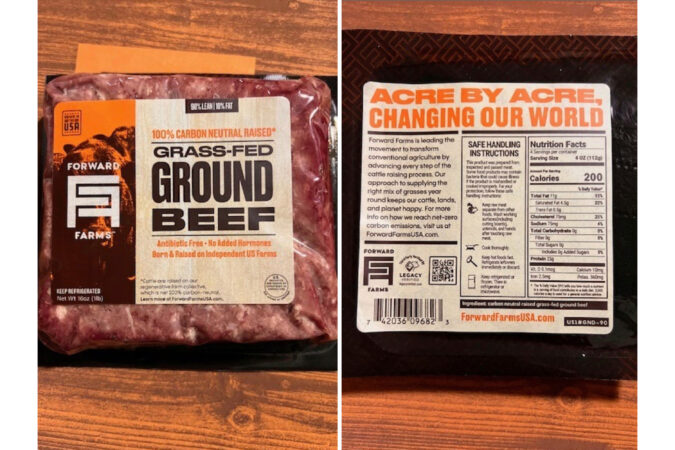
An Idaho-based company is recalling nearly 3,000 pounds of raw ground beef that may have been contaminated with E. coli bacteria.
The recall involves 16-ounce vacuum-sealed packages labeled “Forward Farms Grass-Fed Ground Beef.” Affected packages were produced Dec. 16 and have a label telling customers to use or freeze the meat by Jan. 13. The affected beef also bears the establishment number “EST 2083” on the side of its packaging.
The meat was produced by Heyburn, Idaho-based Mountain West Food Group and was shipped to distributors in Pennsylvania, California, Colorado, Idaho, Montana, and Washington.
The U.S. Department of Agriculture’s Food Safety and Inspection Service, which announced the recall Saturday, didn’t say which retailers may have sold the meat. The USDA and Mountain West Food Group didn’t respond to messages left Tuesday by the Associated Press.
The USDA said there have been no confirmed reports of illness due to consumption of the meat. The issue was discovered in a sample of beef during routine testing.
The USDA said the type of E. coli found can cause illness within 28 days of exposure. Most infected people develop diarrhea, which is often bloody, and vomiting. Infection is usually diagnosed with a stool sample.
The USDA said customers who have purchased the affected products should either throw them away or return them to the place they were bought. The agency also advises all customers to consume ground beef only if it has been cooked to a temperature of 160 degrees Fahrenheit.
In mid-December, the nation’s leading workplace civil rights enforcer took to social media to pose a question: “Are you a white male who has experienced discrimination at work based on your race or sex?”
Andrea Lucas, chair of the Equal Employment Opportunity Commission, appeared in the video, urging those who have to contact the agency “as soon as possible.”
“You may have a claim to recover money under federal civil rights laws,” she says in the video, which has amassed nearly 6 million views on X.
It was an unusual move, because the EEOC does not typically solicit complaints. But it underscores the sea change at an agency central to President Donald Trump’s civil rights agenda —one that began with executive orders gutting the last vestiges of affirmative action, and buttressed by his purge of the EEOC board anda newly installed Republican majority.
Now “fully empowered,” the agency will focus on stamping out “illegal discrimination” stemming from diversity, equity, and inclusion (DEI) programs and “anti-American bias,” Lucas said recently in written responses to questions from the Washington Post. Enforcement, including a heightened emphasis on pregnancy and religious bias, will stress “individual rights over group rights,” she said, and eschew identity politics.
The EEOC’s new priorities come during a year of regulatory uncertainty — it lacked a quorum most of the year, limiting its functions — fueling confusion and uncertainty for employers, workplace experts say. And civil rights advocates contend this pivot detracts from its mission.
“Chair Lucas has chosen to elevate an asserted concern that lacks empirical support as a significant and widespread problem,” a group called EEO Leaderssaid in a statement Dec. 23, “diverting scarce enforcement resources from well documented and pervasive forms of workplace discrimination that harm millions of workers in America today.” The group comprises former EEOC and Department of Labor officials.
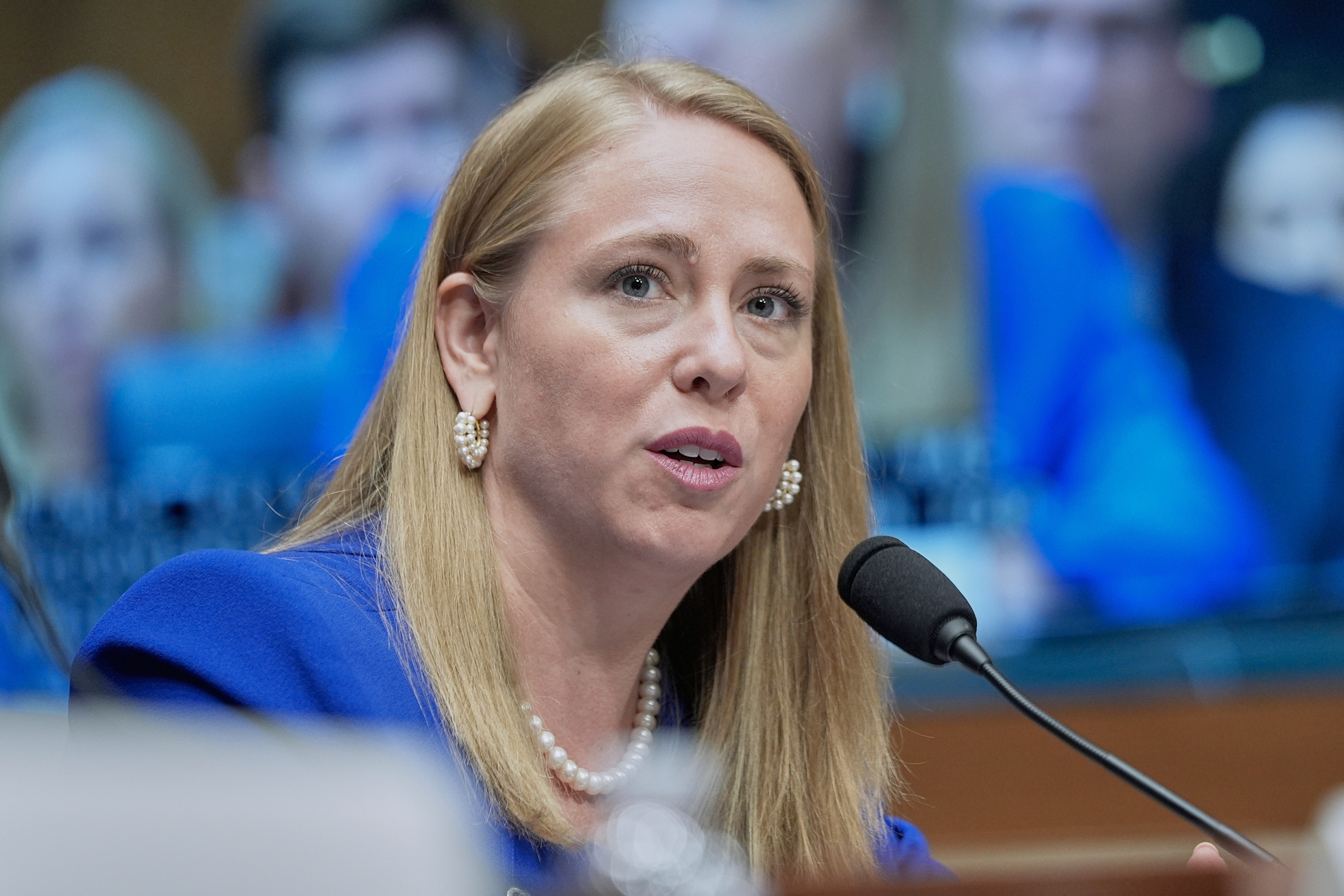
Andrea Lucas, testifying at a June hearing on Capitol Hill, was designated chair of the Equal Employment Opportunity Commission in November, after a 10-month stint as acting chair.
Lucas said her X post reflects the agency’s effort to “correct underreporting” of forms of discrimination that were neglected by the past administration, adding that “for too long, many employees thought they weren’t the ‘right’ kind of plaintiff, that our civil rights laws only protected certain groups, rather than all Americans.”
A restrained year
Founded in 1964 at the height of the Civil Rights Movement, the EEOC is charged with enforcing federal laws that make it illegal to discriminate against a worker or job applicant on the basis of race, sex, religion, age, disability, and other factors. Most employers with at least 15 employees are bound by EEOC regulations, which apply to such workplace practices as hiring, firing, promotions, and wages. The agency has recouped billions in monetary rewards for victims of workplace bias and harassment during the last decade.
Days into his second term — in a break from precedent — Trump dismissed two Democratic members of the independent commission. As a result, it lost the quorum needed to pursue certain cases and overhaul guidance. That changed in October with the appointment of Commissioner Brittany Panuccio, who with Lucas gave the panel a 2-1 GOP majority and a quorum. Commissioner Kalpana Kotagal, a Democrat, rounds out the commission.
In past administrations, the EEOC typically filed 200 to 300 merit lawsuits — those in which the agency determined discrimination exists — a year, said Christopher DeGroff, an employment attorney with the firm Seyfarth Shaw. The 93 merit suits the agency filed in fiscal 2025 marked one of its lowest tallies in three decades, he noted in an analysis of its activity.
Still, the agency’s new priorities were evident in the cases that reached a public resolution or culminated in a lawsuit, DeGroff said. Merit suits alleging discrimination based on race or national origin — historically one of the EEOC’s busiest enforcement areas — hit a decade low in 2025, his research noted. And two of the three cases filed revolved around anti-American bias.
Meanwhile, 37 of the 93 merit lawsuits the EEOC brought pertained to sex or pregnancy discrimination. Of those, 10 were filed under the Pregnancy Discrimination Act and/or the newly enacted Pregnant Workers’ Fairness Act, and included lawsuits against Delta Air Lines and meat processor Smithfield alleging they denied accommodations to pregnant employees.
Religious bias lawsuits were another focus in 2025, with the agency filing 11 merit suits asserting religious discrimination or failure to accommodate religious beliefs. One case was against Apple, over allegations it failed to accommodate a Jewish employee’s request not to work on the weekend due to his faith.
Apple declined to discuss the case but “strongly denied” the claims in a statement to the Post.
Disparate impact
One of the EEOC’s biggest pivots under Trump is to abandon cases filed under disparate impact, a legal theory holding that seemingly neutral policies — such as height or lifting requirements — can have discriminatory outcomes. It stems from the U.S. Supreme Court’s landmark 1971 decision in Griggs v. Duke Power, where attorneys used statistical evidence to show how standardized tests prevented Black employees from advancing at a North Carolina energy company.
Disparate impact is central to civil rights litigation and a key lens though which the EEOC has tackled systemic discrimination, said Jenny Yang, who served as EEOC chair during the Obama administration and worked to expand the agency’s tool kit for addressing systemic discrimination.
In 2020 for example, Walmart settled a nationwide discrimination lawsuit brought by the EEOC over a “physical ability test” it used for grocery workers that “disproportionately excludes female applicants.” Walmart agreed to stop using the test and to pay $20 million into a settlement fund for women who were denied grocery order-filler positions because of the testing.
Disparate impact “advances the core principle that removing unjustified barriers to opportunity helps all Americans thrive,” Yang said.
In April, Trump signed an executive order barring use of disparate impact by agencies, calling it a “pernicious movement” that ignores “individual strengths, effort or achievement.” Dan Lennington, deputy counsel at the Wisconsin Institute for Law and Liberty, a conservative think tank specializing in workplace issues, said the debate reflects the broader ideological divide on how to best protect workers’ civil rights.
“The minute you start saying all Black people this, all Hispanic people this, all women this, you’re just stereotyping,” he added. “The only thing that matters is the individual in front of you.”
Yang said it’s been “challenging” to see the Trump administration make such changes to an agency that historically ” really valued its bipartisanship and its independence to interpret antidiscrimination laws.” By moving away from disparate impact and targeting corporate diversity efforts, Yang said, the EEOC has been “weaponized to intimidate employers, to retreat from efforts designed to promote equal opportunity, and to really abandon its historic mission to protect some of our most vulnerable workers.”
‘Illegal’ DEI
Shawna Bray, general counsel at the Center for Equal Opportunity, a conservative think tank, said that Lucas’ EEOC iscorrecting for past administrations that “used the tools in the toolbox to push things up to, and even over, the line because of their goals,”especially with DEIand other social issues.
DEI refers to practices companies use to ensure equal opportunity in their ranks, from recruiting and mentorship programs to antibias training and employee resource groups. Many companies began reconsidering such policies after the Supreme Court’s 2023 decision rejecting the use of affirmative action in college admissions.
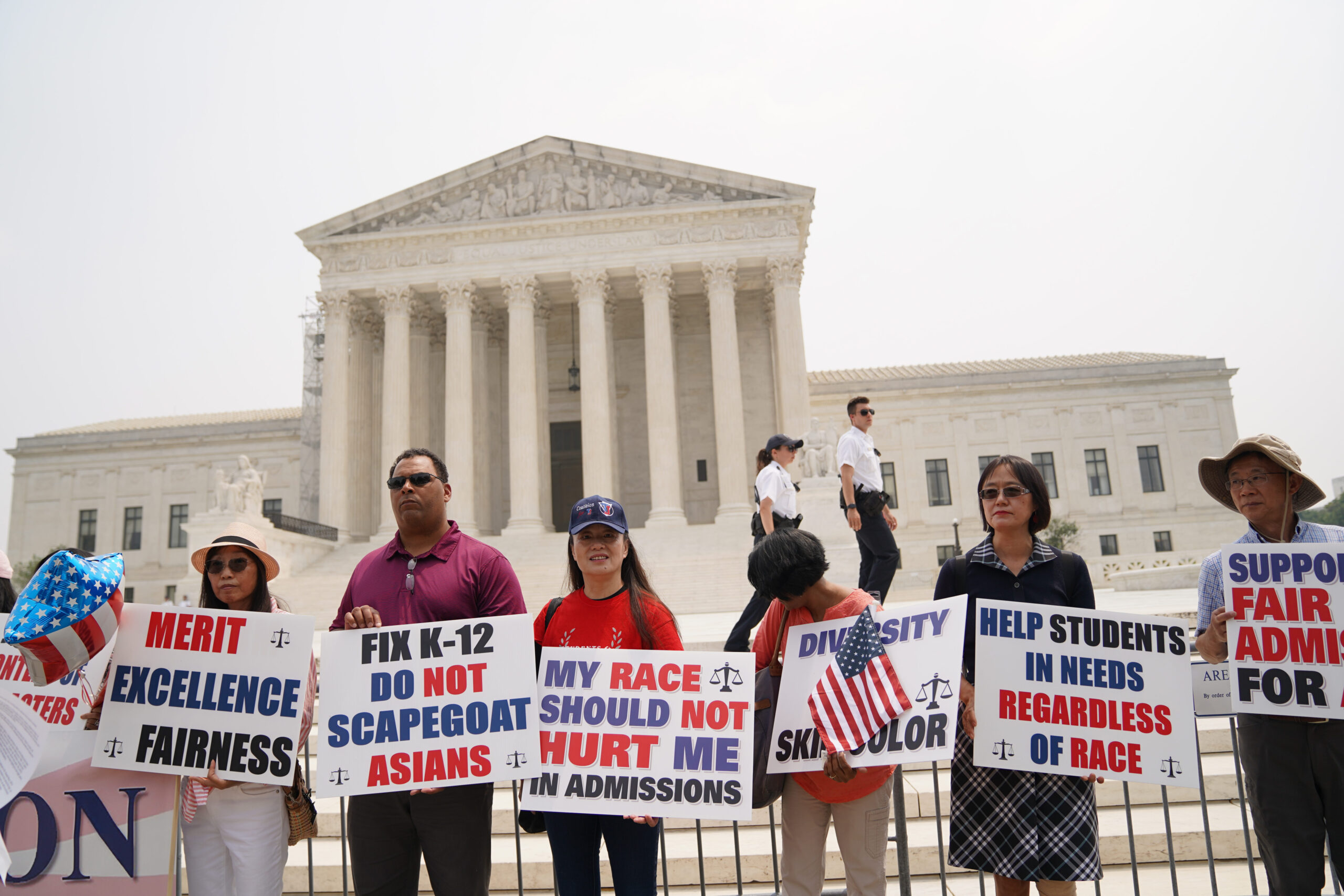
After the Supreme Court struck down the use of racial considerations in college admissions in June 2023, many companies reassessed their diversity, equity and inclusion (DEI) programs.
The ruling sparked a wave of activist lawsuits aiming to replicate the order in the employment sphere. Much of corporate America has since opened identity-based programs, such as fellowships and employee resource groups, to people of all backgrounds, ended efforts like antibias training, and rebranded DEI programs with a focus on “belonging.”
Lucas and others in the Trump administration often refer to “illegal DEI,” but Bray said that she finds the term “a little frustrating” given that such programs only break the law if they show identity-based preference. She also thinks the phrasing has created confusion.
The EEOC should “have in mind an even application of our civil rights,” regardless of factors such as race, gender, and religious background, Bray said. “The desire to put a thumb on the scale was never consistent with that.”
While the agency has yet to file a lawsuit over a workplace DEI program under Lucas, DeGroff expects to see such “cases hit the docket” in 2026.
Valerie Wilson, director of EPI’s Program on Race, Ethnicity, and the Economy, said that priorities like dismantling DEI have “turned the mission of the EEOC on its head, in a way that weaponizes it against the people that it was intended to protect, given the long history of racial discrimination and exploitation” in the United States.
Lucas contends the EEOC is making up for past administrations that “went hunting for activist matters while closing [their] eyes to overt widespread discrimination occurring against groups it disfavored.” Earlier this year, it issued guidance encouraging workers to challenge DEI policies by their employers.
Among possible targets are 20 law firms from which the EEOC said it has requested information about their DEI and hiring practices going back nearly a decade.
Jason Solomon, director of the National Institute for Workers’ Rights, a think tank focusing on private workplace law, wonders whether there is much more for the EEOC to target, given that companies have largely gotten rid of identity-based programs.
“They may look at the changed landscape and say, ‘We can declare victory because we’ve gotten employers to change a lot of what they’ve done,’” Solomon said.
Backing away
Race-discrimination complaints are historically among the most common lodged with the EEOC — 29,000a year on average since 1997, according to a report from EPI — but 2025 marked “the lowest number of race/national origin-based filings by the EEOC in at least a decade,” Seyfarth’s report states.
Two of the lawsuits it pursued alleged bias against U.S.-born workers in favor of foreign ones, DeGroff said. One case involved a hotel and resort in Guam, LeoPalace Guam Corp., which agreed to pay $1.4 million to resolve claims that it favored Japanese workers over those from other countries, including the U.S.
The EEOC also has dismissed cases filed on behalf of transgender workers and stopped processing new gender-identitycomplaints to comply with Trump’s executive orderthat prohibits agencies from using federal funds to support gender-identity issues. It also removed “X” as a gender marker option on its discrimination charge intake form, making it harder for workers whose gender identity does not match their sexat birthto file complaints.
Over the summer, the agency resumed processing some transgender discrimination cases, although the complaints will be subject to a heightened level of review.
The Atlantic City Expressway is set to become the first of New Jersey’s major toll roads to go cashless.
Starting Sunday, drivers on the highway must pay via E-ZPass or be billed by plate, according to the South Jersey Transportation Authority (SJTA).
Drivers who don’t have E-ZPass will be mailed a bill for the toll, plus a 100% surcharge and a $1 administrative fee. Driving the length of the expressway without E-ZPass would cost about $14. The SJTA says the extra charges will help “offset the administrative costs associated with the new billing process.”
If drivers fail to pay the first bill, they will receive another with an extra $5 late fee. If they still don’t pay, it will be considered a toll violation, which can result in fines and a suspension of vehicle registration.
The start of all-electronic tolling on the A.C. Expressway comes after a $77 million multiyear project that replaced the Egg Harbor and Pleasantville barrier toll plazas with overhead gantries that digitally read E-ZPass transponders and license plates. All ramp toll machines were also replaced with gantries.
A cash lane at the Berlin-Cross Keys toll booth on the Atlantic City Expressway as shown in 2022.
With the new system, drivers don’t stop to go through a toll booth; they keep moving, which state officials have said will be safer and more environmentally friendly. It may also result in quicker drives on the 44-mile highway that connects Camden County to the Shore.
The Garden State Parkway and the New Jersey Turnpike are also set to go cashless sometime in the future.
The New Jersey Turnpike Authority’s 2020 long-range capital plan estimated that endeavor would cost $900 million — $500 million for the parkway and $400 million for the turnpike.
A driver pays a toll in cash at the Egg Harbor Toll Plaza on the Atlantic City Expressway in 2022.
Spokespeople for the South Jersey Transportation Authority could not immediately be reached for comment Tuesday regarding whether Atlantic City Expressway toll workers were losing their jobs.
The authority, which runs the expressway, has been using its social media accounts to encourage drivers to get E-ZPass. They can do so online at ezpassnj.com, by phone at 1-888-288-6865, or by stopping at the Customer Service Center at milepost 21.3 on the expressway.
The in-person center is open from 8 a.m. to 3 p.m. Monday, 9 a.m. to 4 p.m. Tuesday through Thursday, and 11 a.m. to 6 p.m. Friday. It is closed on weekends and holidays, including New Year’s Day.
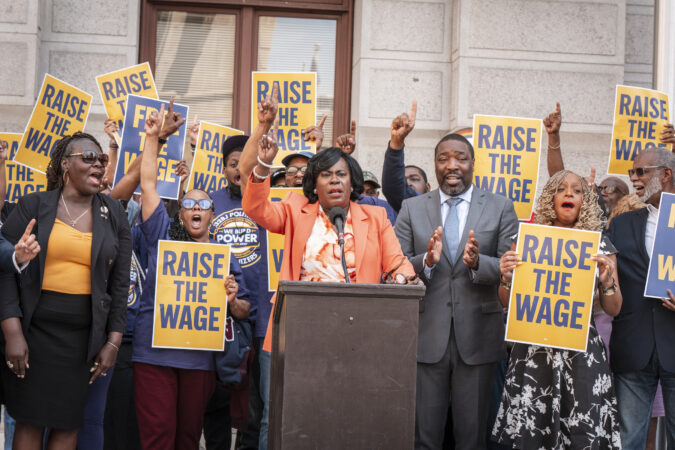
New Jersey’s minimum wage will increase on Thursday.
The new rate of $15.92 an hour is a $0.43 increase from the previous standard, which was set in 2025.
“Eight years ago, Governor Murphy pledged a stronger, fairer economy, and we’re delivering on this commitment by raising New Jersey’s minimum wage again,” Robert Asaro-Angelo, commissioner of the state’s Department of Labor and Workforce Development, said in October. “This increase will provide vital support to all Garden State workers by making the dream of a livable wage reality.”
window.addEventListener(“message”,function(a){if(void 0!==a.data[“datawrapper-height”]){var e=document.querySelectorAll(“iframe”);for(var t in a.data[“datawrapper-height”])for(var r,i=0;r=e[i];i++)if(r.contentWindow===a.source){var d=a.data[“datawrapper-height”][t]+”px”;r.style.height=d}}});
In 2019, New Jersey lawmakers passed legislation to increase the standard to $15 by 2024, joining California, Massachusetts, New York, and the District of Columbia which were also progressively introducing the new standard. At the time, the minimum wage in New Jersey was $8.85 per hour.
A single adult without a child needs to make $26.20 per hour in New Jersey to afford their basic needs as of February 2025, according to a living wage calculator developed at the Massachusetts Institute of Technology.
Agricultural workers in New Jersey have a separate wage standard and will see an increase from $13.40 to $14.20 in January.
For tipped workers, the minimum hourly wage will increase from $5.62 to $6.05. But when combined with their tips, these workers should have a total hourly wage of at least $15.92.
Employees at seasonal and small businesses will see wages rise from $14.53 to $15.23. The state has a different scale for these employers to lessen the impact of the raises.
What’s the minimum wage in Pennsylvania?
Pennsylvania’s minimum wage has gone unchanged since 2009, despite efforts to increase it. The federal minimum wage was last increased in 2009 to $7.25.
In Pennsylvania, a single adult without a child needs to make $22.91 per hour to afford their basic needs, according to the MIT calculator.
As of July, other states following the federal minimum wage were: Idaho, Utah, Kansas, Oklahoma, Texas, North Dakota, Iowa, Wisconsin, Indiana, Kentucky, North Carolina, and New Hampshire.
Advocates have also sought legislation to allow Philadelphia to set its own minimum wage separate from the state’s. That’s currently prohibited by law.
The Trump administration made sweeping changes in 2025, leading to layoffs, resignations, and early retirements.
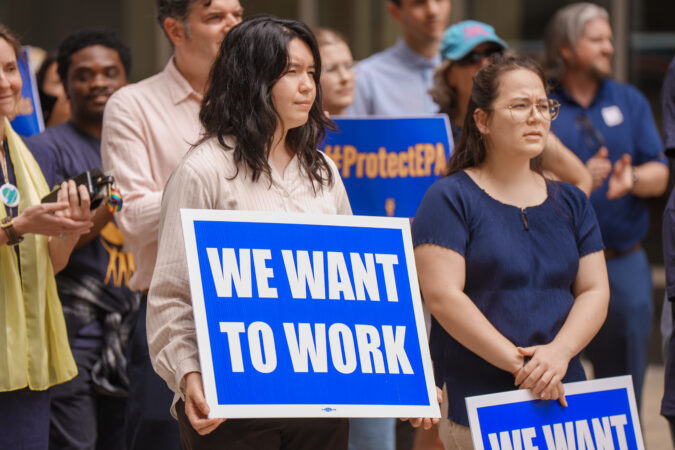
Employees and supporters at a Philadelphia rally for EPA workers being put on leave after signing a letter critical of the Trump administration on July 9, 2025.Jessica Griffin / Staff Photographer
For many federal workers, 2025 has been a year of massive change in the workplace. And for thousands of them, it was the year they quit working for the U.S. government.
That’s the result of the Trump Administration’s efforts to shrink and reshape the federal workforce through a deferred resignation program called “Fork in the Road.” First offered in January, it allowed employees to resign and stay on government payrolls through Sept. 30.
If they didn’t resign, they were told, there was no assurance their job would still be around.
After the “Fork in the Road” offer, President Donald Trump’s administration continued to shake up the federal workforce, with moves including layoffs, dismantling federal worker unions, and overhauling workplace policies.
Here’s a look back on how these changes have impacted Philadelphia-area federal employees this year.
President Donald Trump signs executive orders in the Oval Office at the White House on Jan. 20 after his inauguration. Credit: Jabin Botsford/The Washington PostJabin Botsford
Elon Musk during a trip with President Donald Trump to the NCAA Division I Men’s Wrestling Championship at the Wells Fargo Center in Philadelphia.Elizabeth Robertson / Staff Photographer
DOGE was tasked with reducing government spending and streamlining bureaucracy by July 4, 2026, encouraging mass layoffs and upheaval within the federal government.
Jan. 28
Trump administration offers a new resignation program
Federal workers received an email directly from the U.S. Office of Personnel Management (OPM), the government’s human resources agency, offering the opportunity to resign while continuing getting paid for several months. The agency encouraged federal workers to go from “lower productivity jobs in the public sector to higher productivity jobs in the private sector.”
Protestors hold signs at the Save Our Services day of action event at Independence Mall in Philadelphia on Feb. 19. They gathered to protest Elon Musk's push to gut federal services and impose mass layoffs.Elizabeth Robertson / Staff Photographer
Local workers and supporters gathered in subfreezing temperatures near Independence National Historical Park to protest the layoffs and other workforce shakeups.
On Feb. 26, a memo from OPM and the Office of Management and Budget gave agencies a March 13 deadline for submitting additional layoff and reorganization plans.
Musk said in a post on X that not responding to the email would be seen as a resignation, but some members of the Trump’s administration later said responding was voluntary.
March 5
Pa. government looks to hire federal workers
Gov. Josh Shapiro signed an executive order to streamline the hiring process for former federal employees. Nearly two weeks later, hundreds had applied.
Gov. Josh Shapiro delivers his budget address in February 2025.Tom Gralish / Staff Photographer
story continues after advertisement
March 7
Trump administration starts stripping union rights
The Department of Homeland Security canceled union rights for Transportation Security Administration employees. TSA union leaders and workers at the Philadelphia International Airport said the change caused morale to plummet.
TSA worker Devone Calloway at the Philadelphia International Airport soon after DHS revoked TSA employees' collective bargaining rights.Jose F. Moreno / Staff Photographer
A few weeks later, Trump issued an executive order to end union rights for federal workers across agencies, and union dues stopped being deducted from worker paychecks.
April 2
State officials express concerns over federal layoffs in Pa.
“What we’re seeing right now, in the last 72 days, is an unprecedented assault on organized labor, on working people, on working families and on Pennsylvanians of all different political stripes, from every single corner of our commonwealth,” said state Rep. Malcolm Kenyatta (D., Philadelphia) at a hearing. “It is an attack on their ability to have access to the necessary government services that they depend on every single day.”
Andrew Kreider, an environmental protection specialist at the EPA's Region 3 office, holds a sign reading “Thank You EPA” at a solidarity march around City Hall on March 25.Tyger Williams / Staff Photographer
In a late Friday email, the IRS asked employees to share their resumes so leaders could “determine [their] qualifications.” That included over 3,600 employees from the agency’s office at 30th and Market Streets.
IRS Union Rep. Alex Jay Berman, in front of the Philadelphia IRS building at 30th and Market Streets in April 2025.Jessica Griffin / Staff Photographer
April and May
Philly’s understaffed National Park Service faces “workforce optimization”
NPS workers were asked in late April to upload their resumes amid plans for “workforce optimization.” But administrative staff had already left the regional office in Philadelphia, leaving others to take on their work. At Independence National Historical Park, staffing was an issue even before the start of the second Trump administration, workers said.
At Independence National Park, a ranger casts shadow as they walk along S. 6th Street at Market Street in June.Alejandro A. Alvarez / Staff Photographer
“To work well, to perform, you have to be happy, you have to enjoy what you’re doing,” said Ed Welch, president of AFGE Local 2058, which represents employees at the NPS in Philadelphia. “There’s a horrible oppressiveness in government now, and it‘s unnecessary.”
story continues after advertisement
May 5
Philly-based VA workers return to offices full-time
Following orders from the VA, employees started coming in to work in-person full time but found challenges including insufficient parking and concerns about the confidentiality of work in a shared space.
Theresa Heard attends a rally of VA employees at the VA Medical Center in West Philadelphia in June 2025.Jessica Griffin / Staff Photographer
During a February protest in Philadelphia, retired federal worker Roseanne Sarkissian of Philadelphia holds a sign showing Elon Musk and the phrase “This man is not our boss.”Elizabeth Robertson / Staff Photographer
DOGE, Musk said, is “like a way of life.” The agency remains part of Trump’s government.
Late May
Laid-off employees return to work
Workers who’d been laid off across agencies were reinstated and placed on administrative leave following court rulings. As of late May, the “vast majority” of several hundred Philly-area IRS workers, who lost their jobs in the probationary worker layoff were back at work, union leader Alex Jay Berman estimated.
Yolanda Cowan, Mayra Gonzalez, and Michael Rosado were among the Philadelphia IRS workers who lost their jobs when probationary employees were laid off in February. Here, in February, they posed for a selfie outside the IRS offices.Tom Gralish / Staff Photographer
June 1
Over 100 federal workers find work for the Pa. government
By the first week of June, the state had hired 119 former federal employees across 22 agencies, according to Daniel Egan, a spokesperson for the Pennsylvania Office of Administration.
July 7
VA cancels mass layoffs after many employees leave voluntarily
The VA said it would forgo plans to cut the workforce by 15% after about 17,000 people left through the deferred resignation program, retirement and other attrition. The agency was on pace to have 30,000 fewer employees by the end of the 2025 fiscal year.
A rally of VA employees at the VA Medical Center in West Philadelphia on June 5, 2025.Jessica Griffin / Staff Photographer
August
Federal agencies cancel union contracts
Employees at the VA, the EPA, the U.S. Citizenship and Immigration Services, the Department of Agriculture (USDA), and the Federal Emergency Management Agency (FEMA) are stripped of their union contracts.
Brad Starnes, president of American Federation of Government Employees Local 3631, which represents EPA employees in Pennsylvania, Delaware and several other mid-Atlantic states.Jessica Griffin / Staff Photographer
story continues after advertisement
September
Thousands have left federal government employment
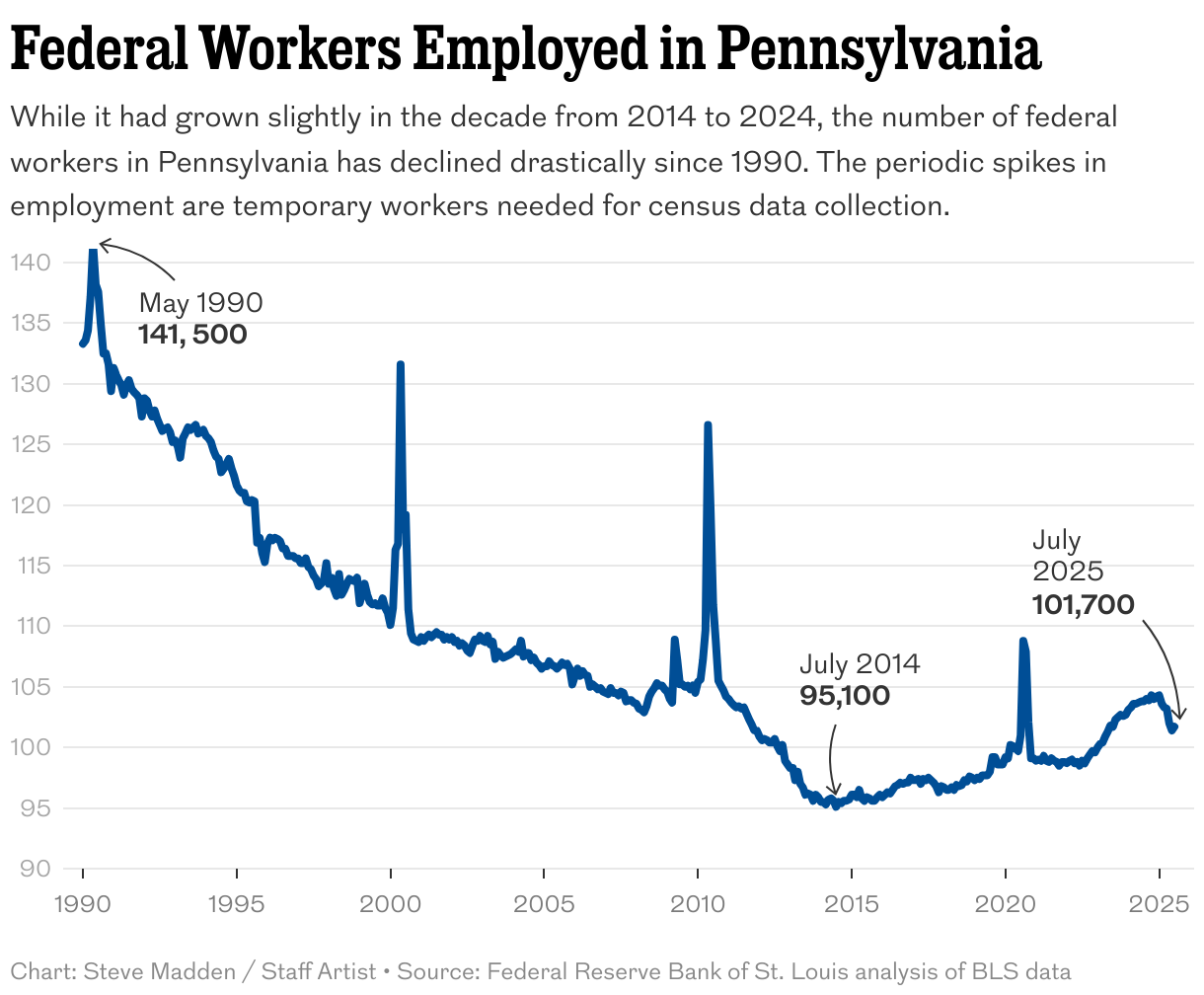
A few weeks before deferred resignations were expected to drop off payroll, new data showed the scope of the workforce shrinkage through mid-2025. In Pennsylvania, there were 2,600 fewer federal workers by the end of July than at the start of 2025.
Meanwhile, media reports said the government planned to call back some employees who took the deferred resignation program at the IRS and the U.S. Department of Labor.
Sept. 24
White House threatens mass firings if shutdown occurs
Federal agencies were asked to prepare plans to fire workers if legislation is not passed to keep the government open past Oct. 1. Philadelphia-area union leaders said they would push back on this effort, even as the Trump administration has moved to curtail their collective bargaining rights.
Oct. 1
A federal government shutdown begins
Lawmakers were unable to reach a deal to keep the government open, causing a shutdown. Agencies shared plans for how many employees were expected to continue working without pay and how many would be sent home on furlough. Air traffic controllers and TSA agents at Philadelphia International Airport, continued to work and so did employees at Philadelphia’s Social Security Administration building at Third and Spring Garden.
The Liberty Bell Center is closed Oct. 1, 2025 in Independence National Historical Park due to the federal government shutdown.Tom Gralish / Staff Photographer
Mid to late October
Unemployment claims increase in Pa. and N.J.
Uncertain when their next paycheck would arrive, federal workers applied to SNAP, put their mortgage payments on hold, negotiated with utility companies, and cut back on costs. At PHL, a food pantry was set up for airport government employees impacted by the shutdown. It served some 250 employees in its first two days.
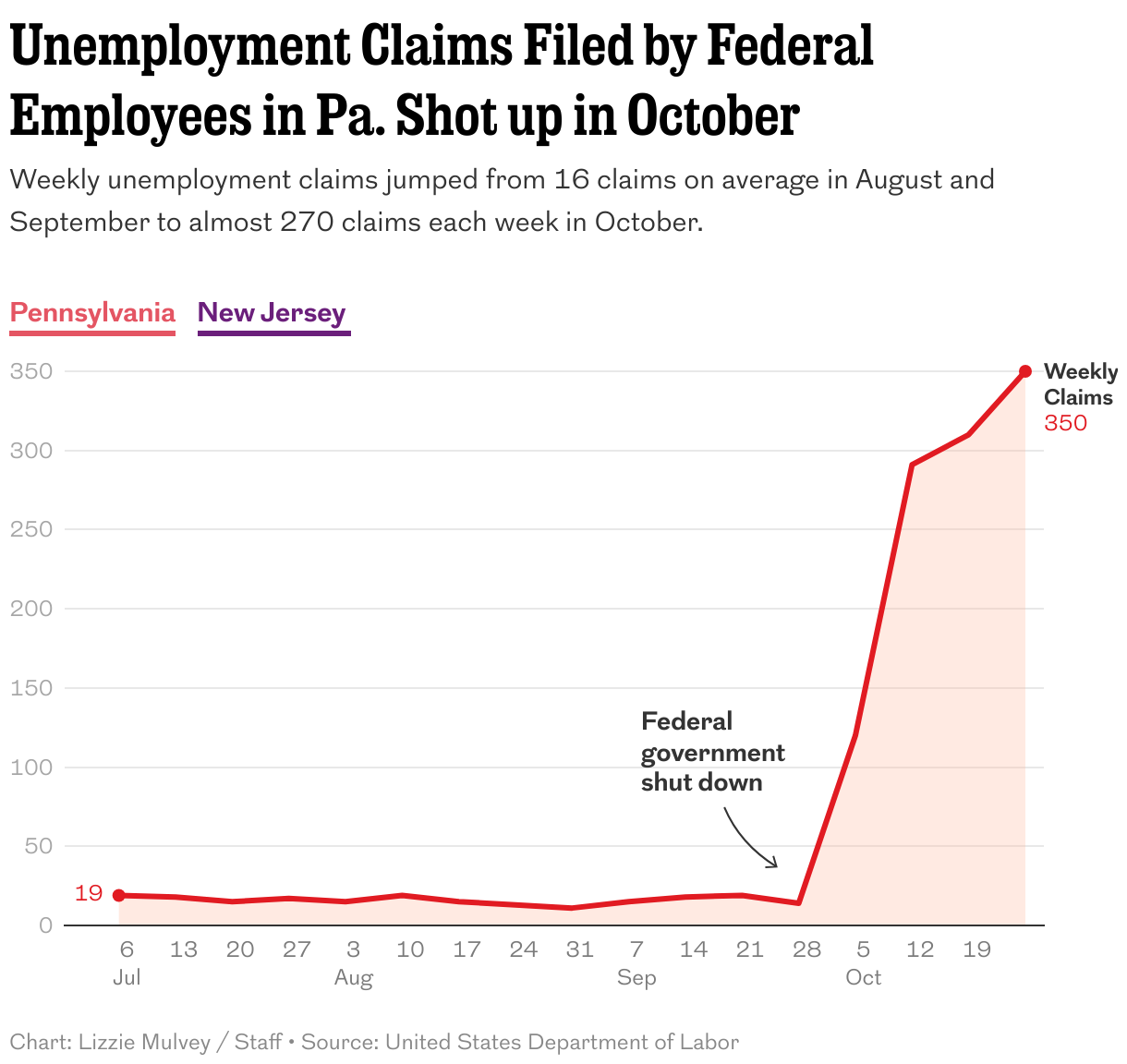
Many federal workers in Pennsylvania and New Jersey filed for unemployment benefits.
Nov. 12
The end of the longest shutdown in history
Lawmakers reached a deal to reopen the government and keep it funded through Jan. 30, and President Donald Trump signed the legislation. The shutdown lasted 43 days, making it the longest in the country’s history.
The deal included protections from mass layoffs through Sept. 2026, and reversal of firings made during the shutdown — the administration sent 4,000 layoff notices during that time. Still, some worried about another potential government shutdown after Jan. 30.
December
Data on impact of resignations is still to come
Workers who took the government’s deferred resignation offer were expected to drop off federal payroll after Sept. 30, and be reflected in employment data from the Bureau of Labor Statistics.
Amid the shutdown, federal data releases were canceled or delayed. Insight on how many people have left the federal government since September is now expected in January.
story continues after advertisement
Staff Contributors
Reporting: Ariana Perez-Castells and Fallon Roth
Editing: Lizzy McLellan Ravitch and Erica Palan
Digital editing: Lizzy McLellan Ravitch
(()=>{var K=(e,t)=>()=>(t||e((t={exports:{}}).exports,t),t.exports);var A=K(r=>{var Q={0:”Jan.”,1:”Feb.”,2:”March”,3:”April”,4:”May”,5:”June”,6:”July”,7:”Aug.”,8:”Sept.”,9:”Oct.”,10:”Nov.”,11:”Dec.”};function L(e){return e===void 0&&(e=new Date),Q[e.getMonth()]}var X={0:”Jan”,1:”Feb”,2:”Mar”,3:”Apr”,4:”May”,5:”Jun”,6:”Jul”,7:”Aug”,8:”Sep”,9:”Oct”,10:”Nov”,11:”Dec”};function b(e){return e===void 0&&(e=new Date),X[e.getMonth()]}function s(e){return e==null}function T(e){return typeof e==”number”&&isFinite(e)}function f(e){return T(e)&&Math.floor(e)===e}var ee=[“one”,”two”,”three”,”four”,”five”,”six”,”seven”,”eight”,”nine”],te=[“million”,”billion”,”trillion”,”quadrillion”,”quintillion”,”sextillion”,”septillion”,”octillion”,”nonillion”,”decillion”],S=[“th”,”st”,”nd”,”rd”,”th”,”th”,”th”,”th”,”th”,”th”],ne=[11,12,13];function M(e){if(s(e))return””;var t=+e;return f(t)?ne.indexOf(t%100)>-1?S[0]:S[t%10]:””}var oe=[“first”,”second”,”third”,”fourth”,”fifth”,”sixth”,”seventh”,”eighth”,”ninth”],ie=new RegExp(/s+([^s]*)s*$/);r.apdate=function(e){return e===void 0&&(e=new Date),L(e)+” “+e.getDate()+”, “+e.getFullYear()},r.apdatetab=function(e){return e===void 0&&(e=new Date),b(e)+” “+e.getDate()+”, “+e.getFullYear()},r.apmonth=L,r.apmonthtab=b,r.apnumber=function(e){if(s(e))return””;var t=+e;return f(t)?t=10?e.toString():ee[t-1]:e.toString()},r.aptime=function(e){e===void 0&&(e=new Date);var t,n,o=e.getHours(),i=e.getMinutes(),u=i===0;if(u){if(o===0)return”midnight”;if(o===12)return”noon”}return o0?o:12):(t=”p.m.”,n=o===12?o:o-12),u?n+” “+t:n+”:”+(i<10?"0"+i:i)+" "+t},r.capfirst=function(e){if(s(e))return"";var t=String(e);return""+t.charAt(0).toUpperCase()+t.slice(1)},r.intcomma=function(e){if(s(e))return"";var t,n=+e;return T(n)?((t=n.toString().split("."))[0]=t[0].replace(/B(?=(d{3})+(?!d))/g,","),t.join(".")):e.toString()},r.intword=function(e){if(s(e))return"";var t=+e;if(!f(t))return e.toString();var n=Math.abs(t);if(n<1e6)return e.toString();var o=Math.ceil(Math.log(n+1)/Math.LN10)-1,i=o-o%3,u=t/Math.pow(10,i);return(u=Math.round(10*u)/10)+" "+te[Math.floor(i/3)-2]},r.ordinal=function(e,t){if(t===void 0&&(t=!1),s(e))return"";var n=+e;return f(n)?t&&n/Android|webOS|iPhone|iPad|iPod|BlackBerry|IEMobile|Opera Mini/i.test(navigator.userAgent);var g=(e,t=null,n=null)=>{n||(n=document.querySelector(“head”));let o=document.createElement(“script”);o.type=”text/javascript”,o.src=e,t&&(o.onload=t),n.appendChild(o)},q=()=>(window.PMNdataLayer?.[0]!==void 0&&window.PMNdataLayer[0])?.analytics?.user?.state===”Subscribed”,k=()=>{let t=(window.PMNdataLayer?.[0]!==void 0&&window.PMNdataLayer[0])?.analytics?.user?.state;return window.location.host.includes(“zzz-systest”)||window.location.host.includes(“pmn.arcpublishing.com”)||window.location.host.includes(“stage.fusion.inquirer.com”)||typeof t>”u”},j=()=>{let t=(window.PMNdataLayer?.[0]!==void 0&&window.PMNdataLayer[0])?.analytics?.user?.hasAdsFreeReading;return!!(t&&t==1)},v=()=>window.location.host.includes(“localhost”);var re=()=>{j()&&document.querySelectorAll(“.js-adbox”).forEach(t=>{t.classList.add(“is-hidden”)})},H={init:()=>{re()}};var a,y=!1,se=()=>{a=document.querySelector(“.js-appendix”)},C=()=>{let e=document.querySelector(“.js-appendix-static-content”),t=e.querySelector(“.js-appendix-static-items”).getBoundingClientRect().height;e.classList.remove(“is-collapsed”),e.style.maxHeight=t+”px”},B=()=>{a.classList.contains(“js-appendix-sticky”)&&(a.getBoundingClientRect().top{y=document.querySelector(“.js-appendix-static-content”).getBoundingClientRect().bottom{y&&document.querySelector(“body”).classList.toggle(“is-open-appendix”)},ae=()=>{window.addEventListener(“scroll”,()=>{B(),D()}),window.addEventListener(“resize”,()=>{B(),D()}),document.querySelector(“.js-appendix”).addEventListener(“click”,()=>{P()}),document.querySelectorAll(“.js-appendix-expand-static”).forEach(e=>{e.addEventListener(“click”,()=>{C(),window.addEventListener(“resize”,()=>{C()})})}),document.querySelectorAll(“.js-appendix-link”).forEach(e=>{e.addEventListener(“click”,()=>{P()})})},N={init:()=>{se(),ae()}};var m,ce=(e,t)=>{m=m||window.PMNdataLayer,m?m.push({event:”misc_event”,eventAction:e,eventLabel:t}):window.location.hostname.includes(“localhost”)?console.log(“Analytics event:”,e,t,”(not actually being sent due to localhost)”):console.log(“Failed to push analytics event”,e,t)},I={event:(e,t)=>{ce(e,t)}};var le=()=>{document.querySelectorAll(“.js-card-show-more”).forEach(e=>{e.addEventListener(“click”,()=>{de(e)})})},de=e=>{let t=e.closest(“.js-card”),n=t.querySelector(“.js-card-body”),i=n.querySelector(“.js-card-body-content”).getBoundingClientRect().height;t.classList.remove(“is-collapsed”),n.style.maxHeight=i+”px”,setTimeout(()=>{n.style.maxHeight=”none”},1e3),I.event(“expand_card”,`${t.dataset.id}`)},F={init:()=>{le()}};var c,$,ue=()=>{c=document.getElementById(“js-inno-toast”)},pe=e=>{if(!c)return;c.innerHTML=e,c.classList.add(“is-active”);let t=()=>{c.addEventListener(“transitionend”,fe,{once:!0}),c.classList.remove(“is-active”)};clearTimeout($),$=setTimeout(t,5e3)},fe=()=>{c.innerHTML=””},l={init:()=>{ue()},showToast:pe};var h,z=!1,me=async()=>new Promise(e=>{setTimeout(()=>{console.log(“simulating createShareLink for localhost”),e(“https://inquirer.com/interactives”),he()},100)}),he=()=>{let e=document.querySelector(“.js-gift-toast-receiver”);!e||!(e instanceof HTMLElement)||setTimeout(()=>{let t=e?.querySelector(“span”);t&&(t.innerHTML=”Gift link copied to clipboard“)},20)},ge=()=>{let e=window.services?.createShareLink;e&&(h=e),v()&&(h=me),h&&ye()},ve=async e=>{let t=”text/plain”,n=async()=>{try{return await h(window.location.pathname)}catch{e.dataset.state=”error”,l.showToast(“Hmm, we couldn’t generate a gift link…”)}},o=new ClipboardItem({[t]:n()});await navigator.clipboard.write([o]).catch(i=>{console.log(i),l.showToast(“Couldn’t copy to clipboard, try again?”),e.dataset.state=”error”}),l.showToast(“Gift link copied to clipboard!”),e.dataset.state=”complete”},ye=()=>{document.querySelectorAll(“.js-gift”).forEach(t=>{(q()||v()||k())&&t.classList.add(“is-available”)}),document.querySelectorAll(“.js-gift-button”).forEach(t=>{t instanceof HTMLButtonElement&&t.addEventListener(“click”,()=>{t.classList.contains(“disabled”)||(t.dataset.state=”loading”,z=!0,ve(t),setTimeout(()=>{t.dataset.state=”ready”},2e3))})});let e=document.querySelector(“.js-gift-toast-receiver”);!e||!(e instanceof HTMLElement)||we(e)},we=e=>{new MutationObserver(n=>{for(let o of n){let i=[…o.addedNodes].at(0);if(!(i instanceof HTMLElement))return;z&&l.showToast(i.outerHTML)}}).observe(e,{subtree:!0,childList:!0})},O={init:()=>{ge()}};var xe=()=>{window.addEventListener(“message”,e=>{if(e.data[“datawrapper-height”]){let t=e.data[“datawrapper-height”];for(let n in t)document.querySelector(`#datawrapper-chart-${n}`).setAttribute(“height”,t[n])}})},Le=()=>{document.querySelectorAll(“.js-datawrapper-graphic”).forEach(e=>{g(`https://datawrapper.dwcdn.net/${e.dataset.id}/embed.js`,null,e)})},be=()=>{window.addEventListener(“message”,e=>{let t=e.data;document.querySelectorAll(`iframe[src*=”${t.id}”]`).forEach(o=>{o.style.height=`${t.height}px`})},!1)},Se=()=>{document.querySelectorAll(“.js-pym-graphic”).forEach(e=>{if(typeof window{new window.pym.Parent(e.id,e.dataset.iframe)};typeof window.pym>”u”?g(“https://pym.nprapps.org/pym.v1.min.js”,t):t()}})},R={init:()=>{xe(),Le(),Se(),be()}};var p,Me=()=>{document.querySelectorAll(“.js-hover”).forEach(e=>{e.addEventListener(“click”,()=>{J(e)}),e.addEventListener(“mouseenter”,()=>{J(e)}),e.addEventListener(“mouseout”,()=>{V(e)})}),window.addEventListener(“scroll”,()=>{p!==null&&Te()})},Te=()=>{(p>window.scrollY+100||p{V(e)})},J=e=>{e.classList.add(“is-visible”),p=window.scrollY},V=e=>{e.classList.remove(“is-visible”),p=null},G={init:()=>{Me()}};var d,w,x=!0,Ae=()=>{d=document.querySelectorAll(“.js-video-autoplay”)},Ee=()=>{window.addEventListener(“resize”,()=>{W()}),window.addEventListener(“scroll”,()=>{W()}),d.forEach(e=>{e.addEventListener(“volumechange”,t=>{e.muted!==x&&!E()&&(x=e.muted,qe())})})},W=()=>{let e;d.forEach((t,n)=>{let o=t.getBoundingClientRect(),i=o.height/2;o.y-i&&(e=t)}),e!==w&&(w=e,d.forEach(t=>{t.pause()}),e?e.play():w=null)},qe=()=>{d.forEach(e=>{e.muted=x})},Y={init:()=>{Ae(),d&&Ee()}};var _={init:()=>{H.init?.(),N.init?.(),F.init?.(),O.init?.(),R.init?.(),G.init?.(),Y.init?.(),l.init?.()}};var ke=()=>{},U={init:()=>{ke()}};var je=document.querySelector(“.js-inno”),Z=()=>{_.init(),U.init()};je?Z():new MutationObserver((t,n)=>{if(document.querySelector(“.js-inno”)){n.disconnect(),Z();return}}).observe(document,{attributes:!0,childList:!0,subtree:!0});})();
Tianna Williams didn’t finish high school after becoming a mom at 16. As a teen dropout, she began flipping cars to make money, and by her late 20s, her car sales acumen led her to open a dealership in Lehigh Valley that grossed over $1 million in annual sales.
An opportunity to get a line of credit with one of the nation’s largest banks turned Williams’ dream into a nightmare, she said, which led the 30-year-old to file a lawsuit.
M&T Bank opened a fraud investigation into Williamsin spring 2023, says the suit filed in Common Pleas Court in Philadelphia in March. The bank inappropriately informed her financial partners that her business could be illegitimate, the complaint says. The bank froze her account, her partners cut ties, and her checks bounced. Williams’ growing businesses crashed.
The investigation found no fraud, M&T lawyers said in a September hearing. But Williams says the damage was done.
The complaint says the Black entrepreneur was a victim of the bank’s “racist and overzealous fraud investigator” who tormented the business owner for weeks. The investigator told Williams “you people” have ways of making fraudulent behavior seem legitimate, the suit says.
Despite eventually finding no fraud, the investigator shared an email with a colleague,signed with a smiley-face emoji, saying “doing my best to not let her win on my watch.”
“She killed my self-esteem,” Williams said of the investigator. “I lost all financial security.”
The phenomenon of Black people being treated with suspicion by financial institutions has been dubbed “banking while Black” and has a history going back at least to the 1930s, when red lines on maps labeled majority-Black neighborhoods as unworthy of mortgages. More subtle variations of the practice have continued into the 21st century, resulting in settlement agreements for millions of dollars.
Williams’ rags-to-riches story began in 2012, when she became pregnant at the age of 16. Her mother had recently been diagnosed with cervical cancer, and the family barely scraped by. After dropping out of high school before completing 10th grade, Williams learned how to flip cars from auctions with the help of a mentor she met through Facebook.
Her first car: a 2002 Lincoln that as a 17-year-old she sold the next day for a $700 profit.
The young hustler with a knack for sales got her auction license a couple of years later. She kept selling cars on Craigslist and through other social media connections. In 2018, she began working at an auto dealership. She learned the trade and became especially good at working with people who had low credit scores.
Williams’ cut from each sale at the dealership was a fraction of the overall profit, so she decided to go it alone. She bought a lot in Easton in 2020 and set to work. The cars she sold became newer and more expensive.
Tianna Williams next to the sign of her car dealership in Easton.
To sell cars for more than a couple of thousand dollars, Williams needed to offer financing options. She got her banking license and contracted with lenders. Her business was booming and she was planning to open a second location.
That’s when Shazard Mohammed from M&T reached out, the complaint says. He offered Williams a line of credit that would allow her to take her business to the next level, and she transferred her accounts to the bank.
Within days, Williams’ lenders contacted her to say they could no longer offer her financing because she was being investigated by M&T for fraud. Nearly overnight, she was without a business while owing about $200,000 in business and tax debts.
“M&T BANK basically told me that they suspected you of fraud,” one business partner told Williams in a text message, according to the complaint. “If that’s not true, then somebody really has it out for you.”
Records fight
The bank is now fighting in court to keep documents related to the investigation secret, despite an attorney representing M&T saying in a September hearing that “there was no finding of fraud,” according to a transcript.
M&T said in that hearing that Williams was investigated because of “red flags,” such as misspellings on checks that were immediately withdrawn as cash, and that the investigation lasted only seven days.
Common Pleas Court Judge Paula Patrick sanctioned the bank’s lawyers in October for their failure to produce documents and ordered them to pay nearly $8,000 in attorneys’ fees. The judge also found that most records should not be sealed. M&T is appealing the ruling.
Dean Malik, the attorney representing Williams, frames the case as a fight of David vs. Goliath. By issuing sanctions, he said, the judge reminded large entities that in court the playing field is leveled.
“The judge is sending a message that it doesn’t matter if you are a billion-dollar bank and have two law firms representing you with five lawyers, you are still bound by the orders of the court,“ Malik said.
Williams now cleans houses with her mother to support her family financially. She said her self-esteem has been shattered, and she hasn’t set foot inside a bank out of fear since her business closed in 2023.
“There is nothing else I know how to do,” Williams said. “All I know is cars.”
At CES, the annual consumer technology conference happening in Las Vegas next week, the biggest names in tech, including Nvidia Corp., Advanced Micro Devices Inc., Samsung Electronics Co. and Lenovo Group Ltd., will make the case for artificial intelligence. Their target audience those few days: investors, corporate clients, and — perhaps just as importantly — ordinary shoppers who have yet to be fully sold on the idea of AI-infused gadgets.
CES, which runs from Jan. 6-9, is where many tech companies unveil their wares for the year. That includes a mix of products that are imminently available for purchase, and concept devices that may or may not go to market — and could be half-baked if they do. While Nvidia CEO Jensen Huang is likely to be the most charismatic showman in Vegas hyping AI’s underlying technologies, he’ll be surrounded by a slew of players that are testing consumers’ appetite for gadgets where AI isn’t just a nice-to-have feature, but the main selling point.
The show floor this year will be particularly populated with AI-powered hardware, including the sort of smart glasses popularized by Meta Platforms Inc. and that Snap Inc. and Apple Inc. are planning to launch by the end of 2026. While Meta and Snap will both have a presence at CES, the bulk of the news in this space is likely to come from smaller brands, such as Xreal Inc., Vuzix Corp., Halliday Global Ltd., Rokid, and Even Realities.
Meta isn’t expected to unveil new hardware at this time, having recently debuted its first smart glasses with a built-in screen. It is possible, however, that the social media giant is ready to show off some new or improved software features. It’s a similar story for Snap, which isn’t likely to choose this venue to announce pricing and availability for its forthcoming “Specs” glasses. The Specs will be on display for attendees who haven’t had a chance to see them in person, which has so far mostly included select media outlets.
In addition to eyewear, such as glasses and goggles, some of these gadgets will take the form of a ring or something else entirely — underscoring that start-ups and Big Tech alike remain bullish on AI-first hardware that lets people tap into intelligent assistants without necessarily taking out their smartphone. Previous offerings, including the Humane AI Pin and the Rabbit R1, were commercial failures after being panned by tech reviewers.
Robots everywhere
Many companies will also be testing consumers’ readiness to accept AI-powered humanoid robots. There will be so many players, in fact, that the Consumer Technology Association, or CTA, which organizes CES, has set aside an entire hall of the convention space for robotics. While some of these robots are intended for the home, many of the models on display will be designed for enterprise uses such as manufacturing, logistics, and food service. Firms such as Artly Coffee and VenHub Global will show off technology for AI-powered robotic cafes and convenience stores.
Companion robots will be a common sight as well, including products such as the Jennie robot dog from Tombot Inc., a California-based start-up focused on developing products for aging adults and people living with dementia.
If 2026 is similar to previous shows, there’s likely to be a sizable gap between what many of these human-inspired bots are capable of in controlled demos vs. what their makers promise they’ll eventually be able to do.
Still, there are signs of progress. Many humanoid makers this year are shifting from single-task demonstrations to more complex, multistep tricks, such as both sorting and folding laundry. Larger players, including LG, are expected to tease their own humanoid concepts, but the companies will need to convince attendees that these machines are commercially viable amid ongoing challenges around battery life, mobility, cost, and safety.
Everything else
Above all other categories, televisions have traditionally been the centerpiece of CES, with Samsung, LG, and ascendant Chinese competitors TCL and Hisense showing off their brightest, biggest sets for the new year. Sony Group Corp., once a cornerstone of the convention show floor, has moved its TV product announcements to spring in recent years and pared back its booth as a result.
In 2026, with high-end TVs now delivering more than enough brightness and resolution for most consumers, manufacturers are likely to focus on wider color reproduction and other improvements that result in a more vivid, lifelike picture. Aesthetically pleasing models like Samsung’s The Frame line have inspired a wave of clones from other TV makers, a trend that’s likely to continue in Vegas.
CES typically isn’t a venue for major smartphone news, but Motorola could be an exception this year. Its parent company, Lenovo, is headlining one of the show’s evening keynotes for the first time, and Motorola mailed a teaser package to media that strongly hints at a book-style foldable. Such a device would be its first of that form factor after years of releasing Razr-branded folding handsets.
Meanwhile, wearables will continue to evolve beyond basic fitness tracking, blurring the lines with medical-grade devices. The show will feature products such as a smart night guard that not only protects against teeth grinding but also claims to monitor sleep apnea events, heart rate, respiration, and sleep cycles. Wearables in general are expected to offer a greater focus on women’s health, continuous glucose monitoring, advanced cardiovascular tracking, longevity, and chronic-condition management.
The fast-casual eatery, based in Center City, plans to open up to 18 new locations next year, following 17 new outposts in 2025, founder and CEO Justin Rosenberg told The Inquirer on Monday.
“It was definitely a good year,” said Rosenberg, adding that the company is “just continuing to build the pipeline for 2026 and beyond.”
Honeygrow sells made-to-order stir-fries as well as salads and desserts. Since launchingin 2012, the company has grown to 71 locations across several states, including Ohio, Massachusetts, Virginia, Maryland, Delaware, and New York.
Philadelphia-area stores include Center City, Kensington, University City, North Philadelphia, Bala Cynwyd, and Cherry Hill.
The company’s expansion plans include adding locations in Ohio and New Jersey, as well as in Boston. The eatery is also currently in negotiations to bring Honeygrow to the Detroit metropolitan area, a new market, said Rosenberg.
Honeygrow also aims to open a location in Middletown, Del.
“Saleswise, it’s kind of neck and neck between certain Philly stores and our two Boston stores,” Rosenberg said.
Further expansion in Philadelphia is also possible.
“We are always looking at Philly,” Rosenberg said. “We’ve been poking around South Philly for a while. We just haven’t found the right opportunity.”
Honeygrow, at 11th Street in Center City, in 2024.
The company typically seeks 2,500-square-foot locations for new stores, but Rosenberg says it’s a competitive market for that kind of real estate.
“One of the things that has made us successful — and I give credit to my team for this — is that we’ve been very disciplined on growth, just saying, look, if we can’t get the deal we need in terms of underwriting, let someone else take it,” he said.
The company employs roughly 2,000 people, and each new store adds some 30 new hires, Rosenberg said.
Some of the considerations when looking at new markets include what other fast-casual concepts are in the area, and how they’re doing, Rosenberg said.
“If a Starbucks is underperforming in that market, that’s certainly going to spook us. Or a Chick-fil-A, if it’s below average unit volume, it’s probably not the right market for us,” he said.
On the flip side, if a Chipotle, Chick-fil-A, Starbucks, Raising Cane’s, or another brand is doing well in an area, Rosenberg said, “We feel that those would be very similar customers to ours. We’re willing to put a restaurant in there and see what happens.”
The plans for new locations come as the company shuttered some stores in Chicago, Washington, and New York in 2018 after rapid expansion plans. Some stores were “dragging down profitability,” Rosenberg has said, and he hasattributed closures to growth that happened too quickly as well as poor real estate.
Since then, the company has roughly tripled in size, said Rosenberg, adding “you just keep learning with every opening that you have.”
“My mission remains the same,” he said. “I want to build something that’s from Philadelphia — make this a national, if not international, brand that we can be proud of.”
Chicken Parm Stir-fry at Honeygrow at the 11th Street location in Philadelphia in 2024.
As we head into the new year, here are eight ways you can position your Philly-based business for success.
Join a business group
The people who best understand the challenges you face as a business owner are the ones who are also running small businesses in the area. Meeting them will give you the opportunity to share your problems with others who can help solve them, or at least give you a shoulder to cry on.
If you’re looking for foreign customers, have a meeting with someone from the World Trade Center of Greater Philadelphia. They help their members connect to overseas customers (and suppliers), make introductions, and create new opportunities. If you want to sell more to the government — which spends more than $7 trillion per year! — reach out to a local chapter of APEX Accelerators. They’ll connect you to government projects particular for your industry and guide you through the process of getting approved so that you can respond to bids.
Revisit your taxes
There were big changes in the 2025 federal tax and spending bill that can benefit your business. These include significant new deductions for capital expenditures (particularly if you’re a manufacturer), more incentives to offer your employees paid time off, the ability to go back to 2022 and deduct research and development costs, and additional options for investing in other small businesses. And, because “pass-through” rules and corporate rates have been made permanent, maybe now is the time to reconsider your entire business structure.
“Maybe [pass-throughs] such as S corporations or partnerships are perfect for you and minimizes your ultimate tax liability,” says Rich Petillo, a partner at Centri Business Consulting in Philadelphia. “But perhaps converting to a C corporation is more attractive to potential future investors.”
Before things get really busy for your accountant, meet and make a plan for leveraging these benefits.
Provide financial counseling to employees
Your employees have a lot of complicated financial choices to make. How can they make sure they’re taking advantage of all the tax incentives that are available to help them with their dependents? What health insurance plan is right for them? How much should they be saving for retirement? When should they buy life insurance? Which are the best investments for the short and long term? What’s the difference between “after-tax” and “before-tax” savings plans?
It’s important to make sure your employees are making the best financial decisions possible. This year ask your CPA firm, financial adviser, and benefits consultants for help. They can provide advice to your staff as an added employee benefit. It may cost a little extra, but it’s good for everyone in the long term.
Start an HSA
Health Savings Accounts have been exploding in popularity and there’s no mystery why: having one for your employees allows them to put away $4,400 per year ($8,750 for families) pretax (it lowers their taxable income) and can then be withdrawn, without penalty, as long as the funds are used for unreimbursed medical expenses. That includes periodic health evaluations, such as tests and diagnostic procedures ordered in connection with routine examinations, routine prenatal and well-child care services, child and adult immunizations, and even certain weight-loss programs. Unused amounts are rolled over to the next year and continue to grow with investment choices you can offer.
“The longer the funds stay in the account and grow, the bigger the tax benefit,” Meg McGinn, founder of Osprey Health, a health insurance brokerage firm based in Berwyn said. “It’s one of the only accounts out on the market right now that offer these benefits.”
Get immigration paperwork in order
U.S. Immigration and Customs Enforcement ”is likely looking at companies right now that they think and/or know are hiring undocumented immigrants,” Lindsay Eury, an attorney at the Philadelphia-area immigration law firm Solow, Hartnett & Galvan, told me earlier this year. “We do expect to see an increase in on-site inspections and audits for other employers.”
AI assistants like ChatGPT, Copilot, Gemini, Claude, and Grok — though far from perfect — have become more reliable and accurate and 2026 is the year where you should be leaning into their offerings. Encourage your employees to do the same.
You could make a rule that no contract, quote, bid, purchase order, estimate, or other outside communication leaves your company without first uploading to your AI assistant for review. Or require all new policies, internal memos, and agreements be first created by your AI assistant and then reviewed by your experts. Use your assistant for research, analysis, and advice. AI can now play a very important role in your business if you accept that it’s no more than another smart adviser.
Finally … make ‘me’ time
Running a small business is very demanding, stressful, and can put pressure on your family relationships. In 2026, regularly commit to doing something for yourself. Join a birdwatching group. Ride your bike in the middle of the day. Go to a gym every morning. Coach or get involved in your child’s after-school activity. Volunteer. Take an art class.
Do something that’s completely unrelated to your business. You’ll find that it takes your mind off your daily problems and clears your head for better thinking. Your customers, employees, and family will notice the difference.