As boxes of holiday gifts pile up on your stoop, beware: Porch pirates continue to strike in Philadelphia.
Reports of package theft from January through November of this year are up 6% compared to last year, according to The Inquirer’s analysis of Philadelphia Police Department data.
And if the past two years are any indication, porch pirates will be particularly active this month.
In neighborhoods across the city, residents have shared their frustration over repeated thefts. Katie Byrne said she’s had more a dozen packages swiped from out front of her Fishtown home. Often, she said, “before I even get the notification it got delivered.” This year, she said she and a neighbor have teamed up to grab each other’s packages when the other isn’t home.
Porch pirates strike in the suburbs, too. Exasperated consumers have vented about package thefts to their neighborhood Facebook groups in Brookhaven, Cheltenham, Conshohocken, Croydon, Lower Merion, Levittown, Media, West Chester, Quakertown, and even down the Shore.
Last holiday season in Newtown Square, Katy Retzbach said $150 in Christmas gifts were stolen from under her family’s mailbox in broad daylight.
Nationwide, at least 58 million packages were stolen last year, amounting to $16 billion in financial losses, according to a recent report from the U.S. Postal Service Office of the Inspector General. Most stolen packages are between $50 and $200 in value.
What Philly’s package theft data shows
window.addEventListener(“message”,function(a){if(void 0!==a.data[“datawrapper-height”]){var e=document.querySelectorAll(“iframe”);for(var t in a.data[“datawrapper-height”])for(var r,i=0;r=e[i];i++)if(r.contentWindow===a.source){var d=a.data[“datawrapper-height”][t]+”px”;r.style.height=d}}});
It’s difficult to determine how many package thefts will occur in Philadelphia before the year’s end, as reports of the crime spike each December. And some of these incidents go unreported to the police.
In 2023 and 2024, package-theft reports in December accounted for nearly 14% of the annual total on average, according to the analysis of police data.
If 2025 were to follow that pattern, Philadelphia would log around 450 reported package thefts this month — slightly more than last year but less than 2023 — and would end the year with a total of 3,300 reports, more than the city recorded each of the past two years.
The total number of reported package thefts declined by 1.2% between 2023 and 2024, according to the analysis. However, the number of thefts reported in December increased over the same period.
How to protect against porch piracy
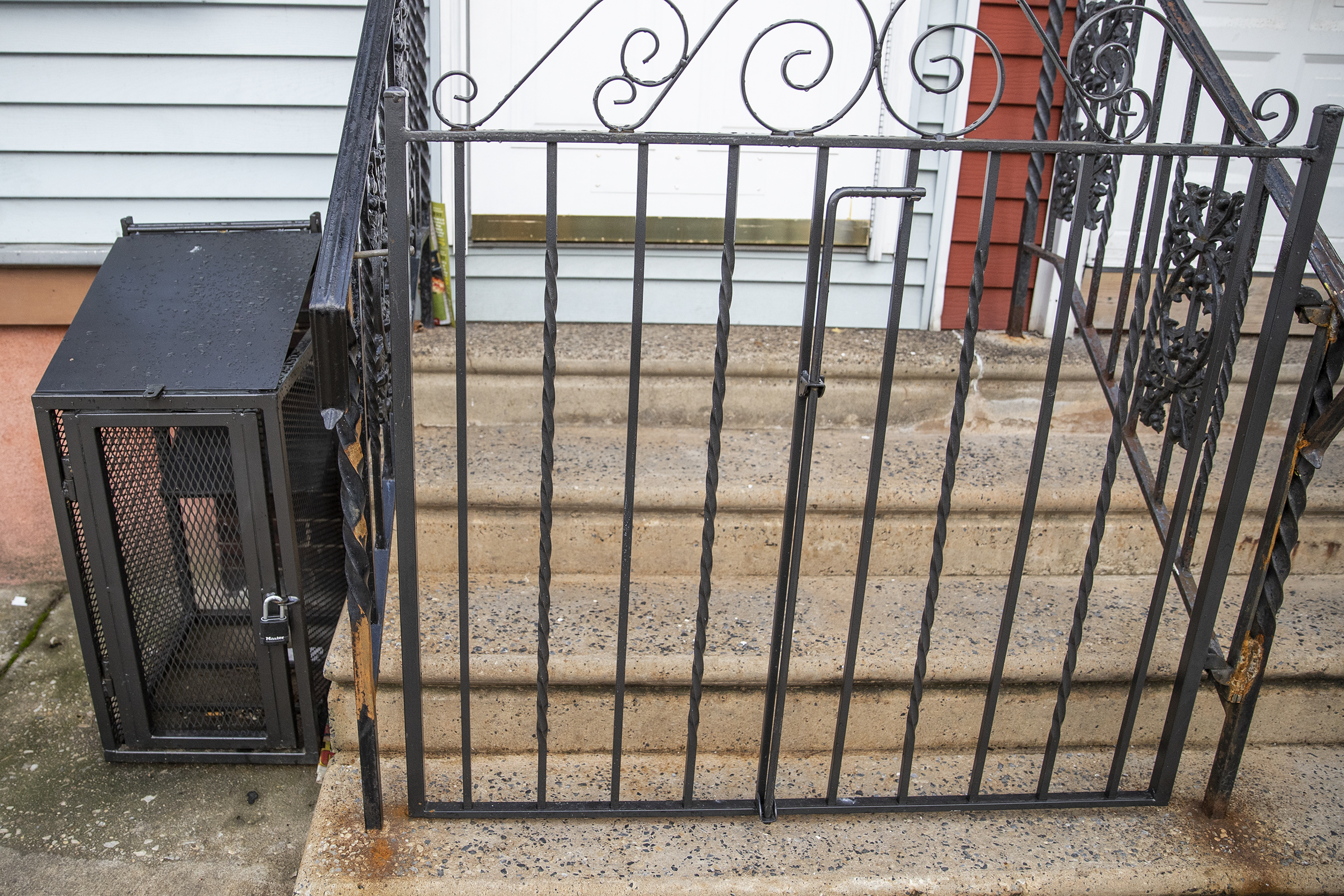
Some people find or erect secure places to have their packages delivered. A metal cage for packages is shown here in this 2019 file photo.
There’s no surefire way to prevent porch piracy.
But police departments and carriers like USPS, FedEx, and UPS provide the following tips to reduce your chances of falling victim — or to get your money back if your package is stolen:
Leave drop-off instructions: Log into your online account with the package carrier and ask that they leave deliveries in a less visible location, such as behind a planter, in a shed, or at a side door. Or ask that they require a signature for drop-off. This requires that delivery people read the instructions, which some Philadelphians have found is not always the case.
Redirect the delivery: You can also go online and redirect deliveries to locations such as your office, the home of a friend who doesn’t experience package theft, or a secure physical mailbox, such as a FedEx, UPS, or Amazon Locker pickup location. If you aren’t going to be home for a day, you can also request a hold on packages until you return, or have a neighbor or friend pick them up.
Use security cameras: Cameras can alert you that someone is outside and allow you to grab a package immediately if you’re at home. If a delivery is stolen, the footage can help police find the porch pirate. (If they’re charged and convicted in New Jersey, they could even go to prison.)
Report theft: After confirming that the package was in fact delivered, file a police report. Then, contact the seller, shipping company, and, if all else fails, your credit card company to see if they cover package theft.
The precious metal has more than doubled in value since the start of the year and broke a fresh record on Tuesday, rising above $60 per troy ounce on New York’s Commodity Exchange for the first time ever. Now it’s up 102% for 2025 — far outpacing the record-building rush that has lifted gold 59%.
A mix of forces are boosting silver, including the weakened dollar, tariff politics, and supply shortages. Especially critical in recent weeks, though, was the growing expectation that the Federal Reserve would announce another rate cut, which it did on Wednesday, as the U.S. economy continues to slow down. Analysts say that’s likely to further pressure the dollar lower while lifting silver — a classic safe-haven asset — even higher.
In light of Fed concerns, “precious metals prices are rising as a bit of a hedge,” said Michael Farr of the D.C.-based investment firm Farr, Miller & Washington, ahead of the meeting.
But silver’s rise is also a global story with a combination of forces at play. Here’s what you need to know about its soaring popularity.
Dollar weakness and the ‘debasement trade’
The softening of the greenback — which depreciated about 8.5% since the start of the year — is a big part of the story. Most of this drop occurred in the first half of the year, after the Trump administration unleashed steep tariffs on trading allies and competitors alike and reduced U.S. attractiveness as a reliable trade and investment partner. At the same time, rising U.S. debt and lingering concerns about inflation have also diminished the dollar’s value.
The weakened dollar, in turn, has been driving what’s known as the “debasement trade”: Investors are looking for other assets — which include gold as well as silver — because the dollar is no longer seen as ultrasafe as it used to be, said Collamore Crocker of the economic consultancy New Century Advisers.
“‘Concern’ is a big piece of the trade‚” Cocker said. “If you’re worried about governments undermining the value of their own currencies, you might buy precious metals.”
The Fed rate decision could very well push the dollar down even more. Typically, lower interest rates make a currency less attractive for investors because there’s a lower return on assets in that currency.
“Lower rates are bullish for precious metals,” said Bob Gottlieb, an independent consultant who previously worked at JP Morgan and other financial institutions.
The tariff factor
Traditionally, silver tends to be more volatile compared to gold and more sensitive to policy changes, say analysts. Tariffs are a good example. Recently, concerns spiked that the U.S. could add tariffs specifically for silver after it was added to the U.S. Geological Survey’s list of critical minerals last month, along with copper, lead, and other rare metals.
The list allows the federal government to “understand where strategic domestic investments or international trade relationships may help mitigate risk to individual supply chains,” USGS acting director Sarah Ryker said in a statement.
Adding a metal to the list can signaltariffs to come, and many investors reacted accordingly, pushing silver higher.The threat of additional tariffs has also led metals traders to shift silver to the United States and out of London or Shanghai, as a way to preempt the hit from new import taxes on the precious metal.
Demand and supply squeeze
The tariff uncertainty and dollar weakness are coinciding with a long-running silver shortage. A recent report from the Silver Institute estimated industrial demand for silver has soared about 18% over the past four years, due in part to India — now theworld’s second-largest market for silver investment, according to Kitco News, a metals publication.
Silver is culturally seen as a “poor man’s gold,” said Hiren Chandaria, managing director at the financial firm Monetary Metals. “With gold prices rising so high, many households and smaller investors have shifted toward silver as a more affordable precious metals store of value, so investment and gifting demand has shot up alongside traditional jewelry and silverware buying.”
Investor demand from India is also spurred by a recent decision by the country’s central bank that allowed for regulated silver-backed loans. The Silver Institute has reported roughly a doubling in silver-backed exchange-traded fund price inIndia since January 2023, amid a surge of investment.
Beyond India, broader supply crunches are in play. The world’s mines are expected to produce only about 813 million ounces of silver this year, slightly less than they did in 2021, according to the Silver Institute. Mines can only produce so much each year, and it takes many years to get a new one up and running — something that puts a cap on supply.
Industrial demand
The buying frenzy for silver and resulting shortage are also driven by technological change across the industrial world that has unfolded over the past five years.
While gold has relatively little practical use aside from jewelry, silver is a high-quality conductor of electricity and heat and holds a range of industrial applications — “at the cusp of precious metals and industrial metals,” as Chandaria describes it.
Surging investments in electric vehicles and artificial-intelligence data centers, for example, are among the sectors driving demand. Silver is laced throughout electric vehicles and their batteries, which is one reason for its surge during the electric-vehicle investment boom by major automakers in recent years. It’s also used in AI semiconductors.
“There is an inherent tightness still in the silver market … demand is greater than supply every year,” said Bob Gottlieb, a former metals trader with leading financial institutions.
Meanwhile, the silver boom is lifting mining companies. Canada’s Wheaton Precious Metals, the largest silver mining company by market capitalization, has seen its stock price rise close to 85% year-to-date. Fresnillo, a Mexico City-based mining company that bills itself as the world’s leading producer of silver ore, is up 365% since the start of the year, while Mexico’s Industrias Peñoles has risen around 230%. Canadian mining conglomerate Pan-American Silver rose 105%.
Gottlieb, the metals trader, says he believes silver will settle between $50 and $75 an ounce over the next year, adding that he views India’s demand as grounds to stay bullish.But he also urged caution. “I learned a long time ago that whenever you forecast a price, the real movement is not from what you forecasted,” Gottlieb said.
It’s December, which means it’s time for economists to publish their forecasts for the upcoming year. Given all the political, economic, and social concerns, the crystal ball is fuzzy.
However, the factors that should drive growth in 2026 are fairly clear.
Tariffs are an unknown and the greatest potential threat
With inflation remaining stubbornly high and affordability becoming a political battleground, President Donald Trump is faced with some difficult decisions. It is hard to argue that tariffs are not paid for by consumers. Recent actions to lower tariffs on imported food products is an admission that is the case.
So in 2026, will tariffs be reduced? And if so, how broadly?
The likelihood is they will be lowered, but the ad hoc nature of tariff adjustments indicates the changes will not likely have much of an impact on prices. And that means inflation is likely to remain well above the Fed’s target rate of 2%.
The effects of high and rising prices on economic activity cannot be denied. Affordability is not a hoax, at least not for the average household. Consumer confidence recently fell to some of the lowest levels recorded.
While overall consumer spending has held up, much of the demand is coming from upper-income households. An economy can be supported for only so long by a small percentage of the population. Eventually, the companies that provide goods and services to the average household will feel the pain.
Without a major turnabout on tariffs, inflation is likely to remain high, further depressing consumer confidence and spending.
Immigration policy and deportations are slowing population growth
Whatever you think of the Trump immigration and deportation strategy, there are economic implications.
When the shutdown in immigration is combined with rising death rates and falling birth rates, the result is the U.S. population may have declined in 2025 for the first time ever.
Also, restrictions on immigration have slowed labor force growth. When you add in the fear factor affecting both documented and undocumented workers, the negative effects on the labor supply are magnified.
In an economy with low unemployment rates, the lack of workers puts upward pressure on wages and inflation while reducing income growth and total consumer spending.
In addition, the labor shortage restricts business growth. Small businesses continue to report that the lack of qualified workers is their biggest problem.
The administration’s immigration policy will likely continue to limit labor availability, slow hiring, and restrain spending, while putting upward pressure on wages and prices.
The Federal Reserve faces a difficult choice
The Fed is in a pickle. If it tries to fight elevated inflation by not lowering interest rates, it risks slowing the economy. If it tries to address a softening economy by reducing interest rates, it risks inflaming inflationary pressures.
It is clear the monetary authorities would prefer to lower rates back toward trend levels. And they are likely to cut rates next year. But there is little reason to believe inflation will settle down soon, so the Fed cannot be expected to act aggressively.
The Fed cannot fight high inflation and slowing growth at the same time, so barring a recession, expect it to act cautiously.
The impact of AI on the economy should accelerate in 2026
The 800-pound gorilla in the economic forecast is artificial intelligence, the next industrial revolution.
Next year will likely be make-it-or-break-it for many companies when it comes to AI. The hundreds of billions of dollars being invested must show clear signs of being financially profitable. By this time next year, AI firms must create real value, not just stock market value.
Previous early phases of industrial revolutions typically led to massive upheaval in the labor market. We are starting to see the outlines of what that might look like once AI becomes embedded in the economy.
Right now, firms are not firing workers. But many have paused hiring. The next step, though, is layoffs. We could start seeing that by mid-2026.
Ultimately, hiring should come back. It always happened in past phases of the industrial revolution. Just don’t expect to see that until 2027 or even later.
As AI spreads thorough the economy, anticipate much slower or even negative job growth, leading to higher unemployment rates, lower consumer confidence, and slower spending.
Upending traditional international relationships creates tremendous economic uncertainties
The Trump administration’s desire to reframe international relationships cannot be viewed simply as a political strategy. Its economic consequences are hardly clear now but may show up in 2026.
A rough summary of the latest national security outline points to a pullback from Europe, an expansion in the Americas, closer relations with Russia, and more competition with China.
Again, how this plays out is anyone’s guess, but we could see Europe become a major economic competitor, China become more aggressive when it comes to trade, and Russia, well who knows what Vladimir Putin will do?
How could this affect the U.S. economy? Consider China. It has no qualms about using its economic strength as a cudgel. Its economic war with the U.S. is likely to heat up.
Think about soybeans. China had been the U.S.’s biggest market but has bought little this year. Instead, China is encouraging other countries to grow soybeans. U.S. soybean farmers are going bankrupt and the huge farm bailout could be needed for other segments of the economy if the economic war heats up.
Similarly, look for Europe, which Trump wants to set afloat, to start switching its demand for American-made products to other parts of the world. The continent could become a full-throated competitor with no holds barred.
The Trump administration’s goal of resetting international political relationships is likely to spread into a restructuring of international economic competition.
The U.S. economy is amazingly resilient, but a number of significant issues could become major problems. How they all play out is uncertain, but given the potential negative impacts on growth, it is hard to think we can skirt a recession next year.
WASHINGTON — The Senate on Thursday rejected legislation to extend Affordable Care Act tax credits, essentially guaranteeing that millions of Americans will see a steep rise in costs at the beginning of the year.
As Republicans and Democrats have failed to find compromise, senators voted on two partisan bills instead that they knew would fail — the Democratic bill to extend the subsidies, and a Republican alternative that would have created new health savings accounts.
It was an unceremonious end to a monthslong effort by Democrats to prevent the COVID-19-era subsidies from expiring on Jan. 1, including a 43-day government shutdown that they forced over the issue.
Ahead of the votes, Senate Democratic Leader Chuck Schumer of New York warned Republicans that if they did not vote to extend the tax credits, “there won’t be another chance to act,” before premiums rise for many people who buy insurance off the ACA marketplaces.
“Let’s avert a disaster,” Schumer said. “The American people are watching.”
Republicans and Democrats never engaged in meaningful or high-level negotiations on a solution, even after a small group of centrist Democrats struck a deal with Republicans last month to end the shutdown in exchange for a vote. Most Democratic lawmakers opposed the move as many Republicans made clear that they wanted the tax credits to expire.
The deal raised hopes for a compromise on healthcare. But that quickly faded with a lack of any real bipartisan talks.
“We failed,” said Alaska Sen. Lisa Murkowski, one of four Republicans who voted for the Democratic bill, after the vote. “We’ve got to do better. We can’t just say ‘happy holidays, brace for next year.’”
A Republican alternative
The dueling Senate votes were the latest political messaging exercise in a Congress that has operated almost entirely on partisan terms, as Republicans pushed through a massive tax and spending cuts bill this summer using budget maneuvers that eliminated the need for Democratic votes. In September, Republicans tweaked Senate rules to push past a Democratic blockade of all of Trump’s nominees.
On healthcare, Republicans similarly negotiated among themselves, without Democrats. The health savings accounts in the GOP bill that they eventually settled on would give money directly to consumers instead of to insurance companies, an idea that has been echoed by President Donald Trump.
Senate Majority Leader John Thune (R., S.D.) said ahead of the vote that the Democrats’ simple extension of the subsidies is “an attempt to disguise the real impact of Obamacare’s spiraling healthcare costs.”
But Democrats immediately rejected the GOP plan, saying that the accounts wouldn’t be enough to cover costs for most consumers.
The Senate voted 51-48 not to move forward on the Democratic bill, with four Republicans — Maine Sen. Susan Collins, Missouri Sen. Josh Hawley and Alaska Sens. Murkowski and Dan Sullivan — voting with Democrats. The legislation needed 60 votes to proceed, as did the Republican bill, which was also blocked on a 51-48 vote.
An intractable issue
The votes were the latest failed salvo in the debate over the Affordable Care Act, former President Barack Obama’s signature law that Democrats passed along party lines in 2010 to expand access to insurance coverage.
Republicans have tried unsuccessfully since then to repeal or overhaul the law, arguing that healthcare is still too expensive. But they have struggled to find an alternative. In the meantime, Democrats have made the policy a central political issue in several elections, betting that the millions of people who buy healthcare on the government marketplaces want to keep their coverage.
“When people’s monthly payments spike next year, they’ll know it was Republicans that made it happen,” Schumer said in November, while making clear that Democrats would not seek a compromise.
Even if they view it as a political win, the failed votes are a loss for Democrats who demanded an extension of the benefits during the shutdown — and for the millions of people facing premium increases on Jan. 1.
Maine Sen. Angus King, an independent who caucuses with Democrats, said the group tried to negotiate with Republicans after the shutdown ended. But, he said, the talks became unproductive when Republicans demanded language adding new limits for abortion coverage that were a “red line” for Democrats. He said Republicans were going to “own these increases.”
House to try again
Republicans have used the looming expiration of the subsidies to renew their longstanding criticisms of the ACA, also called Obamacare, and to try, once more, to agree on what should be done.
In the House, Speaker Mike Johnson (R., La.) has promised a vote next week on some type of healthcare legislation. Republicans weighed different options in a conference meeting on Wednesday, with no apparent consensus.
Murkowski and other Senate Republicans who want to extend the subsidies expressed hope that the House could find a way to do it. GOP leaders were considering bills that would not extend the tax credits, but some Republicans have launched longshot efforts to try to go around Johnson and force a vote.
“Hopefully some ideas emerge” before the new year, said Republican Sen. Thom Tillis of North Carolina, who has been pushing his colleagues for a short-term extension.
“Real Americans are paying the price for this body not working together in the way it should,” said Alabama Sen. Katie Britt, a Republican.
Republican moderates in the House who could have competitive reelection bids next year are pushing Johnson to find a way to extend the subsidies. But more conservative members want to see the law overhauled.
Rep. Kevin Kiley (R., Calif.) has also been pushing for a short extension.
If they fail to act and healthcare costs go up, the approval rating for Congress “will get even lower,” Kiley said.
SHAKOPEE, Minn. — Mike Lindell, the fervent supporter of President Donald Trump known to TV viewers as the “MyPillow Guy,” officially entered the race for Minnesota governor Thursday in hopes of winning the Republican nomination to challenge Democratic Gov. Tim Walz.
“I’ll leave no town unturned in Minnesota,” Lindell told The Associated Press in an interview ahead of a news conference set for Thursday.
He said he has a record of solving problems and personal experiences that will help businesses and fight addiction and homelessness as well as fraud in government programs. The fraud issue has particularly dogged Walz, who announced in September that he’s seeking a third term in the 2026 election.
A TV pitchman and election denier
Lindell, 64, founded his pillow company in Minnesota in 2009 and became its public face through infomercials that became ubiquitous on late-night television. But he and his company faced a string of legal and financial setbacks after he became a leading amplifier of Trump’s false claims that the 2020 election was stolen. He said he has overcome them.
“Not only have I built businesses, you look at problem solution,” Lindell said in his trademark rapid-fire style. “I was able to make it through the biggest attack on a company, and a person, probably other than Donald Trump, in the history of our media … lawfare and everything.”
While no Republican has won statewide office in Minnesota since 2006, the state’s voters have a history of making unconventional choices. They shocked the world by electing former professional wrestler Jesse Ventura as governor in 1998. And they picked a veteran TV pitchman in 1978 when they elected home improvement company owner Rudy Boschwitz as a U.S. senator.
Lindell has frequently talked about how he overcame a crack cocaine addiction with a religious conversion in 2009 as MyPillow was getting going. His life took another turn in 2016 when he met the future president during Trump’s first campaign. He served as a warm-up speaker at dozens of Trump rallies and co-chaired Trump’s campaign in Minnesota.
Trump’s endorsement could be the key to which of several candidates wins the GOP nomination to challenge Walz. But Lindell said he doesn’t know what Trump will do, even though they’re friends, and said his campaign isn’t contingent on the president’s support.
Lindell’s outspoken support for Trump’s false claims that the 2020 election was stolen triggered a backlash as major retailers discontinued MyPillow products. By his own admission, revenue slumped and lines of credit dried up, costing him millions. Several vendors sued MyPillow over billing disputes. Fox News stopped running his commercials. Lawyers quit on him.
Lindell has been sued twice for defamation over his claims that voting machines were manipulated to deprive Trump of a victory.
A federal judge in Minnesota ruled in September that Lindell defamed Smartmatic with 51 false statements. But the judge deferred the question of whether Lindell acted with the “actual malice” that Smartmatic must prove to collect. Smartmatic says it’s seeking “nine-figure damages.”
But Lindell won a victory in July when a federal appeals court overturned a judge’s decision that affirmed a $5 million arbitration award to a software engineer who disputed data that Lindell claimed proved Chinese interference in the 2020 election. The engineer had accepted Lindell’s “Prove Mike Wrong Challenge,” which he launched as part of his 2021 “Cyber Symposium” in South Dakota, where he promised to expose election fraud.
The campaign ahead
Lindell said his crusade against electronic voting machines will just be part of his platform. While Minnesota uses paper ballots, it also uses electronic tabulators to count them. Lindell wants them hand-counted, even though many election officials say machine counting is more accurate.
“These guys haven’t lived what I live,” Lindell said.
Lindell wouldn’t commit to abiding by the Minnesota GOP endorsement and forgoing the primary if he loses it, expressing confidence that he’ll win. He also said he’ll rely on his supporters to finance his campaign because his own finances are drained. “I don’t have the money,” he acknowledged.
But he added that ever since word got out last week that he had filed the paperwork to run, “I’ve had thousands upon thousands of people text and call, saying from all around the country … ‘Hey, I’ll donate.’”
WASHINGTON — President Donald Trump’s approval on the economy and immigration have fallen substantially since March, according to a new AP-NORC poll, the latest indication that two signature issues that got him elected barely a year ago could be turning into liabilities as his party begins to gear up for the 2026 midterms.
Perhaps most worryingly for Trump, who’s become increasingly synonymous with his party, he’s slipped on issues that were major strengths. Just a few months ago, 53% of Americans approved of Trump’s handling of crime, but that’s fallen to 43% in the new poll. There’s been a similar decline on immigration, from 49% approval in March to 38% now.
The new poll starkly illustrates how Trump has struggled to hold onto political wins since his return to office. Even border security — an issue on which his approval remains relatively high — has declined slightly in recent months.
The good news for Trump is that his overall approval hasn’t fallen as steeply. The new poll found that 36% of Americans approve of the way he’s handling his job as president, which is down slightly from 42% in March. That signals that even if some people aren’t happy with elements of his approach, they might not be ready to say he’s doing a bad job as president. And while discontent is increasing among Republicans on certain issues, they’re largely still behind him.
Declining approval on the economy, even among Republicans
Republicans are more unhappy with Trump’s performance on the economy than they were in the first few months of his term. About 7 in 10 Republicans, 69%, approve of how Trump is handling the economy in the December poll, a decline from 78% in March.
Larry Reynolds, a 74-year-old retiree and Republican voter from Wadsworth, Ohio, said he believes in Trump’s plan to impose import duties on U.S. trading partners but thinks rates have spiraled too high, creating a “vicious circle now where they aren’t really justifying the tariffs.”
Reynolds said he also believes that inflation became a problem during the coronavirus pandemic and that the economy won’t quickly recover, regardless of what Trump does. “I don’t think it’ll be anything really soon. I think it’s just going to take time,” he said.
Trump’s base is still largely behind him, which was not always the case for his predecessor, President Joe Biden, a Democrat. In the summer of 2022, only about half of Democrats approved of how Biden was handling the economy. Shortly before he withdrew from the 2024 presidential race two years later, that had risen to about two-thirds of Democrats.
More broadly, though, there’s no sign that Americans think the economy has improved since Trump took over. About two-thirds of U.S. adults, 68%, continue to say the country’s economy is “poor.” That’s unchanged from the last time the question was asked in October, and it’s broadly in line with views throughout Biden’s last year in office.
Why Trump gets higher approval on border security than immigration
Trump’s approval ratings on immigration have declined since March, but border security remains a relatively strong issue for him. Half of U.S. adults, 50%, approve of how Trump is handling border security, which is just slightly lower than the 55% who approved in September.
Trump’s relative strength on border security is partially driven by Democrats and independents. About one-third of independents, 36%, approve of Trump on the border, while 26% approve on immigration.
Jim Rollins, an 82-year-old independent in Macon, Georgia, said he believes that when it comes to closing the border, Trump has done “a good job,” but he hopes the administration will rethink its mass deportation efforts.
“Taking people out of kindergarten, and people going home for Thanksgiving, taking them off a plane. If they are criminals, sure,” said Rollins, who said he supported Trump in his first election but not since then. “But the percentages — based on the government’s own statistics — say that they’re not criminals. They just didn’t register, and maybe they sneaked across the border, and they’ve been here for 15 years.”
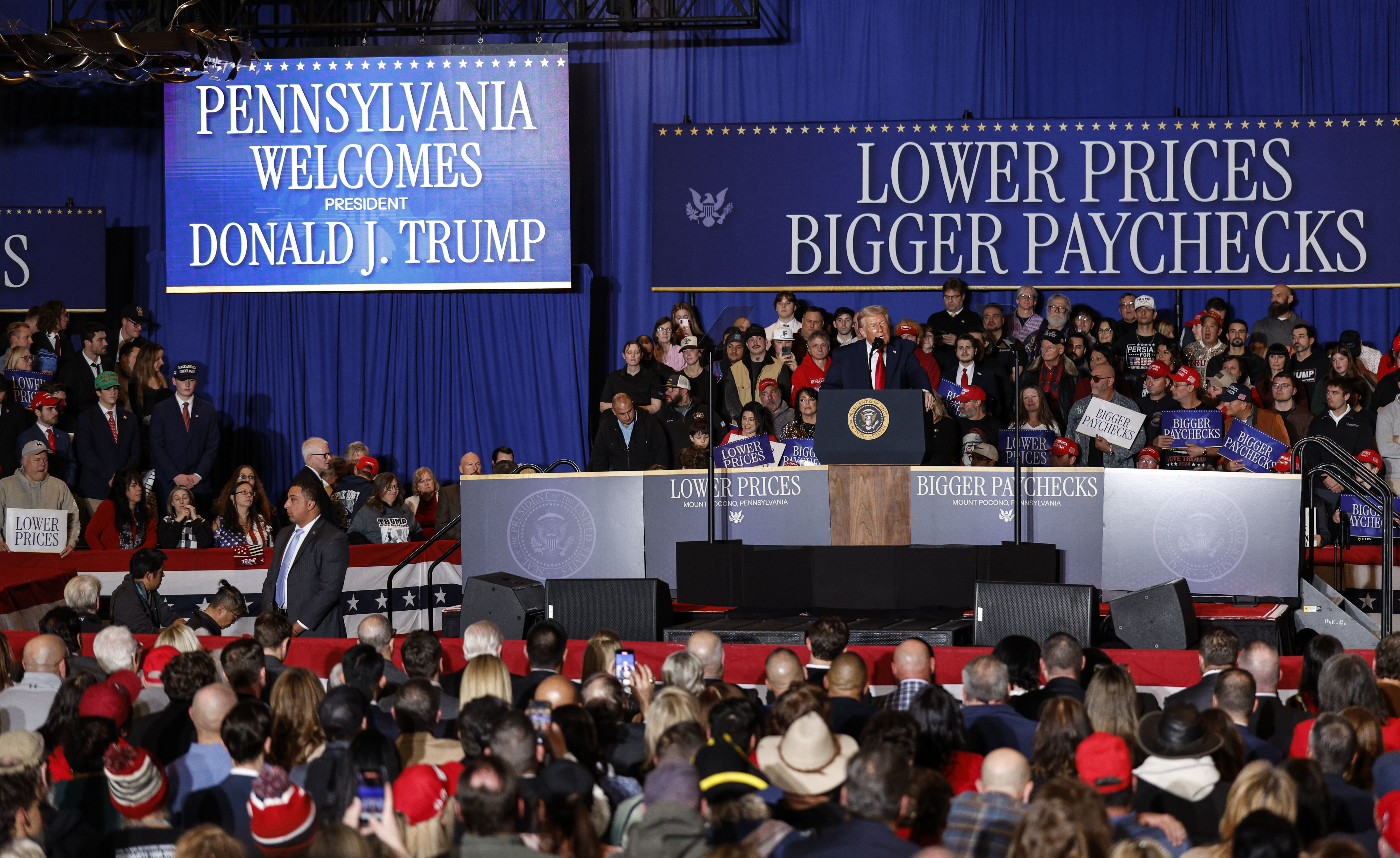
President Donald Trump made his first stop on an “economic tour” in Mt. Pocono, Pa., on Tuesday, Dec. 9.
Other polls have shown it’s more popular to increase border security than to deport immigrants, even those who are living in the country illegally. Nearly half of Americans said increasing security at the U.S.-Mexico border should be “a high priority” for the government in AP-NORC polling from September. Only about 3 in 10 said the same about deporting immigrants in the U.S. illegally.
Shaniqwa Copeland, a 30-year-old independent and home health aide in St. Augustine, Florida, said she approves of Trump’s overall handling of the presidency but believes his immigration actions have gone too far, especially when it comes to masked federal agents leading large raids.
“Now they’re just picking up anybody,” Copeland said. “They just like, pick up people, grabbing anybody. It’s crazy.”
Health care and government management remain thorns for Trump
About 3 in 10 U.S. adults approve of how Trump is handling health care, down slightly from November. The new poll was conducted in early December, as Trump and Congress struggled to find a bipartisan deal for extending the Affordable Care Act subsidies that will expire at the end of this month.
That health care fight was also the source of the recent government shutdown. About one-third of U.S. adults, 35%, approve of how Trump is managing the federal government, down from 43% in March.
But some Americans may see others at fault for the country’s problems, in addition to Trump. Copeland is unhappy with the country’s health care system and thinks things are getting worse but is not sure of whether to blame Trump or Biden.
“A couple years ago, I could find a dentist and it would be easy. Now, I have a different health care provider, and it’s like so hard to find a dental (plan) with them,” she said. “And the people that do take that insurance, they have so many scheduled out far, far appointments because it’s so many people on it.”
The AP-NORC poll of 1,146 adults was conducted Dec. 4-8 using a sample drawn from NORC’s probability-based AmeriSpeak Panel, which is designed to be representative of the U.S. population. The margin of sampling error for adults overall is plus or minus 4 percentage points.
U.S. data agencies need urgent help from the Trump administration and Congress to ensure they can carry out their basic duties and restore public confidence amid a deepening crisis, according to a new report by some of the country’s top statistics experts.
The agencies are struggling with fragile capacity and eroding trust — as well as diminished safeguards for data integrity — and need more money and staff, says the study led by the American Statistical Association. It cites challenges that have grown more acute since last year’s inaugural version of the report, published before President Donald Trump returned to office.
Government departments such as the Bureau of Labor Statistics, Bureau of Economic Analysis, and Census Bureau are tasked with publishing all kinds of data, which cover the economy and many other topics, and are key to decisions by policymakers, investors, and companies as well as the wider public. Their work has been made harder by longstanding problems such as shrinking budgets and falling response rates for surveys — as well as more recent threats to their independence and integrity.
“Immediate action must be taken to halt the severe decline in the federal statistical agencies’ ability to meet their basic mission and be positioned to keep up with increasing information needs and to address uncertainty in the trustworthiness of federal statistics,” says the report, which was published Wednesday.
In Trump’s second term, the strain on federal statistics has intensified. His administration’s campaign to downsize the government left gaping holes in many agencies, with data products becoming collateral damage of the staffing cuts. Organizations such as the ASA have created dashboards to keep an eye on changes to datasets and highlight any that disappear.
Headcount at the BLS was down 20% last fiscal year compared with the previous one, and the BEA has seen a 25% drop since 2019, the report says. Trump has proposed further cuts in his 2026 budget.
Trump’s most drastic action so far on the data front came when he fired the head of the BLS in August after a weak jobs report — accusing her, without providing evidence, of rigging the numbers to make him look bad. Economists and statisticians have lined up to reject that claim. The administration pointed to large revisions in employment data and said the numbers needed to be “fair and accurate.”
Just a day before all this drama unfolded, the statistics experts behind Wednesday’s study had published an interim report saying they were confident that data could be trusted and there were no signs of meddling by the executive branch. Trump’s move against the BLS forced a rapid rethink. The document was amended to say that the president’s actions “undermine trust in the future by accusing statistical agency heads of past political manipulation.”
The group’s new report cites a survey which found the share of the public expressing trust in federal data had declined to 52% in September, from 57% in June.
It calls out other administration actions this year that undermined official statistics, like the termination of advisory committees, failure to fill leadership roles, and elimination of datasets without consulting Congress or the public. It notes that the positions of chief statistician and Census director have been staffed with political appointees who already held other full-time positions, and argues this could further erode trust.
The report urges the Trump administration to exempt key data-agency positions from the federal hiring freeze, and calls on Congress to fund research and enhancements in IT infrastructure that can help improve the quality of statistics. Such measures would “begin to restore the system’s capacity to deliver the timely, relevant, and trustworthy statistics the nation depends upon,” it says.
Children’s Hospital of Philadelphia was the most profitable nonprofit health system in Southeastern Pennsylvania during the three months that ended Sept. 30, according to an Inquirer review of financial filings.
CHOP reported $70 million in operating income in the first quarter of fiscal 2026, up from $67 million the same period a year ago. The nonprofit’s revenue climbed nearly 9% to $1.3 billion.
The biggest loss in percentage terms was at Redeemer Health, the region’s smallest health system and the only remaining operator with a single hospital. Redeemer had an $11.7 million operating loss on $103.4 million in quarterly revenue. That was an improvement over an $18.9 million loss last year.
Jefferson Health had the most patient revenue following its acquisition last year of Lehigh Valley Health Network. The 32-hospital system had $2.9 billion in patient revenue, $100 million more than the $2.8 billion at the University of Pennsylvania Health System, which has seven hospitals.
window.addEventListener(“message”,function(a){if(void 0!==a.data[“datawrapper-height”]){var e=document.querySelectorAll(“iframe”);for(var t in a.data[“datawrapper-height”])for(var r,i=0;r=e[i];i++)if(r.contentWindow===a.source){var d=a.data[“datawrapper-height”][t]+”px”;r.style.height=d}}});
Here’s a recap of selected systems’ results for September quarter:
Jefferson Health
Jefferson Health reported a $104 million operating loss, as its insurance business continued to drag down results. The loss included $19.4 million in restructuring charges for employee severance related to earlier job cuts and moves designed to make the system more efficient.
University of Pennsylvania Health System
University of Pennsylvania Health System had an operating gain of $109.3 million, up from $49.3 million in the same period a year ago. This year’s results include Doylestown Health, which Penn acquired April 1. Total revenue was $3.3 billion, up from $2.8 billion a year ago.
Temple University Health System
Temple University Health System’s loss in the quarter was $15 million, an improvement over a $17 million loss last year. Total revenue was $800 million, up 13% from $712.5 million a year ago. Outpatient revenue increased by nearly $62 million, much of it from the health system’s specialty and retail pharmacy business.
Lil’ Filmmakers, a Roxborough-based nonprofit, was supposed to have $170,000 in the bank.
The mission of helping young people become storytellers through film and media had caught the attention of major donors in 2025. The city awarded it a $28,000 anti-violence grant, and one of Michael Jordan’s charitable organizations issued a separate $35,000 grant. Funding should not have been a problem, according to CEO Janine Spruill, who started the program in 1999.
But on Aug. 27, neither she nor her fourstaffers, nor her summer program participants, had gotten paid by the Federation of Neighborhood Centers, the Philadelphia nonprofit that managed their money.
She remembers FNC staff telling her they had decided not to processpayroll because they were trying to “figure some things out.” Without specifics, Spruill walked away suspecting the worst.
“I went into a bit of a panic mode,” Spruill said, upset that she hadn’t even been given a heads-up. “I ended up crying my eyes out because I said, ‘Oh, my God, I raised all this money, and they’re telling me they don’t have it.’”
Other organizations that had contracts with FNC soon realized that they, too, were having issues accessing their funds. They reported overdue invoices, payroll issues, and spotty communication with FNC.
As the weeks turned into months, Spruill said, FNC would not let her access the money she had raised. She had to launch emergency fundraisers.
The announcement many of the groups dreaded arrived in November. FNC’s grant management services — known as a fiscal sponsorship program in the nonprofit world — would shut down Dec. 31.
“This choice does not come lightly,” said FNC’s announcement on its website. “It comes after years of carrying work that we believed in wholeheartedly — often beyond our capacity — because we care deeply about every project, every leader, and every community member who trusted us with their mission.”
FNC’s collapse, by its own admission, is a story of an organization that grew too quickly and let basic accounting principles go by the wayside. Demir Moore, the nonprofit’s new CEO as of Aug. 26 and a former Lil’ Filmmakers intern, insisted FNC’s collapse was due to a “lapse of management” and “absolutely not attributable to malfeasance or embezzlement.”
FNC spent itself into a deficit over the course of years, continuously using money belonging to one group to pay for another, according to Thaddeus Squire of Social Impact Commons, an organization aiding FNC as it winds down.
“That deficit started to become unrecoverable,” he said. “Money that was borrowed was not put back.”
Moore declined to say how much money FNC has or how many groups are affected by the end of the fiscal sponsorship program. FNC has about 50 groups on its rolls, he said, but some have not been active or have no funds with the nonprofit.
Still, it is unclear how the nonprofit was able to operate the way it did for years. Sorting out just how FNC’s fiscal sponsorship program unraveled is going to take time, Moore said, declining to comment on leadership turnover in the last year.
Attempts to reach past FNC leadership for insight on what transpired were unsuccessful.
And while Moore described a round-the-clock effort to sort out how much every group should have in its account, he would not say for certain whether groups would get all their funds back by the time FNC shuts down.
When the ‘safe approach’ loses control
When run right, a fiscal sponsor can be a boon to newer community groups that do not have a tax-exempt status. By contracting with fiscal sponsors, which are registered as 501c3s, these smaller groups can apply for grants.
Donors are left assured that a more established nonprofit is guiding the smaller or newer group, said Brian Mittendorf, the H.P. Wolfe Chair in Accounting at Ohio State University, who specializes in nonprofit accounting.
“Financial difficulties at fiscal sponsors are much less frequent just because their position … is typically an indicator that they have strong financial controls and other infrastructure in place,” he said, adding that signing with a fiscal sponsor is “often viewed as the safe approach.”
Fiscal sponsors can also be of much help to registered nonprofits that would rather focus on providing services than on managing administrative tasks.
In exchange for a fee, the sponsor signs on to manage and distribute grants, offer reports, and take on a range of tasks, such as payroll or legal questions, giving community groups peace of mind.
For Lil’ Filmmakers, the promise of back-office support led it to contract with FNC nearly a decade ago. Spruill said the monthly accounting report FNC sent her would sometimes require adjustments, but she cited no major issues until this year.
The first red flag came in March. Spruill said FNC did not pay the rent for Lil’ Filmmakers’ studio in Roxborough. FNC ultimately took care of the late fees and cut the rent check, so Spruill said she chalked it up as a one-time occurrence.
Teens at the Lil’ Filmmakers nonprofit learn the ins and outs of filmmaking.
What Spruill and other community group leaders could not see was an organization Moore said could not keep up with its own expansion. The nonprofit recorded a revenue of $774,000 in 2019 taxfilings, which peaked at $4.76 million in 2023.
A years-old message from then-CEO Jerry Tapley remained on the FNC website until this summer, touting more than 50 projects ranging from urban farming and the arts to animal rescue work. The organization’s work affected 250,000 people annually in “Philadelphia and beyond,” he wrote.
Moore said that as the nonprofit grew, FNC was not always collecting key documentation, such as receipts. Community groups were allowed to draw checks for funds they did not have, and balance statements given to groups were out of date or inaccurate.
When Moore stepped down as FNC board president and took over as CEO, the first thing he did, in an attempt to take stock of finances and accounts, was freeze outgoing payments.
While Moore described the move as a necessary first step, community groups struggled to pay for basic overhead, and some sought outside help. Soon, Philanthropy Network Greater Philadelphia and Social Impact Commons, an organization that supports fiscal sponsors, were working with FNC — but it was too late.
There did not appear to be any nefarious intent behind the mismanagement, Social Impact Commons’ Squire said, but FNC’s system allowed some projects to spend into the negative and for debt to snowball.
Social Impact Commons recommended FNC shut down its fiscal sponsorship program and “stop trying to catch up,” according to Squire.
Clarity may not come for at least several more weeks
Sharon Wilson, Lil’ Filmmakers’ attorney, said one of her biggest frustrations is what she finds to be a general lack of transparency as FNC winds down operations, despite her repeated requests for updates in writing.
“All of the information that was learned about FNC’s internal problems, and the fact they were failing other nonprofits other than Lil’ Filmmakers, was all gleaned outside of them,” she said.
The way Moore explains it, the reason FNC has not outright said all community groups would be made whole is that figuring out who is owed what will take at least several more weeks. He said FNC does have funds available, but until the reconciliation process is complete, “no final conclusions can be made about individual project balances or what each project’s final financial position will be.”
Polaroids from a community pet day at Lil’ Filmmakers Thursday, Dec. 4, 2025. The Roxborough based nonprofit and other community groups claim they have been unable to access their funds managed by FNC, which insists it’s not a case of embezzlement or financial malfeasance
For now, multiple third parties, including the city, are working to move the process along.
The Philadelphia Office of Public Safety, for example, said Lil’ Filmmakers and three other anti-violence grant recipients with awards managed by FNC are in different parts of the process. Together, the groups had roughly $380,000 in city-issued funds awarded, which the city said are largely accounted for.
Though the final spending report for Lil’ Filmmakers remains in dispute, it might be resolved by the end of the month, according to the city.
In the meantime, a public safety office spokesperson said staffers were working with organizations to help close their accounts with FNC and offering technical assistance to its grant recipients, including bookkeeping and fiscal sponsor matchmaking.
Still, the office said, there is not much it can do for other grants awarded by other donors.
Complicating moneymatters further, some organizations used a California-based fundraising platform called Flipcause to collect donations. Last month, California’s attorney general sent a cease-and-desist order to the company, ordering it to halt operations after more than a dozen nonprofits in the state accused Flipcause of withholding funds. The platform also faces a class-action lawsuit in federal court.
In all, Moore said, FNC organizations have about $100,000 being withheld by Flipcause; Lil’ Filmmakers is not one of them.
Moore did not rule out that some groups might have less in their accounts than they were initially told in their FNC financial statements because of accounting discrepancies.
Squire went a step further, adding that philanthropic fundraising would be necessary.
“We’re cautiously optimistic that despite a lot of genuine harm that’s been done, that we can at least get people sorted out and back on their feet in the next few months,” Squire said.
The goal, he said, is that each of the groups needing to be placed with a new fiscal sponsor to access their money will have a new one by the end of the first quarter of 2026.
The results of the internal audits will likely determine any legal recourse or investigations. For example, the Pennsylvania Bureau of Corporations and Charitable Organizations, part of the Department of State, can impose fines against charities and revoke their registrations if they are found to be violating the state laws that govern them.
But Spruill, her staff, and her teaching artists cannot afford to keep waiting.
Lil’ Filmmakers has launched another fundraising campaign, this time for $50,000, so programming can continue uninterrupted.
When speaking about the financial setback, Spruill remains defiant.
“We refuse to let this stop the stories that need to be told,” reads her plea to donors.
Conventional wisdom:Motor Trend likes that the Ioniq 5 XRT offers “proper fun in mild dirt,” that it’s “great as an everyday do-it-all crossover,” with “built-in NACS convenience.” But they lament the “off-road gear brings on-road compromises, using Tesla Superchargers not yet optimal,” and the “price close to high-end Ioniq 5 Limited trim.”
Marketer’s pitch: “Our fast-charging electric SUV that goes the distance.”
Reality: The off-road accoutrements are so limited, you might as well get one with more range.
Catching up: Last week, we tested a Chevrolet Equinox EV, which seemed like a real bargain until we started digging deeper.
This week we blow another $20,000 and see what we have to show for it.
What’s new: The Ioniq 5 received a refreshed appearance for 2025. It adds the NACS charging port, allowing easy access to Tesla superchargers, and boosts the size of the batteries across all models.
The new XRT model is marketed as a more rugged version, slightly lifted and with all manner of cladding and black.
Up to speed: The Ioniq 5 gets to 60 mph as fast as any EV. It reaches the magic number in just 4.5 seconds, according to Motor Trend. Unlike last week’s stripped-down Equinox, the Ioniq 5 offers power aplenty throughout the range of driving, as well as through the range of models.
Shiftless: I’ve been singing the praises of the Hyundai twisty-stalk gear selector, and that will continue.
On the road: The Ioniq 5 handled nicely on highways and wasn’t too bouncy for its squared-off shape. Country roads were quite fun, especially in Sport mode.
The Ioniq 5 did have more than its share of rattles, though, from either the hatchback door or the rear cargo area; the squarish shape of the vehicle is probably a factor here.
In the rain: EV makers put low-resistance tires on to help with range. I can’t specifically recall having any other EV in the rain, but the Ioniq 5 with its 235/60/R18 all-terrain tires designed for off-ish roading seemed like it would slide on wet roads. Test drive in the rain, if you can.
Steady speed: The Smart Cruise Control with curve control feature in the Ioniq 5 felt dumber than advertised. I’ve noticed many test vehicles from all brands slowing on curves while the cruise is set, and it’s a welcome feature, but more than a few times I found myself shouting at the dashboard as the Ioniq 5 suddenly started to slow dramatically from my set speed. The cruise was still engaged, too, so it required me taking complete control and starting from scratch.
This can all be controlled through the various settings, but I never found one that I thought worked as well as other manufacturers’ offerings.
The interior of the 2026 Hyundai Ioniq XRT offers plenty of comfort and easy operation.
Driver’s Seat: The leather-covered seat was geared for comfort but still supportive. It held me in place while not getting fresh. The lumbar bolster was just fine and the seat bottom stretched to my knees, something often lacking at this vehicle size.
The seat heater operation and some other functions are in a row of silver buttons (yay!) on the console that will help you in yoga class, requiring a sharp contortion just to reach them (boo!).
Friends and stuff: Sturgis Kid 4.0 blessed the rear seat as comfortable and roomy on a trip to the Sweetest Place on Earth. The flat floor means middle seat occupants won’t feel too bad.
Cargo space is 26.3 cubic feet behind the rear seats and 58.5 when it’s folded.
Play some tunes: Sound from the system is pretty good, about an A-, maybe a B+.
The 12.3-inch touchscreen makes playing tunes and getting to other functions easy enough, and buttons and dials underneath offer a real assist. The home screen has large icons that make navigation swift.
Keeping warm and cool: I was at first pleased at the HVAC’s use of real buttons underneath the infotainment display. But things were not exactly as they appeared; those were just faux buttons of the highly sensitive touch pad variety. Every time my hand got close, I seemed to adjust three things I didn’t intend to. So the driver’s attention is still stolen away from the driving portion of our adventure and is instead trying to fix things that have been changed by accident.
Range: The Ioniq 5’s advertised range of 258 miles was about spot on, as determined by our trip to the AACA (Antique Automobile Club of America) museum in Hershey. We used up about 200 miles of range in 180 miles or so of travel — about half of them keeping up with turnpike traffic; those high speeds suck down the juice. (I could slow down, and yet, I don’t.)
A less expensive SE model would get you beyond 310 miles on a charge. Recharging from 10% to 80% takes as little as 20 minutes.
Where it’s built: Ellabell, Ga. This was the site of an ICE raid in September. It remains to be seen how long the Ioniq 5 will actually come from there, also considering recent trends in EV sales. Stay tuned.
The U.S. and Canada supply 29% of the parts; South Korea another 29%; and Hungary, 33%.
How it’s built:Consumer Reports predicts the reliability to be a 2 out of 5.
In the end: The Ioniq 5 has always been tied with the Kia EV6 on my list of EV champs; the Kia looks a little less stupid, so I’d probably go that direction. But the Equinox is a strong challenger and is worth a look.
A lower price and more range makes any of them more attractive.