Category: College Sports

  • A former St. Joe’s walk-on won $1 million picking NFL games while ‘changing diapers’

    A former St. Joe’s walk-on won $1 million picking NFL games while ‘changing diapers’

    Chris Coyne had a chance to win $1 million earlier this month, but that wasn’t enough to get him out of reading his son a bedtime story.

    His friends were coming over the next afternoon to watch the final slate of NFL games as Coyne neared the prize. So his wife said it was his night to make sure one of their two children was sleeping.

    And there was Coyne — a cell phone on his lap so he could follow the Buccaneers-Panthers game on Jan. 3 — reading The Pout-Pout Fish to 2-year-old Charlie.

    “I know it by heart now, so I’m just reading it from memory and watching the phone on mute while I’m telling the story,” said Coyne, who also has an infant son named Harrison. “But I have a million dollars on the line. The Bucs missed a field goal, and I’m like, ‘Ahh.’ I had to grit it.”

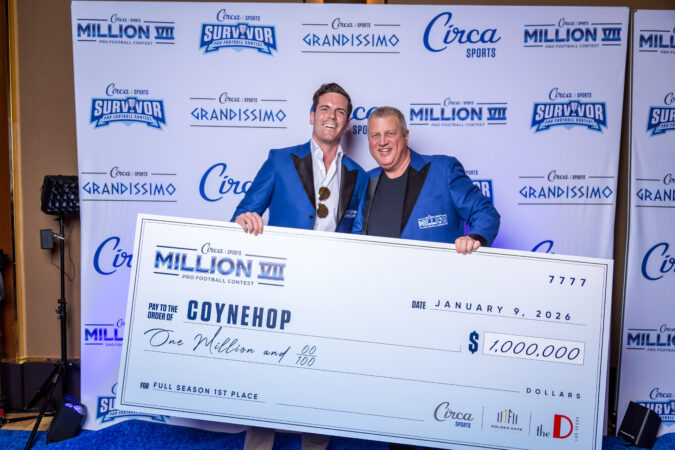
    It was the start of an emotional roller coaster of a weekend that ended with Coyne, a 34-year-old former walk-on for Phil Martelli at St. Joseph’s, winning the $1 million grand prize in a season-long NFL pick ’em contest run by a Las Vegas casino with 6,000 participants.

    He lost a game in September when the Eagles returned a blocked field goal against the Rams, picked up a win in December when the Raiders kicked a meaningless field goal to lose by 7 points instead of 10, and then pouted through that bedtime story as the Buccaneers faded.

    It was a season-long marathon. But it ended with Coyne, who lives in Brooklyn, flying to Las Vegas during the NFL’s wild-card weekend to claim his oversized check and custom blue jacket at the Circa Resort & Casino as the winner of the Circa Million VII.

    “I wasn’t as dedicated to it as many others are,” said Coyne, who was at the playground with his kids when he checked his phone to see how Jordan Davis’ sprint spoiled that game against the Rams on Sept. 21.

    “I joke that there were no models, no Excel spreadsheets. It’s just me changing diapers and making picks.”

    A team photo of the 2012-13 St. Joe’s team with Chris Coyne (first row, third from the left).

    Walk-on Hawk

    Coyne was cut from the St. Joe’s basketball team as a freshman and sophomore but was certain that his junior year in 2011-12 would be different.

    He could have played Division II hoops but came to Philly because his Manhattan high school followed the Jesuit educational model just like St. Joe’s. Coyne played JV ball as a freshman and sophomore for the Hawks and practiced with Martelli’s crew in the offseason.

    He rode his bike home from the gym the night before tryouts and thought it was finally his chance to make the team. Then Coyne hit a curb and flew over his handlebars. His palms were gushing blood and his wrists were banged up.

    “I had no skin on my hands,” Coyne said. “There it goes. There goes the dream.”

    Coyne arrived early to the tryout, hoping that the Hawks athletic trainer could do something. The trainer wrapped Coyne’s hands and sent him on the court.

    “I pretty much looked like a boxer,” he said.

    It worked as Coyne — shooting like coaches always stressed with his fingers and not his palms — seemed to knock down everything. Maybe he should always play like a prizefighter, he thought.

    Martelli called to tell him that his third try was a success: Coyne was a walk-on.
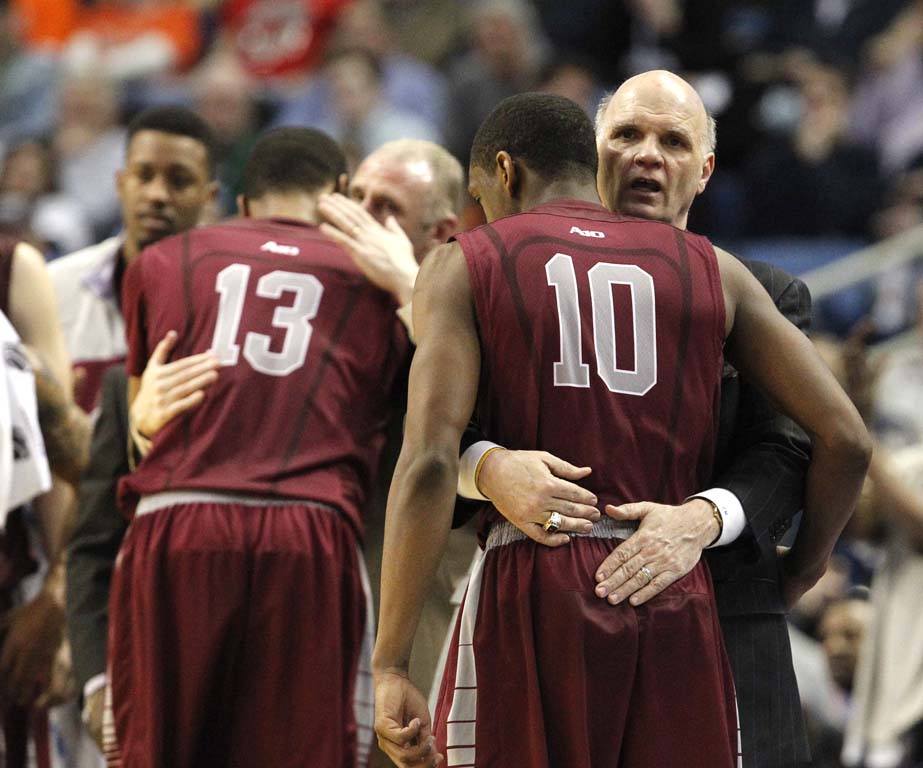
    Chris Coyne played for coach Phil Martelli alongside star Langston Galloway (10) during his time with St. Joe’s.

    “It was my dad’s birthday and I called him to tell him,” Coyne said. “He was the one who pushed me to see this through and not just play at the D-III level. He said, ‘This is your dream. Whether you get one minute in a game or 30 minutes, go see this through.’ I couldn’t thank him enough.”

    He played two years for Martelli, who told the bench players on the “Pinnie Squad” to give it their all in practice against the starters. The reserves were a bunch of guys like Coyne, who could have played elsewhere but stayed on Hawk Hill with Martelli.

    So the future $1 million NFL picker battled every day against Langston Galloway, the future NBA player. Martelli assigned his players to read articles about leadership and teamwork and preached the value of family. It was always more than basketball.

    “I never felt like I was just sitting on the sidelines getting guys water,” Coyne said. “You were in the mix every day, which was really cool.”

    Coyne played just 12 minutes over eight games during those two seasons. But he did knock down a three-pointer at the Palestra, entering the game late against Penn on ESPN for his first NCAA basket.

    “It’s funny looking back and thinking, ‘Why would you ever be nervous?’” Coyne said. “But you’re just sitting there, you’re cold, there’s 15,000 people in the stands, and he’s going to call your name but you don’t know when it’s coming or if it’s coming. You’re just thrown out there.

    “My parents were there and it was a dream come true. It was years of seeing your dream not play out the way you wanted to and then have that opportunity.”
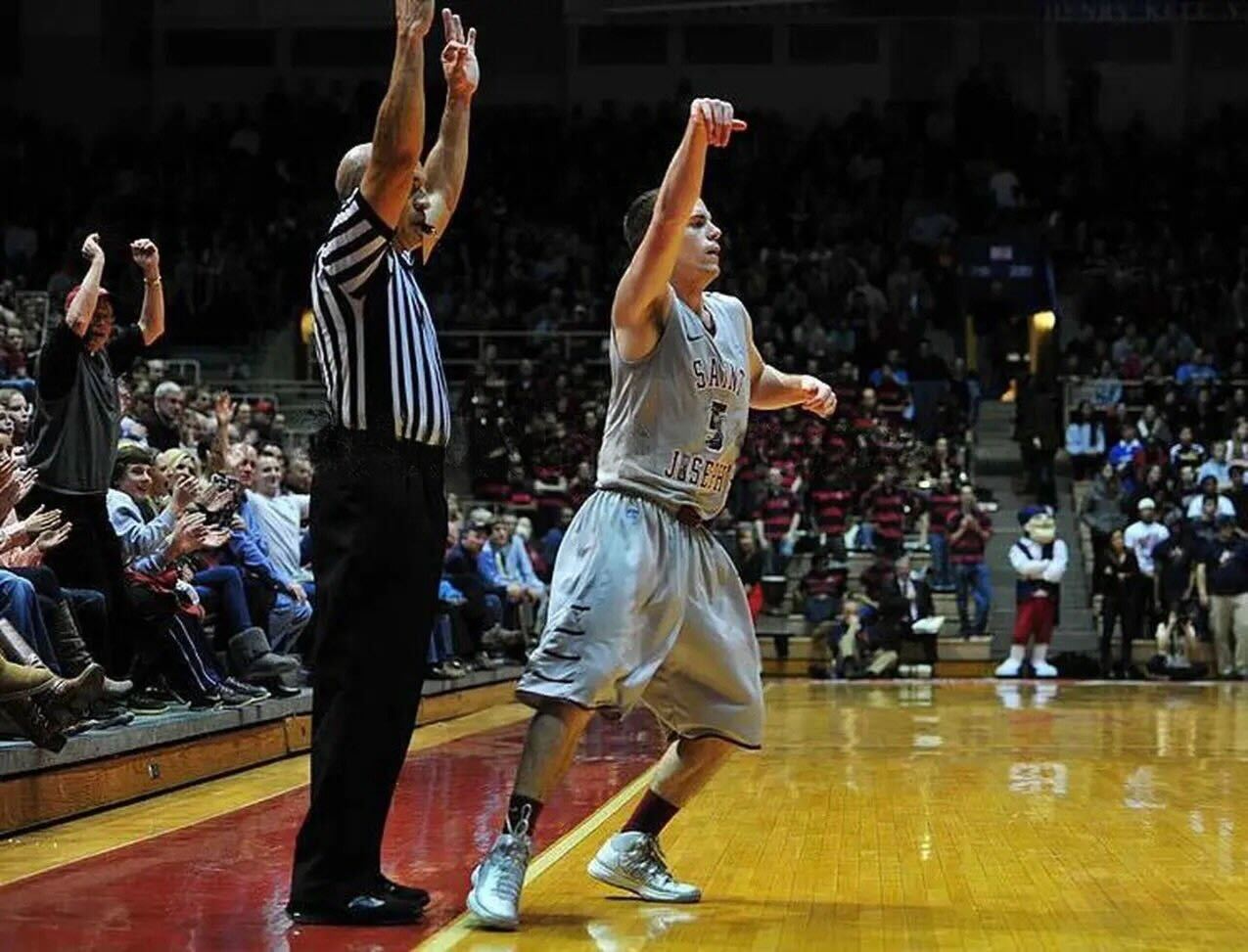
    Chris Coyne making the first and only three-pointer of his St. Joe’s career in 2013 against Penn at the Palestra.

    Winning it all

    Coyne entered his first football contest in 2019 after his friend Brian Hopkins signed him up during a trip to Vegas. He split that entry with Hopkins, and they met each week at a Manhattan bar after work, scribbling down the five games they liked on napkins.

    The pool has a $1,000 buy-in and requires each entrant to pick five games every week against the point spread. A proxy then places the bets for them in Vegas, as more than half the players live outside Nevada.

    Coyne and Hopkins decided to each enter the next season, and they developed their own strategies. Coyne stays away from Thursday night games as he would have to pick all five games by then instead of waiting until Saturday afternoon. The lines for every game lock on Thursday morning, which sometimes means a line could move before Coyne sends in his picks.

    He didn’t watch a full NFL game until the middle of October because he was usually busy on Sundays with his kids. He read articles during the week and listened to podcasts. Picking games, Coyne learned, is less about breaking down game tape and more similar to the sales job he has on Wall Street.

    “You’re aware of trends,” Coyne said. “When the public A.K.A. retail is buying a lot of stock, that’s never a good sign. Maybe in the short term it works out, but over the long term, you try to find those overreactions in the market where the public really likes a team. Especially if the public loves a team and the line is going against the public.

    “That’s the biggest telltale sign right there. You have to have a process and you have to know what you’re doing, but so much of it is you have to get the breaks sometimes. The breaks went my ways sometimes.”

    That bedtime story would have been a bit less stressful had the Bills converted their two-point try a week earlier against the Eagles, as Coyne would have entered the final weekend with a three-game lead.
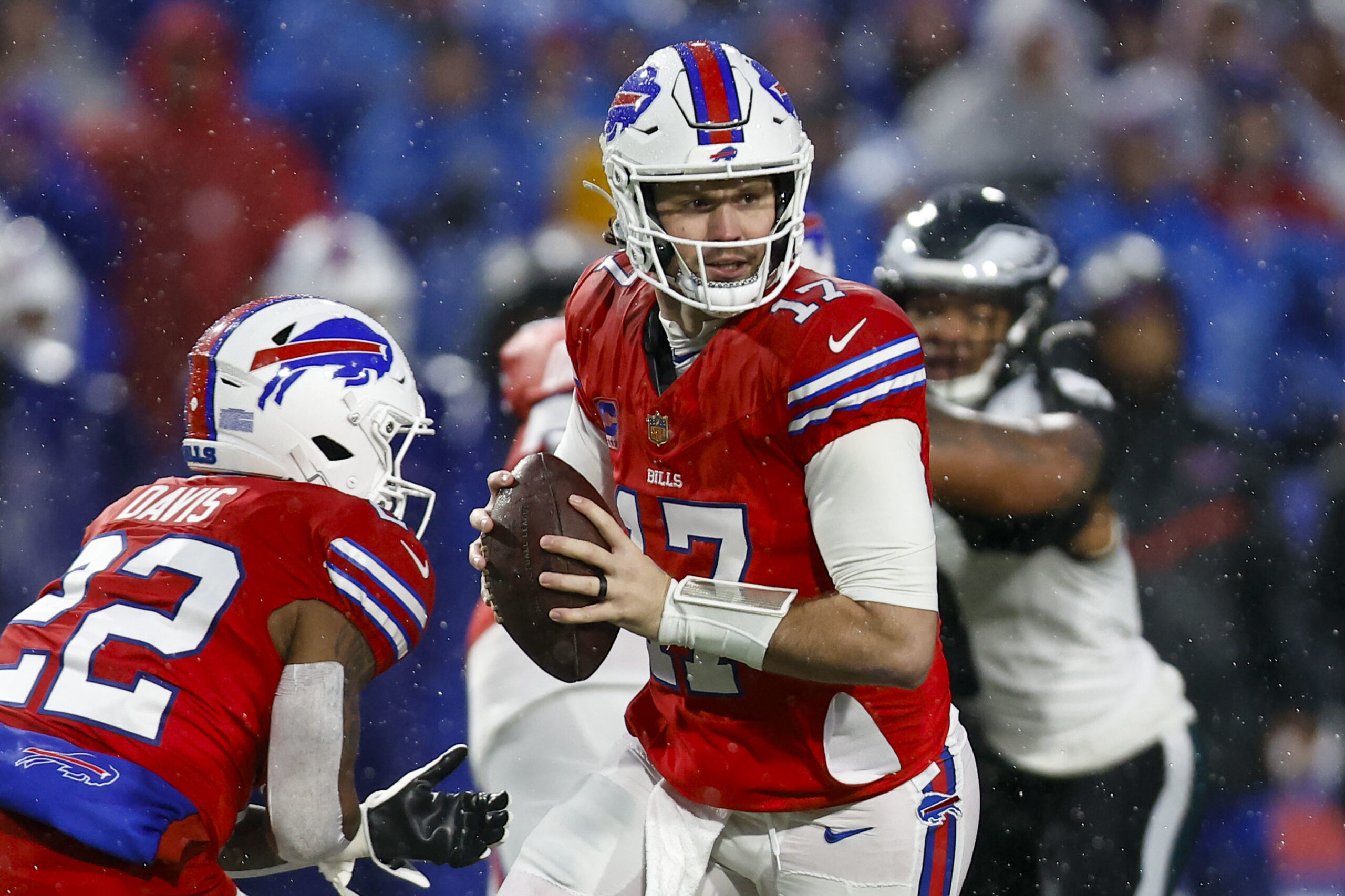
    Josh Allen and the Bills’ inability to execute a two-point conversion against the Eagles on Dec. 28 made Coyne’s road to the $1 million a little more stressful.

    Coyne was in Berwyn for that game visiting the family of his wife, Maddy, which was rooting for the Birds despite knowing Coyne was in the hunt for big money.

    “I’m devastated and I’m like, ‘Can’t you for one week just be on my side?” he said “But Eagles trump all in that household.”

    He instead had to sweat it out. He won Saturday night with the 49ers after the Buccaneers lost and then won Sunday with the Giants but lost with the Titans and Dolphins. Coyne said he tends to pick bad teams since he’s often going against the popular choices.

    The Steelers won on Sunday night, pushing the second-place entry even with Coyne. He thought they would then split the first and second prizes ($750,000 each) and went to bed disappointed.

    “It was a long couple of weeks and I was football fatigued,” Coyne said. “I’m all [ticked] off. But I couldn’t complain. It was still $750,000 and it was a great season, but I didn’t know if I was getting the blue jacket. That’s what I really wanted. It’s like the Masters green.”

    Coyne woke up at 5 a.m., checked his phone, and saw he finished in first place on a tiebreaker, because he had more winning weeks than the other entry. The $1 million prize was his. The blue jacket was, too.
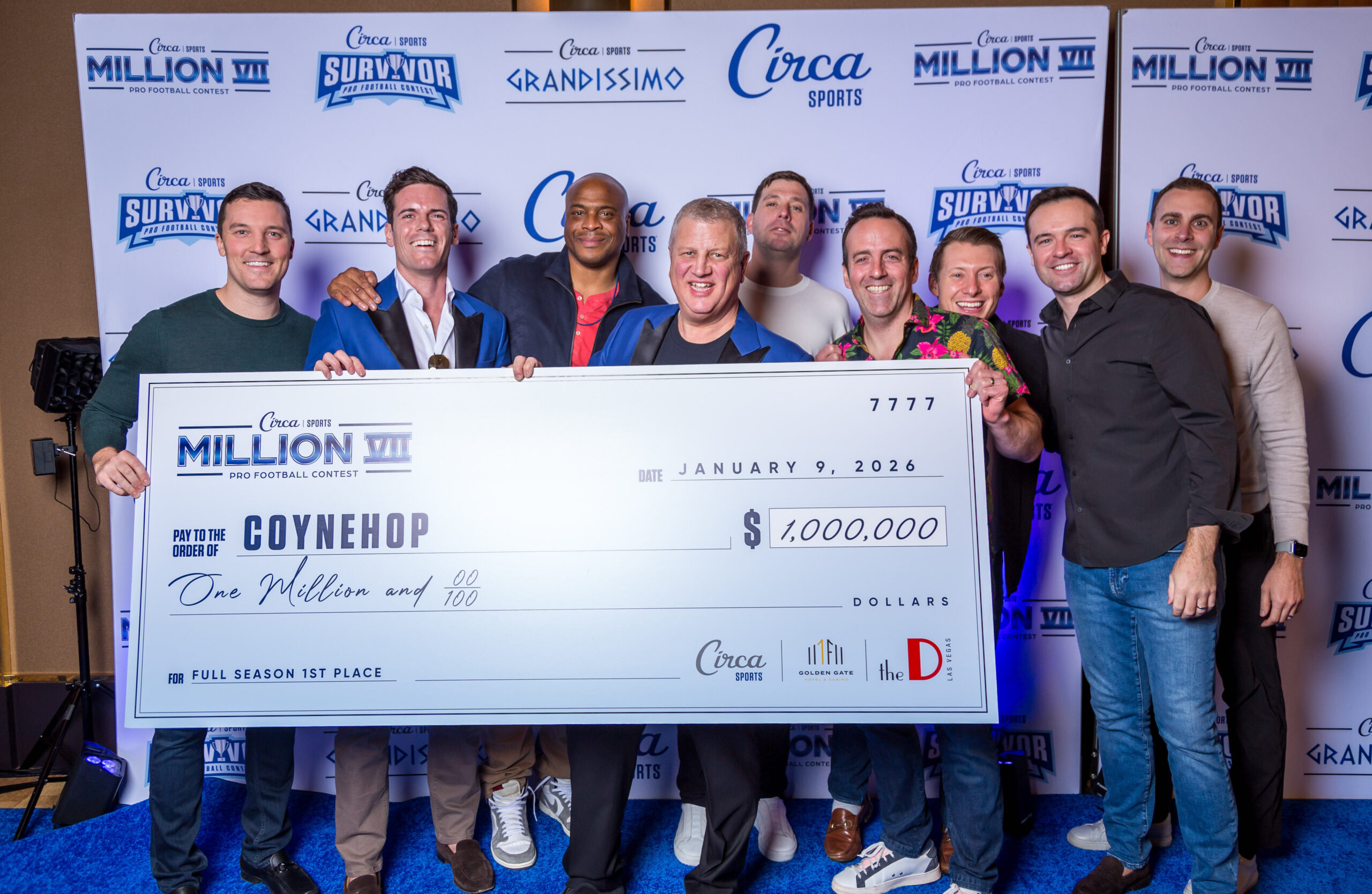
    Chris Coyne (second from the left) with his friends in Vegas on Jan. 9 after he won the $1 million prize.

    Coyne flew to Vegas that weekend with his friends, received his prize, spent 30 hours at the resort, and didn’t take his blue jacket off until he got home.

    It was perfect, like a walk-on hitting a three-pointer at the Palestra with his parents in the crowd.

    “I spent all of November and December saying, ‘How am I going to screw this up?’” said Coyne, who finished 60-29-1 over 18 weeks. “But somehow I came out on top. It was the weekend of a lifetime.”
  • Temple women earned a statement win over South Florida. But ‘we’re nowhere near done.’

    Temple women earned a statement win over South Florida. But ‘we’re nowhere near done.’

    Entering Tuesday’s game against South Florida, Temple coach Diane Richardson and her staff held a meeting with the players to provide some clarity about their roles on the court.

    The Owls were reeling from a three-game losing streak and fresh off a lopsided loss to East Carolina on Jan. 17. The meeting proved to be what they needed to get back on track.

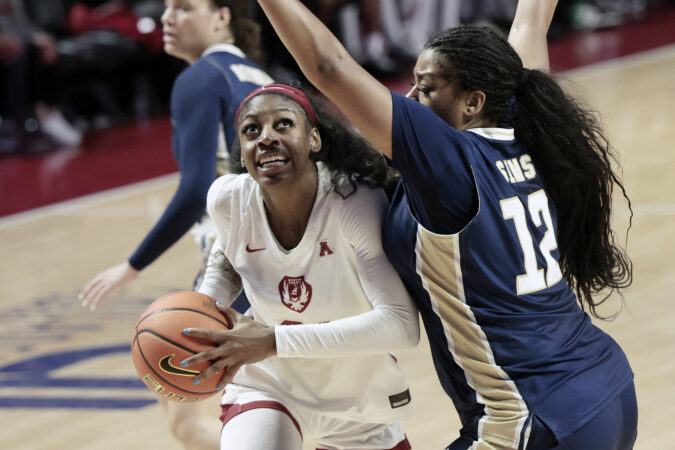
    Against South Florida, which entered Tuesday second in the American Conference standings, Temple played cohesively, which Richardson hadn’t seen lately. The result: an 86-83 win in which the Owls (8-10, 2-4 American) shot 52.7% from the field and had four players score in double figures.

    “I’m really pleased that they stepped up and realized that we have to play together,” Richardson said. “It’s a tough conference. When we play together, it makes a big difference, and as I look at the stats, I think we did pretty well in most of the categories. The biggest one was that we only had 11 turnovers. But, again, that’s confidence in each other and playing together.”

    Guard Kaylah Turner was one of the main benefactors of the meeting, rediscovering her role.

    The junior shot 29.8% from the field in the Owls’ first five conference games and struggled with inefficiency and taking quick shots. Turner, who was named preseason first-team all-conference, looked like herself on Tuesday.

    She shot 7-for-15 from the field and found her spots to knock down jumpers. She also used her speed to get to the basket for easy layups and finished with a game-high 23 points.

    “It makes it 100 times easier when my teammates are always telling me, be confident in my shot, continue to drive, even if I miss two layups or miss a three-pointer,” Turner said. “I’ve got coaches who say the same thing.”

    With Temple’s leading scorer back in her groove, the rest of the offense fell into place.

    Richardson wasn’t happy with Temple’s 5-of-23 shooting from three against Tulane on Jan. 13. She wanted the team to play faster and get more looks near the basket. The Owls fed the ball inside vs. South Florida, which led to a big game from forward Saniyah Craig.

    The Jacksonville transfer flourished in the post and scored a season-high 22 points, including 10-for-13 shooting from the free-throw line. Despite having less of an emphasis on three-pointers, Temple still went 8-for-16 from deep, led by forward Jaleesa Molina, who made all four of her attempts and finished with 19 points.

    Guard Tristen Taylor also finished with 16 points, meaning 80 of Temple’s 86 points came from four players.

    “I think we were more efficient with the things that we did today,” Richardson said. “We were more efficient in ball security. We were more efficient in our shots. I think those made a difference, even though it doesn’t show on the stat sheet. That’s what I told them in the locker room, the things that are not on the stat sheet was the defense, was the intensity, and was the bench. The bench was really into the game, and they were cheering them on.”

    With clarity in their roles, the Owls got back to playing their brand of basketball. Richardson’s equal opportunity offense was in full effect, her team was connected and playing together, and it resulted in a statement win.

    They will look to carry their newfound momentum into the middle of American play, starting with a home game against Charlotte on Saturday (2 p.m., ESPN+).

    “This is a great win, but we’re nowhere near done,” Turner said. “So we’re going to lock in the next practice, and we’re going to make sure we start the beginning of practice how we started this game, and we’re going to practice the entire way so we transfer it to this weekend.”

    Added Taylor: “I think our biggest thing is just don’t be complacent right now.”

  • Havertown’s Mike Tollin screens his new documentary profiling Villanova hero George Raveling

    Havertown’s Mike Tollin screens his new documentary profiling Villanova hero George Raveling

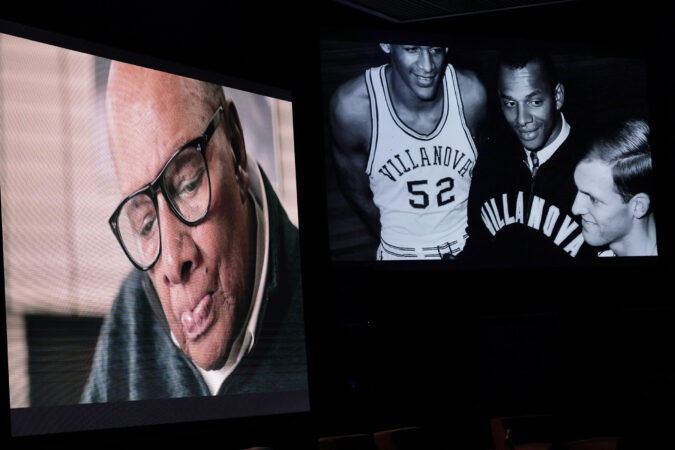
    Mike Tollin received an ovation for his documentary film about the life of George Raveling after a Wednesday night showing on Villanova’s campus. But the best part of the Havertown native’s night may have been meeting and snapping a photo with former guard Fran O’Hanlon, one of his “Villanova heroes.”

    Tollin’s love for Villanova hoops is one of the main reasons he chose to direct Unraveling George, a 90-minute documentary that profiles Raveling. He was a player and assistant coach at Villanova before he rose to prominence as a head coach at Washington State, Iowa, and Southern California. After his coaching career, Raveling joined Nike as a marketing executive.

    Nike and Villanova staged a screening of Tollin’s film before Wednesday night’s game between the Wildcats and Georgetown at the Finneran Pavilion.

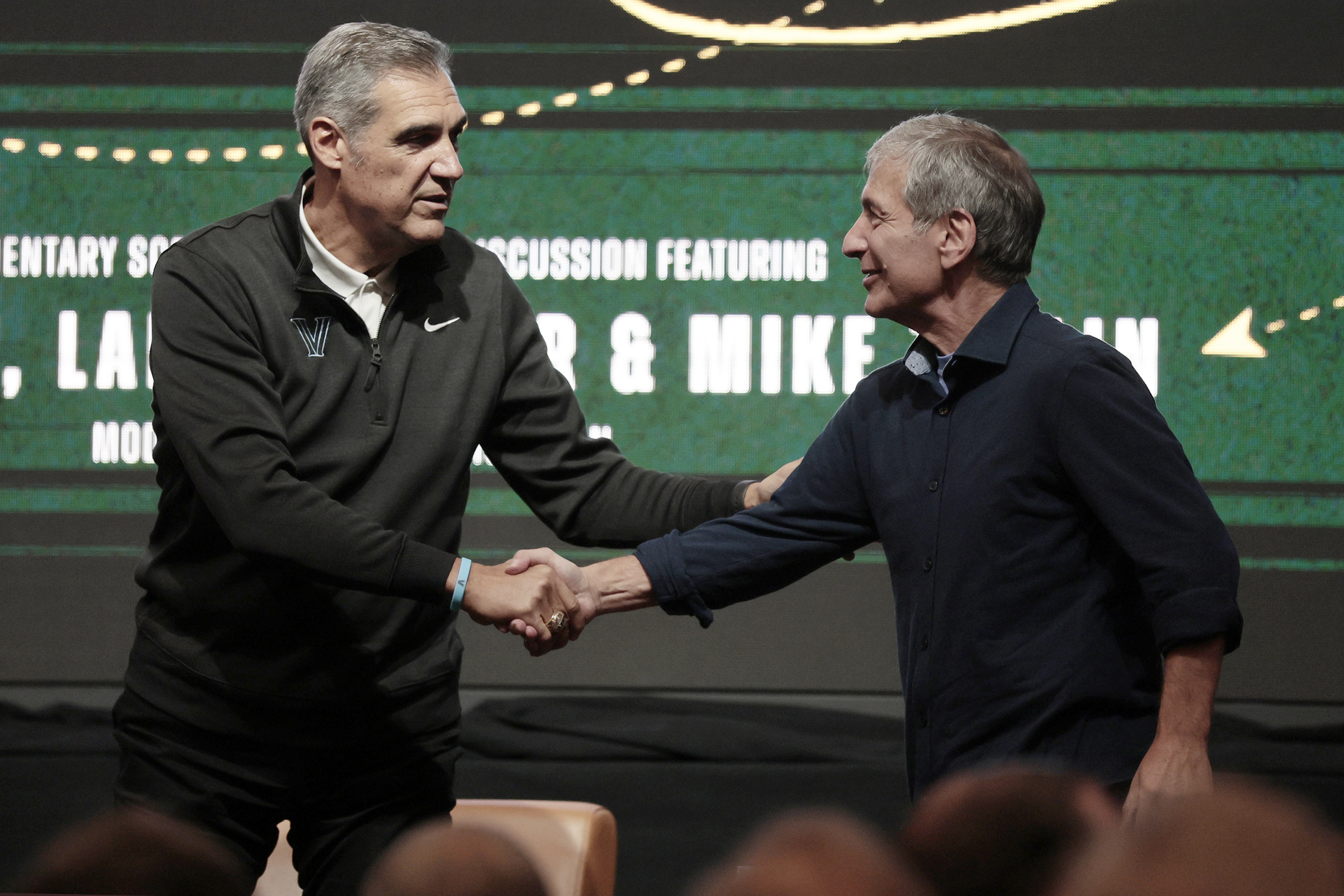
    The screening was preceded by a panel conversation with Tollin, a longtime television and film executive who served as the executive producer on the 10-part Michael Jordan docuseries The Last Dance. Former Villanova coach Jay Wright and Larry Miller, president of Jordan Brand at Nike, joined Tollin onstage.

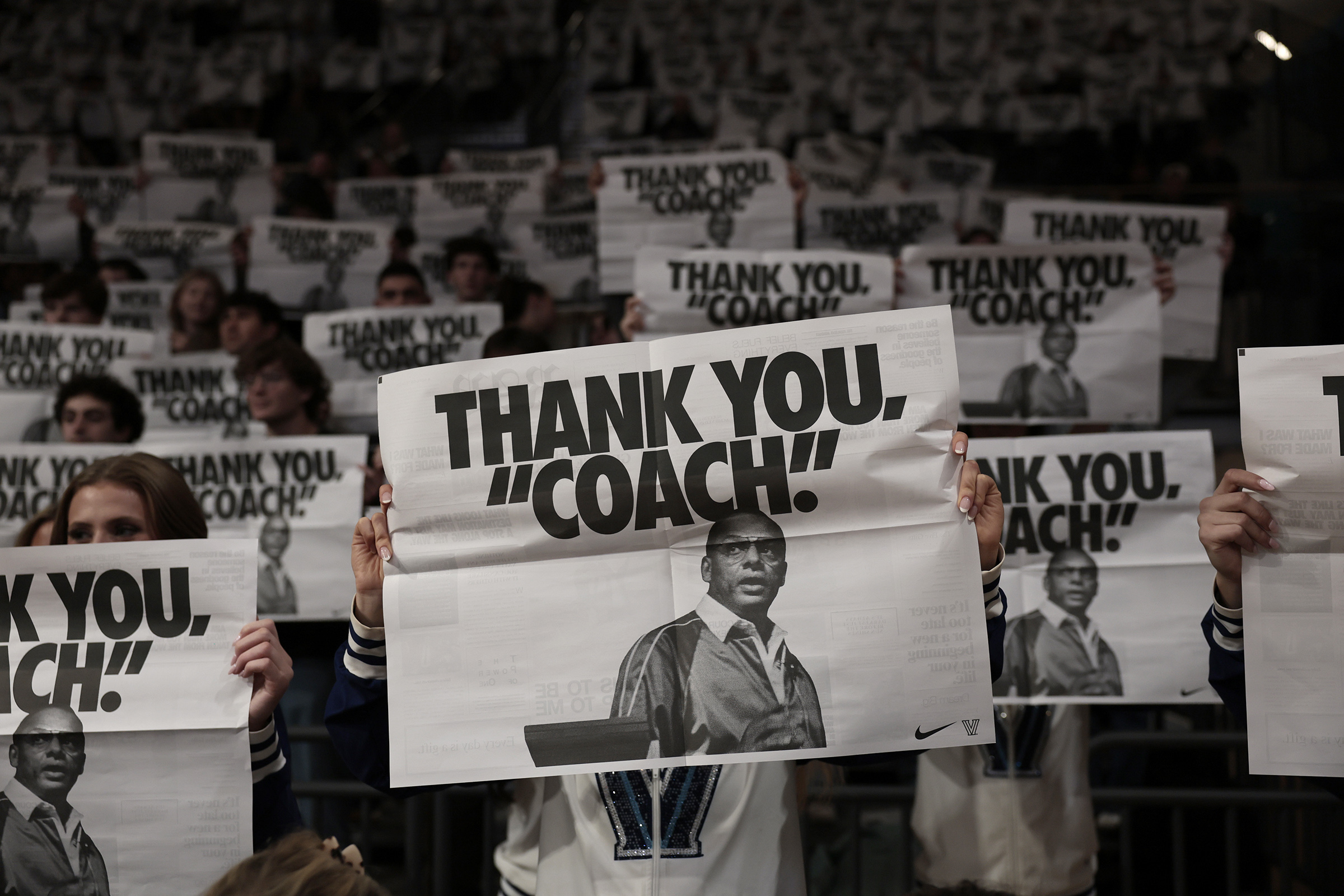
    Fans honored the life and legacy of coach George Raveling during Villanova’s game against Georgetown on Wednesday.

    Villanova also honored Raveling during its game against the Hoyas, which the Wildcats won, 66-51. Raveling graduated from Villanova in 1960 and served as an assistant coach under Jack Kraft from 1963 to 1969. He died at age 88 on Sept. 1, 2025. Fans held up newspaper fliers distributed by Nike that read “Thank You, Coach” during the game’s first timeout.

    “This team, I’m sure [Villanova coach Kevin Willard] has talked to them about coach Rav, but they would not have gotten to know him,” Wright said during the discussion. “All the other teams, coach Rav would come here, spend time with us, talk to the team. It’s great for them, because these guys are smart guys on this team. They’ll Google him, they’ll read about him and they’ll get to know how important coach Raveling was to Villanova and to the world.”

    The idea for Tollin to work on a documentary about Raveling came after the release of Ben Affleck’s AIR in 2023. That film is a fictionalized account of Nike’s pursuit of an endorsement deal with Jordan before his rookie season with the Chicago Bulls in 1984.

    Marlon Wayans plays George Raveling in AIR, but the film’s plot suggests that Sonny Vaccaro, played by Matt Damon, was the primary reason Jordan signed with the company. Jordan disputes this in Unraveling George, saying that Raveling, who coached Jordan at the 1984 Olympics, was the first person to pitch Nike to him.

    Tollin said a conversation about AIR with William Wesley, executive vice president of the New York Knicks, gave him the inspiration to work on the project.

    “He said, ‘Did you see AIR?’” Tollin said. “And I said, ‘Yeah, I enjoyed it.’ He said, ‘Yeah, but we’ve got to tell the real story, and we’ve got to honor George.’”

    Wesley introduced Tollin to Raveling at a Los Angeles Clippers game, where Tollin’s childhood admiration for Villanova basketball showed. Tollin, who graduated from Haverford High School in 1973, grew up watching the players Raveling recruited for the Wildcats.

    “I sat there and I just gushed,” Tollin said. “I said, ‘You recruited all my first basketball heroes.’ I started naming names like Johnny Jones, like Howard Porter.”

    Raveling agreed to be the subject of the documentary, and Tollin got to work on raising funds for the project. The film was completed before Raveling died, and the coach got a chance to see it. Tollin said Wednesday night’s screening at Villanova was “bittersweet.”

    “I wish he was here,” Tollin said. “But obviously, I feel his presence. I know how he felt about the film. He loved it. He was grateful. He was just so generous with me.”

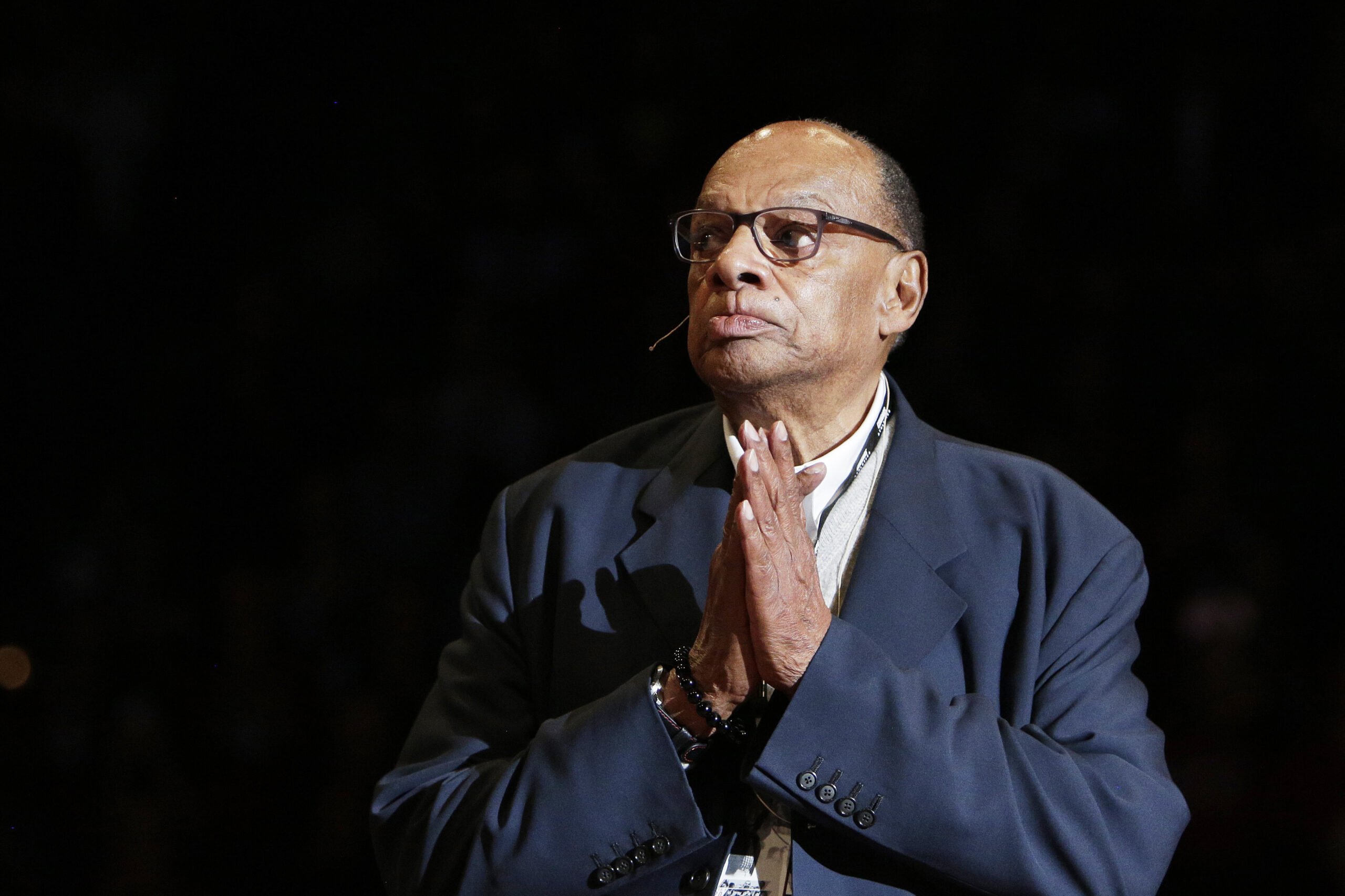
    The late George Raveling played a role in Michael Jordan’s signing a landmark endorsement deal with Nike.

    The film follows Raveling’s life, from his youth in segregated Washington to his playing career at Villanova, where he was the school’s second Black basketball player, and his coaching career. It details the events that led to Raveling obtaining the original typewritten copy of the Rev. Dr. Martin Luther King Jr.’s “I Have a Dream” speech during the March on Washington in August 1963.

    The film also shares Raveling’s time as an assistant coach on Bob Knight’s staff for the 1984 Olympic basketball team, when Raveling formed a relationship with Jordan. It also follows Raveling’s recovery from a 1994 car accident that kept him in intensive care for two weeks and led to his retirement from coaching.

    The documentary goes into Raveling’s second career as an executive for Nike. In addition to being responsible for Jordan’s decision to sign with Nike in 1984, Raveling was also instrumental in helping to bring international players like Dirk Nowitzki and Yao Ming to the NBA.

    Former Villanova coach Jay Wright (left) and filmmaker Mike Tollin during the panel conversation and screening of “Unraveling George” on Wednesday.

    The film features interviews with many significant figures in basketball, including Jordan, Nowitzki, longtime coach Lefty Driesell, Wright, and Nike founder Phil Knight, among others. Wayans provides voice-over narration and sits down for a conversation with Raveling during the film’s credits.

    “It was incredible to keep turning over rocks and find more and more layers, and more and more people who love George and wanted to be a part of the storytelling,” Tollin said.

    Nike made promotional materials for Wednesday night’s screening at Villanova. Those included embroidered canvas tote bags that read “RAV,” and the fliers, inspired by Raveling’s love for reading the newspaper.

    Tollin said when Nike’s team approached him about supporting the film, he wanted the company to help bring it back to Villanova.

    “I just knew this would feel like family,” Tollin said. “And it did. This is sort of like the womb, you know? This is like a really warm bath of support and love. … It was critical that we bring the film here, partly because I’m from here and partly because this is [Raveling]’s origin story.”

    Unraveling George is not available to stream, although Tollin expects to have more details on where to watch it soon.

  • Five Penn State hockey players made history  — and gained fans — at Switzerland’s Spengler Cup

    Five Penn State hockey players made history — and gained fans — at Switzerland’s Spengler Cup

    STATE COLLEGE, Pa. — Imagine filling a roster with 25 of the best Division I hockey players. It almost sounds daunting.

    That was the task assigned to Penn State head coach Guy Gadowsky, who assumed the same position for the United States Collegiate Selects during their inaugural campaign at the 2025 Spengler Cup.

    The Spengler Cup, which began in 1923 and is considered the world’s oldest invitational ice hockey tournament, features six club and national teams from around the world. It was played this year from Dec. 26-31 in Davos, Switzerland, and is annually hosted by local pro team HC Davos.

    “The entire experience was tremendous,” Gadowsky said. “Everybody was curious about how we were going to do. Most [people] thought that we weren’t going to win a game. And the way the team played, the locals in Switzerland really got behind them, and you started to hear ‘USA’ chants when we walked down the street, went to a restaurant, walked into the arena.”

    The coach wasn’t exaggerating. As the lone collegiate squad among four professional teams and a fifth composed of Canadian pros, the U.S. Selects were massive underdogs, expected to participate and nothing more.

    After an opening-game 3-2 loss to Canada and Flyers farmhand Anthony Richard, those lowly expectations remained. That is, until the U.S. Selects stunned host HC Davos, 5-3, on Dec. 27 in a result that showcased college hockey’s growing talent. HC Davos, which leads Switzerland’s top league, featured several former NHLers, including Filip Zadina, Rasmus Asplund, and former Flyer Brendan Lemieux.

    “What we learned is that college hockey is really good,” Gadowsky said. “You’re playing some of the best professional teams in Europe, with 1,000-plus NHL games on their roster. And our guys played with them tooth-and-nail.”

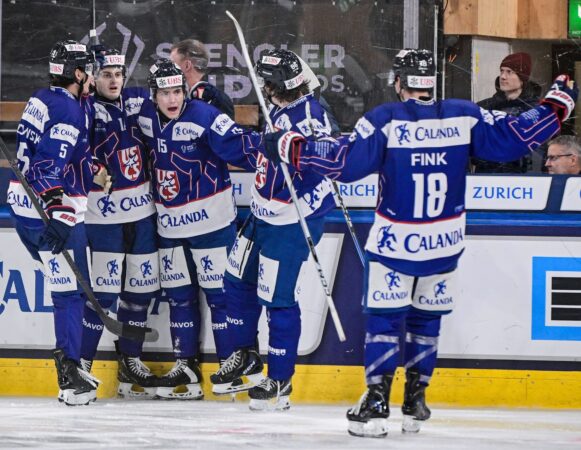
    The coach wasn’t the only Penn Stater in Davos. Five Nittany Lions skaters — Aiden Fink, Charlie Cerrato, JJ Wiebusch, Matt DiMarsico, and Guy’s son, Mac Gadowsky — joined their coach at the Spengler Cup. The roster also had a local flair with Flyers prospect Cole Knuble (Notre Dame), Sewell’s Chris Pelosi (Quinipiac), and Philadelphia’s Vinny Borgesi (Northeastern) all making the team.

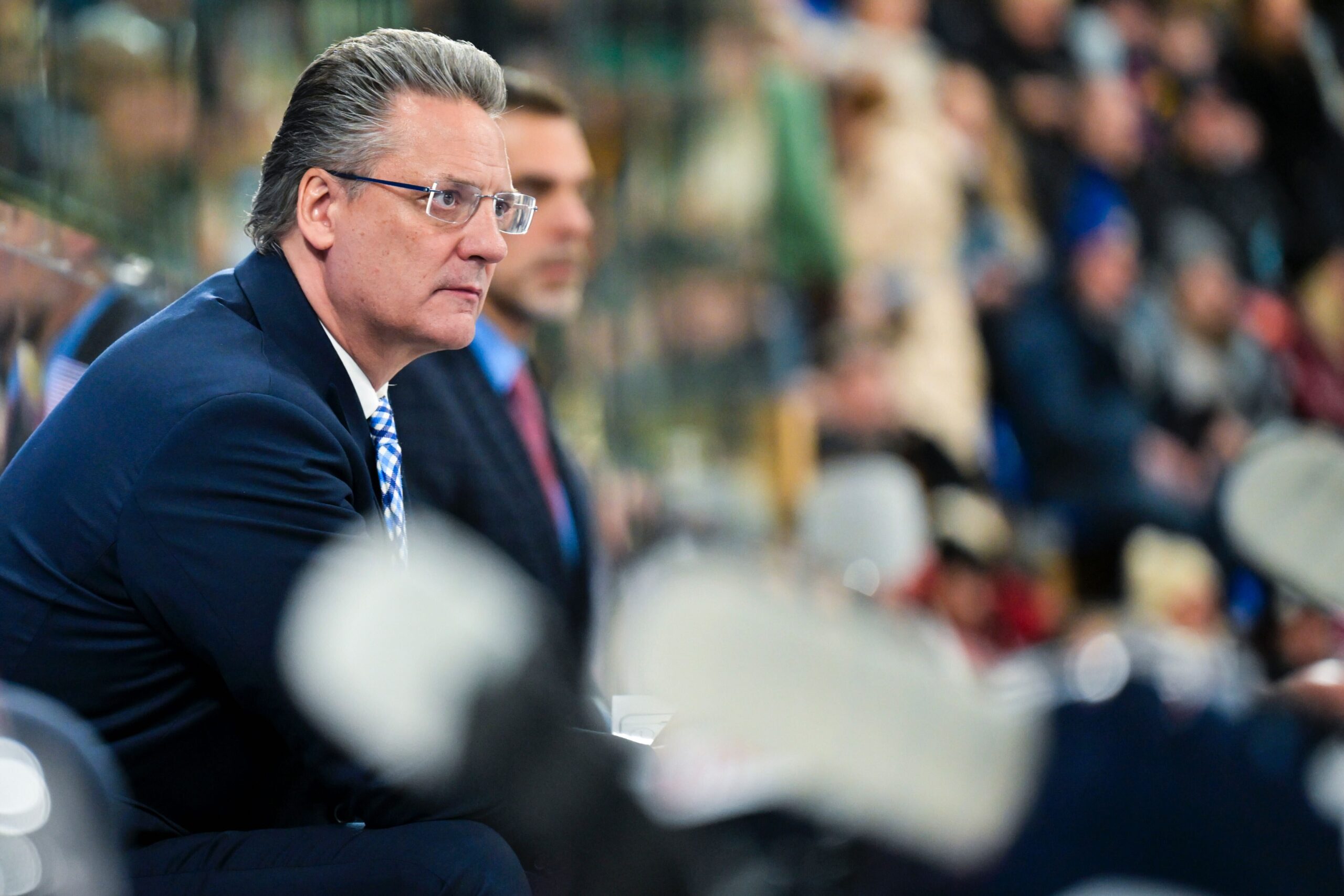
    Fink and Mac Gadowsky received automatic invitations because they earned All-American honors last season. Guy Gadowsky said he selected the other three, labeled the “behind-the-back boys” for their skilled passing while playing on the same line at Penn State, because when rosters were due in November, they were three of the top six goal scorers in Division I.

    Penn State coach Guy Gadowsky led the U.S. Collegiate Selects to two wins over European pro teams last month in Switzerland.

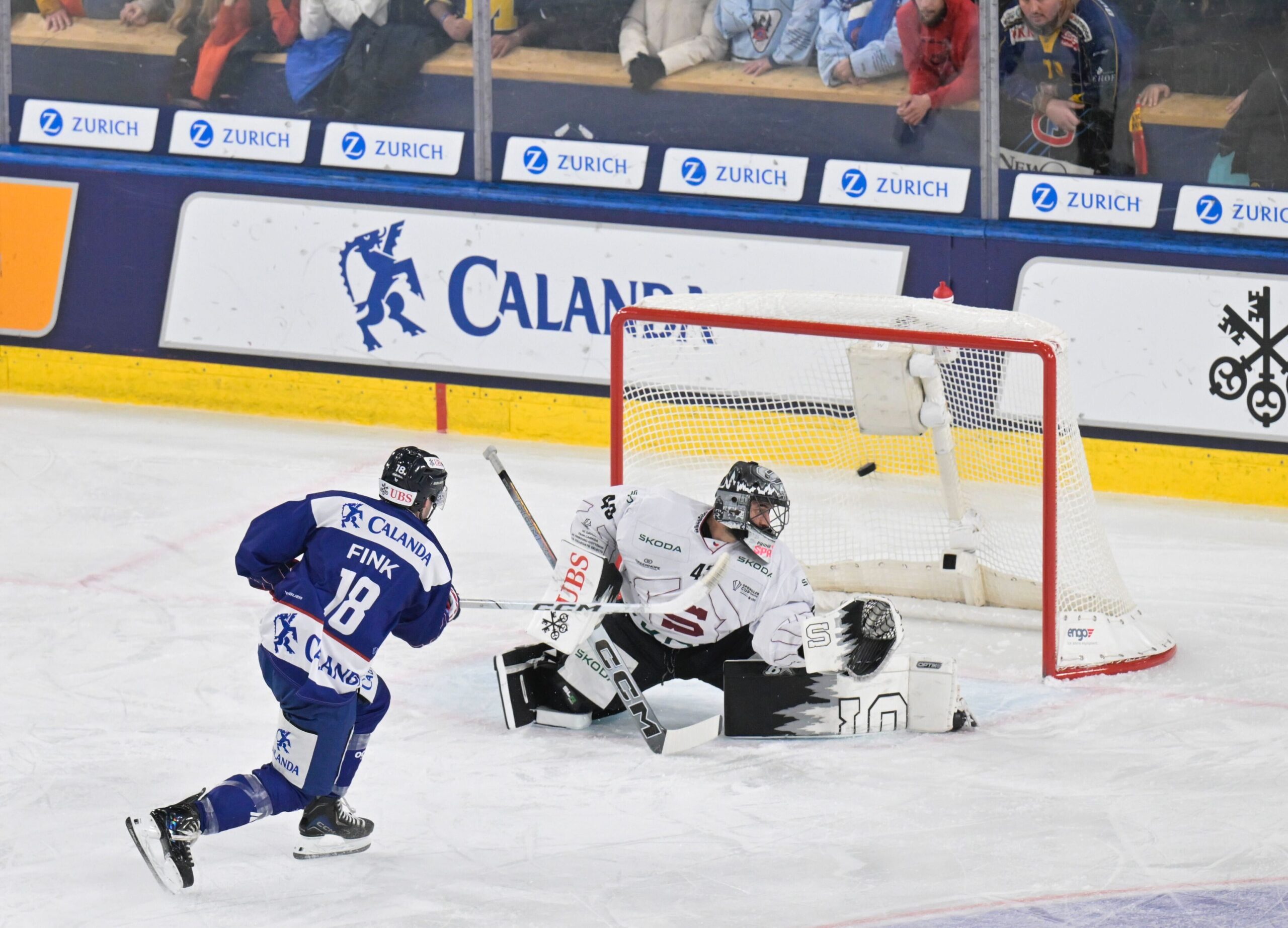
    Fink, a Nashville Predators draft pick who recently became the fastest Nittany Lion to reach 100 career points, led the U.S. Selects with four goals in Switzerland. His eight points led the entire tournament and earned him recognition on the 97th Spengler Cup All-Star team.

    “The experience I had [in Davos] was unforgettable,” said Fink, who tallied two points in the U.S. Selects’ victory over HC Davos. “It was my first experience [in Europe], and it was beautiful. The hockey was great.”

    After dropping their first contest, the U.S. Selects rattled off consecutive wins over professional squads. Their second victory was a 5-3 win in the semifinals over HC Sparta Prague, a team in seventh place in the Czech Republic’s top professional league.

    The underdogs had conquered two giants. And the Davos locals noticed and rallied behind the 25 college kids as they earned a spot in the tournament’s championship game.

    “You’d be walking down the street, and every person would stop you to try to get pictures,” Fink said. “All our merchandise was sold out. [The Davos locals] were super nice to us. It was pretty cool seeing that.”

    Knuble, who faced off against Fink last weekend when Notre Dame visited State College for a Big Ten series, skated alongside the Predators prospect with the U.S. Selects.

    The 5-foot-10 forward lauded the local support and labeled the event “a hockey party,” one he said he will remember for the rest of his life.

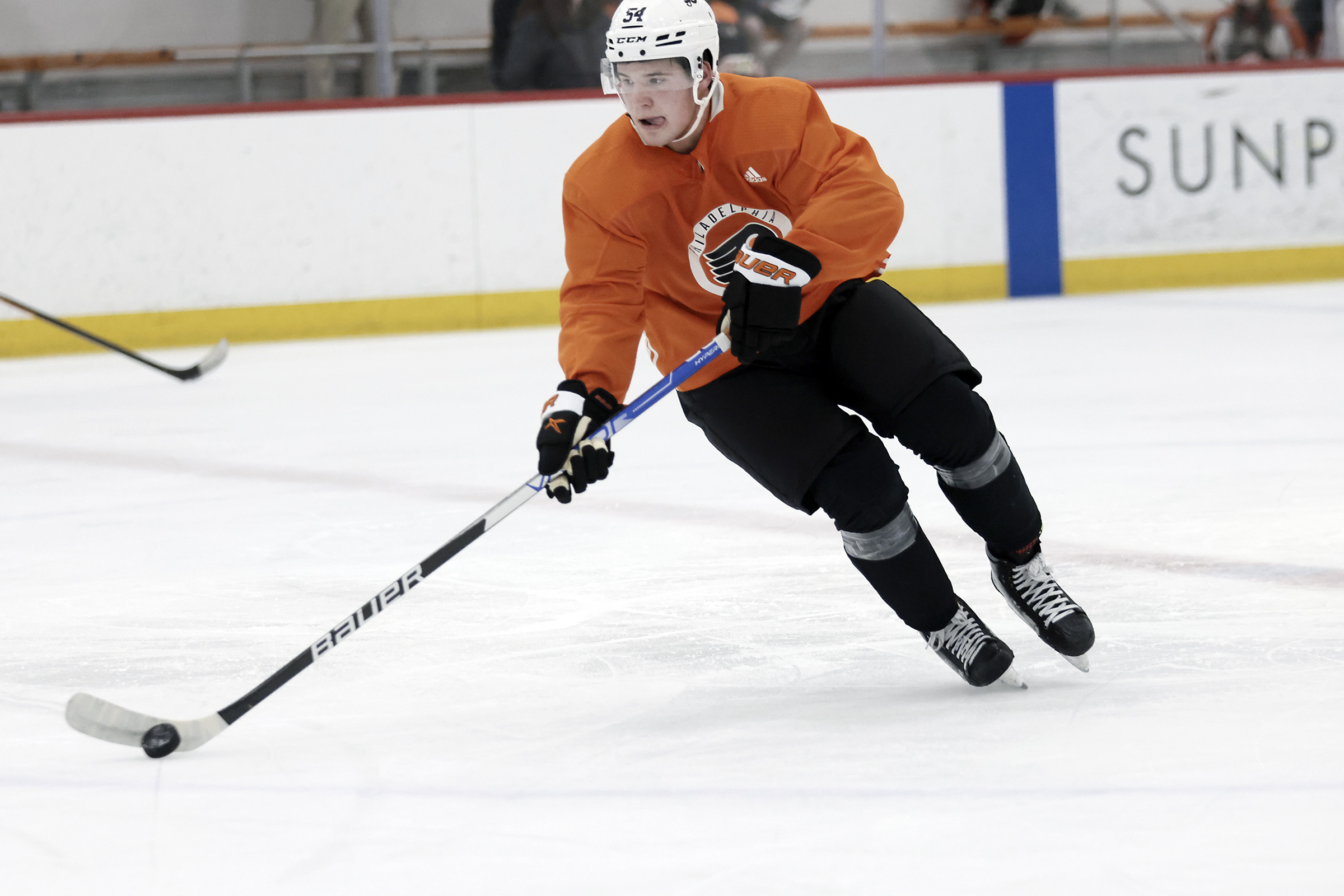
    Flyers prospect Cole Knuble, the son of former Flyer Mike Knuble, is someone the organization is very high on.

    “The excitement in the town for the tournament was insane,” Knuble said. “I don’t think [the locals] knew anything about college hockey and expected us to not be competitive. But everywhere we went, we were stopped, and people were really curious about where we were from and how we were enjoying our time.”

    The Flyers selected Knuble in the fourth round of the 2023 NHL draft. He is the son of former Flyers winger Mike Knuble, who spent five productive seasons with the organization.

    Knuble tallied his lone Spengler Cup point in the championship game — a net-front feed to Cornell’s Ryan Walsh to knot the score at 1. But the U.S. Selects lost that game, 6-3, after a third-period surge from HC Davos and fell just short of their ultimate goal.

    While they didn’t return with a trophy, they had earned the respect of the hockey world. A team of inexperienced college kids had marched into Switzerland and proved it could hang with some of Europe’s best.

    And for that, it was mission accomplished.

    “We definitely felt a responsibility as the first college select team [to play in the Spengler Cup],” Knuble said. “Before the tournament, we talked about how we are making an impression on people about what college hockey is, and [we] wanted to prove that this team should be back.”

    Penn State’s Aiden Fink led the U.S. Collegiate Selects with four goals and the entire tournament with eight points.
  • Second-half surge helps Villanova roll past Georgetown to set up a Saturday showdown with No. 2 UConn

    Second-half surge helps Villanova roll past Georgetown to set up a Saturday showdown with No. 2 UConn

    The difference isn’t in the adjustments as much as it is the inherent advantage of the location of each team’s bench during the first half, according to Villanova coach Kevin Willard.

    Villanova runs its offense in the first half in front of Ed Cooley and Georgetown’s bench, and the Hoyas run their offense in front of Willard and his bench.

    “I get to yell their plays out,“ Willard said after Villanova’s 66-51 victory over Georgetown on Wednesday. ”The coaches all know the plays. I’ve watched Georgetown play nine times now. You know when the center is out in the corner, they’re going to run a boomerang. You know when [Malik] Mack’s on the block, it’s going to be an iso.”

    Villanova used a 16-1 surge in the first four minutes to blow open just a three-point halftime lead, and there has to be more to it than the orientation of the court. Save for a few games, Saturday’s loss to St. John’s being one of the outliers, Villanova has been a solid second-half team. It entered Wednesday night with a plus-4.1 margin over its opponents in the second half. That ranked 62nd nationally and fourth in the Big East. It is not amazing, but considering there are 365 Division I teams, it’s not nothing.

    There is, of course, more to it than Willard’s initial explanation.

    Villanova watches a lot of film at halftime. Willard watches the offense to figure out what he wants to call in the second half, but the rest of the staff and team focus on the defensive end. There was a lot to like on that end from the first 20 minutes. It was an ugly opening frame that ended with the teams combining to shoot 15-for-54 (27.8%). Villanova’s offense looked clunky, but the Wildcats forced nine first-half turnovers from a Georgetown team that entered Wednesday on a five-game losing skid but was 15th nationally in turnover percentage.

    There was less tactical messaging during the break, too.

    “It’s just getting a very young team to understand, it’s all I talked about at halftime, this is Big East play,” Willard said. “They’re a really good, physical defensive team. It’s not going to be easy. We have to rebound and get out. That’s usually all the message is and just cleaning up what we’re struggling with defensively.”

    Villanova allowed a 20-4 St. John’s start to the second half Saturday at Xfinity Mobile Arena, but Wednesday, against a lesser opponent that dropped to 1-7 in conference play, was a much different story. Georgetown turned it over four times in the first four minutes of the second half and Villanova finally got out in transition and found cleaner shots.

    “That first stretch won us the game,” said Tyler Perkins, who led Villanova with 16 points.

    The 16-1 spurt stretched to 29-8 midway through the second half to give Villanova its largest lead, 55-31. The defense that kept Villanova in the game during the first half carried over. The Wildcats held Mack, who averages 13.8 points, to five points on 1-for-14 shooting. The 51 points the Hoyas scored were the fewest by a Villanova opponent this season.

    “I think we all knew we’d be better on offense in the second half,” said freshman point guard Acaden Lewis, who had 15 points and a season-high seven rebounds. “That’s kind of what happened. We stayed solid defensively, and the offense came around late.”

    Bryce Lindsay, who hit a three-pointer from the edge of the midcourt logo in the second half, and Duke Brennan joined Perkins and Lewis in double figures with 11 and 10 points, respectively. It was far from the cleanest offensive night from the Wildcats, who got just nine assists on their 24 makes, far below their season-long assist percentage of 53.7. But it was more than enough against a Georgetown team that Cooley said was “emotionally and physically frustrated” by Villanova in the second half.

    “Villanova does what they do,” Cooley said. “They use a ball screen 118 times a game, and they took advantage of that and made some shots.

    “This game is all about discipline. It’s all about connection. It’s all about emotional and mental toughness.”

    One team had it Wednesday, the other didn’t. One team’s season is spiraling, the other’s continues Saturday afternoon in Hartford, Conn., where it gets another opportunity for a signature win.

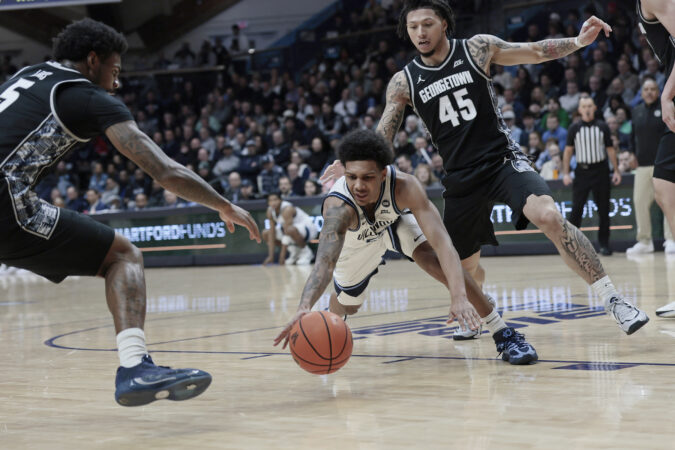
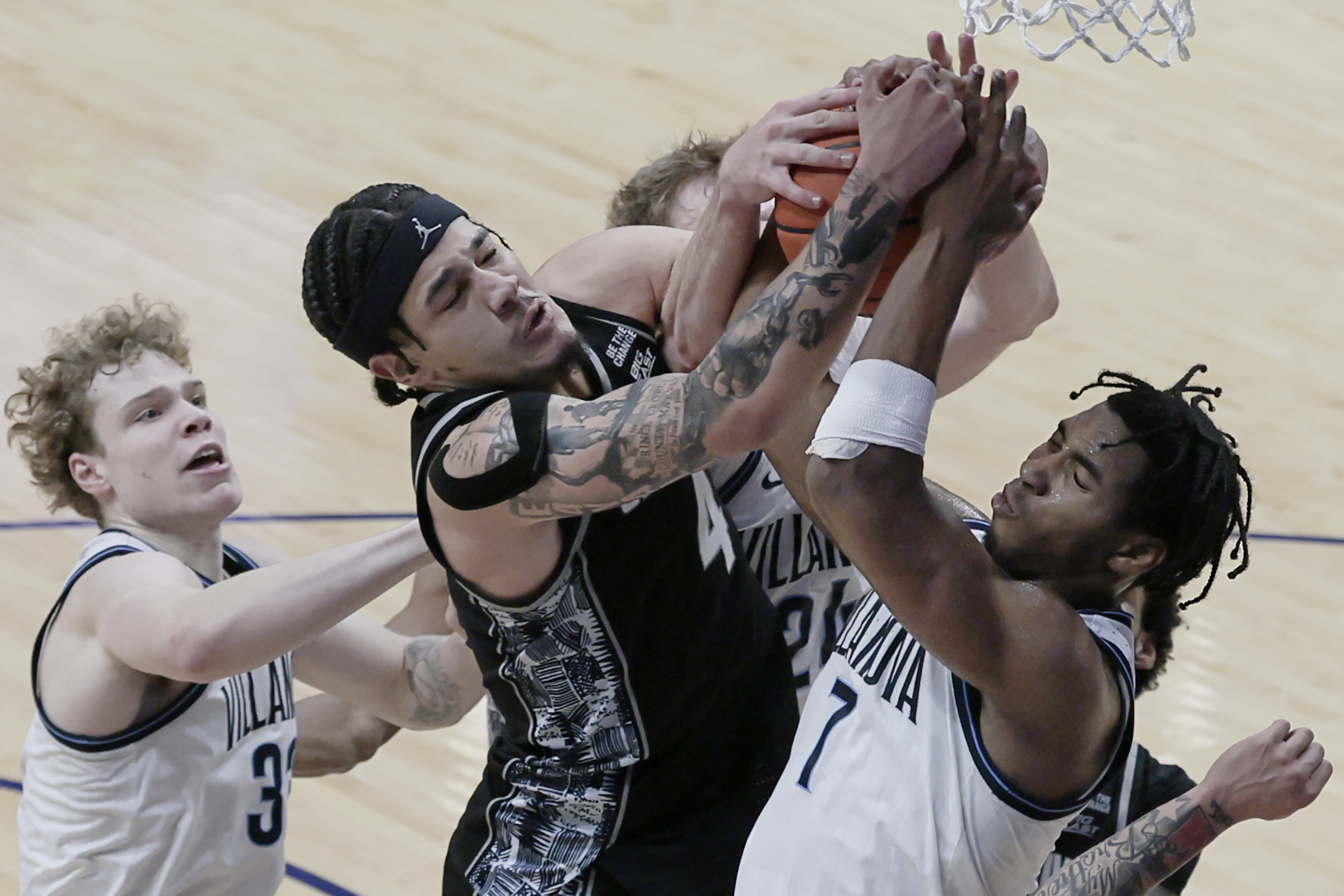
    Georgetown’s Caleb Williams is sandwiched between Villanova players on Wednesday.

    The good part about this time of year, Willard said, is that he’s seen about all of his conference opponents on film. No. 2 UConn, he said, has a lot of veteran talent and he loves watching freshman Braylon Mullins, who attempts nearly six three-pointers per game in 26 minutes and is “always hunting.”

    Villanova entered Thursday rated 24th at KenPom and 34th at Torvik, two of the primary college basketball metrics sites, and was 33rd in the NCAA’s NET rankings. The Wildcats are on a path to snapping their NCAA Tournament drought of three seasons. But what they don’t have yet is a marquee victory, due respect to Wisconsin and Seton Hall. Each major step up in competition has been met with much resistance.

    “Every league game is important,” Lewis said when asked about Saturday. “It’s the same approach, same things we always do.”

    If that’s not working early on, there’s always halftime.

  • Marshall scores 25 off the bench, La Salle takes down Dayton

    Marshall scores 25 off the bench, La Salle takes down Dayton

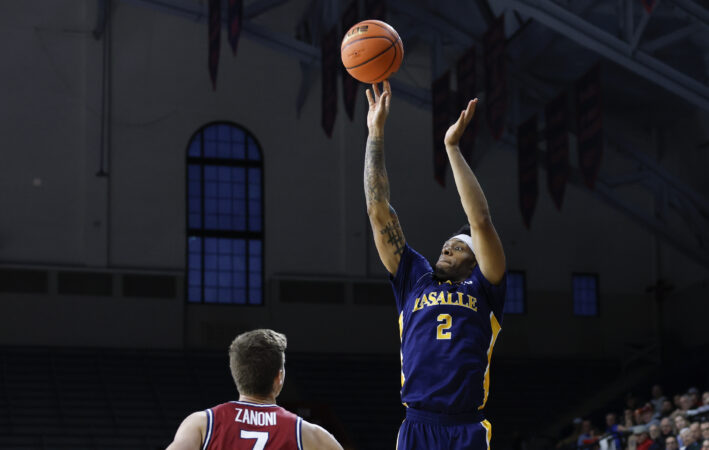
    Jaeden Marshall’s 25 points off of the bench led La Salle to a 67-64 victory over Dayton on Wednesday.

    Marshall shot 7 of 11 from the field, including 4-for-7 in three-pointers, and went 7-for-7 from the line for the Explorers (7-13, 3-4 Atlantic 10). Josiah Harris scored 10 points while shooting 4 of 7 from the field. Jerome Brewer Jr. had seven points, including two free throws with 21 seconds remaining.

    Keonte Jones led the Flyers (14-5, 5-1) in scoring, finishing with 14 points, 10 rebounds, and two steals. Dayton also got 11 points and five assists from Javon Bennett. Bryce Heard also had 10 points. The loss ended a five-game winning streak for the Flyers.

    Marshall scored 12 points in the first half for La Salle, which led 40-29 at the break. Marshall led La Salle with 13 points in the second.

  • Villanova freshman Acaden Lewis is often praised for using his ‘off’ right hand. He’s actually right-handed.

    Villanova freshman Acaden Lewis is often praised for using his ‘off’ right hand. He’s actually right-handed.

    Because Acaden Lewis shoots a basketball left-handed, it is natural for observers to admire the way the freshman Villanova point guard uses his right hand.

    The admirers often wear headsets and announce games on television.

    There goes Lewis, using his other hand.

    Look at that, with the off hand.

    For most players, passing the ball with their nonshooting hand, dribbling to their nonshooting hand’s side, and using their nonshooting hand to finish a layup or floater takes a lot of practice. The movements can be unnatural.

    To be sure, Lewis has worked hard to sculpt a skill set that has allowed him to play right away and be the lead guard on what looks like an NCAA Tournament-bound Villanova team.

    But he isn’t left-handed.

    “I can’t do anything with my left hand,” Lewis said by phone this week as he forked noodles into his mouth using his right hand following a post-practice film session. “I can’t palm a ball. I can’t write. I can’t eat.”

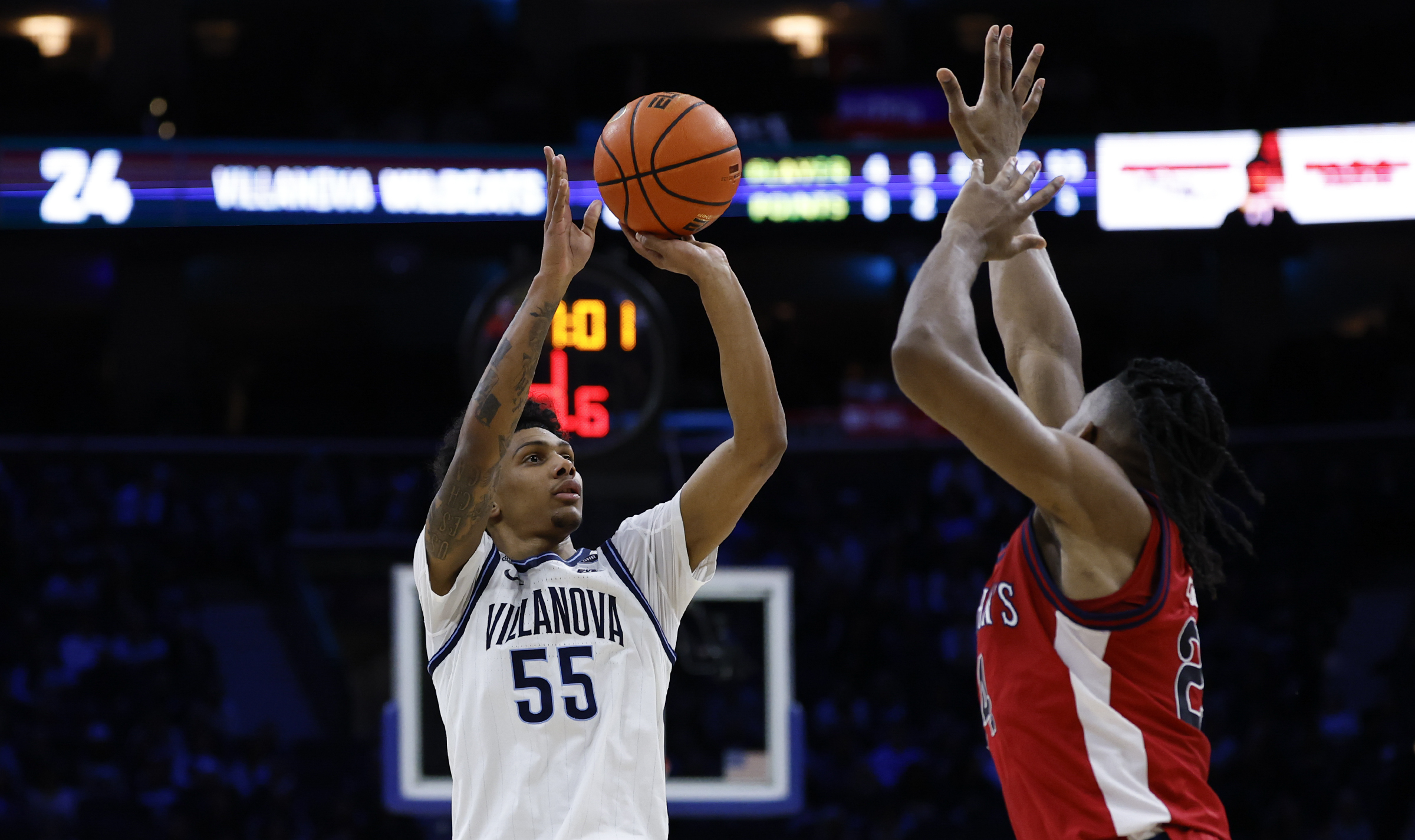
    Acaden Lewis is averaging 12.1 points, 5.3 assists, and 3.4 rebounds for the Wildcats.

    How did a right-handed kid growing up in the nation’s capital learn to play basketball left-handed?

    “I actually have no clue,” Lewis said. “I think I just shot with my left hand when I started hooping.”

    Whatever works. And it’s working. Entering Wednesday night’s game vs. Georgetown, Lewis is at 12.1 points, 5.3 assists, 3.4 rebounds, and 1.9 steals per game.

    His ability to use both hands is all over that stat line.

    “I think he has so much confidence in the fact that he can go both ways, and it’s not like you can shade him one way or send him to his weak hand,” Villanova coach Kevin Willard said.

    Willard first recruited Lewis out of high school when he was the coach at Maryland, but Lewis initially committed to Kentucky. It wasn’t until April, a few months before summer workouts, that Lewis withdrew his commitment from Kentucky and was back on the market. Villanova needed a point guard.

    During the recruiting process, Lewis told Willard and his staff that he actually was a righty.

    “I thought he was full of s—,” Willard said. “Because he was doing everything with his left.”

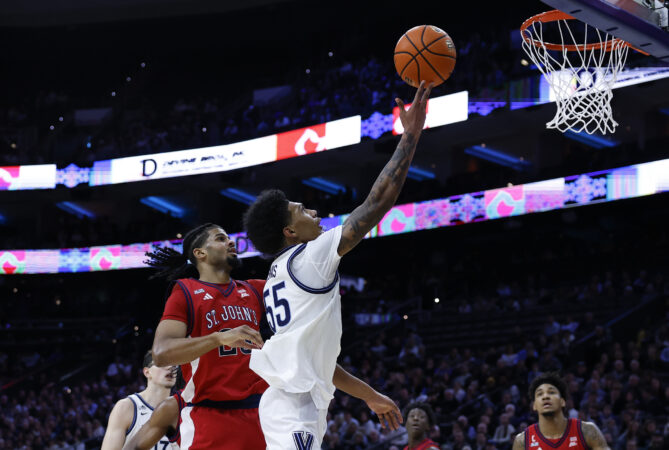
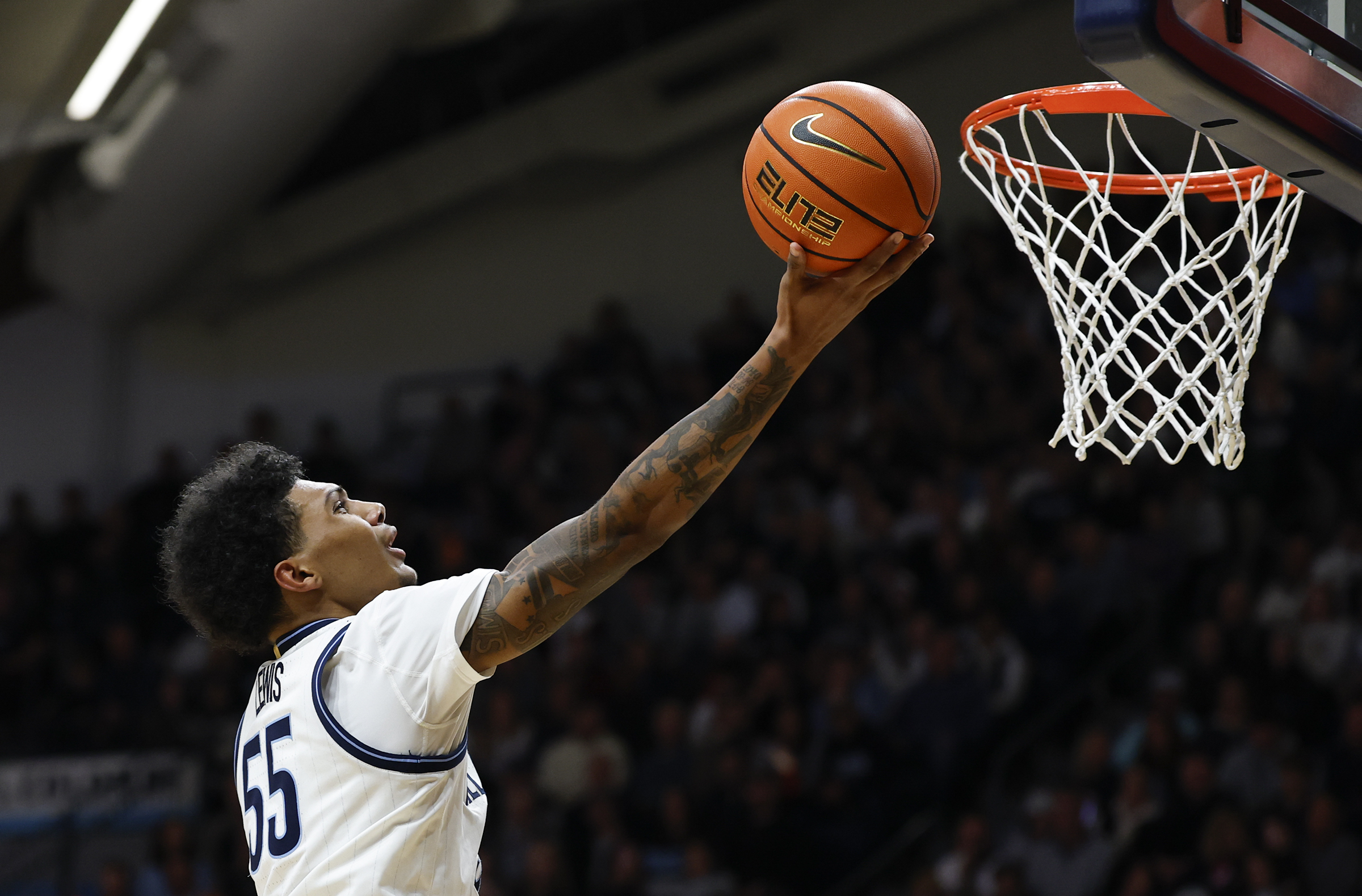
    Villanova guard Acaden Lewis lays up the basketball against Duquesne on Nov. 15.

    Willard noticed Lewis was good going both ways when he watched him, but it took floater drills during preseason practices for the coach to finally become a believer. Lewis was better with his right.

    “I was like, ‘Jeez, he must be right-handed,’” Willard said.

    Then, in October, during the installation of Villanova’s pick-and-roll defense, Willard noticed Lewis’ ability to run offense and pass effectively using his right hand. For most players, Willard said, there’s a “dramatic difference” when running an offense to their supposed weak side. With Lewis, it’s a strength.

    “We actually run some plays where he’s passing with his right hand because he can do it,” Willard said. “We don’t have to switch sides of the floor because he’s lefty. He gives me flexibility in the fact that we can run certain plays on the same side of the floor.”

    Lewis, who has been named Big East freshman of the week four times, agreed with Willard that passing might be the most critical component of him being ambidextrous.

    “I think that’s the best thing I actually do with both hands,” Lewis said. “Either that or finishing. I think the passing ability is really dynamic. I can do all types of passing with both hands, so it’s never like I have to come across my body or have to make awkward movements to throw passes. It makes a lot of things comfortable for me.

    “It’s a little unorthodox, and it’s kind of hard to guard.”

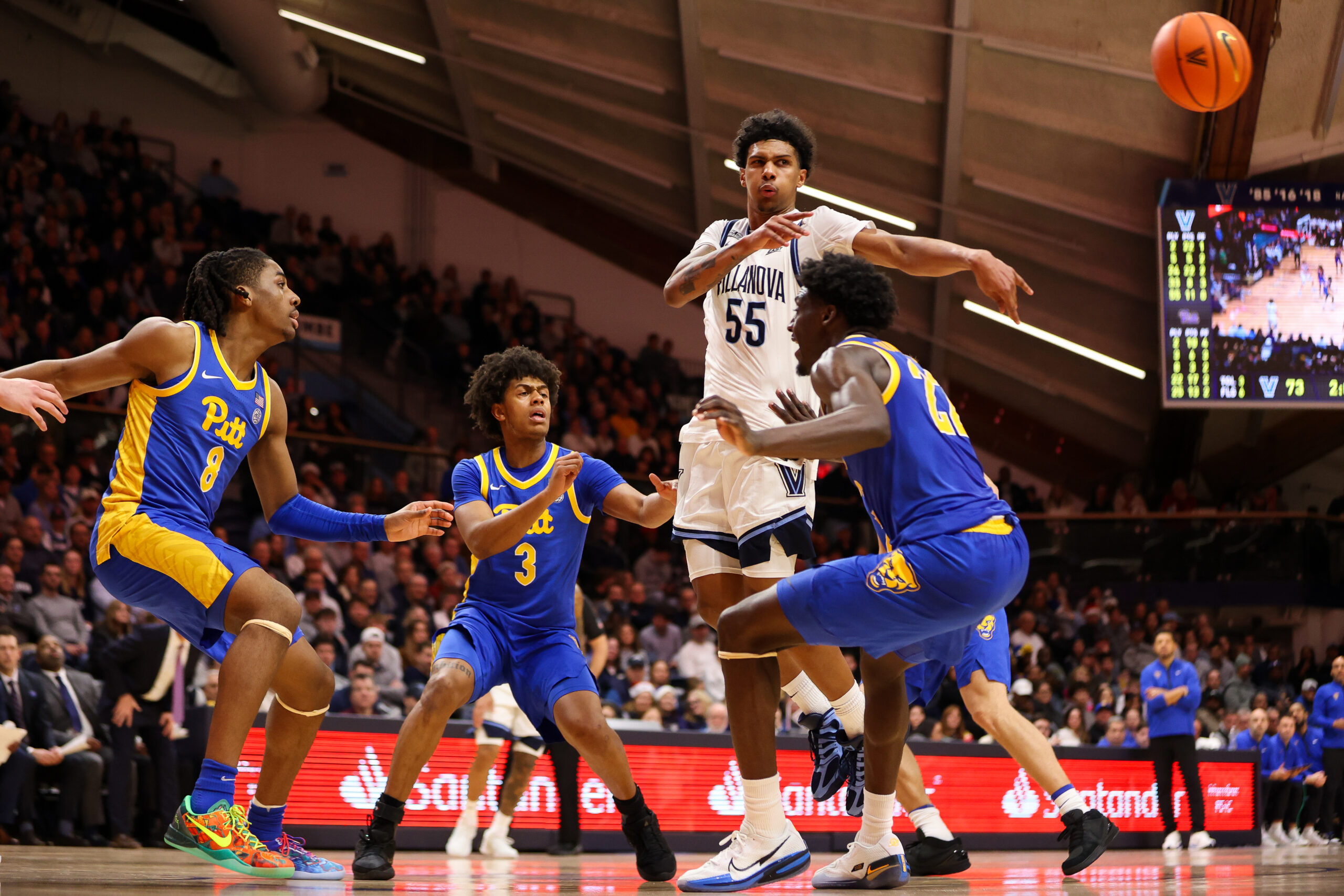
    Acaden Lewis firing a pass to his left during Villanova’s win against Pittsburgh on Dec. 13.

    There is, however, no advantage to being strong with both hands on the defensive end, Willard said.

    “I wish it did [help him],” Willard said jokingly. “I think he wishes it did, too.”

    Lewis credited his knack for the ball as the reason he is averaging nearly two steals through his first 18 college games. But while Lewis is fourth in the Big East in steals, his defense and inexperience have landed him on the bench a few times this season, including for all but 19 seconds of the final 11-plus minutes of Saturday’s loss to St. John’s.

    Lewis, Willard said, takes to coaching. He was similarly benched during the second half of a season-opening loss to BYU and responded well.

    “I think one of the biggest things about a leader is, he admits when he [messes] up,” Willard said. “He owns it. I think other guys have really bought in to the fact that here’s a young guy that’s getting yelled at by the coach because he’s the point guard, but he’s the man taking it.”

    Having two dominant hands and arms on the basketball court has been key for Lewis during his first season, but beyond that, Willard said Lewis’ commitment to learning and studying has enabled him to play well right away. That part he expected. Eric Singletary, Lewis’ coach at Sidwell Friends School in Washington, which previously fed Villanova stars like Josh Hart and Saddiq Bey, raved about the student of basketball Willard was getting.

    What Willard didn’t know until Lewis got on campus was that Lewis is a “monster competitor,” the coach said.

    “I just never knew how much of a competitor, how much he wanted to win, and how much he wants to be good. I don’t think you ever really find that out until you start coaching a kid. He’s blown me away with how much of a competitor he is.”

    That, and the right-handed floaters.

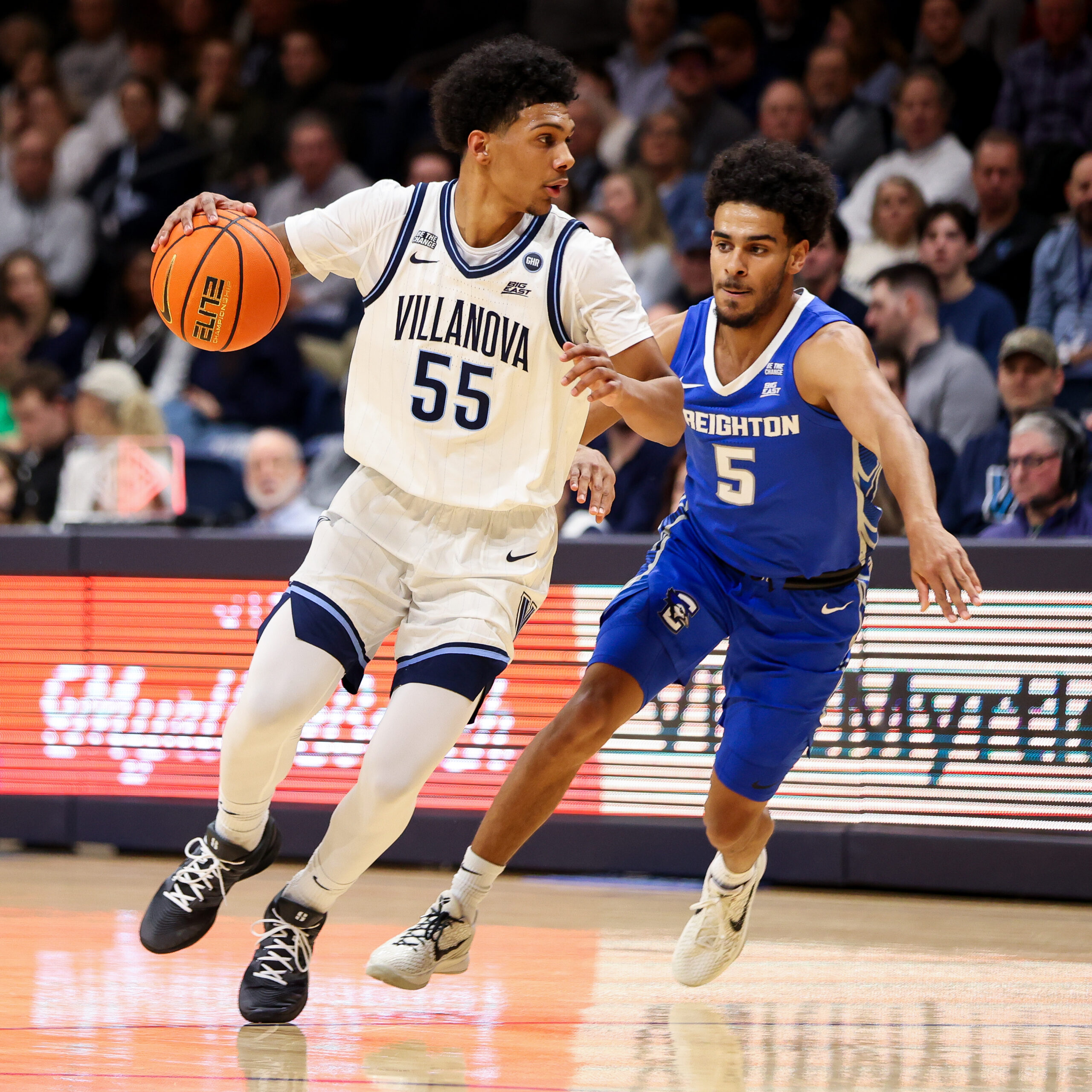
    Acaden Lewis dribbles with his right hand as Creighton’s Nik Graves pursues him on Jan. 7.

    Those, and Lewis’ ballhandling skills, were developed during early-morning training sessions that started when Lewis was a freshman in high school. While Lewis is right-handed, he spent his youth mostly using his left on the court. His trainer, Kevin “Uncle Skoob” Kuteyi, would pick Lewis up full-court during 6 a.m. workouts and force the teen to beat the pressure, often dribbling to his right, and finish at the rim, again mostly with his right hand.

    It came naturally, thanks to Lewis’ right hand being his dominant hand.

    “Everything about me in basketball is left-handed, I would say,” Lewis said. “But I’m right-handed, so I’m ambidextrous, basically. It’s weird.”

    Weird, even ambiguous.

    Does Lewis consider himself right-handed, left-handed, or ambidextrous?

    “I’m a right-handed person who is left-handed when I hoop,” he said. “That’s how I would put it.”

  • Why is a Pennsylvania school celebrating Indiana’s national title? It’s more than the name.

    Why is a Pennsylvania school celebrating Indiana’s national title? It’s more than the name.

    Despite sharing half a name, Indiana University of Pennsylvania has no connection to Indiana University (located in Bloomington, Ind.). So why are some IUP alumni celebrating after the other Indiana won its first football national championship on Monday night in Miami?

    The answer is Curt Cignetti. Before Cignetti’s Indiana team completed arguably the most improbable undefeated season in the history of the sport with a 27-21 win over the Hurricanes on their home field, Cignetti was the coach at Division II IUP.

    Cignetti left his spot on Nick Saban’s staff at Alabama in 2011 to take the IUP job, which was his first head coaching job. Cignetti’s father, Frank Cignetti Sr., played football at IUP and spent 20 seasons as the school’s head coach before retiring in 2005.

    Curt Cignetti amassed a 53-17 record in six seasons with the Crimson Hawks, departing in 2016 to become the head coach at FCS Elon. Two of Cignetti’s assistants at Indiana, offensive coordinator Michael Shanahan and defensive coordinator Bryant Haines, were on staff with Cignetti at IUP.

    So while the Hoosiers and the Crimson Hawks are not connected in any official capacity, IUP fans have plenty of reason to celebrate the Hoosiers’ perfect season. Cignetti even gave a nod to his IUP roots while on the podium with ESPN.

    “Back when I was waxing the staff table at IUP, Thanksgiving weekend and the school was shut down for the playoffs, did I ever think something like this was possible?” Cignetti said. “Probably not. But if you keep your nose down in life and keep working, anything is possible.”

    The school shared a video clip of Cignetti’s podium remarks on its official Facebook page.

    “Congratulations Coach Curt Cignetti and the Indiana Hoosiers!” IUP’s post read. “We are so proud to be a part of your story!”

    Many members of the IUP community took to social media to express their excitement about the Crimson Hawks being represented on college football’s biggest stage.

    “My freshman year at IUP was Curt Cignetti’s final season coaching our D2 football program,” Seth Woolcock posted on X. “The field there is named after his dad. This guy is Western PA born & raised. Watching him take IU to the Natty is the greatest sports feat of my lifetime.”

    A few posters pointed out that Cignetti is not the only prominent coach to spend time at IUP. Eagles coach Nick Sirianni spent three years coaching wide receivers for the Crimson Hawks before joining the pro ranks in 2009.

    “We wake up this morning to the fact that the winning head coaches of the most recent CFP and the Super Bowl were once coaches at IUP,” Matt Burglund posted on X on Tuesday morning.

    Nick Sirianni’s relative, Pete, made the same connection between Cignetti and the Eagles coach. Pete’s post references IUP alum Ben McAdoo’s unsuccessful stint as head coach of the New York Giants, acknowledging that “the IUP Difference only works for some.”

    IUP had connections to both sides of Monday night’s title game, as Miami’s athletic director, Dan Radakovich, played football for the Crimson Hawks and graduated from IUP in 1980. Cignetti’s connection to the school seemed to overpower any Miami favoritism among IUP fans.

    “Our Pick?” the IUP Alumni Association wrote in a Monday morning Facebook post. “I-N-D-I-A-N-A all the way!”

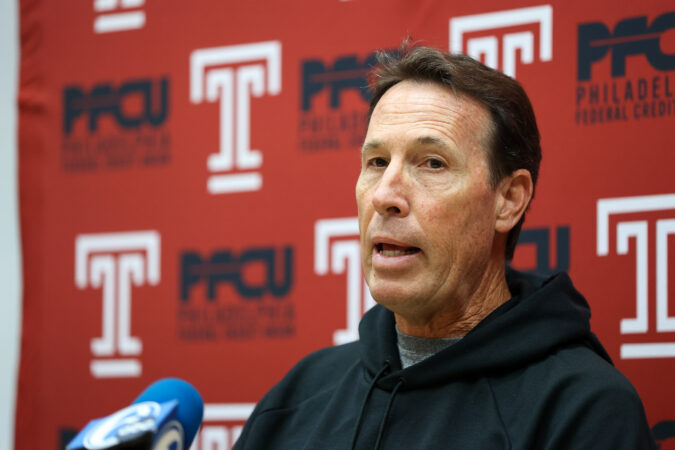
  • K.C. Keeler addressed Temple’s needs in the transfer portal. First, he recruited his locker room.

    K.C. Keeler addressed Temple’s needs in the transfer portal. First, he recruited his locker room.

    After Temple football signed the top-ranked high school class in the American Conference last month, coach K.C. Keeler said the program was just beginning its recruiting process.

    The Owls started their second phase on Jan. 2 when the transfer portal opened. Temple landed 22 transfers while also retaining most of its core pieces from this season.

    “There’s really three phases to this whole recruiting process,” Keeler said. “The first phase is recruiting your locker room. I thought we did a phenomenal job. We’re probably one of the only [non-Power Four] schools in the country that didn’t lose a single starter. … Then the third phase is the portal. The portal’s unique in that it’s not just like who you get in terms of what their ratings are and those things. It’s a lot [of] what your needs are and are you meeting your needs. We graduated a bunch of starters, especially on defense. I thought we did a great job of filling those needs.”

    The priority for Keeler was finding a quarterback for next season. Owls starter Evan Simon and backup Gevani McCoy will graduate this spring, and third-stringer Tyler Douglas entered the transfer portal.

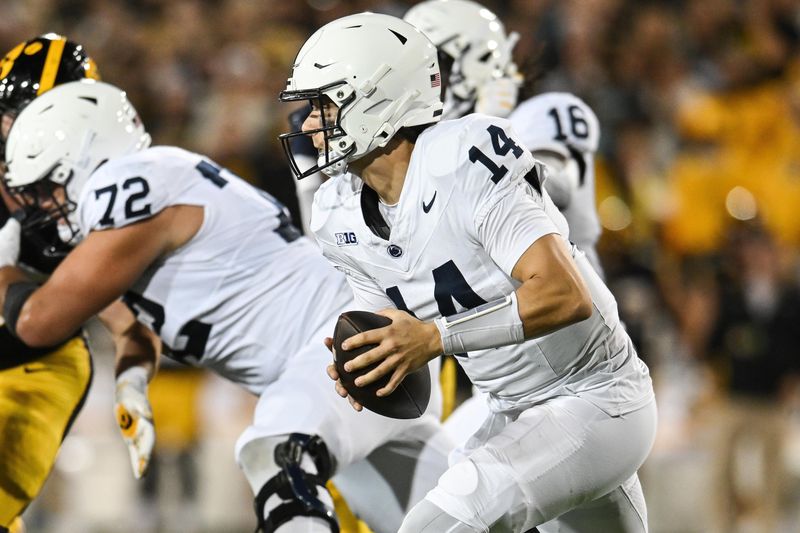
    Temple landed two quarterbacks from the transfer portal in Jaxon Smolik from Penn State and Ajani Sheppard from Washington State. They will compete for the starting role. Sheppard spent two seasons at Rutgers before transferring to the Cougars last year and was recruited by the Owls when he was in the portal last season.

    Temple general manager Clayton Barnes says former quarterback Jaxon Smolik didn’t get his opportunity at Penn State but has the skill set to be an elite quarterback.

    Smolik visited Temple in early January and became friends with tight end Peter Clarke, who hosted him. General manager Clayton Barnes said Smolik has a similar personality to Simon.

    “So [Smolik is] a guy that things didn’t time up. He was behind a three-year starter the whole time he was there” at Penn State, Barnes said. “[He] really just needed that opportunity. So when we checked the box from a skill set, personality, all that kind of stuff, he’s a guy that we felt would be a great fit for us and was one of those first few guys we got on campus. And by the time he was there, it was like, ‘Hey, this is our guy.’”

    Smolik was one of four players to join Temple from Penn State during the offseason. Since the programs have the same recruiting pool, Temple often uses Penn State coaches to source intel on prospective transfers. Two former Nittany Lions, defensive tackle Kaleb Artis and safety Kolin Dinkins, are among 11 defensive players the Owls brought in.

    Artis is among six brought in to bolster the defensive line after Temple lost Sekou Kromah, K.J. Miles, Cam’Ron Stewart, and Charles Calhoun to graduation or the portal.

    “So you look at what we graduated from the rush spot this past year,” Barnes said. “We had two seniors that played and another guy that sought other opportunities. We knew we needed to bring in guys to play that position.”

    Keeler also wanted continuity along the offensive line after losing starting right tackle Diego Barajas to graduation. Left tackle Giakoby Hills and left guard Eric King stayed with the program on multiyear deals.

    The Owls also brought in offensive linemen to add depth. Former Rutgers lineman John Stone will compete for the starting center role with Grayson Mains.

    “How do we bring in guys to compete for that right tackle spot? We don’t want to just rest on our laurels,” Barnes said. “We want to get better. So we brought in a couple other guys that have multiple years that not only can push those current starters, but also give us guys that can play for us next year if they don’t end up being the guy.”

  • The NBA journey of former Villanova star Collin Gillespie seems unlikely to everyone — except him

    The NBA journey of former Villanova star Collin Gillespie seems unlikely to everyone — except him

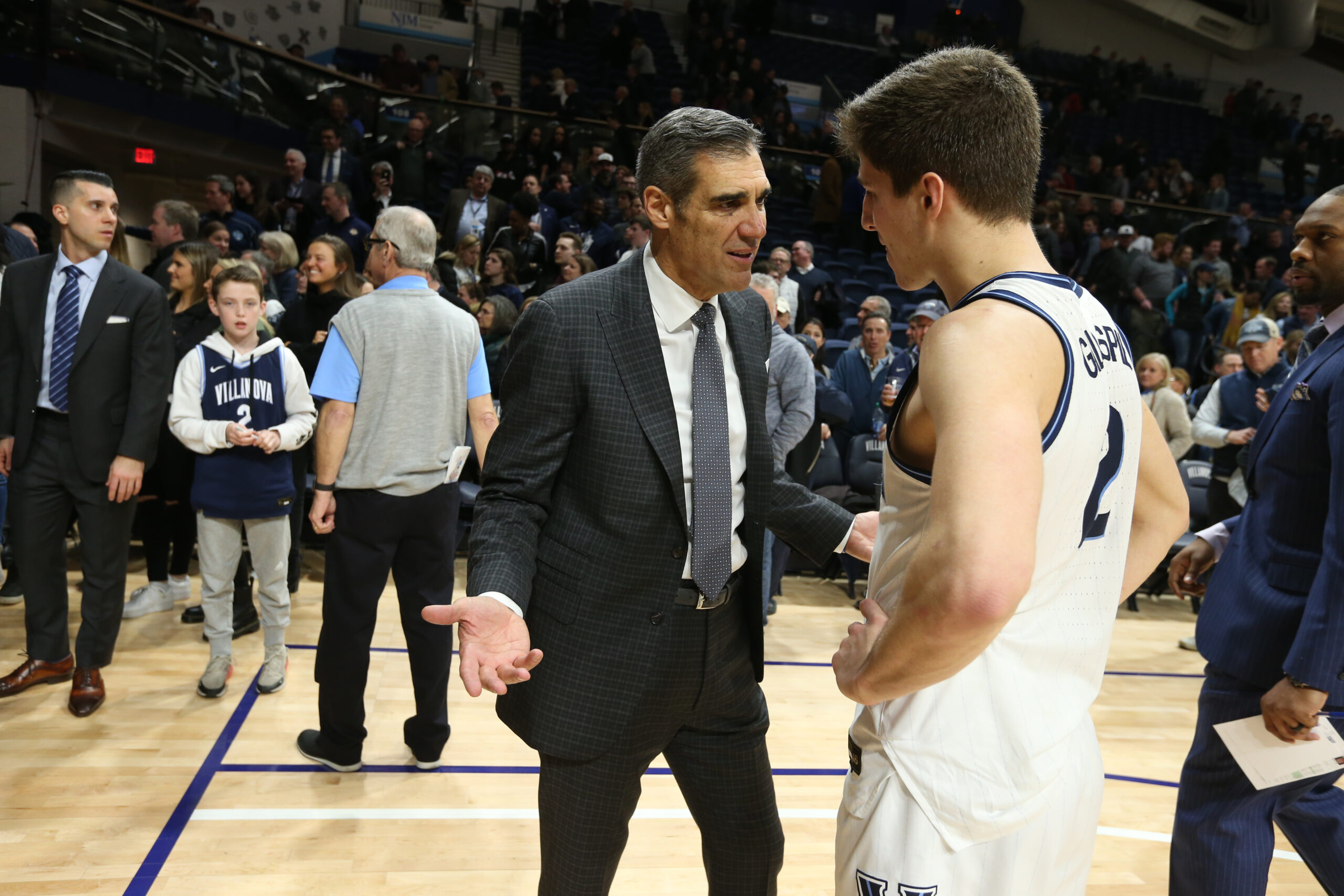
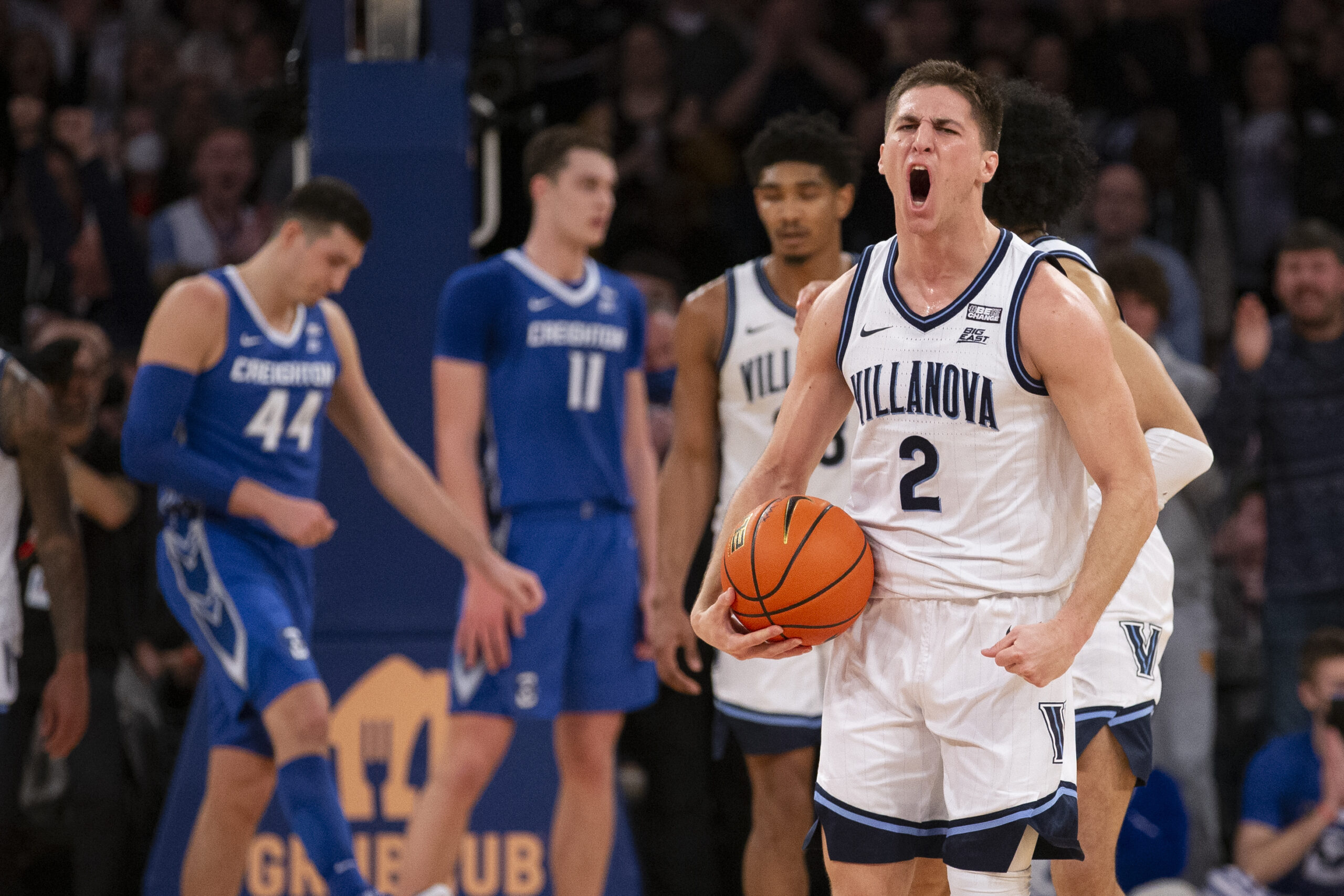
    Jay Wright saw enough of Collin Gillespie a few nights before to invite him to Villanova on a Monday in January 2017 and offer him a scholarship. But this was hardly a courtship. Wright told Gillespie that he would redshirt his freshman season, maybe play as a junior, and then have a complementary role as a fifth-year senior.

    “I thought he would get his master’s degree and be a great coach one day,” Wright said. “I was thinking ‘I would love to have this guy on my staff.’”

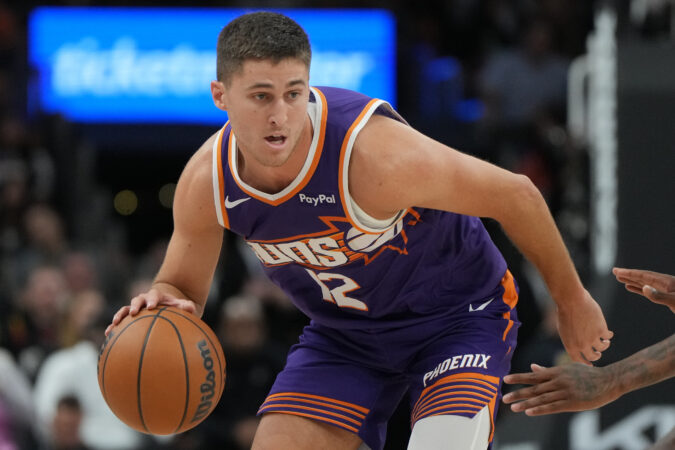
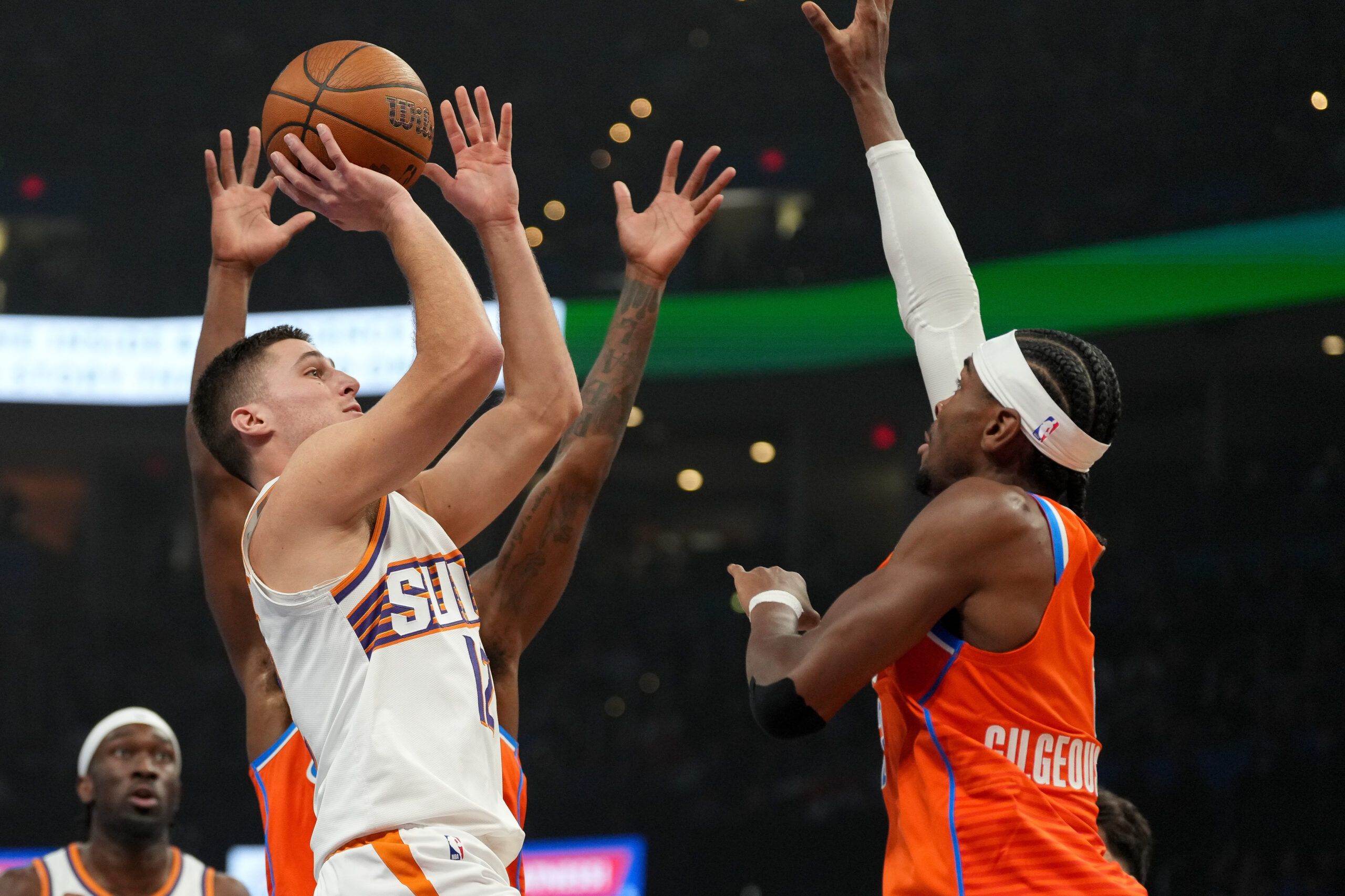
    Gillespie — who has molded himself into an NBA starter with the Phoenix Suns after going undrafted in 2022 — nodded along. He didn’t have a Division I scholarship before his senior year at Archbishop Wood and declined to visit Division II schools because he believed bigger programs would eventually see what he already knew: He could play. Redshirt? OK. Bench player? Sure. Coach? Yes, sir.

    “I didn’t really believe him,” said Gillespie, who will play against the 76ers on Tuesday night. “I believed in myself. I was just like, ‘Whatever he says, I’ll take it and then prove him wrong.’”

    There was Gillespie 15 months later on the court for Wright in the national championship game, taking a charge against Michigan and looking the part. In his fifth year, the kid who had to wait for college scholarships was named the nation’s top point guard in 2022. He went undrafted that June but landed a non-guaranteed contract in July with the Denver Nuggets. He was on track.

    Three weeks later, Gillespie suffered a broken right leg while playing in a pickup game at Villanova.

    His NBA career — the one that is now flourishing — seemed unlikely then to nearly everyone except the guy who nodded along that day in Wright’s office.

    “Everyone has their own journey,” Gillespie, 26, said. “Everyone runs their own race. You just have to stick to what you do, put your head down, and work hard. Don’t compare yourself to anyone else. If you work hard enough, you can probably achieve anything you want to.”

    Collin Gillespie (right) became much more than a fifth-year senior role player first envisioned by Villanova coach Jay Wright.

    G League to the league

    Andre Miller often learned via text messages which players would be flying nearly three hours from Denver to join his G League team that night. He coached the Grand Rapids Gold, the Nuggets’ minor-league affiliate in Michigan that played 1,100 miles from Denver. Those morning flights gave Gillespie a chance to get on the court.

    “It wasn’t a good recipe for these guys to be successful, but when he did show up, he didn’t want to come out of the game,” said Miller, who played three of his 17 NBA seasons with the Sixers. “We knew we had to leave him out there because he didn’t have an opportunity with the other team and he took great advantage of it.”

    Gillespie feared that the Nuggets would void his contract after he suffered that injury playing at Villanova. That’s the first thing he said to his father, who was in the gym when it happened. But they didn’t. They kept him around that first season while he rehabbed and then split his time the next season between Denver and Grand Rapids.

    “There was no ego,” Miller said. “One thing that’s tough to deal with is when your career is in the hands of other people. Some people felt like he wasn’t an NBA player and some people felt like he was an NBA player. The one thing that stood out about him to me is that he’s a competitor. He’s a dog. He’s a guy who enjoys playing basketball. He’s a leader. He plays with a chip on his shoulder.

    “I wish I could have coached him more in the G League, but he was an NBA player. I knew that from the first time I saw him on the court with the G League players. I was like, ‘He probably won’t be here much.’”

    Gillespie signed before last season with the Suns, again splitting time between the NBA and the G League. The 6-foot-1 guard earned a full-time role this season, starting for the Suns and fitting in with pesky defense and a three-point shot. Just like college, it took time before Gillespie’s game was appreciated.

    “You just don’t see it initially. He doesn’t wow you,” Wright said. “But when you see him play over time and you realize this guy is getting to the rim and finishing, he’s elevating on his jumper and shooting over bigger guys, and he’s not getting backed down. You almost need to have time to believe what you’re watching.”

    Collin Gillespie is shooting 41.4% from three-point range for the Suns.

    Gillespie entered Monday’s game against Brooklyn averaging 13.2 points, 4.9 assists, and shooting 41.4% from three-point range. He hit a game-winner at the buzzer in November, regularly finds ways to create his own shot, and has proved that his game fits in the NBA.

    Kevin Durant called him “a dog” and Anthony Edwards said after a loss to the Suns last season that “No. 12 is pretty good at basketball.” Two NBA superstars could see what Gillespie always believed: He belongs.

    “He has more heart than talent,” said his father, Jim. “The kid just doesn’t want to lose. When he sets his mind to something, he just does it. And ultimately, he’s a winner. Wherever he’s gone, he’s won. At every level.”

    Jay Wright says Collin Gillespie came to Villanova with a “killer mentality and stone face that we try to teach.”

    Change of plans

    Gillespie was in the stands for a Villanova game as a senior in high school, seated behind the La Salle bench at the Palestra. The Explorers invited him and Gillespie thought a scholarship offer was near.

    “But they never offered,” Jim Gillespie said.

    Gillespie eventually landed smaller Division I offers as a senior, but he was hopeful a Big 5 school would have a spot for him. None of them did until January when Villanova assistant Ashley Howard urged Wright to watch Gillespie play a game against five-star recruit Quade Green’s Neumann Goretti squad at Archbishop Ryan.

    The Northeast Philly gym was packed and the coach couldn’t stay long as he was being hounded. Howard called Wright while he was driving home and told the coach that one kid scored 42 and the other kid scored 31. Wright figured the 42 points belonged to Green, who was already committed to Kentucky. It was Gillespie, the assistant said. Wright was sold.

    “Nothing was spectacular, and he’s not bringing any attention to himself,” Wright said. “He just makes the right plays.”

    Wright called Gillespie’s father and told him he needed his son at Villanova on Monday. The coach gave Gillespie his pitch that day without any guarantees.

    “We left and we were like, ‘What are you going to do?’” his mother, Therese, said. “He said, ‘I’m going to play out my senior [year].’ I said, ‘Collin, it’s Jay Wright.’ He said, ‘Mom, I know what I’m doing.’”

    Gillespie committed a week later, simply deciding after a game at Bonner-Prendergast that he had enough of the recruiting trail. He was headed to ’Nova and told a Wood coach without first running it by his parents. Gillespie knew what he was doing.

    “He always said, ‘I’ll bet on myself,’” Jim Gillespie said. “He put the work in and the effort in and that’s what he’s always done.”

    It took Gillespie just a few weeks to force Wright to rethink the plan that he would redshirt. Every day in practice that June he went up against Jalen Brunson and held his own.

    Collin Gillespie (left) got to play in practice against future NBA players Donte DiVincenzo (center) and Jalen Brunson (right) at Villanova.

    “He came in with that killer mentality and stone face that we try to teach,” Wright said. “But he came in with that. Then he spent every day with Jalen Brunson and it just became reinforced. It was so obvious. The coaching staff, behind closed doors, was going, ‘This kid is going against Brunson every day. He’s pretty good.’”

    Gillespie suffered a minor injury that month and Wright checked with athletic trainer Jeff Pierce to see how the freshman was feeling. He was fine, the trainer said.

    “The trainer said, ‘You’re not redshirting this kid,’” Wright said. “I said, ‘Is it that obvious?’ He said ‘Yeah, everyone knows.’ Yeah, it was.”

    The guy who nodded along in Wright’s office proved that he belonged. Now, he’s doing it again in the NBA.

    “It’s the way I was raised and where I come from,” said Gillespie, who grew up in Pine Valley before moving to Huntington Valley. “My brother is a year older, so I always played a year up. I had to play against older guys and was always smaller. I always had to prove myself and had a chip on my shoulder. My parents always believed in me and my family always believed in me and taught me to believe in myself.”