The third annual men’s Big 5 Classic returns to Xfinity Mobile Arena on Saturday. The event will feature the teams from the Division I Philadelphia schools, a tradition that has been around for more than 70 years.
The Villanova women are in the championship for the second consecutive year on Sunday at Finneran Pavilion in the women’s Big 5 Classic.
Here’s a look at the men’s and women’s Big 5 brackets:
Men’s bracket
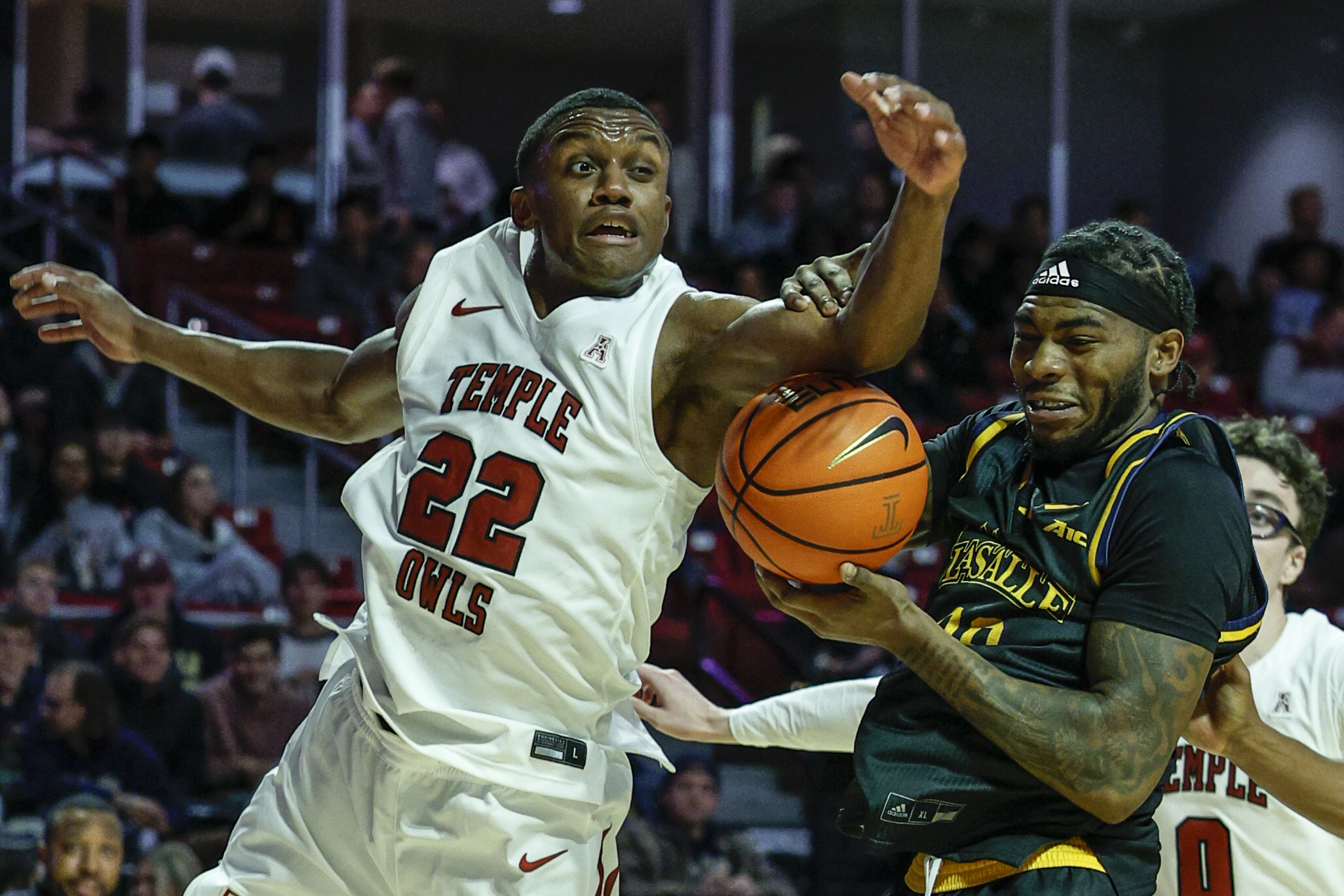
Fifth place: Drexel vs. La Salle, 2 p.m. Saturday
Third place: St. Joseph’s vs. Temple, 4:30 p.m.
Championship: Penn vs. Villanova, 7:30 p.m.
All games will be broadcast on NBC Sports Philadelphia. The championship features two teams that are seeking their first Big 5 crown in the new format. This also is the teams’ first appearance in the championship game.
Both teams have first-year coaches, with Kevin Willard at Villanova and Fran McCaffery at Penn, and both won pod games by double digits to earn a spot in the final.
The men’s side tips off on Saturday for the third straight year, but there is one change in the matchups. For the first time since the format debuted, St. Joe’s will not be in the championship to defend its crown.
St. Joe’s will play Temple in a rematch of the 2023 title game for third place. St. Joe’s beat Drexel on Nov. 8 to begin pod play, setting up a showdown with Penn. The Quakers’ 83-74 upset win sent them to their first Big 5 championship game.
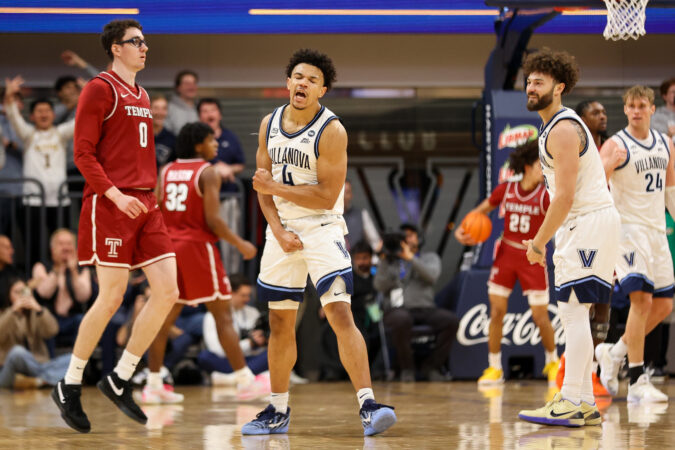
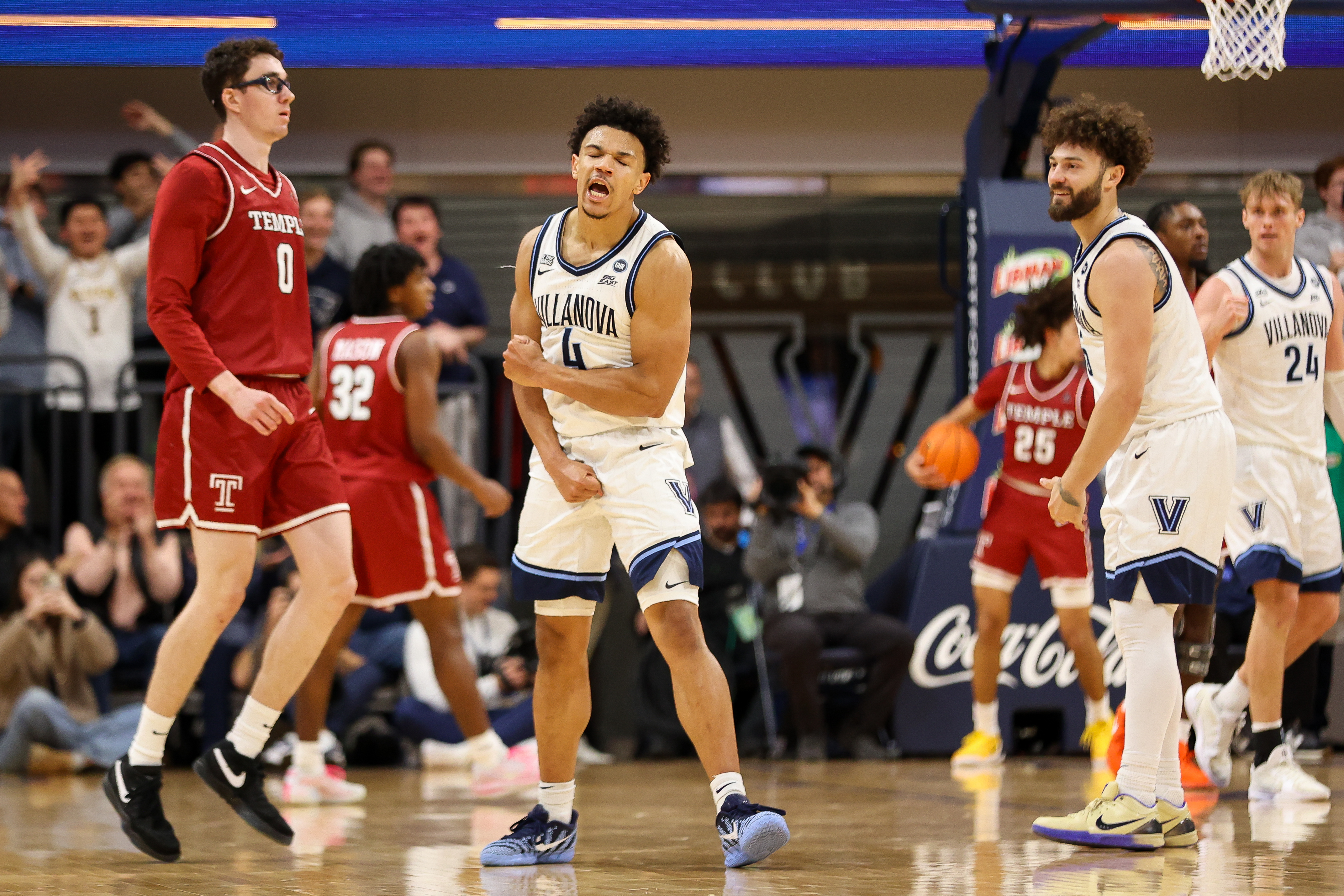
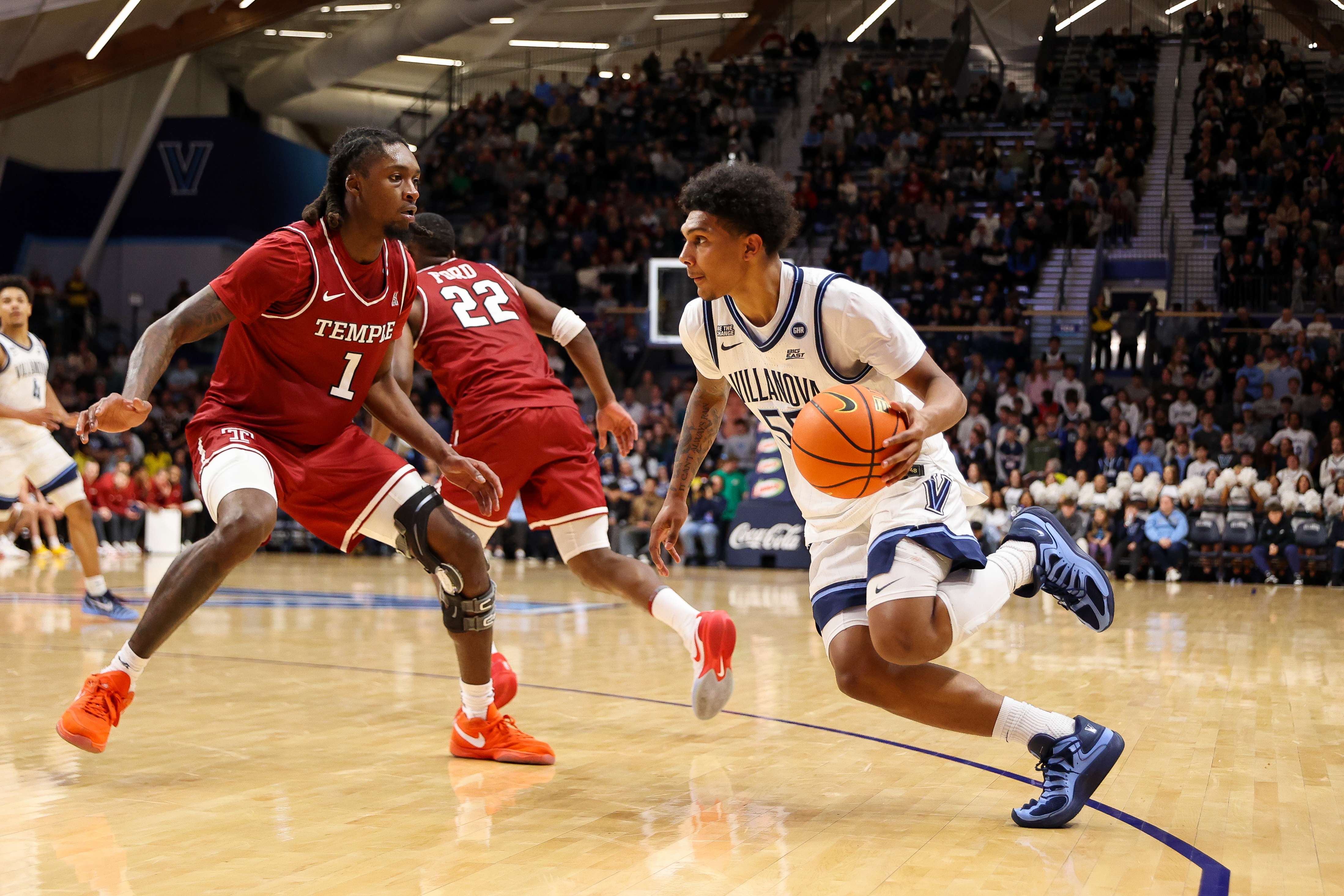
Temple returns to the third-place game for the second consecutive season. Coach Adam Fisher’s team defeated La Salle, 90-63, but was unable to beat Villanova in what essentially was a semifinal game. The Wildcats outscored the Owls by 17 in the second half for a 74-56 victory.
La Salle will take on Drexel in the fifth-place game . The Explorers lost to St. Joe’s in the championship last season but lost both of their pod games, to Temple (90-63 on Nov. 11) and Villanova (70-55 on Nov. 19) this season.
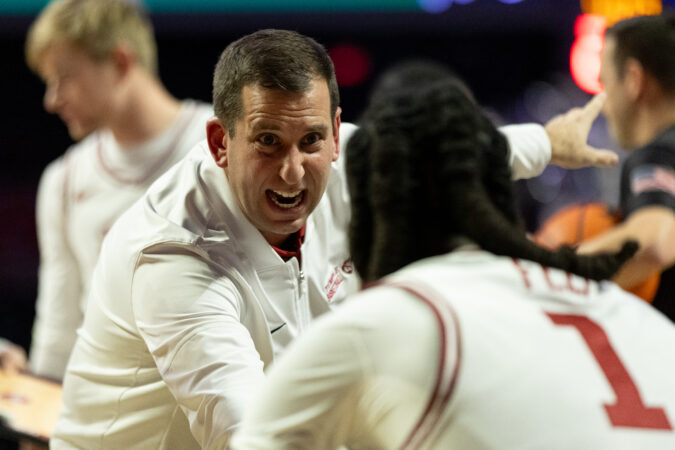
Drexel coach Zach Spiker uses a timeout to draw up some plays for his team against St. Joe’s on Nov. 8.
Drexel is in the fifth-place game for the third consecutive year after being added to the Big 5. The Dragons lost to St. Joe’s (76-65 on Nov. 8) and Penn (84-68 on Nov. 21) in pod play.
Women’s bracket
Fifth place: Penn vs. La Salle, noon Sunday
Third place: Drexel vs. Temple, 2:15 p.m.
Championship: St. Joe’s vs. Villanova, 4:30 p.m.
Temple entered the season on a mission to defend its Big 5 championship. Those aspirations were dashed after the Owls’ 88-58 loss to Villanova on Nov. 22 in a rematch of last year’s final.
Now the Wildcats will be playing in the main event on Sunday (all games on NBC Sports Philadelphia+ and the NBC Sports app) after losing a year ago. They will play St. Joe’s, which is a year removed from a third-place finish. The Hawks earned their way to the championship game after defeating Penn, 74-53, on Nov. 24 and beating Drexel, 57-55, five days later.
Temple’s loss to Villanova sends it to the third-place game against Drexel. The last time the teams played was Nov. 23, 2024, and the Owls won, 52-43.
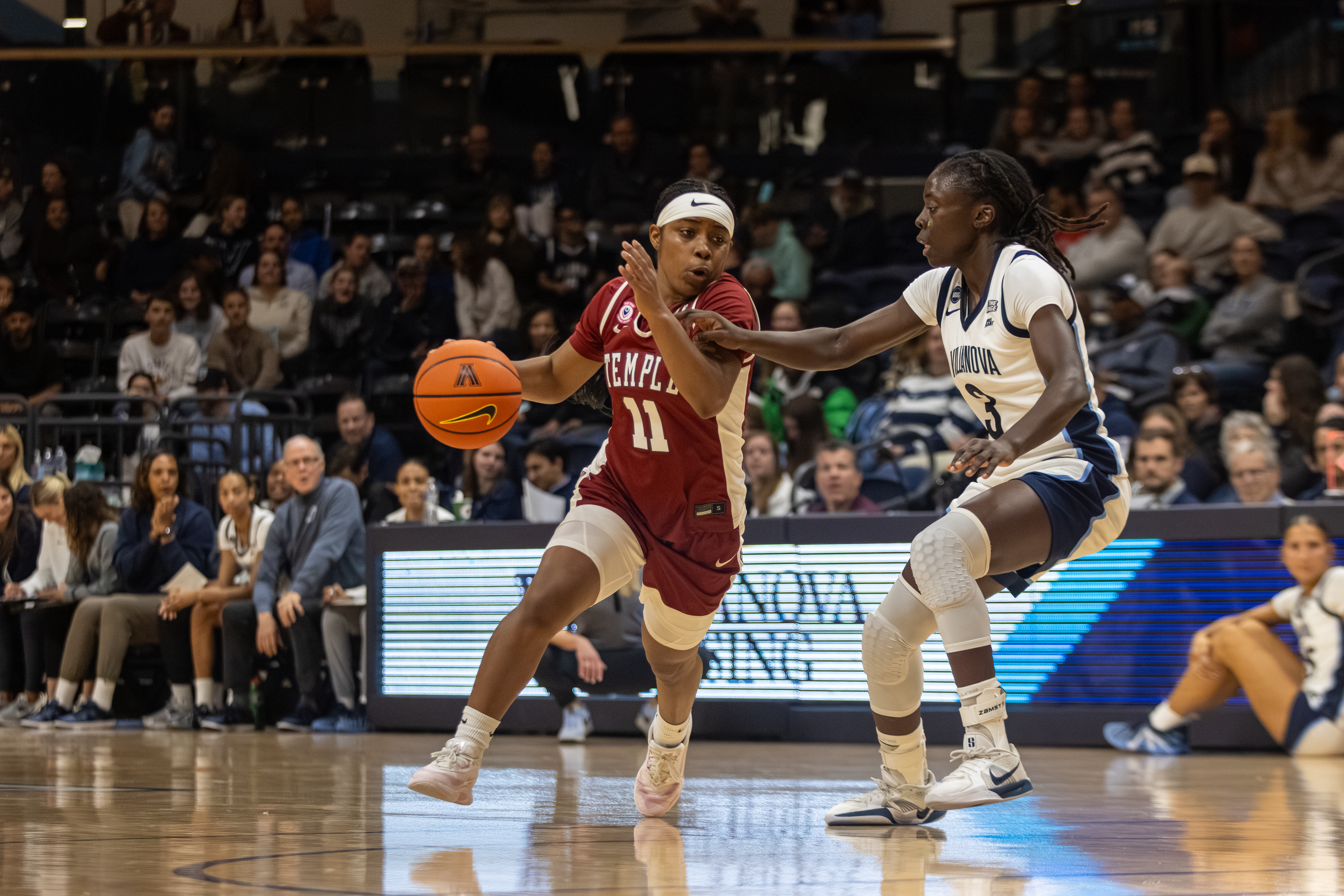
Temple’s Tristen Taylor drives against Villanova’s MD Ntambue on Nov. 22.
The Dragons beat Penn, 72-55, on Nov. 3 and had the two-point loss to St. Joe’s on Saturday.
The first game of the day will feature La Salle and Penn. The Explorers are 5-2 but have yet to win a Big 5 pod game in the two seasons of the new format for the women. La Salle has lost its four pod games by an average of 17.8 points, and both of its losses this season are by double digits.
It took 2½ minutes for Acaden Lewis to, for all intents and purposes, end a Villanova–Temple game Monday night at Finneran Pavilion that mostly had been a sloppy rock fight for the first 25 minutes.
The Villanova freshman, in foul trouble for the bulk of the first half, hadn’t yet made his mark on a game that was sending the winner to the Big 5 Classic championship game.
In a flash, that changed. The Wildcats, in the third year of the current Big 5 Classic format, finally will play for a championship in a City Series the program had long dominated. They beat Temple, 74-56, largely because of Lewis’ steady hand and a short sequence that changed the game.
First, Lewis got to the basket and finished a layup through contact. His three-point play cut a four-point Temple lead to one with 15 minutes remaining. Then he stripped Temple’s Gavin Griffiths and fed Devin Askew for a three-pointer.
After a Temple miss, Villanova’s Duke Brennan, the nation’s leading rebounder, grabbed one of his game-high eight rebounds and found Lewis, who got the ball up court quickly and into the hands of Tyler Perkins, who hit one of his game-high five three-pointers en route to his 19-point night.
Timeout Temple. Tide turned. Lewis got a hockey assist on the next Villanova possession, then grabbed the ensuing Temple miss, brought the ball up the court, and found Brennan rolling to the rim for two easy points. Villanova’s lead was only six with 12 minutes, 20 seconds to play, but Lewis was rolling, and it was only a matter of time before the game got out of Temple’s reach.
Tyler Perkins led Villanova with 19 points against Temple on Monday night.
Lewis finished with 12 points on 4-for-8 shooting to go with eight assists, five rebounds, and two steals. He played 24 minutes, was a plus-25, and didn’t turn the ball over.
Monday’s stat line came on the heels of Lewis’ 20-point outburst in Villanova’s win over Old Dominion last week. He has averaged 6.4 assists over Villanova’s last five games.
Lewis, a top-35 recruit in the 2025 class, was benched in Villanova’s season-opening loss to nationally ranked Brigham Young. His decision-making and defense in his college debut weren’t good enough. But he has responded over the last four weeks with maturity and poise.
“He’s been playing at an extremely high level ever since the BYU game, and I think he just keeps getting a little bit more comfortable with guys out there and what he’s doing,” Villanova coach Kevin Willard said. “He’s been great.”
Lewis said he’s feeling more comfortable. He sees it in his ability to take care of the ball and not turn it over. He had four turnovers apiece in victories over Sacred Heart and Duquesne, but followed those outings up with two turnovers vs. La Salle, one vs. Old Dominion, and zero Monday night vs. Temple. His defense has improved, too.
“Man, is he good,” Temple coach Adam Fisher said. “I got to watch him in high school and stuff. He’s just so smooth as a freshman, and I think you see Coach Willard’s teams through the years, his personnel gets better. So I think what you’re seeing from Lewis right now, and the Lewis come February and March is going to be even better.
“And right now, he’s pretty freakin’ good. All five guys got to guard him, his ability to pick you apart. He can guard, he’s got great length, and he disrupts the game.”
Even if he’s not realizing it in the moment.
“I honestly have no clue,” Lewis said when asked about the impact of the aforementioned sequence that changed the game. “I kind of got lost in the game.”
Acaden Lewis (right) fueled a Villanova run that helped put Monday’s game against Temple on ice.
Villanova, with Lewis on the bench for the final 10 minutes of the first half, looked lost offensively at times. Temple’s trio of guards — Aiden Tobiason, Derrian Ford, and Jordan Mason — who combined for 41 of Temple’s 56 points, did a good job disrupting Villanova’s flow. But Villanova finally put together an extended stretch of good defensive play, an area that has been of concern to Willard lately.
Willard said he was happy at halftime despite Villanova leading by just one, 29-28. The Wildcats outscored the Owls, 45-28, in the second half. They outrebounded Temple (4-4), 43-24, overall.
Villanova had nine turnovers in the first 21 minutes of the game, but not another the rest of the way largely because of Lewis, who drained a three-pointer for good measure (or practice) after the final horn sounded.
The Wildcats are 6-1 and have KenPom’s No. 1 team, Michigan (7-0), which is ranked No. 3 in the Associated Press poll, on Tuesday. It will be a litmus test type of game for a team that currently has no real signature win on its resumé.
First up, though, is a date Saturday with Penn (5-3) in the championship of the Big 5 Classic.
“Where we’re trying to get this program back to, you got to learn how to win games that matter,” Willard said. “To play Penn for the Big 5 championship … learning how to win championships, especially in today’s world where you have 13 guys who are all brand-new, it’s a good opportunity for us to learn and see what it’s all about.”
Big 5 Classic matchups set
Fifth-place game: Drexel vs. La Salle, 2 p.m.
Third-place game: St. Joseph’s vs. Temple, 4:30 p.m.
PISCATAWAY, N.J. — Penn State fans flocked into SHI Stadium on Saturday for their team’s season finale, many repping the school’s blue and white colors as they led “We Are” chants through the stadium’s concourse.
But several of their sweatshirts and signs did not contain the iconic Nittany Lions logo or traditional “We Are” motto. Many were instead etched with “Hire Terry Smith” as Penn State (6-6, 3-6 Big Ten) earned a 40-36 win over Rutgers (5-7, 2-7) to finish the season on a three-game winning streak.
It was a small peek into a game with bowl eligibility on the line where the aftermath seemed bigger than the final score, at least for one side. It showcased the uncertainty surrounding the Nittany Lions’ program — one in search of a new head coach for the first time since 2014.
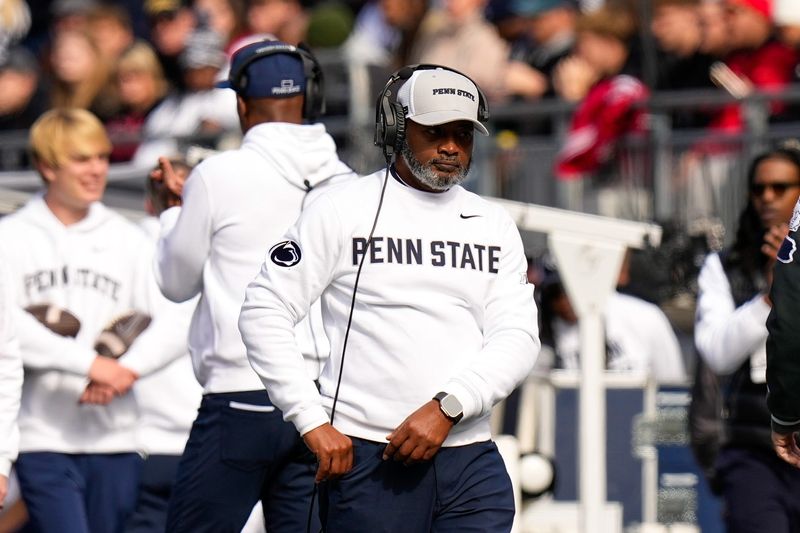
This season Penn State fired its long-time head coach, lost its star quarterback to a season-ending injury and endured a six-game losing streak, but still managed to extend its bowl streak to five seasons. At the forefront of that turnaround was interim head coach Terry Smith, whose passion and honesty galvanized a reeling program.
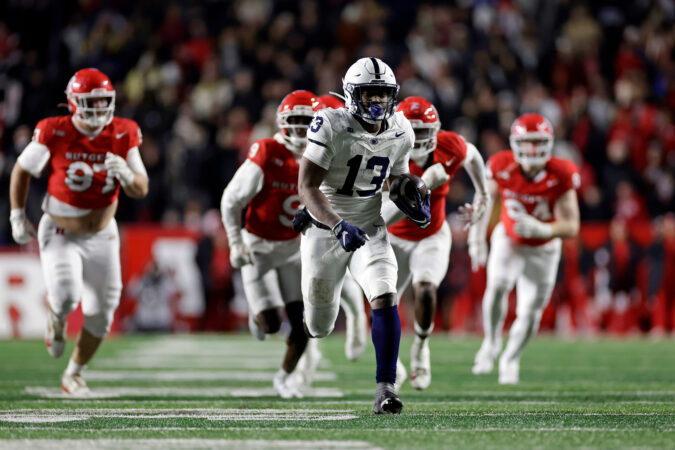
“Terry’s swag, the way he approaches things, brought the fun back to [the game],” said Kaytron Allen, who rushed for 226 yards and a touchdown against the Scarlet Knights. “I appreciate Coach Terry. I hope he is the next head coach [at Penn State].”
As Allen exited the field, he found athletic director Patrick Kraft, showed him a “Hire Terry Smith” sign and said, “You see this?” Kraft nodded his head, acknowledging not only Allen’s message but also the tough decision that lay ahead of him.
Smith believes the respect he has throughout the program, his ownership of the locker room and his pedigree on the recruiting trail make him the best candidate for the job — a desire he made known in recent weeks. His players agree, specifically Allen and the entire starting offensive line, who again lobbied for Smith to become the program’s next coach following Saturday’s win.
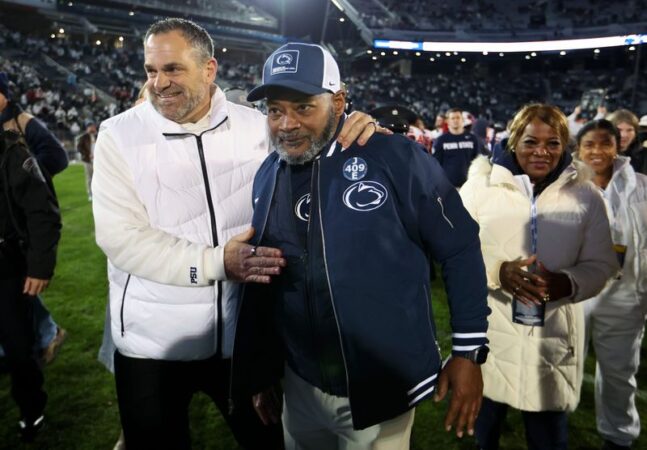
Penn State Nittany Lions interim coach Terry Smith has expressed interest in becoming head coach.
With Early National Signing Day scheduled for Wednesday and a looming transfer portal window, Kraft has to make a decision soon. Who he names 17th head coach in Penn State history holds major implications inside the Lasch Building.
But not for Smith, who remained grounded Saturday. The 56-year-old expressed gratitude for the opportunity to serve as head coach at his alma mater, the university he spent four seasons at as a player and 12 more as a coach.
“I’m just thankful we won the game, thankful for these guys that played their hearts out,” Smith said. “We are bowl eligible. The guys really wanted that. I’m looking forward to playing in a bowl game.”
An uncertain future
It is not unusual for college football players to opt out of bowl games. And it is especially not atypical for players to do so after a program fires the head coach who recruited them.
That means, despite Penn State securing bowl eligibility Saturday with its sixth victory of the season, it is not a given that the team will participate. And judging by the mixed reaction from its players, they also do not know what the future holds.
“We’re not sure yet. We’ll see what happens,” left guard Olaivavega Ioane said when asked about his desire to play in a bowl game.
“We literally just finished a game. I’m seeing [the media] before I see my Mom, so we’re not sure yet,” center Nick Dawkins said.
Andrew Rappleyea, Penn State’s tight end who caught a 53-yard touchdown pass to tie the contest in the opening quarter, said he had no idea what the following days or weeks would hold. He wanted to live in the moment and enjoy the victory.
Allen, who Saturday became the first Penn State player to eclipse 4,000 career rushing yards, shared that approach.
“I’m just trying to take this game in, one game at a time,” Allen said. “We just got out of the game, so I’m not thinking about that. We got a win, [and] that’s all that matters.”
Penn State Nittany Lions running back Kaytron Allen ran for 226 yards and a touchdown.
Not every Penn State player was indecisive about their bowl game intentions.
Dominic DeLuca, Penn State’s redshirt senior linebacker, fought through tears following the Nittany Lions’ 37-10 victory over Nebraska last weekend as he shared what the program meant to him. He thanked Smith for “putting the pieces back together” and bringing Penn State football back to life.
And on Saturday, his passion for Penn State again showed as he took a different approach than his teammates. Bottom line: If there is a bowl game, DeLuca will be ready to play.
“I would do anything to play one more game with these guys,” DeLuca said. “It’s no question for me. I’ll be playing with [my teammates] no matter what.”
Even at age 99, the Palestra still sees rare moments.
Saturday’s Penn-La Salle game marked the first time since the 2001-02 season that two teams formally in the Big 5 faced off in a regular-season nonconference game that didn’t count in the city standings.
When the tournament format started, five teams finally grew to six with Drexel’s inclusion. They agreed that they could schedule matchups outside the tournament pods, as long as they were willing to potentially meet again in the Big 5 Classic triple-header.
It didn’t happen in the tournament’s first two seasons, but it made sense that it would happen at some point. Scheduling nonconference games only ever gets harder for teams outside the elite, and Penn had room to fill in its Cathedral Classic four-team event on Thanksgiving weekend.
La Salle answered the call this season, while Fran Dunphy was still in charge on Olney Ave., and his close friend Steve Donahue was still in charge on 33rd Street. Their successors, Darris Nichols and Fran McCaffery, didn’t mind keeping the matchup when they took the jobs in the spring.
So there they were, staying in town for the holiday weekend, with Merrimack and Hofstra joining the field. The stands were far from filled, but there was some life in them — and there was lots of life on the court in Penn’s 73-71 win.
La Salle gave a great effort, earning a 44-38 halftime lead as much by outhustling Penn as by outscoring them. Though the Quakers shot 53.8% from the field in the frame, the Explorers outrebounded them at both ends of the floor to produce a 21-14 margin on the glass.
“We were just getting destroyed on the glass in the first half,” McCaffery said. “You can’t win basketball games like that. Give them credit for the energy level that they played with.”
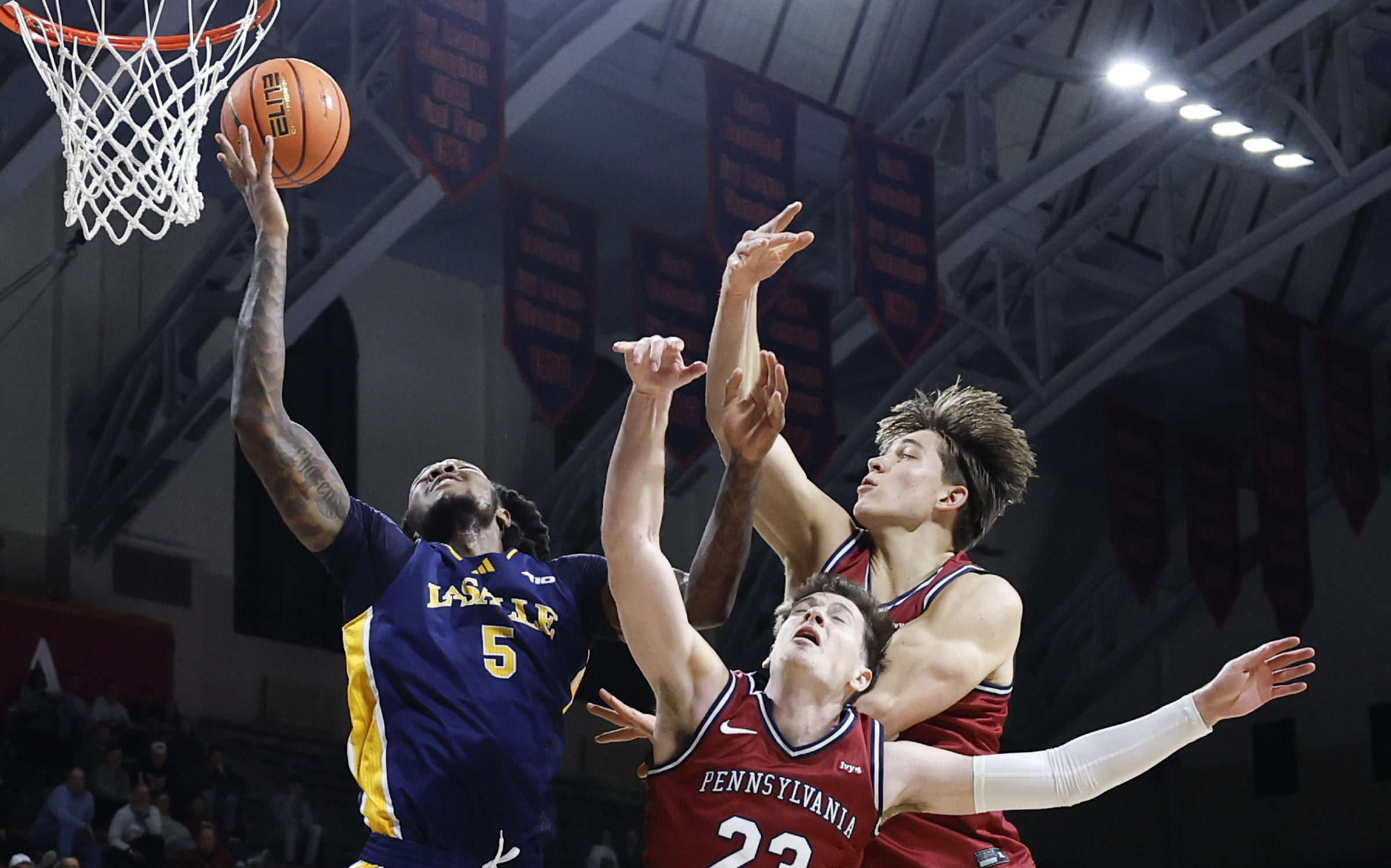
La Salle’s Josiah Harris beats Penn’s Ethan Roberts (center) and Augustus Gerhart to the rim during Saturday’s first half.
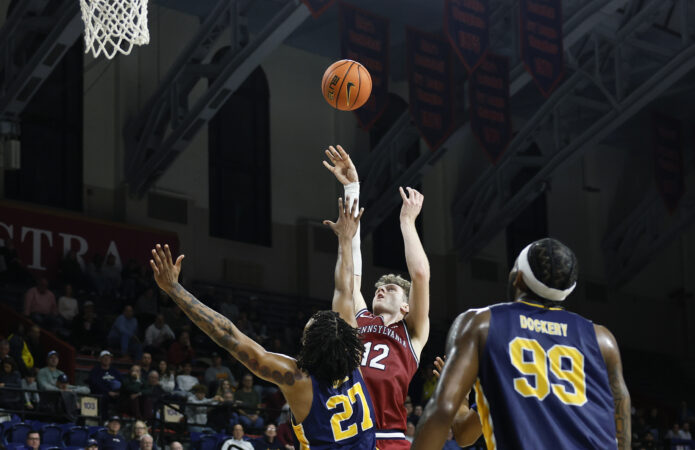
In the second half, the Explorers grew their lead to 55-41 with 15 minutes, 21 seconds remaining, and it was 60-47 with 12:26 to go. From there, star transfer TJ Power and freshman Jay Jones led the big comeback. The Quakers edged ahead 68-66 with 3:56 left, and held on despite missing enough free throws for the Explorers to stay within one possession through the final seconds.
At the buzzer, it felt every bit like a Big 5 game even though it wasn’t one.
“I think you could see the intensity level displayed by both teams and that’s a credit to the individuals but also the coaching staffs for both programs,” McCaffery said. “The crowd was into it and was really good, and I think from that standpoint it makes great sense to do it.”
Power made his latest big impression with a game-high 29 points, including five three-pointers in the second half. But he said he was “most proud of” the mental side of the comeback.
2H (10:49) | La Salle 60, Penn 53
Turnovers leading to triples. All five buckets this half are from distance and TJ has four of them. TIME OUT, EXPLORERS!!#FightOnPenn 🔴🔵🏀 pic.twitter.com/qJsk1Z22oQ
“We work really hard on building our identity to be a winning team,” he said. “When we went down 14, all we were saying in the huddle is, like, ‘We win basketball games — there’s no doubt about that.’ We just knew we had to get stops, we made some adjustments on defense and then we got some momentum on offense.”
Jones’ role came after he subbed in for starting point guard AJ Levine with 12:09 to go, with Levine out of gas. Jones did not leave the court for the rest of the night, tallying seven points, two rebounds, one assist, and two steals in that span.
McCaffery said Jones’ work in practices against the starters earned the opportunity, and praised him for seizing it.
“He’s just been really good,” McCaffery said. “His attitude is great. He’s just a freshman, so it takes time, but he was really special tonight and I’m not surprised.”
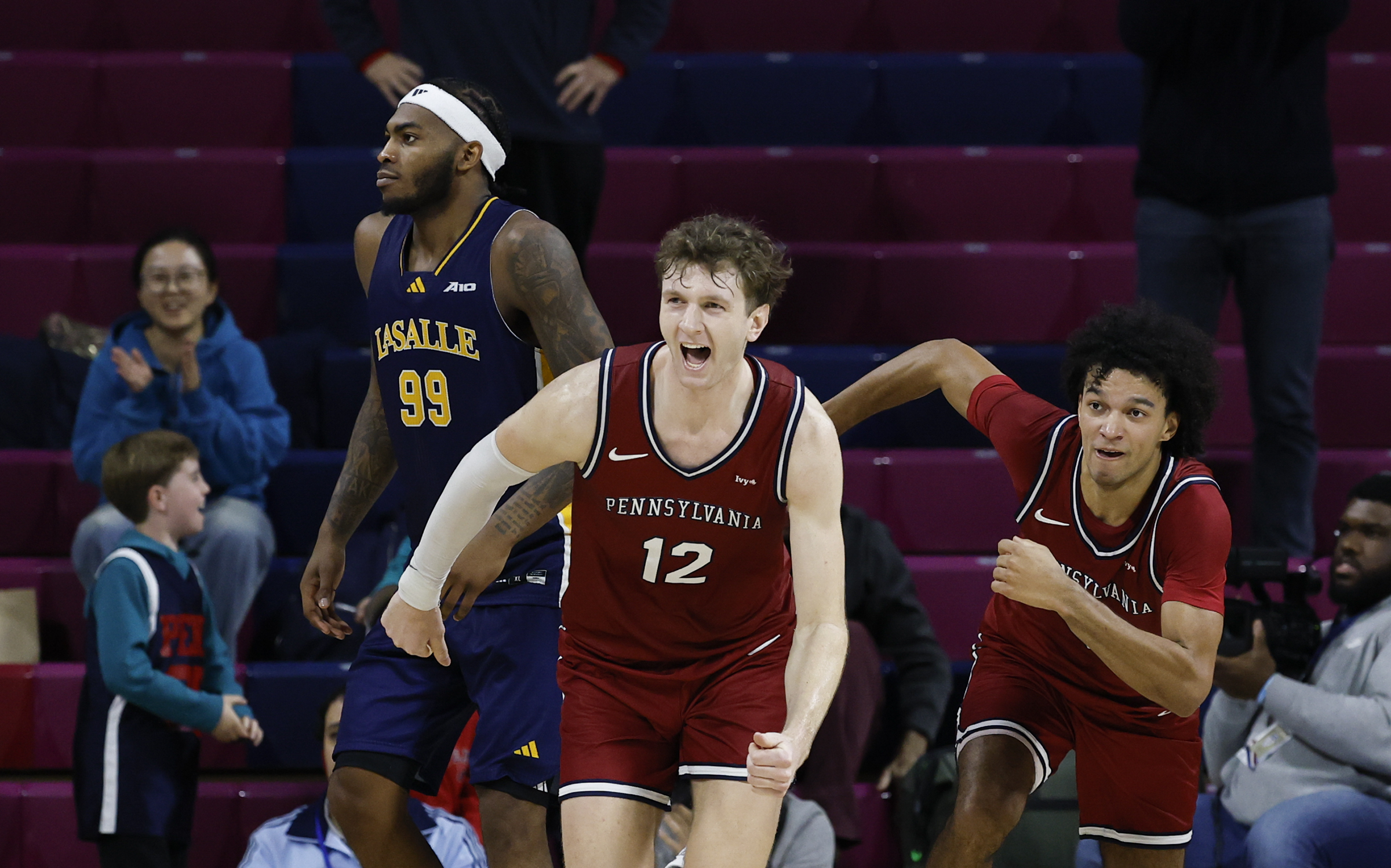
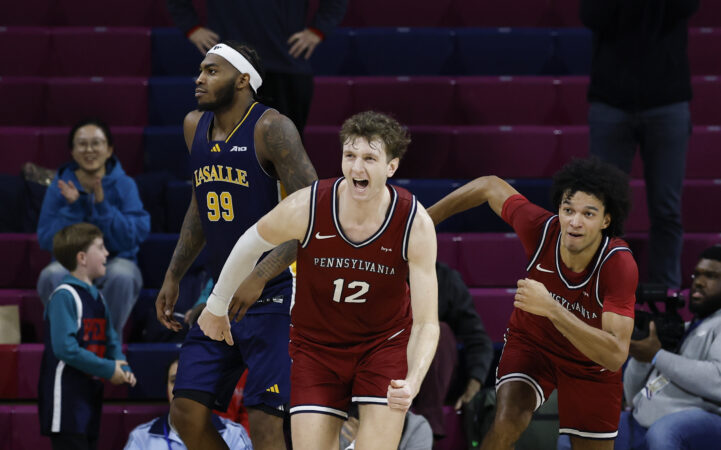
Jay Jones (right) celebrates with TJ Power (center) after the final buzzer.
Nichols was understandably in a less happy mood, having been on the receiving end of it all. But the Explorers are clearly making progress, no matter their record.
“I don’t know if things are on the up — I’m down right now,” he said. But he quickly added it was easy to be “a prisoner of the moment, especially after wins and losses, and I tell my guys all the time the season’s long.”
He will no doubt take his own advice as he teaches it to his players.
“You can be poisoned by accomplishment, you can be down in the valley of disappointment, and both of them are bad,” Nichols said. “Just trying to understand that we’ve got to continue to get better, we’ve got to get some guys healthy, we’ve got to get guys playing better, and we’re just going to continue to work.”
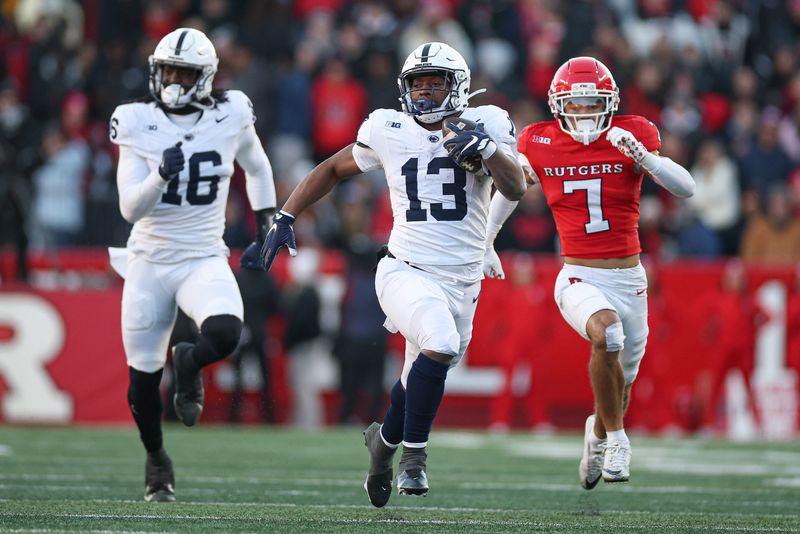
Kaytron Allen ran for a career-high 226 yards and a touchdown as Penn State beat Rutgers 40-36 for the 18th straight time to become bowl eligible after a tumultuous season.
The Nittany Lions (6-6, 3-6 Big Ten) retook the lead for good when linebacker Amare Campbell raced 61 yards with a fumble with 7 minutes, 27 seconds to play. Rutgers quarterback Athan Kaliakmanis lost the ball without being touched.
Rutgers (5-7, 2-7 Big Ten) had moved ahead 36-33 early in the fourth quarter on a 46-yard TD pass from Kaliakmanis to Antwan Raymond. Raymond ran for 189 yards, and Kaliakmanis passed for 338 yards and three TDs. With the loss, the Scarlet Knights will miss the postseason for the first time since 2022.
Penn State hasn’t missed a bowl game since 2020 when the non-College Football Playoff bowl games were canceled due to the COVID-19 pandemic. Additionally, Nicholas Singleton broke ties with Saquon Barkley to claim the school career rushing TD record with his 44th and 45th, career total touchdowns at 55 and all-purpose yards with 5,586.
After losing to Notre Dame in the semifinals of the CFP last season, the expectations for Penn State were high. The Nittany Lions began the season ranked No. 2 and were led by quarterback Drew Allar, who was headed for a Heisman-caliber season before a season-ending leg injury in Week Six against Northwestern.
The following day coach James Franklin was fired after Penn State lost its first three Big Ten games, including back-to-back games in which the Nittany Lions were favored by 20-plus points.
Penn State would lose five straight before turning its season around by winning its last three games.
A 29-point night from Penn’s TJ Power pushed the Quakers past Big Five foe La Salle in a 73-71 win in the Cathedral Classic on Saturday.
Power scored 19 of his total in the second half and had six rebounds for the Quakers (5-2). Ethan Roberts shot 3 of 14 from the field, including 1 for 4 from three-point range, and went 5-for-9 from the line to add 12 points. Jay Jones had 7 points and shot 2-of-2 from the field and 2 of 4 from the free-throw line.
Justin Archer finished with 14 points, six rebounds and two steals for the Explorers (3-5). La Salle also got 12 points and four assists from Ashton Walker. Jaeden Marshall had 12 points.
Power scored 10 points in the first half and Penn went into halftime trailing 44-38. Penn trailed by 15 points early in the second half then took the lead on a three-pointer from Ethan Roberts with 4 minutes left.
Both teams are back in action on Sunday in the final day of the Classic with La Salle taking on Merrimack at noon, while Penn closes out with Hofstra at 2:30 p.m.
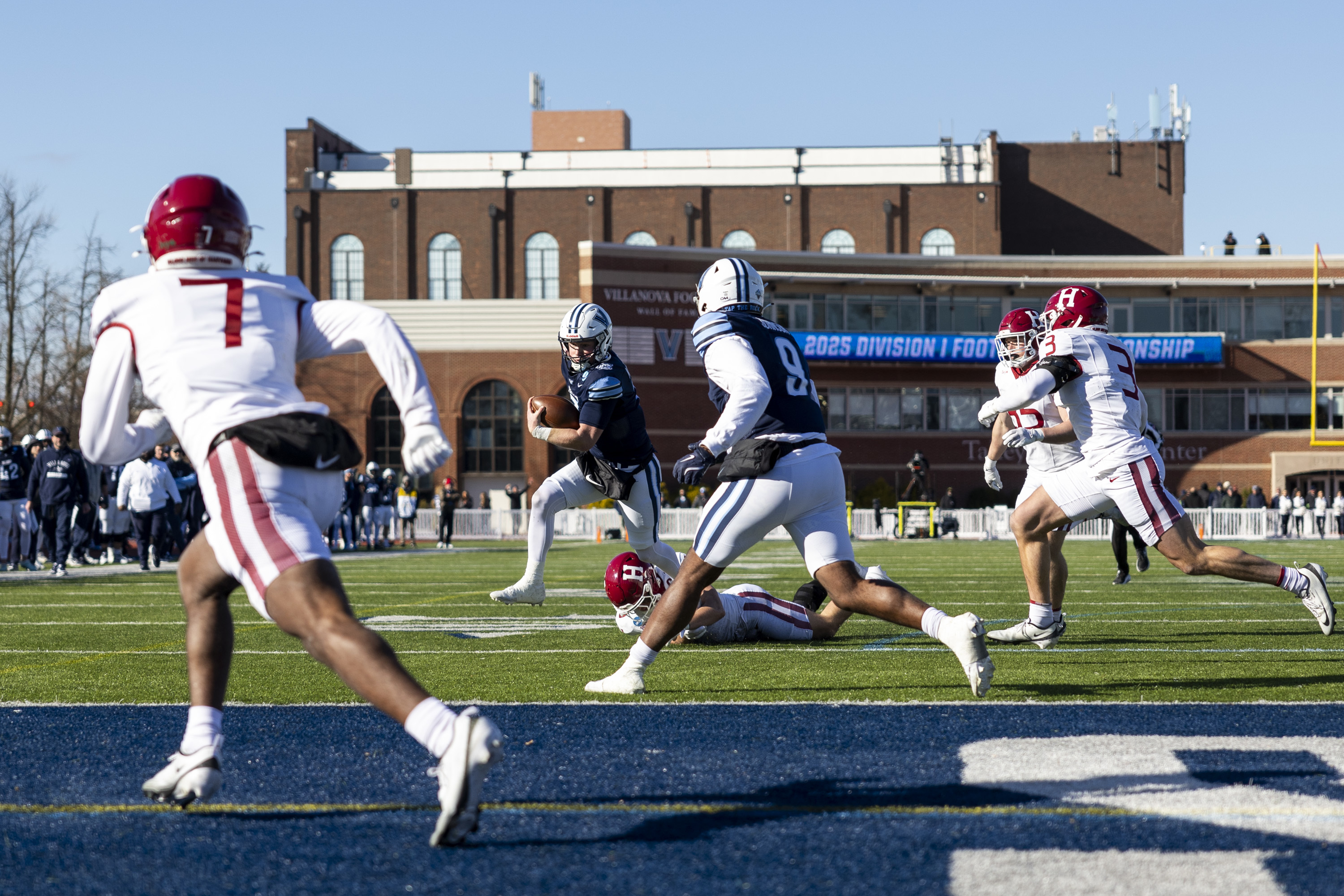
A dominant first half allowed Villanova to conquer Harvard, 52-7, in the first round of the FCS playoffs on Saturday.
No. 6/9 and 12th-seeded Villanova (10-2) stretched its win streak to nine and now has won 23 consecutive home games — the longest active streak in Division I football. No. 15/19 Harvard (9-2), struggling with drops, managed to gather just 31 yards of total offense, while Villanova’s defense forced the Crimson into three consecutive first-half three-and-outs.
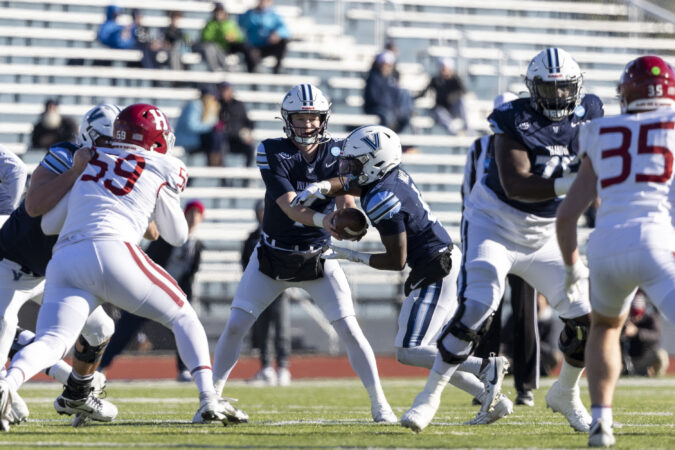
Villanova quarterback Pat McQuaide completed 14 of his 22 attempts, throwing for 193 passing yards and three touchdowns, while also scoring one on the ground. McQuaide is averaging 211.3 passing yards per game.
The Wildcats’ running back room has continued to be unstoppable despite being without its star, David Avit, who has missed the last three games with a knee injury.
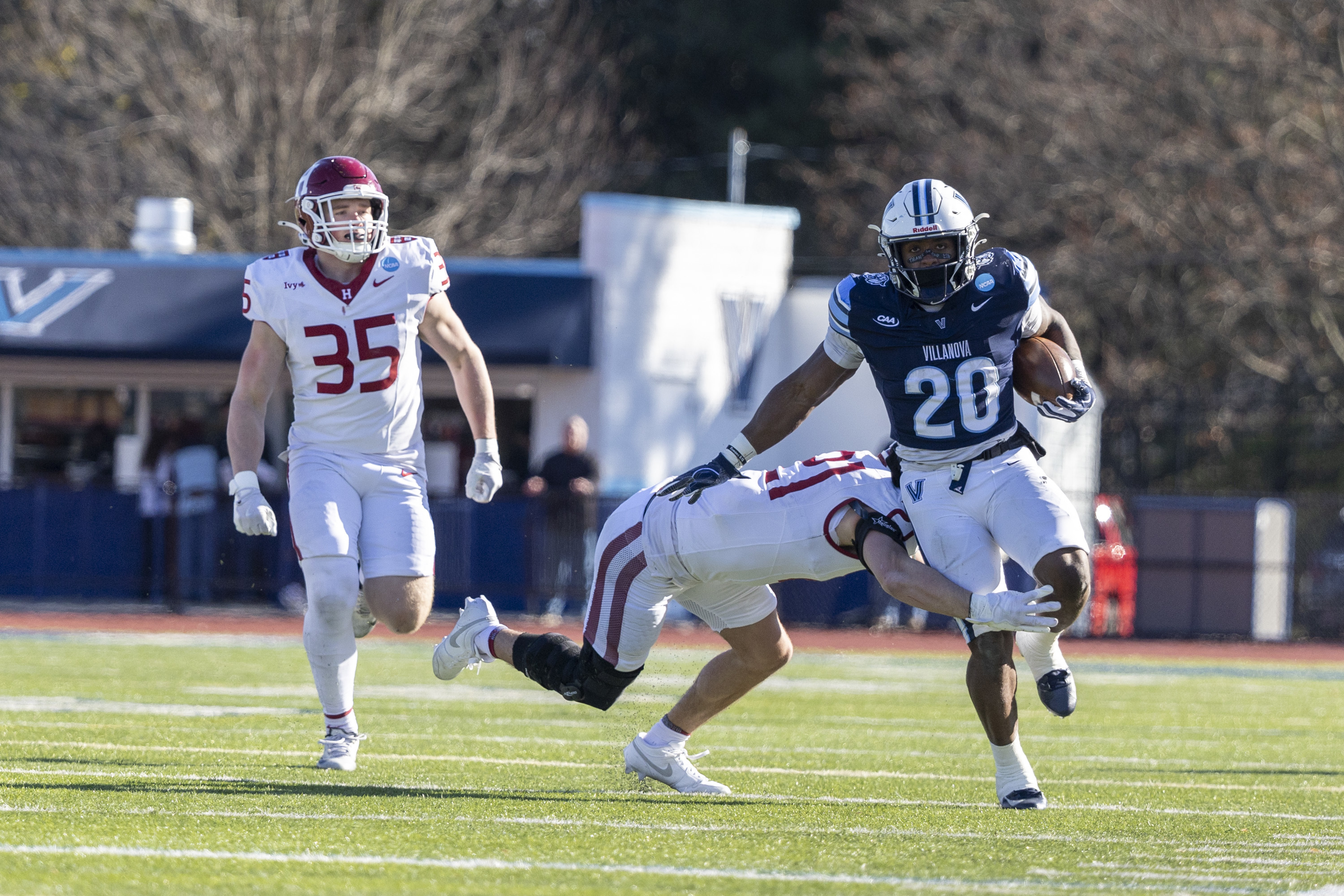
Isaiah Ragland runs past Harvard’s defensive line on Saturday.
Isaiah Ragland led Villanova’s rushing attack, totaling a career-high 152 yards and a touchdown. It was Ragland’s second game of his career with triple-digit rushing yards.
“All glory goes to God,” Ragland said. “Without him, I wouldn’t be able to do anything I did. But we take pride in loving our [offensive] line, and this past week, we really took pride in that. We don’t like to be in the media and stuff like that, but we know we get a lot of disrespect, and we took that. We took that to heart as we should.”
Villanova finished with a season-high 512 yards of total offense, rushing for 319.
Fast Villanova start buries Harvard
Villanova won the coin toss and elected to receive. The Wildcats capitalized on the decision, scoring a touchdown on their opening drive off a 45-yard rushing touchdown by Ragland.
On the following Harvard drive, the Crimson marched all the way downfield and were in scoring position. Harvard quarterback Jaden Craig targeted Ryan Osborne in the end zone, and Villanova’s Newton Essiem came down with the ball for an interception.
“I think if you start fast, it’s hard to [stop] a team that’s rolling on both sides of the ball,” Ragland said. “We take so much pride on offense. We trust our defense and our defense trusts us.”
oh. my. goodness.
absolute gem of a play from @pmcquaide_3 to Lucas Kopecky
The Wildcats were able to capitalize on the takeaway. McQuaide connected with Lucas Kopecky in the end zone on 4th and 10 for a 30-yard touchdown. On the previous play, McQuaide’s pass landed right in the hands of Harvard’s Austin-Jake Guillory, but it was dropped.
Ja’briel Mace scored a rushing touchdown to cap off Villanova’s first-half scoring. It was the third game of the last four that Mace has scored a rushing touchdown.
Villanova’s defense freezes Harvard
Harvard had no solutions for Villanova’s poised defense. The Crimson were held to a season-low 213 yards of total offense and managed only two red zone trips, while the Wildcats won the turnover battle, 3-0.
Villanova’s defense totaled three sacks and seven tackles for a loss. Shane Hartzell had a team-high seven tackles (four solo) and half a sack. He currently leads the team with 81 total tackles this season.
In the first half, Harvard was held to four first downs, and all of its drives ended in a punt or turnover.
“We knew earlier in the year, the secondary may have lacked little experience because they’re a young group,” said Villanova linebacker Richie Kimmel. “They have a true swagger. They’re a tight-knit group. [The] whole defense, we’re a tight-knit group. Everyone’s doing their 1-of-11 to make sure someone else succeeds. We are doing everything in our power defensively. We take things personally. If I’m being honest, if we have a rushing attack coming in, they’re not going to gain yards on us.”
Kimmel tied a team-high seven total tackles (three solo) and 1.5 tackles for a loss.
Harvard receivers dropped three touchdown passes, along with other wide-open passes. Craig went 9-for-21 (43%) on pass attempts and had 107 yards in the air.
“What I’ll say about [our young secondary] is they don’t lack confidence, but they did lack experience,” coach Mark Ferrante said. “And now they’re getting the experience to hopefully match the confidence. We’re playing much better complementary football. You can see how if something happens good on special teams or on defense or on offense, it sparks the other two areas. And early in the season, we kind of didn’t have that. Now, the three phases are playing together, and that’s exciting to see.”
Villanova’s Pat McQuaide runs past the defensive line scoring a touchdown against Harvard on Saturday.
Up next
With Villanova advancing, it will now travel to face fifth-seeded and No. 3/4 Lehigh (12-0) in the second round next Saturday, with kickoff set for noon (ESPN+). Lehigh earned a bye in the first round of the FCS Playoffs.
In the last meeting, the Wildcats defeated the Mountain Hawks, 38-10, on Sept. 2, 2023, in their season opener. Villanova has not lost to Lehigh in the Ferrante era (6-0) and leads the all-time series, 14-5.
About a month ago, Temple reached five wins and was on the verge of reaching a bowl game for the first time since 2019. Instead, the Owls (5-7, 3-5 American) dropped their final four games of the season.
Temple was looking to upset North Texas (11-1, 7-1) on Saturday to become bowl eligible in head coach K.C. Keeler’s first season. Keeler spoke to his team about picking up their confidence on Monday after losing three straight.
It didn’t work.
The Mean Green outmatched the Owls, 52-25, to extinguish Temple’s chances at a bowl game and ending its season. Temple made strides in Keeler’s first year, but the Owls will have to wait another year to end their seven-year bowl drought.
Can’t contain Mestemaker
On Monday, Keeler talked about Temple stopping North Texas quarterback Drew Mestemaker. The redshirt freshman signal caller entered Friday’s game engineering the nation’s top scoring offense at 46.3 points per game.
However, the Owls’ plans were spoiled after two plays.
Mestemaker delivered a 77-yard passing touchdown to wide receiver Cameron Dorner. That play was the beginning of Mestemaker’s stellar first-half performance, when he threw for 234 yards and two touchdowns. He finished with 366 yards and three touchdowns.
North Texas quarterback Drew Mestemaker (17) looks to pass the ball on Friday.
Temple allowed 10 pass plays of more than 15 yards and North Texas found the end zone on five of its six first-half drives.
North Texas Wide receiver Wyatt Young, the nation’s fourth leading receiver, finished with six receptions for 127 yards.
Slow offensive starts
Temple needed to take advantage of the Mean Green’s defense allowing a conference worst 211.2 rushing yards per game. For their first six plays, the Owls leaned on running back Jay Ducker, who finished with 63 rushing yards and a touchdown on 12 carries.
In the first quarter, the Owls tied the game at 7 apiece, thanks to a 2-yard connection from quarterback Evan Simon to tight end Ryder Kusch. But Temple’s offense went cold in the second and entered the half trailing, 35-7.
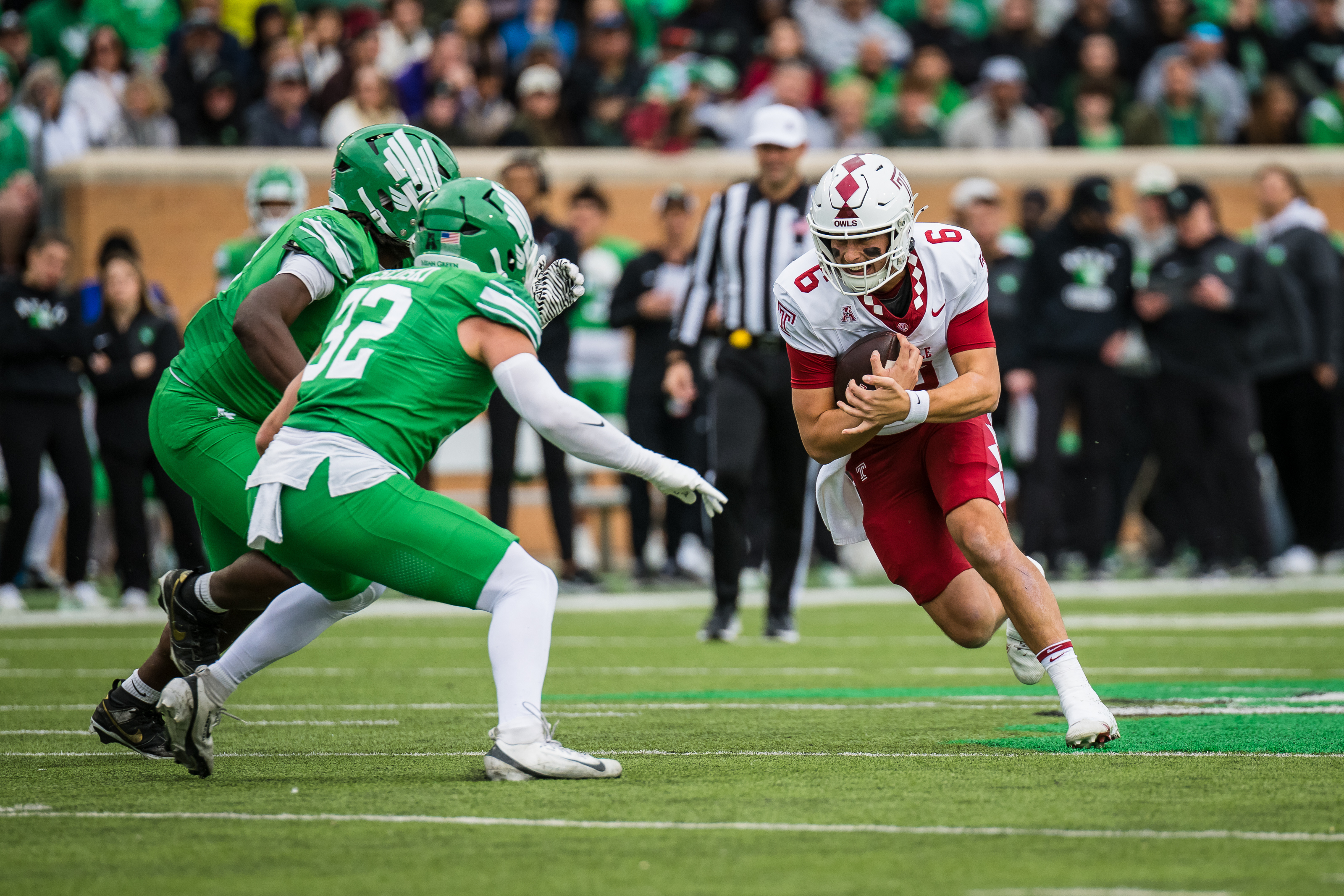
Temple quarterback Evan Simon (6) runs the ball against North Texas on Friday.
Temple abandoned the running game. It had 65 yards on the ground in the first quarter, yet mustered 20 in the second. The Owls’ offense tried to rely on Simon, who finished with 82 passing yards and a touchdown, to lead a comeback.
But Temple went scoreless on four drives in the second quarter, including an interception from Simon.
Despite holding the ball three minutes longer than North Texas, the Owls compiled just 316 yards of total offense. Simon completed 10 of 27 attempts in his final college game.
Another freshman star
Temple’s main focus was to stop Mestemaker, but North Texas running back Caleb Hawkins also got the best of the Owls’ defense. The freshman finished with 186 yards and four touchdowns.
Hawkins entered the matchup with 1,030 rushing yards, the second-most yards in the American.
Much of his success came in the first half, as he poured in 132 rushing yards. It was his fourth game with at least four rushing touchdowns this season.
The Owls averaged 78.8 points per game, the third most in the conference and the highest in program history. However, their defense lagged behind.
They allowed 77.7 points per game, the most in the conference. The team often was outhustled, leading to multiple blown leads. That culminated in a blown 12-point halftime lead vs. Tulsa in the second round of the conference tournament to end the season with a 17-15 record.
Coach Adam Fisher wanted to change his team’s mindset before the 2025-26 season. He opted for a more defensive-minded approach in the offseason and brought in 11 new players who fit the bill.
“We didn’t really change much, because I think [Fisher] just worked on getting guys that want to play defense and that’s something you can’t really teach,” said guard Aiden Tobiason. “So when you get guys that want to play defense, all you have to do is just install what we already know.”
In the first four games, Temple’s defense showed signs of improvement. The Owls (4-3) gave up 70 points per game as they got off to a 3-1 start. However, the wheels have come off as of late.
Temple allowed a combined 256 points in three games in the Terry’s Chocolate ESPN Events Invitational in Florida. The Owls finished in sixth place, with a win over Princeton (79-75) and losses against Rhode Island (90-75) and UC San Diego (91-76)
“We tried to really work a ton this offseason, like, ‘Hey, we got to guard better,’” Fisher said. “How does your offense get better? Through your defense.”
Temple’s Derrian Ford is averaging 16.6 points and 4.6 rebounds this season.
Fisher brought in guards Derrian Ford, Masiah Gilyard, and AJ Smith this offseason because of their defensive ability. Ford is the team’s leading scorer, averaging 16.6 points. He and Gilyard lead the team with 4.6 rebounds per game, while Smith has contributed off the bench.
“I really just tried to make sure that I’m in my right spots on defense,” Smith said. “Allowing my teammates to know that I’m there for them and the gaps and things like that. Just defensive integrity, knowing where you’re supposed to be and how you’re supposed to be there and trying to be there early.”
The early-season progress on defense has felt like a distant memory after this past week.
UC San Diego (7-0) poked holes in Temple’s defense for 40 minutes on Monday. The Tritons struck down any scheme the Owls threw at them. They shot 62.5%, and Temple forced just five turnovers.
Those problems persisted in the next two games. Princeton (3-6) and Rhode Island (6-2) put up more than 30 points in the first half. Rhode Island hit 55.2% of its shots, including 12 three-pointers.
The trip to Florida ballooned Temple’s average points allowed. The Owls are allowing 76.6 points and opponents to shoot 48.1% per game, which ranks last in the American Conference.
Temple came into the season looking to fix its defense. However, the last three games have shown that there still is a long way to go before the repairs are sustainable.
“[Fisher] has done a good job of putting teams on our schedule that play like the teams want to play in our conference,” Tobiason said. “So I think we do play a lot of teams that go out and transition, and that’ll get us prepared for conference games.”
It’s been four years since college athletes have been able to legally profit from their name, image, and likeness.
It’s been less than 10 years since those athletes could enter the NCAA’s transfer portal without needing to redshirt. Yet, it feels like so much of what transpires is taking shape in real time, not just for the students who partake, but also for the coaches, officials, and administrators who navigate it.
College sports, specifically revenue-generating college sports, have become a year-over-year proposition for coaches to find and retain talent. The latter has become even harder, given the trend of student-athletes initially recruited to big-time schools jumping ship after not receiving what they anticipated, often to mid-majors, and becoming big fish.
Conversely, student-athletes who have outkicked their scholarships at a mid-major can enter the portal for a fresh start at a power program — and potentially a substantial payday.
But it’s been fantastic the athlete. It’s why, according to Front Office Sports, nearly 4,000 players in men’s and women’s college basketball entered the most recent transfer portal, the highest number of players in a year in the history of the NCAA.
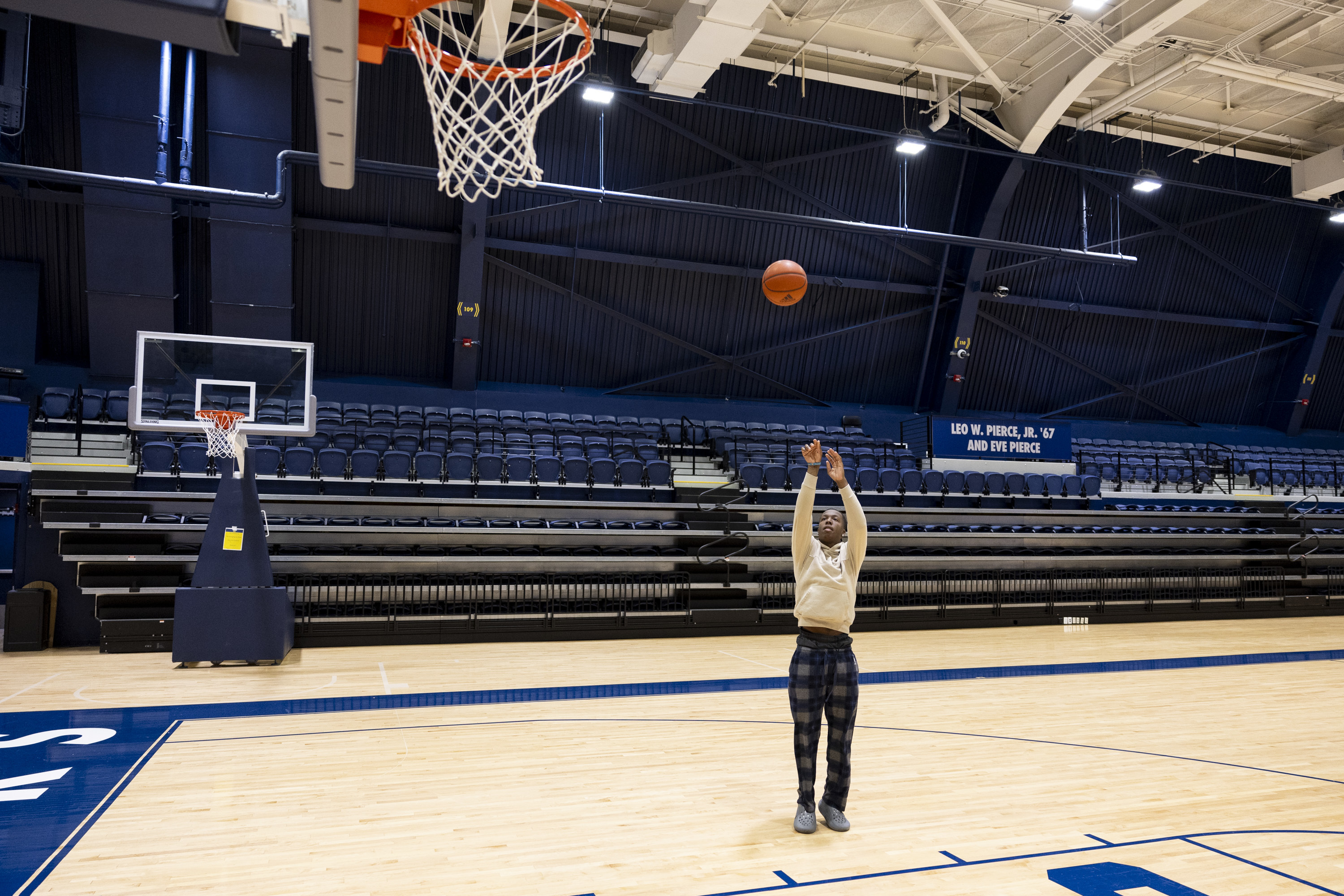
Truth Harris takes a few shots inside La Salle’s TruMark Financial Arena earlier this year. Harris joined the Explorers in the offseason, his fifth school in five years.
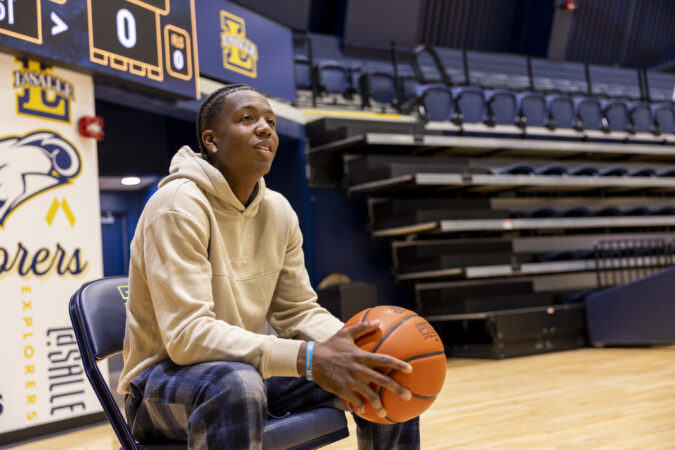
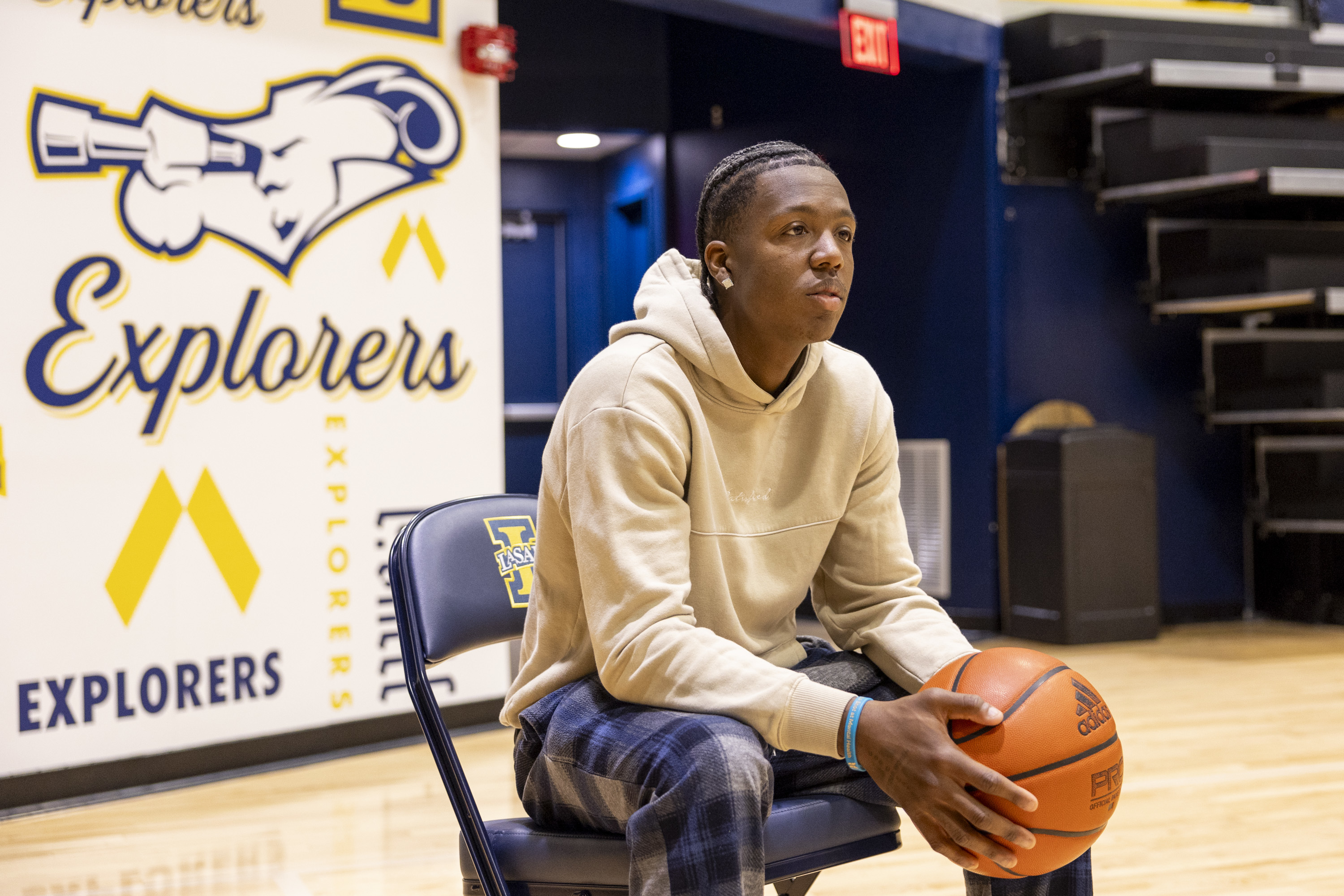
One of those players is Truth Harris, a graduate guard who followed new La Salle coach Darris Nichols after he succeeded Big 5 legend Fran Dunphy in March.
For Harris, 23, his fresh start with the Explorers was his third Division I program and his fifth school since 2020.
After his start at East Tennessee State, Harris, a Mt. Vernon, N.Y., native, who led Mount Vernon High School to a state title in 2017, spent two years at junior colleges, Pensacola State and Indian Hills Community College, where he starred. It afforded Harris a spot with Nichols at Radford ahead of the 2023 season — and he has been alongside him ever since.
While Harris sees these moves as opportunities, there are some within college sports who view them as exploitation and a lack of control by governing bodies.
Harris, who noted that his move to La Salle was paired with a five-figure sum through NIL opportunities, is why many students like him see the portal as a better way to navigate a college career.
“It was always going to get to this eventually,” Harris said in a sit-down with The Inquirer this summer. “I feel like students do deserve the recognition, do deserve the money. As student-athletes, we do go through a lot. We push our limits. We have to get paid for that. So, yeah, I think [the new reality of college sports is] right where it should be.”
This season’s top earners likely would agree. The highest paid hooper, BYU guard AJ Dybantsa, is earning $4.4 million this year, according to On3’s NIL valuations. The top 10 earners in men’s college basketball, according to that list, stand to make over $1 million this season.
It’s a far cry from the days in which the guarantee of a college scholarship was the allure.
These days, that comes standard.
Student-athletes are guided by the promise of a payday, with the masses who continue to jump into the transfer portal serving as proof.
BYU forward AJ Dybantsa (3) is the highest earner in college basketball, with a valuation of $4.4 million this season.
‘It’s not that hard, really’
Instructions on how to enter the NCAA’s transfer portal are available on the NCAA’s website. Once a player decides to go, though, there’s a bit of unknown. But if you’re a proven talent, it’s pretty straightforward, Harris says.
“When you enter the transfer portal, you don’t know what’s going to happen,” he said. “If we are saying if there’s stress [involved], I would say that’s the bad stress? But at the same time, when you start hearing from schools and hearing those schools out, it does ease you down a bit more.
“The hardest decision is picking the right school, picking the right option for you. And that all goes into [questions like], ‘Is the team good? What’s the coaching like? What’s their history, their culture?’ It’s about making sure they want you for the right things and you’ll be a good fit there. But once you do it once, it’s not that hard, really.”
Perhaps what causes little concern for student-athletes freely moving from school to school is that many are moving with general studies majors, or, in Harris’ case, chasing a master’s degree. He’s working on a master’s in communications, a degree he noted as “a well-known major that a lot of schools carry.”
La Salle’s Truth Harris is working on his master’s in communications, a popular degree he says has made it easier for him to change schools as much as he has.
In Step 1 of the NCAA’s guide to transferring schools, a line reads: “Your new school should help you satisfy both your academic and athletic goals.” However, graduation rates for athletes reflect the lack of emphasis on academics.
“I think we’ve opened up two different cans of worms. When we opened up the transfer portal and NIL at the same time, it became chaotic,” said Nichols, who added that fluctuating graduation rates and the impact it has on schools being treated like a revolving door isn’t being talked about enough.
“I think that if we’re about student-athletes graduating, we should be focused on retention and doing what’s best for both parties. Everybody’s talking about the money situation, but, to me, let’s clean up the situation of these student-athletes transferring so much but making sure they still graduate.”
However, according to the NCAA Division I Academic Progress Rates, a metric that is supposed to hold institutions accountable for the academic performance of student-athletes, graduation rates for men’s basketball players hovered around 83% as of the 2025 season — though that did have a 4% decline since last year.
La Salle men’s basketball coach Darris Nichols says graduation rates aren’t being talked about enough in the era of the transfer portal and NIL.
“I think that there are just some challenges people don’t talk about,” Nichols said. “If you’re a player that’s transferring every year, are all your credits rolling over, so you’re actually eligible? Something as simple as uniforms, think about it: you bring in nine new players every year, you’ve got to get nine new uniforms. And for people who say, ‘Well, why don’t you just not put their names on the back,’ every one of them comes in different sizes, and [a player] can be number 0 to 99.
“So it’s not just about the cost of NIL for potential players, it’s about operating costs, budgets, revenue. Everybody’s talking about NIL, but there are the little things that go into all this change.”
Still, to Nichols, a former Division I star at West Virginia whose playing days preceded NIL, players should be compensated. That’s not the issue. The issue is the time coaches spend trying to field winning teams every season in what’s essentially a free-agent market.
“You’re constantly trying to get kids to buy in,” he said. “When I was playing, it was a buy-in for four years. And now it’s buy-in for a year. Look, we’re not in a position to try to hold anybody back. If you play here, you do well, and you want to go elsewhere, I get it. But as a staff, we do our utmost to just have honest conversations with [our players] about the new landscape of athletics and not try to hide behind it.”
Darris Nichols (right) says open communication about expectations is all a program can do when it comes to the the transfer portal process.
It’s impossible to hide when the data is so stark in that most schools, especially mid-majors, will see significant movement across their programs each year, especially in revenue-generating sports like football and basketball.
Across the NCAA’s 364 Division I programs, 1,156 undergraduate transfer portal entrants found new homes in men’s basketball alongside 384 graduate entrants this past offseason. In women’s basketball, 720 undergrads found new homes alongside 344 graduate students.
On the men’s side alone, that averages out to four players a coach would need to replace on their roster — solely from transfers — before entering the 2025-26 season.
Men’s basketball coaches needed to replace an average of four players after transfer portal movement last season.
For players like Harris, who stands to graduate from La Salle after his five-year journey, he’s happy to have benefited from this new reality.
“It’s just a better feeling,” Harris said. “You’re more relaxed. You can do more things for yourself without having to ask your mother and ask your parents for money all the time. I feel like it’s a relief off my parents to know they don’t worry about me [financially]. They’re not worried if I’m good or not because they know I am.
“So if you’re asking me? Yeah, I think it’s a reality that’s right where it should be.”