Category: College Sports

  • Malik Rose and Bill Herrion turned Drexel into an NCAA Tournament team. Now they’re in the Dragons’ Hall of Fame.

    Malik Rose and Bill Herrion turned Drexel into an NCAA Tournament team. Now they’re in the Dragons’ Hall of Fame.

    Drexel hired Bill Herrion as men’s basketball coach in 1991. Replacing longtime head coach Eddie Burke, who led the Dragons to their first NCAA Tournament appearance in 1986, Herrion took the program to three more NCAA tourneys, and Malik Rose was a big reason.

    Drexel assistant Walt Fuller recommended that Herrion recruit the overlooked center from Overbrook High, and Rose caught the first-year Drexel coach’s attention at the All-Star Labor Classic between the best players in the Public and Catholic Leagues.

    It was enough to give Rose a scholarship.

    “Coach Herrion saw something in me that nobody else really did,” said Rose, 51. “None of the Big 5 coaches thought they saw it. None of the other coaches in the region or the area saw it.”
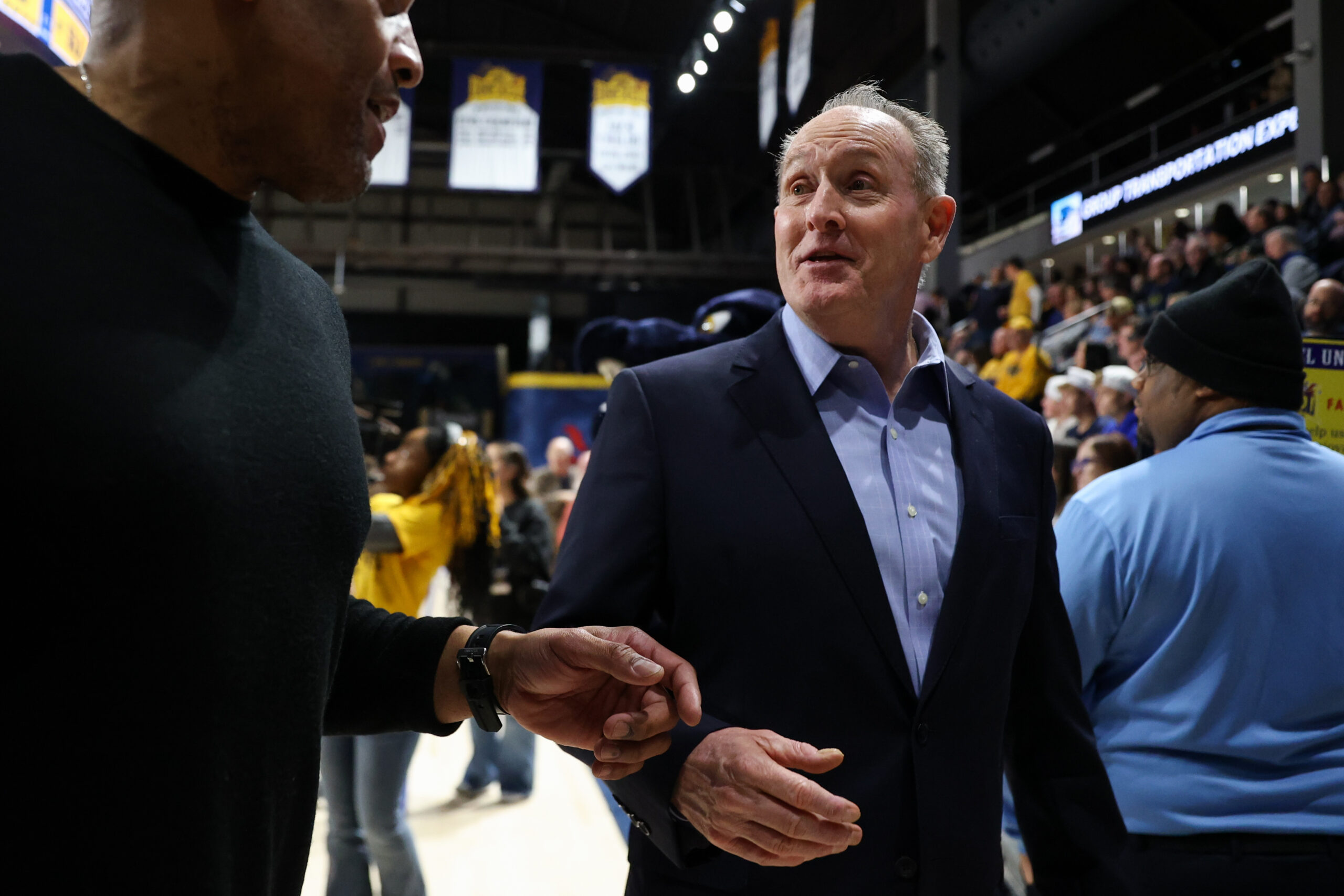
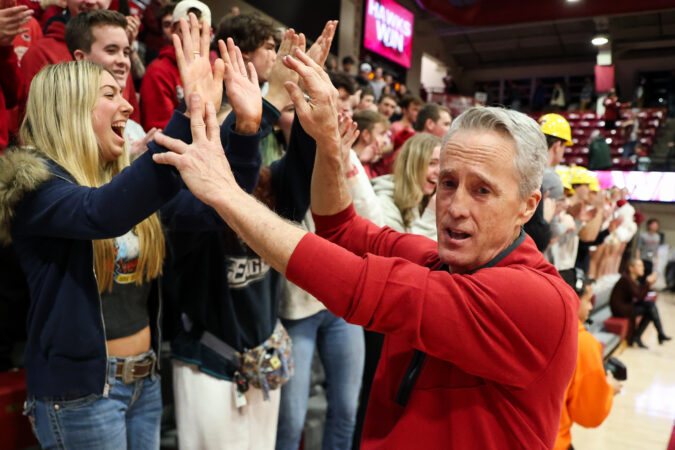
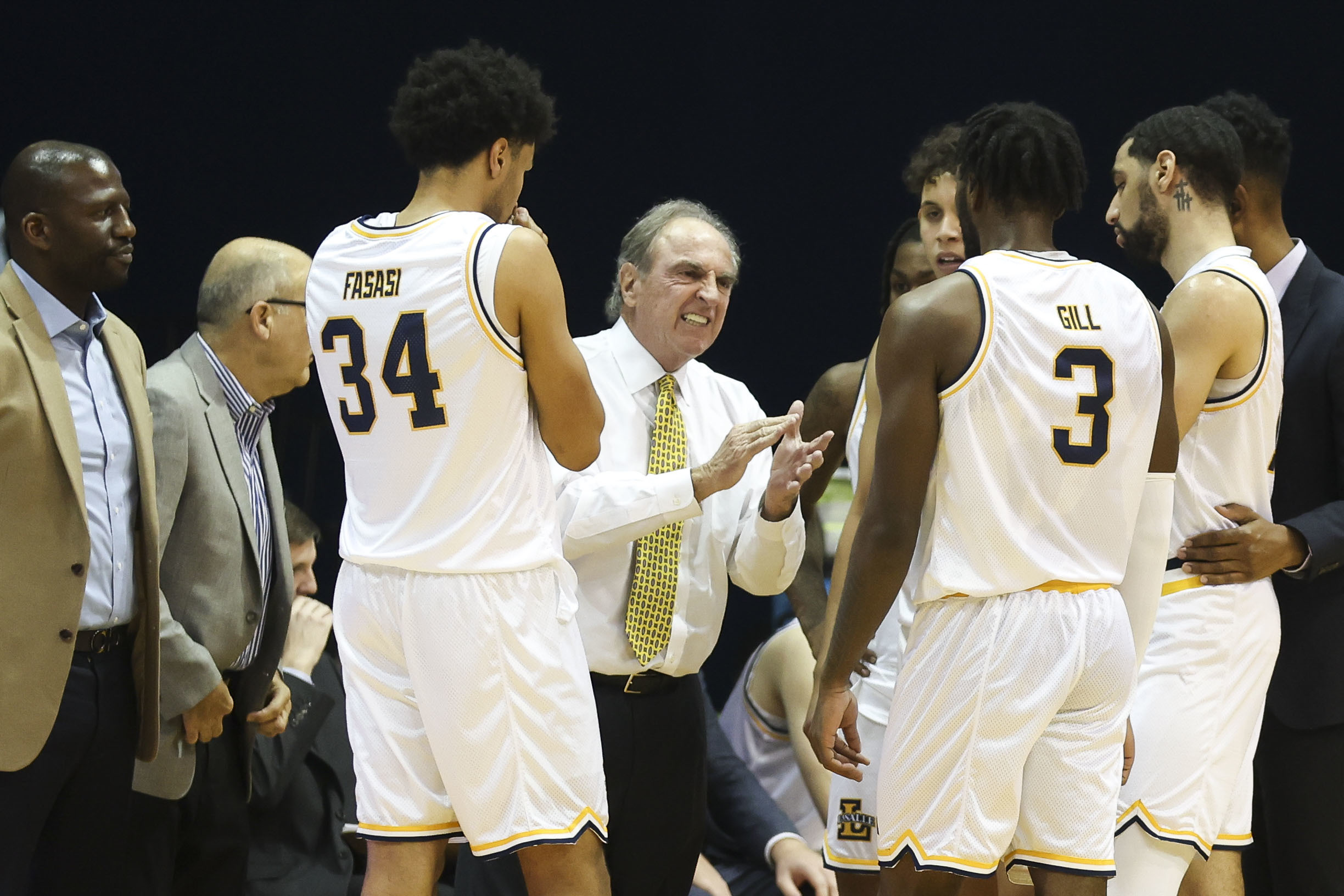
    Former Drexel coach Bill Herrion during the game between the Dragons and the Northeastern Huskies at the Daskalakis Athletic Center.

    With the 6-foot-7 center as the program’s premier player, Herrion’s Dragons made the NCAA Tournament from 1994 to 1996. In its third and final appearance, Drexel upset Memphis as a No. 12 seed. Rose scored 21 points in what is still the only NCAA win in program history.

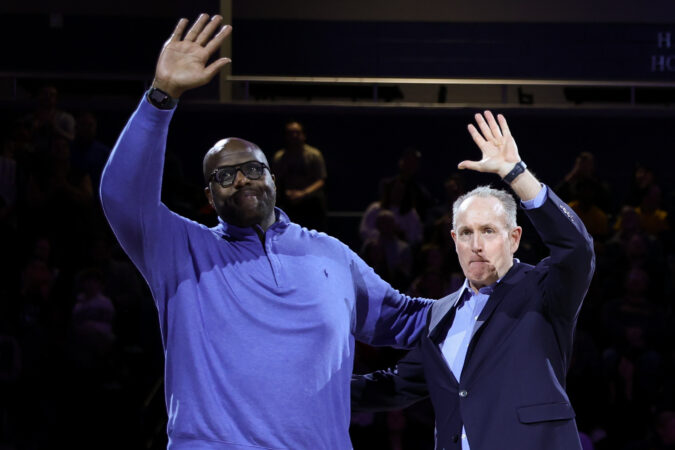
    On Saturday, the Dragons welcomed Rose and Herrion into Drexel Athletics Hall of Fame during an 83-78 victory against Northeastern.

    “It’s a very special and humbling event for me,” said Rose, Drexel’s all-time leading rebounder with 1,514. “It means a lot to me — probably more than any other sports memory I’ve had in my career.”

    Added Herrion: “I’m very honored, very privileged for the recognition. But, I always go back to this. These things only happen as a coach if you’re very, very fortunate to have really good players.”

    A lot of those players were in attendance Saturday. After Herrion and Rose made their way to center court, shaking hands with Drexel athletic director Maisha Kelly and university president Antonio Merlo, players from the ’90s tournament teams joined them.

    “One of the reasons for this taking so long is because I never really wanted to do it,” Rose said. “I don’t really like a lot of this type stuff, but I spoke with Coach Herrion and Maisha the AD — she was really working hard. They were able to get a lot of my former teammates there. … That’s what really hit me. I was like, ‘Man, I get a chance to spend some time with the knuckleheads I rode the bus and the planes with.’”

    The Charlotte Hornets drafted Rose in the second round in 1996, 44th overall, but he spent only one season in Charlotte before signing as a free agent with San Antonio. Rose was a valued role player for two championship teams in eight seasons with Spurs. After that, he played five years for the New York Knicks and a lone season in Oklahoma City. After a stint in broadcasting and multiple executive roles, Rose is now the head of basketball operations for the NBA G League.

    Through all these stops, his Philadelphia roots have stuck around.

    “When I was in the NBA, I think we had [around] 21 players from Philly that came up in the Philly [area] leagues: myself, Alvin Williams, Cuttino Mobley, Kobe [Bryant], Aaron McKie, Rasheed Wallace. … We all grew up playing together, from high school to the Pizza Hut three-on-three leagues up at King of Prussia to the hardwood courts of the NBA. We still have that brotherhood today.”
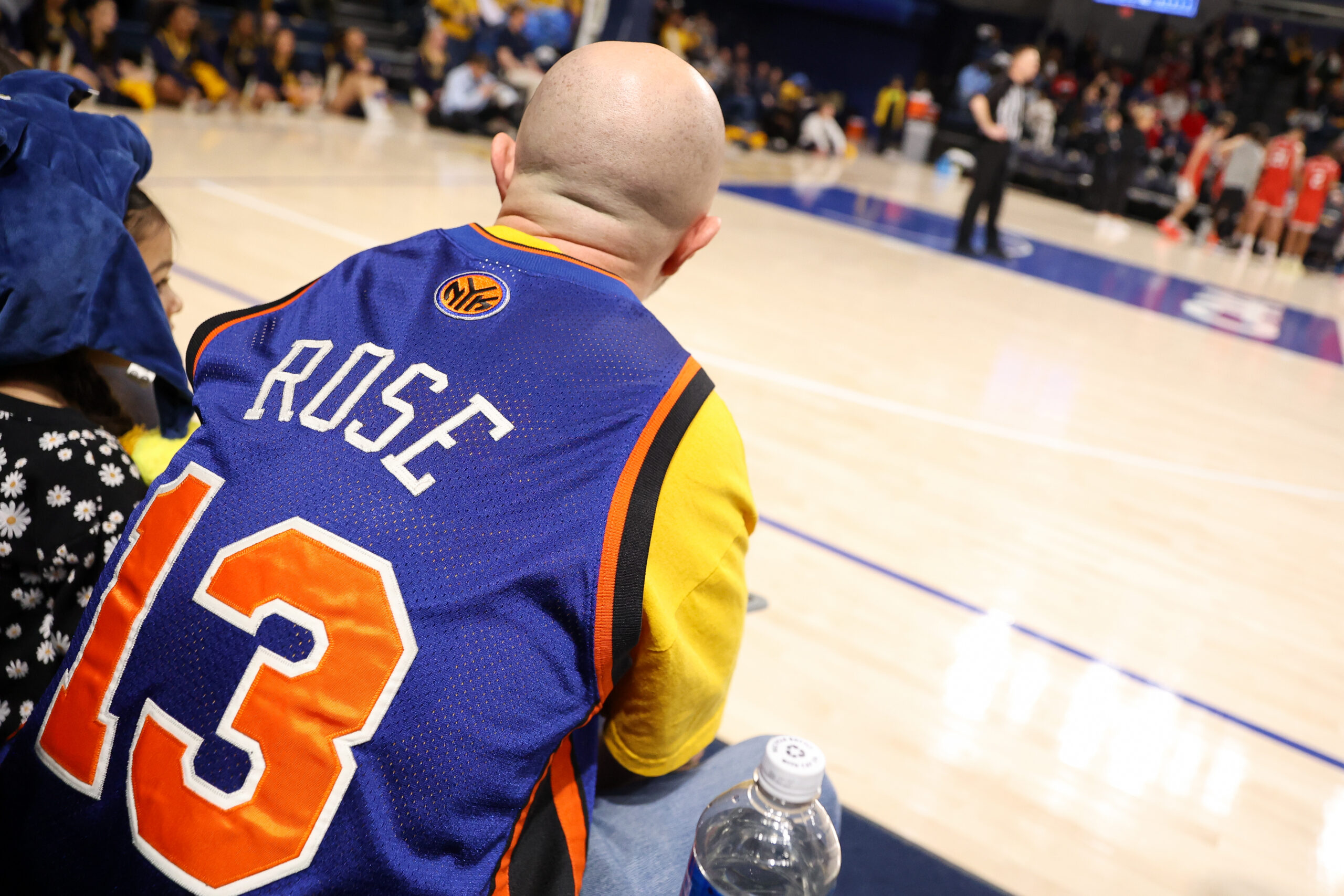
    Bill Martin, a Drexel 2006 graduate and season ticket holder from North Jersey, wearing his jersey from Malik Rose’s time with the Knicks.

    Herrion left Drexel after eight seasons. He coached for six years at East Carolina and 18 at New Hampshire. With the Wildcats, he garnered a program-high 227 victories. Herrion, who is now an assistant at Stonehill in Massachusetts, has the most wins in America East Conference history. His career record as a head coach is 464-472.

    “The remainder of my head coaching career would not even have been possible if it wasn’t for those eight years at Drexel,” Herrion said. “The great thing about it was doing it in Philadelphia, which is such a great college basketball city. All the Big Five coaches I became friendly with. We finally gained unbelievable respect in the city.”

    Now a member of the Big 5, Drexel no longer needs to vie for respect from the other programs. That is still not the biggest change from Herrion and Rose’s time with the Dragons, though. The average NIL budget for a mid-major program, like Drexel, is over $291,000.

    “When I talk to some of my teammates, we remember over Christmas break that we were allowed to get $21 a day. It was like seven bucks a meal,” Rose said. “That’s all we could get each day over Christmas break, and we loved it. We were thankful for it. Times have definitely changed.”

    Behind 22 points from Josh Reed, the current Dragons captured a bit of the energy from the NCAA Tournament teams that routinely packed Drexel’s gym. Afterward, Rose got his wish to spend some more time with his old teammates. The Dragons of the past celebrated a conference win with the team’s present players in the locker room.
  • Downingtown’s Drew Shelton prepares for draft in Texas, joining an academy of sorts for NFL offensive linemen

    Downingtown’s Drew Shelton prepares for draft in Texas, joining an academy of sorts for NFL offensive linemen

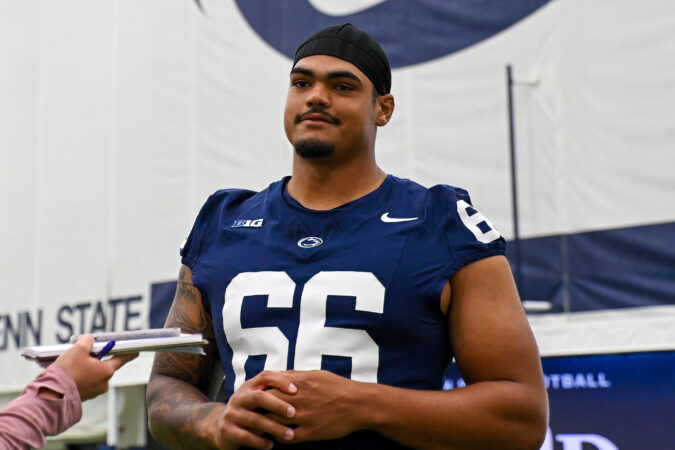
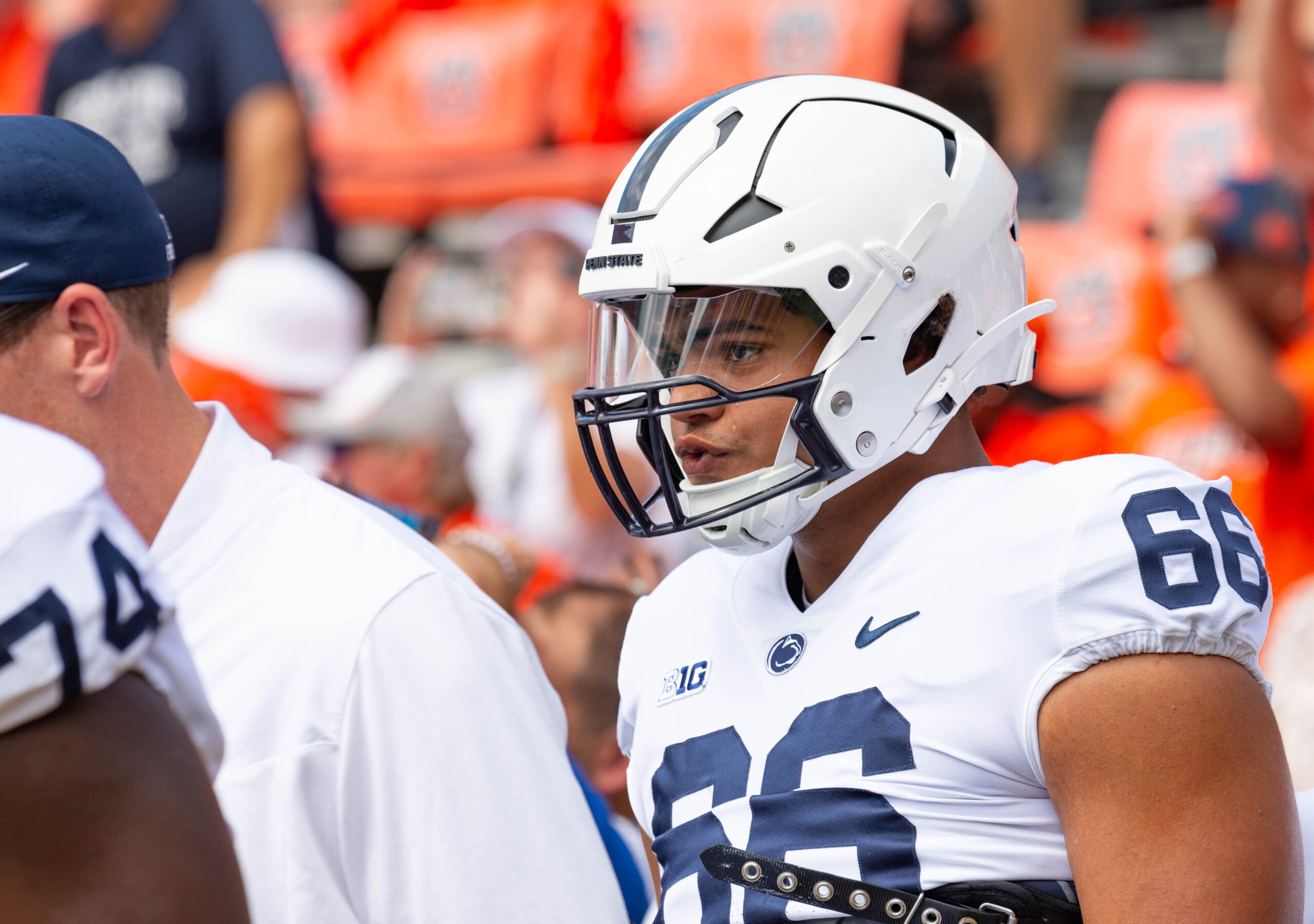
    FRISCO, Texas — Pennsylvania has been Drew Shelton’s home for the majority of his life. The Downingtown native, who starred at Downingtown West and was Penn State’s starting left tackle the last two seasons, is adjusting to life down South.

    Shelton, 22, recently relocated to the Dallas area as he prepares for the next phase of his life with the impending NFL Scouting Combine next month and April’s NFL draft looming.

    “It’s been a big transition down here,” Shelton told The Inquirer in a Frisco hotel lobby. “I haven’t lived away from home in a really long time, been in Pennsylvania pretty much all my life. I’m being down here and learning how to be on my own.”

    It has been quite the journey for Shelton, who was a tight end in high school until he made a position switch to offensive tackle, helping further his playing career. Shelton sat behind 2024 first-round pick Olu Fashanu, although he briefly filled in for an injured Fashanu for five games in 2022 as a freshman.

    The 6-foot-5, 296-pound Shelton started all 16 games for Penn State’s College Football Playoff appearance in the 2024 season and started all 12 regular-season games in 2025 for the Nittany Lions, whose season didn’t go as expected. But Shelton still thinks of his college experience fondly.

    “Coming from Downingtown and growing into the offensive lineman that I needed to be at Penn State, and continuing to grow to be the offensive tackle I need to be in the NFL, it’s been fun. It’s been a challenge,” Shelton said. “You’re never going to be the player that you want to be overnight. It’s just you’ve got to consistently put in the work. And that’s really hard to tell an 18-year-old kid that you’re not going to be the starting left tackle at Penn State on Day 1. I guess it’s hard to come to terms with, but once you really understand and have the patience, that’s a big part of who you are and what you’re going to be.”

    Drew Shelton will be joined by Penn State teammates Olaivavega Ioane and Nolan Rucci at the OL Masterminds workouts in Texas.

    The next phase of Shelton’s life is in Texas because it’s where he is training for the combine, his pro day, and workouts with NFL teams. Shelton is working with Duke Manyweather, the cofounder of OL Masterminds, alongside Eagles right tackle Lane Johnson. Manyweather trains current and soon-to-be NFL offensive linemen at Sports Academy in Frisco.

    And he won’t be alone. Former teammates Olaivavega Ioane, Penn State’s left guard, and Nolan Rucci, the Nittany Lions’ right tackle, are among the 15 draft-eligible offensive linemen working with the offensive line guru.

    Manyweather’s “got some of the top offensive linemen in the league and in the draft,” said Shelton, who had meetings with NFL scouts and executives while they were in town for the East-West Shrine Bowl. “He puts a lot of work into us, builds us up, breaks us all the way down to stance to the fundamentals and all that kind of stuff, and builds us right back up.”

    Shelton, who accepted his invite for the Senior Bowl in December, will not participate in the All-Star game to focus on his training and pre-draft process. Throughout his journey, Shelton has remained connected to former teammate Will Howard, whom he played with at Downingtown West and has been one of his closest friends for a long time.

    Howard led Ohio State to a national championship and was selected in the sixth round of the 2025 NFL draft by the Pittsburgh Steelers. Shelton is hoping to follow in his footsteps, becoming the second Downingtown West alum to reach the NFL in as many years.

    “Seeing someone that you know, and someone that you’ve played with … reach his goals, and obviously continuing to strive to for the next set of goals, that’s been cool,” Shelton said. “And for me personally, like, that’s a dream come true. Every kid dreams of being a professional athlete, and just to be have that be a reality here soon is pretty cool.”

  • Three St. Joseph’s players score 20 points in win over Dayton

    Three St. Joseph’s players score 20 points in win over Dayton

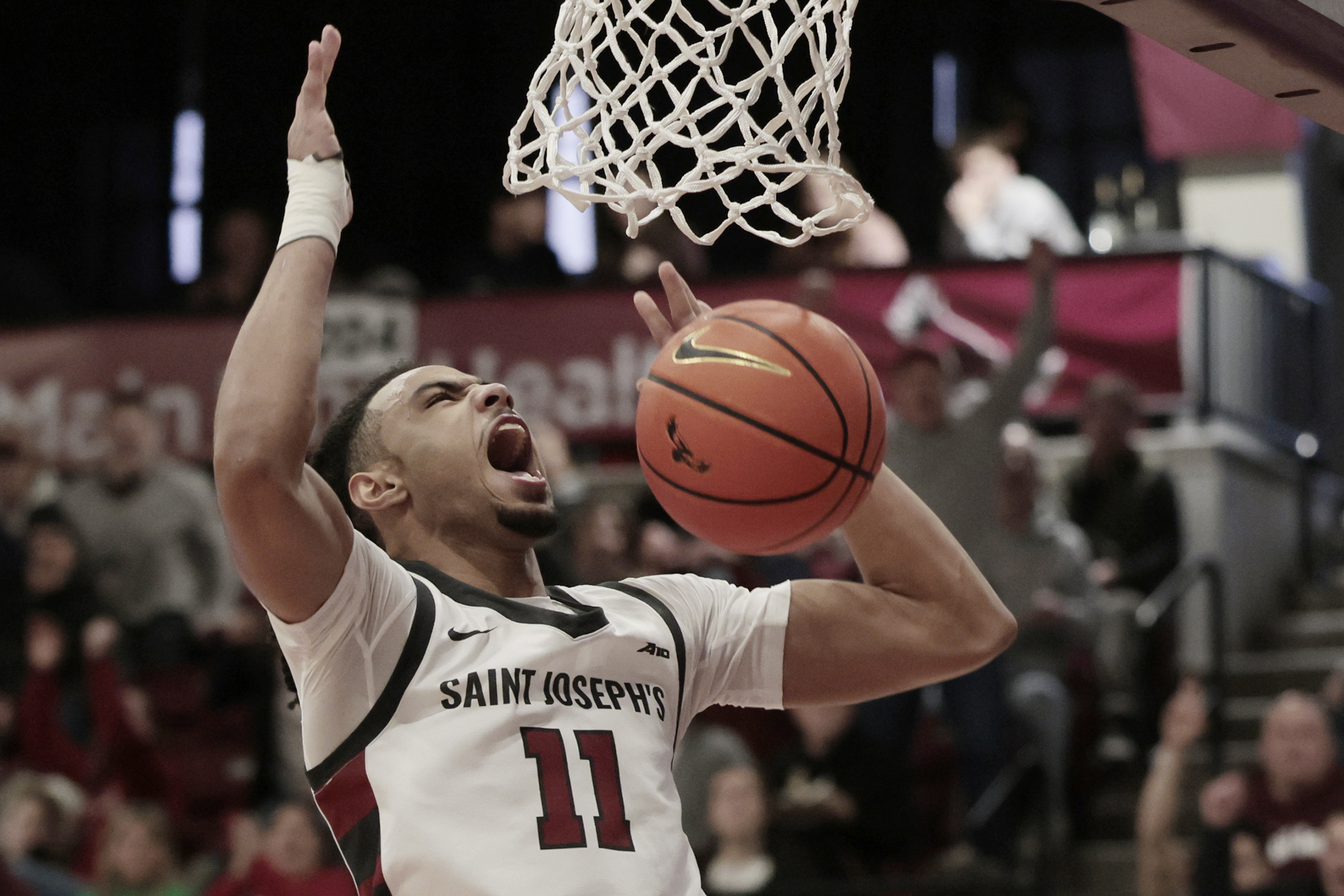
    With St. Joseph’s leading Dayton by eight points in the second half Saturday, guard Jaiden Glover-Toscano got the crowd on its feet with a slam dunk.

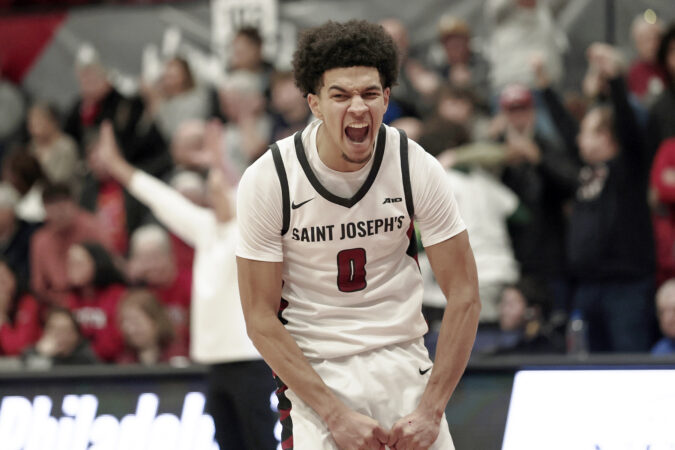
    St. Joseph’s (12-8, 4-3 Atlantic 10) held onto to that lead as the Hawks secured an 81-74 victory at Hagan Arena. Glover-Toscano, Derek Simpson, and Dasear Haskins each finished with 20 points. Simpson added nine assists. Guard De’Shayne Montgomery scored a team-high 19 points for Dayton (14-6, 5-2).

    St. Joe’s Jaiden Glover-Toscano dunks against Dayton.

    “That was a fun atmosphere. That’s what college basketball should be,” Hawks coach Steve Donahue said. “Students going crazy, our guys being motivated, inspired by the fans. … The guys I thought played 40 minutes of really good basketball.”

    Burst of energy

    After falling to La Salle on Wednesday, Dayton hoped to rebound and opened the game against the Hawks with an 8-0 run.

    Dayton did enough to keep itself in the game. That is, until Haskins gave the Hawks the boost they needed.

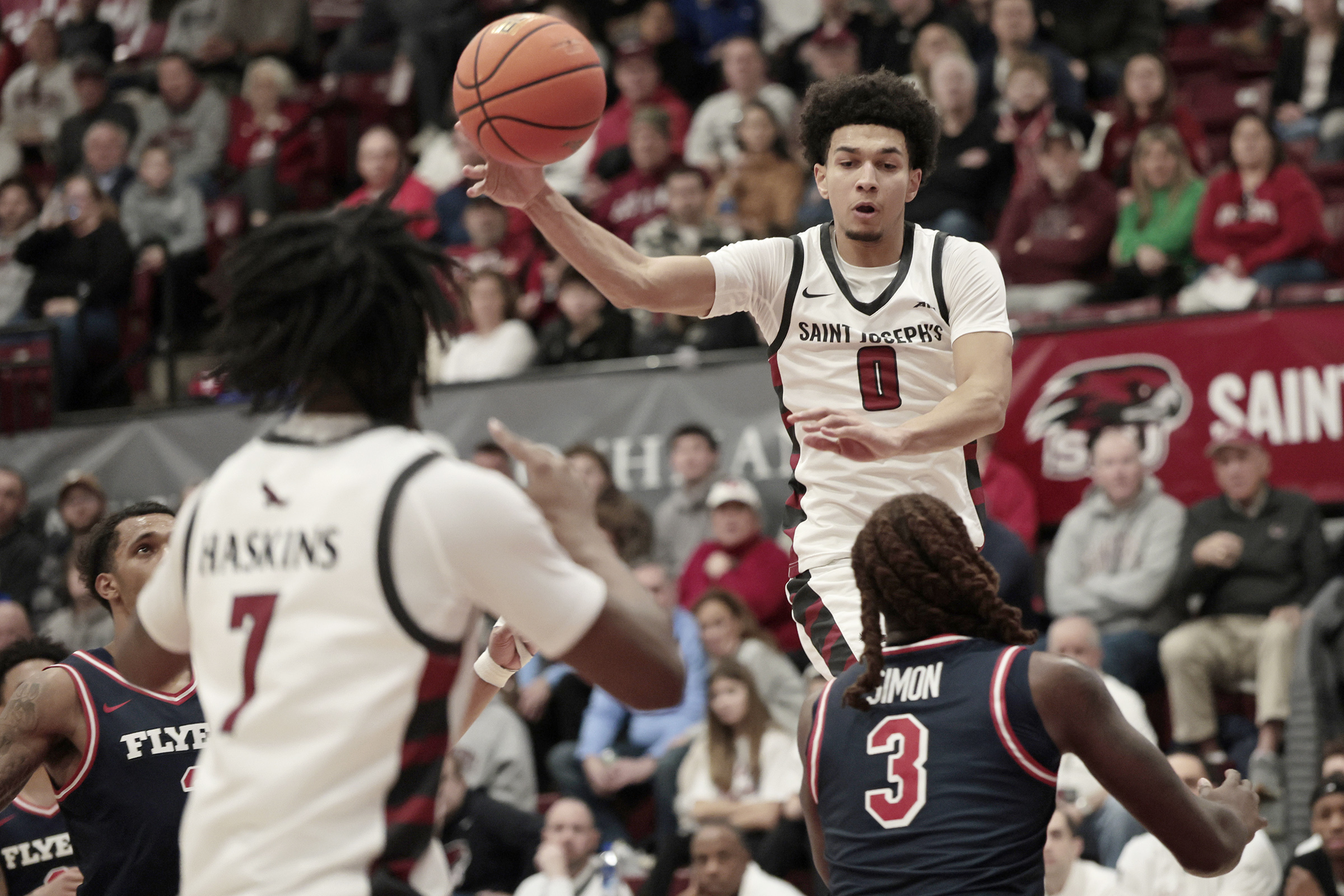
    Haskins, who was scoreless in the first 14 minutes, drilled a three-pointer, which cut the deficit to two. He then grabbed a rebound and ran the length of the court before getting a layup, which got Hagan Arena jumping.

    St. Joe’s Derek Simpson passes the ball to Dasear Haskins on Saturday.

    Before halftime, he knocked down two additional three-pointers, one coming in the final seconds, which gave St. Joe’s a 38-36 lead.

    “It was a real big three,” Haskins said. “We were working hard that whole play, offensive rebounds and kicking out. We emphasize something called ‘boulder’ [in] every practice. So I know when [Simpson] got the ball, I know he was looking for me.”

    Clamping down

    St. Joe’s shut down Dayton in the second half.

    Montgomery was held to three points. On top of that, the Hawks forced 15 turnovers overall and coughed up the ball only 12 times against the conference’s top team in takeaways.

    Dayton’s stagnant offense allowed the hosts to add to their lead, thanks in part to Glover-Toscano, who scored 15 points after the break.

    The Flyers eventually climbed out of a double-digit deficit as the Hawks didn’t score a field goal in the final four minutes, but it wasn’t enough as Dayton fell to its second straight city team and A-10 foe.

    Up next

    The Hawks will travel to Loyola Chicago (5-16, 1-7) at Gentile Arena on Tuesday (9 p.m., CBS Sports Network).

  • Villanova drops a crucial conference matchup on the road against St. John’s

    Villanova drops a crucial conference matchup on the road against St. John’s

    A 22-point deficit heading into the final quarter was just too much.

    In the end, Villanova found themselves on the tail end of a 71-58 final against St. John’s on Saturday in New York City. For St. John’s, the win was retribution from the last time the teams faced off on Dec. 22 — when Villanova claimed an 85-48 victory.

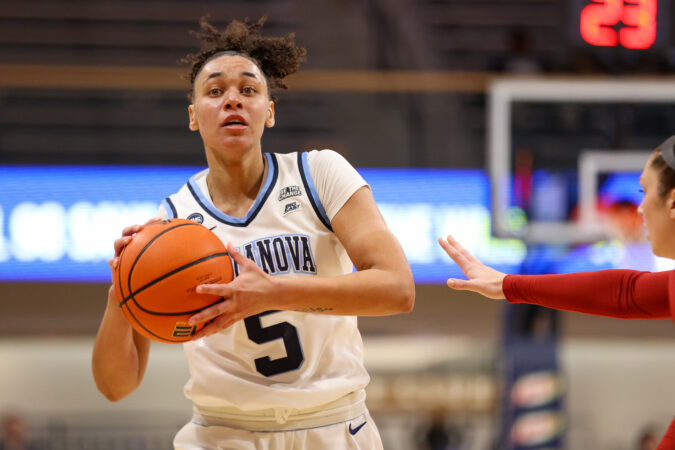
    Ryanne Allen led the Wildcats with 12 points. Jasmine Bascoe, Villanova’s star sophomore guard, added 11.

    Villanova (8-3, 15-5 Big East) is now tied for second place in the conference with Seton Hall. St. John’s (6-5, 16-6 Big East) stands fourth in the Big East.

    St. John’s fast start

    The game quickly spun out of control for Villanova, as St. John’s sprinted off to a 22-5 lead across the opening 10 minutes. Brooke Moore led the way for the Red Storm, as the junior guard scored 10 points in the first quarter.

    St. John’s shut down Villanova’s offense, going on a 17-0 run across the last 7 minutes, and 38 seconds of the quarter.

    Meanwhile, the Wildcats shot an uncharacteristic 2-for-11 from the field and 1-for-6 from three. Villanova entered the game as the second-best shooting team in the conference, averaging 45.1% from the field.

    Villanova attempted to push back in an energetic second quarter, in which it was outscored just 18-17. Junior forward Brynn McCurry led the Wildcats in the first half, with eight points and four rebounds.

    Turning the tables

    St. John’s, which saw some difficulty early in Big East play, was dominant on its home court on. Unlike in its previous meeting with Villanova, St. John’s controlled the game and led by double-digits throughout the second, third, and fourth quarters.

    The Red Storm succeeded in holding back Bascoe, who leads Villanova in scoring with 17.2 points per game. Bascoe dropped 21 points with a season-high nine assists in the previous win over St. John’s. But in Saturday’s contest, she was restricted, scoring just four points in the first half to support her total.

    Villanova struggled to keep St. John’s offense away from the net. The Red Storm scored 42 points in the paint across the game.

    Villanova scored its highest point total (20 points) in the fourth quarter. Allen helped the Wildcats make a late-game push to narrow the deficit, scoring seven points and continuing her consistent three-point shooting.

    Up next

    Villanova returns to Finneran Pavilion on Tuesday to take on Providence (7 p.m., ESPN+).

  • ‘We should have won’: Upset bid slips away from Villanova in overtime loss to No. 2 UConn

    ‘We should have won’: Upset bid slips away from Villanova in overtime loss to No. 2 UConn

    HARTFORD, Conn. — Devin Askew drove into the paint with Villanova trailing Connecticut by just one point inside two minutes to play. The defense collapsed, so Askew kicked the ball to the wing and into the waiting hands of … Kevin Willard.

    The Villanova coach pounded the basketball onto the court with two hands. One of Villanova’s 11 turnovers came at an inopportune time.

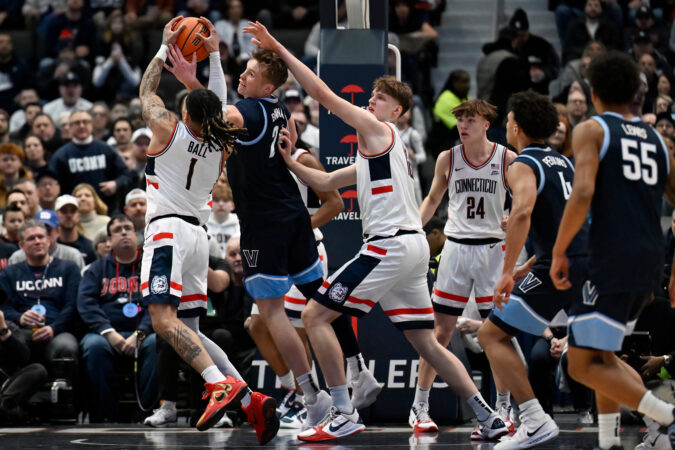
    The Wildcats later had a lead with less than a minute on the clock, and they still did take the second-ranked team in the country to overtime, but Askew’s turnover was one of many little moments that didn’t go Villanova’s way in a 75-67 loss at PeoplesBank Arena.

    Where to start? There was Acaden Lewis’ out-of-control drive down two in overtime with just over a minute to go. Back in regulation, Bryce Lindsay missed an open runner in the paint shortly after the Askew turnover. Then Villanova’s leading scorer, who was held to three points and didn’t make any of his eight attempts, had a three-point attempt blocked in a tie game with less than 30 seconds to play.

    Villanova started overtime with a Tyler Perkins three-pointer, then got the ball back when Perkins drew a charging foul. But instead of building on the lead, Lindsay had his pocket picked by Silas Demary Jr., leading to a runout dunk from Tarris Reed Jr. Perkins’ triple, 12 seconds into overtime, was Villanova’s only made basket of the extra session.

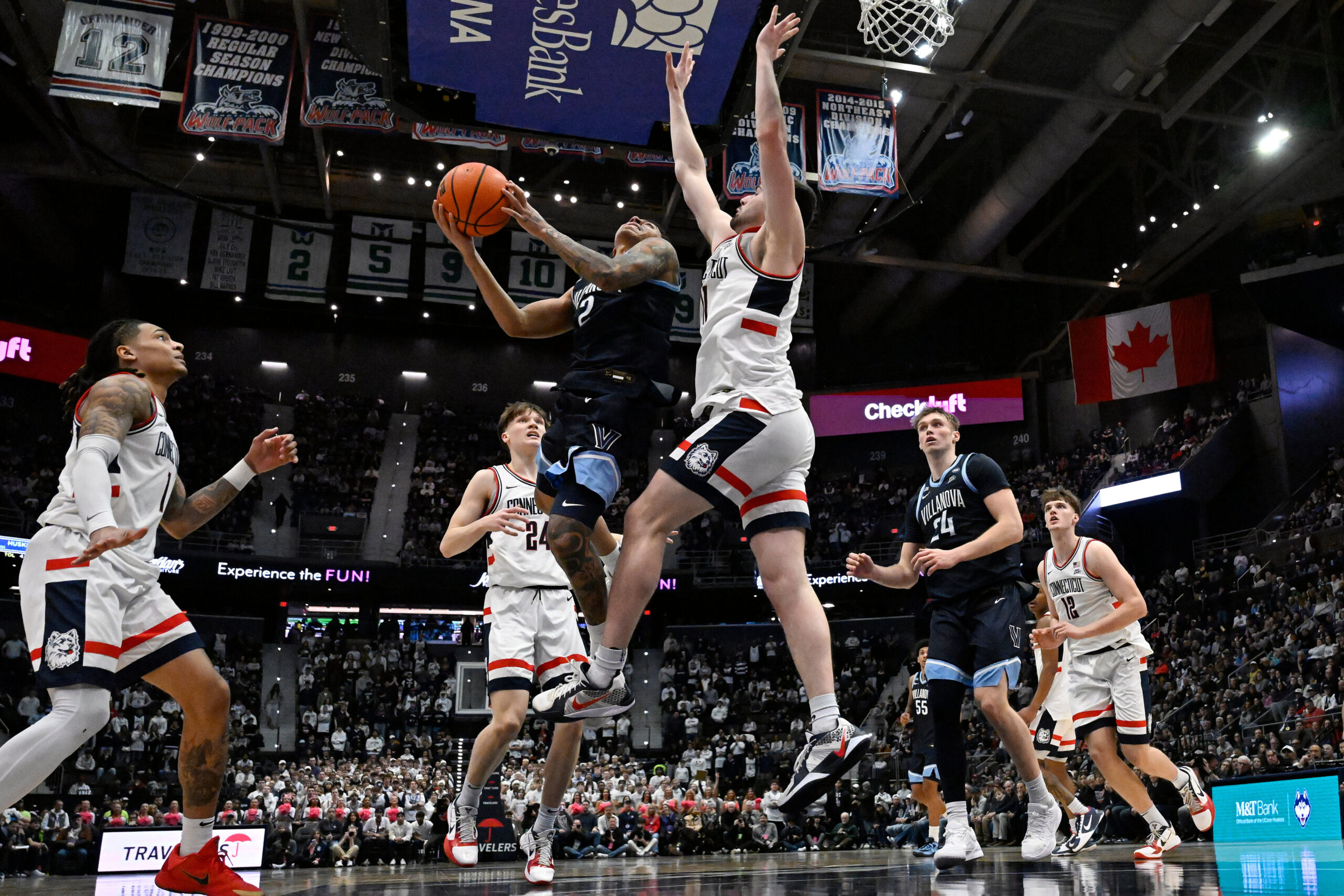
    Villanova guard Bryce Lindsay shoots as UConn forward Alex Karaban defends on Saturday.

    The Wildcats’ youth and inexperience showed up once again in a test against one of the best teams in the country, one week after Villanova allowed St. John’s to start the second half on a 20-4 run that it never recovered from.

    “It just hurts,” said Villanova senior big man Duke Brennan, who struggled last week with the size and physicality of St. John’s but battled back in a big way Saturday. He had 16 points and 14 rebounds and, perhaps most importantly, made eight of his nine free-throw attempts in 40 minutes. “We fought until the end. That’s a great team over there.”

    To be sure, there were things Villanova did well enough to win. You don’t take the No. 2 team in the country to overtime without doing things correctly. The Wildcats had answers for a lot of UConn’s offensive action. They held Alex Karaban, who averages nearly 14 points, off the scoreboard for the first 30 minutes (though he did finish with 17 points).

    Perkins had 16 points and 10 rebounds and continued to be the physical and experienced guard presence Villanova needs. Askew, too, continued his strong stretch of games with 13 points, four rebounds, and three assists before he fouled out in overtime. Matt Hodge followed up consecutive games being held to four points or less with 12 points on 4-for-6 shooting from three-point range, including a corner three that gave Villanova a 61-59 lead with just over a minute to go.

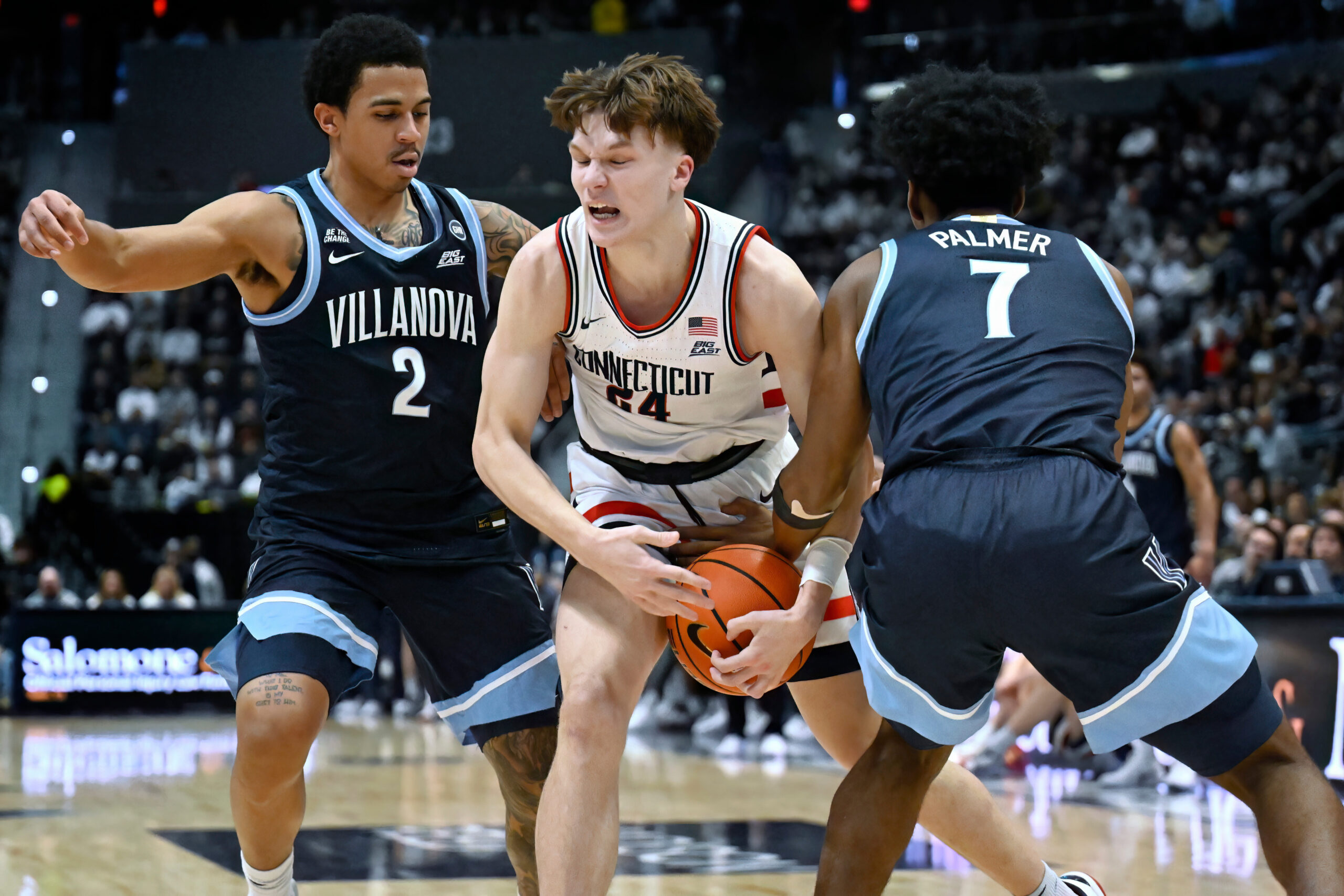
    UConn guard Braylon Mullins is guarded by Villanova guards Bryce Lindsay (2) and Malachi Palmer (7) on Saturday.

    But then came another costly error. Demary missed a driving layup, and Villanova couldn’t secure a rebound, allowing Reed to tip in the tying basket.

    In the end, UConn made the plays when it mattered. Solo Ball, who led all scorers with 24 points, hit arguably the game’s biggest shot, a three-pointer with two minutes left in overtime that turned a one-point Villanova lead into a two-point deficit.

    It is hard for Villanova to win when Lindsay doesn’t make a shot and Lewis goes 1-for-13 from the field. Yet, it nearly happened anyway.

    “We’re a young team,” Willard said. “Guys were trying to make plays. We got to the rim. We didn’t finish at the rim, and I thought we had some opportunities at the rim.”

    Villanova made 5 of 15 layup attempts.

    “We’re still going down and playing high-level defense,” Willard said. “If we can continue to build on that, then we’ll get out in transition and get some easier buckets.”

    It was the closing minutes that Willard said he needed to “get better at.” Lewis was seemingly benched for a large stretch of the second half. Brennan was in foul trouble. The Wildcats are a team without much depth.

    “I got to put the right lineups out there at times and I’m learning a lot about certain guys and what to do,” Willard said. “At the end of the day, we don’t do a free throw box out, and we don’t get a huge rebound when we’re up four with about six minutes to go. … Sometimes to get there on the road you got to make sure you finish possessions, and I thought there was three or four times where we didn’t finish possessions with rebounds.”

    An encouraging game nonetheless?

    “No,” Willard replied. “I don’t like losing. We should have won that game.”

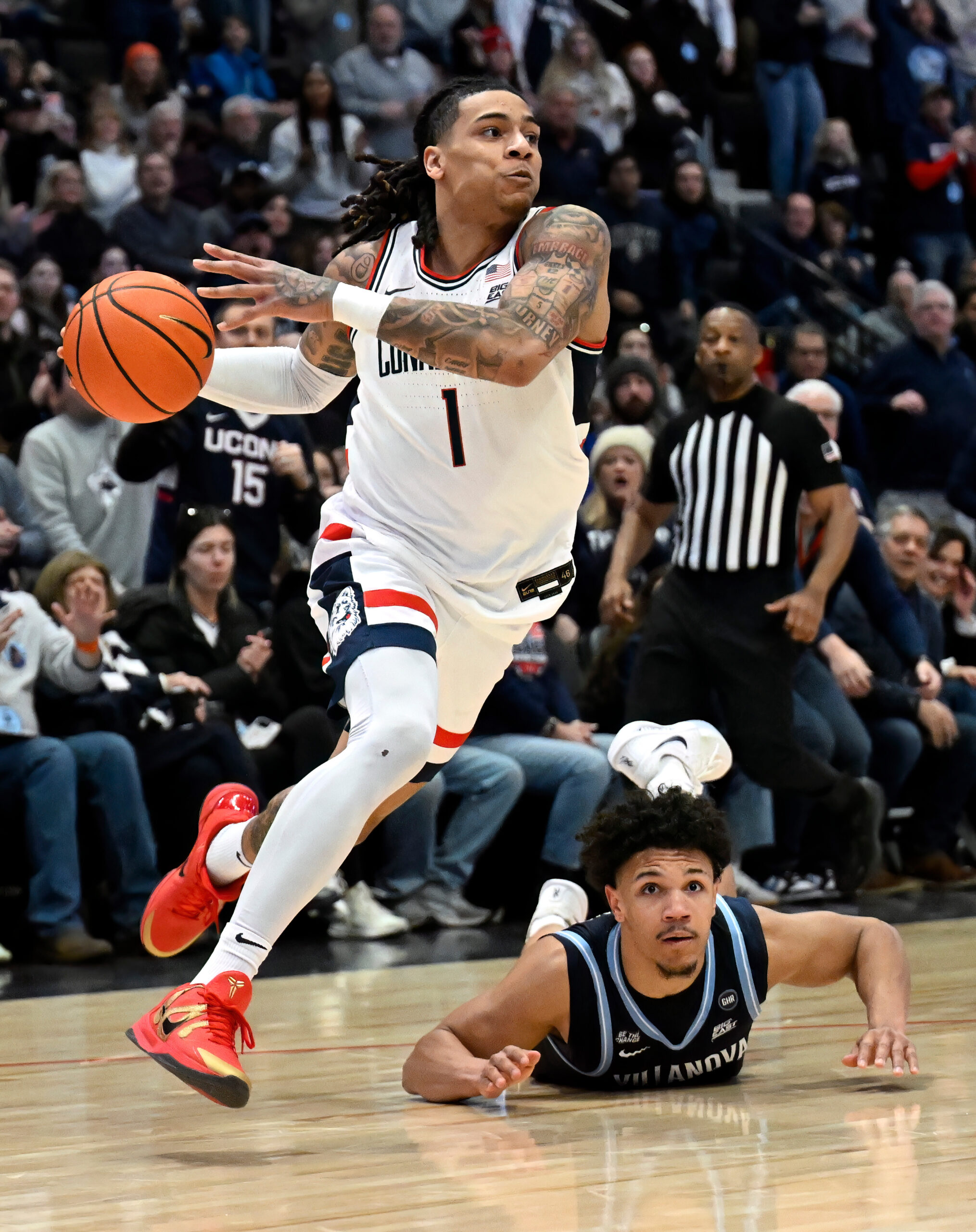
    UConn guard Solo Ball, who led all scorers with 24 points, dribbles around Villanova guard Tyler Perkins on Saturday.

    The reality for Villanova is Saturday’s loss is one that won’t necessarily hurt. A road upset helps a lot more than an eight-point overtime loss stings as far as the meaningful metrics go. The Wildcats are 15-5 overall and 6-3 in Big East play. They started the day rated 25th at KenPom and were still there by late Saturday afternoon. They have rest ahead before a Friday home game vs. Providence, and plenty of winnable games on the calendar as they continue to hunt for an at-large bid to the NCAA Tournament.

    Plus, two more shots at the conference’s elite. On consecutive Saturdays, Villanova took St. John’s and Connecticut to the brink.

    “The good thing about conference is you play every team twice,” Brennan said. “We get another shot at those dudes. St. John’s we felt like we didn’t play good at all, all throughout our program. This game we felt like we really battled.

    “It feels like it got away and we felt like we were there the whole game. There are certain little things that come down at the end of the game where it can flip one way. It wasn’t on our side tonight.”

  • Clemson’s Dabo Swinney alleges tampering by Ole Miss’ Pete Golding and calls for reforms

    Clemson’s Dabo Swinney alleges tampering by Ole Miss’ Pete Golding and calls for reforms

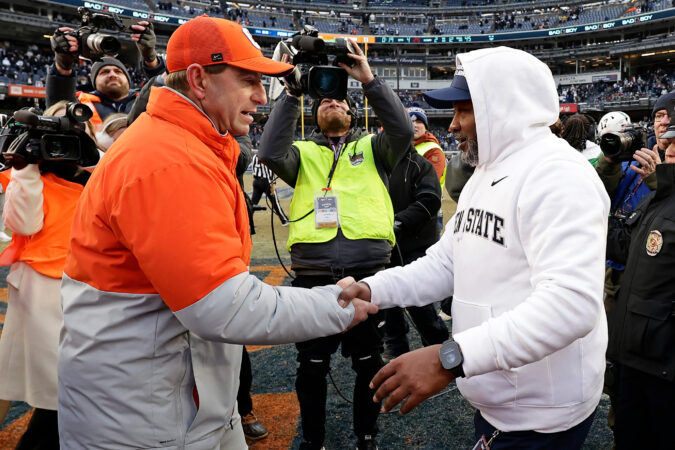
    Clemson coach Dabo Swinney is accusing Mississippi coach Pete Golding of tampering with transfer player Luke Ferrelli and said Friday he has forwarded evidence to the NCAA.

    “If you tamper with my players, I’m going to turn you in. It’s just that simple,” Swinney said during a news conference. “I’m not out to get anybody fired, but there has to be accountability and consequences for this type of behavior and total disregard for the rules.

    “If this happened in the NFL, which is an actual league with rules, they would be fined, they would take draft picks, they hit the cap, whatever,” Swinney continued. “This is such a terrible example for young coaches in this profession. … To me, this situation is like having an affair on your honeymoon.”

    Ferrelli, a former linebacker at California, entered the transfer portal on Jan. 2 and committed to Clemson four days later. Ferrelli subsequently enrolled, began classes, and began attending meetings and workouts, Swinney said.

    Ferrelli reentered the portal on Jan. 22 and committed to Ole Miss.

    “You can’t sign with the Browns and practice a week, and then the Dolphins call you and say we’re going to give you a little more money and you say, ‘See ya, boys,’ and go play for the Dolphins. That’s not the real world,” Swinney said.

    Ole Miss athletic officials did not respond to Swinney’s allegations when contacted on Friday by The Associated Press.

    NCAA vice president of enforcement Jon Duncan said in a statement that the association “will investigate any credible allegations of tampering and expect full cooperation from all involved as required by NCAA rules.”

    Swinney alleged that Golding maintained contact with Ferrelli after the linebacker had enrolled at Clemson, even texting, “I know you’re signed, but what is your buyout?”

    When Swinney found out about it, he said he initially told Clemson general manager Jordan Sorrells that he wanted to give Golding “some grace” because the Rebels’ coach was newly promoted after Lane Kiffin left for LSU over Thanksgiving weekend.

    Swinney asked Sorrells to tell Ole Miss officials “that we know what’s going on, and if he doesn’t cease communication, I’m going to turn him in. I really thought that would be the end of it, but it wasn’t.”

    Swinney said Ferrelli’s agent confirmed that Golding had continued reaching out to the player, so Clemson officials asked for copies of the text messages.

    “The agent communicated that if we were to add a second year at $1 million to the already agreed-upon deal with Luke, then they would gladly give us whatever we need to turn Ole Miss in,” Swinney said. “Jordan, appropriately, said, ‘No, we’re not doing that.’”

    Clemson athletic director Graham Neff said the university’s main reason for making the allegations public was to spur changes to the college football calendar and related rules — or lack thereof — that have contributed to upheaval across the sport.

    “The NCAA was surprised a school was willing to come forward as directly and transparently as we were,” Neff said. “We need to look real hard at how we got here, but (also) how to get out of it.”

    Neff added that Clemson was exploring its legal options.

    “This is not about a linebacker at Clemson,” Swinney added. “I don’t want anyone on our team that doesn’t want to be here.

    “It’s about the next kid and about the message being sent if this blatant tampering is allowed to happen without any consequences.”

    Swinney also called the January transfer portal window “stupid,” saying it causes “flat-out extortion in some cases” because players and schools are making major decisions during “such a short period of time, right in the middle of when people are trying to play bowl games, playoff games, et cetera.”

    If the system is not reformed, Swinney warned, there will be unintended consequences for players who transfer among multiple schools while chasing short-term financial payouts — particularly if they don’t make it to the NFL.

    “We’re going to have some screwed-up 30-year-olds … that have no degrees, that have spent their money, that can’t play football anymore and aren’t connected to anything,” Swinney said.

  • Villanova’s Luke Colella and Temi Ajirotutu declare for 2026 NFL draft

    Villanova’s Luke Colella and Temi Ajirotutu declare for 2026 NFL draft

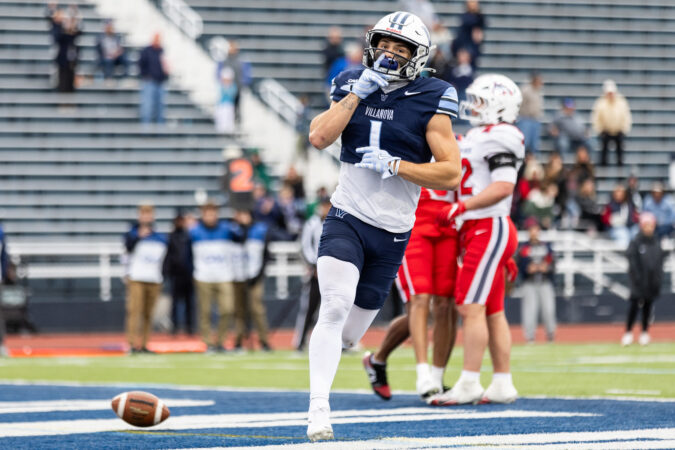
    Villanova receiver Luke Colella and left guard Temi Ajirotutu have declared for the 2026 NFL draft.

    “This journey has been filled with hard work, sacrifice, adversity, and growth,” Colella wrote in his announcement on Wednesday. “Every setback and every challenge made me stronger and taught a valuable lesson. With faith in God, gratitude for everyone who has supported me, and confidence in the work I’ve put in, I am proud to officially declare for the 2026 NFL Draft.”

    Colella transferred to Villanova from Princeton for his final year of eligibility. He finished with a team-leading 77 receptions for 1,071 yards and eight touchdowns with the Wildcats.

    At Princeton, he collected 93 receptions for 1,188 yards and 11 touchdowns across three seasons.

    Ajirotutu, a graduate student, played his entire five-year college career at Villanova. He emerged as a starter in 2022 and was named third team All-CAA in 2023.

    Last season, Ajirotutu played in four games before missing the remainder of the year with a medical redshirt. He earned an honorable mention on the AP FCS All-America team this past season, when he played in all 15 games.

    With the help of Colella and Ajirotutu, Villanova made an appearance in the FCS semifinals for the first time since 2010. The Wildcats fell to Illinois State, 30-14.

    The last Villanova player to get drafted was Buffalo Bills cornerback Christian Benford, who was selected in the sixth round in 2022.

    The 2026 NFL Scouting Combine will take place on Feb. 23 to March 2, and this year’s draft will be held April 23-25 in Pittsburgh.

  • St. Joe’s men’s and Drexel women’s basketball move games due to Philly’s expected winter storm

    St. Joe’s men’s and Drexel women’s basketball move games due to Philly’s expected winter storm

    With heavy snow expected this weekend, two Big 5 basketball programs are moving their tipoff times.

    The St. Joseph’s men’s team was slated to take on Davidson at 6 p.m. on Saturday at Hagan Arena. Now, the Hawks will be starting at 2 p.m. to avoid interference with potential snowfall on Saturday night.

    The Drexel women moved its Sunday matchup against Towson at the Daskalakis Athletic Center to Saturday at 6 p.m., which will now be a homecoming doubleheader with the men’s team, which faces Northeastern at 2 p.m.

    The women’s team will play back-to-back days, as the Dragons host Stony Brook at 6 p.m. Friday.

    The Philadelphia region will be under a winter storm watch from 7 p.m. Saturday until midday Monday. As of Friday, the area is expected to receive anywhere from eight to 14 inches of snow.

  • Amid college basketball’s gambling scandal, concerns that mid-major players could be vulnerable

    Amid college basketball’s gambling scandal, concerns that mid-major players could be vulnerable

    Rollie Massimino “did not mess around” when it came to drawing up defensive schemes against Patrick Ewing … or warding off gambling temptations that might filter through to his Villanova players.

    “When we were playing, we had an FBI agent who was a former ’Nova basketball player give talks about gambling,” said Chuck Everson, a member of Massimino’s 1985 Wildcats title team that took down heavily favored Georgetown.

    “Rollie did not mess around with that stuff. It wasn’t that far removed from the Boston College [point-shaving] scandal. Rollie brought in the FBI to talk to us. Coach Mass did a great job of teaching us, and it wasn’t all basketball; it was life lessons. And with gambling, it was, ‘Don’t do that.’

    “To this day, I have never called DraftKings, or anything like that. I attribute that to being scared straight with Coach Mass.”

    Everson, 61, played in an era when sports betting wasn’t legal in most of the country. These days, things are quite different. College athletes are compensated by their schools or through lucrative name, image, and likeness deals, and the legal/illegal gambling culture infiltrates every level of sports.

    Last Thursday in Philadelphia, federal authorities announced a sweeping criminal indictment and related filings against 26 people on charges related to manipulating NCAA games and Chinese professional games through bribes, some as high as five figures.

    It is the fourth federal criminal indictment that involves gambling and sports unsealed in the last six months, and the latest alleged gambling scheme involves one of the storied Big 5 programs: La Salle.

    According to the indictment, at least one of the purported rigged games took place in 2024 in Philadelphia between La Salle and St. Bonaventure.

    There are at least 39 players from 17 NCAA Division I schools who are alleged to have been involved in the scheme, but the indictment may underscore other, more troubling concerns.

    Players at mid-major or smaller Division I programs might earn a fraction in NIL money compared to what their counterparts at elite programs take in, and therefore might be more susceptible to the temptations of illicit paydays. As one former federal prosecutor put it, this alleged scheme might be one of many dominoes waiting to fall.

    “Anything that interferes with the integrity of sporting events, you’re going to get action by prosecutors,” said Edward McDonald, who prosecuted those involved in the Boston College point-shaving case in the late ’70s. McDonald, now senior counsel at the Dechert law firm, thinks that mid-major schools, like La Salle and some others in the Big 5, could be particularly vulnerable to gambling and bribery schemes.

    “These smaller schools, the compensation to players is not as great [compared to larger programs], even for the better players on the team,” said McDonald, who learned of the Boston College scam through his investigations of organized crime family members with the Justice Department (and played himself in the Martin Scorsese-directed mob film Goodfellas).

    “Players going to big-time schools are making 10 times more. A player [at a smaller program] might not be having a good season or might think they’re not going to play in the NBA or professionally, and they might say, ‘What the hell, I might as well cash in now.’”

    Prop bets on a La Salle game

    According to the court filings, one of the defendants, Jalen Smith, and former LSU and NBA player Antonio Blakeney (who is “charged elsewhere,” according to the indictment), attempted to recruit players on the La Salle men’s basketball team for the point-shaving scheme.

    The fixers offered the La Salle players payments to underperform and influence the first half of a game against St. Bonaventure on Feb. 21, 2024, according to the filings.

    Prosecutors allege that before the game at Tom Gola Arena, defendants who acted as fixers placed bets totaling approximately $247,000 on the Bonnies to cover the first-half spread. A $30,000 wager was made in Philadelphia at a FanDuel sportsbook, according to the indictment. But those bets failed after La Salle covered the spread.

    “Neither the university, current student-athletes, or staff are subjects of the indictment,” La Salle wrote in a statement. “We will fully cooperate as needed with officials and investigations.”

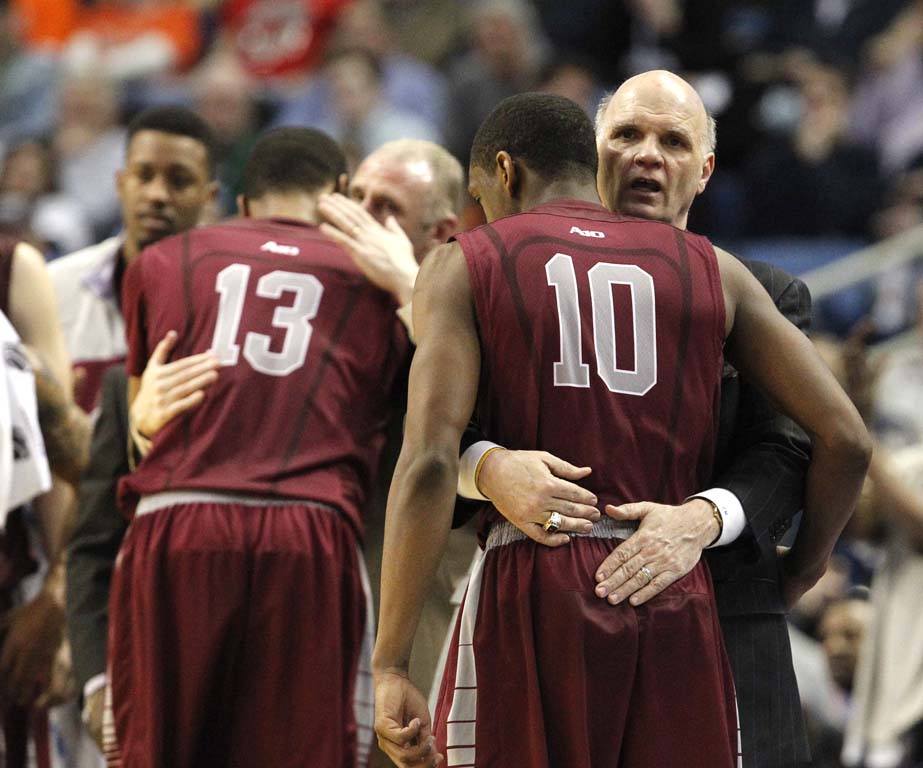
    La Salle coach Fran Dunphy directing the Explorers in November 2023. Dunphy retired after last season.

    Ohio Gov. Mike DeWine told The Inquirer that several years ago he received complaints from a number of college coaches in his state about online abuse directed at players and threatening calls from gamblers who had lost big.

    “I called up [NCAA president] Charlie Baker, and asked him, ‘What do you think of prop betting?’” DeWine said. “He said, ‘We don’t like it.’ And I said, ‘Give me a letter that says that.’

    “Under Ohio law, if I can get a letter from a league saying, ‘Don’t bet on certain things,’ that gives me the ability to go to my Casino Commission and they can [enact rules] without any legislation. Charlie sent the letter, I took that to the commission, and that stopped collegiate prop betting.”

    The Ohio Casino Control Commission granted the NCAA’s request to prohibit proposition bets on collegiate sports in February 2024, but the decision affected only Ohio.

    “It doesn’t really eliminate the problem,” DeWine said.

    The ban in Ohio is only a drop in the bucket against a sea of pro-gambling momentum, legislation, and, most significantly, lucrative revenue streams.

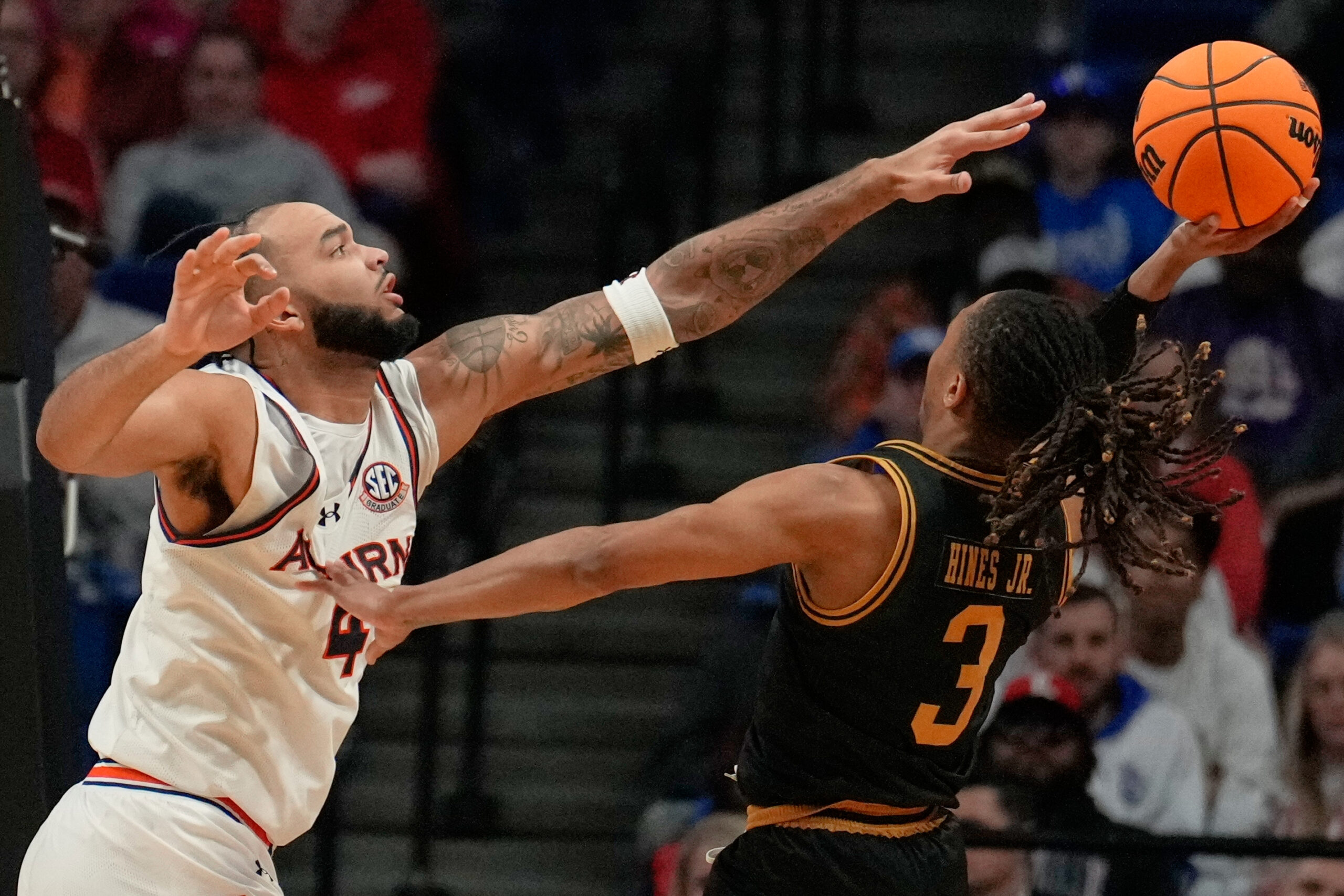
    CJ Hines, a guard who was dismissed from Temple’s basketball team on Jan. 16, allegedly participated in a point-shaving scheme during the 2024-25 season while playing for Alabama State, according to the indictment. Hines transferred to Temple in May but didn’t play this season after the university announced that he was under investigation for eligibility concerns before his enrollment.

    Former Alabama State guard CJ Hines (3) averaged 14.1 points in 35 starts last season.

    The Atlantic 10 Conference — which includes La Salle and St. Joseph’s — weighed in on the latest gambling indictment.

    “Any activity that undermines the integrity of competition has no place in college athletics,” commissioner Bernadette V. McGlade said in a release. “The Atlantic 10 and its member institutions will continue to work closely with the proper authorities to combat illegal activities.”

    A St. Joe’s spokesperson added: “St. Joseph’s University has not been approached by federal investigators or any other entity about suspicious sports wagering activity involving St. Joe’s student-athletes or team.”

    Villanova, which plays in the powerful Big East Conference, has numerous resources and protocols in place to address the sports wagering issue.

    Handbooks, which include NCAA rules on gambling, are distributed annually to athletes, who also must sign a sports wagering document before being declared eligible. The athlete must acknowledge he or she won’t engage in activities that influence the outcome or win-loss margins of any game.

    In 2021, 2023, and 2025, Villanova brought in speakers who have a history with sports gambling to talk with athletes about the risks and dangers associated with it. Villanova’s athletic compliance office meets twice annually with every athlete to review NCAA compliance standards, including its rules on sports wagering.

    Former Villanova basketball star Maddy Siegrist told The Inquirer last year that her college alma mater ingrained in her mind the potential devastating consequences of gambling, values that she continues to adhere to as a WNBA player.

    ‘The integrity of sports is at risk’

    Even after the 2018 Supreme Court ruling that legalized sports wagering state to state, the honesty and integrity component still comes into question when so much is riding on any sports wager.

    DeWine, the Ohio governor, is taking a proactive role in trying to address malfeasance in the gaming culture.

    “I’m writing letters to all other major [sports] leagues,” DeWine said. “They need to get on this. If they sit back, they’re making a huge mistake. I think the integrity of sports is at risk. I’m continuing to urge these leagues to take care of business, because they’re the ones that are going to get hurt.”

    But McDonald said that with the flurry of recent indictments involving sports and gambling, “you have to wonder how pervasive [the illegal gambling problem] really is.”

    “This could very well be the tip of the iceberg,” McDonald said.

  • A former St. Joe’s walk-on won $1 million picking NFL games while ‘changing diapers’

    A former St. Joe’s walk-on won $1 million picking NFL games while ‘changing diapers’

    Chris Coyne had a chance to win $1 million earlier this month, but that wasn’t enough to get him out of reading his son a bedtime story.

    His friends were coming over the next afternoon to watch the final slate of NFL games as Coyne neared the prize. So his wife said it was his night to make sure one of their two children was sleeping.

    And there was Coyne — a cell phone on his lap so he could follow the Buccaneers-Panthers game on Jan. 3 — reading The Pout-Pout Fish to 2-year-old Charlie.

    “I know it by heart now, so I’m just reading it from memory and watching the phone on mute while I’m telling the story,” said Coyne, who also has an infant son named Harrison. “But I have a million dollars on the line. The Bucs missed a field goal, and I’m like, ‘Ahh.’ I had to grit it.”

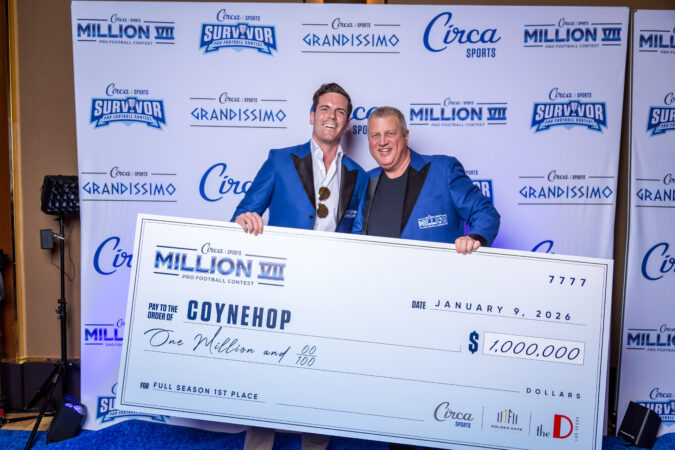
    It was the start of an emotional roller coaster of a weekend that ended with Coyne, a 34-year-old former walk-on for Phil Martelli at St. Joseph’s, winning the $1 million grand prize in a season-long NFL pick ’em contest run by a Las Vegas casino with 6,000 participants.

    He lost a game in September when the Eagles returned a blocked field goal against the Rams, picked up a win in December when the Raiders kicked a meaningless field goal to lose by 7 points instead of 10, and then pouted through that bedtime story as the Buccaneers faded.

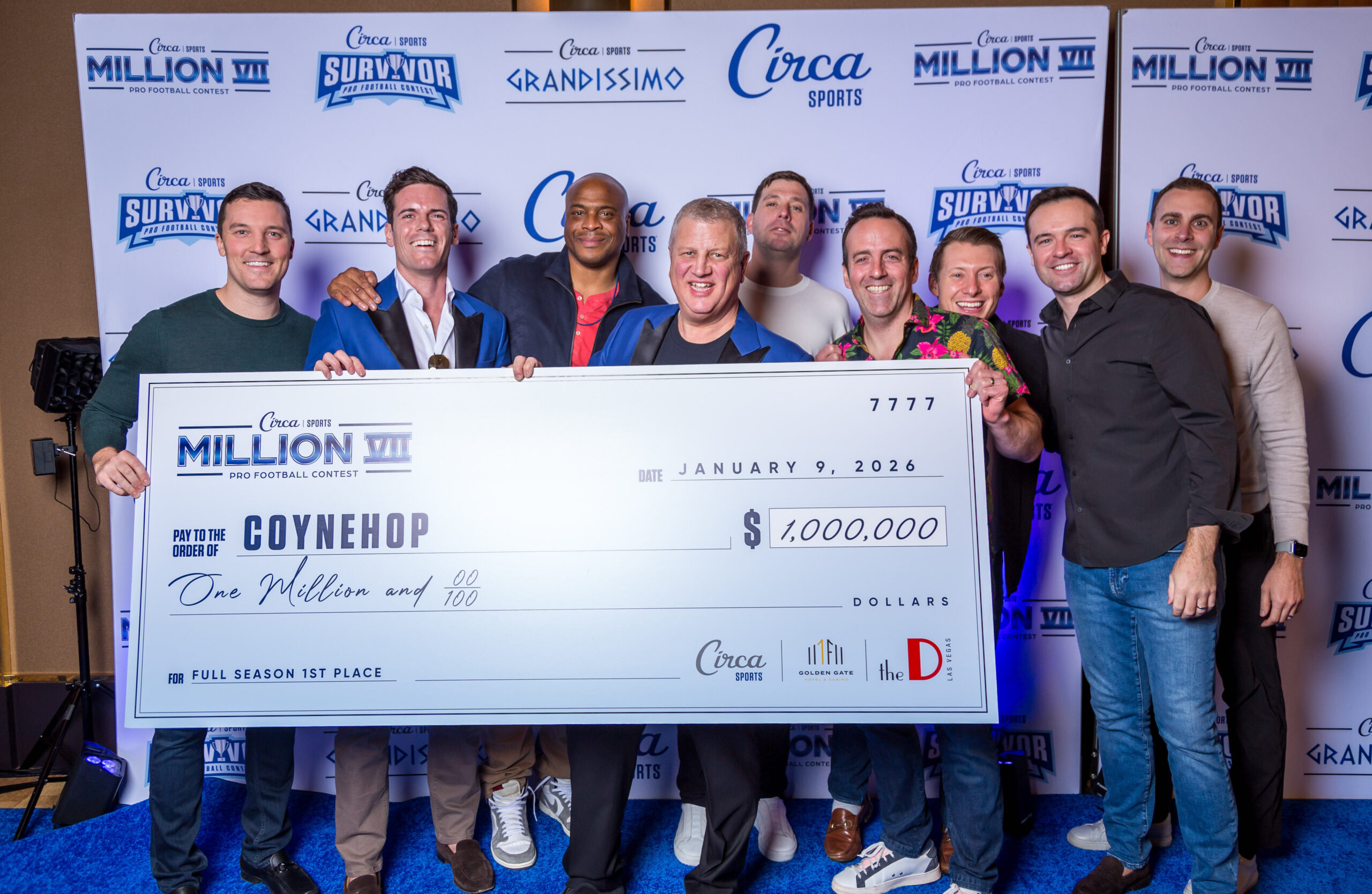
    It was a season-long marathon. But it ended with Coyne, who lives in Brooklyn, flying to Las Vegas during the NFL’s wild-card weekend to claim his oversized check and custom blue jacket at the Circa Resort & Casino as the winner of the Circa Million VII.

    “I wasn’t as dedicated to it as many others are,” said Coyne, who was at the playground with his kids when he checked his phone to see how Jordan Davis’ sprint spoiled that game against the Rams on Sept. 21.

    “I joke that there were no models, no Excel spreadsheets. It’s just me changing diapers and making picks.”

    A team photo of the 2012-13 St. Joe’s team with Chris Coyne (first row, third from the left).

    Walk-on Hawk

    Coyne was cut from the St. Joe’s basketball team as a freshman and sophomore but was certain that his junior year in 2011-12 would be different.

    He could have played Division II hoops but came to Philly because his Manhattan high school followed the Jesuit educational model just like St. Joe’s. Coyne played JV ball as a freshman and sophomore for the Hawks and practiced with Martelli’s crew in the offseason.

    He rode his bike home from the gym the night before tryouts and thought it was finally his chance to make the team. Then Coyne hit a curb and flew over his handlebars. His palms were gushing blood and his wrists were banged up.

    “I had no skin on my hands,” Coyne said. “There it goes. There goes the dream.”

    Coyne arrived early to the tryout, hoping that the Hawks athletic trainer could do something. The trainer wrapped Coyne’s hands and sent him on the court.

    “I pretty much looked like a boxer,” he said.

    It worked as Coyne — shooting like coaches always stressed with his fingers and not his palms — seemed to knock down everything. Maybe he should always play like a prizefighter, he thought.

    Martelli called to tell him that his third try was a success: Coyne was a walk-on.

    Chris Coyne played for coach Phil Martelli alongside star Langston Galloway (10) during his time with St. Joe’s.

    “It was my dad’s birthday and I called him to tell him,” Coyne said. “He was the one who pushed me to see this through and not just play at the D-III level. He said, ‘This is your dream. Whether you get one minute in a game or 30 minutes, go see this through.’ I couldn’t thank him enough.”

    He played two years for Martelli, who told the bench players on the “Pinnie Squad” to give it their all in practice against the starters. The reserves were a bunch of guys like Coyne, who could have played elsewhere but stayed on Hawk Hill with Martelli.

    So the future $1 million NFL picker battled every day against Langston Galloway, the future NBA player. Martelli assigned his players to read articles about leadership and teamwork and preached the value of family. It was always more than basketball.

    “I never felt like I was just sitting on the sidelines getting guys water,” Coyne said. “You were in the mix every day, which was really cool.”

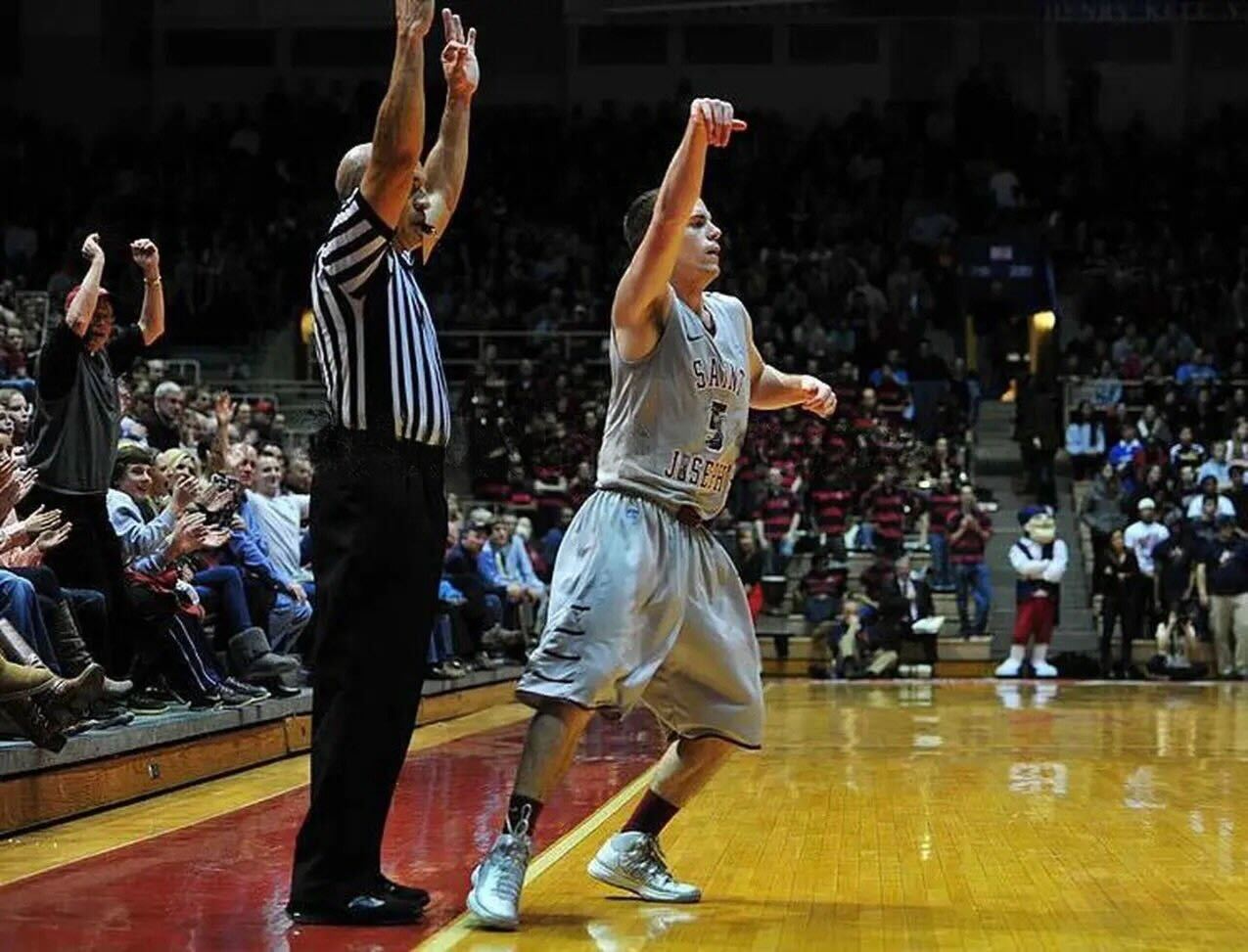
    Coyne played just 12 minutes over eight games during those two seasons. But he did knock down a three-pointer at the Palestra, entering the game late against Penn on ESPN for his first NCAA basket.

    “It’s funny looking back and thinking, ‘Why would you ever be nervous?’” Coyne said. “But you’re just sitting there, you’re cold, there’s 15,000 people in the stands, and he’s going to call your name but you don’t know when it’s coming or if it’s coming. You’re just thrown out there.

    “My parents were there and it was a dream come true. It was years of seeing your dream not play out the way you wanted to and then have that opportunity.”

    Chris Coyne making the first and only three-pointer of his St. Joe’s career in 2013 against Penn at the Palestra.

    Winning it all

    Coyne entered his first football contest in 2019 after his friend Brian Hopkins signed him up during a trip to Vegas. He split that entry with Hopkins, and they met each week at a Manhattan bar after work, scribbling down the five games they liked on napkins.

    The pool has a $1,000 buy-in and requires each entrant to pick five games every week against the point spread. A proxy then places the bets for them in Vegas, as more than half the players live outside Nevada.

    Coyne and Hopkins decided to each enter the next season, and they developed their own strategies. Coyne stays away from Thursday night games as he would have to pick all five games by then instead of waiting until Saturday afternoon. The lines for every game lock on Thursday morning, which sometimes means a line could move before Coyne sends in his picks.

    He didn’t watch a full NFL game until the middle of October because he was usually busy on Sundays with his kids. He read articles during the week and listened to podcasts. Picking games, Coyne learned, is less about breaking down game tape and more similar to the sales job he has on Wall Street.

    “You’re aware of trends,” Coyne said. “When the public A.K.A. retail is buying a lot of stock, that’s never a good sign. Maybe in the short term it works out, but over the long term, you try to find those overreactions in the market where the public really likes a team. Especially if the public loves a team and the line is going against the public.

    “That’s the biggest telltale sign right there. You have to have a process and you have to know what you’re doing, but so much of it is you have to get the breaks sometimes. The breaks went my ways sometimes.”

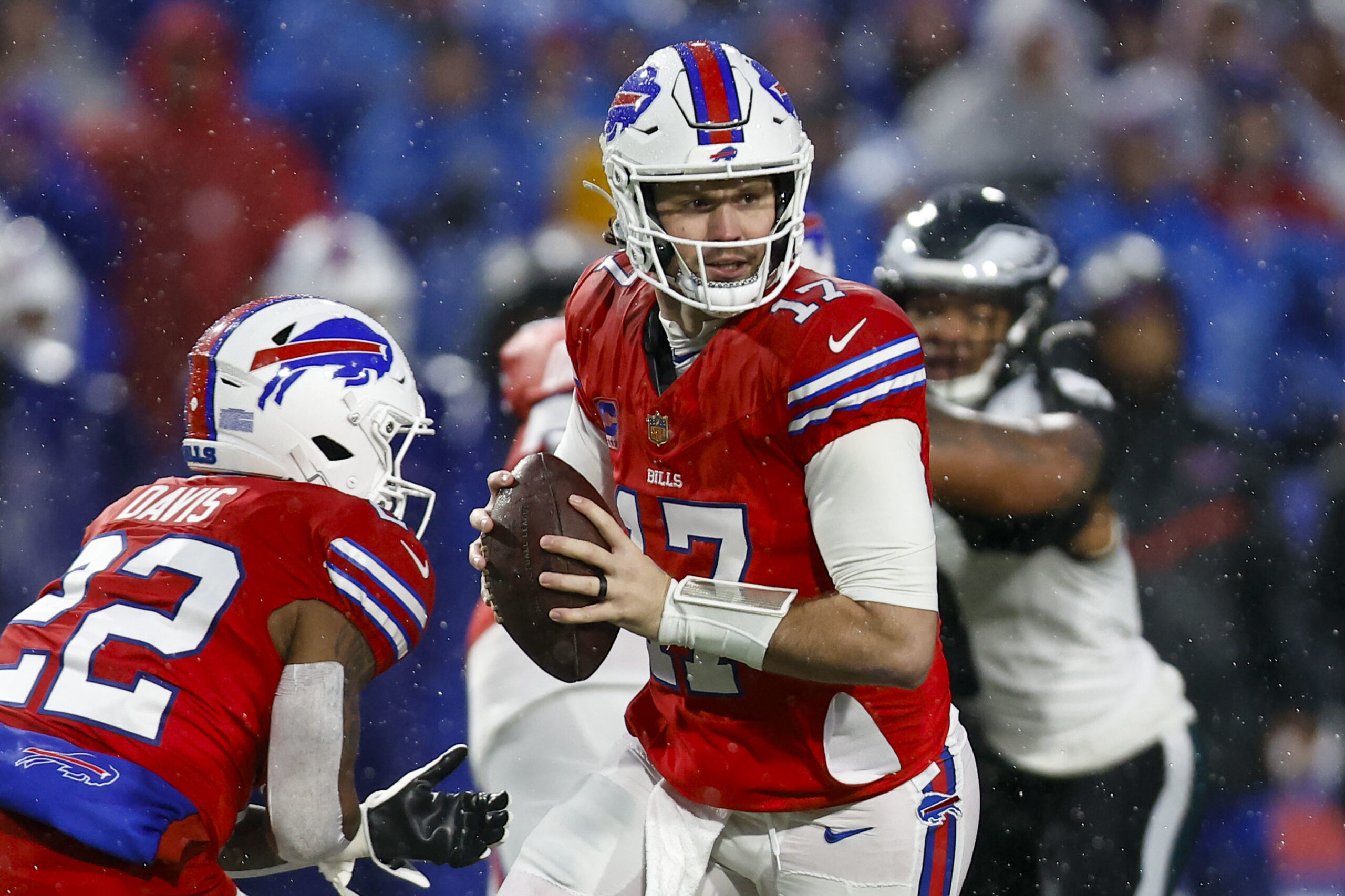
    That bedtime story would have been a bit less stressful had the Bills converted their two-point try a week earlier against the Eagles, as Coyne would have entered the final weekend with a three-game lead.

    Josh Allen and the Bills’ inability to execute a two-point conversion against the Eagles on Dec. 28 made Coyne’s road to the $1 million a little more stressful.

    Coyne was in Berwyn for that game visiting the family of his wife, Maddy, which was rooting for the Birds despite knowing Coyne was in the hunt for big money.

    “I’m devastated and I’m like, ‘Can’t you for one week just be on my side?” he said “But Eagles trump all in that household.”

    He instead had to sweat it out. He won Saturday night with the 49ers after the Buccaneers lost and then won Sunday with the Giants but lost with the Titans and Dolphins. Coyne said he tends to pick bad teams since he’s often going against the popular choices.

    The Steelers won on Sunday night, pushing the second-place entry even with Coyne. He thought they would then split the first and second prizes ($750,000 each) and went to bed disappointed.

    “It was a long couple of weeks and I was football fatigued,” Coyne said. “I’m all [ticked] off. But I couldn’t complain. It was still $750,000 and it was a great season, but I didn’t know if I was getting the blue jacket. That’s what I really wanted. It’s like the Masters green.”

    Coyne woke up at 5 a.m., checked his phone, and saw he finished in first place on a tiebreaker, because he had more winning weeks than the other entry. The $1 million prize was his. The blue jacket was, too.

    Chris Coyne (second from the left) with his friends in Vegas on Jan. 9 after he won the $1 million prize.

    Coyne flew to Vegas that weekend with his friends, received his prize, spent 30 hours at the resort, and didn’t take his blue jacket off until he got home.

    It was perfect, like a walk-on hitting a three-pointer at the Palestra with his parents in the crowd.

    “I spent all of November and December saying, ‘How am I going to screw this up?’” said Coyne, who finished 60-29-1 over 18 weeks. “But somehow I came out on top. It was the weekend of a lifetime.”