Category: Villanova

  • Will Villanova end its NCAA Tournament drought? Here’s what the numbers — and Joe Lunardi — say.

    Will Villanova end its NCAA Tournament drought? Here’s what the numbers — and Joe Lunardi — say.

    Sunday is the first day of February, which means March is right around the corner, which means it is officially no longer too early to think about the NCAA Tournament.

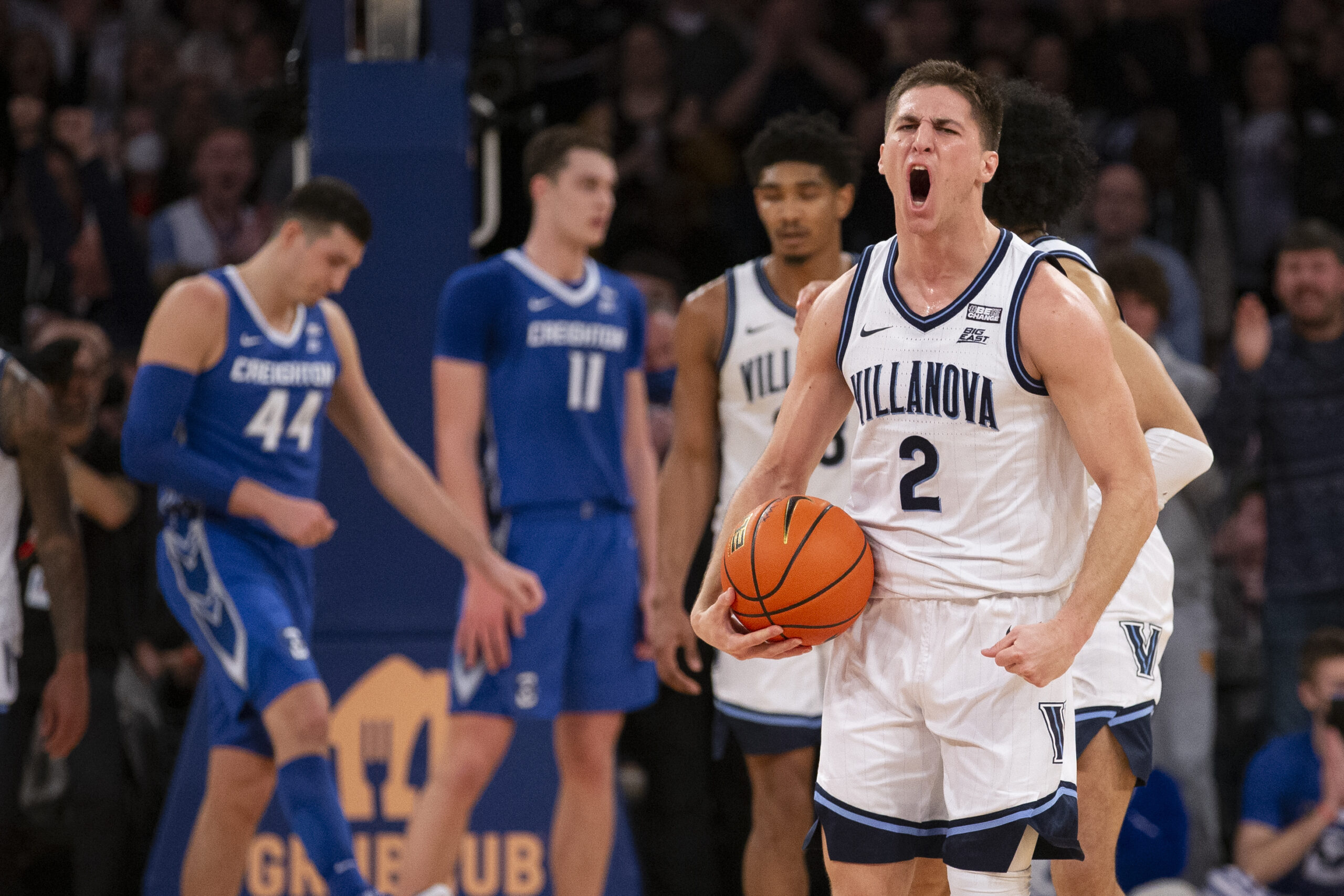
    Villanova is 20 games through its 31-game schedule, and nine games through its 20-game Big East slate. The Wildcats, who host Providence on campus Friday night, are 15-5 overall and 6-3 in their conference matchups in the first season of the Kevin Willard era.

    School administration moved on from Kyle Neptune last March after a third consecutive season ended without an invitation to the NCAA Tournament. Villanova officials believe the school should field a basketball team that perennially is in the at-large bid conversation, and three consecutive seasons without meaningful basketball was not acceptable.

    Right now, it’s hard to believe the drought could stretch to four.
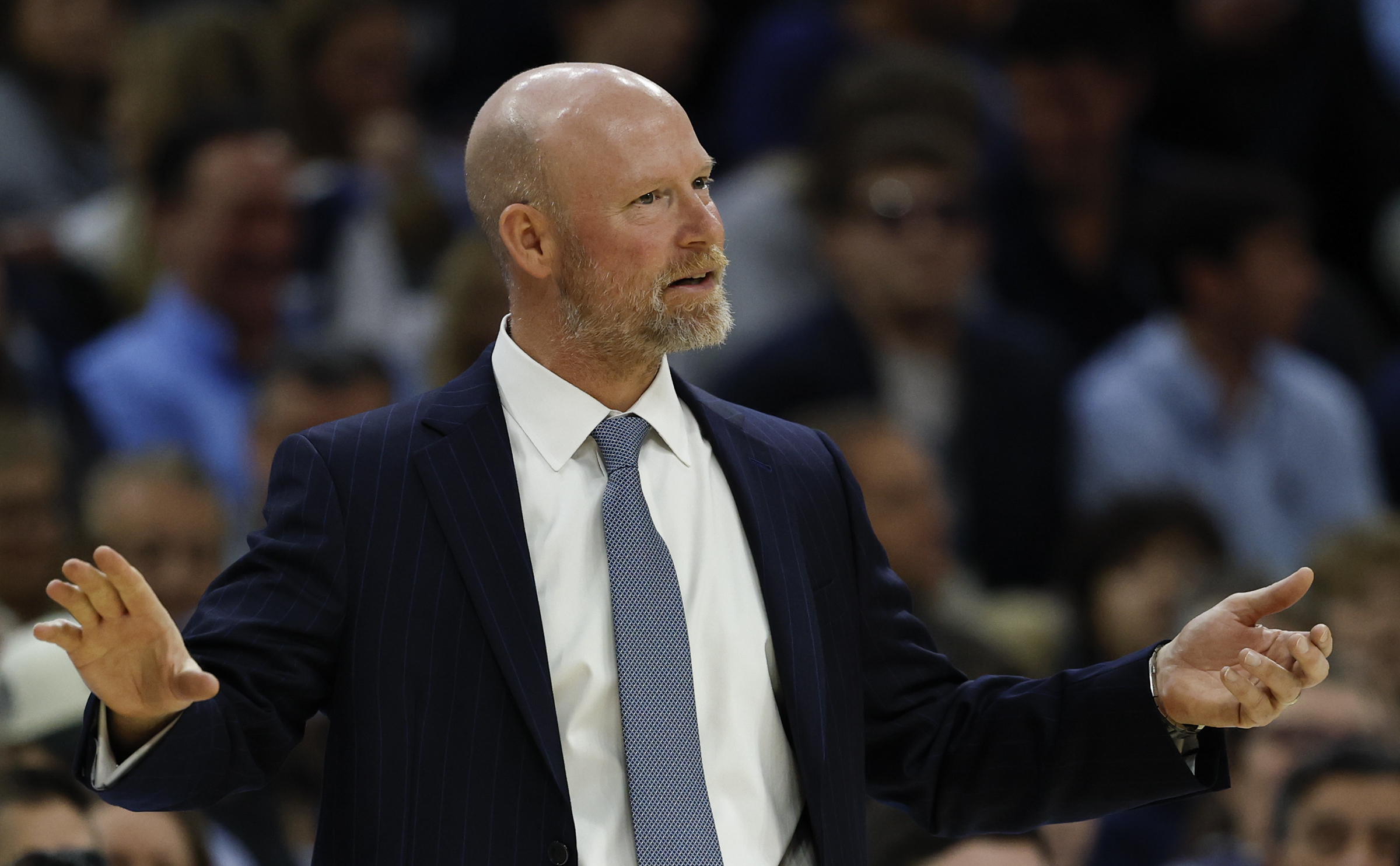
    Villanova coach Kevin Willard is on pace to get the Wildcats back to the tourney.

    The Wildcats aren’t yet a lock, but it’s looking pretty safe for their fans to preemptively look into taking a PTO day or two for the third week of March.

    What are the numbers saying? We went to ESPN’s bracket guru himself, Joe Lunardi, for some help.

    ‘A very long leash’

    Saturday’s loss to No. 2 UConn in Hartford, Conn., was an “insurance policy” kind of game, Lunardi said. Villanova declined coverage. The Wildcats let an upset opportunity slip away in an overtime loss, but the result, Lunardi said, was a “wash.” Villanova was a double-digit underdog and lost by eight.

    “It didn’t hurt, and it didn’t help,” said Lunardi, who had the Wildcats as a No. 7 seed in his latest bracket projection released Tuesday morning.

    The metrics support that notion. Villanova barely budged in the NCAA’s NET rankings, where it was ranked 34th as of Wednesday afternoon, and at KenPom (27).

    What has to happen to stay on the right path?

    “All they really need to do is win games they’re favored, and they can even afford to lose [a few] of those,” Lunardi said. “If they go 6-5, they’re going to make it.”

    That’s some leeway.

    “That’s a very long leash given the fact that, frankly, the league is good but not great,” Lunardi said.
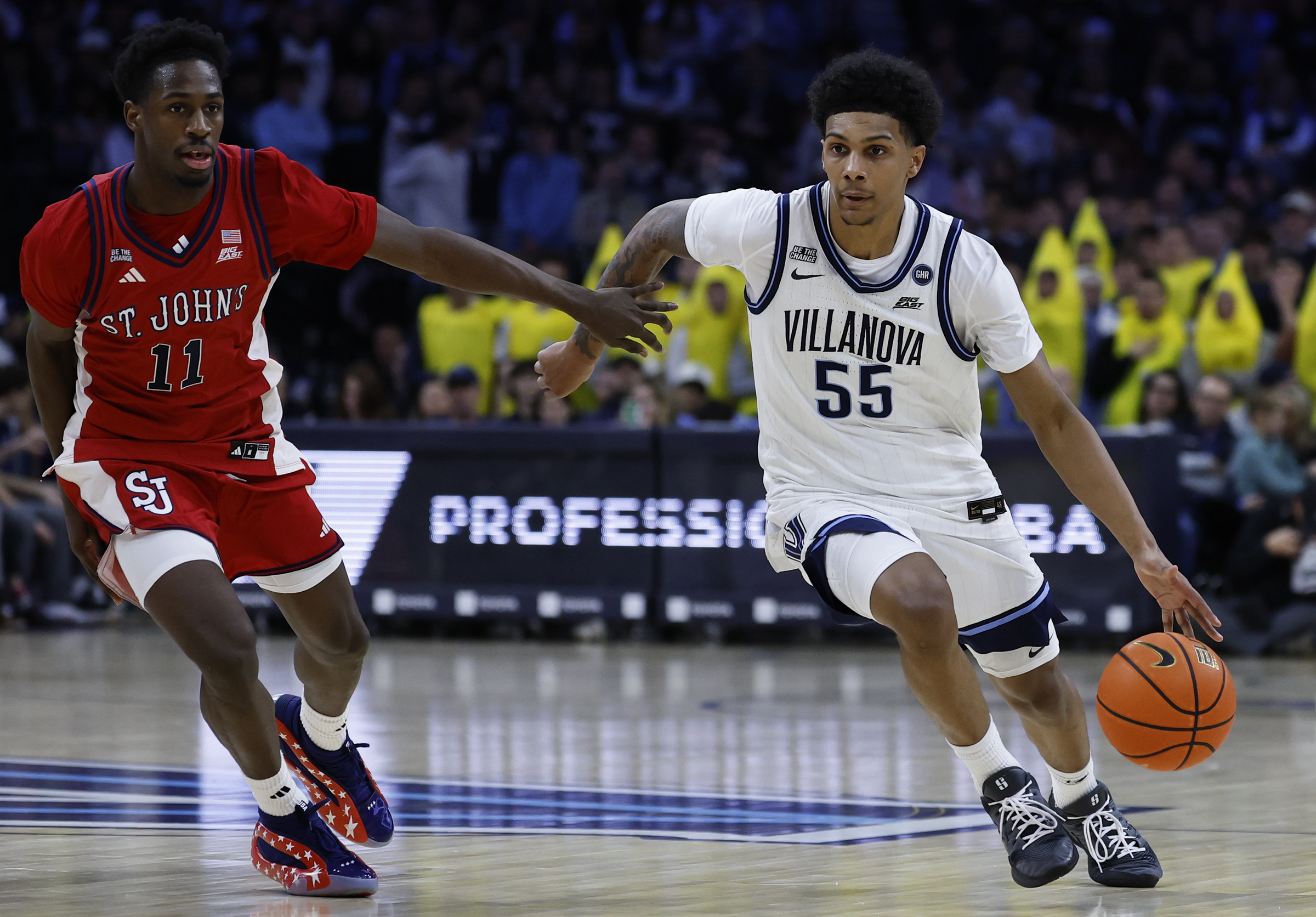
    Guard Acaden Lewis is among those who could land the Wildcats back in the dance.

    As things stand right now, Villanova likely would be favored in at least eight of its final 11 contests. Take care of six or seven of those, and there’s no need for a marquee win over UConn or St. John’s.

    While 6-5 the rest of the way probably would be a disappointment, Lunardi projects that a final record of 21-10 gets Villanova “at worst” a No. 10 seed. The Wildcats’ ceiling, meanwhile, is “probably a five,” Lunardi said.

    So, don’t count on the NCAA rewarding the Wildcats with a “home” game at Xfinity Mobile Arena to start the tournament.

    No signature win, no problem?

    Asked to put the resumé in perspective, Lunardi said: “I would describe it as a resumé of a regular good Jay Wright team, meaning a mid-single-digit seed, not a Final Four team. Everything has to go right to make the second weekend.”

    That’s probably a result any rational person in ’Nova Nation would have signed up for nine months ago.

    It also seems pretty accurate. Villanova is 15-5 because it mostly has taken care of business against teams it is supposed to beat. The nonconference schedule started with a loss to nationally ranked BYU, but then came seven consecutive games against teams well outside the KenPom top 100, including three dominant Big 5 wins.

    The Wildcats were then blown out by Michigan before traveling to Wisconsin to beat the Badgers in overtime, which was followed up with a road victory over Seton Hall to begin conference play. At the time, those were pretty good wins. Only the Wisconsin game has aged well.

    As of Tuesday morning, Seton Hall was Lunardi’s first team outside the field of 68 after a four-game losing streak.
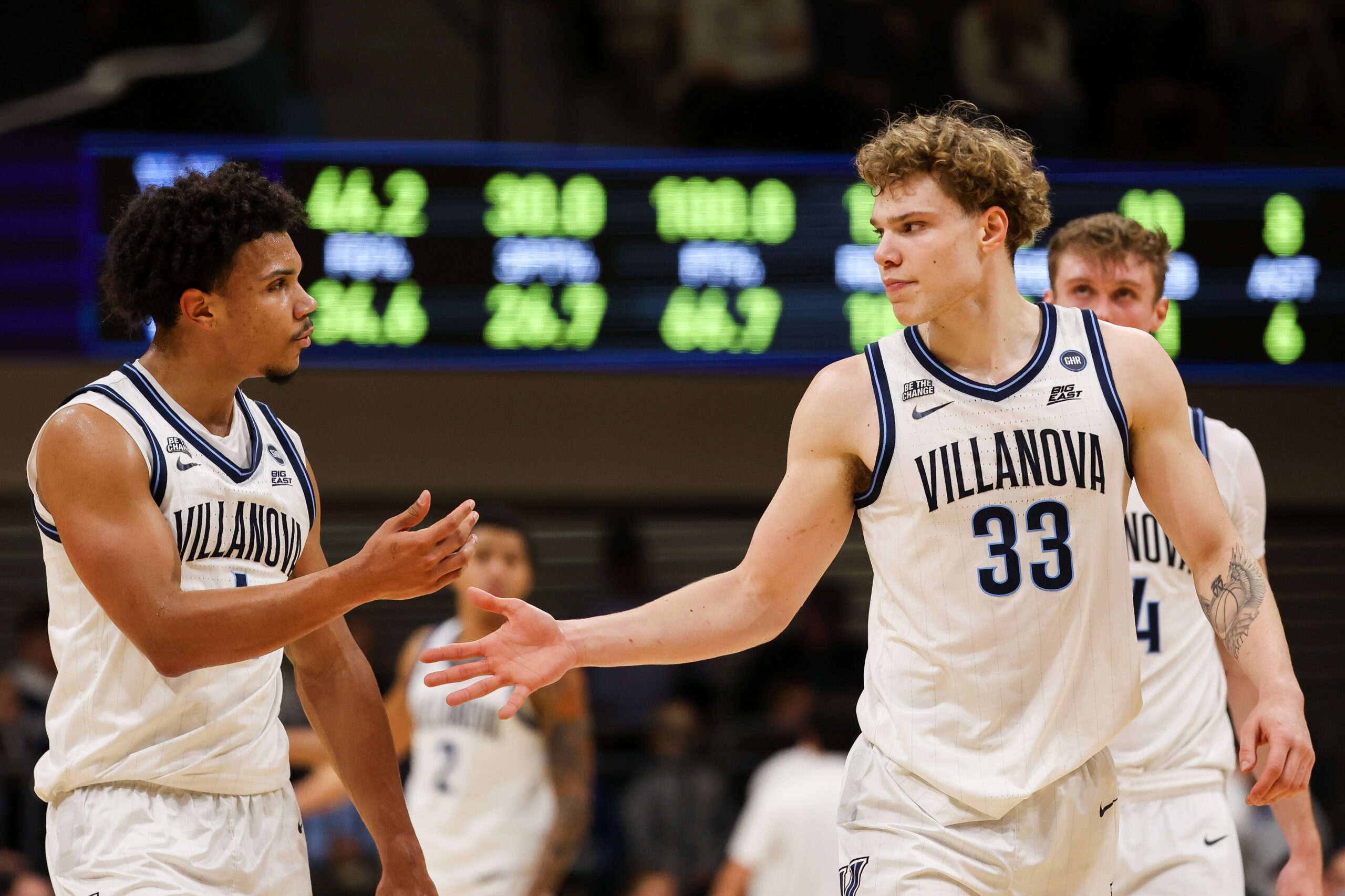
    Forward Matt Hodge and guard Tyler Perkins have Villanova in good shape despite a near-miss against UConn on Saturday.

    It is a Villanova resumé without a signature win, and it might not need one. Why?

    “They don’t have the dreaded bad loss,” Lunardi said.

    Last year’s resumé had losses to Columbia, St. Joseph’s, and a down Virginia team. The year before featured losses to St. Joe’s, Penn, and Drexel. This year’s biggest blip currently is against a Creighton team that still is on the NCAA Tournament bubble.

    Show me the math

    Lunardi says his projections are pretty conservative and include some emphasis on past similar resumés. Right now, Villanova has more than an 80% chance of making the NCAA Tournament, according to Lunardi’s projections.

    On the more extreme side, the TourneyCast projections at Bart Torvik’s analytics site have Villanova at 96% to make the dance. Torvik’s numbers are based on thousands of simulations playing out the rest of the season.

    “It’s too early to make anybody a lock,” Lunardi said.

    But it’s getting closer to that time.

    If there was anything to worry about right now for Villanova fans, it should be health. The Wildcats are a key injury or two — even minor ailments — from scrambling a bit. They don’t have a reliable backup center, for example. Their depth has taken a hit elsewhere, too.

    But those worries are hypothetical. Then again, all of this is.

    What about the rest of the Big 5?

    Villanova is the only one of the six Big 5 schools with an at-large path to the men’s NCAA Tournament. The others would need to win their respective conference tournaments. Of the bunch, only Temple (5-2) and St. Joe’s (5-3) entered Wednesday with a winning conference record.
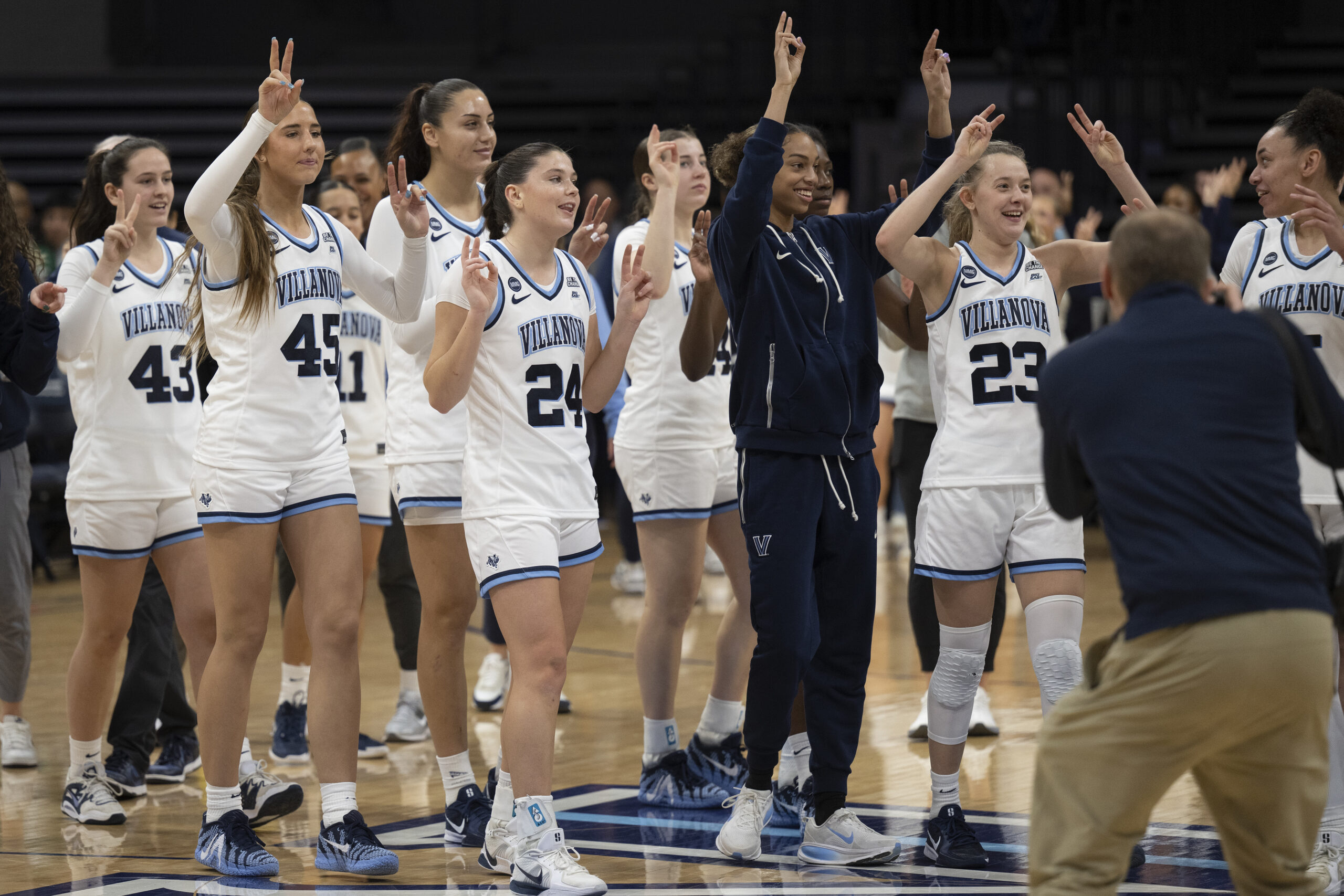
    Villanova celebrates after a win over Xavier on Jan. 8.

    On the women’s side

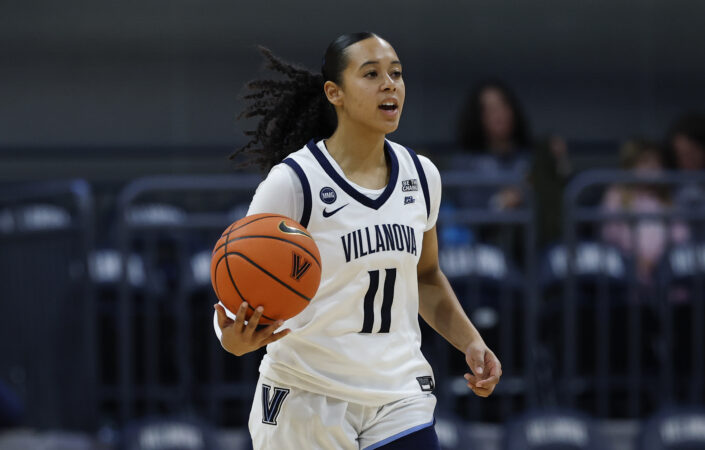
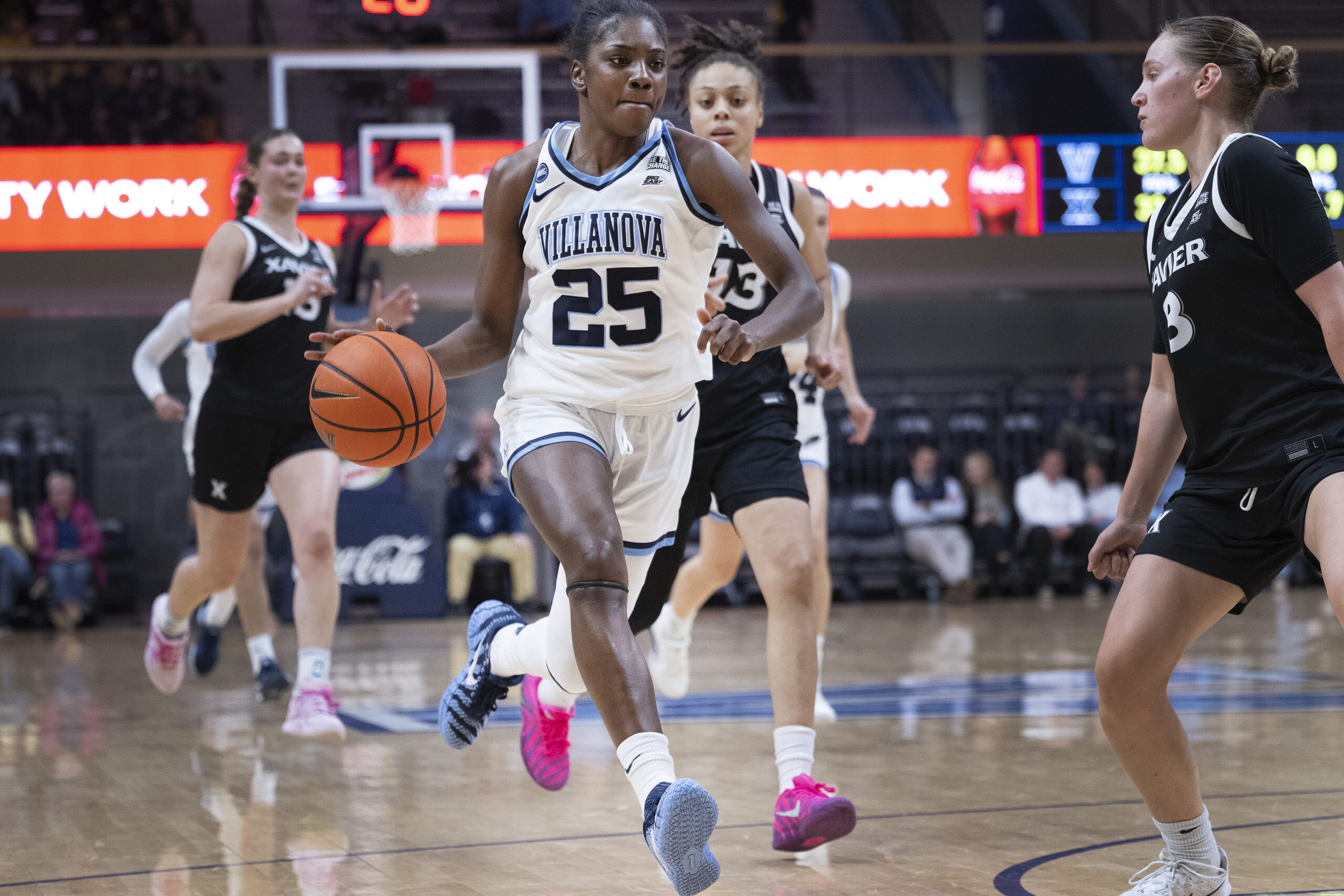
    Similar story. Villanova (16-5, 9-3) was projected as a No. 10 seed on the right side of the NCAA Tournament bubble with an at-large bid in the latest ESPN women’s bracketology. No other team has an at-large path, and only Drexel (4-3) had a winning conference record entering Wednesday.
  • Villanova drops a crucial conference matchup on the road against St. John’s

    Villanova drops a crucial conference matchup on the road against St. John’s

    A 22-point deficit heading into the final quarter was just too much.

    In the end, Villanova found themselves on the tail end of a 71-58 final against St. John’s on Saturday in New York City. For St. John’s, the win was retribution from the last time the teams faced off on Dec. 22 — when Villanova claimed an 85-48 victory.

    Ryanne Allen led the Wildcats with 12 points. Jasmine Bascoe, Villanova’s star sophomore guard, added 11.

    Villanova (8-3, 15-5 Big East) is now tied for second place in the conference with Seton Hall. St. John’s (6-5, 16-6 Big East) stands fourth in the Big East.

    St. John’s fast start

    The game quickly spun out of control for Villanova, as St. John’s sprinted off to a 22-5 lead across the opening 10 minutes. Brooke Moore led the way for the Red Storm, as the junior guard scored 10 points in the first quarter.

    St. John’s shut down Villanova’s offense, going on a 17-0 run across the last 7 minutes, and 38 seconds of the quarter.

    Meanwhile, the Wildcats shot an uncharacteristic 2-for-11 from the field and 1-for-6 from three. Villanova entered the game as the second-best shooting team in the conference, averaging 45.1% from the field.

    Villanova attempted to push back in an energetic second quarter, in which it was outscored just 18-17. Junior forward Brynn McCurry led the Wildcats in the first half, with eight points and four rebounds.

    Turning the tables

    St. John’s, which saw some difficulty early in Big East play, was dominant on its home court on. Unlike in its previous meeting with Villanova, St. John’s controlled the game and led by double-digits throughout the second, third, and fourth quarters.

    The Red Storm succeeded in holding back Bascoe, who leads Villanova in scoring with 17.2 points per game. Bascoe dropped 21 points with a season-high nine assists in the previous win over St. John’s. But in Saturday’s contest, she was restricted, scoring just four points in the first half to support her total.

    Villanova struggled to keep St. John’s offense away from the net. The Red Storm scored 42 points in the paint across the game.

    Villanova scored its highest point total (20 points) in the fourth quarter. Allen helped the Wildcats make a late-game push to narrow the deficit, scoring seven points and continuing her consistent three-point shooting.

    Up next

    Villanova returns to Finneran Pavilion on Tuesday to take on Providence (7 p.m., ESPN+).

  • ‘We should have won’: Upset bid slips away from Villanova in overtime loss to No. 2 UConn

    ‘We should have won’: Upset bid slips away from Villanova in overtime loss to No. 2 UConn

    HARTFORD, Conn. — Devin Askew drove into the paint with Villanova trailing Connecticut by just one point inside two minutes to play. The defense collapsed, so Askew kicked the ball to the wing and into the waiting hands of … Kevin Willard.

    The Villanova coach pounded the basketball onto the court with two hands. One of Villanova’s 11 turnovers came at an inopportune time.

    The Wildcats later had a lead with less than a minute on the clock, and they still did take the second-ranked team in the country to overtime, but Askew’s turnover was one of many little moments that didn’t go Villanova’s way in a 75-67 loss at PeoplesBank Arena.

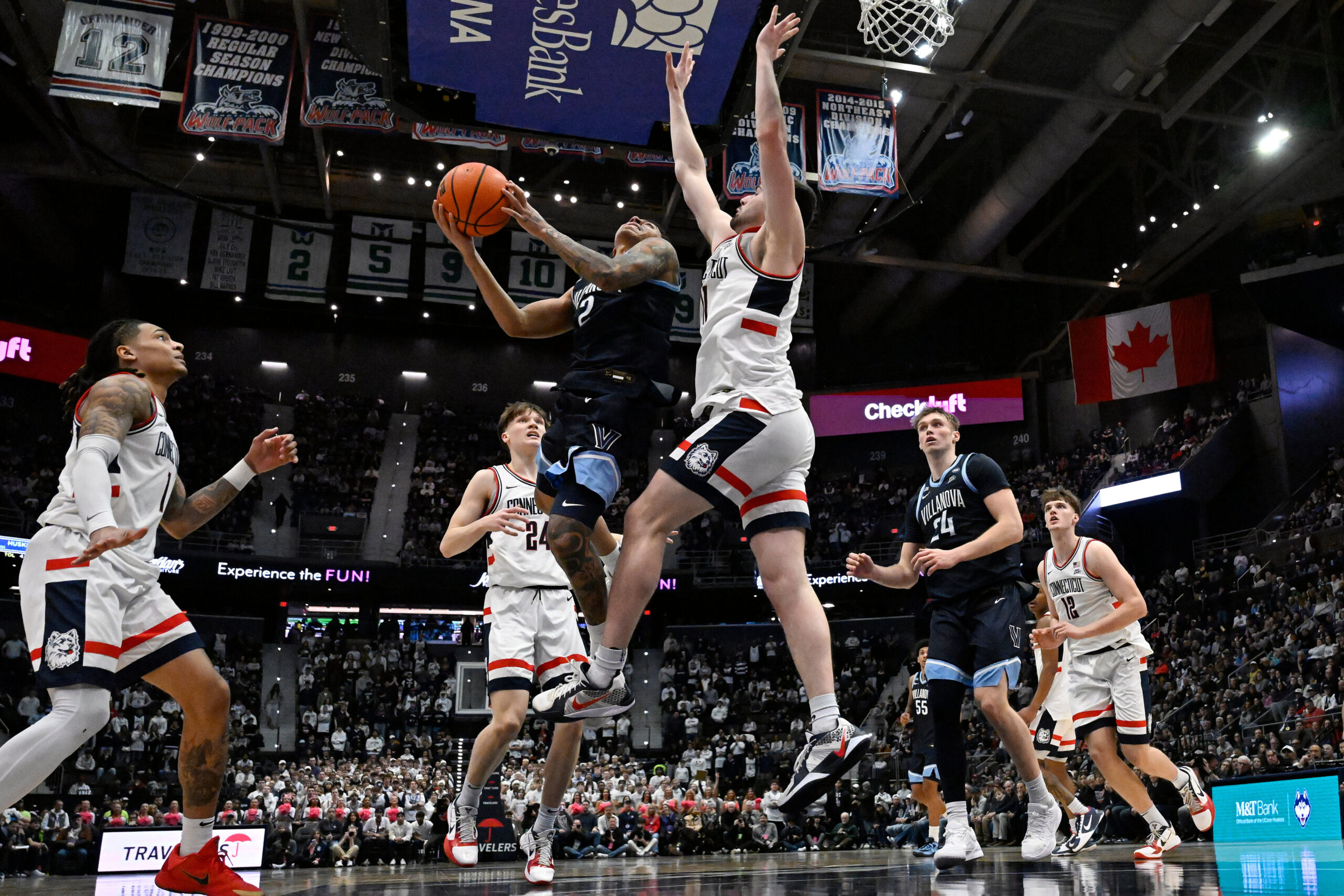
    Where to start? There was Acaden Lewis’ out-of-control drive down two in overtime with just over a minute to go. Back in regulation, Bryce Lindsay missed an open runner in the paint shortly after the Askew turnover. Then Villanova’s leading scorer, who was held to three points and didn’t make any of his eight attempts, had a three-point attempt blocked in a tie game with less than 30 seconds to play.

    Villanova started overtime with a Tyler Perkins three-pointer, then got the ball back when Perkins drew a charging foul. But instead of building on the lead, Lindsay had his pocket picked by Silas Demary Jr., leading to a runout dunk from Tarris Reed Jr. Perkins’ triple, 12 seconds into overtime, was Villanova’s only made basket of the extra session.

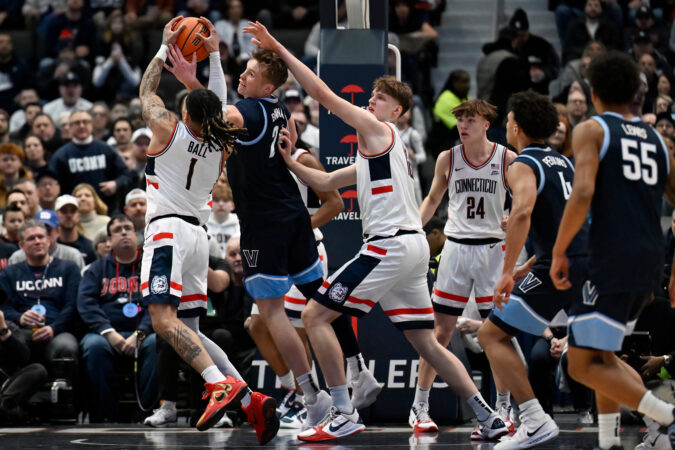
    Villanova guard Bryce Lindsay shoots as UConn forward Alex Karaban defends on Saturday.

    The Wildcats’ youth and inexperience showed up once again in a test against one of the best teams in the country, one week after Villanova allowed St. John’s to start the second half on a 20-4 run that it never recovered from.

    “It just hurts,” said Villanova senior big man Duke Brennan, who struggled last week with the size and physicality of St. John’s but battled back in a big way Saturday. He had 16 points and 14 rebounds and, perhaps most importantly, made eight of his nine free-throw attempts in 40 minutes. “We fought until the end. That’s a great team over there.”

    To be sure, there were things Villanova did well enough to win. You don’t take the No. 2 team in the country to overtime without doing things correctly. The Wildcats had answers for a lot of UConn’s offensive action. They held Alex Karaban, who averages nearly 14 points, off the scoreboard for the first 30 minutes (though he did finish with 17 points).

    Perkins had 16 points and 10 rebounds and continued to be the physical and experienced guard presence Villanova needs. Askew, too, continued his strong stretch of games with 13 points, four rebounds, and three assists before he fouled out in overtime. Matt Hodge followed up consecutive games being held to four points or less with 12 points on 4-for-6 shooting from three-point range, including a corner three that gave Villanova a 61-59 lead with just over a minute to go.

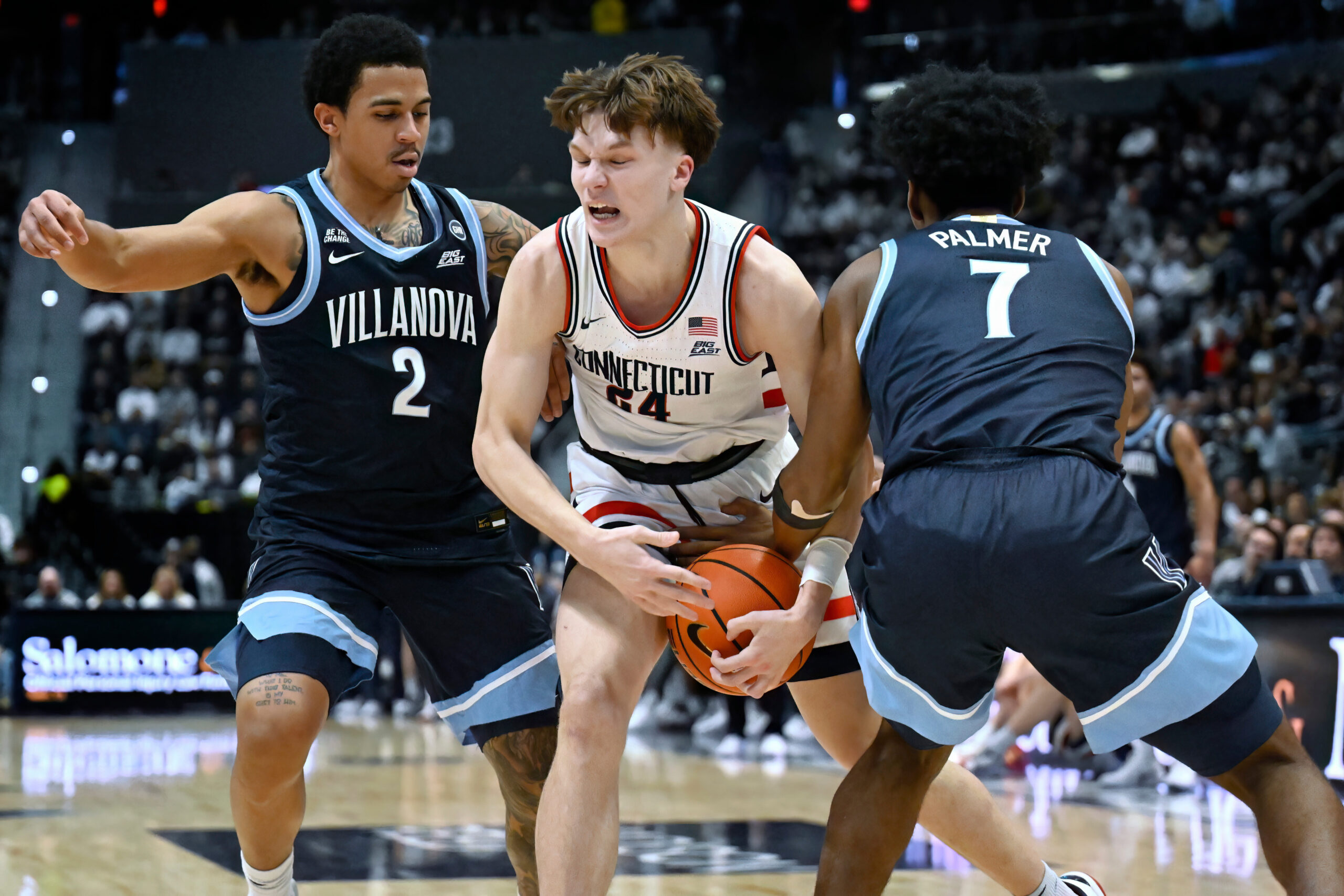
    UConn guard Braylon Mullins is guarded by Villanova guards Bryce Lindsay (2) and Malachi Palmer (7) on Saturday.

    But then came another costly error. Demary missed a driving layup, and Villanova couldn’t secure a rebound, allowing Reed to tip in the tying basket.

    In the end, UConn made the plays when it mattered. Solo Ball, who led all scorers with 24 points, hit arguably the game’s biggest shot, a three-pointer with two minutes left in overtime that turned a one-point Villanova lead into a two-point deficit.

    It is hard for Villanova to win when Lindsay doesn’t make a shot and Lewis goes 1-for-13 from the field. Yet, it nearly happened anyway.

    “We’re a young team,” Willard said. “Guys were trying to make plays. We got to the rim. We didn’t finish at the rim, and I thought we had some opportunities at the rim.”

    Villanova made 5 of 15 layup attempts.

    “We’re still going down and playing high-level defense,” Willard said. “If we can continue to build on that, then we’ll get out in transition and get some easier buckets.”

    It was the closing minutes that Willard said he needed to “get better at.” Lewis was seemingly benched for a large stretch of the second half. Brennan was in foul trouble. The Wildcats are a team without much depth.

    “I got to put the right lineups out there at times and I’m learning a lot about certain guys and what to do,” Willard said. “At the end of the day, we don’t do a free throw box out, and we don’t get a huge rebound when we’re up four with about six minutes to go. … Sometimes to get there on the road you got to make sure you finish possessions, and I thought there was three or four times where we didn’t finish possessions with rebounds.”

    An encouraging game nonetheless?

    “No,” Willard replied. “I don’t like losing. We should have won that game.”

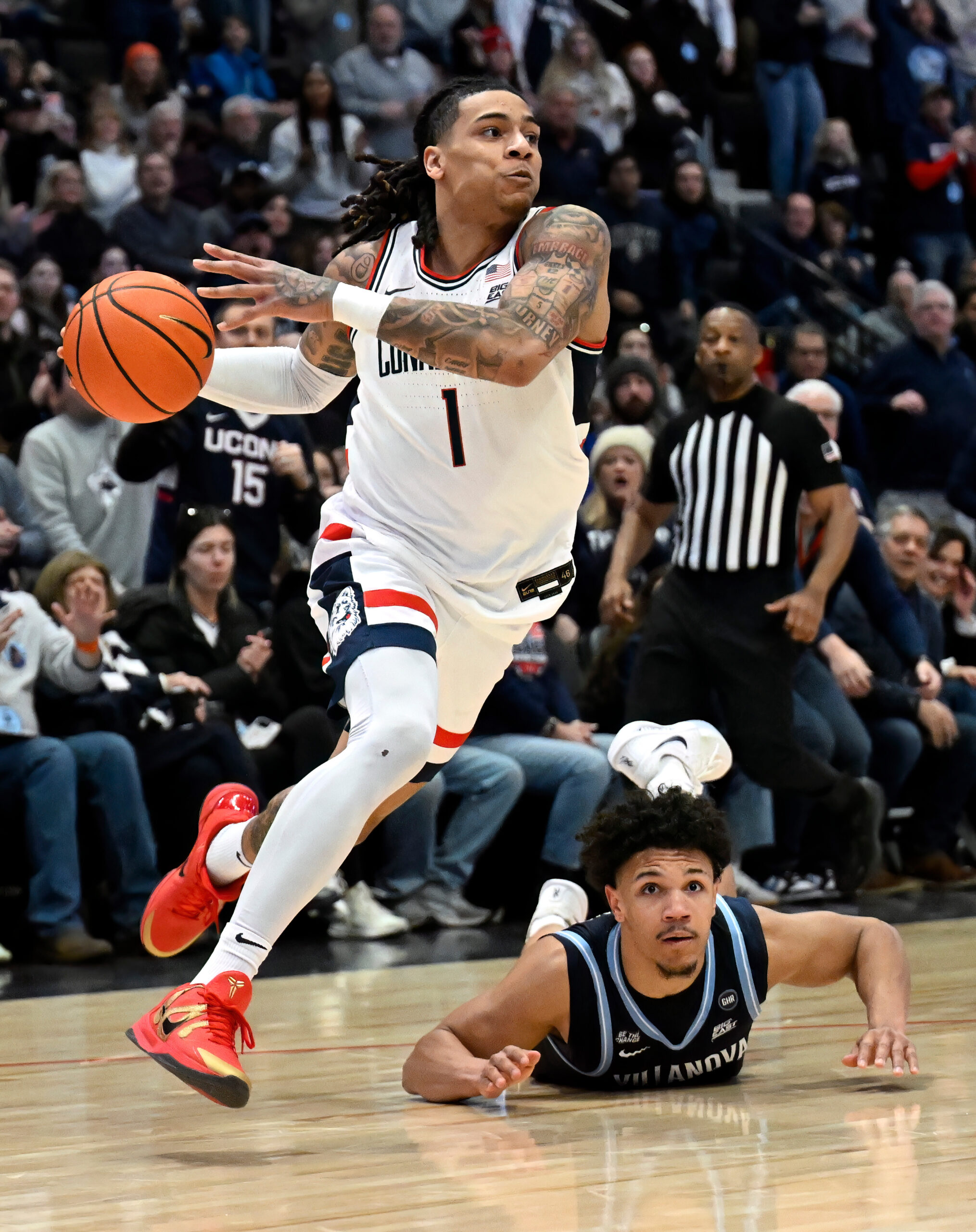
    UConn guard Solo Ball, who led all scorers with 24 points, dribbles around Villanova guard Tyler Perkins on Saturday.

    The reality for Villanova is Saturday’s loss is one that won’t necessarily hurt. A road upset helps a lot more than an eight-point overtime loss stings as far as the meaningful metrics go. The Wildcats are 15-5 overall and 6-3 in Big East play. They started the day rated 25th at KenPom and were still there by late Saturday afternoon. They have rest ahead before a Friday home game vs. Providence, and plenty of winnable games on the calendar as they continue to hunt for an at-large bid to the NCAA Tournament.

    Plus, two more shots at the conference’s elite. On consecutive Saturdays, Villanova took St. John’s and Connecticut to the brink.

    “The good thing about conference is you play every team twice,” Brennan said. “We get another shot at those dudes. St. John’s we felt like we didn’t play good at all, all throughout our program. This game we felt like we really battled.

    “It feels like it got away and we felt like we were there the whole game. There are certain little things that come down at the end of the game where it can flip one way. It wasn’t on our side tonight.”

  • Villanova’s Luke Colella and Temi Ajirotutu declare for 2026 NFL draft

    Villanova’s Luke Colella and Temi Ajirotutu declare for 2026 NFL draft

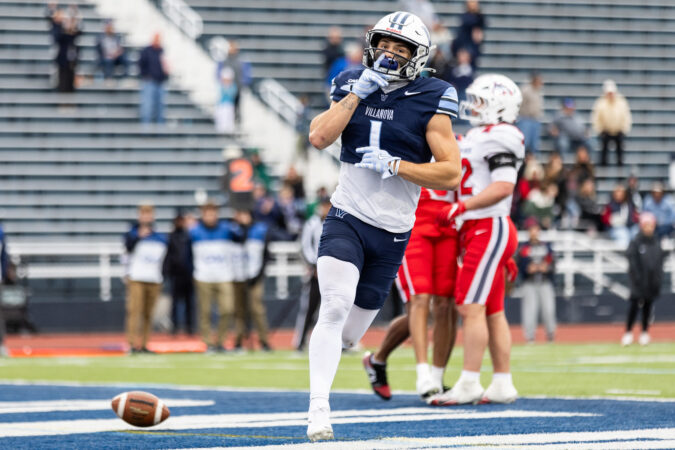
    Villanova receiver Luke Colella and left guard Temi Ajirotutu have declared for the 2026 NFL draft.

    “This journey has been filled with hard work, sacrifice, adversity, and growth,” Colella wrote in his announcement on Wednesday. “Every setback and every challenge made me stronger and taught a valuable lesson. With faith in God, gratitude for everyone who has supported me, and confidence in the work I’ve put in, I am proud to officially declare for the 2026 NFL Draft.”

    Colella transferred to Villanova from Princeton for his final year of eligibility. He finished with a team-leading 77 receptions for 1,071 yards and eight touchdowns with the Wildcats.

    At Princeton, he collected 93 receptions for 1,188 yards and 11 touchdowns across three seasons.

    Ajirotutu, a graduate student, played his entire five-year college career at Villanova. He emerged as a starter in 2022 and was named third team All-CAA in 2023.

    Last season, Ajirotutu played in four games before missing the remainder of the year with a medical redshirt. He earned an honorable mention on the AP FCS All-America team this past season, when he played in all 15 games.

    With the help of Colella and Ajirotutu, Villanova made an appearance in the FCS semifinals for the first time since 2010. The Wildcats fell to Illinois State, 30-14.

    The last Villanova player to get drafted was Buffalo Bills cornerback Christian Benford, who was selected in the sixth round in 2022.

    The 2026 NFL Scouting Combine will take place on Feb. 23 to March 2, and this year’s draft will be held April 23-25 in Pittsburgh.

  • Amid college basketball’s gambling scandal, concerns that mid-major players could be vulnerable

    Amid college basketball’s gambling scandal, concerns that mid-major players could be vulnerable

    Rollie Massimino “did not mess around” when it came to drawing up defensive schemes against Patrick Ewing … or warding off gambling temptations that might filter through to his Villanova players.

    “When we were playing, we had an FBI agent who was a former ’Nova basketball player give talks about gambling,” said Chuck Everson, a member of Massimino’s 1985 Wildcats title team that took down heavily favored Georgetown.

    “Rollie did not mess around with that stuff. It wasn’t that far removed from the Boston College [point-shaving] scandal. Rollie brought in the FBI to talk to us. Coach Mass did a great job of teaching us, and it wasn’t all basketball; it was life lessons. And with gambling, it was, ‘Don’t do that.’

    “To this day, I have never called DraftKings, or anything like that. I attribute that to being scared straight with Coach Mass.”

    Everson, 61, played in an era when sports betting wasn’t legal in most of the country. These days, things are quite different. College athletes are compensated by their schools or through lucrative name, image, and likeness deals, and the legal/illegal gambling culture infiltrates every level of sports.

    Last Thursday in Philadelphia, federal authorities announced a sweeping criminal indictment and related filings against 26 people on charges related to manipulating NCAA games and Chinese professional games through bribes, some as high as five figures.

    It is the fourth federal criminal indictment that involves gambling and sports unsealed in the last six months, and the latest alleged gambling scheme involves one of the storied Big 5 programs: La Salle.

    According to the indictment, at least one of the purported rigged games took place in 2024 in Philadelphia between La Salle and St. Bonaventure.

    There are at least 39 players from 17 NCAA Division I schools who are alleged to have been involved in the scheme, but the indictment may underscore other, more troubling concerns.

    Players at mid-major or smaller Division I programs might earn a fraction in NIL money compared to what their counterparts at elite programs take in, and therefore might be more susceptible to the temptations of illicit paydays. As one former federal prosecutor put it, this alleged scheme might be one of many dominoes waiting to fall.

    “Anything that interferes with the integrity of sporting events, you’re going to get action by prosecutors,” said Edward McDonald, who prosecuted those involved in the Boston College point-shaving case in the late ’70s. McDonald, now senior counsel at the Dechert law firm, thinks that mid-major schools, like La Salle and some others in the Big 5, could be particularly vulnerable to gambling and bribery schemes.

    “These smaller schools, the compensation to players is not as great [compared to larger programs], even for the better players on the team,” said McDonald, who learned of the Boston College scam through his investigations of organized crime family members with the Justice Department (and played himself in the Martin Scorsese-directed mob film Goodfellas).

    “Players going to big-time schools are making 10 times more. A player [at a smaller program] might not be having a good season or might think they’re not going to play in the NBA or professionally, and they might say, ‘What the hell, I might as well cash in now.’”

    Prop bets on a La Salle game

    According to the court filings, one of the defendants, Jalen Smith, and former LSU and NBA player Antonio Blakeney (who is “charged elsewhere,” according to the indictment), attempted to recruit players on the La Salle men’s basketball team for the point-shaving scheme.

    The fixers offered the La Salle players payments to underperform and influence the first half of a game against St. Bonaventure on Feb. 21, 2024, according to the filings.

    Prosecutors allege that before the game at Tom Gola Arena, defendants who acted as fixers placed bets totaling approximately $247,000 on the Bonnies to cover the first-half spread. A $30,000 wager was made in Philadelphia at a FanDuel sportsbook, according to the indictment. But those bets failed after La Salle covered the spread.

    “Neither the university, current student-athletes, or staff are subjects of the indictment,” La Salle wrote in a statement. “We will fully cooperate as needed with officials and investigations.”

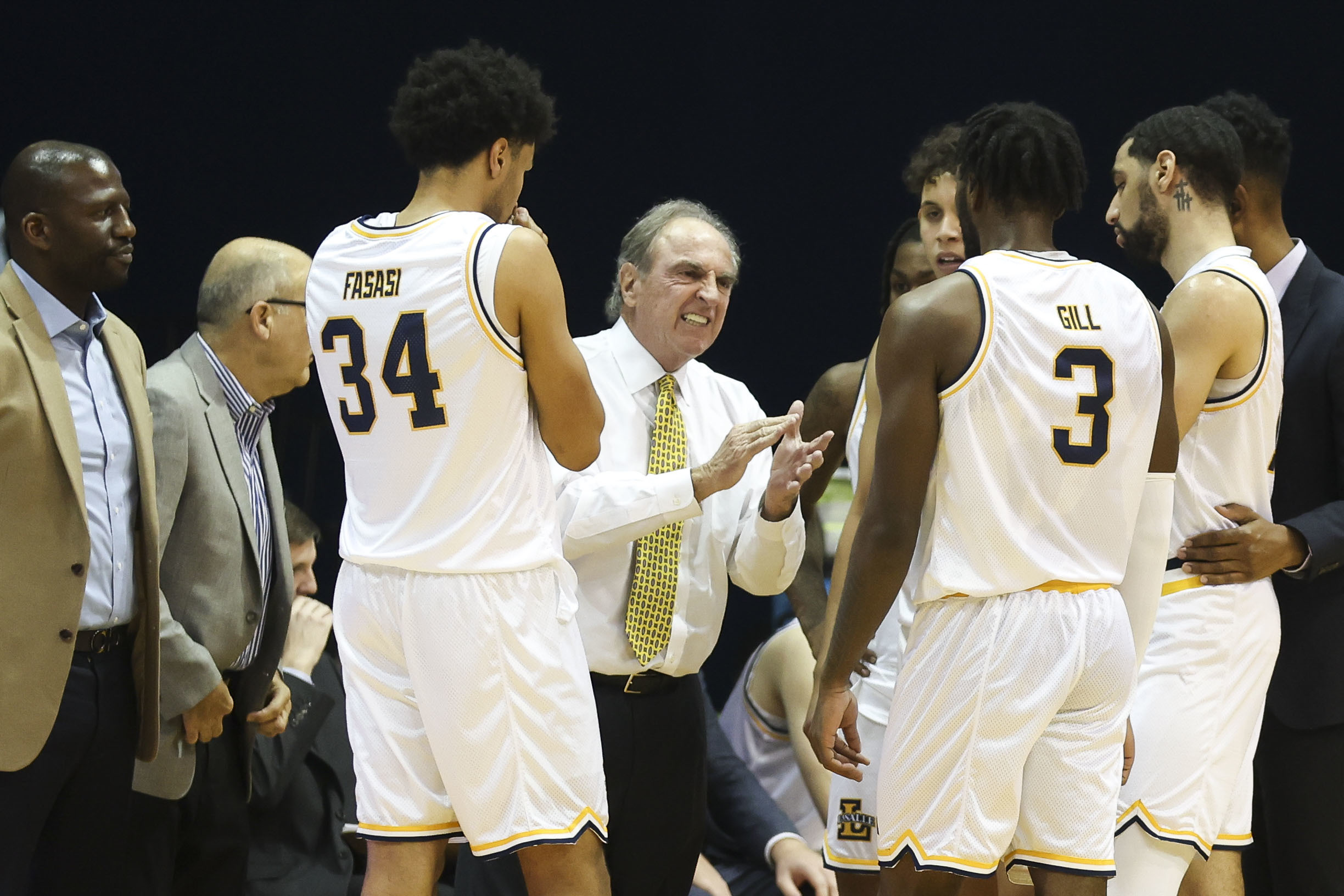
    La Salle coach Fran Dunphy directing the Explorers in November 2023. Dunphy retired after last season.

    Ohio Gov. Mike DeWine told The Inquirer that several years ago he received complaints from a number of college coaches in his state about online abuse directed at players and threatening calls from gamblers who had lost big.

    “I called up [NCAA president] Charlie Baker, and asked him, ‘What do you think of prop betting?’” DeWine said. “He said, ‘We don’t like it.’ And I said, ‘Give me a letter that says that.’

    “Under Ohio law, if I can get a letter from a league saying, ‘Don’t bet on certain things,’ that gives me the ability to go to my Casino Commission and they can [enact rules] without any legislation. Charlie sent the letter, I took that to the commission, and that stopped collegiate prop betting.”

    The Ohio Casino Control Commission granted the NCAA’s request to prohibit proposition bets on collegiate sports in February 2024, but the decision affected only Ohio.

    “It doesn’t really eliminate the problem,” DeWine said.

    The ban in Ohio is only a drop in the bucket against a sea of pro-gambling momentum, legislation, and, most significantly, lucrative revenue streams.

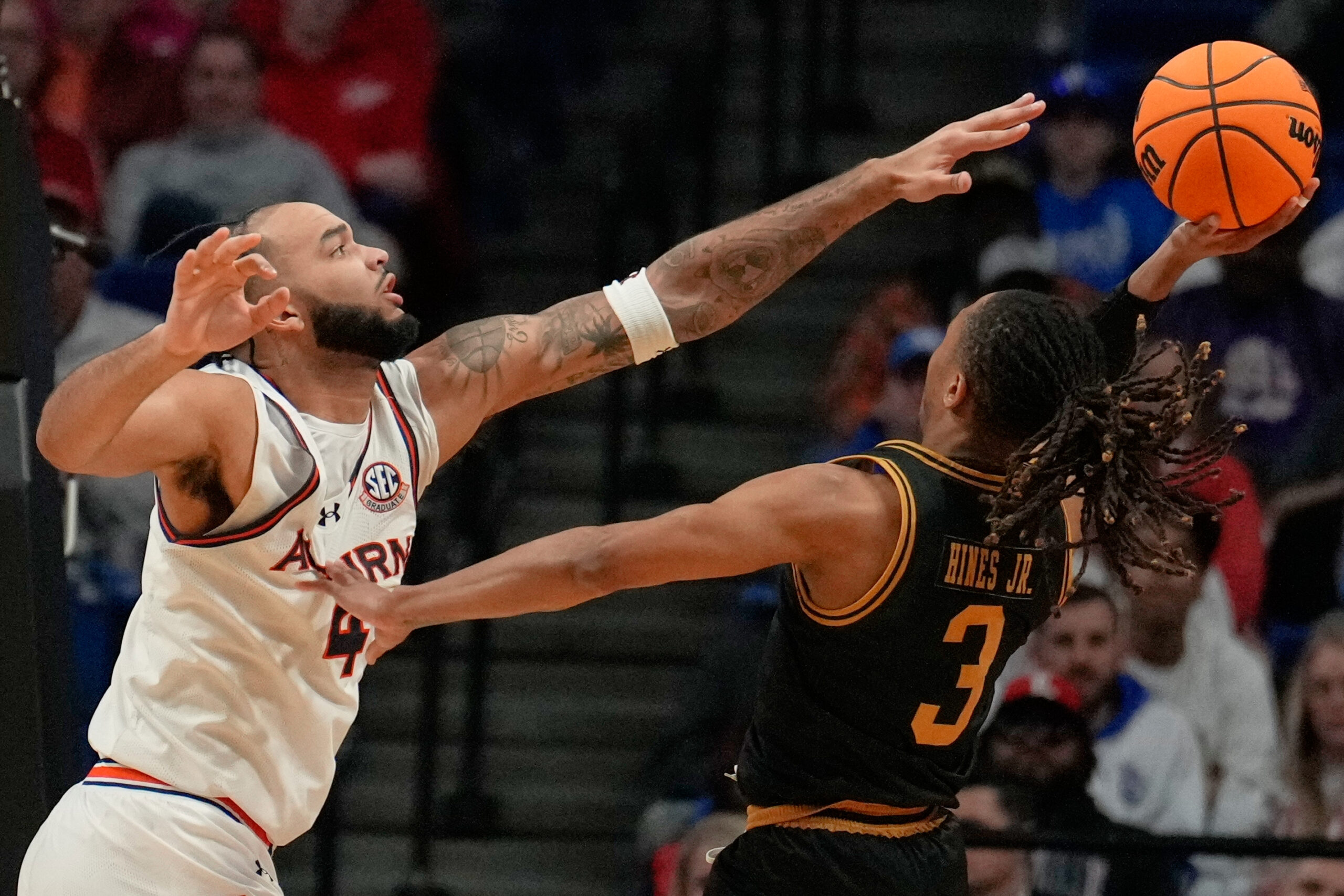
    CJ Hines, a guard who was dismissed from Temple’s basketball team on Jan. 16, allegedly participated in a point-shaving scheme during the 2024-25 season while playing for Alabama State, according to the indictment. Hines transferred to Temple in May but didn’t play this season after the university announced that he was under investigation for eligibility concerns before his enrollment.

    Former Alabama State guard CJ Hines (3) averaged 14.1 points in 35 starts last season.

    The Atlantic 10 Conference — which includes La Salle and St. Joseph’s — weighed in on the latest gambling indictment.

    “Any activity that undermines the integrity of competition has no place in college athletics,” commissioner Bernadette V. McGlade said in a release. “The Atlantic 10 and its member institutions will continue to work closely with the proper authorities to combat illegal activities.”

    A St. Joe’s spokesperson added: “St. Joseph’s University has not been approached by federal investigators or any other entity about suspicious sports wagering activity involving St. Joe’s student-athletes or team.”

    Villanova, which plays in the powerful Big East Conference, has numerous resources and protocols in place to address the sports wagering issue.

    Handbooks, which include NCAA rules on gambling, are distributed annually to athletes, who also must sign a sports wagering document before being declared eligible. The athlete must acknowledge he or she won’t engage in activities that influence the outcome or win-loss margins of any game.

    In 2021, 2023, and 2025, Villanova brought in speakers who have a history with sports gambling to talk with athletes about the risks and dangers associated with it. Villanova’s athletic compliance office meets twice annually with every athlete to review NCAA compliance standards, including its rules on sports wagering.

    Former Villanova basketball star Maddy Siegrist told The Inquirer last year that her college alma mater ingrained in her mind the potential devastating consequences of gambling, values that she continues to adhere to as a WNBA player.

    ‘The integrity of sports is at risk’

    Even after the 2018 Supreme Court ruling that legalized sports wagering state to state, the honesty and integrity component still comes into question when so much is riding on any sports wager.

    DeWine, the Ohio governor, is taking a proactive role in trying to address malfeasance in the gaming culture.

    “I’m writing letters to all other major [sports] leagues,” DeWine said. “They need to get on this. If they sit back, they’re making a huge mistake. I think the integrity of sports is at risk. I’m continuing to urge these leagues to take care of business, because they’re the ones that are going to get hurt.”

    But McDonald said that with the flurry of recent indictments involving sports and gambling, “you have to wonder how pervasive [the illegal gambling problem] really is.”

    “This could very well be the tip of the iceberg,” McDonald said.

  • Havertown’s Mike Tollin screens his new documentary profiling Villanova hero George Raveling

    Havertown’s Mike Tollin screens his new documentary profiling Villanova hero George Raveling

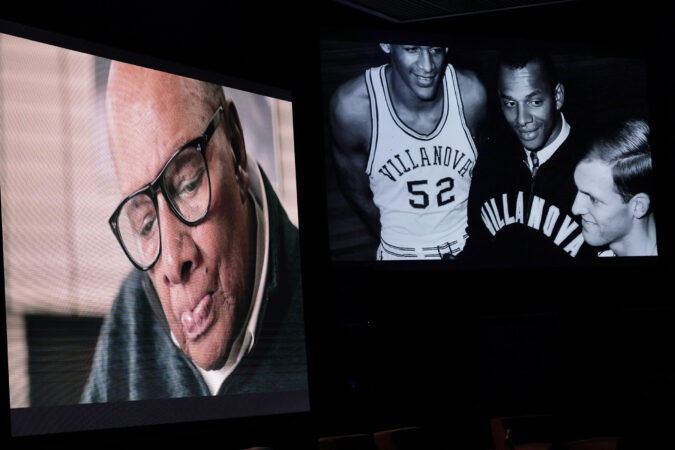
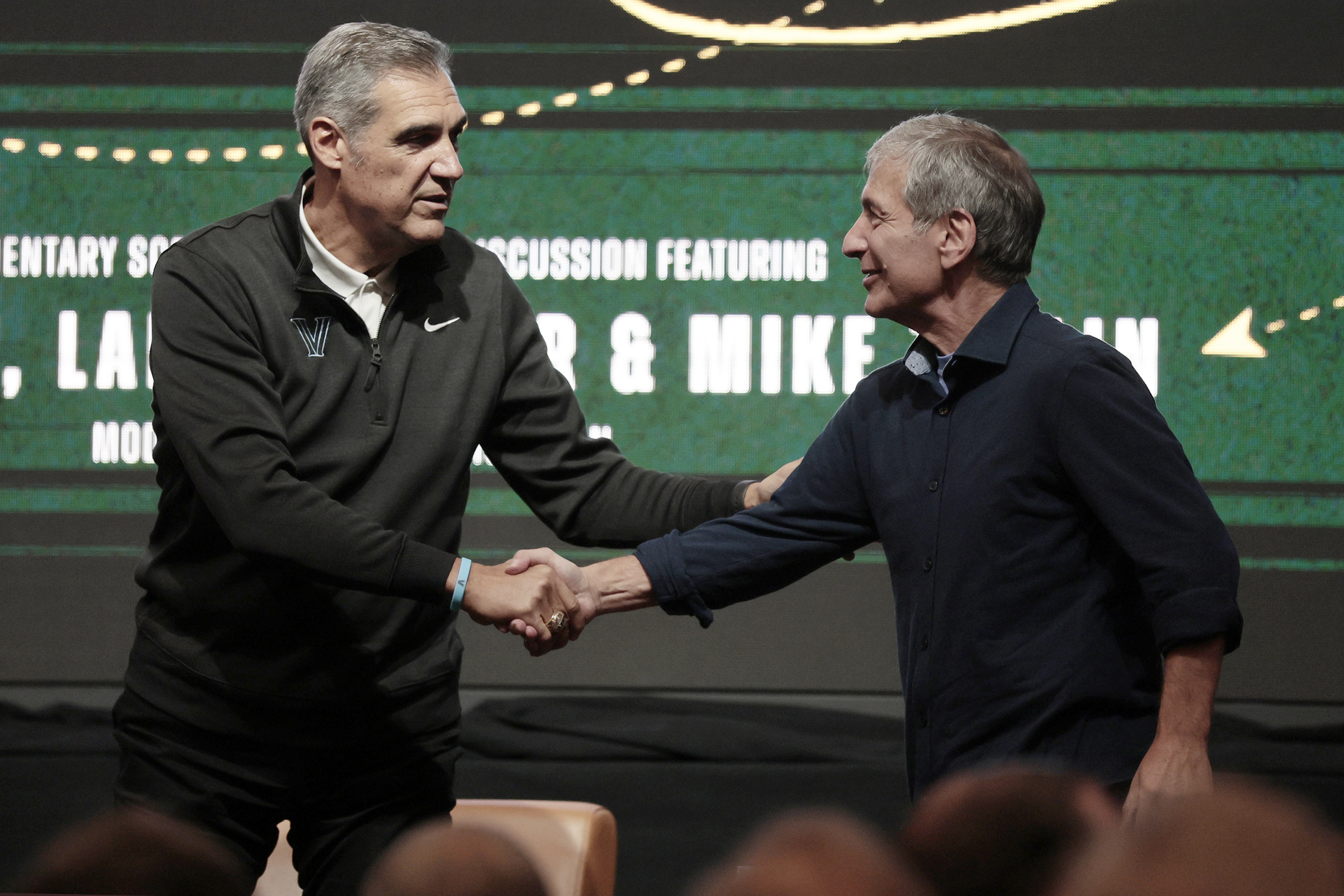
    Mike Tollin received an ovation for his documentary film about the life of George Raveling after a Wednesday night showing on Villanova’s campus. But the best part of the Havertown native’s night may have been meeting and snapping a photo with former guard Fran O’Hanlon, one of his “Villanova heroes.”

    Tollin’s love for Villanova hoops is one of the main reasons he chose to direct Unraveling George, a 90-minute documentary that profiles Raveling. He was a player and assistant coach at Villanova before he rose to prominence as a head coach at Washington State, Iowa, and Southern California. After his coaching career, Raveling joined Nike as a marketing executive.

    Nike and Villanova staged a screening of Tollin’s film before Wednesday night’s game between the Wildcats and Georgetown at the Finneran Pavilion.

    The screening was preceded by a panel conversation with Tollin, a longtime television and film executive who served as the executive producer on the 10-part Michael Jordan docuseries The Last Dance. Former Villanova coach Jay Wright and Larry Miller, president of Jordan Brand at Nike, joined Tollin onstage.

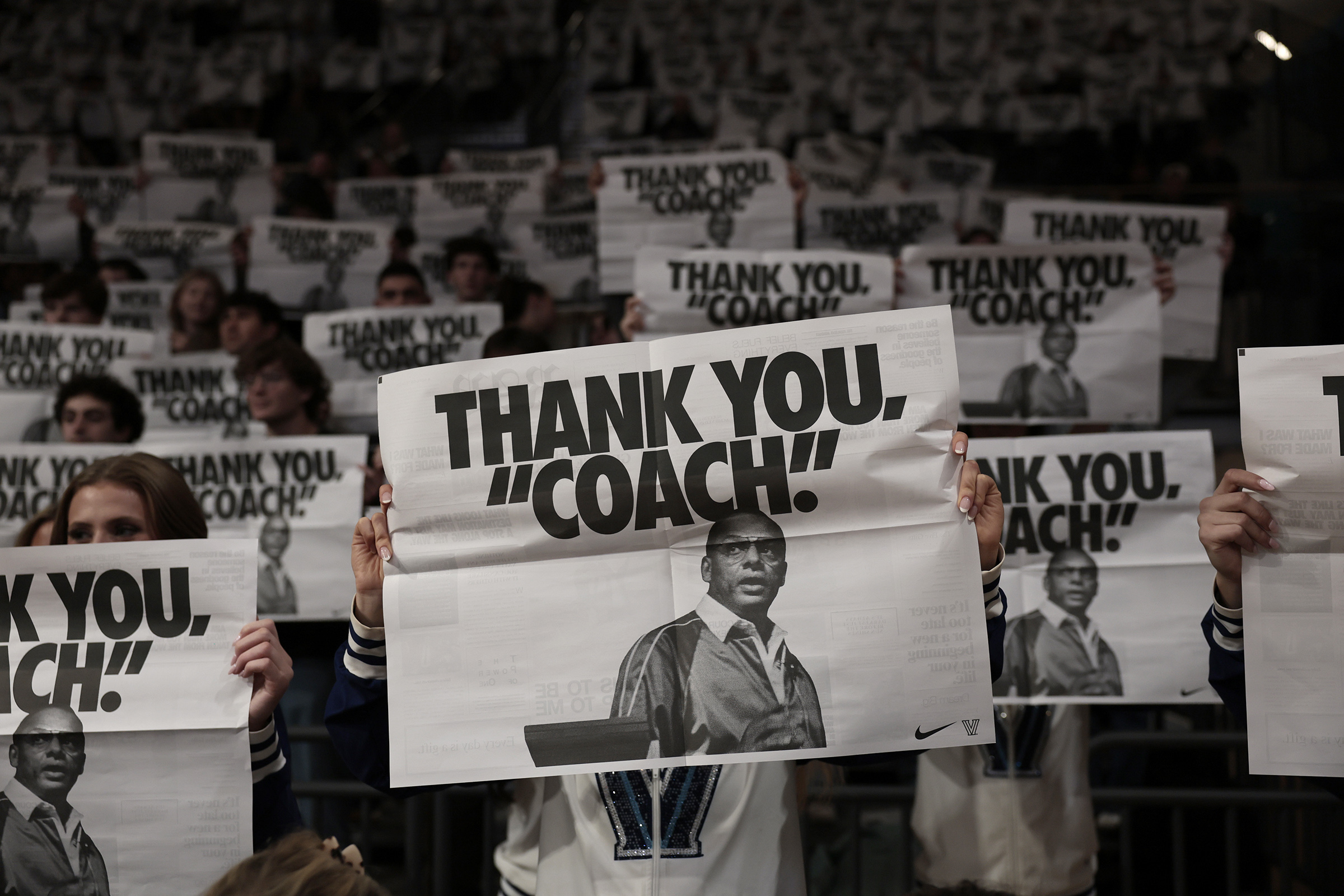
    Fans honored the life and legacy of coach George Raveling during Villanova’s game against Georgetown on Wednesday.

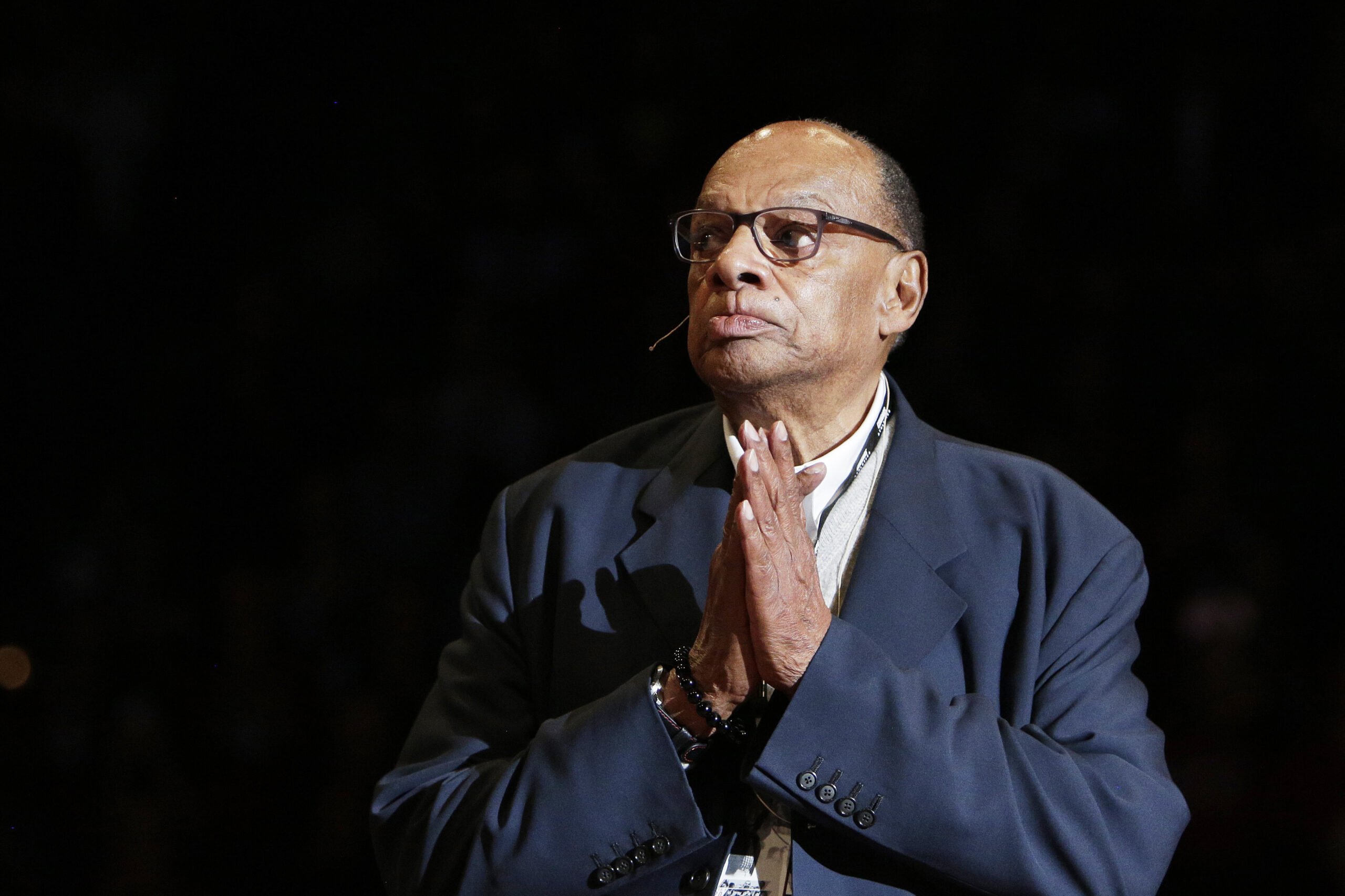
    Villanova also honored Raveling during its game against the Hoyas, which the Wildcats won, 66-51. Raveling graduated from Villanova in 1960 and served as an assistant coach under Jack Kraft from 1963 to 1969. He died at age 88 on Sept. 1, 2025. Fans held up newspaper fliers distributed by Nike that read “Thank You, Coach” during the game’s first timeout.

    “This team, I’m sure [Villanova coach Kevin Willard] has talked to them about coach Rav, but they would not have gotten to know him,” Wright said during the discussion. “All the other teams, coach Rav would come here, spend time with us, talk to the team. It’s great for them, because these guys are smart guys on this team. They’ll Google him, they’ll read about him and they’ll get to know how important coach Raveling was to Villanova and to the world.”

    The idea for Tollin to work on a documentary about Raveling came after the release of Ben Affleck’s AIR in 2023. That film is a fictionalized account of Nike’s pursuit of an endorsement deal with Jordan before his rookie season with the Chicago Bulls in 1984.

    Marlon Wayans plays George Raveling in AIR, but the film’s plot suggests that Sonny Vaccaro, played by Matt Damon, was the primary reason Jordan signed with the company. Jordan disputes this in Unraveling George, saying that Raveling, who coached Jordan at the 1984 Olympics, was the first person to pitch Nike to him.

    Tollin said a conversation about AIR with William Wesley, executive vice president of the New York Knicks, gave him the inspiration to work on the project.

    “He said, ‘Did you see AIR?’” Tollin said. “And I said, ‘Yeah, I enjoyed it.’ He said, ‘Yeah, but we’ve got to tell the real story, and we’ve got to honor George.’”

    Wesley introduced Tollin to Raveling at a Los Angeles Clippers game, where Tollin’s childhood admiration for Villanova basketball showed. Tollin, who graduated from Haverford High School in 1973, grew up watching the players Raveling recruited for the Wildcats.

    “I sat there and I just gushed,” Tollin said. “I said, ‘You recruited all my first basketball heroes.’ I started naming names like Johnny Jones, like Howard Porter.”

    Raveling agreed to be the subject of the documentary, and Tollin got to work on raising funds for the project. The film was completed before Raveling died, and the coach got a chance to see it. Tollin said Wednesday night’s screening at Villanova was “bittersweet.”

    “I wish he was here,” Tollin said. “But obviously, I feel his presence. I know how he felt about the film. He loved it. He was grateful. He was just so generous with me.”

    The late George Raveling played a role in Michael Jordan’s signing a landmark endorsement deal with Nike.

    The film follows Raveling’s life, from his youth in segregated Washington to his playing career at Villanova, where he was the school’s second Black basketball player, and his coaching career. It details the events that led to Raveling obtaining the original typewritten copy of the Rev. Dr. Martin Luther King Jr.’s “I Have a Dream” speech during the March on Washington in August 1963.

    The film also shares Raveling’s time as an assistant coach on Bob Knight’s staff for the 1984 Olympic basketball team, when Raveling formed a relationship with Jordan. It also follows Raveling’s recovery from a 1994 car accident that kept him in intensive care for two weeks and led to his retirement from coaching.

    The documentary goes into Raveling’s second career as an executive for Nike. In addition to being responsible for Jordan’s decision to sign with Nike in 1984, Raveling was also instrumental in helping to bring international players like Dirk Nowitzki and Yao Ming to the NBA.

    Former Villanova coach Jay Wright (left) and filmmaker Mike Tollin during the panel conversation and screening of “Unraveling George” on Wednesday.

    The film features interviews with many significant figures in basketball, including Jordan, Nowitzki, longtime coach Lefty Driesell, Wright, and Nike founder Phil Knight, among others. Wayans provides voice-over narration and sits down for a conversation with Raveling during the film’s credits.

    “It was incredible to keep turning over rocks and find more and more layers, and more and more people who love George and wanted to be a part of the storytelling,” Tollin said.

    Nike made promotional materials for Wednesday night’s screening at Villanova. Those included embroidered canvas tote bags that read “RAV,” and the fliers, inspired by Raveling’s love for reading the newspaper.

    Tollin said when Nike’s team approached him about supporting the film, he wanted the company to help bring it back to Villanova.

    “I just knew this would feel like family,” Tollin said. “And it did. This is sort of like the womb, you know? This is like a really warm bath of support and love. … It was critical that we bring the film here, partly because I’m from here and partly because this is [Raveling]’s origin story.”

    Unraveling George is not available to stream, although Tollin expects to have more details on where to watch it soon.

  • Second-half surge helps Villanova roll past Georgetown to set up a Saturday showdown with No. 2 UConn

    Second-half surge helps Villanova roll past Georgetown to set up a Saturday showdown with No. 2 UConn

    The difference isn’t in the adjustments as much as it is the inherent advantage of the location of each team’s bench during the first half, according to Villanova coach Kevin Willard.

    Villanova runs its offense in the first half in front of Ed Cooley and Georgetown’s bench, and the Hoyas run their offense in front of Willard and his bench.

    “I get to yell their plays out,“ Willard said after Villanova’s 66-51 victory over Georgetown on Wednesday. ”The coaches all know the plays. I’ve watched Georgetown play nine times now. You know when the center is out in the corner, they’re going to run a boomerang. You know when [Malik] Mack’s on the block, it’s going to be an iso.”

    Villanova used a 16-1 surge in the first four minutes to blow open just a three-point halftime lead, and there has to be more to it than the orientation of the court. Save for a few games, Saturday’s loss to St. John’s being one of the outliers, Villanova has been a solid second-half team. It entered Wednesday night with a plus-4.1 margin over its opponents in the second half. That ranked 62nd nationally and fourth in the Big East. It is not amazing, but considering there are 365 Division I teams, it’s not nothing.

    There is, of course, more to it than Willard’s initial explanation.

    Villanova watches a lot of film at halftime. Willard watches the offense to figure out what he wants to call in the second half, but the rest of the staff and team focus on the defensive end. There was a lot to like on that end from the first 20 minutes. It was an ugly opening frame that ended with the teams combining to shoot 15-for-54 (27.8%). Villanova’s offense looked clunky, but the Wildcats forced nine first-half turnovers from a Georgetown team that entered Wednesday on a five-game losing skid but was 15th nationally in turnover percentage.

    There was less tactical messaging during the break, too.

    “It’s just getting a very young team to understand, it’s all I talked about at halftime, this is Big East play,” Willard said. “They’re a really good, physical defensive team. It’s not going to be easy. We have to rebound and get out. That’s usually all the message is and just cleaning up what we’re struggling with defensively.”

    Villanova allowed a 20-4 St. John’s start to the second half Saturday at Xfinity Mobile Arena, but Wednesday, against a lesser opponent that dropped to 1-7 in conference play, was a much different story. Georgetown turned it over four times in the first four minutes of the second half and Villanova finally got out in transition and found cleaner shots.

    “That first stretch won us the game,” said Tyler Perkins, who led Villanova with 16 points.

    The 16-1 spurt stretched to 29-8 midway through the second half to give Villanova its largest lead, 55-31. The defense that kept Villanova in the game during the first half carried over. The Wildcats held Mack, who averages 13.8 points, to five points on 1-for-14 shooting. The 51 points the Hoyas scored were the fewest by a Villanova opponent this season.

    “I think we all knew we’d be better on offense in the second half,” said freshman point guard Acaden Lewis, who had 15 points and a season-high seven rebounds. “That’s kind of what happened. We stayed solid defensively, and the offense came around late.”

    Bryce Lindsay, who hit a three-pointer from the edge of the midcourt logo in the second half, and Duke Brennan joined Perkins and Lewis in double figures with 11 and 10 points, respectively. It was far from the cleanest offensive night from the Wildcats, who got just nine assists on their 24 makes, far below their season-long assist percentage of 53.7. But it was more than enough against a Georgetown team that Cooley said was “emotionally and physically frustrated” by Villanova in the second half.

    “Villanova does what they do,” Cooley said. “They use a ball screen 118 times a game, and they took advantage of that and made some shots.

    “This game is all about discipline. It’s all about connection. It’s all about emotional and mental toughness.”

    One team had it Wednesday, the other didn’t. One team’s season is spiraling, the other’s continues Saturday afternoon in Hartford, Conn., where it gets another opportunity for a signature win.

    Georgetown’s Caleb Williams is sandwiched between Villanova players on Wednesday.

    The good part about this time of year, Willard said, is that he’s seen about all of his conference opponents on film. No. 2 UConn, he said, has a lot of veteran talent and he loves watching freshman Braylon Mullins, who attempts nearly six three-pointers per game in 26 minutes and is “always hunting.”

    Villanova entered Thursday rated 24th at KenPom and 34th at Torvik, two of the primary college basketball metrics sites, and was 33rd in the NCAA’s NET rankings. The Wildcats are on a path to snapping their NCAA Tournament drought of three seasons. But what they don’t have yet is a marquee victory, due respect to Wisconsin and Seton Hall. Each major step up in competition has been met with much resistance.

    “Every league game is important,” Lewis said when asked about Saturday. “It’s the same approach, same things we always do.”

    If that’s not working early on, there’s always halftime.

  • Villanova freshman Acaden Lewis is often praised for using his ‘off’ right hand. He’s actually right-handed.

    Villanova freshman Acaden Lewis is often praised for using his ‘off’ right hand. He’s actually right-handed.

    Because Acaden Lewis shoots a basketball left-handed, it is natural for observers to admire the way the freshman Villanova point guard uses his right hand.

    The admirers often wear headsets and announce games on television.

    There goes Lewis, using his other hand.

    Look at that, with the off hand.

    For most players, passing the ball with their nonshooting hand, dribbling to their nonshooting hand’s side, and using their nonshooting hand to finish a layup or floater takes a lot of practice. The movements can be unnatural.

    To be sure, Lewis has worked hard to sculpt a skill set that has allowed him to play right away and be the lead guard on what looks like an NCAA Tournament-bound Villanova team.

    But he isn’t left-handed.

    “I can’t do anything with my left hand,” Lewis said by phone this week as he forked noodles into his mouth using his right hand following a post-practice film session. “I can’t palm a ball. I can’t write. I can’t eat.”

    Acaden Lewis is averaging 12.1 points, 5.3 assists, and 3.4 rebounds for the Wildcats.

    How did a right-handed kid growing up in the nation’s capital learn to play basketball left-handed?

    “I actually have no clue,” Lewis said. “I think I just shot with my left hand when I started hooping.”

    Whatever works. And it’s working. Entering Wednesday night’s game vs. Georgetown, Lewis is at 12.1 points, 5.3 assists, 3.4 rebounds, and 1.9 steals per game.

    His ability to use both hands is all over that stat line.

    “I think he has so much confidence in the fact that he can go both ways, and it’s not like you can shade him one way or send him to his weak hand,” Villanova coach Kevin Willard said.

    Willard first recruited Lewis out of high school when he was the coach at Maryland, but Lewis initially committed to Kentucky. It wasn’t until April, a few months before summer workouts, that Lewis withdrew his commitment from Kentucky and was back on the market. Villanova needed a point guard.

    During the recruiting process, Lewis told Willard and his staff that he actually was a righty.

    “I thought he was full of s—,” Willard said. “Because he was doing everything with his left.”

    Villanova guard Acaden Lewis lays up the basketball against Duquesne on Nov. 15.

    Willard noticed Lewis was good going both ways when he watched him, but it took floater drills during preseason practices for the coach to finally become a believer. Lewis was better with his right.

    “I was like, ‘Jeez, he must be right-handed,’” Willard said.

    Then, in October, during the installation of Villanova’s pick-and-roll defense, Willard noticed Lewis’ ability to run offense and pass effectively using his right hand. For most players, Willard said, there’s a “dramatic difference” when running an offense to their supposed weak side. With Lewis, it’s a strength.

    “We actually run some plays where he’s passing with his right hand because he can do it,” Willard said. “We don’t have to switch sides of the floor because he’s lefty. He gives me flexibility in the fact that we can run certain plays on the same side of the floor.”

    Lewis, who has been named Big East freshman of the week four times, agreed with Willard that passing might be the most critical component of him being ambidextrous.

    “I think that’s the best thing I actually do with both hands,” Lewis said. “Either that or finishing. I think the passing ability is really dynamic. I can do all types of passing with both hands, so it’s never like I have to come across my body or have to make awkward movements to throw passes. It makes a lot of things comfortable for me.

    “It’s a little unorthodox, and it’s kind of hard to guard.”

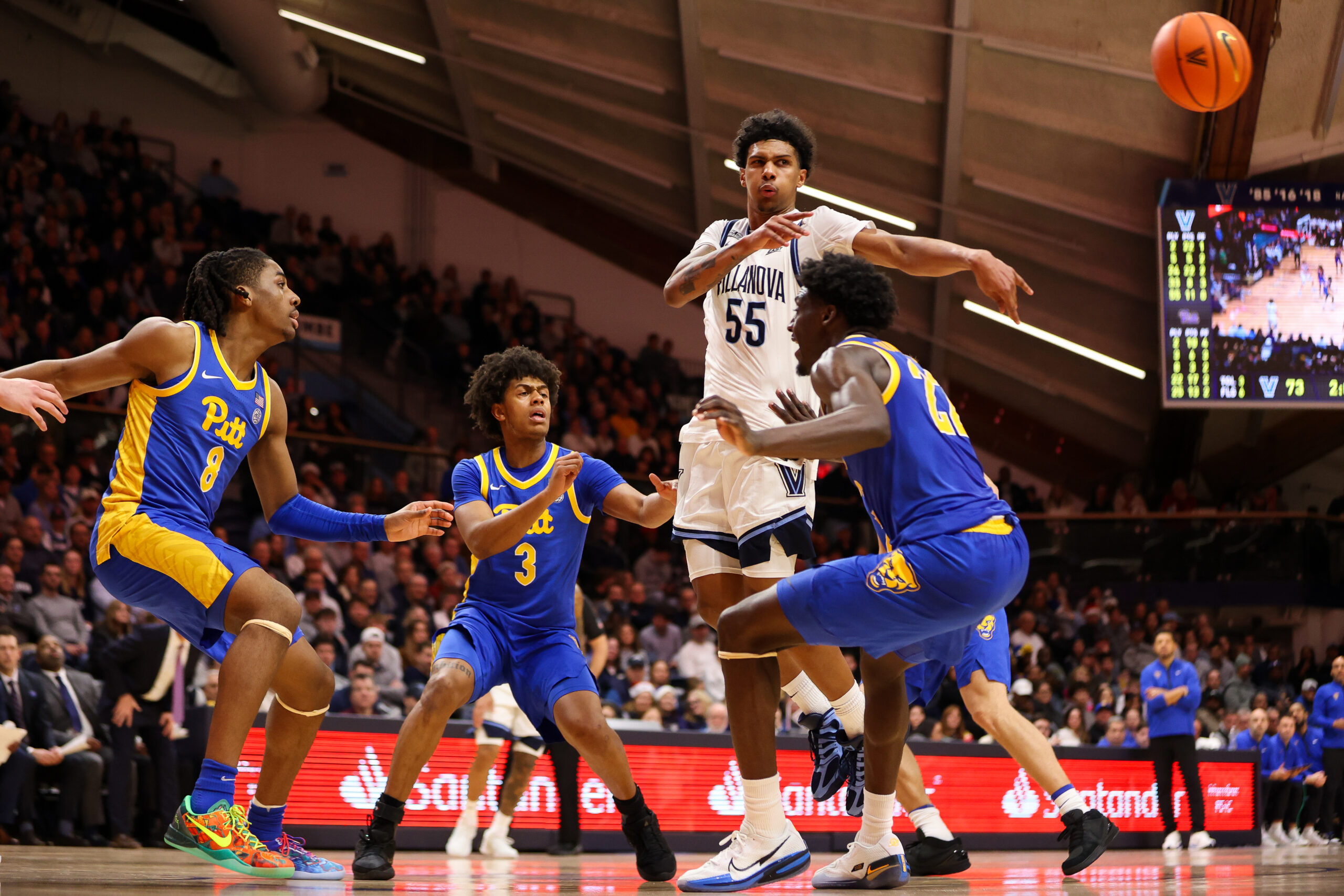
    Acaden Lewis firing a pass to his left during Villanova’s win against Pittsburgh on Dec. 13.

    There is, however, no advantage to being strong with both hands on the defensive end, Willard said.

    “I wish it did [help him],” Willard said jokingly. “I think he wishes it did, too.”

    Lewis credited his knack for the ball as the reason he is averaging nearly two steals through his first 18 college games. But while Lewis is fourth in the Big East in steals, his defense and inexperience have landed him on the bench a few times this season, including for all but 19 seconds of the final 11-plus minutes of Saturday’s loss to St. John’s.

    Lewis, Willard said, takes to coaching. He was similarly benched during the second half of a season-opening loss to BYU and responded well.

    “I think one of the biggest things about a leader is, he admits when he [messes] up,” Willard said. “He owns it. I think other guys have really bought in to the fact that here’s a young guy that’s getting yelled at by the coach because he’s the point guard, but he’s the man taking it.”

    Having two dominant hands and arms on the basketball court has been key for Lewis during his first season, but beyond that, Willard said Lewis’ commitment to learning and studying has enabled him to play well right away. That part he expected. Eric Singletary, Lewis’ coach at Sidwell Friends School in Washington, which previously fed Villanova stars like Josh Hart and Saddiq Bey, raved about the student of basketball Willard was getting.

    What Willard didn’t know until Lewis got on campus was that Lewis is a “monster competitor,” the coach said.

    “I just never knew how much of a competitor, how much he wanted to win, and how much he wants to be good. I don’t think you ever really find that out until you start coaching a kid. He’s blown me away with how much of a competitor he is.”

    That, and the right-handed floaters.

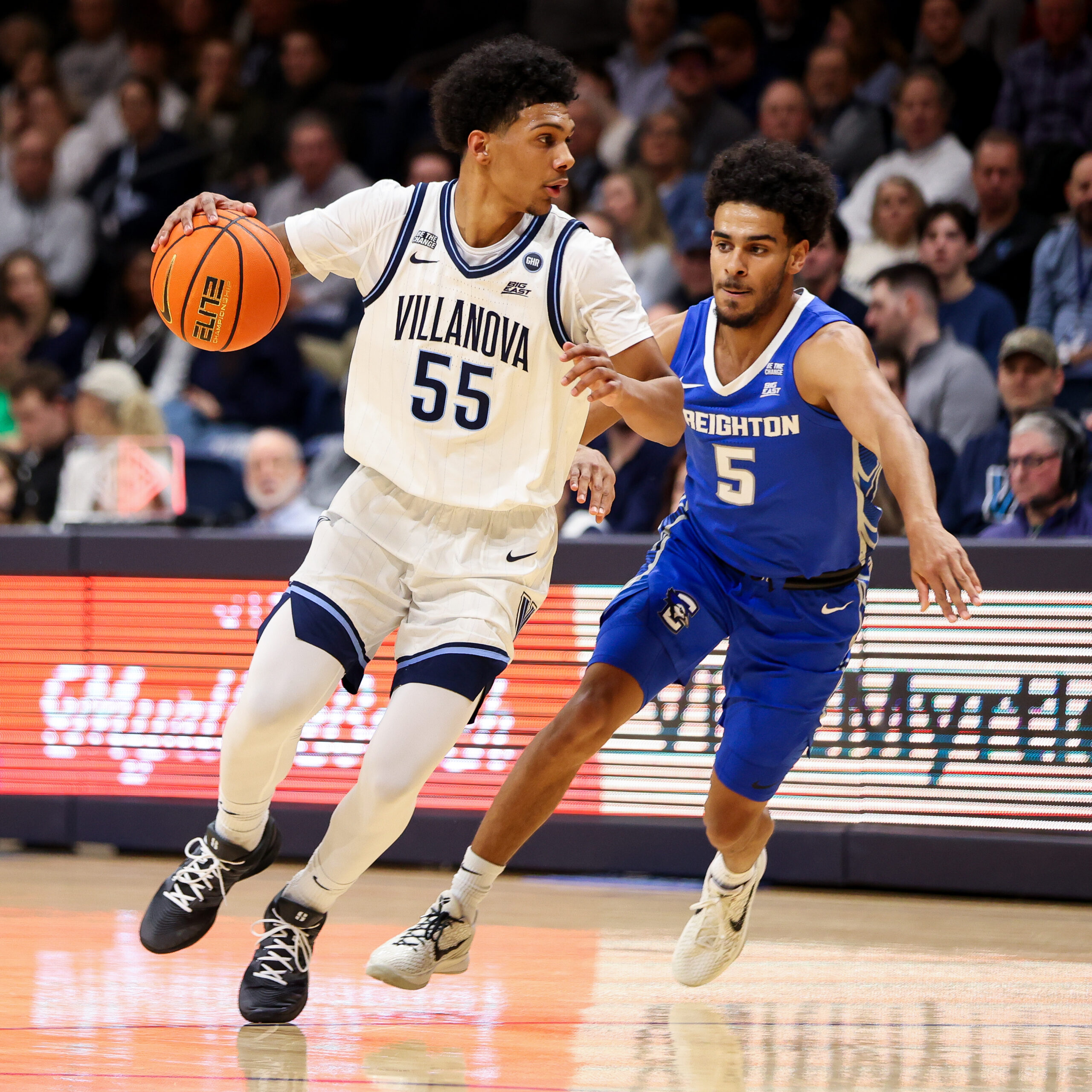
    Acaden Lewis dribbles with his right hand as Creighton’s Nik Graves pursues him on Jan. 7.

    Those, and Lewis’ ballhandling skills, were developed during early-morning training sessions that started when Lewis was a freshman in high school. While Lewis is right-handed, he spent his youth mostly using his left on the court. His trainer, Kevin “Uncle Skoob” Kuteyi, would pick Lewis up full-court during 6 a.m. workouts and force the teen to beat the pressure, often dribbling to his right, and finish at the rim, again mostly with his right hand.

    It came naturally, thanks to Lewis’ right hand being his dominant hand.

    “Everything about me in basketball is left-handed, I would say,” Lewis said. “But I’m right-handed, so I’m ambidextrous, basically. It’s weird.”

    Weird, even ambiguous.

    Does Lewis consider himself right-handed, left-handed, or ambidextrous?

    “I’m a right-handed person who is left-handed when I hoop,” he said. “That’s how I would put it.”

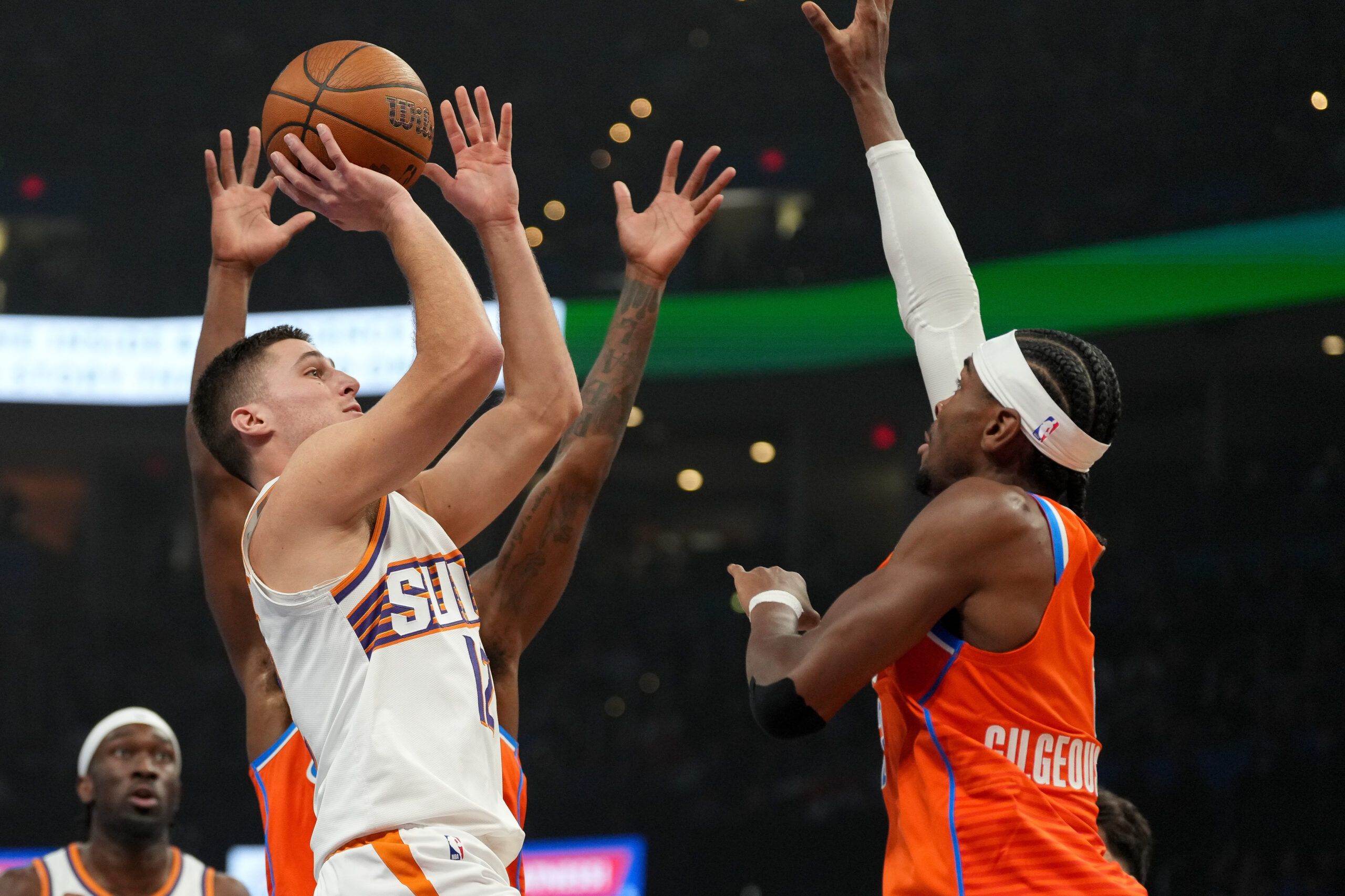
  • The NBA journey of former Villanova star Collin Gillespie seems unlikely to everyone — except him

    The NBA journey of former Villanova star Collin Gillespie seems unlikely to everyone — except him

    Jay Wright saw enough of Collin Gillespie a few nights before to invite him to Villanova on a Monday in January 2017 and offer him a scholarship. But this was hardly a courtship. Wright told Gillespie that he would redshirt his freshman season, maybe play as a junior, and then have a complementary role as a fifth-year senior.

    “I thought he would get his master’s degree and be a great coach one day,” Wright said. “I was thinking ‘I would love to have this guy on my staff.’”

    Gillespie — who has molded himself into an NBA starter with the Phoenix Suns after going undrafted in 2022 — nodded along. He didn’t have a Division I scholarship before his senior year at Archbishop Wood and declined to visit Division II schools because he believed bigger programs would eventually see what he already knew: He could play. Redshirt? OK. Bench player? Sure. Coach? Yes, sir.

    “I didn’t really believe him,” said Gillespie, who will play against the 76ers on Tuesday night. “I believed in myself. I was just like, ‘Whatever he says, I’ll take it and then prove him wrong.’”

    There was Gillespie 15 months later on the court for Wright in the national championship game, taking a charge against Michigan and looking the part. In his fifth year, the kid who had to wait for college scholarships was named the nation’s top point guard in 2022. He went undrafted that June but landed a non-guaranteed contract in July with the Denver Nuggets. He was on track.

    Three weeks later, Gillespie suffered a broken right leg while playing in a pickup game at Villanova.

    His NBA career — the one that is now flourishing — seemed unlikely then to nearly everyone except the guy who nodded along that day in Wright’s office.

    “Everyone has their own journey,” Gillespie, 26, said. “Everyone runs their own race. You just have to stick to what you do, put your head down, and work hard. Don’t compare yourself to anyone else. If you work hard enough, you can probably achieve anything you want to.”

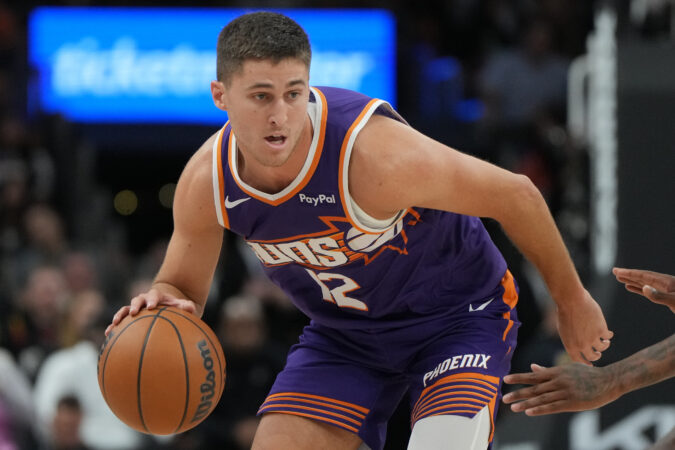
    Collin Gillespie (right) became much more than a fifth-year senior role player first envisioned by Villanova coach Jay Wright.

    G League to the league

    Andre Miller often learned via text messages which players would be flying nearly three hours from Denver to join his G League team that night. He coached the Grand Rapids Gold, the Nuggets’ minor-league affiliate in Michigan that played 1,100 miles from Denver. Those morning flights gave Gillespie a chance to get on the court.

    “It wasn’t a good recipe for these guys to be successful, but when he did show up, he didn’t want to come out of the game,” said Miller, who played three of his 17 NBA seasons with the Sixers. “We knew we had to leave him out there because he didn’t have an opportunity with the other team and he took great advantage of it.”

    Gillespie feared that the Nuggets would void his contract after he suffered that injury playing at Villanova. That’s the first thing he said to his father, who was in the gym when it happened. But they didn’t. They kept him around that first season while he rehabbed and then split his time the next season between Denver and Grand Rapids.

    “There was no ego,” Miller said. “One thing that’s tough to deal with is when your career is in the hands of other people. Some people felt like he wasn’t an NBA player and some people felt like he was an NBA player. The one thing that stood out about him to me is that he’s a competitor. He’s a dog. He’s a guy who enjoys playing basketball. He’s a leader. He plays with a chip on his shoulder.

    “I wish I could have coached him more in the G League, but he was an NBA player. I knew that from the first time I saw him on the court with the G League players. I was like, ‘He probably won’t be here much.’”

    Gillespie signed before last season with the Suns, again splitting time between the NBA and the G League. The 6-foot-1 guard earned a full-time role this season, starting for the Suns and fitting in with pesky defense and a three-point shot. Just like college, it took time before Gillespie’s game was appreciated.

    “You just don’t see it initially. He doesn’t wow you,” Wright said. “But when you see him play over time and you realize this guy is getting to the rim and finishing, he’s elevating on his jumper and shooting over bigger guys, and he’s not getting backed down. You almost need to have time to believe what you’re watching.”

    Collin Gillespie is shooting 41.4% from three-point range for the Suns.

    Gillespie entered Monday’s game against Brooklyn averaging 13.2 points, 4.9 assists, and shooting 41.4% from three-point range. He hit a game-winner at the buzzer in November, regularly finds ways to create his own shot, and has proved that his game fits in the NBA.

    Kevin Durant called him “a dog” and Anthony Edwards said after a loss to the Suns last season that “No. 12 is pretty good at basketball.” Two NBA superstars could see what Gillespie always believed: He belongs.

    “He has more heart than talent,” said his father, Jim. “The kid just doesn’t want to lose. When he sets his mind to something, he just does it. And ultimately, he’s a winner. Wherever he’s gone, he’s won. At every level.”

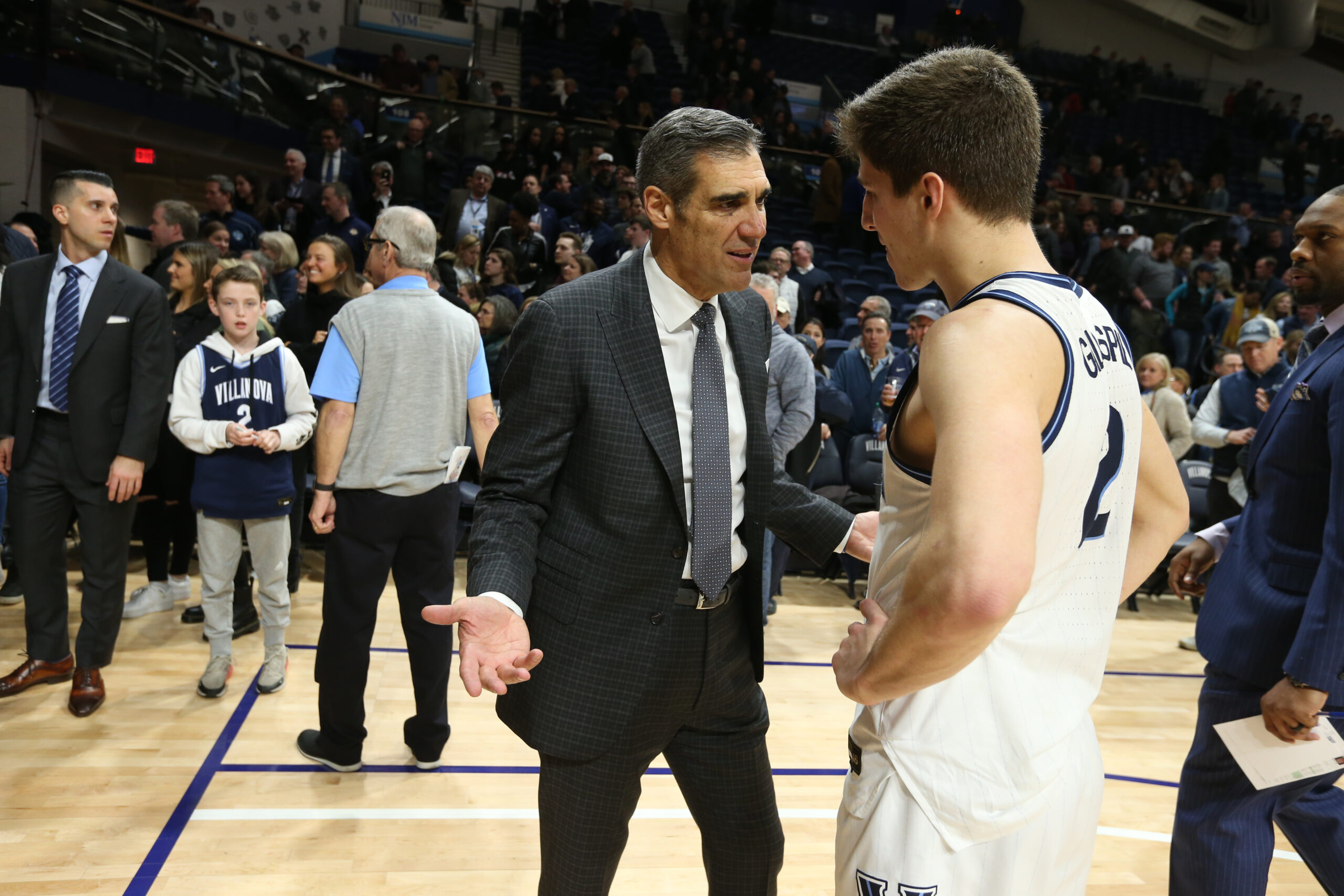
    Jay Wright says Collin Gillespie came to Villanova with a “killer mentality and stone face that we try to teach.”

    Change of plans

    Gillespie was in the stands for a Villanova game as a senior in high school, seated behind the La Salle bench at the Palestra. The Explorers invited him and Gillespie thought a scholarship offer was near.

    “But they never offered,” Jim Gillespie said.

    Gillespie eventually landed smaller Division I offers as a senior, but he was hopeful a Big 5 school would have a spot for him. None of them did until January when Villanova assistant Ashley Howard urged Wright to watch Gillespie play a game against five-star recruit Quade Green’s Neumann Goretti squad at Archbishop Ryan.

    The Northeast Philly gym was packed and the coach couldn’t stay long as he was being hounded. Howard called Wright while he was driving home and told the coach that one kid scored 42 and the other kid scored 31. Wright figured the 42 points belonged to Green, who was already committed to Kentucky. It was Gillespie, the assistant said. Wright was sold.

    “Nothing was spectacular, and he’s not bringing any attention to himself,” Wright said. “He just makes the right plays.”

    Wright called Gillespie’s father and told him he needed his son at Villanova on Monday. The coach gave Gillespie his pitch that day without any guarantees.

    “We left and we were like, ‘What are you going to do?’” his mother, Therese, said. “He said, ‘I’m going to play out my senior [year].’ I said, ‘Collin, it’s Jay Wright.’ He said, ‘Mom, I know what I’m doing.’”

    Gillespie committed a week later, simply deciding after a game at Bonner-Prendergast that he had enough of the recruiting trail. He was headed to ’Nova and told a Wood coach without first running it by his parents. Gillespie knew what he was doing.

    “He always said, ‘I’ll bet on myself,’” Jim Gillespie said. “He put the work in and the effort in and that’s what he’s always done.”

    It took Gillespie just a few weeks to force Wright to rethink the plan that he would redshirt. Every day in practice that June he went up against Jalen Brunson and held his own.

    Collin Gillespie (left) got to play in practice against future NBA players Donte DiVincenzo (center) and Jalen Brunson (right) at Villanova.

    “He came in with that killer mentality and stone face that we try to teach,” Wright said. “But he came in with that. Then he spent every day with Jalen Brunson and it just became reinforced. It was so obvious. The coaching staff, behind closed doors, was going, ‘This kid is going against Brunson every day. He’s pretty good.’”

    Gillespie suffered a minor injury that month and Wright checked with athletic trainer Jeff Pierce to see how the freshman was feeling. He was fine, the trainer said.

    “The trainer said, ‘You’re not redshirting this kid,’” Wright said. “I said, ‘Is it that obvious?’ He said ‘Yeah, everyone knows.’ Yeah, it was.”

    The guy who nodded along in Wright’s office proved that he belonged. Now, he’s doing it again in the NBA.

    “It’s the way I was raised and where I come from,” said Gillespie, who grew up in Pine Valley before moving to Huntington Valley. “My brother is a year older, so I always played a year up. I had to play against older guys and was always smaller. I always had to prove myself and had a chip on my shoulder. My parents always believed in me and my family always believed in me and taught me to believe in myself.”

  • Jasmine Bascoe scores 22 as Villanova beats Butler

    Jasmine Bascoe scores 22 as Villanova beats Butler

    For sophomore guard Jasmine Bascoe, Villanova is “right where we want to be” after a 73-65 victory over Butler on Sunday at the Finneran Pavilion.

    Bascoe led the way with 22 points and added two rebounds and six assists as Villanova (15-4, 8-2 Big East) maintained its hold on second place in the conference.

    The Wildcats trailed by 33-31 at the half but used a productive third quarter to seal another Big East win. In their last outing, they were thumped, 99-50, at No. 1 UConn on Thursday.

    “We want to be trailing UConn in the Big East,” Bascoe said. “That’s a great spot for us going into the second half of the league [schedule], and then hopefully the Big East Tournament. … So it’s just continuing to push through.”

    Turning it around

    Heading into the game, Villanova coach Denise Dillon urged the team to come out stronger after halftime.

    Butler (8-11, 2-7) went on a 7-0 run in the final 1 minute, 13 seconds of the second quarter. The Bulldogs kept the game close in the first half with efficient shooting, going 60.9% from the field. Meanwhile, Villanova shot just 34.4% from the field and 16.7% from the three-point range in the half.

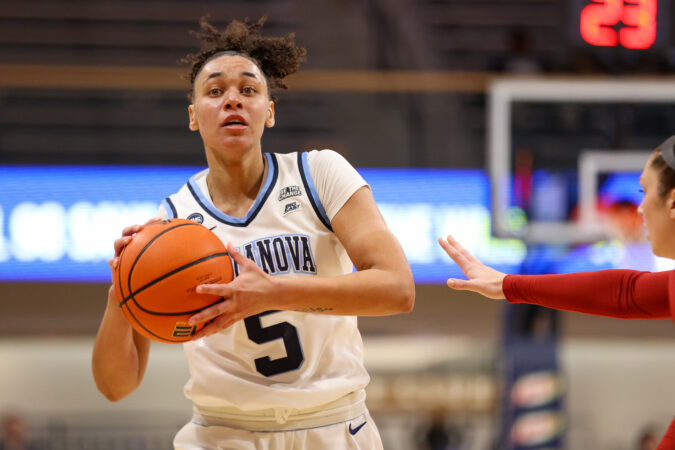
    Villanova’s Denae Carter in action against Xavier on Jan. 8.

    “[At halftime,] we just acknowledged that we weren’t playing like ourselves in the first half,” Bascoe said. “And to finish off the game right, we had to come out hard in the third quarter. So, you know, we drew up some plays, we intensified our defense, and then it kind of slowed down from there and we didn’t have to force any shots.”

    Carter has her moment

    Villanova opened the third quarter with a 7-0 run of its own. Bascoe sank a three-pointer and layup off a Butler turnover. Then, sophomore forward Dani Ceseretti assisted on a layup by junior forward Brynn McCurry.

    The Wildcats outscored the Bulldogs, 24-15, in the third quarter and led for the rest of the game.

    Graduate forward Denae Carter accounted for 11 of those points, shooting 5-for-7 from the field. She added six points in a scoring burst within the last 1:31 of the quarter.

    “This is [Carter’s] final run, and when she realizes it, it just fuels her,” Dillon said. “There’s nothing better for this group. You can even see it in the huddle, when all of a sudden she’s like, ‘I’m ready to go.’ … Denae is one of our top defenders, and when she’s disruptive, good things happen for us.”

    With less than four minutes left to play, Carter had to leave the court after she was struck in the face and Butler was charged with a flagrant foul. She finished the game with 15 points and four rebounds.

    Next up

    Villanova visits St. John’s (15-5, 5-4) on Saturday (2 p.m., FS1).