There was plenty of blame to go around after the Eagles’ postseason run ended early, following a loss to the San Francisco 49ers in the NFC wild-card round. But a few people are getting more heat than the rest.
One of the main culprits was offensive coordinator Kevin Patullo, who was fired after one season in the role and is reportedly on his way to Miami. Another person who has taken a lot of the blame is three-time Pro Bowler A.J. Brown.
Throughout the season former Eagles center Jason Kelce defended the receiver. Now, with Brown’s future in Philly still in question, Kelce was asked about the receiver’s perceived lack of effort on 94 WIP.
“How hard is it to play with a player that’s not giving full effort?” Kelce said. “It’s incredibly frustrating, right. I think any player that’s out there when you’re seeing a teammate not go all out, like that’s all you want from your teammates. And that’s all we want as fans. And it’s a really hard thing to optically watch. It’s frustrating to watch.”
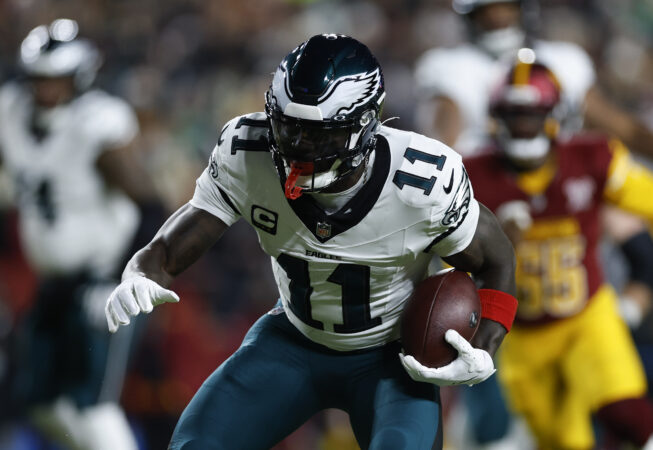
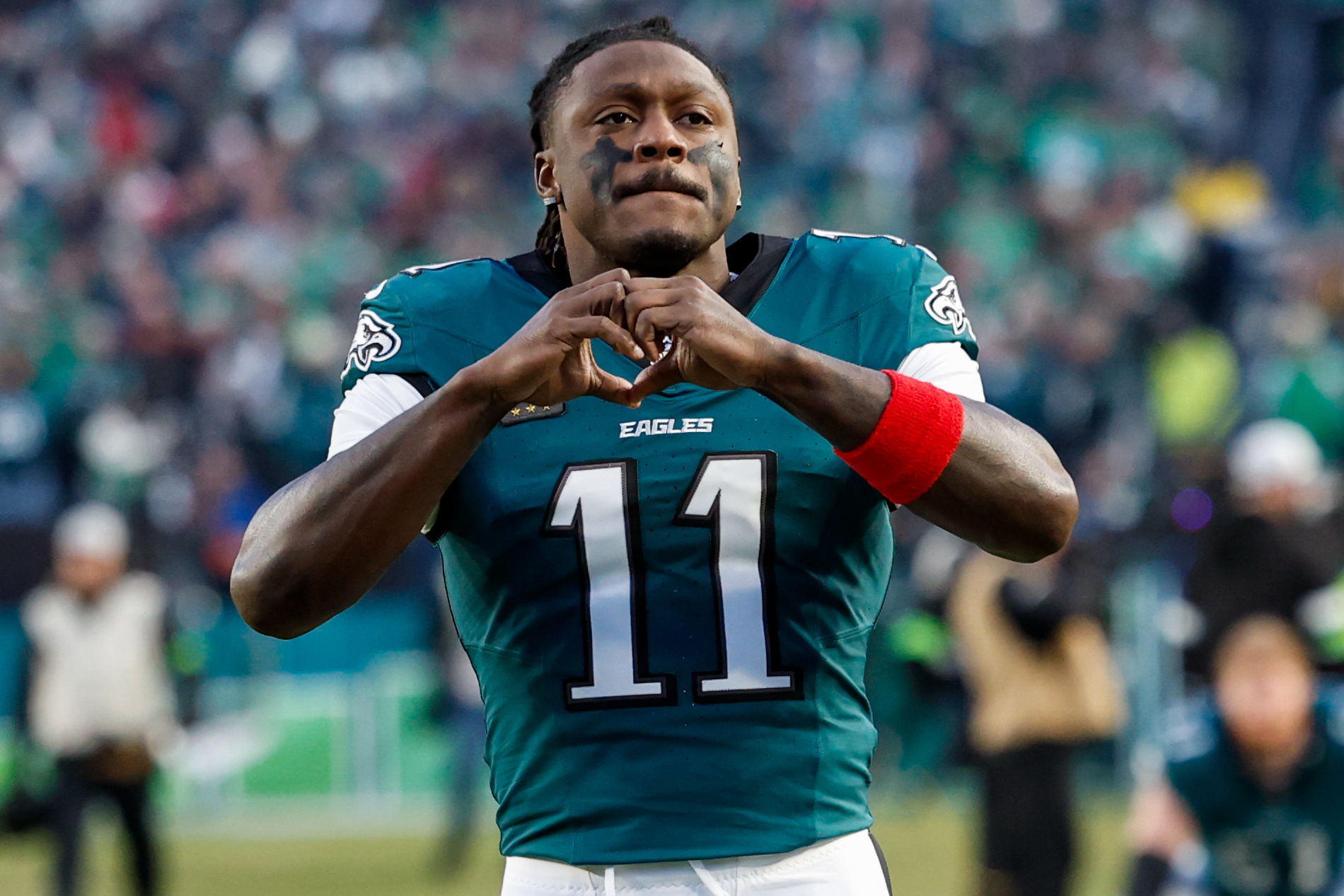
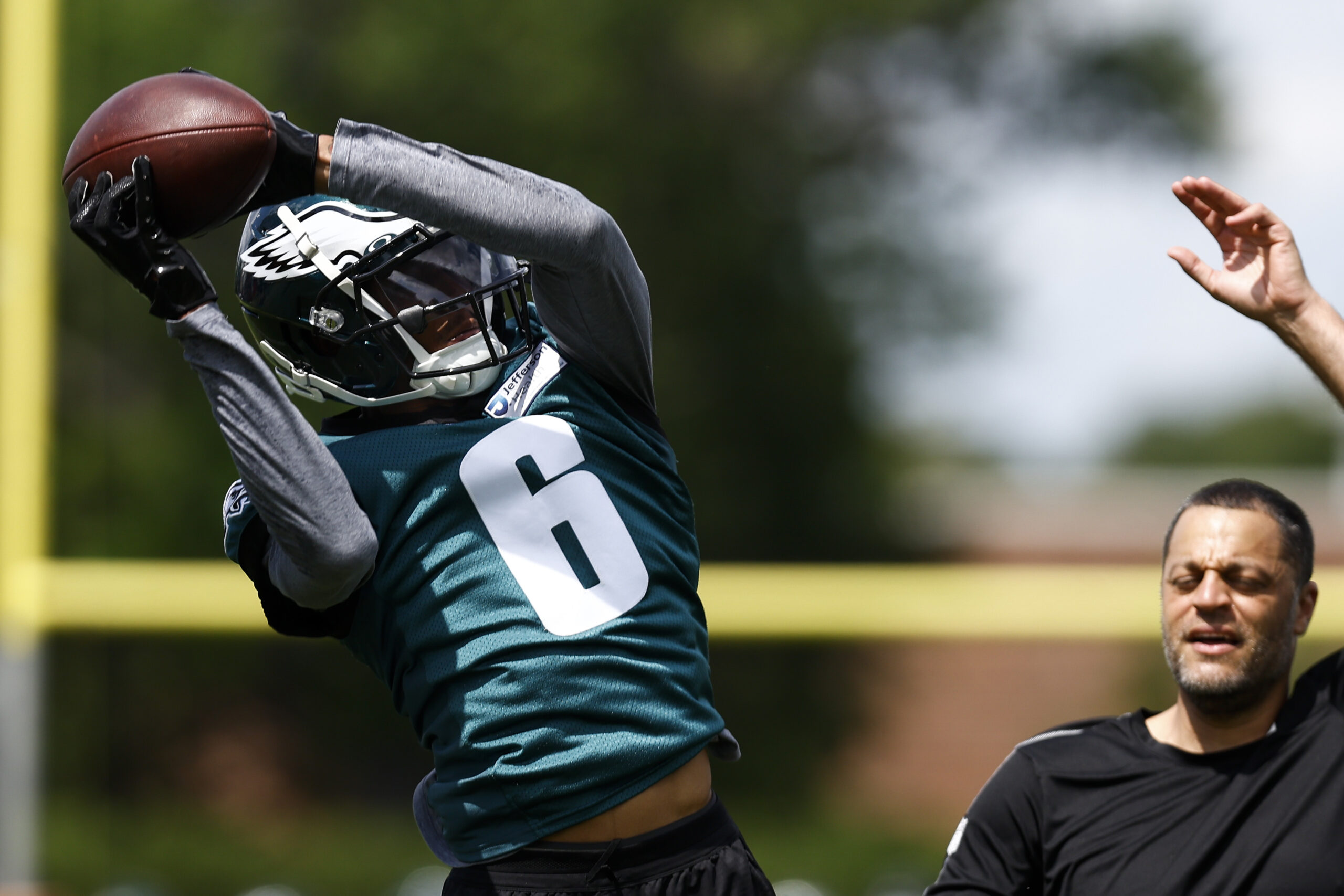
Eagles wide receiver A.J. Brown has surpassed 1,000 receiving yards in each of his four seasons in Philly.
Brown finished last season with 78 catches for 1,003 yards and seven touchdowns. In the wild-card loss, Brown recorded three receptions for 25 yards and had a costly third-down drop late in the game.
“I think whatever was affecting A.J. affected the team,” Kelce said. “And I think that A.J. was clearly affected. I don’t know to what degree A.J. affected the other guys, probably a little bit. Whenever you have somebody who doesn’t have the right energy come through the building and you can just feel it. It’s not good, right? But, I think the reality is most of the words that come out of the building — from players, from coaches, from everybody — love A.J. Brown. … There’s a genuine appreciation for A.J. Do you know how hard that is when it’s so apparent that he’s frustrated on the field?
“ … He’s well respected. I think part of it is that he’s a great player and teammates want him there and know that he can be a dominating force for them. He’s just unfortunately a player who allows his internal frustrations to manifest into his play. And it makes him play worse, and makes the offense worse, and it makes his energy worse. And some guys can block that out and go out there and just play football. He is clearly not one of those guys.”
Jason Kelce on a perceived lack of effort from A.J. Brown this season:
"He's just unfortunately a player who allows his internal frustrations to manifest into his play, and it makes him play worse and makes the offense worse." pic.twitter.com/tsQxzKH1np
Kelce has since clarified his comments with a post on X.
“It seems people are taking this as a dig on A.J. Brown, which wasn’t really the intent of the response,” Kelce wrote. “It was apparent that A.J. was frustrated, and it’s apparent that A.J. lets that affect his play at times. That’s frustrating to watch as fans and people on the outside. But it’s more important that his teammates and coaches for all of this external frustration still love and only say positive things about A.J.
“That probably means that his teammates understand where he’s coming from, and that’s what really matters. If there was an issue with it, teammates would be saying different things publicly. That was the point I was attempting to say. That was the purpose of this response and I worded it poorly. I love A.J. Brown, I loved him as a teammate, and I think if he ends up getting traded, the Eagles, and fans will end up regretting it majorly.”
Brown is under contract with the Eagles through the 2029 season.
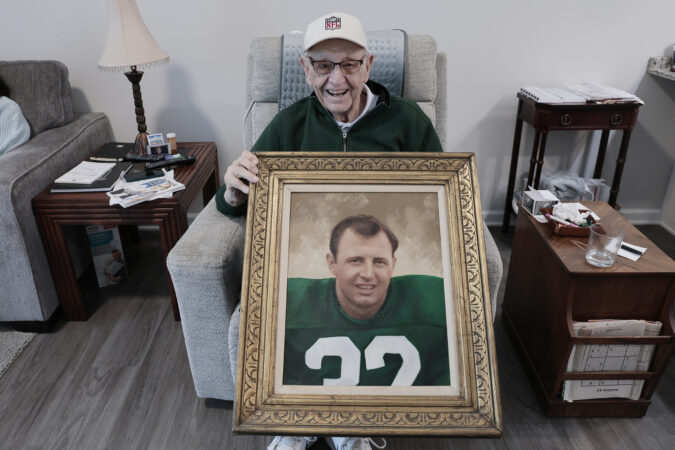
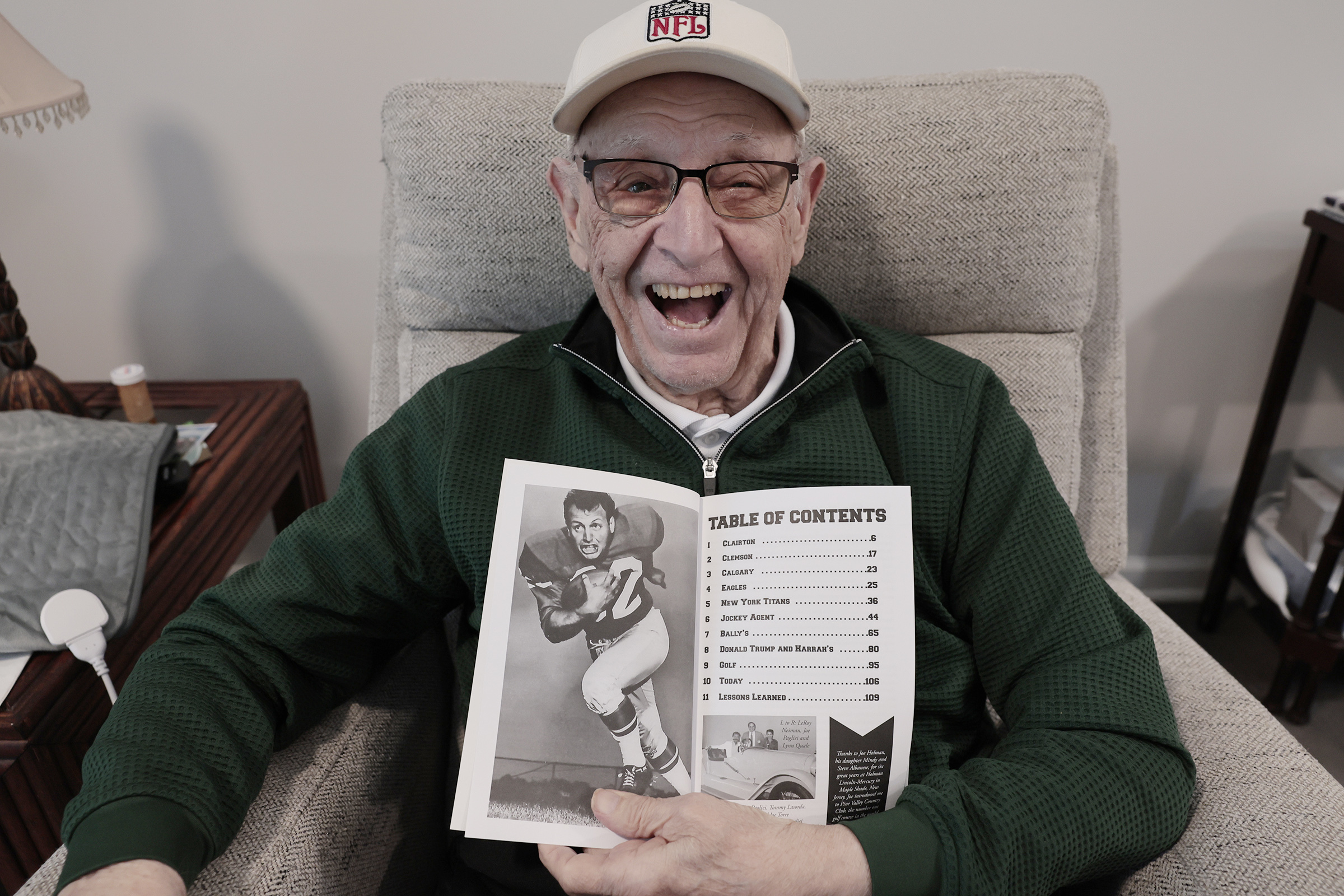
When Joe Pagliei moved to the Azalea senior living facility in September of 2023, word spread quickly. This was not just because he spent a season playing for the Eagles.
It was also because of his unabashed personality.
Pagliei would walk the halls of the Cinnaminson retirement home practicing his golf swing. If he lost a game of bingo, he’d throw the cards into the air and accuse his neighbors of “cheating.”
Every day, at 3 p.m., he’d sit at the bar, nursing a ginger ale, with copies of a book about his life stacked beside him. Before long, residents began to ask for some.
This wasn’t your average nonagenarian, after all. Pagliei spent parts of the 1950s and 1960s as a pro football player, first in Canada in the CFL, then in the NFL, and eventually, the AFL.
He played the 1959 season as a fullback and punter with the Eagles. Pagliei was the last cut in training camp before the 1960 season. The Eagles called him back, asking if he’d want to rejoin the team, but it was too late.
The fullback had already signed with the New York Titans, later to become the New York Jets. Pagliei ended up missing out on a championship.
“Big mistake,” joked his daughter Vicki.
It didn’t hamper Joe’s confidence. The former football player worked in auto sales and real estate for a few years, and became a jockey agent in 1970 out of Garden State Park Racetrack.
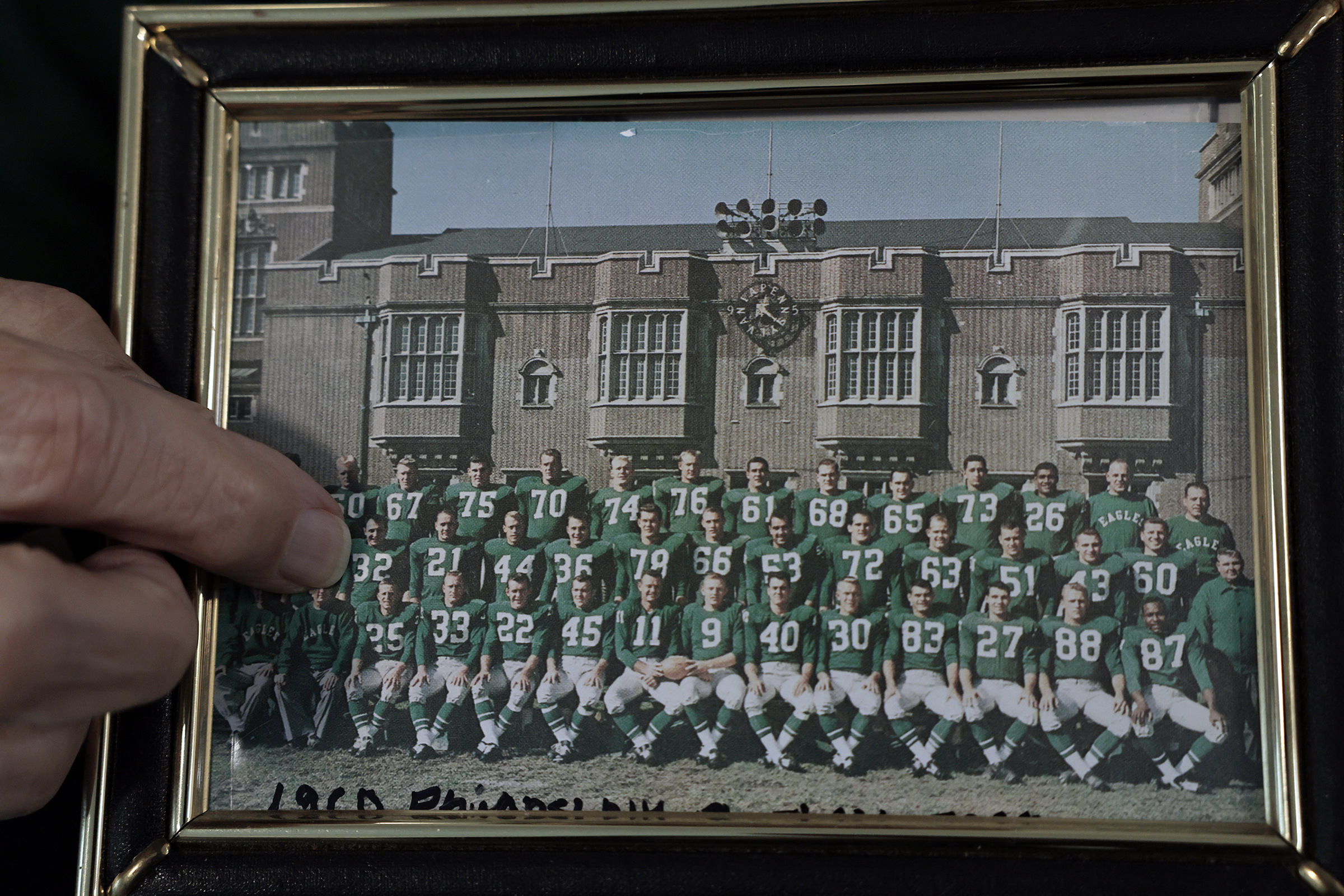
Joe Pagliei points to himself, wearing No. 32, in the 1960 Eagles team photo taken at Franklin Field.
When the track burned down in 1977, Pagliei headed to Atlantic City, where he became a casino host, crossing paths with everyone from Mickey Mantle to Joe Frazier to Sammy Davis Jr.
He moved to Mount Laurel with his wife of 62 years, Rita, and four children in 1991. He sold cars for a few years, retired in 2000, and moved to Azalea after Rita died in 2023.
At 91, Pagliei is believed to be the oldest living former Eagle. It is not a title he takes lightly. Last year, before the Super Bowl, his senior facility arranged for a visit from an Eagles-themed bus.
Dressed in his kelly green jersey, Pagliei signed one of the bus panels: “Joe Pagliei, #32.”
When he’s not lifting weights, or playing poker, he is watching Eagles games in his apartment, often with critiques of his own. Philadelphia will always be his favorite team, but he does have some misgivings about how he was used back in the day.
“I was awfully good to be sitting down,” the 91-year-old said. “Not enough [playing time].”
‘I’m going to make you famous, buddy’
Pagliei grew up in Clairton, Pa., a small town southeast of Pittsburgh, full of hard-nosed steel mill workers. His father, Alberto, emigrated from Italy and spent 48 years working as a janitor at the local plant.
The elder Pagliei, a pragmatic man who saved every dollar, didn’t see the benefit in his son joining the football team. He refused to let him play until the 11th grade.
Despite missing a few seasons, the younger Pagliei was not short on confidence. On the first day of practice, he walked straight up to his new coach.
“I said, ‘I’m going to make you famous, buddy,’” Pagliei recalled. “He said, ‘You’re full of [expletive].’ And I said, ‘Oh really?’
“I didn’t know the plays. I went out on a Wednesday. I ran two touchdowns. He said, ‘Wow.’ I said, ‘You just put my [butt] in there. Don’t worry about it.’”
Famous might have been an exaggeration, but Pagliei did catch the attention of some big-name schools. According to his 2017 self-published book, The Roast Master, he received more than 100 recruitment letters.
The fullback chose Clemson University in South Carolina. His arrival on campus in 1952 marked the first time he’d ever traveled outside of Western Pennsylvania. He played both football and baseball, and separated himself on the gridiron.
Joe Pagliei came to football later than most, but he made up for lost time as a dual-position standout.
In 1954, he led the Atlantic Coast Conference in punting, averaging 37.8 yards on 26 kicks. In 1955, his senior year, he topped the conference again, averaging 39.1 yards on his punts. He also made a dual-threat impact for the Tigers on offense, rushing for 476 yards and catching 10 passes for 233 yards.
Clemson’s 1955 team program referred to the fullback as a “flashy performer,” a characterization that seemed apt, though perhaps insufficient in retrospect.
“I did a number on ’em when I went to Clemson,” Pagliei said. “I just ran everybody the hell out. They had me as number five. I said, ‘I’m number uno.’ They said, ‘You’re five.’ I became the best one.”
After going undrafted in 1956, Pagliei received free-agent invitations from the Green Bay Packers and Washington, but said neither came “with any form of guarantee.”
He ended up getting a better contract outside the NFL, with the Calgary Stampeders of the CFL, where he played the 1956 season. Pagliei was drafted into the U.S. Army in 1957.
He joined the football team on the base while serving at Fort Knox in Kentucky, and the Eagles offered him a contract for the 1958 season. Because of his military commitment, he was unable to suit up until May 1959, when he was discharged from the Army.
The Eagles had a deep backfield, and as Pagliei noted, he didn’t get much playing time (only two carries for minus-5 yards and two catches for 9 yards). He didn’t get much time as a punter, either, because he was the backup for Hall of Fame quarterback Norm Van Brocklin.
But Pagliei did emerge with one stat to be proud of. According to The Roast Master, on Dec. 6, 1959, in the middle of a rainy game against Washington, Van Brocklin suggested that Pagliei take the kick.
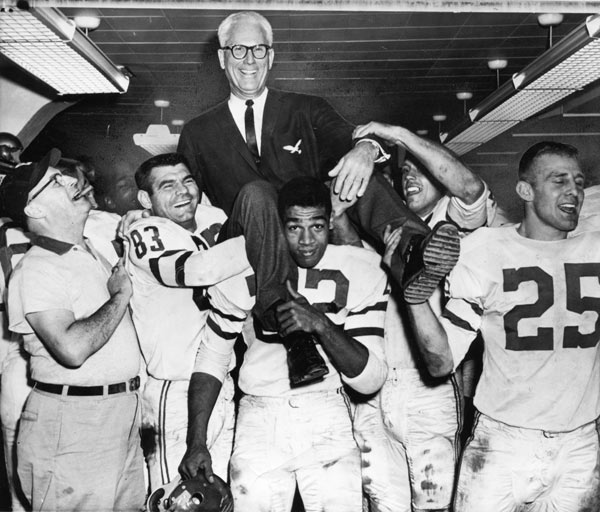
Joe Pagliei was not officially a part of Buck Shaw’s 1960 title team, but he was considered an honorary part of it by his former Eagles teammates.
He did, for 45 yards. It was the NFL rookie’s only punt of the 1959 season, giving him a yearly average of 45 yards (for his one attempt) while Van Brocklin had only 40.8 (for his 53).
“I always rubbed that in with Van Brocklin,” Pagliei wrote. “And he’d say to me, ‘You son of a [expletive]. One punt and you lead the team.’”
Pagliei again faced stiff competition in training camp the following year. He was cut on the day the Eagles took their team photo, Sept. 19, 1960, thereby capturing his final moment on the future championship-winning squad.
After he signed with the Titans of the AFL, the Eagles contacted Pagliei again. Fullback Theron Sapp had broken his leg in a preseason game and would be out longer than the team had expected.
They asked Pagliei if he’d like to return to Philadelphia, but he’d already signed his Titans contract. While missing out on history was bittersweet, the 91-year-old always felt like he was a part of the 1960 Eagles group.
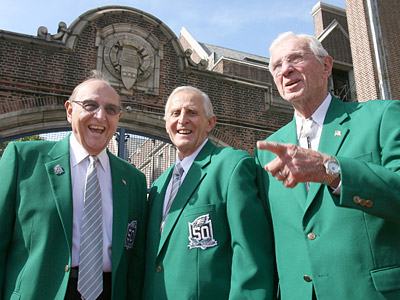
Joe Pagliei (left) with Tommy McDonald (center) and Chuck Bednarik at an event honoring the 1960 team.
It included some of his closest friends. Defensive tackle Jesse Richardson was the best man at Pagliei’s wedding. Wide receiver Tommy McDonald was like a family member. McDonald’s wife, Patty, was the godmother to Pagliei’s daughter Lizanne and the confirmation sponsor for Vicki.
Pagliei left professional football in 1961 but continued to stay a part of that fraternity. His kids would play with McDonald’s kids, and linebacker Bob Pellegrini’s kids. The team always invited Pagliei to reunions and celebrations of the 1960 championship.
In 2018, after the Eagles won their first Super Bowl, former players and their families were invited to the NovaCare Complex to see the Lombardi Trophy up close.
McDonald had been diagnosed with dementia. He attended the event in a wheelchair, donning his gold Hall of Fame jacket. The former receiver’s recall was shaky, but when he saw Pagliei, his face lit up.
“He knew who my dad was,” Vicki said. “He didn’t know too many people, but he knew who my dad was. He used to call him his brother.”
The mayor of Azalea, senior living
The staffers at Azalea of Cinnaminson say that Pagliei is something akin to a mayor. He knows everyone in the building. He also knows everythinggoing on in the building, for better or for worse.
The 91-year-old goes to the gym once a day, where he rides a bike, and does “40 reps of each weight.” On Tuesday and Thursday nights, he plays poker, a game that he might take more seriously than any other.
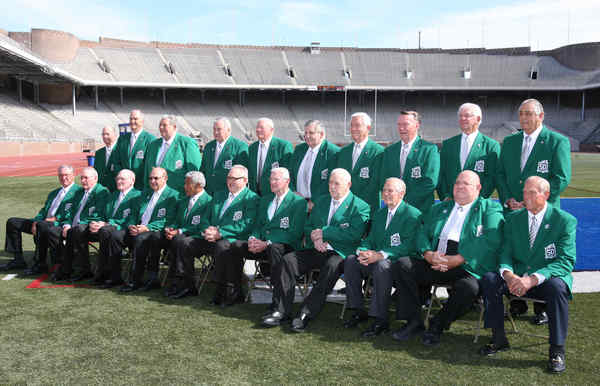
Members of the 1960 Eagles NFL championship team pose for a team photo at Franklin Field, the site of their 17-13 win over Green Bay in the title game.
“I make a lot of money,” Pagliei said, pointing to a stack of bills totaling $21 on a nearby counter. “Big time. Big time.”
The former Eagle is 66 years removed from his last NFL season, but he has not lost his competitive spark. The Azalea staff learned this the hard way.
Gracie Pouliot, a guest services manager, has had to intervene in a few contentious games of bingo.
“He’s not a very good loser,” she said. “Everyone is cheating if he loses. He’s like, ‘This is [expletive]! They cheated!’
“And we’re like, ‘No!’ He’ll throw the cards. He just cracks us up. He’s so funny.”
Linda Bryant, a life enrichment assistant, said that Pagliei used to make fun of how she’d play pool.
“He was joking around,” she said. “‘You guys don’t know how to do it.’”
Bryant and Pouliot wouldn’t have it any other way. Pagliei might not be able to punt the ball, or run the length of a field, but he still has the spirit of a teenager.
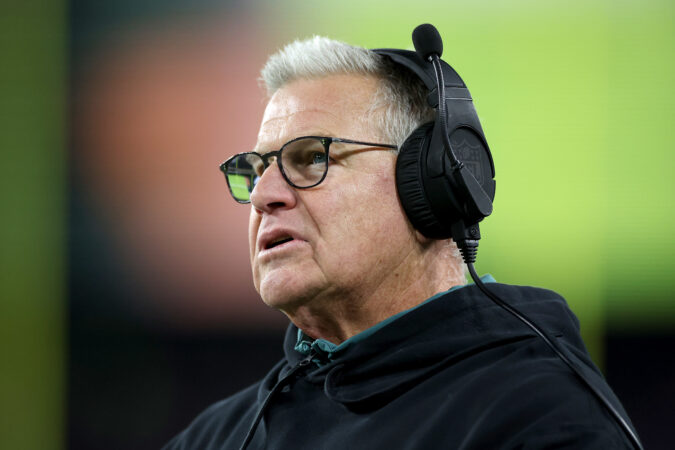
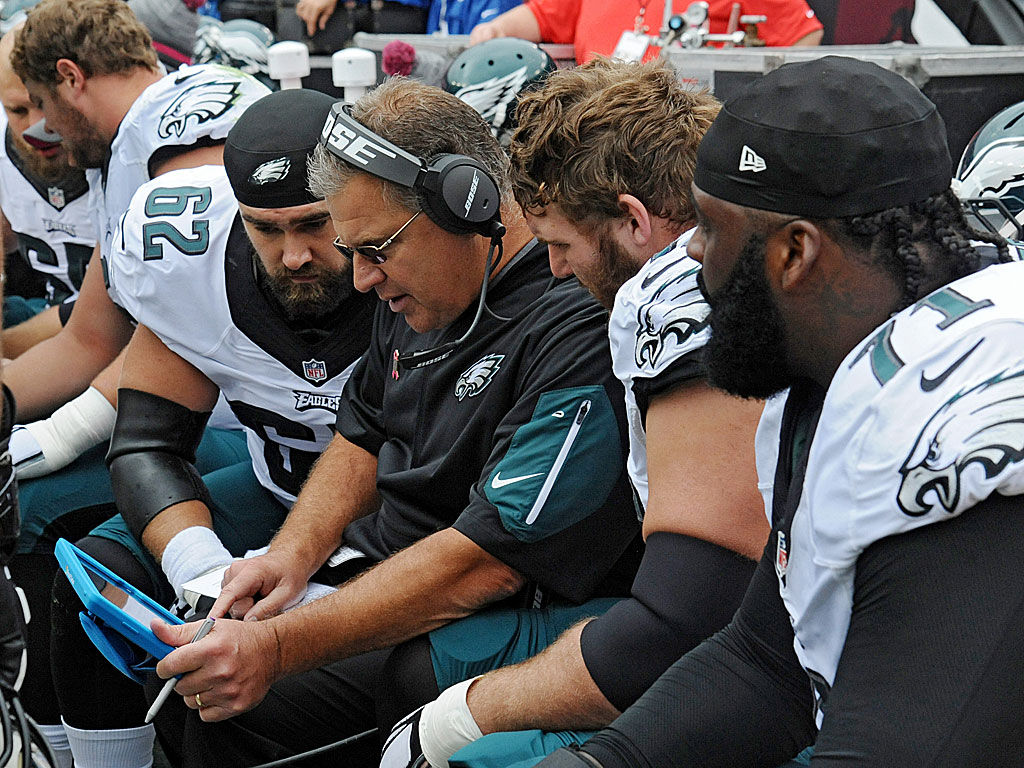
Former center Jason Kelce was one of the first people to share his thoughts when Jeff Stoutland announced last week that he was stepping down after 13 seasons as the Eagles offensive line coach.
Kelce, who spent 11 of his 13 seasons studying under the dean of “Stoutland University,” talked more about the departure of the longtime assistant on the most recent episode of New Heights.
“I mean, [he] just coached a ton of incredible players: Jason Peters, Todd Herremans, Evan Mathis, myself, Lane Johnson, Jordan Mailata — turned him from a rugby player into an All-Pro left tackle,“ Kelce said. ”He got Cam Jurgens to a Pro Bowl last year, Landon Dickerson to some Pro Bowls, Isaac Seumalo. He’s just done such an incredible job within the Philadelphia Eagles organization, and he’s been such a mainstay throughout multiple head coaches at this point.”
Kelce, who remains a regular at the team facility since his retirement and worked with the Eagles’ young offensive lineman during training camp at the request of Stoutland, also had personal reasons for not wanting to see his mentor go.
“It just sucks to see him go, selfishly. As an Eagles fan and somebody that played for him, and somebody that still goes to the facility — I still go to NovaCare on a regular basis — and I’m not going to be able to see Stout anymore,“ Kelce said. ”And that’s just frustrating for me, and I think frustrating for a lot of people in that building because he was a personality that a lot of people gravitated toward. And this is the reality of the business.”
In addition to Jason Kelce (left), Jeff Stoutland also coached left tackle Jason Peters (right).
He even offered a personal message to Stoutland, who won a pair of Super Bowls with the Eagles and has coached football longer than the 38-year-old Kelce has been alive.
Said Kelce: “Coach, I love you. I don’t know what’s next, but whatever it is, whether it’s coaching or whatever, I know you’re going to be great at it, as you always are.”
Stoutland’s greatness wasn’t lost on Travis Kelce either. While he never played for him, the younger Kelce brother admired him from afar, all while seeing the impact Stoutland had on Jason.
“You already know, man, we’ve got so much respect for him,” Travis said. “He’s one of those guys that you meet in crossing just because you were playing for him … And he’s one of those guys that you would [expletive] just know you’d love playing for, man. And it’s across the board, anybody that runs into him knows you’re going to get everything this guy has and on top of that he’s going to be real about it and we’re going to get [expletive] done.
“One of the best ball coaches I’ve known from afar, and couldn’t be more proud to say congrats on everything your career has gotten to at this point.”
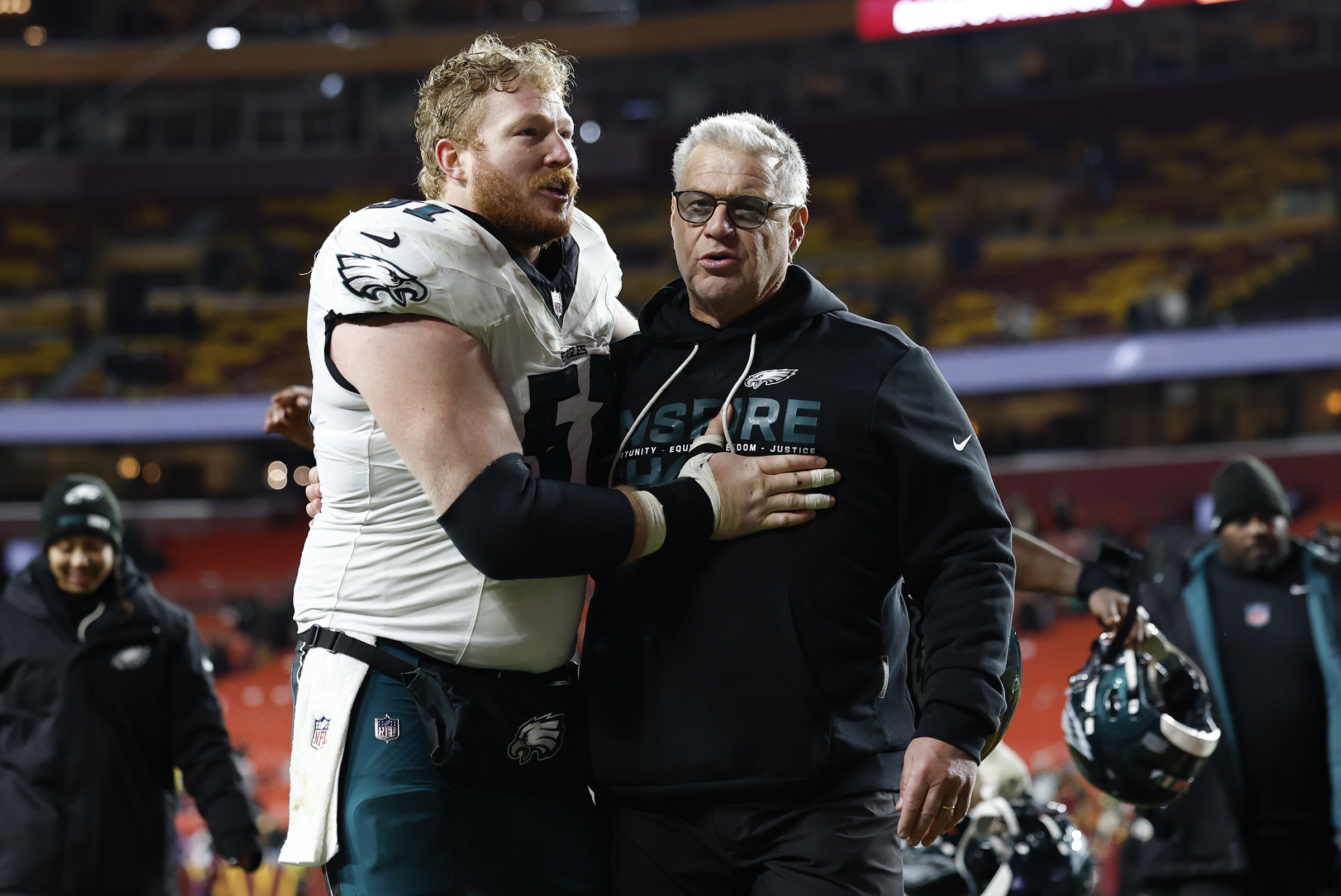
Cam Jurgens (left) was Jason Kelce’s replacement at center. Kelce helped Stoutland coach him up before retiring.
In addition to serving as offensive line coach, Stoutland was also the Eagles run-game coordinator for many years, but Nick Sirianni shifted some of those responsibilities away from Stoutland last year with the ground attack struggling, as Jeff McLane reported. The team also made a change at offensive coordinator, with Kevin Patullo (now reportedly headed to the Dolphins) being replaced by Sean Mannion. And while Jason Kelce understands the nature of the business, he wishes the veteran assistant could’ve stuck around through yet another coordinator change.
“I get that the team is trying to move forward and really embrace this new system and really redesign what this offense is. I wish Stout could’ve been a part of that, but sometimes it doesn’t work out that way,” Jason added. “Anyways, love you, coach. Couldn’t be more happy to have been coached by you.
“And 27 Pro Bowl linemen were with Stout over that 13 years. Wild.”
After five seasons with the Eagles, including a yearlong stint as the offensive coordinator last season, Kevin Patullo reportedly will not return to Philadelphia in 2026.
The Miami Dolphins are hiring Patullo as their pass game coordinator, according to NFL Network, joining a revamped coaching staff under new head coach Jeff Hafley and offensive coordinator Bobby Slowik.
The Eagles removed Patullo from his post as offensive coordinator in January following their wild-card loss to the San Francisco 49ers. The Eagles offense, which returned 10 of 11 starters from the Super Bowl LIX-winning team, regressed under Patullo. The unit finished the season ranked No. 19 in scoring and No. 24 in yards after ranking No. 7 and No. 8 in those respective categories with Kellen Moore at the controls in 2024.
Patullo had technically remained on Nick Sirianni’s staff for the last month, although it seemed unlikely that he would find a role on the offensive coaching staff under Sean Mannion, whom the Eagles hired as their new offensive coordinator on Jan. 29.
The offensive staff has undergone sweeping changes in a short span, underscored by veteran offensive line coach Jeff Stoutland announcing his exit after 13 seasons. Mannion filled Stoutland’s offensive line coach duties by hiring Chris Kuper, his former colleague with the Minnesota Vikings. The Eagles hired another of Mannion’s former coworkers when they named Ryan Mahaffey, formerly of the Green Bay Packers, as the team’s tight ends coach and run game coordinator.
The Eagles also hired ex-Tampa Bay Buccaneers offensive coordinator Josh Grizzard as pass game coordinator shortly after Mannion was named OC.
Despite the departures of Patullo, Stoutland, and former tight ends coach Jason Michael, the Eagles will have some continuity among the offensive coaching staff. Wide receivers coach Aaron Moorehead and running backs coach Jemal Singleton are among those who will be retained.
Patullo reportedly will get a fresh start in a somewhat familiar place. The 44-year-old coach attended high school in the Miami area in Davie, Fla., and played college football at South Florida in Tampa.
Sonny Jurgensen was an Eagle and a Redskin but never a saint.
It’s been about a week since the hedonistic Hall of Famer died at 91 and nearly 62 years since he departed Philadelphia for Washington in a trade that left the city’s bartenders as downcast as its football fans.
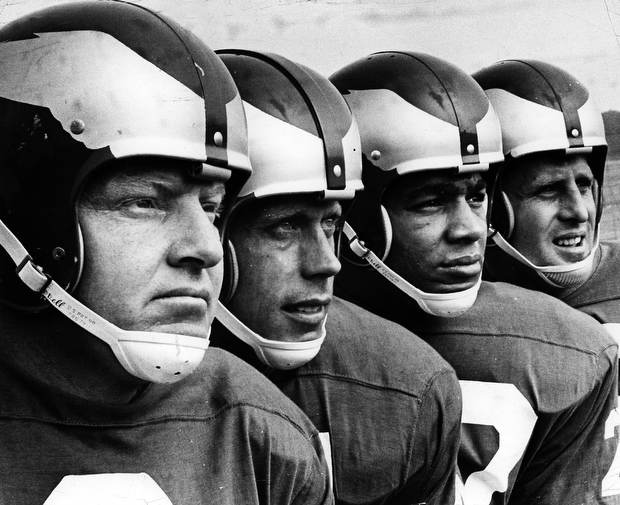
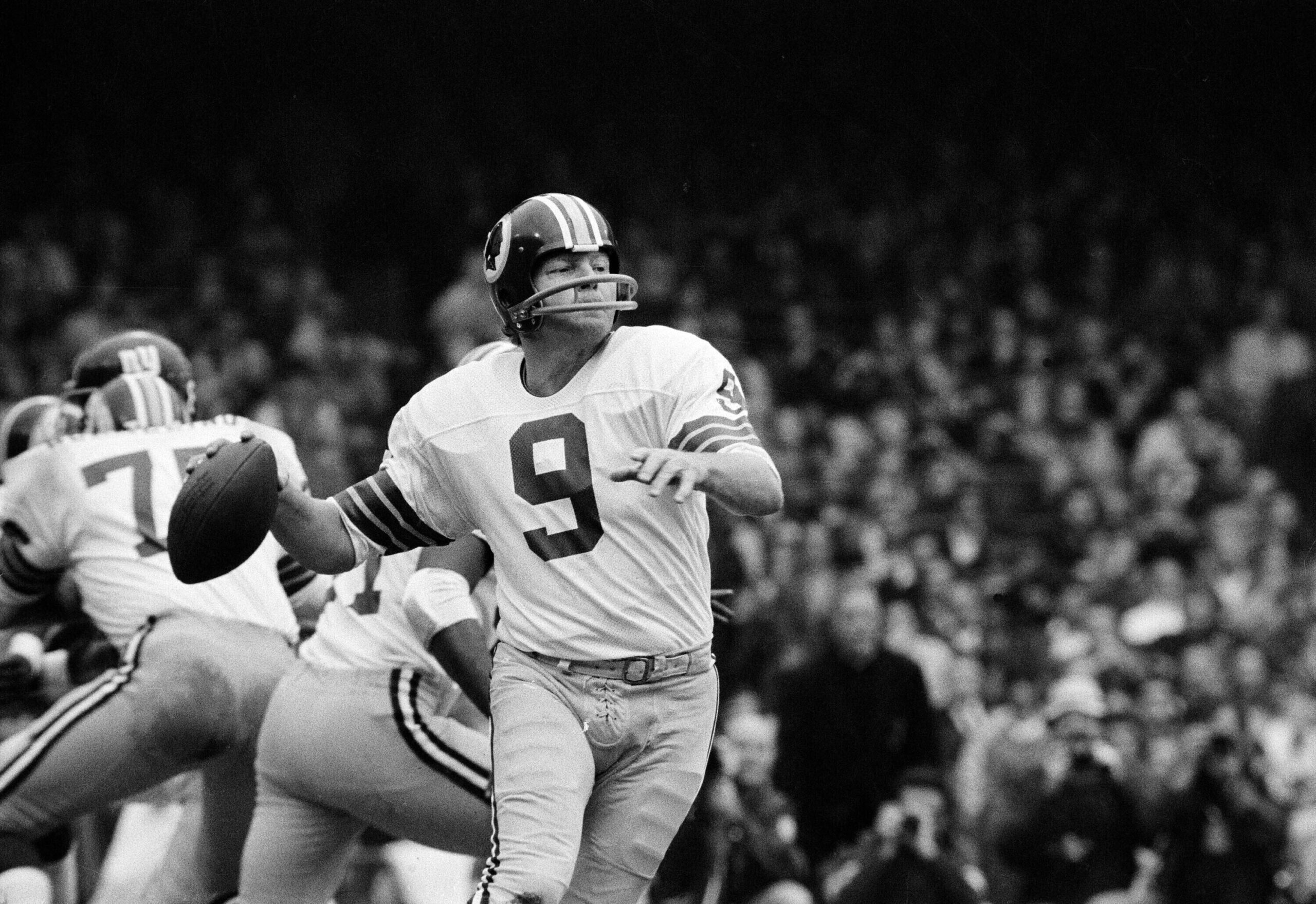
Thinking of Jurgensen now, I still conjure images of that flimsy helmet he wore with its single-bar face mask. I see him squirming in the pocket, quickly surveying the downfield action, then flicking those effortless passes to Tommy McDonald or Pete Retzlaff.
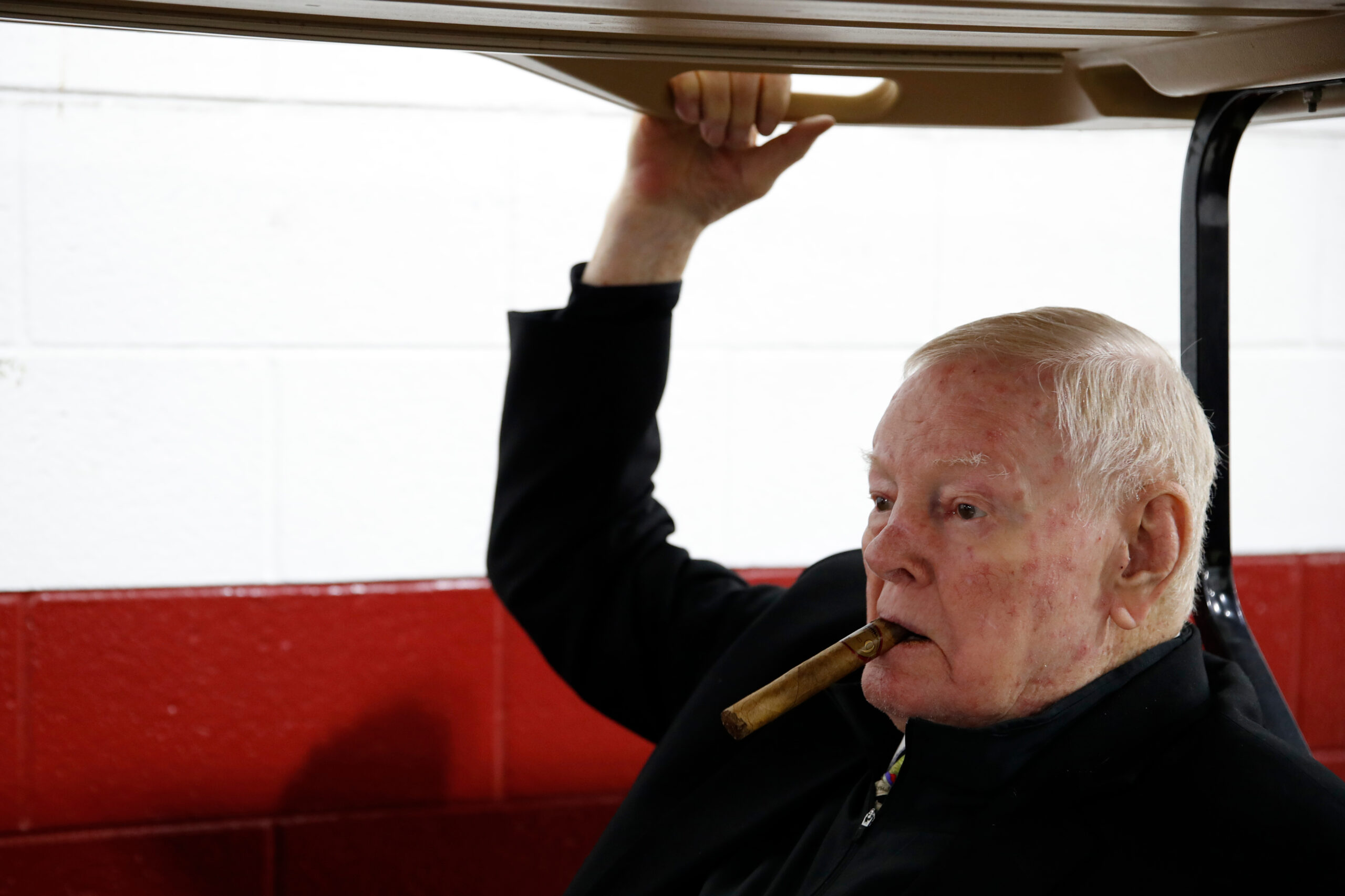
But I also still see, maybe more than in any other athlete from that era, his personal foibles. There was the booze, the pot belly, the mischievous smile, the postgame cigars that jutted from his mouth like middle fingers to those who disapproved.
Sonny Jurgensen was one of the NFL’s great characters of his era and went go on to achieve exalted status in Washington.
Jurgensen was one of the first Philly athletes whose lifestyle was as well-known as his talents. Throughout his seven seasons as an Eagle, the last three as a starter, Philadelphia was rife with whispered stories about the redhead’s off-field encounters. It hardly was a secret that he loved liquor, ladies, and last calls.
Like many of his early-1960s Eagles teammates, the native North Carolinian lived during the season at the Walnut Park Plaza hotel at 63rd and Walnut, just a short stagger from one of the team’s favorite bars, Donoghue’s. Jurgensen regularly showed up there as well as Center City spots like the Latimer Club and Jimmy’s Milan.
Another of his favorite haunts was Martini’s, an Italian restaurant and bar in Berwyn where he befriended the owner, Louie DiMartini. DiMartini’s son, Bill, remembered all the nights that his dad and “Uncle Sonny” showed up at their house.
“One night, my siblings and I were in bed when we were awakened by loud singing,” DiMartini said. “Sonny and my dad had just made up a song called ‘Pine Tree.’ The song had no other lyrics but ‘pine tree,’ and they went on singing it for hours.
“Another time, the Eagles couldn’t find Sonny; he hadn’t shown up for practice. We woke up to get ready for school, and as my older brothers went downstairs they found Sonny sleeping on the couch. My father told us, ‘You didn’t see anything.’”
I was a 12-year-old sports nut when I learned of Jurgensen’s off-field proclivities. For me, pardon the expression, it was a sobering experience, perhaps the first time I realized sports heroes weren’t gods.
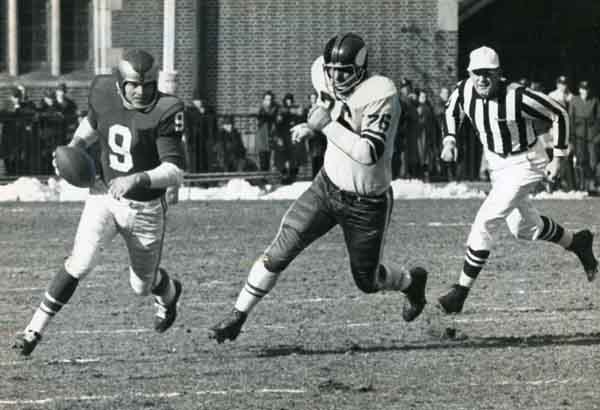
Sonny Jurgensen led the Eagles to a 10-4 mark and was an All-Pro in 1961. After two more seasons he was traded to Washington.
If my memory is accurate, it happened on a morning in January 1962. The night before, my father, the sports editor of two Philadelphia neighborhood weeklies, had attended his first Philadelphia Sports Writers Association banquet.
I couldn’t wait to hear about it. So at 7:30 the next morning, when he got home from his full-time job as a Bulletin proofreader, I was waiting at the door. As I peppered him with questions, he handed me the event’s program. On its front page were the autographs he’d gathered from sports celebrities he’d encountered there — Gene Mauch, Sonny Liston, Mickey Mantle.
Clearly a little starstruck himself, he eagerly described Mantle’s Oklahoma drawl, Liston’s enormous hands, Mauch’s steely eyes.
Then I saw another signature, this one from Jurgensen, the spirited quarterback who’d just emerged as an NFL star after throwing a league-best 32 touchdown passes during the Eagles’ 10-4 season in 1961.
I awaited my father’s impressions. A virtual teetotaler, his tone shifted when he said, clearly disapproving, “I’ve never seen anyone drink so much.”
That was a jolt. Could a star quarterback be a drunk? That didn’t compute. It was, after all, the pre-Ball Four world of the early 1960s when most of us knew nothing about things like Mantle’s carousing or Liston’s mob connections. Sports writers of the era, many of whom partied just as hard as Jurgensen, shielded the athletes they covered.
My young mind’s palette worked in black and white only. There were no shades of nuance. Heroes had no flaws. Or so I believed. Was Jurgensen a drunk or a hero? He couldn’t be both. Was he the pure-passing machine who’d just thrown for an NFL-high 3,723 yards? Or was he no different from those lost souls my grandmother pointed out in warning whenever we rode the 47 trolley past Vine Street’s Skid Row.
Eagles players (from left) Sonny Jurgensen, Pete Retzlaff, Timmy Brown, and Tommy McDonald during the 1963 season.
I still wasn’t sure when in April 1964, 12 days after he dealt McDonald, Jurgensen’s partner on and off the field, coach/general manager Joe Kuharich shocked Eagles fans by trading the colorful QB to Washington. I wondered if it had something to do with the then 29-year-old’s lifestyle. And I wasn’t alone. Daily News columnist Jack McKinney gave voice to what many thought was behind the incongruous trade.
“Another theory is that Jurgensen’s off-field antics, something less than that of a Boy Scout leader, may have been a factor.”
That trade, which brought pedestrian QB Norm Snead here, was a bad omen. It launched one of the longest and darkest stretches in Eagles history. They wouldn’t reach the postseason again until 1978. In those 14 intervening seasons, the team amassed a combined record of 68-122-6.
With Jurgensen, meanwhile, Washington made five playoff appearances in that span, and in his first six seasons there, he was named first- or second-team All-Pro four times.
No matter the Washington coach, Jurgensen flourished. For three seasons, he clashed with prudish Otto Graham — “He likes candy bars and milkshakes,” Jurgensen said, “and I like women and scotch” — but twice led the league in passing yards. He got along famously with Graham’s successor, Vince Lombardi. Never prone to hyperbole, Lombardi once admitted that Jurgensen “may be the best the league has ever seen.”
And he was still pretty formidable after hours, too. He became a regular at such late-night D.C.-area establishments as the Dancing Club and Maxie’s. At least twice, he was charged with driving while intoxicated.
Sonny Jurgensen spent 11 seasons as a player in Washington and was named to the Pro Football Hall of Fame in 1983.
Jurgensen ended his 18-year career in 1974 with the highest QB rating (82.62) of anyone in the pre-1978 era. Sometime in the 1980s he reportedly stopped drinking and for four decades was Washington’s drawling, plain-spoken radio analyst.
By then the NFL had changed. Its stars now endure round-the-clock scrutiny.
I’m not sure how Jurgensen would have dealt with social media, paparazzi, tabloid headlines. Would it have impacted his play? Would the DWIs have sent him to rehab? Would the whispers have become shouts?
In the end, I really don’t care.
I lost that sportswriters banquet program years ago. I lost a lot of that youthful righteousness, too. So from now on, in those corners of my mind where it’s always a sunlit Sunday at Franklin Field, I’ll remember Jurgensen simply as a gifted man with a child’s name who lofted all those beautiful spirals.
On Monday, former Eagles quarterback Michael Vick joined former NBA star Carmelo Anthony on his 7pm In Brooklyn podcast to discuss his NFL career — including the impact Andy Reid and the Eagles organization had on him when he returned to football after serving 21 months in federal prison for felony offenses related to operating a dogfighting ring and a gambling enterprise.
“That second act was everything that I needed in my life,” Vick said. “Talk about full circle, completion.”
Changing Birds
Vick joined the Eagles shortly after his time in prison in 2009, with Reid bringing him in to back up then starter Donovan McNabb. At the time, it was unclear if Vick, a three-time Pro-Bowler with the Atlanta Falcons and the 2005 MVP runner-up, would get a second chance in professional sports following his indictment.
“I hate to say it, but I needed some time to myself,” Vick said in reference to his time in prison. “As much as it hurt and as much as I cried, because I didn’t come from that, I had to adjust and adapt to that. I did, and I made it through, but within that time I was just building my whole [mentality] to come back and be a better version of myself.”
A backup in his first year, Vick was able to return to a starting role in 2010 after the Eagles traded McNabb, and his replacement, starter Kevin Kolb, suffered a concussion against the Green Bay Packers in Week 1. Vick was eventually named the starter, helping the team go 10-6 while earning himself NFL comeback player of the year honors.
Michael Vick signed with the Eagles as a backup in 2009.
Rejuvenated
Vick finished second to Tom Brady, the eventual MVP, in offensive player of the year voting in 2010, and the Eagles fell to the Packers in the wild-card round of the playoffs. The lefty quarterback, who signed a six-year, $100 million deal with the Birds that offseason, credited his career resurgence to his teammates and the culture Philly had established before his arrival.
“I still was young,” Vick said. “Still had so much to learn. I appreciated it the second time around because I ended up with Andy Reid. I ended up with a great group of teammates: DeSean [Jackson], LeSean [McCoy], Jeremy Maclin, Jason Peters, Jason Avant, Jason Kelce, Nick Foles — all these dudes were my brothers, Donovan, [Brian] Westbrook, it was family.”
Vick noted how he didn’t apply himself fully in Atlanta, and that the Eagles taught him how to be a professional, and described how too many nights out and an unserious mindset hampered his growth while with the Falcons.
“I had seen that they were just different in Philly,” Vick said. “It was just all about learning and getting better every day and supporting one another. Things that I didn’t do in Atlanta, that I wish I had done, I was able to do. Being able to come back and win comeback player of the year, all the hard work I put in, it’s like, damn, mentorship is really real. Brotherhood is real. Trust is real. Accountability is real.”
Vick also pushed himself to improve off the field, which started during his time in prison.
“When I was away, I wanted to prepare myself to be a better version of myself,” Vick said. “As far as being media friendly, being more approachable, just being better, a better person all around, a better family man for my kids, my wife, just searching for completion.”
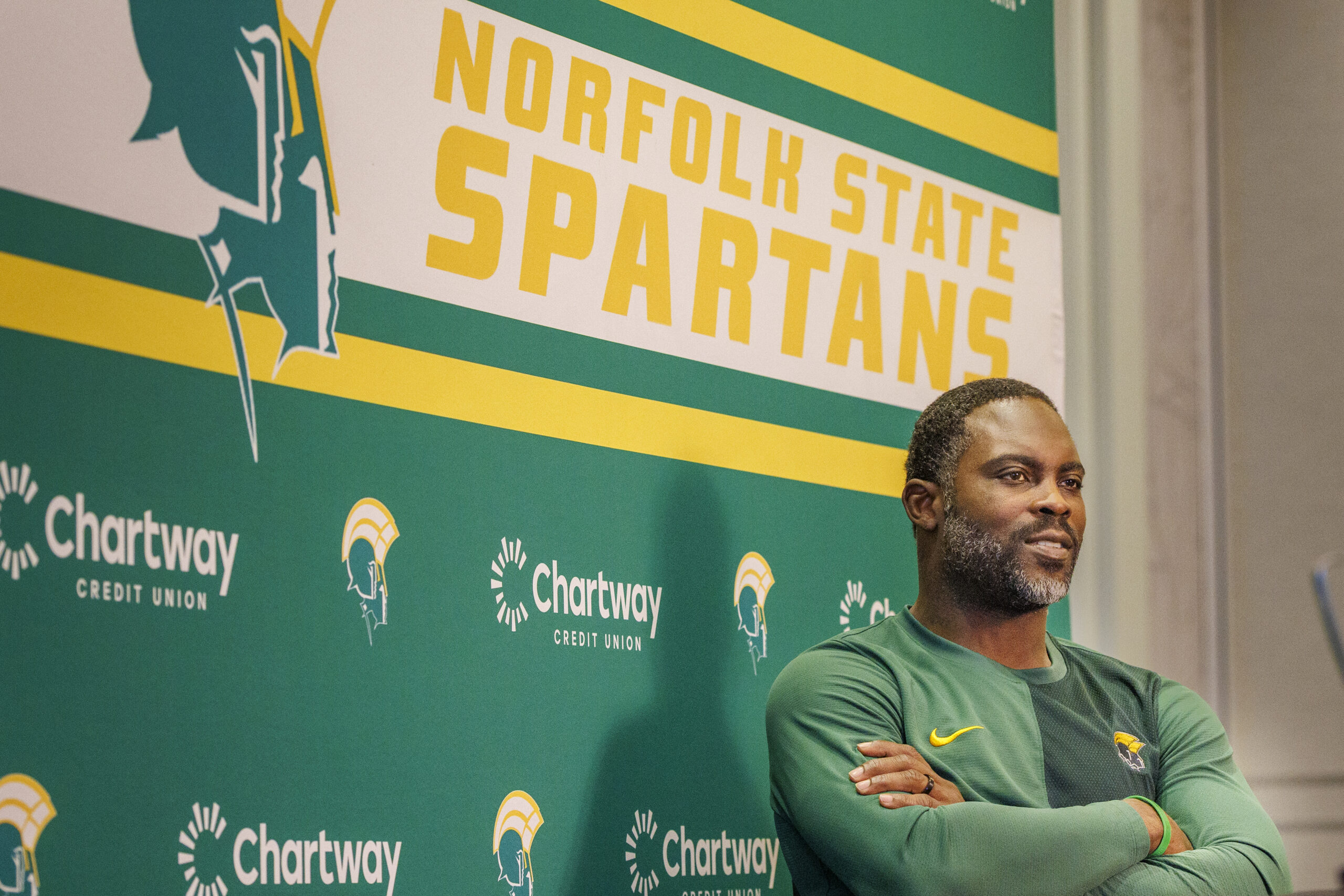
Vick is now the head coach Norfolk State, and faced off against former teammate DeSean Jackson, now the coach of Delaware State, at the Linc last year.
Coaching matters
Before he ever wore midnight green, Vick says he was jealous of McNabb and the situation the former quarterback had in Philly — specifically highlighting Reid’s coaching style. McNabb and Reid ended two of Vick’s playoff runs with the Falcons, defeating Vick in the divisional round in 2003 and in the 2005 NFC championship.
“Don’t take this the wrong way, Donovan, but I was a little envious,” Vick said. “Like, damn, man, you got a great coach. I’m looking at the offense, watching them on film, and if I was doing that type of stuff, we’d be winning more.”
At the time, Vick didn’t understand how transformative playing for Reid would be. Not only did the coach helpgive him his second shot in the NFL, but he also opened the door for Vick to one day become a coach himself.
“God blessed me and put me in that man’s presence,” Vick said in reference to Reid. “I didn’t take that for granted, and what it taught me … [was] I can be a coach one day, even though that was something I never thought I would be doing.”
Vick is now the head coach of Norfolk State, a historically Black university located near his hometown of Newport News, Va. Last October, Vick found himself at Lincoln Financial Field once again, this time as a coach, where he faced off against former teammate DeSean Jackson, who is now the coach of another HBCU program, Delaware State.
The Eagles are retaining running backs coach/assistant head coach Jemal Singleton and wide receivers coach Aaron Moorehead, NFL sources told The Inquirer on Tuesday. While coach Nick Sirianni has already made significant changes to his offensive staff, led by hiring Mannion last month, the return of two key members of his staff suggests a relative blending of the old and new.
Mannion, a first-time coordinator, is expected to bring with him some elements of the Kyle Shanahan-Sean McVay scheme that he learned during his playing and coaching careers. While Mannion never previously worked with Josh Grizzard — the Eagles’ new pass game coordinator — Grizzard also has experience in the “Shanahan” scheme.
New tight ends coach/run game coordinator Ryan Mahaffey and offensive line coach Chris Kuper have more direct links with Mannion, having crossed paths with the former backup quarterback and Packers quarterbacks coach.
Eagles wide receivers coach Aaron Moorehead running a drill with DeVonta Smith in June.
The Eagles have yet to hire a new quarterbacks coach. Existing quarterbacks coach Scot Loeffler remains on staff. Mannion, who played for the Rams, Vikings, and Seahawks during his playing career, is expected to work closely with Jalen Hurts, which could determine the type of quarterbacks coach he tabs.
Several other assistants on offense will return, as well, although their future roles are to be determined. Pass game coordinator Parks Frazier, assistant offensive line coach Greg Austin, and offensive quality control coaches Eric Dickerson and Montgomery VaGorder also will be back, sources said.
Kevin Patullo’s future with the team also remains uncertain. He was removed as offensive coordinator by Sirianni last month following his first season as a play-caller, but he currently remains with the Eagles.
Longtime offensive line coach Jeff Stoutland’s resignation last week perhaps was the most significant change thus far this offseason. Stoutland 13-year run with the Eagles came under three head coaches. He became run game coordinator 2018 but was expected to lose that responsibility amid schematic changes.
Tight end coach Jason Michael also is no longer with the organization, sources said.
On defense, most of coordinator Vic Fangio’s staff will return. Defensive backs coach/pass game coordinator Christian Parker left last month to take the Cowboys’ defensive coordinator job. The 67-year-old Fangio considered retirement for a second straight year, but he elected to return, sources told The Inquirer last week.
It’s still unclear how much of the offense will look different with Hurts and most of the starting offense slated to return. The mix of new with Mannion and old from Sirianni’s staff since he became coach in 2021 suggests there will be some carryover.
The Eagles are no longer the defending champions, and their early exit from the playoffs one month ago has already ushered in major changes. Out is offensive coordinator Kevin Patullo, in is new offensive coordinator Sean Mannion, and with him more changes to the offensive coaching staff.
The Eagles are facing a key offseason as they aim to make changes and improvements to make sure their Super Bowl window remains open in 2026 and beyond.
Stoutland’s departure is a big one, as he has long been regarded as the best offensive line coach in the NFL. The Eagles hired his replacement on Monday by bringing in former Vikings offensive line coach Chris Kuper, who was with Minnesota as the line coach for the last four seasons before his contract expired. Kuper crossed paths with Mannion in 2023, when Mannion was a quarterback on the Vikings’ roster. He also worked under Vic Fangio as an assistant offensive line coach when Fangio was the head coach of the Denver Broncos (2019-21).
The new hires also indicate that Parks Frazier, the pass game coordinator this season, and Jason Michael, the tight ends coach, could be on their way out with the Eagles as the team revamps its offensive scheme under a new coordinator.
On the defensive side, there was a brief scare when Fangio was mulling retirement, but the defensive coordinator made the decision to return to the Eagles for the 2026 season. Fangio’s exit would have been a big blow, especially considering that the Dallas Cowboys plucked Eagles defensive backs coach Christian Parker, a highly regarded, 34-year-old up-and-comer, to be their new defensive coordinator. It had always seemed like a matter of time until Parker, who was also the defensive pass game coordinator, was lured to a better job with another team, and that time came.
Parker, of course, has been instrumental in helping the Eagles develop their two young All-Pro defensive backs, Quinyon Mitchell and Cooper DeJean. Those young players will now be under the tutelage of Joe Kasper, who will assume the role of defensive backs coach after being promoted from safeties coach, a position the Eagles need to backfill.
Did Jaelan Phillips show the Eagles enough to get a new contract from them this offseason?
Roster decisions
Scheduled free agents
The Eagles have 20 pending free agents — 10 on offense, nine on defense, and punter Braden Mann.
Offense
TE Dallas Goedert: Goedert reworked his deal last offseason to stay with the Eagles and scored a career-best 11 touchdowns, a tight end record for the team. Considering the Eagles don’t have any tight ends on the roster, they may look to bring the 31-year-old back after he got through the season relatively healthy.
WR Jahan Dotson: The little-used third receiver could find a new home this offseason. WR3 is a tough position on this team behind A.J. Brown and DeVonta Smith, and it seems unlikely the Eagles will find it worth bringing Dotson back.
OT Fred Johnson: Johnson left for free agency after last season, but the Eagles traded for him before the season for some insurance at tackle, and they needed it. It remains to be seen how the Eagles approach the draft and free agency, but Johnson’s return would put an experienced body on the depth chart.
TE Grant Calcaterra: As mentioned, the Eagles don’t have any tight ends. Calcaterra has been productive when the Eagles use him as a pass catcher, but he’s not a great blocker, and the Eagles need their tight ends to block.
OL Brett Toth: The do-it-all lineman has been a valuable asset in the offensive line room. He can fill in at any position.
TE Kylen Granson: Granson was a big part of the Eagles’ special teams, despite having a limited role in the offense. The tight end position is in flux, but Granson could return as a depth piece.
OL Matt Pryor: The Eagles brought back a familiar and experienced face in the offseason for some depth. Pryor gave that and provided positional versatility. But he wasn’t all that great in relief.
RB AJ Dillon: Dillon started the season in the mix to get snaps behind Saquon Barkley, but he fell out of favor after the Eagles traded for Tank Bigsby. Dillon was inactive for most of the second half of the season and logged just 12 carries. The Eagles are pretty set at running back with Barkley, Bigsby, and Will Shipley.
QB Sam Howell: The Eagles weren’t comfortable with Kyle McCord as QB3, so they acquired Howell before the season. McCord has since landed with Green Bay.
FB Ben VanSumeren: VanSumeren changed positions from linebacker to fullback and made the 53-man roster, but his season ended with an injury on the opening kickoff in Week 1. The Eagles signed Kansas City’s Carson Steele to a futures contract. Will they bring back VanSumeren and have a fullback competition?
Defense
Edge rusher Jaelan Phillips: The deadline acquisition stepped in right away and was a difference-maker along the defensive line. The Eagles need a top-end edge rusher to add to a unit that has Jalyx Hunt and Nolan Smith under contract. Phillips would make sense.
LB Nakobe Dean: Dean returned from patellar tendon surgery in the middle of the season and looked like he didn’t miss a beat. But the Eagles drafted his replacement last season in Jihaad Campbell.
S Reed Blankenship: Blankenship has been a big part of the defense for the last four years. He has started 50 games and is a leader. The Eagles are thin at safety, but it remains to be seen what Blankenship’s market looks like and if the Eagles will be in the mix.
CB Adoree’ Jackson: Jackson was up and down in training camp and to start the season, but he played his way into a starting job opposite Mitchell. He’ll be 31 next season, and the Eagles probably want to get better at CB2.
S Marcus Epps: Epps stepped in as a starter after Drew Mukuba went down. He just turned 30, although he could find his way back to the Eagles and compete for a job.
Edge rusher Brandon Graham: Graham came out of retirement and briefly changed positions when Jalen Carter went down and the interior needed a boost. Will he go back into retirement?
Edge rusher Joshua Uche: Uche seemed to be playing his way into a bigger role when the Eagles brought Graham out of retirement, which forced Uche to a lesser role. The Eagles are thin on the edge, though Uche seems to be more of a depth piece right now.
Edge rusher Azeez Ojulari: Ojulari ended up behind Uche on the depth chart and then missed most of the season after being placed on injured reserve.
Edge rusher Ogbo Okoronkwo: Okoronkwo made the team out of training camp as a depth edge rusher but suffered a season-ending injury in Week 4, the only game in which he played.
Special teams
P Braden Mann: Mann had a great season. He ranked fifth in the NFL in punt average (49.9 yards). It would make sense for the Eagles to want to bring him back.
New deals?
There are a few players under contract who could be in the running for a new contract with the Eagles.
DT Jordan Davis: The Eagles picked up Davis’ fifth-year option last offseason and he remains under contract for the 2026 season. But after a breakout 2025 season, he likely earned himself a lot of money.
DT Jalen Carter: The Eagles likely will do what they did with Davis and pick up Carter’s fifth year, but it might be time for an extension now. Carter didn’t have his best season after a dominant 2024. The Eagles may be able to sign him to a more team-friendly deal, though Carter and his agent, Drew Rosenhaus, may opt to play 2026 on his current deal and revisit the big-money deal next offseason.
DT Moro Ojomo: Ojomo is set to play the final year of his four-year rookie deal in 2026. The seventh-round pick has been a major success story. Will the Eagles look to lock him up beyond 2026? Will they be able to afford all of these defensive linemen with big contracts coming in the future for other defensive stars like Mitchell and DeJean?
Contracted players who could be on the way out
The Eagles have some players on the 2026 roster who may not be here when training camp starts.
K Jake Elliott: Elliott has had two consecutive seasons in which he didn’t perform well enough. His 2025 field goal conversion rate was just 74.1%, the lowest of any kicker who played a full season.
WR A.J. Brown: Will his frustrations with the offense cause him to ask for a trade? It would be a costly move for the Eagles, but they’ve willingly taken on dead cap in the past. The Eagles would have a big hole to fill if it came to that.
RT Lane Johnson: Johnson remains one of the best tackles in football, but his availability was an issue this season. He missed the final eight games after suffering a Lisfranc injury in his right foot. The Eagles probably would love him back, but Johnson will be 36 in May and won’t play forever.
LG Landon Dickerson: The Inquirer’s Jeff McLane reported in a podcast during Super Bowl week that Dickerson’s return was no sure thing. The 27-year-old played through a lot of pain in 2025 and his body has taken a toll with multiple injuries since his college football playing days. An early retirement would leave the Eagles with a big hole.
QB Tanner McKee: Will the Eagles look to ship McKee to another team for a draft pick? McKee’s Week 18 performance didn’t help their cause.
CB Kelee Ringo: Ringo remains under contract on his rookie deal, but he seems like a change-of-scenery candidate. He has struggled to get on the field with the Eagles, though he has been great on special teams.
2026 free agency targets
What do the Eagles need most? What kind of players will be on the market?
First, the Eagles need to know what happens with the futures of key offensive players like A.J. Brown, Lane Johnson, and Landon Dickerson.
At the moment, they have just over $20 million in cap space, according to Over the Cap. That’s not a lot, but Howie Roseman has shown the creativity to use void years and spread cap hits out over multiple seasons.
Free agency begins March 11.
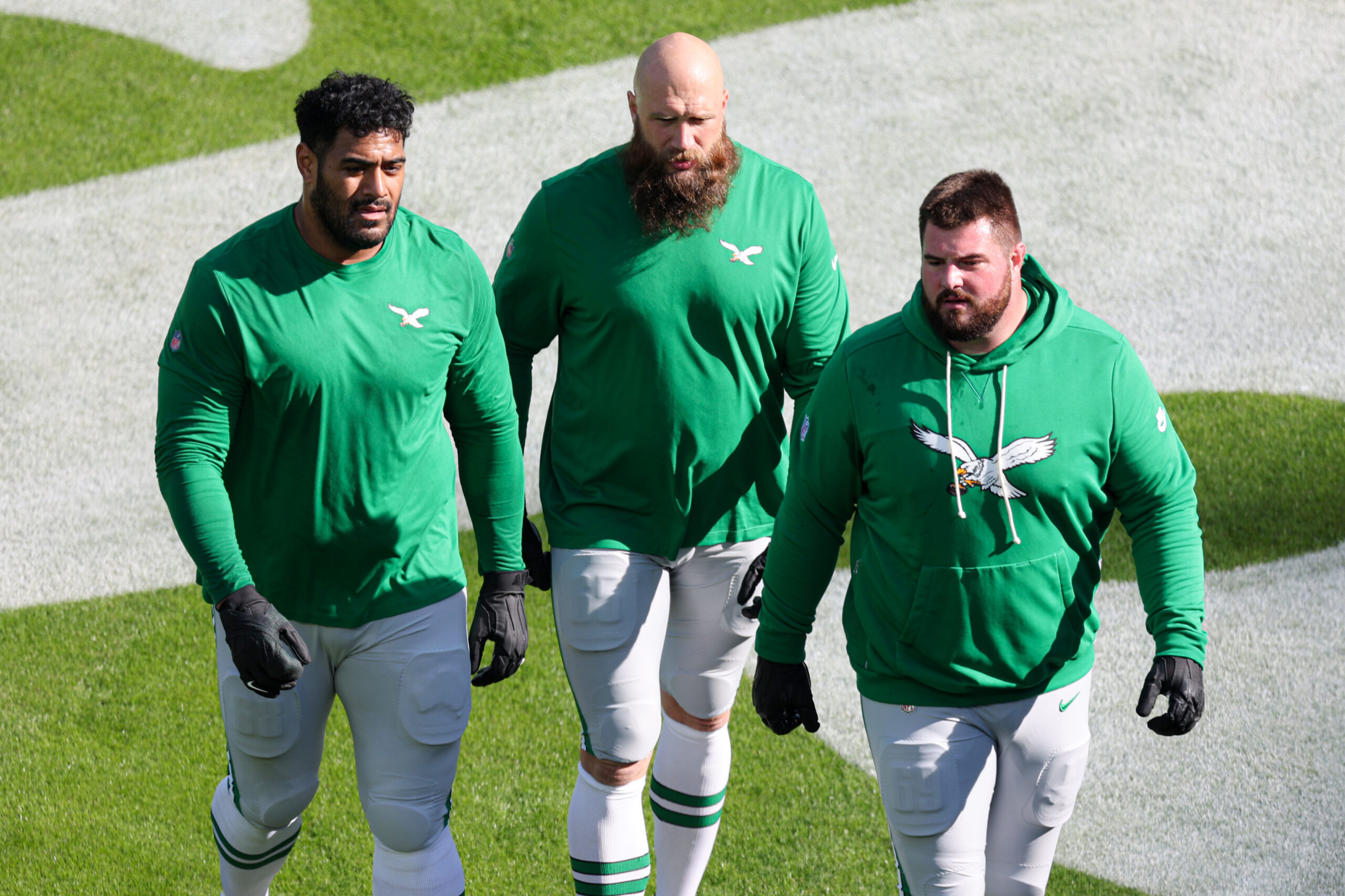
Jordan Mailata (left) will be back, but what will become of tackle Lane Johnson (center) and guard Landon Dickerson (right)?
Position groups and players to target
Offensive line: Will Johnson return? Will Dickerson ever be fully healthy again? Can Cam Jurgens bounce back? Those are big questions facing the Eagles, who need to restore their offensive line this offseason. Reinforcements likely will come via the draft, but free agency offers some options.
Indianapolis Colts right tackle Braden Smith, for example, has dealt with injuries but could provide insurance for Johnson and help the Eagles bridge their way to the next young tackle. Old friend Isaac Seumalo fits that bill, too, at guard. Same with Cleveland Browns guard Joel Bitonio.
Wide receiver: Regardless of what happens with Brown, the Eagles could use some more help at receiver. They won’t be playing in the George Pickens pool, and probably not Alec Pierce, either, but what about Romeo Doubs, Kendrick Bourne, or Van Jefferson at WR3?
EDGE: Jaelan Phillips should be at the top of the Eagles’ wish list. Jalyx Hunt and Nolan Smith are the only two edge rushers under contract. The Eagles will draft at least one rusher, but they need a top-end talent like Phillips. If not Phillips, other top options would be Trey Hendrickson, Odafe Oweh, Boye Mafe, Joey Bosa, and Khalil Mack. There’s always the possibility of Roseman figuring out a way to trade for Maxx Crosby, too.
Tight end: Dallas Goedert may be in the running to return. But if not, the Eagles could eye someone like Atlanta’s Kyle Pitts, who finally played to his potential this season. Pitts attended Abington and Archbishop Wood before playing at Florida in college. Other free agents include Isaiah Likely, David Njoku, and Tyler Higbee. The Eagles probably will use a draft pick on one, too.
Cornerback: Quinyon Mitchell eventually will re-sign at the top of the market, and you don’t see many teams spending that type of money on two players at this position. But there are some options the Eagles could target, like Tariq Woolen, Roger McCreary, and Jamel Dean. Will those players be too costly? We’ll see.
Safety: Reed Blankenship has been solid for the Eagles, but he’s not great in coverage. The Eagles could be looking to pair Drew Mukuba with a better player on the back line, and they could look to do that via free agency. Old friend Kevin Byard has been really productive with the Chicago Bears, though he could command a bigger contract than the Eagles are willing to give out. Los Angeles Rams safety Kamren Curl could be an option.
The 2026 NFL draft will be held April 23-25 in Pittsburgh.
The 2026 NFL draft
The Eagles’ needs here will become clearer after free agency, though our Devin Jackson released his first mock draft Monday morning and has the Eagles making a key addition to their offense at a position of need.
The draft will take place beginning on Thursday, April 23, in Pittsburgh.
The yearly NFL Scouting Combine begins on Feb. 23; and teams have until April 15 to conduct visits, tests, and interviews with prospective draft picks.
League meetings (updated Jan. 17)
The annual league meeting is from March 29 to April 1 in Arizona. It is there that the Tush Push likely will be another big topic of conversation and could meet its demise.
But the Eagles’ lack of success using their signature play this season could result in some teams backing off a little bit. We’ll see.
There’s also another league meeting May 19 and 20 in Orlando.
2026 Eagles schedule (updated Jan. 17)
The Eagles’ opponents are known. They play home games vs. their three divisional opponents (Washington Commanders, Dallas Cowboys, and New York Giants), as well as other games vs. the Indianapolis Colts, Carolina Panthers, Los Angeles Rams, Seattle Seahawks, Pittsburgh Steelers, and Houston Texans.
Besides their three NFC East road games, the Eagles also travel to play the San Francisco 49ers, Chicago Bears, Arizona Cardinals, Jacksonville Jaguars, and Tennessee Titans.
It remains to be seen if the Eagles will get an international game.
The schedule is due out in May, but international dates will likely be released before that.
The Eagles have their replacement for longtime offensive line coach Jeff Stoutland.
A league source confirmed an NFL Network report that the Eagles are hiring Minnesota Vikings offensive line coach Chris Kuper for the same role in Philadelphia. Kuper’s contract with Minnesota expired after the season and the team did not retain him, according to The Athletic.
Kuper, 43, had been the line coach for the Vikings since 2022 and crossed paths there with new Eagles offensive coordinator Sean Mannion in 2023, when Mannion was on the roster as a quarterback.
Kuper, who was drafted in the fifth round in 2006 and played guard for the Denver Broncos for eight seasons, also worked as an assistant offensive line coach under Eagles defensive coordinator Vic Fangio when Fangio was the head coach in Denver from 2019 to 2021.
Jeff Stoutland had been the Eagles’ offensive line coach since 2013.
Kuper has big shoes to fill. Stoutland was the Eagles’ offensive line coach from 2013 to 2025 and was widely regarded as the best line coach in the NFL. Stoutland announced his departure from the Eagles last week. The Eagles are moving to a new scheme under Mannion, and while Stoutland was offered a chance to return as offensive line coach, according to a source, he wasn’t going to have the role of run game coordinator and ultimately decided to step away from coaching with the Eagles.
The Eagles’ offensive line took a dramatic step back in 2025, mostly because of injuries. Lane Johnson missed half the season, and Landon Dickerson and Cam Jurgens were never or rarely fully healthy and did not have the same impact as in previous seasons. The futures of Johnson and Dickerson could be up in the air, and the Eagles could be forced to replace one or two key parts of the line, or at the very least need to start planning for replacements via the draft or free agency.
Kuper’s hiring marks the fourth new offensive coach in the building, a process that started when the Eagles hired Mannion on Jan. 29. They also hired former Tampa Bay offensive coordinator Josh Grizzard to be the pass game coordinator and hired Green Bay wide receivers coach Ryan Mahaffey as the run game coordinator and tight ends coach.
SANTA CLARA, Calif. — As the Eagles demonstrated last year, defense wins championships.
The Seattle Seahawks pounded the New England Patriots and their quarterback Drake Maye for three quarters and cruised to a 29-13 victory in Super Bowl LX on Sunday night at Levi’s Stadium.
The Seahawks had standouts on offense and special teams, as running back Kenneth Walker displayed in an MVP performance and kicker Jason Myers showed in making all five of his field goal attempts. But it was their “Dark Side” defense that set the tone and carried Seattle to its second title and first in 12 years.
What does the Seahawks’ achievement mean for the Eagles moving forward? Well, not much more than the Eagles realized a year ago when they made a future Hall of Fame quarterback look helpless. No matter how you do it, pressuring the quarterback is paramount.
Maye is no Patrick Mahomes, and few expected the 24-year-old and a young Patriots team to get this far in coach Mike Vrabel’s first season at the helm. Of course, the same could have been said for Seattle quarterback Sam Darnold, who once got lost in the NFL wilderness before general manager John Schneider signed the free agent last offseason.
But it was coach Mike Macdonald’s defense, Walker’s tough running, and Myers’ leg that compensated for an unremarkable passing attack. Here are five takeaways — with an Eagles slant — from the 60th Super Bowl:
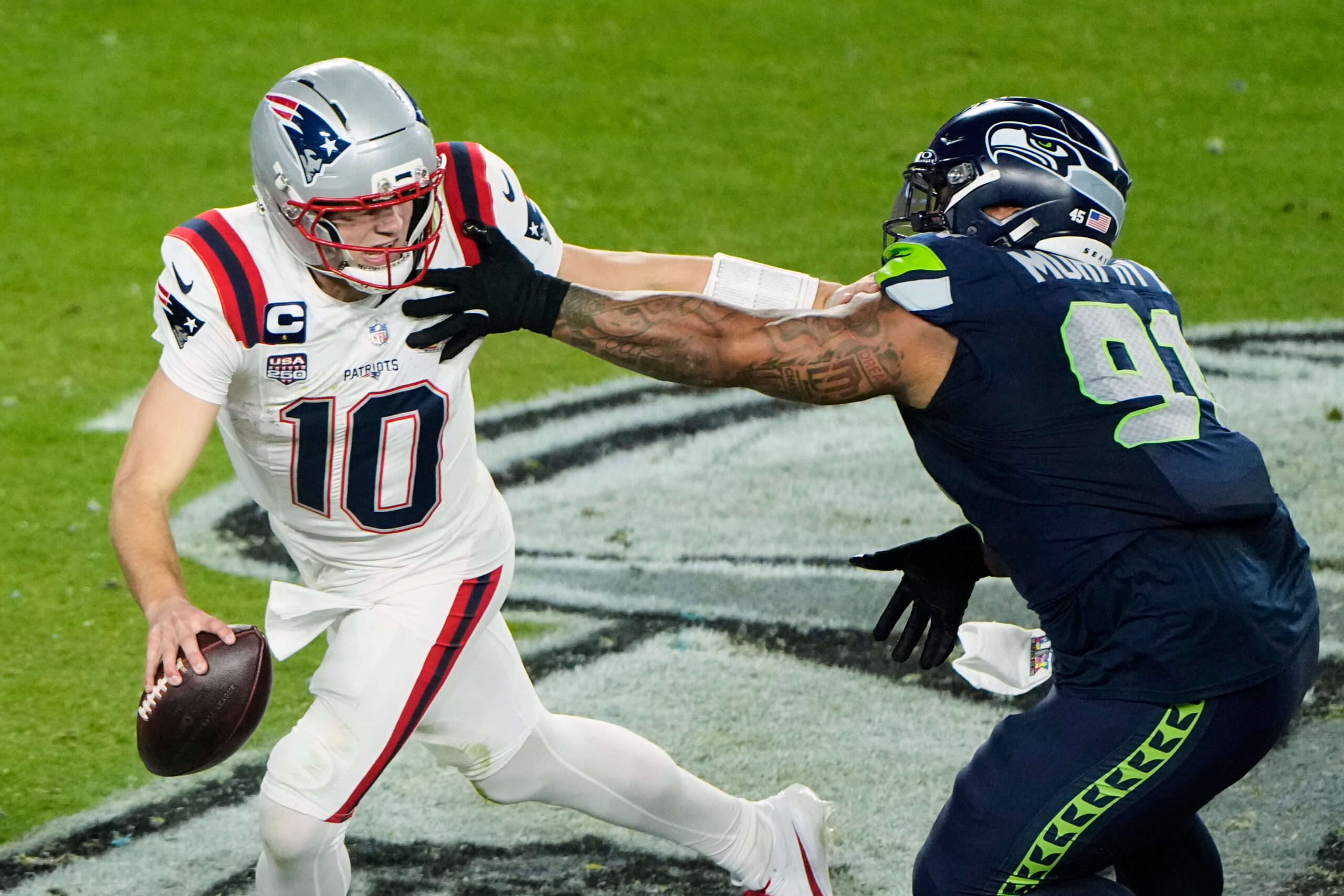
Byron Murphy II (91) and the Seahawks’ front four got after Drake Maye all night.
A familiar defensive philosophy?
Schneider knows something about building elite defenses. Twelve years ago, the Seahawks’ “Legion of Boom” unit whipped quarterback Peyton Manning and the Denver Broncos and won going away, 43-8, in Super Bowl XLVIII.
This group, led by another elite secondary, may not yet have the name recognition of Richard Sherman and Earl Thomas from that early 2010s Seattle defense. But third-year cornerback Devon Witherspoon and rookie safety Nick Emmanwori are already two of the best at their respective positions.
The Seahawks consistently pressured Maye, and their zone coverages and heavy dime personnel took away the quarterback’s few reads. There were just as many moments when the quarterback had little time in the pocket due to the pass rush.
The four-man front did its job, but Macdonald’s selective blitzes had Maye dipping his eyes as the game progressed. Witherspoon got to him four times from the slot. He forced two throwaways, registered a sack, and hit Maye just as he threw on a key play in the fourth quarter. The ball landed in linebacker Uchenna Nwosu’s arms and he went 45 yards the other way for a touchdown and a 29-7 lead.
A year ago, the Eagles famously didn’t blitz once and sacked Mahomes six times and forced three turnovers. The Seahawks weren’t a blitzing team in the regular season, and Macdonald followed that approach in the Super Bowl, sending extra rushers just 13.2% of the time, according to NextGen Stats.
Maye was sacked six times and pressured on 52.8% of his drops. And like Mahomes, he tossed two interceptions and fumbled once. The Patriots, meanwhile, went against their norm and blitzed Darnold on 53.7% of his drops.
There are different ways to skin a cat. The Eagles’ scheme isn’t changing, with defensive coordinator Vic Fangio returning after mulling retirement. But there could be room for a slightly more aggressive approach next season.
No other defense was as passive in 2025. The Eagles had the highest percentage of light boxes in defending the run and they had the lowest blitz rate in the NFL. Fangio’s approach worked for the most part, but he didn’t have the defensive front he had a year ago.
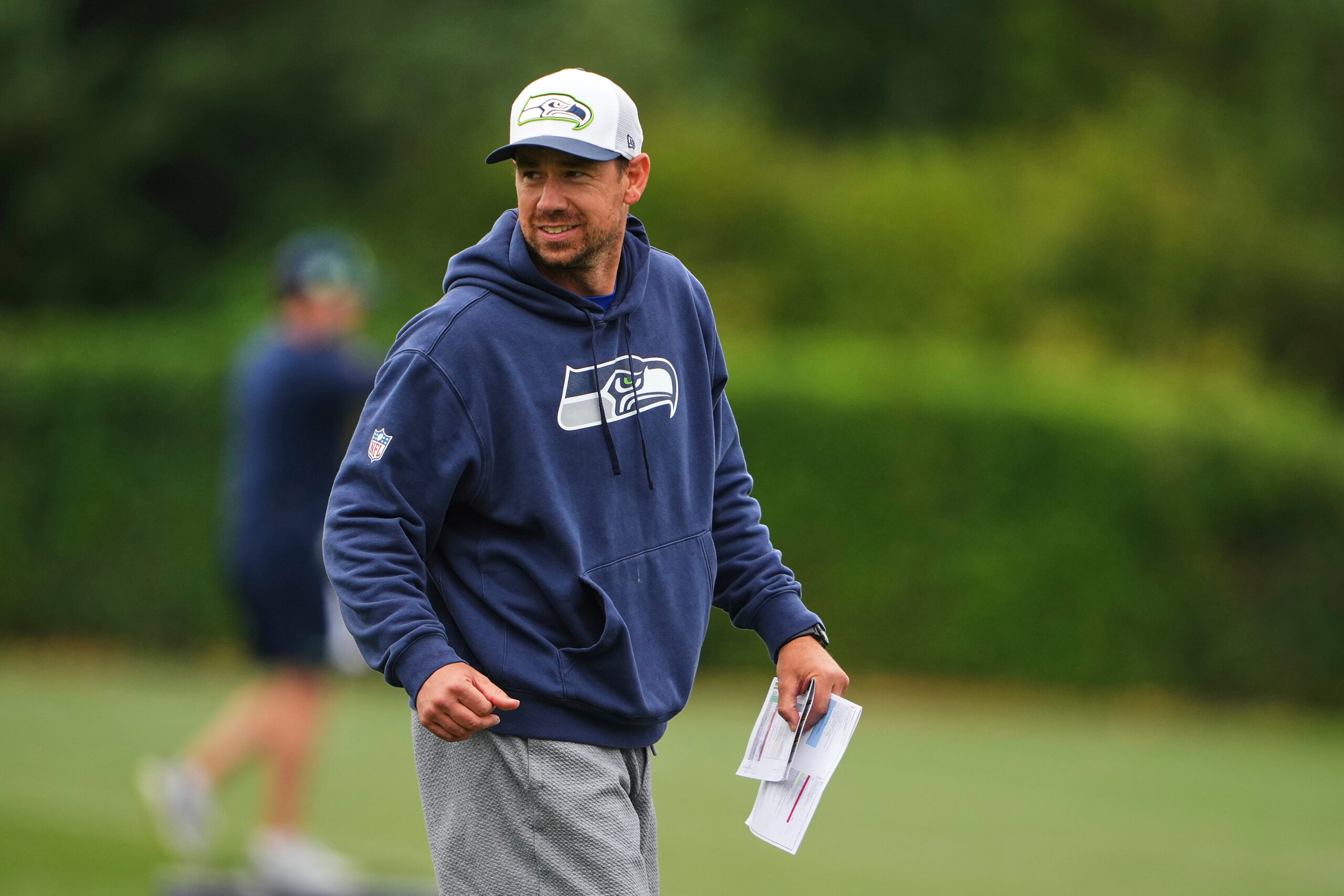
Seahawks offensive coordinator Klint Kubiak is headed to Las Vegas to become Raiders head coach, and elements of his scheme will show up in Philly next season with Sean Mannion.
How did the Shanahan-McVay scheme fare?
With the Eagles expected to change their offense after the hiring of coordinator Sean Mannion, the Seahawks offered an opportunity to see how the Shanahan-McVay system that Seattle operates offensively would fare on the biggest stage.
The results were mixed. But two staples of the scheme that have flourished under 49ers coach Kyle Shanahan and Rams coach Sean McVay and their acolytes were effective against the Patriots: under-center play-action and outside zone runs.
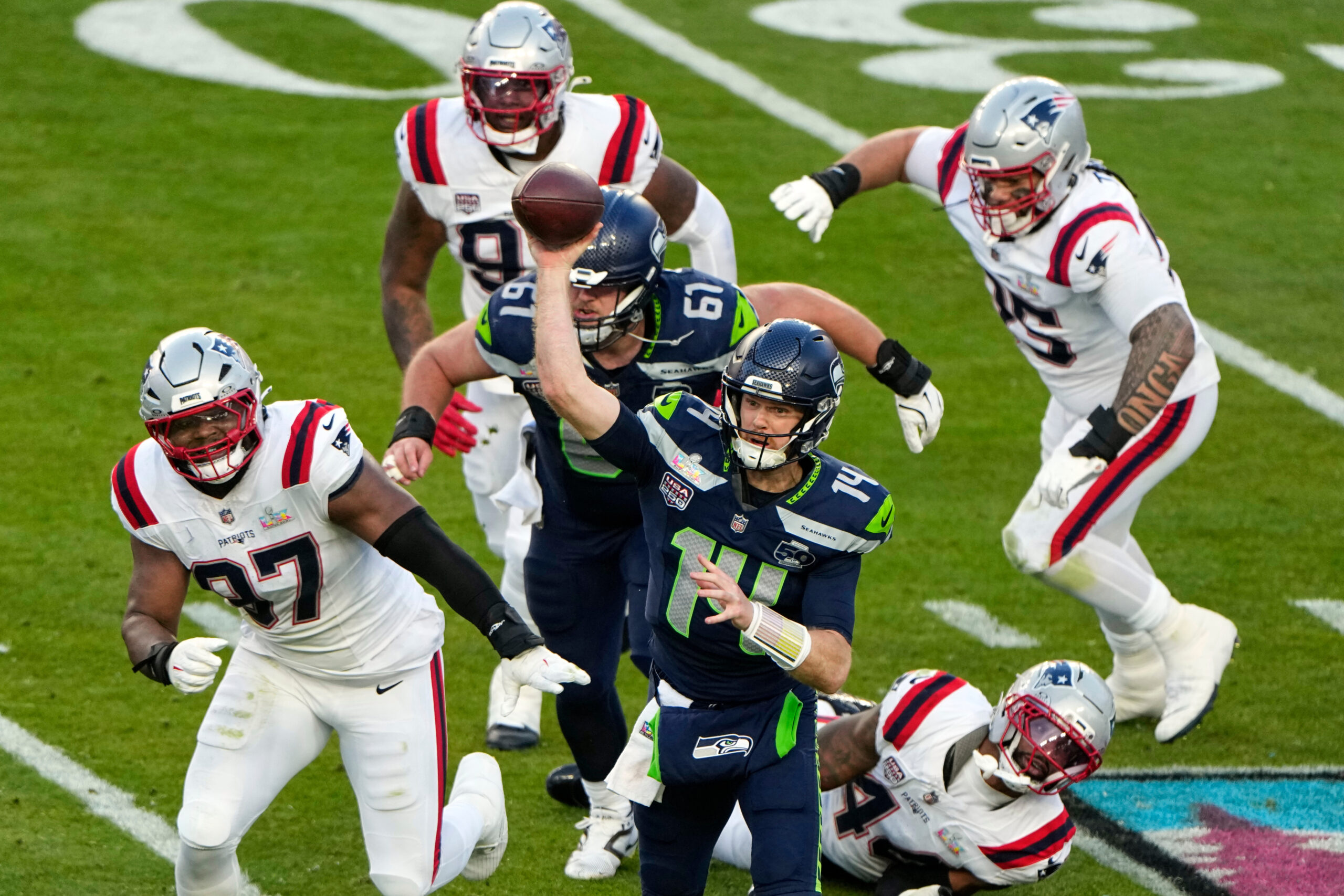
Darnold was under center for almost half the plays — 35 of 71 — as coordinator Klint Kubiak stayed committed to the ground game. It helped that the Patriots never really threatened the Seahawks. But Walker was often allowed to run downhill and finished with 135 yards rushing on 27 carries.
He gained 71 yards on 12 carries (5.9 average) on runs outside the tackles. The Eagles long had an inside zone-heavy offense under run game coordinator Jeff Stoutland. But they tried to shift away from that tendency last season when they essentially took that responsibility from the offensive line coach.
It was a mild tweak, meant to create more diversity in the running game, but improvement was marginal. There will likely be a more significant transition under Mannion, who played under McVay and Kubiak, and coached under another from the Shanahan tree: Matt LaFleur.
Stoutland’s sudden resignation, after coach Nick Sirianni was prepared to hire tight ends coach Ryan Mahaffey to assume running game duties, was further evidence that change is coming. The Eagles want an offense that has more variables and under-center plays that give quarterback Jalen Hurts more layup throws.
Darnold’s lone touchdown pass came from under center when play-action caught Patriots linebacker Jack Gibbens. The quarterback found wide-open tight end AJ Barner for a 16-yard score early in the fourth quarter.
How far will Sirianni go in altering the offense? It’s been relatively the same structure since 2021. The Eagles had great success with it, but last season’s regression was stark, and wasn’t all on first-time coordinator Kevin Patullo.
How Hurts and the rest of the returning offense adapt is to be determined. But change is coming.
Milton Williams (97) had a sack and was around the football all night.
Milton Williams balled out — again
Milton Williams fell short in his quest to become the fifth player to win back-to-back titles for different teams, but the Patriots defensive tackle had nothing to be ashamed about.
The same could be said for New England’s defense. The unit kept the Patriots within striking distance despite the offensive struggles. But, ultimately, they succumbed after Maye and Co. went three-and-out on five of six possessions during one stretch.
Aside from cornerback Christian Gonzalez, Williams might have been the Patriots’ best defender. He gave Seahawks right guard Anthony Bradford fits and finished with six pressures, one sack, and one batted pass.
The former Eagle, who had two sacks and a forced fumble in last year’s Super Bowl, beat a double team before dropping Darnold in the backfield for a third-quarter loss. It was the Patriots’ lone sack of the game.
Williams wasn’t as dominant vs. the run and finished with just one tackle. But Walker had most of his success running away from New England’s interior defense.
Vrabel knew he had to hang his hat on his defense, but his game management and offensive coordinator Josh McDaniels’ play-calling leaned conservative. Their most egregious moments came on McDaniels’ early run call on third-and-5, and the team electing to punt on fourth-and-1 at the Patriots’ 41 while down 12-0 in the third quarter.
Vrabel also erred in not going for two after a Patriots touchdown narrowed Seattle’s lead to 19-7 early in the fourth quarter.
Williams might not have won for a second straight year, but he further justified the Patriots signing him to a four-year, $104 million contract last offseason. The 26-year old told The Inquirer last week that he never wanted to leave Philly and felt slighted when the Eagles didn’t tender an offer.
The Eagles had first-rounders Jalen Carter and Jordan Davis, along with Moro Ojomo, returning at defensive tackle. It would have been difficult for general manager Howie Roseman to justify extending Williams with other necessary investments waiting in the pipeline.
But time will tell, assuming Carter and Davis eventually get signed to second contracts, if the Eagles made the right decision.
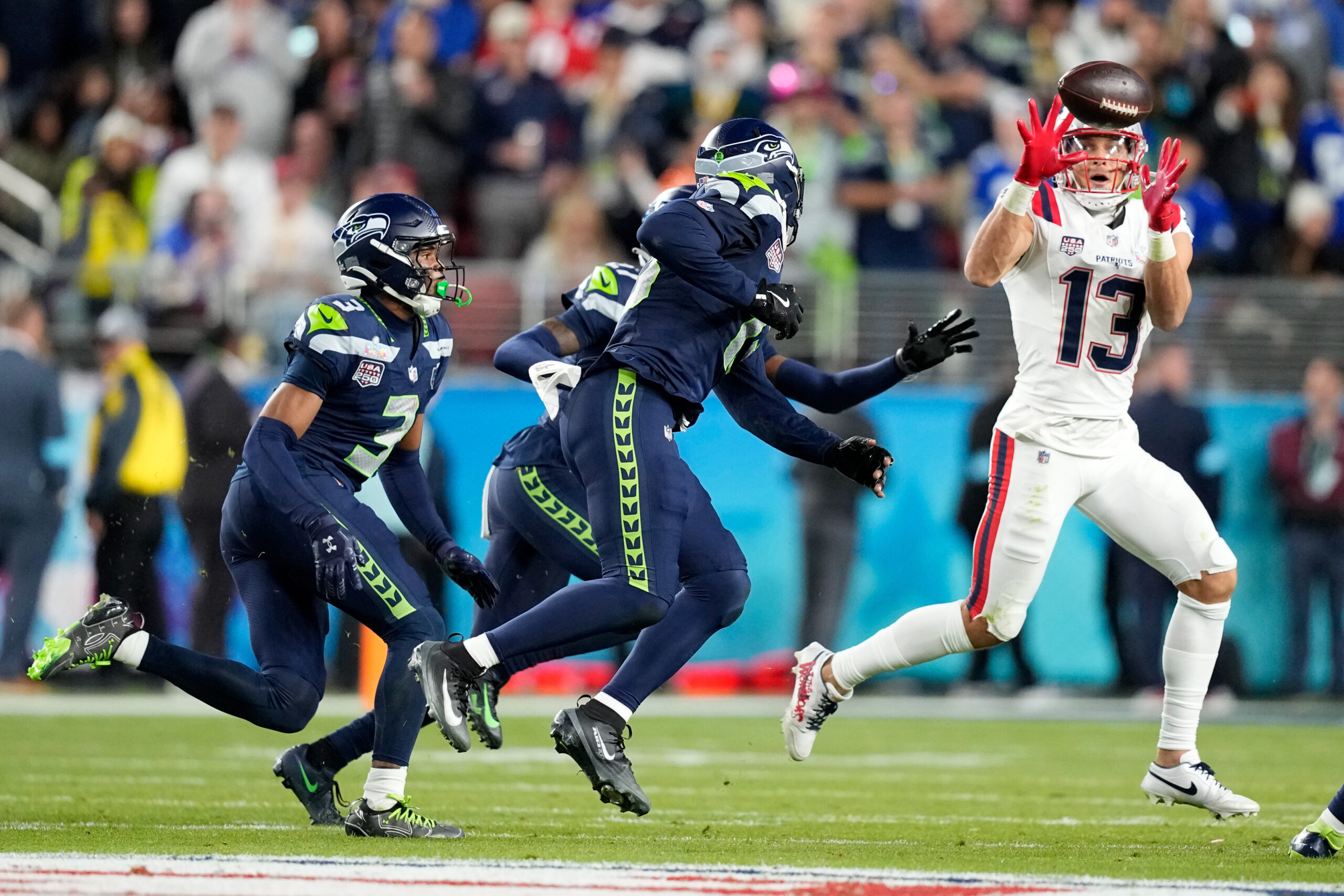
Mack Hollins (13) finally got the Patriots on the board and acquitted himself well overall.
How did the other ex-Eagles perform?
Williams was one of four former Eagles to play in Super Bowl LX. Josh Jobe was the only one to end the night with confetti on his head. The Seahawks cornerback started on the outside and was sticky in coverage and stout against the run. He finished with seven stops and one pass breakup.
Jobe, who spent his first two years in Philly, said he watched last year’s Super Bowl “[ticked] off” after the Eagles released him before the 2024 season. He revived his career in Seattle and will be one of the more sought-after corners on the market this offseason.
The Seahawks may not allow him to reach free agency, even if homegrown cornerback Riq Woolen is also slated to be unrestricted. Seattle has only four starters slated to become free agents. The Seahawks should, theoretically, be a contender again next season.
Woolen had a rough patch in the fourth quarter when Patriots receiver Mack Hollins caught back-to-back passes vs. him in coverage. Hollins’ first catch came over the middle for 24 yards and the second was an over-the-shoulder 35-yard grab for a touchdown.
Hollins, who won a Super Bowl with the Eagles when he was a rookie in 2017, was hoping to cap a journeyman career with a second title.
Patriots linebacker Christian Elliss played his first two seasons in the NFL for the Eagles before getting released late into the 2023 season. New England snatched him up a day later and he has risen the ranks since.
Elliss blitzed early and hit Darnold before he threw incomplete. He also notched three tackles. But he had a relatively quiet night.
John Schneider is on a short list of the NFL’s best GMs along with the Eagles’ Howie Roseman.
Best GM in the NFL?
Schneider joins the Chiefs’ Brett Veach and the Eagles’ Howie Roseman as the only current GMs to win more than one Super Bowl. While Veach has won all three of his with the same coach (Andy Reid) and quarterback (Mahomes), Schneider and Roseman have won their two titles with different coaches and quarterbacks.
The latter two men have been tied together since they became GMs just days apart in 2010. They took different paths to the top spot — Schneider came up the traditional way as a scout, while Roseman got his start on the business side — but both are now regarded by many as the two best NFL roster-builders.
Schneider can now say he’s not only been to as many Super Bowls as Roseman’s three, but he’s also matched him in Lombardi Trophies. The lone feather in his cap could be winning titles with completely different rosters and coaching staffs, while Roseman had several holdovers last season from the 2017 championship squad.