Category: Economy

  • U.S. employers added a surprisingly solid 119,000 jobs in September, the government said in a delayed report

    U.S. employers added a surprisingly solid 119,000 jobs in September, the government said in a delayed report

    WASHINGTON — U.S. employers added a surprisingly solid 119,000 jobs in September, the government said, issuing a key economic report that had been delayed for seven weeks by the federal government shutdown.

    The increase in payrolls was more than double the 50,000 economists had forecast.

    Yet there were some troubling details in the delayed report.

    Labor Department revisions showed that the economy lost 4,000 jobs in August instead of gaining 22,000 as originally reported. Altogether, revisions shaved 33,000 jobs off July and August payrolls. The economy had also shed jobs in June, the first time since the 2020 pandemic that the monthly jobs report has gone negative twice in one year.

    And more than 87% of the September job gains were concentrated in two industries: healthcare and social assistance and leisure and hospitality.

    “We’ve got these strong headline numbers, but when you look underneath that you’ll see that a lot of that is driven by healthcare,’’ said Cory Stahle, senior economist at the Indeed Hiring Lab. ”At the end of the day, the question is: Can you support an economic expansion on the back of one industry? Anybody would have a hard time arguing everybody should become a nurse.”

    The unemployment rate rose to 4.4% in September, highest since October 2021 and up from 4.3% in August, the Labor Department said Thursday. The jobless rate rose partly because 470,000 people entered the labor market — either working or looking for work — in September and not all of them found jobs right away.

    The data, though late, was welcomed by businesses, investors, policymakers and the Federal Reserve. During the 43-day shutdown, they’d been groping in the dark for clues about the health of the American job market because federal workers had been furloughed and couldn’t collect the data.

    The report comes at a time of considerable uncertainty about the economy. The job market has been strained by the lingering effects of high interest rates and uncertainty around Trump’s erratic campaign to slap taxes on imports from almost every country on earth. But economic growth at midyear was resilient.

    Healthcare and social assistance firms added more than 57,000 jobs in September, restaurants and bars 37,000, construction companies 19,000 and retailers almost 14,000. But factories shed 6,000 jobs — the fifth straight monthly drop. The federal government, targeted by Trump and billionaire Elon Musk’s DOGE cost cutters, lost 3,000 jobs, the eighth straight monthly decline..

    Average hourly wages rose just 0.2% from August and 3.8% from a year earlier, edging closer to the 3.5% year-over-year increase that the Federal Reserve’s inflation fighters like to see.

    The latest reading on jobs Thursday makes a rate cut by the Fed officials at their next meeting in December less likely. Many were already leaning against a cut next month, according to minutes of their October meeting released Wednesday. Steady hiring suggests the economy doesn’t need lower interest rates to expand.

    The September jobs report will be the last one the Fed will see before its Dec. 9-10 meeting. Officials are split between those who see stubbornly high inflation as the main challenge they need to address by keeping rates elevated, and those who are more concerned that hiring is sluggish and needs to be supported by rate reductions.

    Hiring has been strained this year by the lingering effects of high interest rates engineered to fight a 2021-2022 spike in inflation and uncertainty around Trump’s campaign to slap taxes on imports from almost every country on earth and on specific products — from copper to foreign films.

    Labor Department revisions in September showed that the economy created 911,000 fewer jobs than originally reported in the year that ended in March. That meant that employers added an average of just 71,000 new jobs a month over that period, not the 147,000 first reported. Since March, job creation has fallen farther — to an average 59,000 a month.

    With September numbers out, businesses, investors, policymakers and the Fed will have to wait awhile to get another good look at the numbers behind the American labor market.

    The Labor Department said Wednesday that it won’t release a full jobs report for October because it couldn’t calculate the unemployment rate during the government shutdown.

    Instead, it will release some of the October jobs data — including the number of jobs that employers created last month — along with the full November jobs report on Dec. 16, a couple of weeks late.

    The 2025 job market has been marked by an awkward pairing: relatively weak hiring but few layoffs, meaning that Americans who have work mostly enjoy job security – but those who don’t often struggle to find employment.

    Megan Fridenmaker, 28, lost her job last month as a writer for a podcast network in Indianapolis. She’s applied for at least 200 jobs and landed just one interview. “I am far from the only unemployed person in my friend group,’’ she said. “Where the job market’s at right now – people will apply for hundreds and hundreds (of jobs) before getting one interview.’’

    “Out of everything I’ve applied for, I get a response from maybe a quarter of them,’’ she said. “And the vast majority of the responses are the automated – ‘Thank you so much, but we’ve gone with another candidate.’ ‘Thank you so much, but we’ve already filled the position.’

    “The whole job-hunting experience has felt so cold and so distant and so removed from who we are as humans.”

  • SEPTA workers authorized a strike for the fourth year in a row. Here’s when they walked off the job in the past.

    SEPTA workers authorized a strike for the fourth year in a row. Here’s when they walked off the job in the past.

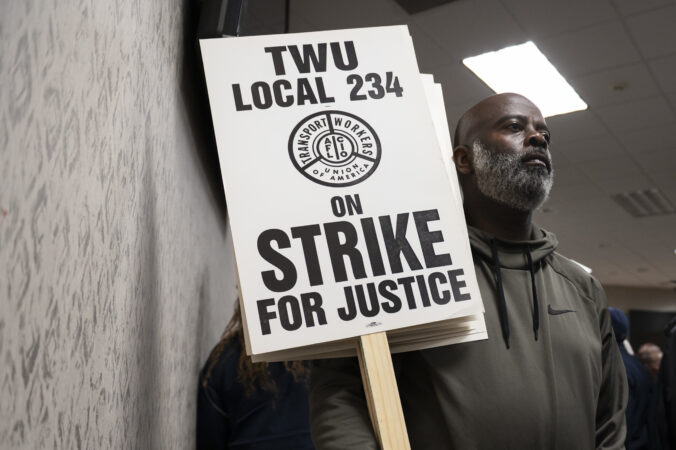
    Members of the Transport Workers Union Local 234 on Sunday, Nov. 16 voted to authorize a strike if union and SEPTA negotiators can’t reach an agreement on a new contract.

    Shortly before the current contract ran out at 11:59 p.m. on Nov. 7, TWU’s new president, Will Vera, urged union members to stay on the job. In an unusual move, he delayed a strike vote at the time of contract expiration, saying he had hope that a deal could be reached without the usual brinksmanship.

    “We’re asking you to please continue to come to work and put money aside. We want you to be prepared in case we have to call a work stoppage,” he told members in a video at the time.

    Local 234 leaders say they’re prioritizing a two-year deal with raises and changes to what the union views as onerous work rules, including the transit agency’s use of a third party that Vera said makes it hard for members to use their allotted sick time.

    Three TWU contracts in a row have run for one year each, all negotiated as SEPTA weathered what it has called the worst period of financial turmoil in its history.

    In a statement, SEPTA said it was aware of the authorization vote and is committed “to continue to engage in good-faith negotiations, with the goal of reaching a new agreement that is fair.”

    SEPTA unions have walked off the job at least 12 times since 1975, earning the authority a reputation as the most strike-prone big transit agency in the U.S.

    Here is what happened in previous SEPTA strikes:

    2023 Fraternal Order of Transit Police Lodge 109 (three days)

    SEPTA police officers walked off the job after bargaining with the transit agency for almost nine months, largely over the timing of a 13% pay raise for members. The agreement, partially brokered by Gov. Josh Shapiro, came amid heightened fears about safety on public transit and a funding crisis for SEPTA.

    2016 TWU Local 234 (six days)

    TWU Local 234 walked off the job for six days; the biggest issue was retirement benefits. SEPTA’s contributions toward union members’ pensions did not rise in tandem with wages when workers made more than $50,000. Managers’ pension benefits were not capped. The union also wanted to reduce out-of-pocket health-care costs and win longer breaks for bus, trolley, and subway operators between shifts and route changes.

    SEPTA and the union reached an agreement Nov. 7, the day before the general election. Democrat Hillary Clinton’s presidential campaign was worried about voter turnout, and the city sought an injunction to end the strike. It proved unnecessary.

    2009: TWU Local 234 (six days)

    Talk about leverage. TWU was ready to strike just before the first home game of the World Series between the Phillies and the New York Yankees. Gov. Ed Rendell pushed the two sides to continue talking, and the transit workers waited to walk out until three hours after the end of Game 5, the last in the series played at Citizens Bank Park.

    It was a bitter strike, coming just a year after the stock market’s meltdown started the Great Recession. TWULocal 234 President Willie Brown called himself “the most hated man” in Philadelphia. Mayor Michael Nutter was harshly critical. Brown called him “Little Caesar.”

    The strike was settled Nov. 7 with a deal on a five-year contract. Transit workers got a $1,250 bonus, a 2.5% raise in the second year, a graduated increase in SEPTA pension contributions from 2% to 3.5%, and the maximum pension benefit was raised to $30,000 from $27,000.

    2005: TWU Local 234 and United Transportation Union Local 1594 (seven days)

    Two unions walked off the job on Halloween, halting most bus, subway, and trolley service in Philadelphia and its Pennsylvania suburbs.

    Negotiations collapsed mostly over SEPTA’s insistence that workers pay 5% of medical insurance premiums. At that point, the authority paid 100% of the workers’ premiums for family coverage.

    In the end, it was solved by Gov. Rendell, a Democrat who had been Philadelphia mayor in the 1990s. He agreed to give promised state money to SEPTA early, so it could pay premiums in advance, reducing its costs.

    In the resulting four-year deal, the unions had to pay for 1% of their medical premiums. They also received 3% yearly raises.

    Pedestrians and cars in a chaotic dance at the intersection of Market and 30th Streets during the afternoon commute on the first day of the SEPTA city workers’ strike Nov. 1, 2016.

    1998: TWU Local 234 (40 days)

    City transit workers’ contract expired in March, but they did not strike until June — and then stayed out for 40 days. The two sides reached an agreement in July, but it fell apart. TWU members had returned to their jobs and kept working under an extension of their old contract. A final agreement was signed Oct. 23.

    The union agreed to SEPTA’s demand that injured-on-duty benefits be limited. The old contract gave them full pay and benefits while on leave after a work injury. SEPTA wanted to hire an unlimited number of part-time workers. The union agreed to 100 part-timers to drive small buses.

    SEPTA’s chief negotiator was David L. Cohen, famous for reining in unions representing city workers during Philadelphia’s bankruptcy in 1992, as Rendell’s mayoral chief of staff.

    1995: Local 234 TWU (14 days)

    A two-week strike stilled city buses, trolleys and subways until an agreement was reached April 10. Transit workers would get 3% raises per year over the three-year span of the new contract, as well as increases in pension benefits and sick pay.

    The union agreed to several cost-reduction measures, including a restructuring of SEPTA’s workers compensation policies.

    Mayor Ed Rendell, a villain to many in labor for winning givebacks from city unions in 1992, pushed SEPTA to offer more generous terms to TWU than it had initially. Cohen, who was his chief of staff, crunched the numbers to make it work. Three years later, out of the city administration and working as a lawyer, he was hired as SEPTA’s chief negotiator.

    1986: TWU Local 234 (four days) and UTU Local 1594 (61 days)

    When TWU struck the city transit division in March 1986 over a variety of economic issues and work rules, some bus drivers pulled over mid-route and told passengers to dismount, The Inquirer reported.

    Members were particularly incensed at what they considered SEPTA’s draconian disciplinary procedures. Union leaders said the issue was a basic lack of respect. The strike was settled in four days.

    Drivers for 23 suburban bus routes, two trolley lines in Delaware County and the Norristown High-Speed Line — all members of the United Transportation Union — struck for just over two months, affecting about 30,000 passengers a day.

    Employees in what was then known as SEPTA’s Red Arrow Division — after the private transit company that used to own the routes and lines — made considerably less than their city counterparts and had weaker pension benefits. They won raises and pension changes that brought them closer to parity.

    1983: Regional Rail (108 days)

    Thirteen separate unions walked off the job on the commuter rail lines that SEPTA had taken over at the beginning of the year from Conrail, successor to the bankrupt Pennsylvania and Reading Railroads.

    In addition to wages, a key issue was SEPTA’s demand that union train conductors accept pay cuts. The authority had already cut the number of those workers by more than half.

    Eventually SEPTA reached deals with a dozen of the unions. The 13th local, which represented 44 railroad signalmen, held out longer. Main issue: Whether SEPTA had the right to contract with outside firms for some types of signal work.

    The Regional Rail strike remains SEPTA’s longest work stoppage since 1975.

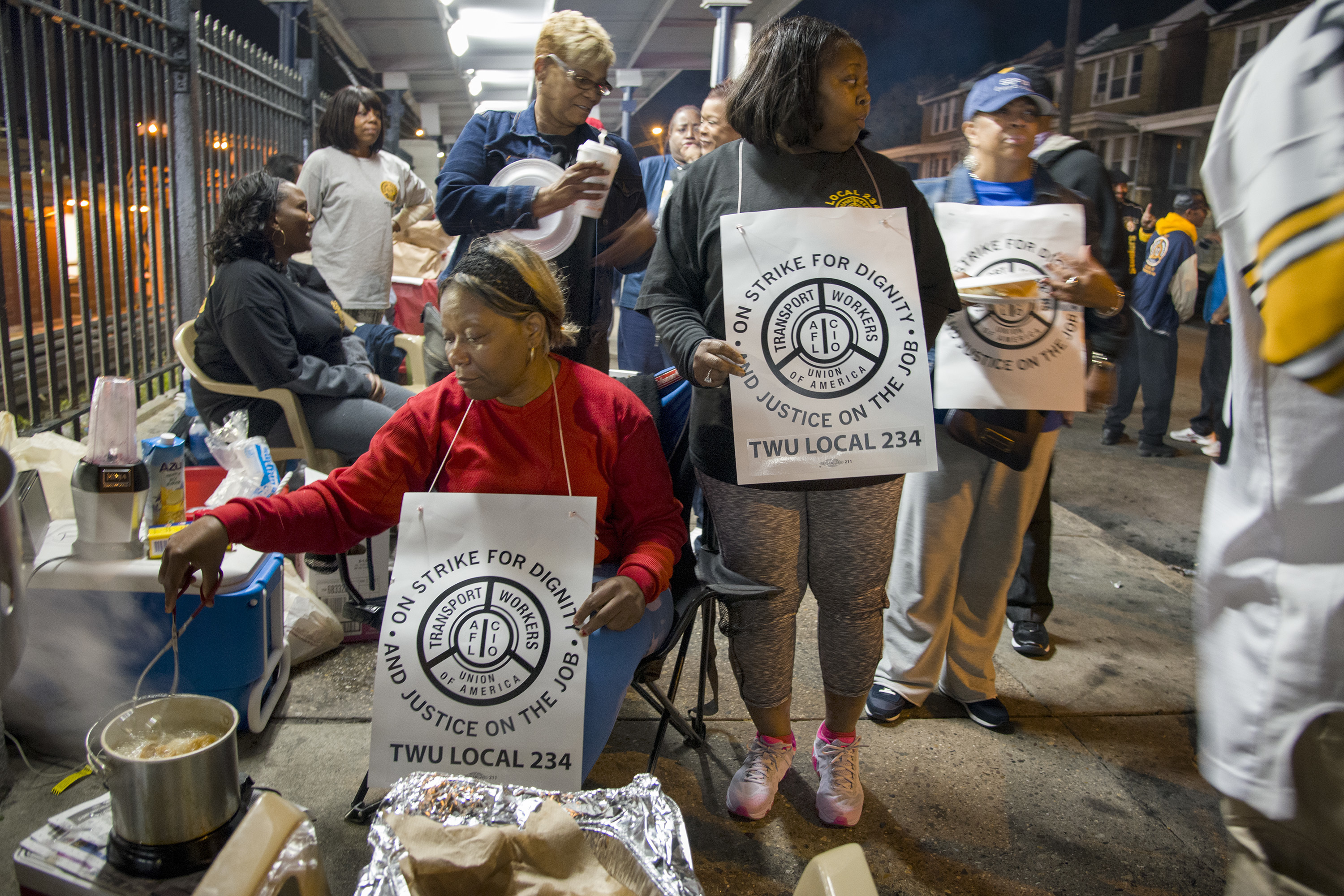
    Joyce Woodford (center), a 25-year veteran cashier on SEPTA’s Broad Street Line, serves up fried fish for her fellow striking cashiers outside the Fern Rock Transportation Center during dinnertime on the third day of the SEPTA strike in 2016.

    1982: TWU Local 234 (34 days)

    About 36 suburban bus drivers and mechanics operating routes primarily in Montgomery County, and some routes in Bucks, won an 8.5% wage increase over three years.

    The bus routes were the descendants of the Schuylkill Valley Lines and the Trenton-Philadelphia Coach Lines, which SEPTA acquired in 1976 and 1983, respectively. Service has grown, and the collection of bus routes is known as the Frontier Division today.

    1981: TWU Local 234 (19 days) and UTU Local 1594 (46 days)

    Transit workers shut down buses, trolleys and subways in the city on March 15, seeking job security in the form of a no-layoff clause, wage increases and a bar on SEPTA hiring part-time workers.

    And the Red Arrow division went out for 46 days seeking higher wages and better medical benefits. SEPTA also backed down a demand for permission to hire private contractors for some work on the suburban buses, trolleys, and the Norristown High Speed Line.

    1977: TWU Local 234 (44 days)

    After a bitter strike, union members who run the city transit division got higher wages and more benefits, after rejecting an arbitrator’s proposed contract that was portrayed in news reports as generous.

    A furious Mayor Frank Rizzo told reporters the strike “can last 10 years for all I care.” He said of the union’s rejection of the earlier offer: “It is outrageous, and I hope the people won’t forget it.”

    1975: TWU Local 234 (11 days)

    Transit workers, concerned about the ravages of inflation, wanted a clause giving them cost-of-living increases and enhancements to health-care benefits. Those were granted after Rizzo agreed to add $7.5 million to the city’s annual SEPTA contribution. Perhaps that’s one reason the mayor was so annoyed two years later.

    Staff writer Erica Palan contributed to this article.

  • Is artificial intelligence our economy’s friend or foe?

    As a professional economist, I have the opportunity to weigh in on many issues. In some of my views I’m highly confident, some less so. When it comes to artificial intelligence and its impact on the economy, I’m less confident.

    Having said this, AI has — at least so far — been mostly beneficial for the economy. It has provided a strong tailwind to economic growth since its commercial introduction with the release of ChatGPT nearly three years ago. Over the past year, an estimated more than one-third of the growth in real GDP — the value of all goods and services produced by the economy — has been powered by AI.

    One could make a strong case that without this tailwind, the economy would be in or near a recession. The higher tariffs, the highly restrictive immigration policy, large cuts to federal government jobs, and the interminable federal government shutdown are stiff headwinds to growth.

    But the economy hasn’t buckled — thanks to AI. It is lifting growth via the massive investments being made to erect the AI infrastructure. This includes data centers that are being feverishly built across the country, electric power capacity that is needed to keep the data centers humming, and the fabrication plants that make the semiconductors powering AI‘s intense calculations.

    Even more important to economic growth is the blockbuster increase in the stock prices of AI companies. Stocks for the “magnificent seven,” the seven most iconic AI companies, are up some 40% over the past year and 300% since the unveiling of ChatGPT. Investors are anticipating huge profits from these companies.

    These gains equate to trillions of dollars in increased stock wealth, owned mostly by well-to-do Americans. The wealthy, with suddenly much larger nest eggs, are able and happily willing to spend more, and that’s what they are doing. Consumer spending by those in the top part of the income distribution is on a tear.

    AI has not eliminated lots of jobs as feared, at least not yet. Most businesses are cautious in their hiring, but that has more to do with the uncertainty created by the wild swings in economic policy, the poster child of which is the up-and-down tariffs. Businesses are also waiting to hear from the Supreme Court about the legality of these policies before making any expansion decisions.

    There is some indication that younger workers, those just entering the workforce, may be feeling the early ill effects of AI on their job opportunities. The unemployment rate for those aged 20-24 exceeds 9%, up more than 3 percentage points during the past couple of years, and is on the rise despite a decline in labor force participation. But even here, it is tough to connect the dots from AI to this group‘s difficulties landing a job.

    Of course, it is still early days in the adoption of AI. Just how disruptive AI will be to the job market depends on how quickly companies adopt it. So far, it has been slow going. Less than one-tenth of U.S. companies, mostly large companies, have begun to meaningfully incorporate AI into their workflows. It stands to reason that the most intensive users of AI would be information-technology companies, but even here, the adoption rate is no more than one-fourth.

    AI adoption by businesses is slow because it is hard. Companies don’t have employees with the right skills, their information-technology systems aren’t set up to take advantage of AI, and they are fearful of releasing AI-driven products and services, given that they might cannibalize their existing offerings. A range of compliance and legal issues must also be resolved before adoption.

    If the history of the adoption of pathbreaking technologies is a guide — for example, electricity and the internal combustion engine more than a century ago, or the personal computer and the internet several decades ago — it’s only when new businesses form and optimize around that technology that its economic impact is truly felt. But this takes years.

    AI’s adoption rate is sure to be faster than that of other technologies, but you get my point. There will be disruptions as AI replaces some jobs, and the nature of work will change as AI assumes some of the more menial tasks done by workers. But all of this should happen slowly enough to allow disrupted workers to gain new skills and new jobs.

    This isn’t to say AI raises no concerns for the economy.

    Most immediately, I worry about those high-flying AI stock prices. If I’m even close to right about slower AI adoption rates, this will come as a disappointment to euphoric investors, and stock prices will quickly come back to earth. Wealthy investors will take it on the financial chin, and so too will the economy.

    And abstracting from the near-term gyrations in the stock market, there is a reasonable concern that the financial benefits of AI will accrue largely to the well-to-do. Our already highly skewed income and wealth distribution will become even more so. The economic and political struggle between the haves and have-nots will intensify, to everyone’s detriment.

    Of course, there are even more dystopic views of where AI is set to take us, and they can’t and shouldn’t be dismissed when thinking about legal and regulatory guardrails.

    But when it comes to the economy, AI should be much more friend than foe.

  • Six months in, how are Philly-area businesses handling Trump’s tariffs?

    Six months in, how are Philly-area businesses handling Trump’s tariffs?

    It’s been six months since President Donald Trump announced new tariffs on U.S. imports. For local small-business owners, the impact so far depends on what they sell. But they’re all thinking ahead about more adjustments they will have to make.

    Trump declared an “Independence Day” on April 2, implementing a minimum 10% tariff on all countries selling products into the U.S., with larger ones on countries including India and China. Since then the president has either threatened or implemented additional tariffs on certain products such as steel and aluminum, sectors such as furniture, and “reciprocal tariffs” on countries to match their tariffs on American imports.

    Many economists have warned that these higher costs will drive up inflation, slow our economy, and hurt many small businesses that rely on imported goods.

    Fred Woll, president of Philadelphia packaging products supplier F.P. Woll & Co., said he’s seen tariffs from overseas suppliers but “decided to eat a 5% price increase.” He doesn’t think he can do that again.

    “We have been in business in the City of Philadelphia since 1907, and gone through many, many challenges over the last 100-plus years,” he said. “This current challenge may end up being existential, and it’s our country doing it to itself.”

    George Patti, the owner of Head Start Shoes in Philadelphia, is also feeling pressure.

    “Everything is costing me more money and the dollar has dropped in value,” Patti said. “The costs of our merchandise is higher, and we’ve had to raise prices 10% to 15%.”

    At Tildie’s Toy Box in East Passyunk and Haddonfield, owner Michelle Gillen-Doobrajh said tariffs have made this year “confusing and difficult” and the added costs will “absolutely” have an impact on how they do business going forward.

    Michelle Gillen-Doobrajh (right) talks with 10-year-old customer Harlowe McGrath at Tildie’s Toy Box shop in downtown Haddonfield.

    “I am beginning to pass on items where the cost has gone up too much to be realistic for the consumer,” she said. “I fear that product selection will decrease, and many manufacturers will end up going out of business and retailers will follow.”

    “We will have to get used to paying more money for less product,” Gillen-Doobrajh added.

    Not every company is suffering. The family-run Trappe Tavern in Trappe, Montgomery County, has not seen a significant impact.

    “We’ve had some prices creep up,” David Duryea, the restaurant’s owner said. “In general, it hasn’t really had much of an effect at all.”

    If the costs of his food and other supplies continue to go up, Duryea said, people will eventually cut back on their spending and that could affect his business.

    “If that happens, we’re going to have to raise prices like everyone else,” he said.

    Despite new tariffs on steel, Upper Darby-based Delaware Valley Steel has not been significantly impacted, at least for now. That’s because “we don’t import any of our inventory,” said Jerry Sharpe, the company’s CEO.

    However, Sharpe warns that whenever tariffs are applied, the domestic steel mills that sell him products see that as an opportunity to raise prices.

    “If demand picks up, which I believe it will later this year, we will see increased pricing from the domestic mills,” he said. “We’re also going to be hit with a 20% tariff on an expensive piece of machinery we have ordered.”

    Kevin McLaughlin, a partner at business advisory firm Centri Consulting in Philadelphia, said the common theme among his firm’s clients is uncertainty.

    “While the full impact of tariffs has not yet sifted through every corner of the economy, growing businesses and businesses with thinner margins and less negotiating power than large corporations are often the first to feel the pressure,” he said.

    Ten year-old customer Harlowe McGrath looks through figures — all of them 3D printed in the U.S. — at Tildie’s Toy Box shop in downtown Haddonfield Wednesday, Oct. 15, 2025. Store owner Michelle Gillen-Doobrajh is one of many Philly-area business owners dealing with tariffs. McGrath, who lives in town, was shopping with her mother, Kimberly McGrath.

    How small-business owners are navigating tariff uncertainty

    Woll says he’s focusing on cutting his overhead and may lay off employees. Gillen-Doobrajh is changing her product mix by “stocking up where tariffs are low” and foregoing unnecessary items.

    “I’m trying to be really smart and frugal with buying overall,” she said. “I am also paying attention to where items are made and holding out hope that these tariffs will dissolve so that our industry can survive.”

    Frank Cettina, who runs operations at Computer Components Corp., a precision tools contract manufacturer based in Philadelphia, is passing along any added costs to customers, with transparency. Tariff-related cost increases are noted separately and determined “on a customer-by-customer basis,” he said.

    “We are not making blanket cost increases because our intention is to remove them when and if they go away or change,” Cettina said. “We are also offering any alternative sources where we can.”

    Patti said he will likely buy less product but will also “buy higher quality just to pick up my margins” and compensate for the loss of volume.

    McLaughlin, the consultant, struck a more positive tone. He said clients are “stress-testing” multiple “what-if” scenarios so their businesses can adapt quickly.

    “With all the uncertainty, we are consistently encouraged by how resourceful our clients are through this unique time,” he said. “Many are using this moment as an opportunity to strengthen supplier relationships, accelerate efficiency, and polish their value propositions.”