The Coatesville Area School District will soon see a swath of changes as it prepares to shutter two elementary schools at the end of the school year, open a new one, and realign its attendance boundaries to ensure equity amid the transition.
The new map, approved by the school board Tuesday, splits the district into four geographic regions, intended to keep communities together while maintaining ethnic and socio-economic balance, according to the district’s presentation.
“We’re proud of our diverse population that we have in Coatesville, so we were looking to sustain that in each of our elementary schools as well,” the district’s superintendent, Anthony P. Rybarczyk, said in an interview Thursday.
The update,slated to take effect next school year, comes as the district has been rolling out a new facilities plan over the last several years, while its enrollment has declined and its budget has been squeezed by charter schools. When students leave Caln and East Fallowfield elementary schools for the summer, the two nearly century-old schools will close permanently. The schools, which both serve kindergarten through fifth grades, enroll roughly 730 students between them.
Under thenew attendance zones, families in the Indian Run Village are being reassigned to Kings Highway Elementary School. Families in the area of Millview Park will be reassigned to Kings Highway, rather than split among three of the district’s elementary schools. The community divided by Barley Sheaf Road will now attend Reeceville Elementary. The district began communicating the changes Wednesday.
“Geographically, it made sense,” Rybarczyk said during the school board meeting. “We met with transportation as well, they were very promising in how they said this could save time on their runs and avoid the crossovers between going from one community to the next.”
The middle school feeder pattern will be split into two sections, with Kings Highway and Reeceville matriculating to North Brandywine Middle School. Rainbow Elementary School and the new Doe Run — which will open in August on the former South Brandywine Middle School site — will feed to Scott Middle School.
Fourth graders at elementary schools will be “grandfathered in” to complete their fifth-grade year at the elementary school they’ve been in, even if its enrollment is set to shift. The district plans to ask parents to provide transportation for those students next year, Rybarczyk said.
As the district winds down two of its schools, it will celebrate their history over the summer, with legacy walks and celebrations.
“The great thing about Coatesville is the children are in the schools where their parents went,” he said.
The district will keep the buildings, with an eye toward potential growth in the future, Rybarczyk said, though the district has no immediate plans for them.
The schools’ closure and the opening of Doe Run Elementary School are part of a broader effort to update the district’s aging facilities, which Rybarczyk said would continue next year.
“I think the community has been looking for something like this for a long time as well,” he said.
With “a shift of a number of charter school families coming back to our district” and new development, Rybarczyk said he believes the district could see its enrollment grow. Its campaign to bring students back from cyber and charter schools, launched alongside its upgrading of facilities in the last few years, has gained back 64 students, and hundreds of thousands of dollars, he said.
“We’re going to see what the need will be in the future, because we could have an influx where we need to repurpose them in some way,” he said at the board meeting. “Obviously, they’re two older schools …There’s some work to be done if we were to repurpose those.”
This suburban content is produced with support from the Leslie Miller and Richard Worley Foundation and The Lenfest Institute for Journalism. Editorial content is created independently of the project donors. Gifts to support The Inquirer’s high-impact journalism can be made at inquirer.com/donate. A list of Lenfest Institute donors can be found at lenfestinstitute.org/supporters.
Prior to the vote, the board heard from registered speakers, including some from West Oak Lane Charter School who want their school to be able to purchase the vacant Ada Lewis Middle School building.
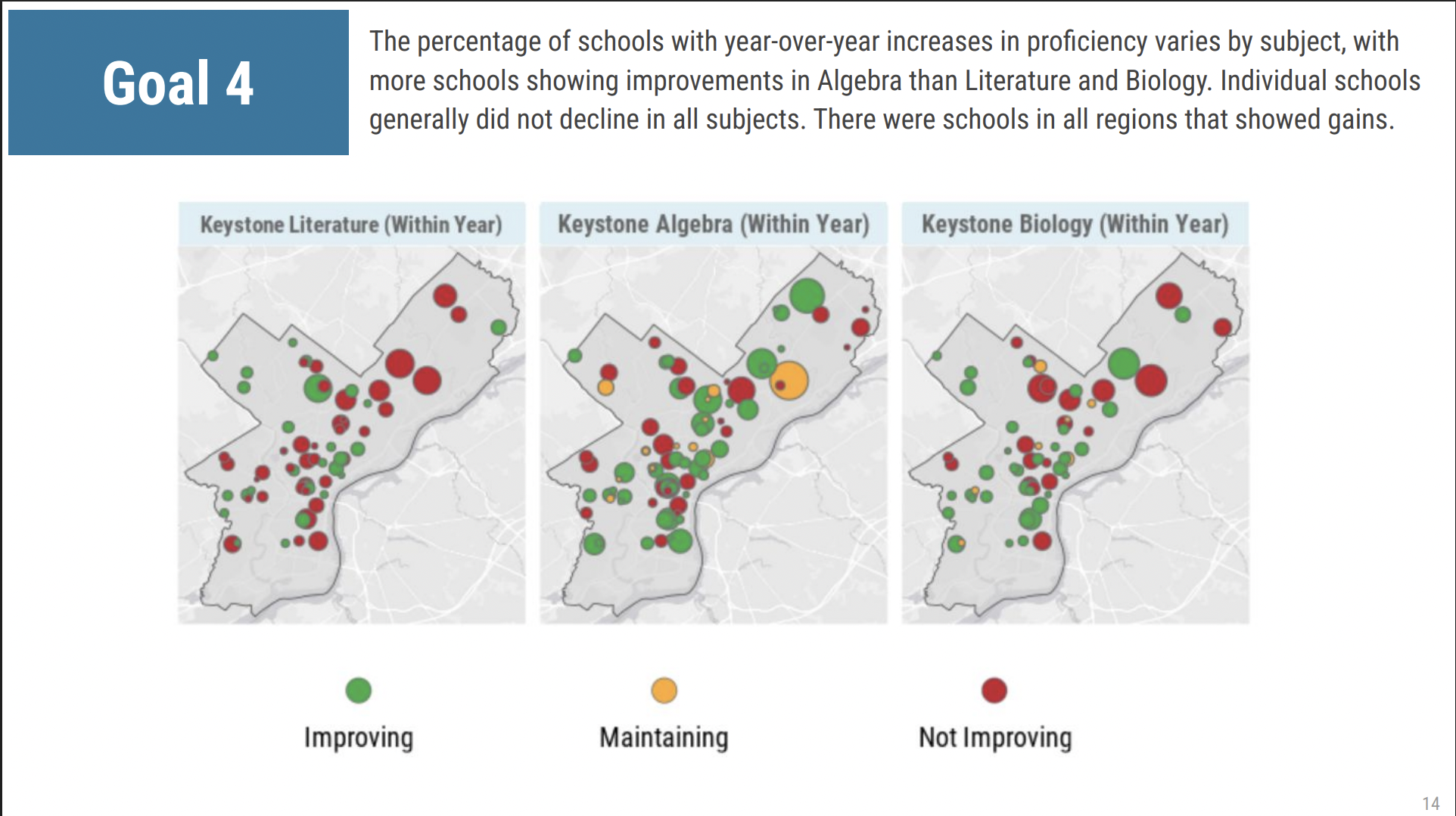
The board, with some absences, then moved into the “Goals and Guardrails” portion of its meeting, where district leaders shared 2024-25 Keystone and NOCTI scores. Algebra and biology Keystone scores stayed mostly flat compared to 2023-24, while literature scores dropped 2.9%. Board members Whitney Jones and Wanda Novales each asked for more detailed data from the district.
// Timestamp 12/11/25 6:20pm
Novales adjourns the meeting
Novales summarizes what the board learned from today’s Goals and Guardrails meeting: Keystone scores remained stagnant last year, with literature scores decreasing, she said. And many CTE schools have made gains.
In future monitoring sessions, she said, the board will want to see the data broken down by various demographics, and more specific data about the percentages of schools seeing gains and decreases in Keystone scores. This data will give the board “a more complete understanding of what’s going on in the district.”
Novales then adjourned the meeting.
This is our final scheduled public school board meeting of 2025. See you in 2026!
// Timestamp 12/11/25 6:07pm
Board member Novales asks for more specific data: What percentage of schools saw gains and decreases in Keystone scores?
Board member Wanda Novales asks the district: What percentage of schools made gains in Keystone scores? And what supports are we offering our lowest-performing schools?
Watlington asks each of the individual networks of schools to be read — along with their Keystone score results and changes — with the associate and assistant superintendent of each network recognized.
Novales says she’s interested in even more specific data: What schools made gains, not just networks? What percentage of schools made gains, what percentage saw a decrease in scores, and what percentage stayed the same?
Watlington asks research chief Wolford to pull that together for a future meeting.
// Timestamp 12/11/25 6:05pm
Board member Joan Stern urges to district to think about the role creative and agricultural jobs play in the economy
Board member Joan Stern questions how the district is thinking about “the role of the creative economy in the city and in the region” in career and technical education.
“I would like to know what the focus is on developing careers in that part of the economy,” she said, highlighting the role of agriculture in particular.
Dawson says they are “intentional and methodical” about how they approach extracurriculars and nurturing students’ interests outside of the careers they may pursue.
We want to “help them to build themselves out of poverty and have an opportunity for a livable wage not only for them but their families and that can be sustained over time,” Dawson said.
Watlington adds in: “We don’t want to graduate a majority of young people that take minimum-wage jobs.”
“Our children can learn anything,” Stern said, adding in: “They should not be treated as though they are always going to be doing the pouring of the cement as opposed to the design of the airport.”
// Timestamp 12/11/25 5:55pm
Board member Lam wants to know: How do we keep literature scores from continuing to slip?
Board member ChauWing Lam asks: What is the relationship between the technical education and the core education for NOCTI at CTE schools?
Mastbaum Principal David Lon answers that the programs work together “hand in glove” and they work to prepare students for the tests they’ll need to take to graduate.
She also said she found the geographic clustering of Keystone interesting. “There’s not really a concise pattern across the three subjects in terms of what happened last year and what happened this year.” She wants to know: What is our strategy for stopping the decline of literature scores?
“We recognize that that is a concern for us,” Dawson said about the dropping ELA scores. But they did just roll out a new curriculum, he said, and teachers are still acclimating.
“We recognize as we say all the time, more work needs to be done to ensure our students are academically successful the first time they sit in that course,” he said.
Lam acknowledges that these test results are from last year. She asks: Are there any early indications yet that we’re seeing a rebound?
Tonya Wolford, the district’s research chief, says they are processing data and hope to have more information later this month or in January.
// Timestamp 12/11/25 5:46pm
Board member Whitney Jones asks district to dig deeper into the data
In responding to a question from board member Whitney Jones, Watlington says they do need to take a harder look at the data broken down by race, gender, economically disadvantaged students, English language learners, and other demographics.
“You can’t move the overall district without moving kids of color,” he said.
// Timestamp 12/11/25 5:35pm
Success isn’t linear, Watlington says: ‘No, I’m not satisfied’
Watlington says that people ask him all the time: Are you satisfied?
“No, I’m not satisfied,” he said. Far too many kids can’t read and do math on grade level, he said. But the district didn’t get here quickly, and it can’t fix it quickly. Success isn’t linear.
“The district is making significant progress,” Watlington said. We’re not blaming historical underfunding or “this political partisan nonsense.”
Deputy superintendent tells the board: ‘We have a lot of work to do in our high schools’
“We’re going to recognize that we have a lot of work to do in our high schools,” deputy superintendent Dawson said. “We see it, we own it, and we recognize it.”
How will the district improve math, ELA, and science performance? Dawson explains: more high-impact algebra tutoring, a fellowship for algebra teachers, and creating math pathways to allow more students to take Algebra 1 in eighth grade. Plus, a new science curriculum this year.
“We’re hearing great feedback from the teachers, from our students, and from principals” about the science curriculum, Dawson said.
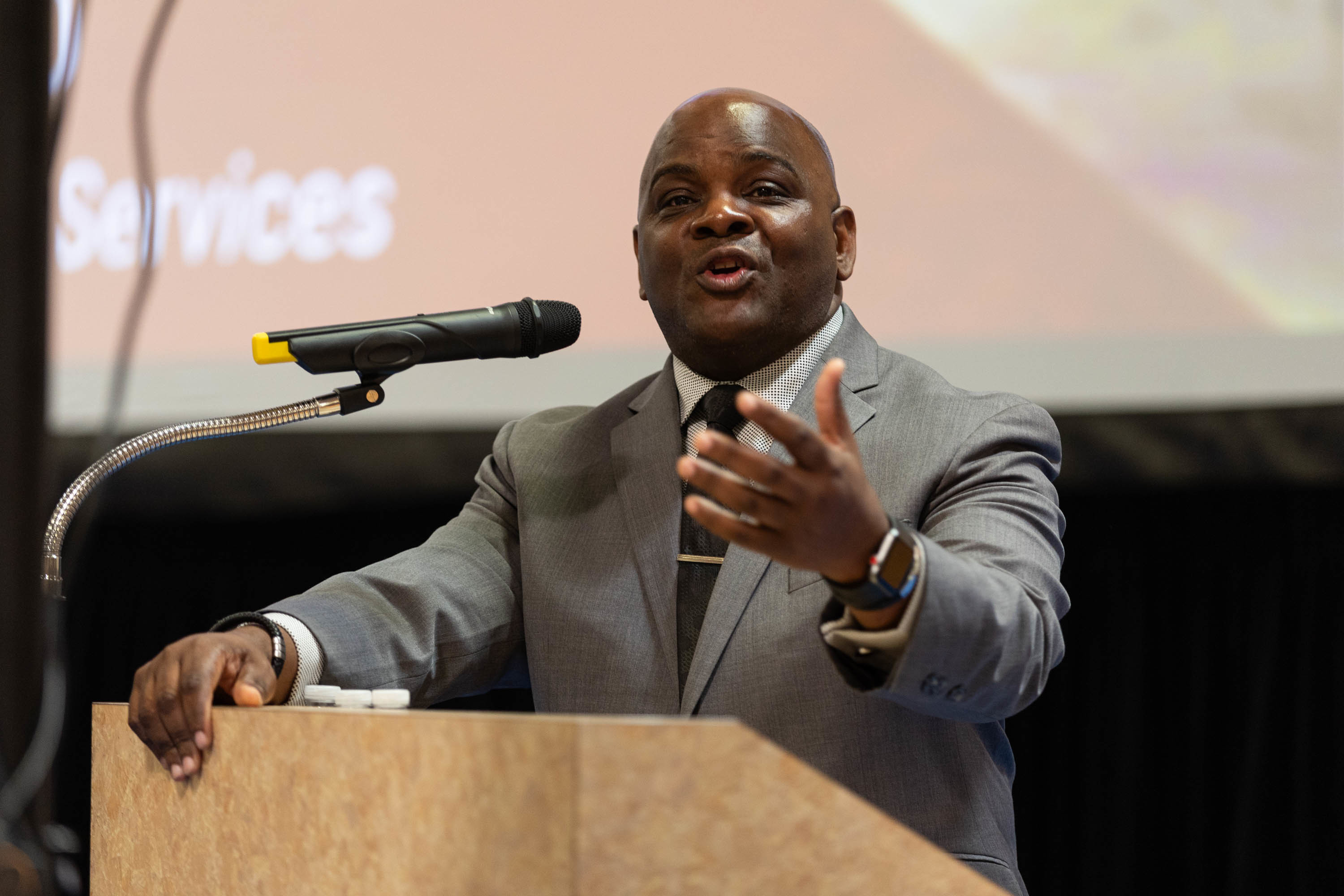
Deputy Superintendent Jermaine Dawson speaks at the School District of Philadelphia’s New Hire Orientation on Aug. 7, 2025.
On career and technical education, Dawson said the district will increase the number of guest speakers, company tours, and job shadowing and internship opportunities; create regional events like career fairs; implement new professional development; expand the middle school CTE program; and more.
Analyzing the district’s career and technical education programs: 39% are aligned to high-wage, in-demand occupations; 32% are aligned to high-wage, in-demand industries, but not aligned to occupation; and 29% of programs are unaligned to high-wage, in-demand occupations.
There are 41 programs in the district across 11 clusters.
This may mean some programs that are currently offered in the district may go away, Dawson said. Some new programs may be launched.
// Timestamp 12/11/25 5:15pm
Mastbaum principal speaks to success with improving NOCTI scores at his school
Principal David Lon from Mastbaum High School has seen tremendous growth at his school, a career and technical education school in Kensington.
Mastbaum has deliberately moved to a NOCTI focus. There’s been pedagogical work in the area students struggle most in: the NOCTI writing portion, Lon said.
There are quarterly benchmark exams, professional learning communities to reinforce data analysis and vocabulary best practices, and more.
There’s also a focus on culture-building, Lon said. Students are taught that the NOCTI is more than just another test; it’s important to their future. There are town halls and pep rallies, and a NOCTI breakfast the morning of the test.
“Before they go into the test, they are literally surrounded by the love and support of their community,” Lon said.
“We can directly tie student performance on the test-to-life outcomes,” Lon said. Students who score advanced get free college credits; those who are competent or advanced get extra points on the city test that can lead to good-paying jobs.
Mastbaum CTE staff are stars, Lon said. Counselors play a big role. Mastbaum had 32.4% point growth in NOCTI pass rate.
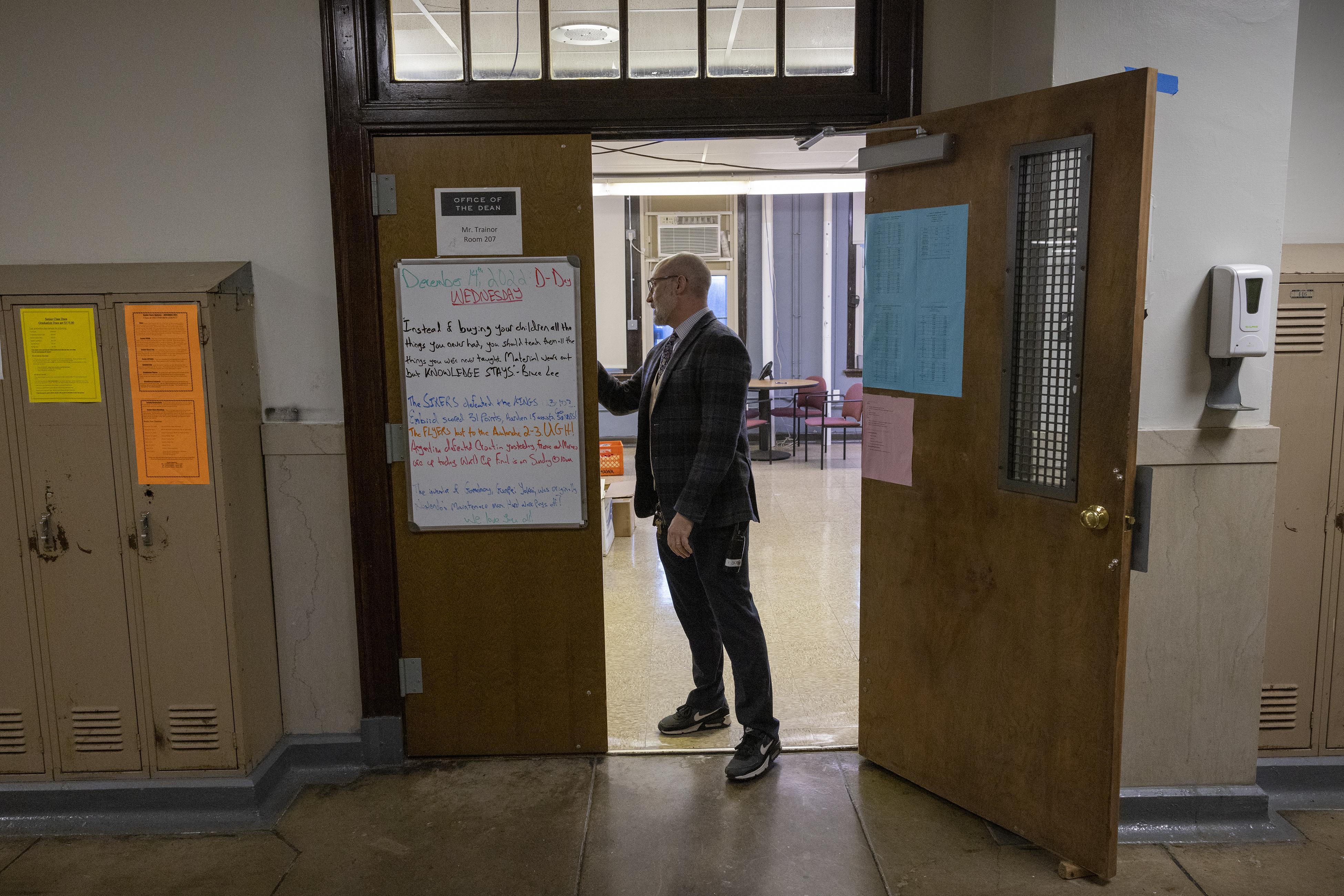
Principal David Lon at Mastbaum High School in December 2022.
// Timestamp 12/11/25 5:10pm
Percentage of students passing the NOCTI has increased
For the NOCTI, a nationally-recognized career and technical education exam, the percentage of 12th grade students who passed increased to 59.7% in 2024-25 from 56.9% in 2023-24.
Students in most areas — health, construction and manufacturing, education — increased participation and pass rates on NOCTI exams.
// Timestamp 12/11/25 5:06pm
District highlights the changes to student proficiency in the three Keystone subject areas
On the algebra Keystones, students scoring proficient or advanced increased slightly, from 15.1% to 15.5%, comparing 2024-25 to 2023-24.
Biology Keystones remained flat — 22.7% of students passed.
Literature Keystone proficiency decreased to 34.9%, a 2.9 percentage point drop.
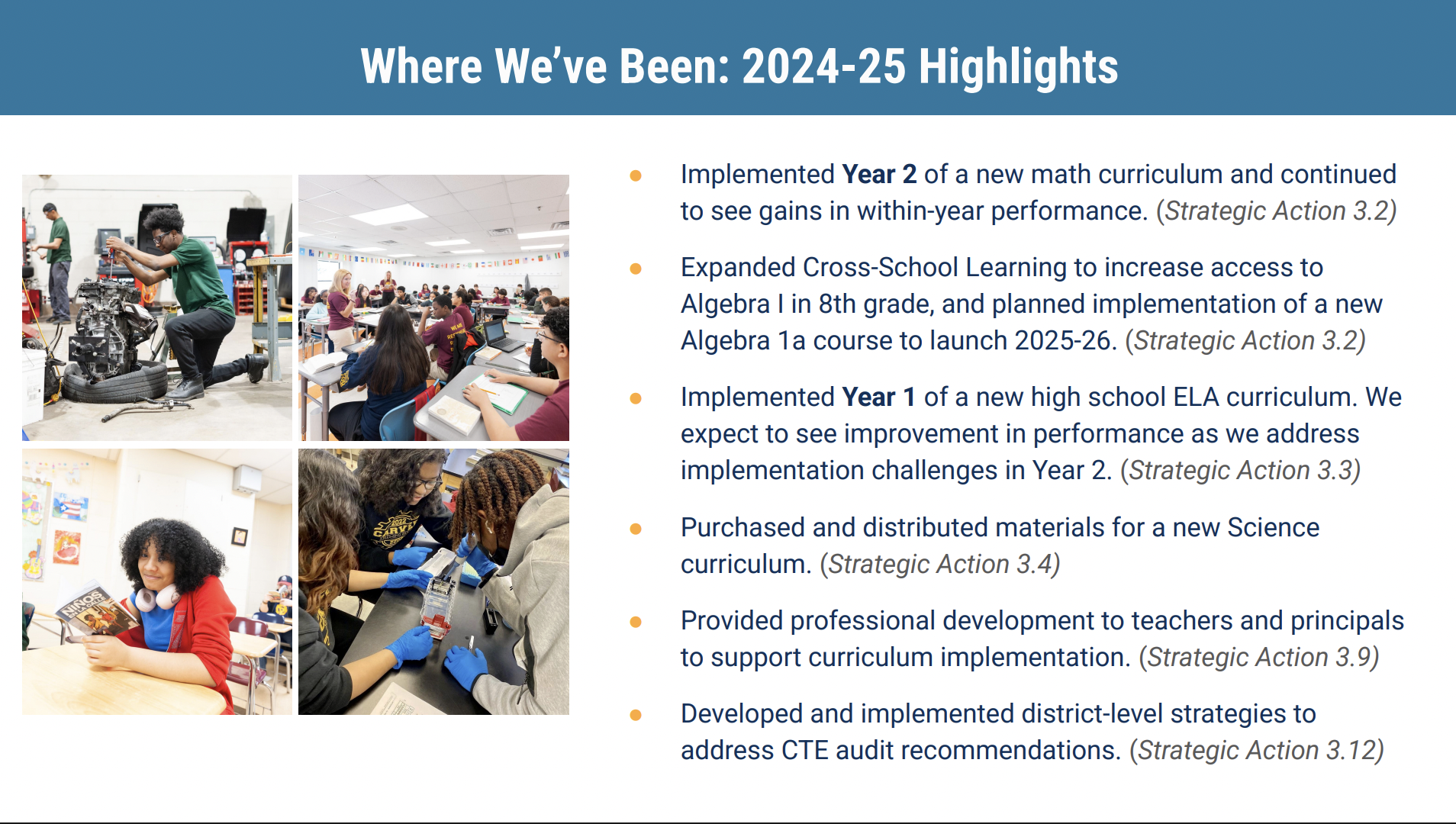
This slide was shown during the Goals and Guardrails portion of the Philadelphia school board meeting on Dec. 11, 2025.
// Timestamp 12/11/25 5:04pm
Deputy superintendent highlights the 2024-25 highlights
Jermaine Dawson, deputy superintendent, is talking about 2024-25 highlights: It was the second year of a new math curriculum, the first year of a new ELA curriculum, and they purchased a new science curriculum (which is being rolled out this year).
This slide was presented during a Goals and Guardrails meeting of the Philadelphia school board on Dec. 11, 2025.
// Timestamp 12/11/25 4:54pm
Special action meeting ends, and Goals and Guardrails portion begins
And here ends the special action meeting.
Now we’re into progress monitoring/Goals and Guardrails.
The board will be monitoring goals around Keystone and NOCTI (career and technical education) exams tonight. Streater and a few other board members have to leave to conduct interviews for student board representatives, they noted.
// Timestamp 12/11/25 4:52pm
Board passes resolution, authorizing district to explore transferring vacant school buildings to the city
The resolution passes, six to two. Crystal Cubbage and ChauWing Lam voted no.
President Streater says this is an ‘exploratory resolution’ that he supports
Reginald Streater, board president, reiterated: No properties are being given to the city with a yes vote to this resolution.
Resolutions are the most effective way to convey what might be coming, Streater said. This is an “exploratory resolution.”
“I don’t see anything wrong with exploring this, and bringing the public along in a very public way,” Streater said, adding that he would be “derelict in his duty” if he didn’t explore this.
// Timestamp 12/11/25 4:50pm
Board member Cubbage says she ‘cannot support this resolution in its current form,’ while board VP Andrews says she will vote yes
Board member Crystal Cubbage said she applauds the mayor’s housing initiative, but “I cannot support this resolution in its current form,” because it limits the district to giving buildings to the city without financial gain, against a backdrop of coming financial issues for the district. Other options should be explored, including selling buildings to interested parties that are not the city.
Sarah-Ashley Andrews, the board vice president, will vote yes, but said any agreement “must deliver clear benefits to our children.” Opportunities to stabilize and grow the district’s tax base would help the district.
// Timestamp 12/11/25 4:48pm
School board discusses the resolution around what to do with vacant school buildings
Board member ChauWing Lam says she “fully supports” the idea of working with the city and addressing what should happen with the portfolio of buildings. But, Lam said: I have a concern that in adopting such a resolution, it limits the district’s options.
The portfolio of vacant buildings was recently valued at $80 million by the city, Lam said. “Given the disrict’s structural budget deficit, I encourage consideration of additional opportunities before rushing into an agreement as set forth in this resolution.”
Board member Wanda Novales notes that these buildings belong to the district, and any agreement must benefit district students.
Board member Joan Stern underscores that this resolution does not transfer any properties to the city. It explores what to do with the properties, some of which have been vacant since 2007. “It is critical for us to know what our costs are, what our liabilities are, what our exposure” is, Stern said.
“We are trying to do this in the context of our facilities plan,” Stern said. “I would like very much for everyone to keep in mind that this is a step for us to take that will provide us with the facts and the diligence necessary to decide on the fate of these properties.”
// Timestamp 12/11/25 4:42pm
Councilmember Thomas shares concerns, through aide, about the ‘lack of communication’ around resolution to transfer properties to the city
Zach McGrath, legislative aide to City Councilmember Isaiah Thomas, is reading a letter from Thomas.
Thomas is concerned about “a lack of communication” around the plan to possibly transfer properties to the city.
Thomas wants a separate, independent authority to manage buildings for the city and district. He and others learned about this plan from The Inquirer, which he finds troubling.
He says: We can’t find ourselves in a situation like Germantown High. The school was closed, abandoned for some time, and then after years, developed into apartments people in the neighborhood largely can’t afford.
// Timestamp 12/11/25 4:45pm
// Timestamp 12/11/25 4:37pm
Retired teacher questions the board’s authority to ‘just give away real estate’
Lisa Haver, retired teacher and a founder of the Alliance for Philadelphia Public Schools, asks the board: “Does this board have the authority to just give away real estate? That would be an abdication of the board’s responsibility of this district.”
The board is supposed to operate independently, not as an intergovernmental board, Haver said.
Haver says: Essentially, it sounds like the mayor wants the district to give her buildings, and the board is playing ball.
// Timestamp 12/11/25 4:35pm
Another West Oak Lane Charter School community member asks the board to allow the school to buy Ada Lewis building
Angela Case, a member of the West Oak Lane Charter School community, asks the board to allow the school to buy the Ada Lewis Middle School building.
“Our school is growing, but our current space is limited,” Case said. “Ada Lewis would give our students safe classrooms, outdoor areas,” and more. It would also mean a positive use of a vacant property, Case said. “This is an investment in our children, families and a better future for Philadelphia.”
// Timestamp 12/11/25 4:32pm
The Cloudens speak to the board about student achievement and vacant buildings
Horace Clouden, a retired district worker, said there’s a “crisis in K-8,” both in public and charter schools, in student achievement.
“If you give away buildings that could be crucial to the development of the children, it could be criminal,” Clouden said.
Clouden tells the board they should repurpose closed schools to solve for student placement.
Mama Gail Clouden, who is married to Horace Clouden, said it must be difficult for the board and superintendent to hear parents discuss significant issues with their children, month after month. Leaders are getting awards “but these children that are suffering are saying something different,” Mama Gail said.
“Everybody’s making money off these children,” Mama Gail said. “The least of these are losing the most. You are in a position to fix this.”
Leah Clouden, Mama Gail and Horace Clouden’s daughter, said “the plan to warehouse students is in full effect.”
“Giving away 20 properties for housing is insane,” Leah Clouden said.
University City High was “given away for pennies on the dollar,” Leah Clouden said.
// Timestamp 12/11/25 4:26pm
Parent shares issues with curriculum sharing between the district and the Catholic church
Anne Dorn, a district parent, is talking about issues with curriculum shared between the district and the Catholic church.
“Fear not” the elephants in the room, Dorn said.
// Timestamp 12/11/25 4:22pm
West Oak Lane Charter School parent praises the school
Daniel Wideman, a parent and board member at West Oak Lane Charter School, is praising the school, which has changed his and his child’s lives.
“As a community, we have grown out of our building at West Oak Lane, and we need change,” Wideman said. The charter would like to buy Ada Lewis Middle School.
Kenderton Elementary parent says she is suing the district over her child’s IEP
Sashai Rivers, a parent of two children at Kenderton Elementary, said her son was bullied and antagonized by students and staff. She removed her kids from the school, but said her child’s IEP was ignored. “I’m currently being ignored by all parties at the school district,” Rivers said.
Rivers said she is suing the district.
// Timestamp 12/11/25 4:17pm
A retired educator, a student, and a charter school staff member each address the board about a variety of issues
Elijah Mahaffey, a former student at George Washington High, said he was bullied at the school. “Nobody would help me,” he said.
Deanna Lewis, of Lab Charter, is drawing attention to Black-led and Black-founded charter schools. Lab recently got a $500,000+ grant to bring computers to the community. “We’re deeply committed to our academic mission, and to support our community with care,” Lewis said.
// Timestamp 12/11/25 4:13pm
Former school board member wants students with special needs to be considered in school closing decisions
We’re onto speakers now.
Cecelia Thompson, a former school board member, wants to know what provisions will be made for students with special needs in school closing decisions.
And when it comes to possibly transferring closed schools to the city, she asks: Can we sell them to the city “for market value, and not $1? Just to be respectful, I guess, for the worth of the properties?”
Former Philadelphia School Board member Cecelia Thompson spoke to the board during a special action meeting on Dec. 11, 2025.
// Timestamp 12/11/25 4:09pm
Pre-submitted written testimony addresses Ada Lewis Middle School
Of note: One piece of written testimony submitted today concerns the closed Ada Lewis Middle School, likely to be considered in any list of vacant schools transferred to the city. A member of the West Oak Lane Charter School community suggests the Ada Lewis building be sold to West Oak Lane Charter.
Eight board members are present at today’s meeting. Joyce Wilkerson is absent.
// Timestamp 12/11/25 4:06pm
The board held an executive session earlier today
The board discussed developments in the People for People and KIPP North Philadelphia vs. Joyce Wilkerson case in executive session today, Streater said, as well as real estate matters one can assume are related to the special action item.
Board president Reginald Streater is outfitted in kelly green, and notes that he still has faith in the Eagles.
The only item on the agenda: a resolution authorizing Superintendent Tony B. Watlington Sr. and the district’s legal team to discuss possibly transferring about 20 vacant district buildings to the city.
Philly school board to host special action meeting with Goals and Guardrails presentation
// Timestamp 12/11/25 3:50pm
The Philadelphia school board is set to host a special action meeting — its last scheduled meeting of the year — starting at 4 p.m.
Following the special action meeting, the board will hold its regularly scheduled Goals and Guardrails meeting, during which Watlington will share end-of-year Keystone and NOCTI performance for 2024-25.
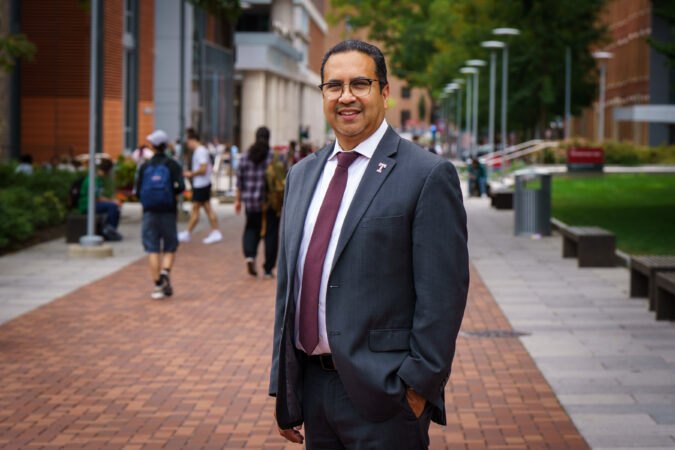
Jose A. Aviles, who abruptly resigned last month as Temple University’s head of enrollment, has taken a leadership role at Rutgers University.
Aviles has been named senior vice president for enrollment management and student success at New Jersey’s flagship university.
“Dr. Aviles’ commitment to data-informed, student-centered leadership will be pivotal to strengthening student recruitment, expanding access and enhancing student success metrics,” Rutgers said in its announcement.
At Rutgers, the overall enrollment neared 71,500 this year, up 3.2%.
When Aviles announced his exit from Temple, he told The Inquirer he was leaving for “a life-changing opportunity.”
Aviles, who served as Temple’s vice president for enrollment and student success for 2½ years, joined the North Philadelphia school in 2023, after about six years at Louisiana State University.
In that experience at LSU, he has a tie to Rutgers’ new president, William F. Tate IV, who led the Baton Rouge university from 2021 to this July, when he took the helm at Rutgers.
Aviles left Temple with recent successes under his belt; he had recently been promoted from a vice provost to a vice president.
“Jose has reimagined enrollment management at the university over the last couple of years, helping move us to a modern, technology- and data-driven approach that has delivered results,” Temple president John Fry and interim provost David Boardman said to the campus community last month.
They noted the university achieved growth in first-year enrollment the last two years, with this year’s group reaching a record high of 5,379.
The university also under Aviles’ tenure started the Temple Promise program, which makes tuition and fees free for first-time, full-time college students from low-income families who live in Philadelphia, and the Temple Future Scholars program, a mentoring and college-readiness initiative.
While Temple’s first-year class was strong, the school fell short of its initial overall enrollment projection by about 700 students, which translates to about $10 million in lost revenue.
The university had been estimating it would enroll a total of 30,100 to 30,300 students, which would have been its first enrollment increase since 2017.
Instead, enrollment came in at 29,503, down about 500 from last year and further declining from its high of more than 40,000 eight years ago. (That does not include enrollment on its Japan and Rome campuses, which increased. Including those campuses, Temple’s overall enrollment was over 33,000, a slight increase from last year.)
There have also been concerns about sophomore retention and a higher percentage of third- and fourth-year students not returning.
Voters in Shamong handily rejected a $25 million school bond question that would have raised property taxes, while a referendum in Mantua was too close to call, officials said Wednesday.
Shamong voters rejected the bond question 797-271, according to unofficial results from Tuesday’s election in the Burlington County school system.
If approved, the bond issue would have meant a $408 annual property tax increase on a home assessed at the township average of $309,500.
The district had said funding was needed for projects at the Indian Mills and Indian Mills Memorial schools that need immediate action. They included roofing and HVAC work.
Superintendent Mayreni Fermin-Cannon did not respond to a message seeking comment on next steps for the district.
Shamong Mayor Michael Di Croce, who tried unsuccessfully to block Tuesday’s election, hailed the results. Shamong residents make up 90% of the town’s tax base and could not afford an increase, he said.
Di Croce, an attorney, filed a complaint last week on behalf of several residents that contended school officials provided incorrect or misleading information about state funding for the project.
The complaint also alleged the district has refused to disclose why it could not earmark $4 million in capital reserves for renovations prior to seeking a bond referendum.
At a hearing Monday, Superior Court Judge John E. Harrington refused to invalidate the referendum.
“I’m very happy with the way things played out,” Di Croce said Wednesday. “Their whole sky is falling just was not credible and voters didn’t buy it.”
Mantua results too close to call
Meanwhile, the outcome of Tuesday’s vote in Mantua Township on a $39.1 million school bond referendum was too close to call Wednesday.
In preliminary results, there were 1,097 votes opposed and 1,074 votes in favor, the Gloucester County district said. The totals are expected to change over the next few days as officials count mail ballots and verify provisional ballots.
“Regardless of the result, our mission remains the same — to prepare our students for lifelong success through comprehensive academics, community partnerships, and character education,” Superintendent Christine Trampe said in a statement.
The bond issue would fund improvements at all three schools in the kindergarten-through-sixth-grade district, including renovations, roof repairs, and new classrooms.
Trampe called the renovations “true necessities.” Without the funding, the district may need to cut programs, she said.
If approved, the bond issue would increase property taxes about $336 annually on a home assessed at the township average of $311,993.
Elsewhere in the region, voters in Woodbine in Cape May County and Cumberland Regional district in Cumberland County approved bond questions, according to the New Jersey School Boards Association.
Tuesday was one of five times during the year that school boards may ask voters to approve a bond issue or special question. Bond referendums allow districts to pay for projects that cannot readily be funded through their annual operating budget.
Standing before a room full of parents, administrators, and taxpayers on Monday morning, Wallingford-Swarthmore School District Superintendent Russell Johnston opened the conversation: “None of us is as smart as all of us.”
At the listening session at Strath Haven Middle School, Johnston and members of the Wallingford-Swarthmore administration took suggestions from the public and laid out the district’s dire budget issues, which came into the public eye at a board meeting last month.
The main message Johnston came to deliver: As Wallingford-Swarthmore works to cut its budget, everything is on the table, no idea is too big, and no cut is too small.
“None of this is easy and, like I said, everything is up for consideration right now,” Johnston said, emphasizing that the district is “turning over every stone” and is eager to hear good ideas.
The Wallingford-Swarthmore School District is facing a $2.6 million budget deficit for the 2027-28 school year. Administrators say the shortfall is due to a combination of factors, including runaway spending, rising staffing costs, a stagnant revenue base, and costly infrastructure repairs, which are needed due to years of deferred maintenance.
At the community meeting (which was the first of two sessions that took place on Monday), Johnston and colleagues broke down expenses related to staffing, transportation, special services, curriculum, and the district’s long-range capital plan, which was approved in June.
The conversation stretched across the big picture and the nitty-gritty.
How often should classrooms be deep-cleaned? How important is renovating the swimming pool? Should the district run late buses for students in after-school clubs? Could the number of district administrators be reduced?
Suzanne Herron, a parent of young children in the district, said the meeting felt “thoughtful and transparent.”
“I walked out of there feeling pretty confident that they were going to think about the right things,” Herron said.
Johnston took the helm of Wallingford-Swarthmore in May, closing an embattled chapter for the Delaware County school district. The district parted ways with its former superintendent, Marseille Wagner, with a $330,000 payout in August 2024. Wagner was accused of spending excessively on administrative initiatives and facilitating an unhealthy work environment for staff, including pitting staffers against one another and dismissing efforts for consensus building.
The district and Wagner said in a statement at the time that they had “mutually agreed to amicably end their contractual agreement.”
Wagner’s tenure hung over the conversation at Strath Haven Middle School. Attendees asked how many administrators had been added under the prior superintendent and how the administrator-to-student ratio compared with neighboring districts (administrators said they didn’t have exact numbers off the top of their heads). One parent said that while she was grateful for the open discussion, she struggled to understand how the district got to such a dire place.
Parents also raised concerns that a disconnect remains between school needs and what taxpayers, especially those without children in the district, see as wasteful spending
In contrast to neighboring districts like Rose Tree Media and Radnor, which are home to a mix of residential and commercial properties that feed their tax bases, Wallingford-Swarthmore is small and largely residential. This means its school district tax base is powered almost completely by homeowners, many of whom feel stretched thin by the growing tax burden. Swarthmore College, a major presence in the borough, pays limited taxes as a 501(c)3 nonprofit.
On top of local taxes, Delaware County is expected to increase residential property taxes by 19% for next year. That’s in addition to the 23% increase the county approved for 2025.
Joyce Federman, an attendee who recently moved to the area and does not have children in the school district, said she has been “staggered” by the amount of school taxes she pays.
“My tax burden is unbearable,” she added.
District officials emphasized that there will be continued opportunities for feedback as the budget process continues. The school board finance committee is set to present a potential budget reallocation strategy on Tuesday, and the board is set to vote on reallocation expectations on Dec. 22. A budget must be adopted by June.
This suburban content is produced with support from the Leslie Miller and Richard Worley Foundation and The Lenfest Institute for Journalism. Editorial content is created independently of the project donors. Gifts to support The Inquirer’s high-impact journalism can be made at inquirer.com/donate. A list of Lenfest Institute donors can be found at lenfestinstitute.org/supporters.
A judge said this week that arguments questioning the legality of Joyce Wilkerson’s seat on the Philadelphia school board had merit, and directed the board to halt nonrenewal proceedings for two charter schools.
Philadelphia Common Pleas Court Judge Christopher R. Hall granted a preliminary injunction to People for People Charter School and KIPP North Philadelphia Academy on Monday, saying that a lawsuit against the school board can continue because lawyers had presented sufficient evidence.
The charters claim that board member Wilkerson — who is perceived to be anti-charter schools — tainted the votes against them this year and should not be on the board.
City Council declined to approve Wilkerson last yearas a school board member, but Mayor Cherelle L. Parker asked her to serve until she named areplacement.
People for People’s initial lawsuit complaint, filed in September, said that Wilkerson is an “illegally and unlawfully seated member of the BOE” and that her participation in the nonrenewal deliberations tainted and ultimately invalidated them.
The city and the board have said that the city’s Home Rule Charter allows Wilkerson to continue to serve — without Council approval — until a replacement is named.
Reginald Streater, the school board president, said the ruling overshadows the underlying issues.
“The board’s decision to begin the process of nonrenewal was on the merits of each board member’s independent assessment of the schools’ outcomes,” Streater said in a statement. Board members’ concerns were aired publicly over months.
Any delay slows the board’s ability to give the schools full hearings, with testimony and the ability to present evidence, he said.
“Our schools, families, and children deserve resolution,” Streater said. “We remain committed to transparency and to continuing this work in the best interest of the community.”
(Nonrenewal does not equal closure, though it is the first step on that path. It triggers an extensive nonrenewal hearing, after which an officer makes a recommendation; then the board votes again on whether to non-renew the school.)
Lawyers for the charters argued that Wilkerson essentially poisoned the votes, and the judge wrote in his order that there was enough evidence to move forward with the injunction.
“This leaves the question whether Ms. Wilkerson’s participation in the pertinent BOE meetings without color of right tainted its vote [on the charter nonrenewals]. Plaintiffs have shown it likely did,” Hall wrote.
Hall’s order means that nonrenewal hearings cannot proceed, but the board had not yet scheduled them.
What was Wilkerson’s role on the People for People and KIPP votes?
Wilkerson, Hall noted in his order, “was the first to press” to issue a nonrenewal notice to the schools at a June board meeting, and in August called for a vote on the nonrenewal notice.
The KIPP North Philadelphia nonrenewal vote passed unanimously; board member Whitney Jones was the onlyvote against the People for People non-renewal.
But Wilkerson, a former school board president and School Reform Commission chair, was not the only board member with concerns about the two charter schools.
Board member Cheryl Harper said People for People is “failing our children. How long do we allow them to keep failing our children? I have an issue with these schools not being able to succeed for our children.”
Board vice president Sarah-Ashley Andrews cited issues with KIPP North Philadelphia’s “failure to deliver for our students,” specifically calling out its academics and suspension rates.
Streater, the board president, called KIPP’s performance “unacceptable.”
What’s next?
Thecourt case will now proceed, andis likely to drag on for months.
But Hall’s legal ruling on Wilkerson’s school board seat could mean open season for other parties that are unhappy with decisions the board has made and are willing to challenge those rulings legally.
As to whether Wilkerson will remain on the board, Parker has staunchly stood by her in the past.
When the People for People suit was first filed, a member of her administration said she stood by Wilkerson as “an official member of the Philadelphia Board of Education” who “has the full support of Mayor Cherelle L. Parker.”
What was the reaction?
Mark Seiberling, a lawyer for People for People, said the ruling was an important one.
“We are pleased with Judge Hall’s thoughtful and well-reasoned decision following a lengthy hearing at which multiple witnesses from the School District of Philadelphia were called to testify,” Seiberling said in a statement. “We look forward to Ms. Wilkerson’s replacement being nominated and confirmed in accordance with Philadelphia’s Home Rule Charter.”
The University of Delaware on Tuesday appointed Laura A. Carlson, who had been serving as interim president, to the permanent post, effective Jan. 1.
Carlson came to the school in 2022 as provost after spending 25 years at the University of Notre Dame. She stepped into the interim presidency in July after former president Dennis Assanis announced he was stepping down last June with less than two months notice.
The university did not conduct a national search but rather engaged a consultant to help the school evaluate the qualities needed for the next president and assess Carlson’s ability to fit the role.
“Dr. Carlson has demonstrated a deep commitment to the advancement of our university and a clear passion for the success and wellbeing of our students, faculty, staff and alumni,” Terri Kelly, board of trustees’ chair, said in a statement.
As provost, Carlson, whose specialty is psychology, expanded courses offered in winter and summer sessions to give students the ability to graduate more quickly and prioritized bringing ideas from faculty and staff to fruition, the university said.
She’s a cum laude graduate of Dartmouth, where she got her bachelor’s in psychology of language and obtained her master’s from Michigan State University and her doctorate from the University of Illinois, Urbana-Champaign.
“I have fallen in love with UD, and I am deeply committed to its purpose and people,” Carlson, 60, said in a statement. “Together we can make the University of Delaware a place where we inquire with impact, create with connections, innovate with intention, grow with purpose, welcome with promise, educate with outcomes, work with trust, and belong with joy.”
A Pennsylvania State University faculty group has taken the next step to form a union across the system’s campuses, which eventually could represent some 6,000 faculty.
Officials from the Penn State Faculty Alliance and the Service Employees International Union said they had filed Tuesday with the Pennsylvania Department of Labor after having obtained at least the required signatures of 30% of eligible faculty.
The next step would be an election, and if approved by a majority, a union would be formed and contract negotiations could begin. How long it takes to schedule an election depends on whether the university opposes the move.
“It would be the largest single union election in the public sector in the history of the Commonwealth if not the last 50 years,” Steve Cantanese, president of SEIU 668 said at a news conference held at the Capitol building Tuesday in Harrisburg.
The announcement comes about a month after graduate student workers at Penn State voted to unionize, with 90% in favor. That vote came nearly a year after the Coalition of Graduate Employees at Penn State filed the required signature cards with the labor board. Their vote came amid a wave of graduate union workers’ efforts to unionize.
Penn State is the only state-related university of the four in the Commonwealth without a faculty union. Faculty concern about the university’s decisions began to accelerate during the pandemic and have continued to mount amid budget cuts and the decision in May to announce the closure of seven of the school’s Commonwealth campuses. A seeming lack of shared governance, salary, and workload inequities across campuses, and transparency are among other concerns cited by faculty involved in the effort.
“Penn State faculty are filing for a union election to bring transparency to their workplace, to bring job security to their workplace, to have an opportunity to have a greater voice at their workplace, to have some economic security at their workplace,” Cantanese said.
Julio Palma, associate professor of chemistry at Fayette, one of the campuses selected for closure, said faculty tried to fight the Commonwealth campus closure plan but didn’t have enough power.
“We organized,” he said. “We held rallies on campus. We talked to our elected officials. Nothing moved the needle.
“If we had a faculty union, we wouldn’t be in this situation… We need a faculty union now.”
Cantanese said SEIU reached out to the university in the hope that it will welcome faculty’s efforts to unionize.
Penn State in a statement said it would review the petition when it is received.
“Penn State deeply values the teaching, research, and service of our faculty, who play a critical role in fueling the success of our students and advancing our mission,” the school said.
Faculty at the press conference said a union is needed.
“As a teacher, I know that my working conditions are my students’ learning conditions,” said Kate Ragon, an assistant clinical professor of labor and employment relations at University Park, Penn State’s main campus. “We want a voice in the decision-making that affects us, affects our students, and affects our work.”
The three other state-related universities in Pennsylvania ― Temple, the University of Pittsburgh, and Lincoln ― already have faculty unions. Temple’s has existed for more than 50 years, and its graduate student workers have been unionized for about 25 years. Lincoln’s formed in 1972. Pitt’s is more recent. It was established in 2021.
Faculty at Rutgers, New Jersey’s flagship university, are unionized, too. So are the 10 universities in the Pennsylvania State System of Higher Education.
Faculty in the alliance have said they hope to secure better wages and benefits, job security protections, and a greater role in decision-making. When they announced plans to form a union last March, they said they wanted full and part-time, tenure, and nontenure faculty to be included as members and believed all campuses would be involved except for the medical school faculty at Hershey.
Alternative Middle Years at James Martin, in Port Richmond, is all but finished and ready for students to occupy after winter break.
Community members, district officials, and dignitaries gathered Tuesday to take tours and trumpet the new construction, a bright spot in a district grappling with a large stock of aging and sometimes environmentally troubled buildings.
“This is what growth looks like,” said Paula Furman, AMY at James Martin’s principal. The middle school educates 200 students in grades 6, 7, and 8.
Superintendent Tony B. Watlington Sr. and Debora Carrera, the city’s chief education officer, applaud a student performance Tuesday at AMY at James Martin, a new middle school in Port Richmond.
Sarah-Ashley Andrews, the school board vice president, noted that of the district’s roughly 300 buildings, more than 200 were built before 1978.
“Projects like this underscore why continued investment is essential,” said Andrews.
On time, on budget
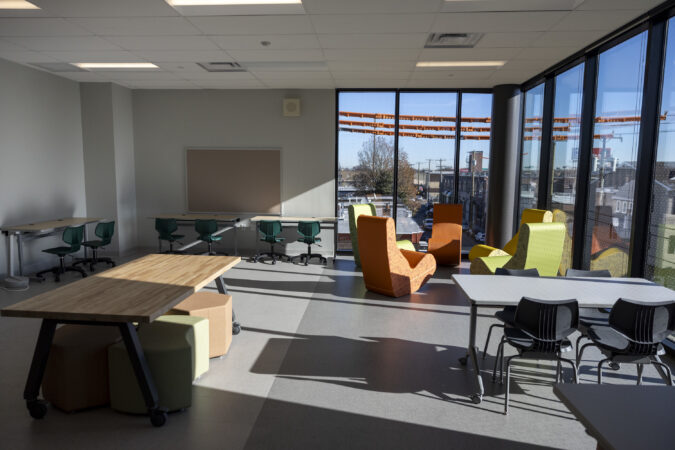
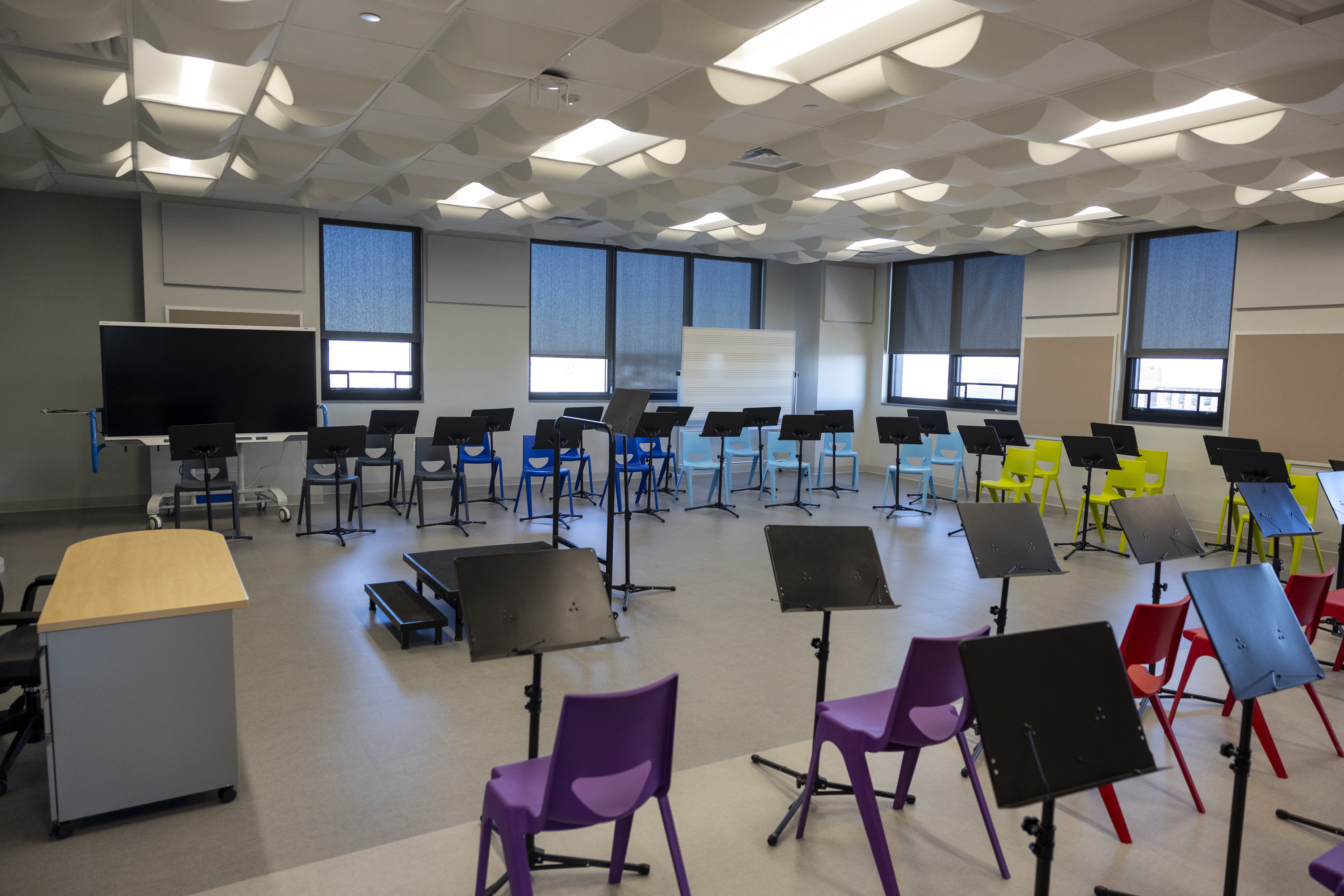
Inside, the 88,000-square-foot, four-story structure at Richmond and Westmoreland Streets just off I-95 is a marvel: all light and flexible seating, makerspace, “digital flex lab” (think: computer lab), and “gymnatorium” (spiffy gym and auditorium). It has modern science labs, dedicated spaces for instrumental and vocal music, and a killer view of Center City from its rooftop outdoor classroom.
The outdoor space with a view of the Center City skyline at the new AMY at James Martin school.
The school replaces an 1894 structure razed to make way for new construction. It is the Philadelphia School District’s sixth new building in 10 years.
“It is kind of crazy, just the giant leap forward that students will be taking, just in terms of furniture, not to mention the technology,” said Melanie Lewin, a district school facilities planner who led tours of the new building. AMY at James Martin students, who have been temporarily learning in classrooms at Penn Treaty High School, used to learn in a 19th-century building; they’re relocating to a building with built-in charging outlets and “noodle chairs” that let them fidget securely while in class.
The instrumental music classroom at the new Amy at James Martin School in Philadelphia.
“This school was not just built to look fantastic,” Watlington said. “I want everyone to know that it was built on time and on budget. That is no easy feat when the price of everything is going up — inflation, tariffs, everything.”
Some neighbors showed up at Tuesday’s ribbon-cutting to celebrate. But the process was controversial at first — some protested the loss of the old AMY at James Martin historic site.
City Councilmember Mike Driscoll alluded to the past pain on Tuesday.
“It’s been a struggle, I’ll admit that,” Driscoll said. But, he said, the new school is lovely. “When you see the plans on paper, it doesn’t do it justice.”
A looming facilities master plan
AMY at James Martin’s opening comes with the district approaching a crossroads: Officials are awaiting a years-in-the-making facilities master plan, the first in decades.
While schools in the Northeast and in a few other spots are overcrowded or nearing capacity, schools in many parts of the city are dramatically underenrolled.
Custom cushioned seats in a classroom at the new Amy at James Martin School in Philadelphia.
Officials have said that some schools will likely cease to exist as part of the process, now expected to culminate early next year with Watlington making recommendations to the school board for grade reconfigurations, closures, co-locations, significant renovations, and new construction.
AMY at James Martin, in its current form, is likely to come in under the district’s minimum recommended school size, at 200 students. The school’s capacity is 500, officials said.
But Casey Laine hopes the school count grows by two in January.
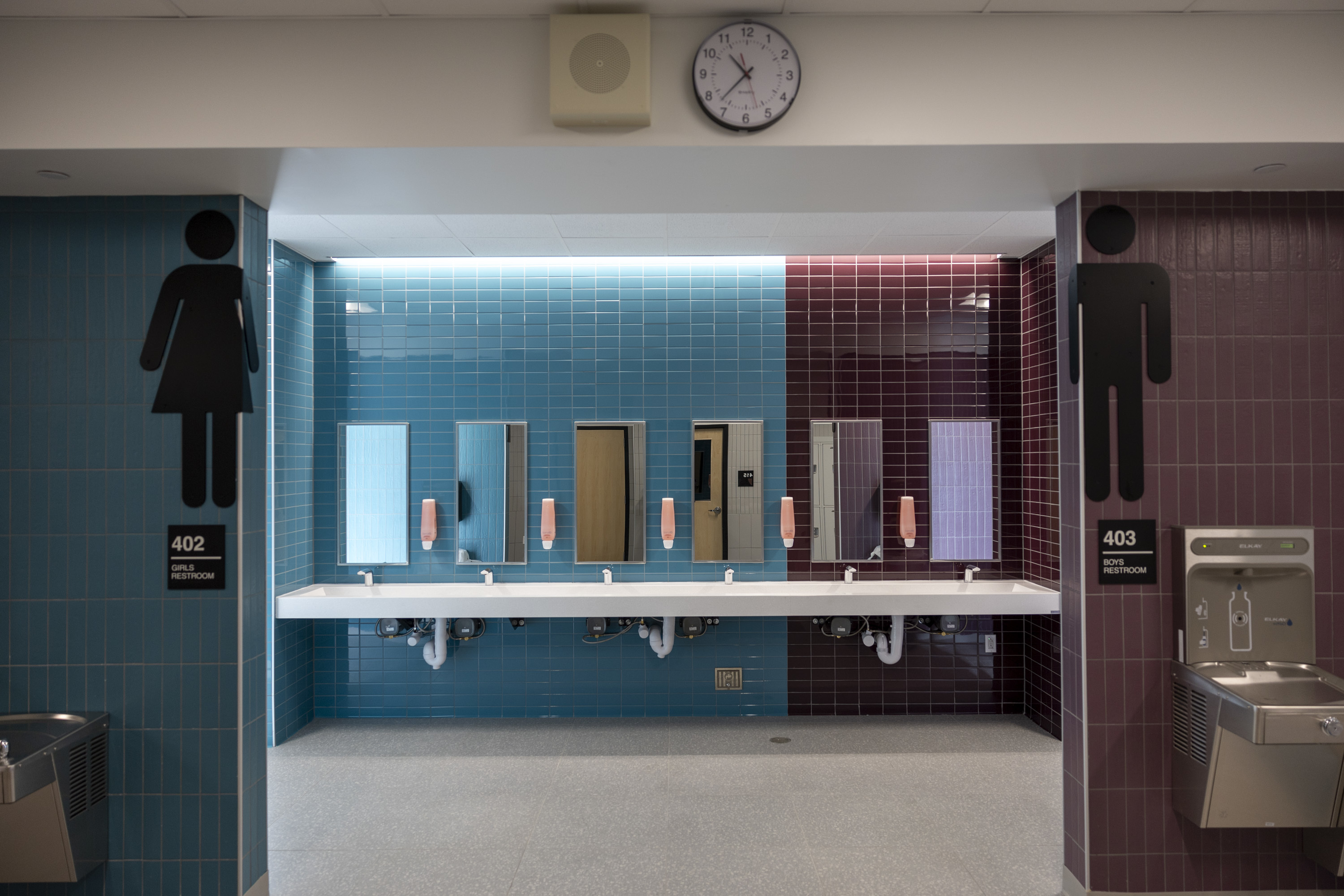
One of the bathrooms for students at the new Amy at James Martin School in Philadelphia.
Laine, who lives around the corner from the new AMY at James Martin and attended Tuesday’s ribbon-cutting, is the mother of a sixth and seventh grader who currently attend Bridesburg Elementary.
She’d like her kids, a son and daughter, to transfer to AMY at James Martin if possible.
“This is beautiful,” Laine said. “I’m so excited.”
The Philadelphia school board on Monday signaled its intentions to play ball: Later this week, it will hold a special action meeting to vote on a resolution authorizing Superintendent Tony B. Watlington Sr. and his team to consider handingover a portfolio of unused school buildings to the city.
Watlington, the resolution states, “recommends that, in the best interests of the district and its students, the district explore and pursue negotiations with the city to potentially convey certain vacant and surplus district property.”
Parker, in a statement, said the process was about “public health and public safety” and the school buildings can be used to improve residents’ quality of life.
Officials “cannot let blighted buildings in the middle of residential neighborhoods lie vacant — many of which have been vacant for many years — from two years to over 30,” Parker said. “It’s unconscionable to me that we are in the middle of a housing crisis and we have government buildings sitting vacant for years or even decades. That cannot continue.”
School board president Reginald Streater said that no decisions are final and that public deliberation will still happen at the special meeting at 4 p.m. Thursday. But, he said, the move makes sense with “the board moving toward being much more willing to be intergovernmental partners” with the city.
“Many of these properties have not been used in the last decade or more, and they require a significant amount of upkeep and maintenance,” Streater said. “These properties are unused, for the most part, and unnecessary for K-12 education.”
The district is in the business of running schools, Streater said.
“I do believe that the city possesses considerably more expertise and capacity than the district does regarding property development,” Streater said. “We are an education institution. To build the capacity to do such things is out of our wheelhouse, and economic development would take us out of our lane.”
According to the language of the resolution, the district is urging Watlington to consider all angles — bond obligations, property conditions, financial protection of the district, any legal processes that would need to happen, and more.
The action comes as something of a surprise, happening just a week after what was to be the final voting meeting of the year. Streater said he did not want to add it as a walk-on resolution to the December school board meeting, but wanted to give members of the public time to understand it and provide testimony, if desired.
Giving unused school buildings to the city could further academic outcomes, the school board president said.
“It’s possible,” Streater said, “that conveying these vacant and surplus properties to the city for redevelopment and revitalization could help stabilize and grow the city and district’s tax base … and consequently positively impact future revenues to the district and educational experiences for students.”
Asked for a list of the unused buildings the resolution would cover, school board officials said more internal evaluation is needed before such a list is released.
The possible transfer of district properties to the city comes as officials debate the specifics of one of Parker’s signature initiatives.
The mayor wants to spend $800 million on her housing initiative, Housing Opportunities Made Easy, or H.O.M.E. In a rare sign of division, Council last week allotted more housing funds to the city’s poorest residents over the Parker administration’s objections.
Because of Council’s move, more legislation is now needed to advance H.O.M.E. It will not come until January at the earliest.
Thomas, chair of Council’s education committee, has long been pushing for a school facilities plan.
“It’s unclear to say what this step forward means, but I want to understand how it fits into a larger plan for Philly’s educational institutions,” Thomas said in a statement.
“Without getting into hypotheticals, and due to a lack of communications with City Council, there are a lot of moving pieces and still many questions about what this means and what is the overall plan for the future of our school buildings,” Thomas said.