Of the district’s 307 buildings, most schools — 159 in total — would be modernized under the proposed plan. The district pointed to Frankford High, which closed for two years because of asbestos issues and just reopened in the fall with $30 million worth of work to spruce it up, as an example of modernization.
An additional 122 schools would fall into a “maintain” category, meaning they would receive regular upkeep. And six facilities would be co-located, meaning two separate schools would be housed under one roof, each with its own principal and team.
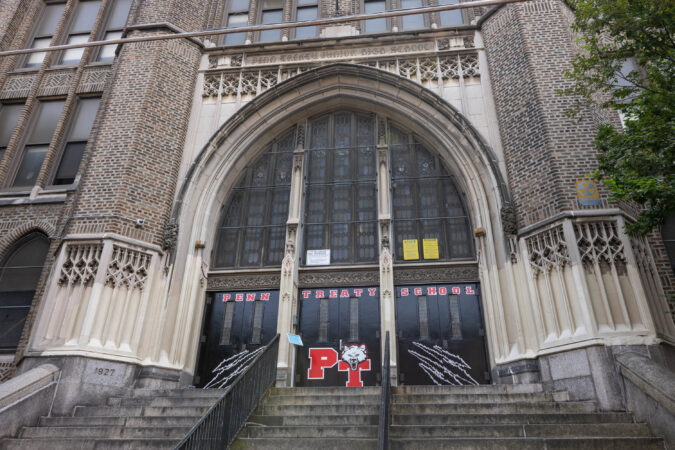
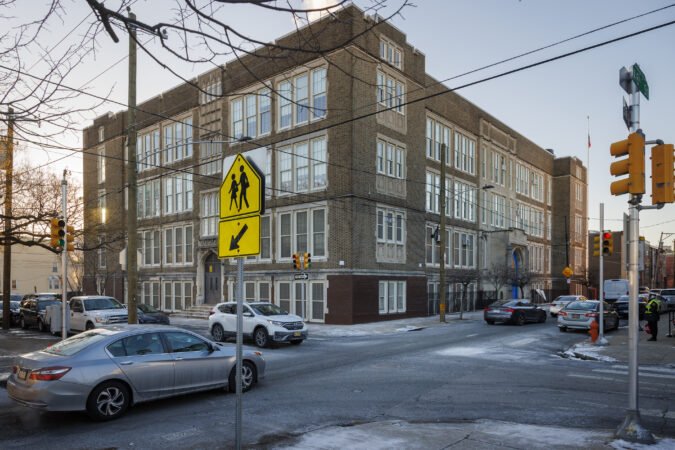
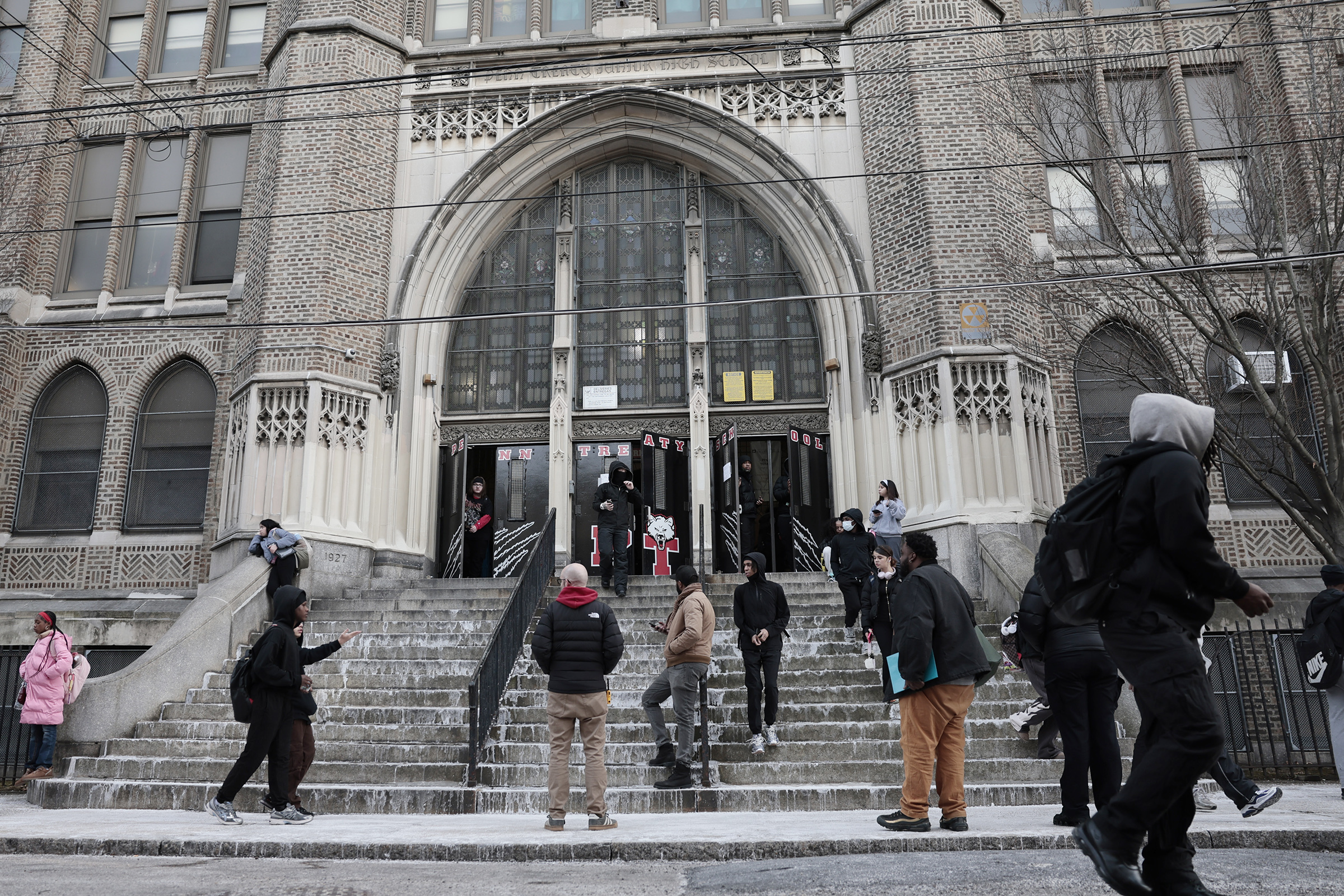
Finally, 20 schools would be recommended for closure. Among them is Penn Treaty, now a 6-12 school, which would close in its current form, but go on to house the current Bodine High School, a magnet in Northern Liberties. Bodine’s building would become the home of Constitution High, which now occupies a rented space in Center City.
As proposed, Watlington’s plan would cost $2.8 billion over 10 years. The district would put up $1 billion via capital borrowing during that time — leaving $1.8 billion unaccounted for that the superintendent said would need to be covered by state money or philanthropic support. If the district doesn’t get all or some of that amount, the plan would have to be amended.
Will some schools definitely close? Which ones?
Right now, the closures are just a proposal, and the school board is slated to have the final say at a vote this winter. They could adopt all, some, or none of Watlington’s recommendations.
If the closures are approved, no school would be shuttered before the 2027-28 school year. And should some schools close, no job losses are expected, Watlington said.
Of the 20 facilities targeted for closure, 12 would be repurposed for district use. Eight would be given to the city for affordable workforce housing, or job creation, both priorities of Mayor Cherelle L. Parker.
We don’t have the full list of proposed modernizations yet, so it’s tough to say the proposed fate of every school.
What will happen to students who attend closing schools?
Every affected student would be routed to a new school. A new transition office would work closely with impacted communities to make sure academics, attendance, and social-emotional needs don’t suffer, Watlington said.
“These families will get gold-standard, red-carpet treatment directly from the superintendent’s office,” he pledged.
Why are these changes necessary?
The district hasn’t had a facilities master plan in more than a decade. It has 70,000 empty seats citywide, with some schools overcrowded and others with entire unused floors. It’s also got a lot of aging buildings — the average district school is nearly 75 years old — and many have environmental and/or significant systems issues.
Officials said they want to solve district-wide disparities: Some schools have art, music, and ample space for physical education, plus extracurricular activities, and some have few of those things.
How were school buildings’ fates determined?
Watlington said there was no formula to determine his recommendations. But four factors entered into the decision: building condition, utilization, the school’s ability to offer robust programming, and neighborhood vulnerability — a new measure that considers things like poverty and whether the area has lived through prior school closings.
The district formally launched the final phase of its facilities master planning process in late 2024. Since then, officials have hosted 47 community conversations and received 13,700 survey responses from people in every zip code in the city. Officials heard from a project team of 30 members and received feedback from nine advisory groups composed of more than 170 members.
The district later launched surveys to gain more input, with the topline result being that Philadelphians didn’t want their local schools closed. Many respondents outlined fears about potential hardships that closing schools could create, such as longer walks to school or tough bus rides in unfamiliar or unsafe areas.
And they flagged worries about merging schools and having large grade spans in a single building.
When did the district last close schools?
Mass school closures last happened in 2012 and 2013, when 30 schools shut.
That process hit economically disadvantaged neighborhoods disproportionately, did not yield substantial savings, and generally led to worse academic outcomes and attendance for students.
The mistakes of 2012 informed this go-round, officials said. They have promised better services for schools, students and families affected by any coming transitions.
In total, 159 buildings would be modernized, while six schools would co-located inside existing buildings
The plan will be presented to the school board Feb. 26, with a board vote expected sometime this winter.
// Timestamp 01/22/26 6:23pm
Philly could close 20 schools, co-locate 6, and modernize 159: Superintendent Watlington shares his facilities plan
****Embargoed until 5pm on Thursday January 22, 2026 ***Superintendent of the School District of Philadelphia Tony B. Watlington at a press conference to announce the plan for the first draft of the Philadelphia facilities master plan during a press conference at the Philadelphia School District Headquarters, in Philadelphia January 20, 2026.
Wholesale changes are coming to the Philadelphia School District, with Superintendent Tony B. Watlington Sr. poised to propose a massive reshaping of the system, including closing 20 schools.
The plan, years in the making, would touch the majority of the district’s buildings and bring change to every part of the city: over a decade, 159 would be modernized, six co-located inside existing schoolbuildings, 12 closed for district use, and eight closed and given to the city.
At least one new building would be constructed.
The 20 closures, which would not begin to take effect until the 2027-28 school year, would be scattered through most of Philadelphia, with North and West Philadelphia hardest hit.
Watlington released some details of the blueprint Thursday — including the list of proposed school closures—and acknowledged that the changes will roil some communities.
Watlington is scheduled to present his proposal to the school board next month, with a board vote on the plan expected this winter.
Mayor Cherelle Parker defends district’s plan: ‘A clear-eyed look at really what matters for our children’
Mayor Cherelle L. Parker on Thursday praised the community engagement process Superintendent Tony B. Watlington Sr. conducted before issuing the facilities plan and defended the school district from critics.
“It is ambitious, it’s thorough, and it’s grounded in what I believe matters most, and that’s achieving the best outcomes for our students,” Parker told reporters. “I’m proud that the district has taken what I would describe as a clear-eyed look at really what matters for our children.”
Watlington’s outreach efforts, she said, stood in stark contrast to the district’s handling of the last round of school closures in the early 2010s, when Parker was a state representative.
“All this communication didn’t happen before, and I know because I was there,” Parker said. Criticism of the plan, she said, is to be expected.
“There are going to be some people who are going to politically try to use this as an anchor, for politics, to raise funding, to just point fingers and say what’s wrong and criticize the district’s leadership,” Parker said. “It’s a part of the process. … But there is no one who can question Dr. Watlington and his exec team.”
The Philadelphia school district’s facilities plan did not go over well in City Council
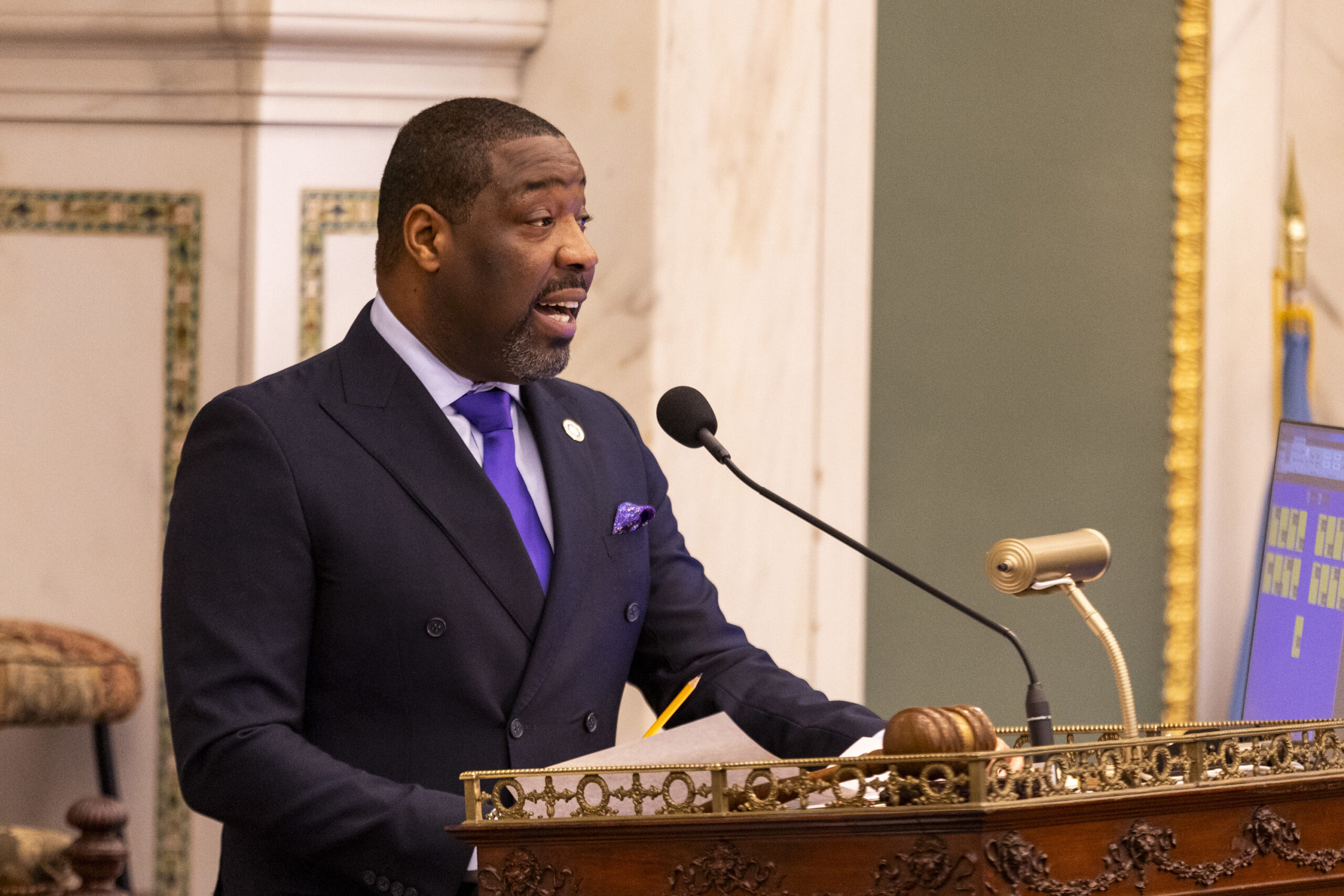
City Council President Kenyatta Johnson speaking at the City Council’s first session of the year in Philadelphia, Pa., on Thursday, Jan. 22, 2026.
City Councilmember Jamie Gauthier said the Philadelphia school district showed “just a complete lack of thought and consideration for really important programs” when crafting its long-anticipated facilities plan, released Thursday.
Council President Kenyatta Johnson said his members had “a lot of concerns.”
And City Councilmember Jeffery “Jay” Young Jr. went so far as to propose amending the city Home Rule Charter to allow Council to remove the school board members who will consider the proposed closures.
“If you are closing schools during a literacy crisis, then you should be held directly accountable to the people you serve,” Young said.
In many ways, it’s unsurprising Council members would speak out against a plan that would close or consolidate schools in their districts. But the pushback from lawmakers Thursday was notably strong, and Young’s proposal to allow Council to remove school board members could dramatically reshape the politics of the district.
Schools plan draws mixed reactions from state lawmakers representing Philly in Harrisburg
The School District of Philadelphia’s plan to close 20 schools through an overhaul of the system received mixed feelings from state lawmakers representing the city in Harrisburg, ranging from careful optimism to concern.
Lawmakers in Harrisburg are responsible for distributing billions of state dollars for public education, including any funding increases. These funds are critically important in Philadelphia, whose tax base alone only meets about a quarter of the needs of its students.
It’s unlikely that any school closures will impact the district’s annual funding from the state, but will likely be a part of conversation as budget talks resume next month for the upcoming fiscal year.
Rep. Andre Carroll, a Democrat who represents parts of Northwest Philadelphia, was driven to run for office by the 2013 closure of his alma mater Germantown High School, which closed during the district’s last round of shutdowns. Now, he has three schools in his district set to close, merge, or co-locate that he worries will negatively impact local students.
“I’m very scarred by that situation and that experience,” Carroll said. “I fear there’s young people in my district that are about to experience the same thing.”
The three schools slated for closure in Carroll’s district are: Building 21 (to be co-located at Martin Luther King High School and building given to the city), General Louis Wagner School (closing but building use is unknown) and Parkway Northwest High School (merging into MLK as an honors program and building used as district swing space).
Carroll said he’s particularly concerned about Wagner’s closure, as it’s the only public middle school in West Oak Lane.
He’s also concerned about the district giving the empty buildings to the city, making the city responsible with their upkeep until they are sold or repurposed. This is especially top of mind to him, he said, because he represents the area where 23-year-old Kada Scott’s body was found last year. Her remains were found on the grounds of the former Ada H.H. Lewis Middle School that’s been closed since 2008 that has over the years become a hotspot for illegal dumping, squatting and other criminal activity. More vacant school properties could attract more crime and community issues in his district, Carroll said.
And if the city sells off the empty properties, he wants to make sure they reach a different fate than that of his alma mater Germantown High, which is now luxury apartments.
“What I fear is that we’re going to continue to see these school buildings turned into unaffordable housing,” Carroll added.
For Rep. Mary Isaacson, a Democrat whose district includes Fishtown, has almost the opposite problem: Schools in her district are often overcrowded due to the area’s population and development boom. One school in her district — Penn Treaty High School currently for students grades 6-12 — will be closed and expanded to become the new site of Bodine High School.
“Right now, I’m taking it as a ‘wait and see,’” Isaacson said. “This has to go through the process with the school board. There probably will be changes. Putting forth the plan doesn’t mean it’s rubber-stamped.”
“I do credit the school district with trying to move forward, modernizing and addressing a lot of the facility issues as part of this plan that have plagued the city of Philadelphia and their aging infrastructure,” she added.
Isaacson said she hopes the district revisits its catchment areas created years earlier to account for her district’s development boom.
“My community schools are bursting in most places,” Isaacson said. “I look forward to having discussions about making room for growth, which may not be the same issues that some others are experiencing in other parts of the city.”
District’s announcement echoes closures from more than a decade ago, Stand Up for Philly Schools coalition member says
For Akira Drake Rodriguez, another member of the Stand Up for Philly Schools coalition, the district’s announcement echoed the highly controversial School Reform Commission closures more than a decade earlier.
“The way this process was presented was trying to not repeat the mistakes of the 2013 closures,” said Rodriguez, an assistant professor of city and regional planning at the University of Pennsylvania who was part of a district advisory group during its planning stages. Yet “the rollout was bumpy,” with some principals of affected schools informing their staffs, and others not, Rodriguez said. “It did not feel like it was done with the care and engagement they knew and were trying to address in this process.”
Rodriguez noted that Tilden Middle School in Southwest Philadelphia was now slated for closure, after absorbing the populations of the Shaw and Tilden middle schools shuttered by the SRC.
“That’s a school you would invest in,” she said. She questioned where students would go instead: “That whole neighborhood of Southwest Philly is charter schools. Do you really think they’re going to stay in traditional public schools when you close Tilden?”
She predicted enrollments at some schools marked for closure would plummet as parents face uncertainty around their futures.
“The district hasn’t really given people a ton of confidence around managing large-scale modernization efforts,” Rodriguez said.
Council President Kenyatta Johnson endorses proposal that would allow city lawmakers to remove school board members
Council President Kenyatta Johnson said Thursday that city lawmakers had “a lot of concerns” about the school district’s facilities plan and would do their “due diligence” to evaluate it.
“I’m sure it’s going to be a very, very robust process,” Johnson told reporters. “These are only recommendations. This isn’t the final product.”
Notably, Johnson immediately endorsed a new proposal by Councilmember Jeffery “Jay” Young Jr. that would allow Council to remove school board members, potentially reshaping the politics of the district. Currently, the mayor appoints the nine-member board, and Council votes to confirm them.
Young’s proposal, an amendment to the city Home Rule Charter, would require voter approval if Council adopted it. Johnson’s endorsement Thursday likely means it has a good choice of at least getting through Council.
“It’s a good check and balance in terms of the process, and also allows us to have the ability and the opportunity to make sure that anything that the school board does is done with transparency,” Johnson said. “I‘m always for, as members of City Council and this body in this institution, having the opportunity to provide accountability.”
‘You’re piling too many kids per classroom. What are the kids learning?’
Letitia Grant, 41, was frustrated to learn that her daughter’s Penn Treaty School was marked for closure in the district’s plan.
“That sucks. That can’t happen,” she said.
Her daughter is in eighth grade at the Fishtown school, and would have stayed at Penn Treaty through her high school graduation. Grant said her daughter loves her teachers and guidance counselor, and has many friends whom she’d miss.
Grant was worried that the district’s consolidation plan could mean larger class sizes and less individual attention for her daughter at a new school. As her daughter and a friend hung out on the sidewalk after dismissal, they stopped their biology teacher to chat. Grant said he was her daughter’s favorite.
“You’re piling too many kids per classroom. What are the kids learning?” she said.
// Timestamp 01/22/26 3:25pm
Councilmember Jamie Gauthier says district’s planning lacked ‘thought and consideration’ for important programs
City Councilmember Jamie Gauthier said the Philadelphia School District showed “just a complete lack of thought and consideration for really important programs” when crafting its long-anticipated facilities plan.
Gauthier said the plan would limit opportunities in her West Philadelphia-based 3rd District. She pointed to changes including Robeson High School and Parkway West ceasing to exist as standalone schools (Robeson would merge into Sayre and Parkway West into SLA Beeber) and The Workshop School co-locating with Overbrook High School.
“What are people supposed to do for good high school options in West Philadelphia?” Gauthier said .
Gauthier added that while Superintendent Tony B. Watlington Sr. has talked at length about avoiding the mistakes of the district’s widely criticized 2012 school closure plan, it appears doomed to repeat that history.
“That’s a great thing to hold up every time we have this conversation, but how are you solving for it?” Gauthier said. “You can’t state all of the things that went wrong and then present a plan that seems to lack care in the same way as the plan in 2012.”
Proposed school closures are ‘deeply troubling,’ Academy at Palumbo parent says
Edwin Mayorga, an Academy at Palumbo parent and member of the Stand Up For Philly Schools coalition, called the planned school closures “deeply troubling.”
“Closing schools straight off is never to me the right answer,” said Mayorga, an associate professor of educational studies at Swarthmore College who said SUPS is planning to rally outside district headquarters next Thursday to oppose the closures. “It’s about asking ourselves, what are the conditions that have produced a school that has declining enrollments, or toxic conditions in the facility, and trying to start from there?”
Mayorga said he was still concerned the district hadn’t adequately engaged with the community. While the district touted 8,000 responses from a citywide survey, Mayorga questioned how extensively it was promoted.
He also expressed skepticism of its findings: When his wife filled it out, Mayorga said, she was asked to choose between options she felt should all be priorities — like a neighborhood high school, and clean facilities.
“How much did that survey really tell us? They’re framing it as a mandate,” said Mayorga, who noted that the Palumbo HSA wasn’t given notice of the plan for a new middle school.
He also said the district’s plan seemed to “bury” the facilities needs of many of its aging buildings — citing Southwark Elementary’s troubles as just one example.
“With all the money involved here … we’re still struggling to ensure all the schools across the city are operating in well-supported ways,” he said.
Search tool: Check how your school could be impacted
window.addEventListener(“message”,function(a){if(void 0!==a.data[“datawrapper-height”]){var e=document.querySelectorAll(“iframe”);for(var t in a.data[“datawrapper-height”])for(var r,i=0;r=e[i];i++)if(r.contentWindow===a.source){var d=a.data[“datawrapper-height”][t]+”px”;r.style.height=d}}});
Newly introduced legislation seeks to allow City Council to remove members of the school board
One lawmaker on Thursday said he planned to oppose some of the closures proposed by the school district and brought legislation that would allow City Council to remove members of the school board.
Councilmember Jeffery “Jay” Young, Jr., a Democrat who represents the North Philadelphia-based fifth district, introduced legislation to amend the city’s Home Rule Charter to give council the authority to remove board members, which it is not currently empowered to do. To become law, Council would need to pass legislation and a majority of voters would have to approve it through a ballot question.
Young said it’s necessary to ensure accountability.
“If you are entrusted with $5 billion in public funds, if you are closing schools during a literacy crisis, then you should be held directly accountable to the people you serve,” Young said. “This moment really demands our leadership.”
He added: “Our children deserve stability. And above all, they deserve leaders who are willing to fight.”
The legislation is also no doubt in response to a 2024 episode involving school board member Joyce Wilkerson, whom Council tried to deny a seat on the board by withdrawing her nomination. But Mayor Cherelle L. Parker took advantage of a loophole in the law and asked Wilkerson to serve on the board indefinitely.
Alliance for Philadelphia Public Schools blasts district’s plan, vows to oppose closings
The Alliance for Philadelphia Public Schools — a group made up mostly of retired district staff who are frequently critical of the district — blasted the district’s plan and the process it used to get there, and vowed to oppose closings.
“Closing public schools that serve as community anchors has been and will again be devastating,” Lisa Haver, group coordinator and a co-founder, said in a statement. “Members of the school communities affected have been given very little time to organize and fight to save their schools before the board’s final vote.”
Watlington is scheduled to present his plan to the school board on Feb. 26, but a vote has not been set. District officials said it was expected sometime this winter.
Group members also questioned why the district “would give away valuable properties to the city, and why the city would not pay for buildings out of its $4.6 billion capital budget.”
Philadelphia Education Fund president is ‘feeling optimistic’ about schools plan
Farah Jimenez, president of the Philadelphia Education Fund, called the plan “incredibly ambitious,” presenting new opportunities for students. For instance: Centralizing many career and technical education offerings, which could help more kids access them, Jimenez said.
But Jimenez, who served on the former state-appointed School Reform Commission after it voted in 2013 to close more than 20 Philadelphia schools, also predicted challenges — including managing expectations.
“With a lot of change comes a lot of anxiety,” Jimenez said, noting schools’ role not just as places of education, but as community hubs.
The district also will have to think about “the brand around some of these community schools,” Jimenez said, and how to co-locate schools with “arguably some differences in culture and make sure people feel like that is a win-win for both student populations.”
The district is planning to give eight school buildings to the city, which Jimenez said reflected a lesson learned from the SRC. When the commission tried to put school buildings on the open market, “it didn’t end up being the win we expected,” she said.
While the SRC’s closure decisions were driven by financial constraints, “it feels like these changes are being made to improve experiences for students and educators,” Jimenez said. She said she was “feeling optimistic about it, because in Philadelphia we have a tendency to not do hard things.” If done well, the plan could be “incredibly exciting.”
Closure plan is ‘a loss for Philadelphia,’ principals union president says
Dr. Robin Cooper, president of CASA, the Philly principals’ union goes to her notes while the principals stream a Facebook live town hall meeting on April 7,2021. Teamsters International Rep. Michael Clark is on left.
Robin Cooper, president of the union that represents district principals, said the effects of Thursday’s announcement will be felt for years.
“It’s a loss of history, a loss for Philadelphia,” said Cooper. “Schools are a family, and some families are breaking up.”
Cooper said she understands the math — the district has a lot of old buildings, many of which are have decades of deferred maintenance. A state court affirmed that the district has been underfunded for generations.
“We know that change is inevitable, but this is difficult because we are talking about our schools,” Cooper said. “My members are in shock. And we’re figuring out how do we continue to provide a stable environment for our school staffs and our students and parents.”
Though no closings would happen until the 2027-28 school year, Watlington said, the announcement was likely to have a destabilizing effect immediately. Site selection — the process by which teachers and other school staffers can apply for new jobs in the district — opens soon, and though they won’t be forced to find new positions immediately, some employees will likely move to jump now, before they’re pushed.
Workshop School founder skeptical of Philly school closure plan
Simon Hauger said closing schools like Overbrook High will be “politically not easy.”
As the district released the school closure plan, Simon Hauger, founder of the Workshop School, was skeptical.
Given the school system’s billions of dollars in deferred maintenance, “the district does not have the talent and capacity to actually solve this problem,” Hauger said. “To me, that’s the part that’s most frustrating … This is not their expertise. The solutions they’re offering are not going to be good solutions.”
Under the plan, Workshop would move into the under-enrolled Overbrook High School in West Philadelphia — which “would be fine,” Hauger said. “There’s good stuff at that building.” But that only makes Overbrook, which Hauger estimated takes millions to run, “slightly more utilized,” he said. “It doesn’t make sense to me.”
The problem, Hauger said, is that closing a school like Overbrook High, which was not slated to shut, is “politically not easy.”
Philly City Council members express concerns about school closure plan
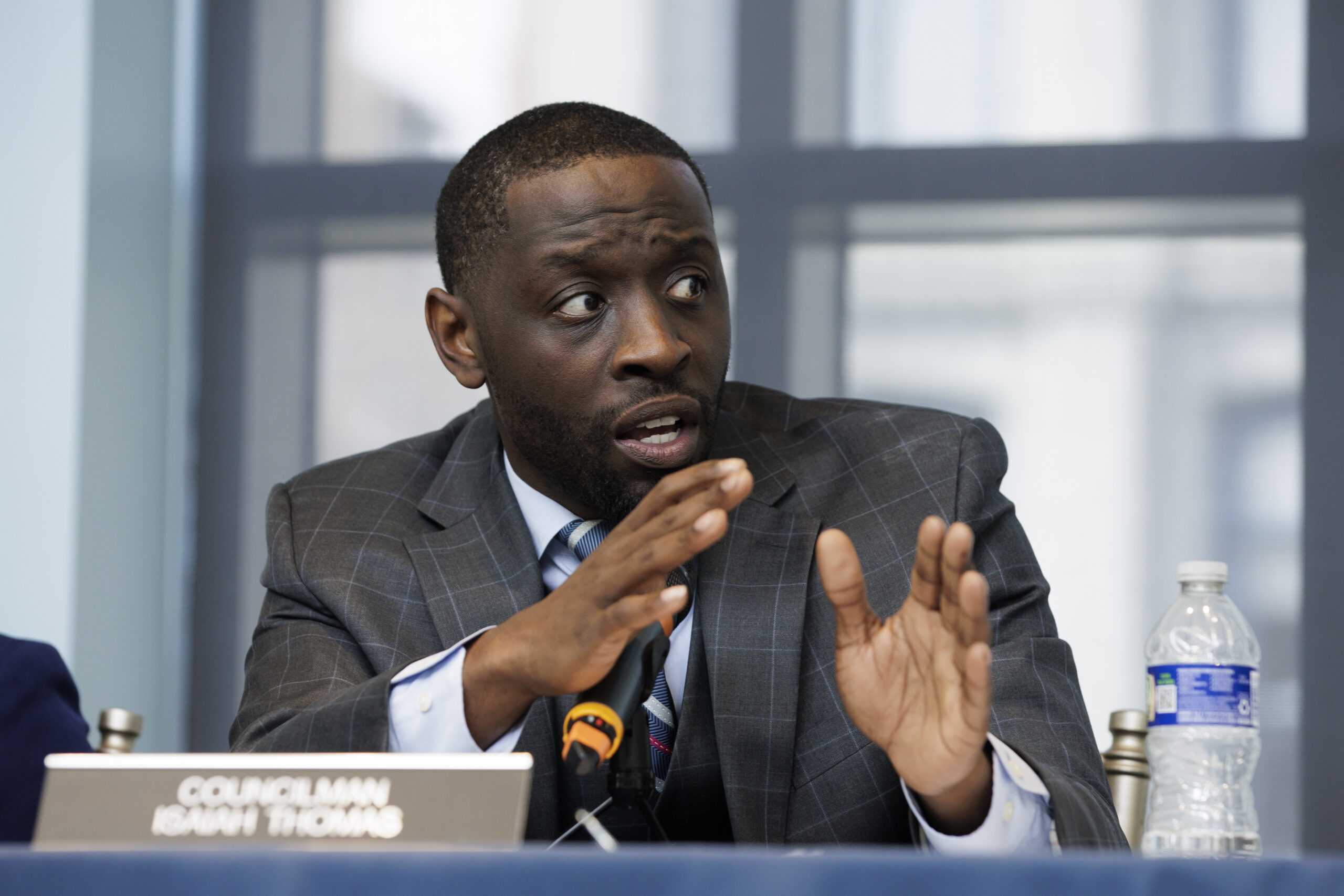
Councilmember Isaiah Thomas, seen here in April, said he would oppose the closure of Russell Conwell Middle School in Kensington.
City Council members were meeting Thursday morning during the first meeting of the year as news of the school district’s facilities plan became public. Several members, who were briefed on the plan earlier this week, said they understood the need to close and consolidate schools but have concerns about how individual closures could impact communities.
“I’m Philly-born and raised, so there’s always like an emotional attachment to schools,” said Councilmember Isaiah Thomas, a Democrat who chairs the Education Committee. “They are a pillar in a lot of neighborhoods. Whenever you step into a conversation like this, you are always going to be super emotional.”
For example, Thomas attended Russell Conwell Middle School in Kensington, which is slated for closure under the facilities plan. He said he will “adamantly” oppose the district shutting Conwell’s doors.
Thomas did praise the district’s process for drafting its plan and said Superintendent Tony Watlington engaged in an open dialogue with lawmakers.
The district, he said, acted with clear “intentionality.”
Councilmember Curtis Jones Jr., whose district includes parts of West and Northwest Philadelphia, said some of the changes are encouraging, including an expansion of career and technical education planned for some schools, including Overbrook High School. Increasing the student body at the school instead of electing to close it, Jones said, is “right on point.”
Jones also said some co-locations make sense — “like a great peanut butter and jelly mix” — but others could combine students who come from different neighborhoods and backgrounds. He said the district must consider what merging those populations means for classroom dynamics.
“The places where the kids come from, that is always a dynamic that is under considered,” Jones said. “If I live in this neighborhood and got to travel to that neighborhood, what are the historical dynamics? That granular detail needs to be discussed.”
Philly teachers union president blames ‘chronic underfunding’ for school closing plan
Philadelphia Federation of Teachers president Arthur Steinberg, seen here in September at Murrell Dobbins Career & Technical Education High School.
Arthur Steinberg, president of the Philadelphia Federation of Teachers, said he’s waiting to see more granular details of the plan, including the list of schools that will be upgraded and what fixes are promised, and hopes information about how much weight was given to every factor that went into the decisions.
But, Steinberg said, “it is devastating for any community to lose their school — the parents, the kids and the staff.”
As for the process that led the district to this moment, Steinberg said it was abundantly clear even to advisory panel members that their viewpoints were just points of information for Watlington’s administration, that no promises about heeding any advice were made.
Either way, the closure of 20 schools and more changes that will have ripples across the city for years to come all lead back to one factor, he said.
“Without the chronic underfunding of the district,” said Steinberg, “we wouldn’t have gotten to this point.”
A copy of the Philadelphia School District’s facilities master plan.
Outrage mounted for some Thursday morning as district officials began quietly notifying affected communities and groups.
“It’s heartbreaking,” said Sharee S. Himmons, a veteran paraprofessional at Fitler Academics Plus, a K-8 in Germantown. “It feels like a family member is dying.”
Himmons is enrolled in the district’s paraprofessional pathways program, taking college courses to earn her degree and teacher certification. She was sitting in her math class at La Salle University when she found out Fitler was slated for closure. She began crying. She failed a test she was taking because her concentration was shot, she said.
“This school is such a staple in the neighborhood,” she said. Fitler is a citywide admissions school, but draws many students from the area. Himmons’ own sons attended Fitler, and she wanted to teach there after her college graduation.
“This isn’t over,” she said. “We’re going to fight — hard.”
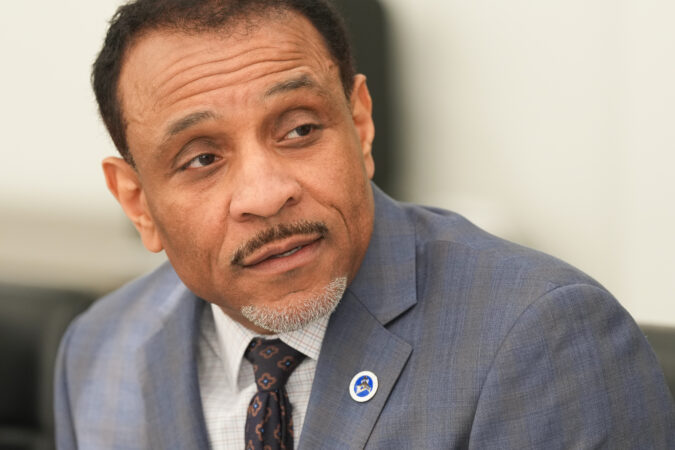
Philadelphia School District Superintendent Tony B. Watlington, seen here in September.
Wholesale changes are coming to the Philadelphia School District, with Superintendent Tony B. Watlington Sr. poised to propose a massive reshaping of the system, including closing 20 schools.
The plan, years in the making, would touch the majority of the district’s buildings: over a decade, 159 would be modernized, six co-located inside existing buildings, 12 closed for district use and eight closed and given to the city.
One new building would be constructed.
Change would come to every part of the city, but not until 2027-28. Closures would be scattered through most of Philadelphia, with North and West Philadelphia hardest hit.
Philadelphia, the nation’s eighth largest school system, now has 216 schools in 307 buildings, the oldest of which was built in 1889. It has 70,000 empty seats citywide, though some of its schools, especially those in the Northeast, are overcrowded.
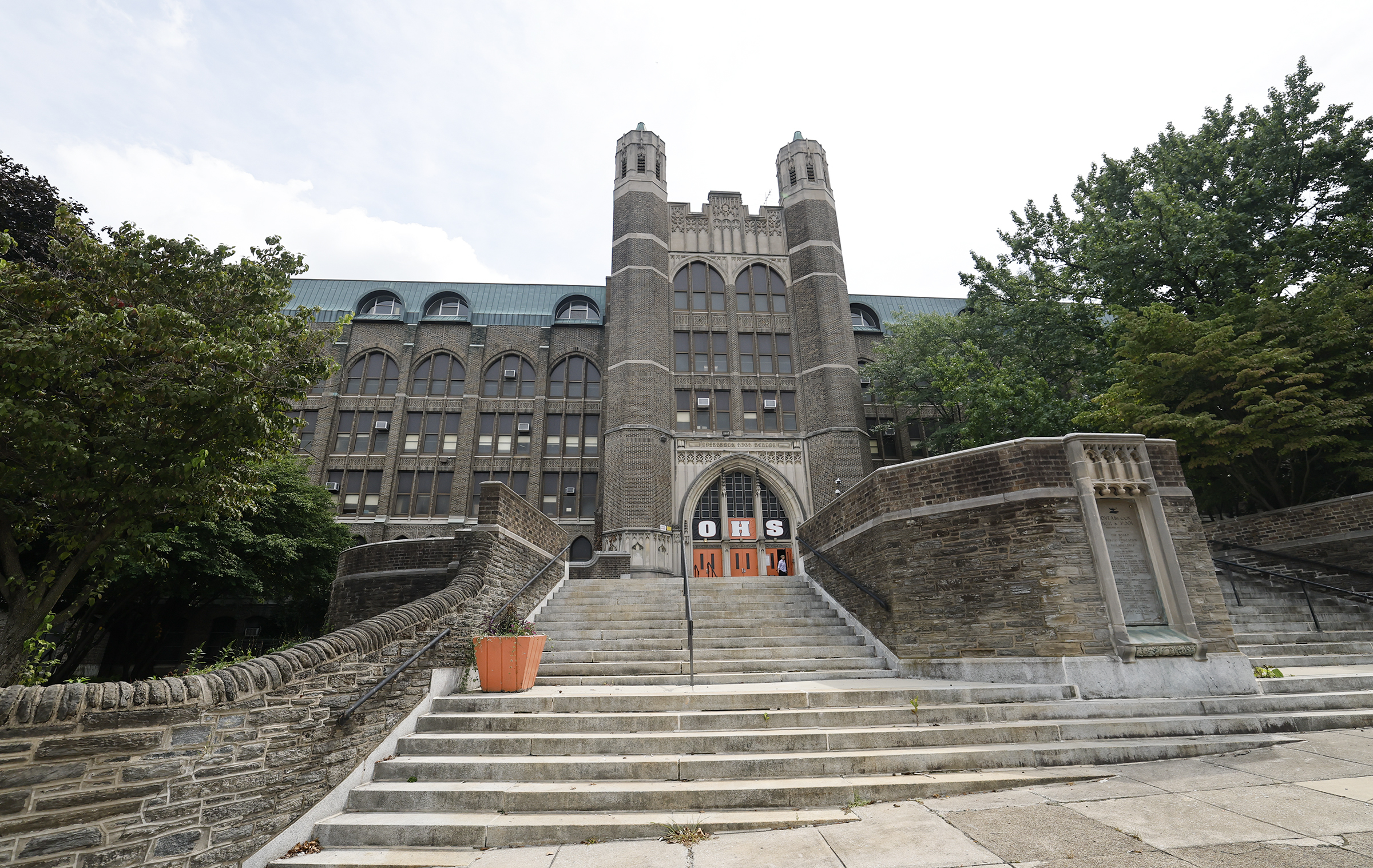
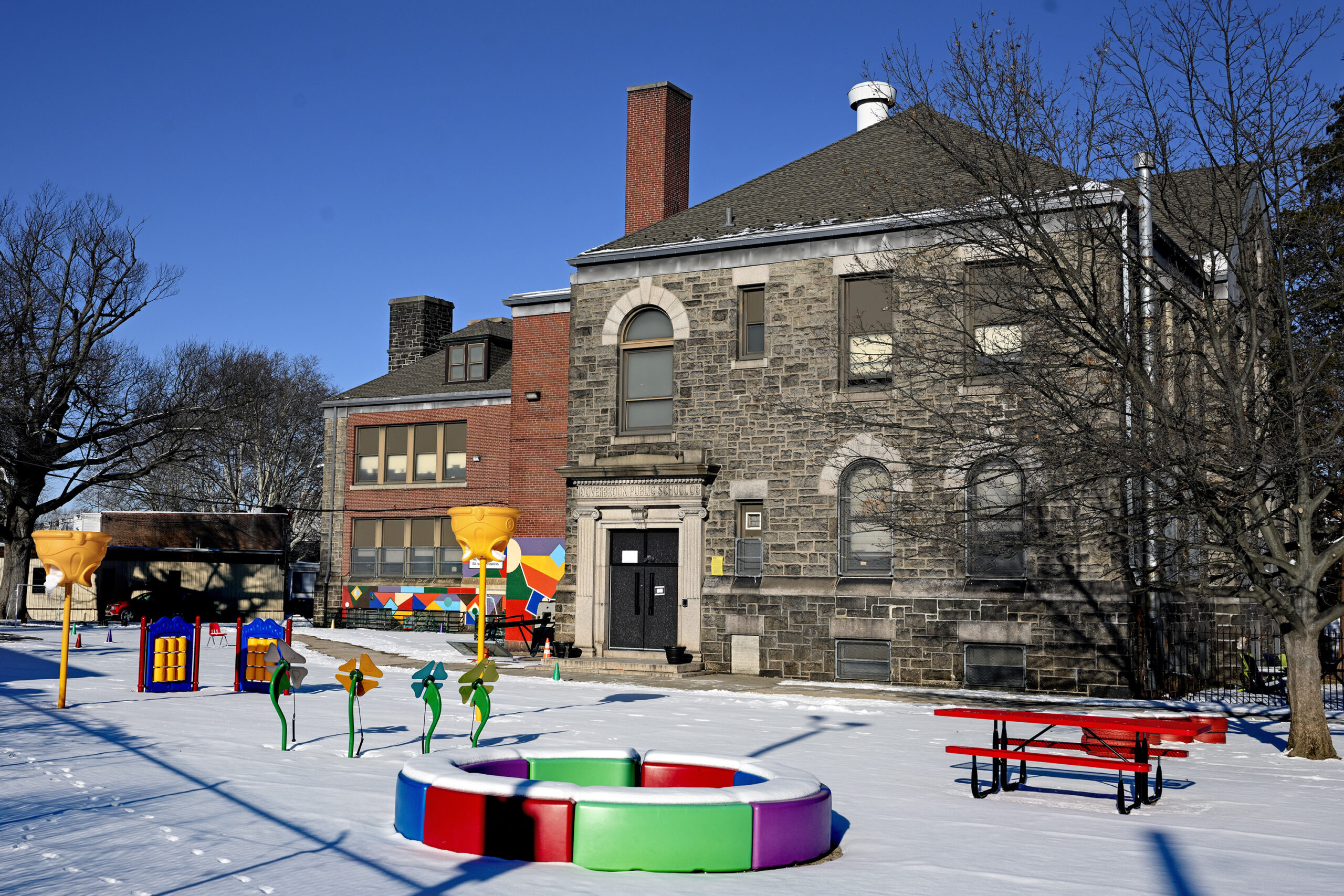
Overbrook Elementary is among the schools that would close.
Here are the 20 schools that would close under Superintendent Tony B. Watlington Sr.’s revitalization plan:
Elementary schools
Blankenburg
Fitler
Ludlow
Overbrook
Pennypacker
Morris
Waring
Welsh
Middle schools
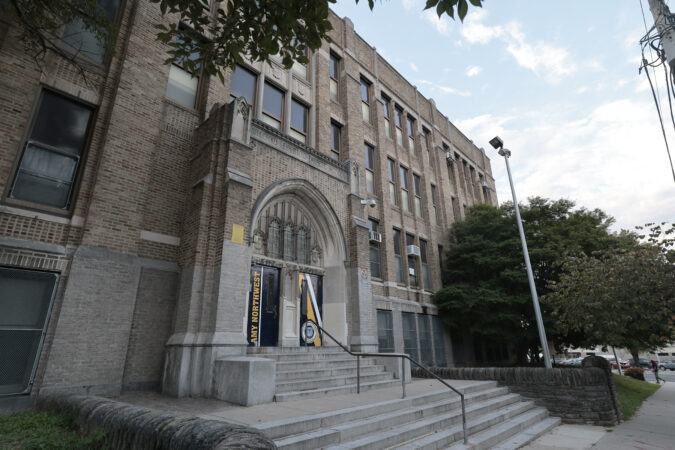
AMY Northwest
Conwell
Harding
Penn Treaty
Stetson
Tilden
Wagner
High schools
Lankenau
Motivation
Parkway Northwest
Parkway West
Robeson
(function() {
var l2 = function() {
new pym.Parent(‘school_closing1’,
‘https://media.inquirer.com/storage/inquirer/projects/innovation/arcgis_iframe/school_closing1.html’);
};
if (typeof(pym) === ‘undefined’) {
var h = document.getElementsByTagName(‘head’)[0],
s = document.createElement(‘script’);
s.type = ‘text/javascript’;
s.src = ‘https://pym.nprapps.org/pym.v1.min.js’;
s.onload = l2;
h.appendChild(s);
} else {
l2();
}
})();
Some of those schools, like Lankenau and Robeson, would become programs inside other schools — Roxborough High for Lankenau, and Sayre for Robeson. Others would close outright, with students assigned elsewhere.
Students at the affected schools would move into schools with similar or better academic outcomes or building conditions, or schools that are better by both measures, Watlington said. Transition resources would be available for schools, students and families from closing schools and for schools that take in new students.
Watlington said he did not anticipate job losses as a result of the closures.
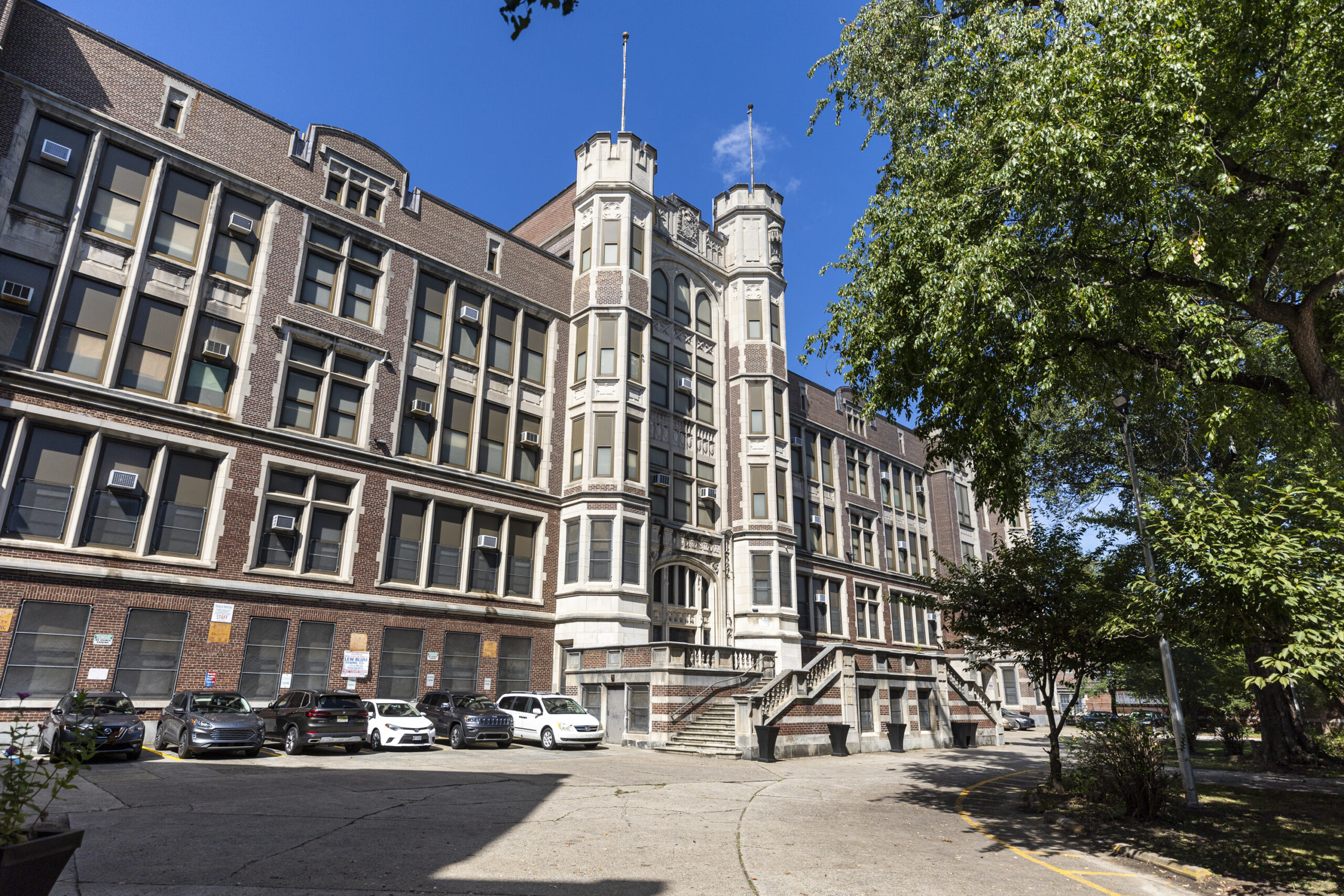
Frankford High School is an example of a Philly school that has been modernized.
Most schools — 159 — would be modernized under the proposed plan. (Frankford High, which closed for two years because of asbestos issues and just re-opened this fall with $30 million of work to spruce it up, is an example the district cited of a modernization.)
An additional 122 fall into the “maintain” category, meaning they’ll just receive regular upkeep.
Six facilities would be co-located, meaning they would be two separate schools housed under one roof, each with its own principal and team.
Twenty schools would be closed.
A lot of shuffling is planned. Penn Treaty, now a 6-12 school in Fishtown, would close in its current form, but the building would stay open, housing the current Bodine High School, a magnet in Northern Liberties. Bodine’s building would become the home of Constitution High, which now occupies a rented space in Center City.
The school system would see sweeping changes: 20 school closures, six co-locations, more than 150 modernization projects and one brand-new building.
All parts of the city would be affected under the blueprint, which will be formally presented to the school board Feb. 26 and is not final.
The $2.8 billion project is necessary, officials said, because of 70,000 extra seats across the district, poor building conditions in many schools, and disparities in program offerings.
Here’s a breakdown of Watlington’s plan:
If you are reading this story and cannot see the charts, click here.
window.addEventListener(“message”,function(a){if(void 0!==a.data[“datawrapper-height”]){var e=document.querySelectorAll(“iframe”);for(var t in a.data[“datawrapper-height”])for(var r,i=0;r=e[i];i++)if(r.contentWindow===a.source){var d=a.data[“datawrapper-height”][t]+”px”;r.style.height=d}}});
window.addEventListener(“message”,function(a){if(void 0!==a.data[“datawrapper-height”]){var e=document.querySelectorAll(“iframe”);for(var t in a.data[“datawrapper-height”])for(var r,i=0;r=e[i];i++)if(r.contentWindow===a.source){var d=a.data[“datawrapper-height”][t]+”px”;r.style.height=d}}});
window.addEventListener(“message”,function(a){if(void 0!==a.data[“datawrapper-height”]){var e=document.querySelectorAll(“iframe”);for(var t in a.data[“datawrapper-height”])for(var r,i=0;r=e[i];i++)if(r.contentWindow===a.source){var d=a.data[“datawrapper-height”][t]+”px”;r.style.height=d}}});
Wholesale changes are coming to the Philadelphia School District, with Superintendent Tony B. Watlington Sr. poised to propose a massive reshaping of the system, including closing 20 schools.
The plan, years in the making, would touch the majority of the district’s buildings and bring change to every part of the city: over a decade, 159 would be modernized, six colocated inside existing schoolbuildings, 12 closed for district use, and eight closed and given to the city.
At least one new building would be constructed.
The 20 closures, which would not begin to take effect until the 2027-28 school year, would be scattered through most of Philadelphia, with North and West Philadelphia hardest hit.
Watlington released some details of the blueprint Thursday — including the list of proposed school closures—and acknowledged that the changes will roil some communities.
Watlington is scheduled to present his proposal to the school board next month, with a board vote on the plan expected this winter.
(function() {
var l2 = function() {
new pym.Parent(‘school_closing1’,
‘https://media.inquirer.com/storage/inquirer/projects/innovation/arcgis_iframe/school_closing1.html’);
};
if (typeof(pym) === ‘undefined’) {
var h = document.getElementsByTagName(‘head’)[0],
s = document.createElement(‘script’);
s.type = ‘text/javascript’;
s.src = ‘https://pym.nprapps.org/pym.v1.min.js’;
s.onload = l2;
h.appendChild(s);
} else {
l2();
}
})();
Philadelphia, the nation’s eighth-largest school system, now has 216 schools in 307 buildings, the oldest of which was constructed in 1889. It has 70,000 empty seats citywide, though some of its schools, especially those in the Northeast, are overcrowded.
But, Watlington said, “this is not just about old buildings.” Philadelphia’s academics are improving, and faster than most big-city districts, but most of its students still fail to meet state standards — just 21% hit state goals for math, and 35% for English.
“We must find ways to more efficiently use all of our resources so that we can push higher-quality academic and extracurricular programming and activities into all of our schools across all the neighborhoods of Philadelphia, while at the same time addressing under- and overenrolled schools,” the superintendent said.
If the school board adopts Watlington’s plan as proposed, the number of empty space in school buildings would decrease, with district schools going from a 66% utilization rate to 75%. The changes would also allow for the district to offer more students prekindergarten, algebra in eighth grade, and career and technical education and Advanced Placement courses, officials said.
“Part of the problem here is there’s so much disparity in the School District of Philadelphia,” said Watlington, who suggested the plan will improve equity.
Every building judged in “poor” or “unsatisfactory” condition — there are now 85 citywide — would either close or be upgraded within a decade, though the information released Thursday did not include details on upgrade plans.
There are no guarantees, however. The plan comes with a $2.8 billion price tag — only $1 billion of which the district will cover with its capital funds. The rest of the money is dependent on state and philanthropic support, neither of which is a given.
If the extra funding does not come through, Watlington said, fewer schools in disrepair could be modernized, or the district would have to make other revisions to the plan.
Officials said a backup plan would take longer to complete — 16 years, instead of a decade. The $1 billion version would not allow the school system to upgrade all schools currently rated unsatisfactory or poor. Instead, it would have 45 buildings in the those categories in 2041.
A possible closure list
Watlington indicated he wants to close these schools: Blankenburg, Fitler, Ludlow, Robert Morris, Overbrook Elementary, Pennypacker, Waring, and Welsh elementary schools; Conwell, AMY Northwest, Harding, Stetson, Tilden, and Wagner middle schools; and Lankenau Motivation, Parkway Northwest, Parkway West, Penn Treaty, and Robeson high schools. (Some of those schools, like Lankenau and Robeson, would become programs inside other schools — Roxborough High would use Lankenau, and Sayre would useRobeson. Others would close outright, with students assigned elsewhere.)
And he named six schools that would move into other school buildings while maintaining their individual structure and identity: Martha Washington, Building 21, the Workshop School, the U School, a new Academy at Palumbo Middle School, and a new K-8 year-round school.
Students at the affected schools will all move into schools with similar or better academic outcomes or building conditions, or schools that are better by both measures, Watlington said. Transition resources will be available for schools, students, and families from closing schools and for schools that take in new students.
The changes will also affect far more students than those in the 20 schools being shut down or in those sharing locations; closures mean the district would eventually need to redraw at least some school catchment boundaries, which dictate the neighborhood school each child attends.
Watlington said he did not anticipate job losses as a result of the closures.
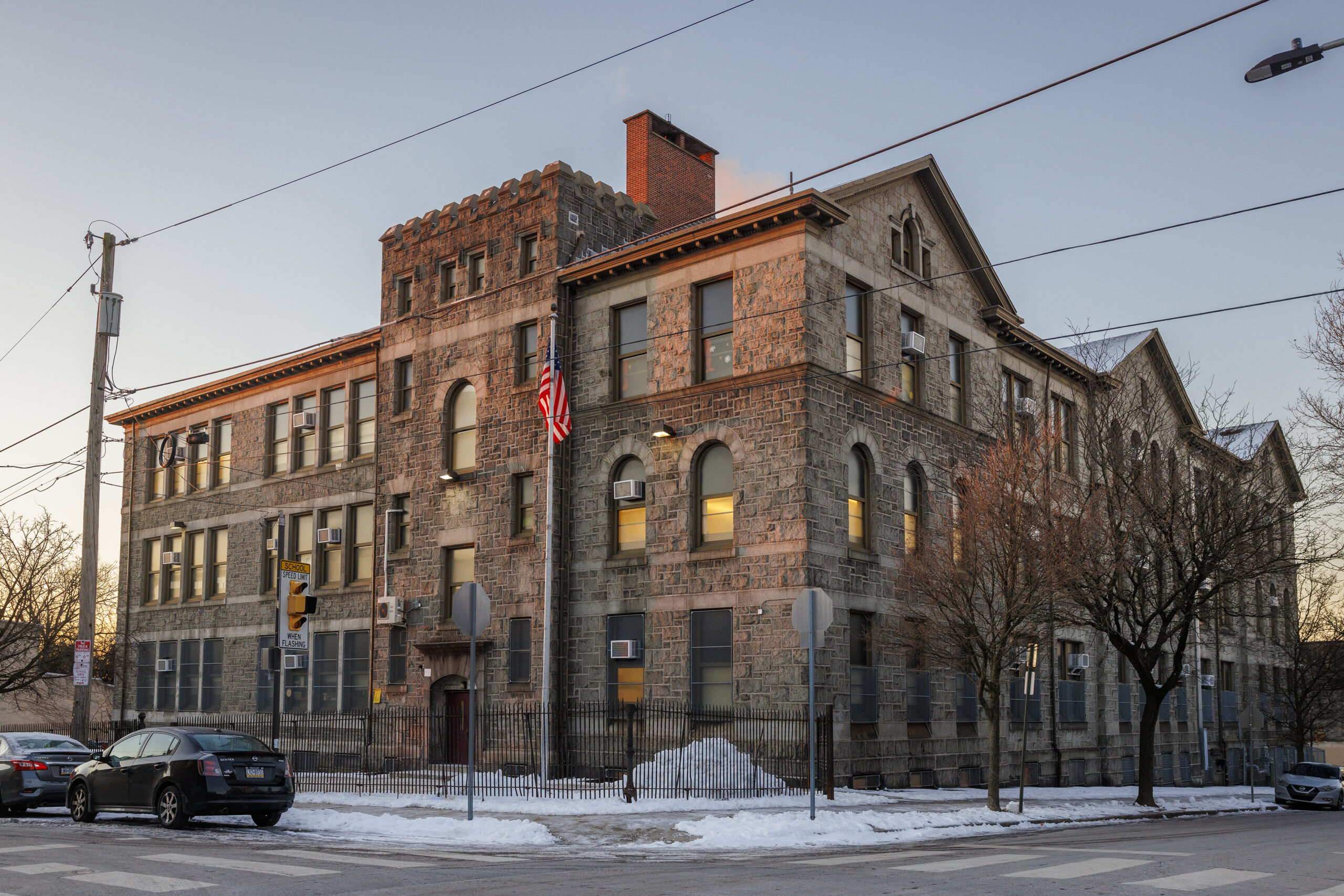
School officials stand by outside for afternoon dismissal at Penn Treaty Middle School, 600 East Thompson Street, in Philadelphia on Thursday, Jan. 22, 2026.
Fewer transitions, more standard grade configurations
Officials said they arrived at the blueprint after analyzing data and gathering feedback across the city — in meetings and surveys, and based on wisdom from advisory panels and a planning team. (Some advisory panel members said they had real concerns about the process, felt they got too little information, and saidtheir input was not seriously considered. Some had called for a pause in the process and a plan with no closings.)
Parents, staff, and community members identified four main themes that informed the recommendations, Watlington said: strengthening K-8 schools, reinvesting in neighborhood high schools, reducing school transitions for students, and expanding access to grades 5-12 criteria-based high schools.
The plan dramatically shrinks the number of grade spans in the district.
Currently, there are 13 different kinds of school configurations. Going forward, there be just six grade bands: K-4, K-8, K-12, 5-8, 5-12, and 9-12. (Six schools will be exceptions, however.)
Philadelphia is leaning into a “strong K-8 model,” Watlington said. He recommended closing six middle schools, with some elementary schools adding grades to accommodate.
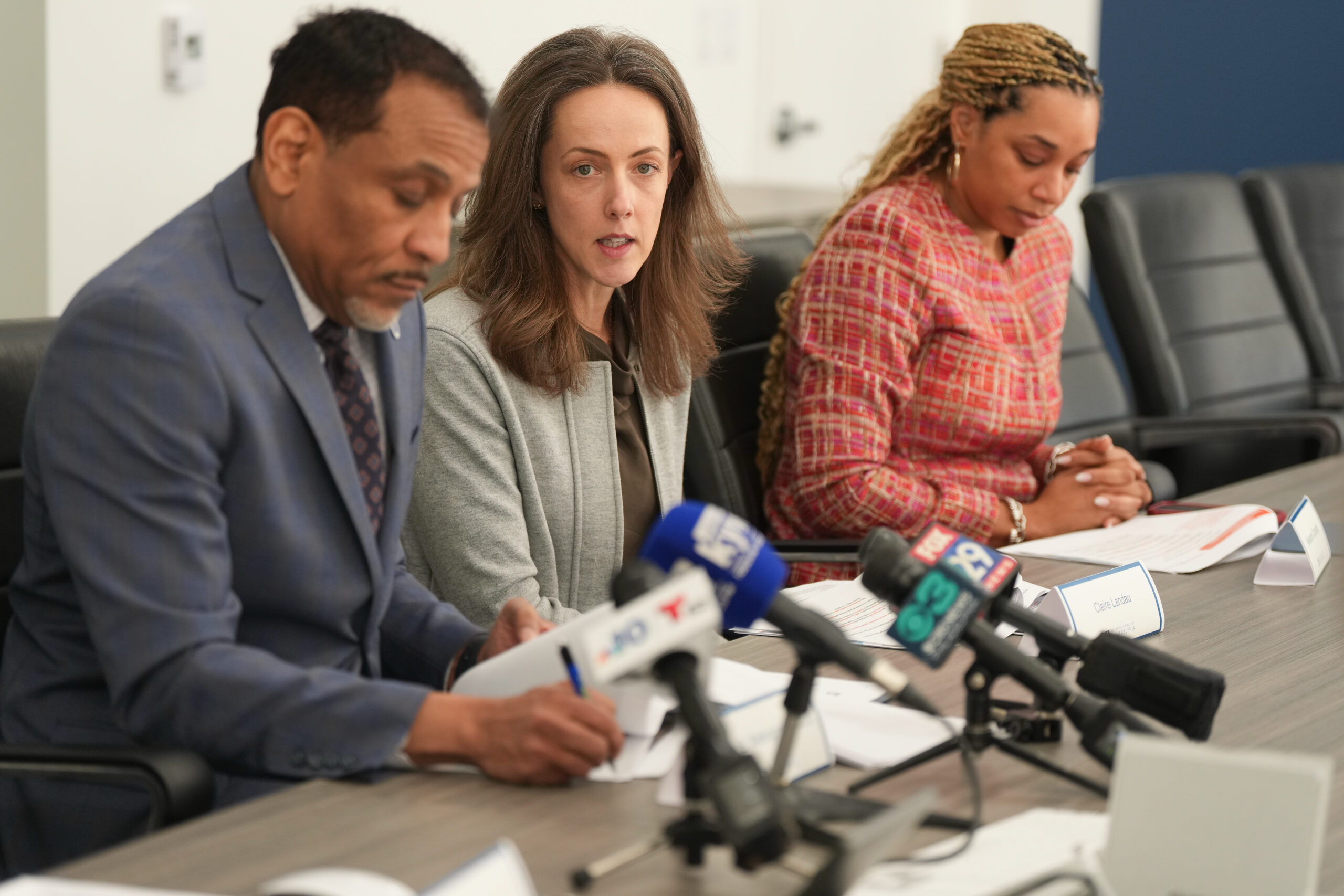
From left to right, Superintendent Tony B. Watlington, senior adviser Claire Landau, and chief of communications and customer service Alexandra Coppadge speak to reporters on Tuesday about their proposed master plan for Philadelphia schools.
It is also turning some high schools that now house four grades into middle-high schools, with 5-12 spans. South Philadelphia High will get investments to its career and technical education space and add fifth through eighth grades, for instance. A new Palumbo Middle School will open, colocated with Childs Elementary in Point Breeze; its students will get preference for admission to the Academy at Palumbo, a South Philly magnet.
Investments in the Northeast, and elsewhere
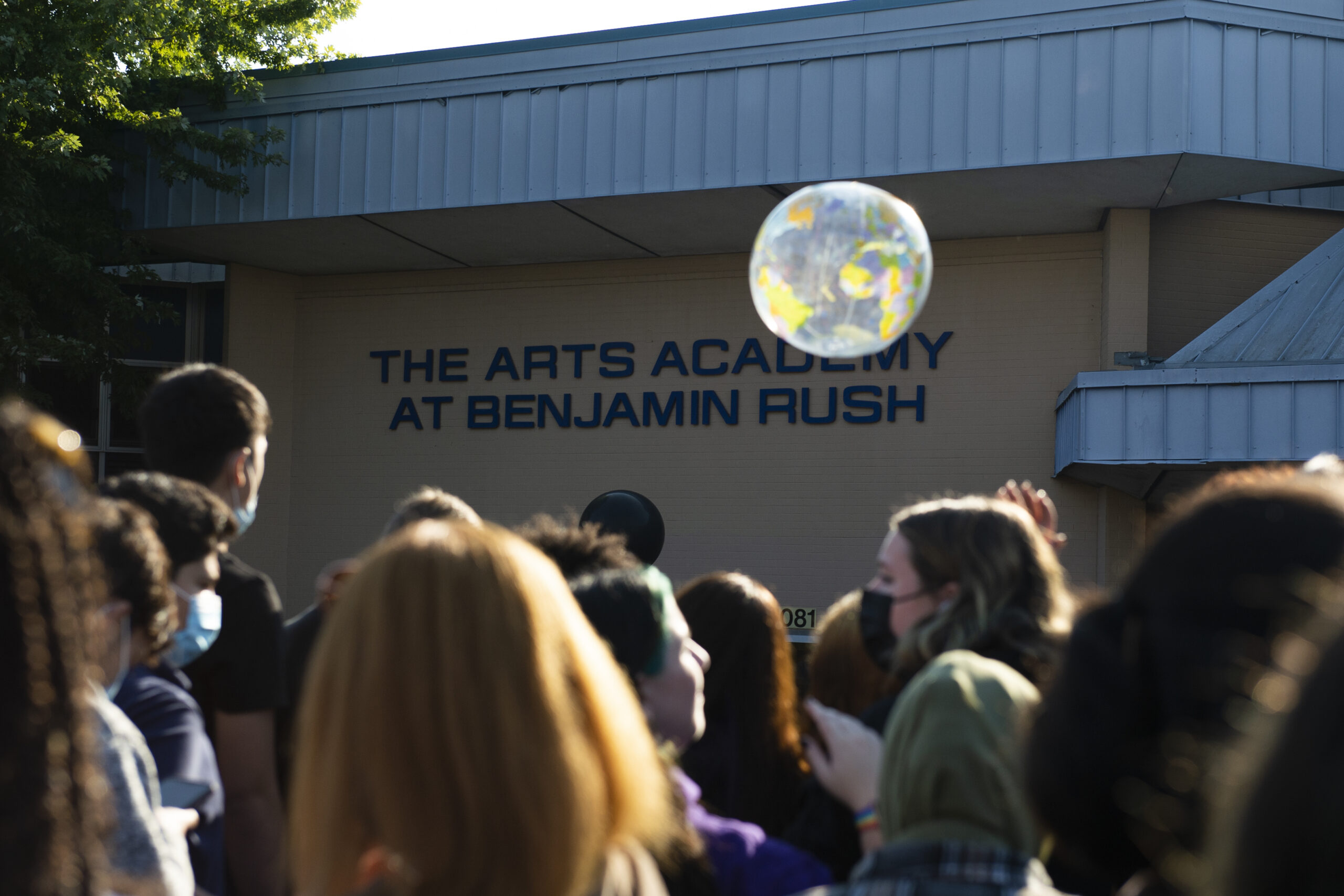
The single from-scratch construction announced will be in the Lower Northeast — a new Arts Academy at Benjamin Rush, a popular magnet now in the Far Northeast. That new building, which will house students in fifth through 12th grades, would rise on the site of the old Fels High School in Oxford Circle.
A new neighborhood high school will open in the current Rush Arts building, if the plan is approved.
The Arts Academy at Benjamin Rush, shown in this 2022 file photo, will move to a new building constructed in the lower Northeast under the facilities master plan now under consideration. A new catchment high school would open in the Rush Arts building.
Comly, Forrest, and Carnell — all Northeast schools — would be modernized and get additional grades to relieve overcrowding.
Masterman, one of the city’s top magnets, has long been overcrowded — its middle school would move to Waring, in Spring Garden, one of the closing schools.
“It’s really important to note this is not a plan to just funnel resources into the Northeast part of Philadelphia, where the population is increasing faster or in a different way than other parts of the city,” Watlington said. “This is not just build out, invest in some areas, divest in others.”
Learning from past mistakes
Watlington said he knows the plan will be difficult for some to swallow, and does not achieve every aim.
But, he said, “we are not going to make good the enemy of perfect.”
Still, Watlington and others vowed this closure process — the first large-scale closures in more than a decade — would not repeat the mistakes of 2012 and 2013, when 30 schools were shut to save money.
A new transition team will focus on what students and schools need, from social and emotional supports to safety and academic help.
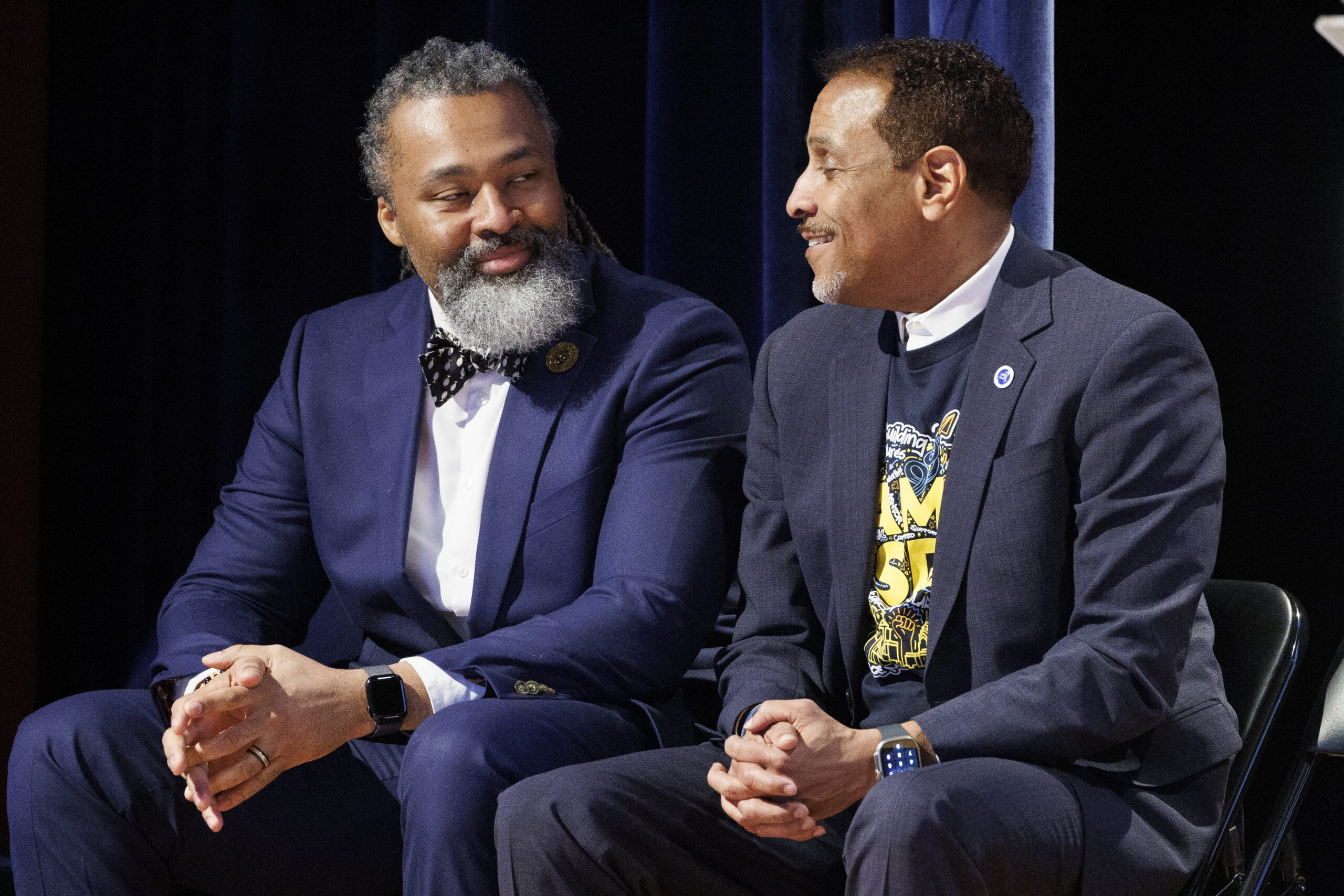
School board president Reginald Streater and Superintendent Tony B. Watlington Sr. are shown in this 2025 file photo.
“These families will get gold-standard, red-carpet treatment directly from the superintendent’s office,” Watlington said.
The superintendent said he will urge the board to “strongly consider” his recommendations.
“We have one shot to get this right,” Watlington said. “We believe this is as good a plan as we can bring to the board, and so we’re going to recommend strongly that the board adopt these recommendations.”
School board president Reginald Streater said the facilities planning process was “critical” to bettering student outcomes.
Watlington, Streater said in a release, has led “meaningful community engagement with families, educators, and community members across our city. The board looks forward to receiving the full set of recommendations and carefully considering them as we work together to ensure all of our school facilities and student rostering practices best support access to high-quality educational experiences and opportunities for all students.”
Mayor Cherelle L. Parker gave good marks to the plan.
“It is ambitious, it’s thorough, and it’s grounded in what I believe matters most, and that’s achieving the best outcomes for our students,” Parker told reporters. “I’m proud that the district has taken what I would describe as a clear-eyed look at really what matters for our children.”
‘It feels like a family member is dying’
Outrage mounted for some Thursday as district officials began notifying affected communities and groups.
“It’s heartbreaking,” said Sharee S. Himmons, a veteran paraprofessional at Fitler Academics Plus, a K-8 in Germantown. “It feels like a family member is dying.”
Himmons is enrolled in the district’s Pathways to Teaching program, taking college courses to earn her degree and teacher certification. She was sitting in her math class at La Salle University when she found out Fitler was slated for closure. She began crying. She failed a test she was taking because her concentration was shot, she said.
Fitler Academics Plus Elementary School in Germantown is among the 20 schools that would close under the proposed plan.
“This school is such a staple in the neighborhood,” she said. Fitler is a citywide admissions school, but draws many students from the area. Himmons’ own sons attended Fitler, and she wanted to teach there after her college graduation.
“This isn’t over,” she said. “We’re going to fight — hard.”
Arthur Steinberg, president of the Philadelphia Federation of Teachers, said he is waiting to see more granular details of the plan, including the list of schools that will be upgraded and what fixes are promised, and hopes for information about how much weight was given to every factor that went into the decisions.
But, Steinberg said, “it is devastating for any community to lose their school — the parents, the kids, and the staff.”
As for the process that led the district to this moment, Steinberg said it was abundantly clear even to advisory panel members that their viewpoints were just points of information for Watlington’s administration, that no promises about heeding any advice were made.
Either way, the closure of 20 schools and more changes that will have ripples across the city for years to come all lead back to one factor, he said.
“Without the chronic underfunding of the district,” Steinberg said, “we wouldn’t have gotten to this point.”
Robin Cooper, president of the union that represents district principals, said the announcement was destabilizing, even though officials had warned closings were coming.
“It’s a loss of history, a loss for Philadelphia,” Cooper said. “Schools are a family, and some families are breaking up.”
Staff writer Sean Collins Walsh contributed to this article.
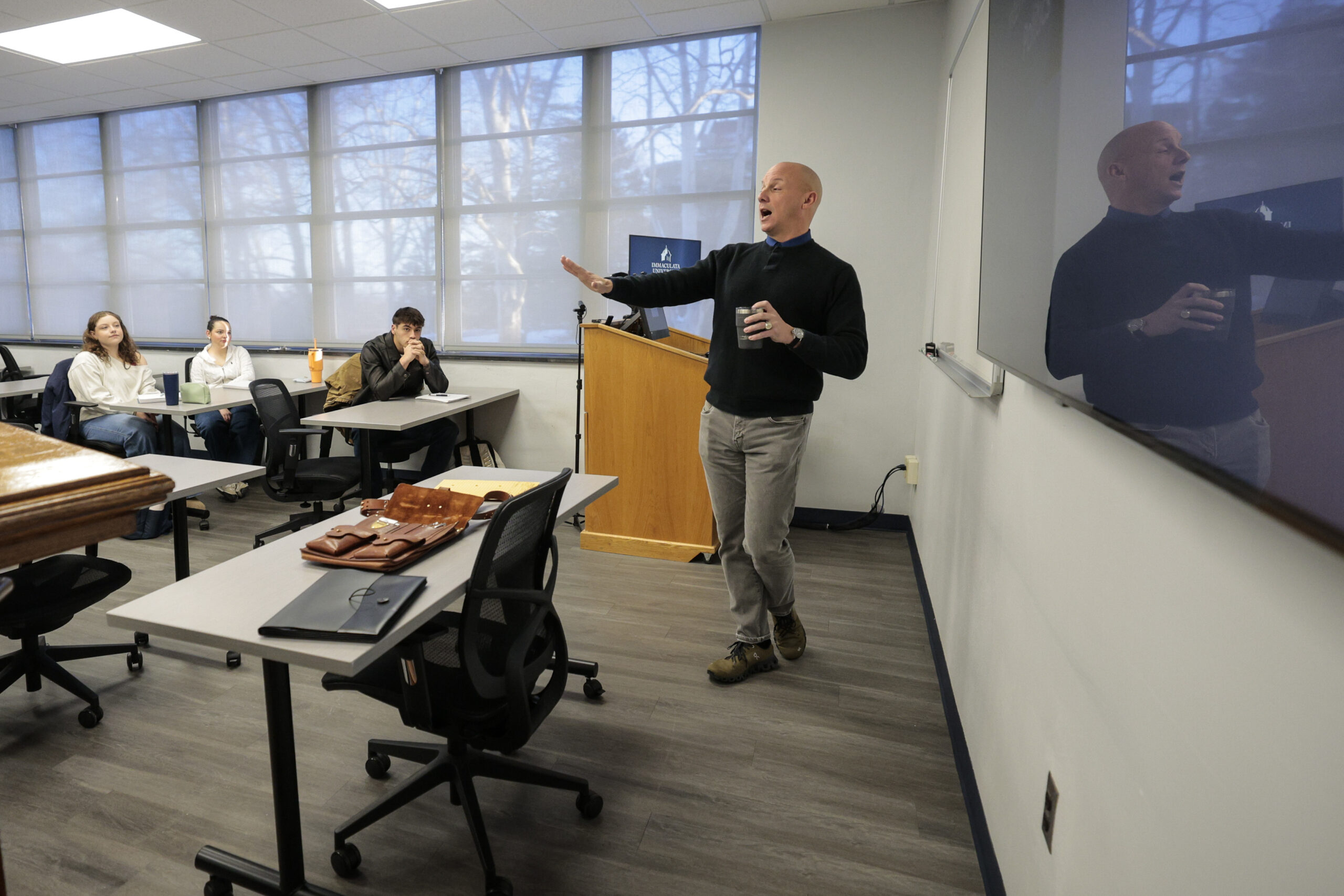
As Joshua Weikert shared ground rules for quizzes in his early morning international relations class, he sought to put his students at ease.
“I don’t want you stressing out about these,” he said Tuesday, as the new semester got underway at Immaculata University in Chester County.“I myself was a terrible student.”
Weikert, 47, of Collegeville, may not have been a star student, but he sure knows a lot.
The politics and public policy professor will compete onJeopardy! 2026 Tournament of Championsat 7 p.m. Friday on ABC, having won six games when he was on the show in March.
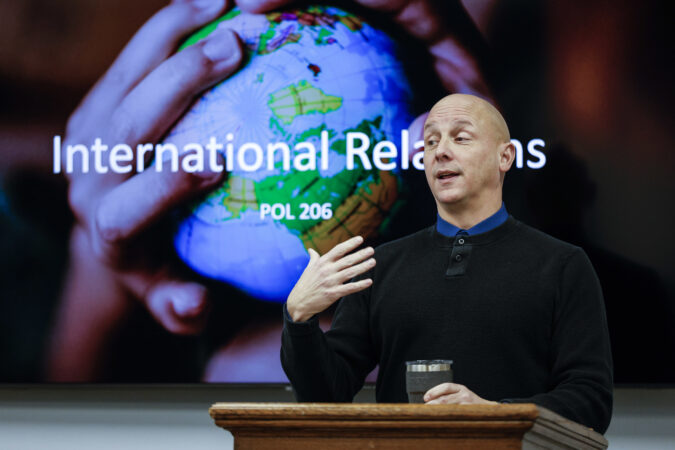
Joshua Weikert teaches a class in international relations at Immaculata University.
Over a couple weeks, Jeopardy! shows will feature him vying against 20 other champions, including Allegra Kuney, a doctoral student at Rutgers University’s New Brunswick campus, and Matt Massie, a Philadelphia lawyer who moved to the area in 2024, who also will appear on Friday’s show.
Friday’s match is a quarter-final, and if Weikert wins, he’ll advance to the semifinals. (Kuney won her quarter-final Tuesday.)
Weikert won about $103,000 when he competed last year, 10% of which he donated to a memorial scholarship fund named for his late friend, Jarrad Weikel, a Phoenixville man who died unexpectedly at age 40 in 2022. The winner of the champions tournament —which will conclude sometime in early February — will take home a grand prize of a quarter million.
Weikert will watch the show Friday among family and friends — including his fellow contestant Massie — at Troubles End Brewing in Collegeville, which named one of its beers after him. It’s an English Bitter, one of Weikert’s favorites, called “Who is Josh?”
At Immaculata, a Catholic college where Weikert has taught since 2016, students and staff are stoked. A campus watch party is planned, President Barbara Lettiere said.
His appearance last year, she said, has put a welcome spotlight on the school and brought an outpouring of enthusiasm from alumni. On tours, some prospective students and their parents who spot Weikert have recognized him, she said.
“I never knew that this show was as watched as it appears to be,” she said. “Win or lose, Immaculata wins.”
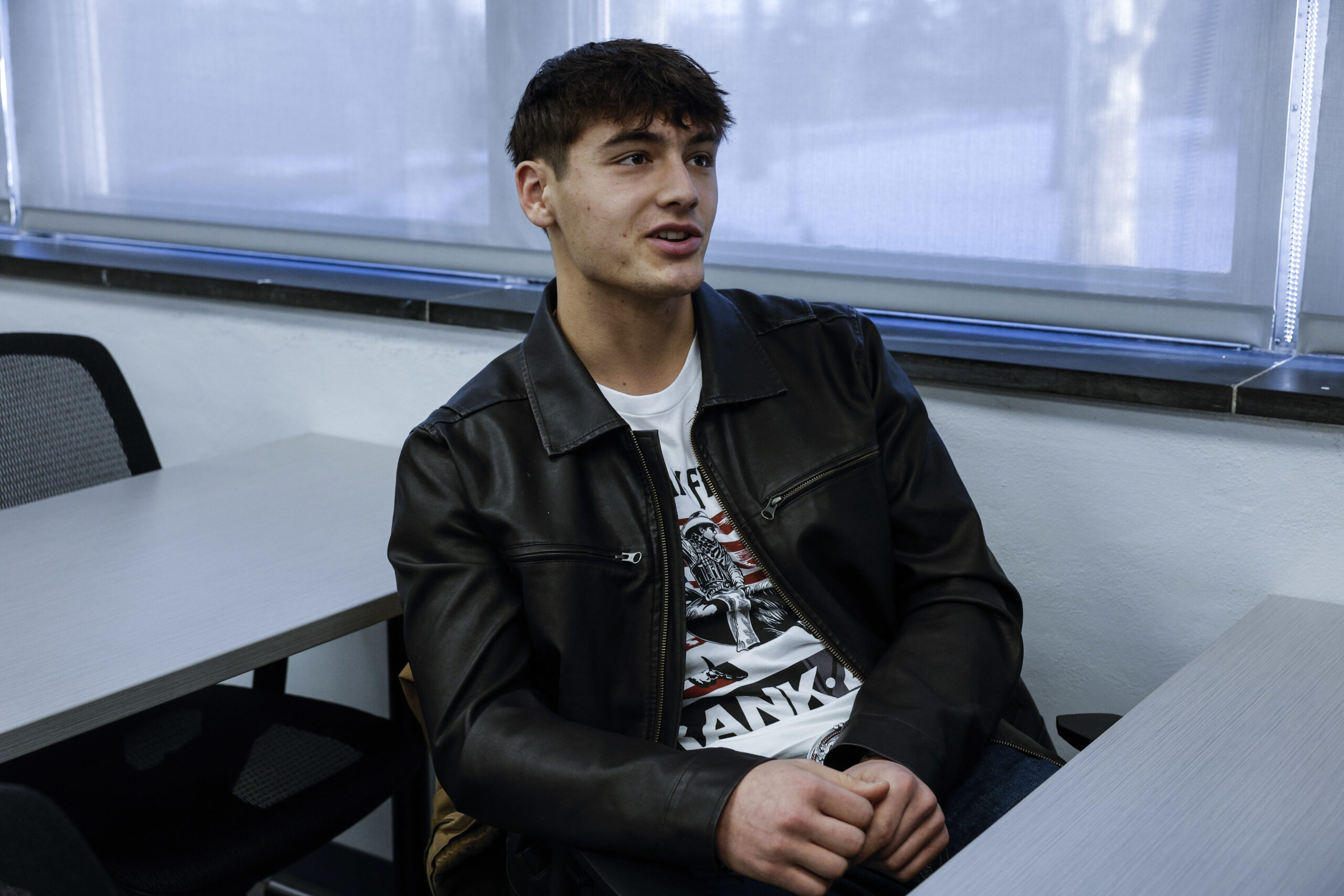
Student Ben Divens talks about his Jeopardy-star professor Joshua Weikert.
Ben Divens, 19, said it’s “jaw-dropping” and “surreal” to know his teacher will compete in the Jeopardy! champion tournament.
“I knew from the first time I met him he was a super, super smart person,” said Divens, a prelaw major from Souderton.
“He’s guided us so much in our major already,” added Bailey Kassis, 18, a political science major from Fort Washington.
“He’s guided us so much in our major already,” student Bailey Kassis said about her professor Joshua Weikert.
An early gamer
Weikert said he has watched Jeopardy! ever since he can remember, probably since 1984 when he was 6, and it came back on the air with Alex Trebek as host. He grew up just outside of Gettysburg in a family that loved to play games, he said.
“We took them very seriously, which is to say that they didn’t just let the kids win,” he said of his parents, both of whom had accounting degrees. “We were destroyed routinely in the games we played.”
About his performance as a student, he said he often skipped his homework.
“Just give me an exam,” he said, describing his attitude at the time. “I’ll pass it.”
He got his bachelor’s degree in international relations from West Chester University, master’s degrees from Villanova and Immaculata, and his doctorate from Temple. He also attended the Defense Language Institute Foreign Language Center, where he studied modern standard Arabic while serving in the U.S. Army.
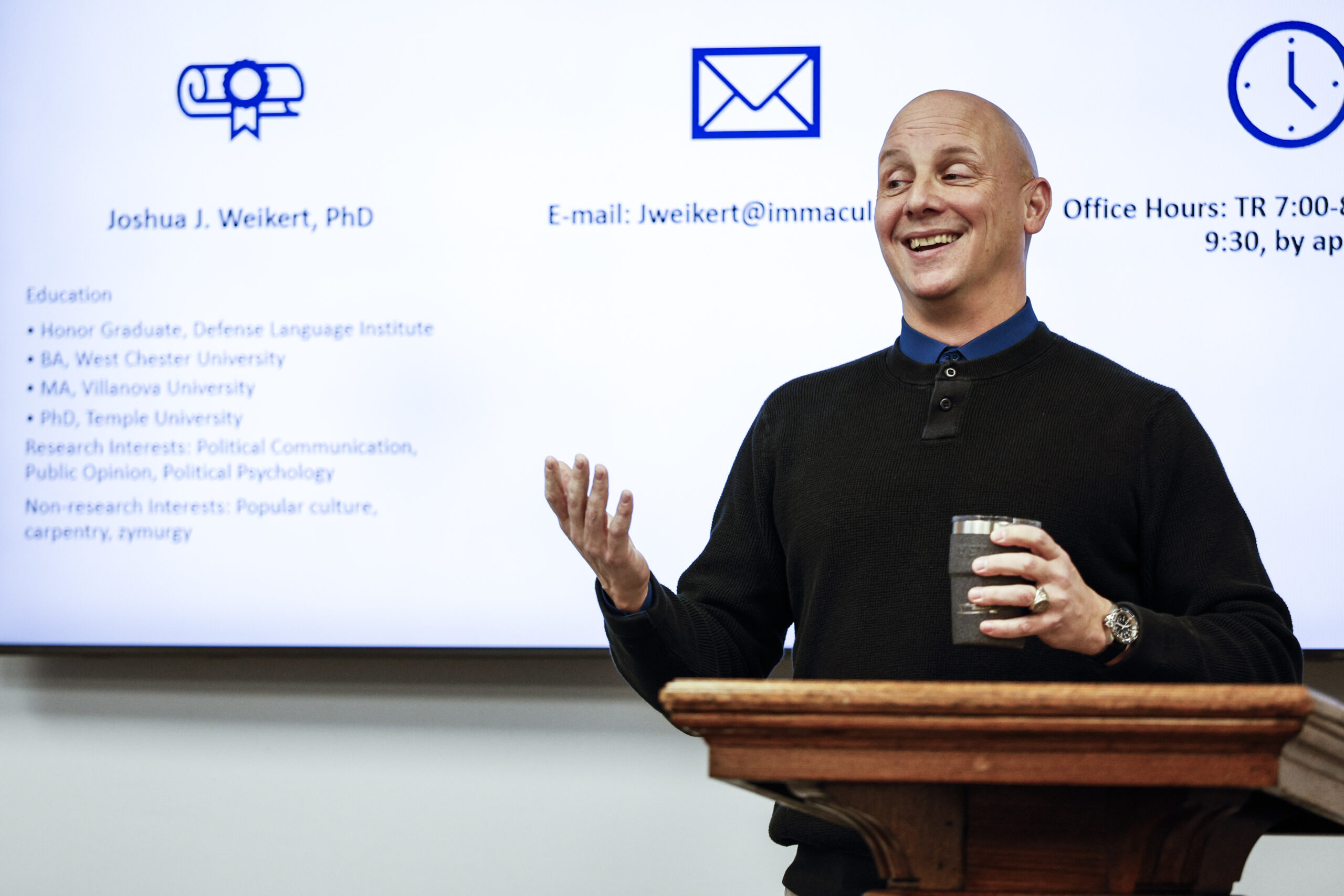
Joshua Weikert sets expectations for students as a new semester gets underway at Immaculata University.
In addition to teaching, he also works as a policy adviser to the Pennsylvania House of Representatives under state Rep. Joe Webster, a Democrat serving part of Montgomery County. He vets legislators’ ideas and offers ideas of his own.
“The only thing they’ve ever told me no on was [when] I tried to abolish the Pennsylvania Senate,” he said.
So many bills pass one body, then die in the other, he explained. If there were one legislative body where all House and Senate members served, that might be different, he said.
Weikert’s office walls are lined with framed newspaper front pages highlighting major events: “Nixon Resigns,” “Nazis Surrender,” “Man Walks on Moon,” “Kennedy Shot to Death.”
“Every once in a while, I just get up and read one of the stories,” he said.
He got them from his mother-in-law’s basement and put them up after his wife told him his office needed some decor.
Weikert’s status as a Jeopardy! champion makes clear he’s a fast thinker. He’s also a fast talker.
“I don’t really drink caffeine. I just talk this fast,” he told his students.
His wife, he told the class, tells him to slow down.
“Keep up,” he tells her, he said.
The road to Jeopardy
Since his mid-20s, Weikert has been trying to get on Jeopardy!. Years ago, he got a call from the game show, but he put the caller on hold to get to a quiet place. They hung up.
“I was like, well, I guess I missed that opportunity,” he said.
But he kept trying and started taking the online tests, which typically draw 200,000 participants annually. In 2024, he got an email, inviting him to take the test again — and then again under Zoom surveillance.
Next came a virtual audition and practice game in August 2024. That earned him a place in a pool of about 3,000 people, of whom a few hundred eventually became contestants.
Weikert got the call last January and was invited to fly to California the next month to compete.
In reality, his varied interests and life path had already prepared him for the show. He reads a lot. He’s a fan of historical fiction, pop culture, and movies. His work as a public policy scholar helps, too.
But to try and up his game, he read plots of Shakespeare plays and a book on great operas. He flipped through lists of presidents and vice presidents. His wife, Barbara, a Norristown School District middle school music teacher, read questions to him from old Jeopardy! shows. He knew about 80% of the answers, he said.
That, however, didn’t stop him from having panic dreams of being on stage and knowing nothing.
The toughest category for him, he said, is popular music. Movies, history, and politics are his strongest.
But the hardest questions, he said, are the ones with four or five strong possible answers.
“Getting a Jeopardy! answer right is more about knowing what it’s not than what it is,” he said.
Ultimately, he said, it’s impossible to really study for the game show.
“The odds that something you study would come up is almost zero,” he said.
It was an intense experience on stage last March, but the staff put contestants at ease, he said. Host Ken Jennings, formerly one of the show’s most successful contestants, told them, according to Weikert: “I promise you something today is going to be a win for you, so just relax and have fun.”
He has a hard time remembering his winning answers. He readily recalls his dumbest, he said.
The answer was “sacred cow.” He uttered “holy cow.”
“Even as it was coming out of my mouth, I knew it was wrong,” he said.
He’s proud that he only froze on one answer involving lyrics from the B-52’s “Love Shack,” he said.
There was less pressure competing in the championship match last month, given he was already a winner, he said. But it was harder in that the contestants were the best of the best.
“During the regular season, it’s a little under a quarter of a second between when you can start to buzz in and when the buzz actually comes,” he said. “In the tournament of champions, that drops to 0.08 seconds.”
This time, he also prepped by reading children’s books on topics such as basic cell biology, a tip he got from another contestant.
“It’s the simplest language they can use to convey the information,” he said.
He also read the book, Timelines of Everything: From Woolly Mammoths to World Wars.
He most enjoyed the camaraderie among contestants, he said. When filming was over, they hung out in a bar and — watched Jeopardy!.
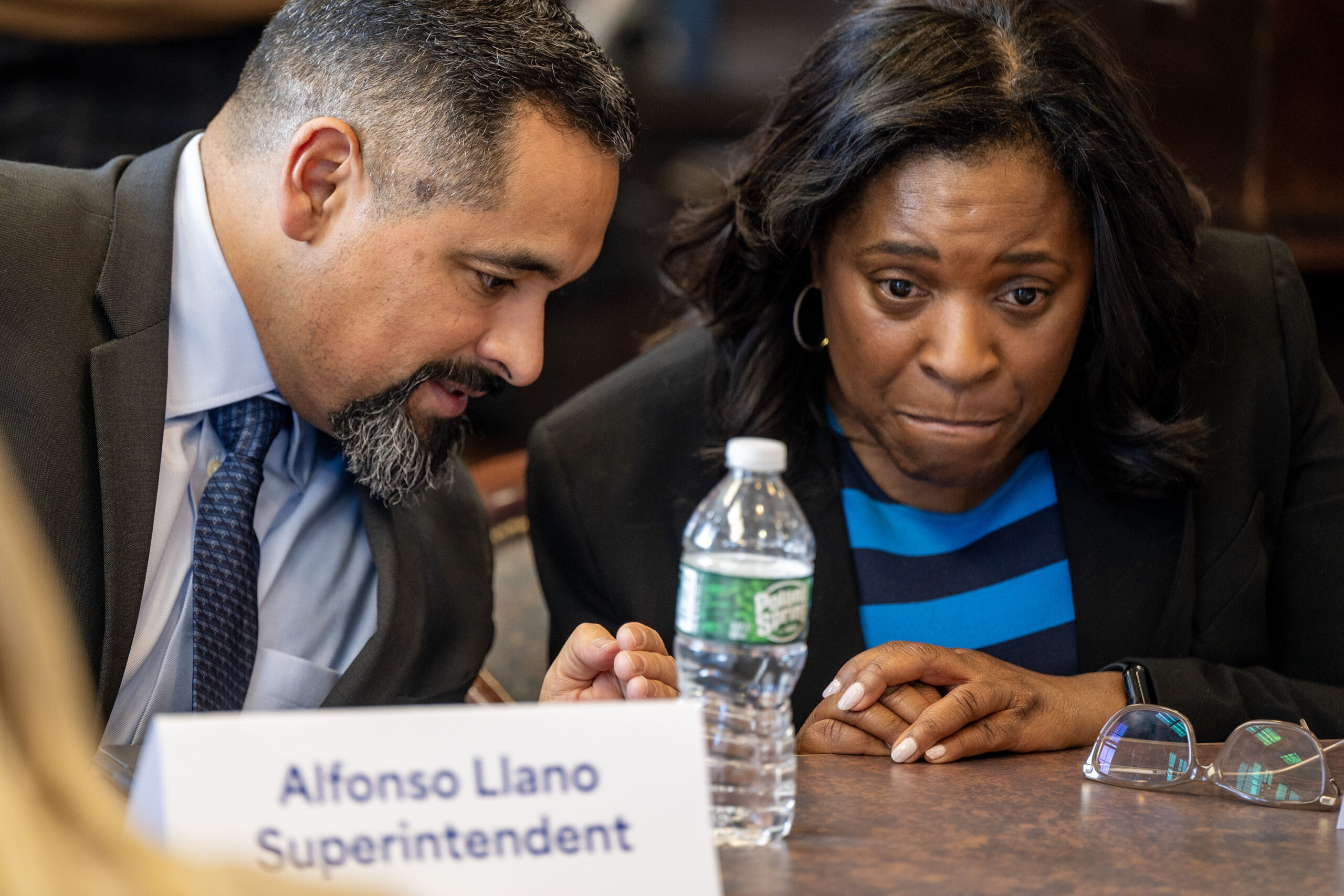
Incoming state-appointed Camden school superintendent Alfonso Q. Llano Jr. got a head start Wednesday on his new position running the troubled school system.
Llano met with Camden Mayor Victor Carstarphen and other key stakeholders at City Hall for a congenial discussion ahead of taking over the district March 1. .
During a round-table discussion, Llano said his immediate priority will be to provide stability to the district. Camden has been without a permanent superintendent since June 30.
The incoming district leader said it was too early to comment on the district’s budget outlook for the 2026-2027 school year. Last year, the district had a $91 million budget deficit and made cuts affecting nearly 300 positions.
Llano said he was made aware of recent rumors about possible school closures. He said he had not received data about it and declined further comment.
In response to another question, he said he would support immigrant families who have grown increasingly afraid to send their children to school because they fear they may be targeted by ICE. About 56% of Camden’s traditional public school students are Hispanic.
“Schools are a safe place and we want to maintain them as a safe place,” Llano said.
He delicately side-stepped a question about the changing educational landscape in Camden. Thousands of students have left the city’s traditional public schools for Renaissance and charter schools, which are publicly funded but privately run.
Enrollment in the Renaissance and charter schools exceeds the traditional public schools. The district has said payments to those schools have increased from $54.9 million in 2013 to $198 million.
“School choice is important to families. Camden is unique” Llano said. “We want to make sure the public school system is stabilized and innovative in a way that families feel comfortable keeping their children in the public school system.”
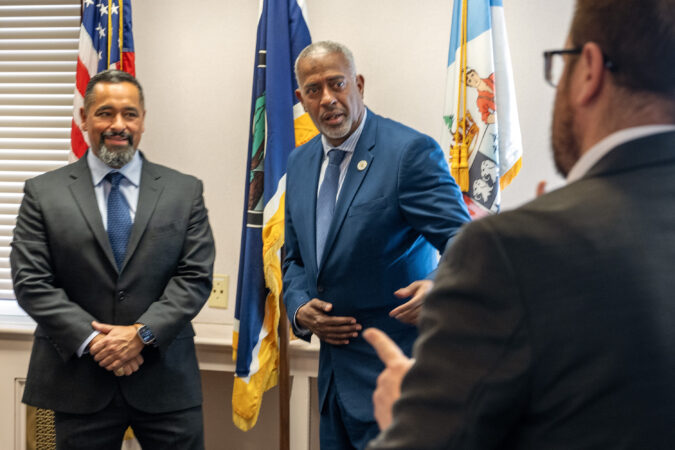
Camden’s new state-appointed school Superintendent Alfonso Q. Llano Jr. listens as Mayor Victor Carstarphen speaks while Llano makes his rounds Wednesday, Jan. 21, 2026 at City Hall, meeting with other city, county and state officials. Currently the Vineland schools chief, he doesn’t officially begin in Camden until March.
Llano said he would focus on listening and learning from educators and the community as his introduction to Camden.
“What does the reality look like? What is every day in the classroom?” he said.
Llano has been making his rounds in Camden. He was in the city Monday and joined Martin Luther King Jr. Day of Service activities.
Llano said he was proud to become the first Hispanic tapped to lead the district. He is among only a handful of outsiders to become the city’s schools chief.
Camden’s new state-appointed school Superintendent Alfonso Q. Llano Jr. (left) talks with Davida Coe-Brockington, current acting state superintendent, as he makes his rounds Wednesday, Jan. 21, 2026 at City Hall, meeting with city, county and state officials. Llano, currently the Vineland schools chief, doesn’t officially begin in Camden until March.
Llano will receive an annual salary of $260,000 under a three-year contract, making him among the highest paid superintendents in Burlington, Camden and Gloucester Counties.
Coe-Brockington, who will continue as interim chief until Llano arrives, said she was “honored to hold it down” until a permanent superintendent was named. She thanked Llano “for saying yes to Camden.”
Carstarphen and a group of city leaders cleared the path for the state to appoint a new superintendent. Katrina McComb’s contract was not renewed last year after The group said Camden schools needed “a new vision for leadership.”
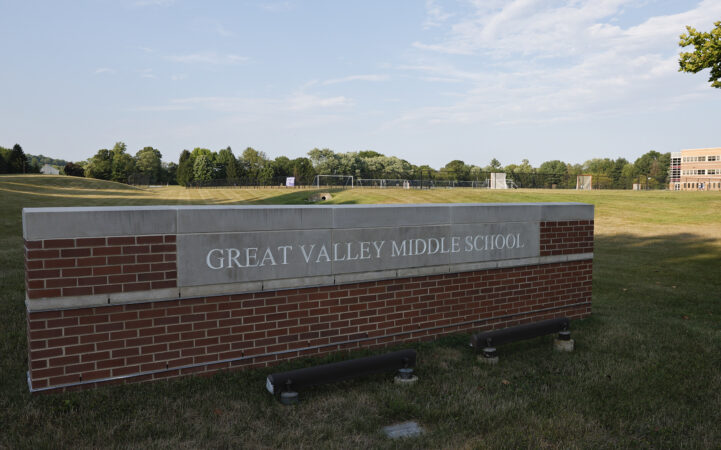
The U.S. Department of Education has opened a civil rights investigation into the Great Valley School District in Chester County for a policy allowing transgender girls to participate in girls’ sports teams.
The probe — one of 18 investigations announced last week into transgender sports policies in K-12 districts and colleges nationally — comes after President Donald Trump threatened last year to strip federal funding from schools that recognize transgender students.
“Time and again, the Trump Administration has made its position clear: violations of women’s rights, dignity, and fairness are unacceptable,” Assistant Secretary for Civil Rights Kimberly Richey said in a statement. “We will leave no stone unturned in these investigations to uphold women’s right to equal access in education programs — a fight that started over half a century ago and is far from finished.”
District officials said at a school board meeting Tuesday that they’re cooperating with the investigation and working with lawyers to prepare a response.
Numerous Philadelphia-area school districts have policies allowing transgender students to play on sports teams aligned with their gender identities, including Philadelphia. But Great Valley appears to be the first on the administration’s radar.
Great Valley was one of the first Pennsylvania school districts to pass a policy supporting the rights of transgender students in 2016 — seeking to provide those students “equal opportunity to achieve their maximum potential,” including by participating in sports “in a manner that is consistent with their consistently asserted gender identity.”
It was unclear whether any transgender girls currently play sports at Great Valley. A district spokesperson provided a statement Wednesday saying the district was “committed to serving all students in our community with dignity and respect” but declined to comment further.
After declaring the country would “recognize two sexes, male and female,” Trump issued an executive order in February seeking to end the participation of transgender women in women’s sports.
The president invoked Title IX, the landmark civil rights law prohibiting sex-based discrimination in programs that receive federal funding.
But how that law applies to transgender students and their rights has been hotly debated. The U.S. Supreme Court last week heard two cases challenging laws in West Virginia and Idaho requiring that participation on sports teams for girls be based on “biological sex.”
In Pennsylvania, meanwhile, the Human Relations Act specifies that discrimination based on gender identity is a form of prohibited sex-based discrimination.
Courts have also protected the rights of transgender students. In 2018, judges in the U.S. Third Circuit Court of Appeals ruled against students in the Boyertown Area School District who said their privacy rights were violated by sharing bathrooms with transgender students.
Last year, a U.S. District Court judge in Philadelphia rejected a lawsuit from a Quakertown student who said her equal protection rights were violated by having to race against a transgender female student in the Colonial School District.
Great Valley “takes its obligations under Title IX and all federal civil rights laws seriously,” the district’s school board president, Rachel Gallegos, said at a board meeting Tuesday. “We also take our responsibility to comply with the legal rulings from federal courts in this jurisdiction and to provide the protections afforded our students by Pennsylvania statutes just as seriously.”
Much of the Trump administration’s focus on transgender issues to date has been at the collegiate level. The NCAA last year announced it would ban transgender women from competing, and the University of Pennsylvania struck a deal with the administration over the past participation of transgender athlete Lia Thomas on its women’s swim team.
The Great Valley investigation appears to have been triggered by a former school board president, Bruce Chambers, who filed a complaint with the Office for Civil Rights last March, objecting to the policy.
Chambers, who served on the board from 2009 to 2012, said Wednesday that OCR notified him last week that his complaint was under investigation, the same day it made its public announcement.
The district’s policy “discriminates against girls, because the trans people can use whatever bathroom they want, use whatever locker room they want … join any team they want, or activity,” Chambers said. He said he “gave the board three chances” before filing the OCR complaint.
If the board rescinds the policy, “that will solve the whole thing,” Chambers said.
Kristina Moon, senior attorney with the Education Law Center, a Philadelphia-based group that advocates for transgender students, said the Trump administration appears to be trying “to intimidate school districts” into complying with its policy goals.
Moon pointed to a recent OCR investigation into gender neutral bathrooms that was criticized by Denver Public Schools, which said the office didn’t independently verify claims and “issued conclusions using an approach that departs from established investigative practice.”
“If they actually cared about protecting girls … they would not have dismantled the Department of Education and Office for Civil Rights,” Moon said.
In a letter this week to the Great Valley board, the LGBT Equality Alliance of Chester County said there was “no clear federal law or Supreme Court ruling that makes inclusive policies for transgender students unlawful.”
“Great Valley’s current policy reflects a reasonable, lawful approach that protects students from discrimination, aligns with local and state civil rights standards, and has been reviewed with legal counsel,” the alliance said in the letter. “Supporting students’ dignity and safety is not political. It is consistent with our legal obligations and the district’s duty of care to all students.”
Two residents who spoke at Tuesday’s meeting also urged the board to maintain the policy.
“I understand there is a need for all students and not just a minority to feel safe, but I feel assured the board can and will handle all concerns from parents and students with great care,” Christi Largent said. “I look forward to seeing the board stand up for all the students.”
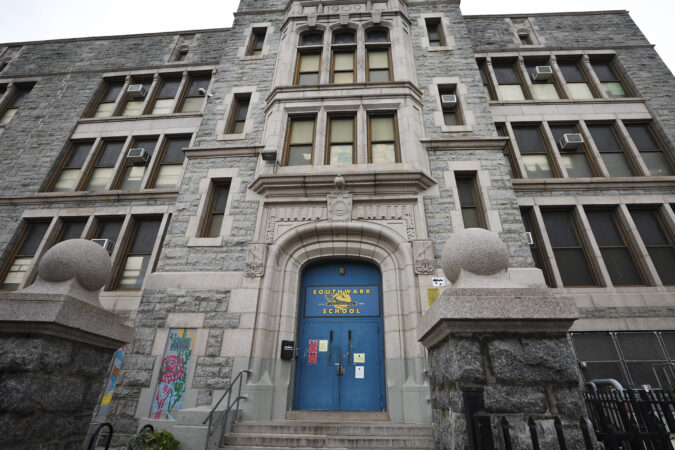
The Philadelphia School District is poised to announce soon which of its aging buildings it will fix up and which it might close, or consolidate, or reimagine in the coming years.
But teachers and parents at one South Philadelphia elementary school say they cannot wait for help and have appealed to Superintendent Tony B. Watlington Sr., Mayor Cherelle L. Parker, and others.
“Southwark School is desperately in need of changes,” a letter signed by 300 people and sent to Watlington and Parker on Friday read. “Our children are learning in an unhealthy environment that no child should have to experience.”
In many ways, Southwark, a K-8 facility constructed in 1905, is a thriving school — it has strong academics, a diverse student body of about 900, a dual language immersion program, and a robust complement of activities. Southwark is a community school, with city-paid resources including free before- and after-school care.
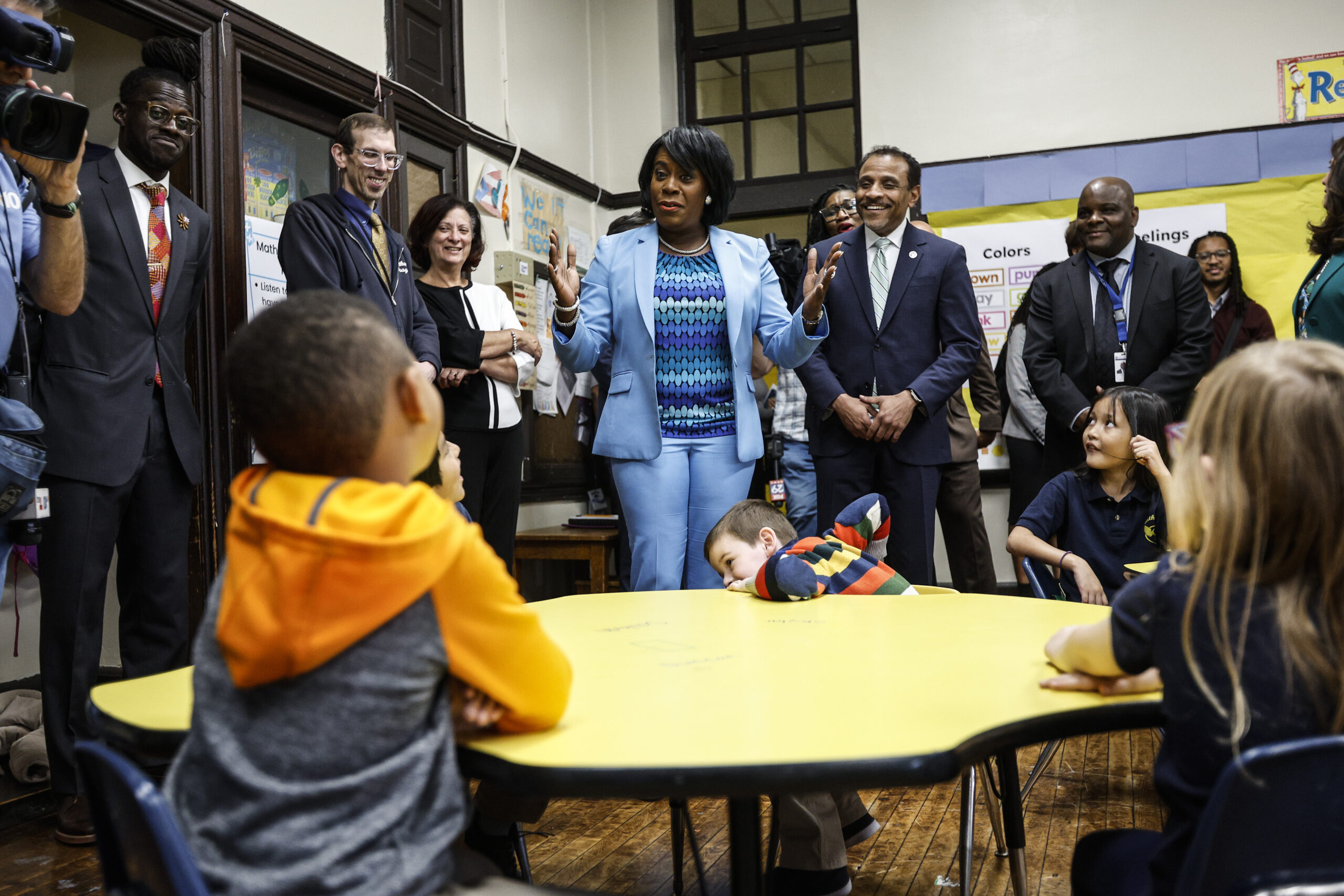
Mayor Cherelle Parker and Superintendent Tony B. Watlington Sr. visit a classroom at Southwark Elementary to discuss the city’s extended day extended year programming in this 2024 file photo.
But it also has issues including bathrooms that “break down nearly every day,” the letter said. “The plumbing has gotten so bad that sewage comes dripping down from the ceiling into classrooms.”
The letter outlined other issues including a rampant bug and rodent problem, a stairwell covered in graffiti and trash, dank hallways, a lack of adequate ventilation, and more.
“Our children tell us that classrooms feel like prisons because the windows can’t be opened fully and they have opaque coverings,” the letter read.
Nyera Parks, a Southwark second-grade teacher, said she doesn’t think the community is asking for too much.
“These conditions are affecting the children’s health, their focus, their sense of safety,” Parks said. “It’s the bare minimum — we’re asking for a clean and safe school.”
Responding to teacher and parent concerns, district chief operating officer Teresa Fleming said in a letter sent Monday the school system “has already taken concrete action to address conditions at Southwark while continuing to plan for sustained improvement.”
Fixes Fleming cited include “mass”trapping, plaster and plumbing work, and adjustments to the cleaning staff.
Some staff have reported “visible improvement in cleanliness and operational response,” Fleming wrote in the letter to State Rep. Elizabeth Fiedler (D., Philadelphia). “At the same time, we recognize that some of Southwark’s challenges are rooted in aging infrastructure and require longer-term planning. My team is developing an actionable plan that includes feasibility reviews of plumbing systems, HVAC needs, and cafeteria kitchen capacity, with attention to major shared spaces, including the gymnasium, cafeteria, and auditorium.”
Southwark, according to data released by the district this summer, is in “poor” building condition. It is also operating at 104% of its building capacity.
Fleming said the school “will likely receive facility enhancements” through the forthcoming facilities master planning process.
‘It shouldn’t have to be like this’
The first thing Jennifer O’Shaughnessy, a teacher and part of the morning care staff, does when she gets to Southwark early is pick up trash. Then, when she gets to the cafeteria, where kids will eat breakfast, she grabs wipes to clear the mouse droppings that have accumulated overnight.
At least once a week, O’Shaughnessy said, “the kids are eating breakfast and we see a mouse come out, and then they’re standing up, screaming. We tell them it’s going to be OK, but it shouldn’t have to be like this.”
O’Shaughnessy has worked at Southwark for 15 years and is now the upper school coordinator, teaching writing and a elective and supporting other educators. She loves the school so much she sends her own daughter to Southwark.
But it troubles her that because of the old heating system, the school’s classrooms are either freezing or so hot students sometimes get nosebleeds.
“I’ve had teachers take their kids into the hallway because it’s too hot in their classrooms,” O’Shaughnessy said. “It’s 80, 90 degrees in there, and you can’t think. And when the heat is not on, it’s freezing and you have students with winter jackets on.”
City demographics and Southwark’s burgeoning popularity have brought new life to the school, but have also strained the building.
Bathrooms are a particular issue. The restrooms that get the most use are in the basement, near the cafeteria. But those bathrooms are frequently closed because of plumbing issues and other problems.
Last month, a student told O’Shaughnessy they couldn’t use the bathroom because no toilets were working. There had been no news of a closure, so O’Shaughnessy went in to investigate.
“Every toilet was running over,” she said. “I went in there and almost lost my lunch. They had taped off half the stalls because flood water was running over. The other toilets were clogged.”
O’Shaughnessy had the bathroom shut down, leaving a common problem — there are a few other bathrooms, but not enough to accommodate the large student population’s needs.
‘It’s still a mess’
Appealing to the superintendent and mayor was not the teachers’ and parents’ first move. They worked within the system, staff said, putting in countless work orders and making more direct appeals to district officials.
Southwark recently got a permanent building engineer — that has helped some, said Justin Guida, the school’s STEM teacher, but the problems can never be rectified by one employee.
“We get a little Band-Aid here and there, it looks like they helped, but it’s still a mess,” said Guida, who lives in the neighborhood and has worked at Southwark for 10 years. “When the kids complain because of the bathrooms or the food or the bugs or mice, it breaks my heart. The kids say, ‘I love Southwark, but it’s dirty.’”
Southwark teachers say that school material often get ruined by rodents.
“We’re growing plants as a science experiment, and the plants get destroyed because they’re getting eaten by the mice,” Guida said.
Guida knows the district has billions in unmet facilities needs, but the changes Southwark needs are not all costly, he said.
“Can the windows get uncovered so we can see out them and have natural light come in? Can we clean the fire towers that our kids have to walk through?” he asked.
Parks, the second-grade teacher, is frustrated by air filters that do not get changed, especially given the high rates of asthma among Southwark children.
In 2023, Southwark was temporarily closed because of damaged asbestos, with the school split between South Philadelphia High and Childs Elementary. The damaged asbestos was removed, but Parks and others worry about the asbestos that remains in the building.
Parks attended Southwark as a child and is dismayed that her second graders may not be having the same experience she had as a student. She never had sewage leaking from bathrooms into her classroom, or had lessons interrupted by a mouse scurrying across the floor.
“I remember feeling safe there,” she said. “Some of the things that I’m seeing in the building now are not how I saw and experienced it when I was there. How are they able to learn and feel comfortable in these types of conditions?”
Parks and others who signed the letter to Watlington and Parker have asked for fixes including repainting hallways, ensuring every classroom has a working lock, and guaranteeing that stairways and outdoor areas will be regularly cleaned, that every room has air-conditioning and regular air filter changes, and that there are specific plans for long-term bathroom repairs.
Fiedler said that she appreciated Fleming’s response, but that Southwark’s conditions generally “are a major concern.”
“We know that there’s many years of deferred maintenance in the School District of Philadelphia and across the commonwealth,” Fiedler said. “I think this is a really good, really sad, and scary example of a place where more needs to be invested.”
The University of Pennsylvania in a legal filing Tuesday pushed back against a federal commission’s demand that in effect would require it to turn over lists of Jewish faculty, staff, and students, calling the request “unconstitutional,” “disconcerting,” and “unnecessary.”
The filing comes in response to a lawsuit filed against the university in November by the Equal Employment Opportunity Commission, asserting that Penn failed to comply with its subpoena. The commission is seeking employees’ names, home addresses, phone numbers, and email addresses to further an investigation it began in 2023 over the school’s treatment of Jewish faculty and other employees regarding antisemitism complaints that emerged following Hamas’ attack on Israel.
In its quest to find people potentially affected, the commission demanded a list of employees in Penn’s Jewish Studies Program, a list of all clubs, groups, organizations, and recreation groups related to the Jewish religion — including points of contact and a roster of members — and names of employees who lodged antisemitism complaints. It also sought names of participants in confidential listening sessions held by the school’s task force on antisemitism.
The request has spurred a backlash from some student and faculty groups, including Penn’s chapter of the American Association of University Professors, arguing that the names and personal information should not be turned over to the government.
Penn has refused to provide the information, and the school doubled down on that position in Tuesday’s legal filing.
“The EEOC insists that Penn produce this information without the consent — and indeed, over the objections — of the employees impacted while entirely disregarding the frightening and well-documented history of governmental entities that undertook efforts to identify and assemble information regarding persons of Jewish ancestry,” the university wrote in its filing. “The government’s demand implicates Penn’s substantial interest in protecting its employees’ privacy, safety, and First Amendment rights.”
Also on Tuesday, the Penn Faculty Alliance to Combat Antisemitism, a group of more than 150 primarily Jewish professors, filed a brief in support of the university’s decision not to comply with the commission’s demand.
“While the Alliance supports the EEOC’s efforts to combat antisemitism at Penn, its members are gravely concerned that the scope of the EEOC subpoena … invokes the troubling historical persecution of Jews and threatens the personal security of the Alliance’s members,” the group wrote in the brief.
The alliance includes members who have had concerns about antisemitism at Penn, including faculty who were harassed online after attending a trip to Israel following Hamas’ Oct. 7, 2023, attack on the country, said Claire Finkelstein, a professor at Penn Carey Law School, member of the alliance, and faculty director of the Center for Ethics and the Rule of Law.
Among its members are faculty “who have been really on the side of remediating antisemitism, do not believe that concerns about antisemitism are pretextual, do not think that it is a sham issue, and think there are real … issues to address at universities in general.”
Finkelstein said the alliance has not taken a position on whether the EEOC’s investigation is warranted or needed.
But the group is adamantly opposed to the subpoena and believes it could discourage membership in Jewish groups at Penn. In its brief, the group notes “the dark historical legacy associated with government lists of Jews,” including how Nazis “frequently demanded that others identify the Jews among them.”
Penn said in its filing that it had complied with the subpoena except for the list of names and contacts, noting it had provided over 900 pages of materials to the commission. The school noted that it even offered to send notices to all employees about the EEOC’s request to hear about antisemitism concerns with the commission’s contact information.
The university also asserted that the commission’s demand “is a particularly unjustified use of enforcement authority given the weakness of the underlying charge.”
The commission, the university argued, has not identified a “single allegedly unlawful employment practice or incident involving employees.”
“The charge does not refer to any employee complaint the agency has received, any allegation made by or concerning employees, or any specific workplace incident(s) contemplated by the EEOC, nor does it even identify any employment practice(s) the EEOC alleges to be unlawful or potentially harmful to Jewish employees,” Penn said in its response.
The original complaint was launched by EEOC Commissioner Andrea Lucas, now chair of the body, on Dec. 8, 2023, two months after Hamas’ attack on Israel that led to unrest on college campuses, including Penn’s, and charges of antisemitism. It was also just three days after Penn’s then-president, Liz Magill, had testified before a Republican-led congressional committee on the school’s handling of antisemitism complaints; the testimony drew a bipartisan backlash and led to Magill’s resignation days later.
Lucas, whom President Donald Trump appointed chair last year, also brought similar antisemitism charges against Columbia University that resulted in the school paying $21 million for “a class settlement fund.”
EEOC complaints typically come from those who allege they were aggrieved. Lucas, according to its complaint, made the charge in Penn’s case because of the “probable reluctance of Jewish faculty and staff to complain of harassing environment due to fear of hostility and potential violence directed against them.“
The commission’s investigation followed Lucas’ complaint to the commission’s Philadelphia office that alleged Penn was subjecting Jewish faculty, staff, and other employees, including students, “to an unlawful hostile work environment based on national origin, religion, and/or race.”
The allegation, the complaint said, is based on news reports, public statements made by the university and its leadership, letters from university donors, board members, alumni, and others. It also cited complaints filed against Penn and testimony before a congressional committee.
In its brief, the faculty alliance also asserted that the commission could have used other voluntary and informal methods to obtain contact information for Penn faculty and staff, such as setting up a website where people could report concerns.
Finkelstein, the Penn law professor, said she understands that the commission generally guarantees anonymity to witnesses or complainants, but leaks can occur.
“When state force extracts sensitive, personal details, those details could (and often do) become public, turning group members into targets for their enemies,” the group states in its filing.
Penn has done a lot to address antisemitism concerns, said Brian Englander, president of the alliance and a professor of clinical radiology who has been at Penn for 22 years.
In its brief, the alliance listed antisemitic incidents that occurred on Penn’s campus in 2023, including a swastika left on a Penn building and messages that Penn called antisemitic that were light-projected onto several Penn buildings.
“Penn is a very different place than what we were experiencing in the fall of 2023,” he said.
Finkelstein agreed.
“Penn is not Columbia or Harvard or UCLA,” she said. “The problems that have appeared on those campuses have been much more extreme than what happened on Penn’s campus.”
“I also think there may be a limit to what university leadership can do in the face of widespread antisemitism that has really affected university campuses all over the country.”
But there is always room for improvement, she said.
“To the extent that there is an atmosphere that has made Jewish students and faculty feel unwelcome, or not heard, or vilified, that is something the university has to continue to address and I believe they will continue to address it,” she said.
Finkelstein was among about 40 faculty who took a four-day, personal trip to Israel in January 2024 and said hey felt attacked for supporting academics there and trying to learn more about the Oct. 7 attacks. An Instagram account by Penn Students Against the Occupation was critical of the trip and accused faculty of “scholasticide.” The EEOC referred to that incident in its complaint.
“My dean got hundreds of letters,” she said, protesting faculty going on the trip.
Englander said there probably are members of the alliance who would be interested in talking to the commission.
“But they would want to do it voluntarily,” he said.
The alliance, he said, is “straddling this middle line” in that it supports Penn’s refusal to turn over the names, but also recognizes “that antisemitism is a massive problem in the United States right now.”
“So having government support, whatever the motivation for that, is meaningful,” he said.
Beginning in September, New Jersey public schools must begin teaching cursive writing to students in grades three to five.
A bill signed by Gov. Phil Murphy on Monday makes cursive instruction mandatory for some elementary students. The requirements take effect immediately and apply to the 2026-27 school year.
New Jersey joins Delaware and at least two dozen other states that require cursive writing. Similar legislation proposed in Pennsylvania did not advance.
Murphy, who signed the bill on his last full day in office, also cited America’s 250th anniversary this year. Students should also be able to sign a check, he said.
“We owe it to our students to give them a well-rounded education that ensures they have the tools to fully understand our rich history and become competent leaders,” Murphy said in a statement.
Teaching cursive to our students is NOW LAW in New Jersey!
Experts say cursive writing improves fine motor skill development and eye-hand coordination. It is also believed to boost spelling and writing skills and overall learning and to encourage discipline and patience.
However, in 2010, cursive writing was eliminated from the state’s common core standards and many districts stopped teaching it. Many Catholic schools in the region have kept the tradition to promote good penmanship.
Critics believe cursive writing is antiquated and learning should focus more on technology such as AI. They believe incorporating cursive lessons would take valuable time from other subjects.
Some South Jersey districts like Shamong, Cherry Hill and Winslow never stopped teaching cursive writing. .
“Handwriting is something that has always been important,” said Nicole Moore, principal of the Indian Mills School in Shamong. “We never got rid of it.”
Moore said students in her school in Burlington County learn cursive in third and fourth grades. She believes it will be easy to extend the instruction to fifth graders in the middle school.
The biggest challenge facing schools implementing the new mandate will be funding and finding time in the school day to add another subject, Moore said.
“You need resources to teach handwriting,” Moore said Tuesday. “That’s just one more thing as schools we have to figure out how to pay for it.”
Moore said teachers must find creative ways to make learning cursive writing engaging and not simply have students write the same passage several times.
At Indian Mills School, the school year begins with cursive writing instruction twice a week and then shifts to independent learning later in the year. A program called “Handwriting Without Tears” is used to teach students basic strokes and how to connect letters.
McKnight has said cursive could be incorporated during writing or spelling lessons. She first introduced the bill several years ago, but it didn’t get traction.