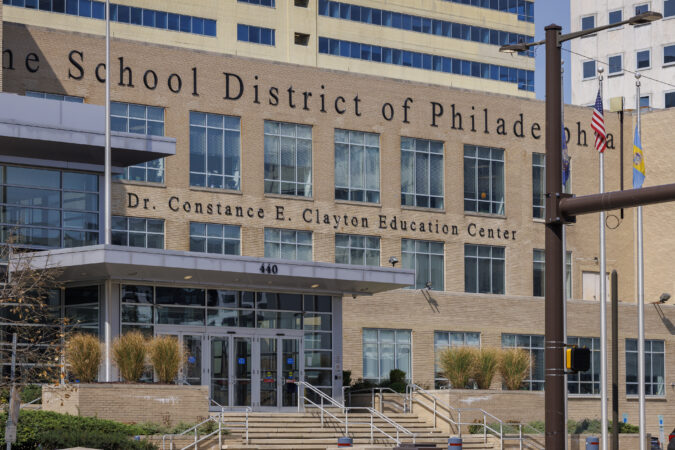
Military officers will see their tuition assistance cut off at 22 schools and institutions, but the University of Pennsylvania is not among them.
The Ivy League institution, which counts President Donald Trump among its alumni, was on an initial list of 34 schools “at risk” of losing Pentagon-funded tuition assistance. But Penn was not part of the 22-university list released by Defense Secretary Pete Hegseth on Friday.
Penn did not immediately respond to a request for comment Tuesday.
Hegseth previously said he intendedto cut off schools where faculty members have “leftist political leanings” and “openly loathe our military,” but he cited no specific examples of bias or misconduct at the 22 schools that will lose tuition assistance beginning with the 2026-27 academic year.
“We will no longer invest in institutions that fail to sharpen our leaders’ warfighting capabilities or that undermine the very values they are sworn to defend,” Hegseth wrote in a letter released Friday with the final list.
It was not immediately clear why Penn and other schools were removed from the initial draft list.
Among the schools still set to lose access to the tuition-assistance program is Princeton University, where Hegseth obtained a bachelor’s degree in 2003. Carnegie Mellon University in Pittsburgh is also on the list, as is Yale University, where Vice President JD Vance obtained a law degree.
The move means members of the military will be banned from using Department of Defense tuition assistance to pay for Senior Service College Fellowship programs at those schools.
The impact will not be large — the Department of Defense said fewer than 100 military students are enrolled in programs at schools that will lose funding. Military personnel currently enrolled may complete their courses of study, Hegseth said, though it is unclear if they will have to change schools to continue receiving financial assistance.
Hegseth’s announcement did not mention several other financial assistance programs for undergraduates, including the GI Bill, which is administered by the Department of Veterans Affairs.
Here is the full list of schools losing tuition assistance from the Pentagon:
Educational institutions
Harvard University
St. Louis University
Massachusetts Institute of Technology
Tufts University
Georgetown University
Carnegie Mellon University
Brown University
Columbia University
Yale University
Middlebury College
Princeton University
George Washington University
College of William and Mary
International institution
Queen’s University (Canada)
Nonprofit institutions
Center for Strategic and International Studies
New America Foundation
Brookings Institution
Atlantic Council
Center for a New American Security
Council on Foreign Relations
Henry L. Stimson Center
Senior Service College
Johns Hopkins University School of Advanced International Studies West Space Scholars Program
The announcement that the Philadelphia School District will close additional schools because of budget shortfalls is devastating, but sadly not surprising.
When schools close, students who have already faced instability pay the highest price. Parents scramble to rearrange transportation and childcare. Children lose trusted teachers and friendships. Communities lose institutions that once anchored them. Families deserve more than reassignment letters and uncertainty. They deserve meaningful options.
Two solutions are within reach: Lifeline Scholarships for Pennsylvania and the federal program, the Educational Choice for Children Act (ECCA). These programs would allow funding to follow Pennsylvania students to schools that meet their needs. These scholarships would give parents — not bureaucracies — the ability to choose a safe, effective learning environment, whether that is a public charter school, private school, faith-based school, or specialized program tailored to a child’s needs.
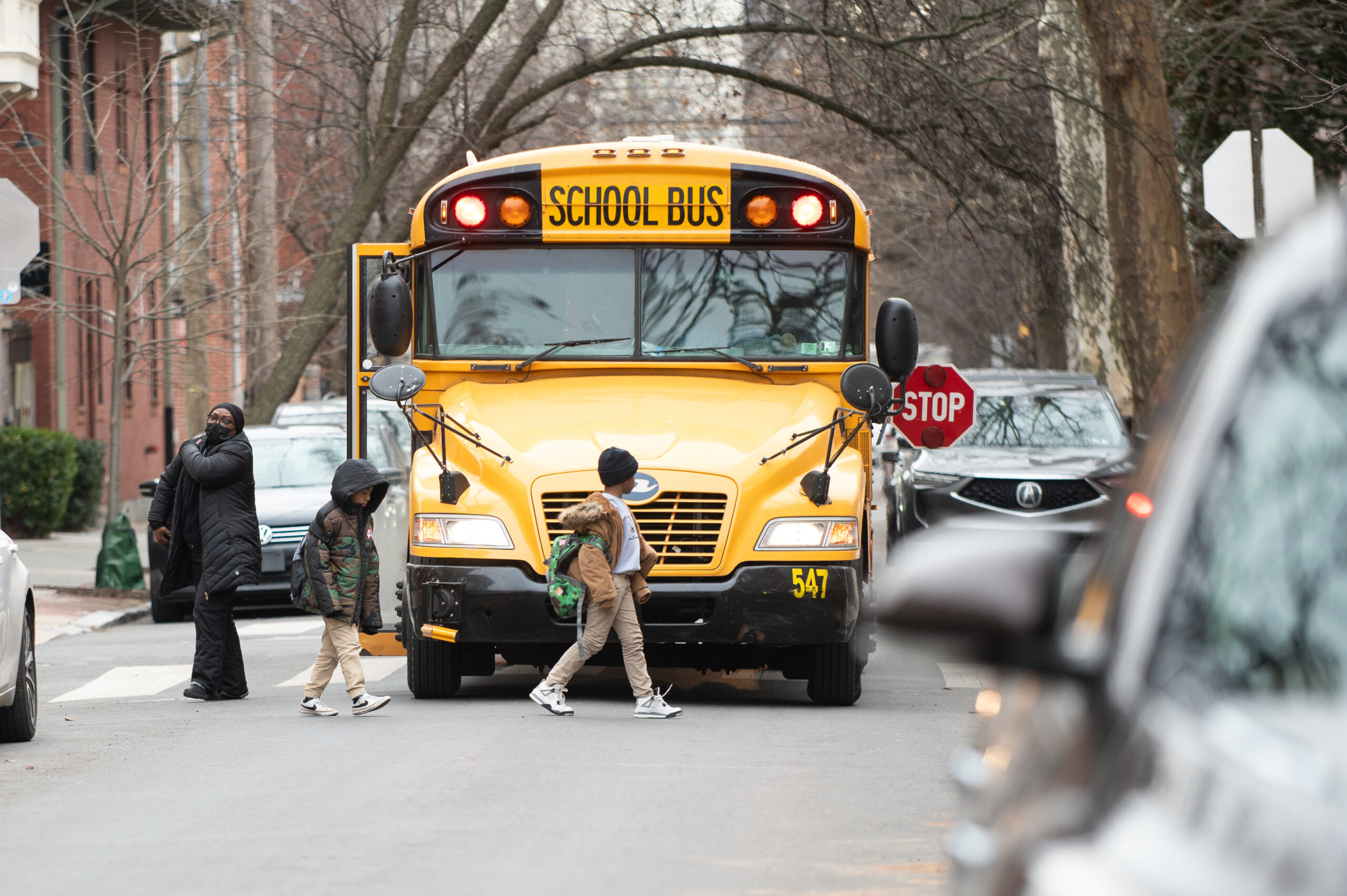
Students get off the bus at Laura W. Waring elementary school in Spring Garden last month. The school is set to close in 2027.
Gov. Josh Shapiro has the opportunity to act, and he needs to opt in now. By supporting Lifeline Scholarships and opting Pennsylvania into federal education choice programs like ECCA, the state could help families immediately. These are education dollars intended for children. Allowing them to follow students would give parents real leverage and real hope.
Other states are already moving forward. In Texas and Florida, tens of thousands of families are applying for scholarships that open doors to schools better suited to their children. Reports from Texas show more than 80,000 applications from families seeking alternatives. These parents are not abandoning public education; they are seeking opportunity where it exists.
Critics argue that school choice harms public schools. But forcing families to remain in schools that are unsafe or chronically underperforming harms children. Choice introduces accountability. When families have options, schools must improve to keep students. Competition can spark innovation, encourage responsiveness, and reward excellence.
This is not about politics or ideology. It is about fairness.
Every parent wants the same basic things: a safe school, strong teachers, and a chance for their child to succeed. For too many Philadelphia families, those expectations remain unmet. School closures make that reality even more urgent. Lifeline Scholarships and federal education choice programs like ECCA could offer stability in a time of upheaval.
Philadelphia parents and community leaders should make their voices heard. Contact your legislators. Write to Gov. Shapiro. Ask Pennsylvania to adopt policies that put students first and give families the freedom to choose schools that work for their children.
Our children cannot wait another decade for incremental change. When schools close, families need solutions — not promises. These solutions are already working for families in many states across the country; why not in Pennsylvania?
Reginald Streater, president of the Philadelphia Board of Education, opened his testimony before City Council last month by introducing himself as “Reggie from Germantown,” a graduate of two district schools that no longer exist. Germantown High and Leeds Middle both closed. He knows what it means to lose a building. He’s also voting to close 20 more.
The conflict playing out in Philadelphia isn’t only about schools. It’s about the fact that the school district and City Council have different responsibilities for the same places, and the new facilities plan brings that conflict into sharp focus.
On Jan. 22, Superintendent Tony B. Watlington Sr. released a facilities master plan proposing to close 20 schools, colocate six, and modernize 159 others. On Feb. 26, he presented an amended final plan to the Board of Education, which was updated from 20 school closures to 18. Russell Conwell Middle School and Motivation High School were removed from the closure list.
The district has lost 15,000 students in a decade, carries 300 buildings, many of them 75 years and older, and runs some schools with more than 1,000 empty seats, while others are overcrowded. Concentrating students means Advanced Placement courses in every high school, algebra for every eighth grader, and real career and technical pathways. The current spread of half-empty buildings makes all of that impossible to deliver consistently or fairly.
The facilities plan is doing exactly what it was designed to do. The trouble is that everything it was not designed to do.
A Philadelphia neighborhood school isn’t just one institution. It’s four, sharing an address. There’s the instructional platform: courses, teachers, schedules, the district’s domain. There’s the civic anchor: the building that signals to a neighborhood that its children count, and they belong. There’s the distribution node: where meals are served, where social workers operate, and where there is, most days, someone watching. And there’s the pathway to the future: where a counselor knows a family by name, where a student learns there’s a college or a trade or a life beyond the block.
In places like Kensington, schools have absorbed those responsibilities over time.
When that school building closes, all of those other things close with it. Some of those functions were formal educational programs. Others accumulated because families had nowhere else to go for them. The school became the place where paperwork was explained, problems were addressed and solved, and someone always knew which door to knock on next.
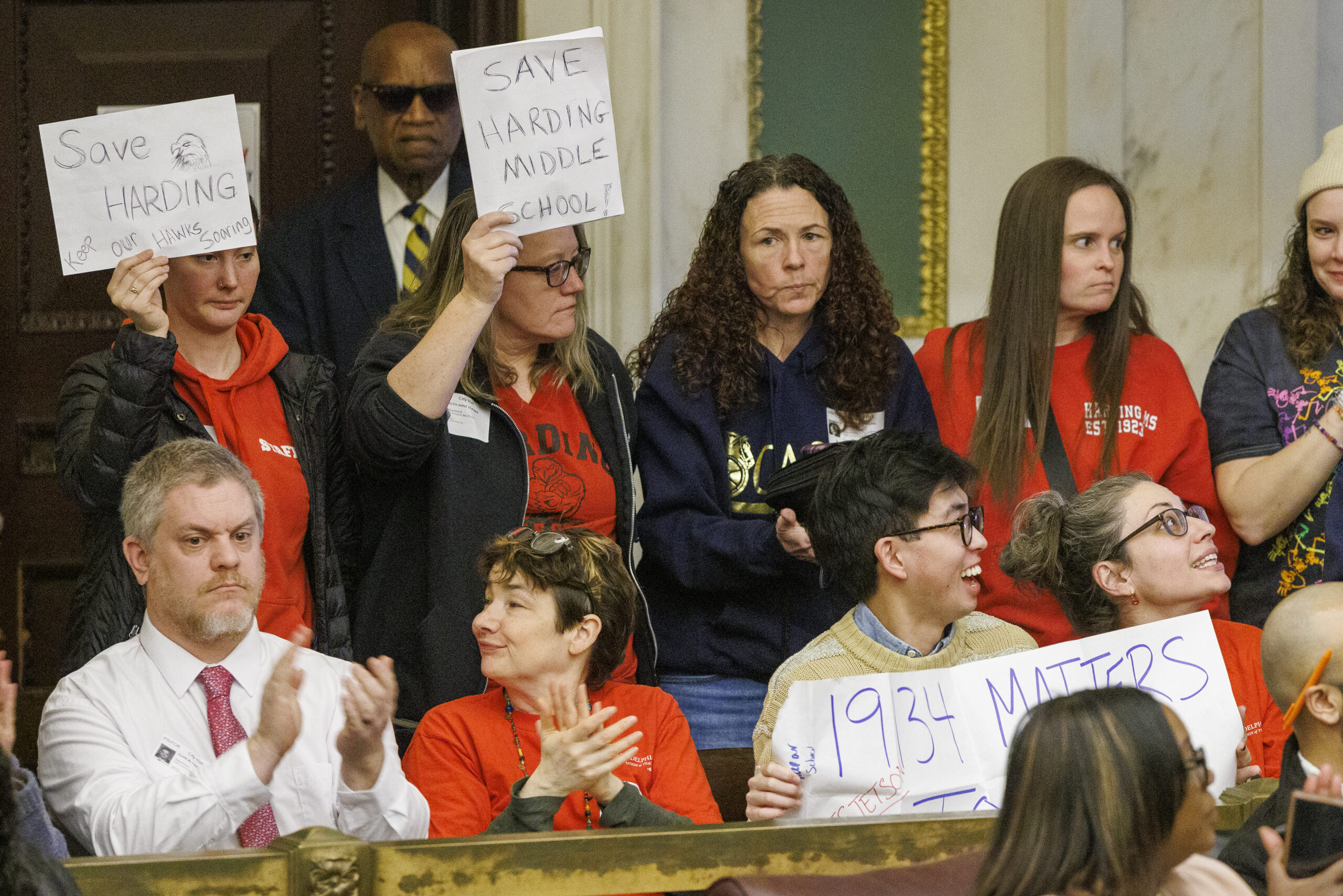
Supporters of Harding Middle School protest at a City Council hearing with school board members earlier this month.
Residents and families filled the chamber. Parents stood along the walls long after seats ran out, some holding infants, others carrying school backpacks. The hearing lasted hours.
The debate sounded like a disagreement about the plan, but it was really a disagreement about who is responsible for what the plan leaves behind.
What closes with a school building is not limited to instruction. Council’s budget is the instrument for the functions the facilities plan does not govern: housing investment, community infrastructure, colocated services, and neighborhood anchors that exist independent of school enrollment.
The district held 47 public listening sessions and surveyed more than 13,000 people before releasing this plan. The fight at City Hall last month wasn’t because communities weren’t heard. It’s because what they described was a loss that the facilities plan was never designed to address. That’s not a failure of process. It’s a mismatch of jurisdiction.
The district’s plan answers an educational question. What replaces the neighborhood functions housed in those buildings is a civic one.
That answer does not sit with the school district.
Amanda Soskin is a Philadelphia resident and consultant who writes about neighborhoods and civic infrastructure at Neighborhood Fundamentals.
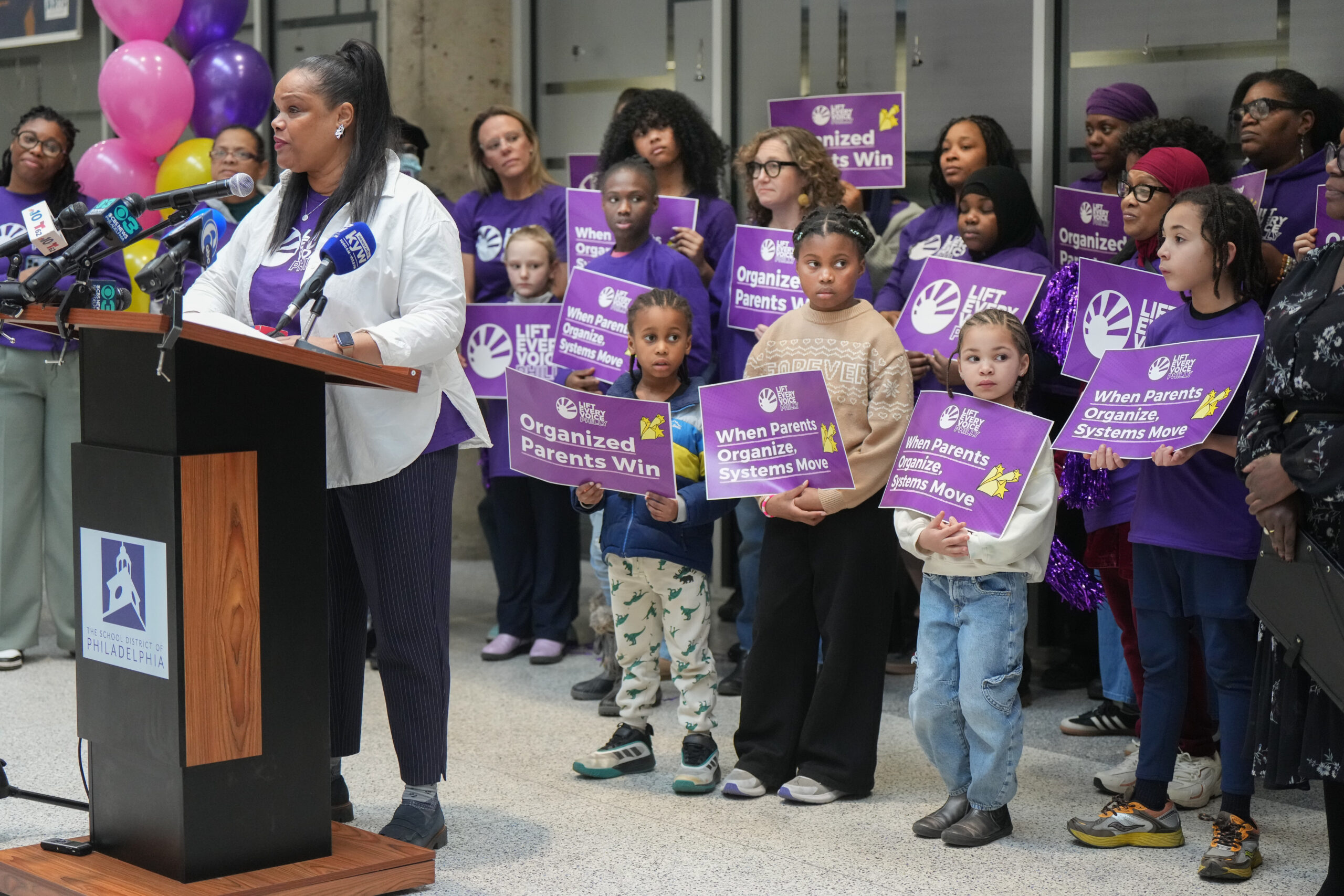
For the first time, Philadelphia School District students have guaranteed bathroom and water breaks. Recess is promised. Silent lunches and collective punishment are forbidden.
Philadelphia’s school board just adopted the district’s first-ever comprehensive wellness policy, two years after a group of parents began pushing a “joy campaign” because, parent Jamila Carter said, “we refused to accept the unacceptable.”
Jamila Carter speaks during a news conference celebrating the wellness policy / joy campaign at the school district building, in Philadelphia, on March 2, 2026.
In the past, said members of Lift Every Voice — a grassroots, Black-led parent organization growing in numbers and clout in the city — students inside some district schools weren’t allowed to drink water during the day. Entire classes were punished for the misdeeds of one or two students. And sometimes, parents sent their children to school in diapers because children weren’t always allowed to use the bathrooms.
The group of moms weren’t trained advocates, but they learned quickly, pushing the school board and district to codify rights that weren’t always guaranteed.
Now they are — on Thursday night, the school board signed off on bathroom and water breaks and mandatory recess and movement breaks for every 90 minutes of seated time for elementary school students.
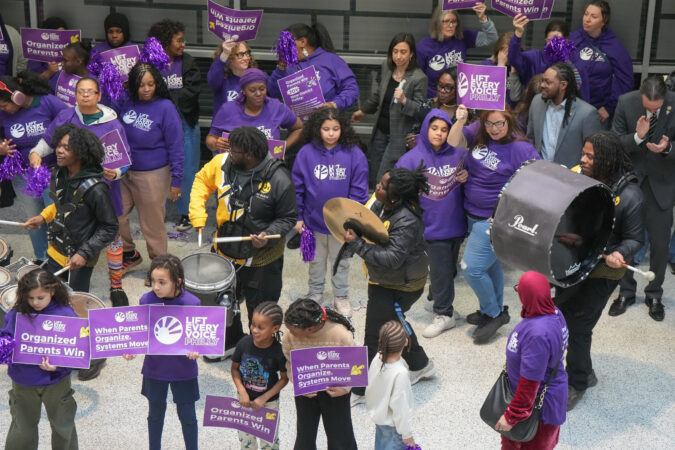
With pom-poms and dancing, a drum line and cheers, Lift Every Voice members celebrated their victory at district headquarters Monday.
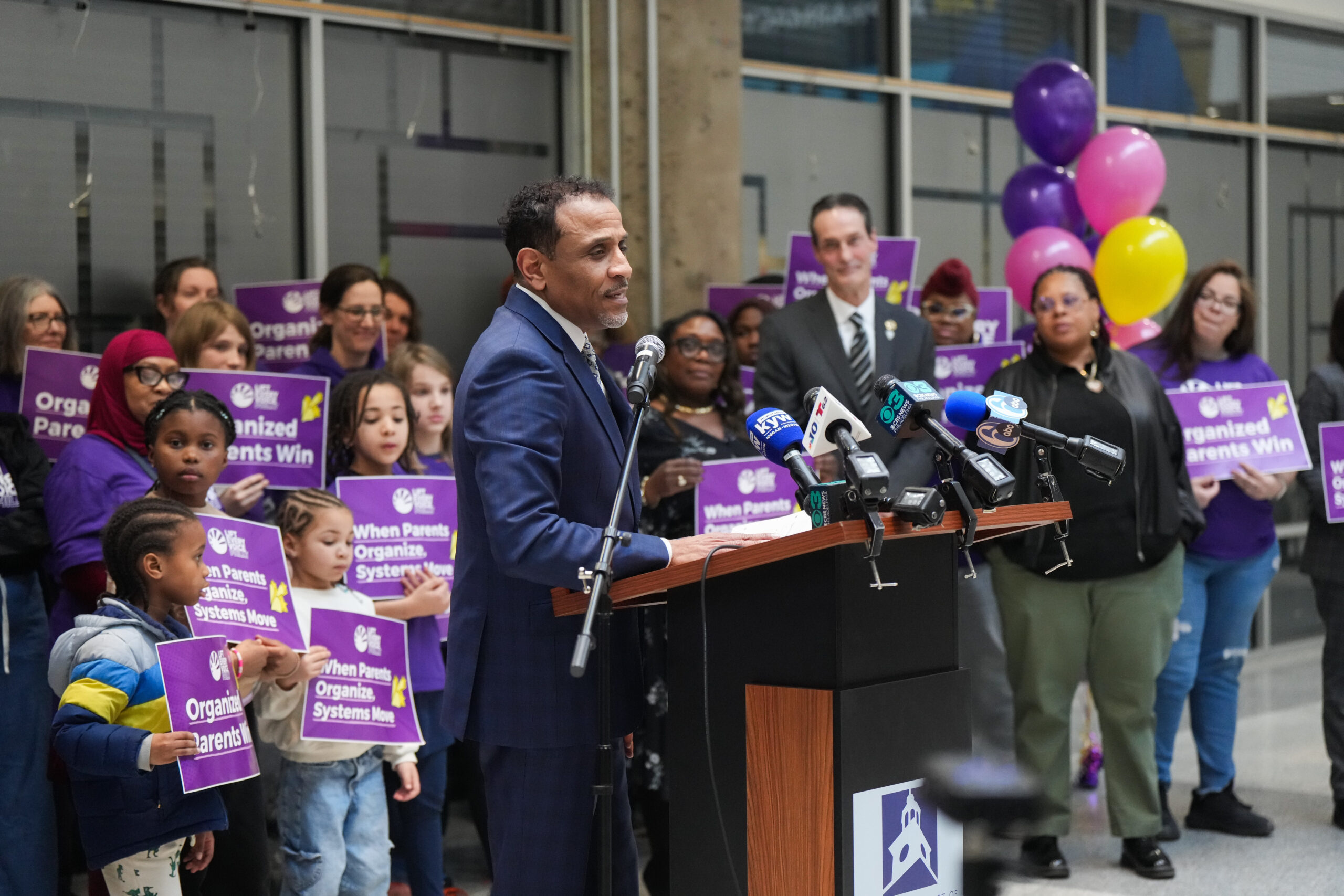
Superintendent Tony B. Watlington Sr. speaks during a news conference celebrating the wellness policy / joy campaign, at the school district building, in Philadelphia, on March 2, 2026.
Superintendent Tony B. Watlington Sr., who now routinely talks about joy as one of the district’s core values, credited the parents for pressing the issue.
“You know what Frederick Douglass once said? He said, ‘Power concedes nothing without a demand. It never has and it never will.’ And so I want to thank the members of Lift Every Voice. I wish we had done this much sooner. But I’m pleased that we’re doing it today,” Watlington said.
Amy Faulring, a parent of two district students, said it was a happy day, but the campaign taught parents a sobering thing.
“Even in some of the best schools, these practices were happening, in buildings that families fight to get into and feel proud of,” said Faulring. “That tells us this wasn’t about one school, it was about culture, and culture does not shift by accident. When basic protections aren’t written down, they become negotiable. They depend on which building you’re in or which parent feels empowered enough to speak up. Codifying this into policy changes that.”
The policy, Faulring said, “sets a clear floor, it creates consistency, and it makes dignity non-negotiable.”
The priorities, said Lift Every Voice member LaTi Spence, came right from kids.
“Our children told us what was wrong,” said Spence. “They told us what it felt like to sit in classrooms thirsty, how hard it was to have silent lunches. They told us where joy was missing.”
Councilmember Kendra Brooks said the policy fixes things that parents and students had to tolerate for too long.
“When we think about children holding their bodies because bathroom access is protected, or sitting for hours without movement, or rushing through silent lunches, that’s not discipline,” Brooks said, who was a parent activist before she was a politician. “That’s not discipline. That’s not rigor. It’s actually dehumanizing.”
A former Delsea Regional High School student has accused a math teacher of sexually abusing him years ago and is suingthe South Jersey school system for failing to protect him.
A lawsuit filed in Superior Court in Gloucester County on Friday alleges the former student was subjected to predatory conduct and sexual abuse by former teacher Cheryl Cousin in the 1980s.
According to court documents, the alleged abuse occurred when the student,David Reeves, was a junior and senior and not yet 18. Cousin was a math teacher in the district, but he was not her student, the lawsuit said.
Attorney Jeffrey P. Fritz said Cousin groomed Reeves for abuse using her position of power and trust, and district employees who knew or should have known about the abuse failed to stop it.
“Schools have both a legal and moral obligation to protect children entrusted to their care,” Fritz said in a statement. “When school officials become aware of suspected abuse, the law requires immediate reporting to authorities and decisive action which didn’t occur here.”
Cousin, reached for comment Monday, said she was stunned by the allegations. She has retired from the district and is not defendant in the lawsuit, though she is named in the complaint.
“I think I’m in shock right now. I guess I better call a lawyer,” she said, declining further comment.
Delsea Regional Superintendent Fran Ciolciola did not respond to email and voicemail messages. The school board’s solicitor, Frank P. Cavallo Jr., said the district had not received a copy of the lawsuit Monday and declined to comment.
Reeves, 55,said hedecided to use his name in the case to encourage other child sex abuse victims, especially male victims, to come forward. (The Inquirer does not identify victims in sexual assault cases without their consent).
The alleged sexual assault occurred between the 1987-88 and 1988-89 school years, Fritz said. There were at least 20 alleged assaults at various locations, the lawsuit alleges.
David Reeves is shown in his Delsea Regional High School senior year photo.
Reeves, who is nowa health and physical education teacher in Camden public school schools, said in an interviewhe was afraid to come forward until now.
“I have nothing to be embarrassed about,” Reeves said. “I am a victim who is standing up and putting my name on it.”
Married and the father of two, Reeves said the alleged abuse began his junior year when a fellow basketball team member told him that Cousin liked him and gave him her number. Cousin was the girls’ cheerleading coach, he said.
Reeves said he visited Cousin’s apartment and the two began a sexual relationship that continued into his senior year. Cousin purchased two pairs of Air Jordan sneakers for him and let him drive her Camaro, he said.
Reeves said the relationship was well-known in the school among students and teachers. Girls refused to date him because they believed he was involved with Cousin, he said.
“It couldn’t have been any more well-known,” Reeves said.
According to the lawsuit, thethen-school Principal Frank Borelli called Reeves to the office to question him about their suspicions. Reeves said he didn’t want to cause problems for Cousin so he denied that he was involved with her.
“I was a child. I was scared to death,” he said.
Borelli later became the district’s longtime superintendent and currently serves on the school board. He is not named as a defendant in the lawsuit, but the school board is listed as a defendant. Borelli did not respond to a message seeking comment.
The lawsuit also alleges that the district failed to make mandatory reports of suspected abuse to the state’s child welfare agency, according to the complaint.
It was filed under the 2019 New Jersey Child Victims Act, which extended the statute of limitations to allow child sex abuse victims to sue their abusers and the institutions that protected them until they turn 55. Reeves turned 55 Saturday.
Reeves said his wife of 16 years, Stacy, encouraged him to come forward with his allegations. He said he has suffered from post-traumatic stress disorder and has battled drug and alcohol addiction.
He wants to advocate for other victims, especially boys. It is estimated that 1 in 4 girls and 1 in 6 boys experience some form of sexual abuse before age 18, according to Child USA, a Philadelphia-based children’s rights advocacy group.
“It does not matter if I am male. I was a kid,” Reeves said. “It has affected me a long time.”
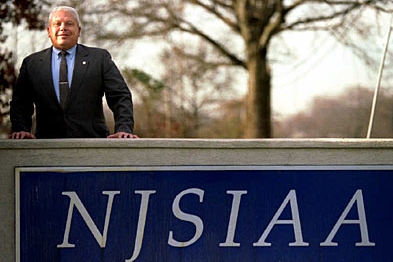
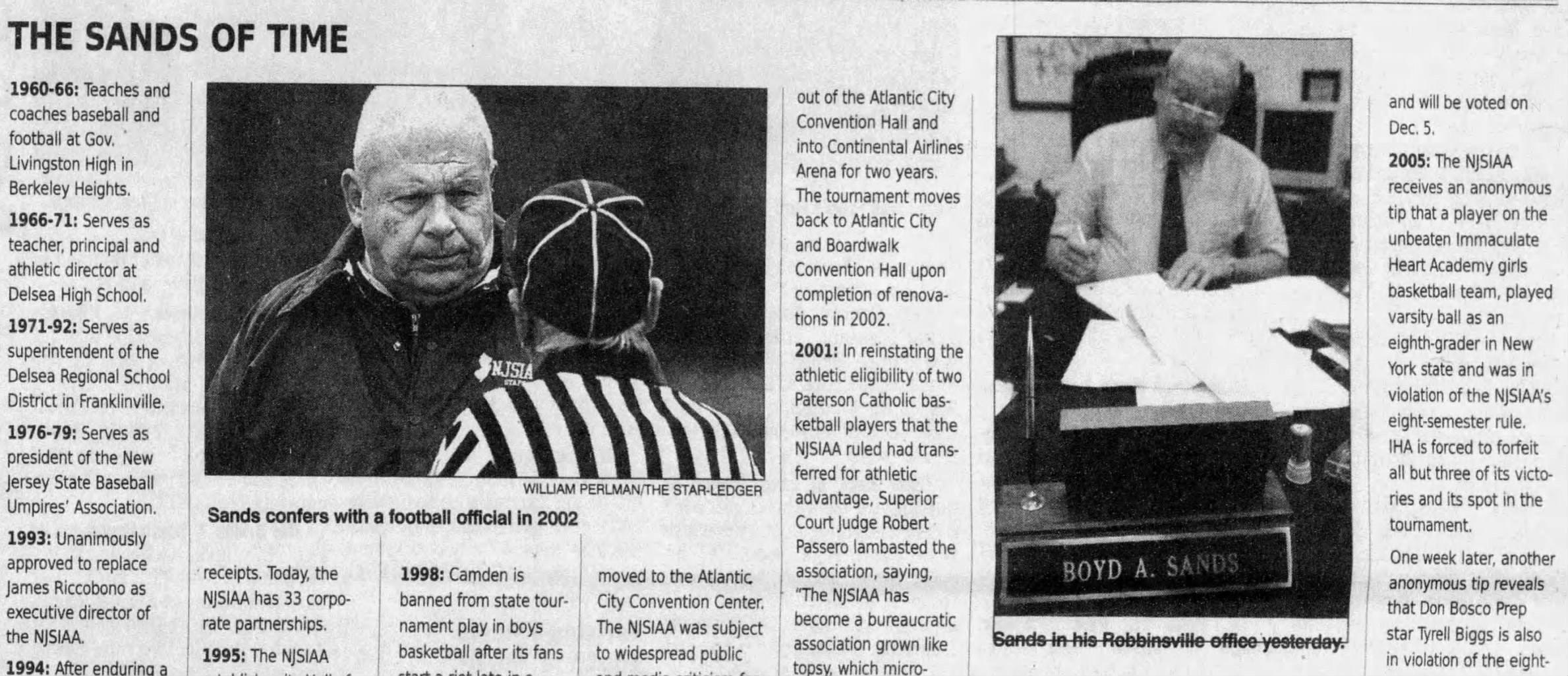
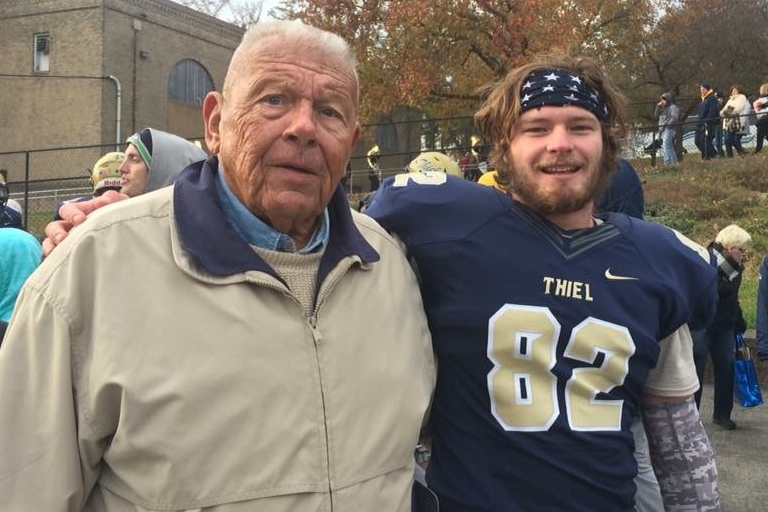
Boyd Sands, 88, formerly of Glassboro, Gloucester County, retired teacher, coach, principal, and superintendent of the Delsea Regional School District, and Hall of Fame former executive director of the New Jersey State Interscholastic Athletic Association, died Saturday, Jan. 17, of complications from a stroke at Cape Canaveral Hospital in Florida.
An All-Star football player in high school and college, and a longtime baseball umpire and basketball referee, Mr. Sands directed the NJSIAA from 1993 to his retirement in 2006. He and the association’s executive committee organized hundreds of statewide championship playoff tournaments, hired thousands of game officials, and enforced eligibility and sportsmanship rules for high school athletes in more than 30 sports at more than 400 public and private high schools.
He was an expert on all kinds of rules and a champion of the state’s expanded football playoff format and more programs for girls. He oversaw ever-changing conference alignments and supervised the association’s multimillion dollar budget.
He attracted dozens of corporate sponsorships to fund new initiatives regarding improved officiating, violence at sports events, and drug education. He forged working relationships with the state’s Sports and Exposition Authority, Boardwalk Hall in Atlantic City, the NHL’s New Jersey Devils, and other organizations.
Overall, Mr. Sands served more than three decades as a member of the NJSIAA advisory committee and executive committee, and executive director. In an online tribute, former colleagues there called him “a respected leader in education and sport. A consummate professional.”
Steve Timko, his successor as executive director, told the Times of Trenton in 2005: “He has taken the association to the next level.” In 2003, Mr. Sands told the Record of Hackensack: “I really just enjoy high school athletics.”
He joined Delsea in 1966 as assistant principal, was promoted to principal, and served as district superintendent from 1971 to 1994. Before school, he was known to greet students as they exited the buses in the morning. After school, he handed out programs at events, prowled the sidelines at Delsea, and officiated games at other high schools.
He taught social studies and coached football for six years at two high schools in North Jersey before going to Delsea. He oversaw the building of the district’s middle school in the 1970s, and colleagues named the entrance road leading to the new building after him.
The Star-Ledger of Newark featured Mr. Sands when he announced his retirement from the NJSIAA in 2005.
“His influence lives on in the students he inspired, the educators he mentored, and the community he helped shape,” Delsea superintendent Fran Ciociola said in a tribute.
Mr. Sands was onetime president of the Camden County chapter of the New Jersey Baseball Umpires Association. He won achievement awards from the NJSIAA, the National Federation of Interscholastic Athletic Officials, and the Union County Interscholastic Athletic Conference.
He was an executive committee member of the National Federation of State High School Associations and lifetime member of the International Association of Approved Basketball Officials. “His spirit, kindness, and dedication will be remembered always,” colleagues at the IAABO said in a tribute.
Mr. Sands was inducted into the Gloucester County Sports Hall of Fame in 1989, the NJSIAA Hall of Fame in 2007, and the South Jersey Baseball Hall of Fame in 2009. He attended many continuing education classes and earned certifications at Rowan, Rutgers, and Seton Hall Universities, and elsewhere.
Mr. Sands liked nothing more than attending a football game.
He never changed his signature flattop crew cut. “Bear of a man, great guy,” a former student said in a Facebook tribute. A friend said online: “Boyd was a wonderful man and terrific mentor.”
Boyd August Sands was born Feb. 16, 1937, in Newark, N.J. He played football and basketball in high school, and earned a bachelor’s degree in education at Colby College in Maine and a master’s degree in administration at what is now Kean University in New Jersey.
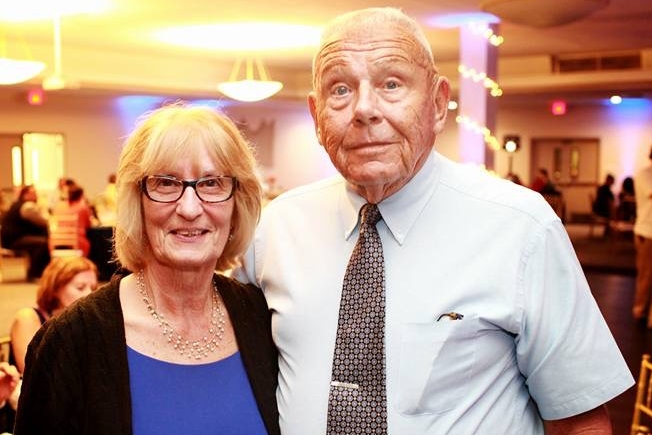
He met Frances Curto at a New Year’s Eve party, and they married in 1958. They lived in North Jersey, moved to Glassboro when he worked at Delsea, and had daughters Susan, Nancy, Karen, and Lori, and a son, Michael. His son died earlier.
Mr. Sands studied history and enjoyed road trips to family reunions in Florida and stops at historical sites along the way. He loved his dogs, followed the Eagles and Phillies closely, and was sure to be greeted by former students and old colleagues whenever the family went out.
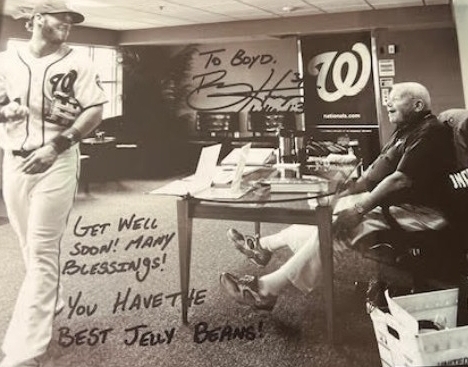
Mr. Sands (right) became friendly with baseball star Bryce Harper when he worked at the Washington Nationals’ spring training complex in Florida.
He and his wife moved to Cape Canaveral in 2006, and he helped run spring training for the Washington Nationals baseball team and worked security for a cruise line. He had bypass surgery in 2015.
“My father was a man who found joy in two of life’s greatest gifts: family and sports,” said his daughter Nancy. “My dad was a man who always showed up and pushed us hard to do our best.”
His daughter Susan said: “He saw everyone as a person.”
Nearly everyone has a memorable umpiring story about Mr. Sands, like the time he got drilled by a line drive down the first base line. In 1994, he told The Inquirer that he enjoyed officiating high school baseball and basketball games more than anything.
“It was my hobby and outlet,” he said. “I tried golf, and I figured I’d rather get hit by a hard ball.”
Mr. Sands and his wife, Frances, married in 1958.
In addition to his wife and daughters, Mr. Sands is survived by 16 grandchildren, 28 great-grandchildren, a brother, and other relatives. A brother died earlier.
Superintendent Tony B. Watlington Sr. and the Philadelphia School District have proposed 18 school closures, six colocations, and a vague, insufficiently transparent plan to reconfigure grade levels across numerous other schools, citing the need for “more efficient use of all of our resources” to deliver high-quality academic and extracurricular programming districtwide.
The Inquirer Editorial Board has endorsed the plan, pending adjustments to several sites, including Lankenau Environmental Science Magnet High School.
The district is right to pursue a comprehensive facilities plan that addresses toxic building conditions, overcrowding, and underutilization. But it is going about it the wrong way. Facilities planning should be an annual, longitudinal process grounded in sustained community engagement, not a punctuated moment of 24 mass closures that disrupt neighborhoods and sidestep the thoughtful incorporation of public input that only time and intention can provide.
Mistakes of 2013
Without such care, the district will repeat the mistakes of the 2013 closures, which led to students disappearing from school rolls in September, overcrowded receiving schools, and the racialized erasure of neighborhood histories and place-based educational traditions.
First, significant questions remain about implementation and transparency. Ten properties are slated to be “conveyed” to the city, reportedly tied to Mayor Cherelle L. Parker’s H.O.M.E. plan. Amid speculation about a 20-year tax abatement connected to redevelopment, it is unclear what mechanisms will ensure the benefits of these transfers accrue to the communities that have borne the brunt of closure, rather than to private developers. A two-decade tax abatement would symbolically and materially reinscribe the racialized disinvestment, neglect, and manufactured crisis that have too often paved the way for school closures in the first place.
Second, the data used to inform the closures have been called into question by many, and do not take into account the nuance of mixing school populations via colocation. For example, parents at Childs Elementary have cited the district’s plan to colocate a new Academy at Palumbo based on a building capacity of 1,000. However, a significant portion of the building’s classrooms is dedicated to special-education students. A colocation would displace SPED students from these classrooms while reinforcing a bifurcated culture among the catchment-based middle school students and Palumbo students in an already rapidly gentrifying neighborhood of Point Breeze.
Third, closure and conveyance to the city for resale do not guarantee public-serving outcomes. With my collaborators — Ariel Bierbaum, Amy Bach, and Elaine Simon — I have studied how thoughtful reuse, rooted in restoring community access and public control, can begin to repair the racially inequitable legacy of past closures.
Yet, private redevelopment has repeatedly failed to stabilize these properties. Selling off public assets does not guarantee revitalization; it often perpetuates stagnation or displacement. Developers frequently “flip” former school buildings, speculating on value rather than advancing community use.
After it closed in 2013, Germantown High School fell into decay and disrepair, a fate Julia McWilliams writes could be repeated.
Take the former Germantown High School and Robert Fulton Elementary, for example. Concordia Group bought them in 2014, only to abandon its plans and resell the buildings three years later to local developer Jack Azran, whose opaque redevelopment has sparked concern.
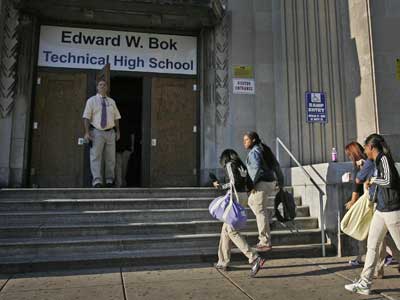
Moreover, once schools are sold to private entities, they are effectively lost to some communities and public education forever. South Philadelphia’s experience is a cautionary tale. As nearby elementary schools became overcrowded following the 2013 closures, the former Edward W. Bok Technical High School, once a public citywide admissions school, was transformed into a workspace for small-business owners, artists, and nonprofit organizations, closing classrooms forever.
This reuse no longer serves the same community of students and families as when it was a high school, and raises important questions: What does it mean for a community’s future when former schools become symbols of gentrification rather than centers of education? And what options remain when demographic shifts create new demand for neighborhood schools that no longer exist?
Had Bok remained in public hands, it could have flexibly adapted to those needs. Instead, it serves a much different population: South Philadelphia working artists, small-business owners, and local refugee-serving nonprofits, but also patrons who can afford $14 cocktails.
Slow down
Rather than defaulting to closure, the Board of Education should consider how underenrolled buildings might be repurposed for public-serving uses that retain community control. Could redevelopment proceed gradually, with clear commitments that investments in existing buildings benefit both local families and those who have chosen these schools?
Such an approach would require genuine public engagement and sustained dialogue. It would require slowing down and rejecting a disruptive, thinly deliberated plan shaped by speculative capital and instead committing to participatory, long-term facilities planning.
The district and the city face a choice. They can repeat a cycle of disinvestment and dispossession, or they can chart a more deliberative, community-rooted path. The question is whether they have the will to do so.
Julia McWilliams is the codirector of the Urban Studies Program at the University of Pennsylvania and a member of Stand Up for Philly Schools. She coauthored the forthcoming book, “Schools for Sale: Disinvestment, Dispossession, and School Building Reuse in Philadelphia,” from the University of Chicago Press.
Half days are disappearing in the Philadelphia School District.
Beginning in the 2026-27 school year, the district won’t have a single early dismissal — for teacher planning, report card conferences, or any other purpose.
Student attendance tumbles whenever Philadelphia has a half day, and parents scramble to plan for childcare when they happen, Superintendent Tony B. Watlington Sr. said.
At the superintendent’s request, the board amended the 2026-27 calendar, changing eight previously scheduled half days to zero.
Some days previously scheduled for professional development will now be full days off for students, and report card conferences — previously held over two half days — will now be scheduled on a single day off for students.
“When we have half days in the school district, it significantly impacts our student attendance,” Watlington told the board. “We now have clear data over 3½ years that when we have half days for professional development and the like, it lowers our overall student attendance.“
Watlington has emphasized student attendance as a key driver of academic improvement, and overall, Philadelphia’s student and teacher attendance has risen during his tenure, which began in 2022.
But half days were responsible for the largest single year-over-year drop in attendance in recent years. In December 2025, 54% of district students attended school 90% of the time or more, down from 66% over the same time period in 2024.
In January 2026, regular student attendance was 51%, down from 53% in January 2025, a dip Watlington said was “largely attributed to disruptions in the calendar.”
Controlling for half days, regular student attendance would have been 70% last month — proof, Watlington said, that half days need to disappear.
“This is very important,” the superintendent said, “because we know if we can get student regular attendance up, kids just learn more when they’re in school more.”
Half days planned for March, April, and May this school year will remain on the calendar, but the half day planned for students’ last day of the school year, June 11, is now a full day.
“Why would you not want to study the thing that lets you study,” said Schechtman-Taylor, a senior from New York City. “The brain, that’s our entire world.”
Neuroscience has become the most popular major on the highly selective liberal arts campus on Philadelphia’s Main Line, counting nearby Bryn Mawr College students who also take classes at Haverford. And it’s only been around since 2021 when the two colleges — which have had a minor in the discipline since 2013 — decided to administer the joint major.
At Haverford, there were 24 majors the year it started; now there are 60. Bryn Mawr saw similar growth and currently has 49. Enrollment in Haverford’s neuroscience classes including both Bryn Mawr and Haverford students grew from 154 in 2014 to nearly 800 last fall.
“We knew that neuroscience was going to be popular, but we did not anticipate this growth,” said Helen White, Haverford’s provost, who noted the school recently hired another neuroscience professor to accommodate more students.
The major’s popularity is also growing at schools around the Philadelphia region — and across the country. Students and professors say neuroscience is popular because it’s interdisciplinary, involving psychology, biology, and chemistry, and can lead to a variety of careers. It can also be personal, because it involves studying diseases like Alzheimer’s and Parkinson’s, which have no cures, and the treatment of strokes and traumatic brain injuries.
“I would say about 90% of my students are coming into my lab because they have someone in their family with one of these diseases,” said Rob Fairman, a Haverford biology professor whose research focuses on neuroscience.
Haverford senior Alina Schechtman-Taylor, 21, of New York City, works as a teacher assistant in professor Laura Been’s lab.
A growing major
In 2008, 110 colleges nationally offered neuroscience majors; now, it’s about 330, said Raddy Ramos, associate professor in the Department of Biomedical Sciences at the New York Institute of Technology. Ramos, who coauthored studies on the topic, said there were more than 2,000 neuroscience graduates in 2008; in 2019, that number had grown to more than 7,200.
window.addEventListener(“message”,function(a){if(void 0!==a.data[“datawrapper-height”]){var e=document.querySelectorAll(“iframe”);for(var t in a.data[“datawrapper-height”])for(var r,i=0;r=e[i];i++)if(r.contentWindow===a.source){var d=a.data[“datawrapper-height”][t]+”px”;r.style.height=d}}});
Pennsylvania is a hot spot, with 36 colleges having programs in 2022-23, Ramos said — more than than any other state.
Drexel University, which has had a minor since 2015, launched its undergraduate major in neuroscience in 2024.
“We have seen a 45% increase in applications over the last two years,” a university spokesperson said.
Pennsylvania State University in November announced it was launching two new undergraduate majors in neuroscience, one offered by the biology department and the other by the biobehavioral health department.
Students look for sections of rat brains that match the sections projected on the screen in a Haverford College lab.
Neuroscience has become especially popular among pre-med majors, school officials say. Otherpotential career paths include biotechnology, pharmacology, psychology, and neuroengineering, while somestudents go on to law school, business, or public policy.
“There’s a lot more awareness that mental health conditions are due to changes in the brain, and people want to understand that,” said Lisa Briand, associate professor and program director for Temple University’s neuroscience program.
At Temple, neuroscience has become the fourth largest of 30 majors in liberal arts, Briand said. The psychology department a few years ago changed its name to psychology and neuroscience, she said.
At the University of Pennsylvania a decade ago, 100 to 120 neuroscience majors graduated annually, said Lori Flanagan-Cato, associate professor of psychology and codirector of the undergraduate neuroscience program.
“Twice in the past 3 years we have had over 150,” she said.
Swarthmore College, a highly selective small liberal arts college, graduated 10 to 12 neuroscience majors a year about a decade ago, said Frank Durgin, professor of psychology who oversees the program.
“This year, we anticipate graduating 24 majors,” he said. “Next year, it’s 30.”
The college has added two professors in the last two years to accommodate growth, he said.
Why students study neuroscience
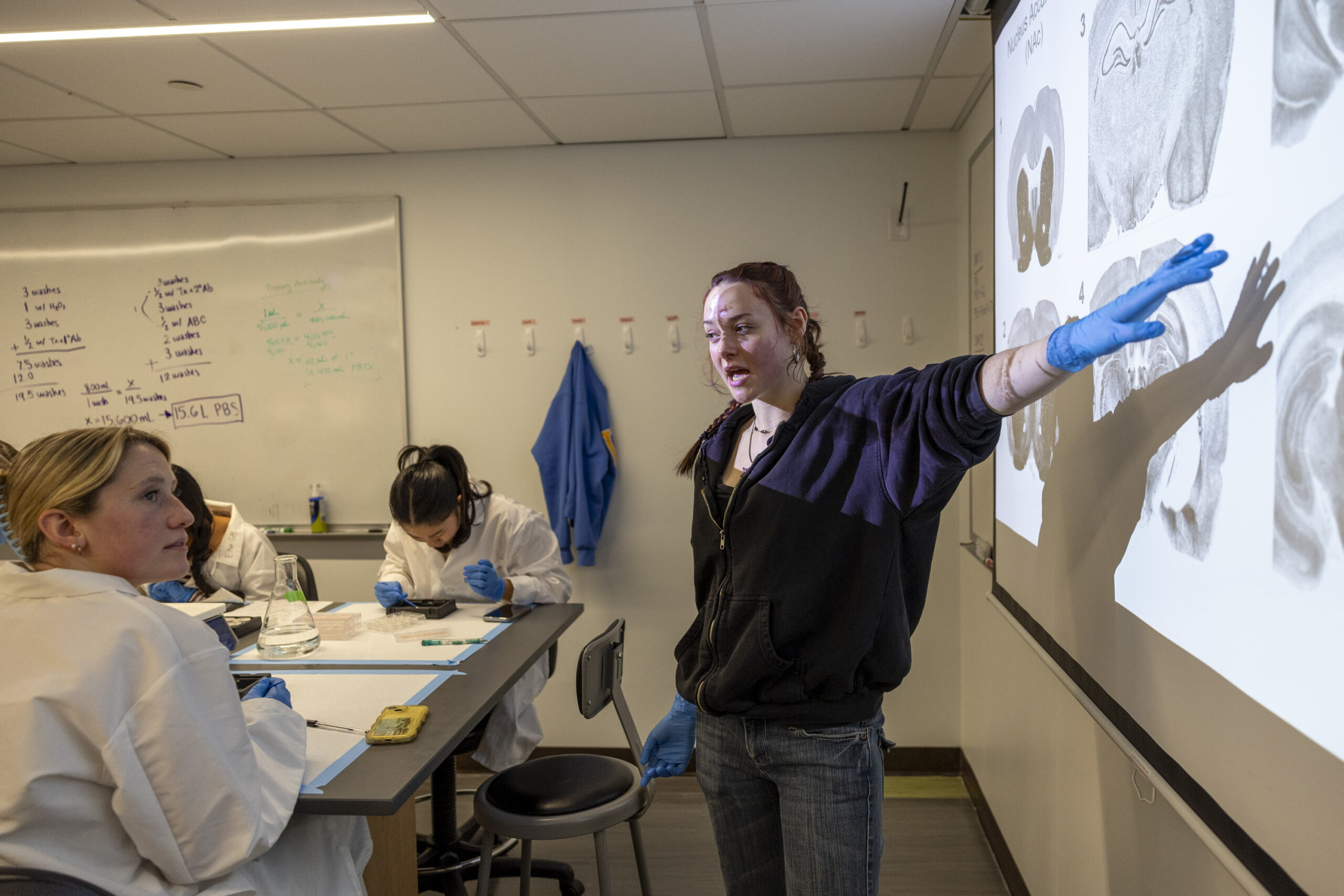
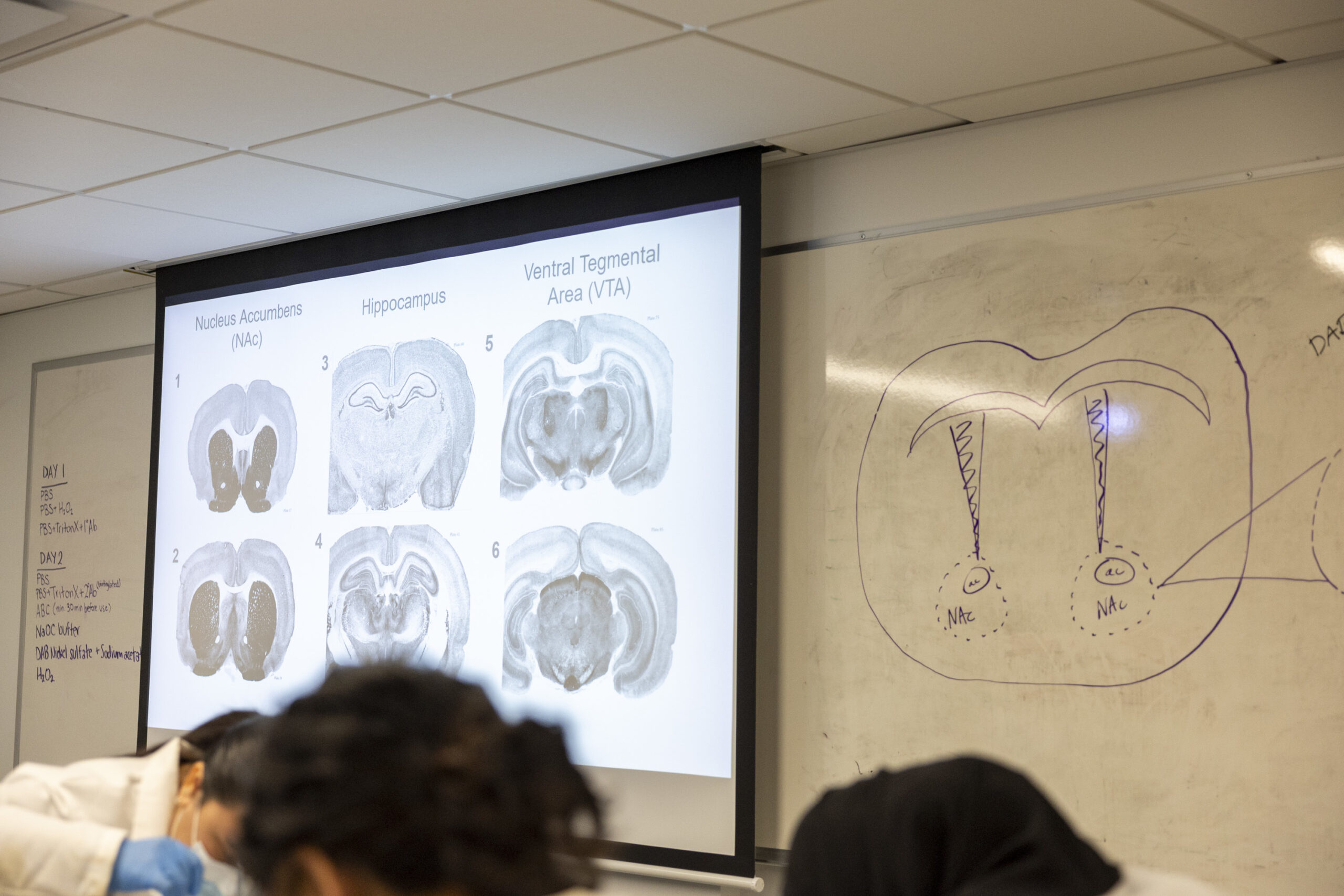
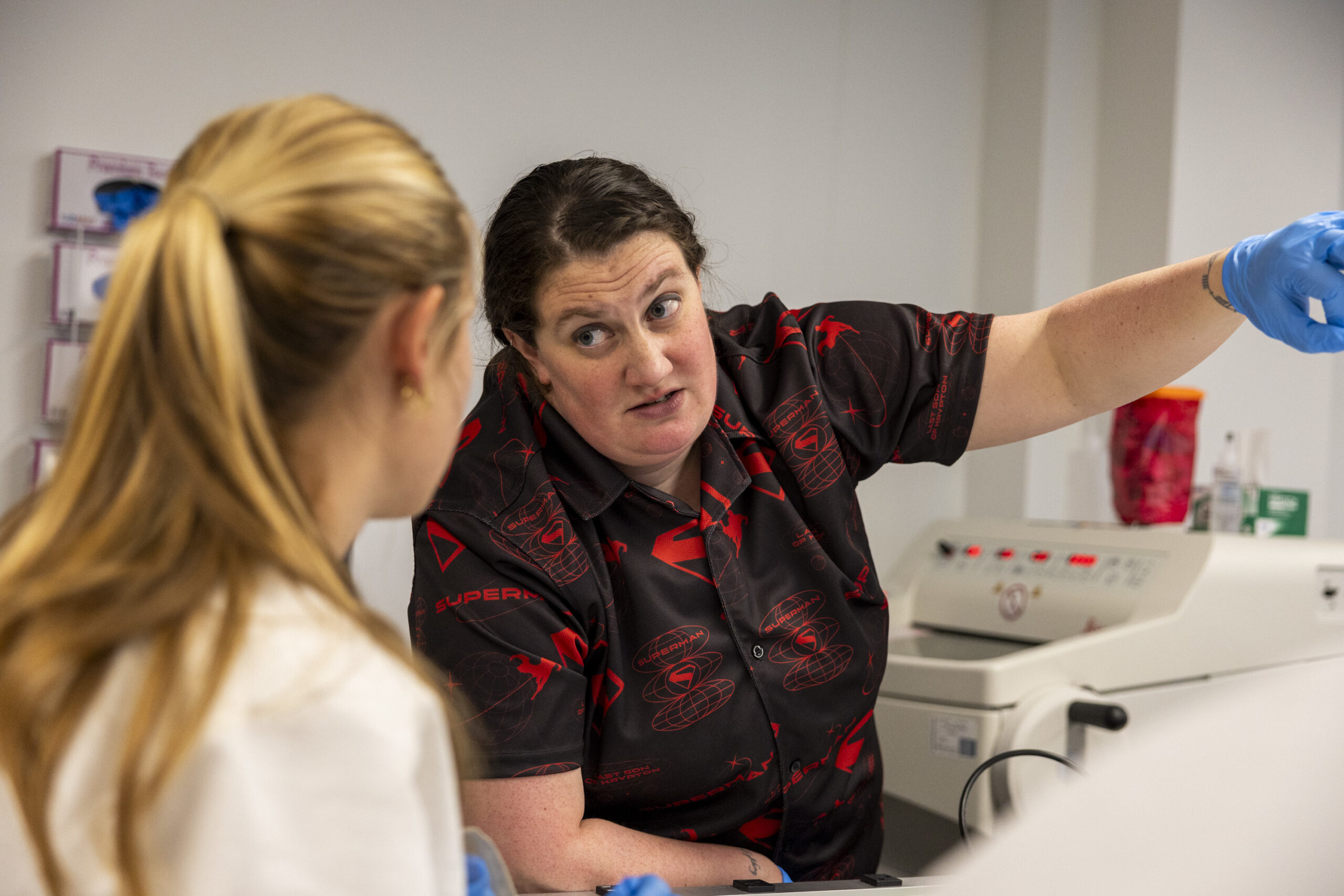
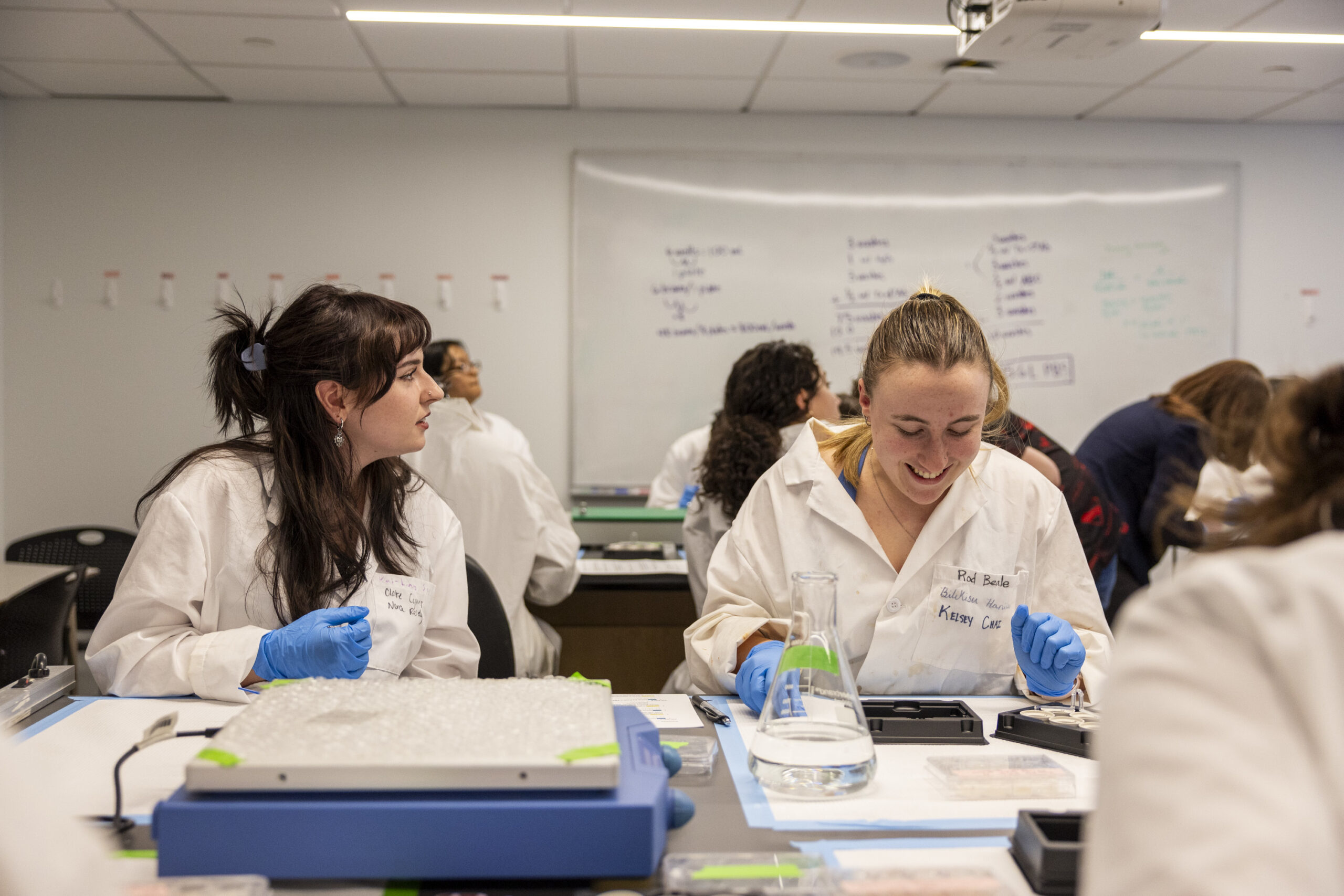
In a lab at Haverford one afternoon last month, 16 students in white lab coats poked with paintbrush tips at thin slices of rat brain in preservative fluid, preparing to stain them to look for which neurons were activated. Some of the rats received the drug Ritalin, commonly used for attention deficit disorder, while others did not. Students were trying to discern differences in their brains when they performed certain tasks, said Laura Been, associate professor of psychology and director of the bi-college neuroscience program.
A neuroscience student works with sections of rats’ brains in a lab at Haverford College.
“We can … try to learn something more about how this sort of drug treatment impacts the brain,” said Been, whose area of interest is behavioral neuroendocrinology, which looks at the relationship between hormones, the brain, and behavior.
Students in Been’s class had varied reasons for studying neuroscience.
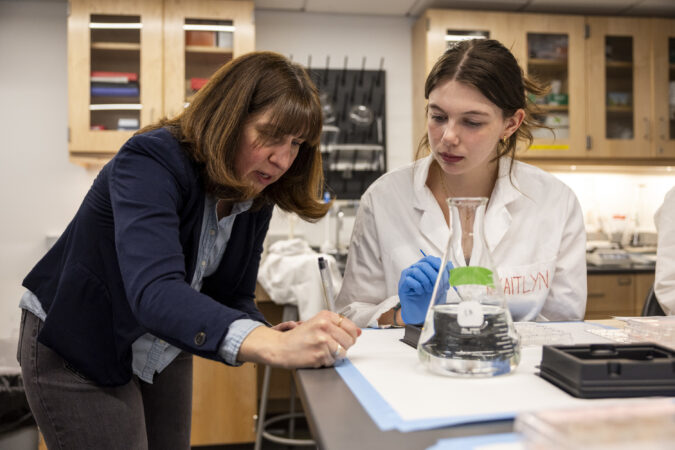
Emily Black, visiting assistant professor of neuroscience at Haverford College, helps Savannah Shaw, 22, of Downingtown, during neuroscience lab work. “I really like the variety of the classes we can take in the major,” said Shaw, a senior who plans to go to medical school, possibly to become a neurologist. “You can go more the psychology route or go more biology.”
Sophia Lipari, 21, a junior from Jacksonville, Fla., whose father is a reproductive endocrinologist, is interested in hormones and the field of fertility.
Riley Fass, 20, a junior from Claremont, Calif., wants to be a special-education teacher. She already sees the connection between neuroscience and her job as a teacher’s assistant at a school where children have traumatic brain injuries and cerebral palsy.
“The topics we discuss — an injury here will result in this — I can actually see it in my students,” she said.
Iris Goxhaj (left), 21, of Northeast Philadelphia, and Riley Fass, 20, of Claremont, Calif., work with sections of rats’ brains in a lab at Haverford College.
Deeya Abrol’s interest was stoked when she worked with a child on the autism spectrum as a swim instructor. Abrol, 22, a senior from Los Gatos, Calif., plans to go to medical school.
Schechtman-Taylor meanwhile wants to pursue biomedical engineering and specifically developing medicines for the treatment of neurodegenerative disorders.
“I want to work on the treatment side,” she said.
Fairman, the Haverford biology professor, said a recent graduate’s mother had died of Huntington’s disease, meaning she has a 50% chance of getting it, he said. She worked in his lab and wanted to be involved in hisresearchon protein clumping in the brain and its effect on diseases such as Parkinson’s and Alzheimer’s.
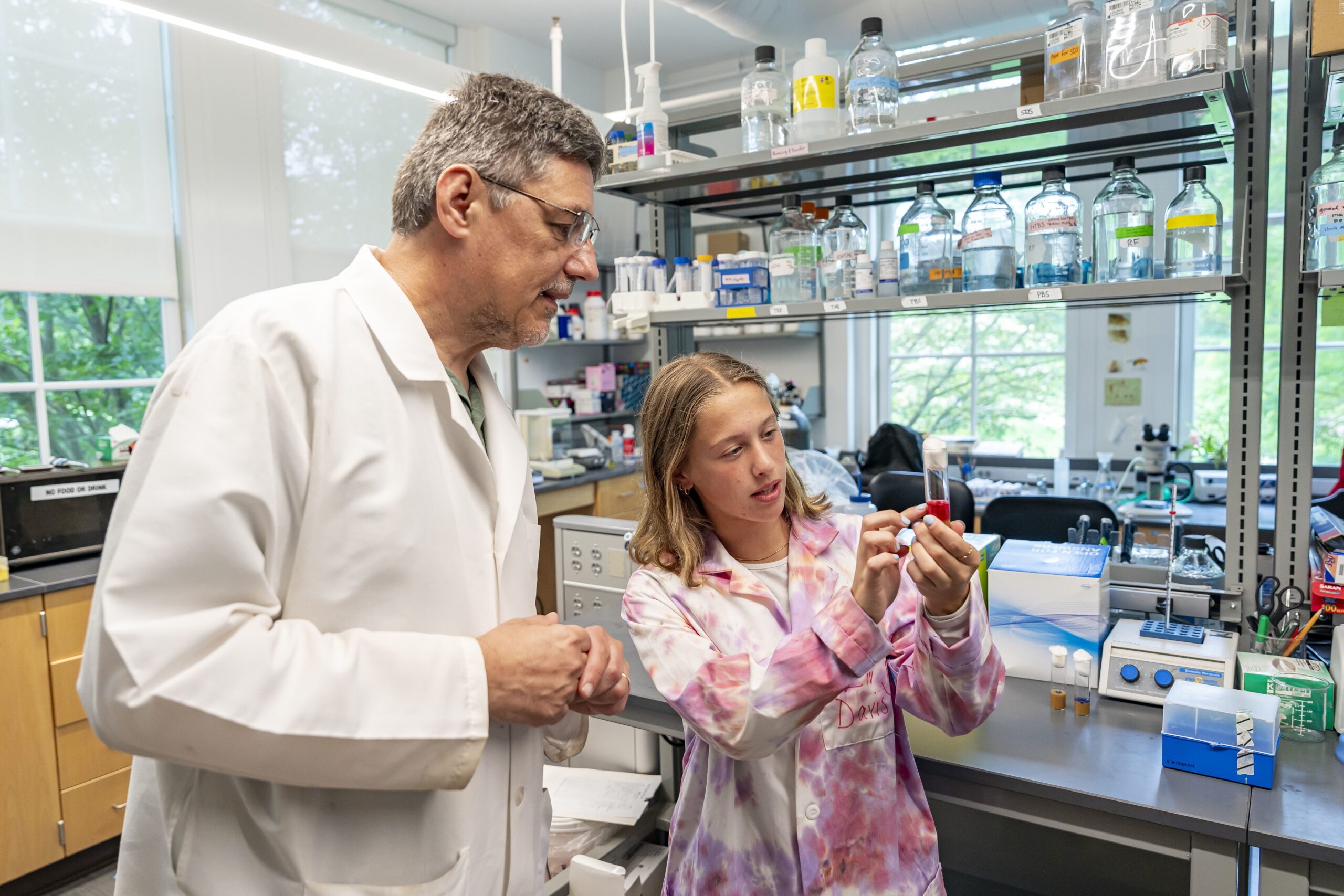
Rob Fairman, a professor of biology at Haverford College, and student Liv Davis are testing the effects of natural products on animal models with neurodegenerative diseases.
Junior Liv Davis, 21, wanted to help find a cure for Parkinson’s, which struck her grandmother in 2020.
“She’s had two falls in the last year and a half because it’s progressed pretty quickly,” said Davis, of Lanoka Harbor, N.J. “It’s hard to see someone you love so much live with it, but it makes it all the more rewarding to work toward fixing it.”
Davis, who has worked in Fairman’s lab since her freshman year, tried to get into an introduction to neuroscience class early on. But there wasn’t room. She ended up majoring in biology, which she thinks probably would have happened anyway.
About half the students working in Fairman’s lab are neuroscience majors, he said.
Davis is currently studying the effect of a chemical on sleeping fruit flies that have been genetically modified to carry the protein associated with Parkinson’s.
Last summer, she received an inaugural research fellowship funded by Shamir Khan, a Haverford alumnus and psychologist who was diagnosed with early-onset Parkinson’s.
Her grandmother was glad she could continue the research, said Davis, who plans to become a doctor.
“She always jokes with me,” Davis said. “‘Give me a spoonful of that chemical, whatever it is. If you need a test subject, you let me know.’”
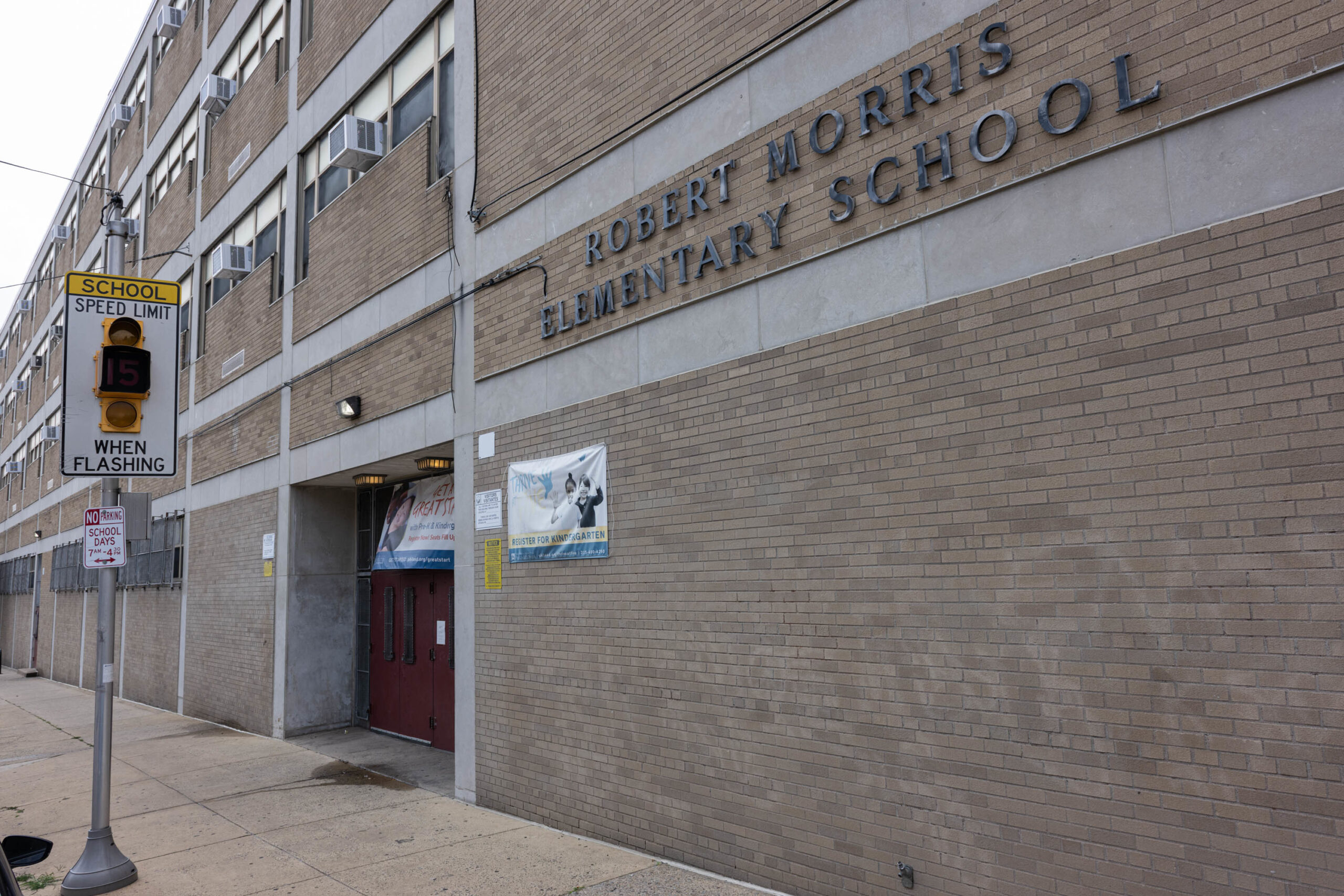
Robert Morris School in North Philadelphia has been lauded for improving test scores, and it isthe last elementary school in its immediate neighborhood.
But the school district says not enough neighborhood children want to attend.
At a community meeting last week, district officials said the school’s“severely underutilized” capacity was the driving factor behind their recommendation to close Morris after the next school year.
But community members have questioned why low enrollment alone was enough reason to cut the school — and have voiced concern that the district is closing a school with a majority-Black student population while keeping open a nearby elementary school that has more white students.
“We want the option for our children to be able to walk a block or two or three and get to their school. And it’s not clear to us the reason why that isn’t a possibility,” said Cierra Freeman, co-lead of culture and strategy for the Brewerytown-Sharswood Neighborhood Coalition.
Morris students would be reassigned to Bache-Martin School or William D. Kelley School for fall 2027 under the plan.
The district plans to repurpose the building at 2600 W. Thompson St., which it has categorized as being in “fair” condition, into a hub for its Office of Diverse Learners. Currently, the office operates within district headquarters and has an evaluation center near Central High School.
District officialsalso said theywant to keep the building so it could be reopened as a school in the future should enrollment interest rise.
Robert Morris Elementary School in Brewerytown.
‘Punished for being so small’
Morris was honored by the district last year at its Accelerate Philly awards for major improvements in test scores across reading and math. Its third-grade class jumped from 7% proficiency in reading and 14% in math to 48% and 59%, respectively. The district has said it did not consider schools’ academic performance in its facilities plan.
“It seems like Robert Morris is being punished for being so small,” Paul Brown, a school psychologist at Roxborough High School a Youth and Education co-lead for the Brewerytown Sharswood Neighborhood Coalition and a member of Stand Up for Philly Schools, said at the community meeting.
Neighbors said the district has not done nearly enough to retain and attract families to Morris, a “neighborhood gem,” according to Siobahn Neitzel, a local resident and youth and education action team co-lead for Brewerytown-Sharswood Neighborhood Coalition.
“The challenges that the district talks about with regards to Morris … really come from a continued lack of investment on the district’s part,” she said.
If there must be change at Robert Morris, some speakers urged the district to consider colocating the Office of Diverse Learners with the school instead of closing it. District officials said that option would be considered —but it was not reflected in a revised plan Superintendent Tony B. Watlington Sr. presented Thursday that spared two schools originally slated for closure. Morris is still on the closure list, but the school board could make changes before votingon the plan in the coming weeks.
A changing area
Brewerytown and adjacent Sharswood are neighborhoods in flux. The area is experiencing rapid gentrification, with new developments and property values shooting up in recent years, including the $750 million Philadelphia Housing Authority project to clear and redevelop the Norman Blumberg Apartments towers.
In the last round of mass closures in 2013, the district shuttered Meade Elementary School, less than a mile from Morris. Residents within the Morris catchment area have opted for other choices in recent years, including charters and other public schools. District officials said about 16% of students in Morris’ catchment already attend Bache-Martin.
Third grade teacher Brendan Yuhas teaches students Trenton Andersen, left, and Serenity Rose Rhoades, right, at Robert Morris Elementary last year.
Freeman said that is, in part, the district’s fault.
“This school has not been marketed to parents and families in the neighborhood. It has not been made attractive. It has not been pushed up,” Freeman said.
Some residents are frustrated with the plan to instead investmore than $50 million in Bache-Martin to handle an infusion of hundreds more students, including from Laura W. Waring School, and $4.7 million into Kelley. They believe Bache-Martin students deserve that kind of investment, but so do Kelley and Morris students. District officials said Kelley has received more funding in recent years, making a similarly large investment unnecessary.
Residents are concerned the consolidation could result in violence, by putting kids from different neighborhoods and rival gangs suddenly under the same roof at Bache-Martin or Kelley. And some at the community meeting worried that even if the district reopens the Morris building as a new school, it would be as a magnet that excludes local students.
Undergirding many of their concerns is the reality of race. Morris’ student body is 82% Black, and its community members said its potential closure was another indicator of the major impact the district’s plan would have on Black families. Bache-Martin in Fairmount, poised for significant financial support, has only about 34% Black students.
“When closures disproportionately affect minority communities, we cannot pretend race is not a part of this story. … What message are we sending to our students, my fifth- and sixth-grade students, when [the] place that nurtured them is going to disappear?” Adrienne Ramsey, a math teacher at Morris, said at the community meeting.
Freeman insisted that there must be a public education option for elementary school students in the neighborhood. She said she is concerned that charter schools, which are privately run and publicly funded, do not have enoughpublic oversight, and public schools are critical tocommunities.
“Schools are one of the places that the real community building and community weaving starts,” she said.
She said shebelieved interest in a public elementary school in the Brewerytown-Sharswood area would return, particularly as incoming residents occupying the new developments look for places to send their childrenand current neighbors reconsider their education options.
“People want to be part of their communities. They want to be part of their neighborhoods. They want their children to have friends whose home they can walk to,” she said.