Sometimes you take a road trip to experience something totally different from the world you inhabit — the absolute silence of a state forest, the carnivalesque majesty of the shore in full swing. A weekend in Baltimore is not that kind of trip.
Charm City is the most Philly of the cities on the Acela corridor: smaller in size, but equally quirky, proud, and shaped by blue-collar roots. (Our accents are even passably close.) It’s also stacked with restaurants, museums, and cultural institutions that compete on a national level, all with a distinctly Baltimorean flavor, less than two hours away.
Once arriving in Baltimore proper, take I-83 up to the Remington neighborhood on the north side of the city, where Café Los Sueños roasts and brews its own beans in a peaceful, light-washed space a couple blocks off the highway exit. (The name translates to “Café of Dreams,” fitting for owner Carlos Payes, who came to the U.S. from the coffee plantations of El Salvador.) A horchata latte and croissant make for a perfectly calming start to the trip.
📍 2740 Huntingdon Ave., Unit B, Baltimore, Md. 21211
If it’s not too cold — and you’re up for a walk — Los Sueños sits near the eastern edge of Druid Hill Park, the third-oldest urban park in the country and, for millennials, the namesake of Dru Hill. Follow the path along Druid Lake toward the Rawlings Conservatory, a circa-1888 botanical garden with five greenhouses. Even when it’s frosty outside, the impressive Victorian conservatories filled with tropical orchids, ceiling-skimming palms, and citrus blossoms deliver full-on summer music-video energy.
Check into the Pendry Baltimore, a moody, stylish 127-room hotel housed in a grand 1914 building on the former Recreation Pier. The Fell’s Point location is both charming and convenient, putting you within walking distance of many of Baltimore’s marquee attractions. Many of the wood-and-leather-clad rooms overlook the waterfront. The huge pool, which seems to float in the Inner Harbor, will have you booking a return visit for summer.
No curveball here. The National Aquarium is Baltimore’s claim to fame, and if the last time you were here was on an eighth-grade field trip, you should come back as an adult, with or without your own kids. The sprawling complex houses 2.2 million gallons of water and residents ranging from reef sharks and puffins to otters and moray eels. Don’t miss the Harbor Wetland exhibit, which opened in 2024 along a series of floating docks in the Inner Harbor and be sure to book tickets in advance. Aim for off-hours to beat the crowds.
📍 501 E. Pratt St., Baltimore, Md. 21202
View: American Visionary Art Museum
The title Cap Bathing Moligator With Angelic Visitation (Dickens 44) tells you just about everything you need to know about the boundary-pushing work housed at the American Visionary Art Museum. This brick-and-mirror-clad institution in Federal Hill celebrates outsider art in all its surreal glory from landscapes to cosmological oil paintings to sculptures of a mosaic-winged Icarus and Baltimore icon Divine. The collection embodies the city’s DIY spirit and unbreakable creative streak.
With its deep pedigree and polished service, Charleston in Harbor East possesses a sense of occasion that few restaurants have anymore. Even if you’re just passing through for drinks in its swanky little lounge, where local power brokers and big-night-out suburbanites mingle with tourists, those drinks are crafted with gravitas and élan as much as sparkling wine, passionfruit and honey (the Ipanema Fizz), or blanco tequila, Strega, and ginger (the Arandas Monk). The wine list is famously deep, which helps explain why Charleston won the James Beard Award for Outstanding Wine and Other Beverages Program.
From one medalist to another, the Wren, one of Bon Appetit’s best new restaurants of 2025, sits less than a 10-minute walk from Charleston in Fell’s Point. The location is an ideal spot for drink or dinner, with a much more casual silhouette with its wood paneling, pressed-tin ceilings, and no-reservations policy. It’s a pub essentially, and like the very best pubs in Ireland and the U.K. (partner Millie Powell hails from Dublin), the cooking comforts and satisfies on a cellular level. Think glazed ham, golden onion pie, sharp cheeses, honey-roasted apple cake, and the like. (Your Philly analog is Meetinghouse.) As expected, the bartenders pour a precise pint of Guinness, the perfect finale to a Baltimore weekend.
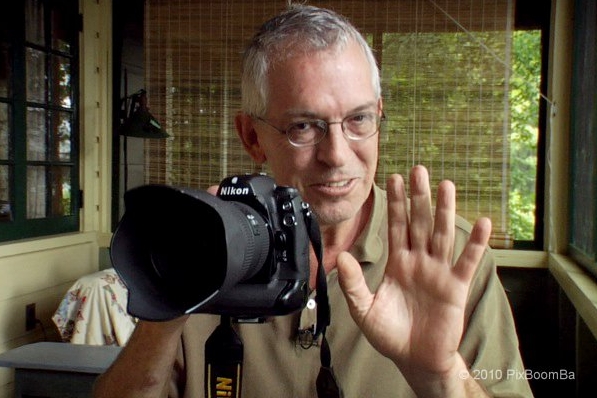
Robert Caputo was captivated by the natural world, its animals and people. So he spent 35 years, from 1970 through 2005, traveling through Africa, Asia, and South America, taking photos, writing stories, and making films and TV shows for National Geographic magazine, Time, PBS, TNT, and other media outlets.
From Kenya to Egypt, Venezuela to Zanzibar, in China, Cuba, New Orleans, and Boston, Mr. Caputo chronicled the beauty and tragedy of everyday life. He reported as a freelancer, with a camera and a notepad, for National Geographic for decades, covering political coups, civil wars, and famines in Sudan and Somalia, and the AIDS epidemic in Uganda.
He worked for photographer and filmmaker Hugo van Lawick in Tanzania in the 1970s and then camera-stalked lions and leopards for National Geographic on the Serengeti Plain. He sent back striking images of the Abu Simbel Temples in Egypt and the old Kingdom of Mustang in Nepal.
In Sudan, he sipped tea with camel traders, slept under the stars, and posed for portraits with tribal chiefs. He trekked the Himalayas and photographed fishermen on the Congo, Nile, and Mississippi Rivers. His poignant August 1993 cover photo for National Geographic of a starving Somali woman gained worldwide attention.
“In fact, it is a great job,” Mr. Caputo told the Washington Post in 1995, when he was featured in a TV show about the Geographic photographers. “You really do get to go places and do things others only dream about.”
He told the New York Daily News in 1995: “I’ve always thought of my job as a license to be nosy.”
In 2002, as he was winding down his international travel, Mr. Caputo moved from Washington, D.C., to a farmhouse in Kennett Square, Chester County. In early 2025, he was diagnosed with Alzheimer’s disease. In December, he and his family traveled to the Pegasos Swiss Association voluntary assisted dying center in Basel, Switzerland. He died Thursday, Dec. 18. He was 76.
“Fairly early on, Bob had expressed his wishes to go out on his own terms,” said his wife, Amy. “We were able to honestly and pragmatically deal with our situation, and he remained his thoughtful self, with his sense of humor intact till the end.”
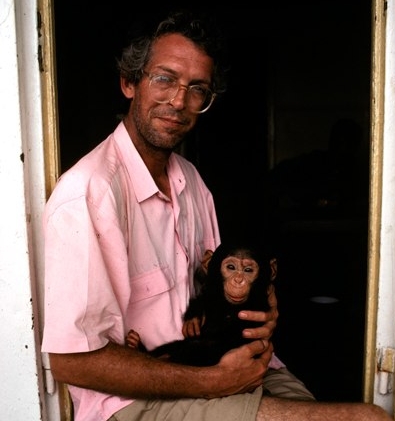
Mr. Caputo loved spending time with animals.
Mr. Caputo first went to Africa in 1970. He dropped out of Trinity College in Connecticut as a senior and meandered with friends across the vast continent, from Morocco to Tanzania.
He returned to earn a bachelor’s degree in film at New York University in 1976. Then, until 1979, he lived in Nairobi, Kenya, and sold photos and stories about Africa to Time, Life, and other magazines.
“He liked to learn about things,” said his son Nick. “He was constantly inquiring into things.”
In 1981, National Geographic hired him to report from Sudan on the verge of its civil war, and he produced striking cover photos, dramatic picture spreads, and detailed stories about Africa. In 1984 and ’85, he spent eight months and traveled 4,000 miles on steamboats, tugboats, and all-terrain vehicles to document traditional daily life along the Nile.
Mr. Caputo had several cover photos for National Geographic.
“Everywhere he went,” his family said, “Bob found that the people he met were fundamentally good and generous, happy to share their often limited food with him, a perfect stranger, and excited to tell him about their lives.”
There were challenges, too, he said in many interviews. He was detained by border guards in Uganda in 1979 and contracted malaria nine times. The monthslong assignments in search of remote Indigenous people were often lonely, and he got hungry and tired.
But the connections he made with people he encountered were worth it, he said. “The great advantage of working for National Geographic is having time,” he told the New York Daily News. “You can go to a village in Africa and not just have to waltz in and start shooting away. You can spend time getting to know people, and they can know you.”
Mr. Caputo was a natural innovator and teacher, and he organized photo workshops and lectured about photography around the world. He taught digital photography at the Center for Digital Imaging Arts at Boston University and cofounded Aurora & Quanta Productions in Maine in 1985 and the PixBoomBa.com photo website in 2010.
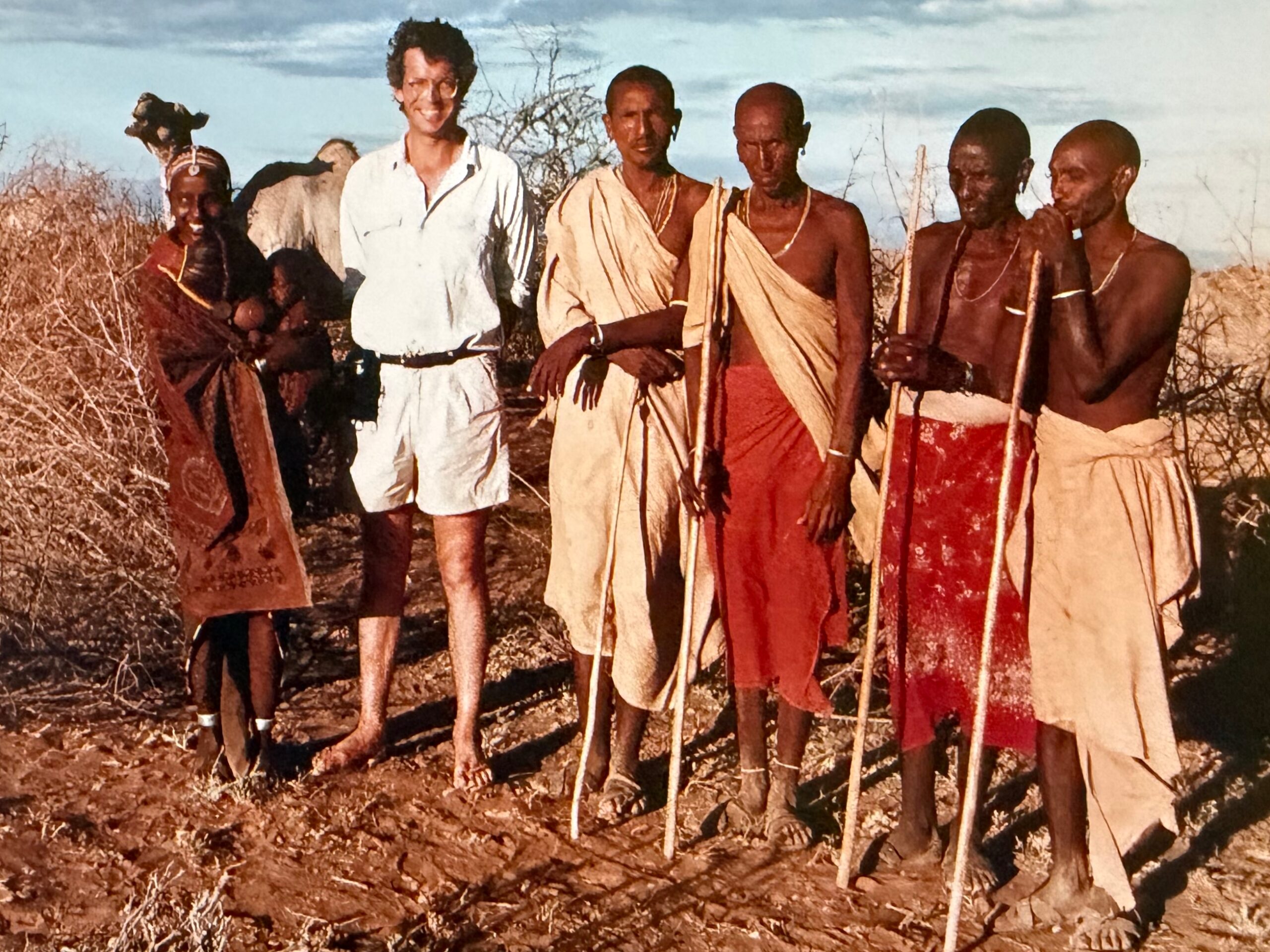
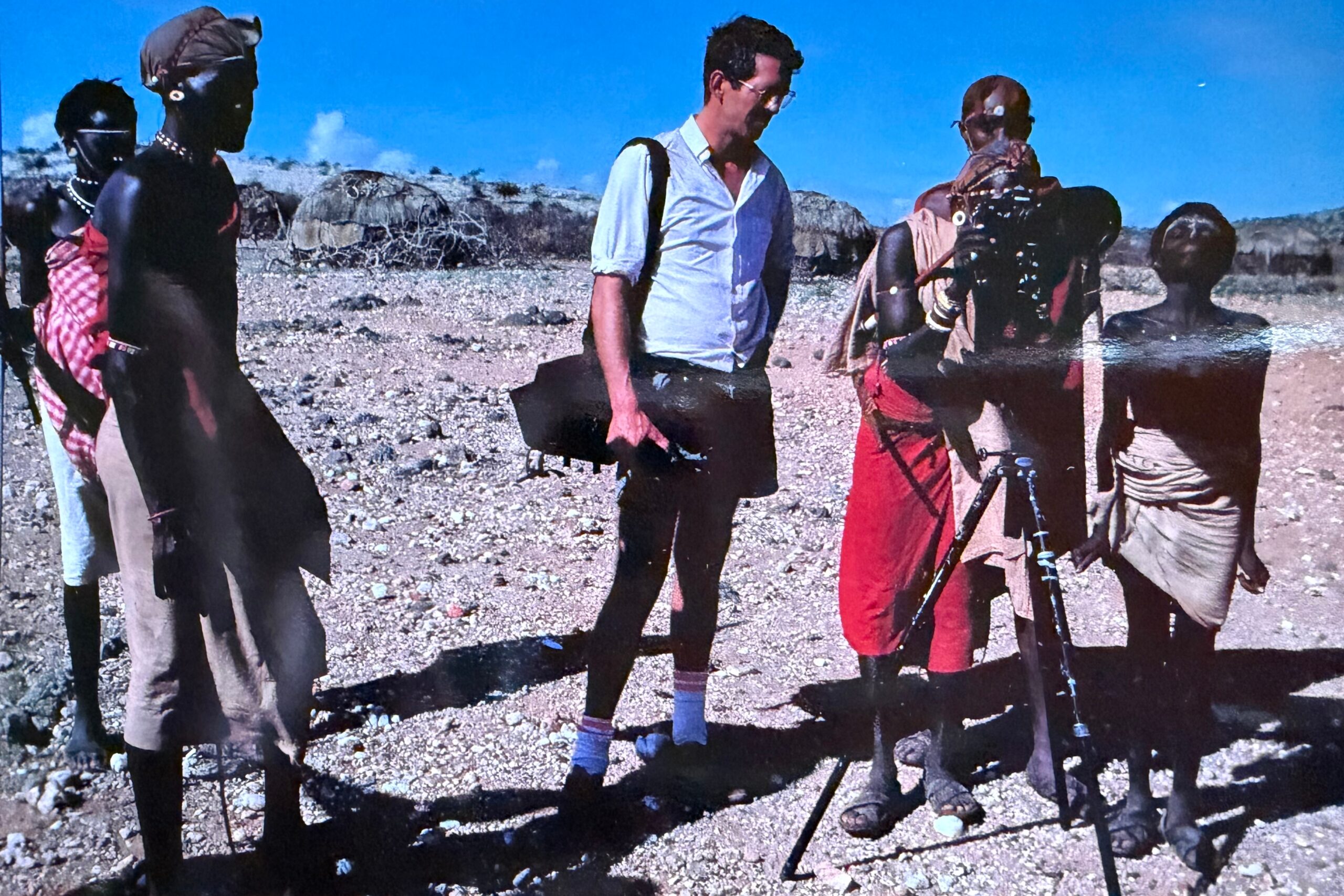
Mr. Caputo (second from left) poses with local people in Africa.
He wrote and appeared in wildlife shows, hosted TV programs and YouTube videos about photography, and wrote the story on which Glory & Honor, a 1998 award-winning TV film, is based. He made films about making films in Nigeria and the history of Boston’s Fenway Park.
He earned awards from the National Press Photographers Association, the American Travel Writers Foundation, Communications Arts journal, and other groups. He was personable and energetic, colleagues said, and he cofounded the annual National Geographic Prom at the Washington office.
“He was a tremendously caring and loving person,” his son Nick said. “He looked out for other people.”
Mr. Caputo met TV and film producer Amy Wray on a National Geographic TV shoot in the Amazon rainforest. They married in 1997 and had sons Nick and Matt.
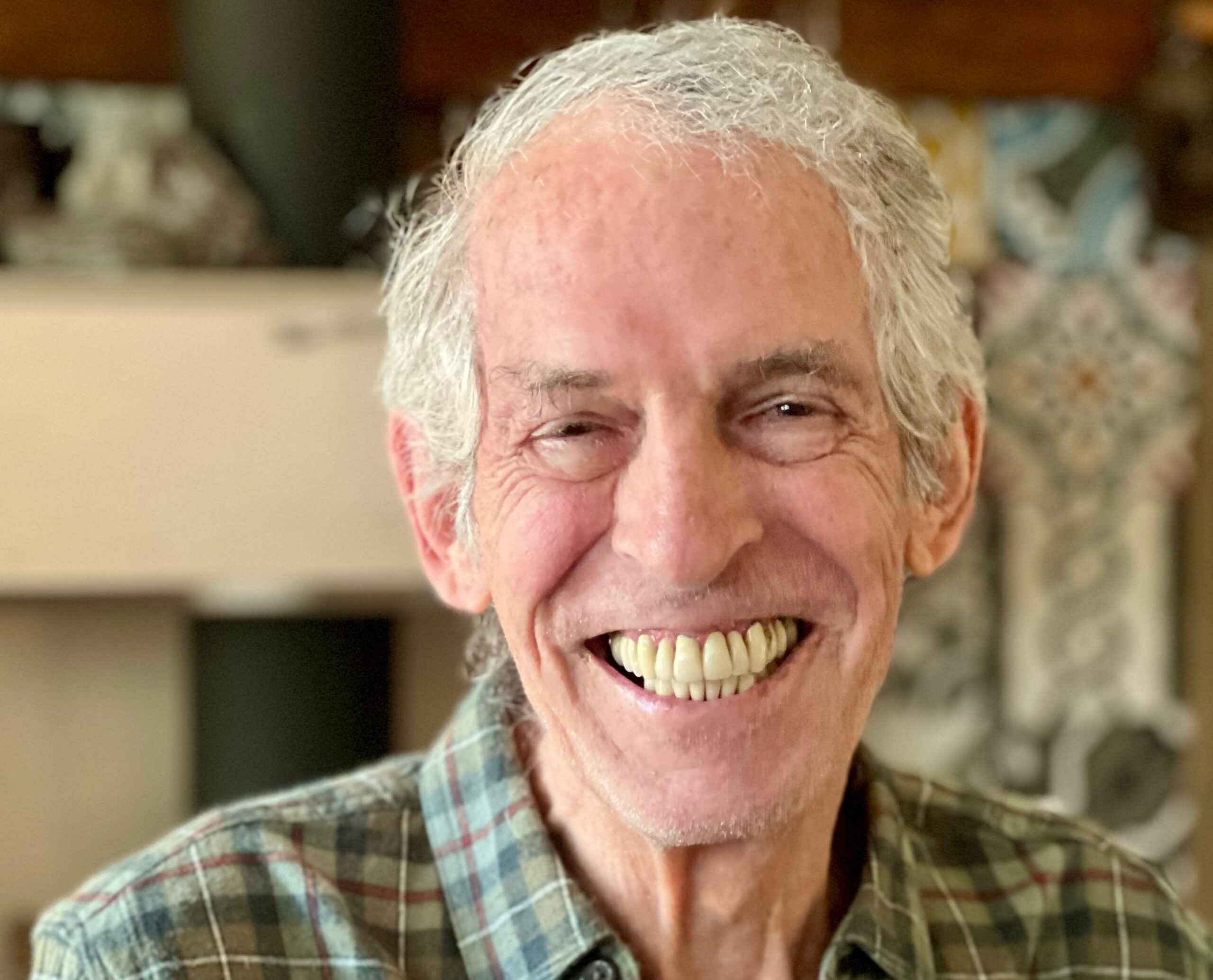
This photo is featured on Mr. Caputo’s website.
In Facebook tributes, friends and colleagues noted his “wonderful smile” and “deep love of people and animals.” They called him a “legend” and “amazing.” Robert J. Rosenthal, former Africa correspondent and former executive editor of The Inquirer, called Mr. Caputo “one of the best humans I ever knew.”
Mr. Caputo told MainLine Today in 2009: “My personal heroes are the people who work for aid organizations and nongovernmental organizations, who go to some faraway place to help people they’re not related to and often put themselves in harm’s way.”
Robert Anthony Caputo was born Jan. 15, 1949, at Camp Lejeune, N.C. His father was a career Marine and moved the family to bases in Virginia and then Sweden for an assignment at the U.S. embassy there.
In a 1991 interview with the Newhouse News Service, Mr. Caputo said: “I remember as a kid going to sleep listening to artillery going off in the distance down at the range. It was kind of comforting. I wouldn’t change it for anything.”
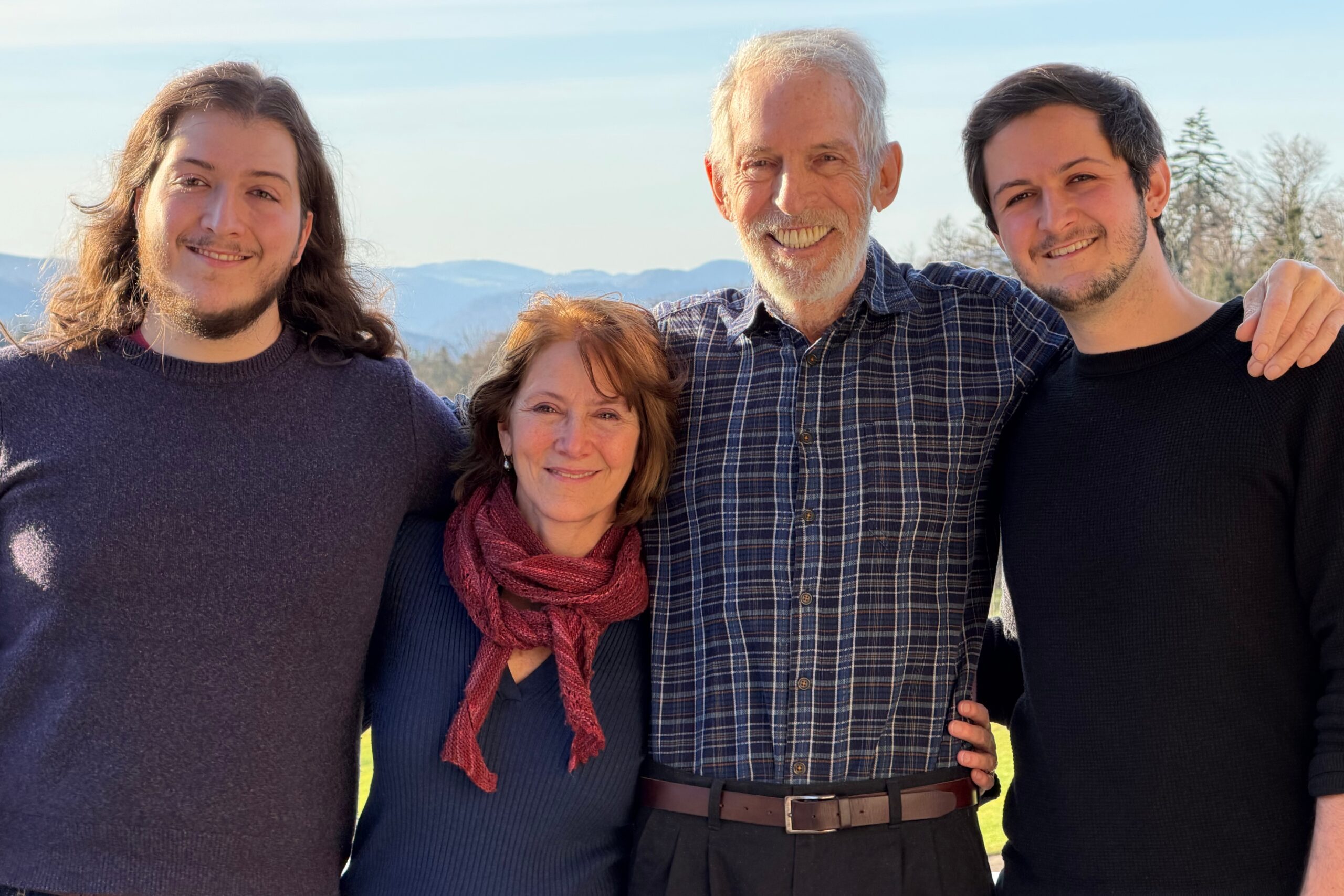
Mr. Caputo (second from right) doted on his wife and sons.
He attended a Swedish middle school, learned the language, skied, and played soccer. He returned to the United States in the late 1960s to attend boarding school in Virginia and then Trinity.
In Kennett Square, Mr. Caputo was a soccer, baseball, and basketball coach to his sons, and a Cub Scouts leader. He walked the boys to the school bus stop in the morning. He told them bedtime tales about secret agents and pirates, they said, and built a tree house in the backyard.
He decorated his truck on Halloween and grew impressive gardens. His neighbors called him Farmer Bob.
He took his family on trips to Kenya and Tanzania. He dabbled in experimental playwriting and literature when he was young, and enjoyed classic movies and William Blake’s poetry.
Mr. Caputo (center) shows his camera to the locals in Africa.
“He felt extraordinarily lucky to have lived the life he did,” his wife said, “full of adventure, family and friends. And in the end he said, ‘I’m ready.’”
In addition to his wife and sons, Mr. Caputo is survived by a sister and other relatives.
Services are to be at 11 a.m. Saturday, Jan. 10, at Kennett Friends Meeting, 125 W. Sickle St., Kennett Square, Pa. 19348.
Donations in his name may be made to Doctors Without Borders, Box 5030, Hagerstown, Md. 21741.
His family called Mr. Caputo “buttered side up” when he was young “because no matter
how he fell he always seemed to end up the right way, and his life was full and lucky.”
Legendary singer Jill Scott is kicking off 2026 with a special announcement: Her sixth studio album, called To Whom This May Concern, will come out on Feb. 13.
The release marks Scott’s first new album in more than a decade, following 2015’s Woman.
Coinciding with the Friday announcement, Scott also dropped her new single, “Beautiful People,” in which she croons about the power of love: “Our love is the art of war / Conquering all algorithms / And wicked, wicked systems of things.”
“THANK YOU for your patience and your listening ears,” Scott wrote on Instagram, signing off her caption with her beloved nickname, Jilly from Philly.
On To Whom This May Concern, the Philly native collaborates with fellow Philadelphian musicians including rapper Tierra Whack and music producer Adam Blackstone. Other collaborators include rappers Ab-Soul, J.I.D., and Too Short along with producers DJ Premier, Om’Mas Keith, Camper, and Andre Harris, according to Variety.
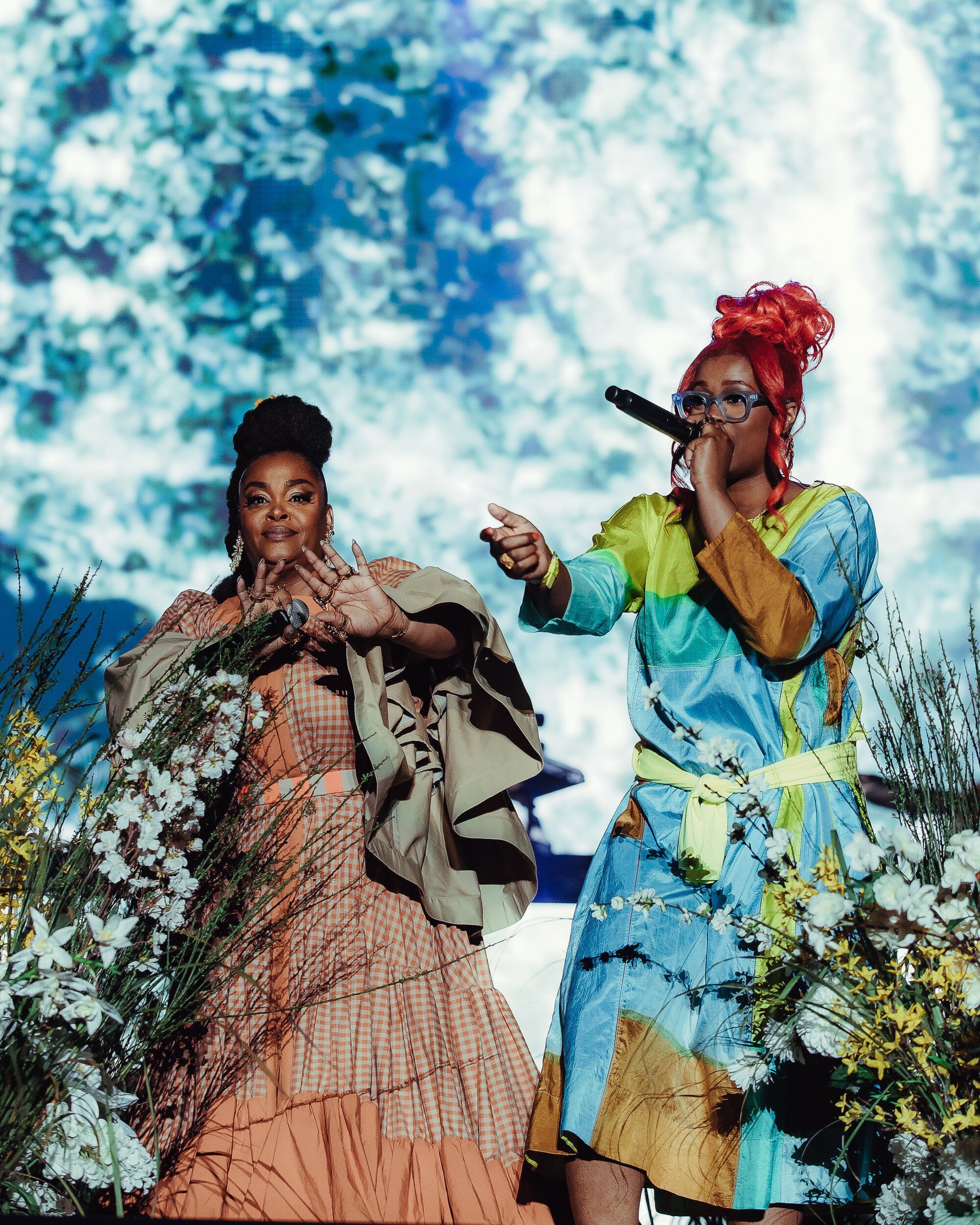
Jill Scott with Tierra Whack on the Fairmount Park Stage of The Roots Picnic at the Mann Center in June 2024.
During that show, Scott brought out Whack to debut their soon-to-be-released song, “Norf Philly.”
The To Whom This May Concern album cover features a painting by Chicago artist Marcellous Lovelace and depicts a nude Black woman with large yellow earrings and a matching collar necklace that repeats the message, “We fight.” The design includes affirmations like, “We can save ourselves,” “You cannot touch me,” and “One day we will destroy all of those who wish to harm us.”
“It’s a lot of living in this album,” Scott said about the album in a recent interview. “It’s a lot of revelation. Musically, it’s a full spectrum. Had some wonderful musicians come in. I feel touched all over, literally … The musicianship on this project and the people that gravitated towards it, I couldn’t be happier. I couldn’t have ever even imagined who is on this album.”
New Year’s Eve brought the much-anticipated finale of the ultrapopular Netflix series Stranger Things, marking the official conclusion of the 10-year sci-fi saga.
One detail from the series’ two-hour finale caught the ear — and imagination — of local viewers.
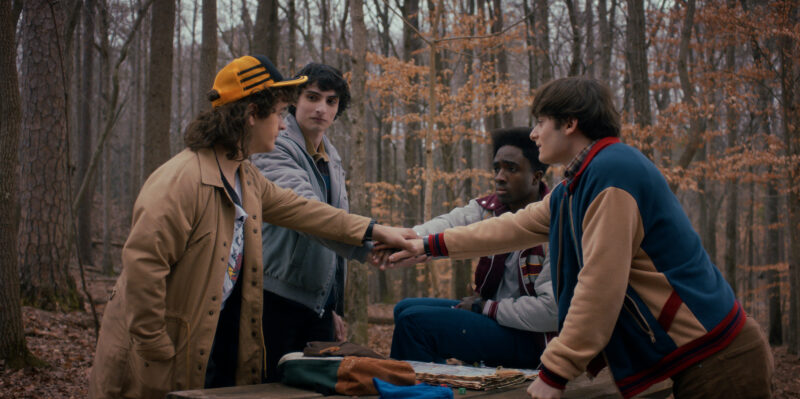
In one of the episode’s final scenes, four of the show’s main characters — Robin, Nancy, Jonathan, and Steve — discuss how to keep in touch now that many of them have departed their cursed hometown, the fictional Hawkins, Indiana.
Over beers on the rooftop of a local radio station, the characters vow to meet up once a month in a convenient location.
“What’s a city between Hawkins and Massachusetts [and] New York?” asks Nancy, who drops out of Emerson College to take a job at the Boston Herald.
“I have an uncle who lives in Philly,” replies Robin, played by Maya Hawke, who attends Smith College in Massachusetts. “He’s kind of weird, but he’s got a really big house.”
It’s an idea that Philadelphians quickly took to online, obviously.
“The closest thing to the upside down IRL would probably be Philly, so I guess that makes sense,” wrote one commenter in a Reddit thread on the topic.
“Gritty has yet to emerge so they think it’s safe,” wrote another.
Even the city’s official tourism agency got in on the action.
“Did the Stranger Things crew just say they’re meeting up in Philly?!” the Visit Philly account posted to the social media site Threads. “Where should they meet?”
(Among the suggestions: It’s Always Sunny in Philadelphia’s Paddy’s Pub.)
Inevitably, some pined for a Philly-based spinoff — or, at the very least, a crossover with another high-profile show set in the region.
“I’m pretty sure when she says Philadelphia she really means Delco which, to [an] Indiana native, would be close enough,” wrote one Reddit commenter. “And would make for a kickass spin off or team up with Mare of Easttown.”
Actor and musician Will Smith is facing a lawsuit filed by violinist Brian King Joseph, who has accused Smith of sexual harassment, wrongful termination, and retaliation during Smith’s “Based on a True Story” tour.
Joseph, who rose to fame as an America’s Got Talent contestant, was hired for Smith’s concerts in 2024. Now, he is suing Smith and his company, Treyball Studios Management, over an alleged incident that took place in March 2025 during the tour’s Las Vegas stop.
According to a civil complaint filed in a Los Angeles court on Tuesday, Joseph said he returned to his Las Vegas hotel room at 11 p.m., which was booked by Smith’s company, to find it was “unlawfully entered” by an “unknown person.”
Brian King Joseph plays the National Anthem before the Los Angeles Rams host the Dallas Cowboys in the NFL Divisional Round at the Los Angeles Memorial Coliseum in 2019.
Max Faulkner/Fort Worth Star-Telegram
A handwritten note was left behind, according to the lawsuit. It read, “Brian, I’ll be back no later [sic] 5:30, just us, Stone F.” The note was left behind with other items that allegedly include “wipes, a beer bottle, a red backpack, a bottle of HIV medication with another individual’s name, an earring, and hospital discharge paperwork belonging to a person” unknown to Joseph, the lawsuit states.
Joseph said he reported the incident to hotel security, local police, and tour management. The musician claims he was accused of fabricating the story and was “shamed” for reporting the incident. He was subsequently fired from the tour, with management telling him the tour was “moving in a different direction.” Another violinist was promptly hired in his place.
In the lawsuit, Joseph claims that tour management had suspiciously lost his bag, which included his room key. Joseph called these a “sequences of events” which, paired with the nature of the hotel intrusion, “all point to a pattern of predatory behavior rather than an isolated incident.”
The lawsuit also claims that Smith, a Philadelphia native, was “grooming and priming” the violinist for “further sexual exploitation.”
Will Smith poses for a portrait on Monday, March 17, 2025, in Los Angeles. (AP Photo/Chris Pizzello)
Joseph said in the filing that he and Smith had developed a close relationship while working together on Smith’s latest album and concert tour.
“You and I have such a special connection that I don’t have with anyone else,” Joseph claims Smith said to him.
Joseph is seeking compensation for personal and financial damages. He claims he made significant financial investments for the tour, and now suffers from major physiological damage and PTSD.
Smith’s attorney, Allen B. Grodsky, denied all claims, calling the allegations “false” and “baseless.”
“They are categorically denied, and we will use all legal means available to address these claims and to ensure that the truth is brought to light,” Grodsky said to People in a statement on Thursday.
At 9 years old, Jim Donovan would share with his parents his dreams of becoming a journalist. Around that time, he also flicked through the Guinness Book of World Records, thinking it would be cool to set one himself one day.
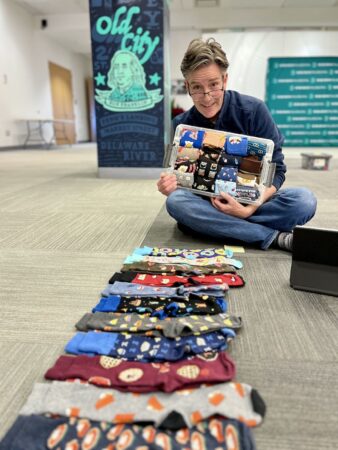
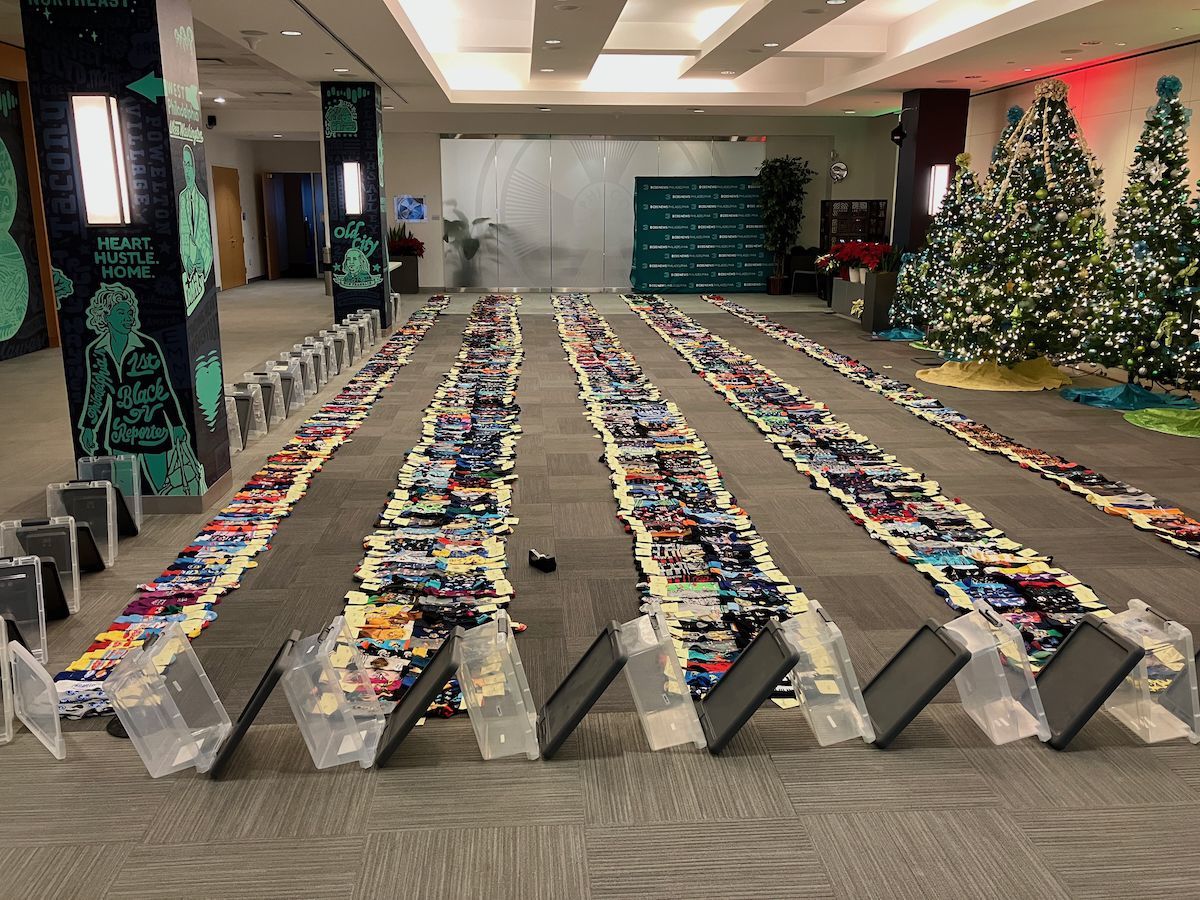
Guinness World Records verified on Dec. 8 that the 15-time Emmy winner is now the owner of the world’s largest sock collection at 1,531 pairs, many of which have eccentric designs, including Friends and Star Trek-themed socks, and every color of the rainbow. Donovan announced the achievement before his final day on-air at CBS Philadelphia on Dec. 19.
Jim Donovan’s 1,531 pairs of socks laid out on the floor of CBS Philadelphia studios while Donovan and two independent experts counted each sock on camera to be submitted to the Guinness World Records.
While Donovan said he’s immensely grateful for a ceremonious end to a long career — a feat he admits can be rare in the world of journalism — preparing his Guinness World Record application was also a difficult project.
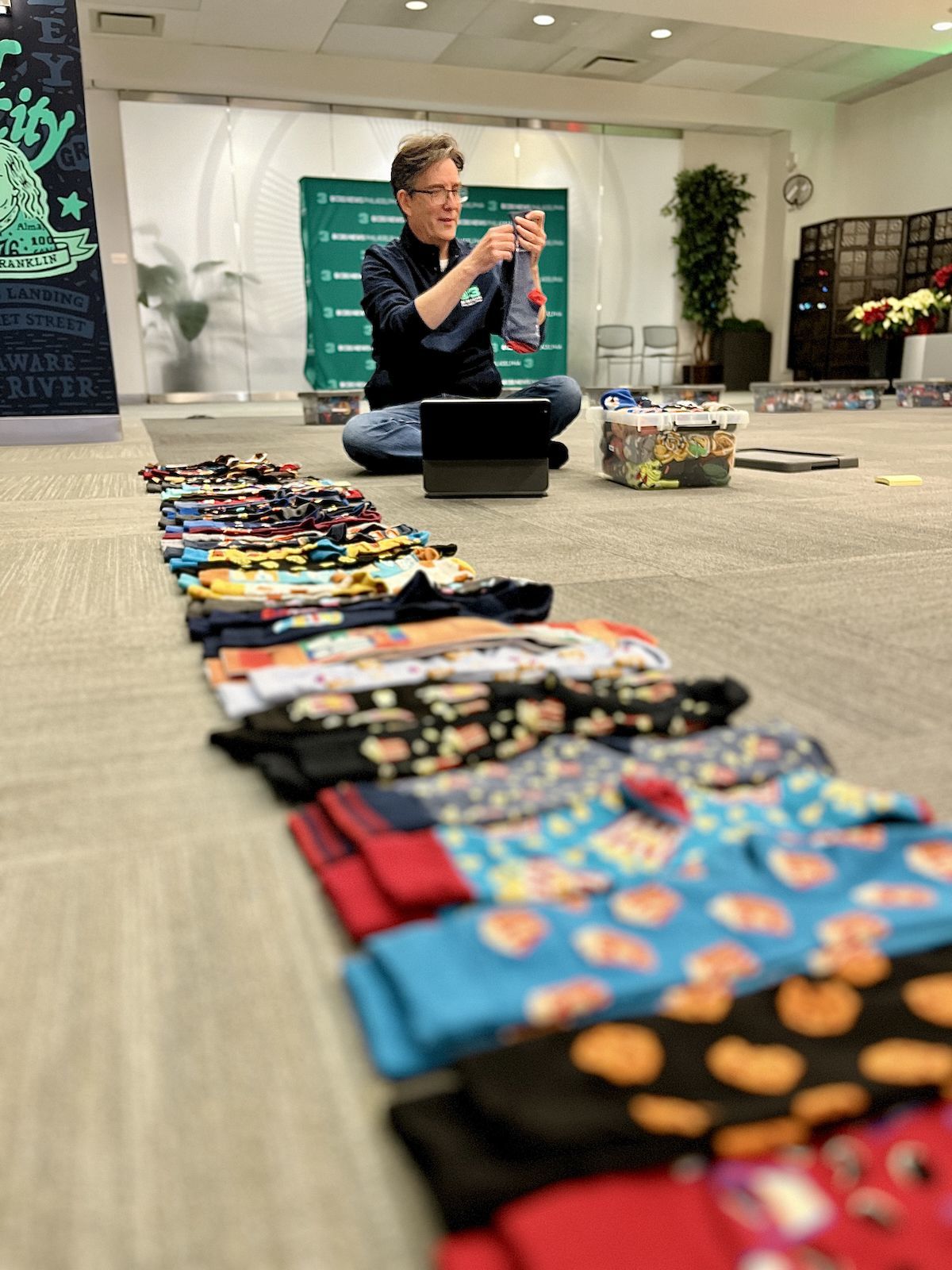
“I’ve done major investigation pieces and consumer stories over four decades of TV, and this was the thing that nearly pushed me over the edge,” he said of the nearly 40 hours of inventory work required to painstakingly document each pair of socks.
Jim Donovan takes inventory of the thousands of socks he submitted for a Guinness World Record. After 40 years in broadcast journalism, he will be retiring. But, not before receiving the world record on Dec. 8, 2025.
Donovan questioned himself at times when the hours of inventory work became overwhelming, but he remembered that this record was, in part, meant to thank his fans for their decades of support.
Guinness requires applicants to have two independent third-party experts oversee the counting of the world records. Two members of Thomas Jefferson University’s fashion merchandising and management program, Juliana Guglielmi-DeRosa and Jeneene Bailey-Allen, stepped up to facilitate Donovan’s counting. Together, the two experts and Donovan recorded the counting of socks for more than an hour inside CBS Philadelphia studios, without interruptions or editing of the footage, as required by Guinness.
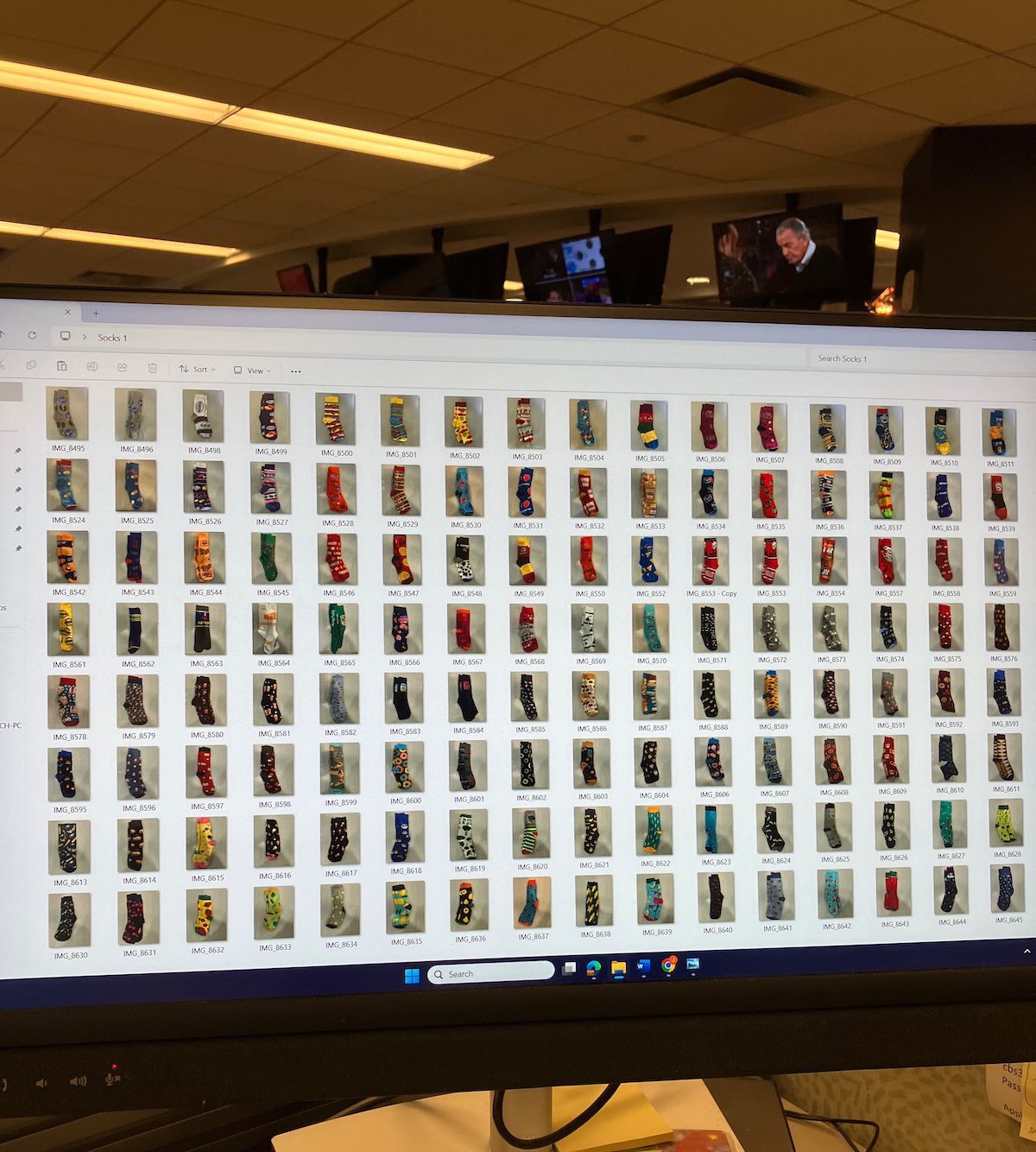
Digital images of Jim Donovan’s socks that he submitted for a Guinness World Record. He received recognition for his 1,531 pairs of socks on Dec. 8, 2025.
Donovan would then embed pictures and descriptions of each sock into what became a 262-page spreadsheet so that Guinness inspectors could verify the count at a later date. During the final count, Guglielmi-DeRosa and Bailey-Allen gifted Donovan an additional pair of socks, bringing the unofficial total to 1,532, but there was no way he was going to redo the spreadsheet, Donovan said.
“I just remember when I was a kid looking in that Guinness World Records book and thinking, ‘Boy, it would be cool to do this.’ And here I am now, 59 years old, and I finally checked off one of those kid bucket list items,” Donovan said.
Storing thousands of socks is no small feat, either. Folded and stacked inside dozens of bins, with 48 pairs per bin, Donovan has an entire closet dedicated to the socks. Each box contains different categories, from animals to food to holidays, and more.
Jim Donovan holds his Guinness World Records plaque verifying that he owns the largest sock collection in the world at 1,531 pairs of socks. He received the recognition on Dec. 8, 2025.
The first openly LGBTQ+ news anchor in Philadelphia, Donovan garnered a loyal fan base with whom he frequently chatted during his daily Facebook livestreams outside of his regular broadcasts. Around eight years ago, fans noticed Donovan’s penchant for socks with bold colors and designs, and started sending the journalist socks to wear on-air.
During the winter holidays, it was Santa socks; birthdays, it was socks with his face on them; and randomly, folks would get creative, Donovan said, sending him Spock socks (complete with Spock ears), flamingos playing golf, and Superman socks with a cape.
In his final week on-air at CBS Philadelphia, where he was for 22 years, the station celebrated each day as part of a “Week of Jim.” In retirement, Donovan plans to spend more time with his father, who lives on Staten Island, N.Y., and dive into volunteering and nonprofit work.
Now he’ll be enjoying retirement as a world-record holder. Donovan said he’seven starting to get messages from other Guinness World Record holders welcoming him to the club.
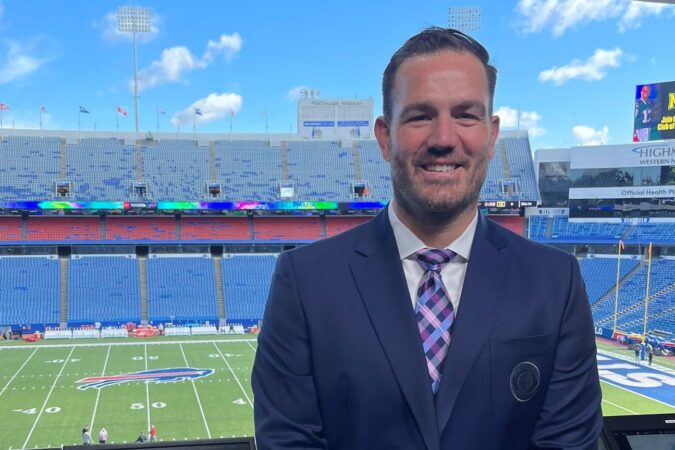
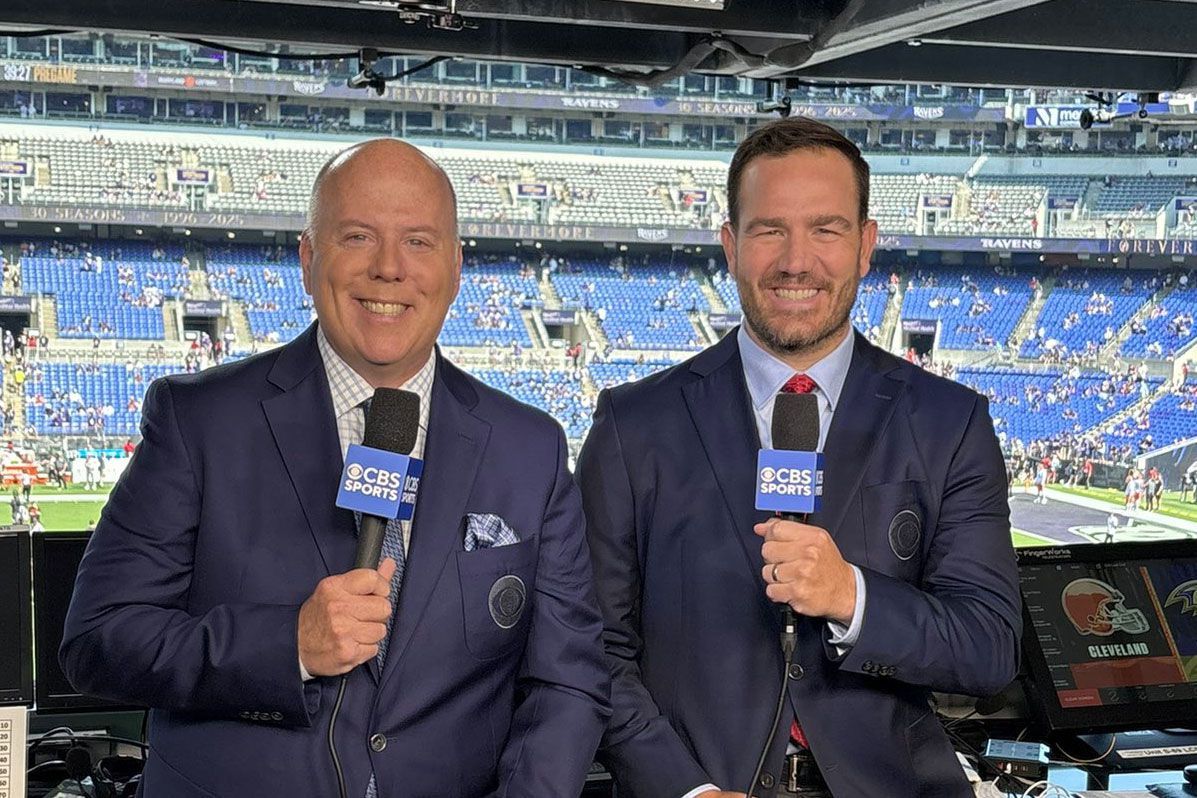
While the Eagles are prioritizing next week’s wild-card game, Sunday’s matchup against the Commanders is the sole focus of one announcer who grew up rooting for the Birds.
Tucker, a Wyomissing native and former NFL offensive lineman, has called a number of Eagles games on radio for Westwood One, where he’s worked since 2015. But Sunday will be his first chance broadcasting a Birds game on TV for CBS.
“It’s super cool for me on multiple levels,” Tucker said. “I grew up an Eagles fan, and all my friends are Eagles fans, so this will be really neat for them.”
It’s a stroke of luck on many fronts. Ordinarily, Tucker works games on CBS’s No. 6 crew alongside Phillies announcer Tom McCarthy. But Harlan’s normal broadcast partner, Kansas City Chiefs quarterback Trent Green, is off this weekend to attend his son’s wedding, opening a slot for Tucker.
Despite that, the Eagles game wasn’t on Tucker’s radar, since Fox traditionally is the home of NFC games. But under new TV deals that began in 2021, the NFL is only required to schedule one of each NFC divisional matchup on Fox, which aired Eagles-Commanders in Week 16.
Tucker didn’t know he landed the Birds game until CBS announced their broadcast lineups Tuesday.
“I knew I was doing the game with Kevin for about three or four weeks, but I had no idea it would turn out to be the Eagles game,” Tucker said. “It’s really fortuitous.”
This will be the first game Tucker and Harlan have called together on TV, but the two have been paired on radio a bunch on Westwood One, including for playoff games. Harlan has called games alongside plenty of analysts during his 40-year career, but thinks Tucker’s insight as a former offensive lineman in a broadcasting world dominated by former quarterbacks is enlightening.
“Ross picks up nuance and the right way to capture what a line is doing or not doing, and I just find that refreshing,” Harlan said.
With the Eagles resting their starters, it turned out to be a prescient move by CBS to turn to Tucker, who watched every preseason snap and knows the Birds’ backups better than most. Harlan also calls preseason games for the Green Bay Packers, but that won’t help him much when it comes to the Birds’ backups.
“It’s a great challenge to come in and do a bunch of players I’m not really familiar with,” Harlan said. “I’m probably going to let Ross kind of lead things that he finds interesting to get the ball rolling, and then we’ll let the game take it from there.”
Calling Sunday’s Eagles game certainly is a milestone for Tucker, but he remains a workhorse. In addition to calling NFL games for CBS and Westwood One (where he’ll broadcast playoff games), he calls college football games and continues to host the daily Ross Tucker Football Podcast. He also nearly replaced Angelo Cataldi as the morning host on 94.1 WIP, but a daily commute from Reading to Philadelphia for a 6 a.m. show wasn’t in the cards.
“I still feel like I’m just grinding and trying to move up the ranks and doing the best I can,” Tucker said.
Ross Tucker (right) called NFL games on CBS in 2025 alongside Phillies announcer Tom McCarthy.
Tucker’s only regret is not being able to call his first Eagles game alongside McCarthy. The two have been friends since McCarthy called Tucker’s college football games at Princeton. And McCarthy, in his 12th season calling NFL games for CBS, has yet to land the Eagles, though he remains the only announcer not named Jim Nantz to call a game with Tony Romo.
“He is the best,” McCarthy said of Tucker. “Just a tremendous partner. We have had such an amazing year.”
But McCarthy has a nice consolidation prize. He will be in Cincinnati Sunday calling the Bengals’ matchup against the Cleveland Browns, where he’ll have the chance to voice Myles Garrett breaking the NFL’s single-season sack record (22), currently held by Michael Strahan.
Where on TV is Eagles-Commanders airing
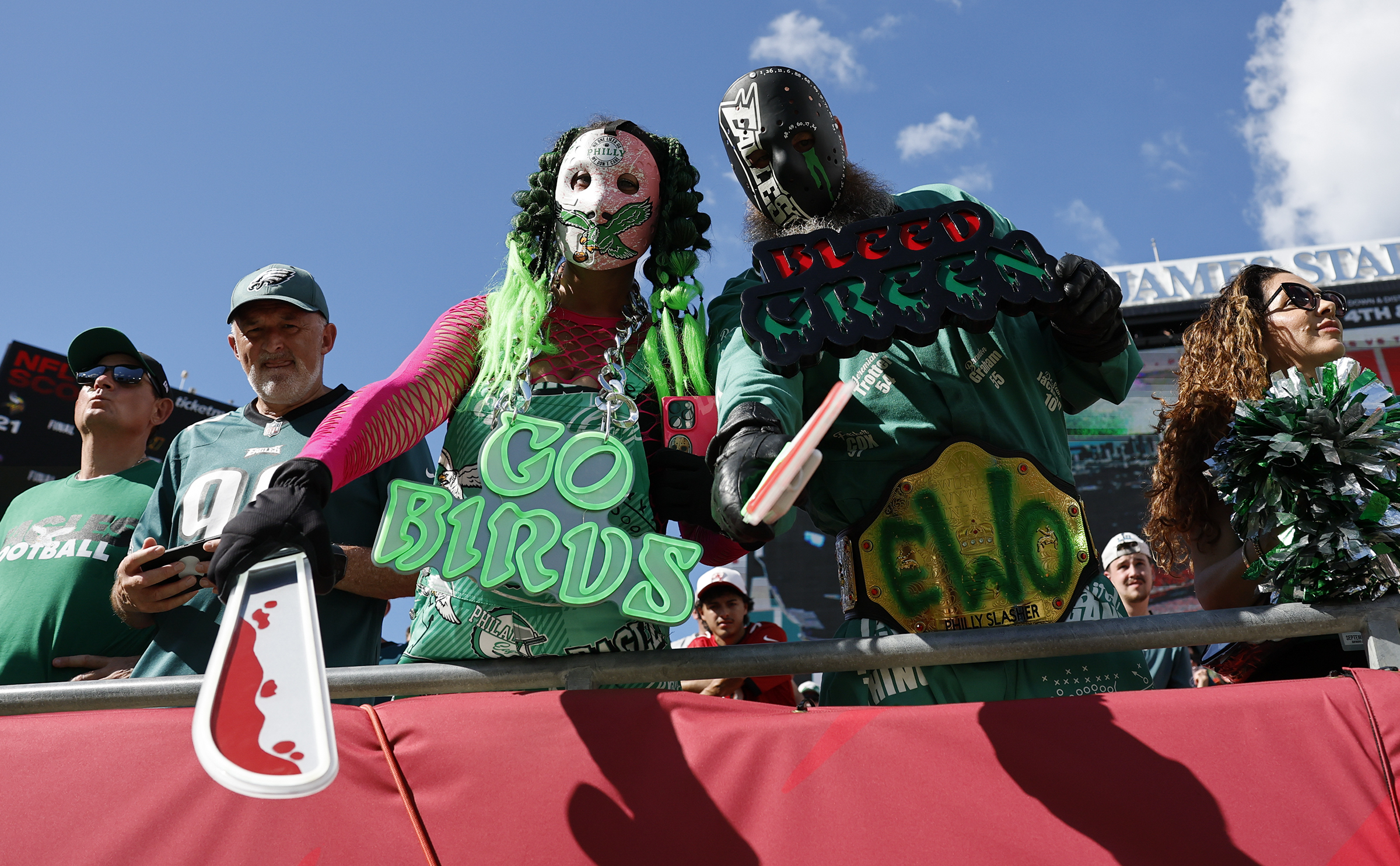
Among other places, Sunday’s Eagles game is airing in Tampa, where a lot of Birds fans call home.
This season, the Eagles have had their fair share of nationally televised games. That won’t be the case Sunday.
In addition to the Philadelphia TV market, Eagles-Commanders also is airing in Washington, D.C., and throughout most of Maryland, Virginia, North Carolina, and South Carolina. The game also will be available on CBS in Tampa, Fla., which an outsized number of Eagles fans call home.
It’s airing in two TV markets home to teams the Eagles have a chance of facing in the first round of the playoffs — San Francisco and Green Bay, along with most of Minnesota and all of Detroit.
It’ll also broadcast in Chicago, where Bears fans will be flipping to see which team ends up with the No. 2 seed.
Los Angeles Rams fans will be out of luck, though. While the Eagles likely will face the Rams, CBS2 in Los Angeles is locked into airing the Chargers’ game against the Denver Broncos, where the AFC’s No. 1 seed is on the line.
Other NFL games airing Sunday in Philadelphia
D’Andre Swift and the Bears will lock down the No. 2 seed with a win Sunday.
Eagles fans in Philadelphia will get plenty of games Sunday impacting the playoffs.
Saturday night on ESPN, Carolina Panthers-Tampa Bay Buccaneers will likely decide the winner of the NFC South (although the Atlanta Falcons could play spoilers Sunday) while the winner of Seattle Seahawks-San Francisco 49ers will claim the NFC West crown and the No. 1 seed.
Sunday afternoon, Fox will air Detroit Lions-Chicago Bears at 4:25 p.m. If the Eagles win and the Bears lose, the Birds will head to the playoffs as the No. 2 seed and host the Packers in the wild-card round. Otherwise the Birds will be the No. 3 seed and face the 49ers or Rams.
Sunday night, NBC has a win-or-go-home game in the Baltimore Ravens at the Pittsburgh Steelers. The winner heads to the playoffs as the AFC’s No. 4 seed.
Here are the games airing on TV in and around Philadelphia in Week 18:
Saturday
Panthers at Buccaneers: 4:30 p.m., ESPN (Chris Fowler, Dan Orlovsky, Louis Riddick, Katie George, Peter Schrager)
Seahawks at 49ers: 8 p.m., ESPN/6abc (Joe Buck, Troy Aikman, Lisa Salters, Laura Rutledge)
Sunday
Packers at Vikings: 1 p.m., CBS3 (Spero Dedes, Adam Archuleta, Aditi Kinkhabwala)
Stravinsky’s Petrushka is beloved in the orchestral world, a landmark in the dance community, and for all audiences, one of the most peculiarly passionate ballet stories ever told.
Seedy carnival puppets come to life, fall in love, die bitterly, and haunt adversaries mercilessly. But will that music/theater package thrive when dramatically transformed by BalletX — in its latest collaboration with Philadelphia Chamber Music Society?
Sight unseen, anticipation runs so high that the Jan. 8 and 9 performances at the Kimmel Center’s Perelman Theater are sold out (but with waitlists). The program, including Mozart’s Piano Quartet in G Minor, promises much to be seen — far from the 1911 Paris premiere by the world-changing Ballets Russes.
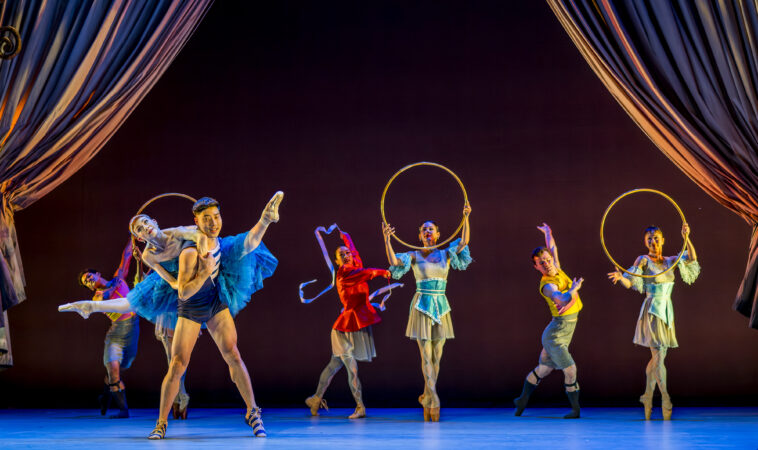
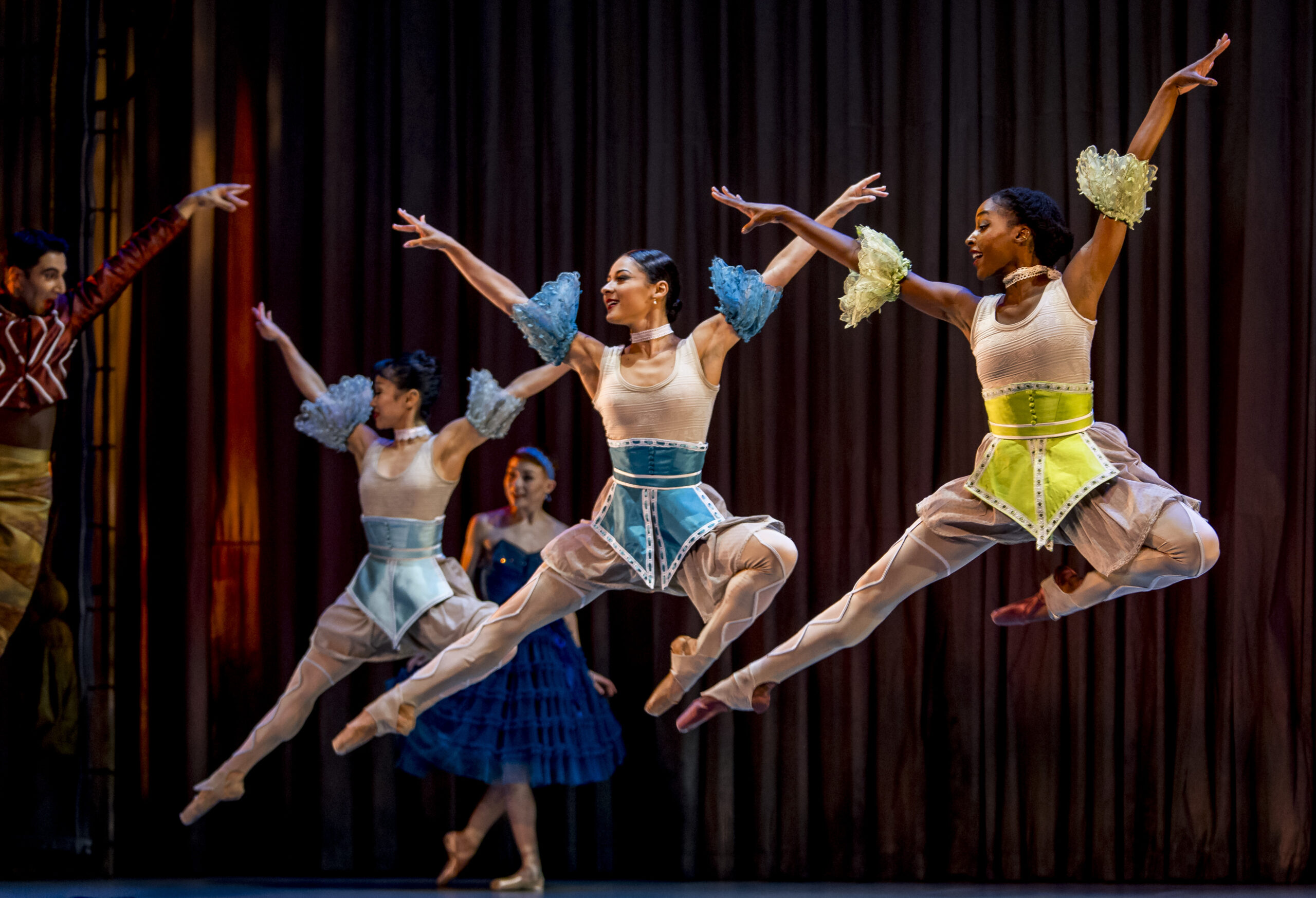
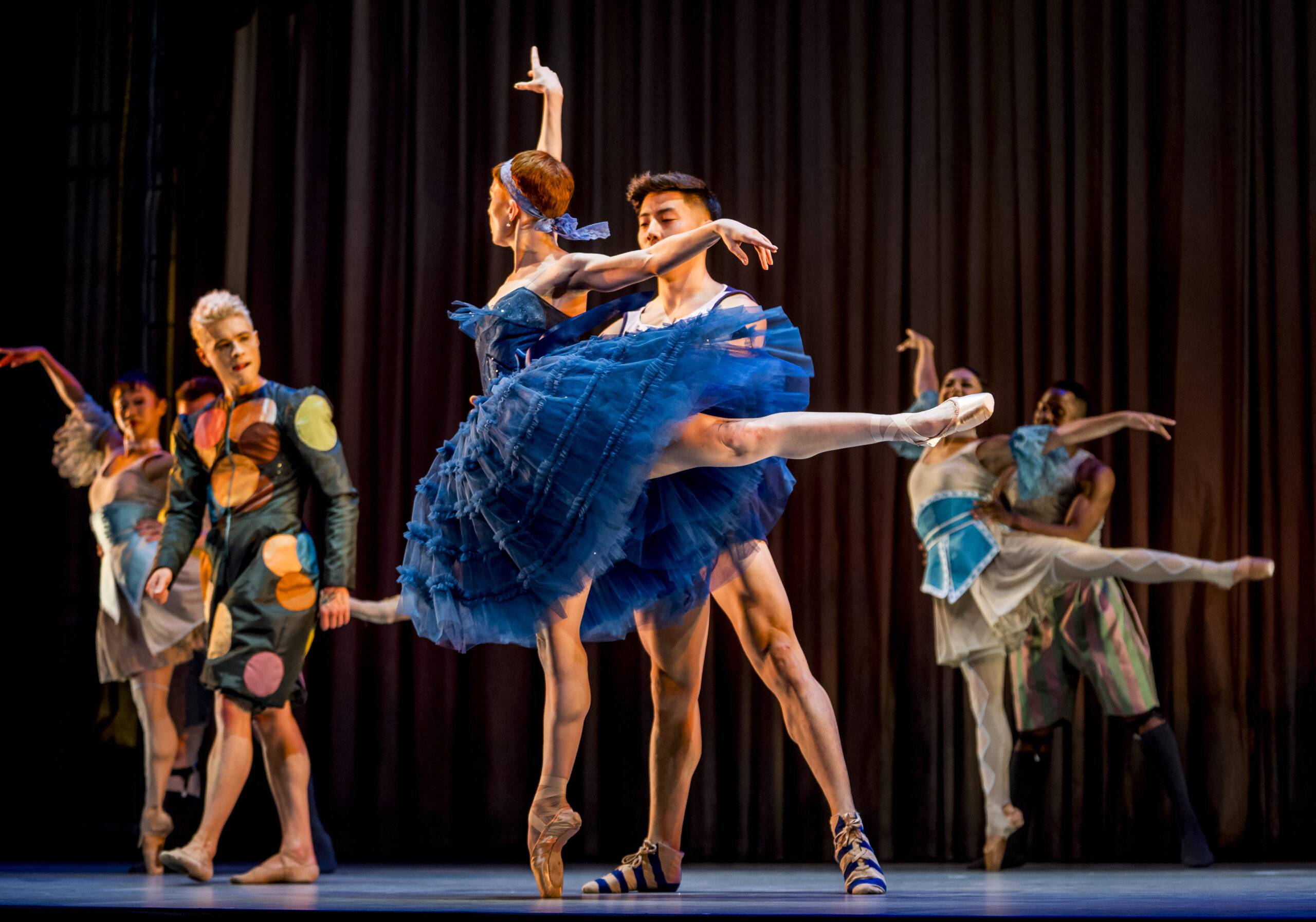
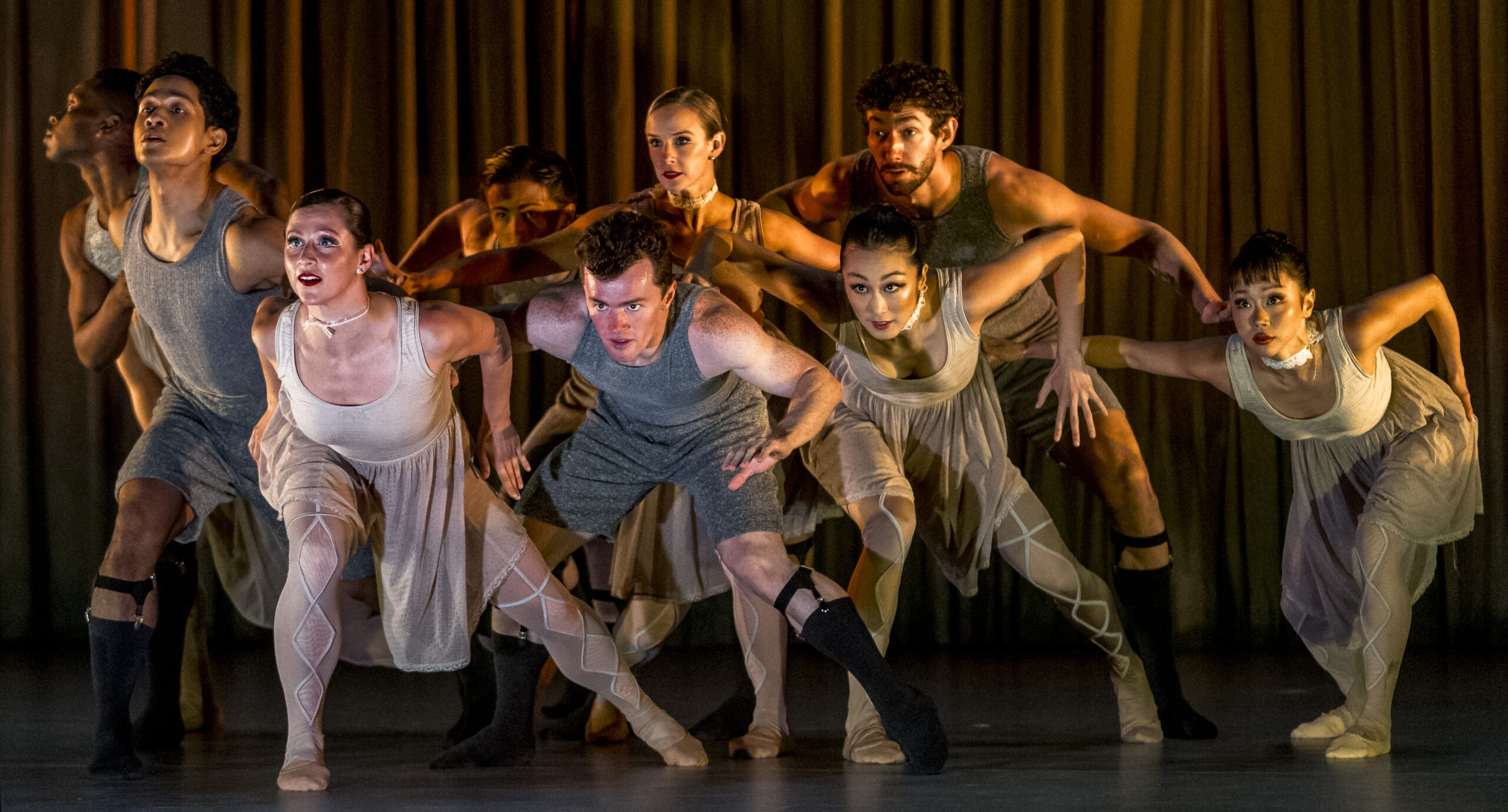
Ashley Simpson, Itzkan Barbosa, Minori Sakita, and Lanie Jackson of BalletX Company rehearse “Petrushka” choreographed by Amy Hall Garner at the Suzanne Roberts Theatre
For the story full of loneliness and jealousy, with a street-theater puppet show, the setting is Shrovetide Tuesday during what is now called Mardi Gras season. In this new version, the time setting for the traveling troupe is updated to the Great Depression. Petrushka — a role once performed by the legendary dancer Vaslav Nijinsky — becomes Pete.
“We’ve changed it up quite a bit,” said BalletX resident choreographer Amy Hall Garner, who has also worked with the Joffrey Ballet. “The beauty of Stravinsky’s music is that the ballet can take different routes and still support the story.”
BalletX Company rehearse “Petrushka”
choreographed by Amy Hall Garner at the Suzanne Roberts Theatre
The ballet was never meant to be cute. The primary point of reference for many modern audiences was a production by the sophisticated puppeteer Basil Twist — which has been seen in several venues since 2001, sometimes with two-piano accompaniment. The challenge, outlined at that time in a video interview by Twist, is projecting intense feelings among characters that “are supposed to be puppets, not supposed to be people.”
In Garner’s version, dancers will be humans at some turns, puppets in others.
The murderous Moor of the original has his plot functions replaced by, among others, a circus Strong Man and a magician known as the Charlatan. Such extrapolations are relatively respectful in light of how Stravinsky’s Rite of Spring has been turned from a ballet about pagan sacrifice to a modern gangster story by the much-admired choreographer Paul Taylor.
BalletX members rehearse “Petrushka,” choreographed by Amy Hall Garner.
The foundation of any Petrushka is the score. In contrast to many dance companies that use prerecorded music, the lavishly orchestrated Stravinsky original has been transcribed for piano quintet (piano and strings) by the ensemble 132, a collective of musicians in their 20s and 30s, formed in 2019, many having graduated from the Curtis Institute, their name drawn from one of Beethoven’s revolutionary opus numbers. They will not only be in the 500-seat Perelman Theater, but will be seen onstage.
Ensemble 132 is a collective of musicians in their 20s and 30s, formed in 2019, many having graduated from the Curtis Institute.
“There’s no hiding them,” said Garner. “Dance and music are like brother and sister — with all those heartbeats onstage. It’s a special connection that we don’t get to experience all of the time in the arts. It’s an unseen dialogue with the musicians integrated into the story.”
The project is part of a continuing collaboration between BalletX and PCMS that included a 2022 event with the Calidore Quartet — brokered in part by a mutual board member of the two organizations, Vince Tseng.
Mathis Joubert lifts Eli Alford during a rehearsal for “Petrushka.”
It’s also driven by the companies wanting to expand their respective audiences, both sides of which are open to such artistic cross-pollination when presented to them in their regular concert-going flight patterns.
For PCMS, much of the attraction comes out of fascination with BalletX. “We don’t usually get involved with a brand new work like this,” said PCMS artistic director Miles Cohen. “It’s impossible not to love what they do.”
What came first in this case was the Petrushka chamber-size version that was created a few years ago by and for ensemble 132.
Reducing Petrushka’s many details and colors might seem daunting. But because Stravinsky was a piano-based composer, tracing his thoughts back to their sound source isn’t impossible. “My focus was to present the gesture and the mood,” said ensemble member Sahun Sam Hong, co-artistic director and pianist of ensemble 132. “It’s music about characters but I don’t attempt to make value judgments on those characters.”
BalletX members rehearse “Petrushka” choreographed by Amy Hall Garner.
Still, psychological questions can’t help but arise for the musicians. Since the Petrushka character has a history of being a mere puppet, ensemble 132 member Zachary Mowitz speculates, “he’s going through adult matters and isn’t prepared to handle it.”
“Where does Petrushka belong?” asks Hong. “That’s a story to be told.”
Such answers fall to Garner, who treats the matter both philosophically and literally: “We put him in an environment where you could see promise. It’s an open field that this traveling show comes to. It’s gritty, it’s haunting, it’s gorgeous.”
BalletX and ensemble 132 perform “Petrushka,” Jan. 8, 9, 7.30 p.m., Perelman Theater, 300 S. Broad St. Tickets are sold out but there is a waitlist. boxoffice@pcmsconcerts.org, 215-569-8080, pcmsconcerts.org
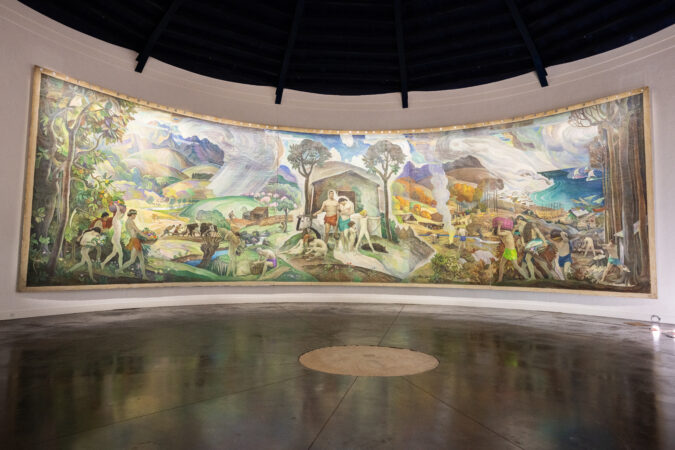
Packed away in 2007, a mural 60 feet long and 19 feet high has been brought back to life and given a swanky new home near Wilmington.
N.C. Wyeth’s colossal 1932 mural, “Apotheosis of the Family,” re-emerges in a gleaming new round barn after years in storage, on Jamie Wyeth’s property near Wilmington, Del.
Artist Jamie Wyeth had to rent a building “the size of an aircraft tanker” to open the rolled-up panels of the five-panel mural Apotheosis of the Family, painted by his grandfather — famed illustrator N.C. Wyeth.
The panels had been in storage for more than a decade, and once unrolled, Wyeth didn’t know what shape they’d be in.
“I didn’t know if I’d see potato chips of paint flying,” he said.
Thankfully, he didn’t.
Instead, in a bid to resurrect the mural from oblivion, he had a “sort of tent thing” built to humidify the panels of what is N.C. Wyeth’s largest artwork ever. “There was a lot of damage to it,” he said, “but certainly not major damage.”
Jamie Wyeth stands in front of his grandfather N.C. Wyeth’s colossal 1932 mural, “Apotheosis of the Family.” The 60-feet-long and 19-feet-high mural is now open for public viewing.
story continues after advertisement
In the late 1920s, while the country reeled under the Great Depression, N.C. Wyeth was commissioned to paint the colossal 60-feet-long and 19-feet-high mural by his friend Frederick Stone, who was the president of the Wilmington Savings Fund Society (now, WSFS). It was the bank’s 100th anniversary and they needed something that would instill some confidence in their clients.
N.C. Wyeth had already painted a 16-by-30-foot mural for New York City’s Franklin Savings Bank, and had added a mural studio to his painting studio in Chadds Ford, Pa. in 1923.
“He was beginning to take the idea of painting murals seriously. It’s a natural progression from illustration to mural painting, because both of them are involved with the painting telling a story, a narrative that really has a specific idea to be conveyed,” said Amanda Burdan, senior curator at the Brandywine Museum of Art, which has the largest collection of N.C. Wyeth paintings and oversees the studios of N.C. Wyeth and his son Andrew.
Jamie Wyeth outside the barn which houses N.C. Wyeth’s colossal 1932 mural, “Apotheosis of the Family”A view of the new round barn from the horse sanctuary built in memory of Jamie Wyeth’s wife, Phyllis
Building a home
Apotheosis was unveiled in January, 1932. Undergoing two restorations, the mural hung on the walls of the Wilmington Savings Fund Society location at Wilmington's Ninth and Market streets until 2007 when the bank sold the building to a developer.
That was when the five humongous panels were rolled away into storage and put under the care of the Historical Society of Delaware.
"Apotheosis" mural installed at Wilmington Savings Fund Society, 9th and Market Streets, Wilmington, DE, circa 1932.Sanborn Studio, Wilmington, DE
“It was all planned how to take it down, and they [possibly, the Historical Society, to whom the mural was donated by the developers and the bank] completely disregarded that, and used a cheaper method of removing it, and then rolled it the improper way,” said Jamie Wyeth, who was born in 1946, a year after his grandfather died from a freak accident where his car was struck by a freight train. N.C. Wyeth was working on a series of murals when he died.
A portrait of N.C. Wyeth around 1930.
When being rolled, the painting side of Apotheosis was supposed to be on the outside to prevent cracking. But it was rolled inside. Chunks of the lead white paint from the wall were still stuck to the panels’ back when they were packed away. For the next 15 years, until 2022, the mural lay forgotten.
In 2021, the Wyeth Foundation for American Art asked the Society for an assessment of the mural’s condition. With restoration estimated at about $903,000, the Historical Society deemed the mural “severely damaged” and its trustees voted to transfer the mural to a proper steward.
In 2022, the ownership of Apotheosis was transferred to the Wyeth Foundation, of which Jamie Wyeth is a trustee.
“And then began the two years of painstaking conservation and restoration,” said Jamie Wyeth who remembers seeing the mural on the bank’s walls several times as a young boy.
The whole project cost close to a million dollars. While the barn was built by Wyeth, the restoration was funded by the Wyeth Foundation for American Art.
A cutout of N.C. Wyeth stands next to a self-portrait of Andrew (right) in N.C.’s studio. Three generations of Wyeth artists have practiced their art in the Brandywine region.Jamie Wyeth stands in front of N.C. Wyeth’s “Apotheosis of the Family.”
“I loved the idea of bringing it back to Pennsylvania. My farm is half in Pennsylvania and half in Delaware. And I thought, ‘Well, this is where the painting was created,’” he said, referring to his Points Lookout Farm and his grandfather’s Chadds Ford studio which are about a mile apart. “And my wife and I thought, ‘What a perfect thing!’ But then we thought, ‘How the hell do we do it?’”
Jamie and Phyllis Wyeth had offered the mural to museums, including the Brandywine, but no one had the space.
“And then the question was, if we build a building, would it be 100-feet-high and 10-feet-wide?”
The answer came from Wyeth’s assistant Caroline O’Neil Ryan. How about building a round barn on the farm?
The new barn on Jamie Wyeth’s Point Lookout Farm near Wilmington, Del.
“And I’ve always just loved round barns. The Shelburne Museum in Vermont has one of the great round barns. Not only was the mural going to be resurrected, but also this structure would be so unique and wonderful, and so in keeping with the farm,” said Jamie Wyeth.
The result is a 62-foot diameter barn with high windows and a slanting roof. Half the curved wall surface holds the mural and the other half remains empty.
When the mural’s first panel was rolled out in the tanker-sized building, conservators Kristin deGhetaldi and Brian Baade could hear the lead white crackling. There was a lot of flaking “along several hundred lines of paint loss,” deGhetaldi said in an email. “We had to then remove the old facing and varnish and stabilize each flake of paint that was lifting.” There were several tears that had to be addressed and each panel “suffered from severe undulations and bulges.”
So before anything could be done, the panels had to be humidified. The conservation team wore protective suits because of the lead and was able to restore the damaged parts.
story continues after advertisement
The panels had to be wrapped around wooden cylinders to be uncurled. Each of them were then glued and mounted onto a custom-made curved frame that matches the curve of the barn. They were then weighed down with sandbags before installing the panels on the wall.
The mural took three years to restore off-site and one week to install.
A small domed cupola stands on the roof of Jamie Wyeth’s new barn while columns guard the entry way. Nearby, retired racehorses neigh within the sanctuary he built in memory of his wife after she passed away in 2019.
The restoration of the mural, however, is not quite finished, wrote deGhetaldi.
For one, the seams that were, as deGhetaldi wrote, “meticulously painted over” by N.C. Wyeth when the mural was installed in 1932, are now visible and need to be fixed. A frame that he had made himself also needs to be re-attached.
The mural spectacle
The five-panelled mural paints a vast picture of a pastoral community.
There are farmers with their cattle, young girls carrying flowers, men carrying multicolored fruits and fish, some chopping wood, sowing seeds, weaving a basket, playing a flute — all spread over a landscape that, valleylike, is nestled among rolling hills, but is also thriving against the seashore.
Details on N.C. Wyeth’s 1932 mural, “Apotheosis of the Family” show people farming and coming together to form a civilization, an optimistic message during the Great Depression“Apotheosis of the Family” is set amidst a varied landscape and shows the passage of all seasons
Woodlands and prairies blend into one another. When the eyes move from left to right, we see a change of seasons. Fruit-laden trees and clear skies transition into an autumnal scenery while winter lurks around in the clouds. A brook streams along as sheep and oxen graze. And in the middle of all the activity, is the artist’s own family.
The father figure, modeled after N.C. Wyeth himself stands bare-torsoed. Beside him, the wife (modeled after his wife Carolyn Wyeth) breastfeeds an infant. There is a toddler daughter holding a doll in her hand — modeled after their daughter, also named Carolyn. Andrew Wyeth—Jamie’s father — is the young boy playing with a bow and arrow. Nearby another daughter, a young Ann Wyeth sits on the ground looking at a sapling and son Nathaniel, carries a bunch of sticks on his back. Several other figures are modeled after the Wyeths’ neighbors.
In the center of N.C. Wyeth’s “Apotheosis of the Family,” is the artist’s own family. The father figure, modeled after Wyeth himself stands bare-torsoed.
“It is showing the most idealized version of life,” said Burdan. “So not everybody is represented faithfully.”
Carolyn Wyeth, the daughter, for example, was well in her 20s when her father painted her as a toddler. In a February 1931 letter to his brother, N.C. Wyeth mentions he weighs 230 lbs., bearing little resemblance to the muscular bare-bodied father in the mural. When N.C. Wyeth pointed out to the almost-naked Andrew to Betsy, Andrew’s future wife, Andrew was rather embarrassed, Jamie Wyeth recalled.
“But still, it was his family that was the center of this mural about the family,” said Burdan. “The family is represented here as the heart of a community of people who are working together to form a civilization.”
A Wilmington Savings Fund advertisement showing a part of the N.C. Wyeth mural, "Apotheosis of the Family." From the 7 Feb 1934 issue of the Morning News(Wilmington, DE)Newspapers.com
“For the family … safety and security,” reads a Wilmington Savings Fund Society ad that appeared on the Feb. 7, 1934 issue of the Morning News.
By this time in his career, N.C. Wyeth had made a name for himself as an illustrator. But even when he illustrated best-selling versions of Treasure Island and Robinson Crusoe, he’d draw them in large sizes which would later be scaled down for the books.
“He wanted the mural to jump out of the page and grab you, they still do. And so the mural was not really that much of a departure to him. He was always thinking on this large scale,” said Jamie Wyeth.
A Wilmington Savings Fund advertisement showing the central motif of N.C. Wyeth’s "Apotheosis of the Family." From the Oct. 18 1933 issue of the Morning Newsnewspapers.comN.C. Wyeth in Chadds Ford studio with the same central panel of the “Apotheosis” mural, undated.Earl C. Roper
“It’s almost like a respite from current time,” said Burdan, “[Like] an encouragement that can build back from the depression.”
A 1920s’ mural commissioned by a bank, she said, would perhaps be very different — “luxuries and cars and millionaires and mansions.” But the stock market crash had sobered the society down and forced artists to look at the roots of what makes a civilization.
Believing the role art plays in recovery from the depression, the American government’s Works Progress Administration started a mural painting program so artists could be employed and the general public could partake of art in their regular surroundings. The artistic medium had already been popularized by the Mexican artists, José Clemente Orozco, Diego Rivera, and David Alfaro Siqueiros.
A logistical home in Brandywine
Just up the river from Jamie Wyeth’s barn is the Brandywine Museum, which will manage the access to the barn. It “is the perfect vehicle for this,” said Jamie Wyeth.
“The land, the barn, and the painting, might all have different owners, but Brandywine is taking on the responsibility of interpreting it and bringing it to the public,” said Burdan.
N.C. Wyeth's art studio on the Wyeth property in Chadds Ford, PA, August 28, 2025. He used the wooden stairway to paint massive murals. On view is Qeth's "William Penn, Man of Vision·Courage·Action."
The museum, home to the Andrew & Betsy Wyeth Study Center, already oversees and conducts tours of the studios of Andrew Wyeth and N.C. Wyeth. In this studio, N.C. Wyeth built a wooden stairway that he climbed to paint Apotheosis — in five panels so that while working on one panel, he has another panel side by side to match colors. He reportedly bore a hole into the floor going up and down the stairs. A door in the studio would lift open and allow for the direct passage of the panels once they were complete.
story continues after advertisement
The William Penn, Man of Vision·Courage·Action mural that Wyeth painted in 1933 still stands in the mural studio.
The Brandywine, therefore, becomes the “logical starting place” for a trip to the barn, said Burdan.
Inside N.C. Wyeth’s studio in Chadds Ford, Pa.Inside N.C. Wyeth’s studio in Chadds Ford, Pa.
The museum owns 350 works of art by N.C. Wyeth, and has just started digitizing a collection of his letters. “So we want to be really good stewards of N.C. Wyeth’s work. And this is his biggest work ever,” said Burdan.
“We want to be the place that people say, ‘If I am interested in NC, Wyeth, I must go there, I must read the archives there, I must see the collection of paintings. And now, his mural.”
The Brandywine Museum is currently sold out for tours happening through March 28, 2026. For information on future availability of tickets,visitbrandywine.org/mural
The article has been updated with added information on the restoration and costs from Kristin deGhetaldi
Staff Contributors
Reporting: Bedatri D. Choudhury
Editing: Kate Dailey
Photography: Jessica Griffin, Charles Fox
Subscribe to The Philadelphia Inquirer
Our reporting is directly supported by reader subscriptions. If you want more journalism like this story, please subscribe today
When famed production designer Wynn Thomas prepared an acceptance speech for his long-awaited Oscar at the age of 72, he wanted to highlight his own Philadelphia story.
“My journey to storytelling began as a poor Black kid in one of the worst slums in Philadelphia. There were street gangs and poverty everywhere. And to escape that world, I immersed myself in books,” Thomas told the Hollywood audience at the Governor’s Awards ceremony in November. “I would sit on my front stoop and I would travel around the world. Now, the local gangs looked down on me and called me ‘sissy.’ But that sissy grew up to work with some great filmmakers and great storytellers.”
It was a significant moment for an artist who has spent nearly 50 years behind the camera to finally step into the spotlight himself. The honorary Oscar — which also went to Tom Cruise and Debbie Allen — recognizes “legendary individuals whose extraordinary careers and commitment to our filmmaking community continue to leave a lasting impact.”
During his extensive film career, Thomas has designed epic, comedic, and dramatic worlds for filmmakers like Spike Lee (Do The Right Thing, Malcolm X), Ron Howard (A Beautiful Mind, Cinderella Man), Robert DeNiro (A Bronx Tale), Tim Burton (Mars Attacks), and Peter Segal (Get Smart).
And while at it, he broke several barriers along the way: Thomas is considered the first Black production designer in Hollywood history.
No matter how far his work took him, though, he was always proud to discuss his Philadelphia roots.
The theater kid from West Philly
Long before he worked on major feature films, Thomas grew up as one of six kids in West Philadelphia, living primarily near 35th and Spring Garden Streets. Avid reading kept him out of trouble. His mother, Ethel Thomas, wrote a permission letter to the local library so he could access the adult section, and he immersed himself in the worlds of Harper Lee, James Baldwin, William Shakespeare, and Lillian Hellman.
The young Thomas always looked forward to Saturdays, when he could spend nearly all day at a movie theater on Haverford Avenue. Occasionally, he took classes at Fleisher Art Memorial, too.
The 1961 movie Summer and Smoke, written by Tennessee Williams, he said, inspired him to pursue theater.
“I absolutely said, ‘My God, what is this?’ I think it was just the nature of the story that really affected me,” Thomas, who now lives in New York, said in a recent interview. “I couldn’t believe what I had just seen, what I had just experienced. So I went to my library and got as many Tennessee Williams plays as I could.”
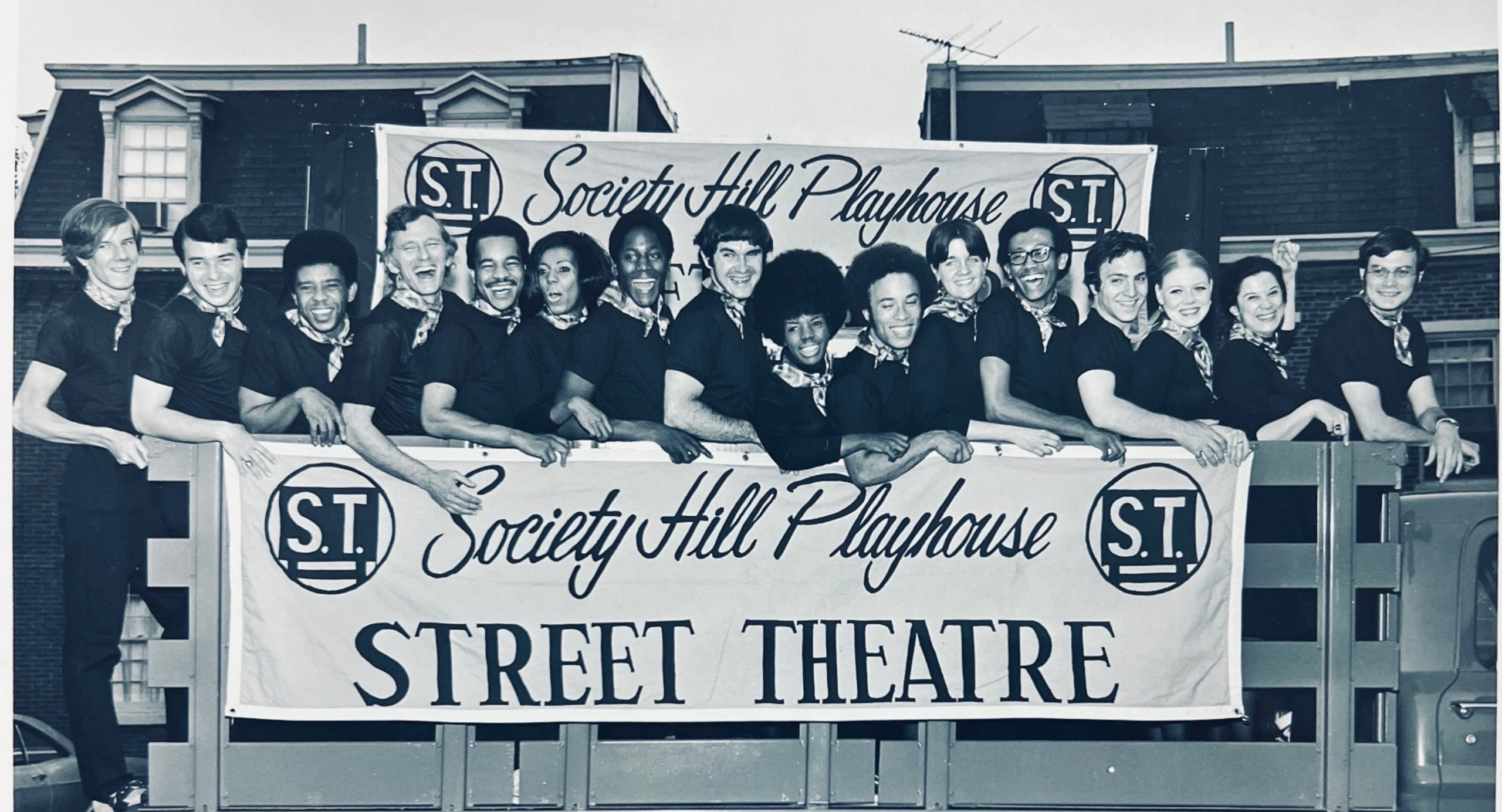
Wynn Thomas (fifth from right) at the Society Hill Playhouse as a teen in the late 1960s.
A couple of years later, Thomas heard that Society Hill Playhouse was holding open auditions. He was too young to audition himself, so he persuaded his older sister Monica to try out.
“I remember saying to her, ‘You need to do a scene from Who’s Afraid of Virginia Woolf,’” he recalled, chuckling. “Now, can you imagine being a 14-year-old kid who knows Who’s Afraid of Virginia Woolf? That’s a geek!”
She earned a spot in the company for a season and Thomas frequently tagged along, volunteering as an usher and eventually forming a close relationship with the owners, legendary Philadelphia theater couple Jay and Deen Kogan.
Throughout high school, the Overbrook High art student spent most of his after-school time across town at the playhouse. He acted, painted scenery, and served as a stage manager.
One of the final productions he stage-managed was The Great White Hope, loosely based on boxing champion Jack Johnson, who was played by Richard Roundtree — the soon-to-be Hollywood star who went on to lead the 1971 classic Shaft. While he was performing at Society Hill Playhouse, Roundtree was auditioning for the life-changing role.
“Shaft was a very important and very pivotal film for that time period,” said Thomas. “It was about a strong Black male who lived in the world under his own terms. That was not a character that was portrayed often in films.”
It was a glimpse into the worlds Thomas would help create in the future — with Black characters who had agency at the center.
Some four decades later, he worked with Roundtree once more for the 2019 remake of Shaft and they had an “incredible reunion.”
From Philly to Boston to New York
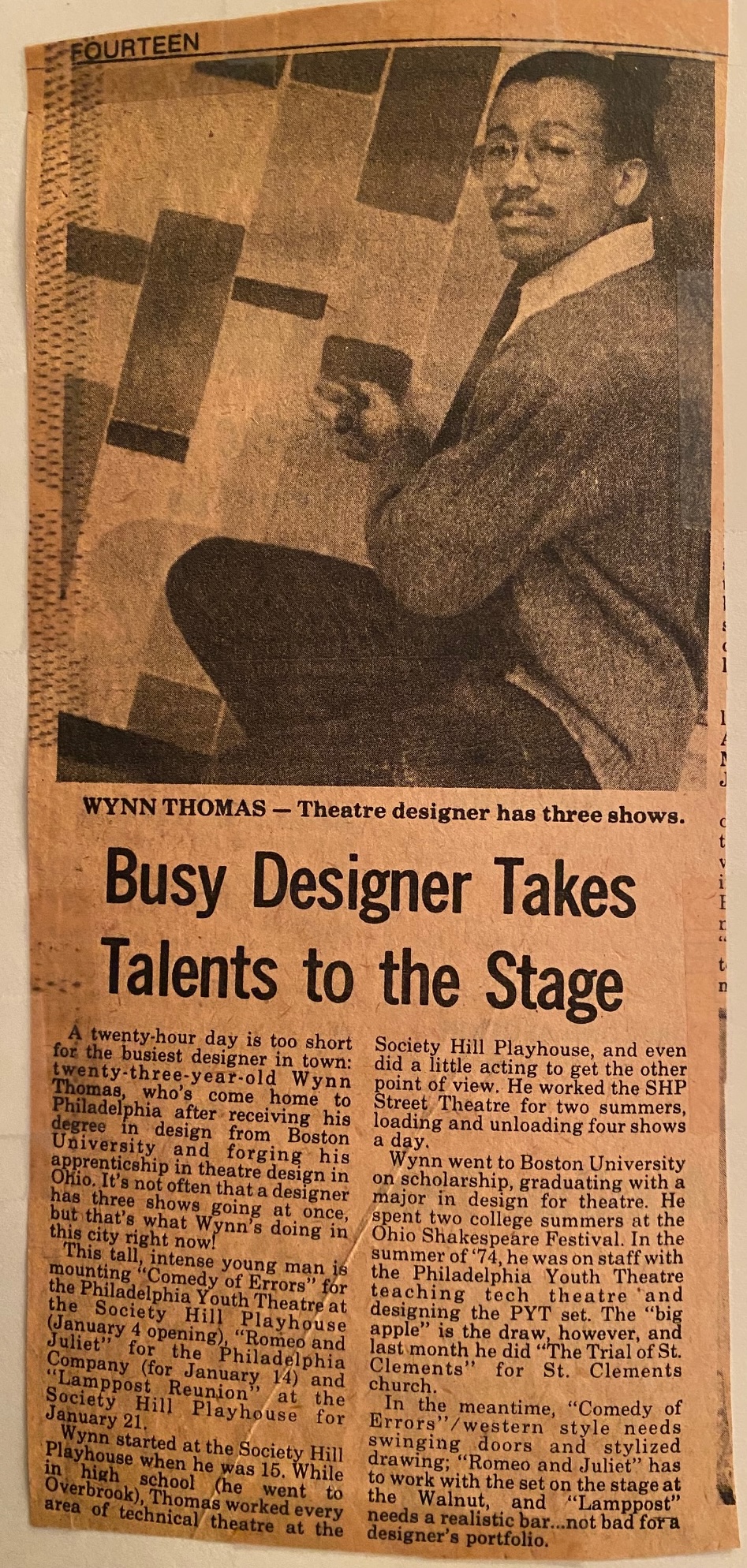
Thomas received his bachelor of fine arts in theater design from Boston University. After graduating in 1975, he returned to Philadelphia and worked as a window dresser at the Strawbridge & Clothier department store on Market Street for a few months before landing his next theater job.
For about four years, Thomas was a painter for the Philadelphia Drama Guild, operating out of the Walnut Street Theatre. He also returned to Society Hill Playhouse as a production designer.
An article about Wynn Thomas when he was 23 years old and working as a theater designer in Philadelphia in the mid 1970s.
“It was a huge learning phase for my career, because I was painting all these different kinds of shows,” Thomas said.
By his mid-20s, Thomas had moved to New York and soon became the resident set designer for the legendary Negro Ensemble Company, where he worked with not-yet-famous actors from Denzel Washington to Phylicia Rashad.
“There was an actor who had auditioned for the company but did not get in. He was looking for a job and it turns out that he had carpentry skills, so I ended up hiring this actor who built my sets for my very first season at NEC,” Thomas recalled.
“That actor was Samuel L. Jackson.”
Breaking into film
Thomas loved theater but sought higher-paying work in film. After multiple job rejections, he joined the United Scenic Artists Local 829.
In an event the union organized with renowned production designer Richard Sylbert, who was working on Francis Ford Coppola’s The Cotton Club, Thomas was the sole Black person in attendance.
The next day, he called Sylbert and introduced himself: “I’m the Black guy that was in the room last night. Do you remember seeing me?”
He convinced Sylbert to hire him to build model sets, and Sylbert became a crucial reference that helped Thomas secure art director jobs, like on 1984’s Beat Street (directed by fellow Philly native Stan Lathan). That’s where he met Spike Lee, who interviewed “for the coffee-fetching position of assistant to the director,” Thomas recalled. When Lee stopped by the art department to greet a friend, the aspiring filmmaker was surprised to see Thomas.
“He said he didn’t know there were any Black people doing this [work],” Thomas said.
Filmmaker Spike Lee, center right, appears with his brother David Lee, center left, with castmembers, including Halle Berry, left, and Wesley Snipes, right, on the set of the 1991 film, “Jungle Fever.” Wynn Thomas served as production designer.
A storied career of firsts
That Beat Street encounter led to one of the most fruitful collaborative relationships of Thomas’ career: He went on to make 11 films with Lee, from She’s Gotta Have It to School Daze to Jungle Fever. Lee regularly worked with the same collaborators (“the family”) including Thomas, costume designer Ruth Carter, and cinematographer Ernest Dickerson.
“We wanted to present images of Black and brown folks that had not been seen before on the screen. We did not want to present any negative images. If you look at those films, there’s no drugs, there’s no alcohol, there’s no domestic abuse — none of that trauma that people used to associate with our communities,” said Thomas. “That was the artistic link, the journey for all of us …[and] that has been a criteria for me.”
Meanwhile, he continued to find mainstream success on commercial films, fueled by a relentless work ethic and a commitment to hiring a diverse crew of artists on his team. Later in his career, he was elected to the Academy’s Board of Governors where he pushed for expanding educational programs nationwide.
Thomas’ films showcase a breadth of world-building talent across genres like comedy (To Wong Foo, Thanks for Everything! Julie Newmar, Get Smart), romance (The Sun Is Also a Star), and dramas about other Black barrier-breakers, like King Richard (starring fellow Overbrook alum Will Smith), Hidden Figures, and the miniseries Lawmen: Bass Reeves.
It’s rare that he returns to his hometown for a job, but in 2014, he was thrilled to work on the pilot of the Philadelphia-set show How to Get Away with Murder.
Thomas believes the city holds countless rich, untold stories that he hopes will one day receive a bigger spotlight.
For now, he’s enjoying seeing the Oscar statue grace his living room.
“It really means a great deal to me, after 40-plus years of working in the business, to have my work recognized by this organization,” said Thomas. “I’ve worked on a lot of films that should have been recognized by the Academy, [for which] I should have been nominated, and it never happened. So I think this was a way for the Academy to correct that oversight.”