In December, former Philadelphia Art Museum director and CEO Sasha Suda had pushed for a trial with jury to settle her wrongful-termination lawsuit against her former employer. The Art Museum argued for arbitration.
On Friday, Common Pleas Court Judge Michael E. Erdos settled the question with a ruling — in favor of arbitration. Erdos directed Suda to submit her claim against the museum in arbitration, per the terms of her employment contract.
The museum in a statement Saturday said that it was pleased with Erdos’ ruling “reaffirming the requirement to arbitrate as previously agreed to in the employment agreement, which is the best use of the resources of all — including the court’s.” The statement added that the museum “will now return to our focus on the museum’s mission of bringing art and inspiration to the people of Philadelphia.”
Suda’s lawyer, Luke Nikas of Quinn Emanuel Urquhart & Sullivan, said Saturday that “the court’s procedural, one-sentence decision requiring arbitration has no relevance to the outcome of this case.”
“We are not surprised that the museum wants to hide its illegal conduct in a confidential arbitration,” he said, “but we will hold the museum accountable wherever the case is heard.“
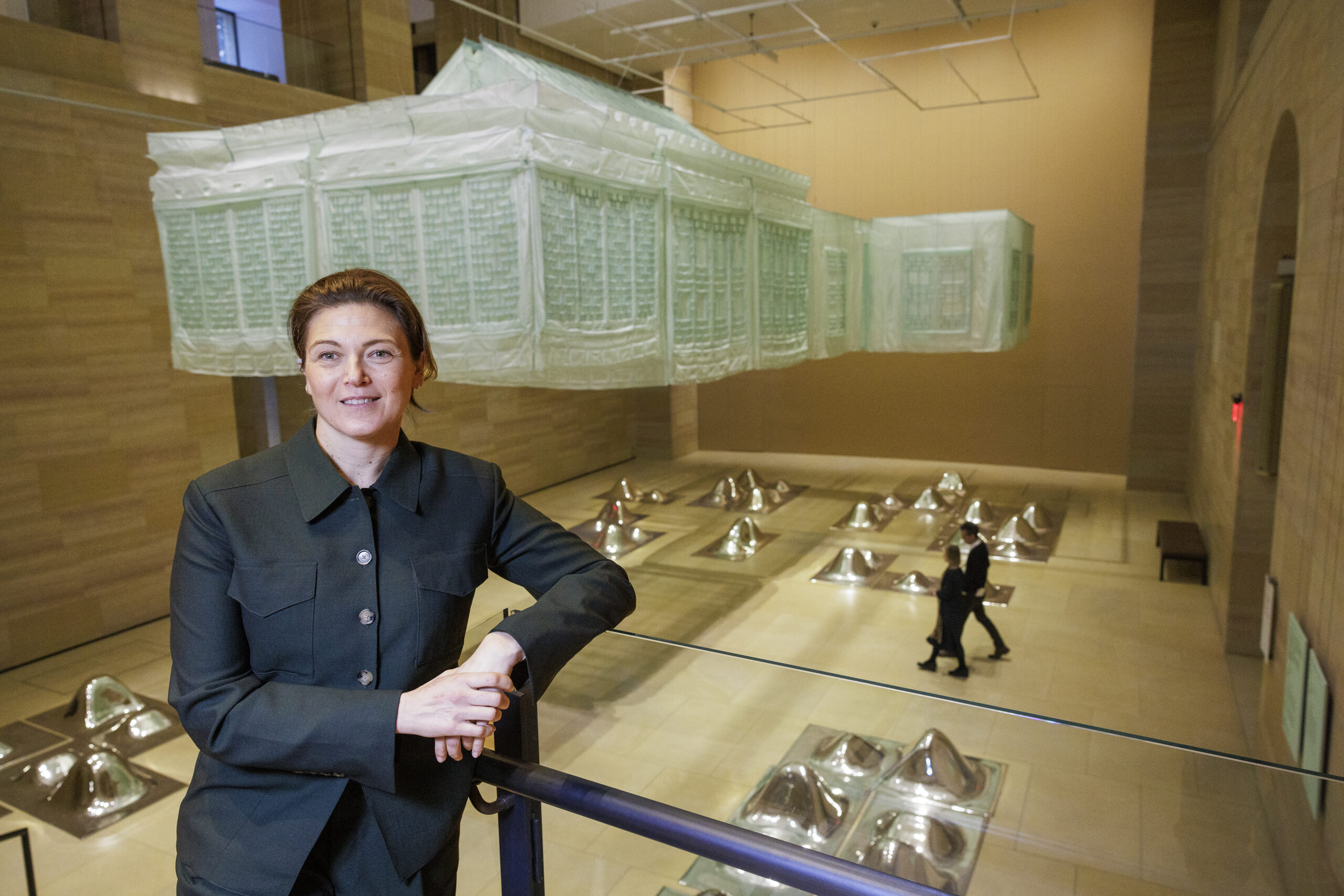
Sasha Suda, with the Art Museum’s Williams Forum in the background, Jan. 30, 2024.
Suda filed her lawsuit Nov. 10, less than a week after being fired by the museum, arguing that the dismissal was “without a valid basis.” The museum responded by calling the suit “without merit.”
Tensions between Suda and the board over authority in running museum matters were cited in court filings. The former director said she was hired in 2022 to “transform a struggling museum, but was later terminated when her efforts to modernize the museum clashed with a small, corrupt, and unethical faction of the board intent on preserving the status quo.”
In a court filing, the museum responded by saying Suda was dismissed after an investigation determined that she “misappropriated funds from the museum and lied to cover up her theft.”
Suda was let go Nov. 4, three years into a five-year contract. With her lawsuit, she sought two years’ pay, as well as “significant damages for the museum’s repeated and malicious violations of the non-disparagement and confidentiality clauses in her employment agreement, and an injunction enforcing the confidentiality and non-disparagement terms of her agreement,” Nikas said.
Less than three weeks after Suda’s dismissal, the museum named Daniel H. Weiss — who formerly led the Metropolitan Museum of Art — its new director.
Rapper and actor Eve finally got recognition for her contribution to a Grammy Award-winning song by The Roots, and she had kind words for her hometown.
“I will say Philly started it,” Eve told a reporter at the Recording Academy Honors, presented by the Black Music Collective. “I came from Philadelphia. I think we’re used to being the underdogs in that city. And we also like to prove to you that you can underestimate me, but I’m going to show you.”
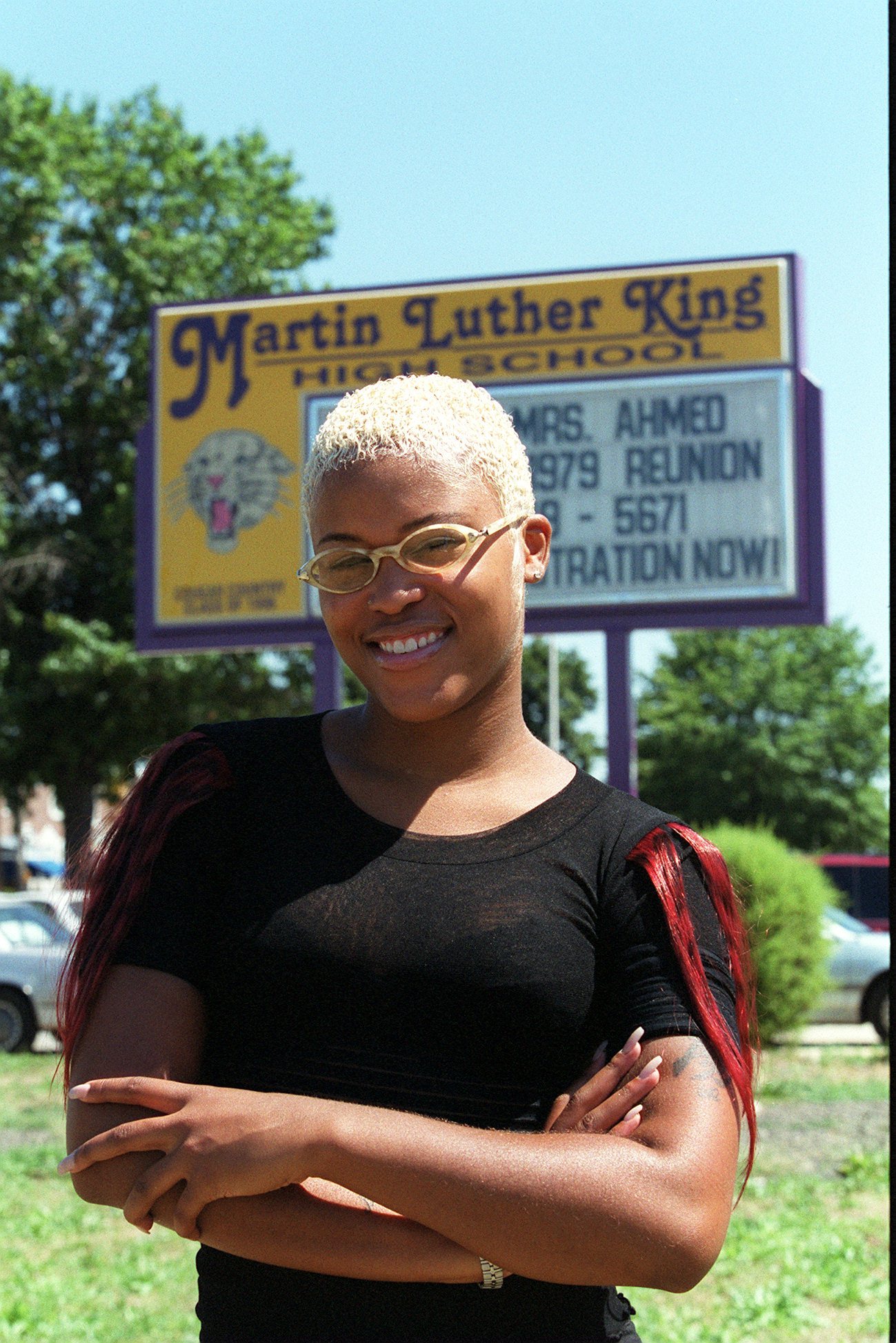
Rapper Eve Jeffers outside Martin Luther King High School in Philadelphia in 1999.
Eve grew up in West Philly and Germantown. In 1999, when she was a 19-year-old rapper going by “Eve of Destruction,” she laid down the essential second verse for The Roots’ “You Got Me.”
A year later, the song earned the Philly hip-hop group a Grammy for Best Rap Performance By a Duo or Group. Erykah Badu, who sang the hook, also won the award.
But Eve, who was not signed with a recording label, was not listed as a contributing artist on the song’s 1999 release and was overlooked by the awards committee.
That didn’t stop her from launching a successful solo career and winning a Grammy in 2002 for “Let Me Blow Ya Mind,” a Gwen Stefani collaboration that drips with early aughts vibes.
Eve’s memoir is titled ‘Who’s That Girl?’
At the ceremony Thursday in Los Angeles, Eve told the crowd that “this is actually for little Eve from Philly” on stage.
“What is yours never can miss you,” she said.
Addressing the crowd, Eve gave a shout-out to broadcaster Ebro Darden, who discussed the song at length on his podcast, The Message. She credited him for keeping people interested in seeing her receive a Grammy for the song.
Eve said she found success through being determined and understanding what kind of life she wanted to live. She encouraged other Black women to be there for themselves and fight for their dreams.
“I think, you know, we owe it to ourselves to show up for ourselves, to fight for ourselves, to be our own champion,” she said. “We deserve it. We are always the strongest for everyone else. We need to be the strongest for ourselves.”
This isn’t a typical report card item, and it shouldn’t be.
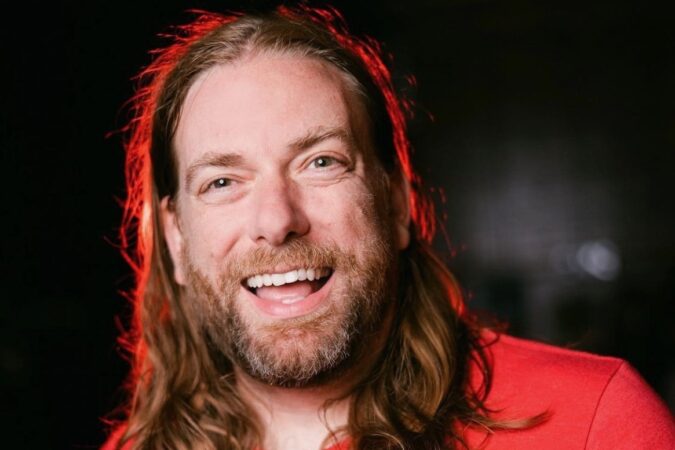
This week made it impossible not to understand who Dan McQuade was — and how deeply he mattered to Philadelphia — just by reading what people shared about the journalist and Philadelphia superfan after he died of cancer this week at age 43.
Colleagues, friends, editors, and readers kept circling the same truths: how funny he was, how kind he was, how precise his understanding of the city felt. Not in a forced or caricatured way, but in the way that comes from paying close attention, loving a place, and never taking it (or yourself) too seriously.
Dan had a gift for finding meaning in the everyday. He treated Philly’s quirks, tics, and absurdities not as punchlines to exploit, but as things worth documenting, celebrating, and occasionally poking fun at with affection. He gave people permission to laugh at the city without laughing at it. That’s harder than it sounds.
His impact was everywhere this week: in stories about Rocky runs and boardwalk T-shirts, in memories of long happy hours that turned into lifelong friendships, in anecdotes about him being the go-to fact-checker for all things Philly, in the way people described him as both brilliant and generous. A writer who made others better. A friend who showed up. A presence that made rooms, and timelines, lighter.
The tributes weren’t performative or flowery. They were specific. Personal. Grounded. Which feels fitting. McQuade’s work was never about being loud or self-important. It was about noticing things, connecting dots, and reminding people that there’s joy, and humor, in paying attention to where you live.
Philadelphia lost a journalist. But it also lost one of its clearest interpreters. Someone who understood that “Philadelphianness” isn’t a brand or a gimmick, but a way of moving through the world with skepticism, warmth, and a well-timed joke.
An A+ doesn’t feel like enough. But it feels right to say this much: Philly is better for having had Dan McQuade in it. And it won’t quite be the same without him.
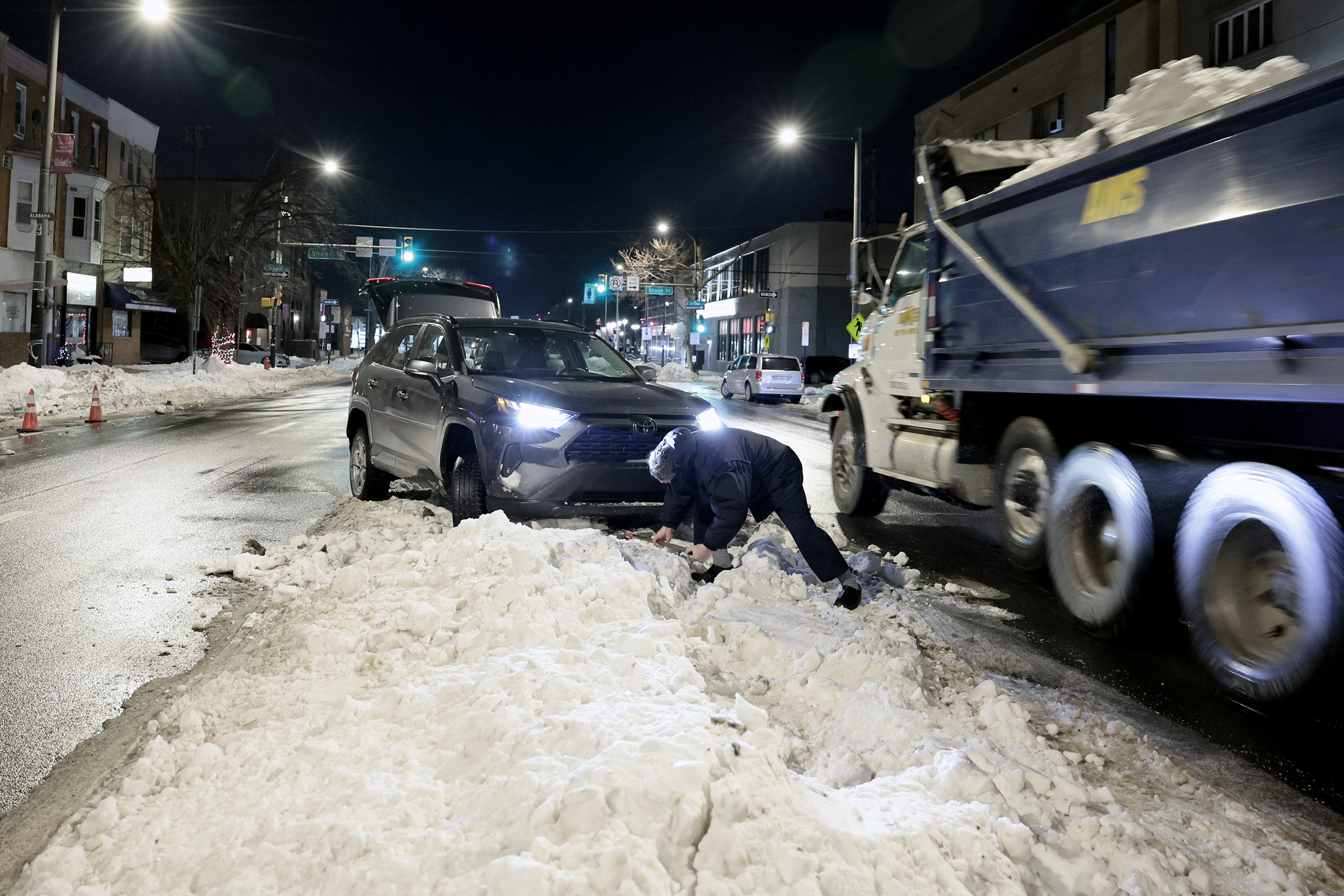
A man shovels snow from underneath his car after it became hung up while trying to park in the middle of South Broad Street in the early morning hours of Jan. 28, 2026. Dump trucks filled with snow from the city’s snow removal operations were zooming by as he worked to get his car free.
The snowstorm delivered. The plowing did not: F-
Let’s be clear: The snow itself did what snow is supposed to do. Nine-plus inches, pretty at first, historic enough to brag about, disruptive enough to cancel plans and spark group-chat meteorology. Fine. That’s winter.
What came after? That’s where everything fell apart.
The city promised differently. Mayor Cherelle L. Parker stood in front of cameras before the storm and said every street would get attention “as long as it takes.” That message mattered because Philadelphians have heard this story before, and expectations were deliberately raised.
Then reality hit.
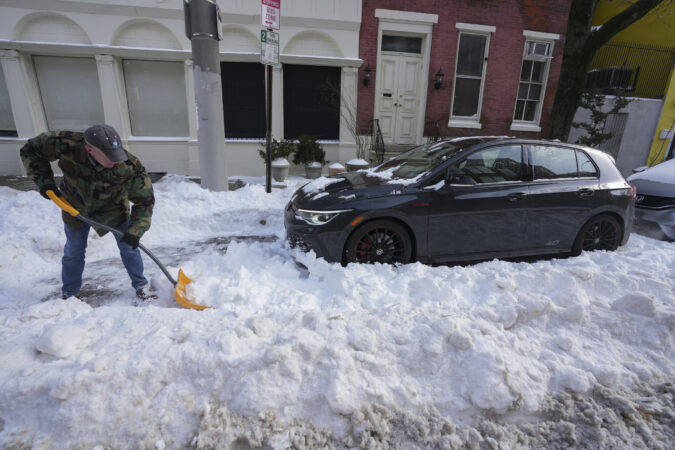
Plow data show roughly a quarter of city streets got no treatment at all after the storm ended. Not plowed. Not salted. Nothing. And the longer it sat, the worse it got — snow compacting into ice, intersections blocked by frozen berms, cars effectively entombed.
This isn’t just an inconvenience. People with limited mobility are stuck. Workers can’t get out. Streets department explanations about sleet, freezing rain, and illegally parked cars may be true, but they don’t change the fact that many blocks are still uncleared a week later.
This is the part where Philly frustration kicks in hardest: The storm wasn’t unprecedented, but the response feels familiar in the worst way. The expectation has long been “don’t count on a plow,” and this week did little to change that.
New York tries to claim ‘Delco.’ Pennsylvania says absolutely not: A
Every so often, something happens that instantly unites Delco. Snowstorms. Eagles runs. Wawa shortages. And now: a county in upstate New York attempting to brand itself as “Delco.”
Absolutely not.
Stephanie Farr laid out the case perfectly: Delco isn’t just shorthand for Delaware County. It’s a culture. A personality. A way of life built on hoagie trays, Catholic school rivalries, beach flags, and a shared, deeply ingrained chip on the shoulder.
New York’s Delaware County is rural. Ours is suburban chaos packed into 184 square miles, powered by Wawa coffee, tailgating energy, and a pride so aggressive it gets tattooed on bodies and planted in Jersey Shore sand like a territorial marker.
The funniest part isn’t that there’s another Delaware County (there are several). It’s that this one thought it could simply adopt the nickname, slap it on merch, and call it authenticity. That’s not how Delco works. Delco is earned.
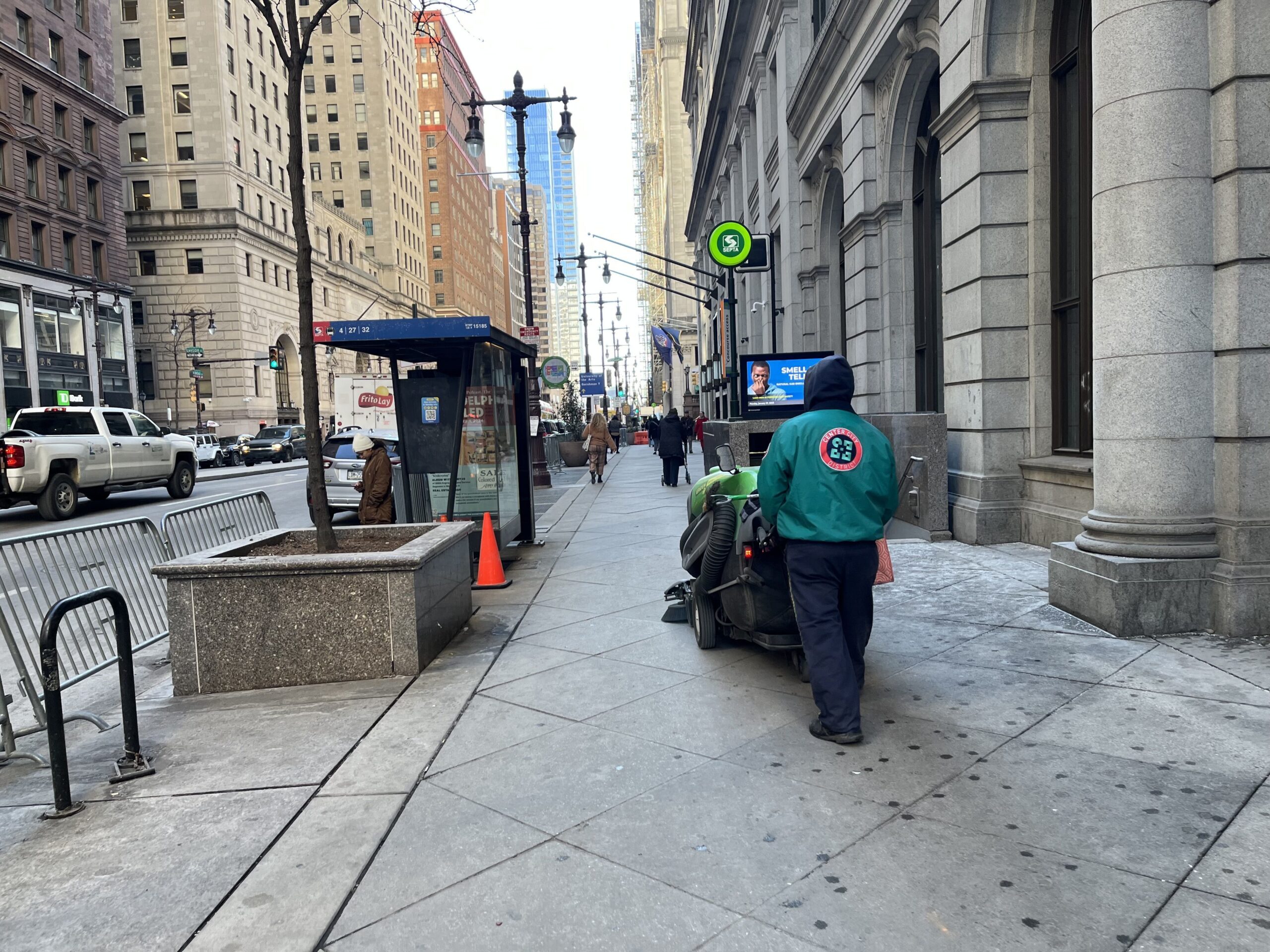
A Center City District worker cleaning the sidewalk on Broad Street the morning after the Philadelphia Eagles won the NFC Championship.
Center City West sidewalks are getting grimy (and it’s not your imagination): C
For nearly a decade, a lot of Center City West quietly benefited from something most people never realized existed: a privately funded sidewalk cleaning program that swooped in after city trash pickup and handled the leftover mess.
Asthe Fitler Focus reported, that program ended when the Center City Residents’ Association let its contract expire at the end of 2025. Not out of neglect, but necessity. The cost had ballooned to about 41% of CCRA’s projected 2026 budget, which is an unsustainable chunk for what was essentially backstopping city services.
The result has been immediate and visible. Trash bags torn open overnight. Litter lingering days after pickup. Sidewalks that used to reset themselves now just… don’t. CCRA deserves credit for being upfront about the trade-off and pivoting toward enforcement, even if it won’t bring immediate results.
The frustrating part is that the rules haven’t changed. Trash placement regulations exist. Containers are required. Enforcement is technically possible. But in reality, it’s complaint-driven, slow, and uneven. Meaning the difference between a clean block and a gross one often comes down to who has the time and energy to call 311 and wait on hold.
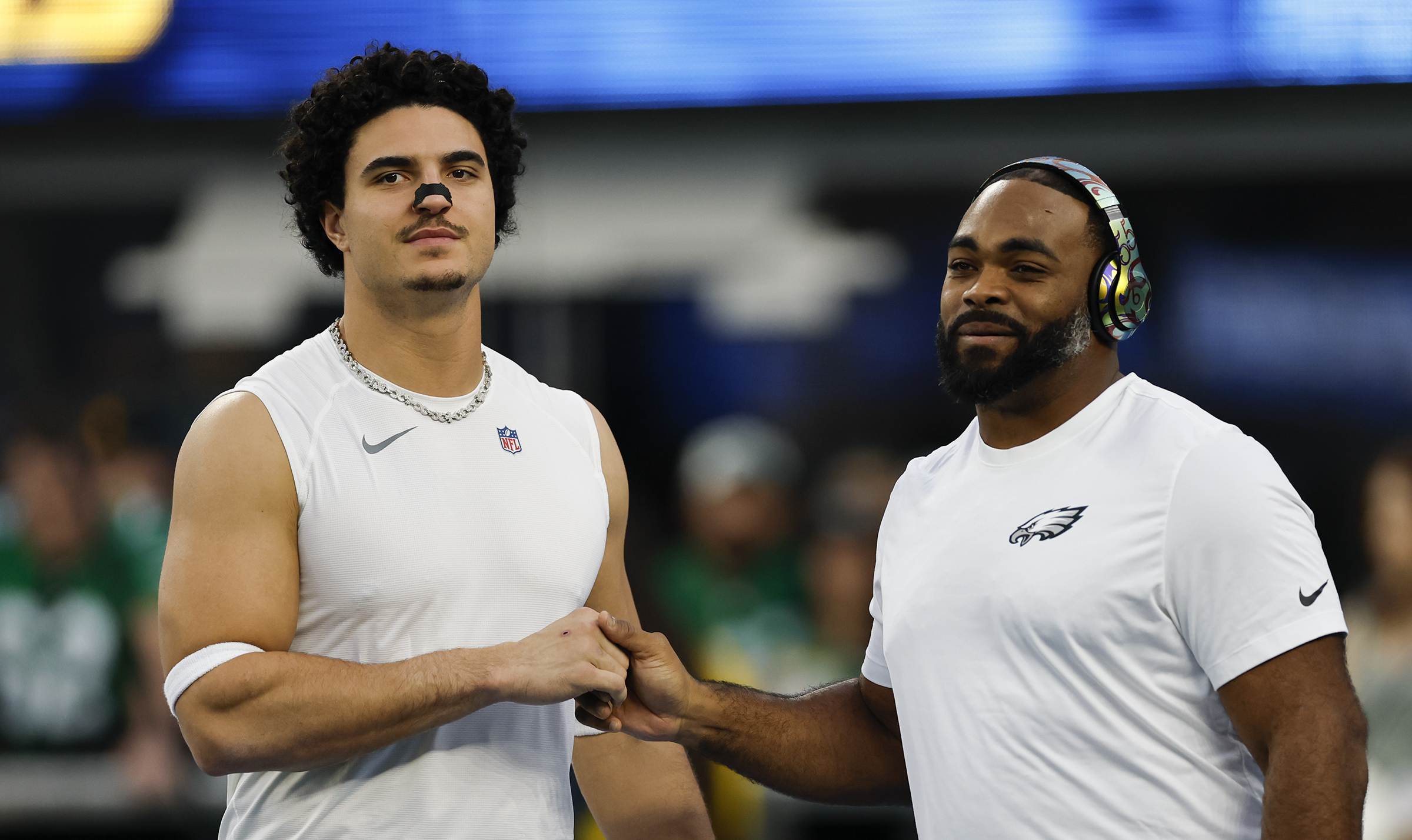
Eagles linebacker Jaelan Phillips (left) and defensive end Brandon Graham during warm-ups before the Eagles play the Los Angeles Chargers on Dec. 8, 2025 at SoFi Stadium in Inglewood, Calif.
Eagles fans agree on almost everything — except the part that actually hurts: B
In this year’s Inquirer Stay or Go poll, Eagles fans were unusually aligned on who still feels like the future: young defensive studs, the offensive line pillars, the rookies who look like actual hits. Cooper DeJean and Quinyon Mitchell clearing 96% stay feels less like optimism and more like self-preservation. The message is clear: The defense isn’t the problem. Or at least, it’s not our problem.
Where things get interesting is offense. Not because fans are confused, but because they’re suddenly colder. Jalen Hurts is still trusted, but not untouchable. A.J. Brown’s dip is real and telling: not rage, not rejection, just disappointment, Philly’s least favorite emotion. Fans didn’t turn on him. They just stopped defending him reflexively, which in this city is its own warning sign.
And then there’s Brandon Graham, the emotional Rorschach test of the poll. A franchise legend. A locker room heartbeat. A guy people want to want back. The split vote says everything: respect battling reality. Philly loves its icons, but it hates lying to itself more.
No one landed in the mushy middle. Fans know who they’re done with. They know who they’re attached to. There’s little patience left for “maybe.”
This wasn’t a meltdown poll. It was a sorting exercise. And the conclusion fans keep circling is uncomfortable but consistent: The Eagles don’t need vibes. They need clarity — and probably a few hard goodbyes.
The Inquirer mapped Philly’s dive bars (and proved how much the city loves them): A
When The Inquirer put out a call for Philly’s favorite dive bars, the response was immediate and overwhelming. Nearly 400 submissions poured in, which tracks for a city where dive bars aren’t just places to drink. They’re personal landmarks.
What the map really shows isn’t just where to grab a cheap beer. It’s how attached people are to the bars that feel like theirs. The ones tied to first jobs, postgame rituals, bad breakups, good Tuesdays, and nights that went exactly nowhere and somehow mattered anyway. These are rooms where nobody’s performing, the prices are low on purpose, and the atmosphere is set by regulars, not a concept.
It also surfaced one of Philly’s most reliable debates: Is being called a dive bar a compliment or an insult? Some owners bristle at the label. Others embrace it. Many bars live in the gray area: cheap, unpretentious, deeply loved, and absolutely uninterested in how they’re categorized. Very Philly.
Are there bars missing? Of course. There always will be. Philly has too many neighborhood institutions, and too many people willing to argue for them, for any list to feel definitive. But that’s not a failure of the map, it’s a feature of the city.
This isn’t a checklist. It’s a snapshot of how much Philadelphians still value places that don’t try to be anything other than what they are.
Snow savesies are back, and Philly is absolutely feral about it: C+
Every major snowstorm in Philly brings back the same question we never resolve: If you shovel out a spot, is it yours, or is public parking still public? This week’s viral Reddit thread, sparked by a wooden chair left in a shoveled space with a handwritten threat (“Move these chairs & I will destroy your car. Try me.”), confirms we are once again incapable of calm thought.
Some commenters were immediately in the respect the chair camp. One wrote, “After digging my s— out from snow past my knees I just want to one time come back to a spot,” while another argued, “Normally vehemently anti-savesies, but I feel like spending an hour digging out earns you a [savesie] or two.” This group is running on sore backs, wet boots, and pure principle.
Then there’s the other side: the chaos agents. “I’d move the chair and watch someone else park there,” one commenter said, which feels less like civic engagement and more like performance art. Another proudly added, “I take peoples cones all the time when I’m walking around. F— em.” (This explains so much.)
Somewhere in the middle were people admitting the quiet truth: Everyone dug out a spot. “The person who’s parked there dug out their car this morning, too,” one commenter noted, puncturing the idea that only one hero labored for the block.
So where does that leave us? With a very Philly stalemate. The chair is obnoxious. The threat is unhinged. The labor is real. The fear of retaliation is realer.
The Grammys are here, with lots of familiar faces.
Kendrick Lamar, who won five awards at last year’s show, leads with nine nominations and Lady Gaga, Bad Bunny, and Billie Eilish are up for major awards.
As is Sabrina Carpenter, the Bucks County native who is the Philly region’s great hope. She won twice last year and is nominated six times for her album Man’s Best Friend.
Neither Taylor Swift nor Beyoncé released music in the eligibility period, which runs from Aug. 31, 2024, to Aug. 30, 2025, so that’s why they’re missing from this year’s list.
I’m picking winners in the four major categories, which will be among the dozen or so given away on the awards show hosted by Trevor Noah and broadcast on CBS from the Crypto.com Arena in Los Angeles at 8 p.m. Sunday, and streaming on Paramount+.
A total of 95 Grammys will be given out, however, with most presented in a pre-telecast ceremony streamed on grammy.com and the Recording Academy’s YouTube page, starting 3:30 p.m. Sunday.
That’s where you’ll find the Philadelphians.
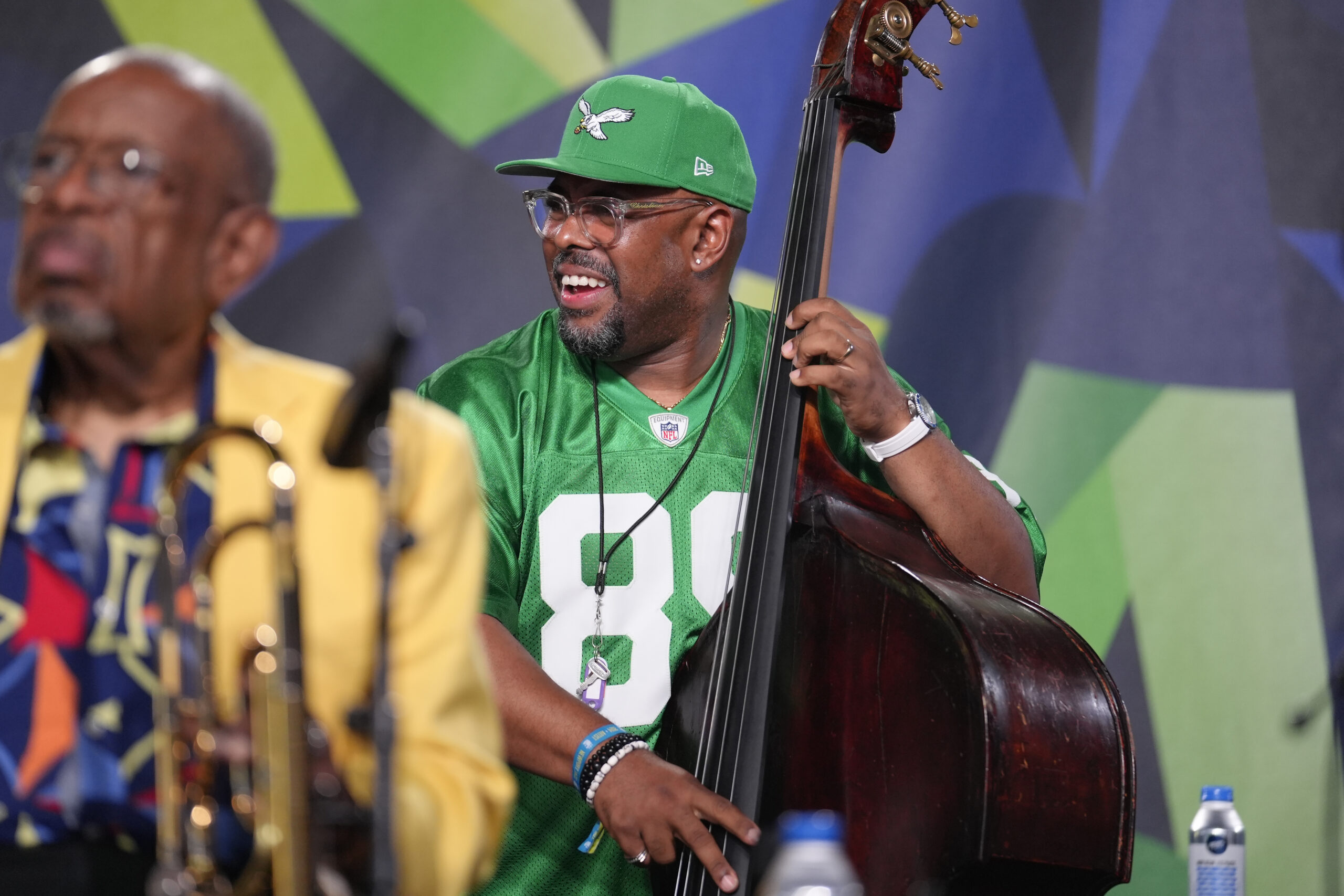
Jazz bassist Christian McBride is up for three awards, with his Big Band’s Without Further Ado, Vol. 1 vying with Sun Ra Arkestra’s Lights on a Satellite for best jazz large ensemble.
Philadelphia Orchestra and music and artistic director Yannick Nézet-Séguin are up for two, and Nézet-Séguin is also nominated for one with the Metropolitan Opera orchestra.
Jazz saxophonist Immanuel Wilkins and University of Pennsylvania graduate John Legend have two noms each. The Crossing Choir, Camden gospel bandleader Tye Tribbett, songwriter Andre Harris, and producer Will Yip each have one.
Bassist Christian McBride (right) performs during the Newport Jazz Festival, Sunday, Aug. 4, 2024, in Newport, R.I. The Philadelphia musician is up for three Grammys on Sunday.(AP Photo/Steven Senne)
As the first major live TV awards show since the death of Alex Pretti in Minneapolis last weekend, the Grammys are likely a platform for anti-ICE protests. We’ll see which, if any, performers or presenters — who include Charli XCX, Teyana Taylor, Queen Latifah, Lainey Wilson, Nikki Glaser, and Chappell Roan — speak out.
Here’s who I think should — and will — win.
Album of the Year
Nominees: Bad Bunny, Debí Tirar Más Fotos; Justin Bieber, Swag; Sabrina Carpenter, Man’s Best Friend; Clipse, Let God Sort ‘Em Out; Lady Gaga, Mayhem; Kendrick Lamar, GNX; Leon Thomas, Mutt;Tyler, the Creator, Chromakopia
My prediction: The most prominent of these in my rotation these days is LetGod Sort ‘Em Out, the topflight reunion of hip-hop brothers Gene “Malice” and Terence “Pusha T” Thornton. But it has little chance among these heavy hitters.
Carpenter will have to be satisfied with a performance slot in the prime-time show, a prize showcase on “Music’s Biggest Night.” But Man’s Best Friend isn’t quite up to the level of her tart 2024 Short n’ Sweet.
The consensus says this is a race between Lady Gaga, Bad Bunny, and Kendrick Lamar. All have an excellent chance, with Gaga being a veteran Grammy favorite back on form. Lamar’s album released way back in November 2024, but he continued to impact culture through his “Grand National” tour with SZA and “Luther,” their collab that topped the pop charts for 13 straight weeks.
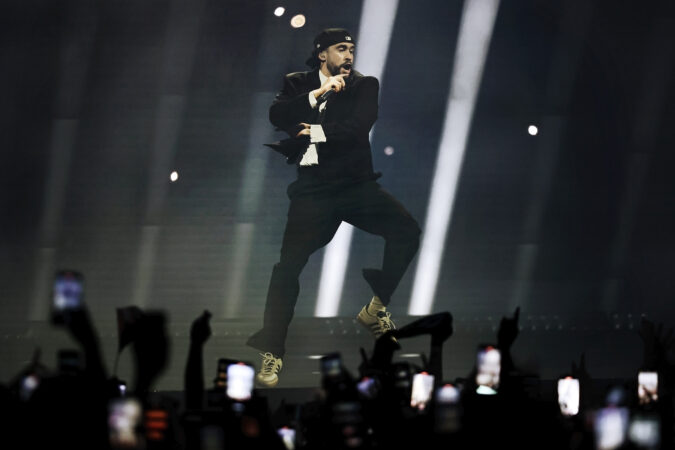
But this feels like Bad Bunny’s year. Debí Tirar Más Fotos — which translates as “I should have taken more photos” — is the Puerto Rican singer, rapper, and producer’s most confident, varied, and politically potent work.
It’s poised to become the first Spanish language album of the year, and thus a Grammy statement of multicultural solidarity when immigrant populations in the U.S. are under threat. And it would make for a pretty good start to February for the Super Bowl halftime headliner.
Should win: Bad Bunny
Will win: Bad Bunny
Chappell Roan performs “Pink Pony Club” during the 67th annual Grammy Awards in Los Angeles, Feb. 2, 2025. The singer is nominated for two Grammy awards on Sunday and will also be a presenter at the ceremony, which airs on CBS at 8 p.m. and streams on Paramount+. (AP Photo/Chris Pizzello, File)
Record of the Year
Nominees: Bad Bunny, “DTMF”; Sabrina Carpenter, “Manchild”; Doechii, “Anxiety”; Billie Eilish, “Wildflower”; Kendrick Lamar & SZA, “Luther”; Lady Gaga, “Abracadabra”; Chappell Roan, “The Subway”; Rosé & Bruno Mars, “APT”
My prediction: This is a strong group, including Carpenter’s cheeky “Manchild” and Doechii’s “Anxiety,” which samples Gotye and Kimbra’s 2011 “Somebody I Used to Know.”
Roan’s “The Subway” hearkens back to classic pop and Eilish’s “Wildflower” is lovely, though it’s a little ridiculous that it’s nominated. It’s from Eilish’s Hit Me Hard and Soft, which came out in May 2024 but qualifies because it became a single last February. When the Grammys want you to be part of the show, they’ll find a way to sneak you in.
My pick to win is “APT.” The duet between Bruno Mars and K-pop star Rosé is a super-catchy global hit that borrows from Toni Basil’s 1982 hit “Mickey,” which older Grammy voters will surely remember. It’s the second-fastest song to reach a billion streams after Mars and Gaga’s 2024 “Die With a Smile.”
Will win: “APT.”
Should win: “Luther”
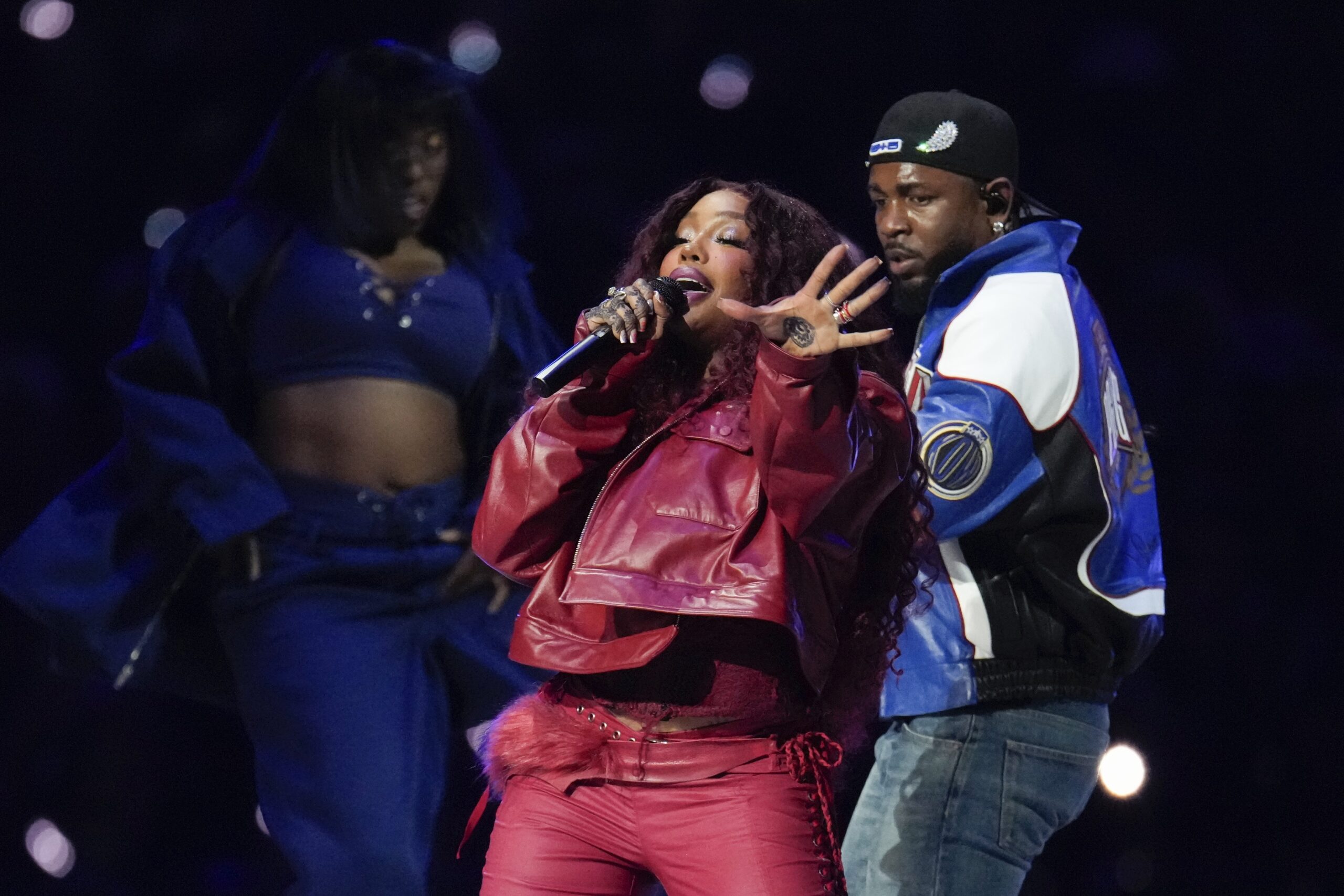
SZA and Kendrick Lamar perform during halftime of the NFL Super Bowl between the Kansas City Chiefs and the Philadelphia Eagles, Sunday, Feb. 9, 2025, in New Orleans. (AP Photo/George Walker IV)
Song of the Year
Nominees: Bad Bunny, “DTMF”; Sabrina Carpenter, “Manchild”; Doechii, “Anxiety”; Billie Eilish, “Wildflower”; Huntr/x — “Golden”; Kendrick Lamar & SZA, “Luther”; Lady Gaga, “Abracadabra”; Rosé & Bruno Mars, “APT”
My prediction: The Grammys are silly. Why are there separate record and song of the year categories? In theory because the latter is a songwriter’s award. But these categories are virtually identical, the only difference being dropping Roan for “Golden” from the Netflix movie KPop Demon Hunters.
Let’s give this one to last year’s Super Bowl halftime headliners to reward their overall excellence and songwriting skills.
Should win: “Luther”
Will win: “Luther”
Olivia Dean performs at the Austin City Limits Music Festival on Oct. 11, 2025, in Texas. The British singer-songwriter is nominated for Best New Artist at the Grammy Awards on Sunday.(Photo by Jack Plunkett/Invision/AP, File)
Best New Artist
Nominees: Olivia Dean, Katseye, The Marías, Addison Rae, Sombr, Leon Thomas, Alex Warren, Lola Young
A little rant detour: Another failing: The Recording Academy has completely ignored country music in the major categories. The Grammys are, in many ways, a popularity contest. Unlike the Oscars, which sometimes reward niche and art house fare and look askance at commercial success, the Grammys are intent on showing they’re in step with the zeitgeist by recognizing big sellers.
Except they don’t bother when it comes to country, thus reinforcing America’s cultural divide. The Recording Academy isn’t too blame when it comes to Morgan Wallen, whose I’m the Problem was the most streamed album in the U.S. in 2025 — because he chose to not submit his music.
But completely credible and widely popular country artists like Ella Langley and especially Megan Moroney are obvious candidates for best new artist. They have been shown no love, either due to cluelessness or a conscious decision to shut out mainstream country. End of rant!
My prediction: In this last of the major categories, Addison Rae is to be commended for making a smart, catchy transition from TikTok to pop star. Leon Thomas emerged as a serious R&B artist with staying power, and Lola Young is a major talent whose “Messy” is a terrific universalist earworm.
But my most confident prediction in these four categories is Olivia Dean. The British songwriter is marked for stardom, simultaneously coming off as a youthful ingenue and an old soul. Her vocals have a slight Amy Winehouse tinge without being imitative. Her breezy, immediately likable The Art of Loving mixes neo-soul 1970s Los Angeles soft-rock is right up the Grammy alley.
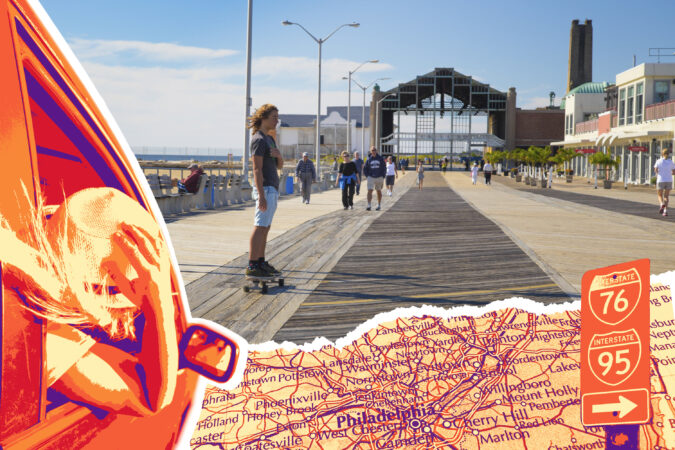
Would you believe it if we told you Asbury Park is the same distance from Philly as Sea Isle? For many Philadelphians, the north end of the Shore might as well exist on another planet. Fortunately, the offseason is the perfect time to broaden one’s horizons — so that come summer, you might break out of the tribal nature that governs which sands you plant your umbrella in.
As one of the larger towns on the coast, with a healthy year-round population, Asbury Park makes an ideal entrée. Things are open in the winter.
Not everything — but enough to keep you busy for a weekend of city-level food, idiosyncratic shopping, and live music. Start the car.
Make your first stop just to the south of Asbury, at Hey Peach in Bradley Beach. This inviting granny-core café-bakery from Erin “Peach” Kilker lines its wooden sideboard and pastry case with holey olive fougasses, crackling croissants, Scottish shortbread, fat cream puffs, and more. If the weather cooperates, grab one of the bistro tables out front and enjoy your pastry (or three) with a Counter Culture coffee.
It might not be beach weather, but the glittering sea views from the 11-foot windows at Asbury Ocean Club are just as dramatic in winter. The soothing dune-and-khaki suites in this luxurious 54-room high-rise — which opened in 2019 — feel especially indulgent in the offseason. Winter rates hover in the mid-$300s; that same room can top $1,000 on a summer weekend.
Cosplay your favorite Stranger Things kid (minus the Vecna creepy-crawlies) at Silverball Retro Arcade. Gamer or not, it’s impossible not to light up like the 1992 Addams Family pinball machine when you step inside this clanging, jangling boardwalk fixture. And because it’s not summer, the chances are good you’ll have no trouble finding an empty Skee-Ball lane. (Fun fact: Skee-Ball was invented in Vineland in 1907, with early alleys manufactured in Philly.)
📍 1000 Ocean Ave. N., Asbury Park, N.J. 07712
Shop: Asbury Park Bazaar
Right in the middle of the boardwalk, where you can shop for travel-inspired hoodies at Promised Land Apparel and thrifted art supplies at Asbury Park Art Club, Asbury Park Bazaar pops up through the year inside the Grand Arcade at Convention Hall. More than 50 vendors will fill the space on Valentine’s Day weekend, selling everything from patch-customized beanies and travel-inspired hoodies to candles that melt into massage oil.
📍 1300 Ocean Ave. N., Unit C-4, Asbury Park, N.J. 07712
Read: Paranormal Books & Curiosities
Ghost ships, Victorian murders, haunted houses — in Asbury Park, spooky season never really ends. Paranormal Books & Curiosities anchors the city’s supernatural streak, selling horror novels, spellbooks, and oddities, while also running ghost tours and curating a small paranormal museum. Whether you’re looking for Grady Hendrix, Paul Tremblay, or something to summon the corners, you’ll find it here.
📍 621 Cookman Ave., Asbury Park, N.J. 07712
Dine: Judy & Harry’s
Named for owner Neilly Robinson’s parents, Judy & Harry’s in the St. Laurent Hotel is a two-in-one restaurant and cocktail bar with butterscotch leather barstools, frosted globe lights, and framed family photos. The menu, by Robinson’s partner and James Beard semifinalist David Viana, blends her Italian and Jewish heritage with dishes like limoncello-splashed hamachi crudo, ricotta-matzo ball soup, schmaltzy potatoes, and chicken and eggplant parm. If you’re visiting Asbury on a Sunday, swing in for their $38 Sunday Sauce prix fixe supper.
📍 408 Seventh Ave., Asbury Park, N.J. 07712
Jam: The Stone Pony
What’s the opposite of a sleeper pick? First opened in 1974, Stone Pony is so deeply and inextricably tethered to Asbury Park. Everyone knows it. The bar and venue runs shows every weekend through the offseason, and the variety is pretty astounding: a Dave Matthews tribute band, country singer Hunter Hayes, a student showcase from Red Bank’s School of Rock, bassist and Phish cofounder Mike Gordon. Tourists go. Summer people go. Locals go. You should go.
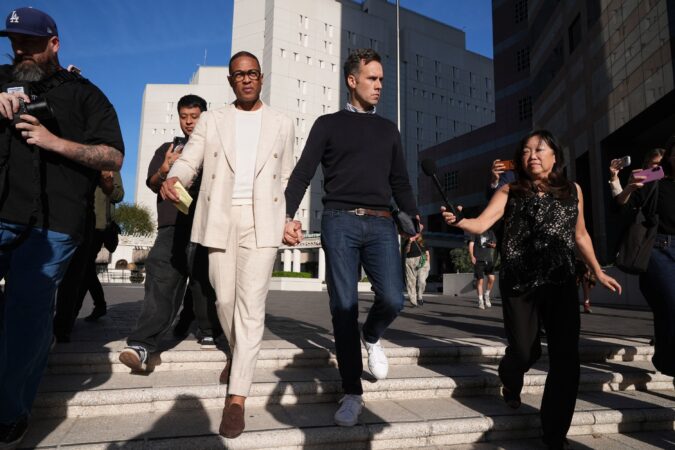
LOS ANGELES — Journalist Don Lemon was released from custody Friday after he was arrested and hit with federal civil rights charges over his coverage of an anti-immigration enforcement protest that disrupted a service at a Minnesota church.
Lemon was arrested Thursday while across the country in Los Angeles, while another independent journalist and two protest participants were arrested in Minnesota. He struck a confident, defiant tone while speaking to reporters after a court appearance in California.
“I have spent my entire career covering the news. I will not stop now,” Lemon said. “In fact there is no more important time than right now, this very moment, for a free and independent media that shines a light on the truth and holds those in power accountable.”
The arrests brought sharp criticism from news media advocates and civil rights activists including the Rev. Al Sharpton, who said the Trump administration is taking a “sledgehammer” to “the knees of the First Amendment.”
The four were charged with conspiracy and interfering with the First Amendment rights of worshipers during the Jan. 18 protest at the Cities Church in St. Paul, where a U.S. Immigration and Customs Enforcement official is a pastor.
In federal court in Los Angeles, Assistant U.S. Attorney Alexander Robbins argued for a $100,000 bond, telling a judge that Lemon “knowingly joined a mob that stormed into a church.” He was released, however, without having to post money and was granted permission to travel to France in June while the case is pending.
Defense attorney Marilyn Bednarski said Lemon plans to plead not guilty and fight the charges.
Lemon, who was fired from CNN in 2023 following a bumpy run as a morning host, has said he has no affiliation to the organization that went into the church and he was there as a solo journalist chronicling protesters.
“Don has been a journalist for 30 years, and his constitutionally protected work in Minneapolis was no different than what he has always done,” his lawyer, Abbe Lowell, said in a statement. “The First Amendment exists to protect journalists whose role it is to shine light on the truth and hold those in power accountable.”
Attorney General Pam Bondi promoted the arrests on social media.
“Make no mistake. Under President Trump’s leadership and this administration, you have the right to worship freely and safely,” Bondi said in a video posted online. “And if I haven’t been clear already, if you violate that sacred right, we are coming after you.”
‘Keep trying’
Since he left CNN, Lemon has joined the legion of journalists who have gone into business for himself, posting regularly on YouTube. He hasn’t hidden his disdain for President Donald Trump. Yet during his online show from the church, he said repeatedly: “I’m not here as an activist. I’m here as a journalist.” He described the scene before him, and interviewed churchgoers and demonstrators.
A magistrate judge last week rejected prosecutors’ initial bid to charge the veteran journalist. Shortly after, he predicted on his show that the administration would try again.
“And guess what,” he said. “Here I am. Keep trying. That’s not going to stop me from being a journalist. That’s not going to diminish my voice. Go ahead, make me into the new Jimmy Kimmel, if you want. Just do it. Because I’m not going anywhere.”
Georgia Fort livestreamed the moments before her arrest, telling viewers that agents were at her door and her First Amendment right as a journalist was being diminished.
A judge released Fort, Trahern Crews, and Jamael Lundy on bond, rejecting the Justice Department’s attempt to keep them in custody. Not guilty pleas were entered. Fort’s supporters in the courtroom clapped and whooped.
“It’s a sinister turn of events in this country,” Fort’s attorney, Kevin Riach, said in court.
Discouraging scrutiny
Jane Kirtley, a media law and ethics expert at the University of Minnesota, said the federal laws cited by the government were not intended to apply to reporters gathering news.
The charges against Lemon and Fort, she said, are “pure intimidation and government overreach.”
Some experts and activists said the charges were not only an attack on press freedoms but also a strike against Black Americans who count on Black journalists to bear witness to injustice and oppression.
The National Association of Black Journalists said it was “outraged and deeply alarmed” by Lemon’s arrest. The group called it an effort to “criminalize and threaten press freedom under the guise of law enforcement.”
Crews is a leader of Black Lives Matter Minnesota who has led many protests and actions for racial justice, particularly following George Floyd’s killing in Minneapolis in 2020.
After Trump administration officials said earlier this month that arrests would be coming in the church protest, Crews told the Associated Press there’s a “tradition” of Black activists and leaders being targeted or subjected to violence.
“Just as being a Black person, you always have to have that in mind,” Crews said.
Protesters charged previously
A prominent civil rights attorney and two other people involved in the protest were arrested last week. Prosecutors have accused them of civil rights violations for disrupting the Cities Church service.
The Justice Department launched an investigation after the group interrupted services by chanting “ICE out” and “Justice for Renee Good,” referring to the 37-year-old mother of three who was fatally shot by an ICE officer in Minneapolis.
Lundy, a candidate for state Senate, works for the office of Hennepin County Attorney Mary Moriarty and is married to a St. Paul City Council member. Lemon briefly interviewed him as they gathered with protesters preparing to drive to the church on Jan. 18.
“I feel like it’s important that if you’re going to be representing people in office that you are out here with the people,” Lundy told Lemon, adding he believed in “direct action, certainly within the lines of the law.”
Church leaders praise arrests in protest
Cities Church belongs to the Southern Baptist Convention and lists one of its pastors as David Easterwood, who leads ICE’s St. Paul field office.
“We are grateful that the Department of Justice acted swiftly to protect Cities Church so that we can continue to faithfully live out the church’s mission to worship Jesus and make him known,” lead pastor Jonathan Parnell said.
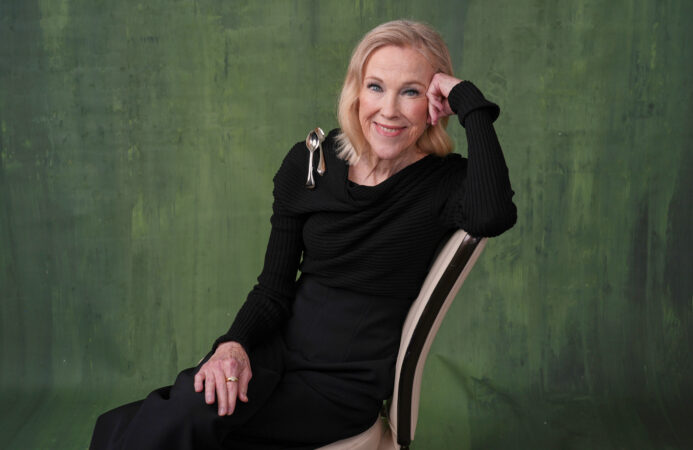
LOS ANGELES — Catherine O’Hara, a gifted Canadian-born comic actor and SCTV alum who starred as Macaulay Culkin’s harried mother in two Home Alone movies and won an Emmy as the dramatically ditzy wealthy matriarch Moira Rose in Schitt’s Creek, died Friday. She was 71.
Ms. O’Hara died at her home in Los Angeles “following a brief illness,” according to a statement from her representatives at Creative Artists Agency. Further details were not immediately available.
Ms. O’Hara’s career was launched with the Second City comedy group in Toronto in the 1970s. It was there that she first worked with Eugene Levy, who would become a lifelong collaborator — and her Schitt’s Creek costar. The two would be among the original cast of the sketch show SCTV, short for “Second City Television.” The series, which began on Canadian TV in the 1970s and aired on NBC in the U.S., spawned a legendary group of esoteric comedians that Ms. O’Hara would work with often, including Martin Short, John Candy, Andrea Martin, Rick Moranis, and Joe Flaherty.
Ms. O’Hara would win her first Emmy for her writing on the show.
Eugene Levy (from left), Annie Murphy, Daniel Levy, and Catherine O’Hara, cast members in the series “Schitt’s Creek,” pose for a 2018 portrait.
Her second, for best actress in a comedy series, came four decades later, for Schitt’s Creek, a career-capping triumph and the perfect personification of her comic talents. The small CBC series created by Levy and his son, Dan, about a wealthy family forced to live in a tiny town would dominate the Emmys in its sixth and final season. It brought Ms. O’Hara, always a beloved figure, a new generation of fans and put her at the center of cultural attention.
She told the Associated Press that she pictured Moira, a former soap opera star, as someone who had married rich and wanted to “remind everyone that (she was) special, too.” With an exaggerated Mid-Atlantic accent and obscure vocabulary, Moira spoke unlike anyone else, using words like “frippet,” “pettifogging” and “unasinous,” to show her desire to be different, Ms. O’Hara said. To perfect Moira’s voice, Ms. O’Hara would pore through old vocabulary books, “Moira-izing” the dialogue even further than what was already written.
Ms. O’Hara also won a Golden Globe and two SAG Awards for the role.
At first, Hollywood didn’t entirely know what to do with Ms. O’Hara and her scattershot style. She played oddball supporting characters in Martin Scorsese’s 1985 After Hours and Tim Burton’s 1988 Beetlejuice — a role she would reprise in the 2024 sequel.
She played it mostly straight as a horrified mother who accidentally abandoned her child in the two Home Alone movies. The films were among the biggest box office earners of the early 1990s and their Christmas setting made them TV perennials. They allowed her moments of unironic warmth that she didn’t get often.
“Mama, I thought we had time,” Culkin said on Instagram alongside an image from Home Alone and a recent recreation of the same pose. “I wanted more. I wanted to sit in a chair next to you. I heard you. But I had so much more to say. I love you.”
Meryl Streep, who worked with O’Hara in Heartburn, said in a statement that she “brought love and light to our world, through whipsmart compassion for the collection of eccentrics she portrayed.”
Roles in big Hollywood films didn’t follow Home Alone, but Ms. O’Hara would find her groove with the crew of improv pros brought together by Christopher Guest for a series of mockumentaries that began with 1996’s Waiting for Guffman and continued with 2000’s Best in Show, 2003’s A Mighty Wind, and 2006’s For Your Consideration.
Best in Show was the biggest hit and best-remembered film of the series. She and Levy play married couple Gerry and Cookie Fleck, who take their Norwich terrier to a dog show and constantly run into Cookie’s former lovers along the way.
“I am devastated,” Guest said in a statement to the AP. “We have lost one of the comic giants of our age.”
Born and raised in Toronto, Ms. O’Hara was the sixth of seven children in a Catholic family of Irish descent. She graduated from Burnhamthorpe Collegiate Institute, an alternative high school. She joined Second City in her early 20s, as an understudy to Gilda Radner before Radner left for Saturday Night Live. (Ms. O’Hara would briefly be hired for “SNL” but quit before appearing on air.)
Nearly 50 years later, her final roles would be as Seth Rogen’s reluctant executive mentor and freelance fixer on The Studio and a dramatic turn as therapist to Pedro Pascal and other dystopia survivors on HBO’s The Last of Us. Both earned her Emmy nominations. She would get 10 in her career.
“Oh, genius to be near you,” Pascal said on Instagram. “Eternally grateful. There is less light in my world.”
Earlier this month, Rogen shared a photo on Instagram of him and Ms. O’Hara shooting the second season of “The Studio.”
She is survived by her husband, Bo Welch, a production designer and director who was born in Yardley; sons Matthew and Luke; and siblings Michael O’Hara, Mary Margaret O’Hara, Maureen Jolley, Marcus O‘Hara, Tom O’Hara, and Patricia Wallice.
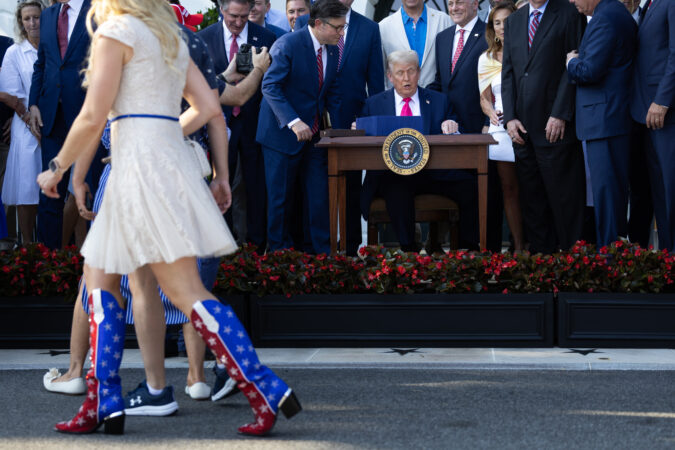
More than 4 million SNAP recipients nationwide — including 1 million children — began losing benefits throughout January as new rules included in the Trump administration’s so-called “One Big, Beautiful Bill Act” started kicking in.
In Pennsylvania, around 144,000 of the nearly 2 million people on SNAP are being affected, or will soon be, according to state Department of Human Services figures. Some will lose all benefits, while others will have their benefits substantially reduced based on the law, which was signed by President Donald Trump on July 4.
Around 45,000 Philadelphia residents are being affected, more than any other county in the state, DHS figures show.
Throughout the region, the number of people affected include around 3,300 in Bucks County, 1,000 in Chester County, 5,700 in Delaware County, and 2,300 in Montgomery County, DHS figures show.
“This is all happening right now, with a huge impact on the state,” said Lydia Gottesfeld, a SNAP expert at Community Legal Services, which provides legal help to low-income individuals in Philadelphia.
More people are expected to lose benefits throughout the year, according to Katie Bergh, senior policy analyst at the left-leaning Center on Budget and Policy Priorities.
Driving the SNAP reductions are a complex set of changes.
Until Trump’s spending plan rewrote the rules, groups of low-income people in states including Pennsylvania were exempt from a long-standing requirement that childless adults without disabilities and under the age of 54 work 20 hours per week in order to be eligible for SNAP benefits, which are typically $6 a per person, per day.
The work stipulation had been waived for decades because of high levels of poverty and hunger, as well as diminished job opportunities in Philadelphia and elsewhere in the Commonwealth.
Under the new policy, childless, able-bodied adults can only be exempt from the work requirements in areas with at least 10% unemployment. In November, Philadelphia’s unemployment rate was 4.8% and other areas in the region saw similar or lower rates.
“An unemployment rate of 10% is a catastrophic threshold not normally reached in Pennsylvania,” Bergh said.
Beginning in March, more people will begin to lose benefits, according to the Food Research and Action Council (FRAC) in Washington, D.C., the largest anti-hunger lobby in the nation.
The One Big Beautiful Bill Act also expanded the age range for people who are required to work at least 20 hours to obtain benefits. Prior to the law, anyone who reached age 55 could access SNAP benefits without a work requirement. Now, however, a person must work the required hours until they’re 64 before they’re free of the requirement.
Previously, adults with children 18 and under were exempt from the work requirement. Now, only adults with children under 14 are exempt.
And yet another group of people will begin to lose benefits, according to the Food Research and Action Council (FRAC) in Washington, D.C., the largest anti-hunger lobby in the nation.
That group includes veterans, people experiencing homelessness, and young people aging out of foster care, who will all become subject to the 20-hour work requirement they had previously been exempted from, according to FRAC.
Because so many changes are occurring at once, it’s hard to keep track of how individuals are faring, Gottesfeld of CLS said.
“We’re still trying to see who the people are who are losing benefits,” she said. “We don’t have a good summary of the changes just yet.”
Even as a child, Dan McQuade let his imagination run wild. “What are you doing?” his mother, Denise, would ask if she hadn’t heard any noise from his bedroom for a while. “I’m making stories,” he would reply.
Later, as a young man about town, his compassion for fellow Philadelphians inspired his father, Drew. Dan volunteered to give blood often, donated brand-new sneakers to other guys in need, and continually reached out to people he saw struggling with drug abuse and homelessness. “His kindness was what I loved about him the most,” his father said.
Dan McQuade was already an award-winning writer, blogger, and journalist when he met his future wife, Jan Cohen, online in 2014. To her, his jovial humor, wide-ranging intelligence, and shoulder-length hair made him unique in her circle. “I thought he was too cool for me,” she said.
His empathy, likely inspired by his parents, his wife said, led him to toil tirelessly for charitable nonprofits such as the Everywhere Project, Back on My Feet, and Prevention Point. “Service was always part of his life,” his wife said.
His coolness, as unconventional as it sometimes was, made those he encountered feel cool, too. Molly Eichel, an Inquirer editor and longtime friend, said: “He was annoyingly smart and incredibly kind.”
Dan McQuade died Wednesday, Jan. 28, of neuroendocrine cancer at his parents’ home in Bensalem. He was 43. His birthday was Jan. 27.
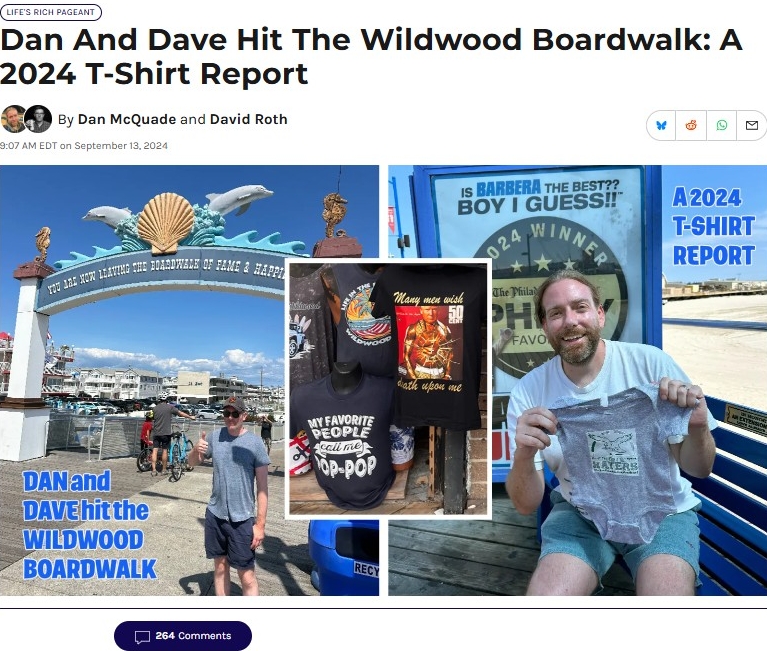
Mr. McQuade’s annual Wildwood T-shirt report was a favorite of his many readers and fans.
“It’s incredibly hard for me to imagine living in a Philadelphia without Dan McQuade,” said Erica Palan, an Inquirer editor and another of Mr. McQuade’s many longtime friends. “He understood Philadelphians better than anyone because he was one: quirky and funny, competitive and humble, loyal and kind.”
A journalism star at the University of Pennsylvania in the early 2000s, Mr. McQuade was a writer, sports editor, and columnist for the school’s Daily Pennsylvanian, and managing editor of its 34th Street Magazine. He earned two Keystone Press awards at Penn, was the Daily Pennsylvanian’s editor of the year in 2002, and won the 2003 college sports writing award from the Philadelphia Sportswriters Association.
He went on to create Philadelphia Weekly’s first blog, “Philadelphia Will Do,” and was a finalist for the Association of Alternative Newsmedia’s best blogger award. He served an internship at the Bucks County Courier Times in Levittown and worked for a while at the Northeast News Gleaner.
Often irreverent, always inventive, he filed thousands of notable stories about, among other things, the Wildwood T-shirt scene, the origin of “Go Birds,” sneaker sales, Donald Trump, Wawa hoagies, the Philly accent, parkway rest stops, the Gallery mall, soap box derbies, and Super Bowls. His stories sparkled with research and humor.
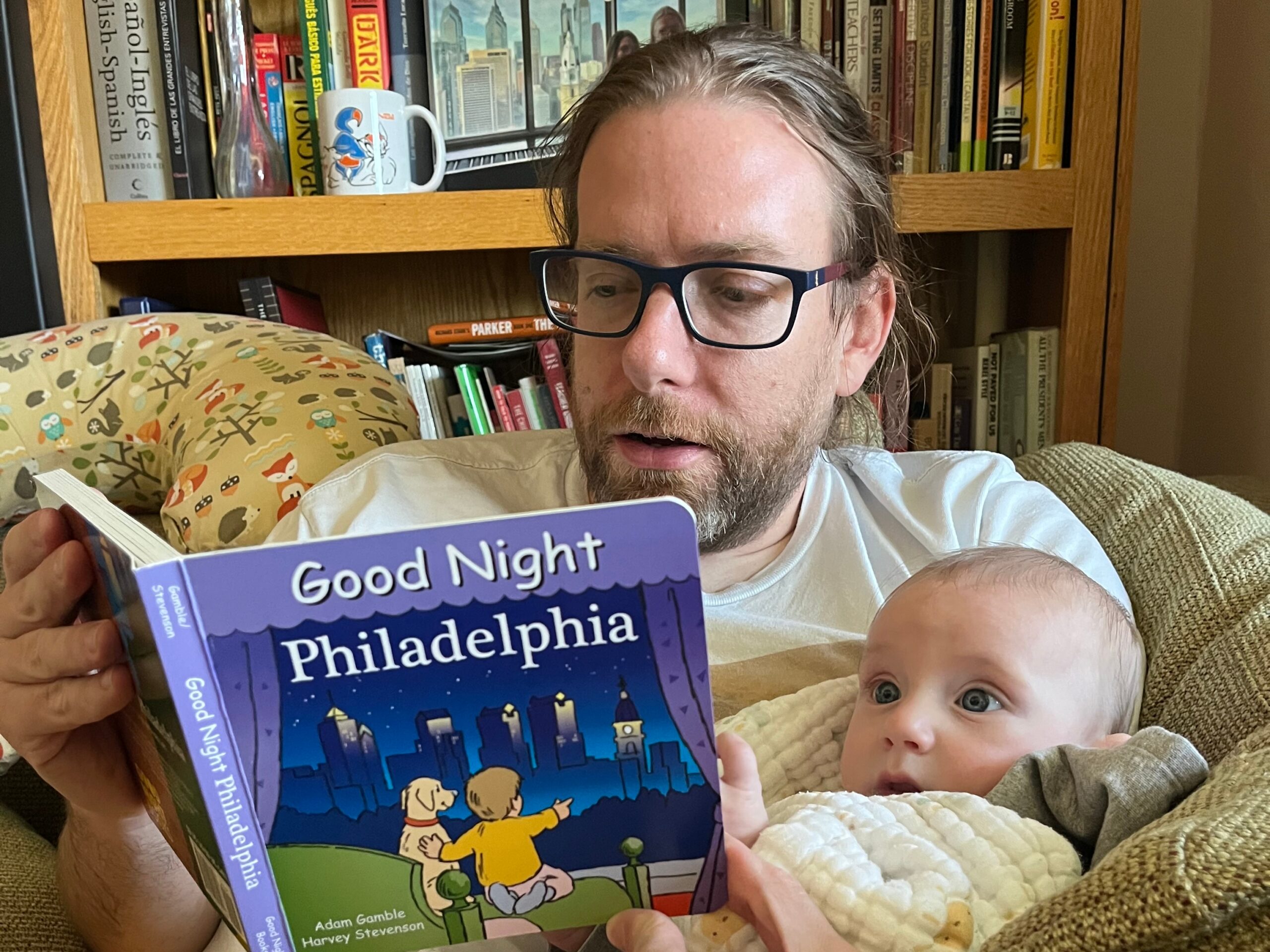
An avid reader himself, Mr. McQuade enjoyed reading local tales to his son, Simon.
“Dan was a truly authentic and engaging person,” Tom Ley, editor-in-chief at Defector, said in an online tribute. “His curiosity was relentless, and his interests were varied and idiosyncratic.”
For example, Mr. McQuade wrote in Philadelphia Magazine in 2013 that Sylvester Stallone’s famous training-run montage in Rocky II — it started in South Philly and ended two minutes of screen time later atop the Art Museum steps — actually showed city scenes that would have had the actor/boxer run more than 30 miles around town. “Rocky almost did a 50K,” Mr. McQuade wrote. “No wonder he won the rematch against Apollo!”
In 2014, he wrote in Philadelphia Magazine about comedian Hannibal Buress calling Bill Cosby a rapist onstage at the old Trocadero. The story went viral, and the ensuing publicity spurred more accusations and court cases that eventually sent Cosby to jail for a time.
When he was 13, Mr. McQuade wrote a letter to the editor of the Daily News that suggested combining the Mummers Parade with Spain’s running of the bulls. Crossing Broad’s Kevin Kinkead said he had “an innate gift for turning the most random things into engaging reads.”
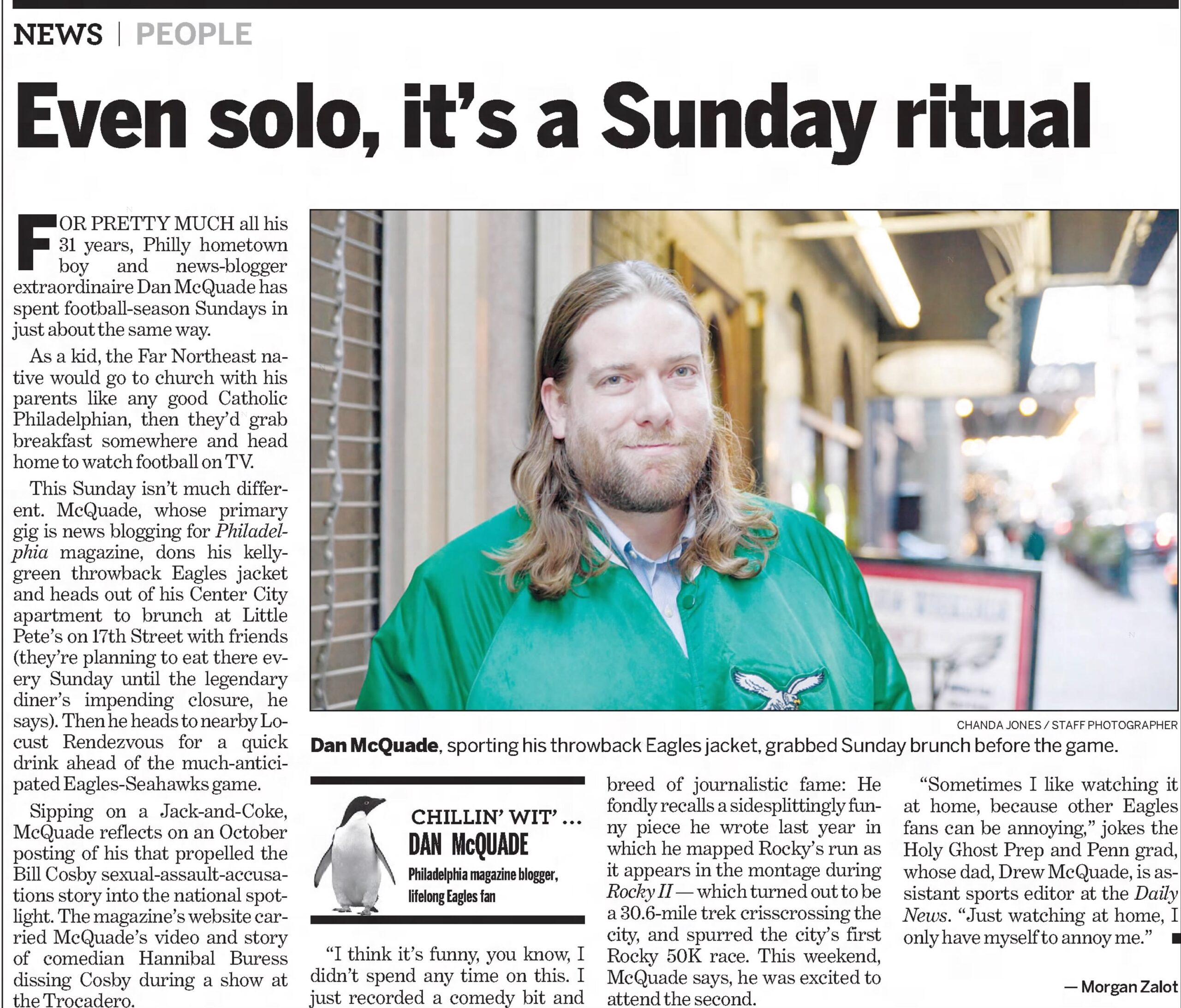
This story about Mr. McQuade appeared in the Daily News in 2014.
“Without Dan’s voice, Philly Mag wouldn’t be Philly Mag,” editor and writer Brian Howard said in a tribute on phillymag.com. “And, I’d argue, Philadelphia wouldn’t quite be Philadelphia.”
Other colleagues called him “a legend,” “a Philadelphia institution,” and “the de facto mayor of Philadelphia” in online tributes. Homages to him were held before recent Flyers and 76ers games.
“Sometimes,” his wife said, “he inserted himself into stories, so readers had a real sense of who he was because he was so authentic.”
Daniel Hall McQuade was born Jan. 27, 1983, in Philadelphia. His father worked nights at the Daily News for years, and the two spent many days together when he was young hanging around playgrounds and skipping stones across the creek in Pennypack Park.
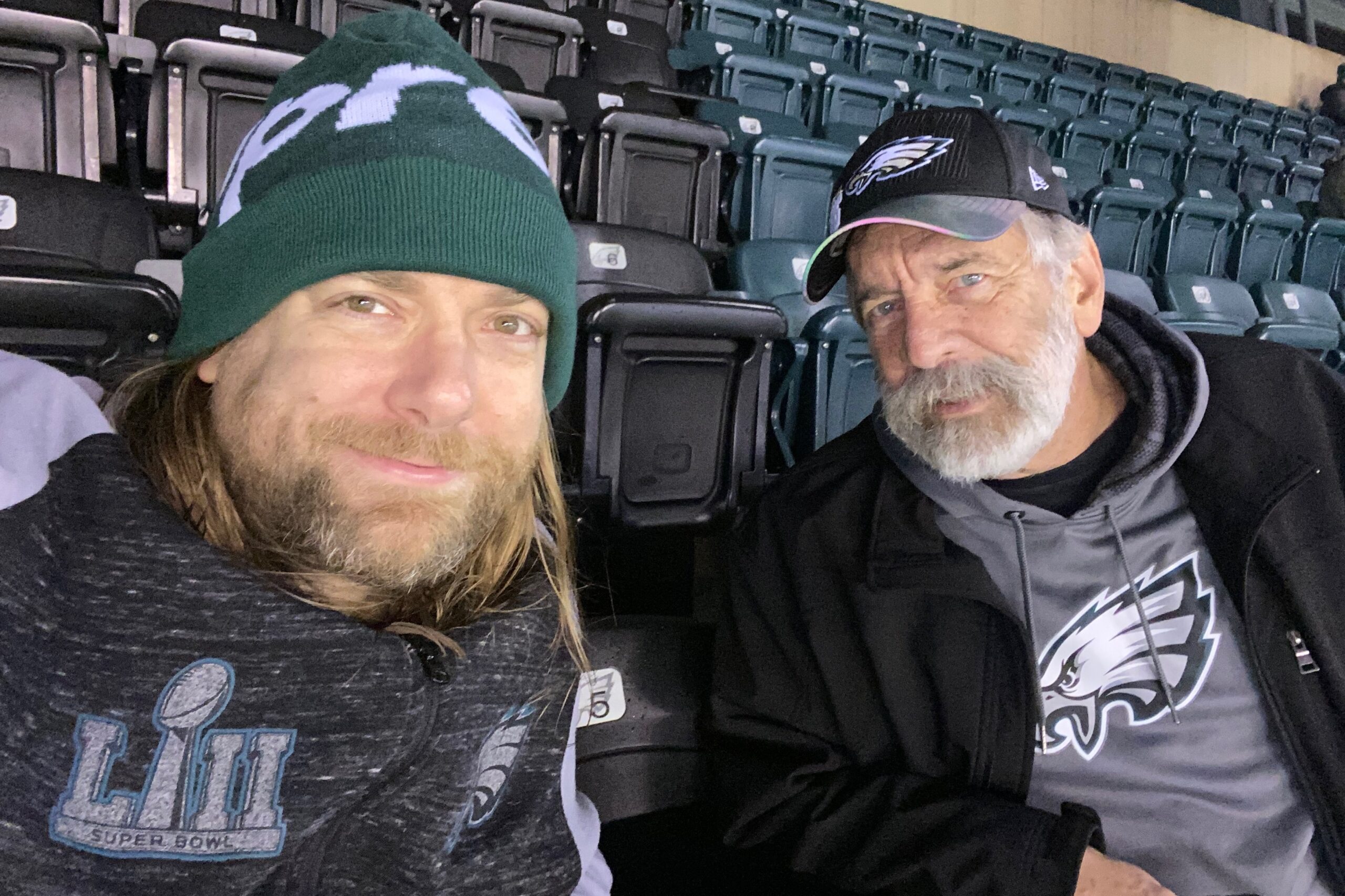
Mr. McQuade (left) and his father, Drew, shared a love of Philly sports and creative writing.
Later, they texted daily about whatever came to mind and bonded at concerts, Eagles games, and the Penn Relays. He grew up in the Northeast, graduated with honors from Holy Ghost Preparatory School in Bensalem, and earned a bachelor’s degree in English at Penn in 2004.
He overcame a serious stutter as a teen and played soccer and basketball, and ran cross-country and track at Holy Ghost. He married Jan Cohen in 2019 and they had a son, Simon, in 2023. They live in Wissahickon.
Mr. McQuade was a voracious reader and an attentive listener. “He never wanted to stop learning,” his wife said. He enjoyed going to 76ers games with his mother and shopping for things, his father said, “they didn’t need.”
He was mesmerized by malls, the movie Mannequin, the TV series Baywatch, and his wife’s cat, Detective John Munch. During the pandemic, he and his wife binged all 11 seasons of Baywatch.
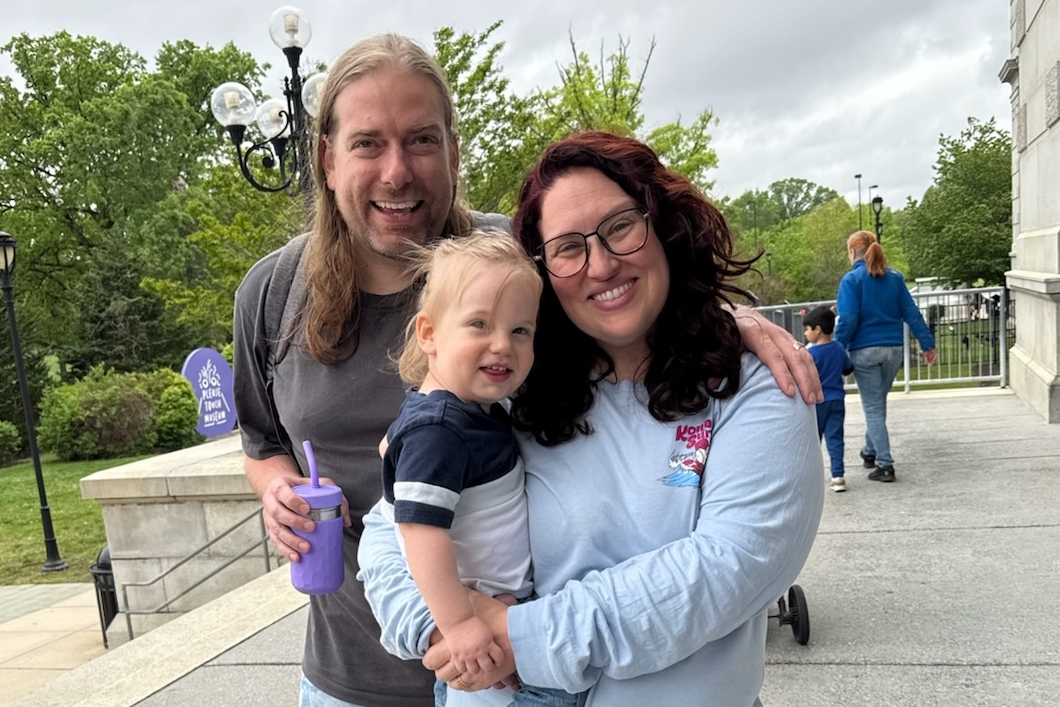
Mr. McQuade doted on his wife, Jan, and their son, Simon.
He could be loud, his mother said, and Molly Eichel described his laugh as “kind of a honk.” His friend and colleague Alli Katz said: “In 50 years I’ll forget my own name. But I’ll remember his laugh.”
He was a vintage bootleg T-shirt fashionista, and his personal collection numbered around 150. He named Oscar’s Tavern on Sansom Street as his favorite bar in a recent podcast interview and said he would reluctantly pick a pretzel over a cheesesteak if that was the choice.
In September, Mr. McQuade wrote about his illness on Defector.com under the headline “My Life With An Uncommon Cancer.” In that story, he said: “Jan has been everything. My son has been a constant inspiration. My parents are two of my best friends, and I talk to them every day. Jan’s parents have been incredible.”
He also said: “I believe there are no other people on earth with my condition who are in as fortunate a situation. … For the past thousand words you have been reading about a bad break I got, but if only everyone in my position had it this good.”
Mr. McQuade and his wife, Jan Cohen, married in 2019.
His wife said: “He was truly the best guy.”
In addition to his wife, son, and parents, Mr. McQuade is survived by his mother-in-law, Cheryl Cohen, and other relatives.
Visitation with the family is to be from 9 to 10 a.m. Thursday, Feb. 5, at St. Martha Parish, 11301 Academy Rd., Philadelphia, Pa. 19154. Mass is to follow from 10 to 11 a.m.
Donations in his name may be made to the Everywhere Project, 1733 McKean St., Philadelphia, Pa. 19145.
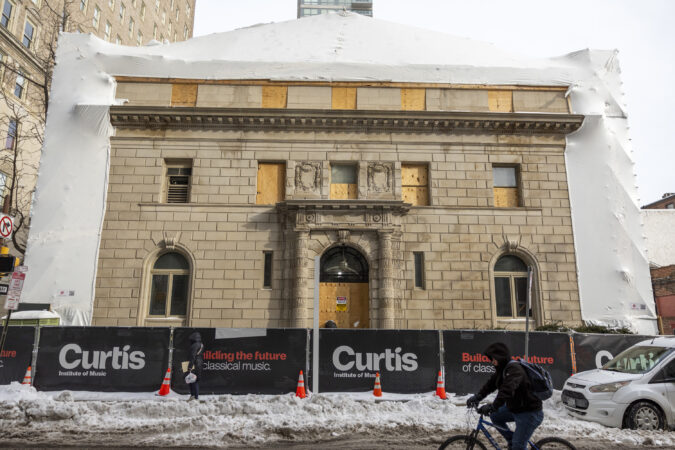
A temporary shrink-wrap covering has been draped over the Art Alliance building as damage is being assessed. The Curtis Institute of Music, which owns the historic, jewel-box structure on the southeast edge of Rittenhouse Square, is in the early stages of dreaming about the building’s eventual use.
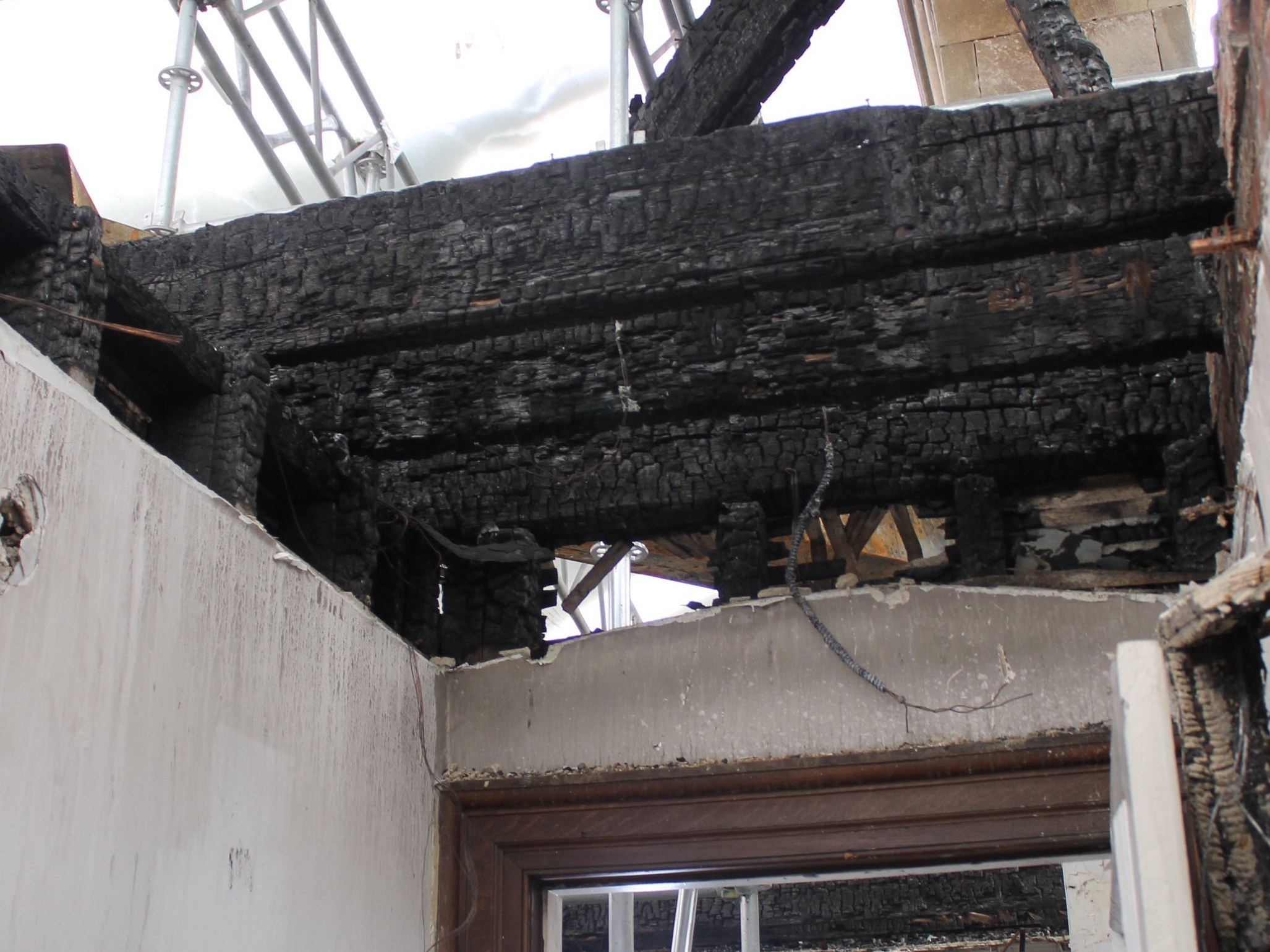
Curtis had only recently taken over the Art Alliance, when, in the early hours of July 4, a blaze broke out that took more than 120 firefighters to extinguish. The building’s roof was largely destroyed, and other portions of the building were severely damaged by fire, smoke, and water.
The fire marshal categorized the cause of the fire as undetermined, and Curtis isn’t expecting to ever arrive at an answer.
“We haven’t thought much about it in a few months because it just hasn’t come up,” said Curtis chief financial officer Chris Dwyer, who is overseeing the building rehabilitation process. “What I’m concluding is that the damage is so bad that there’s no answer with a capital A.”
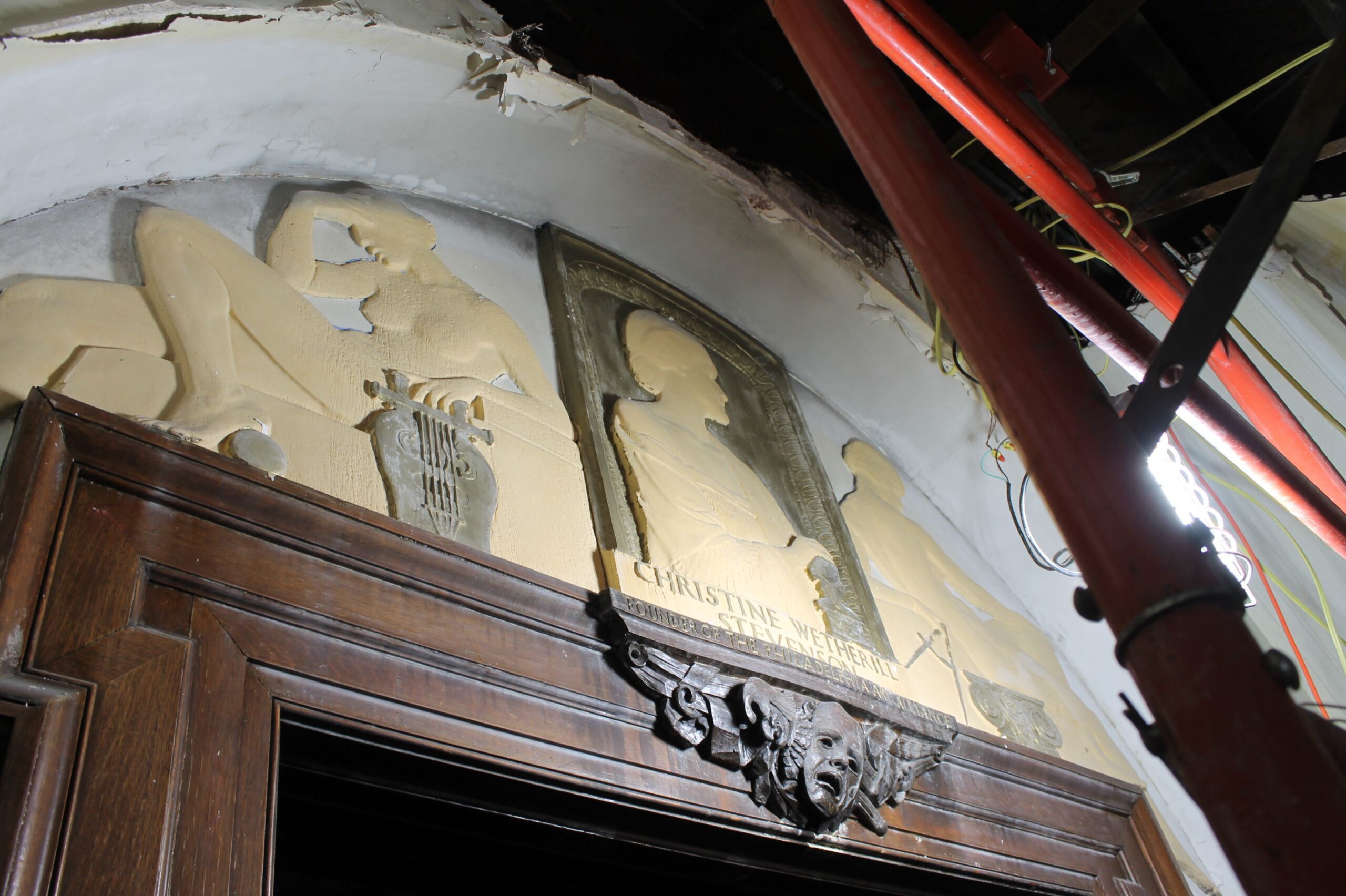
At the Art Alliance building on Rittenhouse Square, a detail of a memorial to Alliance founder Christine Wetherill Stevenson, on the first floor, Jan. 27, 2026. The building, owned by the Curtis Institute of Music, was damaged in a fire early on the morning of July 4, 2025.
At the time of the fire, Curtis was overseeing modest repairs and cleaning and transferring archival materials from the building to other institutions, with an eye toward being able to host a few small community gatherings, a school spokesperson said.
A full damage assessment is due shortly, and while it’s already clear that some historic elements of the interior survived, it is not yet known whether others were lost.
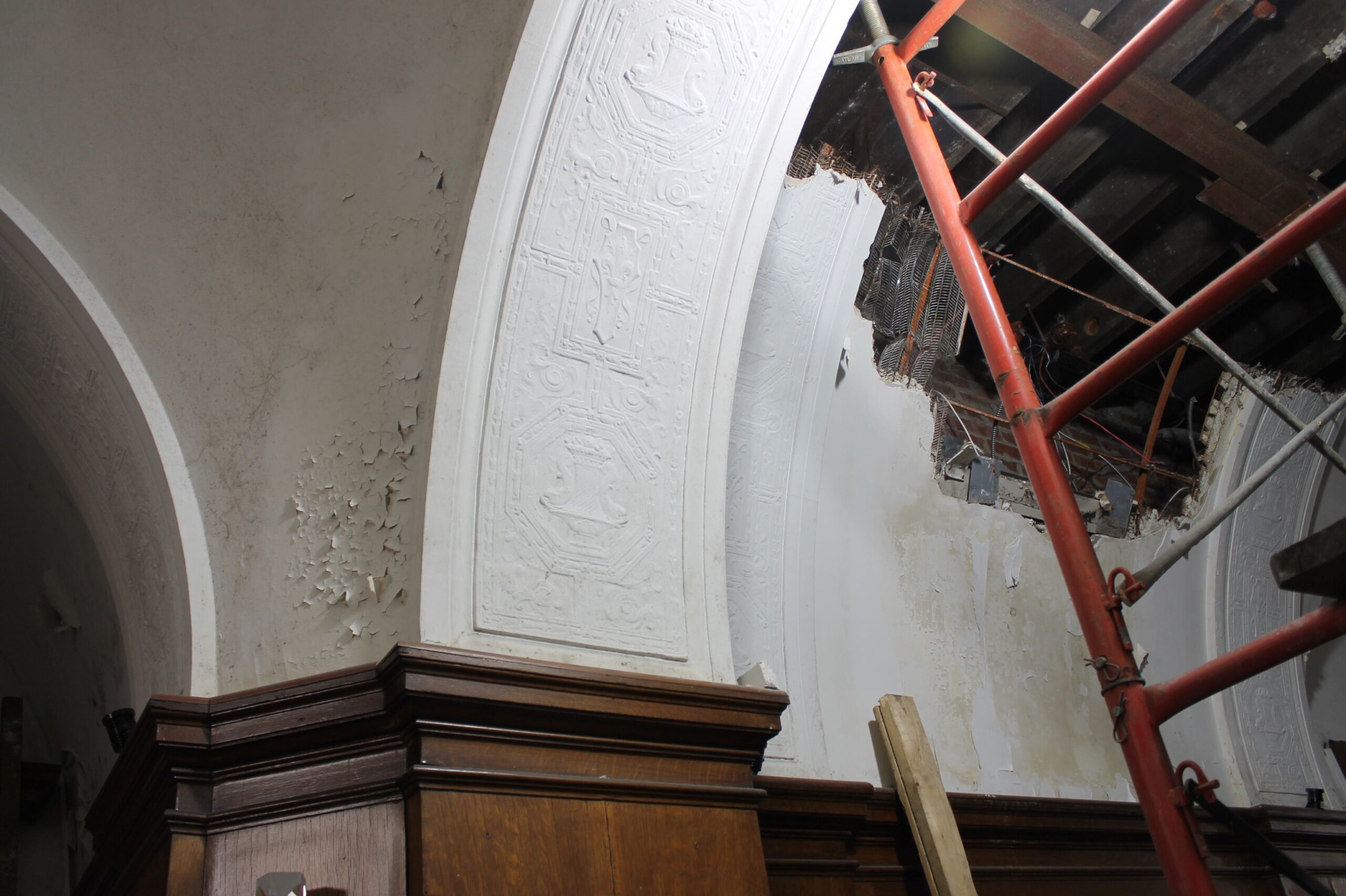
“The whole front of the building is more intact than you might have thought, but [there is] definitely a lot of water and smoke damage,” Dwyer said. “But things like the staircase is still there, the stained glass window [on the south side] is essentially intact.”
Curtis aims to incorporate the surviving historic elements into the design of a rehabilitated building, he said.
What exactly the renowned music conservatory will use the 15,000-square-foot building for is an open question at the moment.
“We’re definitely constrained as far as teaching space, rehearsal space, performance space, and places to welcome the community,” said Dwyer.
Looking through charred timbers and a destroyed section of the attic and roof to the underside of the shrink-wrap covering over the Art Alliance building, Jan. 27, 2026.
The fire has left the configuration of the building slightly changed. The third floor included an attic that was destroyed by the fire, which raises the possibility that a reconstructed third floor will offer higher ceilings than before.
VSBA Architects and Planners has been engaged to assess damage and develop some preliminary concepts for eventual reuse. The firm designed Curtis’ nearby Lenfest Hall on Locust Street, and has a long track record in historic preservation work.
Though reuse plans are still developing, some public-use element seems likely, Dwyer said.
“We’d love for the building to be used year-round. We’d be open to partnerships and rentals and maybe some new imaginative public programming. So it’s definitely on our minds that it would be public and in some way, shape, or form.”
A detail on the first floor of the Art Alliance building on Rittenhouse Square shows some historic elements saved, others damaged, Jan. 27, 2026.
A timeline is far from certain, but if various elements fell into place quickly enough, the building — which was built in 1906 — could reopen by summer or fall of 2028, leaders say.
Curtis is aware of the place the Art Alliance holds in the hearts of many — “of all the nostalgia and the memories of the building that folks in the community cherish,” said Dwyer. “I was at a wedding there in the late ’90s. It seems like everyone has been in that building at least once.”
It has a “pretty special character that we think is possible to bring back.”
Curtis conducted a special fundraising campaign to acquire the building for $7.6 million from the bankruptcy estate of the University of the Arts. The conservatory and its insurance company are working toward arriving at a payout for the damage, but Curtis may want to do more to the building than simply what the insurance would cover.
That would mean more fundraising.
“It’s hard to see how we wouldn’t need to raise funds,” said Dwyer.