Born in a puppy mill in Peach Bottom, Lancaster County, Oscar suffered from “failure to thrive,” his breeder said.
By the time the breeder turned the 6-week-old toy poodle over to Phoenix Animal Rescue in Chester County, Oscar weighed just 7 ounces, according to Marta Gambone, a coordinator at the all-volunteer organization.
“But one of our volunteers was able to turn him around, from this scraggly little hamster to this wonderful Puppy Bowl player,” Gambone said.
When Oscar, a toy poodle, was rescued from a puppy mill in Lancaster County, he weighed just 7 ounces. After being nursed back to health, he’s playing in the 2026 Puppy Bowl.
After being nursed back to health, Oscar traveled to Glens Falls, N.Y., to participate in the October 2025 taping of the 22nd annual Puppy Bowl, which airs today before the Super Bowl.
Gambone said the annual event has become a wonderful way to raise awareness for animal rescues across the United States. Every one of the 150 dogs in the competition — between Team Ruff and Team Fluff — comes from a rescue.
Oscar, a toy poodle nursed back to health in Chester County, is one of this year’s Puppy Bowl stars.
Oscar, now 8 months old, has developed into a playful, social, and upbeat young dog who has found a loving home, Gambone said.
Oscar is one of six puppies from Phoenix Animal Rescue in the annual TV special this year, Gambone said. Jill, an 8-month-old Cavalier, was suffering from a hernia when she was turned over by a breeder in New Holland, Lancaster County.
The rescue also has four dogs participating in this year’s first-ever “Oldies vs. Goldies” senior dogs’ competition: Tiki, a Shiba Inu; Starlight, a Jack Russell terrier; Daisy, a Pomeranian; and Emmie, a Maltese mix.
Tiki, a Shiba Inu, is in this year’s “Oldies vs. Goldies” senior dog competition.
They all came from breeders in Lancaster County and were in need of care, Gambone said, “and now they’re all playing on a national stage, and getting lots of attention, and finding their forever homes.”
Though all of this year’s stars have since been adopted, Gambone noted that the rescue gets about a dozen dogs per week, across a wide variety of breeds and mixes.
“Anybody looking can find what they’re looking for if they have a little patience,” she said.
Carrie Pawshaw sits for a portrait. Pawshaw, a rescue dog from the Pittsburgh region, competed in the 2026 Puppy Bowl.
Across the state in Springdale, Allegheny County, Jacqueline Armour said it’s the third year that some of her rescue dogs are playing in the Puppy Bowl.
She founded Paws Across Pittsburgh, a rescue that places dogs with foster parents until they find permanent homes. The dogs come from owners and shelters from as far away as West Virginia, Kentucky, and Ohio.
This year, a playful Jack Russell mix named Meeko is their star, along with a Norwegian elkhound and American Eskimo dog mix named for Sarah Jessica Parker’s character in the TV show Sex and the City.
“They pick some of them and rename them,” Armour explained, “so initially I thought they were going to call her Sarah Jessica Barker. And then they said Carrie Pawshaw.”
Armour noted that, because her organization uses foster homes, their puppies are already learning how to live in a home — getting house-trained and crate-trained, and learning how to get along with children and other pets. This also gives volunteers a chance to see the dogs’ personalities, which can be helpful in matching a dog with an owner.
Both Armour and Gambone emphasized that rescue operations offer a variety of ways for volunteers to help out.
For those who’ve never owned a dog, Armour said the experience can be profound. The medical community consensus is that having a dog can help people get more exercise, improve mental health, and lower blood pressure, and can help children learn how to properly treat an animal.
In Chester County, Gambone said she’s seen firsthand how dogs can add vitality to someone’s life.
“They help with loneliness, and on the physical side, they help people stay more active,” she said. “We have so many senior citizens coming to us saying, ‘I just need something — something to love.’ And it changes their lives.”
Bad Bunny vows to protest with love. Bruce Springsteen has opted for a more confrontational approach.
Both are part of a growing wave of pop-music dissent aimed at what critics see as overreach by the Trump administration’s Department of Homeland Security — actions in Minneapolis that have been linked to the deaths of two American citizens during encounters with U.S. Immigration and Customs Enforcement agents.
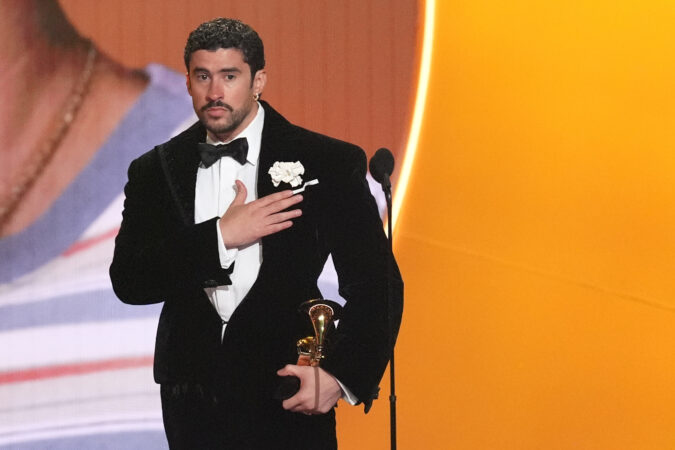
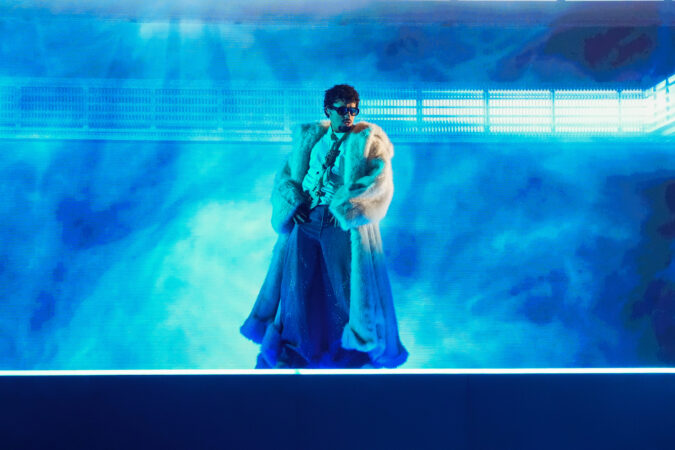
Bad Bunny, the Puerto Rican superstar known as the King of Latin Trap, was the world’s most-streamed pop music maker in 2025. The rapper-singer-producer, whose full name is Benito Antonio Martínez Ocasio, has a massive platform to air his grievances if he chooses, serving as the half-time show headliner at Super Bowl LX on Sunday.
This year’s half-time show is likely to surpass Kendrick Lamar’s 2025 performance, which drew 113.5 million viewers as the most-watched in history.
Those critics include President Donald Trump. “I’m anti-them. I think it’s a terrible choice. All it does is sow hatred. Terrible,” he said last month, referring to Bad Bunny and Green Day, who will play a pregame concert during NBC’s broadcast. The clash between the Seattle Seahawks and New England Patriots will also stream on Peacock.
Bad Bunny haters have an alternative: Kid Rock, whose 5 million monthly Spotify listeners is dwarfed by Bad Bunny’s 87 million, will top the bill on Turning Point USA’s All-American Halftime Show, shown on TPUSA’s YouTube page and conservative media outlets. Country singers Brantley Gilbert, Lee Brice, and Gabby Barrett will also perform.
Will Bad Bunny’s performance be a virulent attack on the Trump administration’s immigration policy?
That remains to be seen. But the speech he gave at the Grammys last weekend, after winning best música urbana album for Debí Tirar Más Foto — which also became the first Spanish-language album of the year winner — suggests a more subtle expression of Puerto Rican pride that emphasizes the humanity of demonized brown-skinned immigrants.
Speaking in English, Bad Bunny thanked God, said “ICE Out,” then continued: “We’re not savages, we’re not animals, we’re not aliens. We are humans and we are Americans.” (As a Puerto Rican native, Bad Bunny is an American citizen unlike recent MAGA convert Nicki Minaj, who was born in Trinidad and Tobago.)
“Hate gets more powerful with more hate. The only thing that is more powerful than hate is love. We need to be different. If we want to fight, we have to do it with love.”
Bad Bunny’s speech was one of many gestures opposing ICE at the Grammys, from Bon Iver’s Justin Vernon wearing a whistle on his lapel to Billie Eilish criticizing anti-immigrant voices with a terse line: “Nobody is illegal on stolen land.”
Olivia Dean, the British singer who won best new artist, said: “I’m up here as a granddaughter of an immigrant. I’m a product of bravery, and I think those people deserve to be celebrated.”
But the Grammys didn’t include any overtly political new music. A rumor that Springsteen would open the show with “Streets of Minneapolis” proved unfounded. Springsteen wrote the new anti-ICE broadside the day protester Alex Pretti was killed by federal agents.
But Springsteen’s protest song leads the way in a trend toward musicians opposing the Trump administration in song, in many cases consciously connecting with a tradition that reaches back to Woody Guthrie, Peter Seeger, Bob Dylan, and the Civil Rights protest of the 1960s.
In “Street of Minneapolis,” Springsteen meets the moment by expressing outrage at the deaths of Renee Good and Pretti, specifically the administration’s initial pronouncements that placed blame on the dead rather than the federal agents.
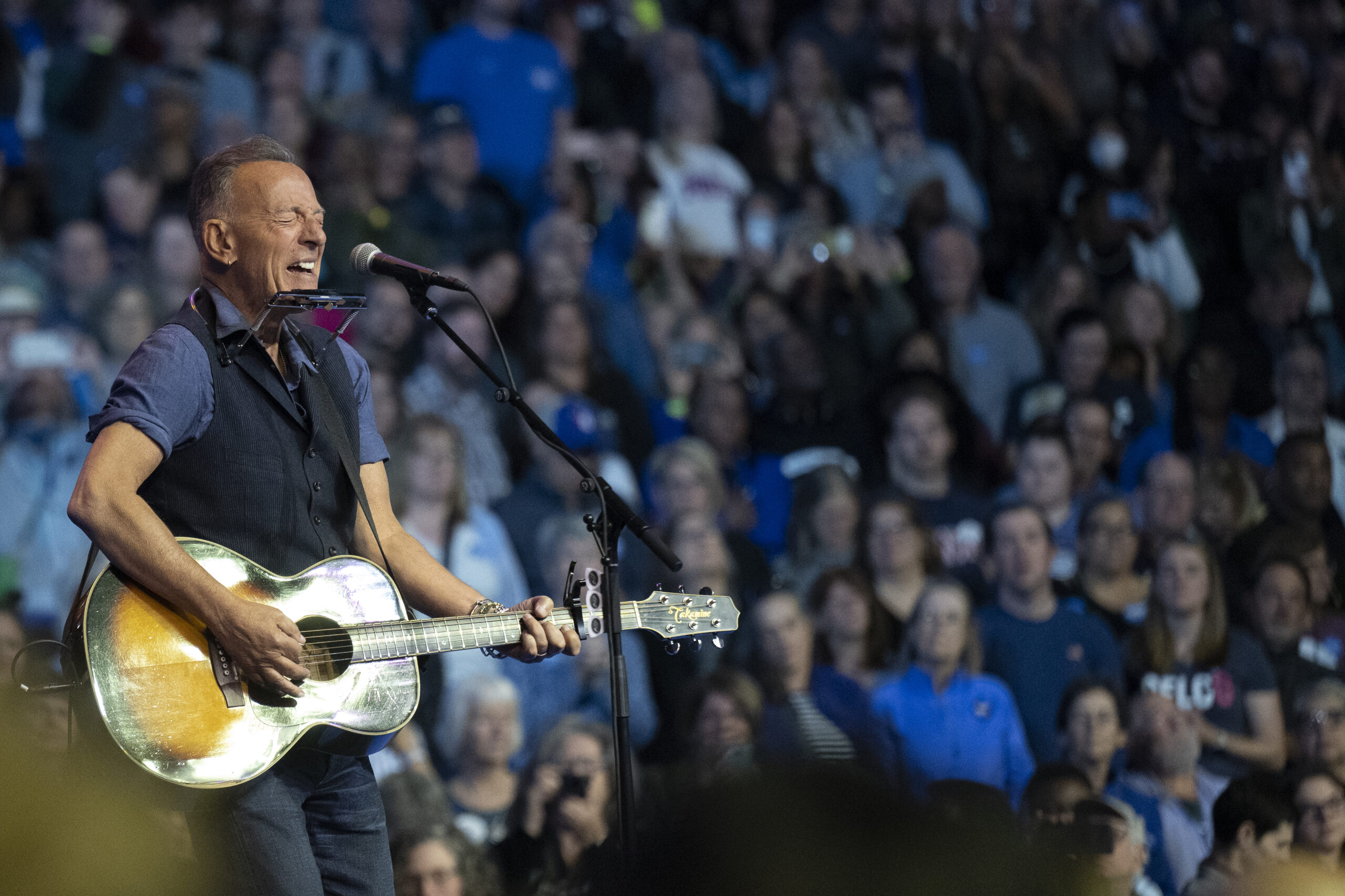
Bruce Springsteen performs Oct. 28, 2024, during a Democratic concert rally at the Liacouras Center at Temple University.
“Their claim was self-defense sir, just don’t believe your eyes,” the Boss sings. “It’s these whistles and phones against Miller and Noem’s dirty lies.”
The song builds to a rousing “ICE out” chorus that’s so unsubtle it even gave the Boss pause.
Performing in Minneapolis last month with rabble-rousing former E Street Band member Tom Morello, Springsteen said he asked the guitarist whether “Streets” was too “soap boxy.” Morello, of Rage Against the Machine, replied: “Nuance is wonderful, but sometimes you have to kick them in the teeth.”
Springsteen, of course, can afford to be aggressively provocative. Not only is he a revered superrich artist at the tail end of his career whose loyal audience is not going anywhere. He’s also a white man whose fans who look like him are not in danger of being detained and deported.
And he has a history of sparring with Trump, whose administration he repeatedly labeled “corrupt, incompetent, and treasonous” on stage in Europe last spring. At the time, Trump responded by calling the Jersey rocker “not a talented guy — Just a pushy, obnoxious JERK.” The president hasn’t responded to “Streets of Minneapolis” as of yet, but loyalist Steve Bannon called Springsteen “fake and gay, as the kids say.”
Springsteen’s singing out will also surely lead to others joining the chorus. And plenty of broadsides have been in the works already.
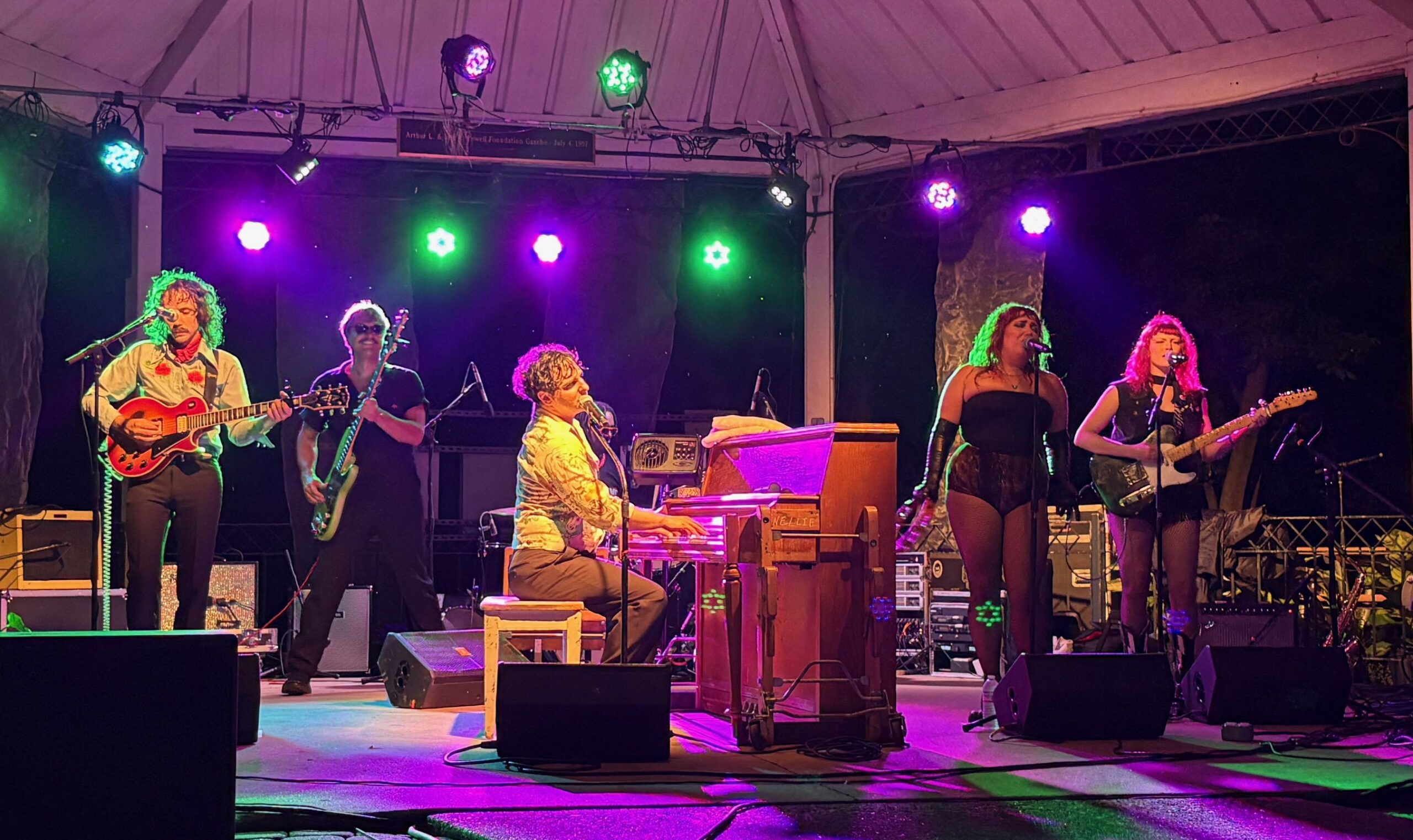
Low Cut Connie at Concerts Under The Stars in King of Prussia on Friday August 1, 2025. Left to right: Rich Stanley, Nick Perri, Adam Weiner, Jarae Lewis (on drums, partially hidden), Amanda “Rocky” Bullwinkel, Kelsey Cork.
Philadelphia’s Adam Weiner of Low Cut Connie has been an outspoken Trump critic, among the first to pull out of a Kennedy Center performance last year.
He’s announced an entire protest album called Livin’ in the U.S.A. Weiner said he made the album “because I am disgusted to see our country descend into an authoritarian hell, a place where art does not lead the cultural conversation.” It arrives timed to the Semiquincentennial on July 3.
The same day that Springsteen released “Streets of Minneapolis,” British folk-punk singer Billy Bragg dropped “City of Heroes,” also written to commemorate Pretti’s death.
Veteran punk rockers are joining in, too, sometimes by rewriting lyrics to old protest songs like Boston band Dropkick Murphys’ “Citizen I.C.E.” — a new version of “Citizen C.I.A.”
The protest isn’t manifest only in topical song writing. In Philly, local events in the indie music scene are aiming to assist immigrants. Juntos, the organization that aids Philadelphia communities affected by ICE, will be the beneficiary of “A Jam Without Borders” at Ortlieb’s on Wednesday, with local musicians Arnetta Johnson, Nazir Ebo, and others.
New generation protest singers include Liberian-born Afro Appalachian singer Mon Rovia, whose buoyant 2025 song “Heavy Foot” remains upbeat as he sings “the government staying on heavy foot / No, they never gonna keep us all down.”
Most prominent in branding himself as a modern folk troubadour is Jesse Welles, whose “No Kings” duet with Joan Baez came out in December.
Welles’ “Join ICE” uses humor as a weapon, with an early Dylan persona. “There’s a hole in my soul that just rages,” he sings. “All the ladies turned me down and I felt like a clown / But will you look at me now, I’m putting people in cages!”
Serious songwriters are likely to continue to pen protest songs as long as scenes of turmoil continue to show up on TV and social media screens.
But high-profile artists worried about alienating their audience aren’t likely to start flooding the zone with anti-ICE screeds if they’re concerned about backlash.
A case in point would be formerly Philadelphian country superstar Zach Bryan. Last October, he released a song snippet of “Bad News” that included the lyrics “ICE is gonna come, bust down your door” and cited “the fading of the red, white and blue.”
The song was met with disdain by the White House. Spokesperson Abigail Jackson said, “Zach Bryan wants to open the gates to criminal illegal aliens and has condemned heroic ICE officers.” DHS secretary Kristi Noem was “extremely disheartened and disappointed.”
Bryan did include the song on his album With Heaven on Top in January, but not before taking great care to explain he wasn’t on one political side or the other.
“Left wing or right wing, we’re all one bird and American,” the Eagles fan said. “To be clear I’m not on either of these radical sides.”
This story first appeared in PA Local, a weekly newsletter by Spotlight PA taking a fresh, positive look at the incredible people, beautiful places, and delicious food of Pennsylvania. Sign up for free here.
If you’ve got coins in your pocket, purse, or wallet, you’re likely carrying around Pennsylvania-created art.
The U.S. Mint produces coins in four cities: Denver, Philadelphia, San Francisco, and West Point, N.Y. But the Philly location — located just a few blocks north of Independence Hall — is the Mint’s hub for engraving, and employs a team of medallic artists who sculpt all the new designs for circulating coins, congressional medals, and collectible pieces.
Yes, sculpt. The images in coins are three-dimensional and extremely detailed despite being only slightly raised.
“There’s a great challenge in making something in relief like this,” said Phebe Hemphill, a medallic artist who has worked at the Mint since 2006. “It’s kind of a weird, fascinating challenge to fit everything into that very, very low space we’re allowed to sculpt.”
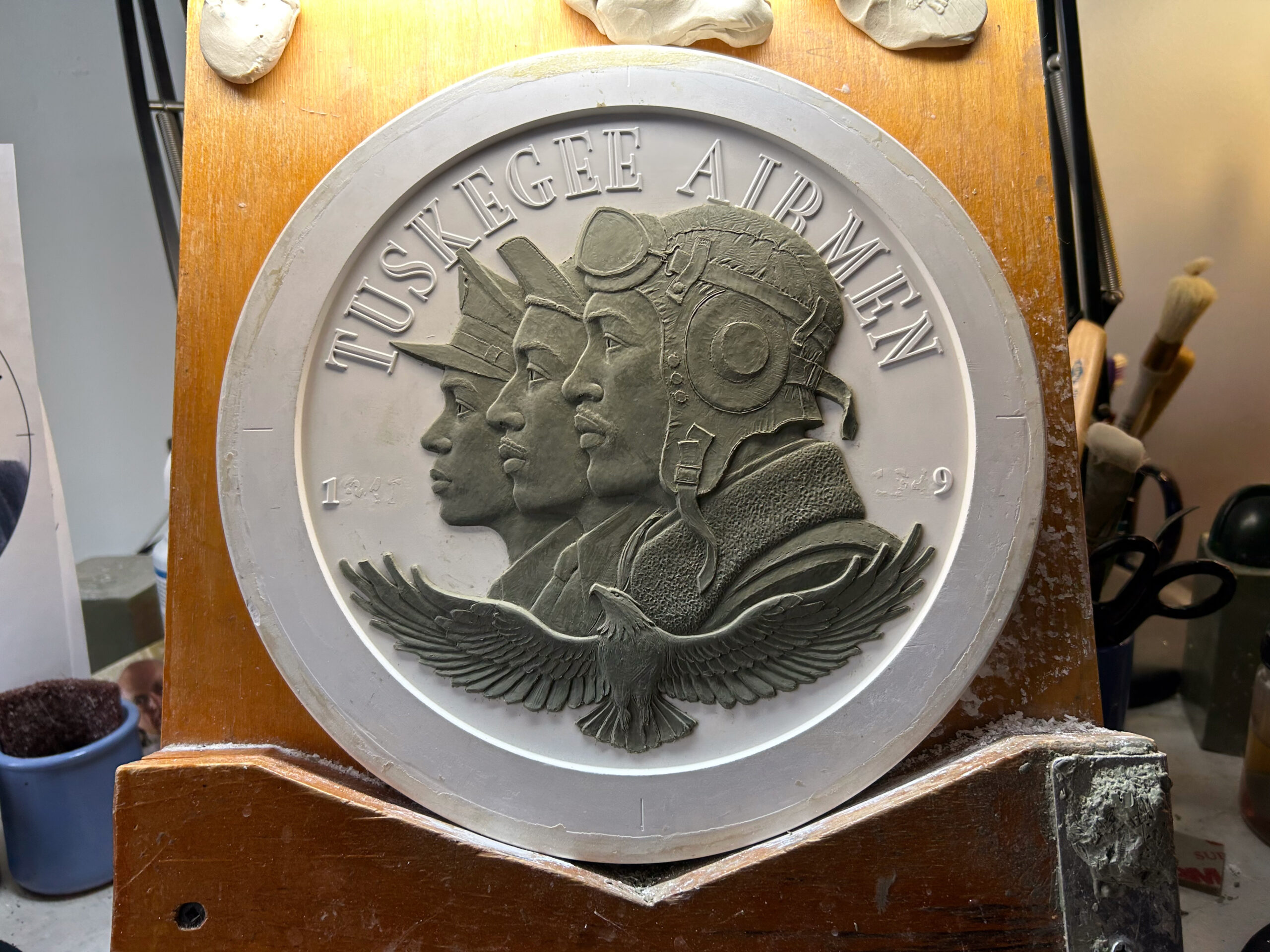
Hemphill, a Pennsylvania Academy of the Fine Arts alumnus originally from West Chester, got some early experience working at the Franklin Mint, a private Delaware County-based company that produces coins and other collectibles. Her design and sculpting credits over her two decades at the U.S. Mint number in the dozens, from a Congressional Gold Medal presented to Tuskegee Airmen to a quarter depicting the Cuban American singer Celia Cruz.
The coin-sculpting process requires many “small technical nuances” to create “the illusion of depth,” said Eric David Custer, another medallic artist at the Mint. While medals allow for a bit more “freedom” because they are larger, he said, coins like quarters are trickier. The sculpted image ends up being about as thick as “two or three human hairs” stacked on top of one another.
Custer, who grew up in Independence Township in Western Pennsylvania, did some of his early engraving work at Wendell August Forge, a Pennsylvania-based artisan metalware company. An alumnus of the Art Institute of Pittsburgh with a degree in industrial design, he joined the Mint in 2008 as a product designer and became a medallic artist in 2021.
Custer and Hemphill are part of a small team of medallic artists who span a range of backgrounds and skill sets. One previously designed dinnerware and pottery, while another founded a community sculpture studio.
“Everyone that’s arrived here has come from different avenues in art, sculpture, and manufacturing,” Custer said.
Since the first U.S. Mint was established in Philadelphia in 1792, the city has been the country’s center for coin engraving, according to spokesperson Tim Grant. The Mint’s headquarters moved to Washington in the 1870s, but its engraving operation remained in Philly.
Some notable names in sculpture, such as Augustus Saint-Gaudens, have designed coins for the Mint over the years — a history that is not lost on the artists who work there now.
“A perk of this job and to have this position is that you know that the greats went before you here,” Hemphill said.
How coins are made
The making of new coins and medals generally starts in Congress, which passes laws to authorize their creation.
The Mint then outlines design standards, and taps staff artists and its pool of over two dozen freelancers from around the country to submit line drawings for consideration. The designs go through a robust revision and review process before one gets final approval from the U.S. treasury secretary.
From there, the in-house medallic artists take the selected line art drawing and sculpt it into three dimensions, which can involve adding more detail than what is in the sketch.
“The sculptor has to make some decisions,” Hemphill said. “They can’t just solely take a design and, you know, make it look good as a coin. You have to enhance certain things.”
The completed artwork is then machine-engraved onto steel hubs, which are used to stamp dies that get used to strike coins. And once they enter circulation, the coins make their way to our pockets, jars, and couch crevices.
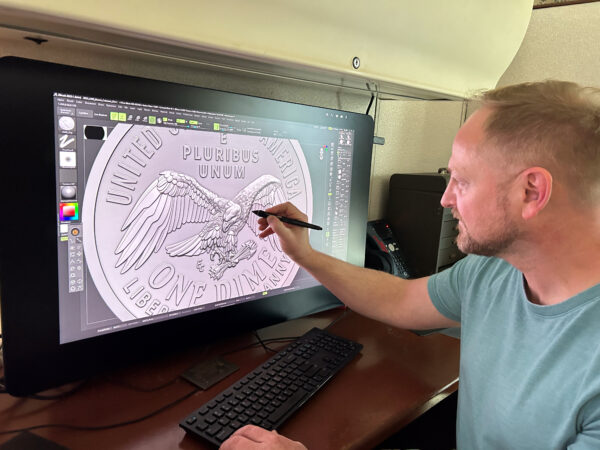
Some medallic artists prefer to sculpt the designs by hand with clay or plaster on rounds that are about 8 or 9 inches in diameter, while others use software, Hemphill explained. She prefers to work by hand initially, then scan her work to make finishing touches digitally.
The traditional approach “really allows the sculptor to gauge the depth properly using your own binocular vision,” Hemphill said, while digital tools make some “cool tricks” possible that “you wouldn’t even imagine you could do in traditional.”
A clay and plaster sculpture in relief of the Tuskegee Airmen by U.S. Mint medallic artist Phebe Hemphill for a Congressional Gold Medal.
Regardless of the methods used, the artistic process involves lots of constraints and “hard limits,” Hemphill said.
First, designs have to comply with the legislation that authorized them, which outlines required elements like the type of people or symbols the coins must depict, as well as phrases to include.
In some cases, stakeholders named in the law that authorized a coin — which can mean governors, museums, or organizations relevant to the design — have to be consulted.
Time is a factor, too. After a design is approved, things can move pretty quickly to meet production schedules, with artists getting around 16 business days to translate a line drawing into a sculpture, according to Hemphill and Custer.
And then there are medium-specific musts: Artists have to create designs that fit coins and medals. For example, certain angles don’t work well in coin art, Custer said, and nickels, dimes, and quarters each have specific font size requirements.
Production design staff also have to provide feedback to artists to make sure an image will be “strikable” and won’t result in manufacturing errors or inconsistencies, Custer explained.
“Designing and sculpting — they’re both problem-solving processes as much as they are art,” he said.
Sculpting stories
A medallic artist’s job ultimately boils down to finding a way to translate iconic moments or people in history into pocket-size art.
In Philadelphia, one of the country’s oldest and most storied cities, that history can be pretty accessible. When working on a new series of coins meant to honor the nation’s 250th birthday, for instance, Custer drew on resources that are practically in the Mint’s backyard.
Custer’s design for the tails side of the coin — which features an eagle with one empty claw and one claw holding 13 arrows — won out in the selection process.
The image takes inspiration from the Great Seal of the United States, and represents the colonists before and during the American Revolution, Custer explained. While he included the arrows from the seal, he left out the olive branch to symbolize the fact that the colonies had not yet reached peace — but left the claw open to demonstrate that they were waiting for it.
Hemphill also used the neighborhood to her advantage while working on the series. She sculpted the back of the “U.S. Constitution Quarter,” a design by Donna Weaver that features an image of Independence Hall.
When translating a line drawing of a building to a three-dimensional coin, sculptors benefit from having additional visual context, like a photograph, to get the details right, Hemphill said. In this case, though, she didn’t need a photo.
“I had a nice little walk down the street to really get a good gauge of how to do that one.”
Dirty Franks says ’25 and up’ — and the regulars reclaim the bar: B+
Dirty Franks banning 24-year-olds and under sounds, on paper, like the plot of a generational culture war. In reality, it’s a dive bar doing what dive bars have always done: protecting the room.
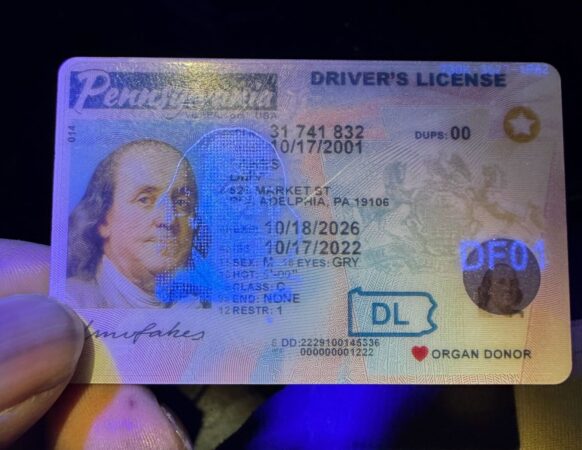
The catalyst? A fake ID featuring Ben Franklin that successfully scanned. Over the past year, Franks has been overrun by increasingly bold fake IDs, TikTok-fueled crowds, and behavior that doesn’t match the unspoken social contract of a place where regulars expect to sit, talk, and not babysit a bar.
This isn’t about hating young people. It’s about a bar that has never been a college bar suddenly being treated like one. Quantity over quality, as owner Jody Sweitzer put it. More bodies, same money, harder nights.
The temporary 25-plus rule is blunt, maybe even unfair to the responsible 22-year-olds who just want a cheap beer and a dart board. But Philly bars have always operated on feel as much as fairness. When something’s off, you fix it first and argue about it later.
And by most accounts, it worked. The room is calmer. Regulars are back. People can sit again. Staff aren’t playing bouncer-scanner-detective every five minutes, trying to outsmart IDs that look like they came straight out of a CIA prop department.
Is it sustainable? Probably not. Is it extremely Philly to say “we’ll relax when the nonsense stops”? Absolutely.
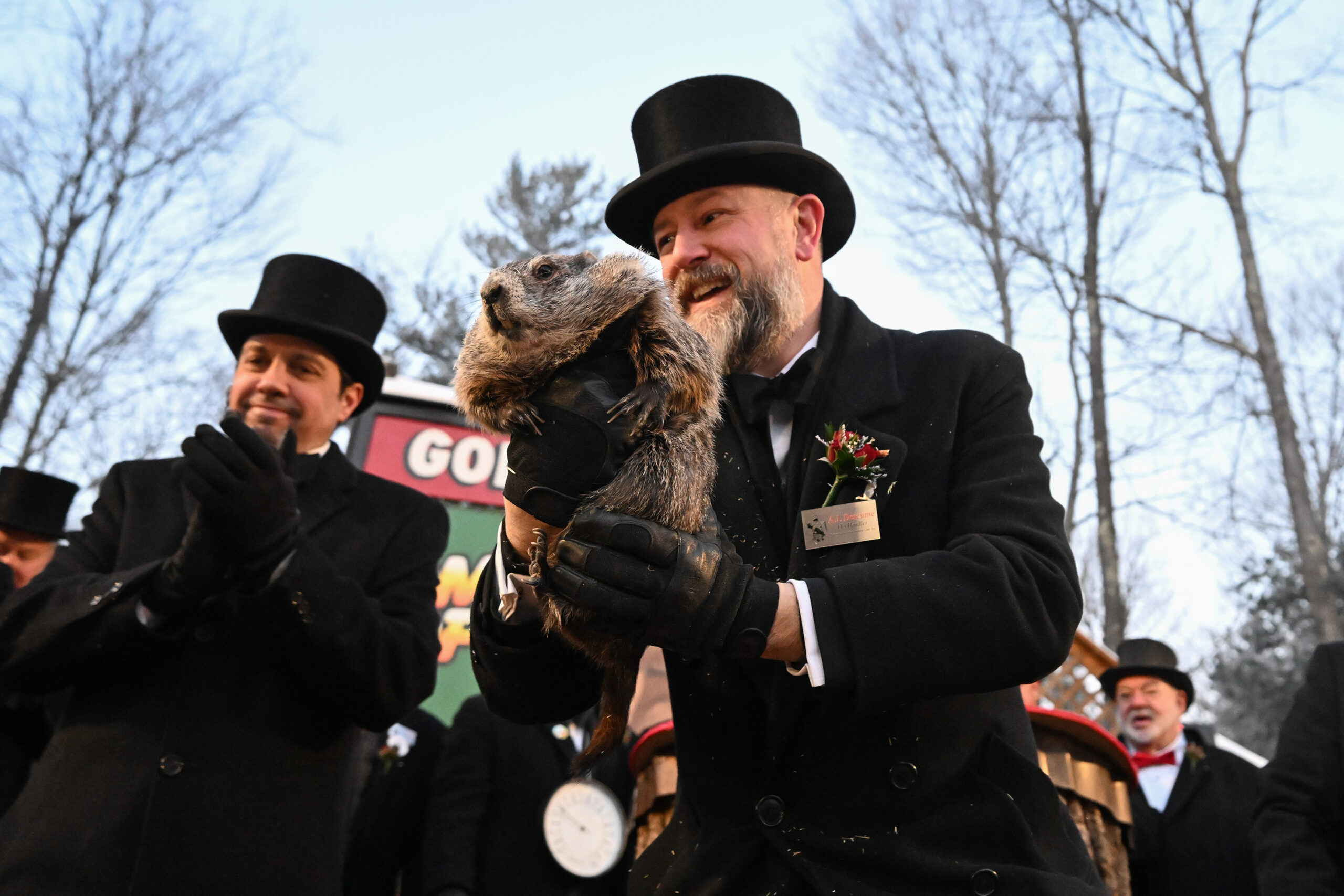
Groundhog Club handler A.J. Dereume holds Punxsutawney Phil, the weather prognosticating groundhog, during the 140th celebration of Groundhog Day on Gobbler’s Knob in Punxsutawney, Pa., Monday, Feb. 2, 2026. Phil’s handlers said that the groundhog has forecast six more weeks of winter. (AP Photo/Barry Reeger)
Punxsutawney Phil sees his shadow, condemning Philly to six more weeks of this: D
Six more weeks of winter doesn’t mean snowflakes and cozy vibes in Philadelphia. It means gray piles of ice that never melt, sidewalks that double as obstacle courses, and that specific kind of cold that seeps through gloves.
Phil seeing his shadow wasn’t news. The snow is still here. The side streets are still a mess. The wind is still disrespectful. And now we’re being told to mentally prepare for another month and a half of bundling up just to take out the trash.
Phil’s track record doesn’t help his case. He’s been wrong more often than right, but somehow still gets the power to set the emotional tone for an entire region. And the tone this year is simple: exhausted, sore, and deeply over it.
We don’t hate Phil. We just resent him for reminding us that winter in Philadelphia isn’t a season: It’s a long, drawn-out test of patience, balance, and civic infrastructure.
Six more weeks? Fine. We’ll survive. But we’re not happy about it.
Heavy equipment clears snow and ice from South Broad Street near Tasker Street in South Philadelphia, Tuesday, Feb. 3, 2026.
Philly sends in ‘snow ambassadors’ because the cleanup still isn’t done: C
At this point, the storm itself is old news. What isn’t: frozen crosswalks, ice-packed corners, and a city that still feels stuck in cleanup mode.
So now comes the next phase of winter in Philadelphia: improvisation.
The city is deploying 300 “snow ambassadors” to manually chip away at ice piled up at crosswalks and corners. We’re well past the point where plows and salt were enough, and if the choice is between stubborn ice lingering for weeks or sending people out with tools to break it up, the latter is the only real answer.
But it also says a lot about how this cleanup has gone.
The city is now in hand-to-hand combat with the leftovers of a storm that dropped 9.3 inches and then immediately locked them in place with days of deep cold. The fact that crosswalks still need this level of attention, days later, underscores how uneven the original response was, especially on side streets and pedestrian infrastructure.
Calling them “ambassadors” doesn’t change the reality: This is a workaround. A necessary one but still a sign that the system didn’t fully deliver the first time around.
That said, credit where it’s due. The city didn’t just shrug and tell people to wait for a thaw. It adjusted. It added manpower. It acknowledged that what’s left isn’t just inconvenient but dangerous. And focusing on crosswalks and ADA ramps is exactly where the effort should be right now.
This isn’t a win. It’s a course correction.
Phillies designated hitter Kyle Schwarber celebrates his solo home run with teammate J.T. Realmuto against the Kansas City Royals on Saturday, Sept. 13, 2025, in Philadelphia.
Phillies spring training hope (and the kids knocking): A
This is the part of the calendar where Philly collectively exhales.
Spring training is just getting started, and already the Phillies feel lighter. Not because anything’s been won. Not because the roster is flawless. But because February baseball is where optimism still gets the benefit of the doubt.
Clearwater represents a reset. New grass. Fresh routines. The annual illusion that this version of the team will be the one where everything clicks at the right time. It doesn’t matter how last season ended, spring training always feels like permission to believe again.
And for the first time in a while, the kids are actually coming. Justin Crawford looks like the opening-day center fielder. Andrew Painter is finally healthy enough to matter again. Aidan Miller is looming. The Phillies’ farm system has spent years as a drip-feed; now it feels like a faucet that might finally turn on.
That matters for a team that’s been built around a veteran core for so long. Bryce Harper and Kyle Schwarber anchoring things in Clearwater feels familiar in the best way, but the real intrigue is whether the next wave can actually stick. Whether this spring is the start of something sustainable, not just another “run it back.”
Spring training is baseball’s softest sell. No standings. No scoreboard pressure. Just story lines, roster battles, and enough sun to trick you into thinking October is guaranteed. Philly knows better than to fully trust it, but we still show up every year.
Because hope is part of the ritual. And for now, it’s earned.
If nothing else, pitchers and catchers reporting means one undeniable thing: Winter is losing leverage, and baseball is back in the conversation. Around here, that’s worth an A all by itself.
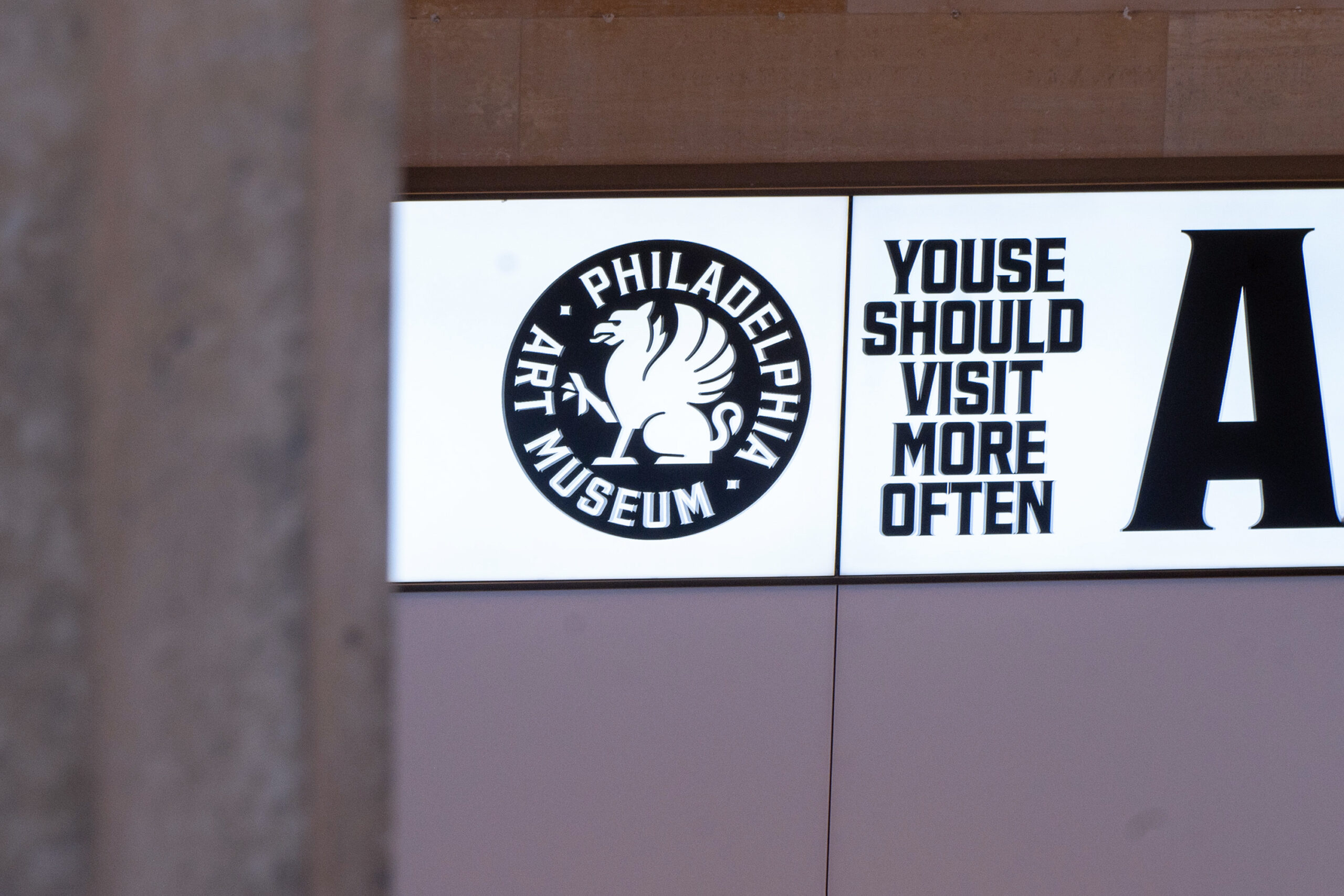
A rolling video screen above the admissions counter at the West Entrance at the Philadelphia Museum of Art Monday, Oct. 6, 2025, features a “youse should visit” slide and a new logo. The name change was eventually reversed back to its original – Philadelphia Museum of Art – but the griffin was kept.
The Art Museum walks it back (somewhat): B+
Four months after trying to rename itself the Philadelphia Art Museum, the Philadelphia Museum of Art has decided to do what Philadelphians do best: Stop pretending and call it what everyone was calling it anyway.
But this wasn’t a full rewind. The museum kept the updated look — the bold fonts, the sharper visual identity, the griffin logo pulled from the building’s roofline. The feedback was clear and consistent: People who know the institution (members, donors, staff) felt alienated by the name change.
The Philadelphia Museum of Art isn’t just branding; it’s muscle memory. You don’t casually swap that out without expecting pushback. But surveys also showed that the broader public didn’t hate the new look itself. So the museum split the difference.
It kept the visual refresh. It dropped the name change, which felt unnecessary and confusing. And it signaled, intentionally or not, that listening matters more than doubling down.
Philly gets its own Monopoly board, and the arguments have already started: A
A Philadelphia edition of Monopoly is coming this fall, and honestly, the game itself almost feels beside the point. The real action is happening now, in the collective act of imagining what would, and absolutely would not, be allowed on a Philly board.
The gaming company behind the project is soliciting public nominations for landmarks, businesses, and nonprofits, which means we’re about two seconds away from the most Philly fight imaginable: not about what belongs on the board, but what deserves Boardwalk money and what gets stuck near Baltic Avenue out of spite.
Picture it. Pass GO at City Hall. Community Chest immediately fines you for blocking a crosswalk. Chance card sends you directly to SEPTA delays — do not collect $200. Jail is the Roundhouse. Free Parking is somehow still under construction.
Some squares feel obvious: the Art Museum steps, LOVE Park, Independence Hall. Others are going to be chaos picks. Wawa utilities. Delco railroads. A corner bar that hasn’t changed since 1987 somehow costing more than Center City. Someone will nominate their neighborhood dive and mean it sincerely. Someone else will nominate their rowhouse just to prove a point.
And that’s where this gets interesting. A Philly Monopoly board isn’t really about the game. It’s about which places people think matter, and which ones they’ll argue should’ve made the cut.
‘We’ll shew ya whereta gew in the snew’: Visit PA leans into accents — and Philly winter energy: B+
If you’re going to tell Philadelphians to leave the house in February, you’d better sound like someone we trust. Preferably someone who says “youse.”
The Pennsylvania Tourism Office seems to get that, according to WHYY. Its new winter “Snow Day Hotline” is staffed by prerecorded Philly and Pittsburgh accents, plus live comedians during select hours.
Call the number and you’re greeted by exaggerated but affectionate regional voices walking you through things to do around the state, from museums to indoor hangs. It’s intentionally old-school, phone only, no app.
The Philly side of the operation is handled by comedian Betsy Kenney, whose accent isn’t natural but feels familiar anyway: a composite of neighbors, aunts, and the person behind you in line at Wawa explaining why something is “not worth it, but also maybe worth it.” The advice isn’t groundbreaking. The delivery is the point.
So when a highly accomplished Jeopardy! champion (16-game winner, nearly half a million dollars in earnings) visibly struggled to pronounce “Schuylkill” on national television this week, Philly collectively leaned forward and went, here we go.
To Scott Riccardi’s credit, he got the answer right. The river that runs through Pottsville, Reading, and Philadelphia? Yes. Correct. No notes. But the pronunciation (Skol-kull) sent Ken Jennings into referee mode, which is never where you want to be when the clue involves Pennsylvania geography.
For the record (again): it’s Skoo-kl. Two syllables. No drama. No extra letters pronounced.
Riccardi walks away with a B: smart, successful, and close enough to get partial credit. But full points are reserved for anyone who can say Schuylkill on the first try without breaking eye contact.
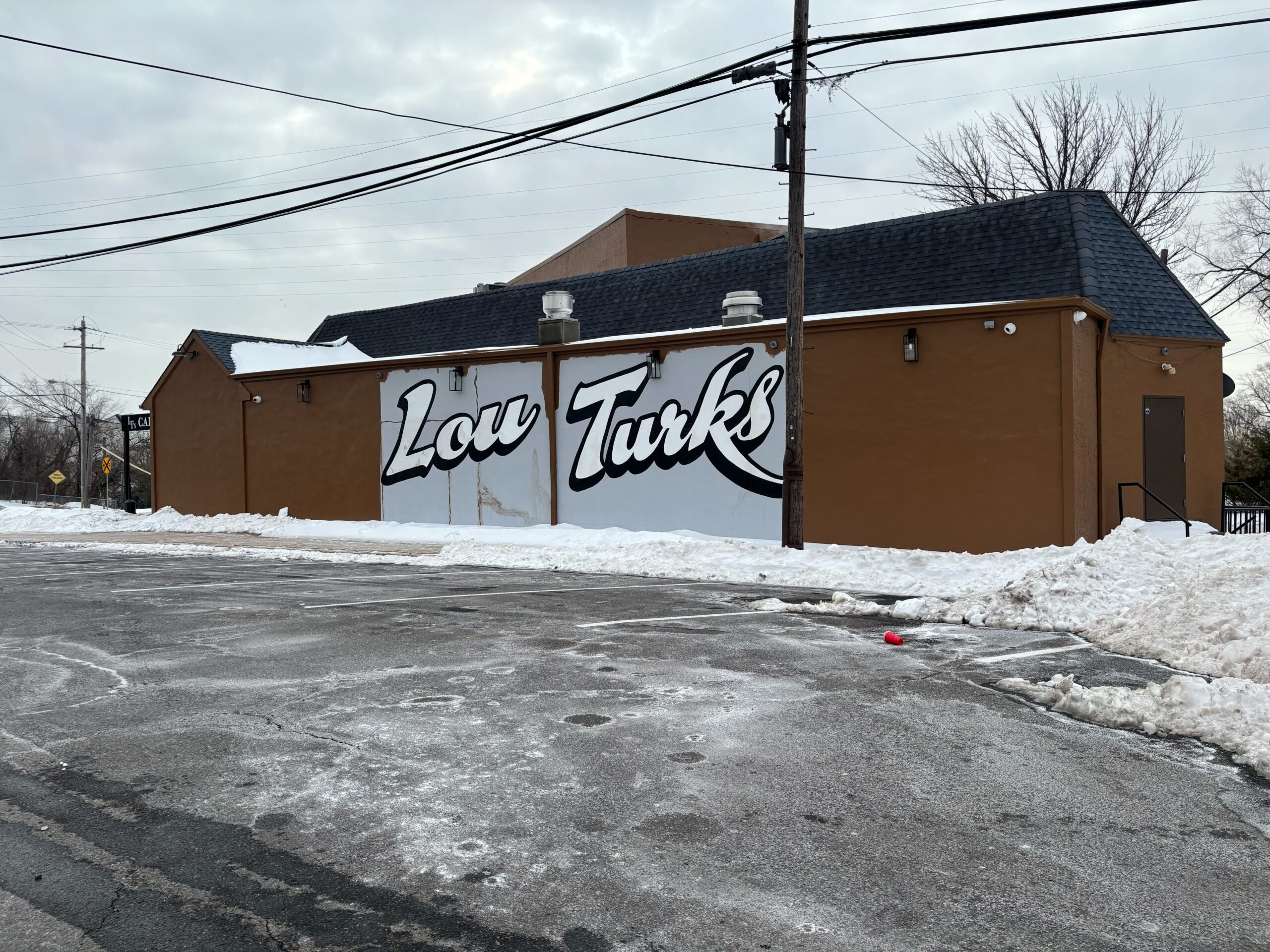
Lou Turk’s, a Delaware County strip club with more than 50 years in business, announced it will change its name to the Carousel Delco.
Lou Turk’s rebrands, Delco shrugs: A
Only in Delco could a strip club rebrand spark genuine cultural concern. Not about the name, but about whether Mother’s Day flower sales would survive.
Lou Turk’s, Delaware County’s lone strip club and one of its most stubborn institutions, announced it’s changing its name to the Carousel Delco. The response was immediate disbelief, light outrage, and a collective understanding that no one is actually calling it that. Ever. This is Gallery/Fashion District math.
Stephanie Farr laid it out perfectly: Lou Turk’s isn’t just a business, it’s a landmark. A place that exists in the Delco imagination as much as it does off Route 291, wedged between a Wawa and an Irish pub like it was placed there by a zoning board with a sense of humor.
The new name raises questions (mostly “why?”), but Delco culture is resilient. The club can swap signage, management, and branding buzzwords all it wants. It will still be Lou Turk’s. And more importantly, it will still sell flowers on Mother’s Day, preserving one of the county’s most unhinged and beloved traditions.
After a week of moderate winter temps, we’re back to single digit chills and snow-packed streets this weekend.
At this point, we’re used to the bone-numbing winds, so nothing will stop us from enjoying fun, brutally-entertaining, and dog-friendly events happening this weekend. Am I right?
While our beloved Birds didn’t make it to the Super Bowl this year, there’s plenty of watch parties for disheartened fans in need of support, and others looking forward to Bad Bunny’s electrifying half-time show.
Plus, a brutal bare knuckle brawl will take place in South Philly. Craftsman Row’s annual Mardi Gras pop-up experience will transport patrons to New Orleans’ French Quarter. And a reimagined Shakespearean classic will open at the Philadelphia Contemporary Theatre.
Whatever you choose, just please avoid ice fishing on the frozen Schuylkill. There’s enough events to go around before you need to risk your warmth (and life) on the river’s ice-solid surface.
Just look below, and you’ll find plenty of events worth reeling into your weekend plans.
Schuylkill River as seen from former railroad bridge in Manayunk section, Philadelphia on snowy and cold Monday, Jan. 26, 2026.
The Schuylkill is frozen, so that means you can ice fish on it. Right? No!
With the surface of the Schuylkill frozen solid, a reader asked through Curious Philly if ice fishing is allowed on the grand tributary.
Short answer: no.
While fishing along the Schuylkill is accepted and celebrated in warmer temperatures, those dreaming of an Arctic lifestyle should be reconsider their plans.
⚜️ A taste of NOLA: Stop by Craftsman Row Saloon for a taste of New Orleans. The bar’s annual Fat Tuesday pop-up experience will feature Mardi Gras-inspired dishes and southern favorites like jambalaya, crawfish mac and cheese, and po boys.
🍷 The formula of love: Learn the science of romance at the Science History Institute’s event on Friday. Wine chemist André Isaacs, master chocolatier Jim St. John, essential oil specialist Kim Bleimann, and others will dive into the history of your favorite Valentine’s Day staples for “Wine, Roses, and Chocolate: How Romance and Science Work Together.”
🐶 The return of Bark Bowl: The fifth annual Bark Bowl returns to Craft Hall on Saturday. While their furry, four-legged friends are enjoying the indoor turf and doggie toys, pet-parents can enjoy a special menu of drinks, crafty-style pizza, BBQ platters, and other offerings.
🏈 Super Bowl Watch Parties: While our beloved Eagles didn’t make it to the biggest night in sports, it doesn’t mean you can’t stop by watch parties at Fringe Bar, Taller Puertorriqueño, Stateside Live!, and other venues and dive bars.
📅 My calendar picks this week: Step Afrika! at Miller Theater, First Friday in Chestnut Hill, Restaurant Week in Center City
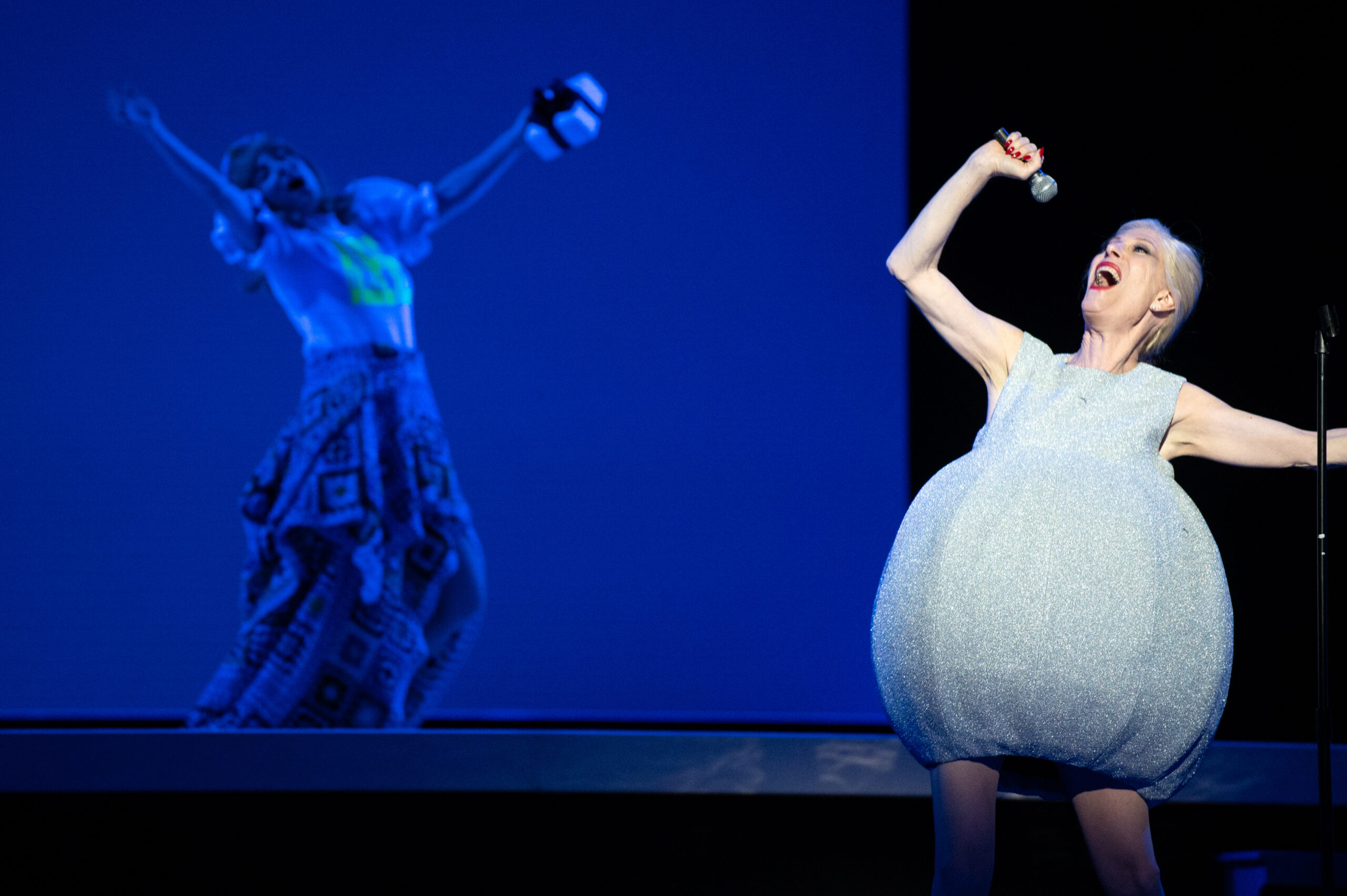
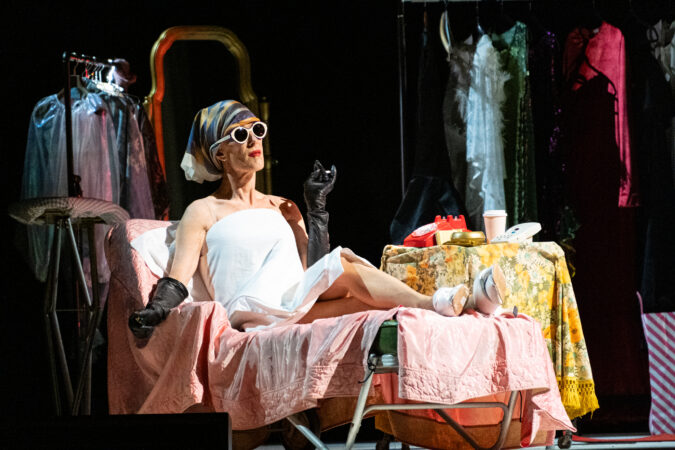
Kiera Duffy (left) and Justin Vivian Bond perform in “Complications in Sue” during the final dress rehearsal at the Academy of Music in Center City Philadelphia on Saturday, Jan. 31, 2026. The original libretto is based on an idea by Bond, and is playwright Michael R. Jackson’s operatic debut.
Opera Philadelphia’s ‘strange little roller coaster ride’ is rolling into town
Created to commemorate the Opera Philadelphia’s 50th anniversary, Complications in Sueopened on Wednesday with 10 composers commissioned to write eight-minute scenes. (Here’s our review!)
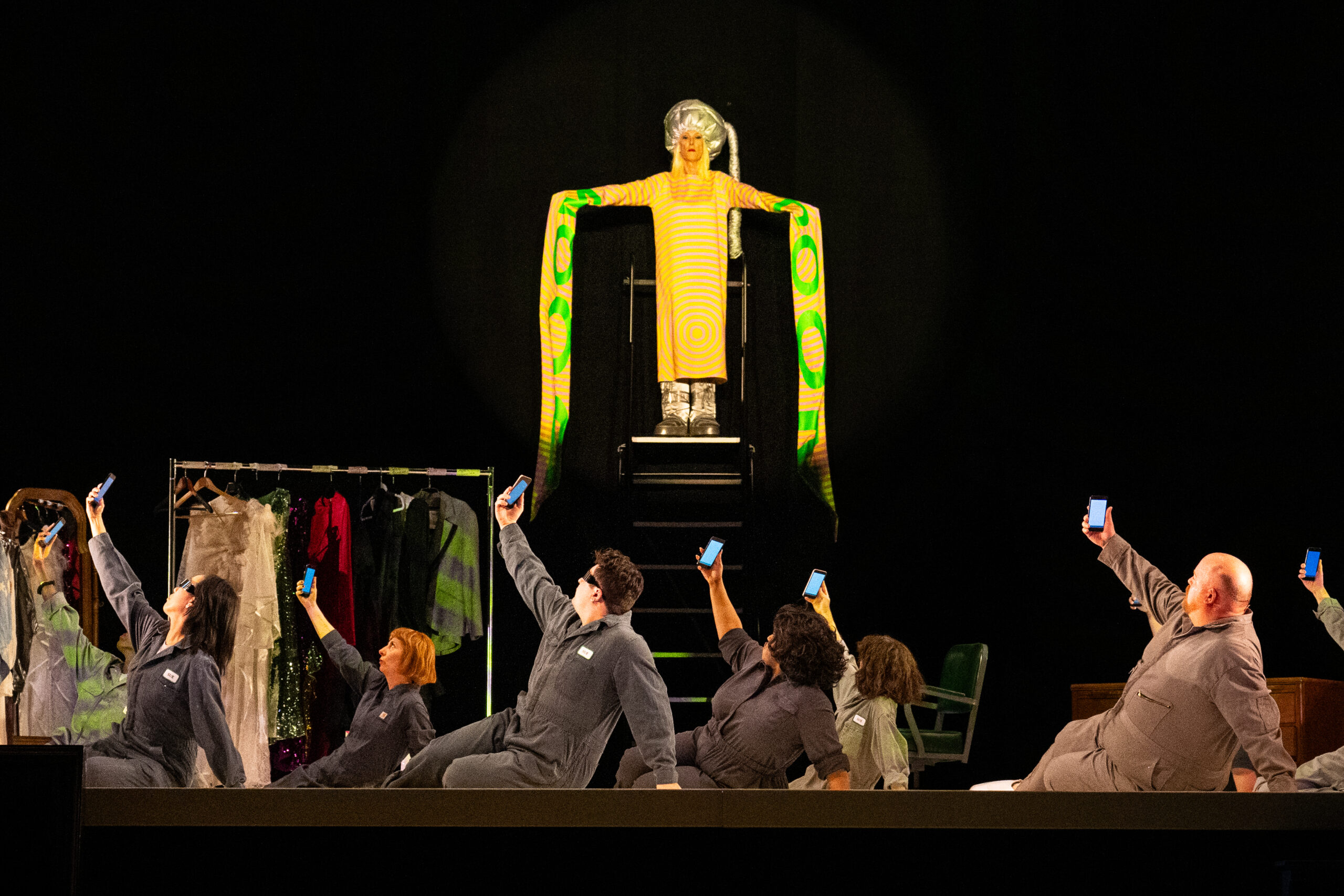
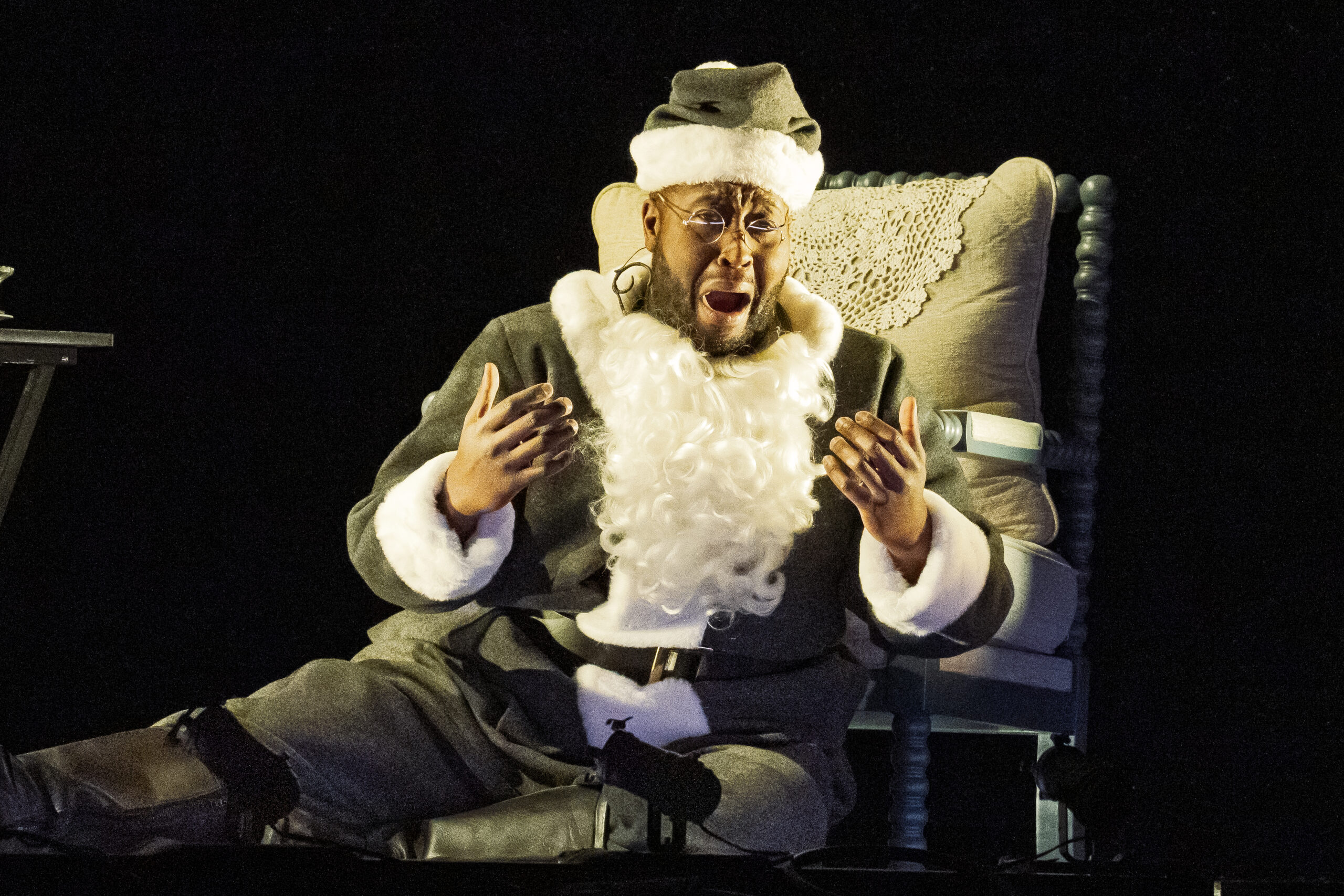
The scenes encompass the century-long life of a mythical everywoman named Sue, who does everything from saving Santa Clause from an existential crisis in a nonbelieving world, to fending off aggressive shopping algorithms. Impressive, right?
Complications in Sue plays through Sunday at the Academy of Music. All tickets are Pick Your Price, starting at $11.
Read more in writer David Patrick Stearns’ story here.
Winter fun this week and beyond
🏎️ One final lap: Stop by the Philadelphia Auto Show, and take a spin around the Pennsylvania Convention Center before the annual ends on Sunday. Hundreds of vehicles will be displayed throughout the exhibition, including some you can test drive in and outside the building.
🤜🏽 Put your dukes up: The biggest night in Bare Knuckle Fighting Championship returns to Philly for KnuckleMania VI at Xfinity Mobile Arena. Show-stoppers like heavyweight champion Ben Rothwell will defend his title against former UFC champ Andrei Arlovski in a main event clash.
🎭 A reimagined theater classic: A modern, fast-paced, and thrilling reimagining of Shakespeare’s Julius Caesar will take center stage at the Philadelphia Theatre Company on Froday. The show runs through Feb. 22.
🧗🏼♂️ Come Baa-aaa-ack to Please Touch Museum: Shaun the Sheep, Bitzer, and your kid’s other farmyard friends will guide them through a series of fun problem-solving activities at the Please Touch Museum. Kids can scale small climbing walls, form their own stop-motion animations, and test their agility on balance boards. The exhibit runs from Saturday to May 10.
🎸 Thursday: Off the heels of the Oklahoma band’s seventh album, the Turnpike Troubadours bring their brand of Red Dirt country at the Met Philly. The band will be joined by wry Texas songwriter Robert Earl Keen.
🎤 Friday: Soulful Alabama singer Kashus Culpepper, whose new album, Act I, features guest appearances from Sierra Ferrell and Marcus King, will play World Cafe Live’s Free at Noon. Then, he’s headed to the Foundry at the Fillmore for a second gig that night.
🎤 Tuesday: Two days after singing “America the Beautiful” at Super Bowl LX in Santa Clara, Calif., on Sunday, Brandi Carlile will kick off her “Human Tour” at Xfinity Mobile Arena on Tuesday.
Assuming the roads are clear, and the snow isn’t too brutal this weekend, make your way to these stellar events.
Besides, I’m sure it helps to keep Eagles fans’ minds off Sunday’s game. And I’ll say it again — avoid any ice fishing, please.
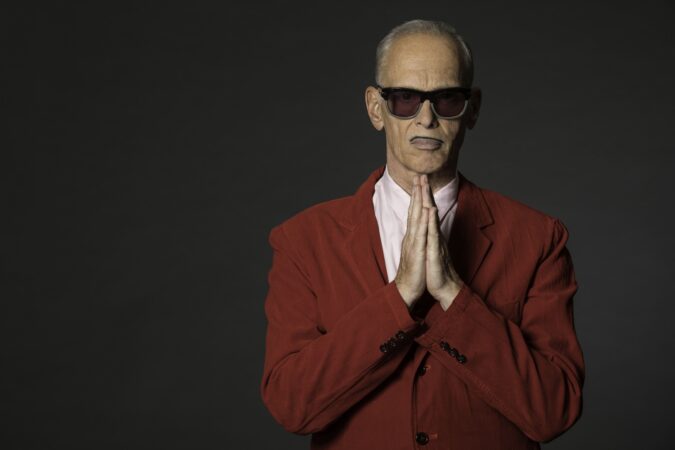
It’s a chilly January afternoon and John Waters is on the phone talking about his new one-man show, “Going to Extremes.”
Waters, whose subversive indie films inspired William S. Burroughs to dub him “The Pope of Trash,” is calling from San Francisco, where he has an apartment. He has another one in New York and a place in Provincetown, Mass.
But Waters’ heart — and his home — is in Baltimore.
“That’s where my house is, that’s where my office is, that’s where my studio is,” Waters said. “Baltimore is always where I lived. I never for a moment thought of leaving there.”
Waters’ 1970s queer cult classics like Multiple Maniacs and Pink Flamingos starring iconic drag queen Divine were all made in Baltimore, as were mainstream breakthroughs like Hairspray (1988) and Cry-Baby (1990).
Charm City has always been essential to Waters’ work because, “I knew it well, and I praised a city that, in that time, had an inferiority complex.”
Thanks to his movies and other works, like Barry Levinson’s Diner and David Simon’s The Wire, “Baltimore does not have an inferiority complex anymore because we praised all the things that people used against it.”
“I think Philadelphia has the same issue sometimes, too. And we even have the same accent, though ours is a little weirder.”
“Philadelphia was always a good market for me,” he said. “Elizabeth Coffey was from there, a great, great actress who’s in a lot of my films, the first [transperson] I ever worked with… And the TLA cinema was one of the first theaters that made Pink Flamingos famous. It played there forever.”
Waters and Divine made several trips up I-95 for appearances at TLA midnight movie screenings, one of which, from 1974, is immortalized on YouTube.
It shows a lank-haired Waters in trademark shades and a Little Richard-inspired pencil mustache sitting beneath a Citizen Kane poster, and Divine popping out of a cake.
Waters’ early movies can still shock. Watching Divine’s character Babs Johnson eat poo in Pink Flamingos never goes down easy. But over time, Waters has been lauded as a transgressive pioneer of undeniable importance.
Or, as he puts it: “I’m so respectable I could puke!”
John Waters’ show “Going to Extremes” comes to the Colonial Theatre in Phoenixville on Saturday.
Pink Flamingos was added to the National Film Registry in 2021 and judged to be the 31st best comedy of all time last year by Variety. The publication called it “the cinematic birth of punk.” In the 91st spot on the same list is Waters’ Hairspray, the musical starring Ricki Lake (and Divine as her mother) about an American Bandstand-like 1960s Baltimore TV show’s struggles to integrate its dancers.
“C’mon, the 100 best comedies in the history of film, and two of them are mine? We’re talking the Marx Brothers, Charlie Chaplin, everything. When I see that for movies that are probably even more offensive today than they would have been then because of all the things that you wouldn’t have been allowed to do — it’s astounding to me.
“I’m proud,” he said. “I’m amazed by it. I think it’s wonderful. Debbie Harry, who’s a friend” — and hilarious as a scheming stage mom in Hairspray — “and I have talked about that. Aren’t we glad we’re alive to see this? Because many are not.”
For all of his respectability, however, Waters, 79, still finds it hard to get films financed and made.
“The last two movies I was supposed to make never happened. Aubrey Plaza was going to star, and we had a big company buy the rights to my novel Liarmouth. And it fell through.”
Still, Waters says, “I’m busier now than I’ve ever been.”
“I love the punks,” he said. “They’re the only minority who want to be hated.”
He also gathers his flock every September for a long weekend in Connecticut at Camp John Waters, where “people come and live as my characters for four days. We call it Jonestown with a happy ending.”
Every year, he also writes a brand new show and takes it on the road, sometimes with a Christmas theme in holiday season. “Going to Extremes” is billed as “crackpot comedy.”
But don’t call it stand-up, or performance art.
“It’s a sermon,” he said. “It’s a religious gathering.”
And it aims to speak to America’s deep divisions with a tool he finds sorely lacking in the body politic: humor.
“When I was young, the radical left had a sense of humor, with the Yippies and Abbie Hoffman. Today, they have more rules than my parents had.”
Waters is worried about the times, especially about the persecution of trans people in the second Trump administration.
“Of course, I’m worried about all of it, because you can’t embarrass him,” he said about the president. “He’s like the punks — he loves to be hated, too. When I saw him around in the ‘70s, he was a liberal. He was in Studio 54. He hung around with Hillary!”
One of the highlights of “Going to Extremes,” he promised, will be revealing “the only funny thing [Trump] has ever said.”
What is it? “You have to come to the show to hear it.”
Waters is excited to return to the Colonial, where he performed in 2022. “The Blob was filmed there! And I, of course, love The Blob.”
Water doesn’t love everything about barnstorming the country, though.
“I don’t like it when the plane is late,” he quipped. “But I do enjoy it. I do 50 shows a year, so I’m always in motion. I’m a carny. It’s what I do. And I’m in touch with my audience.
“Elton John once said to me, the day you stop touring, it’s over. And that’s true. You have to keep doing it. Somebody’s waiting to take your place the minute you blink.”
“John Waters: Going to Extremes,” Feb. 7, 8 p.m., the Colonial Theatre, 227 Bridge St., Phoenixville. ColonialTheatre.com.
A high-concept stunt? A rare stroke of artistic luck? A Frankensteinian collage of 21st-century life?
All of that can be said about Complications in Sue, an opera of sorts that premiered with surprising cohesion and great audience response, on Wednesday at the Academy of Music.
Opera Philadelphia is on new ground with this collection of 10 loosely linked scenes by different composers who did their work without knowing what the others were up to.
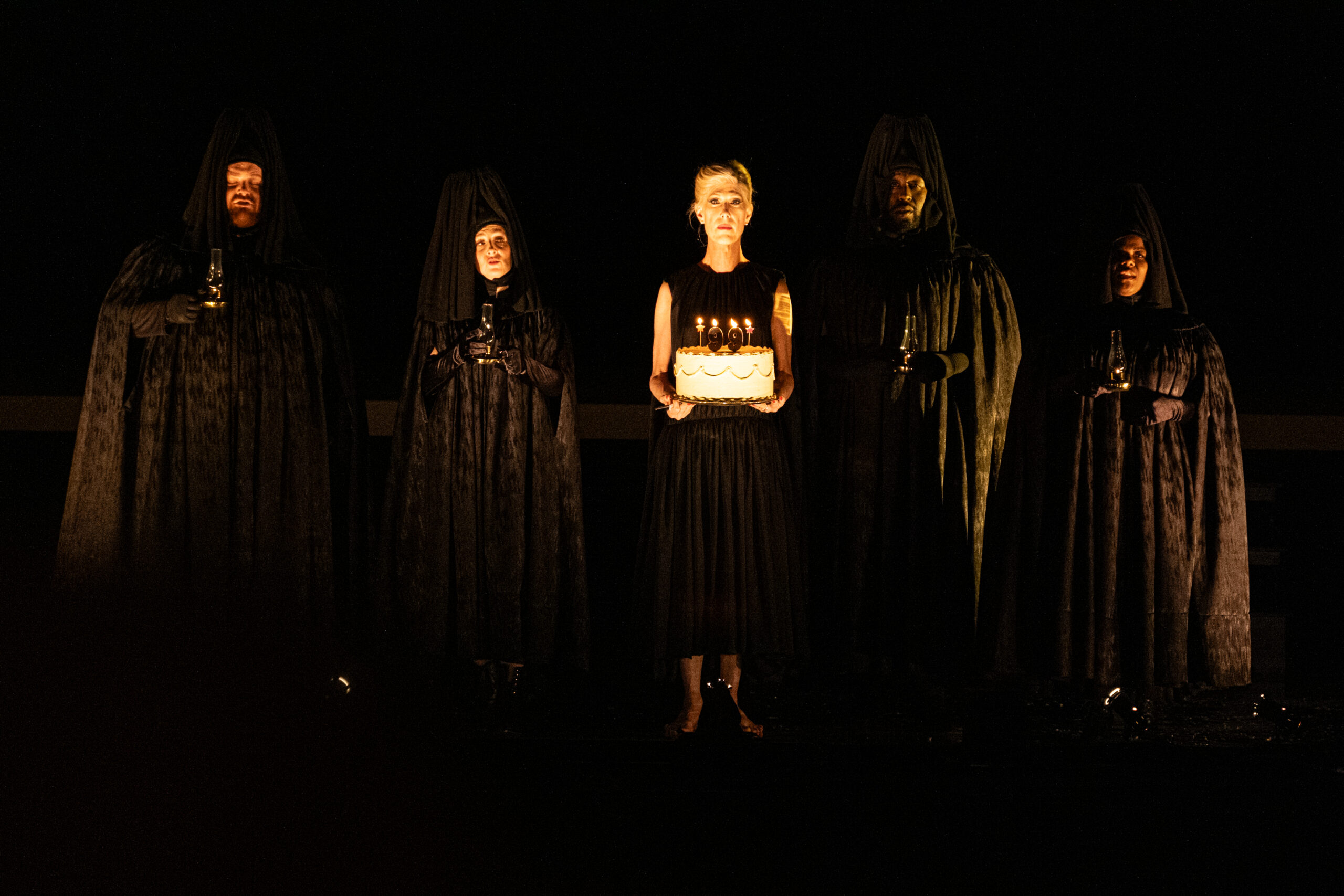
Each scene documents a decade of the life of Sue, in a birth-to-death chronicle curiously devoid of outstanding achievements but forming a reflection of the worlds (both inside and outside her psyche) swirling around her.
Sue’s shopping algorithm comes to life in Scene 6 of “Complications in Sue.” Justin Vivian Bond’s costumes were designed by JW Anderson.
At the center of it all — including episodes about Santa Claus in crisis, a grieving ex-husband, and Sue’s shopping algorithms coming to life — was the sharp-tongued cabaret artist Justin Vivian Bond.
Playing the imaginary Sue, she sang, talked (and danced here and there), and seemed to go off script with a damning litany of current government persons and entities. She prompted the loudest ovation of the evening with a no-holds-barred condemnation of U.S. Immigration and Customs Enforcement.
Somehow, the components came together, thanks partly to the anything-can-happen atmosphere of the piece.
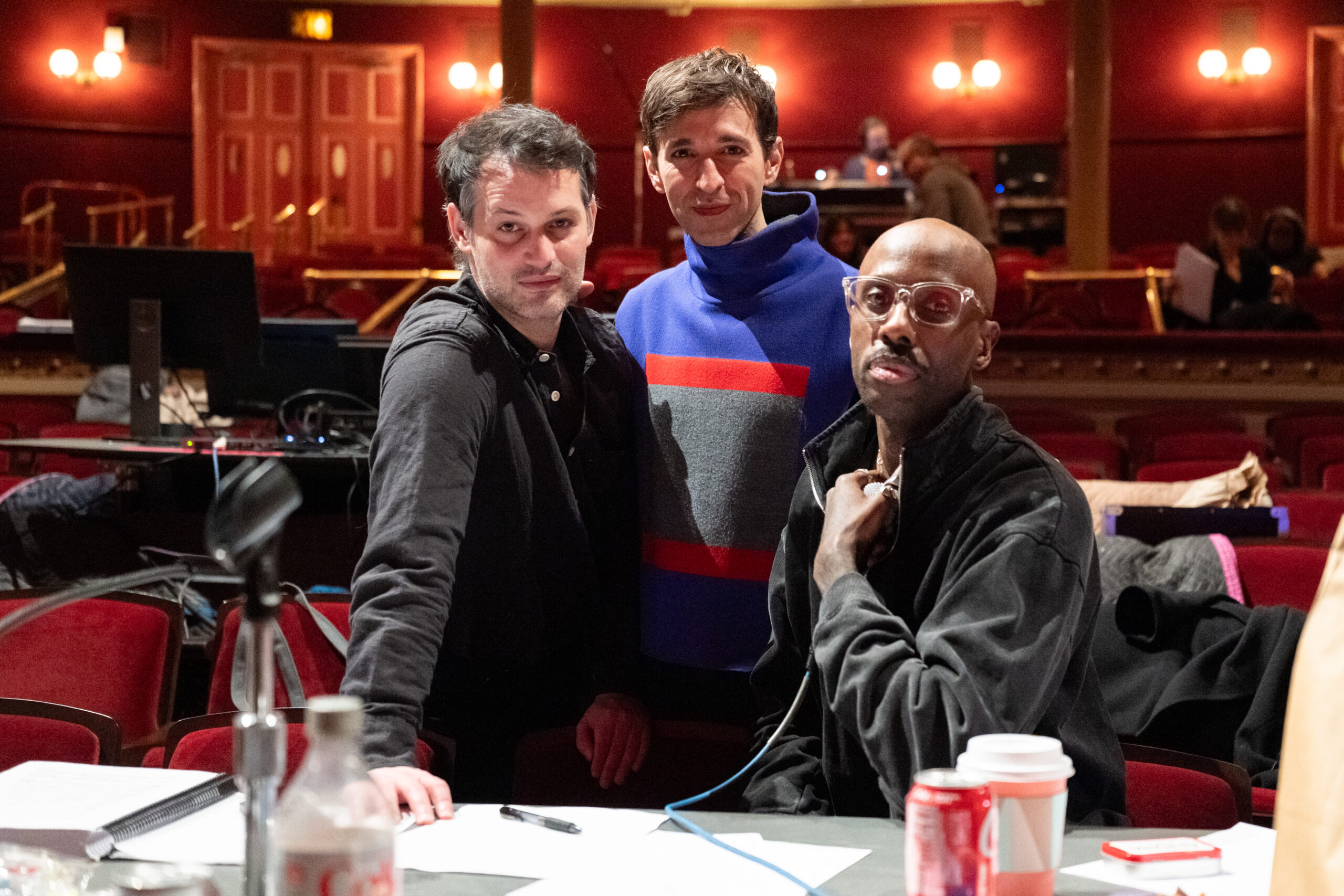
From left: Director Zack Winokur, producer Anthony Roth Costanzo, and director Raja Feather Kelly before a dress rehearsal at the Academy of Music on Jan. 31, 2026. The venue will be showing the new opera “Complications in Sue” from Feb. 4-8.
The 10 episodes — as fantastically conceived by librettist Michael R. Jackson — are like semi-improvised comedy sketches that leave certain psychological doors open for the composers to create a sense of operatic magnitude.
The composer lineup, full of strong personalities, was framed by Errollyn Wallen on birth (during which Bond walked down the theater aisle saying hello to aisle seaters) and Nico Muhly on death (in lovely choral writing with a waning, interior heartbeat).
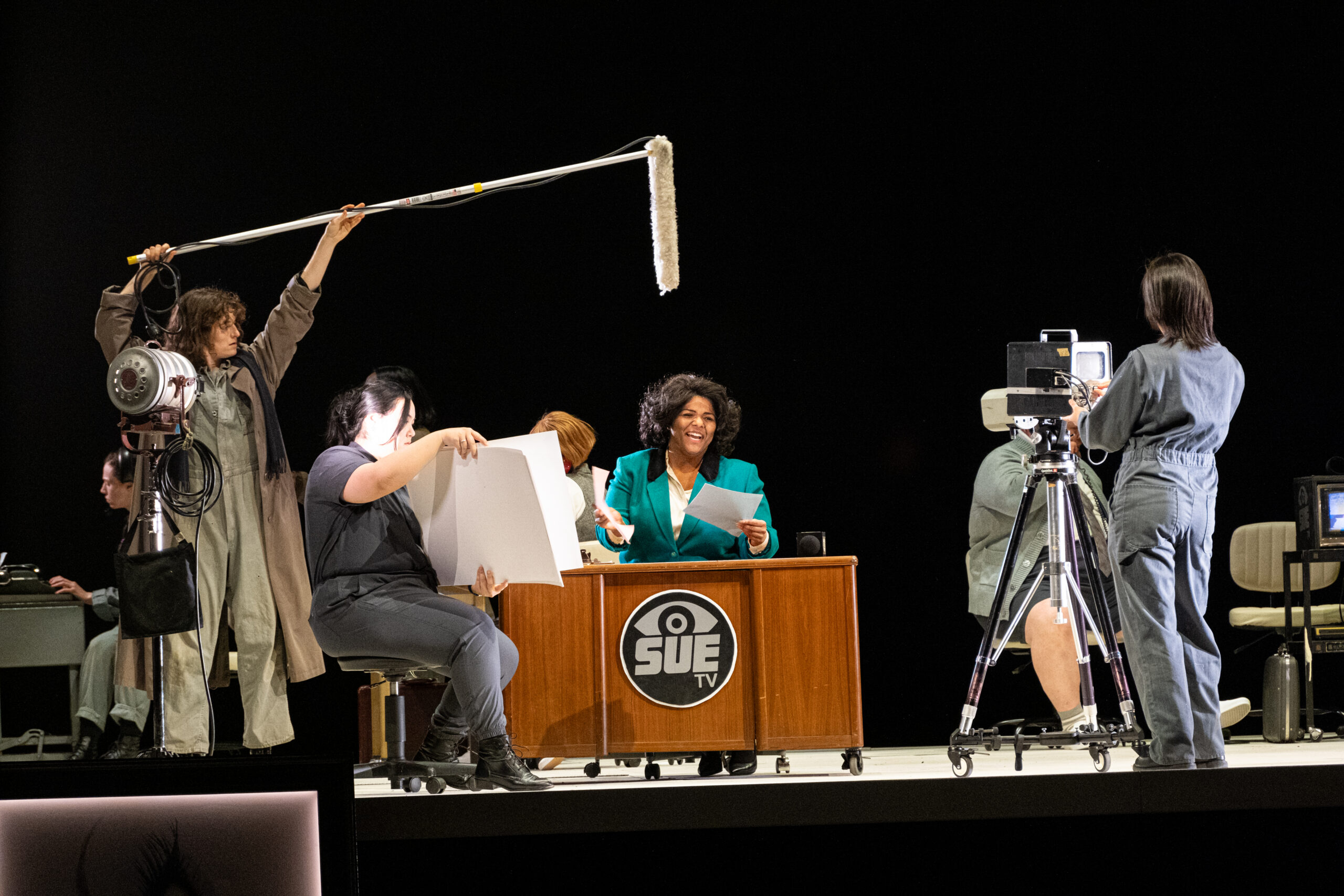
Generally, tunes weren’t a priority as the composers characterized the theatrical events that Jackson gave them, such as Nathalie Joachim’s scene with a newscaster from deep within Sue’s psyche interviewing her about life choices. When Sue’s husband has a meltdown, Dan Schlosberg goes on a rampage through musical styles reflecting the cultural jumbles of our times. Missy Mazzoli makes Santa Claus’ breakdown more tragic than comic.
Bass-baritone Nicholas Newton portrays a disillusioned Santa in Scene 2 of “Complications in Sue.”
Nobody just went for laughs, even when they seemed to.
Andy Akiho had singers being annoyingly manic playing college kids obsessing over who they thought Sue is. But this is where the overall theme of Complications in Sue coalesced: Do we know anybody? Or ourselves? Do we want to?
Composers Cécile McLorin Salvant, Rene Orth, Alistair Coleman, and Kamala Sankaram also wrestled with such issues in one way or another, sometimes using minimalist-shaded repetition for urgency, prominent bass lines for dark corners and with absolutely no need to box these situations into some sort of smooth musical package.
Mezzo-soprano Rehanna Thelwell as Brenda Blackwoman, broadcasting
from inside Sue’s imagination in Opera Philadelphia’s “Complications in Sue.”
That last quality made many of these miniature compositions seem epic in their implications. Was Complications in Sue really just 90 minutes?
Under the confident direction of Caren Levine, the four-member cast consistently gave it their all in deeply unconventional musico-dramatic assignments.
Kiera Duffy and Nicky Spence each had episodes giving them space to dominate the stage on their own. Duffy’s voice was an island of sweet stillness even in tumultuous moments while Spence never let intonation and enunciation slip even in his most reckless moments.
The cast of “Complications in Sue” (From left: Nicky Spence, Kiera Duffy, Justin Vivian Bond, Nicholas Newton, and Rehanna Thelwell) in the final scene of the world premiere opera.
Nicholas Newton played both Santa Claus and Death with equal conviction (an accomplishment indeed). And if you walked in not knowing that Rehanna Thelwell was walking through her stage roles that were actually sung by Imara Miles, you wouldn’t be any the wiser.
The one disappointment on the performance front was Bond’s dance of death: It was just a lot of twirling in moments that asked for transcendence. Much of Bond’s fan base feels anything she wants to do is just fine. I’m not one of them.
One major achievement was how the production elements worked together. That just doesn’t happen very often in new operas.
Justin Vivian Bond as 10-year-old Sue in “Complications in Sue,” directed by Raja Feather Kelly and Zack Winokur
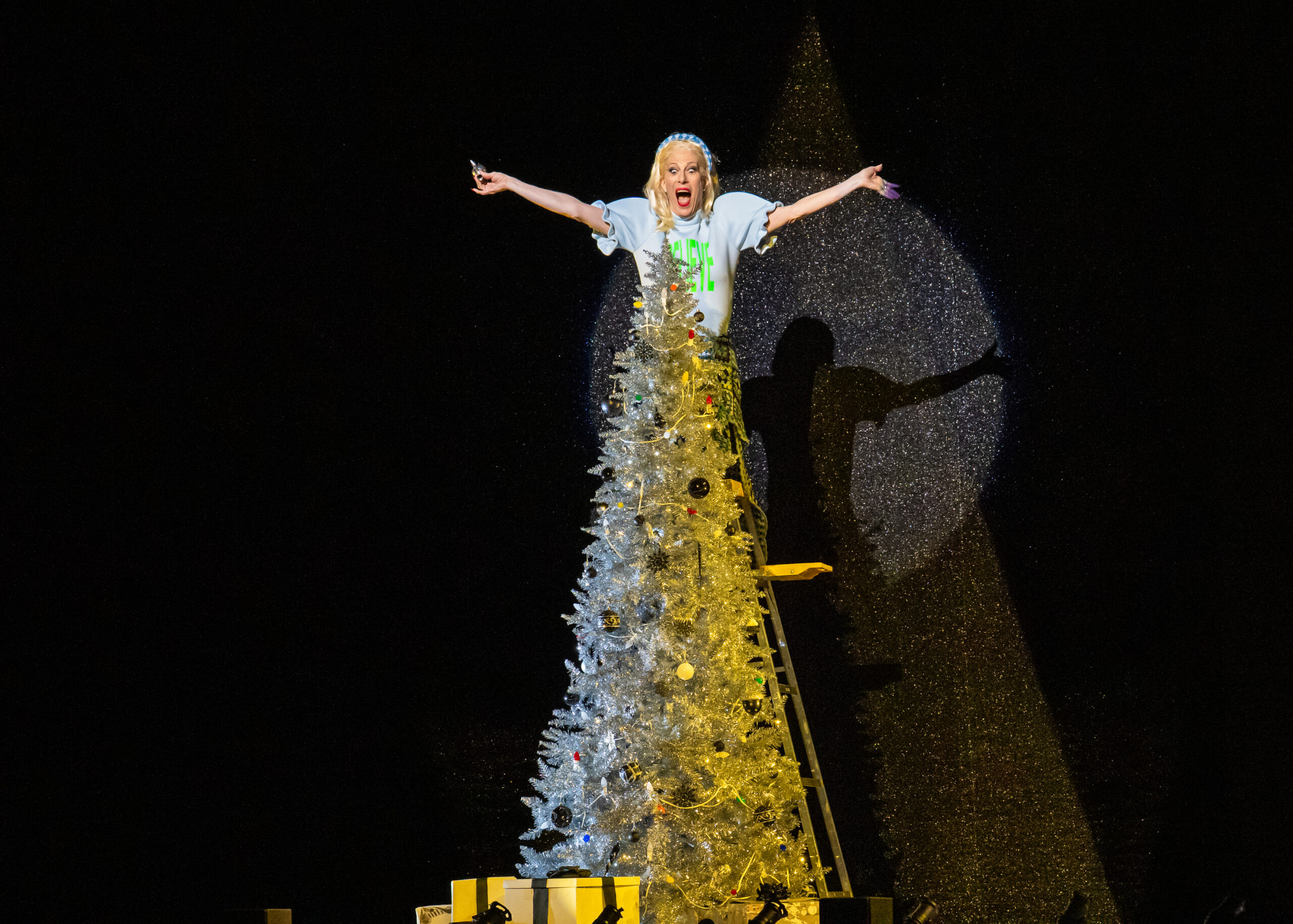
The Krit Robinson-designed production ranged from a charmingly makeshift Christmas tree to dazzling abstraction. In later scenes, the stage had concentric rectangular frames, each with changing, subtle coloring.
Raja Feather Kelly and Zack Winokur shared directing duties but in such fluid, choreographic staging, it was hard to determine where one director’s work started and the other left off.
Consider what this team could do in more conventional operatic circumstances. I hope to see that.
“Complications in Sue,” plays at Feb. 5, 7 p.m. Feb. 6, 8 p.m. Feb. 8, 2 p.m. Academy of Music, 240 S Broad St. All tickets are Pick Your Price, starting at $11. operaphila.org, 215.732.8400, tix@operaphila.org
Mark Tyler, historiographer and executive director of research and scholarship of the African Methodist Episcopal Church, often wonders: What if Christians stood up in the 1780s and challenged the articles of the U.S. Constitution that said Black people were not whole human beings?
What if the American branch of the Methodist church followed the teachings of its founder, John Wesley, who taught that slavery was a violation of Christian mercy? What if the ushers of Old City’s St. George’s Methodist Church didn’t kick formerly enslaved congregants Richard Allen and Absalom Jones out of the general congregation and force them to worship in segregated pews?
“We would have avoided the Civil War,” Tyler said. “We would have avoided Jim Crow. We would have avoided the moment in history we are in now.”
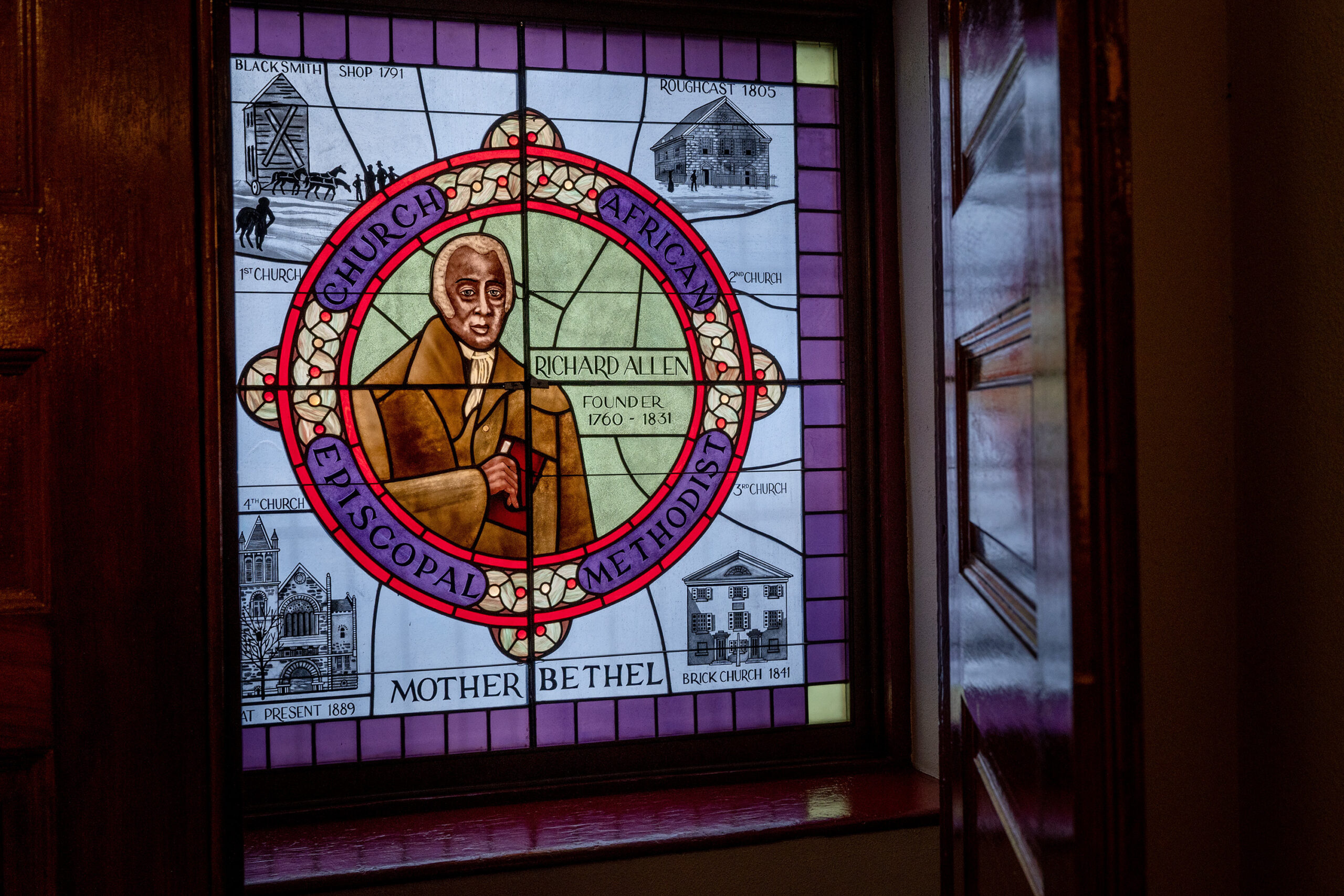
A stained glass window of founder Richard Allen and Mother Bethel AME Church’s previous homes is at entrance of the church.
Instead, American Methodists sided with southern landholders who relied on cost-free Black labor to build their empires. Evangelical churches, Tyler said, were among the first institutions to practice segregation.
Allen and Jones went on to start their own churches.
Allen established Mother Bethel African Methodist Episcopal Church, regarded as America’s — and the world’s — first AME congregation.
Mother Bethel will celebrate this history at the Philadelphia Historical District’s weekly “firstival,” part of a yearlong celebration of America’s 250th birthday. Each Saturday in 2026, the historic district is hosting a daytime shindig honoring an event that happened in Philadelphia before anywhere else in America and often the world.
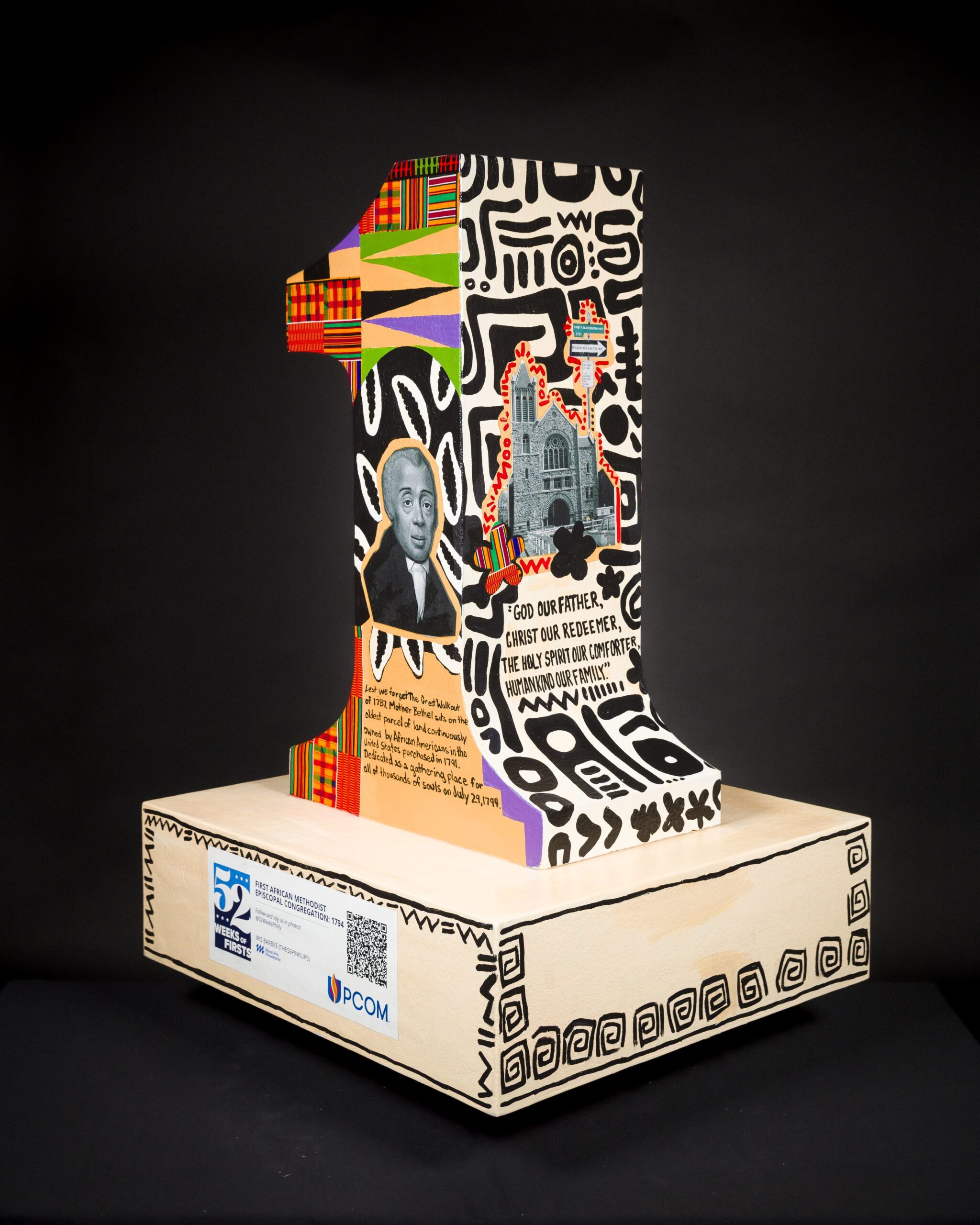
Iris Barbee Bonner is a fashion designer and graphic artist who brought her experience growing up in the AME Church to this 52 Weeks of Firsts No. 1
Allen was born into slavery in Philadelphia in 1760. He bought his freedom from his enslaver, a devout Methodist who converted many of the people he enslaved, in 1783. Allen answered the call to preach and traveled the mid-Atlantic for a few years evangelizing freed and enslaved people.
In 1786, he returned to Philadelphia, joined St. George’s, and started a 5 a.m. worship service. He led the service for a year-and-a-half before walking out in November of 1787.
“Certainly there had been moments of resistance in colonial Black communities,” Tyler said. “But this walkout was significant because it led to the emergence of the first American institutions by and for Black people,” Tyler said.
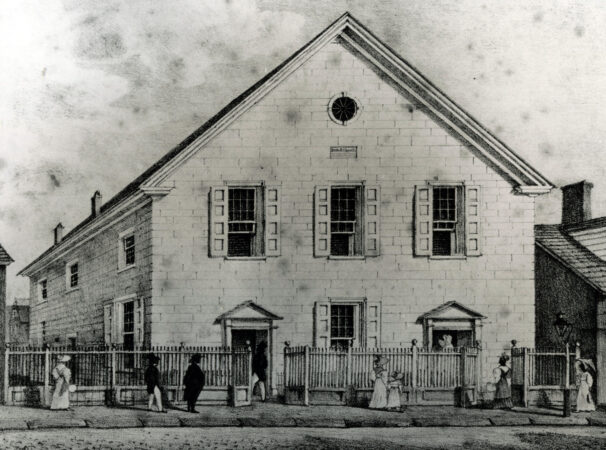
Allen bought land at Sixth and Lombard Streets — where Mother Bethel sits now — on Oct. 10, 1791. Mother Bethel’s first building, a repurposed blacksmith shop, was dedicated on July 29, 1794, by Bishop Francis Asbury.
A second building was erected in 1805, a third in 1841, and the current building was completed in 1890.
“We are the oldest independent denomination founded by people of color in the United States,” said the Rev. Carolyn C. Cavaness, pastor of Mother Bethel. “Our church sits on the oldest parcel of land continuously owned by African Americans.”
In 1816, 30 years after Allen established Mother Bethel, he invited delegates of Black Methodist churches in Pennsylvania, Baltimore, Maryland, Delaware, and New Jersey to a conference, establishing the AME Church as its own denomination.
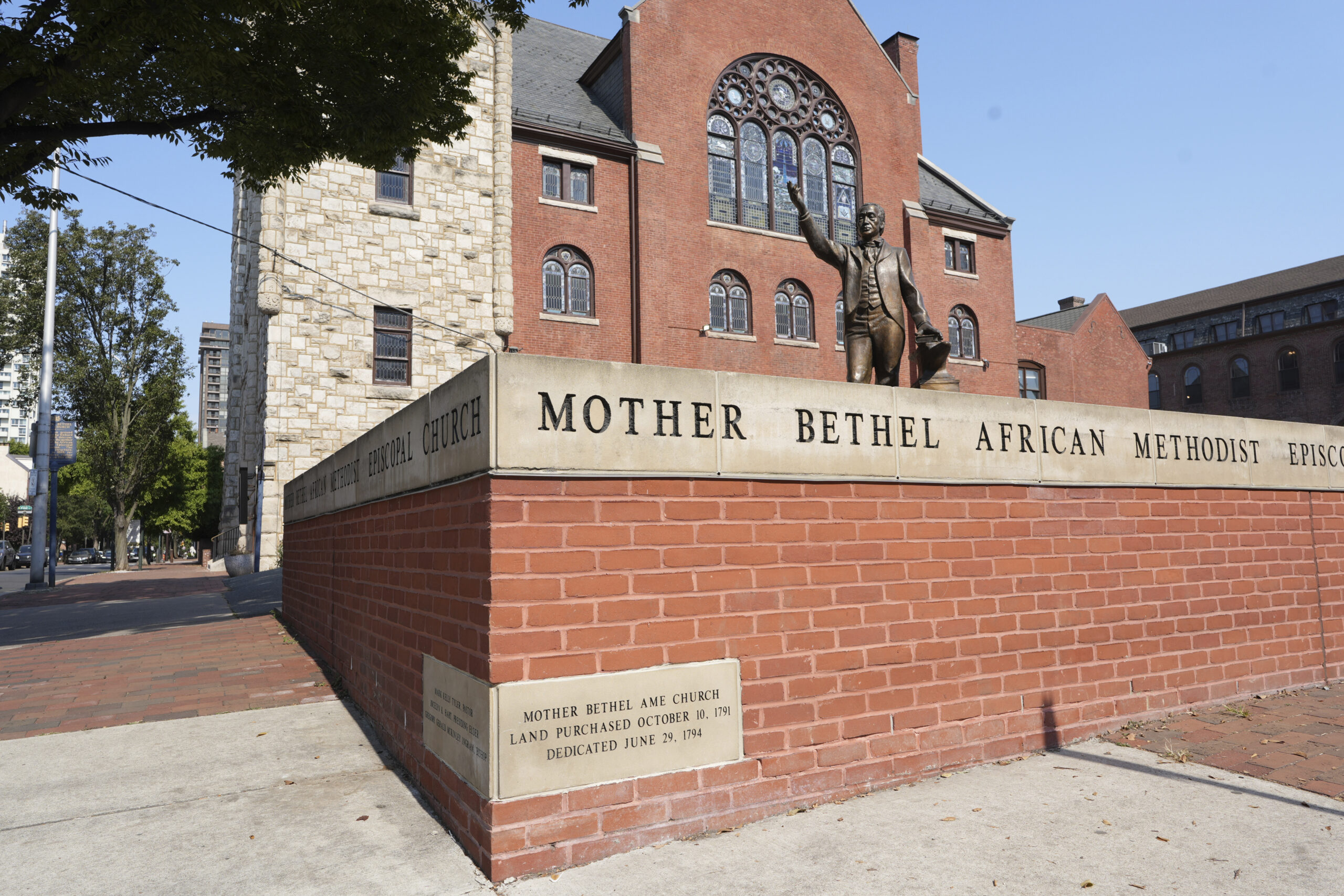
A statue of Mother Bethel AME Church founder Richard Allen stands on the oldest parcel of land continuously owned by Black Americans in Philadelphia on Oct 13, 2024. (AP Photo/Luis Andres Henao)
Mother Bethel has stood at the center of civil rights for centuries, from serving as a station on the Underground Railroad to uniting interfaith clergy who questioned $50 million of community benefits slated to go to the Sixers arena in 2024.
“We are the Mother Church,” Cavaness said. “ … the foundation of so much Philadelphia history, so much American history. It’s an honor to be the sacred caretaker of this history.”
This week’s Firstival is Saturday, Feb. 7, 11 a.m.-1 p.m., at Mother Bethel, 419 S. Sixth St. The Inquirer will highlight a “first” from Philadelphia Historic District’s 52 Weeks of Firsts program every week. A “52 Weeks of Firsts” podcast, produced by All That’s Good Productions, drops every Tuesday.
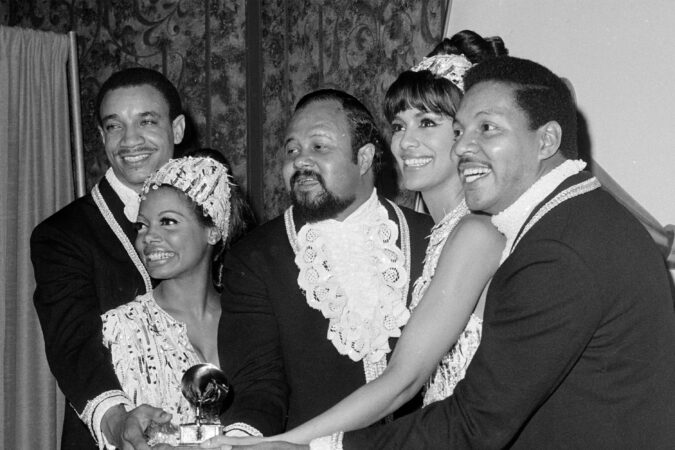
Singer LaMonte McLemore, a founding member of vocal group The 5th Dimension, whose smooth pop and soul sounds with a touch of psychedelia brought them big hits in the 1960s and ’70s, has died. He was 90.
Mr. McLemore died Tuesday at his home in Las Vegas surrounded by family, his representative Jeremy Westby said in a statement. He died of natural causes after having a stroke.
The 5th Dimension had broad crossover success and won six Grammy Awards including record of the year twice, for 1967’s “Up, Up and Away” and 1969’s “Aquarius/Let the Sunshine In.” Both were also top 10 pop hits, with the latter, a mashup of songs from the musical Hair, spending six weeks at No. 1.
Mr. McLemore had a parallel career as a sports and celebrity photographer whose pictures appeared in magazines including Jet.
Born in St. Louis, Mr. McLemore served in the Navy, where he worked as an aerial photographer. He played baseball in the Los Angeles Dodgers’ farm system and settled in Southern California, where he began making use of his warm bass voice and skill with a camera.
He sang in a jazz ensemble, the Hi-Fi’s, with future 5th Dimension bandmate Marilyn McCoo. The group opened for Ray Charles in 1963 but broke up the following year.
Mr. McLemore, McCoo, and two of his childhood friends from St. Louis, Billy Davis Jr., and Ronald Towson, later formed a singing group called the Versatiles. They also recruited Florence LaRue, a schoolteacher Mr. McLemore met through his photography, to join them. In 1965 they signed to singer Johnny Rivers’ new label, Soul City Records, and changed their name to The 5th Dimension to better represent the cultural moment.
Their breakthrough hit came in 1967 with the Mamas & the Papas’ song “Go Where You Wanna Go.”
That same year they released the Jimmy Webb-penned “Up, Up and Away,” which would go to No. 7 on the Billboard Hot 100 and win four Grammys: record of the year, best contemporary single, best performance by a vocal group and best contemporary group performance.
In 1968 they had hits with a pair of Laura Nyro songs, “Stoned Soul Picnic” and “Sweet Blindness.”
The peak of their commercial success came in 1969 with “Aquarius/Let the Sunshine In,” which along with its long run at No. 1 won Grammys for record of the year and best contemporary vocal performance by a group.
That same year they played the Harlem Cultural Festival, which has become known as the “Black Woodstock.” The festival, and The 5th Dimension’s part in it, were chronicled in the 2021 documentary from Ahmir “Questlove” Thompson, Summer of Soul.
The 5th Dimension also had a rare level of success with white audiences for a group whose members were all Black. The phenomenon came with criticism.
“We were constantly being attacked because we weren’t, quote, unquote, ‘Black enough,’” McCoo said in Summer of Soul. “Sometimes we were called the Black group with the white sound, and we didn’t like that. We happened to be artists who are Black, and our voices sound the way they sound.”
The group had hits into the 1970s including “One Less Bell to Answer,” “I Didn’t Get to Sleep at All,” and “If I Could Reach You.”
They became regulars on TV variety shows and performed at the White House and on an international cultural tour organized by the State Department.
The original lineup lasted until 1975, when McCoo and Davis left to make their own music.
“All of us who knew and loved him will definitely miss his energy and wonderful sense of humor,” McCoo and Davis, who married in 1969, said in a statement.
LaRue said in her own statement that Mr. McLemore’s “cheerfulness and laughter often brought strength and refreshment to me in difficult times. We were more like brother and sister than singing partners.”
Mr. McLemore is survived by his wife of 30 years, Mieko McLemore, daughter Ciara, son Darin, sister Joan, and three grandchildren.
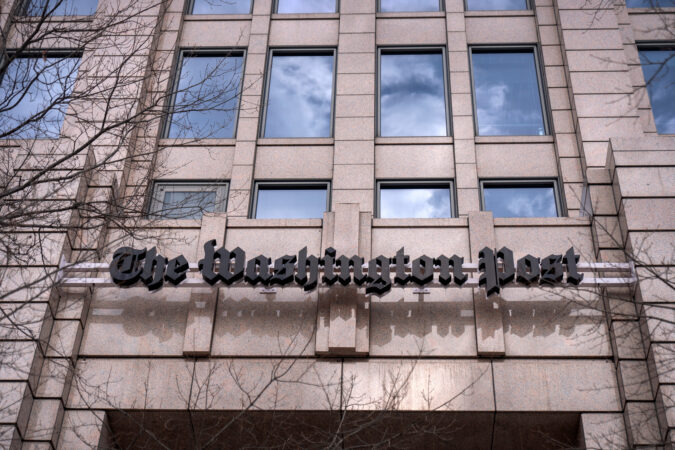
The Washington Post laid off one-third of its staff Wednesday, eliminating its sports section, several foreign bureaus, and its books coverage in a widespread purge that represented a brutal blow to journalism and one of its most legendary brands.
The Post’s executive editor, Matt Murray, called the move painful but necessary to put the outlet on stronger footing and to weather changes in technology and user habits. “We can’t be everything to everyone,” Murray said in a note to staff members.
He outlined the changes in a companywide online meeting, and staff members then began getting emails with one of two subject lines — telling them their role was or was not eliminated.
Rumors of layoffs had circulated for weeks, ever since word leaked that sports reporters who had expected to travel to Italy for the Winter Olympics would not be going. But when official word came down, the size and scale of the cuts were shocking, affecting virtually every department in the newsroom.
“It’s just devastating news for anyone who cares about journalism in America and, in fact, the world,” said Margaret Sullivan, a Columbia University journalism professor and former media columnist at the Post and the New York Times. “The Washington Post has been so important in so many ways, in news coverage, sports and cultural coverage.”
Martin Baron, the Post’s first editor under its current owner, billionaire Jeff Bezos, condemned his former boss and called what has happened at the newspaper “a case study in near-instant, self-inflicted brand destruction.”
Journalists pleaded with Bezos for help
Bezos, who has been silent in recent weeks amid pleas from Post journalists to step in and prevent the cutbacks, had no immediate comment.
A private company, the Post does not reveal how many subscribers it has, but it is believed to be roughly 2 million. The Post would also not say how many people it has on staff, although the New York Times estimated that more than 300 journalists were let go.
The Post’s troubles stand in contrast to its longtime competitor the New York Times, which has been thriving in recent years, in large part due to investments in ancillary products such as games and its Wirecutter product recommendations. The Times has doubled its staff over the past decade.
Eliminating the sports section puts an end to a department that has hosted many well-known bylines through the years, among them John Feinstein, Michael Wilbon, Shirley Povich, Sally Jenkins, and Tony Kornheiser. The Times has also largely ended its sports section, but it has replaced the coverage by buying The Athletic and incorporating its work into the Times website.
The Post’s Book World, a destination for book reviews, literary news and author interviews, has been a dedicated section in its Sunday paper.
A half-century ago, the Post’s coverage of Watergate, led by intrepid reporters Bob Woodward and Carl Bernstein, entered the history books. The Style section under longtime Executive Editor Ben Bradlee hosted some of the country’s best feature writing.
All Mideast correspondents and editors laid off
Word of specific cuts drifted out during the day, as when Cairo Bureau Chief Claire Parker announced on X that she had been laid off, along with all of the newspaper’s Middle East correspondents and editors. “Hard to understand the logic,” she wrote.
Lizzie Johnson, who wrote last week about covering a war zone in Ukraine without power, heat, or running water, said she had been laid off, too.
Anger and sadness spread across the journalism world.
“The Post has survived for nearly 150 years, evolving from a hometown family newspaper into an indispensable national institution, and a pillar of the democratic system,” Ashley Parker, a former Post journalist, wrote in an essay in The Atlantic. But if the paper’s leadership continues its current path, “it may not survive much longer.”
Fearing for the future, Parker was among the staff members who left the newspaper for other jobs in recent months.
Atlanta paper also makes cuts
Also on Wednesday, the Atlanta Journal-Constitution, which stopped print editions and went all-digital at the end of last year, announced that it was cutting 50 positions, or roughly 15% of its staff. Half of the eliminated jobs were in the newsroom.
Murray said the Post would concentrate on areas that demonstrate authority, distinctiveness and impact, and resonate with readers, including politics, national affairs, and security. Even during its recent troubles, the Post has been notably aggressive in coverage of Trump’s changes to the federal workforce.
The company’s structure is rooted in a different era, when the Post was a dominant print product, Murray said in his note to the staff. In areas such as video, the outlet hasn’t kept up with consumer habits, he said.
“Significantly, our daily story output has substantially fallen in the last five years,” he said. “And even as we produce much excellent work, we too often write from one perspective, for one slice of the audience.”
While there are business areas that need to be addressed, Baron pointed a finger of blame at Bezos — for a “gutless” order to kill a presidential endorsement and for remaking an editorial page that stands out only for “moral infirmity” and “sickening” efforts to curry favor with Trump.
“Loyal readers, livid as they saw owner Jeff Bezos betraying the values he was supposed to uphold, fled The Post,” Baron wrote. “In truth, they were driven away, by the hundreds of thousands.”
Baron said he was grateful for Bezos’ support when he was editor, noting that the Amazon founder came under brutal pressure from Trump during the president’s first term.
“He spoke forcefully and eloquently of a free press and The Post’s mission, demonstrating his commitment in concrete terms,” Baron wrote. “He often declared that The Post’s success would be among the proudest achievements of his life. I wish I detected the same spirit today. There is no sign of it.”