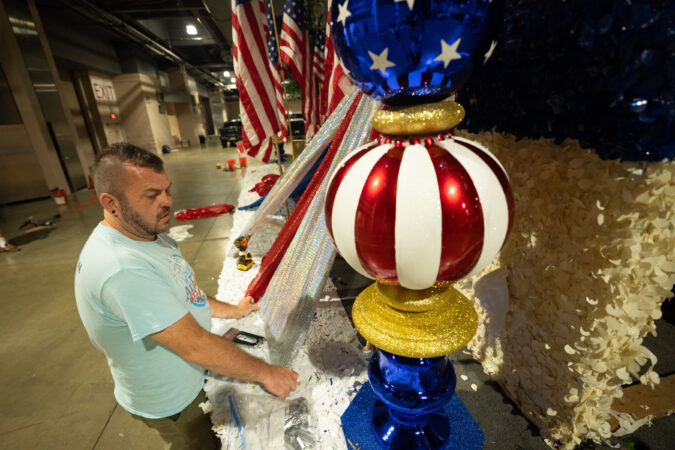
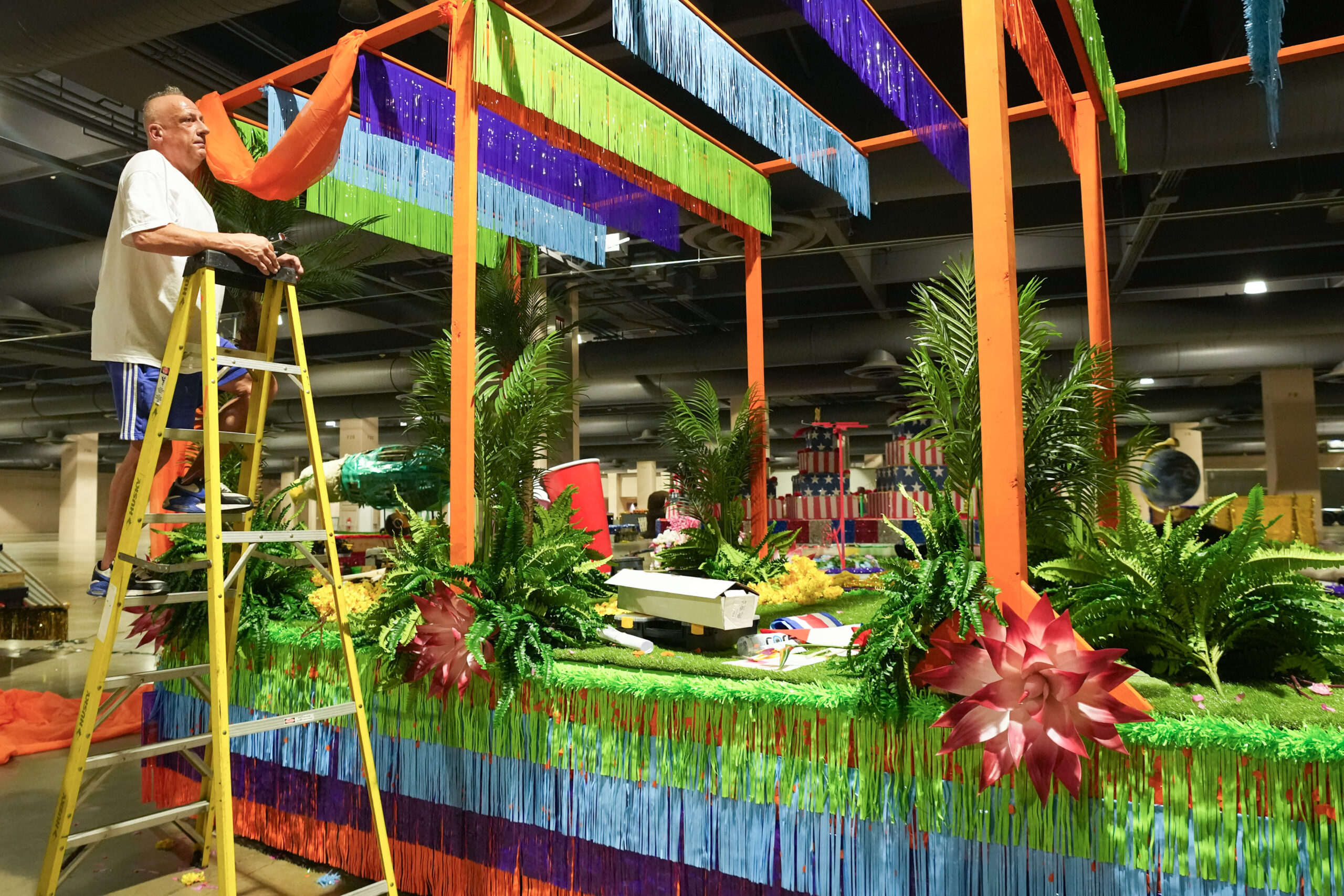
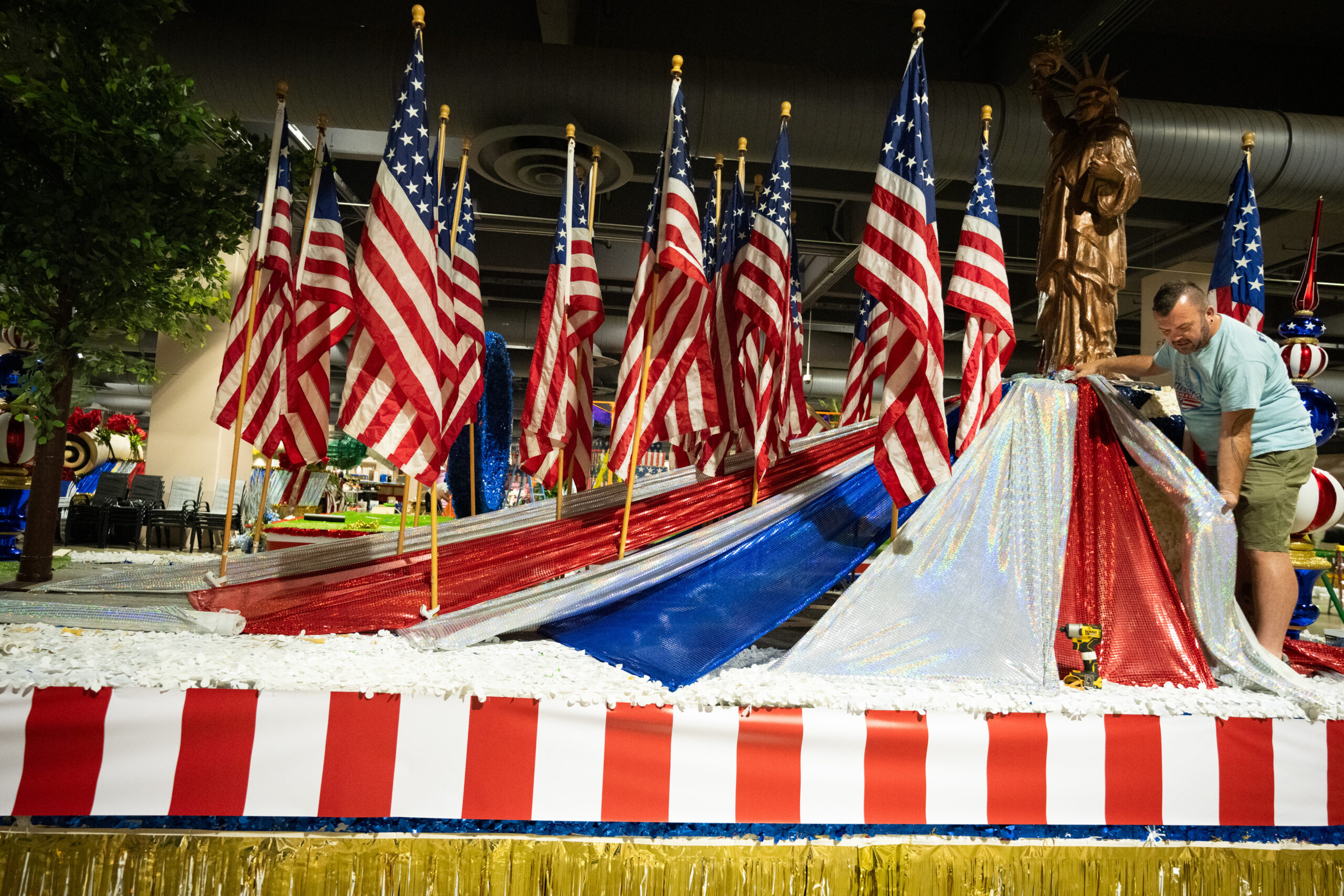
In the dull glow of the overhead Convention Center lights, Todd Marcocci and a band of craftspeople stood next to large wheeled platforms, some housing floral gazebos, others a recreation of a Pennsylvania farm. Sweat dripping from his brow, Marcocci intently drilled palm tree crowns into the base of a platform dedicated to Central and South America.
With just days until Philadelphia’s Semiquincentennial parade, Marcocci, alongside his crew and John Shaw of Shaw Parades, is assembling 19 parade floats to commemorate the United States’ 250th birthday.
Todd Marcocci works on a float back stage with the crews of Friday’s parade and festival.
The “Salute to Independence” Semiquincentennial Parade is scheduled to begin at noon Friday nearwhere the Declaration of Independence was signed in 1776, which Marcocci reminded himself of while he designed a historical parade.
“I told all the groups who signed on for the parade that we’ll be lining up in the footsteps of the Founding Fathers,” Marcocci said. “We’ll walk through history.”
In the halls of the Pennsylvania Convention Center, where float builders worked on Monday, larger-than-life recreations of Martin Luther King Jr. and Harriet Tubman awaited placement on a platform celebrating the Civil Rights movement.
Mike Oyer works backstage on the floats.
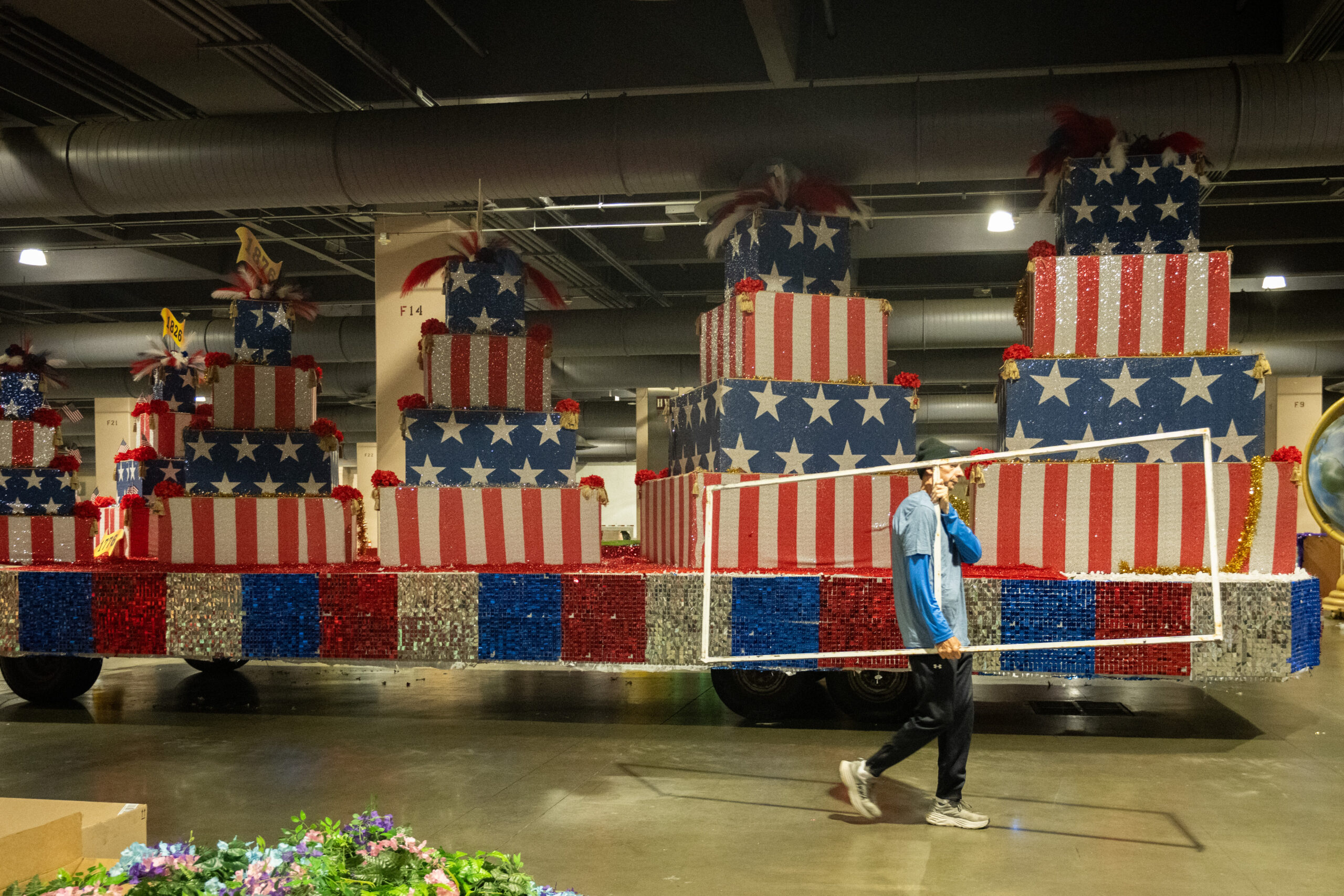
The next float over was bathed in white sequins, where a giant “peace dove” sculpture accompanied by a globe would rest. A few paces over sat a 6-foot-tall Wawa smoothie and coffee cups, and right by that were multiple United States-themed layered birthday cakes marking the various anniversaries of the country.
Shaw worked a blade saw, slicing through two-by-fours to construct the float frames that Marcocci and Co. were painstakingly deciding the minutiae of, such as how many American flags or sequins can be threaded through a float.
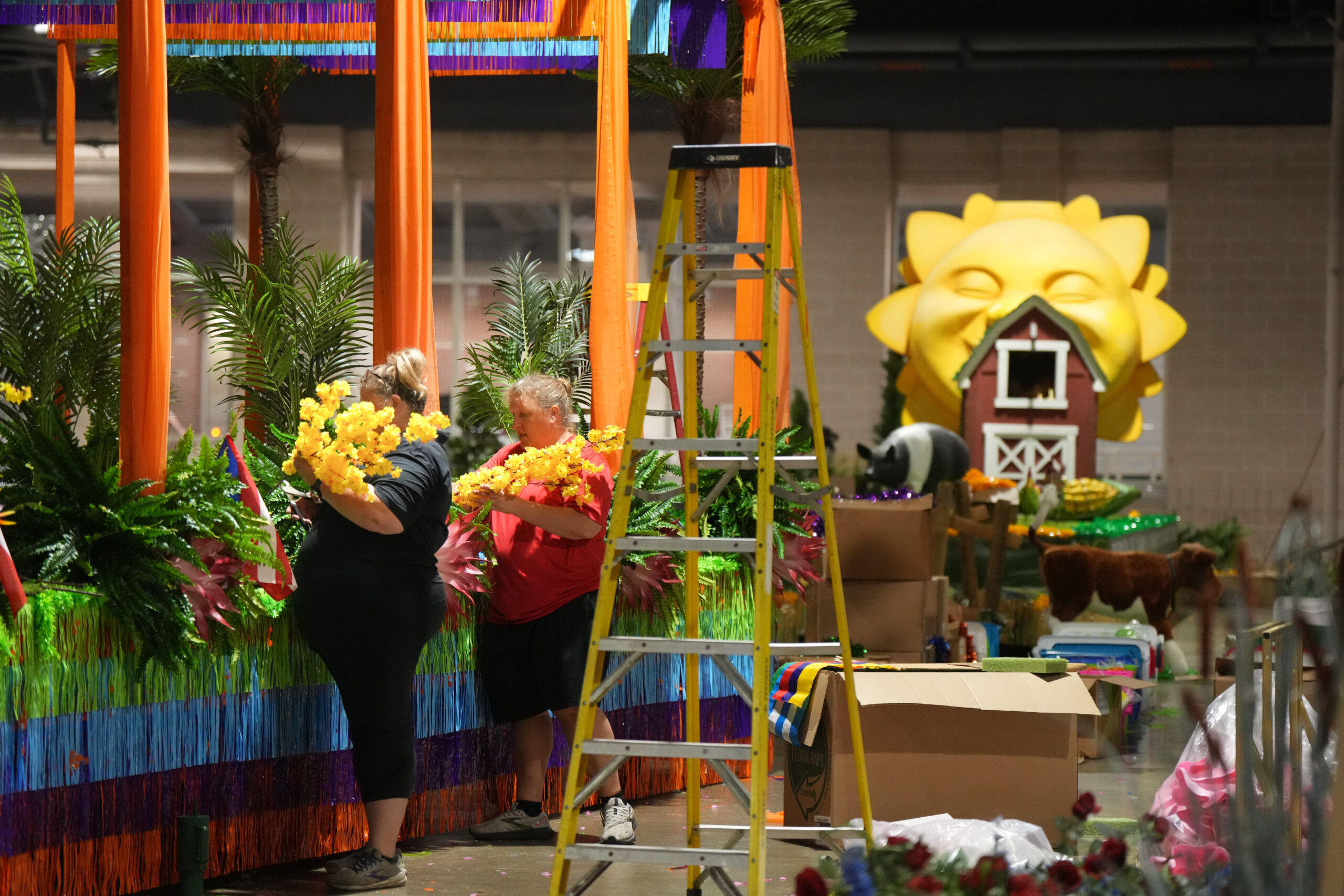
Annie Woods (left) and Johanna Gelber working on the floats.
Shaw, whose parade float company has passed down through four generations, said Philly Fourth of July parades usually average seven floats. “This year it’s almost tripled,” he said. “Todd designs everything in his head, and then we collaborate back and forth to come up with the plan to actually make these ideas work.”
Mayor Cherelle L. Parker will be on board the “One Philly — A United City” float, which features a large sculpture in the shape of the number 1 and a butterfly-and-floral gazebo symbolizing the city’s commitment to a clean and green city, Marcocci said.
Jeremy Williams, works on a float back stage.
A Liberty Bell float will commemorate some of the Founding Fathers and Betsy Ross with an Independence Hall backdrop. Another celebrates Philadelphia Pride with prominent LGBTQ figures and pride flags atop a vibrant rainbow platform.
“The most important thing for me is that people, whether they’re watching on TV at home across the nation or here in person, is that they see themselves in our parade,” Marcocci said of representing the diversity of America’s history.
Philadelphia’s Semiquincentennial Parade on Friday starts at noon at Fifth and Chestnut Streets, passing such historical landmarks as Independence Hall before heading to Sixth and Market Streets and then west on Market to circle City Hall before ending at Broad and Chestnut Streets after a heat emergency was declared, cutting short the route that was to continue to Logan Circle and loop around before heading back to City Hall.
Fan zones are at Sixth and Market Streets , 11th and Market, and the northeast side of City Hall, where a bar is available for those 21 and over.
“Smokin’” Joe Frazier is finally in his new home, just in time for the 250th birthday of the United States.
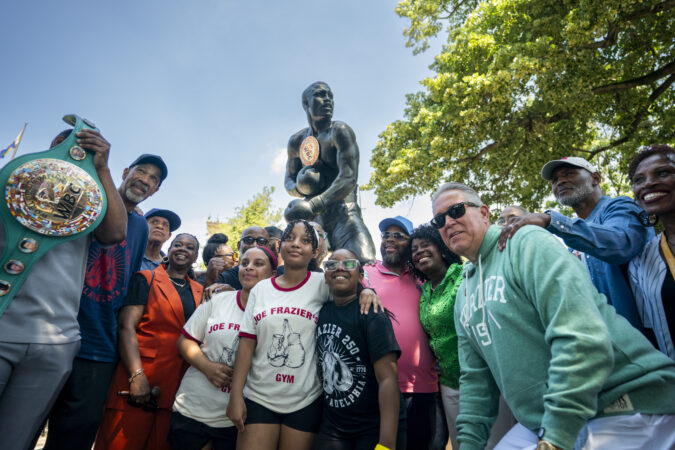
City officials, alongside Frazier’s family, friends, and fans, on Monday unveiled the real-life heavyweight boxing champion’s statue at the base of the Philadelphia Museum of Art. Intended to be the statue’s new location in perpetuity, the spot was occupied by a monument to fictional boxer Rocky Balboa for two decades.
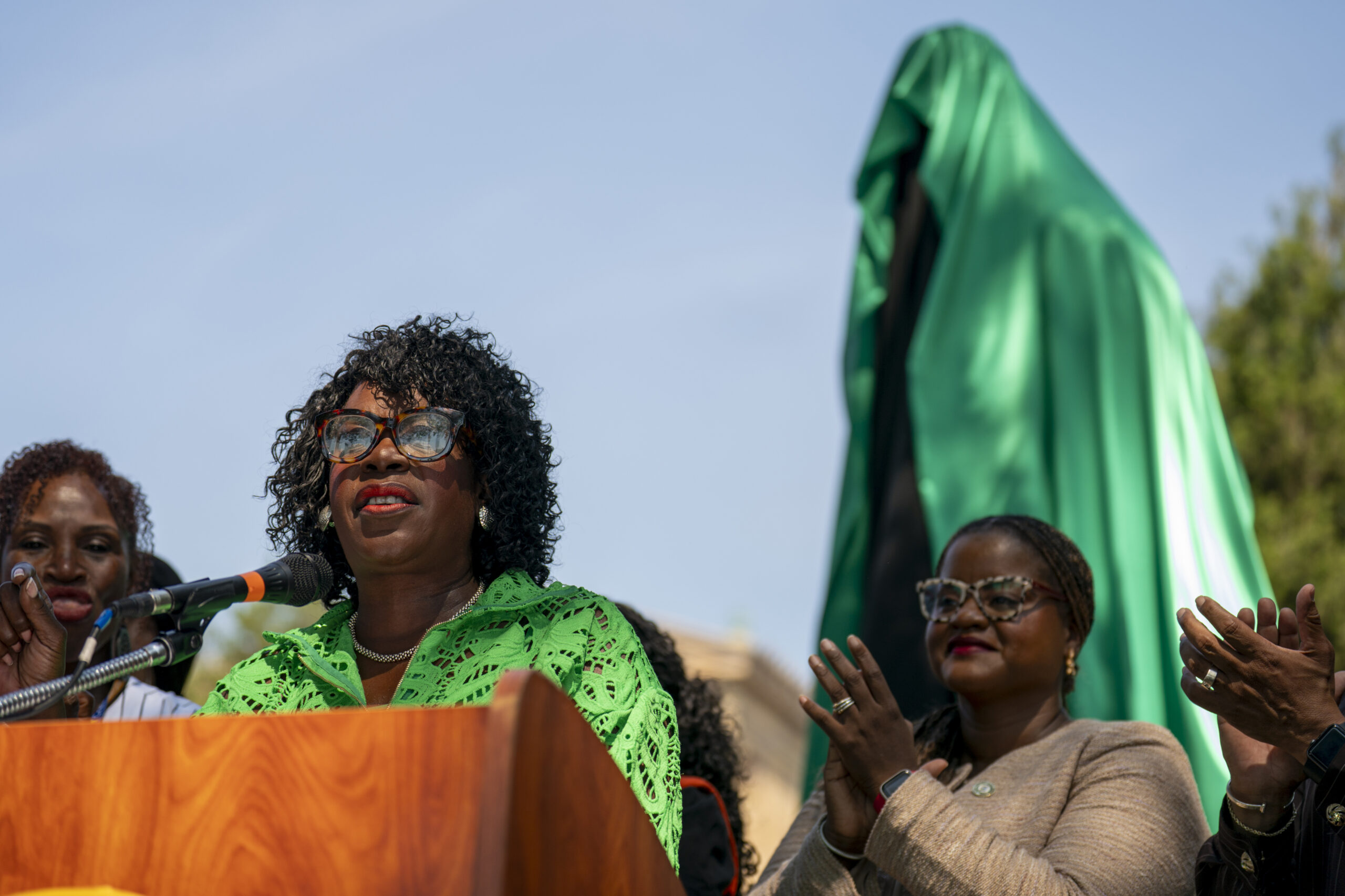
“During this 250th celebration in the birthplace of democracy, we will forever remember that the city got right what it had gotten wrong for a long, long time,” Mayor Cherelle L. Parker said. “Now, Joe Frazier is attached, and connected to, and will permanently be here at our Philadelphia Museum of Art.”
Monday’s unveiling was the culmination of months of planning. The Philadelphia Art commission in February approved a plan to move the statue from by Creative Philadelphia, the city’s office for the creative sector. Chief cultural officer Valerie V. Gay said Monday’s event was something of a “soft launch” for the statue’s new home, as a granite base will be installed in the future, along with more formal interpretive panels.
Mayor Cherelle L. Parker speaks at the unveiling of the statue of former heavyweight boxing champion Joe Frazier at its new home outside the Art Museum.
“Today, we did not want to wait,” Gay said.
Frazier’s statue, after all, lived at the South Philadelphia sports complex for more than 10 years. Created by sculptor Stephen Layne, the statue was unveiled outside what is now Stateside Live! in 2015, four years after Frazier’s death in 2011 following a battle with liver cancer. Frazier, the undisputed heavyweight champion in 1970-1973, is probably best remembered for his three battles against Muhammad Ali in the 1970s.
The city’s statue of Rocky had called the base of the Art Museum’s famed steps home since 2006. The monuments’ moves are part of a larger shuffling of statues at the Art Museum that began in March, when the Rocky statue was moved inside the museum for the first time as part of the ongoing exhibition Rising Up: Rocky and the Making of Monuments.
That Rocky statue will be installed at the top of the Art Museum steps in the fall, when the statue of the Italian Stallion currently there will be returned to actor Sylvester Stallone’s private collection. Stallone, Parker said, was supportive of the Frazier statue’s new location.
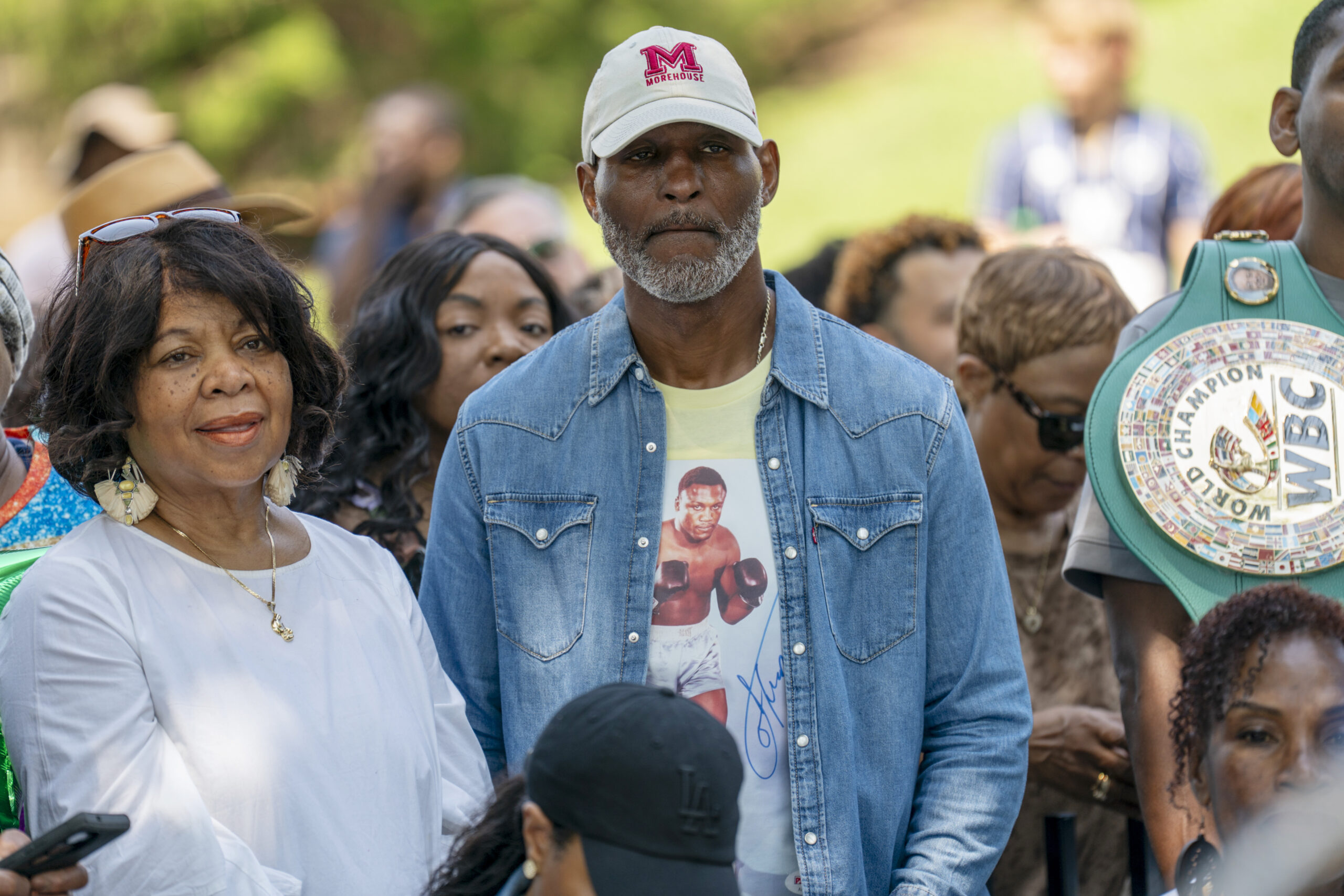
Dozens of the boxer’s supporters attended on Monday, including Philadelphia boxer Bernard Hopkins who held world championships in two weight classes, promoter Joe Hand Jr., and Frazier’s daughter Jacqueline Frazier-Lyde. Frazier-Lyde, a retired boxer and current Municipal Court judge, said the the color of the shroud covering her father’s statue — green —was fitting.
“My mother’s favorite color was green, because we’re from the South and we love green, because it represents life,” she said. “My father, Joe Frazier, liked it because it was the color of money.”
Boxing legend Bernard Hopkins at the unveiling of the new home for the statue of heavyweight boxing champion Joe Frazier.
To the end, the statue’s new location wasn’t the end of efforts in the boxer’s memory. Parker also announced plans for a capital campaign to restore the former Joe Frazier’s Gym on Broad Street above Glenwood Avenue in North Philadelphia. Now a discount furniture store, the building is a legendary location in Philadelphia boxing history, having served as a training location for not just Frazier but other famed fighters and community members.
Parker said plans were underway to establish a way to accept donations for that effort via the Philadelphia City Fund. The amount of funds targeted be raised was not immediately clear.
“It’s important to show the world who we are,” Gay said. “Joe Frazier was a humble underdog whose determination and grit inspires us all. What could be more [a] more Philadelphia story than that?”
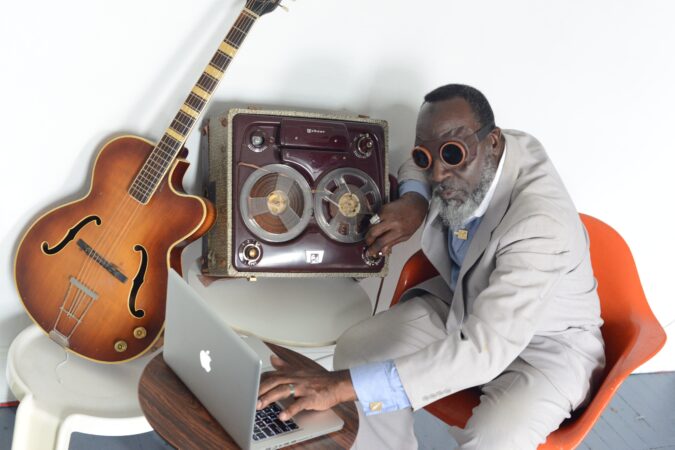
Jamaaladeen Tacuma isn’t particularly interested in dwelling on the fact that he has just turned 70. It may be one of the few things the veteran bassist, with a seemingly limitless capacity for fascination, isn’t interested in.
“I was always the kind of person that looked ahead,” Tacuma said. “I like to say, ‘What am I going to be doing in the future? How will I be thinking in the future?’”
He marked his June 13 birthday not with old friends, but performing at South,leading a never-before-assembled, multigenerational quintet with Pulitzer-winning drummer Tyshawn Sorey, saxophonist and Snacktime cofounder Yesseh Furaha-Ali, guitarist Keyanna Hutchinson, and pianist Yoichi Uzeki.
On July 18, he’ll celebrate the release of a new all-star album with 102-year-old saxophonist Marshall Allen at Grounds for Sculpture in New Jersey. Two months later, he’ll be back at South with Quantum Blues, an unlikely quartet teaming him with longtime Pharoah Sanders guitarist Tisziji Munoz, Living Colour drummer Will Calhoun, and former Late Show with David Letterman keyboardist Paul Shaffer.
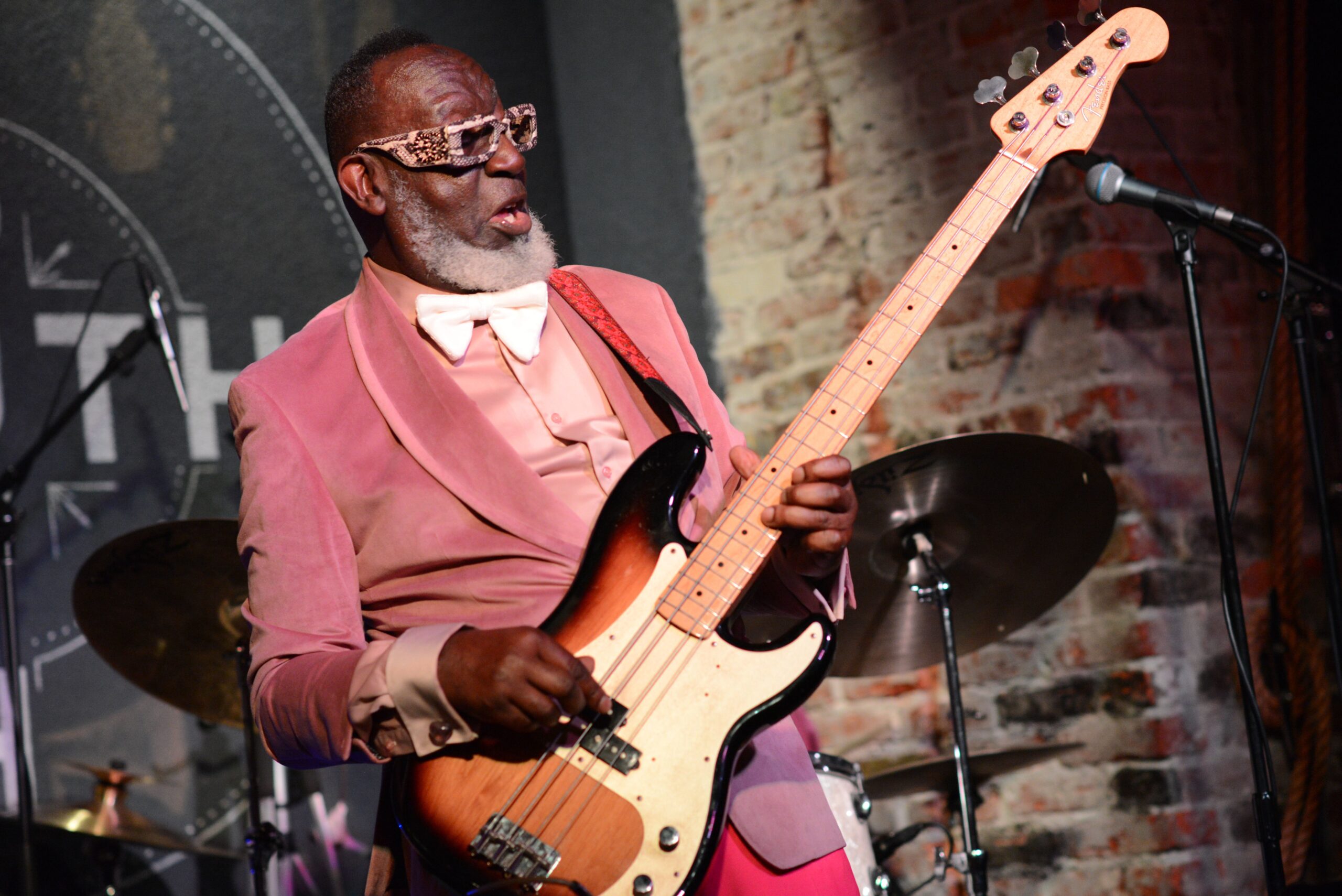
Jamaaladeen Tacuma on stage at South. The bassist celebrated his 70th birthday at the club in a quartet featuring drummer Tyshawn Sorey.
But it’s not just music that captures his imagination. Before settling in for our interview in May at a Mexican restaurant on Passyunk, Tacuma was gushing about his recent viewings of vintage films from Japan’s Toho studio, giant monster movies like the original Godzilla and The Mysterians.
The lunch, he said, evoked memories of a visit to Mexico City, where he learned of the country’s lucha libre wrestling tradition. This, in turn, prompted the recording of an upcoming album, Bajo Libre.
That sort of thing happens constantly with Tacuma, who has a Zelig-like ability to find himself in unexpected musical situations.
On a recent trip to London, he was being shown around by drummer Sean Noonan, a frequent collaborator. While passing though the Liverpool Street tube station, his ear was caught by the guitar playing of a young busker. He immediately tasked Noonan with finding a studio and enlisted the 18-year-old guitarist, Michael Asukyle, to record an impromptu album he called Mind the Outsiders, which was released last February.
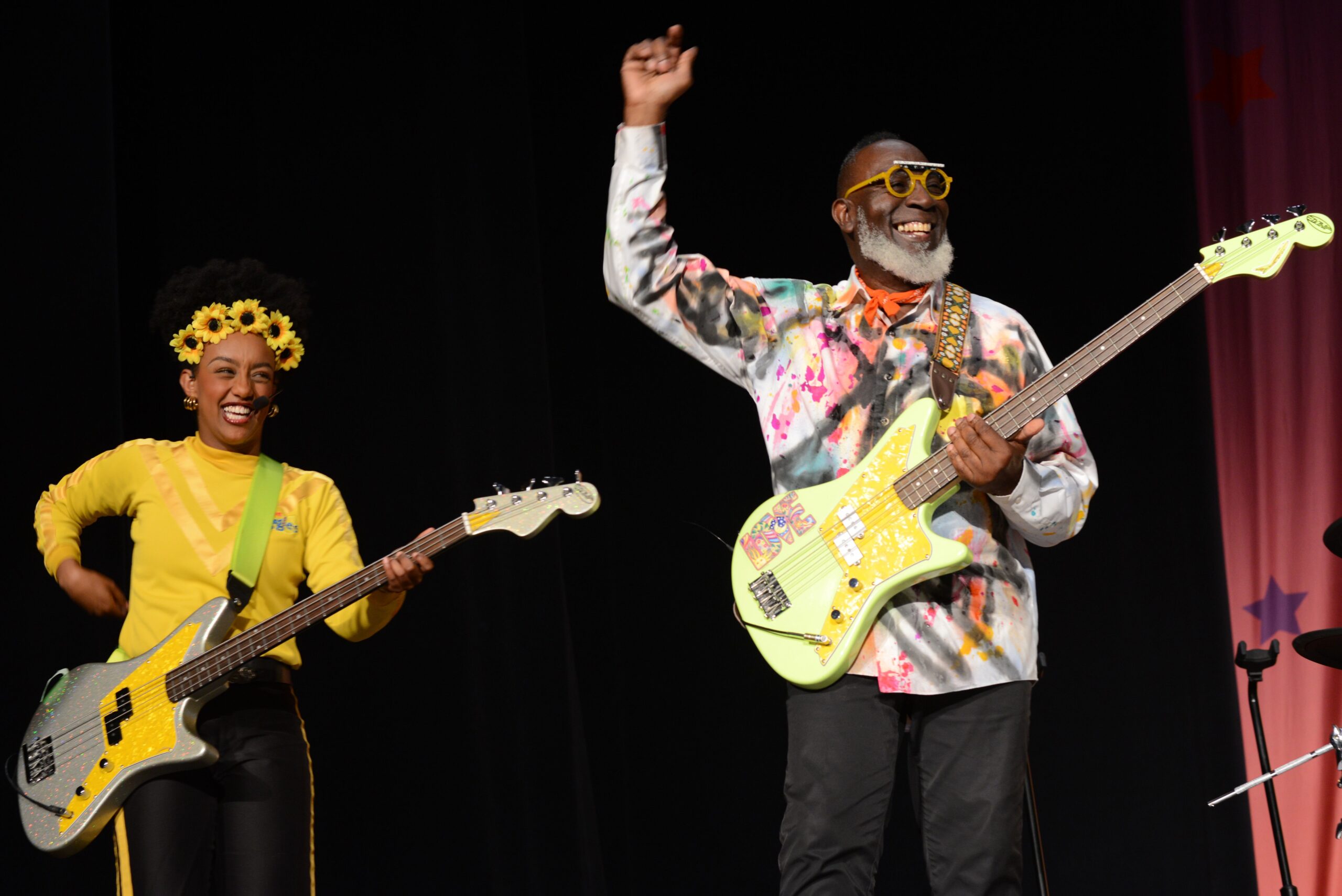
Jamaaladeen Tacuma on stage with the Wiggles in Boston’s Wang Theater in 2023, where he presented band member Tsehay Hawkins with a special DiPinto bass.
After taking his grandson to see the Australian children’s group the Wiggles a few years ago, he bumped into the band over breakfast at Sabrina’s Cafe the next morning. By the time he got home, they’d invited him into the studio to write and record the song “Play the Bass Guitar.”
He’s since joined them on stage and on television, and plans to reunite with the band this summer at the Miller Theater.
Tacuma’s friendship with Rolling Stones drummer Steve Jordan — they met, he recalls, copresenting an award to the Red Hot Chili Peppers — led to an eight-year gig in the house band for the Michael J. Fox Foundation’s annual gala fundraiser, where he’s played with the likes of Sheryl Crow, Stevie Nicks, Jackson Browne, and Bob Weir.
Almost in spite of his compulsion to move perpetually forward, Tacuma’s 70th birthday year has occasioned a number of opportunities for revisiting the past, as well.
In January, the bassist returned to the Norris Apartments housing project, where he grew up as Rudy McDaniel.
Joined by a group of local singers and musicians, many of whom he’d known since his early days in North Philly, he presented his “The Dream Then & Now” suite, dedicated to the Rev. Dr. Martin Luther King Jr. As Lawrence “Weas” Newton recited the civil rights leader’s words, Tacuma struck up a funk groove in the complex’s community center, a poster board nearby displaying photos of him playing in the same room as a teenager.
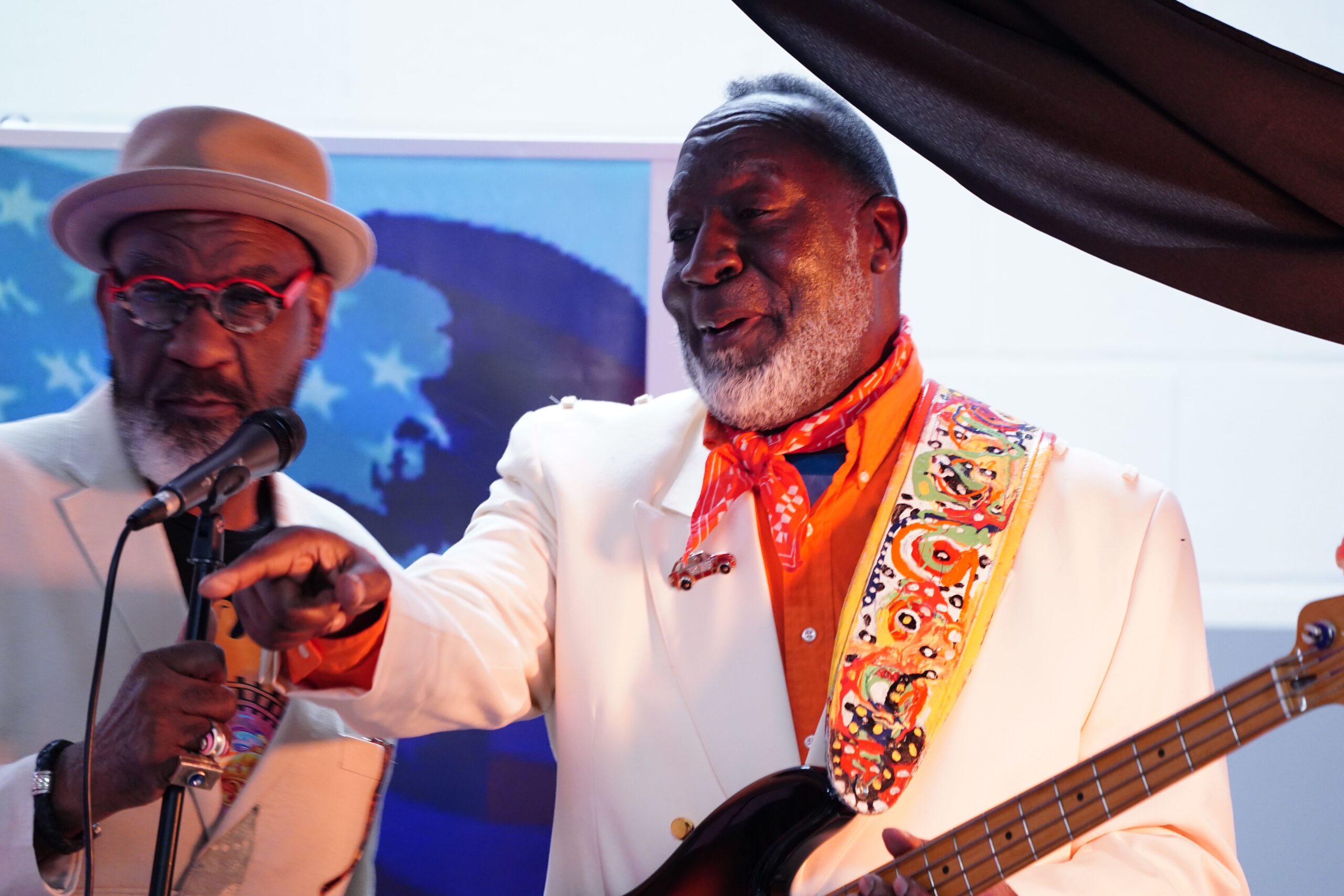
Bassist Jamaaladeen Tacuma on stage with vocalist Lawrence “Weas” Newton in January at the Norris Homes Community Center.
“It was surreal,” Tacuma said with a laugh. “Weas and I grew up in the area. We used to play ball in the basketball courts right next door. A lot of groups came from that area, like Harold Melvin & the Blue Notes, the Stylistics, McFadden and Whitehead, Brenda & the Tabulations. And the Uptown Theater was right around the corner, so I saw everybody there whenever those shows would come to town — the Temptations, James Brown.”
The neighborhood not only nurtured Tacuma’s passion for music but also inculcated his love of fashion.
“If folks had money, they would go downtown and go to Boyds,” he explained. “But for the most part, we would go to the Avenue, Germantown and Lehigh. There you had all the stores, like Leo’s or Al Schaeffer’s Red Carpet Room.”
Tacuma later borrowed the name of one of those shops for his boutique, the Redd Carpet Room. There he sells the finds he brings home from his travels; he can often be found at flea markets and vintage shops in the hours prior to a performance.
“I don’t take bass guitars on tour anymore,” he said. “I just bring a suitcase to fill with clothes. I’m serious about helping guys look a bit better.”
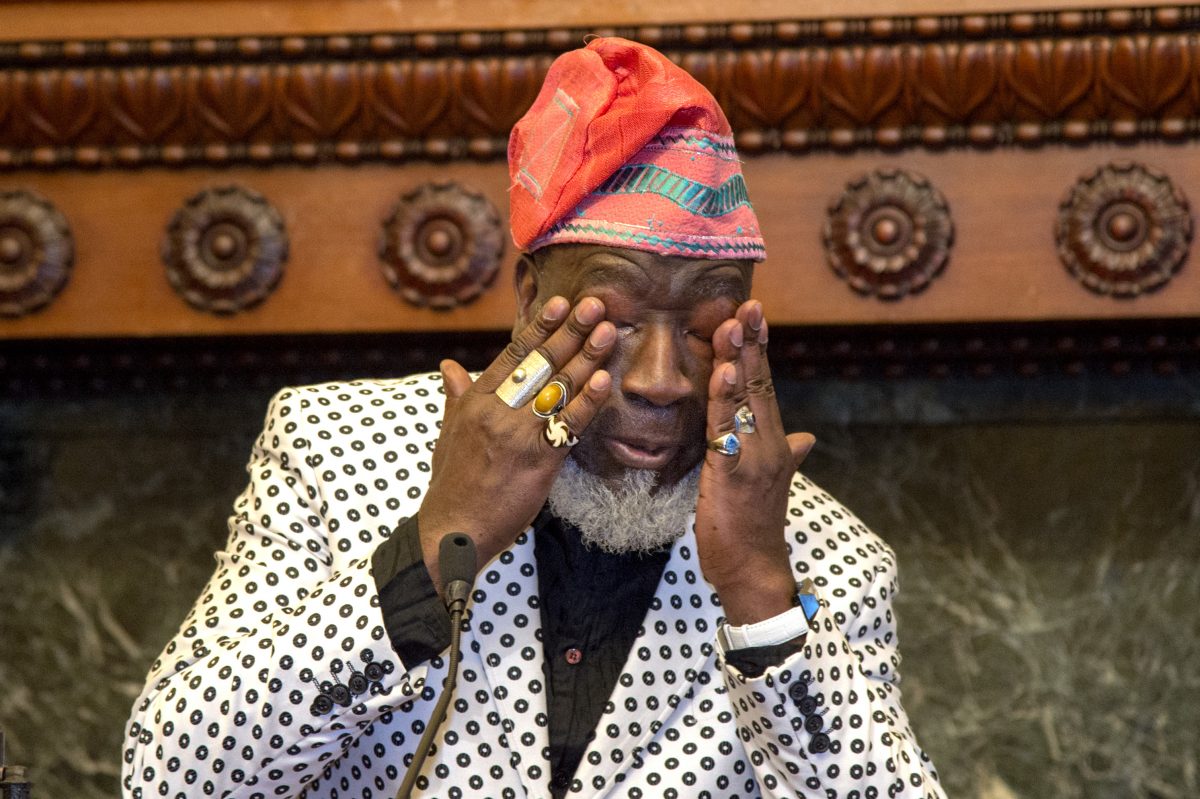
Bassist Jamaaladeen Tacuma wipes away tears after he was presented with the 2018 Benny Golson Award by the mayor at City Hall on March 29, 2018.
A month after his MLK Day performance, Tacuma played the Sons d’Hiver festival in Paris, where he revisited the hotel that had become the home base for Ornette Coleman’s Prime Time band 50 years earlier, during Tacuma’s first tour of Europe.
“We were supposed to go to Paris for two weeks, and we wound up staying for three months,” he recalled. “I hadn’t been back to that place since that time. The same family owned it. We had lunch right next door, at the same restaurant where Ornette and I used to have lunch, sitting at the same table. It brought back a lot of memories.”
Coleman played a foundational role in Tacuma’s musical life. After high school, he received a scholarship to attend Berklee School of Music but declined.
“Because I wanted to be a musician that played on the road.”
Instead of college, he joined organist Charles Earland’s band but was fired after a year. He moved home, wondering what to do next, until a week later he received a call to audition for Coleman’s band.
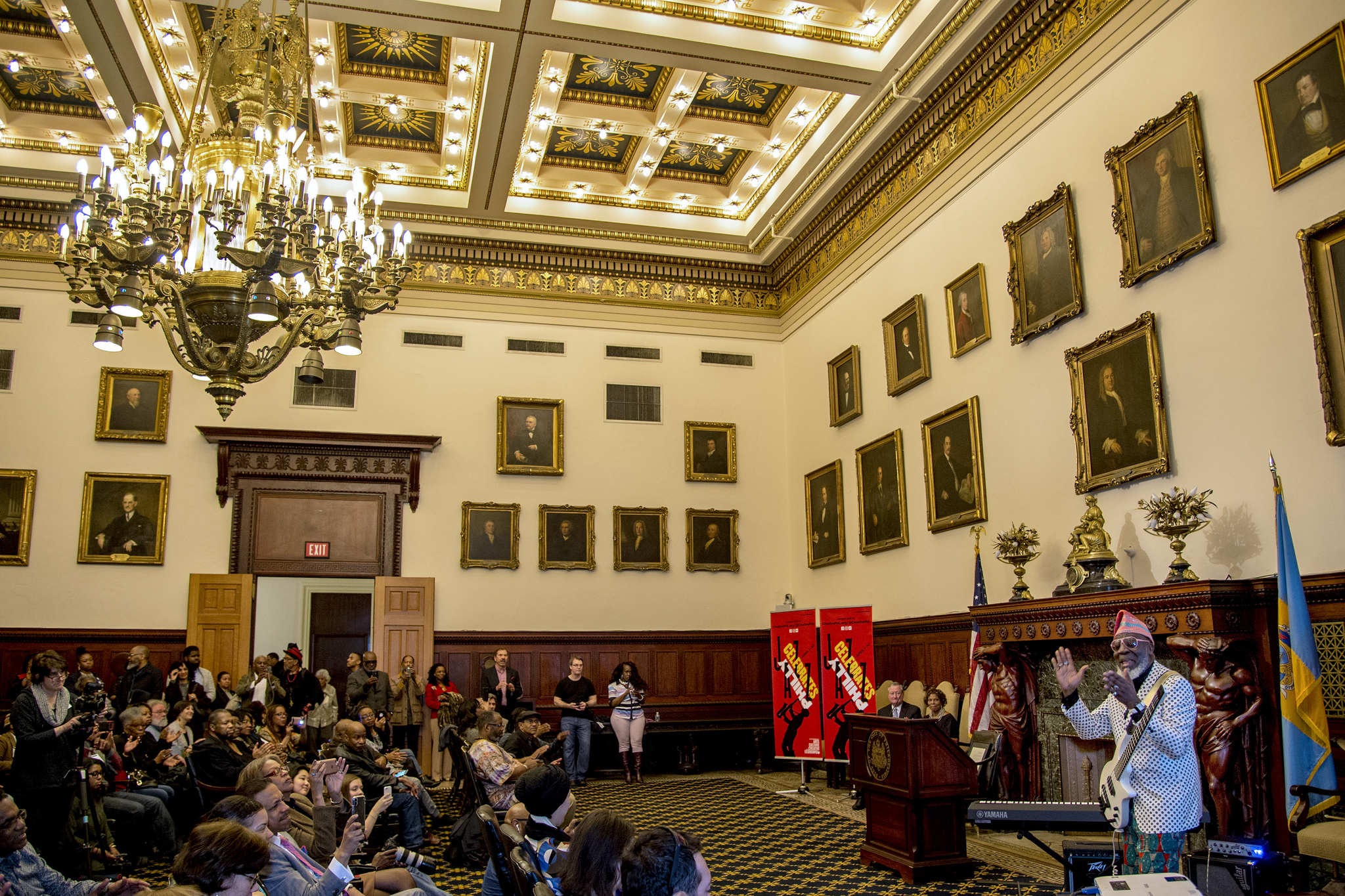
Tacuma gives an impromptu solo performance in the Mayor’s Reception Room on March 29, 2018.
“I learned so many things from Ornette,” he said. “As a bandleader, he wasn’t dictatorial, but he knew what he wanted and he knew how to extract that from the members of the band. Also there was a seriousness about sound, the idea that if you really, truly hear something different, then you should express it. You don’t have to follow a trend.”
Those are lessons that Tacuma has carried with him over a remarkably diverse and unpredictable career spanning more than half a century. He has collaborated not just with a staggering variety of musicians but with visual artists, filmmakers, architects, and scientists.
When asked to take a moment to look back over it all, even he has to marvel.
“I think I’ve looked into the future so much,” he concluded, “that I have a lot of stuff now to look back on. I feel blessed that the creator has given me all this.”
The players amble into the auditorium on acloudy May morning to run through their schemes and formations and make last-minute adjustments to the roster. Some are already in uniform — waistcoats and breeches — fueling up on Wawa coffee and bagels. Others scroll aimlessly on iPhones or finish off their cigarettes outside the Free Quaker Meeting House near Independence Hall. They discuss contingencies, ready their gear, and buckle their latchet shoes tight.
“Get out there and have fun,” their coach, Historic Philadelphia’s director of storytelling Johanna Dunphy, says as she sends her proud-chested team of historical reenactors off for their preseason opener.
This is the start of the team’s Super Bowl run: the lead-up to the nation’s Semiquincentennial. The cast of Ben Franklins, John Adamses, and Betsy Rosses — actors who have spent months and uprooted their lives to learn about and live as colonial America’s key characters — will be at the front lines of the 250th birthday celebrations, which began with the cast’s opening day on May 23 and reach a fever pitch on July 4. They will become de facto historians, guides, entertainers, and ushers to an expected crush of tourists, all while anchoring how the country’s earliest days are memorialized and whose stories get to be told.
“Fly!” Dunphy says with gusto as the performers shuffle out of the modest redbrick building.
This set of actors is part of Historic Philadelphia’s Once Upon a Nation program — a series of performances staged throughout the summer and beyond in Philadelphia’s historic district and at Valley Forge. It’s Once Upon a Nation’s 21st season, but this year is expected to be one of its biggest ever, with the most actors, plays, scripts, and events.
And, with tourism agencies expecting this summer’s events to draw upward of one million visitors, it’s almost certain to be the program’s largest audience.
“Philadelphia is ready for you,” Amy Needle, Historic Philadelphia CEO, told the players on the last day of the preseason. “And I know you’re ready for them.”
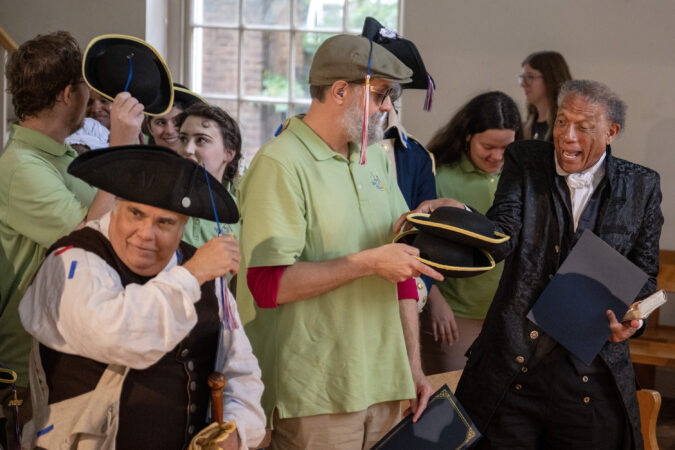
Shecky Perlman as Ben Franklin, and other historical reenactors receive their diplomas on May 21, 2026, after weeks of intensive, immersive training at the Benstitute.
Fourmonths to game day
Actors, mostly local, file in and out of Jason Greenplate’s office on a chilly January afternoon. Greenplate, program manager for Once Upon a Nation, and his colleagues are seeking the strongest possible players who have the passion, the look, and the improvisational skills to take on the characters and become “history makers” — what Historic Philadelphia calls its reenactors.It’s essential for these coaches to choose players who are not only capable of taking on these roles but are also willing to challenge their own understanding of history.
Spencer Salusky, a 23-year-old fresh William & Mary graduate, walks through the door.
As a draft prospect, Salusky is an impressive pick. He can execute even the most complex of plays (tricky lines and blocking), and his stats (body measurements and head shape) are optimal.
“He kind of looks like John Adams,” Greenplate thinks.
After conferring with his peers, Greenplate chooses Salusky tobecome Once Upon a Nation’s next John Adams, and, one by one, 19 more actors are cast as history makers and storytellers, those who are stationed at the city’s historic sitesin green polos to offer context to visitors. They join the existing 30 company members returning from prior years.
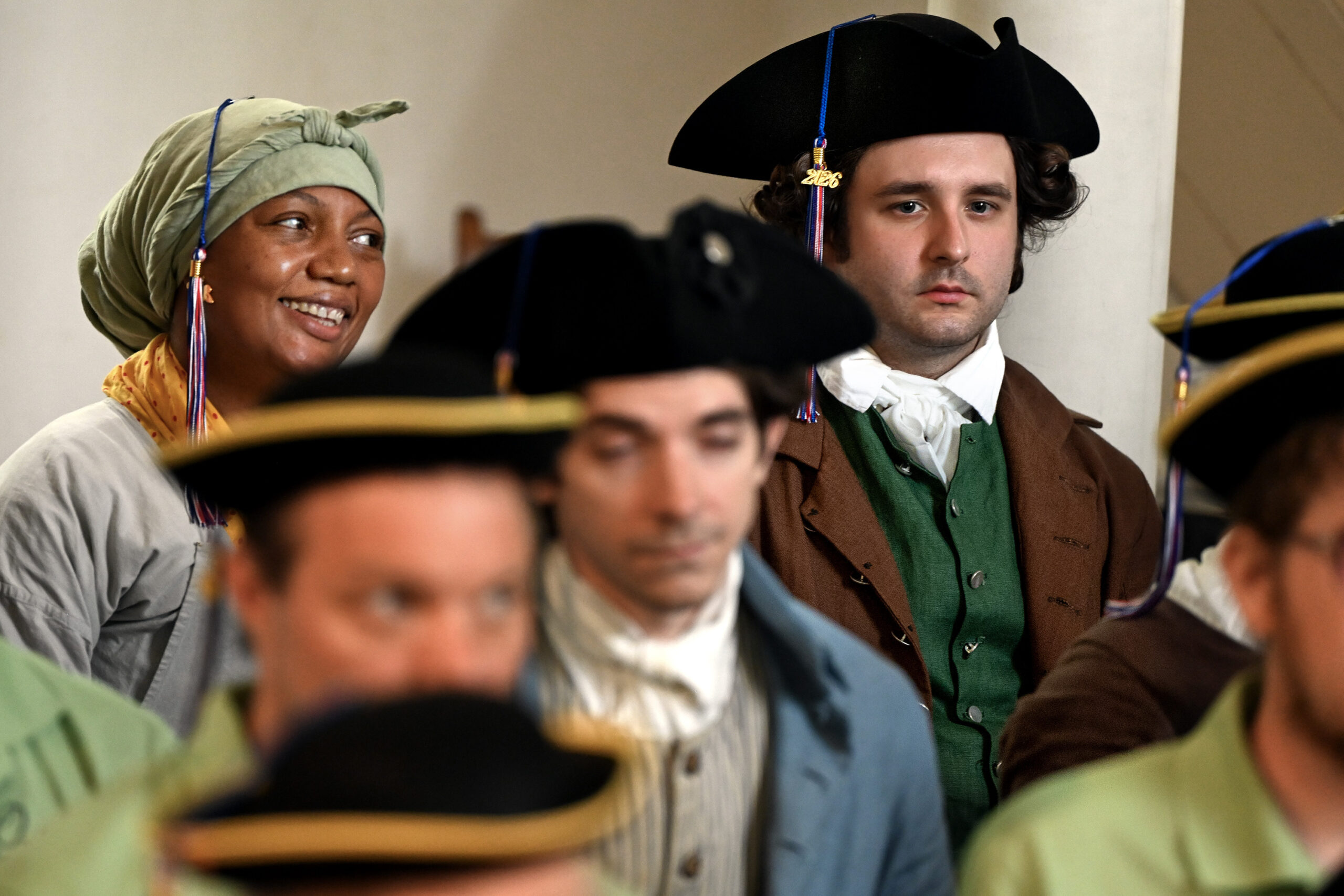
Courtney Mitchell, who portrays Margaret Woodby (left), and Spencer Salusky (right) as John Adams, join other historical reenactors at graduation on May 21, 2026, after weeks of intensive, immersive training at the Benstitute.
Three months to game day
The actors soon begin their training. For Salusky, that looks like receiving a large packet full of biographical information about John Adams — where he was born, his wife’s name, and his perspective on slavery — from Doug Thomas, director of history makers.
Thomas is a player-coach, a star in his own right who can seamlessly transition to the coaches’ box. Like Deion “Prime Time” Sanders, Thomas is a Swiss Army knife on the field, having played every position in the game of historical reenacting, from William Penn and Patrick Henry to Francis Scott Key, and has been doing the work for nearly 30 years. But what makes him truly elite is his position as Mount Vernon’s George Washington.
Out in the field, the players might be blindsided by a granular question from a tourist, an offensive remark from a passerby, or incessant badgering from a child. On the stage — where the history makers also perform a series of scripted plays — they must be prepared to embrace their characters’ conflicting motivations, shifting attitudes on political issues, and complex interpersonal relationships.
Thomas is equipped to help them tackle it all.
He guides them in studying their characters, trains them on redirecting conversations with visitors toward topics they’re knowledgeable about, and teaches them improvisational techniques. He also prepares them to embody the voice, posture, and behavior of historical figures.
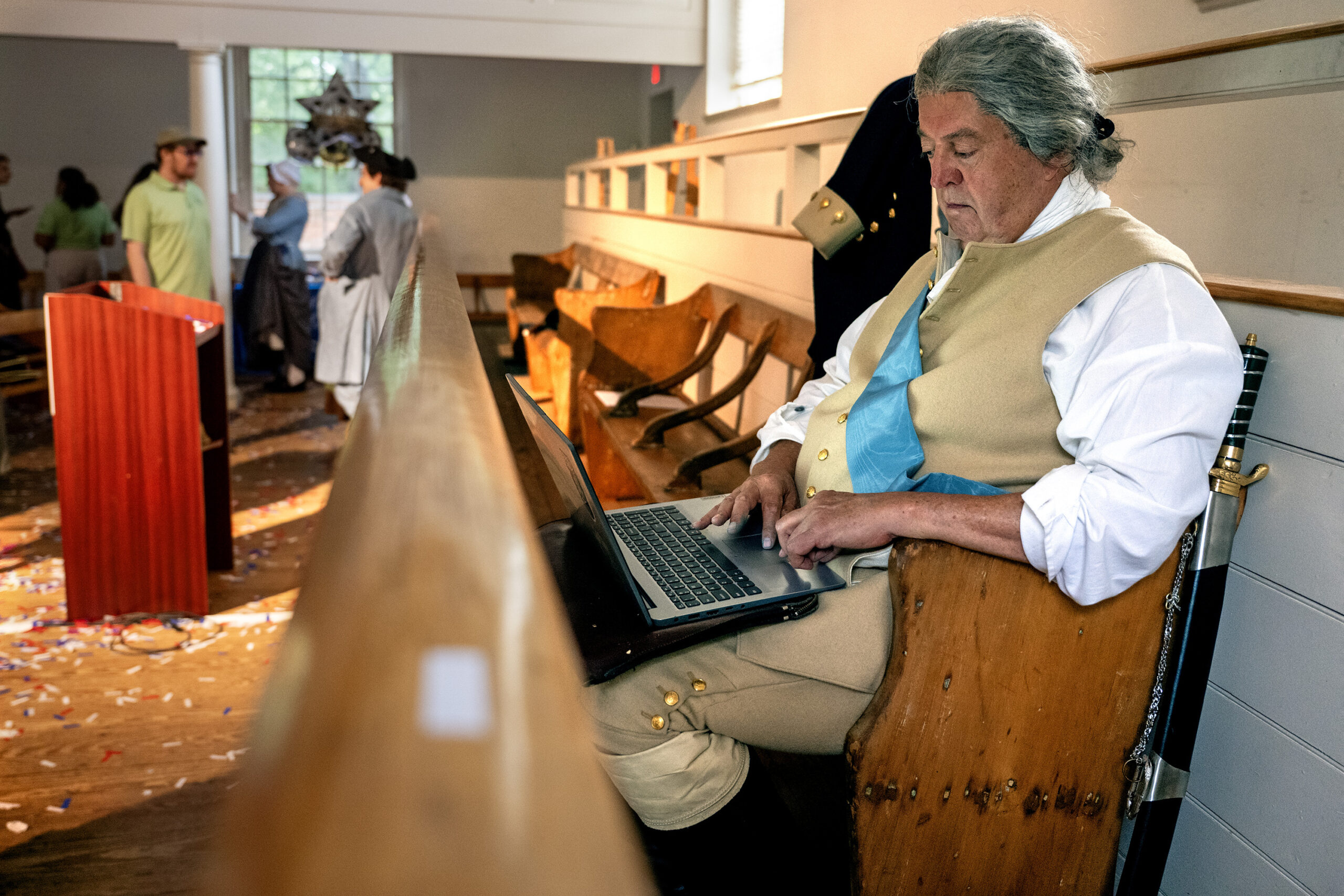
Jim Fryer as George Washington checks in on his laptop on May 21, 2026, after the graduation of dozens of historical reenactors after weeks of intensive, immersive training at the Benstitute.
Three days to game day
“Adams,” Thomas says, summoning Salusky during a rehearsal for Cocktails and Congress, a marquee performance in the Once Upon a Nation repertoire.
On a scorching 95-degree afternoon that foreshadows what the players can expect during the steamy home games to come, Thomas scans the script, glasses poised atop silky black hair that grazes his shoulders. He directs Salusky’s attention to a moment in the dialogue: “Slavery is like a great cancer.”
He cautions the actor to be careful with how he utters that line. Adams is torn about slavery at this point in his life, Thomas explains.
“He doesn’t like it, he doesn’t support it, but also he does realize very practically what eliminating slavery would do to the economy,” Thomas tells Salusky.
Salusky contemplates the note, sitting on a Meeting House pew with a mechanical pencil tucked behind his ear.
“Adams is evolving,” Thomas tells him. But “he’s a practical man.”
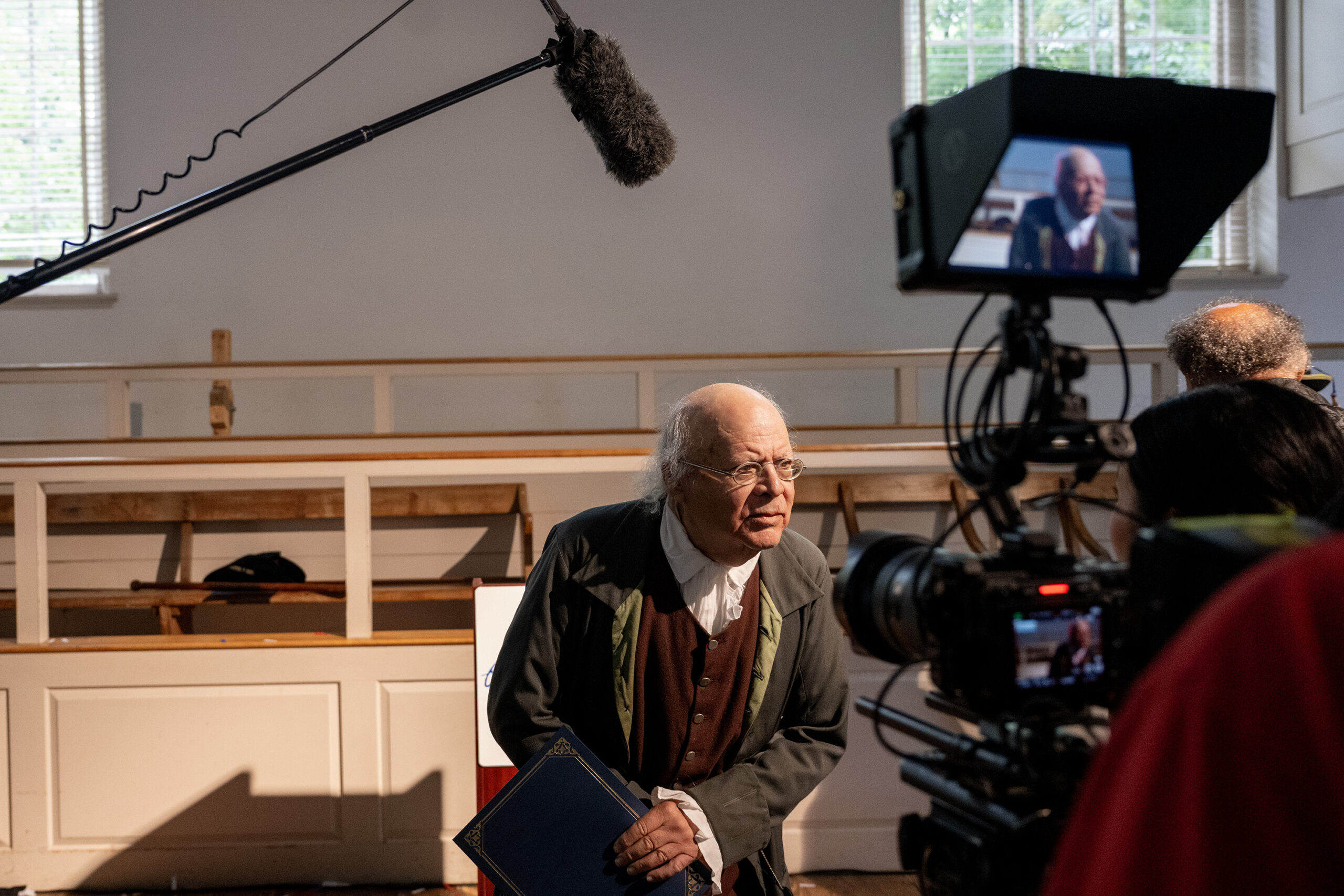
Shecky Perlman as Ben Franklin, ready for his close-up, on May 21, 2026, as he is interviewed by a documentary film crew, as dozens of historical reenactors graduate after weeks of intensive, immersive training at the Benstitute.
Two days to game day
Even with centuries of primary and secondary sources, and extensive research, there are still gaps in what’s known about 18th-century American life that the actors and program coordinators must contend with. There’s a trove of information on John Adams, for example, but the documented lives of women and people of color are far less complete, like that of Hannah Till, an enslaved cook for George Washington at Valley Forge, who purchased her freedom. What’s known about Till is often centered on her enslavers.
West Philadelphia actor Miranda Thompson, who portrays Till as well as Sarah, a fictional composite character in Cocktails and Congress, relies on more general information about how women of color lived during the colonial era to inform her performance. “You just want to get it right,” Thompson, 43, says. “You want to give truth to who that person was. … I feel like if I’m grounded and honest within that interpretation, I think that I’ve done it justice.”
For historian Sandra Mackenzie Lloyd, who authored many of the Once Upon a Nation scripts and founded the Benstitute — the immersive training program the actors undergo — the American story is about “more than the dead white dudes.”
“It’s not a straight line,” Lloyd says. “We are people who have been through many difficult periods and ups, downs. This is a country that was created by people from many places with different beliefs, and that’s historic, and it’s contemporary.”
Organizers were intentional about the stories and figures they chose to platform this summer, centering diverse and layered voices in the narrative of the nation’s founding, including those of Black Americans whose stories have been omitted in the retellings of the story of 1776.
“Our history is being erased, voting rights [are being erased], certain books are banned,” Thompson says. “Representation matters … to know that we were there, and we played an important role.”
Prominently featuring Black history during the 250th, she says, is also an opportunity to dismantle racist, archaic stereotypes about enslaved people through authentic storytelling and connection.
“You can change a person’s mind,” Thompson says. “We’re human, we can always change our minds.”
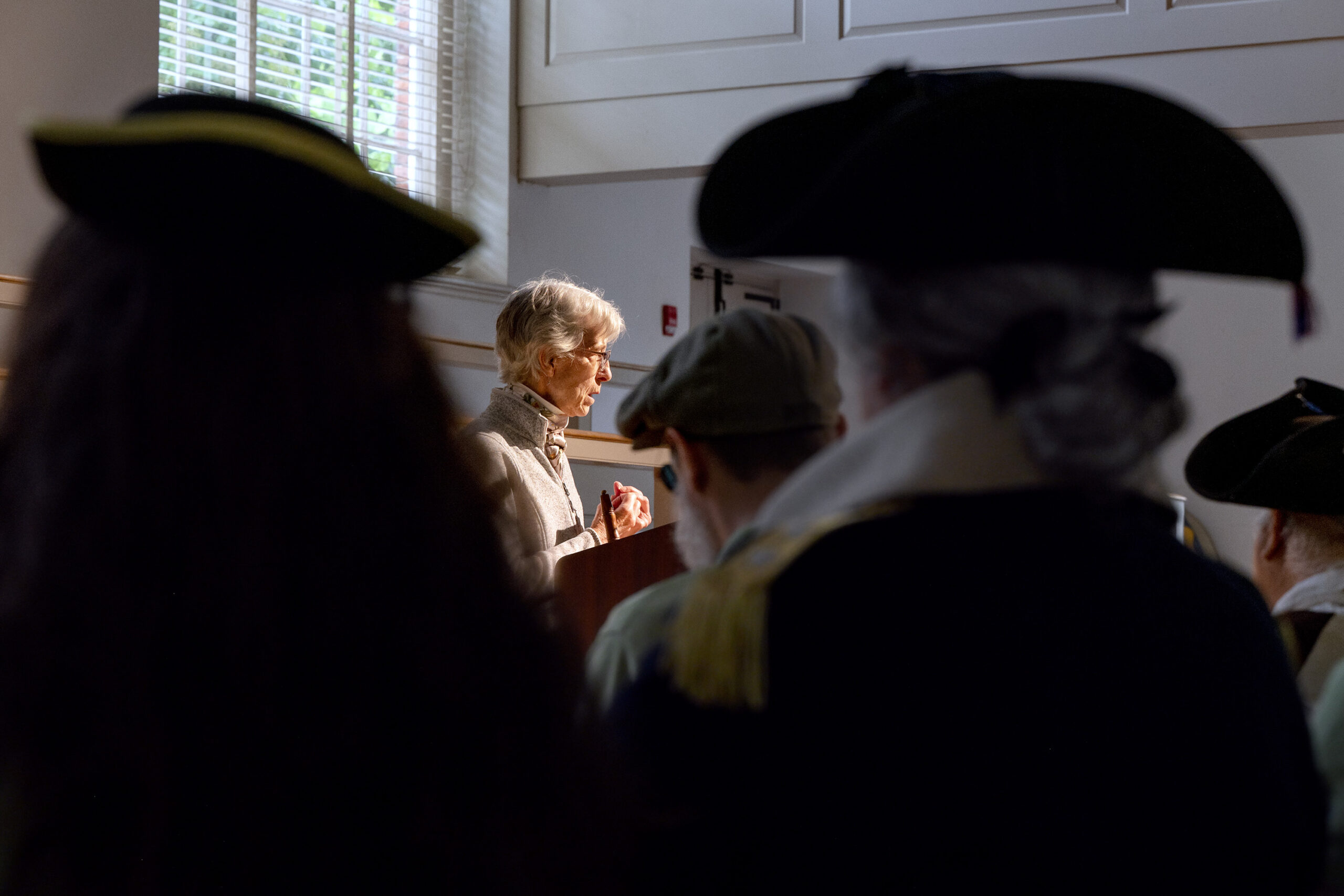
Historian Sandra Mackenzie Lloyd, founder of the Benstitute, delivers the commencement address on May 21, 2026, as dozens of historical reenactors graduate after weeks of intensive, immersive training.
One day to game day
Preparations for the reenactors include not only character work, but also tourism and hospitality training. They learn how to guide someone to the best cheesesteak or nearest toilet while staying in character and using period-appropriate vernacular. The actors also learn how to beat the heat in wool frocks and petticoats and stay safe.
“Make sure to hydrate, hydrate, hydrate,” Dunphy, the storytelling director, tells her team during a morning gathering at the Meeting House before they hit the streets in costume, and a set of volunteer fake tourists heads out to test the reenactors’ skills before they’re faced with real tourists.
She points them to a packet in their supply bags full of powder to pour into their water for extra hydration.
“Drink this,” she instructs them.
Most importantly, Dunphy reminds both the history makers and the storytellers what to do if they’re out in the field and feeling unsafe.
“History makers, please remember this: If a storyteller says, ‘Have you seen John Adams?’ Don’t be cute. That is a plea for help; they need you to stay with them. It is not a joke. They need you to stay,” she says. “Things can turn on a dime.”
And, as this is live performance, things often don’t go according to plan.
During an April news conference at which a Betsy Ross and a Benjamin Franklin from the company stood onstage beside Gov. Josh Shapiro, a giant poster reading “America 250 PA” fell forward, scraping Franklin’s behind.
Carol Spacht, the Betsy Ross at the event, acted quickly.
“This is such an exciting announcement that the world is falling apart over it,” she exclaimed after the poster came down, gesticulating with a scroll clasped in her hand before turning to the Benjamin Franklin reenactor, Bill Robling.
“Quite all right, Dr. Franklin?” she asked as he nodded. “We’re sturdy at our age. 250 years does that.”
At a recent event at Reading Terminal Market, Salusky, as John Adams, had to navigate how to handle tourists approaching him, thinking he was Benjamin Franklin.
“As John Adams, how do I react to people thinking I’m Ben Franklin. Well, he was a mentor of his. He really admired him, found him annoying, but would still be a little flattered,” Salusky says. “It’s kind of just like in-the-moment problem-solving.”
Over the course of their four months of training, the actors finally reach a place of feeling ready for anything … mostly.
“Speaking in 18th-century tongue continuously, I am nervous about that,” Thompson says. “I want to portray it real.”
Cause for celebration
Before the actors are on their own on the Philly streets, they and their mentors celebrate the completion of their Benstitute training with a graduation ceremony at the Free Quaker Meeting House.
Graduates file in, some in polos and slacks and some in costume, all wearing red, white, and blue tassels dangling from the center of their mob caps and other historical hats. They sit in the pews, players awaiting the game-time whistle, as their coaches offer them final words of encouragement before they put their drills to the test and tackle the real world, beginning with their season’s opening day — their fervor not letting up until they run through the proverbial tunnel onto the championship field for July 4.
“History is not just about buildings, artifacts, and famous moments. It is about people — their choices, their struggles, their disagreements, their courage, their hopes for the future,” says Steven Sims, superintendent of Independence National Historical Park. “Long after visitors leave Philadelphia, they may not remember every date they heard or every building they toured, but many will remember how someone made them feel connected to history. Many will remember you.”
One by one, the reenactors and storytellers cross the stage, graciously accept their diplomas, smile for photos, and return to their seats.
“Class of 2026, please stand up,” says Amy Needle, the Historic Philadelphia CEO.“Change your tassels. Congratulations! George Washington?”
“Class of 2026,” aWashington reenactor calls. “Hip hip.”
“Huzzah,” they respond.
“Hip hip,” he repeats.
“Huzzah!” they conclude as audience members deploy tiny silver confetti cannons and red, white, and blue rain down upon them.
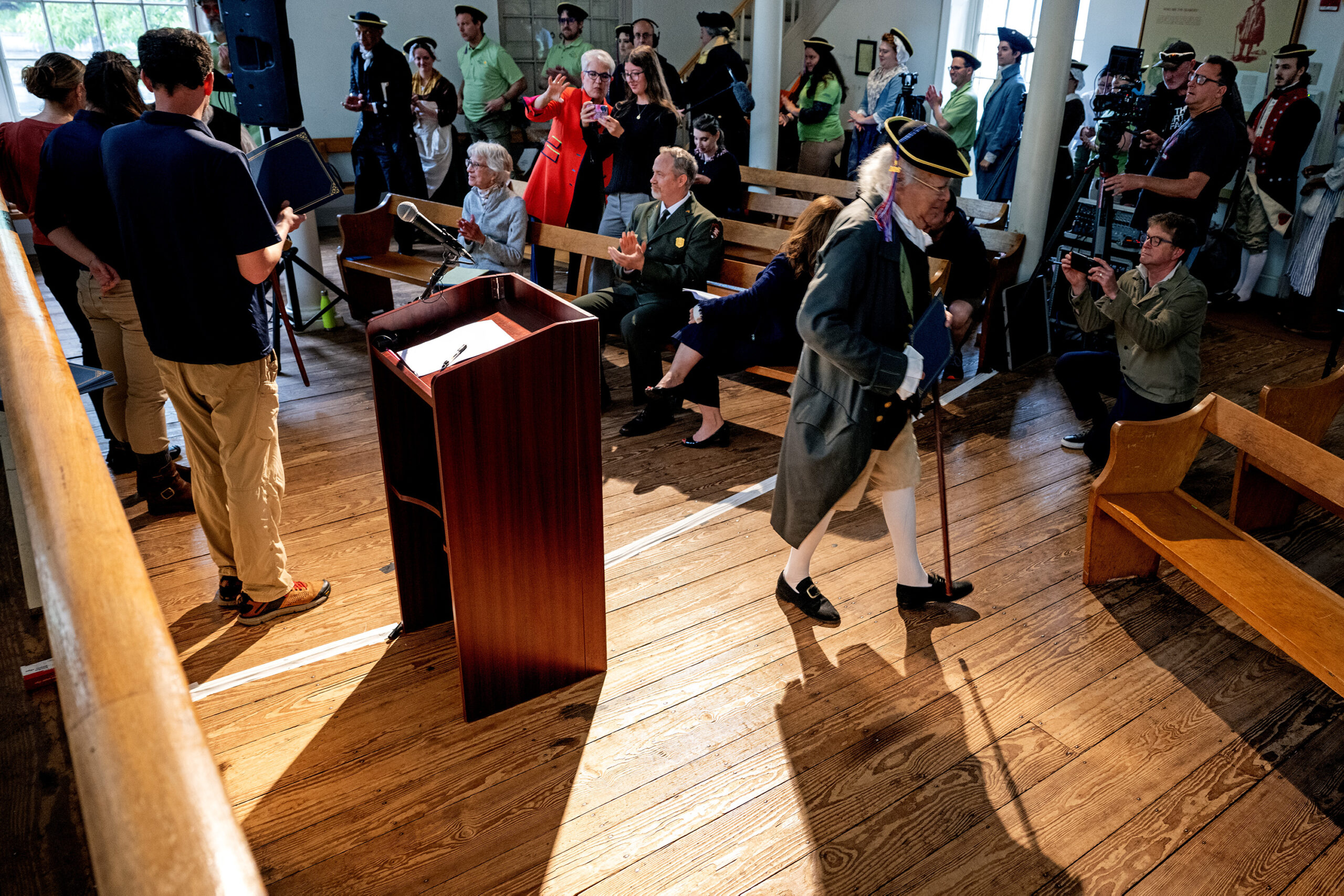
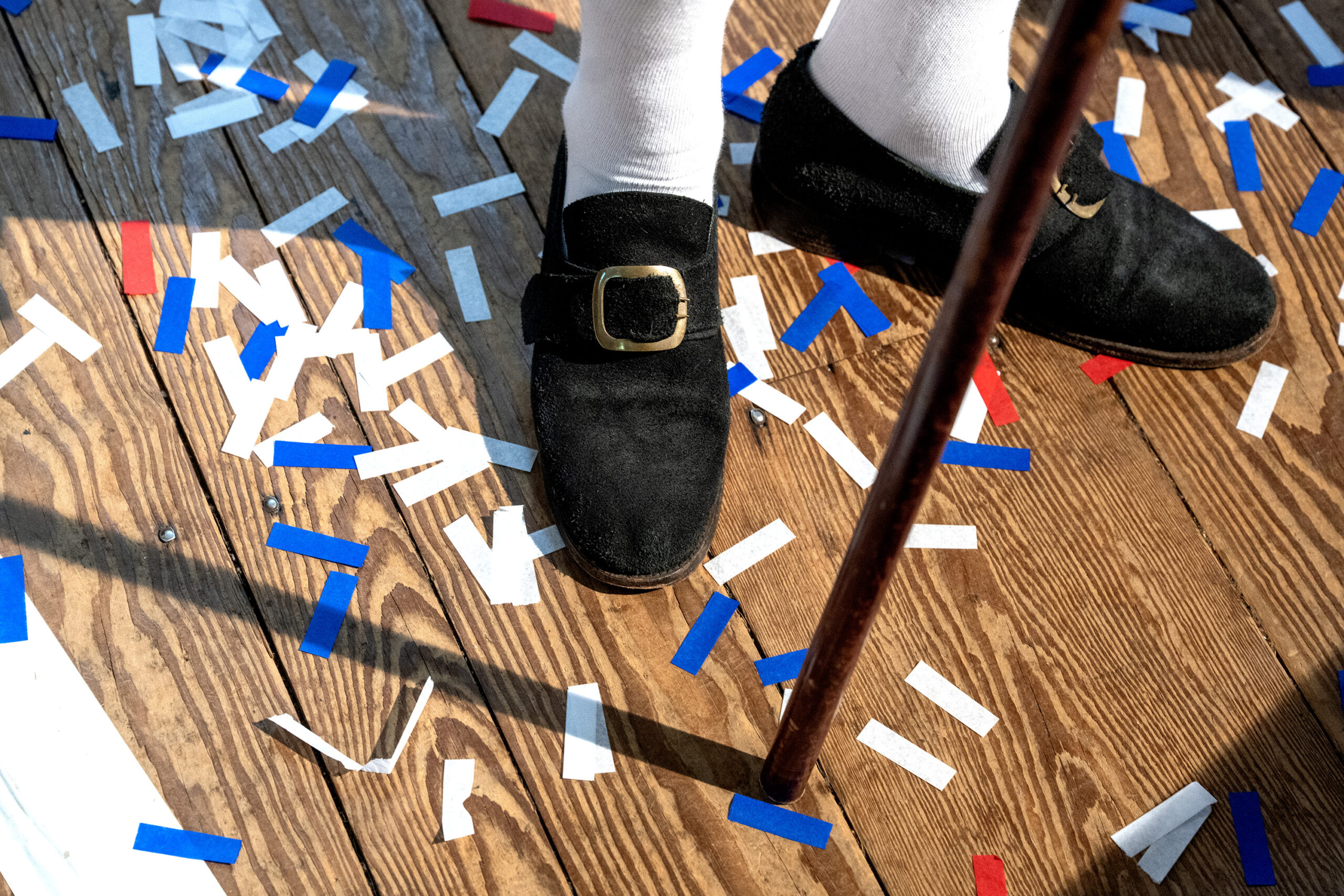
Shecky Perlman as Ben Franklin, his cane and feet, Thursday, May 21, 2026, among the confetti as dozens of historical reenactors graduate after weeks of intensive, immersive training at the Benstitute.
Big Night is a food movie, an Italian American movie, a movie about brotherhood, and a movie about the immigrant experience. And , it’s a Jersey Shore movie.
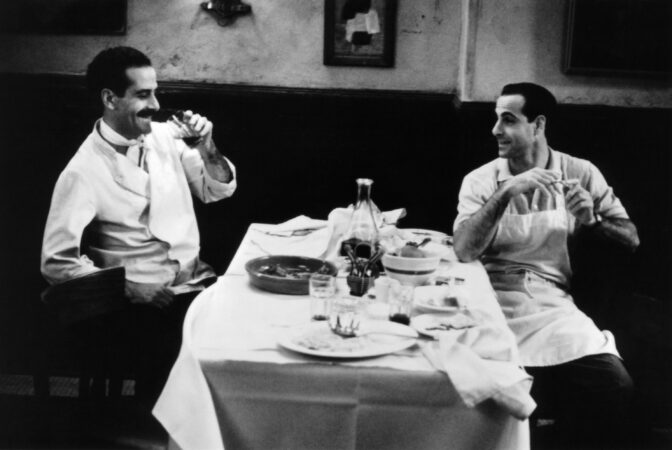
Released in 1996, it stars Tony Shalhoub and Stanley Tucci as Primo and Secondo, a pair of Italian immigrant brothers who operate an authentic but failing Italian restaurant in an unnamed Jersey Shore town in the 1950s.
Chafing under the competition of the more successful but less authentic restaurant across the street, the brothers stake it all on the eponymous “Big Night” when they’ve been told the jazz bandleader Louis Prima is coming to dine at their spot. Presumably, he’d then talk up the food and save their restaurant.
Big Night is full of mouth-watering food, starting with the timpano, a complex dish that includes a crust, meat, pasta, and more.
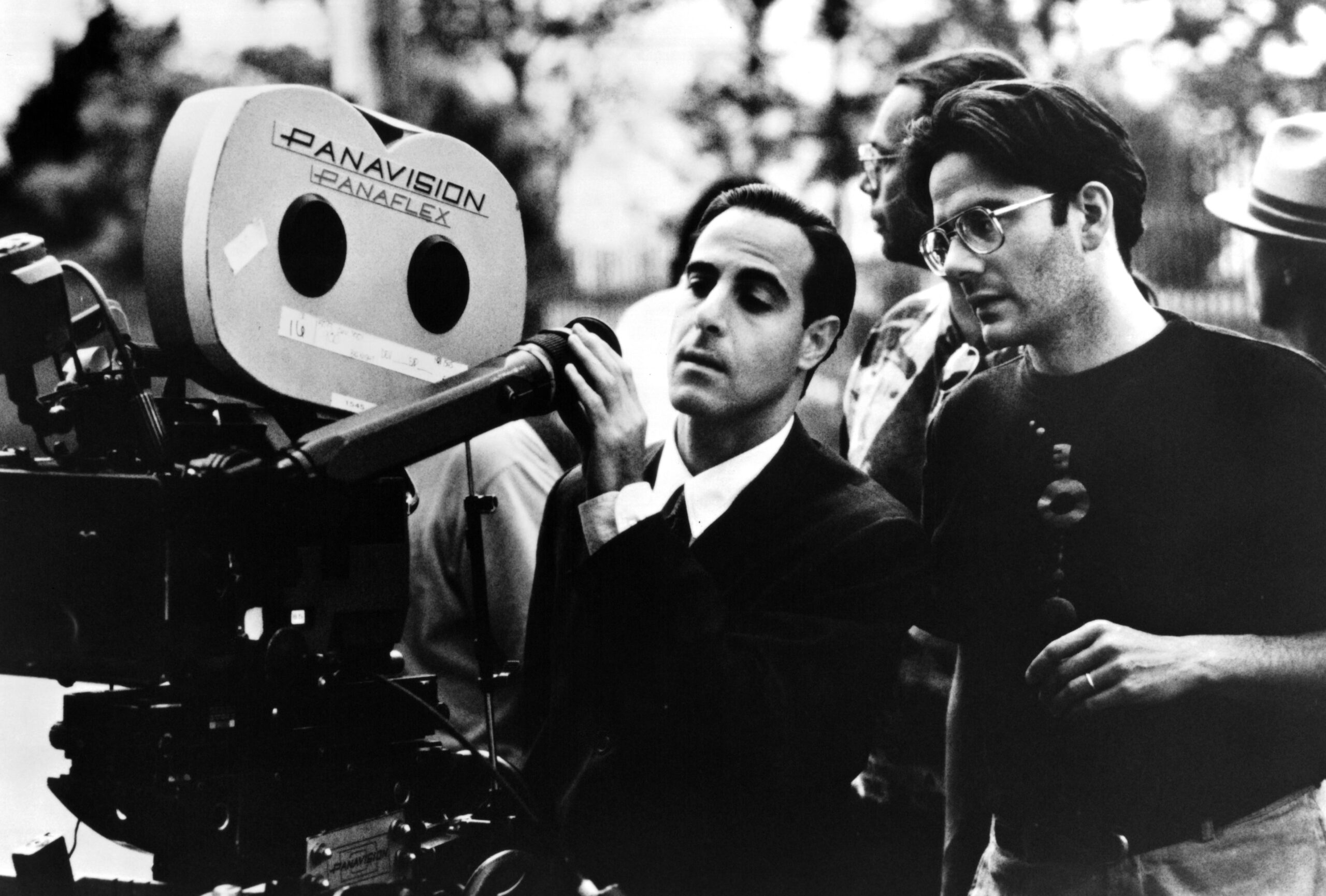
Codirectors Stanley Tucci (left) and Campbell Scott, on set of the movie “Big Night,” circa 1996. (Photo by Michael Ochs Archives / Getty Images)
While the film’s exteriors were shot in Monmouth County’s Red Bank and Keyport, the film never specifies exactly where it is set. The interiors were shot on a soundstage in New York City.
“It was really one of those towns that had not changed too much,” Shalhoub said to The Inquirer. “The town, the outside of the restaurant, the beach sequences, were all shot in Jersey.” Even in 1996, the areas easily stood in for the 1950s Jersey Shore.
Shalhoub, well-known for the TV series Monk and The Marvelous Mrs. Maisel, among numerous movie roles, shot Big Night during a summer hiatus from his sitcom Wings.
“I knew Stanley Tucci; we had done a play together in the late ‘80s,” he said. “We were both actors in New York, I had seen his work in the theater, [and] we had similar friends and directors in common.”
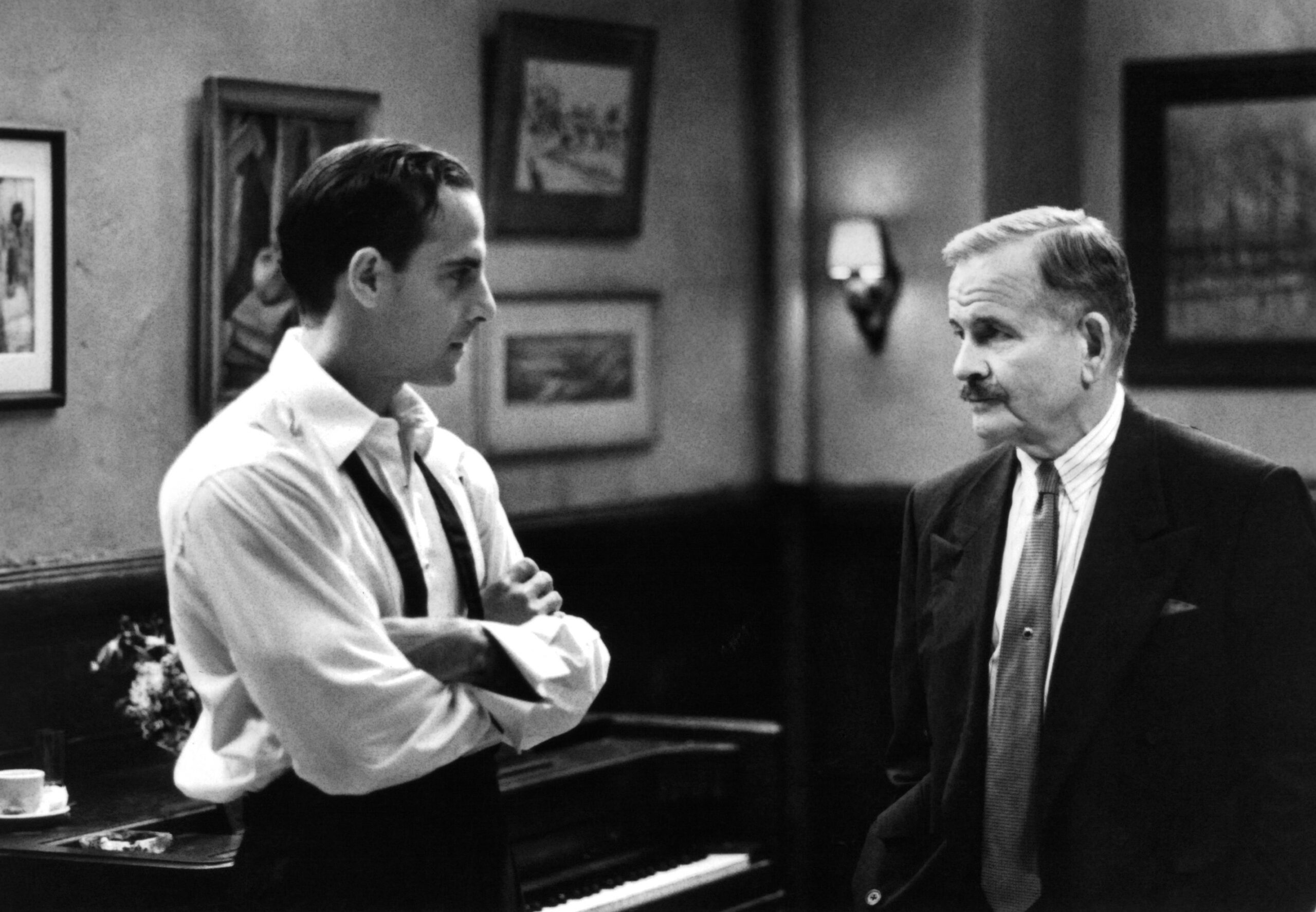
Actors Stanley Tucci and Ian Holm on set of the movie “Big Night,” circa 1996.
There was a specific reason Tucci decided to make Big Night, Shalhoub said.
“[He wanted] to sort of begin to establish himself as an actor … not to be pigeonholed into the stereotypical Italian Mafia zone.”
There was no mention of that in Big Night.
“It’s all about the brothers,” Shalhoub said. “It’s about the period, it’s about the food, it’s about the old country, Primo having one foot still in the old country.”
“The closest we get to violence is those two clowns rolling around. They don’t even know how to fight,” the actor said during a conversation recently following a special screening of the film at the Lighthouse International Film Festival on Long Beach Island.
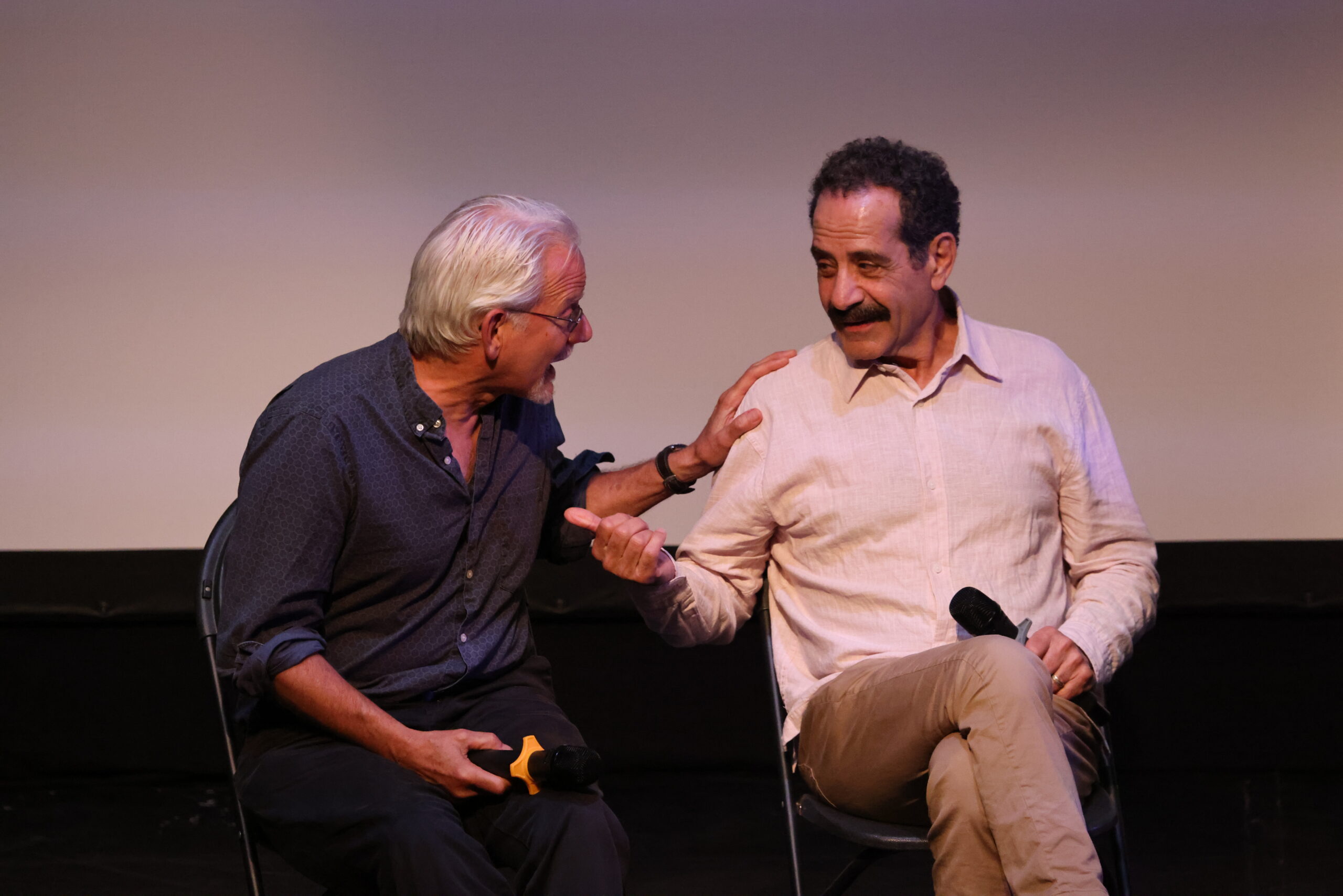
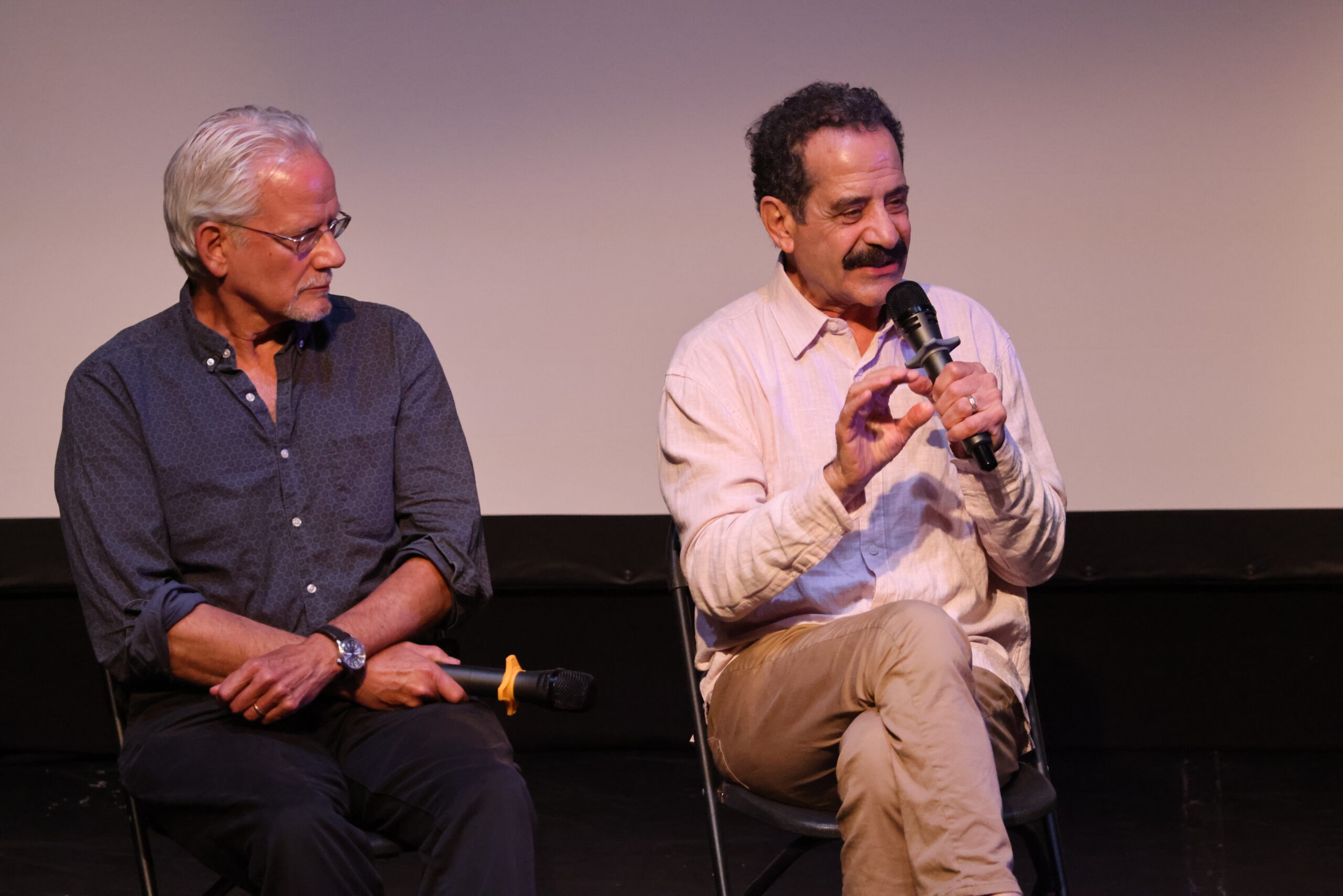
Campbell Scott (left) and Tony Shalhoub speak at a 30th anniversary screening of their film “Big Night” at Lighthouse International Film Festival on Long Beach Island, on June 12, 2026.
Big Night had been “in the pipeline” for many years, and Shalhoub had originally auditioned for the role of Pascal, the rival restaurant owner ultimately played by Ian Holm.
It finally came together in the summer of 1995; the shoot lasted about four weeks.
“I was thrilled,” Shalhoub said. “Any part, either part, I was happy to join, because I loved the material, and I had a lot of respect for Stanley.”
Tucci and Campbell Scott, actors who had been high school classmates, codirected the film, which was cowritten by Tucci and his cousin Joseph Tropiano.
“I don’t know how he wore all those hats,” Shalhoub said of Tucci. “Being a cowriter … and co-directing, and being in almost every scene, and it being his first film.”
Shalhoub, who is from a large Lebanese American family in Green Bay, Wisc., had limited exposure to Italian American culture growing up. He also didn’t live anywhere near an ocean.
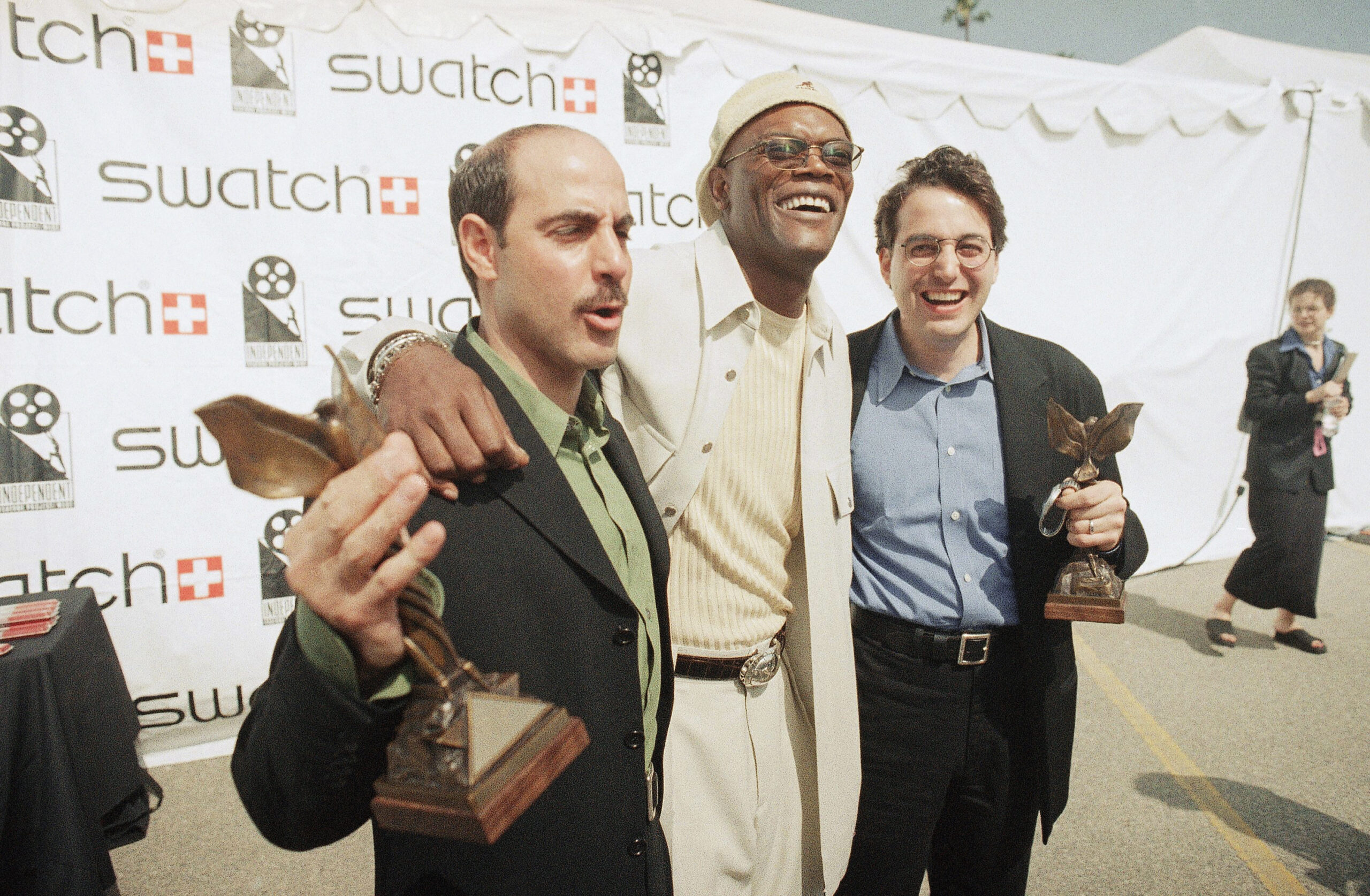
Master of Ceremonies for the 12th Annual Independent Spirit Awards ceremony, Samuel L. Jackson (center) jokes with Best First Screenplay winners Stanley Tucci (left) and Joseph Tropiano for “Big Night,” on March 22, 1997, in Santa Monica, California.
(AP Photo/E.J. Flynn)
The Big Night shoot was his first time at the Jersey Shore. He had, however, had some experience with Italian food.
Growing up, he remembers being taken to a family friend’s apartment, where an “older Italian woman” made “some pasta dishes.”
“I don’t know what I was eating, but I couldn’t get enough of it.”
At 19, after heading East for college at the University of Southern Maine, Shalhoub had his first “Italian sandwich, which I’d never heard of before … And all the variations on an Italian sub, and all those great Italian deli meats.”
On the sets of Big Night, he said, the crew had food stylists preparing the dinners shown in the film.
“All these meals that we had to consume on camera … it was delicious!” he said.
Campbell Scott (left) and Tony Shalhoub speak at a 30th anniversary screening of their film “Big Night” at the Lighthouse International Film Festival on Long Beach Island, on June 12, 2026.
The film ends with a famous scene — five minutes of no dialogue, just Tucci cooking an omelet and the brothers sitting down to eat it.
The film’s financiers didn’t understand that scene and wanted it changed or removed, Scott said at the screening. The directors then pulled the old Mel Brooks trick; they said they’d take the scene out but didn’t.
Tucci and Shalhoub, 30 years later, are not only busy actors, but both have recently hosted food-focused travel shows: Hulu’s Tucci in Italy and HBO’s Breaking Bread, respectively.
“I could never have imagined that this movie would have the legs that it has, that 30 years in, it would still be a film that people go back to and consider one of the best food movies,” Shalhoub said.
Philadelphia chef and restaurateur Marc Vetri is a fan.
“In 1996, chefs were in this kind of zone,” said Vetri, who watched the film shortly after it came out. “We all made the menus, and we had our visions, and we didn’t want to alter anything, and [said] ‘this is how we do it’.”
He still remembers the unveiling of the timpano in the film.
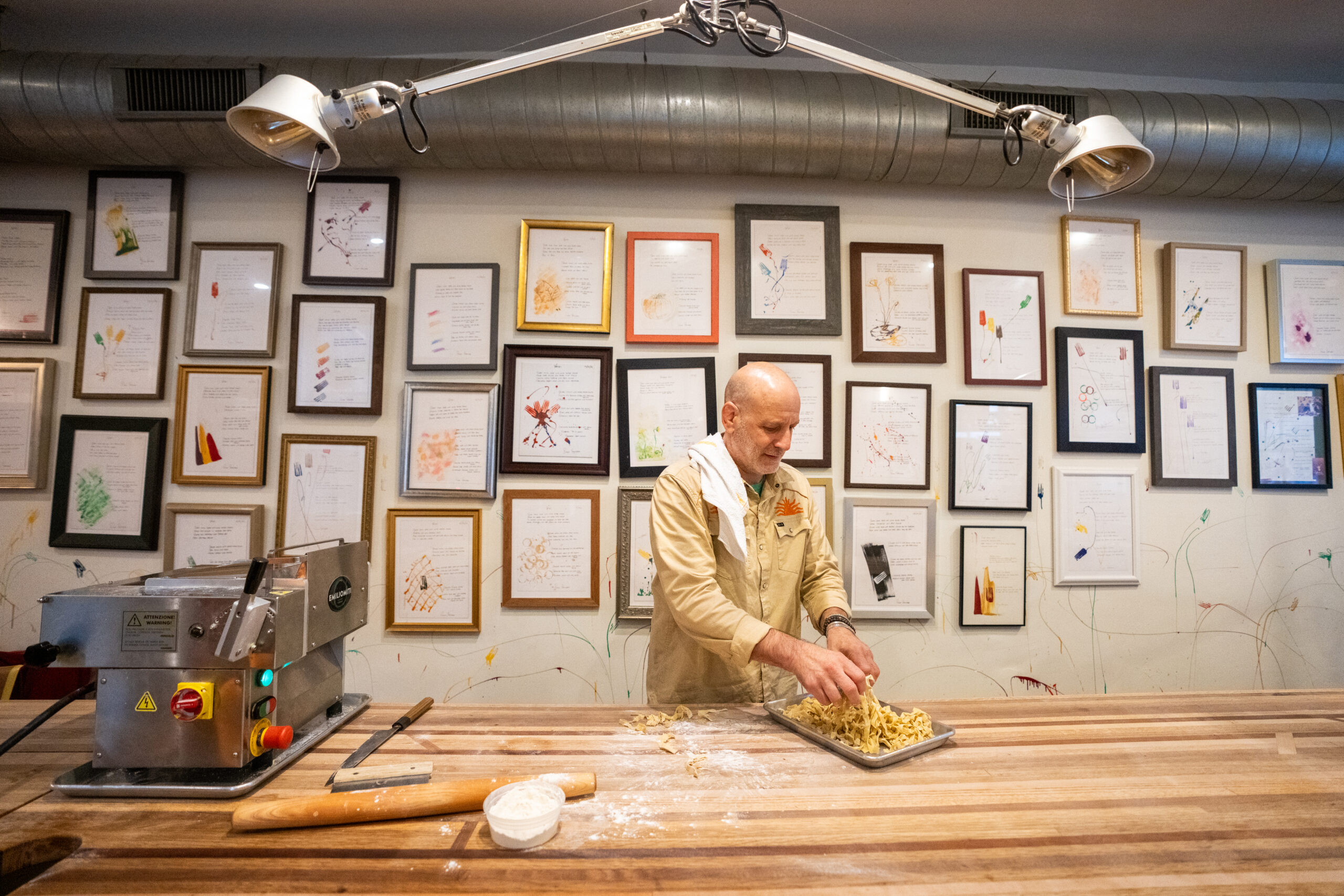
Marc Vetri makes pasta at Vetri Cucina, in Philadelphia, Oct. 30, 2025.
“For me, that was magic,” he said. “I was like, ‘I gotta make that’ … I get that because when I finish something that I’m working on, I have that same look, that same feeling; it looks like I’m in love. That never leaves us.”
Vetri, who has gone on to cook for many famous people, said the film always reminds him of when, early in the life of his first restaurant, he cooked for famed French chef Jacques Pépin. He cooked whole roasted fish, with cherry tomatoes and olives.
Thirty years on, Vetri — like many others — remains a fan.
“The music, the vibes, and even the ending … Everything [with] cooking, you always just want to make it the most awesome thing. Having them make that omelet — it’s just that magical thing that they’re sharing.”
Most of us remember the 2010s Obama-era stomp-clap folk music, brought on by bands like the Lumineers, that graced the soundtracks of films like Silver Linings Playbook, sparking an intensely optimistic sound.
But can that even exist today? Can folk music rise in the 2020s, amid rapid social media usage, volatile politics, and a general feeling of uneasiness?
It can and it does.
Often veering into the gloomy and the existential, but somehow still managing to stay romantic and rebellious, thanks to the folk-pop stylings of Noah Kahan.
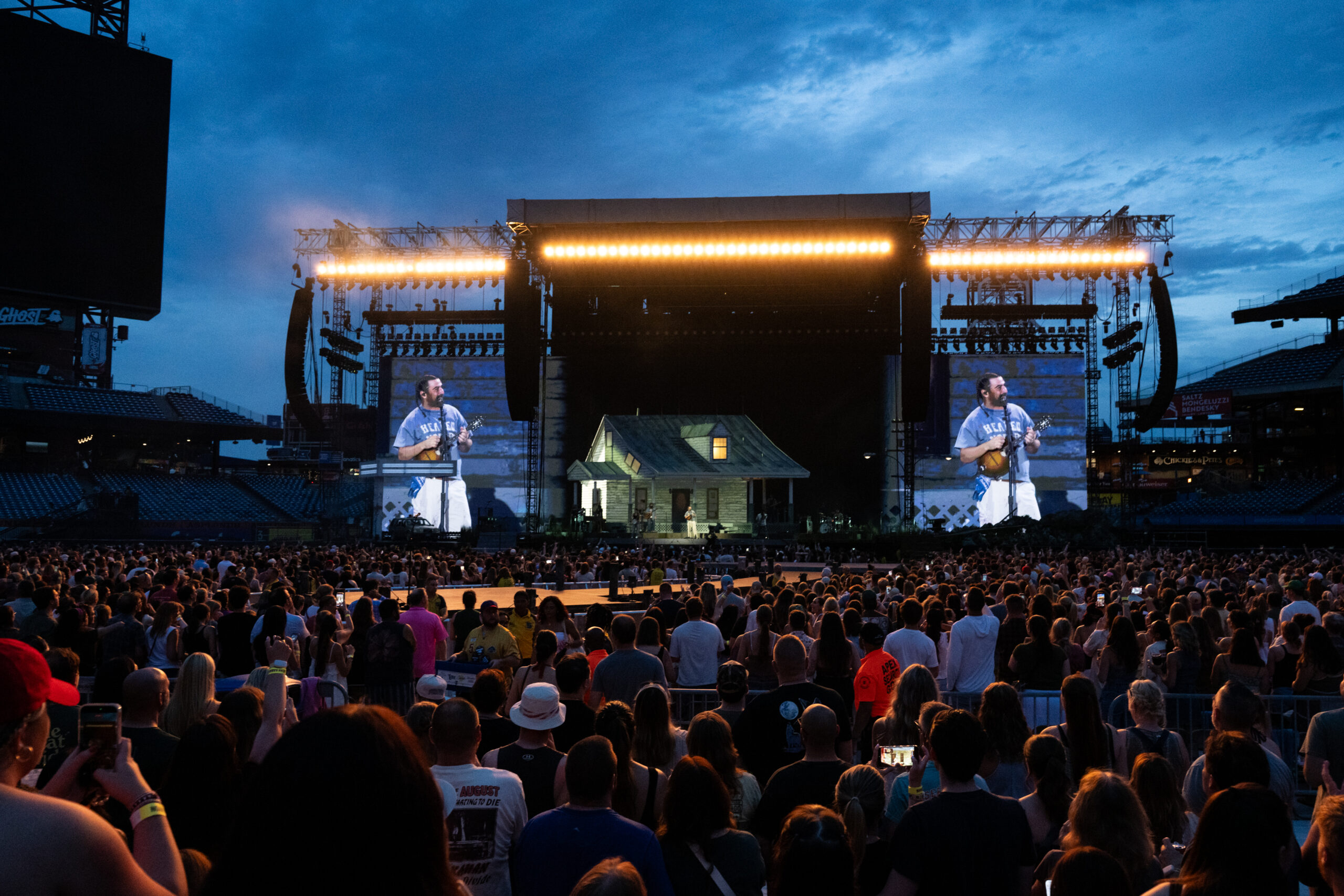
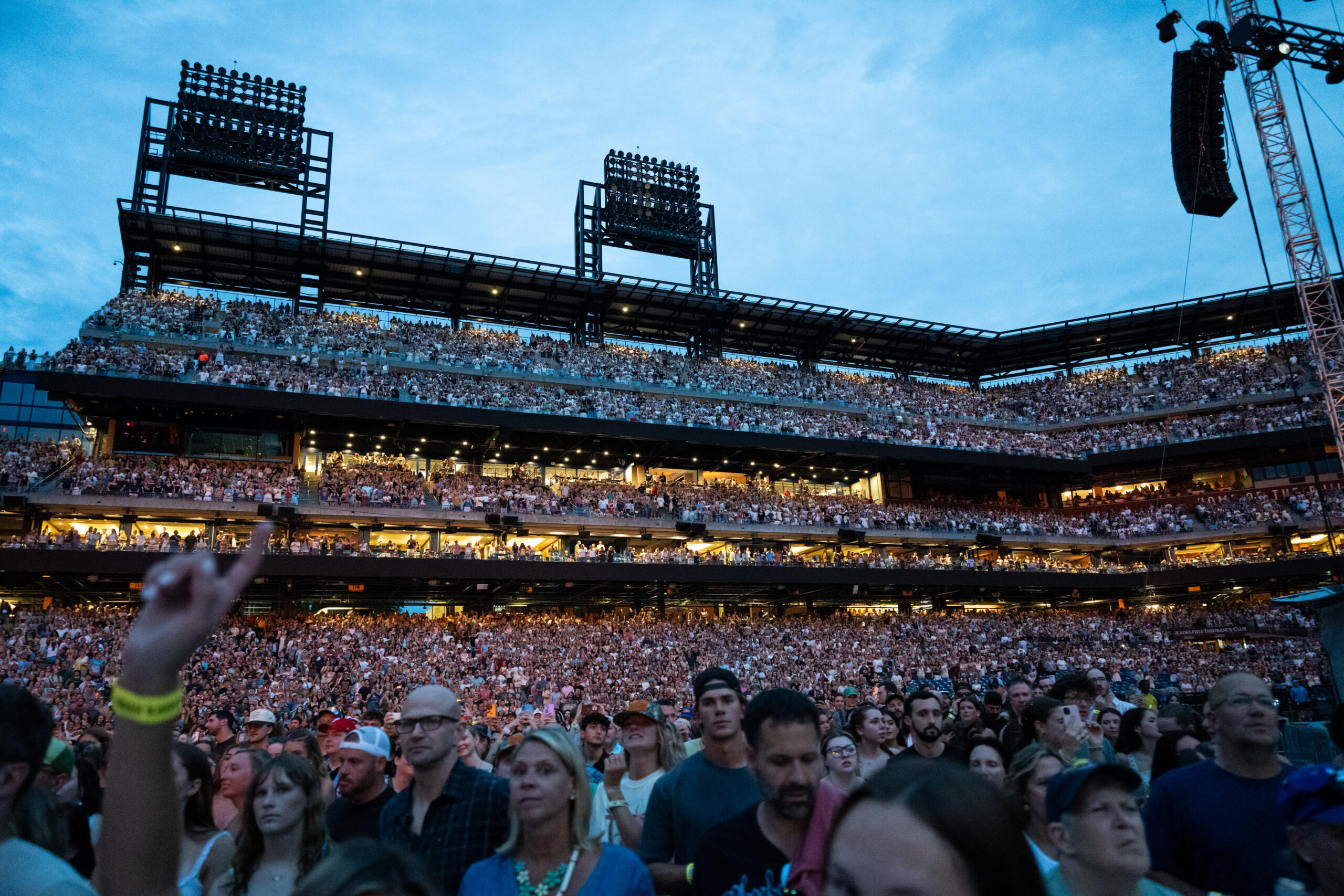
Kahan and his band performed for a sold-out crowd of 40,000 people.
Kahan released his latest The Great Divide in April. The introspective collection of songs explores the realities of fame and the isolating feeling of leaving home. The tour behind that album brought him to Citizens Bank Park on Friday night.
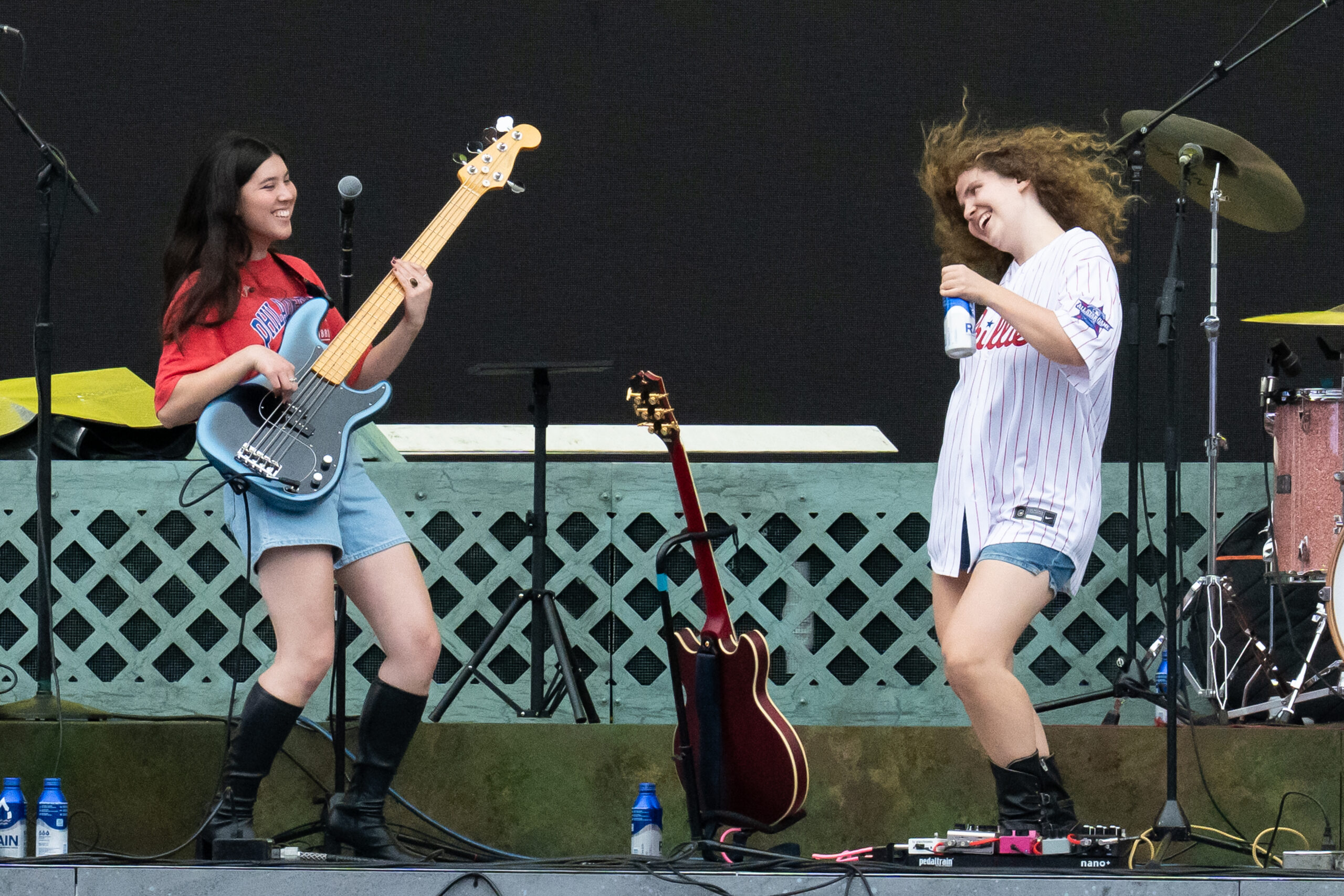
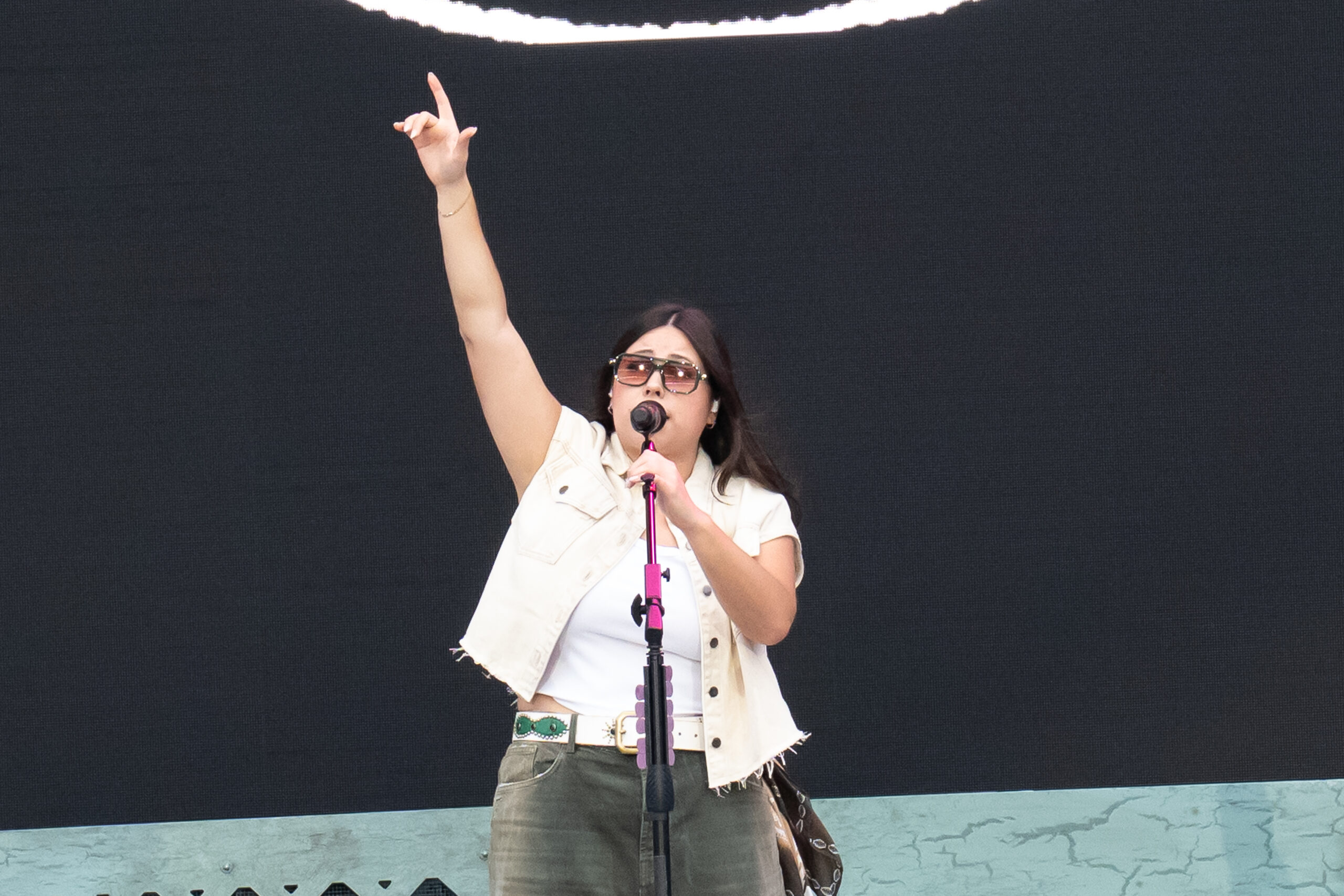
After openers, Wayne, Pa., native Annabelle Dinda sporting a Phillies shirt and Gigi Perez, a one-minute countdown popped up on the screen at 8:30 p.m., met with loud cheers from the audience.
When the clock struck zero, a sunset scene of a field appeared on a screen on stage, with The Great Divide displayed across it.
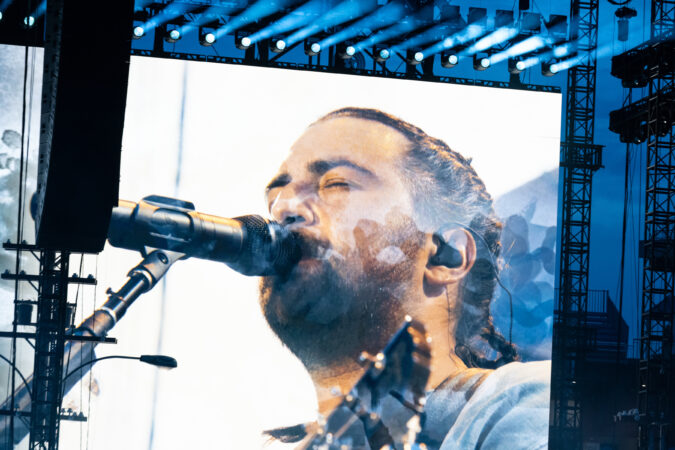
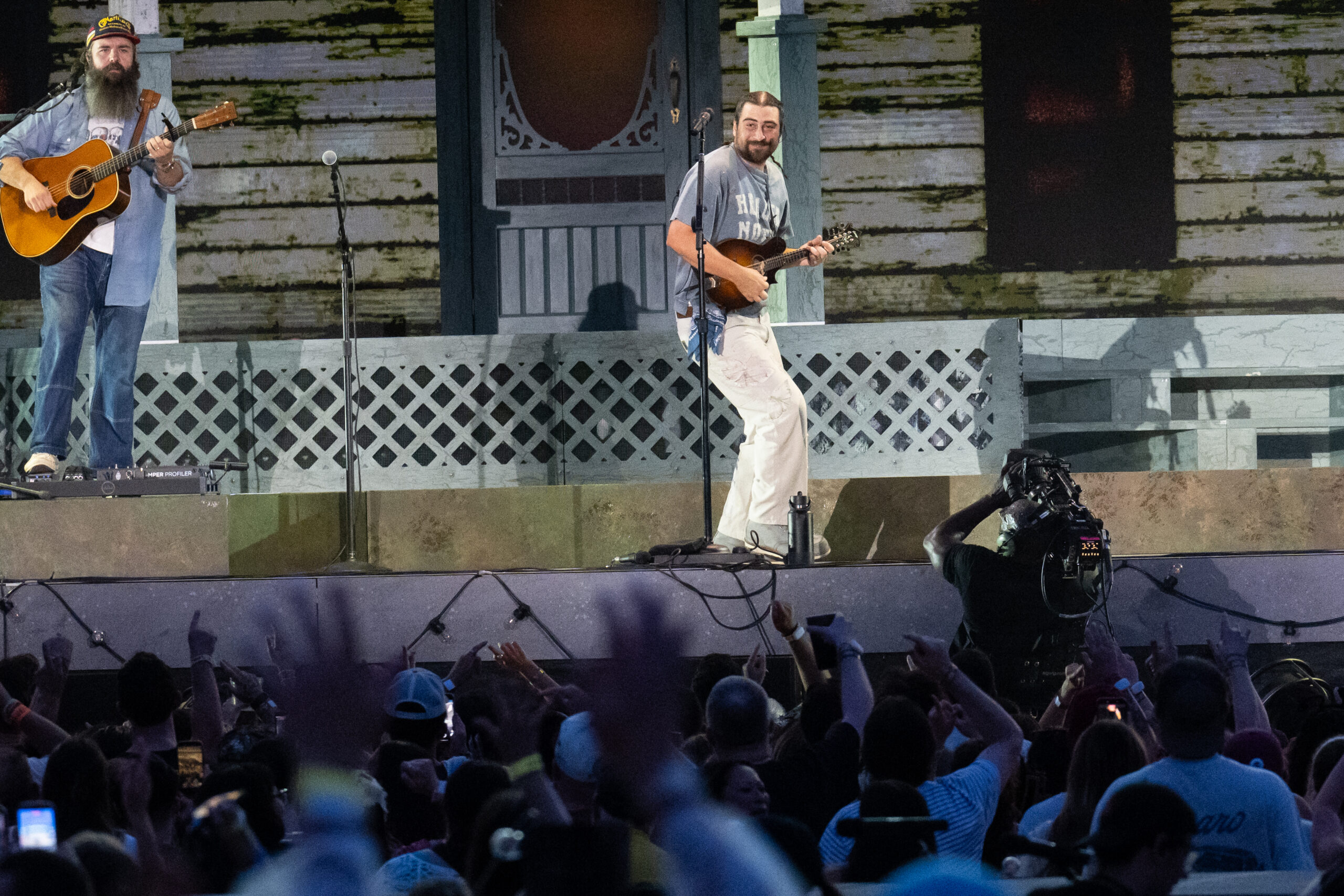
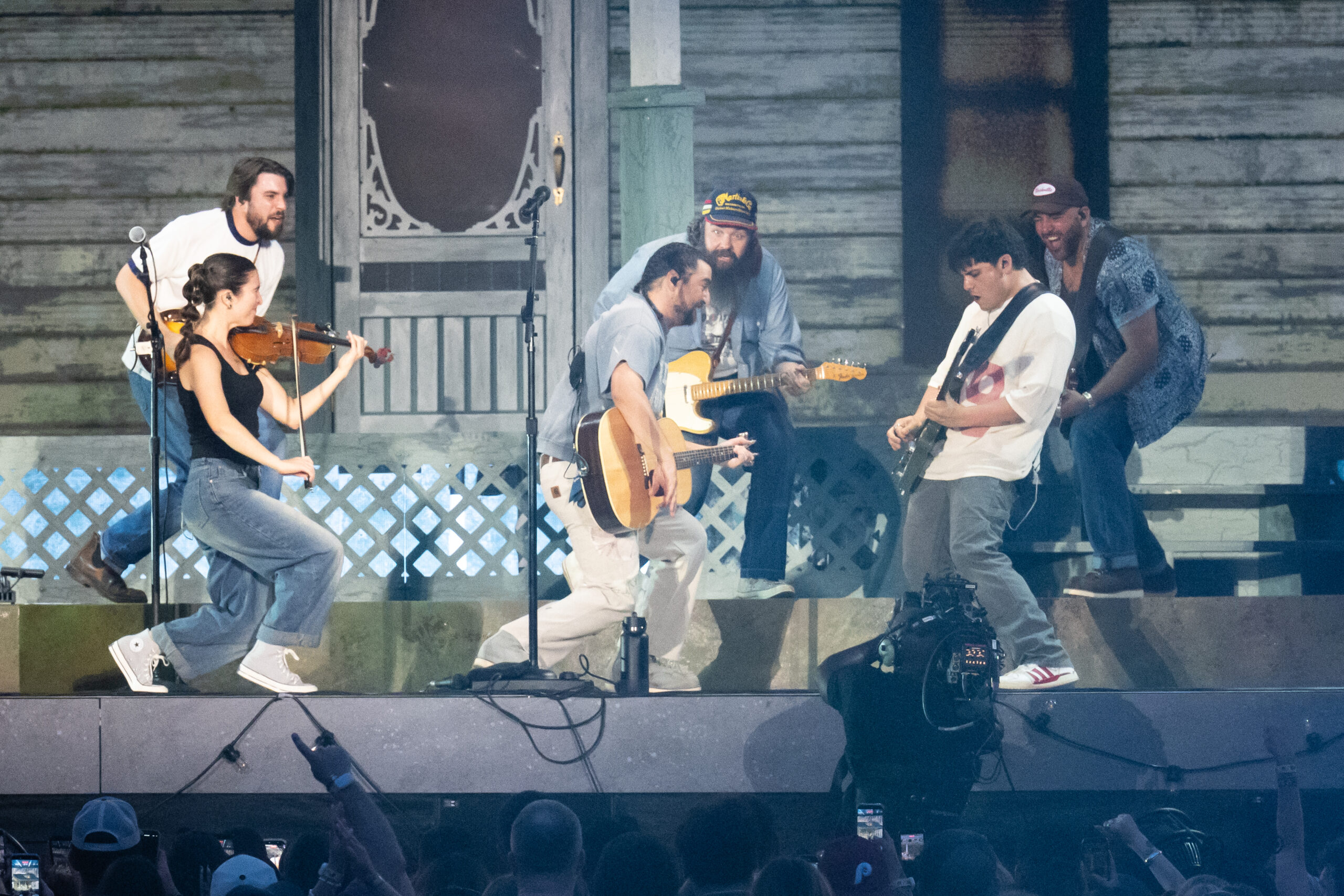
The roof of a house slowly descended from the top of the stage to meet the rest of the barnhouse in the middle of the stage. Then out came Kahan, with his signature French braids and baggy clothes, ready to bring his woodsy vibe to Philadelphia.
Annabelle Dinda performs an opening set during the Philadelphia stop of Noah Kahan’s “The Great Divide Tour” at Citizens Bank Park in South Philadelphia on Friday, June 26, 2026. Dinda was one of two opening acts performing before Kahan took the stage.
The audience in the 40,000+ seat stadium reacted swiftly, jumping to their feet and screaming for Kahan. The crowd was a mix of Gen-Z fans, new to the contemporary folk-pop sound, and millennials, who were undoubtedly jamming out to Mumford & Sons during the aforementioned 2010s folk-rock era.
There were also families with young children in tow. Some appeared to be fans themselves, wearing the tour’s merchandise and singing along.
After performing “American Cars” and “Doors” from The Great Divide, Kahan addressed the sold-out crowd, promising to make them very sad with his melancholic music.
“Philadelphia, what a f— dream,” he said. “It must be something in the water, how do you all have clinical depression?”
Gigi Perez performs an opening set during the Philadelphia stop of Noah Kahan’s “The Great Divide Tour” at Citizens Bank Park in South Philadelphia on Friday, June 26, 2026. Perez gained widespread recognition with her 2024 single “Sailor Song” and opened for Kahan on select dates of the tour
Kahan continued with “All My Love” from 2022’s Stick Season, with the set around him bringing the music to life, even in the face of the promised melancholy.
Rocks covered in moss sat one side of the stage with an abandoned gas station scene set up on the other, with tall grass scattered throughout. String lights warmed up the setting as it got darker, making Citizens Bank Park feel like a small-town backyard. On the screen behind Kahan, seasons changed and insects crawled around amid visuals from the singer’s home state of Vermont.
The forest-y and naturalist aesthetic of both the music and the setting is an homage to Kahan’s childhood spent on a tree farm in rural Vermont.
The concert was Kahan’s first arena show in Philadelphia, on his second arena tour in his career.
The crowd matched the scenery; flowing skirts, bandannas, cowboy hats and boots, denim, corduroy, and just about every other clothing item you’d see when searching “farm aesthetic” on Pinterest. Everyone attending could easily pop over to the Schuylkill Trail for a quick hike after the show.
After singing another new song “Downfall,” Kahan pretended to answer a phone call.
“What’s up, Twitter,” he said into the phone. “Oh, Noah Kahan can’t sell out stadiums?” The response was a thunderous cheer as Kahan pretended to hang up.
This is his fifth concert tour and his first time headlining a show at Citizens Bank Park, playing for a sold-out crowd. This last “The Stick Season (We’ll All Be Here Forever)” tour in 2024 didn’t stop in Philadelphia.
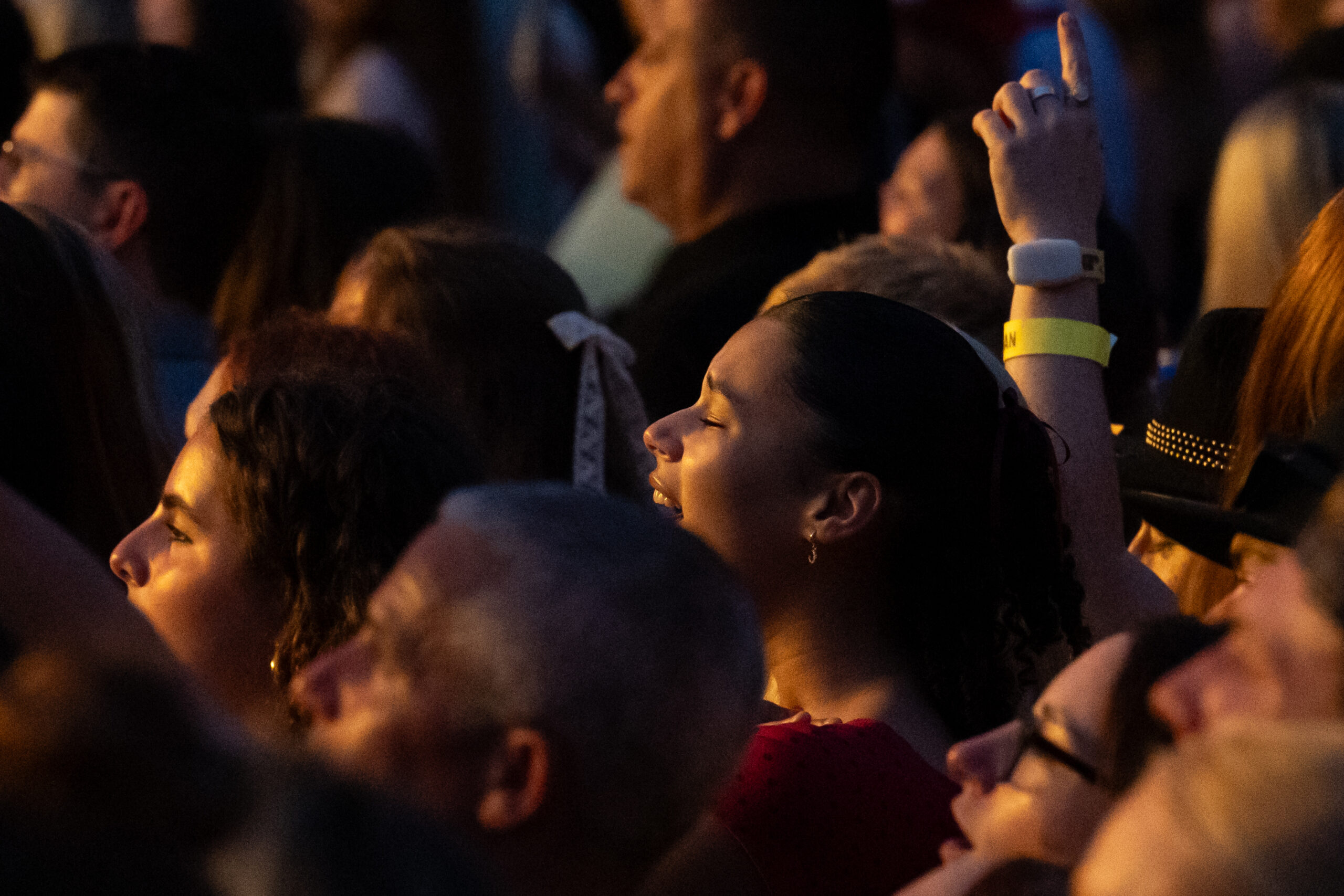
A fan sings while Noah Kahan performs at Citizens Bank Park in South Philadelphia on Friday, June 26, 2026. More than 40,000 people attended the sold-out show. .
After singing and playing the guitar for nine songs standing on the main stage, Kahan decided to shake things up a bit. For “Dial Drunk,” he moved to the left side of the stage where an actor dressed as a police officer arrested him. He performed the first half of the song from inside of a police car fitted with cameras.
For “Willing and Able,” Kahan sat upon the roof that came down in the beginning of the show. There, he softly played the guitar and sang the lyrics to the somber song about a strained sibling relationship.
Fans sang along and cheered until Kahan made his gravest mistake of the show: suggesting that Philadelphians be friendly toward Boston.
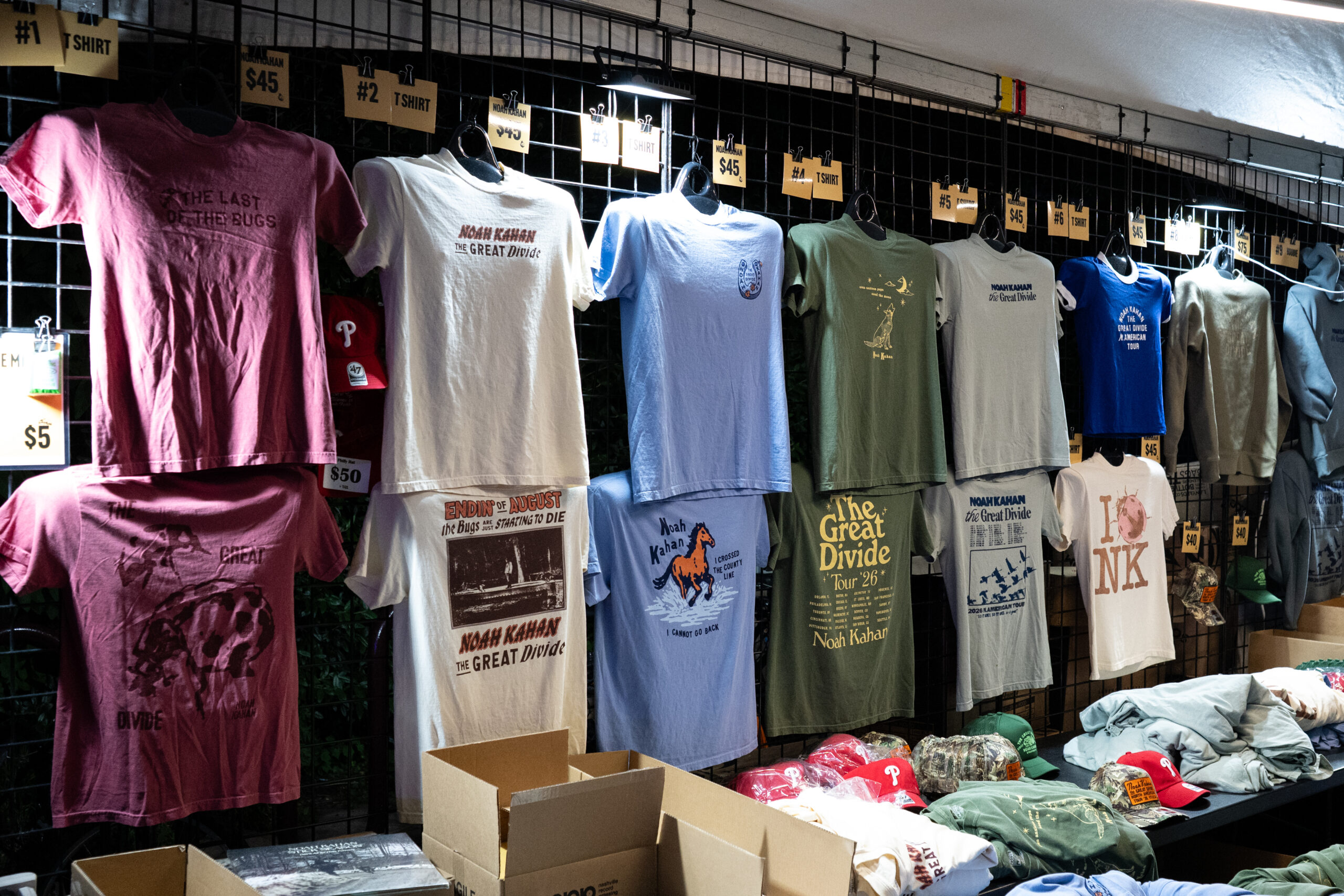
Noah Kahan merchandise is displayed outside Citizens Bank Park in South Philadelphia on Friday, June 26, 2026. More than 40,000 people attended the sold-out show, with some fans lining up as early as 9 a.m. to purchase merchandise.
“Having lived in Boston, you guys are a lot more alike than you think, and I think you need to reconcile,” Kahan said, citing the tough brotherly relationship in “Willing and Able.” This sentiment was the only thing that was met with boos on Friday.
Fittingly enough, Kahan recalled being heckled at a Philly show.
One hopes the city hosting a sold-out show will soften his feelings toward Philadelphia.
Fans matched the forest aesthetic of Kahan’s music, with flowy outfits and cowboy apparel.
He also took the opportunity, standing in the middle of the floor seats, to address the backlash he received on Twitter for his original setlist he played in Orlando on June 11. Fans complained about the lack of older songs, as the singer filled the set with songs from his last two albums. The fans who booed Kahan’s online haters were rewarded with his older song “Maine” from the EP Cape Elizabeth, which he called his favorite song he’s ever written.
In addition to the guitar, Kahan’s six-piece band comprised a host of other unique instruments that got to shine. This included a fiddle, banjo, mandolin, and a resonator guitar, all contributing to Kahan’s unique folk sound that blends both rock and pop.
Noah Kahan performs at Citizens Bank Park in South Philadelphia on Friday, June 26, 2026, during his “The Great Divide Tour.” The Philadelphia concert was part of the North American leg of Kahan’s summer tour
As the show went on, Kahan took multiple opportunities to listen to the crowd sing and coyly smile as he expressed his gratitude, often peppering it with his well-known dry humor.
“You guys are gonna make me emotional,” he said to the screaming fans, giggling.
Kahan closed out his main set with “Orange Juice” and “New Perspective” before exiting the stage and reentering it as fans started growing restless. For the encore, sitting at a spotlit piano, he performed the incredibly moody “End of August.”
That was followed by a more upbeat “Homesick.” Of course, he wrapped things up with an explosive extended performance of his biggest hit, “Stick Season.”
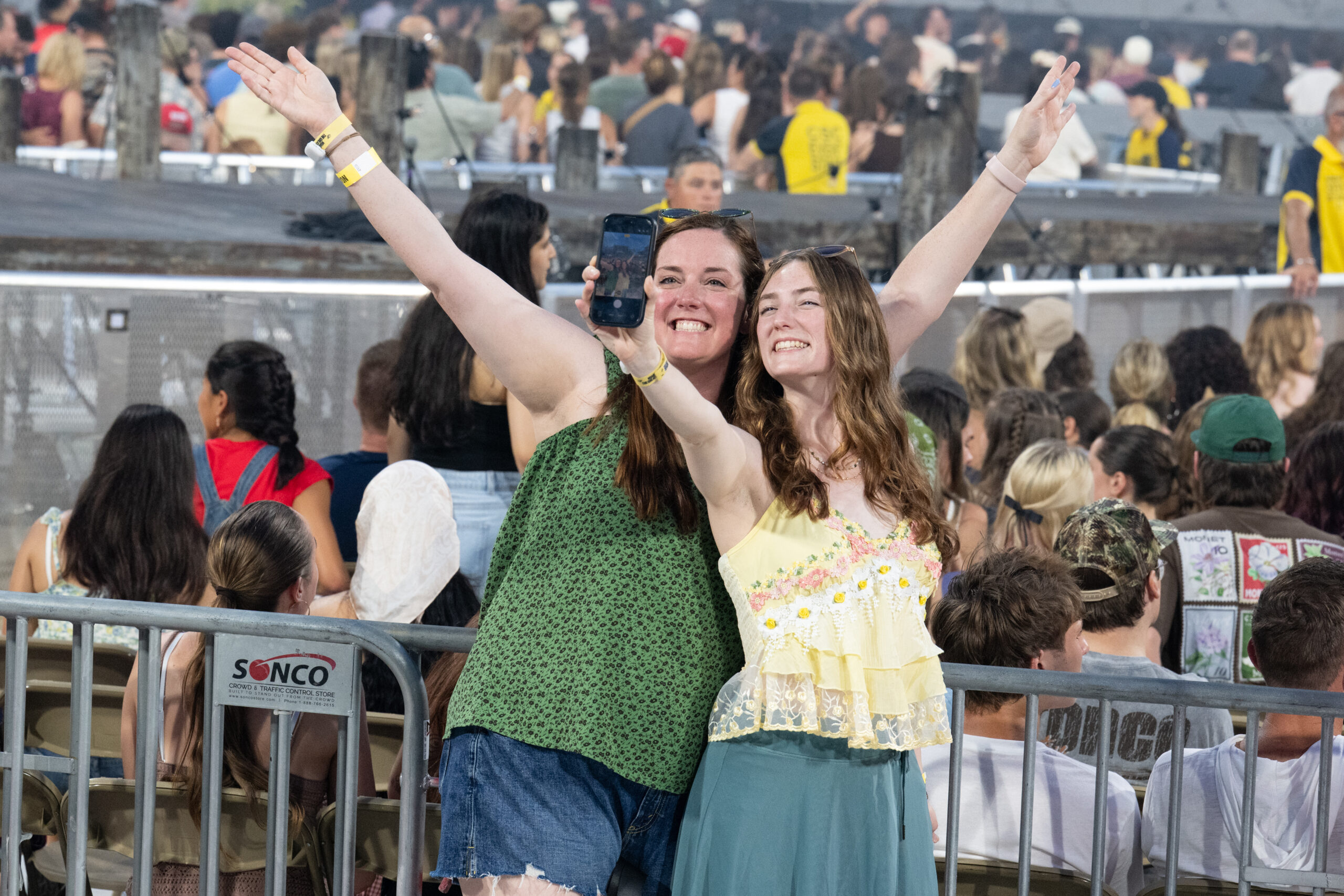
Two fans take a selfie before Noah Kahan performs at Citizens Bank Park in South Philadelphia on Friday, June 26, 2026. More than 40,000 people attended the sold-out show. .
There was no one in the crowd who didn’t sing along.
Kahan made sure to thank his band mates before one final chorus that culminated in a brief fireworks display over the stage.
And just like that, the woodland escape that is the Noah Kahan concert came to an end for Philadelphia.
Noah Kahan, setlist from “The Great Divide Tour.” June 26, 2026, Citizens Bank Park, Philadelphia
Philadelphians have spent decades developing an inferiority complex about New York.
Maybe we’ve been comparing ourselves to the wrong city.
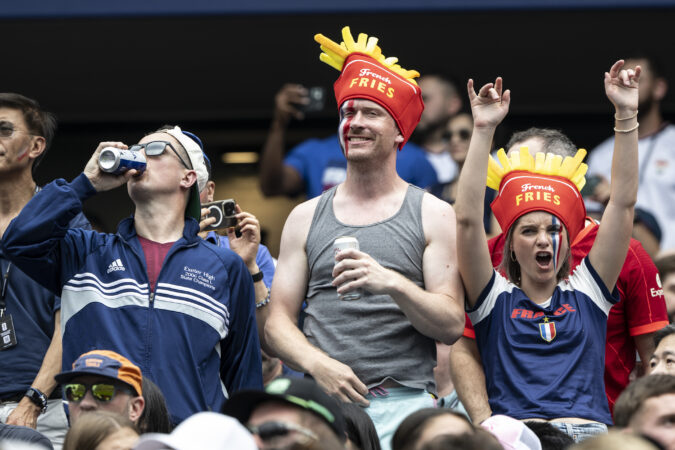
French soccer fans visiting for the World Cup spent this week looking around Center City and noticing something many locals overlook: Philadelphia is surprisingly French. The Parkway was modeled after the Champs-Élysées. City Hall looks like it belongs in Paris. Even Michelin once called Philadelphia the “Frenchest city” in America.
We’ll take it.
Most American cities get compared to other American cities: Philadelphia gets compared to one of the most beautiful and romantic cities in the world.
Sure, Paris has the Eiffel Tower. But Paris doesn’t have roast pork sandwiches, Gritty, or people arguing over parking permits at 7 a.m.
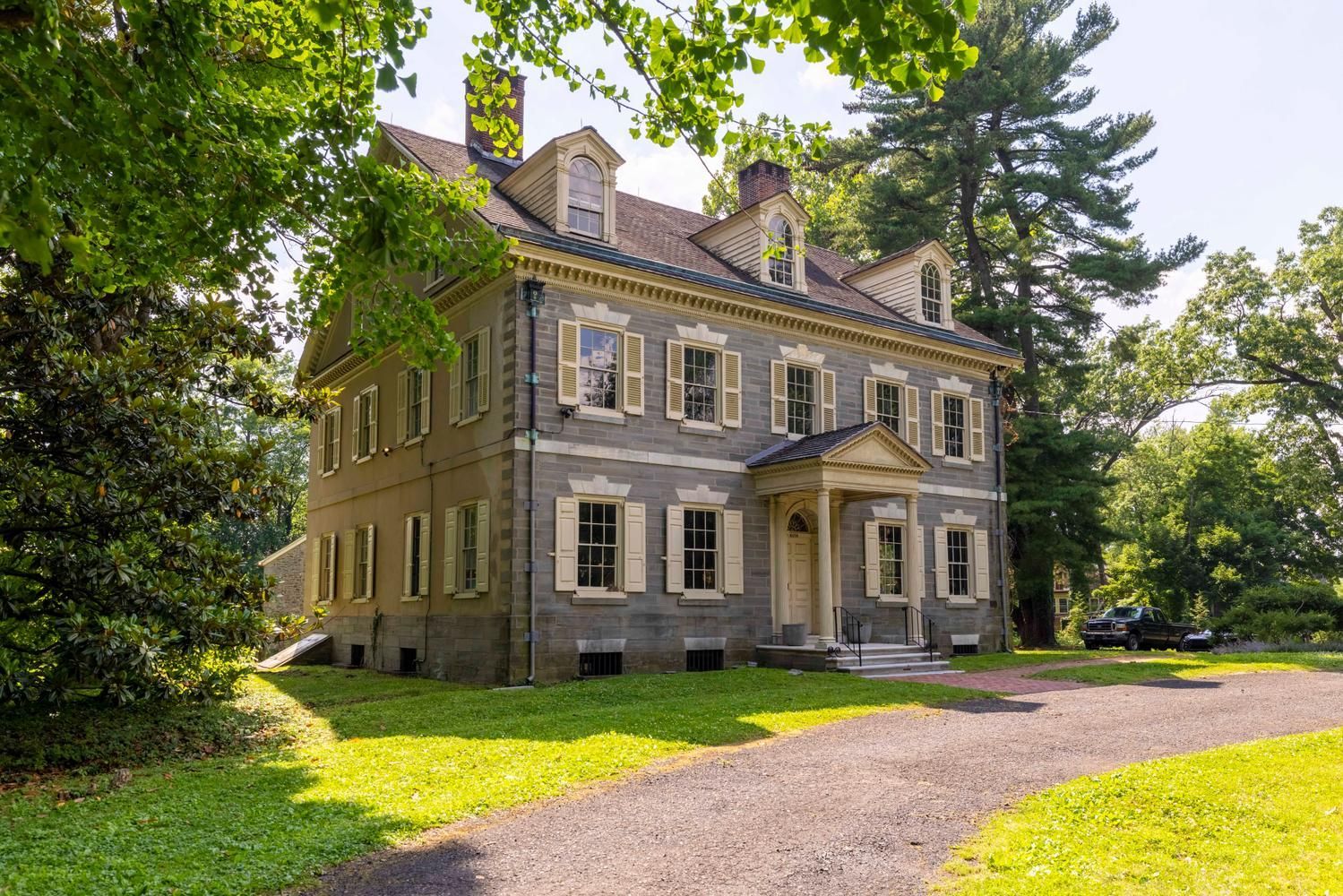
Upsala mansion on the 6400 block of Germantown Avenue was built in 1798 and is currently up for sale.
A house that comes with Revolutionary War reenactments: A
Philadelphia real estate listings can get weird.
You might get a rowhouse with a hidden speakeasy, a church converted into condos, maybe even a former firehouse.
The owner of Upsala, a historic estate now listed for sale, revealed this week that the property’s easement requires future owners to allow reenactments of the Battle of Germantown. The reenactments haven’t happened since 2019, but the obligation remains, preserved in a 70-page legal document waiting for some future homeowner.
For a city preparing to celebrate America’s 250th birthday, this is a nice reminder that in Philadelphia, history isn’t always tucked away in museums. Sometimes it’s written into the paperwork.
A Phanatic-themed apartment: A+
There are plenty of ways Major League Baseball could have celebrated the All-Star Game coming to Philadelphia.
A logo, banners, a commemorative beer.
Instead, someone decided to create an apartment that appears to have been designed by the Phillie Phanatic after consuming several energy drinks, Philly Voice reported.
The result is a two-bedroom rental covered in green fur, baseball memorabilia, Phillies decor, and what can only be described as mascot maximalism. Two lucky fans can stay there for $19.78 a night and get tickets to All-Star festivities.
The obvious question is why this exists. The Philly answer is why wouldn’t it?
There’s a baseball glove chair, fuzzy green barstools, and a photo op with the Phanatic.
Every detail sounds made up, but they’re not! Which is amazing.
Philadelphians spend an awful lot of time explaining themselves. We feel underrated, maybe overlooked. And we’re not New York, D.C., or Boston.
A Chicago man posted a lengthy love letter to Philadelphia recently after a trip that included cheesesteaks, hoagies, roast pork, dive bars, the Barnes Foundation, Reading Terminal Market, Magic Gardens, and City Hall, which he declared his favorite building in America.
The review was so thorough that it started to feel like Visit Philadelphia had hired him.
But the most revealing part was that he kept comparing Philadelphia to Chicago.
Another city full of neighborhood pride, old bars, great sandwiches, beautiful architecture, and residents who spend half their time insisting everyone else overlooks them.
The commenters understood immediately. One called Philadelphia a mini New York. Another argued Chicago and Philadelphia people have more in common with each other than either would like to admit. They’re probably right.
But there’s no compliment Philadelphians love more than hearing someone came here expecting very little and left wondering why nobody told them how great it is.
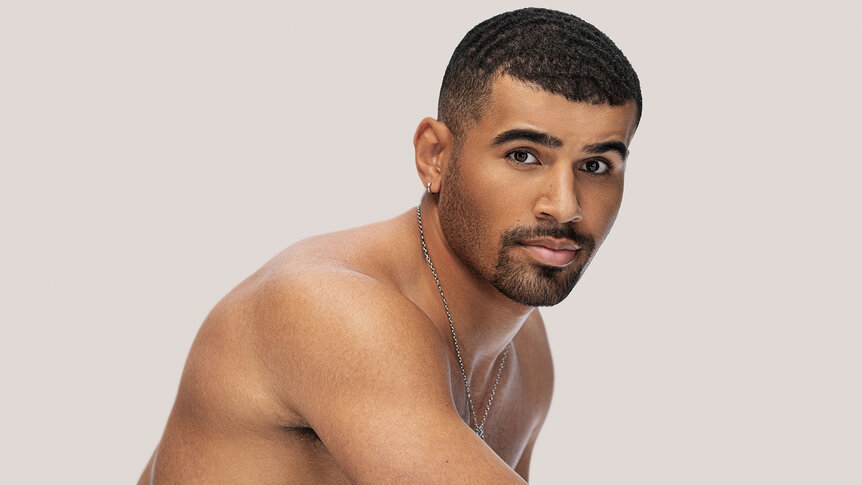
Ronnie Gunter, a lacrosse athlete and Drexel grad known for looking a lot like Eagles QB Jalen Hurts, is the latest bombshell on “Love Island USA.”
The Jalen Hurts look-alike on Love Island: B+
Philadelphia has reached a level of cultural dominance where even our quarterback’s doppelgänger is getting reality TV opportunities.
Honestly, that feels very Philadelphia. We don’t just have celebrities, we also have backup celebrities.
The funniest part is that nobody on the show seems to have noticed yet. Viewers back home immediately saw Jalen Hurts. The contestants on a tropical island in Fiji just saw a handsome guy in swim trunks. Give it time.
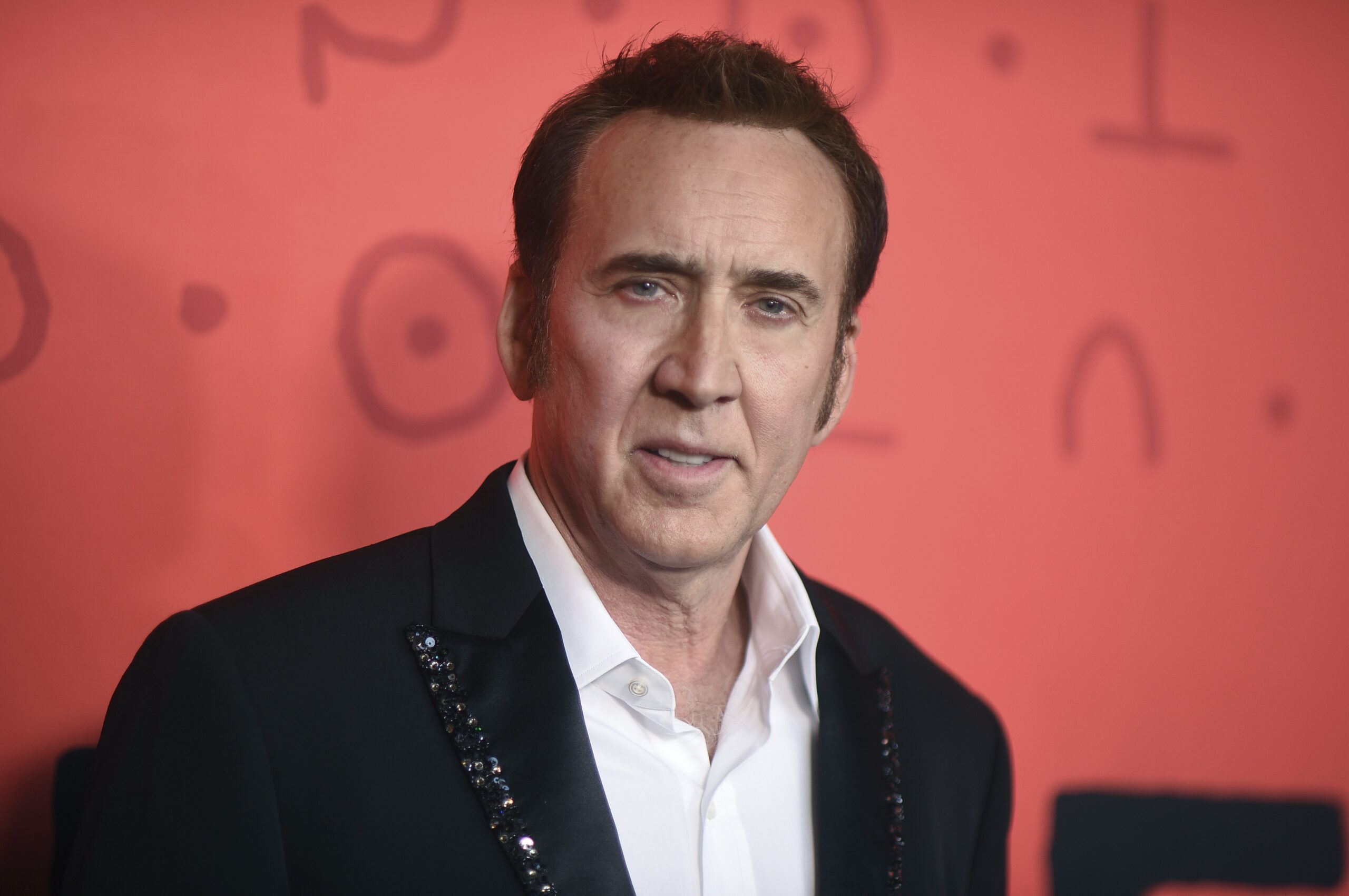
Nicolas Cage arrives at the premiere of “Longlegs” at the Egyptian Theatre on Monday, July 8, 2024, in Los Angeles. (Photo by Richard Shotwell/Invision/AP)
A Nicolas Cage bar crawl: A+
Philadelphia spent years planning America’s 250th birthday celebration. And somehow nobody thought to include the man who stole the Declaration of Independence.
Fortunately, Jenkintown stepped in.
This weekend’s Nicolas Cage-themed bar crawl features Cage cocktails, Cage trivia, Cage competitions, Cage masks, Cage movies, and what appears to be a community-wide commitment to a bit that has gotten completely out of hand.
The genius of Nicolas Cage is that nobody can quite agree whether he’s a great actor, a bizarre actor, or some third category that exists only for Nicolas Cage.
The same could be said for this event.
Jenkintown is hosting an evening built around a man whose filmography includes stealing national treasures, fighting John Travolta while wearing John Travolta’s face, and getting punched repeatedly in a wicker bear costume.
Frankly, if we’re celebrating America this year, Nicolas Cage probably deserves a seat at the table.
America’s 250th is a big deal for Philadelphia. Our nation was born right here on July 4, 1776, which gives us plenty of reason to celebrate with our Semiquincentennial in Philadelphia, centered around Independence Day and beyond.
Philly and the region have been busy planning for the nation’s milestone birthday bash for what feels like forever, and now the time is finally here. Whether you’re a local who has been gearing up for this moment or a visitor ready to explore Philly this summer, you’ll find plenty of ways to join in on the festivities.
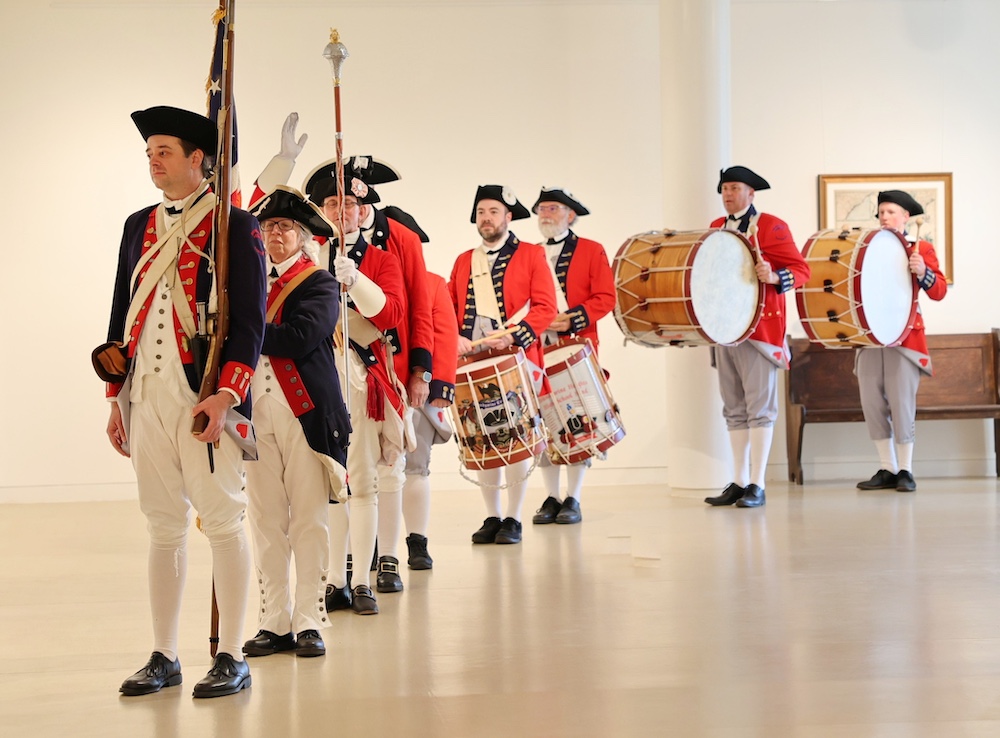
Brandywine Colonials Fife and Drum Corps.
Independence Weekend at Schwenkfelder Library and Heritage Center
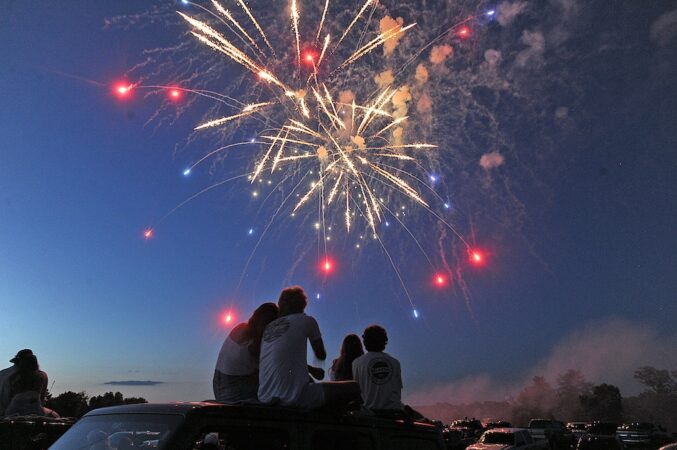
The Schwenkfelder Library and Heritage Center in Montgomery County kicks off the holiday weekend with its annual event in New Goshenhoppen Park, including a parade. Brandywine Colonials Fife and Drum Corps performs July 4 with a reading of the Declaration of Independence, followed by music from the Corps and the Red Hill Band before a fireworks display. Heritage Day closes out the weekend at the Heritage Center with crafts for kids and exhibits the whole family can enjoy.
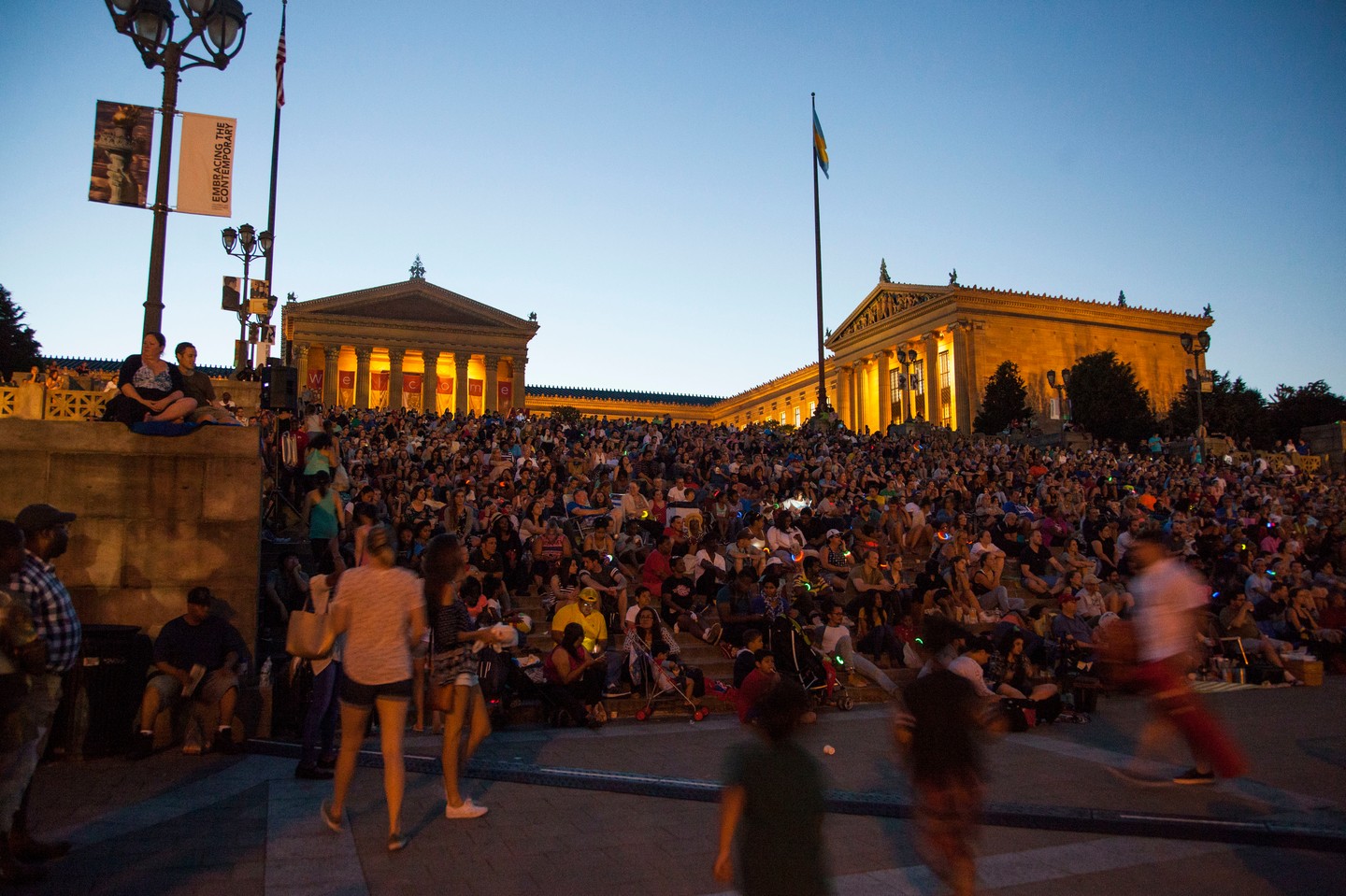
One highlight of the Wawa Welcome America festival, Philadelphia’s multiday Independence Day celebration, is outdoor movies shown on big screens in iconic city spots. Crowds gather on the steps of the Philadelphia Museum of Art for a free screening of the 1976 classic “Rocky,” starring Sylvester Stallone.
Wawa Welcome America and One Philly: Unity Concert for America
A local tradition closes its final weekend on July 3 with the Salute to Independence Semiquincentennial Day Parade, the largest of its kind in the nation, featuring 50 marching bands and 13 floats, beginning at noon at 5th and Chestnut Streets. Later in the evening, a live concert featuring patriotic orchestral music takes place from 7-9 p.m. at Independence Mall, with multi-platinum-selling singer/songwriter and Tony Award-winning performer Idina Menzel headlining with the Philly Pops. On July 4, One Philly: Unity Concert for America takes over the Benjamin Franklin Parkway for a free all-day concert featuring Christina Aguilera, Jill Scott, The Roots, Will Smith & DJ Jazzy Jeff, Seal, and others, hosted by Wanda Sykes.
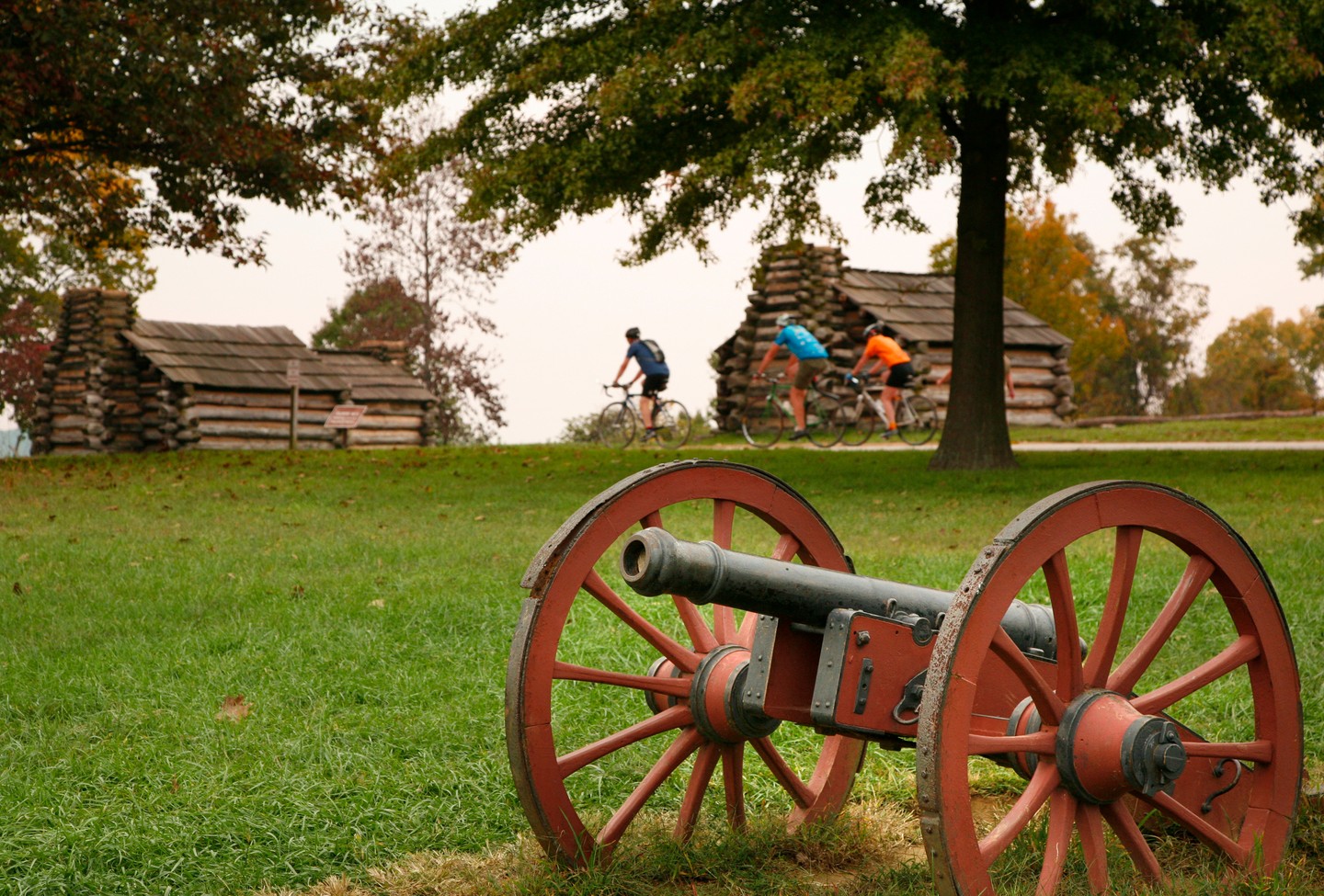
Valley Forge National Historical Park turns 50 this year.
Valley Forge National Historical Park’s 50th Birthday
Valley Forge National Historical Park turns 50 over the July 4 weekend, celebrating with musket-firing demonstrations at Muhlenberg’s Brigade throughout the day on July 3. Philly’s own Hot Taters will perform live at the National Memorial Arch, and a reenactor portraying Anna Morris Holstein, the woman who helped makeWashington’s Headquarters a true local landmark in 1879, will take place on the 4th, followed by a closing ceremony on July 5.
America Celebrates 250 holds a three-day festival in New Hope, Bucks County, featuring fireworks and a drone show over the Delaware River on July 3, accompanied by a pub crawl toward a Revolutionary-themed tavern tent with a cash bar and actors performing as patriots on July 4. The Freedom Parade starting in New Hope and the Dragon Boat race on the river will conclude the weekend events on July 5.
Montgomery County presents a series of public readings of the Declaration of Independence throughout the July Fourth weekend at various locations, including the Elmwood Park Zoo. The Tapestry Historic Dance Ensemble will perform period dances at 859 County Line Road in Horsham, and guests can channel Thomas Jefferson by practicing writing with a quill pen, as he once used to sign the Declaration.
America’s Time Capsule to be buried at Independence Hall
On July 4, America’s Time Capsule, a stainless steel cylinder containing a collection of letters and artifacts from each state, will be buried at Independence National Historical Park. Spectators will have the opportunity to be part of this historical moment, as this capsule will remain sealed for the next 250 years, until 2276, when the generations of that time will be able to recover it.
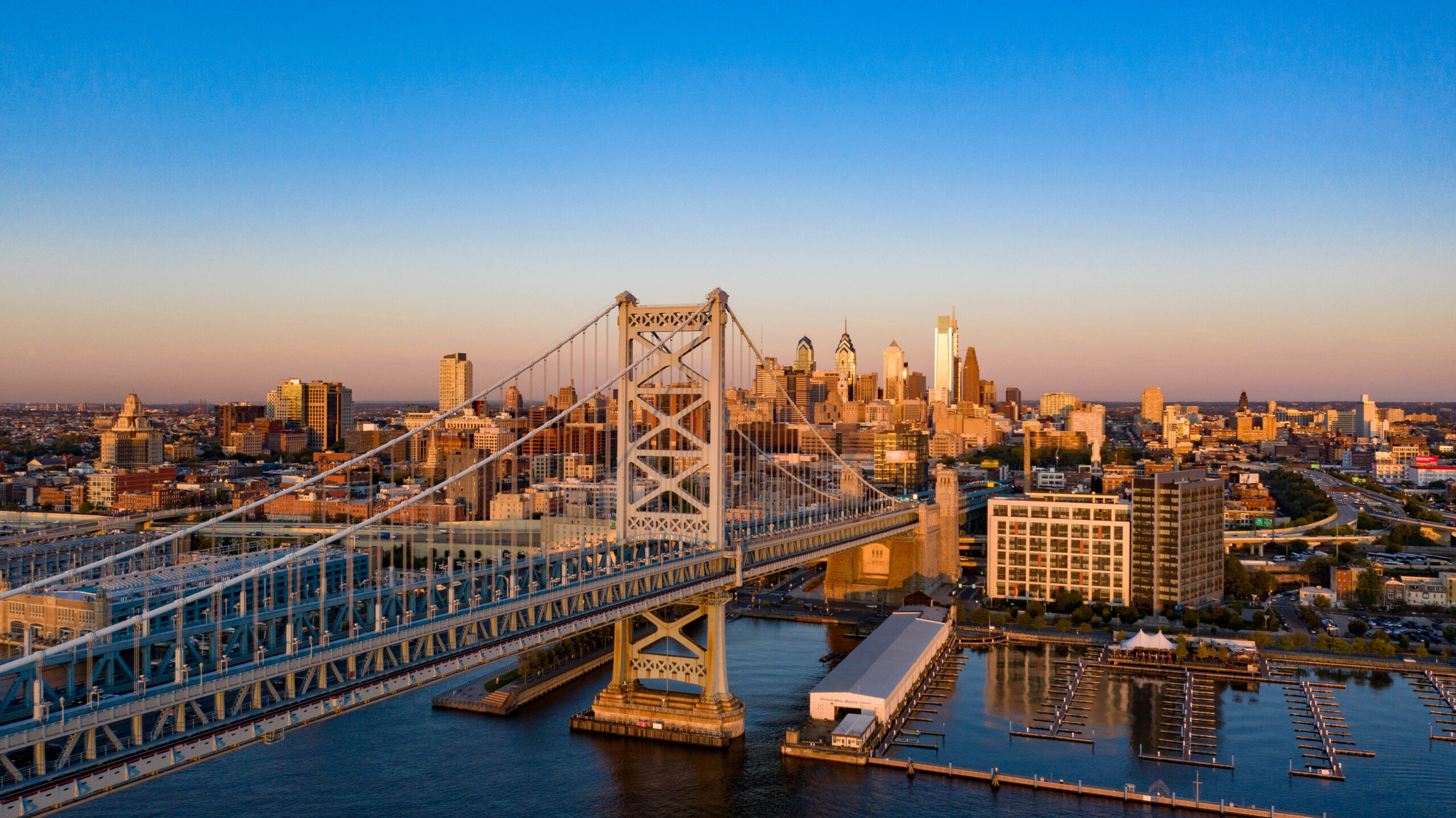
Completed in 1926, the Ben Franklin Bridge connects Camden and Center City (pictured) over the Delaware River. The 1,750-foot-long span, designed by architect Paul Philippe Cret, was once the longest suspension bridge in the world.
Ben Franklin Bridge 100th anniversary
On July 11, the Delaware River Port Authority celebrates the 100th anniversary of the Ben Franklin Bridge with live music, performances, food trucks, and carnival rides. Hosted on the Camden side of the bridge near the toll plaza, a pop-up museum offers attendees a better understanding of this iconic structure’s legacy and features artifacts from the world’s longest suspension bridge.
Philly Phlotilla on the Schuylkill and Delaware Rivers
More than 100 patriotic kayakers dressed in red, white, and blue will paddle the rivers July 11 for the Philly Phlotilla event. Starting at the Walnut Street Dock, the 8-mile paddle, led by experienced guides, will reach the historical site of Fort Mifflin, known as the “Fort that Saved America.” Paddlers and non-paddlers alike can take in the post-Phlotilla festivities for dinner, cannon firing, and tours of the historic fort.
Newtown in Bucks County packs a full day of spirited events throughout the borough on Aug. 8 to celebrate the nation’s historic milestone. The Old Presbyterian Church of Newtown will hold graveyard tours, while the Newtown Fire House Museum presents its display of antique fire trucks, and the Newtown Theatre sets the stage with period music from a Civil War band.
The Haverford High School Football Stadium in Havertown hosts a patriotic-themed drone show on Aug. 29 to mark the country’s anniversary. The day begins with live music, crafts, and other family-friendly activities, with food trucks on the premises, all leading up to an evening of a choreographed illuminated drone display paired with themed music.
There’s a rare reunion at the Philadelphia Museum of Art this year: Two of Vincent van Gogh’s famous sunflower paintings are on view side by side. Only five large-scale paintings comprise his Sunflowers series, scattered over three continents. But now, Philadelphia gets a chance to see two together.
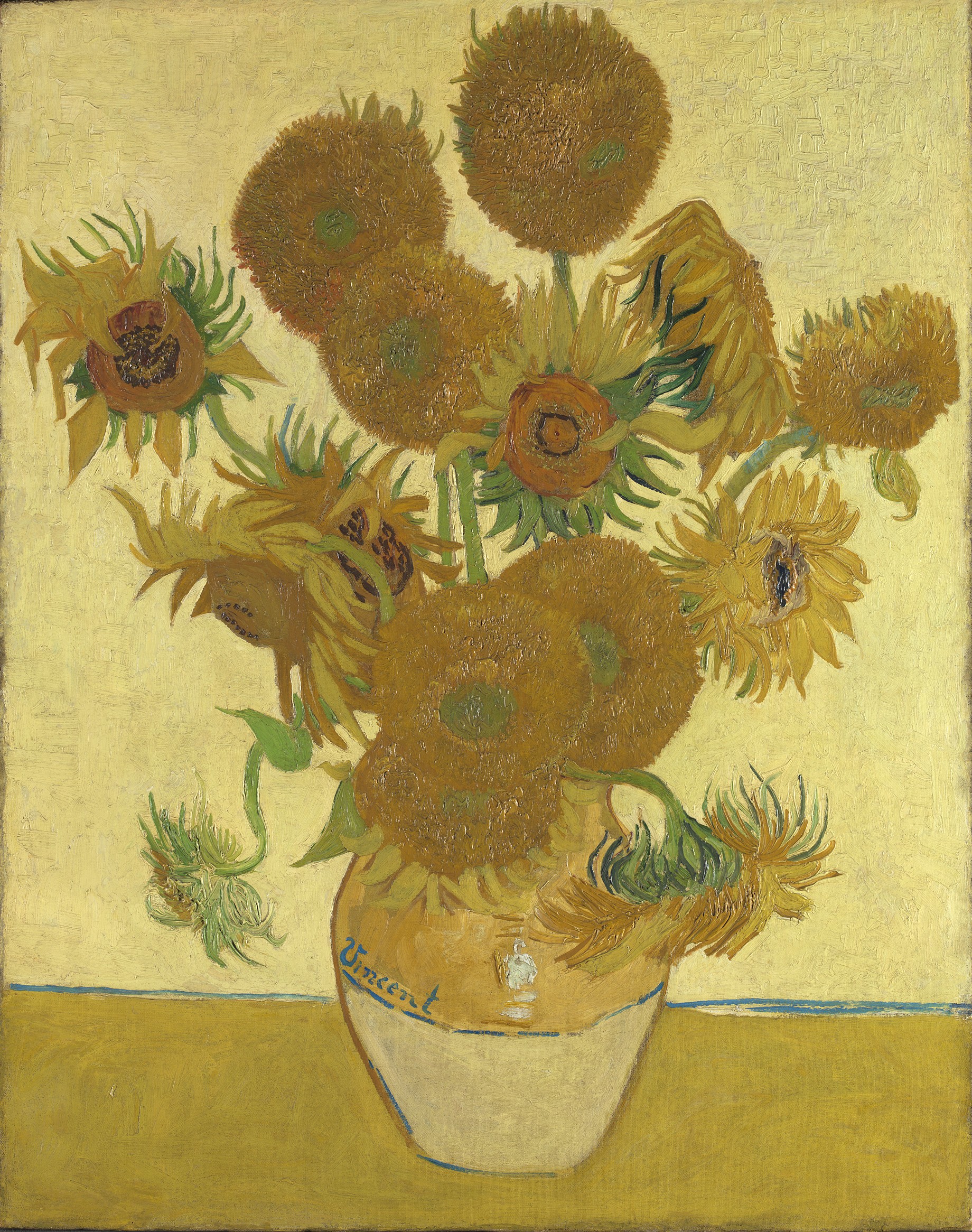
For the first time in its history, Sunflowers (1888), from the collection of London’s National Gallery, has traveled across the Atlantic for its United States premiere alongside the PMA’s own Sunflowers (1889). The London artwork shows the sunflowers on a pale yellow background while Philadelphia’s features a soft blue; both exemplify the artist’s desire to create what he described as “a symphony of blue and yellow.”
It’s a historic display of signature works by a world-famous artist who sadly never achieved critical acclaim during his lifetime. But, all of that aside, these are simply two marvelous paintings to see.
“Sunflowers” (1888), Vincent van Gogh. Courtauld Fund, The National Gallery.
Their charm isn’t solely in the pretty subject matter; it’s all about the texture. Thick globs of paint in various shades of yellow give the appearance of a not-quite-settled image, enchanting the viewer with dynamic motion that can only be experienced up close. Each bloom has its own stylistic personality as the paint takes on an almost sculptural presence. Both paintings create a mesmerizing display — pictures truly don’t do it justice.
“Van Gogh’s Sunflowers: A Symphony in Blue and Yellow” is on view through Oct. 11 at the Philadelphia Museum of Art, 2600 Benjamin Franklin Pkwy, Philadelphia, 215-763-8100 or philamuseum.org.
— Rosa Cartagena
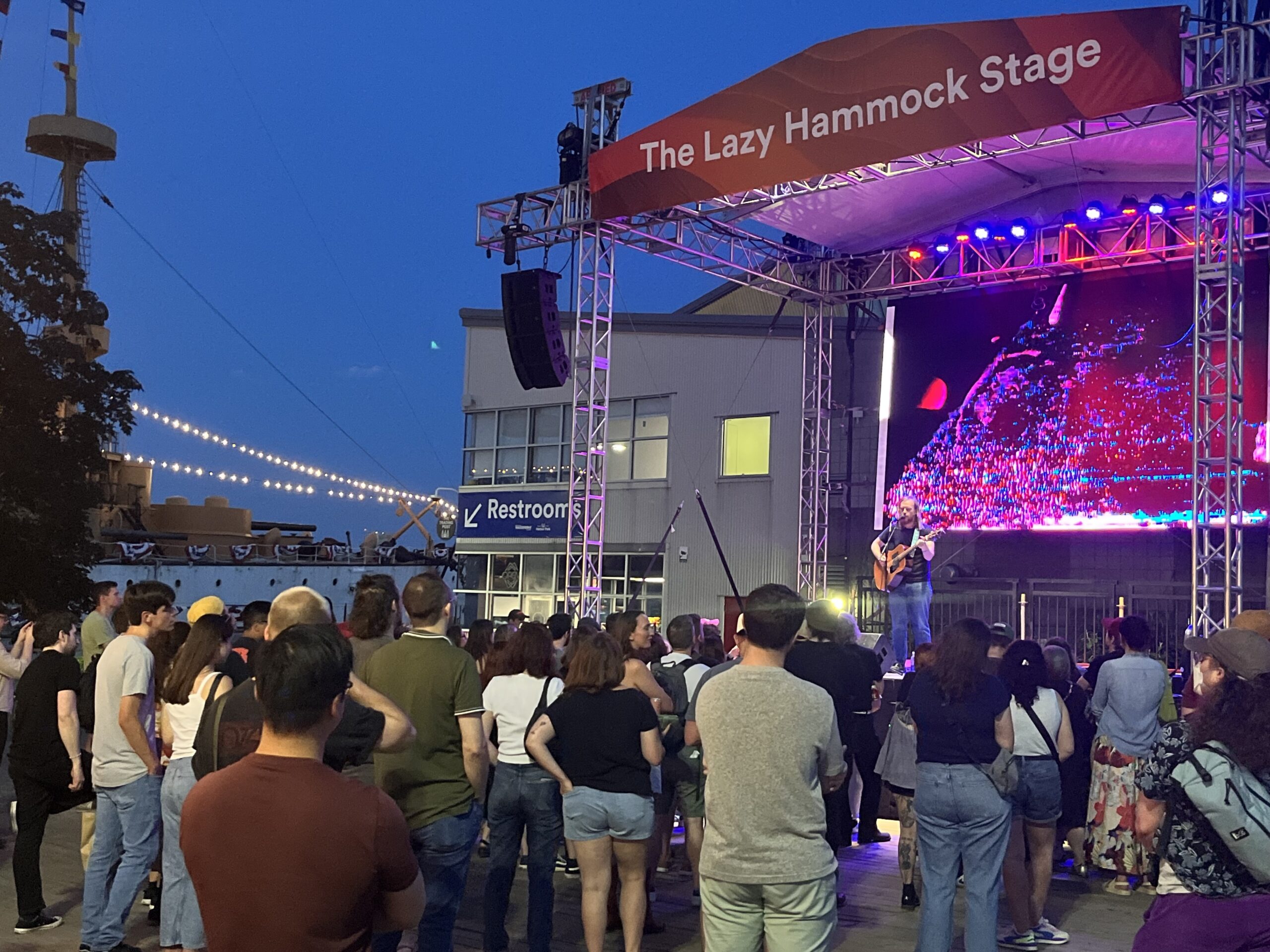
Kevin Devine performs at Spruce Street Harbor Park on June 25, 2026.
Kevin Devine at Spruce Street Harbor Park
Some of the best shows of the summer can be enjoyed for free, from a picnic table, with a Tecate in hand.
On Thursday night, I attended Kevin Devine’s free show at Spruce Street Harbor Park, where he was joined by openers Shannen Moser and Abi Reimold. It was the first of Devine’s short two-weekend tour through non-traditional spaces across the Northeast, including mostly house shows and an arcade.
For about an hour, Devine played — just him and his acoustic guitar — a stretch of old and new songs from his repertoire that dates back over two decades. Currently, Devine’s 11th LP is in the works. It will have distinct Philly ties, being recorded at Will Yip’s Memory Music Studios and produced by Steph Marziano, one of Hayley Williams’ longtime collaborators who cut her teeth in Philly’s music scene.
But back to Thursday night’s show. It was one of an impressive series of free shows at Spruce Street Harbor Park programmed by 4333 Collective.
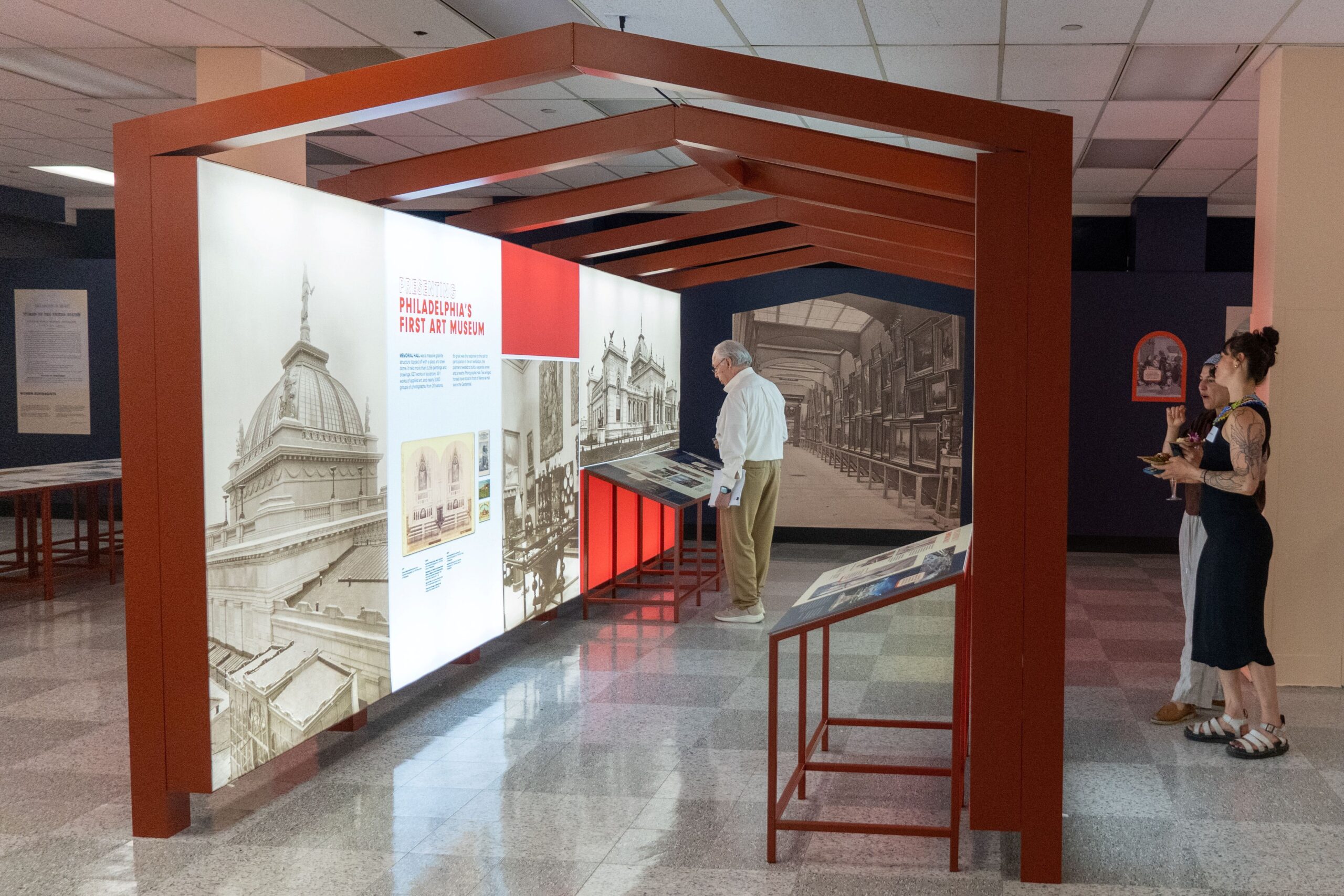
An exhibit on Memorial Hall at “Revist: 1876,” a recreation of the Centennial Exhibition at the Fairmount Park Grounds in 1876. Before Memorial Hall was turned into the Please Touch Museum, it was the first site of the Philadelphia Museum of Art.
The first telephone, at the Lits Building
Before the Please Touch Museum was the go-to hangout spot for our city’s adventurous toddlers, it housed the first Philadelphia Museum of Art.
The 70,000-square-foot Beaux Arts building was originally built to showcase the work of late-19th-century American artists — including Philadelphia’s own Thomas Eakins — for the Centennial Exposition of 1876.
The history of Memorial Hall is told in one of four pavilions featured in “Revisit 1876,” the 8,000-square-foot exhibition located in the ground floor of the Lits Building, produced by the nonprofit arm of the Center City District Foundation.
The exhibit aims to connect present-day Philly with the innovations that were introduced at the fair 150 years ago, said Paul Levy, the foundation’s executive director.
And they do a pretty good job.
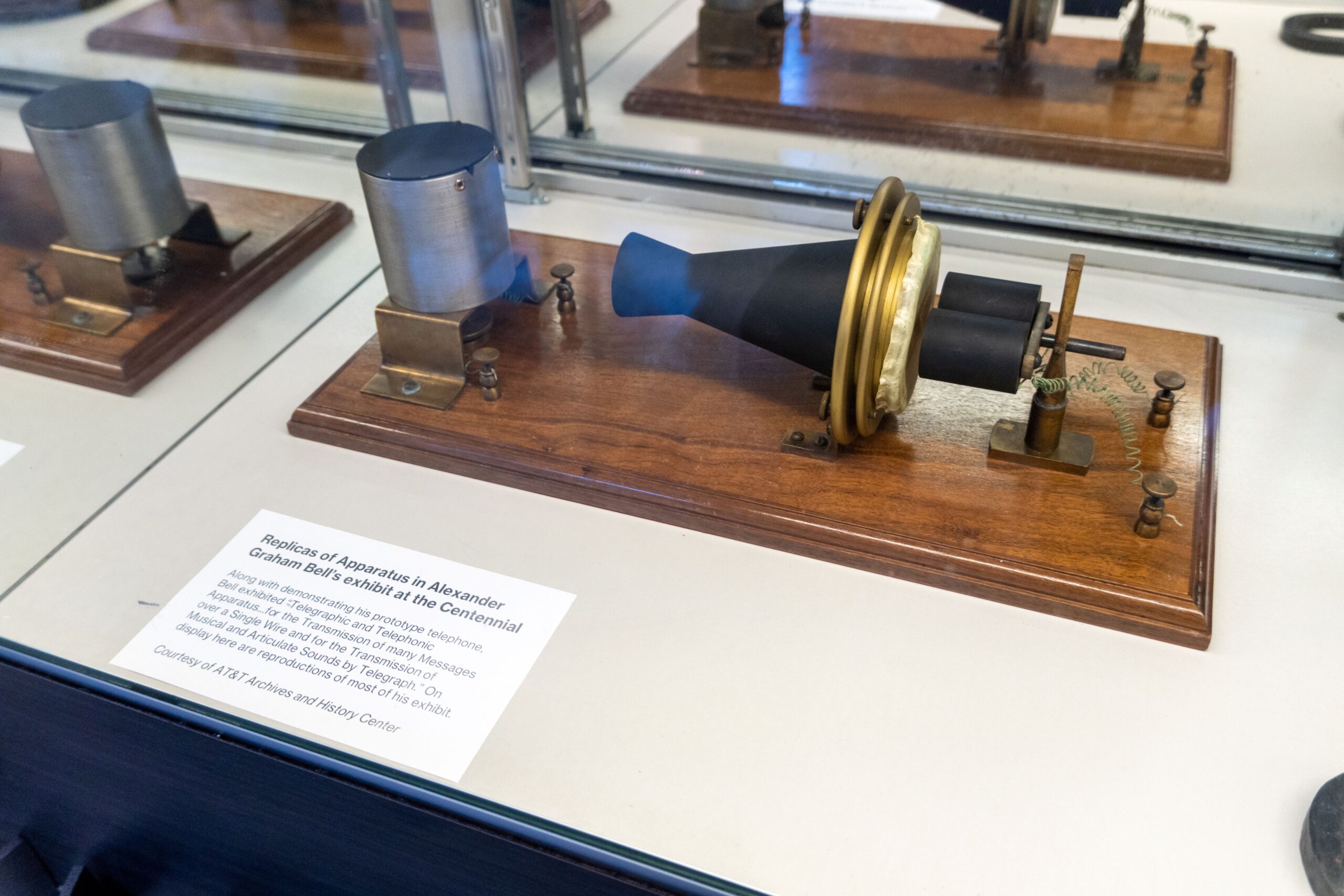
A replica of Alexander Bell’s first telephone that was shown for the first time for the 1876 Centennial Exhibition in Fairmount Park. The replica is on exhibit at “Revisit: 1876” in the Lits Building, 701 Market St. Entrance is on Eighth Street.
Silhouettes of women in corseted dresses and twirling umbrellas and dandy men in top hats greet visitors. Behind the sales counter is the replica of the first telephone that Alexander Graham Bell brought to the Centennial. Also behind the glass counter is a 3-foot terra-cotta model of the Statue of Liberty made by the original sculptor Frédéric Auguste Bartholdi.
There is even Centennial merch, including puzzles and wallets, all in pristine condition.
My favorite part is the flyover video from Independence Hall to Memorial Hall. It’s layered with historic photos connecting 2026 to 1876. In other words, the 2026 flyover includes our majestic City Hall. In 1876, it was an active construction site. (Construction started in 1871 and wasn’t finished until 1901.)
In addition to Memorial Hall, there are exhibits on Machinery Hall, Horticultural Hall, and the Main Building. A special section spotlights how the former enslaved abolitionist Frederick Douglass was prevented from speaking at the event and how Ben Franklin’s great-granddaughter Elizabeth Duane Gillespie fought to have women included.
“Revisit 1876” is open through December. The Lits Building is at 701 Market St. (Entrance is on the Eighth Street side). Admission is free.
Rachel Maddow’s brief turn as a Philadelphian began with her bicycle being stolen on the first day of a new job.
“I got to work at 9 a.m. and I got out for lunch before noon, because I didn’t have anything to do,” Maddow said. “My bike was already gone.”
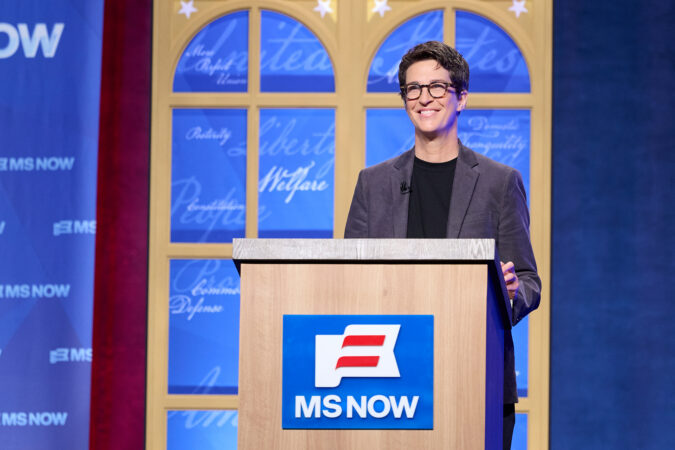
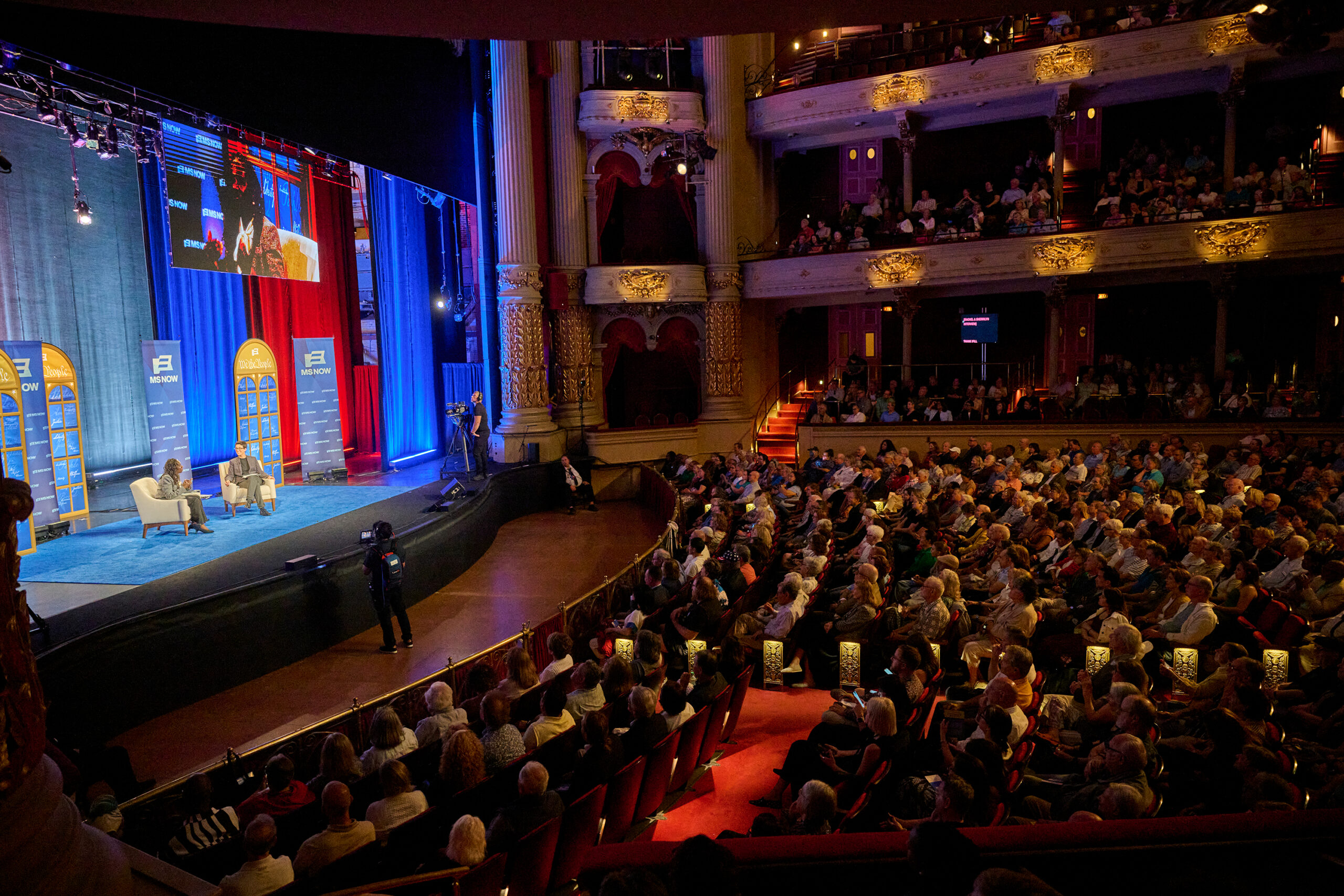
MS NOW’s top star was in Center City on Thursday night to interview constitutional legal expert Sherrilyn Ifill live in front of nearly 2,000 people at the Academy of Music.
But prior to the event, she reminisced about her brief time in Philly in the early 1990s, shortlyafter she came out as gay during her freshman year of college at Stanford University.
“It didn’t go well at home, so it was a bit of a scramble in terms of like paying for college, figuring out what I was going to do, where I was going to live,” Maddow said. “And I got an internship at a think tank at Penn.”
Maddow lived in West Philadelphia and basically ate nothing but Ethiopian food for a few months, though she can’t remember the name of the street: “It was in the 40s and it was one of the tree-named streets.”
In college she was an AIDS activist and focused on healthcare policy, so landing at the University of Pennsylvania’s Leonard Davis Institute of Health Economics seemed liked an ideal fit.
Maddow said her job was to answer the phone. But the internship didn’t last long.
“I was not an additive,” Maddow said. “I don’t think I was an asset to the organization.”
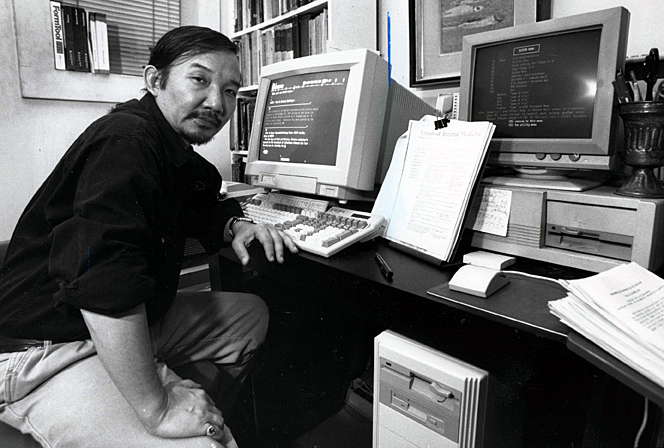
Kiyoshi Kuromiya seen here in 1992, was a gay civil rights activist who helped establish ACT UP Philly.
Maddow’s activism began when she was still in high school, when she began working at a hospice for people who were dying during the AIDS epidemic.
Still, those few months living in Philadelphia influenced Maddow’s developing political voice. She idolized ACT UP Philly, an activist organization fighting for people with HIV/AIDS, and thinks that gay civil rights activist Kiyoshi Kuromiya is the city’s most overlooked hero for the work he did helping connect people with hard-to-find information about the virus and treatment.
“He saved millions of lives,” Maddow said. “The city needs to build a statue for Kiyoshi Kuromiya.”
Maddow has returned to Philly a number of times over the years, and every time she does, it makes her feel like she’s 19 again. Things have changed — seeing Indego bicycles to rent on street corners after hers was stolen is pretty jarring — but though her time living here was brief, she didn’t hesitate saying, “Philly was really formative for me.”
“The thing I loved about Philly at the time, and that I kind of fell in love with, even before I really knew what to do with it, was the really sparky, edgy, impolite activist spirit,” Maddow said. “I think I’m just a middle-class polite kid who doesn’t like to offend anybody, and Philly kind of shook me out of that a little bit, and made me aspire to edgier things.”
More live events and a new app coming from MS NOW
Nearly 2,000 people attended Thursday night’s event at the Academy of Music.
A strong Philly current ran through MS NOW’s event Thursday night, which highlighted the messy history of the American experiment leading up to the country’s 250th anniversary next week.
“My mother’s best friend of 70 years lives here,” Psaki said.
Thursday’s event was part of a larger strategy of engagement at the network after breaking away from NBC and becoming part of Versant, hence the name change from MSNBC to MS NOW. Ratings are up, but the cord-cutting trend is undeniable, so MS NOW is attempting to secure a digital future while it remains a popular TV destination.
The network has now hosted three large fan events since 2024 and another is planned for Sept. 26 ahead of the midterm elections, though further details have not been announced. Attendees in Philly on Thursday night received a free, one-year subscription to MS NOW’s membership product that is set to launch soon. It will act as a streaming platform and online community for the network’s progressive fans and provide access to its biggest stars.
“We’re always looking for ways to connect with our MS NOW community, to meet more viewers where they are, and to engage them in new ways,” said Lauren Peikoff, the network’s executive producer of live events.
Cecil Parker, a Philadelphia musician, said the state of affairs in Washington compelled him to attend Thursday’s event.
“Urgency. That’s the all-encompassing word,” Parker said, who often tunes into MS NOW to get their take on the news. “They have their opinions, but it’s based on the facts. So I dig that.”
Some audience members traveled from as far as Arizona and California to have a chance to hear Maddow and her MS NOW colleagues in person.
Tony Clyburn and his wife, Lisa, drove more than 10 hours from West Columbia, S.C., to take part. A radio host back home, Clyburn said it was inspiring being in a room with people from different walks of life who want what’s best for their neighbors and their country.
“These gatherings are good because they’re as close to a town hall as we can get,” Clyburn said.