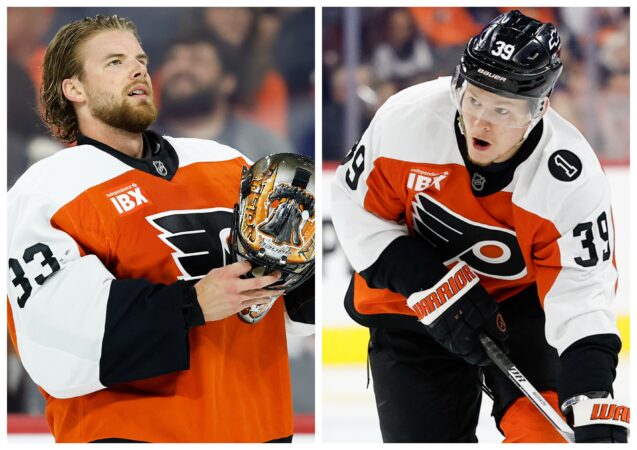
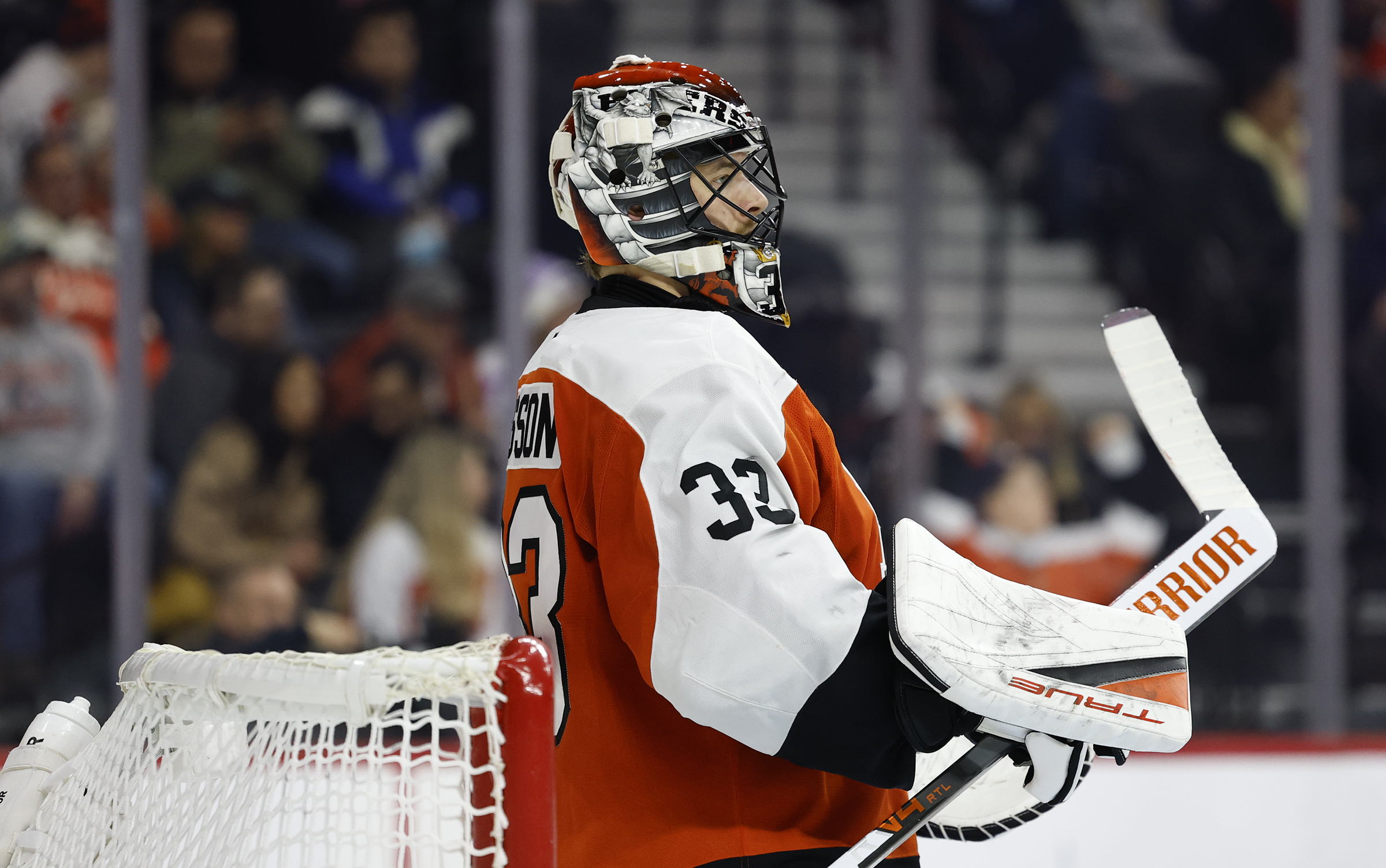
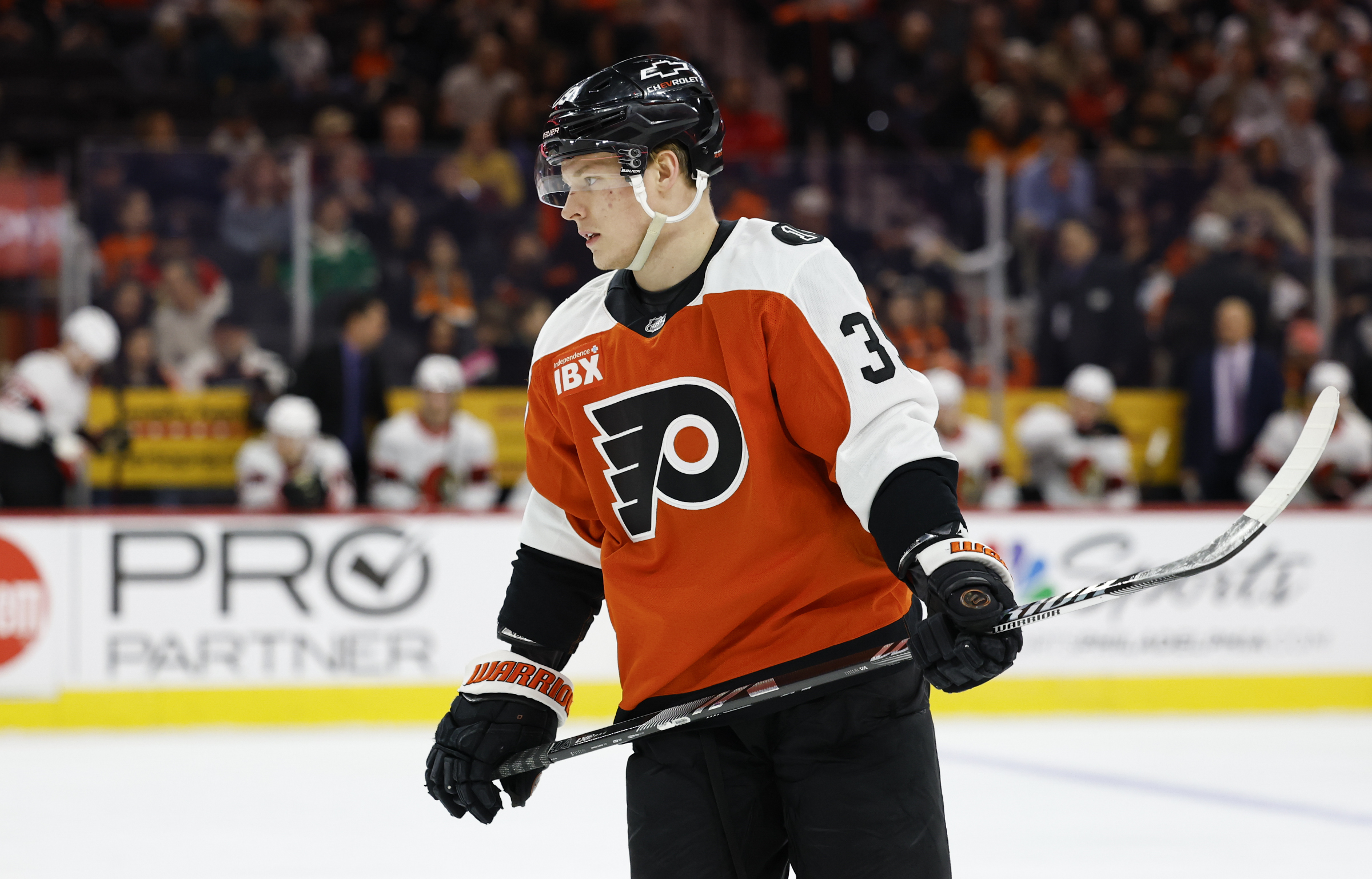
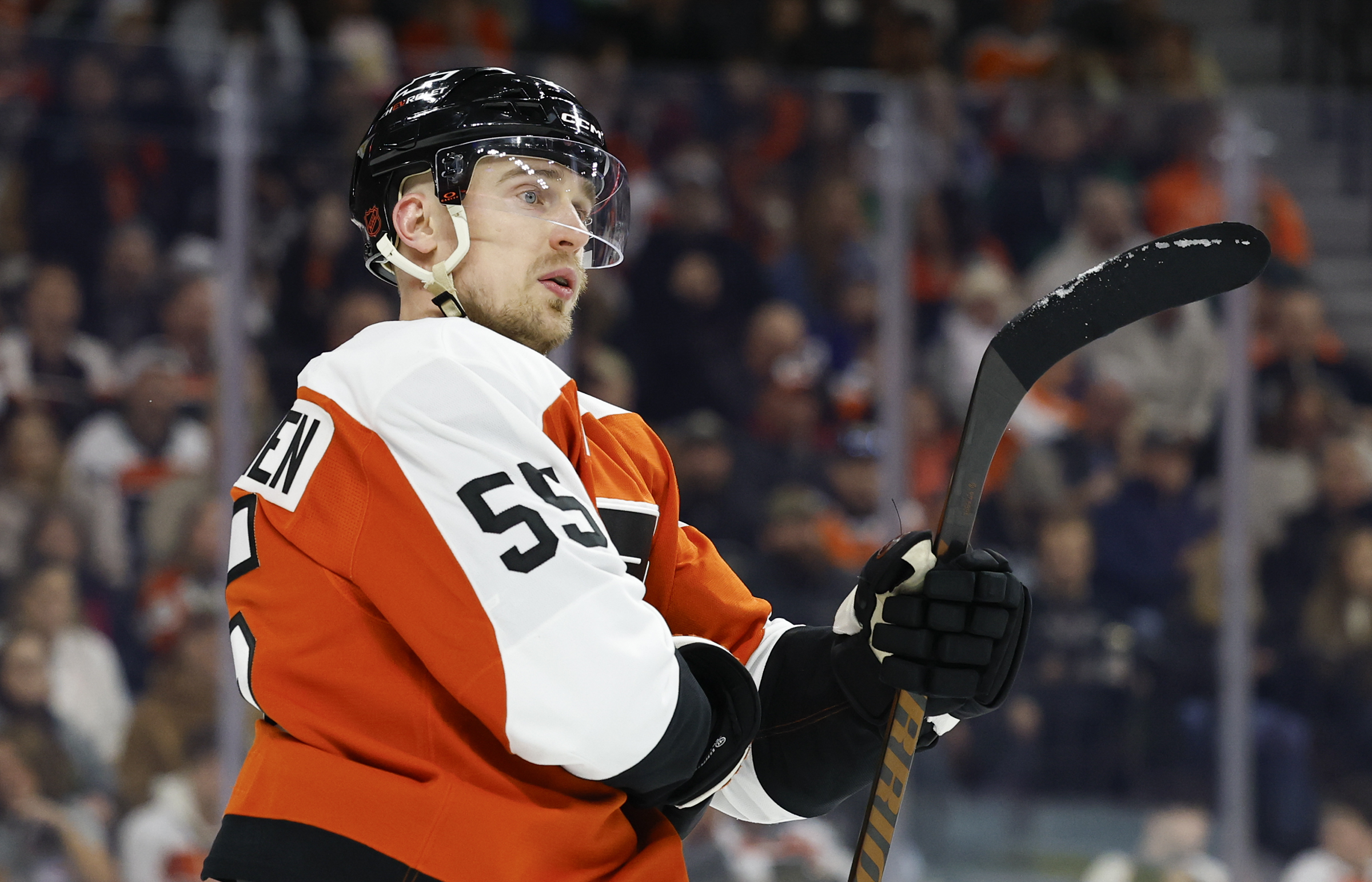
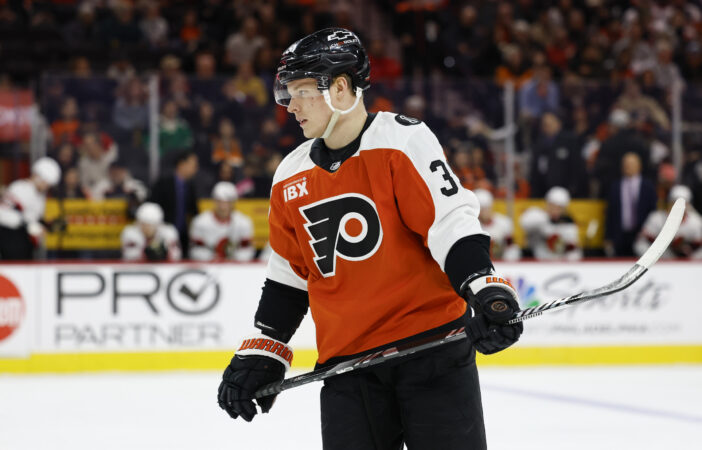
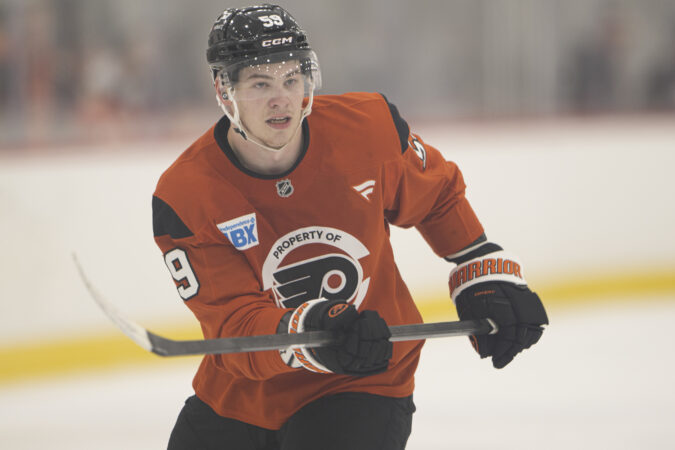
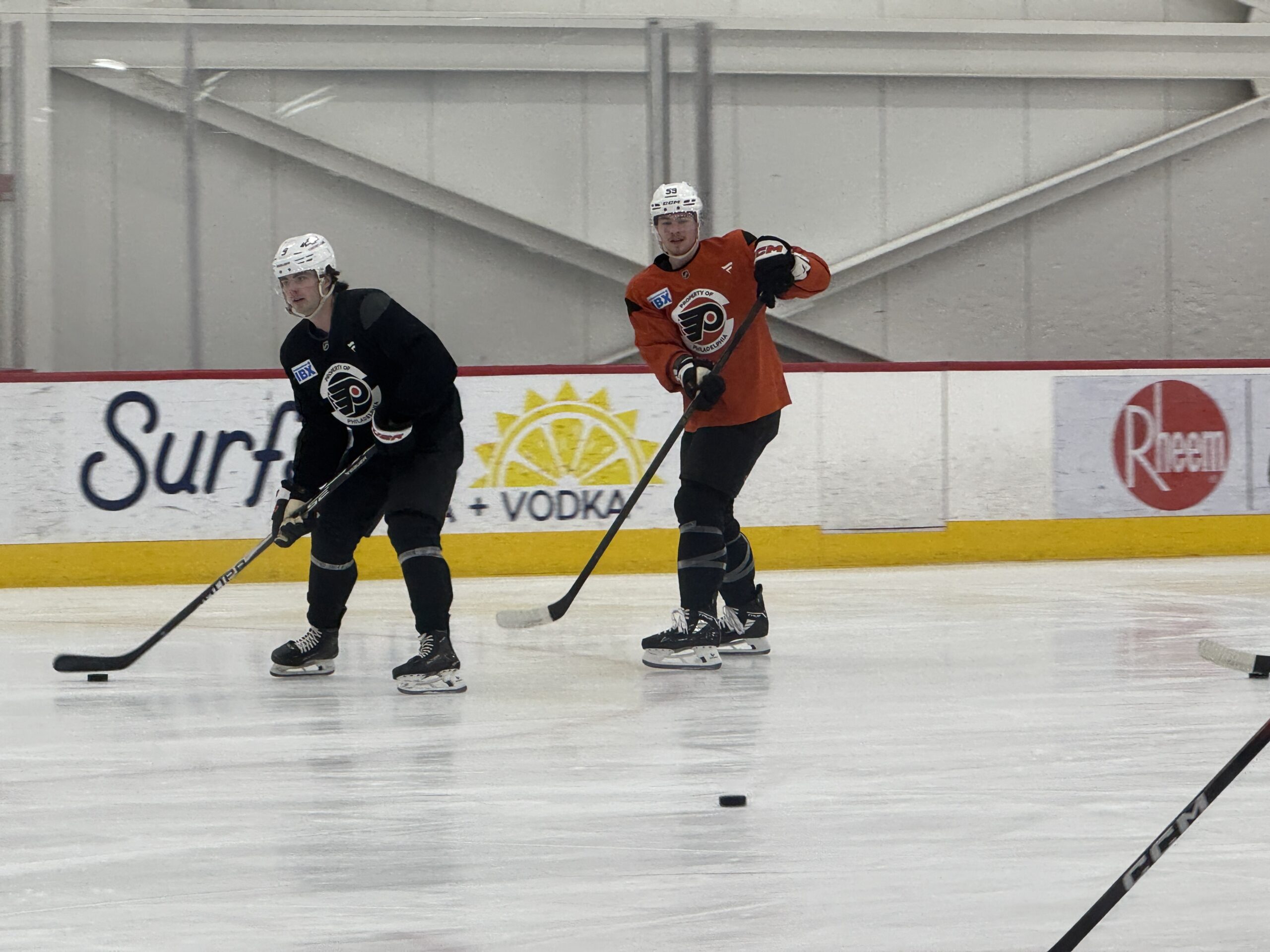
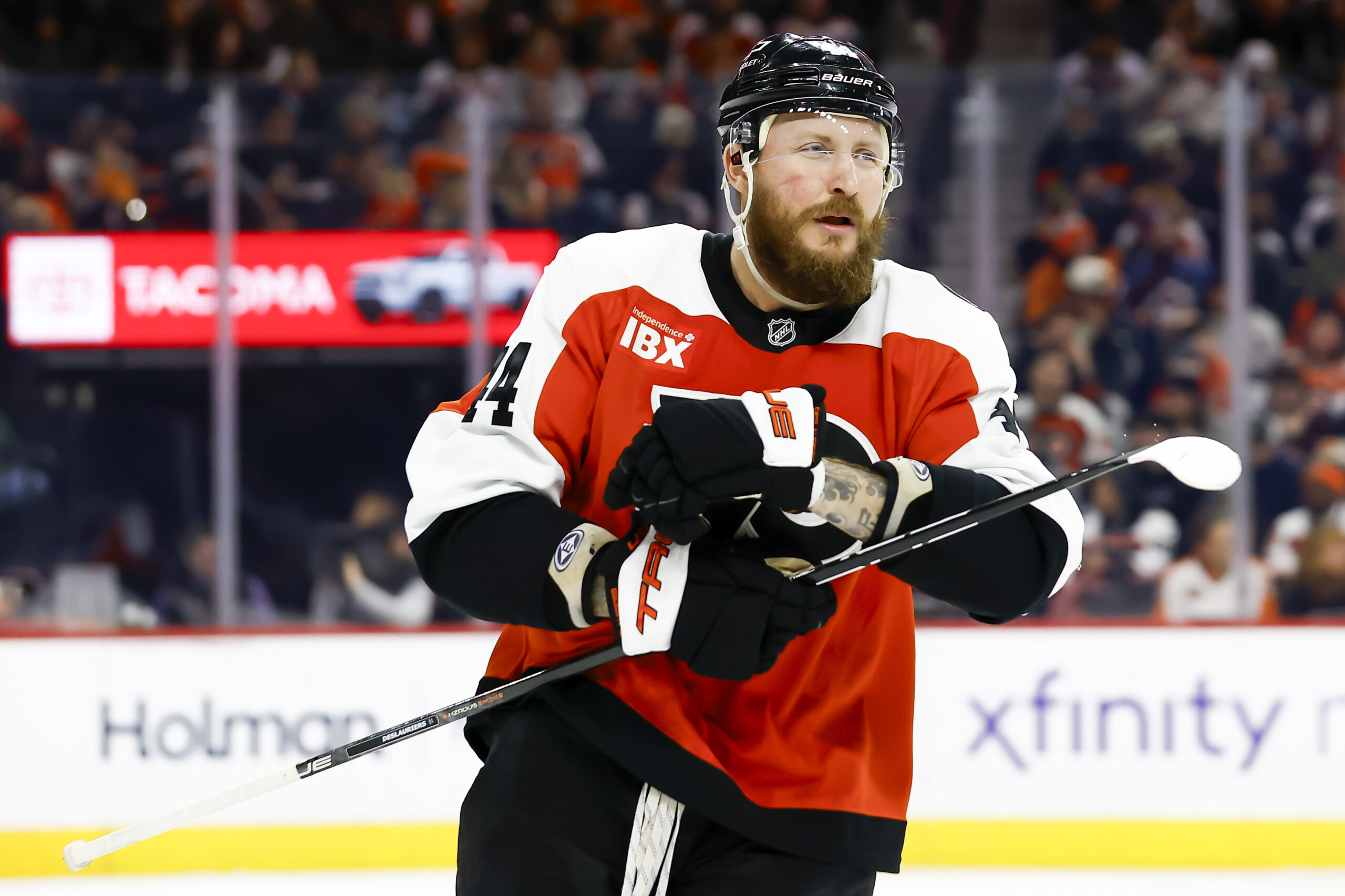
Although they didn’t gain any ground in the playoff race, as the New York Islanders and Boston Bruins each won, the Flyers remain in the hunt with their 16th comeback win of the season. Trailing 2-0, they beat the Eastern Conference’s worst team, the New York Rangers, 3-2 in overtime on Thursday.
As the minutes tick off to the NHL trade deadline next Friday at 3 p.m., here are three questions to ponder.
Inconsistency continues to plague Flyers goaltender Sam Ersson.
Will the real Sam Ersson please stand up?
The Flyers’ goalie situation has been a mix of emotions for years, and for most of this season, there has been a question mark around the play of Sam Ersson. No longer the Flyers’ No. 1 goalie, can he even be the Flyers’ No. 2? Inconsistency has plagued the Swedish netminder.
In the first two minutes of the game, Ersson made two ridiculous saves. First, he robbed Rangers defenseman Adam Fox with the glove after a neutral zone turnover led to a four-on-one with just Travis Sanheim back. Travis Konecny tried to hit Christian Dvorak, but the puck was picked off by Mika Zibanejad, who found Fox charging backdoor less than 30 seconds in.
Around a minute later, he stopped a Noah Laba shot from above the circle, which he shot as Emil Andrae knocked him down. That wasn’t the big save; that was two seconds later when Brendan Brisson drove around Denver Barkey to get the rebound. Everyone looked behind Ersson — including Ersson — but he had made the save.
“I think the first 10 minutes of the first period, we were kind of running around, just giving them pop turnovers and ‘Biggie’ made a ton of great saves for us,” said forward Trevor Zegras.
But then, around the halfway mark of the period, Ersson allowed a weak goal to Sam Carrick. The forward sent a quick turnaround shot on goal from the half-wall that went five-hole on the Swedish netminder. And in the second period, Alexis Lafrenière scored to make it 2-0 — although the 2020 first-overall pick was left wide-open after Noah Cates lost him in the corner.
Ersson then clamped down and stopped the next 15 shots on goal — each save bigger than the next. He tracked the puck well, kicked the pad out, flashed the leather, and as coach Rick Tocchet said, he battled.
“He dug in there. … And even going down 2-0, this is where you’ve got to have that resolve. We’ll kind of give him some more of that confidence; we’ll get him in there again, and we’ll see how he goes,” Tocchet said.
Is Matvei Michkov poised for another strong finish to the season?
Can Matvei Michkov find his joy?
Like Ersson, questions have swirled around the young Russian winger, too. For Michkov, those are about his conditioning, his production, his ice time, and his lack of overtime play.
There’s a good chance a lot of those were answered on Thursday.
Last year, after the 4 Nations Face-Off Tournament break, Matvei Michkov scored 10 goals and 27 points in the final 25 games of the season. Two games into the final 26 this season, he has two goals — both coming against the Rangers.
His first goal cut New York’s lead in half when he scored on the power play midway through the second period. Owen Tippett had the puck along the left wing boards, evaded New York defenseman Will Borgen, and passed the puck to Cates in the left circle. The centerman then sent it quickly to Michkov sitting backdoor at the right post for the slam-dunk goal past Igor Shesterkin.
It was his 14th goal and third on the power play this season.
“I thought the one he scored for us, the first one, was a timely one, and it kind of helped us calm down and get us back into it,” forward Travis Konecny said. “And, it was good, yeah, he’s playing great. He looked fast. He looked confident with the puck.”
After doing two-a-days off the ice for seven days during the break — one session focused on strength and another on conditioning and stamina while he stayed off the ice — Michkov looked stronger. It was notable in the dwindling minutes of the third period, when he made a move between his own legs to get around Fox and drive to the net. The only problem? He then continued into his countryman, Shesterkin, and was called for goaltender interference with nine seconds left in regulation, with the score tied.
His teammates killed off his penalty, and Michkov, who entered the game with the 10th most minutes in the extra session, finally got some time — granted, it was four-on-four. There was a mad scramble for the puck after Ersson stoned Zibanejad and tried to cover up, but the puck eventually popped out to Sean Couturier in the Flyers’ end, and he fed Michkov.
The forward carried the puck down into the zone and blew by J.T. Miller — yes, his skating stride looked great, unlike an earlier overtime session this season. And yes, he carried it down the left side two days after he said he was “happy” playing on the right side — before beating Shesterkin again. After scoring three overtime game-winners last season, he got his first of the year on Broadway to give the Flyers their third overtime win in 11 games this season.
“Anytime he gets a good look like that, when you can get him clear cut — you watch him in practice — he’s going to have a pretty good chance to score a goal,” said Konecny, who seemed to offer words of encouragement to Michkov after the game-winner.
Added Tocchet: “That was a [heck] of a goal, that second goal; Shesterkin’s a [heck] of a goalie. He went five-hole there. He sold it, you know, that’s the stuff that he can do … He had some confidence yesterday [against the Washington Capitals] so he’s getting some confidence here.”
Will Flyers defenseman Rasmus Ristolainen be on the move by the trade deadline?
Where do things stand one week from the trade deadline?
Two games into their return, and like most of this season, the Flyers struggled to put in a complete 60-minute effort. On Wednesday in Washington, D.C., they came out jumping but couldn’t sustain it. On Thursday, the Rangers had the energy early as they skated in their first game back.
It makes it hard to gauge if the Flyers should be sellers or buyers, but they do still trail by eight points in the race for the final Metropolitan Division spot and the last wild card.
But as Konecny said, they “just kept battling back,” like they’ve done all year. The game marked the 39th time the opposition scored first.
“I guess where we’re at in the standings, the last 25 I guess — yesterday, 26 — are all playoff-type games for us, and we got to do something special down the stretch to get in,“ Zegras said.
”And I think we all know that. Yesterday, I thought, for the most part, played a good game, just gave up a couple of weak-side goals that we’ve been trying to clean up.”
The scouts were out, however, for the last two days. On Wednesday in Washington, D.C., eight teams were represented, with one being the Dallas Stars, a team rumored to be interested in defenseman Rasmus Ristolainen. The Rangers do not identify team affiliates for scouts who are present at home games, and while there were many, The Inquirer could identify a scout from the Vegas Golden Knights, New York Islanders, Tampa Bay Lightning, Anaheim Ducks, Edmonton Oilers, and Winnipeg Jets.
Not everyone was there to see Ristolainen, and several are regulars, but ‘tis the season.
NEW YORK ― It appears all of that on-ice time during the NHL’s break for the Winter Games paid off for Matvei Michkov.
He scored not only the Flyers’ first goal of the game, but also the overtime winner, redeeming himself after taking a penalty to put the Flyers on the kill at the end of regulation in a 3-2 win over the Rangers.
“He had two big goals,” Konecny said. “First, obviously the overtime one, but I thought the one he scored for us, you know, the first one, was a timely one that helped us calm down and get us back into it. He’s playing great. He looked fast.”
The Flyers were on the second leg of a back-to-back, and they looked it in the first period. The Rangers had them on their heels, dominating puck possession and smothering the Flyers’ breakout attempts.
But Sam Ersson held down the fort early, as the Flyers’ netminder made a few point-blank saves, including a high-danger shot from Adam Fox. But Sam Carrick flung a shot from along the boards at Ersson, and it slipped right through the five-hole, to put the Rangers up 1-0.
“We told him, that’s going to happen, those goals like that,” coach Rick Tocchet said. “I don’t know what happened. Whatever happened, happened, but he dug in there.”
Hathaway tried to spark the Flyers late in the first with a fight after taking a boarding penalty on Brennan Othmann. But coming out of the break, the Rangers added to their lead with an early goal from Alexis Lafrienière, who beat Noah Cates in front of the net to bury a pass from Will Cuylle.
The Flyers got one back on the power play from Michkov, who scored his 14th of the season and third power-play goal. They outshot the Rangers in the second period, 10-5.
And out of the second intermission, the Flyers kept that momentum going. Trevor Zegras sniped one over the shoulder of Igor Shesterkin under 40 seconds into the third period to tie the game at 2-2.
“The first 10 minutes of the first period, we were kind of running around, just giving them the puck, turnovers, and [Ersson] made a ton of great saves for us,” Zegras said. “But I thought after that, we settled in, less turnovers, and just played our game.”
Cates had two point-blank opportunities in front of Shesterkin late in the third to take the lead on the power play, but couldn’t bury either chance.
Michkov’s goaltender interference penalty put the Flyers at a disadvantage to open the extra period, and the situation was made even worse after Rasmus Ristolainen lost his stick late into the penalty kill.
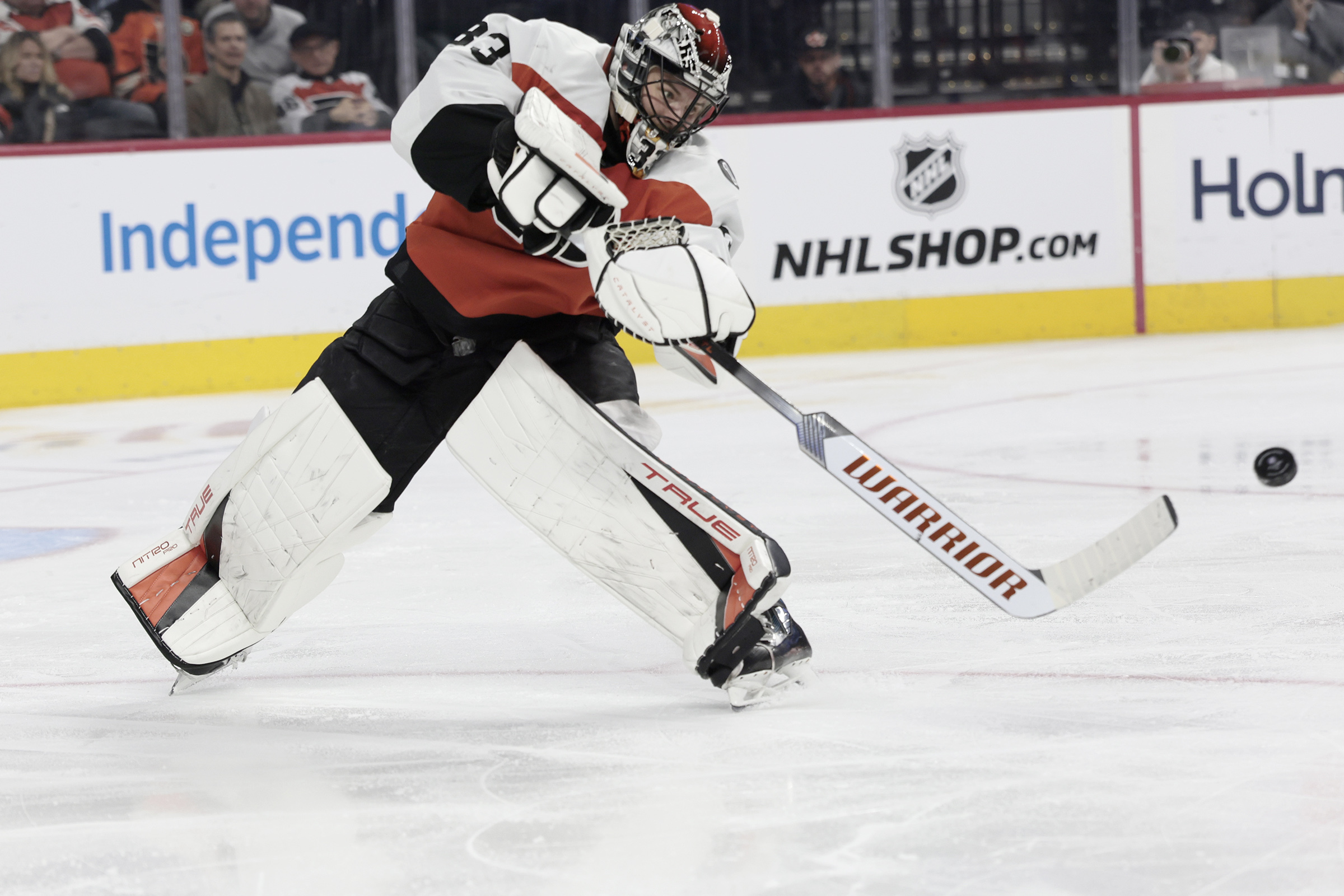
Ersson’s season has been up-and-down this year, but despite the early soft goal, he made 23 of 25 saves, keeping the Flyers in it while they found their legs early in the first period and delivering in overtime.
Sam Ersson made 23 saves in the Flyers’ overtime win against the New York Rangers on Thursday.
“[Ersson] was fantastic, he was fantastic,” Zegras said. “The save he made on Fox in the first four minutes, the penalty kill in overtime, he was amazing … When that first one goes in, he made so many ridiculous saves that it didn’t even matter.”
Ultimately, the Flyers still need to get as many points as possible. Still out of a playoff spot, Zegras said every game is like a playoff game for this group, and they’ll need more timely goals like the overtime winner from Michkov on the breakaway.
“The last 25, I guess yesterday 26, are all playoff-type games for us,” Zegras said. “We’ve got to do something special down the stretch to get in, and we all know that.”
Breakaways
Emil Andrae drew into the lineup for the first time since Jan. 26. He played 11 minutes and 50 seconds … The Flyers have conceded the first goal 39 times this year in 58 games.
Up next…
The Flyers return to action on Saturday against the Boston Bruins (3 p.m., 6ABC).
During the recent Olympic break, the Flyers called up a few youngsters to fill out their roster for a series of practices.
One of those players was top defensive prospect Oliver Bonk, who is finally settling in with Lehigh Valley after an upper-body injury cost him all of training camp and delayed the start of his pro career until mid-December. The Inquirer caught up with Bonk last Thursday for an interview to discuss his frustrating start to the season, his adaptation to the pro game in the minors, and much more.
While Bonk said he was frustrated that his injury prevented him from competing to make the NHL roster, he said, “you can’t dwell on bad stuff” and that he is “just trying to get back up [to the NHL] for me has been the only objective.”
Bonk said he takes notes of things that he wants to work on in a journal and then targets two or three things to focus on before and after practices that week until he improves at them.
The Flyers defenseman called watching former London teammate and close friend Denver Barkey “awesome,” adding that he’s been “playing unreal” since his call-up to the Flyers.
During the recent Olympic break, the Flyers called up a few youngsters to fill out their roster for a series of practices.
One of those players was top defensive prospect Oliver Bonk, who is finally settling in with Lehigh Valley after an upper-body injury cost him all of training camp and delayed the start of his pro career until mid-December. The Inquirer caught up with Bonk last Thursday for an interview to discuss his frustrating summer, his adaptation to the pro game in the minors, and much more.
Q: To start, what has this year been like for you?
A: Yeah, I mean, it’s been a learning year. Trying to, even after the rehab, trying to learn how to take care of my body better, and learning how to play pro hockey. Learning how to be a good player up there and not just being an average player up there. You want to be the best so you can make it back up [to the NHL]. So I think just learning all about that, how to be a pro, and kind of just learning as I go along.
Q:Are you someone who prefers to watch tape?
A: I like watching, especially after games. I like watching the clips. Some guys get focused on what they messed up and keep looking at that, but I just kind of let that go. Everyone’s going to make mistakes. It’s hockey, it’s not a perfect game. It’s never going to be. I’m not striving to be perfect every time I’m out there; just improving every time and making sure I’m making the right [reads] and then not making the same mistakes over again.
Q: What’s the transition been like for you to the pro game, especially after not playing until early December?
A: Yeah, it was a tough first 10 games, until I started kind of feeling like fully myself again. So it was definitely a learning curve there. But I think now, I’m kind of back to the way I want to play, and just improving my game every day and feeling good about myself. So it was tough at the start, but I think I’m on a good path right now.
Oliver Bonk (orange jersey) spent a few days last week practicing with the Flyers during the Olympic break.
Q: Is there anything you are particularly focused on improving?
A: There’s a lot. Every week, I kind of try to work on different things, whether it’s closing guys off with speed one week, or it’s hard passes, or it’s hand-eye coordination. Every week’s got something different, which is kind of different than in Junior. You mess around in practice and whatever; you shoot a couple of pucks, and you’re like, ‘Yeah, great.’ So I think it’s a lot different. It makes me excited to come to the rink every day, knowing that every week I’ve got something different planned, and something else to work on. So it’s good.
Q: You mentioned at development camp in July that you wanted to make the NHL team. How hard was it when the injury happened to reset how the year was going to go?
A: It’s tough. I thought I had a chance to make the team, and I believed that I could do it. But a setback, and now you’re starting the season off in the AHL — and still a very good league with very good players. So I think it’s just, it happened, and there’s really nothing you can do about it. But just like I said before, you can’t dwell on bad stuff that happens. It’s never going to help you. So I think just trying to get back up here, for me, has been the only objective, and just keep working at that every day.
Q: Two years ago, you had 67 points in 60 games. Last season, it was 40 in 52. Do you feel like your game has a good balance now?
A: I still try to work on both [sides of the puck] the most you can. After my draft year, I scored the 24 goals, and then the year after, it kind of slowed down. Our power play didn’t do as well, but we won the [Memorial] Cup, so I must have been doing something well. … People will say whatever they want, and, ‘Oh, you can’t put up points,’ and whatever. But we won and that was the biggest thing for me that year. I didn’t score 20-whatever goals, but we ended up winning the Memorial Cup and the OHL, so I think obviously we must have been doing something right there.
Q: You have just over 20 games left this season, so what will be your focus?
A: I think it’s just playing the best I can for the team. Doing the most I can, give them the best effort every night to help us win. And play how I want to play, not just one side of the puck, but be a real 200-foot player that can be versatile and in any situation and stuff like that. So I think that’s the focus for me.
During the recent Olympic break, the Flyers called up a few youngsters to fill out their roster for a series of practices.
One of those players was top defensive prospect Oliver Bonk, who is finally settling in with Lehigh Valley after an upper-body injury cost him all of training camp and delayed the start of his pro career until mid-December. The Inquirer caught up with Bonk last Thursday for an interview to discuss his frustrating summer, his adaptation to the pro game in the minors, and much more.
Q: To start, what has this year been like for you?
A: Yeah, I mean, it’s been a learning year. Trying to, even after the rehab, trying to learn how to take care of my body better, and learning how to play pro hockey. Learning how to be a good player up there and not just being an average player up there. You want to be the best so you can make it back up [to the NHL]. So I think just learning all about that, how to be a pro, and kind of just learning as I go along.
Oliver Bonk (orange jersey) spent a few days last week practicing with the Flyers during the Olympic break.
Q: Are you someone who prefers to watch tape?
A: I like watching, especially after games. I like watching the clips. Some guys get focused on what they messed up and keep looking at that, but I just kind of let that go. Everyone’s going to make mistakes. It’s hockey, it’s not a perfect game. It’s never going to be. I’m not striving to be perfect every time I’m out there; just improving every time and making sure I’m making the right [reads] and then not making the same mistakes over again.
Q: What’s the transition been like for you to the pro game, especially after not playing until December?
A: Yeah, it was a tough first 10 games, until I started kind of feeling like fully myself again. So it was definitely a learning curve there. But I think now, I’m kind of back to the way I want to play, and just improving my game every day and feeling good about myself. So it was tough at the start, but I think I’m on a good path right now.
Q: Is there anything you are particularly focused on improving?
A: There’s a lot. Every week, I kind of try to work on different things, whether it’s closing guys off with speed one week, or it’s hard passes, or it’s hand-eye coordination. Every week’s got something different, which is kind of different than in Junior. You mess around in practice; you shoot a couple of pucks, and you’re like, ‘Yeah, great.’ So I think it’s a lot different. It makes me excited to come to the rink every day, knowing that every week I’ve got something different planned, and something else to work on. So it’s good.
Q: Do you plan that out, or is it in consultation with someone like defense coach Nick Schultz?
A: No, it’s just kind of whatever I make up. I have a notebook of things that you do and things that need improving and you just go every week. You don’t want to change it every day, because you want to kind of have a steady look of how you’re improving. So last week, maybe hand-eye coordination, trying to bat down two-on-ones, and stuff like that. So you just focus on that for a week, and you kind of see how, by the end of the week, you’re more comfortable, you’re better doing it.
Q: You mentioned you keep a journal. After games, do you jot things down to track your development?
A: It’s more like, this week you work on this, this, this; three things you want to work on after practice, a couple of things before practice. You just bang that out during the week, and then next week, you can reset and see what you didn’t do well that week, and maybe improve on that.
Q: Do you talk to your father, former NHLer Radek Bonk, about what to work on to get ideas?
A: We talk about it, and we always talk pretty much every day. Like about practice and what he thought about the game and stuff like that. But I think most of it’s got to come from me. I definitely lean on him heavily … he’s my dad, and he’s here to support me, but I got to kind of figure it out because he’s not coaching me anymore, and he’s not always here with me, so I kind of got to figure it out on my own what I got to improve on.
Q: You mentioned at development camp in July that your focus was on making the NHL team. How hard was it when the injury happened to reset how the year was going to go?
A: It’s tough. I thought I had a chance to make the team, and I believed that I could do it. But a setback, and now you’re starting the season off in the AHL — and still a very good league with very good players. So I think it’s just, it happened, and there’s really nothing you can do about it. But just like I said before, you can’t dwell on bad stuff that happens. It’s never going to help you. So I think just trying to get back up here, for me, has been the only objective, and just keep working at that every day.
Q: You said in September you gained 15 pounds of muscle, and then the other day you mentioned that you gained a little bit of weight when out with the injury. How hard was it to get back into game shape when you hadn’t played a game since June 1?
A: I mean, there’s shape, but then there’s game shape. Every hockey player knows that once you get on the ice, it’s so much harder. It’s so much different when you get on the ice. And even just, from being on the ice and practicing, doing your rehab skate is tough, but then playing is a whole different thing. I did a lot of conditioning when I was here, but I still had a bit of weight. And then once you start playing, the five pounds that I lost, and I started to just feel a bit quicker and a bit more explosive and a bit better. So it’s not like I’m losing, like 15, 10 pounds, it’s not like going like that; it’s just little increments. But I feel like I lost five pounds, and it really helps.
A first-round pick in 2023, Oliver Bonk missed most of the offseason with an upper-body injury. He made his professional debut in December.
Q: When John Tortorella was here, he mentioned your pace of play as an issue. Do you feel like you’re learning to play with better pace in the AHL and getting reps at that speed?
A: Yeah. Our team, we try to play the same way as Philly and do the same stuff. We’re not as skilled, obviously, because we’re in the AHL, but I mean, we try to do the same stuff and play the same way and play a pace game, trying to score off the rush and do all that stuff. So I think it’s a big thing that [Phantoms coach John Snowden] has been on us too, like, move the puck up and try to just get up, get in the rush. Don’t just hold it, because then the forwards are crossing and it’s annoying for them. So yeah, it’s definitely been a big thing of focus for all the [defensemen] this year in Lehigh.
Q: Two years ago, you had 67 points in 60 games. Last season, it was 40 in 52. Do you feel like your game has a good balance now?
A: I still try to work on both [sides of the puck] the most you can. After my draft year, I scored the 24 goals, and then the year after, it kind of slowed down. Our power play didn’t do as well, but we won the [Memorial] Cup, so I must have been doing something well. … People will say whatever they want, and, ‘Oh, you can’t put up points,’ and whatever. But we won and that was the biggest thing for me that year. I didn’t score 20-whatever goals, but we ended up winning the Memorial Cup and the OHL, so I think obviously we must have been doing something right there.
Q: You and Denver Barky know each other well from London. What’s it like watching him in the NHL now?
A: Well, it was great to see him in Lehigh, and I was excited to spend the season with him, and then he gets called up right away. So, there’s still guys at Lehigh, but [Ty] Murchison got hurt, and then [Hunter] McDonald got called up, so I’m like there’s no more young guys to hang out with. But, yeah, it’s great. It’s awesome seeing him here, and he’s playing unreal, and he’s a great player. But we miss him, definitely, in Lehigh, but it was great to see him here, and great to see how he’s learning and blossoming. It’s awesome.
Q: You have just over 20 games left this season, so what will be your focus?
A: I think it’s just playing the best I can for the team. Doing the most I can, give them the best effort every night to help us win. And play how I want to play, not just one side of the puck, but be a real 200-foot player that can be versatile and in any situation and stuff like that. So I think that’s the focus for me.
Q: Flyers assistant coach Todd Reirden was saying he had some drills last week that were specifically designed to see where you and McDonald were at. How did those go?
A: Yeah, we went through it [last Thursday], and he had video clips of the practice yesterday. But he had a couple of ones testing how well we’re going to react to the speed here. He was giving the forwards all the speed that they wanted, and then coming down on us. So it was a test for us, but I think we both did pretty well. And yeah, it’s just another thing to learn. And stuff is so much quicker, even from here to the AHL. It’s more on the tape, quicker, better players. So I think it’s another thing to get used to and another thing to learn.
WASHINGTON ― It feels like it’s been 84 years since the Flyers last played an NHL game.
On Wednesday night against the Washington Capitals, they kicked off the final 26 games of the season. Entering the night, Philly sat four points back of Washington — with three games in hand — and eight points back of a playoff spot.
By the end of the night, the Flyers were six points back of Washington, after losing 3-1 at the Capital One Arena. They remain eight points back of the idle New York Islanders and Boston Bruins, and have a game in hand on the Islanders.
Trevor van Riemsdyk scored the decisive goal, giving the Capitals a 2-1 lead with 5 minutes, 52 seconds left in regulation. Off the rush, Declan Chisholm dropped the puck to Aliaksei Protas and got it back near the left post. He then hit van Riemsdyk, the brother of former Flyers forward James van Riemsdyk, as he crashed the net.
As coach Rick Tocchet noted postgame, the Flyers came out with some pep in their step to start the game. “The first nine minutes we were dominating,” he said. But they were unable to capitalize until the third period, when Noah Cates deflected a shot by Travis Sanheim 29 seconds in.
Rasmus Ristolainen applied pressure, creating a turnover to Matvei Michkov, who found Bobby Brink. The winger carried it down into the left face-off circle before hitting Sanheim for the quick shot, which Cates deflected past goalie Logan Thompson. Cates tied the game at one — and ended an 18-game goal drought.
“I didn’t like my January,” said Cates, whose last goal came Dec. 30. “I thought the team struggled as well, and I feel like when I struggle, the team struggles. You just want to get out of it and get going.
“So to get that goal and feel good about our line, we were making some plays and just playing the right way, playing how we can play with Bobby [Brink] and [Michkov]. So, yeah, good to get going.”
The trio had several other chances, notably in the third period when Brink, while under pressure, sent a cross-crease pass to Michkov alone at the right post. Thompson robbed him of a sure goal as he stretched across and made a toe save. According to Natural Stat Trick, when they were on the ice at five-on-five, the Flyers had 10 shot attempts, a game-high 1.05 expected Goals For, and nine scoring chances.
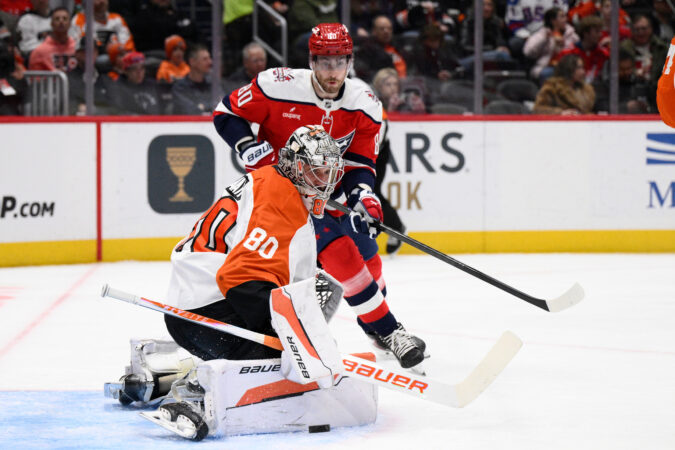
Philly did put 24 shots on Thompson, with 18 coming in the first two periods, but couldn’t find the back of the net. Dan Vladař kept them in the game all night.
The goaltender told The Inquirer on Sunday that he “wasn’t the best” in his one game at the 2026 Milan Cortina Olympics, a 6-3 win against France, when he allowed the trio of goals on 12 shots for Czechia. So maybe he had something to prove.
Vladař faced seven shots in the first period, and robbed the owner of 919 NHL goals, Alex Ovechkin, of his 920th. “The Great 8″ was left wide-open in front after Ristolainen had the puck poked away from him in the corner by Dylan Strome, who fed Ovechkin. Vladař then stopped Strome’s point shot as Travis Konecny’s clearing attempt went right to him.
“He gives us a lot of confidence. He was making huge saves out there for us,” center Christian Dvorak said. “He’s been doing that all year, and it would have been nice to get him a win tonight. He definitely deserved it. He’s been big for us, and we just got to work on being better for our goalies.”
In the second period, the Capitals outshot the Flyers 12-9 and seemed to have the ice tilted their way. Although they broke through once — and missed the net a few more times — Vladař came up big again to keep the score close.
He stopped a point shot by Ethan Frank off a face-off win, kicked out a Ryan Leonard shot to the boards, and then seconds later made a masterful stop on another shot by Leonard.
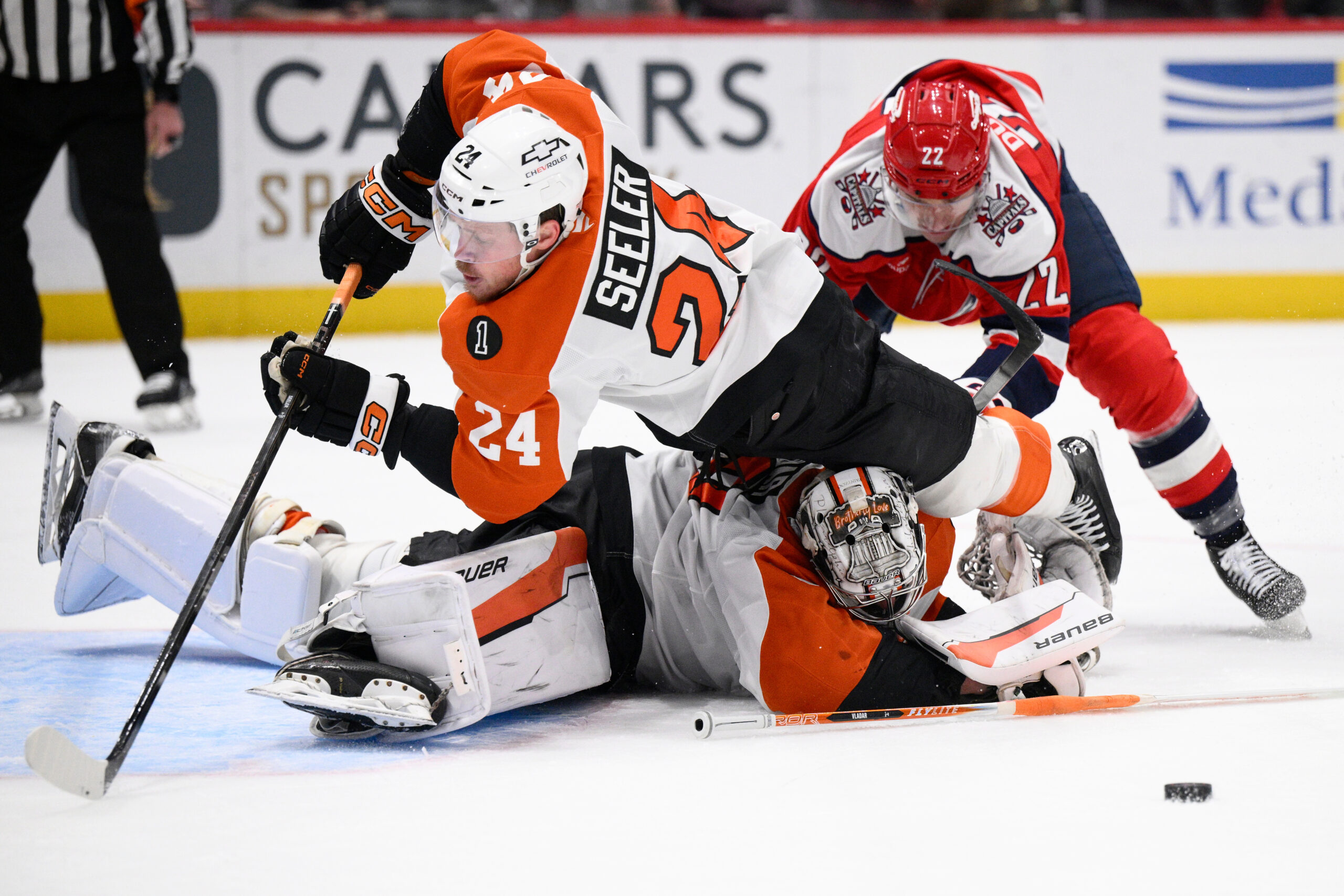
Philadelphia Flyers goaltender Dan Vladar (bottom) was a bit shaken up after defenseman Nick Seeler (24) fell over him late in the second period.
Later, Vladař made a save on a Brandon Duhaime shot from nine feet out, and Nick Seeler pushed it back for him to cover. But there was a bit of a scramble, and Seeler fell over him, and the goalie seemed a bit stung. He flexed his right arm at the next whistle but stayed in the game.
Capitals defenseman Rasmus Sandin scored the Capitals’ opening goal in the period. Philly regrouped and reset after a three-on-two by Washington — and Michkov broke up a pass in front, but then allowed the blueliner to skate down from the point behind him. Hendrix Lapierre found him for the 1-0 goal.
And while he again allowed a goal in the third period, Vladař kept his team in the game. With the Flyers on the penalty kill, Pierre-Luc Dubois got the puck near the net and turned to take a shot, but Vladař was aggressive with the stick and poked it away. He was tracking the puck well all night and seconds later squared up to snare a Strome tip-in attempt on a point shot.
With the game tied, he robbed Lapierre, who got a return touch pass from Duhaime in the slot after the Flyers couldn’t break out of their own end.
“He’s a battler,” Tocchet said. “He’s done it all year for us. But the lateral goals are the tough ones; we don’t want to give those up. That’s the one thing. Vladdy’s played really well for us, but if we eliminate those that will really help. It’ll help Vladdy, too, [because] those laterals are tough to save.”
Protas added a short-handed empty-net goal with 25.6 seconds left in the game. … Defenseman Emil Andrae and forward Nic Deslauriers were the Flyers’ healthy scratches. What does Andrae, who hasn’t played since Jan. 26, need to do to get back into the lineup? “He’s not a PK guy,” said Tocchet pregame. “So actually, this week, he’s worked on his penalty killing. That’s really what it’s going to come down to.“ … Forward Carl Grundström, who has been playing wing all season, centered the fourth line. … The Flyers went 1-for-1 on the penalty kill and 0-for-2 on the power play.
Up next
The Flyers’ restart is already grinding away as they face the New York Rangers on Thursday at Madison Square Garden (8 p.m., ESPN).
WASHINGTON ― Once again, Travis Sanheim was on the outside looking in.
And as in the 4 Nations Face-Off tournament a year ago, the Flyers defenseman was inserted into Canada’s lineup in Game 2 at the Milan Cortina Olympics and never left.
Maybe the doubters need to stop doubting.
Across his five games, the silver-medal-winning Sanheim averaged 13 minutes, 14 seconds, as he crept up coach Jon Cooper’s depth chart as the tournament progressed. Although it was fewer minutes than he’s used to in Philly — he plays more than 24 a night — the blueliner made the most of his ice time.
Sanheim finished the tournament tied for the fourth-best plus-minus (plus-6) among all players, despite averaging fewer minutes than 10 of the 12 players who were either tied with him or above him; only forwards Jack Hughes and Joel Armia played fewer minutes among that group.
He was not on the ice for any of the 10 goals Canada allowed in his five games and his plus-minus was up there with some of the game’s best defensemen — Brock Faber and Cale Makar (plus-6), Zach Werenski (plus-8), and Niko Mikkola, Devon Toews, and his Flyers teammate and, based on Wednesday’s morning skate, his current defensive partner, Rasmus Ristolainen (plus-9).
“I think that’s kind of why I was brought over, was the ability to kind of be a utility guy and be able to play in different situations,” he said Wednesday at Capital One Arena. “Didn’t get in the first game, and have the ability to step right in and play and give them good minutes.
“And I just thought as the tournament went along, just gained more confidence with playing each game and gained the trust of the coaching staff to earn more minutes, and was happy with how I performed.”
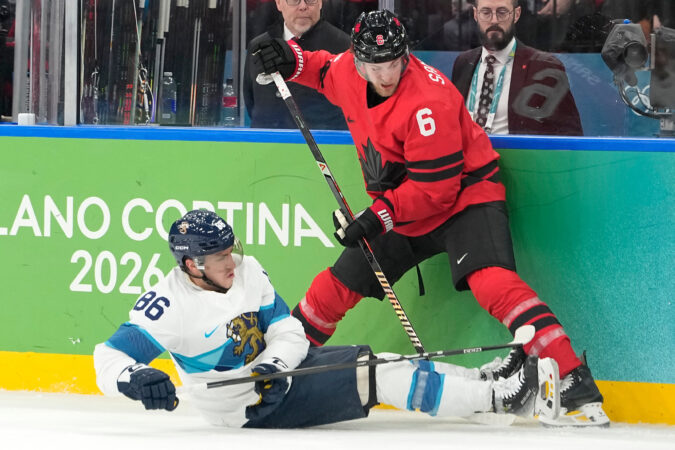
Sanheim also had one assist, and it was an important one. He set up Shea Theodore for the game-tying goal with under 10 minutes to go in the semifinals against Finland after receiving a pass from Tom Wilson, whom the Flyers will see with the Capitals on Wednesday (7 p.m., NBCSP). Nathan MacKinnon scored the game-winner with 36 seconds left in regulation.
He was robbed of a goal by Czech goalie Lukáš Dostál in the quarterfinals, but Sanheim’s name was mentioned over and over again during the gold-medal game by NBC play-by-play man Kenny Albert. A versatile defenseman who can play on the right or the left, he skated more than 15 minutes and had three shots on goal in the finale.
Defenseman Travis Sanheim believes being around some of the league’s best players and playing such high-level hockey can help him as he returns to the Flyers.
But while he won a medal, it was obviously not the one he wanted.
“I’m sure I’ll appreciate the silver years down the road and looking back on it, but obviously right now, disappointment. Thought we did a good job of playing in that tournament and thought that we deserved better,” said Sanheim, who told Unfiltered With Ricky Bo & Bill Colarulo on Tuesday that the medal is currently in his safe.
“So, it’s hard to enjoy the silver when you think that you had a chance to take gold and you come up short. So, like I said, grateful for the opportunity and the experience and what it all entailed, and yet disappointment that comes with it.”
The experience was special nonetheless for Sanheim. He took in speedskating with his Canadian teammates, and traded pins, including swapping with Japan and Italy; however, he didn’t realize how big the pin swapping was at the Olympics and was unable to get a few he had his eye on.
And he was able to spend time with his family. As his mother, Shelly, told The Inquirer on New Year’s Eve, the whole family was headed to Italy to watch Sanheim don the maple leaf.
“Just appreciative of the support that I get. Everyone that came over has been with me from when I was a kid, and happy to be able to share that experience with them,” he said, also mentioning that it meant the world to him that his hometown, Elkhorn, Manitoba, showed its support too.
“ … And, at the end of it, showing them the medal, and them putting it on and getting pictures, you get to see the joy and what it meant for them to experience what I was going through and fortunate to have those guys.”
But while the Olympics are over and he is back with the Flyers as they begin their final 26-game sprint to the end of the season, that doesn’t mean he won’t take what he learned and experienced to the Orange and Black.
“I think how hard you have to play each and every night, the style of play that you need to play, the willingness to do anything to win a hockey game, and different roles that come up throughout the tournament, that guys have to sacrifice for the better good of the team,” he said.
“And then just the skill level that these guys all play with, and how they play, how hard they work, their off-ice training, and what they do, their preparation. There’s a reason they’re the best in their sport and lucky to share the ice with them.
“If I can bring any of that back and share that with our team and try and help the guys … and obviously, we want to continue to grow and take the next step, and being able to see that firsthand is going to benefit me.”
Breakaways
Dan Vladař (17-8-6, .905 save percentage) was the first goalie off at morning skate and is expected to be the starter against Washington. … The Flyers officially loaned defenseman Adam Ginning back to Lehigh Valley of the American Hockey League on Wednesday.
I, for one, am astonished that several entitled young white millionaires were eager to capitalize on their brief moment of relevance by becoming pawns of a president for whom most of them probably voted, especially if they listened to the most popular podcasters — that is, if they even bothered to vote.
Let’s unpack that sentence.
The average age of Team USA men’s hockey players is 28.43 years, so the chance they voted is less than 50%, according to surveys conducted by CIRCLE, a research initiative based at Tufts University. Among white men between the ages of 18-29, 56% voted for President Donald Trump. If they had no college degree, as is the case with most NHL players, that number jumps to 67%. More than half the listeners of podcasts such as The Joe Rogan Experience are white men between the ages of 18-34, and, after Trump was elected, Dana White, the CEO of UFC and a staunch Trump ally, thanked those podcasters for getting Trump over the hump.
Let’s throw in the fact that most professional athletes are, necessarily, narcissists. And there you have the reasons that so many members of Team USA have become the latest victims of moral political outrage.
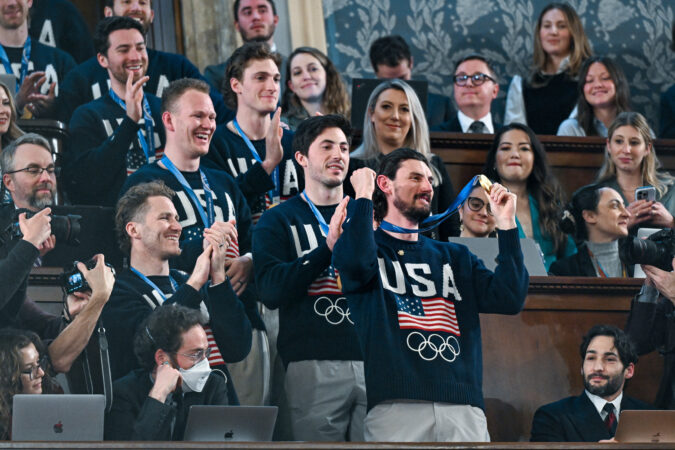
They won Olympic gold in dramatic, heartwarming fashion Sunday, but our sitting president immediately spoiled the afterglow as they celebrated in Italy. Still, most of Team USA accepted an invitation to visit the White House. They met with Trump on Tuesday afternoon and attended the State of the Union address that night.
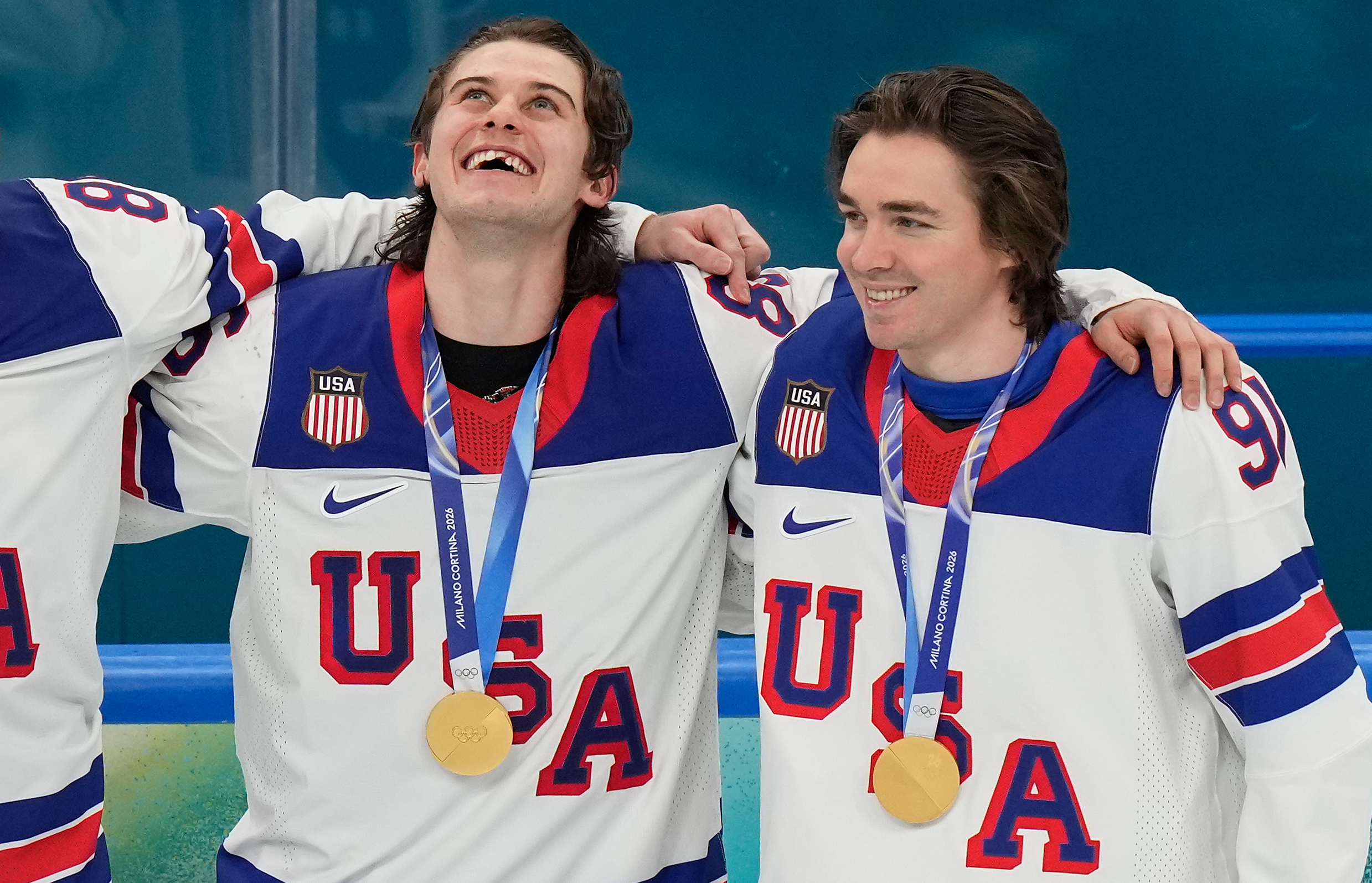
Jack Hughes (left) and Clayton Keller react after receiving their gold medals after the U.S. defeated Canada in the gold medal game on Sunday at the Winter Olympics.
All of this set social media and TV talk shows on fire: How dare they?
Which is exactly what Trump wanted.
Once again, his theater of the absurd drew fabulous ratings. Snowflakes on both sides melted, as scripted: The left, in anger; the right, in glee.
Perhaps one day Trump’s opponents will understand that the only one who gains from this sort of performative outrage is Trump. Save your energy for the ICE attacks in Minnesota and the acts of war on Venezuela. You’re not converting anyone by attacking Connor Hellebuyck, the goalie in the crowd to whom Trump promised a Presidential Medal of Freedom on Tuesday night.
Everything Trump does is transactional: They showed up for him, he gave one of them a medal.
What, you want him to turn it down? Get real. That’s not who these players are.
You expected a group of guys like this to decline the invitation to see and be seen with the most powerful man on the planet? What planet do you live on? In what world do these guys do the right thing?
Consider Olympic hero Jack Hughes’ considered reaction Monday, after all the heat was on:
“Everything is so political,” he told reporters. “People are so negative out there, and they are just trying to find a reason to put people down, and make something out of almost nothing.”
It’s as if he was trying to define “self-unawareness.” Like most young men in his situation, he is not equipped for the moment.
Nevertheless, as America’s current Olympic hero, Hughes, 24, is the unofficial spokesman for the group that some folks think should have told its FBI director to go home and find Nancy Guthrie. The group that some folks think should have told Trump that they weren’t coming to the White House unless the women’s team came, too, and that the women would have to sit in the front row.
There’s no way a bunch of partying, exhausted, exhilarated frat bros are going to not laugh at a dumb joke from a guy who reminds them of their grandfathers.
Lighten up, folks.
I’m not MAGA. For that matter, you’re going to be hard-pressed to find a sports writer more anti-MAGA than I’ve proven myself to be. When Trump dips his toe into sports, I generally try to stub it.
However, on the Trump scale, Trump acted mildly here. He offhandedly insulted the women’s team — a team whose win I considered the apex of the Games, and wrote as much. He and his minions did far worse to Olympians who dared challenge him.
And if you think the hockey lads are bad, check out Nick Bosa, Herschel Walker, and Georgia quarterback Gunner Stockton.
𝗧𝗥𝗘𝗡𝗗𝗜𝗡𝗚: President Donald Trump was greeted by Herschel Walker and UGA QB Gunner Stockton when he arrived in Georgia coming off Air Force One.
Both have been long-term supporters of Trump and the MAGA movement.
This hockey team isn’t perfect, but it isn’t evil, either. It should not be remembered for being the victim of a controversy not of its own making.
It should be remembered as a brilliantly built roster, masterfully coached, which played a spectacular tournament. Its No. 1 goalie gave up six goals total. The penalty kill snuffed all 18 power plays.
The team was incredible.
This outrage, at best, is futile. At worst, it is performative.
Every lefty Twitter warrior knew Trump would politicize a men’s hockey win because Trump knew he and the men’s hockey team were generally of like mind. Most of Team USA appears to be Trump people, unbothered by the misogyny, racism, xenophobia, and corruption of his administrations, happy for every second in the spotlight.
Certainly, it would have been nice if all 25 players had made a different choice. Five did. Twenty didn’t. Twenty percent of a group of clueless twentysomethings is better than nothing.
This contrived controversy obscures how, for about an hour, this was a powerful Olympic tale.
The good feelings emanating from the team’s moving remembrance of Johnny Gaudreau were washed away by the Trump episode.
The facts
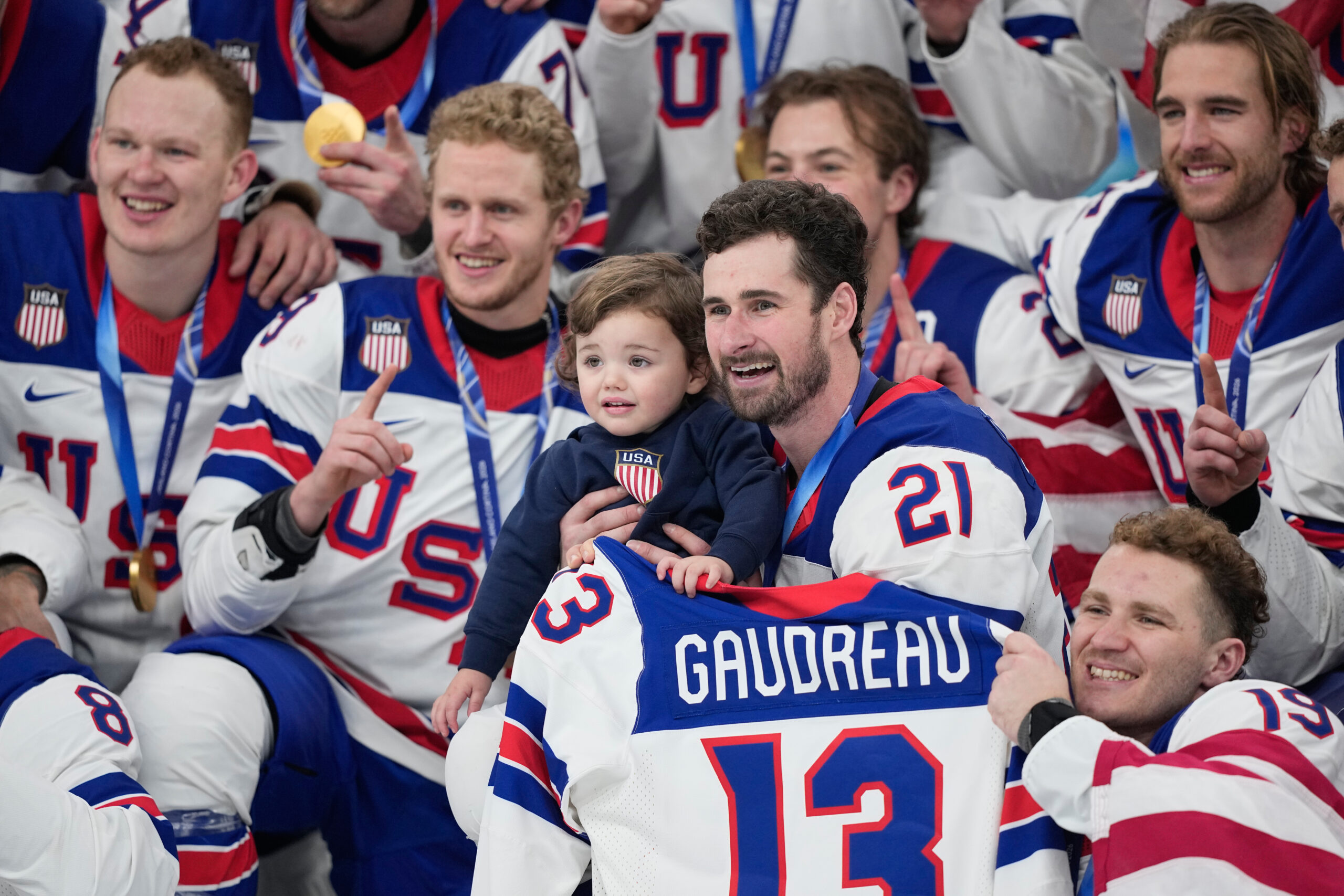
Hughes scored a golden goal against Canada in overtime, avenging an identical defeat handed to Team USA by Canadian hero Sidney Crosby in 2010. Afterward, with an American flag draped over his shoulders, Hughes skated around with his brother and teammate, Quinn, smiling through chipped and bloodied teeth he’d suffered during the game. Team members took victory laps carrying the jersey Johnny Gaudreau would have worn had G and his brother not been killed in August 2024. The team invited Gaudreau’s two small children onto the ice for a team photo.
What’s more, social media hyped Hughes’ advocacy of Pride Night last season, which has become a controversial topic in the more reactionary corners of the NHL.
In this 2024 interview, Jack Hughes, who just scored the game-winning goal for the US Olympic hockey team, explains why it was important for him to embrace Pride Night when many other NHL players refused to do so. pic.twitter.com/jLRy5Blqo4
Then, Trump intruded. And, as with most things, he ruined it. This was not just predictable. It was inevitable.
First, FBI chief Kash Patel, who’d said he was in Italy on official business, joined the alcohol-drenched postgame celebration, a moment of indecorum that sent J. Edgar Hoover spinning in his grave. The players partied on. What were they supposed to do? Kick Patel out of the locker room?
Then, Trump called the party and, offhandedly, demeaned the women’s team, which had won gold three days before. The players laughed. Some of them, clearly aware of Trump’s boorishness, laughed nervously. But they laughed.
What were they supposed to do? Chastise the president during his locker-room call?
Be realistic. This was the greatest achievement of their lives. None of them seems particularly woke. And, besides, they’d been partying.
“There’s so many things happening,” winger Kyle Connor told The Athletic on Monday. “We just won the gold medal and things are going on so I don’t really remember what he said. It’s such a whirlwind, just celebrating.”
The boys are getting more abuse than they deserve, especially in the cesspool of social media. Folks called the players morons. They told them they could stick their gold medals up their collective butts. Some said they’d carry the stain of this moment with them the rest of their lives.
No, they won’t. Have we learned nothing from Trump and his associations with the golf world?
American golfers at the Ryder Cup not only welcome Trump at the event, but some actually performed the ridiculous Trump dance. None has suffered.
Tiger Woods’ associations with the president do not appear to have damaged the golfer.
The fallout
You know who were the two most popular golfers before they golfed with Trump? Tiger Woods and Rory McIlroy. You know who the two most popular golfers are today? Tiger and Rory. In fact, Tiger’s dating Trump’s former daughter-in-law.
The players on the women’s team, bless them, declined their invitation to the White House.
Sure, I respect the five from Team USA who didn’t wallow in the Trump trough more than I respect the 20 who did. In that same vein, I respect the Eagles, such as Jalen Hurts, who refused to visit the White House last spring more than I respect Saquon Barkley, who not only visited the White House, but also went golfing and lunched with Trump the day before.
The fallout: In September, Saquon received the ultimate honor of having a Wawa hoagie named after him.
But there’s not going to be any real hangover effect from this. There never really is.
It’s been three years since the Flyers fired Chuck Fletcher and replaced him with Danny Brière. Here’s a look back at everything that’s happened since.
Flyers president Keith Jones (left), governor Dan Hilferty (center), and GM Danny Brière (right) have been overseeing the team's years-long rebuild.Anton Klusener/ Staff illustration. Photos: Tyger Williams, Yong Kim/ Staff Photographers; Miguel Martinez
Wednesday marks exactly 1,083 days since Danny Brière grabbed the wheel of the rudderless ship that the Flyers had become under previous captain Chuck Fletcher, and a lot has happened since.
From Brière’s use of the previously taboo term “rebuild” at his introductory news conference to the dawning of “New Era of Orange” to the arrival of Matvei Michkov to the team’s ongoing search for a No. 1 center, where do the Flyers stand three years into their process — and are they close to turning the corner?
story continues after advertisement
Ahead of the upcoming March 6 trade deadline, here’s a look at all the key moments and moves from Brière’s first three years as general manager of the Flyers.
The Flyers fire general manager Chuck Fletcher less than a week after the NHL trade deadline and name Danny Brière as interim GM. At his introductory news conference, Brière notably uses the word “rebuild” to define the Flyers’ situation.
May 11-12, 2023
‘New Era of Orange’ begins
The Flyers make the Brière hire permanent and hire former Flyer Keith Jones, who was then covering the NHL on TV, as the team’s president of hockey operations. The moves are unveiled as part of the team’s “New Era of Orange” ceremony as the organization’s leaders lay out a broad vision and plan for the team’s future.
June 6, 2023
‘Trader Danny’ announces himself
MIGUEL MARTINEZ / For the Inquirer
Brière makes his first major move as GM, trading top defenseman Ivan Provorov to Columbus in a three-team deal. The Flyers land the No. 22 overall pick in 2023 (Oliver Bonk), defenseman Sean Walker, goalie Cal Petersen, defensive prospect Helge Grans, and two future second-round picks (from the Kings and Blue Jackets). The Flyers later traded the two second-rounders in deals to move up and select Carson Bjarnason and to acquire Trevor Zegras.
More on the Flyers
From trade bait to untouchables, here’s where the Flyers roster stands less than two weeks before the deadline
The Flyers haven't committed to being buyers or sellers, but they have some pieces they could move for the right price by March 6.
June 24, 2023
Sanheim trade falls through
Brière gets close on a trade involving defenseman Travis Sanheim and center Kevin Hayes, but it is nixed after St. Louis defenseman Torey Krug exercises his no-trade clause. Sanheim’s full no-trade kicks in the following week.
June 27, 2023
Offloading Hayes
After the larger trade with the Blues falls through, Brière ships the 31-year-old Hayes to St. Louis for a 2024 sixth-round pick. Hayes’ relationship with coach John Tortorella had deteriorated to the point where a trade seemed unavoidable.
story continues after advertisement
June 28-29, 2023
Michkov falls to the Flyers
With his first draft pick as Flyers GM, Brière takes winger Matvei Michkov with the seventh overall selection. The Flyers draft Bonk later in the first round (No. 22), as well as Bjarnason, Denver Barkey, and Yegor Zavragin on Day 2.
July 1, 2023
A quiet free agency
As expected, the Flyers are relatively quiet as free agency opens, with Brière signing only depth players Ryan Poehling and Garnet Hathaway. Later they add veteran blueliner Marc Staal.
More on the Flyers
Flyers hit the Olympic break at a crossroads. Will they sell for the future or try to push for the playoffs?
The Flyers are eight points out of a playoff spot but have games in hand with 26 remaining. Is it time to stick or twist for GM Danny Brière ahead of the March 6 trade deadline?
July 15, 2023
The subtraction continues
Brière continues to clean house as the Flyers place defenseman Tony DeAngelo, whom Fletcher traded three picks for the previous summer, on waivers for a buyout. The Sewell native had been benched by Tortorella to end the season.
Jan. 8, 2024
The Gauthier-Drysdale shocker
Yong Kim / Staff Photographer
Brière trades No. 2 prospect Cutter Gauthier, then playing at Boston College, to Anaheim for defenseman Jamie Drysdale and a 2025 second-round pick. Brière soon reveals that Gauthier’s camp had demanded a trade for unspecified reasons and that his camp had cut off all communication. Days earlier, Gauthier had been named the best forward at the World Junior Championship as Team USA won gold. Gauthier has never confirmed the exact reason he forced a trade, whether it was because of Tortorella, the team’s decision to send him back to college for a second year, or the Flyers’ overall direction.
Jan. 26, 2024
Tippett signs eight-year extension
The Flyers hand 24-year-old winger Owen Tippett a lucrative eight-year, $49.6 million contract extension ($6.2 average annual value). Tippett, who was acquired in the Claude Giroux trade, had 18 goals in 46 games at the time of the extension, and had tallied a career-high 27 the year before.
Jan. 30, 2024
Hart charged with sexual assault
Yong Kim / Staff Photographer
A week after taking a leave of absence, franchise goaltender Carter Hart is charged alongside four other professional hockey players in connection with an alleged sexual assault in 2014 in Canada. Hart is acquitted in July 2025 but never plays for the Flyers again.
March 6, 2024
Flyers land first-rounder for Walker
The Flyers flip Sean Walker, a salary dump by Los Angeles in the Provorov trade, to Colorado with a fifth-round pick, for a first-round pick and half of Ryan Johansen’s contract. The Flyers, who were in a playoff spot at the time of the trade, prioritize the long term in moving the thriving pending free-agent defenseman for future assets. On the same day, the Flyers extended veteran defenseman Nick Seeler, another potential trade chip, with a four-year, $10.8 million contract.
story continues after advertisement
March 23, 2024
A surprise playoff push
Having punched above their weight all season, the Flyers enter their final 11 games with a 36-26-9 record and four points above the playoff cut. According to hockey analytics company Stathletes, they have an 88% chance of making the postseason.
March 24-April 9, 2024
Colossal collapse
Steven M. Falk / Staff Photographer
The Flyers lose eight straight games to fall below the playoff cut, culminating with a 9-3 embarrassment in Montreal. They win their next two to push their slim playoff odds to their final day of the season, but are officially eliminated on April 16 with a 2-1 loss to Washington. They finish four points out of a playoff spot.
June 28, 2024
Jumping for Jett
The Flyers go off the board to select center Jett Luchanko with the No. 13 overall pick in the draft. Brière and the Flyers had moved back one pick in a trade with Minnesota that netted them an additional third-rounder. Minnesota selects defenseman Zeev Buium. The Flyers then trade their second first-rounder — Pick No. 32 from the Giroux trade — to Edmonton in exchange for a 2025 first-rounder. Edmonton selects Sam O’Reilly with the pick.
July 1, 2024
Michkov arrives early
After much speculation, the Flyers sign Michkov to his entry-level contract, after reports circulated in late June that he would come over to North America two years earlier than expected. He arrives in Philly on July 23.
July 25, 2024
Flyers keep Konency
The Flyers sign 27-year-old winger Travis Konecny to a massive eight-year, $70 million extension ($8.75 million AAV). Konecny, who was coming off career highs in goals (33) and points (68) and was the team’s most valuable asset, had one year remaining on his contract.
story continues after advertisement
Jan. 30, 2025
Bye-bye, Beezer
The Flyers continue to subtract as they move Morgan Frost and Joel Farabee to Calgary for Andrei Kuzmenko, Jakob Pelletier, a second-round pick (Shane Vansaghi), and a 2028 seventh-round pick. The Flyers are five points out of a wild-card spot at the time; Farabee has 3½ years left on his contract at a $5 million cap hit.
March 7, 2025
Laughton to the Leafs
Sitting five points out of a playoff spot with 19 games to play, the Flyers trade beloved glue guy Scott Laughton and two late-round picks to Toronto for a package that includes a protected 2027 first-round pick and forward prospect Nikita Grebenkin. Laughton has one year remaining on his deal. On the same day, the Flyers flip Kuzmenko, whom they acquired a month and a half earlier, to Los Angeles for a third-rounder.
March 27, 2025
Tortorella fired
Yong Kim / Staff Photographer
With the Flyers losing 11 of 12 games, Tortorella is fired after almost three seasons. The firing comes a day after the coach said, “I’m not really interested in learning how to coach in this type of season, where we’re at right now.” It later leaks out that Tortorella and Cam York had a heated verbal exchange during the Toronto game a night earlier. Tortorella, who was hired by the Fletcher regime, leaves with a 97-107-33 record with the Flyers.
April 17, 2025
Playing out the string
After winning five of interim coach Brad Shaw’s first six games in charge and seeing several young players thrive, the Flyers lose their final three games to ensure they will have the fourth-best draft lottery odds. They finish with a 33-39-10 record.
May 5, 2025
Bad bounce
The Flyers drop the maximum two spots in the lottery and learn they will pick sixth in June’s NHL draft.
May 14, 2025
Flyers name Tocchet head coach
Tyger Williams / Staff Photographer
Flyers Hall of Famer Rick Tocchet is named the 25th head coach in franchise history, becoming the sixth former Flyer to hold the post. The 61-year-old arrives with a 286-265-87 career record and is a year removed from winning the Jack Adams Award as Coach of the Year with Vancouver. Brière cites Tocchet’s passion for the Flyers and his communication and teaching skills as reasons he is the right fit to oversee the next stage of the rebuild.
More on the Flyers
The Flyers are in Rick Tocchet’s ‘blood.’ Now he’s tasked with returning the once-proud organization to prominence.
Tocchet, who was beloved as a player in Philly for his combination of toughness, heart, and goal-scoring ability, believes he can be "part of the solution of bringing the Flyers back to dominance."
May 29-June 3, 2025
Keeping the kids
Brière extends two homegrown pieces of the Flyers’ young core, signing winger Tyson Foerster to a two-year bridge deal ($3.75 million AAV) and center Noah Cates to a four-year contract ($4 million AAV).
June 10, 2025
Michkov Mania
Charles Fox / Staff Photographer
After leading all rookies with 26 goals and tying for second in points (63) with Macklin Celebrini, Michkov finishes fourth in Calder Trophy voting. Brière calls Michkov’s rookie campaign “exciting” and says the Russian surpassed all expectations.
June 23, 2025
‘Z’ is for Zegras
After years of speculation, the Flyers acquire Trevor Zegras from Anaheim in exchange for Ryan Poehling and second- and fourth-round draft picks. Zegras goes on to post 20 goals and 49 points in his first 56 games with the Flyers.
June 27-28, 2025
Porter’s house
The Flyers draft power forward Porter Martone with the sixth overall pick, then send their other two first-rounders (Nos. 22 and 31) to Pittsburgh, moving up to take center Jack Nesbitt with pick No 12. On Day 2, the Flyers select seven players, highlighted by second-rounders Carter Amico, Jack Murtagh, Vansaghi, and Matthew Gard.
Subscribe to The Philadelphia Inquirer
Our reporting is directly supported by reader subscriptions. If you want more in-depth stories like this, please subscribe today.
The Flyers sign goaltender Dan Vladař, depth center Christian Dvorak, and defenseman Noah Juulsen on the first day of free agency. Brière reiterates that the Flyers are focused on “flexibility” and “short-term” deals with an eye on the 2026 free-agent class. As expected, the star-studded 2026 class that included Connor McDavid, Jack Eichel, and Kirill Kaprizov dries up in the months that follow as all of the top players sign extensions.
July 7, 2025
York extended
The Flyers sign the 24-year-old York to a five-year extension that carries a $5.15 million cap hit. Brière says York has untapped potential and says the organization views him as “a main piece on our blue line.”
Sept. 10, 2025
‘Not moving back’
Jose F. Moreno / Staff Photographer
Jones and governor Dan Hilferty won’t commit to making the playoffs but tell the media that the Flyers are done making “changes in order to get better for the future,” adding that “now, it would be about staying on course, which is advancing. It’s not about moving back.” Jones says they owe it to the players to add to the team after years of subtracting.
Oct. 5, 2025
Exiting the Ellis contract
The Flyers get out of the final two years of the injured Ryan Ellis’ contract by trading it to San Jose. The blueliner, who played only four games in 4½ years for the Flyers, had a $6.25 million cap hit for this season and next. The move, which cost only a sixth-round pick, frees up significant cap space for the Flyers.
Jan. 5, 2026
Dvorak’s new deal
Months after they signed Dvorak to a one-year, $5.4 million deal, the Flyers extend the center for five years and $25.75 million ($5.15 million AAV). After citing “flexibility” and the importance of “short-term” deals in the summer, Brière reverses course by signing Dvorak through his 35-year-old season, while also handing him full trade protection in the first two years of the deal. Dvorak, who was having a career season and was on pace for 53 points at the time, would have been an attractive trade chip as a rental at the deadline.
More on the Flyers
Contract grades: Was signing Christian Dvorak for the long haul the right move for the Flyers?
Dvorak turns 30 next month and is now signed with the Flyers through age 35. Here's what our writers think of the team's decision to lock up the center, who is enjoying a career year.
Jan. 6, 2026
Flying high
The Flyers hit the halfway mark in style with a 5-2 beatdown of Gauthier and the Ducks at Xfinity Mobile Arena. Zegras scores two goals as the Flyers improve to 22-12-7 and climb to ninth overall in the league standings.
Jan. 8-Feb. 5, 2026
Hitting the wall
The Flyers win just three of their next 15 games entering the Olympic break and go from two points above the playoff cut line to eight points below it. Injuries also strike as Drysdale, Vladař, and Bobby Brink all miss time.
Feb. 3, 2026
Tocchet-Michkov saga comes to a head
Yong Kim / Staff Photographer
Days after Tocchet reiterates on several podcasts that Michkov came to camp out of shape, contributing to his sophomore slump, Brière calls a news conference, trying to quell speculation about the relationship between player and coach. Brière says the two “have a good relationship” and that “Matvei Michkov is not going anywhere. Let’s make that clear. … Matvei is going to be here for a long time.” He confirms that Michkov was out of shape and says this situation will be a learning moment for the young player.
Feb. 25, 2026
Stick or twist?
Sitting eight points out of a playoff spot, albeit with two games in hand, the Flyers return to game action against Washington. With just 10 days and five games until the March 6 trade deadline, the Flyers have one last chance to impress Brière. Will the Flyers be buyers, sellers, or stand pat? Defenseman Rasmus Ristolainen is among the players who could generate a significant return on the trade market.
So are the Flyers in a better place than they were three years ago when Brière took charge? In short, yes. The prospect pool is now top 10 leaguewide and much deeper than before, a product of several savvy long-term-view trades that netted a haul of first- and second-round draft picks. They have also added three star-level talents to the organization in Michkov, Martone, and Zegras, and may have finally solved their longstanding goalie riddle with Vladař.
On the other hand, the Flyers haven’t fully bottomed out and thus have missed out on landing top-5 picks — where teams usually land stars at premium positions like center and defense — and also were forced to trade a high-end prospect in Gauthier. With those gaping holes still to fill, Brière will need to get creative both in the draft and the trade market over the next six months if the Flyers are to truly shift their rebuild into the next gear in 2026-27.
The Flyers’ season restarts Wednesday in Washington, and Matvei Michkov is ready to go.
“I was training every day. Was not resting,” the winger said through team translator Slava Kuznetsov about how he spent his Olympic break.
Michkov said he did two-a-days off the ice for seven days during the break. One session focused on strength and another on conditioning and stamina while he stayed off the ice. He also posted pictures and videos on Instagram on Feb. 16, showing him working out on vacation in the Dominican Republic, and said he had a trainer with him.
“Last year, the 4 Nations [Face-Off] was not too long a break, so I was just resting,” he said when asked about his impressive stretch after the February 2025 tournament. “This time, I was not planning to rest. I was not happy with the way the game was going, so I was working the entire break.
“My emotions depend on how the hockey goes, so that’s why I decided to work instead of the rest.”
In mid-October, the Spittin’ Chiclets podcast reported that sources said Michkov was “out of shape,“ and coach Rick Tocchet revealed the same day that Michkov had suffered an ankle injury in the offseason that impacted his training. In November, the 21-year-old Russian attributed his slow start — one goal in his first 13 games, and now 13 across 55 — to his failure to train well over the summer.
Over the past several weeks, The Inquirer has spoken with former and current NHL players about the conditioning and strength needed to endure the grind of the 82-game season, especially one as condensed as this one.
They all agreed that while not 100% impossible, it is incredibly difficult to build strength and conditioning during the season. A large part of that is because of the lack of time to recover when players need to be ready to play a physical game at a consistent level. This season, even more so, makes it tough to have an extra day to “run myself into the ground,” as one player put it, because the next day is a game or practice.
In-season programs are built to maintain instead of build, with even maintaining still difficult to achieve. Conditioning and stamina do go up as games build because of the constant stress of the game on the body, but strength goes down for everyone. The work has to be done in the summer, and Michkov, who was “a little bit behind the eight ball” as Tocchet said earlier this season, reiterated Tuesday that he has learned from his mistakes.
Flyers coach Rick Tocchet and Matvei Michkov haven’t always agreed on the winger’s role and ice time this season.
“The NHL is hard work,” he said. “If you take a four-month break, it can reflect [in] your game. You have to concentrate on hockey all the time, and you cannot take even a month of [a] break. You have to be smart when you train in the break, don’t take [an] injury, but training must go.”
As for working with Tocchet, another topic that swirls around Michkov due to his current role and ice time, the sophomore forward said they have the “common relationship” between coach and player.
He said he was also unaware of the media chatter before the break, specifically around Tocchet’s comments on the PHLY podcast at the Flyers Charities Carnival regarding Michkov’s minutes and how general manager Danny Brière wanted “to address a little bit of the noise that is going around” while denying a rift between the two.
“I’ll play as much time as I’m [being] given, and I have to do my job. That’s the only thing I care about,” said Michkov, who is averaging more than two minutes fewer this season compared to last.
“The way the [coach] plays me, that’s the way he decides to play, so I’ll play. I’m a player, and I have to concentrate 100% on what I’ve been doing at that moment.”
A left-handed left wing is preferable to many coaches in the defensive zone because it typically pits a lefty against a right-shot defenseman, so they have sticks on the same side — and in the shooting lane — as the defenseman when they try to close them down.
Another aspect of Tocchet’s decision-making that has drawn criticism is his switching of the left-handed Michkov off his preferred position of right wing to the left side. Some traditionalists will tell you that Michkov should be playing on the left side anyway, especially in defensive-zone coverage, as a left-handed stick will be able to use the walls and protect the puck to get it out on the left side.
Tocchet said in January that it’s just to line up and not a big deal in the offensive zone, “but through the neutral zone, for me, the faster you can go on your forehand is the better [side]. But that doesn’t mean you can’t go to the other side.”
Asked about the adjustment, Michkov responded: “I’m always playing [on] the right, I was always happy. Now I’m playing on the left [and] it’s a new role. If the coach sees me there, I have to adapt as quick as I can. But, for me, on the right, I can create a lot more moments. Now I have to switch everything to the left and do the same thing.”
Regardless, Michkov says he is feeling 100% and “very light on the ice.” His focus is not on the noise but the last stretch of games as the Flyers try to make up ground in the Eastern Conference and gain a spot in the Stanley Cup playoffs.
“I’m sure every single player is looking [to win] those games,” he said.
“Twenty-six games left; it’s hard work. Everybody wants to make the playoffs, and that’s our goal on the ice — for me, for coaches, and for staff as well — everybody’s thinking about the group and how to win those games and make the playoffs.”
Breakaways
Rasmus Ristolainen rejoined the Flyers on Tuesday after an impressive Olympic performance in Milan. He said he roomed with Mikko Rantanen in the Athletes’ Village and is just happy he didn’t lose his bronze medal after the game. … Assistant coach Todd Reirden said Travis Sanheim was at the Flyers Training Center on Tuesday and is expected to play against the Washington Capitals on Wednesday (7 p.m., NBCSP). He took a different route home from Italy than Tocchet, who flew on the charter to Miami and was unable to make it to Philly because of the weather. Tocchet will join the team in Washington.
The NHL trade freeze thawed at 11:59 p.m. on Sunday, and general managers have until 3 p.m. on March 6 to decide if their team is a buyer or a seller.
Flyers president Keith Jones and general manager Danny Brière have long said “the players will decide” which route they take during the team’s rebuild, but Brière expects this deadline to be a quiet one.
That doesn’t mean trades won’t happen between now and the buzzer, as the Flyers still have five games to sway brass one way or the other.
We broke the Flyers’ roster into five categories, ranging from the players most likely to be traded to those who are considered untouchable.
Which Flyers are trade bait?
Two seasons ago, pending unrestricted free agent defenseman Sean Walker was widely expected to be on his way out, and he was eventually dealt to the Colorado Avalanche in a package that included a 2025 first-round pick. Last season, after years of speculation, glue guy Scott Laughton was shipped north to Toronto for Nikita Grebenkin and a 2027 first-round pick.
But for the first time in Brière’s tenure, no player is a slam dunk to be traded.
Rasmus Ristolainen, D: If the Flyers trade anyone, all signs point to the 31-year-old Ristolainen. There are several appealing aspects regarding the 6-foot-4, 208-pound blueliner for playoff-bound teams. Finally healthy, the Finn is coming off an impressive performance at the 2026 Milan Cortina Olympics, where he showcased a physical, two-way game while posting three assists, a plus-9 rating, and earning a bronze medal. A more tantalizing tidbit is that he wouldn’t be a one-and-done rental; Ristolainen has term, with one more year at a relatively cheap $5.1 million. Various reports on Monday indicate that there will be suitors.
Emil Andrae, D: In the last month, a question has arisen: Where does Andrae actually fit? Limited in stature but not in heart and drive, the 24-year-old Swede is an exciting puck-mover but also prone to miscues. Scratched the last five games before the Olympic break, it’s not clear whether the Flyers are looking to move him, but a change of scenery might suit all involved..
Flyers defenseman Emil Andrae seems like a player who is a little stuck. Could the Flyers opt for a change-of-scenery trade?
Carl Grundström, LW/RW: Acquired in early October in the deal that sent Ryan Ellis’ contract west, Grundström has brought speed, quickness, and a great shot to the Flyers’ fourth line. As assistant coach Todd Reirden said on Sunday: “He’s been such a good add for our team this year. Been able to help us in a number of different ways, whether it’s penalty kill or sliding up and down anywhere from the fourth line to the second line.” If the Flyers are selling, could he recoup a mid-round draft pick?
Nic Deslauriers, LW: The veteran will be an unrestricted free agent this summer and recently told The Inquirer that he thinks he has another year or two in him. A good locker room guy, he has the playoff intangibles of being a hard-working forward who plays the body with authority and can patrol the ice. Brière is known to do right by veteran players — i.e., Erik Johnson and Scott Laughton — so maybe it’s Deslauriers turn.
Noah Juulsen, D: Someone coach Rick Tocchet knew from his days in Vancouver, the blueliner is a capable depth defenseman that might provide depth for a contender.
Which Flyers could be in play for the right price?
Owen Tippett, LW/RW, and Bobby Brink, RW: It’s unlikely — for the moment — but the Flyers are going to need to start making space for young wingers like Porter Martone. And while the Flyers assuredly wouldn’t want to subtract either player from their lineup, Tippett and Brink are players other teams might want. Tippett, who has a 10-team no-trade list beginning on July 1, has officially become the guy everyone expected, using his speed, skill, and physicality to become a true power forward. Small in stature, Brink is a two-way player who has built a solid foundation to his game and can slide into any system.
With a glut of wingers, could the Flyers look to move Owen Tippett in a package for a center or a defenseman.
Noah Cates, C/LW: This one has an even lower probability, but Stanley Cup teams are always looking for third-line centers who play a checking role while also chipping in offensively. Cates has shown he can shut down the game’s best, and contenders assuredly wouldn’t mind adding someone as fundamentally sound as the Minnesotan.
Sam Ersson, G: Inconsistent is a good word to describe Ersson, who has had stretches of brilliance but also long stretches of struggle — notably the latter this season. Could the Flyers trade the pending restricted free agent? Anything is possible, especially with the decision of whether or not to extend him a qualifying offer on the horizon. But as of today, the young goalies in the system aren’t ready for the leap to the NHL, so it’s foreseeable that he’s sticking around for now at least.
Garnet Hathaway, RW: Although he has struggled this year to put the puck in the net and has been a healthy scratch for nine games, Hathaway has intangibles that playoff-bound teams want at the deadline — like penalty killing ability and a gritty, edgy game that gets under opponents’ skin. That formula helped the Florida Panthers win back-to-back Cups and is why Hathaway been moved to contenders at previous deadlines.
Nick Seeler, D: There’s been a bit of a buzz around the hard-nosed blueliner in the press box from visiting scouts. A solid defenseman who blocks shots and provides physicality, Seeler could be the perfect depth guy for a team heading for a deep playoff run. The only thing is, he would have to waive his no-trade clause, which does expire on July 1.
Which Flyers are unlikely to be traded?
Sean Couturier, C: The Flyers captain has a no-movement clause and a likely unmovable cap hit of $7.75 million for the next four years. With a cheaper and short-term contract he might be enticing to a playoff team as the 33-year-old center’s analytics are still solid, and what he does in the faceoff circle could change the course of a game. But the contract is probably a nonstarter for most teams.
Jamie Drysdale and Cam York, D: Teams need guys like Drysdale and York to round out their defense, as both are young with offensive upside and solid defensive games. York has a team-friendly contract at $5.15 million for the next five years, while Drysdale is a restricted free agent. While there might be interest, the Flyers need both players to hit on their potential.
Christian Dvorak, C: Inked to a shiny new deal, the Flyers are less inclined to trade a guy they just promised four years to. But, if they were to do it, they need to do it now, as Dvorak received a no-trade clause the first two seasons and a modified no-trade the last two that kicks in on July 1.
Flyers center Christian Dvorak is presumably off the market now after signing a five-year extension in January.
Nikita Grebenkin, LW: A key part of the swap for Laughton at the last trade deadline, the Flyers like what the young Russian brings. A gritty but skilled winger, Grebenkin is a work in progress; however, the upside and potential could be too good to part with this soon.
Which Flyers would only get traded for a star or massive haul?
Tyson Foerster, LW/RW: Since Foerster, 24, went down with a likely season-ending injury in December — a yellow non-contact jersey has been in his locker during the Olympic break — it’s become more evident just how important the Canadian is to the roster. Prior to his injury, Foerster seemed to be trending close to “untouchable” given his goal scoring and defensive acumen.
Denver Barkey, LW: Expected to be in the minors this season, Barkey was recalled in late December and has been not just a revelation but a reminder that not every guy needs to “marinate.” The Flyers do not want to lose the 20-year-old rookie and his high hockey IQ, but he could be a key part of a larger deal to land that center or top-pair defenseman the team covets.
Who on the Flyers is untouchable?
Matvei Michkov, RW: Brière on Feb. 3: “One thing I can tell you, first of all, is: Matvei Michkov is not going anywhere. Let’s make that clear. OK. Matvei is going to be here for a long time.” Despite a difficult season, Michkov remains one of the most important pieces to the Flyers’ rebuild.
Trevor Zegras, C/LW: It took the Flyers some patience to get Zegras, 24, from the Anaheim Ducks, and they are not partying with him now. The only question is how much the restricted free agent, who has 20 goals and 49 points in 56 games as a Flyer, will make when he inks his new contract.
The Flyers have long coveted an offensive game-breaker like Trevor Zegras. Now, they have to pay the restricted free agent.
Travis Sanheim, D: Coming off an impressive silver-medal-winning twirl with Hockey Canada, Sanheim is among the team’s untouchables right now. The blueliner has a unique combination of size and skating ability, which he just showcased on the international stage. Sanheim, who turns 30 next month, also has a full no-trade clause through the 2026-27 season, and a modified 12-team clause for the remaining four years of his deal.
Travis Konecny, RW: Currently in Year 1 of an eight-year extension signed two summers ago, with a no-movement clause through 2031, Konecny has become not only the team’s top scorer but a leader. Before the Olympic break, it felt like the soon-to-be-29-year-old strapped the Flyers to his back and tried to will them to victory — on a bruised and battered body, no less. The time off has helped the winger recoup, and he is on pace to achieve yet another career year.
Dan Vladař, G: The goalie needed someone to believe in him and give him the chance to carry the workload. He has paid the Flyers back two-fold with a top-20 save percentage and the 10th-best goals-against average in the NHL. He has an eight-team no-trade clause, but there is no doubt the netminder is sticking around given the Flyers’ checkered history between the pipes.
Last season, Nic Deslauriers played 31 games for the Flyers, mostly due to an upper-body injury that kept him out for almost three months. This season, across the Flyers’ 56 games, the veteran winger has suited up for just 21.
“Not easy, that’s for sure,” he said Sunday after practice. “It’s where the young guys kind of step up and [I] just stay ready for when my name is called upon. It’s frustrating, but at the same time, I can’t control those things.”
A fourth-liner when he does slot in, Deslauriers is a bit of a throwback. Although he was selected by the Los Angeles Kings in the third round of the 2009 NHL draft as a defenseman, the now 35-year-old — his birthday was Sunday — is a tough, grinding forward who is feared across the league for his fists.
This season, he has one assist with a minus-3 rating while averaging 8 minutes, 18 seconds of ice time. He’s averaging the most minutes he’s played since his first year in Philly (10:06 in 80 games) after signing as a free agent in July 2022.
Since joining the Flyers, the forward has dropped the gloves 32 times in the regular season — most notably against the New York Rangers’ Matt Rempe in what many called the “Fight of the Year” two years ago Tuesday. Twenty of his 26 penalty minutes this season are from fighting majors against Minnesota Wild forward Marcus Foligno, Montreal Canadiens forward Arber Xhekaj — he fought his brother, Florian, who is also on the Canadiens in the preseason — Tampa Bay Lightning tough guy Curtis Douglas, and Brennan Othmann of the Rangers.
“It’s funny, there’s sometimes that I could see it kind of like disappearing, and then, it’s more when you watch the playoffs, and you see those guys, not enforcers technically, but the hardworking guys that hit, and, I wouldn’t say patrol, but if there’s something going wrong, they’re there,” he said.
“I think you see them in some teams, and those are teams that have success. So I think it’s getting away, that’s for sure, but I think there’s still a place for it.”
Flyers general manager Danny Brière is starting to build a reputation as a guy who does right by his veteran players. Last year, he traded Erik Johnson back to Colorado, where he had previously won a Stanley Cup, and Scott Laughton to his hometown Toronto Maple Leafs. With the trade deadline approaching on March 6, is the pending unrestricted free agent next?
“I think I have maybe another year or two in me [but] those are things out of my power,” Deslauriers said. “I’ve always taken care of my body for the type of job that I do, and I’m always ready. I still think I have some in the gas tank.”
Deslauriers feels like he came into camp in great shape, plus, as he noted, “I get bag-skated a lot, so I’m still in shape.” On the ice for every morning skate, whether optional or not, he spends extra time helping goalies work on their craft, does a hard skate if he’s not playing, and then hits the gym during the first period of the game. Sometimes he’ll head up to the press box afterward to check out the game.
“The game’s easier when you guys watch from up top,” he noted. “Some games you want to feel a refresh and you go up there and kind of look at the games. But the main thing, of not playing, is just staying in shape and waiting for your turn.”
Nic Deslauriers has played in just 31 of the Flyers’ 56 games this season. He might welcome a chance to play more elsewhere.
Unfortunately, time catches up to us all, and there is only so much road left for the Quebec native who is two games shy of 700 in the NHL. He got a taste of post-career life when he was hurt last season, spending more time with his four children and taking them to soccer tournaments in between gym sessions during the recent Olympic break.
But despite being the oldest player on the Flyers — he’s got nine months on linemate Garnet Hathaway — the respected and well-liked Deslauriers is not done yet.
“I know it’s toward the end,” he said with a laugh, “but trying to kind of prove that I can be here.
“If you look at my season this year, just 21 games, it’s not a lot, but I think I’m almost more in shape now than the last few years from all the skating.
“So, no, I think the passion of the game is still there. The love of the game is still there. And we’ll see where that goes.”
The NHL trade freeze lifted at 11:59 p.m. on Sunday. … Several Flyers and NHL items are up for auction at www.classicauctions.net, including items from the personal collections of Ron Hextall and Bobby Taylor along with the late Bernie Parent’s “Ghost” mask. The auction closes on Tuesday. … On Saturday, Flyers forward Owen Tippett surprised more than 50 children, ages 5-9, by participating in the Flyers Learn to Play practice at the Skatium in Haverford. An ambassador for the program since 2023-24 with his wife, Taylor, Tippett ran the players through skating and stickhandling drills. Participants in the program, which takes place at 18 rinks across Pennsylvania, New Jersey, and Delaware, are supplied full head-to-toe hockey equipment, a personal welcome message from the Tippetts, a certificate of completion signed by Owen, and the chance for a postgame meet-and-greet at Xfinity Mobile Arena.