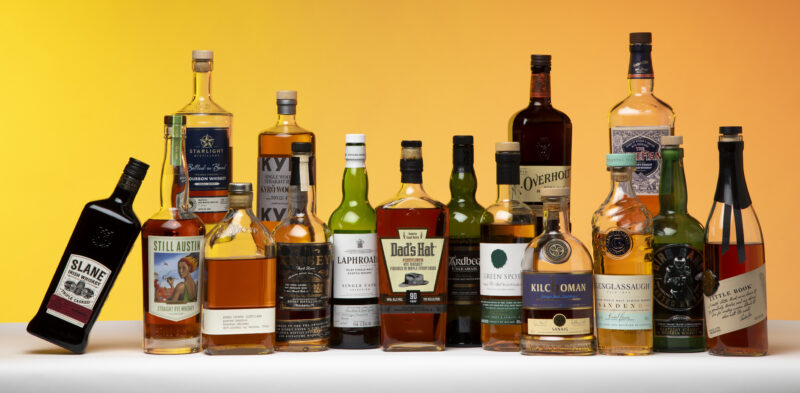
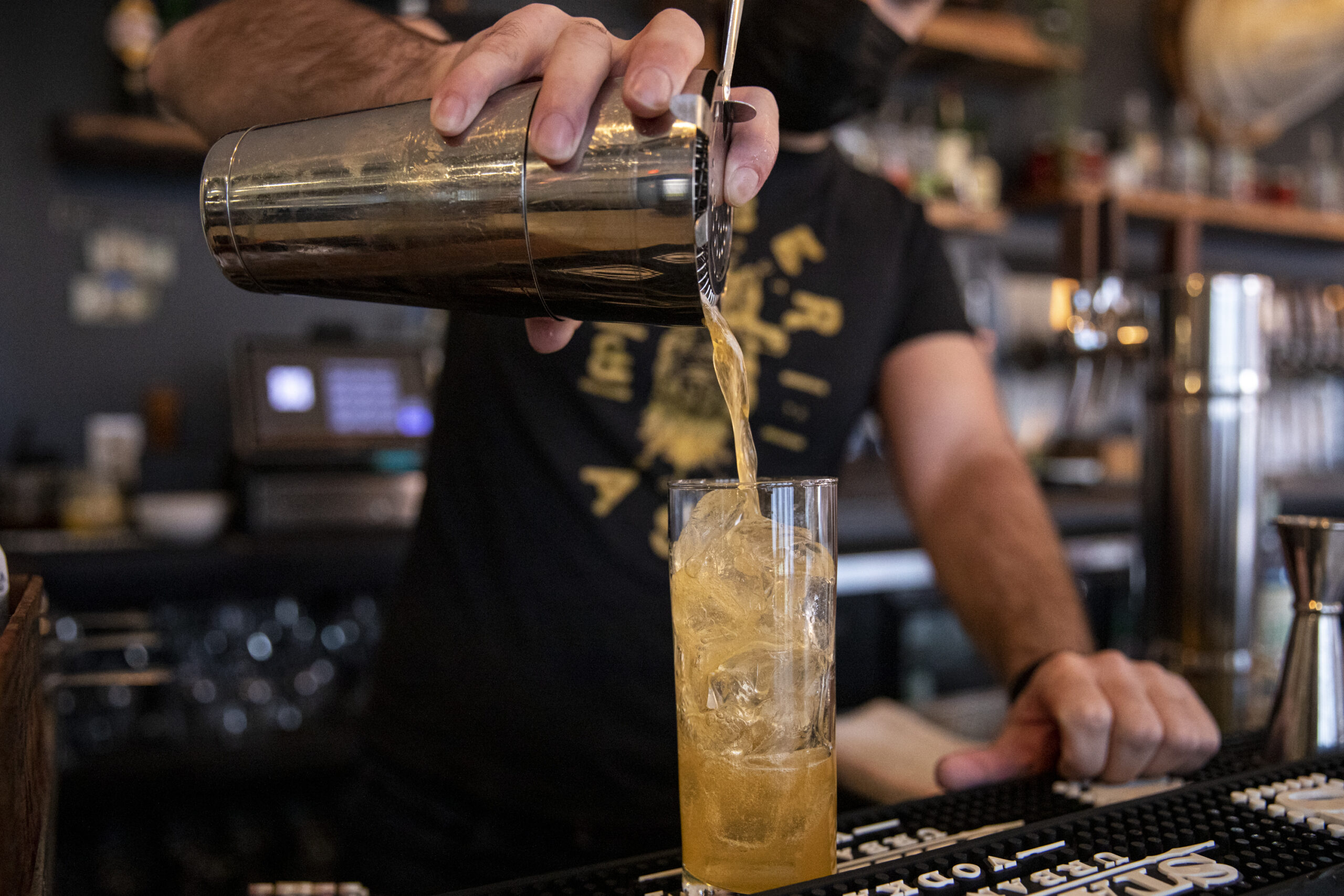
It’s that time again: You could win the rare whiskey lottery, and the deadline for entry is Friday.
State liquor license holders and Pennsylvania residents 21 and over have till 5 p.m. Jan. 16 to enter the Liquor Control Board’s latest “Limited-Release Lottery.” This time, 1,434 bottles are being offered in three lotteries. As usual, this is a chance to buy — not win — one of these prized whiskeys. If you’re a collector or serious about whiskey, it’s worth a shot.
There will be separate lotteries for each collection. Opt in for one, two, or all three lotteries. Only one entry per household, per drawing is allowed; duplicative entries will be disqualified.
Individual consumers and licensees entering the lottery must have an active account on Fine Wine & Good Spirits‘ website. Entries must include a valid store for delivery.
Lottery 1, the Buffalo Trace Antique Collection, retailing for $149.99, includes:
Sazerac Straight Rye Whiskey 18 Year — nine bottles for individuals, three for licensees
Eagle Rare Straight Bourbon 17 Year — 18 for individuals, six for licensees
William Larue Weller Straight Bourbon Barrel Proof — 45 for individuals, 15 for licensees
George T. Stagg Straight Bourbon Barrel Proof — 45 for individuals, 15 for licensees
Thomas H. Handy Sazerac Straight Rye Whiskey Barrel Proof — 126 for individuals, 42 for licensees
Lottery 2, the Van Winkle collection, $129.99 to $449.99, includes:
Pappy Van Winkle’s Family Reserve Straight Bourbon 23 Year — 32 for individuals, 10 for licensees
Pappy Van Winkle’s Family Reserve Straight Bourbon 15 Year — 34 for individuals, 11 for licensees
Pappy Van Winkle’s Family Reserve Straight Bourbon 20 Year — 34 for individuals, 11 for licensees
Old Rip Van Winkle Handmade Straight Bourbon 10 Year — 118 for individuals, 39 for licensees
Van Winkle Special Reserve Straight Bourbon 12 Year — 580 for individuals, 193 for licensees
Lottery 3 features limited-edition Colonel E.H. Taylor Jr. straight bourbon, bottled in bond, $149.99: 36 bottles for individuals and 12 for licensees.
Harry A. Spivak, 66, a veteran caterer and connector in the city’s hospitality sector, died of natural causes on Dec. 31 after a short illness.
Over the decades in catering, event production, and consulting, he was known as the person who knew whom to call, how to staff a last-minute job, where to source the right equipment, and how to make complicated events run smoothly.
“He was a sage when it came to organization and bartending and everything that goes into making an event work,” said Jon Spivak, a brother who was his partner at the now-closed Max & Me Catering. “But his real gift was connecting people. He had what I call ‘a Rolodex brain.’ That was his true genius.”
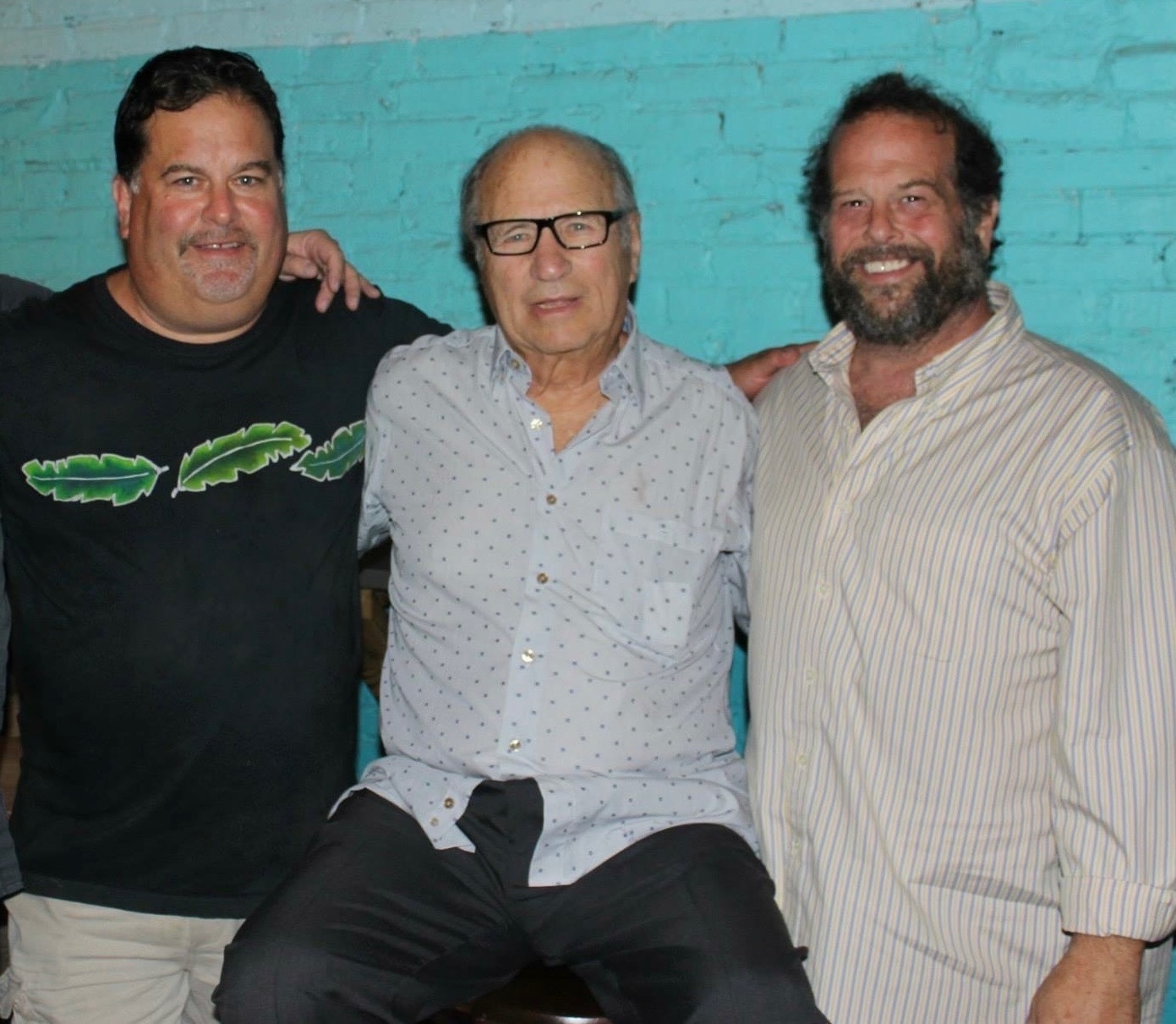
Harry Spivak (left) with his uncle Herb Spivak and his brother Jon.
Mr. Spivak, the oldest of Joseph “Jerry” and Sally Spivak’s five children, grew up immersed in hospitality and music through the family’s businesses.
In 1968, Jerry Spivak and brothers Herb and Allen were among the founders of the Electric Factory, the pioneering music venue that grew into the industry’s largest concert-promotions company, Live Nation. In 1972, the Spivak brothers opened H.A. Winston & Co., a casual restaurant that grew to 22 locations on the East Coast.
Mr. Spivak himself only dabbled in the restaurant business — opening the short-lived Bala Rouge in Bala Cynwyd in 1985 with his brother Jon and cousin Adam Spivak after his graduation from the University of Colorado in Boulder. He later spent eight years in the San Francisco Bay Area before returning to the Philadelphia area to raise his daughter, Katie.
Friends say Mr. Spivak possessed a rare mix of business instinct and personal warmth. He could talk logistics one minute and relationships the next.
“He had this incredible memory,” said Jon Spivak, who is a chef. “You could mention someone you worked with 20 years ago in Colorado or New York, and Harry would remember where they went to school, who they worked for, and who they might know that could help you now.”
It also would take only one move to play the 1990s parlor game “Six Degrees of Kevin Bacon” with Mr. Spivak.
“Harry was my first friend,” Bacon said Monday, describing him as a “kind, gentle, big-hearted man.” The Spivaks moved onto Van Pelt Street in Center City in 1967, around the corner from the Bacon family’s house on Locust Street. “I was immediately taken in by the Spivak family, and their house became my second home,” Bacon said.
Three decades ago, Mr. Spivak’s talents as a social bridge created a chapter in music history when he suggested that Bacon and his older brother Michael perform together as the Bacon Brothers. Kevin Bacon confirmed that Mr. Spivak also arranged their area debut at the TLA on South Street, then owned by Electric Factory.
“Harry and I shared countless adventures through the years on the Philly streets, the Electric Factory, the Spectrum, Northern California, and Bucks County,” Bacon said.
Mr. Spivak also was his family’s historian, a daunting role given that his grandfather — taproom owner Harry “Speedie” Spivak — was one of 13 children. “Anyone in the family could call him and say, ‘I just met someone named Susan — how are we related?’” Jon Spivak said. “Harry would immediately say, ‘She’s your grandfather’s third sister’s daughter’s kid.’”
Mr. Spivak was happiest when he was in motion — building teams, solving problems, and making sure everyone had what they needed.
“He was a jack of all trades,” said Jon Spivak. “But more than that — he was the guy you wanted in your corner.”
Jon Spivak and his Max & Me business partner Max Hansen relied on him in 2000 for catering jobs at the Republican National Convention in Philadelphia. After the convention, Max & Me was hired to cater aboard the Bush-Cheney campaign’s train for a three-day whistle-stop tour through the Midwest.
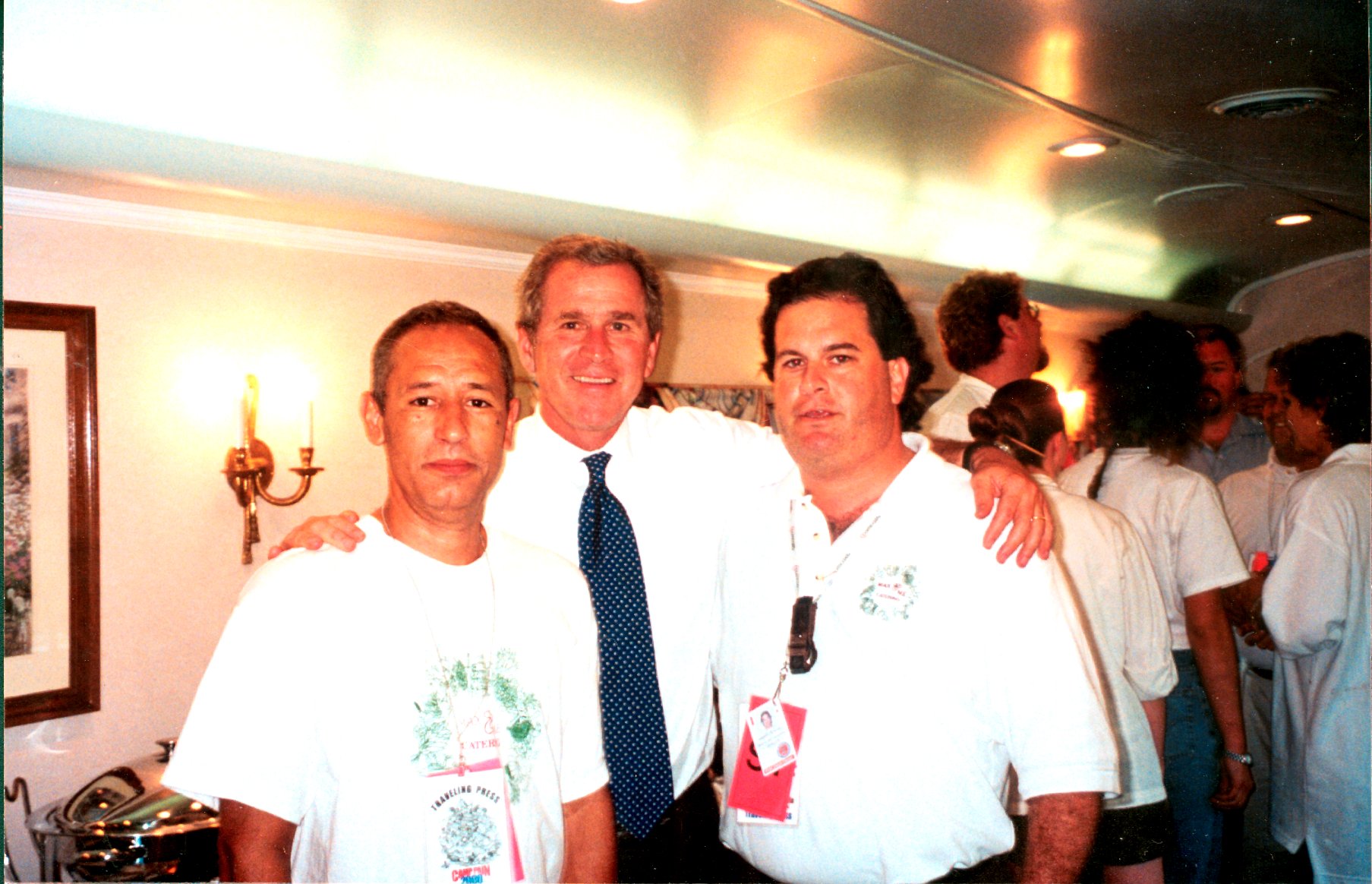
Harry Spivak (right) with then-presidential candidate George W. Bush and Max & Me Catering colleague Ariel Alejandro on a train after the Republican National Convention on Aug. 31, 2000.
Assigned to oversee beverages for the media, Secret Service agents, campaign staffers, and railroad employees, Mr. Spivak loaded 15 cases of beer, 21 cases of bottled water, 22 cases of sodas, and eight cases of juices, plus wines and spirits.
The baggage car used for storage, however, was separated from the kitchen and dining car by four 100-foot cars. Rather than navigate the narrow aisle, Mr. Spivak waited for station stops, unloaded the boxes onto the platform, transferred them by hand truck, and reloaded them onto the train. “My body didn’t stop hurting for weeks,” he told The Inquirer later.
Friends and relatives also remembered him for his role as the family’s fun uncle, who took nieces and nephews for ice cream, bent the rules, and encouraged adventure. “What I’ll remember most is his love of fun,” his brother said. “He didn’t take life too seriously.”
During the COVID-19 pandemic, Mr. Spivak became an advocate for feeding homeless people and worked to direct meals and resources to those most affected by shutdowns. “He didn’t live inside a box,” his brother said. “He did his own thing. People loved him because he had a huge heart and would do anything for anybody.”
In addition to his daughter and brother, Mr. Spivak is survived by siblings Jenny, Betsy, and Josh, and dozens of cousins, nieces, and nephews.
A celebration of Mr. Spivak’s life will begin at 1 p.m. Jan. 25 at Underground Arts, 1200 Callowhill St., Philadelphia. Memorial contributions may be made to Chosen 300 Ministries, Box 95, Ardmore, Pa. 19003.
Birch Street will get a new restaurant and cocktail lounge this summer as its makeover in Kennett Square continues.
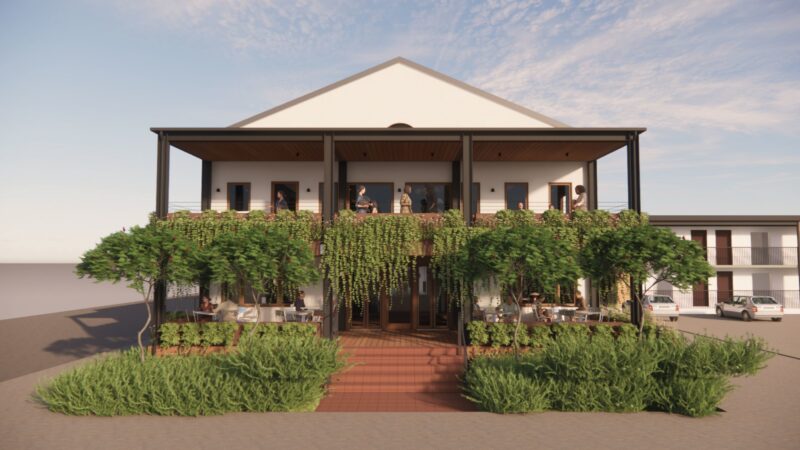
Opus, a New American upscale restaurant with a second-floor cocktail lounge, will open at 201 Birch St., adjoined to Artelo, a 14-room boutique hotel. Opus is a new initiative for Square Roots Collective, an organization that builds businesses and uses the profits to support nonprofits in southern Chester County.
Opus will boast 125 seats in its 6,000 square-foot building, with outdoor dining and a two-story terrace. During the day, the cocktail bar will serve breakfast to the public and guests of Artelo.
The restaurant, which will be adorned by curated art pieces and a hand-painted ceiling mural, is an extension of Artelo, which Square Roots Collective opened in 2024. The hotel, which replaced the former Birch Inn, offers an immersive art experience, with each room painted by a local or regional artist, creating a living piece of art.
That same principle will follow in Opus, said Luke Zubrod, chief of staff for Square Roots Collective.
“It’s kind of the anchor to Birch Street,” he said. “It’s really kind of setting the tone for the street as a whole — and the tone it’ll set is really an artistic tone. This is a street kind of filled with beauty, and I think that that theme will be more evident over time.”
It’s part of a larger effort to revitalize Birch Street, which has in recent years seen more development, including Square Roots Collective’s beer garden The Creamery, and streetscaping.In the coming years,the street will be resurfaced, and the borough plans to add a trail on one side and sidewalk on the other, along with new streetlights and crosswalks. Square Roots Collective worked with the borough to secure funds for that investment, leaning on grant dollars from the state and county, Zubrod said.
“In addition to the Opus itself, there’s a lot to look forward to,” Zubrod said. “This street is really receiving some public investment that will make it a really vibrant and beautiful place.”
Along with Artelo and The Creamery, 100% of Opus’ funds will go to the organization’s nonprofit, focused on community improvement, he said.
“I think in addition to just being a really exciting restaurant concept, it’s also one people can feel really good about in terms of helping to make the community better,” he said.
Another boutique hotel coming
The Francis, a boutique hotel in central Kennett Square, is slated to open this year. The eight-room hotel will reimagine an 18th century home, and pay homage to the region’s history.
Meanwhile, also coming this year, the collective will open another boutique hotel, at 205 S. Union St. The Francis, an ode to Francis Smith who named Kennett Square for his home back in England, will have eight rooms, each dedicated to the history of the town.
The hotel will reimagine an 18th-century home, and offer single rooms and loft suites with kitchenettes, plus balcony or courtyard access.
One room — “The Watchmaker” — will honor a former resident and watchmaker, Thomas Milhous. Another room, “The Gardener,” will pay homage to the region’s first big harvest: flowers. Others nod to battlegrounds, four generations of a local family, education, plus the region’s history with the Underground Railroad, the Lenni-Lenape tribe and its “rich immigrant history.”
The collective plans on luscious landscaping, with a courtyard serving as “a little bit of an oasis,” said Zubrod.
“There is an appetite to have kind of quaint boutique hotels in the area to meet the needs of people who are coming for Longwood [Gardens] especially,” he said.
This suburban content is produced with support from the Leslie Miller and Richard Worley Foundation and The Lenfest Institute for Journalism. Editorial content is created independently of the project donors. Gifts to support The Inquirer’s high-impact journalism can be made at inquirer.com/donate. A list of Lenfest Institute donors can be found at lenfestinstitute.org/supporters.
The New York-style bagel shop, which currently has locations in West and South Philadelphia, is bringing its fresh bagels, smoked meats, egg sandwiches, and unique schmears to 273 Montgomery Ave.
The Main Line outpost is expected to open this summer.
While the new storefront marks a major expansion for the local bagel shop, it’s also a homecoming for cofounders and brothers Brett and Kyle Frankel, who grew up in Bala Cynwyd.
“We know the area very, very well,” Brett Frankel said.
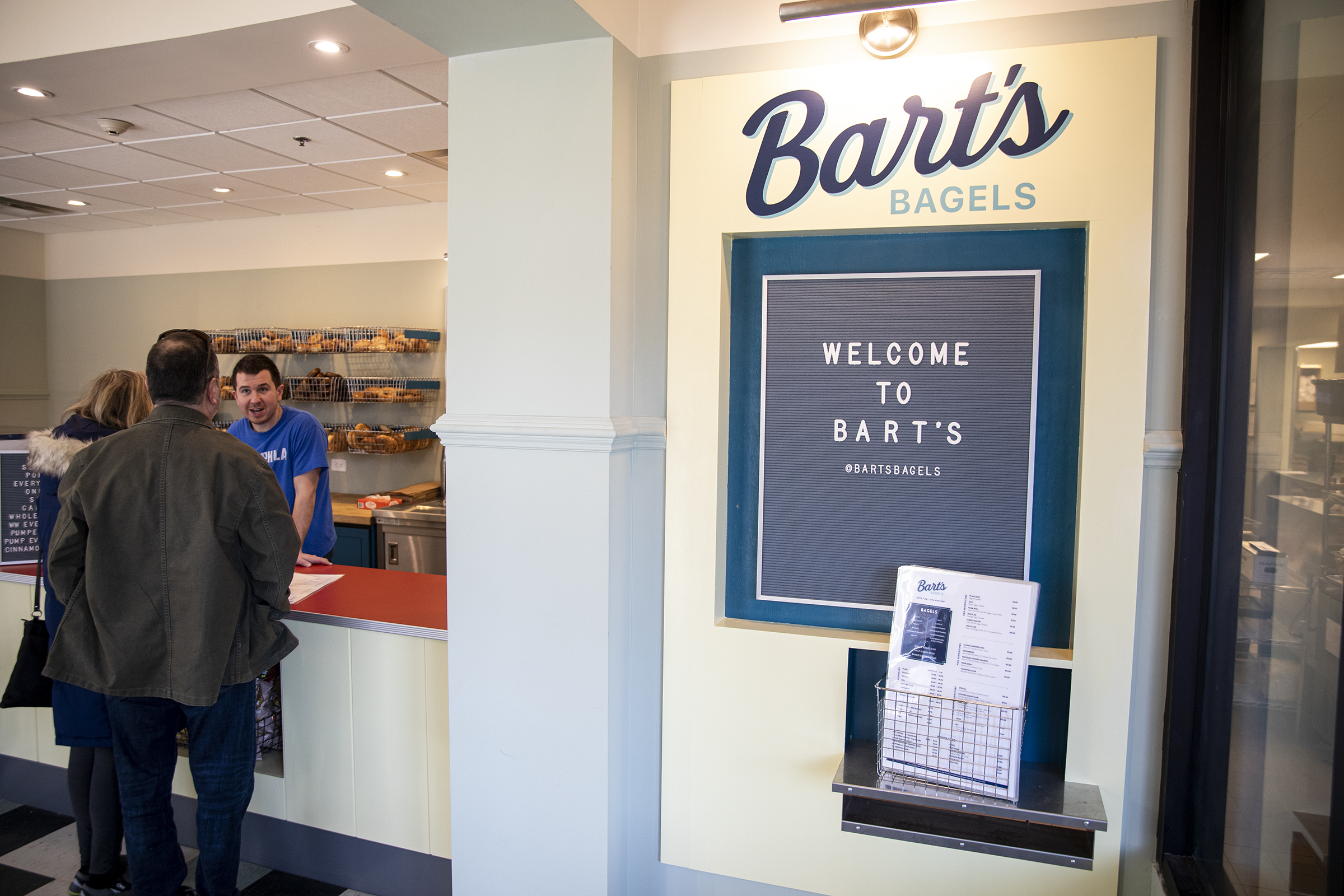
Brett Frankel, co-owner of Bart’s Bagels, helps customers at Bart’s Bagels on Wednesday, Jan. 22, 2020. Bart’s is expanding to Bala Cynwyd later this year.
Brett, 34, and Kyle, 41, both Lower Merion High School graduates, grew up a five-minute walk from their newest location. Brett Frankel says he remembers hanging out at the soon-to-be Bart’s Bagels storefront after middle school, back in the days when it was Bravo Pizza.
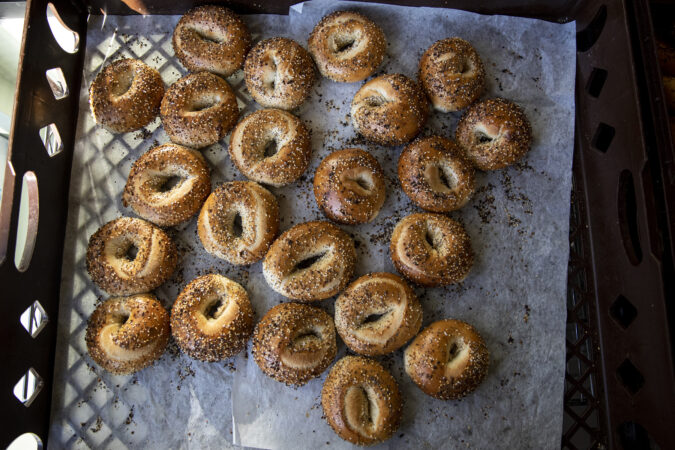
Main Line patrons will be able to expect all of the same kettle-boiled bagels and fixins’ that Bart’s is known for, from pumpernickel bagels to pastrami smoked salmon and beet-horseradish cream cheese.
While Bart’s city-based locations are grab-and-go only, there will be a few seats in the new Bala Cynwyd shop.
The unique part of Bart’s, Brett Frankel said, is that patrons can see bagels being made in front of them through the open kitchen.
“You’re kind of immersed in it,” he said.
The Frankels say their love for good bagels was forged through regular trips to New York’s Upper West Side to eat at the famed Zabar’s and H&H Bagels.
Looking to get their fix closer to home, Brett Frankel taught himself how to make bagels while working as a business analyst for a software company. He traveled to Denver, New Jersey, and Detroit to learn the ins and outs of the bagel industry.
Bart’s started as a wholesale operation in late 2019, selling to Di Bruno Bros., Middle Child, Elixr Coffee, White Dog Cafe, and other local restaurants. The Frankels brought chef Ron Silverberg on board, and they opened the first Bart’s in West Philly in January 2020. Their South Philly location opened in July 2024.
Bart’s is not the only new bagel place coming to Lower Merion this year.
This suburban content is produced with support from the Leslie Miller and Richard Worley Foundation and The Lenfest Institute for Journalism. Editorial content is created independently of the project donors. Gifts to support The Inquirer’s high-impact journalism can be made at inquirer.com/donate. A list of Lenfest Institute donors can be found at lenfestinstitute.org/supporters.
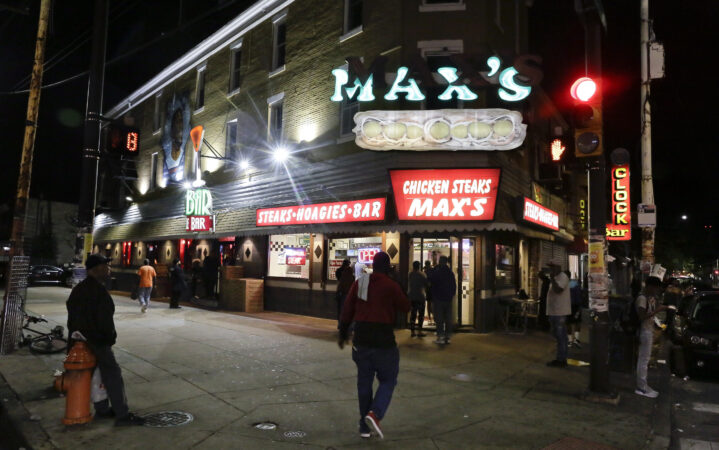
Max’s Steaks — the North Philadelphia sandwich shop known for its 2-foot sirloin cheesesteaks, quirky next-door bar advertising “the largest drink in Philly,” and star turn in the Creed movies — is being sold after three decades.
Pennsylvania Liquor Control Board records show a recent license transfer application from corporations controlled by longtime bar owner Chuck Weiner to veteran restaurateur Rob LaScala, whose diverse holdings include the fast-growing LaScala’s Fire Italian restaurants as well as numerous steak shops and pizzerias in Philadelphia and South Jersey.
Weiner, who also owns Chuck’s Alibi at the Five Points intersection in Northeast Philadelphia, did not return a message seeking comment that was left with a family member last week.
Rob LaScala of LaScala Restaurant Group.
LaScala, who has been managing Max’s under a contract, said he also was Weiner’s longtime tenant at Chubby’s, his popular Roxborough steak shop. “He’s always been a good landlord to me,” LaScala said Friday. “Max’s is exactly like Chubby’s — right up my alley. I love those kinds of places.”
“We bought it because it’s a staple in the community, and I love high-volume places,” LaScala said. “I want to get it back to the volume it used to have.”
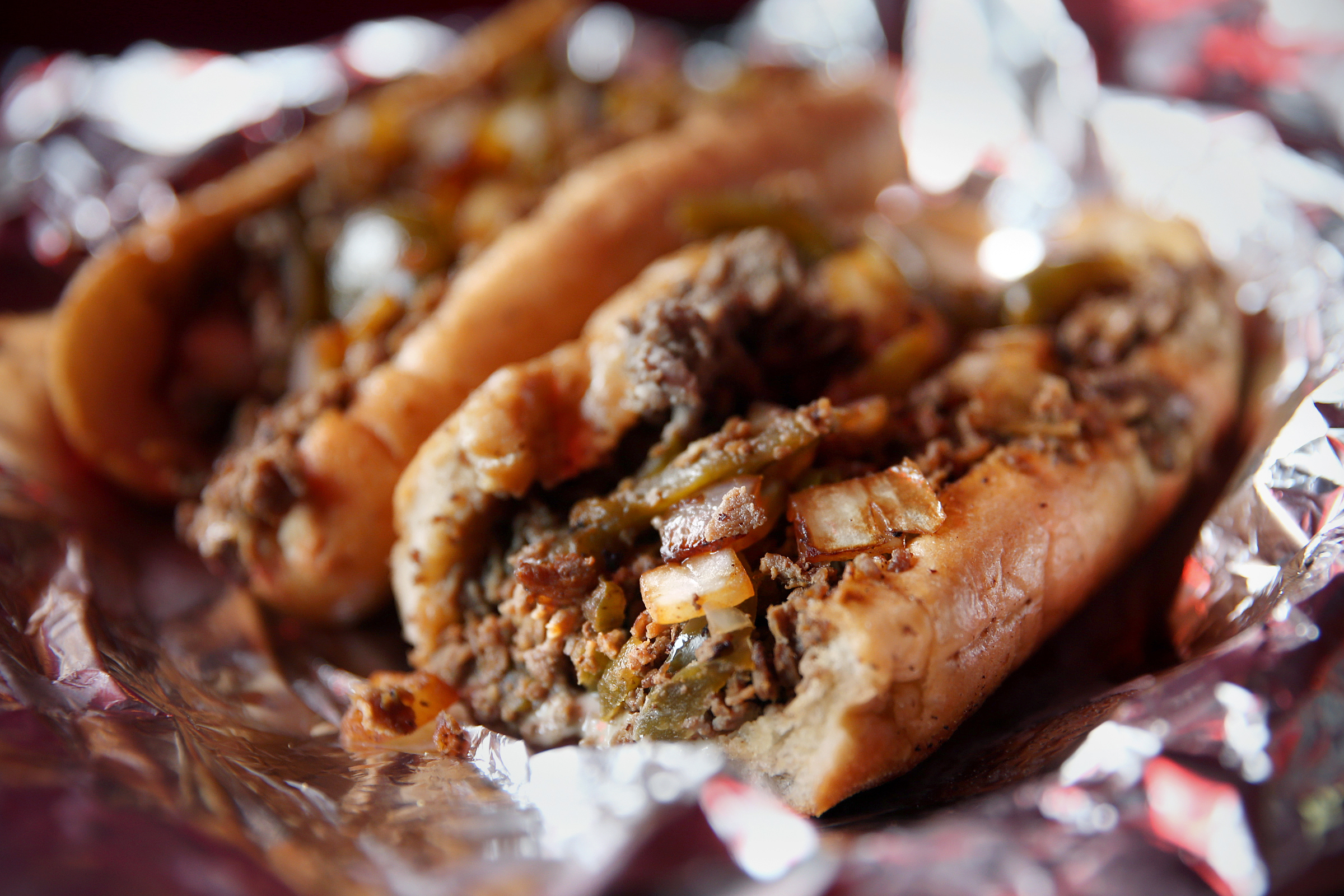
A cheesesteak with onions and peppers at Max’s Steaks in 2018.
LaScala said his company was rebranding Max’s. “We already renovated the place and we’re doing a bigger renovation over the next six months,” he said. “We’re doing brand recognition — shirts, hats, logos. Menu-wise, we’re expanding a little. Before, it was mostly cheesesteaks and hoagies. We added fries, wings, specialty sandwiches, and some bar food since there’s a bar. We’re not changing what it is — we’re just making it better, more efficient, and better quality.”
Weiner told Philly Voice in a 2016 interview that he got the idea for Max’s after watching the crowds at Jim’s South Street circa 1990 while eating across the street at Lickety Split, then a popular restaurant where MilkBoy is now. Max’s — named after Weiner’s son — opened in 1994 at 3653 Germantown Ave. in Nicetown, at the busy Broad Street-Erie Avenue hub. The adjacent Eagle Bar, with its Naugahyde booths, oversized cocktails, and neon signs, is Max’s de facto seating area.
LaScala said he was not involved with the neighboring Clock Bar, also part of Weiner’s holdings.
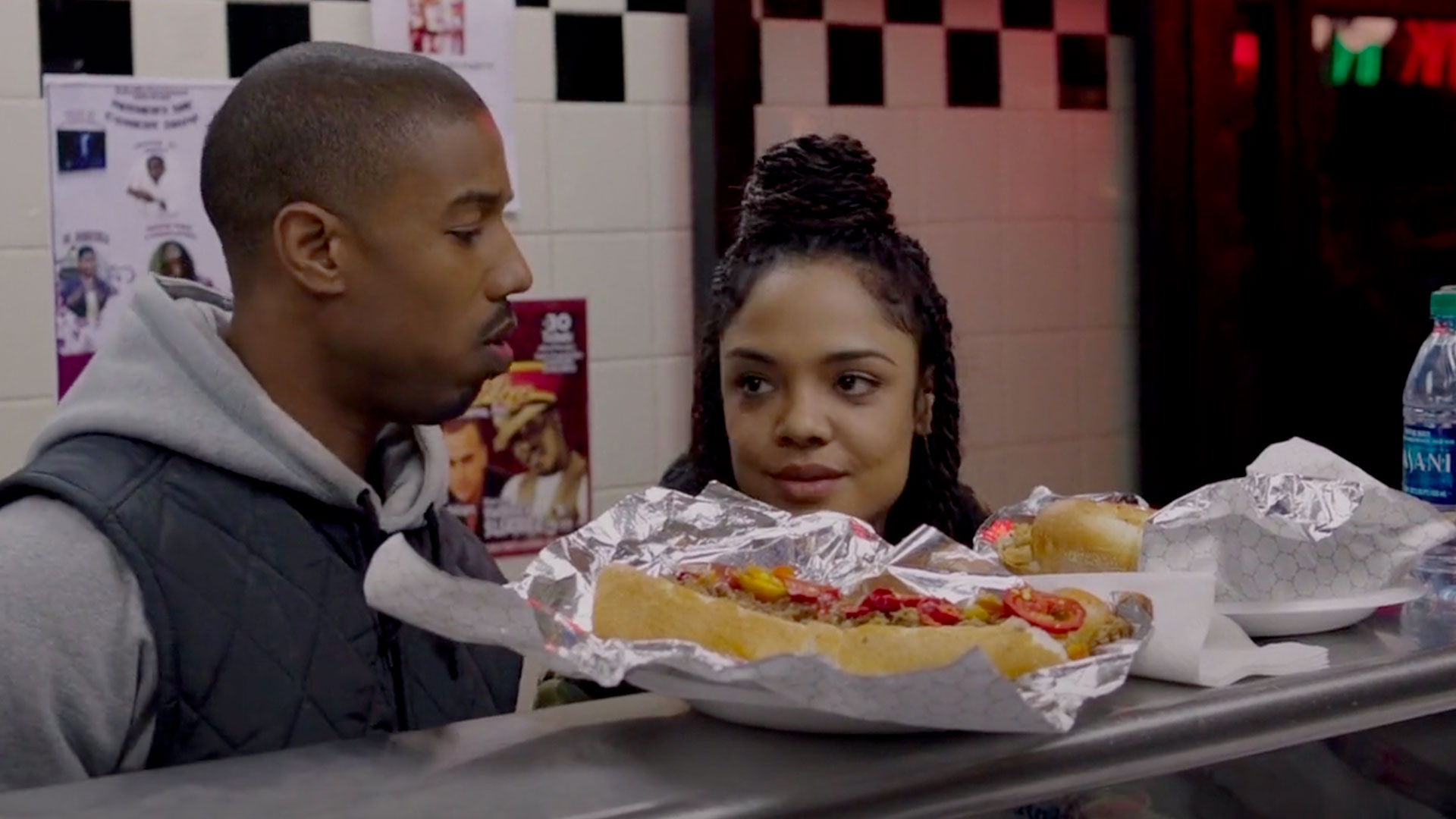
Michael B. Jordan and Tessa Thompson at Max’s Steaks in “Creed.”
In part because of its location far from tourist hubs, Max’s reputation spread primarily by word of mouth rather than guidebooks.
That changed dramatically in 2015, when Max’s appeared in the Rocky sequel Creed. This is where Adonis Creed (Michael B. Jordan) ate his first Philly cheesesteak under the adoring eye of Bianca Porter (Tessa Thompson) and learned that he would box Viktor Drago. The shop also had a cameo in Creed II, the 2018 sequel.
In 2017, Philadelphia marked Kevin Hart Day with a party at Max’s, located a block from the comedian’s childhood home.
TOKYO — Lindsay Mariko Steigerwald and Jesse Pryor set the gold standard for ramen in Philadelphia during their five-year run at Neighborhood Ramen. But when the couple announced the closure of their beloved Queen Village restaurant at the end of 2024, they also teased an audacious bit of news: They were moving to Japan with plans to reopen their shop in the ramen capital of the world.
“This is the next chapter for Neighborhood Ramen!” said Steigerwald, 35, as we stood in a blustery November rain beside Shibuya Scramble Crossing, the famously chaotic, neon-lit intersection in Tokyo where we rendezvoused for a day of noodle slurping across the city.
The couple had arrived from Philadelphia just 10 days earlier — following a year of planning (and a pop-up venture called ESO Ramen Workshop in Society Hill). They’d already begun their classes at Japanese language school and launched the arduous visa process that must be settled before they can begin working on their own restaurant. It will likely still be many months before Neighborhood Ramen fires up its stockpots and noodle machine in Tokyo.
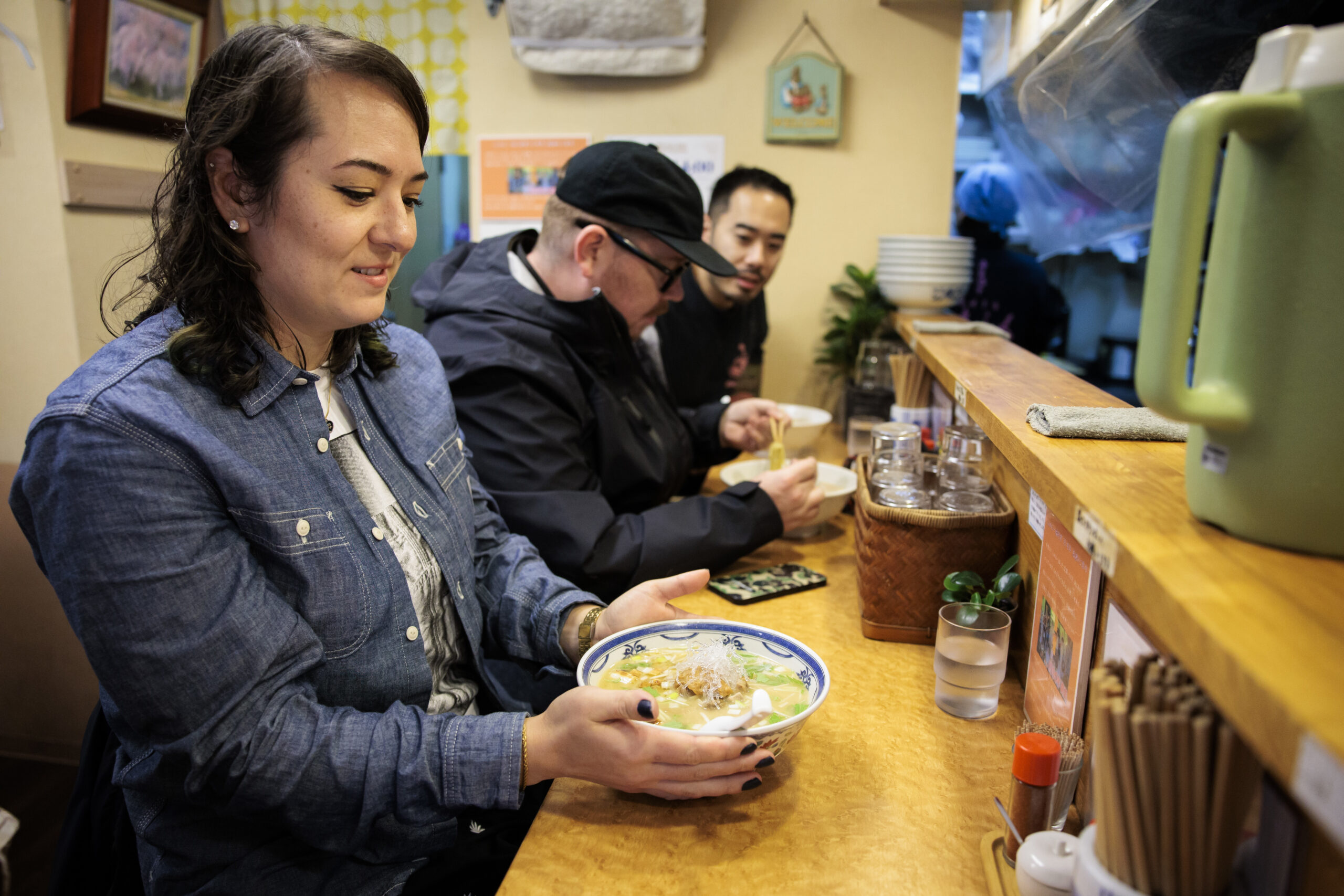
Lindsay Mariko Steigerwald (from left), Jesse Pryor, and Jesse Ito sit at the counter at Ramen Ichifuku in November in Tokyo.
Their move was precipitated by a long-simmering goal to practice their craft alongside the best, but also a desire for “a better quality of life” they’ve come to love over the course of multiple visits to Tokyo, says Steigerwald.
Equally motivating is the couple’s passion for consuming ramen regularly; it’s every bit as intense as their drive to make it.
“I want to eat ramen every day,” says Pryor, 38. “I want to go to different shops all the time, be inspired and just soak it up. It’s hard to do that in Philadelphia.”
He’d already eaten 14 bowls of ramen in the first nine days since landing in Tokyo in November — on top of the 300 ramen shops the couple had visited during their 10 previous visits to Japan. By the end of December, Pryor was up to 80 bowls of ramen at 70 different places. (Steigerwald has been keeping pace with ramen, too, but she documents her own obsession — dumplings — on her GyozaKween Instagram account.)
That’s still just a fraction of the 10,000 ramen shops in Tokyo serving myriad variations: rich tonkotsus cloudy with the emulsified essence of slow-simmered pork bones; crystalline shio salt broths and shoyus tinted amber with soy; creamy miso ramens; and gyokai ramens punchy with seafood umami. Pryor’s quest for soupy inspiration here, he says, is “infinite.”
“Jesse is a true ramen hunter,” says Steigerwald. “At night he’s game planning what bowls he’s going to eat the next day.”
“The ramen comes first,” he says, “and then the rest of the day just fills in around it, you know?”
Ramen-hopping rules
We were about to learn firsthand, as the couple, who’ve begun a fledgling ramen tour business, had mapped out an afternoon of visits to some of their favorites. There were rules. Our group must be small (ideally two to three guests max) because the best ramen counters are often tiny. Also, come hungry.
“It’s expected each person that steps foot in the shop orders their own ramen and finishes the bowl. … Doggie bags are not a thing,” says Pryor.
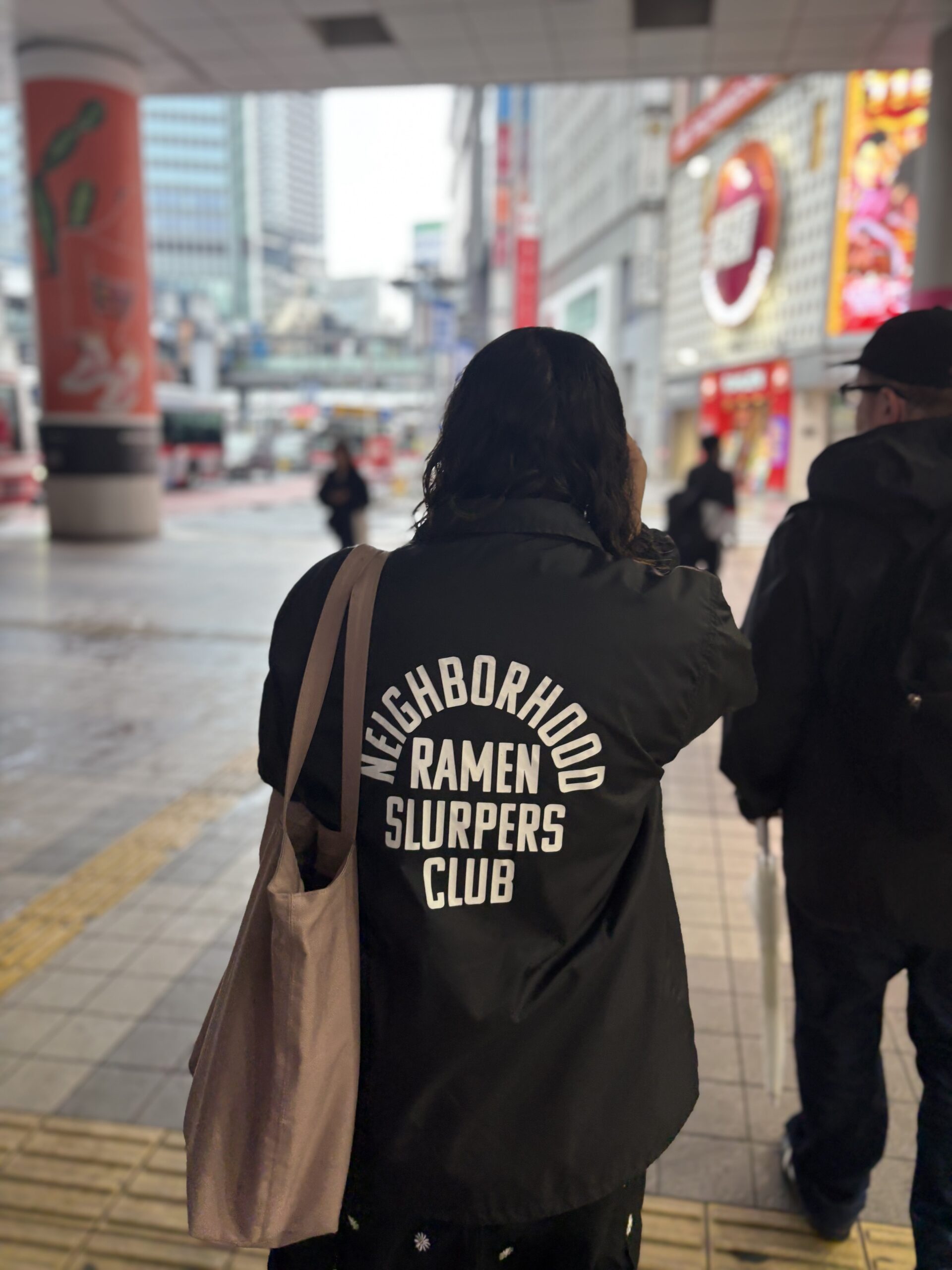
The last edict was especially daunting considering the belly-filling richness of ramen. Consume three bowls and you’re in for a long nap. In addition, eating ramen like a pro is a full-contact sport — a messy, broth-splashing endeavor for which there is not only a recommended dress code (“Jesse’s entire wardrobe is black,” Steigerwald says), but also an almost athletic eating technique: the power slurp.
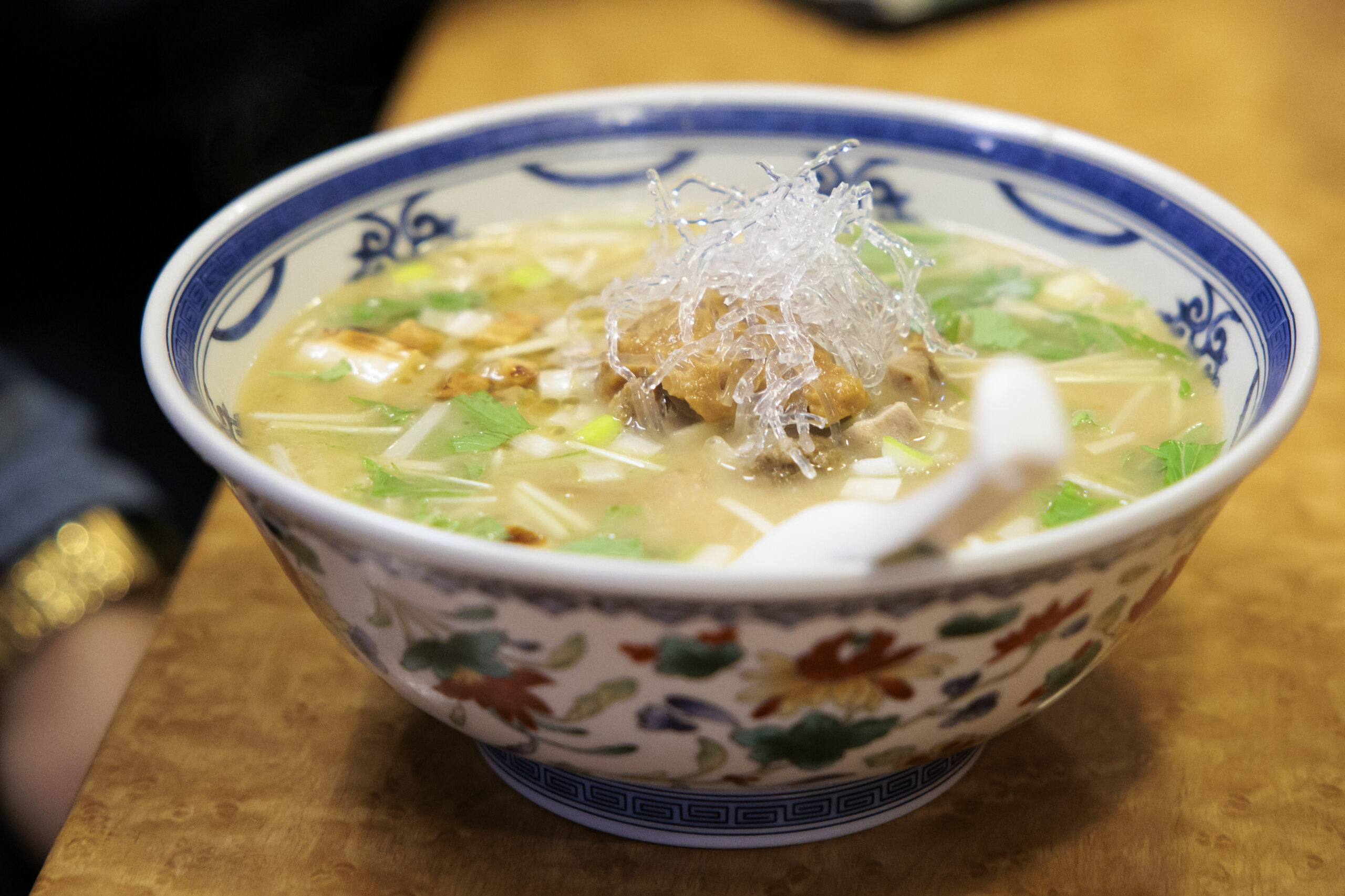
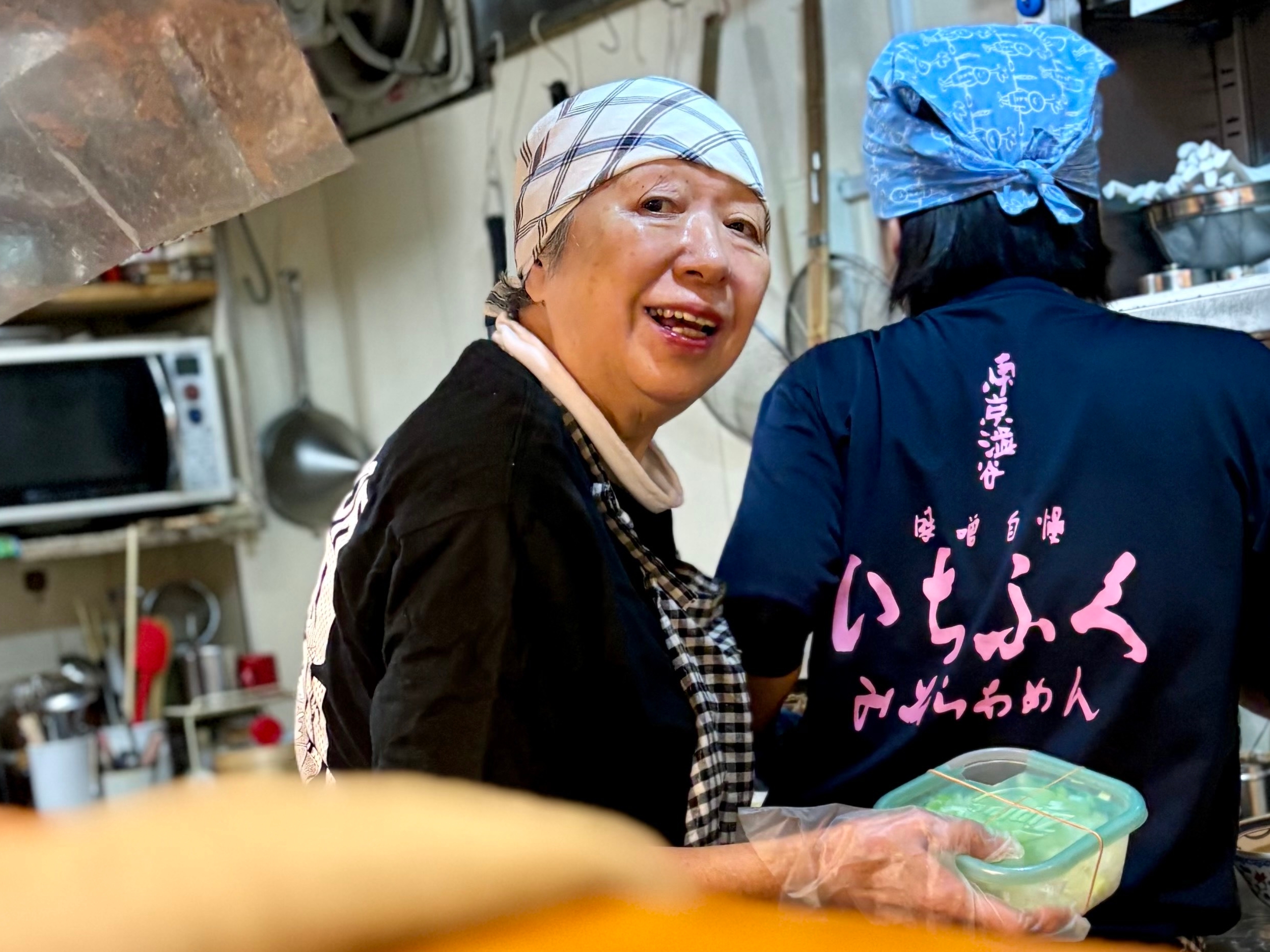
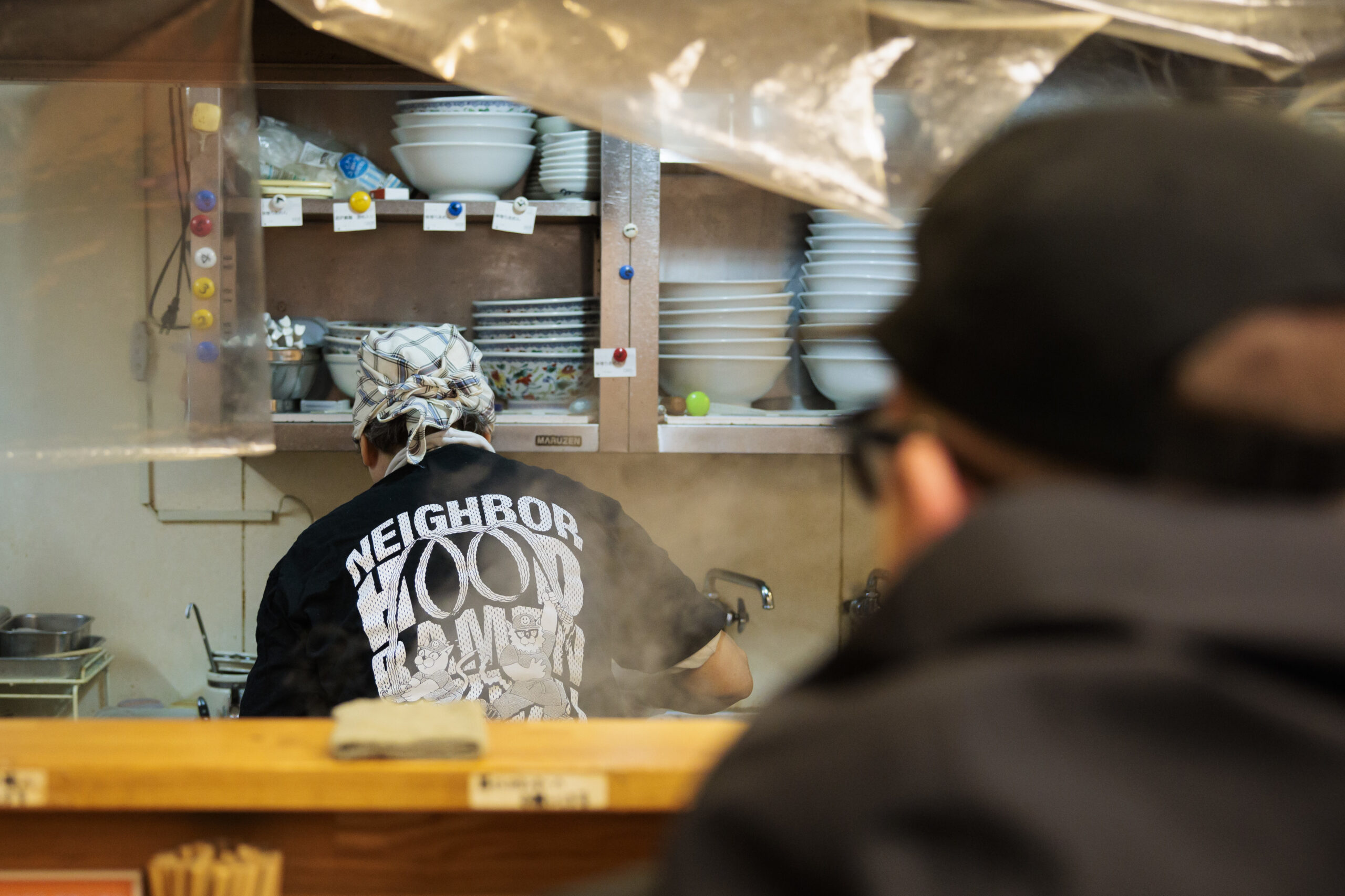
Ramen with shark cartilage at Ramen Ichifuku.Chef and owner Kumiko Ishida of Ramen Ichifuku in the Honmachi neighborhood of Shibuya, Tokyo, looks back across the counter while making miso ramen.
As the bowls landed before us at Ramen Ichifuku, our first stop in the Honmachi neighborhood of Shibuya, I marveled at the nutty aroma of the tan broth of an irorimen-style ramen, enriched with three kinds of miso, tender pork, tangy sake lees, and translucent threads of shark cartilage bundled over top.
I was just as mesmerized by Pryor and Steigerwald, though, as they locked onto their bowls with trancelike focus, then pounced, their faces hovering just inches above the steamy rims. As they began to slurp, columns of noodles steadily streamed upward into their open jaws. The jazz soundtrack of Hiromi’s Sonicwonder playing “Yes! Ramen!!” was punctuated by a gurgling roar reminiscent of shop vacs inhaling shallow pools.
“We call it ‘hitting the zu’s,’” says Steigerwald, noting the reference to zuru zuru, the onomatopoeia for slurping ramen in Japanese comics.
“It’s like turbo tasting, because you get the flavor of it up into all your sensory crevices,” says Pryor, who typically eats a bowl in five minutes or less, to consume each element at its peak.
I leaned over and gave it my best slurp — only to scorch my too-tightly pursed lips with hot broth while the noodles refused to rise. I resorted to my usual leisurely pace, savoring what was nonetheless the best bowl of ramen I’d ever eaten.
It was a comforting collage of firm but slippery noodles glazed in a nuanced broth with a parade of so many other textures — velvety pork, snappy bamboos shoots, tiny crunchy croutons. If only I could learn to properly slurp, it might be even better.
Steigerwald give me a sympathetic look: “We’ve had a lot of practice.”
Philly restaurant romance leads to Japan
Philly’s ramen power couple met at CoZara in 2016, where Steigerwald tended bar, and Pryor, a former news photographer from Delaware turned line cook at Zahav, had become a regular for the restaurant’s $5 Japanese riff on a citywide (Orion beer and a shot of sake).
“I saw them falling in love at that bar,” says Mawn chef Phila Lorn, who was CoZara’s chef de cuisine at the time.
Steigerwald, who grew up in New Jersey near Fort Dix and McGuire Air Force Base with two half-Japanese parents who are both kung fu masters, found Pryor’s budding obsession with ramen endearing: “Cool, the guy I’m dating is into the food of my culture.”
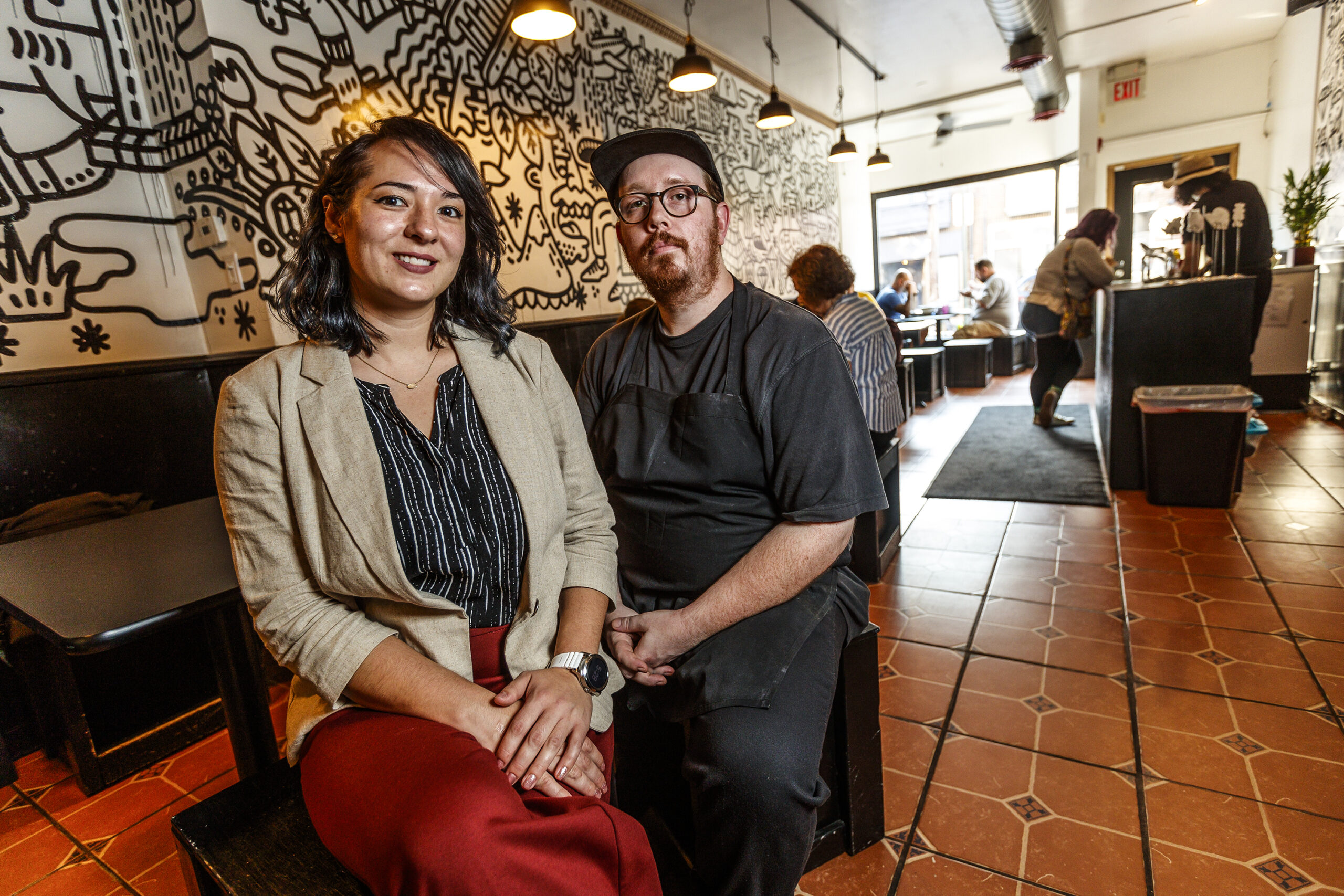
Lindsay Mariko Steigerwald (left) and Jesse Pryor co-owned Neighborhood Ramen on Third Street in Queen Village. They are pictured in their dining room shortly after opening in 2019.
She studied business management at college in Texas with an eye toward opening a Japanese restaurant, so it wasn’t long before they launched one of the city’s early pop-up sensations in 2016, dishing out bowls of intense tonkotsu and spicy tantan from his apartment between shifts at Cheu Noodle Bar, Morimoto, and Zahav.
When they finally opened their Queen Village shop in 2019, they instantly raised the city’s ramen bar. They acquired a used ramen machine in 2022 to begin making their own noodles (a rarity, considering the process is more involved than Italian pasta), raising the local standard once again.
But over the course of their research visits to Japan — where they were entranced by the abundance of quality ingredients as well as a public sense of order thatkeeps the streets tidy, safe, and tranquil — their pipe dream steadily bloomed into a determination to actually move.
“We did our thing for 10 years in Philly, but between the political climate and inflation there, the more we visited [Japan], we realized that this was where we want to be,” says Steigerwald. “We just want to make a modest living, be happy, and be proud of what we do.”
Steigerwald is eager to bring her family’s Japanese roots full circle, closing the loop that brought her two grandmothers to the United States after World War II: “My aunt in Texas finds it interesting that [my grandmothers] moved to America for a better life in the 1950s and that we are moving back to Japan to find a better life 70 years later.”
Steigerwald is pursuing a Nikkei visa for Japanese descendants. She hopes that the couple, who eloped in August — “moving to a new continent, we figured it was time,” she says — can open their shop in Koenji, a neighborhood known for its counterculture. It reminds them of South Street.
Tokyo transplants
In the meanwhile, they’ve been having rewarding ramen encounters everywhere. That included a spontaneous detour to Honmachi’s bustling and futuristic Denny’s, where ordering is automated and the food is delivered by a fleet of beeping musical robots.
“Honestly, I’d be hyped to eat that tantan anywhere,” says Pryor, gazing approvingly at a bowl of noodles whose broth is rich with sesame paste, ground pork, and orange puddles of chili oil. (Japanese Denny’s are owned by the same company as the country’s celebrated versions of the 7-Eleven, explaining the impressive confluence of quality and value.)
The duo’s exploration of the upper echelons of Tokyo’s artisan ramen world, however, has gone a long way toward building a community of friends and peers. When we arrivedat Ichifuku, chef Kumiko Ishida was wearing a Neighborhood Ramen T-shirt. The 15-seat restaurant in a homey, living room-like space is one of the very few ramen shops in Tokyo owned and operated by a woman, and Steigerwald and Pryor had named one of their regular specials in Philadelphia “Mama Miso” in the chef’s honor.
The source of their inspiration did not disappoint, even if Ichifuku would not divulge how (or from what) she makes her signature croutons, which remain a subject of ramen-world speculation because they never turn soggy in broth.
Chef Kumiko Ishida wears a Neighborhood Ramen T-shirt while cooking at her restaurant, Ramen Ichifuku. It is one of the very few ramen shops in Tokyo owned and operated by a woman.
Such minuscule details are the fodder for constant discussion among ramen hunters like Pryor and chef friends like Hiroshi “Nukaji” Nukui of Menya Nukaji in the Shibuya section of Tokyo, where Neighborhood staged a well-received pop-up in 2023. Nukui, who joined us for part of our journey, said he was thrilled the couple had decided to make the move to Tokyo.
“Their passion is so strong. Many Japanese have not been to the amount of ramen shops they’ve been to,” Nukui said. And their status as foreigners might also be an advantage, he suggested. “Japanese ramen chefs typically work under a famous chef and end up following in that tradition. But [Pryor and Steigerwald] are not boxed into a style or lineage.”
In fact, Pryor plans to focus on a ramen style similar to Nukui’s, a double-brothed ramen (also called “W soup”) that blends rich pork tonkotsu with an intense seafood broth called gyokai. While Nukui is known for his tsukemen style — in which noodles are served on the side for dipping into a broth as thick as gravy — Pryor intends to serve his noodles soup-style.
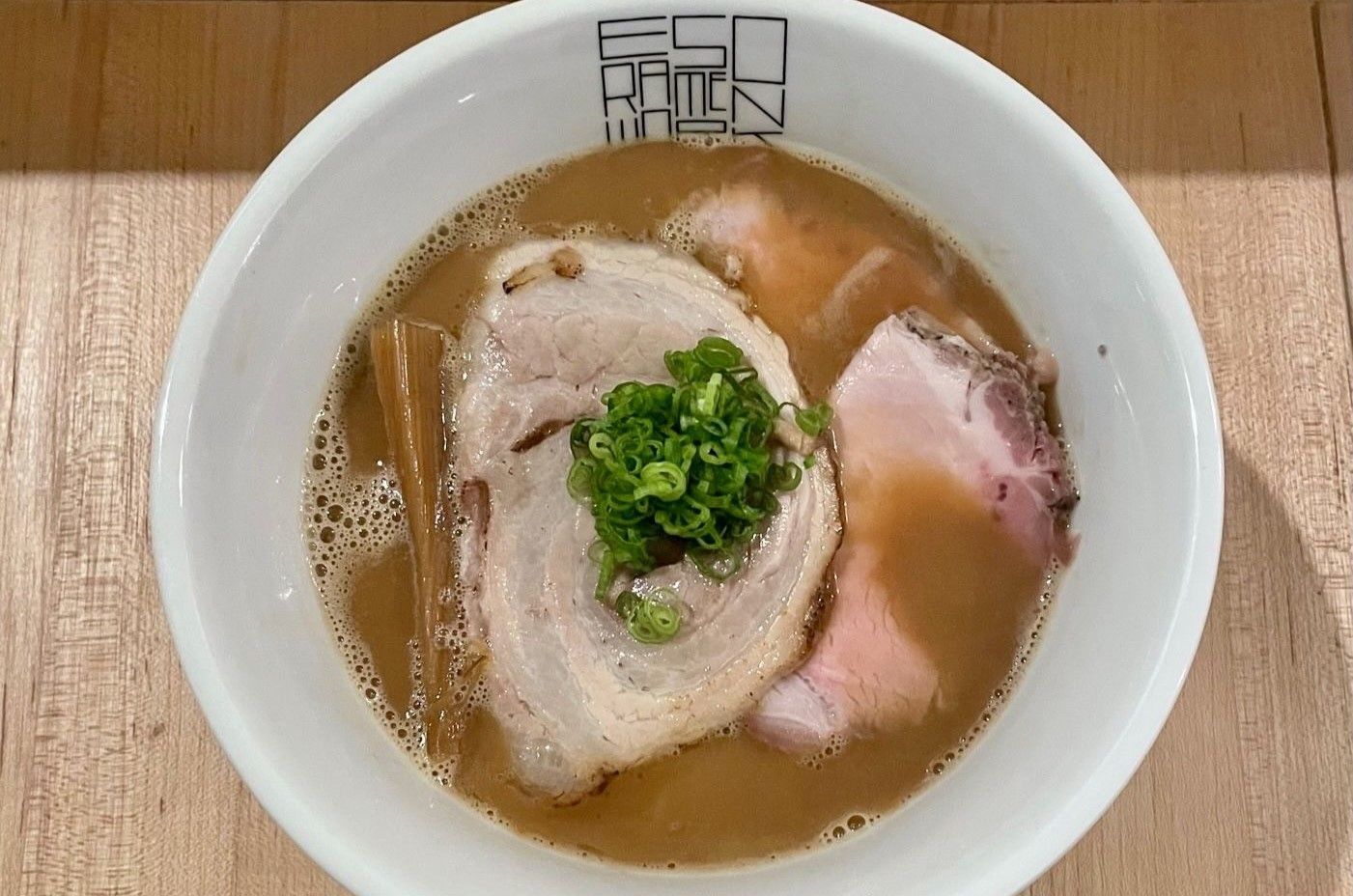
“This style is so impactful,” Pryor says, “you eat it and you’re like ‘Whoa!’” (I tried Pryor’s gyokai tonkotsu at both Neighborhood Ramen and Eso, and it is one of the most powerful, smoky, ocean-flavored broths I’ve ever tasted.)
Gyokai tonkotsu ramen at ESO Ramen Workshop, 526 S. Fourth St.
“Their ramen is no joke,” agrees Kosuke Chujo, the griddle master of Nihonbashi Philly, Tokyo’s shrine to Philly culture. “They are very, very good. The broth, of course. But also the fact they make their own noodles. Your average Japanese ramen maker does not do what they do.”
Indeed, high-quality noodles are so widely available in Japan that few ramen shops bother; there are so many other details to refine in composing a great bowl. At our final stop of the day, Ramenya Toy Box in Minowa, we were given a master class in the art of ramen’s two most elemental styles: shio (clear broth seasoned with salt) and shoyu (clear broth seasoned with soy).
As we stood in line outside the small white building, Pryor warned us of a solemn dining experience to come. It sounded like the polar opposite of the relaxed atmosphere at Ichifuku. “Yamagami-san is strict. His vibe is very serious, and the cooks stand at attention,” he said, referring to owner Takanori Yamagami, who studied under famed “Ramenbilly” chef Junichi Shimazaki, the pompadour-coiffed social media sensation whose shop is known for its no-talking rule.
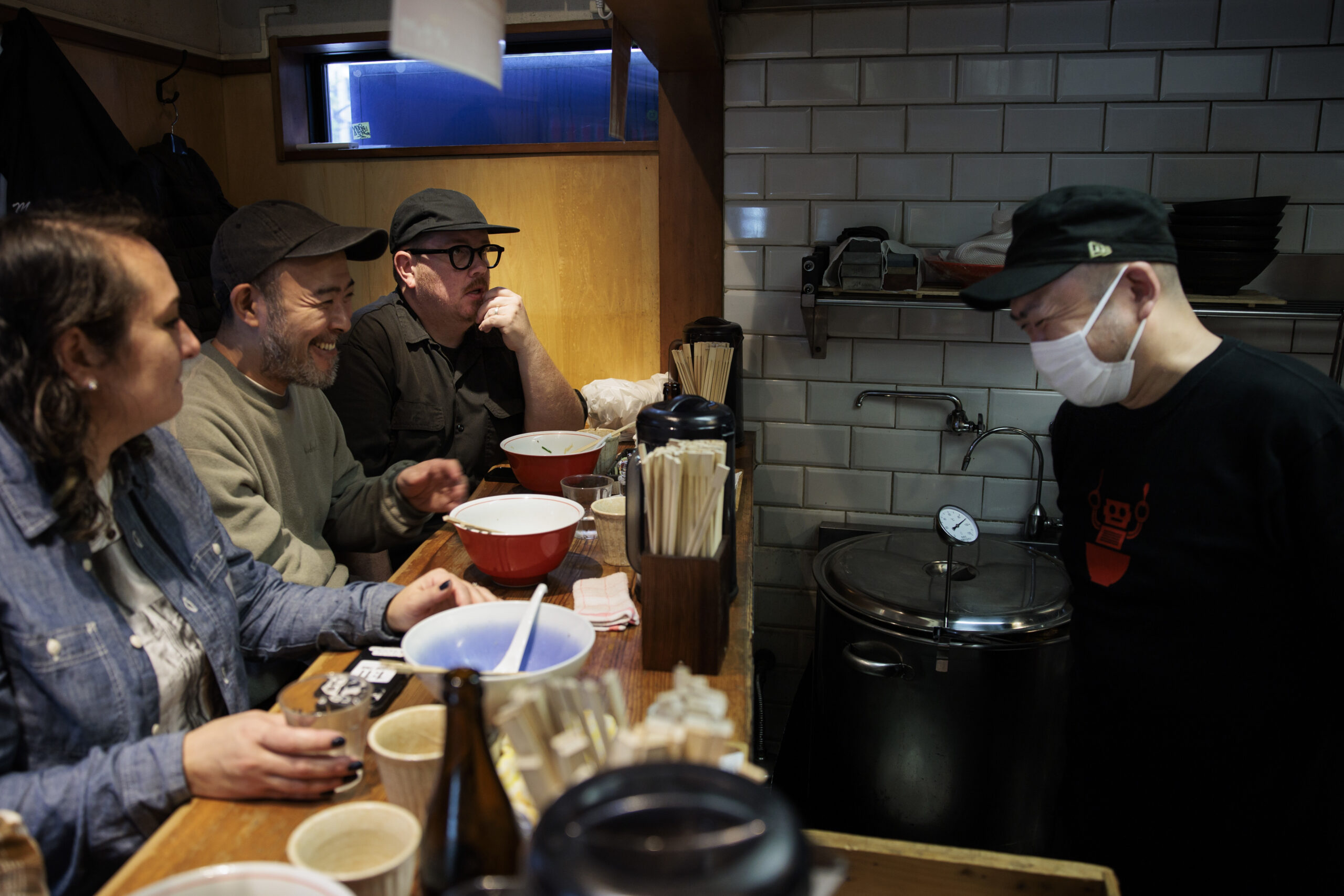
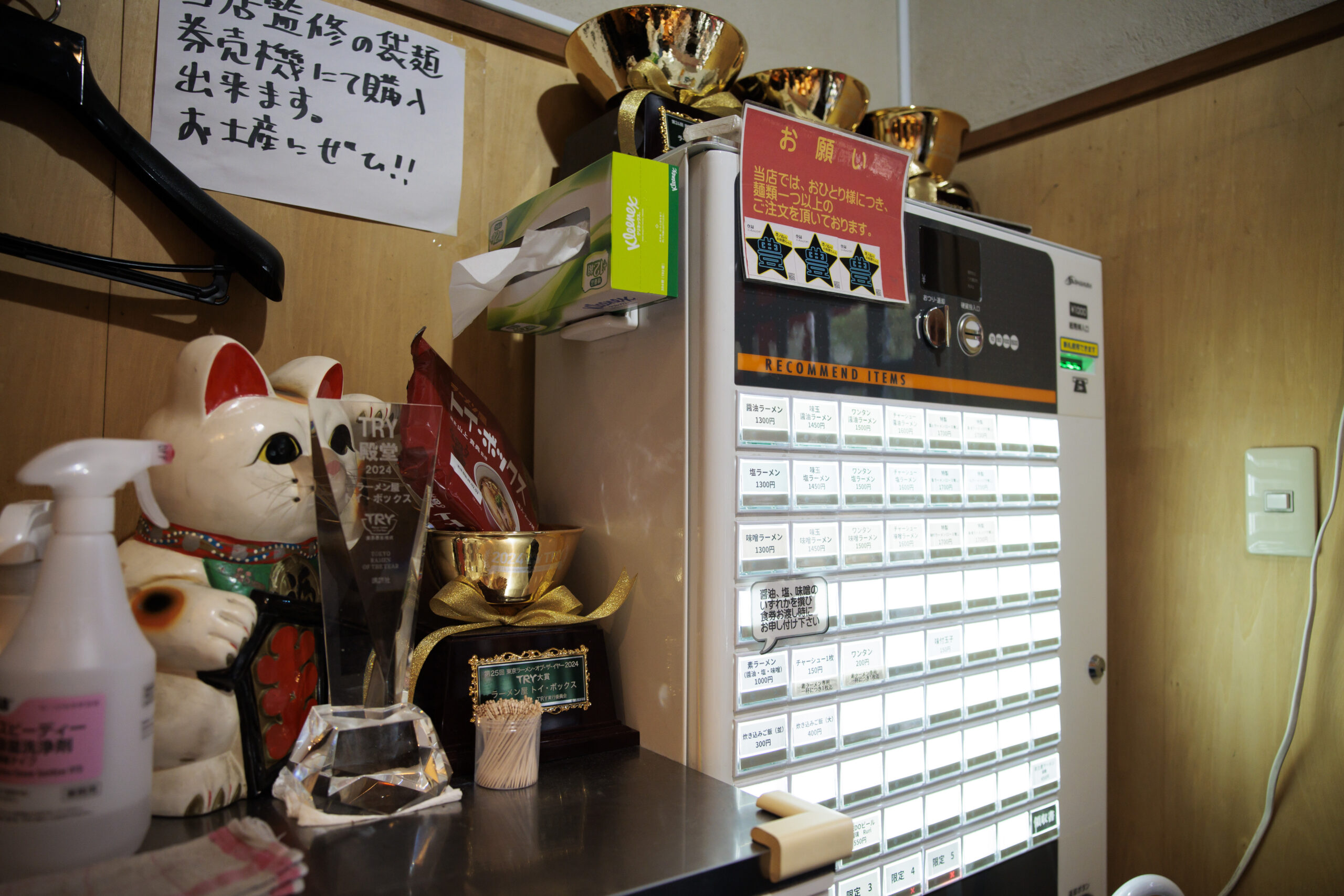
Lindsay Mariko Steigerwald (from left), Hiroshi Nukui, and Jesse Pryor laugh with chef and owner Takanori Yamagami during a meal at Ramenya Toy Box in November. “I think it’s a great thing,” Yamagami says of Steigerwald and Pryor’s move to Tokyo. “If their ramen is good, people will go.” A ticket vending machine is used to pay for ramen at Ramenya Toy Box. Gilded trophy versions of the shop’s bowls attest to its reputation as one of Tokyo’s best ramen destinations.
Yamagami has made his own name in this tiny space, where the counter wraps like an elbow around the open kitchen. Pristine renditions of three classic styles won him induction into the ramen hall of fame in 2024.
The small team worked silently alongside him, prepping the “tare” seasoning base while the chef drained baskets of noodles in both hands, shaking off cooking liquid with almost-musical syncopation. A flick of his chopsticks coaxed the noodles, placed in bowls, into a perfect comb-over wave, to be swiftly layered with two kinds of chashu (pork belly and loin), a perfect egg, a curl of bamboo shoot, and a final spoonful of rendered chicken fat that glinted like gold.
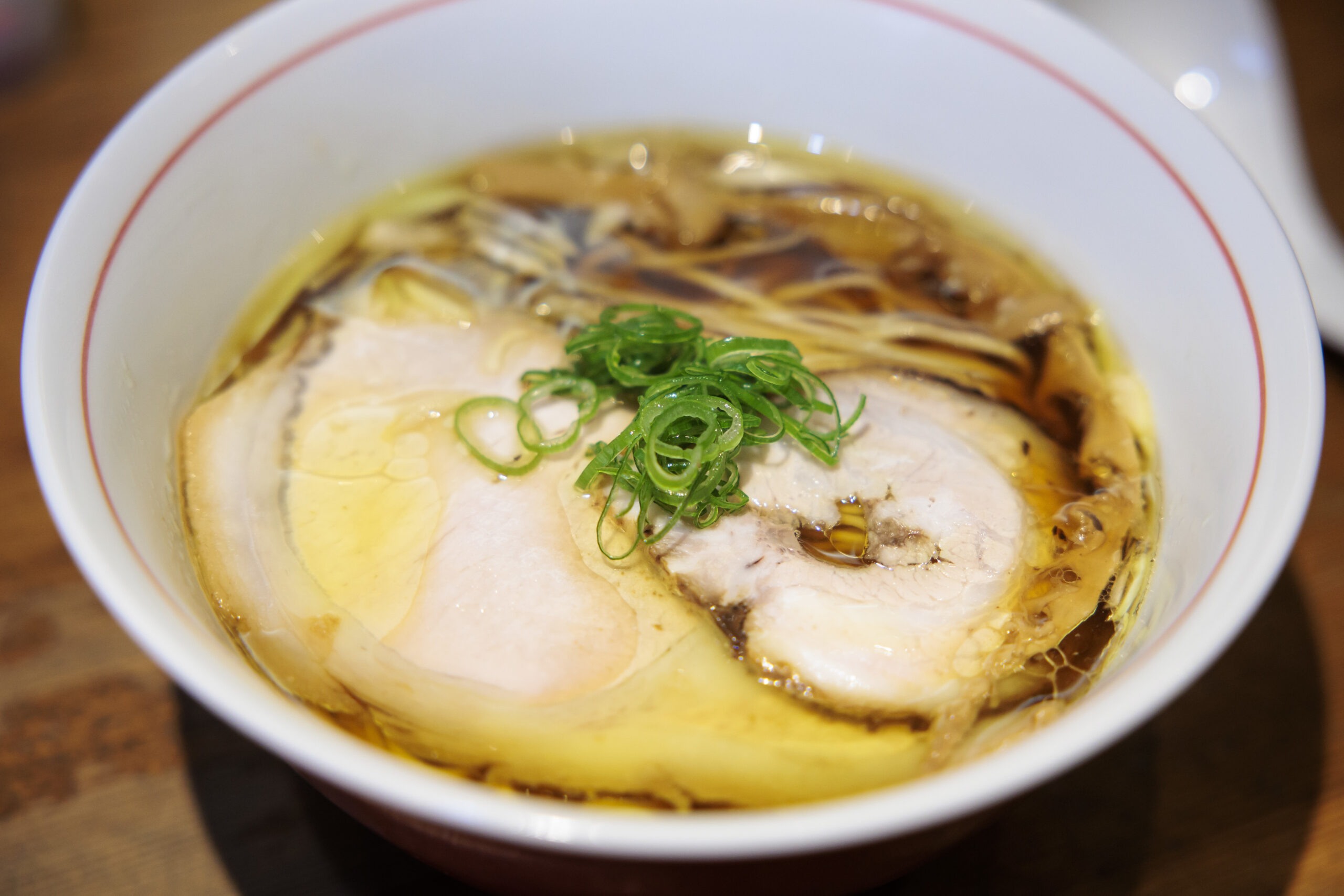
The intense broth of just chicken and water is the true source of Toy Box’s magic, drawn froma slow-cooking cauldron in back that appears to be more chopped-up bones than liquid. Three kinds of heritage chickens contribute different properties of richness, collagen, aroma, and flavor. In the bowl, the most straightforward shio ramen is seasoned only with salt, thinly shaved scallions, and a dusting of tart sudachi citrus zest; it’s one of the most vivid yet delicate distillations of chicken I’ve tasted.
Yamagami’s shoyu ramen — seasoned with six kinds of soy sauce, including several fermented in wood vats — begins with that same vivid chicken flavor, then blooms with earthy umami.
Shoyu ramen at Ramenya Toy Box.
I lean in, inhale, and — at last — execute a proper slurp, the firm, slippery noodles swiftly rising up past my lips with a velocity and snap that fans the flavor volume even higher. I can understand why Pryor, who usually visits new shops daily, has returned to Toy Box a dozen times.
The respect is clearly reciprocal. Yamagami is eager to see the Neighborhood Ramen couple plant their flag in Tokyo. And, as if to punctuate that thought, he reached over the counter and gifted Pryor one of the white bowls lined with sky blue that he uses for his signature shio ramen. It’s like watching a great athlete hand his jersey to a rising star.
“It’s inspiring for us, too,” Yamagami says of their arrival. “I think it’s a great thing. If their ramen is good, people will go.”
The gesture isn’t lost on Pryor or Steigerwald, who clearly cannot wait to begin sharing their own ramen talents with Tokyo. They sold their coveted ramen machine before leaving Philadelphia (to the forthcoming Tako Taco) and have plans to buy a new one here soon, so Pryor can get his hands back in the dough.
The couple intend to level up to the standards of their new noodle landscape. “We want it to be fun, welcoming, and chill — not intimidating,” says Steigerwald, who imagines a space with fewer than a dozen seats.
But so many hurdles remain, from visa bureaucracy to finding the perfect location. So they have stayed focused on what’s next: their first holidays in Tokyo, a trip to the ramen museum in Yokohama, and a big test at their Japanese language school.
They already have a post-exam celebration plan in place. Not surprisingly, said Steigerwald, it will involve “one monstrous bowl of ramen.”
Lindsay Mariko Steigerwald and Jesse Pryor, formerly the owners of Neighborhood Ramen in Philadelphia, lead the way on a ramen crawl across Tokyo, where they moved toward the end of 2025.
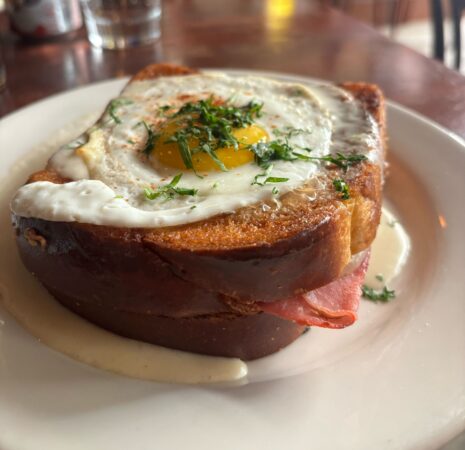
When the server at this long-running French brasserie in Washington Square West delivered my croque madame for lunch Thursday, I was taken aback by its size and beauty. If ever a sandwich deserved a place in the Louvre, this was it. The thick-sliced brioche bread was toasted golden and crispy, the Parisian jambon (ham) and cheese within were grilled to perfection, and a decadent béchamel sauce was drizzled over the bread and spooned in a perfect circle around the entire sandwich. A well-executed sunny-side up egg atop was sprinkled with paprika and julienned ribbons of fresh herbs.
Of course, once I dove into it, this croque madame went from beautiful to big ol’ mess very quickly — but it tasted delightful. Should I have eaten a salad for my first lunch out of the year? Perhaps. Do I have any regrets? None whatsoever. Not only was the food good, Caribou’s French-inspired decor always has a way of transporting me to Europe while still in Center City. Philadelphia. Caribou Cafe, 1126 Walnut St., 267-951-2190, cariboucafe.com
— Stephanie Farr
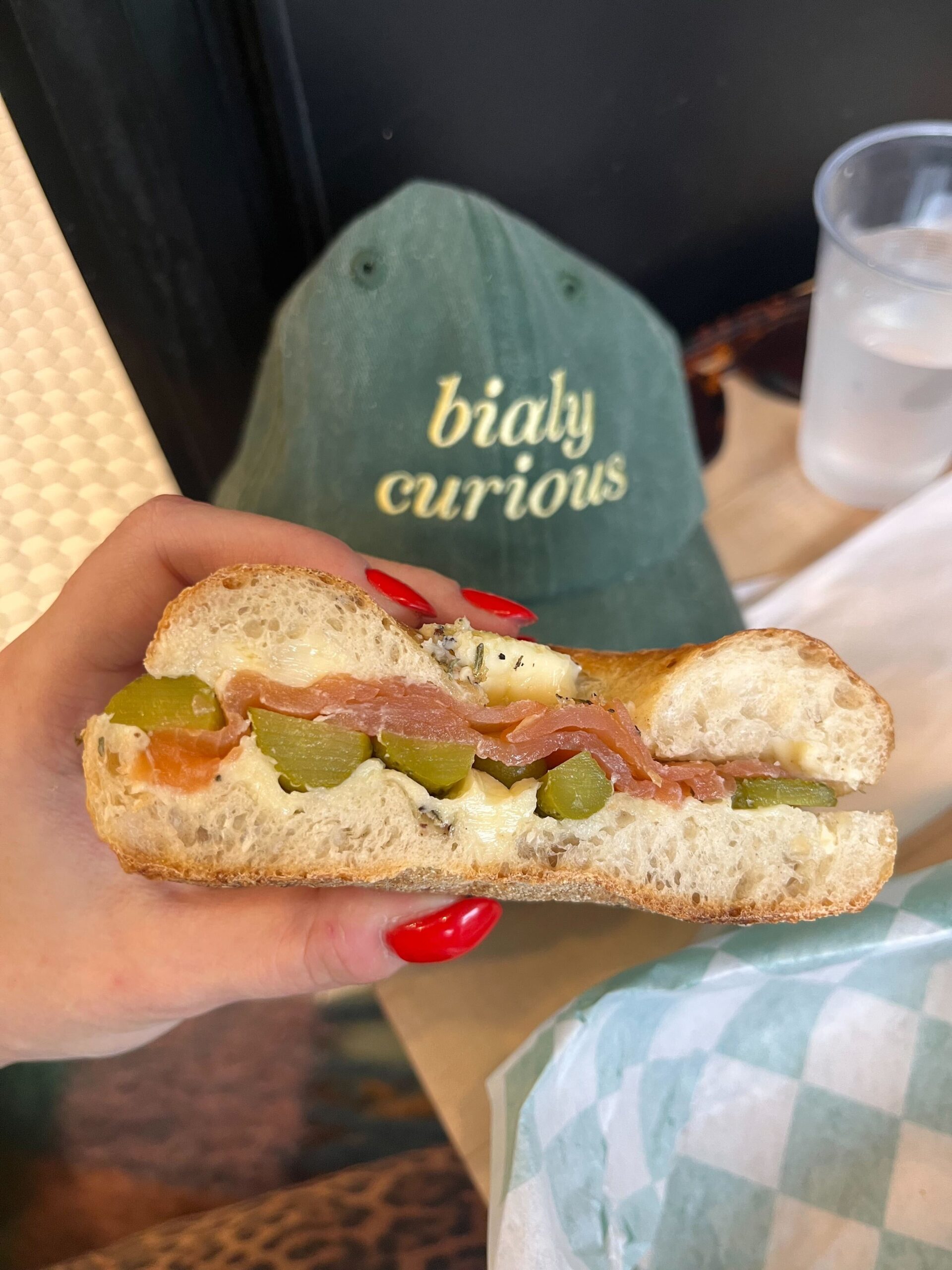
The salmon buerre bialy at Cleo Bagels.
Salmon beurre at Cleo Bagels
On a rainy day in West Philly, I found myself wanting to switch it up from a classic Nova lox sandwich — but not veer too far from it at the same time. The salmon beurre, a recurring special at Cleo Bagels, was the perfect fit. Served on a garlic za’atar bialy (one of my favorite bialys in the city), this lighter sandwich pairs a schmear of fancy cultured butter with lox and cornichon pickles. It’s a pleasant, balanced, and just-filling-enough bite I’m sure to repeat. Cleo Bagels, 5013 Baltimore Ave., 215-282-7292, cleobagels.com
— Emily Bloch
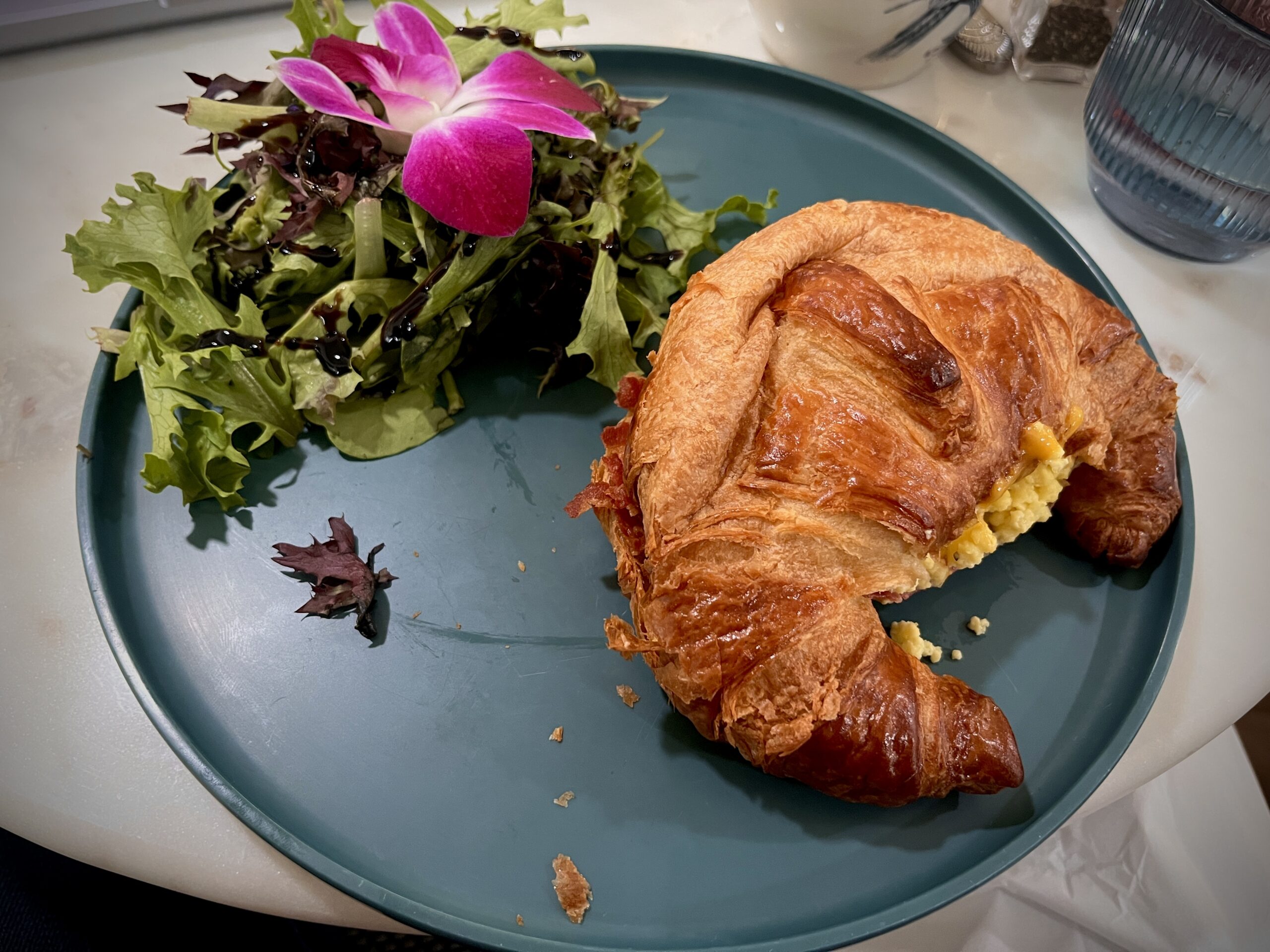
Matines Cafe’s default breakfast sandwich features scrambled eggs, bacon, and cheese tucked into a croissant.
Breakfast sandwich at Matines Cafe
The day after New Year’s was cold and gray, and the prospect of going back to the grindstone was a grim one, and the only sensible salve for that was a breakfast sandwich. (Judging by this week’s other Best Things entries, I wasn’t alone in that sentiment.) So I swung by Chestnut Hill’s Matines Cafe — now in a larger, new-ish space just off the main drag on Highland Avenue — and ordered their signature breakfast sandwich, which comes with scrambled eggs, bacon, and cheddar. And I chose to have it on a croissant instead of a baguette for all of the aforementioned reasons, not to mention Matines’ owners are French and know their way around viennoiserie.
Split just enough to tuck in a sizable scoop of fluffy scrambled eggs, crispy strips of bacon, and a scant layer of cheddar, the croissant sandwich scratched my itch for something savory and slightly decadent — and managed to do that without flaking or falling apart. Paired with a big mug of black coffee and its accompanying tuft of balsamic-dressed side salad, it got the first workday of the year off to a very satisfying start. I’ll be more than happy to return to try one of Matines’ other breakfast-sandwich varieties, including avocado with turkey and Swiss, salmon with brie, and black truffle-parmesan-prosciutto. Matines Cafe, 23 W. Highland Ave., 215-621-6667, matinescafe.com
Saban Kar walked into Falafel Time on South Street on a quiet Thursday afternoon with one mission: to try the restaurant’s exclusive crispy chicken shawarma wrap.
The West Philly resident had been searching for the crunchy, saucy shawarma sandwich of his native Antakya, Turkey, in the City of Brotherly Love. But it wasn’t until he came across a TikTok videothat he found a local restaurant serving this beloved handheld classic.
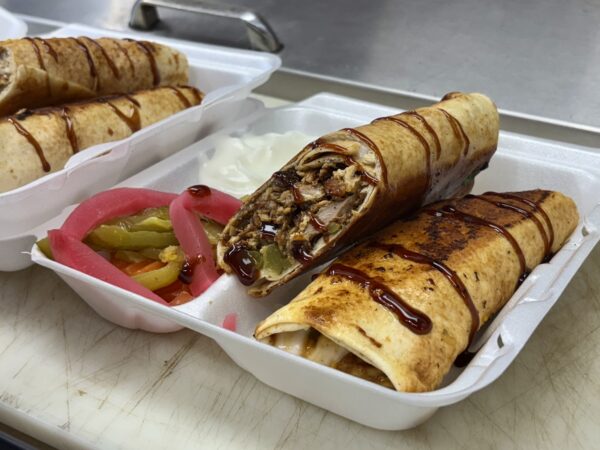
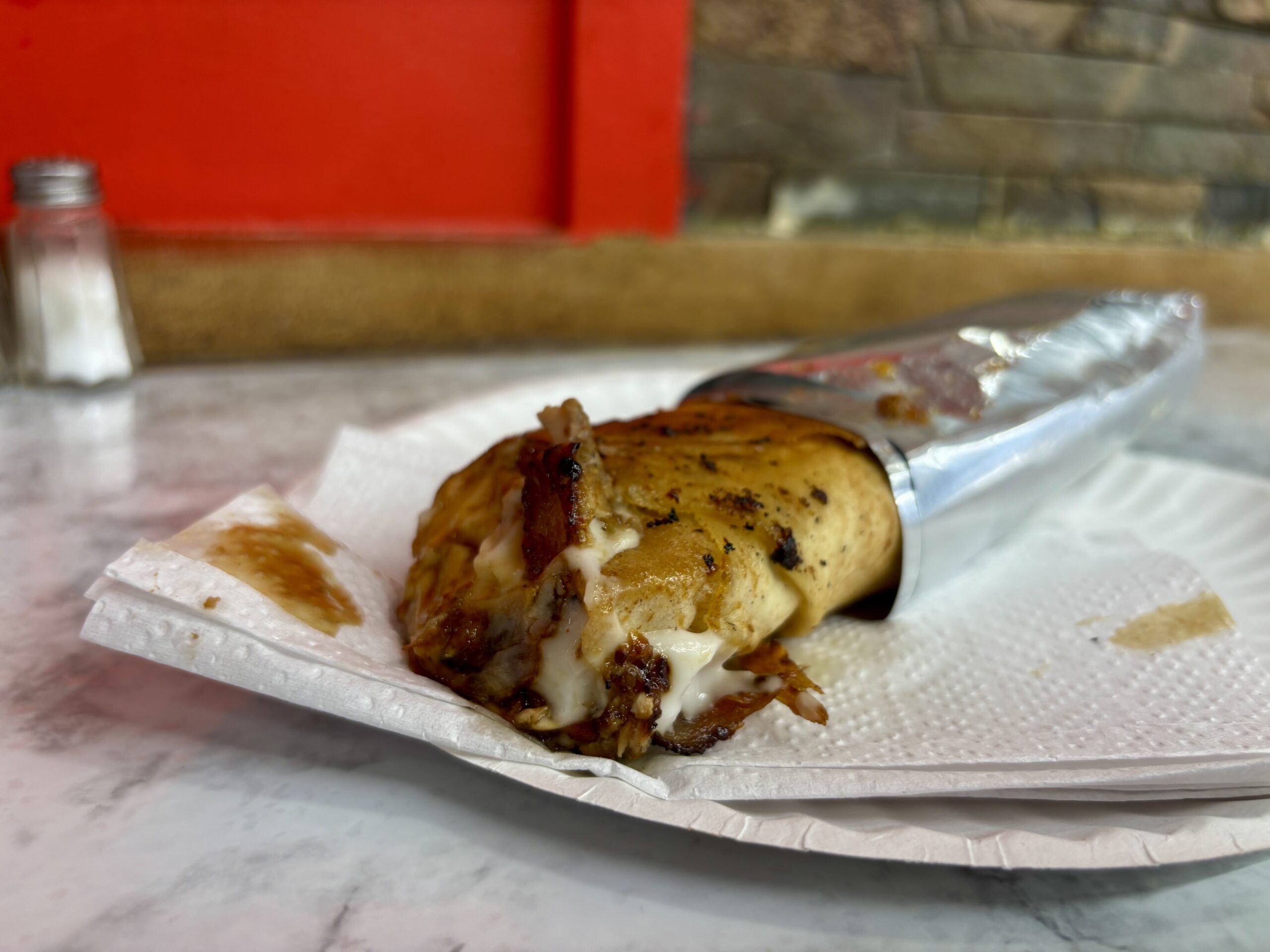
Thecracklyshawarma wrap is having a moment on the internet’s virality machine. In video after video, TikTok influencers and internet chefs across the country and in the Philly-area hold blistered rolled sandwiches stuffed with chicken pieces, thin pickle slices, and garlic sauce close to the camera, scraping and biting into toasted wraps for ASMR sounds.
After ordering two sandwiches, Kar explains the wrap style is popular because the added crispiness of the bread brings out the juices of the meat within the sandwich. “There’s not a lot of places in Philly who even warm up their breads for sandwiches,” he said. “[Toasting] just makes the bread taste better.”
At Falafel Time, it’s chef Sam Maymouna’s special sauce made of oil, shawarma spices, garlic, and lemon juice that brings forth the flavor.
He starts by tearing open a pita at the seams in a circular motion, then stacking the two halves on top of each other. The chef then adds a splatter of house-made garlic sauce, a heap of pickles, chicken shawarma freshly sliced off a rotating spit, and a heavy drizzle of a sweet-tart pomegranate balsamic.
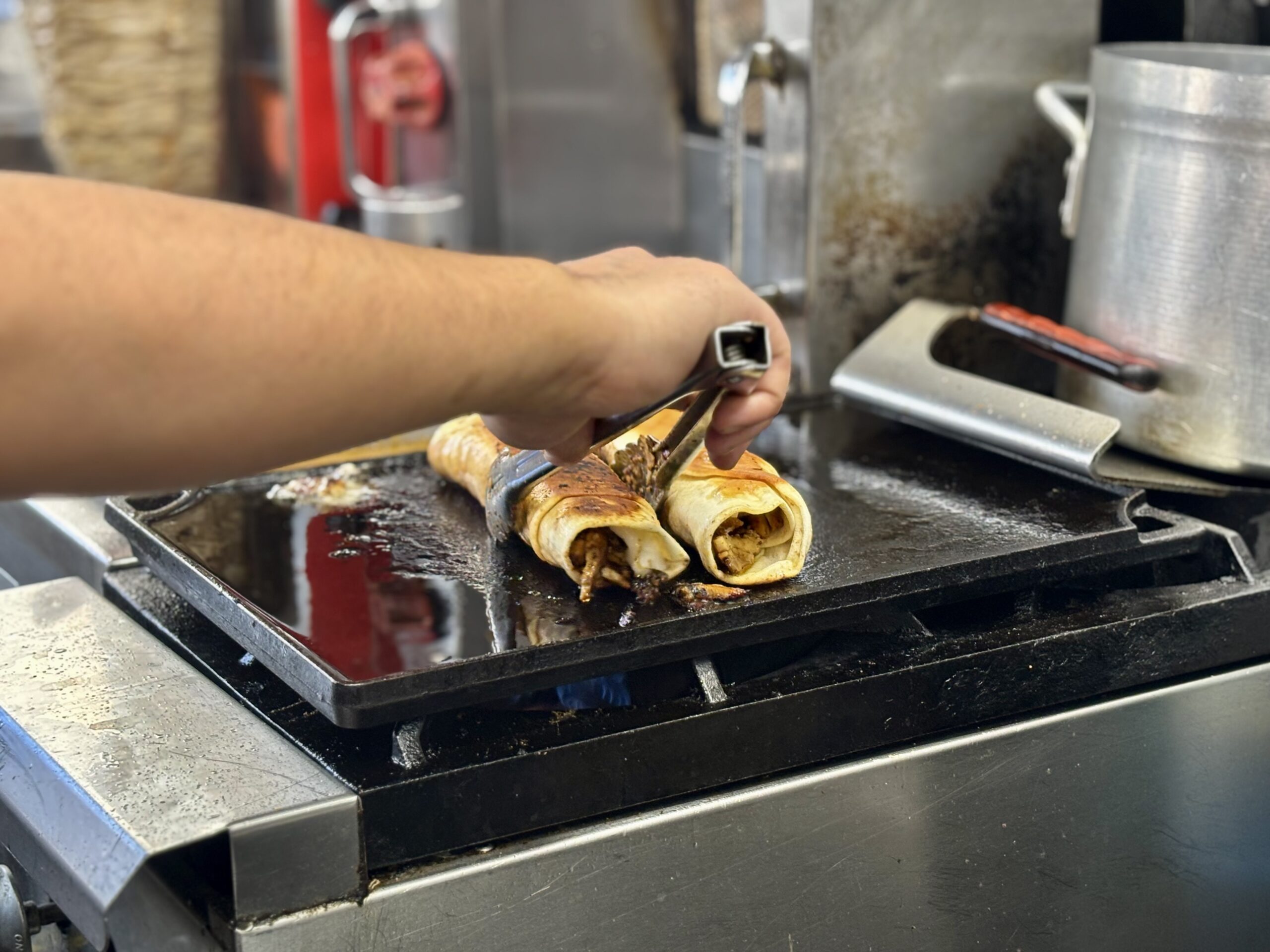
Maymouna rolls all the fillingsintoa long, skinny baton and dips itin the special sauce. The wrap sizzles on the grill until golden brown and crackly.
Chef Sam Maymouna grills a chicken shawarma wrap at Falafel Time.
The viral sandwich isn’t new to the Syrian restaurant. In fact, the wrap has been on a “secret menu,” as Maymouna calls it, at the Graduate Hospital takeout shop since its inception in 2019. Customers in the know — typically Philadelphians from Syria and other Arab countries — seek out Syrian-style shawarma sandwich with a thinner saj bread or a pita in the now-viral crispy style.
“Arabs order [from] it because they know the Syrian way,” Maymouna said. “But now, [the crispy shawarma] got popular because of the viral videos.”
While the TikTok videos haven’t increased sales of the wrap by much yet, the online chatter is leading more Philadelphians to the South Street restaurant — Maymouna estimates he’s selling an additional 10 a day.
The crispy chicken shawarma wrap at Falafel Time.
Sitting at the counter, Kar took a big bite of the crunchy wrap as he waited for a second order he ordered to-go for his wife. “It is great, but it’s not similar to the ones back in Turkey — for us, there’s more of a red, tomato-like sauce.”
But for the West Philadelphian, it was still exciting to finally find a restaurant in Philly offering a similar sandwich, if not a replica of the one at home. “I’ll give them a seven out of 10‚” he said. “I’m happy I’m going to take one home.”
Dry January is here, and Philly bars are serving inventive alcohol-free drinks. But that’s not all: Bartenders are also offering interactive classes and bottle shops are expanding their inventory of nonalcoholic spirits.
We’ve complied all the tips and tricks you need navigate the month — and beyond — alcohol-free in Philadelphia.
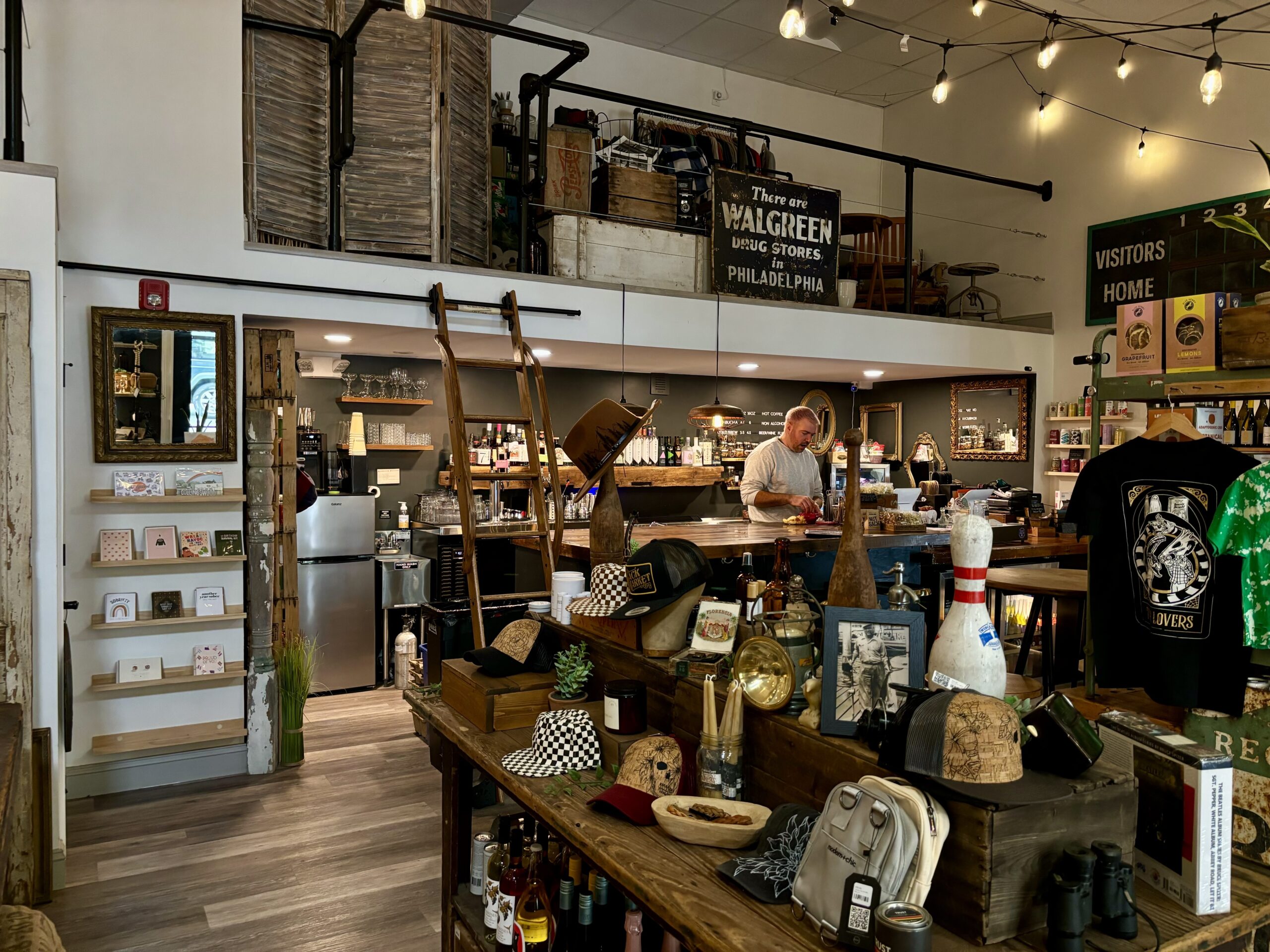
Mercantile 1888 is a vintage store and nonalcoholic bar in Collingswood.
Where to drink for Dry January
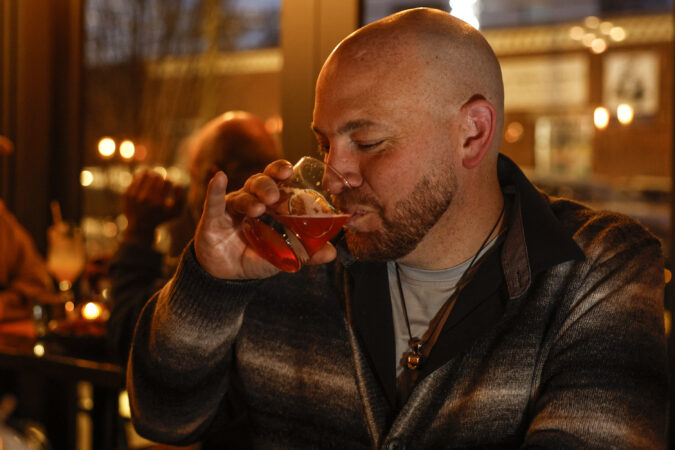
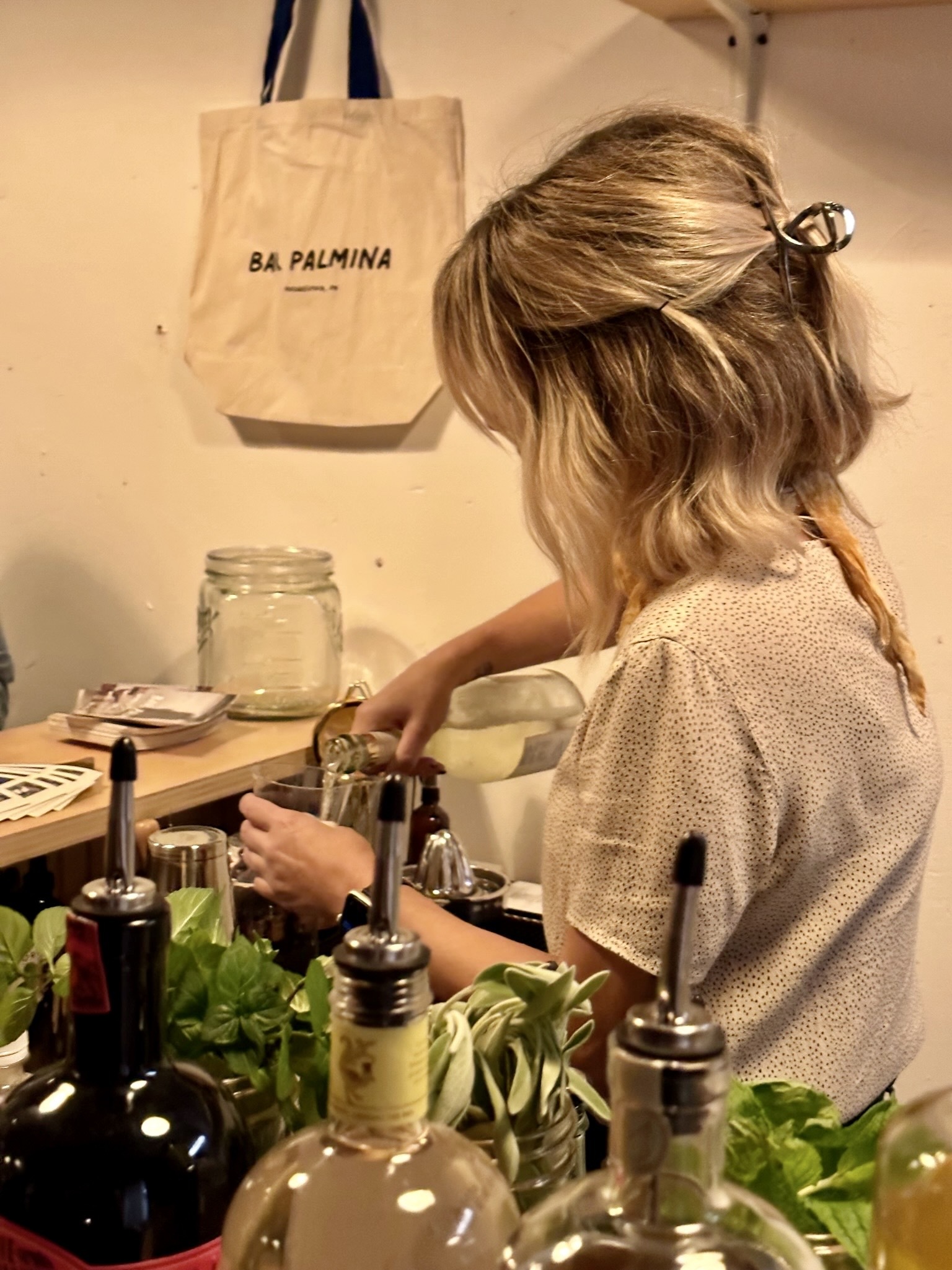
Start your Dry January journey at Bar Palmina in Fishtown, where Nikki Graziano, a “former heavy drinker,” serves creative zero-proof craft cocktails featuring brands like Monday and Lyre’s.
Over in Collingswood, Mercantile 1888 offers pomegranate margaritas with Ritual tequila, Monday mezcal palomas, and Seedlip botanical cocktails.
Other options include:
Grace and Proper (South Philly): $7 zero-proof cocktails during happy hour (Wednesdays and Thursdays, 4 to 6 p.m.).
Mia Ragazza (Manayunk): Booze-free tiramisu espresso martinis made with Seedlip Spice.
Bar Hygge (Fairmount): Sparkling nonalcoholic wines.
Evil Genius Beer Co.: Nonalcoholic golden ales from Athletic Brewing Co.
Dry Vibes, a touring sober festival, makes a stop in Philly this January.
Best Dry January events
There are plenty of events in honor of Dry January, too.
Jan. 14: Jesse Andreozzi, known as @mr.zeroproof, will share his expertise in zero-proof cocktail-making at Bar Hygge at 6:30 p.m. Tickets include cheese and charcuterie, a live demonstration from Mr. ZeroProof, and three nonalcoholic cocktails.
Jan. 15: Bar Palmina teams up with Heart to Heart Herbology, Three Wild Spirits, and Home Brewed Events for a Dry January class. Learn about the history of herbs and botanicals, along with its uses in beer brewing, distilling, and cocktails. Tickets, which can be purchased online, include a nonalcoholic cocktail featuring botanicals created in collaboration Bar Palmina.
Jan. 31: Dry Vibes Philly Festival at Billy Penn Studios (11 a.m. to 5 p.m.), featuring a vendor marketplace, wellness services, and celebrity meet and greets, including skateboarder Brandon Novak and author Arlan Hamilton. Tickets can be purchased online.
Gem Life + Bar in Pitman offers over 250 nonalcoholic products.
Where to find zero-proof spirits
The options for alcohol-free spirits in Philadelphia are vast, with plenty of stores and shops selling an expansive selection of alcohol-free spirits for you to try at home.
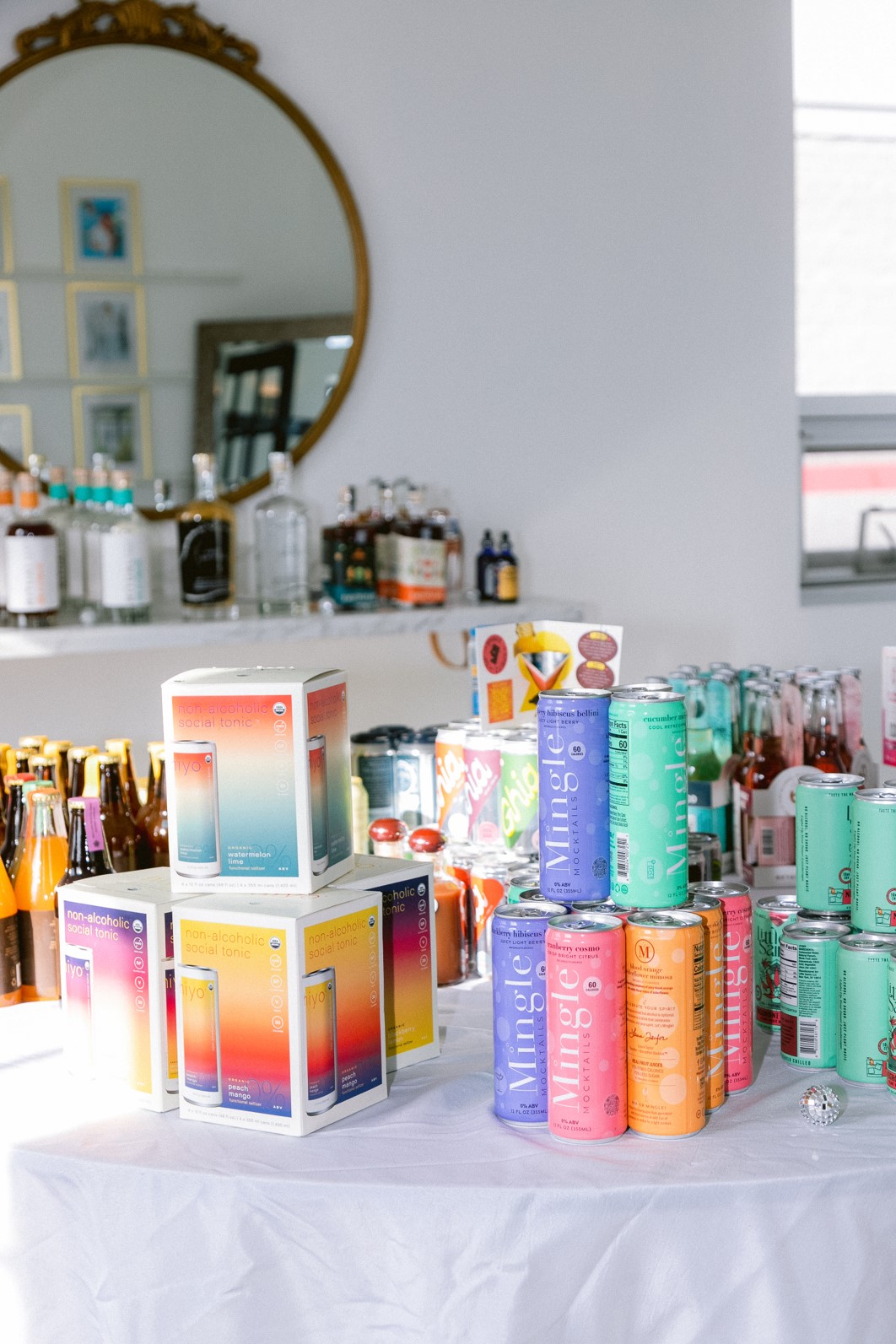
At Cork in Rittenhouse, brands like Spiritless tequila, Lyre’s Aperitif Rosso vermouth, canned Ghia aperitifs, and others are priced up to $48. Herman’s Coffee, the South Philly cafe known for espresso tonics and food pop-ups, offers a selection of over 200 nonalcoholic wines, spirits, and beers. And Riverwards Produce in Old City and Fishtown are stocked with nonalcoholic spirits, along with a variety of ingredients for cocktail making.
Whether you’re seeking a zero-proof wine, beer, or spirit, there’s something for every palate — explore more options in the Inquirer guide.
Best zero-proof spirits
But with such a wide selection of nonalcoholic spirits, where do you begin?
Buyer Michelle Flisek asks visitors walking into Cork one key question to help guide them in the right direction: What flavor profiles are you looking to enjoy? With over 100 varieties of nonalcoholic items in the store, starting with flavor is a good way to determine what brands and cocktail accessories will work for you.
Each brand has distinct flavor profiles and ingredients. Brands like Ritual Zero Proof and Monday use botanical ingredients like Mexican blue agave and coriander seed extract to mimic the flavor profiles of mezcal, gin, and other traditional spirits. Wines like Prima Pavé create grape beverages through dealcoholization, a process that begins with the traditional fermentation process, but includes the additional step of removing alcohol from the final product.
Remember the key to working with these nonalcoholic products is experimentation, according to Kasey Ehrgott of Manayunk’s now-closed alcohol-free bar the Volstead by Unity. Ehrgott recommends Ritual products, All The Bitter zero-proof bitters (created by botanical extraction with vegetable glycerin), and Pathfinder, a hemp-based drink with dark botanical notes of angelica root, saffron, and wormwood.
“It’s important to remember it’s not going to be identical — you might like something you didn’t expect to,” she said.
Kristian Fidrych, beverage manager at Ember & Ash, creating a Tomato Collins, made with zero-proof gin, zero-proof bitter aperitif, smoke tomato shrub, lemon, and club soda, in 2021.
Are there health benefits to Dry January?
Reducing alcohol consumption, even temporarily, can offer meaningful health benefits, according to experts. Henry Kranzler, director of the Center for Studies of Addiction at the University of Pennsylvania’s Perelman School of Medicine, previously emphasized to The Inquirer that “alcohol is not good for you, by and large,” highlighting the potential risks associated with drinking.
In a recent report, U.S. Surgeon General Vivek Murthy outlined a direct link between alcohol consumption and an increased likelihood of developing cancer. The Surgeon General’s Advisory on Alcohol and Cancer Risk stated “alcohol consumption is the third leading preventable cause of cancer in the United States, after tobacco and obesity, increasing risk for at least seven types of cancer” with about 100,000 alcohol-related cancer cases and about 20,000 alcohol-related cancer deaths annually.
Nikki Graziano runs Bar Palmina.
How to keep your Dry January resolution
With the city’s ever-growing sober-curious scene, Philadelphians are able to prioritize an alcohol-free lifestyle, even during the holidays. But sustaining mindful drinking beyond Dry January can be a challenge for some.
Understanding what leads you to drink is the first step, according to Amanda E. White, the founder of Therapy for Women Center and author of Not Drinking Tonight.
White and other experts say changing your mindset and having more options can help you stay booze-free year-round.
“Sometimes people go back to drinking without even realizing why they started again,” White told The Inquirer. “This is likely because they are not familiar with their triggers or reasons that they drink — maybe it’s feeling awkward at a party or a warm day that makes you crave a margarita.
“Learn your triggers and come up with a plan for how you will combat them.”
Frosted vegan pop-tarts, swirls of dairy-free soft serve, and meatless bacon-egg-and-cheese croissants have officially arrived in East Falls.
Crust Vegan Bakery opened Thursday at the intersection of Ridge and Midvale Avenues, just off Kelly Drive. The move from its two-space operation in Manayunk to a larger location enabled the confectionery to consolidate its retail storefront and commercial kitchen, said owner Meagan Benz.
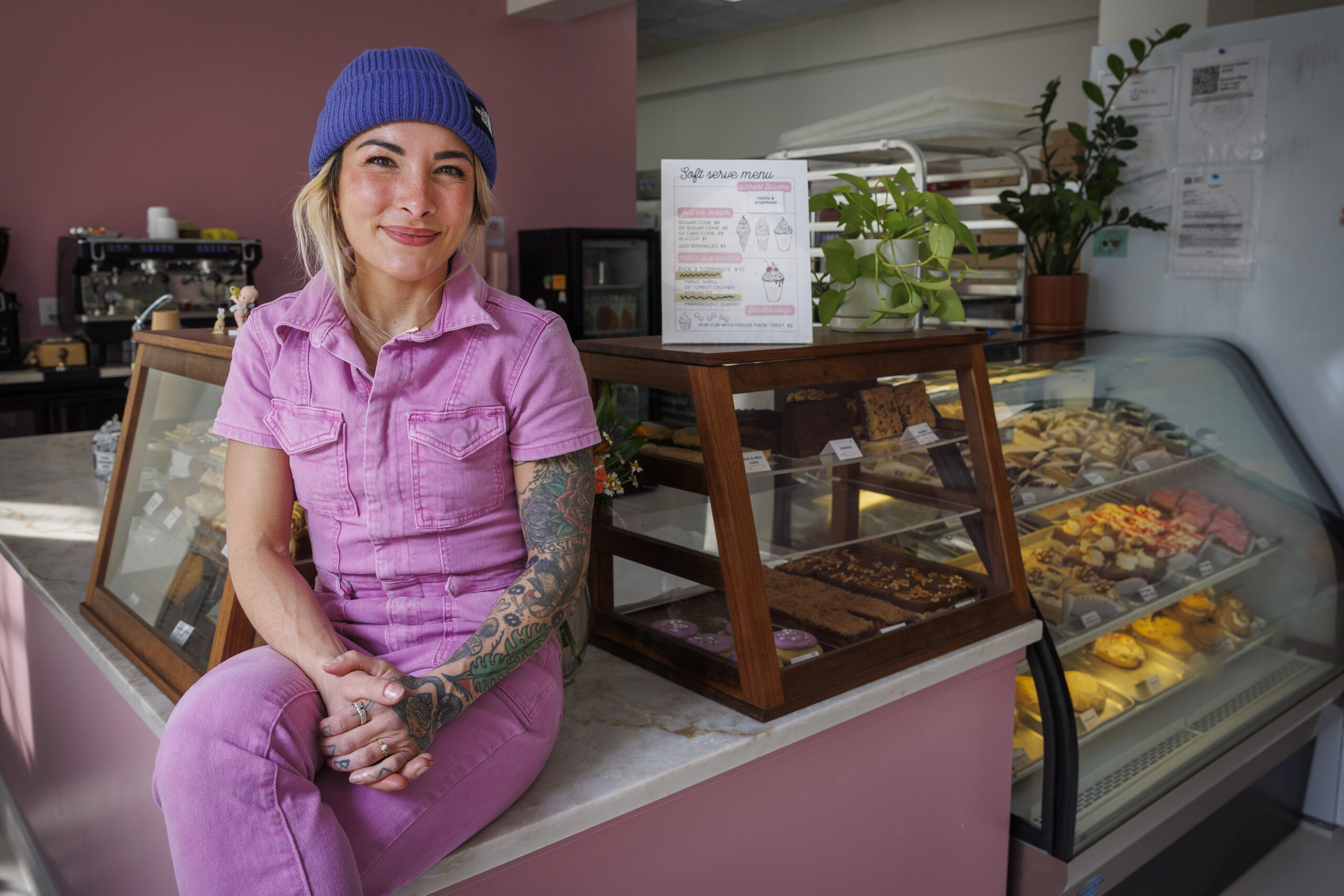
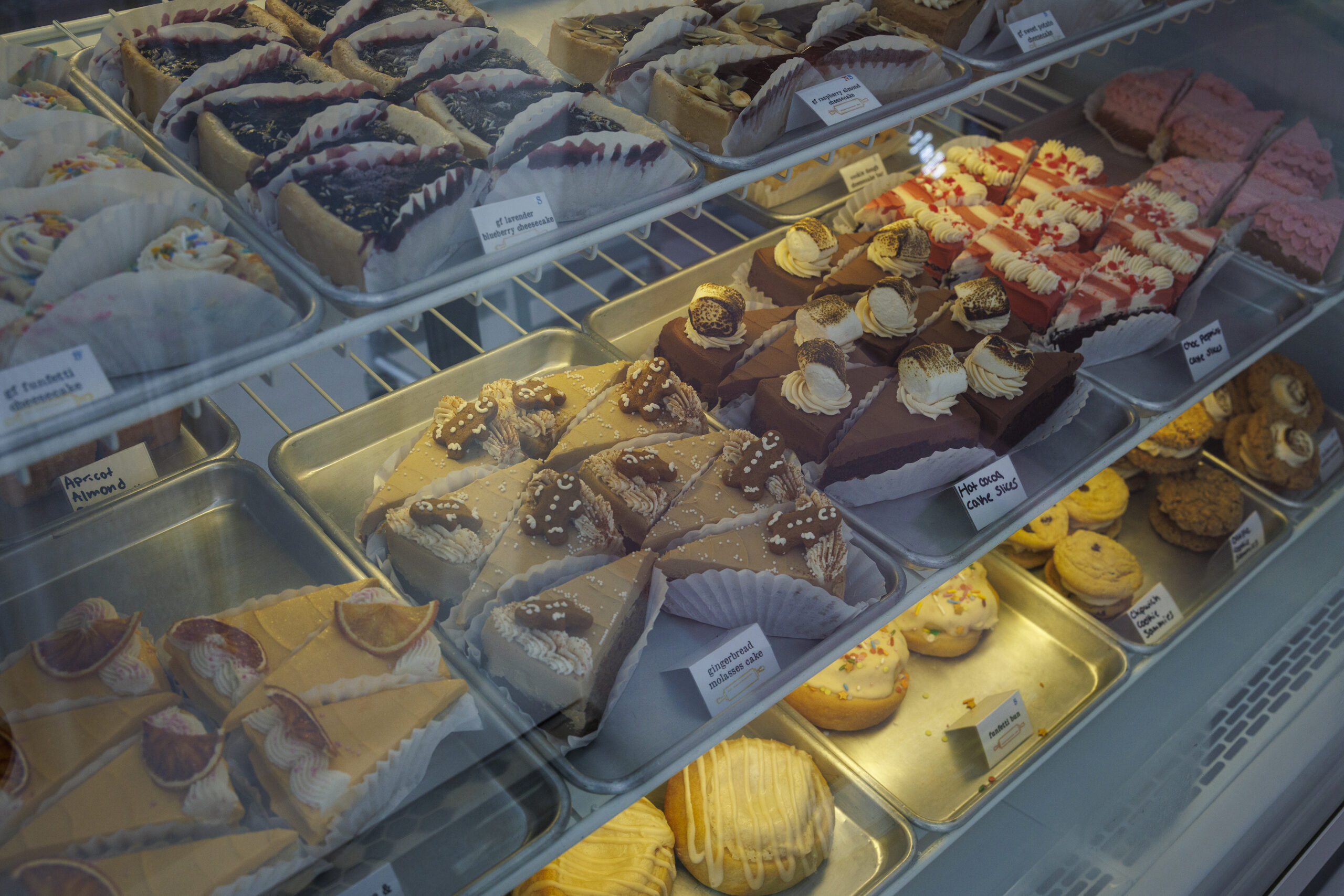
Benz spent more than nine months transforming a 3,000-square-foot office along the Schuylkill River into what she called a “cakelike retail space” with baby-pink walls piped with white paint and ceiling tiles modeled after Lambeth-style cake trims. Light from oversized front-facing windows dapple a trio of pastry cases filled with batches of all-vegan sweets, from cheesecake slices and cinnamon buns to black-and-white cookies and crumb-coated coffee cakes. Baristas-slash-bakers pull espresso shots and whisk matcha for lattes sweetened with house-made syrups.
“I wanted to create a place where people think, ‘Oh, I can get everything I need there,’” Benz said.
Crust Vegan Bakery owner Meagan Benz with a display case of treats on opening day Jan. 8 at the bakery’s new location at 4200 Ridge Ave. in East Falls. Crust moved there from Manayunk.
Benz, who went vegan in 2009 while a freshman at University of North Carolina Greensboro, launched Crust in 2015 as a wholesale vegan bakery out of a commissary kitchen at 220 Krams Ave. in Manayunk. When custom cake and wholesale orders dried up almost overnight in 2020, she and then-co-owner Shannon Rocheopenedtheir storefront at4409 Main St.as a way to keep on staff they would’ve otherwise had to lay off during the pandemic, a move Benz said ended up making Crust profitable enough to bring on more employees.
“Retail is where we make more money,” said Benz, 35.
Now, the business has outgrown the satellite storefront that saved it.
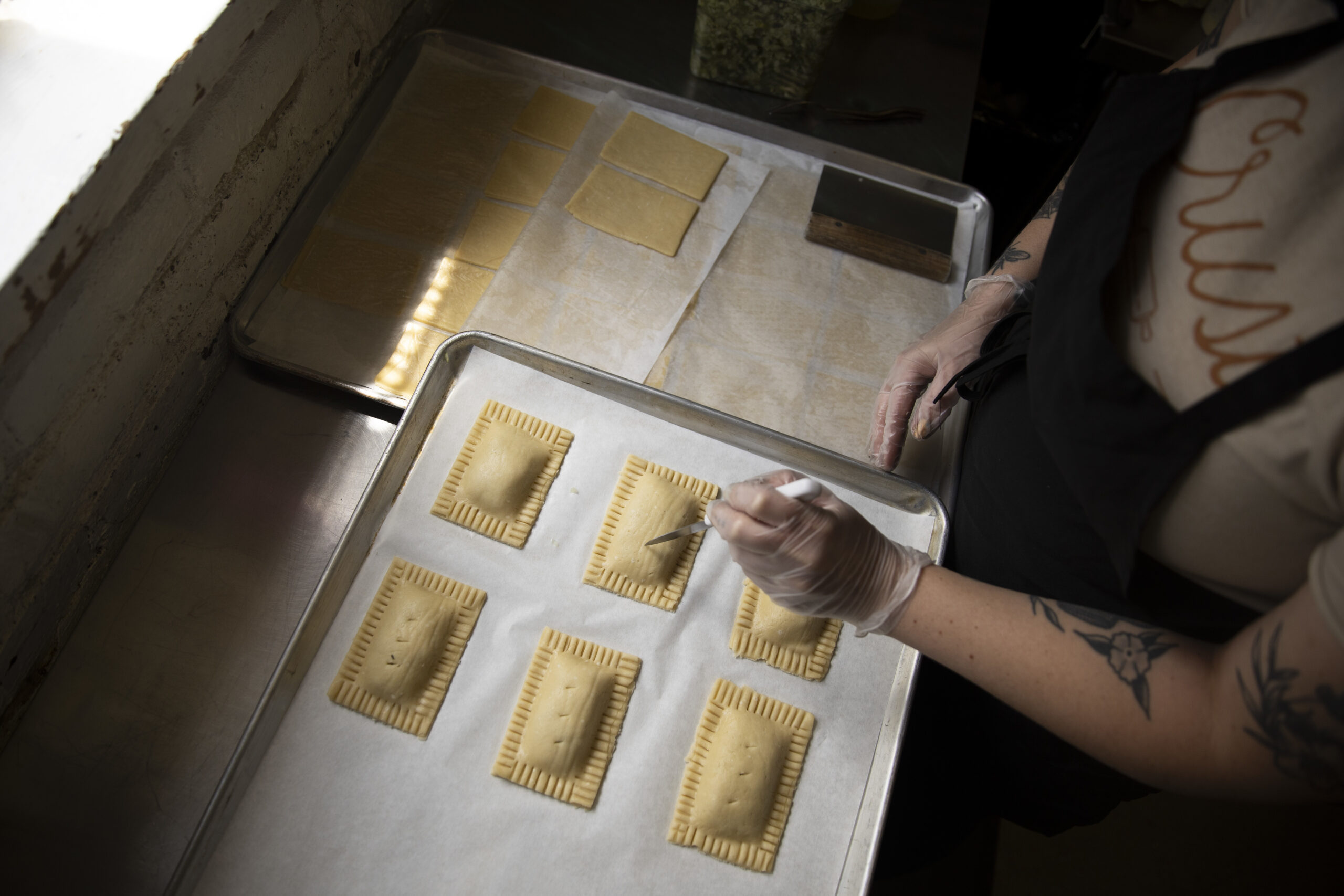
Jordan Fuchs prepares pop-tarts at Crust Vegan Bakery’s former commercial kitchen space on Krams Avenue.
Splitting time and staff between the retail space and commercial kitchen proved logistically challenging. Benz said Crust’s storefront manager wound up spending most of her time ferrying pastries between locations, a half-mile journey that led to lots of wasted product.
“It was a really short distance, but people drive crazy — someone slams on the brakes in front of us and we’re done for,” Benz said. “We had many times where things would tip over and we’d have to determine if it was still usable.”
At Crust’s new location, a sparse yet cozy cafe area with two tables and a large, lived-in green couch bleeds into the kitchen, where staff pivot from packaging cakes and swirling soft-serve cones to frosting pop-tarts. The streamlined setup has allowed Benz to dream big. Already on her wish list for the future: a separate convection oven for made-to-order breakfast sandwiches, a back room for cake-decorating classes, and more room for colorful displays.
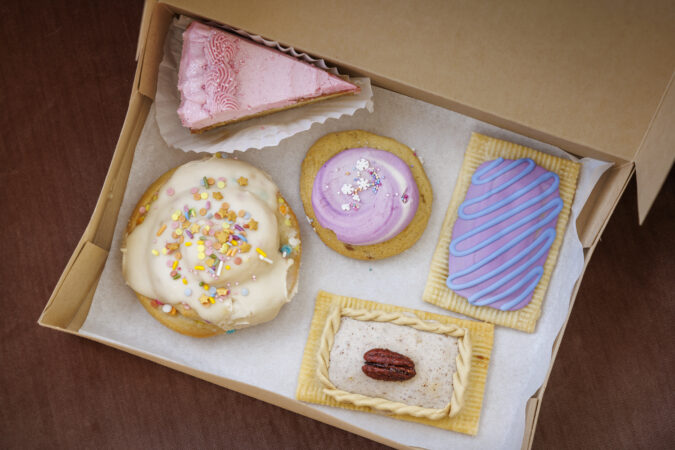
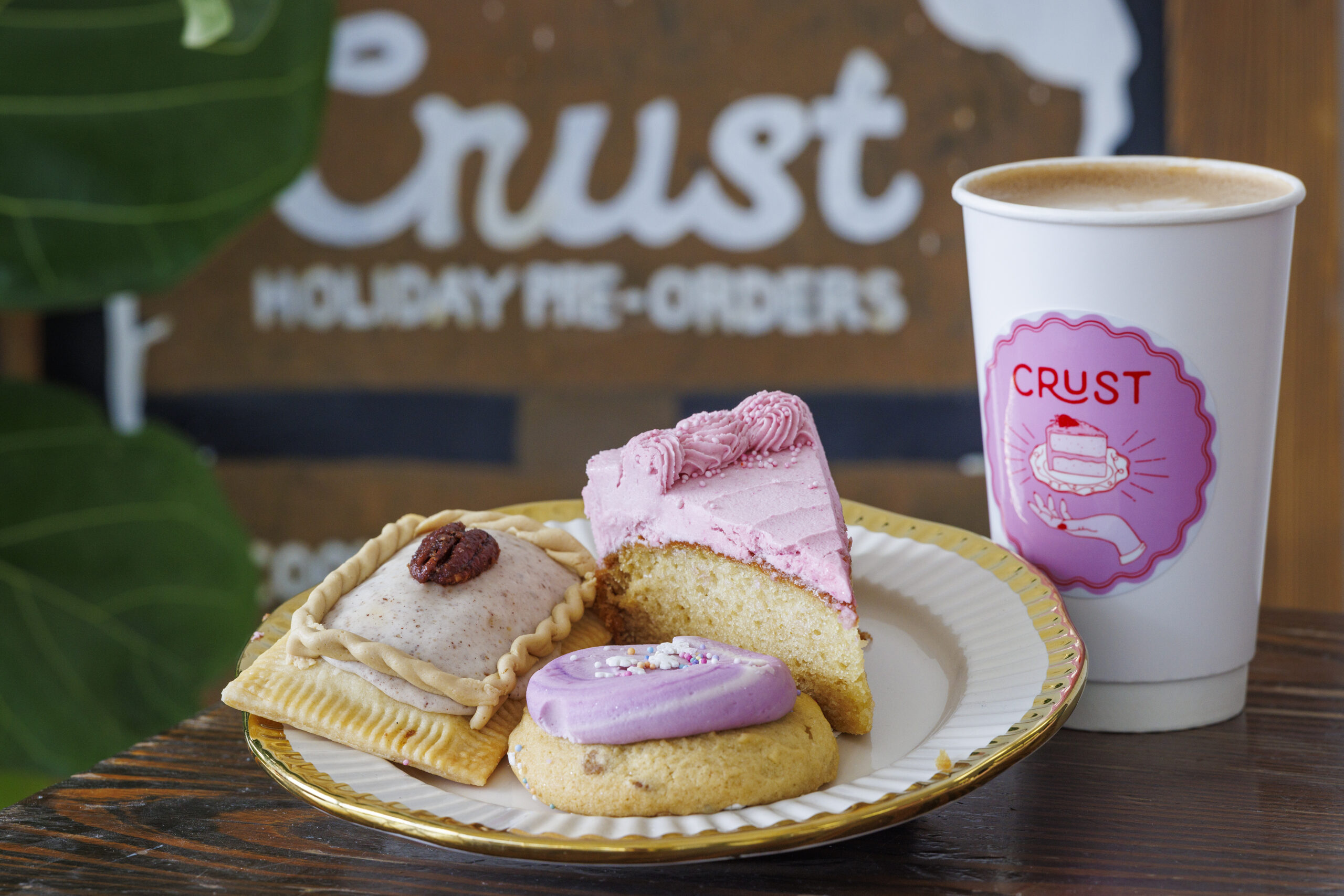
A brown sugar pecan pie pop-tart, soft frosted cookie, and vanilla strawberry cake from Crust Vegan Bakery are plated next to a hot latte. Beverages are new to the bakery.
Benz spent two years looking for the right location, unwilling to compromise on a short list of non-negotiables. Most of the bakery’s 15-member team live in Northwest Philly, she said, so the new space needed to remain in the area while being more transit-accessible.
Crust’s new location sits at the convergence of five bus lines. It also will leave Manayunk without a pastry specialist when Crust’s former commercial-kitchen neighbor Flakely decamps for Bryn Mawr in February.
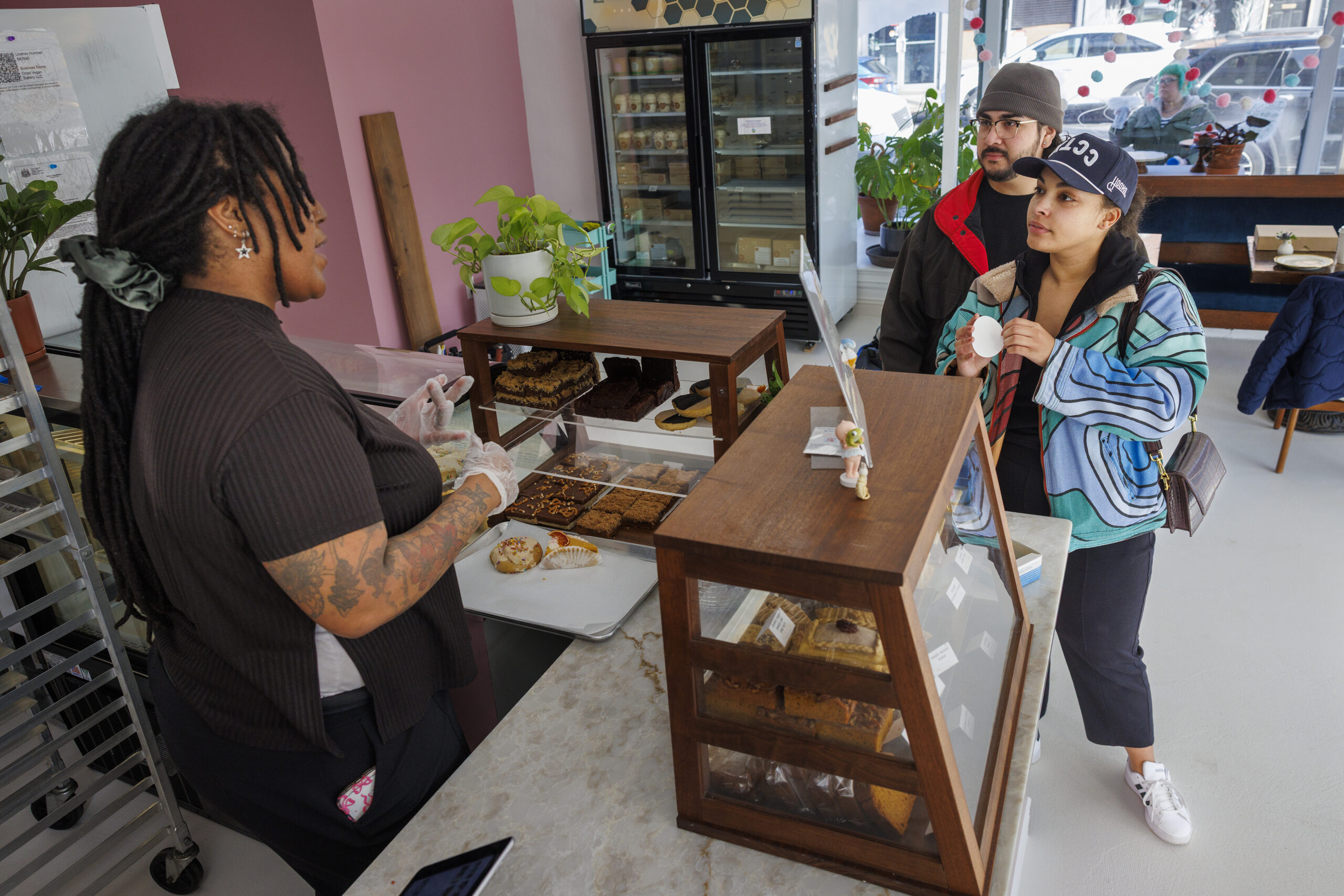
Taleema Ruffin takes an order from Chase Sanders and Ryan Martinez-Peña, of East Falls, at the counter of Crust Vegan Bakery’s new location at 4200 Ridge Ave. on opening day, Jan. 8, 2026.
Crust’s move also marks the launch of its first-ever coffee program, headed by cake decorator-turned-beverage coordinator Jordan Fuchs.
The bakery will serve a short but sweet menu of coffee and tea drinks, with beans and matcha sourced from Rise Up Coffee, a fair-trade roaster based in Maryland. Crust makes its own vanilla and mocha coffee syrups, and Fuchs has plans for a rotating menu of seasonal additions. The signature drink will be a black sesame latte, Fuchs said, and she’s currently perfecting a chocolate-covered strawberry latte in time for Valentine’s Day.
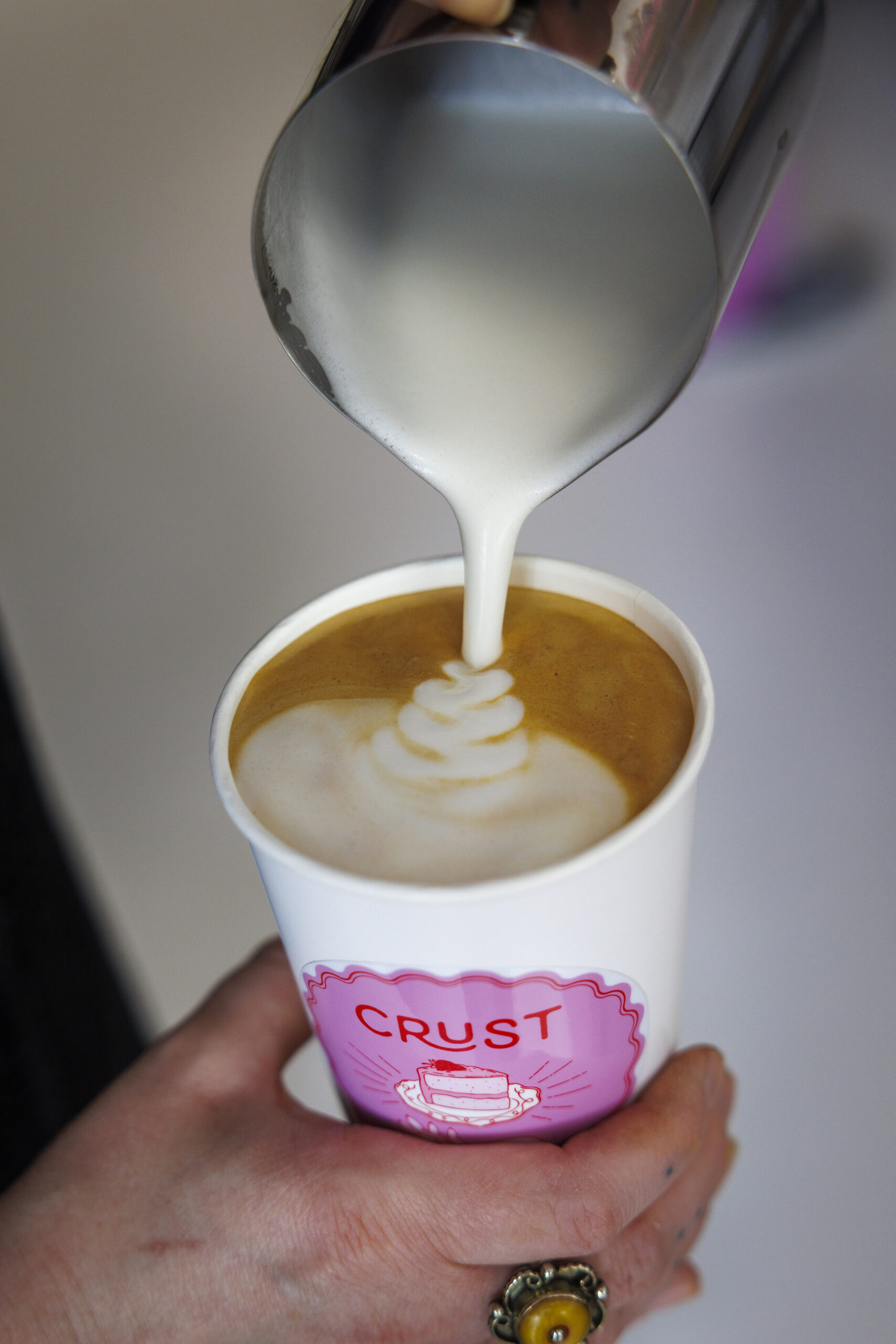
Jordan Fuchs pours a rosetta on top of a hot soy latte inside Crust Vegan Bakery. Its new retail space in East Falls has enabled the bakery to start a beverage program.
Crust will also continue selling two things Benz said many of her vegan customers desperately miss from their dairy-consuming days: soft-serve ice cream and hulking breakfast sandwiches.
Benz’s breakfast sandwiches are served on flaky vegan croissants or thick biscuits, both made in-house, with Just Egg patties and seitan bacon that crisps up like the real thing.
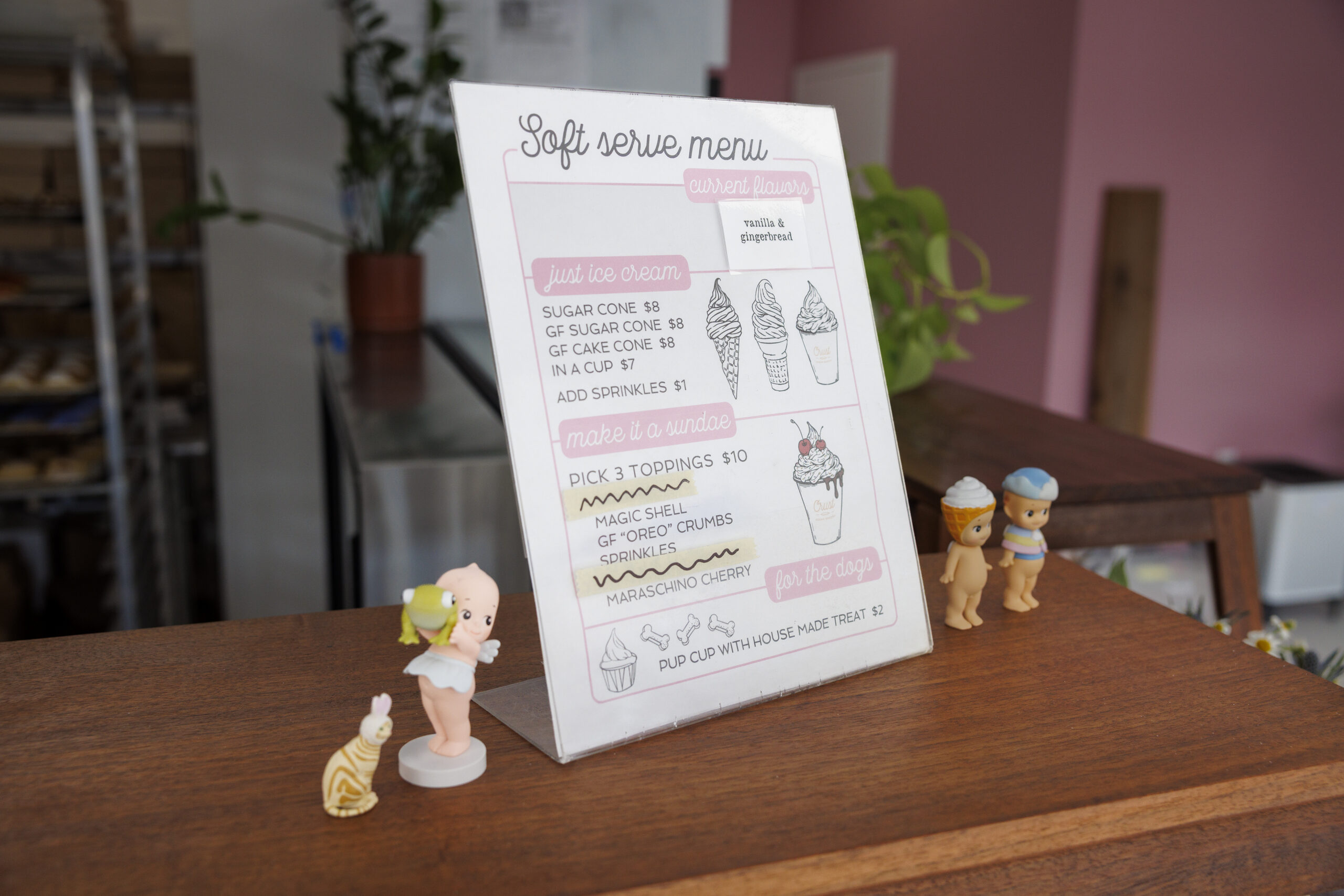
The bakery started offering nondairy soft serve year-round in 2023, Benz said, as a way to satiate her own craving. Crust uses a vanilla base made with pea protein and then adds mix-ins for flavors that rotate every two weeks. The ice cream is silky, and curls out of the machine with the flourish of a Dairy Queen swirl. It’s sweet, but doesn’t quite capture the essence of its full-dairy counterpart; Benz said that’s the point.
“If our ice cream doesn’t exactly taste like dairy ice cream, that’s OK,” she said. “I just want it to taste really good.”
Crust Vegan Bakery’s dairy-free soft serve menu, which is offered year round and includes toppings.
Pastries are still the main event at Crust’s new location. The bakery’s staff make roughly 22 dozen pop-tarts a week, with some bakers spending a full eight-hour shift solely on rolling out dough, preparing fillings, and sealing the edges for baking. To make the process smoother, Benz made a custom crimping tool that creates cartoonishly perfect hash marks. Her favorite flavor is the wild berry, a dead ringer for the purple-frosted Kellogg’s version.
Also on offer: slices of sweet potato, Oreo, blueberry lavender, and funfetti cheesecakes (gluten-free and vegan) that take up a pastry case’s entire top shelf. The secret to Benz’s recipe is Tofutti cream cheese, which is versatile enough to be customizable and easily whipped into a dairy-accurate texture.
“I make a lot of things because I want them, I miss them,” Benz said. “Then I hope other people do, too.”
A display case of vegan cheesecake, cake slices, and cinnamon buns inside Crust Vegan Bakery’s new location at 4200 Ridge Ave. in East Falls.
Crust Vegan Bakery, 4200 Ridge Ave., Philadelphia, 215-298-9969. Hours: 10 a.m. to 6 p.m. Wednesday and Thursday, 8 a.m. to 8 p.m. Friday and Saturday, 8 a.m. to 6 p.m. Sunday.