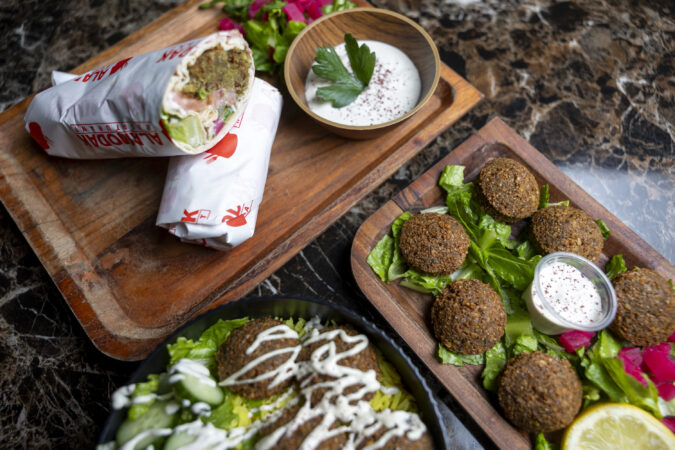
Eating at over 20 Middle Eastern restaurants as a scout for The Inquirer’s 76 list may seem like a daunting task (and in some ways it was). But when your search includes eating falafel over six weeks, the quest becomes a delightful lesson in texture and taste.
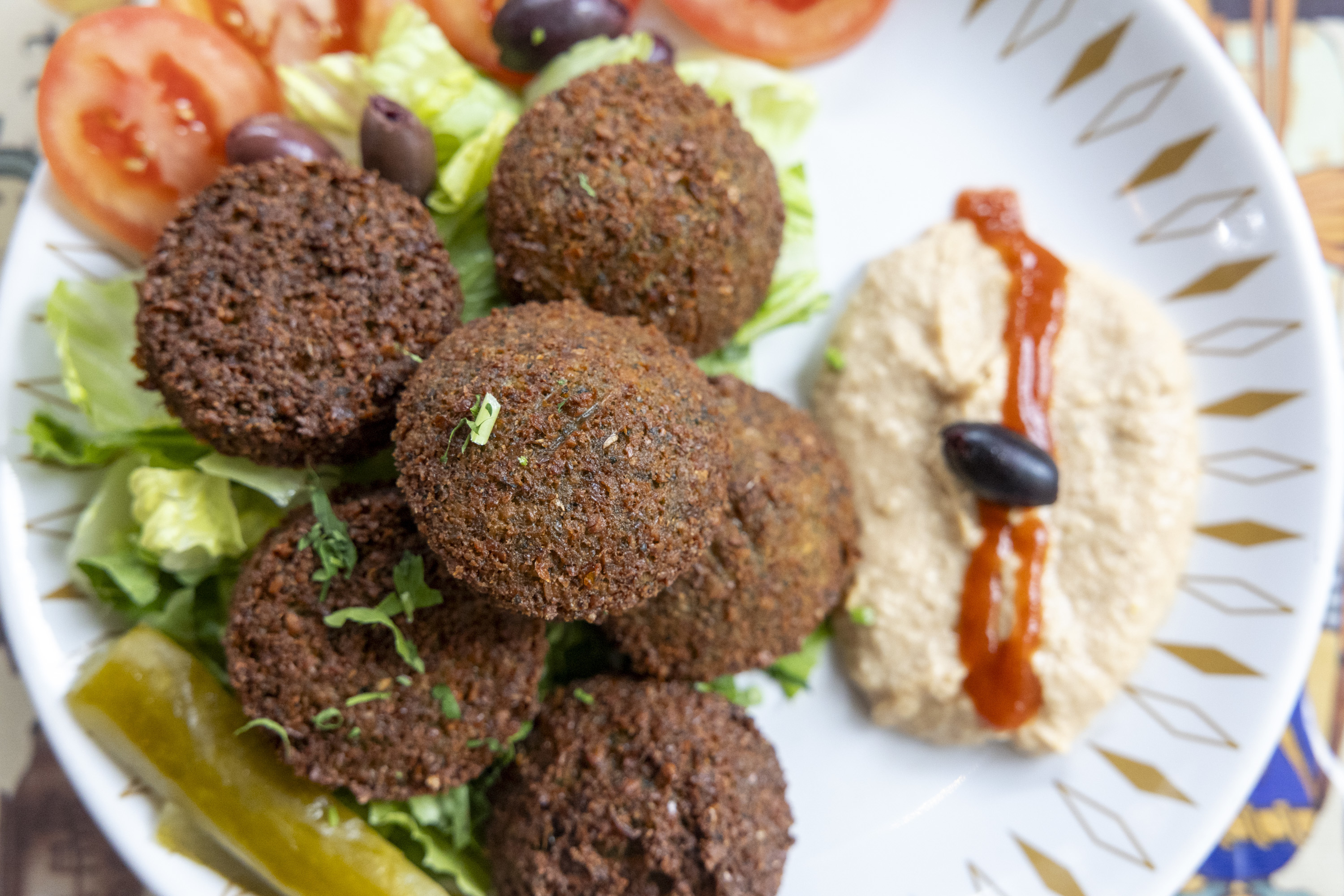
My beat included Lebanese, Yemeni, Afghan, Palestinian, Jordanian, Turkish, Egyptian, Syrian, and Moroccan restaurants, which meant I became a falafel obsessive, tasting over two dozen falafels. At every restaurant I went to I would ask my dining companions to evaluate the dish. And I would ask:
Could I feel the crispiness of the exterior by tapping on it? Was there a soft, herb-hued mush inside when I tore it in half? Did the earthy, nutty flavors of warming spices like cumin, coriander come through with each bite?
No matter how it’s made — legumes soaked overnight, blended (with spices, herbs, and sometimes flour), and fried — falafel is about the herbs, spices, and legumes that come together to make the palm-sized rounds that are perfect on platters, in a sandwich, or as a snack by themselves.
While falafel originates from Egypt, there are various techniques used throughout the Middle East to create this popular dish. Growing up with many Arab friends, I knew falafel looked and tasted a bit different depending on the chef’s country of origin — after all, Middle Eastern cuisine is not a monolith.
What was fascinating to learn were the specific differences in technique and ingredients within Philly restaurants. Palestinian falafel, like those served at Al-Baik Shawarma, tend to have bronze exteriors with slightly spicy, earthy, light-green interiors. Egyptian falafels use fava bean and chickpea mixes fried to perfection for the most satisfying crunch at Cilantro near South Street. Fluffy Lebanese falafels are made gluten-free and with baking soda in Collingswood at Li Beirut.
My journey revealed the rich tapestry of falafels that make up this city. After a summer of munching, Cilantro, Al-Baik, and Apricot Stone falafels live rent-free in my head.
But most importantly, these palm-sized legume balls were a clear reflection of just how expansive and diverse the Middle Eastern dining landscape is in Philadelphia. One that only takes sinking your teeth into super-satisfying falafels to experience.
Philadelphia lawmakers on Thursday approved two changes to city law that are aimed at boosting business for restaurants and the hospitality sector ahead of an expected influx of tourists visiting the city next year.
Legislators also voted to ban so-called reservation scalpers, which are third-party businesses that allow people to secure tables and then resell them without authorization from the restaurant.
Both measures passed Council unanimously and were championed by advocates for the restaurant industry, who lobbied lawmakers to ease burdens on the tourism and hospitality industry ahead of several large-scale events in the city next year, including celebrations for America’s Semiquincentennial, when Philadelphia is expected to host a flurry of visitors.
They both now head to the desk of Mayor Cherelle L. Parker, who has never issued a veto.
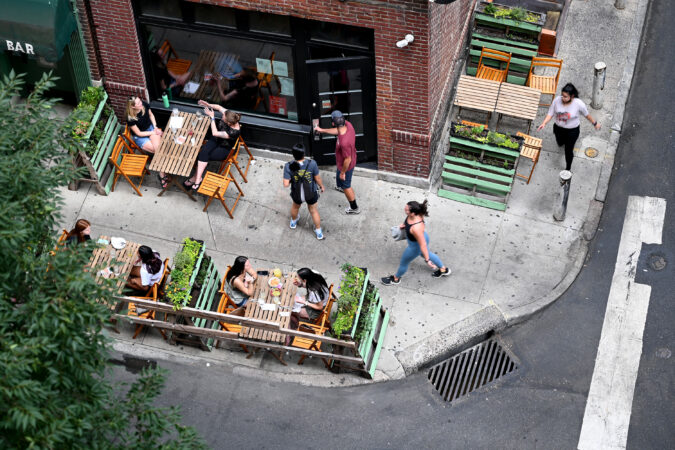
The outdoor dining legislation, authored by Councilmember Rue Landau, a Democrat who represents the city at-large, expands the number of so-called by-right zones, where businesses can have sidewalk cafes without having to obtain a special zoning ordinance.
Currently, by-right areas are only in Center City and a few commercial corridors in other neighborhoods. Restaurants outside those areas must undertake a sometimes lengthy process to get permission to place tables and chairs outside.
The expanded zones, which were chosen by individual Council members who represent the city’s 10 geographic districts, include corridors in Manayunk and on parts of Washington Avenue, Passyunk Avenue, and Point Breeze Avenue in South Philadelphia.
The legislation also includes all of the West Philadelphia-based Third District, which is represented by Jamie Gauthier, the only Council member who chose to include her entire district in the expansion.
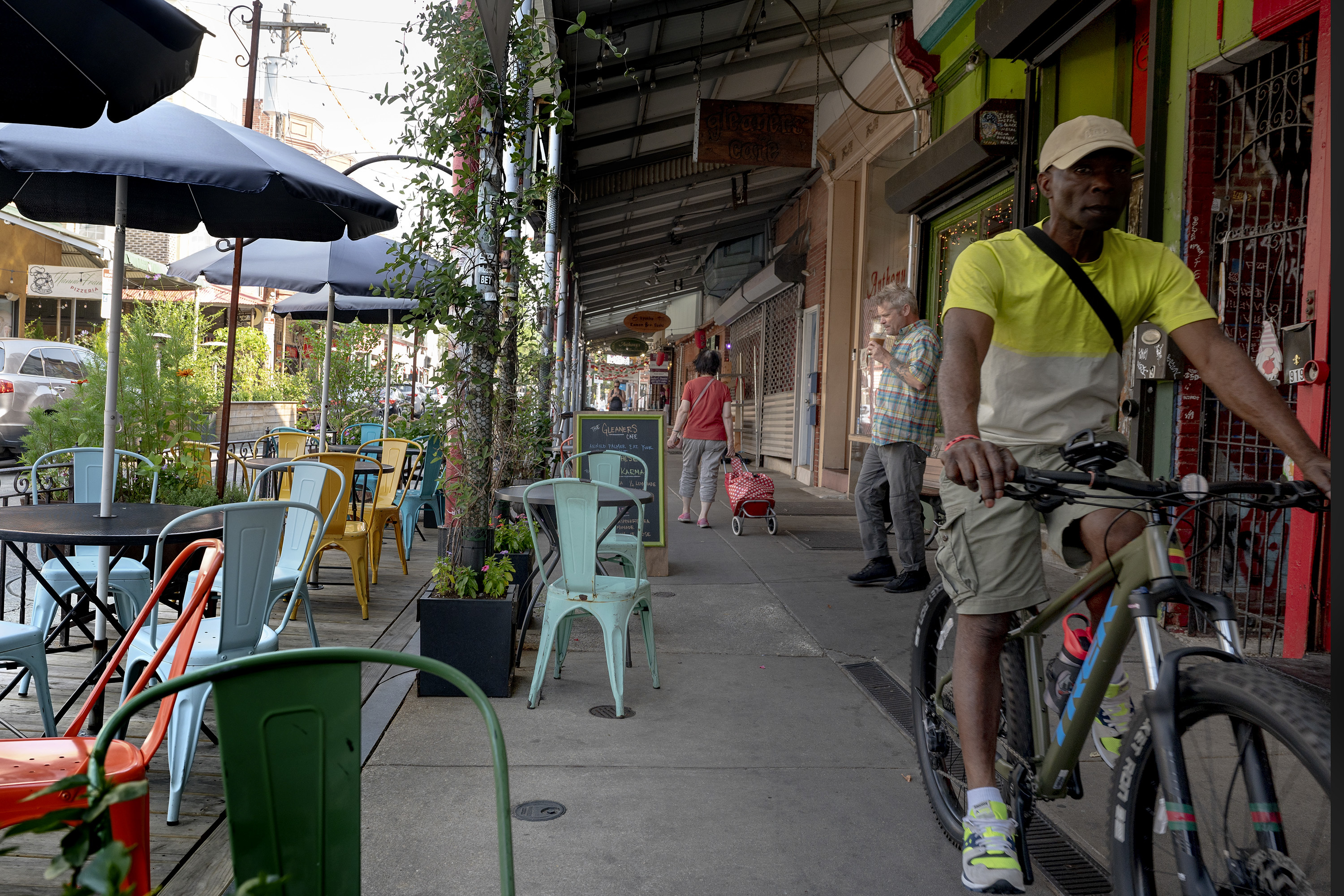
The cafe area on the sidewalk outside of Gleaner’s Cafe in the 9th Street Market on Thursday, July 27, 2023.
Nicholas Ducos, who owns Mural City Cellars in Fishtown, said he has been working for more than a year to get permission to place four picnic tables outside his winery. He said he has had to jump through hoops including working with multiple agencies, spending $1,500 to hire an architect, and even having to provide paperwork to the city on a CD-ROM.
“There are a lot of difficult things about running a business in Philadelphia,” Ducos said. “This should not be one.”
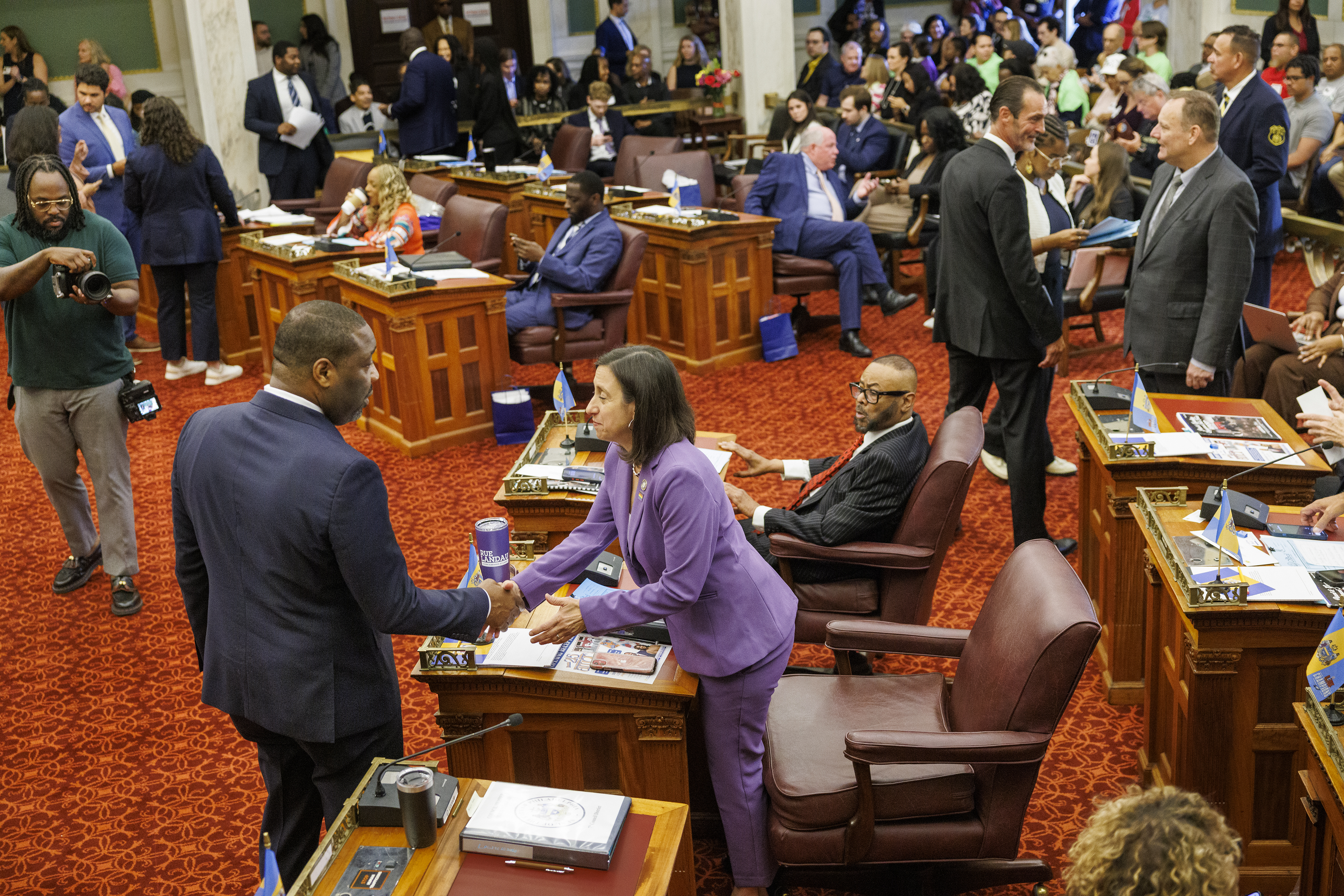
At left is Philadelphia Council President Kenyatta Johnson greeting Rue Landau and other returning members of council on their first day of fall session, City Hall, Thursday, September 11, 2025.
Council members also approved the reservation scalping legislation authored by Councilmember Isaiah Thomas, a Democrat who represents the city at-large. He has said the bill is modeled after a similar law in New York and is not aimed at popular apps and websites like OpenTable, Resy, and Tock that partner directly with restaurants.
Instead, it is a crackdown on websites that don’t work with restaurants, such as AppointmentTrader.com, which provides a platform for people to sell reservations and tickets to events.
Jonas Frey, the founder of AppointmentTrader.com, previously said the legislation needlessly targets his platform. He said his company put safeguards in place to prevent scalping, including shutting down accounts if more than half of their reservations go unsold.
But Thomas has cast the website and similar platforms as “predatory” because restaurants can end up saddled with empty tables if the reservations do not resell.
Zak Pyzik, senior director of public affairs at the Pennsylvania Restaurant and Lodging Association, said the legislation is an important safeguard for restaurants.
“This bill provides clear, sensible protections that will keep restaurants in the driver’s seat,” he said, “and in control of their business and their technology services.”
As the health inspector left Cafe Michelangelo in the Far Northeast last week, she affixed a “cease operations” sticker to the front door, ordering the restaurant to close for at least 48 hours.
Co-owner Giuliano Verrecchia got an idea.
He would come clean.
Chastened by the report’s findings and mindful of his restaurant’s previous dodgy health inspections this year, Verrecchia decided to go public and explain all 16 violations, one by one.
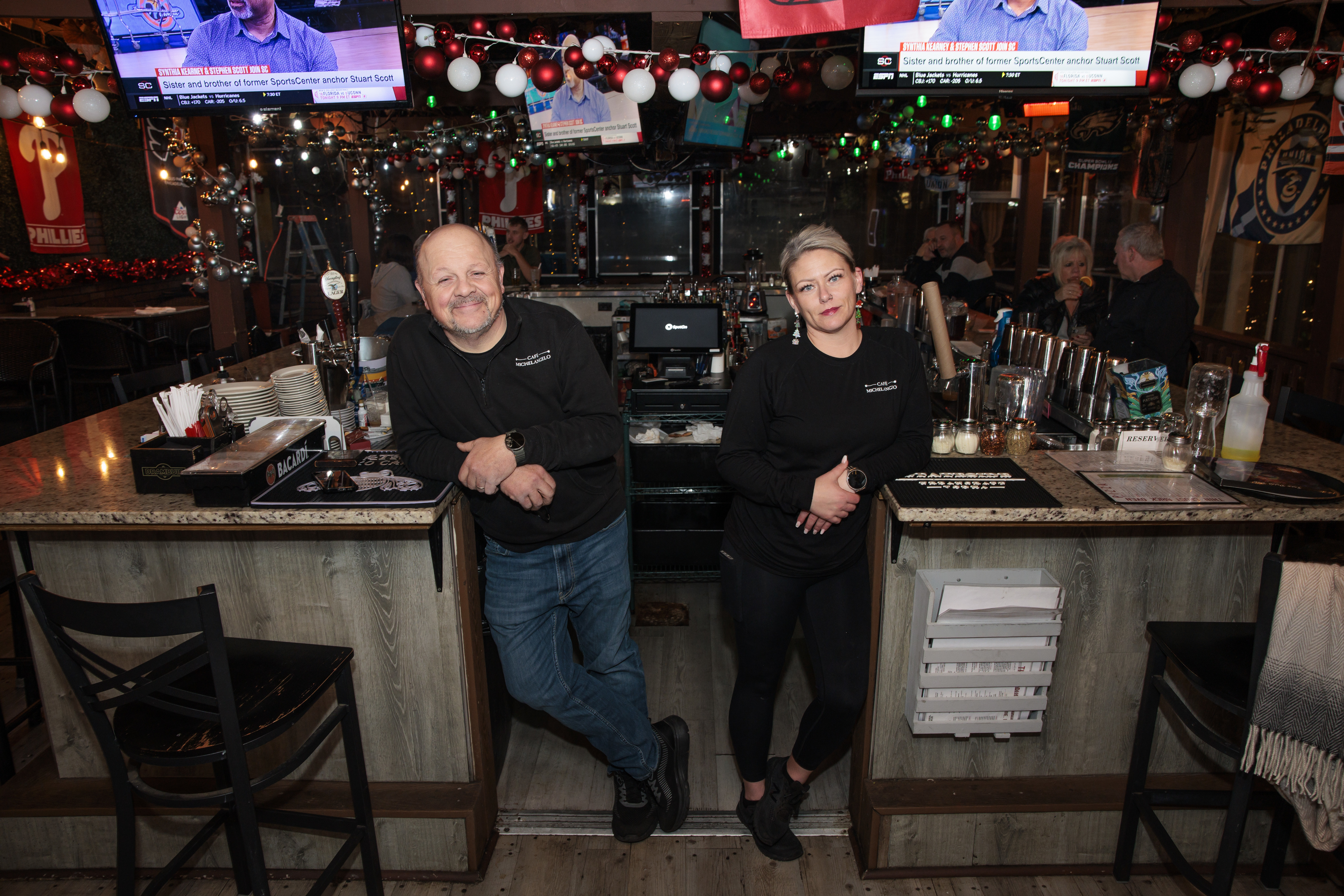
Co-owner Giuliano Verrecchia and manager Danielle Runner at Cafe Michelangelo on Dec. 9, 2025.
“I wanted to put my side out there and be transparent,” Verrecchia said, adding that he considered some of the cited issues “a bit misleading.” He and his manager, Danielle Runner, printed out the inspection report, added commentary, and posted it to Michelangelo’s Facebook page on Dec. 4, the day after the shutdown.
Addressed to “all of our amazing customers,” the post on Michelangelo’s profile paired the exact wording of the health report’s violations with Verrecchia’s own explanation (and redress or occasional rebuttal). He detailed 16 violations, including “peeling paint observed on walls in one of the women’s restroom areas” (“Bathrooms and storage areas were repainted yesterday,” he explained) and “ice build-up observed in the first-floor walk-in cooler unit” (“removed ice build-up,” he wrote).
Reaction to the post was mostly positive. Customers replied with words of support. Some commenters — several of whom identified as food-service industry workers — downplayed the inspector’s finding, describing them as minor.
(In a Facebook post earlier that day, the restaurant described the violations as “non-hazardous,” which was not entirely accurate.)
On Friday, Dec. 5, Michelangelo passed its reinspection, paid a $315 fee, and prepared to reopen. Verrecchia held his breath. Would the public respect his attempt at transparency?
A Northeast Philly staple
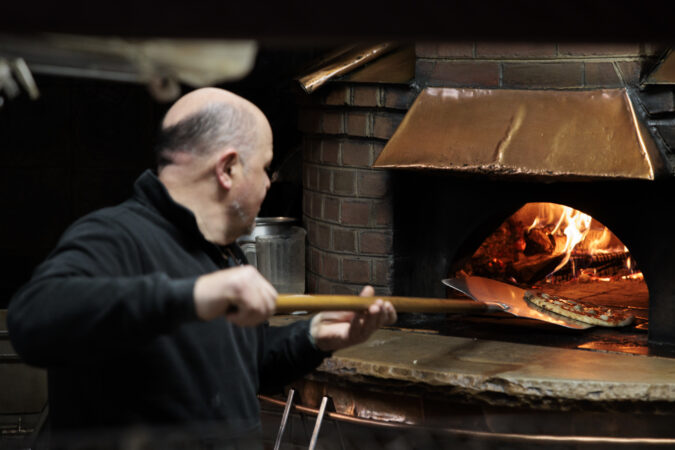
In 1992, brothers Michael and Angelo DiSandro combined their names to open a family-friendly Italian restaurant, complete with bocce courts and room for 250 guests, in a Somerton strip center. By Northeast Philadelphia standards, Cafe Michelangelo was years ahead of its time, serving espresso and brick-oven pizza. Angelo DiSandro died in 2012, and Michael has stepped aside from the day-to-day operation.
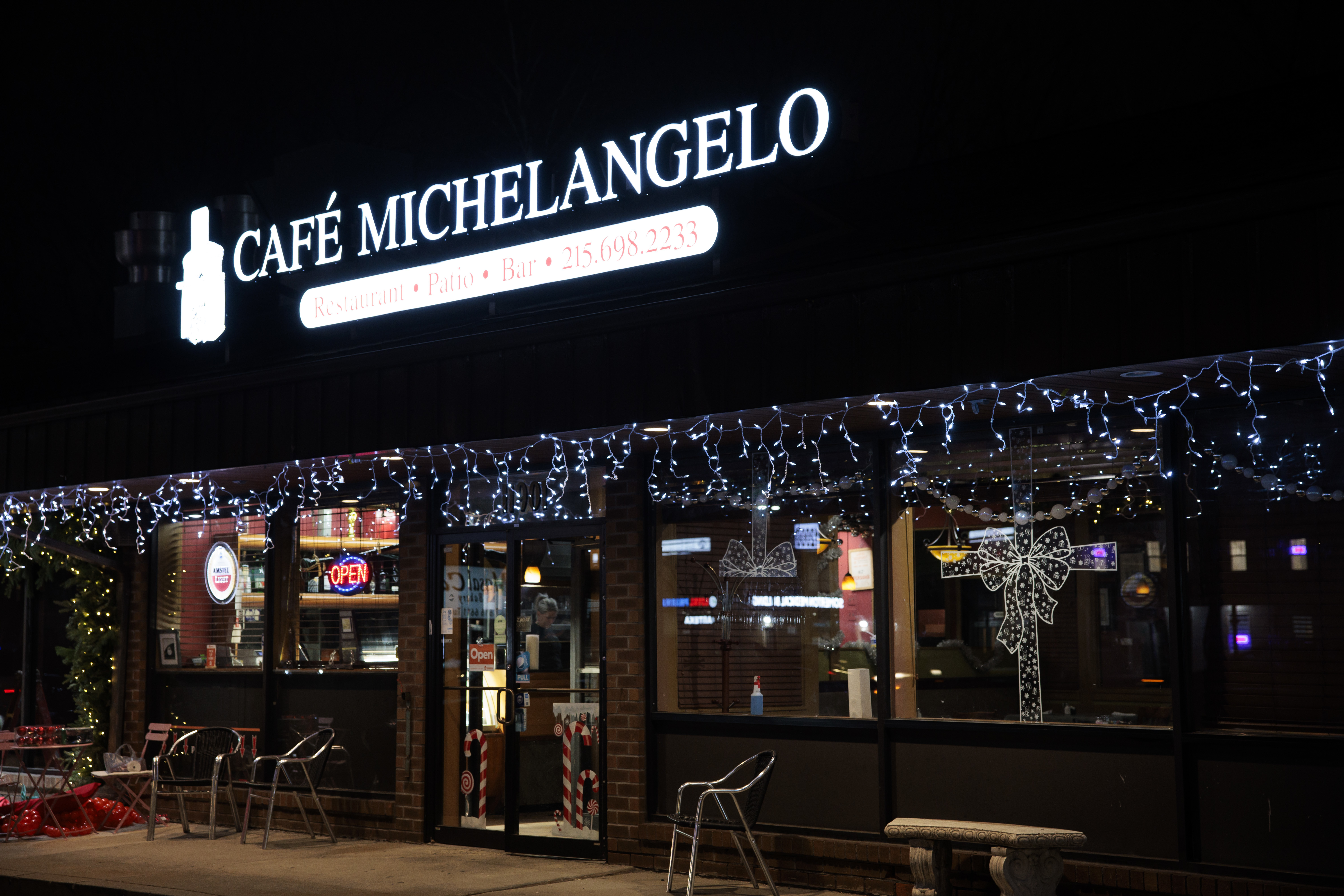
Cafe Michelangelo, 11901 Bustleton Ave., on Dec. 9.
Verrecchia, 56, a nephew, oversees the restaurant, which has a bar in a rear dining room as well as a newer second bar on a covered, heated patio. There’s live music at least three days a week. Michelangelo’s business, like that at many older restaurants, hasn’t been the same since the pandemic. Rising food prices and labor costs have cut margins, and competition has become keener. Customers can get a world of cuisine delivered via apps.
To boost traffic, Verrecchia offers a $15 lunch buffet Tuesday to Friday with two pastas, two proteins, salads, and pizza. Over dinner, the calamari, the parm dishes, and pizzas still move, but he said his customers are cautious about spending. He still sells bigger-ticket items — steak, rack of lamb, whole fish — “but I’m not charging you $45,” Verrecchia said. “I’m charging you $37 and I’m not making money on it, but if you want a steak and the kid wants pizza? You got a home run.”
The aftermath
Michelangelo reopened the same day it passed its reinspection. The phone rang over the weekend. It was a group of teachers canceling their large annual party. Then another big order fell through.
Neither cited a reason. Business was down about 25% on Friday, the restaurant’s first day back, and remained soft Saturday. There was a slight improvement Sunday. The restaurant is closed Mondays. Tuesday was slow again, which Verrecchia partly attributed to cold weather. He said it was too soon to tell what was driving this.
Timeline of inspections
In interviews, Verrecchia said he acknowledged that some of the inspector’s findings required attention, but added: “I don’t think those issues put customers in jeopardy.”
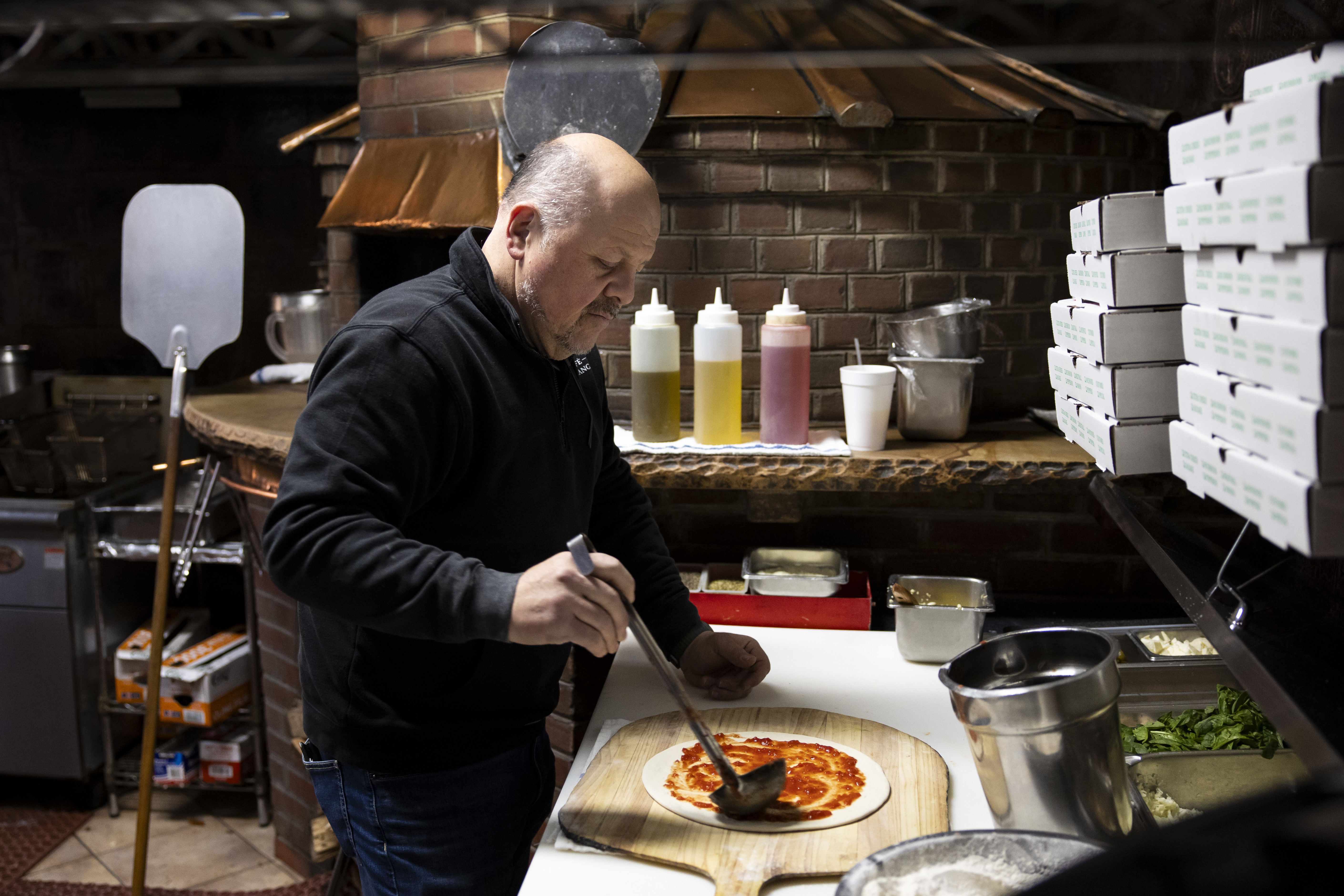
Giuliano Verrecchia sauces a Margherita pizza at Cafe Michelangelo.
“You as a layman read what they wrote and you get scared,” he said. “I wanted to explain what’s really meant.”
He cited rules about labeling containers as an example. “If [the inspector comes in] at 11:30 [a.m.] and my guys are prepping, some things won’t have labels because they have to open them up,” he said.
Verrecchia said he was cited for some issues that had been addressed previously, including cracked floors observed in the kitchen preparation area. “I had already fixed it and showed her,” he said. The report called out a chest freezer that was not commercial-grade. “I fixed that, too, but it still showed up again as if nothing had been done.”
“She made some valid observations,” he said. “I’m not denying that. But the wording in those reports can sound scarier than it really is if people don’t understand the terminology.”
But given its inspections in 2025, Cafe Michelangelo’s record showed mounting problems.
This also was not the restaurant’s first involuntary closure. In February 2023, an inspector cited repeated violations, including improper food labeling, missing temperature controls, rodent activity, improper food storage, and sanitation problems such as grease on walls near the hood, food debris and mouse droppings in the basement, damaged flooring, and missing wall tiles. The restaurant also was cited for using plastic crates to elevate beverages in the takeout area.
Cafe Michelangelo was allowed to reopen four days after that 2023 reinspection, and a follow-up two months later found no serious violations.
At the next inspection, Feb. 27, 2025, four risk-factor violations were noted: missing handwashing supplies, a dirty ice machine, missing date-marking, and unlabeled chemicals. All were corrected on site.
By Sept. 11, the violation count had risen to six and included flies throughout the facility, shellfish storage and record-keeping problems, and significant structural and equipment issues. The Health Department ordered a reinspection.
On Oct. 29, many of the same issues appeared again as repeat violations, and a certified food-safety manager was not on-site at the start of the inspection.
On Dec. 3, the inspector pointed out unsafe cooling of salads and onions, along with unresolved pest, handwashing, and facility problems — all what are deemed “imminent health hazards.” She also logged six risk-factor violations, which include any violation that increases the likelihood of foodborne illness; three of them were repeats. Two and a half hours after the inspector walked in, Michelangelo was shut down.
Corrections and changes
Verrecchia said the inspection issues were a wake-up call. He said he has tightened oversight throughout the restaurant, which employs about 30 people.
“I’m on it every single night now,” he said. “I’m re-educating my team. I’ve got to be more diligent. If I [mess] up, I admit it. I [messed] up. I’m human.”
He is now conducting mock inspections at the end of the day. “I walk through everything, write up what’s wrong, and then go over it with the staff in the morning,” he said.
He also has begun purchasing new equipment, including wall-mounted metal shelving and fruit-fly traps where required.
Verrecchia said he is standing by his decision to go public.
“If I didn’t think it was right, I wouldn’t have done it,” he said. “I can’t afford to shut down again — and I’m not going to.”
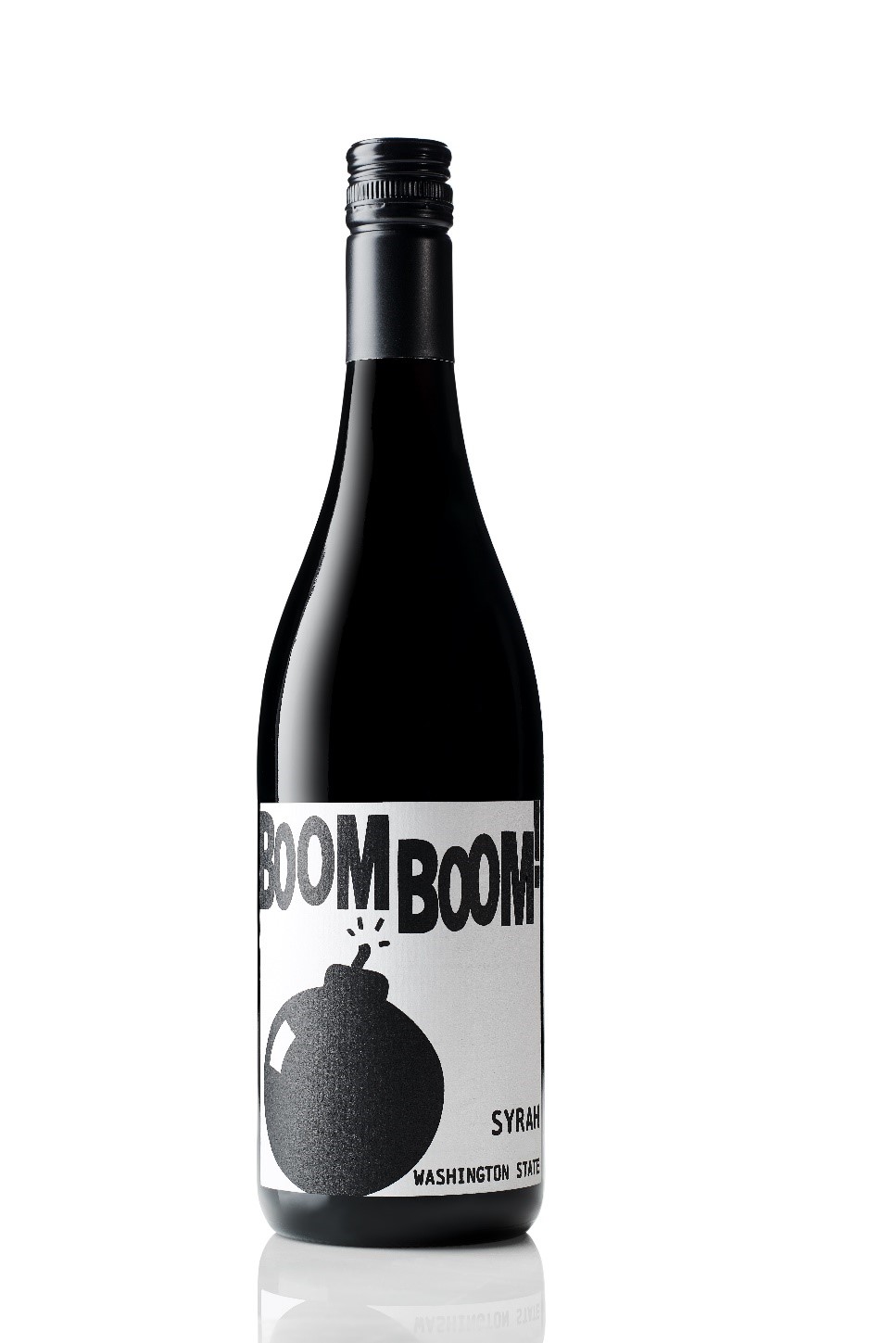
Syrah is the name of the most intense member of a group of spicy red grapes native to the Rhône Valley region of France. However, many American wine drinkers are more familiar with it as shiraz, the name the grape goes by in Australia. While this week’s wine is not the kind of lightly sweet, cheap, and cheerful “fruit bomb” made famous Down Under, it does deliver explosive flavor worthy of its cheeky label.
Syrah grapes make delicious wines in both California and Washington State, but there’s little incentive for growers to plant it when cabernet sauvignon commands higher returns. With small berries and skins as thick as those of cabernet sauvignon, syrah grapes yield nearly as much solids as juice.
Since color and flavor are found in the skin of grapes, not in their flesh or juice, this is an important style factor that determines how intense red wines can be. Syrah’s big flavor and deep color make it a natural choice for making bold and robust red wines, and its knack for resisting oxidation preserves a youthful, violet-tinged color longer than most before succumbing to the browning of age.
Flavor-wise, syrah wines have a distinctive spicy scent and flavor, reminiscent of wild berries and black pepper. In cooler climates, like its native France, syrah makes paler, more acidic wines that smell of salty foods like green peppercorns and cured meats. In warmer, sunnier regions like Washington’s Columbia Valley, though, syrah lends itself to making fuller-bodied powerhouse wines — like this one — that are dense with dark, jammy flavors that are decadent, dessertlike, and meant for immediate gratification. This premium bottling is a perfect example, with its concentrated flavors of blueberry pie and raspberry jam, accented with meaty aromatics that evoke barbecue ribs or beef jerky.
“Boom Boom” Syrah
Charles Smith “Boom Boom!” Syrah
Washington State, 14.5% ABV
PLCB Item #1501, on sale for $15.69 through Jan. 4 (regularly $18.69)
Diner traffic doesn’t usually peak on Monday evenings, but there was a long line of patrons waiting to get inside Comfort & Floyd at just that time this week. They poured into the South Philly luncheonette’s diminutive space, quickly filling its 16 seats and every inch of standing room. They were eager to taste Ange Branca’s take on English jacket potatoes: enormous russet potatoes baked until the skin is dark and shatteringly crisp, with a fluffy interior that’s splayed open and filled with heaps of baked beans, shredded cheese, thin-sliced beef, chili con carne, or jackfruit.
Unlike its American cousin, the baked potato, the English jacket potato is not a side dish, but a full meal in a bowl.
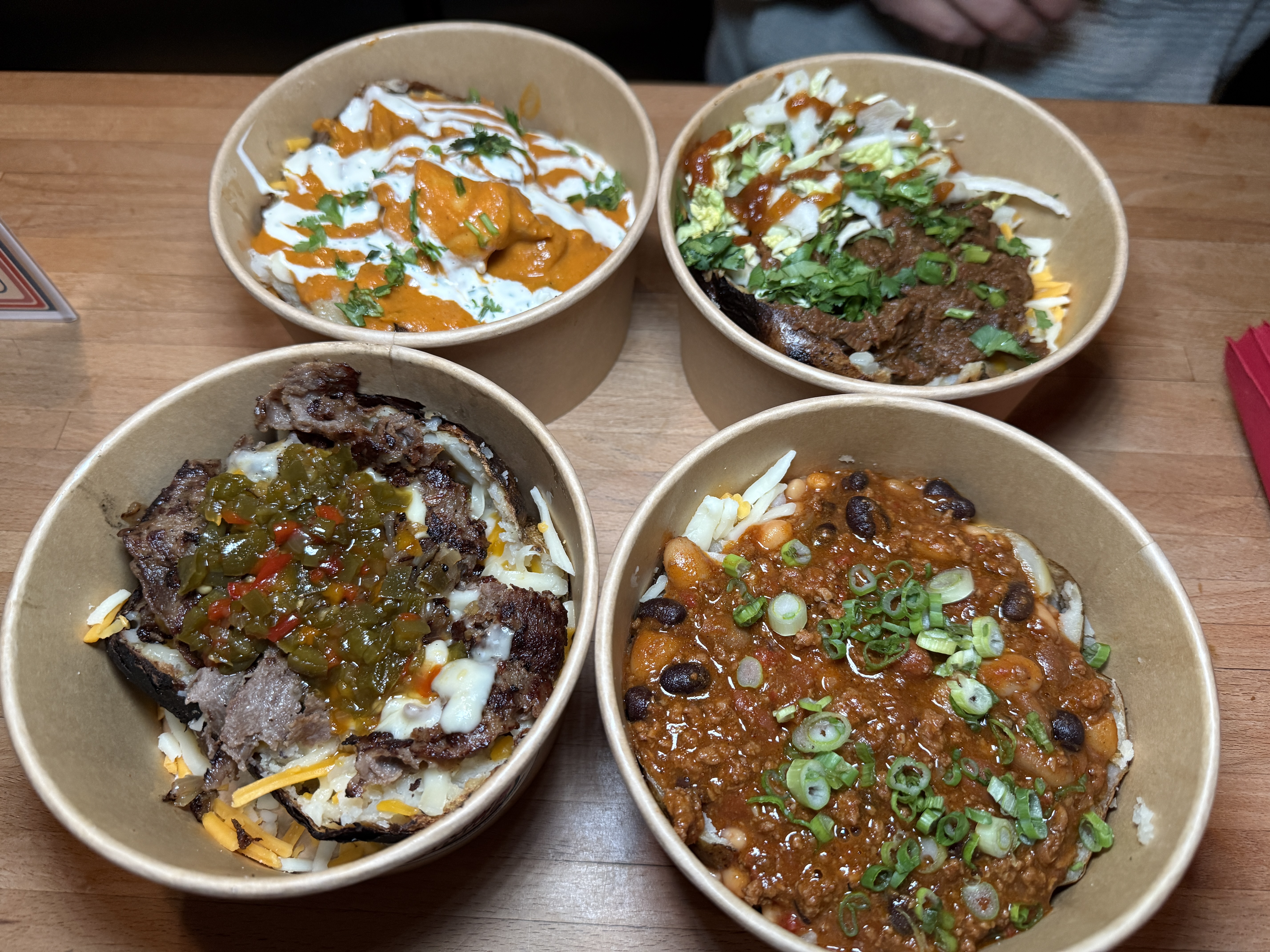
Clockwise from top left, Mod Spuds’ Bollywood spud, Malaysian spud, classic spud, and Philly cheesesteak spud.
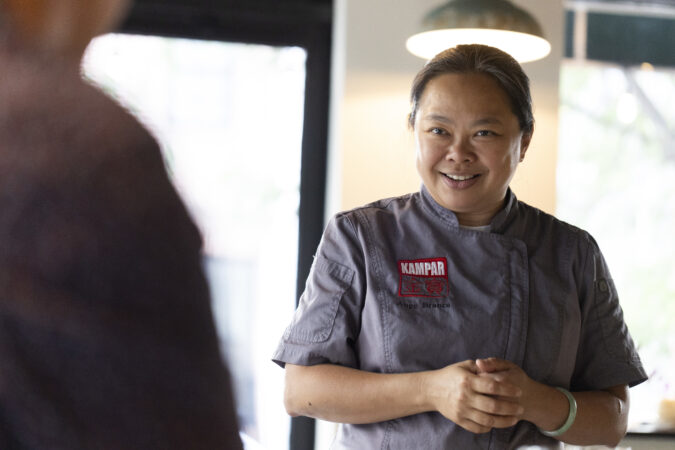
While Branca’s Bella Vista restaurant Kampar remains under construction after a February fire, Branca has started Mod Spuds, a monthlong residency running twice a week at Comfort & Floyd, located on the corner of 11th and Wharton.
Southeast Asian twists on the comfort food of the ’90s seem to be having a moment — Mod Spuds pops up in the same month as the debut of Manong, Chance Anies’ Filipino interpretation of an Outback Steakhouse. It’s another instance of a chef centering a specific story from a moment in their life as the animating theme of a concept.
In Branca’s case, she survived on jacket potatoes while studying at university in Edinburgh.
She retells the story of this era in her life through global flavors found in Philadelphia. There’s a Philly cheesesteak spud with hot pepper relish; a Bollywood spud with chicken tikka masala; the Nacho, with chorizo, pico de gallo, and salsa verde; a Happy Jack spud with barbecue jackfruit; and one more familiar to Branca’s devotees — a Malaysian spud with beef rendang, sambal, and ulam (a fresh herb blend). The classic Mod Spud is pulled directly from Branca’s university days, topped with chili con carne and Heinz baked beans that British chef Sam Jacobson from Stargazy helped her source.
Branca has a particular way of eating jacket potatoes. “I dig right into the middle, scooping all the way down so I can get a little bit of each topping and a little bit of the potato.” Once she has scraped the toppings and potato from its skin, or jacket, she’ll pick it up like a taco and eat it.
Each jacket potato goes for $15. All offerings are gluten-free. Diners may also build their own spud ($8 for the base, $3 for each vegetable topping, $5 for each meat topping).
Wash it all down with an excellent and very fizzy homemade root beer ($8) from Kampar server and fermentation specialist Rachel Ore. (Make it a float with Turkey Hill vanilla ice cream for an extra $5.) Ore is behind Kampar’s nonalcoholic soda program. For this one, she used sarsaparilla root, birch bark, licorice root, galangal root, a little bit of cinnamon, mint, and some vanilla. The brew takes four days to fully ferment and creates an extremely bubbly beverage — sort of like if root beer married kombucha.
Branca hopes the fast-casual concept will have legs beyond this month’s pop-up and that its slick, retro, Jetsons-esque branding will have wide appeal. Other than the rendang on the Malaysian spud, Mod Spuds marks a significant departure from anything that has ever been served at Kampar.
“I want to see if people love this, and if they do, I will keep it going,” she said.
Mod Spuds runs through December at Comfort & Floyd, 1301 S. 11th St., 5 p.m. to 9 p.m. Mondays and 11 a.m. to 9 p.m. Tuesdays.
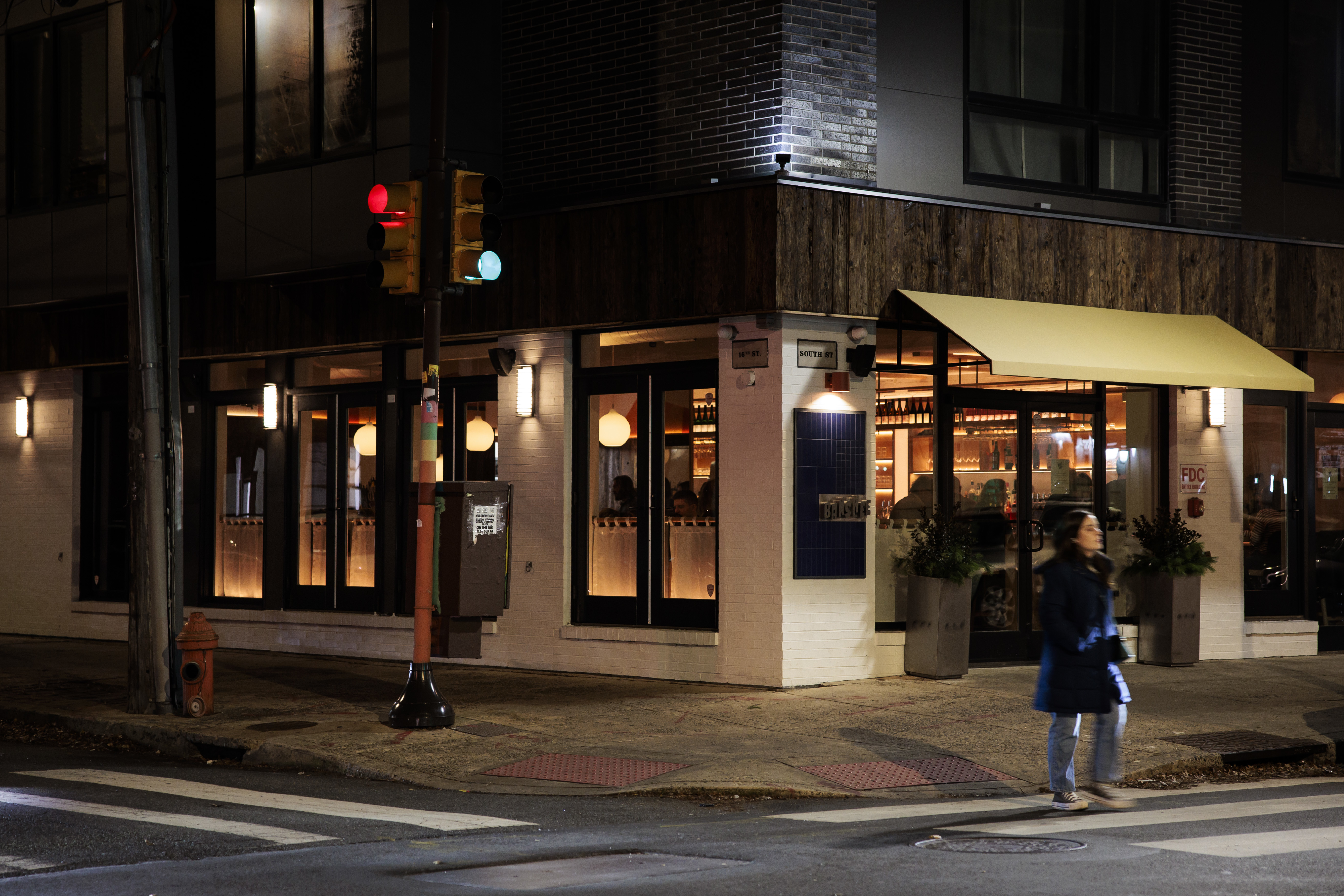
The door of Banshee at 16th and South Streets will be unlocked Thursday, welcoming patrons for crispy onion tarts, chicory salad, and a saucy Spanish mackerel dish you can mop up with house-made sourdough. They can then polish it all off with a sip of draft wine or a sesame- and pineapple-laced whiskey sour.
The cozy, modern American bistro is a refined addition to the Graduate Hospital neighborhood. And although two of its backers will be familiar to followers of Philly’s restaurant scene, Banshee marks a clear break from the Asian-inspired street food and graffitied airs that defined their earlier work.
Shawn Darragh and Ben Puchowitz, who founded Cheu Noodle Bar (2013), Cheu Fishtown (2017), Bing Bing Dim Sum (2015), and Nunu (2018), have brought on two key former employees as partners: twin brothers Kyle and Bryan Donovan, 34.
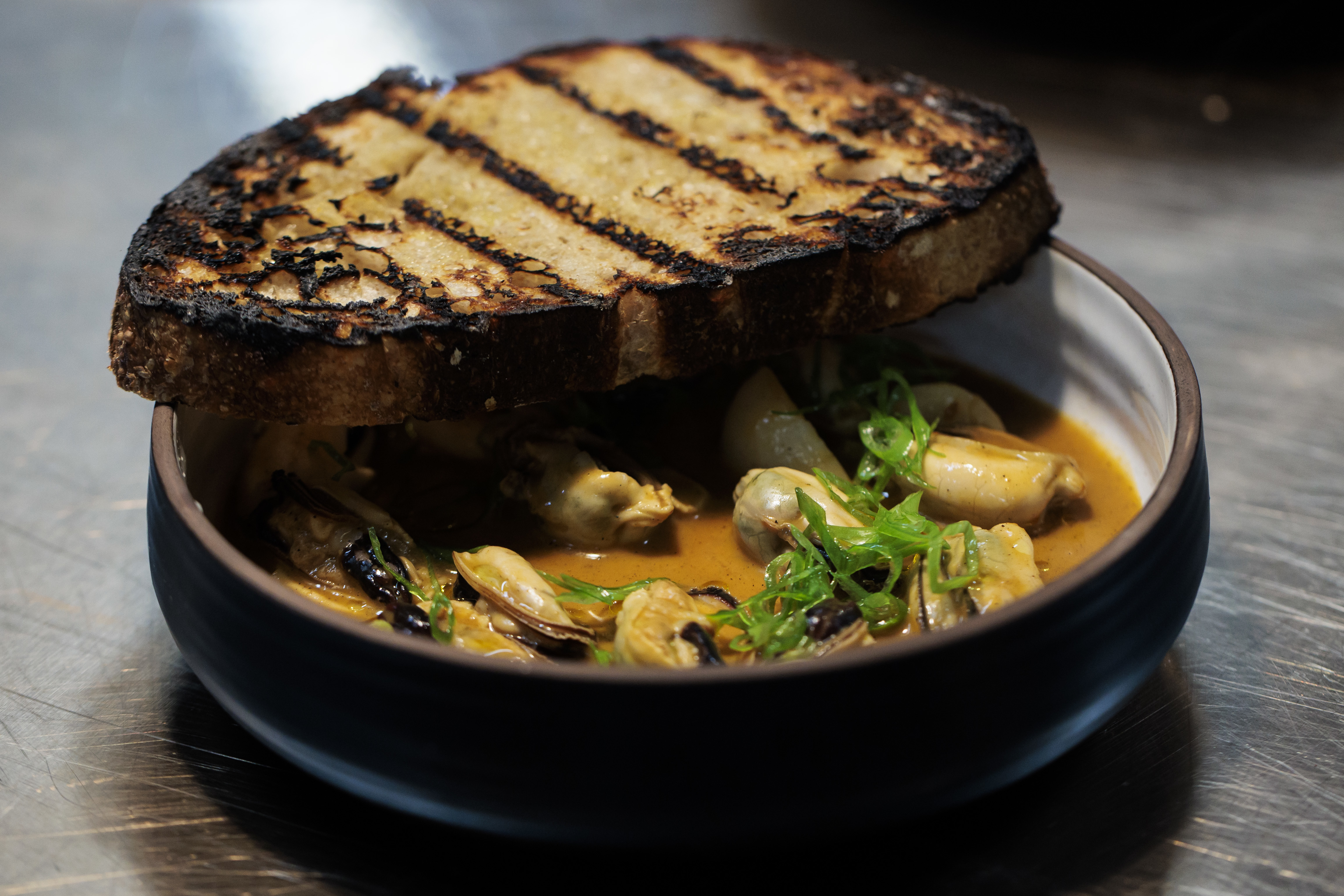
Mussels in harissa with hakurei turnips in coconut milk, beneath a lid of grilled bread, at Banshee.
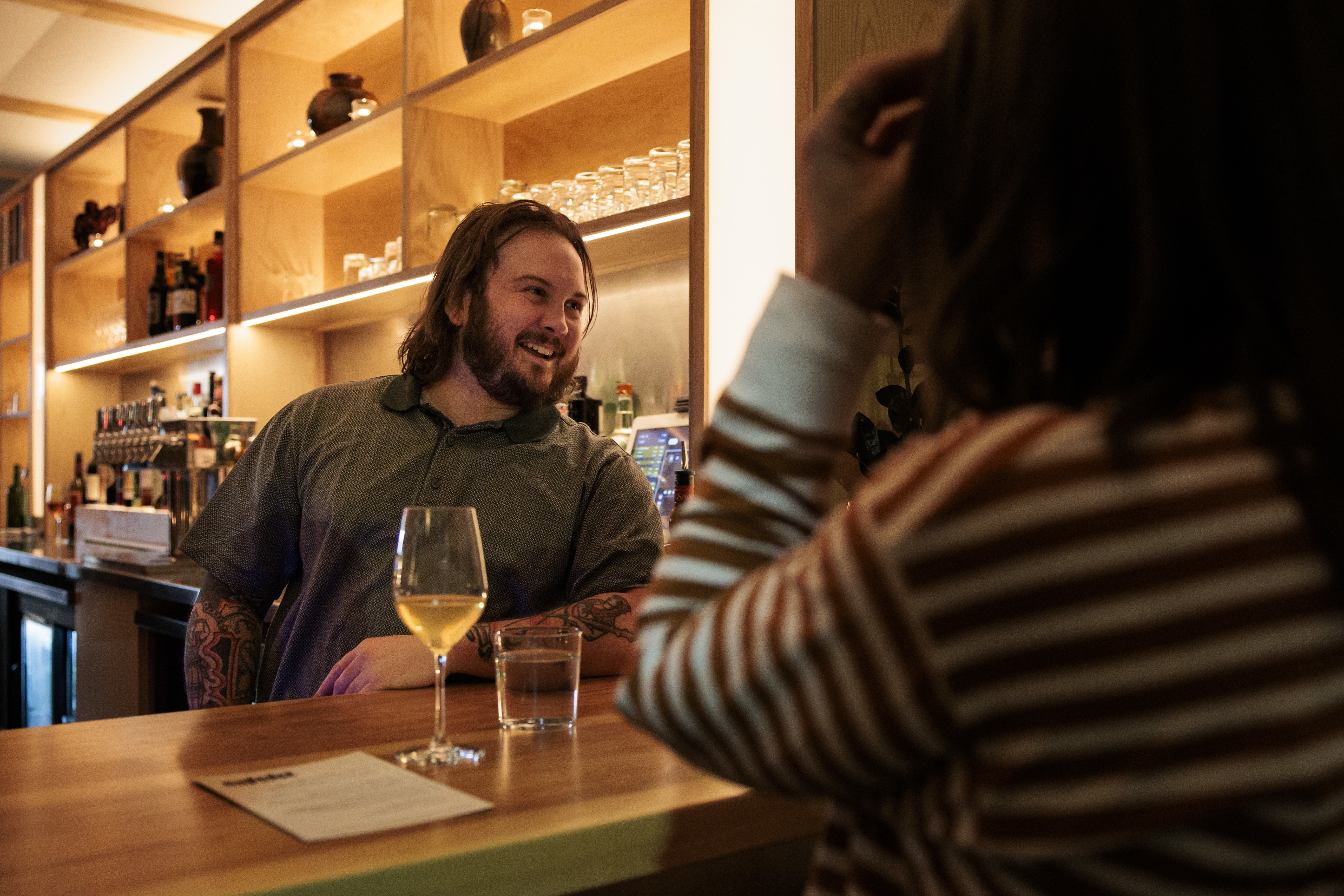
Kyle Donovan — who started at the original Cheu near 10th and Locust and later managed Bing Bing on East Passyunk until it closed in 2024 — is Banshee’s general manager, overseeing 12 walk-in-only bar seats and about three dozen seats in the dining room.
Banshee executive chef Bryan Donovan was opening sous chef under Puchowitz at Cheu Fishtown before he went on to cook at Sqirl in Los Angeles and Contra, Wildair, and the Four Horsemen in New York City.
Darragh and Puchowitz, now in their early 40s, have moved on from the day-to-day of restaurant work. Darragh, the front-of-the-house/marketing guy, runs a construction company. Puchowitz — who as a 23-year-old ran the kitchen at the late, great Rittenhouse BYOB Matyson — works in real estate.
“It’s fair to say we’re all grown up now,” Darragh told me. “We’re trying to carry over that neighborhood spirit but take it a step further — maybe a little more refined but still fun.”
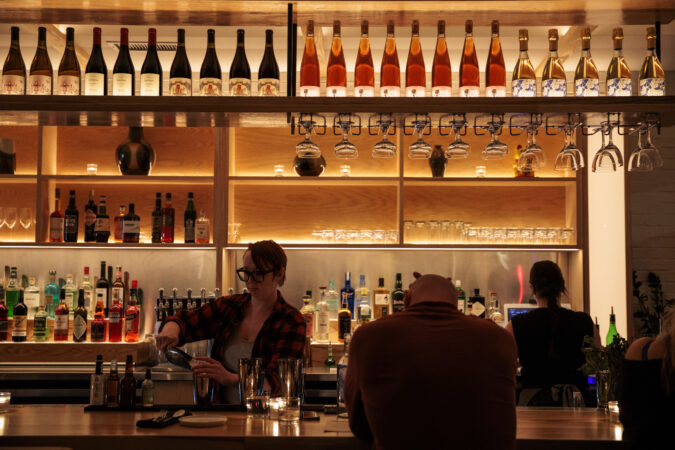
The visual shift, not only from their former restaurants but also from the building’s previous occupant, Tio Flores, is obvious. Stokes Architecture + Design created a warm, Scandinavian-inspired space with natural woods, curtains, table lamps, pendant lights, and a mushroom-wood accent wall. The up-lit bar anchors the room.
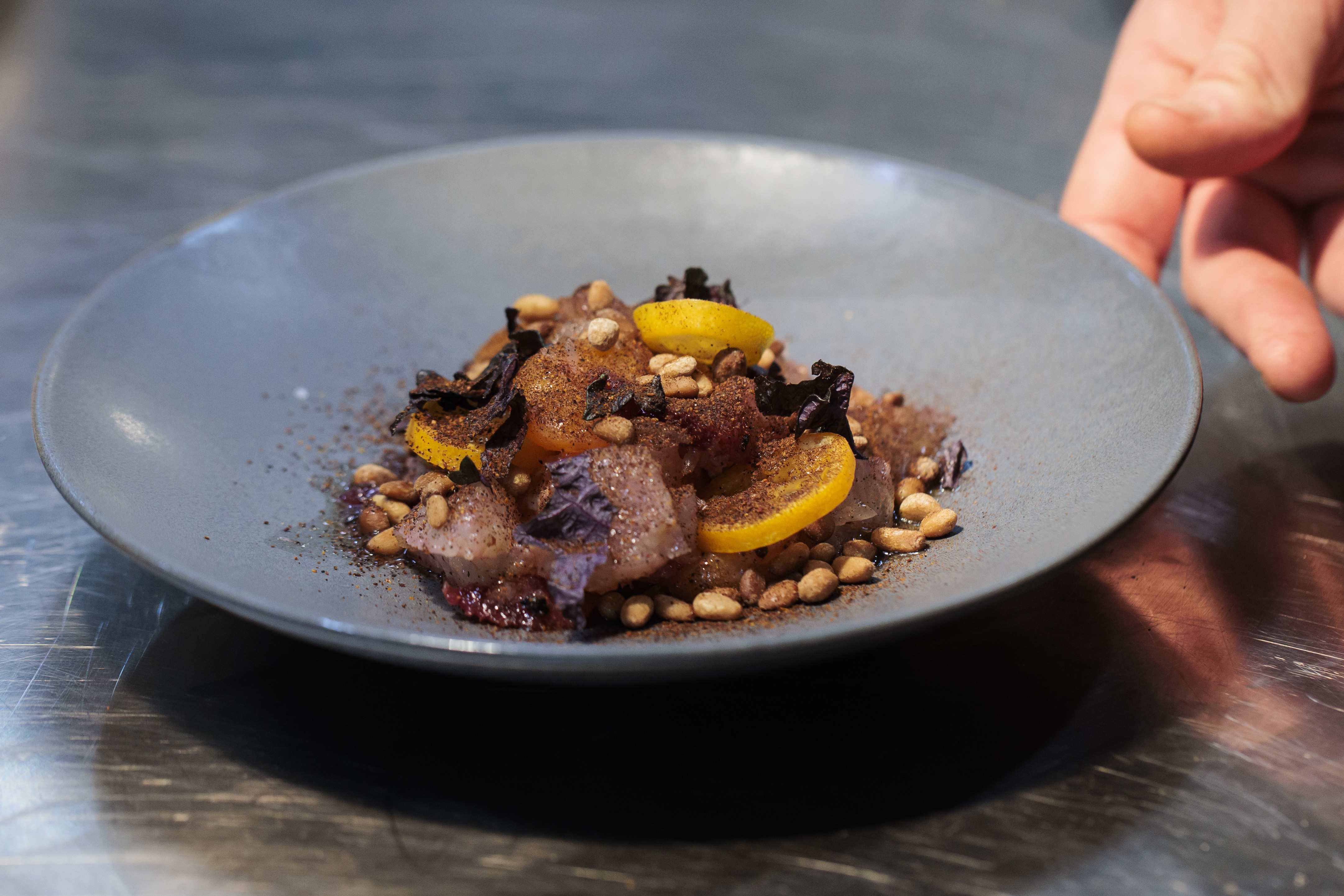
Winter citruses at Banshee.
Banshee was originally planned for the former Bing Bing space on East Passyunk Avenue at 12th Street, but that deal fell through. Chefs Biff Gottehrer and Kenjiro Omori are renovating it for a new restaurant called Tako Taco.
Mediterranean, Basque, and modern American flavors
Don’t expect ramens or dumplings at Banshee. The menu leans Mediterranean/Basque — chef-driven but not inaccessible. Premium ingredients include Berkshire pork collar ($25) and Lady Edison ham ($17) with persimmon and fromage blanc. The center-of-the-table dish is a half chicken ($39) with pickled peppers and buttery Marcona almonds.
Kyle Donovan at the bar at Banshee.
Vegetables take center stage: braised leeks with boquerones, pepitas, and Comté ($14); grilled Kyoto carrot with txakoli sabayon ($15); and a chicory salad with dijonnaise, pear, and nutty, creamy Midnight Moon cheese ($15). Fermentation-driven umami shows up in red kuri rice with koji butter and nori, as well as a winter citrus salad finished with brown butter, pine nuts, and umeboshi. About half the menu is vegetarian, and five dishes are vegan or easily made vegan.
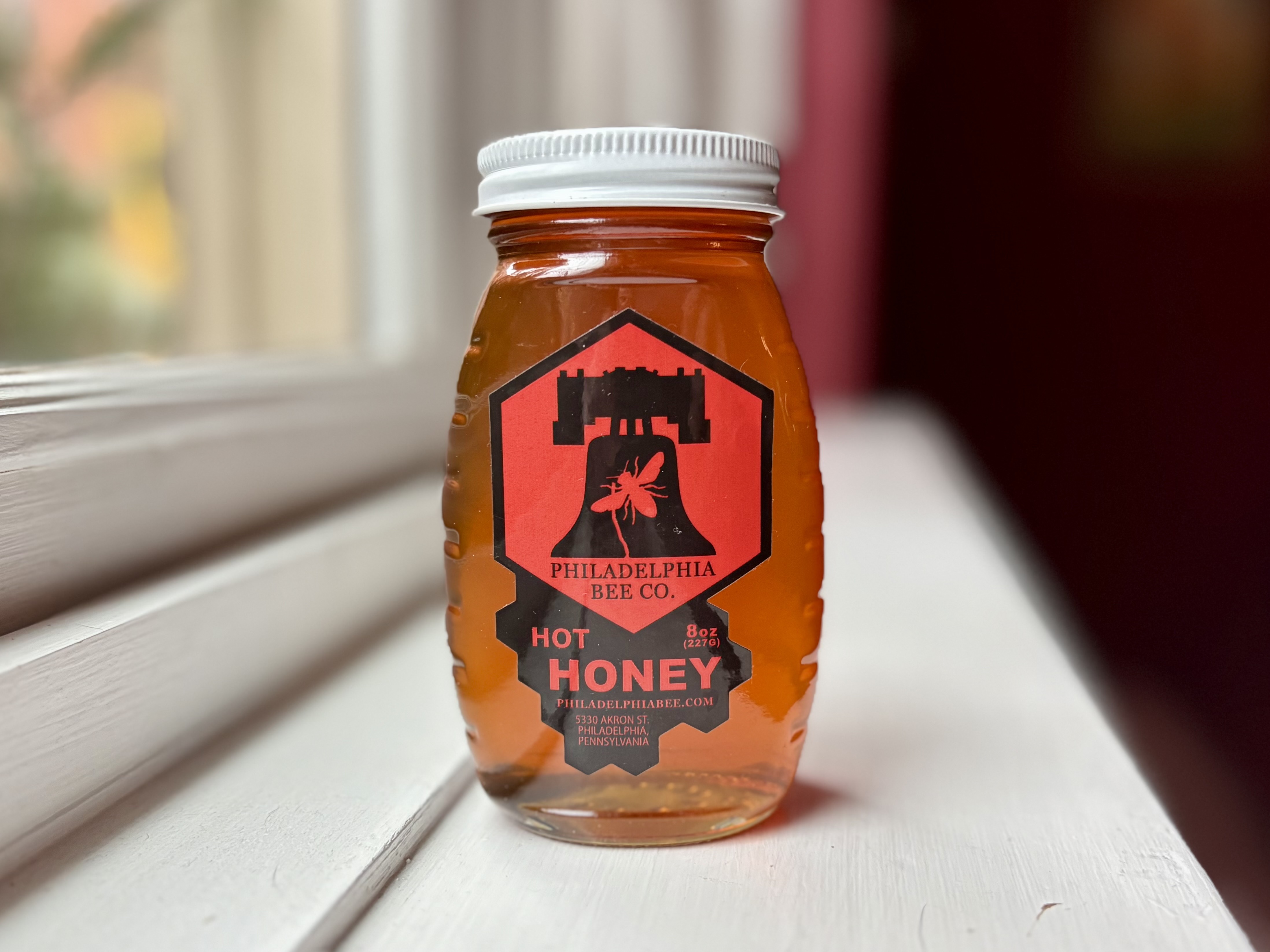
The tarte flambée ($15) is one of the most distinctive dishes on the menu. It starts with a yeasted semolina dough that’s rolled through a pasta sheeter, cut into squares, and baked on olive oil-lined sheet trays. It’s topped with smoked crème fraîche, caramelized onions, raw onions, maitake mushrooms, chives, and hot honey, and finished with a leek-and-parsley powder made from dehydrated leek scraps. Crispy and bold, “it’s layered onion flavor all the way through,” Bryan Donovan said.
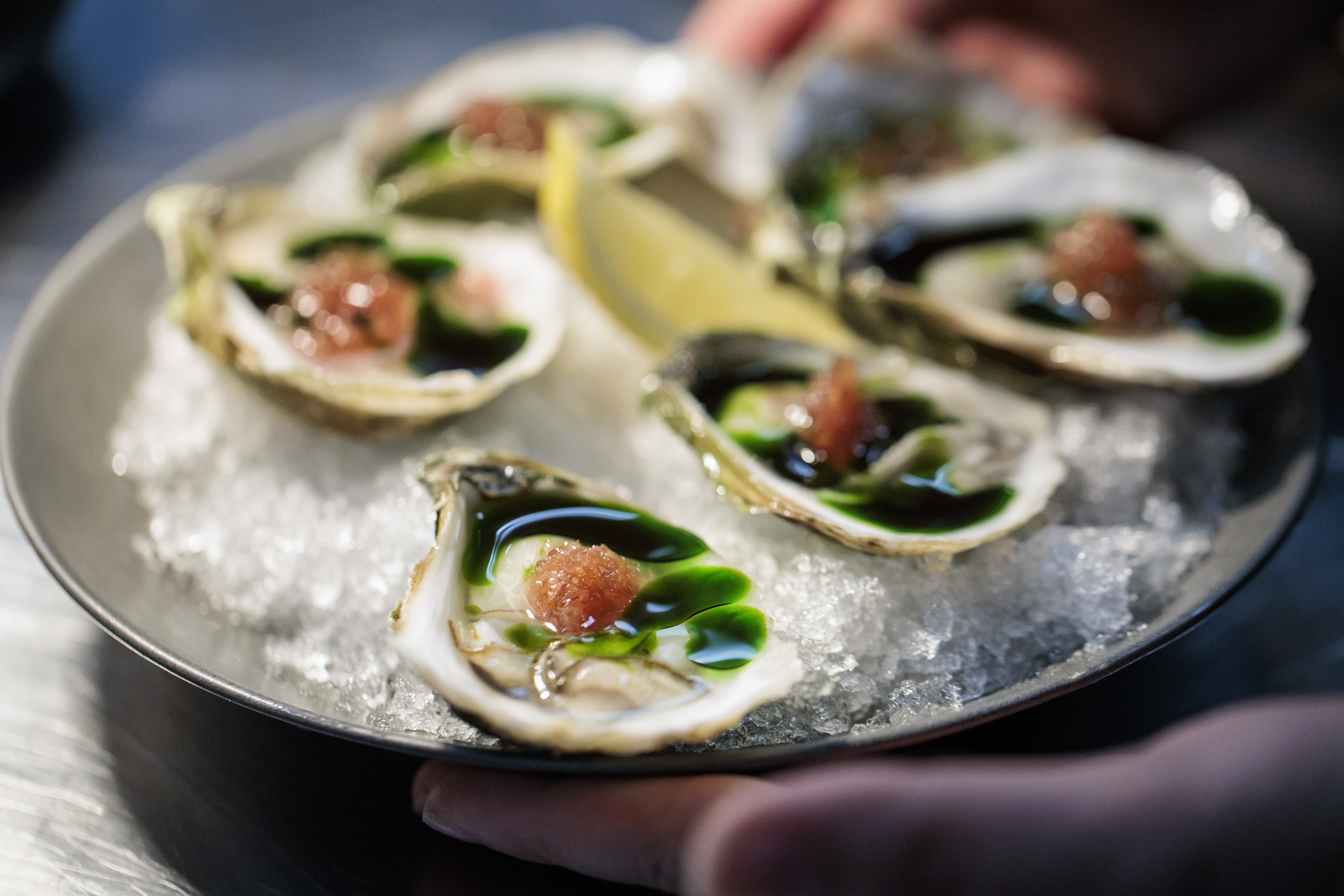
Barnstable oysters in dill mignonette at Banshee.
A dill mignonette brightens the Barnstable oysters ($22). Hamachi crudo ($18) is sliced thick to highlight the fish’s natural fat and paired with a bright, acidic sauce made from minced peppers, passion fruit puree, shio koji, and white verjus. “The sauce actually came first, and then we tailored the fish to it,” Donovan said.
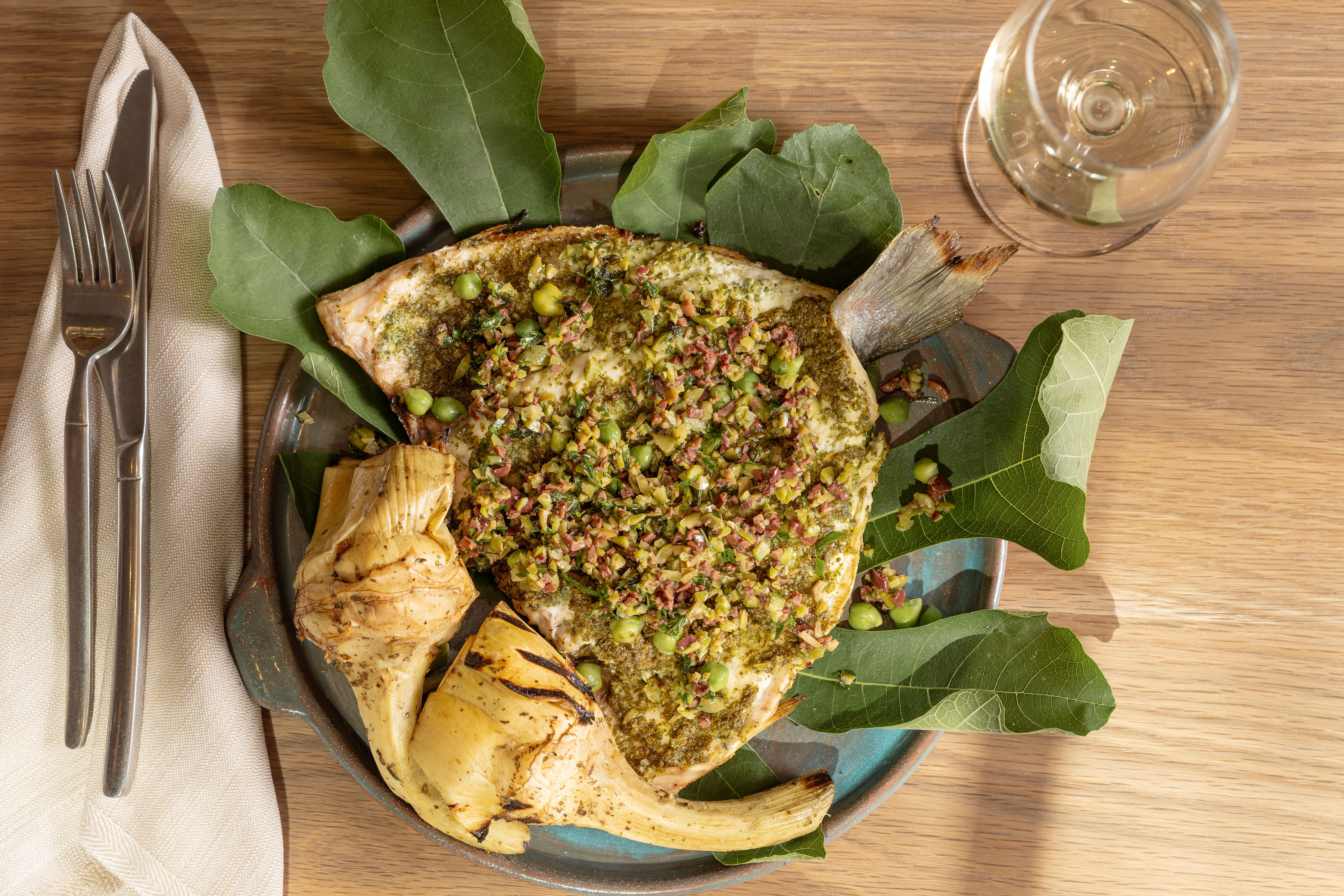
A larger plate of Spanish mackerel ($24) is served over grilled Brussels sprout leaves tossed in a smoked clam emulsion with thyme and tamari, finished with olive oil tapenade and pickled golden raisins.
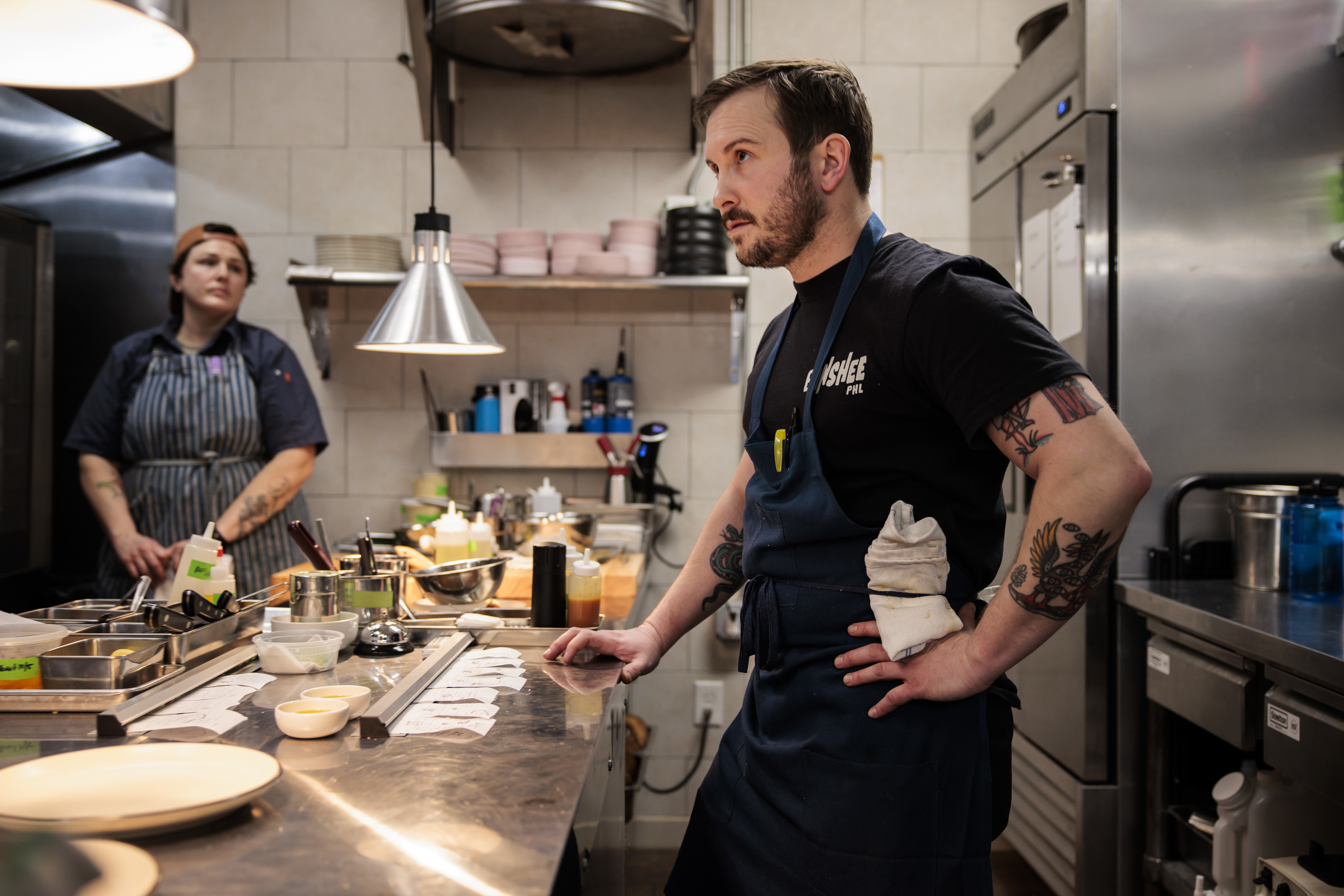
Chef Bryan Donovan juggling orders in the kitchen at Banshee.
“We’ll change vegetables seasonally and add more snacky, fried, and skewer-style items as we settle in,” Donovan said. “Spontaneity and experimentation are part of the spirit of the place.”
There’s a baked Alaska (not done tableside) and a butterscotch Krimpet filled with boysenberry jam for dessert.
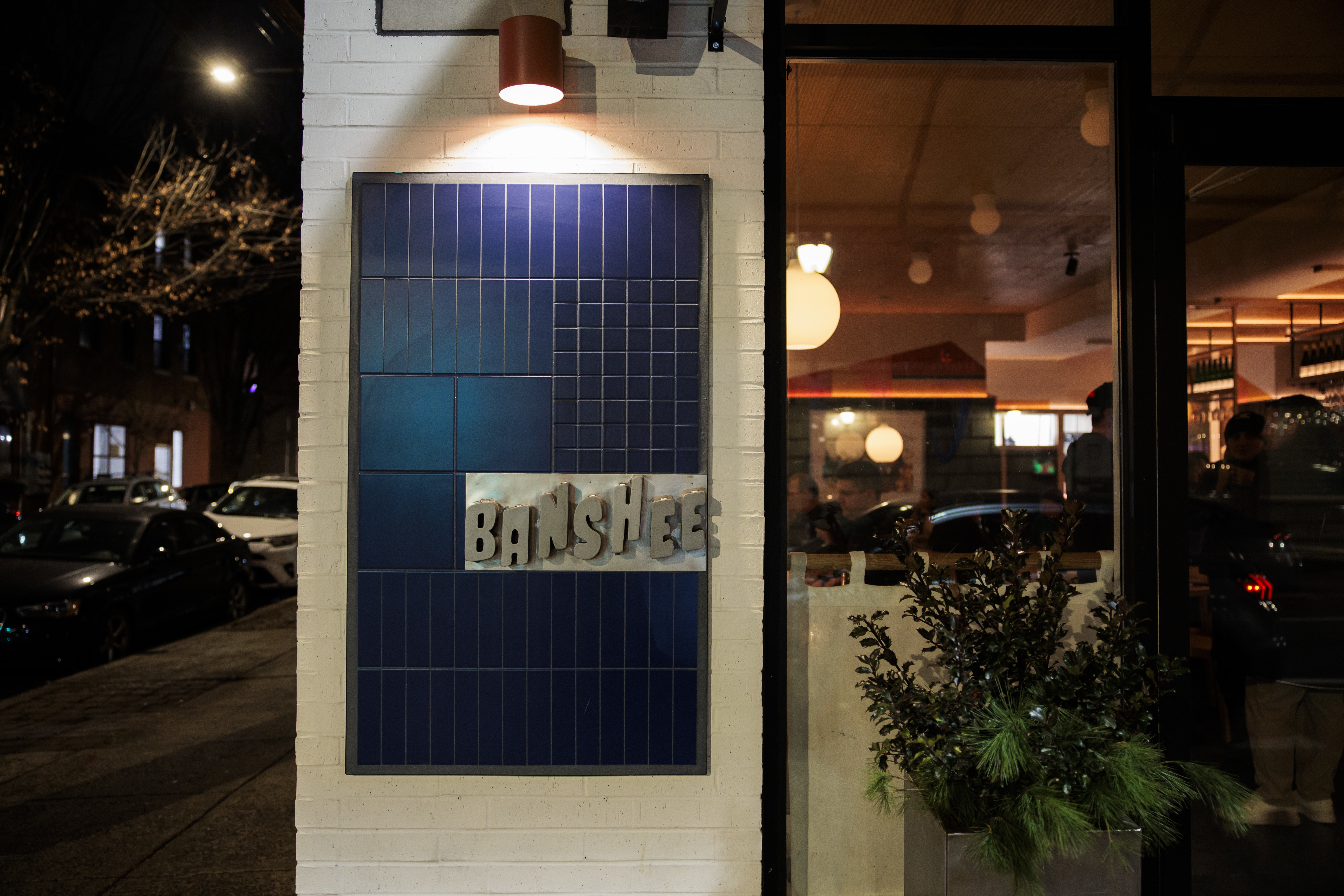
The exterior of Banshee at 1600 South St.
Check average is projected at $70 to $75 per person for two to three dishes and one drink.
The Banshee partners brought in lead bartender Mary Wood to build the cocktail program, working alongside assistant manager Madeline Anneli. “None of us are professional bartenders, so we wanted real expertise on cocktails,” Kyle Donovan said.
Wood’s list draws from home-cooking influences and ingredients already used in the kitchen. The Dirty Banshee ($16) — olive oil-infused vodka, garlic fino, and blue cheese olive — leans deeply savory. Beet imbues the Crowd Work ($15), a sparkling gin cocktail with lemon and quinine. The bar also offers low-ABV drinks, nonalcoholic options, fermentation elements such as tepache, and an accessible beer lineup.
Hours are 5 to 10 p.m. Thursday through Monday. Reservations are available on Resy on a rolling 30-day basis.
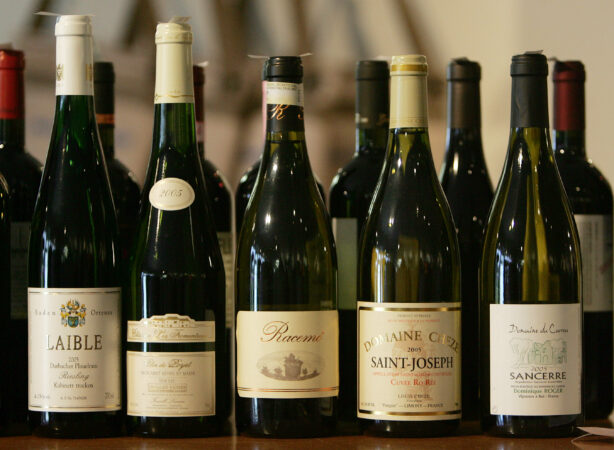
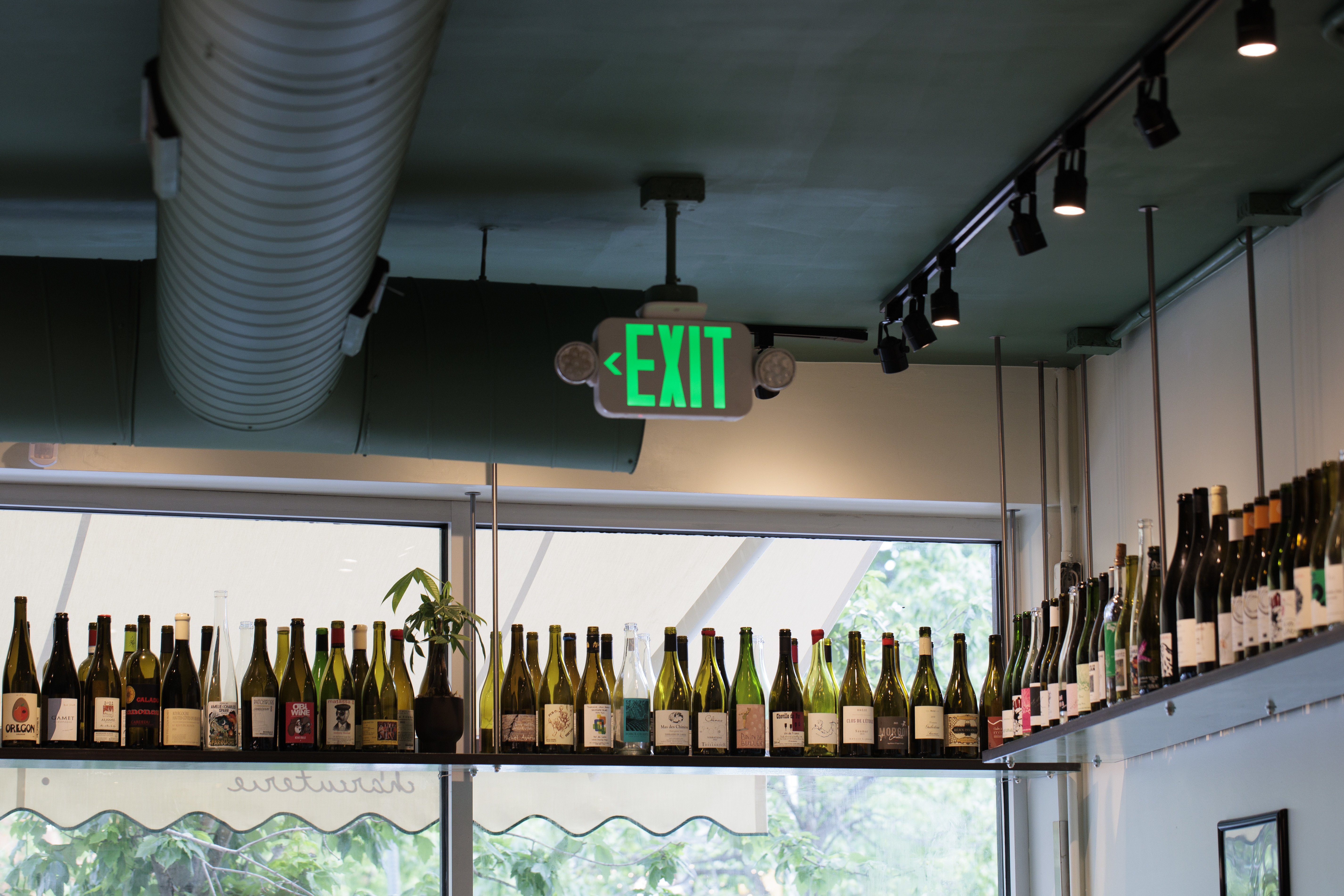
It’s easier than ever to swing by a neighborhood shop and leave with a special wine bottle at a friendly price. Sande Friedman shares her favorite indie wine merchants in Philly and the suburbs.
🍷 In these cold days, here’s a luxe Chardonnay worth warming up to, says Marnie Old.
If you’re after squid ink risotto, surf and turf, or mostly just pasta, Kiki Aranita has you covered for this year’s crop of seven fishes feasts with an array of festive, mostly fishy Philly restaurants.
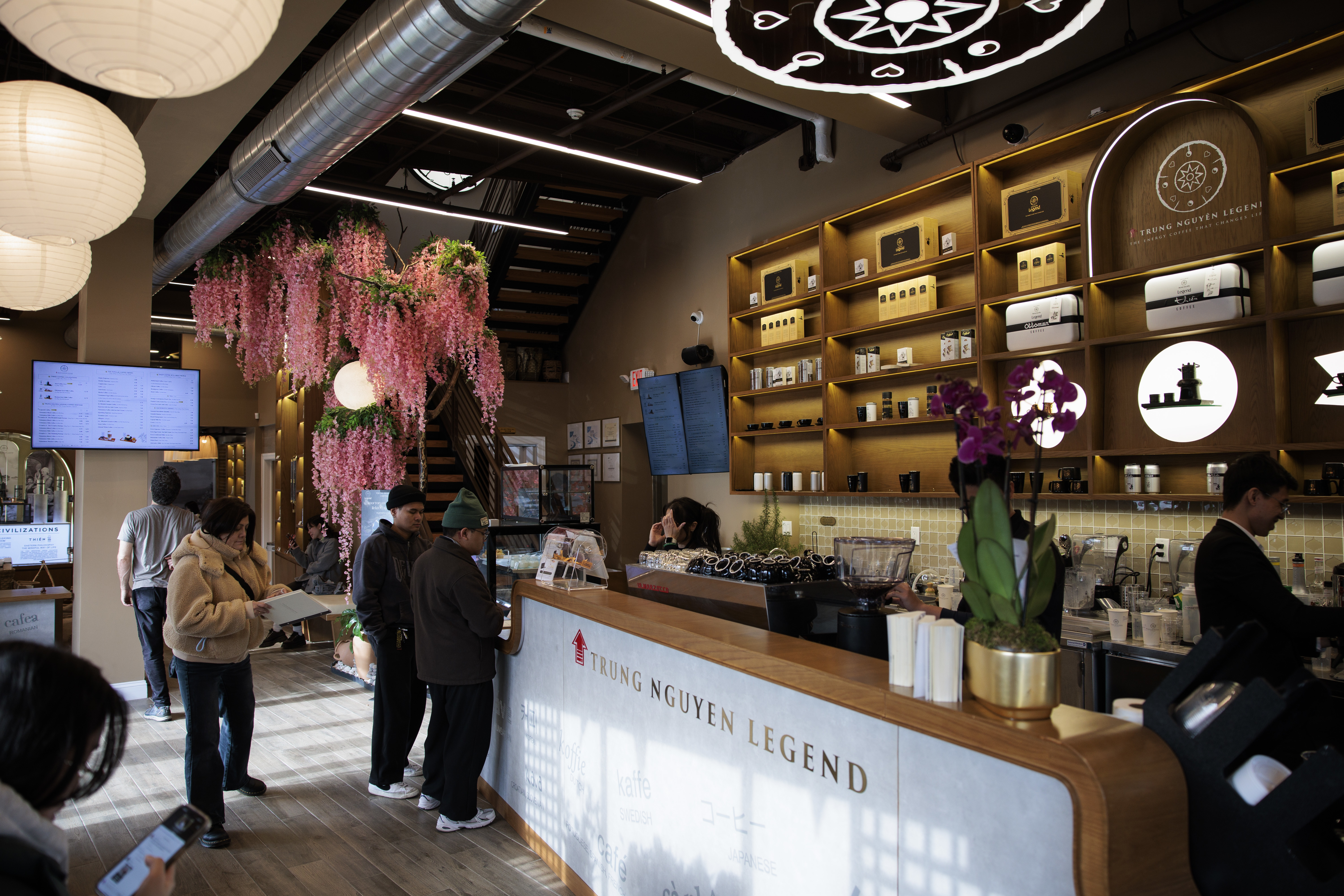
The largest U.S. location of the Vietnamese coffee brand Trung Nguyên Legend has opened near the Mummers Museum in Pennsport. Beatrice Forman stopped to visit the onetime cabinetry showroom, now a two-story destination with a year-round roof deck for espresso tonics, Vietnamese egg coffees, and phin pour-overs.
Critic Craig LaBan found much to enjoy at Phila and Rachel Lorn’s Sao — a love letter to Philly, set to a soundtrack mix of vintage R&B, Cambodian rap, and Frank Sinatra.
An accolade for Omar Tate
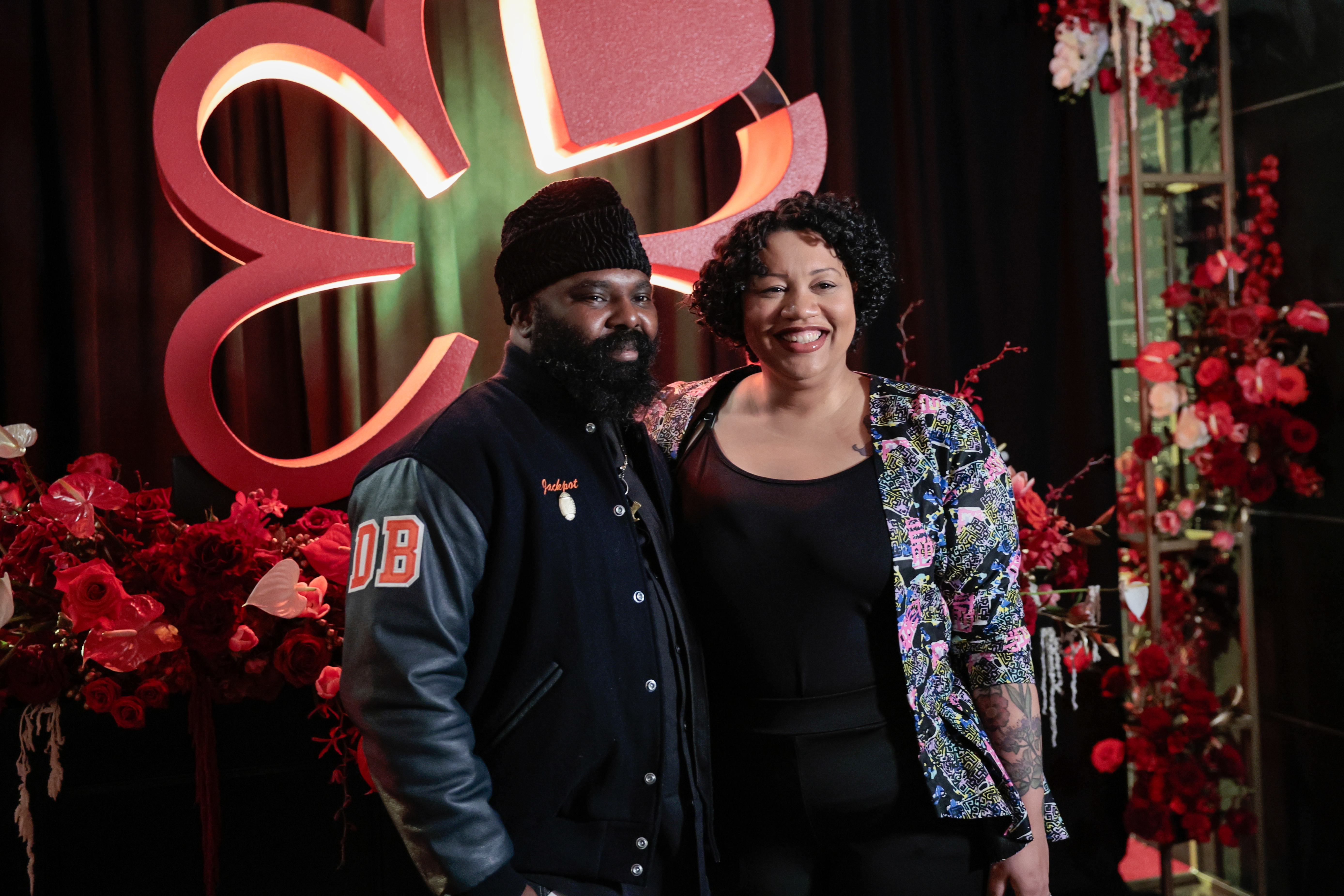
Chef Omar Tate, who co-owns the Michelin-recommended Honeysuckle on North Broad Street with his wife, Cybille St.Aude-Tate, just received an $85,000, no-strings-attached grant from the Pew Center for Arts & Heritage. Pew says the grants support timely and compelling new projects and long-term stability. “Tate uses food as a medium for storytelling and cultural preservation,” it blurbed. “His curated culinary experiences assert cooking as a fine art that can express complex narratives about identity, memory, and history. In his visual artworks, collaborations with other artists, and his Philadelphia restaurant Honeysuckle, Tate connects people with Black creative lineages and cuisine.”
A sweet (and spicy) Market Street pop-up … belly-warming Indian food … a sticky dessert at Paffuto … a Greek spin on American Sardine Bar’s namesake food. Read on to see where we’ve been eating.
Scoops
Barcelona Wine Bar, the syndicated Spanish tapas house, appears to be in the initial stages of planning a second Philadelphia location, complementing its eight-year-old spot in East Passyunk. A real estate solicitation mentions Barcelona as a tenant in an adaptive reuse of an old warehouse on North Lee Street in Fishtown, next to Pizzeria Beddia and Hiroki and across from the new Pip’s, the cider bar by Ploughman Cider. No comment from a Barcelona rep.
Vons Chicken, a South Korean-rooted chain big on the West Coast, ventures east next month to open at 1714 Washington Ave., next to AutoZone. Vons’ menu includes Korean fried as well as baked chicken, plus sides such as mandu and tteokbokki. Local franchisee Thao Le, who found Vons in California while visiting family, has assorted restaurant experience, including serving at Pietro’s Italian in Center City.
Restaurant report
Hira Qureshi tried falafel at more than 20 restaurants while scouting Middle Eastern cuisine for The Inquirer’s 76. Here’s her rule: good falafel = good restaurant. She maps her picks.
Briefly noted
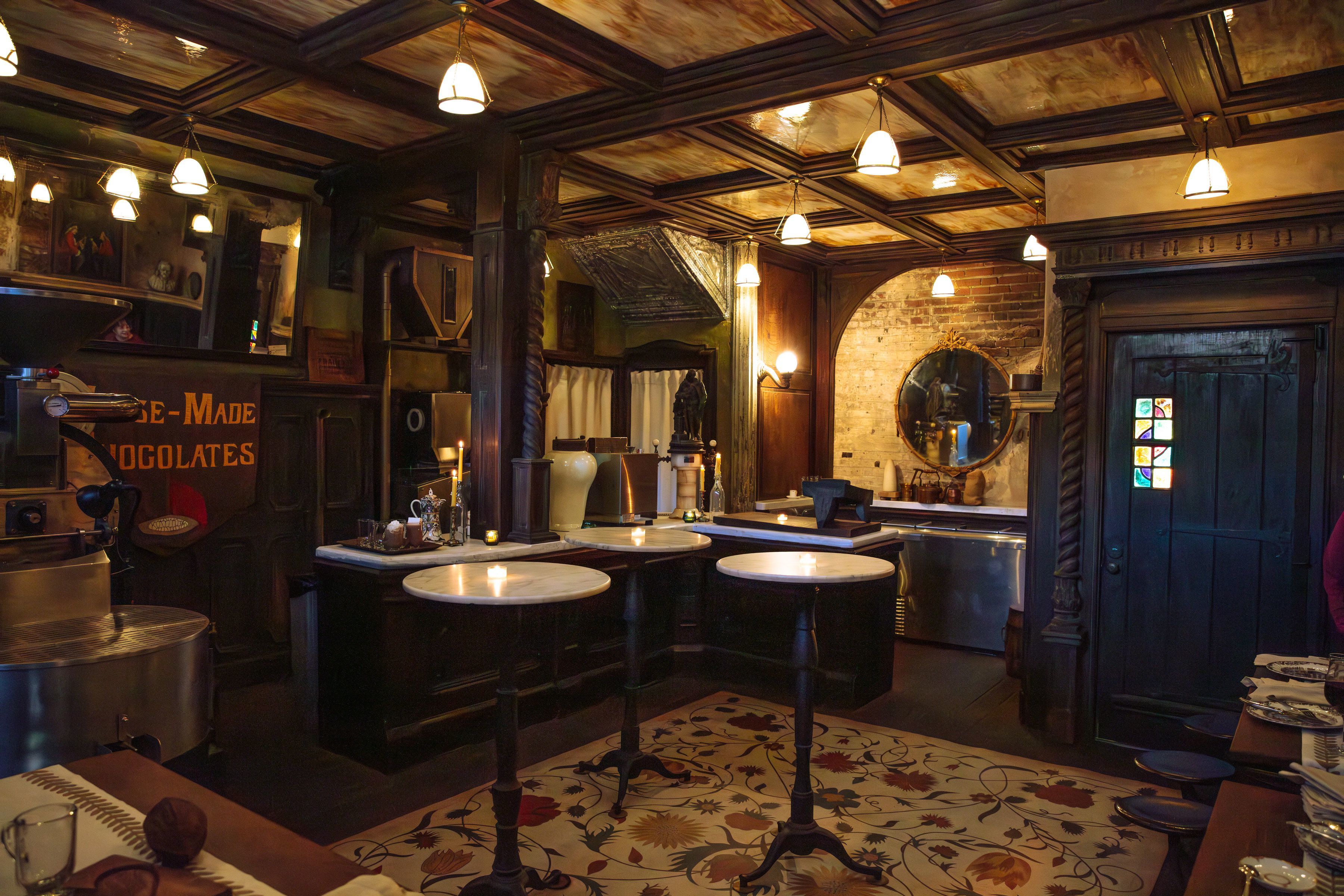
Eric Berley of Old City’s Franklin Fountain and Shane Confectionery now has a third business on the block. The Cacao Pod — a private event space that doubles as head chocolate maker Kevin Paschall’s chocolate roastery — rocks the same ye olde look at 104 Market. The space, which fits 24 guests (18 seated), is equipped with an ice cream counter, soda fountain, and hot chocolate bar.
Bombay Express completes its move from Marlton to 219 Haddonfield-Berlin Rd., the Centrum Shoppes in Cherry Hill, opening Thursday.
Homegrown 215 opens its second location, at the former Bison Coffee shop at 1600 Callowhill St. (enter on Carlton), on Saturday.
The Concourse at Comcast Center (1701 JFK Blvd.) has two openings teed up for Dec. 15: Pagano’s Market (Italian classics, prepared foods, and desserts) andKenny’s Wok (a fast-casual pan-Asian concept creating dishes using robotic-wok technology; it’s a version of InstaFooz, the Chinatown shop Poon owns with David Taing).
Panchoʼs Mexican Taqueria in Atlantic Cityʼs Ducktown neighborhood — which has been running 12 hours a day, seven days a week, for 20 years — will close for what owner Josh Cruz predicts will be a five-week-long renovation.
Sisterly Love Collective, the alliance of women in the food and hospitality industries, will host a pop-up holiday market from noon to 4 p.m. this weekend at the old High Street Bakery space (101 S. Ninth St.).
Oyster House’s latest guest chef in its lobster-roll series is Amáchef Frankie Ramirez. His roll ($39), whose proceeds will benefit PAWS, includes butter-poached lobster, salsa macha, refried beans, and cilantro macho on a split-top bun, served with hand-cut fries. It’s on through Saturday.
Red Gravy Goods is a new gift shop from Valerie Safran and Marcie Turney (of Barbuzzo, Bud & Marilyn’s, Little Nonna’s, and Darling Jacks) at 1335 E. Passyunk Ave., across from Cartesian Brewing/CJ & D’s Trenton Tomato Pies. Kitchen wares are part of the line and the big sell is a hat patch bar: about 100 patches designed by Safran and team that can be applied on-site.
Center City District Restaurant Week returns Jan. 18-31 with 100-plus restaurants offering three-course, prix-fixe dinners for $45 or $60 and two-course lunches for $20. (The district skipped the promotion this fall for the first time in 22 years.) Here’s the rundown.
❓Pop quiz
A bar is on the way to Center City whose specialty will be:
A) “the most tequilas under one roof in Philadelphia”
B) 50 varieties of Champagne, plus caviars
C) an espresso martini fountain
D) snacks whose names all start with the letter “G”
I would have thought that with the college campuses nearby and booming University City business in general, the big spaces that formerly housed Pod, Distrito, and City Tap House would have been taken over by new restaurants already. Why do you think that is not the case? — Lyndsey M.
My real estate sources say the main force that makes large spaces tougher to fill in University City are the colleges’ schedules, which create slow summers and winter breaks. One also cited a lack of older architecture (which restaurateurs gravitate toward) and the surfeit of new construction, which tends to make rents more expensive.
On the bright side, I’m hearing that a tenant may be on the way to the Pod space next to the Inn at Penn (3636 Sansom St.). This year, the UCity/West Philly area has seen the new Gather Food Hall at the Bulletin Building, as well as a slate of smaller destinations: Out West Cafe (5127 Walnut), Corio at uCity Square (37th and Chestnut), Haraz Coffee House (3421 Chestnut), and Good Hatch Eatery (4721 Pine). Next year’s crop will include Mi Casa and a Tous Les Jours bakery at Schuylkill Yards.
📮 Have a question about food in Philly? Email your questions to me at mklein@inquirer.com for a chance to be featured in my newsletter.
By submitting your written, visual, and/or audio contributions, you agree to The Inquirer’s Terms of Use, including the grant of rights in Section 10.
In Philly, it’s easier than ever to swing by a neighborhood shop and leave with a delicious bottle at a friendly price, be it a weeknight wine or a special-occasion splurge. Our local retail scene has been up and coming for a few years now, even as national wine sales have dipped. The selections at the more successful stores demonstrate what is working in the wine industry right now: Big-brand sales are down, while smaller-production and natural-focused wines are on the rise. It’s always nice to find another reason why we’re a city of culinary pioneers — we simply have great taste.
This list of great independently run bottle shops is curated according to uniqueness of selection, fair pricing (for Pennsylvania), and excellent customer service. To showcase a wide shopping radius, I’ve included some suburban options in Pennsylvania, South Jersey, and one down the Shore.
Herman’s Coffee
Herman’s began in Pennsport as a coffee shop/roasterie and has evolved into a specialty shop offering snacks, cheeses, tinned fish, and more. This year, owner Mat Falco squeezed a wine-focused bottle shop into the jam-packed space. “I thought wine was a natural fit for the market. I already carried a lot of higher-quality food items, and wine goes perfectly with food,” Falco explained. A veteran of the craft beer scene, Falco curates Herman’s selection from the perspective of a regular person simply looking for a good bottle at a fair price. The majority of the 100-plus bottles that Herman’s stocks range from $15 to $35, with a small higher-end offering. You’ll find some of the most minuscule price markups in the city here, as well as a wine club and a growing number of tasting events. “I’ve always tried to take a volume-over-top-dollar mentality with the café,” Falco said. “I don’t want going out for coffee to have to feel like a special-occasion thing; neither should wine. We price so that people have good wine on a weekday, not just as a weekend splurge.”
Solar may have been conceived as a coffee/wine bar/music venue, but its boutique bottle shop is not to be missed. General manager and wine director Lauren Demers already offers one of the best natural wine lists in the city. More recently, she’s been expanding the to-go section to include a mishmash of affordable bottles and showstopper rarities. Plans are in motion for more retail shelving in the new year. If the labels are unfamiliar, the smart and friendly staff are excited to walk you through the offerings. A wine shop with genuine service?! We love to see it.
This old-school grocery store on the edge of Fishtown, a member of the Independent Grocers Alliance, has long housed an excellent no-frills bottle shop with a strong selection and great pricing. Signage on individual wines can be minimal, but the natural and small-production wine section is robust. There are also big callout displays for local producers such as Mural City Cellars. This is not exclusively a specialty store; you’ll have to skim the natural wine shelves or poke around in between big brands on the main shelves for the real gems. Happily, there are many to be found — and at some of the best prices in the city.
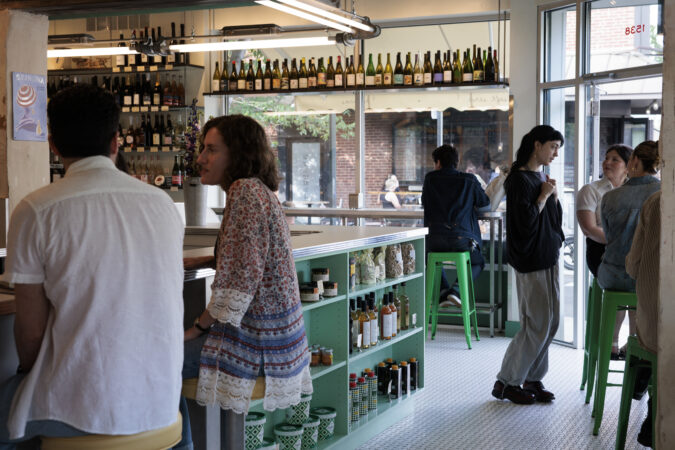
Pop in for an afternoon snack, leave (or lounge) with a great bottle of wine. Owner Chloe Grigri and partner-in-wine Kait Caruke have been queens in the Philadelphia wine scene for years, so it’s no surprise that their bar/bottle shop hybrid is one of the best additions to the Philly bottle shop scene. Supérette boasts a fresh, eclectic selection of about 100 wines mostly meant to be enjoyed now, with some collector’s items sprinkled onto the shelves. The inventory is French-focused, rounded out by other Old and New World bottles for range. Prices range from high teens to $100, with magnums available as well. Affordability has clearly been prioritized for takeaway bottles, and corkage is just $25 if you stay to sip. Check out the CouCou wine club to have interesting bottles chosen for you monthly.
These suburban shops were among the first small grocers to offer curated retail wine sets — Media in 2016 and Swarthmore in 2017 — and remain some of the best in the ‘burbs to this day. The stores have offered a natural-dominant selection for even longer. Owner Jack Cunicelli is guided by his own love of minimal-intervention wines, updated classics, and renegade producers. The selections at the respective locations offer a full global representation while remaining laser-focused on producers and styles that made Cunicelli himself fall in love with wine. Expect a rotation of old-school standouts (Frank Cornelissen, Cantina Giardino, and Sylvain Pataille were recent highlights) mixed with new wave American producers to know, like Fossil & Fawn, Franchere, and Monte Rio. With prices starting at $12, there’s something for everyone.
713 S. Chester Rd., Swarthmore, 610-328-7211; 211 W. State St., Media, 610-565-8320; the320marketcafe.com
Bloomsday
This Headhouse Square restaurant/bottle shop offered a range of great Pennsylvania-produced bottles long before the current urban winery boom, showcasing that it’s just as important to celebrate the local scene as the heavy hitters of France, Italy, Spain, and beyond. The retail shop inside the restaurant — formerly dubbed the “Fancy Wine Shop” and now mid-rebrand toward a more neighborhood vibe — has evolved for the better every year. Beverage director Chris Liu has been meticulously refining the selection and revamping the retail pricing structure without sacrificing quality. Beyond wine, the beer and cider offerings are also fantastic. Notably, this is one of the only places in the city where you can pick up Fermentery Form bottles outside of the brewhouse.
Pre-pandemic, this Rittenhouse space was Cook, a live-action venue for food and beverage classes taught by local professionals. COVID-19 forced that business model to pause and the space reopened as Cork wine shop in fall 2020, offering a big selection of bottles alongside barware and small-batch cocktail ingredients. Cork did what few others were doing at the time, prioritizing being a neighborhood shop over a specialty wine store. The offering is vast, from wine cans to bottles to liters and bags. You’ll also find one of the largest NA programs in the city. It’s a luxurious stop for snacks — the gummy selection is unrivaled — but the wine and the team running the shop are as friendly as can be.
This Abruzzo-focused restaurant has been an East Passyunk mainstay for years, and its small bottle shop is an under-the-radar gem. Jack-of-all-trades manager Chris O’Brien pulls double duty between running the wine program and supporting chef Andrew Wood in the kitchen, which brings a special pairing pizzazz to the selection. Le Virtù offers nearly 100 different bottles, predominantly low-intervention wines from southern Italy. Expect to find a few dozen options from Sardinia, Sicily, and northern Italy, starting at $15. Le Virtù also offers a wine club with both two- and four-bottle memberships, and the option for an additional “Somm’s pick” bottle. The first Wednesday of each month is a tasting social, where club members get complimentary snacks (stuzzichini) and tastes of that month’s wines, plus additional special bottles. Nonmembers can partake for $20.
Seven minutes from the Ben Franklin Bridge, the Pennsauken outpost of this highly regarded wine shop has long been a primary shopping destination for Philly residents looking for options beyond Pennsylvania’s state stores. Moore Brothers exclusively offers wines that they import directly from France, Italy, and Germany, focusing on sustainable and biodynamic producers. Temperature control — from the shipping to in-store storage — is their non-negotiable to keep bottles pristine. Because inventory is built around a direct-import program, the selection doesn’t change often, but the consistency and longtime relationships with their producers shine, vintage after vintage. Make sure to sign up for the email list for great tips on wine pairings.
We’ll never throw shade at a South Jersey stock-up, but independently owned stores can be tricky to find there, likely due to the cost and rules for liquor licenses. This unassuming shop, with locations in Marlton and Voorhees, quietly offers one of the more interesting selections in South Jersey. Bottles are displayed by country and style, meaning you’ll find deep-cut small-batch wines tucked casually next to their more mainstream counterparts. A recent trip found Olga Raffault Chinon Rose, a beloved producer from central France, for just $20, displayed next to Whispering Angel, on sale for $24. If wine names mean nothing to you, all good. Simply keep an eye out for “Nina’s Picks” tags, denoting favorite selections from wine director Nina Sygnecki, or ask if she’s around for a recommendation.
100 Church Rd. E., Marlton, 856-983-0056; 2999 E. Evesham Rd., Voorhees, 856-424-4898,trainoswine.com
Florida Cold Cuts
Headed down the Shore? There are dozens of big-box wine shops along the way, but you should really scope out this Ventnor spot with great bottles (and excellent made-to-order sandwiches). The selection is small, tight, and extremely well-curated. Everything is natural-minded, organic, or biodynamically focused, with an emphasis on wines from people and places with a great story. To borrow a line from its monthly wine club, “Leave it to us to find the wines that make the ‘cut’ so you can focus on drinking cleaner and better.” There’s also an excellent selection of cold beers by the bottle or can and canned/bagged wines — perfect for tossing into your beach tote.
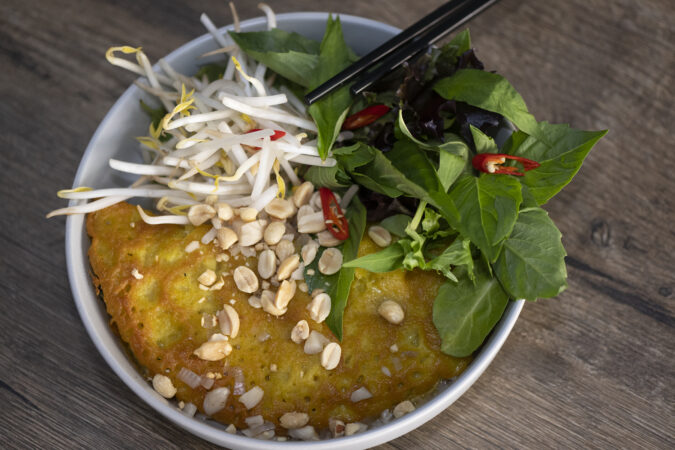
This time, a single dish is in the spotlight. The New York Times named the Southeast Asian BYOB noodle house’s banh chow salad on its annual list of Best Restaurant Dishes We Ate Across the U.S.
It’s a dish that Craig LaBan also praised in his 2023 review of Mawn: “You can taste the pride in those memories in dishes like the banh chow salad, savory coconut milk-turmeric crepes, not unlike crispy Vietnamese banh xeo, but cradled wet in a bowl already dressed with fish sauce beneath a flavorful pile of herbs, sprouts, chicken, and shrimp.”
NYT food reporter Brett Anderson extolled the salad’s savory coconut rice crepe for being “as lacily crisp as a Parmesan tuile on the outside, and plumped by ground chicken and shrimp within.”
He also notes that the “tangle of soft lettuces and what the menu calls ‘backyard herbs’ bring a lot to the plate: levity, structure and the thrown-together appearance of everyday Cambodian American home cooking, only with a chef’s attention to details.”
Mawn’s banh chow salad is the only Philadelphia dish on the national list, sharing a place with other picks from around the country, like a chaas aguachile from Mirra in Chicago, an ode to Ben’s Chili Bowl from Kwame Onwuachi’s Dogon in D.C., and a lamb neck pie from Little Beast in Seattle.
The largest U.S. outpost of thepopular Vietnamese coffee brand Trung Nguyên Legend is open in South Philly.
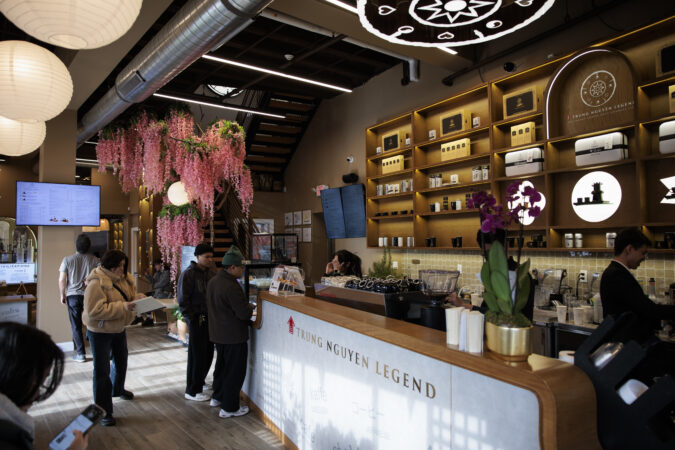
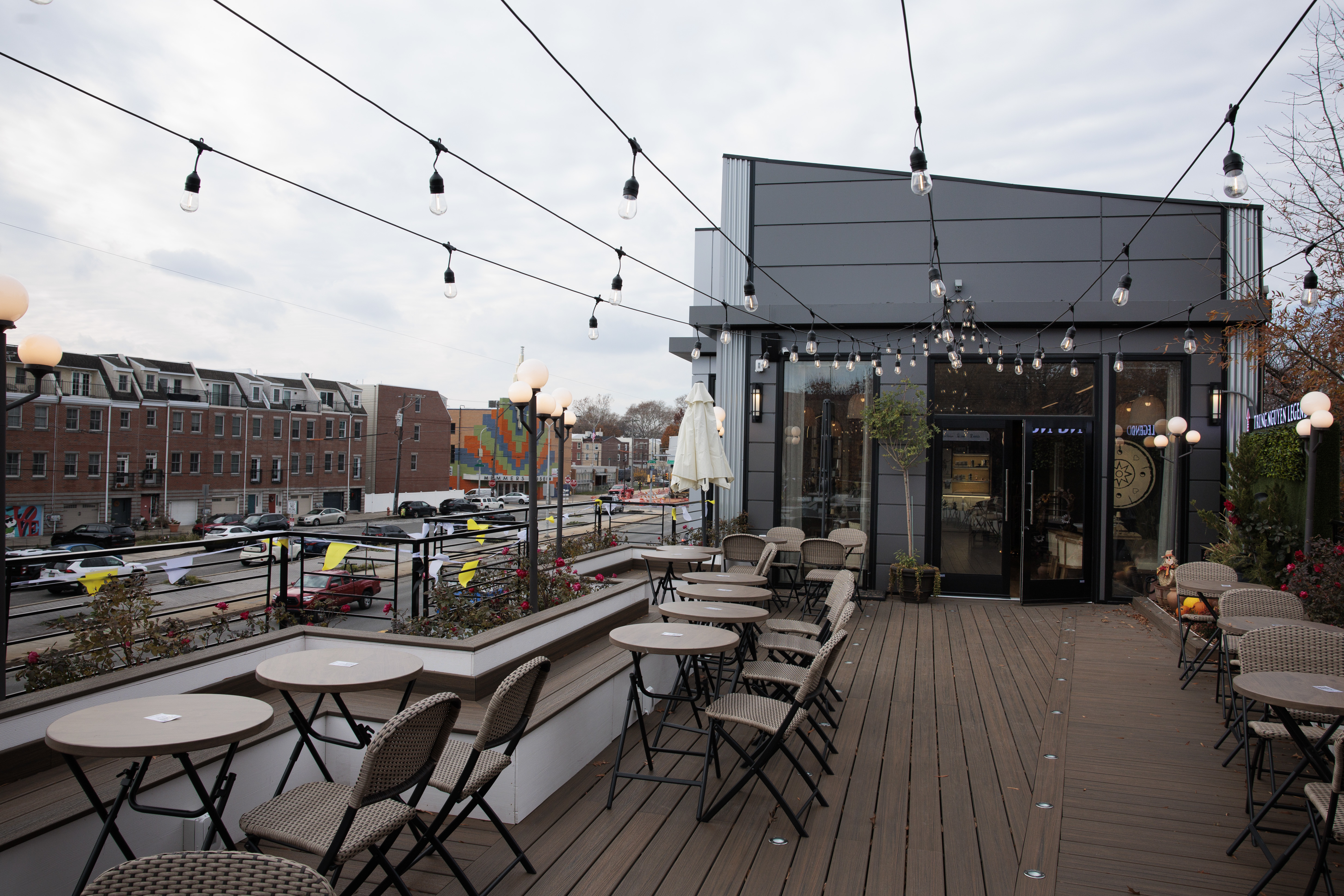
Packer Park residentsEstelle Nguyen and husband Vandy Doopened their Trung Nguyên Legend franchise at 113-117 Washington Ave. late last month. The couple transformed a one-story cabinetry showroom into a 5,000-square-foot cafe with two floors and a year-round roof deck,where customers can sip on citrusy espresso tonics, frothy Vietnamese egg coffees, or strong phin pour-overs, paired with a small array of European pastries (macarons, eclairs, mille-feuille) delivered daily from an off-site bakery.
Founded in 1996, Trung Nguyên is one of Vietnam’s largest coffee brands, known for turning robusta beans from the country’s Central Highlands region into a well-regarded line of ground and instant coffees sold internationally.
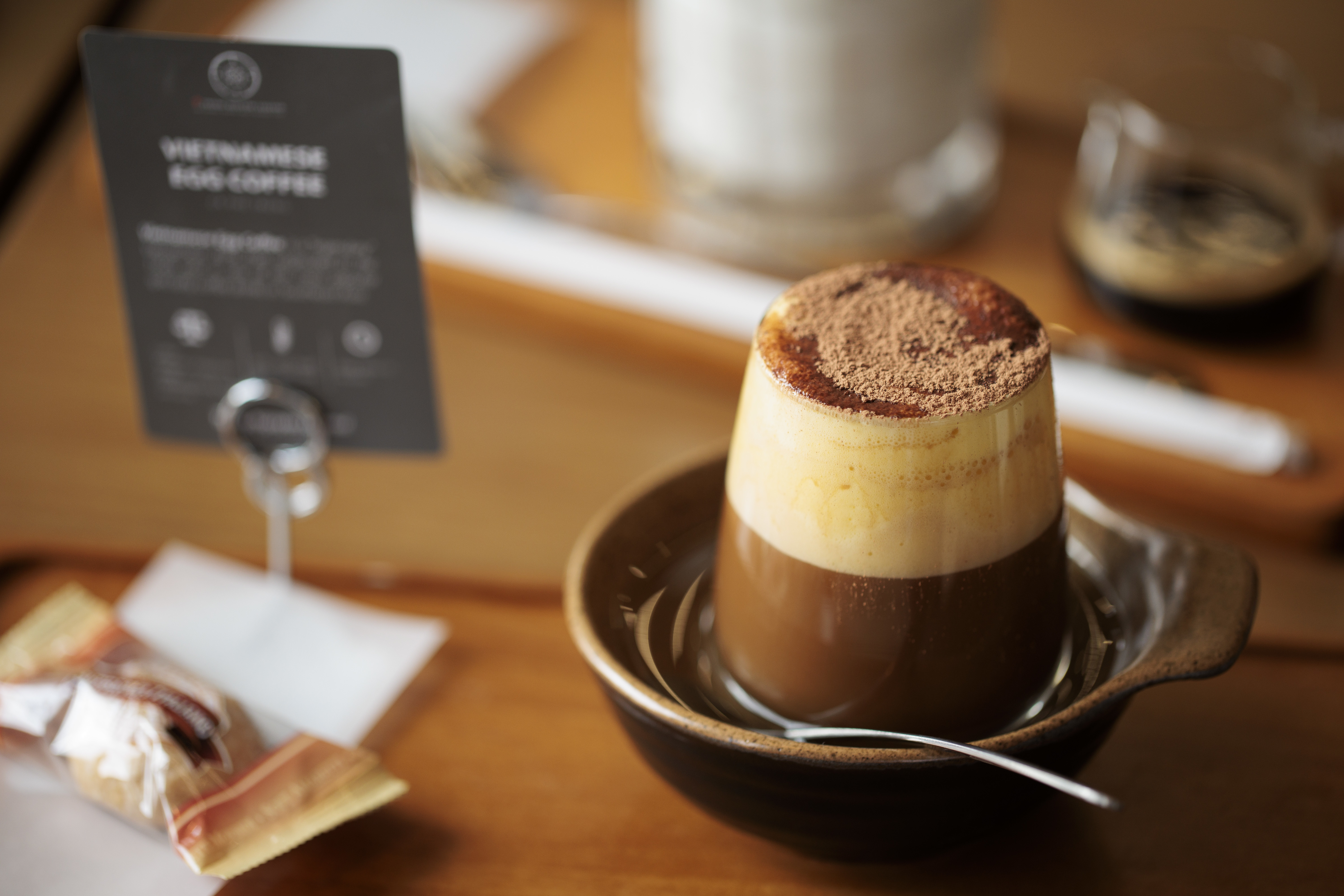
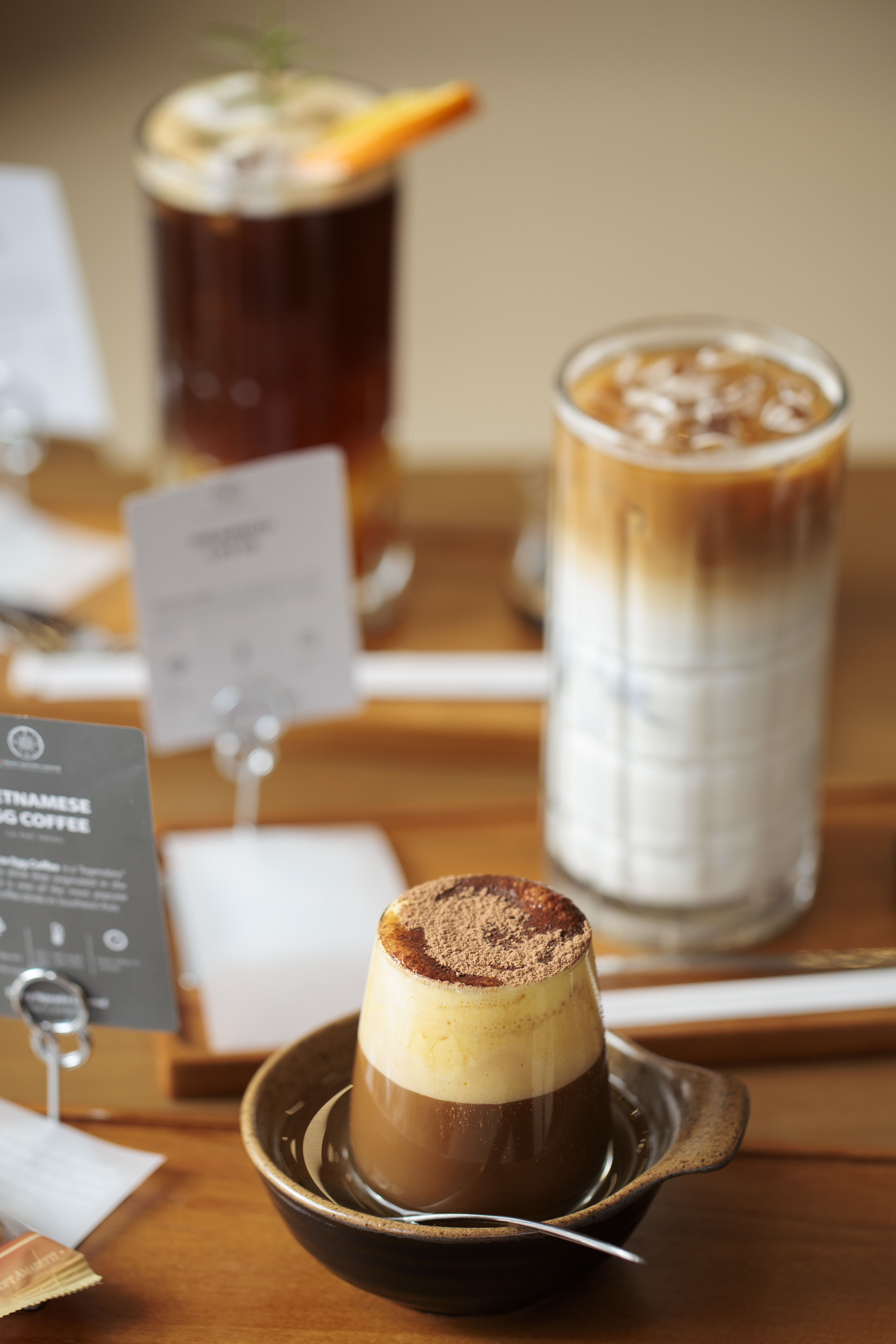
Hot Vietnamese Egg Coffee served over a pool of warm water at Trung Nguyên Legend’s Philly location at 113-117 Washington Ave.
Not every Trung Nguyên coffee shop is as massive —or luxurious — as the new Washington Avenue outpost. The chain operates 1,000 locations across Vietnam, China, and Europe, the majority of which are grab-and-go stores. Legend stores, however, are the brand’s version of a Starbucks Reserve, with more seating and higher-end touches like interactive coffee services.
Most of Trung Nguyên’s U.S locations are Legends. The first franchise opened in Southern California in 2023, with six outposts across Portland and Texasfollowing soon after. Nguyen and Do’s location is the only one on the East Coast, a fact Nguyen brags about.
“I wanted to do something gorgeous,” said Nguyên, 52.
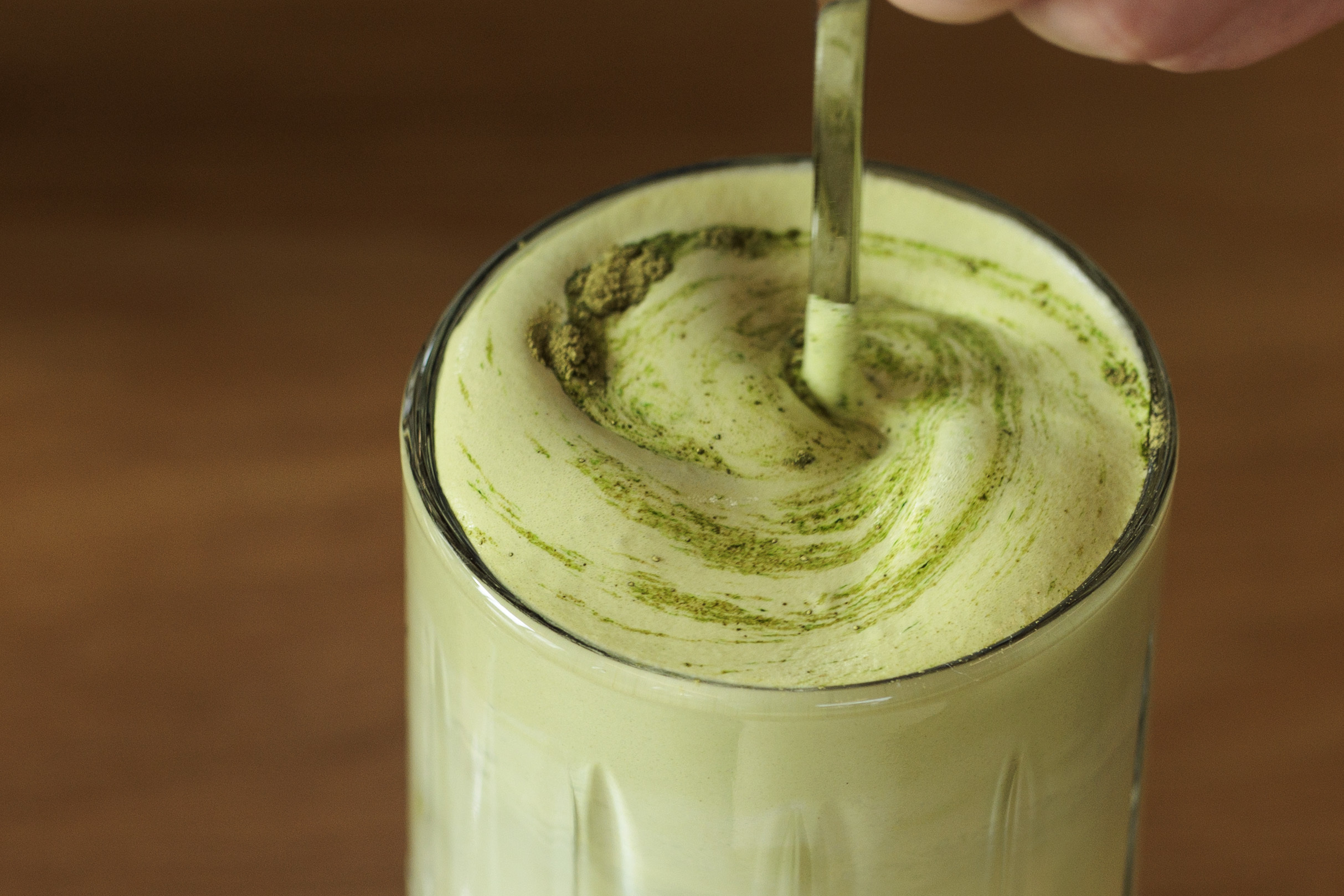
Under her careful supervision, baristas at the first-floor counter crouch down to ensure that the amount of cold foam is level across matcha, sesame, and tiramisu lattes. Nguyen folds napkins printed with the Trung Nguyên logo into perfect equilateral triangles. As she greets customers,Nguyen promises tours of the rooftop lounge to people she hopes will become regulars.
The coconut matcha at Trung Nguyên Legend on Washington Avenue in South Philly.
Nguyen and Do, both Vietnamese, moved to Philadelphia in 2005 to become big-time entrepreneurs: Together, they own a South Philly daycare, a wedding planning business, and Asian Palace, a Chinese restaurant at 2001 Oregon Ave. that doubles as a banquet hall.
The Trung Nguyên franchise, Do said, is the couple’s first venture that pulls directly from their culture. Vietnam is the world’s second-largest coffee exporter, known for strong coffees brewed through phins, slow-drip coffee filters that help retain the heat and intensity of coffee grounds. The country’s coffee shop scene is also somewhat different; shops generally stay open past 10 p.m and gladly let customers linger.
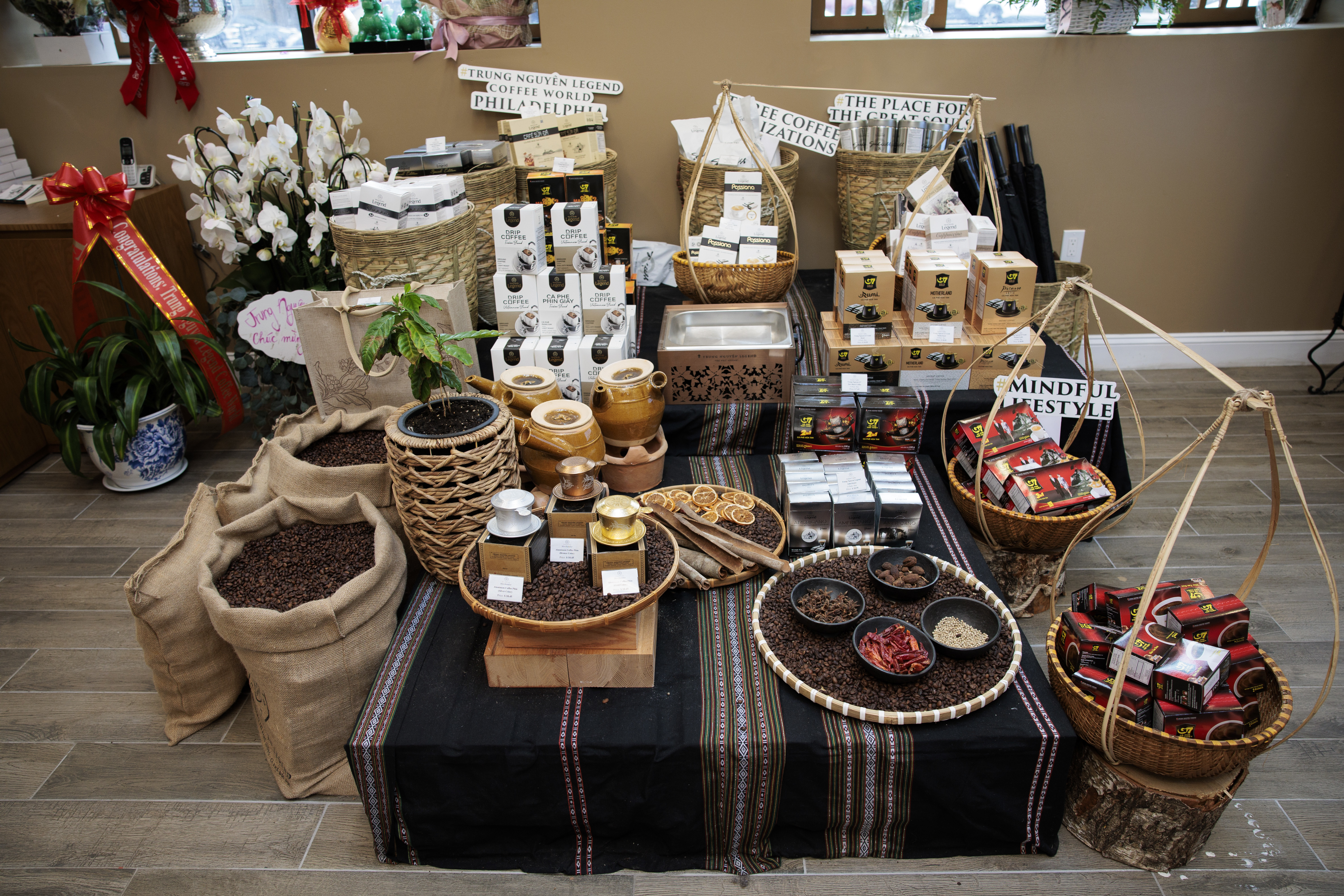
Trung Nguyên instant coffees, phin filters, and other merchandise available for purchase at the Vietnamese coffee chain’s South Philly Legend store.
“We’ve lived in Philly for over 20 years,” said Nguyên. “We didn’t see any spot like this where you could hang out with coffee and dessert.”
The final result is a Trung Nguyên unlike any other in the U.S. The couple paid a sum “in the low six-figures” to sign a franchise agreement in February 2024, Nguyên said, and invested “significantly more” to add a second-floor dining space to the former showroom.
The size was Nguyen’s idea, like most everything else in this Trung Nguyên. (Do, her husband, mostly nods in agreement while snapping photos of his wife at work.)
“This is all me, honey,” Nguyen said. “I wanted a pop.”
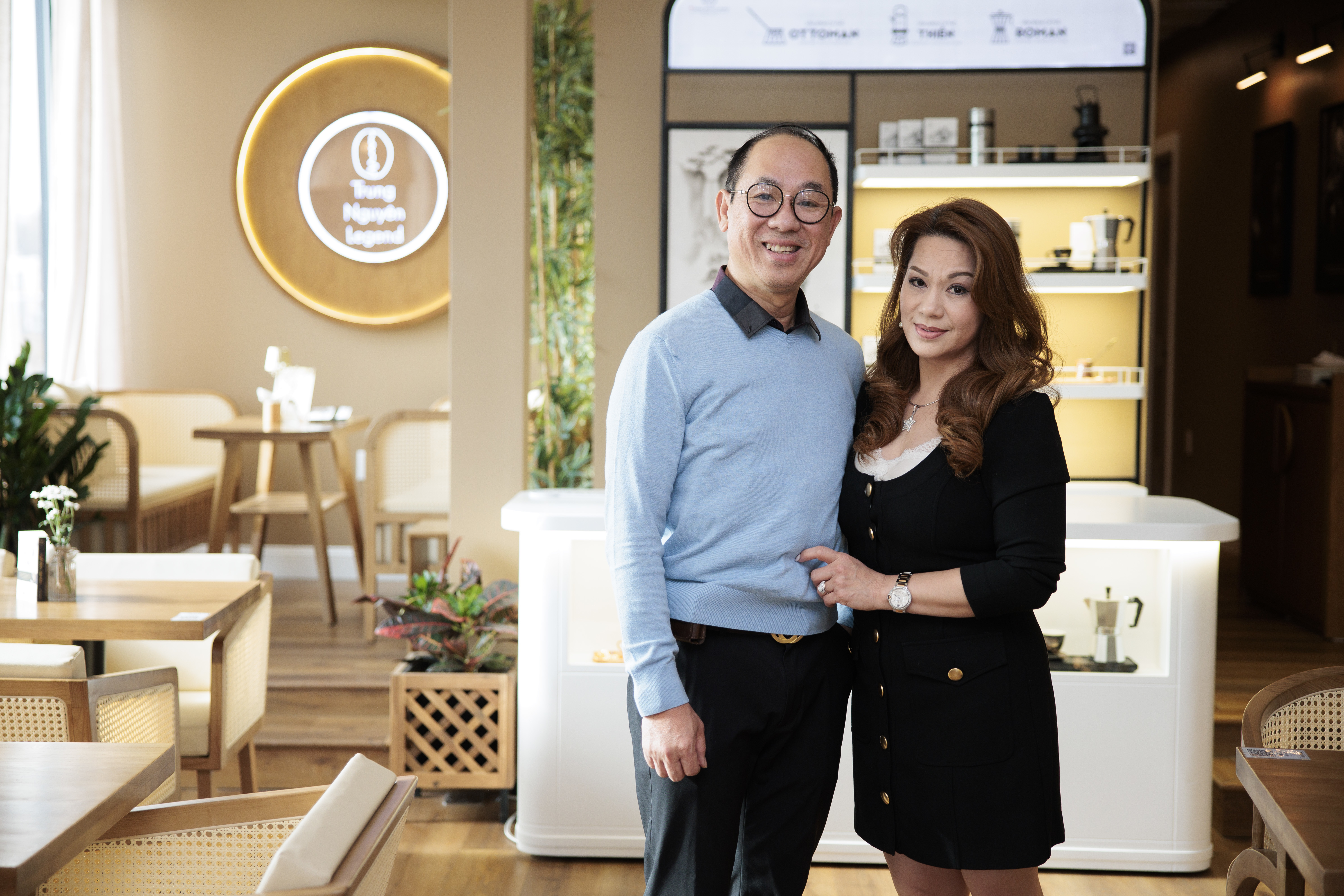
Vandy Do and Estelle Nguyen posed for a portrait at Trung Nguyên Legend Coffee World Philly on Thursday, Dec. 4, 2025 in Philadelphia.
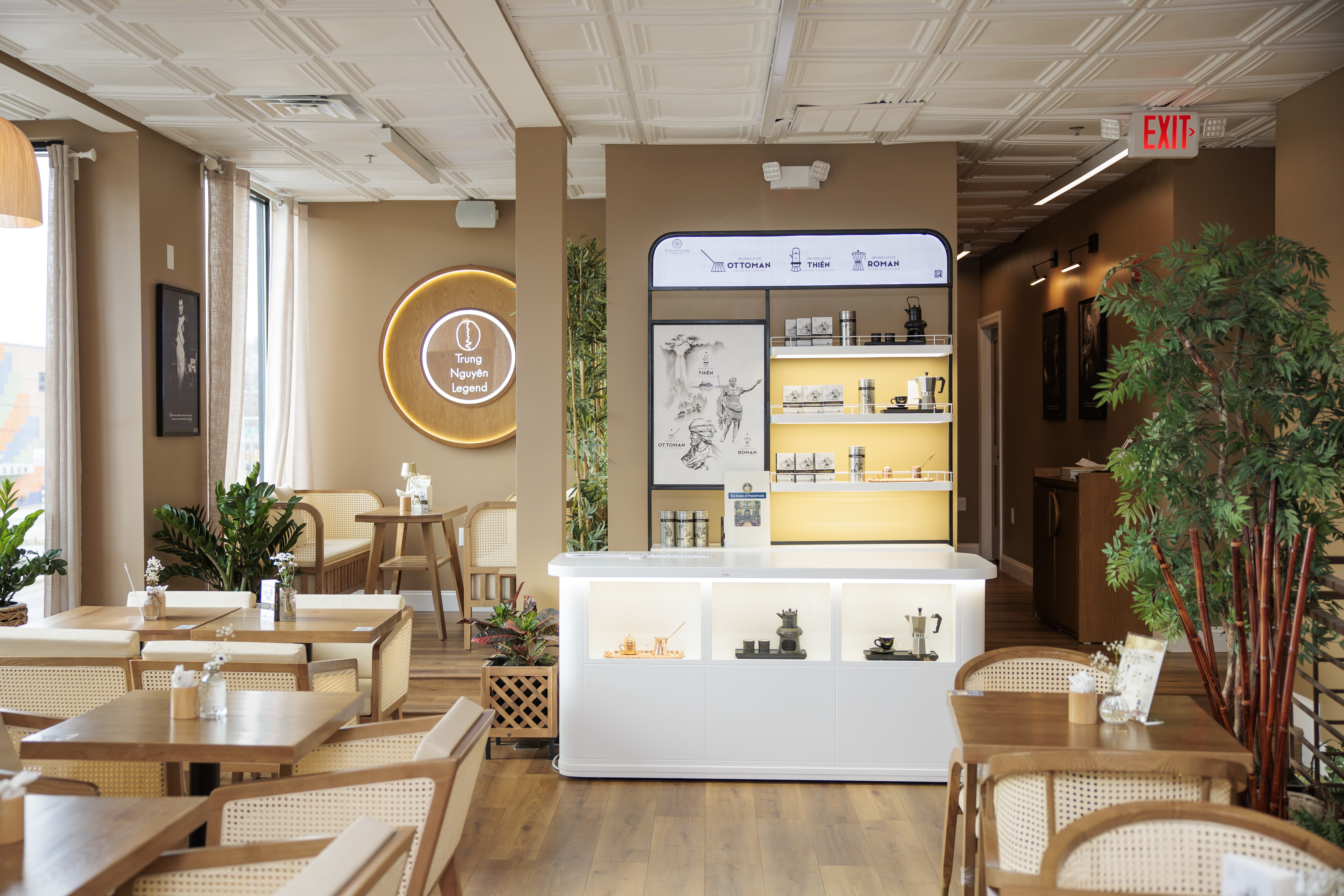
The space is decorated in tones of black, beige, and brown — Trung Nguyên’s signature colors — with grand couches and plush fabric chairs that Nguyen said she lobbied the company to include, breaking with their standard look.
A 17-foot tree covered in fake fuschia flowers looms over the main staircase. It was another of Nguyen’s visions: After spotting a barren tree on the side of a South Philly road, Nguyen had Do cut it down, the branches hanging out of his trunk on the drive home. She spent roughly a week gluing strands of flowers onto the salvaged tree. Its stump sits on the cafe’s patio, surrounded by a plant wall and a water fountain.
That, Nguyen said graciously, was her husband’s idea.
The roof deck at Trung Nguyên Legend Coffee World Philly on Thursday, Dec. 4, 2025 in Philadelphia.
Different coffees for different floors
South Philly’s sprawling Trung Nguyên also offers a choose-your-own adventure element: Depending on which floor one visits, customers have the option to order coffee brewing experimentsreminiscent of a high school chemistry class.
“It’s like playing” with your coffee, Nguyen said.
All of the store’s coffee beverages are made with Trung Nguyên-brand arabica and robusta beans — the latter of which is stronger with double the caffeine content. Baristas use both phins and a traditional espresso machine, depending on the order.
Though there’s plenty of seating throughout, downstairs ismainly intended for to-go coffees. Customers can watch baristas prepare drinks with military precision. Nguyên said the most common orders thus far have been yuzu coffee — an espresso tonic spiked with fresh-pressed yuzu juice — and a “matcha cloud” with matcha-oat milk cold foam floated atop iced coconut water.
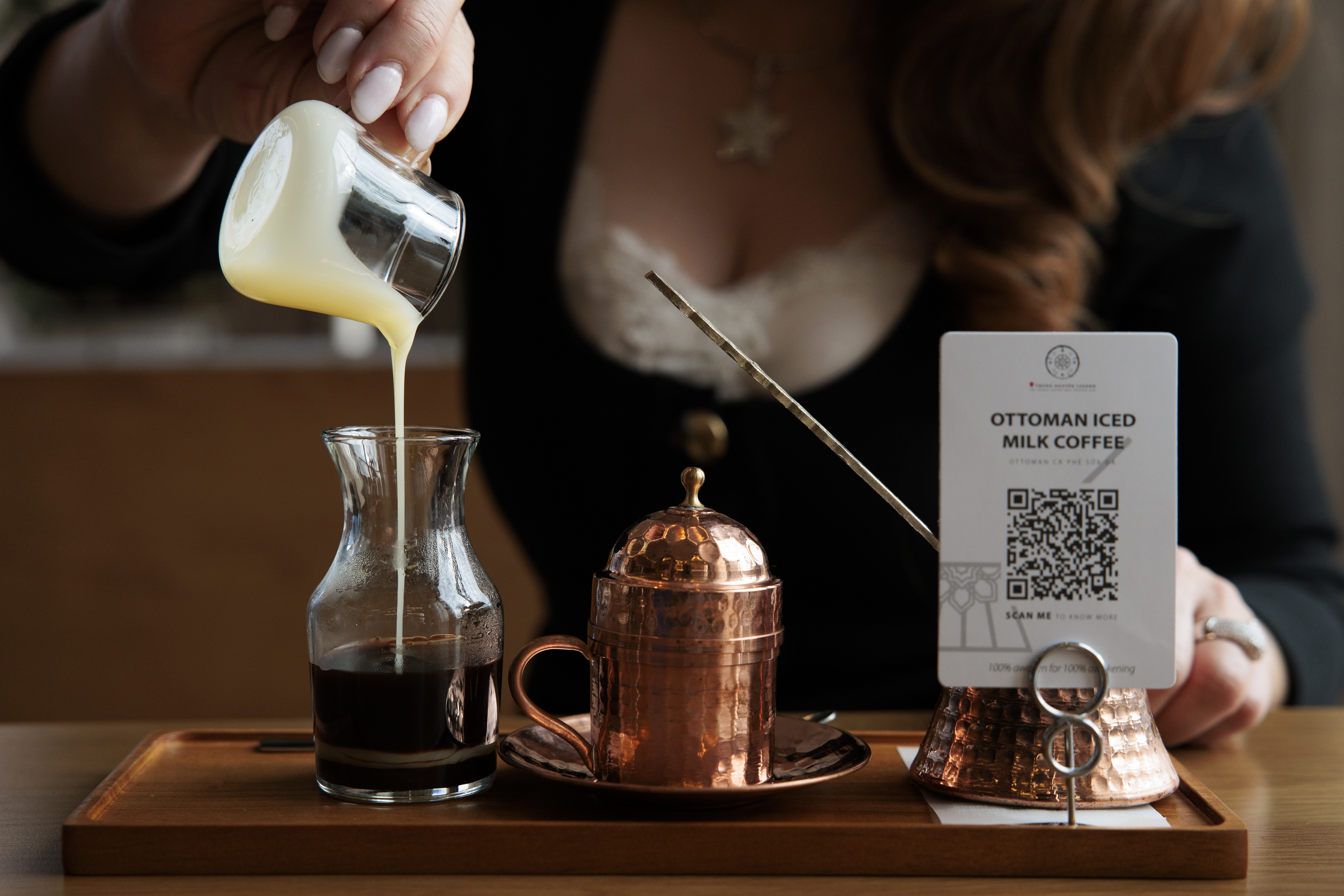
Co-owner Estelle Nguyen pours condensed milk as part of the Ottoman Iced Milk Coffee service at Trung Nguyên Legend.
Open from 3 to 9 p.m. daily (hours are subject to change as Nguyen hires more staff), the upstairs is the only level where customers can order Trung Nguyên’s signature Zen, Ottoman, and Legend coffee services, all of which include a 20% gratuity.
Each service comes with percolating coffee that’s been arranged on a tray with the appropriate phins or kettles for the customer to finish the process, along with finishing accoutrements like milk and sugar, and an amaretti cookie — Nguyen’s personal touch. QR codes display instructions on how to create the perfect pour.
Nguyen’s favorite service is the Legend. To get the perfect sip, customers must wait for grounds to finish passing through a phin before adding a thimble-sized serving of condensed milk to the brew and pouring the mixture over a glass of ice. Another option is the elaborate Ottoman service, a five-step process that involves transferring the coffee from a jug to a traditional Turkish ibrik to a petite teacup. The end result of this coffee theater tastes like a smoother, slightly bitter version of cafe con leche.
The second-floor interior of Trung Nguyên Legend Coffee, where a 20% auto-gratuity is applied.
Also available on both floors: creamy Vietnamese egg coffee, which became Vietnam’s signature drink in the 1940s after bartenders in Hanoi started subbing milk for whipped eggs to cope with a dairy shortage. Trung Nguyên’s version comes blended with ginger to neutralize the smell of the egg; it goes down easy, in layers of frothy foam and slightly sweet coffee. Do recommends trying it upstairs, where the drink is served hot over a bowl of warm water in order to retain its temperature.
The concoction will run dine-in customers $8.34 for an 8-ounce cup. If they want to recreate the experience at home, they can purchase Trung Nguyên-branded products.
“A lot of people told me I was crazy to sell $10 coffees and invest so much,” said Nguyen. “This is my big challenge.”
Trung Nguyên Legend, 113-117 Washington Ave., 215-755-1953, trungnguyenlegendphilly.com. Hours: 7:30 a.m. to 8:30 p.m. daily
(left to right) The Yuzu Coffee, Vietnamese Egg Coffee and Tiramisu Latte at Trung Nguyên Legend in Philadelphia.