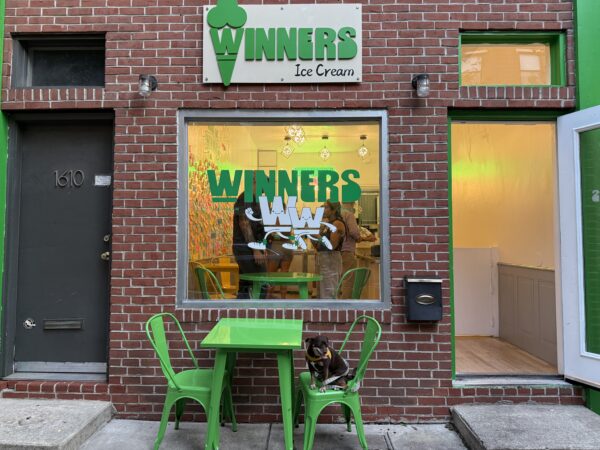
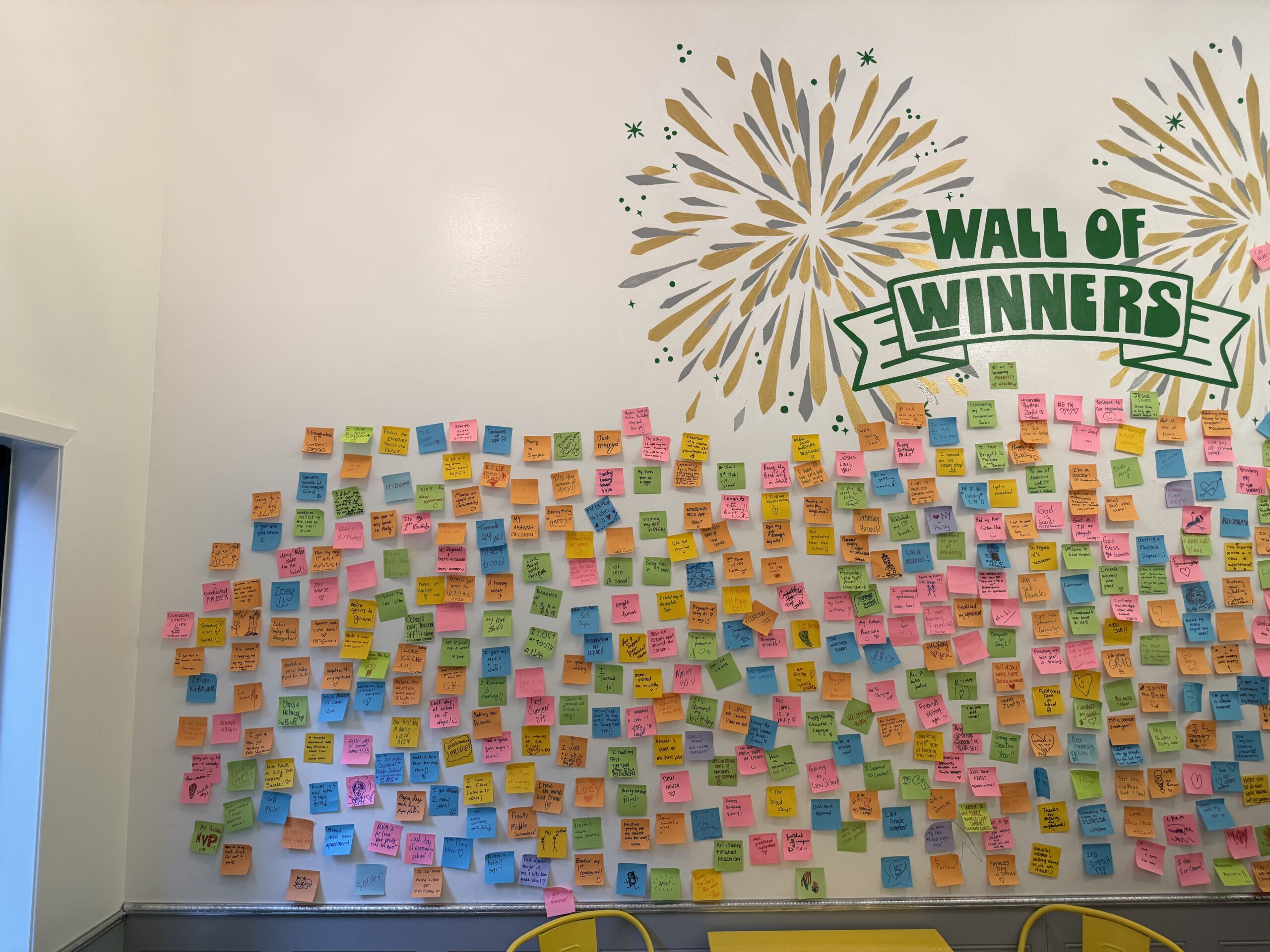
Winners Ice Cream has only been open three weeks, but its wall is already completely covered with notes from neighbors. The small shop was packed on a recent, hot Thursday evening, as customers of all ages lined up for scoops of nostalgic flavors with winning-themed names like “MVPeanut Butter Crunch,” “Champ Chocolate,” and “Sweet Success ‘Smores.” They were invited to leave Post-It notes on the wall that detailed their own personal wins.
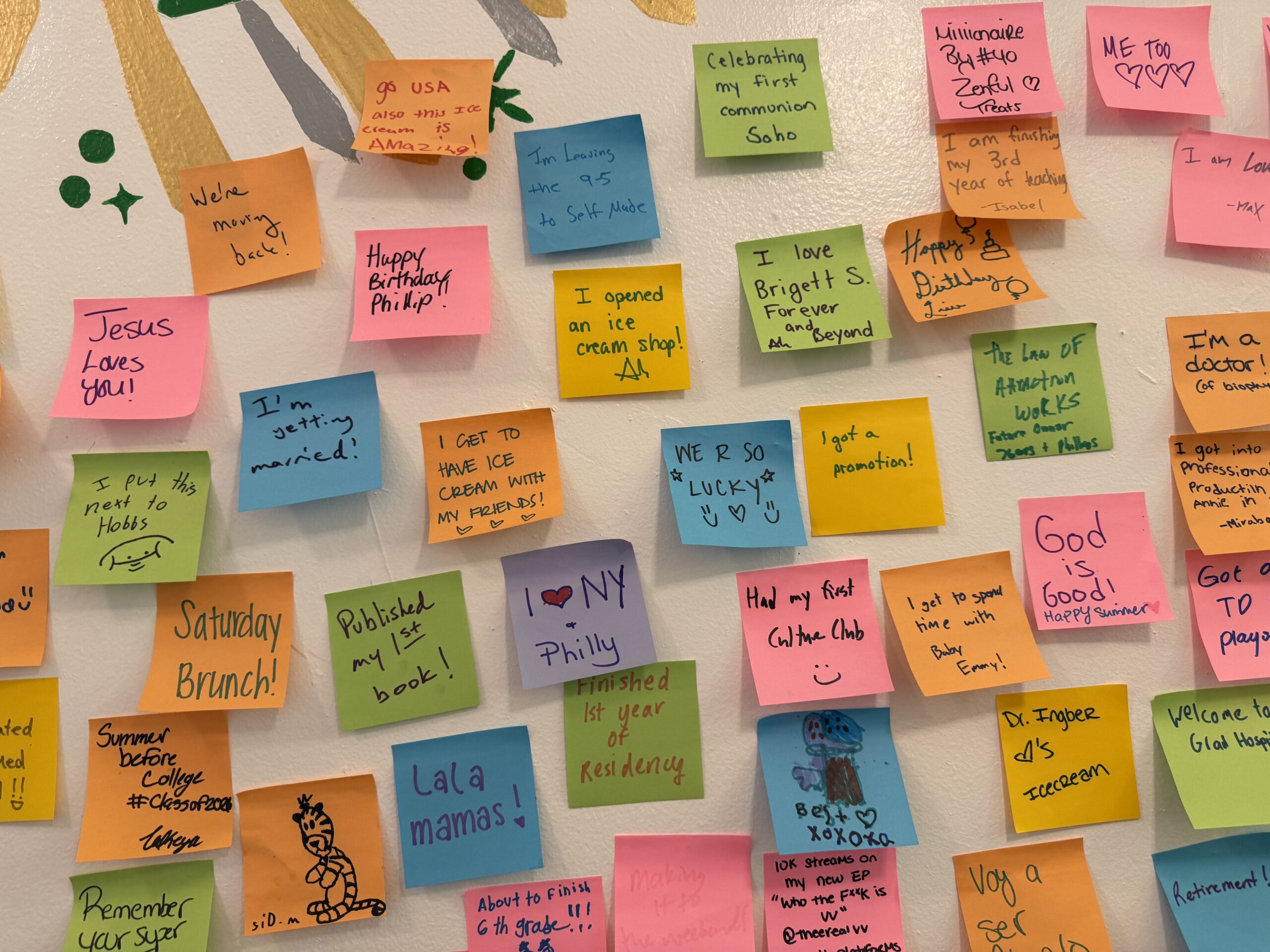
These notes ranged from “I’m getting married” to “Published my first book” to “I ate breakfast.”
This is owner Anh Nguyen‘s first shop. The 31-year-old, originally from Newark, Del., moved to Philly to manage branches of Surreal Creamery for the four years prior to his opening Winners.
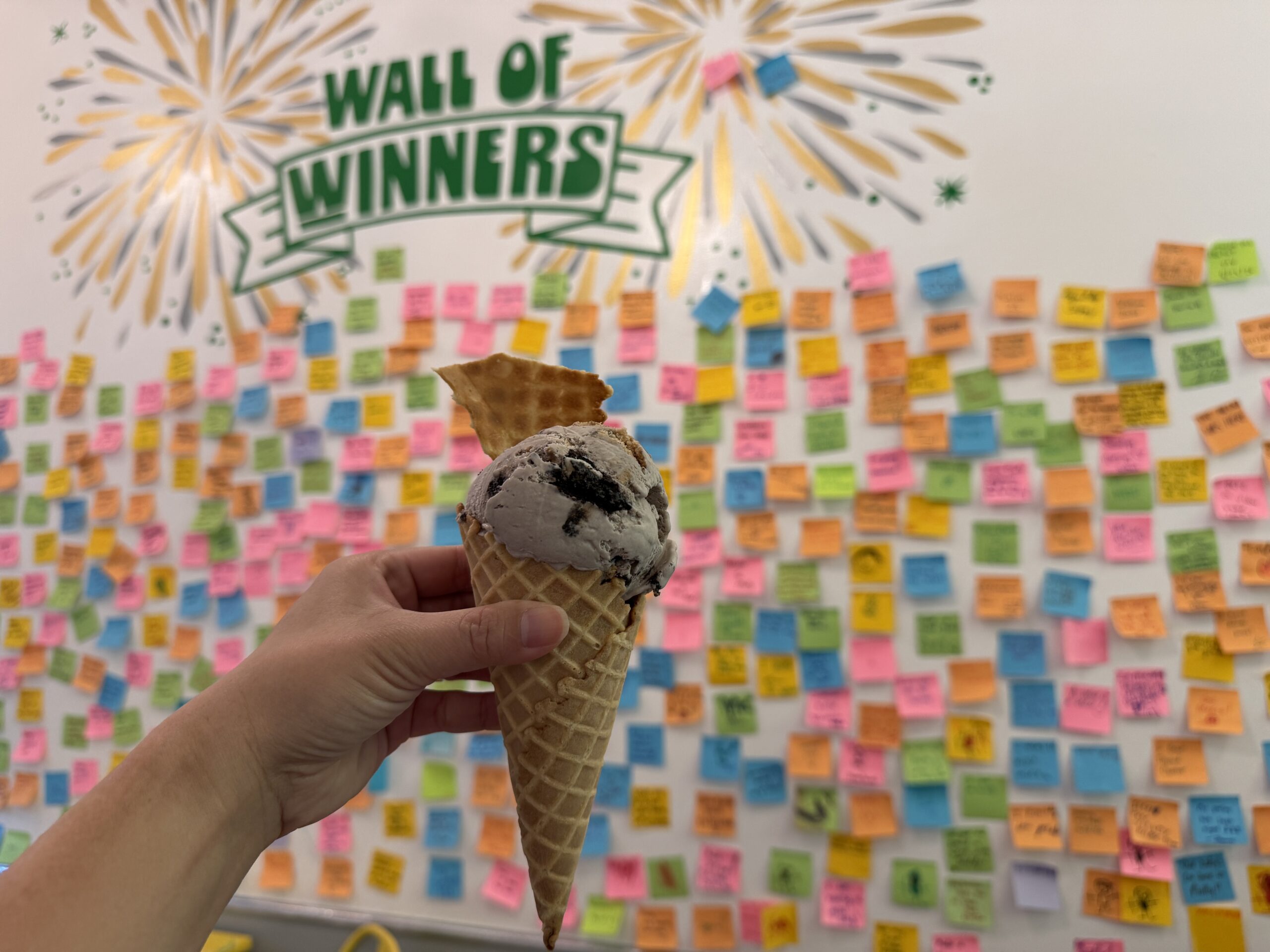
Cookies and cream dream in a waffle cone at Winners Ice Cream in Graduate Hospital.
Winners is so named because “we celebrate small wins, big wins, and all the wins in between with fantastic ice cream,” said Nguyen.
Nguyen built a production kitchen downstairs, where all his ice creams are made from a 14% buttermilk base. Although he is the sole proprietor, his family has been actively involved with helping him get Winners off the ground. His father helped with construction and his mother kept the crew fed while they spent hours at the shop “putting things together with hammer and nails. And since we’re Vietnamese, she always packed us jasmine rice with eggs, pork, or sautéed chicken.”
It took Nguyen and his father about a month and a half to build out the space. His three sisters have weighed in heavily, testing flavors and helping source ingredients. Nguyen currently makes 14 flavors of ice cream, with more in development, including “Match Point Matcha” (“All the flavors are winning themed,” he said) since the green tea flavor is so popular.
His current personal favorite? “Major Mint Chip, which I make by infusing fresh mint leaves into the ice cream base, and letting it steep overnight. I didn’t want to use extracts or food colorings in any of my ice creams.”
The flavor has crushed Girl Scout cookies (Thin Mints, of course) because Nguyen’s niece is a Girl Scout. To support her during cookie sales, he bought cases upon cases of cookies.
The wall of winners at Winners Ice Cream.
Winners, as well as Mod Spuds, which opened a week and a half prior to the ice cream shop, contributes greatly to “little treat culture” in the neighborhood. And they also share a similar aesthetic, because they share the same muralist. Nguyen peeked into Ange Branca’s Mod Spuds, a few feet away and also on South Street, noticed their painted walls, and asked to be connected with the artist, Hana Alshahab, who ended up painting the wall at Winners.
Winners is a dream come true for Nguyen, who has loved hard-scoop ice cream since he was a child. “You can add mix-ins to hard scoop and make flavors that are more out of the box, unlike with soft serve where the mix-ins won’t fit through the tube of soft serve machines.”
Most importantly, “I want Winners to be a community space to recognize and celebrate the moments in life that are often overlooked. Small wins can add up to big wins. I look at the wall and I get inspired and emotional,” said Nguyen.
The wall of winners at Winners Ice Cream consists of notes left by patrons.
In the sea of slips of paper denoting other peoples’ wins, one yellow one could easily be missed. It reads, “I opened an ice cream shop!”
“That one was mine,” said Nguyen.
Winners Ice Cream is at 1610 South St. It’s open from noon to 10 p.m. daily. Single scoops served in cups start at $5.75.
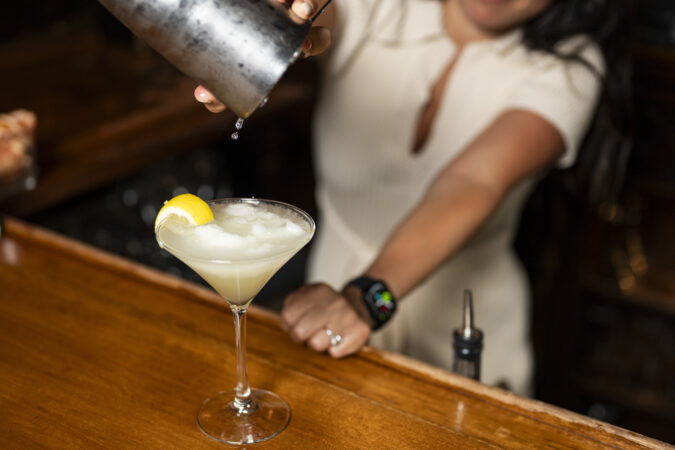
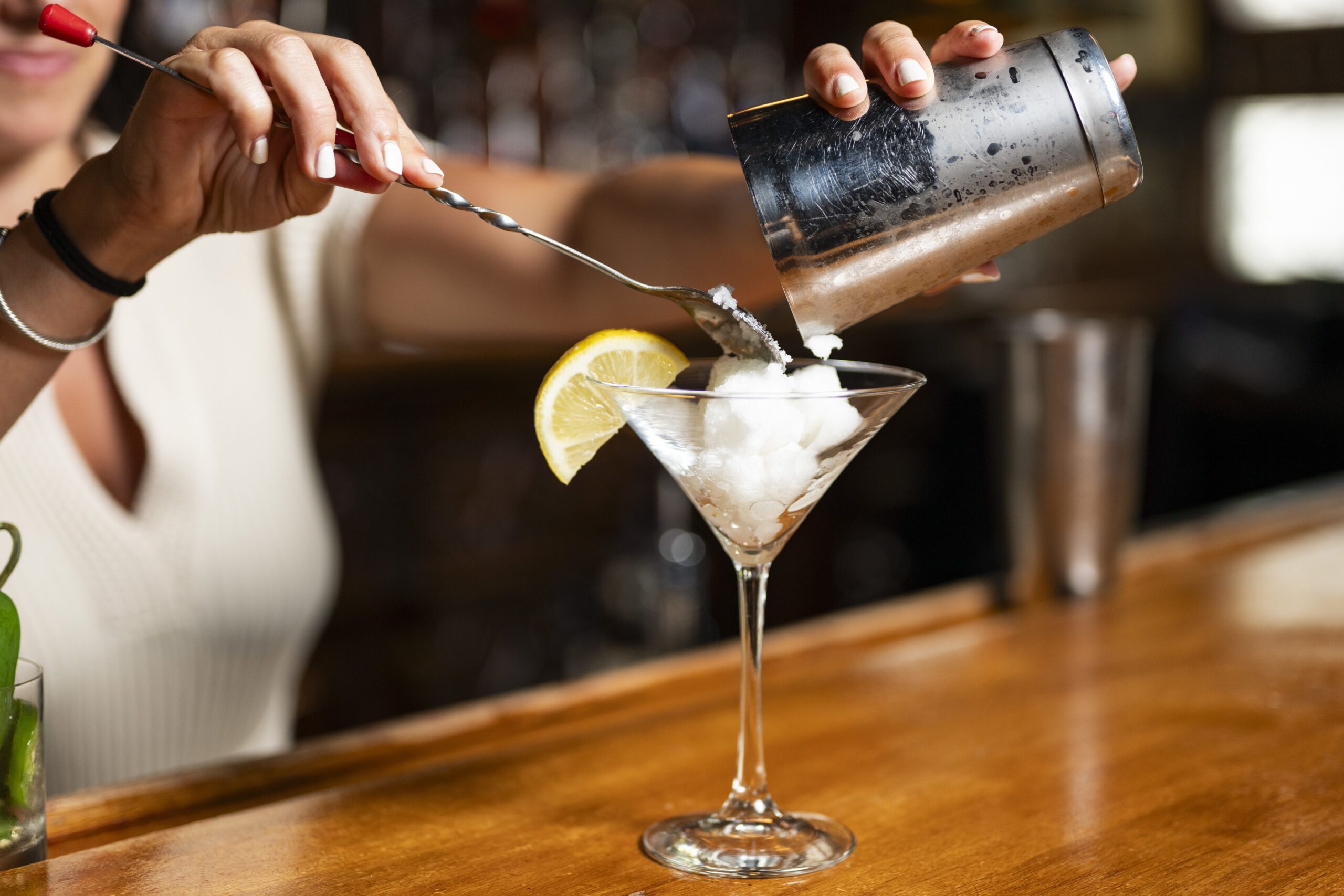
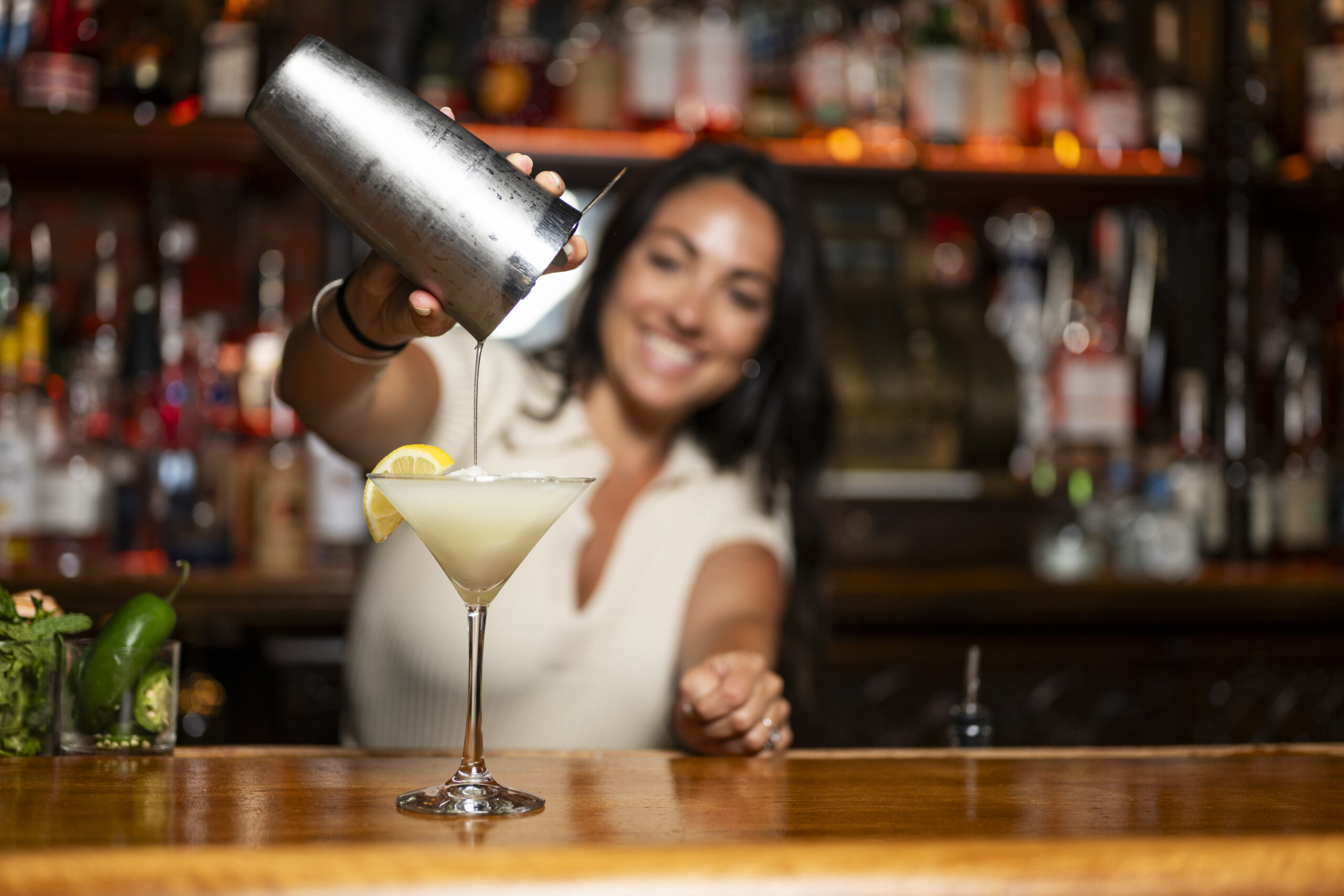
If you were to distill the energy of a South Philly summer into a cocktail, it might look like water ice shaken with vodka in a martini glass, garnished with a pretzel stick. It would taste like the syrupy-sweet melted ice left in the cup and be crushable enough to knock back on a hot afternoon.
That’s the water ice martini, a cocktail invented in the early 2000s at one of the neighborhood’s most famous red sauce joints. The drink was a hidden gem for decades, but has found new life this summer as copycats and riffs emerge at bars around Philly and down the Shore that are looking to stand out in a sea of Hugo spritzes, espresso ‘tinis, and soft serve margaritas.
“Anyone that’s grown up in South Philadelphia grew up on water ice with pretzel sticks and pumpkin seeds. Its been a thing in my family for three generations,” said Vera Masi, the sales manager at Popi’s Restaurant in Packer Park, where the cocktail recently went viral. “Pairing that with a martini is a guaranteed hit.”
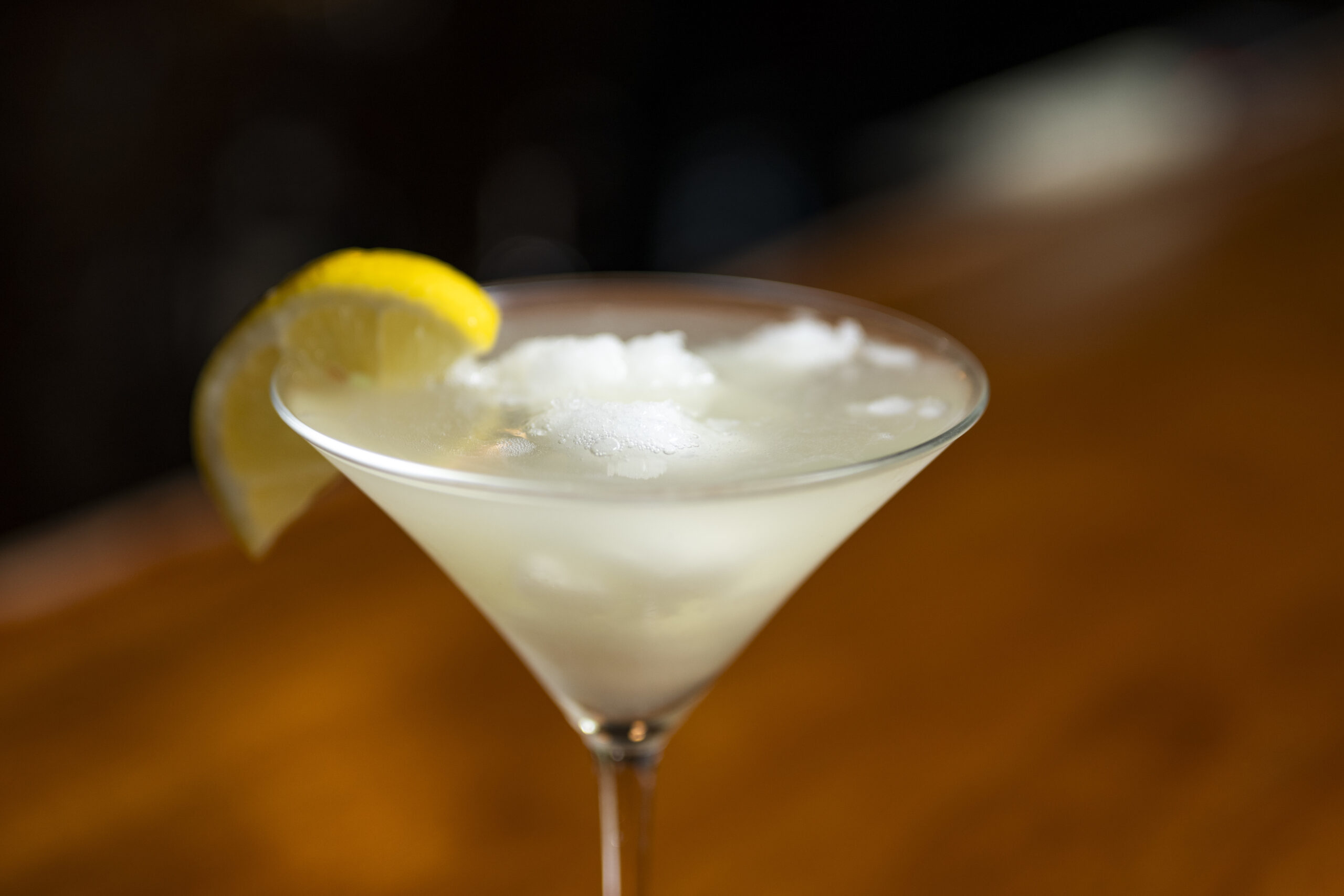
The first water ice martini on record was poured in 2002 at Saloon by Anthony Cardullo, the third-generation John’s Water Ice owner who was then just a bartender. Called the Iceberg, the drink involves adding a scoop of John’s lemon water ice to a shaker with limoncello and Ketel One Citreon vodka. It then gets poured over a second scoop of lemon water ice in a glass.
Gigi Bello, bar manager at Saloon, makes an Iceberg martini using lemon water from John’s. The cocktail has remained a bestseller since they started serving it in 2002.
It’s the restaurant’s most enduring cocktail hit, according to manager Frankie Santore. Saloon sells at least 150 Icebergs per week in the summer, he said, making it their bestseller. To keep up, Cardullo has to drop off gallons of fresh made water ice each week.
Other versions have cycled through Saloon — a pineapple ice painkiller and a melon ice midori sour, to name a few— but the Iceberg is the only one that has lasted, most recently inspiring a dupe that uses Cardullo’s recipe at the Ventnor Social in New Jersey. The restaurant has “never for a second” thought to use anything other than John’s water ice for its cocktails.
“It’s all fresh fruit,” Santore said. “Anthony’s squeezing the lemons himself.”
Gigi Bello, bar manager at Saloon, pours an Iceberg martini.
Popi’s started serving their own versions of the water ice martini last summer after getting the idea from Rowhome Magazine editors Dorette Jackson and Dawn Rhodes. The 33-year-old Italian restaurant sources its water ice from Pop’s for two reasons, owner Gina Rucci said: It’s down the street, and “our names went together.”
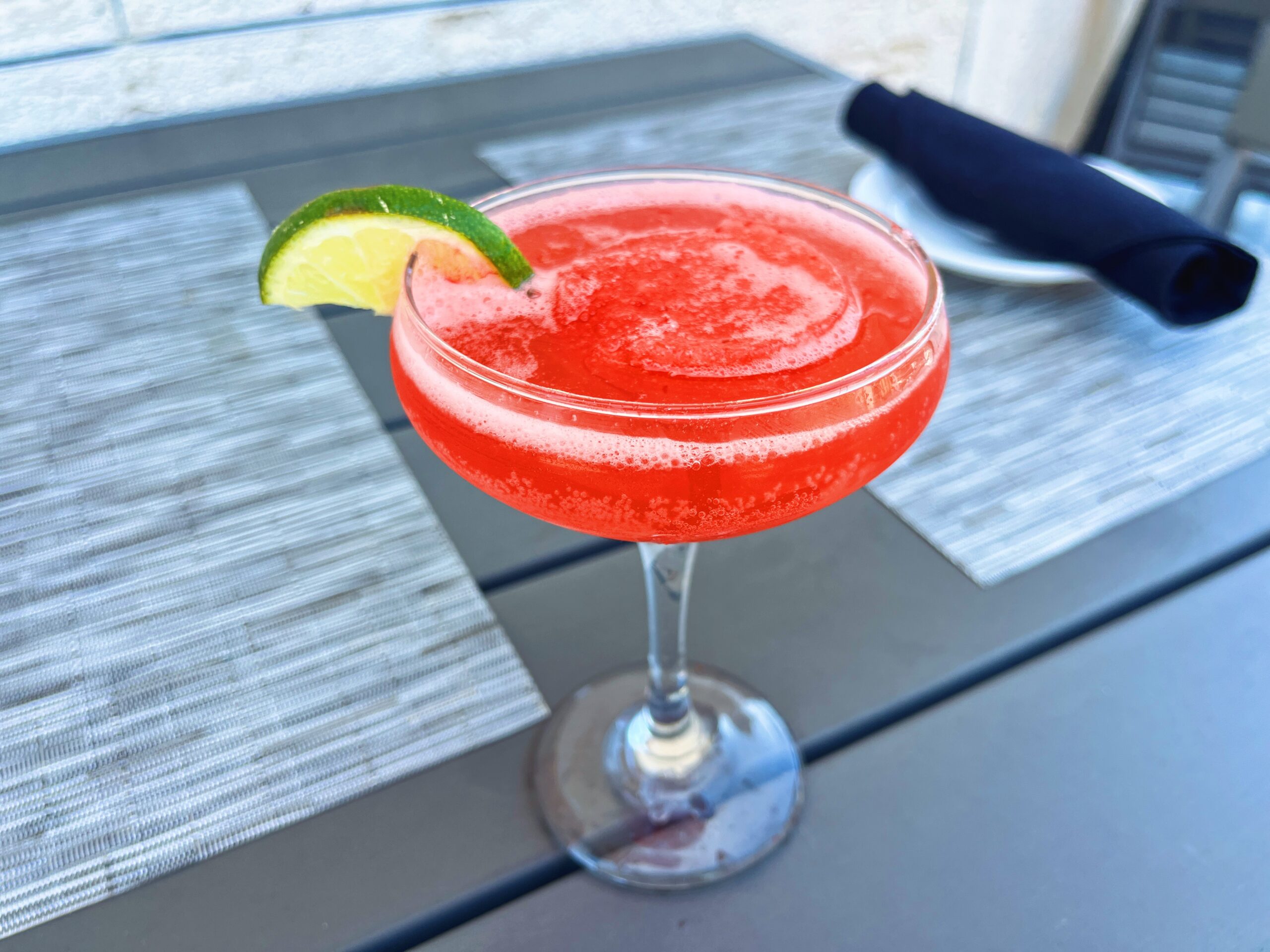
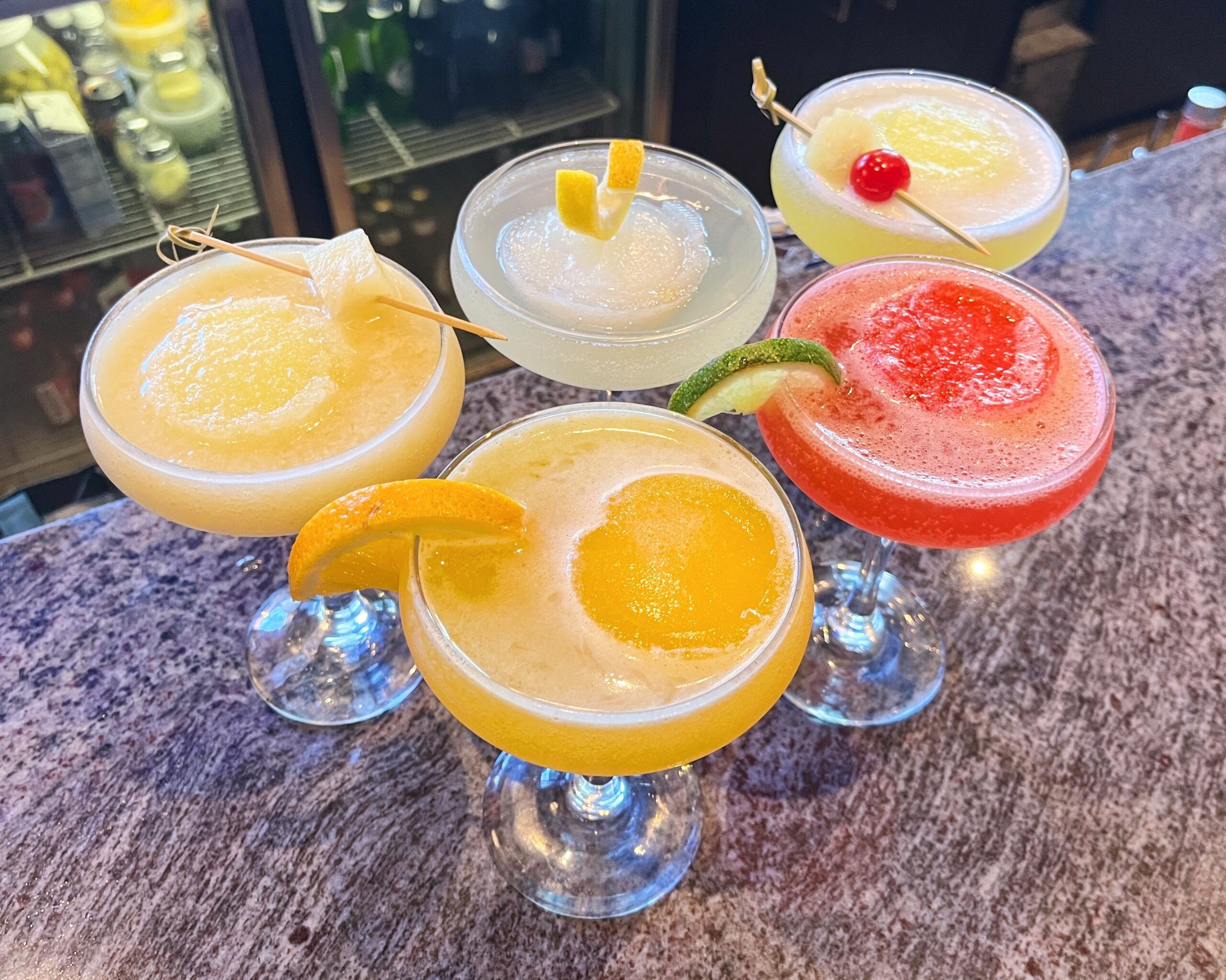
Popi’s has its own version of a lemon ice martini (aptly called the Limoncellotini), but its other offerings pull from the colors of the rainbow, like a neon orange mango water ice martini called the Gritty and a vibrant red strawberry water ice daiquiri. The restaurant used to sell about 20 a day last summer, said bar manager Laura Kreschollek. Now, they’re averaging 50.
“People were coming in just for these,” said Masi. “We kept running out of water ice and were sneaking out to Pop’s in the middle of the day.”
A strawberry daiquiri made with Pop’s Homemade Italian Ice at Popi’s Restaurant, 3120 S. 20th St.
Naturally, the evolution would continue with spiked gelati. Philly could get its first in the early fall, when James Beard Award-winning South Jersey bartender Danny Childs aims to open his bar Field Day in Northern Liberties.
Childs told The Inquirer he plans to serve the treat year round using his signature Slow Drinks approach. While the vanilla soft serve will come from 1-900-ICE-CREAM, Childs said, the boozy water ice will be made from scratch with local and foraged produce that change with the season. He’s envisioning a lineup of cherry, blueberry, and pawpaw (a fruit native to the Mid-Atlantic that tastes like a mango) to start.
The cocktail-dessert hybrid was driven by a mix of nostalgia and peer pressure. Childs wanted a nod to his childhood in Delaware County, where he grew up using a soft pretzel as a spoon to scoop up water ice. He also wanted to one-up the alcohol-infused ice creams already on the market.
“I was like, ‘Someone is going to do spiked gelati before us,’” Childs said. ”We have to hurry.”
The Iceberg martini from Saloon, which was created by current John’s Water Ice owner Anthony Cardullo.
Here are four places where you can find boozy water ice in all its forms, from vodka-infused scoops to martinis.
Where to find boozy water ice in Philly
Saloon
This classic Italian joint in Bella Vista has been serving its signature $18 Iceberg martini since 2002, when current John’s Water Ice owner Anthony Cardullo invented it while working at the restaurant’s bar. It does indeed look like icebergs disintegrating into the Arctic as it melts, but the drink goes down easy — sweet, icy, and citrusy without tasting artificial. Also be on the lookout for Cardullo’s nightly water ice cocktail specials.
A lineup of water ice martinis made with Pop’s homemade Italian ice at Popi’s Restaurant. Clockwise from left: The Pineapple Pizzaz, Limoncellotini, piña colada, strawberry daiquiri, and the Gritty.
Popi’s Restaurant
At Popi’s, the pours are heavy and the water ice is extra sweet. This 33-year-old Italian restaurant near the sports complex in Packer Park gained a new reputation in 2025 when it started serving brightly colored cocktails sweetened with Pop’s homemade Italian ice. Normally $16 and $20 during the World Cup, the cocktails run the gamut from the Gritty (a vodka martini with orange juice and mango water ice) and Pineapple Pizzaz (a pineapple vodka martini with pineapple water ice) to a strawberry daiquiri with a disk of — you guessed it — strawberry water ice floating in the middle. If you’re not susceptible to a sugar rush, it’s easy to have several in one sitting.
Best known for its excellent vegan wings and cheesesteaks, Triangle Tavern also serves scratch-made boozy water ice year round. Flavors rotate seasonally and range from mango and pomegranate in the summer to pumpkin spice in the fall and crisp peppermint in the winter. Spun in a slushie machine with a handle of vodka, the $12 cocktails are served in a pint glass garnished with a hard pretzel rod for an extra dose of South Philly flair.
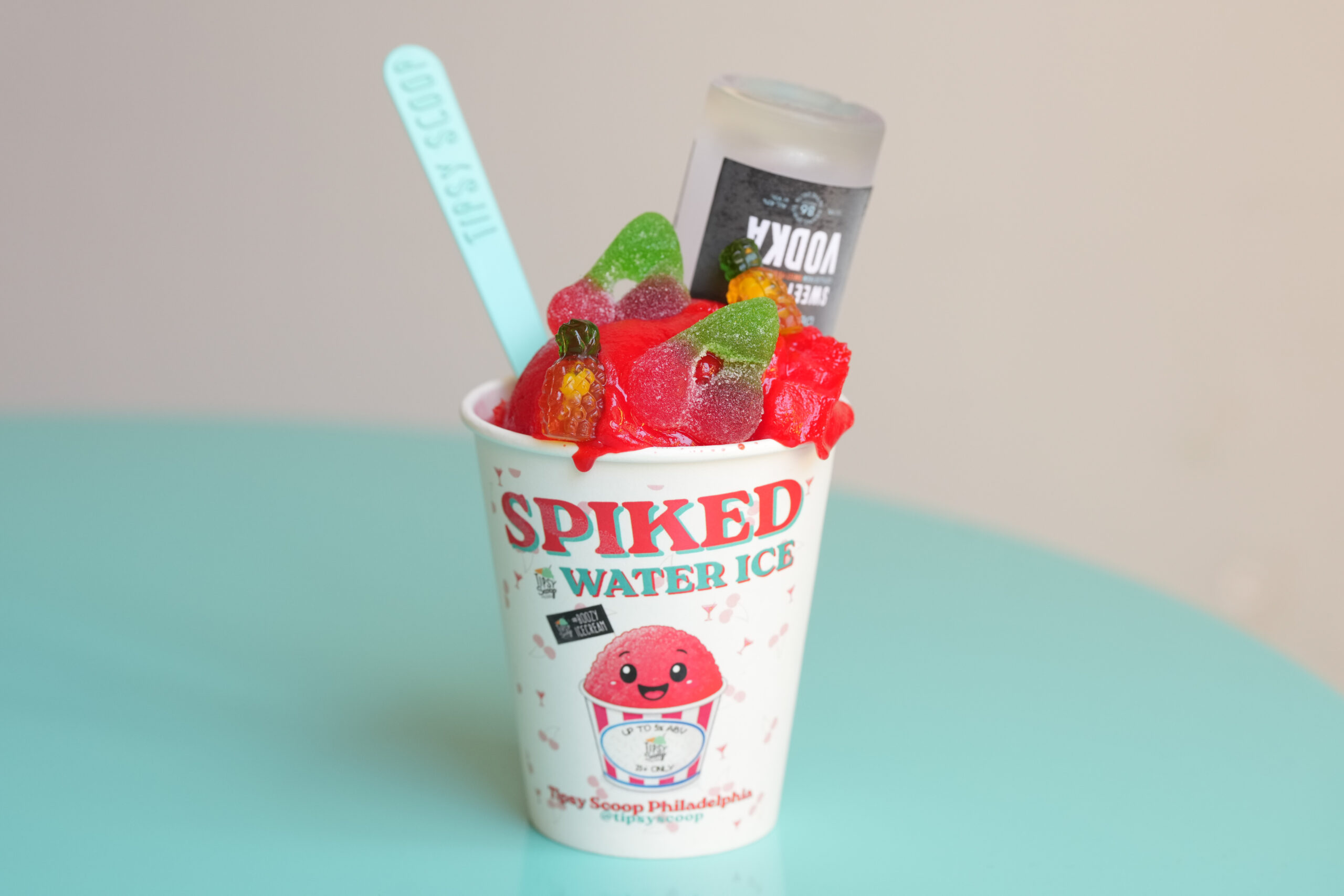
The Philly Phreeze sundae at Tipsy Scoop in Rittenhouse Square, which is comprised of vodka-infused cherry water ice topped with gummy candies.
Tipsy Scoop
This New York City-based ice cream chain has been infusing ice cream and sorbet with alcohol since 2013. After opening its first Philly outpost inside the Rittenhouse Square BOTLD location, the brand added a cherry water ice spiked with vodka to its menu. Our suggestion: Order the $14 sundae version — which comes topped with chewy cherry and pineapple gummies in a novelty cup — and consider springing for the chilled vodka shooter. It’s entirely too much in the best way possible, and the water ice is delightful despite being made by a New Yorker. Red enough to stain your tongue, it tastes like a handful of maraschino cherries.
The Philadelphia area restaurant boom continues into the summer, with newcomers including a neighborhood cocktail bar, bakery/cafes, a suburban brewpub, a $2 million pizzeria, a vegan cafe, a destination dining room, and a fusion sandwich shop.
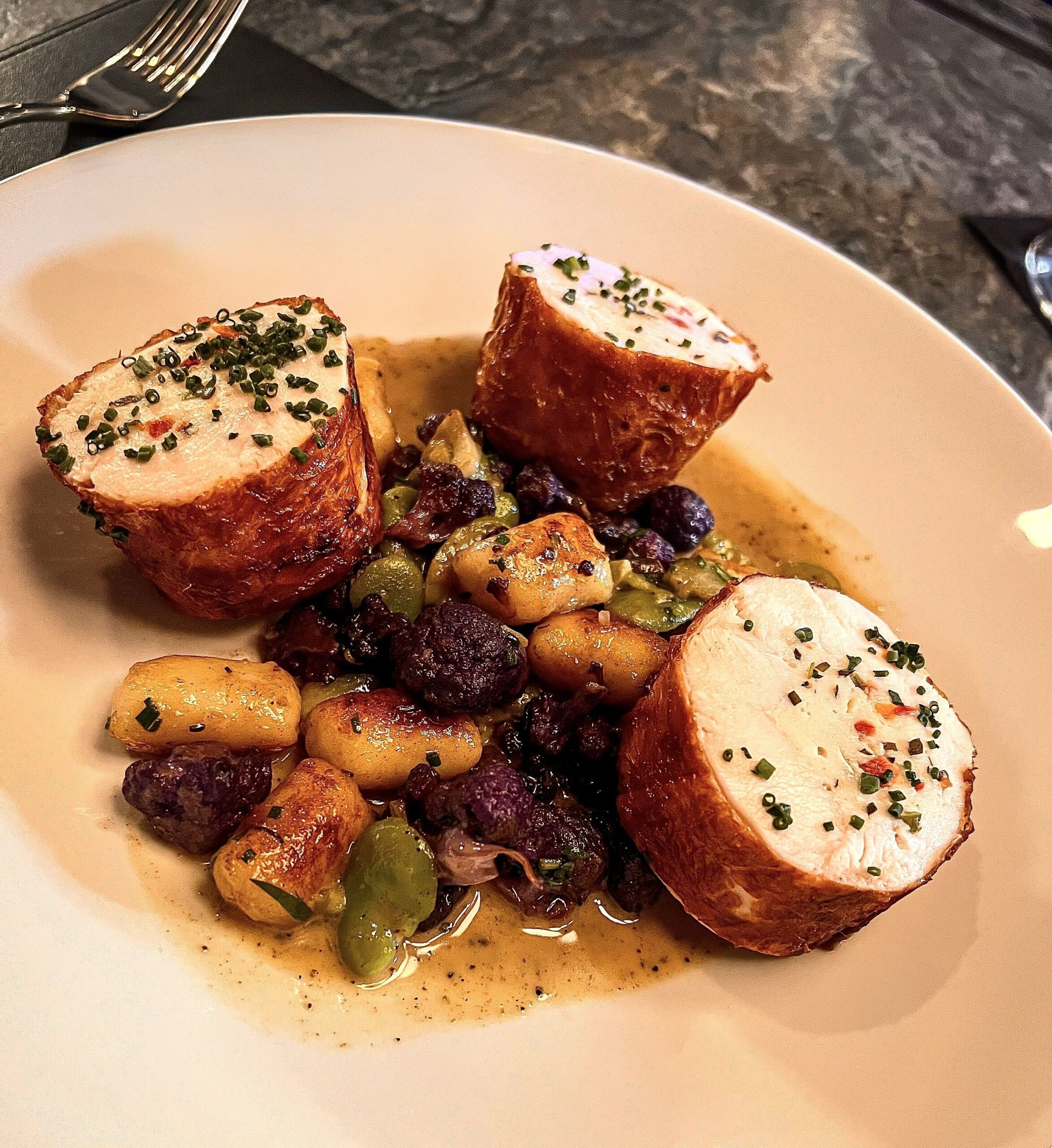
Chicken roulade with fava beans, gnocchi, and cauliflower at Academy Grill in Fort Washington.
Academy Grill(424 S. Bethlehem Pike, Fort Washington): Fine Line Dining’s next project, an Italian-inspired, white-tablecloth restaurant, will serve seafood, steaks, and pastas in the former Cantina Feliz space near Germantown Academy (hence the name). Chef Jeff Power, formerly of Dettera in Ambler, is leading the kitchen. Owners Mike Sloane and Jay Rosenthal, who also own the casual Fort nearby and Jasper’s Backyard in Conshohocken, plan to open July 7 for dinner, July 9 for lunch, and then operate Tuesday to Saturday for dinner.
Banjara Indian Bistro (689 Berlin-Cross Keys Rd., Sicklerville): Vaneet Chopra, whose family owns Cross Culture in Haddonfield and previously operated Banjara in Chestnut Hill, is behind this Indian restaurant due to open soon in the strip center that also houses Gouldsburger’s, the Breakfast Nook, and Saladworks. Owners told 42Freeway that it was awaiting final inspections.
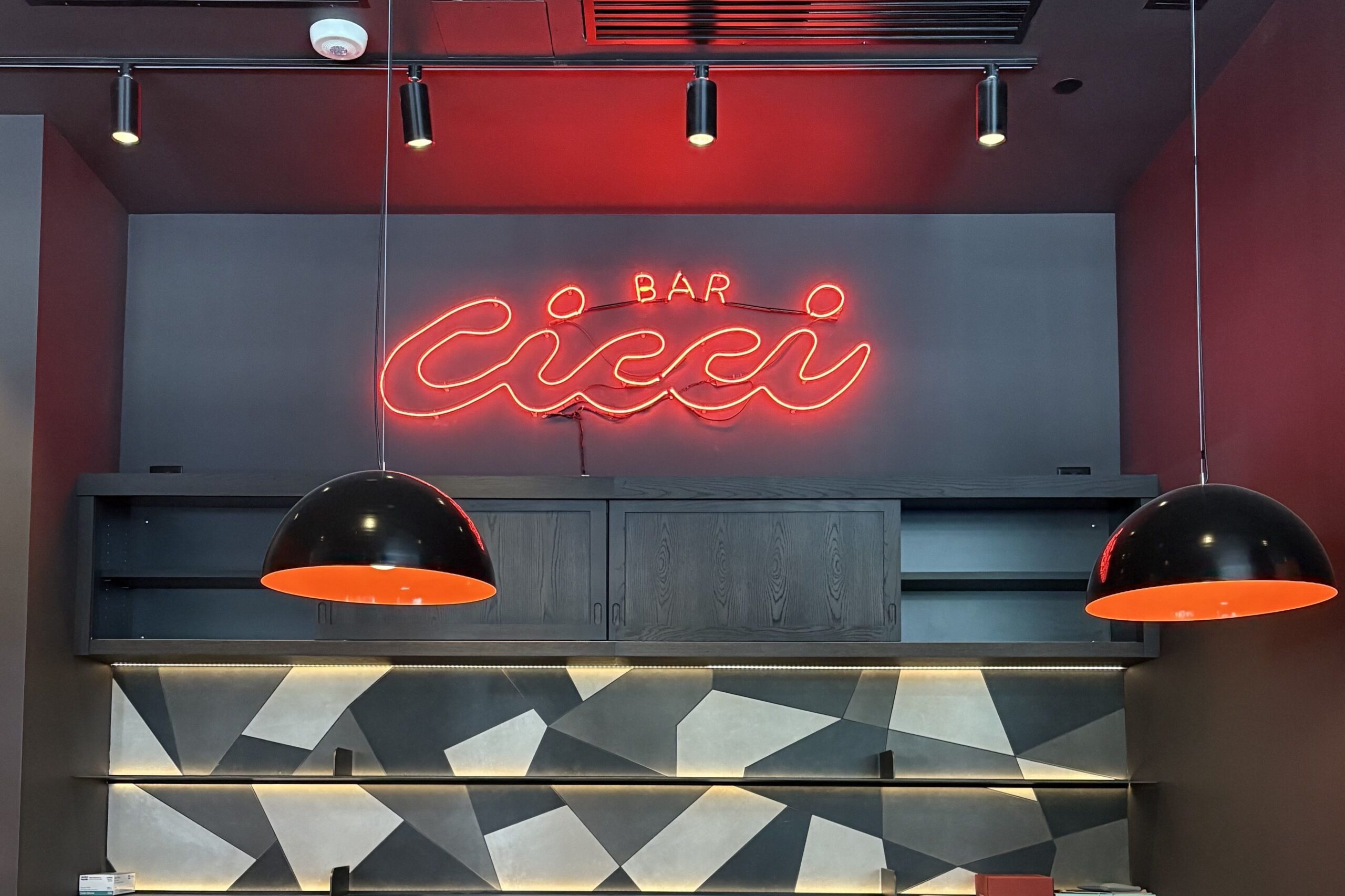
Bar Cicci is due to open in late July at 1620 Sansom St.
Bar Cicci (1620 Sansom St.): Ellen Yin and High Street Hospitality Group are behind this Italian cafe-bar next to Uchi near Rittenhouse Square. Pronounced “chee-chee,” it is positioned as an all-day salon for espresso, pastries, panini, cicchetti, wine, and aperitivi. It’s due to open later this month.
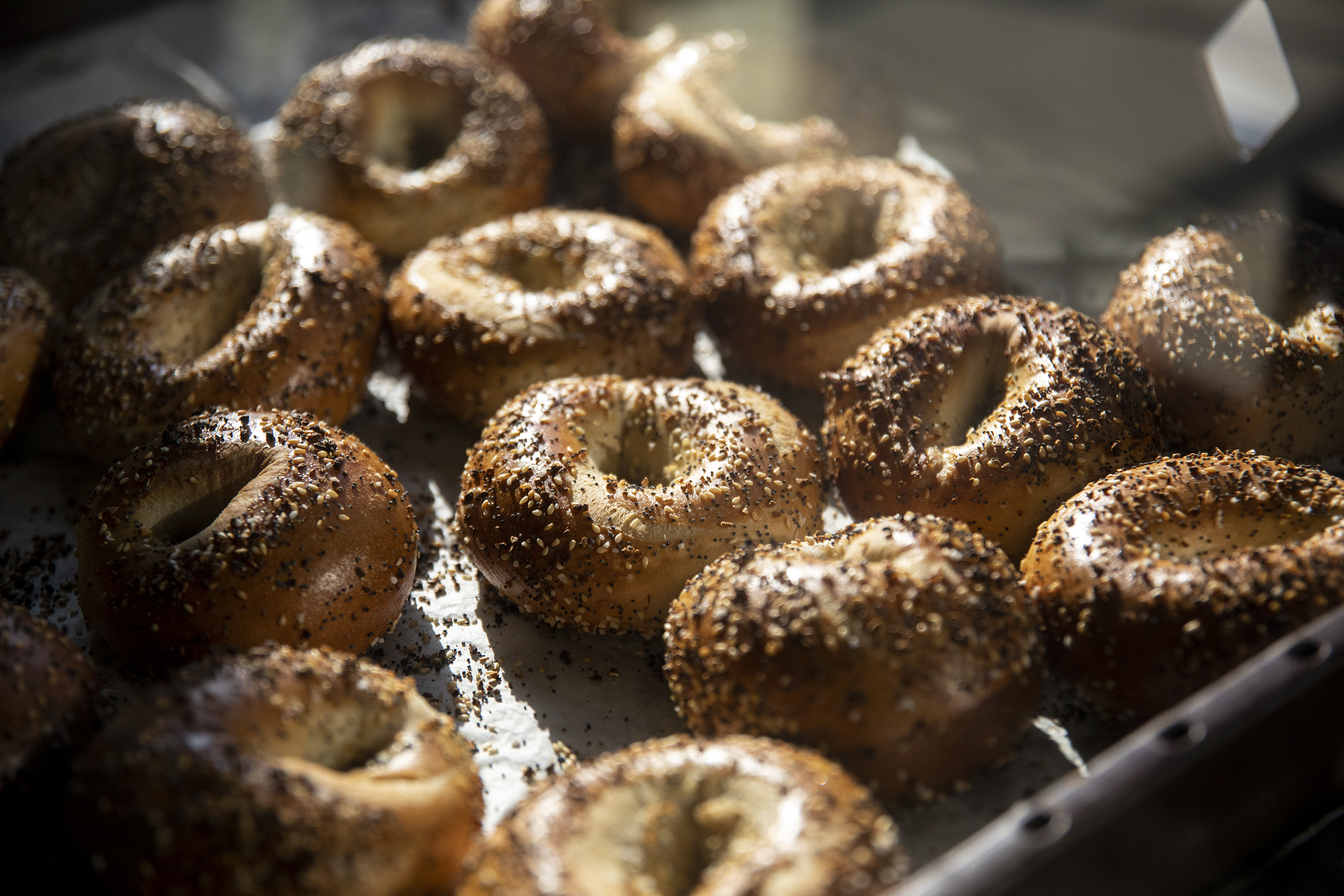
Bart’s Bagels’ first shop opened in 2020 in the Powelton section of West Philadelphia.
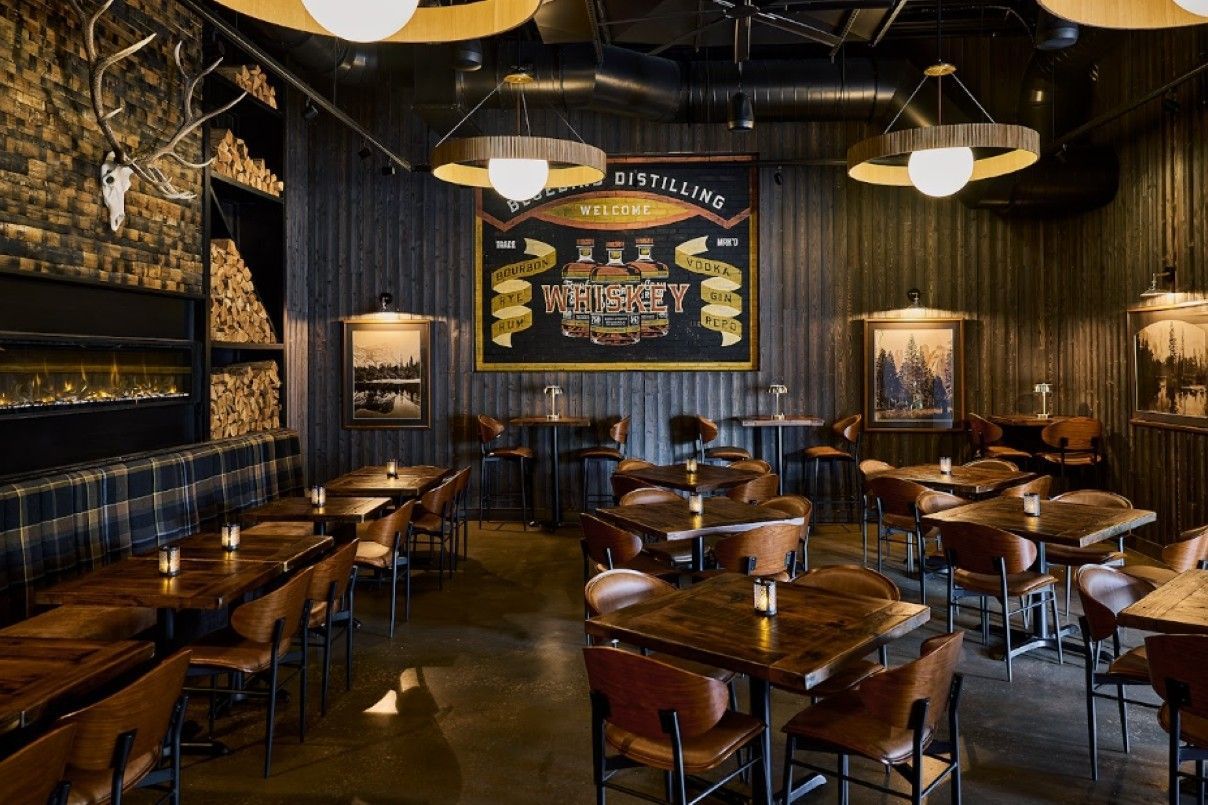
Bluebird Distilling & Dough House is a $2.2 million expansion and renovation of the popular Phoenixville destination.
Bluebird Distilling & Dough House(100 Bridge St., Phoenixville): Bluebird’s $2.2 million expansion, Dough House, arrives July 7. It’s a neo-Neapolitan pizzeria and restaurant inside its downtown Phoenixville distillery, and adds an expanded cocktail bar, a 50-seat dining room, a chef’s counter, and an enlarged retail shop. Executive chef Devon Migeot, formerly of Zahav, Laser Wolf, Rosalie, and Tresini will serve naturally fermented pizzas, house-baked breads, and shareable small plates alongside the distillery’s cocktails.
Cheezy Vegan by Chef Reeky (1216 S. 17th St.): Now in soft-opening mode at 17th and Manton Streets in Point Breeze, this plant-based concept from Tarik “Chef Reeky” Ryant and Erin Mignogna-Dougherty (previously in Woodlyn, Delaware County) serves a full menu — breakfast, lunch, appetizers, coffee drinks, milkshakes, and smoothies — from a counter, with coffee beans roasted on-site. A sidewalk cafe is planned.
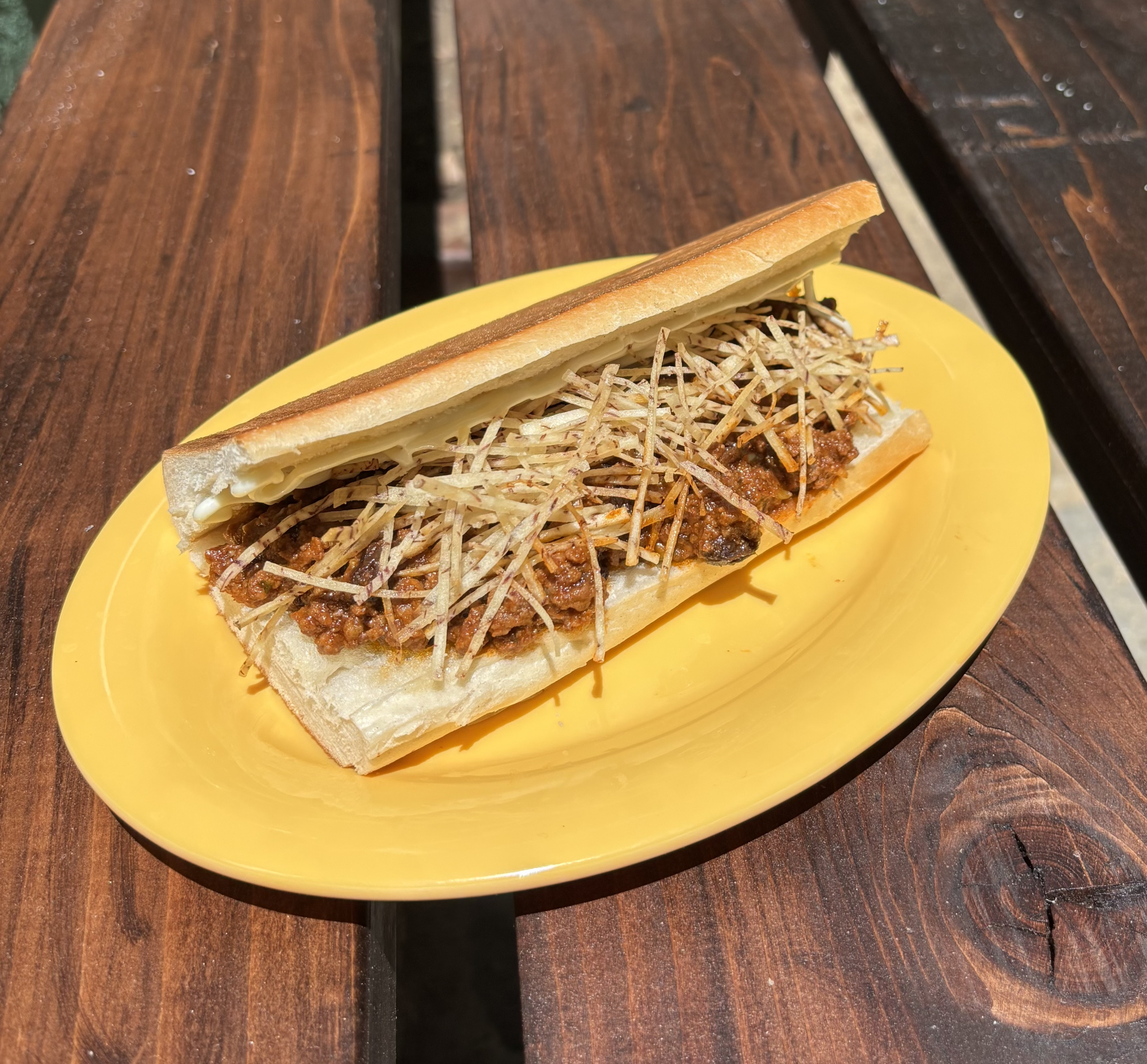
The pica pica sandwich at Chibanos, which comes with picadillo, Swiss cheese, mayo, and crispy taro sticks.
Chibanos(1127 Pine St.): Opening today at 8 a.m., this casual sandwich shop in Effie’s former Washington Square West building is an ode to owner Evan Jaroff’s multicultural upbringing, blending Chinese and Cuban flavors for a tight fusion menu. Breakfast sandwiches are made on Dodo Bakery bolo baos, there are pressed sandwiches like the pica pica (picadillo, swiss, mayo, crispy taro sticks) and mima frita (Chinese sausage croquetas, Swiss, mayo, cabbage, mojo vinagrette), plus salads, sides, and a robust drink list that offers both colada and black milk tea.
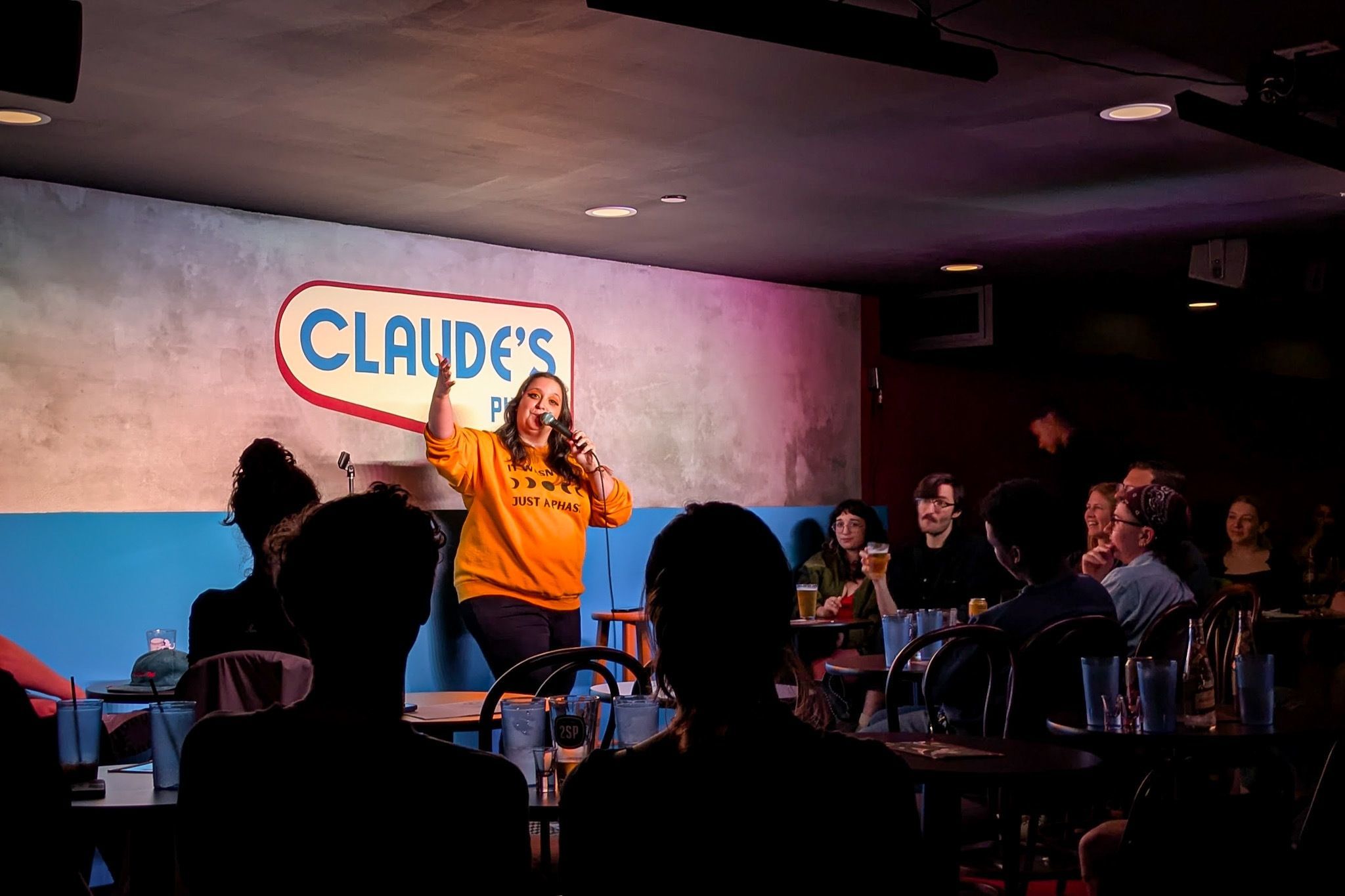
Comedian Meg Goetz entertains at a preview of Claude’s Comedy Club & Bar, 1123 S. Broad St.
Claude’s Comedy Club & Bar (1123 S. Broad St.): Reid Benditt’s intimate South Philly venue for stand-up, in its opening days, sits alongside a bar serving cocktails, beer, and casual fare from 4 p.m. daily. He’s positioning this as an affordable alternative to larger comedy clubs, with modest ticket prices, no two-drink minimum, and a mix of touring performers and local comics.
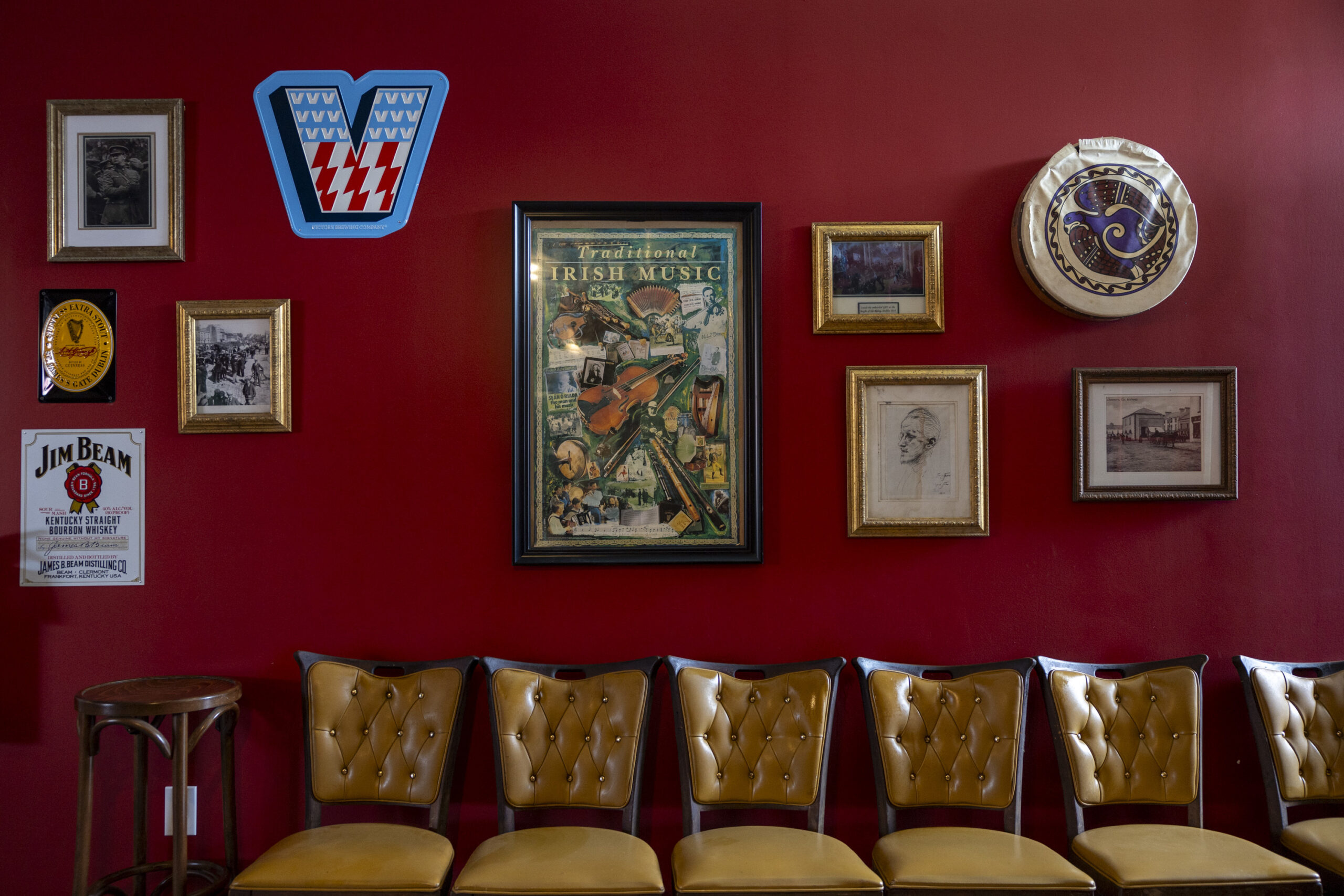
Dublin Brewing Co., Brendan FitzGerald’s Irish pub, in Downingtown.
Dublin Brewing Co. (137 Wallace Ave., Downingtown): Irish-born homebrewer Brendan FitzGerald’s decade-in-the-making brewpub is designed as an authentic Irish pub, with an Irish dry stout, Irish red ale, IPAs, pale ale, Pennsylvania wine and spirits, and bar food. FitzGerald built the pub himself while continuing his day job, borrowing design cues from pubs in Howth and Dublin’s Temple Bar. It’s open for special events (check Instagram) while FitzGerald awaits final permitting.
Home Team Tavern (267 S. Black Horse Pike, Mount Ephraim): The short-lived Mount Ephraim Bar & Grill has been flipped into a compact, sports-minded neighborhood tavern from Greg Carta, who previously managed North Bowl and South Bowl in Philadelphia. He told 42Freeway that he’s aiming for an early July opening with a menu built around tavern pizzas, burgers, starters, and other game-day food.
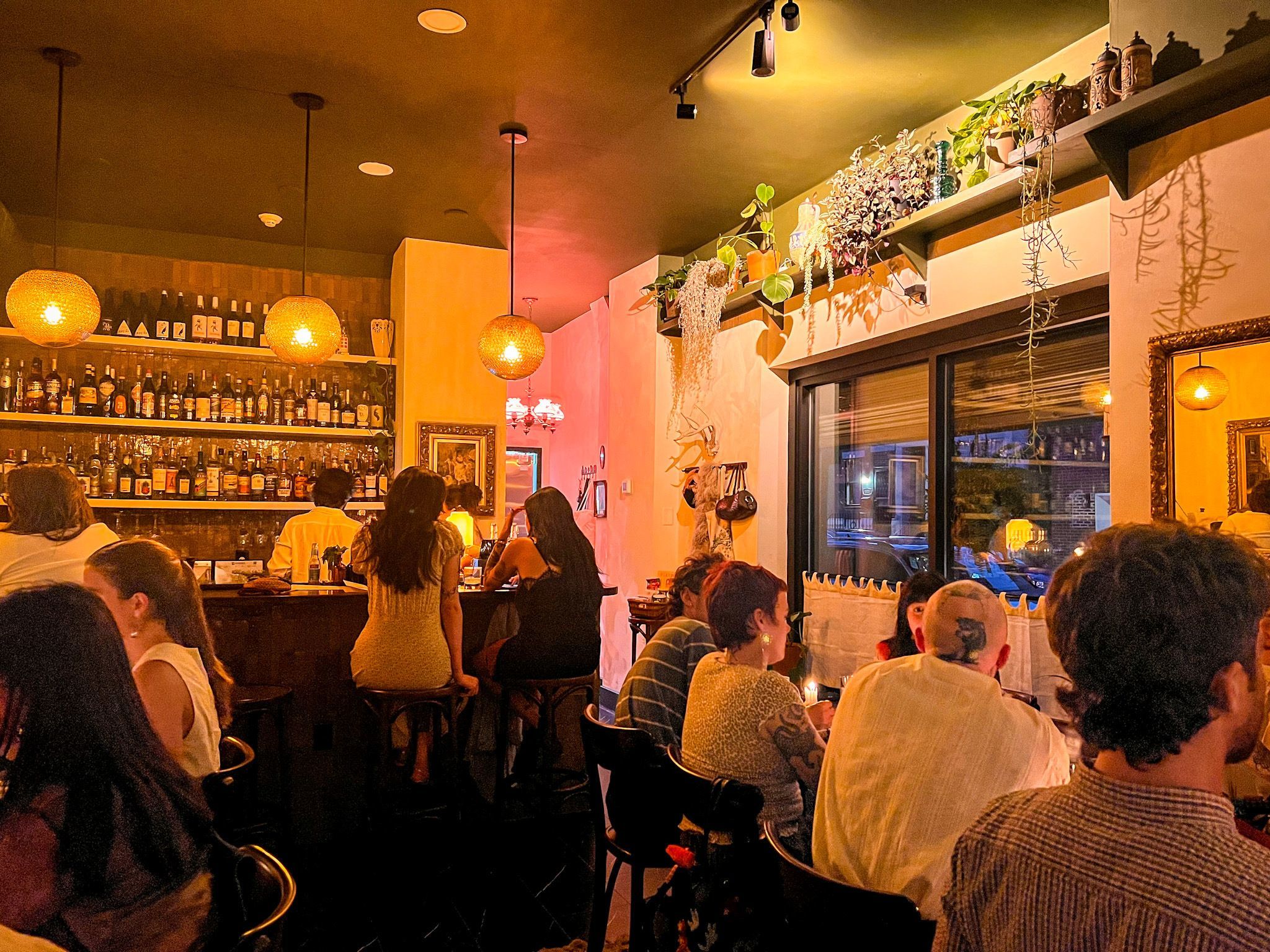
Lillian’s, 1900 S. 19th St., during a preview on June 25, 2026.
Lillian’s Bar (1900 S. 19th St.): This week, Point Breeze got a cozy neighborhood cocktail bar at 19th and Mifflin Streets with an evolving kitchen concept from Sam Ahern, a former bar manager at Fabrika who also worked at Cicala at the Divine Lorraine and Fitler Club after hosting backyard supper clubs during the pandemic. Ahern has brought in chef Alejandro Martín Sánchez (Mesona) to set up the concise menu of Mediterranean-leaning bistro fare, including sandwiches, salads, tinned fish, charcuterie, and cheese boards with kitchen operations overseen by Isobella “Izzy” Ioffreda. Guest chefs will take over for weekend or monthlong runs. First will be Miled Filianos of Habibi Supper Club, whose six-course dinners and happy hours are scheduled for July 9-11, 17-18, and 23-25. Cocktail program is led by Fitler Club alum Avdo Babic. Opens at 5 p.m. Tuesday through Saturday.
Luna at the Luxe (1705 N. American St.): Sarah Varisano expects to open her relocated Luna Cafe on Monday in the Luxe apartment complex in Old Kensington. The reboot keeps Luna’s familiar brunch, breakfast, and coffee-to-go identity, while adding a larger bar and beverage program, evening hours, and courtyard seating.
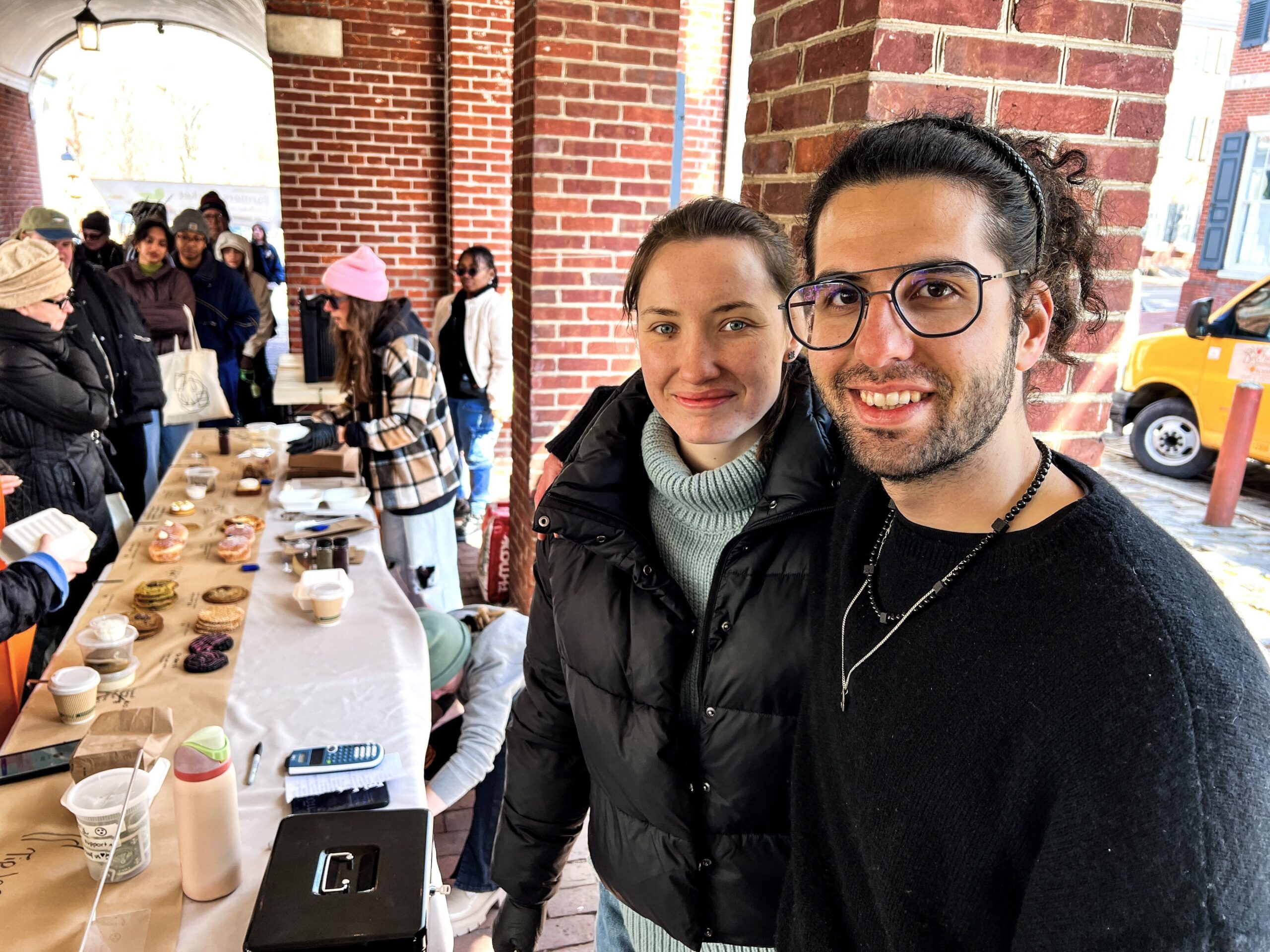
Bakery owner Saif Manna and his wife, Stefaniya Surikova, at their table at Headhouse Farmers Market.
Manna Bakery (110 W. Berks St.): Baker Saif Manna, shifting from pop-ups to a brick-and-mortar at the former Essen in Kensington, is looking for a late-month soft opening of his 50- to 60-seat bakery/cafe specializing in Levantine and Palestinian wares. It will initially open for daytime service, in addition to his farmer’s market stops. The menu expands to include individual manakish made in the style of Manna’s grandmother, rotating savory buns led by a chicken-sumac version, airy Palestinian-style brioche filled with seasonal fruit and creams, cookies, cakes, and gluten-free desserts such as a flourless chocolate cake and whipped rice pudding created in honor of Manna’s late father. The space also will host baking, cooking, coffee, and arts workshops with visiting chefs, bakers, artists, and baristas, and monthly supper clubs.
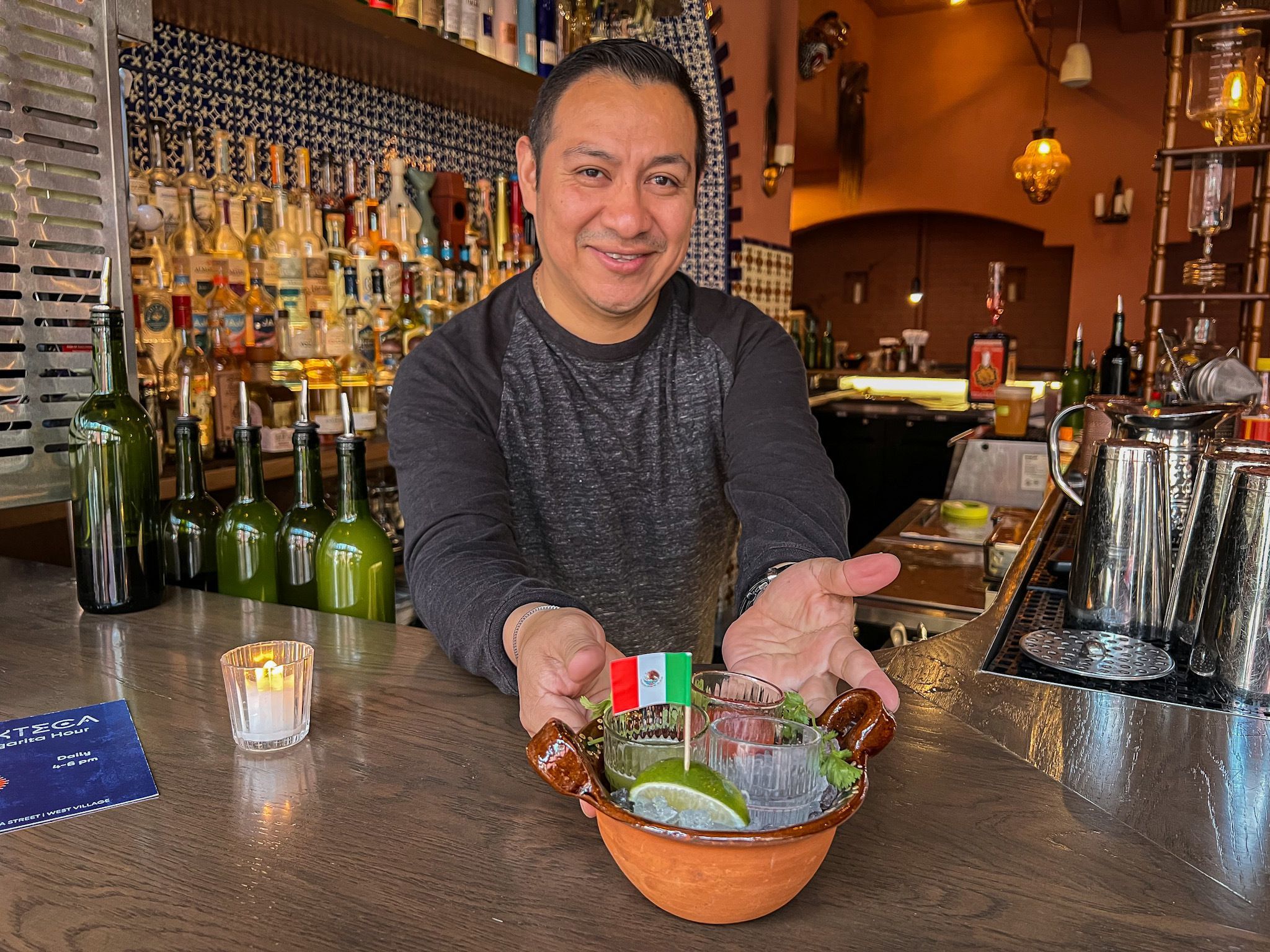
Bartender Euclides “Victor” Lopez behind the bar at Mixteca in New York City on June 4.
Mixteca (2113 E. York St): This agave-focused Mexican cocktail bar from New York’s Jeff Bell and Euclides “Victor” Lopez is taking over the former Martha in East Kensington. The Philly location, expected later in the month, marks the local debut for Mixteca and Apres Cru Hospitality. The plan includes tequila, mezcal, Mexican drinking culture, indoor-outdoor seating, and a reworked layout with an expanded bar and lounge.
Philly Po Boy Co. (102 W. Berks St.): Brothers Chris and Greg Lynch are looking for late month for their New Orleans-inspired sandwich shop under the Berks El stop, with po’boys, gumbo, jambalaya, beignets, and coffee from Applied Arts Coffee in New Orleans. Chris spent years cooking in New Orleans, while Greg’s Philly resumé includes Starr Restaurants and LMNO.
Sandpiper Cafe (1640 South St.): This all-day breakfast-and-lunch spot is due to soft-open Thursday at 1640 South St. It’s the latest from Gunawan Raharjo, who owns the West Passyunk Indonesian gem Indo Spice (noted in our list of Philly’s 76 most influential restaurants). Sandpiper’s American menu, served from 7 a.m. to 5 p.m. daily, will expand upon the menu at Raharjo’s other restaurant, Cafe Olivier in Old City. At Sandpiper, Raharjo is partnered with Deddy Pornomo.
Stella’s Ice Cream (1832 N. Front St.): This Idaho-based chain of ice cream shops planted its first East Coast location on June 27 in Kensington/Fishtown on what reporter Beatrice Forman has dubbed Ice Cream Row, mere blocks from Sweet 45 and 1-900-ICECREAM. Franchisee Shay Marlin had no prior ties to Idaho or the ice cream biz, but was drawn to Stella’s inclusive and family-friendly vibe. The shop offers 24 flavors of ice cream — including eight nondairy options — plus gluten-free waffle and sugar cones, sandwiches made on hulking brownies baked in-house, and yogurt-peanut-butter popsicles for pups.
Thirsty Turtle Tavern(270 White Horse Pike, Barrington): Just days old, this Camden County taproom in the former Chuck Lager/Wild Wing Cafe building near I-295 is the brand’s second, after Whitehall, Pa., and 42Freeway says it features a refreshed dining room, open kitchen, wood-fired pizza oven, sushi station, and patio.
333 Belrose Bar & Grill (333 Belrose Lane, Radnor): A slow-moving top-to-bottom renovation will add a larger bar, expanded kitchen, redesigned dining rooms, upgraded private-event spaces, and refreshed outdoor dining to this Main Line landmark, whose new American menu is overseen by chef Ross Esner.
Staff writer Beatrice Forman contributed to this article.
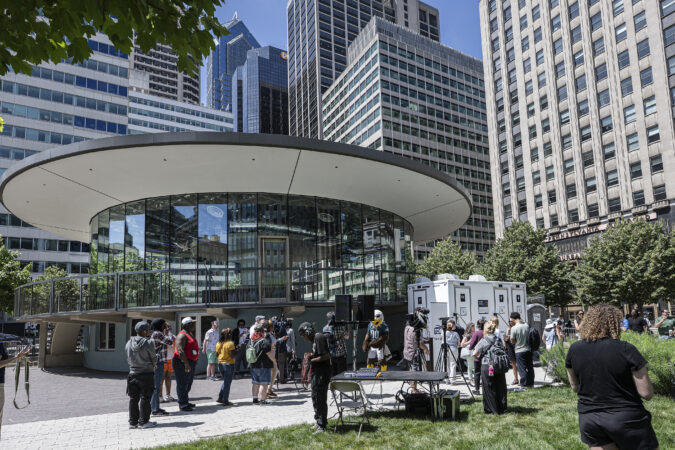
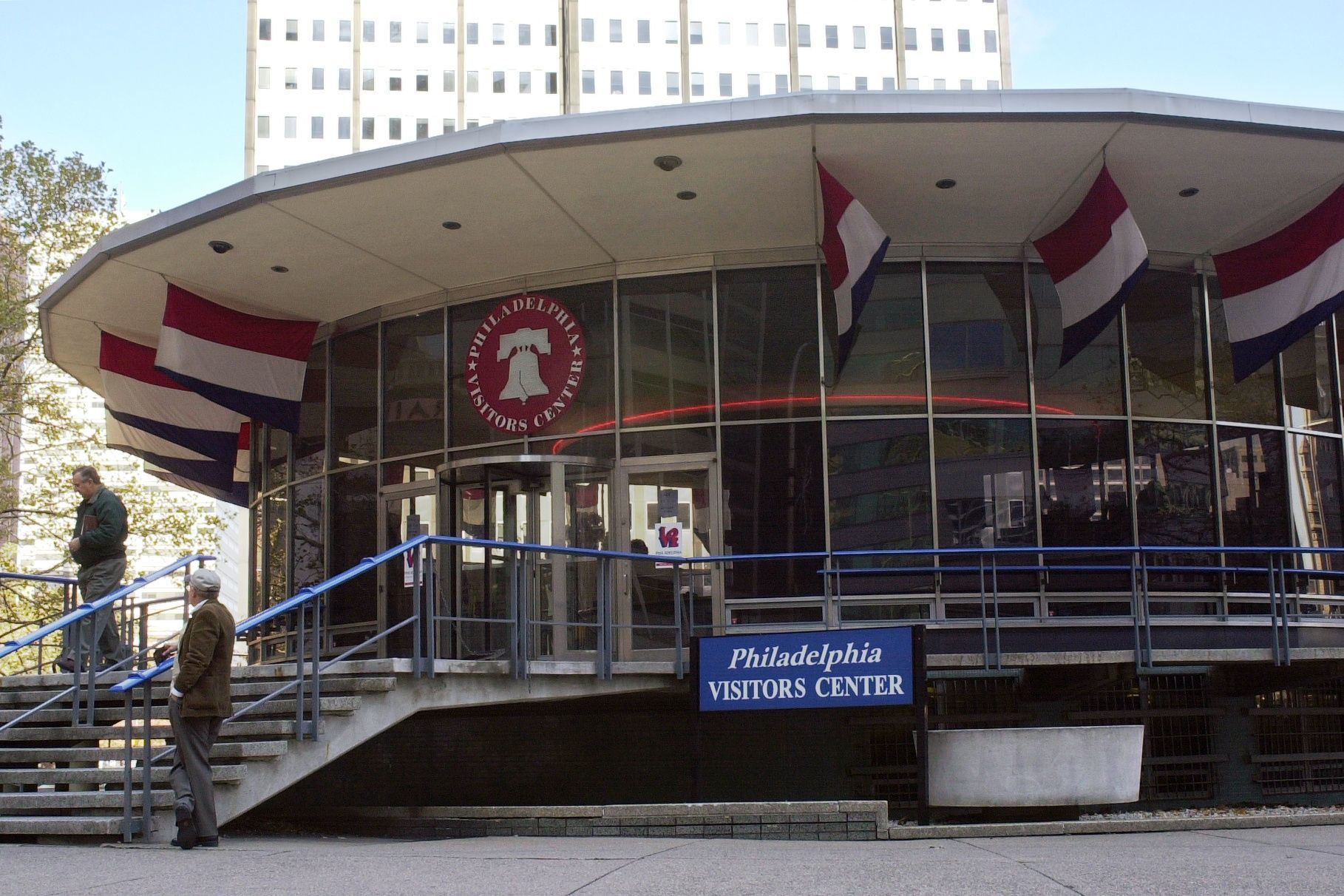
More than six decades after it landed in LOVE Park, Philadelphia’s long-shuttered “flying saucer” building is preparing for its next mission. The first step begins Saturday — not inside the circular glass pavilion itself, but with a new outdoor beer garden surrounding it.
Broad Street Beer Garden at LOVE Park is the opening phase of a food-and-drink operation led by Broad Street Brewing, the Bucks County brewery selected by the Philadelphia Department of Parks & Recreation as its operator after years of fits and starts.
Saturday’s debut, on the final FIFA World Cup game in Philadelphia and amid the hoopla surrounding America250 festivities, will feature a beer garden with a limited food menu. Two Philadelphia companies, Rival Bros. Coffee and High Street Hospitality Group, will be involved as well. High Street, which operates Fork, a.kitchen, and the Bread Room, will assume a larger culinary role when the restored pavilion itself reopens in early 2027 as a year-round cafe, restaurant, and coffee bar. Its name has not yet been announced.
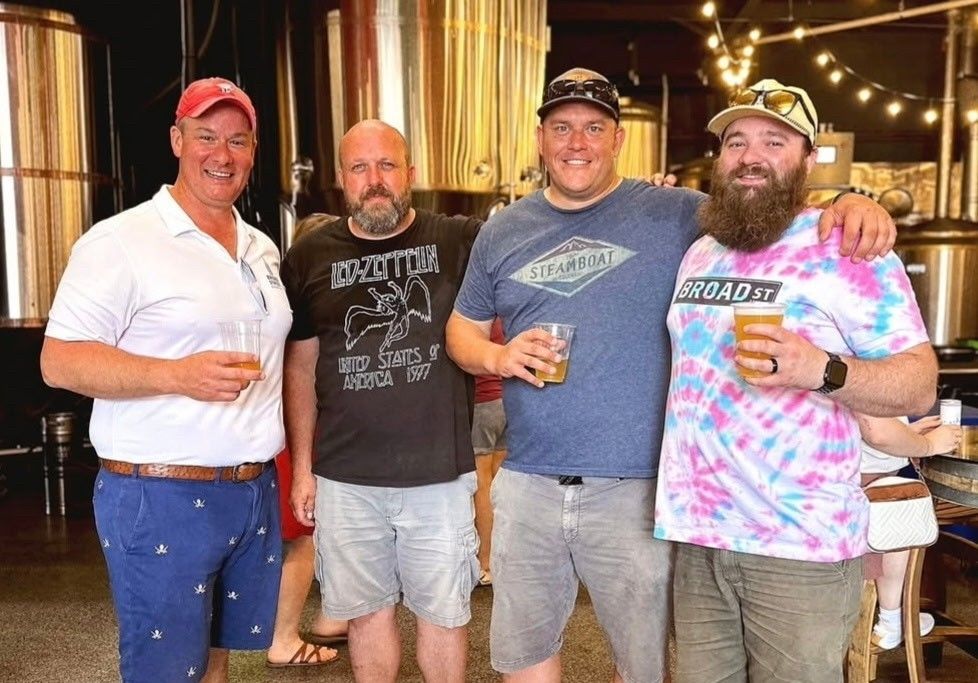
Broad Street Brewing’s partners (from left) Ed Webber, Tim Lohse, and Brandon Wellington with brewer Andrew Balmer.
For the Parks & Recreation Department, the concession is about more than filling the building at 16th Street and JFK Boulevard. Revenue from the operation will be reinvested in LOVE Park and the Benjamin Franklin Parkway, helping fund programming, maintenance, and improvements.
“This has been a long time coming,” said Katie Burns Kays, the department’s director of business and event development. “Our goal wasn’t just to find somebody to fill the space. We wanted a strong partner who would bring the kind of energy and story we want to be telling at LOVE Park, for both residents and visitors.”
Kays said officials hope the arrangement becomes “a sustainable funding model for our public spaces.”
Broad Street Brewing, which opened three years ago in Bristol, emerged from a field of applicants that included Four Corners Management, operator of Parks on Tap; Triple Bottom Brewing Co.; Tica’s Taco; Bower Penn, which operates Bower Cafe locations; and Little Susie’s Coffee & Pie, according to city documents.
The center in November 2001, just before the Independence Visitor Center opened at Sixth and Market Street.
Kays said the city used what it calls a “best value” procurement process, weighing community engagement, operational experience, partnerships, and programming alongside revenue. Financial terms were not disclosed. The department’s standard concessions run for one year with up to four renewals, and Parks & Recreation plans to seek City Council approval this fall for a longer-term agreement to support the investment, Kays said.
“It’s exciting to feature three local businesses rather than a national chain,” Kays said. “We really want visitors to experience Philadelphia through Philadelphia businesses.”
For Broad Street co-owner Brandon Wellington, the project is also something of a homecoming. When Wellington lived at Broad and Race Streets, he first began brewing beer before setting the hobby aside for more than a decade. During the pandemic, he and longtime friends Ed Webber and Tim Lohse left their previous careers to launch Broad Street. Although the brewery established its production facility and taproom there, Wellington said the long-term goal was always to return to Philadelphia. He reached out to High Street partner Ellen Yin — whom he knew through his commercial kitchen-ventilation business — about partnering.
The opening phase will occupy the terrace surrounding the pavilion and about a third of the adjacent lawn, with about 250 seats divided among cafe tables, picnic tables, and Adirondack chairs. Wellington said the goal was to create a gathering place for commuters, office workers, tourists, and park visitors while bringing regular live music and community programming to LOVE Park. The initial beverage program will feature at least eight Broad Street beers on draft.
Broad Street Brewing expects to operate the outdoor beer garden through late October, serving beer alongside grab-and-go items such as smash burgers and maintaining a presence during Christmas Village as the permanent indoor build-out continues.
Once the historic pavilion can be outfitted with a commercial kitchen, the partners expect to open a year-round operation with about 100 indoor seats. High Street will oversee the food program, while Rival Bros. anchors the cafe. Wellington said they also envision rotating guest chefs and an automated tap wall pouring Broad Street beers alongside selections from breweries across Philadelphia. The indoor operation is expected to debut around March 2027.
“I just don’t want people to think this is simply a beer garden,” Wellington said. “While it’s being quarterbacked by a brewery, this will be Center City’s ultimate open-air hub — an oasis where local commuters, corporate professionals, and tourists can relax and connect.”
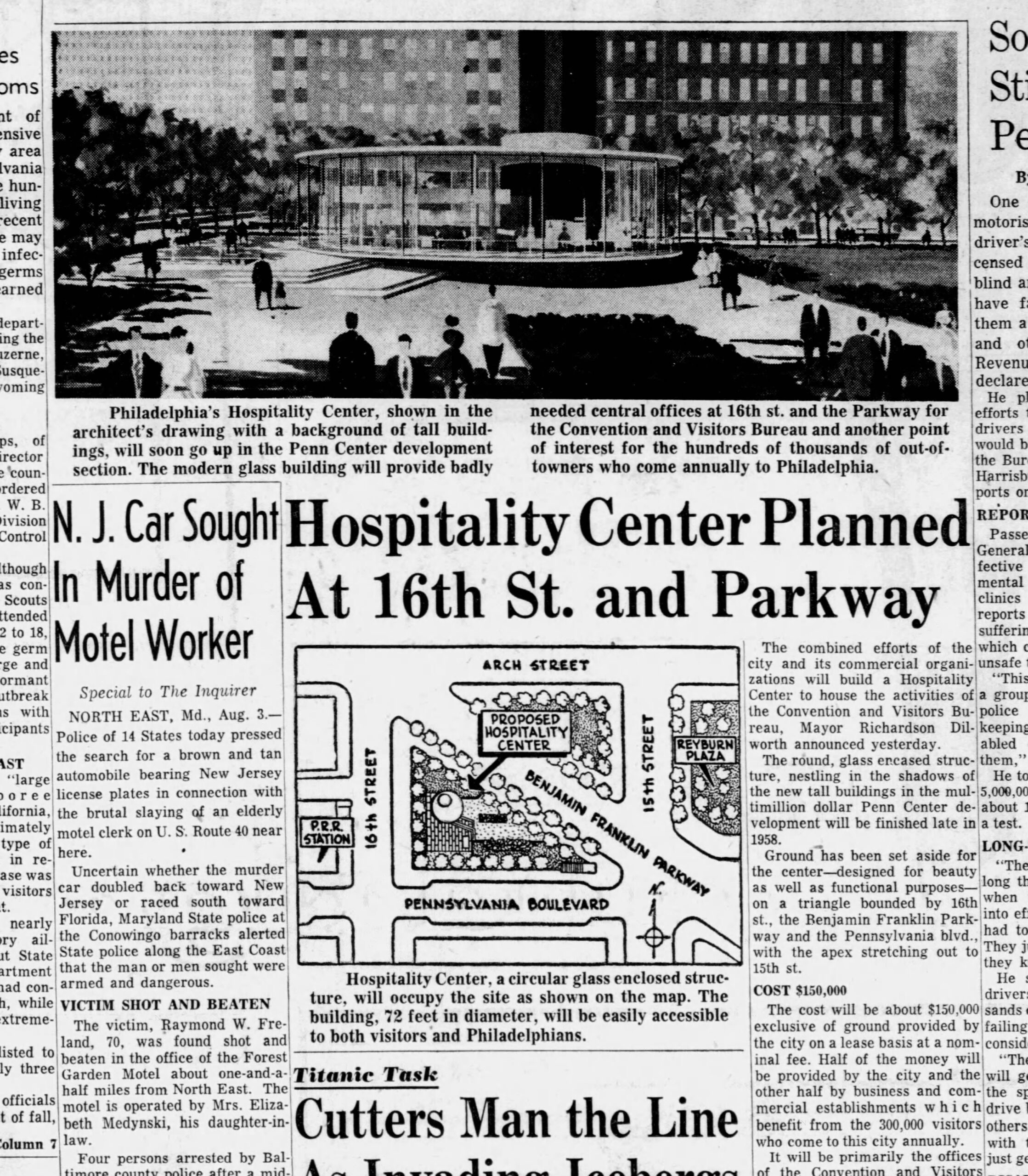
On Aug. 4, 1957, The Inquirer reported the plan for what become the flying saucer-like building. In those days, Ben Franklin Parkway extended through what is now JFK Plaza to City Hall.
Long before it became known as Philadelphia’s “flying saucer,” the pavilion was conceived in the late 1950s as the Philadelphia Hospitality Center at what was then the corner of 16th Street and Pennsylvania Boulevard. News accounts placed the price tag at $150,000, exclusive of the land provided by the city.
Designed by Roy F. Larson of Harbeson, Hough, Livingston & Larson, the circular building opened in 1960 as a visitor information center for an era when families increasingly arrived by automobile. Its broad cantilevered roof and nearly continuous glass walls embodied the optimism of the Space Age and Philadelphia’s postwar redevelopment under city planner Edmund Bacon.
The pavilion predates both Robert Indiana’s LOVE sculpture and the boulevard that now borders it. When it opened, the roadway, which bisected the plaza, was called Pennsylvania Boulevard. Following President John F. Kennedy’s assassination in 1963, it was renamed John F. Kennedy Boulevard, giving the plaza the name by which it is now universally known.
Renamed the Fairmount Park Welcome Center shortly after opening, the building later served as park offices, a cafe, a concession stand, and exhibition space. After the Independence Visitor Center opened at Sixth and Market Streets in 2001, however, it gradually lost its original purpose and sat vacant for years.
Its future appeared uncertain during LOVE Park’s 2016-18 reconstruction. Although some questioned whether the aging structure should be demolished, preservation advocates successfully argued that it was among Philadelphia’s finest surviving examples of midcentury modern civic architecture. The city instead invested about $5.6 million to restore the pavilion, replacing its roof, mechanical systems, and custom-curved glass while preserving its distinctive appearance. It was added to the Philadelphia Register of Historic Places in 2025.
Last year, the city broadened its search, seeking a cafe, taproom, or other community-oriented food-and-beverage concept instead of a traditional restaurant. More than 50 prospective operators responded.
Kays said the city deliberately slowed the process to avoid repeating earlier missteps.
“The city has tried this before, and the business was not set up for success,” she said. “We wanted to be much more intentional this time.”
Daniel Martino didn’t set out to build an empire of pie shops. He just wanted somewhere to get coffee without leaving the neighborhood.
When he bought his home in Port Richmond in 2013, the closest coffee shop was an hour round trip, he said. “Selfishly, I thought, I can put a little coffee shop here.”
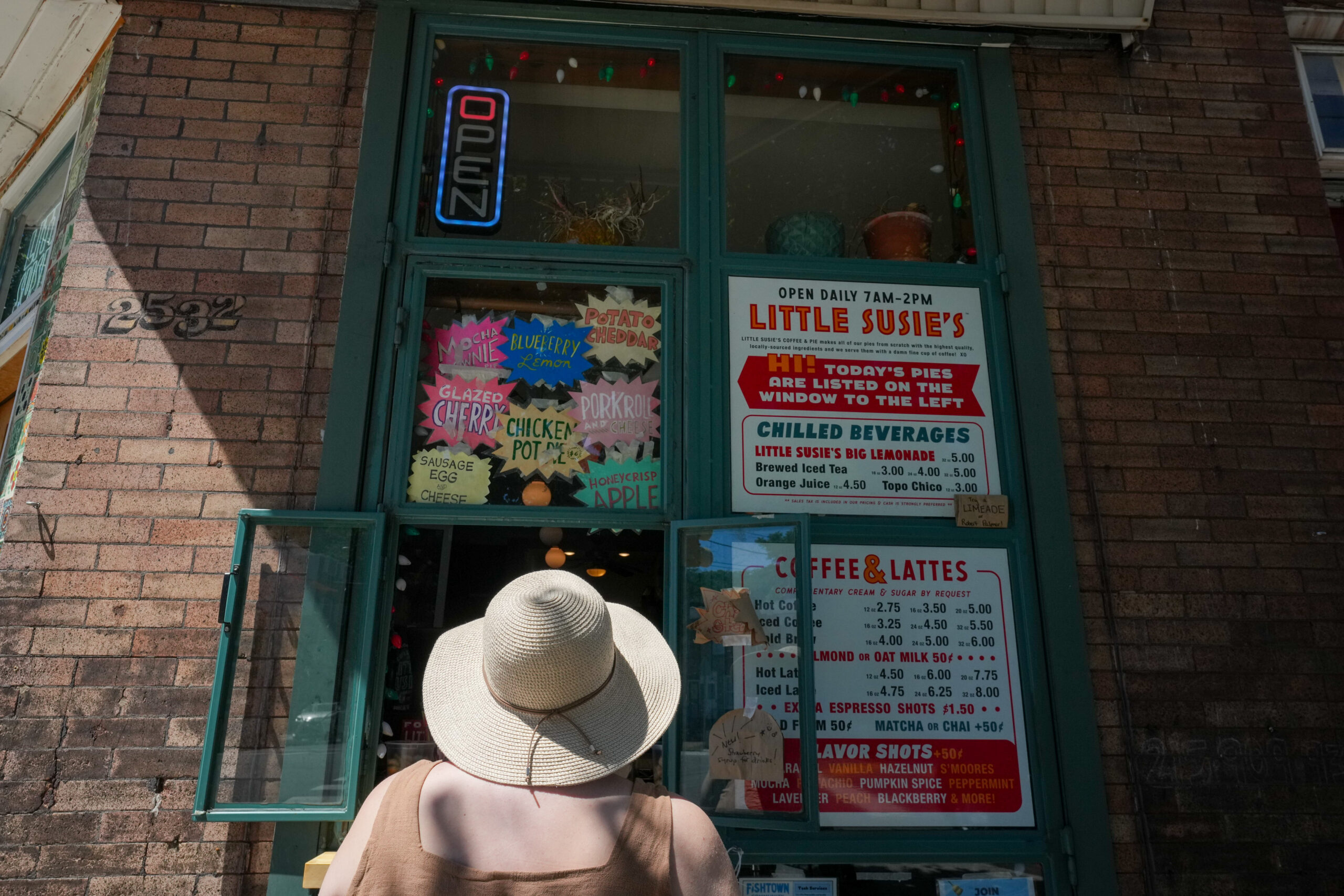
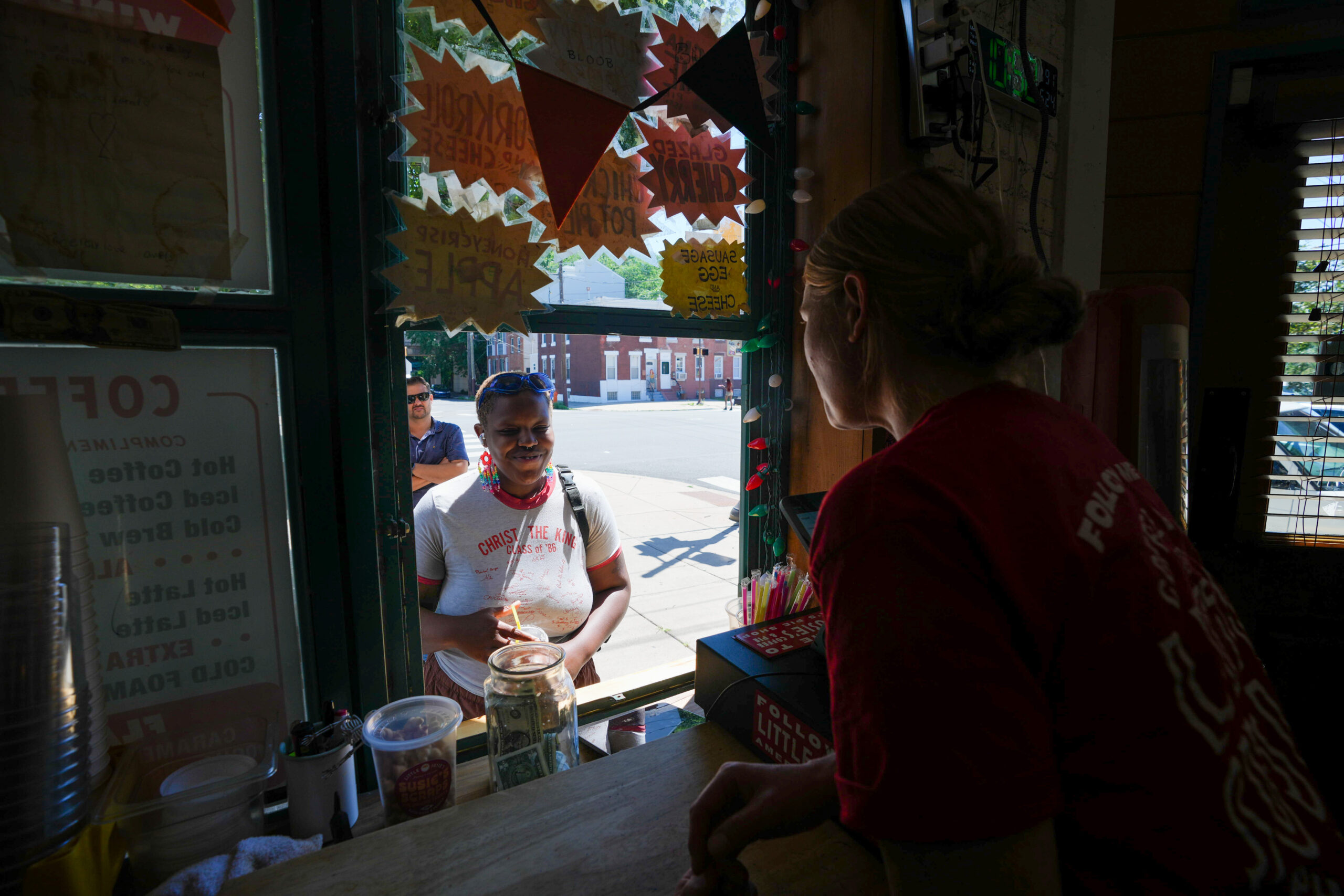
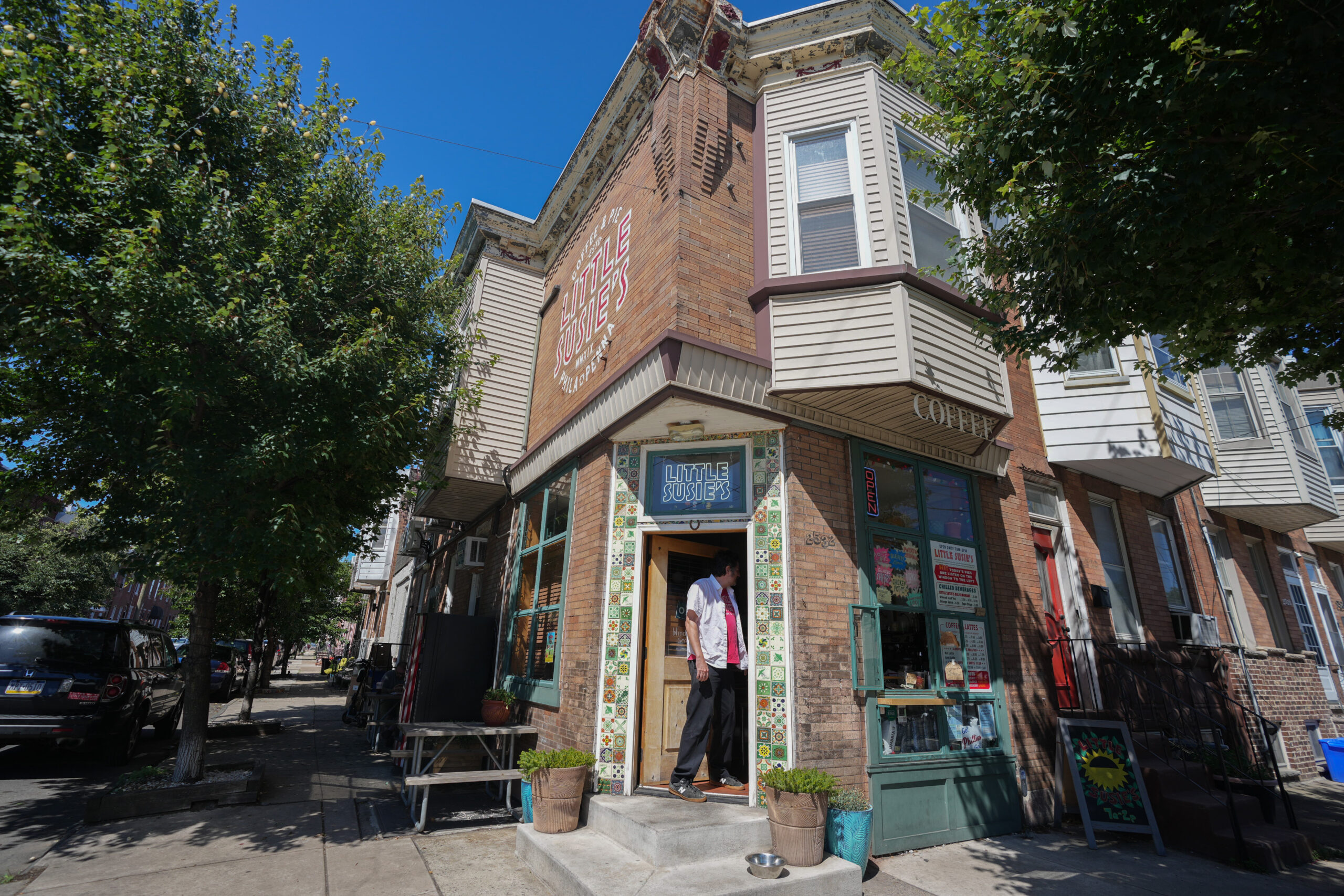
The takeout window at Little Susie’s flagship location at 2532 E. Lehigh Ave.
And what goes better with a cup of coffee than pie? He had a recipe he’d been baking for family get-togethers.
Seven years after Martino opened Little Susie’s Coffee & Pie in the building next door to his house, his modest idea has grown into four Philadelphia locations, with a fifth expected to open Friday at the former Pop’s Bun Shop in Bella Vista, a franchise headed to Milwaukee, and plans for additional shops in Fairmount and Northern Liberties. All his stores run from takeout windows, requiring little more than coffee stations and electric ovens.
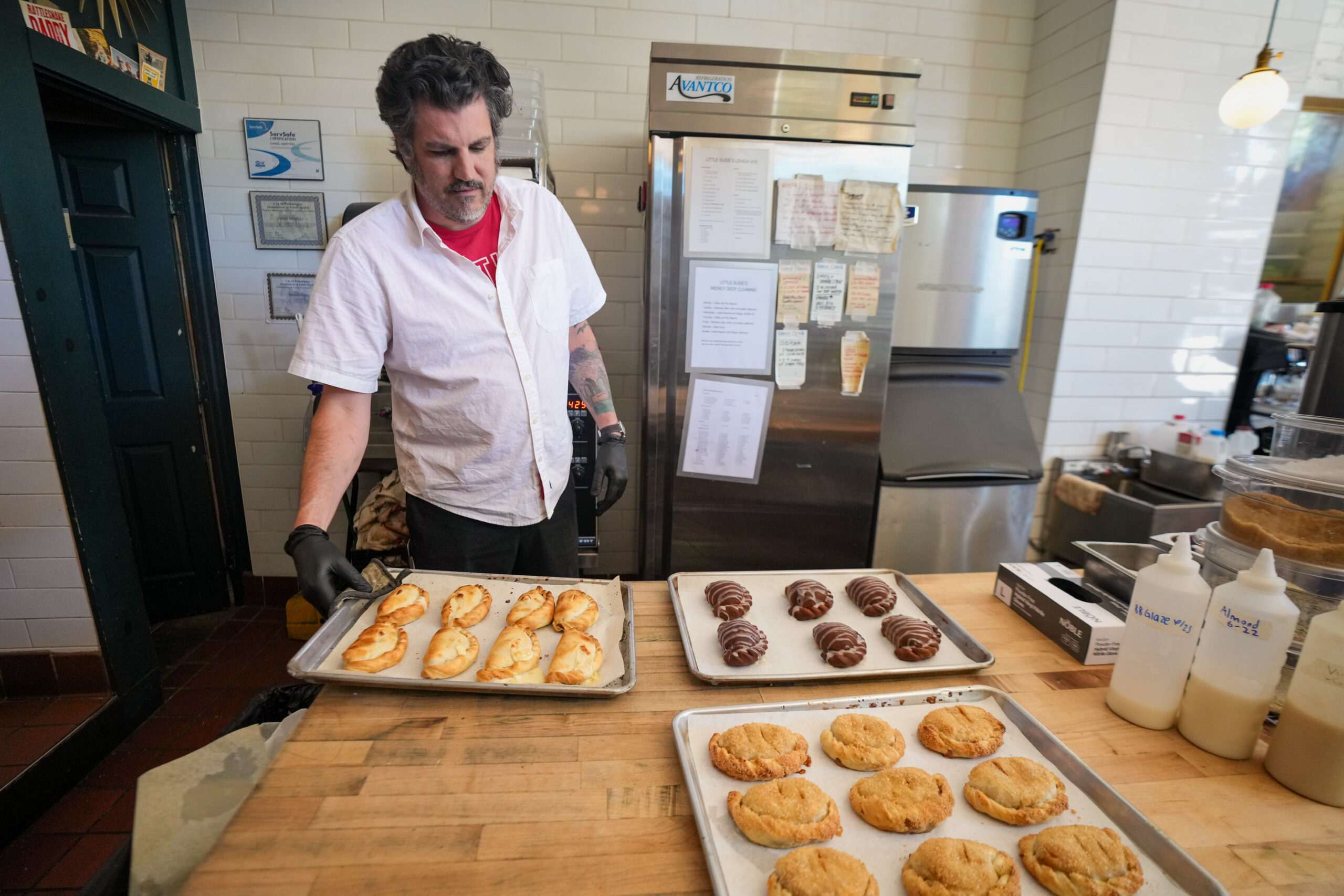
Today, the company employs 28 people and turns out about 1,200 pies a day from a bakery occupying two cramped rooms in the corner rowhouse on Lehigh Avenue.
Owner Daniel Martino with trays of pies at Little Susie’s.
Martino, 46, who grew up in Northeast Philadelphia, has spent much of his working life around food. As a teenager, he worked at a swim club snack bar before taking a kitchen job at what is now Jefferson Torresdale Hospital.
After studying film at Temple University, he joined Public House Investments, which ran City Tap House, as a DJ before becoming the hospitality company’s creative director, designing menus, logos, ads, and marketing material.
When the property next door to his house became available, Martino said he used a home-equity line of credit to buy it before securing a Small Business Administration loan to renovate it.
The takeout window at Little Susie’s. Hand-lettered signs advertise the specials.
By the time Little Susie’s opened in December 2019, he said, “I had maxed out every credit card I had. I even had to go to the bank, hat in hand, and sign a signature loan for the last $10,000 just to get it open.”
His shop offered a simple menu, little more than coffees and lattes and four kinds of pies. There was a counter for seating. The first day brought in about $180, and “it was the greatest day of my life,” Martino said.
Then the pandemic arrived. When COVID-19 restrictions shut down indoor dining, Little Susie’s shifted to window service. Customers called in orders, paid over the phone, and picked up coffee and pies outside. Even after restrictions were lifted, the shop never reopened indoors.
It wasn’t what Martino had imagined. His idea was ”Cheers with coffee — the neighbors and the mailman talking about the weather,” he said.
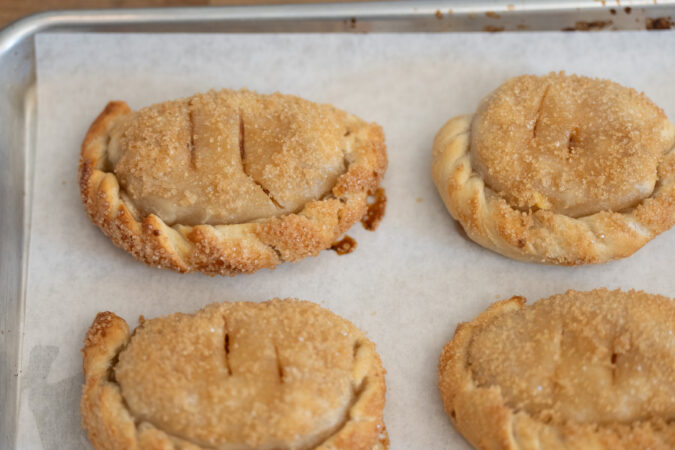
Instead, customers embraced the walk-up model and the seating at a picnic table beneath a maple tree. The pies especially quickly caught on. The signature is the crust. Rather than trimming away the excess dough, workers twist it around each pie by hand, creating what Martino calls “a fluffiness that the fork doesn’t provide — that flaky tenderness you want in a pie crust. The twist is its own special treat in and of itself.”
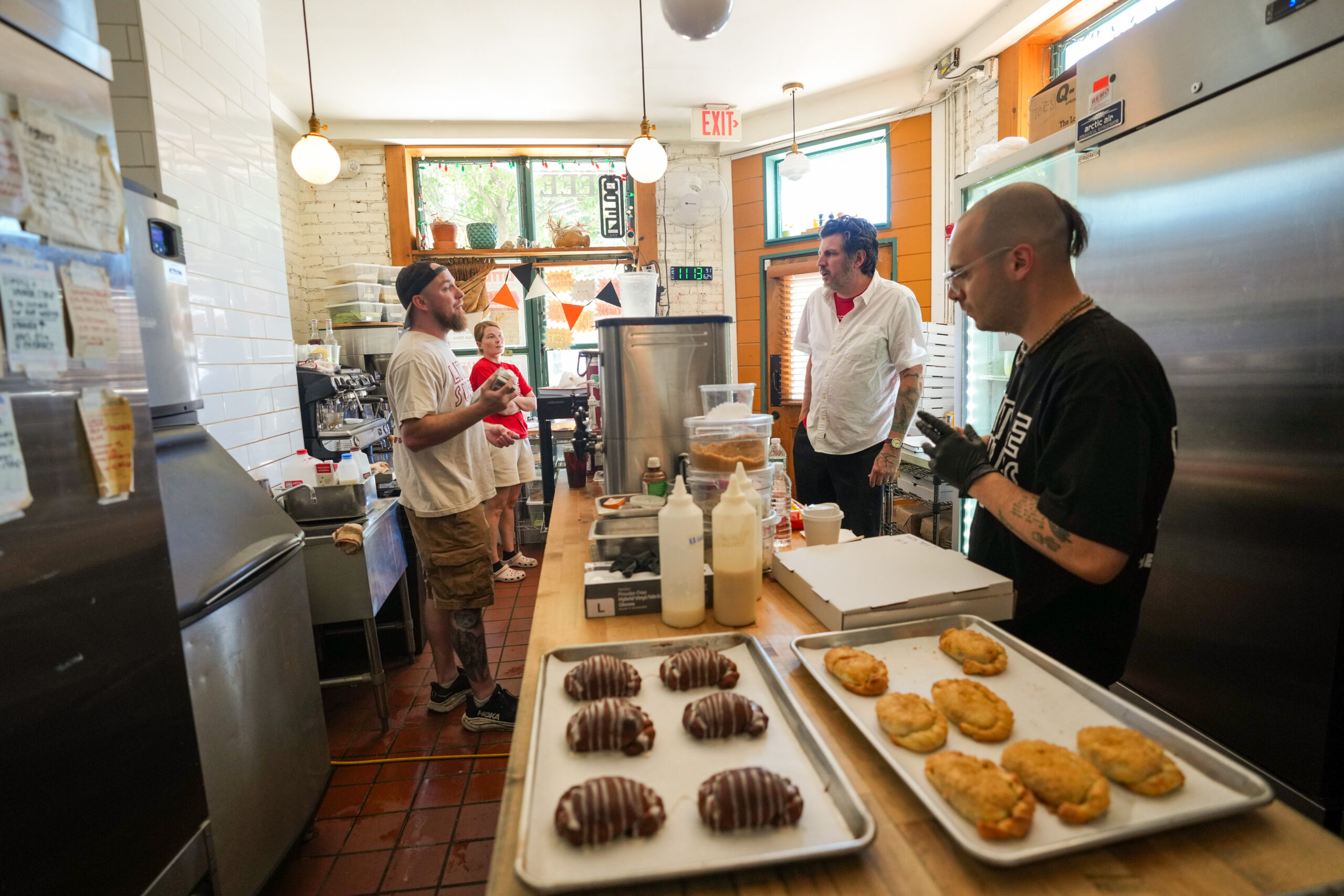
Owner Daniel Martino (rear, right) with staff and pies at Little Susie’s, set up in a rowhouse.
The pies, which are baked and not fried, are made with a simple crust of flour, butter, sugar, and salt. It’s a 48-hour process. Dough is mixed at the company’s Kensington location, where a 20-quart mixer runs nearly all day. The dough rests for 24 hours before it is brought to Port Richmond, where it is sheeted, filled, twisted, frozen, and delivered to the other stores to be baked to order.
Little Susie’s first menu included only blueberry, pork roll, apple, and mushroom Swiss fillings. Today, it offers about a dozen varieties, with eight available year-round and others rotating seasonally. “You can practically throw anything in this pie crust,” Martino said. “I haven’t been disappointed yet.”
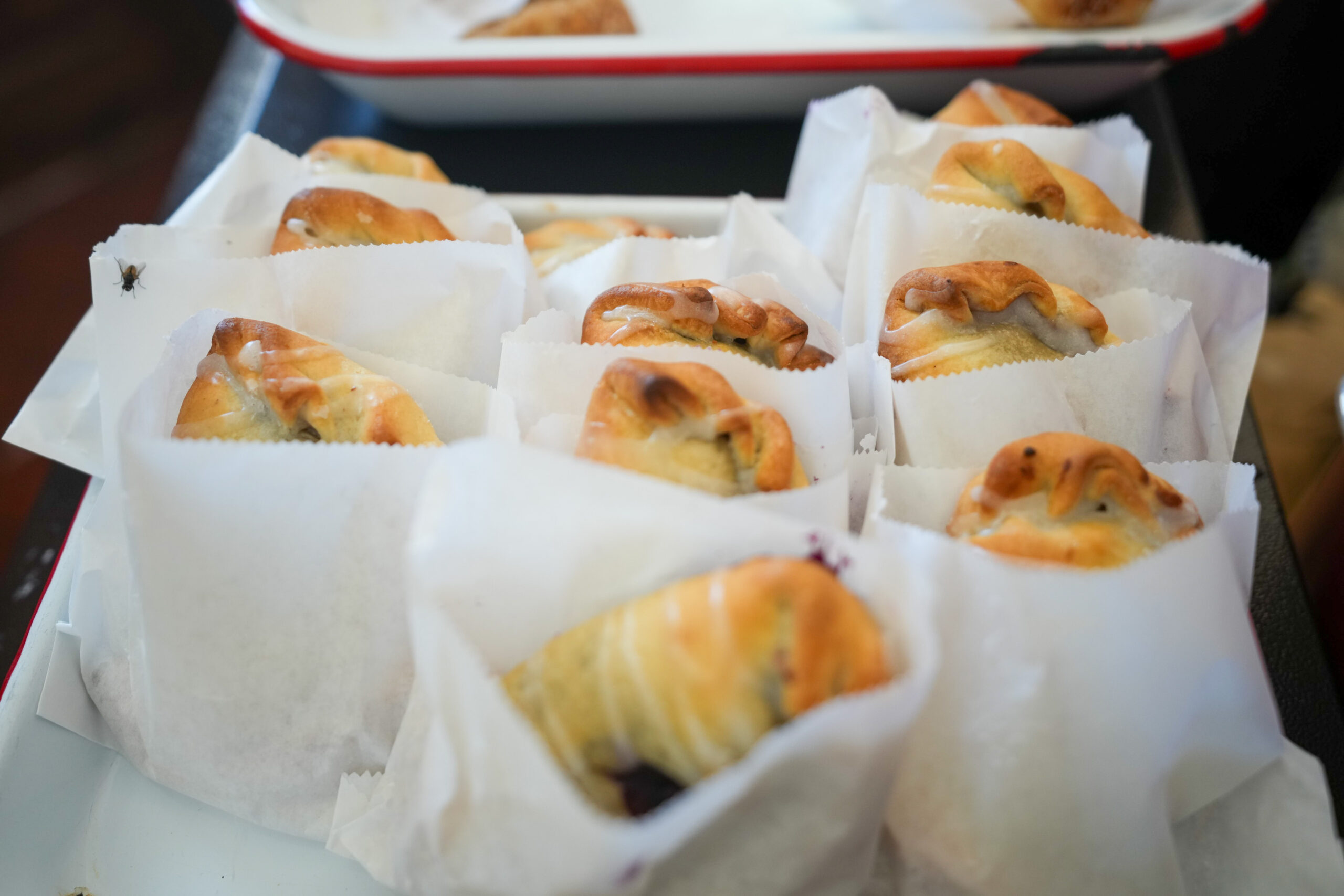
Pies at Little Susie’s.
Pork roll remains the top seller, followed by apple, and a sausage, egg, and cheese breakfast pie encrusted with everything bagel seasoning. Seasonal flavors have included ham and Brie, chocolate-covered strawberry, and Cajun crab and corn. None are gluten-free because of the shop’s limitations, he said.
Not every idea works. “We tried to make a cannoli pie, but the cream just melted right out,” he said.
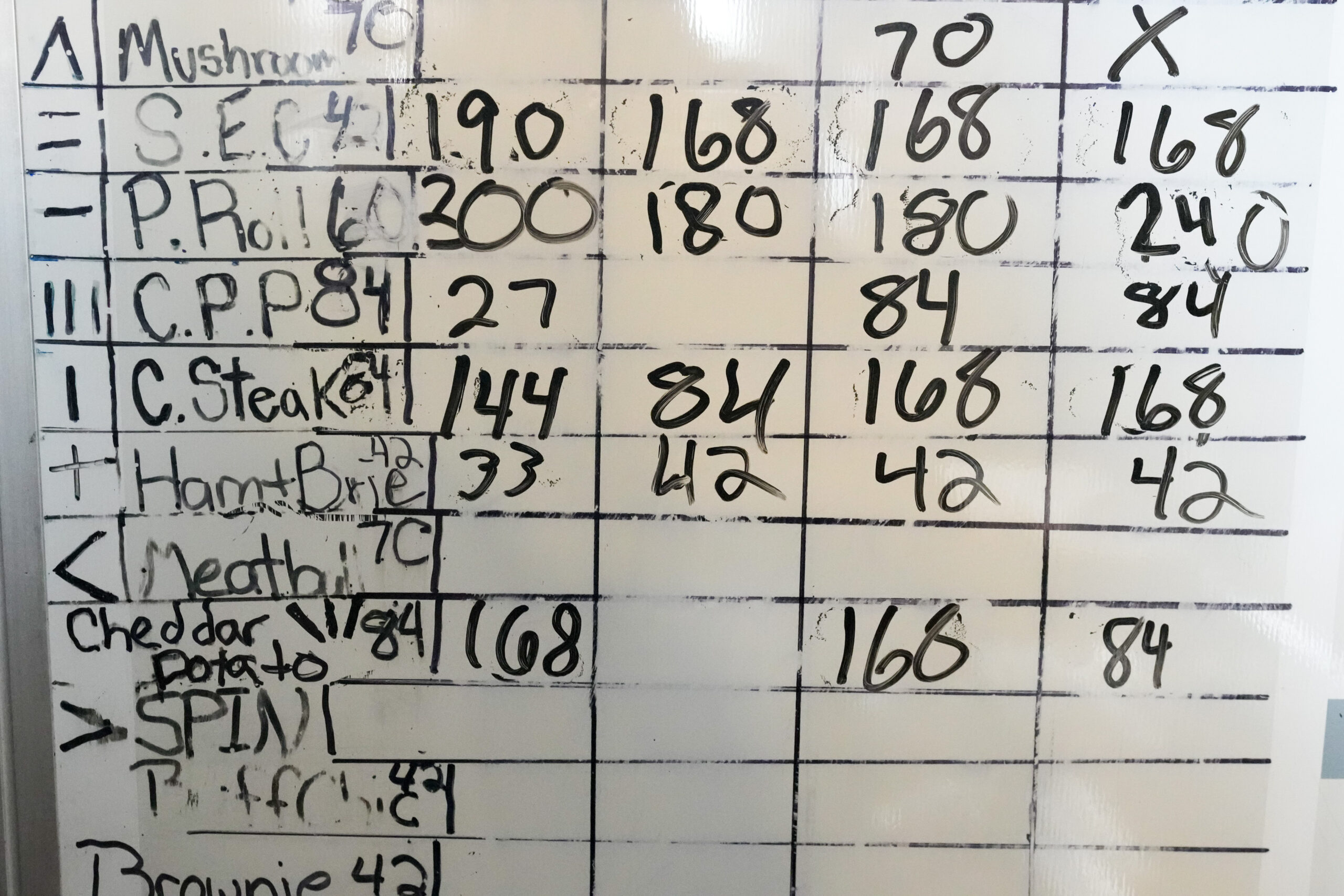
Each shop sells 200 to 300 pies a day. The production kitchen now employs 11 bakers, who track production on a whiteboard nicknamed “the Pieble.” Each variety get its own knife mark on top; an inverted V, for example, denotes mushroom Swiss.
The “Pieble” at Little Susie’s, the flagship pie takeout place located at 2532 E. Lehigh Ave., in Philadelphia, June 24, 2026.
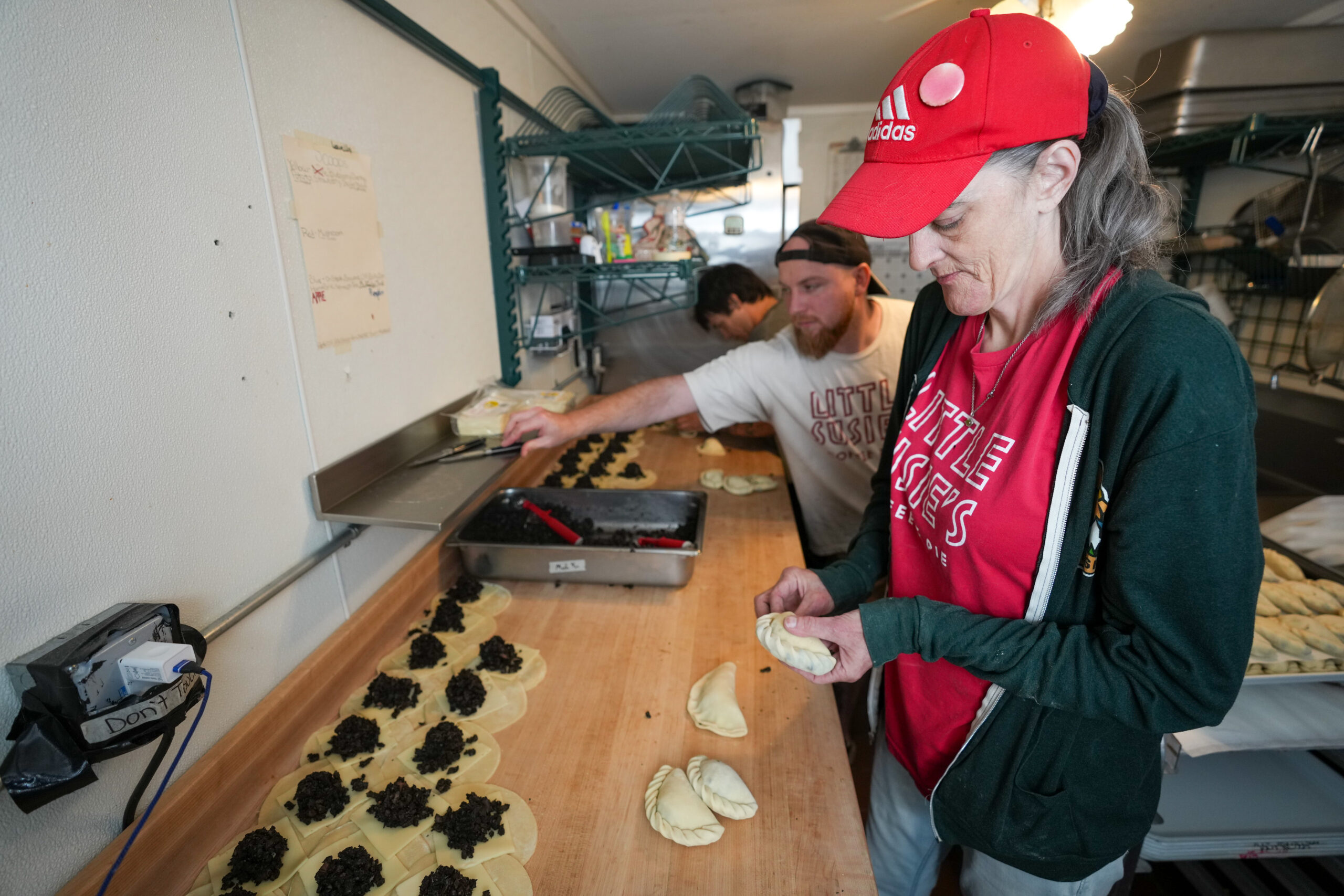
Lena Hurchick, who has worked at Little Susie’s for three years, said she enjoys “the competition of filling all the shops” and watching customers eat pies she helped make.
“Susie” was the name of the dog that belonged to the former owner of the building. “When we had the community meeting here, I said, ‘I’m thinking Little Susie’s,’ and people started crying,” he said.
Lena Hurchick crimps mushroom pies at Little Susie’s.
Expansion has brought complications. A planned Fairmount location was nearly ready to open before the city determined that the property required zoning approval for food sales. “The city does not make it easy,” he said, adding that it will take months to get onto the zoning board’s calendar.
Even so, he expects the company to keep growing. He has a handshake deal for a spot in Northern Liberties. Milwaukee is planned as the first franchise — operated by a friend — while Martino has begun thinking about a larger bakery in Philadelphia.
“We’re basically bursting at the seams,” he said. “We’re probably going to need a 10,000-square-foot facility.”
Owner Daniel Martino at Little Susie’s.
He wants that growth to remain slow enough that the pies are still made fresh every day. “I don’t want to get too far away from making them every day, because then it just becomes some frozen-food empire,” he said.
Little Susie’s Coffee & Pies’ locations are at 2532 E. Lehigh Ave. in Port Richmond, Second and Chestnut Streets in Old City, 1772 N. Front St. in Kensington, and 1754 S. Chadwick St. in Point Breeze. A fifth, at 800 S. Ninth St. in Bella Vista, is due to open Friday. Hours are 7 a.m. to 2 p.m. daily.
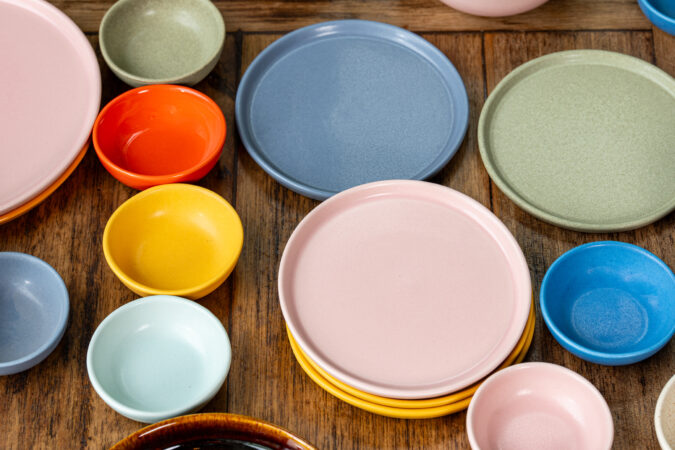
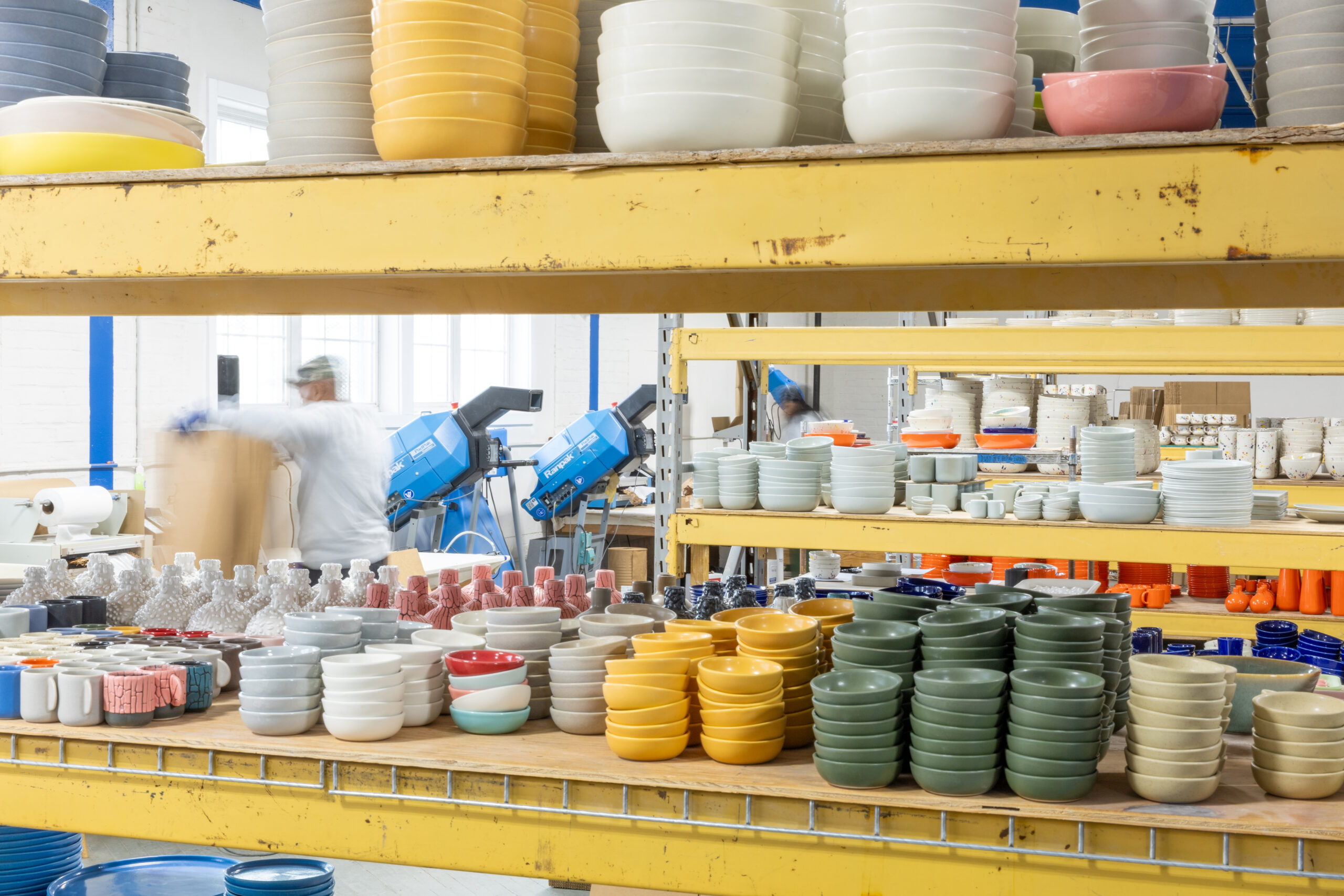
The vibrant, paint-flecked, confetti-esque glazed bowls are Philly icons. But at the end of January, these and hundreds of other ceramic dishes lay in ruins inside Felt and Fat’s kiln.
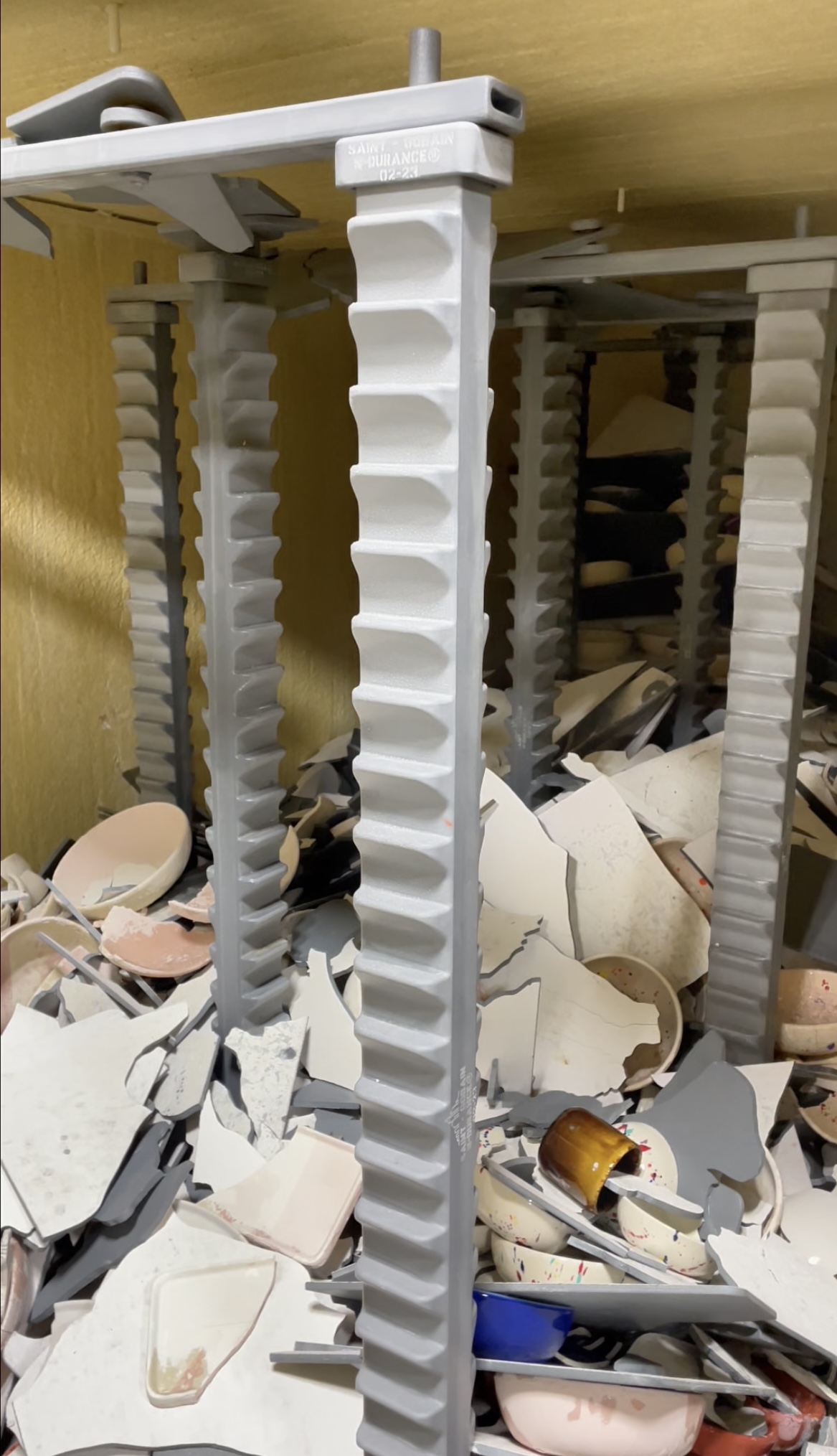
The wreckage after a winter cold snap destroyed Felt and Fat’s kiln in January 2026.
Philly’s back-to-back snowstorms and cold temperatures froze the ceramic producer’s warehouse’s sprinkler lines, causing sprinkler heads to crack.
Mist blanketed Felt and Fat’s kiln — and kilns are not supposed to ever get wet — for 12 hours. The kiln was just over a year old, custom-ordered from the Netherlands. It cost over $300,000 and was the keystone of founder Nate Mell’s plans for expansion.
The kiln took a year to arrive and was outfitted with a specialized rack system that made loading and unloading pieces — up to 250,000 per year — easy.
“The kiln company told us they couldn’t repair it and with high-pressure gas going into the kiln, even if they could, they couldn’t speak for it in terms of liability,” said Mell, 40. The electrical components were all soaked and frozen. The inside was completely destroyed. “We still haven’t quantified our revenue loss,” he said, despite getting his old kiln back in use about a month after the disaster.
The kiln explosion came on the heels of Felt and Fat filing for Chapter 11 bankruptcy. “We were really struggling in 2024 and 2025, which was a terrible time to raise money. The early 2020s for us were all about growth,” said Mell.
To get out of bankruptcy, Mell had to come up with a reorganization plan for his creditors. It required getting back to Felt and Fat’s roots.
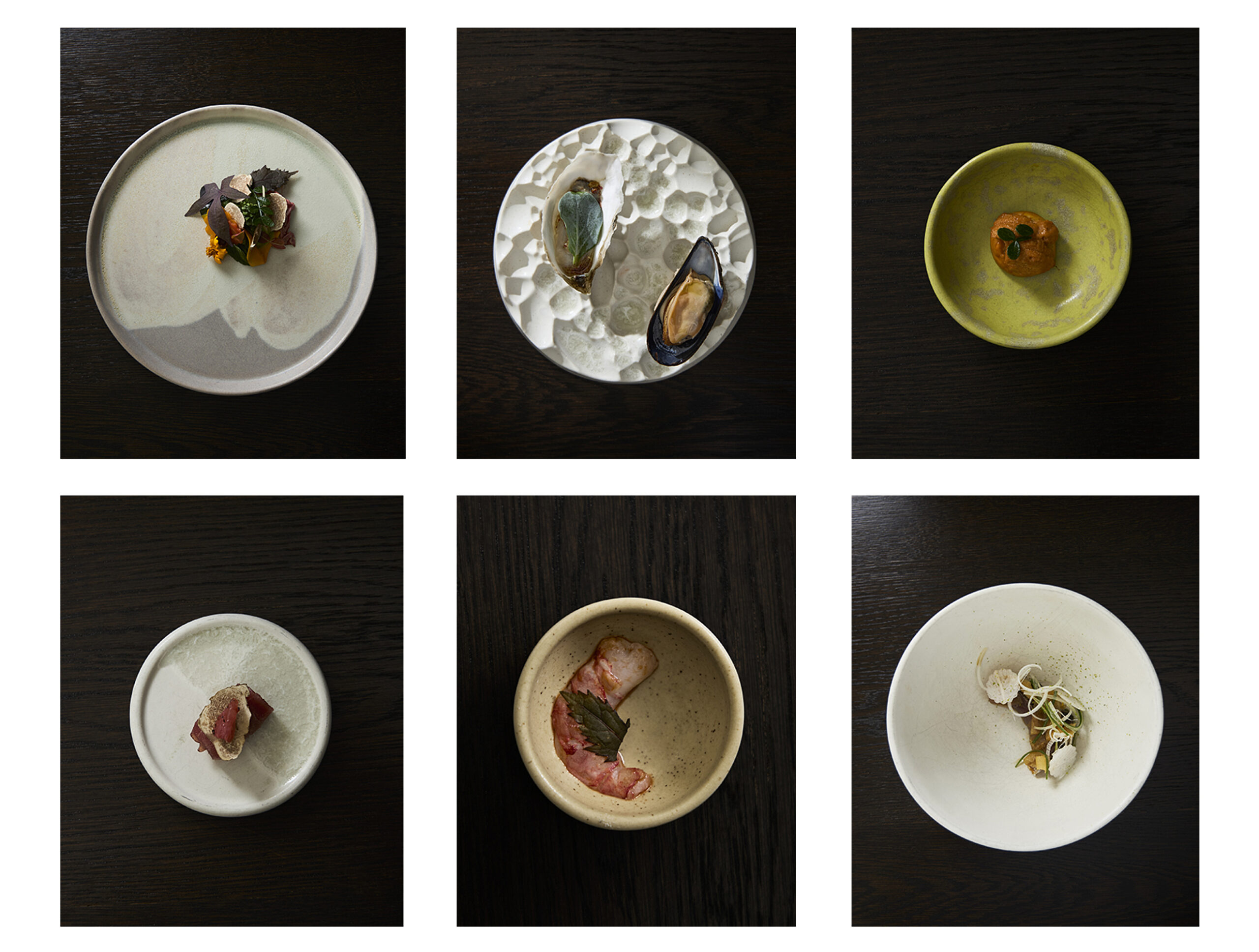
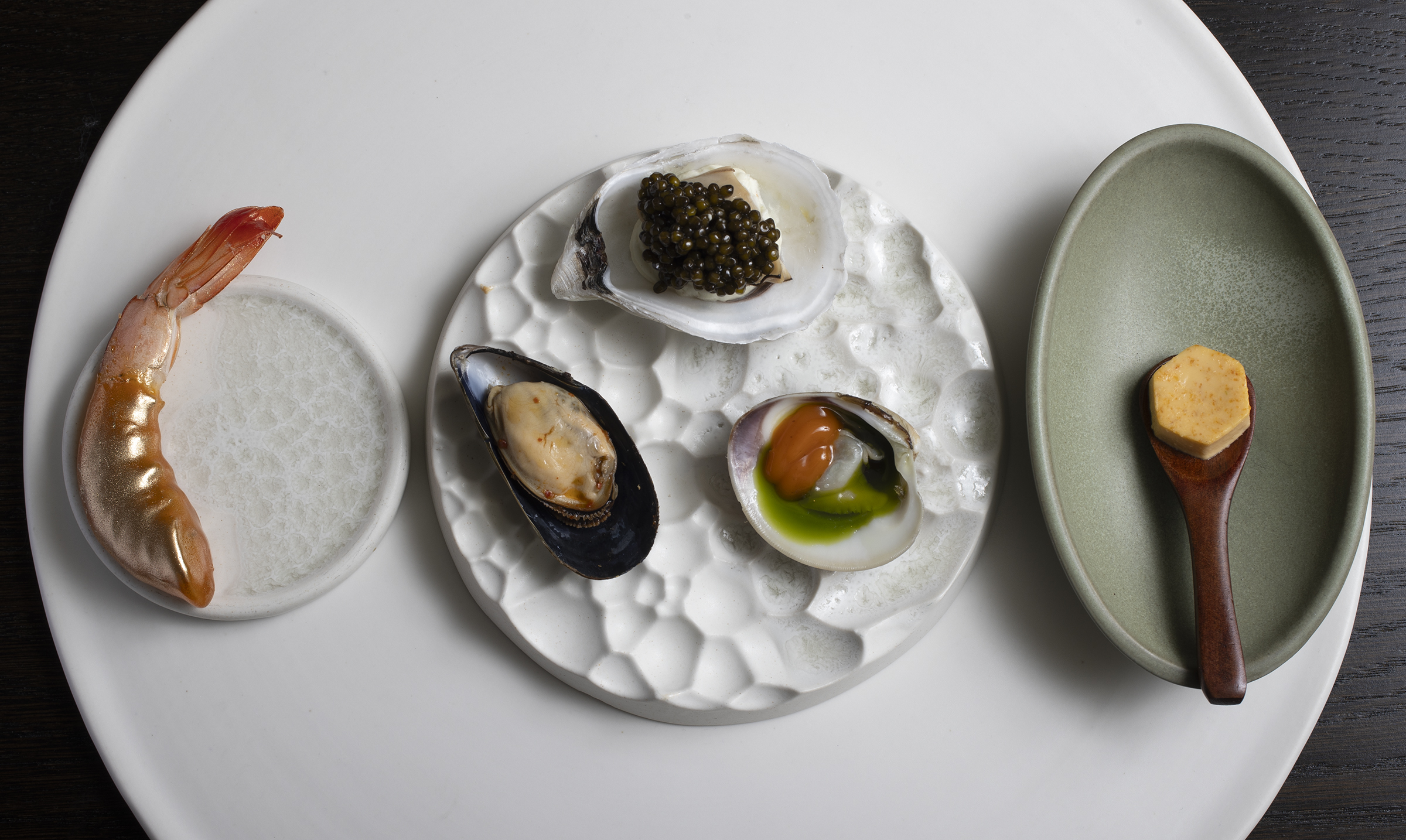
It all started in 2013, when Ellen Yin and Eli Kulp commissioned custom ceramics from Mell for the original High Street restaurant, which opened in September of that year. He officially formed the business in 2014, and over the next decade, Felt and Fat grew from a two-person ceramics studio — encompassing Mell and former business partner Wynn Bauer, who left the company in 2017 — into one of the region’s most recognizable dinnerware manufacturers. Their plates were seemingly at every award-winning Philadelphia restaurant, from River Twice to Tesiny to the now-closed Laurel.
“We had been growing the same way everyone else grows: build a factory, add people, add machines,” said Mell, a Temple grad who admitted that this trajectory had little to do with what he had been trained in. “I went to the Tyler School of Art and Architecture and studied glass but took classes in ceramics. I worked as a server in Philadelphia restaurants for eight years and started delving deeper into ceramics by working part-time at the Clay Studio back when it was in Old City.”
Felt and Fat provides Provenance with custom ceramic dinnerware.
He realized that what he and his team does well is “great design, really interesting glaze work with relatively low minimum-order quantities, and interesting collaborations.” His expansion plans were taking him away from that design and glaze work. “The bulk of what we were doing, and what every other factory does, is taking clay and turning it into a shape.”
Collection of canapés served at Provenance in 2024 on Felt and Fat ceramic dinnerware.
He reached out to an old contact, the company Anfora, located outside of Mexico City, which has been making ceramics for over a century. “They do massive volume, making stuff the way we do. They treat their people well and make the same quality dinnerware with the same porcelain clay we use.”
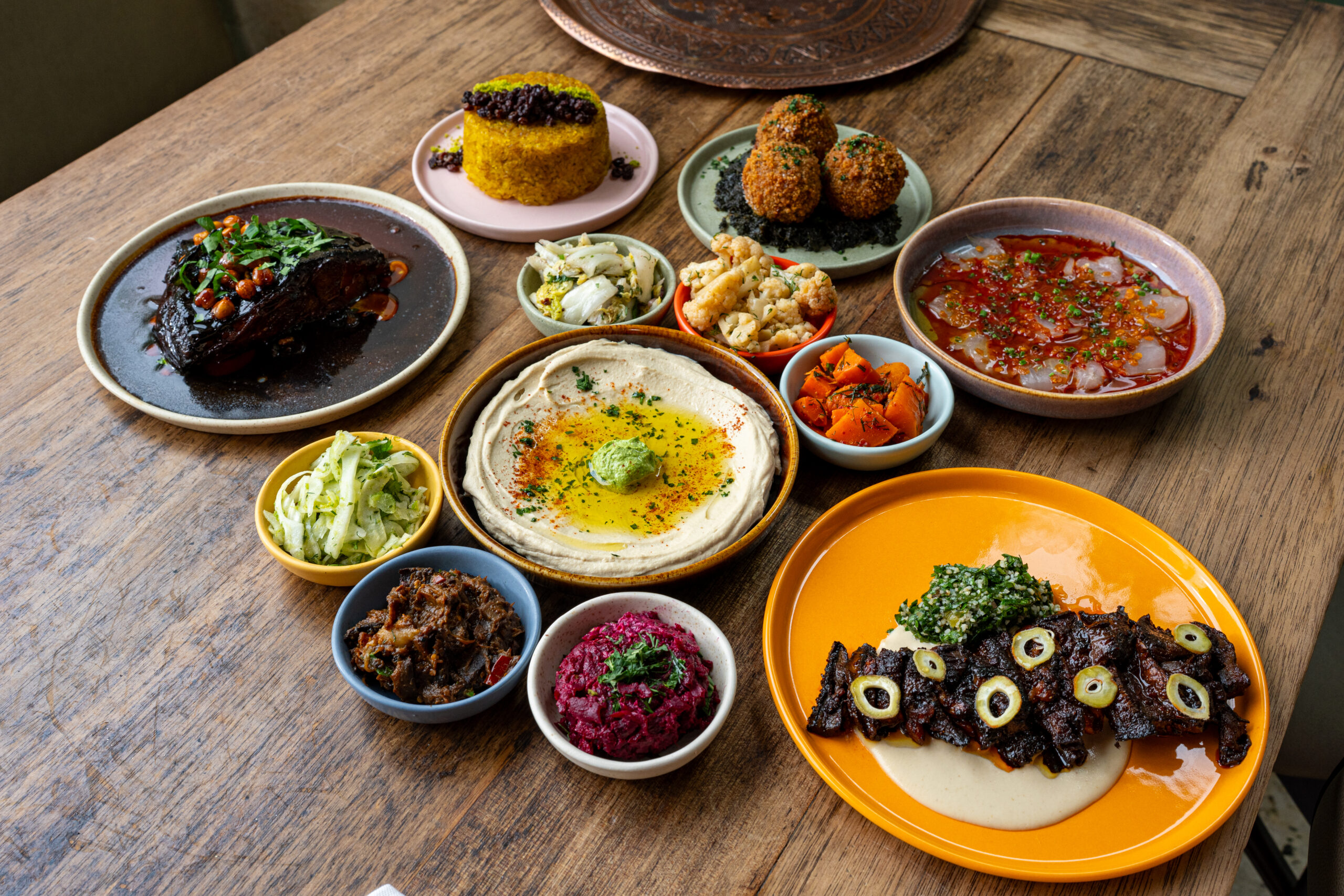
Food from Zahav on Felt and Fat dishes.
His restructuring plan meant Anfora would produce the shapes for Felt and Fat, and they would be glazed by hand in Philadelphia. Mell has just received the first of his shapes from Anfora, with more to come.
“We’re going to have our standard shapes formed at Anfora. But we’re going to expand our high-touch, low-output forming — hand thrown and slip cast,” he said. “We’re going to be even more handmade than we were before. And we’ll be able to lean into that. But we’ll also have the consistency of our standard pieces.”
Felt and Fat dishes are stacked and lined up at the ceramic company’s Kensington facility.
These days, Felt and Fat has just seven employees, including Mell. “Everybody gets their hands in everything. We’re a tight little team,” said Mell, though he hopes to add more employees at a more sustainable rate than before.
“The two years leading up to this were tortuous,” said Mell. But he hopes the future will be brighter, with slower, more purposeful growth.
Felt and Fat’s studio is open for browsing by appointment from Monday to Friday, 9 a.m. to 4 p.m. at 3750 M St., Philadelphia, Pa., 19124. To make an appointment, email support@feltandfat.com or call 215-259-8773. Orders can also be placed online at Felt and Fat’s website and picked up at the studio.
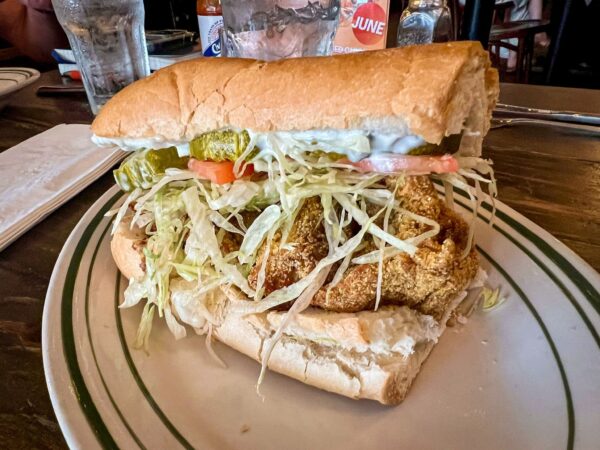
The good times roll at Khyber Pass Pub in Old City, where the menu of New Orleans-style comfort food includes a hearty share of vegan items. The chicken-style po’ boy, for example, delivers crispy, thinly breaded seitan while keeping the classic New Orleans formula intact. Served on a crackly Leidenheimer roll, it’s dressed with shredded lettuce, tomato, pickles, vegan mayo, and Creole mustard, delivering a satisfying mix of crunch, tang, and subtle heat. It’s a convincing plant-based rendition that feels like a true po’ boy, not a compromise. Khyber Pass Pub, 56 S. Second St., 215-238-5888, khyberpasspub.com
— Michael Klein
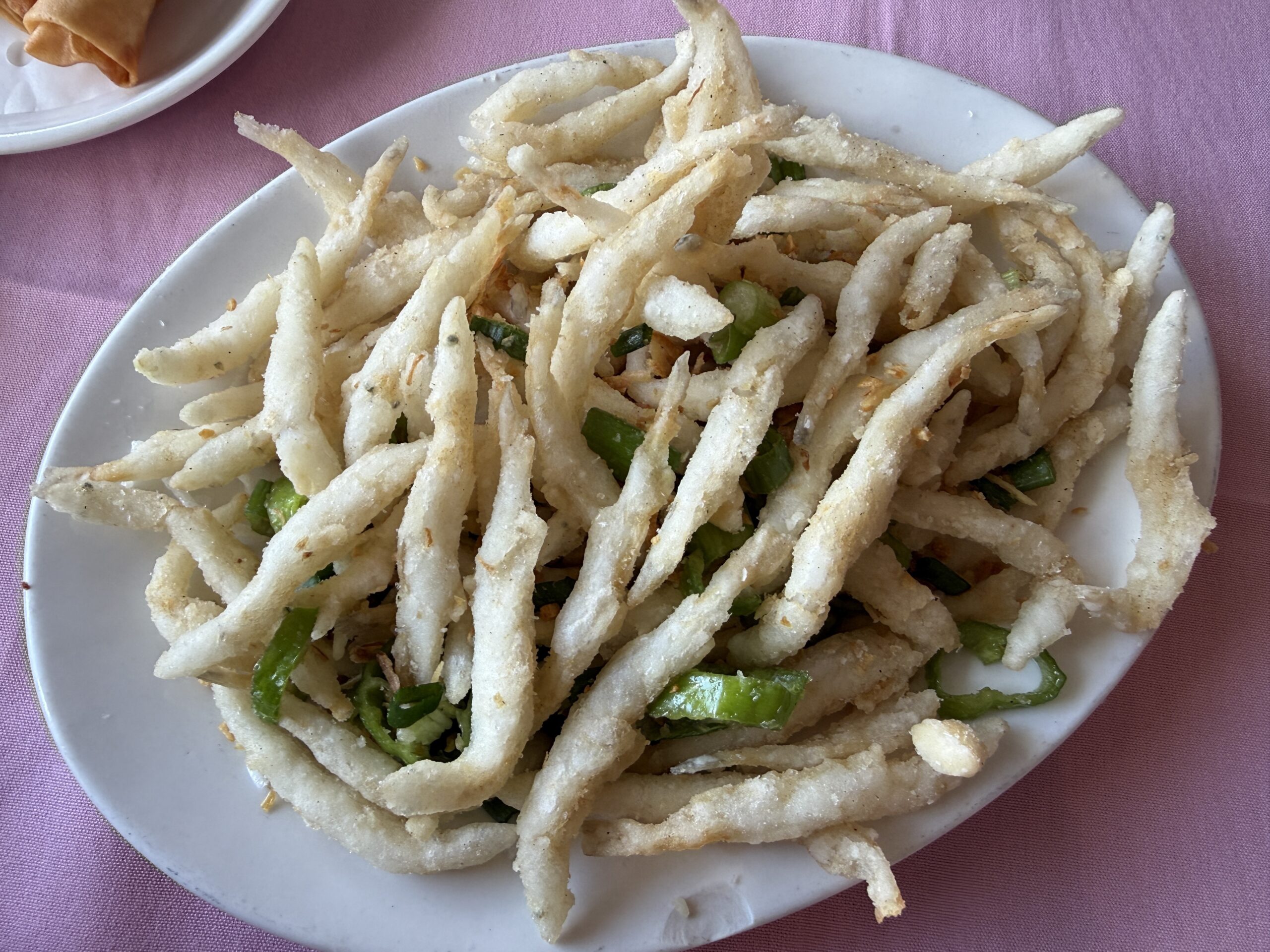
Fried silverfish — a Cantonese delicacy that’s pretty similar to a French Fry — at Grand Palace, 600 Washington Ave. #3B.
Fried Silverfish at Grand Palace
Weekend dim sum at Grand Palace in South Philly’s Little Saigon is a party where the whole family (second cousins and all) is invited, so the party-sized portions of Cantonese delicacies deserve special attention. The rice-flour-battered and fried silverfish (also known as noodlefish or whitebait) are generously sized and hopelessly addictive. More delicious than any French fry — though similarly salty, crunchy, and thin — the tiny fish are lightly funky and just barely scented with jalapeños and scallions. I haven’t stopped thinking about them since. Grand Palace Restaurant, 600 Washington Ave. #3B, 215-645-0079, grandpalacechineserestaurant.com
— Kiki Aranita
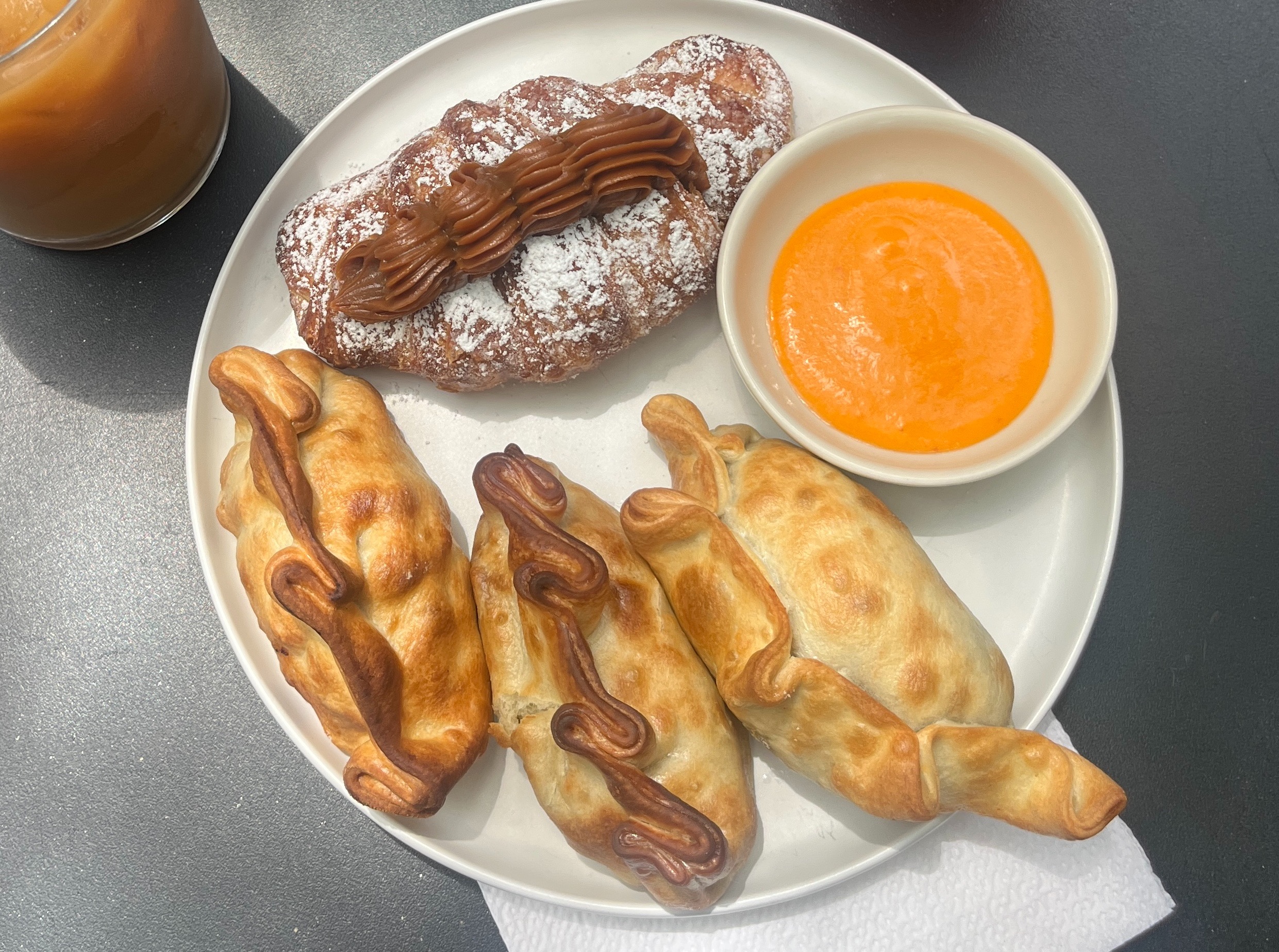
An array of empanadas and a dulce de leche medialuna at Jezabel’s in West Philadelphia.
Empanadas and a dulce de leche medialuna at Jezabel’s
Empanadas are the main attraction at Jezabel Careaga’s eponymous West Philly cafe, where the open-concept kitchen feeds into a dining room that allows customers to watch bakers knead, shape, and pack the dough tight with fillings. The lineup is special, but simple: a stewed chicken empanada lightly seasoned with aji dulce; a vegetarian version stuffed with leeks and gooey white cheese; and a vegan version packed with a summery lentil and corn salad. Careaga’s empanadas are baked — not fried — and so light that it’s easy to snack on several in one sitting.
Even more excellent are the cafe’s medialunas, an Argentinian pastry that sits somewhere between brioche and a croissant. The dulce de leche version is ultra-decadent, its butter crescent-shaped layers peeling apart to reveal a core of caramel cream. When Careaga returns to Fitler Square with a second location — likely opening this fall, I’m told — it’ll still be empanadas and medialunas galaore. Thank goodness. Jezabel’s, 206-208 S. 45th St., 215-554-7380, jezabelsphl.com
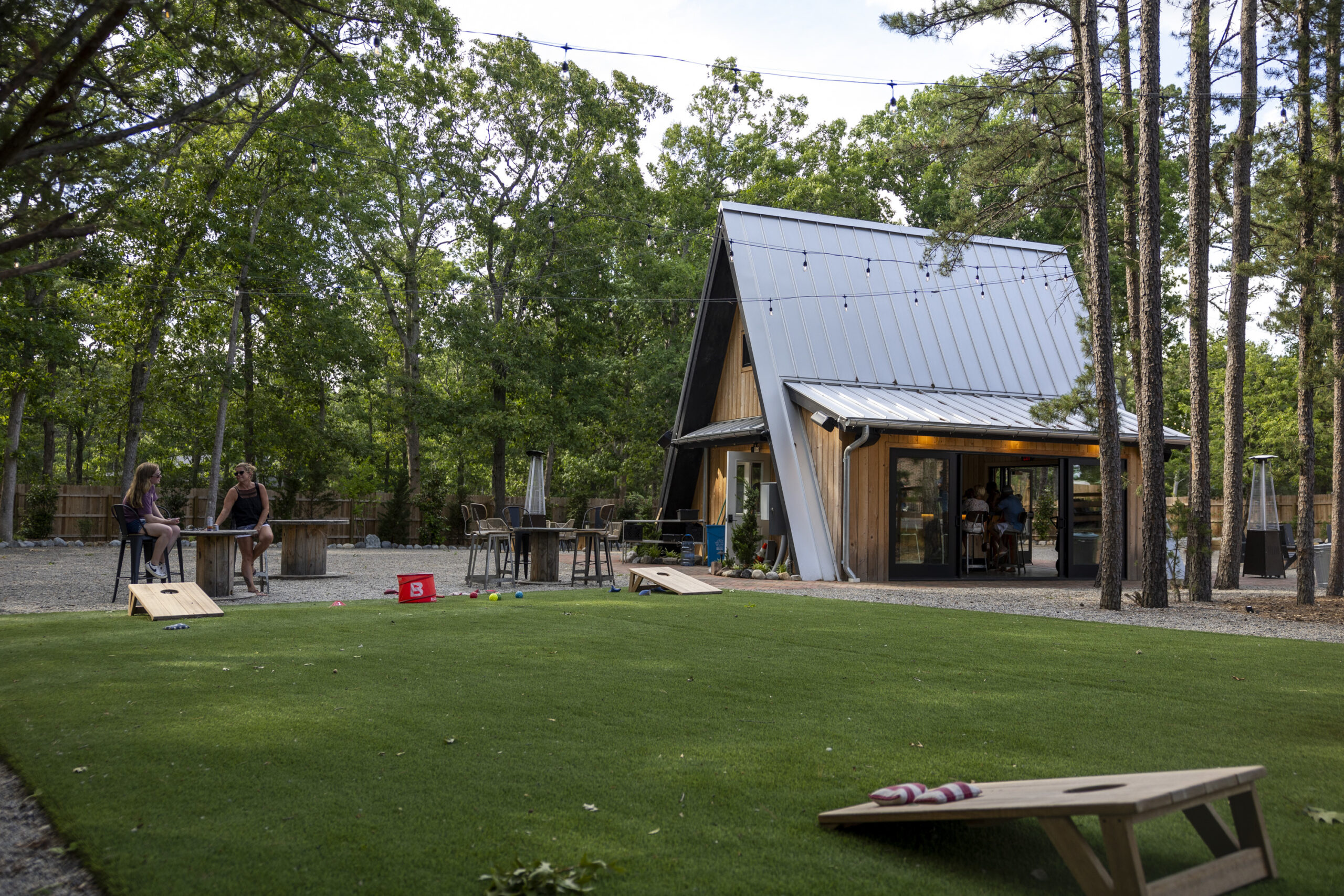
The fire pits are ablaze by dusk at Hollow Pines, a sprawling compound with an outdoor bar, bocce courts, and a massive A-frame lodge where craft cocktails, duckpin bowling, and updated comfort food with a Jersey twist have been drawing guests by the hundreds to West Creek.
The vibe at this ambitious newcomer off Route 9 from the Tide Table Group, which opened in February, conjures a funhouse in the woods more than a beachside resort, even if it’s only half a mile from the bay just south of Manahawkin. It’s also part of a larger trend: the biggest new restaurant openings at the Jersey Shore this year are on the mainland rather than the barrier islands, where real estate prices have skyrocketed.
Veronica Smith of Barnegat (left) and Makayla Williams of Absecon enjoy drinks at Hollow Pines in West Creek, N.J., on Thursday, June 18, 2026.
“There’s only so much land on the islands, and the property value there is higher if you subdivide and put residential on it,” says Hollow Pines co-owner Billy Mehl. “Plus, the short season [on the islands] makes it harder to recoup the cost.”
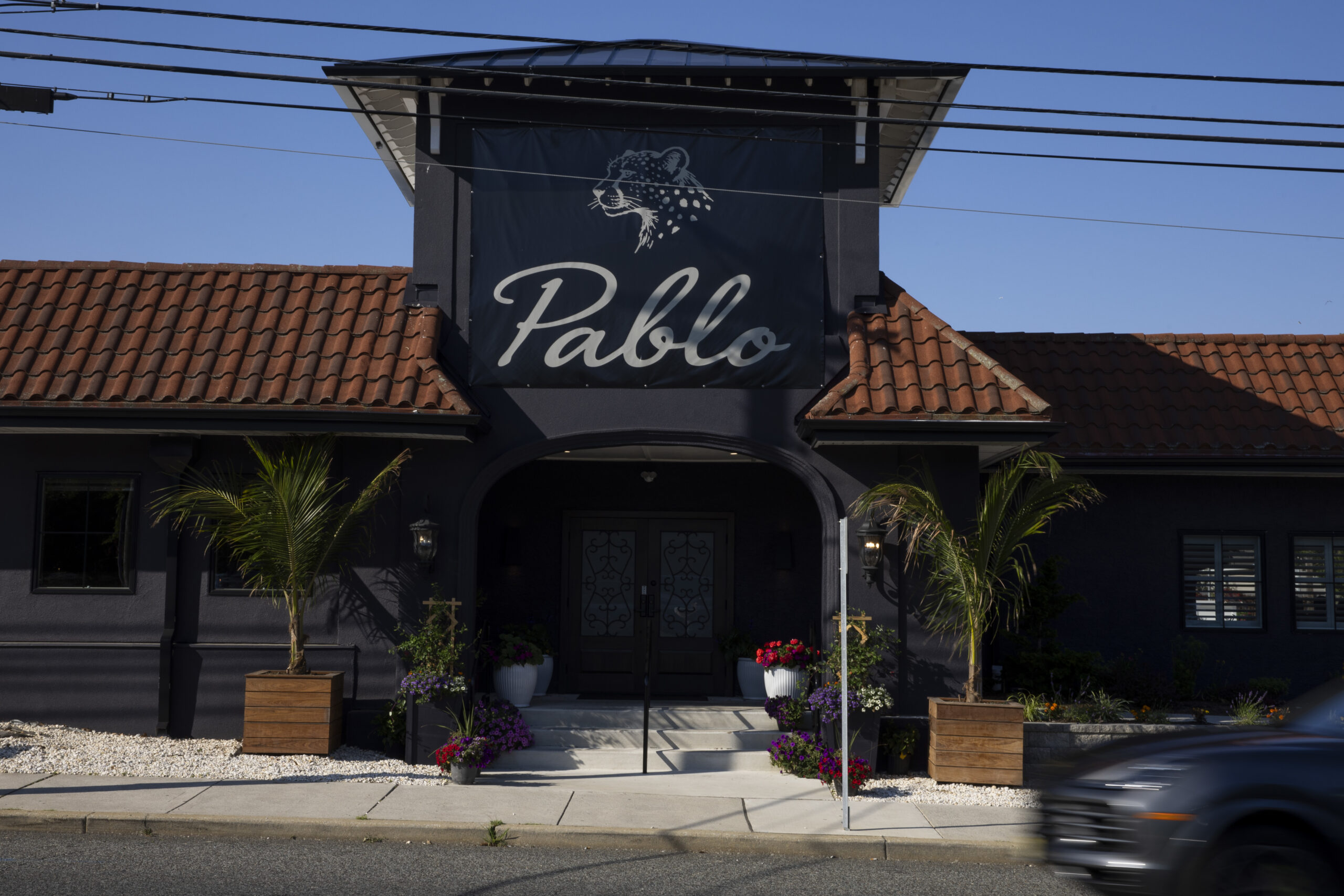
The logic is similar farther south in Somers Point, where two mega-openings — the 400-seat Pablo and 250-seat Webster’s Tavern — aim to draw the growing year-round population as well as thirsty summer tourists pouring across the bridge from the dry island of Ocean City.
“You should see our after-church crowd! We sell a lot of Bloody Marys and it’s terrific,” says Webster’s owner Chris Webb, noting the construction of hundreds of new homes nearby as a reason for optimism beyond the summer season. “Somers Point is on fire right now.”
Of course, bigger is not necessarily better. New menus up and down the Shore have trended more conservative this summer, toward the safe bets of American tavern classics (wings, chicken Caesar wraps, and burgers), hedging for mainstream tastes at even a taco-themed fusion concept like Pablo. So, while I was sure to check out these large new players — results were mixed — I also explored some flavorful highlights from the international communities that have also settled on the mainland across from Atlantic City, from a stellar new chilaquiles specialist to the kebab combo platter of my dreams.
If you prefer to eat closer to the beach, do not fret. This is just the first part of my annual shore guide. I still have exciting dining dispatches from the barrier island towns coming the following weeks, with reports from more than 20 places from Cape May to LBI. But first, here’s a look at some of the rapidly growing options for food and fun before you even cross a bridge.
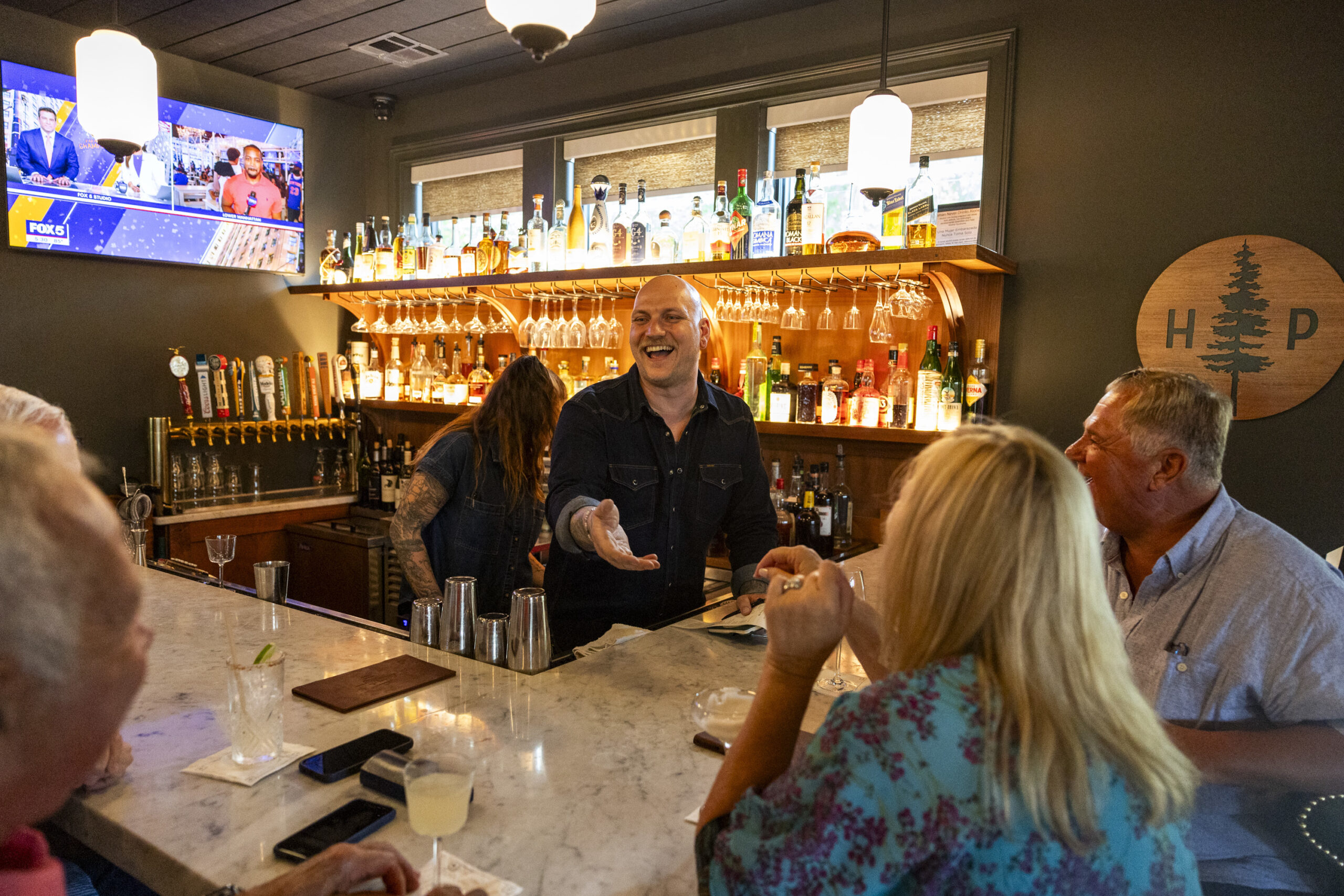
Nicholas Bisbee of Tuckerton, lead bartender and head trainer, chats with customers at the upstairs bar at Hollow Pines in West Creek, N.J., on Thursday, June 18, 2026.
PINELANDS
Hollow Pines
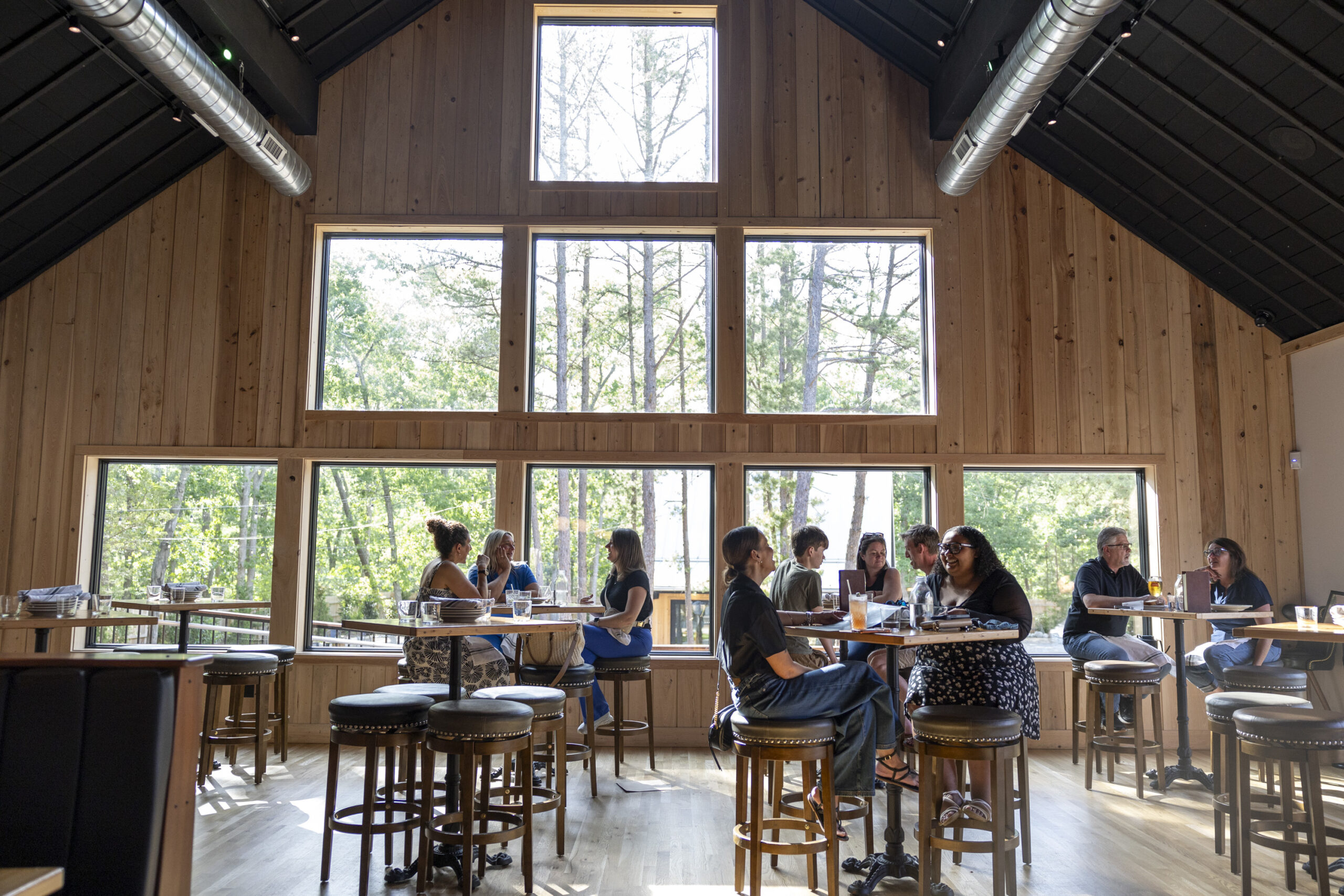
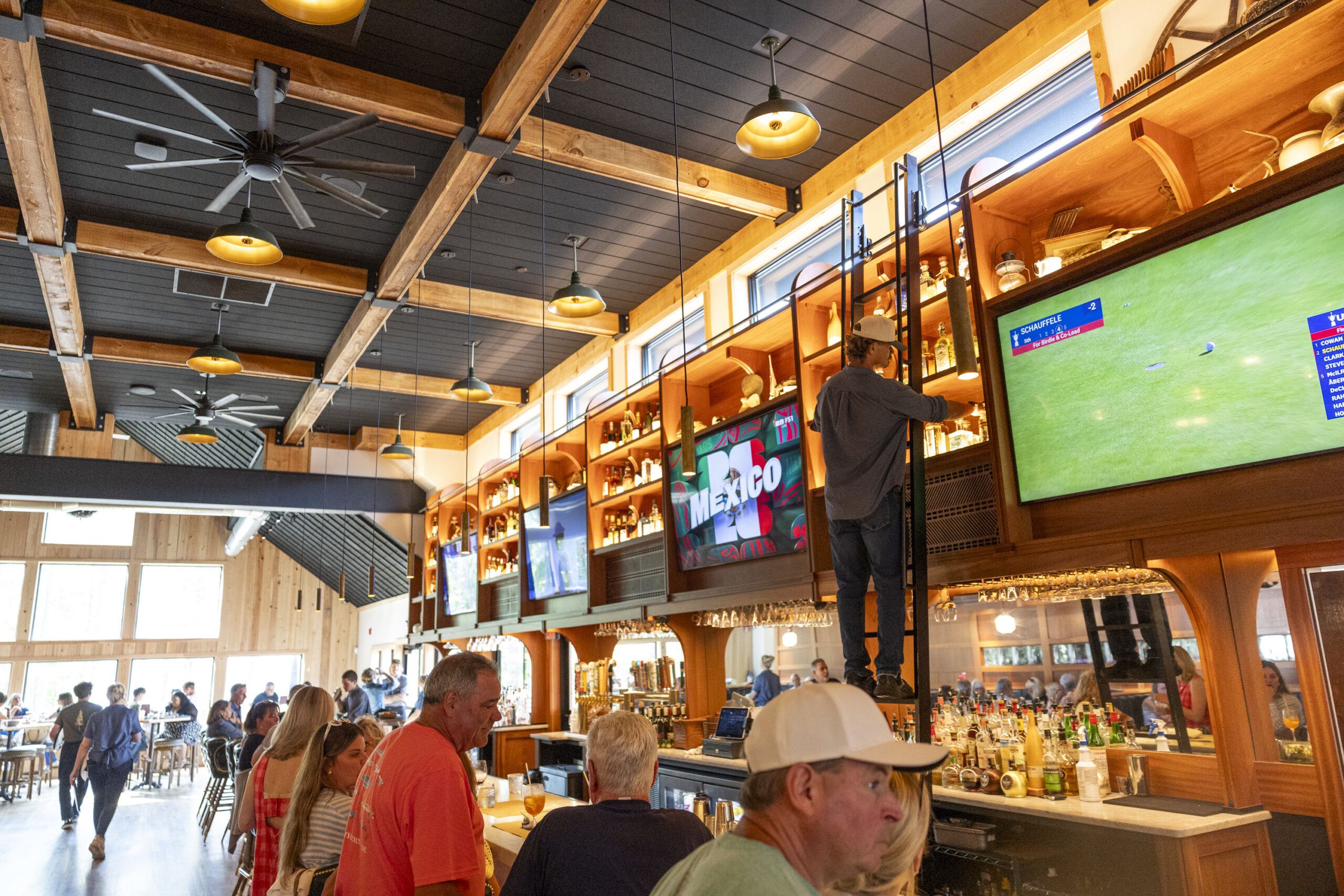
It took eight years and nearly $8 million for the Tide Table Group to finally complete Hollow Pines, a multipurpose destination built on five acres of marshland just beyond the edge of the Pinelands National Reserve. The owners envisioned a place for big groups to linger and play, not just eat and run. And its indoor-outdoor spaces offer a variety of activities to that effect, from cornhole beside a separate outdoor bar serving Spaghett beer cocktails, composed shots, and other drinks, to a lively four-lane duckpin bowling alley on the ground floor of a roomy split-level tavern hall lined with TVs and a more intimate mezzanine dining room tucked upstairs.
The outside bar and outdoor entertainment give patrons a reason to linger and play at Hollow Pines in West Creek, N.J., on Thursday, June 18, 2026.The inside main seating and bar area at Hollow Pines in West Creek, N.J., on Thursday, June 18, 2026.
With Tide Table’s track record for good dining experiences at restaurants such as Mud City Crab House in Manahawkin and Parker’s Garage in Beach Haven, it’s no surprise the food and drink programs here are thoughtfully crafted. There’s a wide selection of upscale comfort foods from chef Al Cuff, from a pull-apart hot dog wrapped in a horseshoe of puff pastry to rich crab chowder and tomato bisque and a homey, double-crusted pot pie filled with an herbal chicken velouté.
Some ideas were a bit too cute, like the salad heavily dressed with sour cream-and-onion dressing topped with potato chips. But the pasta is homemade in the pappardelle tossed with a hearty ragù of braised short rib. There’s plenty of lobster bits in the risotto to add some glamour to the salmon, and the oysters broiled in zesty Calabrian chili butter are decidedly local Briny Pinys. Jersey duck for the cassoulet and venison for the lasagna are appealing nods to the state’s sportsman traditions.
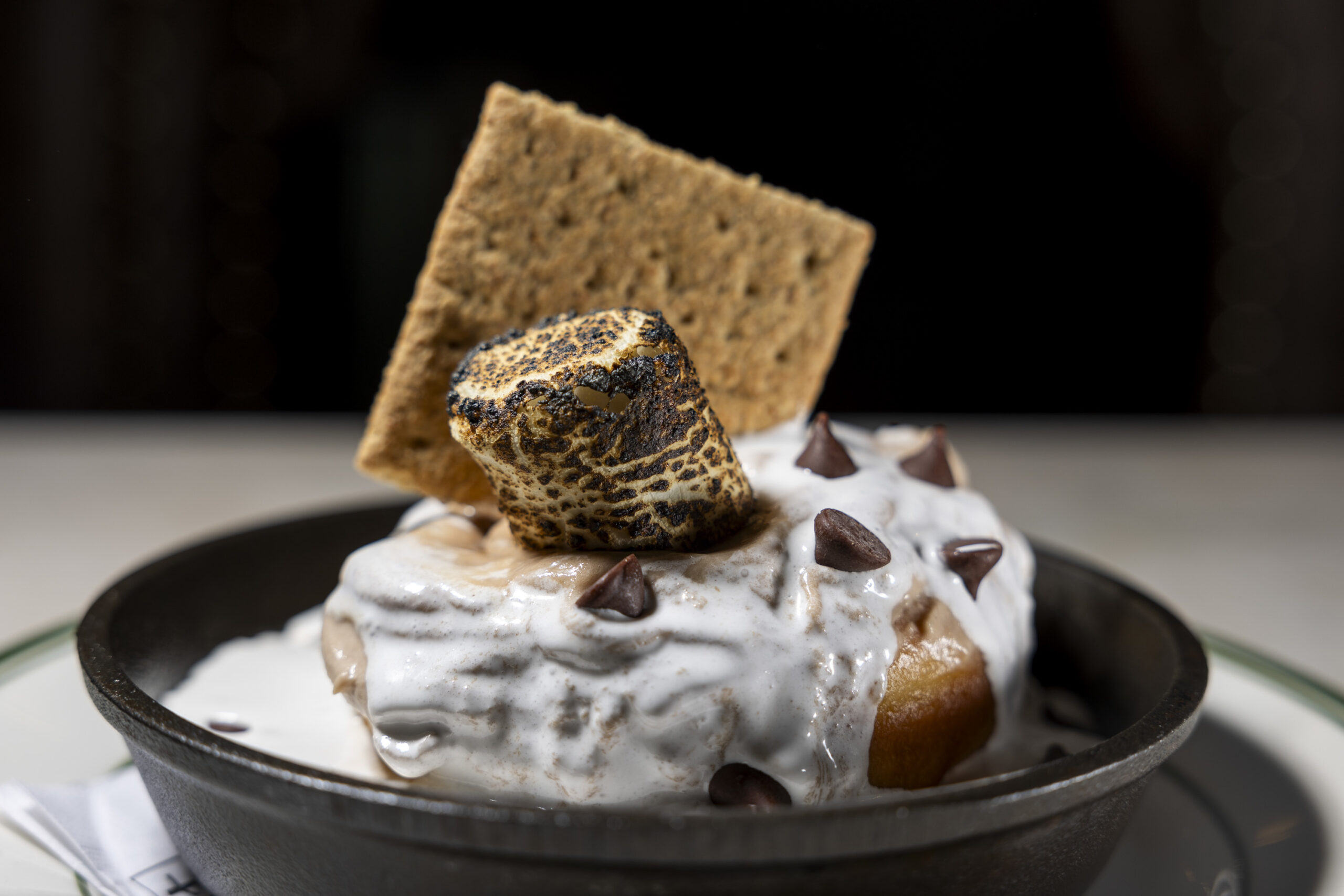
The S’more’s doughnut dessert at Hollow Pines in West Creek, N.J., on Thursday, June 18, 2026.
All this is fueled by a drink program that bubbles with local beers and whimsical cocktails, from an ice-cold tomato water martini (Nona’s Freezer Door) to the smoke bubble-topped rosemary gin drink (the Controlled Burn) appropriately named for a sipper at the edge of a national preserve. For dessert, I’m all about channeling the summer campfire vibe with the S’mores doughnut, a freshly fried fritter topped with molten marshmallow fluff that flows into a chocolate sauce studded with chips. It was both delicious and still on theme. Hollow Pines offers a nice reminder that New Jersey summers can be just as tasty in the forest as at the beach. Hollow Pines, 475 Main St, West Creek, N.J. 08092; 609-891-2558; hollowpinesnj.com
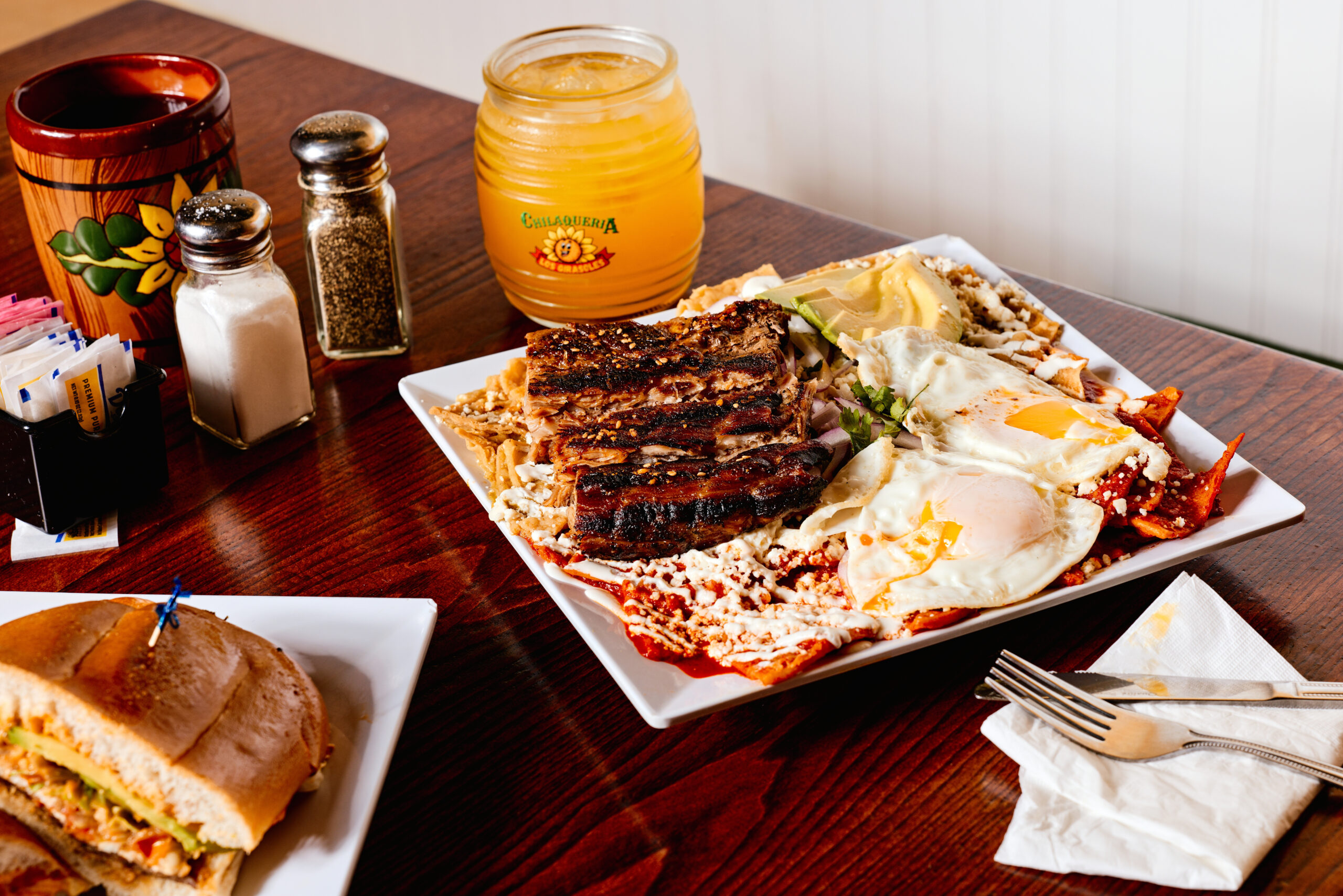
The chilaquiles divorciados dish, paired with a passionfruit drink, rests on a table at Chilaqueria Los Girasoles in Pleasantville, N.J. on Friday, June 19, 2026.
PLEASANTVILLE
Chilaqueria Los Girasoles
While the Shore has no shortage of Americanized Mexican food, you can find more traditional flavors just six miles north of Somers Point in Pleasantville, which has become a vibrant hub for multiple Latin American communities. At least a dozen Mexican restaurants operate within its city limits, and one of the newest, Chilaqueria Los Girasoles, is already one of my favorites. As the name suggests, chilaquiles is the focal point, with nine varieties of salsa combos used to sauté tortilla chips until they achieve the perfect balance of crunch and softness (they’ll even ask your preference). The traditional choices of salsa roja and salsa verde are so good, I’d recommend Los Girasoles’ unique pairing of the two for side-by-side fields of tangy green and earthy red on one plate, to be topped with protein of your choice. Try a hearty helping of eggs and steak, or salted cecina beef, then plan for a good nap when you’re done. The sweet and spicy mole poblano variation, made from a mole base shipped from Puebla, is also fantastic.
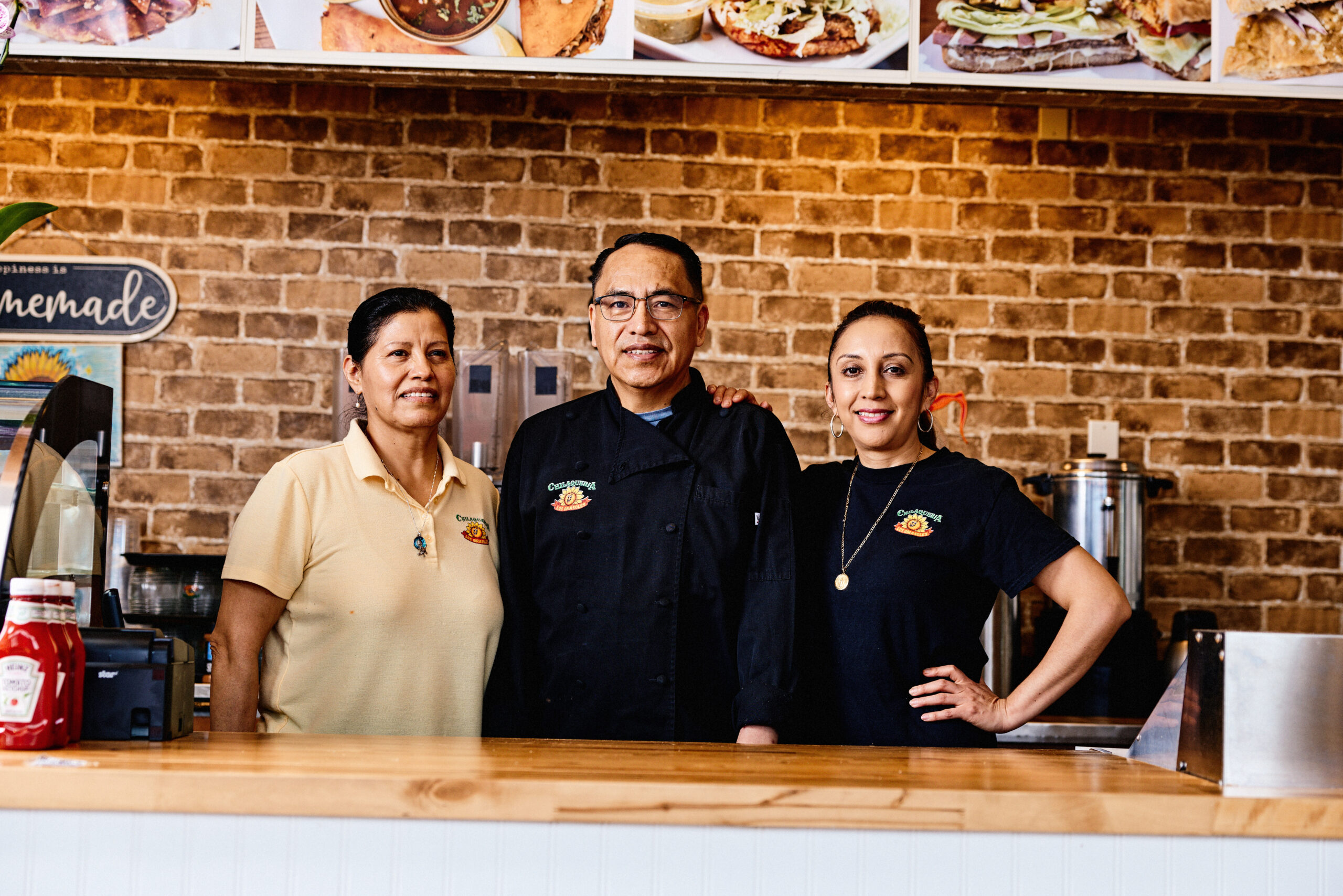
Raquel Soto, Miguel Cerón, and Sandra Aguilar at Chilaqueria Los Girasoles in.Pleasantville, N.J., on Friday, June 19, 2026.
As unique as this concept is (even in Mexico such a focus on chilaquiles is rare), this year-old project in a brightly rehabbed former Subway, owned by Sandra Aguilar, her husband, chef Miguel Cerón, and his cousin, co-chef Raquel Soto, is also an evocative tribute to their home state of Hidalgo. Their occasional weekend special of lamb barbacoa is outstanding, and I cannot stop thinking about their Hidalgo-style torta. A soft roll is stuffed with a thin slice of breaded top round beef, tender from its zesty marinade, then layered with stretchy quesillo cheese, creamy avocado slices, and a warm salsa of lightly cooked tomatoes and onions that gives this sandwich the perfect moistness. For dessert, don’t miss the fresh and delicate crêpes Cerón perfected while working in a previous job at a breakfast diner. Chilaqueria Los Girasoles, 310 S New Rd, Pleasantville, N.J. 08232, 609-241-0269; chilaquerialosgirasoles.com
Pollos Asados PLV
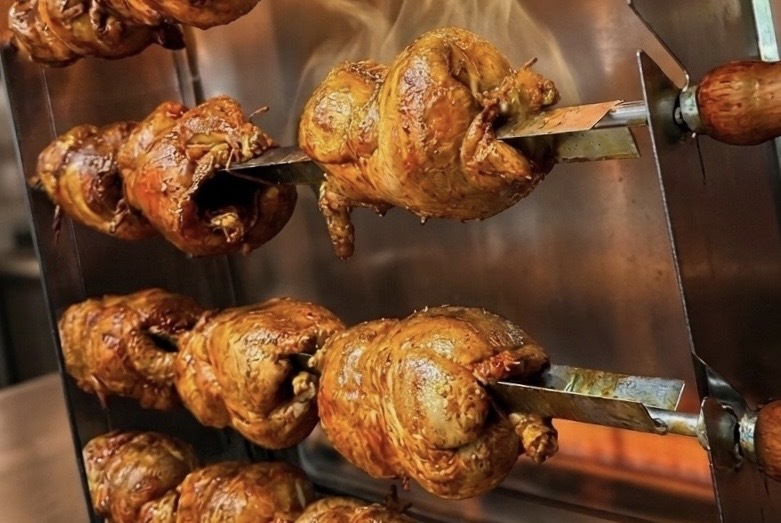
Since fire-roasted chicken is in the name, it’s no surprise that the juicy birds turning on a rotisserie spit, seasoned with a Chiapas-style marinade, are the big draw to Pedro Rincon’s restaurant in downtown Pleasantville. It’s been so popular that he’s moving July 1 from his current location (114 N. Main St.) to a larger space next door at 104 N. Main St. Few meals I’ve eaten at the Shore were more satisfying than a whole bird here served simply cut up into pieces in a Styrofoam box with a bundle of fresh-pressed tortillas, two squeeze bottles of vibrant salsas, and belly-filling sides of refried black beans and rice.
Chiapas-style chickens roast on the spit at Pollos Asados PLV in Pleasantville.
But Rincon’s kitchen has other worthy gems you absolutely should not miss, from the platters of extra-large seven-inch-wide tacos (I loved the juicy al pastor) to the paddle-sized bundles of Chiapanecas quesadillas, whose pliant tortillas are made with a blend of corn and flour. The long envelopes are big enough to share and come stuffed with quesillo cheese and a variety of fillings, from nopales to chicken. But the real quesadilla star here is the deshebrada de res, a stew of tender shredded beef so full of flavor, I just about ate the whole darn thing. Pollos Asados PLV, 104 N. Main St. (after July 1), Pleasantville, N.J. 08232, 609-640-6347; pollosasadosplv.com
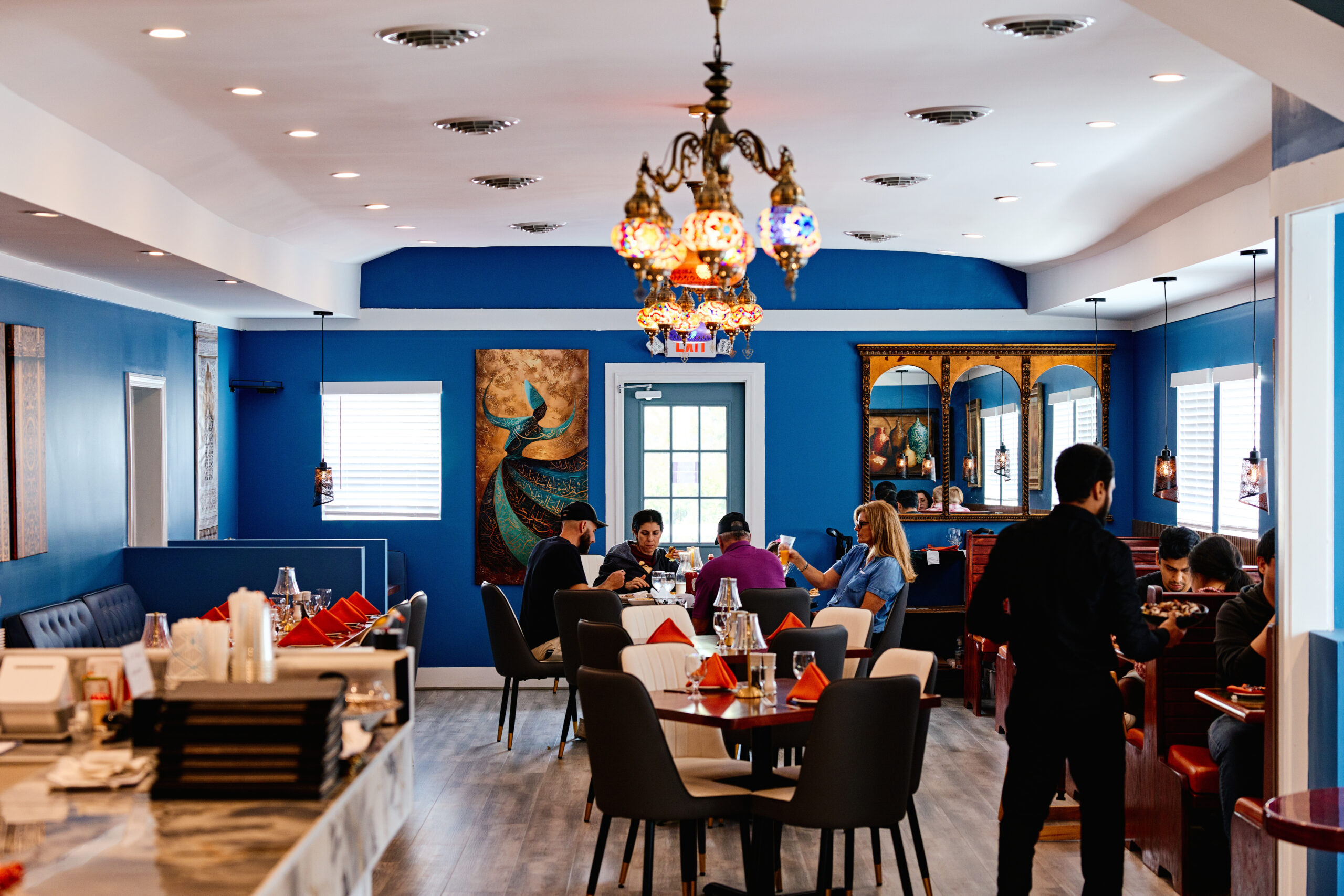
Staff serve guests at Ruhani Kitchen in Egg Harbor Township on Friday, June 19, 2026.
EGG HARBOR TOWNSHIP
Ruhani Kitchen
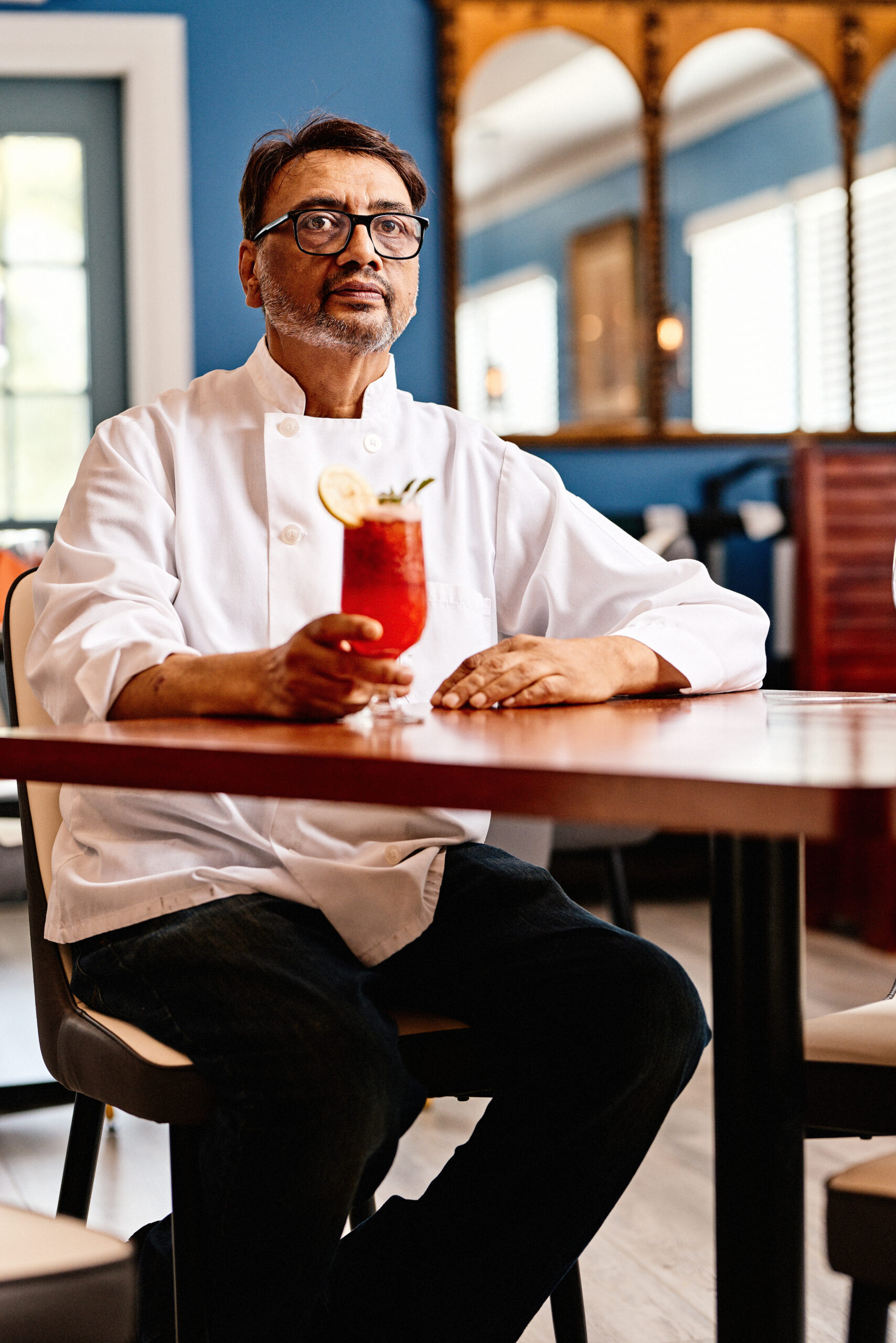
Chef Syed Abbas is best known for The Nizam’s, the well-regarded Indian restaurant in Egg Harbor Township that he owned for 15 years before selling it in 2022. The New Delhi-born chef says he needed a break for health reasons, and over the next three years traveled extensively through the Middle East. He worked for free in several kitchens in Dubai, shadowing chefs in Turkey, and gathering inspiration for a new concept back in New Jersey that would draw on dishes from across the region while also reflecting his family’s Persian roots. Ruhani Kitchen, which opened in December in the same narrow white roadhouse where he’d launched the first version of Nizam’s, is the result — and it is a delight.
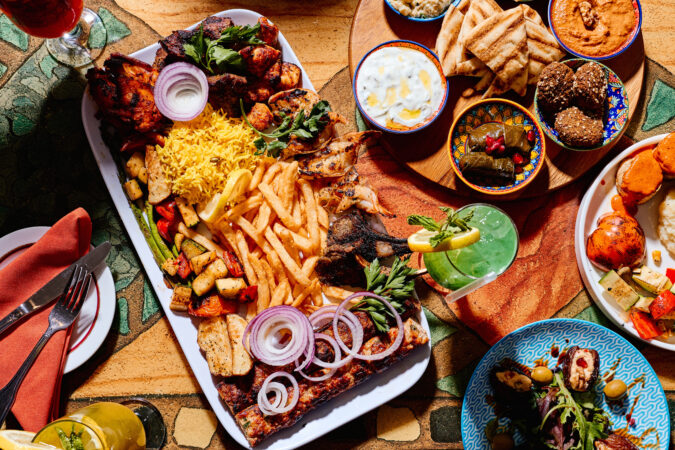
The space has been completely rehabbed with vibrant blue walls, imported rugs, and comfortable furniture. The menu offers a greatest-hits list of Mediterranean and Middle Eastern dishes from Lebanon to Afghanistan, and though the range is so broad that some nuances may not always be in perfect register, Abbas’ skill as a chef always shines through in the quality halal ingredients and satisfying flavors. The mixed app platter is a perfect place to start, from smoky baba ghanoush to tangy-sweet muhammara and vibrant green falafel made with fava beans.
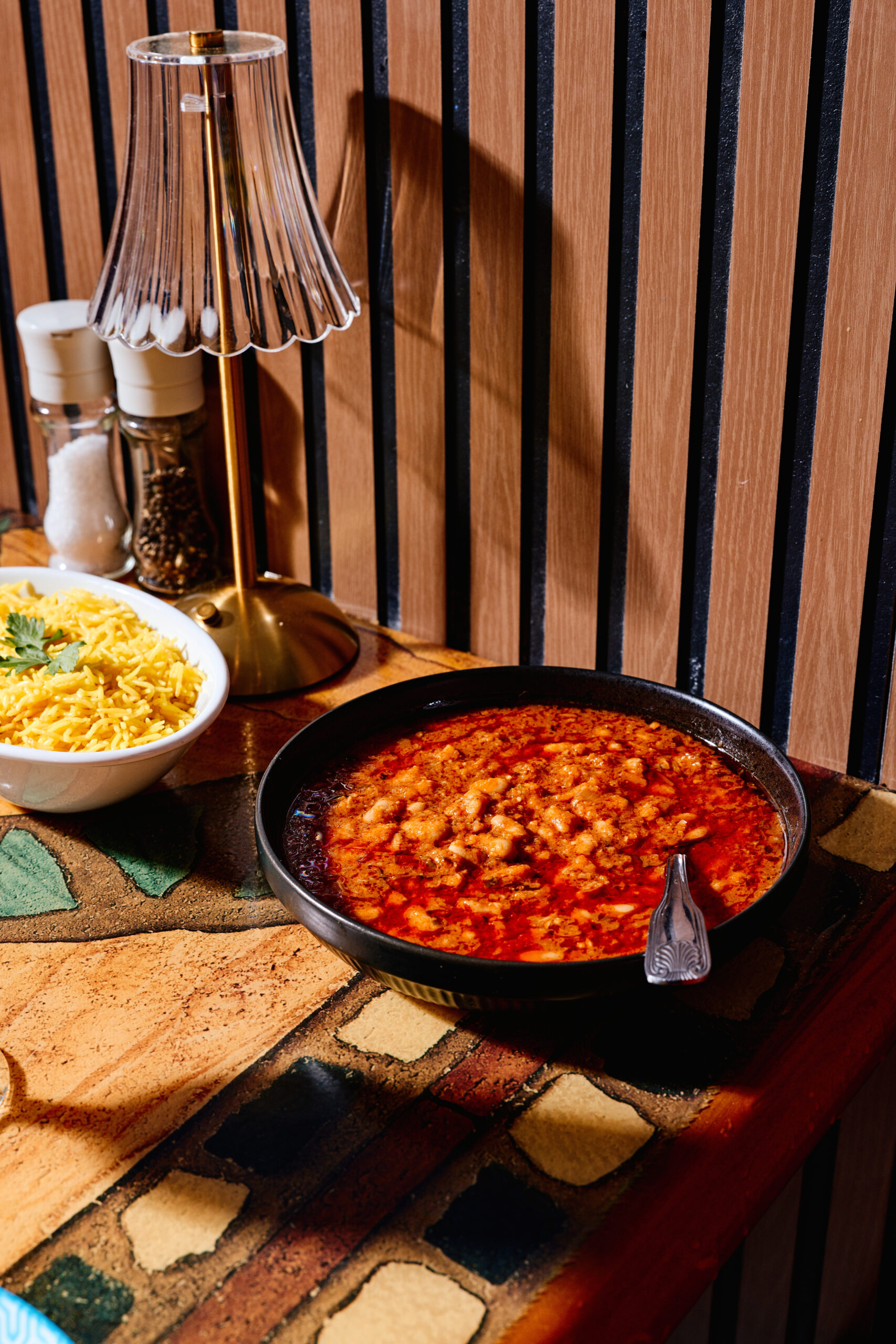
Chef Syed Abbas at his restaurant, Ruhani Kitchen, in Egg Harbor Township on Friday, June 19, 2026.The fasooli baida spicy white bean soup with a side of rice rests on a table Ruhani Kitchen in Egg Harbor Township on Friday, June 19, 2026.
But the main courses are where Ruhani most impresses, especially with the Sultan’s platter, a generous medley of grilled meats — lamb and chicken kebabs tenderized with yogurt and fragrant seven spice; succulent shell-on shrimp; adana kebabs of both ground chicken and lamb scented with cumin and sumac — that can easily feed a crowd. Abbas’ talent with lamb shanks is also worth noting, served either Afghan-style plain over a pilaf enriched with lamb juices and sweet carrot laces, or Persian-style in creamy saffron sauce. I also couldn’t stop eating Ruhani’s take on the spicy white bean and tomato stew known as fasooli baida. The only thing off-key at Ruhani were the desserts, including a non-traditional knafeh that was strangely soupy. But even the ever-confident Abbas knows his limitations with sweets: “I cannot be good at everything.” Ruhani Kitchen, 6666 Black Horse Pike, Egg Harbor Township, N.J. 08234, 609-855-9719;ruhanikitchen.com
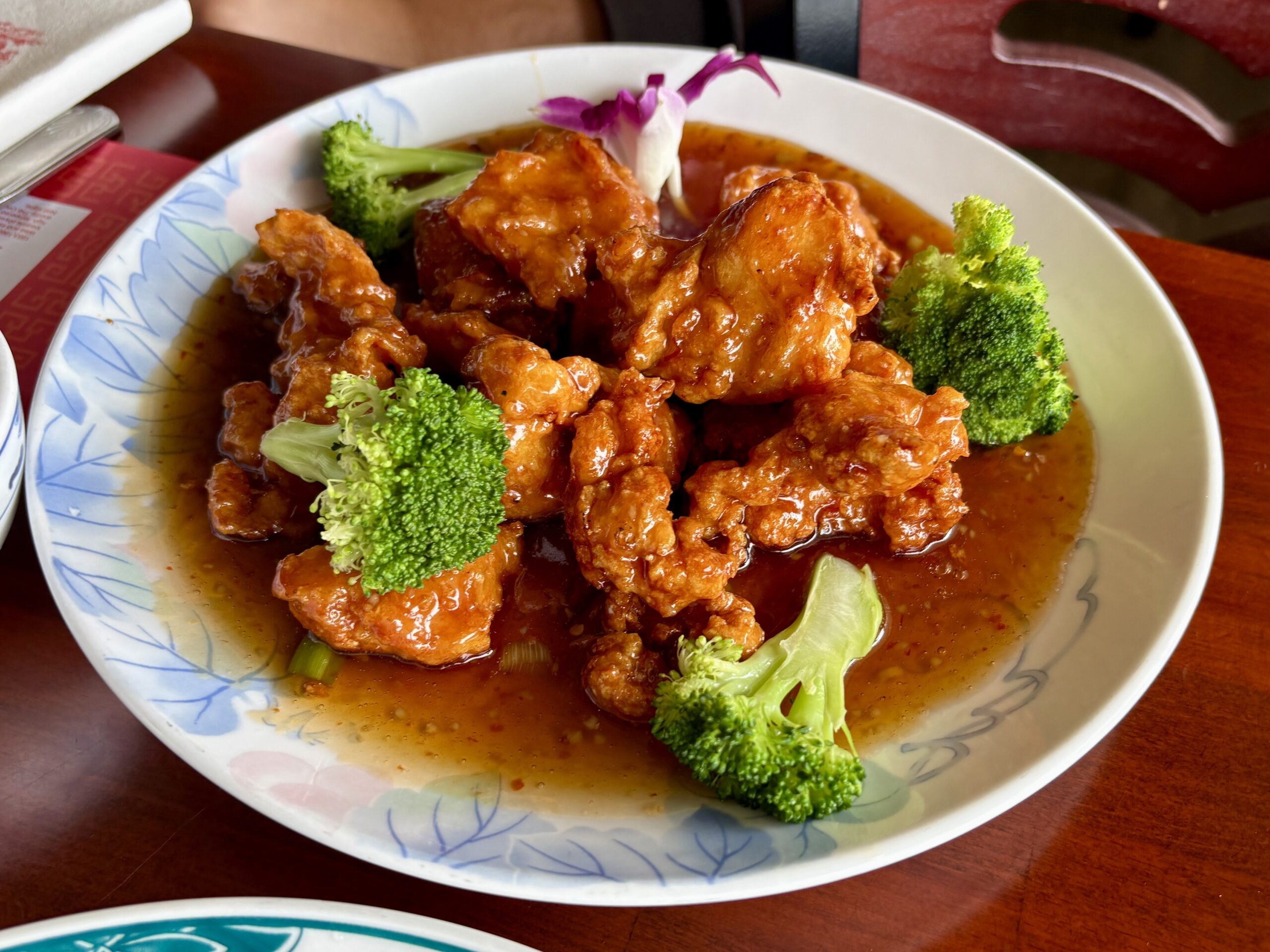
General Tso’s chicken is made gluten-free at China Sea of Absecon.
ABSECON
China Sea of Absecon
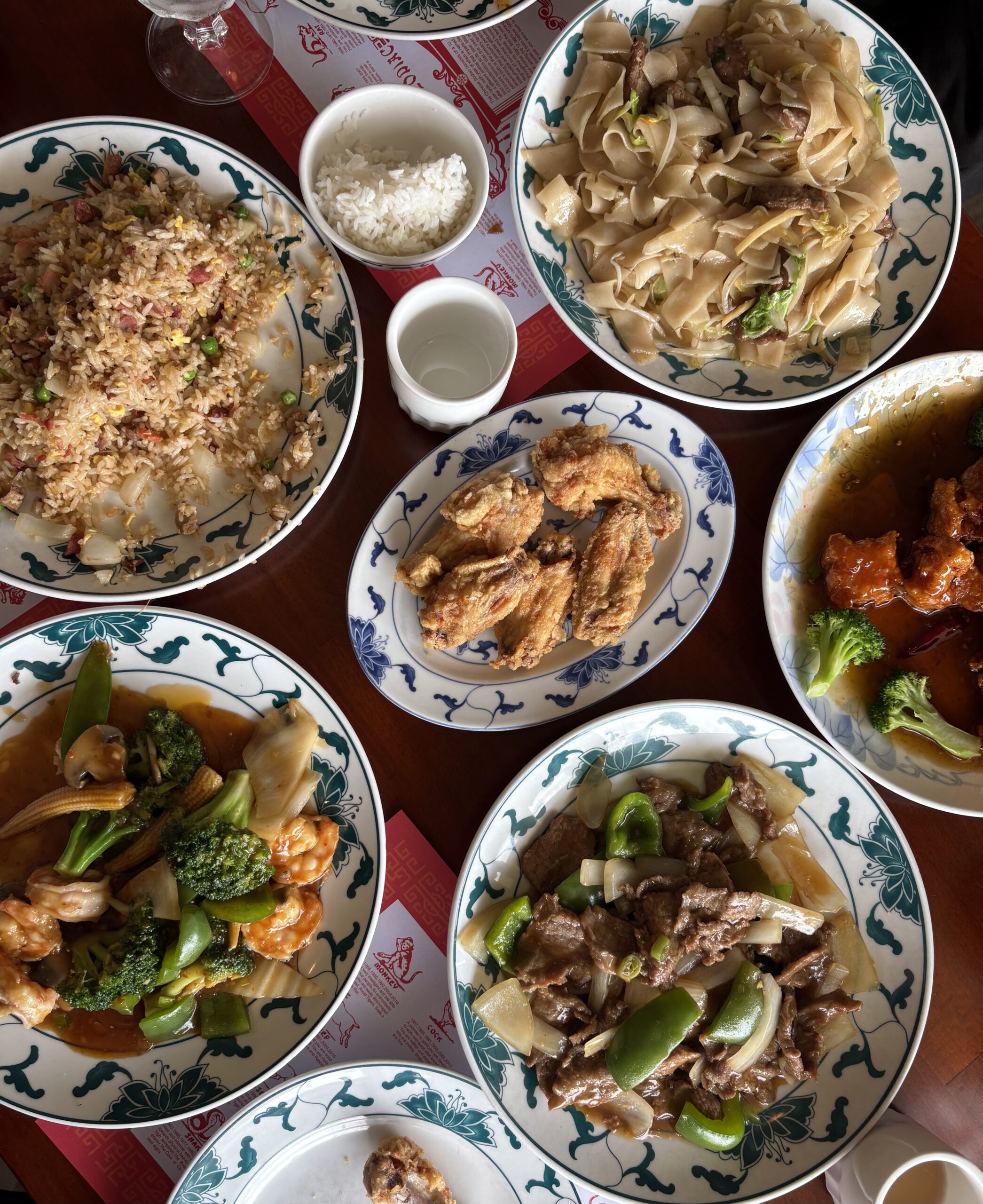
China Sea is a survivor on the Shore’s dining scene, an unassuming standby that has thrived for 31 years in an Absecon strip mall. Founders Lily Lin and her husband, chef Chei Lin, delivered consistently good Cantonese food with a special distinction: an expansive selection of gluten-free options. Chinese food can be tricky for diners with gluten intolerance because of the heavy use of soy sauce and fryers that are commonly contaminated by wheat flour. But once chef Lin discovered his own restrictions with gluten, he developed an entire repertoire of modified dishes that are rarely seen elsewhere, including what my daughter Alice, who has celiac disease, declared as the best gluten-free General Tso’s chicken she’s ever tasted. Tender nuggets of meat are encased in delicate crusts crisped in a dedicated wok and tossed in a vivid orange sauce with a hint of heat that was flavorful without being cloyingly sweet. I consider it one of the best General Tso’s of any sort that I’ve tasted. But that wasn’t all. There were excellent gluten-free versions of plump shrimp in peppery Hunan sauce, perfectly deep-fried chicken “wing dings” in a crackly salt-baked crust, and impressively tender beef with peppers that hummed with a mellow savory balance.
An entirely gluten-free Cantonese feast is served at China Sea of Absecon, including, clockwise from top left, fried rice, beef chow fun, General Tso’s chicken, pepper steak and Hunan shrimp.
Such consistently good flavors bode well for continuity at China Sea, which has been in a gentle transition since the Lins retired in September and sold to Lily’s niece, Melissa Xie, and her husband, chef Billy Zheng. The couple, who both previously worked as poker dealers in Atlantic City’s nearby casinos, have plans to introduce more traditional seafood dishes from Zheng’s home province of Fujian, where the former pro chef mastered lobster in ginger-scallion sauce, a spicier rendition of Singapore noodles than what the standard menu currently serves, and whole fish. Xie promises that China Sea’s classics will remain, but I’d definitely return to explore some of this kitchen’s new moves: “My husband [Billy] is very famous for his cooking within our [local Chinese] community,” she says, “but we have to be careful to keep everything else the same because we have customers who come from all over.” China Sea of Absecon, 662 White Horse Pike, Absecon, N.J. 08201; 609-569-1995; chinaseaofabsecon.com
Jersey Cow Ice Cream
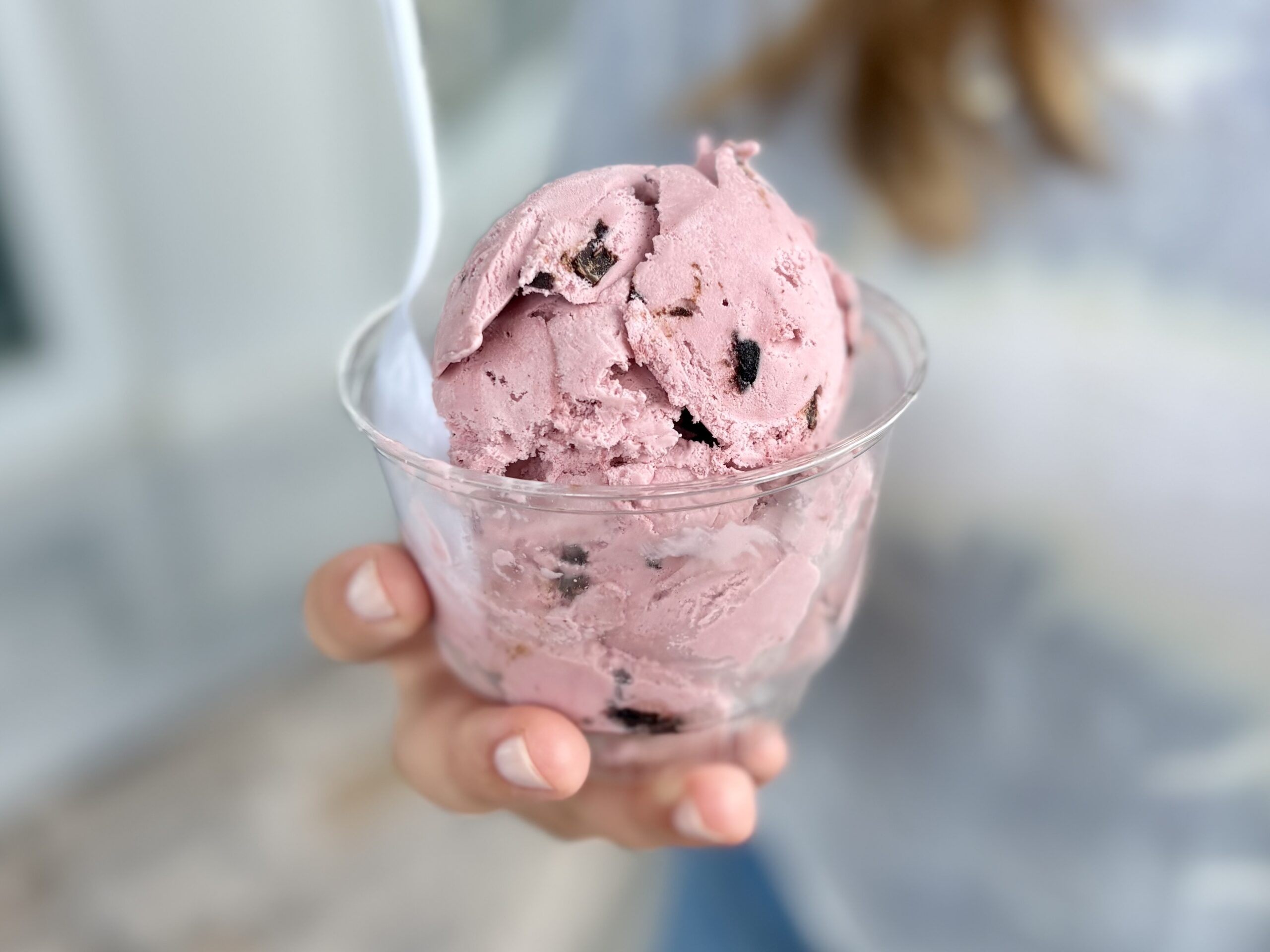
Bordeaux cherry chip ice cream is one of the highlight flavors at the Jersey Cow Ice Cream chain.
The Jersey Shore has plenty of options for your daily scoop. But here comes Jersey Cow, a fast-growing mini-chain of retro-style takeout windows with modern touch-screen menus that’s expanded over four years from the original location in Northfield, to Absecon, Brigantine, and now Margate, where the frozen treat competition is already fierce. If my visit to the Absecon storefront is any indication, Jersey Cow has come to play, especially in the hand-dipped category, where the ice cream is made from high-fat milk that allows them to achieve more vivid flavors with less sugar. The Chocolate Therapy is fudgy and intense, while the Bordeaux Cherry Chip (so named for the premium variety of dark cherries) has a more fruit-forward punch than the typical maraschino version. I wasn’t a fan of the icy vegan salted caramel, and Jersey Cow is still outsourcing its soft-serve base. But I’ll go back for any of their originals, especially some of the unique Asian flavors featured on the rotating specials — ube, black sesame, mango sticky rice, or red bean served atop a pandan green waffle — inspired by co-owner Maureen Gaw’s upbringing in Myanmar. Jersey Cow Ice Cream, 610 Mill Rd., Absecon, N.J. 08201, 609-796-2525; details on Northfield, Brigantine, and Margate locations noted on website, jerseycow-icecream.com
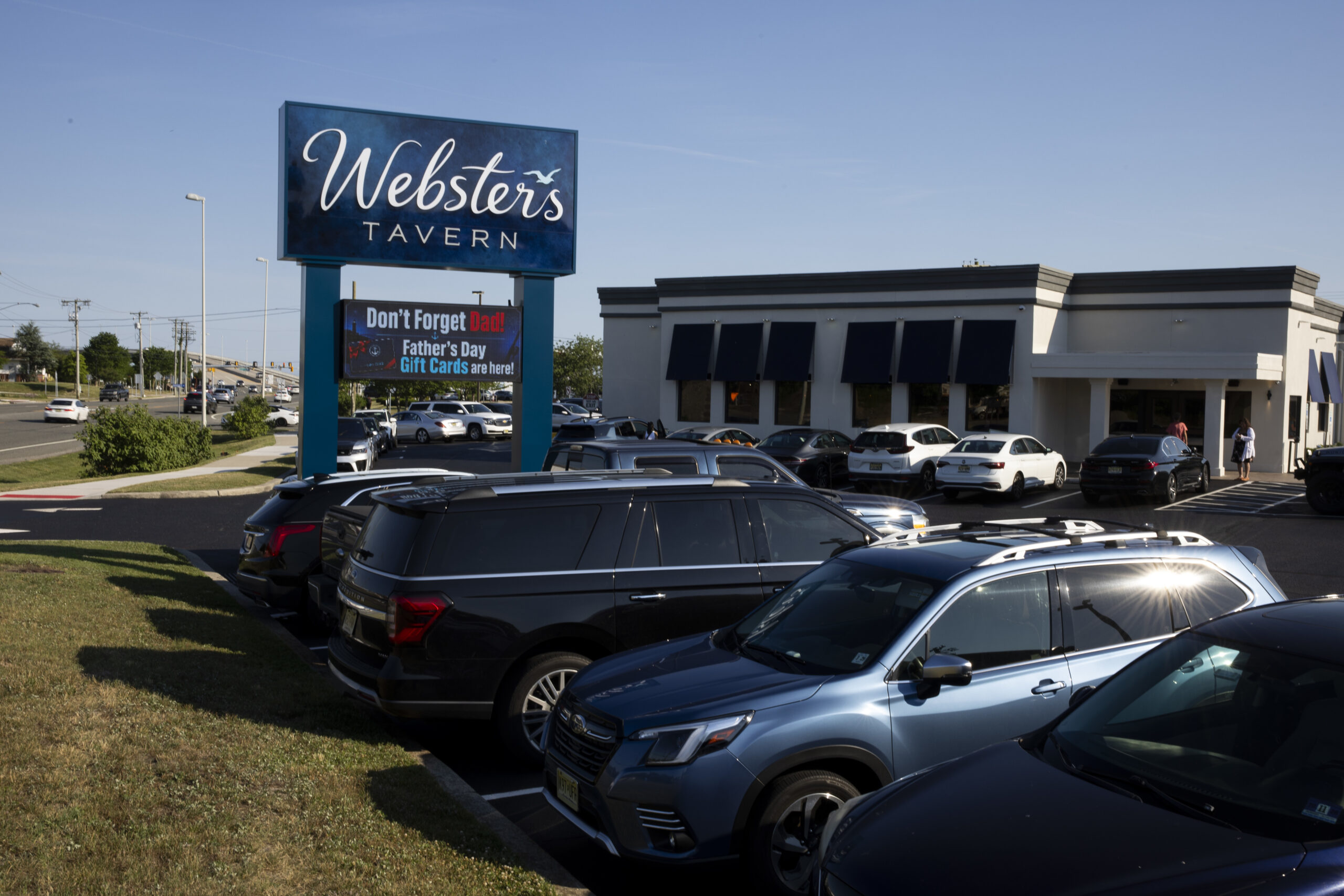
The exterior of Webster’s on Wednesday, June 17, 2026, in Somers Point.
SOMER’S POINT
Webster’s Tavern
Some people come to the Shore to relax on the beach, dig holes in the sand, body surf, and read. For those suffering from screen-time withdrawal, Webster’s Tavern is there for you. “An elite TV program,” as I’ve heard it described, has helped pack the big parking lot of the former Windjammer turned giant sports bar in Somer’s Point. So many customers are willing to wait up to an hour for a chicken wing feast bathed in the pulsing glow of 38 TVs that owner Chris Webb has concluded “we’re going to add more [TVs], including one on the kitchen wall.”
The early days of Webster’s operations have exhibited some predictable hiccups as the tavern’s traffic rocketed to 750 customers a day within a couple weeks of opening in early June. The rushed pacing resulted in a multi-course meal that lasted barely as long as our 45-minute wait. The margarita was oversalted and sloppily mixed. (The pineapple-tinis, crushes, espresso martinis, and mud slides are apparently the safer move here). I appreciated the inclusion of local beers from Slack Tide and Somers Point Brewing on a list otherwise heavy with national brands and hard seltzers.
The something-for-everyone menu typical of the corporate restaurant world Webb comes from (he was a vice president at P.J. Whelihan’s) was uneven to say the least. The French onion soup and sheet pan nachos were solid, as was the classic tavern burger, which landed with a perfect medium rare on a branded brioche bun (a fair quality value for $17). But the house-breaded chicken wings were dry and chewy. The seafood mac ’n’ cheese was skimpy on the seafood. The chicken lettuce wraps were tepid and drowned in too much sweet soy marinade. The fried shrimp were oddly mealy. I take heart in hearing that Webb has already made some smart early corrections, switching to house-breaded shrimp since my visit. It’s a good sign to know that this personable and veteran restaurant executive is ever-present on the ground of his first solo project and that he is paying as much attention to the food as he is the number of TVs. Webster’s Tavern, 18 MacArthur Blvd., Somers Point, N.J. 08244, 609-657-3470;websterstavernsp.com
Pablo
Who is Pablo? That name was atop the list of every local I surveyed before my visit to the beach. It’s easy to see the curiosity factor at play: cars are often spilling out of the lot and parked on both sides of East Maryland Avenue beside the massive black hacienda of a restaurant and night spot called Pablo in Somers Point. The Zest Restaurant Group opened Pablo this summer after pouring $2 million into a renovation of the short-lived former Mexiquila. The Zest group, known for its stylish Cape May restaurants Port, Fish House, and Tacos Caballito Tequileria, has similarly transformed this rambling property (originally Clancy’s By the Bay) into a multi-room, four-bar, 400-seat extravaganza. There’s a moody lounge at the rear anchored by a DJ spinning house music, boosted by live musicians and pyrotechnics, an airy greenhouse dining room on the other side with skylights and garage doors that roll-up to a patio bar where they’ve re-created a beach. Fresh-juice cocktails fuel this fiesta, accounting for about 75% of the sales from the 1,200 or so guests that come through on a busy evening, says co-owner Ross Hammer, who concedes Pablo is a made-up name for the restaurant’s cheetah logo. (“Sorry, I’m Miguel,” said a passing server when I asked him for Pablo’s whereabouts.)
The exterior of Pablo on Wednesday, June 17, 2026, in Somers Point.
Pablo’s menu is a more affordable than its upscale-yet-underwhelming predecessor and conscientious to accommodate dietary restrictions. I only wish the kitchen put as much energy into making better-tasting food. Our meal was full of tepid overcooked meats, dry rice, stadium-grade nachos welded together with cheap cheese, and a parade of fusion tacos so disappointing that it was an all-out Taco-pocolypse, whose brightest bite was a tortilla topped with a cheeseburger. By that point, I realized that the wait — Hammer says it averages two to three hours for a seat in this no reservations dining room — is not worth it. Go to Pleasantville (see above) or pretty much anywhere else for your tacos, then return to Pablo for a tequila-spiked espresso martini, if you’re so determined, and boogie the night away on its ersatz beach. Pablo, 101 E. Maryland Ave., Somers Point, N.J. 08244, 609-469-6991; pablosomerspoint.com
In 2026, you either die a bargain or stay around long enough to get hit by inflation. In other words, Fountain Porter’s iconic $6 burger is now $7, roughly the price of a fancy latte or a McDonald’s Quarter Pounder with cheese after tax.
The East Passyunk neighborhood bar made the nearly 17% price increase official last Wednesday, said owner Evan Clancy, after months of watching the prices of ingredients creep up.
Five days later, a post appeared in the popular r/PhiladelphiaEats subreddit breaking the news like a bargain hunting, beer-loving version of Paul Revere. “Recession indicator: Fountain Porter has officially raised the price of their burger,” the post read. “End of era.”
Commenters were aghast.
“Noooooooo,” bemoaned one Redditor. “Bring back boiled peanuts!” shouted another. A third cried of shrinkflation, alleging that the patty had gotten smaller. But most agreed on one thing: the burger is still dirt cheap and delicious.
“I still ate three total this past weekend,” wrote another Reddit user, undeterred by the change.
This isn’t first time inflation has come for Fountain Porter: When Clancy opened the bar at 1601 S. 10th St. in 2012, its burgers were just $5. Somewhere along the way — Clancy couldn’t recall when — he raised the price to $6 in recognition of the labor his staff put in to running a pub that, in many ways, also doubles as a burger factory.
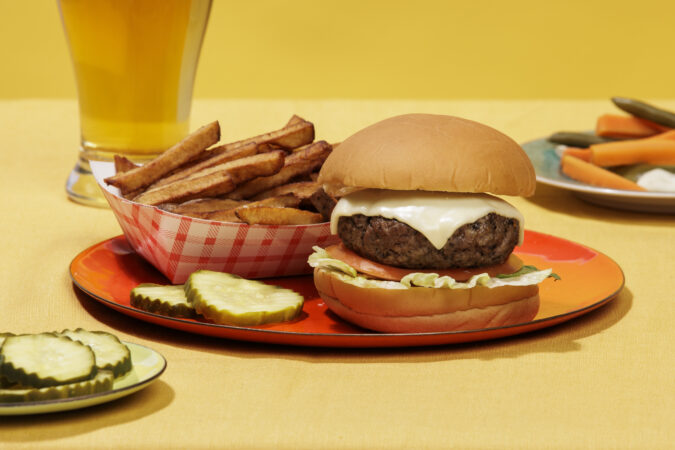
Fountain Porter makes upwards of 800 burgers a week, Clancy said, with the three cooks alone dedicated just to grilling and flipping patties. It’s also the platonic ideal of the sandwich, comprised of a modest beef patty with a salty char topped with American cheese, crisp lettuce, and a tomato slice on a Martin’s potato bun with two pickle chips on the side.
The burger and its price — along with the bar’s deep beer list, dirty martini, and solid Guinness pour — has cemented Fountain Porter’s status as a Philly icon, beloved equally by world class chefs and people who just really like eating and drinking.
“Their burger is the perfect size — not too small, not too big — and their lettuce is always cold and crispy,” Rachel Lorn, the co-owner of acclaimed South Philly restaurants Mawn and Sao, previously told The Inquirer.
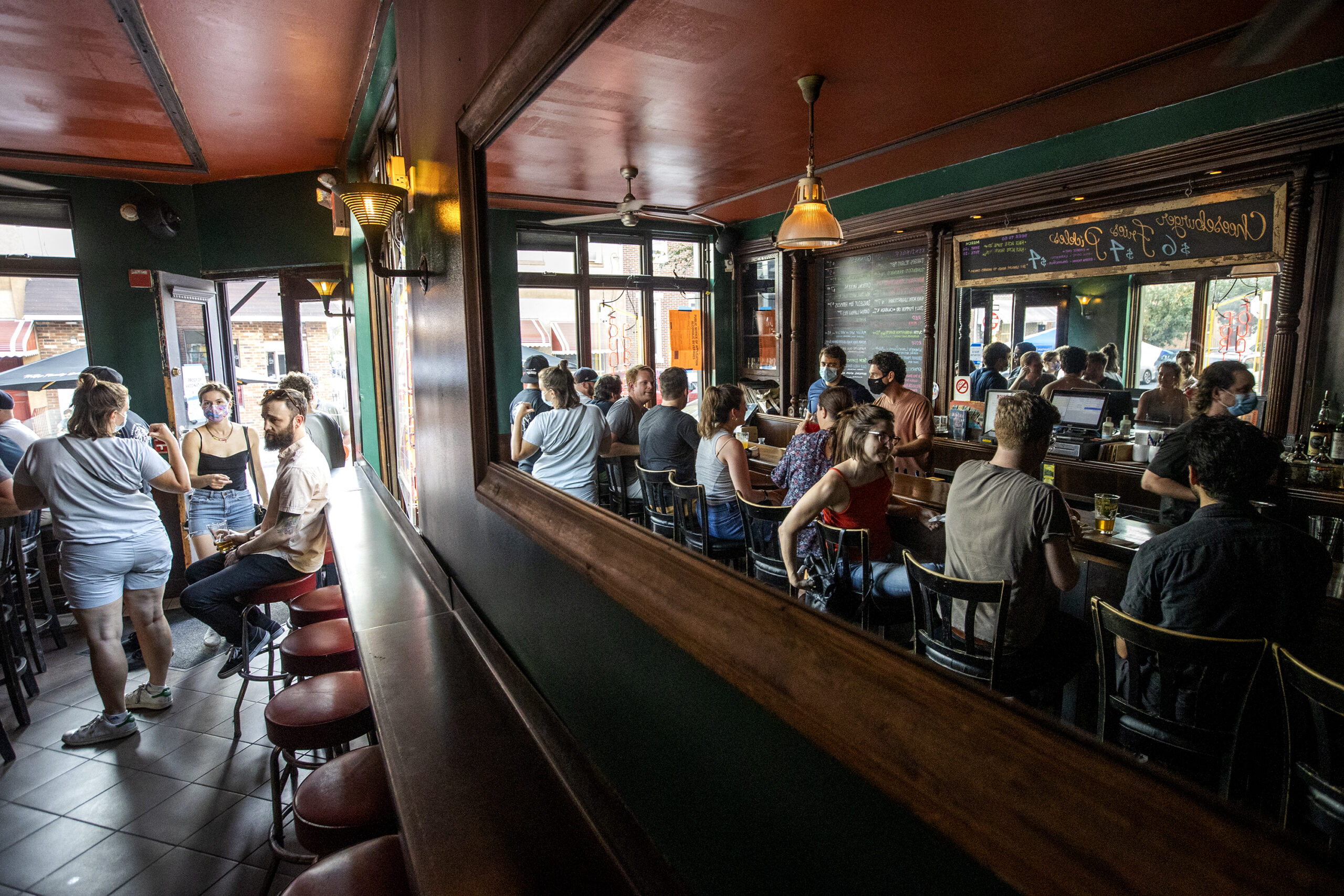
The crowd is reflected in a mirror at Fountain Porter at 1601 S. 10th St. in 2021.
The burger will remained unchanged despite the price increase, Clancy said. He also doesn’t think it will harm the bar’s reputation, and was shocked that people cared enough to post about it on social media.
“If the burger is not good at $7, then it’s really not that good at all. And that’s not on me, that’s on whoever is heaping the praise,” said Clancy. “It’s never been about a budget burger. It’s about being fair and honest. That’s what a burger is supposed to be.”
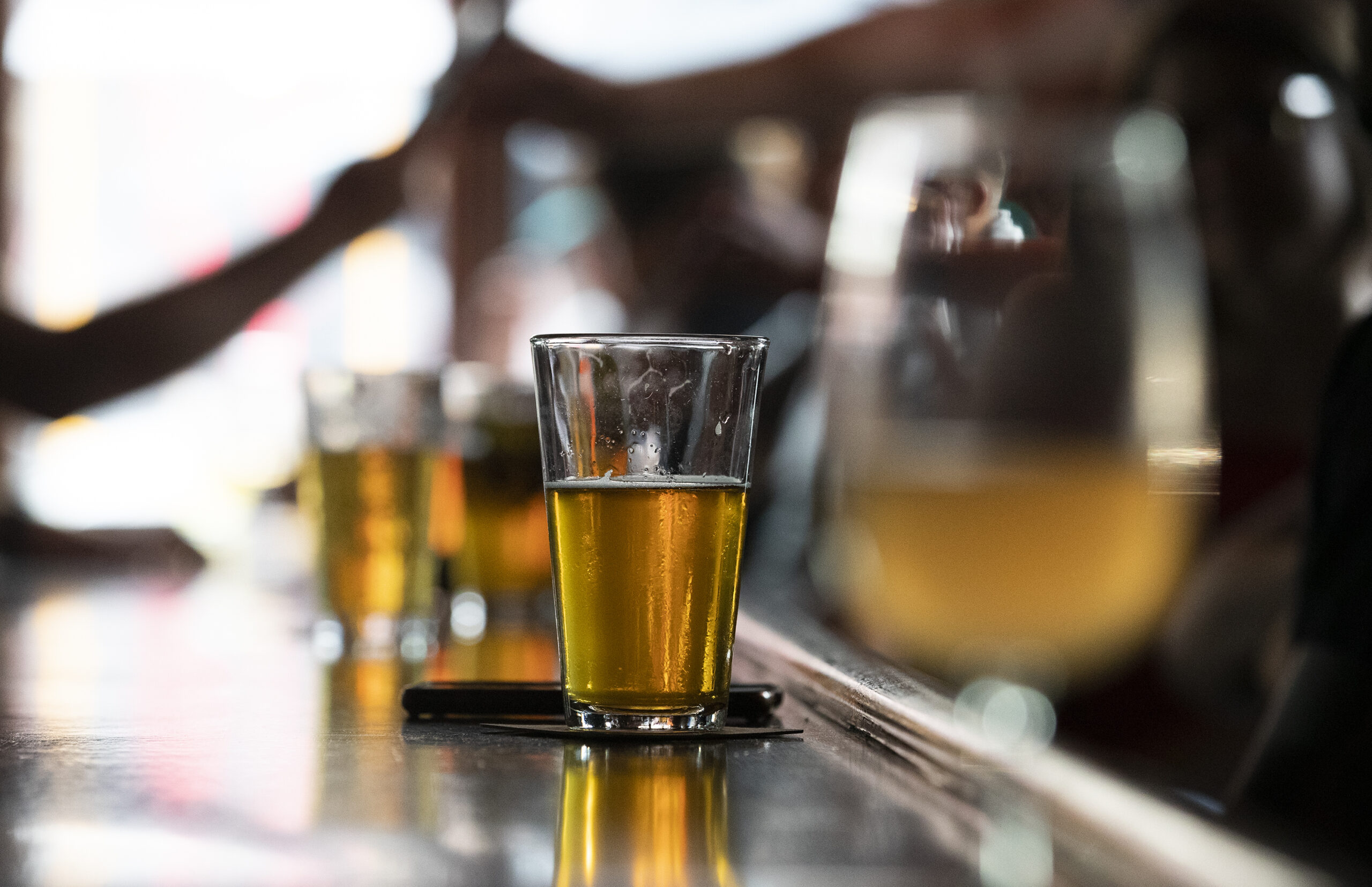
Drinks on the bar at Fountain Porter at 1601 S. 10th St. in 2021.
The price of the beef Fountain Porter uses in its burgers nearly doubled over the past two months, Clancy said, and he expects it to keep rising. The cost of tomatoes has also risen sharply and varies daily due to a mixture of tariffs and crop shortages, making it difficult for Clancy to budget. And, Clancy said, that despite Fountain Porter’s high volume of burgers, “we’re not making a lot of money off them.”
Besides, Clancy wondered, why shouldn’t his burger be allowed to get more expensive if everything else is?
“I know it’s a change, but we raised the price twice in 13 years, Clancy said. ”Tell me something else that hasn’t changed the price a lot in 13 years.”
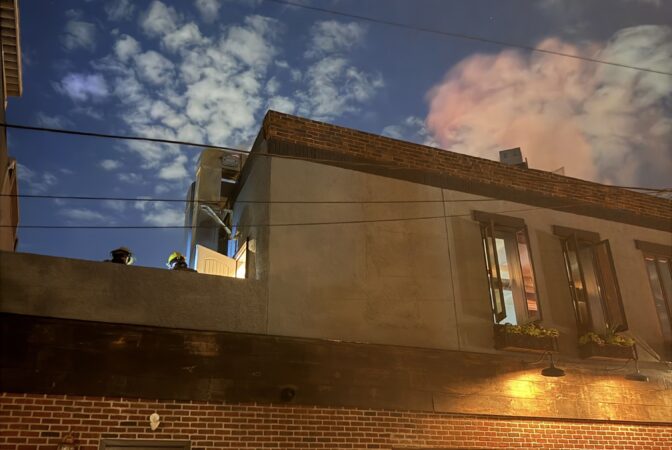
Ember & Ash restaurant on East Passyunk Avenue in South Philadelphia is closed indefinitely after a late-night fire Wednesday sent flames to the roof through its ventilation system, its owners said.
No injuries were reported. Owner Lulu Calhoun said she, her husband and chef-partner Scott Calhoun, and another chef, John Forkin, were leaving for the evening through the kitchen door about 10:20 p.m. when they heard a loud sound from above.
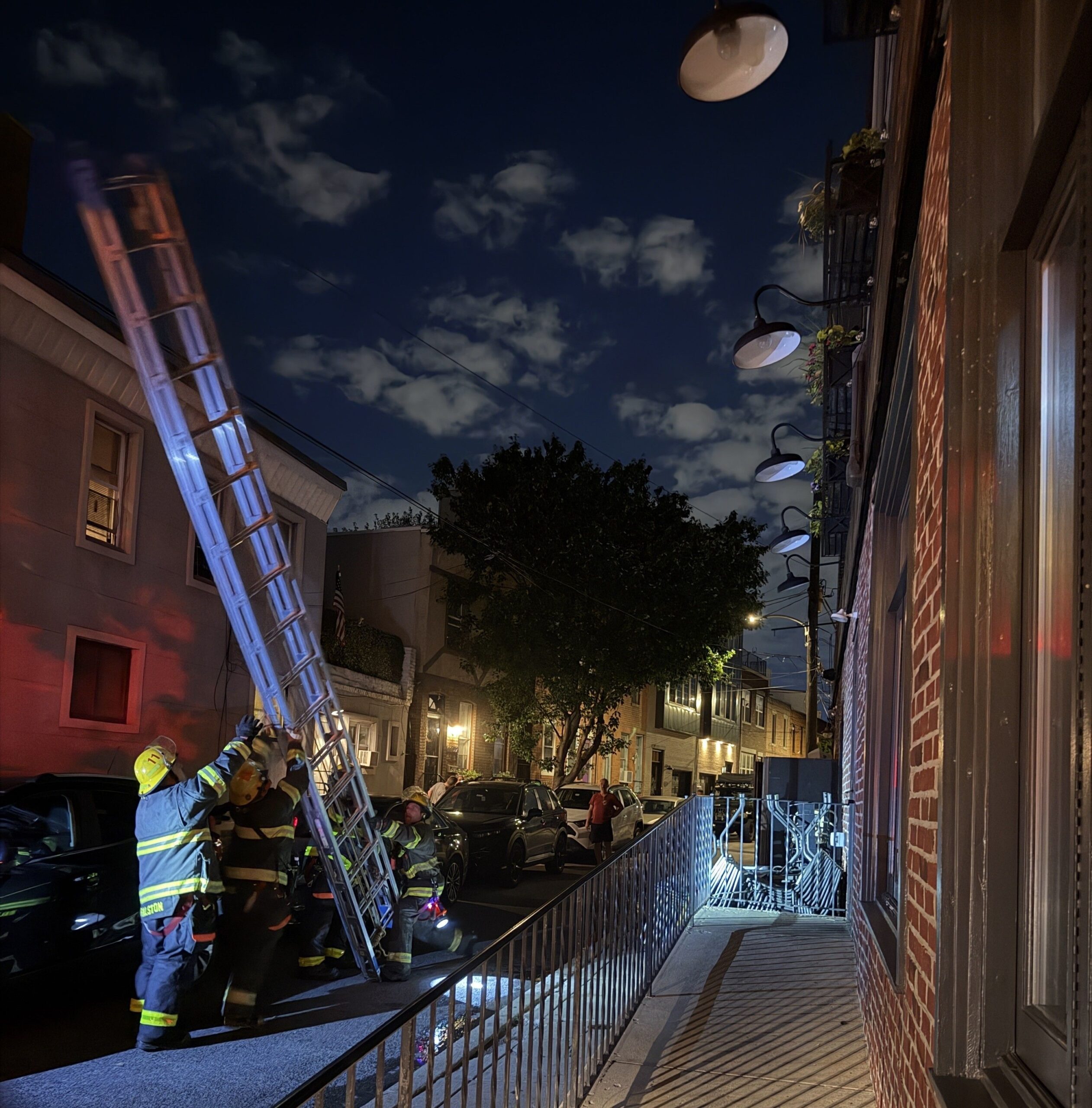
Firefighters positioning a ladder outside of Ember & Ash, 1520 E. Passyunk Ave., on June 24, 2026.
“We didn’t know what it was,” she said. “We thought maybe like a helicopter or a jet.”
Scott Calhoun looked up to see fire on the roof. He grabbed fire extinguishers and ran upstairs to try to put it out, she said.
The couple called 911, and firefighters arrived almost immediately. Ember & Ash is about two blocks from Ladder 11 at 12th and Reed Streets, a fire company that was restored in 2024 after having been shuttered for 15 years. “We’re just so grateful, because it could have been a much, much worse situation,” Lulu Calhoun said.
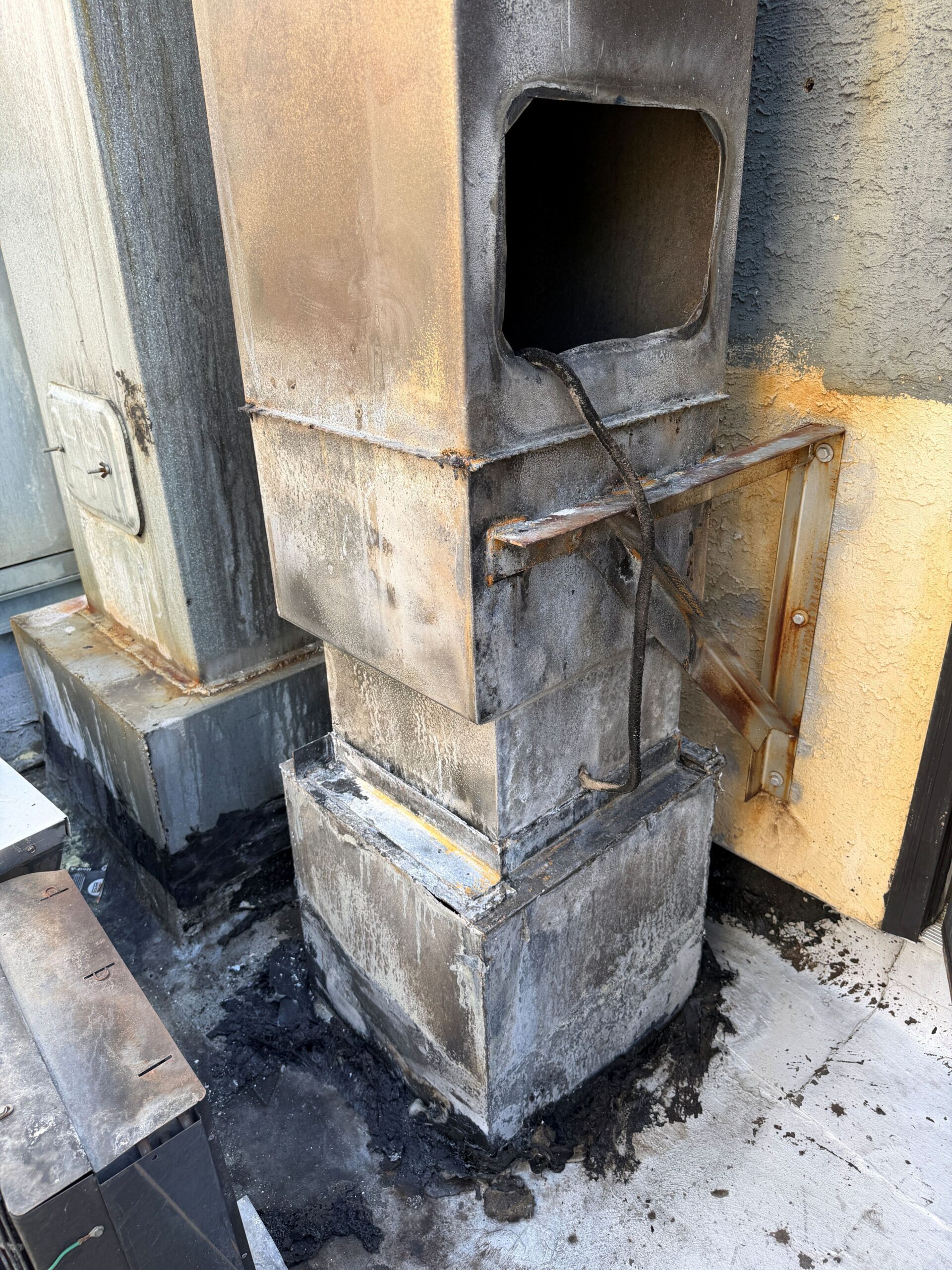
A charred portion of the ventilation system at Ember & Ash, 1520 E. Passyunk Ave., as seen June 25, 2026.
Thursday morning, the full extent of the destruction was still being assessed, but she said the restaurant was facing professional cleanup for water throughout the building and repairs to the hood and roof. Fire damage was not apparent from the Passyunk Avenue sidewalk. The Philadelphia Fire Department said the fire was under control in about an hour and 20 minutes but had no information on its cause.
“That’s the part that’s the most heartbreaking,” she said. “It’s not only our livelihoods, but our entire team.”
She said the timeline for repairs was not yet known, adding that the duct work had been professionally cleaned recently as part of maintenance.
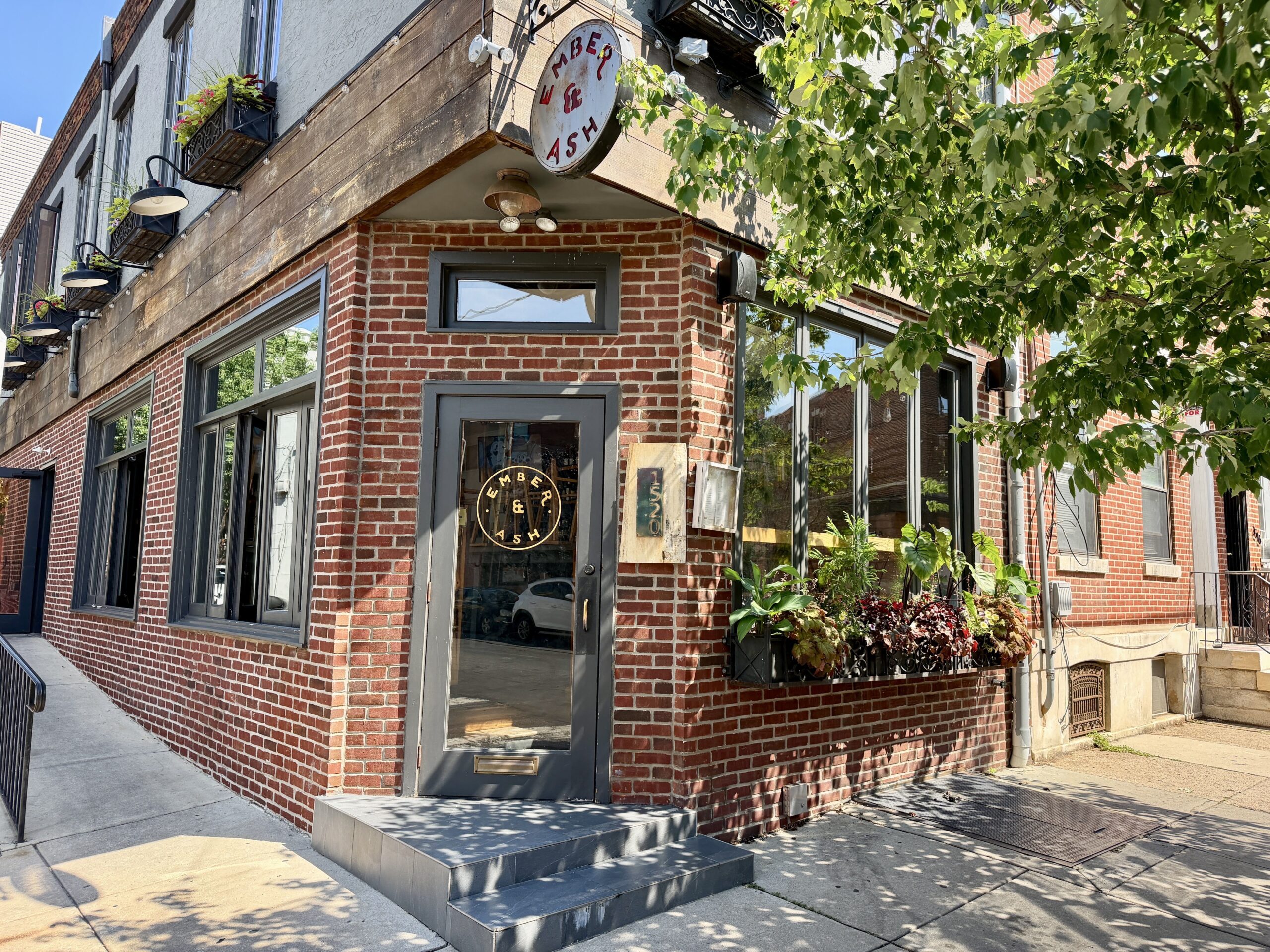
Ember & Ash, 1520 E. Passyunk Ave., on June 25, 2026.
The hearth at Ember & Ash, a live-fire restaurant built around a custom wood-burning grill made by Grills by Demant, has been the center of the kitchen since the restaurant’s opening in late 2020.
Fires that travel through ventilation systems can sideline a restaurant for months because damage is not always immediately visible and insurance claims can drag on. Kampar in Bella Vista has been closed since a February 2025 fire and has not announced a reopening date. Black Sheep in Rittenhouse has been closed since a May 18 fire. Tequilas in Center City was shuttered for about two years after a 2023 fire, though owners spent some of that time creating a second restaurant, La Jefa, in its rear dining room.
Calhoun said Ember & Ash was contacting customers with bookings along with parties that had reserved private events in July and August.