The package was mailed from New Jersey, which should have been the first clue.
Inside was a cigar box rigged to resemble a bomb, and it was delivered on the afternoon of Nov. 21, 1960, to the office of TV host Dick Clark.
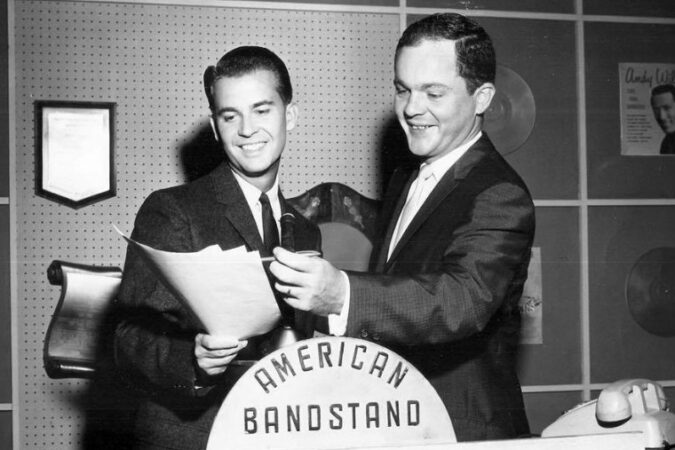
Clark, a week away from his 31st birthday, was the star of the nationally televised ABC program American Bandstand, which was filmed at WFIL-TV studios at 46th and Market Streets. He was filming his afternoon program when the parcel arrived shortly after 3 p.m.
His secretary received the package, and as she started to untie the brown-paper wrapping, the cigar box became visible. One side of the box had been removed, and she spotted a net of wires and a five-inch piece of copper tubing.
Police quickly arrived and inspected the device, and took it to their headquarters for further evaluation. And while it looked like a crudely constructed explosive device, police and postal leaders told The Inquirer that it was missing two key components: powder and a fuse.
There were no actual explosives in the box, and the device couldn’t have set any off.
It contained what at first appeared to be a blasting cap, but after closer examination was identified as a piece of tree bark.
“The package was obviously the work of a crank,” the officials told The Inquirer.
Philly Police, the U.S. Postal Service, and the FBI took part in the investigation, but no culprit was ever publicly identified.
TV staffers were still jumpy a few weeks later when an unmarked gift package that resembled the faux bomb arrived at Clark’s office.
Responding police, taking no chances, carried it across the street and into the middle of Drexel University’s athletic field.
When they finally got the courage to open it, out popped a shaggy, stuffed dog.
All packages from then on, The Inquirer quipped, should carry a notation:
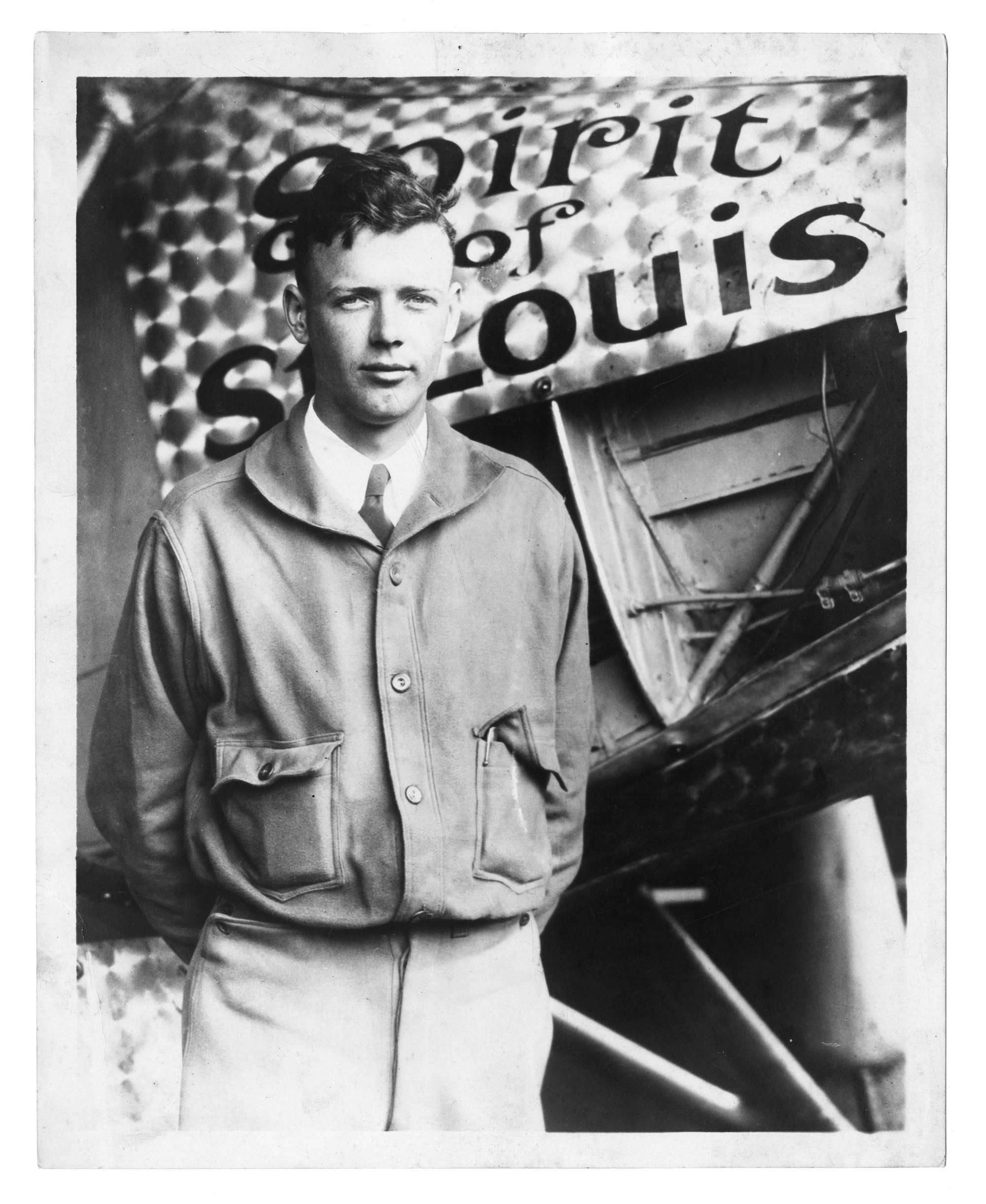
In May 1927, Charles A. Lindbergh became the first person to fly nonstop between New York and Paris. A feat that launched him and his plane into a level of stardom today reserved for the likes of Taylor Swift.
He was held up as the poster boy for an expanding empire. He epitomized the delicate balance of American exceptionalism and humble appreciation.
So when he returned stateside, there was a nationwide celebration. The victory tour covered nearly 100 cities and ended in Philadelphia.
So maybe he was a little cranky when a gaggle of reporters fawned over the 25-year-old aviator from Missouri.
One problem
Lindbergh landing the Spirit of St. Louis at Philadelphia’s airport on Oct. 22, 1927, was a big deal.
During this PR tour, which also helped sell his forthcoming memoir We, the city saw an opportunity to hype its airport.
Only problem?
Lindbergh said he didn’t like the airport.
His thoughts
After landing, Lindbergh raised Old Glory as part of ceremony to dedicate what was then called Philadelphia Municipal Airport, which is now part of the Philadelphia International Airport. Two years earlier, in 1925, the municipal airport had opened as a training facility for National Guard aviators.
Charles Lindbergh flew nonstop between New York and Paris in the Spirit of St. Louis.
Later, he was honored at a reception at Municipal Stadium, which stood at the site of what’s now Xfinity Mobile Arena. The stadium was originally built for the 1926 Sesquicentennial.
It was followed by a banquet at the Bellevue-Stratford Hotel, which is where he made his thoughts on the airport known.
“What do you think of Philadelphia’s landing field?” a reporter asked.
“Well,” he paused, “it could be improved.”
He laughed at his frankness, The Inquirer reported.
He thought that the airport needed longer runways and needed to be closer to the city.
“I think that the field is a little far out,” he said.
An Inquirer reporter covering the event observed Lindbergh was not the only out-of-towner to express disdain for the city.
“A stranger finds Philadelphia the most difficult of American cities at first,” Richard Beamish wrote in The Inquirer, “and the most charming after he has become known.”
In fairness, Lindbergh was also advocating for the expansion of airports and expansion of aerial accommodationsacross the country.
Convicted former Philadelphia mob boss John Stanfa made headlines as part of a bloody mafia power struggle in the 1990s, which is now being chronicled in the newly released Netflix docuseries,Mob War: Philadelphia vs. The Mafia.
He was missing one thing that many of his contemporaries had — at least in the papers.
A nickname.
Don of the Philadelphia La Cosa Nostra from 1990 to 1995, when he was convicted on racketeering, murder, and conspiracy charges that netted him five life sentences, Stanfa went without an official street name during his time at the top. In September 1993, the Daily News set out to change that with a “Name the Don” contest encouraging readers to send in their best handles for Stanfa.
“Philadelphia mobsters have had nicknames since there’s been a Philadelphia mob,” the People Paper wrote in a contest announcement. “But poor John Stanfa, the acknowledged leader of the local Cosa Nostra, has suffered long enough. Our godfather needs a nickname — and fast.”
A classic Daily News stunt, yes — but its timing was somewhat, well, insensitive. Just days before the contest was announced, Stanfa was the target in a brazen morning rush-hour shooting on the Schuylkill Expressway in Grays Ferry. His then-23-year-old son, Joseph, was seriously injured with a gunshot wound to the face.
That shooting, the Daily News reported, signaled an “all-out war” for control of the local mafia, escalating the then-ongoing feud between Stanfa’s crew and a group of young upstarts referred to by the press as the “Young Turks,” purportedly led by Joseph “Skinny Joey” Merlino. The month before, Merlino was injured in a shooting on the 600 block of Catharine Street, and his friend Michael “Mikey Chang” Ciancaglini was killed.
Stanfa was uninjured in the expressway shooting. His son survived and was never implicated in Stanfa’s underworld dealings.
Still, some of the Daily News’ audience was game to participate in the contest, though the total number of submissions was not reported. Some of the potential monikers were directly inspired by the attempt on his life, including “Nine Lives,” “The Dodger,” and “Johnny Wheels.”
Others poked fun at his appearance, like “Sourpuss,” “Stoneface,” and “Big Baldy.” And some — such as “Johnny Meatballs,” “The Grocer,” and “Sticky Buns” — focused on Stanfa’s work in the food business, thanks to his involvement in a South Philly-based Italian food importer.
The contest, however, was not without its detractors. It was, after all, a controversial move — this was a mob boss being roasted, and one who was nearly killed only days before the Daily News began soliciting jokes at his expense. And it didn’t help that the paper went directly to some law enforcement officials to ask for their suggestions.
“I don’t think I should be in the business of characterizing Mr. Stanfa,” said Joel Friedman, then-head of the U.S. Organized Crime Strike Force in Philly. ”I am in the business of investigating criminal activity, and prosecuting it.”
Regular folks were upset, too — largely over the perception that the contest mocked Italian Americans at large. One reader, retired high school principal Richard Capozzola, took particular umbrage, postulating that the Daily News “wouldn’t have done it if [Stanfa] weren’t Italian.”
“How much more insulting can your paper be to the Italian-American community of Philadelphia?” said Arthur Gajarsa, of the National Italian-American Foundation. “Would you dare run a contest involving any other ethnic criminal element?”
The outcry became so significant that after almost two weeks, the Daily News’ editor at the time, Zachary Stalberg, addressed it in a note to readers. The message: Relax.
“I think people understand that nothing in our handling of the contest mocked those of Italian descent,” Stalberg wrote. “And I think people know it’s OK to be intrigued by the mob, even if you hate their business.”
By mid-September, the Daily News had a winner with John “Tightlips” Stanfa. That entry came from South Philadelphia resident Brian Baratta, who won, of course, a videotape box set of The Godfather I, II, and III for his effort.
“‘Tightlips’ certainly is descriptive of this strong and silent guy,” the Daily News wrote of the winning entry. “John Stanfa doesn’t talk to the cops, the feds, or the press.”
With that, the contest was over — but it wasn’t so quickly forgotten, and not just in Philadelphia.
In 1995, ahead of Stanfa’s trial, the Daily News sent reporter Kitty Caparella to Italy to investigate the mob boss’ family tree. While in Caccamo, on Sicily’s Tyrrhenian coast, Caparella was approached by a police officer, editor Stalberg wrote in a note that year.
The officer, Stalberg said, pulled out the 1993 Daily News issue advertising the “Name the Don” contest.
Hit man-turned-government informant John Veasey, whose testimony helped bring down mob boss John Stanfa and a dozen of his top associates in the 1990s, says he’s on the road to redemption.
The new Netflix docuseries Mob War: Philadelphia vs. The Mafia, now streaming, chronicles a violent 1990s power struggle in the local La Cosa Nostra through the eyes of investigators and former crime family members who were there.
Veasey, a South Philly native, was a central figure in the ’90s Philly mob, having admitted to participating in two high-profile murders. He went on to serve nearly 11 years in prison after becoming a government witness against Stanfa and other top mob associates in a federal racketeering trial, and was released in 2005. He has since denounced the mob life, and, in the Netflix series, calls joining the mafia the “worst decision” he ever made.
While he became a feared killer, Veasey was also something of a folk hero after Stanfa’s 1995 trial. The jury, according to Inquirer and Daily News reports from the time, was enamored with his frank and sometimes graphic testimony, which was a key component of federal prosecutors’ case against Stanfa and others.
Veasey agreed to become an FBI informant in January 1994 after his brother, William “Billy” Veasey, told him Stanfa had taken a contract out on his life, reports from the time indicate. In agreeing to work with federal authorities, Veasey admitted to being one of the shooters behind two then-recent mob killings: Michael “Mikey Chang” Ciancaglini and Frank Baldino Sr.
Ciancaglini was killed in August 1993 in a shooting that also wounded Joseph “Skinny Joey” Merlino. The pair were the purported leaders of the so-called “Young Turks” faction who opposed the rule of Stanfa, reports indicated. Merlino has long denied having been behind a faction of the city’s mob and has never been convicted of mob violence.
Ahead of that shooting, Veasey testified, Stanfa had given orders to “kill anybody aligned with Merlino” and circulated a list of about a dozen people who were to be killed. Veasey undertook the hit with fellow mob enforcer Philip Colletti in a white Ford Taurus that, shockingly, was leased in Colletti’s name.
Veasey also admitted to burning the vehicle, badly burning his hand in the process. Knowing he needed an explanation to have his injury treated, Veasey returned to his house and poured lighter fluid into a barbecue grill, and intentionally lit his injured hand on fire.
“I screamed and told the neighbors I had burned it trying to light the grill,” he told jurors during the Stanfa trial. The cover, he says in the Netflix docuseries, wasn’t a great one — the grill he used was electric, arousing the suspicion of police.
Likewise, Veasey was the triggerman in the killing of Frank Baldino Sr., a then-suspected low-level mob associate who was killed outside the Melrose Diner in September 1993.
Baldino was shot multiple times in his car in the diner’s parking lot, and died en route to Thomas Jefferson University Hospital. Veasey later tipped off authorities to the location of the murder weapons, which divers found in a pond at FDR Park in April 1994, reports from the time indicate.
The attempted murder of John Veasey
In January 1994, police found Veasey grievously injured near Sixth and Sigel Streets, having somehow survived a brutal assassination attempt in which he was shot four times and stabbed seven. The attempted murder, he later testified, was undertaken by Stanfa associates Frank Martines and Vincent “Al Pajamas” Pagano in an apartment above a meat store near where Veasey was found.
“One bullet fragmented in the back of my head. One went in the back and out through my forehead,” Veasey later said of the shooting. ”One hit the back of my head and bounced into my neck. And one is still in my chest, in my rib cage.”
His assailants, Veasey said, had targeted him because they believed he was working with the FBI — which he had been for a few days by the time the attack happened.
The shots failed to kill Veasey, who in the struggle wrestled a knife away from Pagano and used it to stab Martines near the eye. The ordeal lasted about 18 minutes, according to a Daily News report, and ended with Martines and Pagano letting Veasey go in exchange for their lives.
After he escaped, Veasey attempted to stop a car for help. But because of the way he looked, he said, no one would help him.
Eventually, police arrived but believed Veasey would die.
“I could hear them talking, saying I was DOA,” Veasey said. “I’m saying, ‘I’m alive, I’m alive. Everyone is giving up on me tonight.’”
Veasey later said he left the mob that night, putting his time in the mafia at just over five months, the Daily News reported. He had been recruited in August 1993, days before the Ciancaglini murder, after landing a job at a construction company owned by Stanfa’s brother-in-law.
“I wouldn’t recommend this life to an enemy,” he later said of the mob.
Hours before Veasey was set to take the stand for Stanfa’s trial in October 1995, his brother, Billy, was shot and killed on the 1700 block of Oregon Avenue. The killing, authorities speculated, could have been ordered by Stanfa as a way to silence Veasey, or by suspected Young Turks leader Merlino as revenge for the Ciancaglini and Baldino murders.
Ultimately, it only delayed Veasey’s testimony by five days.
From the stand, Veasey referred to himself as a triggerman and divulged his involvement with the murders of Ciancaglini and Baldino.
Veasey’s testimony at trial
In total, Veasey testified for about two and a half days, which he wrapped up with two pieces of information: That he refused to kill kids, and he did not like gambling. He also mocked Sergio Battaglia, a would-be Stanfa hit man who, despite going on a number of hits, never actually killed anyone, according to an Inquirer report.
Battaglia “went on a hundred hits and didn’t shoot nobody,” Veasey said.
He quickly became well-liked by the jury, who seemed to hang on his every word, The Inquirer reported. Among his more graphic accounts from the witness stand was the “drilling” of Joseph “Joe Fudge” DeSimone, a mob associate who had wanted to kill Veasey, to which Veasey took less-than-kindly.
Veasey testified that he had warned Stanfa of a coming altercation with DeSimone, and at one point persuaded another mob associate to bring DeSimone over to Veasey’s house to settle their dispute. Veasey was on house arrest at the time.
DeSimone arrived, kicking off a violent encounter with an electric drill.
“I smacked him in the face with the drill. I stuck the drill in his chest and in his legs. I stuck it in his head, and from the rotation of the drill, clumps of hair was going out,” Veasey testified. “Then I hit him in the knee with a baseball bat. I chambered the gun … gave it to him and asked, ‘Do you still want to kill me?’”
Veasey said that DeSimone declined.
The testimony was not only well received by jurors, but it was considered a success by prosecutors. Though violent, Veasey appeared relatable to the jury and seemed to have a secret weapon against the defense.
Former mob hit man John Veasey’s biography details his work for one of the city’s mob organizations, the hits he carried out, the attempt on his life, and more.
The reformed hit man
Stanfa was ultimately found guilty and sentenced to five consecutive life terms. Veasey, meanwhile, spent almost 11 years in prison, and was released in 2005. By 2012, he was back in the news, this time for a detailed account of his story in The Hit Man: A True Story of Murder, Redemption and the Melrose Diner, a book by former Inquirer reporter Ralph Cipriano.
By then, Veasey was working as a car salesman in the Midwest, and claimed to have turned over a new leaf.
“I never respected the Mafia or what it stood for,” Veasey said in an interview with The Inquirer in 2012. “My only regret was being dumb enough to join … I always said they either rat or kill each other.”
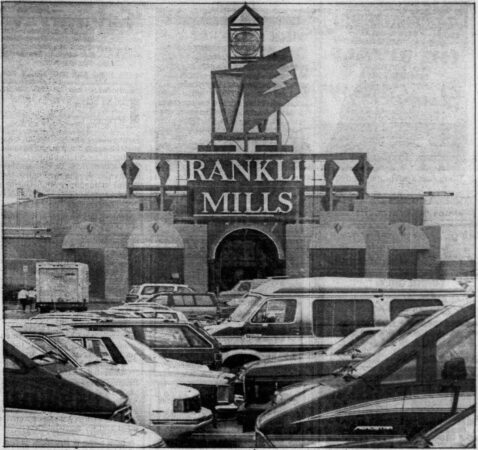
The design of the Franklin Mills mall was inspired by disaster.
“The mall was built in the fashion of a modified train wreck,” Jeffery Sneddon, the mall’s general manager, told The Inquirer in 1989, the year it opened. “There are several buildings connected at odd angles.”
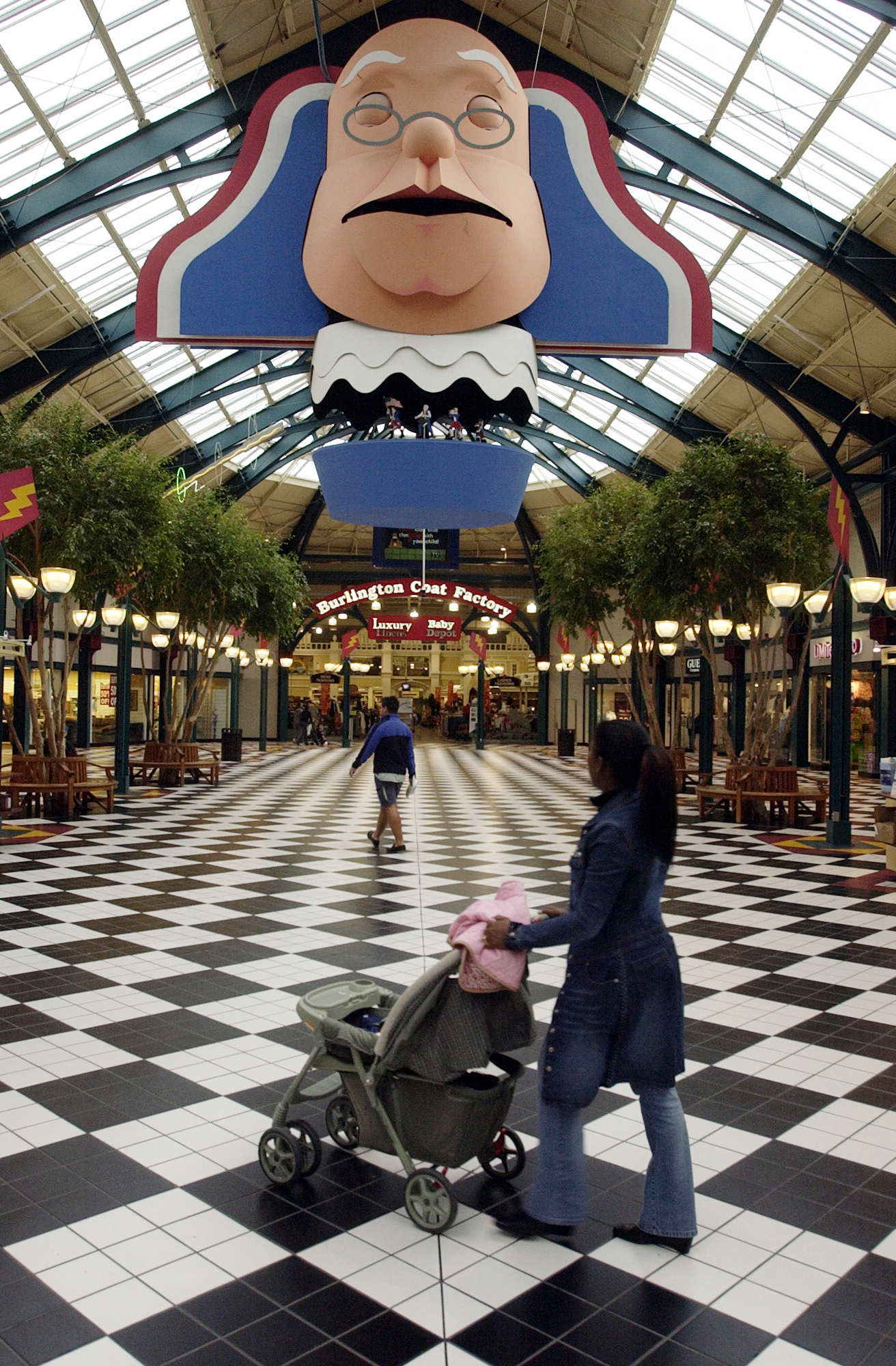
Years later, the inspiration for the mall’s design underwent a little revisionist history, with publicists claiming the mall’s shape was inspired by the lightning bolts courted by Ben Franklin.
Appropriate, as change would ultimately become the story of the mall in Northeast Philadelphia.
At the outset, the goal of the design was to break up the long stretches of the single-level space.
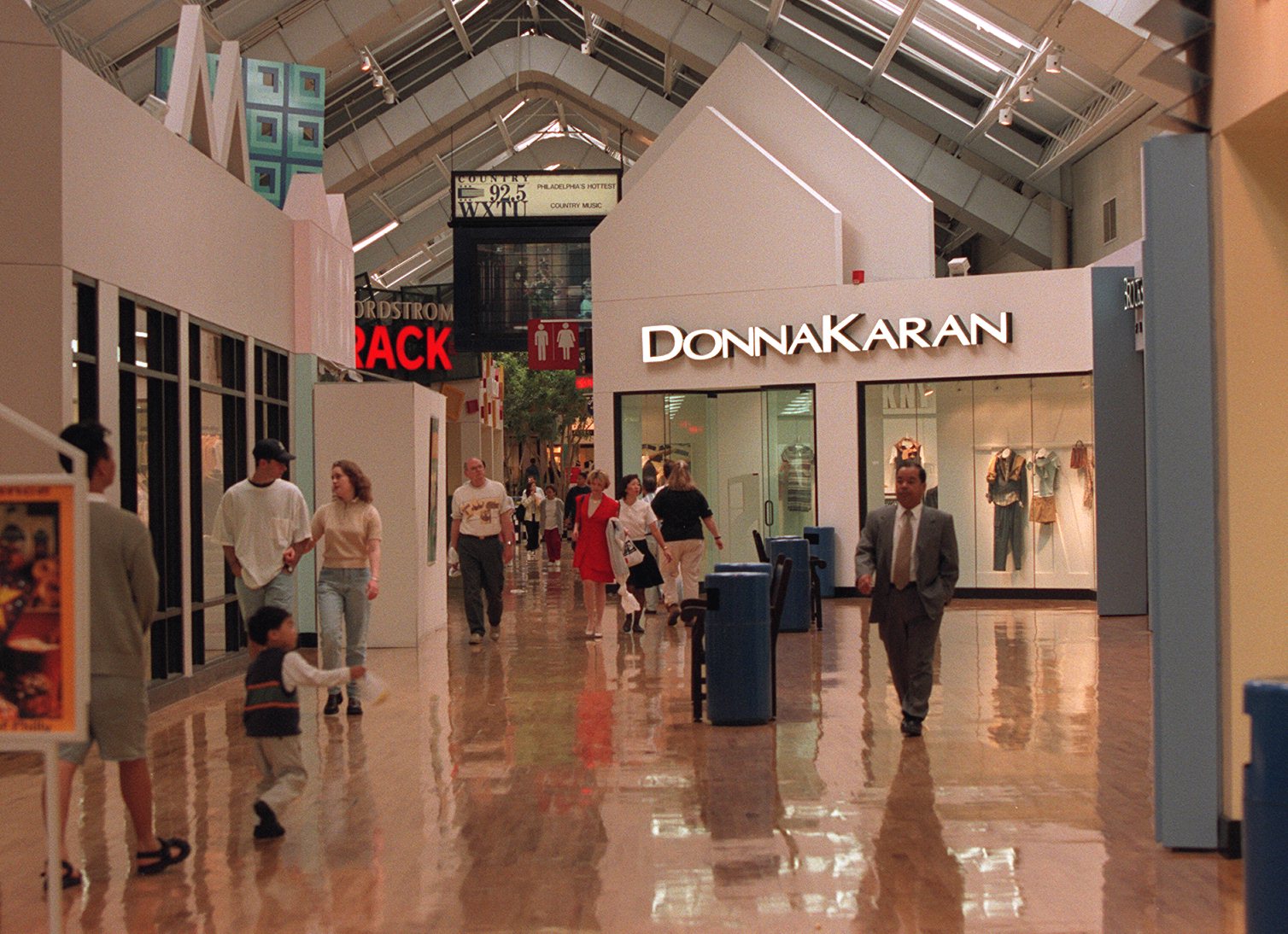
Shoppers at Franklin Mills walk through the mall in 1997.
The result was a mile of winding concourse lined with 250 storefronts, and organized so a shopper would always have merchandise shoved into their face.
The 1.8 million-square-foot mall was built at Knights and Woodhaven Roads on the former Liberty Bell racetrack site. The build cost was $300 million, about $773 million in today’s money.
When the doors opened on May 11, 1989, to the then-world’s largest outlet mall, the shops were 70% leased, with 120 stores rented by shoe and clothing outfits, restaurants, and anchor stores like a J.C. Penney Outlet and Sears Outlet.
The title of world’s largest had previously belonged to the Potomac Mills mall, which was a prototype in the suburbs of Washington, D.C. Both shopping meccas were the brainchild of Washington-based commercial real estate tycoons Herbert S. Miller and Richard L. Kramer.
The duo wanted to build destination venues withvalue stores. And they paired that with an aggressive marketing campaign that targeted tourists, as well as shoppers who lived up to 60 miles away.
And it worked. Far Northeast Philadelphia became a destination in the shopping mall era. They’d later add a movie theater, a skate park, and a Jillian’s restaurant and arcade. The mall would host autograph signings and celebrity appearances. And throughout the 1990s and early aughts, it was a popular hangout for discount shoppers and teenagers, and attracted nearly 20 million shoppers yearly.
Shoppers stroll through the Franklin Mills mall in 2014.
But by the 2010s, it started to lose its charm. It changed names multiple times, became a haven for flash mobs, and saw its share of Black Friday melees, and a fatal shooting in the food court.
The fall of the mall concept and the rise of online shopping added to its financial issues, and the building is in receivership as debt holders determine next steps, according to the Business Journal.
John Chism, manager of Granite Run Mall in Middletown Township back in ’89, didn’t see the mall’s value at the time.
“Malls are in business to sell,” he said, “not to be attractions for sightseers.”
But that was the innovation of the Franklin Mills.
By the afternoon of Sept. 11, 1968, the hostility had faded.
Neither the Rev. Dr. Martin Luther King Jr. nor Cecil B. Moore was making rousing speechesoutside Girard College’s wrought-iron front gates.
No human barricade of police officers blocked the entrance, and no civil rights groups marched through North Philadelphia.
After a brutal fight to desegregate the private boarding school, which started with an intense seven-month demonstration and then spent years tied up in the court system, the color barrier was pierced without protest.
Four little boys, dressed in suits and ties and carrying their favorite board games, walked to the front door of marble-faced Founder’s Hall at 21st Street and College Avenue, and reported for their first day of second grade.
Mothers and grandmothers and siblings accompanied each child, and a gaggle of photographers and reporters attempting to capture the otherwise-calm moment circled each family.
“Nice place,” 11-year-old William Lenzy Dade told The Inquirer, “I didn’t expect it.”
The school was the brainchild of French merchant Stephen Girard, a childless entrepreneur who amassed an immense wealth in Philadelphia in the aftermath of the American Revolution. Upon his death in 1831, he set aside a then-fortune of $2 million to start a boarding school for “poor, white, male orphans.” The school opened in 1848, and offered a premium education at no cost to select students whose families had a single guardian.
By the 1960s, the campus’ imposing stone walls became a metaphorical obstacle to the enclosed white-columned buildings. Moore, then the Philadelphia NAACP president, led the charge and a lawsuit to force Girard to desegregate. In 1965, the animosity escalated into sometimes-violent confrontations with police. But demonstrators continued undaunted, singing and chanting and marching so those four boys could be the first Black students admitted to the private school.
Owen Gowans III was 7 when he walked through those gates in his bright, green-and-brown plaid jacket, the last of the four to arrive.
“Are you nervous?” a reporter asked.
He just shook his head.
In 2015, as part of an anniversary celebration of the school’s integration, Gowans found the words.
“I’m just humbled by what transpired,” he told The Inquirer. “I’m appreciative to the people who put up with beatings and bad words so people like me could go to school here.”
Just before midnight on March 4, 1990, 15-year-old Darius Lamont was pulled through the back door of a friend’s home in Charlotte, N.C.
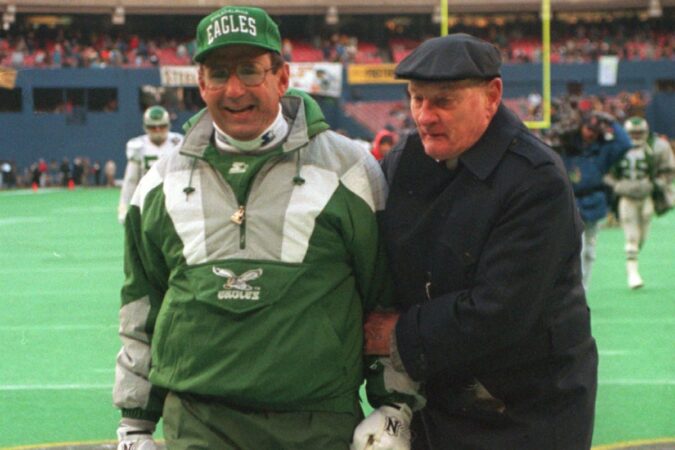
His attacker wanted the teenager’s green-and-white Eagles Starter-brand jacket, valued at $125. During their struggle, the attacker pulled out a gun and shot Lamont in the face.
When police arrived, the jacket was gone. Lamont died 10 hours later.
His death — like the jacket — was part of a trend.
The growing popularity of professional sports in the late 1980s and early ’90s spawned a new cultural status symbol: expensive sports gear lined in team colors and affixed with hulking logos. The apparel was marketed to the eager-to-impress in their teens and early 20s. But the gear was so popular that some young wearers became crime victims.
As the 2017 NFL season kicks off and sports stores start to push their cold-weather gear, we look back on the chaos that followed the rise in sports-gear popularity and crimes spurred by the Starter-brand jacket trend.
In the 1980s and ’90s, the jackets were manufactured by the Starter Corp. of New Haven, Conn. The company was licensed to produce gear for all the major professional teams, including baseball, hockey, basketball, and football. While the brand still exists, it’s now an underutilized subsidy of Iconix Brand Group, which continues to sell the jackets for about $100 each.
Starter’s business peaked in 1992, when the brand made $350 million in sales.The most popular product was the winter-weight jacket, worn by gangster rappers and Hollywood superstars alike.
But the status symbol also led to a secondary industry: jacket theft. In Philadelphia, especially in the lower Northeast, some who couldn’t afford one turned to violence.
Two and three times a week, the police blotter was full. On one week in 1993:
– “14-year-old boy was jumped by a group of four men at 8:45 p.m. Jan 23 in the 6300 block of Charles Street and robbed of his $100 warmup jacket”
– “14-year-old boy was punched and robbed of his $100 Starter jacket at 9:15 p.m. Jan. 22 in the 4100 block of Levick Street by a group of three teen-age boys”
– “A 13-year-old boy was robbed of his $100 Starter jacket at 3:15 p.m. Jan. 21 in the 1500 block of Foulkrod Street by a 15-year-old boy”
Philadelphia police went so far as to send the freshest-faced cops undercover as decoys to catch would-be thieves. A Mayfair neighborhood group offered to put jackets on a registry, scribbling assigned serial numbers in three separate and secret locations on the jackets. But the thieves caught on, cutting out the serial numbers after they were lifted.
In 1993, when Robert Levins was inspector of the Northeast Police Division, he told then-Daily News columnist Jill Porter that he would lecture parents.
“I tell parents that I wouldn’t buy one for my child because of the fact — why put a target on your kid?” he said. “Why make your kid a victim? Buy him a nice coat, but it doesn’t have to be a Starter jacket or a sports team jacket.”
Porter wrote in response: “Sounds good to me, but try telling that to your kid.”
James Lamont, Darius’ father, told the Charlotte Observer that he had given his son money for Christmas to buy the jacket.
“It’s a shame you can’t buy something for your child,” he said, “without worrying if he’ll be safe to wear it.”