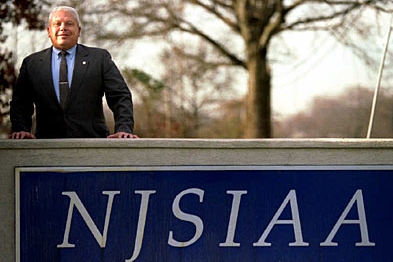
Boyd Sands, 88, formerly of Glassboro, Gloucester County, retired teacher, coach, principal, and superintendent of the Delsea Regional School District, and Hall of Fame former executive director of the New Jersey State Interscholastic Athletic Association, died Saturday, Jan. 17, of complications from a stroke at Cape Canaveral Hospital in Florida.
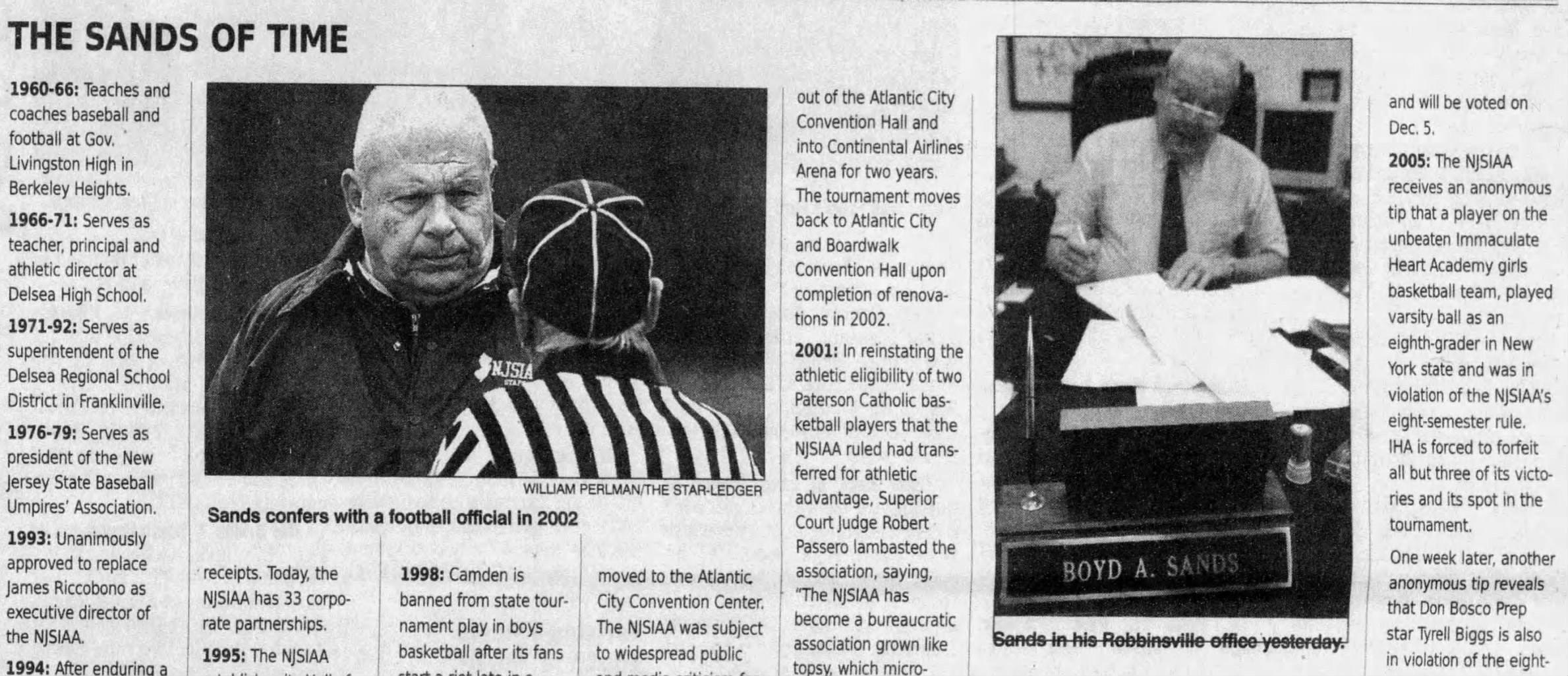
An All-Star football player in high school and college, and a longtime baseball umpire and basketball referee, Mr. Sands directed the NJSIAA from 1993 to his retirement in 2006. He and the association’s executive committee organized hundreds of statewide championship playoff tournaments, hired thousands of game officials, and enforced eligibility and sportsmanship rules for high school athletes in more than 30 sports at more than 400 public and private high schools.
He was an expert on all kinds of rules and a champion of the state’s expanded football playoff format and more programs for girls. He oversaw ever-changing conference alignments and supervised the association’s multimillion dollar budget.
He attracted dozens of corporate sponsorships to fund new initiatives regarding improved officiating, violence at sports events, and drug education. He forged working relationships with the state’s Sports and Exposition Authority, Boardwalk Hall in Atlantic City, the NHL’s New Jersey Devils, and other organizations.
Overall, Mr. Sands served more than three decades as a member of the NJSIAA advisory committee and executive committee, and executive director. In an online tribute, former colleagues there called him “a respected leader in education and sport. A consummate professional.”
Steve Timko, his successor as executive director, told the Times of Trenton in 2005: “He has taken the association to the next level.” In 2003, Mr. Sands told the Record of Hackensack: “I really just enjoy high school athletics.”
He joined Delsea in 1966 as assistant principal, was promoted to principal, and served as district superintendent from 1971 to 1994. Before school, he was known to greet students as they exited the buses in the morning. After school, he handed out programs at events, prowled the sidelines at Delsea, and officiated games at other high schools.
He taught social studies and coached football for six years at two high schools in North Jersey before going to Delsea. He oversaw the building of the district’s middle school in the 1970s, and colleagues named the entrance road leading to the new building after him.
The Star-Ledger of Newark featured Mr. Sands when he announced his retirement from the NJSIAA in 2005.
“His influence lives on in the students he inspired, the educators he mentored, and the community he helped shape,” Delsea superintendent Fran Ciociola said in a tribute.
Mr. Sands was onetime president of the Camden County chapter of the New Jersey Baseball Umpires Association. He won achievement awards from the NJSIAA, the National Federation of Interscholastic Athletic Officials, and the Union County Interscholastic Athletic Conference.
He was an executive committee member of the National Federation of State High School Associations and lifetime member of the International Association of Approved Basketball Officials. “His spirit, kindness, and dedication will be remembered always,” colleagues at the IAABO said in a tribute.
Mr. Sands was inducted into the Gloucester County Sports Hall of Fame in 1989, the NJSIAA Hall of Fame in 2007, and the South Jersey Baseball Hall of Fame in 2009. He attended many continuing education classes and earned certifications at Rowan, Rutgers, and Seton Hall Universities, and elsewhere.
Mr. Sands liked nothing more than attending a football game.
He never changed his signature flattop crew cut. “Bear of a man, great guy,” a former student said in a Facebook tribute. A friend said online: “Boyd was a wonderful man and terrific mentor.”
Boyd August Sands was born Feb. 16, 1937, in Newark, N.J. He played football and basketball in high school, and earned a bachelor’s degree in education at Colby College in Maine and a master’s degree in administration at what is now Kean University in New Jersey.
He met Frances Curto at a New Year’s Eve party, and they married in 1958. They lived in North Jersey, moved to Glassboro when he worked at Delsea, and had daughters Susan, Nancy, Karen, and Lori, and a son, Michael. His son died earlier.
Mr. Sands studied history and enjoyed road trips to family reunions in Florida and stops at historical sites along the way. He loved his dogs, followed the Eagles and Phillies closely, and was sure to be greeted by former students and old colleagues whenever the family went out.
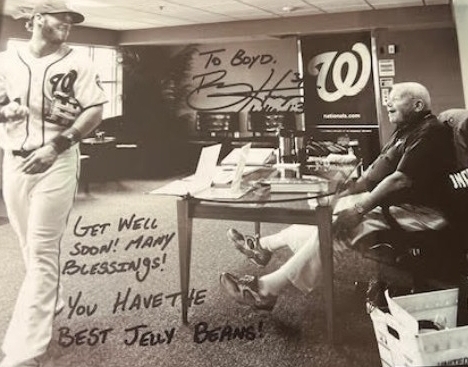
Mr. Sands (right) became friendly with baseball star Bryce Harper when he worked at the Washington Nationals’ spring training complex in Florida.
He and his wife moved to Cape Canaveral in 2006, and he helped run spring training for the Washington Nationals baseball team and worked security for a cruise line. He had bypass surgery in 2015.
“My father was a man who found joy in two of life’s greatest gifts: family and sports,” said his daughter Nancy. “My dad was a man who always showed up and pushed us hard to do our best.”
His daughter Susan said: “He saw everyone as a person.”
Nearly everyone has a memorable umpiring story about Mr. Sands, like the time he got drilled by a line drive down the first base line. In 1994, he told The Inquirer that he enjoyed officiating high school baseball and basketball games more than anything.
“It was my hobby and outlet,” he said. “I tried golf, and I figured I’d rather get hit by a hard ball.”
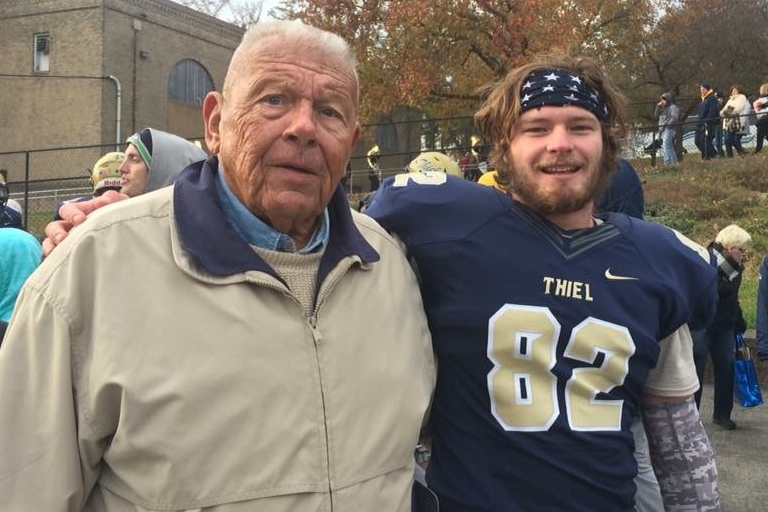
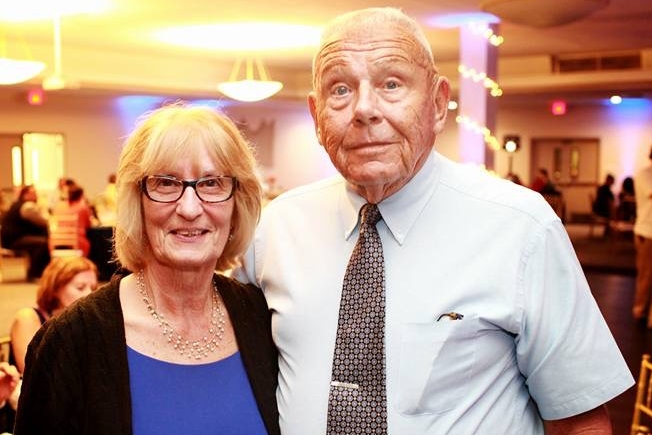
Mr. Sands and his wife, Frances, married in 1958.
In addition to his wife and daughters, Mr. Sands is survived by 16 grandchildren, 28 great-grandchildren, a brother, and other relatives. A brother died earlier.
Robert Koopmeiners is up to here with this winter and is among the masses more than ready for the atmosphere to flip the switch.
“It’s getting kind of old,” he said. But he wasn’t complaining about Arctic freezes, or winter storms, or black ice, or hideously darkening mountains of plowed snow.
He was talking about the weather in Colorado, where he is a National Weather Service meteorologist, where bone-dry Denver has set nine high-temperature records since Dec. 1, where wildfire alerts were in effect, and water is getting scarce.
Warm West, cold East, and vice versa are standard fares in the great national atmospheric seesaw that hasn’t been doing much seesawing lately, as if a boulder has been placed atop our end of it.
That’s the result of an atmospheric roadblock for the ages in the high latitudes around Greenland, meteorologists say, that has allowed winter to reappear with a ferocity not experienced in several years in the Northeast, and a winterlong spring in parts of the West. The cold in the East may even be related to rising global temperatures.
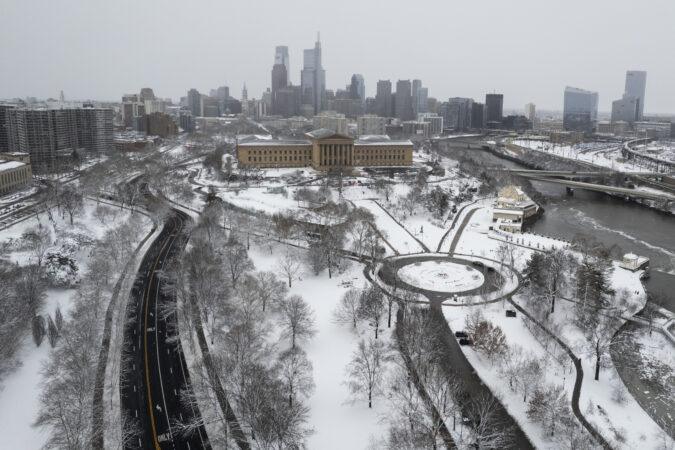
The result for the Philadelphia region has been one of the colder and snowier meteorological winters — the Dec. 1 to Feb. 28 period — on record. Officially Philadelphia has had more days of snow cover of an inch or more than in the five seasons ending with the winter of 2023-24 combined.
After quite a wintry start to the new week, with even some more snow possible, a major warmup is due to begin with a spring teaser possible next weekend. (It may turn colder the second half of the month, but that can wait.)
In the meantime, the atmosphere is enjoying a belly laugh over the preseason outlooks for the winter of 2025-26.
Philadelphia’s winter scorecard
By convention, the weather community divides the seasons into three-month increments. In part that’s in recognition of the fact that weather often has an adversarial relationship with astronomy. For example, it has snowed, and hit 90 degrees, in the astronomical spring, the period between the vernal equinox and summer solstice.
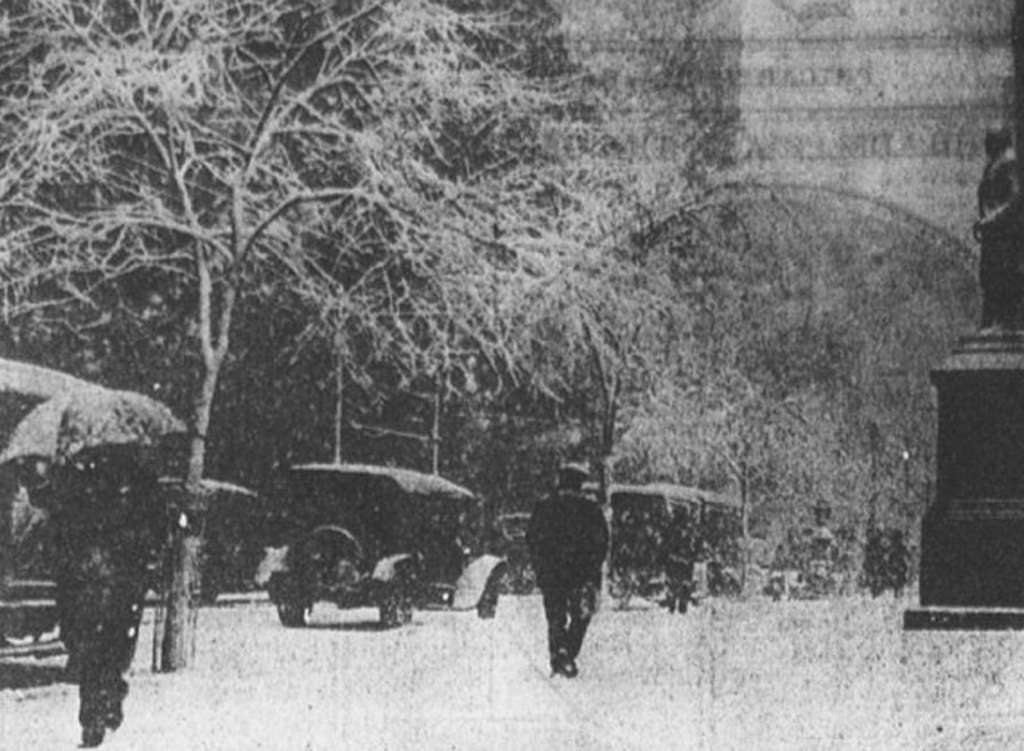
The day before Easter in 1915, Philadelphia was socked with 19 inches of snow, despite a forecast of “Unsettled, rain likely.”
For the three-month 2025-26 winter period, official temperatures at Philadelphia International Airport have averaged a shade over 33 degrees, putting it in the top third for coldest winters in the period of record dating to the late 19th century.
The official snow total is in the top 20% of all winters on record. The normal through February is just under 20 inches.
AccuWeather Inc. and 6abc went with 14 to 18 inches. Fox29 called for16 inches, and 17 days of snow cover. At last count, that snow-cover count was up to at least 35. Other forecast services called for normal — 23.1 inches — or slightly above-normal snowfall.
Regarding temperatures, all the outlooks foresaw normal — thethree-month averageis 36.1 degrees — to above-normal temperatures for the Philly region, save for Arcfield Weather, a private-sector company, which went for below.
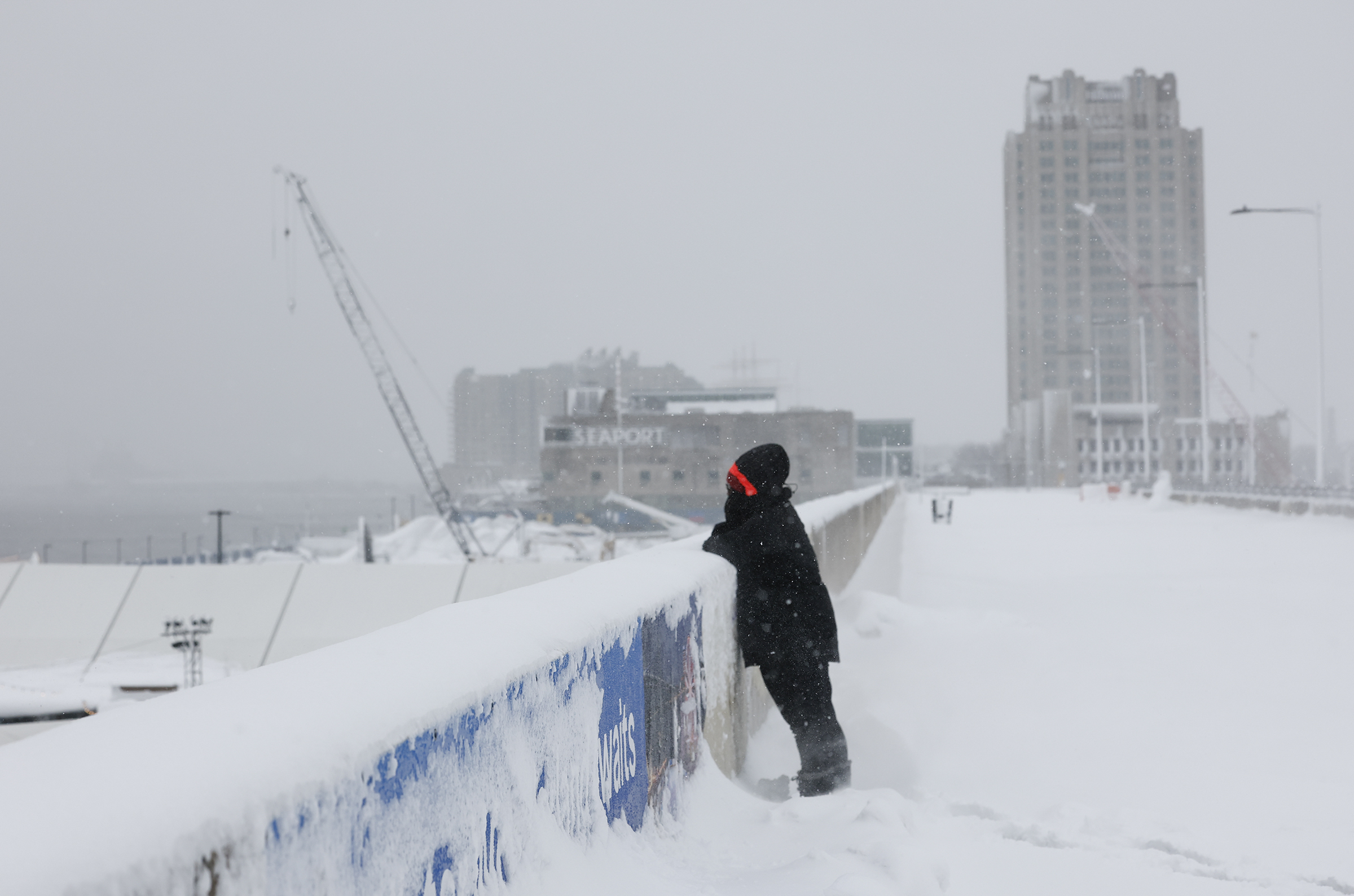
Nicole Swinson looks into Penn’s Landing while standing in the snow on Monday, Feb. 23, 2026.
‘Blocking’ has been the leitmotif of Philly’s winter
If it seemed that what happened kept happening, that was more than perception.
It was the result of particularly vigorous “blocking” in the vicinity of Greenland in which high pressure, or heavier air, persistsin the upper atmosphere. It was a massive obstruction that kept directing cold air and storms toward the East while toasting the West, said Climate Prediction Center branch chief Jon Gottschalck.
The East got stuck under a “trough” of upper-air low pressure that favored storminess and cold, he added. The West, quite the opposite.
“The blocking pulled the storms eastward, and the cold followed,” said Paul Pastelok, Accuweather’s longtime seasonal forecaster. “We should have caught on to that.”
In addition, an upper-air pressure pattern over the Arctic — the Arctic Oscillation — was stuck in its negative phase from December until recently, said climate center meteorologist Laura Ciasto, with negative consequences for local winter-phobes.
When it’s negative, the weather-moving west-to-east jet stream winds can become more active at the midlatitudes where we live, and the conditions colder and stormier. The oscillation has had “an interesting winter,” she said. “Typically,” she said, “we expect the AO to fluctuate.”
Related to the oscillation’s behavior were episodes of “polar vortex stretching,“ said Ciasto. The vortex’s powerful winds usually trap cold air in the Arctic, but on occasion they weaken and ”stretch,“ allowing cold air to spill southward.
Another explanation for why the forecasts went awry may be an obvious one: We’re not used to this level of Arctic cold or prodigious snowfalls like the Sunday-Monday event that creamed parts of the region with 20 inches or more. “We have simply gone many years without experiencing a storm like this,” said Owen Shieh, warning coordination meteorologist at NOAA’s Weather Prediction Center.
Did the world suddenly grow colder?
No, the planet didn’t cool off precipitously. In fact, said Pastelok, the blocking may have been related to warming-related sea-ice reductions near Greenland. The solar energy absorbed by freshly freed waters could have effects on pressure patterns in the high atmosphere, he said, adding that for now, that’s only a hypothesis.
While the world evidently cooled slightly last year after a record 2024, according to NOAA’s database, it’s still about 2 degrees Fahrenheit warmer than the 20th-century average, the supply of Arctic air isn’t quite as it used to be.
As it turns out, Philly’s winters in the 21st century have trended milder, with average temperatures about 2 degrees Fahrenheit above long-term averages.
The overall warming trend has been one reason the climate center has had the odds favoring above-normal winter temperatures for Philly for the last seven consecutive winters. And they indeed were above normal for six straight years — but not seven.
Retired climate center forecaster Mike Halpert once remarked that while sticking with the trend can be a smart bet, “some years you’re going to be woefully wrong.”
Newspapers do many service stories, letting readers know about upcoming events.
The “things to do” pieces are usually illustrated either with pictures provided by the organizations or their public relations partners or, in the case of annual events, our own staff’s file photos from previous years.
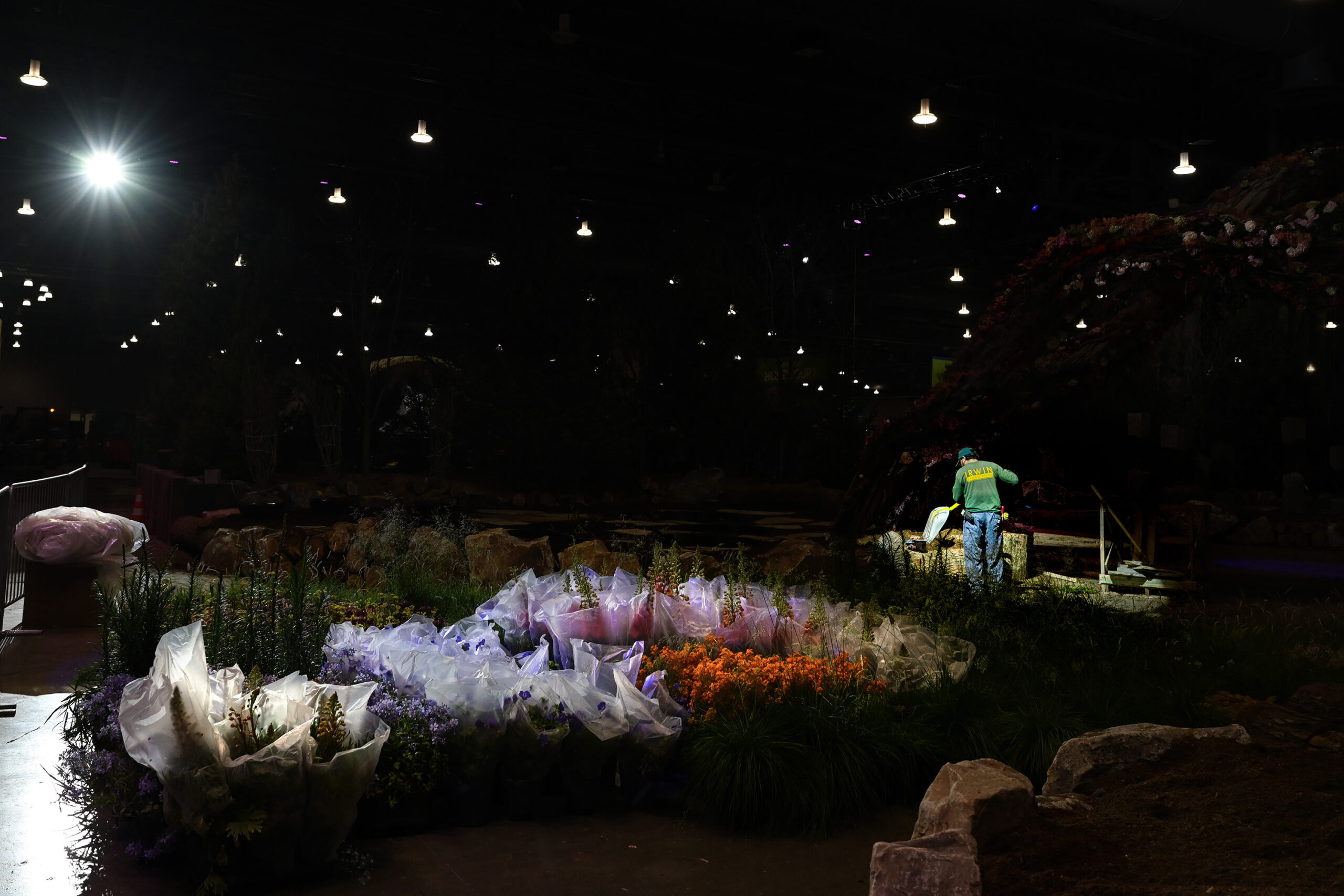
Technicians adjust the lighting as Andres Ceballos with Irwin Landscaping in Hockessin, Delaware is setting up for the PHS Philadelphia Flower Show Tuesday, Feb. 24, 2026.
I was at the Convention Center earlier this week to photograph preparations for the nation’s largest and longest-running horticultural event. As with similar preview assignments, the stars of the show — the flowers in this case — were not quite ready for prime time.
Most of the blooms are waiting to be unloaded from refrigerated trucks, and those inside the Convention Center are still wrapped in plastic. So I rely on close-ups, or take advantage of the play of color and light.
Awaiting placement in the entrance garden, hyacinths are in the spotlight during light testing.
It is hard enough to convey the perfumes of thousands of blooms in the air with mere photos — or the vibrant color of the petals in the meticulously designed displays. Imagine trying to showcase it all in black-and-white.
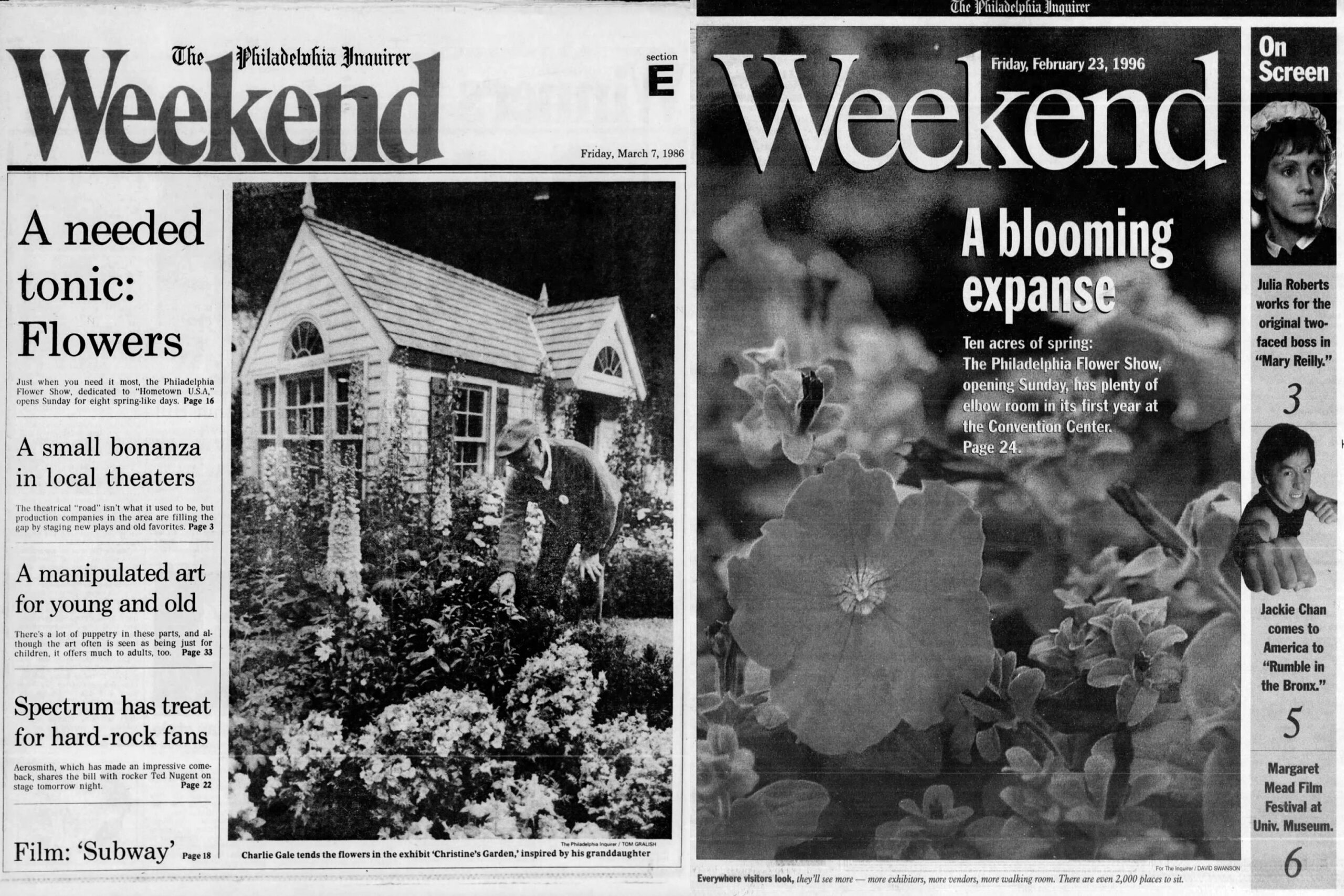
LEFT: March 7, 1986. RIGHT: February 23, 1996.
That’s my photo on the cover of The Inquirer Weekend section on the left, from 40 years ago when the Flower Show was at the Philadelphia Civic Center in University City. David Swanson made the close up on tje right 30 years ago, the year the show moved to the new Pennsylvania Convention Center.
When The Inquirer and Daily News knew we were switching from black-and-white to color presses a forward-thinking photo editor had us pop in a roll of color negative film while covering some events so we’d have some color photographs in the files when the time came. (That finally happened in March of 1993. In a focus group a few years earlier, loyal readers “were horrified” when they were shown a prototype of a possible color Inquirer.)
I don’t know yet if I’ll be back at the Flower Show this week, or if another photographer will be assigned, but you can count not only on seeing live coverage, but some of the photos again before the 2027 show.
Favorite assignment anniversary
Speaking of anniversaries and black-and-white photography, I am often asked if I have a favorite assignment.
It was 40 years ago this week that I made the Weekend Flower Show cover photo above — days after returning from six weeks in the Philippines. I was there as millions of Filipinos took to the streets in a “People Power” revolution (also known as the EDSA Revolution).
The nonviolent revolution led to the ouster of President Ferdinand Marcos as Corazon “Cory” Aquino became the country’s 11th president. It was seen as a model for similar uprisings that occurred around the world in the following years, from the occupation of Tiananmen Square to the Fall of Communism and the Arab Spring.
These images are the original prints — developed in a hotel bathroom I converted into a darkroom — transmitted back to The Inquirer in January and February of 1986.
Since 1998 a black-and-white photo has appeared every Monday in staff photographer Tom Gralish’s “Scene Through the Lens” photo column in the print editions of The Inquirer’s local news section. Here are the most recent, in color:
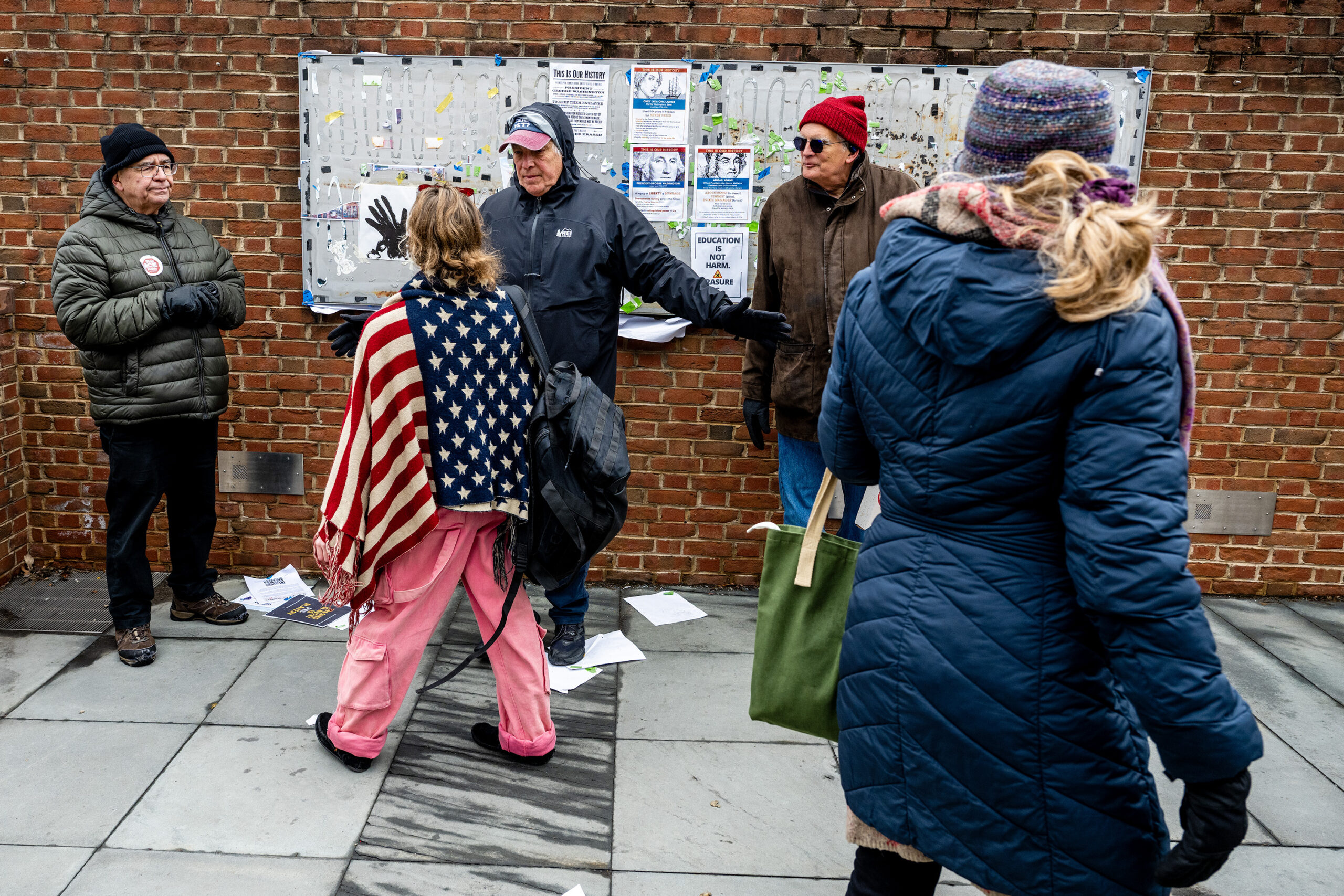
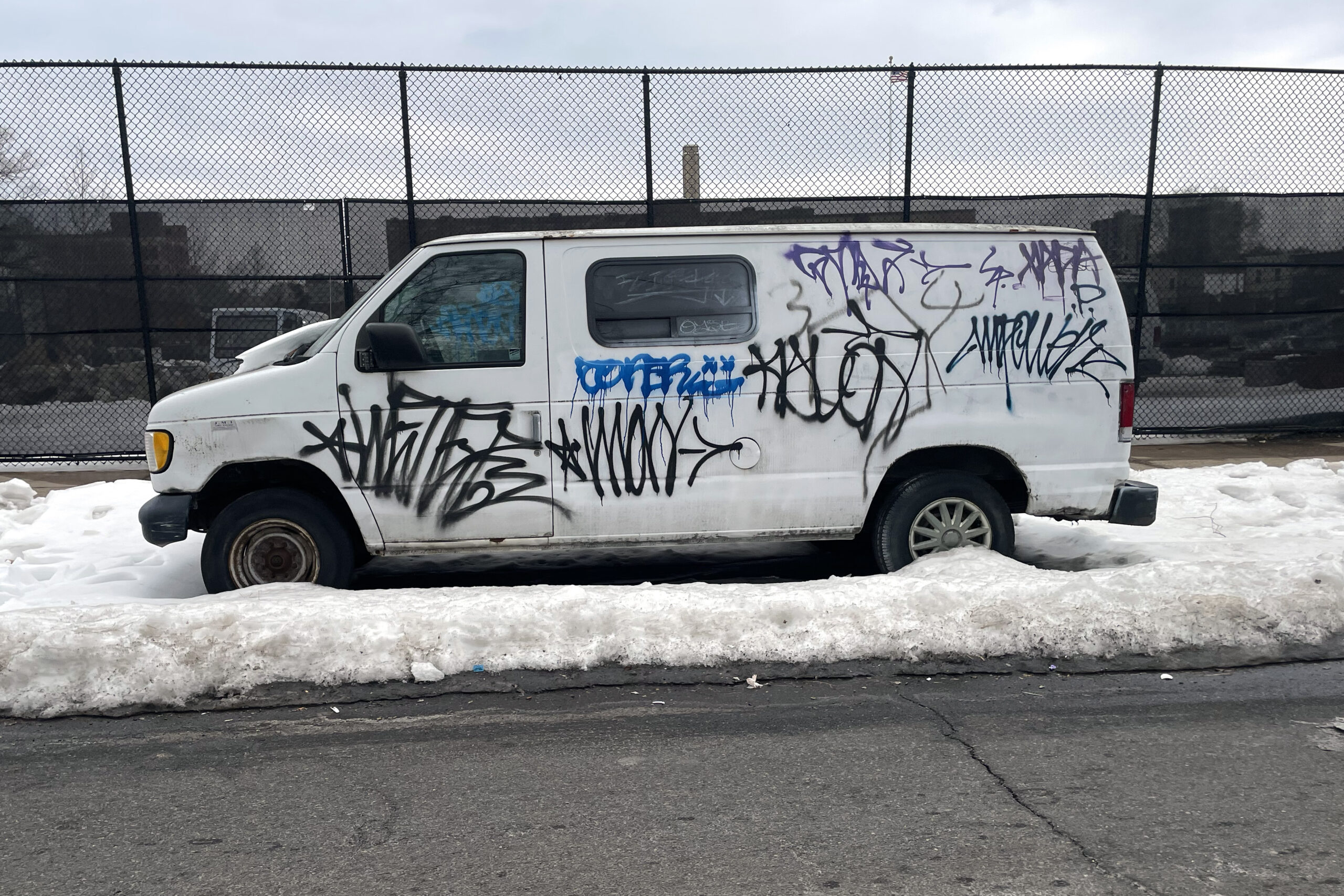
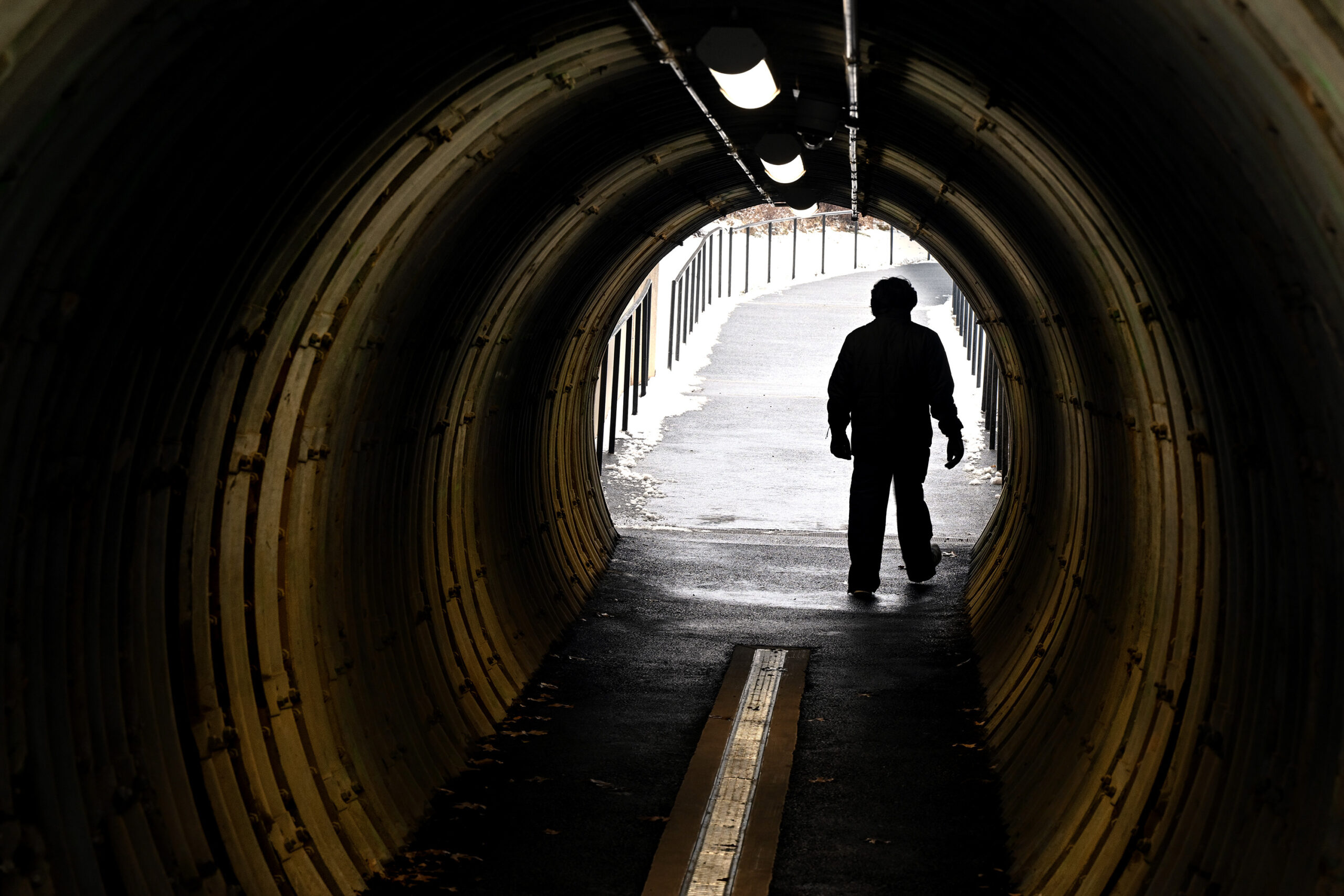
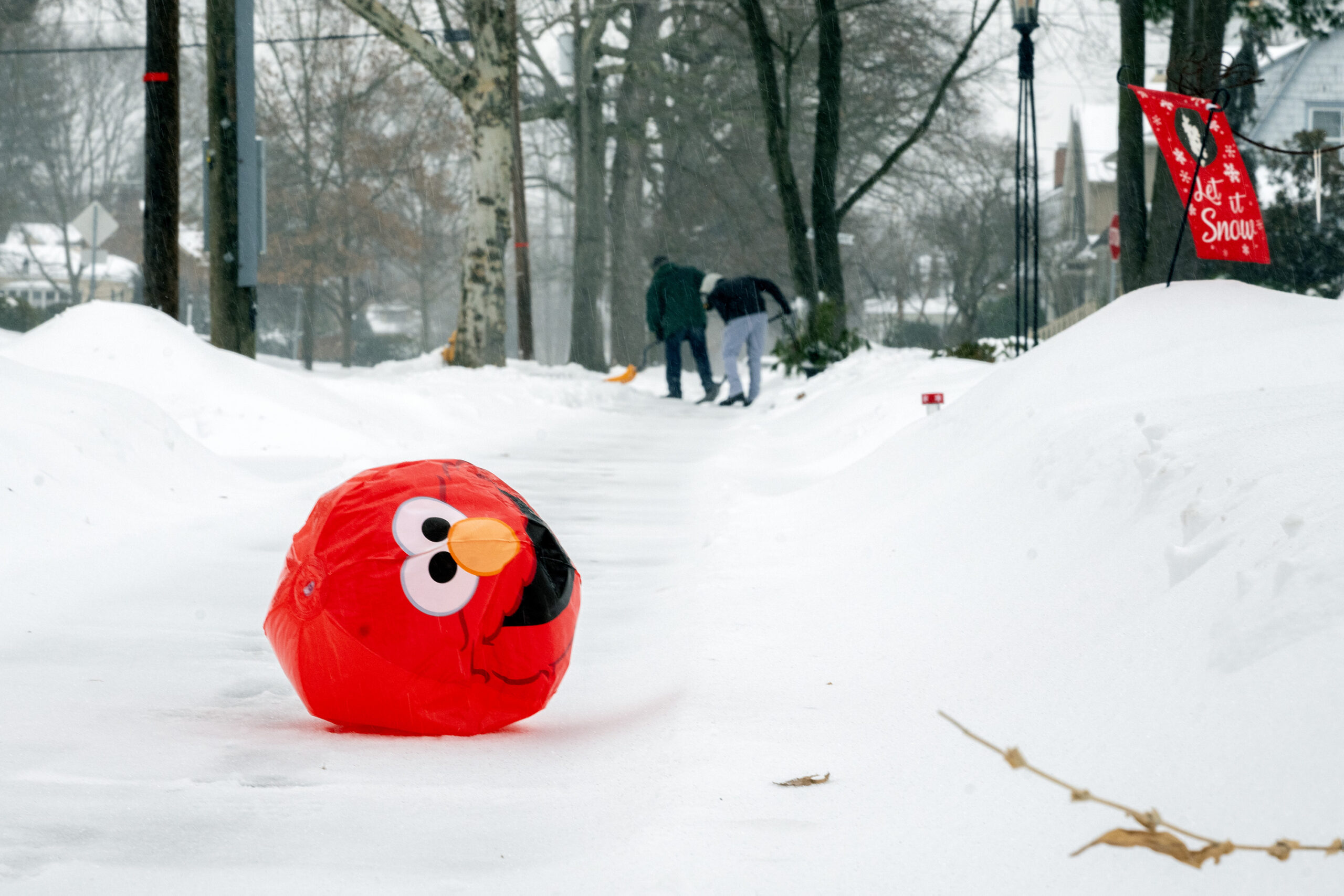
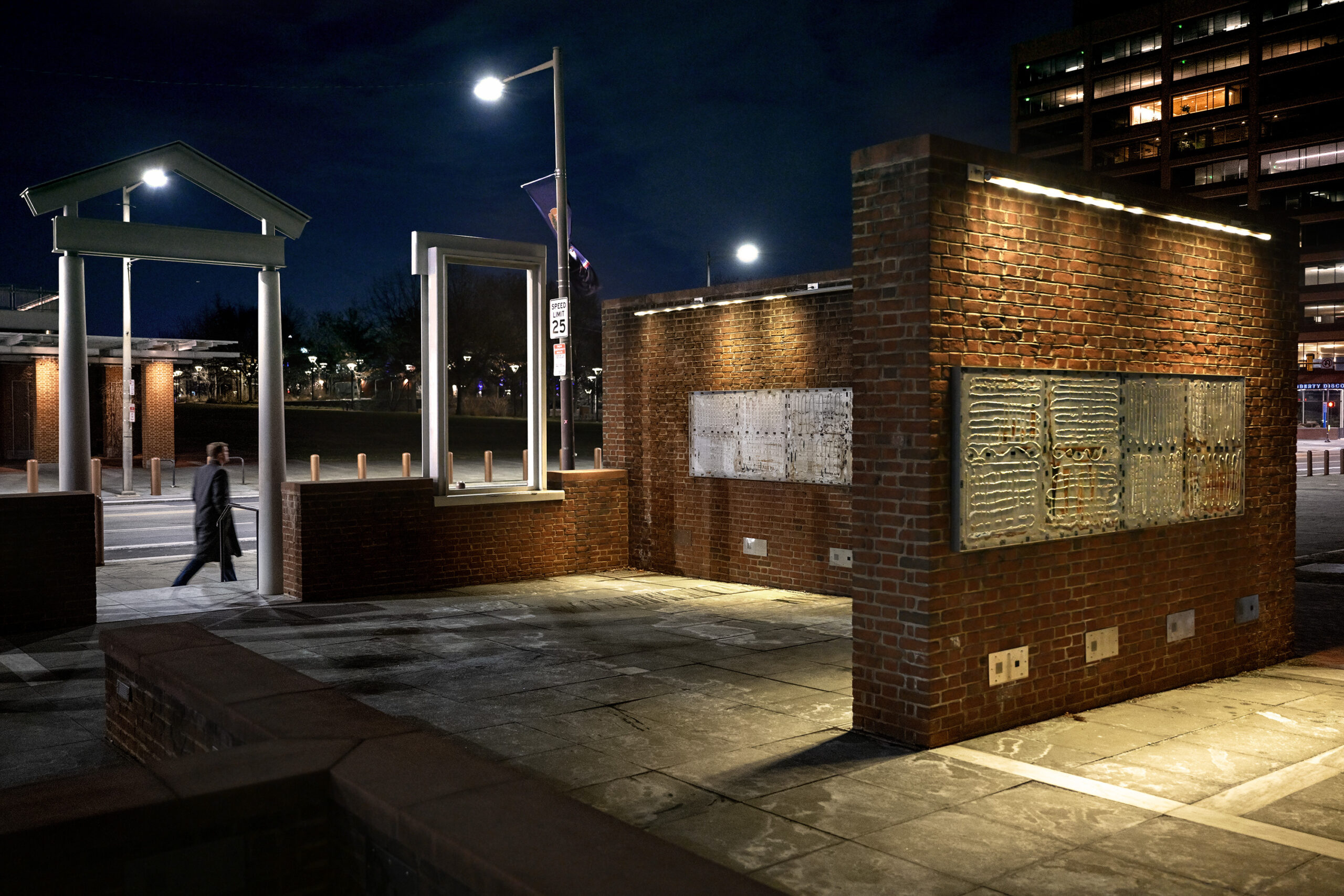
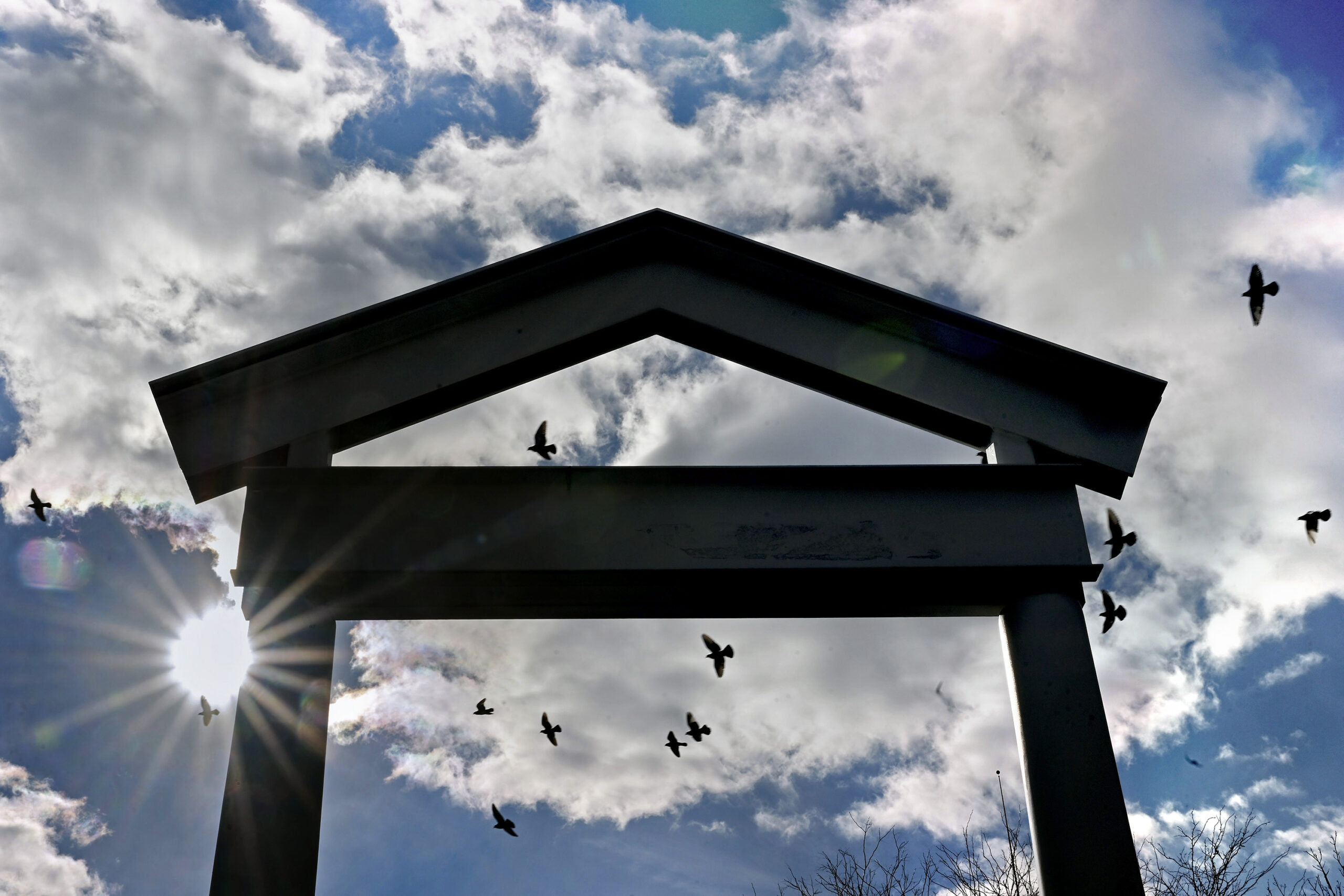
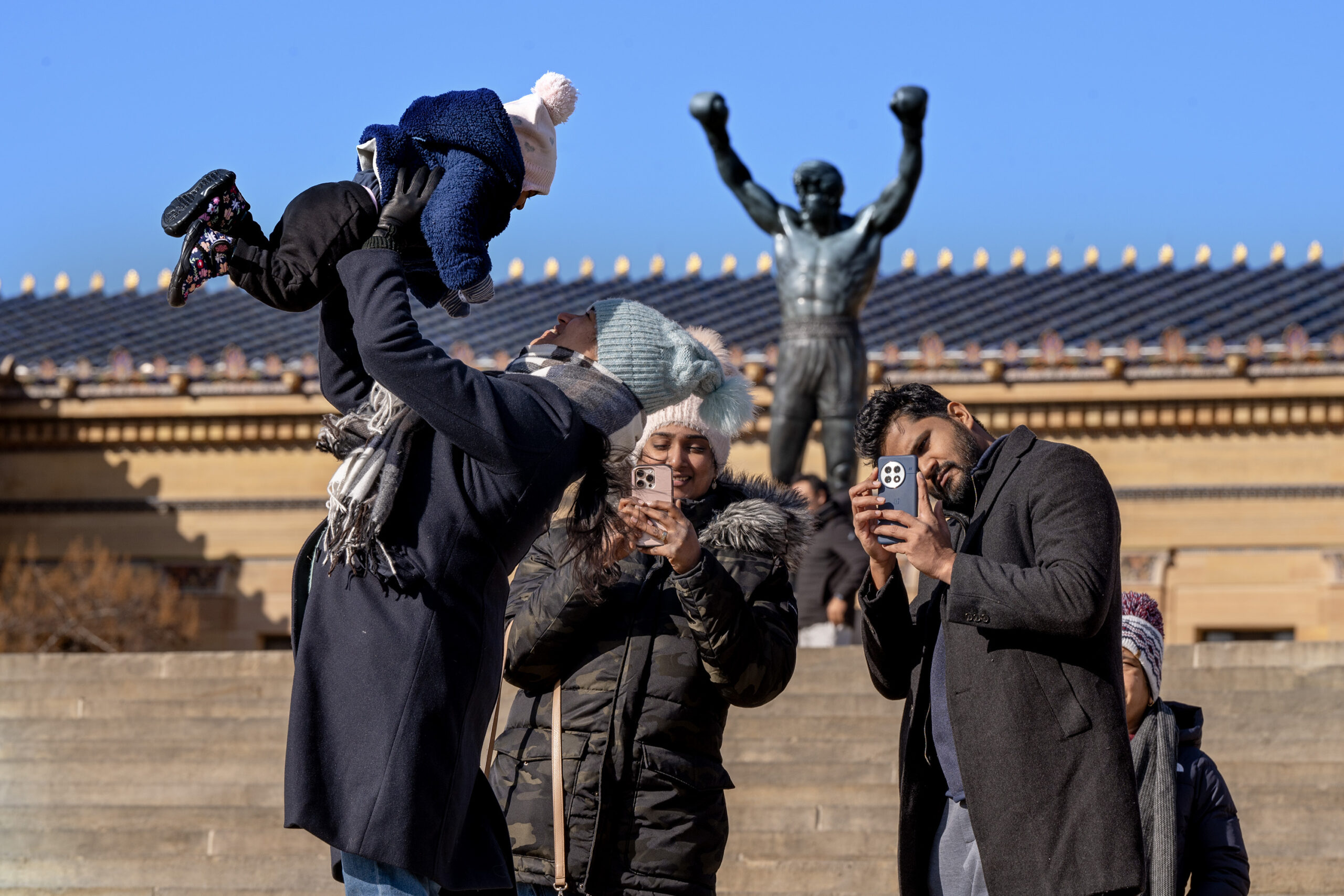
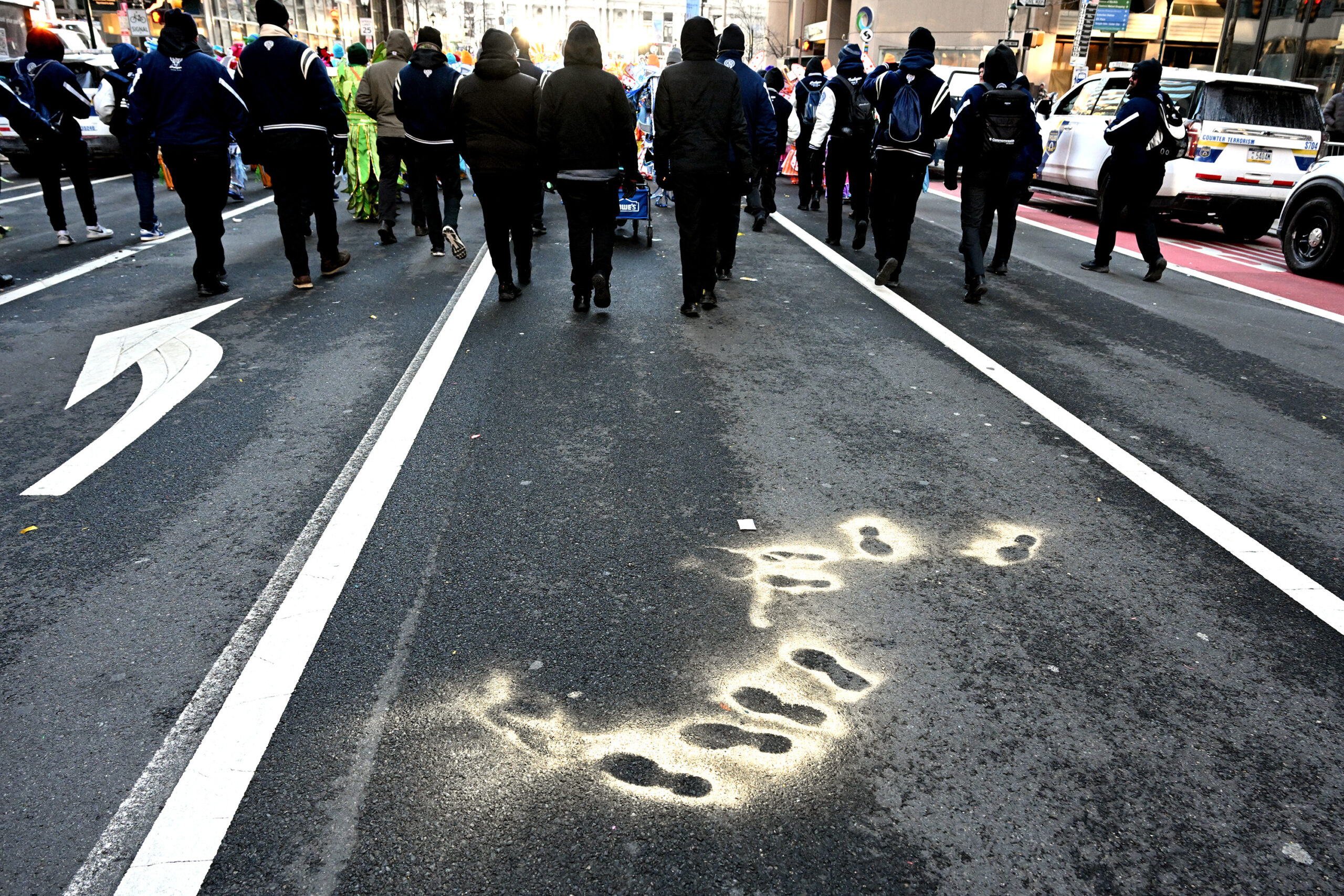
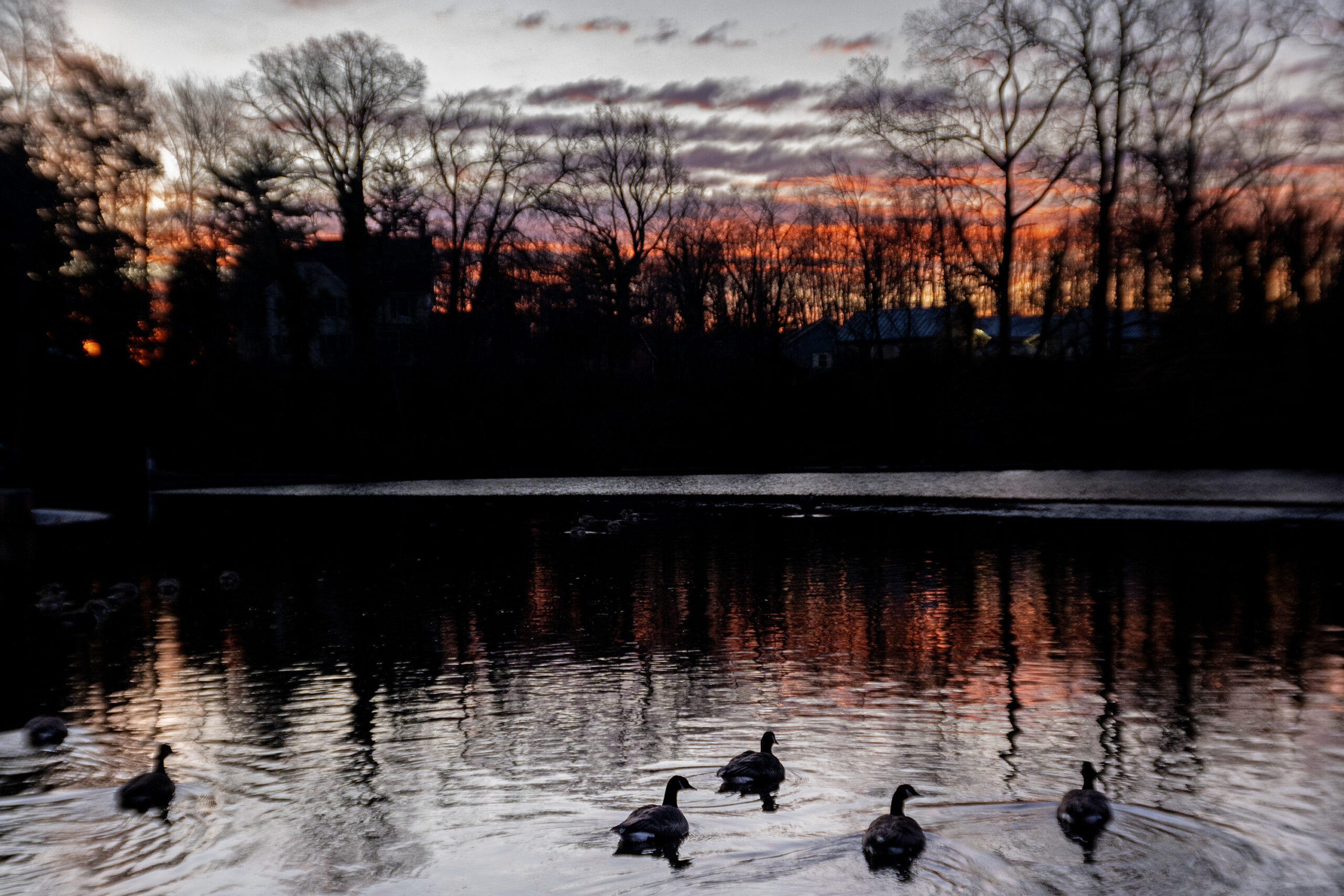
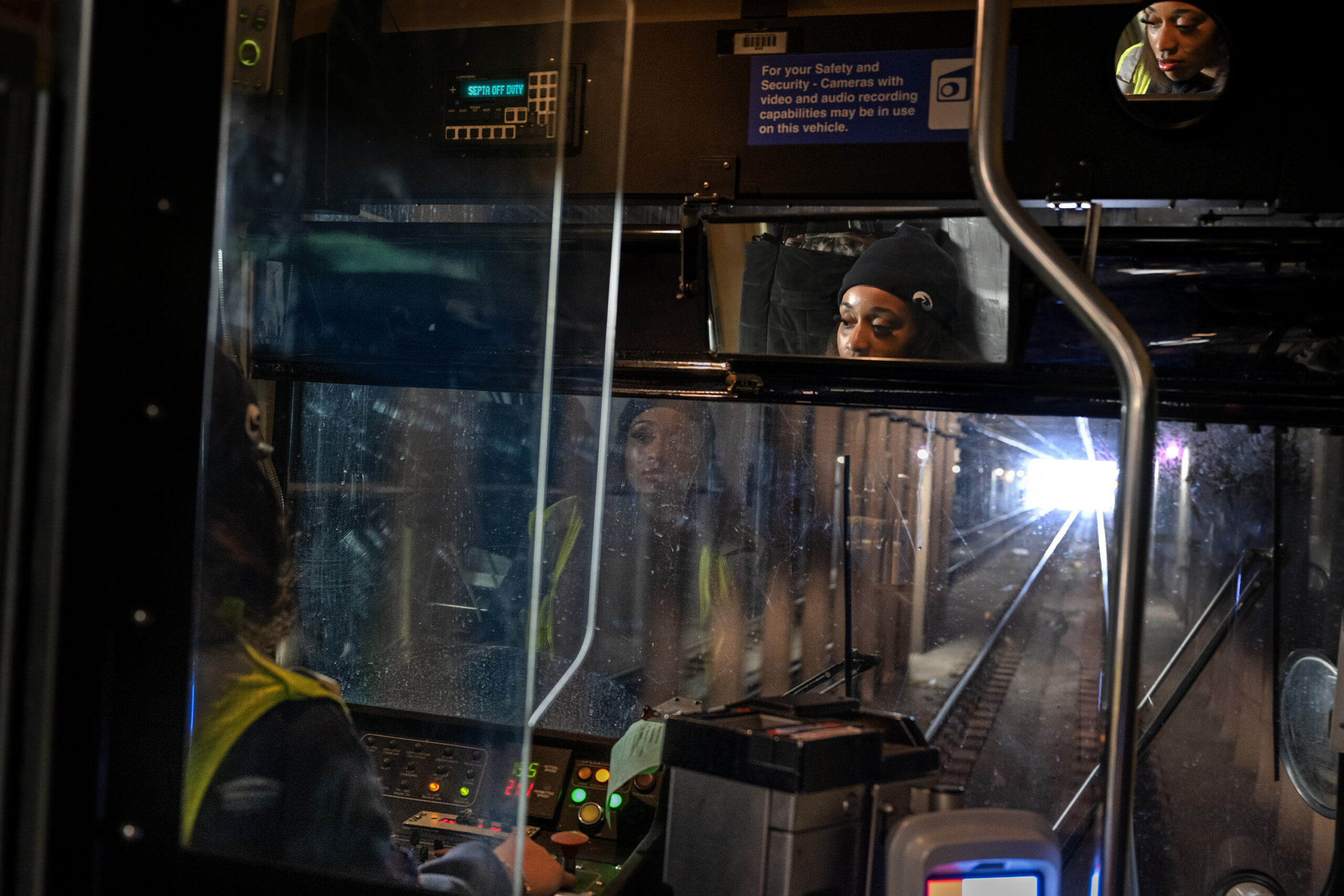
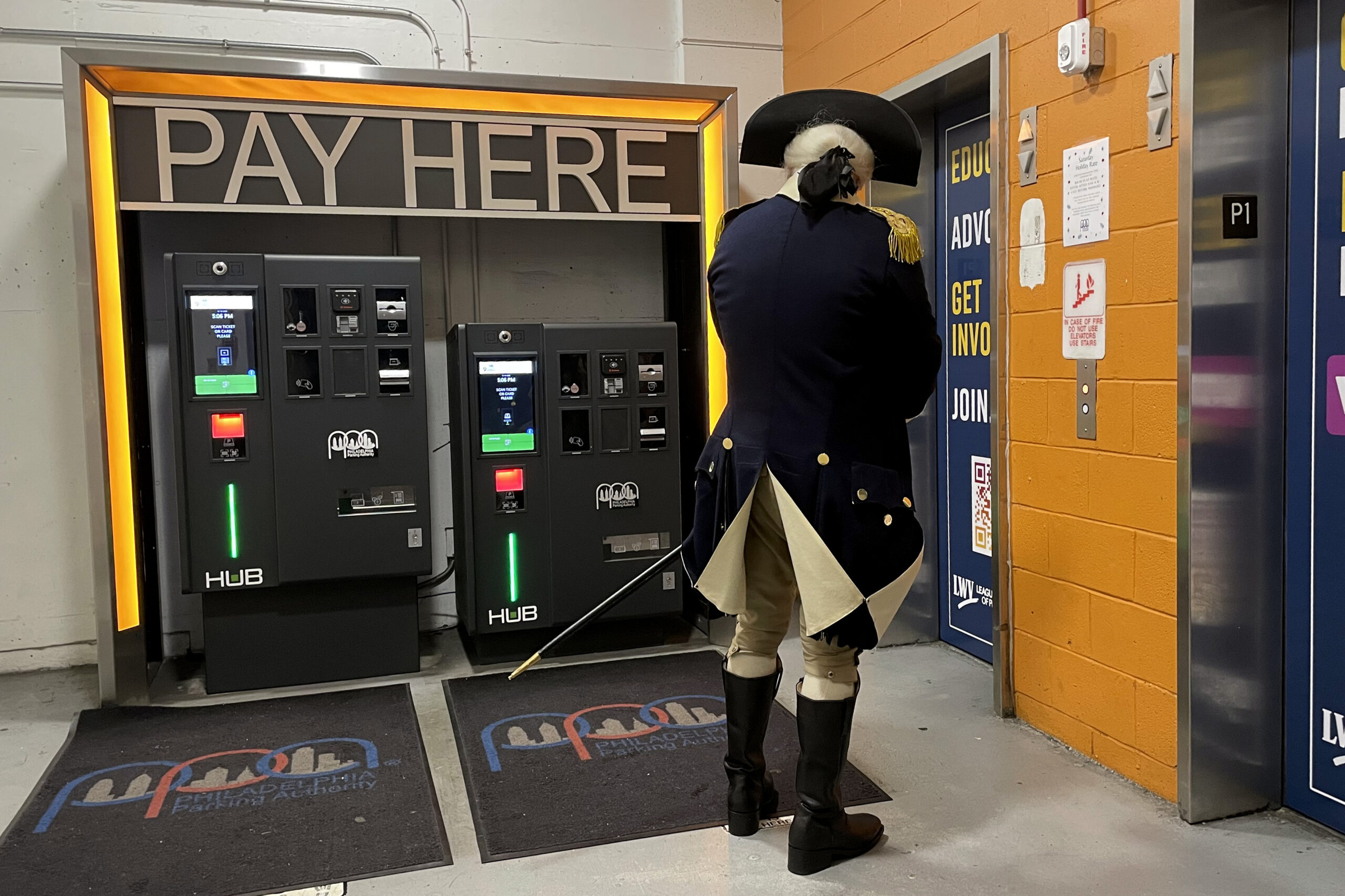
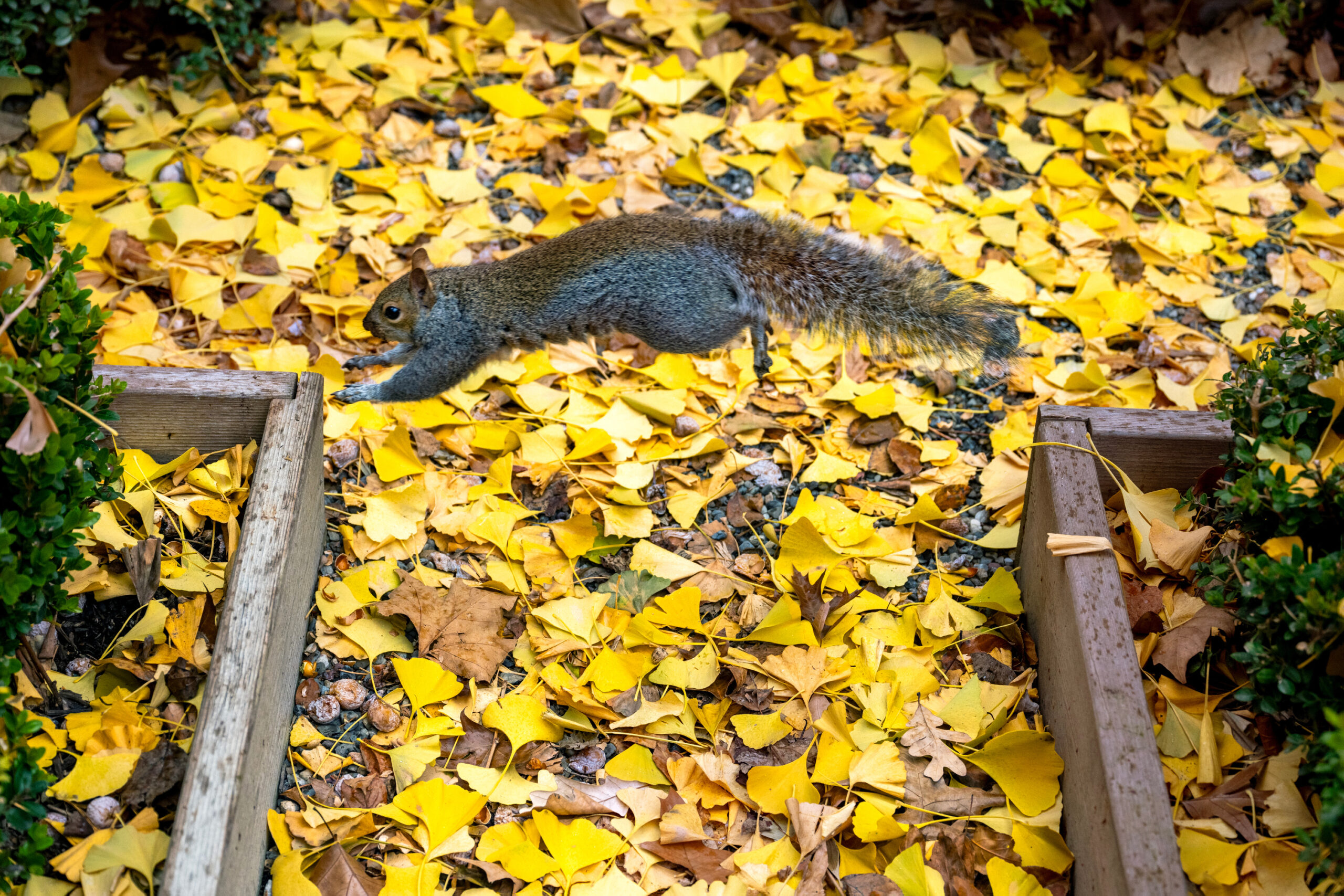
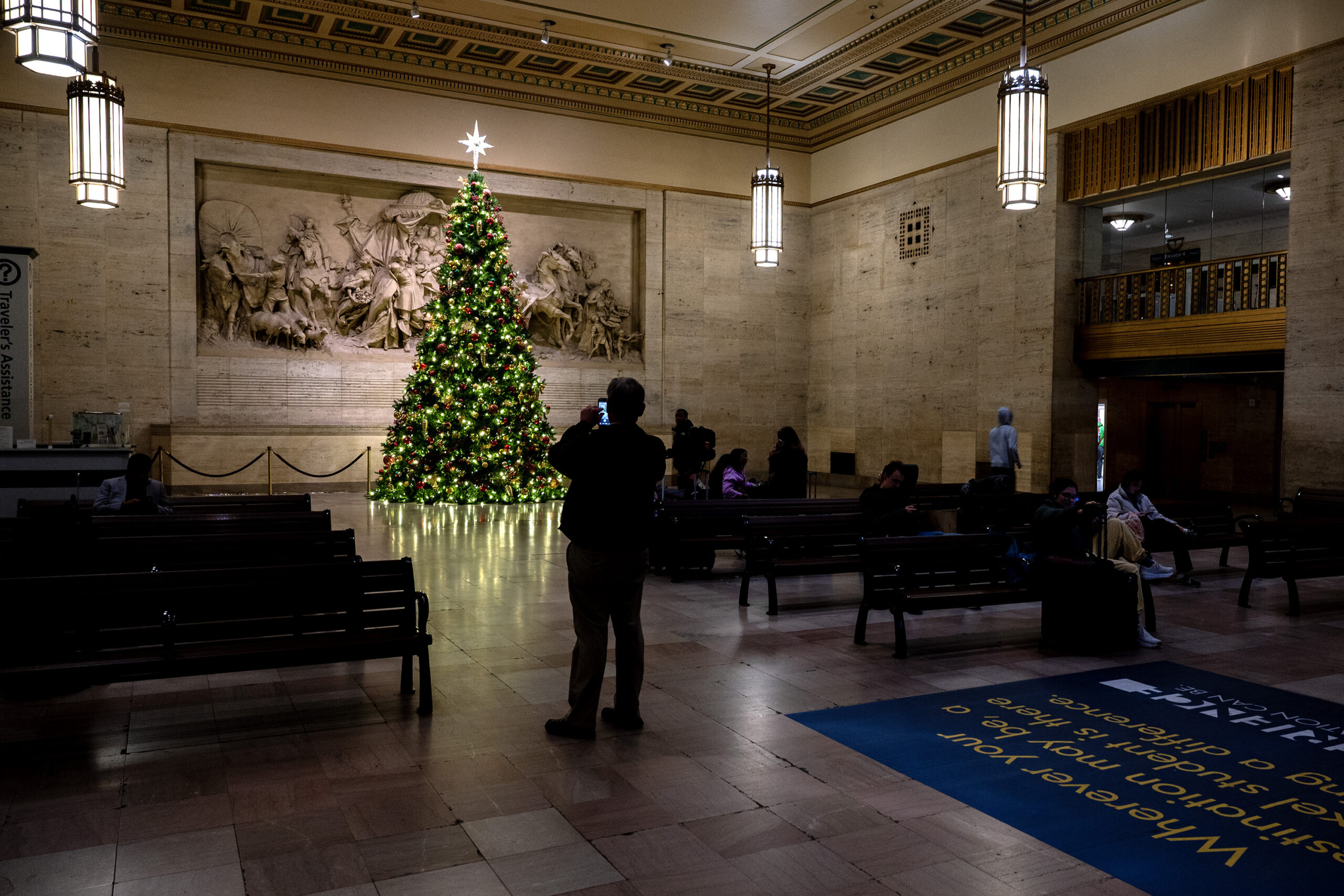
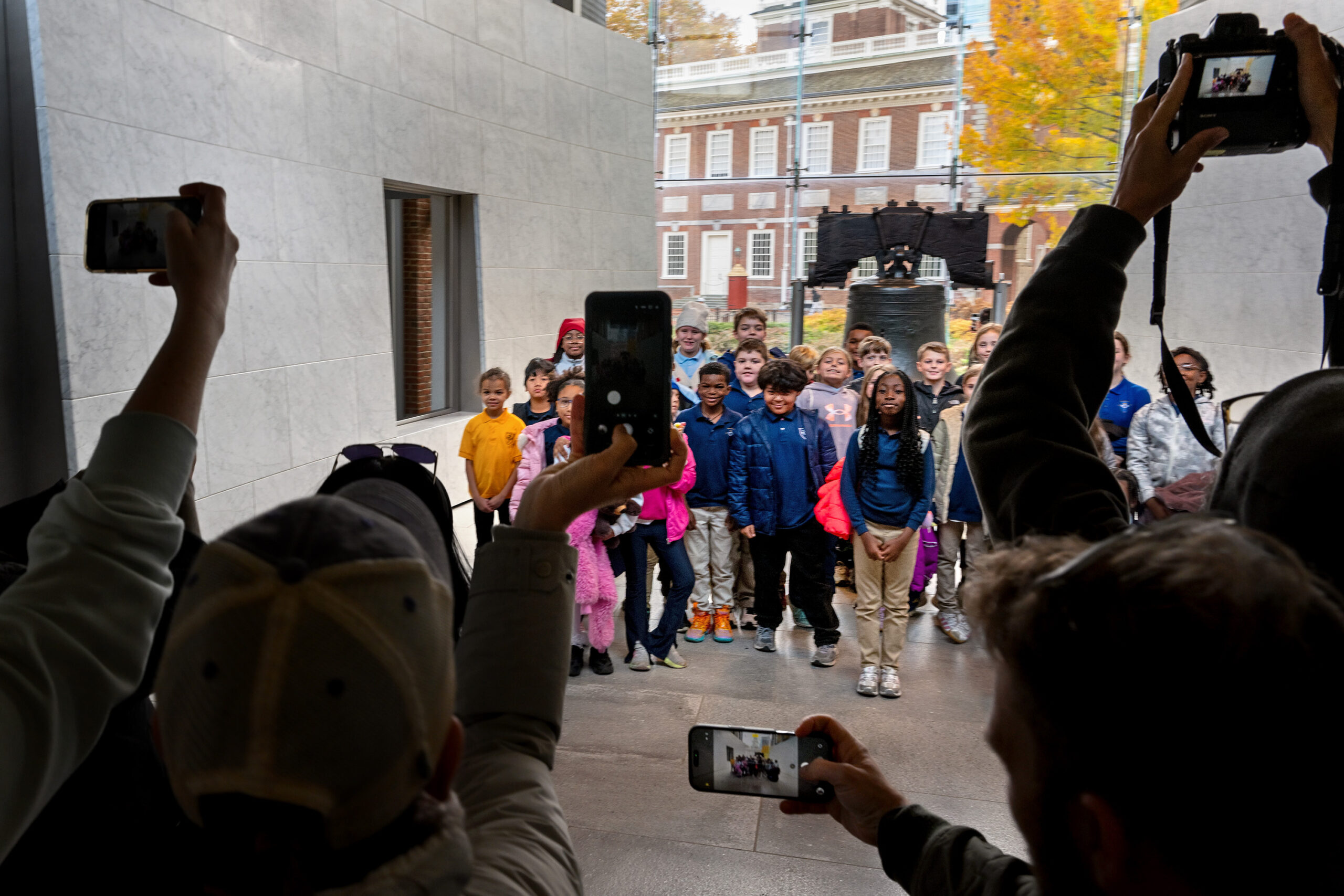
February 23, 2026: Bystanders at the President’s House try to prevent a “counter-protester” from ripping off notes posted by visitors where panels about slavery had been removed by President Donald Trump’s administration.February 16, 2026: What came first? The dirty snowpacked berm of frozen slush or the graffiti? February 9, 2026: Walking through a corrugated metal culvert called the “Duck Tunnel,” a pedestrian navigates the passageway under the SEPTA tracks on the Swarthmore College campus. February 2, 2026: A light-as-air Elmo balloon rolls along a sidewalk in Haddonfield, propelled by the wind as Sunday’s heavy snow starts to turn to ice and sleet. January 26, 2026: The President’s House in Independence National Historical Park hours Jan, 22, after all historical exhibits were removed following President Trump’s Executive Order last March that the content at national parks that “inappropriately disparage” the U.S. be reviewed. The site, a reconstructed “ghost” structure titled “Freedom and Slavery in the Making of a New Nation” (2010), serves as a memorial to the nine people George Washington enslaved there during the founding of America.January 19, 2026: A low-in-the-sky winter sun is behind the triangular pediment of the “front door” of the open-air President’s House installation in Independence National Historical Park. The reconstructed “ghost” structure with partial walls and windows of the Georgian home known in the 18th century as 190 High St. is officially titled, “Freedom and Slavery in the Making of a New Nation” (2010). It is designed to give visitors a sense of the house where the first two presidents of the United States, George Washington and John Adams, served their terms of office. The commemorative site designed by Emanuel Kelly, with Kelly/Maiello Architects, pays homage to nine enslaved people of African descent who were part of the Washington household with videos scripted by Lorene Cary and directed by Louis Massiah. Deepika Iyer holds her niece Ira Samudra aloft in a Rockyesque pose, while her parents photograph their 8 month-old daughter, in front of the famous movie prop at the top of the steps at the Philadelphia Art Museum. Iyer lives in Philadelphia and is hosting a visit by her mother Vijayalakshmi Ramachandran (partially hidden); brother Gautham Ramachandran; and her sister-in-law Janani Gautham who all live in Bangalore, India.January 5, 2026: Parade marshals trail behind the musicians of the Greater Kensington String Band heading to their #9 position start in the Mummers Parade. Spray paint by comic wenches earlier in the day left “Oh, Dem Golden Slippers” shadows on the pavement of Market Street. This year marked the 125th anniversary of Philly’s iconic New Year’s Day celebration.Dec. 29, 2025: Canada geese at sunrise in Evans Pond in Haddonfield, during the week of the Winter Solstice for the Northern Hemisphere. December 22, 2025: SEPTA trolley operator Victoria Daniels approaches the end of the Center City Tunnel, heading toward the 40th Street trolley portal after a tour to update the news media on overhead wire repairs in the closed tunnel due to unexpected issues from new slider parts.December 15, 2025: A historical interpreter waits at the parking garage elevators headed not to a December crossing of the Delaware River, but an event at the National Constitution Center. General George Washington was on his way to an unveiling of the U.S. Mint’s new 2026 coins for the Semiquincentennial, December 8, 2025: The Benjamin Franklin Bridge and pedestrians on the Delaware River Trail are reflected in mirrored spheres of the “Weaver’s Knot: Sheet Bend” public artwork on Columbus Boulevard. The site-specific stainless steel piece located between the Cherry Street and Race Street Piers was commissioned by the City’s Public Art Office and the Delaware River Waterfront Corporation and created and installed in 2022 by the design and fabrication group Ball-Nogues Studio. The name recalls a history that dominated the region for hundreds of years. “Weaver’s knot” derives from use in textile mills and the “Sheet bend” or “sheet knot” was used on sailing vessels for bending ropes to sails. November 29, 2025: t’s ginkgo time in our region again when the distinctive fan-shaped leaves turn yellow and then, on one day, lose all their leaves at the same time laying a carpet on city streets and sidewalks. A squirrel leaps over leaves in the 18th Century Garden in Independence National Historical Park Nov. 25, 2025. The ginkgo (Ginkgo biloba) is considered a living fossil as it’s the only surviving species of a group of trees that existed before dinosaurs. Genetically, it has remained unchanged over the past 200 million years. William Hamilton, owner the Woodlands in SW Phila (no relation to Alexander Hamilton) brought the first ginkgo trees to North America in 1785.November 24, 2025: The old waiting room at 30th Street Station that most people only pass through on their way to the restrooms has been spiffed up with benches – and a Christmas tree. It was placed there this year in front of the 30-foot frieze, “The Spirit of Transportation” while the lobby of Amtrak’s $550 million station restoration is underway. The 1895 relief sculpture by Karl Bitter was originally hung in the Broad Street Station by City Hall, but was moved in 1933. It depicts travel from ancient to modern and even futuristic times. November 17, 2025: Students on a field trip from the Christian Academy in Brookhaven, Delaware County, pose for a group photo in front of the Liberty Bell in Independence National Historical Park on Thursday. The trip was planned weeks earlier, before they knew it would be on the day park buildings were reopening after the government shutdown ended. “We got so lucky,” a teacher said. Then corrected herself. “It’s because we prayed for it.”
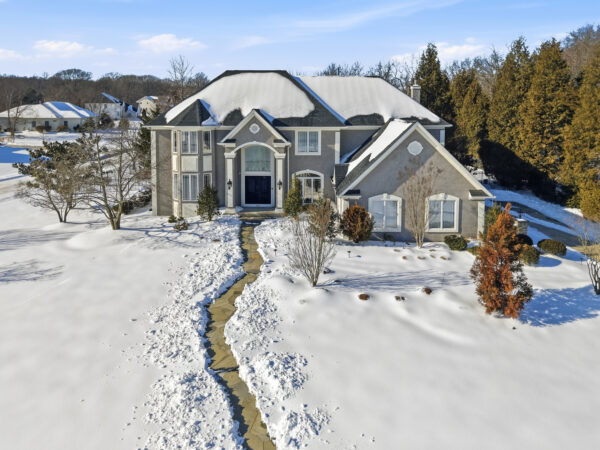
“It’s got him all over it,” said Lynne Stamm, a sales associate with Berkshire Hathaway HomeServices Fox & Roach, Realtors. “He put his heart and soul into the house as a young kid” who moved into the property when he was in his early 20s.
Cox, a Mississippi native, bought the house for $550,000 in 2014, according to Gloucester County property records.
Fletcher Cox’s design touches are seen throughout his Mullica Hill home, said the listing agent. They include this $15,000 chandelier in the foyer.
Since then, Cox, now 35, has regularly updated the home, Stamm said. He installed a $15,000 chandelier in the foyer and created “a complete resort area” in the backyard with a dark-finish pool, a built-in bar, and an outdoor kitchen with a pizza oven.
The home has four bedrooms, three full bathrooms, and two half bathrooms.
The first floor features a marble foyer, gourmet kitchen, comfortable living areas, and two-story windows that Stamm said let in abundant natural light.
The first floor of Fletcher Cox’s $1.5 million Mullica Hill home features two-story windows that let in abundant natural light.
On the second floor, the bedrooms include a large primary suite and a new Jack-and-Jill suite.
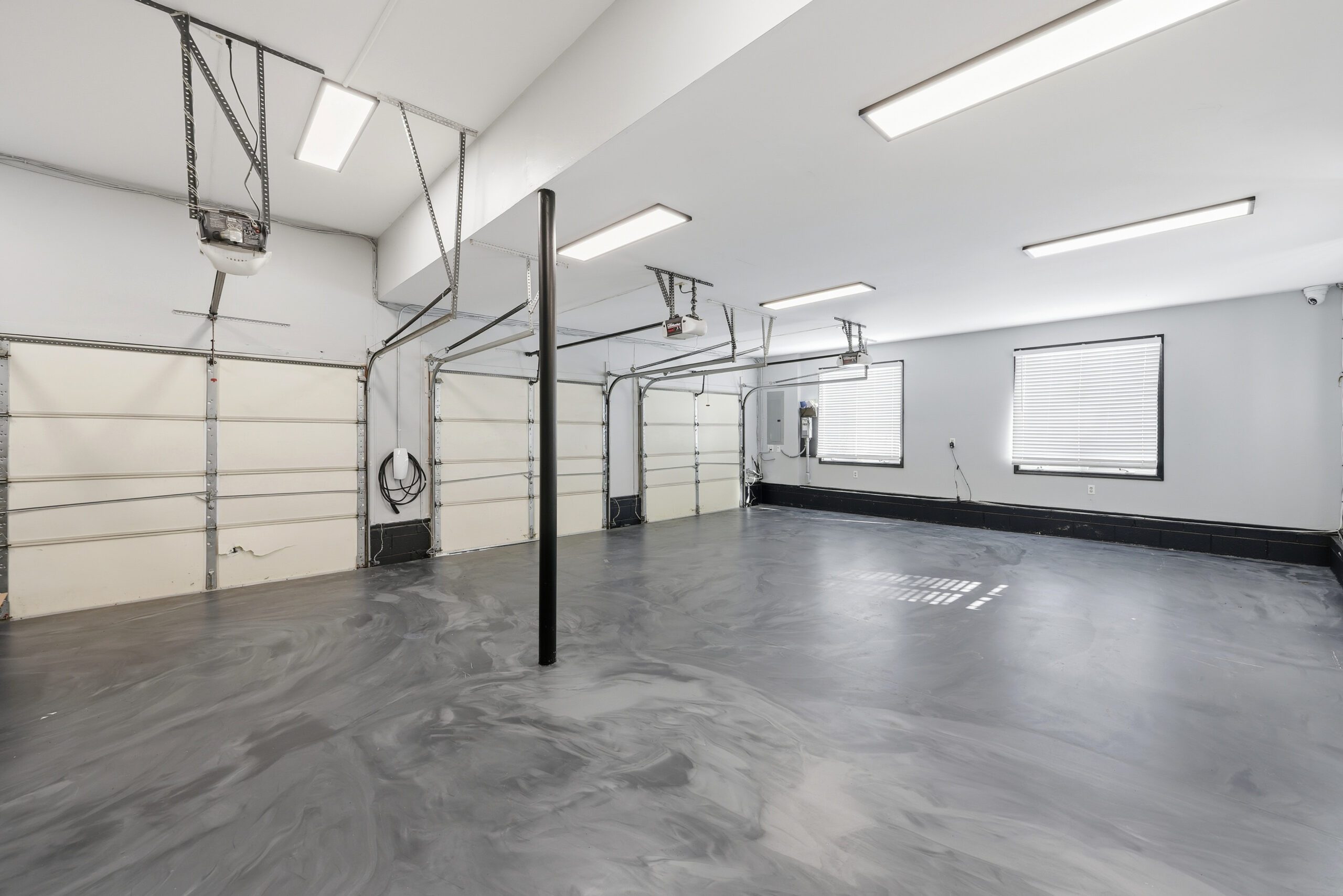
The basement, referred to in the listing as an “entertainment hub,” could be outfitted as a gym, home theater, and game room, with a pool table included as part of the sale. The house also has an epoxy-finished three-car garage.
With its open floor plan and indoor and outdoor gathering spaces, Stamm said the home would be ideal for a buyer “who really likes high-end entertaining.”
The property is also turnkey, she said, due to all the upgrades Cox made over the years.
Fletcher Cox’s Mullica Hill home includes an epoxy-finished three-car garage.
He loved the house so much that he was “reluctant” to sell, Stamm said. But the agent said Cox is excited about his new home, just a few miles away and nearly double the size, with an expansive pole barn for his race cars. Cox has owned a drag-racing team for about a decade and started driving in retirement.
His Mullica Hill home made headlines in 2019 when a man tried to break in with a baseball bat in search of his ex-girlfriend. Cox called 911 and told an operator that he was armed with a shotgun. The assailant fled but was later arrested and indicted on charges related to the incident, according to New Jersey court records.
State Rep. Steven Malagari (D., Montgomery) plans to introduce a bill that could put THC drinks in beer stores, while State Sen. Dan Laughlin (R., Erie), a major proponent of weed legalization — unlike his party’s leaders — is working on legislation that would open the door to hemp-derived THC being regulated like medical marijuana. Pennsylvania hemp businesses look toward these efforts with optimism, but as the clock races down, stakeholders are asking for urgency.
Representatives from the hemp, medical marijuana, and beer wholesaler industries spoke to state regulators at January’s Pennsylvania Farm Show about shielding the hemp industry from the Nov. 12 deadline that would outlaw all intoxicating hemp products, including Delta-9 THC and CBD, which is what the majority of hemp is grown for in Pennsylvania. Under new rules, many of the state’s hemp farmers would be out of business by fall.
Across all competing interests, industry representatives said one thing was clear: Lawmakers need to regulate the billion-dollar state hemp market.
Testifying before the Center for Rural Pennsylvania, stakeholders, including Montgomery County District Attorney Kevin Steele, agreed, stressing the need for safeguards.
“It’s not about taking away people’s livelihoods in hemp farming and people working in this industry,” Steele said during his testimony. “It’s about community safety and establishing guardrails through legislation to oversee that safety.”
But, as Congress disagrees on when and if it will regulate hemp-derived THC — including if the ban deadline should be extended — those delays cascade to the states, where local lawmakers await federal guidance before regulating it themselves. While any state proposals for regulation are purely speculative until Congress passes hemp legislation, Laughlin’s and Malagari’s efforts in Pennsylvania imagine what is possible.
It is important to note, however, that regulating intoxicating hemp products is an uphill battle in a state where recreational marijuana legalization is opposed by Republican state leadership.
Whether these bills become law or save the state’s hemp industry as it currently stands is up in the airwith federal delays, but local hemp businesses choose to be optimistic.
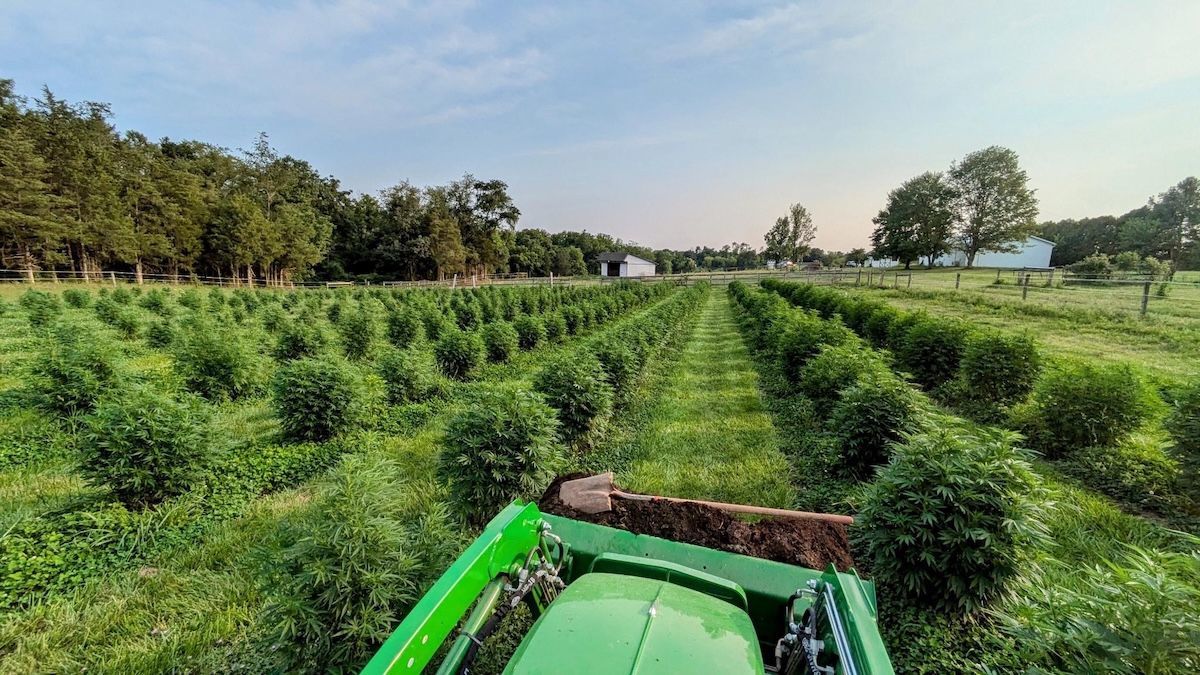
A view of Tyler Shannon’s Adams County hemp farm. Unless regulations change, he will have to shut down his hemp farm by next year.
What does any of this mean for Pennsylvania hemp?
For Tyler Shannon, an Adams County hemp farmer, a full ban on hemp products would be devastating. With the vast majority of Pennsylvania’s hemp grown for cannabinoids, such as Delta-9 THC and CBD, it means that “if hemp is not saved, my family will lose everything, including our farm,” Shannon said.
Shannon is not alone. Beau Whitney, a leading cannabis market analyst who testified at the January hearing, estimated that Pennsylvania’s cannabinoid market generates just under $1 billion in revenue annually. In his latest report, he found that the majority of Pennsylvania’s hemp-derived THC and CBD products were sold “legally” through semi-regulated channels, in stores or online. “As a result, there were 9,500 jobs, generating $382 million in wages in Pennsylvania,” Whitney said.
Those in the local hemp industry are confident that a deadline extension will help protect them, but planting season is fast approaching, while hemp farmers have no reassurance that their crops will be legal come fall, Shannon said. His family farm is holding off on a planned $175,000 facility expansion due to the looming ban.
As of now, no federal or state legislation has been passed to avert the impending doomsday scenario for hemp, and despite the constant regulatory discussions, small hemp farmers and businesses don’t feel on solid ground, Sebastian Stelmach of Manayunk’s Keystone Dispensary said.
“It’s just scary to think that come November, I might be unemployed and close up shop,” Stelmach said. “A lot of lawmakers realize that we can’t let this industry die. I believe that they’re going to do something, but what that is, I don’t know.”
Trade organizations, like the U.S. Hemp Roundtable, are lobbying Congress to extend the federal ban deadline by one year, giving regulators time to flesh out less restrictive standards for hemp products.
“Even [federal agencies] said they don’t have enough time to enforce the rules under the current bill,” said Jonathan Miller, U.S. Hemp Roundtable’s general counsel. “We’ve created a mess here, and we really need this extension to be more deliberate and responsible.”
In this 2019 file photo, Steve Groff is getting ready to harvest his first crop of hemp plants at his farm in Holtwood, Lancaster County.
Intoxicating hemp regulated like marijuana
Laughlin’s bill to establish a Cannabis Control Board would see the state’s medical marijuana program come under new oversight, similar to the liquor and gaming control boards.
While hemp is not the primary focus of that legislation, organizations like the Pennsylvania Cannabis Coalition (PCC), which represents the state’s medical marijuana industry, hope to see hemp included in Laughlin’s bill to open the doors for more responsive hemp regulation.
“The Cannabis Control Board would have the authority to deal with hemp products and decide what is safe for consumers as a single regulatory body,” said Meredith Buettner, executive director of PCC. Buettner said it makes the most sense for intoxicating hemp products to be regulated alongside cannabis.
Laughlin argues that “if it’s a consumable cannabis product, it should fall under one clear regulatory structure.”
How and where specific hemp THC products would be sold will be worked out in the legislation, but “intoxicating products should be sold through appropriate, regulated channels,” he said.
Jake Sitler, who owns Lancaster-based Endo THC drinks and testified at the January regulatory hearing, is ready to support any regulation that saves the current hemp framework, like incorporating hemp into a control board, but worries small businesses will get cut out of the deal.
“The hemp industry concern is where our seat is at the table and to make sure new laws are appropriate for our farmers and our industry,” Sitler said. “And that any new regulation isn’t used as a guise to out-regulate small business down the road.”
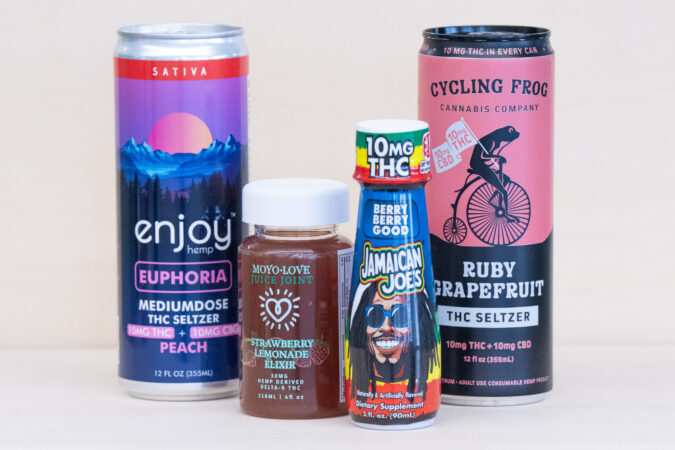
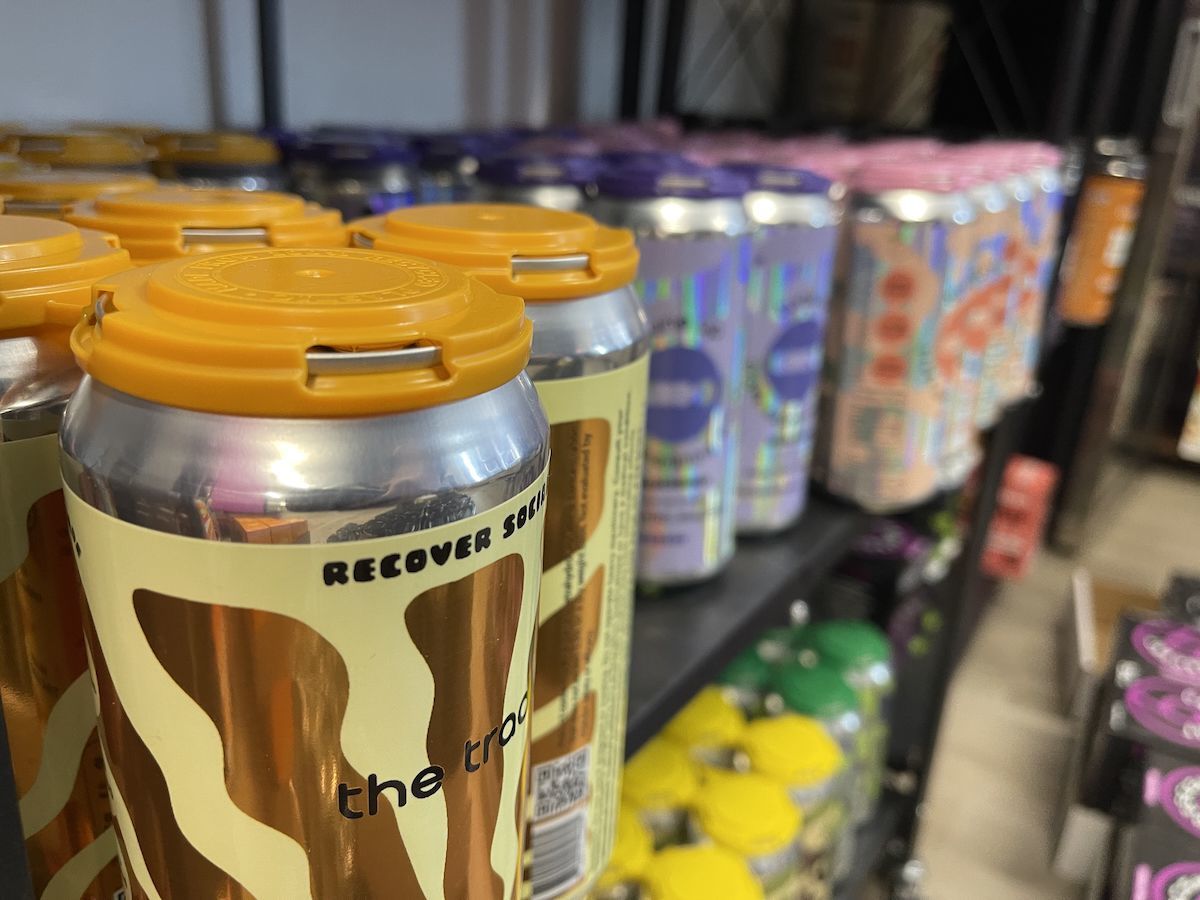
THC and CBD-infused beverages on the shelves of Free Will Collective, an Ardmore smoke shop and wellness store owned by Will Angelos. As Congress moves to ban most intoxicating hemp products, business owners like Angelos aren’t sure they will be able to keep the doors open long past 2027 if current regulations go into effect.
Delta-9 THC drinks in Pennsylvania beer stores
The bill from Malagari would carve out regulation for hemp-derived Delta-9 THC drinks, which are among some of the most popular intoxicating hemp products, with a national market of $1.5 billion in annual sales.
Malagari, who previously worked in beverage wholesale, wants to see THC drinks regulated similarly to beer and malt-beverage products in Pennsylvania.
Pennsylvania operates a three-tiered system for beer, with licenses at the manufacturing level, distribution level, and retail level. THC drinks would be incorporated into this system, which would begin by allowing established three-tiered license holders to manufacture and sell hemp-derived Delta-9 THC drinks.
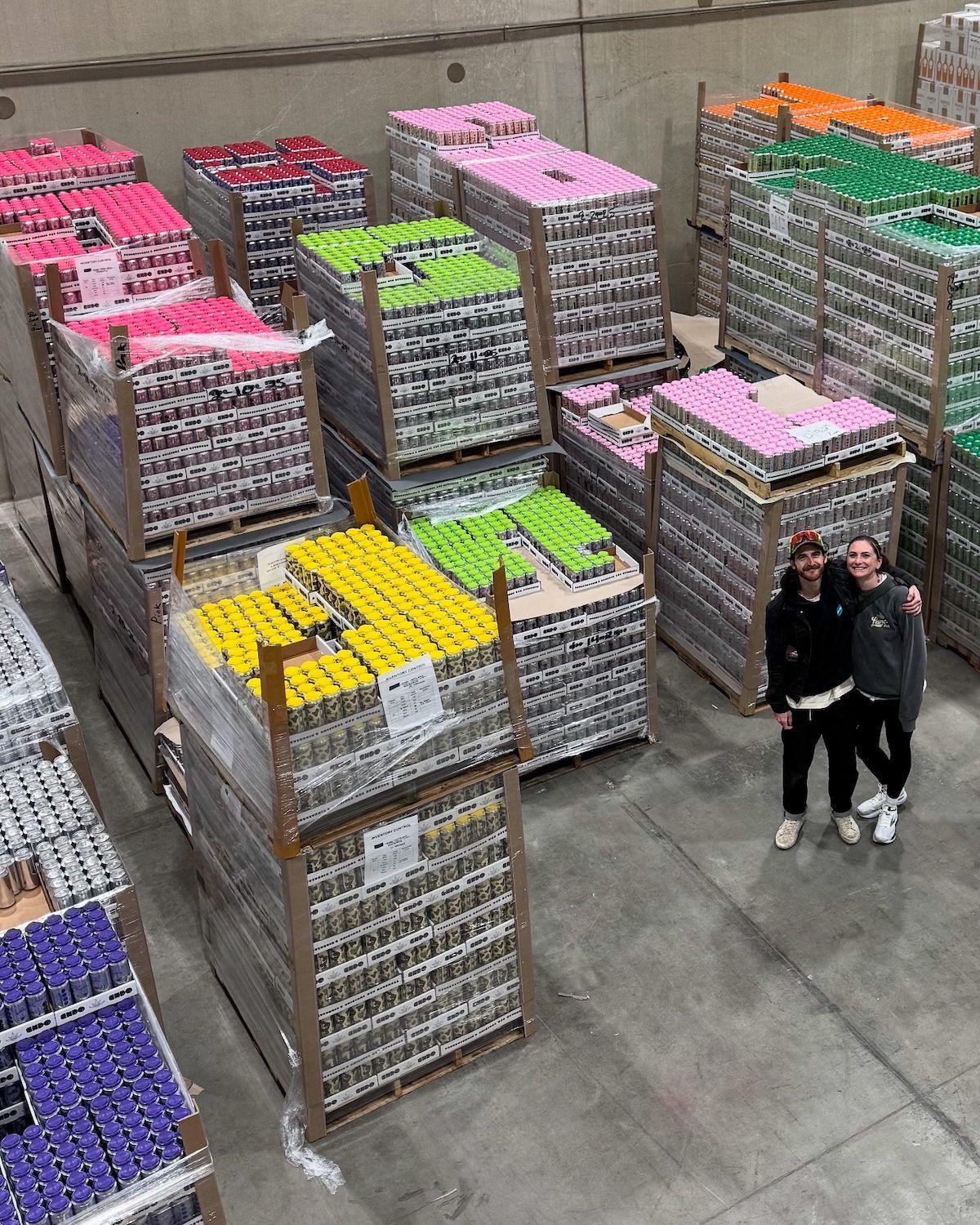
Jake Sitler and his wife, Jamie, standing inside the Endo drinks warehouse. The Lancaster couple founded one of Pennsylvania’s first hemp-derived THC drinks and is grappling with the fact that their business might have to shut down if Congress doesn’t rework its hemp regulations.
Common retail spaces for beer and malt beverages include beer distributors, grocery stores, restaurants, and bars.
This legislation, if passed and signed into law, would not prohibit THC drinks from being sold in medical marijuana dispensaries and could work alongside Laughlin’s CCB bill, Malagari said. But he believes that lawmakers should approach THC beverages differently from hemp-derived flower and vapes.
As an owner of a hemp beverage company, Sitler could benefit from Malagari’s bill, but also wonders if it is too early for beverage carve-outs before a fuller state framework is in place. “A hemp beverage bill with no overarching regulation is putting the cart a bit before the horse,” Sitler said.
New Jersey joined the growing list of states sued by the Department of Justice after refusing to share personal information of voters with President Donald Trump’s administration because of privacy concerns.
The Justice Department sued New Jersey on Thursday alongside Utah, Oklahoma, Kentucky, and West Virginia as it escalates its effort to obtain voter data. It previously sued Washington, D.C., and 24 other states, including Pennsylvania.
The suits follow Trump’s rhetoric in recent weeks about the need to “nationalize elections.” During his State of the Union address to a joint session of Congress this week, the president repeated the unsubstantiated allegation that “cheating is rampant in our elections.”
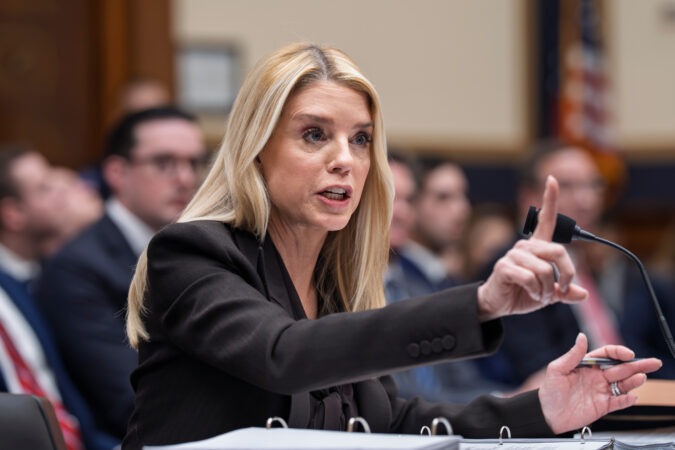
The lawsuit in the New Jersey District Court accuses Dale Caldwell, who is serving as the Garden State’s lieutenant governor and secretary of state, of violating Title III of the Civil Rights Act of 1960 by refusing to hand over the list of the state’s registered voters to U.S. Attorney General Pam Bondi.
“Accurate, well-maintained voter rolls are a requisite for the election integrity that the American people deserve,” Bondi said in a statement. “This latest series of litigation underscores that This Department of Justice is fulfilling its duty to ensure transparency, voter roll maintenance, and secure elections across the country.”
Caldwell’s office did not immediately respond to a request for comment.
Acting New Jersey Attorney General Jennifer Davenport said the state would defend against the lawsuit in court.
“As several courts have already held, the Department of Justice’s request for voters’ personal information, including driver’s license numbers and Social Security numbers, is baseless,” Davenport’s statement said. “We are committed to protecting the privacy of ours state’s residents.”
Bondi sent a letter to Caldwell on July 15 asking for the statewide voter registration list, the suit says. The letter cited alleged discrepancies in New Jersey’s voting registration statistics compared to national averages. For example, it says the state removes fewer duplicates from its voter rolls.
A month later, the suit says, Bondi sent another letter asking for the full list including each voter’s full name, date of birth, address, and driver’s license or last four digits of their Social Security number.
In the months following the August letter, former state Attorney General Matthew Platkin declined to share the information because of privacy concerns — a reason Pennsylvania officials have also cited.
After the administration of Gov. Mikie Sherrill took office in January, DOJ sent a “courtesy email” to check if the state’s position on sharing the records has changed. But it didn’t.
The suit is asking a federal judge to find that Caldwell violated federal law by refusing to share the records and order the state to pass over the information.
Schmidt called the department’s request “unprecedented and unlawful” and promised to “vigorously fight the federal government’s overreach in court.”
“I have an obligation to protect the personal information that Pennsylvania voters entrust us with, and I take that obligation extremely seriously,” Schmidt said in a September statement.
The voter roll lawsuit is the second filed by the Justice Department against New Jersey this week. Bondi sued Sherrill on Tuesday over a Feb. 11 executive order that prohibits state agencies to allow federal immigration agents from entering state property for enforcement actions without a warrant.
The lawsuit said the executive order would disrupt the ability of U.S. Immigration and Customs Enforcement to capture “dangerous criminals” who are in prisons or courthouses controlled by the state.
Davenport said in a Tuesday statement that the state would continue to ensure the safety of the immigrant communities.
“Instead of working with us to promote public safety and protect our state’s residents, the Trump administration is wasting our resources on a pointless legal challenge,” Davenport’s statement said.
Adventure Aquarium in Camden on Thursday unveiled three Little Blue Penguin chicks that hatched earlier this month.
Little Blue Penguins are the smallest species of penguin in the world — they are also called “fairy penguins” because of their diminutive size — and are naturally found along the coastlines of southern Australia and New Zealand.
At the Adventure Aquarium, the first chick — a male — hatched on Feb. 2, aquarium officials said. A female hatched the next day, and a second male arrived on Feb. 5.
The first chick is the offspring of Sheila and Spud, who are also the parents of Tater Tot (hatched 2023), Kiwi (2024), and Saquon (2025). This is Sheila’s 10th chick.
The younger chicks were born to Maremma and Bloke, who are also experienced parents. Their offspring include Lovie, hatched in 2024, and Griffin, hatched in 2021.
“Sheila and Spud are successful, proven parents and are once again doing a wonderful job with their chick, nicely allowing the biologists in the nest each morning to check on the chick’s growth,” Jamie Becker, biologist on the aquarium’s birds and mammals team, said in a statement.
“Maremma and Bloke have been doing a great job taking care of two chicks and are very protective parents,” Becker said.
The new chicks join 19 members of the Little Blue Penguin colony at Adventure Aquarium. The three chicks have been transitioned from parental care to biologist care in a nursery area, aquarium officials said,
Once they are fully grown and have developed juvenile waterproof feathers, they will gradually be introduced back into the colony.
Readers were asked to draw a line where they believed South Jersey starts. Here is every individual submission we received. As you can see, the lines are scattered across the state, but there is a focus on the center of the state.
In the end, the average divider marking South Jersey sat near Burlington, Trenton, and just south of Toms River.
There were many factors that influenced where people drew their line, from using towns and counties to highways and area codes as boundaries.
I-195 was a popular point of division. “The dividing line in my mind is I-195, which goes from around Trenton east to the shore,” Will Dean from South Jersey wrote.
story continues after advertisement
Cultural factors also played a role. Eagles or Giants? Phillies or Mets? Flyers or Devils? Taylor ham or pork roll?
According to an analysis of Twitter accounts and what teams they follow, the county divide between Eagles fans and Giants fans tracks very closely with where readers drew the line.
After readers answered where South Jersey starts, we asked the more controversial question: Does Central Jersey exist? An overwhelming 74% of readers said that it did.
If a reader said yes, we challenged them again to draw the line between North and Central Jersey. Every line represents a submission.
Rebecca Overholt, a reader who has lived in all regions of the state, said of Central Jersey: "You get NYC and Philly stations in both TV and radio. You can find Eagles fans, Giants fans, and Jets fans all on the same block, and the only reason they get along is the jerk who flies a Dallas flag.”
Julie Lawson, another reader from South Jersey, weighed in, saying: “South and North Jersey are distinctly different. Central Jersey is amorphous and sort of exists where the two mix, sort of like the brackish water between fresh and saltwater.”
The average line was south of Hillsborough and New Brunswick.
“Happy to see a majority think Central Jersey exists because it does. I'd argue that New Brunswick is the dividing line; its county name, MIDDLEsex, screams Central Jersey,” said Tim Quinn, a Central Jersey reader.
As you can see, we are far from reaching a consensus here.
Maybe the one point New Jerseyans can agree on is best said by reader Ryan Wall: “Regardless of whether or not people believe Central Jersey exists, one thing everyone in the Garden State can agree on is that it's the greatest place in the world to call home. Lest we forget: ‘We're from Jersey, baby, and you're not.’”
What should we settle next?
Staff Contributors
Design, development, data, and reporting: Garland Fordice
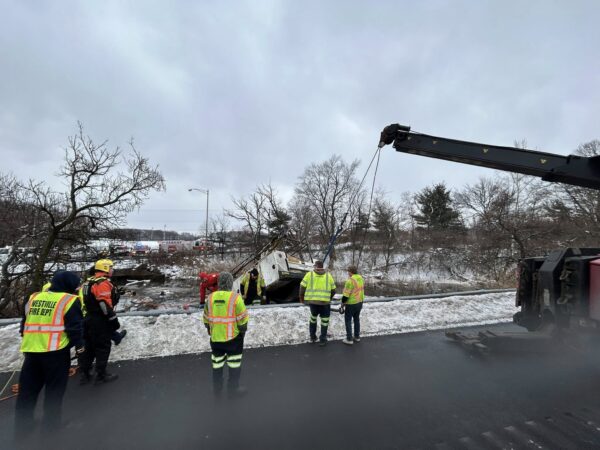
Just before 7:30 a.m., the utility truck and passenger vehicle collided along I-295 northbound and overturned into the Hessian Run Tributary near West Deptford High School, officials said.
The occupants were transported to a hospital to be treated for injuries that were not life-threatening, officials said.
The wreckage caused a “significant leak” of fuel into the tributary, and that prompted a response from county hazmat crews to assist firefighters at the scene, officials said. The U.S. Coast Guard and the New Jersey Department of Environmental Protection were also notified of the incident.
All road lanes closed for the emergency response were reopened by 1 p.m., officials said.
The Atlantic City International Airport will soon offer even more southbound flights.
Breeze Airways, a budget carrier founded in 2021, is set to add direct flights between A.C. and Tampa twice a week starting this summer, the company announced Tuesday.
The routes will be offered on Wednesdays and Saturdays beginning July 1, according to Breeze, and fares for a one-way ticket will start at $79 per person.
The airline announced the new route to and from the Jersey Shore along with more than a dozen other nonstop flights nationwide.
Breeze Airways is adding nonstop flights from Atlantic City to Tampa twice a week starting in July.
“The addition of these new cities and routes will give even more travelers the opportunity to save precious hours that would otherwise be spent flying through hubs or driving,” David Neeleman, Breeze Airways’ founder and CEO, said in a statement, noting his company’s mission to offer affordable airfare in underserved markets. Neeleman has founded four other airlines, including JetBlue.
Last month, Breeze announced new nonstop service from Atlantic City to Charleston, S.C., and Raleigh-Durham, N.C., as well as a flight to Tampa, Fla., that includes a stopover.
The Charleston flights are set to be offered on Wednesdays and Saturdays starting May 6. And the Raleigh-Durham and stopover Tampa routes are scheduled for Thursdays and Sundays starting June 11.
All Breeze flights out of Atlantic City can be booked online now at flybreeze.com.
Breeze Airways is a private company, so it is not required to publicly report its finances. Last year, however, the airline announced that it had turned a profit for the first time in the fourth quarter of 2024, a period in which the company generated more than $200 million in revenue.
The Utah-based carrier has expanded in recent years, now operating more than 300 routes, including seasonal flights, to 86 cities in the U.S., Mexico, and the Caribbean.
Breeze is one of only a few major airlines that operate a dozen or so flights in and out of Atlantic City every day, depending on the season.
American Airlines allows passengers to go through security in Atlantic City and then get on a bus to catch flights at the Philadelphia International Airport.