Category: New Jersey News

  • Removing history next to the Liberty Bell

    Removing history next to the Liberty Bell

    I have walked through Independence National Historical Park many times looking at the many interpretive panels, exhibits and historical materials after President Donald Trump’s March 27, 2025 Executive Order 14253.
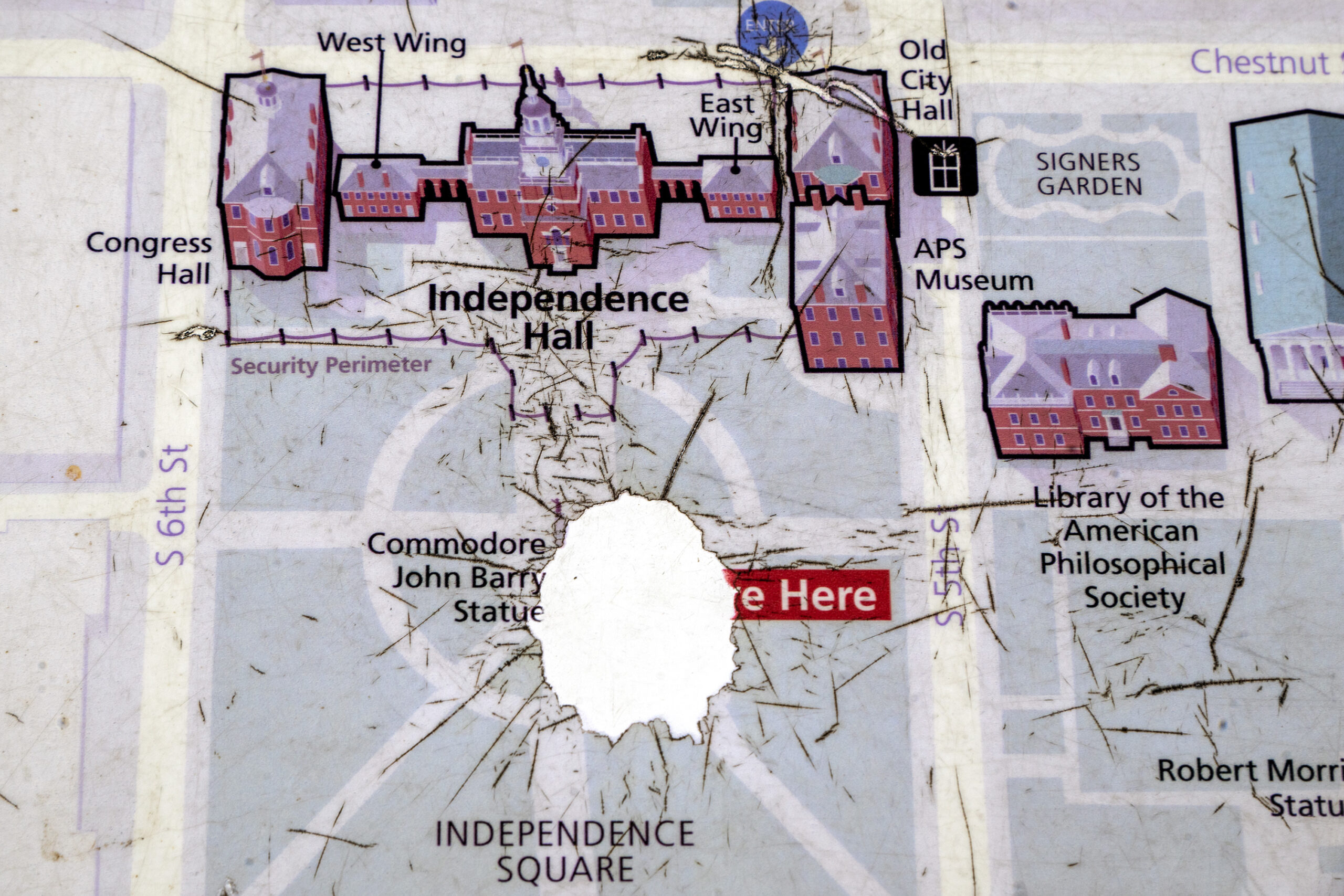
    “You Are Here” sign in the square behind Independence Hall July 23, 2025.

    Titled “Restoring Truth and Sanity to American History,” the order directed the Department of the Interior, which oversees the National Park Service, to review over 400 national sites to remove or modify interpretive materials that it deems “inappropriately disparage Americans past or living (including persons living in colonial times).” The order aimed to focus on the “greatness of the achievements and progress of the American people.”

    At first I looked at the many interpretive panels, videos, exhibits and historical materials in Independence Hall, Liberty Bell Center, President’s House and Ben Franklin Museum, wondering which ones the Interior Secretary might identify that “perpetuate a false reconstruction of American history, inappropriately minimize the value of certain historical events or figures, or include any other improper partisan ideology.”

    An Uncle Same hatted headband is left on a park bench Philadelphia’s Historic District during the Independence Day weekend celebrations Jul. 2, 2025.

    I took a lot of photos, but realized there wasn’t a way I could write a caption reading, “the administration doesn’t like what this panel says about slavery.” So I put any photos I made in a file for later use.

    In July, the New York Times broke the story that employees of the National Park Service had been flagging descriptions and displays at scores of parks and historic sites around the country for review — and they had examples of a few here in Philadelphia.

    The next day, armed with the specific panels at the Liberty Bell and the President’s House they reported, I went back and re-photographed them all for our own story.

    My colleague Fallon Roth obtained and reviewed the internal comments submitted by NPS employees here with many more details so in the following days I made many more photos.

    I was even told to re-photograph some panels for a third time, grumbling (to myself) when told “we need higher resolution versions, shot head on, without any distortion,” for an interactive project. Which, I had to admit later (again, to myself) turned out great!

    The President’s House came under particular scrutiny, and the removal of noncompliant displays was initially slated to come on Sept. 17.

    I went back many times, through protests and even the federal government shutdown.
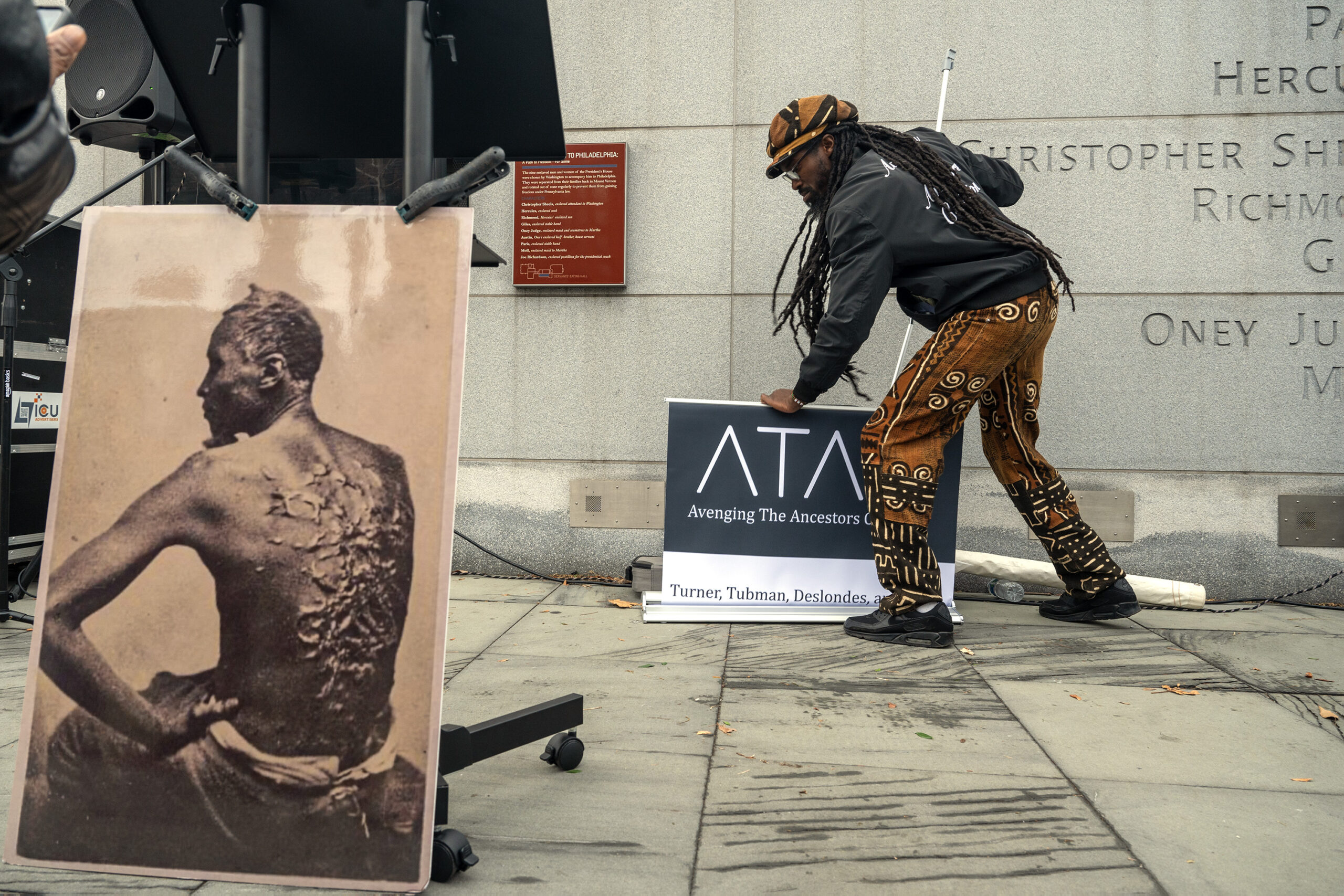
    Farugh Maat, with Avenging the Ancestors, Coalition, takes down signs at the President’s House exhibit following a ceremony on the site Dec. 21, 2025 marking the 15th anniversary of its opening. The photo at left, known as “The Scourged Back” is copy of one that was removed from display at Fort Pulaski National Monument in Georgia following an order from President Trump’s “disparaging” executive order.

    The administration’s deadline came and went. We got tips that signs had been altered, but I checked, and nothing actually happened. Until Thursday.

    I was on assignment near Independence Hall, and as always, walked through the President’s House. It was quiet except for a local TV news crew using Independence Mall as a location for their report on this weekend’s coming winter storm.

    Later while editing that assignment, we got a tip that workers with tape measures where looking and poking around “behind the panels” there. I rushed down where my colleague Maggie Prosser was already asking them what they were up to.

    It wasn’t long before it finally happened.

    I photographed the entire removal, and was joined by photographer Elizabeth Robertson who even made an overall photo from our newsroom overlooking the site.

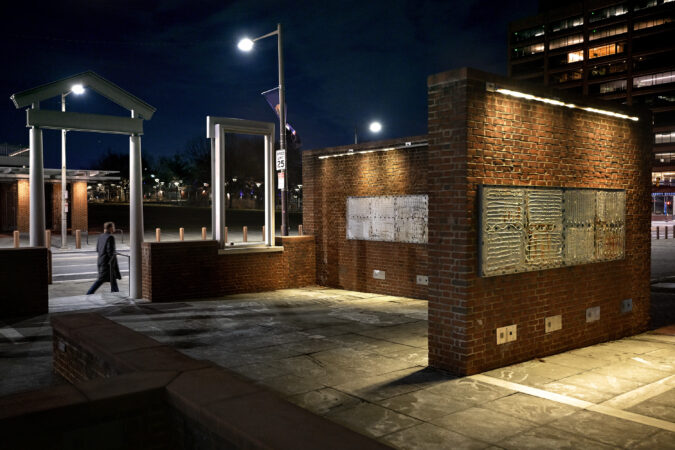
    Finally, I ended up returning after dark, just because.
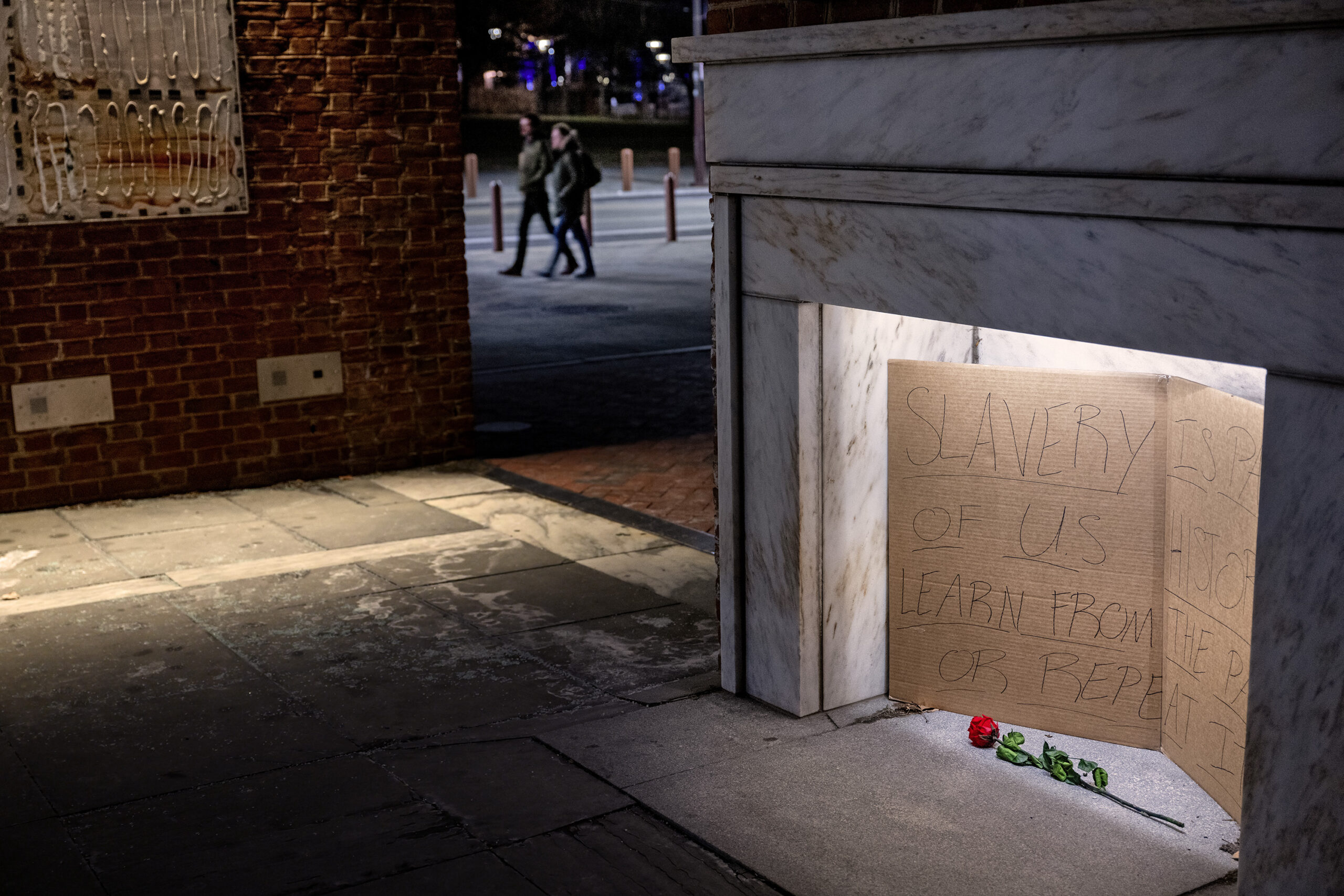
    A single rose and a handwritten cardboard sign – “Slavery is part of U.S. history learn from the past of repeat it”- are inside an empty hearth at the President’s House site Thursday night, Jan. 22, 2026 after workers removed display panels.

    Since 1998 a black-and-white photo has appeared every Monday in staff photographer Tom Gralish’s “Scene Through the Lens” photo column in the print editions of The Inquirer’s local news section. Here are the most recent, in color:

    January 19, 2026: A low-in-the-sky winter sun is behind the triangular pediment of the “front door” of the open-air President’s House installation in Independence National Historical Park. The reconstructed “ghost” structure with partial walls and windows of the Georgian home known in the 18th century as 190 High St. is officially titled, “Freedom and Slavery in the Making of a New Nation” (2010). It is designed to give visitors a sense of the house where the first two presidents of the United States, George Washington and John Adams, served their terms of office. The commemorative site designed by Emanuel Kelly, with Kelly/Maiello Architects, pays homage to nine enslaved people of African descent who were part of the Washington household with videos scripted by Lorene Cary and directed by Louis Massiah.
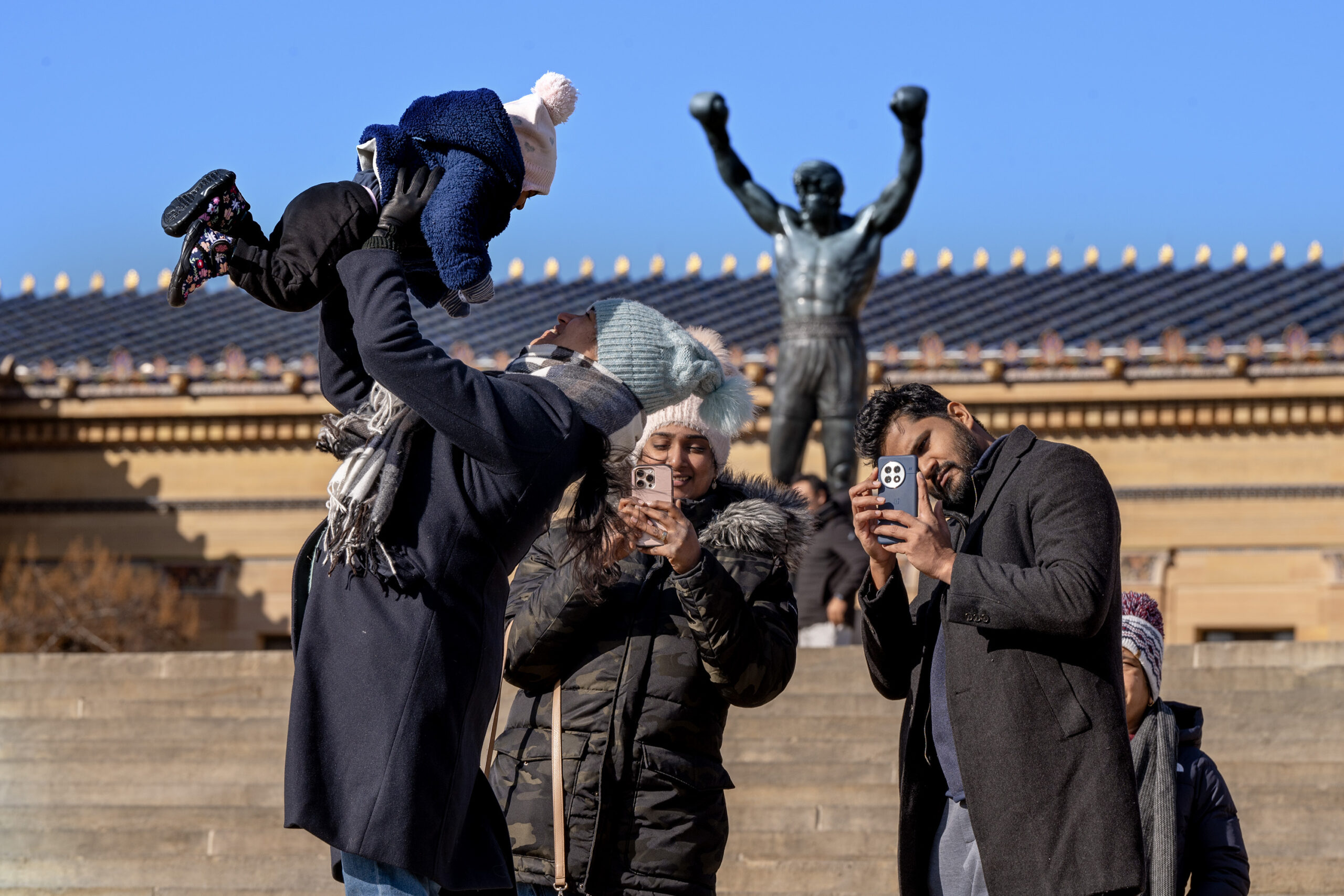
    Deepika Iyer holds her niece Ira Samudra aloft in a Rockyesque pose, while her parents photograph their 8 month-old daughter, in front of the famous movie prop at the top of the steps at the Philadelphia Art Museum. Iyer lives in Philadelphia and is hosting a visit by her mother Vijayalakshmi Ramachandran (partially hidden); brother Gautham Ramachandran; and her sister-in-law Janani Gautham who all live in Bangalore, India.
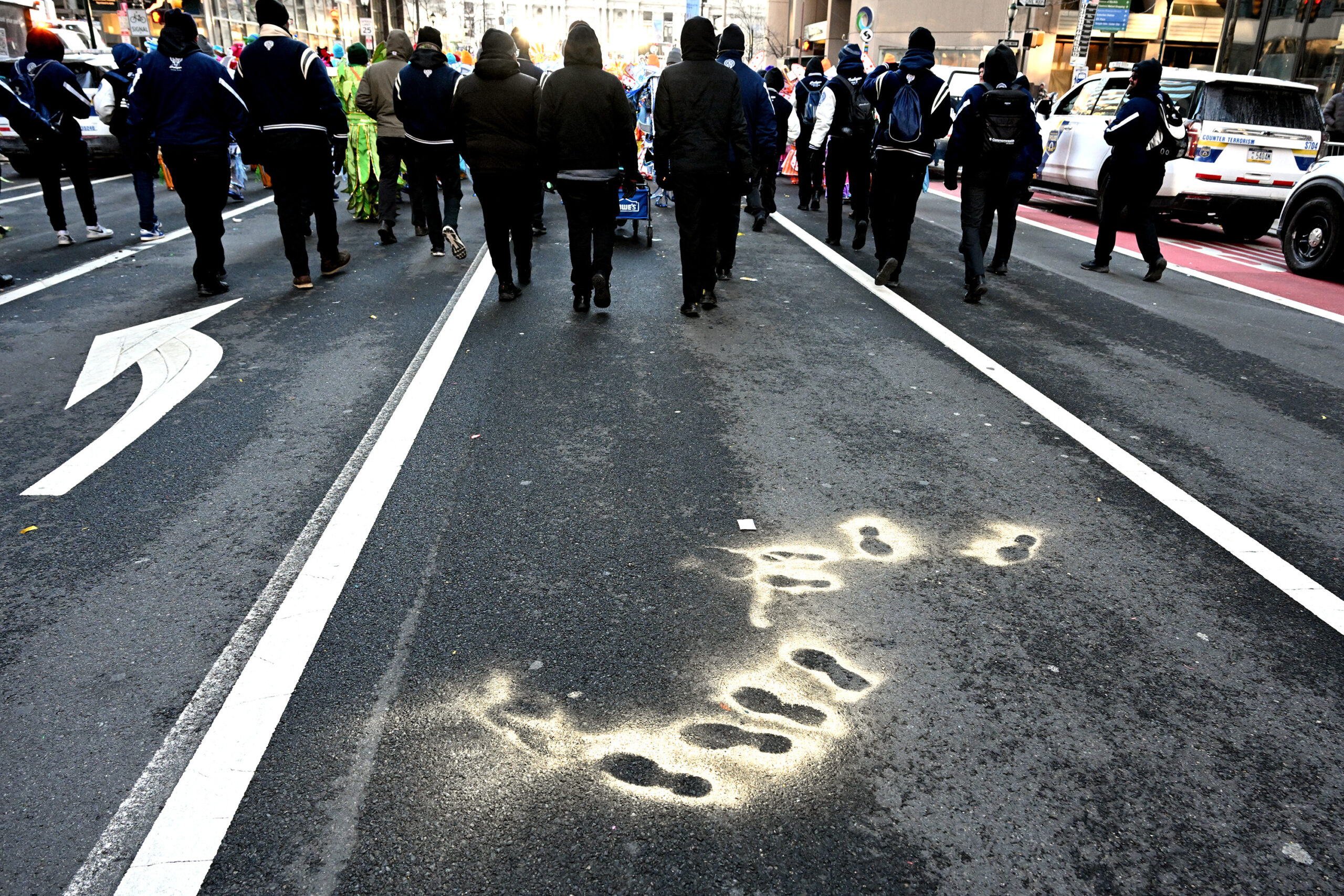
    January 5, 2026: Parade marshals trail behind the musicians of the Greater Kensington String Band heading to their #9 position start in the Mummers Parade. Spray paint by comic wenches earlier in the day left “Oh, Dem Golden Slippers” shadows on the pavement of Market Street. This year marked the 125th anniversary of Philly’s iconic New Year’s Day celebration.
    Dec. 29, 2025: Canada geese at sunrise in Evans Pond in Haddonfield, during the week of the Winter Solstice for the Northern Hemisphere.
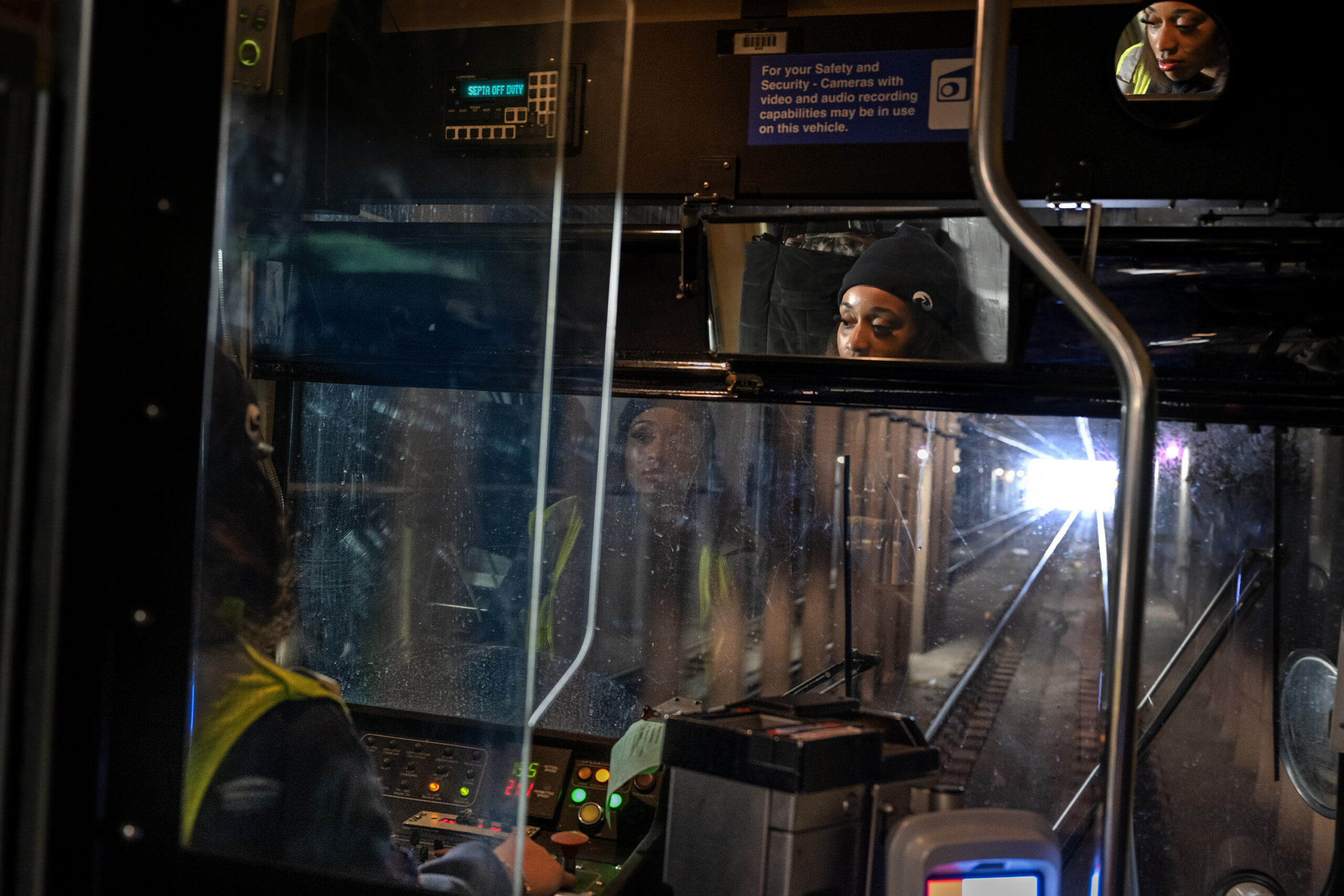
    December 22, 2025: SEPTA trolley operator Victoria Daniels approaches the end of the Center City Tunnel, heading toward the 40th Street trolley portal after a tour to update the news media on overhead wire repairs in the closed tunnel due to unexpected issues from new slider parts.
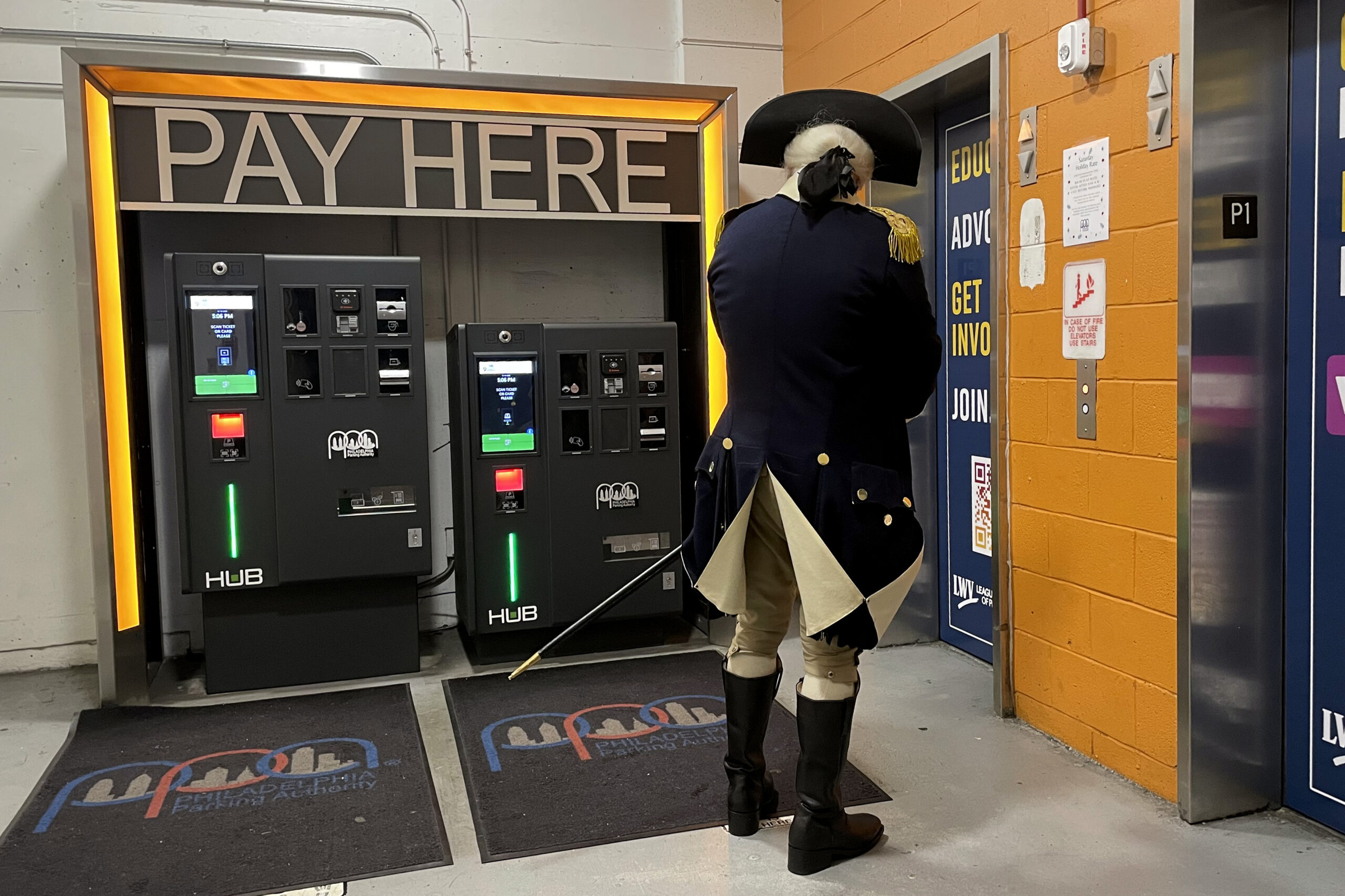
    December 15, 2025: A historical interpreter waits at the parking garage elevators headed not to a December crossing of the Delaware River, but an event at the National Constitution Center. General George Washington was on his way to an unveiling of the U.S. Mint’s new 2026 coins for the Semiquincentennial,
    December 8, 2025: The Benjamin Franklin Bridge and pedestrians on the Delaware River Trail are reflected in mirrored spheres of the “Weaver’s Knot: Sheet Bend” public artwork on Columbus Boulevard. The site-specific stainless steel piece located between the Cherry Street and Race Street Piers was commissioned by the City’s Public Art Office and the Delaware River Waterfront Corporation and created and installed in 2022 by the design and fabrication group Ball-Nogues Studio. The name recalls a history that dominated the region for hundreds of years. “Weaver’s knot” derives from use in textile mills and the “Sheet bend” or “sheet knot” was used on sailing vessels for bending ropes to sails.
    November 29, 2025: t’s ginkgo time in our region again when the distinctive fan-shaped leaves turn yellow and then, on one day, lose all their leaves at the same time laying a carpet on city streets and sidewalks. A squirrel leaps over leaves in the 18th Century Garden in Independence National Historical Park Nov. 25, 2025. The ginkgo (Ginkgo biloba) is considered a living fossil as it’s the only surviving species of a group of trees that existed before dinosaurs. Genetically, it has remained unchanged over the past 200 million years. William Hamilton, owner the Woodlands in SW Phila (no relation to Alexander Hamilton) brought the first ginkgo trees to North America in 1785.
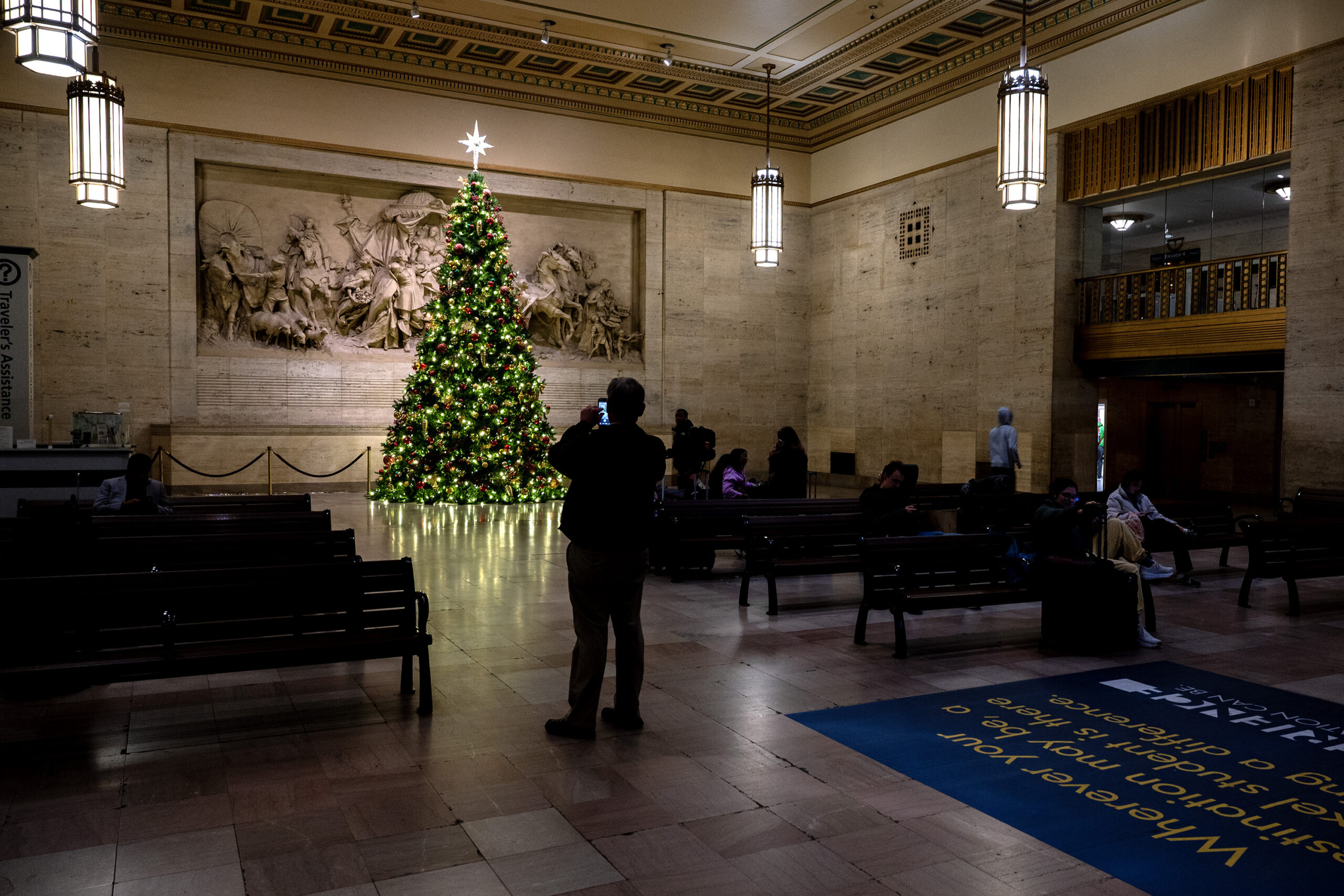
    November 24, 2025: The old waiting room at 30th Street Station that most people only pass through on their way to the restrooms has been spiffed up with benches – and a Christmas tree. It was placed there this year in front of the 30-foot frieze, “The Spirit of Transportation” while the lobby of Amtrak’s $550 million station restoration is underway. The 1895 relief sculpture by Karl Bitter was originally hung in the Broad Street Station by City Hall, but was moved in 1933. It depicts travel from ancient to modern and even futuristic times.
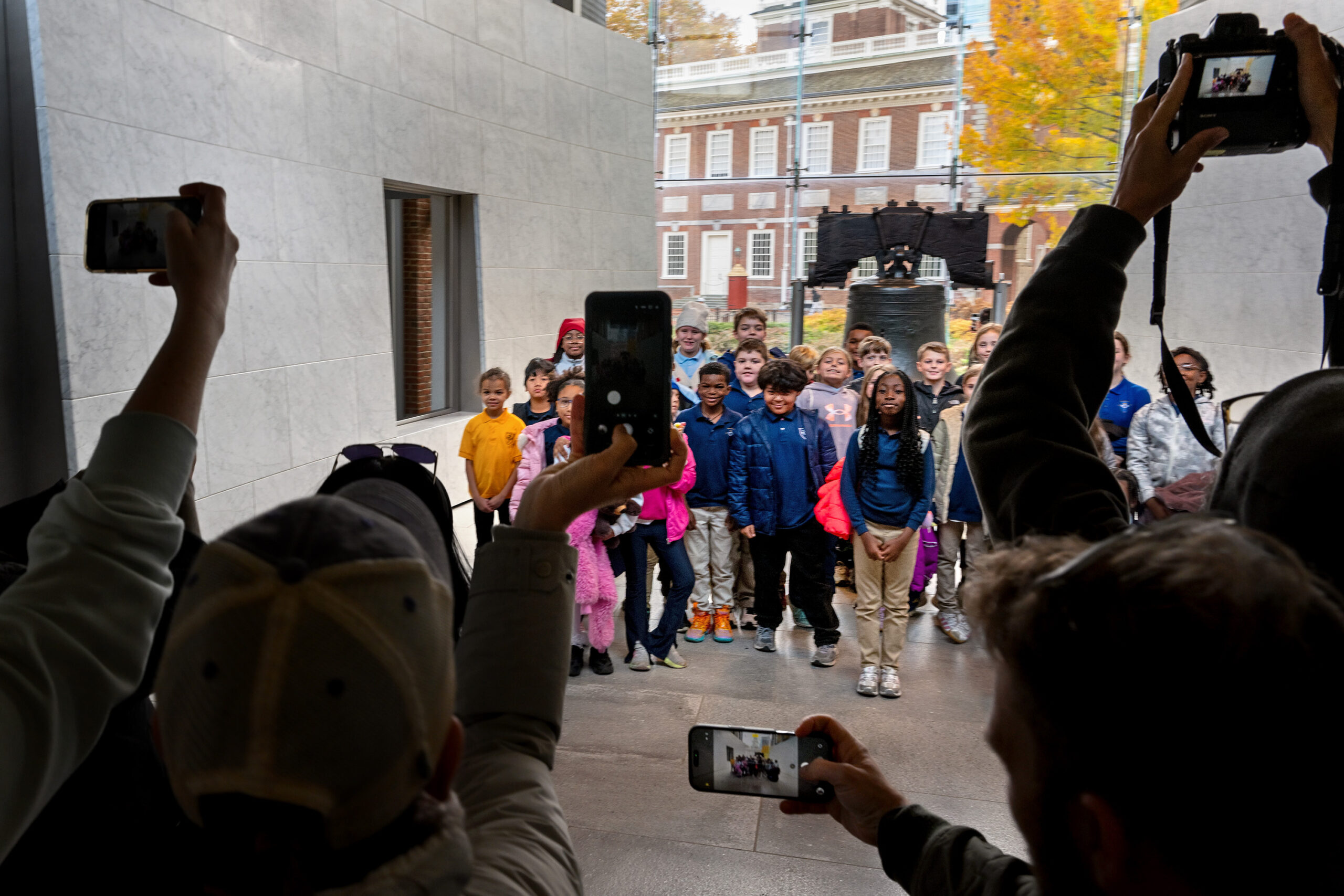
    November 17, 2025: Students on a field trip from the Christian Academy in Brookhaven, Delaware County, pose for a group photo in front of the Liberty Bell in Independence National Historical Park on Thursday. The trip was planned weeks earlier, before they knew it would be on the day park buildings were reopening after the government shutdown ended. “We got so lucky,” a teacher said. Then corrected herself. “It’s because we prayed for it.”
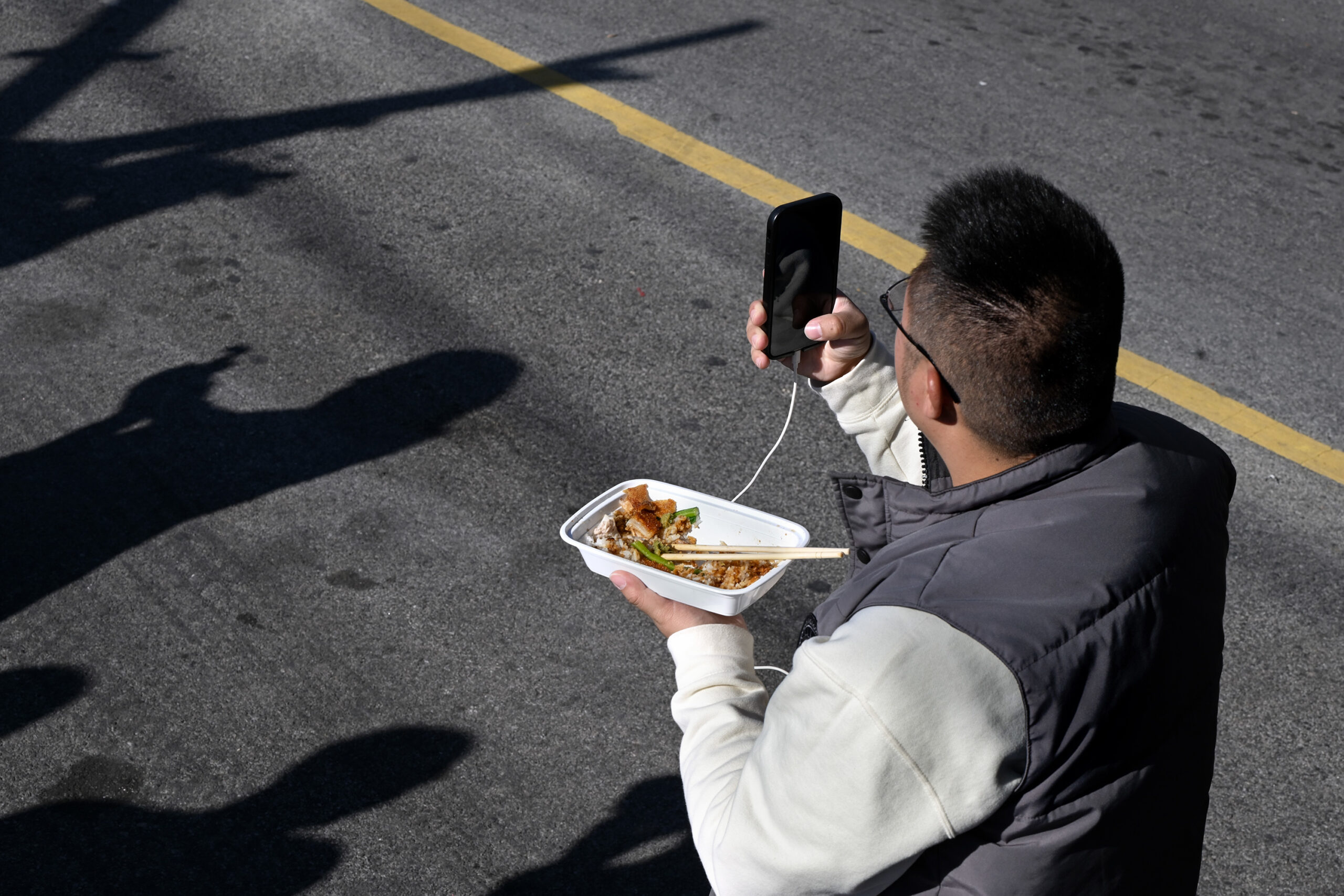
    November 8, 2025: Multitasking during the Festival de Día de Muertos – Day of the Dead – in South Philadelphia.
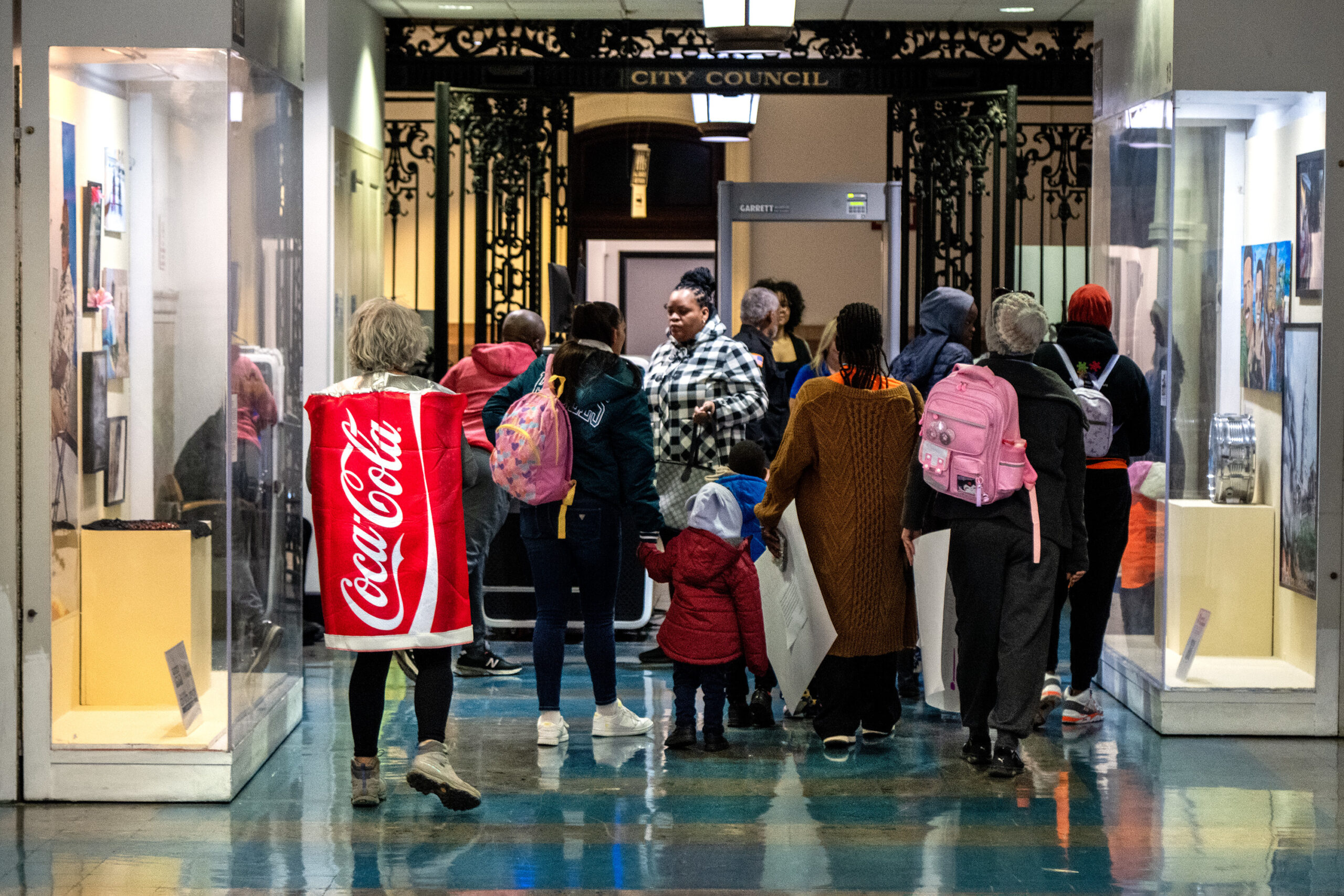
    November 1, 2025: Marcy Boroff is at City Hall dressed as a Coke can, along with preschoolers and their caregivers, in support of former Mayor Jim Kenney’s 2017 tax on sweetened beverages. City Council is considering repealing the tax, which funds the city’s pre-K programs.
    October 25, 2025: Austin Gabauer, paint and production assistant at the Johnson Atelier, in Hamilton Twp, N.J. as the finished “O” letter awaits the return to Philadelphia. The “Y” part of the OY/YO sculpture is inside the painting booth. The well-known sculpture outside the Weitzman National Museum of American Jewish History was removed in May while construction continues on Market Street and has been undergoing refurbishment at the Atelier at the Grounds for Sculpture outside of Trenton.
    October 20, 2025:The yellow shipping container next to City Hall attracted a line of over 300 people that stretched around a corner of Dilworth Park. Bystanders wondered as they watched devotees reaching the front take their selfies inside a retro Philly diner-esque booth tableau. Followers on social media had been invited to “Climb on to immerse yourself in the worlds of Pleasing Fragrance, Big Lip, and exclusive treasures,” including a spin of the “Freebie Wheel,” for products of the unisex lifestyle brand Pleasing, created by former One Direction singer Harry Styles.

    » SEE MORE: Archived columns and Twenty years of a photo column.

  • Teen who wanted to join ISIS admits to attempting to kill South Jersey police officer, officials say

    Teen who wanted to join ISIS admits to attempting to kill South Jersey police officer, officials say

    A Virginia teen who admitted in court that he wanted to join ISIS pleaded guilty Thursday to attempted murder and related offenses for a stabbing attack last year on a Florence Township police officer, Burlington County Prosecutor LaChia L. Bradshaw said Friday.

    Fasihullah Safar, 17, of Alexandria, Va., was charged as an adult and will be sentenced to 18 years in prison under a plea deal, Bradshaw said. He is scheduled to be formally sentenced on March 26 in Superior Court in Mount Holly.

    The police officer who was stabbed several times in the chest was wearing a ballistic vest that prevented more significant injuries, Bradshaw said.

    On March 21, 2025, Safar, who was 16 at the time, was driving a stolen vehicle when he intentionally caused a crash with another vehicle, Bradshaw said. A Florence police vehicle responding to the scene was then struck multiple times by Safar’s vehicle.

    Safar’s vehicle became inoperable on Route 130 near Station Road. When officers arrived, Safar charged them while armed with a knife, Bradshaw said. Besides the officer who was stabbed, suffering a laceration to his torso and facial injuries, two other officers sustained minor injuries. During the struggle, Safar also cut himself.

    In court, Safar admitted that in the months before the confrontation, he had begun following the Islamic State organization, Bradshaw said. Safar had indicated on social media that he planned to join the group.

    Safar admitted that he shouted “Allahu akbar” during the confrontation with police, and that he intended to kill one of the officers, Bradshaw said.

    Prior to the violent encounter with police in Florence Township, he was being sought by authorities, including the FBI, after he allegedly trespassed at a school in Fredericksburg, Va., causing the local district to close all schools.

    A school resource officer approached Safar, who then fled and later allegedly stole a vehicle.

    One report later said Safar had been investigated by the FBI after the teen allegedly posed on social media with what appeared to be a firearm.

  • Getting ready for the snow and cold? Here are tips to prepare yourself, your house, and your car.

    Getting ready for the snow and cold? Here are tips to prepare yourself, your house, and your car.

    Brace yourself for the cold, Philadelphians, because the first double-digit snowfall in 10 years is potentially heading our way, followed by sub-freezing temperatures that could last the rest of the month.

    Since nowhere is safe from the cold, here are some tips on how to keep yourself from freezing and your property from damage (no burst pipes in sight):

    How to prevent frostbite or hypothermia

    Staying indoors is the best way to keep frostbite and hypothermia at bay, but some must brave the temperature for work, other needs, or emergencies, as even waiting for the bus can take longer if SEPTA experiences storm-related service delays.

    With temperatures forecast in the teens and lower 20s, it is important to keep an eye on your core temperature.

    When you rapidly lose heat or stay wet for too long, it can cause hypothermia, even indoors. This can affect your brain and body, causing slurred speech, confusion, clumsiness, and extreme tiredness.

    Continued exposure to the cold can cause frostbite, as blood stops reaching your fingers, nose, ears, and extremities properly. You can get frostbite even under winter clothing, and it can lead to losing the affected body parts. If you start feeling tingling, numbness, or your skin looks gray or pale, head indoors.

    Frostbite can happen without hypothermia symptoms, and vice versa. Children, older adults, and people with circulation issues are especially at risk

    To prevent both afflictions, stay dry, covered, and layered up, keeping your skin from being exposed.

    Read more for additional tips on staying warm.

    Where to stay warm if you have no heat or are experiencing homelessness

    Four out of five warming centers reached capacity on Thursday, but the city plans to open more and add beds as needed.

    The warming centers remain open at select libraries from 9 a.m. to 9 p.m. And shelter beds have been added under the Code Blue declaration.

    Some recreation centers will also serve as warming centers from 9 p.m. to 9 a.m. Find the selected libraries and recreation centers closest to you on the city’s interactive map of warming centers.

    Folks in need of a warm place can go to their local police precinct to be transported to the nearest warming center.

    Read more about the warming centers.

    Avoid slips and falls

    Broken bones and head trauma are no fun. Stay grounded by wearing footwear with enough traction (no sneakers or dress shoes), or traction cleats.

    You can’t control the city roads, but salting your sidewalk properly can help avoid starting your day on the ground, or worse, in the emergency room. As you walk, make sure to lean slightly forward and take shorter steps. You may look like a penguin, but it’s worth it to avoid the pain and medical bills.

    Doing some balance exercise can also help.

    Tips to prevent frozen pipes and safely heat your home

    Much like your body, your home also loses heat in the cold, putting pipes at risk for freezing and bursting. Disconnecting garden hoses and shutting off the valve that feeds them, and keeping faucets slightly open and running can prevent expensive repairs.

    Pipes will begin to freeze when a thermostat is at 39 degrees and lower. Maintaining the thermostat at 50 degrees or above is ideal.

    Read more for tips on how to spot a freezing pipe or what to do if it bursts.

    How to prep your car for freezing weather

    Though they won’t burst, cars get cold too, reducing battery power and creating a risk of being left stranded, especially if the battery is older than two or three years.

    Be ready to jump-start your car. Jumper cables and a portable jumper pack can be helpful. Remember, red clamps to the positive post of the dead battery; black clamps to the negative post of the working battery and to the unpainted metal surface on the engine of the dead car.

    Here is a step-by-step guide on how to jumpstart a car.

  • Is Wegmans collecting shoppers’ biometric data at its Philly-area stores? The company won’t say.

    Is Wegmans collecting shoppers’ biometric data at its Philly-area stores? The company won’t say.

    Grocery chain Wegmans came under fire earlier this month after signage at its New York City stores revealed it was collecting biometric data on shoppers.

    But the Rochester, N.Y.-based supermarket chain won’t say whether it’s collecting biometric data on shoppers at eight Philly-area stores. There are Wegmans stores in Cherry Hill and Mount Laurel in New Jersey and in Glen Mills, Malvern, King of Prussia, Collegeville, Warrington, and North Wales in Pennsylvania.

    Patrons at some New York City Wegmans locations learned earlier this month that the supermarket chain had begun to collect, retain, store, and share data on their faces, eyes, and voices. The information, Wegmans said, was being used for “safety purposes.”

    “This is information that can be used to identify or help identify you,” a sign posted at Wegmans in New York City said, according to reporting from the online news site Gothamist. “We use facial recognition technology to protect the safety and security of our patrons and employees, and do not lease, trade or otherwise profit from the transfer of biometric identifier information.”

    Wegmans does not “get into the specific measures used at each store” for “safety and security purposes,” Wegmans spokesperson Marcie Rivera said in an email.

    Rivera said Wegmans has deployed cameras equipped with facial recognition technology in “a small fraction of our stores that exhibit an elevated risk.” Wegmans is using the technology in a “handful of states.” It posted mandated signage in New York City to comply with local regulations, Rivera said.

    Wegmans has previously said that the surveillance software is used to help identify individuals who “pose a risk to our people, customers, or operation.”

    Biometric surveillance is becoming increasingly common but is not yet widespread, said Gus Hurwitz, senior fellow and academic director of the Center for Technology, Innovation and Competition at Penn’s Carey Law School.

    Companies that use biometric surveillance do so for a number of reasons, but seldom tell consumers what their data is being collected for. Data collection can help companies understand what consumers are purchasing and how they’re moving through stores, Hurwitz said. Biometric data collection can also be used for dynamic pricing, when retailers change prices in real-time depending on a number of factors, including time of day, demand, weather, and consumer behavior.

    Hurwitz said it’s important to distinguish between real-time and non-real-time biometric screening. Non-real-time screening has been happening for decades in the form of security cameras and other data collection tools, often used for market research purposes.

    Real-time screening, however, is a newer frontier with a far murkier regulatory landscape.

    Businesses in New York City that collect biometric data are required to post signage notifying customers, per a 2021 city law, however the agency in charge of implementing the law has no enforcement mechanism for noncompliant businesses, a city official told Gothamist.

    A bipartisan bill regulating biometric data collection is currently moving through the Pennsylvania legislature. A recently introduced bill in the New Jersey Legislature would require any entity collecting biometric information to post a “clear and conspicuous notice” at every entryway to their business, like in New York City.

    Hurwitz said we’re “still very much in the development era of these sorts of technologies,” and that he expects more and more government entities to hone in on regulating them in the near future.

  • Snow, perhaps more than a foot, is all but certain this weekend for Philly

    Snow, perhaps more than a foot, is all but certain this weekend for Philly

    Based on what the computers and their human interpreters are saying, a key question this weekend will be whether measuring the snow in the Philly region will require a ruler or a yardstick.

    This no doubt will be a moving target, but on Friday morning, the National Weather Service in Mount Holly was seeing eight to 14 inches for Philly, said meteorologist Alex Staarmann. Several inches were possible even at the Jersey Shore.

    For Philly, that would be the first double-digit snowfall in 10 years.

    A wild card would be a potentially unpleasant atmospheric parfait that would add ice to the mix on Sunday, and computer models Friday were suggesting that mixing was likely near I-95 and in Delaware and South Jersey. However, the weather service expects that to yield to all snow Sunday night.

    While this is all quite a complicated meteorological setup, in essence Arctic air is pressing southward and it is going to interact with an impressively juicy storm to the south.

    “Having the Arctic front come through before the onset of wintry precipitation, that’s really concerning,” said Ray Kruzdlo, the staff hydrologist in the weather service office, where “it’s all hands on deck.”

    Below-zero windchills are expected Saturday morning, prompting a cold-weather advisory, and temperatures in Philly may stay below freezing the rest of the month.

    What time will the snow start and end?

    The timing and duration of precipitation aren’t among the strong suits of computer models.

    The weather service’s winter storm watch, which covers the entire region, all of Delaware, and most of Pennsylvania and New Jersey, is in effect from 7 p.m. Saturday until 1 p.m. Monday.

    The daytime Saturday “looks fine if you have to get out,” said Tom Kines, senior meteorologist with AccuWeather Inc.

    The weather service is listing the likeliest starting time as the early morning hours of Sunday, with snow likely into the early morning hours of Monday.

    Sunday is going to be one of the colder days of the winter with temperatures in the teens and lower 20s. The weather service introduces the possibility of freezing rain and sleet by 1 p.m., with a forecast temperature of 19 degrees.

    Wait, it can rain when it’s 19 degrees?

    Yes, it can rain when it’s below 20 degrees at the surface, and precipitation doesn’t get much more dangerous.

    Snow and sleet, liquid that freezes on the way down, can at least provide traction on the roads. Rain that freezes on contact becomes an ice sheet. Also, when freezing rain accumulates on fallen snow it can bring down trees and power lines.

    Peco has heard the storm rumors (who hasn’t?) and will have crews on call through the weekend, said spokesperson Candace Womack.

    The threat of ice is related to the possibility of warm layers of air, borne on onshore winds from the ocean, at levels of the atmosphere where precipitation is formed.

    That could well happen Sunday as the coastal storm intensifies, said Kruzdlo, and winds build from the Northeast, perhaps gusting past 20 mph. Any rain or sleet would encounter very cold air at the surface, locked and dammed in place by the Appalachian Mountains.

    “That’s the complexity of living where we are so close to the ocean,” Kruzdlo said. “We have tens of thousands of observations at the surface,” he added, but data from the upper atmosphere is wanting, adding challenges to forecasting changeovers.

    Along the I-95 corridor, storms of purely snow are the exceptions, Kruzdlo said.

    What are chances that the storm is a bust?

    In the chess matches between science and the nonlinear chaos of the atmosphere, chaos has been known to win.

    One of the more notable busts occurred in January 2015 when forecasts called for an I-95 East Coast snowstorm so ferocious that the mayor of New York imposed a curfew.

    Philly was supposed to get a foot or more, and ended up with an inch or two. That prompted the head of the Mount Holly weather service office to issue a public apology.

    His boss at the time, weather service head Louis Uccellini, said no apology was necessary: Science has its limits. Busts have been known to happen in the battle of science against nonlinear.

    This time around, meteorologists are all but certain something “impactful” is going to happen.

    Said Kruzdlo, the slim chance of this storm “not being significant is leaving us.”

  • Collingswood mayor settles conflict-of-interest lawsuit as the borough’s EMS future is in flux

    Collingswood mayor settles conflict-of-interest lawsuit as the borough’s EMS future is in flux

    A month and a half after Collingswood’s mayor defiantly disagreed with a solicitor’s opinion that she should recuse herself from a vote to grant an ambulance-services contract to Virtua Health, which employs her husband, Daniela Solano-Ward signed a settlement agreement nullifying the vote and recusing herself from the matter.

    The shift followed a lawsuit filed by James Maley, who sits alongside Solano-Ward on the South Jersey borough’s three-person commissioners board, accusing the mayor of a conflict of interest. The lawsuit asked a judge to discard a Dec. 1 vote outsourcing Collingswood’s EMS services to Virtua Health.

    A Superior Court of Camden County judge, Francisco Dominguez, issued a temporary restraining order on Jan. 5 prohibiting Collingswood from executing the contract with Virtua or making changes to the borough’s EMS services.

    The borough settled the lawsuit Jan. 16, in an agreement that voided the contract with Virtua, and requires Solano-Ward to recuse herself from all EMS-related matters, according to a copy of the settlement obtained by The Inquirer.

    The settlement instructs Maley and Commissioner Amy Henderson Riley, Solano-Ward’s political ally and the borough’s director of public safety, to devise a plan to select an independent consultant to assist in deciding the future of Collingswood EMS services and a schedule for a public process.

    “Today’s settlement allows us to move forward as an elected body in a way that reflects the values of Collingswood,” Maley said in a statement. “My concerns in filing this action were rooted in two core principles: avoiding conflicts of interest under the law and ensuring that major decisions, especially those involving essential services like Fire and EMS, are made with full public awareness and engagement.”

    Solano-Ward confirmed she would limit her involvement with the EMS process moving forward, but said she trusted Henderson Riley and Maley to “roll up their sleeves and work together to find a resolution in a timely manner.”

    The catalyst for the dispute was concerns that Solano-Ward heard from the borough’s fire chief over his department’s lack of capacity to respond to the 4,000 calls it receives annually, the mayor said in a December commissioners meeting. The emergency medical services generate $450,000 a year, the lawsuit says.

    The mayor held a meeting with Collingswood’s fire chief in August, the suit says, and brought her husband, a Virtua critical-care physician, Jared Ward. He does not hold leadership positions in the South Jersey health system.

    Virtua was one of two entities that responded to a request for proposals to provide ambulance services for the borough.

    At the Dec. 1 commissioners meeting, Solano-Ward defended her husband’s involvement, saying the borough does not have a medical officer and she wanted to be sure no question went unasked.

    “We reached out to our attorney and he agreed that there could be a conflict of interest,” the mayor said in the meeting. “To which I respectfully disagree and I will be voting on the matter.”

    The commissioner’s board approved the contract in a 2-1 vote, with Maley opposing. Before the vote, the former long-time mayor, who held the position from 1997 until May, expressed outrage at the lack of transparency during the process and Solano-Ward’s participation.

    “It’s absurd, it is wrong, it’s unethical,” Maley said.

    The contentious lawsuit spilled into the January commissioners meeting, in which residents seemed divided on the issue. Some complained about the perceived lack of transparency by Solano-Ward in the decision to privatize the borough’s EMS department, while others accused Maley of neglecting the ambulance services during his tenure as mayor.

  • A massive and controversial AI data center is under construction in South Jersey

    A massive and controversial AI data center is under construction in South Jersey

    The French developer of South Jersey’s first large-scale AI data center made his case to residents on Wednesday, saying his massive under-construction facility will benefit them in ways unprecedented in the emerging industry.

    But at a contentious town hall, several residents said they’re not taking his word for it, especially given the timing at which the developer was asking for their input.

    “You couldn’t do this before the building was built?” asked one resident, who spoke during public comment but declined to give their name. “You kind of took our voice away.”

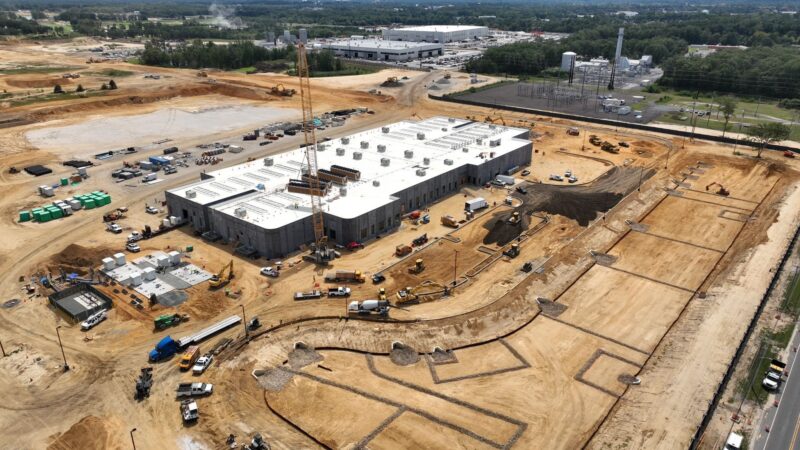
    The 2.4 million-square-foot, 300-megawatt Vineland data center was approved by city council more than a year ago. The center is already under construction, and the developer expects to complete it by November.

    Located on South Lincoln Avenue, off State Route 55, the site was formerly a private industrial park.

    DataOne, a French company that manages advanced data centers, is the owner, operator, and builder. Its client, Nebius Group, an Amsterdam-based AI-infrastructure company, will operate the center’s internal technology, which will fuel Microsoft’s AI tools.

    Located on South Lincoln Avenue, off State Route 55, the site was formerly a private industrial park. It was sold to DataOne in a private transaction, the details of which Charles-Antoine Beyney, DataOne’s founder and chief executive officer, declined to disclose.

    At city council meetings and on social media, some residents have voiced concerns about the environmental, financial, and quality-of-life impacts of the site. Prior to Wednesday’s meeting, residents were prompted to submit questions online that were then addressed in a presentation. Dozens also took to the mic afterward.

    Beyney said he understood their concerns, but they don’t apply to his center, which will use “breakthrough” technology to reduce its environmental impact.

    “Most of the data centers that are being built today suck, big time,” Beyney said Wednesday. “They consume water. They pollute. They are extremely not efficient. This is clearly not what we are building here.”

    “No freaking way am I am going to do what the entire industry is doing … just killing our communities and killing our lungs to make money,” he added.

    Developers tout promises of data centers

    Data centers house the technology needed to fuel increasingly sophisticated AI tools. In recent years, they have been proliferating across the country and the region.

    In June, Gov. Josh Shapiro announced a $20 billion investment by Amazon in Pennsylvania data centers in Salem Township and Falls Township.

    Politicians on both sides of the aisle — from Republican President Donald Trump to Democratic Pa. Gov. Josh Shapiro — have encouraged the expansion, as have certain labor and business leaders. Yet environmental activists and some neighbors of proposed data centers have pushed back.

    Across the Philadelphia region, residents have recently organized opposition to proposals for a 1.3 million-square-foot data center in East Vincent Township and a 2 million-square-foot facility near Conshohocken (that was forced to be withdrawn in November due to legal issues).

    This week, Limerick Township residents voiced concerns about the possibility of data centers being built in their community. And in Bucks County, a 2-million-square-foot data center is already under construction in Falls Township.

    Pennsylvania and New Jersey are home to more than 150 data centers of varying sizes and scopes, according to Data Center Map, a private company that tracks the facilities nationwide. But so far, the AI data center boom has largely spared South Jersey.

    A 560,000-square-foot data center is being built in Logan Township, Gloucester County, and is set to have a capacity of up to 150 megawatts once completed in early 2027, according to the website of its designer, Energy Concepts. There are also smaller, specialized data centers in Atlantic City and Pennsauken, according to Data Center Map.

    In Vineland, Beyney said his gas-powered center will have nearly net-zero emissions, not consume water while cooling the equipment, and generate 85% of its own power. He told residents: “You will not see your bill for electricity going and skyrocketing.”

    Opponents of data centers worry their electric bills will rise due to the centers. The developer in Vineland says that won’t happen in South Jersey.

    The facility will be 100% privately funded, he said, after the company turned down a nearly $6.2 million loan from the city amid resident backlash. The loan was approved at a December council meeting, and Beyney said DataOne would have paid about $450,000 in interest, money that could have gone back into the community.

    “That’s a shame,” Beyney said, “but we follow the people.”

    At a meeting next week, Vineland City Council could approve a PILOT agreement that would give DataOne tax breaks on the new construction in exchange for payments to the city.

    Beyney said DataOne plans to be a good neighbor. Across the street from the data center, he said they will build a vertical farm — which grows crops indoors using technology — and provide free fruits and vegetables to Vineland residents in need.

    Residents voice concerns about Vineland data center

    Several residents expressed skepticism, and even anger, about Beyney’s data-center promises, noting that Cumberland County already has plenty of farms.

    Regarding the data center itself, they asked how Beyney could be so confident about new technology, questioned the objectivity of his data, and accused him of taking advantage of a city where nearly 14% of residents live below the poverty line.

    Beyney denied the allegations.

    At least one resident said he was moved by Beyney’s assurances.

    “I was a really big critic of [the data center all along], but I think what you said tonight has alleviated a lot of my concerns,” said Steve Brown, who lives about a mile away from the data center. He still had one gripe, however: The noise.

    “What I hear every night when I wake up at 2, 3, 4 o’clock in the morning is this rumble off in the distance,” Brown said. “When I get out of my car every day when I get home, I hear it.”

    Brown invited Beyney and his team to come hear the noise from his kitchen or back patio. Beyney said they would do so, and promised to get the sound attenuated as soon as possible, certainly by the end of the project’s construction.

  • A major winter storm is looking inevitable for Philly, with the snow expected to stick around

    A major winter storm is looking inevitable for Philly, with the snow expected to stick around

    The details are likely to remain elusive well into the weekend, but on Wednesday evidence was accumulating that the Philadelphia region could become a winter wonderland for the remainder of January.

    “We’re definitely going to get some snow,” said Alex Staarmann, a meteorologist with the National Weather Service in Mount Holly, which probably won’t make a first accumulation guess until Thursday afternoon. Snow could begin as early as Saturday night and continue into Monday.

    The weather service Thursday posted a winter-storm watch for the entire region — for all of Delaware and most of Pennsylvania and New Jersey — in effect from 7 p.m. Saturday until 1 p.m. Monday.

    At the weather office, “It’s all hands on deck,” said agency hydrologist Ray Kruzdlo Thursday. The “outside chance” that the region would be spared a major storm “is leaving us.”

    AccuWeather Inc. is calling for 6 to 10 inches for Philly, very much subject to change, said senior meteorologist Bob Larsen.

    Several inches of snow would be all but certain, the weather service said. Philadelphia could have a 75% chance of a foot or more, based on analysis of a blend of computer models, and a 50-50 shot of 18 inches or more. However, the individual models are having their usual squabbles, with the American being the snowiest.

    In any event, Staarmann said: “It could be a significant storm for most of the region.”

    And that applies to the rest of the Mid-Atlantic and Northeast. AccuWeather Inc. estimated that snow and ice during the weekend could affect half the nation’s population.

    Said Stephen Morgan, a meteorologist with Fox Weather: “It’s one of the most sprawling systems we’ve seen in several years.”

    Predictably, computer models have been using the map as a Ouija board, moving around the zones of the expected heaviest snows.

    Earlier in the week, it appeared that the region would be near the northern edge of the snowfall; on Wednesday, however, the models bumped the snow north, increasing the chances that snow could mix with sleet and freezing rain in Delaware and South Jersey.

    The snow could mix with sleet at the height of the storm even in the Philly region, the weather service said. That would hold down accumulations: Sleet is slow to accumulate. Conversely, since it is pure ice, it is slower to melt.

    Should any rain get mixed in, it would freeze on contact: The upper air may be warmer, but temperatures at the surface are forecast to be mostly in the teens Sunday.

    The amounts of snow and mixing would depend on the track of a storm that is forecast to develop off the Texas Gulf Coast and track through the Tennessee Valley and off the Mid-Atlantic coast on Sunday. That track ultimately will be determined by other moving parts in the atmosphere.

    As the storm intensifies, its onshore winds would import warmer air into the upper atmosphere, changing the snow to sleet and/or freezing rain, but the surface layers would remain quite cold, Larsen said.

    Despite the potential mixing, it is at least possible that Philly will get its first double-digit snowfall since Jan. 22, 2018, said Paul Dorian, a meteorologist with Arcfield Weather, based in Valley Forge.

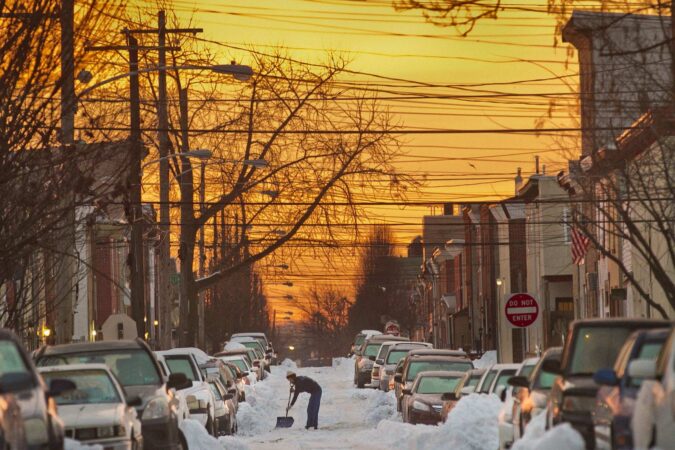
    In the short term, Thursday may be a day to savor. It’s heading into the mid-40s, with nothing falling from the skies. The cold begins to filter in Friday, and highs will be in the teens Saturday.

    After the precipitation shuts off Sunday night or Monday, whatever has fallen won’t be in a hurry to disappear, Staarmann said.

    Temperatures might not get above freezing for several days after the snow stops, he said. Wind chills are expected to be in the single digits Monday morning, and below zero Tuesday.

    “This overall very cold weather pattern is likely to continue into next weekend, potentially beyond,” the weather service said.

    “The next couple of weeks will feature some of the worst weather winter has to offer,” Dorian said.

    Said Fox’s Morgan: “The overall pattern in the Northeast seems to be locked in to a colder than average at least to Groundhog Day.”

    Punxsutawney Phil might want a “do not disturb” sign this year outside his burrow.

  • South Jersey man is accused of drugging, molesting men renting room at his home

    South Jersey man is accused of drugging, molesting men renting room at his home

    A 60-year-old man has been accused through an indictment of drugging and sexually molesting two men who at different times rented a room from him at his home, Burlington County Prosecutor LaChia L. Bradshaw said Wednesday.

    Craig M. Cardella, of Mansfield Township, pleaded not guilty on Tuesday at his arraignment in Superior Court in Mount Holly. He was charged by indictment in December with multiple counts of kidnapping, aggravated criminal sexual contact, and related offenses.

    Robert M. Perry, Cardella’s lawyer, declined to comment Wednesday evening.

    The charges involved two victims during separate time periods, Bradshaw said.

    In late 2024, a man renting a room from Cardella contacted Mansfield Township police and said he awakened at night to find Cardella in bed with him, holding a mask over his mouth and nose and touching him sexually, Bradshaw said.

    A search warrant was obtained for Cardella’s home and a safe was discovered in a closet that contained two bottles of chloroform, along with prescription sleep medication, medical masks, a camcorder and digital storage devices, Bradshaw said.

    Prosecutors allege that Cardella used the chloroform to prevent his victims from waking while they were being molested.

    Anyone who believes they were victimized by Cardella can contact Detective Ken Allen at allen@mansfieldpd.org.

  • In one of Phil Murphy’s final acts as governor, he signed a bill that could help Camden tower get $400 million in tax credits

    In one of Phil Murphy’s final acts as governor, he signed a bill that could help Camden tower get $400 million in tax credits

    Hours before leaving office, New Jersey Gov. Phil Murphy on Tuesday signed legislation that could make it easier for commercial real estate projects in Camden to qualify for hundreds of millions of dollars in state tax incentives.

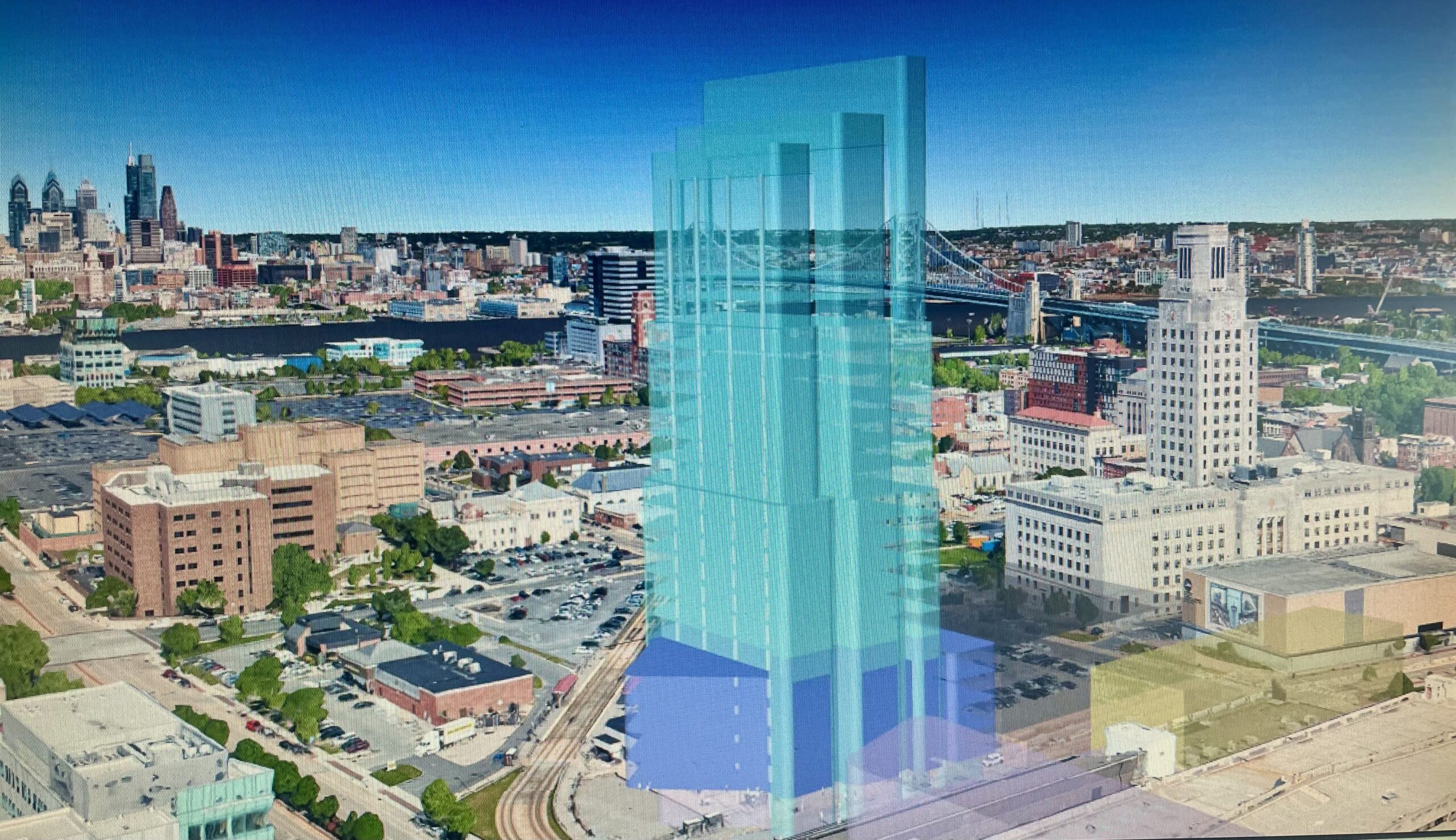
    One planned development that could benefit is the Beacon Building, a proposed 25-story office tower downtown on the northwest corner of Broadway and Martin Luther King Boulevard, The Inquirer previously reported.

    Murphy approved the bill and dozens of others on the final day of his second term, shortly before fellow Democrat Mikie Sherrill was sworn in as governor. Another newly signed law authorizes up to $300 million in tax breaks to renovate the Prudential Center in Newark, home of the New Jersey Devils. The hockey team is owned by Harris Blitzer Sports & Entertainment, which also owns the Philadelphia 76ers.

    The Camden-focused law makes changes to the state’s gap-financing program, known as Aspire, which authorizes up to $400 million in corporate tax credits over 10 years for “transformative” redevelopment projects that have a total cost of $150 million and meet other requirements.

    To qualify for the incentives, most commercial projects must generate a net positive benefit to the state, based on the Economic Development Authority’s economic modeling. The new law exempts certain projects from that “net benefit test.”

    The law applies to redevelopment projects located in a “government-restricted municipality” — as described in the Aspire program’s statute — “which municipality is also designated as the county seat of a county of the second class.” In addition, the project must be located in “close proximity” to a “multimodal transportation hub,” an institution of higher education, and a licensed healthcare facility that “serves underrepresented populations.”

    A rendering of the 25-story Beacon Building proposed for the northwest corner of Broadway and Martin Luther King Boulevard in Camden. It would be the tallest building ever constructed in the city.

    The site of the proposed Beacon Building is across the street from the Walter Rand Transportation Center and Cooper University Hospital. Rutgers’ Camden campus is also nearby. Lawmakers said projects in New Brunswick and Trenton could also qualify for exemptions under the law.

    Development firm Gilbane is leading the project with the Camden County Improvement Authority. Gilbane has yet to announce any commitments from tenants.

    Assembly Majority Leader Louis Greenwald (D., Camden), who sponsored the legislation, has said it wasn’t written with a specific project in mind but rather to remove a barrier to investment in South Jersey.

    Critics said that the law removes a key safeguard meant to protect taxpayers and that it represented an about-face for Murphy, who earlier in his tenure sought to reform corporate incentive programs.

    “Just in terms of the governor signing the bill, this is a massive disappointment,” said Antoinette Miles, state director of the New Jersey Working Families Party.

    “Broadly, if there’s a so-called transformative project that can’t pass the net benefit test, maybe it isn’t so transformative,” she said.

    Murphy’s office announced the bill signing without commenting on it, though he has previously cheered state investment in Camden. Any Aspire tax incentives must be approved by the state’s Economic Development Authority.