Category: New Jersey News

  • Military members and veterans in Camden County can now get free legal services. Here’s what to know.

    Military members and veterans in Camden County can now get free legal services. Here’s what to know.

    Current and former military personnel can now receive free estate planning assistance in Camden County to help support their families’ futures.

    The Camden County Board of Commissioners launched the new clinic last month, one of several no-cost legal services available to vulnerable South Jersey residents.

    The clinic, currently scheduled monthly, gives active service members, veterans, and their spouses living in Camden County access to certain legal services at no charge. The county will provide a last will and testament, power of attorney, and an advance directive, which documents a person’s preferences for medical treatment in case they become unable to make their own healthcare decisions.

    Sixteen veterans are signed up for the first Veterans Will Clinic on Wednesday at the Camden County One-Stop Career Center in Cherry Hill Township, said Morgan Callan, the county’s external communications manager. There is no current cap for how many veterans can participate.

    The Camden County Office of Veterans Affairs is now accepting registrations for the second clinic, on July 29. Anyone interested should contact the office by calling 856-374-5801, or by visiting the office at 1 Collier Drive in Blackwood, part of the Camden County Lakeland Complex.

    Help for veterans

    Camden County has nearly 19,000 veterans, according to the most recent estimate available from the U.S. Census Bureau.

    The Camden County Office of Veteran’s Affairs has partnered with Susan Purvin, an attorney from Gloucester County, to help provide the services. Louis Cappelli Jr., one of Camden County’s three commissioners, said in a statement that he hopes everyone eligible takes advantage of the program.

    “Our veterans and servicemembers have sacrificed so much in service to our nation, so have their families,” Cappelli Jr. said. “The least we can do is help them get their affairs in order, giving them the confidence that their last wishes will be protected.”

    The cost to Camden County for the program is $50 per will, $25 per power of attorney, and $100 per hour for every legal information session, with the total cost varying based on how many people show up for the clinics, said Dan Keashen, the county’s public affairs director.

    Other counties in South Jersey provide similar services. All active military personnel and veterans in Gloucester County can receive assistance with a simple will, a legal document for those not looking to involve complicated estates or trusts in their end-of-life plans.

    About 20 attorneys recently volunteered for a free event in Cape May County that helped veterans and their spouses prepare a will, power of attorney, and healthcare directive free of charge.

    More free legal services

    You don’t have to be a veteran to find free legal services in Camden County.

    The Camden County Bar Association hosts Wills for Heroes, a small, volunteer-led clinic that provides free wills and estate planning documents to firefighters, police officers, and paramedics, and their spouses annually. The 2026 clinic, which took place in March, was full at 21 participants.

    Kara Edens Graser, the association’s executive director, said she hopes to run the same clinic next year.

    Camden County also offers free legal workshops, which cover the same services as those now available to veterans, for seniors and residents with disabilities aged 18 and over.

    Plus, about 300 attorneys volunteer on an as-needed basis for the Volunteer UP Legal Clinic, a Camden-based nonprofit that provides legal expertise to those who need it. The nonprofit spent more than $300,000 in 2024 to provide legal services for tenants, criminal record expungement, estate planning, and name changes, according to its 2024 tax filing.

    Volunteer UP also provides same-day eviction defense for tenants in Burlington, Camden, Cumberland, Gloucester, and Salem Counties, CEO Steven Salinger said via email.


  • Authorities ID 3 people killed in Maryland crash of plane from Ocean City, N.J.

    Authorities ID 3 people killed in Maryland crash of plane from Ocean City, N.J.

    Maryland State Police on Monday released the names of three young men killed when a plane that took off from Ocean City, N.J. crashed late Saturday night east of Washington D.C.

    Around 11:30 p.m. Saturday, a single-engine Piper Cherokee piloted by Yoav Bomrind, 26, of Israel, with two passengers, David Rabinovich, 19, or Israel, and Elad Naidik, 20, of Canada, crashed in a wooded area in Bowie, Md.

    Maryland State Police said Prince George’s County Public Safety Communications received an iPhone crash alert around 11:45 p.m. indicating the plane went down in the area of U.S. Routes 50 and 301 in Bowie.

    The plane was headed to the Montgomery County Airpark in Gaithersburg, Md., approximately 20 miles northwest of Bowie, apparently as part of a training flight, the state police said.

    Based on preliminary information, investigators believe the plane was owned by a flight school in Montgomery County, Maryland, the state police said.

    Multiple agencies responded to the crash area and the plane was located around 3:45 a.m. Sunday near a residential neighborhood. All three men were pronounced dead at the scene.

    No one else was injured, the state police said.

    The National Transportation Safety Board is investigating the crash.

  • Advocates say Delaney Hall detainees have ended hunger strike

    Advocates say Delaney Hall detainees have ended hunger strike

    A hunger and labor strike by detained immigrants at Newark migrant jail Delaney Hall that drew national attention and sparked weeks of violent protests outside the detention center has effectively ended, immigration advocates said Monday.

    The detainees ended their strike because of the actions taken by the jail’s guards, and not because conditions behind bars have improved, the advocates said.

    “Because of the intimidation tactics, the disciplinary consequences for folks to be placed in segregation, [detainees] have now resorted to going back to job assignments and eating,” said Sally Pillay, an advocate with Eyes on ICE who has spent months outside of the migrant jail aiding families of detainees.

    A request for comment from the U.S. Department of Homeland Security was not immediately returned. Federal officials have said for weeks that detainees never engaged in a hunger or labor strike.

    More than 300 detainees inside the immigration detention center said they launched the strike May 22 to call attention to what they called inhumane conditions, including inedible food and poor treatment by guards. Delaney Hall soon became a national flashpoint, attracting members of Congress, state officials, and sustained crowds of protesters to Doremus Avenue in Newark on a near-daily basis.

    Amy Torres, the executive director of New Jersey Alliance for Immigrant Justice, speaks outside Delaney Hall on Tuesday, Dec. 23, 2025.

    Amy Torres, executive director of the New Jersey Alliance for Immigrant Justice, said the tactics used to break the strike are nothing new. Some detainees were transferred out of the facility as a “means of punishing them for being part of that dissent,” she said.

    Torres said among those transferred was a 20-year-old man who crossed the border at 18. He was transferred in the last two days and his location remains unknown as of Monday, she said.

    “There are hundreds more that have disappeared,” Torres said. “There’s no way to account for where they are. Are they OK? What’s going on with them? It’s pure heartbreak.”

    Pillay said activist groups have tracked detainees to facilities in Louisiana, Texas, Pennsylvania, California, Arizona, and Colorado.

    “These transfers have had devastating consequences,” she said. “We know that these facilities are in remote locations where people do not have access to their lawyers, to their families, and their support networks.”

    She noted that detainees in the units most active in the strike were deliberately broken up, with people dispersed throughout the facility. Detainees have also raised new concerns inside the jail, like discolored drinking water and weeks without access to hot water, Pillay said.

    Family visitation, which was briefly suspended during the strike, was reinstated with sharp restrictions. Pillay said visitations have been cut to 30 minutes, are only offered twice a week in some units, and are limited to immediate family members on an approved list. She said Geo Group — the private company that runs the detention center — has not posted information about the new visitation schedule online, so families show up expecting the old schedule and are turned away.

    Detainees have also been blocked from speaking with members of Congress conducting oversight visits. Detainees must now sign a privacy waiver, provided only in English, before a member of Congress can speak with them, and forms must be submitted in advance of the visit, a process Pillay said is “to probably intimidate and use retaliatory tactics against the individuals who speak out.”

    On Father’s Day, Pillay said of the 80 family members who arrived to visit loved ones, more than 30 were turned away.

    “We saw heightened emotions, distraught families, and loved ones outside,” she said.

    Dozens showed up for a protest Sunday. Some tied neckties to the fence outside the jail in honor of the fathers who remain detained and some held up signs that read, “Free the dads.”

    One protester holding an upside-down American flag near the driveway of the prison was hit by a car entering the jail parking lot, video shows. Newark Public Safety Director Emanuel Miranda said the incident is under investigation.

    “Federal agents are brutal, abusive, and reckless with the public,” Torres said. “We can only imagine what they’re doing to people in detention behind closed doors.”

    This story originally appeared on New Jersey Monitor.

  • Virtua Mount Holly nurses approve contract after threatening to strike

    Virtua Mount Holly nurses approve contract after threatening to strike

    Nurses at Virtua Mount Holly Hospital have voted in favor of a new contract ensuring raises and safety enhancements under a deal reached with employers at the South Jersey hospital after their union threatened to strike last week.

    Under the contract approved Friday, the hospital will enforce minimum staffing ratios to ensure a certain number of nurses are caring for a given patient at all times, and hire new staff in some areas.

    Nurses will receive pay raises at an average of 16.5% through June 2028.

    The three-year contract also includes provisions for new safety measures at the hospital, including panic buttons and wearable devices for staff, and increased visitor screening for weapons, the union said. The hospital will also implement a visitor ID system. Protocols will be improved to notify nurses when they have been exposed to an infectious disease.

    “HPAE nurses are not willing to tolerate the status quo anymore so we are proud that we have won strong language to ensure nurses can care for their patients the way they were trained,” HPAE president Debbie White said in a statement.

    The contract ratification comes after Mount Holly nurses, a local chapter of the Health Professionals and Allied Employees union, voted earlier this month to strike on June 16 if they could not come to an agreement with Virtua officials.

    Both sides had been negotiating for two months, including in a 21-hour session the night before the strike vote. More than 700 unionized nurses work at the Burlington County hospital.

    Staffing levels, a concern raised by nursing unions across the country, were a particular sticking point in bargaining. Many nurses say that the number of nurses assigned to care for a given patient is a safety issue.

    Nurses last week said the strike vote — in which 92% of nurses threatened to walk off the job — helped the union reached a tentative contract agreement with Virtua.

    In a statement Monday, Chrisie Scott, senior vice president and chief marketing officer, said the three-year contract “will enable Virtua Mount Holly to continue delivering safe, high-quality care for our patients, while providing wage increases, enhanced safety measures, and updated staffing levels for our nurses.”

    “We look forward to moving ahead together,” she said.

  • A Philly woman pleaded guilty to voting twice in the 2024 presidential election

    A Philly woman pleaded guilty to voting twice in the 2024 presidential election

    A Philadelphia woman pleaded guilty Monday to voting twice in the 2024 election — first in northern New Jersey, then in the city.

    Miya Pack, 40, said little beyond responding to routine legal questions as she pleaded guilty to a charge of voter fraud before U.S. District Judge Joshua D. Wolson.

    Pack has been registered to vote since 2004 in Bergen County, N.J., prosecutors said in court documents, and she’s also been registered to vote in Philadelphia since 2016. She is not affiliated with any political party, voter records show.

    On Oct. 26, 2024, prosecutors said, Pack cast a ballot in that year’s presidential election in Bergen County. Then, 10 days later, prosecutors said, she cast a ballot in the same contest in Philadelphia on Election Day.

    They did not say whom she voted for, and she declined to comment as she left the courtroom Monday.

    President Donald Trump has repeatedly made questionable or false statements about the prevalence of voter fraud, particularly in places like Philadelphia, where Democrats heavily outnumber Republicans. Election officials and experts who study the issue generally agree that voter fraud has not historically occurred at widespread rates.

    Pack was charged by federal prosecutors last September. Prosecutors announced her indictment alongside the indictment of another man, Matthew Laiss, who was separately charged with voting twice in the 2020 election.

    Laiss later said in court documents that he voted twice for Trump, and unsuccessfully sought to claim that his actions were covered by pardons Trump extended to people who tried to help him overturn the results of the 2020 election.

    Laiss was convicted of voter fraud earlier this year at trial and is awaiting sentencing.

    Pack is scheduled to be sentenced in October. She faces the possibility of prison time, although prosecutors said in court that federal guidelines suggest a term of no jail time to six months.

  • Mutant mice resistant to pest control found in Philly, its suburbs, and NYC. Are rats next?

    Mutant mice resistant to pest control found in Philly, its suburbs, and NYC. Are rats next?

    Pest control companies routinely use traps baited with rodenticide to kill rats and mice found in homes, restaurants, and businesses throughout the Philadelphia area, but a recent Rutgers University study suggests those companies face a gnawing problem.

    Researchers discovered that mice in Philadelphia, Trenton, and suburbs like Levittown and New Hope harbor genetic mutations that shield them from standard chemical baits.

    In fact, a majority of house mice sampled from Northeast urban areas, including Manhattan and other New York City boroughs, carried at least one mutation linked to rodenticide resistance — a clear sign that pests are actively evolving to survive common poisons.

    Rats presented a different problem. While they lacked the chemical-resistant mutations found in mice, the study’s author suggests they possess the cognitive sophistication to outsmart and evade traps entirely.

    Lead author Jin-Jia Yu, a postdoctoral researcher in Rutgers’ entomology department, said the findings indicate that pest control companies might need to develop different strategies.

    Yu conducted his research with the supervision of another of the paper’s authors, Changlu Wang, an entomologist in the same department.

    Published in the April issue of Pest Management Science, the peer-reviewed study was launched after frustrated pest control professionals repeatedly approached the Rutgers lab, reporting that rodents routinely survived multiple treatments.

    “For the house mouse, we saw much more mutations rather than Norway rats,” Yu said. Norway rats are the common brown rat often seen in sewers. “Genetic mutation is not that special in these creatures. But we found that the house mouse shows a lot of genetic mutations related to rodenticide resistance.”

    Rodents are a bigger problem in cities

    This study focused on urban rodents. It found that mice in big cities such as Philly and New York had a high frequency of mutations of a certain gene.

    Rodents are a bigger problem in cities than more rural areas. Data cited in the study indicate that an average of 12% of all households experience rodent sightings. But major metropolitan areas reporter higher rates, including Philadelphia (29%), Washington (20%), and Manhattan (15%).

    Yu said that similar studies of mutations in house mice and Norway rats were conducted in Europe and that research in the U.S. has been limited. One study in 2009 did find some rats in England with mutations that made them resistant.

    However, Yu said there had been no such studies in the Northeast.

    It has long been known that rodents developed resistance to the rodenticides developed in the 1950s. So more potent compounds were created in the 1970s and include brodifacoum, bromadiolone, difenacoum, and difethialone.

    The poisons contain anticoagulants that interfere with the activation of vitamin K reductase (VKOR), an enzyme essential for blood to clot. Eating the bait leads to fatal internal bleeding.

    The Rutgers team looked for mutations in the gene known as VKORC1 that makes the enzyme.

    Pest control companies, as well as the Philadelphia Department of Public Health, sent the researchers the tails of caught rodents. Yu said his research was possible only with their help.

    A rare mouse mutation in Philly

    The researchers analyzed DNA from 147 house mice and 143 Norway rats collected in New York, New Jersey, Pennsylvania, and Washington, D.C.

    Among house mice, 84% carried at least one mutation in the VKORC1 gene. Nearly 70% carried mutations known to help mice survive rodenticides.

    Of 24 mice collected in Philadelphia, the majority had a mutation and five had two. One mouse had a rare mutation.

    Of 20 mice collected in Trenton, 10 had two mutations. Lansdale, Levittown, and New Hope had one mouse each with a mutated VKORC1 gene.

    About 35% of the Norway rats also carried mutations. However, scientists do not yet know whether those mutations result in resistance in the rats.

    Mice, Yu said, might be genetically adapting faster than rats because they are curious and more likely to eat unfamiliar food, including rodent bait.

    However, rats will avoid new objects, including live traps, and learn from their encounters.

    In other words, not only are mice mutating to survive, but rats may be learning to avoid entrapment.

    “They’re pretty smart,” Yu said of rats.

  • When in New Jersey for the World Cup, do as the locals do. (Go to a mall.)

    When in New Jersey for the World Cup, do as the locals do. (Go to a mall.)

    EAST RUTHERFORD, N.J. — Benjamin Klevge, a soccer fan from Pamiers, France, had the front-facing camera open on his phone and a wide smile on his face. He crouched down, struggling to fit the Statue of Liberty into the frame.

    It wasn’t the actual Statue of Liberty, though. It was a 60-foot replica, encrusted with more than 1 million green jelly beans, towering above the entrance to a three-story candy store.

    And Klevge wasn’t in New York. He wasn’t even outdoors. He was roaming the gaping halls of the American Dream, a three-million-square-foot megamall in East Rutherford, N.J. He took more pictures in front of an indoor water park a few steps away as a Backstreet Boys song from the previous century played over the loudspeakers.

    “C’est magnifique,” he said, before switching to English. “It’s beautiful.”

    Fans who attended the opening match of this World Cup this month in Mexico City could wander a warren of neighborhood streets alive with music and the smell of grilled meat on their way to the iconic Estadio Azteca.

    Other citadels of soccer — whether Maracanã Stadium in Rio de Janeiro, which hosted the 1950 and 2014 finals, or Madrid’s Santiago Bernabéu, where the final was played in 1982 — are similarly embedded in dense, urban landscapes, helping to animate the heartbeats of their respective cities.

    Then there’s MetLife Stadium — or “New York New Jersey Stadium,” as World Cup officials have poetically rebranded it for the summer — which will host eight matches in this tournament, including the final.

    For fans accustomed to ballparks with more of the local flavor outside, it has become a punchline. They deride it as a remote island in a sea of asphalt, an inaccessible behemoth surrounded by swampland and a tangle of highway. And for the most part they’re right.

    But there’s another island out there.

    On Tuesday, before a match between France and Senegal, Klevge and thousands of others fans flooded the American Dream mall, which is connected to the stadium by an elevated footpath, and tried to make the best of an odd situation.

    Children from France kick play during a World Cup watch party at American Dream earlier this month.

    “Exit?” Klevge asked a reporter after taking his selfies and apologizing for his limited English. He tapped two fingers on his lips. “For smoking?”

    Erected in 2021, the American Dream is the second-largest shopping mall in the country. It has hundreds of stores, several dozen eateries and a host of attractions not commonly found indoors: a go-kart track, a water park, a ski slope and five roller coasters.

    This month, the air-conditioned cathedral to commerce represents the only public gathering space — besides the generic official “fan zones” immediately outside the stadium — accessible to the 82,500-capacity stadium by foot.

    “It’s kind of confusing. We’re just in a mall,” said Dawda Daye, 30, a Senegalese fan from Houston, who arrived there by taxi with his wife. “But it’s convenient, and everyone seems to be enjoying it and having fun.”

    Indeed, fans of both teams on Tuesday — just like the crowds supporting Brazil and Morocco over the weekend — seemed open to embracing the weirdness of the setting. The resulting rowdy energy was similar to the atmosphere at any major soccer match around the world — just entirely different.

    Three hours before kickoff, four men in French jerseys juggled a plush soccer ball, purchased moments earlier from an Ikea kiosk, outside a Verizon store.

    A Senegalese drum troupe rapped out a mesmerizing beat for a swaying group of soccer fans marching near the cash register of a Mrs. Field’s cookie stand.

    The sunlit space normally containing the mall’s NHL regulation-size ice rink had been converted into a sort of simulation of a beer garden, filled with picnic tables where scores of fans clapped and sang. Above them towered a screen roughly the size of the penalty area on a soccer field that displayed a video feed of the very same picnic zone they were in — meaning the fans were cheering real-time images of themselves cheering.

    “In the U.S., everything is bigger,” said Benoit Berthier, 39, a Frenchman working in Montreal, who was eating a pastry at a cafe a few steps away. “But what they did inside is good. If you have one thing you know how to do in America, it’s entertain.”

    In a food court connected to H Mart, the Korean American grocery chain, two men wearing the jersey of Rayan Cherki, a young French star, blew into vuvuzelas as they squeezed between groups munching on traditional Korean snacks.

    On the third floor — there are five levels to the American Dream — a trio of Frenchman puzzled over a digital map of the shopping center, tapping on the screen to find a place to eat.

    “This kind of mall is unusual for French people,” said Gérald Grégoire, 52, one of the fans. “What’s most surprising is the size of the parking lot.”

    Three friends kick a small soccer ball in the American Dream parking garage.

    During American football season, when the New York Jets and the New York Giants share MetLife Stadium, the parking lots there can hold close to 30,000 cars, a perfect setting for that quintessentially American sports tableau: tailgating.

    A handful of World Cup stadiums — like Lincoln Financial Field, where opposing fans played drinking games together before a match — are allowing tailgating this summer. MetLife is not one of them.

    “We heard there was no tailgating, so we said, ‘OK, we’re not going to the stadium, we’re going to the mall,’ ” said Carlos Orbe, 35, who was visiting from Tampa, Fla., with his fiancée, Julia Szenberg.

    Undeterred, the two grabbed a case of hard seltzers, took a cab to the American Dream and found some space between a row of parked cards in the mall’s indoor parking complex.

    They stood in a circle with a dozen or so other fans, sipping their drinks and periodically kicking a soccer ball that bounced their way. Asked about the people in the juggling circle, Szenberg, 36, who was born in Paris, shrugged.

    “We don’t know them,” she said. “But now they’re our family. This is the real American dream, happening in the mall parking garage.”

    This article originally appeared in The New York Times.

  • Hillary Bor closed Philly’s Pumpkin BYOB in 2024 and moved down the Shore. Now, she’s selling hot dogs.

    Hillary Bor closed Philly’s Pumpkin BYOB in 2024 and moved down the Shore. Now, she’s selling hot dogs.

    MARGATE, N.J. — Hillary Bor had had enough of running the acclaimed Pumpkin BYOB in Philly after two decades.

    Around the time Pumpkin closed in 2024, she uprooted her life and moved to the Shore full time. Also around this time, she fell in love with Tim Nedzwecky, whom she met through their respective white pit bulls, Piggy and Loki.

    They hadn’t planned to launch a food venture, but when Scott Bonar, of Scott’s Dock on the bay in Margate, talked about wanting a food option, the pieces fell together.

    Dogs. The Shore. A view.

    Thus was born Dock Dogs (hot dogs with a view), a permanent fixture next to Scott’s Dock, with a complimentary lovely sunset over the bay.

    Tim Nedzwecky and Hillary Bor, the former owner of Pumpkin BYOB in Philadelphia, opened Dock Dogs on the bay in Margate.

    “We wanted to do something together,” Bor said. “He asked us, ‘You guys want to do food?’”

    Hot dog stands have a history in Margate. There’s Junior’s nearby and the old Lenny’s, famous for its pepper hash, which was set up back in the 1960s and 1970s near Lucy the Elephant. Now, Dock Dogs has started carrying — by popular demand — the pepper hash from the original Lenny’s outside Philadelphia.

    But does running a hot dog cart, even one with a beautiful view, offer fulfillment after owning Pumpkin BYOB with its elevated cuisine and prime South Street Graduate Hospital location, for 20 years?

    Bor does not hesitate to answer.

    “This is so fulfilling,” said Bor, who rides a bike everywhere and still doesn’t own a car. Plus, “I get to be with my soulmate. I get to be with wonderful people to work with. We get to be on the water.”

    “It’s a dream come true,” said Nedzwecky.

    Tim Nedzwecky and Hillary Bor at their hot dog stand on the bay in Margate, Docks Dogs. Bor is the former owner of Pumpkin BYOB in Philadelphia, which closed in 2024.

    Dock Dogs has a menu item in memory of Scott’s mother, Robin, a familiar face around the marina, who died in 2021: Robin’s Reuben with Swiss cheese, sauerkraut, and Russian dressing. ($12).

    The Windy Dog with mustard, relish, onions, peppers, pickles, celery salt, tomatoes, and a side of Lenny’s pepper hash, at Dock Dogs in Margate, opened by Hillary Bor, the former owner of Pumpkin BYOB in Philadelphia, and partner Tim Nedzwecky.

    All hot dogs are Hebrew National and served on Martin’s potato rolls with kettle chips, pickles, and coleslaw.

    There’s chicken and egg salad options (no hot dog) as well, and the Keeper, a crab cake shaped like a hot dog ($22). The Captain’s Choice ($14) has bacon, barbecue sauce, and cheddar and a “simple sailor” hotdog with choice of ketchup, mustard, relish, sauerkraut, and sriracha is $10.

    They’re hoping people come for the food as well as the vibe. Mondays are for families, with face painting and other kid-friendly activities out back, where picnic tables line the docks. You can come by boat. Wednesdays feature a house band.

    There’s also a “Hook the hot dog” game that carries a prize.

    The response has been enthusiastic.

    “Saturday night, the vibe here, it was so special,” said Nedzwecky. “Everybody, the kids, were dancing.”

    “We were looking at each other like, ‘Oh my God it’s amazing.’, ” said Bor.

    “It makes us really happy,” said Nedzwecky. “People are saying this is exactly what this area needed.”

  • New Jersey’s new e-bike law is causing confusion down the Shore. Pennsylvanians are exempt.

    New Jersey’s new e-bike law is causing confusion down the Shore. Pennsylvanians are exempt.

    VENTNOR, N.J. — The e-bike revolution will not be coming to Ventnor’s famously chaotic boardwalk. The city banned motorized bicycles decades ago, and raised the penalties in 2023, citing dangers from the speeds and heavier bicycles.

    Ocean City tried doing the same in 2024, but reversed course on the lowest speed e-bikes after an outcry, particularly from seniors who have grown to cherish the electric bikes that take them farther and faster, and against the wind without breaking a sweat.

    Wildwood allows them but has a 10 mph speed limit for any vehicle. Atlantic City prohibits them.

    But while boardwalk rules vary, the state’s e-bike law, passed in January with a grace period through July 19, requires New Jerseyans with e-bikes to register them and, in some cases, purchase insurance.

    The law was adopted amid a sense of urgency after a 13-year-old Scotch Plains boy on an electric bike was killed in a collision with a landscaping truck. Earlier this month, Chase Sudano, 16, a rising wrestling star at St. Augustine Prep, was killed after he collided with a UPS delivery truck in Southhampton, Burlington County.

    The law defines two classes of e-bikes: low-speed, where the motor assists only while pedaling and shuts off when the bicycles reaches 20 miles per hour, and a motorized bicycle that is throttle-capable of assisted speeds up to 28 miles per hour.

    All users of both categories must have a permit or driver’s license and wear helmets. Nobody under 15 can ride one at all.

    ‘It’s a mess’

    So far, there is no way to actually comply. The state’s own Motor Vehicle Commission website has no way to register an e-bike. The state now says it will begin taking appointments only after the grace period ends.

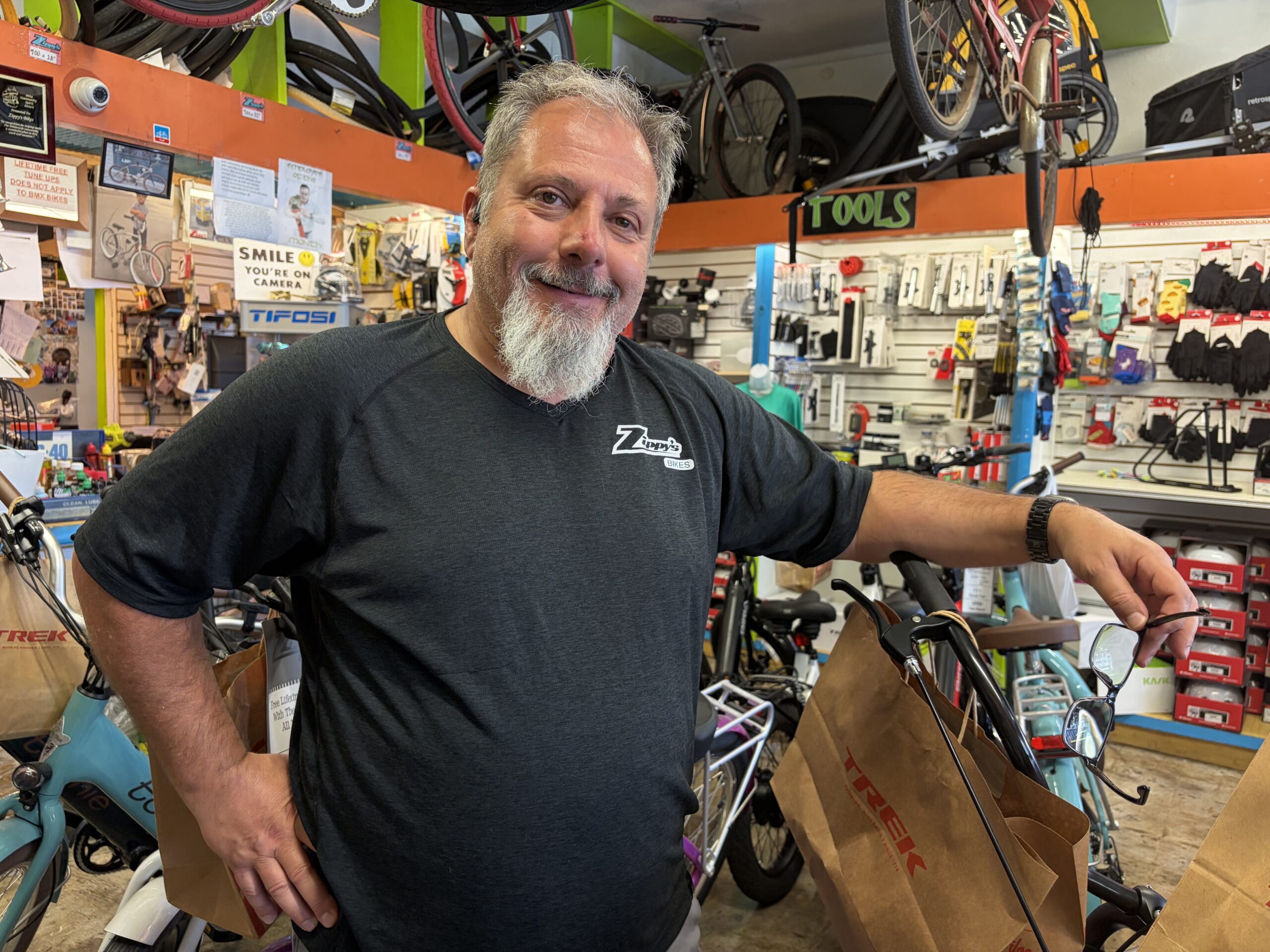
    Scott Chambers, owner of Zippy’s Bikes in Wildwood, says the new e-bike law in New Jersey “is a mess,” with no way for people to comply with registration requirements, and confusion over other issues.

    “It’s a mess,” said Scott Chambers, owner of Zippy’s Bikes in Wildwood. “It’s so overwhelming because they created this law, I don’t want to say haphazardly, but they rushed it.”

    Crawford said his customers are reluctant to buy an e-bike until they know they can ride it in compliance with the law.

    He says the law doesn’t mention e-tricycles, so it’s not clear where those might fall. (The state now says the law does not apply to e-tricycles.)

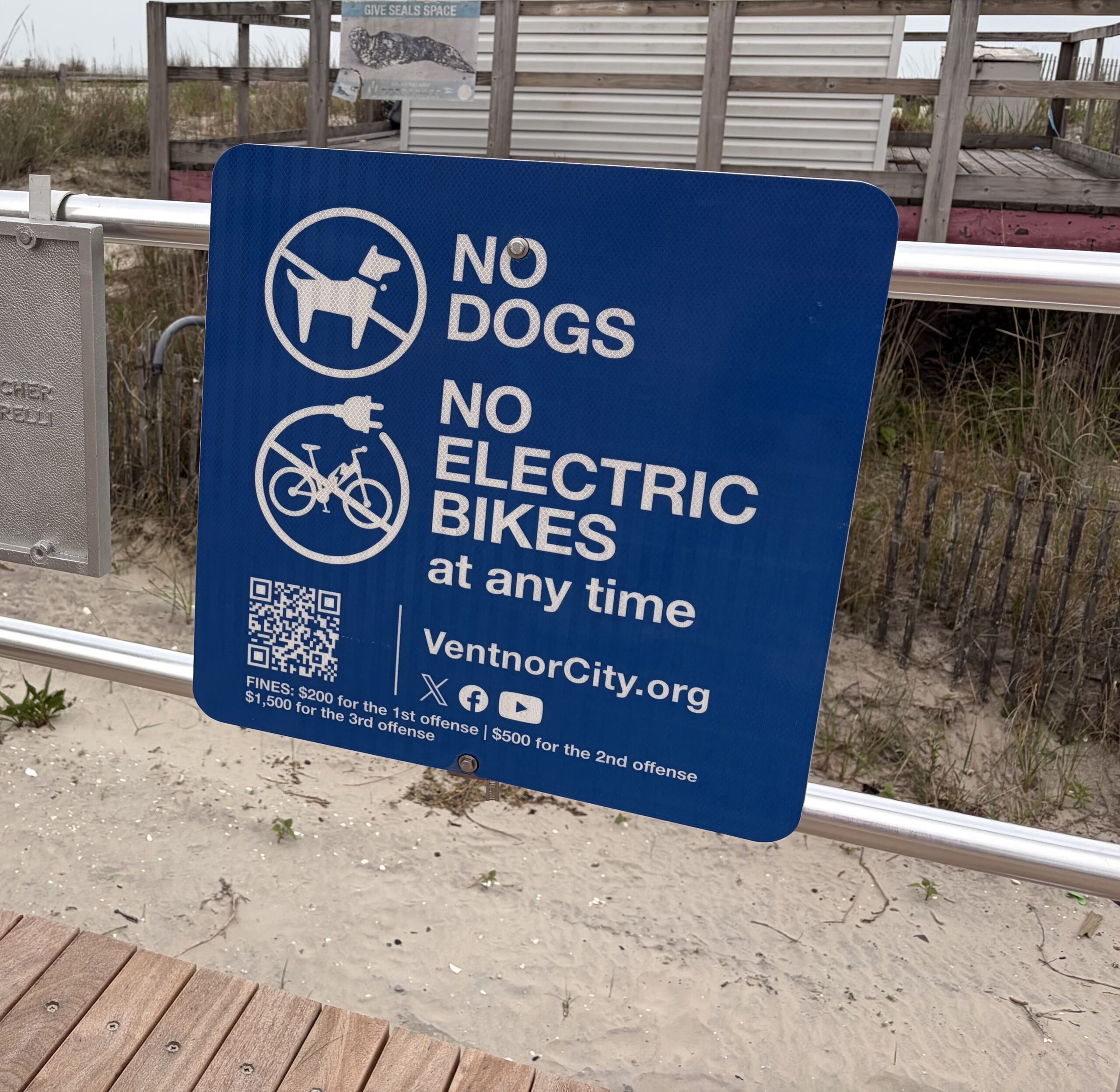
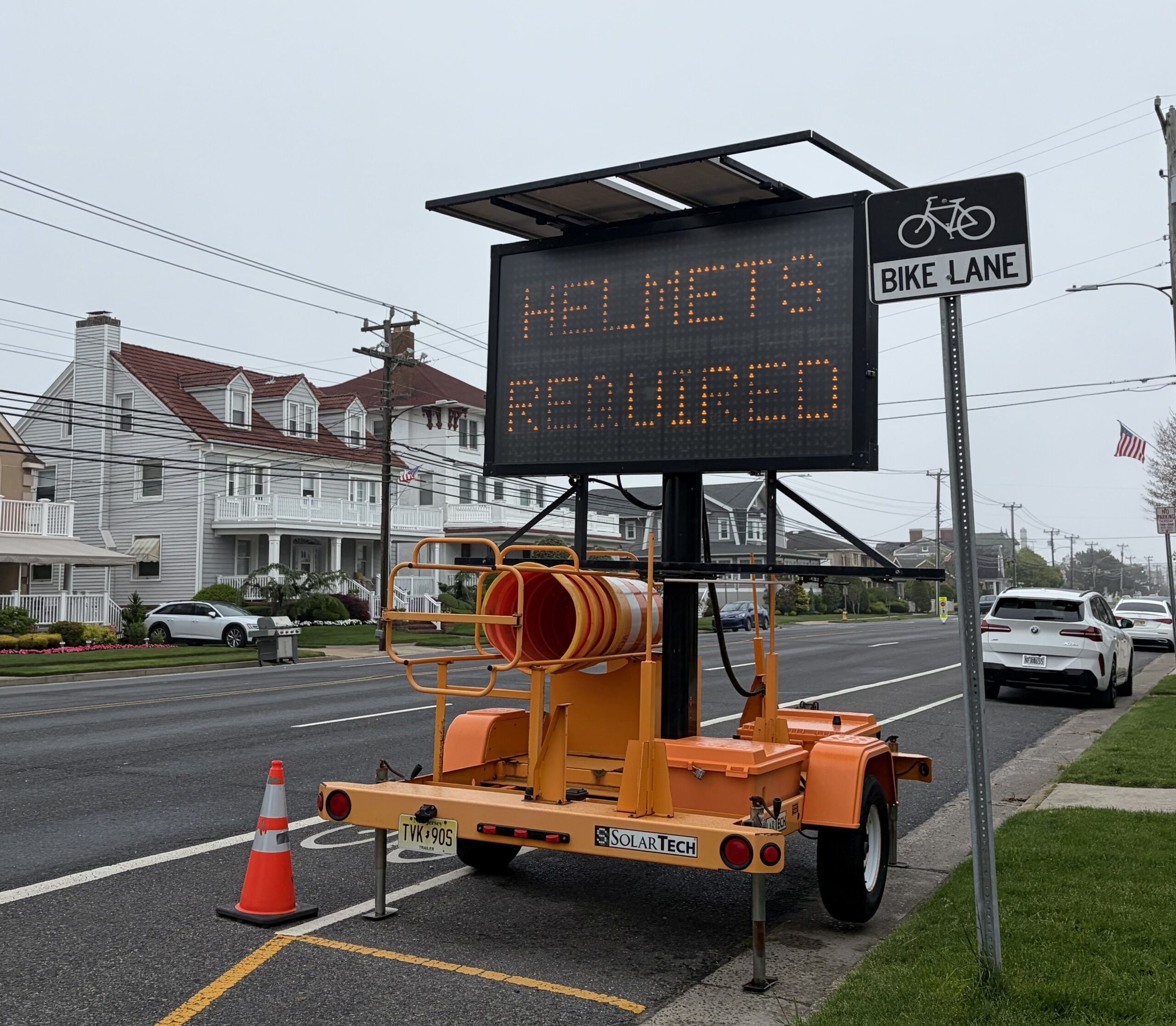
    In Ventnor, there’s a big electronic sign on Atlantic Avenue alerting people to the new law’s helmet, insurance, and registration requirements. A new sign was added to the Boardwalk itself, highlighting two prohibited categories: e-bikes and dogs.

    Ventnor police Lt. Bryan Gaviria says the department will have its hands full, educating and, at some point, enforcing the new e-bike law.

    But first, he said, they need some answers themselves.

    “We’re absolutely waiting for clarity all around,” he said, adding that the city’s bicycle officers are choosing to ride on non-electric bikes because they don’t want to be out of compliance themselves, and they don’t want to be on e-bikes while enforcing an e-bike ban.

    Ventnor installed this sign on the Boardwalk warning that electric bikes were prohibited (as well as dogs). The state’s new e-bike law goes into effect July 19, but Pennsylvanians will not be required to register their e-bikes while in New Jersey, the state says.

    Waiting on the state

    The state recently clarified some of the issues that were causing confusion.

    William Connolly, the press secretary for the N.J. Motor Vehicle Commission, says the MVC will begin offering appointments for e-bike licensing and registration in July. The law’s grace period ends July 19.

    “We will be making an announcement later this month about when appointments will become available, along with offering newly updated resources and step-by-step guidance for e-bike licensing and registration,” he said.

    He said the delay was due to the “extensive IT upgrades” required for new licensing and registration systems, educational resources and testing procedures, not to mention buying new materials such as “specialized license plate stickers,” that will have to be displayed on the registered bikes.

    “We are establishing a first-of-its-kind, comprehensive process for e-bikes,” he said.

    Ventnor installed this electronic sign on Atlantic Avenue to educate people about the state’s new e-bike law. Pennsylvanians will not be required to register their e-bikes while in New Jersey, the state says.

    Connolly said there is one category of e-bikes that will not require insurance, though they will still require registration: the lowest speed e-bikes.

    “These are the low-speed e-bikes with a motor that provide pedal assist only when the rider is pedaling and cease to provide assistance when the e-bike reaches 20 mph,” he said.

    So what if you’re visiting the Shore and bring an e-bike?

    Connolly said: “E-bike registration through the New Jersey MVC is only available to New Jersey residents.” Meaning, Pennsylvanians can bring their bikes and use them without registering them.

    But bicycle advocates say the law is confusing, because it also states that any bike must display a sticker showing that it is registered.

    While the law was prompted by a series of crashes, and particularly by the ubiquitous use by teenagers, it has been seniors that have taken to the e-bikes and urged towns to let them ride on their boardwalks.

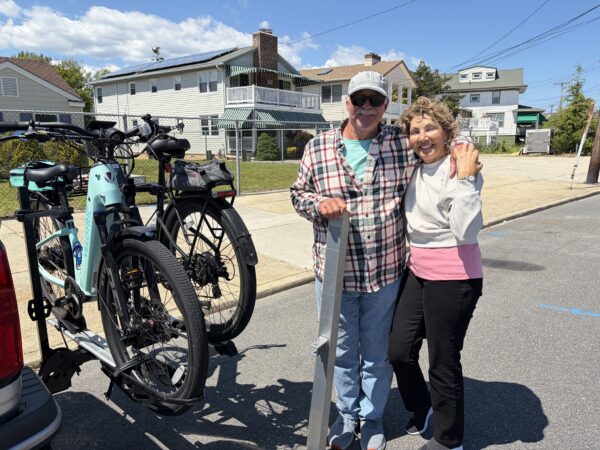
    Annamarie, 70, and Mike Carr, 71, of Ventnor are best known for the Jagielky’s candy shops they own, but it’s e-bikes that have become their passion.

    Loading their bikes back onto their truck in Ocean City, where they began and ended a bike ride around various bridges, Mike Carr said he’d be sure to wear a helmet, because he believes that will be the thing that officers will focus in on in the beginning.

    Annamarie said, “Sure we’re upset,” about not being able to ride on Ventnor’s boardwalk, but they recognize the risks from people going too fast, particularly on electric scooters.

    E-bikes have allowed the couple to go on numerous bike rides a week, for upward of 30 or more miles. They’d never do that on a regular bike.

    “We parked here, we went the whole length of the boardwalk, we went down to 29th Street, we went back to Haven Avenue, came back and went over the bridge to go see the birds,” Mike said, describing the couple’s route that day.

    With the e-bikes, they don’t have to worry about the wind, he said. The couple will typically go 13 miles an hour.

    They are hooked on the freedom, distance, and exhilaration that e-bikes have given them, even as they passed 70. They ride all over the bridges of the barrier islands.

    Mike’s got some of his regular routes timed so that he can get over the bridge without getting a red light and without automobile traffic catching him from behind. “When we’re going into Longport, you turn around, you look at the light. When it’s red, you have four minutes to get over. You hit the throttle and you go as fast as you can.”

    He said they’ll try to register the bicycles and comply with the law, once they’re able to:

    “I’ll have to wear a helmet because I’m guessing they’ll look for the guys with no helmet, pull them over.”


    E-bike riders can sign up for direct updates from MVC here.

  • For these military veterans, Brazilian jiujitsu is a path to healing and finding a new community

    For these military veterans, Brazilian jiujitsu is a path to healing and finding a new community

    As a U.S. Army soldier in Afghanistan in 2013, Dan Kovalik got used to the adrenaline rush of bullets whizzing by while on patrol. Risking his life was part of his job as he radioed in Apache helicopters to protect other soldiers.

    But by the time he retired from the Army in 2018, his 23 years of military service had taken their toll. He had been diagnosed with post-traumatic stress disorder and was rated 80% disabled by the U.S. Department of Veterans Affairs. Kovalik moved back to his hometown of Johnstown, Pa., where he struggled to find the sense of purpose and camaraderie that had come so easily in the military.

    “I was looking for ways to be part of the community,” Kovalik said. “Church. The VFW. Then I tried jiujitsu.”

    Kovalik, 49, shared his story Saturday from the deck of the USS New Jersey, the decommissioned Navy battleship in Camden. The battleship was host to dozens of fans of and participants in Brazilian jiujitsu — a martial art that uses grappling and leverage to subdue opponents — for a day of competition.

    It was part of a two-day jiujitsu seminar and fundraiser put on by the We Defy Foundation, a Texas-based nonprofit that provides qualified combat veterans with free local jiujitsu classes and mentors who help them reintegrate into civilian life. Veterans must have been honorably discharged and have a VA disability rating of at least 80%.

    “The physical execution and mental chess game helps me to focus,” Kovalik said. “That, and just going out for a beer or dinner with friends afterwards.”

    Omar Feliciano, a 33-year-old Marine Corps veteran from Brooklyn, wins his match against Matthew Castillo, with Prodigy BJJ, at the We Defy Foundation jiujitsu event at the USS New Jersey in Camden on Saturday, June 20, 2026.

    The program has over 500 veterans currently enrolled, We Defy Foundation executive director Kevin Linderman said. About 70% of those who enroll complete the one-year program.

    “What makes it so different is, you have to do it with someone else,” Linderman said of jiujitsu. “When you’re grappling, you’re connecting with someone deeply. You’re both getting better through the process. It’s physical, and you’re learning how to operate under stress.”

    It’s also one more way to fight an ongoing crisis, Linderman said. Though military veterans made up 7.6% of the U.S. population in 2020, they accounted for 14% of suicides, according to research published in the National Library of Medicine. The suicide rate among veterans is 1.5 times higher than that of the overall population, after adjusting for age and sex, researchers noted.

    Though prevention efforts have shown some success, nearly 6,400 veterans died by suicide in 2023 — the most recent year for which data were available — according to the Department of Veterans Affairs.

    Omar Feliciano of Brooklyn, N.Y., said he found Brazilian jiujitsu after struggling to process a traumatic event he witnessed while in the Marines.

    “It really affected my sleep, my relationships with people,” Feliciano said. “I was irritable for no particular reason.”

    After another Marine recommended the We Defy Foundation, Feliciano applied. Now, Feliciano benefits from the structure of attending jiujitsu class twice a week, keeping him physically active and building camaraderie with other people in his community.

    The 33-year-old mechanical engineer said jiujitsu is helping him be a better father. He fought — and won — a jiujitsu match Saturday.

    “We’ve seen that it has a significant impact in reducing PTSD, depression, and anxiety,” said Linderman, 52, who came to the sport in 2015 while dealing with multiple deaths among his family and friends. Much like the veterans he helps, Linderman said, he was caught in a “rumination cycle,” and he quickly learned that an evening of grappling with opponents was a great way to break that cycle.

    Ethan Wanner, 21, of Williamsport, Pa. and Tried and True Gym, celebrates after winning his match against Josh Newhart, with 10P Bethlehem, at the We Defy Foundation jiujitsu event at the USS New Jersey in Camden on Saturday, June 20, 2026.

    The foundation was formed in 2015 by Army veterans Alan Shebaro and Joey Bozik. Though Bozik lost part of one arm and both legs from the blast of a roadside bomb in Iraq, he learned how to adapt his body to the martial art. In the process, Bozik regained much of the community he had been missing, Linderman said.

    As the COVID-19 pandemic waned, interest in the group accelerated, Linderman said. The organization has gotten $250,000 a year in financial backing from Facebook head Tom Alison. With 2,000 people moving through the program so far, interest is only growing. Linderman estimated that there are hundreds of thousands of Iraq or Afghanistan veterans who qualify for the program — including some who are struggling to find connection in civilian life.

    “I think that a way for people to stay connected to each other is one of the most important things right now,” Linderman said.