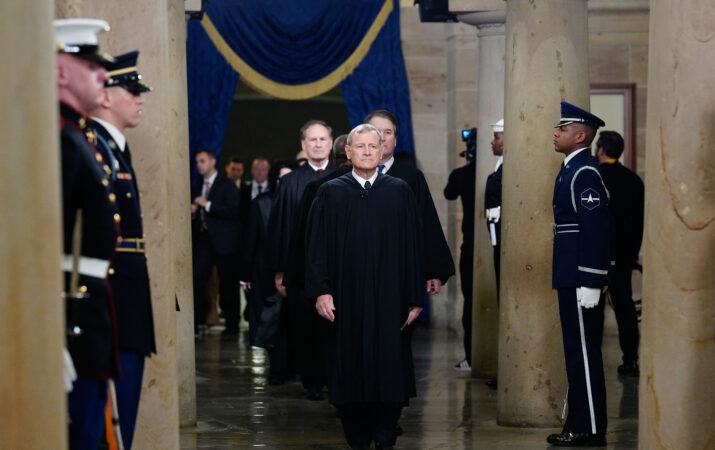
Amid rising concerns about the health of the nation’s democracy, Chief Justice John G. Roberts Jr. expressed faith Wednesday that the nation’s founding charters and key principles are proving resilient.
Quoting President Calvin Coolidge, the Supreme Court’s leader wrote in a year-end report that as the nation approaches its 250th anniversary, the rule of law remains alive and well.
“Amid all the clash of conflicting interests, amid all the welter of partisan politics, every American can turn for solace and consolation to the Declaration of Independence and the Constitution of the United States with the assurance and confidence that those two great charters of freedom and justice remain firm and unshaken,” Roberts quoted Coolidge as saying.
He added in his own words: “True then; true now.”
The comments came in Roberts’s annual report on the state of the judiciary, which largely sidestepped contemporary controversies and events at a moment of political upheaval. Many of those concerns have revolved around President Donald Trump’s push to expand executive authority and wield power that critics say belongs to other branches of the government.
Instead of those issues, Roberts wrote mostly about history — the drafting of the Declaration of Independence and Constitution, the ideas that inspired the documents and the nation’s struggles to fulfill the charters’ ideals.
Roberts urged judges to remain true to that legal bedrock.
“Those of us in the Third Branch must continue to decide the cases before us according to our oath, doing equal right to the poor and to the rich, and performing all of our duties faithfully and impartially under the Constitution and laws of the United States,” Roberts wrote.
Roberts made no mention of topics that have animated others in the judiciary and legal observers over the last year: threats against judges, the Trump administration’s alleged defiance of court orders or critiques by lower-court judges of how the Supreme Court has ruled on its emergency docket.
Roberts did decry threats against judges in last year’s annual report and pushed back on President Donald Trump’s calls to impeach a federal judge who ruled against him. In March,Roberts issued a rare statement saying that “impeachment is not an appropriate response to disagreement concerning a judicial decision.”
In November, Congress boosted funding for security at the Supreme Court, but it did not extend additional money for the protection of lower-court judges.
Threats against federal judges spiked in the months after Trump began his second term in January. Through the current fiscal year, which started Oct. 1, the U.S. Marshals Service has investigated 133 threats against federal judges, according to agency statistics.
Trump and his allies have sharply criticized rulings against the president’s policies and called for the removal of some judges. Dozens of judges who have ruled against Trump have received unsolicited pizza deliveries at their homes. Threats against judges have also come from the left.
Roberts’s report comes as the Supreme Court takes up a series of high-profile cases involving key tests of Trump’s agenda. In November, the justices appeared skeptical that Trump’s sweeping tariffs were legal. Earlier this month, the justices seemed ready to allow Trump greater authority to fire the heads of independent agencies without cause.
Next month, the justices will hear arguments over whether the president can dismiss Federal Reserve governor Lisa Cook, which would allow the president to reshape the Fed and its vast powers over the economy.
Decisions in all three cases are expected by the summer.
MELBOURNE, Australia — From Paris to Dubai to Sydney, crowds began ringing in the new year with exuberant celebrations filled with thunderous fireworks or drumming, while others took a more subdued approach.
A countdown to midnight was projected onto the Arc de Triomphe in Paris and Russians celebrated in snowy Moscow. In Japan, temple bells rang and some climbed mountains to see the year’s first sunrise and a light show with somersaulting jet skis twinkled in Dubai.
Other events were more subdued. Hong Kong held limited celebrations following a recent fire at an apartment complex that killed 161 people. Australia saluted the new year with defiance less than a month after its worst mass shooting in almost 30 years.
More security in Sydney
A heavy police presence monitored crowds watching fireworks in Sydney. Many officers openly carried rapid-fire rifles, a first for the event, after two gunmen targeted a Hannukah celebration at Bondi Beach on Dec. 14, killing 15.
An hour before midnight, victims were commemorated with a minute of silence, and the crowd was invited to show solidarity with Australia’s Jewish community.
New South Wales Premier Chris Minns had urged residents not to stay away from festivities, saying extremists would interpret smaller crowds as a victory: “We have to show defiance in the face of this terrible crime.”
People gather at Lan Kwai Fong to celebrate the start of 2026 in the Central district of Hong Kong.
Shadows of war and disaster
Indonesia scaled back festivities in solidarity with communities devastated by floods and landslides in parts of Sumatra a month ago that killed over 1,100. Fireworks on the tourist island of Bali were replaced with traditional dances.
Hong Kong rang in 2026 without fireworks over Victoria Harbor after the massive fire in November. Facades of landmarks were turned into countdown clocks and a light show at midnight.
And in Gaza, Palestinians said they hope the new year brings an end to the conflict between Israel and Hamas. “The war humiliated us,” said Mirvat Abed Al-Aal, displaced from the southern city of Rafah.
People gather to celebrate the new year at the Zojoji Buddhist Temple in Tokyo.
Around Europe
Pope Leo XIV closed out the year with a plea for the city of Rome to welcome foreigners and the fragile. Fireworks were planned over European landmarks, from the Colosseum in Rome to the London Eye.
In Paris, revelers converged toward the glittering Champs-Élysées avenue. Taissiya Girda, a 27-year-old tourist from Kazakhstan, expressed hope for a calmer 2026.
“I would like to see happy people around me, no war anywhere,” she said. “Russia, Ukraine, Palestine, Israel, I want everybody to be happy and in peace.”
In Scotland, where New Year’s is known as Hogmanay, First Minister John Swinney urged Scots to follow the message of “Auld Lang Syne” by national poet Robert Burns and show small acts of kindness.
Greece and Cyprus turned down the volume, replacing traditional fireworks with low-noise pyrotechnics in capitals. Officials said the change is intended to make celebrations more welcoming for children and pets.
Additional security in New York City
Police in New York City planned additional anti-terrorism measures at the Times Square ball drop, with “mobile screening teams.” It was not in response to a specific threat, according to NYPD Commissioner Jessica Tisch.
After the ball drops it will rise again, sparkling in red, white and blue, to mark the country’s upcoming 250th birthday. And Zohran Mamdani was taking office as mayor following a private ceremonial event around midnight in an old subway station.
People pose for pictures near illuminated decorations on New Year’s Eve in Mumbai, India.
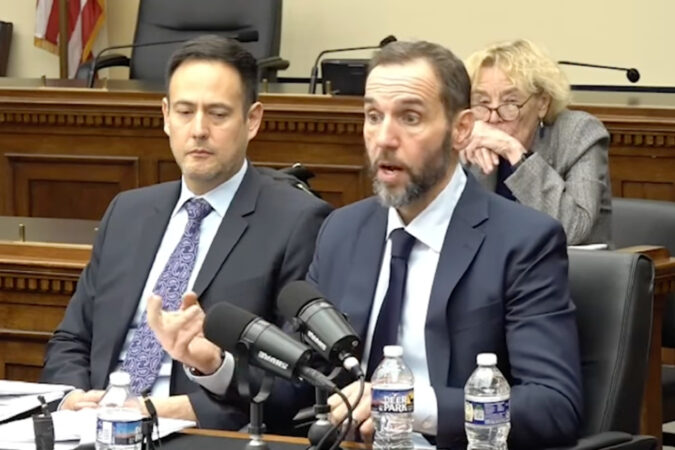
WASHINGTON — The Jan. 6. riot at the U.S. Capitol “does not happen” without Donald Trump, former special counsel Jack Smith told lawmakers earlier this month in characterizing the Republican president as the “most culpable and most responsible person” in the criminal conspiracy to overturn the results of the 2020 election.
The Republican-led House Judiciary Committee released on Wednesday a transcript and video of a closed-door interview Smith gave about two investigations of Trump. The document shows how Smith during the course of a daylong deposition repeatedly defended the basis for pursuing indictments against Trump and vigorously rejected Republican suggestions that his investigations were politically motivated.
“The evidence here made clear that President Trump was by a large measure the most culpable and most responsible person in this conspiracy. These crimes were committed for his benefit. The attack that happened at the Capitol, part of this case, does not happen without him. The other co-conspirators were doing this for his benefit,” Smith said, bristling at a question about whether his investigations were meant to prevent Trump from reclaiming the presidency in 2024.
“So in terms of why we would pursue a case against him, I entirely disagree with any characterization that our work was in any way meant to hamper him in the presidential election,” he added.
The Dec. 17 deposition was conducted privately despite Smith’s request to testify publicly. The release of the transcript and video of the interview, so far Smith’s only appearance on Capitol Hill since leaving his special counsel position last January, adds to the public understanding of the decision-making behind two of the most consequential Justice Department investigations in recent history.
Smith repeatedly made clear his belief that the evidence gathered against Trump was strong enough to sustain a conviction. Part of the strength of the Jan. 6 case, Smith said, was the extent to which it relied on the testimony of Trump allies and supporters who cooperated with the investigation.
“We had an elector in Pennsylvania who is a former congressman, who was going to be an elector for President Trump, who said that what they were trying to do was an attempt to overthrow the government and illegal,” Smith said. “Our case was built on, frankly, Republicans who put their allegiance to the country before the party.”
Accounts from Republicans willing to stand up against the falsehood that the election had been stolen “even though it could mean trouble for them” created what Smith described as the “most powerful” evidence against Trump.
When it came to the Capitol riot itself, Smith said, the evidence showed that Trump “caused it and that he exploited it and that it was foreseeable to him.”
Asked whether there was evidence that Trump had instructed supporters to riot at the Capitol, Smith said that Trump in the weeks leading to the insurrection got “people to believe fraud claims that weren’t true.”
“He made false statements to state legislatures, to his supporters in all sorts of contexts and was aware in the days leading up to January 6th that his supporters were angry when he invited them and then he directed them to the Capitol,” Smith said.
“Now, once they were at the Capitol and once the attack on the Capitol happened, he refused to stop it. He instead issued a tweet that without question in my mind endangered the life of his own Vice President. And when the violence was going on, he had to be pushed repeatedly by his staff members to do anything to quell it.”
Some of the deposition focused on Republican anger at revelations that the Smith team had obtained, and analyzed, phone records of GOP lawmakers who were in contact with Trump on Jan. 6. Smith defended the maneuver as lawful and by-the-book, and suggested that outrage over the tactic should be directed at Trump and not his team of prosecutors.
“Well, I think who should be accountable for this is Donald Trump. These records are people, in the case of the senators, Donald Trump directed his co-conspirators to call these people to further delay the proceedings. He chose to do that,” Smith said. “If Donald Trump had chosen to call a number of Democratic senators, we would have gotten toll records for Democratic senators.”
The communications between Trump and Republican supporters in Congress were an important component of the case, Smith said. He cited an interview his office did with Mark Meadows in which Trump’s then-chief of staff referenced that Rep. Jim Jordan, an Ohio Republican and current chairman of the House Judiciary Committee, had been in touch with the White House on the afternoon of the riot.
“And what I recall was Meadows stating that ‘I’ve never seen Jim Jordan scared of anything,’ and the fact that we were in this different situation now where people were scared really made it clear that what was going on at the Capitol could not be mistaken for anything other than what it was,” Smith said.
Smith was also asked whether his team evaluated former White House aide Cassidy Hutchinson’s explosive claim that Trump that grabbed at the steering wheel of the presidential SUV when the Secret Service refused to let him go to the U.S. Capitol building after a rally at the Ellipse on Jan. 6, 2021.
Smith told lawmakers that investigators interviewed the officer who was in the car, “who said that President Trump was very angry and wanted to go to the Capitol,” but the officer’s version of events “was not the same as what Cassidy Hutchinson said she heard from somebody secondhand,” Smith said.
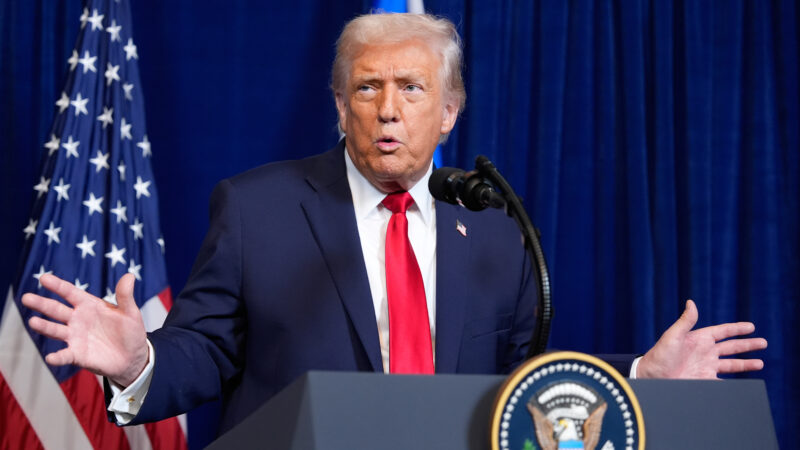
WASHINGTON — President Donald Trump said he’s dropping — for now — his push to deploy National Guard troops in Chicago, Los Angeles and Portland, Ore., a move that comes after legal roadblocks held up the effort.
“We will come back, perhaps in a much different and stronger form, when crime begins to soar again — Only a question of time!” he said in a social media post Wednesday.
Governors typically control states’ National Guardsmen, and Trump had deployed troops to all three cities against the wishes of state and local Democratic leaders. He said it was necessary as part of a broader crackdown on immigration, crime and protests.
The president has made a crackdown on crime in cities a centerpiece of his second term — and has toyed with the idea of invoking the Insurrection Act to stop his opponents from using the courts to block his plans. He has said he sees his tough-on-crime approach as a winning political issue ahead of next year’s midterm elections.
Troops had already left Los Angeles after the president deployed them earlier this year as part of a broader crackdown on crime and immigration.
In his post, Trump said the troops’ presence was responsible for a drop in crime in the three cities, though they were never on the streets in Chicago and Portland as legal challenges played out. When the Chicago deployment was challenged in court, a Justice Department lawyer said the Guard’s mission would be to protect federal properties and government agents in the field, not “solving all of crime in Chicago.”
Portland Mayor Keith Wilson’s office in a statement said the city’s reduction in crime was due to the efforts of local police and public safety programs. Chicago officials echoed the sentiment, saying in a release Tuesday that the city had 416 homicides in 2025 — the fewest since 2014.
Trump’s push to deploy the troops in Democrat-led cities has been met with legal challenges at nearly every turn.
Governors react
The Supreme Court in December refused to allow the Trump administration to deploy National Guard troops in the Chicago area. The order was not a final ruling but was a significant and rare setback by the high court for the president’s efforts.
Illinois Gov. JB Pritzker wrote on X Wednesday that Trump “lost in court when Illinois stood up against his attempt to militarize American cities with the National Guard. Now Trump is forced to stand down.”
Hundreds of troops from California and Oregon were deployed to Portland, but a federal judge barred them from going on the streets. A judge permanently blocked the deployment of National Guard troops there in November after a three-day trial.
Oregon Gov. Tina Kotek said in a statement Wednesday that her office had not yet received “official notification that the remaining federalized Oregon National Guard troops can return home. They were never lawfully deployed to Portland and there was no need for their presence. If President Trump has finally chosen to follow court orders and demobilize our troops, that’s a big win for Oregonians and for the rule of law.”
Trump’s decision to federalize National Guard troops began in Los Angeles in June, when protesters took to the streets in response to a blitz of immigration arrests in the area. He deployed about 4,000 troops and 700 Marines to guard federal buildings and, later, to protest federal agents as they carried out immigration arrests.
The number of troops slowly dwindled until just several hundred were left. They were removed from the streets by Dec. 15 after a lower court ruling that also ordered control to be returned to Gov. Gavin Newsom. But an appeals court had paused the second part of the order, meaning control remained with Trump. In a Tuesday court filing, the Trump administration said it was no longer seeking a pause in that part of the order.
“About time (Trump) admitted defeat,” Newsom said in a social media post. “We’ve said it from Day One: the federal takeover of California’s National Guard is illegal.”
Troops will remain on the ground in several other cities. The U.S. Court of Appeals for the District of Columbia Circuit in December paused a lower court ruling that had called for an end to the deployment of National Guard troops in Washington, D.C., where they’ve been deployed since August after Trump declared a “crime emergency.”
Trump also ordered the deployment of the Tennessee National Guard to Memphis in September as part of a larger federal task force to combat crime, a move supported by the state’s Republican Gov. Bill Lee and senators. A Tennessee judge blocked the use of the Guard, siding with Democratic state and local officials who sued. However, the judge stayed the decision to block the Guard as the state appeals, allowing the deployment to continue.
In New Orleans, about 350 National Guard troops deployed by Trump arrived in the city’s historic French Quarter on Tuesday and are set to stay through Mardi Gras to help with safety. The state’s Republican governor and the city’s Democratic mayor support the deployment.
WASHINGTON — The Department of Justice has expanded its review of documents related to the convicted sex offender Jeffrey Epstein to 5.2 million as it also increases the number of attorneys trying to comply with a law mandating release of the files, according to a person briefed on a letter sent to U.S. Attorneys.
The figure is the latest estimate in the expanding review of case files on Epstein and his longtime girlfriend Ghislaine Maxwell that has run more than a week past a deadline set in law by Congress.
The Justice Department has more than 400 attorneys assigned to the review, but does not expect to release more documents until Jan. 20 or 21, according to the person briefed on the letter who spoke on the condition of anonymity because they were not authorized to discuss it.
The expanding scope of the disclosure and the additional legal firepower committed to it showed how the Epstein file investigation will continue to occupy significant attention in Congress and the White House, almost ensuring that it remains a potent political force as the new year rolls toward midterm elections.
The White House did not dispute the figures laid out in the email, and pointed to a statement from Todd Blanche, the deputy attorney general, who said the administration’s review was an “all-hands-on-deck approach.”
Blanche said Wednesday that lawyers from the Justice Department in Washington, the FBI, the Southern District of Florida, and the Southern District of New York are working “around the clock” to review the files. The additional documents and lawyers related to the case were first reported by the New York Times.
“We’re asking as many lawyers as possible to commit their time to review the documents that remain,” Blanche said. “Required redactions to protect victims take time, but they will not stop these materials from being released.”
Still, Attorney General Pam Bondi is facing pressure from Congress after the Justice Department’s rollout of information has lagged behind the Dec. 19 deadline to release the information.
“Should Attorney General Pam Bondi be impeached?” Rep. Thomas Massie, a Kentucky Republican who helped lead the effort to pass the law mandating the document release, asked on social media this week.
Democrats also are reviewing their legal options as they continue to seize on an issue that has caused cracks in the Republican Party and, at times, flummoxed President Donald Trump’s administration.
Senate Democratic Leader Chuck Schumer said on social media that the latest figures from the Department of Justice “shows Bondi, Blanche, and others at the DOJ have been lying to the American people about the Epstein files since day one” and pointed out that the documents released so far represented a fraction of the total.
What’s expected next
A late January release of documents would put the Department of Justice more than a month behind the deadline set in law, but some key lawmakers appeared willing to let the process play out before trying to take direct action against the Trump administration.
Rep. Ro Khanna, a California Democrat who also led the effort to pass the law requiring the release, told the Associated Press that the Justice Department’s expanding review showed that the law is working.
“We are willing to give DOJ a few extra weeks to comply, provided they release the survivors’ statements to the FBI naming the other rich and powerful men who abused them or covered up and the prosecution memos about charges that were dropped against Epstein and co-conspirators,” he said. “When all the information comes out, this will shock the conscience of the nation.”
Massie has also said that he wants to see the release of statements that victims gave to the FBI. He has claimed that those could disclose the names of influential business figures and political donors who were involved or complicit in Epstein’s abuse.
The pair has also argued that the expanding disclosure is evidence that more people were involved besides Epstein and Maxwell.
What could the files mean for the midterms?
The Trump administration has already struggled to move past the Epstein files for the better part of last year. While it’s not clear what else will be shown in the files, it will almost certainly give Democrats continued fodder to continue to seize on the issue.
So far, Democrats, even though they are in the minority, have forced Congress to act on an issue that has caused splits in Trump’s political base.
A tranche of documents released just before Christmas showed that Trump flew on Epstein’s private jet in the 1990s, when they had a friendship before a falling out. But the documents revealed little new information about their relationship. The initial release of documents also showed several photos of former President Bill Clinton with women whose faces were blacked out.
Republicans on the House Oversight Committee have honed in on the connections to Clinton and are seeking to force him and former Secretary of State Hillary Clinton to appear for a deposition in January.
Still, Democrats are trying to show that the Trump administration’s handling of the Epstein files shows that it cannot be trusted and is more concerned about the welfare of the rich and famous than working-class voters.
“Unlike the President, we don’t care who’s in the files,” said Rep. Robert Garcia, the top Democrat on the oversight panel, on social media. “Anyone that’s involved in the abuse of women and girls should be held accountable.”
WASHINGTON — President Donald Trump issued the first vetoes of his second term on Tuesday, rejecting two low-profile bipartisan bills, a move that had the effect of punishing backers who had opposed the president’s positions on other issues.
Trump vetoed drinking water pipeline legislation from Republican Rep. Lauren Boebert of Colorado, a longtime ally who broke with the president in November to release files on convicted sex offender Jeffrey Epstein. He also vetoed legislation that would have given the Miccosukee Tribe of Indians of Florida more control of some of its tribal lands. The tribe was among groups suing the administration over an immigration detention center in the Everglades known as ” Alligator Alcatraz.”
Both bills had bipartisan support and had been noncontroversial until the White House announced Trump’s vetoes Tuesday night.
Trump appeared to acknowledge the tribe’s opposition to the detention facility in a letter to Congress explaining his veto. “The Miccosukee Tribe has actively sought to obstruct reasonable immigration policies that the American people decisively voted for when I was elected,” Trump wrote.
Trump did not allude to Boebert in his veto of her legislation, but raised concerns about the cost of the water pipeline at the heart of that bill.
In an interview later Wednesday with Politico, Trump also criticized the state’s Democratic Gov. Jared Polis while saying that he issued the veto because “They’re wasting a lot of money and people are leaving the state. They’re leaving the state in droves. Bad governor.”
Boebert, one of four House Republicans who sided with House Democrats early on to force the release of the Epstein files, shared a statement on social media suggesting that the veto may have been “political retaliation.”
“I sincerely hope this veto has nothing to do with political retaliation for calling out corruption and demanding accountability. Americans deserve leadership that puts people over politics,” her statement said. Boebert added in another post: “This isn’t over.”
The Florida legislation had been sponsored by Republican Rep. Carlos Gimenez, whom Trump has endorsed. Gimenez and the Miccosukee Tribe were not immediately available for comment on Wednesday.
When asked whether the vetoes were punishment, the White House did not answer and instead referred to Trump’s statements explaining the vetoes.
Congress can override the vetoes by a vote of two-thirds of the members of the House and the Senate, but it’s unclear if there’s enough support in the Republican-controlled chambers to do so, especially heading into a midterm election year where many of them will be on the ballot and many GOP members will count on Trump’s backing.
Boebert’s legislation, the “Finish the Arkansas Valley Conduit Act,” aimed to improve access to clean drinking water in eastern Colorado.
While the congresswoman has long been a staunch supporter of Trump, she found herself at odds with the president with her support this year for legislation that required the Justice Department to release files related to Epstein.
Trump fought the proposal before reversing in the face of growing Republican support for releasing the files. Members of his administration even met with Boebert in the White House Situation Room to discuss the matter, though she didn’t change her mind.
Republican Rep. Jeff Hurd of Colorado, who co-sponsored the legislation, said he was “deeply disappointed” by Trump’s veto.
“This was a bipartisan, unanimous bill passed by Congress to uphold a long-standing federal commitment to southeastern Colorado,” Hurd said in a statement.
He said the legislation did not authorize any new construction spending or expand the federal government’s original commitment to the pipeline project, but adjusted the terms of repaying its costs.
KYIV, Ukraine — Russian drones blasted apartment buildings and the power grid in the southern Ukraine city of Odesa in an overnight attack that injured six people, including a toddler and two other children, officials said Wednesday.
Russian President Vladimir Putin expressed confidence in his country’s eventual victory in the nearly four-year war against its neighbor.
Four apartment buildings were damaged in the Odesa bombardment, according to regional military administration head Oleh Kiper. The DTEK power provider said two of its energy facilities had significant damage. The company said 10 substations that distribute electricity in the region have been damaged in December.
Russia has escalated attacks on urban areas of Ukraine. As its invasion approaches a four-year milestone in February, it has also intensified targeting of energy infrastructure, seeking to deny Ukrainians heat and running water in the bitter winter months.
Between January and November, more than 2,300 Ukrainian civilians were killed and more than 11,000 were injured, the United Nations said earlier in December. That was 26% higher than in the same period in 2024 and 70% higher than in 2023, it said.
Renewed diplomatic push to stop the fighting
Trump’s special envoy Steve Witkoff said he, Secretary of State Marco Rubio, and Trump’s son-in-law and adviser Jared Kushner had a “productive call” with the national security advisers of Britain, France, Germany, and Ukraine “to discuss advancing the next steps in the European peace process.”
“We focused on how to move the discussions forward in a practical way on behalf of (Trump’s) peace process, including strengthening security guarantees and developing effective deconfliction mechanisms to help end the war and ensure it does not restart,” Witkoff said in a post on X.
He added that a main element of the conversation was the reconstruction of Ukraine and how to ensure its prosperity in the future.
Wednesday’s call comes after U.S. President Donald Trump hosted Ukrainian President Volodymyr Zelensky on Sunday and announced that a settlement is “closer than ever before.” European and Ukrainian officials plan to meet Saturday, lead Ukrainian negotiator Rustem Umerov reaffirmed, adding that U.S. representatives were expected to join remotely.
Zelensky also is due to hold talks next week with European leaders supporting his efforts to secure acceptable terms.
Putin is convinced of victory
Despite progress in peace negotiations, which he didn’t mention, Putin reaffirmed his belief in Russia’s eventual success in its invasion during his traditional New Year’s address.
He gave special praise to Russian troops deployed in Ukraine, describing them as heroes “fighting for your native land, truth, and justice.”
“We believe in you and our victory,” Putin said, as cited by Russian state news agency Tass.
The Russian Defense Ministry said 86 Ukrainian drones were shot down overnight over Russian regions, the Black Sea and the illegally annexed Crimea peninsula.
Russia claims Putin’s residence was attacked
Russia’s Defense Ministry released a video of a downed drone that it said was one of 91 Ukrainian drones involved in an alleged attack this week on a Putin residence in northwestern Russia, a claim Kyiv has denied as a “lie.”
The nighttime video showed a man in camouflage, a helmet and a Kevlar vest standing near a damaged drone lying in snow. The man, his face covered, talks about the drone. Neither the man nor the Defense Ministry provided any location or date.
The video and claims could not be independently verified.
Kyiv has denied the allegations of an attack on Putin’s lakeside country residence and called them a ruse to derail progress in peace negotiations.
Ukraine’s Center for Countering Disinformation said Wednesday the images could not be considered evidence of the attack as the origin of the damaged drone, as well as the time and location of the video itself, remained unknown.
“It took Russia more than two days to fabricate this ‘evidence’. The photographs of metal fragments laid out on the snow, published by the Russian Defense Ministry, do not prove anything in themselves,” the center said in a statement on its website.
“There is no video of air defense operations in the area of the residence, no recorded drone crashes in the claimed locations and no consistency even in its own figures, which have changed repeatedly.”
Maj. Gen. Alexander Romanenkov of the Russian air force claimed that the drones took off from Ukraine’s Sumy and Chernihiv regions. At a briefing where no questions were allowed, he presented a map showing the drone flight routes before they allegedly were downed by Russian air defenses over the Bryansk, Tver, Smolensk, and Novgorod regions.
The European Union’s foreign policy chief, Kaja Kallas, called the Russian allegations “a deliberate distraction” from peace talks.
Ukraine weapons fund receives billions of dollars
Zelensky said Romania and Croatia are the latest countries to join a fund that buys weapons for Ukraine from the United States.
The financial arrangement, known as the Prioritized Ukraine Requirements List, or PURL, pools contributions from NATO members, except the United States, to purchase U.S. weapons, munitions, and equipment.
Since it was established in August, 24 countries are now contributing to the fund, according to Zelensky. The fund has received $4.3 billion, with almost $1.5 billion coming in December, he said on social media.
Meanwhile, Ukraine’s Security Service carried out a drone strike on a major Russian fuel storage facility in the northwestern Yaroslavl region early Tuesday, according to a Ukrainian security official who was not authorized to speak publicly.
Long-range drones struck the Temp oil depot in the city of Rybinsk, part of Russia’s state fuel reserve system, the official told the Associated Press. Rybinsk is about 500 miles from the Ukrainian border.
U.S. Immigration and Customs Enforcement officials are planning to spend $100 million over a one-year period to recruit gun-rights supporters and military enthusiasts through online influencers and a geo-targeted advertising campaign, part of what the agency called a “wartime recruitment” strategy it said was critical to hiring thousands of new deportation officers nationwide, according to an internal document reviewed by the Washington Post.
The spending would help President Donald Trump’s mass-deportation agenda dominate media networks and recruitment channels, including through ads targeting people who have attended UFC fights, listened to patriotic podcasts, or shown an interest in guns and tactical gear, according to a 30-page document distributed among officials in this summer detailing ICE’s “surge hiring marketing strategy.”
The Department of Homeland Security has spoken publicly about its fast-tracked effort to significantly increase ICE’s workforce by hiring more than 10,000 new employees, a surge promoted on social media with calls for recruits willing to perform their “sacred duty” and “defend the homeland” by repelling “foreign invaders.” The agency currently employs more than 20,000 people, according to ICE’s website.
But the document, reported here for the first time, reveals new details about the vast scale of the recruitment effort and its unconventional strategy to “flood the market” with millions of dollars in spending for Snapchat ads, influencers and live streamers on Rumble, a video platform popular with conservatives. Under the strategy, ICE would also use an ad-industry technique known as “geofencing” to send ads to the phone web browsers and social media feeds of anyone who set foot near military bases, NASCAR races, college campuses, or gun and trade shows.
The document was also distributed among ICE officials in the days after the agency published a request for bids seeking contractors who could use “precise audience targeting, performance media management, and results-driven creative strategies” to “accelerate the achievement of [its] recruiting goals.” The language in the published bid closely mirrored language in the strategy document. That same month, DHS awarded two marketing firms nearly $40 million to support ICE’s public affairs office “recruitment campaign,” according to federal awards data.
It’s unclear how much of the spending and strategy have been carried out. But the plans outlined in the document have coincided with a rush of recruitment ads online seeking Americans who will “answer the call to serve.”
The rapid-recruitment approach is unlike anything ICE has ever pursued, said Sarah Saldaña, a director of ICE during the Obama administration, who recalled the agency filling its open positions through local police departments and sheriff’s offices with appeals to officers’ interests in federal public-safety work.
She said she worries that the speed with which ICE is racing to bring on new hires — coupled with the ad campaign’s framing of the jobs as part of a war — will raise the risk that the agency could attract untrained recruits eager for all-out combat.
The appeal to law enforcement should not be “the quicker we get out there and run over people, the better off this country will be,” she said. “That mentality you’re fostering tends to inculcate in people a certain aggressiveness that may not be necessary in 85 percent of what you do.”
ICE deferred comment toTricia McLaughlin, a DHS spokeswoman, who did not dispute a detailed list of claims and financial figures sent by the Post andsaid she was “thrilled to see the Washington Post highlight … [the] wildly successful ICE recruitment campaign, which isunder budget and ahead of schedule.”
The agency, she said, has received more than 220,000 job applications in five months and has issued more than 18,000 tentative job offers. More than 85% of the new hires had experience in law enforcement, she added.
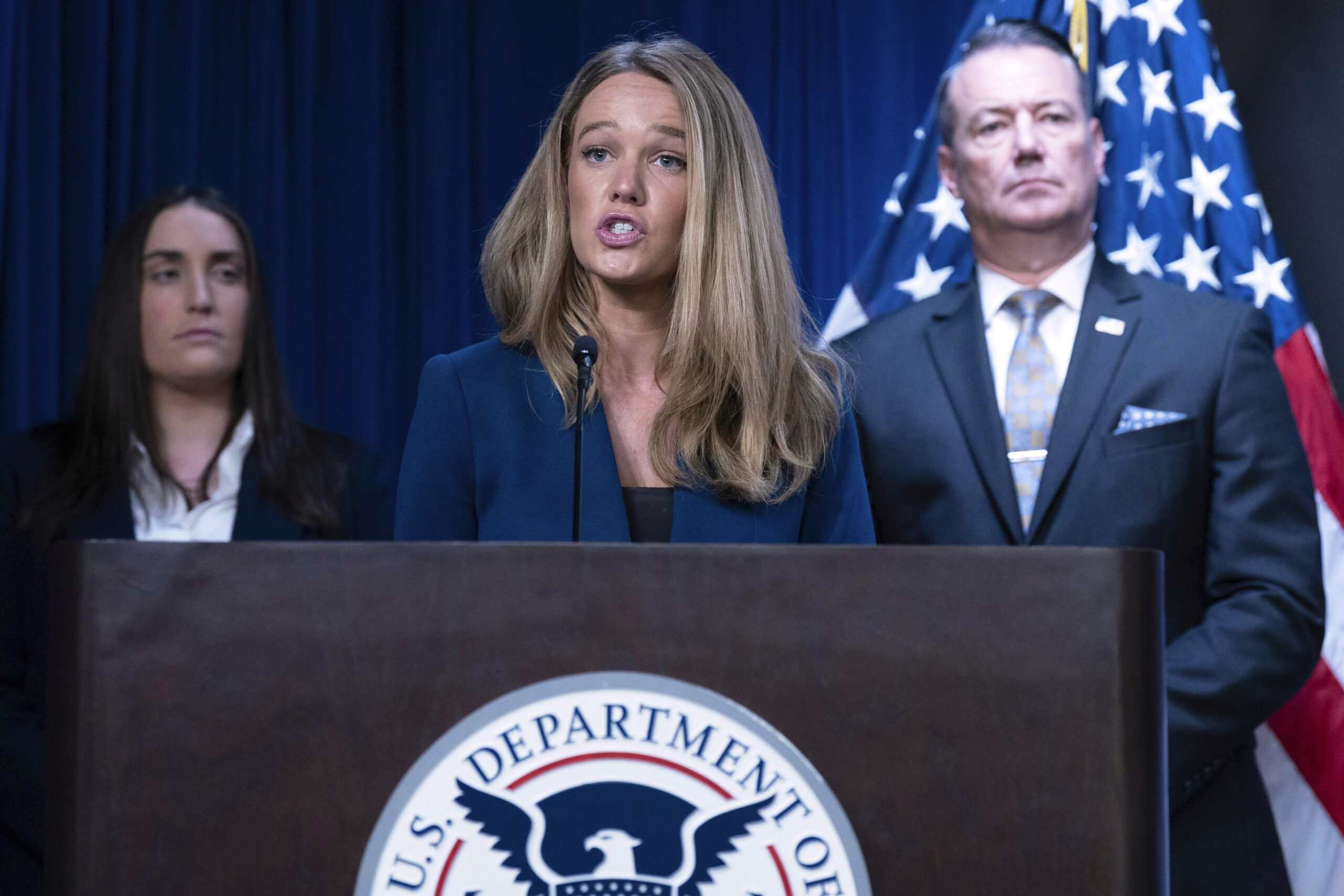
Tricia McLaughlin, spokeswoman for the Department of Homeland Security, is flanked by Madison Sheahan, second in command at ICE, and Todd Lyons, acting ICE director, at a May 21 news conference in Washington.
Congress this summer tripled ICE’s enforcement and deportation budget to about $30 billion by passing the One Big Beautiful Bill Act, helping to start a hiring spree that officials have said would be necessary to carry out the Trump administration’s promise of the biggest mass deportation in American history. Officials set a goal of 1 million deportations within the first year of Trump’s term.
To bolster its recruiting, the agency has removed its age limits for applicants and offered signing bonuses of up to $50,000. A job listing on a federal hiring board said the salaries for many deportation officers could range from $50,000 to $90,000 a year.
Recruitment ads have proliferated across TV, radio, print and podcasts directing viewers to an ICE hiring website that portrays immigration as an existential threat. “America has been invaded by criminals and predators,” reads the website, which includes an image of Uncle Sam. “We need YOU to get them out.”
On social media, administration accounts have mixed immigration raid footage with memes from action movies and video games to portray ICE’s mission as a fight against the “enemies … at the gates.” “Want to deport illegals with your absolute boys?” one post says. “Are you going to cowboy up or just lay there and bleed?” says another.
A U.S. Immigration and Customs Enforcement agent is seen in Park Ridge, Ill., on Sept. 19.
But to reach ICE’s “rapid hiring” goal of about 14,000 new Enforcement and Removal Operations officers, Homeland Security Investigations agents, ICE lawyers and support staff, the strategy document also calls for deploying more finely targeted digital advertising tools that can home in on viewers’ interests and lifestyles.
ICE recruitment ads, the plan said, would be shown to people with an interest in “military and veterans’ affairs,” “physical training,” or “conservative news and politics” and would target people whose lifestyles are “patriotic” or “conservative-leaning.”
The strategy said to target listeners of conservative radio shows, country music and podcasts related to patriotism, men’s interests and true crime, as well as any accounts that resemble users with an interest in “conservative thought leaders, gun rights organizations [and] tactical gear brands,” the document said.
To further attract recruits, the strategy called for spending at least $8 million on deals with online influencers whose followers are largely Gen Z and millennials and who were in the “military families,” “fitness,” and “tactical/lifestyle enthusiast communities.”
The document did not name specific influencers but said it would focus on “former agents, veterans and pro-ICE creators” who would be expected to host live streams, attend events and post short- and long-form videos and other content to Facebook, Instagram, Rumble, X and YouTube. Blogs, Substack newsletters, and Threads accounts would also be targeted for more “niche communities,” the document said.
The objective, it said, is to build trust through “authentic peer-to-peer messaging” and to “normalize and humanize careers at ICE through storytelling and lived experiences.” The document said it expected more than 5,000 applicants would come through the influencer program, costing ICE about $1,500 per application.
ICE has run ads on Google, LinkedIn, Instagram and Facebook, targeting the latter to military veterans and “entry-level job” seekers, according to the companies’ ad libraries, which share public data on the platforms’ ad campaigns. Millions more in advertising was slated for delivery to gaming consoles, connected TV devices and streaming services such as ESPN, Fox News and Paramount+, as well as across newspapers, billboards and box trucks, the strategy document said.
Listeners on Spotify have heard ICE ads calling on recruits to “fulfill your mission,” leading to hundreds of complaints on the music service’s message board. One NASCAR viewer who saw the ads on live streams said in a Reddit post that they changed the channel, and separately told the Post that they had “never felt such distaste for our government airing such ads.”
Natalia Banulescu-Bogdan, a deputy director at the Migration Policy Institute, a nonpartisan Washington think tank, said ICE’s ads harked back to World War I recruitment posters by using symbols like Uncle Sam.
The war rhetoric is in line with the Trump administration’s broader efforts to push mass deportations as critical to American security and immigration officials’ work as heroic, she said. But the ads also allow ICE to gloss over the “messy realities of immigration enforcement,” including “the public backlash, the legal pushback and the very real operational constraints.”
“We’ve never seen immigration agencies kind of strip down the policy debates to this level of raw imagery and symbolism,” she added.
The strategy document features on the cover ICE’s second-in-command, Madison Sheahan, who worked as an aide to DHS Secretary Kristi L. Noem when she was governor of South Dakota. In the photo, Sheahan, 28, wears a “police” vest and an ICE badge under the words “Defend the Homeland.”
The document called for spending “$100 million within one year” as part of an “aggressive” recruitment program that would “saturate digital and traditional media” and prioritize “speed, scale, and conversion at every level.”
Public ad-tracking figures from Google and Meta show ICE’s digital ad spending so far is a fraction of the strategy’s proposed budget for their platforms. McLaughlin, the DHS spokeswoman, did not respond to questions about how much money had been spent already or whether the strategy had changed.
Beyond demographic targeting, the strategy document also identified New York, Los Angeles, Minneapolis, Chicago, and Boston as “key locations” for finding recruits. The cities have been the targets of intense ICE sweeps and major anti-deportation protests over the last year.
The largest local recruitment target, seeking up to 1,000 removal officers, is slated for the New Orleans field office. The state of Louisiana has one of the country’s biggest immigrant detention populations, second only to Texas, and the New Orleans field office manages all nine detention facilities in the state.
ICE has hosted hiring events around the country, including at a Texas job fair earlier this year, during which a former mixed martial arts fighter told the Post he was eager to “work with these guys that are going to arrest you, slam your face on the pavement and send you home.”
But the strategy has also called for boosting recruitment at major gatherings and sporting events, including a booth at the NASCAR Cook Out Southern 500 in South Carolina in August; a “gym-based recruitment” event with “influencer-style content” at the UFC Fight Night in Las Vegas in November; and a planned sponsorship devoted to “patriotism, strength [and] grit” at the National Finals Rodeo this month in Las Vegas.
DHS did not say whether all the events proposed in the strategy were carried out, but their ads did accompany several of the events on TV. “ICE commercial during the UFC event tonight?! How gross,” one X user said in October. ICE also posted a bid in November seeking a firm to “identify suitable event locations” for “recruitment and outreach events.”
The recruitment ads run separately from other large-scale DHS campaigns that celebrate Trump’s immigration agenda and urge undocumented immigrants to leave the U.S. DHS has awarded more than $200 million in contracts this year to People Who Think and Safe America Media, two marketing firms linked to Republican political consultants, federal contracting records show. Representatives from the firms did not respond to requests for comment.
Those efforts, too, have relied on ad-targeting techniques more commonly used by corporate marketing campaigns. The ad library for Meta, which runs Facebook and Instagram, shows that DHS has spent more than $1 million on “self-deportation” ads in the last 90 days targeted to people interested in “Latin music,” “Spanish as a second language,” and “Mexican cuisine.”
On a message board for the music streaming service Pandora, some users were furious about the ads they called “fearmongering … propaganda.” One user, who said she is a U.S. citizen who likes listening to reggaeton, said she had been overwhelmed by DHS commercials “implying I am an undocumented immigrant and instructing me to ‘go home’” that played in “nearly every other ad slot I hear.”
ICE’s ads have drawn criticism from some Democrats, who have called them overly inflammatory. The Senate Judiciary Committee, led by Sen. Dick Durbin (D., Ill.), said in October that ICE’s “polarizing recruitment ads” would “only attract MAGA radicals.”
And some of the platforms on which the ads have run have expressed their own reservations. Earlier this month, a transit operator in Long Beach, Calif., removed ICE recruitment ads from its buses and apologized for the “uncertainty and fear” they may have caused, as was first reported by the Long Beach Watchdog, a local news source.
Americus Reed, a marketing professor at the University of Pennsylvania’s Wharton School, said the ICE strategy reminded him of the “Army of One” campaign that the military once used to build up recruits as mighty warfighters critical to safeguarding the American way of life.
“They’re aiming for that sweet spot of people who’ve got something to prove, who want to have that power, under the guise of patriotism,” he said.
The Kennedy Center adopted bylaws earlier this year that limited voting to presidentially appointed trustees, a move that preceded a unanimous decision this month by board members installed by President Donald Trump to add his name to the center.
The current bylaws, obtained by the Washington Post, were revised in May to specify that board members designated by Congress — known as ex officio members — could not vote or count toward a quorum. Legal experts say the move may conflict with the institution’s charter.
Trump took over the Kennedy Center in February, purging its board of members he had not appointed. The months that followed saw struggling ticket sales and programming changes that began to align the arts complex with the Trump administration’s broader cultural aims, culminating with the annual Kennedy Center Honors hosted by the president.
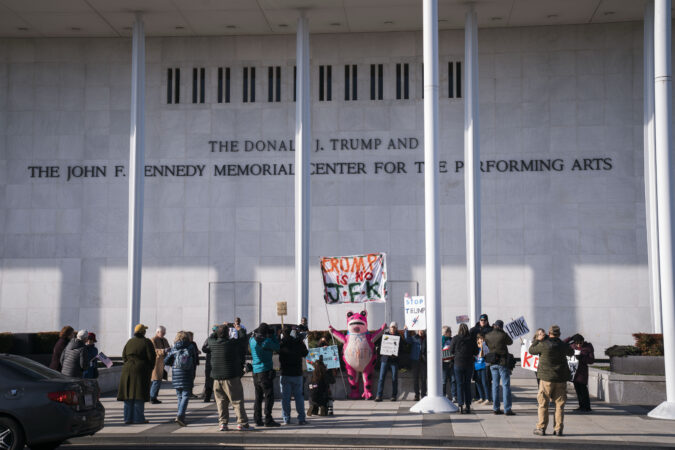
Days later, on Dec. 18, the board voted to add the president’s name to the institution, and within 24 hours it was on the website and the building itself: “The Donald J. Trump and The John F. Kennedy Memorial Center for the Performing Arts.”
Several artists have announced cancellations at the center as the unprecedented move drew public scrutiny and backlash. Democratic lawmakers and legal experts said it was illegal for the board to alter the name of the living memorial to Kennedy that Congress established. Democrats also claimed that one ex officio member, Rep. Joyce Beatty (D., Ohio), was muted when she attempted to speak out during the Dec. 18 vote.
Roma Daravi, the center’s vice president of public relations, told the Post that ex officio members have never voted.
“The bylaws were revised to reflect this longstanding precedent and everyone received the technical changes both before the meeting and after revisions,” Daravi wrote in an email to the Post. “Some members (including ex officio) attended in person, others by phone, and no concerns were voiced, no one objected, and the bylaws passed unanimously.”
The Kennedy Center lists 34 presidentially appointed board members, including Trump himself as chair, and 23 ex officio seats. The center’s president, Richard Grenell, is also an officer of the board.
The federal law that established the Kennedy Center designates specific government and federal positions — including the librarian of Congress; the mayor of Washington, D.C.; the secretary of the Smithsonian Institution; and the majority and minority leaders of the Senate — to serve as ex officio members.
The law identifies them as part of the board of trustees, which it directs to maintain and administer the facility as a living memorial. But it does not distinguish between voting and nonvoting members, which has been a point of ambiguity in the days following the vote to rename the Kennedy Center.
The center’s original bylaws didn’t distinguish voting powers, either. But its most recent tax filings list 59 “voting members” of its governing body — a total that includes both general and ex officio members.
A former Kennedy Center staffer with knowledge of board proceedings, who spoke on the condition of anonymity out of fear of retribution, told the Post that ex officio members were “always included in debate and discussion” during their tenure, but the person did not recall a time when those members’ votes were counted.
“Theoretically they could vote, but our practice was not to have them vote or count toward quorum,” the person said, noting they were not aware of the new leadership’s practices at the center.
For this report, the Post reached out to all ex officio members with questions about their voting authority and any known changes to it. Some told the Post or other outlets that they understood their current role to be nonvoting, though none addressed whether they were aware of any prior changes to that status.
“Like a lot of things, this seems to be in dispute,” said one person with knowledge of board proceedings, who spoke on the condition of anonymity because they were not authorized to speak on the matter.
Senate Majority Leader John Thune (R., S.D.) told a reporter Dec. 18: “I don’t have a vote. I don’t know enough about it.”
Sen. Sheldon Whitehouse (D., R.I.) told the Post that he became an ex officio member this year after he became the lead Democrat on the Senate Committee on Environment and Public Works — another ex officio seat designated by Congress — but was not invited to board meetings until his committee began investigating the Kennedy Center last month.
Whitehouse said the statute “makes no distinction between ex officio and presidentially appointed Trustees when it comes to members’ rights and responsibilities on the board, including voting,” and he accused the Trump-appointed board of attempting to “illegally change the bylaws to silence dissent.”
A spokesperson for the Smithsonian Institution said that Secretary Lonnie G. Bunch III does not vote or attend the meetings. It was unclear whether he had since assuming his role in 2019, but it is not uncommon for high officials serving on influential Washington boards to attend by proxy or not at all.
Copies of the Kennedy Center’s May and September board meeting minutes, obtained by the Post, showed that many ex officio members were absent or sent a staffer in their place.
Beatty, who sued the Kennedy Center’s board of trustees Dec. 22 to stop it from adding Trump’s name to the institution, declined to comment for this story. But her lawsuit argues the center’s statute makes her a “a full voting member.”
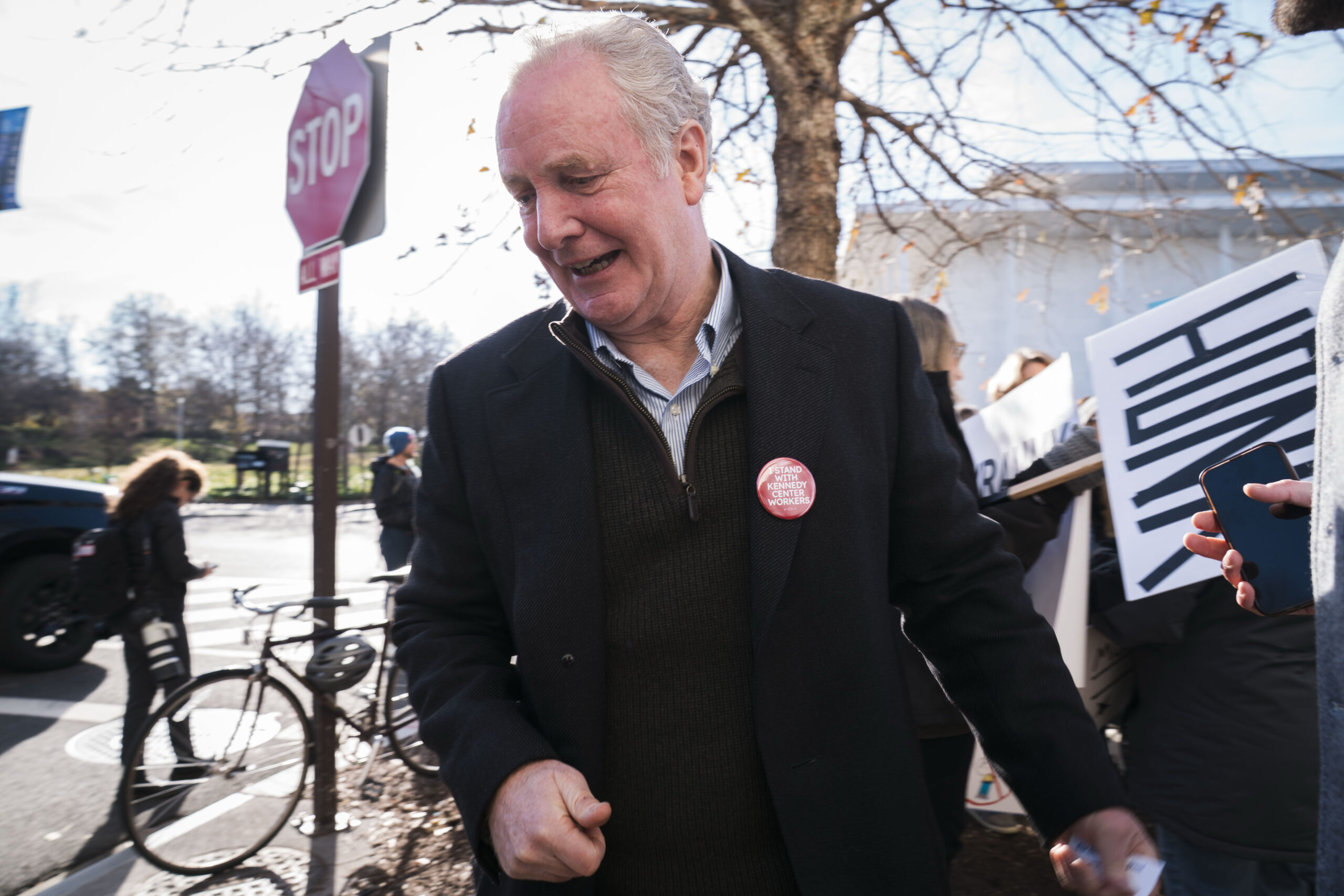
Sen. Chris Van Hollen (D., Md.) leaves a protest of the Kennedy Center name change in Washington on Dec. 20.
Sen. Chris Van Hollen (D., Md.), who is listed as an ex officio member on the Kennedy Center’s website, said he is no longer part of the board. “I was on the Kennedy Center board … in the last Congress,” he told the Post. “So their website is not caught up because I was told when Democrats lost control of the Senate and the Republicans became the majority that I fell off.” (The charter calls for three additional Senate members appointed by the president of the Senate and three House members appointed by the speaker to serve in ex officio seats.)
Many in high-ranking roles, including Secretary of State Marco Rubio, Health Secretary Robert F. Kennedy Jr. and Senate Minority Leader Charles E. Schumer (D., N.Y.), did not respond to requests for comment.
The offices of D.C. Mayor Muriel E. Bowser and the acting librarian of Congress, Robert Newlen, declined to comment.
Other changes from the May revision state that the general trustees “serve at the pleasure of the President.” (Previously, that language appeared in the bylaws and the federal statute only in reference to the Advisory Committee on the Arts, a separate body that makes recommendations to the board.)
They also added language about the ability of officers to make certain appointments, including stating that the chair may appoint the center’s president to act as chief executive.
The vote by the Kennedy Center’s board to add Trump’s name to the institution marked the most overt effort to date by the president and his allies to remold the storied performing arts center in his image.
In the days since his name was added to the building, several lawmakers have vowed to fight the change.
During a rally outside the Kennedy Center on Dec. 20, Van Hollen said he and his colleagues would work to “reverse” the move when Congress returns to session in January. “The day we get back, we can put an amendment on the … Interior appropriations bill to reverse this outrage,” he told the crowd.
Beatty’s lawsuit, filed in the U.S. District Court for the District of Columbia, claimed that the vote exceeded its statutory authority and requested that a judge declare it to be void.
“Because Congress named the center by statute, changing the Kennedy Center’s name requires an act of Congress,” the lawsuit says, adding that “Congress intended the Center to be a living memorial to President Kennedy — and a crown jewel of the arts for all Americans, irrespective of party.”
President Donald Trump, shown attending a showing of “Les Misérables” in June, has made himself a marquee element of the Kennedy Center.
Last week, Rep. April McClain Delaney (D., Md.) introduced legislation to remove Trump’s name.
Rep. Chellie Pingree of Maine, the top Democrat on the Appropriations subcommittee that oversees the Kennedy Center, along with more than 70 lawmakers in Congress, called for Trump to reverse the renaming effort and remove his name from the building immediately.
“No board vote nor social media post has the legal authority to change the name without an act of Congress,” the members wrote.
“We’ll be working to block this disgraceful renaming effort at every possible opportunity and restore the Kennedy Center’s rightful place as our nation’s cultural center without the burden of vanity projects or political influence,” they wrote.
Roger Colinvaux, a law professor at Catholic University, said his read of the statue establishing the center was “not quite as demonstrative” as Beatty’s, but “I’d argue that the statute does not differentiate among types of trustees in terms of powers and obligations, which would include voting.”
Colinvaux added that “basic governance principles” “do not allow for the ‘muting’ of members” of an entity’s governing body, which is a “deliberative body.”
Phil Hackney, a law professor at the University of Pittsburgh and a specialist in nonprofit tax-exempt organizations, said it’s worth noting “how ex officio trustees have traditionally operated” at both the Kennedy Center and the Smithsonian, of which the Kennedy Center is technically a bureau. He said that a court would also need to consider whether trustees are supposed to be able to remove ex officio members’ powers by amending bylaws.
That said, the statute says the trustees “have the usual powers,” and “it still strikes me, under what I see so far, that it is reasonable to believe that ex officio trustees might have the right to vote,” he said.
Ellen Aprill, senior scholar at UCLA School of Law, who has written about the Kennedy Center’s legal status, said even if the bylaws limit voting to general board members appointed by the president, “I believe there is a strong argument that such a bylaw provision violates the Kennedy Center’s charter.”
Aprill stressed that the charter includes a variety of public servants, and both majority and minority members of Congress in the Kennedy Center’s governance. “Clearly the intent of the charter provisions was to entrust Kennedy Center guidance to a broad group, not just those appointed by the president,” she said.
Still, the Kennedy Center’s relatively ambiguous legal status as a public-private entity “makes it difficult to predict how a judge faced with the issues in the case beyond standing would decide,” she said, noting the situation “is likely to give any judge a great deal of freedom in making any decision.”
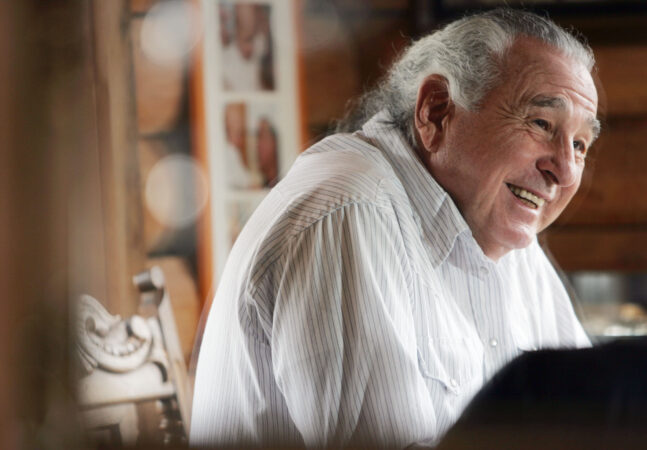
Former Sen. Ben Nighthorse Campbellof Colorado, who overcame a hardscrabble childhood to become the first Native American chairman of the Senate Committee on Indian Affairs and a leader of the effort to build the National Museum of the American Indian in Washington, died Dec. 30. He was 92.
Mr. Campbell died surrounded by his family, his daughter, Shanan Campbell, told the Associated Press. A cause of death was not provided.
Mr. Campbell, a member of the Northern Cheyenne tribe, represented the western slope of Colorado for three terms in the U.S. House, starting in 1987, and served two terms in the Senate beginning in 1993.In each chamber, he was the only American Indian in office at the time.He immersed himself in public lands, water, and mining issues but made Indian causes the centerpiece of his legislative career.
In the button-down environs of Capitol Hill, Mr. Campbell stood out by arriving at work on a motorcycle, wearing a ponytail and a bolo tie with a handmade silver and turquoise clasp. His unusual resumé further set him apart from the many former lawyers in Congress.
In his youth, Mr. Campbell was a member of the first U.S. Olympic judo team. He became a Teamsters union truck driver, an Air Force military police officer, a trainer of champion quarter horses and a successful jewelry designer before entering public service, by his account, on a whim.
A fiscal conservative and social liberal, Mr. Campbell was elected first as a Democrat and made a high-profile switch to the Republican Party in 1995. He joined the Republicans, in part, he said, to protest Senate Democrats’ defeat of a GOP-backed proposed constitutional amendment to balance the budget.
He continued to support abortion rights and opposed attempts by some Republicans to cut spending for the federal school lunch program. The program sometimes accounted for “the only meal I got when I was a kid,” he said, recalling a childhood that also included years in an orphanage during the Depression.
Republicans had recently taken control of the Senate when Mr. Campbell joined their caucus, and they rewarded him with a seat on the Appropriations Committee, which controls government spending. In 1997, he was selected to chair the Indian Affairs Committee.
His involvement with the Smithsonian Institution’s National Museum of the American Indian dated to 1989, when he was a sponsor of legislation that authorized construction of a building on the National Mall and that required the Smithsonian to identify Indian remains and sacred objects in its vast collection and repatriate them to tribes requesting their return. The museum opened in 2004.
Unlike federal laws regarding water rights or tribal boundaries for Native Americans, the museum legislation “was about respecting their humanity,” said Kristen Carpenter, director of the American Indian Law Program at the University of Colorado.
John Echohawk, executive director of the Native American Rights Fund, a Colorado-based public interest law firm that has worked for decades to secure the return of Indian remains and sacred objects, said the legislation was a “key part of the process of educating” the publicabout Indian rights and sovereignty.
Fascination with judo
Benny Marshall Campbell was born in Placer County, Calif., northeast of Sacramento, on April 13, 1933.
His father, who dabbled in jewelry-making and ran a country store, tried to hide his Cheyenne Indian heritage in an era of rampant discrimination. “My father insisted we keep our Indian background a secret,” Mr. Campbell told his biographer, Herman J. Viola. “Don’t worry about it, we were told. Just keep your mouth shut. It doesn’t mean anything; don’t have anything to do with it.”
His mother, a Portuguese immigrant, suffered from tuberculosis and was in and out of healthcare facilities for much of his childhood. She struggled to look after Benny and his sister while their father,an alcoholic, spent long periods away on drinking sprees.
“It was all she could do, sick and weak herself, to take care of her little family,” Mr. Campbell recalled to Viola. Sometimes the only food in the house was a can of vegetables. “I remember one day, in fact, when my mother opened a can of peas and gave half of them to my sister and half to me,” he said. “All she kept for herself was the juice in the can.”
Mr. Campbell was 6 when his mother placed her children inan orphanage in Sacramento, an act that he said he never held against her, given the family’s struggles. They occasionally returned to her care when their father was home.
At roughlyage 12, Mr. Campbell began packing fruit at the many farms in the area. He worked alongside laborers of Japanese heritage and, in one heated moment, found himself ina fight with a young man Mr. Campbell assumedhe could easily knock to the ground.
Instead, to his shock, the man put him on the floor with a judo maneuver — and Mr. Campbell became a “convert” to the sport, he said. He joined a judo club established by Japanese residents in Placer County, and the sport became an obsession.
Heleft high school in 1950, during his junior year, to enlist in the Air Force at the start of the Korean War. He chose to be a military police officer,in part, because the training included judo lessons.
He completed his high school equivalency diploma in the Air Force and, after he left the service, used the GI Bill to enroll at San Jose State College (now university), partly because of its winning judo team. His biographer wrote that Mr. Campbell’s first marriage, which was annulled within months, and his second, to Elaine Morgan, ended, in part, because he “put judo first.”
After graduating in 1957 with degrees in physical education and fine arts, Mr. Campbell taught art and industrial arts at an elementary school near San Jose. When he learned in 1960 that judo would be introducedin the 1964 Tokyo Olympic Games, hequit his job, sold his house and car, and moved to Japan to enroll in a renowned judo program at Meiji University.
To support himself in Tokyo, he taught English and landed bit parts in Japanese movies. He won a gold medal at the 1963 Pan American Games in Sao Paulo, Brazil.
The next year, Mr. Campbell was part of a four-man U.S. Olympic team, but a knee injury forced him to drop out during the competition. Stunned and in pain, Mr. Campbell wept openly when he had to forfeit the match, according to his biographer.
Returning to California, hetook a job as a high school physical education teacher near Sacramento.
In 1966, he married Linda Price, and they had two children, Colin and Shanan. A complete list of survivors was not immediately available.
Entering politics
In the late 1960s, a period of protest and cultural resurgence among American Indians, Mr. Campbell joined thousands of Native American young people searching for their roots. He located relatives in the Northern Cheyenne tribe in Montana, became a member of the tribeand took the name Nighthorse.
Soon, Mr. Campbell moved his family to a ranch in Southwest Colorado and began raising champion show-ring quarter horses. He also made award-winning jewelry with Indian themes, using skills he learnedfrom his father, whotaught him how to carve wood and bone and shape metal from coins and tobacco tins.
With a thriving jewelry business, Mr. Campbell acquired a pilot’s license and purchased a single-engine plane to ease travel to jewelry shows and competitions around the country. One day in 1982, he found himself grounded by weather in Durango, Colo., and met up with a friend who was attending a Democratic Party gathering to nominate a candidate for the state House of Representatives.
Mr. Campbell, who had not been active in politics, volunteered when no one else agreed to run. He won election that November, with 54% of the vote, and served two terms before narrowly unseating one-term incumbent U.S. Rep. Mike Strang in 1986 in a congressional district that included the cities of Pueblo, Grand Junction, and Durango.
In the U.S. House, Mr. Campbell successfully co-sponsored legislation to rename the Custer Battlefield National Monument in Montana, which became the Little Bighorn Battlefield National Monument. The change, according to the National Park Service, was intended “to recognize indigenous perspectives” on the American Indian victory over Lt. Col. George A. Custer and his 7th Cavalry in June 1876. The legislation also authorized a prominent memorial to the warriors who died there.
In 1987, Mr. Campbell generated support to remove from theHouseInterior Committee hearing room a century-old painting, titled Death Whoop and depicting an Indian holding a bloody knife in one hand and a settler’s scalp in the other.
“It’s out of touch with the sensitivity of Indians,” Mr. Campbell told the Associated Press at the time. “It plays on the prejudice of man.”
After three terms in the House, Mr. Campbell ran in 1992 for an open Senate seat and won the general election with support from organized labor, energy interests, ranchers and Hispanic voters.
He did not seek reelection in 2004, citing poor health. He had been treated for prostate cancer the previous year.
Yet it was his vigor that most colleagues recalled.
On one occasion, he chased down a mugger who had accosted him. In 1995, when he was 62, he used his martial arts skills to help subdue a homeless man who had shoved 92-year-old Sen. Strom Thurmond (R., S.C.) and then attacked a Capitol Police officer.
Alluding to his colleague’s physical prowess, Sen. Mitch McConnell (R., Ky.) wryly observed when Mr. Campbell retired that “many senators became a little more inclined to vote for his amendments after that.”