Category: News

Latest breaking news and updates

  • The Rev. Jesse Jackson, who led the Civil Rights Movement for decades, has died at 84

    The Rev. Jesse Jackson, who led the Civil Rights Movement for decades, has died at 84

    CHICAGO — The Rev. Jesse L. Jackson, a protégé of the Rev. Martin Luther King Jr. and two-time presidential candidate who led the Civil Rights Movement for decades after the revered leader’s assassination, died Tuesday. He was 84.

    As a young organizer in Chicago, Rev. Jackson was called to meet with King at the Lorraine Motel in Memphis shortly before King was killed, and he publicly positioned himself thereafter as King’s successor.

    Santita Jackson confirmed that her father, who had a rare neurological disorder, died at home in Chicago, surrounded by family.

    Rev. Jackson led a lifetime of crusades in the United States and abroad, advocating for the poor and underrepresented on issues, including voting rights, job opportunities, education, and healthcare. He scored diplomatic victories with world leaders, and through his Rainbow/PUSH Coalition, he channeled cries for Black pride and self-determination into corporate boardrooms, pressuring executives to make America a more open and equitable society.

    And when he declared, “I am Somebody,” in a poem he often repeated, he sought to reach people of all colors. “I may be poor, but I am Somebody; I may be young; but I am Somebody; I may be on welfare, but I am Somebody,” Rev. Jackson intoned.

    It was a message he took literally and personally, having risen from obscurity in the segregated South to become America’s best-known civil rights activist since King.

    “Our father was a servant leader — not only to our family, but to the oppressed, the voiceless, and the overlooked around the world,” the Jackson family said in a statement posted online. “We shared him with the world, and in return, the world became part of our extended family.”
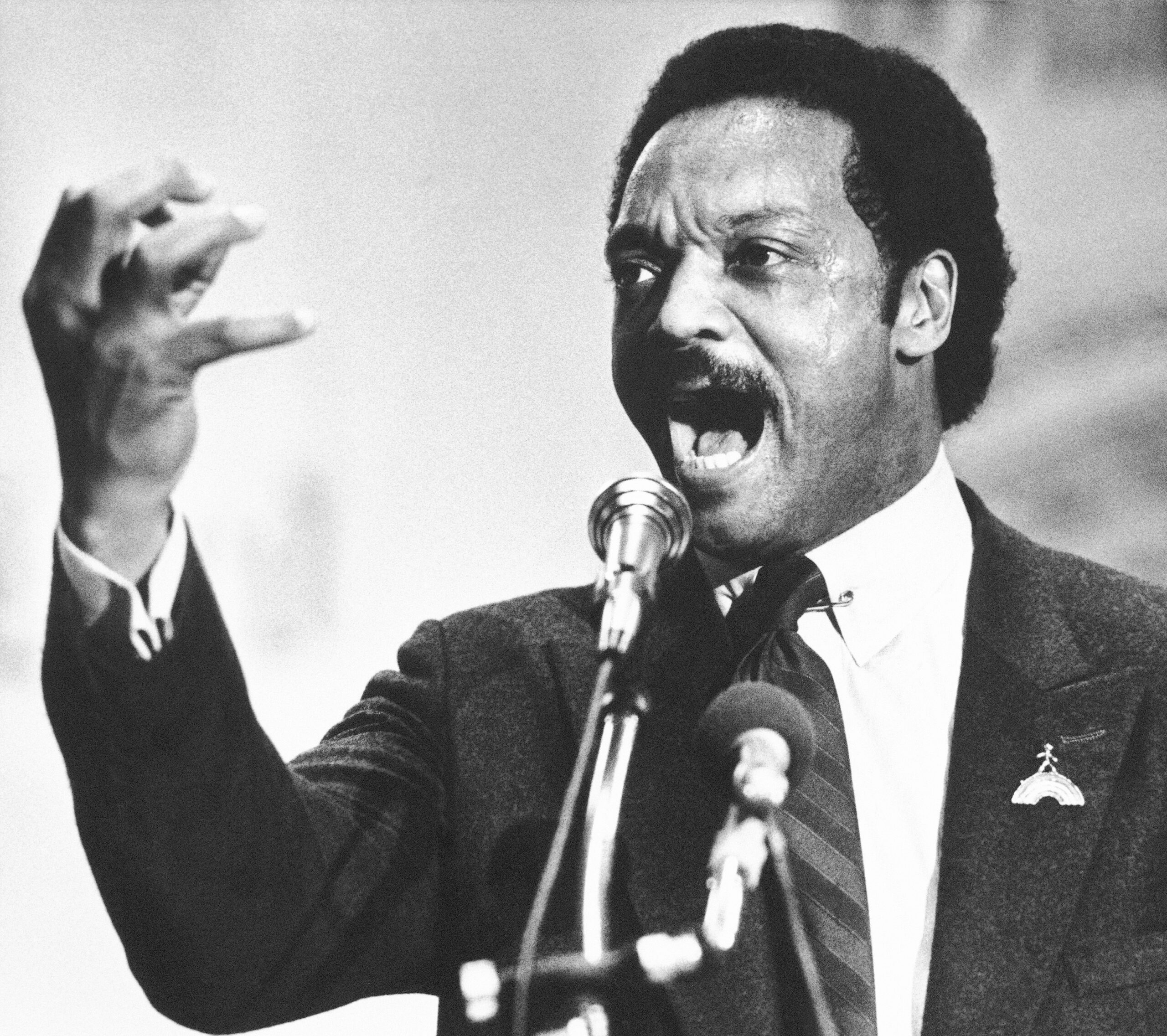
    Democratic presidential primary candidate Jesse Jackson speaks to a group of his supporters at a rally held at a Baptist Church in Dayton, Ohio, on April 14, 1984.

    Fellow civil rights activist the Rev. Al Sharpton said his mentor “was not simply a civil rights leader; he was a movement unto himself.”

    “He taught me that protest must have purpose, that faith must have feet, and that justice is not seasonal, it is daily work,” Sharpton wrote in a statement, adding that Rev. Jackson taught “trying is as important as triumph. That you do not wait for the dream to come true; you work to make it real.”

    Despite profound health challenges in his final years, including the disorder that affected his ability to move and speak, Rev. Jackson continued protesting against racial injustice into the era of Black Lives Matter. In 2024, he appeared at the Democratic National Convention in Chicago and at a City Council meeting to show support for a resolution backing a ceasefire in the Israel-Hamas war.

    “Even if we win,” he told marchers in Minneapolis before the officer whose knee kept George Floyd from breathing was convicted of murder, “it’s relief, not victory. They’re still killing our people. Stop the violence, save the children. Keep hope alive.”

    Calls to action, delivered in a memorable voice

    Rev. Jackson’s voice, infused with the stirring cadences and powerful insistence of the Black church, demanded attention. On the campaign trail and elsewhere, he used rhyming and slogans such as “Hope not dope” and “If my mind can conceive it and my heart can believe it, then I can achieve it,” to deliver his messages.

    Rev. Jackson had his share of critics, both within and outside of the Black community. Some considered him a grandstander, too eager to seek the spotlight. Looking back on his life and legacy, Rev. Jackson told the Associated Press in 2011 that he felt blessed to be able to continue the service of other leaders before him and to lay a foundation for those to come.

    “A part of our life’s work was to tear down walls and build bridges, and in a half century of work, we’ve basically torn down walls,” Rev. Jackson said. “Sometimes when you tear down walls, you’re scarred by falling debris, but your mission is to open up holes so others behind you can run through.”
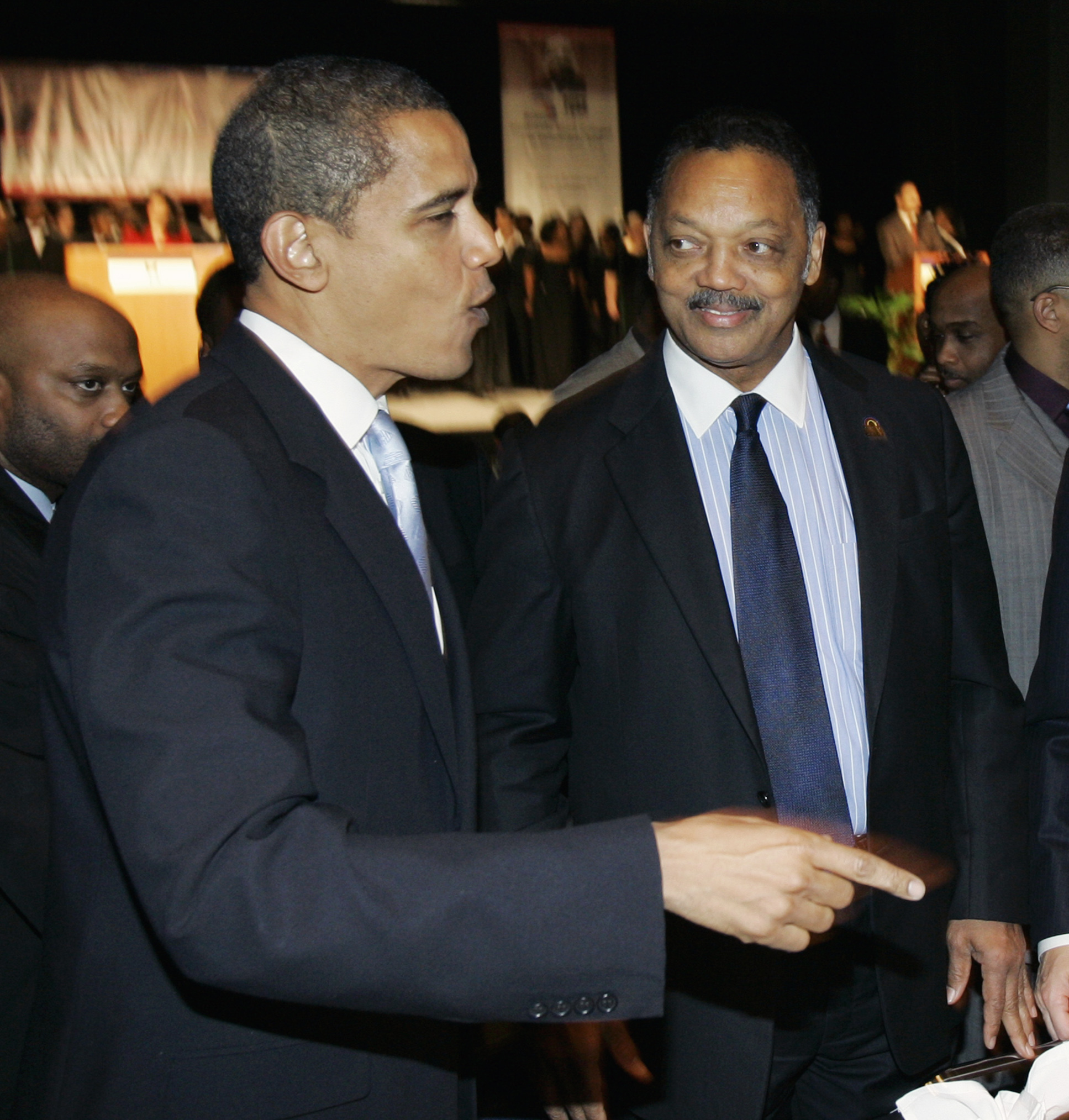
    Barack Obama, then a senator. from Illinois, and the Rev. Jesse Jackson are seen at the Rev. Dr. Martin Luther King Jr. Scholarship Awards Breakfast in Chicago on Jan. 15, 2007.

    In his final months, as he received 24-hour care, he lost his ability to speak, communicating with family and visitors by holding their hands and squeezing.

    “I get very emotional knowing that these speeches belong to the ages now,” his son, Jesse Jackson Jr., told the AP in October.

    A student athlete drawn to the Civil Rights Movement

    Jesse Louis Jackson was born Oct. 8, 1941, in Greenville, S.C., the son of high school student Helen Burns and Noah Louis Robinson, a married man who lived next door. Jackson was later adopted by Charles Henry Jackson, who married his mother.

    Rev. Jackson was a star quarterback on the football team at Sterling High School in Greenville, and he accepted a football scholarship from the University of Illinois. But after reportedly being told that Black people couldn’t play quarterback, he transferred to North Carolina A&T in Greensboro, where he became the first-string quarterback, an honor student in sociology and economics, and student body president.

    Arriving on the historically Black campus in 1960 just months after students there launched sit-ins at a whites-only lunch counter, Rev. Jackson immersed himself in the blossoming Civil Rights Movement.

    By 1965, he joined the voting rights march King led from Selma to Montgomery, Alabama. King dispatched him to Chicago to launch Operation Breadbasket, a Southern Christian Leadership Conference effort to pressure companies to hire Black workers.
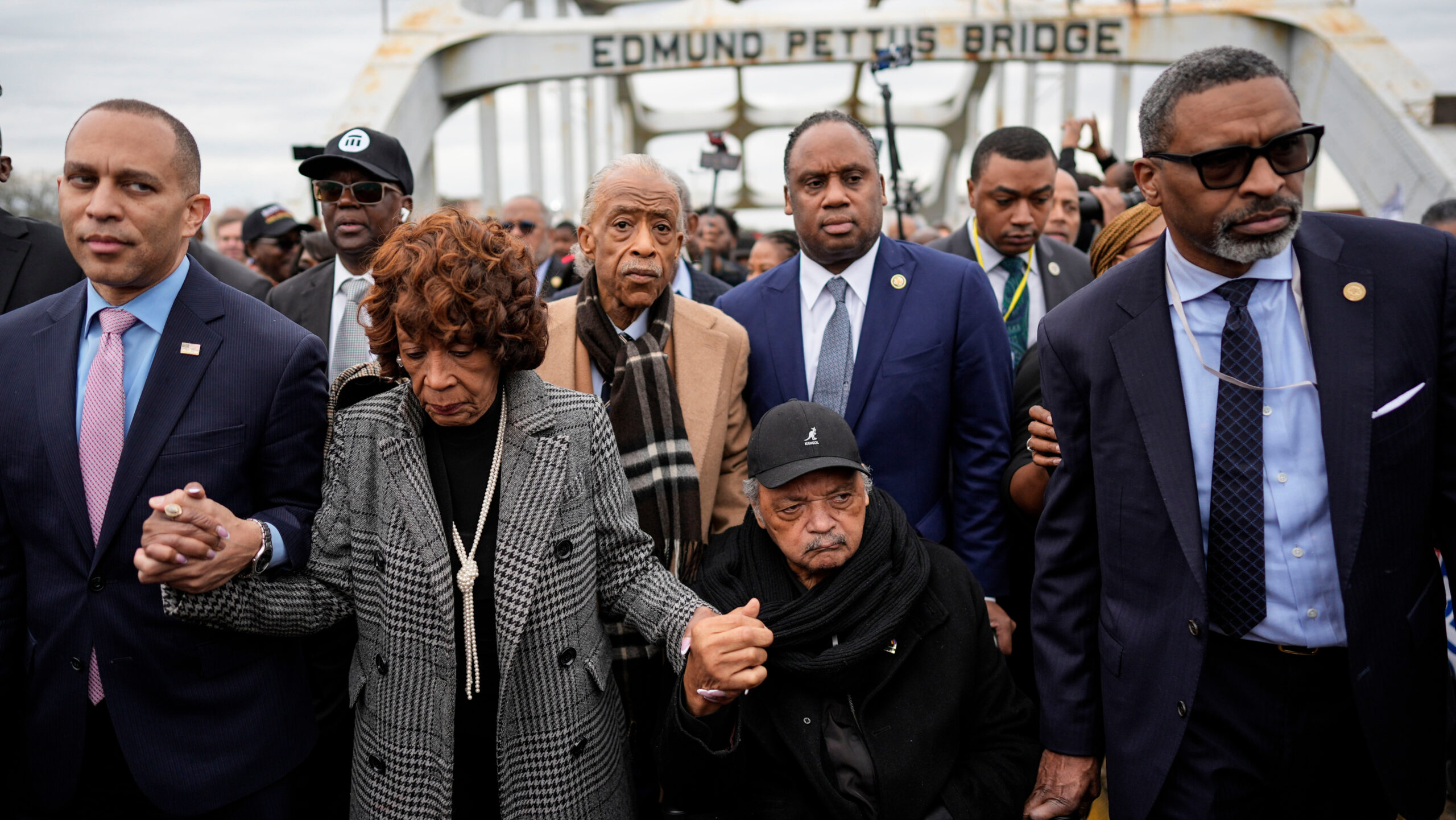
    U.S. Rep. Hakeem Jeffries (D., N.Y.), U.S. Rep. Maxine Waters (D., Calif.), the Rev. Al Sharpton, Rev. Jesse Jackson and NAACP President Derrick Johnson walk across the Edmund Pettus bridge in Selma, Ala., on March 9, 2025, during the 60th anniversary of the march to ensure that African Americans could exercise their constitutional right to vote.

    Rev. Jackson called his time with King “a phenomenal four years of work.”

    Rev. Jackson was with King on April 4, 1968, when the civil rights leader was slain. Rev. Jackson’s account of the assassination was that King died in his arms.

    Sharpton said he “always wondered how much trauma that must have been” for Rev. Jackson to witness King’s death. “He never would talk about it too much, but it drove him,” Sharpton said Tuesday. “He said, ‘We’ve got to keep Dr. King’s legacy alive.’”

    With his flair for the dramatic, Rev. Jackson wore a turtleneck he said was soaked with King’s blood for two days, including at a King memorial service held by the Chicago City Council, where he said: “I come here with a heavy heart because on my chest is the stain of blood from Dr. King’s head.”

    However, several King aides, including speechwriter Alfred Duckett, questioned whether Rev. Jackson could have gotten King’s blood on his clothing. There are no images of Rev. Jackson in pictures taken shortly after the assassination.

    In 1971, Rev. Jackson broke with the Southern Christian Leadership Conference to form Operation PUSH, originally named People United to Save Humanity. The organization based on Chicago’s South Side declared a sweeping mission, from diversifying workforces to registering voters in communities of color nationwide. Using lawsuits and threats of boycotts, Rev. Jackson pressured top corporations to spend millions and publicly commit to hiring more diverse employees.

    The constant campaigns often left his wife, Jacqueline Lavinia Brown, the college sweetheart he married in 1963, taking the lead in raising their five children: Santita Jackson, Yusef DuBois Jackson, Jacqueline Lavinia Jackson Jr., and two future members of Congress, U.S. Rep. Jonathan Luther Jackson and Jesse L. Jackson Jr., who resigned in 2012 but is seeking reelection in the 2026 midterms.

    The elder Jackson, who was ordained as a Baptist minister in 1968 and earned his master’s of divinity degree in 2000, also acknowledged fathering a child, Ashley Jackson, with one of his employees at Rainbow/PUSH, Karen L. Stanford. He said he understood what it means to be born out of wedlock and supported her emotionally and financially.

    On Tuesday, Harold Hall joined other mourners who stopped by the family home to pay their respects.

    Hall, who once lived in the same Chicago neighborhood as Rev. Jackson, left a bouquet of flowers outside Rev. Jackson’s door and recalled that he helped local street organizations in the late 1960s and early 1970s.

    Rev. Jackson “would come out and shoot ball and try to change the minds of many of our young folk,” urging them to stay out of trouble, Hall told reporters. “And in many instances, it happened. It worked.”

    Presidential aspirations fall short but help ‘keep hope alive’

    Despite once telling a Black audience he would not run for president “because white people are incapable of appreciating me,” Rev. Jackson ran twice and did better than any Black politician had before President Barack Obama, winning 13 primaries and caucuses for the Democratic nomination in 1988, four years after his first failed attempt.

    His successes left supporters chanting another Rev. Jackson slogan, “Keep hope alive.”

    “I was able to run for the presidency twice and redefine what was possible; it raised the lid for women and other people of color,” he told the AP. “Part of my job was to sow seeds of the possibilities.”

    U.S. Rep. John Lewis said during a 1988 C-SPAN interview that Rev. Jackson’s two runs for the Democratic nomination “opened some doors that some minority person will be able to walk through and become president.”

    Obama acknowledged Rev. Jackson’s efforts, saying he led some of the most significant movements for change in human history.

    Michelle Obama “got her first glimpse of political organizing at the Jacksons’ kitchen table when she was a teenager,” Obama wrote on X. “And in his two historic runs for president, he laid the foundation for my own campaign to the highest office in the world.”

    Rev. Jackson “was relentless in his belief that we are all children of God, deserving of dignity and respect,” the post read.

    Rev. Jackson also pushed for cultural change, joining calls by NAACP members and other movement leaders in the late 1980s to identify Black people in the United States as African Americans.

    “To be called African Americans has cultural integrity — it puts us in our proper historical context,” Rev. Jackson said at the time. “Every ethnic group in this country has a reference to some base, some historical cultural base. African Americans have hit that level of cultural maturity.”

    Rev. Jackson’s words sometimes got him in trouble.

    In 1984, he apologized for what he thought were private comments to a reporter in which he called New York City “Hymietown,” a derogatory reference to its large Jewish population. And in 2008, he made headlines when he complained that Obama was “talking down to Black people” in comments captured by a microphone he didn’t know was on during a break in a television taping.

    Still, when Rev. Jackson joined the jubilant crowd in Chicago’s Grant Park to greet Obama that election night, he had tears streaming down his face.

    “I wish for a moment that Dr. King or [slain civil rights leader] Medgar Evers … could’ve just been there for 30 seconds to see the fruits of their labor,” he told the AP years later. “I became overwhelmed. It was the joy and the journey.”

    Exerting influence on events at home and abroad

    Rev. Jackson also had influence abroad, meeting world leaders and scoring diplomatic victories, including the release of Navy Lt. Robert Goodman from Syria in 1984, as well as the 1990 release of more than 700 foreign women and children held after Iraq’s invasion of Kuwait. In 1999, he won the freedom of three Americans imprisoned by Yugoslav President Slobodan Milosevic.

    In 2000, President Bill Clinton awarded Rev. Jackson the Presidential Medal of Freedom, the country’s highest civilian honor.

    “Citizens have the right to do something or do nothing,” Rev. Jackson said, before heading to Syria. “We choose to do something.”

    In 2021, Rev. Jackson joined the parents of Ahmaud Arbery inside the Georgia courtroom where three white men were convicted of killing the young Black jogger. In 2022, he hand-delivered a letter to the U.S. Attorney’s Office in Chicago, calling for federal charges against former Chicago Police Officer Jason Van Dyke in the 2014 killing of Black teenager Laquan McDonald.

    Rev. Jackson, who stepped down as president of Rainbow/PUSH in July 2023, disclosed in 2017 that he had sought treatment for Parkinson’s, but he continued to make public appearances even as the disease made it more difficult for listeners to understand him. Last year, doctors confirmed a diagnosis of progressive supranuclear palsy, a life-threatening neurological disorder. He was admitted to a hospital in November for nearly two weeks.

    During the coronavirus pandemic, he and his wife survived being hospitalized with COVID-19. Rev. Jackson was vaccinated early, urging Black people in particular to get protected, given their higher risks for bad outcomes.

    “It’s America’s unfinished business — we’re free, but not equal,” Rev. Jackson told the AP. “There’s a reality check that has been brought by the coronavirus, that exposes the weakness and the opportunity.”
  • N.J. attorney general is dropping racketeering charges against George Norcross following court ruling

    N.J. attorney general is dropping racketeering charges against George Norcross following court ruling

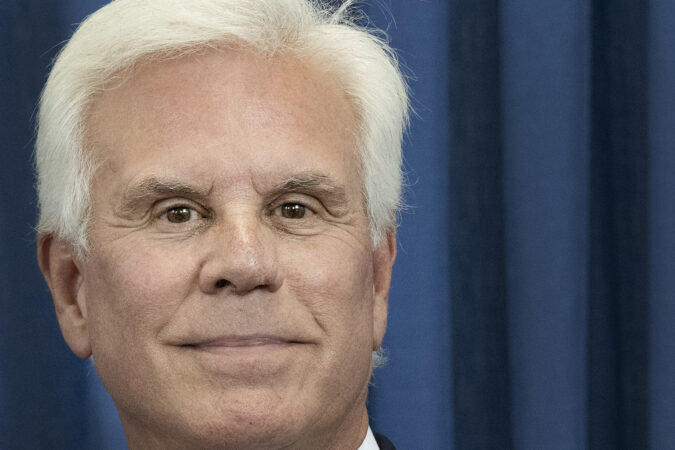
    New Jersey prosecutors are dropping racketeering charges against Democratic power broker George E. Norcross III, ending a high-profile case that law enforcement officials had framed as a reckoning on the state’s culture of corruption.

    Acting Attorney General Jennifer Davenport, an appointee of Democratic Gov. Mikie Sherrill, will not appeal a January appellate court ruling that upheld a judge’s decision to dismiss charges against Norcross and five codefendants, the attorney general’s office said Tuesday.

    Davenport could have asked the state Supreme Court to review the Appellate Division’s decision, but prosecutors concluded that their resources “would be best spent on other matters,” Sharon Lauchaire, a spokesperson for the New Jersey Attorney General’s Office, said in a statement.

    A three-judge panel said in a Jan. 30 decision that several of the racketeering conspiracy and extortion charges were time-barred under the statute of limitations. Other counts failed to state a crime, were untimely, or both, the panel said.

    Norcross, 69, is a former longtime member of the Democratic National Committee, founder of insurance brokerage Conner Strong & Buckelew, and chair of Cooper University Health Care. He was accused of using threats of economic and reputational harm — and his purported control of Camden’s government — to obtain valuable property on Camden’s waterfront from a developer and a nonprofit.

    His spokesperson on Tuesday portrayed the case against Norcross — announced in June 2024 by then-Attorney General Matthew J. Platkin — as a politicized abuse of the law similar to the Trump Justice Department’s targeting of perceived enemies.

    “We always knew that Matt Platkin brought this case for reasons other than its legal merits — and now multiple judges and Platkin’s successor as AG agree the allegations simply weren’t true,” Norcross spokesperson Dan Fee said in a statement.

    “The question now is whether Platkin’s supporters who cheered him on will take a serious look at what he did and whether other authorities will do the same,” he said. “We will certainly be making the case that he and anyone else who used lawfare against George should be held to account, no differently than Pam Bondi and her DOJ should.”

    Platkin, who was appointed to the post by Democratic Gov. Phil Murphy, has denied pursuing the case for political reasons. He noted on Tuesday that the case “was presented to a grand jury by career prosecutors over several months.”

    “Out of respect for the men and women who do brave work holding corruption to account, I won’t comment further — other than to say I remain proud to have supported their efforts at a time when trust in government is at an all-time low and I will never apologize for believing that everyone should be held to the same standards, no matter how powerful they may be,” Platkin said in a statement.

    Notwithstanding the decision to drop charges, Lauchaire said the attorney general’s office “remains committed to prioritizing public corruption prosecutions in this time of deepening mistrust in government.”

    “Wrongdoing by public officials undermines faith in our institutions, and the public rightfully demands and deserves that officials perform their duties with integrity and in accordance with the law,” she said. “We will never shy away from holding public officials accountable when they betray the public’s trust and behave unlawfully.”

    The prosecution faced an earlier setback last February, when a Superior Court judge found that the charges were not timely and said that even if the allegations in the indictment were proven true, they amounted to hard bargaining in real estate deals and did not cross the line into unlawful threats.

    Prosecutors appealed that ruling, arguing that the judge should review evidence presented to the grand jury before deciding whether the indictment was valid.

    The appeals court affirmed the trial judge’s order, though the panel focused on the statute of limitations violations and largely sidestepped the question of whether the threats underpinning the indictment met the legal requirements for alleging conspiracy to commit extortion.

    In addition to Norcross, prosecutors are dropping charges against his brother Philip Norcross, CEO of the law firm Parker McCay; attorney William Tambussi; former Camden Mayor Dana L. Redd; Sidney R. Brown, CEO of logistics firm NFI; and John J. O’Donnell, an executive at residential developer the Michaels Organization.

    “We are pleased and gratified that this misguided, baseless prosecution has been finally laid to rest,” said Kevin H. Marino, a lawyer for Philip Norcross.

    Henry Klingeman, an attorney for Redd, said his client “is relieved that this unjust and unnecessary ordeal is over.” The former mayor has “continued her unswerving commitment to bettering Camden,” Klingeman said.

    Brown said he was “innocent of these baseless charges” and added that Tuesday’s decision showed “justice was carried out based on the facts.”

    “Since its inception, this case was unfounded and attacked those of us who believed in the future of a thriving Camden,” the NFI CEO said in a statement.

    Tambussi’s lawyers, Jeff Chiesa and Lee Vartan, said their client “engaged in the routine practice of law.” They said Platkin’s attempted prosecution “did damage to the profession” and “was rightly rejected by both courts.”

  • The University of Pennsylvania soon may be off-limits to Army officers seeking tuition aid for graduate programs

    The University of Pennsylvania soon may be off-limits to Army officers seeking tuition aid for graduate programs

    The University of Pennsylvania soon may be off-limits to Army officers and other military service members who are seeking tuition aid to further their educations.

    The Ivy League university in West Philadelphia is among 34 schools the Army says are at risk of being banned from military funding for service members to pay for their graduate programs and other education, according to a CNN report. The messaging has caused confusion among military officers seeking advanced degrees in law, medicine, and nuclear engineering, the report states.

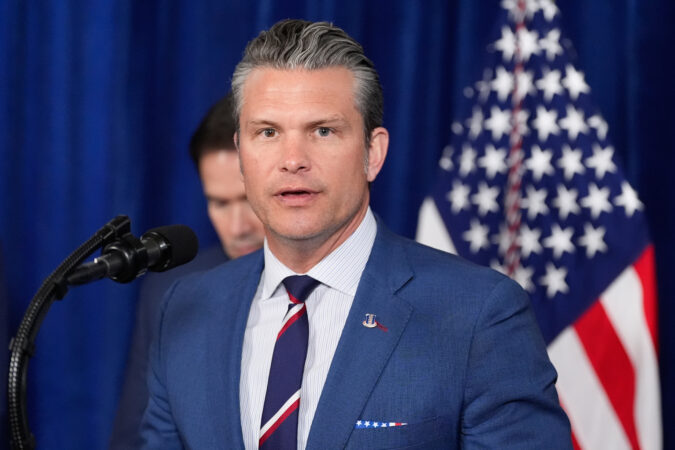
    The G.I. Bill and similar programs to pay for college have long been a major draw for people who join the military. But last week, Defense Secretary Pete Hegseth said the DOD “will discontinue graduate-level professional military education, fellowships and certificate programs” at Harvard.

    “Too many faculty members openly loathe our military,” said Hegseth, who obtained a master’s degree in public policy from Harvard in 2013. “They cast our armed forces in a negative light and squelch anyone who challenges their leftist political leanings, all while charging enormous tuition.”

    Hegseth, a former Army National Guard officer who served in Iraq and Afghanistan, said the department, which he calls the Department of War, is evaluating its relationships with other schools as well.

    “[We] will evaluate all existing graduate programs for active-duty service members at all Ivy League universities and other civilian universities,” he said. “The goal is to determine whether or not they actually deliver cost-effective strategic education for future senior leaders when compared to, say, public universities and our military graduate programs.”

    CNN obtained a “preliminary list of at-risk schools compiled by the Army,” which includes the University of Pennsylvania, as well as nearby Princeton University and Carnegie Mellon University in Pittsburgh. Officials at Princeton and Penn did not immediately respond to requests for comment Sunday.

    “We are aware of reports indicating that Carnegie Mellon is among several universities whose eligibility to support graduate training for military officers may be under review. At this time, we have received no formal notification confirming that any such review is underway,” a spokesperson for Carnegie Mellon said in a statement. “As always, CMU stands ready to engage constructively with the Department on ways to strengthen and advance military education.”

    Numerous schools on the list are the alma maters of Trump administration officials. In addition to attending Harvard, Hegseth obtained a bachelor’s degree in politics from Princeton. President Donald Trump holds a bachelor’s degree in economics from the Wharton School of the University of Pennsylvania. Vice President JD Vance holds a law degree from Yale University.

    Here is the preliminary list of “at-risk” schools:

    1. American University
    2. Boston College
    3. Boston University
    4. Brown University
    5. Carnegie Mellon
    6. Case Western University
    7. Columbia University
    8. College of William and Mary
    9. Cornell University
    10. Duke
    11. Emory
    12. Florida Institute of Technology
    13. Fordham
    14. Georgetown
    15. George Washington University
    16. Harvard
    17. Hawaii Pacific University
    18. Johns Hopkins University
    19. London School of Economics and Political Science
    20. MIT [Massachusetts Institute of Technology]
    21. Northeastern University
    22. Northwestern University
    23. New York University
    24. Pepperdine
    25. Princeton
    26. Stanford
    27. Tufts
    28. University of Miami
    29. University of Pennsylvania
    30. University of Southern California
    31. Vanderbilt
    32. Wake Forest
    33. Washington University in St Louis
    34. Yale

    Update: This article has been updated to include comment from Carnegie Mellon University.

  • Graduate student workers at Penn reach a tentative agreement, avoiding a strike

    Graduate student workers at Penn reach a tentative agreement, avoiding a strike

    Penn’s graduate student workers have reached a tentative agreement on a first union contract, averting a strike.

    The two-year tentative agreement includes increases to wages among other benefits.

    “I am so proud of what we were able to accomplish with this contract,” Clara Abbott, a Ph.D. candidate in literary studies and member of the bargaining committee said in a statement. “We won a historic contract that enshrines gains for grad workers.”

    Research and teaching assistants at the university voted to unionize in 2024. The union, which represents about 3,400 graduate student workers, is known as Graduate Employees Together-University of Pennsylvania (GET-UP) and is part of the United Auto Workers (UAW). The union has been negotiating with the university since October 2024 for a first contract.

    In November, the union’s bargaining members voted to authorize a strike, if called for by the union. In January, they set a strike deadline, announcing that they would walk off the job on Feb. 17 if they had not reached a deal.

    A deal was announced in the early morning hours Tuesday.

    While tentative agreements had been reached on a number of issues, some remained without consensus ahead of the final bargaining session on Monday before the strike deadline. Those sticking points included wages, healthcare, and discounts on SEPTA passes.

    “We are pleased to announce that a tentative agreement has been reached between Penn and GETUP-UAW,” a university spokesperson said in a statement. “Penn has a long-standing commitment to its graduate students and value their contributions to Penn’s important missions. We are grateful to all the members of the Penn community who helped us achieve this tentative agreement.”

    A date to vote on the ratification of the tentative agreement has not yet been announced.

    The deal comes as earlier this month Pennsylvania state senators and representatives and Philadelphia City Council members addressed letters to the university’s president and provost, urging them to come to an agreement with the student workers and avoid a strike.

    “A strike at the University of Pennsylvania would seriously disrupt life for the tens of thousands of Philadelphians who are students, employees, and patients at Penn,” the letter signed by City Council members reads. “As such, we strongly urge the Penn administration to avert a strike by coming to a fair agreement that meets the needs of graduate student employees prior to February 17th.”

    What’s in the tentative deal?

    Monday’s bargaining session brought tentative agreements on sticking points that included wages and healthcare coverage.

    If ratified, the tentative deal would provide graduate student workers with an annual minimum wage of $49,000, which the union has said is a 22% increase over the previous standard. For those paid on an hourly basis, the minimum hourly rate would be $25. Those rates would go into effect in April and a 3% increase would be provided in July 2027.

    The deal would also create a fund with $200,000 annually from which graduate student workers could seek reimbursements to cover up to 50% of their dependent’s health insurance premiums.

    Ahead of the Monday bargaining session, other tentative agreements had come together around leave. The university agreed to give six weeks of paid medical leave, as well as eight weeks of paid parental leave.

    The university and the union had also recently reached a tentative agreement that would create an annual $50,000 fund to help international graduate student workers with expenses associated with reinstating or extending visas.

    What would have happened in the event of a strike?

    Graduate student workers in the bargaining group teach and conduct research at the university.

    Classes, research, and other academic activities would have continued during a strike, according to the university spokesperson. Penn published guidance on how to continue this work in the event of a work stoppage or other disruption.

    Striking graduate student workers would not have been paid throughout a work stoppage, but would have continued to be covered by their health insurance for the time being, according to a university statement.

    If others employed at the university who are not in the bargaining group chose to join the work stoppage, they would not have been paid and could have faced consequences “up to and including separation from that position, depending on the circumstances of the refusal to work,” according to a university statement.

    Ahead of the tentative agreement on Monday, hundreds signed a pledge indicating that they are employed at Penn and would not do the work of those on strike or assign it to others in the event of a work stoppage.

    In recent years, a wave of labor actions has taken place across Penn and other local campuses. Temple University graduate workers went on strike for 42 days in 2023 during contract negotiations. Rutgers University educators, researchers, and clinicians walked off the job for a week that same year.

    At Penn, the largest employer in Philadelphia, a wave of student-worker organizing in recent years has included resident assistants, graduate students, postdocs, and research associates, as well as training physicians in the University of Pennsylvania Health System.

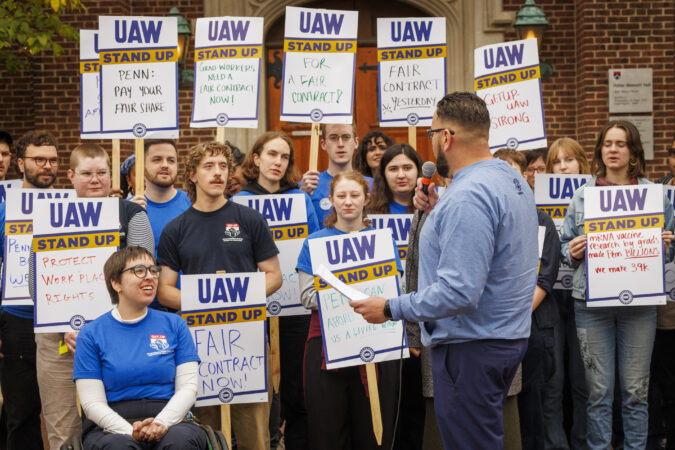
    Pins on a table during a GET-UP rally at the University of Pennsylvania in Philadelphia, Pa., on Wednesday, Oct. 4, 2023.
  • Why Philly has so many chicken bones lying around

    Why Philly has so many chicken bones lying around

    As the cold thaws and the snow melts, one constant remains the same: There are chicken bones on the Philly streets.

    Time may be a flat circle, but that doesn’t stop us from wondering why. A reader asked through Curious Philly, The Inquirer’s forum for answering questions, why there are so many chicken bones on the sidewalks and streets of Philadelphia.

    » ASK US: Have something you’re wondering about the Philly region? Submit your Curious Philly question here.

    Two architects appear to be behind Philadelphia’s chicken-bone temple.

    First are animals, who forage through trash looking for the final scraps left on discarded bones. Whether they discover drumsticks by ripping through trash bags on the street or from dumpster diving, these animals likely drop the bones wherever they finish with them.

    The culprits most likely to blame are rats, followed by raccoons and opossums, said Rich Foreman, the owner of Dynamite Pest Control in West Philly.

    While it’s unclear if rats have a particular taste for fried chicken, the animals are among the least-picky eaters around and will take advantage of any food source, from human scraps to cannibalism. And Philadelphia is seemingly a good place to be a rat, being declared the eighth-rattiest city in the United States in 2025 by the pest-control company Orkin, measured by tracking its new residential rodent treatments.

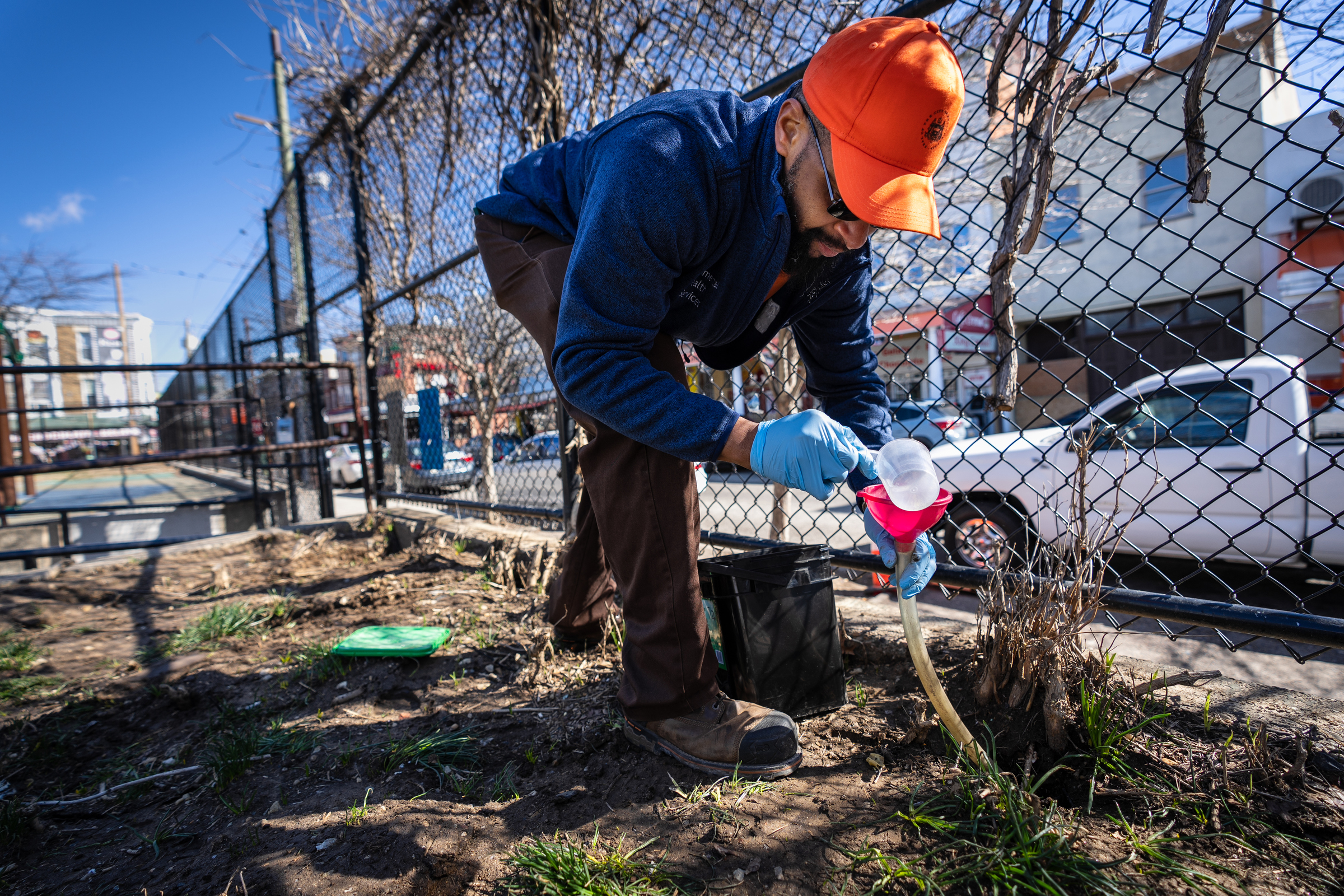
    Adrian Jordan, Vector Control Crew Chief, works keeping the rat population under control, in Philadelphia, Friday, March 7, 2025.

    Foreman sees the chicken-bone problem all over the city, as with some restaurants in Port Richmond that called Dynamite when they saw their trash all over the street. He is confident animals were behind the mess, and said he has “never seen” humans do anything of the sort.

    Foreman said the city’s twice-weekly trash pickup initiative has not helped, since it means an additional day of easily accessible trash on the street for animals.

    He said the best way for people to prevent critters from going into their garbage for bones is to get large, durable trash cans.

    “And make sure you put the lid on it,” he said.

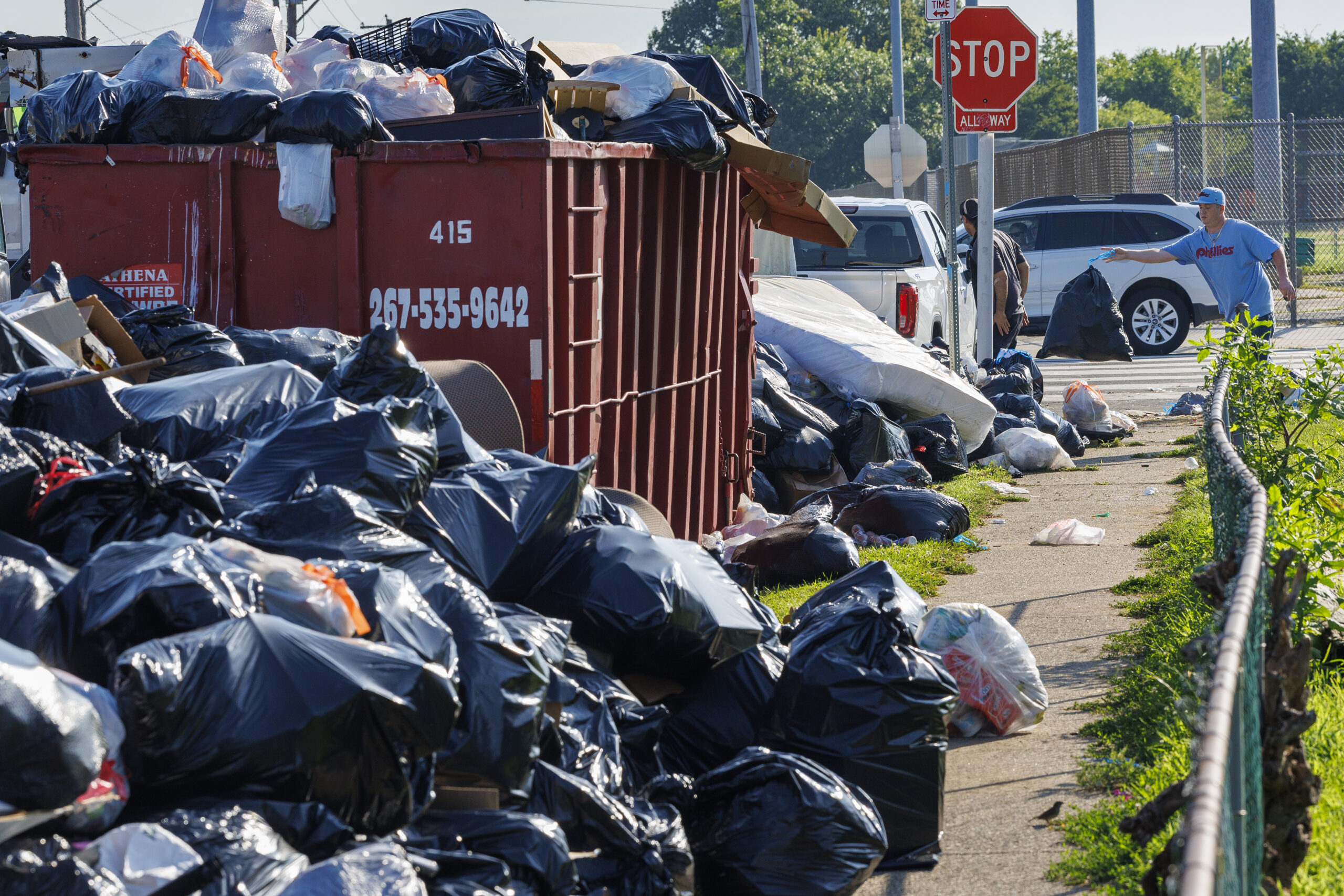
    Residents with trash arriving at garbage dump site at Caldera Road and Red Lion Road in northeast Philadelphia. AFSCME District Council 33 workers enter their second week on strike, Tuesday, July 8, 2025.

    Scavenging animals was the conclusion that the Search Engine podcast reached in a 2024 episode investigating the cause of the chicken bones littering the streets of New York City. Other cities have reported the same problem, including Chicago, Miami, and Washington.

    And yet, anecdotal evidence from residents demonstrates that human activity clearly contributes to the problem.

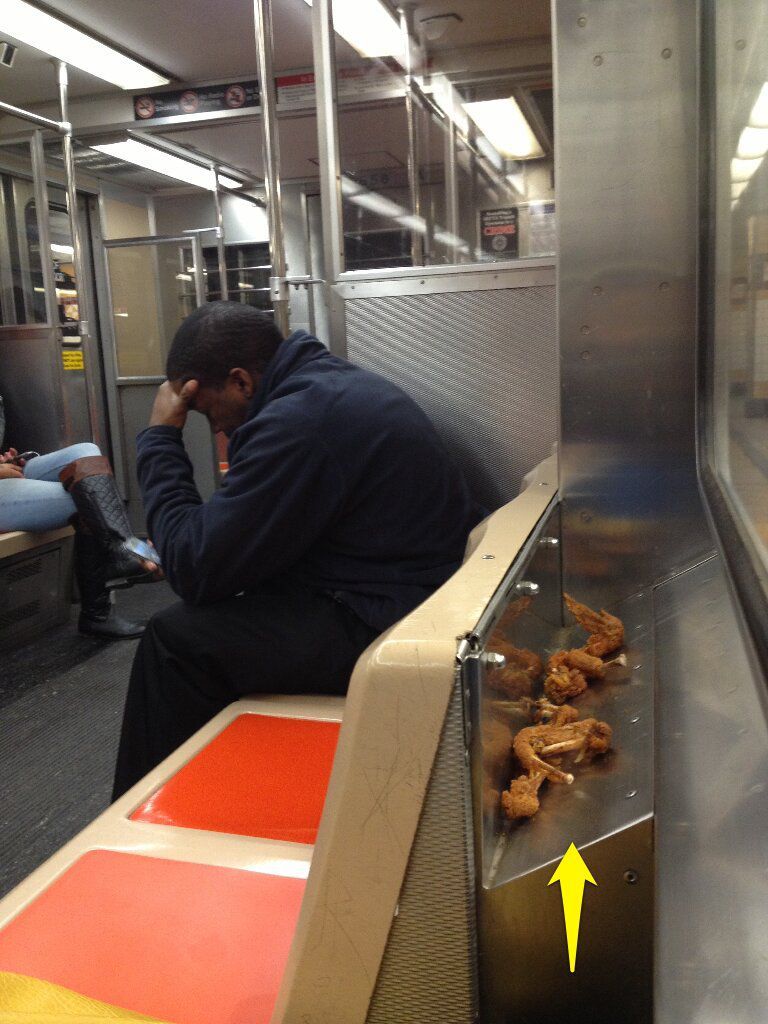
    Jessica Griffith has become the David Attenborough of abandoned chicken bones, documenting and appreciating the beauty of what she encounters in the wild. More than 10 years ago, when she lived in South Philly, Griffith, 46, would notice the chicken bones frequently on walks with her dog. She started photographing them and posting the pictures to Facebook, finding the bones everywhere, including a pile on a SEPTA train.

    “It was just bizarre to me. Just a phenomenon,” she said.

    Jessica Griffith snapped this picture of some discarded chicken bones on the Broad Street Line in 2013.

    Her documentation gathered a following, and people started to send their own submissions. Griffith received pictures from all over the globe — people in Seattle, Las Vegas, South Korea, Sweden, and the Dominican Republic all had their own pictures of discarded chicken bones to share.

    When Brian Love, 53, walks his miniature pinscher, Ziggy, through the Gayborhood, he often sees other people smiling at his dog. But then he realizes it’s because Ziggy is carrying a chicken bone in his mouth.

    Love has complained to his friends about constantly needing to tussle with Ziggy over what the dog sees as a treasure. He has watched people toss chicken bones on the ground, and recently came across a pile of four bones on a mound of snow. Love wishes his neighbors would just use trash bins.

    “It’s your food that you’ve literally just had in your mouth. Throw it in the trash,” he said.

    Stephanie Harmelin, 43, has the same problem with her dog in West Philly, and she said she accepts the bony sidewalks as part of living in a city. She has seen aggressive squirrels rifling through trash, but also has come across bones at street corners and under park benches that appear to have been dropped by humans.

    She said part of the problem is educational. Once, Harmelin pulled her dog away from a bone on the street, and two fellow walkers asked her why.

    Harmelin explained how chicken bones are unsafe for most dogs to consume. Cooked bones splinter when a dog chews on them, and the sharp fragments may cause life-threatening damage as they pass through the dog’s digestive track.

    One woman was shocked, and said she had not realized chicken bones were potentially dangerous to dogs when she had tossed them to the ground before.

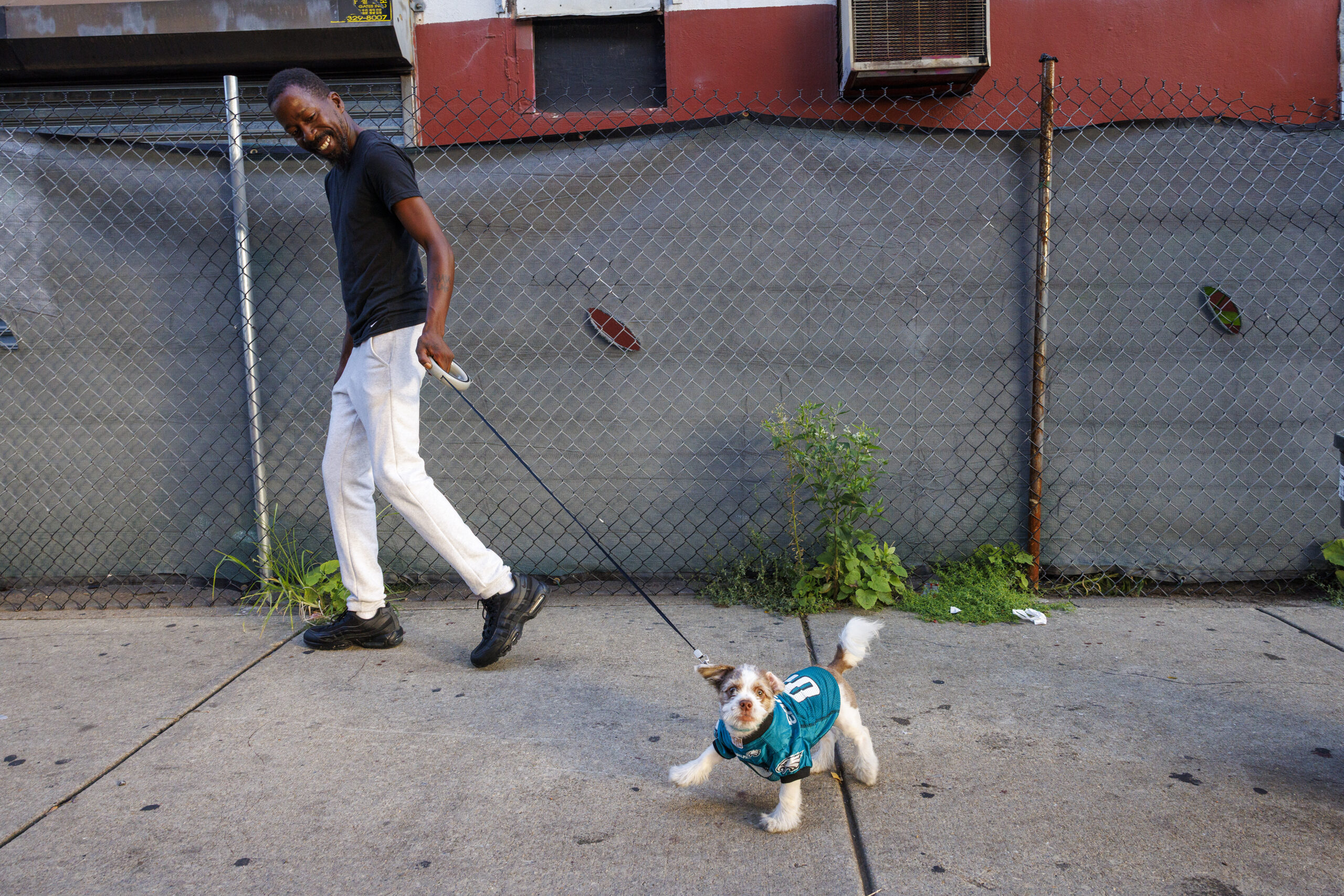
    Theo Caraway of Philadelphia walking his dog Cooper, 6 months, Shitzu/Poodle wearing his Eagles jersey along Kensington at Ontario Street on Philadelphia, Friday, September 5, 2025.

    Harmelin has had similar conversations with others who were not aware of the hazards bones create. Now, she is less likely to be frustrated at whomever has dropped the chicken bone on her street corner.

    “We’re trying to assume what other people know and intend, but we can’t,” she said.

    Even if more people get the message, though, it appears you will still be as likely to find a chicken bone on the street as a fallen leaf.

    Although they’re a gross nuisance of a sidewalk adornment, Griffith doesn’t really mind them. She said they are more of a curiosity that make Philly what it is, in a small way.

    “I think it’s kind of endearing,” she said.

  • Radnor and Council Rock students made AI deepfakes of classmates. Parents say the schools failed to protect their daughters.

    Radnor and Council Rock students made AI deepfakes of classmates. Parents say the schools failed to protect their daughters.

    One night in early December, the phones of Radnor High School students started buzzing. Some freshmen girls were getting disturbing messages: A male classmate, they were told, had made pornographic videos of them.

    When one of the girls walked into school the next morning, “she said everyone was staring at her,” said her mother, who requested anonymity to protect her daughter’s identity. “All the kids knew. It spread like wildfire.”

    So-called AI deepfakes — pictures of a real person manipulated with artificial intelligence, sometimes with “nudify” features that can convert clothed photos into naked ones — have become the talk of school hallways and Snapchat conversations in some area schools.

    As Pennsylvania lawmakers have pushed new restrictions cracking down on deepfakes — defining explicit images as child sexual abuse material, and advancing another measure that would require schools to immediately alert law enforcement about AI incidents — schools say they have no role in criminal investigations, and are limited in their ability to police students off campus.

    But some parents say schools should be taking a more proactive stance to prepare for AI abuse — and are failing to protect victims when it happens, further harming students who have been violated by their peers.

    In the Council Rock School District, where AI-generated deepfakes were reported last March, parents of targeted girls said administrators waited five days to contact the police about the allegations and never notified the community, even after two boys were charged with crimes.

    “They denied everything and kind of shoved it under the rug and failed to acknowledge it,” said a mother in Council Rock, who also requested anonymity to protect her daughter’s identity. “Everybody thought it was a rumor,” rather than real damage done to girls, the mother said.

    Council Rock spokesperson Andrea Mangold said that the district “recognizes and understands the deep frustration and concern expressed by parents,” and that a police investigation “began promptly upon the district’s notification.”

    Mangold said that current laws were “insufficient to fully prevent or deter these incidents,” and that the district was “limited in what we know and what we can legally share publicly” due to student privacy laws.

    In Radnor, parents also said the district minimized the December incident. A district message last month said a student had created images of classmates that “move and dance,” and reported that police had not found evidence of “anything inappropriate” — even though police later said they had charged a student with harassment after an investigation into alleged sexualized images of multiple girls.

    A Radnor spokesperson said the alleged images were never discovered and the district’s message was cowritten by Radnor police, who declined to comment.

    The district “approaches all student-related matters with care and sensitivity for those involved,” said the spokesperson, Theji Brennan. She said the district was limited in what it could share about minors.

    In both Radnor and Council Rock, parents said their daughters were offered little support — and were told that if they were uncomfortable, they could go to quiet rooms or leave classes early to avoid crossing paths with boys involved in the incidents.

    “She just felt like no one believed her,” the Radnor mother said of her daughter.

    How an investigation unfolded in Radnor

    In Radnor, five freshman girls first heard they were victims of deepfakes on Dec. 2, according to parents of two of the victims who requested anonymity to protect their daughters’ identities. They said boys told their daughters that a male classmate had made videos depicting them sexually.

    In a Snapchat conversation that night, one boy said, “‘Nobody tell their parents,’” a mother of one of the victims recalled. Reading her daughter’s texts, “it quickly went from high school drama to ‘Wow, this is serious.’”

    The girls and their parents never saw the videos. In an email to school officials the next morning, parents asked for an investigation, discipline for the students involved, and efforts to stop any sharing of videos. They also asked for support for their daughters.

    School administrators began interviewing students. The mother of one of the victims said her daughter was interviewed alone by the male assistant principal — an uncomfortable dynamic, given the subject matter, she said.

    One mother said the principal told her daughter that it was the boys’ word against hers, and that he was “so glad nothing was shared” on social media — even though no one knew at that point where videos had been shared, the mother said.

    The principal said the school had no authority over kids’ phones, so the girl and her family would need to call the police if they wanted phones searched, the mother said.

    Brennan, the Radnor spokesperson, said that administrators contacted Radnor police and child welfare authorities the same day they spoke with families. “The district’s and the police department’s investigations have found no evidence that the images remain or were shared, posted, or otherwise circulated,” she said.

    The male classmate acknowledged making videos of the girls dancing in thong bikinis, the parents said police told them. But the app he used was deleted from his phone, and the videos were not on it, the police told them.

    The parents didn’t believe the admission.

    “I don’t think a 14-year-boy would report a TikTok video of girls in bikinis,” said one of the mothers, who said her daughter was told she was naked and touching herself in videos.

    The police told parents they did not subpoena the app or any social media companies, making it impossible to know what was created.

    Radnor Police Chief Chris Flanagan declined to comment, as did the Delaware County District Attorney’s Office.

    In a message sent to the district community Jan. 16 announcing the end of the police investigation, officials said a student, outside of school hours, had taken “publicly available” photos of other students and “used an app that animates images, making them appear to move and dance.”

    “No evidence shared with law enforcement depicted anything inappropriate or any other related crime,” the message said.

    A week later, the police released a statement saying a juvenile was charged with harassment after an investigation into “the possible use of AI to generate non-consensual sexualized imagery of numerous juveniles.”

    Asked why the district’s statement had omitted the criminal charge or mention of sexualized imagery, Brennan said the statement was also signed by Flanagan, who declined to comment on the discrepancy.

    Brennan said the district had provided ongoing support to students, including access to a counselor and social worker.

    Parents said the district had erred in failing to initiate a Title IX sexual harassment investigation, instead telling parents they needed to file their own complaints.

    “They kept saying, ‘This is off campus,’” the mother said. But “my daughter could not walk around without crying and feeling ashamed.”

    Parents say girls were ‘not supported’ in Council Rock

    In Council Rock, a girl came home from Newtown Middle School on March 17 and told her mother a classmate had created naked images of her.

    “I’m like, ‘Excuse me? Nobody contacted me,’” said the mother, who requested anonymity to protect her daughter’s identity. She called the school’s principal, who she said told her: “‘Oh, my God, I meant to reach out to you. I have a list of parents, I just have not gotten to it’ — you know, really downplaying it.”

    The mother and other victims’ parents later learned that administrators were alerted to the images on March 14, when boys reported them to the principal. But instead of calling the police, the principal met with the accused boy and his father, according to parents. Police told parents they were contacted by the school five days later. The Newtown police did not respond to a request for comment.

    Mangold, the Council Rock spokesperson, declined to comment on the specific timing of the school’s contact with police.

    Police ultimately obtained images after issuing a subpoena to Snapchat; in total, there were 11 victims, the parents said.

    Through the Snapchat data, police learned that a second boy was involved, the parents said, which made them question what was created and how far it spread.

    Parents said they believe there are more pictures and videos than police saw, based on what their daughters were told — and because the delayed reporting to police could have given boys an opportunity to delete evidence.

    “That’s kind of what the fear of our daughters is — like, what was actually out there?” said one mother, who also requested anonymity to protect her child’s identity.

    Manuel Gamiz, a spokesperson for the Bucks County district attorney, said Newtown Township police had charged two juveniles with unlawful dissemination of sexually explicit material by a minor. Gamiz said the office could not provide further information because the case involved juveniles.

    Juvenile cases are not public, but victims’ parents said both boys were adjudicated delinquent. While the boys had been attending Council Rock North High School with their daughters, the district agreed to transfer both after their cases were resolved, according to a lawyer representing four of the parents, Matthew Faranda-Diedrich.

    “How can you let this person be roaming the halls?” said Faranda-Diedrich, who said it took formal demand letters in order for the district to transfer the boys.

    He accused the district of mishandling the incident and “protecting the institution” rather than the victimized girls.

    “They’re putting themselves above these students,” Faranda-Diedrich said.

    Parents said school leaders warned their daughters against spreading rumors, and never sent a districtwide message about the incident.

    “These girls were victims,” one of the mothers said, “and they were not supported.”

    She and the other mothers who spoke to The Inquirer said the incident has deeply affected their daughters, from anxiety around what images may have been created — and how many people saw them — to a loss of trust in school leaders.

    Some of the girls are considering switching schools, one mother said.

    State law changes and a debate around education about deepfakes

    In Pennsylvania, AI-generated sexual images of minors are now classified as child sexual abuse material and people can also be charged with digital forgery for creating them.

    Those changes came in 2024 and 2025, after a scandal over deepfakes of nearly 50 girls at a Lancaster private school.

    Another bill that passed the state Senate unanimously in November would require school staff and other mandated reporters to report AI-generated explicit images of minors as child abuse — closing what prosecutors had cited as a loophole when they declined to bring charges against Lancaster Country Day School for failing to report AI images to the police. That legislation is now pending in the House.

    Schools can also do more, said Faranda-Diedrich, who also represented parents of victims in the Lancaster Country Day School incident. He has pressed schools to conduct mandated reporter training for staff. “By and large they refuse,” he said.

    In Radnor, parents urged the school board at last week’s committee meeting to make changes.

    Parent Luciana Librandi walks back to her seat after speaking during a Radnor school board committee meeting last week.

    Luciana Librandi, a parent of a freshman who said she had been “directly impacted by the misuse of generative AI,” called for timelines for contacting police following an AI incident, safeguards during student questioning, and annual education for students and parents on AI.

    Others called for the district to communicate the criminal charge to families, to enforce existing policies against harassment, and to independently review its response to the recent incident.

    Radnor officials said they are planning educational programming on the dangers of making AI images without a person’s consent.

    There is some debate on whether to teach children about “nudify” apps and their dangers, said Riana Pfefferkorn, policy fellow at the Stanford Institute for Human-Centered AI, who has researched the prevalence of AI-generated child sexual abuse material. Alerting kids to the apps’ existence could cause them “to make a beeline for it,” Pfefferkorn said.

    But widely publicized controversy over Elon Musk’s Grok AI chatbot producing sexualized images of women and children may have tipped the scale in favor of more proactive education, she said.

    While “this isn’t something that is epidemic levels in schools just yet,” Pfefferkorn said, “is this a secret we can keep from children?”

    One of the victims’ parents in Radnor said education on the topic is overdue.

    “It’s clearly in school,” the mother said. “The fact there’s no video being shown on the big screen in your cafeteria — we don’t live in that world anymore.”

  • Philly’s teachers union has raised an alarm with City Council about school closing plan

    Philly’s teachers union has raised an alarm with City Council about school closing plan

    The city’s teachers union has significant concerns with the Philadelphia School District’s sweeping facilities plan, and it has taken them to a City Council committee.

    Superintendent Tony B. Watlington Sr.’s $2.8 billion proposal “does not provide sufficient detail or data to inform binding decisions about school closures, co-location, re-purposing, or widespread impact and disruption that will be incurred,” Philadelphia Federation of Teachers president Arthur Steinberg wrote in a letter to Council’s education committee obtained by The Inquirer.

    The appeal, sent late last week, comes as the district prepares for a Tuesday Council hearing on the school blueprint, which currently calls for 20 school closings, six colocations, and 159 modernization projects.

    The stakes are high as district officials prepare to appear before Council members, who have raised alarm about several proposed closures.

    Council members are not the decision-makers — Philadelphia’s school board will ultimately vote on the plan sometime this winter — but as one of the district’s main funders, “you hold powerful levers that may be used to encourage the district to craft a more equitable [plan] that achieves our shared goals of improving student learning conditions and educators’ working conditions,” Steinberg wrote.

    Council President Kenyatta Johnson has said he’s willing to hold up city funding to the district if Council’s concerns are not adequately addressed.

    About 40% of the district’s nearly $2 billion budget comes from local revenue and city funding, which City Council and Mayor Cherelle L. Parker must approve in the annual city budget by the end of June.

    What does the PFT letter say?

    Before any decisions are made about what to do with the district’s buildings, the PFT wants system officials to do better by “showing their work and providing all data used to reach their determinations and recommendations for school improvement,” Steinberg wrote.

    The teachers union also flagged compliance inconsistencies with the district’s own standards, implementation questions, and “substantial problems with data interpretation and application.”

    The conclusions came after Jerry Roseman, the PFT’s longtime director of environmental science, scrutinized the plan. Roseman has decades of experience working with district officials on environmental issues.

    The PFT and Roseman want access to all data. The district has released some details officials used to make their calls, but some remain opaque.

    “How is the district ensuring that decisions regarding closing and receiving schools are based on comprehensive, up-to-date, and easily verifiable facility data (e.g., lead, asbestos, ventilation, overall condition)?” Steinberg wrote.

    The PFT also wants to “definitively show that the facility condition of receiving schools is not, in fact, worse than the facilities that are slated to close. If students are moving to a facility with worse current conditions, what will happen at the facility to improve it prior to students being moved there?”

    District officials outlined some modernization and renovation plans ahead of Tuesday’s Council hearing, but some remain a mystery to the public. Watlington has promised all projects will be detailed before Feb. 26, when he’s scheduled to formally present the plan to the school board.

    Don’t close schools or displace students based on incomplete data, PFT says

    The school system’s own data contains some inconsistencies, Steinberg said — including some schools judged to be in “good” or “fair” building condition by the district’s metrics that have “severely inadequate” critical systems, such as roofing, windows, or electrical and plumbing systems.

    And though the district said it could modernize all 85 school buildings currently in poor or unsatisfactory condition for $2.8 billion, the PFT questioned that price tag as overly optimistic. (City and district officials had previously put the system’s total deferred maintenance cost at $7 billion or more.)

    “The cost to fully repair poor-inadequate buildings and systems could actually exceed $3.5 billion,” the PFT said.

    The teachers union also highlighted the inequitable distribution of adverse conditions, noting that “Black and brown children and children from economically disadvantaged families are more vulnerable — to health risks, learning disruptions, and the long-term effects of instability and displacement.”

    While the information the district has made public is “useful and has value as a ‘baseline,’ it is insufficient for its use in supporting the proposed conclusions, recommendations and other plan details released,” Steinberg said.

  • Frederick Wiseman, documentarian behind the Northeast High-filmed ‘High School,’ dies at 96

    Frederick Wiseman, documentarian behind the Northeast High-filmed ‘High School,’ dies at 96

    Frederick Wiseman, 96, the renowned documentarian who chronicled life at Northeast Philadelphia High School in a 1968 film that caused a yearslong controversy in the city, has died.

    Zipporah Films, a company that has distributed Mr. Wiseman’s films for more than 50 years, confirmed the filmmaker’s death in a statement Monday.

    Known for his direct cinema style, Mr. Wiseman started his career as a law professor at the Boston University Institute of Law and Medicine before turning to film. His lengthy filmography stretches back to 1967 with the release of Titicut Follies, a controversial exposé focused on the treatment of the patient-inmates of Bridgewater State Hospital for the Criminally Insane in Massachusetts.

    That film was banned in Massachusetts for more than two decades.

    His follow-up, 1968’s High School, a foundational cinema verite documentary filmed at Northeast High School in Philly between the assassinations of the Rev. Dr. Martin Luther King Jr. and Sen. Robert F. Kennedy, was similarly controversial. In fact, Northeast High leaders found it so incendiary that it did not receive a local premiere until 2001 — 32 years after its initial release — for Mr. Wiseman’s fear of legal action.

    At 75 minutes, High School depicted what viewers at the time saw as a bleak vision of life at Northeast High. Contemporary reviews agreed, with Variety writing that it showed the school taught “little but the dreary values of conformity, [and] blind respect for authority.” Newsweek noted that the film showed “high schools are prisons where the old beat down the young.”

    In one scene, a guidance counselor tells a student they may not be college material. In another, a teacher tells a girl her legs are too fat for a dress she sewed. Another shows a dean shutting down a student who was complaining about unfairly receiving detention.

    As early as mid-1969, Mr. Wiseman refused to make a copy of the film available locally, citing “legal repercussions,” according to Inquirer reports from the time. The Philadelphia Board of Education, meanwhile, declared the documentary “biased” and demanded it be shown to students and faculty.

    High School, however, would not receive its first official local public showing until August 2001, at the Prince Music Theater. About 400 people attended, The Inquirer reported, most of whom were faculty or alumni of Northeast High.

    Five days later, it aired on the PBS series POV Classic.

    “I took him to the annual press tour the year we aired High School and never had a funnier, more incisive companion to compare notes with on the state of cinema,” said Cara Mertes, who was then the executive producer of POV Classic. “He was perpetually young, incredibly smart, and did not suffer fools, and still he was always generous with his time and immense talent as one of America’s greatest chroniclers, in any medium.”

    Ten years before, in 1991, High School was selected for preservation in the United States National Film Registry by the Library of Congress.

    “It is everything you need to know about 1968 middle-class America in microcosm,” Mertes said. “So many scenes and characters have taken on iconic status. It captures the tectonic social shifts happening in the most ordinary of exchanges in the day-to-day of a touchstone of American life: the high school experience.”

    “Wiseman pulled a fast one on Northeast,” said English department head Irene Reiter after seeing the film. “It was a setup to attack the educational system.”

    Former students, however, largely seemed to disagree. Andrea Korman Shapiro, a student featured in a scene in which a vice principal admonishes her for wearing a minidress to prom, called it “accurate.”

    “[It’s] a chronicle of the inner life of people not permitted to speak,” she said.

    Even others who had more positive experiences at the school argued the film’s strengths outweighed its shortcomings. As Marilyn Kleinberg, a 1978 graduate, put it: “It felt real to me, even though I had an excellent experience.”

    Shapiro, meanwhile, said it would be wise to view High School as a “trauma model.”

    “A trauma, if it doesn’t get resolved, gets replayed and reenacted,” she said. “There needs to be some kind of learning to let it go.”

    The year High School debuted in Philadelphia, Mr. Wiseman told Current, a nonprofit news organization associated with American University’s School of Communication, that his concerns about legal action over the film were perhaps overblown.

    “This was soon after the Titicut Follies case, and I didn’t want another lawsuit on my hands,” he said. Possible legal threats, he added, were merely the “vague talk of no one particular individual.”

    In 2016, Mr. Wiseman received an honorary Oscar at the 89th Academy Awards for his “masterful and distinctive documentaries” that “examine the familiar and reveal the unexpected.” Making films, he said in his acceptance speech, presented opportunities to “learn something about a new subject.”

    “The variety and complexity of the human behavior observed in making one of the films, and cumulatively all of the films, is staggering,” Mr. Wiseman said in the speech. “And I think it is as important to document kindness, civility, and generosity of spirit as it is to show cruelty, banality, and indifference.”

    The article has been updated with quotes from Cara Mertes.

  • Nancy Guthrie kidnapping investigators work with Walmart after identifying suspect’s backpack

    Nancy Guthrie kidnapping investigators work with Walmart after identifying suspect’s backpack

    Investigators working on the disappearance of “Today” show host Savannah Guthrie’s mother are consulting with Walmart management to develop leads because a backpack the suspect was wearing is sold exclusively at the stores, the Pima County, Arizona, sheriff said Monday.

    Nancy Guthrie, 84, was last seen at her Arizona home on Jan. 31 and was reported missing the following day. Authorities say her blood was found on the front porch. Purported ransom notes were sent to news outlets, but two deadlines for paying have passed.

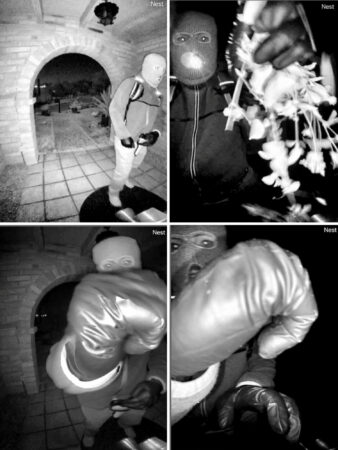
    The Federal Bureau of Investigation released surveillance videos of a masked person wearing a handgun holster outside Guthrie’s front door in Tucson the night she vanished. A porch camera recorded video of a person with a backpack who was wearing a ski mask, long pants, a jacket and gloves.

    Pima County Sheriff Chris Nanos said in a text message to The Associated Press on Monday that the 25-liter “Ozark Trail Hiker Pack” backpack was the only clothing item that has been “definitively identified.”

    “This backpack is exclusive to Walmart and we are working with Walmart management to develop further leads,” Nanos said.

    The suspect’s clothing “may have been purchased from Walmart but is not exclusively available at Walmart,” the Pima County Sheriff’s Department said in a statement Monday. “This remains a possibility only.”

    Investigators on Sunday announced that a glove discovered near the Guthrie home has been sent for DNA testing. The FBI said that it received preliminary results Saturday and was awaiting official confirmation. The development comes as law enforcement gathers more potential evidence and as the search for Guthrie’s mother heads into its third week. Authorities previously said they had not identified a suspect.

    The FBI said the suspect in the surveillance footage is a man about 5 feet, 9 inches tall with a medium build.

    Nanos said on Monday that members of Guthrie’s family, including siblings and spouses, are not suspects.

    “The family has been nothing but cooperative and gracious and are victims in this case,” Nanos said in a statement.

    Authorities have expressed concern about Nancy Guthrie’s health because she needs vital daily medicine. She is said to have a pacemaker and have dealt with high blood pressure and heart issues, according to sheriff’s dispatcher audio on broadcastify.com.

  • 3 killed, including suspect, in shooting during Rhode Island youth hockey game

    3 killed, including suspect, in shooting during Rhode Island youth hockey game

    PAWTUCKET, R.I. — Three people, including the suspect, were fatally shot during a Rhode Island youth hockey game Monday, authorities said.

    Pawtucket Police Chief Tina Goncalves told reporters that three other victims were hospitalized in critical condition. The shooter died from an apparent self-inflicted gun wound, she said.

    While police were not involved in the shooter’s death, authorities were still investigating, she said.

    “It appears that this was a targeted event, that it may be a family dispute,” she said.

    Goncalves did not provide details about the suspect or the ages of those who were killed, though she said it appeared that both victims were adults.

    She said investigators were trying to piece together what happened and speak with witnesses of the shooting inside Dennis M. Lynch Arena in Pawtucket, a few miles outside Providence. They also were reviewing video taken from the hockey game. Unverified footage circulating on social media shows players diving for cover and fans fleeing their seats after popping sounds are heard.

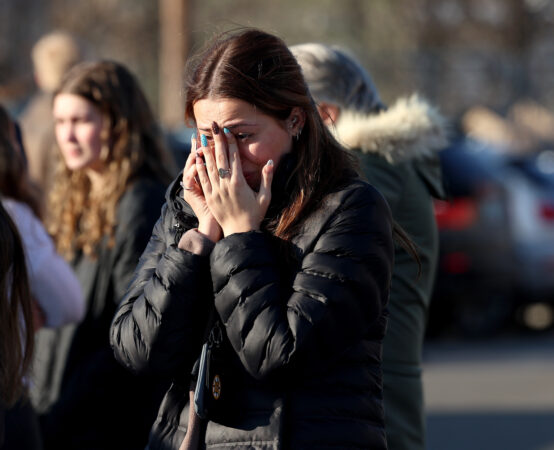
    Outside the arena, tearful families and high school hockey players still in uniform could be seen hugging before they boarded a bus to leave the area. Roads surrounding the arena were shut down as a heavy police presence remained and helicopters flew overhead.

    Monday’s shooting comes nearly two months after Rhode Island was rocked by a separate gun violence tragedy at Brown University, where a gunman killed two students and wounded nine others. That shooter went on to also fatally shoot a Massachusetts Institute of Technology professor. Authorities later found Claudio Neves Valente, 48, dead from a self-inflicted gunshot wound at a New Hampshire storage facility.

    “The fortunate thing is that the two incidents are not related, but it is very tragic,” said Pawtucket Mayor Don Grebien. “These are high school kids. They were doing an event, they were playing with their families watching, a fun time, and it turned into this.”

    Pawtucket is nestled just north of Providence and right under the Massachusetts state border. A city of just under 80,000, Pawtucket had up until recently been known as the home to Hasbro’s headquarters.