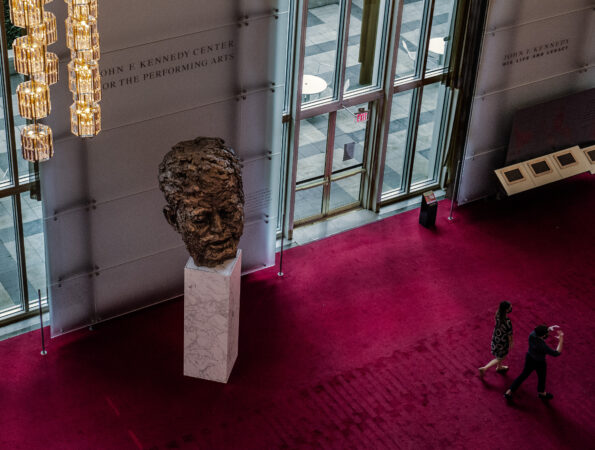
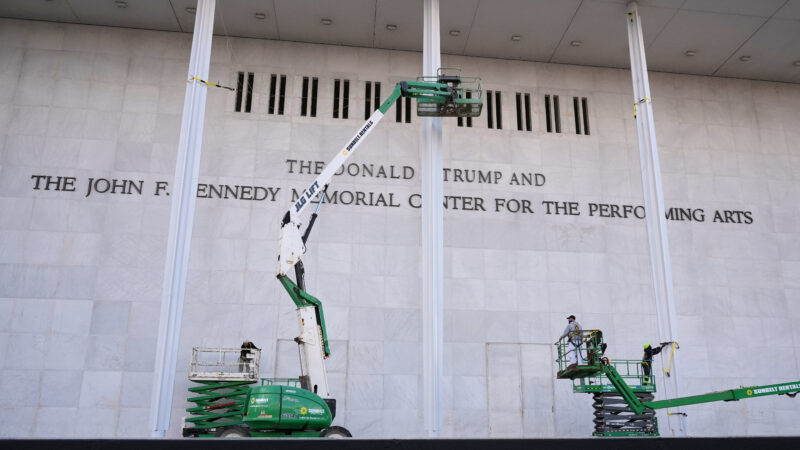
The Washington National Opera announced Friday that it plans to leave the John F. Kennedy Center for the Performing Arts, its longtime home, a stunning move that follows reports of declining ticket sales for the 70-year-old organization amid upheaval at the center since President Donald Trump’s takeover.
The opera said in a statement that it would “seek an amicable early termination of its affiliation agreement with the Kennedy Center” and “resume operations as a fully independent nonprofit entity.”
After the opera’s announcement, the Kennedy Center claimed it had ended the relationship.
“After careful consideration, we have made the difficult decision to part ways with the WNO due to a financially challenging relationship,” a spokesperson wrote in a statement. “We believe this represents the best path forward for both organizations and enables us to make responsible choices that support the financial stability and long-term future of the Trump Kennedy Center.”
But a person familiar with the situation, who spoke on the condition of anonymity because they were not authorized to represent either party, told the Washington Post that the choice was “definitely a WNO decision” and that there was consensus to leave, “but it’s with great regret.”
There had been concerns since Kennedy Center board chairperson David M. Rubenstein was removed in February and Trump became chairperson, the person said, but the board’s vote to change the name to the Trump Kennedy Center last month spurred the WNO’s decision to leave.
The opera said in its statement that the decision was driven by the elimination or reduction of support previously provided by the Kennedy Center, as well as changes to the center’s business model, which now require productions to be fully funded in advance — a shift the WNO called incompatible with how opera companies operate.
“Opera companies typically cover only 30-60% of costs through ticket sales, with the remainder from grants and donations that cannot be secured years ahead when productions must be planned,” the statement read.
It also added that the new model conflicts with the opera’s artistic mission of balancing popular titles with lesser-known works to serve diverse audiences.
Francesca Zambello, the opera’s artistic director for 14 seasons, told the Post she was “deeply saddened” to leave the Kennedy Center.
“I have been proud to be affiliated with a national monument to the human spirit, a place that has long served as an inviting home for our ever-growing family of artists and opera lovers,” she wrote in an email. “In the coming years, as we explore new venues and new ways of performing, WNO remains committed to its mission and artistic vision.”
To stay on solid financial footing, the opera said, it planned to cut back its spring season and relocate performances to new venues, which will be announced in the coming weeks.
News of the departure was first reported by the New York Times.
The person familiar with the situation stressed that the center is the “vision and dream of those who brought themselves out of the darkness of the assassination of a young president.”
“There are an awful lot of people that are offended that the official memorial to President John F. Kennedy is being manipulated,” they added. “It is not personal to any one president. You just can’t do that.”
They also said that the move came partly in response to criticism by the new Kennedy Center leadership of the previous management’s financial stewardship. “Frankly, to say that the Kennedy Center was in financial ruin under the predecessor to the current regime is fake,” the person said.
Describing the opera’s circumstances since Trump’s takeover, the person said the company has seen dropping attendance, a decline in donor contributions, and, especially after the name change, increasing numbers of opera singers and artists who are refusing to perform at the Kennedy Center. “A lot of it really is: You can’t get the artists, you can’t get the ticket sales, you’re not going to be able to get the support under this.”
Declines in ticket sales became apparent in the first few months after Trump’s takeover, the Post reported in June. Revenue generated from Washington National Opera subscriptions had fallen 15%, year over year, through the first 10 weeks of its campaign.
A Post analysis in October showed that ticket sales had declined across several genres at the Kennedy Center’s major theaters, a drop that current and former staffers attributed to audiences feeling repelled by Trump’s takeover.
Zambello had told the Guardian in November that the turmoil was leading the opera to consider moving out of the building. (At the time, the opera’s board chairperson denied plans to leave.) Budget constraints had delayed the opera’s 2026-2027 season planning, a person familiar with the organization told the Post last month.
Another round of artists and performers has canceled shows at the Kennedy Center since its board, installed by Trump early last year, voted in December to add his name to the center. It was on the building’s exterior signage the following day.
As the Trump administration increases the presence of federal agents in U.S. cities, a local group identifying as part of the Black Panther Party for Self-Defense has become more active in Philadelphia.
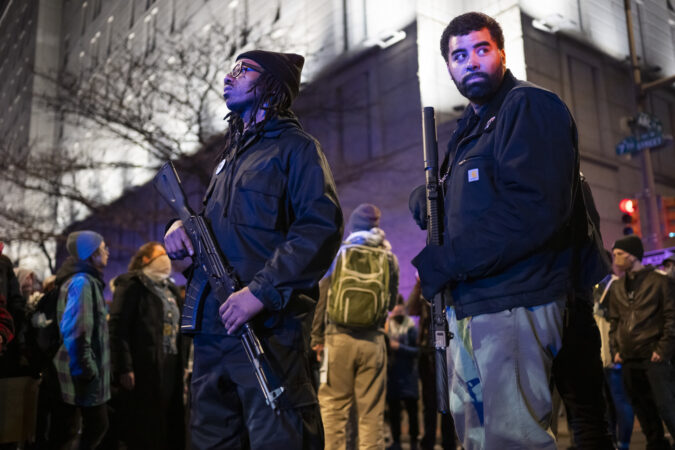
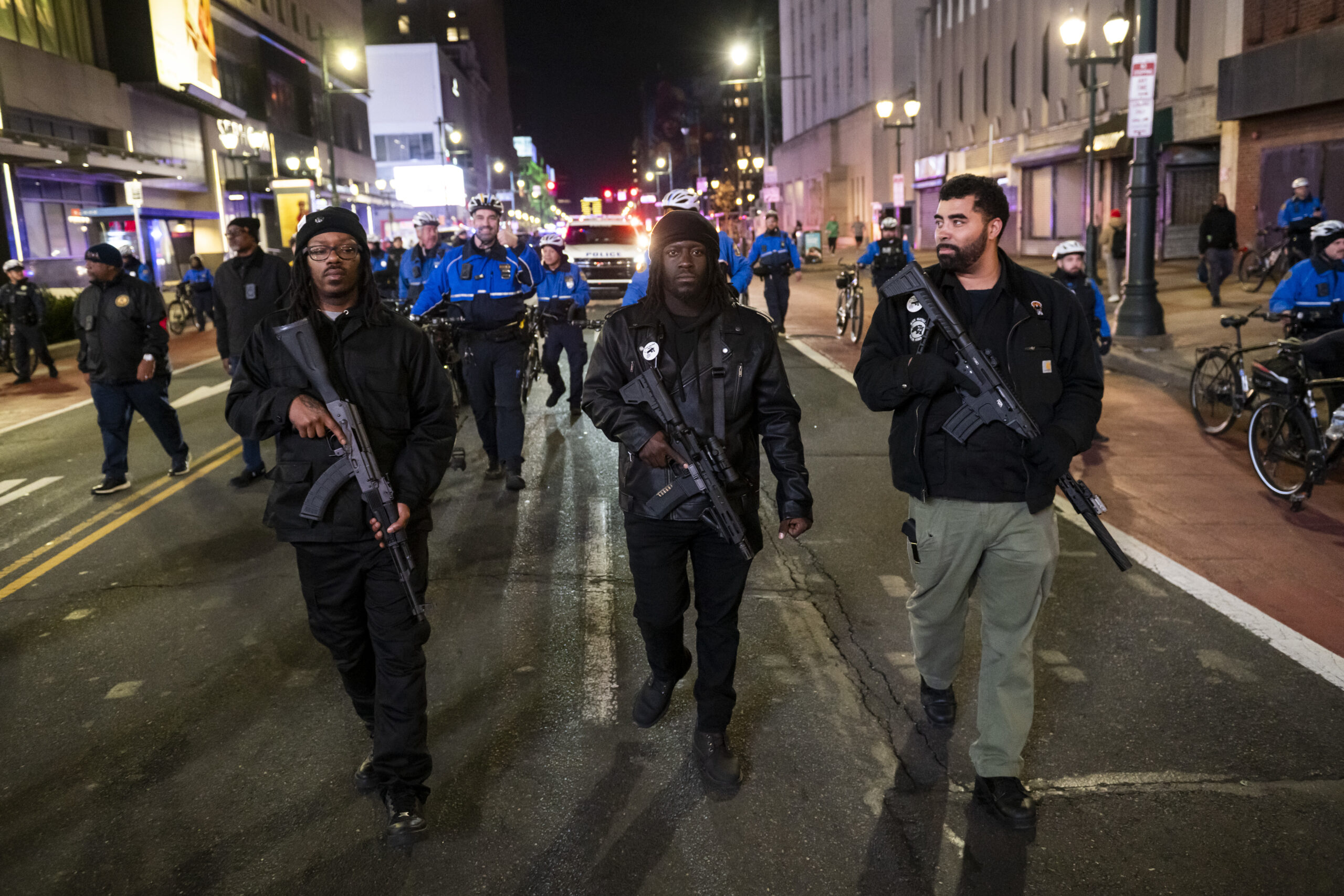
The group says it is a resurgence of the militant Black power group dating back to the 1960s, and has been trained by some of the original party’s surviving members. Several attended an anti-ICE protest Thursday at Philadelphia City Hall, carrying military-style weapons.
They say they’re legally permitted to carry firearms and are showing up as a response to violence from the Trump administration.
The group has been holding regular weekly free food programs in North Philadelphia for several years, according to 39-year-old Paul Birdsong of West Philadelphia, who identifies himself as the Black Panther Party’s national chairman.
Birdsong and others attended the Philly protest one day after Immigration and Customs Enforcement officer Jonathan Ross shot and killed 37-year-old Renee Nicole Good in Minneapolis.
“That wouldn’t have happened if we were there,” Birdsong said. “Not a single person would have gotten touched.”
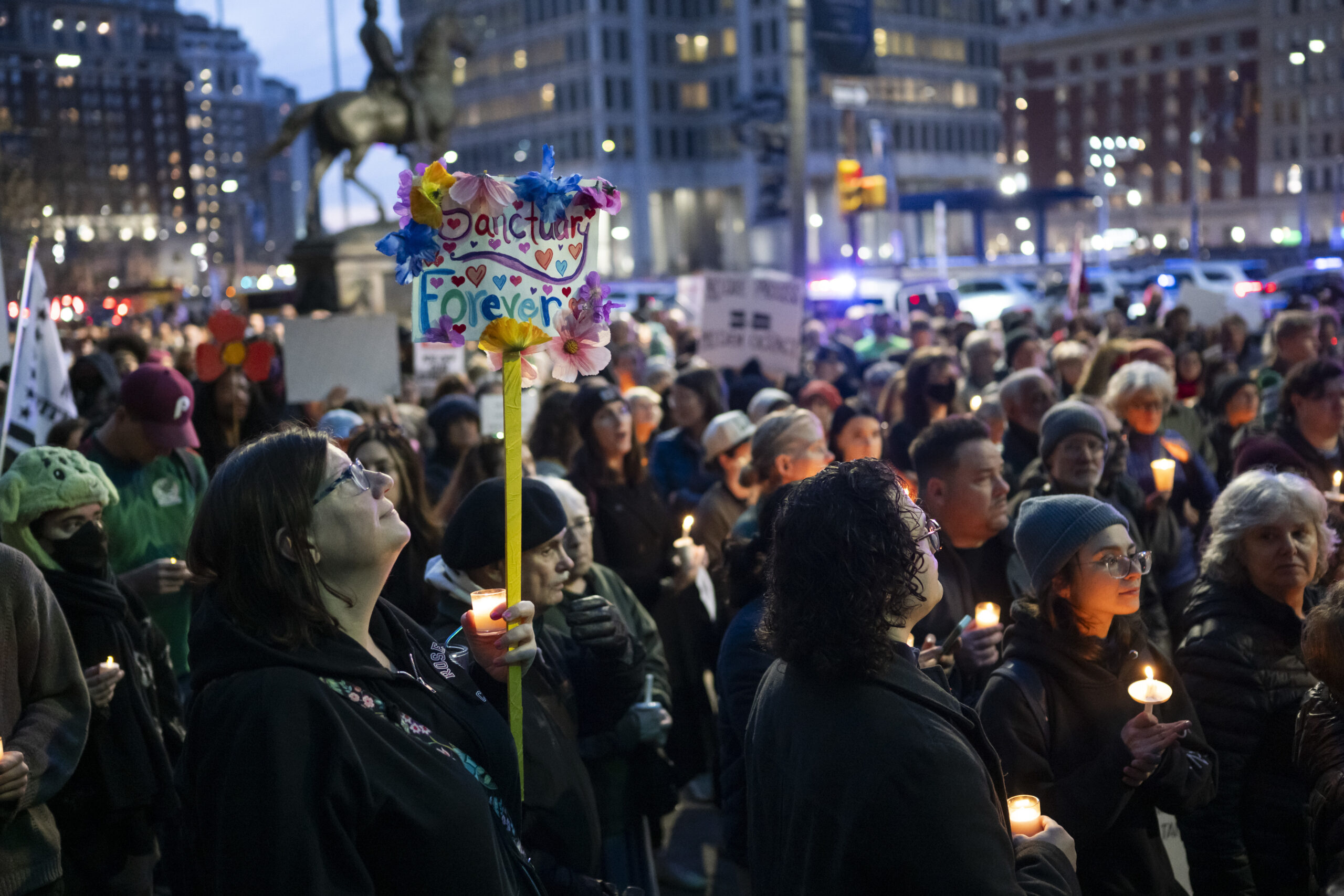
Jane Wiedman of Mount Airy holds up a sign among the crowd of protesters at City Hall on Thursday, Jan. 8, 2026, as they gather for a vigil to rally against the killing of Renee Nicole Good, who was shot by an ICE agent in Minneapolis.
Millions of people have watched videos of the shooting online, sparking national protests. The Trump administration quickly defended the shooter, with JD Vance asserting Ross has “absolute immunity” and “was doing his job.” Some have rejected Vance’s suggestion that Ross couldn’t be tried by the state, and Minnesota leaders Friday renewed their calls for state involvement in an investigation of the shooting.
Birdsong said the group wants to see ICE abolished and the Trump administration held accountable.
“You got people that are part of a cabal, that are self serving … and they prey on the common folks of the United States,” Birdsong said.
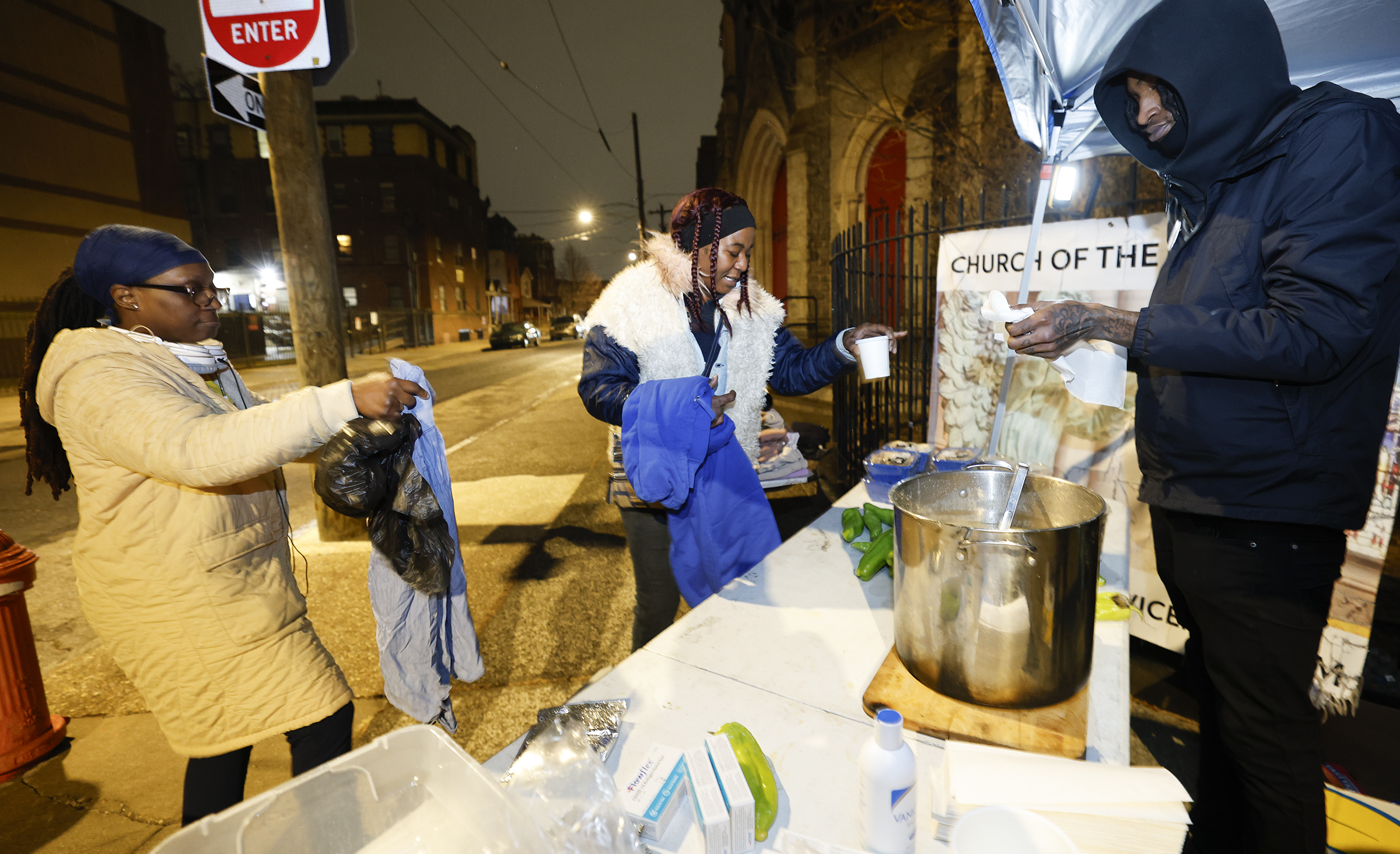
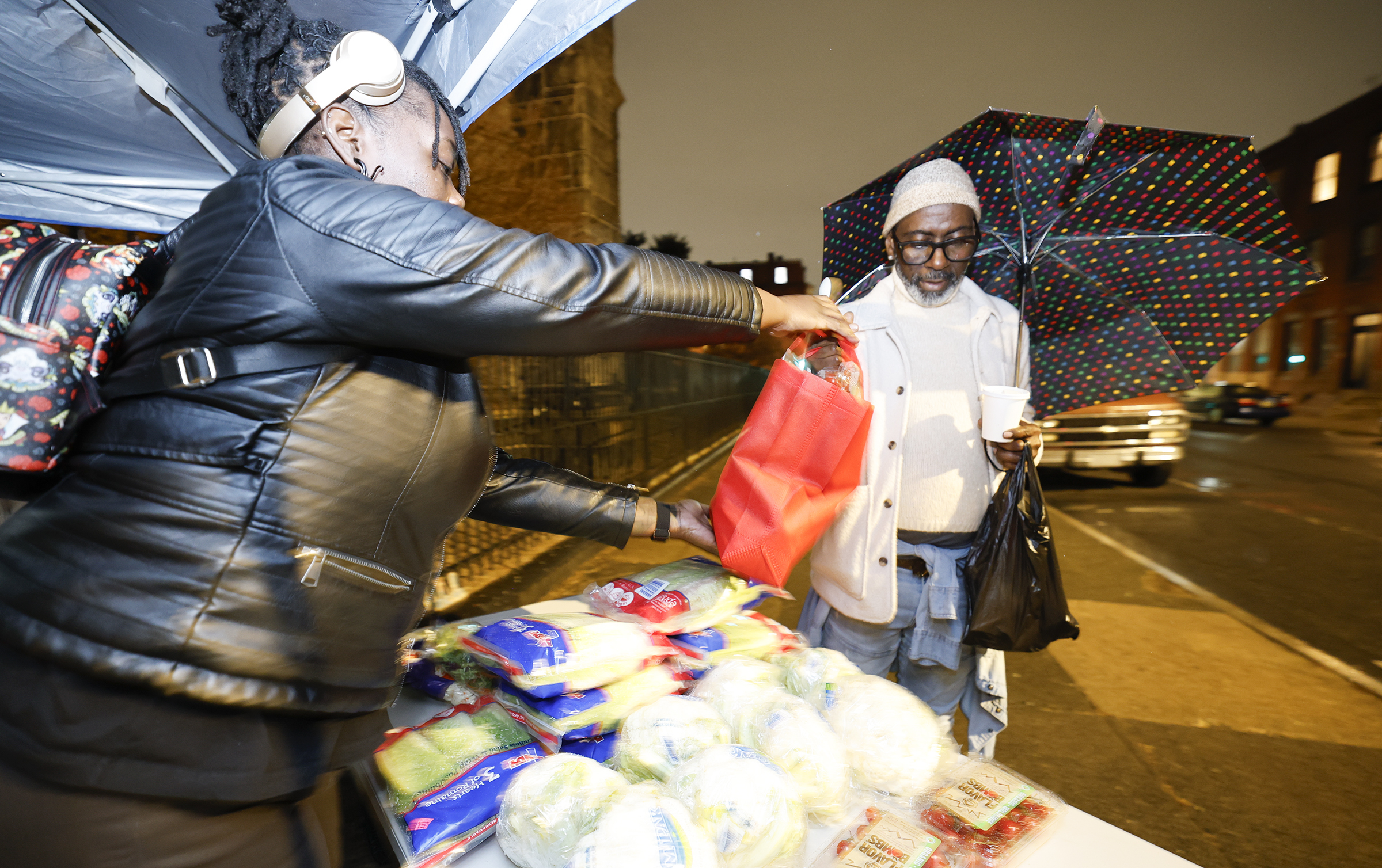
Philadelphia Black Panther Party for Self-Defense member Skiippy (right) hands soup to Yolanda Gray (center) and Roxanne Hart outside the Church of the Advocate in North Philadelphia on Friday, Jan. 9, 2026. The Philadelphia Black Panther Party for Self-Defense helps supply food and clothes for residents.
A free food program
Birdsong said he was recruited by members of the Black Panther Party in the wake of the 2020 police killing of George Floyd, and he listed several surviving elders of the group as mentors. The Philly chapter has “less than 100″ members, he said, though he declined to provide more detail.
On Friday evening, Birdsong and several other Black Panther Party members set upa pop-up food pantry outside Church of the Advocate at the corner of 18th and Diamond Streets in North Philadelphia.
The members laid out bananas, grapes, salad greens, romaine lettuce, cherry tomatoes, apples, pears, celery, peppers, and mushrooms on folding tables.
They added bread, Tastykakes — immediately popular with passing children — canned food, and hygiene items like shampoo, COVID-19 test kits, and adult undergarments. On another table were children’s clothes and a large pot of chicken soup, all near a banner with the Black Panthers logo.
Philadelphia Black Panther Party for Self-Defense member Sharon Fischer (left) hands a bag of food to Daren Robison in North Philadelphia on Friday, Jan. 9, 2026. The Philadelphia Black Panther Party for Self-Defense supplies food and clothes for residents.
Birdsong said the money to buy the food comes from members’ own paychecks, as well as donations from people in the community.
“It really helps out,” said Dawn Henkins, 60, who lives nearby. She said it’s especially helpful for older people who are living on a fixed income.
“The brothers can help people — they are here for the people,” Henkins said.
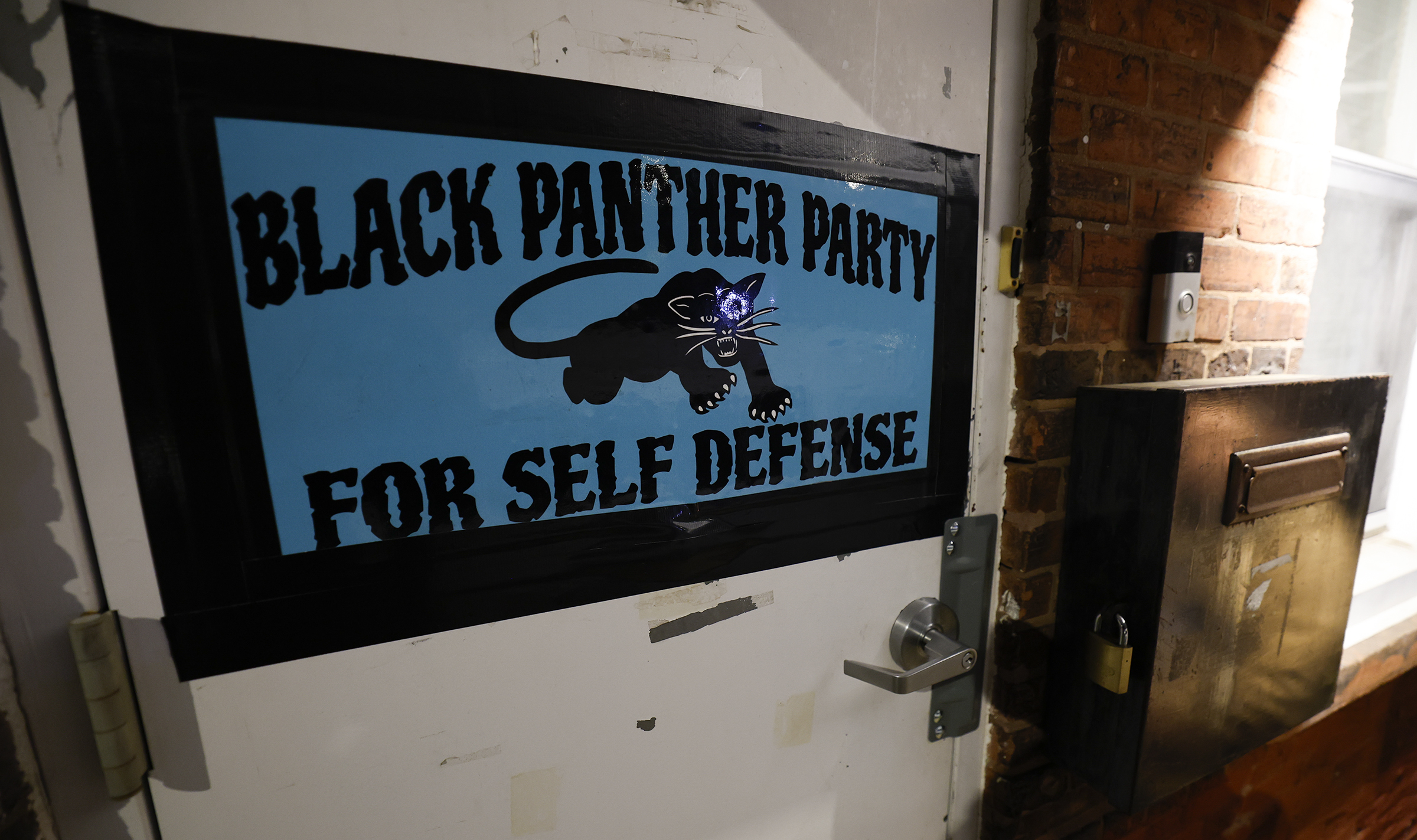
The Black Panthers previously held food programs at 33rd Street and Cecil B. Moore Avenue in Strawberry Mansion, and at Jefferson Square Park in Pennsport, Birdsong said. More recently, the group was able to move into 2123 N. Gratz St. — a North Philadelphia location that Birdsong says once was a headquarters for the original Black Panther Party Philadelphia chapter.
The original Black Panther Party was founded by Bobby Seale and Huey P. Newton in Oakland, Calif., in 1966 and was active nationally until the early 1980s. The group formed to fight against police brutality and quickly evolved to promote other social changes including prison reform and access to education, food, and healthcare, according to the National Museum of African American History and Culture.
The group was soon targeted by J. Edgar Hoover’s FBI, which sought to “discredit, disrupt, and destroy” the Black rights movement, according to UC Berkeley Library. Two Black Panthers in Chicago, Fred Hampton and Mark Clark, were killed in a Chicago police raid that was later revealed to have been coordinated by the FBI.
The Philadelphia chapter was active from 1968 until 1973, according to a University of Washington website that maps U.S. social movements. Prominent local figures from this era include Sultan Ahmad, who went on to hold roles in city government, and Paula Peebles, a social activist who stayed involved in the Black Panthers for much of her life.
The Black Panther Party for Self-Defense headquarters in North Philadelphia on Friday, Jan. 9, 2026.
One person who stopped by for soup on Friday, Jerome Hill, 63, said he can distantly remember the days when Episcopalian pastor and social activist the Rev. Paul Washington let the Black Panthers hold events at Church of the Advocate.
“They primarily were always community oriented,” Hill said. He said he’s glad to see the group handing out food, and added that they could serve as role models for younger people in the neighborhood.
While one member of the group served up chicken soup to several boys who stopped by the tables, another member stood at the corner holding an AK-47-style rifle.
“I feel like we’re welcome,” said one member, also carrying a firearm, who identified himself as Comrade Arch. He said he was a fan of the original group growing up, and he joined a few months ago. “I’ve always had a revolutionary spirit.”
Under a canopy behind the tables, Birdsong moved back his jacket to reveal a modern MP5, a weapon that has its origins in German submachine guns. He also carried two semiautomatic handguns.
It’s a controversial posture: Many pro-democracy advocates and experts on civil rights emphasize that nonviolence is essential to successful protest movements.
The law says you can carry a gun in Philadelphia — but only if you have a license to carry firearms, according to Dillon Harris, an attorney who focuses on gun rights.
“Open carry,” or carrying a firearm in a way that it can be plainly seen by others, is “generally lawful” in Pennsylvania, except for in prohibited locations such as federal buildings, said Harris.
But Philadelphia is an exception to this rule, Harris said. A state law prohibits carrying firearms in “a first class city” without a license to carry firearms. That statute applies to Philadelphia.
But while many civil rights advocates argue that firearms tend to escalate violent confrontations, rather than prevent them, it’s long been part of the Black Panthers’ tactics, and Birdsong pushed back against that idea.
“We feel safe,” Birdsong said. “No police, no drug dealers doing anything to us here.”
Armed members of the Black Panther Party for Self-Defense march down Market Street with a crowd of protesters on Thursday, Jan. 8, 2026, to rally against the killing of Renee Good, who was shot by an ICE agent in Minneapolis, Minn.
With the internet down in Iran and phone lines cut off, gauging the demonstrations from abroad has grown more difficult. But the death toll in the protests has grown to at least 72 people killed and over 2,300 others detained, according to the U.S.-based Human Rights Activists News Agency. Iranian state TV is reporting on security force casualties while portraying control over the nation.
Supreme Leader Ayatollah Ali Khamenei has signaled a coming clampdown, despite U.S. warnings. Tehran escalated its threats Saturday, with Iran’s attorney general, Mohammad Movahedi Azad, warning that anyone taking part in protests will be considered an “enemy of God,” a death-penalty charge. The statement carried by Iranian state television said even those who “helped rioters” would face the charge.
“Prosecutors must carefully and without delay, by issuing indictments, prepare the grounds for the trial and decisive confrontation with those who, by betraying the nation and creating insecurity, seek foreign domination over the country,” the statement read. “Proceedings must be conducted without leniency, compassion or indulgence.”
U.S. Secretary of State Marco Rubio offered support for the protesters.
“The United States supports the brave people of Iran,” Rubio wrote Saturday on the social platform X. The State Department separately warned: “Do not play games with President Trump. When he says he’ll do something, he means it.”
State TV split-screen highlights challenge
Saturday marks the start of the work week in Iran, but many schools and universities reportedly held online classes, Iranian state TV reported. Internal Iranian government websites are believed to be functioning.
State TV repeatedly played a driving, martial orchestral arrangement from the Epic of Khorramshahr by Iranian composer Majid Entezami, while showing pro-government demonstrations. The song, aired repeatedly during the 12-day war launched by Israel, honors Iran’s 1982 liberation of the city of Khorramshahr during the Iran-Iraq war. It has been used in videos of protesting women cutting away their hair to protest the 2022 death of Mahsa Amini as well.
It also repeatedly aired video of purported protesters shooting at security forces with firearms.
“Field reports indicate that peace prevailed in most cities of the country at night,” a state TV anchor reported Saturday morning. “After a number of armed terrorists attacked public places and set fire to people’s private property last night, there was no news of any gathering or chaos in Tehran and most provinces last night.”
That was directly contradicted by an online video verified by the Associated Press that showed demonstrations in northern Tehran’s Saadat Abad area, with what appeared to be thousands on the street.
“Death to Khamenei!” a man chanted.
The semiofficial Fars news agency, believed to be close to Iran’s paramilitary Revolutionary Guard and one of the few media outlets able to publish to the outside world, released surveillance camera footage that it said came from demonstrations in Isfahan. In it, a protester appeared to fire a long gun, while others set fires and threw gasoline bombs at what appeared to be a government compound.
The Young Journalists’ Club, associated with state TV, reported that protesters killed three members of the Guard’s all-volunteer Basij force in the city of Gachsaran. It also reported a security official was stabbed to death in Hamadan province, a police officer killed in the port city of Bandar Abbas, and another in Gilan, as well as one person slain in Mashhad.
The semiofficial Tasnim news agency, also close to the Guard, claimed authorities detained nearly 200 people belonging to what it described as “operational terrorist teams.” It alleged those arrested had weapons including firearms, grenades, and gasoline bombs.
State television also aired footage of a funeral service attended by hundreds in Qom, a Shiite seminary city just south of Tehran.
More weekend demonstrations planned
Iran’s theocracy cut off the nation from the internet and international telephone calls on Thursday, though it allowed some state-owned and semiofficial media to publish. Qatar’s state-funded Al Jazeera news network reported live from Iran, but they appeared to be the only major foreign outlet able to work.
Iran’s exiled Crown Prince Reza Pahlavi, who called for protests Thursday and Friday, asked in his latest message for demonstrators to take to the streets Saturday and Sunday. He urged protesters to carry Iran’s old lion-and-sun flag and other national symbols used during the time of the shah to “claim public spaces as your own.”
Pahlavi’s support of and from Israel has drawn criticism in the past — particularly after the 12-day war. Demonstrators have shouted in support of the shah in some protests, but it isn’t clear whether that’s support for Pahlavi himself or a desire to return to a time before the 1979 Islamic Revolution.
Online video purported to show protests ongoing Saturday night as well.
The demonstrations began Dec. 28 over the collapse of the Iranian rial currency, which trades at over 1.4 million to $1, as the country’s economy is squeezed by international sanctions in part levied over its nuclear program. The protests intensified and grew into calls directly challenging Iran’s theocracy.
Airlines have canceled some flights into Iran over the demonstrations. Austrian Airlines said Saturday it had decided to suspend its flights to Iran “as a precautionary measure” through Monday. Turkish Airlines earlier announced the cancellation of 17 flights to three cities in Iran.
Meanwhile, concern is growing that the internet shutdown will allow Iran’s security forces to go on a bloody crackdown, as they have in other rounds of demonstrations. Ali Rahmani, the son of Nobel Peace Prize laureate Narges Mohammadi, who is imprisoned in Iran, noted that security forces killed hundreds in a 2019 protest “so we can only fear the worst.”
“They are fighting, and losing their lives, against a dictatorial regime,” Rahmani said.
Sheriff Rochelle Bilal has garnered national headlines and condemnation for calling U.S. Immigration and Customs Enforcement “fake, wannabe law enforcement” and sending a blunt warning to immigration officers who commit crimes in Philadelphia.
“If any [ICE agents] want to come in this city and commit a crime, you will not be able to hide, nobody will whisk you off,” Bilal said. “You don’t want this smoke, cause we will bring it to you. … The criminal in the White House would not be able to keep you from going to jail.”
The sheriff’s office and a spokesperson for Bilal did not immediately respond to requests for comment Saturday. In an interview with CNN’s Erin Burnett, Bilal said “enough is enough.”
“People are tired of these people coming into the city, masked up — basically all masked up — and pulling people out and causing havoc,” Bilal told the network. “This was supposed to be helping cities out, this was supposed to be eliminating crime, but yet, you are committing them here, you are putting people in fear, you are breaking up families.”
Bilal spoke for less than four minutes at the Thursday news conference. She upbraided ICE agents for wearing masks that obscure their faces and said their actions violate “not only legal law but the moral law.”
“Law enforcement professionals around the country do their job, and we have been fighting for years to build that bridge between us and our communities,” Bilal said. “You had one negative nutcase that causes this problem and now we all have to fight again to let people know law enforcement works with communities.”
Some praised Bilal on social media. Ben Crump, a prominent civil rights attorney, wrote on Facebook, “Sheriff Rochelle Bilal didn’t hold back. … Tragedies like this happen when agents operate in our communities with little to no oversight.”
Meanwhile, the Pennsylvania GOP posted on X, “When local law enforcement stands with criminals rather than people keeping our communities safe, you know there’s a problem. … Rhetoric like this only makes this situation more dangerous for federal law enforcement and the city of Philadelphia.”
A video of Bilal’s statement was also posted by LibsofTikTok, a controversial far-right social media account. That post had more than 746,800 views and 8,500 likes as of Saturday afternoon.
U.S. Rep. Randy Fine, a Republican from Florida, responded to LibsofTikTok’s post, writing, “She should be arrested.”
The Philadelphia Sheriff’s Office does not police the city; instead, the office’s core functions are deploying deputies to the county’s courtrooms and transporting in-custody defendants to court.
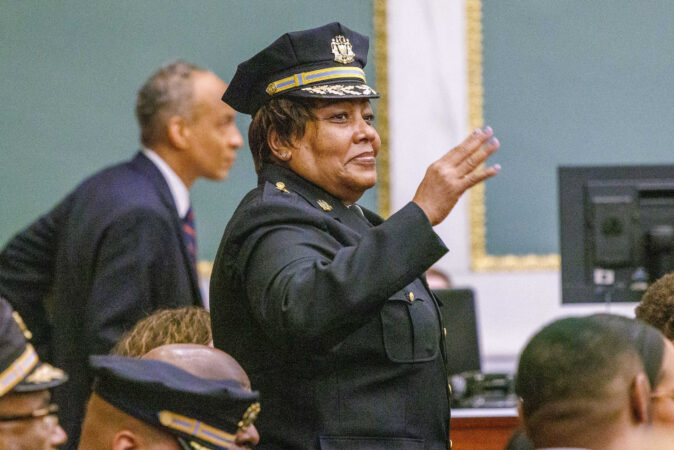
In his statement, Police Commissioner Bethel distinguished the roles of the sheriff’s office and the police department, noting that the sheriff’s office does not “conduct criminal investigations, nor does it in any way direct municipal policing.” The sheriff is an elected official, while police commissioners are appointed by the mayor.
“The Philadelphia Police Department will continue to work professionally with all of our enforcement partners,” Bethel said. “But clear lines of authority — and accurate public representation of those roles — are essential to maintaining public trust and effective public safety operations.”
The New York Times also names Philly the top place to visit in 2026: A- (yet again)
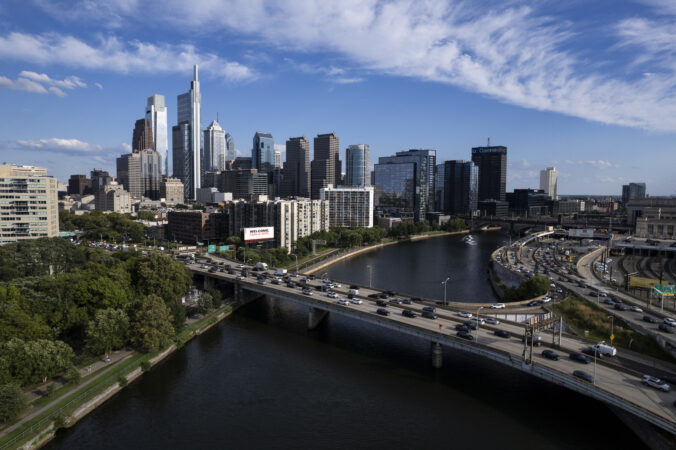
Well, here we go again. Philadelphia has once more been crowned the world’s best place to visit in 2026 — this time by the New York Times, which means we are now in the extremely Philly position of being right twice and still deeply suspicious about it.
Yes, the reasons are familiar. The Semiquincentennial. The World Cup. The All-Star Game. Fireworks, parades, exhibitions, concerts, TED talks, themed balls, and a calendar so packed it feels like someone dared the city to see what would break first. It’s a lot. Enough, apparently, to push Philly to the top of the Times’ “52 Places to Go” list.
But at this point, the events are almost beside the point. Big moments don’t explain why people want to be here, they just give them an excuse.
Philly keeps landing on these lists because it’s a place that feels alive even when nothing “special” is happening. It’s opinionated without being curated. Historic without being precious. Welcoming in a way that involves some yelling, a little side-eye, and eventually someone telling you where to eat. You don’t visit Philly to be impressed. You visit to be absorbed.
So why not an A+? Because every time the outside world decides Philly is the place to be, the city pays for it in very real ways. Hotel prices climb. SEPTA gets stress-tested. Streets designed for horse traffic brace for global crowds. And locals are once again asked to host a massive party while still making it to work, daycare pickup, and whatever delayed train they’re already standing on.
There’s also the small matter of validation fatigue. Philly didn’t suddenly get good because the New York Times said so — just like it didn’t when the Wall Street Journal said it. The city’s been doing this for a long time, whether or not anyone was paying attention.
Nothing says Philadelphia quite like being named the top travel destination in the world for 2026 and, at the exact same time, going viral for a road sign that simply reads: “Avoid Philadelphia.” No explanation. No branding. Just a warning.
The photo resurfaced on r/philly and immediately became a public forum for collective truth-telling. When one user asked, “Why?” the answers poured in: “The usual reasons.” “Mental health reasons. Financial reasons.” “SEPTA.” Another went full blunt-force: “Bad things happen in Philly.”
Of course, the Eagles entered the chat. “Eagles lost yesterday,” one commenter offered. Another countered, “Or Eagles won yesterday… Could be Eagles just did a thing. Go Birds.” Honestly, both feel correct.
Then came the traffic trauma. “Spend a day on the Blue Route,” someone wrote — a sentence that should probably be included in driver’s ed. One person proposed Google Maps should add a new setting: “avoid highways, avoid toll roads, avoid Philadelphia.”
But buried in the comments was the buzzkill reality check: This sign is almost certainly old. Several users pointed out it likely dates back to the I-95 bridge collapse in 2023, when avoiding Philadelphia was not a vibe, but a Department of Transportation directive. “Why are you posting a 5+ year old pic?” one top commenter asked, ruining the mystery but improving the accuracy.
But the timing is what makes this perfect. As the Wall Street Journal and the New York Times roll out the red carpet for 2026, locals are standing off to the side holding a faded road sign like, just so you know. It’s not anti-tourism. It’s informed consent.
An A for honesty, context, and a comment section that somehow functions as a city guide, traffic alert, sports recap, and warning label… even when the photo is old.
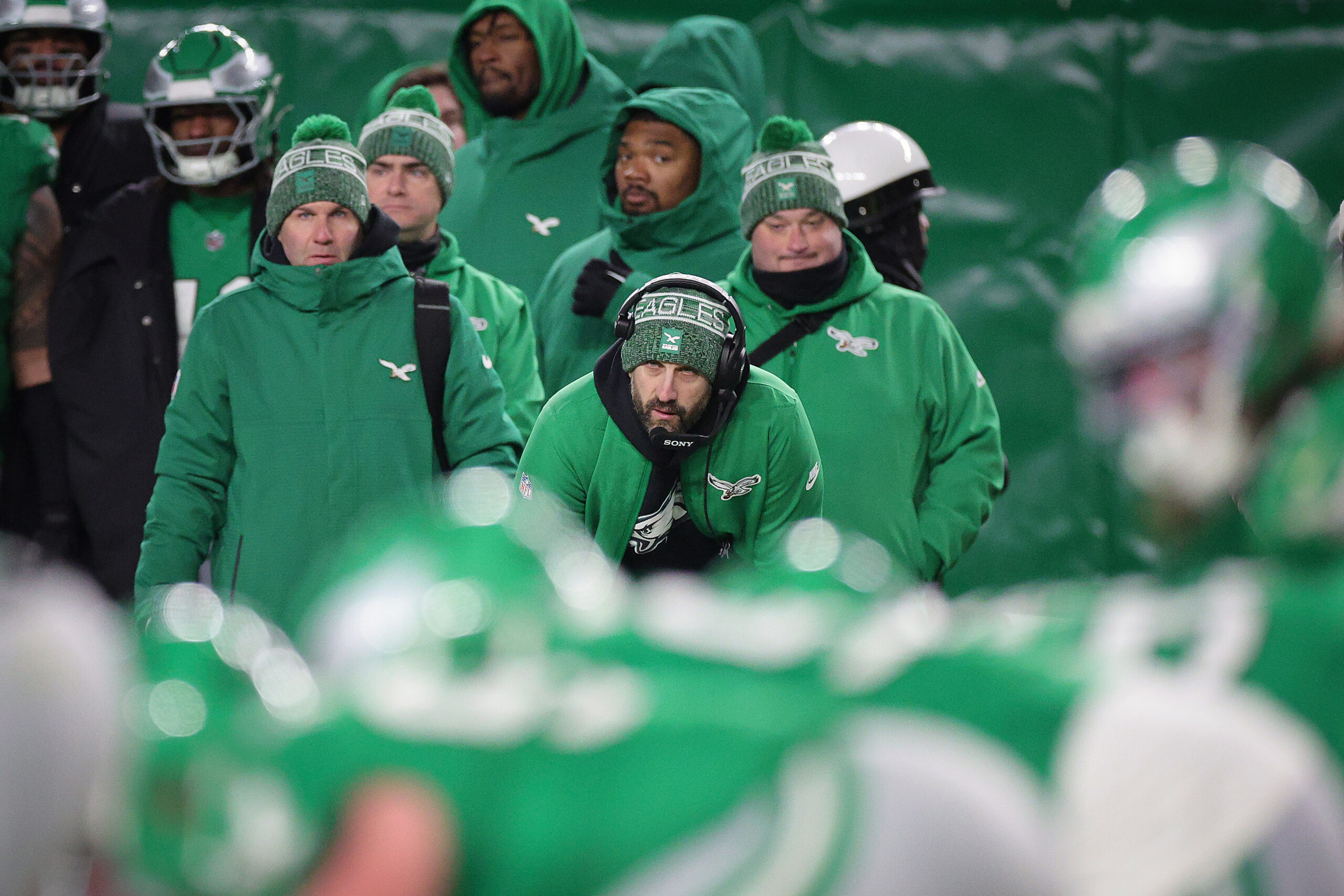
Philadelphia Eagles head coach Nick Sirianni (center bottom) watches his team play the Washington Commanders at Lincoln Financial Field in Philadelphia on Sunday, Jan. 4, 2026.
Eagles start the playoffs as the No. 3 seed: B-
The Eagles enter the playoffs as a No. 3 seed, a position that history treats like a warning label. The math is rude: Few No. 3 seeds make the Super Bowl, and most of them don’t even sniff it. The Eagles themselves have tried this route before and usually wound up packing up by the divisional round. Not great.
And yes, this is at least partially self-inflicted. Resting the starters in Week 18 cost them a real shot at the No. 2 seed and an objectively easier path. That decision is already being litigated in every bar, group chat, and radio segment. And it will keep getting relitigated until either A) the Eagles lose or B) they win enough that no one wants to admit they were wrong.
The 49ers limping into the Linc with injuries, tired legs, and a defense that is no longer the Final Boss version Philly remembers? That’s manageable. The Eagles’ defense has been the most reliable unit all season, and if this game turns into trench warfare, that favors the Birds. Saquon Barkley doesn’t need to be vintage playoff Saquon yet. He just needs to exist long enough to keep the offense functional.
Still, the unease is earned. This is a team with Super Bowl expectations walking a historically unfriendly path, powered by a defense everyone trusts and an offense no one fully believes in. That’s not nothing. That’s the whole tension.
So yes, the road is harder than it needed to be. Yes, the margin for error is thin. And yes, if this goes sideways, the No. 3 seed will be Exhibit A in the postmortem.
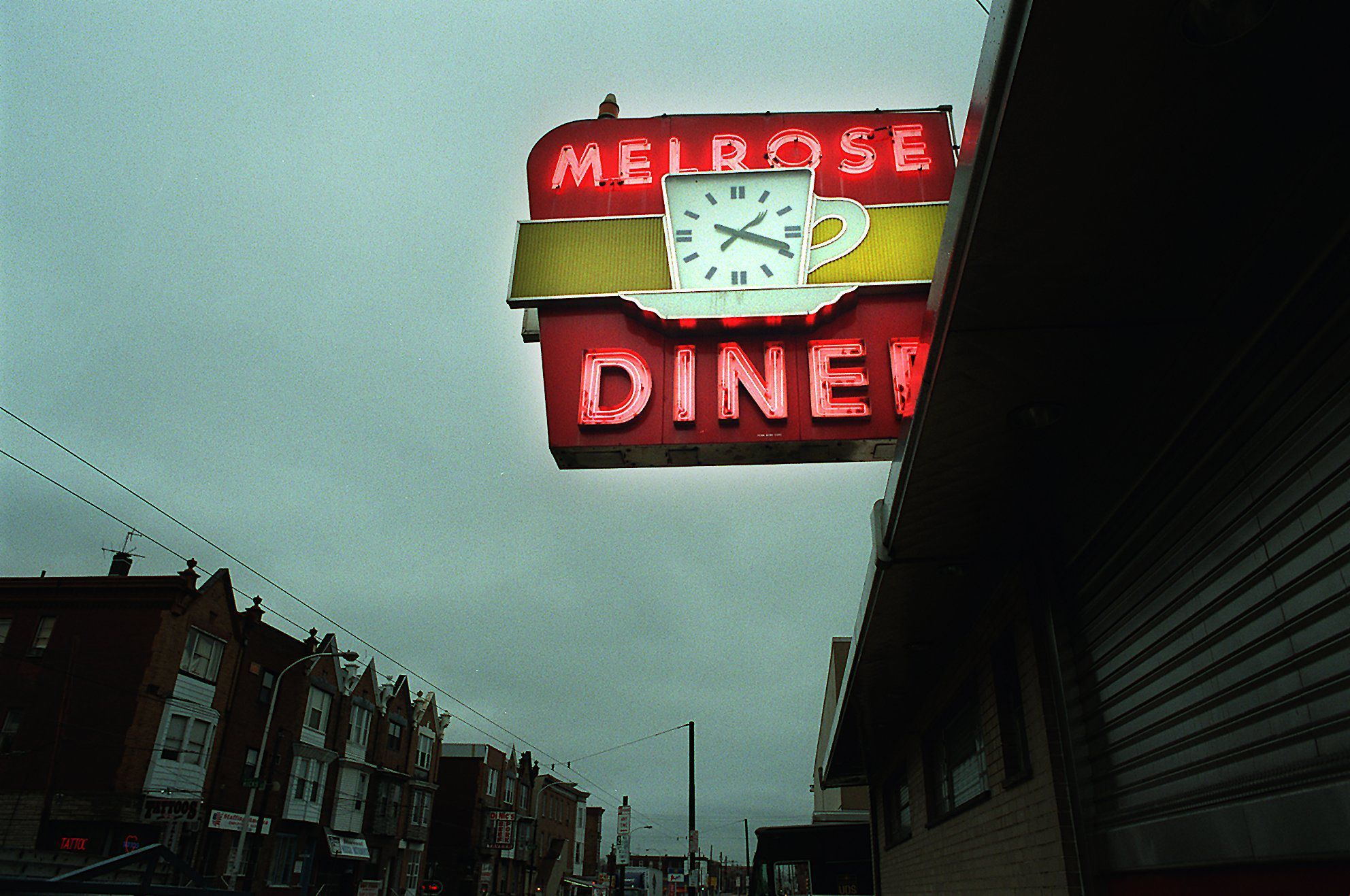
In this photo from 2000, the Melrose Diner sign shines bright on a gray day.
The Melrose Diner sign hits Facebook Marketplace: A+
Nothing says Philadelphia like scrolling Facebook Marketplace and suddenly finding the neon soul of a demolished diner listed as “very heavy and totally cool.”
Yes, the iconic Melrose Diner sign — red, yellow, stainless steel nostalgia and all — is apparently for sale. Not at auction. Not through a preservation society. Not behind glass in a museum. Just vibes, photos, and the immortal Marketplace closer: “Serious inquiries only.”
There’s something perfectly on-brand about this. The Melrose didn’t go out quietly. It didn’t get a tasteful plaque or a respectful archival goodbye. It got torn down for apartments, went into “storage,” and has now reemerged like a ghost asking for a sizable offer and a pickup truck.
The listing itself is doing a lot of work: four pieces, sold as a set, “used — good,” with the helpful reminder that Olga’s Diner once sold signage for $12,000. Philly translation: Don’t lowball me, I know what I’ve got.
Selling the sign feels a little like selling a family photo album. The Melrose wasn’t just a diner — it was late nights, early mornings, post-bar waffles, post-court appearance coffees, and at least one story involving a mobster, depending on who you ask.
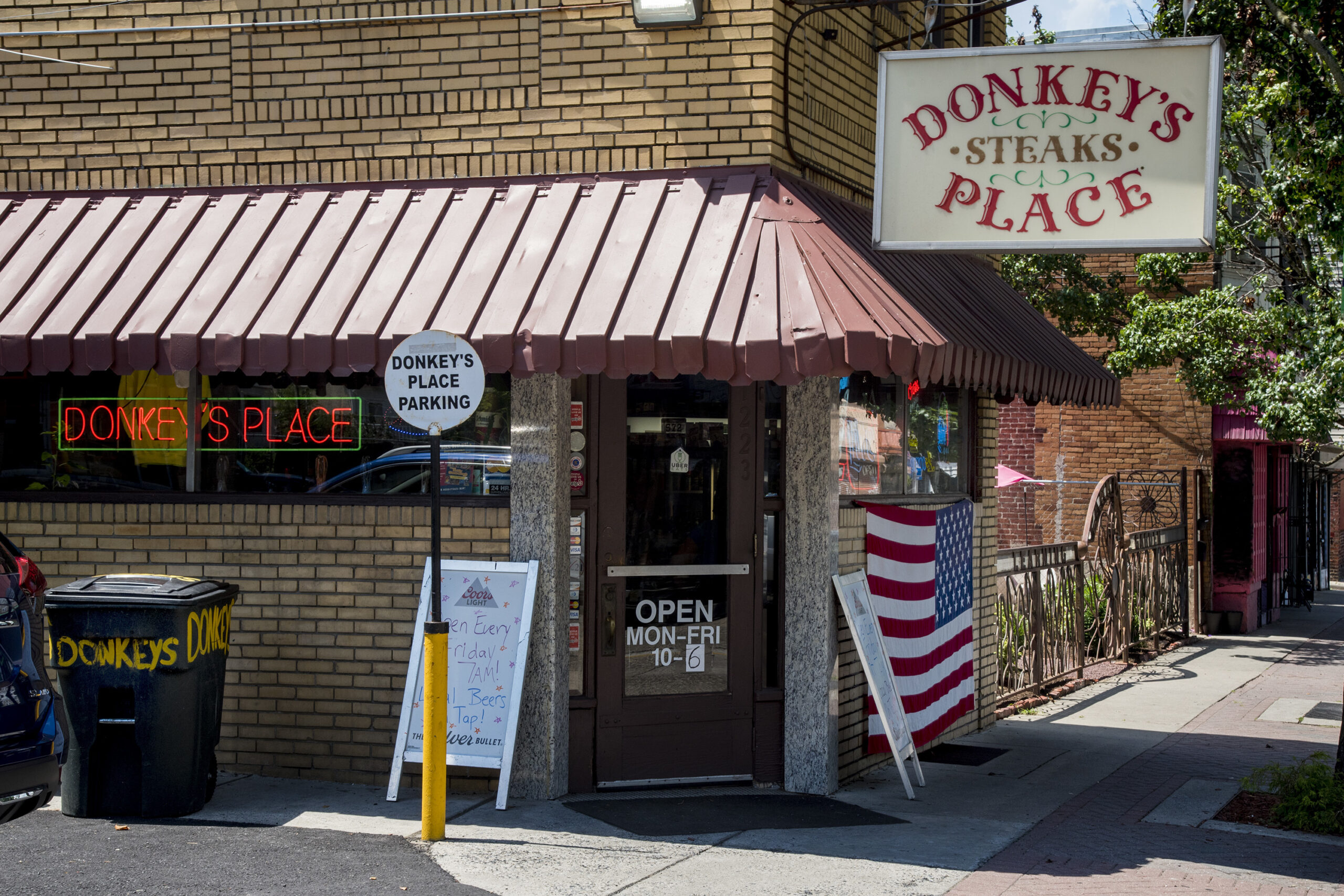
Donkey’s Place in Camden on July 18, 2018, one of 10 eateries Anthony Bourdain visited in a 2015 episode of his “Parts Unknown” show in New Jersey.
Donkey’s Place walrus bone theft: D (return it, coward)
Donkey’s Place didn’t ask questions about the bone for years — it just existed, looming behind the bar like a strange guardian angel of cheesesteaks and beers. It wasn’t sentimental, it wasn’t precious. It was just there. Which somehow makes taking it worse.
The alleged thief wrapped it in a scarf and walked out like this was Ocean’s Eleven: South Jersey Edition, and now the bar is left explaining to the internet why they’re asking nicely for a walrus baculum to be returned, no police report, no drama, just vibes and decency.
The deduction from an A is only because this never should’ve happened. Otherwise, this is peak Philly-area energy: a historic bar, an inexplicable artifact, security footage, TikTok pleas, and a collective regional agreement that yes, this matters.
Mail it back. No questions asked. Everyone will pretend this never happened.
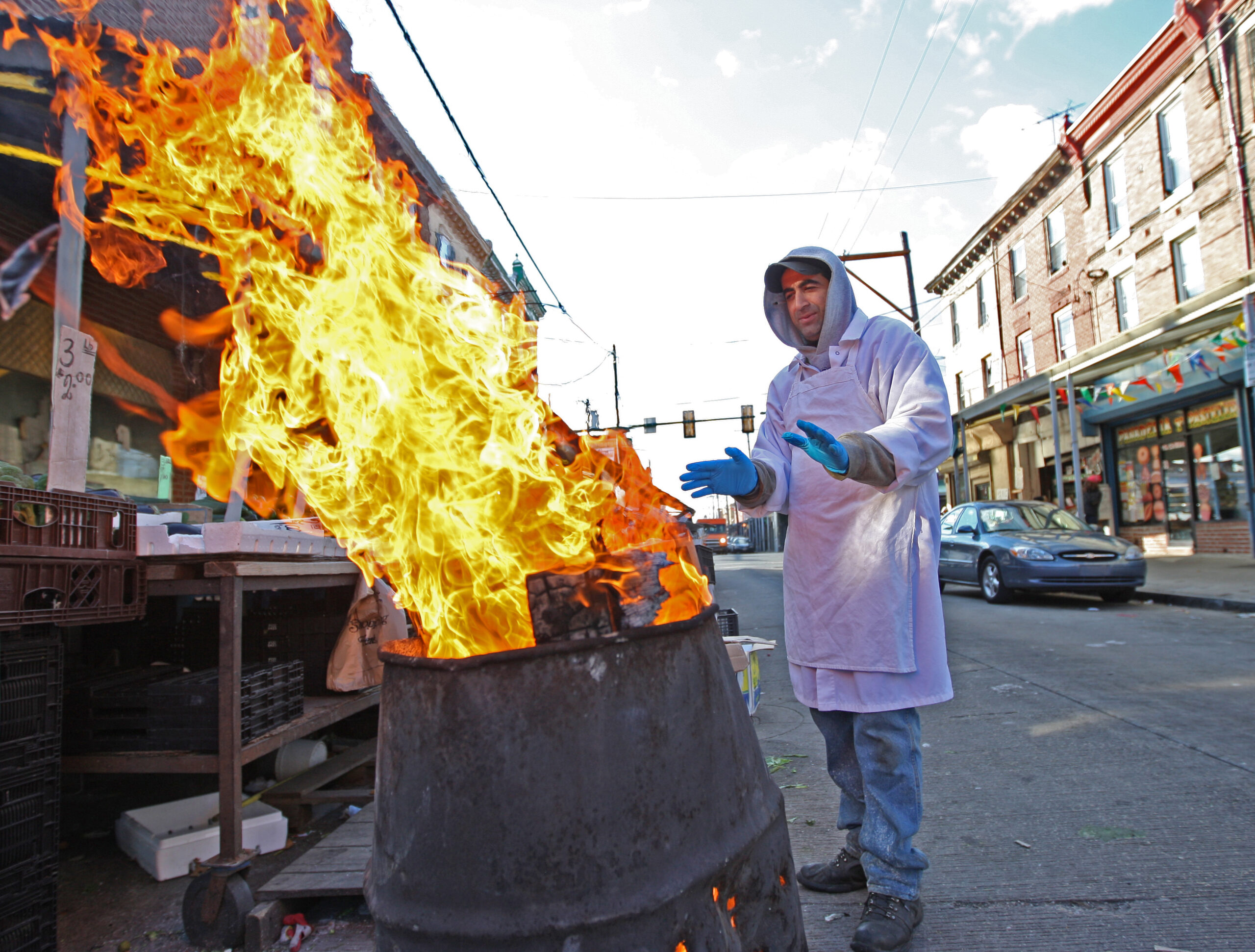
In this Dec. 4, 2007 Inquirer file photo, Joe Carioti, of Carl’s Poultry, warms his hands on the first really cold day down at the market.
Trash can fires are back on Ninth Street: A
You don’t need a calendar to tell you winter has arrived in Philadelphia. You just need to walk down Ninth Street and see a trash can on fire.
The barrels come back when mornings turn brutal and vendors are out before dawn, unloading boxes, setting up stalls, and bracing against the cold. This isn’t nostalgia or aesthetic — it’s practical. A few minutes of heat for hands that don’t get to stay in pockets, a pause before the work continues.
They’re regulated, debated, occasionally questioned, and absolutely unmoved by any of that. Every winter, they come back anyway. Not as a statement, but as a fact of life.
When spring shows up, they’ll disappear again. Until then, the fire’s on.
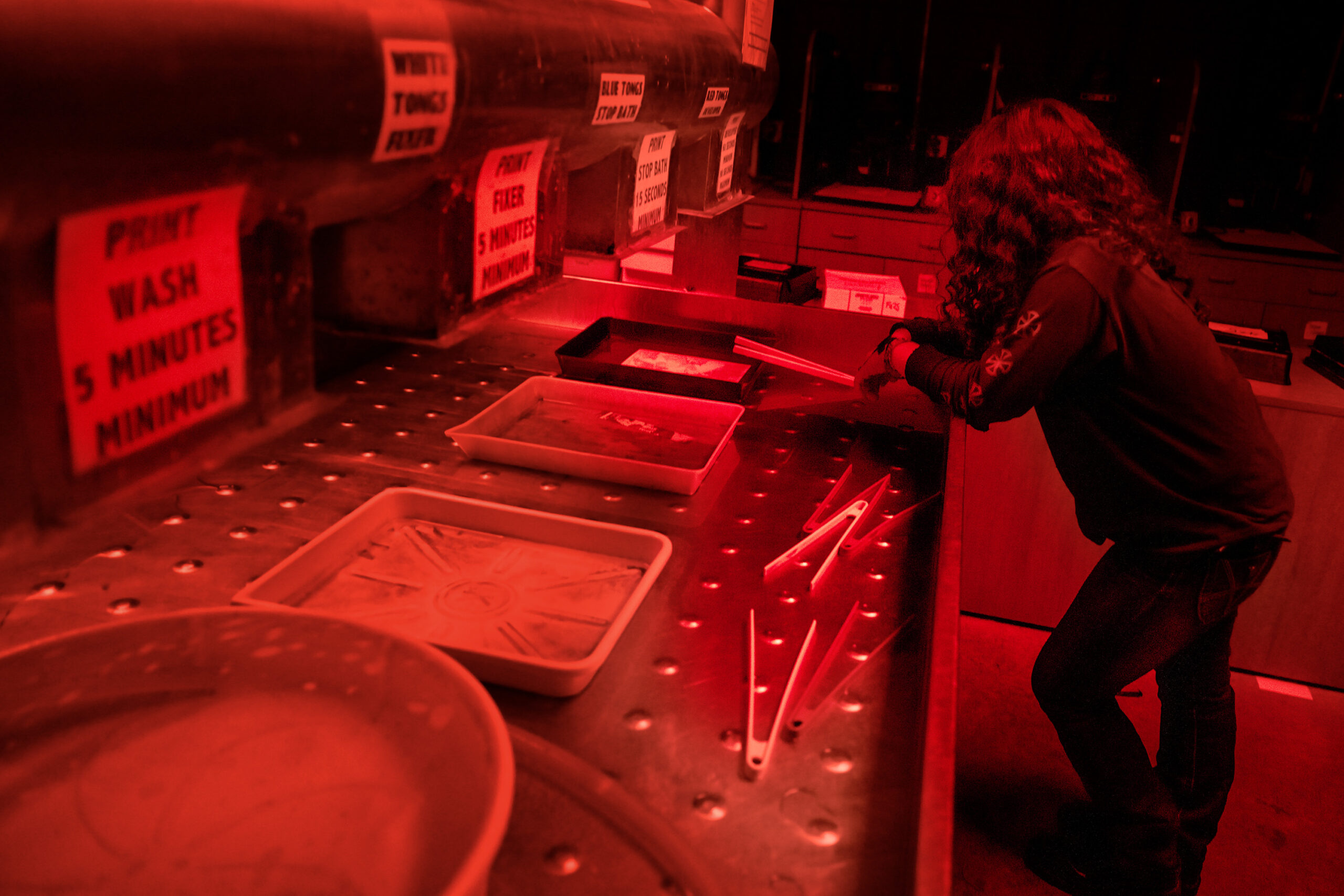
I stepped into a real live, working — smells and all — black and white darkroom this week, for the first time in decades.
I watched Charlotte Astor, a junior at Cherry Hill High School East, develop her B&W photographs in the school’s darkroom.
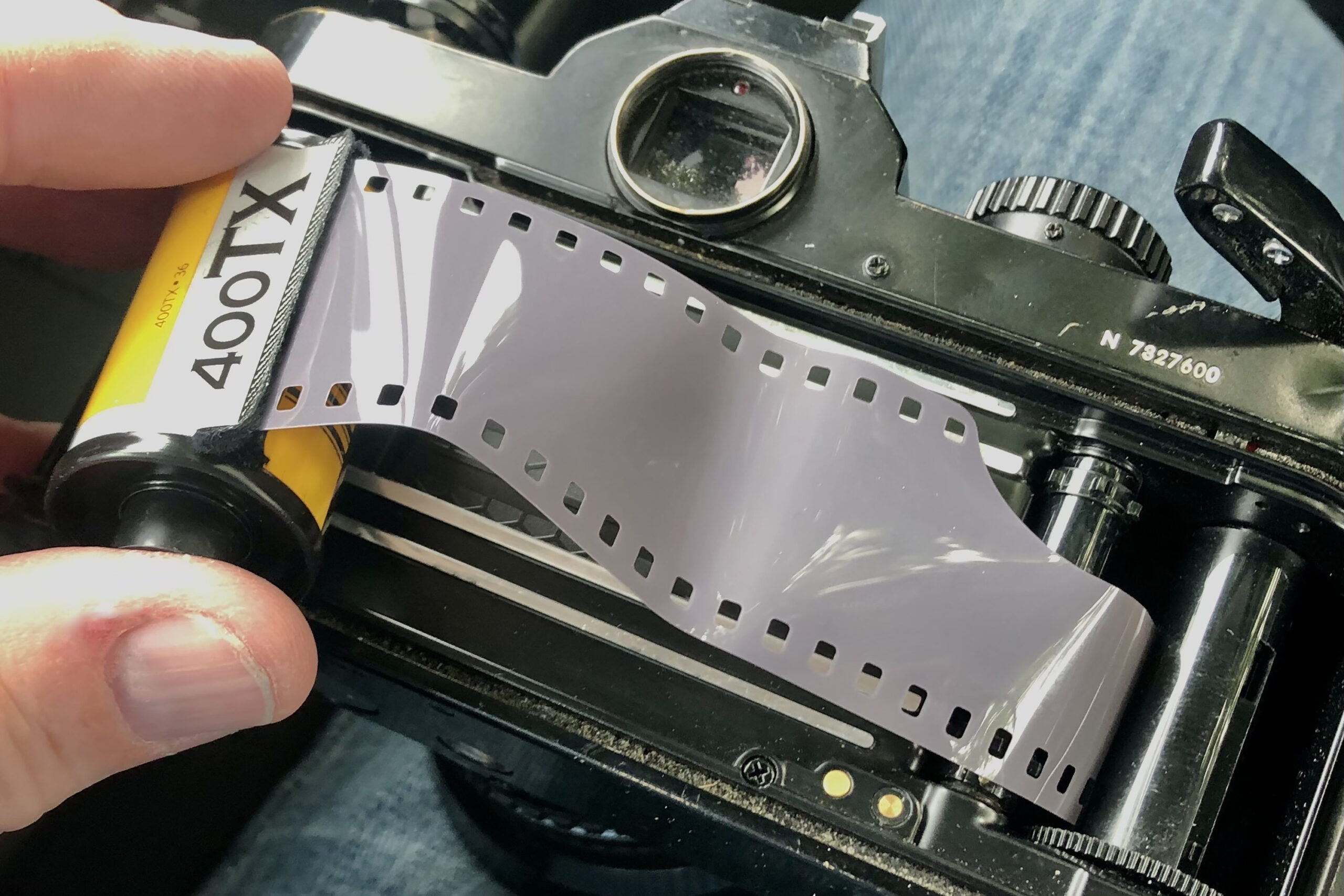
For a few years after The Inquirer went digital I kept the small enlarger and other personal equipment that I’d used in my crude basement darkroom from when I was starting out. I had little use for it after I got my first staff job with bigger and better facilities. It all stayed boxed up, through multiple moves, long after I’d stopped exposing any film — even for family photos.
I finally gave it all away when young people first started using analog formats like typewriters, vinyl records, “dumb phones,” and film cameras as a move away from digital overload. (A few years ago our photo staff did a group project where we each took a turn with the same 35 mm mechanical camera using just one roll of black-and-white film.)
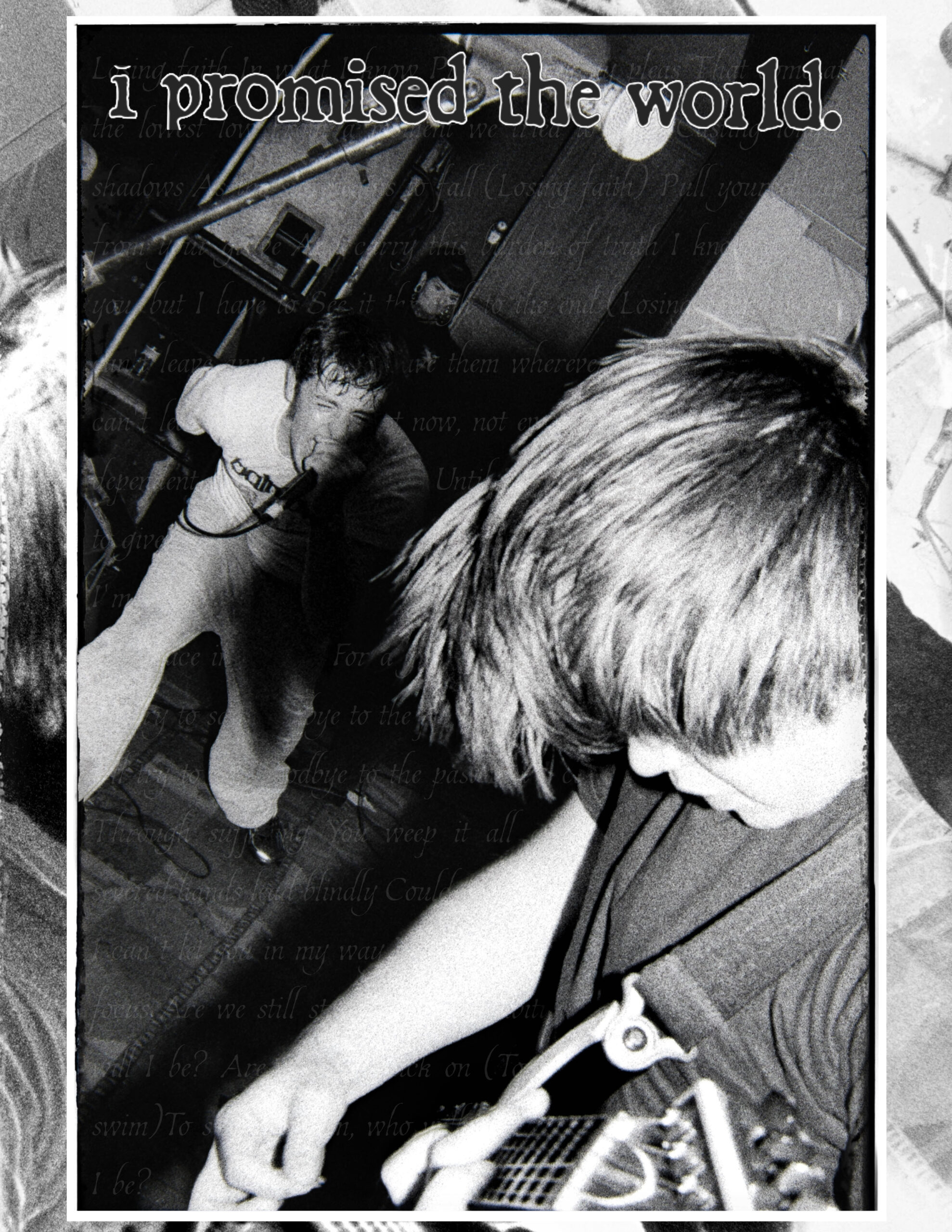
Like many digital natives who grew up with smartphones and the internet and are now “detoxing,” Astor has totally embraced B&W 35 mm, photographing at hardcore shows around the area for a zine she self-publishes, “Through Our Eyes.”
“So often,” she says of the music scene, “you’ll see these people taking a million photos a second, and to me it’s just waste. When I shoot film, I only have 36 shots before I gotta risk reloading in the middle of the pit, so every shot I have to make count. It keeps me in that moment, with this kind of clarity. When you get the shot, even though you can’t see it, you just know that you got that moment perfect. That moment means everything to me. I wouldn’t trade it for the world, and digital will never come close.”
Photo by Charlotte Astor, from a show by “I Promised the World” at the First Unitarian Church in Philadelphia Nov. 22, 2025. Taken with a Nikon FE and Tmax 3200 film.
But that’s not why I was taking her picture. Our story, published next week, is about Astor’s four year search for a demo tape — yes, an analog cassette — from her mother’s teenage band.
I enjoyed talking with her about photography, and I couldn’t stop thinking about what digital photography has brought us.
Film demanded patience and technical precision. Digital offered instant feedback and greater flexibility in lighting conditions.
Photojournalists delivered images faster, adapted to the demands of online media and met tighter and more frequent deadlines.
The transition hasn’t changed the way I see, and interpret. I still emphasize composition, context, or complexity. However, I have adapted and adjusted. I see the value in making the kinds of thumbnails that online platforms prioritize to generate algorithmic attention.
Between photographing for stories on assignment I still wander whatever neighborhood I am in looking for “standalones.”
But I am also always on the lookout for “stock” photos that can be used as thumbnails with future stories. Think images of police tape or flashing lights, city street scenes, and skylines, educational, civic, and medical institutions.
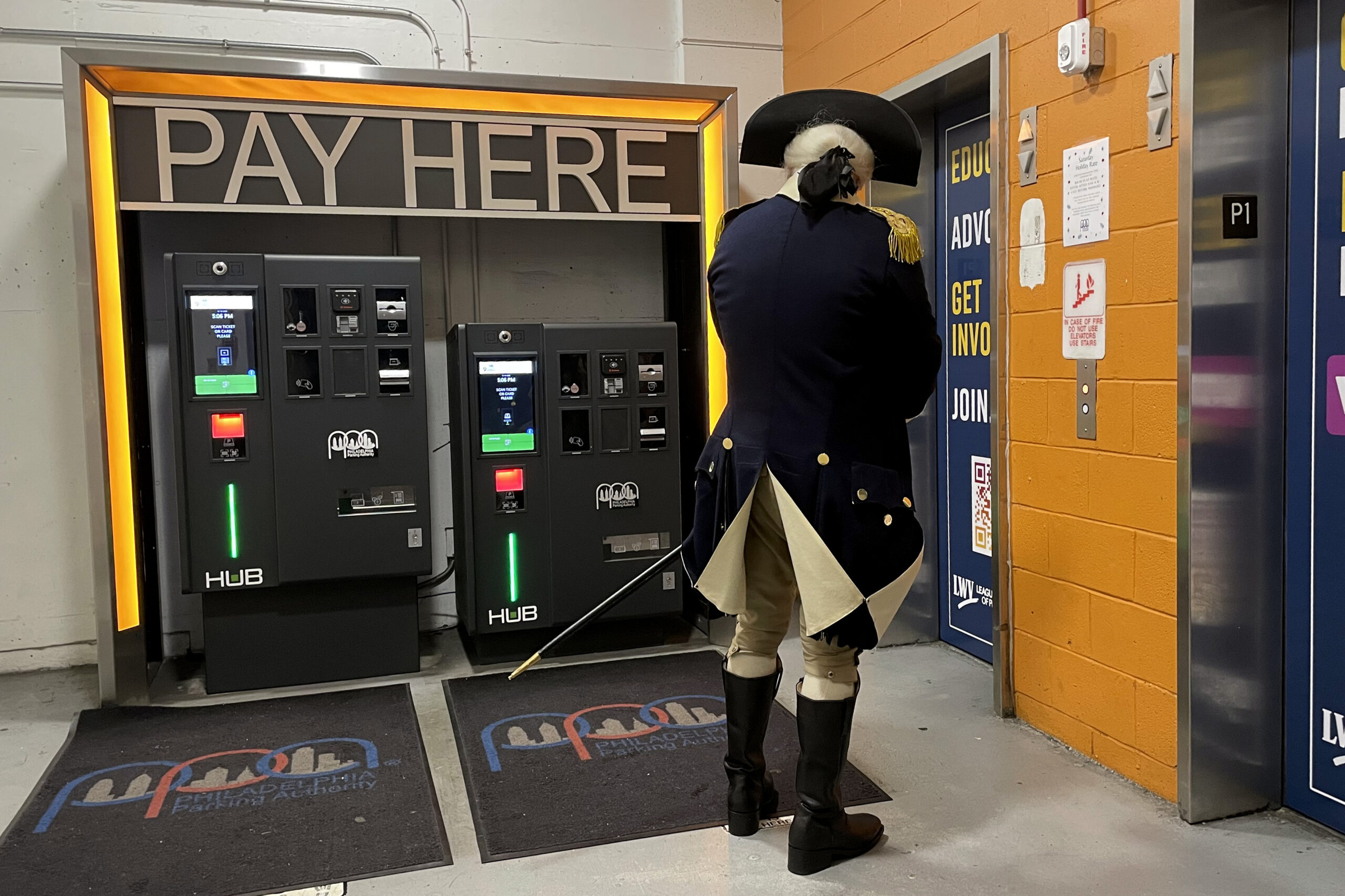
Made while riding in a parking garage elevator, this photo had been been published with over a dozen stories in the past year.
After an assignment at the Philadelphia Art Museum, I loitered outside.
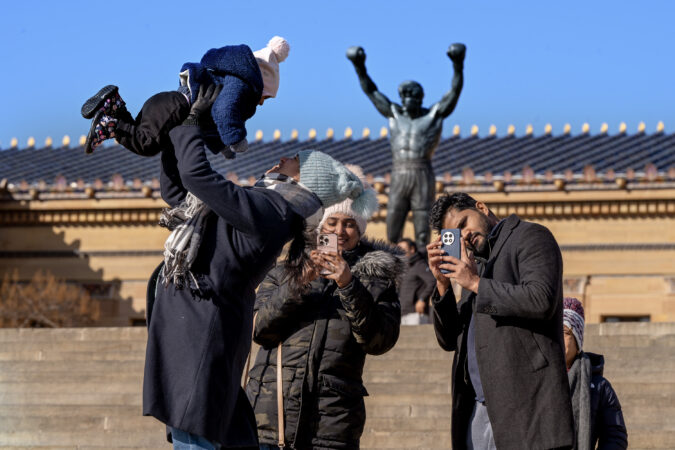
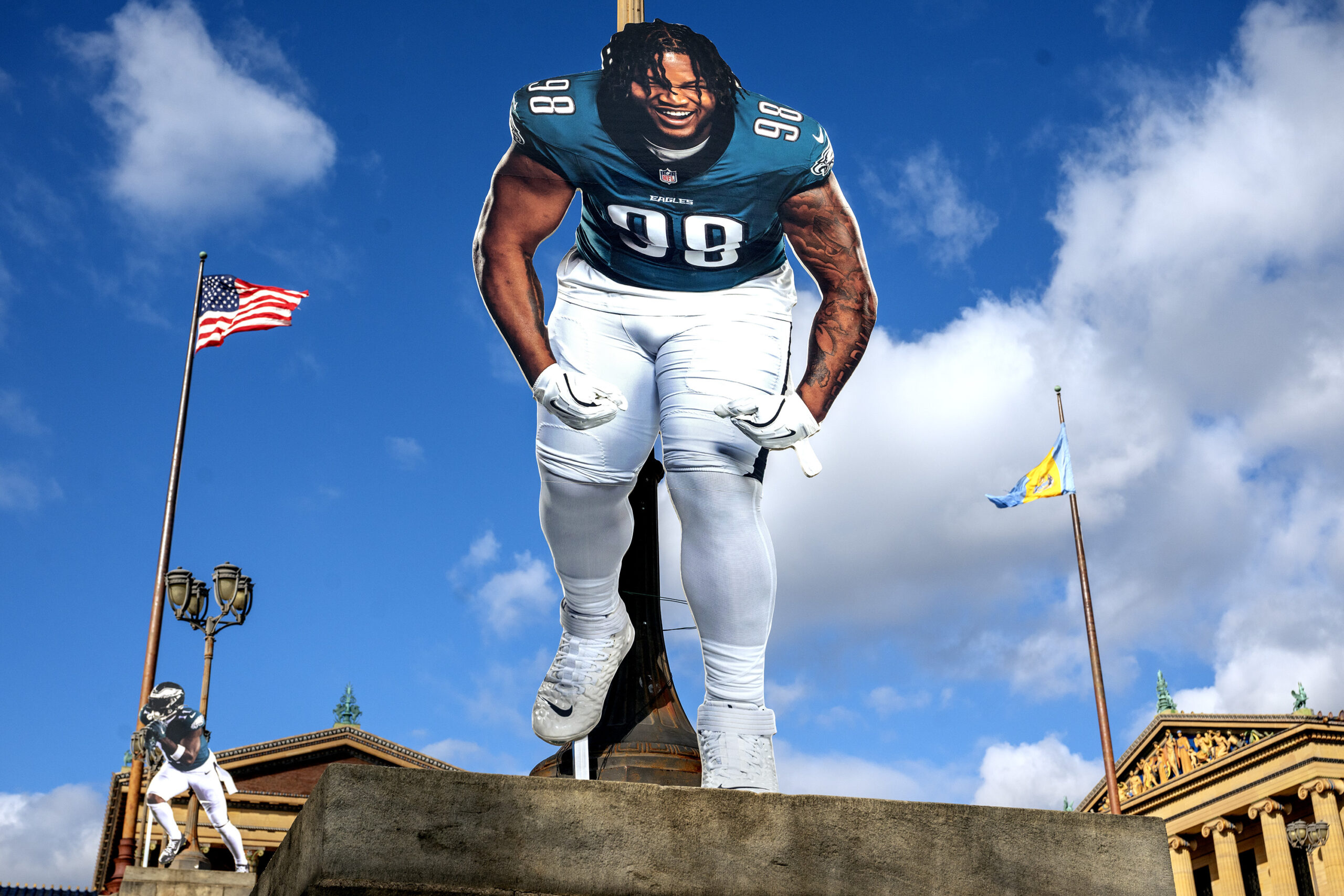
Ahead of Sunday’s wildcard playoff game against the San Francisco 49ers, the museum put up giant cutouts of four Eagles players on its iconic front steps. The cutouts first appeared in 2014 (before the Birds’ wild-card loss to the New Orleans Saints) and again a few times over the years, including before both Super Bowl wins in 2018 and last year.
The newspaper already has lots of photos from the steps, including many of that movie prop, but I knew the city’s Art Commission is voting next week to see if it stays, or not.
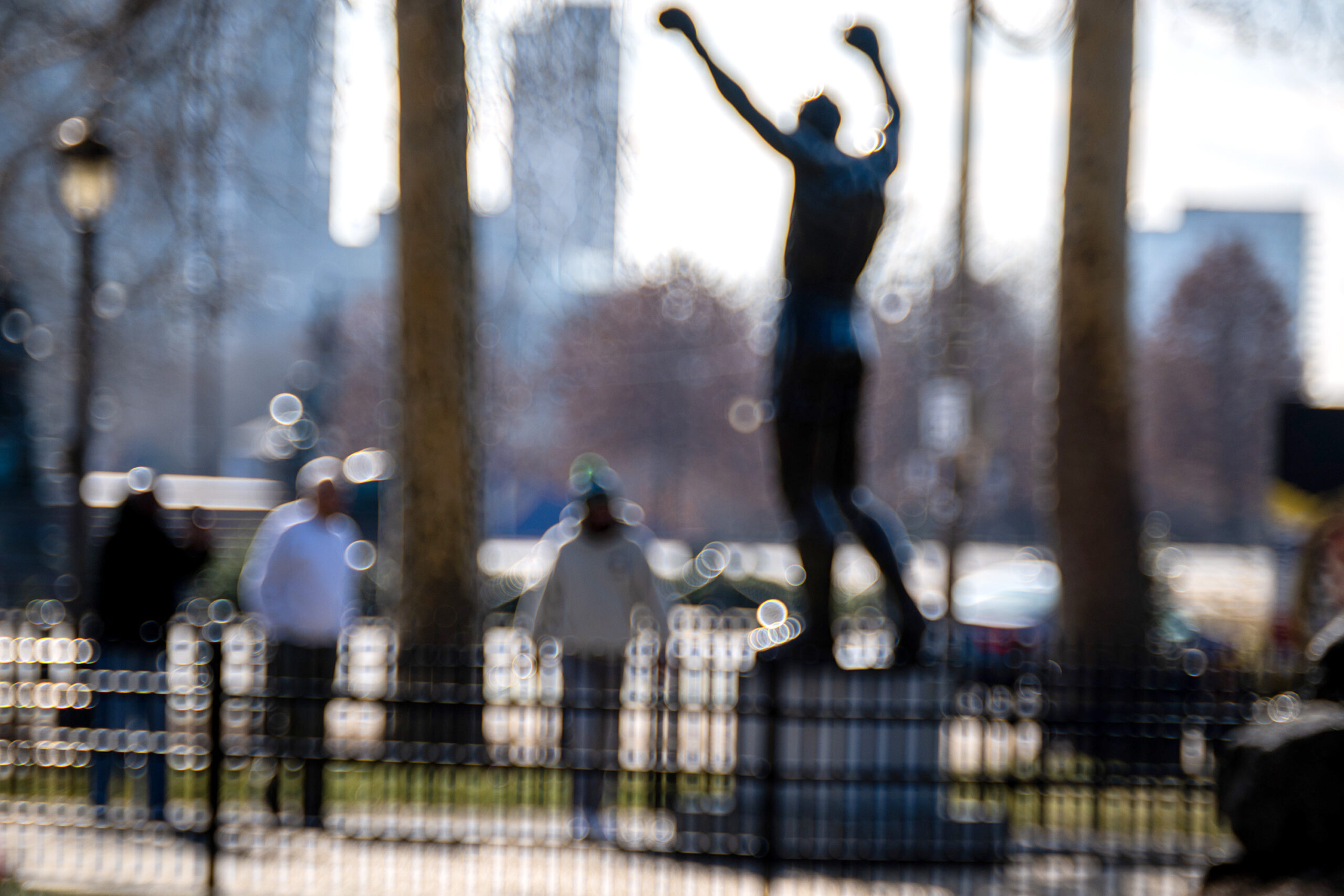
That famous movie prop seen out-of-focus – and captured – between changing f-stops for different depths-of-field. Did you know (spoiler alert, there is math involved) that an f-stop is the numerical value of the ratio of the focal length of the lens to the diameter of its aperture.
If it stays, the “original” version of the statue from 1982’s Rocky III that now sits at street level would be moved inside the museum for an exhibit this summer, then go back outside and installed at the top of the steps “permanently.” And the “second casting” statue there now “temporarily” would be returned to Sylvester Stallone.
It was that really nice, warm sprint-like day we had on Wednesday, following those bitterly cold first days of 2026, so I didn’t mind being outside making “stock” photos.
And THAT’S when I spotted a real moment — the kind photographers live for — of the family taking selfies on the steps, and how I ended up making the photo at the very top of this column.
Since 1998 a black-and-white photo has appeared every Monday in staff photographer Tom Gralish’s “Scene Through the Lens” photo column in the print editions of The Inquirer’s local news section. Here are the most recent, in color:
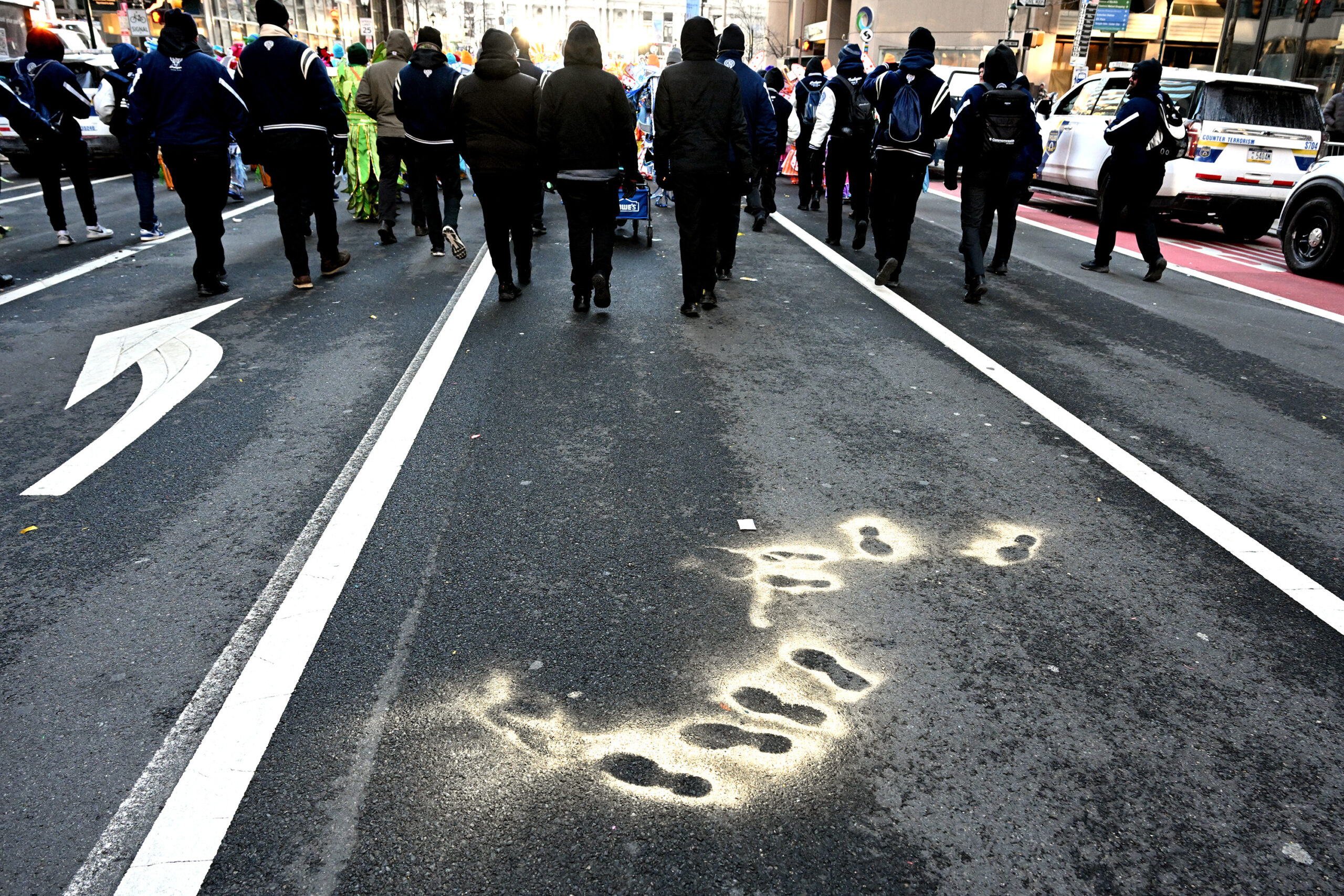
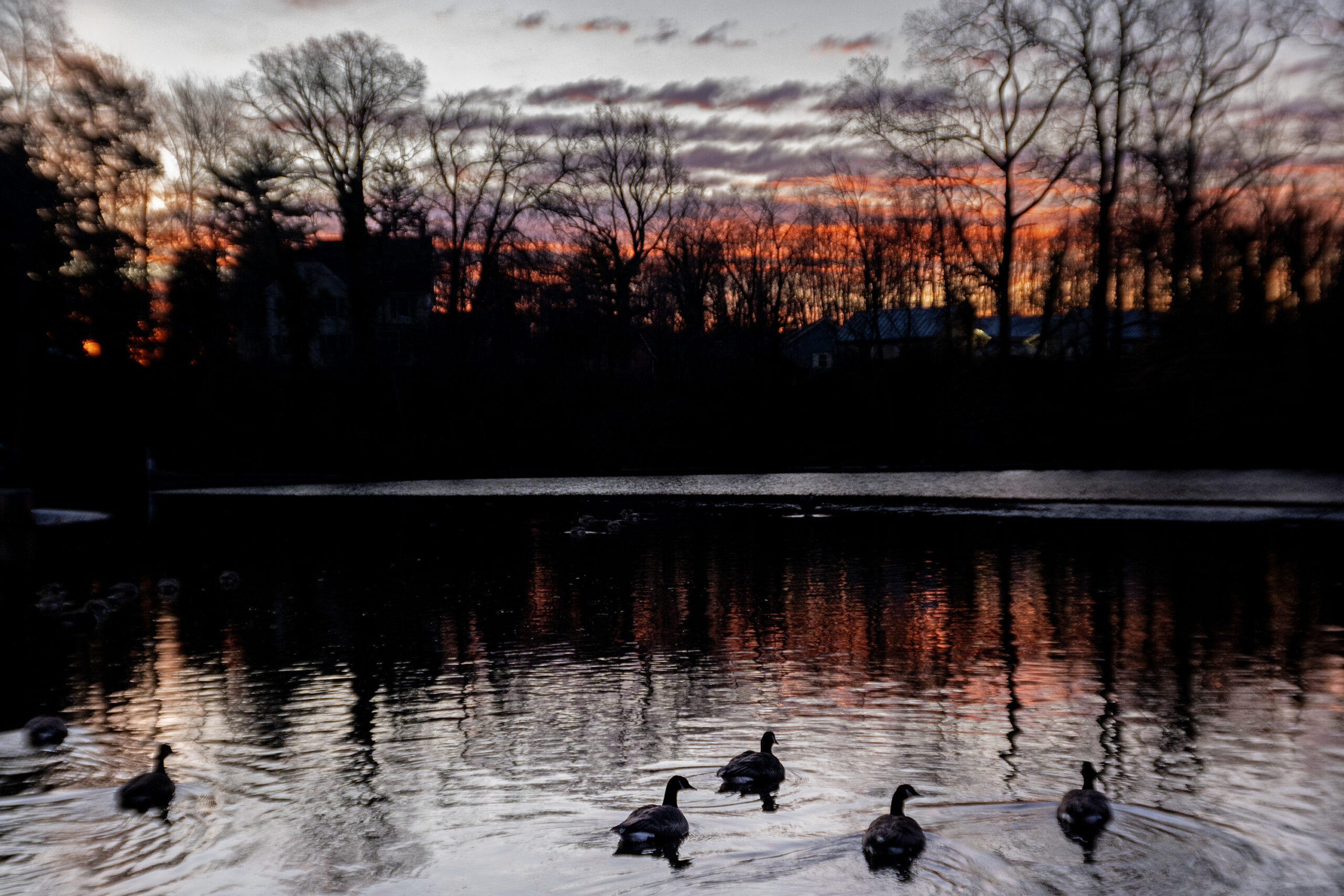
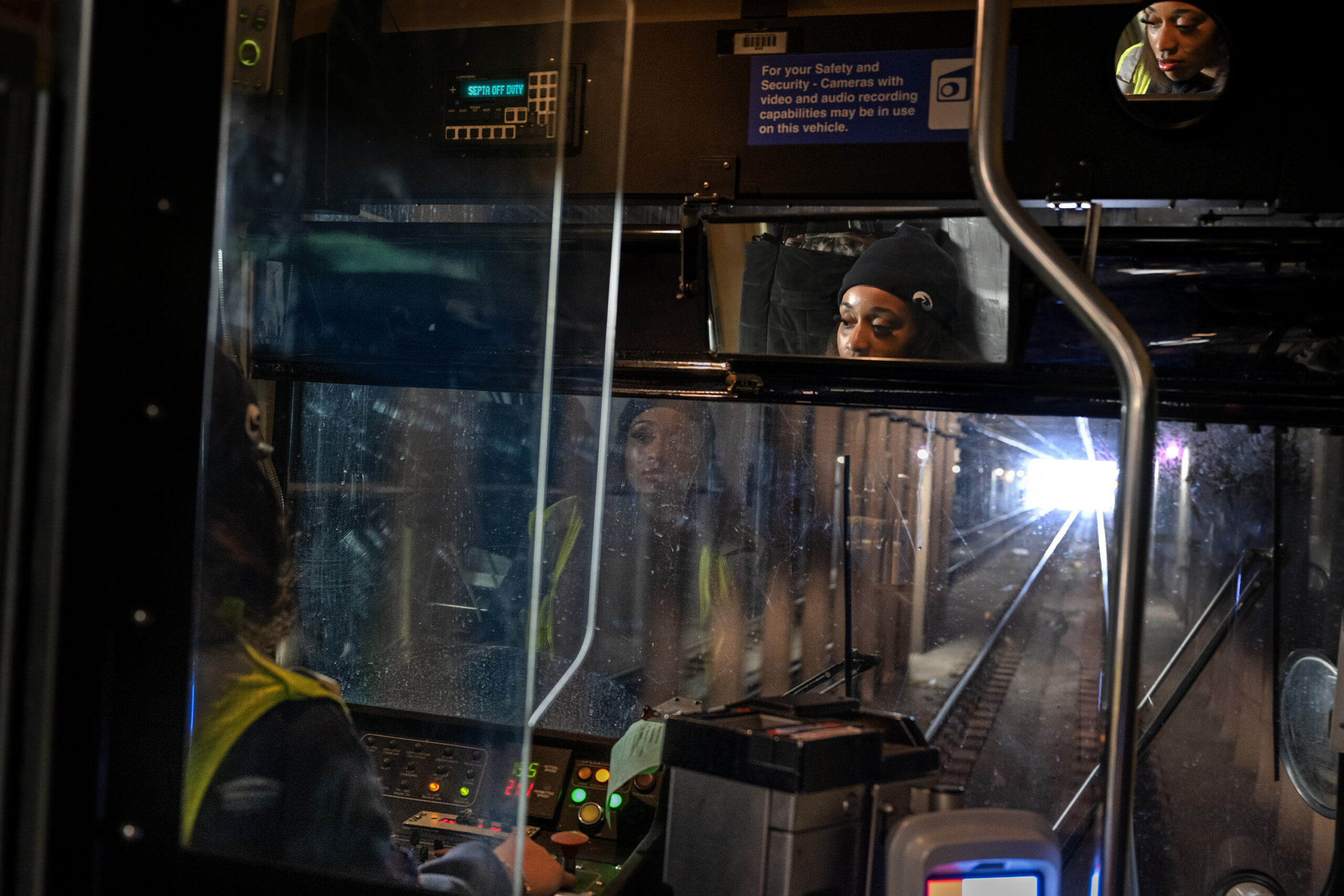
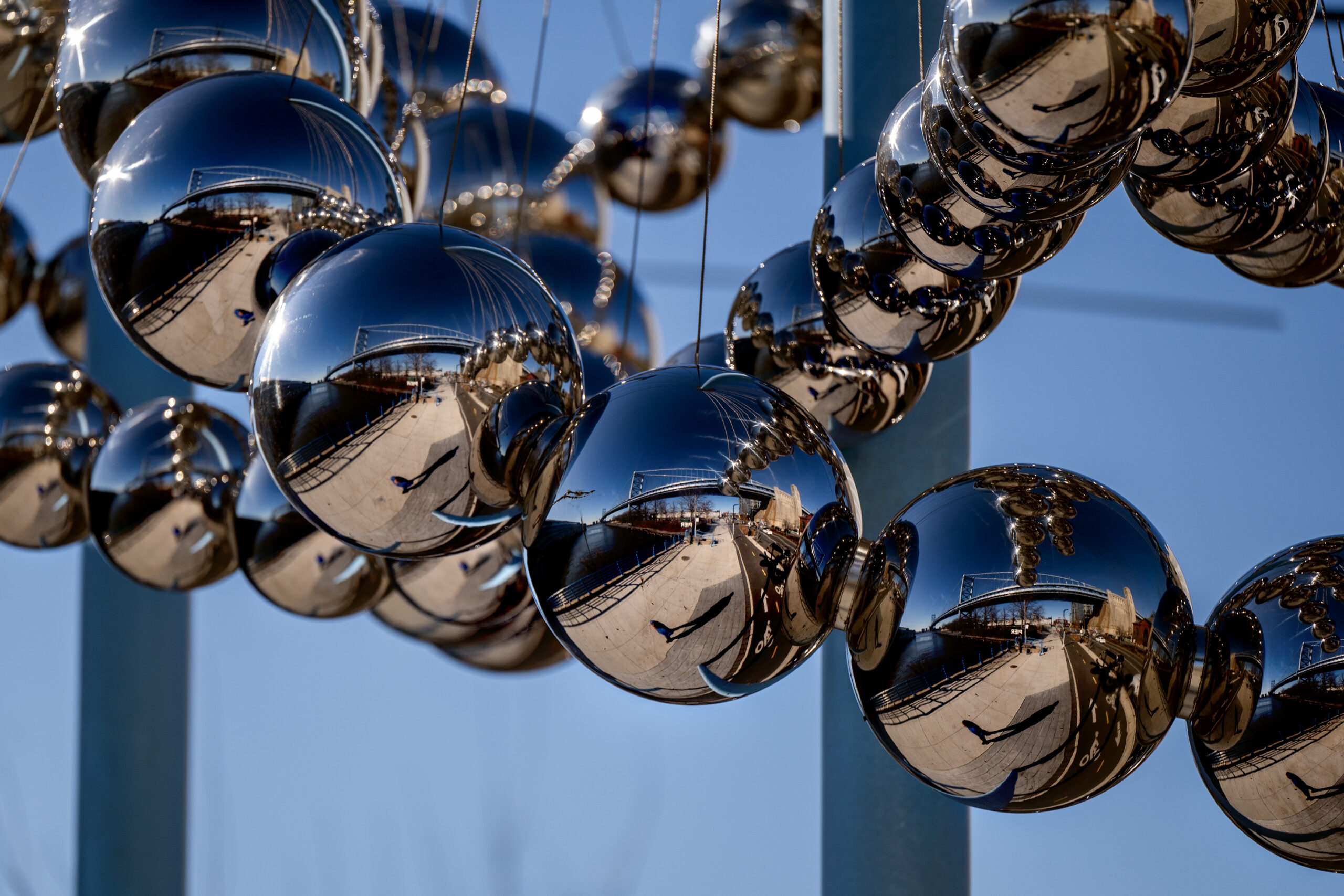
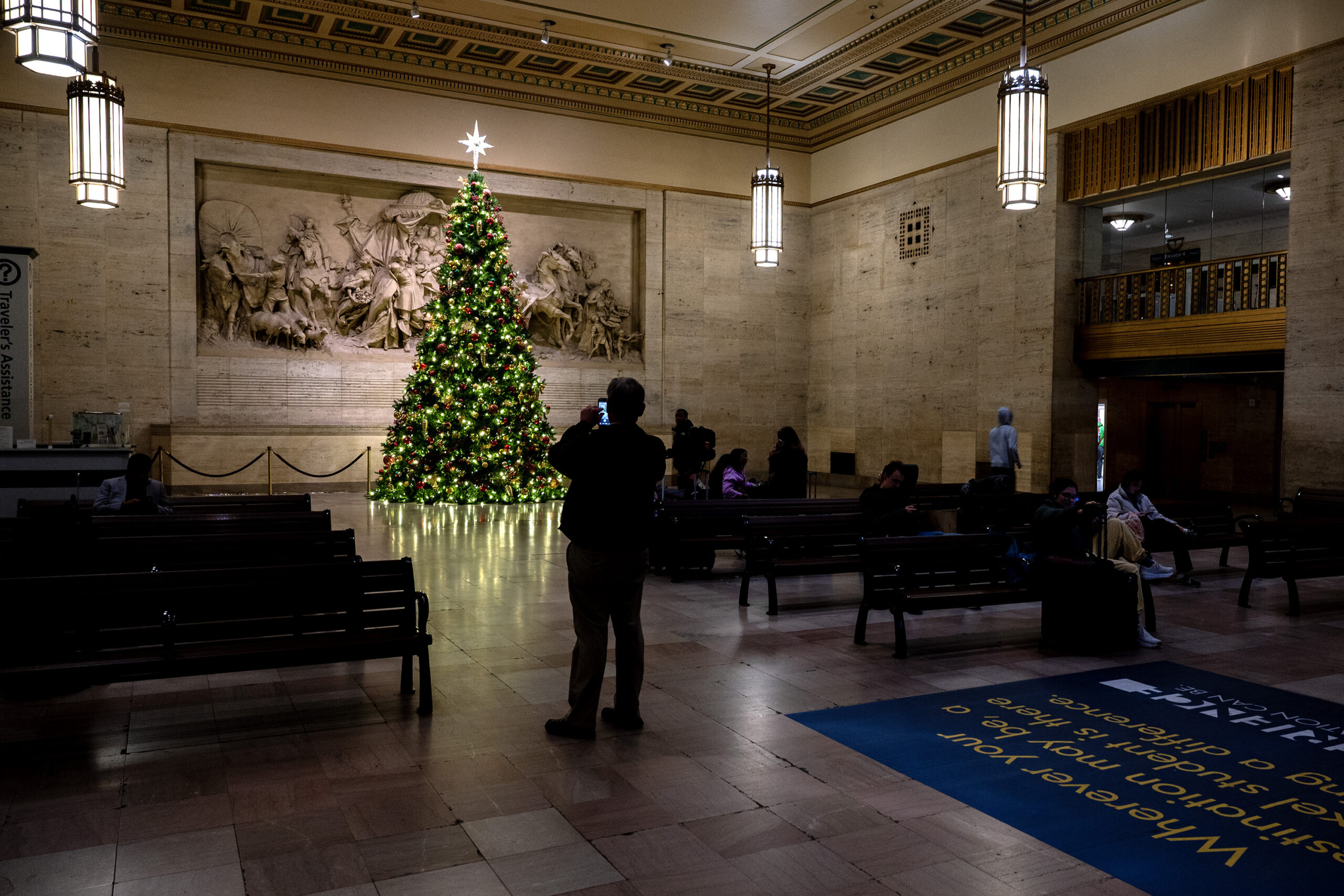
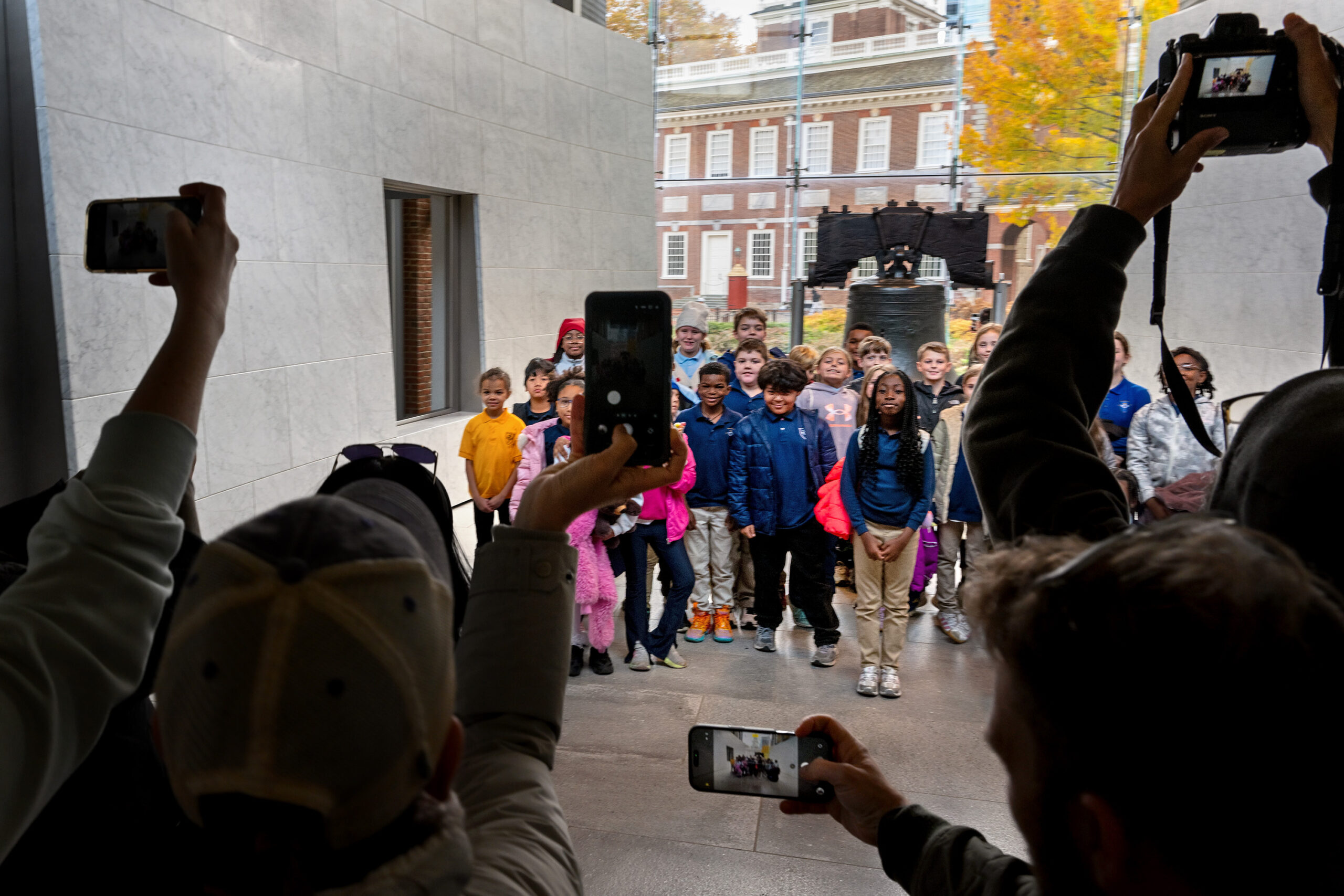
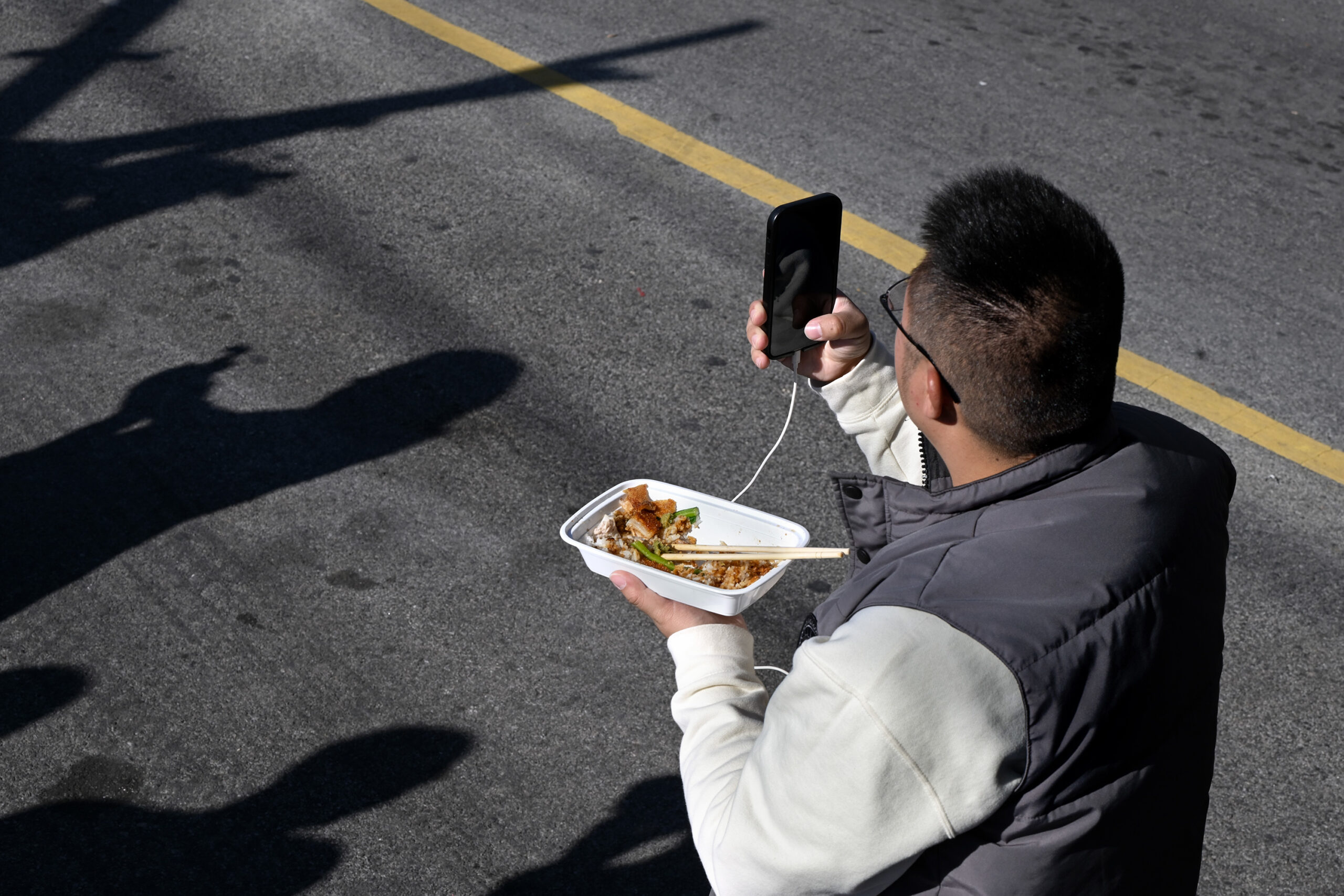
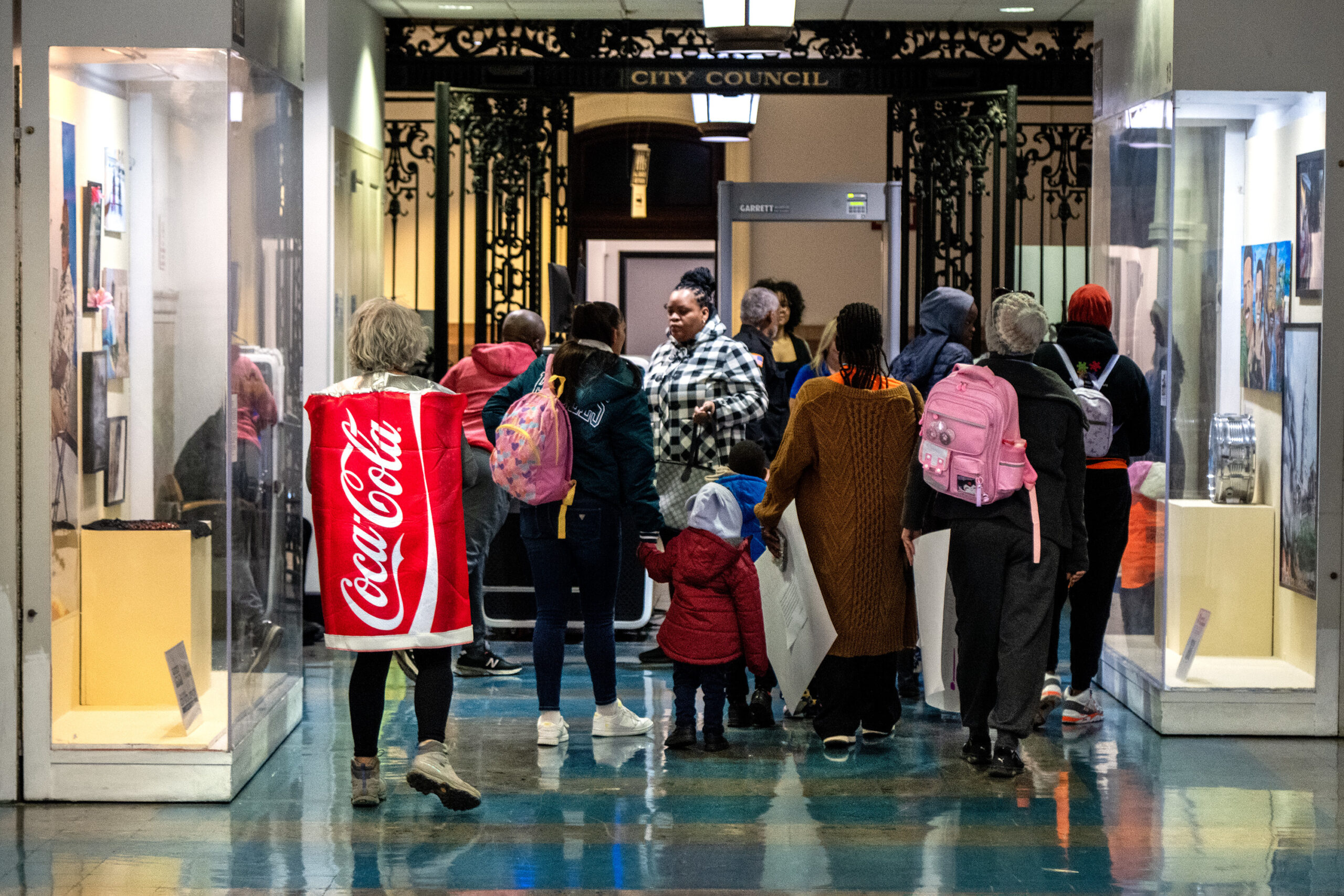
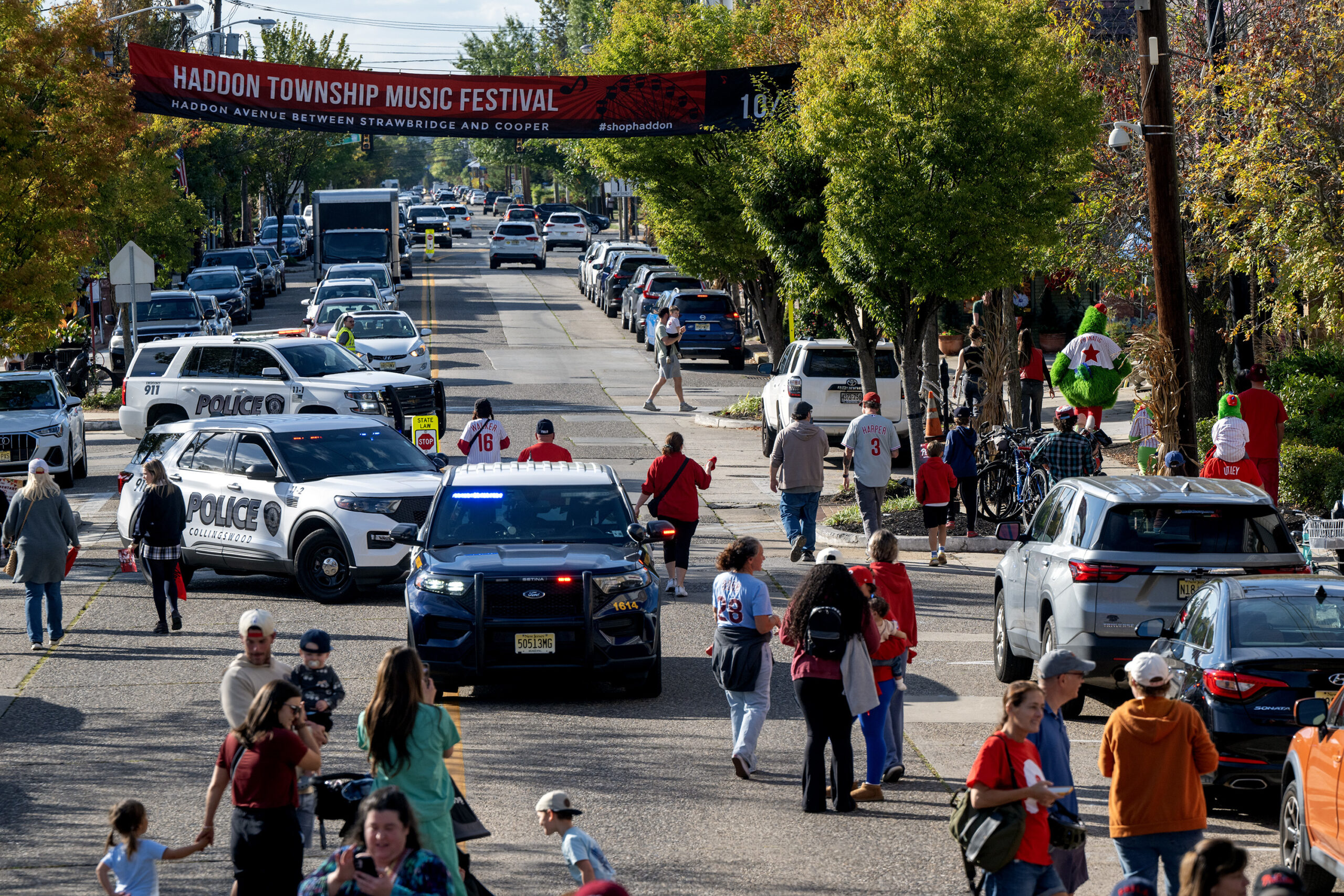
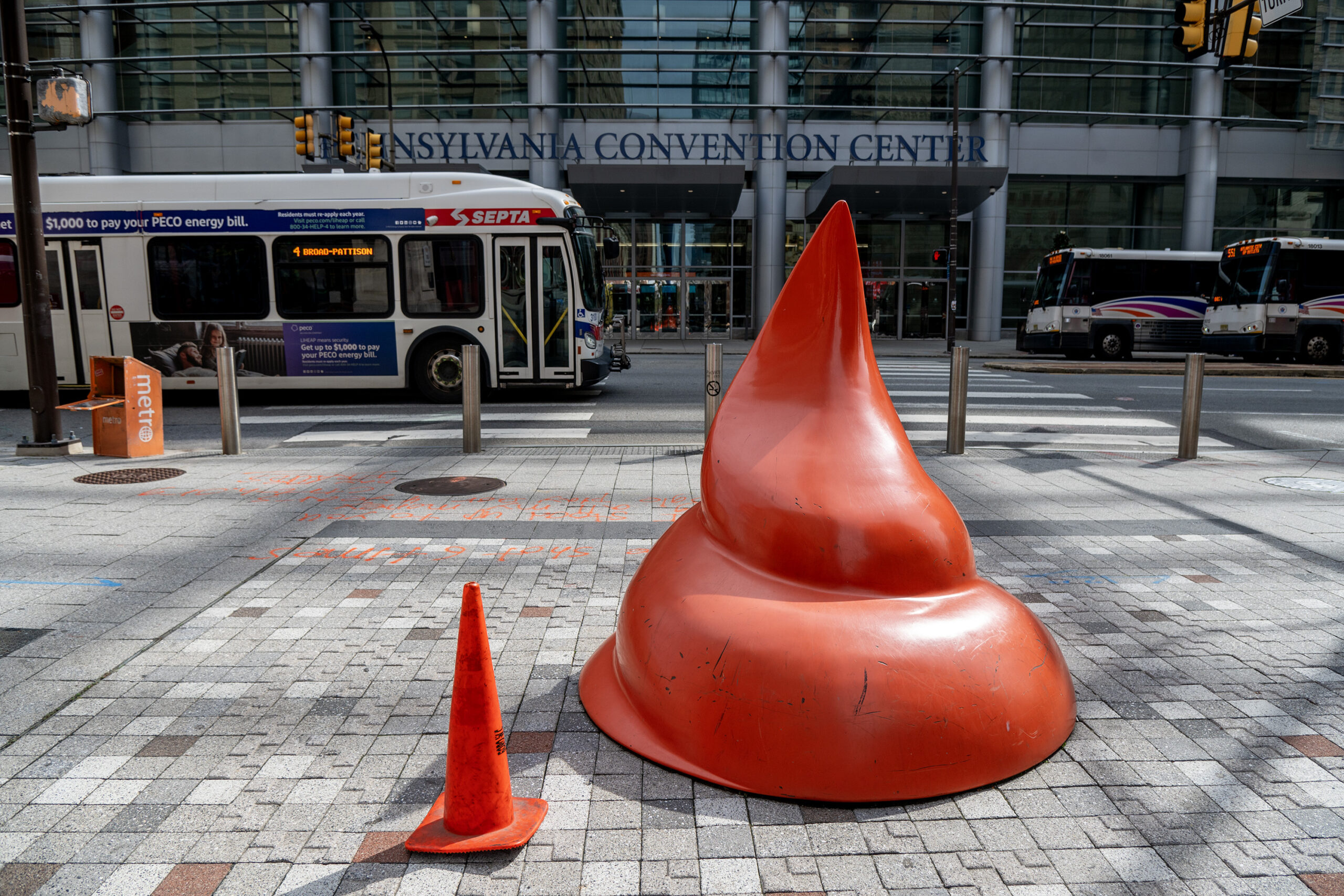
January 5, 2026: Parade marshals trail behind the musicians of the Greater Kensington String Band heading to their #9 position start in the Mummers Parade. Spray paint by comic wenches earlier in the day left “Oh, Dem Golden Slippers” shadows on the pavement of Market Street. This year marked the 125th anniversary of Philly’s iconic New Year’s Day celebration.Dec. 29, 2025: Canada geese at sunrise in Evans Pond in Haddonfield, during the week of the Winter Solstice for the Northern Hemisphere. December 22, 2025: SEPTA trolley operator Victoria Daniels approaches the end of the Center City Tunnel, heading toward the 40th Street trolley portal after a tour to update the news media on overhead wire repairs in the closed tunnel due to unexpected issues from new slider parts.December 15, 2025: A historical interpreter waits at the parking garage elevators headed not to a December crossing of the Delaware River, but an event at the National Constitution Center. General George Washington was on his way to an unveiling of the U.S. Mint’s new 2026 coins for the Semiquincentennial, December 8, 2025: The Benjamin Franklin Bridge and pedestrians on the Delaware River Trail are reflected in mirrored spheres of the “Weaver’s Knot: Sheet Bend” public artwork on Columbus Boulevard. The site-specific stainless steel piece located between the Cherry Street and Race Street Piers was commissioned by the City’s Public Art Office and the Delaware River Waterfront Corporation and created and installed in 2022 by the design and fabrication group Ball-Nogues Studio. The name recalls a history that dominated the region for hundreds of years. “Weaver’s knot” derives from use in textile mills and the “Sheet bend” or “sheet knot” was used on sailing vessels for bending ropes to sails. November 29, 2025: t’s ginkgo time in our region again when the distinctive fan-shaped leaves turn yellow and then, on one day, lose all their leaves at the same time laying a carpet on city streets and sidewalks. A squirrel leaps over leaves in the 18th Century Garden in Independence National Historical Park Nov. 25, 2025. The ginkgo (Ginkgo biloba) is considered a living fossil as it’s the only surviving species of a group of trees that existed before dinosaurs. Genetically, it has remained unchanged over the past 200 million years. William Hamilton, owner the Woodlands in SW Phila (no relation to Alexander Hamilton) brought the first ginkgo trees to North America in 1785.November 24, 2025: The old waiting room at 30th Street Station that most people only pass through on their way to the restrooms has been spiffed up with benches – and a Christmas tree. It was placed there this year in front of the 30-foot frieze, “The Spirit of Transportation” while the lobby of Amtrak’s $550 million station restoration is underway. The 1895 relief sculpture by Karl Bitter was originally hung in the Broad Street Station by City Hall, but was moved in 1933. It depicts travel from ancient to modern and even futuristic times. November 17, 2025: Students on a field trip from the Christian Academy in Brookhaven, Delaware County, pose for a group photo in front of the Liberty Bell in Independence National Historical Park on Thursday. The trip was planned weeks earlier, before they knew it would be on the day park buildings were reopening after the government shutdown ended. “We got so lucky,” a teacher said. Then corrected herself. “It’s because we prayed for it.” November 8, 2025: Multitasking during the Festival de Día de Muertos – Day of the Dead – in South Philadelphia.November 1, 2025: Marcy Boroff is at City Hall dressed as a Coke can, along with preschoolers and their caregivers, in support of former Mayor Jim Kenney’s 2017 tax on sweetened beverages. City Council is considering repealing the tax, which funds the city’s pre-K programs. October 25, 2025: Austin Gabauer, paint and production assistant at the Johnson Atelier, in Hamilton Twp, N.J. as the finished “O” letter awaits the return to Philadelphia. The “Y” part of the OY/YO sculpture is inside the painting booth. The well-known sculpture outside the Weitzman National Museum of American Jewish History was removed in May while construction continues on Market Street and has been undergoing refurbishment at the Atelier at the Grounds for Sculpture outside of Trenton.October 20, 2025:The yellow shipping container next to City Hall attracted a line of over 300 people that stretched around a corner of Dilworth Park. Bystanders wondered as they watched devotees reaching the front take their selfies inside a retro Philly diner-esque booth tableau. Followers on social media had been invited to “Climb on to immerse yourself in the worlds of Pleasing Fragrance, Big Lip, and exclusive treasures,” including a spin of the “Freebie Wheel,” for products of the unisex lifestyle brand Pleasing, created by former One Direction singer Harry Styles.October 11, 2025: Can you find the Phillie Phanatic, as he leaves a “Rally for Red October Bus Tour” stop in downtown Westmont, N.J. just before the start of the NLDS? There’s always next year and he’ll be back. The 2026 Spring Training schedule has yet to be announced by Major League Baseball, but Phillies pitchers and catchers generally first report to Clearwater, Florida in mid-February.October 6. 2025: Fluorescent orange safety cone, 28 in, Poly Ethylene. Right: Paint Torch (detail) Claes Oldenburg, 2011, Steel, Fiberglass Reinforced Plastic, Gelcoat and Polyurethane. (Gob of paint, 6 ft. Main sculpture, 51 ft.). Lenfest Plaza at the Pennsylvania Academy of the Fine Arts on North Broad Street, across from the Convention Center.
The day after U.S. special operations forces swept into Caracas, the new Venezuelan president assembled her cabinet members around a large wooden table at the Miraflores Palace. Behind Delcy Rodríguez were large pictures of the country’s fallen leaders: Hugo Chávez, dead of cancer in 2013, and Nicolás Maduro and his wife, Cilia Flores, now jailed in New York on drug-trafficking charges.
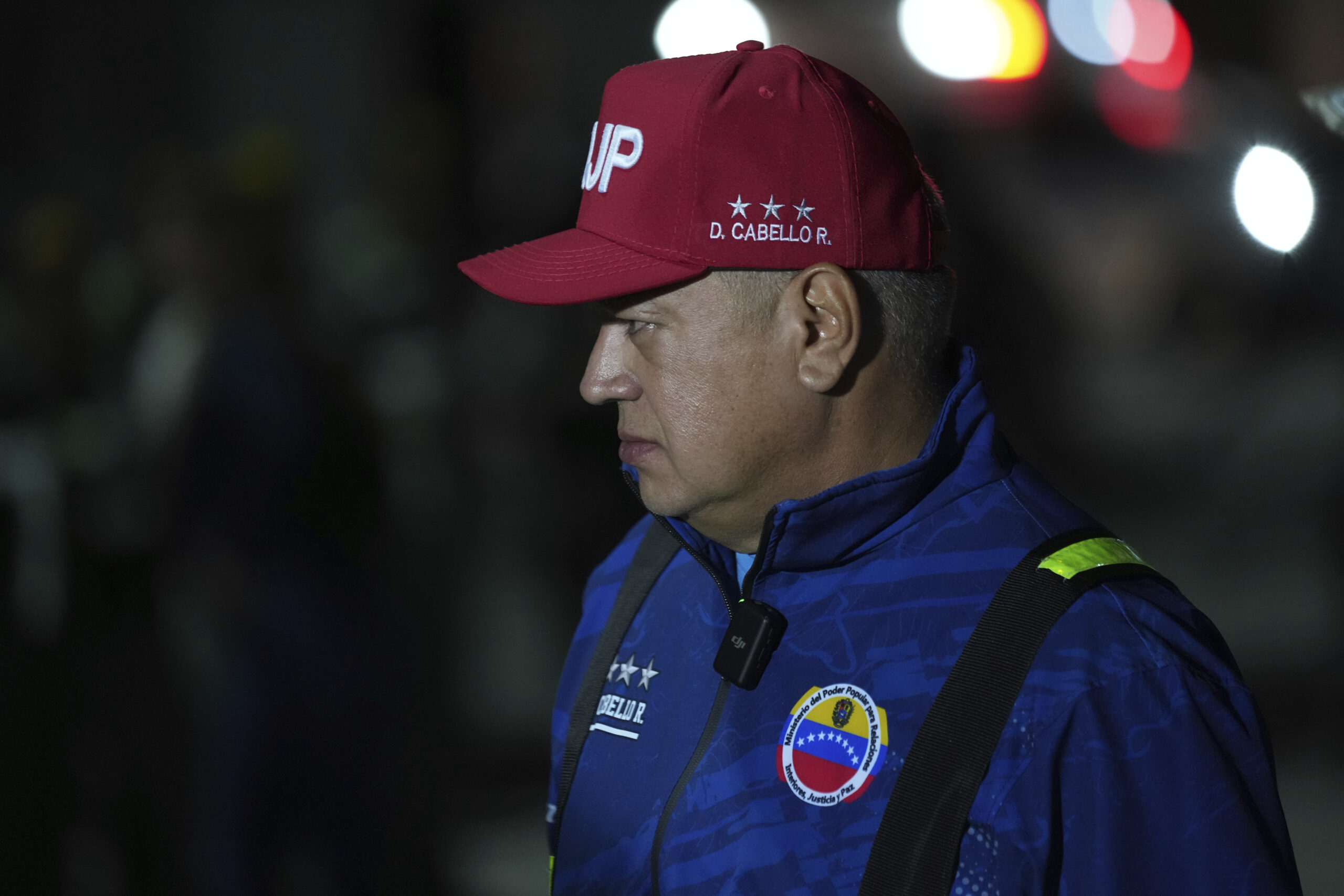
Seated on either side of Rodríguez, at the head of the table, were the powers that remained. One was Vladimir Padrino López, the defense minister, dressed in military camouflage. The other was Diosdado Cabello, the interior minister. He wore a scowl and a hat that said, “To doubt is treason.”
Both men hold far more power than their titles suggest, analysts say. Stalwarts of the Maduro regime — one U.S. investigators say is built on patronage and fueled by criminal proceeds — they control Venezuela’s expansive security state and much of its commercial activity.
Since Maduro’s capture and arrest Saturday, public attention has focused on Rodríguez and whether she will accede to White House demands to open up Venezuela’s vast natural resources to American industry. But the newly installed president — alongside her brother Jorge, president of the Venezuelan National Assembly — represents only the political sphere.
The country’s other power centers, according to scholars, Venezuelan researchers, and current and former U.S. officials, are commanded by Padrino López and Cabello — hard-line, old-school Chavistas who came of ideological age in the socialist movement and accrued significant power and wealth through continued loyalty to the cause.
Using connections and intimidation, researchers say, the men have repeatedly helped Maduro survive periods of crisis and tighten his authoritarian grip. First in 2019, when much of the world united behind opposition leader Juan Guaidó’s bid to supplant Maduro. And then again in summer 2024, when electoral tallies made clear that Maduro had lost the presidential election.
Now Padrino López and Cabello, both of whom are wanted by U.S. authorities on drug-trafficking allegations, will help to decide the future of Chavismo — and the nation. Their continued presence magnifies the complexity of the challenge faced by American negotiators as they seek to bypass war and regime change and find common ground with members of a besieged government riven by internal divisions.
Venezuelan President Nicolás Maduro (left) listens to Defense Minister Vladimir Padrino López during a government-organized civic-military march on Nov. 25, 2025, in Caracas.
“There are three centers of power,” said a former senior official with the U.S. State Department, who like others in this story spoke on the condition of anonymity to discuss sensitive matters. “And Delcy is going to find out pretty quickly that she can’t provide everything that the Americans want.”
The Washington Post was unable to reach Padrino López and Cabello for comment. The communications office of the Venezuelan government did not respond to a request for comment.
President Donald Trump has said the United States is “in charge” of Venezuela, while Secretary of State Marco Rubio has suggested a less direct role, saying the U.S. will use its ongoing oil blockade and other economic measures to make Caracas do its bidding.
Venezuelan Interior Minister Diosdado Cabello attends the arrival of migrants deported from the United States at Simon Bolivar International Airport in Maiquetia, Venezuela, on Feb. 10, 2025.
Analysts expressed concern that Washington doesn’t fully understand the factional, internecine political system it now seeks to control — a maze of overlapping loyalties, family ties and competing interests. Several pointed to Cabello — a feared figure who hosts a weekly talk show called Bringing the Hammer — as the wild card.
One Venezuelan adviser close to Rodríguez’s government said he was central to maintaining unity. “In times of crisis, his role is not conciliatory, but rather one of maintaining order,” the adviser said. “Delcy governs; Diosdado ensures that power does not slip away.”
But others worry about what he was capable of. At his disposal, according to researchers and U.S. officials, were not only the police and intelligence services, but also the “colectivos,” a pro-government militia embedded throughout society, whose members speed around the streets on motorcycles, armed and masked.
“Cabello is a brutal, repressive figure in the regime, but he’s not stupid,” said Geoff Ramsey of the Atlantic Council. “He knows his survival depends on threatening to burn down the country, unless his interests are taken care of.”
“Politics in Venezuela,” he added, “is a ruthless blood sport.”
Power at all costs
How the state built by Chávez went from a hierarchal system built around a single charismatic leader to a hotbed of competing factions is, to some degree, a story of Maduro’s own political failings.
“Chávez was a leftist military man and very charismatic and happened to rule Venezuela during an oil boom, so he had a lot of resources to do a lot of things,” said David Smilde, a sociologist at Tulane University who researches Chavismo. “And with the exception of being a leftist, Maduro is none of those things — not charismatic, not a military man, and he has no oil boom.”
After narrowly winning the presidential election to succeed Chávez in 2013, Maduro appeared to recognize what he lacked and set out to defend his hold on power not through political persuasion, but by restricting freedoms and empowering — and enriching — the armed forces.
In February 2016, he put the mining sector in the hands of the military. A few months later, he gave it control over the distribution of basic goods. Another decree shortly afterward put the nation’s ports under its purview. Padrino López, who rose to defense minister in October 2014, became more powerful with each move, researchers said, pioneering new kickback schemes that kept the military loyal to him and indebted to the regime.
“The military became its own branch of power,” said Carolina Jiménez Sandoval, the Venezuelan president of the Washington Office on Latin America. “I don’t think the United States understands the extent to which the military is ingrained into the politics and economy, both formally and informally.”
The military also began to profit from illicit revenue streams, American authorities contend. In March 2020, federal prosecutors in the U.S. District Court of the Southern District of Florida filed charges against Padrino López and Cabello for using their roles to facilitate and abet Venezuelan drug trafficking and “flood” the United States with cocaine.
The U.S. government announced significant bounties for both men — $15 million for Padrino López and $25 million for Cabello.
Over time, Maduro came to be seen less as the ultimate authority in the country and more as an arbiter between competing powers that had little in common, said Roberto Deniz, a Venezuelan investigative journalist.
“It’s not just an authoritarian regime,” he said. “It’s an authoritarian regime with a kleptocratic structure in which there are numerous heads, and each one acts as its own fiefdom.”
“It doesn’t matter if the economy is good or bad, if human rights are respected or not,” he added. “The goal is to preserve power.”
‘The black sheep’
Cabello, who describes himself online as a “revolutionary” and “radical Chavista,” is seen by observers as a particularly unpredictable figure. He participated in Chávez’s failed coup attempt in 1992 and spent the next two years in prison. After Chávez won the presidency through the ballot box, Cabello served as vice president, helping him stave off an attempted coup in 2002, and then as interior minister, a role where he developed deeper ties with the internal security and intelligence forces.
At the time of Chávez’s cancer diagnosis, he was seen as the second most important revolutionary and a direct rival to Maduro, then the vice president, in the line of succession. After Chávez selected Maduro as his heir, he moved to sideline Cabello, only bringing him back into his cabinet shortly after his apparent electoral loss in 2024.
“Cabello has been the black sheep in the ruling party,” Ramsey said. “But Maduro found it impossible to rule without his knack for repression and his proximity to the intelligence apparatus.”
His family’s influence spans the nation. Alexis Rodríguez Cabello, a first cousin, is in charge of the Venezuelan intelligence service and posts frequent homages to Cabello on social media. His brother, José David Cabello, is in charge of the powerful customs and taxation ministry, granting him control over duties at borders and ports. His wife Marleny Contreras, a current member of the national assembly, has been the minister of both tourism and public works.
The Post was unable to reach Cabello’s family members for comment.
“Diosdado never stopped being a powerful actor, even when he seemed demoted,” Deniz said.
And he has “ascended rapidly” since his formal return to government, added Rafael Uzcátegui, the former director of Provea, a prominent Caracas nongovernmental organization — “at the cost of Rodríguez.”
Uzcátegui saw a narrow path forward for brokering an agreement between Venezuela’s rival power centers that would enable cooperation with U.S. officials and avert a wider conflict.
“It’s much easier to negotiate with a malandro than a religious fanatic,” he said, using a word that most closely translates to “hustler.” “And the Diosdado Cabello and Padrino López factions are most motivated by material incentive.”
But there have been worrying early signs, most notably from the informal militias that answer to Cabello.
The colectivos have fanned out across Caracas. Ordinarily, they carry small arms to intimidate dissenters, but they have been seen with larger weapons in recent days, including assault rifles. They have set up checkpoints, forcing residents to turn over their phones and searching them for messages that could be seen as supportive of the U.S.
Security forces also have arrested civilians and detained members of the media.
“Diosdado Cabello could be the spoiler,” said the former senior U.S. diplomat. “It’s a pretty rough start for what is the same regime, but a different management.”
SAND SPRINGS, Okla. — One float stood out among the tinsel and holiday cheer at the annual Christmas parade here: an unsightly data center with blinding industrial lights and smoke pouring out of its roof, towering menacingly over a helpless gingerbread house.
This city bordering Tulsa is a battleground, one of many across the country where companies seeking to build massive data centers to win the AI race with China are coming up against the reality of local politics.
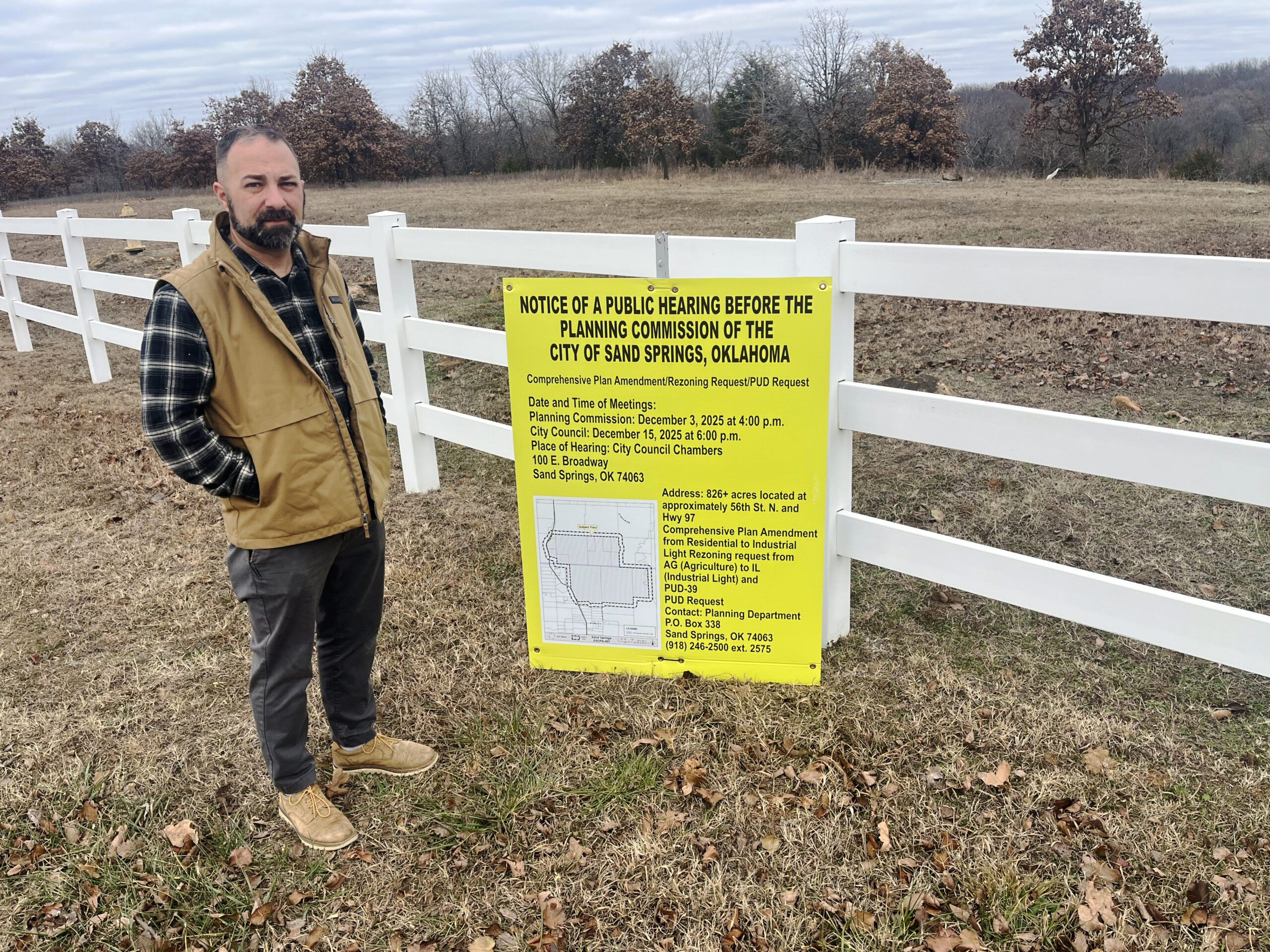
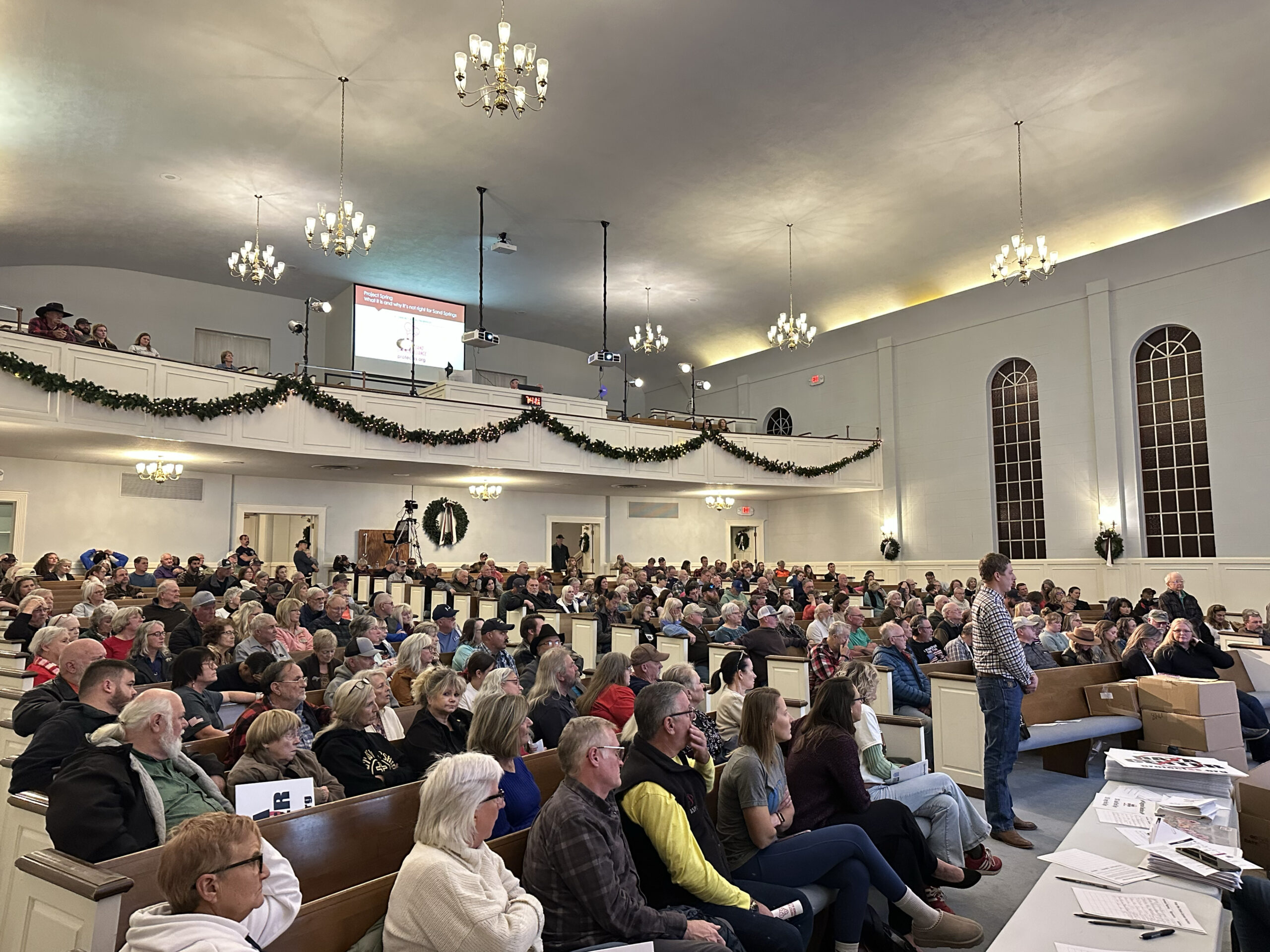
Sand Springs leaders were besieged with community anger after annexing an 827-acre agricultural property miles outside of town and launching into secret talks with a tech giant looking to use it for a sprawling data center. Hundreds of aggrieved voters showed up at community meetings. Swarms of protest signs are taking root along the rural roads.
“It feels like these data center companies have just put a big target on our backs,” said Kyle Schmidt, leader of the newly formed Protect Sand Springs Alliance. “We are all asking: Where are the people we elected who promised to protect us from these big corporations trying to steamroll us? The people who are supposed to be standing up and protecting us are standing down and caving.”
Kyle Schmidt, president of the advocacy group Protect Sand Springs, at the property city officials have annexed near his home.
From Archbald, Pa., to Page, Ariz., tech firms are seeking to plunk down data centers in locations that sometimes are not zoned for such heavy industrial uses, within communities that had not planned for them. These supersize data centers can use more energy than entire cities and drain local water supplies.
Anger over the perceived trampling of communities by Silicon Valley has entered the national political conversation and could affect voters of all political persuasions in this year’s midterm elections.
Many of the residents fighting the project in Sand Springs voted for Trump three times and also backed Gov. J. Kevin Stitt, a Republican who implores tech firms to build in his state.
“We know Trump wants data centers and Kevin Stitt wants data centers, but these things don’t affect these people,” said Brian Ingram, a Trump voter living in the shadow of the planned project. “You know, this affects us.”
Ingramwasstanding before a homemade sign he planted on his front lawn that said, “Jesus Was Born on Ag Land.”
The grassroots blowback comes from deep red states as much as from left-wing groups such as the Democratic Socialists of America, which have helped draw hundreds of residents to hearings in Arizona, Indiana, and Maryland.
Even Energy Secretary Chris Wright warned data center developers that they are losing control of the narrative. “In rural America right now, where data centers are being built, everyone’s already angry because their electricity prices have risen a lot,” he told energy executives assembled in Washington for the North American Gas Forum last month. “‘I don’t want them in my state’ is a common viewpoint.”
Some industry groups argue that residents’ concerns are misplaced.
“Fueled by misinformation, driven by radical environmental policies, communities are missing out on the jobs, security, and opportunities this technology is delivering,” said an email from Brian O. Walsh, executive director of the AI Infrastructure Coalition. The group says the projects lower electricity prices, a claim that is hotly disputed.
The White House frames the data center boom as beneficial, saying in a statement that it will lead to big investments in infrastructure and boost manufacturing. But the administration is also aware some communities oppose them.
“Communities know what’s best for them, and the Administration is clear that local infrastructure decisions remain with states and localities,” the statement said.
Residents who attended a community meeting held near the land Sand Springs annexed were overwhelmingly against the proposed data center project.
Many local politicians are yielding to community pressure and rejecting data centers. Between April and June, more projects were blocked or delayed than during the previous two years combined, according to Data Center Watch, a tracking project by the nonpartisan research firm 10a Labs. Some $98 billion in planned development was derailed in a single quarter.
Last month, a group of Senate Democrats launched an investigation into the role data centers play in increasing electricity prices.
Sen. Bernie Sanders (Ind., Vt.) last month called for a moratorium on data center construction, warning that the tech firms are draining scarce energy and water reserves and pushing the cost onto everyday Americans in pursuit of AI technologies that threaten to displace millions from the workforce.
White House AI czar David Sacks replied on X: “He would block new data centers even if states want them & they generate their own power.”
But advocates say residents’ concerns are legitimate.
“This data center expansion affects so many issues,” said MitchJones, managing director of policy and litigation at Food and Water Watch. The group last month organized a letter signed by several national advocacy groups demanding a moratorium.
“It takes up farmland in rural communities. It takes up dwindling water sources in communities that need cleaner drinking water. And it is driving up electricity prices for everyone,” he said. “It is drawing together people from disparate backgrounds who might not agree on other political issues. They are saying this is taking place without any forethought to communities and we must stop it.”
The NAACP this month convened a two-day “Stop Dirty Data” conference in Washington that focused on the impacts of the AI build-out on minority and low-income communities. It included a bus tour of “Data Center Alley” in Northern Virginia, the world’s largest collection of data centers.
Even Florida Gov. Ron DeSantis is championing an AI “bill of rights” to enshrine local governments’ power to stop data center construction and prohibit utilities from pushing AI infrastructure costs onto residents. The break between Rep. Marjorie Taylor Greene (R., Ga.) and President Donald Trump was driven in part by her vocal criticism of his AI build-out push.
The industry has struggled to quell the concerns.In Chandler, Ariz., former Sen. Kyrsten Sinema, co-founder of the AI Infrastructure Coalition, implored city officials to get on board with a large proposed project or risk the federal government pushing it through without city input.
The city council rejected the project unanimously.
The vote followed the Tucson City Council’s unanimous rejection of a plan that would have required annexing land in the Sonoran Desert that until June had been zoned “rural homestead.” Some voters were outraged that local officials had signed a five-year nondisclosure agreement with Amazon, which did not come to light for two years. Frustration with the power company that would have provided the power has fueled a movement to drive it out in favor of a community-led nonprofit.
Amazon did not respond to questions aboutthe controversy, saying only, “We do not have any commitments or agreements in place to develop this project.” Amazon founder Jeff Bezos owns the Washington Post.
“People are understandably asking how they will benefit,” said Chris Lehane, chief global affairs officer at OpenAI, which has won initial local approval for some of the country’s largest data center projects. He said companies need to listen to communities and make sure they are sharing in the economic gains. “You need to be on the ground, having these conversations. It is a journey.”
In some places, large tech companies have signed contracts committing to pay for new power grid infrastructure required to bring a data center online, even when the companies are not the only ones that would benefit from it.
It’s a journey that somelocal officials are willing to go on because the projects generate construction jobs and boost revenue for schools.
“We’re trying to work through this,” said Mike Carter, the city manager in Sand Springs. “This would probably be one of our major employers. It would almost certainly become the dominant part of our tax base. … When you can surpass Walmart, which is right now the biggest taxpayer in our community, there is a big incentive to look at this.”
He has tried to assure residents that they will have all their questions answered — including the name of the tech firm — before the city hearing this month, where officials will consider rezoning the sprawling property from agricultural to industrial.He said the city has signed other nondisclosure agreements during negotiations with large corporations, such as Olive Garden.
The project developer, White Rose Partners, said none of the costs involved with providing electricity to the Sand Springs data center would fall on residentialratepayers. The firm says the data center would generate millions of dollars in revenue for local schools and services.
It is cold comfort to many residents of the rural community, where the data center would industrialize a landscape now defined by the ranches that drew them there.
“I don’t care how much chocolate icing you put on a dog turd, it don’t make it chocolate cake,” said Rick Plummer, who raises elite team-roping horses next to the proposed data center.“They are trying to fluff this data center thing up and say, ‘Man, eat this birthday cake.’ But it isn’t birthday cake.”
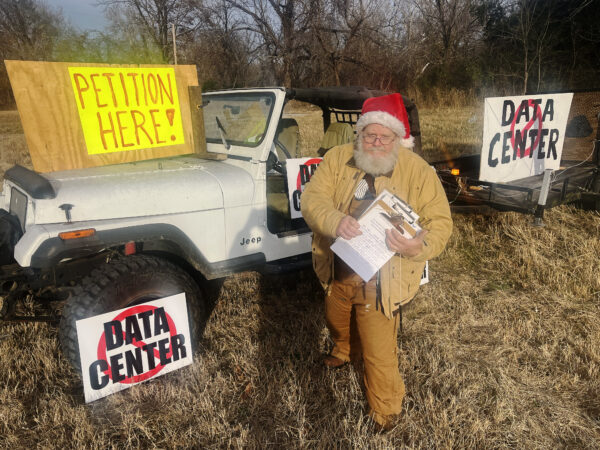
On the other side of Tulsa, a steady stream of pickups pulled off the busy local road to sign petitions fighting a different data center proposed for the rural community of Coweta. One sign takes aim at the nondisclosure agreements, stating “NDAs BETRAY.” The petitions demand the firing of a city official who signed one.
“We want to see this damn data center go away and go someplace else,” said Allen Prather, who was leading the petition drive dressed as Santa. “This town deserves a better centerpiece than a data center. They keep coming to smaller and smaller towns. Leave mine alone.”
Sherri Crumpacker, a retired law enforcement officer who pulled over to sign, concurred. “I moved here from California to get away from BS like this,” she said.
WASHINGTON — The Washington National Opera announced Friday that it had decided to end its arrangement with the Kennedy Center in the nation’s capital, though it said it was hoping for an “amicable transition.”
“To ensure fiscal prudence and fulfill its obligations for a balanced budget, the WNO will reduce its spring season and relocate performances to new venues,” the Opera said in a statement.
It said the decision stemmed from the Center’s new business model, which “requires productions to be fully funded in advance — a requirement incompatible with opera operations.”
Kennedy Center spokesperson Roma Daravi told The New York Times, “After careful consideration, we have made the difficult decision to part ways with the WNO due to a financially challenging relationship.”
Artists ranging from Hamilton creator Lin-Manuel Miranda to rock star Peter Wolf have called off events at the Kennedy Center since President Donald Trump ousted the previous leadership early last year and arranged for himself to head the board of trustees. The board’s decision in December to rebrand the venue the Trump-Kennedy Center led to a new wave of cancellations.
WASHINGTON — The head of the FBI’s New York field office has been named co-deputy director of the bureau, replacing Dan Bongino following his recent departure, an FBI spokesperson said Friday.
Christopher Raia, who helped lead the response to the deadly truck attack in New Orleans on New Year’s Day last year, was picked to run the New York office in April after having served as a top counterterrorism official at FBI headquarters. A former Coast Guard officer, Raia joined the FBI in 2003 and during the course of his two-decade career has investigated violent crime, drugs and gangs as well as overseen counterterrorism and national security investigations.
As a career FBI agent, Raia is a more conventional selection for the FBI’s No. 2 job than was Bongino, a popular conservative podcaster who had previously served as a Secret Service agent but had never worked for the FBI until being selected by the Trump administration last year.
Raia is expected to serve as co-deputy director alongside Andrew Bailey, the former Missouri attorney general who was named to the job last August. He is scheduled to start next week.
He became the head of the New York field office after his predecessor, James Dennehy, who was reported to have resisted Justice Department efforts to scrutinize agents who participated in politically sensitive investigations, was forced to retire.
Bongino announced last month that he was departing the bureau following a brief and tumultuous tenure. He officially ended his tenure last week.
No immediate successor was named for Raia in New York.