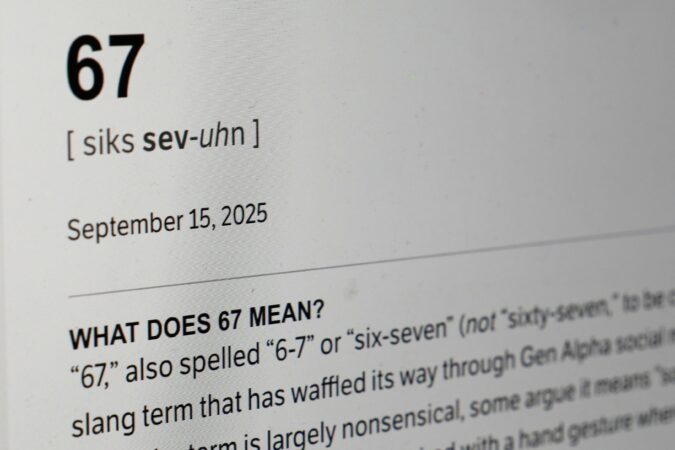
Respondents to an annual Michigan college survey of overused and misused words and phrases say 6-7 is cooked and should come to a massive full-stop heading into the new year.
Those are among the top 10 words on the 50th annual “Banished Words List,” released Thursday by Lake Superior State University in Sault Ste. Marie, Mich.
The tongue-in-cheek roundup of overused slang started in 1976 as a New Year’s Eve party idea and is affectionately called the list of “Queen’s English for Mis-use, Over-use and General Uselessness.”
Around 1,400 submissions came from all 50 states and a number of countries outside the U.S., including Uzbekistan, Brazil, and Japan, according to Lake Superior State.
Also in the top 10 are demure, incentivize, perfect, gift/gifted, my bad, and reach out. My bad and reach out also made the list decades ago — in 1998 and 1994, respectively.
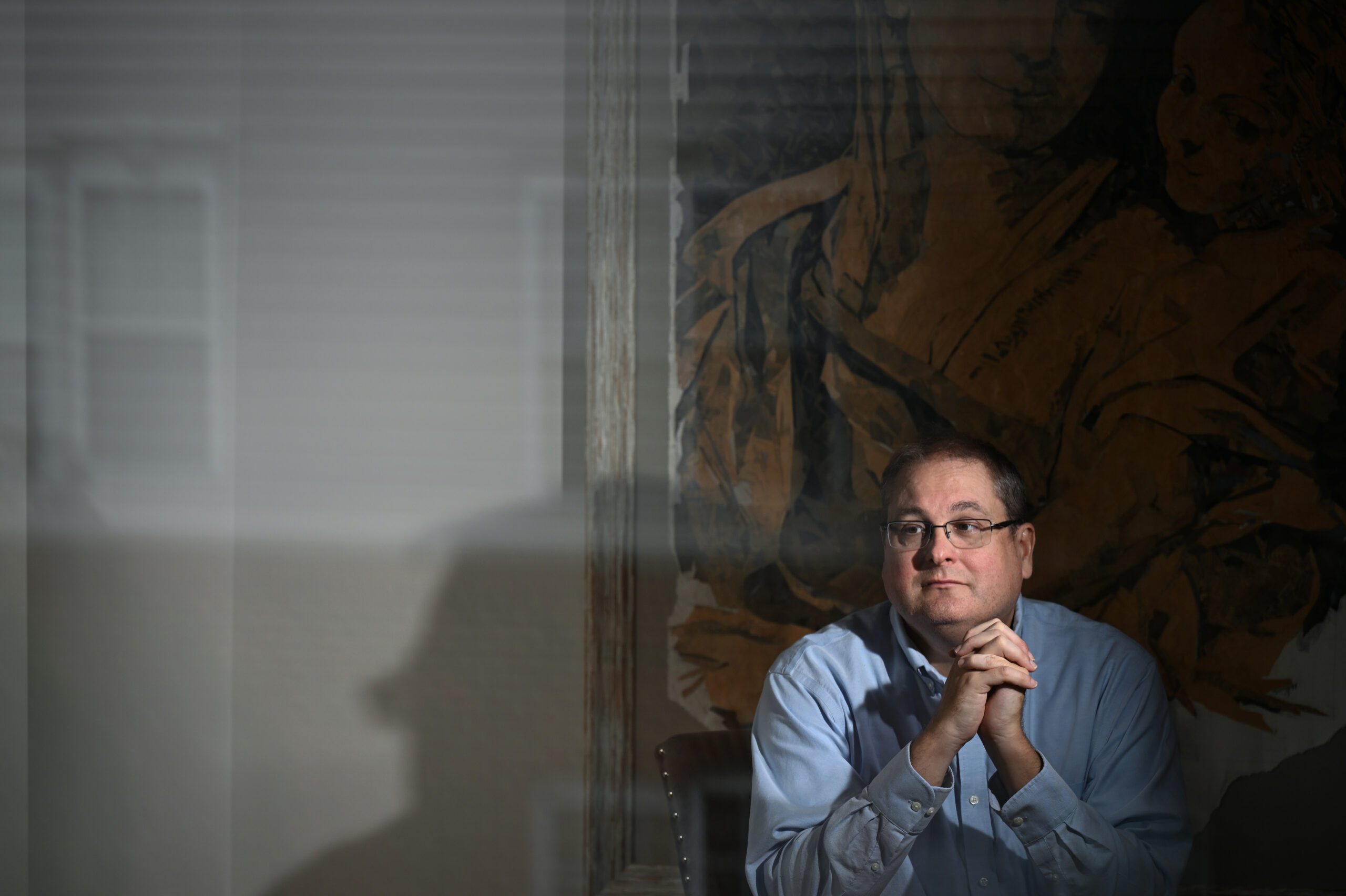
“The list definitely represents the fad and vernacular trends of the younger generation,” said David Travis, Lake Superior State University president.
“Social media allows a greater opportunity to misunderstand or misuse words,” Travis said. “We’re using terms that are shared through texting, primarily, or through posting with no body language or tone context. It’s very easy to misunderstand these words.”
Few phrases in 2025 befuddled parents, teachers and others over the age of, say 40, more than 6-7. Dictionary.com even picked it as its 2025 word of the year. Merriam Webster chose slop, and Oxford University Press pickedrage bait.
But what does 6-7 actually mean? It exploded over the summer, especially among Gen Z, and is considered by many to be nonsensical in meaning — an inside joke driven by social media.
“Don’t worry, because we’re all still trying to figure out exactly what it means,” the dictionary’s editors wrote.
Each number can be spoken aloud as “six, seven.” They even can be combined as the number 67; at college basketball games, some fans explode when a team reaches that point total.
The placement of 6-7 at the top of the banished list puts it in good company. In 2019, the centuries-old Latin phrase quid pro quo was the top requested phrase to ban from popular use. In 2017, fake news got the most votes.
Alana Bobbitt, a 19-year-old sophomore at the University of Michigan in Ann Arbor, is unapologetic about using 6-7.
“I find joy in it,” Bobbitt said. “It’s a little bit silly, and even though I don’t understand what it means, it’s fun to use.”
Jalen Brezzell says that a small group of his friends use 6-7 and that it comes up a couple of times each week. But he won’t utter it.
“Never. I don’t really get the joke,” said Brezzell, a 19-year-old sophomore at the University of Michigan-Dearborn. “I don’t see what’s funny about it.”
But banning it, even in jest, might be a bit of a stretch, he said, adding that he does use other words and phrases on the list.
“I’ve always used the word cooked,” Brezzell said. ”I just think it got popular on the internet over this past year. It’s saying, like, ‘give it up, it’s over.’”
Some of the phrases do have longevity, Travis said.
“I don’t think they’ll ever go away, like ‘at the end of the day,’” he said. “I used ‘my bad’ today. I feel comfortable using it. I started using it when I was young. A lot of us older people are still using it.”
Travis said that while some terms on the list “will stick around in perpetuity,” others will be fleeting.
NEW YORK — Incoming Mayor Zohran Mamdani took his midnight oath of office on a centuries-old Quran, marking the first time a mayor of New York City used Islam’s holy text to be sworn in and underscoring a series of historic firsts for the city.
Mamdani, a 34-year-old Democrat, became mayor in a long-closed subway station beneath City Hall, the first Muslim, first South Asian, and first African-born person to hold that position.
These milestones — as well as the historical Quran — reflect the longstanding and vibrant Muslim residents of the nation’s most populous city, according to a scholar who helped Mamdani’s wife, Rama Duwaji, select one of the books.
Most of Mamdani’s predecessors were sworn in on a Bible, although the oath to uphold the federal, state, and city constitutions does not require the use of any religious text.
And while he has focused heavily on the issue of affordability during his campaign, Mamdani was outspoken about his Muslim faith. He frequently appeared at mosques across the five boroughs as he built a base of support that included many first-time South Asian and Muslim voters.
This photo provided by the New York Public Library shows the Schomburg Quran.
A look at the three Qurans that Mamdani used
Two Qurans were to be used during the subway ceremony: his grandfather’s Quran and a pocket-sized version that dates to the late 18th or early 19th century. It is part of the collection at the New York Public Library’s Schomburg Center for Research in Black Culture.
That copy of the Quran symbolizes the diversity and reach of the city’s Muslims, said Hiba Abid, the library’s curator for Middle Eastern and Islamic Studies.
“It’s a small Quran, but it brings together elements of faith and identity in New York City history,” Abid said.
For a subsequent swearing-in ceremony at City Hall on the first day of the year, Mamdani used both his grandfather’s and grandmother’s Qurans. The campaign hasn’t offered more details on those heirlooms.
One Quran’s long journey to Mamdani’s hand
The manuscript was acquired by Arturo Schomburg, a Black Puerto Rican historian whose collection documented the global contributions of people of African descent. While it is unclear how Schomburg came into possession of the Quran, scholars believe it reflected his interest in the historical relationship between Islam and Black cultures in the United States and across Africa.
Unlike ornate religious manuscripts associated with royalty or elites, this copy of the Quran is modest in design. It has a deep red binding with a simple floral medallion and is written in black and red ink. The script is plain and readable, suggesting it was created for everyday use rather than ceremonial display.
Those features indicate the manuscript was intended for ordinary readers, Abid said, a quality she described as central to its meaning.
“The importance of this Quran lies not in luxury, but in accessibility,” she said.
Because the manuscript is undated and unsigned, scholars relied on its binding and script to estimate when it was produced, placing it sometime in the late 18th or early 19th century during the Ottoman period in a region that includes what is now Syria, Lebanon, Israel, the Palestinian territories and Jordan.
Abid said the manuscript’s journey to New York mirrors Mamdani’s own layered background. Mamdani is a South Asian New Yorker who was born in Uganda, and Duwaji is American-Syrian.
Identity and controversy
The meteoric rise of a Muslim democratic socialist also brought a surge of Islamophobic rhetoric, amplified by national attention on the race.
In an emotional speech days before the election, Mamdani said the hostility had only strengthened his resolve to be visible about his faith.
“I will not change who I am, how I eat, or the faith that I’m proud to call my own,” he said. “I will no longer look for myself in the shadows. I will find myself in the light.”
The decision to use a Quran has drawn fresh criticism from some conservatives. U.S. Sen. Tommy Tuberville of Alabama, a Republican, wrote on social media, “The enemy is inside the gates,” in response to a news article about Mamdani’s inauguration. The Council on American-Islamic Relations, a civil-rights group, has designated Tuberville as an anti-Muslim extremist based on past statements.
Such backlash is not new. In 2006, Keith Ellison, a Democrat from Minnesota who was the first Muslim elected to Congress, faced condemnation from conservatives after he chose to use a Quran for his ceremonial oath.
Following the inauguration, the Quran will go on public display at the New York Public Library. Abid said she hopes attention surrounding the ceremony — whether supportive or critical — will prompt more people to explore the library’s collections documenting Islamic life in New York, ranging from early 20th century Armenian and Arabic music recorded in the city to firsthand accounts of Islamophobia after the Sept. 11 attacks.
“This manuscript was meant to be used by ordinary readers when it was produced,” Abid said. “Today it lives in a public library where anyone can encounter it.”
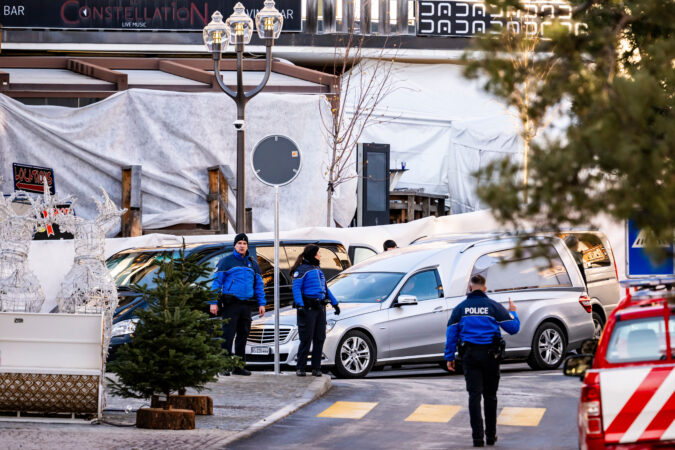
CRANS-MONTANA, Switzerland — About 40 people were killed and another 115 injured, most of them seriously, after a fire ripped through a bar’s New Year celebration in a Swiss Alpine resort less than two hours after midnight Thursday, police said.
Authorities did not immediately have an exact count of the deceased.
The Crans-Montana resort is best known as an international ski and golf venue, and overnight, its crowded Le Constellation bar morphed from a scene of revelry into the site of one of Switzerland’s worst tragedies.
Valais Canton police commander Frédéric Gisler said during a news conference that work is underway to identify the victims and inform their families, adding that the community is “devastated.”
Beatrice Pilloud, Valais Canton attorney general, said it was too early to determine the cause of the fire. Experts have not yet been able to go inside the wreckage.
“At no moment is there a question of any kind of attack,” Pilloud said.
She later said the number of people who were in the bar is “currently totally unknown,” adding that its maximum capacity will be part of the investigation.
“For the time being, we don’t have any suspect,” she added, when asked if anyone had been arrested over the fire. “An investigation has been opened, not against anyone, but to illuminate the circumstances of this dramatic fire.”
Gisler said the priority until further notice would be identifying the victims, and added that “this work will have to take several days.”
An evening of celebration turns tragic
Axel Clavier, a 16-year-old from Paris who survived the blaze, described “total chaos” inside the bar. One of his friends died and “two or three” were missing, he told The Associated Press.
He said he hadn’t seen the fire start, but did see waitresses arrive with Champagne bottles with sparklers, he said.
Clavier said he felt like he was suffocating and initially hid behind a table, then ran upstairs and tried to use a table to break a Plexiglas window. It fell out of its casing, allowing him to escape.
He lost his jacket, shoes, phone and bank card while fleeing, but “I am still alive and it’s just stuff.”
“I’m still in shock,” he added.
Two women told French broadcaster BFMTV they were inside when they saw a male bartender lifting a female bartender on his shoulders as she held a lit candle in a bottle. The flames spread, collapsing the wooden ceiling, they told the broadcaster.
One of the women described a crowd surge as people frantically tried to escape from a basement nightclub up a narrow flight of stairs and through a narrow door.
Another witness speaking to BFMTV described people smashing windows to escape the blaze, some gravely injured, and panicked parents rushing to the scene in cars to see whether their children were trapped inside. The young man said he saw about 20 people scrambling to get out of the smoke and flames and likened what he saw to a horror movie as he watched from across the street.
Officials described how the blaze likely triggered the release of combustible gases that ignited violently and caused what English-speaking firefighters call a flashover or backdraft.
“This evening should have been a moment of celebration and coming together, but it turned into a nightmare,” said Mathias Reynard, head of the regional government of the Valais Canton.
The injured were so numerous that the intensive care unit and operating theater at the regional hospital quickly hit full capacity, Reynard said.
Crans-Montana is less than 5 kilometers (3 miles) from Sierre, where 28 people, including many children, were killed when a bus from Belgium crashed inside a Swiss tunnel in 2012.
Resort town sits in the heart of the Alps
In a region busy with tourists skiing on the slopes, the authorities have called on the local population to show caution in the coming days to avoid any accidents that could require medical resources that are already overwhelmed.
With high-altitude ski runs rising around 3,000 meters (nearly 9,850 feet) in the heart of the Valais region’s snowy peaks and pine forests, Crans-Montana is one of the top venues on the World Cup circuit. The resort will host the best men’s and women’s downhill racers, including Lindsey Vonn, for their final events before the Milan-Cortina Olympics in February. The town’s Crans-sur-Sierre golf club stages the European Masters each August on a picturesque course.
The Swiss blaze on Thursday came 25 years after an inferno in the Dutch fishing town of Volendam on New Year’s Eve, which killed 14 people and injured more than 200 as they celebrated in a cafe.
Swiss President Guy Parmelin, speaking on his first day in office, said many emergency staff had been “confronted by scenes of indescribable violence and distress.”
“This Thursday must be the time of prayer, unity and dignity,” he said. “Switzerland is a strong country not because it is sheltered from drama, but because it knows how to face them with courage and a spirit of mutual help.”
Weather concerns have snarled Philadelphia’s New Year’s Day plans.
The string band competition has been “suspended until further notice,” the Philadelphia Mummers Parade and Philadelphia String Band Association announced Thursday morning.
High winds, “wind damage during unloading and setup and safety concerns” prompted the call, officials said in a statement.
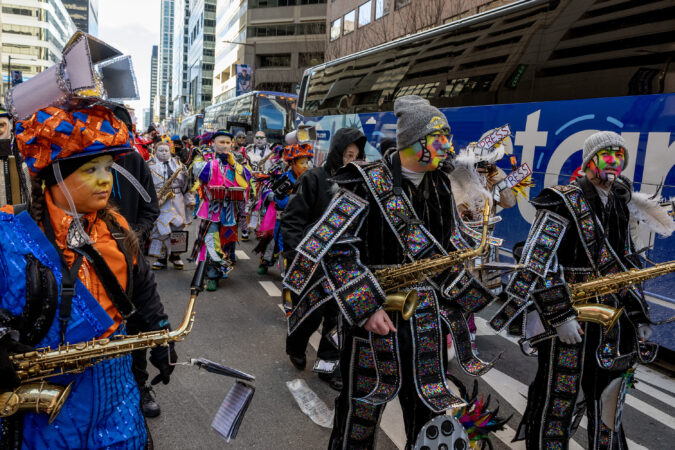
“In the spirit of celebrating New Year’s Day and this important milestone for our city and nation, the String Bands will all still march in full costume and makeup and perform for TV, internet, and live audiences on Broad Street and City Hall,” the statement said. “They will march without props. Times and order will remain the same. Safety of performers is of utmost importance when making this decision.”
This year marks the 125th anniversary of the iconic parade.
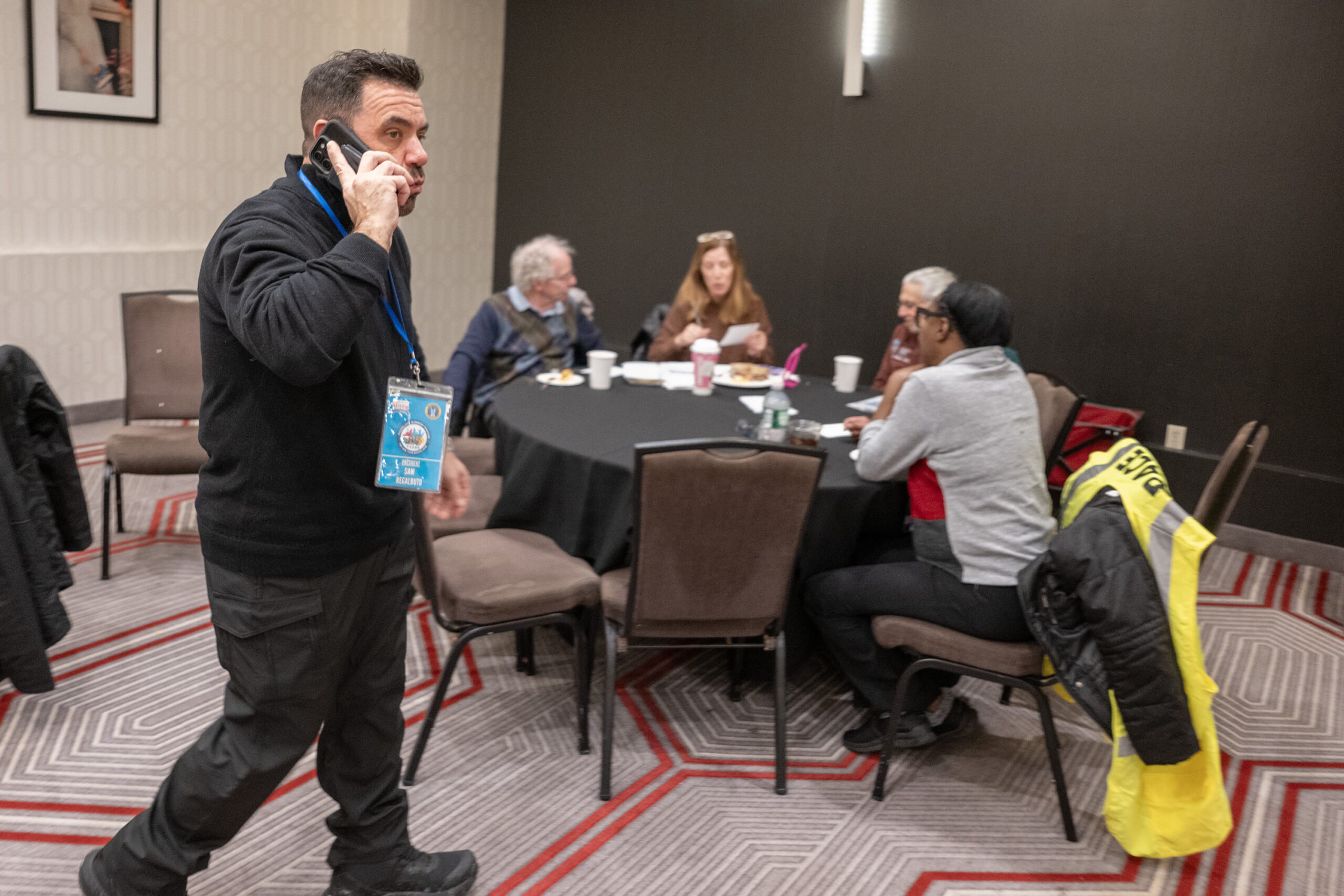
Sam Regalbuto, president of the String Band Association, at the Mummers headquarters hotel Thursday, Jan. 1, 2026, after the string band competition was suspended because of high winds that destroyed props and caused injuries to club members during morning setup.
Sam Regalbuto, president of the String Band Association, said that the clubs were caught off-guard by “the squalls that came through, the wind changes that happened without us knowing.”
Several club members were sent to hospitals with minor injuries sustained during attempted setup this morning, Regalbuto said. All have been treated and released.
“We’ve lost sets, we’ve lost props that we’ve worked 365 days to put together to bring you the best possible string band spectacular that we do every year,” he said. “It was very hard for all of us, as a unit, to make this decision.”
The call came after String Band Association delegates voted on whether to postpone, Regalbuto said.
Ultimately, “we just think, safety, safety, safety, first,” he said.
It was important to clubs to still put on a show for those fans who are crowding Philadelphia streets expecting to see Mummers, said Regalbuto. Though there will be no props, the string bands will “still come in full costume, full makeup, and entertain you, the viewers, at home, and our fans here on the parade route. So please, if you’re thinking of not coming, we’re here. We are performing for you, and we will give you the best show that we can possibly give you.”
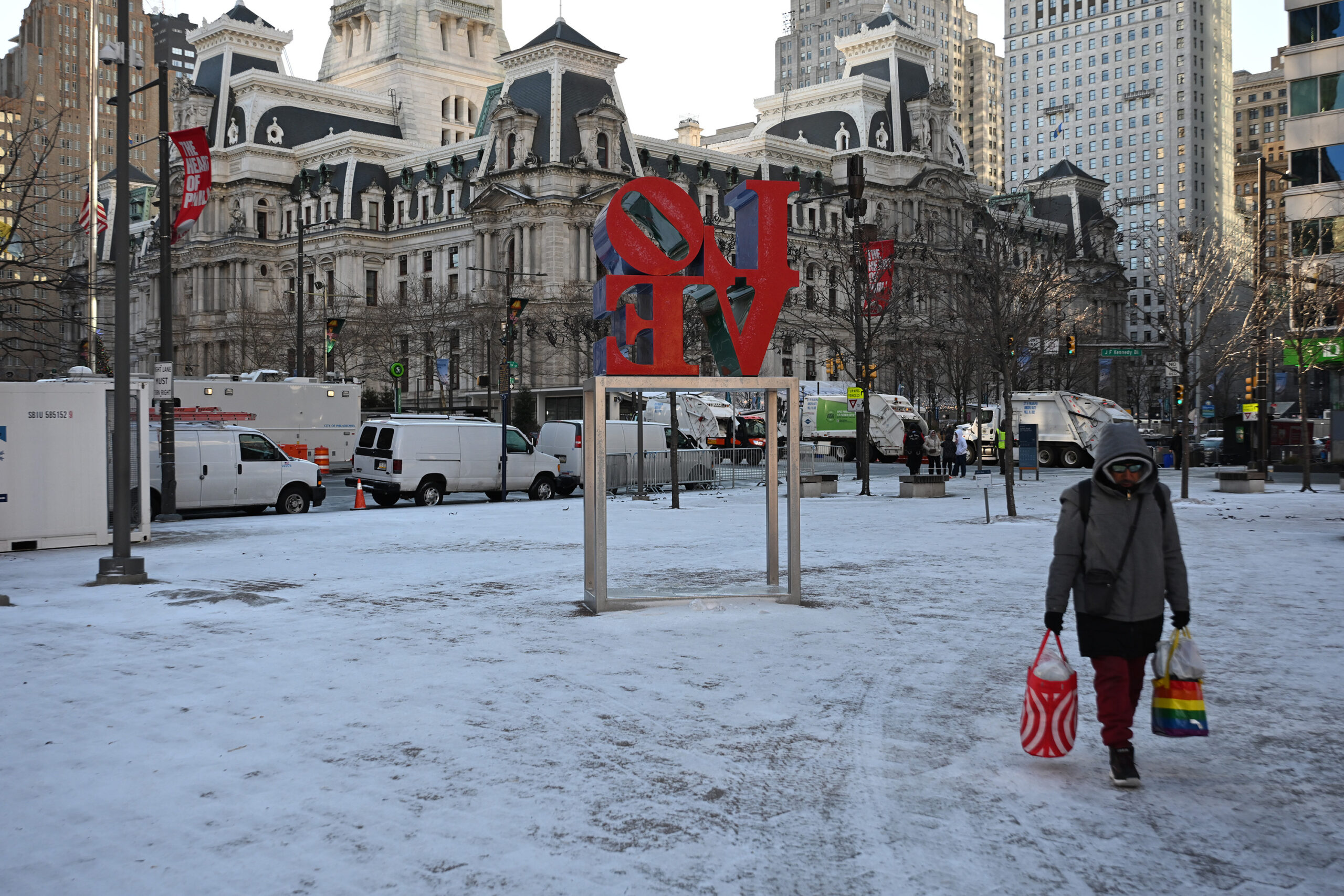
An early morning snow squall left a dusting in LOVE Park before the start of the Mummers Parade near City Hall Thursday, Jan. 1, 2026. This year marks the 125th anniversary of Philly’s iconic New Year’s Day celebration.
A 5 a.m. shocker
Nick Guzzo, a meteorologist with the National Weather Service in Mount Holly, said snow squalls and wind “did not come out of nowhere.”
On Wednesday, the National Weather Service issued a warning for snow squalls between 2 a.m. and 10 a.m. Thursday.
“Snow squalls can produce intense bursts of heavy snow and gusty winds, resulting in rapidly reduced visibility and poor road conditions, making travel difficult and potentially dangerous. Extra care should be taken as a result with any travel early on New Year’s Day,” officials wrote on Wednesday.
Regalbuto said the string bands were closely monitoring hourly weather updates and city messages overnight, but were expecting lesser winds, and gusts, not the sustained wind blasts that ultimately came “shooting from City Hall, straight up Market, and straight up JFK.”
Because the string bands are essentially “a mobile Broadway show,” with heavy, elaborate pieces that require significant work to install, that setup began in the predawn hours, at about 5 a.m., Regalbuto said.
It became apparent quickly that a Thursday string band competition would be dangerous.
Winds “destroyed multiple sets for different organizations,” he said. “We did everything precaution wise — sandbags, and all of that. But as they were trying to assemble, things were just being ripped out of our hands.”
It was then that Regalbuto convened his delegation. The vote was clear.
“We knew that there was already an unfair advantage, because some clubs had already lost their sets,” he said.
Weather reports called for gusts of up to 30 miles per hour well into the afternoon.
“We just had to batten down the hatches,” Regalbuto said.
A rescheduled competition, Regalbuto said, will be held “very soon” at a to-be-determined venue once logistics and financials are worked out. Planning meetings will begin Friday.
Seeing the Mummers’ New Year’s Day parade became something of a running joke to Avril Davidge and her family.
You see, they live in Wales and Davidge is now a 93-year-old grandmother who rarely leaves her flat. She didn’t have a passport, nor had she been on a plane in 30 years. She’d never been to the United Statesand she jokes she could die tomorrow.
But after going down a YouTube rabbit hole and becoming what can only be described as obsessed with the tradition two years ago, she would often say things like “when we go to Philadelphia” or “when I see my Mummers.”
“It’s done a lot for me,” Davidge said. She had her granddaughter set her Mummers YouTube videos on autoplay since she can’t figure out the search function.“Even having breakfast, I put it on. It starts the day right for me.”
While the Mummers Parade can draw drastically divergent opinions at home, where some see it as a beloved multigenerational tradition and others paint it as an excuse for people to get drunk on Two Street, Davidge sees it as a connection to her late husband. She doesn’t know anyone in Wales who has even heard of Mummery, but deep in her heart, she knows it’s something her husband of 70 years would have loved. He died two years ago and she discovered her first Mummers video weeks later.
Quaker City String Band Captain Jimmy Good pushes the wheelchair of “Queen Mumm” Avril Davidge doing a Mummers strut. Davidge is a 93 year old Welsh grandma who came to the United States for the first time to see the Mummers.
Eventually, her family decided to give Davidge the trip of a lifetime to witness the 10,000-person spectacle that has ushered in the new year for Philadelphians for 125 years.Davidge will be among the many spectators watching the Mummers Parade take Broad Street on Thursday.
Using the power of social media and propelled by her family, Davidge landed Tuesday at Philadelphia International Airport, greeted by a Rocky statue — another bit of culture she loves. On Wednesday she was surprised with a trip to the Mummers Museum in South Philadelphia, where she delighted in a private tour: Yes, they’re real ostrich feathers on the costumes, and one of the more elaborate costumes can weigh 150 pounds.
Then she met Jimmy Good, captain of the Quaker City String Band, and a personal favorite of Davidge’s. Her family said Davidge often quiets them down with a “my Jimmy is on.”
“I’ll never forget this,” she told Good, complimenting what she called his beautiful smile and showing him her golden shoes, a nod to dem golden slippers. “Never.”
The two even strutted in the museum, Good pushing Davidge in her wheelchair as she lifted a gifted satin umbrella.
It was a scene Davidge’s family could hardly believe was playing out. Just a few weeks ago, they thought Davidge was at death’s door.
Divine intervention brings the Mummers to Wales
When Davidge’s husband died, she was “feeling low,” as she calls it.
Then the YouTube algorithm, programmed by her granddaughter to show her United Kingdom marching bands, showed her a clip of the Quaker City String Band performing “Make Believe,” a song Davidge and her husband loved. Her family felt it was almost a form of divine intervention.
Something about the string bands, the costumes, the performances offered a comfort Davidge needed. Soon, the Mummers were all she was watching and she quickly developed an encyclopedic knowledge of the longtime Philadelphian tradition.
The 1999 Quaker City String Band theme of “Reflections of Old Moscow” is a legendary performance, Davidge said, and then-captain Bob Shannon Jr. remains her all-time favorite.
She was in awe as she learned Shannon stood at 6-foot-10; the old YouTube clips are grainy and don’t do the performances justice.
Connecting Philly and Wales through social media
Davidge’s love for the Mummers has been contagious, family members say, not that they’ve had much of a choice.
Last year, Fiona Smillie-Hedges, Davidge’s granddaughter, asked a friend, American expat Wendy Ratcliffe, if she had heard of the Mummers.
Ratcliffe, whose maternal side of the family is scattered around Southeastern Pennsylvania, was floored.
“I said, vast swaths of the country would have no idea what you’re talking about,” she said.
When Ratcliffe’s family visited her, they brought a Mummers mug and other Philly merch for the grandmother they had heard so much about. The mug is not for use and remains propped in front of Davidge’s television.
Last Christmas, Davidge even got a Mummers book, which she calls her bible.
By 2025, the joke of going to Philly felt more like an inevitability. Smillie-Hedges, 38, tried to figure out how to maximize the experience and took to TikTok and Instagram to get some advice. She needed to know how people kept warm, how to get a good view of the string bands, and where to stay.
Soon she was in touch with Jim Donio, host of the String Band Sessions podcast, a longtime Mummer who led the broadcasts from 1985 to 1987.
Donio arranged for the museum tour and asked Good to set some time aside to meet Davidge.
“I need[ed] to step in here and do what I can to make this dream happen and make this dream come true,” Donio said.
But as Donio — who calls Davidge “Queen Mumm” — worked stateside, Davidge caught some sort of virus a few weeks ago, which at her age can be deadly.
Davidge said she thought she wouldn’t make it.
But Smillie-Hedges said the family used the Philadelphia trip to motivate her into eating and staying positive.
“She’s worked very hard to be here, to be well enough,” Smillie-Hedges said. “Every time I was like, you must eat this, you must drink that. Come on, Rocky training for Philly.”
On Wednesday, Davidge was all smiles. Her hotel overlooks Broad Street should she get cold and need to duck in for warmth. Unbeknownst to her, Donio also arranged for a golf cart to get her, Ratcliffe, Smillie-Hedges, and Davidge’s daughter Kay Hedges to their VIP seats by the judges’ table.
The whole trip feels implausible to the family, yet the only natural outcome.
“[Davidge] didn’t find the Mummers until it was literally a couple of weeks after my granddad had passed,” Smillie-Hedges said. “I swear it was meant to be.”
Scott Sauer would like nothing better than to make SEPTA an afterthought.
He doesn’t mean that the Philadelphia region’s mass transit agency should be neglected, but rather that it will come to do its job so seamlessly that its nearly 800,000 daily customers can rely on the service without worrying about breakdowns, delays and disruptions.
Given the cascading crises that hit SEPTA in 2025, many people wondered if the place was hexed.
“I hope not, because I don’t know how to get the curse off me,” Sauer said in a recent interview. “But listen, truth be told, there were days when I scratched my head and thought, ‘Oh, my goodness, what is going on?’”
“We just couldn’t seem to get more than a day or two of relief before something else was causing a headache,” said Sauer.
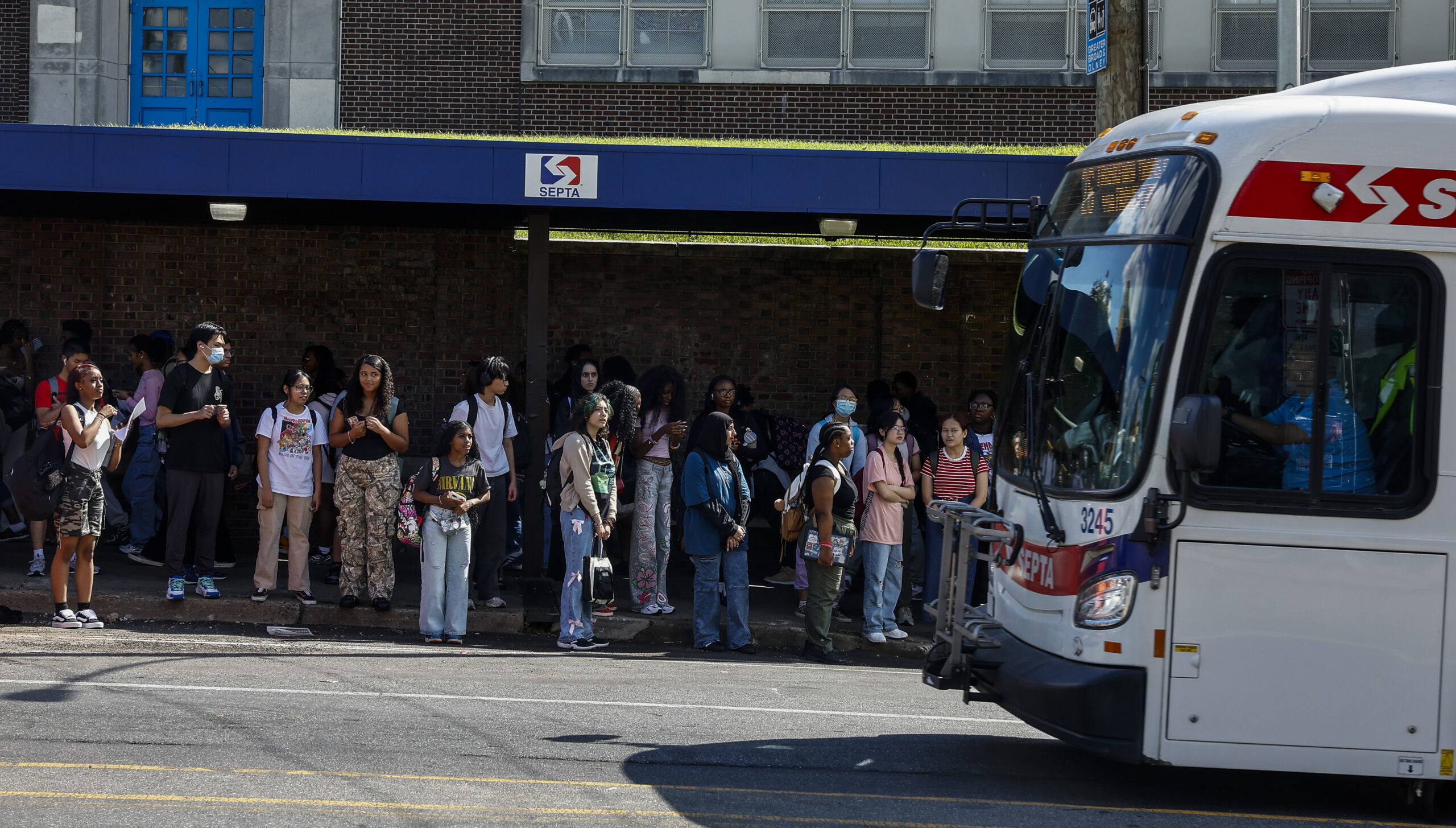
A bus passes the stop near Girls High at Broad and Olney Streets on Monday, Aug. 25, 2025. Thirty two SEPTA bus routes were cut and 16 were shortened, forced by massive budget deficits.
Back to basics in 2026
In the end, help from above and a new labor contract bought SEPTA at least two years to recover from its annus horribilis and stabilize operations.
When the Pennsylvania legislature couldn’t get a transit funding deal done, Gov. Josh Shapiro shifted $394 million in state-allocated funds for infrastructure projects to use for operations — the third temporary solution in as many years. The administration also later sent $220 million in emergency money in November for the Regional Rail fleet and the trolley tunnel.
And, early in December, SEPTA reached agreement on a new, two-year contract with its largest bargaining unit, Transport Workers Union Local 234.
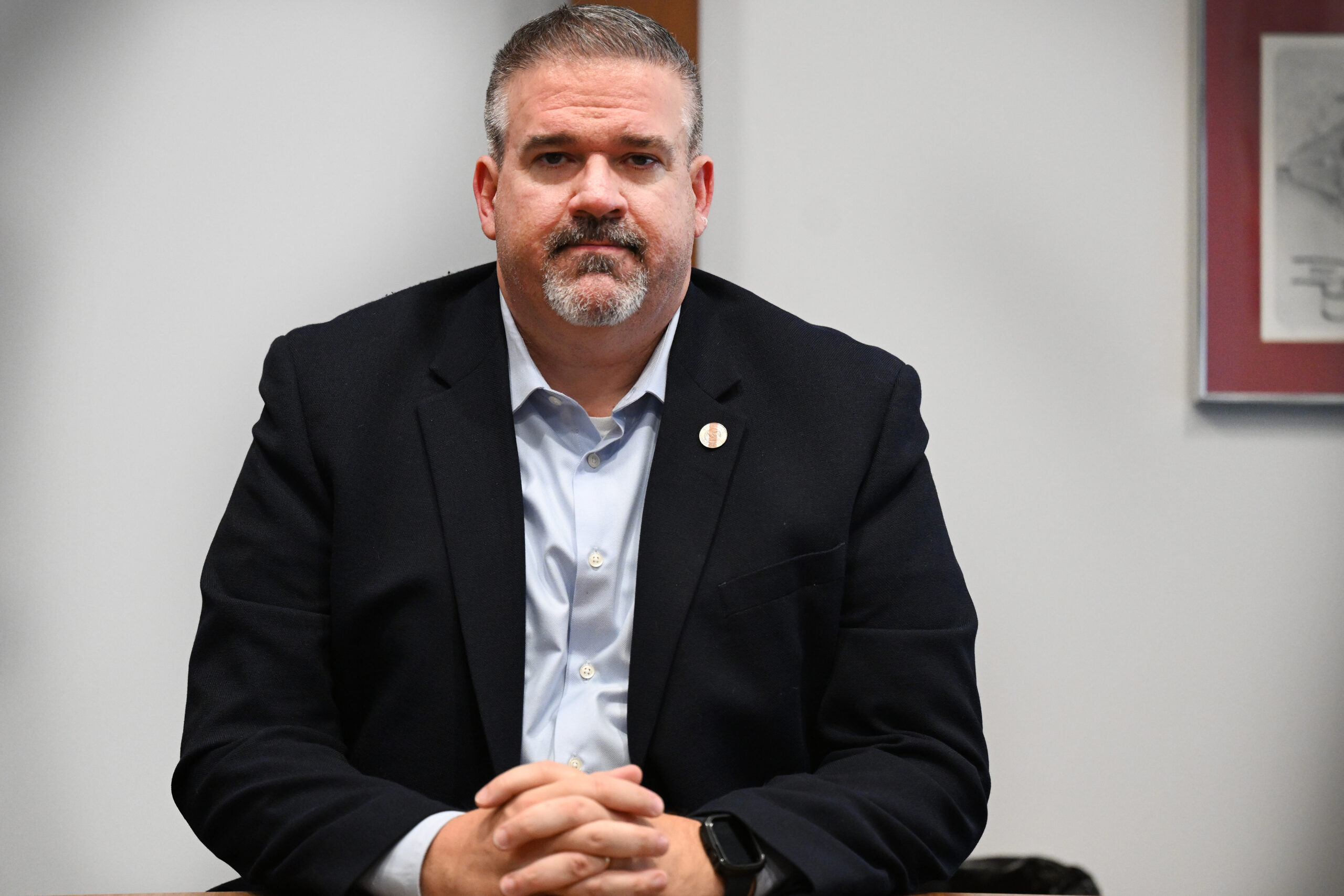
Scott Sauer, general manager of SEPTA, admits that 2025 was an extremely challenging year.
Sauer compared SEPTA’s position to football refs. When they are doing their jobs right, fans don’t have to think about them when watching the game. And when things are going well on the transit system, it becomes part of the background.
“Let’s make sure we do the basics, and we do them really well, because at the end of the day, people want SEPTA to move them from one place to the other, right?” he said.
The test of the focus on fundamentals comes soon, with millions of visitors expected in the region for the 250th anniversary of the Declaration of Independence, World Cup soccer, and other big events.
Sauer, 54, began his career as a trolley operator more than 30 years ago. He had no political experience, though, and would quickly be thrown headfirst into those murky waters to swim with sharks.
Storm clouds were already rolling in. Weeks before Sauer took the reins, Shapiro had flexed $153 million in state highway funds for SEPTA operations after a broader deal failed amid Senate GOP opposition.
It’s a legal move, but often controversial, and Shapiro’s opponents were furious.
Richards and her leadership team had been warning of a looming fiscal “doomsday scenario” for months. Officials were drafting a budget with service cuts and fare increases.
On Feb. 6, a Wilmington-bound Regional Rail train caught fire as it was leaving Crum Lynne Station in Delaware County. It was worrisome, but at the time, nobody knew it would get worse.
More than 300 passengers were safely evacuated after a SEPTA Regional Rail train caught fire near Crum Lynne Station in February.
Familiar battle lines were drawn. Senate Republicans, in the majority in the chamber, opposed Shapiro’s proposal to generate $1.5 billion for transit operations over five years by increasing its share of state sales tax income.
They preferred a new source of income for the state’s transit aid and said SEPTA was mismanaged, citing high-profile crimes, rampant fare evasion, and lax enforcement.
On a mid-August night, the Senate GOP came up with a proposal that would take money from the Public Transportation Trust Fund, a source for transit capital projects, and split it evenly between transit operations subsidies and rural state highway repairs.
Senate Majority Leader Joe Pittman, a Republican from Indiana County, was a key player in budget negotiations, which ultimately did not yield additional funding for mass transit.
“It was kind of quiet … and then we got alerted that a proposal was coming within minutes. And so everybody was scrambling to try to read through it,” Sauer said.
In a quick news conference with Shapiro, Sauer opposed the idea of taking capital dollars for transit operations, as did the governor. Then he spoke with Senate Republicans and told reporters it could be worth considering, but he had questions. And by the end of the night, he walked that back and opposed the measure.
“I guess if there was a lesson to be learned for me in August, it was I should have taken some [more] time reading through that proposal,” he said.
There was not much time to reflect on what happened, though, because the hits kept on comingas the federal government ordered SEPTA to inspect all 223 Regional Rail cars.
SEPTA’s Regional Rail fleet is the oldest operating commuter fleet in the country, and the fires highlighted the difficulty of keeping them maintained while needing to stretch limited capital funds to address multiple problems.
The Market-Frankford El cars, though younger than the Silverliner IVs, have been beat up and unreliable. SEPTA is moving forward with replacing them, as well as the Kawasaki trolleys that are more than 40 years old.
SEPTA had ordered new Regional Rail coaches from a Chinese-government-related manufacturer, but canceled the contract after the first few models, built during the pandemic, showed flaws. Now the agency is advertising for bids on a new fleet of Regional Rail workhorses — but it has to make them sturdier to last for at least seven more years before new cars would be on the way.
Officials plan to use $220 million received from the state on that effort.
Some of the money, about $48 million, is slated to help fix the trolley-tunnel issue. SEPTA is contending with glitches in the connection between the overhead catenary wires and the pole that conducts electricity to the vehicle.
What SEPTA got done
SEPTA has made some progress on some of its persistent issues, officials say, though the accomplishments understandably have been largely overlooked amid the urgent, existential crises of 2025.
For instance, serious crimes on the SEPTA system dropped 10% through Sept. 30 compared to the same period in 2024, according to Transit Police metrics.
And there had already been a sharp improvement. Serious crimes in 2024 dropped 33% compared to 2023 — from 1,063 to 711, year over year.
SEPTA transit police police patrol officers Brendan Dougherty (left) and Nicholas Epps (right) with the Fare Evasion Unit ride the 21 bus.
“If you think back to where we were in 2021 and 2022, the perception was bad things were happening on SEPTA, and you should steer clear of them,” Sauer said.
The Transit Police have been hiring new officers, including a recently graduated academy class of nine, and has about 250 officers.
SEPTA also installed 42 full-length gates designed to thwart fare evasion on seven platforms in five stations during 2025, spokesperson Andrew Busch said.Another 48 gates are coming in the first quarter of the year.
Police are also issuing citations with an enhanced penalty of up to $300 for fare evasion.
Prepare for déjà vu
Andyet, in 2027, it will be time to start the old SEPTA-funding dance once again, as transit agency advocates and supportive lawmakers work at getting a stable state funding stream for transit operations.
State Democrats have said the transit issue could help them take control of the Senate from Republicans — a longtime goal but one that is difficult to achieve. One wild card is whether President Donald Trump’s slumping popularity will cause GOP congressional candidates to get swamped in the 2026 midterms, and whether that will translate into voters’ local senators.
It likely would have to be a huge wave, and it’s a closely divided state.
By 2027, Shapiro is expected to be running for president (if he is reelected next year), and it’s anyone’s guess how that could affect budget politics.
“Not everybody wants to see us. I didn’t make a lot of friends,” Sauer joked after the TWU settlement.
The Social Security Administration — the sprawling federal agency that delivers retirement, disability, and survivor benefits to 74 million Americans — began the second Trump administration with a hostile takeover.
It ended the year in turmoil. A diminished workforce has struggled to respond to up to six million pending cases in its processing centers and 12 million transactions in its field offices — record backlogs that have delayed basic services to millions of customers, according to internal agency documents and dozens of interviews.
Long-strained customer services at Social Security have become worse by many key measures since President Donald Trump began his second term, agency data and interviews show, as thousands of employees were fired or quit and hasty policy changes and reassignments leftinexperienced staff to handle the aftermath.
Exaggerated claims of fraud, for example, have led to new roadblocks for elderly beneficiaries, disabled people, and legal immigrants, who are now required to complete sometransactions in person or online rather than by phone. Even so, the number of calls to the agency for the year hit93 million as of late September — a six-year high, data show.
The troubled disability benefits system is also deteriorating after some improvement, with 66% of disability appointments scheduled within 28 days as of December — down from nearly 90% earlier in the year, data show.
One notable exception is phone service, which improved in the second half of the yearbut is still subpar. Average hold times peaked at about 2½ hours in March, but dropped starting in July as employees were diverted from field office duties to fix what had become a public relations crisis. Average wait times for callbacks remain an hour or longer, however, while new delays have emerged elsewhere in the system, internal data show.
“It was not good before, don’t get me wrong, but the cracks are more than beginning to show,” said John Pfannenstein, a claims specialist outside Seattle and president of Local 3937 of the American Federationof Government Employees, which represents most Social Security employees. “It is a great amount of stress on our employees that remain on the job, who haven’t jumped ship.”
Commissioner Frank Bisignano has authorized millions of dollars in overtime pay to employees in a race to clear the bottlenecks, which worsened dramatically after nearly 7,000 employees — 12% of the workforce — were squeezed out early in the year. The agency said it has made improvements: It reduced the processing center backlog by one million cases this fall, cut pending disability claims by a third and kept the website live 24-7 after a series of outages earlier this year.
The current crisis follows years of disinvestment by Congress and acting leadership, despite a surge in baby boomer retirements. Bisignano promised faster service and a leaner workforce with a digital identity that he says willautomate simple retirement claims and other operations.
Frank Bisignano, President Donald Trump’s nominee for commissioner of the Social Security Administration, arrives for his confirmation hearing in March.
“In the coming year, we will continue our digital-first approach to further enhance customer service by introducing new service features and functionality across each of our service channels to better meet the needs of the more than 330 million Americans with Social Security numbers,” the commissioner said in a statement to the Washington Post.
But responsiveness and trust in the agency have suffered, according to current and former officials and public polling.
This account of the crisis at Social Security is based on internal documents and interviews with41 current and former employees, advocates and customers, many of whom spoke on the condition of anonymity to speak candidly about their concerns.
Social Security officials declined to make Bisignano available for an interview, though he did respond to written questions.
Three days before Christmas, Brian Morrissey, 65, arrived at the field office in Silver Spring, Md., for an appointment to apply for Medicare. He had tried the “MySSA” website, “but navigating it was just really hard,” he said. Morrissey owns a home improvement business, he said.
“If they can make the process easier online, great, but right now it is not well designed,” he said. So his wife waited 30 minutes on hold to schedule a face-to-face appointment for him.
Aime Ledoux Tchameni, an immigrant from Cameroon, waited in line at the Silver Spring office to get an appointment time to fix his last name from being listed as his first name — a mistake that occurred when he came to the U.S. two years ago. He has a provisional driver’s license from Maryland and needs to clear up his name with Social Security by mid-January, he said. But his appointment is not until Feb. 9.
“This is really going to cause me problems, because I need my driver’s license to get to work,” Tchameni said in French. “I don’t understand why I have to wait so long.”
‘I flipped the switch’
The table was set in February by Elon Musk and his Department of Government Efficiency, or DOGE, which installed a loyal, mid-level data analyst with no management experience to lead the $15.4 billion agency.
That former analyst, Leland Dudek, insists that he saved Social Security from a worse fate under Musk’s cost-cutting team. “I flipped the switch,” he said in a recent interview, referring to his disruptive four-month tenure as acting commissioner. “The casualty of that is a smaller SSA, an SSA that is being, for the first time, subject to the whims of being a political organization, which it was never intended to be.”
Regional offices abruptly disappeared in a rushed reorganization. New policies to fight fraud were rolled out only to be canceled or changed, prompting confused customers to jam the phones and the website, which crashed repeatedly. Daily operations in some respects became an endless game of whack-a-mole as employees were pulled from one department to another.
Along the way, Social Security also became ground zero in the administration’s quest to gather Americans’ personal data — largely in service of its mass deportation campaign.
The chaos quickly became a political cudgel, as Democrats saw an opening to defend one of the country’s most popular entitlement programs. Senate Democrats, led by Sen. Elizabeth Warren of Massachusetts, set up a “war room,” holding rallies with former commissioners in both parties and issuing demands for more resources to keep the Trump administration on the defensive.
“We’ve kept up the pressure and held Donald Trump, Elon Musk and Frank Bisignano accountable for the chaos they’ve caused,” Warren said in an interview.
Many critics note that Bisignano, a Wall Street veteran who became commissioner in May, now wears a second hat as CEO of the Internal Revenue Service —another massive portfolio with a multibillion-dollar budget.
In a statement, Bisignano said his shared leadership of Social Security and the IRS “will drive a better outcome for the American public.” He saidhe envisions “a Social Security Administration that is easier to access, faster to respond, and better prepared to meet the challenges facing Americans.”
Bisignano also said he is working to improve morale and “have the right level of staffing to operate at peak efficiency and deliver best-in-class customer service to the American people.”
‘Work piles up’
By the time Bisignano was confirmed by the Senate, Social Security had been led by three acting commissioners in six months. He pledged to stabilize the upheaval.
But he confronted immediate challenges. Dudek had reassigned 2,000 employees in administrative, analytical and technical roles to jobs dealing with the public. Many accepted the switch under threat of firing if they refused. Some began working the phones. But the national toll-free number was still in crisis, so another 1,000 staffers were assigned to the phones in July. The employees were thrown in with minimal training, multiple employees said — and found themselves unable to answer much beyond basic questions. The phone staff was told to keep calls under seven minutes in what became a push for volume over quality, employees said.
Although officials have publicly claimed that wait times have improved to single digits in some cases, those numbers do not account for the time it takes for customers to be called back, according to internal metrics obtained by the Post.
An audit published by the Social Security Inspector General’s Office on Dec. 22 confirmed that millions of callers requesting callbacks were counted as zero-minute waits by the agency. The review concluded that the metrics themselves were accurate, however, and showed that customer service overall has improved.
Jenn Jones, AARP’s vice president of financial security, said the improved phone service numbers were “encouraging” but that “more work needs to be done.”
“Wait times for callbacks remain over an hour, and more than a quarter of callers are not being served — by getting disconnected or never receiving a callback, for instance,” Jones said in a statement.
Public outcry and pushback from congressional Democrats derailed the planned closure of dozens of field offices that DOGEhad said were no longer needed.
Leland Dudek, former acting commissioner of the Social Security Administration, in November.
Meanwhile, Dudek’s workforce cuts led field offices to shed 9% of their employees by spring due to early retirement and deferred resignation offers. Overtime was restricted and hiring was frozen,even as customer visits continued to climb.
Shortly after taking office, Bisignano’s field operations chief, Andy Sriubas, wrote in an email to the staff that field offices “are, and will always remain, our front line — our face in the community and the primary point of in-person contact.”
In the near term, though, the front line staff were overwhelmed. Attrition was geographically uneven, with some offices losing a quarter of their employees to early retirement offers just as foot traffic grew, according to a staffing analysis by the AFGE’s research partner, the Strategic Organizing Center. The groupcalculated that there were about 4,000 beneficiaries for every field office employee in August of this year.
In several states that ratio is worse, the group found. Wyoming’s field offices, for example, have just 18 employees — or one for every 7,429 beneficiaries.
The shortages have created temporary office closures in many rural areas, some for days or months at a time. The office in Havre, Mont., has been closed for months, with the nearest one almost two hours away in Butte.
Today a majority of Social Security staffers who accepted reassignmentshave not been fully or properly trained, according to several employees with direct knowledge of the initiative. Instruction is often truncated so the staff can respond to customers. Officials said they provide training based on the employee’s level of experience and review the reassigned employees’ work.
“They offered minimal training and basically threw them in to sink or swim,” one veteran employee said of their transferred colleagues.
Training on the phone system and complicated claims and benefit programs lasted four hours for some reassigned workers when it should have taken six months, another employee said. As a result, some customers still can’t get basic questions answered or are given inaccurate information,according to a half-dozen staffers who answer the phones or work closely with employees who do.
The increased workload, hiring freeze and departures have made it harder for the staff to complete their daily tasks, said Jordan Harwell, a Butte, Mont., field office employee who is president of AFGE Local 4012. The staff used to find time between calls to process pay stubs, take in new disability applications and schedule appointments, but now “that work piles up,” he said.
DOGE officials, citing fraud concerns, also required direct deposit changes to be done in person or online — but getting online now calls for new identity verification measures that do not come easily to many elderly or disabled customers. Immigrants approved for green cards to work in the U.S. are now required to get Social Security cards in person under a Trump anti-fraud policy, producing a flood of new field office visits.
In one Indiana field office, one employee said she drags herself to work every day, dreading what will come next. Although she was hired as a claims specialist, she and her colleagues are being told to prioritize answering the phones, which never stop ringing now that her office is taking calls for both Indiana and parts of Illinois due to reorganizations and reductions.
That means she is forced to let other work pile up: calls from people asking about decisions in their cases, claims filed online and anyone who tries to submit forms to Social Security — like proof of marriage — through snail mail.
As the backlogs keep building, she is taking calls from 25 or so people every day, already knowing that she won’t be able to help five or six of them. These are elderly people, often poor or bedridden, who have no way to comply with the change requiring that direct deposit actions take place in person or online. Usually they’re calling because something has happened to their bank accounts and they need to alter their financial information. But they can’t access a computer, the employee said, and driving is out of the question.
She received a call this month from a 75-year-old man who suffered a massive stroke that left him unable to drive. He’d also had to switch banks and, as a result, hadn’t received Social Security checks for the last two or three months.
“I had to sit there on the phone and tell this guy, ‘You have to find someone to come in … or, do you have a relative with a computer who can help you or something like that?’” she recalled. “He was just like, ‘No, no, no.’”
She ended that call by telling the man to call his bank, hoping they might be able to help when her agency, hampered by administration policies, no longer could.
‘Everybody started laughing’
As the staff races to answer the phones, other tasks are backing up, including Medicare applications, disability claims that require initial vetting by field offices and other transactions that cannot be solved in one conversation. Any case falling in that category is redirected to a processing center, where the backlogs have been building all year.
These back-office operations, located across the country, often handle labor-intensive, highly complex cases that do not call for automated resolution. Among the tasks are issuing checks, including for back pay, to disabled people whose denial of benefits was reversed by an administrative law judge.
As Congress kept funding flat for Social Security over many years, the processing operations fell way behind, requiring headquarters employees to help handle the volume. But it was never as bad as it got this fall.
Many disability payments now takethree to six months to process when they used to take weeks, advocates and employees said.
At the start of September, one benefits authorizer in a processing center was called into an all-staff meeting with her colleagues, she said. There, management explained that the backlog at the time — six million cases — was unacceptable and that everyone would have to work overtime in an attempt to drive it down to two million by Christmas.
“When they told us that, everybody started laughing,” she said. “Because there is just absolutely no way to get it down in that short period of time.”
Still, she and her colleagues have been hustling, she said, processing cases as fast as they can, even as they can see their haste sometimes causes errors. No time to fix them, she has decided: Best to just keep moving.
The Social Security Administration has said it expects to pay $367 million less on payroll this fiscal year than the year before.
Meanwhile, another staffer, who answers phones at a national call center, said she has changed what she says to customers when she realizes their claim can’t be finished in one conversation and must be referred to a payment center.
“I’m supposed to reassure people it’s being worked on,” she said. “But now I avoid giving people a firm date they can expect it to be done by.”
Just before Thanksgiving, Bisignano said that starting next year, he hopes to slash field office visits by half. More than 31 millionpeople visited field offices in the last fiscal year — or tried to. Critics say the change will dismantle the fail-safe for those who cannot use computers, no matter how imperfect.
At the same time, in recent weeks, hundreds of employees who transferred to customer service operations have been recalled to the roles they were originally hired to fill. Others have been reassigned to a new “digital engagement” office.
Social Security has told Congress it plans to put more resources toward IT, with an expected increase of $591 million this fiscal year compared to fiscal 2025, according to the agency’s budget justification. The agency also expects to pay $367 million less on payroll than it did the year before.
Social Security also plans to roll out a new program that will allow customers to book phone appointments with field offices throughout the country, no matter where they live, according to two people familiar with the plans.
The goal is to reduce the number of field office visits, though one field office employee said the change will probably lead to a greater workload for staff keeping up with queries from customers outside their area.
“They’ve created problems and now they are trying to fix problems they created,” the worker said.
During Christmas week, the grind continued for most front line staff. After Trump signed an executive order last week closing most federal offices on Christmas Eve and Friday, Bisignano told his staff that field offices, teleservice centers, processing centers and more operations would remain open.
“In order to balance the needs of the public and our workforce, we will solicit interest from employees who would like to work on Wednesday and Friday,” he wrote.
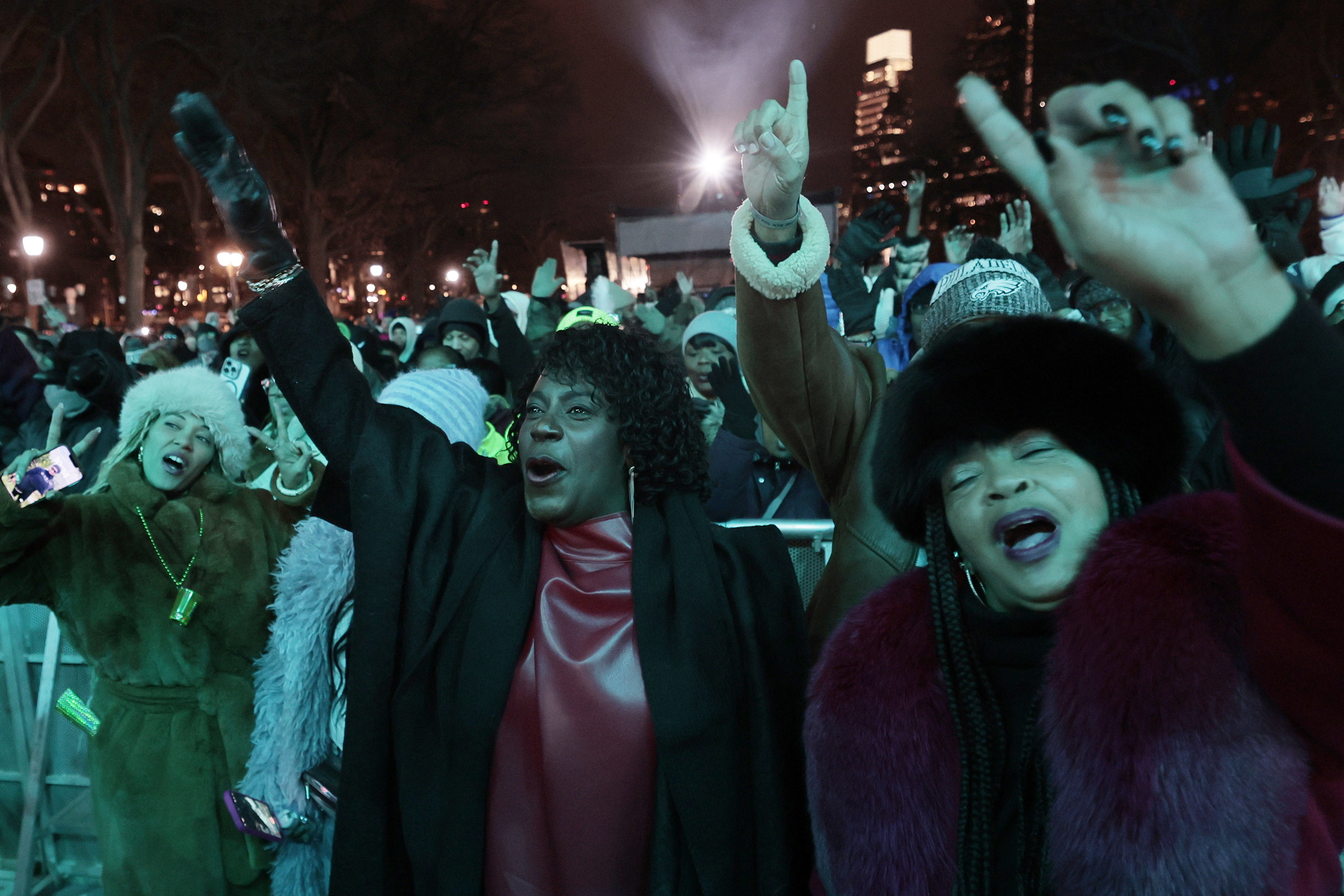
Fans braved the bitter cold to attend the free New Year’s Eve concert in front of the Philadelphia Art Museum and watch a midnight fireworks display kicking off the city’s celebration of the nation’s 250th anniversary.
The concert was headlined by LL Cool J, the two-time Grammy-winning rapper who also has had a long career in movies and TV, including as a regular cast member on the series NCIS: Los Angeles.
About 10 minutes to midnight, LL Cool J brought out Philadelphia-based rapper Freeway as a surprise guest.
Mayor Cherelle L. Parker joined the stage just before 10 p.m. to welcome another headliner, DJ Jazzy Jeff, alongside radio personality Lady B.
“My mayor is a hip-hop head,” Lady B said. Parker told the crowd: “Tonight, we remind the nation, that we are one America, a united nation.”
After taking the stage, Parker told a gaggle of reporters “what you are seeing is ‘one Philly, a united city’ in action” — referencing her mayoral slogan.
“Philadelphia is the birthplace of democracy, sixth-largest city in the nation — Why wouldn’t we kick off 2026, the Semiquincentennial, the 250th birthday of our nation?” she said. “Because Philadelphia, it’s where it happened.”
When asked if the free concert will become an annual tradition, Parker quipped, “Well, the budget process.” (A final price tag on the event was not yet available.)
Mayor Cherelle L. Parker and Lady B (right) dance to DJ Jazzy Jeff during Philadelphia’s free New Year’s Eve concert and fireworks display, at the Oval on the Benjamin Franklin Parkway, on Wednesday, Dec. 31, 2025.
As for Parker’s resolutions for Philly in 2026: “To work harder, to dream bigger, and to do the impossible.
“We have a lot of challenges to address here in our city, but with our amazing team, there is nothing that we cannot accomplish together,” she said.
Taking the stage shortly after 8 p.m., multi-instrumentalist Adam Blackstone, the Philadelphia High School for Creative and Performing Arts graduate and University of the Arts alum who has since performed with some of the world’s most popular musical artists, declared: “I’m home right now. They told me Philly’s the spot to be.”
Just before 11:30 p.m., attendance had grown to around 7,500 and was still growing, according to the show’s producer, Scott Mirkin, of ESM Productions. The final crowd estimate was 10,000 attendees, according to ESM.
The crowd had been modest up to around 10 p.m., but a late surge may have included people only interested in seeing LL Cool J or the fireworks display after the concert.
All were bundled in winter gear as the wind chill dipped into the 20s and even flurries made a late-night appearance.
Performers repeatedly commented on the frigid temperatures Wednesday night.
“I know it’s cold but we’re going to warm you up,” Dorothy frontwoman Dorothy Martin told concertgoers.
Martin later said: “I know you’re cold, but your heart is warm.”
The temperature made Fairmount residents Corey Fletcher, 32, and Alyza Ngbokoli, 30, hesitate, despite the draw of Cool J and Jazzy Jeff. Both were surprised by the prospect of an outdoor concert in the winter.
“It’s hard to breathe — it hurts my lungs,” Fletcher said of the cold. (Fletcher said fall is the ideal season for outdoor events; Ngbokoli said summer.)
For next year, Ngbokoli recommended organizers invest in heat lamps or warming tents. This year, concertgoers had the option of purchasing a hot meal — fried desserts, fried chicken, or lobster bisque from various food trucks — hot apple cider, hot chocolate, or $8 White Claws and other spirits.
Adam Blackstone performs during Philadelphia’s free New Year’s Eve concert and fireworks display, at the Oval on the Benjamin Franklin Parkway, on Wednesday, Dec. 31, 2025.
Die-hard fans were undeterred by the cold.
Sarah and Mike Murray, of Wilkes-Barre, estimate they’ve seen Cool J in concert “almost double-digits.”
“He’s easy on the eyes,” Sarah, 46, said.
“You can’t argue with that,” chimed Mike, 54. “He’s LL — ladies love him.”
The Cool J enthusiasts were supposed to see him perform on the Parkway on July 4, but the “Mama Said Knock You Out” and “I Can’t Live Without My Radio” singer canceled in solidarity with striking municipal workers.
What are the Murrays looking forward to in 2026?
“See LL Cool J more,” Mike said.
Cousins Tahira and Sean Tyler came to the Ben Franklin Parkway expecting a party. It was 55-year-old Sean Tyler’s first New Year’s Eve out on the town, and both were drawn in by LL Cool J.
Sean Tyler, of Overbrook Park, said she remembered in the ‘80s listening to the then-new artist’s first single on Power 99, but had never seen him live. Both Tylers discovered newfound appreciation for LL Cool J canceling his summer concert in solidarity with striking city workers.
“It showed how many people that it affected, and how much in wages, benefits — it shows how much it affects a broad range of people,” Sean Tyler said.
Upon walking into the barricaded Parkway, Sean and Tahira said the visible Philadelphia police presence and security measures made them feel safe.
Police Commissioner Kevin Bethel has said police will be out in full force, and asked concertgoers to leave weapons at home.
Tahira said the show, featuring local talents — like Blackstone and Jazzy Jeff — is the perfect way to ring in 2026, and the nation’s 250th birthday.
Tahira said: “Let’s continue to love Philly in the right kind of way — “
Two men were in stable condition after sustaining stab wounds on SEPTA’s Broad Street Line late Wednesday afternoon, a transit agency spokesperson said.
The stabbings happened around 4 p.m. on a northbound Broad Street Line train, said SEPTA spokesperson John Golden.
Because of police activity at the Broad-Girard Station, northbound B1, B2, and B3 trains were bypassing the station for several hours.
Shortly after 10:30 p.m., Golden said a suspect had been taken into custody by SEPTA Transit Police.
B1,B2,B3: Northbound B1, B2, and B3 trains are bypassing Girard Station due to police activity.
A 31-year-old man was fatally shot — allegedly by his 38-year-old brother — in the parking lot of a shopping center Wednesday evening in the Eastwick section of Southwest Philadelphia, police said.
Just before 6:10 p.m., nearby police officers responded to the sound of gunfire at the Penrose Plaza Shopping Center at 2900 Island Ave. and found the victim with two gunshot wounds to the chest, police said.
The man was transported by police to Penn Presbyterian Medical Center, where he was pronounced dead at 6:35 p.m.
Inspector D.F. Pace said the brothers, whose identities were not released, were believed to be arguing about money when the shooting happened.
The older brother was quickly taken into custody, Pace said.