Right after Pennsylvania Attorney General Dave Sunday was sworn into office in January, he received a lunch invitation from across the Delaware River.
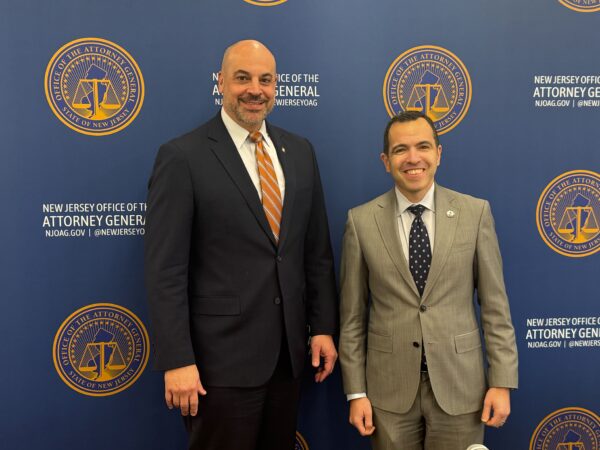
It didn’t matter that they came from different political parties, said New Jersey Attorney General Matthew Platkin, a Democrat appointed to his post by outgoing Gov. Phil Murphy.
Platkin wanted to get to know his neighbor, and invited Sunday out to lunch in Philadelphia.
The two men could not have more different approaches to their jobs. In a hyperpolarized political era, where attorneys general play an increasingly important role in national politics, Platkin has become a face of Democratic opposition to President Donald Trump’s administration. He has led or joined dozens of lawsuits by blue-state attorneys general and governors in arguing that the executive branch is acting unconstitutionally on issues like birthright citizenship, withholding congressionally approved funds, and more.
In contrast, Sunday, a Republican elected last year, has largely avoided suing Trump and has said he strives to be “boring,” focusing his efforts on oversight of his own office.
Even their jobs are different, despite sharing a title. New Jersey’s attorney general is in charge of the state’s 21 county prosecutors, oversight of state police, and protecting consumers, among other duties; Pennsylvania’s attorney general has wide-ranging powers to investigate corruption, enforce the state’s laws, represent the state’s agencies and interests in lawsuits, and more.
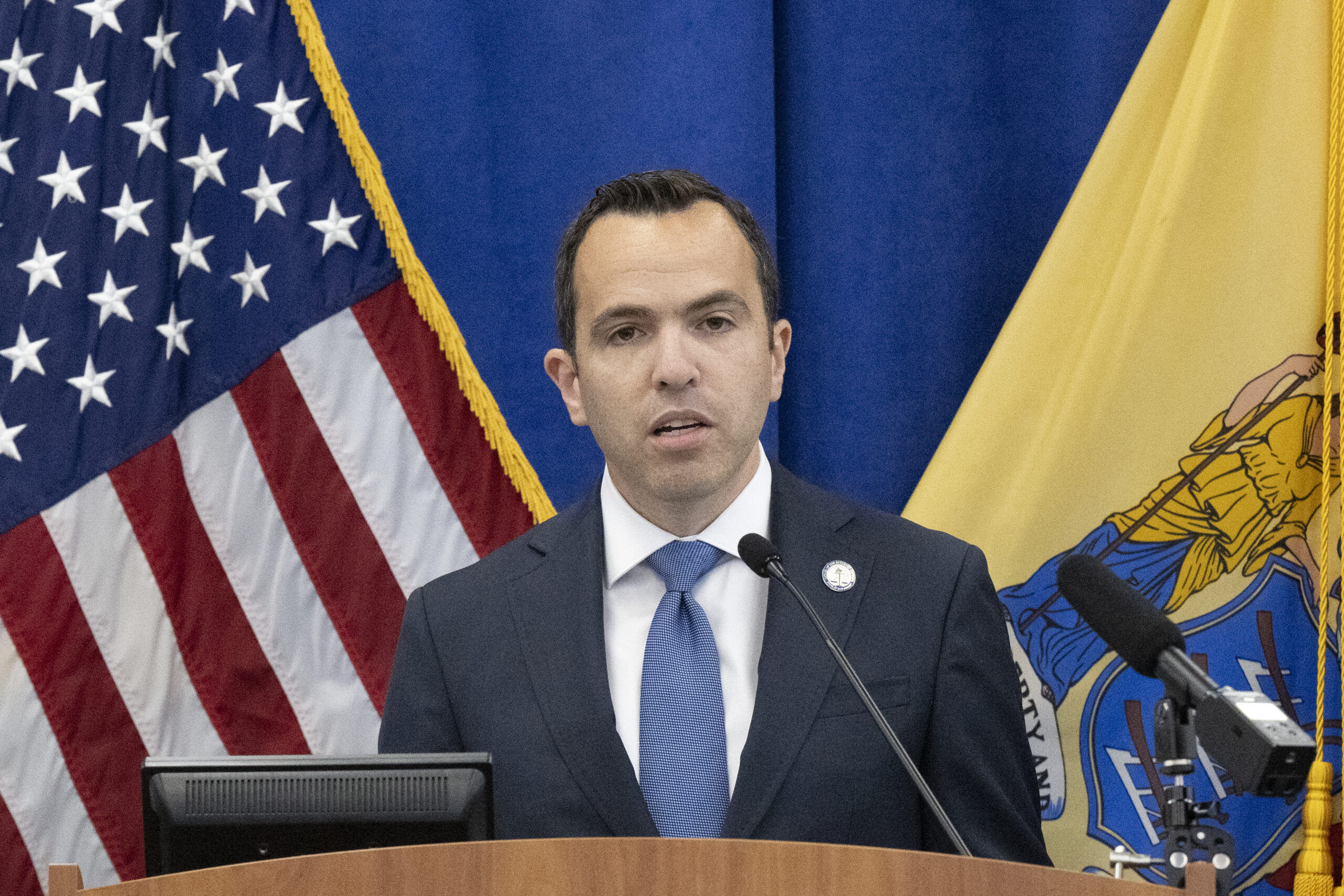
New Jersey Attorney General Matthew Platkin on Monday, June 17, 2024, at the Richard J. Hughes Justice Complex in Trenton, N.J.
Platkin, 39, is an ambitious lawyer who grew up in northern New Jersey and attended one of the best high schools in the state before attending Stanford University and Stanford Law School. He went on to work in private practice in New York and New Jersey before being appointed as chief general counsel to Murphy at 35 — the youngest person to ever hold the office.
Sunday, 50, grew up in a suburb of Harrisburg and has described his high school years as lacking direction. He joined the U.S. Navy after high school before attending Pennsylvania State University for undergraduate and Widener University Law School for his law degree, working at UPS to help put himself through school. He returned to south-central Pennsylvania for his clerkship, and was a career prosecutor in York County until his election to attorney general.
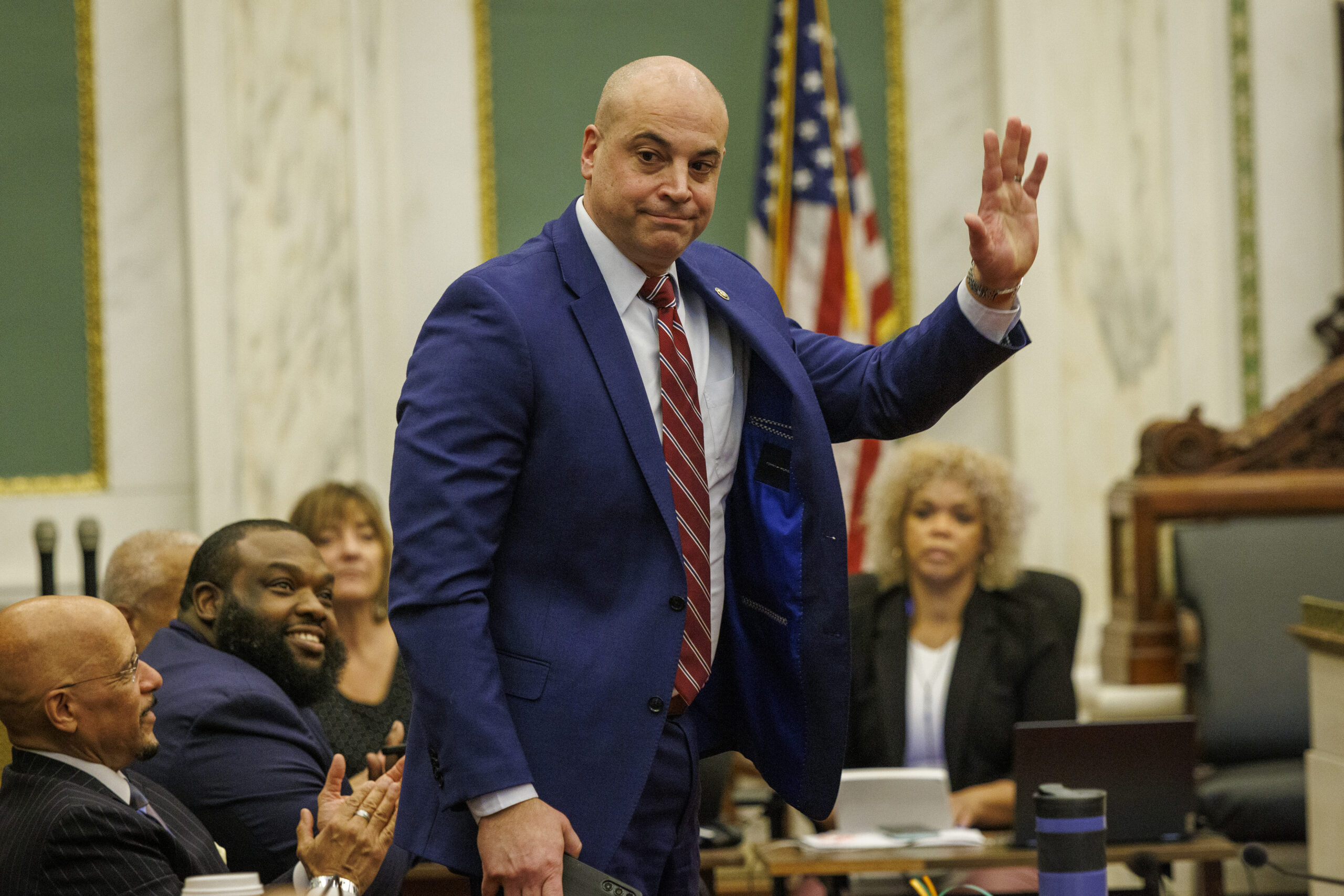
Pennsylvania Attorney General Dave Sunday stands to be recognized by Council President Kenyatta Johnson before Philadelphia Mayor Cherelle Parker gives her budget address to City Council, City Hall, Thursday, March 13, 2025.
But over salads at the Mulberry, Platkin and Sunday found common ground. And ever since, the two said in a joint interview this month, they have worked closely on issues affecting residents in their neighboring states.
“Just because you may not see eye-to-eye on [Trump] doesn’t mean you can’t see or don’t see eye-to-eye on many, many other issues,” Sunday said.
“When we have an auto theft problem, [residents] don’t care if there’s a ‘D’ or an ‘R’ after your name,” Platkin added. “They just want to see us working to solve it.”
The two have since worked together on issues that stretch from criminal investigations and human trafficking cases to challenging Big Tech companies as artificial intelligence rapidly advances, Sunday said.
Earlier this month, Sunday and Platkin led national efforts of coalescing approximately 40 attorneys general across party lines on the issues they say are most pressing for residents. The group wrote a letter to Big Tech companies in mid-December, detailing concerns about the lack of guardrails for AI chatbots like those available from ChatGPT or Meta’s Instagram AI chats, and the potential harm they could cause people in crisis or children who use them.
In two more letters sent this month, the attorneys general also voiced support for a workforce reentry bill before a U.S. House committee and requested that Congress approve additional funding for courtroom and judicialsecurity to protect the nation’s judges from safety threats. Platkin and Sunday said they were some of the first attorneys general to sign on to the letters.
“While the undersigned hold differing views on many legal issues, we all agree that the legal system cannot function if judges are unsafe in their homes and courthouses,” the group of 47 attorneys general wrote in a Dec. 9 letter to top leaders of Congress.
When it comes to lawsuits against the Trump administration and other litigation authored by partisan attorneys general associations, Sunday has largely avoided the fray. Earlier this month, he was elected Eastern Region chair of the National Association of Attorneys General, a nonpartisan group composed of the 56 state and territory attorneys general.
Platkin, on the other hand, has led the charge in pushing back against the administration’s policies in New Jersey, signing onto dozens of lawsuits such as ones challenging Trump’s efforts to end birthright citizenship and to withhold SNAP funding if a state does not turn over personal information about its residents.
Still, Pennsylvania has joined many lawsuits, including several challenging the federal government for withholding congressionally approved funds for electric vehicles and more, as Democratic Gov. Josh Shapiro, formerly the state’s attorney general, has signed on in his capacity as governor.
Platkin, who has served as New Jersey’s attorney general since 2022, will leave office when Murphy’s term ends next month, and Gov.-elect Mikie Sherrill will appoint someone new to the post. Sherrill, a Democrat, earlier this month nominated Jen Davenport, a former prosecutor and current attorney at PSE&G, New Jersey’s largest electric and gas company, to be Platkin’s successor.
Sunday’s team has already been in touch with Davenport to forge a similar cross-state working relationship.
What’s next for Platkin? He said he’s a “Jersey boy” and will remain in the state but declined to say what his next move might entail.
And both Platkin and Sunday say they will maintain their bipartisan friendship going forward.
“It’s OK to say we don’t agree on everything. We shouldn’t hate each other,” Platkin said. “We should be open about the fact that we like each other. … I don’t think there’s anything wrong with that.”
Marsha Levick took her seat at a conference table at the Juvenile Law Center on a recent Wednesday for what would be one of her last meetings. She walked colleagues through the basic principles of the United Nations Convention on the Rights of the Child, the 1989 treaty that laid out, in clear terms, what the world said it owed young people.
At the heart of the treaty is a simple idea: A child’s best interests come first — even when that child enters the justice system. It has been ratified by all but one of the U.N.’s member nations: the U.S. And in many of those 196other countries,Levick said, children younger than 14 cannot be prosecuted at all.
“Wait,” a staffer interjected. “Kids younger than 14 aren’t in the justice system?”
“I know,” Levick said. “It’s very different.”
Marsha Levick, chief legal officer and cofounder of the Juvenile Law Center, speaks with staff on Dec. 17.
For 50 years, Levick, 74, has been one of the most persistent and influential voices in the American juvenile justice system, a driving force in turning what was once a niche legal specialty into a national civil rights movement. Colleagues credit her with helping to rewrite how courts view children — persuading judges, including those on the U.S. Supreme Court, to treat youth not as miniature adults but as citizens with distinct constitutional protections and needs.
Levick will step down Wednesday from her position as chief legal officer of the Juvenile Law Center, the Philadelphia-based organization she helped build from a walk-in legal clinic in 1975 into a national leader in children’s rights.
Her departure coincides with the center’s 50th anniversary. At a celebration gala in May, the nonprofit honored Levick with a leadership award that recognized her body of work.
Levick’s career ranged from representing individual teenagers to steering landmark litigation that forced states to overhaul abusive practices. She helped lead the Juvenile Law Center’s response to the “kids for cash” scandal in Luzerne County. She coauthored briefs in a series of U.S. Supreme Court victories that throttled the harshest punishments for kids, including life in prison.
But Levick is also stepping down at what she calls a “dark moment” forcivil liberties in America — a time when rights once thought settled are being rolled back.
Levick was in law school in 1973 when the U.S. Supreme Court handed down Roe v. Wade, the landmark decision that recognized a constitutional right to abortion. In the years that followed, a constellation of rights — from marriage equality to access to contraception — also expanded.
Roe was overturned, however, in 2022. Since then, other decisions have also chipped away at affirmative action in colleges and LGBTQ+ protections.
“It’s hard to convey the shock that it imposes,” Levick said in a recent interview. “Now, 50 years later, you’re pushing the rock back up the hill.”
She made clear she was unsparing with herself, quick to point out what she perceived as shortcomings. “There were high moments for sure,” she said. “But I am not foolishly happy about that. I’m shocked that that’s all we could do. That’s as far as we got.”
Yet even as fresh battles loom, colleagues say the groundwork Levick has laid will guide the Juvenile Law Center’s mission and the broader fight for children’s rights for years to come.
Jessica Feierman, the center’s senior managing director, will step into Levick’s role. “It is a huge privilege and also an immense responsibility,” she said. “In this moment of attacks on civil rights and children’s rights, it’s even more vital that we build on the victories of the last 50 years.”
From Philadelphia to the U.S. Supreme Court
Raised in Philadelphia’s Fairmount neighborhood, Levick discovered early the charge of using her voice, first as a girl who demanded a recount in an elementary school election and won the presidency, and later as a teenager who inhaled The Feminine Mystique and the feminist writers who followed. She earned an undergraduate degree from the University of Pennsylvania and a law degree from what is now Temple University Beasley School of Law.
She cofounded the Juvenile Law Center in 1975 with three law school classmates: Bob Schwartz, a classical music aficionado and part-time semi-pro baseball umpire; Phil Margolis, a vegetarian and free spirit; and Judy Chomsky, a mother of two and passionate Vietnam War resister.
Seven years earlier, the U.S. Supreme Court had ruled that juveniles were entitled to due process. That decision cracked open an untapped field, Levick said, to buildwith her classmates a new kind of civil rights practice focused on children.
For the first year, they worked out of the Chestnut Street office of Chomsky’s husband, a cardiologist, carving out space in his waiting room and sidestepping an exam room on the days he saw patients.
In its earliest years, the center took on individual cases for children. One of Levick’s first clients was in Montgomery County, a teen girl who had participated in a protest at a nuclear plant and who was arrested and charged with trespassing, she said.
But the center struggled financially. The founding partners laid themselves off at one point, Levick said, so they could keep paying the few employees they had hired: a divorced mother who worked as a receptionist; their first lawyer, Anita DeFrantz, who was an Olympic rower; and a social worker.
In 1982, Levick quit the center to become the legal director of the national NOW Legal Defense and Education Fund, now Legal Momentum. By the time she left there six years later, she had become its executive director.
At the NOW Legal Defense and Education Fund, Levick said, she learned how to build national cases — coordinating multistate litigation and filing amicus briefs in federal courts. By the time she returned to the Juvenile Law Center in 1995, after a stint at a small Paoli firm, she had come to believe that individual wins, while necessary, would not be enough to create lasting change.
The center’s mission became more focused on appellate litigation and national advocacy, setting the stage for children’s rights to reach state supreme courts and, eventually, the U.S. Supreme Court.
Hundreds of juveniles resentenced, released
In 2005, in Roper v. Simmons, Levick cowrote in a brief that social science research on youth development should inform constitutional law. Children, she also wrote, have a greater capacity to change.
“We just pushed ourselves into the center of it,” Levick said. “We were like, ‘We’re here. We’re writing the amicus brief.’”
The high court overturned decades of precedent when it ruled in Roper that the Eighth Amendment forbids the death penalty for juveniles. Five years later, in Graham v. Florida, it barred life-without-parole sentences for juveniles in non-homicide cases, after reading another brief Levick coauthored.
In 2012, Levick helped persuade the court to end mandatory life-without-parole sentences for youths convicted of homicide in Miller v. Alabama. And in 2016, she served as cocounsel in Montgomery v. Louisiana, the case that made the Miller decision retroactive across the country.
Since then, hundreds of juveniles — including nearly 500 in Pennsylvania — have been resentenced or released from prison. One of them: Donnell Drinks, freed in 2018 after 27 years.
The first time Drinks met Levick, he hugged her. “I couldn’t believe how small she was, because of her presence, her legal prowess, has all been so enormous,” recalled Drinks, who works as a leadership and engagement coordinator at the Campaign for the Fair Sentencing of Youth.Levick is 5-foot-3.
Those cases brought Levick into courtrooms across the state, often alongside public defenders. One of them, Bradley S. Bridge, a retired Philadelphia public defender who worked with her on dozens of resentencings, called Levick a “zealous advocate” who “always saw the big picture.”
Her ability, he said, “to think toward the future, I think, was most glorious.”
Levick agreed that looking ahead had always been part of her work. “We always tried to look around the corner,” she said.
One of those moments came in 2008, when she and her colleagues began fielding troubling calls from Luzerne County — the first hints of what would become the “kids-for-cash” scandal.
Seeing more in the ‘kids-for-cash’ scandal
In 2007, Laurene Transue called the Juvenile Law Center. Her daughter, 14-year-old Hillary Transue, had been ordered to serve three months in a detention facility after she created a Myspace page mocking her school principal, she said at the time.
“We saw in that one phone call something that was clearly much bigger,” Levick said.
In fact, it was one of the most egregious judicial corruption cases in modern American history: Two Luzerne County judges had accepted kickbacks in exchange for sentencing thousands of juveniles — many for minor misbehavior — to extended stays in private detention centers.
“It was kind of like, if I may, what the f— in my mind,” Levick recalled.
Levick and the center petitioned the Pennsylvania Supreme Court, which ultimately threw out and expunged thousands of adjudications. They later helped families pursue civil damages, with the help of other firms. The judges, Mark Ciavarella and Michael Conahan, were convicted of federal crimes and sentenced to long prison terms; President Joe Biden commuted Conahan’s sentence in 2024.
Hillary Transue now serves on the Juvenile Law Center’s board.
Transue told The Inquirer that as a teenager she believed that “highly educated” adults in “positions of authority” were “mean, nasty people who were out to hurt you.” But Levick, she said, “brushed up against my perception of adults” and proved her wrong.
“I think she’s a goddamn superhero,” Transue said recently.
Marsha Levick (center) stands with staffers at the Juvenile Law Center earlier this month.
Among the successes, Levick still sees failures
Despite the victories, Levick is quick to cite the cases she lost. “I’ve had successes. I’ve also failed many times,” she said.
She still thinks about clients like Jamie Silvonek, sentenced to 35 years to life in prison after killing her mother, whose early release Levick has fought for but has not yet won, or a recent bid to expand parole access for people convicted as juveniles that fell flat in Florida.
Those losses have hardened her view of how deeply punishment is embedded in American law. “I feel like punishment is in our bones,” she said. “The way that we think about crime is that it is always followed by punishment.”
That instinct, she said, has left behind people who could have thrived outside prison — including juvenile lifers who will never be released. One of them is Silvonek, whom Levick described as brilliant and warm. “I want her to be able to share that warmth and joy with her family and with her community, who are all behind her,” Levick said.
“We lost what they had to give,” she added.
Levick isn’t done yet
Levick, who is married with two adult daughters, is not leaving the field. She will become the Phyllis Beck chair at Temple’s Beasley School of Law, a post once held by her cofounder Bob Schwartz, and will teach constitutional law to first-year students.
She feels newly urgent about the course. “I am outraged at the degree to which the law has been perverted by the current moment, and I think I still can say and do something about that,” she said. “I think that the things that motivate me include outrage.”
She expects much of the future progress in youth justice to come from state supreme courts rather than the U.S. Supreme Court — a shift she sees as pragmatic, not pessimistic. Washington State Supreme Court Justice Mary Yu, who has heard Levick argue successfully before her, called her a fearless litigator. “She’s an extraordinary appellate lawyer,” Yu, who is also retiring Wednesday, said in an interview.“It’s almost instinctual to her.”
And even now, Levick said, she has hope.
“We’re not going to abolish the juvenile justice system in America, but we could transform it radically,” Levick said. “I believe that. But it takes more than just lawyers to care. It takes more than the community to care. It takes people in positions of power to care. And that’s the hard part.”
Correction: An earlier version of this article misstated the name of a legal advocacy group at which Levick worked. She worked at NOW Legal Defense and Education Fund. The story also misstated the year Laurene Transue called the Juvenile Law Center; she called the law center in 2007.
When U.S. Steel opted to build a new mill in Arkansas that had originally been planned for Allegheny County, then-Arkansas Gov. Asa Hutchinson jokedin 2022 that his state could have the mill built faster than Pennsylvania could have it permitted.
Three years later, Pennsylvania politicians and business leaders are hopeful that a series of permitting reforms — the latest of which were approved as part of the state’s $50.1 billion budget — have finally flippedthatdynamic.
The reforms, which are designed to expedite Pennsylvania’s Department of Environmental Protection’s permitting process to allow for quicker development, mark a major step forward in a project that has long been a goal for Democratic Gov. Josh Shapiro and Republican leaders in the General Assembly.
Pennsylvania’s Department of Environmental Protection is responsible for issuing a variety of permits for building plans to ensure they comply with state law and are environmentally safe. The latest reforms will force the agency to automatically approve certain permits relating to stormwater and groundwater within 60 days if it has not completed its review in that time period or sought an extension. For certain permits related to air quality, the changes allow for the permits to be automatically approved 30 days after submission if the DEP has not acted.
The budget, which Shapiro signed into law last month, also expanded an existing program, called SPEED, that allows companies to hire third-party inspectors for certain permits to expedite the process. And lawmakers required the state to create and maintain a database where companies can easily track the progress of their permit applications.
For Senate Majority Leader Joe Pittman (R., Indiana), the change represents a paradigm shift in the state. He recalled the 2022 loss of the U.S. Steel mill at a news conference last month.
“You cannot have economic development without shovels in the ground, and you can’t put shovels in the ground without permits,” Pittman said.
The reforms, he said, will “provide certainty,” which he called, “critical to economic development.”
A longtime goal
Amy Brinton, director of government affairs at the Pennsylvania Chamber of Business and Industry, said it has long been common for businesses to choose other states because of Pennsylvania’s arduous permitting process, and at times begin the process of building in Pennsylvania only to move out of state when permitting becomes a hurdle.
“We lose a lot of projects to Texas and Ohio because of our complicated permitting process,” Brinton said.
Remedying this through permitting reforms, as well as expedited certifications, have been among Shapiro’s top priorities as governor.
“When he took office in January 2023, Governor Shapiro promised to make state government work more efficiently and effectively for Pennsylvanians. Since then, the Shapiro Administration has delivered on that promise to get stuff done — streamlining permitting processes, reducing wait times for licenses, and cutting red tape to attract more businesses to the Commonwealth,“ Kayla Anderson, a spokesperson for Shapiro, said in a statement. ”This budget builds on the Governor’s success.”
Shapiro signed several executive orders aimed at that goal including developing a “Fast Track” program for high-priority projects. DEP has eliminated the 2,400 permit backlog that existed when Shapiro took officein 2023. Additionally, Shapiro’s office said, the average processing time for all permits dropped to 38 days in 2025 from 53 days in 2022.
Lawmakers first approved the SPEED program allowing for third-party inspectors in the 2024 budget. Shapiro’s office said the program has alreadyproduced results, cutting permit wait times in half in some cases.
These projects are a key part of Shapiro’s business-friendly approach, which he’s promoted as he bolsters his resume and bipartisan appeal ahead of a 2026 reelection campaign and a potential future presidential run.
“The permitting was awful,” Ward said in an interview last month. “Permitting now, instead of 300 days, we’re at 30 days. It’s amazing that we were able to come together and get that done.”
Brinton said she is hopeful that the combination of reforms will make it easier for businesses to choose to build in Pennsylvania because the timeline will be more predictable.
“Improved accountability, greater predictability, faster timelines — those are the key kind of drivers that we’re hoping this will continue to provide to our businesses in the hopes that when they look at Pennsylvania they won’t wince at the fact that this is going to take forever,” Brinton said.
President DonaldTrump on Monday said he might sueFederal Reserve Chair Jerome H. Powell for what the president called “gross incompetence,” injecting new tension into the already strained relationship between the White House and theindependent central bank.
Speaking at a news conference beside Israeli Prime Minister Benjamin Netanyahu at Mar-a-Lago in Florida, Trump said, “The guy is just incompetent.” Trump firstbrought up the Fed’s multibillion-dollar renovation project, which at times has become a stand-in for Trump’s ongoing attacks on the Fed system.
“It’s gross incompetence against Powell,” Trump said, adding: “We’re going to probably bring a lawsuit against him.”
Trump threatened a “major lawsuit” against Powell over the summer, but he never followed through. It wasn’t clear what specific claims Trump was referring to Monday, or how or when a suit could be brought. The White House did not respond to a request for more information.
The Fed declined to comment.
The Fed’s renovation project isn’t the only way Trump has put pressure on the bank. White House officials and their allies routinely call for lower interest rates, even though monetary policy is supposed to be siloed off from politics. Trump has threatened to oust Powell and has tried to fire Federal Reserve governor Lisa Cook, setting up an ongoing legal battle over a president’s ability to removecentral bankers.
Trump administrationofficials have alleged Powell either lied to Congress about the renovation or grossly mismanaged the project. Over the summer, when Trump’s criticism was most acute, the price tag for the project had swelled to nearly $2.5 billion, up from an estimate of $1.9 billion before the pandemic. The health crisis and ensuing economic upheaval caused materials such as steel and cement to go up in price, the Fed has said.
Trump toured the renovations over the summer. But the visit proved surprisingly cordial, with Trump saying he wouldn’t fire Powell and wanted the project to continue. At one point, Powell held his ground and fact-checked Trump’s comments that the renovation had cost more than $3 billion.
MINNEAPOLIS — Federal Homeland Security officials were conducting a fraud investigation on Monday in Minneapolis, Department of Homeland Security Secretary Kristi Noem said.
The action comes after years of investigation that began with the $300 million scheme at the nonprofit Feeding Our Future, for which 57 defendants in Minnesota have been convicted. Prosecutors said the organization was at the center of the country’s largest COVID-19-related fraud scam, when defendants exploited a state-run, federally funded program intended to provide food for children.
Minnesota Gov. Tim Walz said then that fraud will not be tolerated and that his administration “will continue to work with federal partners to ensure fraud is stopped and fraudsters are caught.”
Noem on Monday posted a video on the social platform X showing DHS officers going into an unidentified business and questioning the person working behind the counter. Noem said that officers were “conducting a massive investigation on childcare and other rampant fraud.”
“The American people deserve answers on how their taxpayer money is being used and ARRESTS when abuse is found,” U.S. Immigration and Custom Enforcement posted.
The action comes a day after FBI Director Kash Patel said on X that the agency had “surged personnel and investigative resources to Minnesota to dismantle large-scale fraud schemes exploiting federal programs.”
Patel said that previous fraud arrests in Minnesota were “just the tip of a very large iceberg.”
President Donald Trump has criticized Walz’s administration over the fraud cases to date.
In recent weeks, tensions have been high between state and federal enforcement in the area as the Trump administration’s immigration crackdown focused on the Somali community in the Minneapolis-St. Paul area, which is the largest in the country.
Among those running schemes to get funds for child nutrition, housing services, and autism programs, 82 of the 92 defendants are Somali Americans, according to the U.S. Attorney’s Office for Minnesota.
Walz spokesperson Claire Lancaster said that the governor has worked for years to “crack down on fraud” and was seeking more authority from the Legislature to take aggressive action. Walz has supported criminal prosecutions and taken a number of other steps, including strengthening oversight and hiring an outside firm to audit payments to high-risk programs, Lancaster said.
States will share $10 billion for rural healthcare next year in a program that aims to offset the Trump administration’s massive budget cuts to rural hospitals, federal officials announced Monday.
But while every state applied for money from the Rural Health Transformation Program, it won’t be distributed equally. And critics worry that the funding might be pulled back if a state’s policies don’t match up with the administration’s.
Officials said the average award for 2026 is $200 million, and the fund puts a total of $50 billion into rural health programs over five years. States propose how to spend their awards, and the Centers for Medicare and Medicaid Services assigns project officers to support each state, said agency administrator Mehmet Oz.
“This fund was crafted as part of the One Big Beautiful Bill, signed only six months ago now into law, in order to push states to be creative,” Oz said in a call with reporters Monday.
Under the program, half of the money is equally distributed to each state. The other half is allocated based on a formula developed by CMS that considered rural population size, the financial health of a state’s medical facilities, and health outcomes for a state’s population.
The formula also ties $12 billion of the five-year funding to whether states are implementing health policies prioritized by the Trump administration’s Make America Healthy Again initiative. Examples include requiring nutrition education for healthcare providers, having schools participate in the Presidential Fitness Test, or banning the use of SNAP benefits for so-called junk foods, Oz said.
Several Republican-led states — including Arkansas, Iowa, Louisiana, Nebraska, Oklahoma, and Texas — have already adopted rules banning the purchase of foods like candy and soda with SNAP benefits.
The money that the states get will be recalculated annually, Oz said, allowing the administration to claw back funds if, for example, state leaders don’t pass promised policies. Oz said the clawbacks are not punishments, but leverage governors can use to push policies by pointing to the potential loss of millions.
“I’ve already heard governors express that sentiment that this is not a threat, that this is actually an empowering element of the One Big Beautiful Bill,” he said.
Carrie Cochran-McClain, chief policy officer with the National Rural Health Association, said she’s heard from a number of Democratic-led states that refused to include such restrictions on SNAP benefits even though it could hurt their chance to get more money from the fund.
“It’s not where their state leadership is,” she said.
Experts say fund is inadequate in face of other cuts
Oz and other federal officials have touted the program as a 50% increase in Medicaid investments in rural healthcare. Rep. Don Bacon, a Republican from Nebraska who has been critical of many of the administration’s policies but voted for the budget bill that slashed Medicaid, pointed to the fund when recently questioned about how the cuts would hurt rural hospitals.
“That’s why we added a $50 billion rural hospital fund, to help any hospital that’s struggling,” Bacon said. “This money is meant to keep hospitals afloat.”
But experts say it won’t nearly offset the losses that struggling rural hospitals will face from the federal spending law’s $1.2 trillion cut from the federal budget over the next decade, primarily from Medicaid. Millions of people are also expected to lose Medicaid benefits.
Estimates suggest rural hospitals could lose around $137 billion over the next decade because of the budget measure. As many as 300 rural hospitals were at risk for closure because of the GOP’s spending package, according to an analysis by the Cecil G. Sheps Center for Health Services Research at the University of North Carolina at Chapel Hill.
“When you put that up against the $50 billion for the Rural Health Transformation Fund, you know — that math does not add up,” Cochran-McClain said.
She also said there’s no guarantee that the funding will go to rural hospitals in need. For example, she noted, one state’s application included a proposal for healthier, locally sourced school lunch options in rural areas.
And even though innovation is a goal of the program, Cochran-McClain said it’s tough for rural hospitals to innovate when they were struggling to break even before Congress’ Medicaid cuts.
“We talk to rural providers every day that say, ‘I would really love to do x, y, z, but I’m concerned about, you know, meeting payroll at the end of the month,’” she said. “So when you’re in that kind of crisis mode, it is, I would argue, almost impossible to do true innovation.”
PALM BEACH, Fla. — President Donald Trump warned Iran on Monday that the U.S. could carry out further military strikes if the country attempts to reconstitute its nuclear program as he held wide-ranging talks with Israeli Prime Minister Benjamin Netanyahu at his home in Florida.
Trump had previously insisted that Tehran’s nuclear capabilities were “completely and fully obliterated” by U.S. strikes on key nuclear enrichment sites in June. But with Netanyahu by his side, Trump raised the possibility that suspected activity could be taking place outside those sites. Israeli officials, meanwhile, have been quoted in local media expressing concern about Iran rebuilding its supply of long-range missiles capable of striking Israel.
“Now I hear that Iran is trying to build up again,” Trump told reporters gathered at his Mar-a-Lago estate. “And if they are, we’re going to have to knock them down. We’ll knock them down. We’ll knock the hell out of them. But hopefully that’s not happening.”
Trump’s warning to Iran comes as his administration has committed significant resources to targeting drug trafficking in South America and the president looks to create fresh momentum for the U.S.-brokered Israel-Hamas ceasefire. The Gaza deal is in danger of stalling before reaching its complicated second phase that would involve naming an international governing body and rebuilding the devastated Palestinian territory.
At a news conference with Netanyahu after their meeting, Trump suggested that he could order another U.S. strike.
“If it’s confirmed, they know the consequences, and the consequences will be very powerful, maybe more powerful than the last time,” Trump said.
Iran has insisted that it is no longer enriching uranium at any site in the country, trying to signal to the West that it remains open to potential negotiations over its atomic program. The two leaders discussed the possibility of taking new military action against Tehran just months after June’s 12-day war.
The Iranian mission to the United Nations did not immediately respond to a request for comment on Trump’s warning.
Gaza ceasefire progress has slowed
Trump, with Netanyahu by his side, said he wants to get to the second phase of the Gaza deal “as quickly as we can.”
“But there has to be a disarming of Hamas,” Trump added.
The truce’s first phase began in October, days after the two-year anniversary of the initial Hamas-led attack on Israel that killed about 1,200 people. All but one of the 251 hostages taken then have been released, alive or dead.
The Israeli leader, who also met separately with Secretary of State Marco Rubio and Defense Secretary Pete Hegseth, has signaled he is in no rush to move forward with the next phase as long as the remains of Ran Gvili are still in Gaza.
Gvili’s parents met with Netanyahu as well as Rubio, U.S. envoy Steve Witkoff, and the president’s son-in-law, Jared Kushner, in Florida on Monday.
“They’re waiting for their son to come home,” Trump said of the family of the young police officer known affectionately as “Rani.”
Next phase is complex
The path to implementing Trump’s peace plan is certainly complicated.
If successful, the second phase would see the rebuilding of a demilitarized Gaza under international supervision by a group chaired by Trump and known as the Board of Peace. The Palestinians would form a “technocratic, apolitical” committee to run daily affairs in Gaza, under Board of Peace supervision.
It further calls for normalized relations between Israel and the Arab world and a possible pathway to Palestinian independence. Then there are thorny logistical and humanitarian questions, including rebuilding war-ravaged Gaza, disarming Hamas, and creating a security apparatus called the International Stabilization Force.
Much remains unsettled
Two main challenges have complicated moving to the second phase, according to an official who was briefed on those meetings. Israeli officials have been taking a lot of time to vet and approve members of the Palestinian technocratic committee from a list given to them by the mediators, and Israel continues its military strikes.
Trump’s plan also calls for the stabilization force, proposed as a multinational body, to maintain security. But it, too, has yet to be formed. Whether details will be forthcoming after Monday’s meeting is unclear.
A Western diplomat said there is a “huge gulf” between the U.S.-Israeli understanding of the force’s mandate and that of other major countries in the region, as well as European governments.
All spoke on the condition of anonymity to provide details that haven’t been made public.
The U.S. and Israel want the force to have a “commanding role” in security duties, including disarming Hamas and other militant groups. But countries being courted to contribute troops fear that mandate will make it an “occupation force,” the diplomat said.
Hamas has said it is ready to discuss “freezing or storing” its arsenal of weapons but insists it has a right to armed resistance as long as Israel occupies Palestinian territory. One U.S. official said a potential plan might be to offer cash incentives in exchange for weapons, echoing a “buyback” program Witkoff has previously floated.
Trump makes case once again for Netanyahu pardon
The two leaders, who have a long and close relationship, heaped praise on each other. Trump also tweaked the Israeli leader, who at moments during the war has raised Trump’s ire, for being “very difficult on occasion.”
Netanyahu said Trump during the lunch was formally told that his country’s education ministry will award him the Israel Prize, breaking the long-held convention of bestowing the honor on an Israeli citizen or resident.
“President Trump has broken so many conventions to the surprise of people,” Netanyahu said. He added, “So we decided to break a convention, too, or create a new one.”
Trump also renewed his call on Israeli President Isaac Herzog to grant Netanyahu, who is in the midst of a corruption trial, a pardon.
Netanyahu is the only sitting prime minister in Israeli history to stand trial, after being charged with fraud, breach of trust, and accepting bribes in three separate cases accusing him of exchanging favors with wealthy political supporters.
Trump has previously written to Herzog to urge a pardon and advocated for one during his October speech before the Knesset. He said Monday that Herzog has told him “it’s on its way” without offering further details.
“He’s a wartime prime minister who’s a hero. How do you not give a pardon?” Trump said.
Herzog’s office said in a statement that the Israeli president and Trump have not spoken since the pardon request was submitted, but that Herzog has spoken with a Trump representative about the U.S. president’s letter advocating for Netanyahu’s pardon.
“During that conversation, an explanation was provided regarding the stage of the process in which the request currently stands, and that any decision on the matter will be made in accordance with the established procedures,” the Israeli president’s office said.
A soggy, gloomy Monday was expected to give way to a blusterous Tuesday that brings a wind advisory as gusts of up to 50 mph blow their way into the Philadelphia region ahead of the New Year.
Strong winds arrived behind a cold front that descended upon the Philly area Monday afternoon, dropping temperatures from the 50s into the 30s. The gusts arrived amid a wind advisory issued by the National Weather Service office in Mount Holly in effect through 1 p.m. Tuesday, with sustained wind speeds of up to 25 mph expected.
“There could be some lulls in the morning, but there is no clear signal as to when we will see the lowest lulls” in wind speed Tuesday, said Sarah Johnson, a meteorologist with the weather service. “It will pretty much be windy all through the morning into midday.”
With gusts potentially reaching into the 50-mph range, Johnson said, the primary concern for Philly-area residents was power outages caused by downed trees and broken tree limbs. That element will especially be a possibility following Monday’s rainy weather, which softened the ground in the area and primed it for potential treefall that could also bring down power lines.
Peco, meanwhile, has said that it is aware of the wind advisory, and that its crews are actively monitoring weather conditions while remaining ready to respond to potential outages. The company on social media also advised residents to steer clear of downed power lines and report outages on its website.
Johnson also noted that the high winds posed a risk to loose objects outdoors, such as holiday decorations and light furniture. Those items, she said, should be secured or taken indoors to keep them from potentially being lost or causing damage should they be taken away in a strong wind.
Additionally, Tuesday’s forecast strong winds could create challenges for drivers — particularly those behind the wheels of “high-profile vehicles” like SUVs, trucks, and other large cars. Essentially, the larger a vehicle is, or the higher off the ground it sits, the more it is apt to be pushed around in high winds, she said.
“The closer you are to the ground, the less likely you are to be impacted by high winds,” Johnson said.
Tuesday’s windy weather, meanwhile, is not an uncommon occurrence for December in the Philadelphia region, Johnson added. Strong cold fronts are known to bring with them windy conditions as temperatures drop — and the cold is likely to remain throughout the week as New Year’s Eve and New Year’s Day come and go.
“It is normal for us to have the strongest temperature gradients — the biggest difference in temperature — in the winter seasons,” she said. “We tend to see those from late fall through early spring — pretty much prime season.”
The strongest winds are likely to move out later Tuesday, but Wednesday is expected to remain somewhat breezy, with gusts possibly reaching up to 20 mph. Those winds, however, fall well short of the wind forecast for Tuesday.
That may be welcome news for New Year’s Eve revelers set to ring in 2026 at Philadelphia’s first New Year’s Eve concert Wednesday. The concert, set to kick off at 8 p.m. on the Benjamin Franklin Parkway, will feature performances by LL Cool J, DJ Jazzy Jeff, Los Angeles rock band Dorothy, and Philadelphia High School for Creative and Performing Arts graduate Adam Blackstone.
Though Tuesday’s windy weather will likely abate in time for the holiday, colder temperatures with a high around 32 degrees are expected Wednesday, so attendees ought to bundle up. New Year’s Day on Thursday fits a similar description, with highs hovering near freezing and breezes up to 20 mph, Johnson said. There is only a slight chance of “lingering light snow or flurries,” according to weather service forecasts.
“It’s likely to be dry, but cold and maybe breezy” the first day of 2026, Johnson said.
Zohran Mamdani has promised to transform New York City government when he becomes mayor. Can he do it?
Mamdani, a 34-year-old democratic socialist, already faces intense scrutiny, even before taking office in one of the country’s most scrutinized political jobs. Republicans have cast him as a liberal boogeyman. Some of his fellow Democrats have deemed him too far left. Progressives are closely watching for any signs of him shifting toward the center.
On Jan. 1, he will assume control of America’s biggest city under that harsh spotlight, with the country watching to see if he can pull off the big promises that vaulted him to office and handle the everyday duties of the job. All while skeptics call out his every stumble.
For Mamdani, starting off strong is key, said George Arzt, a veteran Democratic political consultant in New York who worked for former Mayor Ed Koch.
“He’s got to use the first 100 days of the administration to show people he can govern,” he said. “You’ve got to set a mindset for people that’s like, ‘Hey, this guy’s serious.’”
That push should begin with Mamdani’s first speech as mayor, where Arzt said it will be important for the city’s new leader to establish a clear blueprint of his agenda and tell New Yorkers what he plans to do and how he plans to do it.
Mamdani will be sworn in around midnight during a private ceremony at a historic, out-of-use City Hall subway station. Then in the afternoon, he will be sworn in a second time on the steps of City Hall, while his supporters are expected to crowd surrounding streets for an accompanying block party.
From there, Arzt said, Mamdani will have to count on the seasoned hands he’s hired to help him handle the concrete responsibilities of the job, while he and his team also pursue his ambitious affordability agenda.
Managing expectations as a movement candidate
Mamdani campaigned on a big idea: shifting the power of government toward helping working class New Yorkers, rather than the wealthy.
His platform — which includes free childcare, free city bus service, and a rent freeze for people living in rent stabilized apartments — excited voters in one of America’s most expensive cities and made him a leading face of a Democratic Party searching for bright, new leaders during President Donald Trump’s second term.
But Mamdani may find himself contending with the relentless responsibilities of running New York City. That includes making sure the trash is getting picked up, potholes are filled, and snow plows go out on time. When there’s a subway delay or flooding, or a high-profile crime or a police officer parked in a bicycle lane, it’s not unusual for the city’s mayor to catch some heat.
“He had a movement candidacy and that immediately raises expectations locally and nationally,” said Basil Smikle, a Democratic political strategist and Columbia University professor, who added that it might be good for Mamdani to “Just focus on managing expectations and get a couple of good wins under your belt early on.”
“There’s a lot to keep you busy here,” he said.
A large part of Mamdani’s job will also be to sell his politics to the New Yorkers who remain skeptical of him, with Smikle saying “the biggest hurdle” is getting people comfortable with his policies and explaining how what he’s pushing could help the city.
“It’s difficult to have this all happen on day one,” he said, “or even day 30 or even day 100.”
Challenges and opportunities
Mamdani’s universal freechild care proposal — perhaps one of his more expensive plans — is also one that has attracted some of the strongest support from New York Gov. Kathy Hochul, a moderate from Buffalo who endorsed the mayor-elect.
Hochul is eager to work with Mamdani on the policy and both leaders consider the program a top priority, although it’s not yet clear how exactly the plan could come to fruition. The governor, who is up for reelection next year, has repeatedly said she does not want to raise income taxes — something Mamdani supports for wealthy New Yorkers — but she has appeared open to raising corporate taxes.
“I think he has allies and supporters for his agenda, but the question is how far will the governor go,” said state Senate Deputy Leader Michael Gianaris, a Mamdani ally.
“There’s an acknowledgment that the voters have spoken, and there’s very clear policies that were associated with his successful campaign,” he said, “so to not make progress on them would be us thumbing our noses at the voters.”
Mamdani’s pledge to freeze the rent for roughly 1 million rent-stabilized apartments in the city would not require state cooperation.
But that proposal — perhaps the best known of his campaign — is already facing headwinds, after the city’s departing mayor, Eric Adams, made a series of appointments in recent weeks to a local board that determines annual rent increases for the city’s rent stabilized units.
The move could potentially complicate the mayor-elect’s ability to follow through on the plan, at least in his first year, although Mamdani has said he remains confident in his ability to enact the freeze.
Other challenges await
His relationship with some of the city’s Jewish community remains in tatters over his criticisms of Israel’s government and support for Palestinian human rights.
The Anti-Defamation League, a prominent Jewish advocacy organization, plans to track Mamdani’s policies and hires as it pledged to “protect Jewish residents across the five boroughs during a period of unprecedented antisemitism in New York City.”
Earlier this month, a Mamdani appointee resigned over social media posts she made more than a decade ago that featured antisemitic tropes, after the Anti-Defamation League shared the posts online.
The group has since put out additional findings on others who are serving in committees that Mamdani set up as he transitions into his mayoral role. In response, Mamdani said the ADL often “ignores the distinction” between antisemitism and criticism of the Israeli government.
The mayor-elect’s past calls to defund the city’s police department continue to be a vulnerability. His decision to retain Jessica Tisch, the city’s current police commissioner, has eased some concerns about a radical shake-up at the top of the nation’s largest police force.
Tensions between Trump and Mamdani have appeared to cool — for now — after months of rancor led into a surprisingly friendly Oval Office meeting. Future clashes may emerge given the sharp political differences between them, particularly on immigration enforcement, along with anything else that could set off the mercurial president.