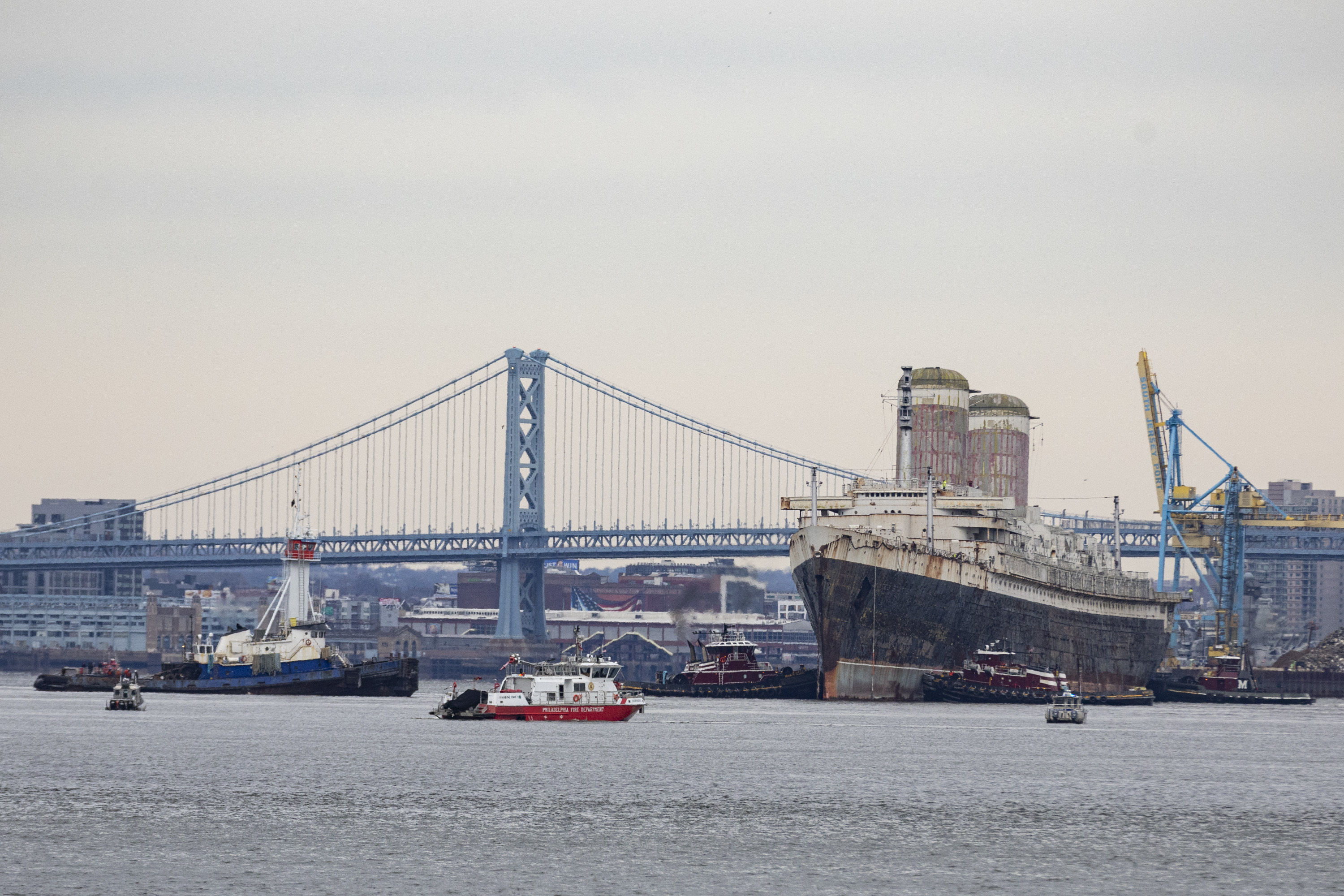
The 990-foot SS United States could be making waves as an artificial reef at the bottom of the Florida Panhandle coast as early as March, according to a tentative timeline from its new owners in Florida.
Even so, hope still springs eternal for the most ardent swath of ship enthusiasts who would rather see it restored to its former glory than swimming with the fishes.
As tourism officials in Okaloosa County report being about 80% done with the remediation work required to meet state and federal requirements for sinking, the New York Coalition to Save the SS United States has urged the New York City Council to intervene to the best of its abilities: a move that appeared to be gaining some traction in recent weeks, until it wasn’t.
A resolution introduced by NYC council member Gale A. Brewer last year finally got a committee hearing in late November.
The symbolic gesture calls on Congress to pass legislation that would allocate funds for restoration and to bring the ship to New York City’s Gowanus Bay Terminal. It also appeals to President Donald Trump, a fellow New Yorker, to sign the legislation.
Okaloosa County, respectfully, is hearing none of it.
“We purchased the vessel specifically to become the world’s largest artificial reef,” said county spokesperson Nick Tomecek. “Anybody that thinks otherwise, that’s just pipe dreams.”
Brewer is aware the odds are against those hoping to reacquire the ship. She acknowledged the resolution was a “Hail Mary” during last month’s committee hearing.
Though the resolution moved to the full council, it has not been put on the calendar for a vote — the last session of the year was Thursday.
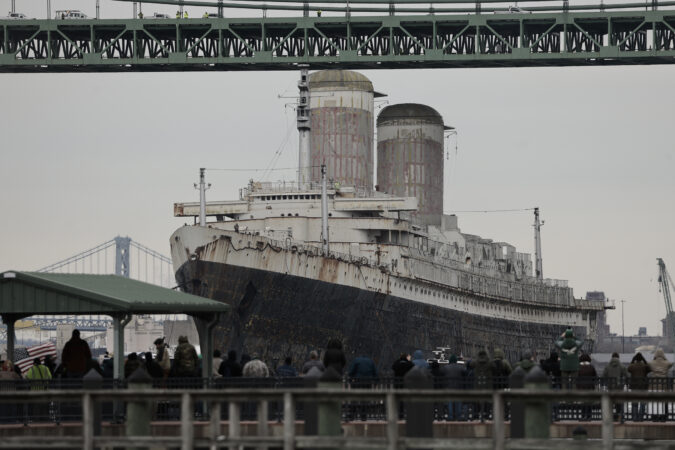
The SS United States is pulled out into the Delaware River and ready to bid its farewell from Philadelphia as people gather to watch it leave in the Delaware River in Gloucester City, N.J., on Wednesday, Feb. 19, 2025.
Brewer could not speak to why the resolution did not get a hearing until a year after she introduced it, but she understands how, despite support on the 51-member council, it has not been put to a vote in the full body.
“Just like in Philly, we got everything under the sun — restaurants, small business, parking, it’s just endless,” Brewer said. “I think there’s lots of support, but it’s not like number one on anybody’s list.”
Brewer said the priority would be to stop the sinking of the ship. Once the SS United States was in New York City, preservationists, donors, and lawmakers could figure out the best way to redevelop the ship, though she could see it as a restaurant.
In many ways, the New York City resolution is also a tried-and-tested approach. As the SS United States faced eviction from its berth along the Delaware River, the conservancy launched public campaigns calling on Florida Gov. Ron DeSantis, New York Gov. Kathy Hochul, and Pennsylvania Gov. Josh Shapiro to step in and help the vessel find a new home.
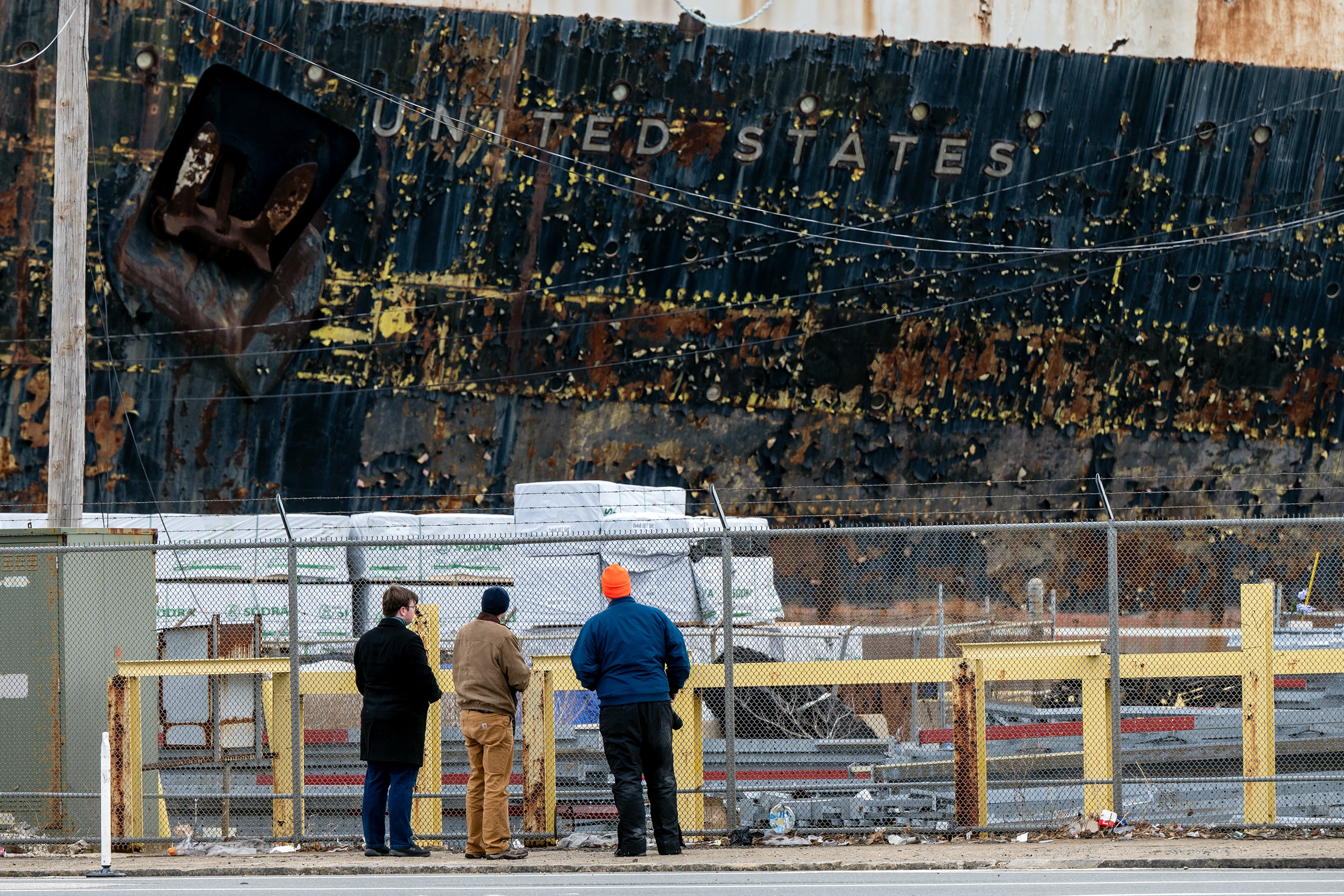
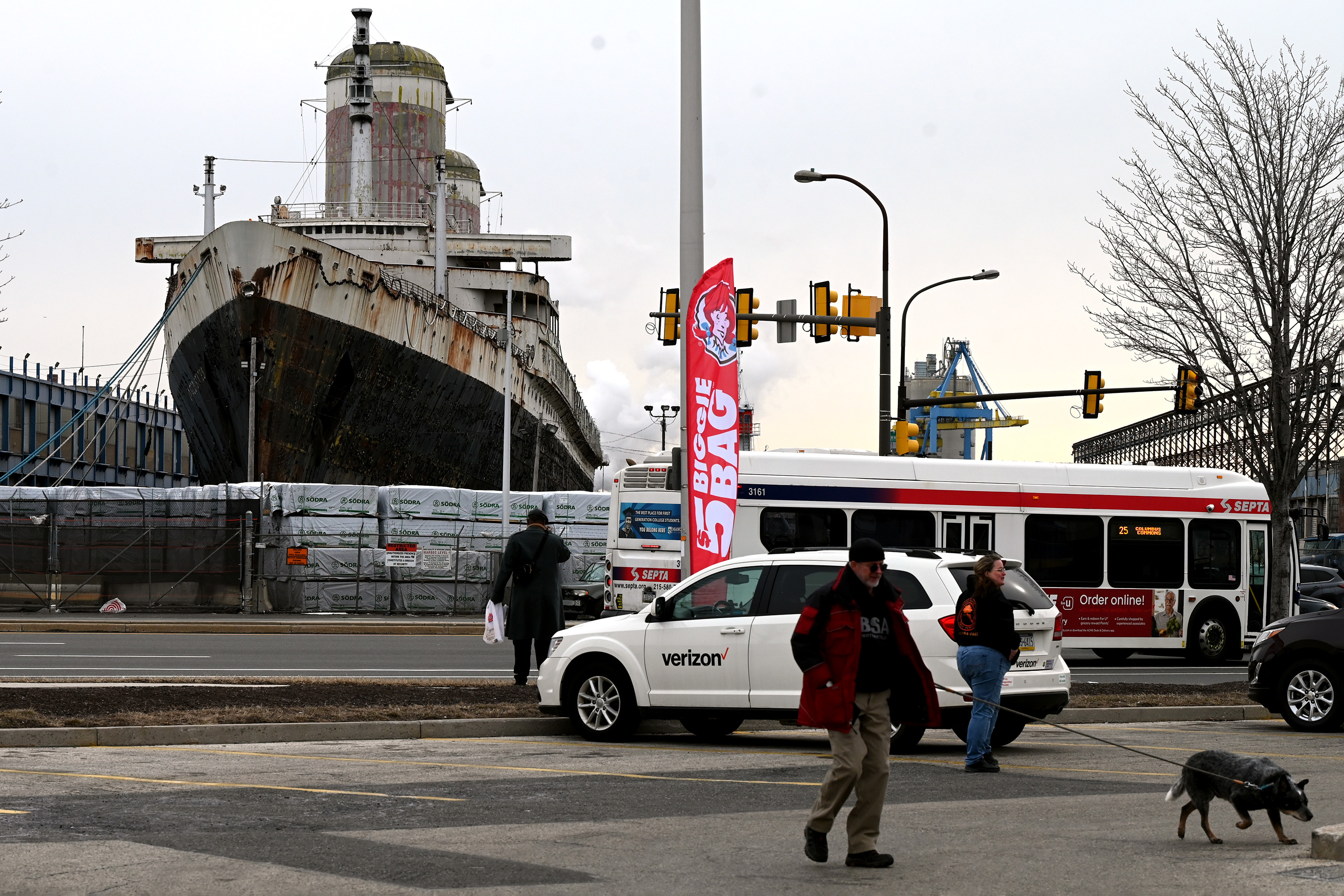
Passenger ship aficionados take a last look at the SS United States docked at pier 80 in South Philadelphia Wednesday, Feb. 19, 2025 before it is towed away to Alabama
The conservancy sent its pleas to then-President Joe Biden, as well as members of Congress on both sides of the aisle.
Much to the chagrin of preservationists, no politico ever came, despite the conservancy’s assurances that whoever championed the ship would be rewarded with all the jobs redevelopment would create.
Whether Trump, his administration, or this iteration of Congress would intervene at the eleventh hour is anyone’s guess.
The New York Coalition to Save the SS United States, which launched as a nonprofit in October 2024, wrote to Trump this year asking him to intervene shortly before the ship left Philadelphia, to no avail.
In a lawsuit filed in U.S. District Court in Pensacola after the ship’s departure, the coalition said it had “no means of knowing whether the Executive Branch of the United States is even aware of the Letter, let alone whether it is being considered.”
The White House did not immediately respond to questions about whether the ship’s saga had reached Trump’s desk and if the administration would be inclined to step in.
Either way, time is working against the coalition.
The suit warned of how some of the prep work in Mobile, Ala., could hinder preservation efforts.
“… the twin stacks of SSUS will be removed, as will other parts of her superstructure,” read the suit. “Once this is done, any hope of preserving the Ship afloat and intact will be lost forever.”
Those smokestacks were indeed removed at the end of summer.
So were all portholes and windows, along with the ship’s radar mast and propeller, according to an Okaloosa County update last week.
Despite the coalition’s fears laid out in the suit, Dan Sweeney, who cofounded the group, hit a more optimistic note, saying it was not too late to stop a reefing.
“The Big U remains an important symbol of America,” he said of the SS United States. “It could also prove to be a robust economic development engine. These two reasons are more than enough for us to continue the effort, and many people across the country agree. For us, it’s ‘damn the torpedoes.’”
Okaloosa County officials, meanwhile, say the months ahead will be used to finish cleaning the ship, removing nonmetal items, cutting holes throughout the ship because the sinking will not be able to be done with explosives, and coordinating with state and local agencies on a sink date.
Should work continue at its current pace and no delays in inspections, the SS United States could be sunk as early as March.
Alex Fogg, the natural resources chief for Destin-Fort Walton Beach, said weather delays, of course, are always possible.
Tomecek reiterated that the county was working with the SS United States’ previous owners to build a land-based museum, which would feature the eye-catching smokestacks and other preserved ship memorabilia and artifacts.
He understands the renewed interest in “saving” the ship, though it would have been turned into scrap had Okaloosa officials not stepped in. In any case, Tomecek said, these efforts come too little, too late.
“I think that when [the SS United States] was sold to the county, a lot of folks kind of woke up and realized what was going on, when, in fact, they should have been worried about her the past 30 years, when she was sitting in Philadelphia,” Tomecek said.
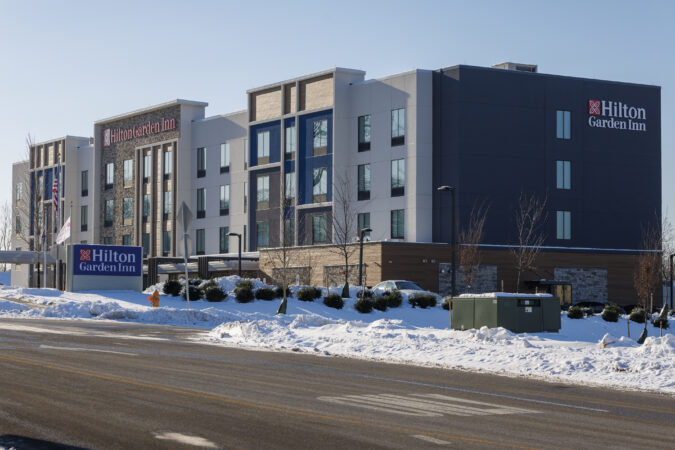
On a frigid Tuesday morning, stakeholders from across Delaware County toasted champagne and popped mini pastries under the roof of Middletown Township’s new Hilton Garden Inn.
“We may be the only Hilton Garden Inn in the world that serves Wawa coffee and drinks it all the time,” quipped hotel owner Patrick J. Burns, standing before a sea of family members, hotel staffers, business associates, and elected officials.
The 107-room, 67,000-square-foot Hilton, located off Baltimore Pike at the former Franklin Mint site, is open and welcoming guests. It’s the 42nd hotel in Delaware County and first full-service hotel in Middletown Township.
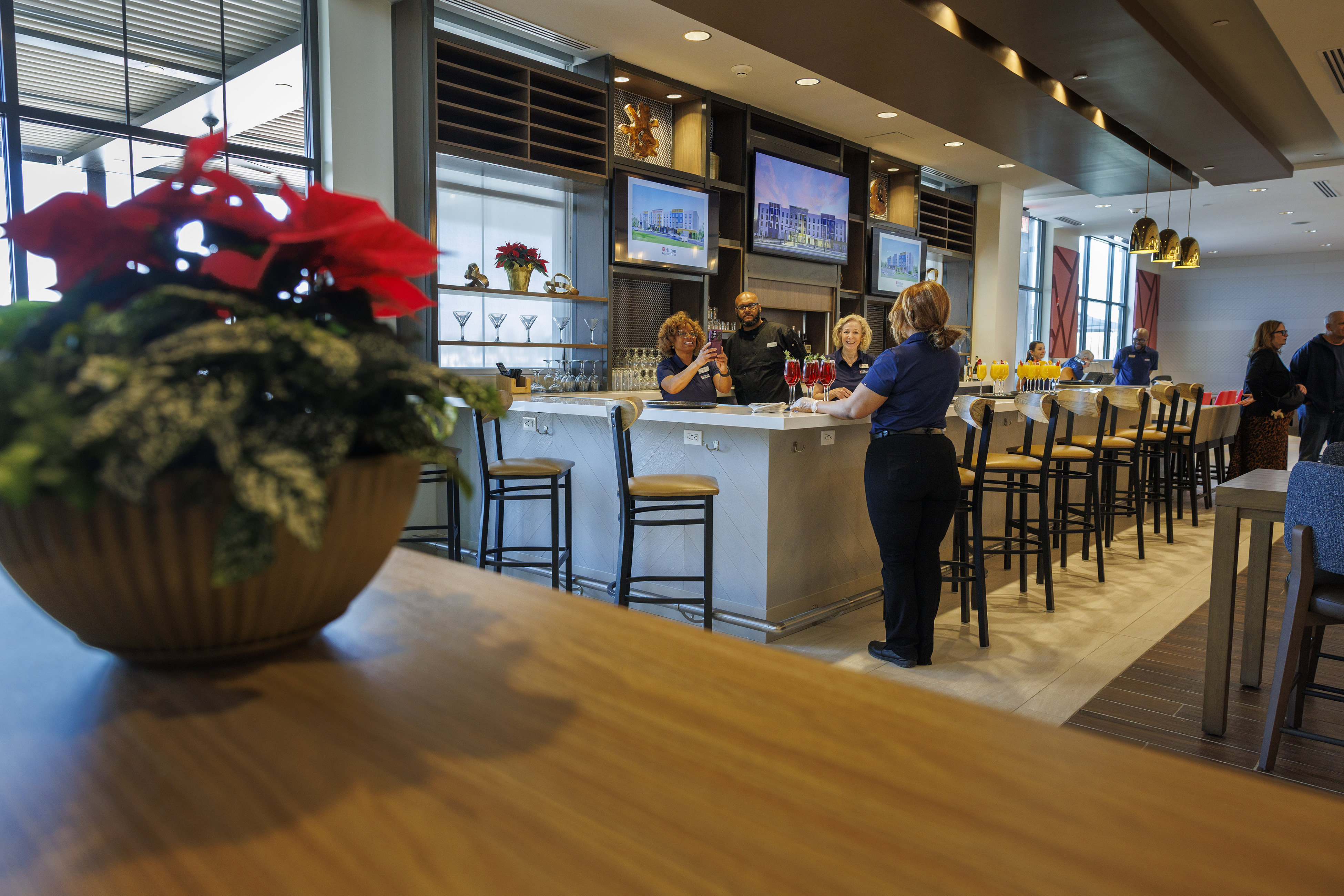
The hotel features app-to-room device integration, mobile key and contactless check-in, meeting and banquet spaces, an outdoor patio with fire pits, a fitness center, and the Garden Grill, a restaurant serving “American cuisine with local flair” that will be open to the public.
The hotel is long awaited, borne from a yearslong planning process and delayed by pandemic-era construction slowdowns. On Tuesday, attendees expressed gratitude that what was once an economic dream for the township was finally becoming reality.
The Hilton marks an important expansion of the collar county’s tourism economy, according to Delaware County’s major economic stakeholders. And as far as tourism in Delco, they say, it’s only up from here.
The bar area off of the lobby at the new Hilton Garden Inn of Middletown Township on Tuesday, Dec. 16, 2025.
Delaware County hosted 4.5 million visitors in 2024, according to Steve Bryne, executive director of Visit Delco. Those visitors spent $860 million, generated $1.2 billion in economic impact, and sustained 13,000 jobs. In 2025, the county is on track to sell more than one million hotel room nights for the first time in its history.
Representatives from the Hilton say it created 200 construction jobs and 40 new hospitality jobs.
Bryne said tourism to Delaware County is a “combination of everything.” The county doesn’t have one major anchor (like Longwood Gardens in Chester County, for example). Rather, it’s home to 12 colleges and universities, major corporate employers like Wawa, and sports complexes like IceWorks and Subaru Park, home of the Philadelphia Union. That means regular tournaments, business conferences, parents weekends, homecomings, and graduations — events that, collectively, help power the county’s economy.
Already, Penn State Brandywine, located down the road, has named the Hilton Garden Inn its host hotel.
Delaware County also gets spillover from visitors to Philadelphia, especially those who want proximity to Philadelphia International Airport.
The hotel is a property of Metro Philly Management, owned by Burns. Burns’ management company also owns the Courtyard by Marriott in Springfield, the Fairfield Inn & Suites in Broomall, and the Springfield Country Club, as well as numerous grocery stores and restaurants.
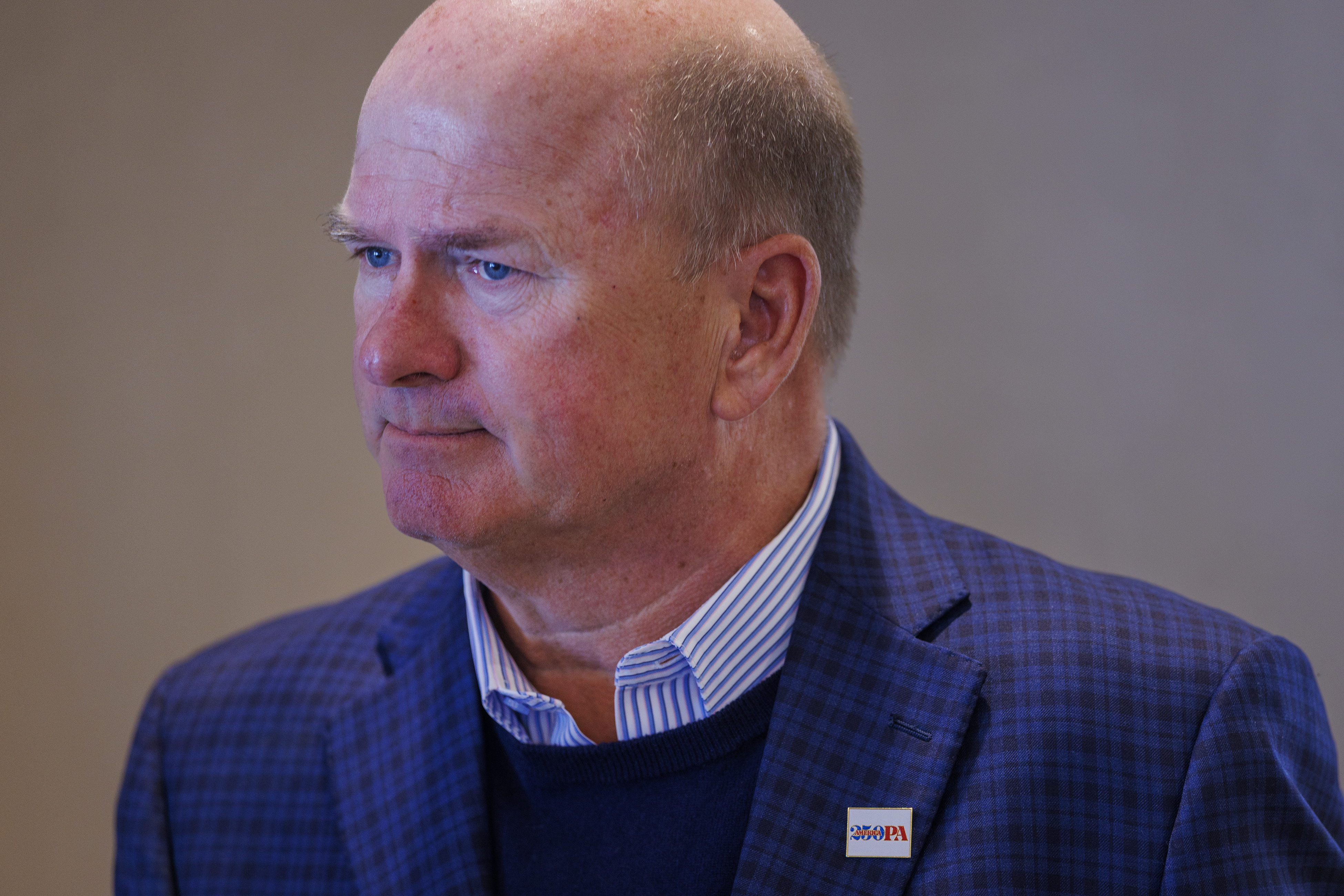
Patrick J. Burns, pictured at Middletown Township’s new Hilton Garden Inn on Tuesday, Dec. 16, 2025. The hotel is owned by Burns’ company, Metro Philly Management.
Stakeholders lauded the hotel’s location in a central, and rapidly developing, part of Middletown Township.
The former Franklin Mint complex, now home to the Hilton, has been a hotbed of development in Middletown Township since the mint shuttered in 2004. Two newer housing developments — Pond’s Edge and Franklin Station — have added over 450 units of housing to the site. Middletown Township outpaced its neighbors — Media, Nether Providence, and Upper Providence — in populationgrowth in 2024.
“Middletown Township is such a vital corridor of Delaware County,” Burns said.
The hotel’s opening coincides with major events coming to the region in the coming months: semiquincentennial celebrations in Philadelphia and in Delco, the FIFA World Cup, the PGA Championship at Aronimink Golf Club, and the MLB All-Star Game. For the PGA Championship alone, Delaware County is expecting 200,000 visitors and $125 million in economic impact.
This suburban content is produced with support from the Leslie Miller and Richard Worley Foundation and The Lenfest Institute for Journalism. Editorial content is created independently of the project donors. Gifts to support The Inquirer’s high-impact journalism can be made at inquirer.com/donate. A list of Lenfest Institute donors can be found at lenfestinstitute.org/supporters.
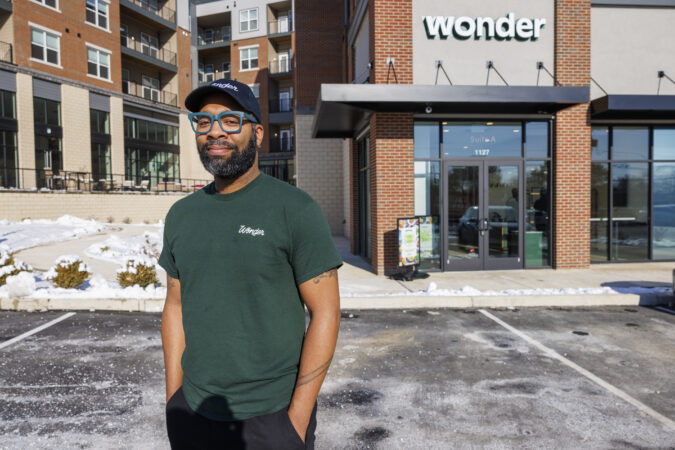
Part of Wonder’s sales pitch is that it offers something for everyone, from pizza and cheesesteaks to Mediterranean and steak.
That flexibility, with parents of finicky kids in mind, is part of what drew Eddie Jefferson to Wonder.
“The picky eater thing kind of sits with me,” said Jefferson, senior operations leader for Wonder’s Media location. “I have children who never really could settle on the same food. So it was like, ‘Oh, this makes sense.’”
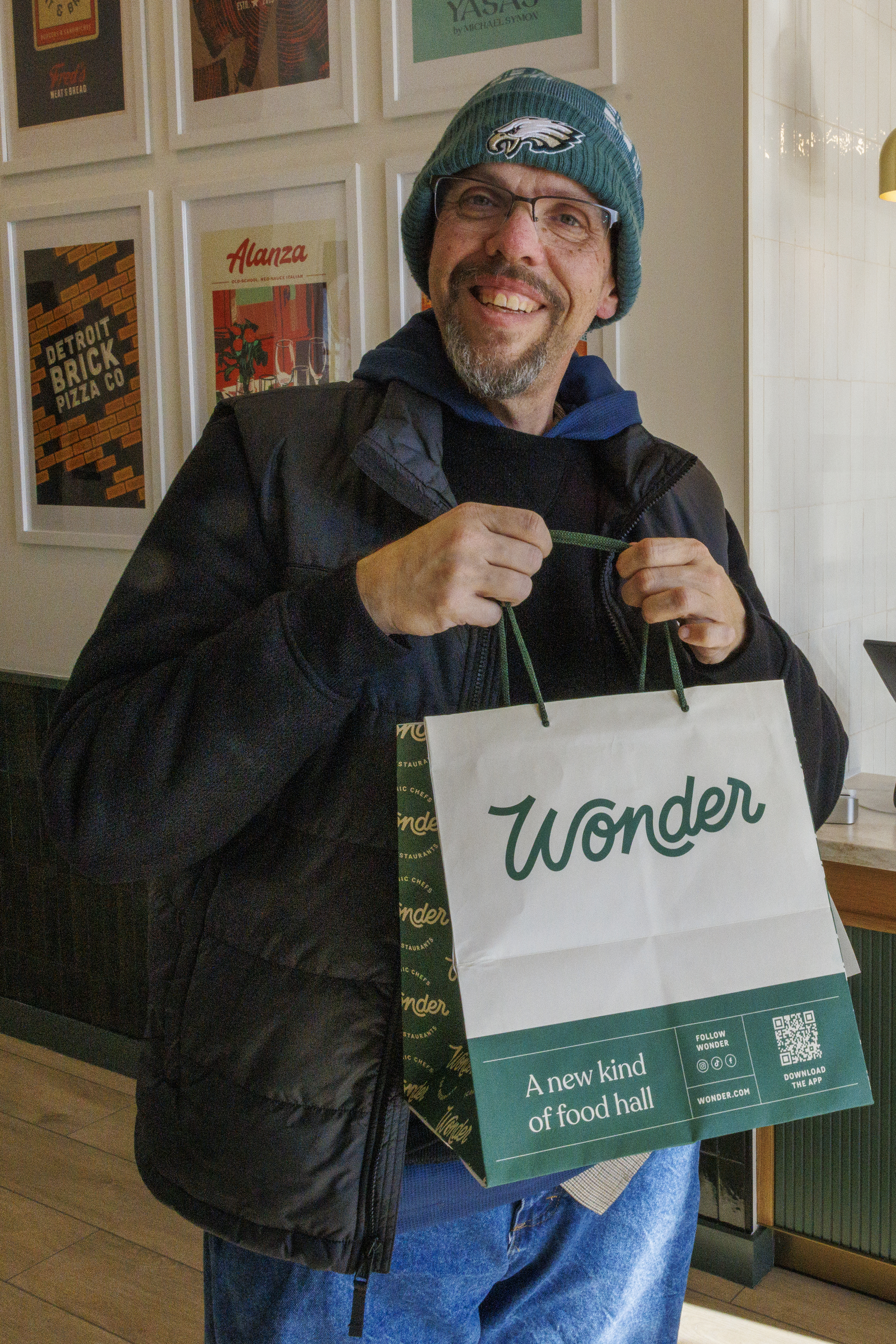
Steve Skalis, of Springfield, picks up an oder of drunken noodles during Wonder’s soft opening in Media on Tuesday, December 16, 2025.
Jefferson said he wants Wonder to be more than just a chain takeout restaurant.
“I want to make sure we’re a staple of the community,” Jefferson said. “I do want to be here for a very long time.”
Wonder is donating $1 to Philabundance for every order at the Media location this week. Jefferson said he hopes that’s just the first local partnership and he will be able to be active in the community.
“Once we settle in to this community I’ll be able to be outside shaking hands and kissing babies.”
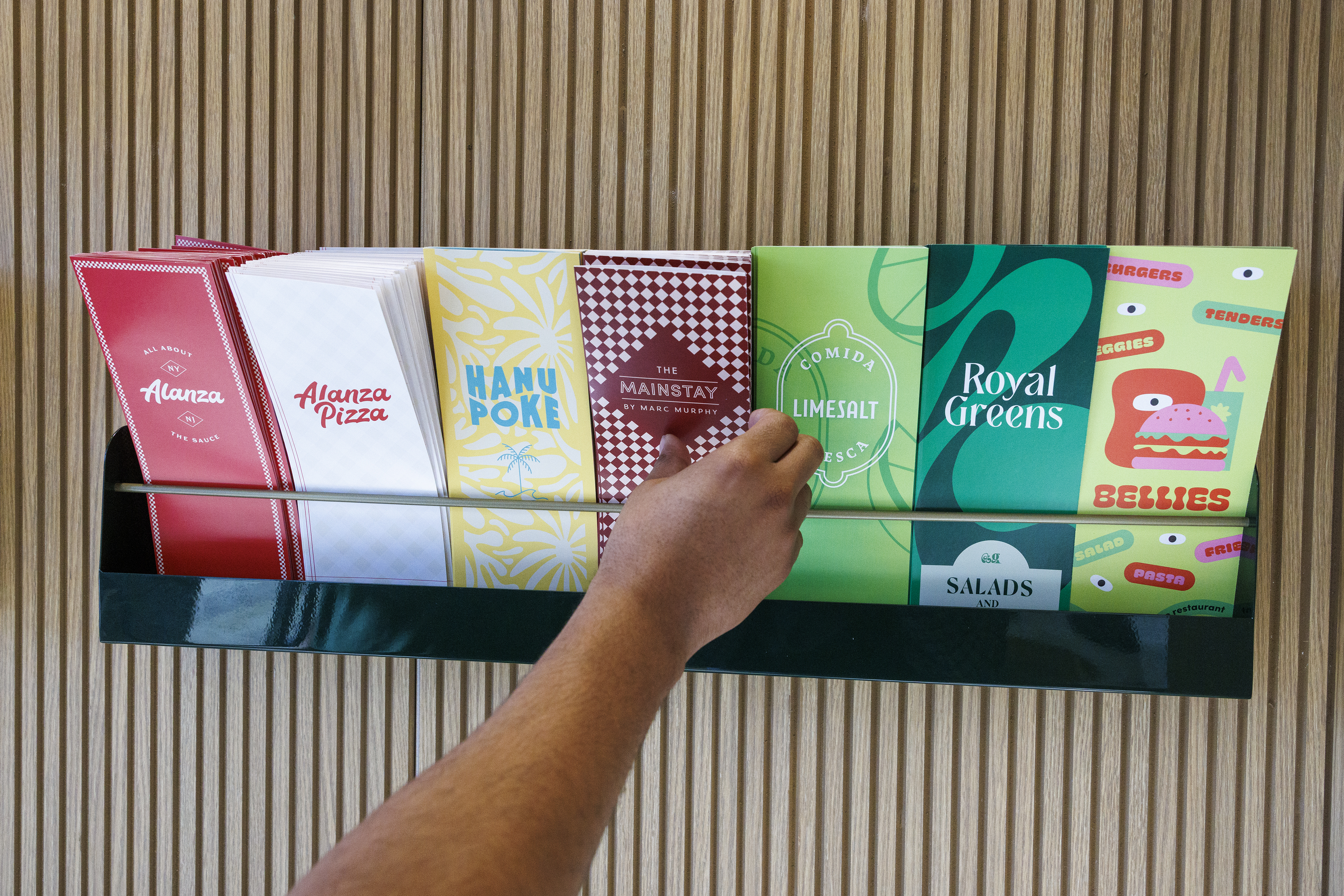
Restaurants available at the Media Wonder include:
Alanza
Alanza Pizza
Bobby Flay Steak
Burger Baby
Detroit Brick Pizza Co.
Di Fara Pizza
Fred’s Meat & Bread
Hanu Poke
Kin House
Limesalt
Maydan
Royal Greens
SirPraPhai
Streetbird by Marcus Samuelsson
Tejas Barbecue
Yasas by Michael Symon
Bellies
Room for Dessert
Wonder’s Media location brings the total to 91 sites across the Northeast, from Rhode Island to Virginia. The plan for 2026 is to more than double that, according to Jason Rusk, head of restaurant operations.
“Our plan is to grow 110 locations, so we’ll go from 91 locations to just over 200 locations by the end of next year,” Rusk said.
Eddie Jefferson, senior operations leader at Wonder in Media, reaches for one of many menus Tuesday, December 16, 2025.
Wonder plans to open locations in Drexel Hill and Roxborough in early 2026, a representative said. It is also planning a foray into Allentown and the rest of the Lehigh Valley.
Rusk said sales have been good across the Philly area’s 20-plus stores, with Cherry Hill one of the strongest openings.
“There is no sign of stopping,” Rusk said. ”I have no doubt in my mind that we will fully have a Wonder that services nearly every part of the broader Philly [area].”
This suburban content is produced with support from the Leslie Miller and Richard Worley Foundation and The Lenfest Institute for Journalism. Editorial content is created independently of the project donors. Gifts to support The Inquirer’s high-impact journalism can be made at inquirer.com/donate. A list of Lenfest Institute donors can be found at lenfestinstitute.org/supporters.
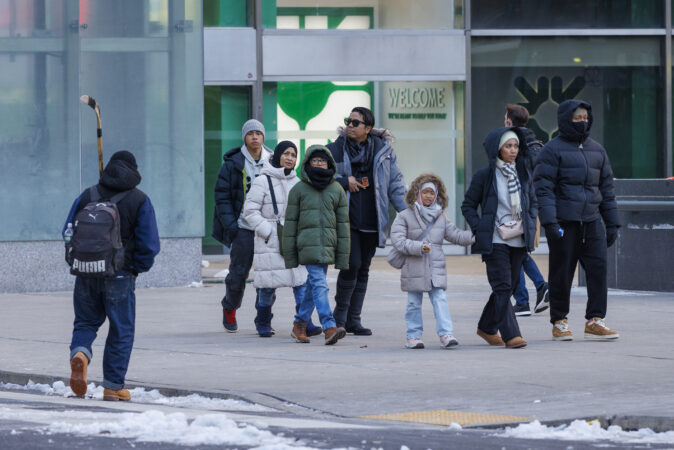
That icy glaze that has appeared on streets, sidewalks, and driveways this week reappeared Wednesday and will make an encore Thursday morning as water continues to ooze from the snowpack by day and freeze at night.
So-called black ice — ice that masquerades as harmless wetness — is especially dangerous, officials warn, and conditions are ripe for a harvest, given the generous snowpacks.
“Refreezing and black ice are definitely a concern,” said PennDOT spokesperson Brad Rudolph. “We will continue to treat areas as needed.”
SEPTA advised commuter to watch out for ice on platforms, walkways, and in parking lots.
Temperatures early Wednesday fell into the teens throughout the region — save for Philadelphia International Airport where the low was 26 — and on Thursday are due to drop into the 20s region-wide.
But along with that winter landscape, the atmosphere over the region is going to undergo radical changes by the end of the workweek, forecasters say, with a rapid but short-lived warmup, and something that’s been missing around here lately — a soaking rain.
As for more snow, the atmospheric scientists are saying it’s probably safe to put away the shovels for a while, and not just in the Philly region.
“In my opinion, cold looks hard to come by for most of the United States through the remainder of December,” said Amy Butler, research scientist at the NOAA Chemical Sciences Laboratory.
In short, prepare for a more typical Philadelphia December.
“With the pattern changing, we’re kind of getting closer to where we should be this time of year,” said Mike Lee, a lead meteorologist at the National Weather Service Office in Mount Holly.
The forecast for the rest of the week
Wednesday should be at least partially sunny with some substantial melting as temperatures are due to crack 40 degrees by early afternoon.
Then after one more overnight with readings dropping into the melt-freezing 20s, Thursday is forecast to become the first day with above-normal temperatures in Philadelphia since the Wednesday before Thanksgiving.
As temperatures rise through the 40s, several hours of soaking rain are forecast to begin in the early evening with the potential for up to an inch.
Throughout the region the snowpack contains about a half inch of water that will be heading to local storm sewers and local waterways, said the weather service’s Lee.
In addition to the rain, the high moisture content of the air is one of nature’s most-efficient snow-removal tools. When warm, moist air comes in contact with snow, it gives off a latent heating effect that accelerates melting.
“We’ll have to watch for the possibility of some localized flooding,” said Paul Dorian, a meteorologist with Arcfield Weather.
For now, Lee said, the weather service isn’t contemplating flood advisories. Precipitation the last 90 days has been substantially below normal throughout the region, and a drought warning remains in effect for New Jersey.
The outlook for the weekend and beyond
Friday’s forecast high in the mid-50s is likely to occur in the early morning hours, and then temperatures are forecast to crash, with wind gusts to 40 mph possible.
Saturday is expected to be dry but chilly, with readings in the low 40s, warmer than it’s been but still several degrees below normal, and in the mid-40s Sunday, closer to the long-term averages.
The polar vortex, the persistent low pressure system that spins around the Arctic and confines the cold air to the ice box of the planet, has been strengthening, said Butler.
It’s possible that it would undergo “stretching” and allow cold air to sink into parts of the contiguous United States, but “it’s not a signal that is very robust,” she said.
For now, she said no obvious dominant feature is emerging that would define the winter.
La Niña conditions continue in the tropical Pacific, where vast expanses of the sea surfaces are about a degree below normal. La Niña can have powerful effects on west-to-east winds that ferry weather to the United States.
In this case, however, La Niña is currently weak, meaning that its influence over global seasonal patterns is also weak, said Emily Becker, scientist with the University of Miami/Cooperative Institute for Marine & Atmospheric Studies.
For now, it would be prudent to savor what’s left of the snow cover, and it wouldn’t hurt to spread a little sand or gravel on the driveway or the front steps before going to bed.
“We strongly believe that Netflix and Warner Bros. joining forces will offer consumers more choice and value, allow the creative community to reach even more audiences with our combined distribution, and fuel our long-term growth,” Warner Bros. said Wednesday. “We made this deal because their deep portfolio of iconic franchises, expansive library, and strong studio capabilities will complement—not duplicate—our existing business.”
Paramount went hostile with its bid last week, asking shareholders to reject the deal with Netflix favored by the board of Warner Bros.
Paramount’s bid isn’t off the table altogether. While Wednesday’s letter to shareholders means Paramount’s is not the offer favored by the board at Warner Bros., shareholders can still decide to tender their shares in favor of Paramount’s offer for the entire company — including cable stalwarts CNN and Discovery.
Unlike Paramount’s bid, the offer from Netflix does not include buying the cable operations of Warner Bros. An acquisition by Netflix, if approved by regulators and shareholders, will close only after Warner completes its previously announced separation of its cable operations.
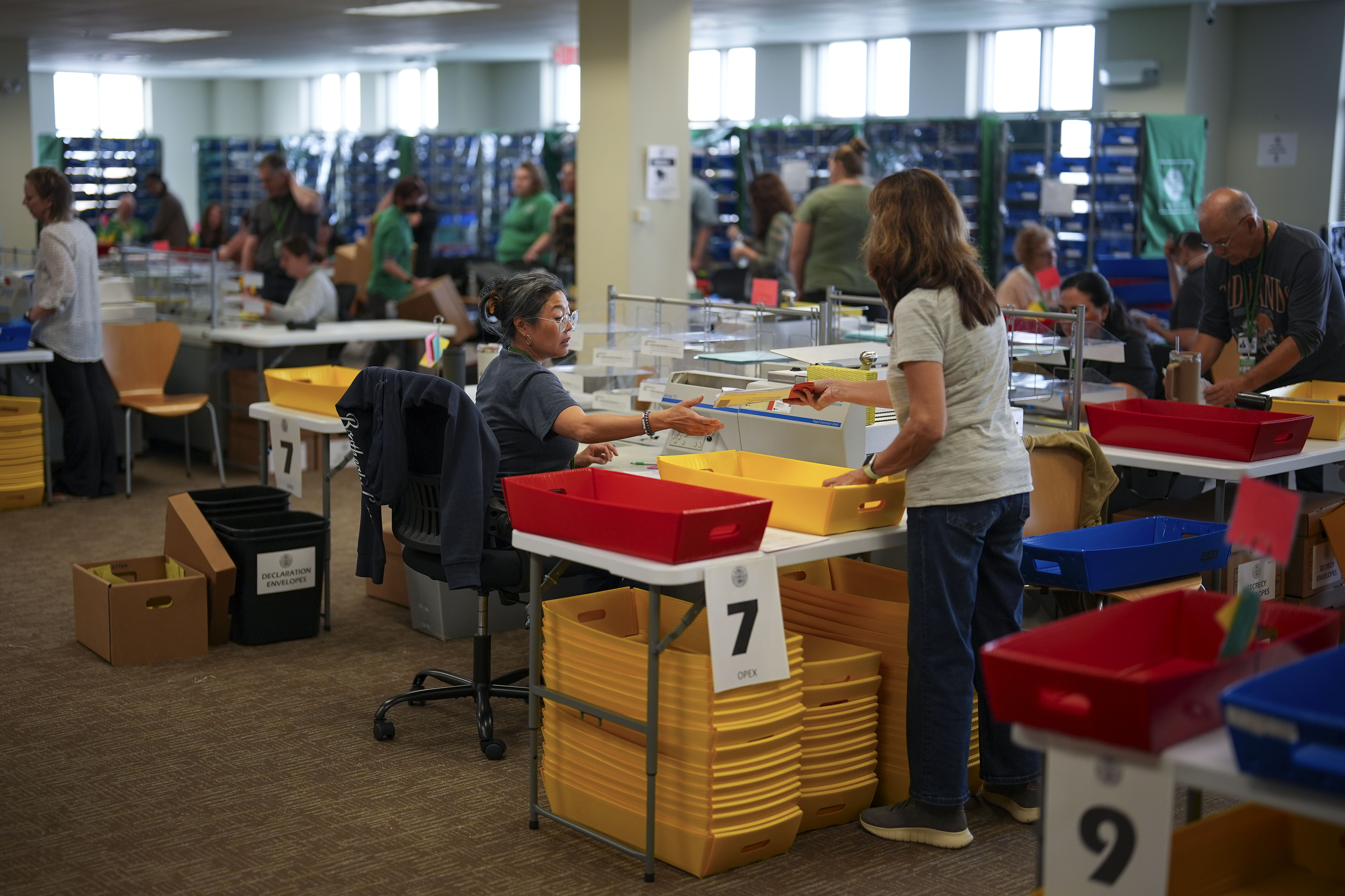
Nearly 30 employees have left Chester County’s election office since 2021.
Several former Chester County election office workers have raised concerns over what they say is a hostile workplace, with one filing a grievance against its director. Another former employee believes she’s suffered from PTSD after working in the office.
As of November, 29 employees had left the office since Karen Barsoum took over as voter services director in 2021, reports The Inquirer’s Katie Bernard. Barsoum said employees left for a number of reasons, and while she noted the departures were a challenge for the office, she helped to train staff on various positions.
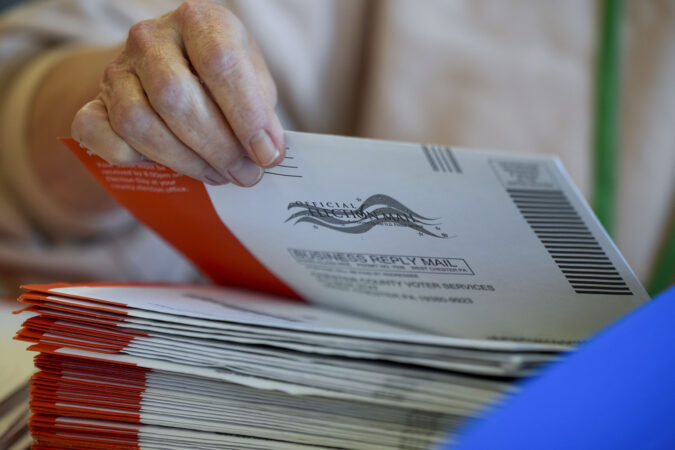
It’s unclear if the culture or turnover impacted last month’s general election, in which independent voters were omitted from county poll books.
Turnover in election offices has gone up in recent years due to election denialism and threats, but Chesco’s departure rate is nearly twice that of Delaware and Montgomery Counties.
Chester County saw plenty of snow during last weekend’s storm. Exton and Malvern reported 8.2 inches each — the largest recorded totals in the county. They were followed by Berwyn (8 inches), Atglen (7.8) and Glenmoore (7.5). Check out this map of snowfall totals to see how much your town got.
Chester County Hospital is among the quietest hospitals in the region at night, according to newly released federal data. Patients from October 2023 to September 2024 reported the hospital as being “always quiet” overnight 62% of the time, “usually quiet” 30% of the time, and “sometimes or never quiet” 8% of the time. See how it compares to other regional hospitals.
Phoenixville Hospital will close its 14-bed post-acute rehabilitation center on Jan. 6 as its parent company, Tower Health, faces financial pressures. The unit helps patients with neurological disorders, orthopedic issues, or who have suffered a stroke. Its closure is expected to displace 55 employees. (Philadelphia Business Journal)
Two individuals died in separate incidents last week. A 48-year-old pedestrian died after being struck by a driver last Tuesday night while attempting to cross Route 202 near the Shoppes at Dilworthtown Crossing in Birmingham Township. And on Saturday, a man was found dead in an Easttown Township basement after a fire broke out in the home. Neither victim has been publicly identified. (Daily Local News)
Two Chester County crop farms — the 21-acre Primitive Hall Foundation in West Marlborough Township and the 59-acre Samuel and Barbara E. Townsend in West Nantmeal Township — will be preserved forever thanks to easements approved by the State Agricultural Land Preservation Board.
Two Coatesville organizations scored grants recently. The Coatesville Bureau of Fire is getting a $58,700 state grant that will go toward buying CPR and other equipment, and The Creative Club of Chester County plans to implement its Future Innovators project with the $47,500 it was awarded in T-Mobile’s latest Hometown Grants.
The owner and brewer behind popular Phoenixville kombucha brand Baba’s Brew has launched a new skincare line. A Culture Factory’s toners, masks, scrubs, and serums are made with surplus scoby, the mother culture used to start kombucha, which Olga Sorzano says are full of enzymes.
Heads up for drivers: Pottstown Pike will continue to have a lane closure at the Park Road intersection in Upper Uwchlan Township through Friday as PennDot repairs the inlet. The closures are from 9 a.m. to 3 p.m.
Refuse fees are set to rise next year in Downingtown from $240 to $360. The increase is due to higher costs from the borough’s contracted hauler.
Santa will join the Phoenixville Fire Department on Saturday as he ventures around the borough starting at 8 a.m. And Liberty Fire Company has pushed its ride with Santa, Mrs. Claus, and Rudolph around Spring City and East Vincent Township to this weekend. They’ll now visit on Sunday at 11 a.m.
The Devon Senior Living at 445 N. Valley Forge Rd. has been renamed Juniper Village at Devon after a recent acquisition. The nearly 91,000-square-foot facility has 65 personal care apartments and 13 secured memory care apartments.
🏫 Schools Briefing
Last week, Coatesville Area School District’s school board approved a new map that it says redraws its geographic regions to better keep communities together and maintain ethnic and socio-economic balance. The approval of the four new regions comes ahead of the closure of Caln and East Fallowfield Elementary Schools at the end of this school year and the opening of the new Doe Run Elementary School.
🍽️ On our Plate
In search of Christmas Eve dining options? Several Chester County restaurants will be open, including Cedar Hollow Inn Restaurant & Bar in Malvern, Duling-Kurtz House Restaurant in Exton, Roots Cafe in West Chester, Sedona Taphouse, which has locations in Phoenixville and West Chester, and Ron’s Original Bar & Grille, in Exton. Prefer to dine in? Carlino’s Market in West Chester has everything from appetizers to a seven fishes feast available, while White Dog Café in Chester Springs is offering a “Christmas at Home” package with options for beef tenderloin, glazed ham, and beef lasagna. (Main Line Today)
🎳 Things to Do
🎅 Tinsel on the Town: The family-friendly event includes train rides, street vendors, hot chocolate, mulled wine, and visits with Santa. ⏰ Thursday, Dec. 18, 5-8 p.m. 💵 Pay as you go 📍 State Street, Kennett Square
🩰 The Nutcracker: Catch one of five performances of the holiday favorite, performed by the Brandywine Ballet. ⏰ Friday, Dec. 19-Sunday, Dec. 21, times vary 💵 $30-$50 📍 Brandywine Ballet, West Chester
🎄 Christmas Village: Fitzwater Station is hosting the final weekend of its first Christmas Village, which includes local vendors, food, drinks, and bonfires. Santa will make an appearance both days and be joined by Mrs. Claus on Sunday. ⏰ Saturday, Dec. 20 and Sunday, Dec. 21, 3-7 p.m. 💵 Pay as you go 📍 Fitzwater Station, Phoenixville
⛄ Wits and Pieces Workshop: Paint a festive ornament while sipping wines. Registration is required. ⏰ Sunday, Dec. 21, 1 p.m. 💵 $40 📍 Harvest Ridge Winery, Toughkenamon
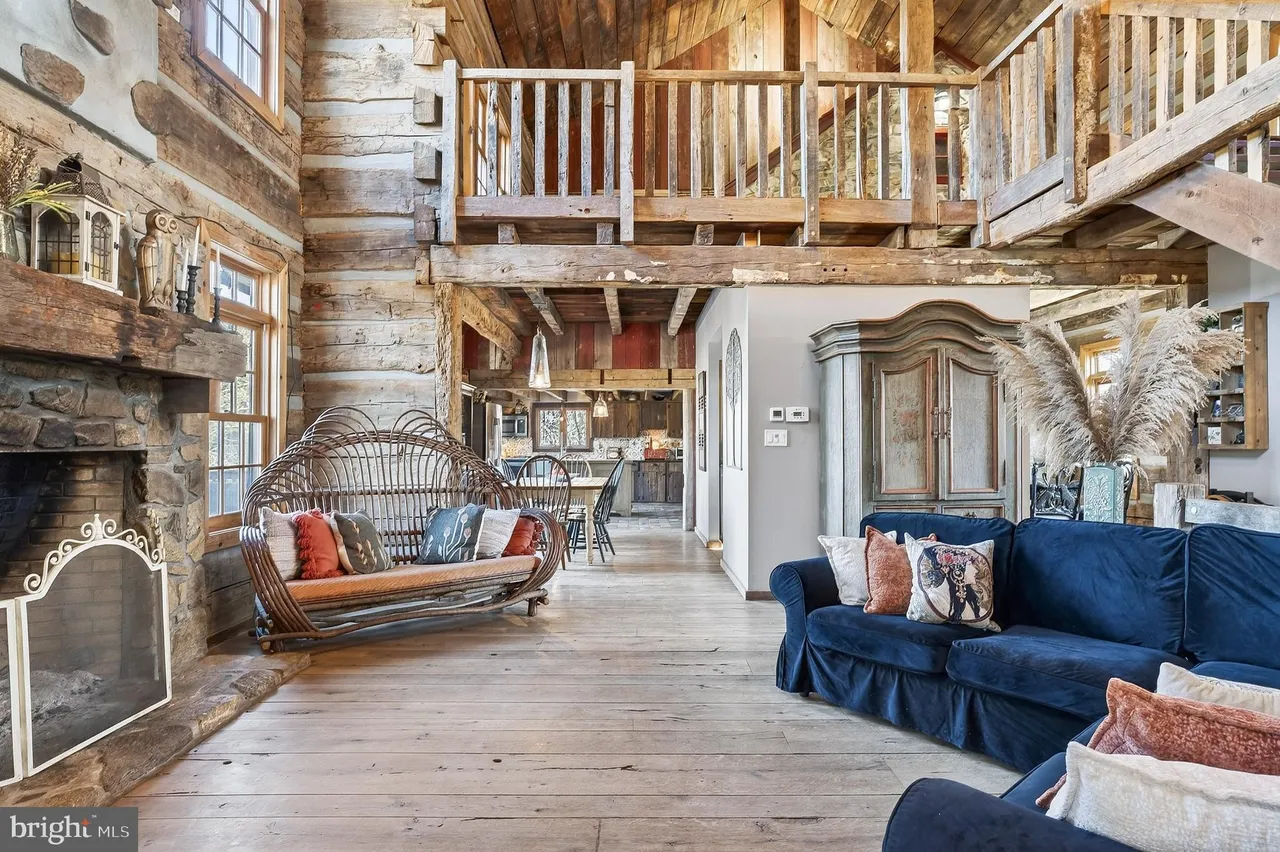
The inside of the farmhouse is a mix of modern and historic elements.
Built in 1770 and since expanded, this Colonial farmhouse blends modern and historic elements like stainless steel appliances with stone walls and exposed beams. The four-bedroom home has a finished walkout basement with a full bathroom, an above-ground saltwater pool, a deck, and a two-story treehouse. The 7.6-acre property is split into two parcels, which can accommodate another house. The property has a chicken coop, paddocks, and a five-stall barn.
By submitting your written, visual, and/or audio contributions, you agree to The Inquirer’s Terms of Use, including the grant of rights in Section 10.
This suburban content is produced with support from the Leslie Miller and Richard Worley Foundation and The Lenfest Institute for Journalism. Editorial content is created independently of the project donors. Gifts to support The Inquirer’s high-impact journalism can be made at inquirer.com/donate. A list of Lenfest Institute donors can be found at lenfestinstitute.org/supporters.
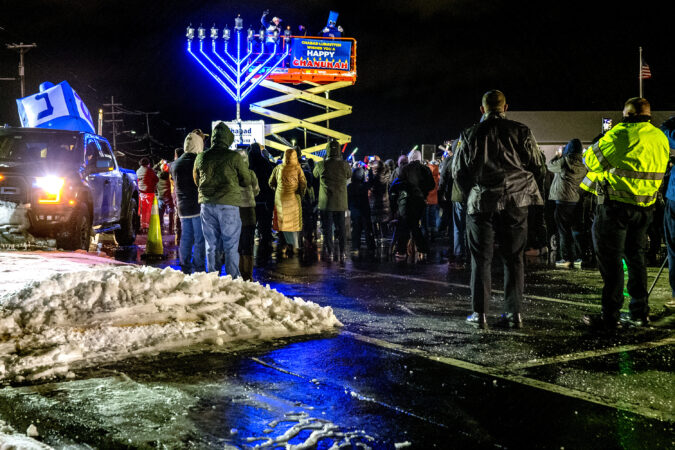
Rabbi Mendel Mangel spoke Sunday during at an event celebrating the first night of Hanukkah.
The lighting of the menorah at Barclay Farms Shopping Center on Sunday was full of symbolism, not only for the holiday, but as Jewish people came together in the wake of a deadly attack on Australians celebrating the first night of Hanukkah.
“Light in the face of darkness is a lot of what Judaism is about,” one attendee said at the 32nd annual Hanukkah event, organized by Chabad Lubavitch of Camden County.
Roughly 100 people gathered on the snowy evening to show their support for those injured and killed earlier that day, while leaders, including Mayor David Fleisher, called for resilience.
“In a day like today, when there’s so much darkness, in the last year, too, and the pain and the suffering, evil, and cruelty — the message is that light can dispel all of that,” said Chabad Rabbi Mendel Mangel.
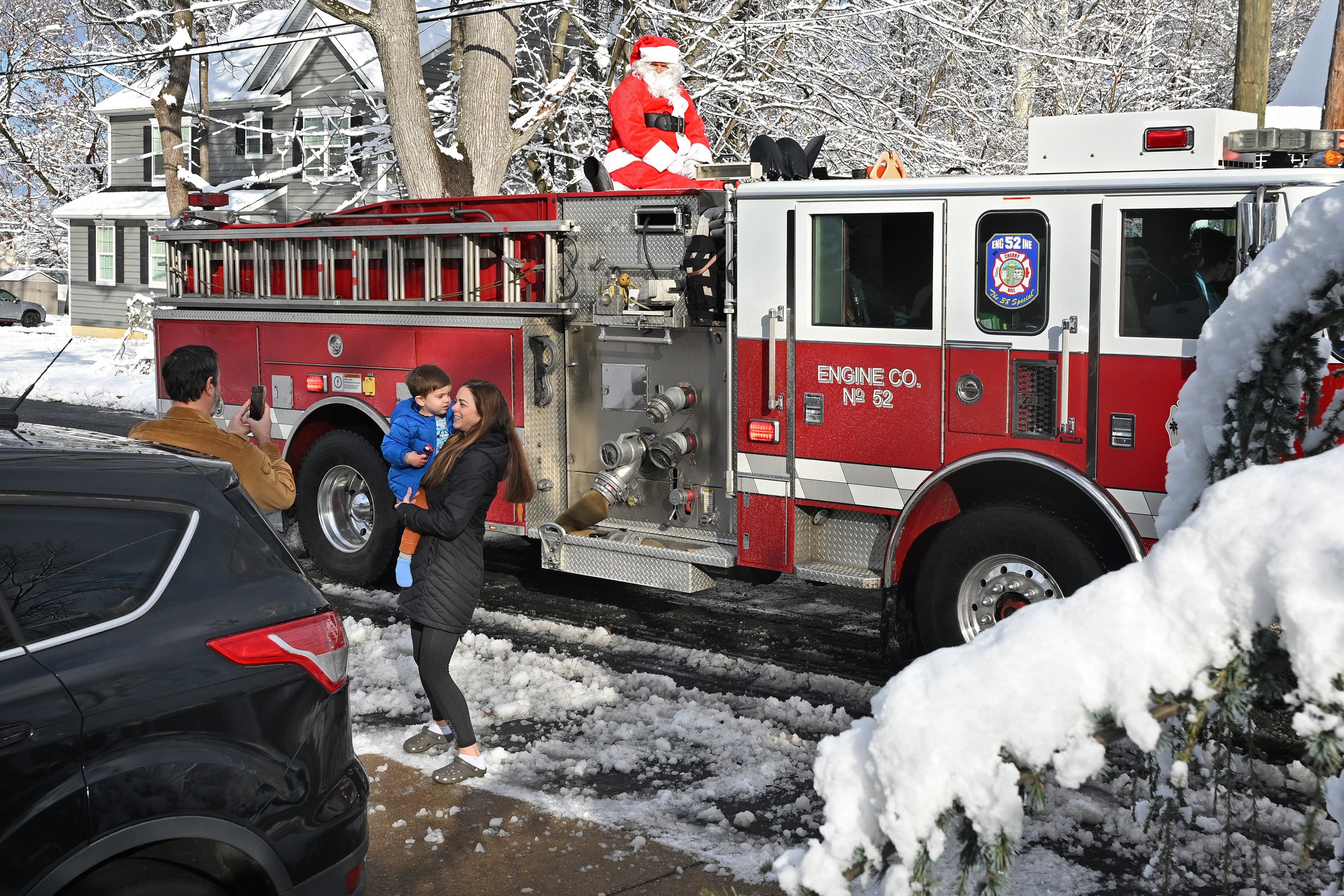
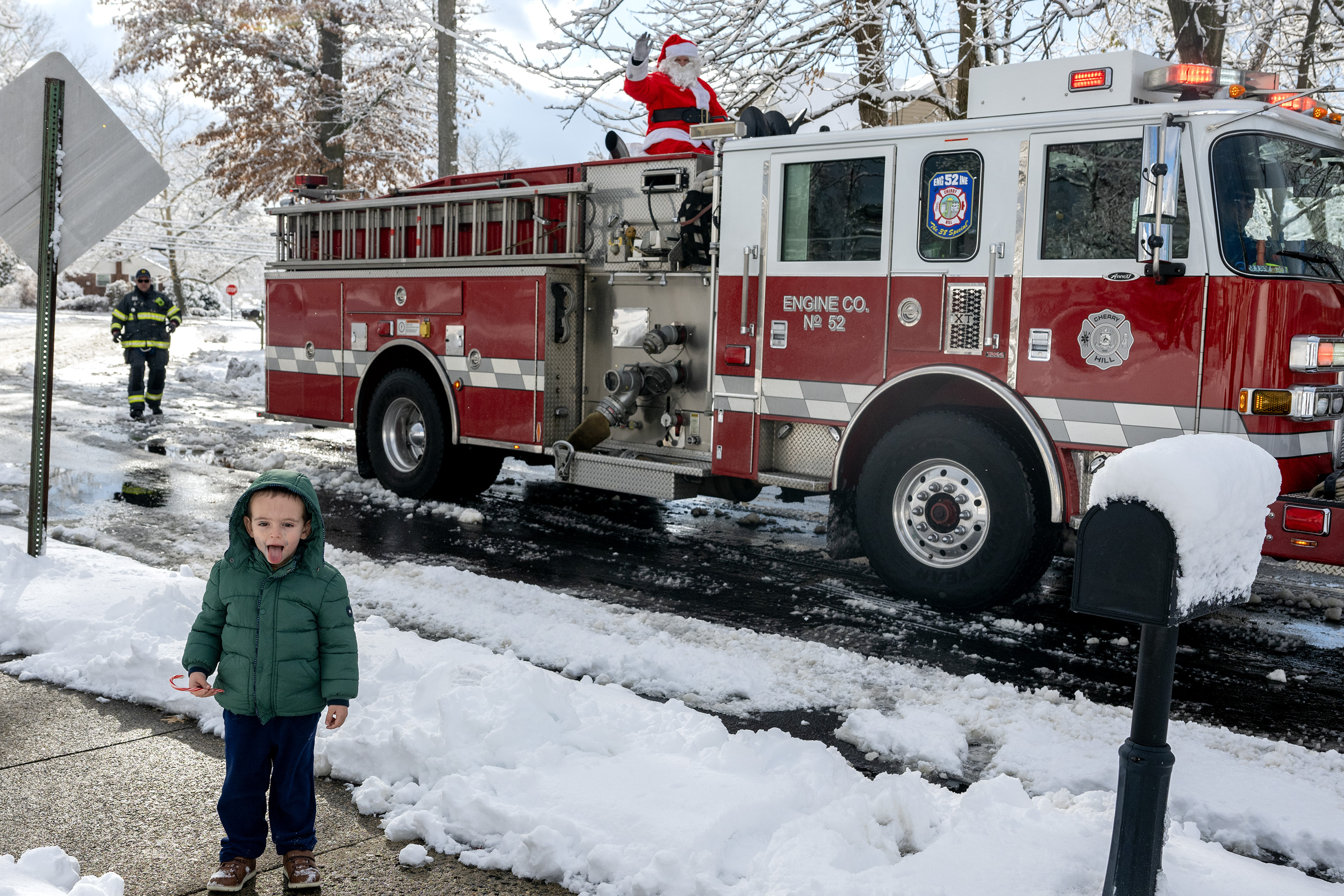
Santa has been making his way through the township, accompanied by the Cherry Hill Fire Department, and even snow and freezing temperatures couldn’t keep residents from running out of their homes to greet him or pose for photos. “Santa brings the spirit,” one said. The Inquirer’s Denali Sagner joined the big man recently for the beloved tradition.
The township has been awarded an $800,000 grant from the state’s Safe Streets to Transit Program for fiscal 2026. The funds, awarded last week by Gov. Phil Murphy, will support pedestrian improvements along Brace and Kresson Roads. The township isalready working on other roadway improvements for pedestrians. Last month, the county broke ground on a $7.5 million improvement project along Kresson Road between Browning Lane to Cropwell Road that includes upgrades to traffic signals, adding sidewalks and ADA curb ramps, and the installation of dedicated bike lanes.
Cherry Hill-based nonprofit Bancroft, which provides services for people with intellectual and developmental disabilities, has named its next president and CEO. Gregory Passanante, who has held roles at Shriners Children’s Hospital Philadelphia and Wills Eye Hospital, will starton Jan. 7.
Jefferson Cherry Hill Hospital is among New Jersey’s 2026 Best Hospitals for Maternity Care, according to a new ranking from U.S. News & World Report released last week.
🏫 Schools Briefing
Science scores statewide in last year’s New Jersey Student Learning Assessments rose above pre-pandemic levels for the first time, according to an NJ.com analysis. In math and English language arts, however, scores remained below pre-pandemic testing levels. At both East and West, students scored below the state average in Algebra I. In Algebra II and Geometry, East students scored above state averages, while West students scored below. Most of the district’s elementary schools scored at or above state averages in two math categories. (NJ.com)
The Courier Post has identified two Cherry Hill East boys basketball players to watch this season: Chris Abreu, the “heart and soul of the Cougars,” and Jamieson Young, who made a splash during his inaugural season last year.
Reminder for families: Winter break begins next week with an early dismissal on Tuesday. Schools are then closed until Jan. 5. See the district’s full calendar here.
🍽️ On our Plate
Chef Greg Vernick is teaming up with fellow Cherry Hill native Meredith Medoway to open his latest restaurant, this one in Kensington. The restaurateur behind Vernick Food & Drink, where Medoway is chef de cuisine, and Vernick Fish is planning to open Emilia in early 2026. The neighborhood trattoria will have a seasonal menu that includes house-made pasta and live-fire cooking.
Several Cherry Hill steakhouses are among the best South Jersey spots to find a great steak, according to the Courier Post. The outlet noted that The Capital Grille is a “classy, upscale” option, as is fellow mall restaurant Eddie V’s Prime Seafood. Steak 38 and The Pub in Pennsauken also made the list.
Voorhees-based Saddlehill Winery recently opened a pop-up kiosk at the Cherry Hill Mall, where it has what director of wine operations and sales Julie Pierre calls a “secondary tasting room.” It will remain open for about three more weeks. (Patch)
🎳 Things to Do
💰 Estates Roadshow Buying Event: Have unwanted goods you think might be valuable? Buyers will assess your goods and make offers on the spot during this five-day event. ⏰ Through Friday, Dec. 19, 10 a.m.-5 p.m. 💵 Free 📍DoubleTree by Hilton Cherry Hill Philadelphia
📚 Teen Winter Lock-In: Kids in sixth through 12th grade can hang out at the library after hours, reading, playing games, and eating pizza. Registration is required. ⏰ Friday, Dec. 19, 4:30-6:30 p.m. 💵 Free 📍Cherry Hill Public Library
🛍️ Curate Noir Holiday Market Pop-Up Expo: Snag last-minute holiday gifts at this two-day pop-up at the mall that features local small businesses. ⏰ Saturday, Dec. 20, 9 a.m.-10 p.m. and Sunday, Dec. 21, 10 a.m.-9 p.m. 💵 Pay as you go 📍Cherry Hill Mall
🛼 A Grinchy Christmas Skate Party: A candy cane limbo and “steal the presents” relay highlight this skate party. ⏰ Tuesday, Dec. 23, 6:30-9 p.m. 💵 $2 admission, $6 skate rental 📍Hot Wheelz
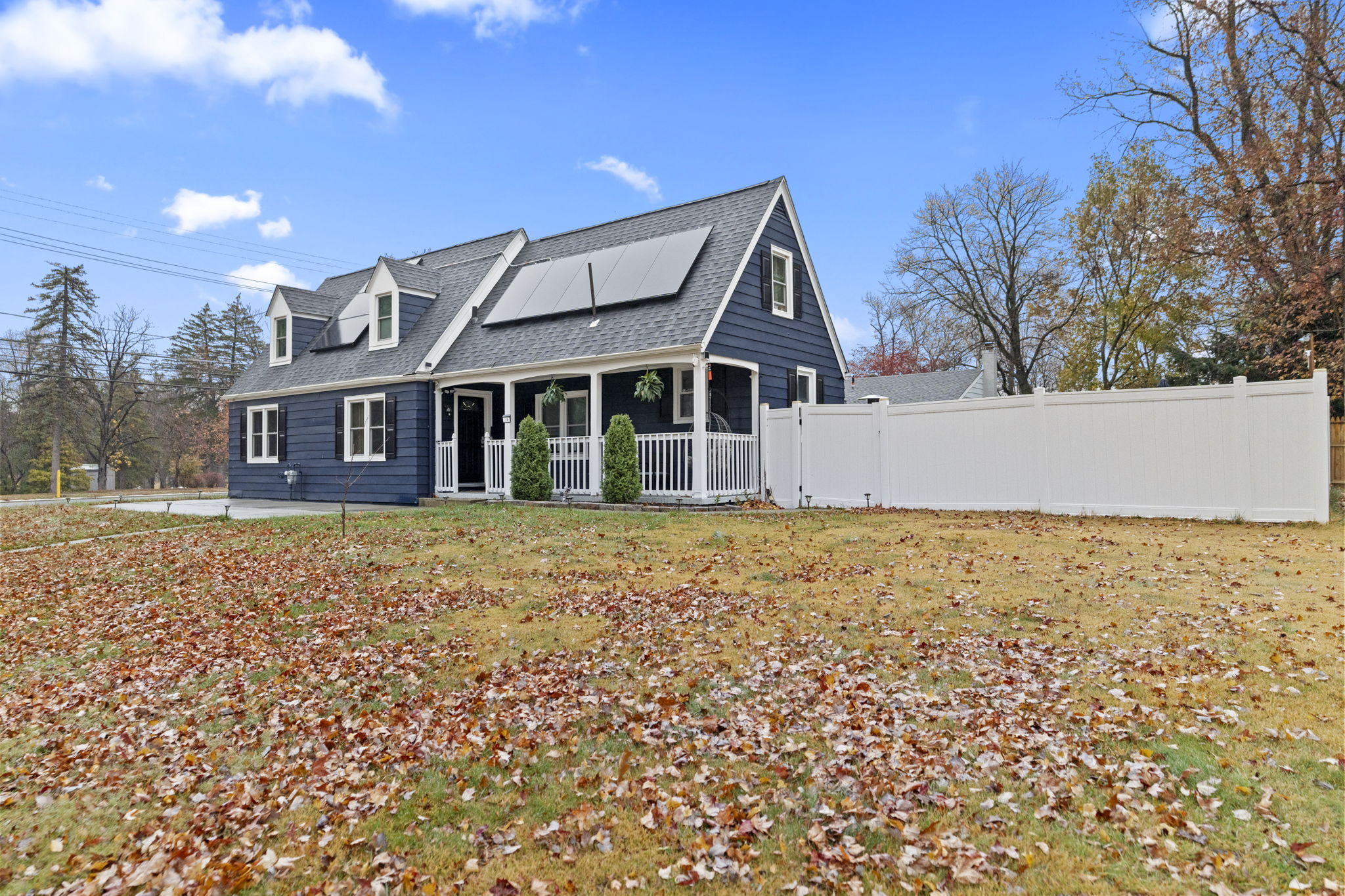
This Erlton Cape Cod-style home packs a lot into a small space. The first floor has an updated kitchen with an island and a dining area adjacent to the living room, as well as a bedroom and full bathroom. There are two bedrooms and another full bathroom upstairs, and a finished basement downstairs. Outside, the home has a patio and covered porch, and there’s a fenced-in yard with two decks and an above-ground pool out back. There’s an open house Sunday from 11 a.m. to 1 p.m.
By submitting your written, visual, and/or audio contributions, you agree to The Inquirer’s Terms of Use, including the grant of rights in Section 10.
This suburban content is produced with support from the Leslie Miller and Richard Worley Foundation and The Lenfest Institute for Journalism. Editorial content is created independently of the project donors. Gifts to support The Inquirer’s high-impact journalism can be made at inquirer.com/donate. A list of Lenfest Institute donors can be found at lenfestinstitute.org/supporters.
Taking a direct route, Santa has to travel 3,400 miles from the North Pole to Philadelphia. In comparison, your Christmas tree will have barely moved. That’s because there’s a high likelihood that your tree is one of the approximately 720,000 grown in the state of Pennsylvania.
Christmas tree lore runs deep around these parts. Don’t take our word for it, Taylor Swift grew up on an 11-acre Christmas tree farm in Reading – she even wrote a song about it.
That’s because Pennsylvania and New Jersey played a significant role in shaping the Christmas tree industry. Pennsylvania is still home to 1,301 Christmas tree farms, the second most in the nation, according to the U.S. Department of Agriculture.
Christmas trees harvested by county annually in Pennsylvania and New Jersey
0
0 – 5k
5k – 20k
20k – 50k
50k – 110k
Indiana, Pa. was once known as the "Christmas Tree Capital of the World."
Columbia, Pa. was where the technique of shearing Christmas trees was invented.
Mercer, N.J. was where the first commercial Christmas trees were grown.
Philly
Pittsburgh
Data: U.S. Department of Agriculture
America’s very first Christmas tree farm was established just outside of Trenton, according to Henry H. Albers and Ann Kirk Davis, authors of the Wonderful World of Christmas Trees. In 1901, a farmer named William McGalliard planted 25,000 Norway spruce trees on his farm in Mercer County, and would later sell his trees seven years later for $1 each.
Before McGalliard’s innovation, most yule trees were wild evergreen conifers (think green cones) cut from forests or abandoned farm land.
A 2000 Inquirer article on Philly and Pennsylvania’s role in establishing the Christmas tree tradition. The Christmas tree in the early illustration is indicative of how wild Christmas trees were far less dense and conical before tree shaping was invented.newspaper.com
Although the origins of decorating Christmas trees indoors are uncertain — often attributed by historians to early German immigrants — archival Inquirer articles have claimed that Philadelphians were among the first Americans to promote the tradition.
Although the growing industry began in Jersey, Pennsylvania farmers were instrumental in improving Christmas tree cultivation through the invention of techniques that are still practiced to this day.
story continues after advertisement
Fred Musser of Indiana County, Pa., started growing seedlings that he sold to other Christmas tree farmers in order to improve the quality of the trees, becoming the nation’s first ever Christmas tree nursery in the late 1920s. Andrew Abraczinskas, who first planted trees in Columbia County in 1915, invented the widely adopted process of shearing the sides of trees such that the resulting trees would keep a dense, conical “Christmas tree” shape.
McGalliard, Musser, and Abraczinskas’s work effectively ended the practice of harvesting wild trees and heavily influenced how trees are grown today:
Many growers buy young plants from tree nurseries where they were raised from seeds that have been genetically curated for the best chance of survival, either in seedbeds or as individual plugs.
Planting happens as soon as the ground thaws in the spring, typically in March. Trees establish themselves better if planted by mid-April, when temperatures rise and new growth begins to emerge.
After about the third growing year, growers wait until August for the new growth to harden before trimming the tree. Every year, the tree must be trimmed again, the base around the trunk pruned, and sprayed with pesticides.
Growers trim the sides to form the classic conical Christmas tree shape. This directs the tree’s energy upward and encourages denser needle foliage.
Trees reach their ideal marketable height of six or seven feet after about seven years, depending on the species. In the holiday harvest season, retail customers can select and cut their own tree, which is then netted by a mechanical baler for easy transport home to be adorned and adored.
While most of the growing process is the same, there are in fact a few different species of trees used for Christmas trees: notably: Firs, Pines, and Spruces. Each region will be better at growing specific subspecies within those three.
“Christmas tree species that you'll find growing in any production region reflect the climate and what grows well there. For instance, in the Pacific Northwest, they grow a lot of Noble Fir and Douglas fir,” said Rick Bates, Associate Professor or Horticulture at Penn State, who also advises growers on Christmas tree management.
“Here in Pennsylvania, we grow a lot of Fraser fir and Douglas fir and a handful of other species.”
Fir trees make up 60–70% of Christmas trees from Pennsylvania. They have flat, soft, long-lasting needles and some, like Douglas firs, have a citrus scent. Fraser firs are currently the most popular yule tree in the country, with European varieties like Turkish, Nordmann, and Korean firs introduced in the past 20 years.
Pine trees with slender, bundled needles and a sharp, earthy scent. They have a long history in Pennsylvania Christmas tree cultivation. Scotch pines, promoted by early innovator Musser, along with Eastern white and red pines, were once the state’s most popular Christmas tree.
Spruce trees, including the bluish-green Colorado spruce, have square, stiff needles that hold ornaments well but can be prickly and shed quickly. Norway spruces were the first commercially grown Christmas trees near Trenton.
Managing a Christmas tree farm can be fun, says Gerrit Strathmeyer II, a tree farmer in York County and president of the Pennsylvania Christmas Tree Growers Association, but the work is also a years-long endeavor that is logistically and physically demanding.
“Think of farming Christmas trees like farming corn or soybeans. They’re on what’s called a one year rotation — we’re on a 10 year rotation.”
The work is tough and labor-intensive. Planting begins in the still-chilly early spring, while growers wait until the hottest late summer months to start manually shearing, as Strathmeyer recounts: “I remember my high school days growing up, my summer jobs were just working in the field for eight, nine, ten hours a day.”
Subscribe to The Philadelphia Inquirer
Our reporting is directly supported by reader subscriptions. If you want more journalism like this story, please subscribe today
Come the winter months, while everyone else enjoys the festive season, this is the busiest time for growers, who take inventory and harvest trees.
Russell Wagner, a former board member of the Pennsylvania Christmas Tree Growers Association, whose farm is located 45 miles north of Harrisburg, has been monitoring the snow forecast in preparation for a busy work week.
“If we get a lot of snow, it can really hamper things, though light snow just makes it more Christmassy.”
story continues after advertisement
Strathmeyer said that his dad and uncles were at their Christmas tree peak in the late ‘90s and early 2000s. “They had 2,500 acres of Chrstmas trees and were selling around 120,000 cut Christmas trees.
Today, Strathmeyer sells around 22,000 trees a year, and the industry is no longer at its pinnacle. In the most recent USDA Census of Agriculture (2022), Pennsylvania had only 60% as many Christmas tree farms as it did 20 years ago.
Wagner attributes this to the fact that “the initial cost to get into the business is prohibitive. Unless you’re already a Christmas tree grower and another generation is going to continue it, it’s very difficult to get started.”
The industry was also disrupted by the advent of the artificial tree in the last 30 to 40 years, which are becoming increasingly more realistic — some even simulate the smell of a yule tree.
A 1972 Inquirer article about the artificial Christmas trees and Indiana County, once known as the "Christmas Tree capital of the world" at the time.newspaper.com
Strathmeyer, who is 38, said that “the popularity of the real Christmas tree has kind of plateaued off. It's a generalization, but our generation I think, people don't want to deal with the mess of a tree, and so that deters them from getting a real tree.”
However, Strathmeyer is optimistic. He is currently transitioning one of his wholesale farms to a choose-and-cut farm – where customers visit the farm, select a tree to cut, and take it home. He credits the recent popularity of these on-site experiences to social media. “People want that experience,” said Strathmeyer, “they want to take pictures out on the farm.
“Maybe they'll put up with the mess of a real tree because their kids want to go out to the farm and ride the wagon and run through the field.”
Support That Keeps Our Journalism Evergreen
Rooted in the field and committed to the facts, our newsroom brings you in-depth reporting. Support quality journalism by making a donation today.
Bates said Pennsylvania has a thriving choose-and-cut scene and that “a lot of those retail choose-and-cut farms also have other activities, like they may have a corn maze or some kind of agritainment.”
Combined with Pennsylvania’s proximity to major cities along the eastern seaboard, this growing popularity of experience-forward farms suggests the industry will remain viable for the foreseeable future.
It might be too late for you to grow up on a Christmas tree farm like Taylor Swift, but it’s not too late to ride a wagon and run through local Christmas tree fields. Whether you’re going to cut your own, or pick one up from a parking lot, we’ve got you covered with guides on where to go and how to get one delivered.
Methodology
Christmas tree data comes from the U.S. Department of Agriculture (USDA) Census of Agriculture data, which was most recently conducted in 2022, and accessed via the USDA’s National Agricultural Statistical Service. The data accessed cover farms that produce Christmas trees, including the number of farms, trees harvested, and acres planted.
Staff Contributors
Design, Development, and Data: Jasen Lo, Sam Morris
Capstan Therapeutics’ sale this year for $2.1 billion, the highest price paid for a private early-stage biotech company since 2022, was a triumph for its founders at the University of Pennsylvania.
Unfortunately for Philadelphia, the company is based in San Diego. Investors wanted an executive who lives there to be CEO.
Capstan was a miss for Philadelphia, said Jeffrey Marrazzo, who cofounded a high-profile regional biotech company, Spark Therapeutics, and is now an industry investor and consultant.
If Philadelphia had a bigger talent pool of biotech CEOs, “it would have and should have been here,” he said.
The Philadelphia region has lagged behind other biotech centers in landing companies and jobs, but industry experts are working to close the gap and better compete with Boston, the San Francisco Bay Area, and San Diego.
According to Marrazzo and others, the Philadelphia region’s relatively shallow pool of top biotech management is a key challenge.
Big investors go to managers who have proven ability to deliver big investment returns, said Fred Vogt, interim CEO of Iovance Biotherapeutics, a California company with a manufacturing facility in the Navy Yard.
“They want the company to perform. They’ll put it in Antarctica, if that was where the performance would come from,” he said.
The Lilly announcement last month also reflects Philadelphia’s national biotech stature. It’s the fourth U.S. city to get a Lilly Gateway Lab, behind Boston, the San Francisco Bay Area, and San Diego.
Those places have far outpaced Philadelphia in the creation of biotech research and development jobs, even as the sector’s growth has slowed.
From 2014 through last year, the Boston area added four biotech research and development jobs for every one job added here, according to an Inquirer analysis of federal employment data.
window.addEventListener(“message”,function(a){if(void 0!==a.data[“datawrapper-height”]){var e=document.querySelectorAll(“iframe”);for(var t in a.data[“datawrapper-height”])for(var r,i=0;r=e[i];i++)if(r.contentWindow===a.source){var d=a.data[“datawrapper-height”][t]+”px”;r.style.height=d}}});
Penn’s role in Philadelphia biotech
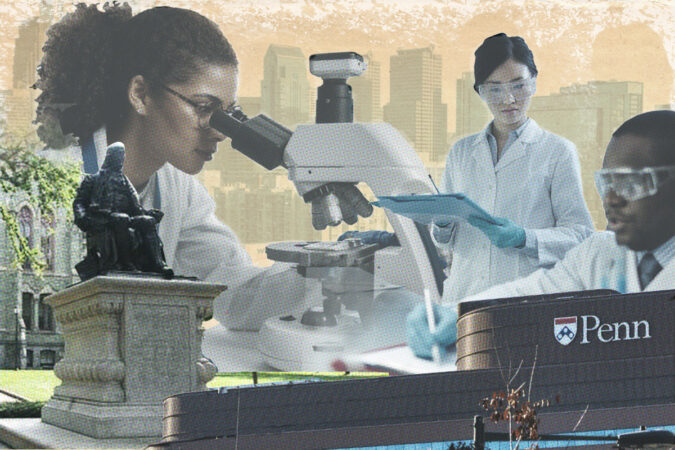
Philadelphia’s reputation as an innovation center — boosters like to call the region “Cellicon Valley” — starts with the University of Pennsylvania, which has long been a top recipient of National Institutes of Health grants to advance scientific discovery.
Research at Penn has contributed to the creation of 45 FDA-approved treatments since 2013, according to the university.
“Penn discoveries help spark new biotech companies, but we can’t build the whole ecosystem in this area alone,” said John Swartley, Penn’s chief innovation officer. “Great science is just one ingredient. We also need capital, experienced leadership, real estate and manufacturing infrastructure, and strong city and state support.”
Penn was one of two Philadelphia institutions receiving more than $100 million in NIH funding in the year that ended Sept. 30. The otherwas the Children’s Hospital of Philadelphia.
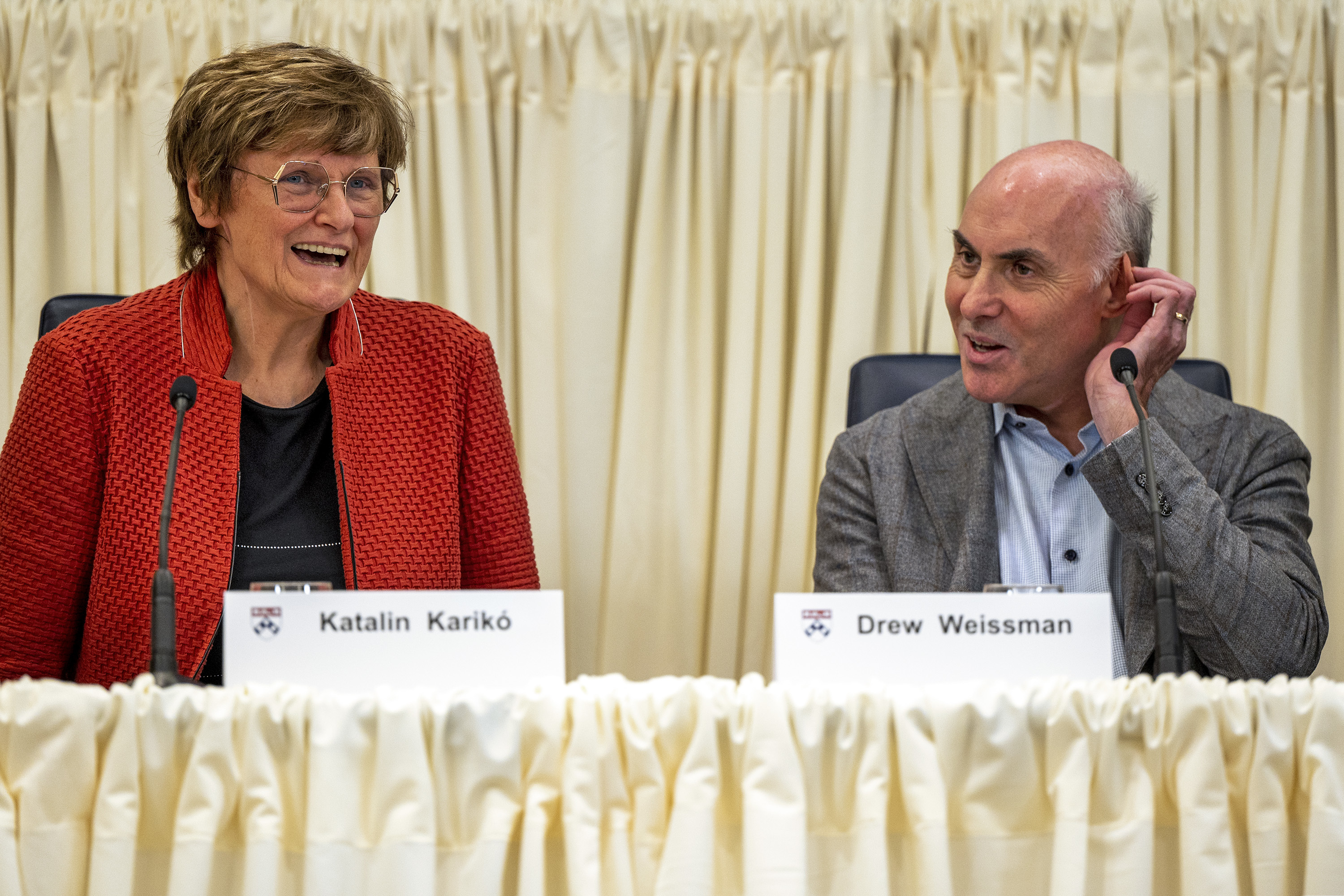
Katalin Karikó and Drew Weissman spoke at a University of Pennsylvania news conference after they were named winners of a 2023 Nobel Prize in medicine. Their work was instrumental to modifying mRNA for therapeutic uses, such as the rapid development of lifesaving vaccines during the COVID-19 pandemic.
By contrast, the Boston area was home to 10 institutions with at least $100 million in NIH grants, generating more spinoffs and jobs.
The Philadelphia region has a healthy number of biotech spinouts, but the biggest markets have more from a larger number of research institutions, said Robert Adelson, founder Osage University Partners, a venture capital firm in Bala Cynwyd.
That concentration of jobs and companies in the Boston area — where nearly 60,000 people worked in biotech R&D last year — makes it easier to attract people. By comparison, there were 13,800 such jobs in Philadelphia and Montgomery County, home to the bulk of the regional sector.
If a startup fails, which happens commonly in biotech, “there’ll be another startup or another company for me to go to” in a place like Boston, said Matt Cohen, a managing partner for life science at Osage.
Another challenge for Philadelphia: It specializes in cell and gene therapy, a relatively small segment of the biotech industry, whose allure to investors has faded in the last few years.
Such market forces shaped the trajectory of Spark, a 2013 Children’s Hospital of Philadelphia spinout that developed Luxterna, the first FDA-approved gene therapy, used to treat an inherited form of blindness. The promise of Spark’s gene therapy work for a form of hemophilia spurred its 2019 acquisition by Swiss pharmaceutical titan Roche for $4.8 billion.
The company still employs about 300 in the city, a spokesperson said, and work continues on its $575 million Gene Therapy Innovation Center at 30th and Chestnut Streets in University City.
The long arc of biotech
A handful of companies dominated the early days of U.S. biotech. Boston had Biogen and Genzyme, San Francisco had Genentech, San Diego had Hybritech, and Philadelphia had Centocor. All of them started between 1976 and 1981.
Centocor started in the University City Science Center because one of its founders, virologist Hilary Koprowski, was the longtime director of the Wistar Institute. Centocor’s first CEO, Hubert Schoemaker, moved here from the Boston area, where he had gotten his doctorate at the Massachusetts Institute of Technology.
Another drug still under development at the time of the sale, Stelara, went on to become J&J’s top-selling drug as recently as 2023 with $10.9 billion in revenue. Stelara, approved to treat several autoimmune disorders, remains a testament to Centocor’s legacy.
Despite its product success, Centocor didn’t have the same flywheel effect of creating new companies and a pipeline of CEOs as peer companies did in regions outside of Philadelphia.
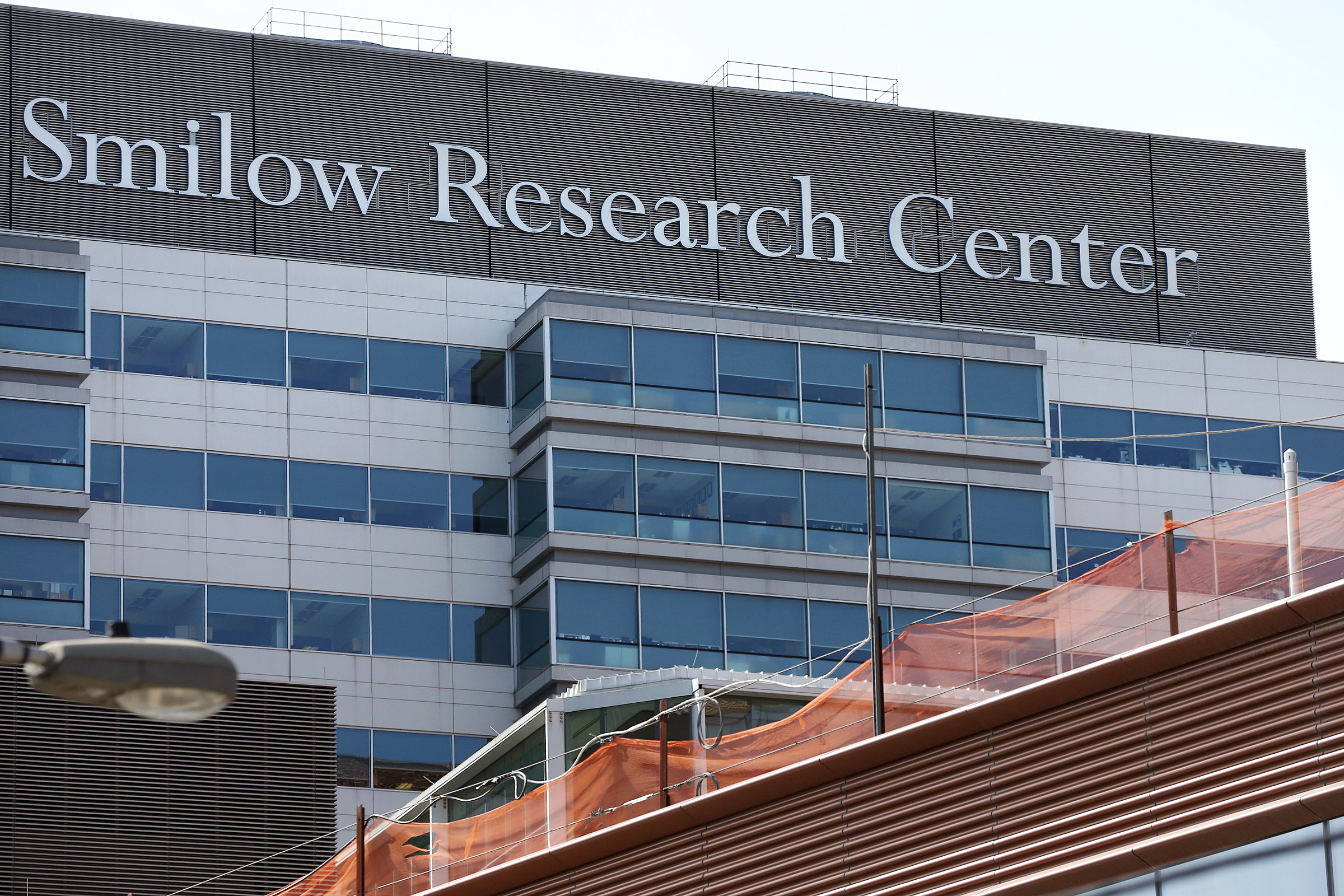
The University of Pennsylvania’s Smilow Center for Translational Research, shown in 2020, is one of the school’s major laboratory buildings.
“There are a lot of alums of Centocor that are really impressive, but they seem to have wound up elsewhere,” said Bill Holodnak, CEO and founder of Occam Global, a New York life science executive recruitment firm.
Among the Centocor executives who left the region was Harvey Berger, Centocor’s head of research and development from 1986 to 1991. He started a new company in Cambridge, Mass.
At the time, the Philadelphia area didn’t have the infrastructure, range of scientists, or management talent needed for biotech startups, he said.
Since then, he thinks the regional market has matured.
“Now, there’s nothing holding the Philadelphia ecosystem back. The universities, obviously Penn, and others have figured this out,” Berger said.
Conditions have changed
Penn’s strategy for helping faculty members commercialize their inventions has evolved significantly over the last 15 years.
It previously licensed the rights to develop its research to companies outside of the area, such as Jim Wilson’s gene therapy discoveries and biochemist Katalin Karikó and immunologist Drew Weissman’s mRNA patents. Now it takes a more active role in creating companies.
Among Penn’s latest spinouts is Dispatch Bio, which came out of stealth mode earlier this year after raising $216 million from investors led by Chicago-based Arch Venture Partners and San Francisco-based Parker Institute for Cancer Immunotherapy.
Dispatch, chaired by Marrazzo, is developing a cell therapy approach that uses a virus to attach what it calls a “flare” onto the cells it wants the immune system to attack.
Marrazzo said in July that he wasn’t going to be involved in Dispatch if it wasn’t based largely in Philadelphia. As of July, 75% of its 60 employees were working in Philadelphia. Still, Dispatch’s CEO is in the San Francisco Bay Area.
The Philadelphia region is increasingly well-positioned for the current biotech era, said Audrey Greenberg, who played a key role in launching King of Prussia’s Center for Breakthrough Medicines about five years ago. The center is a contract developer and manufacturer for cell and gene therapies.
“You no longer need to move to Kendall Square to get a company funded,” she said, referring to Cambridge’s biotech epicenter. “You need good data, a credible translational plan, experienced advisers, and access to patient capital, all of which can increasingly be built here.”
Greenberg now works as a venture partner for the Mayo Clinic, with the goal of commercializing research discoveries within the health system’s network of hospitals in Minnesota, Arizona, and Florida.
She plans to bring that biotech business to the Philadelphia region.
“I’m going to be starting my companies all here in Philadelphia, because that’s where I am. And I know everybody here, and everybody I’m going to hire in these startups that are going to be based here,” she said.
’Twas a few days before Christmas, and all through Cherry Hill, children were running outside with no jackets to chase Santa, and sometimes with no shoes.
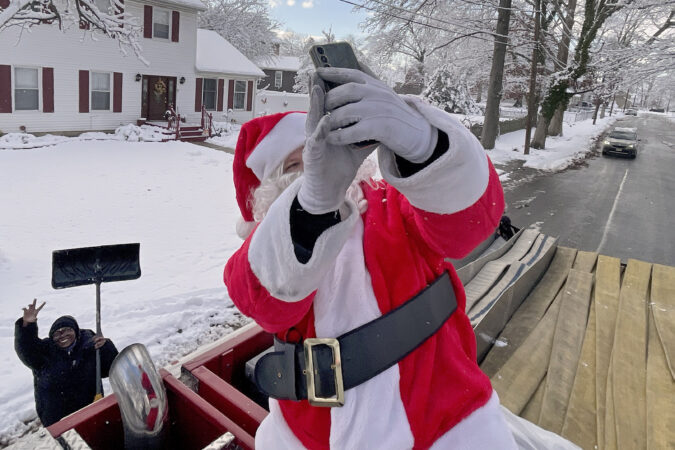
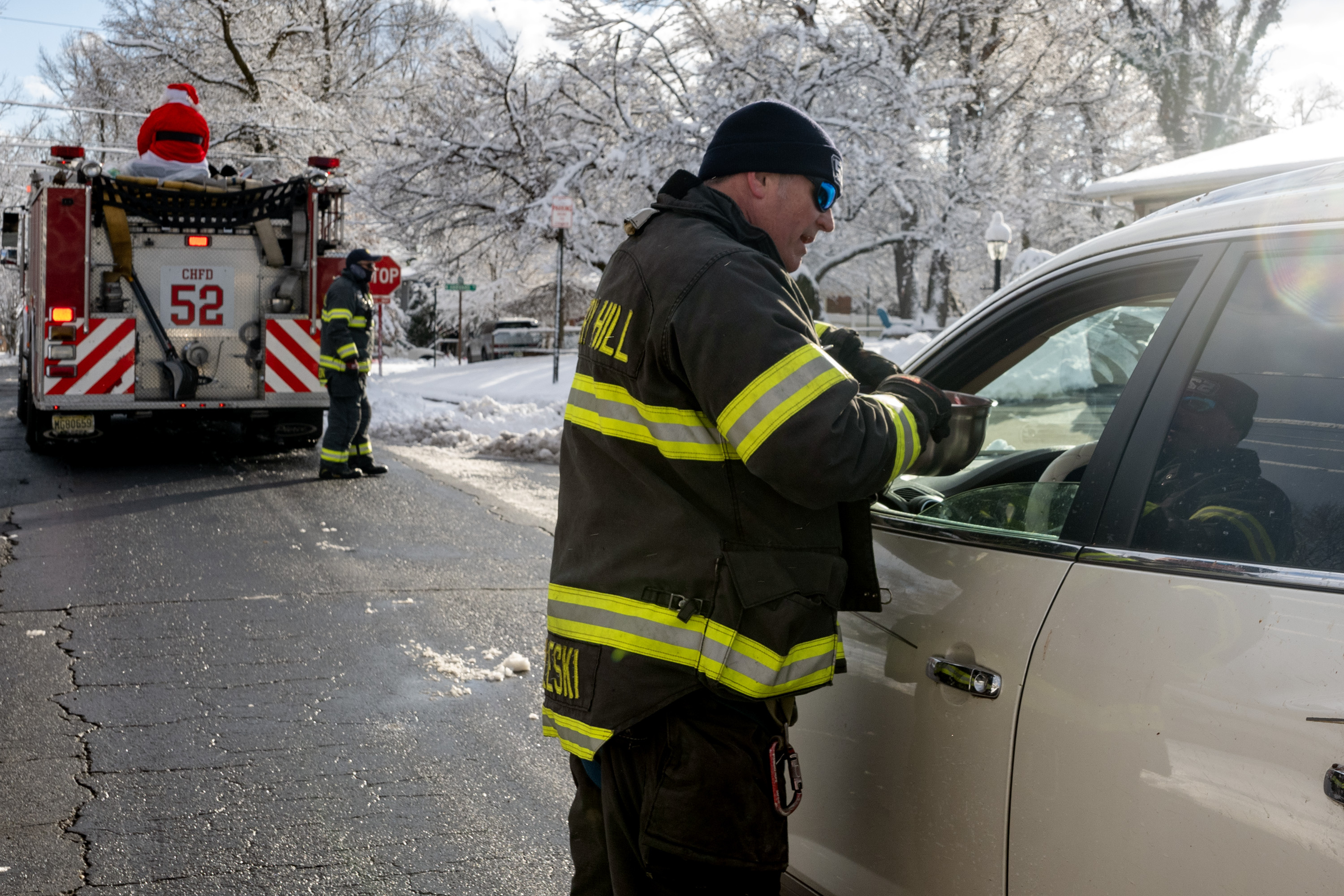
Strapped to the top of a Cherry Hill fire truck, Santa Claus made his rounds through the South Jersey community on Sunday, waving as he passed through condominiums decorated for Christmas and snow-dusted cul-de-sacs. Santa’s firefighter escorts handed out candy canes and holiday greetings as Christmas cheer warmed the frigid township.
“There’s nothing better than when you pull around the block with Santa on the roof,” said Jim Aleski, a Cherry Hill Fire Department lieutenant.
Each December, Santa makes a special trip to Cherry Hill, meticulously visiting every street in the township over the course of the department’s multiday Santa Tour. A fresh coat of rare December snow made for a particularly picturesque scene over the weekend, when kids, parents, and dogs chased down the fire truck to get a coveted glimpse of St. Nick.
Mark Yakovich, 3, and his dad, Ed Yakovich, 44, flagged down the fire truck from their driveway as if they were hailing a cab. Mark, the toddler, is very into trains at the moment. Luckily, fire trucks remain pretty high on his list (specifically when they’re associated with Marshall, the Dalmatian puppy fire marshal in PAW Patrol). Holding two candy canes and a toy train, Mark eyed the fire truck with glee, and a healthy skepticism, from the comfort of his dad’s arms.
Though Ed Yakovich said they are still “figuring out the family traditions with the new little guy,” seeing Santa was at the top of their December to-do list.
At the Burrough’s Mill subdivision, Andrew Lee said he and his family wait for Santa every year. A bit of Christmas light amid so much darkness in the world was a welcome respite this time around, he said.
“Santa brings the spirit,” Lee said.
What is Lee’s son, Makai, 10, asking for this Christmas? An Xbox, Roblox, and more Roblox.
Ed Yakovich takes a photo of his wife Kendra McGarvey with their son Mark Yakovich, 3, as Santa, leaves after stopping at their home.
As the firefighting crew and its guest of honor wound through the township, delighted residents waved and cheered, stopped for selfies, and honked in appreciation. One resident ran out to gift a box of brownies to the firefighters.
Aleski said no one can quite pinpoint when the Santa Tour began, but residents say they remember the tradition happening as far back as the 1960s.
Archives show Santa visiting South Jersey via fire truck as early as 1931, when he distributed gifts to the children of Barrington on Christmas Day.
Sandy Chase, 54, said she remembers a Santa Tour from her childhood in northern New Jersey.
“This is a big Jersey thing,” she said.
Nicole Gaunt, 31, has lived in Cherry Hill her whole life. She and her daughter Khaos, 8, were out playing in the snow when Santa rounded the corner.
Gaunt said the duo were prepared to see the big guy.
“We’ve chased him down before,” she added.
Three-year-old Michele Peruffo pauses as firefighter Sam Harrison (left) walks behind a fire truck with Santa through the neighborhood.
Aleski said nothing drives community engagement like the Santa Tour. Each year, his department gets dozens of calls, emails, and social media inquiries about when Santa will pass by each house.
Though the department is meticulous in hitting every block, it’s a fire department first, and emergency operations supersede Santa. Santa has shown up at more than a few unexpected emergencies during tours past.
The Santa Tour in Cherry Hill will continue over the next few days. To see when Santa is visiting each neighborhood, explore this interactive map.
Firefighter Lt. Jim Aleski gives candy canes to a driver “stuck” behind the Santa fire truck.
This suburban content is produced with support from the Leslie Miller and Richard Worley Foundation and The Lenfest Institute for Journalism. Editorial content is created independently of the project donors. Gifts to support The Inquirer’s high-impact journalism can be made at inquirer.com/donate. A list of Lenfest Institute donors can be found at lenfestinstitute.org/supporters.




 on Philly and Pennsylvania’s role in establishing the Christmas tree tradition. The Christmas tree in the early illustration is indicative of how wild Christmas trees were far less dense and conical before tree shaping was invented.](https://interactives.inquirer.com/secondbank/arc/23HWJ4UDIZGPPALTU5ZPZVNUD4/325.webp)


 about the artificial Christmas trees and Indiana County, once known as the "Christmas Tree capital of the world" at the time.](https://interactives.inquirer.com/secondbank/arc/3L6UHPXXHNHYFITN64ON5QSIMI/325.webp)