Kilmar Abrego Garcia was freed from an immigration detention center in Pennsylvania on Thursday evening following a federal judge’s order earlier in the day that compelled his release, marking a significant development in a case that has served as a test of the deportation powers of President Donald Trump’s administration.
An attorney for Abrego Garcia confirmed his client’s release, telling the Associated Press that he left the Moshannon Valley Processing Center, where he had been held since late September, just before 5 p.m. Abrego Garcia, whose case gained international attention earlier this year after he was deported to the notorious CECOT prison in his native El Salvador before being ordered returned, will return to Maryland.
“The government still has plenty of tools in their toolbox, plenty of tricks up their sleeve,” attorney Simon Sandoval-Moshenberg said. “We’re going to be there to fight to make sure there is a fair trial.”
Abrego Garcia’s release came after Maryland U.S. District Judge Paula Xinis found that Immigration and Customs Enforcement had detained him with no legal basis. In an order issued Thursday morning, Xinis ordered ICE to release him immediately.
“Since Abrego Garcia’s return from wrongful detention in El Salvador, he has been re-detained, again without lawful authority,” the judge wrote. “For this reason, the Court will GRANT Abrego Garcia’s Petition for immediate release from ICE custody.”
The Department of Homeland Security was highly critical of the release order, calling it “naked judicial activism” by a judge who was appointed by President Barack Obama, a Democrat.
“This order lacks any valid legal basis, and we will continue to fight this tooth and nail in the courts,” said Tricia McLaughlin, the department’s assistant secretary.
Abrego Garcia entered the United States without permission at age 16, then settled in Maryland, and later married and started a family. An immigration judge ruled in 2019 that he could be deported, but not to El Salvador, where he faced threats of gang violence. The Trump administration, which claimed Abrego Garcia was a member of the MS-13 gang, nonetheless deported him to that country in March, and his wife successfully sued to bring him back.
His case went on to become a rallying point for those who oppose Trump’s immigration crackdown. Upon his return, he was charged with human trafficking — an allegation his lawyers called preposterous and vindictive. Abrego Garcia has pleaded not guilty in that case and filed a motion to dismiss the charges.
Though Abrego Garcia cannot legally be deported to El Salvador, ICE has sought to deport him to several African countries, including Eswatini, Ghana, and Uganda. In her order, Xinis wrote that “none of these countries were ever viable options” and noted that Costa Rica — where Abrego Garcia indicated he would prefer to be deported should he be removed — never rescinded an offer to accept him, as officials previously alleged.
“But Costa Rica had never wavered in its commitment to receive Abrego Garcia, just as Abrego Garcia never wavered in his commitment to resettle there,” Xinis wrote.
A transfer to Pennsylvania
After being held at a detention center in Virginia following his return to the United States in June, Abrego Garcia was transferred to Moshannon Valley Processing Center in Western Pennsylvania. Known as Moshannon, the facility is run by the Florida-based private prisons giant GEO Group.
In a recent Inquirer report, current and former detainees described grim and crowded conditions at the facility, with 75 men sleeping together in a pod, sharing six toilets and three showers among them. The facility is the largest detention center in the northeastern United States, capable of holding nearly 1,900 prisoners, The Inquirer previously reported.
ICE officials said at the time of Abrego Garcia’s transfer that his detention to Moshannon would allow his lawyers easier access to their client. Abrego Garcia’s attorneys, however, raised concerns about the conditions at the facility, saying there had been reports of “assaults, inadequate medical care, and insufficient food” there.
In a separate immigration court action filed in August, Abrego Garcia petitioned to reopen his immigration case to seek asylum in the United States. That case remains ongoing.
In her order releasing Abrego Garcia, Xinis wrote that federal authorities “did not just stonewall” the court: “They affirmatively misled the tribunal.” Xinis also dismissed the federal government’s arguments that the court did not have jurisdiction to rule on a final order of removal, noting that such an order had not been filed.
“Thus, Abrego Garcia’s request for immediate release cannot touch upon the execution of a removal order if no such order exists,” she wrote.
Staff writers Jeff Gammage and Max Marin contributed to this article, which contains information from the Associated Press.
WASHINGTON — Members of Congress clashed Thursday over President Donald Trump’s use of the National Guard in American cities, with Republicans saying the deployments were needed to fight lawlessness while Democrats called them an extraordinary abuse of military power that violated states’ rights.
Top military officials faced questioning over the deployments for the first time at the hearing before the Senate Armed Services Committee. They were pressed by Democrats over the legality of sending in troops, which in some places were done over the objections of mayors and governors, while Trump’s Republican allies offered a robust defense of the policy.
It was the highest level of scrutiny, outside a courtroom, of Trump’s use of the National Guard in U.S. cities since the deployments began and came a day after the president faced another legal setback over efforts to send troops to support federal law enforcement, protect federal facilities and combat crime.
“In recent years, violent crime, rioting, drug trafficking and heinous gang activity have steadily escalated,” said Mississippi Sen. Roger Wicker, the committee chairman. The deployments, he said, are “not only appropriate, but essential.”
Democrats argued they are illegal and contrary to historic prohibitions about military force on U.S. soil.
Sen. Tammy Duckworth (D., Ill.) said domestic deployments traditionally have involved responding to major floods and tornadoes, not assisting immigration agents who are detaining people in aggressive raids.
“Trump is forcing our military men and women to make a horrible choice: uphold their loyalty to the Constitution and protect peaceful protesters, or execute questionable orders from the president,” said Duckworth, a combat veteran who served in the Illinois National Guard.
Democrats ask military officials about illegal orders
Democrats asked military leaders about Trump’s comments about “the enemy within” America and whether service members could be asked to follow orders that violate their oath.
She asked Charles Young III, principal deputy general counsel at the Pentagon, whether Trump could place troops at polling places during next year’s election and whether such an order would be legal.
The idea “sends a shiver down the spine of every American, and should whether you’re a Democrat or a Republican,” Slotkin said.
Young said he could not answer such a question without details, calling it “a hypothetical situation.” He said the Supreme Court has ruled that the president has exclusive authority to decide whether an emergency exists that could require a National Guard response.
Slotkin was one of six Democratic lawmakers who recorded a video calling on troops to uphold the Constitution and defy “illegal orders.” In response, Trump accused the lawmakers, all military or intelligence veterans, of sedition “punishable by DEATH.”
Sen. Elizabeth Warren (D., Mass.) pressed Young on news reports that the administration had dismissed advice from military lawyers on deploying Guard and bombing alleged drug boats in Latin America.
“If an attorney raises concerns about the legality of military operations, do you think the appropriate response is to tell them to shut up and get out of the way?” Warren asked Young.
Young denied those reports, saying leadership is “very attentive” to the concerns of military lawyers.
When asked about Trump’s statements about an “invasion within” or an “enemy within,” Air Force Gen. Gregory Guillot, commander of U.S. troops in North America, said, “I do not have any indications of an enemy within.”
Republicans and Democrats see the deployments differently
In one exchange, Sen. Mazie Hirono (D., Hawaii) noted how former Defense Secretary Mark Esper alleged that Trump inquired about shooting protesters during the George Floyd demonstrations. She asked whether a presidential order to shoot protesters would be lawful.
Young said he was unaware of Trump’s previous comments and that “orders to that effect would depend on the circumstances.”
Republicans countered that Trump was within his rights — and his duty — to send in troops.
Republican Sen. Tim Sheehy of Montana, a former Navy SEAL officer, argued during the hearing that transnational crimes present enough of a risk to national security to justify military action, including on U.S. soil.
Sheehy claimed there are foreign powers “actively attacking this country, using illegal immigration, using transnational crime, using drugs to do so.”
Military leaders point to training
During questioning, military leaders highlighted the duties that National Guard units have carried out. Troops are trained for their specific missions, they said, and are prohibited from using force unless in self-defense.
Since the deployments began, only one civilian — in California — has been detained by National Guard personnel, Guillot said. He says the troops are trained to de-escalate tense interactions with people, but do not receive any specific training on mental health episodes.
“They can very quickly be trained to conduct any mission that we task of them,” Guillot said.
During the hearing, senators also offered their sympathies after two West Virginia National Guard members deployed to Washington were shot just blocks from the White House in what the city’s mayor described as a targeted attack. Spc. Sarah Beckstrom died a day after the Nov. 26 shooting, and her funeral took place Tuesday. Staff Sgt. Andrew Wolfe remains in a Washington hospital.
Hearing follows court setback for Trump
A federal judge in California on Wednesday ruled that the administration must stop deploying the California National Guard in Los Angeles and return control of the troops to the state. The judge put the decision on hold until Monday, and the White House said it plans to appeal.
Trump also had announced National Guard members would be sent to Illinois, Oregon, Louisiana, and Tennessee. Other judges have blocked or limited the deployment of troops to Portland, Oregon, and Chicago, while Guard members have not yet been sent to New Orleans.
The Coatesville Area School District will soon see a swath of changes as it prepares to shutter two elementary schools at the end of the school year, open a new one, and realign its attendance boundaries to ensure equity amid the transition.
The new map, approved by the school board Tuesday, splits the district into four geographic regions, intended to keep communities together while maintaining ethnic and socio-economic balance, according to the district’s presentation.
“We’re proud of our diverse population that we have in Coatesville, so we were looking to sustain that in each of our elementary schools as well,” the district’s superintendent, Anthony P. Rybarczyk, said in an interview Thursday.
The update,slated to take effect next school year, comes as the district has been rolling out a new facilities plan over the last several years, while its enrollment has declined and its budget has been squeezed by charter schools. When students leave Caln and East Fallowfield elementary schools for the summer, the two nearly century-old schools will close permanently. The schools, which both serve kindergarten through fifth grades, enroll roughly 730 students between them.
Under thenew attendance zones, families in the Indian Run Village are being reassigned to Kings Highway Elementary School. Families in the area of Millview Park will be reassigned to Kings Highway, rather than split among three of the district’s elementary schools. The community divided by Barley Sheaf Road will now attend Reeceville Elementary. The district began communicating the changes Wednesday.
“Geographically, it made sense,” Rybarczyk said during the school board meeting. “We met with transportation as well, they were very promising in how they said this could save time on their runs and avoid the crossovers between going from one community to the next.”
The middle school feeder pattern will be split into two sections, with Kings Highway and Reeceville matriculating to North Brandywine Middle School. Rainbow Elementary School and the new Doe Run — which will open in August on the former South Brandywine Middle School site — will feed to Scott Middle School.
Fourth graders at elementary schools will be “grandfathered in” to complete their fifth-grade year at the elementary school they’ve been in, even if its enrollment is set to shift. The district plans to ask parents to provide transportation for those students next year, Rybarczyk said.
As the district winds down two of its schools, it will celebrate their history over the summer, with legacy walks and celebrations.
“The great thing about Coatesville is the children are in the schools where their parents went,” he said.
The district will keep the buildings, with an eye toward potential growth in the future, Rybarczyk said, though the district has no immediate plans for them.
The schools’ closure and the opening of Doe Run Elementary School are part of a broader effort to update the district’s aging facilities, which Rybarczyk said would continue next year.
“I think the community has been looking for something like this for a long time as well,” he said.
With “a shift of a number of charter school families coming back to our district” and new development, Rybarczyk said he believes the district could see its enrollment grow. Its campaign to bring students back from cyber and charter schools, launched alongside its upgrading of facilities in the last few years, has gained back 64 students, and hundreds of thousands of dollars, he said.
“We’re going to see what the need will be in the future, because we could have an influx where we need to repurpose them in some way,” he said at the board meeting. “Obviously, they’re two older schools …There’s some work to be done if we were to repurpose those.”
This suburban content is produced with support from the Leslie Miller and Richard Worley Foundation and The Lenfest Institute for Journalism. Editorial content is created independently of the project donors. Gifts to support The Inquirer’s high-impact journalism can be made at inquirer.com/donate. A list of Lenfest Institute donors can be found at lenfestinstitute.org/supporters.
WASHINGTON — The Senate on Thursday rejected legislation to extend Affordable Care Act tax credits, essentially guaranteeing that millions of Americans will see a steep rise in costs at the beginning of the year.
As Republicans and Democrats have failed to find compromise, senators voted on two partisan bills instead that they knew would fail — the Democratic bill to extend the subsidies, and a Republican alternative that would have created new health savings accounts.
It was an unceremonious end to a monthslong effort by Democrats to prevent the COVID-19-era subsidies from expiring on Jan. 1, including a 43-day government shutdown that they forced over the issue.
Ahead of the votes, Senate Democratic Leader Chuck Schumer of New York warned Republicans that if they did not vote to extend the tax credits, “there won’t be another chance to act,” before premiums rise for many people who buy insurance off the ACA marketplaces.
“Let’s avert a disaster,” Schumer said. “The American people are watching.”
Republicans and Democrats never engaged in meaningful or high-level negotiations on a solution, even after a small group of centrist Democrats struck a deal with Republicans last month to end the shutdown in exchange for a vote. Most Democratic lawmakers opposed the move as many Republicans made clear that they wanted the tax credits to expire.
The deal raised hopes for a compromise on healthcare. But that quickly faded with a lack of any real bipartisan talks.
“We failed,” said Alaska Sen. Lisa Murkowski, one of four Republicans who voted for the Democratic bill, after the vote. “We’ve got to do better. We can’t just say ‘happy holidays, brace for next year.’”
A Republican alternative
The dueling Senate votes were the latest political messaging exercise in a Congress that has operated almost entirely on partisan terms, as Republicans pushed through a massive tax and spending cuts bill this summer using budget maneuvers that eliminated the need for Democratic votes. In September, Republicans tweaked Senate rules to push past a Democratic blockade of all of Trump’s nominees.
On healthcare, Republicans similarly negotiated among themselves, without Democrats. The health savings accounts in the GOP bill that they eventually settled on would give money directly to consumers instead of to insurance companies, an idea that has been echoed by President Donald Trump.
Senate Majority Leader John Thune (R., S.D.) said ahead of the vote that the Democrats’ simple extension of the subsidies is “an attempt to disguise the real impact of Obamacare’s spiraling healthcare costs.”
But Democrats immediately rejected the GOP plan, saying that the accounts wouldn’t be enough to cover costs for most consumers.
The Senate voted 51-48 not to move forward on the Democratic bill, with four Republicans — Maine Sen. Susan Collins, Missouri Sen. Josh Hawley and Alaska Sens. Murkowski and Dan Sullivan — voting with Democrats. The legislation needed 60 votes to proceed, as did the Republican bill, which was also blocked on a 51-48 vote.
An intractable issue
The votes were the latest failed salvo in the debate over the Affordable Care Act, former President Barack Obama’s signature law that Democrats passed along party lines in 2010 to expand access to insurance coverage.
Republicans have tried unsuccessfully since then to repeal or overhaul the law, arguing that healthcare is still too expensive. But they have struggled to find an alternative. In the meantime, Democrats have made the policy a central political issue in several elections, betting that the millions of people who buy healthcare on the government marketplaces want to keep their coverage.
“When people’s monthly payments spike next year, they’ll know it was Republicans that made it happen,” Schumer said in November, while making clear that Democrats would not seek a compromise.
Even if they view it as a political win, the failed votes are a loss for Democrats who demanded an extension of the benefits during the shutdown — and for the millions of people facing premium increases on Jan. 1.
Maine Sen. Angus King, an independent who caucuses with Democrats, said the group tried to negotiate with Republicans after the shutdown ended. But, he said, the talks became unproductive when Republicans demanded language adding new limits for abortion coverage that were a “red line” for Democrats. He said Republicans were going to “own these increases.”
House to try again
Republicans have used the looming expiration of the subsidies to renew their longstanding criticisms of the ACA, also called Obamacare, and to try, once more, to agree on what should be done.
In the House, Speaker Mike Johnson (R., La.) has promised a vote next week on some type of healthcare legislation. Republicans weighed different options in a conference meeting on Wednesday, with no apparent consensus.
Murkowski and other Senate Republicans who want to extend the subsidies expressed hope that the House could find a way to do it. GOP leaders were considering bills that would not extend the tax credits, but some Republicans have launched longshot efforts to try to go around Johnson and force a vote.
“Hopefully some ideas emerge” before the new year, said Republican Sen. Thom Tillis of North Carolina, who has been pushing his colleagues for a short-term extension.
“Real Americans are paying the price for this body not working together in the way it should,” said Alabama Sen. Katie Britt, a Republican.
Republican moderates in the House who could have competitive reelection bids next year are pushing Johnson to find a way to extend the subsidies. But more conservative members want to see the law overhauled.
Rep. Kevin Kiley (R., Calif.) has also been pushing for a short extension.
If they fail to act and healthcare costs go up, the approval rating for Congress “will get even lower,” Kiley said.
WASHINGTON — The U.S. imposed sanctions on three nephews of Venezuelan President Nicolás Maduro, among others, on Thursday as President Donald Trump looks to inflict further pressure on the South American nation.
The new sanctions on Franqui Flores, Carlos Flores and Efrain Campo come a day after Trump announced that the U.S. had seized an oil tanker off the coast of Venezuela. Also included in the sanctions are Panamanian businessman Ramon Carretero, six firms and six Venezuela-flagged ships accused of transporting Venezuelan oil.
Carretero is accused of facilitating oil shipments on behalf of the Venezuelan government, and the Treasury says he has had business dealings with the Maduro-Flores family, including partnering in several companies together.
The Treasury’s Office of Foreign Assets Control published the list of sanctions on Thursday.
The sanctions are meant to deny them access to any property or financial assets held in the U.S., and the penalties are intended to prevent U.S. companies and citizens from doing business with them. Banks and financial institutions that violate that restriction expose themselves to sanctions or enforcement actions.
Treasury Secretary Scott Bessent said in a statement that “Nicolas Maduro and his criminal associates in Venezuela are flooding the United States with drugs that are poisoning the American people.”
“Under President Trump’s leadership, Treasury is holding the regime and its circle of cronies and companies accountable for its continued crimes,” he said.
This is not the first time Maduro’s family has been involved in a political tit-for-tat with the U.S.
In October 2022, Venezuela freed seven imprisoned Americans in exchange for the United States releasing Flores and Campo, who had been jailed for years on narcotics convictions. The pair were arrested in Haiti in a Drug Enforcement Administration sting in 2015 and convicted the following year in New York.
Carlos Flores had been sanctioned in July 2017 but was removed from Treasury’s list in 2022 during the Biden administration years in an effort to promote negotiations for democratic elections in Venezuela.
Russian President Vladimir Putin expressed “solidarity with the Venezuelan people” on Thursday amid growing tensions between Maduro and the Trump administration.
The Kremlin said in a statement that Putin spoke with Maduro by phone and reaffirmed his support for the Venezuelan leader’s policy of “protecting national interests and sovereignty in the face of growing external pressure.”
Maduro has insisted the real purpose of the U.S. military operations is to force him from office. Venezuela’s government said the tanker seizure “constitutes a blatant theft and an act of international piracy.”
The South American country’s government said that Putin had “categorically reaffirmed his support” for Maduro in their call.
It said in a statement that Putin had told Maduro that direct communication between Moscow and Caracas would “remain permanently open” and Russia would continue to support Venezuela “in its struggle to assert its sovereignty, international law, and peace throughout Latin America.”
Like his predecessor, the late President Hugo Chávez, Maduro has forged a close relationship with Russia, which has offered Venezuela help, ranging from coronavirus vaccines to the design of a cryptocurrency. In 2018, it also briefly dispatched a pair of nuclear-capable Tu-160 bombers to the airport outside Venezuela’s capital amid soaring Russia-U.S. tensions.
Last year, two Russian naval ships docked in the Venezuelan port of La Guaira after exercises in the Atlantic Ocean that Moscow said were to “show the flag” in remote, important regions.
In Belarus, authoritarian President Alexander Lukashenko, a Putin ally, met with the Venezuelan ambassador to Russia, Jesus Rafael Salazar Velázquez, on Thursday, for the second time in just over two weeks.
Details of what was discussed were not revealed, but Belarus’ state news agency Belta quoted Lukashenko as saying that the diplomat was expected to discuss “certain issues” with Maduro after their first meeting on Nov. 25 and to travel to Belarus again, so that they could reach “a certain decision.”
During the November meeting, Lukashenko extended an invitation to Maduro to visit Belarus, and said that he would try and find the time to visit Venezuela, too.
On Thursday, when low temps hit 35 degrees and a wild wind whipped down Market Street, a young man climbed on a box in front of the Liberty Bell and stripped to his underwear.
Turns out the nearly naked man on the box is an artist from Baltimore. His name is Ham. “Like the sandwich,” he said. Standing on a platform in his underwear is, evidently, performance art — a commentary on social media. “Rather than using digital platforms to share art and gain exposure,” Ham told me, “I’ve made a physical platform to stand on in public and talk to strangers.”
In other words, he doesn’t want to be a content creator; he wants to be the content and let others do the creating. And they do.
People snap photos of him, take videos of him, and scan the QR code on the corner of his platform, which links to, what else but his Instagram. It’s part performance art, part guerrilla marketing.
“I do recognize that as an artist I need to have some form of digital presence,” Ham said, “I just don’t want to be responsible for creating it.”
He’d rather shiver.
Ham has been standing on platforms in his underwear on and off for two years in several frigid cities, including New York, Berlin, and a small village in Norway. “I use it as my excuse to travel,” he said.
Ham is saving the money people give him for an engagement ring for his girlfriend.
He also uses it as a way to raise money for an engagement ring for his girlfriend — although that wasn’t the original goal. He only decided to write “engagement ring savings fund” on the side of the platform after he grew tired of explaining to people that he wasn’t freezing in his underwear for money.
“I was like, ‘if people have to have a financial explanation for this, I’ll say it’s an engagement ring fund for my girlfriend,’” he said. Ham wouldn’t disclose how much money he has made, just that it’s “more than you might think,” and enough to afford a custom-designed ring in New York. (I’m guessing at least $2,000.)
Ham is enjoying his time in Philadelphia more than other cities.
“This is actually the most fun I’ve had in terms of the quality of interaction and number of people,” he said, visibly shivering.
Several people have approached him to ask him what he is doing. Two National Parks officers checked in after receiving calls of concern. They offered him clothes; he declined. A police officer stopped by to ask if he was OK. One woman wanted to know whether he was promoting a cause.
If you’re interested in seeing a nearly naked man shiver on a box, Ham will be at the Liberty Bell all day Friday and Saturday. He leaves around 4:30 p.m., partly because he’s noticed people don’t like to talk to him as much once it’s dark.
Measles outbreaks are growing along the Utah-Arizona border and in South Carolina, where hundreds are in quarantine.
Between Friday and Tuesday, South Carolina health officials confirmed 27 new measles cases in an outbreak in and around northwestern Spartanburg County. In two months, 111 people have been sickened by the vaccine-preventable virus.
More than 250 people, including students from nine area elementary, middle and high schools, are in quarantine — some for the second time since the outbreak began in October. Most of the state’s new cases stemmed from exposures at Way of Truth Church in Inman. Church leaders have been “very helpful,” said state epidemiologist Dr. Linda Bell.
“We are faced with ongoing transmission that we anticipate will go on for many more weeks, at least in our state,” said Bell.
In Arizona and Utah, an outbreak has ballooned since August. Mohave County, Arizona has logged 172 cases and the Southwest Utah Public Health Department has logged 82 cases. The border cities of Colorado City, Arizona, and Hildale, Utah, are the heaviest hit.
Overall, Utah has confirmed 115 measles cases this year. Arizona has confirmed 176.
Nationally, the measles case count is nearing 2,000 for a disease that has been considered eliminated in the U.S. since 2000, a result of routine childhood vaccinations.
Last month, Canada lost that designation — which applies when there is no continuous local spread of the virus — as did the larger health region of the Americas.
Experts say the U.S. is also at risk of losing that status. For that to happen, measles would have to spread continuously for a year. A large outbreak in Texas, New Mexico and Oklahoma that started in January sickened nearly 900 and kicked off the United States’ worst measles year in more than three decades.
All but eight states have logged at least one measles case this year, according to the Centers for Disease Control and Prevention. The CDC has confirmed 47 outbreaks this year, compared with 16 in 2024. Three people — two of them Texas school children — have died.
The measles, mumps and rubella vaccine is safe and provides 97% protection against the disease after two doses. Most children in the U.S. are required to get the shot to attend school. But vaccination rates have declined as more parents waive the shots or have fallen behind on recommended vaccination schedules.
Prior to the vote, the board heard from registered speakers, including some from West Oak Lane Charter School who want their school to be able to purchase the vacant Ada Lewis Middle School building.
The board, with some absences, then moved into the “Goals and Guardrails” portion of its meeting, where district leaders shared 2024-25 Keystone and NOCTI scores. Algebra and biology Keystone scores stayed mostly flat compared to 2023-24, while literature scores dropped 2.9%. Board members Whitney Jones and Wanda Novales each asked for more detailed data from the district.
// Timestamp 12/11/25 6:20pm
Novales adjourns the meeting
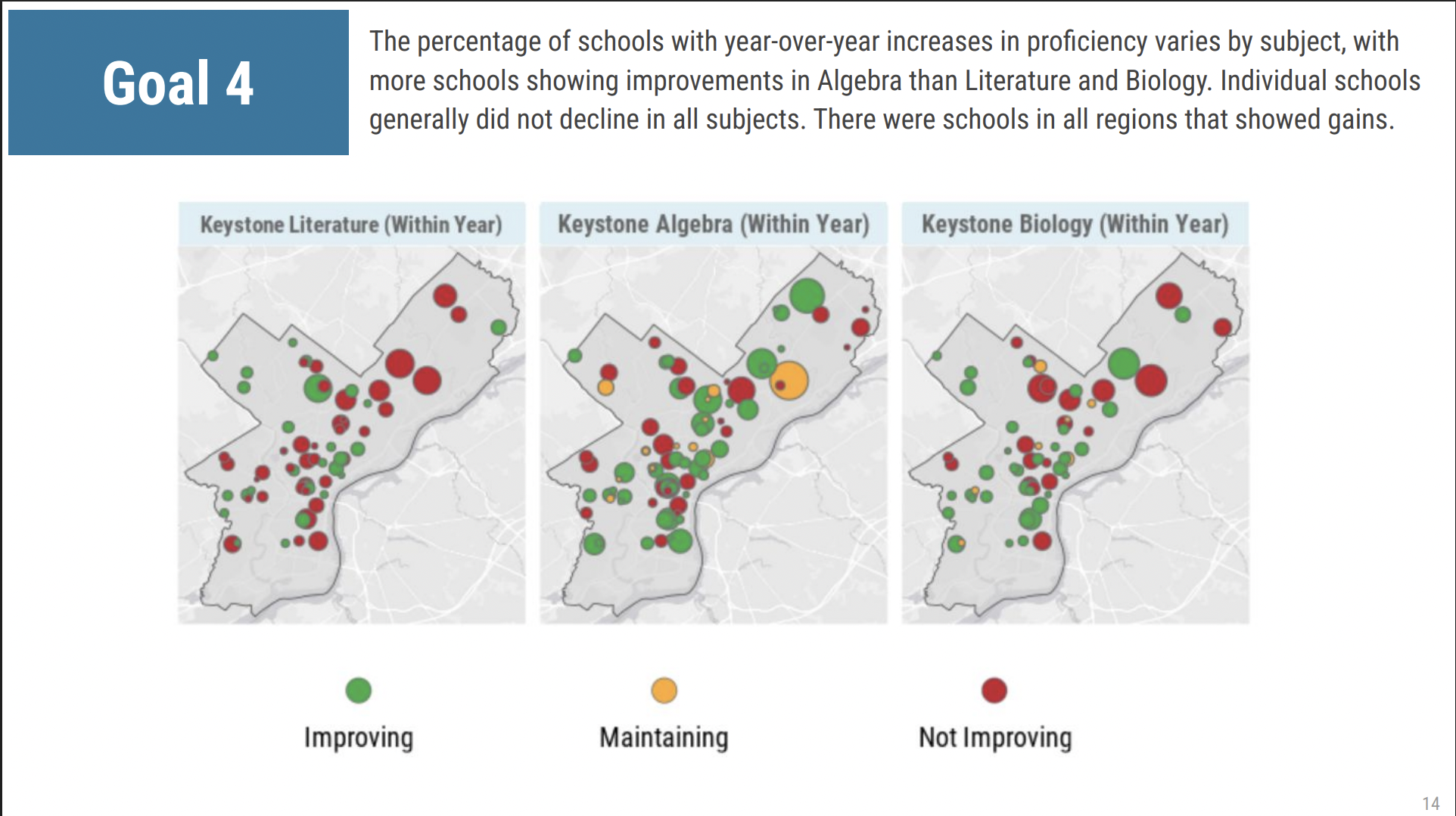
Novales summarizes what the board learned from today’s Goals and Guardrails meeting: Keystone scores remained stagnant last year, with literature scores decreasing, she said. And many CTE schools have made gains.
In future monitoring sessions, she said, the board will want to see the data broken down by various demographics, and more specific data about the percentages of schools seeing gains and decreases in Keystone scores. This data will give the board “a more complete understanding of what’s going on in the district.”
Novales then adjourned the meeting.
This is our final scheduled public school board meeting of 2025. See you in 2026!
// Timestamp 12/11/25 6:07pm
Board member Novales asks for more specific data: What percentage of schools saw gains and decreases in Keystone scores?
Board member Wanda Novales asks the district: What percentage of schools made gains in Keystone scores? And what supports are we offering our lowest-performing schools?
Watlington asks each of the individual networks of schools to be read — along with their Keystone score results and changes — with the associate and assistant superintendent of each network recognized.
Novales says she’s interested in even more specific data: What schools made gains, not just networks? What percentage of schools made gains, what percentage saw a decrease in scores, and what percentage stayed the same?
Watlington asks research chief Wolford to pull that together for a future meeting.
// Timestamp 12/11/25 6:05pm
Board member Joan Stern urges to district to think about the role creative and agricultural jobs play in the economy
Board member Joan Stern questions how the district is thinking about “the role of the creative economy in the city and in the region” in career and technical education.
“I would like to know what the focus is on developing careers in that part of the economy,” she said, highlighting the role of agriculture in particular.
Dawson says they are “intentional and methodical” about how they approach extracurriculars and nurturing students’ interests outside of the careers they may pursue.
We want to “help them to build themselves out of poverty and have an opportunity for a livable wage not only for them but their families and that can be sustained over time,” Dawson said.
Watlington adds in: “We don’t want to graduate a majority of young people that take minimum-wage jobs.”
“Our children can learn anything,” Stern said, adding in: “They should not be treated as though they are always going to be doing the pouring of the cement as opposed to the design of the airport.”
// Timestamp 12/11/25 5:55pm
Board member Lam wants to know: How do we keep literature scores from continuing to slip?
Board member ChauWing Lam asks: What is the relationship between the technical education and the core education for NOCTI at CTE schools?
Mastbaum Principal David Lon answers that the programs work together “hand in glove” and they work to prepare students for the tests they’ll need to take to graduate.
She also said she found the geographic clustering of Keystone interesting. “There’s not really a concise pattern across the three subjects in terms of what happened last year and what happened this year.” She wants to know: What is our strategy for stopping the decline of literature scores?
“We recognize that that is a concern for us,” Dawson said about the dropping ELA scores. But they did just roll out a new curriculum, he said, and teachers are still acclimating.
“We recognize as we say all the time, more work needs to be done to ensure our students are academically successful the first time they sit in that course,” he said.
Lam acknowledges that these test results are from last year. She asks: Are there any early indications yet that we’re seeing a rebound?
Tonya Wolford, the district’s research chief, says they are processing data and hope to have more information later this month or in January.
// Timestamp 12/11/25 5:46pm
Board member Whitney Jones asks district to dig deeper into the data
In responding to a question from board member Whitney Jones, Watlington says they do need to take a harder look at the data broken down by race, gender, economically disadvantaged students, English language learners, and other demographics.
“You can’t move the overall district without moving kids of color,” he said.
// Timestamp 12/11/25 5:35pm
Success isn’t linear, Watlington says: ‘No, I’m not satisfied’
Watlington says that people ask him all the time: Are you satisfied?
“No, I’m not satisfied,” he said. Far too many kids can’t read and do math on grade level, he said. But the district didn’t get here quickly, and it can’t fix it quickly. Success isn’t linear.
“The district is making significant progress,” Watlington said. We’re not blaming historical underfunding or “this political partisan nonsense.”
Deputy superintendent tells the board: ‘We have a lot of work to do in our high schools’
“We’re going to recognize that we have a lot of work to do in our high schools,” deputy superintendent Dawson said. “We see it, we own it, and we recognize it.”
How will the district improve math, ELA, and science performance? Dawson explains: more high-impact algebra tutoring, a fellowship for algebra teachers, and creating math pathways to allow more students to take Algebra 1 in eighth grade. Plus, a new science curriculum this year.
“We’re hearing great feedback from the teachers, from our students, and from principals” about the science curriculum, Dawson said.
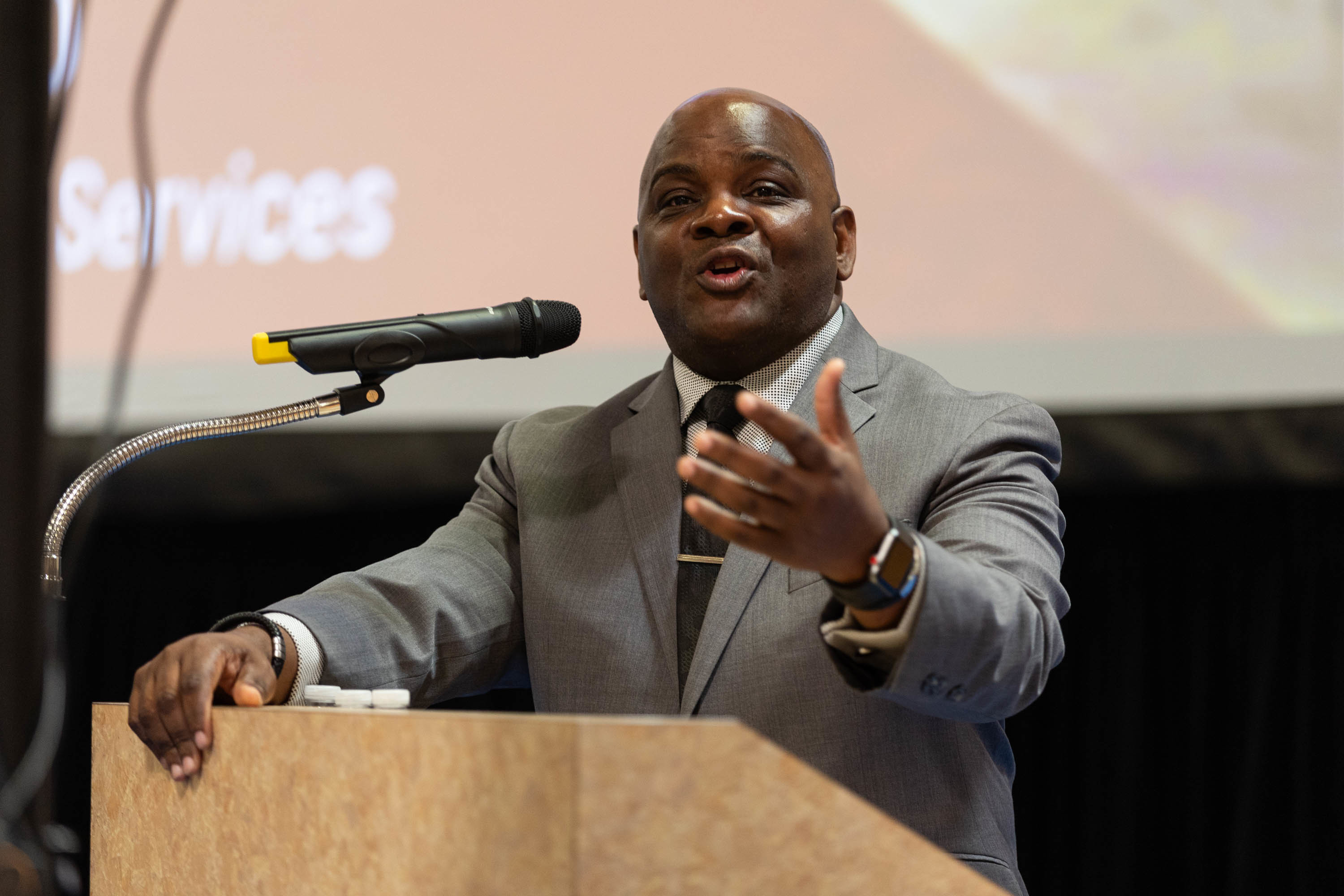
Deputy Superintendent Jermaine Dawson speaks at the School District of Philadelphia’s New Hire Orientation on Aug. 7, 2025.
On career and technical education, Dawson said the district will increase the number of guest speakers, company tours, and job shadowing and internship opportunities; create regional events like career fairs; implement new professional development; expand the middle school CTE program; and more.
Analyzing the district’s career and technical education programs: 39% are aligned to high-wage, in-demand occupations; 32% are aligned to high-wage, in-demand industries, but not aligned to occupation; and 29% of programs are unaligned to high-wage, in-demand occupations.
There are 41 programs in the district across 11 clusters.
This may mean some programs that are currently offered in the district may go away, Dawson said. Some new programs may be launched.
// Timestamp 12/11/25 5:15pm
Mastbaum principal speaks to success with improving NOCTI scores at his school
Principal David Lon from Mastbaum High School has seen tremendous growth at his school, a career and technical education school in Kensington.
Mastbaum has deliberately moved to a NOCTI focus. There’s been pedagogical work in the area students struggle most in: the NOCTI writing portion, Lon said.
There are quarterly benchmark exams, professional learning communities to reinforce data analysis and vocabulary best practices, and more.
There’s also a focus on culture-building, Lon said. Students are taught that the NOCTI is more than just another test; it’s important to their future. There are town halls and pep rallies, and a NOCTI breakfast the morning of the test.
“Before they go into the test, they are literally surrounded by the love and support of their community,” Lon said.
“We can directly tie student performance on the test-to-life outcomes,” Lon said. Students who score advanced get free college credits; those who are competent or advanced get extra points on the city test that can lead to good-paying jobs.
Mastbaum CTE staff are stars, Lon said. Counselors play a big role. Mastbaum had 32.4% point growth in NOCTI pass rate.
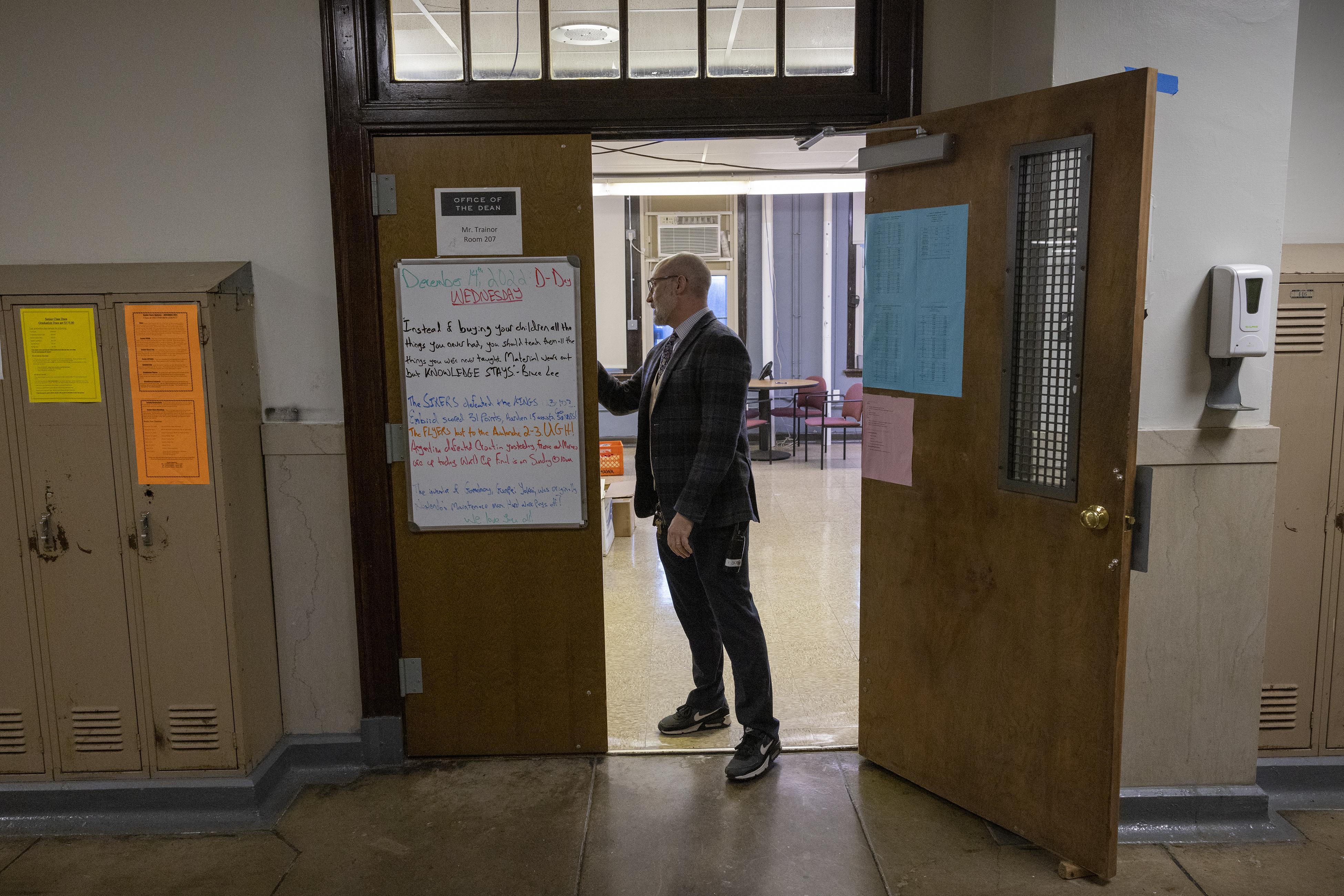
Principal David Lon at Mastbaum High School in December 2022.
// Timestamp 12/11/25 5:10pm
Percentage of students passing the NOCTI has increased
For the NOCTI, a nationally-recognized career and technical education exam, the percentage of 12th grade students who passed increased to 59.7% in 2024-25 from 56.9% in 2023-24.
Students in most areas — health, construction and manufacturing, education — increased participation and pass rates on NOCTI exams.
// Timestamp 12/11/25 5:06pm
District highlights the changes to student proficiency in the three Keystone subject areas
On the algebra Keystones, students scoring proficient or advanced increased slightly, from 15.1% to 15.5%, comparing 2024-25 to 2023-24.
Biology Keystones remained flat — 22.7% of students passed.
Literature Keystone proficiency decreased to 34.9%, a 2.9 percentage point drop.
This slide was shown during the Goals and Guardrails portion of the Philadelphia school board meeting on Dec. 11, 2025.
// Timestamp 12/11/25 5:04pm
Deputy superintendent highlights the 2024-25 highlights
Jermaine Dawson, deputy superintendent, is talking about 2024-25 highlights: It was the second year of a new math curriculum, the first year of a new ELA curriculum, and they purchased a new science curriculum (which is being rolled out this year).
This slide was presented during a Goals and Guardrails meeting of the Philadelphia school board on Dec. 11, 2025.
// Timestamp 12/11/25 4:54pm
Special action meeting ends, and Goals and Guardrails portion begins
And here ends the special action meeting.
Now we’re into progress monitoring/Goals and Guardrails.
The board will be monitoring goals around Keystone and NOCTI (career and technical education) exams tonight. Streater and a few other board members have to leave to conduct interviews for student board representatives, they noted.
// Timestamp 12/11/25 4:52pm
Board passes resolution, authorizing district to explore transferring vacant school buildings to the city
The resolution passes, six to two. Crystal Cubbage and ChauWing Lam voted no.
President Streater says this is an ‘exploratory resolution’ that he supports
Reginald Streater, board president, reiterated: No properties are being given to the city with a yes vote to this resolution.
Resolutions are the most effective way to convey what might be coming, Streater said. This is an “exploratory resolution.”
“I don’t see anything wrong with exploring this, and bringing the public along in a very public way,” Streater said, adding that he would be “derelict in his duty” if he didn’t explore this.
// Timestamp 12/11/25 4:50pm
Board member Cubbage says she ‘cannot support this resolution in its current form,’ while board VP Andrews says she will vote yes
Board member Crystal Cubbage said she applauds the mayor’s housing initiative, but “I cannot support this resolution in its current form,” because it limits the district to giving buildings to the city without financial gain, against a backdrop of coming financial issues for the district. Other options should be explored, including selling buildings to interested parties that are not the city.
Sarah-Ashley Andrews, the board vice president, will vote yes, but said any agreement “must deliver clear benefits to our children.” Opportunities to stabilize and grow the district’s tax base would help the district.
// Timestamp 12/11/25 4:48pm
School board discusses the resolution around what to do with vacant school buildings
Board member ChauWing Lam says she “fully supports” the idea of working with the city and addressing what should happen with the portfolio of buildings. But, Lam said: I have a concern that in adopting such a resolution, it limits the district’s options.
The portfolio of vacant buildings was recently valued at $80 million by the city, Lam said. “Given the disrict’s structural budget deficit, I encourage consideration of additional opportunities before rushing into an agreement as set forth in this resolution.”
Board member Wanda Novales notes that these buildings belong to the district, and any agreement must benefit district students.
Board member Joan Stern underscores that this resolution does not transfer any properties to the city. It explores what to do with the properties, some of which have been vacant since 2007. “It is critical for us to know what our costs are, what our liabilities are, what our exposure” is, Stern said.
“We are trying to do this in the context of our facilities plan,” Stern said. “I would like very much for everyone to keep in mind that this is a step for us to take that will provide us with the facts and the diligence necessary to decide on the fate of these properties.”
// Timestamp 12/11/25 4:42pm
Councilmember Thomas shares concerns, through aide, about the ‘lack of communication’ around resolution to transfer properties to the city
Zach McGrath, legislative aide to City Councilmember Isaiah Thomas, is reading a letter from Thomas.
Thomas is concerned about “a lack of communication” around the plan to possibly transfer properties to the city.
Thomas wants a separate, independent authority to manage buildings for the city and district. He and others learned about this plan from The Inquirer, which he finds troubling.
He says: We can’t find ourselves in a situation like Germantown High. The school was closed, abandoned for some time, and then after years, developed into apartments people in the neighborhood largely can’t afford.
// Timestamp 12/11/25 4:45pm
// Timestamp 12/11/25 4:37pm
Retired teacher questions the board’s authority to ‘just give away real estate’
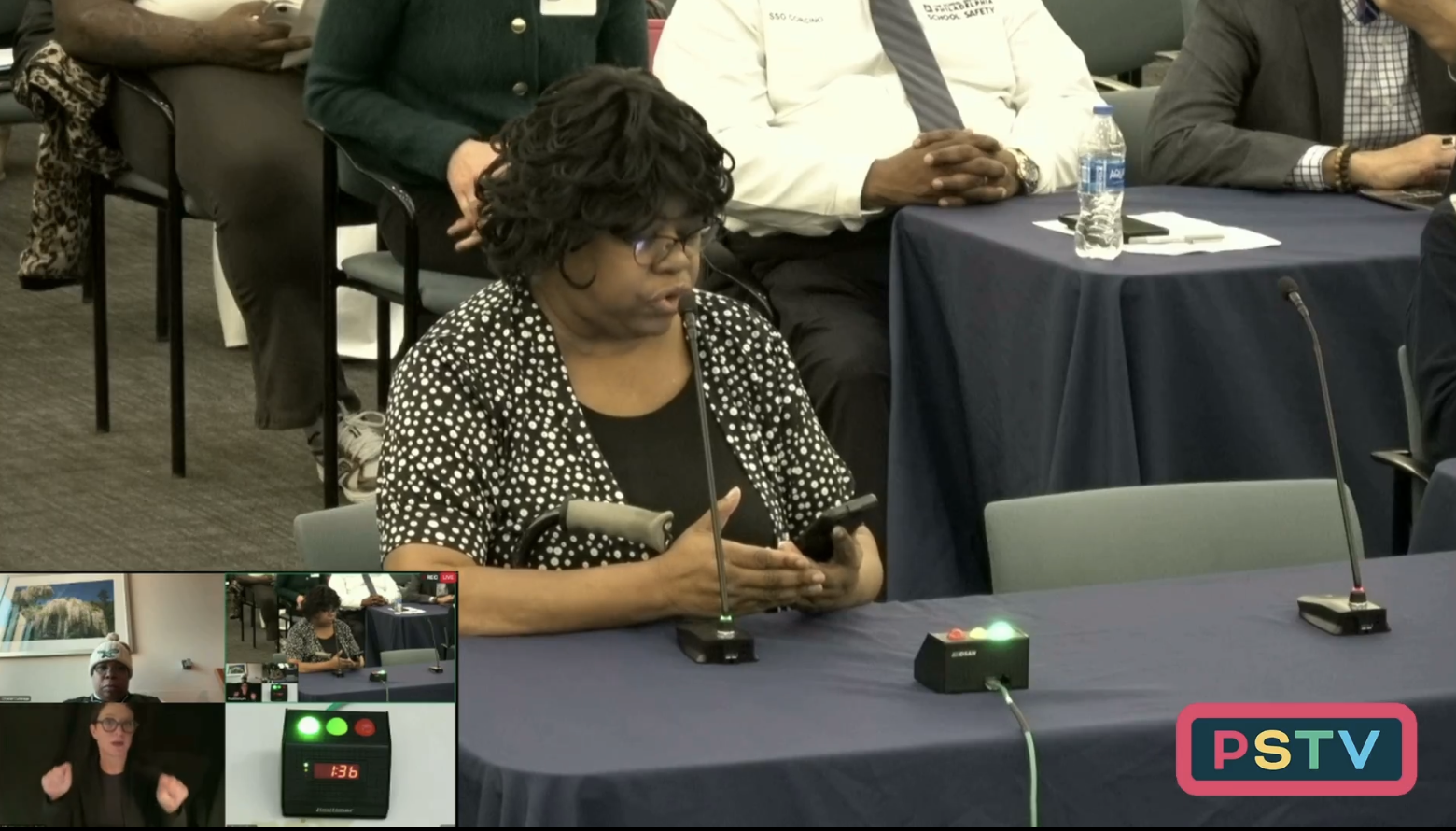
Lisa Haver, retired teacher and a founder of the Alliance for Philadelphia Public Schools, asks the board: “Does this board have the authority to just give away real estate? That would be an abdication of the board’s responsibility of this district.”
The board is supposed to operate independently, not as an intergovernmental board, Haver said.
Haver says: Essentially, it sounds like the mayor wants the district to give her buildings, and the board is playing ball.
// Timestamp 12/11/25 4:35pm
Another West Oak Lane Charter School community member asks the board to allow the school to buy Ada Lewis building
Angela Case, a member of the West Oak Lane Charter School community, asks the board to allow the school to buy the Ada Lewis Middle School building.
“Our school is growing, but our current space is limited,” Case said. “Ada Lewis would give our students safe classrooms, outdoor areas,” and more. It would also mean a positive use of a vacant property, Case said. “This is an investment in our children, families and a better future for Philadelphia.”
// Timestamp 12/11/25 4:32pm
The Cloudens speak to the board about student achievement and vacant buildings
Horace Clouden, a retired district worker, said there’s a “crisis in K-8,” both in public and charter schools, in student achievement.
“If you give away buildings that could be crucial to the development of the children, it could be criminal,” Clouden said.
Clouden tells the board they should repurpose closed schools to solve for student placement.
Mama Gail Clouden, who is married to Horace Clouden, said it must be difficult for the board and superintendent to hear parents discuss significant issues with their children, month after month. Leaders are getting awards “but these children that are suffering are saying something different,” Mama Gail said.
“Everybody’s making money off these children,” Mama Gail said. “The least of these are losing the most. You are in a position to fix this.”
Leah Clouden, Mama Gail and Horace Clouden’s daughter, said “the plan to warehouse students is in full effect.”
“Giving away 20 properties for housing is insane,” Leah Clouden said.
University City High was “given away for pennies on the dollar,” Leah Clouden said.
// Timestamp 12/11/25 4:26pm
Parent shares issues with curriculum sharing between the district and the Catholic church
Anne Dorn, a district parent, is talking about issues with curriculum shared between the district and the Catholic church.
“Fear not” the elephants in the room, Dorn said.
// Timestamp 12/11/25 4:22pm
West Oak Lane Charter School parent praises the school
Daniel Wideman, a parent and board member at West Oak Lane Charter School, is praising the school, which has changed his and his child’s lives.
“As a community, we have grown out of our building at West Oak Lane, and we need change,” Wideman said. The charter would like to buy Ada Lewis Middle School.
Kenderton Elementary parent says she is suing the district over her child’s IEP
Sashai Rivers, a parent of two children at Kenderton Elementary, said her son was bullied and antagonized by students and staff. She removed her kids from the school, but said her child’s IEP was ignored. “I’m currently being ignored by all parties at the school district,” Rivers said.
Rivers said she is suing the district.
// Timestamp 12/11/25 4:17pm
A retired educator, a student, and a charter school staff member each address the board about a variety of issues
Elijah Mahaffey, a former student at George Washington High, said he was bullied at the school. “Nobody would help me,” he said.
Deanna Lewis, of Lab Charter, is drawing attention to Black-led and Black-founded charter schools. Lab recently got a $500,000+ grant to bring computers to the community. “We’re deeply committed to our academic mission, and to support our community with care,” Lewis said.
// Timestamp 12/11/25 4:13pm
Former school board member wants students with special needs to be considered in school closing decisions
We’re onto speakers now.
Cecelia Thompson, a former school board member, wants to know what provisions will be made for students with special needs in school closing decisions.
And when it comes to possibly transferring closed schools to the city, she asks: Can we sell them to the city “for market value, and not $1? Just to be respectful, I guess, for the worth of the properties?”
Former Philadelphia School Board member Cecelia Thompson spoke to the board during a special action meeting on Dec. 11, 2025.
// Timestamp 12/11/25 4:09pm
Pre-submitted written testimony addresses Ada Lewis Middle School
Of note: One piece of written testimony submitted today concerns the closed Ada Lewis Middle School, likely to be considered in any list of vacant schools transferred to the city. A member of the West Oak Lane Charter School community suggests the Ada Lewis building be sold to West Oak Lane Charter.
Eight board members are present at today’s meeting. Joyce Wilkerson is absent.
// Timestamp 12/11/25 4:06pm
The board held an executive session earlier today
The board discussed developments in the People for People and KIPP North Philadelphia vs. Joyce Wilkerson case in executive session today, Streater said, as well as real estate matters one can assume are related to the special action item.
Board president Reginald Streater is outfitted in kelly green, and notes that he still has faith in the Eagles.
The only item on the agenda: a resolution authorizing Superintendent Tony B. Watlington Sr. and the district’s legal team to discuss possibly transferring about 20 vacant district buildings to the city.
Philly school board to host special action meeting with Goals and Guardrails presentation
// Timestamp 12/11/25 3:50pm
The Philadelphia school board is set to host a special action meeting — its last scheduled meeting of the year — starting at 4 p.m.
Following the special action meeting, the board will hold its regularly scheduled Goals and Guardrails meeting, during which Watlington will share end-of-year Keystone and NOCTI performance for 2024-25.
City Council passed legislation Thursday to restore the abandoned Greyhound terminal on Filbert Street as Philadelphia’s new intercity bus station in time for an expected flood of tourists in 2026.
Under the measure, the Philadelphia Parking Authority will operate the station on behalf of the city, collecting fees from bus companies to pay costs.
A refurbished facility is scheduled to open in May 2026, which would resolve more than twoyears of chaos after Greyhound ended its lease, forcing the city to allow the bus companies to operate at the curbs of public streets with few amenities and no shelter for riders.
The saga was embarrassing, and it became more untenable for city leaders with Philadelphia set to host celebrations of the 250th anniversary of the Declaration of Independence, and a round of international FIFA World Cup soccer matches.
The plan came together over the last few months as at least three city departments collaborated and reached an agreement with the parking authority. Mayor Cherelle L. Parker’s administration sent a bill to Council.
Councilmember Curtis Jones Jr. said in a Finance Committee hearing last week that he found the speed of “galvanized” departments working together impressive.
“You can’t put that genie back in the bottle. I know you can cooperate now, and that’s going to be the expectation from now on,” Jones said.
Greyhound ran the terminal at 10th and Filbert Streets for 35 years but ended its lease in June 2023 as the bus line (and its corporate parent) began shedding real estate and leases in the U.S. to cut costs.
First, the buses operated along the 600 block of Market Street. Since November 2023 they have loaded and unloaded passengers in the open along Spring Garden Street.
“This is an opportunity that kind of came from the heavens,” said Mike Carroll, the city’s assistant managing director for transportation.
Bus companies would pay a $40 fee for each stop in the city until the terminal is open, when it would be increased to $65. A smaller number of buses subsidized by the Pennsylvania Department of Transportation under a program to provide rural service would pay $16 a stop.
Operating the renovated terminal will cost $4.7 million to $4.8 million annually, Carroll said.
City officials say they plan to keep researching other possible locations for an intercity bus station but note the lease provides stability.
PPA will provide 24-7 security, 16-hour daily custodial coverage, maintenance staff, and an on-site program manager under terms of an intergovernmental agreement with the city that is part of the legislation.
It also will be responsible for enforcing rules, such as one that will require buses to bypass the heart of Chinatown.
Since the parking authority regulates rideshare and taxi services, its enforcement officers will help keep traffic flowing around the station, officials said.
Councilmember Nina Ahmad pressed city officials to plan for retail tenants and other ways to generate municipal revenue.
“There’s an element of rush,” Ahmad said during the Dec. 3 hearing. “I understand the urgency, but I hope we don’t overlook things that we should be doing to make it really a transit-oriented development.”
It had all the markings of a good, old-fashioned bit of porch piracy.
The man appeared one recent morning in front of a Nether Providence home. He looked to be between 20 and 30 years old, around 5 feet 8, and balding. He wore a black puffer jacket.
For a long while, he paced back and forth in front of the home in the 300 block of South Providence Road.
Then, he opened the mailbox, fiddled with something inside, and walked away.
When the homeowner, who witnessed the incident, went to investigate, however, she was struck by what she found. Inside her mailbox was what Nether Providence police are calling “a significant amount of cash.”
In a season more closely associated with pinched parcels and pilfered packages, police in this Delco township are trying to get to the bottom of something far more novel: An individual apparently passing out a large sum of money through a mailbox.
So far, authorities have been left stumped; a spokesperson for the Nether Providence police on Thursday called the incident an “open investigation” but declined to comment beyond a brief news release issued earlier in the week on the matter, which occurred shortly before 11 a.m. on Dec. 6.
One theory is that the delivery could have been a simple mix-up: According to the homeowner who discovered the cash, the property once housed a psychiatrist’s office, and she suspected the money could’ve been left by a former patient unaware that the previous owner was no longer there.
Police are asking that anyone with information about the curious delivery — or the individual behind it — contact them at 610-892-2875.
“NPPD is urging anyone with information to come forward as detectives work to determine the circumstances surrounding the cash drop-off and identify the individual involved,” according to the department news release.