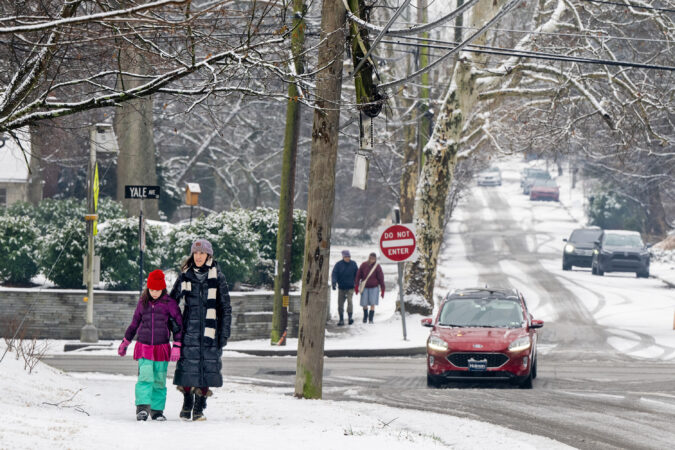
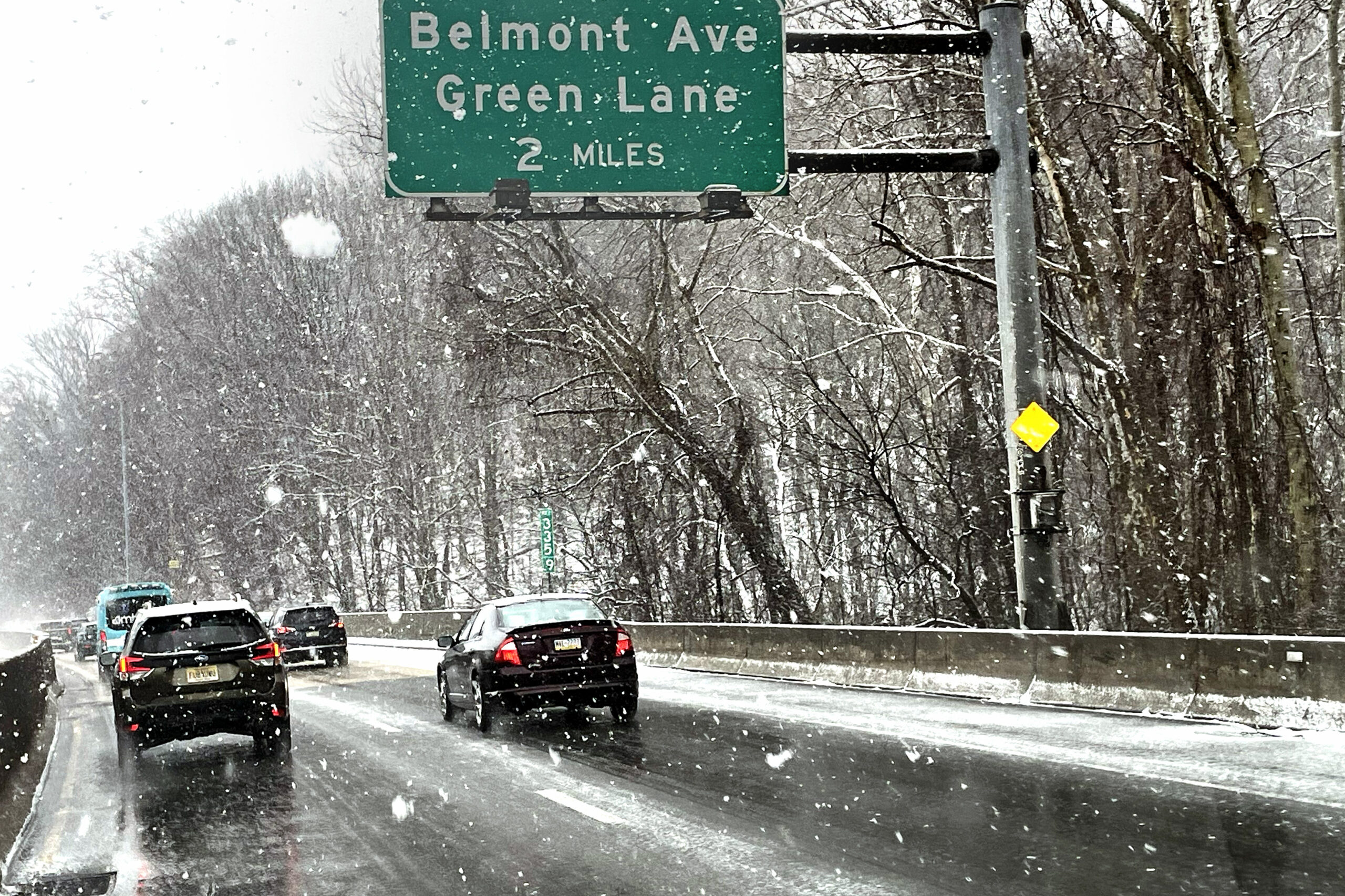
Delicate snowflakes painted Philadelphia white Sunday morning, leaving icy roads and sidewalks to shovel. The storm will also leave behind a cold holiday.
“We have only seen round one; round two is on its way,” said Paul Fitzsimmons, a lead meteorologist with the National Weather Service office in Mount Holly.
Through Sunday, Fitzsimmons predicted a total of 2 to 4 inches of snow, with the second wave of flurries picking up after 1 p.m., possibly mixing with rain after 2 p.m.
Rain is not certain, but there is a 70% chance of showers, according to the National Weather Service. Couple that with a cloudy day, winds around 5 mph, and temperatures in the mid-30s (35 degrees being the warmest Philly will see today), and drivers are in for some hazy driving conditions.
“Roads are icy today: People should exercise extra caution, leave extra time to leave wherever they are going, and drive slower than normal,” Fitzsimmons said.
The weather prompted PennDot to advise drivers to avoid unnecessary travel. Commercial vehicles must stay in the right lane, PennDot said.
Stick to the speed limit even if the roads seem treated, because at the moment, PennDot’s main goal is to only keep them passable, not completely free of ice and snow, the department said.
PennDot’s crews will continue to treat roads throughout the day, but there is a slight chance of more snow coming before 8 p.m., with temperatures dropping as low as 20 degrees, and a 20% chance of rain, according to the weather service.
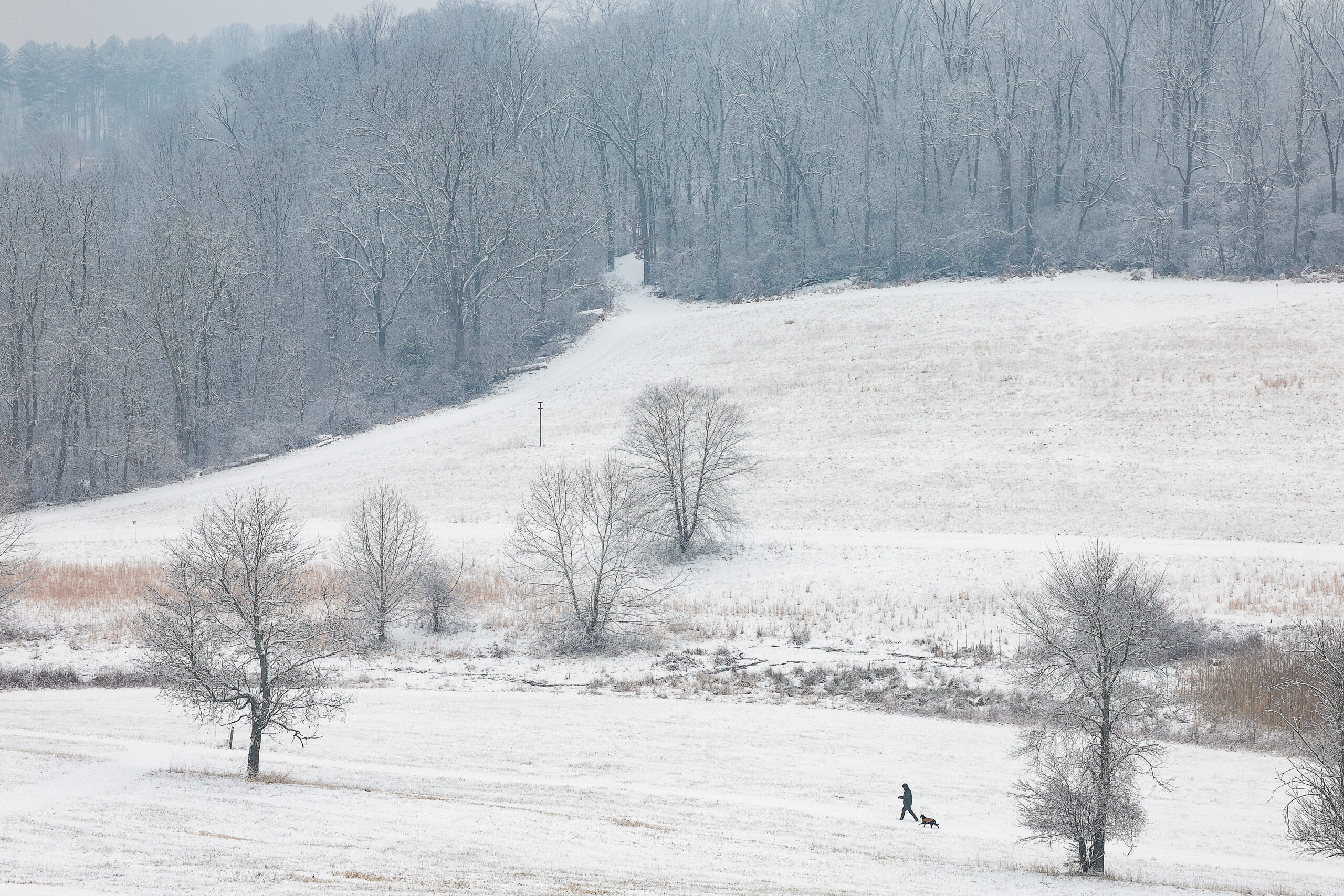
David Bond, of West Chester, walks his dog, Todd, in the snow at Okehocking Preserve in Newtown Square on Sunday, Jan. 18, 2026.
Martin Luther King Jr. Day
Monday arrives a bit sunnier, and with no snow, yet colder than Sunday, Fitzsimmons said.
Skies are expected to be fully clear, with a low of 14 and a high of 35 degrees. Do be mindful of the wind, as the National Weather Service expects gusts as high as 20 mph by Monday night.
That low would be the lowest of the season so far, with an even lower 10 degrees forecast for Tuesday.
“It’s going to be cold overall, so bundle up,” Fitzsimmons said.
(function () {window.addEventListener(‘message’, function (e) { var message = e.data; var els = document.querySelectorAll(‘iframe[src*=”‘ + message.id + ‘”]’); els.forEach(function(el) { el.style.height = message.height + ‘px’; }); }, false); })();
BERLIN — The eight European countries targeted by U.S. President Donald Trump for a 10% tariff for opposing American control of Greenland blasted the move Sunday, warning that his threats “undermine trans-Atlantic relations and risk a dangerous downward spiral.”
The joint statement by some of America’s closest allies signaled a possible turning point in the recent tensions over sovereignty and security nearly 24 hours after Trump’s threat.
It was also the most forceful rebuke of Trump from the European allies since he returned to the White House almost a year ago. In recent months, Europeans have mostly opted for diplomacy and flattery around him, even when seeking an end to the war in Ukraine. Sunday’s statement, as well as some European countries sending troops to Greenland for a Danish military training exercise, appeared to be a step away from that strategy.
The unusually strong joint statement from Denmark, Norway, Sweden, France, Germany, the United Kingdom, the Netherlands, and Finland said troops sent to Greenland for operation Arctic Endurance pose “no threat to anyone.”
Standing in solidarity with Denmark, Greenland
Trump’s Saturday announcement sets up a potentially dangerous test of U.S. partnerships in Europe. He appeared to indicate that he was using the tariffs as leverage to force talks over the status of Greenland, a semiautonomous territory of NATO ally Denmark that he regards as critical to U.S. national security.
“We stand in full solidarity with the Kingdom of Denmark and the people of Greenland,” the group said. “Building on the process begun last week, we stand ready to engage in a dialogue based on the principles of sovereignty and territorial integrity that we stand firmly behind. Tariff threats undermine trans-Atlantic relations and risk a dangerous downward spiral.”
There are immediate questions about how the White House could try to implement the tariffs because the European Union is a single economic zone in terms of trading. It was unclear, too, how Trump could act under U.S. law, though he could cite emergency economic powers that are currently subject to a U.S. Supreme Court challenge.
EU foreign policy chief Kaja Kallas said China and Russia will benefit from divisions between the U.S. and Europe. She added in a post on social media: “If Greenland’s security is at risk, we can address this inside NATO. Tariffs risk making Europe and the United States poorer and undermine our shared prosperity.”
Europe has been trying to keep Trump on its side to ensure U.S. support for Ukraine, including Washington sharing intelligence with Kyiv and its involvement in security guarantees if a peace agreement is reached with Russia.
Rasmus Søndergaard, a senior researcher at the Danish Institute for International Studies, called Trump’s announcement “unprecedented” because tariff threats normally stem from trade disagreements, not territorial disputes between allies.
“That’s of course why we’re seeing the response from European countries saying ’enough is enough,’” he told the Associated Press. “I think there’s in part probably a strategic calculation, of course, from the governments in these countries that if you give in to Trump on this, what will be the next thing? And at some point you have to sort of push back.”
Søndergaard also said Trump leveled the playing field for Europe with the tariff threat. Europeans cannot compete militarily, but the EU can wield an economic weapon through reciprocal tariffs.
“The EU has the ability to really strike back with force if they want to, and it will hurt European economies,” he said. “It will hurt American economies. The challenge for Trump is he has midterms coming up and it’s not going to help him if the U.S. goes into more of an economic recession or more of an economic turmoil than is already the case.”
Meanwhile, NATO Secretary General Mark Rutte wrote on social media Sunday that he’d spoken with Trump. Rutte has been criticized in recent days for largely sidestepping questions about Trump and Greenland and any NATO tensions over the island.
“We will continue working on this, and I look forward to seeing him in Davos later this week,” Rutte said.
U.S. Sen. Mark Kelly, a former U.S. Navy pilot and Arizona Democrat, said Trump’s threatened tariffs on U.S. allies would make Americans “pay more to try to get territory we don’t need.”
“Troops from European countries are arriving in Greenland to defend the territory from us. Let that sink in,” Kelly wrote on social media. “The damage this President is doing to our reputation and our relationships is growing, making us less safe. If something doesn’t change we will be on our own with adversaries and enemies in every direction.”
Former U.S. Vice President Mike Pence said he supports the United States ultimately owning Greenland, but not how Trump is trying to accomplish it.
He said he had concerns whether Trump had the constitutional authority to impose unilateral tariffs on NATO allies, as well as about a threat of a military invasion. Trump’s current position threatens “to fracture that strong relationship, not just with Denmark, but with all of our NATO allies,” Pence said on CNN’s State of the Union.
Populist allies of Trump criticize tariff threat
Six of the countries targeted are part of the 27-member EU, which operates as a single economic zone in terms of trading. It was not immediately clear if Trump’s tariffs would impact the entire bloc. EU envoys scheduled emergency talks Sunday evening to determine a potential response.
The tariff announcement also drew blowback from Trump’s populist allies in Europe.
Italy’s right-wing premier, Giorgia Meloni, considered one of Trump’s closest allies on the continent, said she had spoken to him about the tariffs, which she described as “a mistake.”
The deployment to Greenland of small numbers of troops by some European countries was misunderstood by Washington, Meloni said, adding it was not a move against the U.S. but aimed to provide security against “other actors” that she didn’t identify.
Jordan Bardella, president of Marine Le Pen’s far-right National Rally party in France and a European Parliament lawmaker, posted that the EU should suspend last year’s tariff deal with the U.S., describing Trump’s threats as “commercial blackmail.”
Trump also achieved the rare feat of uniting Britain’s main political parties — including the hard-right Reform UK party — all of whom criticized the tariff threat.
“We don’t always agree with the U.S. government and in this case we certainly don’t. These tariffs will hurt us,” said Reform UK leader Nigel Farage, a longtime champion and ally of Trump. His social media post stopped short of criticizing Trump’s designs on Greenland.
U.K. Prime Minister Keir Starmer, who leads the center-left Labour Party, said the tariffs announcement was “completely wrong” and his government would “be pursuing this directly with the U.S. administration.”
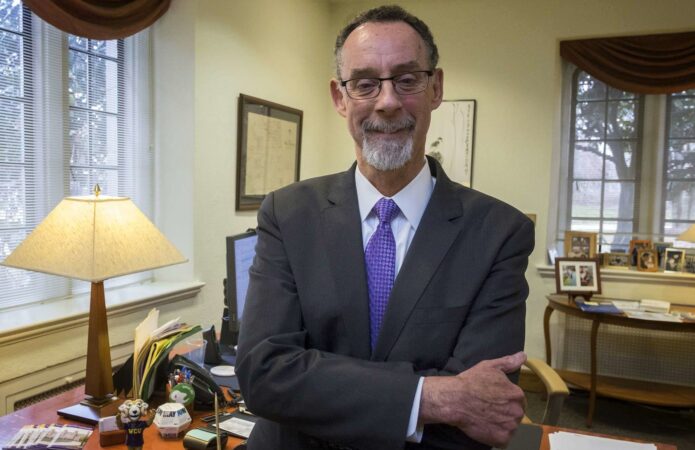
PASSHE includes the 10 state-owned public universities. (State-related universities, including Pennsylvania State and Temple, are funded separately.)
Cheyney University, which is part of the system, got a special $5 million earmark “to develop and implement an enhanced transfer and workforce development initiative in partnership with a community college.” Cheyney, a historically Black college in Delaware and Chester Counties, and Community College of Philadelphia recently announced a partnership that will allow students to transfer seamlessly from CCP to Cheyney and earn bachelor’s degrees while remaining on CCP’s Philadelphia campus.
The state system had asked the state for a 6.5% increase in its general appropriation, which currently stands at $625 million. That would have brought in an additional $40 million for the 10-university system, said Christopher Fiorentino, chancellor of the system.
But he said the system has been preparing for the possibility of a funding freeze and had increased tuition this year for the first time in seven years, raising an additional $25 million.
“We knew it was going to be difficult, given the revenue situation in the commonwealth,” he said. “We weren’t blindsided by this.”
He said he was grateful for the system’s appropriation.
“That’s a huge amount of money,” he said. “… It is a significant commitment to public higher education, and we really appreciate that support.”
The system has requested a 5% state funding increase for 2026-27, which would allow universities to freeze tuition again, Fiorentino said.
But Kenneth M. Mash, president of the Association of Pennsylvania State College and University Faculties, the faculty union, said that would not be enough if tuition is to be frozen. And he has concerns about the freeze in state funding this year.
“Too often, we go in there and act as if this is what we need to maintain the status quo, but the status quo is not good,” he said, citing technology and program needs. “We don’t have the support for students that we should have. We need to start paying attention to the quality of education and make sure it doesn’t suffer.”
The system has been in a state of readjustment as it has lost about a third of its enrollment since 2010, including merging six of its universities into two entities. The system’s universities are: Cheyney, Commonwealth, East Stroudsburg, Indiana, Kutztown, Millersville, Penn West, Shippensburg, Slippery Rock, and West Chester.
Planning for a drop in enrollment
Another enrollment cliff is expected to begin this year as the population of high school graduates begins to drop.
“The demographics right now going forward are unfavorable, so we have to continue to be prepared for the fact that even if we maintain our market share, we’re going to see declines in enrollment,” Fiorentino said.
The system is attempting to recruit in new markets and bring back to college those who have some credits but no degree, he said. Older students may want more weekend, night, and online courses, and that is something the system is reviewing, too, he said.
The system also is contemplating partnering with area doctoral institutions, such as Temple, to bring in doctoral students to teach at the system’s universities. That would save money on faculty hiring, while cultivating new potential talent for the system, he said.
And the system is reevaluating its programs, he said. Ninety-five percent of students are graduating from half the programs the system offers, he said. Some of the larger enrollments are in business, education, health, and engineering, he said.
But only 5% of students are enrolled in the other half of the system’s programs.
“We have to take a look at that,” he said. “How do we redeploy the money that we currently are receiving to make sure that we’re supporting the programs that are critical to the success of the commonwealth?”
Mash, the union president, said that bringing in doctoral students would createa viable stream of quality candidates, and that, under the contract, the system is permitted to employ a certain number of adjuncts. But he is concerned about eliminating programs with lower enrollments.
“We should be providing as broad of a spectrum of opportunity for students as we can,” he said.
Fiorentino said he was pleased to see Cheyney get the additional funding. The school, which has struggled with enrollment, saw an increase of 234 students — nearly 38% — this year, the highest percentage increase of any school in the system. Cheyney enrolls 851 students this year, its highest enrollment since 2014.
The new effort will allow Philadelphia students to get a Cheyney degree without having to travel to the rural campus, he said.
“A lot of their market is Philadelphia,” Fiorentino said of Cheyney, “and for a lot of the Philadelphia students, transportation has become more and more difficult.”
Temple and Penn State were flat-funded again this year. Temple said in a statement that it was grateful to see the budget pass.
“We also continue to be deeply grateful for the ongoing financial support that the university receives to reduce tuition costs for Pennsylvania residents,” the school said.
The long-lost demo tape had always held a certain mythos in Charlotte Astor’s imagination.
For years, the Cherry Hill teen had heard stories about it, recorded about 30 years ago by her mother’s very loud, very short-lived, teenage hardcore band, Seed.
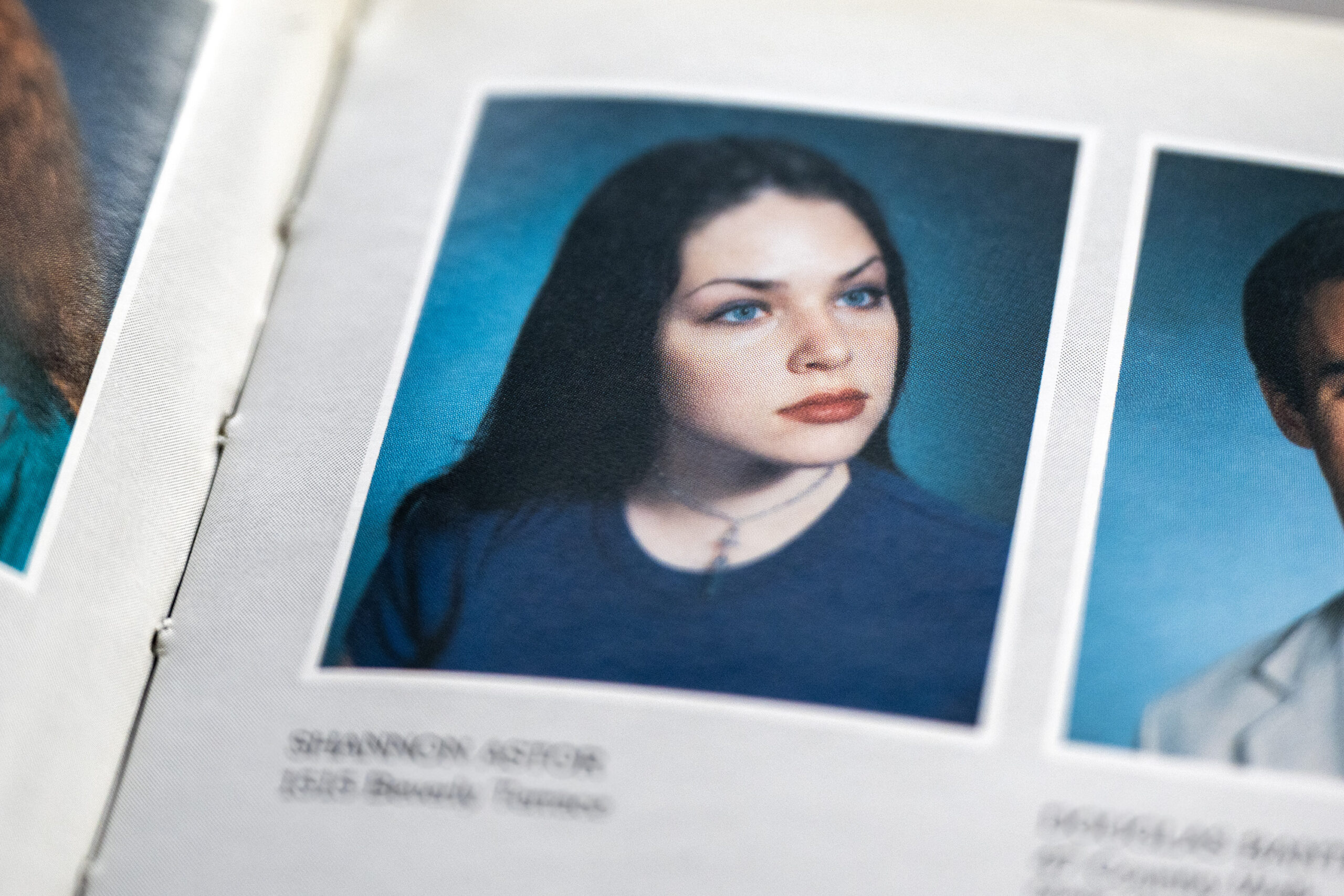
Shannon Astor, now 47, had been a vocalist for the group, just 14 or 15 years old, at a time when female representation within the genre was rare. Within a year or so, the group had disbanded — but before it did, the group, which typically practiced in a member’s parents’ basement, recorded a single demo. There had been only a few dozen copies produced back then, and they had all sold, scattering out around the South Jersey area.
For Charlotte, the tape became a kind of white whale — a relic of her mother’s hard-charging past, something the teen occasionally scoured the web for, to no avail.
She’d never heard her mother’s band. And she wanted to. Badly.
“Ninety-five percent of what I have about my mother is in the stories she tells me,” says Charlotte, 16, a junior at Cherry Hill High School East.
But a demo was something tangible. Something concrete.
“A demo,” she decided, “I can find.”
And so one night last spring, that’s what she set out to do.
She had little to go on: A rough estimate of when the demo would have been released (1993-94), a general geographic location (South Jersey), and a single lyric (“In the wind of the AM shadows cling to nearby trees as season shifts to satisfy the light from above”).
“I have been looking for this tape for 4 years,” she wrote in an appeal to her 1,000 or so Instagram followers, “… and it would mean the absolute world to me to find this tape.”
Butsomething about her search — this desire to connect with a parent, to bridge a gap three decades wide — resonated. It became, within the tight-knit confines of the hardcore music scene, a united pursuit.
At an age when most teenagers couldn’t get far enough away from their parents, here was one launching a quixotic quest to better understand hers.
A senior class photo of Shannon Astor in the 1996 Cherry Hill High School East yearbook. Now 47, Shannon was previously in a hardcore band called Seed.
Soon, strangers from across the country were digging through old boxes in basements, or tagging old running buddies from Jersey’s 1990s hardcore scene in social media posts. Some reached out to old producers from the area, wondering whether the demo might have made its way into some dusty studio corner.
Messages poured in, too — hundreds of them — with suggestions ranging from the plausible to the outlandish. Had she tried getting in touch with Bruce Springsteen’s people? You never know what the Boss might have stowed away in some mansion closet.
“I suddenly had communication with so many people who I thought I would never in my life have any connection with,” Charlotte said. “California to Jersey, and everything in between.”
The lead singer of a well-known Jersey straight-edge band of the era, Mouthpiece, joined the search, messaging Charlotte after others reached out to him about the tape. (He vaguely remembered her mother, Shannon, but not the band.)
Much of the outside help, Charlotte notes, has come from the hardcore community.
Indeed, much of Charlotte’s young life is rooted in the same hardcore music scene that her mother’s once was. Like Shannon before her, Charlotte spends many nights at hardcore shows around the area, photographing the scene for the magazine she self-publishes, “Through Our Eyes.” And like her mother previously, she’s a member of the “straight-edge” hardcore community, a group with a shared collection of ideals that includes abstaining from drinking or drugs. (Her first flirtation with teenage rebellion came when she snuck out of the house one night to go to her favorite record store.)
And though her mother does not necessarily share Charlotte’s zeal for locating the old tape — “I’m not waiting for some garage band demo to be unearthed,” Shannon joked — she understands what it would mean to her daughter to have it.
“It’s special to me only because of how much she needed to hear it,” said Shannon. “I’m just so pro-Charli and everything that she does … But this is her journey, and something that was intrinsically important to her.”
To those in the scene, meanwhile, the response has been very hardcore.
“A bunch of people banding together to help this random girl find her mom’s thing,” said Quinn Brady, 19, of New York, and a friend of Charlotte’s. “Most people assume that hardcore people are not very nice or friendly. [But] there’s this inherent kinship. It connects people across the nation in a way that not a lot of other genres of music do.”
A recent selfie by Charlotte Astor (right) and her mother, Shannon Astor, taken at Reading Terminal Market.
Those outside the hardcore scene have been no less enthralled, however.
In December, after NJ.com picked up the story, further extending its reach, a documentary filmmaker reached out about the possibility of doing a film on her quest.
Last year, after posting in some “old-head” hardcore Facebook groups about the tape, Shane Reynolds — a member of the Philly-based hardcore band God Instinct — stumbled upon what appeared to be the most promising lead yet.
“I found the guy who allegedly made the demo,” Reynolds said.
But when she got the man on the phone, Reynolds says, it proved to be a dead end.
The closest Charlotte came was last year, not long after she first posted about the demo on Instagram. Her mom’s former bandmate in Seed, convinced he must have kept something from that period, recovered from storage an old cassette that featured a recording of a single Seed practice session.
Charlotte took it home, pushed it into the stereo in her bedroom. She stared at the ceiling as the tape began to play and 30 years fell away.
For the first time, she could put a sound to the stories she grew up hearing.
“The first thing I heard was a few seconds of my mom talking,” Charlotte said. “That’s my mom, when she was 16. I’m listening to a clip of my mother, listening to her at the same age I am.”
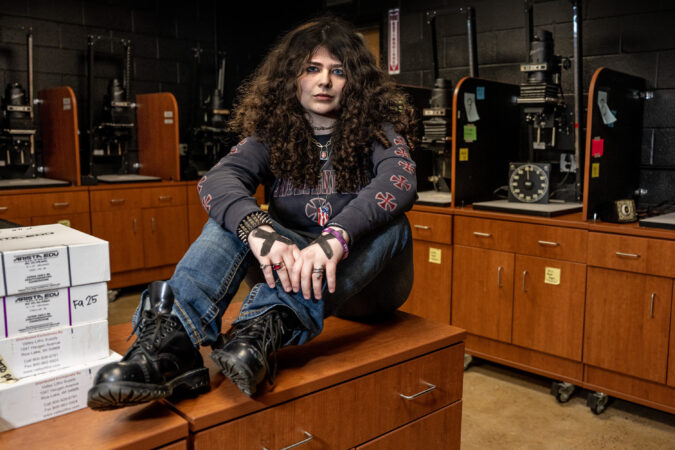
Charlotte Astor, a junior at Cherry Hill High School East, and her vintage 35mm film Nikon camera in the school’s photography classroom.
Still, that small taste has only reinforced her devotion to unearthing the actual demo.
Charlotte remains realistic about her odds of finding it. No, it’s not likely to be found in some radio station’s studio. And no, Bruce Springsteen is almost certainly not in possession of a three-decades old demo tape from her mother’s teenage years.
But some graying hardcore fan from the ’90s, with a penchant for hoarding and a cluttered garage?
Stranger things have happened.
“I have confidence — unwavering confidence — that someone has it,” Charlotte says. “And that I will get my hands on it.”
The limousine door burst open, and the Rev. Dr. Martin Luther King Jr. stepped out onto the sidewalk in front of Dennis Kemp’s South Philadelphia school.
Kemp was 13 that day in October 1967, a member of the stage crew and the basketball team asked by the principal of Barratt Junior High to greet the school’s surprise special guest.
“In just about every Black household that I went into those days, there were three pictures hanging: Jesus, John Kennedy, and Dr. King,” said Kemp, now 72. “To actually meet this guy, it just blew me away.”
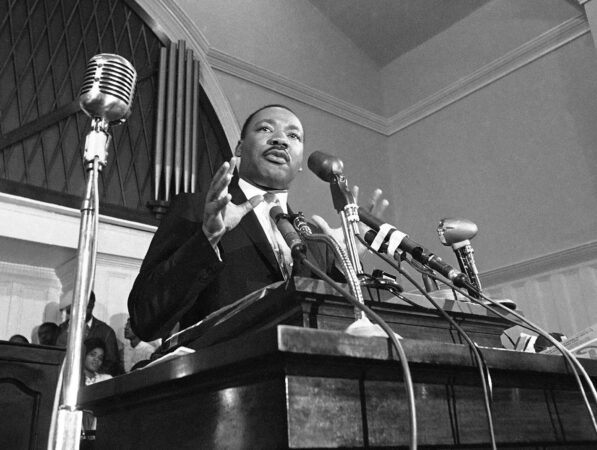
“What is your life’s blueprint?” King asked the students. “This is a most important and crucial period of your lives, for what you do now and what you decide now at this age may well determine which way your life shall go.”
The community will mark the historic moment Monday, on Martin Luther King Jr. Day, with a showing of the speech in the auditorium of the school now known as Childs Elementary, then a day of service projects inside the building. One group hopes to apply to havea historical marker commemorating the visit placed outside the school.
Kemp is glad that people still view and discuss King’s speech. Although he was a child, he sensed that he was part of something significant.
Though nearly 1,000 students had packed into the Barratt auditorium, crowding into aisles and leaning over balconies, the room was silent save for King’s voice, Ben Farnese, then the school’s principal, told The Inquirer in 2006. In a nearby overflow room, 450 more students watched King on closed-circuit TV.
“I took it in,” said Kemp, who was in the auditorium. “I said, ‘I’m going to keep this with me as long as I live.’”
Charles Carter, a ninth grader who was in the auditorium, remembers the quiet.
“Just figure — kids can be a little rowdy,” Carter said. “But we were transfixed, we were glued. We weren’t rowdy that day.”
Jeffrey Miles, another Barratt student, had a good seat that day. He had heard a speaker was coming to school, and he was excited — he thought it might be Georgie Woods, the prominent DJ.
After he heard King speak, he couldn’t help himself.
“I had the end seat, and I jumped up out of my seat,” said Miles, who had turned 14 a few weeks before King spoke. “The speech was so exhilarating and so electrifying, I couldn’t control myself. He was walking down the aisle with [DJ] Georgie Woods, and I said, ‘Dr. King, can I shake your hand?’”
King said yes. Miles grabbed his hand, which was sweaty — a detail that sticks in his mind, along with the sound of the Barratt students clapping thunderously for King.
A belief in ‘somebodiness’
King was in town for a “Stars for Freedom” show at the new Spectrum, opened the prior month in South Philadelphia.
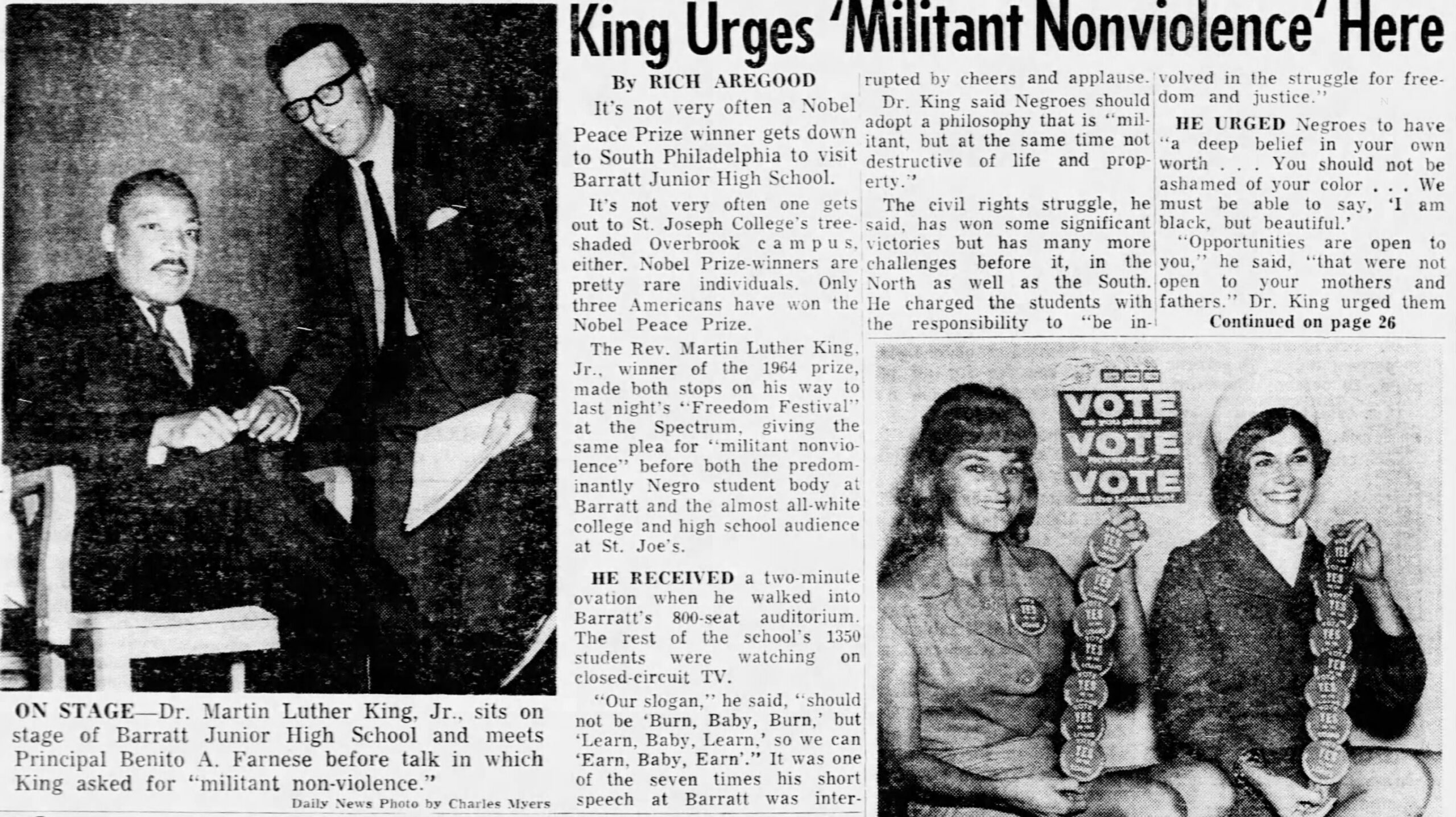
The Philadelphia Daily News recounted Martin Luther King Jr.’s visit to Barratt Junior High in October, 1967.
“I know you’ve heard of that new impressive structure called the Spectrum, and I know you’ve heard of Harry Belafonte and Aretha Franklin and Nipsey Russell and Sidney Poitier and all of these other great and outstanding artists,” King said. He told the students to urge their parents to attend. “And I hope you will come also, for it will be a great experience and, by coming, you will be supporting the work of the Civil Rights Movement.”
King did not use notes, Farnese said. He spoke for 20 minutes, an address that would eventually be known as his “What is Your Life’s Blueprint?” speech.
The Barratt students, seventh, eighth, and ninth graders, were poised to move into a time that would determine the course of the rest of their lives.
The great civil rights figure, who had by that time already won the Nobel Peace Prize, told the young people to have “a deep belief in your own dignity, your own worth, and your own somebodiness. Don’t allow anybody to make you feel that you are nobody.”
Take pride in your color, your natural hair, King told the students, most of whom were Black.
“You need not be lured into purchasing cosmetics advertised to make you lighter, neither do you need to process your hair to make it appear straight,” King said. “I have good hair and it is as good as anybody else’s in the world. And we’ve got to believe that.”
‘Learn, baby, learn’
King urged the crowd to set upon a path to excellence, whatever that looks like.
“I say to you, my young friends, that doors are opening to each of you — doors of opportunity are opening to each of you that were not open to your mothers and your fathers,” King said. “And the great challenge facing you is to be ready to enter these doors as they open.”
Kemp remembers being surprised that King came to South Philadelphia.
“Our neighborhood was pretty poor,” said Kemp, who grew up as one of nine children in a family that struggled. “There really wasn’t too much to look forward to in our neighborhood.”
King acknowledged the “intolerable conditions” faced by many of the children he addressed. But, he said, it was incumbent on them to stay in school, to build a good life.
“Set out to do a good job and do that job so well that the living, the dead, and the unborn couldn’t do it any better,” King said. “If it falls to your lot to be a street sweeper, sweep streets like Michelangelo painted pictures.”
The civil rights hero told students to commit to “the eternal principles of beauty, love, and justice. Don’t allow anybody to pull you so low as to make you hate them.”
King, who encouraged peaceful resistance, urged “a method that can be militant, but at the same time does not destroy life or property.”
“And so our slogan must not be ‘Burn, baby, burn,’” King said, referring to a chant that had become associated with the 1965 Watts riots in Los Angeles. “It must be ‘Build, baby, build. Organize, baby, organize.’ Yes, our slogan must be ‘Learn, baby, learn’ so that we can earn, baby, earn.
“And with a powerful commitment, I believe that we can transform dark yesterdays of injustice into bright tomorrows of justice and humanity.”
‘I’ll never forget it’
Some of the members of the Barratt class in the room that day soared: Kevin Washington, who was on the basketball team with Kemp, went on to become the first Black president of the national YMCA.
Kemp was bright, but his family’s economic struggles weighed on him, he said. He dreamed of college, but it wasn’t in reach. He ended up leaving South Philadelphia High without a diploma, eventually earning a GED.
He raised children, built a life working — often in maintenance. He spent time as a school basketball coach.
After suffering medical and marital issues, Kemp fell on hard times. He spent four months without a home, sleeping in parks and at 30th Street Station.
“Dr. King’s speech really helped,” he said. “That used to come to mind when I was on the street. I’ll never forget it.”
Kemp rallied; he now lives in an apartment in South Philadelphia.
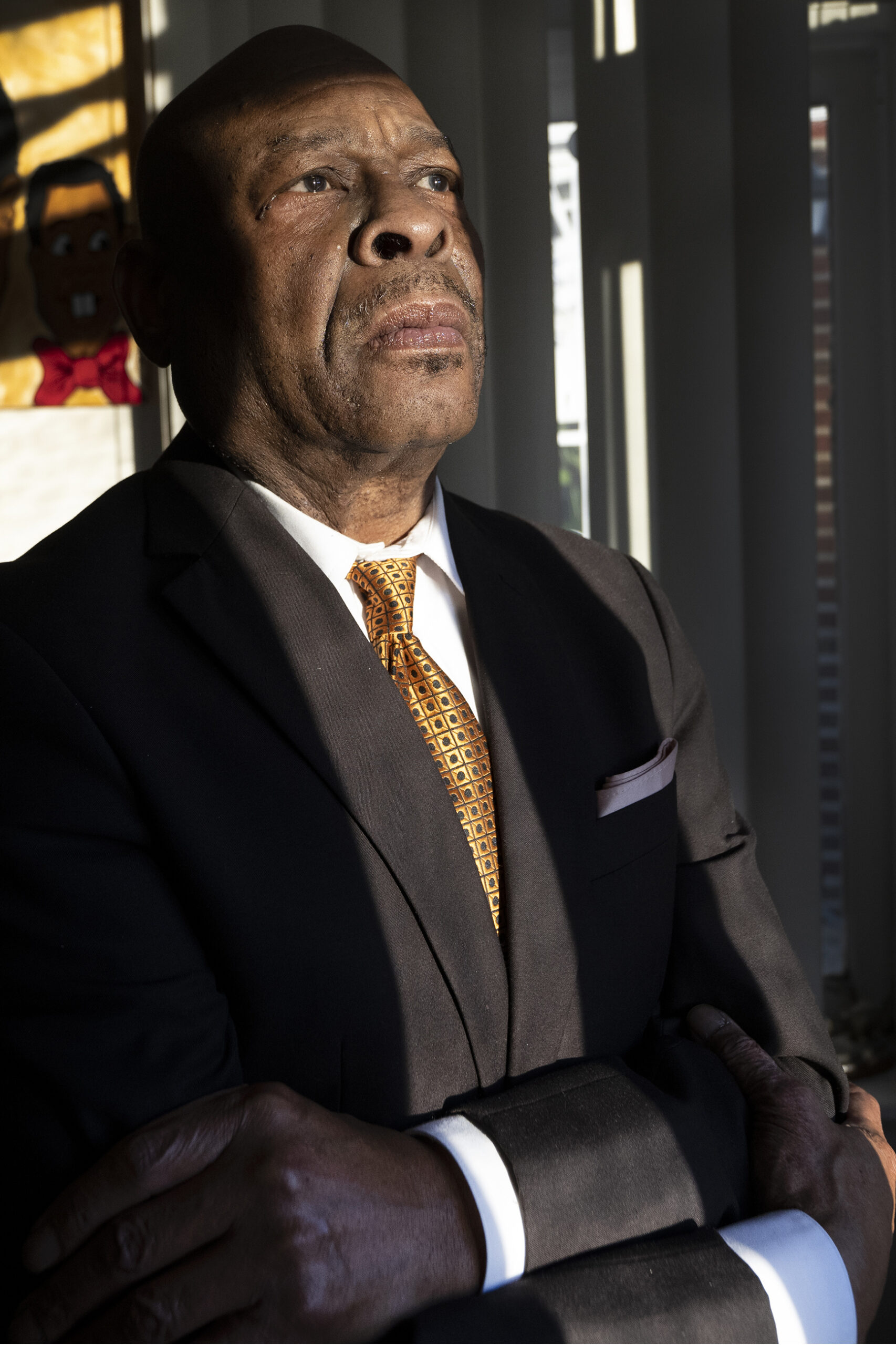
Jeffrey Miles is photographed at his home in Philadelphia on Friday, Jan. 16, 2026. Miles was 13 in October 1967 when he shook the hand of the Rev. Dr. Martin Luther King Jr. and witnessed a speech that altered the course of his life.
The speech also altered the course of Miles’ life.
“I was a member of a gang in South Philly,” said Miles, now 72. “I never paid attention to adults and teachers. But that day I paid attention to Dr. King.”
King’s words — reach for more, do your best, no matter your struggles — resonated. He buckled down at school, graduated from high school, from college. He became an optician and even taught students at Salus University.
“When Dr. King said, ‘instead of burn, baby, burn, learn, baby learn,’ that gave me a window,” said Miles, who lives in West Oak Lane. “It gave me hope.”
MINNEAPOLIS — Protesters for and against the Trump administration’s latest immigration crackdown clashed in Minneapolis on Saturday as the governor’s office announced that National Guard troops had been mobilized and stood ready to assist state law enforcement, though they were not yet deployed to city streets.
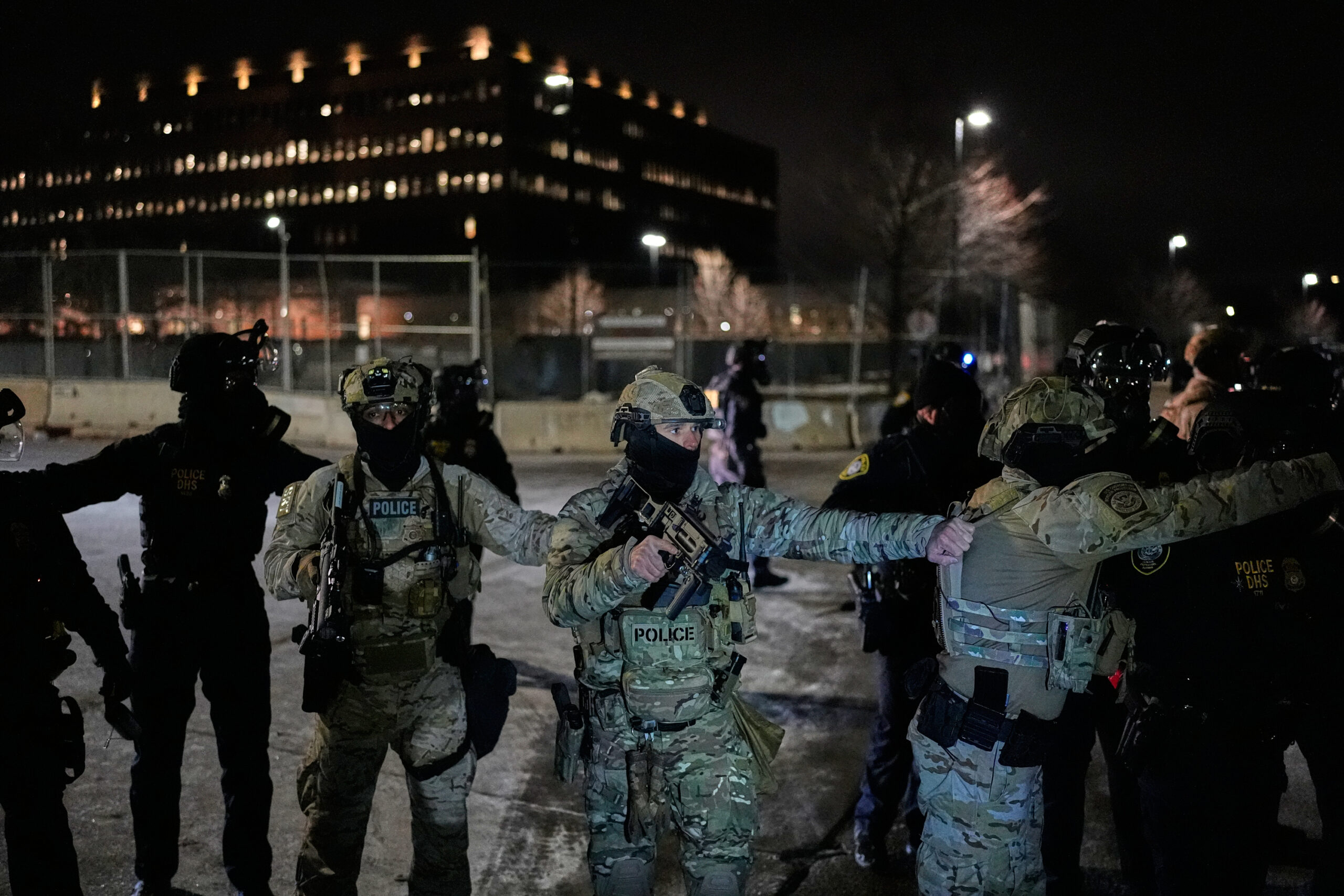
There have been protests every day since the Department of Homeland Security ramped up immigration enforcement in the Twin Cities of Minneapolis and St. Paul by bringing in more than 2,000 federal officers.
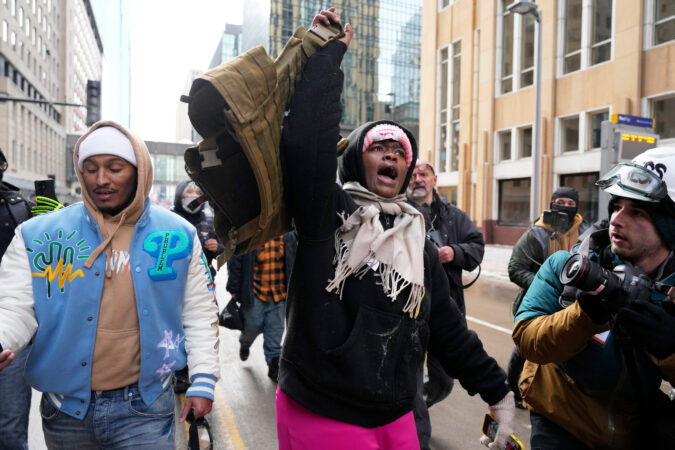
A large group of protesters turned out in downtown Minneapolis and confronted a much smaller group of people attending an anti-Somali and pro-Immigration and Customs Enforcement rally. They chased the pro-ICE group away and forced at least one member to take off a shirt they deemed objectionable.
Jake Lang, who organized the anti-Islam and pro-ICE demonstration, appeared to be injured as he left the scene, with bruises and scrapes on his head. He said via social media beforehand that he intended to “burn a Quran” on the steps of City Hall, but it was not clear if he carried out that plan.
Lang was previously charged with assaulting an officer with a baseball bat, civil disorder and other crimes before receiving clemency as part of President Donald Trump’s sweeping act of clemency for Jan. 6 defendants last year. Lang recently announced that he is running for U.S. Senate in Florida.
In Minneapolis, snowballs, and water balloons were also thrown before an armored police van and heavily equipped city police arrived.
“We’re out here to show Nazis and ICE and DHS and MAGA you are not welcome in Minneapolis,” protester Luke Rimington said. “Stay out of our city, stay out of our state. Go home.”
National Guard ‘staged and ready’
The state guard said in a statement that it had been “mobilized” by Democratic Gov. Tim Walz to support the Minnesota State Patrol “to assist in providing traffic support to protect life, preserve property, and support the rights of all Minnesotans to assemble peacefully.”
Maj. Andrea Tsuchiya, a spokesperson for the guard, said it was “staged and ready” but yet to be deployed.
The announcement came more than a week after Walz, a frequent critic and target of Trump, told the guard to be ready to support law enforcement in the state.
During the daily protests, demonstrators have railed against masked immigration officers pulling people from homes and cars and other aggressive tactics. The operation in the deeply liberal Twin Cities has claimed at least one life: Renee Good, a U.S. citizen and mother of three, was shot by an ICE officer during a Jan. 7 confrontation.
On Friday a federal judge ruled that immigration officers cannot detain or tear gas peaceful protesters who are not obstructing authorities, including while observing officers during the Minnesota crackdown.
Living in fear
During a news conference Saturday, a man who fled civil war in Liberia as a child said he has been afraid to leave his Minneapolis home since being released from an immigration detention center following his arrest last weekend.
Video of federal officers breaking down Garrison Gibson’s front door with a battering ram Jan. 11 become another rallying point for protesters who oppose the crackdown.
Gibson, 38, was ordered to be deported, apparently because of a 2008 drug conviction that was later dismissed. He has remained in the country legally under what’s known as an order of supervision. After his recent arrest, a judge ruled that federal officials did not give him enough notice that his supervision status had been revoked.
Then Gibson was taken back into custody for several hours Friday when he made a routine check-in with immigration officials. Gibson’s cousin Abena Abraham said Immigration and Customs Enforcement officials told her White House Deputy Chief of Staff Stephen Miller ordered the second arrest.
The White House denied the account of the re-arrest and that Miller had anything to do with it.
Gibson was flown to a Texas immigration detention facility but returned home following the judge’s ruling. His family used a dumbbell to keep their damaged front door closed amid subfreezing temperatures before spending $700 to fix it.
“I don’t leave the house,” Gibson said at a news conference.
DHS said an “activist judge” was again trying to stop the deportation of “criminal illegal aliens.”
“We will continue to fight for the arrest, detention, and removal of aliens who have no right to be in this country,” Assistant Homeland Security Secretary Tricia McLaughlin said.
Gibson said he has done everything he was supposed to do: “If I was a violent person, I would not have been out these past 17 years, checking in.”
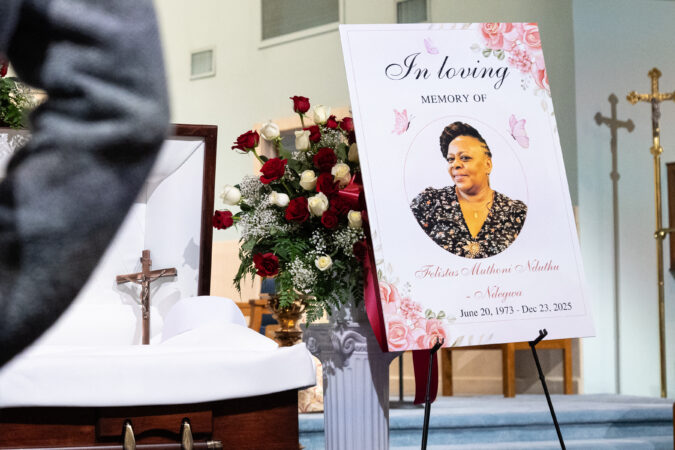
A chorus of nurses called Muthoni Nduthu to service one last time Saturday at her funeral.
“Nurse Muthoni, please report to duty,” the nurses repeatedly cried out, each time punctuated by a chime from a triangle. “You faithfully served your profession with dignity, compassion, and integrity. … Your fellow nurses will take over from here.”
Nduthu — who was killed when an explosion just before Christmas razed the Bristol Health & Rehab Center in Lower Bucks County — was laid to rest Saturday, memorialized by family, friends from the tight-knit Kenyan community in the area, and a 50-person nurse honor guard as an exemplary healthcare professional, a doting and spirited mother, and a pillar of her community.
“She was our anchor, our prayer warrior, and our safe place,” the oldest of her three sons, Clinton Ndegwa, wrote in a tribute read by a relative. “Though her absence leaves a space that cannot be filled, her love remains rooted in us. We carry her faith, her strength and her lessons forward.”
During the funeral service at St. Ephrem Catholic Church in Bensalem, where Nduthu, 52, was a longtime member, she was remembered for her warmth and natural humor; her perseverance as an immigrant who went back to school for nursing while working full-time; her quiet, but constant, sacrifices for her family; and her cooking.
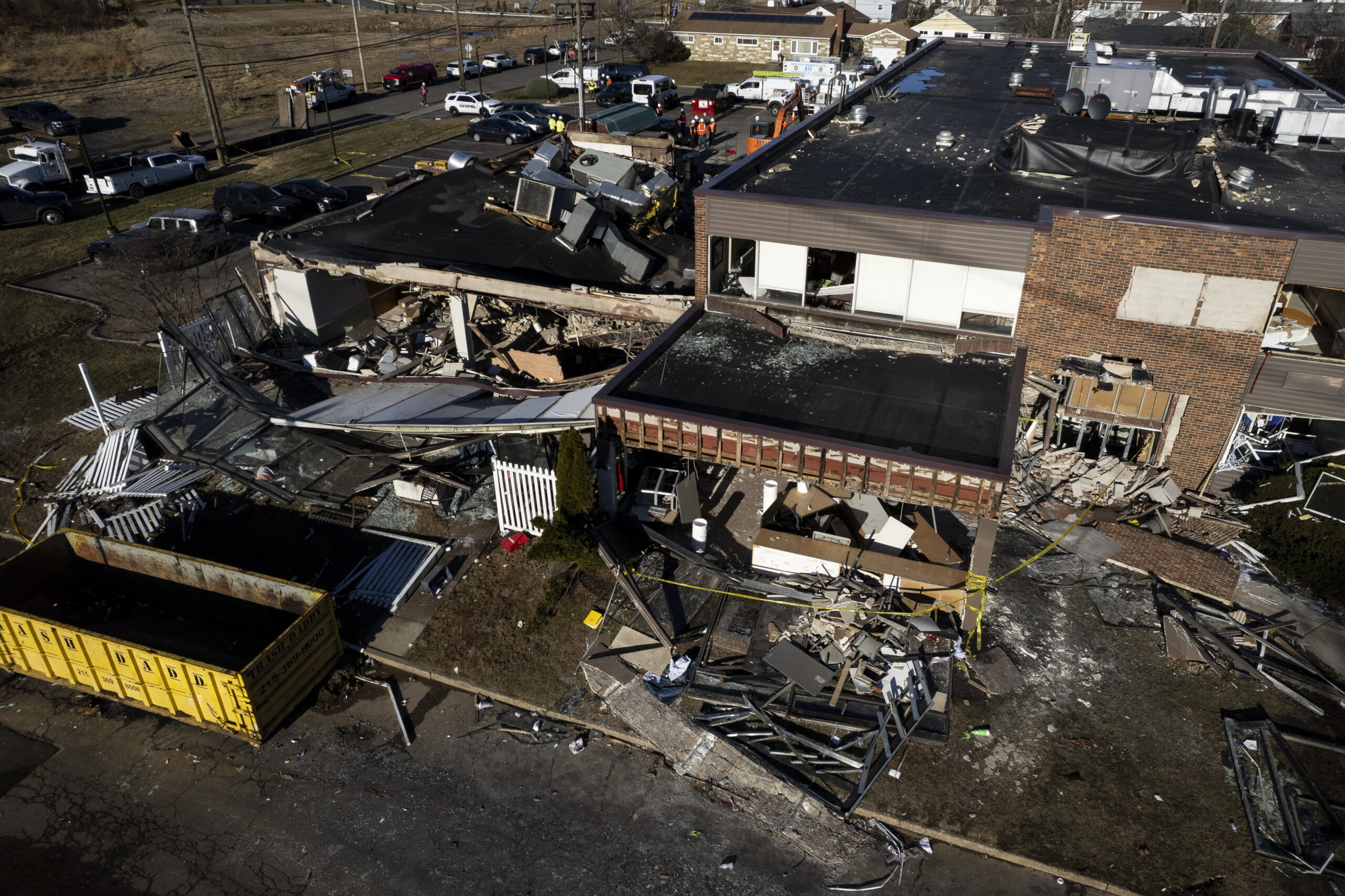
The night before her Dec. 23 shift at the Bristol facility, formerly known as Silver Lake Healthcare Center, Nduthu prepared spiced chicken for her husband and sons to share on Christmas. The next day, she was working when a blast flattened a section of the nursing home just after 2 p.m., trapping dozens, hurling debris, and rocking nearby homes. Resident Ann Reddy was also killed, and about 20 others were injured. Earlier this month, another resident, identified as Patricia Mero, succumbed to injuries.
Investigators work the scene at Bristol Health & Rehab Center on Wednesday, Dec. 24, 2025, in Bristol Township, Pa.
The nursing home; its operator, Saber Healthcare Group; Peco; and others are facing lawsuits from survivors and their loved ones who say the explosion was the result of negligence. NBC10 reported that Nduthu’s husband, David Ndegwa, has also filed a lawsuit.
The National Transportation Safety Board and a spokesperson for Saber said Friday that the investigation into what caused the explosion is ongoing.
Nduthu and her family emigrated from Kenya to the Philadelphia area more than two decades ago, David Ndegwa wrote in a tribute. Once stateside, Nduthu pursued a nursing degree, “guided by her compassion and desire to serve others,” her eulogy read. She believed deeply in the power of education and hard work, her sons said.
She “touched many lives through her kindness, generosity, and genuine care for others,” David Ndegwa wrote. “Her legacy lives on in our sons, in the friendships she nurtured, and in the strong foundation of family she built.”
In an interview with Pennsylvania’s two U.S. senators, CBS Evening News anchor Tony Dokoupil asked about “extreme rhetoric” in Minneapolis.
“Where is the line,” Dokoupil asked, “between protected demonstrations, civil disobedience … and impeding ICE, which is breaking the law?”
He did not specifically mention the Jan. 7 fatal shooting of 37-year-old Renee Good by a U.S. Immigration and Customs Enforcement agent.
“The moment you start dehumanizing people, the moment you start calling people Hitler, the moment you start doing that, it’s a slippery slope to violence,” Republican U.S. Sen. Dave McCormick said during the exchange, which was telecast Friday. “So there’s a direct connection between the violent language, the dehumanizing language, and the actual violence.”
The Trump administration has defended Good’s killing as an act of self-defense by ICE agent Jonathan Ross, who shot Good four times as she drove away from him, video of the incident showed.
Federal immigration officers confront protesters outside Bishop Henry Whipple Federal Building, Thursday, Jan. 15, 2026, in Minneapolis. (AP Photo/Yuki Iwamura)
McCormick said that ICE agents have a responsibility to enforce the law.
“The moment the protesters get in the way of the ICE officials actually enforcing the law … the moment that it starts to become physical, I think the risk of violence goes up,” he said.
The exchange was part of a wide-ranging interview, billed as a “lesson in bipartisanship,” that found McCormick and Democratic U.S. Sen. John Fetterman often agreeing on divisive topics.
“I reject the extreme on both sides right now,” Fetterman said. “It was a tragedy. We all wish that woman was alive. But also, ICE has a job to do as well,” and everyone doesn’t need to agree on its tactics.
Here are other moments that stood out from the 16-minute conversation held at U.S. Steel’s Mon Valley Works in West Mifflin, about 10 miles south of Pittsburgh.
Acquiring Greenland
Fetterman and McCormick both rejected the idea, proposed by President Donald Trump, that the U.S. may use military force to acquire Greenland. But both senators agreed that it makes sense for the U.S. to increase its presence there.
“It’s also undeniable, that, one, this is not a brand-new conversation,” Fetterman said, adding that President Harry Truman and others had tried to buy Greenland. “So it’s not an absurd idea.”
McCormick said he recently met the prime minister of Denmark, “and they are welcoming the United States playing a more active role.” He doesn’t believe the U.S. should use military force, he added, but “we ought to have a strategic foothold.”
Fed Chair Jerome Powell
The Justice Department, led by Attorney General Pam Bondi, recently subpoenaed Federal Reserve Chair Jerome Powell, head of the independent body that determines U.S. monetary policy. The inquiry is looking into Powell’s comments related to renovations of Federal Reserve buildings. Powell has said the probe was opened because Trump was angry that Powell would not cut interest rates when the president wanted him to.
McCormick defended Trump’s right to criticize Powell, and said Powell should have raised rates faster and lowered them sooner. However, he emphasized Powell’s “mandate” to control federal interest rates.
“The Fed has to be independent,” McCormick said. “It’s absolutely critical for our financial system.” He added that he does not believe Powell is “involved in any criminal activity.”
Regulating social media
Both of Pennsylvania’s U.S. senators support legislation to rein in social media companies, which have faced broad criticism for negatively impacting children and teens.
“If there’s a friend who’s spending four or five hours a day with your kid, you really want to know who that friend is,” Fetterman said, “and that is social media right now, and it can be incredibly poisonous.”
Pennsylvania Sens. Dave McCormick, left, and John Fetterman play with Fetterman’s three-legged dog, Artie, at Fetterman’s home in Braddock, Pa., on Feb. 2. (MUST CREDIT: Justin Merriman for The Washington Post)
Fetterman won his 2022 Senate race against Republican Mehmet Oz after relentlessly trolling his opponent on social media, but he said he has seen the negative effect social media has had on his own family.
Fetterman said Congress is not doing enough — and he would like to see a social media ban for children similar to what Australia recently implemented.
Fetterman said he and Republican U.S. Sen. Katie Britt of Alabama are pushing the “Stop The Scroll Act,” which would create a mental health warning label for social media platforms.
McCormick’s wife, Dina Powell McCormick, recently became president and CEO of Meta, Facebook’s parent company. But McCormick said he agrees that Congress needs to do more. He wants to eliminate social media for children under 14, make social media platform data available to researchers, and ban phones in schools that are funded by the federal government.
Data centers
Despite public skepticism over artificial intelligence data centers and their potential impact on energy prices, Pennsylvania Gov. Josh Shapiro has been a vocal supporter of companies building the centers in the state.
McCormick said Pennsylvania is the country’s second-largest energy exporter, making the state “uniquely positioned to be the AI energy leader.”
“But, yes, as we develop this huge infrastructure, we need to make sure that consumers aren’t stuck with raising energy increases,” McCormick added.
The two senators also spoke about energy and healthcare costs, the steel industry, and other topics. The full interview can be viewed here:
President Donald Trump’s Justice Department crossed a new threshold with its criminal investigation of top Democratic elected officials in Minnesota, targeting vocal critics during a moment of crisis in which protesters and federal agents are clashing on icy city streets.
The Twin Cities have been a tinderbox for more than a week since an Immigration and Customs Enforcement officer fatally shot a woman in her vehicle, with residents confronting ICE agents. Trump has raised the prospect of sending U.S. troops into the state, and the Justice Department escalated tensions Friday as it prepared to send subpoenas to Gov. Tim Walz and Minneapolis Mayor Jacob Frey, two of Minnesota’s highest-profile Democrats.
The pair have loudly disparaged ICE’S presence in the state and the way Trump and his administration have defended the officer and sidelined state officials in an investigation into the shooting. The subpoenas the Justice Department is preparing to send suggest the agency is looking at whether Walz’s and Frey’s public statements about the administration’s actions amount to illegal interference with law enforcement.
The administration has pursued numerous other Democrats and perceived adversaries, fulfilling Trump’s promises to prosecute his foes. However, the administration had not taken such forceful action against elected officeholders at a volatile moment when public safety was at issue — until now.
To Trump’s allies, the latest investigation should serve as a warning to critics who they argue are inflaming matters with their rhetoric. Former Trump adviser Stephen K. Bannon said he believes Walz and Frey hit Trump’s “trip wire” with their heated comments and expects “intense prosecution.”
“Walz and Frey should listen when the president says, ‘No games,’” he said.
Trump’s critics warned in stark terms that he was crossing a dangerous line.
“This is what totalitarianism looks like,” said Sen. Chris Murphy (D., Conn.). “Trump is now using the full, entire scope of the federal government in order to destroy and suppress dissent and compel loyalty.” Murphy said Minneapolis is a “test case” that will determine whether Trump tries the same approach elsewhere.
The White House and Justice Department had no comment Friday on the probe of Walz and Frey, but Attorney General Pam Bondi posted on social media a “reminder to all those in Minnesota: No one is above the law.” Neither Walz nor Frey had been served with a subpoena by Friday evening, spokespeople for the officials said.
Trump, who on Thursday threatened to invoke the Insurrection Act in Minnesota, which would enable him to deploy the military on U.S. soil, downplayed the prospect on Friday. “If I needed it, I’d use it. I don’t think there’s any reason right now to use it,” he told reporters.
The Justice Department’s investigation of a governor and mayor is highly unusual. In the 1950s and 1960s, presidents used troops to enforce court desegregation orders in the face of defiance from some Southern governors. But the department did not press charges against them, said Steven Lawson, a history professor at Rutgers University.
“The Justice Department’s Civil Rights Division did keep track of civil rights incidents in the South, but it did not prosecute or harass governors or mayors for their resistance,” he said by email.
Trump’s administration is taking the opposite approach by going after those who have pilloried the president. Traditionally, the Justice Department has tried to insulate itself from the White House, but Trump has not shied away from getting involved in its investigations. In September, he took to social media to complain to Bondi that she wasn’t taking action against his political opponents.
Many Minnesotans were angry when ICE sent thousands of agents to the state, and they launched widespread protests after an ICE officer fatally shot Renée Good. ICE’S presence and the demonstrations have put Minneapolis on edge, with residents blowing whistles and screaming at agents, and officers at times deploying tear gas. Demonstrations “remained peaceful until last night,” Minneapolis Police Chief Brian O’Hara said last weekend after 29 people were arrested and an officer was injured.
Tensions rose again this week when an ICE officer shot a man in the leg.
Soon after an investigation into Good’sshooting began, state officials said they were reluctantly withdrawing from it because the FBI was not sharing information with them. Separately, Minnesota Attorney General Keith Ellison sued federal officials this week to try to force ICE agents out of the state.
Walz, the Democrats’ 2024 vice-presidential nominee, has been fiercely critical of ICE, as has Frey, who drew nationwide attention when he told ICE to “get thef— out of Minneapolis” following the shooting.
Walz and Frey are being investigated under a law similar to one used against protesters whom federal officials have accused of impeding their work.
“The administration is taking us back to the days of seditious libel, where people are prosecuted simply because they criticize the acts of government,” said Rep. Jamie Raskin (D., Md.), a former constitutional law professor who served on a congressional panel that investigated the Jan. 6, 2021, attack on the U.S. Capitol by a pro-Trump mob. “The Department of Justice has now been reduced to a completely political and partisan instrument of vendetta.”
In a statement, Walz noted that Trump has gone after many others who have not done what he wants and said, “The only person not being investigated for the shooting of Renée Good is the federal agent who shot her.”
Justice Department prosecutors pursued cases against former FBI director James B. Comey and New York Attorney General Letitia James, but judges dismissed the charges. The department has also conducted investigations of Sen. Adam Schiff (D., Calif.), who led Trump’s first impeachment as a member of the House, Federal Reserve Chair Jerome H. Powell, and several Democrats who told military members they could defy unlawful orders. He has also tussled with Democratic state officials such as California Gov. Gavin Newsom and Illinois Gov. JB Pritzker, and tried to withhold funds from them when they have fought his agenda.
Frey wrote on the social media platform X that the investigation against him was “an obvious attempt to intimidate me for standing up for Minneapolis, local law enforcement, and residents against the chaos and danger this Administration has brought to our city.” He said he “will not be intimidated.”
The administration’s pressure on Minneapolis ramped up further Friday when the Department of Housing and Urban Development said it was investigating the city over fair housing initiatives, probing for alleged violations of the Fair Housing Act and the Civil Rights Act.
A Minneapolis spokesperson said the investigation “appears to be about politics, not affordable housing.”
The wet, hefty snowflakes that fell across the Philadelphia region Saturday blanketed buildings and streets with slushy snow — and more is predicted Sunday.
While Saturday’s snowfall — recorded at about half an inch in the city, and topping two inches in the immediate suburbs — was melting by the afternoon, a new storm Sunday could bring another round.
Forecasts for the city and surrounding suburbs project 1 to 3 inches.
“Expect more snow tomorrow than what you saw today,” said Mike Lee, lead meteorologist at the National Weather Service in Mount Holly.
Here’s what to know about the snow, and the chances for more this weekend.
Traffic on the eastbound Schuylkill Expressway (I-76) is moving slowly as snow falls in the region midday, Saturday, Jan. 17, 2026. Temperatures in the afternoon were expected to approach 40 degrees, so any precipitation that lingered was likely to turn to rain. Sunday will be colder, the source being a coastal storm.
‘Wet and slushy’
With temperatures right around freezing, the snow that fell Saturday morning and early afternoon was “definitely wet and slushy,” Lee said.
By midafternoon, the snow had stopped. Half an inch was recorded in Center City, while in the nearby parts of the collar counties, totals hovered around 1 to 2 inches, reaching 3 and 4 inches closer to the Lehigh Valley.
While some of that snow was melting throughout the day Saturday, Lee noted that the melt could turn into black ice on roadways as temperatures fell at night.
And Sunday offers another chance for snow to accumulate around the region, Lee said.
Daniel Burton, of Wynnefield, is with his kids Apollo, 9, and Finley, 13, enjoying the snow at Belmont Plateau as the sunset lights up the Philadelphia skyline Saturday, Jan. 17, 2026.
“There’s a little bit better chance for the Philadelphia area” to get snow from that system, Lee said.
Philadelphia and the Main Line could get 1 to 3 inches of snow Sunday, with snow predicted to start at daybreak and last through the evening, said Melissa Constanzer, senior meteorologist with AccuWeather.
South Jersey could see the greatest totals, Constanzer said, given the coastal nature of the storm.
“If you’re planning on going anywhere Sunday, expect travel to be impacted,” Constanzer said. Even if snow is not accumulating, she said, visibility could be a challenge.
Crews should have time to clear roads by Monday morning, Constanzer said.
That’s likely it for snow in the near future, with dry weather predicted to start next week, Lee said. Monday night is forecast to see the lowest temperatures of the season so far, reaching 13 degrees in Philadelphia, according to the weather service. The high Tuesday is forecast to top out at 23, with a low Tuesday night of 11.