When Jackie Fegley, a former nun, got married 51 years ago, money was tight. So she borrowed a dress from a friend.
And when her husband looked at her nurse’s salary the first year he did her taxes, he said: “Do you know you’re borderline poverty?”
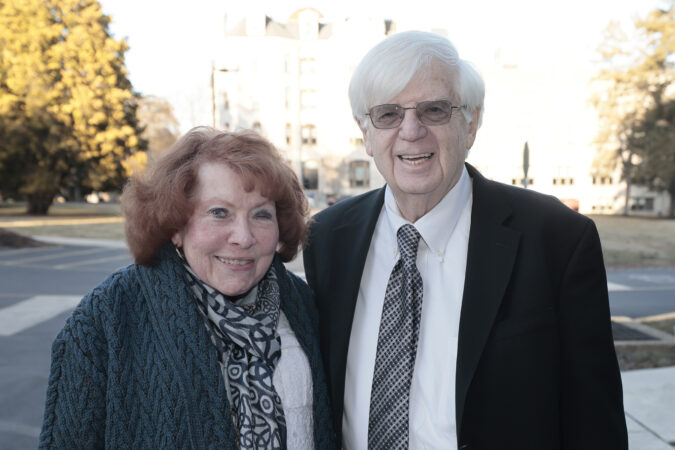
But all that changed over the ensuing decades, and on Friday, Jackie and her husband Bill Fegley Jr., who made his career in accounting, gave a $5 million gift to Neumann University. Jackie is a 1971 graduate of Neumann — then called Our Lady of Angels College.
It’s the largest single gift Neumann — a Catholic university in Aston, Delaware County — has received from an individual, and the university in recognition named its nursing college The Jacquelyn Wilson Fegley ’71 College of Nursing.
“Bill and I were both lucky to receive a good education,” said Jackie, 81, who lives in Blue Bell with her husband, a Drexel University graduate. “So we decided that’s where we’d really like to give our money.”
Chris Domes, president of Neumann University
Neumann President Chris Domes said $4.5 million will be used for undergraduate nursing scholarships for students with the most need and highest achievement, and the other $500,000 for lab equipment. The scholarships will begin to be awarded in the fall, with 22 to 25 students benefiting each year and continuing to get the funds over four years.
Nursing is the largest major at Neumann, with 368 undergraduate and graduate students enrolled. That’s about 17% of the 2,174-student body.
“If the scholarships give somebody an opportunity to change their life, it’s amazing,” said Bill, 78, who started his public accounting career with Arthur Young and then founded his own firm, Fegley & Associates, in 1975.
Domes said he hopes the gift encourages others to invest in higher education.
“It sends a signal that Neumann is a place that is financially strong and getting stronger,” he said. “It’s a real sign from Bill and Jackie that they believe in what we are doing here.”
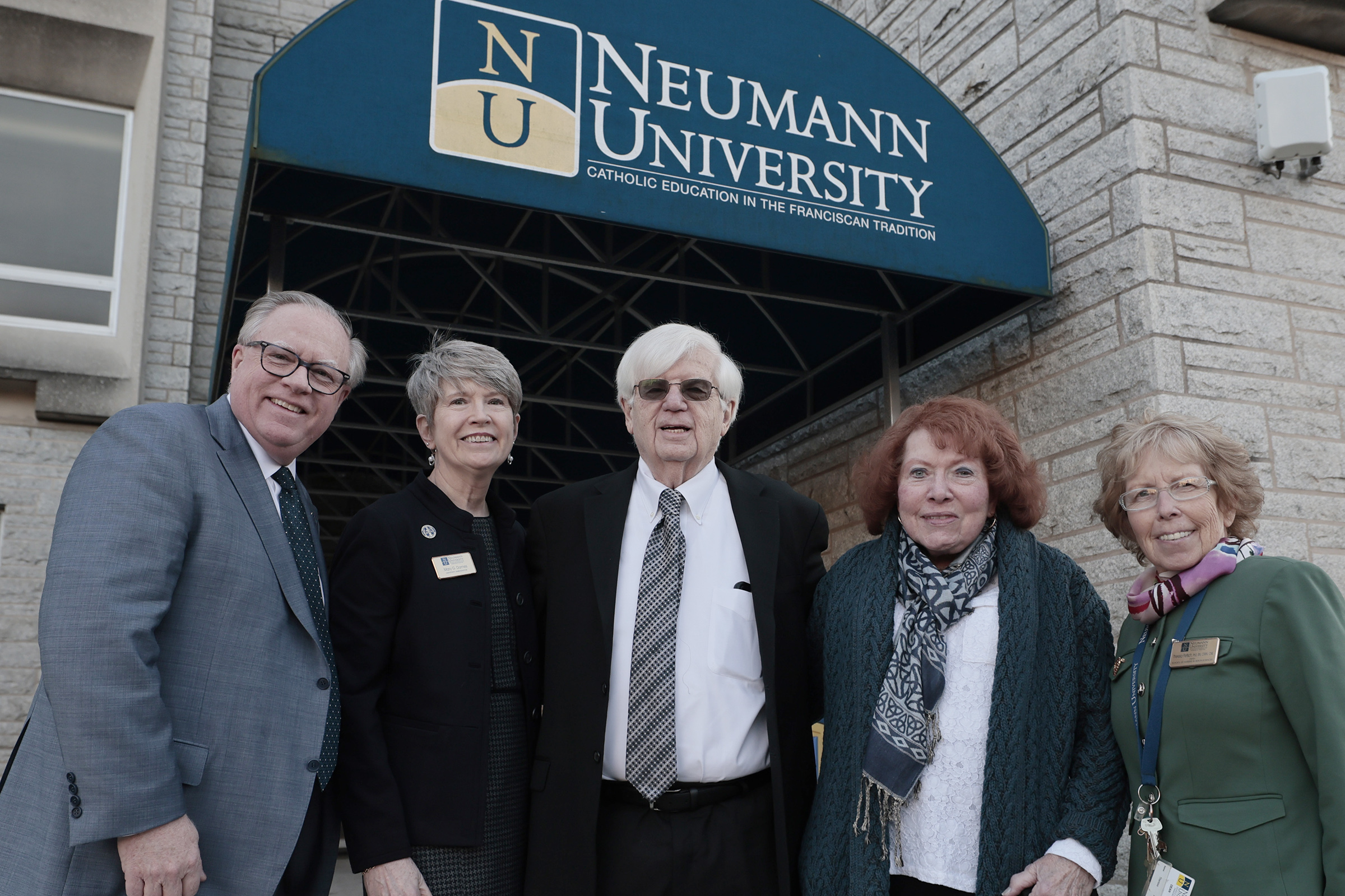
Neumann University President Chris Domes (from left) and his wife Mary Domes, William Fegley Jr. and his wife Jacquelyn Fegley, of Blue Bell and Neumann’s Nursing Health Sciences Dean Theresa Pietsch at Neumann University in Aston, Pa. on Friday, Jan. 16, 2026.
Born in Chester, Jackie said she grew to admire the Franciscan sisters at her local parish and stayed in touch with them through high school. When she graduated from Notre Dame High School in Moylan in 1962, she joined the order.
During her decade there, she taught grade school, including one year at an orphanage where the children ranged in age from 3 to 9. She said that’s when she started to think she wanted a family.
She got her bachelor’s degree while in the order, first taking classes at St. Joseph’s University and then moving over to Our Lady of Angels when it opened. She was part of the college’s second nursing graduating class.
“I think there were 10 of us in the class,” she said, including other nuns and lay people. “It was a wonderful experience integrating everyone together.”
After leaving the convent, she worked as a nurse at Holy Redeemer Hospital in Meadowbrook and Nazareth Hospital in Northeast Philadelphia. In January 1974, she met Bill, who grew up in Tamaqua, at a dance at a local pub. In September of that year, they married.
They have five children, now ages 40 to 50, who work as accountants, a personal trainer, a doctor, and a minimart operator.
Jackie has remained in contact with the sisters through the years.
“I love the sisters,” she said. “I still consider myself a Franciscan, just not a Franciscan sister.”
Bill — whose accounting firm has since merged with Morison Cogen LLP, where he continues to serve as a partner — has served on the foundation board for the Sisters of Saint Francis and has chaired it for about four-and-a-half years. And nine months ago, he joined Neumann’s board of trustees. He also has served as a lecturer at the University of Pennsylvania and an adjunct professor at Drexel and Pennsylvania State University.
The couple has visited Neumann to see how the educational program has grown and were pleased to see its Franciscan spirit thriving.
“I was really thrilled to see that this was how it was progressing,” Jackie said.
The couple attended the naming celebration and gift announcement at Neumann on Friday.
“We’re just pleased that God put us in a position that we’re able to do this,” Bill said.
Sam Salvo didn’t deliver a nuanced breakdown of route trees or personnel groupings. He didn’t cite EPA or All-22 tape. He simply announced — with the confidence of someone who has never had to answer a follow-up question — that Kevin Patullo should be flipping burgers at McDonald’s. Philly nodded in unison.
The funniest part isn’t that it went viral. It’s that a day later, Patullo was gone, and the city collectively decided the kid deserved at least partial credit. In a town where people once egged an offensive coordinator’s house (too far), this somehow felt like the healthier outlet.
Sam’s rant worked because it was pure, unscripted Philly logic: blunt, emotional, metaphor-heavy, and somehow accurate. “One-half cooked, one-half raw” is not just a roast, it’s a season recap. And when he popped back up afterward saying, “I just wanted to say anything that could get him fired. And it worked,” it sounded less like a joke and more like a performance review.
The follow-up reactions only added to the lore. Fans celebrated. Former players debated scapegoating. Someone somewhere probably floated Big Dom calling plays. And the Eagles, intentionally or not, let the internet believe that an 11-year-old helped nudge a major coaching decision.
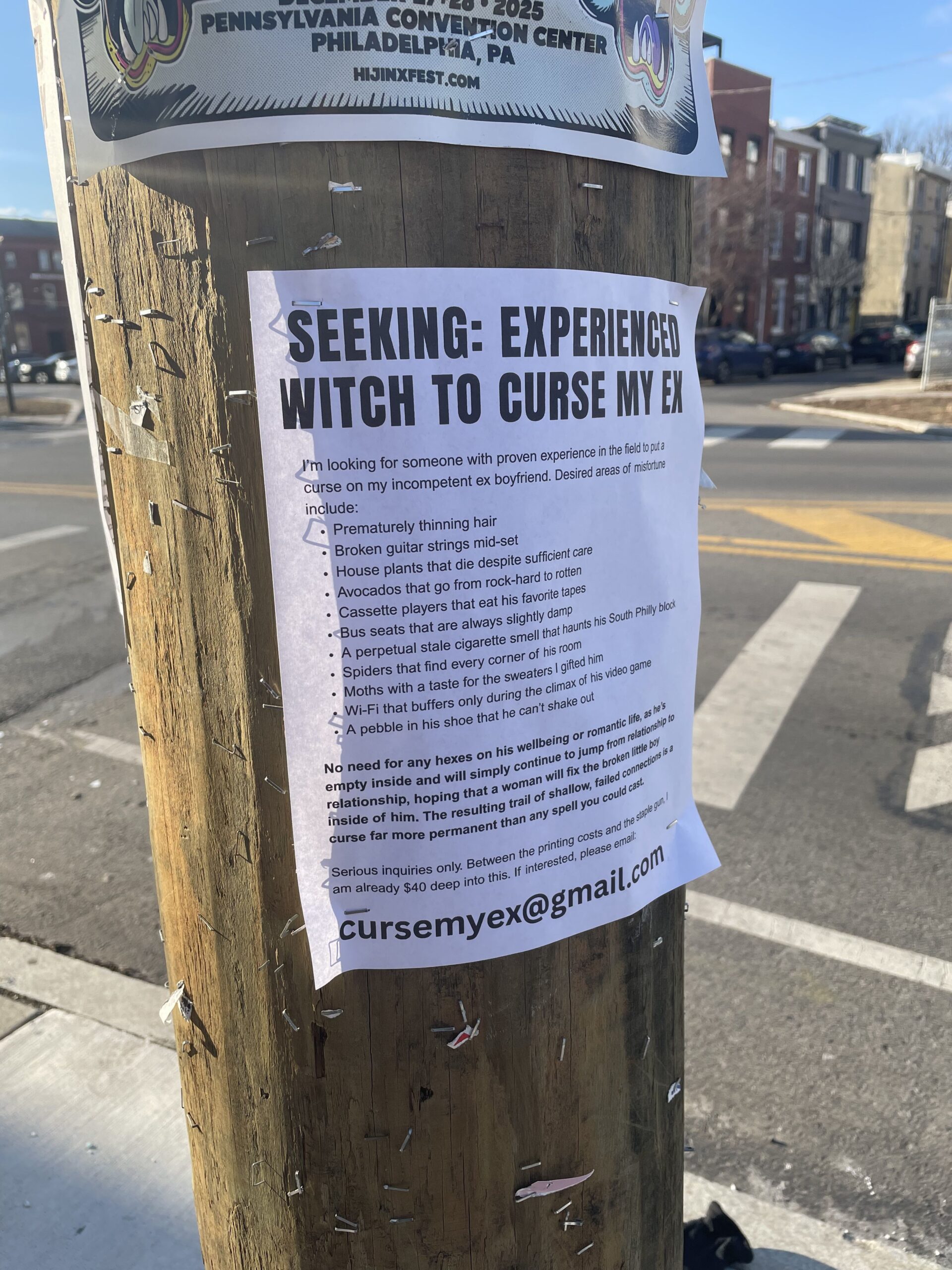
One of the witch-seeker’s fliers hangs in Fishtown on Sunday, Jan. 4. After ending a two-year relationship, a Philadelphia woman posted the fliers around the city and in Phoenixville as a way to channel her emotions over the breakup.
Philly collectively supports hexing an ex (with rules): A
At some point this winter, Philadelphia decided that asking a witch to curse your ex (politely, creatively, and without touching his health or love life) was not only acceptable, but deeply relatable.
The flier itself did most of the heavy lifting. “Seeking: Experienced Witch to Curse My Ex,” stapled to poles from Phoenixville to Fishtown, with a list of curses so specific and mild they felt less like dark magic and more like emotional Yelp reviews: thinning hair, damp bus seats, buffering Wi-Fi, eternally pebbled shoes. Nothing fatal. Nothing irreversible. Just inconvenience with intention.
Instead of pearl-clutching, the city leaned in. The flier spread through neighborhood Facebook groups and socials, where strangers did what they do best: offered commentary, solidarity, jokes, and unsolicited advice. Some people cheered her on. Some defended the ex. Others asked how it ended. And plenty of women recognized the feeling immediately: that moment after you’ve done the therapy, the journaling, the “being mature,” and still need somewhere for the anger to go. This wasn’t about actually ruining someone’s life. It was about yelling into the city and having the city yell back, “Yeah, that sucks.”
The rules mattered, too. No curses on his health. No messing with his love life. Philly rage has boundaries. Even our hexes come with ethics.
Wawa learns Philly does not want a vibes-only convenience store: C-
Philadelphia has many hard rules, but one of the hardest is this: If you remove the shelves from a Wawa, you are no longer operating a Wawa.
And in Philly, that’s not innovation. That’s friction.
This was once one of the company’s highest food-service locations before the pandemic, which makes the experiment feel even more puzzling in hindsight. People weren’t avoiding this store because they didn’t want Wawa. They were avoiding it because it stopped functioning like one. A convenience store that requires commitment, planning, and patience defeats the entire concept.
The grade isn’t lower because this wasn’t malicious or careless. It was a genuine attempt to test something new. But Philly answered clearly, quickly, and repeatedly: We don’t want a Wawa that feels like an airport kiosk. That’s what will get your store closed.
Phillies pitcher Ranger Suárez throws against the Cincinnati Reds on Saturday, July 5, 2025, in Philadelphia.
Saying goodbye to Ranger Suárez hurts, even if it makes sense: B+
This one lands softly and hard at the same time.
Ranger Suárez leaving Philadelphia was never shocking, just quietly devastating. Signed by the Phillies as a teenager, developed patiently, trusted in big moments, and forever tied to the pitch that sent the city to the World Series in 2022, Suárez felt less like a roster spot and more like a constant. You looked up in October and there he was, calm as ever, getting outs without drama.
Now he’s on the Red Sox.
The Phillies weren’t wrong to hesitate on a five-year, $130-million deal for a pitcher with mileage, injury history, and a fastball that succeeds more on craft than velocity. Andrew Painter is coming. The rotation math is real. This is how smart teams stay competitive.
But Philly doesn’t grade purely on spreadsheets.
Suárez embodied a certain Phillies ideal: unflashy, durable when it mattered, unfazed by the moment, and always a little underestimated. He wasn’t the loud ace. He was the steady one. The guy you trusted to calm everything down when the season felt like it might tip.
That’s why this stings. Not because it was reckless to let him go, but because losing someone who felt like a Phillie is different than losing someone who just wore the uniform. Watching him head to Boston is one of those reminders that the version of the team you emotionally commit to is always a few contracts behind the one that actually exists.
OpenTable adds a 2% fee, and Philly sighs deeply: C
Philadelphia understands restaurant math. We’ve lived through inflation menus, pandemic pivots, staffing shortages, reservation deposits, and the great “please cancel if you’re not coming” era. What we don’t love is when the bill quietly grows another line item after we thought we were done reading it.
That’s why OpenTable adding a 2% service fee to certain transactions (no-show penalties, deposits, prepaid dining experiences) landed with more fatigue than outrage. Not rage. Just tired acceptance.
The logic isn’t wrong. No-shows are brutal for small dining rooms, especially in places like South Philly where a missed table can knock a whole service sideways. Restaurants can absorb the fee or pass it on, and in many cases, the platform is genuinely helping places protect their bottom line.
But from a diner’s perspective, this is yet another reminder that convenience now comes with micro-costs layered so thin you barely notice them, until you do. The reservation is free … unless you’re late. Or cancel. Or book a special dinner. Or blink wrong. It’s another reminder that each new surcharge chips away at the simple joy of making dinner plans without feeling like you’re navigating airline baggage rules.
Philly draws the line at selling dinner reservations: A-
Philadelphia has tolerated a lot in recent years: prix-fixe creep, credit card holds, cancellation windows measured in hours, and now, yes, platform fees (see above). But selling a free dinner reservation for profit? That’s where the city finally says no.
The attempted resale of coveted tables at Mawn didn’t just irritate the restaurant’s owners, it offended a basic Philly value system. You can love a place. You can hustle for a table. You can brag that you got one. What you can’t do is turn access into a side hustle and expect people to shrug.
The reaction was swift and very local: public call-out, canceled reservations, and a clear message that this isn’t New York, Miami, or a StubHub-for-dinner experiment. Yes, reservation scalping exists elsewhere, powered by bots and platforms like Appointment Trader. And yes, Philly has passed laws trying to shut that down. But what made this moment resonate wasn’t legislation. It was cultural enforcement. A collective agreement that making money off a free reservation crosses from clever into gross.
Put simply: Waiting your turn is still the rule here. And if you try to flip your way around it, don’t be surprised when the city flips right back.
Amanda Seyfried gives Colbert a very real Allentown community calendar: A
Stephen Colbert has a recurring bit where he asks celebrity guests to promote actual events from their hometowns. When Amanda Seyfried, who grew up in Allentown, took her turn this week, she didn’t try to punch up the material.
She didn’t have to.
Seyfried read through a lineup of events that sounded exactly like a Lehigh Valley bulletin board: all-you-can-eat pasta night, speed dating for seniors, board games at a funeral home, a pirate-themed murder mystery, and Fastnacht Day donuts heavy on lard and tradition. No setup. No apology. Just listings.
That restraint is what made it land. Seyfried treated the segment like she was helping out a neighbor, not auditioning for a tourism campaign.
For viewers around Philly and the surrounding counties, it was immediately recognizable. This is the kind of stuff you scroll past in a local Facebook group or see taped to a coffee shop door without a second thought. Put it on national TV, though, and suddenly it becomes comedy.
We’ll show you a photo take in the Philly-area, you tell us where you think it was taken. Monday is Martin Luther King Jr. Day, so he is the theme of this week’s quest. Good luck!
Round #16
Question 1
Where is this mural?
Loading…
ClickTap on map to guess the location in the photo
ClickTap again to change your guess and hit submit when you're happy
You will be scored at the end. The closer to the location the better the score
Tom Gralish / Staff Photographer
Pretty good/Not bad/Way off! Your guess was from the location.Spot on! Your guess was exactly at the location. Here's also where a random selection of Inquirer readers guessed.
This is Staircases and Mountaintops: Ascending Beyond the Dream, by artists Willis “Nomo” Humphrey and Jonny Buss. This mural is on the side of Martin Luther King Jr. Recreation Center at 22nd Street and Cecil B. Moore Avenue.
Quiz continues after ad
Question 2
Where can you find this car-free recreational spot?
Loading…
Tom Gralish / Staff Photographer
Pretty good/Not bad/Way off! Your guess was from the location.Spot on! Your guess was exactly at the location. Here's also where a random selection of Inquirer readers guessed.
Pretty good/Not bad/Way off! Your guess was from the location.Spot on! Your guess was exactly at the location. Here's also where a random selection of Inquirer readers guessed.
WASHINGTON — The Justice Department is investigating whether Minnesota Gov. Tim Walz and Minneapolis Mayor Jacob Frey have impeded federal immigration enforcement through public statements they have made, according to two people familiar with the matter.
The investigation focused on potential violation of a conspiracy statute, the people said.
The people spoke to the Associated Press on condition of anonymity because they were not authorized to discuss a pending investigation by name.
CBS News first reported the investigation.
In response to reports of the investigation, Walz said in a statement: “Two days ago it was Elissa Slotkin. Last week it was Jerome Powell. Before that, Mark Kelly. Weaponizing the justice system and threatening political opponents is a dangerous, authoritarian tactic.”
Walz’s office said it has not received any notice of an investigation.
Minneapolis Mayor Jacob Frey’s office did not immediately respond to an email and voicemail requesting comment.
The investigation comes during a weekslong immigration crackdown in Minneapolis and St. Paul that the Department of Homeland Security has called its largest enforcement operation, resulting in more than 2,500 arrests.
The operation has become more confrontational since the fatal shooting of Renee Good on Jan. 7. State and local officials have repeatedly told protesters to remain peaceful.
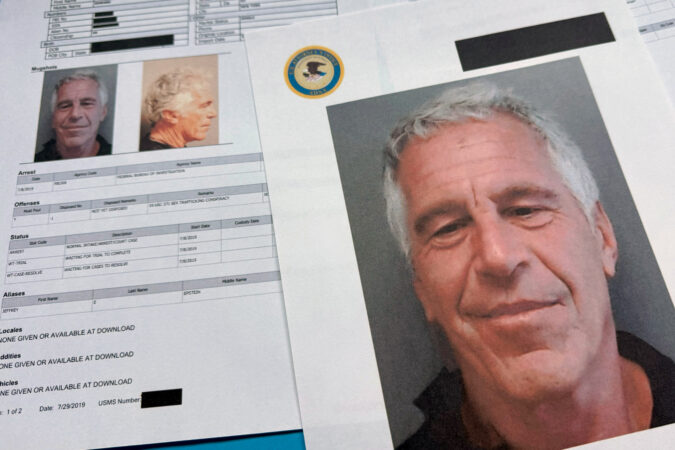
NEW YORK — Manhattan’s top federal prosecutor said Friday that a judge lacks the authority to appoint a neutral expert to oversee the public release of documents in the sex trafficking probe of financier Jeffrey Epstein and British socialite Ghislaine Maxwell.
Judge Paul A. Engelmayer was told in a letter signed by U.S. Attorney Jay Clayton that he must reject a request made earlier this week by the congressional cosponsors of the Epstein Files Transparency Act to appoint a neutral expert.
U.S. Rep. Ro Khanna, a California Democrat, and Rep. Thomas Massie, a Kentucky Republican, say they have “urgent and grave concerns” about the slow release of only a small number of millions of documents that began last month.
In a filing to the judge they said they believed “criminal violations have taken place” in the release process.
Clayton, though, said Khanna and Massie do not have standing with the court that would allow them to seek the “extraordinary” relief of the appointment of a special master and independent monitor.
Engelmayer “lacks the authority” to grant such a request, he said, particularly because the congressional representatives who made the request are not parties to the criminal case that led to Maxwell’s December 2021 sex trafficking conviction and subsequent 20-year prison sentence for recruiting girls and women for Epstein to abuse and aiding the abuse.
Epstein died in a federal jail in New York City in August 2019 as he awaited trial on sex trafficking charges. The death was ruled a suicide.
The Justice Department expects to update the court “again shortly” regarding its progress in turning over documents from the Epstein and Maxwell investigative files, Clayton said in the letter.
The Justice Department has said the files’ release was slowed by redactions required to protect the identities of abuse victims.
In their letter, Khanna and Massie wrote that the Department of Justice’s release of only 12,000 documents out of more than 2 million documents being reviewed was a “flagrant violation” of the law’s release requirements and had caused “serious trauma to survivors.”
“Put simply, the DOJ cannot be trusted with making mandatory disclosures under the Act,” the representatives said as they asked for the appointment of an independent monitor to ensure all documents and electronically stored information are immediately made public.
They also recommended that a court-appointed monitor be given authority to prepare reports about the true nature and extent of the document production and whether improper redactions or conduct have taken place.
Some snow is possible in the Philly region during the holiday weekend, but about the only thing certain is that schools will be closed until Tuesday.
Snow — not a whole lot of it — is expected Saturday morning, and possibly again during the day Sunday.
“Definitely something,” said Ray Martin, a lead meteorologist at the National Weather Service Office in Mount Holly, “maybe not a lot of something.”
In short, he added, expect a “100% chance of forecast uncertainty.”
How much for Philly?
(function () {window.addEventListener(‘message’, function (e) { var message = e.data; var els = document.querySelectorAll(‘iframe[src*=”‘ + message.id + ‘”]’); els.forEach(function(el) { el.style.height = message.height + ‘px’; }); }, false); })();
Some snow is expected in the early morning hours of Saturday, said Dan Pydynowski, senior meteorologist with AccuWeather Inc., and “sidewalks and streets could be slick for a time” in the Philly region.
However, temperatures in the afternoon are expected to approach 40 degrees and that should melt any snow. If the precipitation lingers, it likely would turn to rain.
That snow would be associated with a system from the west, and more significant amounts are expected well north and west of Philly.
On Sunday when it will be colder, the source would be a coastal storm that has been befuddling computer models the last three days. On Wednesday, the U.S. model was seeing a significant snowstorm for the I-95 corridor. On Thursday, it said never mind and fell in line with other guidance that kept the storm offshore.
On Friday, models were bringing the storm closer to the coast, but the model consensus was that it would be more of threat at the Shore and perhaps throw back a paltry amount to the immediate Philly region.
“On the other hand, a slight shift … in the track could bring 1-2 inches into the urban corridor,” the weather service said in its afternoon discussion.
Said Martin, “It’s always tricky with these offshore lows. It’s also possible that both systems pass us and we get basically nothing.”
Far more certain is a rather big chill
A Philadelphia firefighter spreads salt to control icing at a fire scene on Friday.
That the region was about to experience its coldest weather of the season to date was all but certain.
High temperatures on Monday, Martin Luther King Jr. Day, probably won’t get out of the 30s, and no higher than the mid 20s Tuesday and Wednesday, forecasters say.
Overnight lows are due to tumble into the teens, with wind chills approaching zero early Wednesday.
No more precipitation is forecast at least through Thursday, but with odds favoring continued below-normal temperatures through Jan. 29 and above-normal precipitation, it should be a robust period for virtual snow threats, if not actual snow.
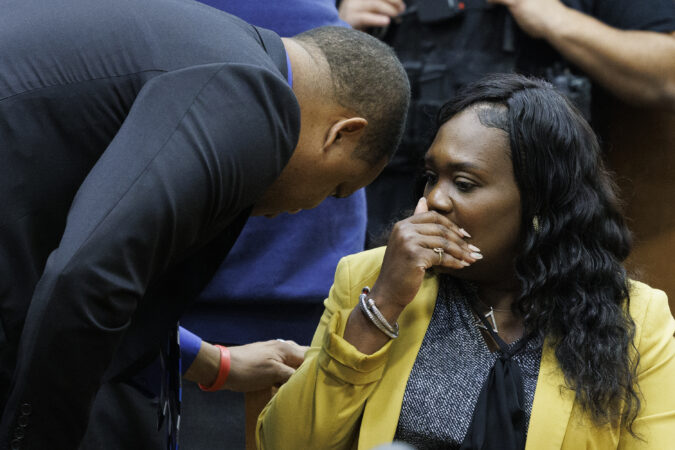
ATLANTIC CITY — The Atlantic County prosecutor said Friday his office would not go forward with a child abuse trial against Atlantic City Superintendent La’Quetta Small, the wife of Mayor Marty Small, after determining that their daughter no longer wanted the case to proceed.
Their daughter, who turned 18 this month, testified for hours at the December trial of her father, who was later acquitted by a jury of charges that he beat his daughter with a broom and further abused her with terroristic threats.
The office will also request dismissal of charges against Constance Days-Chapman, the principal of Atlantic City High School, who was accused of failing to properly report to the state hotline the accusations made by the daughter.
In a statement Friday, the prosecutor said the decision was based on the daughter’s wishes and the prior verdict.
“We believe it is prudent and responsible to dismiss the remaining indictments against them,” prosecutor Williams Reynolds said in the statement.
The charges have been hanging over the Small family for two years. After being acquitted last month, Mayor Small shouted, “Thank you, Jesus. Thank you, jury.”
Atlantic City Mayor Marty Small Sr. speaks to the media after being found not guilty on all counts of abusing his teenage daughter, Thursday, Dec. 18, 2025.
His daughter attended the ceremony when the newly reelected Small was sworn in, and the mayor said the family had spent New Year’s Eve together like old times and begun the healing process.
Small, 51, faced charges stemming from a handful of incidents in late 2023 and early 2024 in which prosecutors said he and his wife abused and assaulted the teen. The couple said the incidents stemmed from their disapproval of their daughter’s relationship with a young man, leading to escalating tension and arguments in the family home.
The jury delivered its verdict at noon after having deliberated for two days. They found Small not guilty of endangering the welfare of a child, aggravated assault, making terroristic threats, and witness tampering. A conviction would have required Small to relinquish his office.
La’Quetta Small was scheduled to stand trial in April on charges of endangering the welfare of a child and simple assault.
Also facing a forthcoming trial was Days-Chapman, the principal of the Smalls’ daughter’s high school. Prosecutors say when the teen reported her parents’ abuse, Days-Chapman failed to notify child welfare authorities and instead told the couple of the report.
Days-Chapman, who is Marty Small’s former campaign manager, was later charged with official misconduct and related crimes.
Mayor Small could not be reached for comment.
La’Quetta Small’s lawyer, Michael Schreiber, said Friday he was “happy they decided to do the right thing.”
“It was a very difficult time for my client and her husband and their daughter,” he said. “We have to work on reunification, which is hard.”
He said the matter should have been handled by counselors or in family court, “where you have therapists to help everyone involved.”
“When the case is over, the prosecutor goes to the next case,” he said. “Where does that leave everybody? What is the benefit of the prosecution to the daughter? Whether it’s guilty or not guilty, how do you pick up the pieces and help this family?”
He said he would now be officially appealing a ruling by the state Division of Child Protection and Permanency that made an initial finding that substantiated the allegations.
He said the daughter has been living with her boyfriend and his mother.
In the statement, the prosecutor said the victim had last week “received a threat, racial in tone, on one of her social media accounts pertaining to her accusations she made against her father.”
“While we actively investigate this threat, we believe it is no longer in her best interest both emotionally and perhaps even physically for us to continue with our cases against La’Quetta Small and Constance Days-Chapman at this time,” the prosecutor said. “The further intent of this decision is to hopefully allow [the daughter], her family, and the community the time to heal and move forward.”
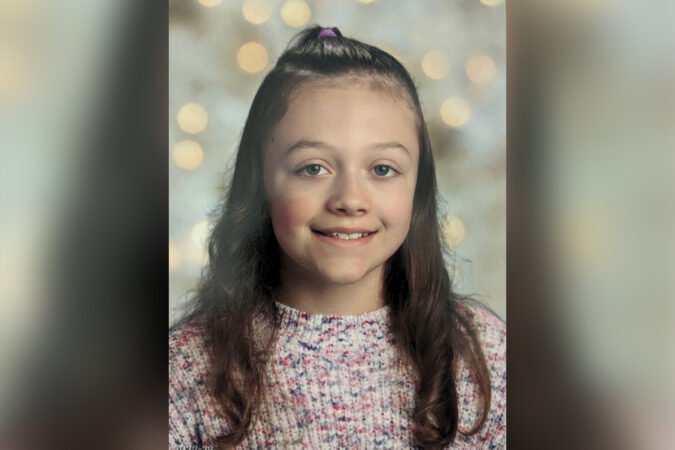
By all accounts, Malinda Hoagland was the kind of 12-year-old girl who would make any parent proud.
She received A’s in school, loved unicorns and going to Wawa with her older sisters, and wrote her lunch ladies notes thanking them for stocking the cafeteria with applesauce and milk.
But her father, Rendell, clearly didn’t see that little girl, prosecutors said Friday in Chester County Court.
Instead, Rendell Hoagland and his fiancee, Cindy Marie Warren, tortured Hoagland’s daughter for months in their West Caln home, depriving her of food and medical care.
They chained her to furniture and forced her into stress positions for hours, beating her if she moved or displeased them.
Once, when the girl forgot her jacket at school, they forced her to do push-ups in the kitchen late at night, striking her with a belt. Other times, the beatings came with a metal spatula.
The lack of care ultimately killed Malinda in May 2024.
Medical examiners found the girl died from severe malnutrition, her organs atrophied from starvation. More than 70 bruises, ulcers, and sores riddled her body, which by then weighed just 50 pounds.
It was the rare type of crime that brought tears even to a judge’s eyes.
On Friday, that judge, Anne Marie Wheatcraft, accepted a guilty plea from Hoagland on one count of first-degree murder and related crimes. The 54-year-old will be confined in prison for life without the possibility of parole.
“This was calculated, sustained cruelty inflicted on an innocent child,” said Malinda Hoagland’s maternal aunt, Christine Mayrhauser, as the girl’s family read tearful victim impact statements.
Rendell Hoagland, a bald man whose size tested the limits of a red prison jumpsuit, gazed on.
“A quick execution is too good for him,” Mayrhauser said.
Warren is also charged with first-degree murder and related crimes. Her trial, scheduled for early January, has been delayed and she will receive a pretrial hearing in May.
Lead prosecutor Erin O’Brien described Malinda Hoagland’s final years as a period of abuse no child should ever endure.
After Rendell Hoagland separated from his wife, he received custody of Malinda in 2020 and moved with the girl from Monroe County to West Caln.
He enrolled the girl at school, but she soon began missing day after day of classes. By 2023, Hoagland had pulled Malinda out of school entirely, and she was completing school online under his and Warren’s near-constant supervision.
After the girl’s death in 2024, investigators recovered photos, videos, and text messages from both Hoagland and Warren that detailed the girl’s horrific life at home.
She was often chained to an air hockey table or other pieces of furniture, even sleeping there, O’Brien said, or made to run in place or do jump squats at Hoagland and Warren’s command.
They punished her with scalding showers and ice baths, forced her to hold books over her head for hours, and poured hot sauce down her throat. The couple monitored the girl through security cameras they had installed throughout the home.
They also kept locks on the refrigerator and snack cabinet, and the girl lost more than a third of her body weight in the last two years of her life. She was often sleep-deprived or suffering open wounds; by the end of her life, she struggled to do her homework because of her eye injuries, O’Brien said
The abuse ended only with death, prosecutors said.
On May 3, 2024, Hoagland called 911 claiming that Malinda had fallen off her bike and had lost consciousness at a campground in Quarryville.
But prosecutors say that the girl had been unconscious for hours, and that Hoagland had driven to CVS the night before, looking for smelling salts in an attempt to wake her up. He propped up the girl’s body so that she did not raise the suspicions of passersby.
It was a common pattern in attempted cover-ups, O’Brien said, and Hoagland and Warren were also known to use makeup to cover up the girl’s bruises for the few people they allowed to see her.
One of the last people to see Malinda Hoagland alive was William Delmedico, an emergency medical responder who wrapped the barely conscious girl in his sweatshirt as he rushed her to a hospital, where she died after surgery.
“I kept telling her she’s not alone, she’s loved, and that we’re doing everything possible to help her,” Delmedico told the court, his voice breaking.
Hoagland and Warren managed to keep the abuse hidden from Malinda’s extended family, prosecutors said, including her three older sisters, his biological children. The women were not living in Southeastern Pennsylvania during the time of the abuse, they said.
In addition to murder, “You should also be facing several counts of robbery,” said Emily Lee, Malinda Hoagland’s older sister, addressing her father. “You robbed my baby sister’s future. You took a life she deserved.”
Jamie Hoagland, another sister, said she begged her father for access to Malinda, sending her sister cards and gifts and playing Minecraft with her online when possible.
“I fought for every inch of communication,” Jamie Hoagland said. She later lamented: “Instead of taking her to the movies, I visit her grave.”
When given the chance to speak, Rendell Hoagland told Wheatcraft he had “nothing to say at this time.”
Wheatcraft said she was not surprised that Hoagland did not express remorse.
WASHINGTON — National Guard troops will be on the streets of Washington, D.C., until the end of the year, according to a memo reviewed by the Associated Press.
The memo, signed by Army Secretary Dan Driscoll and dated Wednesday, said “the conditions of the mission” warranted an extension past the end of next month to continue supporting President Donald Trump’s “ongoing efforts to restore law and order.”
In Washington, troops have been charged with patrolling the streets and picking up trash. Trump has asserted repeatedly that crime has vanished in the city.
The National Guard has about 2,400 troops in Washington, with about 700 from D.C. and the rest from 11 states with Republican governors, including Indiana, South Carolina, Alabama, and Oklahoma.
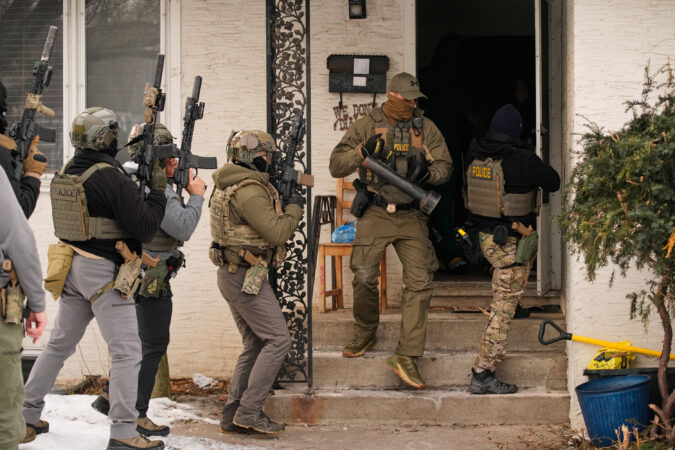
The family of a man shot in the leg by an ICE officer in Minneapolis onWednesday hasdisputed key elements of the Department of Homeland Security’s version of the incident, saying the shooting happened at the door of the man’s houseas he let his housemate inside,rather than out in the street during a scuffle.
The Department of Homeland Security has said an ICE officer shot Julio Cesar Sosa-Celis as he was assaulting the officer “with a shovel or broom stick.” The agency said the incident began when the officer attempted to stop Sosa-Celis in his car, and that Sosa-Celis tried to flee and then got into an altercation with the officer outside, joined by two housemates.
But Sosa-Celis’ mother,citing an account from her son,said DHS had actually been pursuing one of his housemates, who Sosa-Celis let into their house just before the shooting. Alicia Celis said her son made no mention of anyone running from the house to attack ICE officers.
A Facebook Live video reviewed by the Washington Post includes people at the house telling 911 dispatchers that the shooting happened as the men closed the door at the residence. Another video includes Sosa-Celis mentioningsome sort of scufflebefore any gunshots werefired, but he does not specifywhetherthat struggle happened at the door or in the street.
Celis, who lives in Venezuela, toldthe Post that her son called her from the hospital after he was taken into custody by ICE. He told her he had received a panicked call Wednesday eveningfrom Alfredo Alejandro Ajorna, who is one of his housemates and a fellow DoorDash driver,Celis said. Ajorna said he was being pursued by ICE and that he needed Sosa-Celis to let him in the front door of the house, where they and their partners and children and others live.
Sosa-Celis opened the door to let Ajorna inside, Celis said her son told her. Ajorna ran indoors. As Sosa-Celis went to close the door an ICE officer shot him in the leg, his mother said. The men retreated into the house, and people inside called emergency dispatchers, Celis said.
A short time later, ICE officers broke down the front door and went inside the building, Celis said. They arrested Ajorna, Sosa-Celis, and Gabriel Alejandro Hernandez-Ledezma, who Celis said was not involved in the incident and was in the basement of the house, where he lives. All three men are undocumented immigrants from Venezuela, according to DHS; Sosa-Celis’ family said his temporary protected status to live legally in the United States lapsed last year.DHS had not announced charges against the men as of Friday afternoon.
In its account of Wednesday night’s shooting, DHSalleged that Sosa-Celis fled in his car during an attempted traffic stop, crashed into a parked car, and then ran away. An officer chased him and attempted to arrest him, the agency said, adding that Sosa-Celis resisted and began to “violently assault the officer.” DHS alleged that Sosa-Celis and the officer were struggling when Ajorna and Hernandez-Ledezma came out of a nearby residence and hit the officer with a snow shovel and broom handle.
DHS also said Sosa-Celis freed himself of the struggle and hit the officer “with a shovel or broom stick,” at which point the officer fired his gun. The agency called the shot “defensive” and said the officer feared for his life. DHS said the men ran into the residence and ICE officers then arrested them.
When asked to provide additional evidence or body-camera footage of the alleged attack and to address the claims presented by Sosa-Celis’s family, DHS referred the Post to remarks Homeland Security Secretary Kristi L. Noem made Thursday morning.
“I would say that our agent is beat up,” Noem told reporters. “He’s bruised, he’s injured, he’s getting treatment. And we’re thankful that he made it out alive.”
The agency also did not respond to questions Thursday evening about the medical conditions of the officer and Sosa-Celis.
The shooting of Sosa-Celis — and the angry and sometimes violent protests from residents that followed later — came one week after an ICE officer shot and killed Renée Good as she and other residents monitored and protested ICE activity on a residential street.
The federal government over the past week has increased the number of officers in the city to 3,000, a massive deployment, with vows to send more personnel to quell what one administration official called an “insurrection.” Residents have objected to agents detaining people and said they feel like their city is under attack.
Some of the family’s account of Wednesday night’s shooting appeared to align with what was said in a Facebook Live video from inside the home that evening. Achaotic scene appears to unfold as children cry and multiple people speak over each other. The people in the livestream report to 911 dispatchers that one of their family members was shot in the leg as they closed the door of the residence, with ICE officers outside.The Post confirmed the video was filmed from the same address on Minneapolis’s north side.
Sosa-Celis also joined a different Facebook Live video broadcast the same night by a person who Sosa-Celis’ relatives described as a friend of his. That livestream shows Sosa-Celis describing the incident from what appears to be a hospital bed. Speaking Spanish and using a phrase that can be interpreted several ways, he indicates there was some kind of interaction with ICE personnel before the shooting, though it’s unclear whether he’s describing it happening outside the building or as he moved to close the door on the ICE officer.
Sosa-Celis also joined that livestream from his home in the moments after the shooting. He can be heard telling the host of the video that he needs assistance. “We need help, friend. We have ICE here,” said Sosa-Celis, providing his address to viewers. “They shot us, they shot us. They shot us, and hit me in the leg.”
When asked by the host if ICE had been following him, Sosa-Celis, who has his camera pointed toward a window outside, replies that ICE had been following Ajorna.
Neighbors who live behind the house where the shooting happened also confirmed some elements of the family’s version.
Brieella Johnson, 35, said she was home preparing dinner for her children at about 6:30 p.m. — her husband had just left with one of their sons for Bible study — when she heard two men arguing outside the house on North 24th Avenue, which she can see from her back deck.
“We heard two men arguing, then we heard a screech of the vehicle trying to go, and then we heard two to three gunshots,” Johnson said, holding her baby and surrounded by her six older children in her living room on Thursday morning.
She said she saw uniformed ICE officers with guns drawn “swarm” the house. She heard some of the officers shout, “Come out now!” and “Come out now, or we’re going to shoot!” and other things in Spanish.
Johnson said she saw ICE officers shoot at one of the windows of the house, then, “They threw one smoke bomb, then yelled ‘Fire’ … Then afterwards we could see smoke in the second floor window.” One of the building’s front windows appeared to have been shattered, she said.
Johnson heard the DHS account of the shooting and said, “It doesn’t make sense. It doesn’t add up.” She questioned why the ICE officer ended up grappling with and chasing someone he was trying to detain, why he didn’t call for backup sooner, and why he fired in a residential area so close to families with children.
“Even if you’re going after someone you know is illegal, have back up,” she said.
Tommy Ross, 72, stood outside his rental house around the block from the shooting location and said he heard three shots late Wednesday and saw the gray Ford sedan mired in the snow and uniformed ICE officers “all around it.”
Ross, who has lived in the neighborhood for 40 years, said he recognized the car: He had met the owner, a young man with a Spanish accent, after he struck Ross’ Nissan sedan about a month ago, and they exchanged insurance information. He said he did not recall the man’s name.
Ross and his family heard a car wreck about 7 p.m. “ICE was chasing them people. They ran into the house. There was a fight inside the house,” said Tommy Ross Jr., 40, who was visiting his father at the time of the shooting.
He said he heard a woman shout: “Get out of my house!,” then heard ICE officers shout, “Freeze!” and “Get on the floor!”
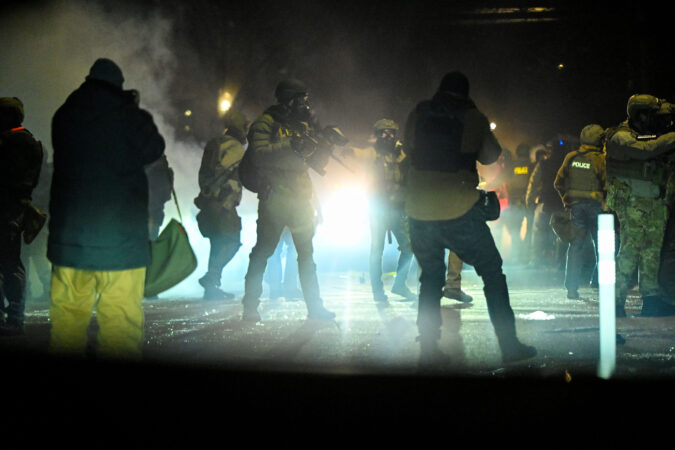
Following ICE officers’ detention of the three men Wednesday night, tensions flared as neighbors and protesters arrived at the scene. Some protesters heckled, filmed with cellphones, and threw fireworks and a water bottle at officers. Officers fired tear gas and flash bangs at the crowd. Conservative influencer Nick Sortor posted video footage on social media that showed protesters attacking empty ICE vehicles. On Thursday, a damaged ICE laptop and a torn FBI property receipt could be seen on the street.
“They were combative all night,” the younger Ross said. “They were shooting tear gas, it was all in the air, you couldn’t stand outside without coughing.” The activity was still going on when he headed to bed at 2:30 a.m., he said. “I went to sleep to ‘boom, boom, boom.’ Sounded like a war zone.”
Local and state officials have called on ICE to leave Minnesota, while the Trump administration has condemned residents who are tracking, protesting, and trying to disrupt ICE activity.
On Thursday morning, President Donald Trump threatened to invoke the Insurrection Act in Minnesota, raising the possibility of taking the highly unusual step of sending U.S. troops into a domestic city. Minnesota Gov. Tim Walz and Minneapolis Mayor Jacob Frey, both Democrats, urged the federal government not to escalate the tension.
“They’re trying to make a riot out of it,” the elder Ross said of Trump administration officials, choking up as he spoke. “Governor Walz is doing a good thing, trying to keep them together.”
Trump on Friday addressed his comments on the Insurrection Act, telling reporters outside the White House: “If I needed it, I’d use it. I don’t think I need it right now.”
Johnson, the neighbor, said she does not support Trump invoking the Insurrection Act. “I don’t think they need U.S. troops or the National Guard. They need a safe and secure plan,” she said of ICE officers. “If the federal government is going to continue to use ICE, they need to treat these people like humans … You can’t just go in guns blazing. You disrupt communities. You make people scared.”
But her husband Bryant Johnson, 35, who runs a painting business, blamed local and state officials for not preventing or doing more to address welfare fraud claims that intensified Trump’s attention on Minnesota. Like Trump, he blamed the fraud on Minneapolis’s large Somali community, because many of the dozens of people implicated in the scandal are Somali American. Most Somalis in the Twin Cities, a population of more than 83,000, are U.S. citizens.
“I feel like a lot of this was brought on by our mayor and our government officials that were very well aware of the fraud,” Bryant Johnson said. “And if they didn’t let that kind of stuff continue and go on, we might not have this much of a presence of ICE.”
“When you come here from another country to defraud our country of hundreds of millions of dollars,” he added, “you’ve got to go.”
His wife shook her head. “There has to be a different way of getting them out,” she said. “There’s plenty of Americans that committed fraud. They go to jails, they don’t get killed.”
Sosa-Celis’ father-in-law, who lives in Saint Paul and spoke on the condition of anonymity because he is undocumented, described Sosa-Celis as a hardworking man who provides for his family in the United States and Venezuela.
Sosa-Celis’ mother said Thursday evening that she had not heard from her son since Wednesday night and does not know where he is or the status of his injury.
“I haven’t been able to sleep,” she said. “He never has a ‘no’ for me … He says, ‘Here, Mom. Take as much as you want.’”