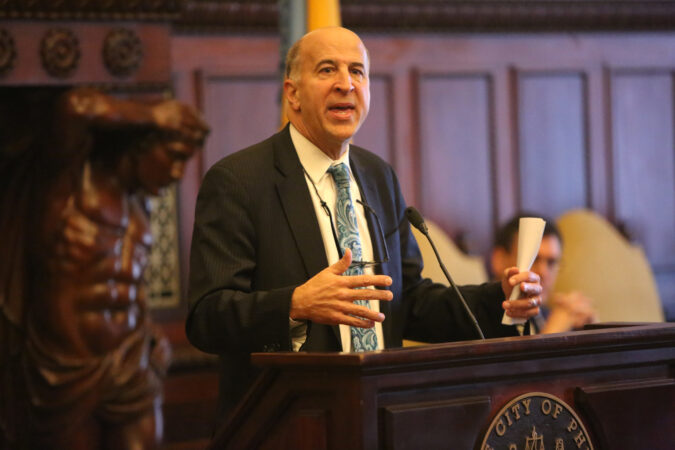
Andy Chan, a Philadelphia Highway Patrol officer who suffered a devastating brain injury in a motorcycle crash while on his way to work six years ago, has died.
Chan, 48, was riding through Northeast Philadelphia one evening in January 2019 when an elderly driver unintentionally struck him on the 3300 block of Rhawn Street. He was thrown about 20 feet, police said, and was critically injured.
Chan, a 24-year veteran of the force, was in a prolonged coma and was hospitalized for weeks on a ventilator. In the years since, his injuries have required around-the-clock care, with family, friends, and colleagues in the Philadelphia Police Department regularly at his side.
The Fraternal Order of Police Lodge 5 announced Chan’s death on Tuesday. The cause of death was not immediately clear.
“Andy died a hero and we will always remember and honor his sacrifice,” the union wrote on Facebook.
Andy Chan was thrown from his highway patrol motorcycle and critically injured in a crash on the 3300 block of Rhawn Street on January 3, 2019.
Chan, a father of three, grew up in Chinatown and had always dreamed of being a highway patrolman. His family recalled how he watched with awe when the leather-clad officers approached his parents’ restaurant on their motorcycles.
He decided, they said, that would be him one day.
“That was the only place he strived to be in,” his wife, Teng, said years ago.
After becoming a Philadelphia police officer in 1996, he was first assigned to the 39th District, working as a bike cop. Eight years later, he was promoted to the elite highway unit.
He took such pride in his work that when he walked into police headquarters, instead of yelling, “Hi,” he would shout, “Highway!”
And even when he met Teng nearly two decades ago, he introduced himself as such: “I’m Highway.”
Chan and his partner, Kyle Cross, were among the first officers who responded to the Amtrak crash in 2015 that left eight people dead and nearly 200 injured. Cross, in an earlier interview, recalled how Chan kept his composure as he sought to rescue survivors from the wreckage.
“What I remember from Andy was his poise — he stayed so calm, he really just led the way,” Cross recalled. “I followed his lead.”
Police Commissioner Kevin Bethel, in an email to the department Tuesday morning, described Chan as “larger than life, not because of what he did, but because of who he was.”
“He was the kind of officer whose reputation reached every corner of this Department and City; not because he sought attention, but because his work, his character, and his heart made him impossible to forget. Andy represented the very best of who we are and what we aspire to be: skilled, humble, kind, and unfailingly courageous,” Bethel wrote.
“Andy,” he said, “will forever remind us of why this work matters.”
Funeral arrangements have not been announced.
Since Chan was injured, police and community members have gathered each December to support his family and raise money for his recovery. Supporters will continue to gather in his honor this year, on Dec. 12 at Craft Hall at 4 p.m., for the sixth annual Andy Chan Block Party.
Wholesale retail giant Costco has sued the federal government to ensure it will receive a “complete refund” on import duties if the Supreme Court rules against President Donald Trump’s sweeping tariffs.
The lawsuit, filed in the U.S. Court of International Trade in New York on Nov. 28 and reviewed by USA TODAY, asked the court to find Trump’s use of the International Emergency Economic Powers Act to impose tariffs as unlawful.
Costco, the largest warehouse club operator in the United States, said it has been the “importer of record” for products affected by the tariffs, but did not provide a specific dollar amount it is seeking in damages. The corporation noted in the filing that the suit was necessary because importers are not guaranteed to receive a refund if the high court strikes down the tariffs, unless they sue.
Costco also claims in the lawsuit that Customs and Border Protection (CBP) denied its request to delay the calculation of the total tariffs that it owes. The lawsuit claims that Costco’s ability to receive a refund will be significantly impacted if those calculations are completed.
The suit is separate from the larger case challenging Trump’s tariffs that the Supreme Court heard on Nov. 5.
Other companies have sued to preserve refund rights, but the Issaquah, Washington-based retail warehouse club operator is among the largest to sue the administration so far. Others that have sought to protect tariff refunds include Bumble Bee Foods, eyeglass giant EssilorLuxottica, Kawasaki Motors, Revlon, and Yokohama Tire, court records show.
Costco and the CBP did not immediately respond to USA TODAY’s requests for comment on Dec. 1.
During nearly three hours of debate on Nov. 5, Supreme Court justices questioned whether Trump has the power to impose sweeping tariffs on most imports using the 1977 International Emergency Economic Powers Act. Several legal experts said the justices’ questions reveal a lot about where they stand on Trump’s policy.
Ashley Akers, a former Justice Department attorney now with the law firm Holland & Knight, previously told USA TODAY that she heard a “notable skepticism from justices across the ideological spectrum.”
“Overall, it felt like a strong day for the tariff challengers, though it feels like this will be a razor-close case,” Akers said.
Several justices were concerned that if they sided with Trump, Congress would lose control over tariffs, even though the Constitution gives that power to lawmakers, said Curtis A. Bradley, an expert on foreign relations law at the University of Chicago Law School.
Oliver Dunford, an attorney with the libertarian Pacific Legal Foundation, said the case is complicated enough without a majority of the court focusing on just one legal argument.
“If I had to guess,” Dunford said, “I’d guess that the court will rule against the president without agreeing on the reason.”
The Supreme Court took the tariff case on an accelerated basis, but has not said when it will rule.
Contributing: Maureen Groppe, Bart Jansen, and Aysha Bagchi, USA TODAY; Reuters
This article originally appeared on USA TODAY: Costco sues US to preserve tariff refunds if Trump loses appeal
Quinta Brunson wants you to dig into your pocket to make free field trips possible for Philadelphia students.
The actor, writer, and comedian — along with Philadelphia School District officials and the leader of the district’s nonprofit arm — announced the “Quinta Brunson Field Trip Fund” on Tuesday.
District teachers and administrators will be able to apply for money for field trips by completing a short application subject to evaluation by an independent, internal group of educators. Field trip grants will be made twice a year.
“They opened my world, sparked my creativity, and helped me imagine a future beyond what I saw every day,” Brunson said. “Going somewhere new shows you that the world is bigger and more exciting than you believe, and it can shape what you come to see as achievable. I’m proud to support Philadelphia students with experiences that remind them their dreams are valid and their futures are bright.”
“Abbott Elementary” star Quinta Brunson watches the Phillies play the Atlanta Braves during a taping of the show in Philadelphia in August.
Every Abbott Elementary season has featured a field trip episode, including visits toSmith Playground, the Franklin Institute, and the Philadelphia Zoo. Brunson’s fund “will remove the financial barriers that too often limit our children’s access to these enrichment opportunities,” officials for the Fund for the School District of Philadelphia said.
The GivingTuesday launch kicked off with an unspecified donation from Brunson herself.
Kathryn Epps, president and CEO of the Fund for the School District of Philadelphia, said getting students out of their classrooms is crucial.
“We are honored to partner with Quinta to expand these experiences for children in Philadelphia’s public schools, helping them to envision and realize any future they desire,” Epps said.
Tony B. Watlington Sr., Philadelphia School District superintendent, said he was grateful to Brunson.
“We want our students to venture out and bridge what they’re learning in the classroom to engaging, real-world learning experiences,” Watlington said. “This commitment to equitably expanding opportunities for students to have experiences outside of their classroom will help accelerate student achievement and we are becoming the fastest improving, large urban school district in the nation.”
Spotlight PA is an independent, nonpartisan, and nonprofit newsroom producing investigative and public-service journalism that holds power to account and drives positive change in Pennsylvania. Sign up for our free newsletters.
Next year we celebrate America’s 250th anniversary, and yet one of the most critical components of our free society — an independent, unbiased free press — is at a tipping point, and you have more power than ever to determine what happens next.
There’s a lot not to like about the news right now. Many people are tuning out, turning away, or feeling like the media no longer serves them. That frustration is legitimate. But at Spotlight PA — a nonprofit, nonpartisan statewide newsroom — we’re charting a bold, fresh new course.
We’re proving every day that accountability reporting can be rigorous without being partisan, that investigations can follow the facts without an agenda, and that a newsroom can earn trust across the political spectrum by simply doing the work with integrity.
Spotlight PA is a nonprofit, and that’s not incidental to our mission — it’s essential to it. We chose this model to ensure our journalism answers to you, not shareholders, profit margins, or a billionaire owner. Our financial success is tied directly to your support, so we prioritize unique, compelling reporting above all else.
More than 10,000 of your friends and neighbors — people just like you from every corner of Pennsylvania, of all political backgrounds — support Spotlight PA as a bright spot in a media landscape too often marred by partisan talking points and questionable corporate decisions.
They’ve invested in journalism that serves the public interest and no one else.
Since 2019, Spotlight PA has saved taxpayers more than $20 million. Our reporting has prompted 58 policy changes, new pieces of legislation, and legal victories — some setting important new statewide precedent. We’ve uncovered broken government programs and gotten people life-changing help. We’ve held lawmakers and powerful institutions accountable for their actions when no one else would.
What’s more, we share our stories at no cost with more than 130 local partner newsrooms across Pennsylvania — including this publication — ensuring that quality accountability journalism reaches every corner of the commonwealth.
Our journalism can sometimes be unpopular, and you may not love everything we write. That’s OK. In fact, that’s the hallmark of truly independent, nonpartisan reporting. But fundamentally, for the good of our country, we can’t afford to leave those with power and influence — especially government — to their own devices and without sustained scrutiny.
I have seen firsthand how an investment in Spotlight PA can yield one of the greatest returns in public good of any you can make this season of giving.
Make a tax-deductible gift to Spotlight PA of any amount at spotlightpa.org/donate, and as a special bonus, all contributions sent this week will be TRIPLED. You can also send a check to: Spotlight PA, PO Box 11728, Harrisburg, PA 17108-1728.
This Giving Tuesday, join 10,000 Pennsylvanians who believe in independent, nonpartisan journalism. Your tax-deductible gift will fund the investigative work our commonwealth needs.
We cannot afford the alternative.
Christopher Baxter is the CEO and President of Spotlight PA, a nonpartisan, nonprofit newsroom producing investigative and public-service journalism that gets results.
The estate sale of the late lawyer and bibliophile Bill Roberts, whose Rittenhouse townhouse is filled with thousands upon thousands of books and other treasures, opens to the public this week.
Roberts, a longtime lawyer at Blank Rome LLP, was a Renaissance man whose interests — and library — spanned genres and eras, touching on microeconomic theory, beekeeping, botany, classical music, poetry, and much else. When Inquirer columnist Stephanie Farr toured the Delancey Street home earlier this fall, she found books stacked on chairs, tables, carts, shelves, and “piled precariously in pillars, like paperback towers of Pisa.”
The contents of Roberts’ home were meticulously inventoried by Sales by Helen, the Main Line estate sale company, over the past few months.
“It’s cerebral, educated. There’s no Calvin and Hobbes books, unfortunately. As much as I love Calvin and Hobbes,” said John Romani, owner of Sales by Helen.
Roughly 300 of the highest-value books are now on auction in conjunction with Briggs Auction, which will close bidding on Thursday, Dec. 4. That collection includes an atlas of Venice, works on translating Homer, and volumes on lichen, algae, and fungi, among many other topics. Romani said the Briggs books are likely to fetch thousands.
About 250 valuable nonbook items, including Roberts’ Hermès ties, will be available on the Sales by Helen online store beginning on Wednesday at 8 p.m.
But the real thrill, for those who wants to examine the thousands of books and other objects in-person, will begin on Thursday Dec. 4, at 2 p.m., when Roberts’ home will open for the estate sale. Continuing through Sunday, Dec. 7, the sale will feature books, as well as artwork, rugs, and other household items from the upscale home.
Romani said he expects to sell the vast majority of books for flat rates: $3 for paperbacks, $5 for hardbacks, $20 for coffee-table books.
“I’m not saying I planned it that way, but I may have looked and seen when it’s going to be,” Romani said.
Bill Roberts read on many subjects. Here’s one of his books, about butterflies and moths of Newfoundland and Labrador.
In addition to working as a lawyer, Roberts played both the lute and the violin, was a researcher on the botany team for the Academy of Natural Sciences at Drexel University, and was president of the board of directors for the Chamber Orchestra of Philadelphia.
When a bookstore near his home closed, he bought its huge shelves and hired a carpenter to transform his home library, The Inquirer wrote in Roberts’ 2024 obituary.
“You’ll find a little bit of everything,” Romani said of the collection. “Just come in, the door’s open, we let everyone in. It’s gonna be fun.”
For years, Rutgers-Camden faculty and staff have complained that the school does not get its fair share from the main campus in New Brunswick.
Faculty in the past have asserted that their salaries are inequitable to counterparts on Rutgers’ other campuses — there’s a process in place to address that — and Chancellor Antonio D. Tillis has cited inadequate investments in campus facilities.
The Campus Center (student center) on the Rutgers-Camden campus with flags of students’ home countries.
“Since I’ve taken this job, I’ve had people say to me ‘Don’t invest in Camden,’” said Tate, a social scientist who grew up in Chicago and came to the job at Rutgers after serving as president of Louisiana State University. “I don’t think they know who they are talking to. … Do you think I have forgotten who I am?”
Tate, who became president in July, pledged during his inauguration speech to make the school a stronger competitor regionally.
“We’re going to build that Big Ten brand in Camden,” he said, referring to the NCAA athletic conference whose members are major research universities. “Look out Philadelphia, we’re coming for opportunity.”
His comments come as Rutgers-Camden is about to celebrate its 100th anniversary and as Tillis, in his fifth year, is nearing the end of his initial contract and aiming to receive a renewal.
Tillis touts 97% occupancy this year in the school’s residence halls, the highest since before the pandemic and up from 84% last year, and a boost in international students even while international enrollment declined 17% nationally, amid federal government policies including a pause of student visas earlier this year.
The Campus Center at Rutgers-Camden has a display showing some of the school’s 100-year history.
The school is also climbing in U.S. News rankings from 148th nationally among both public and private universities in 2021 — the yearTillis came — to 97th this year. It also rose from 18th to ninth in social mobility, meaning it enrolls and graduates large proportions of disadvantaged students.
“Rutgers Camden has just punched above its weight for such a long time and now the fruit are beginning to bear,” he said.
But Tillis’ relationship with some faculty has remained strained. Arts & Sciences faculty voted no confidence in him four months after he took the job and after he removedthe Arts & Sciences’ dean.
Since then, concerns have persisted about pay equity forRutgers-Camden professors compared to counterparts on the other Rutgers’ campuses, in New Brunswick and Newark, and what several faculty said was Tillis’ unwillingness to consult and communicate with faculty.
“There has been a real lack of communication between the chancellor and his office and the faculty, which has made it really hard to understand some of the decisions that have been made in regard to our budget cuts and campus priorities,” said Emily Marker, president of Rutgers-Camden chapter of the AAUP-AFT, the faculty union.
“If he were to be renewed, we would really hope that the communication, the consultation with and involvement of the faculty would improve in campus governance,” Marker said.
Tillis acknowledged a rough entry in part because of the pandemic but said from his perspective, things are better with faculty. He said he hosts regular “coffee with the chancellor” meetings where faculty and staff can come and talk to him.
If he gets a new term, Tillis said he would aim to grow enrollment, increase Rutgers-Camden’s share of out-of-state students from about 20% to 30% to generate more revenue, enroll more students from Camden, and increase internship opportunities.
There are plans to lease the former Camden Free Public Library building, a historic landmark on Broadway, and convert it into a center for the arts, including a bistro and wine bar.
Rutgers-Camden’s overall enrollment stands at 5,822, up 2.6% from last year. Overall, Rutgers’ enrollment neared 71,500 this year, up 3.2%.
Rutgers-Camden junior Mohammed Al Libaan Kazi, a transfer student from India, walks toward the stage to speak during a luncheon for international students hosted by Chancellor Antonio D. Tillis. International enrollment increased 6% on the campus this year.
At Rutgers-Camden, international student enrollment climbed 6% to 312, largely fueled by a jump in freshmen. That’s even though about 30 students deferred enrollment due to the visa holdup, said Carol Mandzik, director of international programs.
Tillis said the school has been recruiting more heavily from Nigeria and Ghana.
“I chose Rutgers-Camden because it’s close to Philadelphia,” said Bao Mai, 18 a freshman from Vietnam, who wanted what a big city has to offer.
But Mai, who spoke at an international student luncheon hosted by Tillis, said he also chose it because he likes the “small campus vibe” and array of business programs.
Tillis also has pledged to bring in more students from Camden. This year, there are 80, up from 53 last year.
The atrium lobby of the Nursing and Science Building on the Rutgers-Camden campus.
He said he asked the admissions team to create more opportunities for students from Camden to come on campus so they begin “to feel as if the campus is theirs because it’s right in their backyard.”
The school, which is designated as a minority-serving institution — meaning at least 50% of students are minorities — also plans to begin to offer in-state tuition to students from Philadelphia and northern Delaware, Tillis said. Prospective students from Philadelphia who chose not to enroll cited the price tag, he said.
Rutgers-Camden sophomore basketball forward Robert Peirson from Toms River practices in the gym in the Athletic & Fitness Center.
Fostering campus culture
More than 710 students are living in the residence halls this year, representing the highest occupancy since 2019, Tillis said.
“Our campus is trying to create a sense of residential culture … even for our commuter students,” Tillis said, so that “they don’t just come here, go to class, and then go home.”
window.addEventListener(“message”,function(a){if(void 0!==a.data[“datawrapper-height”]){var e=document.querySelectorAll(“iframe”);for(var t in a.data[“datawrapper-height”])for(var r,i=0;r=e[i];i++)if(r.contentWindow===a.source){var d=a.data[“datawrapper-height”][t]+”px”;r.style.height=d}}});
The school held a welcome back barbecue during move-in and brought back homecoming last year; there was homecoming before the pandemic but not to the same degree, Tillis said.
The school also has spruced up residence halls and added evening events such as arts and theater performances, he said. There are little things, too, like plans to install hammocks on the quad.
Freshmen Ollie McDermott (left), a psychology major from Buena and Remi Zebedies (right) an art therapy major from Mays Landing take an elevator in their residence hall at Rutgers-Camden.
Ollie McDermott, 22, a freshman psychology major from Buena, had decided against college, but McDermott’s stepfather, who recently graduated from Rutgers-Camden, convinced McDermott to try it.
“I’m kind of glad I did,” McDermott said. “I love it here.”
McDermott convinced a friend, Remi Zebedies, 19, an art therapy major from Mays Landing who also had been leaning against college, to try it, too. They became roommates.
The campus has enough beds to accommodate this year’s students, but if growth continues, it may need more housing, Tillis said. He’d like to open a residential space for students with children and/or spouses.
The lobby entrance between the Towers and Apartments resident halls at Rutgers-Camden.
Working on graduation and retention rates
In the school’s strategic plan approved in 2023, Tillis set improvement in graduation and retention rates as primary goals.
The school’s retention rate from first-year students to sophomores has increased from 71% in 2021 — the year he came — to 73.4% this fall. The six-year graduation rate decreased from 63.6% in 2021 to 61.5% in 2024. (The school said that 2025 data had not been verified and that the 2024 dip reflects lingering pandemic-related challenges.)
Tillis also discussed the Cooper Gateway Project, which will renovate four properties to add event halls, a new space for Arts & Sciences, and pedestrian walkways and courtyards. It’s expected to be completed by early 2027.
A new athletic field house also is in the works, and there are plans for a new building for business students to live and learn in, he said.
Pay equity was a sore spot with faculty for years, despite the process put in place under which they could be compared to peers at the New Brunswick and Newark campuses.
The university said in a statement that since 2021, the vast majority of faculty who petitioned for equitable pay got increases. The requests are reviewed by a committee of faculty experts who look at the professor’s classroom instruction, research, and scholarly activity.
Rutgers-Camden graduate student Funmi Adebajo, from Nigeria, speaks during a luncheon for international students hosted by Chancellor Antonio D. Tillis.
Tillis said sometimes faculty were seeking to compare themselves to peers who were not really comparable.
Marker, the Rutgers-Camden AAUP-AFT president, said through a grievance, the union negotiated a change to the process that will make it harder for Tillis to overrule recommendations by the committee.
In the last cycle, the vast majority of professors with equity claims received “meaningful” pay adjustments, said Marker, an associate professor of European and Global History.
As for the comments about Camden by Tate, the new Rutgers president, Marker said she is hopeful they lead to action.
“If it actually results in a massive investment in Camden, in our students, in our faculty, in our facilities, I would be delighted,” she said. “But we’ll see. That has really not been the orientation of any of the central administrations since I was hired in 2017.”
Rutgers-Camden Chancellor Antonio D. Tillis walks rather than rides in the offered golf cart to a luncheon he hosted for international students.
Tillis said he is hopeful that Rutgers-Camden will get more support under Tate. He got to know Tate in 2020 when they were both in a program at Harvard for new presidents and chancellors.
“We have a beautiful campus, but it’s stuck between the 1950s and the 1970s,” he said. “Certain types of innovative spaces for 21st century instruction needs to happen.”
Historic preservation advocates are sounding the alarm about legislation from Councilmember Mark Squilla, which they argue would weaken existing protections in Philadelphia.
The bill, introduced Nov. 20, would institute changes to the city’s Historical Commission, which regulates properties on the Philadelphia Register of Historic Places and ensures that they cannot be demolished or their exteriors substantially altered.
“This is the first time the [preservation] ordinance has been proposed for amendment in decades,” said Paul Steinke, executive director of the Preservation Alliance for Greater Philadelphia. “This is a developer-driven proposal that does not reflect any of the priorities of the preservation community.”
Proponents of the bill argue that it is simply meant to give more notice and power to property owners before their buildings are considered by the Historical Commission.
“The bill does nothing to decrease the power of the Historical Commission to protect important historic resources,” said Matthew McClure, who served as co-chair of the regulatory committee of Mayor Jim Kenney’s preservation task force.
“It is a modest good government piece of legislation,” said McClure, a prominent zoning attorney with Ballard Spahr. He emphasized that he was not speaking on behalf of a client.
The bill was introduced too late in this year’s Council session to receive a hearing. Squilla says it will be considered next year.
Currently, the interest group most supportive of the bill is the development industry. But even some preservation opponents are displeased with Squilla’s effort, arguing that it does too little for homeowners.
“Everybody’s talking, and I think they all agree to move forward with continued conversations to maybe tweak the language a little bit so everybody feels comfortable with it,” Squilla said.
At least one more stakeholder meeting will be held in December.
Tensions over preservation
Squilla’s proposal comes in the midst of heightened debate around preservation in Philadelphia, where the majority of buildings were constructed before 1960.
Over the last decade, the number of historically protected properties doubled, although well below 5% of the city’s buildings are covered. Preservationists oppose what they see as a demolition-first approach to development in the United States’ only World Heritage City.
These have provoked backlash among some homeowner groups and pro-development advocacy organizations, which see these regulations as increasing housing costs.
Members of the Philadelphians for Rational Preservation gathered at Seger Park in the Washington Square West neighborhood on July 27 to talk about their opposition to the Washington Square West Historic District.
Some property owners have grievances against the way the local nomination process works.
In Philadelphia, citizens are empowered to nominate buildings to the local register — giving buildings protection from demolition or exterior changes — without input from the property owner until the Historical Commission considers the case.
This practice persistently causes controversy, especially because there are few local incentives for homeowners whose properties get protected.
In some localities, preservation protections are promulgated exclusively by planners. In others, owner consent is required.
“The current historic nomination process is most often dictated by nongovernmental actors who operate without notice to property owners,” McClure said. “The administration’s bill is aimed at increasing transparency and basic fairness during the nomination process.”
Mayor Cherelle L. Parker’s administration did not respond to a request for comment.
What’s in the bill
Squilla’s bill is thick with new provisions to the local historic ordinance. A key aspect of the legislation gives property owners at least 30 days before a pending nomination of their building is considered by the commission and protections kick in.
While homeowners probably would not have time to radically alter the exterior of their house — and presumably wouldn’t demolish it — preservationists fear that developers will use the extra time to begin razing historic buildings.
“No one likes the notice provision the way it’s written; that’s freaking people out,” Steinke said. “We made clear why we think that’s a problem, and we were heard. Of course, the development community would love it to be the way it’s currently expressed in the bill.”
A Victorian home in the Spruce Hill historic district. Recently large new historic districts have been created to cover neighborhoods like Powelton Village, parts of Spruce Hill, and 1,441 properties in Washington Square West.
The delayed provision particularly worries preservationists in combination with a proposed requirement that the commission approve permits — including demolition or exterior design work — if “material commitments” were made to plans before the attempt to protect the historic building.
Other provisions include language to make it more difficult to protect land because it may house archaeological remains. It also limits the ability to consider a property for protection due to its relation to a landscape architect (as opposed to, say, a building designer).
Despite their animus toward existing preservation rules in the city, groups like 5th Square and Philadelphians for Rational Preservation called the legislation a sop to those who least need help.
“While this bill is a boon to developers, it doesn’t help ordinary Philadelphians,” said Jonathan Hessney of Philadelphians for Rational Preservation.
He argues that Squilla isn’t curbing historic districts that burden homeowners, “while at the same time risks allowing genuinely historic properties to be destroyed in the new 30-day race to demolish or deface it creates.”
A possible reform that some critics of the bill would like to see are flexible, tiered historic districts, where only a select group of buildings would be fully regulated. Demolition protections would still exist for many buildings, but most would not be subjected to oversight for changes like replacing a door or window.
“That was discussed as something that the preservation community would like to see that was mentioned in the original draft and then stripped out,” Steinke said.
Squilla said the pushback surprised him, given that negotiations have been held since June. He’s confident a compromise can be reached.
Beyond the Preservation Alliance — the advocacy group with the most funding and pull in City Hall — the bill has caused alarm among historic activists.
“It was a blindside to the progress that many stakeholders in the preservation community felt they were reaching with him,” said Arielle Harris, an advocate. “Squilla understands the preservation climate in the city — given that he was on the preservation task force — so this is out of left field.”
Mayor Cherelle L. Parker has said her administration relied on expert advice from a top law firm when it decided to end a Philadelphia policy prioritizing businesses owned by women or people of color in city contracting following recent court rulings that limited affirmative action-style government programs in hiring and contracting.
“I call them my genius attorneys because they all clerked for Supreme Court justices, and they handle the hardest cases throughout the country,” City Solicitor Renee Garcia, the city’s top lawyer, recently said of the New York-based firm Hecker Fink.
“And we went back and forth,” Garcia said. “Can we do this? Can we do this? What about this? What about that?”
But when it came time to replace the city’s old program with a new policy, the Parker administration didn’t adopt all of the suggestions it received from Hecker Fink, internal administration documents obtained by The Inquirer show.
Hecker Fink attorneys suggested that Philadelphia replace its old contracting system with one that favors “socially and economically disadvantaged” businesses, the documents show. Parker instead created a new policy favoring “small and local” companies.
The differences between Parker’s program and alternatives the city could have adopted are highly technical but hugely important, attorneys and researchers who study government contracting told The Inquirer.
Critics say the new policy indicates Philadelphia took the easy way out in the face of conservative legal attacks, instead of fighting to preserve the spirit of the old program: promoting equity and diversity in city contracting.
Parker, however, is adamant that her “small and local” policy will achieve that goal, given that many small companies in the city are owned by Black and brown Philadelphians who have faced discrimination.
“Our small and local business program is our disadvantage program,” Garcia said in a written statement. “Considering counsel’s advice, the City determined that a small and local business program is the best way to incorporate social and economic disadvantage in a way that is objective, content-neutral, consistent, demonstrable, and could be stood up very quickly.”
The documents, which include confidential legal memos from Hecker and internal administration emails, show how top city officials attempted to navigate a new legal landscape after the U.S. Supreme Court in 2023 upended decades of jurisprudence on affirmative action and other race-conscious policies.
Mayor Cherelle L. Parker said her “small and local” contracting policy will boost Philadelphia companies.
In early 2025, the Law Department provided a spreadsheet of line-by-line edits to the city’s Five Year Plan, a long-term budgeting document, to remove language about racial and gender-equity goals submitted by city departments.
When the Office of Community Empowerment and Opportunity, for instance, wrote that its mission involved “advancing racial equity,” the Law Department simply wrote, “remove racial,” as it did for several other agencies.
The edits signify a stark contrast to the city’s approach under former Mayor Jim Kenney, who in 2020, operating under very different circumstances, instructed all departments to craft comprehensive racial-equity plans.
There is no indication in the internal documents, which are primarily from 2024 and 2025, that Parker, the city’s first Black female mayor, or administration officials were eager to make those changes. And no city officials appeared in the documents to view the “small and local” policy as less aggressive or safer than the other options at Parker’s disposal when she replaced the city’s race-conscious contracting system.
But for Wendell R. Stemley, president of the National Association of Minority Contractors, the mayor’s choice was revealing.
“The cities that want to cave in on this issue without doing the hard work are just doing small [and] local, race- and gender-neutral,” Stemley said.
‘Disadvantaged’ vs. ‘small and local’
The documents obtained by The Inquirer show that Hecker recommended the city abandon its decades-old contracting system — responsible for allotting more than $370 million each year in city contracts to historically disadvantaged firms — due to the threat of potential legal challenges, as Parker and Garcia have said.
But they also show that the firm proposed replacing that policy with a system “setting mandatory goals for hiring socially and economically disadvantaged businesses or persons,” a race- and gender-neutral standard based on the federal Small Business Administration’s 8(a) business development program.
Like the city’s contracting policies, the federal program previously had a stated policy of aiding business owners who were members of specific historically disadvantaged groups, such as women and Black people. But a 2023 federal court ruling in Washington, D.C., prohibited the SBA from presuming that members of those groups had faced barriers and required 8(a) applicants to demonstrate social and economic disadvantages.
The change allowed the program to pass legal muster by not favoring race or gender groups, while still allowing the agency to consider whether each applicant had faced discrimination on an individual basis.
Hecker, a litigation and public interest firm, suggested that Philadelphia adopt a similar approach.
“Adopting mandatory goals for hiring socially or economically disadvantaged individuals or businesses, defined along the same race-neutral lines as in the SBA’s 8(a) program, would likely be defensible if challenged,” Hecker lawyers wrote in a May 5 memo to the city.
An internal administration memo analyzing the city’s options on May 16 said that Hecker “recommended taking a look at the federal SBA 8(a) Business Development Program as a model.”
“This is a program to recognize small and disadvantaged businesses,” the city’s memo said, adding that the SBA defines socially disadvantaged individuals as “those who have been subjected to racial or ethnic prejudice or cultural bias within American society because of their identities as members of groups and without regard to their individual qualities.”
The executive order governing the city’s old minority contracting program, which aimed to award 35% of contracts to historically disadvantaged firms, expired at the end of 2024, and the city quietly ended it at some point earlier this year.
The key difference between Parker’s program and the 8(a) model is that the city’s new policy gives no explicit consideration for social disadvantage, prejudice, or cultural bias.
Garcia, the city solicitor, firmly pushed back against the notion that the city had ignored Hecker’s advice on reshaping its contracting landscape and contended that the “small and local” policy will result in equitable outcomes because many of Philadelphia’s small businesses are owned by people of color and have faced discrimination and other barriers to growth.
“The City’s small and local business program … is more aggressive [than an SBA 8(a)-style policy] in that it is broadly applicable to small and local businesses, without creating unnecessary hurdles and confusion over the word ‘disadvantage’ or requiring onerous paperwork” for business owners to demonstrate their disadvantages, she said.
City Solicitor Renee Garcia is the Parker administration’s top lawyer.
Although Parker’s new program is not exclusively available to disadvantaged firms, Garcia said it “has built-in elements of social and economic disadvantaged programs like the SBA 8(a) and [U.S. Department of Transportation] programs, such as utilizing SBA business size standard caps, examining years in business, examining employee count, and personal net worth considerations.”
But Andre M. Perry, a senior fellow at the Brookings Institution, said that while the city may be intending to help disadvantaged businesses with its “small and local” approach, specifying that goal in writing is important. The mayor’s executive order does not use the word disadvantage.
“They are different,” said Perry, the author of Black Power Scorecard, an examination of access to property, education, and business success. “The downside of any approach that does not use some criteria for being disadvantaged is that you can ignore them.
“There is a history that suggests that you absolutely need some process to identify groups of people who have been ignored by the city. It’s certainly not a given that you will touch those communities that have been denied opportunities in the past under ‘small and local,’” Perry said.
‘Too early to tell’
Parker’s move to abandon the city’s goal of prioritizing businesses owned by women and Black and brown people has become the latest flashpoint in the debate over the centrist Democrat mayor’s approach to the new political reality under President Donald Trump’s second administration, as critics like progressive City Councilmember Kendra Brooks have accused her of “caving” to Trump.
Parker, however, said the city had little choice but to end the old system following Students for Fair Admissions v. Harvard, a 2023 Supreme Court ruling that prohibited affirmative action in college admissions and has had widespread consequences for race-conscious government programs.
“There were people who told us that leadership meant justifying the [old] law,” Parker said at a recent news conference announcing the contracting policy changes. “They said, ‘Forget about the Supreme Court ruling. Philadelphia should just continue functioning and operating its program even if your Law Department and these genius lawyers at [Hecker] who have clerked for Supreme Court justices [recommended abandoning it.]’
“I want to take some advice from somebody to interpret the Supreme Court ruling right for some folks who have worked there.”
The U.S. Supreme Court upended the legal landscape for race-conscious government programs with a 2023 case ending affirmative action in college admissions.
But Parker also said she felt that the city’s old system was “broken” long before the Harvard decision because it failed to achieve its goal of boosting the number of “Black and brown and women and disabled business owners” in Philadelphia.
Parker, who as a lawmaker worked on policies aimed at boosting economic opportunities for minority- and women-owned firms, said she was optimistic that pivoting to a focus on “small and local” firms would produce better results.
Parker has not publicly discussed suggested alternatives to her new policy, including the 8(a)-style approach.
Several government contracting attorneys and researchers interviewed by The Inquirer said that both “small and local” and “socially disadvantaged” programs have downsides and that the success of either would primarily depend on how well it is executed. Details are scant on what the new policy will actually look like, making it difficult to evaluate the potential impact.
But experts said choosing a policy that seeks to favor disadvantaged businesses rather than any small Philadelphia firm would indicate the mayor was fighting to maintain the spirit of the old program, which sought to boost companies owned by women and people of color who have long been underrepresented among business owners and government contractors.
“Adopting an 8(a)-style program with language prioritizing contracts for socially disadvantaged businesses would signal a desire to maintain the pre-2024 understanding that cities can procure goods deliberately, intentionally, in different ways, with preferences from disadvantaged businesses,” said Brett Theodos, a senior fellow at the Urban Institute who has written a paper about how governments can use contracting to promote equity, despite recent court decisions. “Having an (8)a-style [program] would signal that the mayor wanted to try something more.”
Parker has defended her policy shift by invoking the bona fides of the Hecker attorneys who worked with the city. She and other city officials have noted that one clerked for liberal U.S. Supreme Court Justice Sonia Sotomayor and now works for the American Civil Liberty Union — “not somebody who would have had a conservative mindset,” as Garrett Harley put it. (Those comments later prompted the ACLU-PA to distance itself from what it described as the city’s “DEI rollback.”)
To be sure, adopting a program in which contractors need to demonstrate social disadvantages, such as past instances of discrimination, has its own drawbacks.
Following the 2023 federal court decision, the SBA now requires 8(a) applicants to submit “social disadvantage narratives,” or essays, increasing administrative burdens and potentially favoring savvier contractors. The U.S. Department of Transportation has a similar essay-based approach.
The U.S. Small Business Administration’s 8(a) business development program is aimed at helping “socially and economically disadvantaged” firms.
“We have heard from our businesses it is already too hard to do business in Philadelphia; these kinds of additional requirements will exacerbate an already difficult and burdensome process,” Garcia said.
And despite being a race- and gender-neutral federal policy, the current 8(a) standard, which was adopted in President Joe Biden’s administration, may still be challenged in court.
The lawyers at Hecker Fink, however, believed that a Philadelphia version of the policy could withstand scrutiny.
“The next wave of conservative litigation in this space may target such programs, arguing that social or economic disadvantage is a proxy for race,” Hecker attorneys wrote in the May 2025 memo. “However, based on our assessment of the current legal landscape, the City would have a strong chance of defeating such challenges.”
Like many diversity, equity, and inclusion initiatives cast as discriminatory by the president, the 8(a) program has come under siege since Trump took office in January. On the agency’s website, hyperlinks to guidelines on how companies can demonstrate social disadvantage have gone dead, and the Trump administration has launched an audit of the program in the wake of an alleged bribery scheme.
None of those issues, however, address the question of whether a similar policy crafted for the city would be legally defensible. Despite Trump’s attacks, the current version of the 8(a) program’s focus on “socially disadvantaged” firms has not been overturned in court.
Regina Hairston, president and CEO of the African-American Chamber of Commerce of PA, NJ, and DE, said the organization will wait and see how Parker’s new policy shakes out.
“It’s too early to tell if the mayor’s policy is the right policy, but from what I’ve seen across the country, other cities are moving to [prioritize] small, medium enterprises,” Hairston said. “We don’t know if that’s the answer, but we will be monitoring it.”
Staff writer Anna Orso contributed to this article.
A New Jersey Senate hearing on a proposal to scale back the authority of a state oversight office degenerated Monday into a blistering back-and-forth between Attorney General Matthew Platkin and state Sen. James Beach.
A bill from Senate President Nicholas Scutari (D., Union) would shift the state comptroller’s investigative responsibilities regarding long-form corruption fraud or organized criminal activity probes to the State Commission of Investigation (SCI).
The legislation drew opposition from two of the state’s most prominent Democrats: Platkin, who has served as New Jersey’s top lawyer since 2022, and U.S. Sen. Andy Kim (D., N.J.).
But Democrats on the Senate State Government, Wagering, Tourism & Historic Preservation Committeeappeared agitated by their presence at the marathon hearing.
Beach, the committee’s chairman whorepresents Camden and Burlington Counties, told fellow DemocratPlatkin the bill was necessary “because of you,” though the bill does not involve the attorney general’s office.
Platkin, who had been critical of the bill, answered, “Now you’re saying the quiet part out loud.”
Beach suddenly went on a tirade excoriating Platkin on his overall performance as attorney general, calling him a “problem,” questioning his ethics, and telling Platkin he’d been “sloppy” in bringing various indictments. ”And,” Beach said, “your leadership has been lacking.”
Platkin,an appointee of outgoing Gov. Phil Murphy,retorted, “This isn’t about me.”
The exchange may reflect sore feelings at Platkin within some corners of the Democratic Party following his pursuit of a corruption case against business owner and South Jersey power broker George E. Norcross III.
Beach chairs the Camden County Democratic Committee, a position previously held by Norcross.
Platkin’s office is currently seeking to reinstate a racketeering case against Norcross after a judge dismissed the indictment earlier this year. Norcross has also come into conflict with the state comptroller’s office, which has investigated him.
Prior to his heated exchange with Platkin, Beach got into it with Kim, whose victory in the Senate race last year came after battles with the Democratic machine. Kim, whohad previously criticized the bill, said he’d broken away from responsibilities in Washington to attend the hearing.
Kim advanced to the hearing microphone with Platkin and acting State Comptroller Kevin Walsh, which angered Beach.
“What makes you special that you can come up with your people?” Beach said to Kim. After Kim’s allotted time expired, he continued to talk. Beach yelled, “Your three minutes are up. You don’t run the meeting.”
Beach then criticized Kim for voting in favor of several of President Donald Trump’s cabinet appointees.
“Why did you vote with [Trump] so many times? Tell me. Tell me. Why don’t you tell me? Why did you vote to approve [Secretary of State Marco] Rubio? Why did you vote to approve [Secretary of Homeland Security] Kristi Noem?” Beach castigated the senator.
Following the fiery exchanges, Beach’s committee voted to advance the bill to the Senate floor.
The legislation states that the comptroller could continue its essential auditing functions but in practice it would remove the office’s ability to conduct investigations or issue subpoenas. In effect, the comptroller could still review government agencies’ finances but would no longer be empowered to probe misconduct or force corrective action.
The Office of the State Comptroller (OSC) would still audit Medicaid-fraud cases, but its investigations arm would be absorbed by the SCI.
The comptroller office’s reports on corruption, waste, and mismanagement have long frustrated officials across the state.But opponents of the legislation see it as an effort to weaken the state’s financial watchdog.
Both Kim and Platkin were not called to speak until the hearing, which had taken up other bills, had gone on for nearly five hours. That annoyed Hoboken Mayor Ravi Bhalla, who accused Beach of not allowing the two to speak for so long.
“That is a senator,” Bhalla said. “And this is a disgrace. This whole hearing is a sham.”
The nasty tone of the hearing even took some lawmakers by surprise.
“I hope it’s last time I ever see it,” said state Sen. John McKeon (D., Essex County). “I’m so proud to be here every day, but not right now. So let’s stop.”
While Platkin and Kim have been vocal in their opposition to the bill, New Jersey Gov.-elect Mikie Sherrill said she was “opposed to efforts that weaken essential accountability and oversight, including with our watchdog agencies,” but added she “would not weigh in on pending legislation as it changes, is amended, and moves through the legislature.”
In his introduction of the bill, Scutari said it would strengthen accountability by reviving the historic SCI and eliminating duplicative efforts between state oversight entities.
“The investigations operations of the Office of the State Comptroller is smaller than, and different from, its main responsibilities, which are Medicaid fraud, procurement oversight, and audit functions,” the bill says. “Transferring the investigations function to the State Commission of Investigation does not curtail those responsibilities and is a more logical fit that will capitalize on its experience and success,” the bill says.
Critics argue that in a state that has long been plagued with government corruption, the more watchdogs, the better.
And Platkin charges that the motivation is personal. Walsh has taken an aggressive approach to the job since taking over in 2020. He led investigations on police accountability, government waste and fraud, and investigations into government benefit plans.
A recent investigation released in September targeted Norcross in a scathing investigation alleging conflicts of interest and violations of public contracting laws related to the South Jersey power broker’s insurance empire. The report alleged that Conner Strong & Buckelew, and PERMA, separate entities owned by the same parent company under Norcross, operated as one entity, with one steering contacts to the other.
Norcross told Politico that the report was “rife with factual inaccuracies and evidences a fundamental lack of understanding of the issues, here how insurance markets work.” He called Walsh a politically motivated ally of Platkin.
Senators have blocked Walsh’s confirmation for years, keeping him in acting status. If the bill becomes law, he would no longer be in charge of the office.
As the bill shifts power to the SCI, it also increases the three commissioners’ salaries and changes who appoints the chair from the governor to the Senate president and the Assembly speaker.
Last week, Platkin wrote on social media, “This Thanksgiving, the NJ Senate is killing a gov’t watchdog that stops wasteful spending, giving politically powerful individuals broad powers to intimidate law enforcement fighting corruption & even letting them tap phones. Outrageous.”
SAINT-MARC, Haiti — Heavily armed gangs attacked Haiti’s central region over the weekend, killing men, women, and children as they set fire to homes and forced survivors to flee into the darkness.
Police made emergency calls for backup, asserting that 50% of the Artibonite region had fallen under gang control after the large-scale attacks targeting towns including Bercy and Pont-Sondé.
“The population cannot live, cannot work, cannot move,” one of Haiti’s police unions, SPNH-17, said Sunday on X. “Losing the country’s 2 largest departments — West and Artibonite — is the greatest security failure in modern Haitian history.”
The bulk of Haiti’s police force and the Kenyan officers leading a U.N.-backed mission to help repel gangs are in the capital, Port-au-Prince, which itself is largely held by gangs.
Guerby Simeus, a Pont-Sondé official, told the Associated Press by phone on Monday that he had confirmed nearly a dozen deaths, including a mother and her child and a local government employee.
“The gangs are still in Pont-Sondé,” he said, noting that no additional police had arrived.
A run for the coast
Many survivors fled to the coastal town of Saint-Marc, where hundreds of angry people on Monday demanded that the government take action against gangs who have repeatedly attacked Haiti’s central region.
“Give me the guns! I’m going to fight the gangs!” said Réné Charles, who survived the attack. “We’ve got to stand up and fight!”
The crowd tried to break into the mayor’s office, with one unidentified man telling the AP that they weren’t going to rely on the government any longer: “We’re going to take justice into our own hands!”
Charlesma Jean Marcos, a political activist, said the gang announced last week that they were going to invade the area, and that they alerted authorities to no avail.
“For now, the only people really fighting (the gang) is the self-defense group,” he said. “A country cannot run like this.”
Marcos urged all the survivors sleeping on the street and in public parks to instead sleep inside police stations and government offices until the government can take back Artibonite.
“A lot of people are going to be hungry,” he warned. “We can support you today, we can support you tomorrow, but we won’t be able to support you forever.”
More than half of Haiti’s population is already experiencing crisis levels of hunger or worse, with gangs blocking main roads and the ongoing violence displacing a record 1.4 million people.
A region overrun with gangs
The attacks in central Haiti began late Friday and late Saturday, with gang members broadcasting them live on social media.
The attacks were blamed on the Gran Grif gang, which operates in the area and was responsible for an attack on Pont-Sondé in October 2024 that killed at least 100 people, one of the biggest massacres in Haiti’s recent history.
“I heard heavy shooting, so much shooting,” one unidentified man recalled to the Associated Press and criticized the lack of police, saying he was stuck inside his house all weekend until Monday morning. “Why don’t they send any drones to Artibonite? They just use the drones in Port-au-Prince. I feel this gang is special. They don’t want to destroy this gang.”
A spokesperson for Haiti’s National Police did not immediately return a message seeking comment.
Gran Grif is considered one of Haiti’s cruelest gangs. Its leader, Luckson Elan, recently was sanctioned by the U.N. Security Council and the U.S. government. Also sanctioned was Prophane Victor, a former legislator whom the U.N. accused of arming young men in the Artibonite region.
The U.N. has said killings have risen dramatically in Haiti’s Artibonite and Centre departments this year, with 1,303 victims reported from January to August, compared with 419 during the same period in 2024.
“These assaults underscore the capacity of gangs to consolidate control across a corridor from the Centre to the Artibonite amid limited law enforcement presence and logistical constraints,” a recent U.N. report stated.
Fritz Alphonse Jean, a member of Haiti’s transitional presidential council who was sanctioned by the U.S. last month and is seeking to oust the current prime minister, condemned the latest attacks.
“Blood continues to flow, lives and property continues to be lost in front of a government incapable of addressing the population’s problems for more than a year,” he wrote on X, adding: “Stability???!”