Category: News

Latest breaking news and updates

  • Smithsonian removes Trump impeachment text as it swaps his portrait

    Smithsonian removes Trump impeachment text as it swaps his portrait

    The National Portrait Gallery removed a swath of text that mentioned President Donald Trump’s two impeachments and the Jan. 6, 2021, insurrection as it swapped out a prominent photo of him last week.

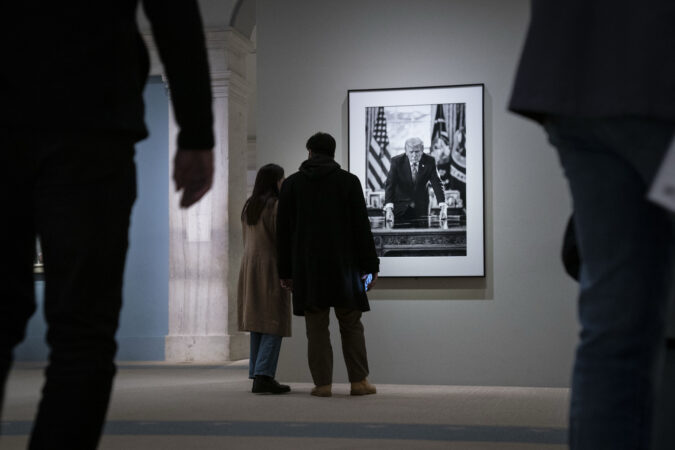
    Trump and the White House posted on social media Friday and Saturday to highlight the updated portrait in the “America’s Presidents” exhibition, which now features a framed black-and-white photo by White House photographer Daniel Torok. It shows Trump staring intensely, with his fists on the Resolute Desk — an image the president first shared on his Truth Social account last year.

    It replaced a photo by Washington Post photojournalist Matt McClain, which showed Trump with his hands folded in front of him, and was accompanied by a longer caption recounting Trump’s first term and his reelection. “Impeached twice, on charges of abuse of power and incitement of insurrection after supporters attacked the U.S. Capitol on January 6, 2021, he was acquitted by the Senate in both trials,” it read, in part.

    A Trump official specifically complained about that passage months earlier, when the president was trying to force out the portrait gallery’s director.

    The placard has been replaced with one whose caption is so short that the outline of the old sign was visible on the wall beneath it, simply noting Trump’s years in office. It now contrasts with portraits of other former presidents, including Joe Biden, Barack Obama, George W. Bush, and Bill Clinton, which all hang alongside wall text highlighting events during their time in office. Clinton’s notes his impeachment.

    National Portrait Gallery spokesperson Concetta Duncan said the museum is “exploring” less descriptive “tombstone labels” for some new exhibits and displays, and she noted that Trump’s portrait in the popular exhibition has changed before.

    Neither the Smithsonian nor the White House directly responded when asked if the Trump administration had requested the changes. The revamp comes several months after Trump bashed former portrait gallery director Kim Sajet as “highly partisan,” leading to her resignation, and after the White House threatened to withhold Smithsonian funding if the institution doesn’t cooperate with the administration’s review of museum content for “improper ideology.”

    Trump’s allies in government have recently led efforts to brand the public sphere with his preferred personal descriptors in ways large and small, adding his name to the Kennedy Center and U.S. Institute of Peace and installing plaques in the White House that laud Trump and disparage his political rivals such as former presidents Biden and Obama. Last year, the Colorado Capitol replaced a portrait of Trump after he complained about it.

    Besides noting the 2021 attack on the U.S. Capitol by Trump’s supporters and his impeachments in the House, the old placard mentioned his Supreme Court appointments, his 2020 election loss to Biden, and his efforts to lead the development of coronavirus vaccines. The text also said that the former photo portrait by McClain was supposed to remain on view until Trump’s commissioned painting was unveiled. (The previous portrait and its biographical label still appeared on the Smithsonian website as of Saturday afternoon.)

    The National Portrait Gallery portrayed the changes as unremarkable, saying that it previously rotated two photos of Trump through the collection.

    A notice posted on the gallery’s website announced the exhibition would temporarily close for updates from April 6 to May 14. It did not specify whether the other labels for former presidents would be changed during that period.

    A former Smithsonian historian, who spoke on the condition of anonymity because they were not authorized to speak for the institution, said that the National Portrait Gallery’s relatively long wall texts have stood out in comparison to shorter labels at many other art museums. “Because it’s a museum which combines art and portraiture, it has always had a biographical component to its labels to explain and contextualize the individual who’s being portrayed,” they said, adding that “you can outline the parameters of somebody’s career in a very neutral fashion.”

    “Tombstone” labels — museum jargon for bare-bones signs that list only essential information such as the artist, date of creation, and medium — are common at art museums such as the Guggenheim or MoMA, as well as other Smithsonian art museums.

    This isn’t the first time the Smithsonian has removed material mentioning congressional attempts to remove Trump from office since he launched a public campaign to remove what he calls “woke” ideology from U.S. cultural institutions. In July, the National Museum of American History briefly removed — then restored — references to his impeachments in its exhibition “The American Presidency: A Glorious Burden.”

    The institution said it had taken the text out “because the other topics in this section had not been updated since 2008.” The change was part of a content review that the Smithsonian agreed to undertake, following pressure from the White House to remove Sajet as the portrait gallery’s director.

    At the time, a White House official provided the Washington Post with a list of instances in which Sajet allegedly criticized Trump or promoted improper ideology. It specifically included the caption on his presidential portrait, for mentioning his impeachments and the Capitol attack.

    Although the Smithsonian Board of Regents affirmed that only its secretary could decide the institution’s personnel, Sajet later stepped down and has not been permanently replaced. Elliot Gruber serves as acting director.

    The changes ignited concerns about political interference at the Smithsonian and how the institution charged with preserving American history could be shaped by the Trump administration’s efforts to exert more control over its work.

    Torok became the White House photographer during Trump’s second term. One of his first official portraits drew attention for its similarity to the president’s 2023 mug shot, for his indictment on criminal charges in Atlanta.

    His photo now hanging in the National Portrait Gallery shows the president leaning over his desk in the Oval Office, fists clenched, looking directly into the camera. Trump posted the photo on Truth Social in October, writing that he was “getting ready to leave our imprint on the World.”

    Torok celebrated the Smithsonian display on social media on Friday and previously described the photo on Instagram as “Powerful!”

    The photo strikingly echoes a quieter image of John F. Kennedy. The president was captured from behind, hunched over in nearly the same position as Trump, in a 1961 photograph called “The Loneliest Job.”

    Trump has struck the same pose in other photos, including one Stephen Voss shot for Time in October.
  • Noem says she’ll send more federal agents to Minnesota

    Noem says she’ll send more federal agents to Minnesota

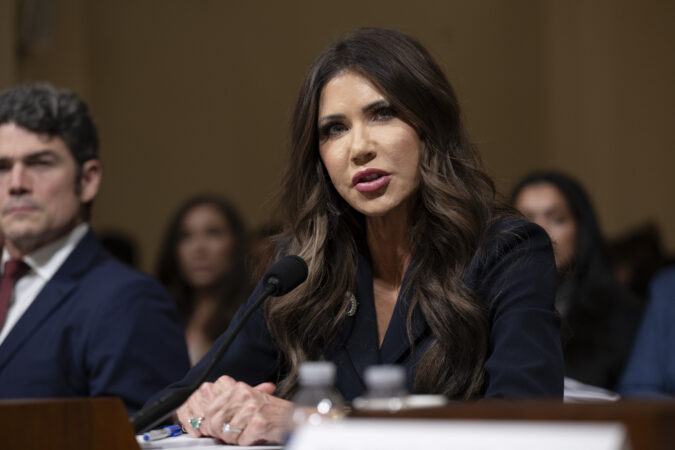
    Homeland Security Secretary Kristi L. Noem said hundreds more federal agents will be deployed to Minnesota as federal and local officials on Sunday doubled down on their competing accounts of what led up to the killing of a U.S. citizen by an Immigration and Customs Enforcement agent in Minneapolis last week, and who gets to investigate.

    In an interview with Fox NewsBusiness’s Sunday Morning Futures, Noem said the administration will send more officers on Sunday and Monday.

    “There’ll be hundreds more, in order to allow our ICE and our Border Patrol individuals that are working in Minneapolis to do so safely,” Noem said.

    The increase in federal agent presence in Minnesota comes as protests continued throughout the weekend. Demonstrators gathered across the country Saturday to demonstrate against ICE and the killing of Renee Good, a 37-year-old mother of three.

    Trump officials remained adamant Sunday that Good was responsible for her own death, while Democrats insisted that an investigation including local law enforcement must be completed before drawing conclusions.

    Federal agents in Minneapolis rammed the door of one home Sunday and pushed their way inside, part of what DHS has called its largest enforcement operation ever.

    In a dramatic scene similar to those playing out across Minneapolis, agents captured a man in the home just minutes after pepper spraying protesters outside who had confronted the heavily-armed federal agents. Along the residential street, protesters honked car horns, banged on drums, and blew whistles in attempts to disrupt the operation.

    But within minutes, the handcuffed man was led away and soon gone.

    More than 2,000 immigration arrests have been made in Minnesota since the enforcement operation began at the beginning of December, said Homeland Security spokesperson Tricia McLaughlin.

    Tensions over the facts of the fatal shooting of Good grew as the FBI, which has taken over the investigation, continued to block Minnesota officials from participating in the inquiry, forcing the local authorities to conduct their own review.

    Speaking to CNN’s State of the Union, Noem said that Good was to blame for the shooting, even though an official investigation into the shooting has not been completed, and as video evidence raised several questions about the administration’s assessment of what happened. About two hours after the shooting on Wednesday, Noem released a statement asserting that Good committed an act of “domestic terrorism,” and she accused Good of weaponizing her SUV by attempting to “run a law enforcement officer over.”

    Almost immediately after the shooting, federal officials, including President Donald Trump, Vice President JD Vance, and Noem, said the ICE officer fired in self-defense. Details of the killing, which was captured in videos widely disseminated online, dispute the administration’s view of the incident. Federal officials’ quick decision to blame Good for the shooting has drawn deep condemnation from Democrats nationwide and Minnesota leaders who’ve argued that federal authorities have not yet finalized a full review of the incident, and that they are blocking Minnesota officials from participating in the investigation.

    Across interviews on Sunday, Noem repeated her accusations that Good used her Honda Pilot to attack the officer, telling CNN’s Jake Tapper that “everything that I said has been proven to be factual.” When pressed by Tapper about video evidence showing that the ICE agent was able to move out of the vehicle’s way and fire at least two of three shots from the side of the car as it veered past him, Noem said Good was “breaking the law by impeding and obstructing a law enforcement operation.” Noem also mentioned that there is video — which Tapper said he had not yet seen — that shows “that this officer was hit by her vehicle.”

    “These officers were doing their due diligence that their training had prepared them to do,” Noem said, insisting that she’s correct in labeling Good a “domestic terrorist” because she “weaponized her vehicle to conduct an act of violence against a law enforcement officer and the public.”

    When Tapper once again pressed her on her decision to draw conclusions ahead of a full investigation, Noem said the administration “will continue to look at this individual and what her motivations were,” but claimed that Good had “harassed and impeded law enforcement operations.”

    Good’s wife has said that Good had “stopped to support our neighbors” when she was fatally shot on the residential street. Good’s family members have said they do not believe she was tailing ICE officers. She had just dropped her son off at school before the shooting, they said. Her father, Tim Ganger, said in a brief interview Wednesday that she got “caught up in a bad situation.”

    Tom Homan, Trump’s border czar, told Fox News Sunday that he believes the officer thought his life was in danger and acted in response. Homan, however, urged Americans to wait for an investigation to play out before making more accusations.

    “There’s a lot of things we don’t know,” Homan said. “You can’t compare this to murder. Murder requires malice and that is just dangerous to put that type of language out.”

    Homan then accused Democratic leaders — including Minneapolis Mayor Jacob Frey, who used an expletive when saying ICE should leave the city — of spreading “the hateful rhetoric [that] has caused a lot of this violence.”

    Frey told NBC News’s Meet the Press that he does bear responsibility to “bring down the temperature” of the rhetoric.

    “To those that are offended, I’m sorry I offended their delicate ears,” Frey said. “But as far as who inflamed the situation, you know, I dropped an f-bomb. And they killed somebody. I think the killing somebody is the inflammatory element here, not the f-bomb.”

    Frey also told NBC News that he believes there is now “deep mistrust” over what the results of an FBI investigation into the shooting will be given that federal officials are not allowing Minnesota authorities, including the Bureau of Criminal Apprehension, to contribute to the review.

    “What I was pushing back on from the very beginning was a narrative that had jumped to that conclusion right from the get-go,” he said. “When you’ve got a federal administration that is so quick to jump on a narrative as opposed to the truth, I think we all need to be speaking out.”

    Sen. Tina Smith (D., Minn.) was more aggressive in her rebuke, accusing the Trump administration of running a “cover-up” of Good’s shooting by trying to shift the public narrative before facts could be learned by investigators.

    “Hours after Renee Good was shot and killed by federal agents, [DHS Secretary] Kristi Noem was telling us what had happened,” Smith said in an interview with ABC’s This Week. “How can we trust the federal government to do an objective, unbiased investigation without prejudice when at the beginning of that investigation, they have already announced exactly what they think happened?”

    Information from the Associated Press was used in this article.

  • SEPTA says two people stabbed at 40th Street Station on Saturday

    SEPTA says two people stabbed at 40th Street Station on Saturday

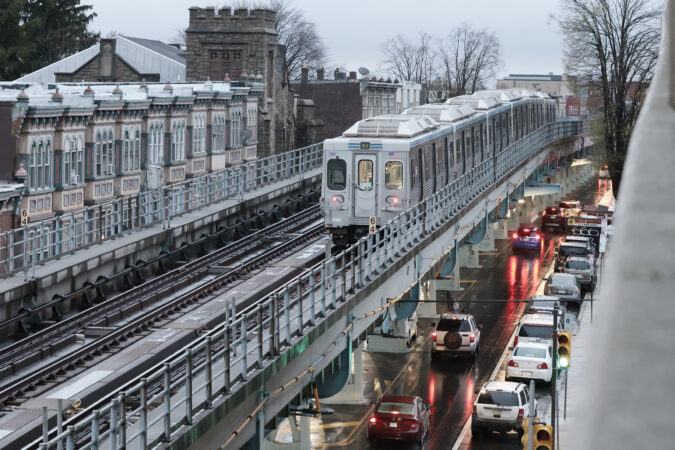
    A man is in critical condition after being stabbed at 40th St. Station Saturday evening, SEPTA said.

    Around 7:30 p.m. Saturday, a woman stabbed the man as he entered the train station in the University City area of West Philadelphia, SEPTA said.

    “She also stabbed another woman on the eastbound platform after a confrontation,” the transit agency said.

    Sunday morning, SEPTA said the suspect was taken into custody, but didn’t provide further details.

    The woman who was stabbed is stable condition, SEPTA said..

    The station, located a few blocks north of University of Pennsylvania, serves the Market-Frankford Line.

    For about an hour after the incident, the Market-Frankford Line bypassed 40th Street Station to avoid police activity, SEPTA said.

  • Gen Z has entered city hall. Meet 4 young Pa. mayors who want to bring new ideas to local government.

    Gen Z has entered city hall. Meet 4 young Pa. mayors who want to bring new ideas to local government.

    This story first appeared in PA Local, a weekly newsletter by Spotlight PA taking a fresh, positive look at the incredible people, beautiful places, and delicious food of Pennsylvania. Sign up for free here.

    Last fall, communities across Pennsylvania elected officials who have yet to turn 30 to one of the most visible local roles: mayor.

    This month, those mayors begin their first terms and their political careers, bringing new perspectives and concerns to local government.

    Spotlight PA spoke to four incoming young mayors — all of them members of Generation Z, by Pew Research Center’s definition (though some noted they feel culturally closer to millennials) — about their ambitions, their platforms, and what drew them to the position.

    While they span the ideological spectrum and have jobs as disparate as coffee roaster and political operative, all want to improve their local governments, and share optimism about the future of their communities.

    Although it’s not unheard of for Pennsylvanians to elect young local leaders, it’s rare. Just 3% of the 866 local elected officials who answered a 2021 Pennsylvania Local Government Commission survey were under 35. The average age of a respondent was about 61.

    Cassandra Coleman, the former mayor of Exeter in Luzerne County who was appointed to her first term at 20, recommended the latest crop make sure they’re “listening and learning” and not coming in too “forceful.”

    “But also,” Coleman added, “I think you have to also weigh that with not being overshadowed and not being kind of pushed to the side because of your age.”

    New perspectives

    Now is an important time to get involved in government and run for office, said Sam Bigham, the new Democratic mayor of Carnegie in Allegheny County.

    “We’re seeing a lot of leaders at different levels not really delivering on their promises or keeping their constituents’ best interest at heart, especially not for young people like me,” he said, pointing to issues like unaffordability and climate change.

    In Pennsylvania, the roles and responsibilities of mayors vary by municipality type. In some cities, the job is powerful and wide-reaching. In boroughs, the mayor’s primary responsibilities are to “preserve order” (i.e., oversee police and respond to emergencies) and enforce local ordinances. They can also break ties among council members.

    It’s often a part-time job, and state law caps salaries based on the size of the borough, though individual municipalities may set pay well below the mandated maximums.

    The mayors who spoke to PA Local all represent boroughs, and acknowledged the limited powers that come with their office. But they hope to lean into the position’s more ceremonial role as a representative of their community — and use it to bring fresh points of view to government.

    Matt Zechman, a Libertarian who was sworn in as mayor of Cleona Borough in Lebanon County this week, said it’s vital for young people to start running for local office and working their way up so they can “change their own future.”

    “It’s a much different time than it was 20, 30, 40, 50 years ago,” he said. “And if we have the same mindset that today’s problems are the same as they were 50 years ago, and we treat them the same way, we’re just going to keep spiraling downward even more.”

    Winning support

    As Bigham went door to door during his campaign, he found “a whole lot of people were actually excited about a young person running for office,” he told PA Local.

    While some were skeptical of his age and experience level, he said he responded by “running a very serious campaign,” listening to people, speaking intelligently about local issues, and making sure all his paperwork was in order.

    Joar F. K. Dahn, the new mayor of the borough of Darby in Delaware County, also said he ran into a “a handful of people that were kind of very against a young person running,” and insisted he “wait his turn.”

    But he stressed that those folks were a vocal minority, and thanked the older adults who’ve guided him and made it “their mission to to mentor the next generation,” which he sees as “contributing to our future.”

    “The young people are going to come, you just got to invite them to the table,” Dahn said. “You got to make them feel like they also belong here, and you got to make sure they understand that their opinions [are] valid.”

    Several of the mayors hope to motivate their peers to run for office or get civically involved in another way.

    “I just want to let everybody know regardless of their background, age, or affiliation, or anything like that, that they do matter,” said Dylan Stevens, a member of the Liberal Party who was elected mayor of the borough of Westover in Clearfield County by a one-vote margin. “If they want to make a difference, just go for it.”

    And it’s “really not as difficult as some people might think” to run for local office, Carnegie’s Bigham pointed out. He collected 10 signatures to secure his place on the ballot, and raised a few thousand dollars — “probably more than what you need in a lot of places,” he said.

    “Obviously, you have to be comfortable putting yourself out there and talking to all different kinds of people,” Bigham said. “I’m a bit more introverted, so sometimes it can get really tiring to have to do that, but it can also be really rewarding.”

    Meet the mayors

    Joar F. K. Dahn of Darby

    Dahn, 28, calls himself Darby’s “biggest cheerleader.” When he was at college, the Bloomsburg University alumnus didn’t tell people he was “from Philly,” like other students from Delaware County would, he told PA Local. He’d say “Darby.”

    Dahn, whose family fled the Liberian Civil War when he was a child, has called Darby home for 20 years. He describes the small borough of 10,749 as a “very close-knit community,” but one that “has its struggles.”

    His dissatisfaction with local leadership motivated him to run for mayor. Working as a political operative for several years, he was inspired by the campaigns he was hired by and felt the officials in Darby weren’t as committed.

    He started looking for someone to throw his support behind — and that person turned out to be himself, Dahn told PA Local. Several residents encouraged him. So he challenged the incumbent mayor in the Democratic primary and ended up winning by 20 points. Dahn ran unopposed in November.

    In his first 100 days, he wants to motivate community members to get more involved in local government and “feel like they’re part of the process.”

    “Sometimes, we’ll have council meetings, and I’m the only resident in the room,” Dahn said. “We have council meetings and there’s literally nobody there. … I want people to understand now that this is a new leadership.”

    Public safety is a big priority for Dahn, who on the campaign trail heard from concerned grandmothers. He hopes to promote a positive relationship between residents and police, and work to reduce gun violence.

    “I need every single grandmom to feel comfortable to walk any single street in Darby,” Dahn said.

    Sam Bigham of Carnegie

    Carnegie’s “old-style” Main Street and strong community connections drew Bigham — a resident since age 10 with deep family roots in the area — back to the borough of about 8,000 after he graduated from Indiana University of Pennsylvania in 2024.

    Now the commonwealth’s youngest active mayor, the 23-year-old had known for years that he wanted to work in government or public service, and his resumé proves it. A former junior councilperson, Bigham also interned for a state representative and a congressman, and worked as a Democratic organizer ahead of last year’s election.

    Early last year, Bigham landed the position of executive director of the Carnegie Community Development Corporation, a nonprofit that aims to support local businesses and boost the area’s attractiveness. He plans to continue in that role alongside his part-time mayoral duties.

    He told PA Local he decided to run after talking with the incumbent, who was planning to step down. A friend from college helped Bigham campaign, and after lots of door-knocking and securing endorsements from several local politicians, he won the Democratic primary with 661 primary votes to his opponent’s 204. (He also won enough write-in Republican votes to be listed under both parties on the November ballot.)

    “I wanted to run on a message of community development and optimism and looking forward to the future,” he told PA Local.

    Bigham’s first-term goals include revitalizing Main Street, improving local infrastructure, updating the borough’s branding, facilitating events between police and residents, and working on sustainability initiatives.

    Matt Zechman of Cleona

    Zechman has worn many hats in his 27 years: volunteer firefighter, EMT, combat medic in Afghanistan, coffee roaster, and father. His latest is mayor of Cleona, a 2,000-person borough he describes as a quiet place with “two traffic lights,” a “really nice playground,” and “a lot of hometown spirit.”

    Although he didn’t see a glaring need for major changes in his community, the lifelong resident ran to bring his skills and a “new perspective” to the role.

    Zechman did much of his campaigning via social media, he told PA Local. Running on the Libertarian ticket, he beat the Republican incumbent by a nearly 2-to-1 margin in the November election.

    As mayor, Zechman wants to implement what he calls “windows-down policing,” a practice he said remembers from his childhood.

    “We would see the police chief and the mayor — they would drive in their vehicle, windows down, going slow, talking to residents, engaging,” Zechman explained. “I knew their names, they knew my name, they knew everyone’s name. And in a town this small, that is very well possible.”

    And even though it’s not part of his job description on paper, he said he also wants to use his bully pulpit to find local business sponsors, seek grant funding, or crowdfund to install flashing pedestrian crossing signs, which he called an “absolute must” for local road safety.

    Dylan Stevens of Westover

    Stevens made a “spontaneous decision” to run for mayor of Westover, a roughly 350-person borough in Clearfield County, just four days before the November election, he told PA Local.

    Raised in a conservative Republican household, Stevens began exploring third parties when he “became disillusioned with the whole political situation” in 2020. He landed on the Liberal Party of Pennsylvania, which was formed as the “Keystone Party” in 2022 by a group of people who believed the Libertarian Party was moving too far right.

    When Stevens, a 26-year-old who’s lived in Westover for 11 years and works at a gas station in another town, realized there wasn’t anyone on the ballot for mayor, he decided to give it a go. He wanted to “do more” in his community and bring more exposure to the Liberal Party, he said.

    Stevens had mostly kept to himself before, so he took a “kids’-lemonade-stand-type-of-approach” to drum up support, he told PA Local. With help from Liberal Party members from out of town, he introduced himself to people outside a general store a few days before the election and did the same on Election Day outside Westover’s polling place. He said reactions ranged from neutral to “OK, well, good luck.”

    Stevens ended up getting 13 write-in votes, a single vote more than the next most popular write-in. According to a Liberal Party news release, his election marked the party’s first mayoral victory in Pennsylvania.

    “Even though I was kind of an unknown, I guess I had the gift of the gab enough to let people know that I wanted to make a difference in my community and I wanted to give it my best effort,” Stevens said. “And for a lot of them, it seemed to be enough.”

    Stevens hopes to work with the borough council to attract businesses and explore alternative water sources. He also wants to poll residents on local issues, revive the borough’s Facebook page, and livestream public meetings to improve access for people who aren’t able to attend in person.

  • Grateful Dead founding member Bob Weir has died at 78

    Grateful Dead founding member Bob Weir has died at 78

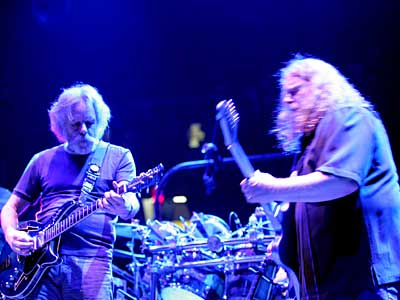
    LOS ANGELES — Bob Weir, the guitarist and singer who as an essential member of the Grateful Dead helped found the sound of the San Francisco counterculture of the 1960s and kept it alive through decades of endless tours and marathon jams, has died. He was 78.

    Mr. Weir’s death was announced Saturday in a statement on his Instagram page.

    “It is with profound sadness that we share the passing of Bobby Weir,” a statement on his Instagram posted Saturday said. “He transitioned peacefully, surrounded by loved ones, after courageously beating cancer as only Bobby could. Unfortunately, he succumbed to underlying lung issues.”

    The statement did not say where or when Mr. Weir died, but he lived in the San Francisco Bay Area for most of his life.

    Mr. Weir joined the Grateful Dead — originally the Warlocks — in 1965 in San Francisco at just 17 years old. He would spend the next 30 years playing on endless tours with the Grateful Dead alongside fellow singer and guitarist Jerry Garcia, who died in 1995.

    Mr. Weir wrote or co-wrote and sang lead vocals on Dead classics including “Sugar Magnolia,” “One More Saturday Night,” and “Mexicali Blues.”

    After Garcia’s death, he would be the Dead’s most recognizable face. In the decades since, he kept playing with other projects that kept alive the band’s music and legendary fan base, including Dead & Company.

    The Dead were beloved in Philadelphia. “Only sports teams have played the Spectrum more than the Grateful Dead,” Inquirer music critic Dan DeLuca wrote when the band played its last concert at the now-demolished arena on May 2, 2009. DeLuca wrote that the Dead had sold out the arena more than 50 times.

    “For over sixty years, Bobby took to the road,” the Instagram statement said. “A guitarist, vocalist, storyteller, and founding member of the Grateful Dead. Bobby will forever be a guiding force whose unique artistry reshaped American music.”

    Mr. Weir’s death leaves drummer Bill Kreutzmann as the only surviving original member. Founding bassist Phil Lesh died in 2024. The band’s other drummer, Mickey Hart, practically an original member since joining in 1967, is also alive at 82. The fifth founding member, Ron “Pigpen” McKernan, died in 1973.

    Dead and Company played a series of concerts for the Grateful Dead’s 60th anniversary in July at Golden Gate Park in San Francisco, drawing some 60,000 fans a day for three days.

    Born in San Francisco and raised in nearby Atherton, Mr. Weir was the Dead’s youngest member and looked like a fresh-faced high schooler in its early years. He was generally less shaggy than the rest of the band, but he had a long beard like Garcia’s in later years.

    The band would survive long past the hippie moment of its birth, with its ultra-devoted fans known as Deadheads often following them on the road in a virtually nonstop tour that persisted despite decades of music and culture shifting around them.

    “Longevity was never a major concern of ours,” Mr. Weir said when the Dead got the Grammys’ MusiCares Person of the Year honor last year. “Spreading joy through the music was all we ever really had in mind, and we got plenty of that done.”

    Ubiquitous bumper stickers and T-shirts showed the band’s skull logo, the dancing, colored bears that served as their other symbol, and signature phrases like “ain’t no time to hate” and “not all who wander are lost.”

    The Dead won few actual Grammys during their career — they were always a little too esoteric — getting only a lifetime achievement award in 2007 and the best music film award in 2018.

    Just as rare were hit pop singles. “Touch of Grey,” the 1987 song that brought a big surge in the aging band’s popularity, was their only Billboard Top 10 hit.

    But in 2024, they set a record for all artists with their 59th album in Billboard’s Top 40. Forty-one of those came since 2012, thanks to the popularity of the series of archival albums compiled by David Lemieux.

    Their music — called acid rock at its inception — would pull in blues, jazz, country, folk, and psychedelia in long improvisational jams at their concerts.

    “I venture to say they are the great American band,” TV personality and devoted Deadhead Andy Cohen said as host of the MusiCares event. “What a wonder they are.”

  • A Cambodian immigrant held by ICE died at a Philly hospital after treatment for drug withdrawal

    A Cambodian immigrant held by ICE died at a Philly hospital after treatment for drug withdrawal

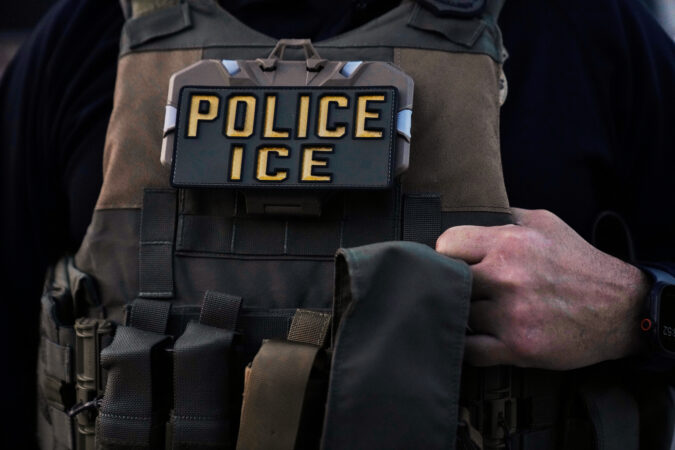
    A 46-year-old Cambodian immigrant held at the Federal Detention Center in Philadelphia died in a hospital on Friday after being treated for drug withdrawal, Immigration and Customs Enforcement officials said.

    Parady La was arrested by ICE agents outside his Upper Darby home on Tuesday, then transferred to the detention center where he received treatment for severe withdrawal, ICE said.

    The next day he was found unresponsive in his cell. Center staff immediately administered CPR and several doses of naloxone, ICE said.

    Emergency medical services workers arrived and took over resuscitation efforts. La was transported to Thomas Jefferson University Hospital and admitted in critical condition.

    On Wednesday evening, medical evaluations indicated he had limited brain function.

    His condition worsened on Thursday and medical staff reported complete renal failure and no brain activity. Family members were notified and visited him at Jefferson, ICE said.

    He was pronounced dead by hospital staff early Friday, ICE said.

    La was admitted to the United States in 1981 as a refugee, when he would have been a child of about 2. He became a lawful permanent resident a year later, but lost his legal status after committing a series of crimes over two decades, ICE said.

    In 1994, when he would have been about 15, he was adjudicated delinquent for simple assault in Delaware County. Later convictions and jail time followed for robbery, criminal conspiracy, and other crimes, ICE said.

  • Department of Homeland Security changes account of ICE shooting in Maryland

    Department of Homeland Security changes account of ICE shooting in Maryland

    The Department of Homeland Security has changed its account of an immigration enforcement-related shooting in Maryland that left two men injured on Christmas Eve, a move prompted by a local police account that contradicted the federal agency’s initial statement.

    In the department’s announcement of the shooting on X, officials said officers with U.S. Immigration and Customs Enforcement were executing a “targeted immigration enforcement operation” in Glen Burnie when they approached a vehicle and told the driver, Tiago Alexandre Sousa-Martins, to turn off the engine. In the passenger seat of Sousa-Martins’ van, the department said, was Solomon Antonio Serrano-Esquivel.

    Officers “defensively fired” their guns at the vehicle, striking Sousa-Martins after he allegedly refused to power off his van and attempted to flee, ramming it into “several ICE vehicles” before driving in the officers’ direction, DHS said in its initial account. In that account, Serrano-Esquivel suffered whiplash when Sousa-Martins’ van crashed between two buildings.

    But the Anne Arundel County Police Department issued a statement Friday that offered a counter narrative. One of the men was an ICE detainee and already in the agency’s custody when the incident occurred, police said. The other was injured by gunfire “while operating a separate vehicle.”

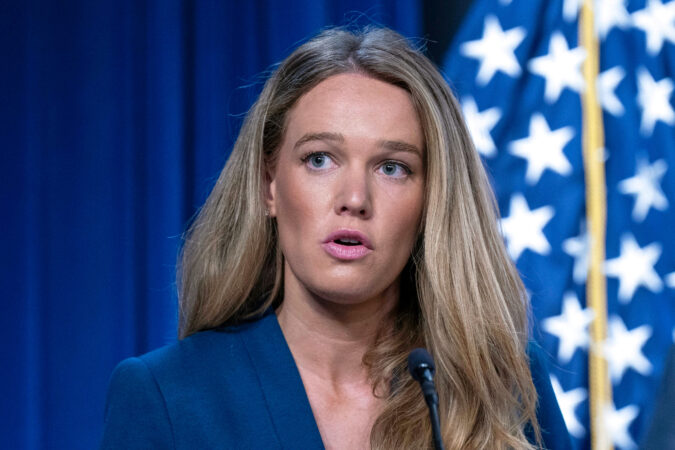
    DHS did not immediately respond to a request for comment on Saturday about the discrepancy in accounts and the status of the two men’s injuries. In a statement provided to the Baltimore Sun, Assistant Secretary Tricia McLaughlin confirmed Serrano-Esquivel was inside “one of the ICE vehicles that was rammed.”

    In its initial account of the shooting, DHS said Sousa-Martins, a Portuguese national, had been living in the United States illegally on an expired visa that lapsed in 2009, according to a statement provided to the Washington Post in December. The statement also noted Serrano-Esquivel, who’s from El Salvador, was also in the country illegally.

    Sousa-Martins is being held at a detention facility in Bowling Green, Va., according to ICE’s detainee locator website. No details were available for Serrano-Esquivel’s whereabouts and DHS did not immediately respond to questions about either man’s detention status.

    The December incident is one of over a dozen ICE shootings during President Donald Trump’s second term, according to media reports and court records.

    On Wednesday, Renée Good, 37, was fatally shot on a residential street in Minneapolis during an exchange with an ICE officer, sparking protests and scrutiny over ICE’s tactics. The following day, two people were shot and injured during a “targeted vehicle stop” in Portland, Ore., prompting an investigation from Oregon officials.

    DHS has said ICE officers are facing a surge in threats and assaults, including with vehicles used as weapons, and blamed “sanctuary politicians and the media.” Officials have vowed to prosecute “rioters” and warned that demonstrations will not stop their immigration enforcement efforts.

    Anne Arundel County police said in their statement on Friday that the Glen Burnie shooting is still under investigation, and that its officers do not enforce immigration law, work with ICE, or ask people about immigration status. At a December news conference, department spokesperson Justin Mulcahy said the FBI will investigate the alleged attempt to run over the federal agents and ICE would conduct an internal investigation through its Office of Professional Responsibility.

  • 6 people killed in Mississippi rampage, including 7-year-old girl. Suspect charged with murder

    6 people killed in Mississippi rampage, including 7-year-old girl. Suspect charged with murder

    WEST POINT, Miss. — A 24-year-old Mississippi man killed six people — his father, brother, uncle, 7-year-old cousin, a church pastor, and the pastor’s brother — at three locations during a Friday night rampage in a rural area, authorities said.

    Daricka M. Moore was arrested at a police roadblock in Cedarbluff just before midnight after dozens of local, state, and federal officers flooded the northeast Mississippi area.

    Moore was being held without bail Saturday at the Clay County jail in West Point on murder charges and ahead of an expected initial appearance Monday before a judge.

    Clay County District Attorney Scott Colom, who said he expects to pursue the death penalty, told the Associated Press that Moore would likely be appointed a public defender at that time.

    If charges are upgraded to capital murder before then, Moore will be ineligible for bail under state law.

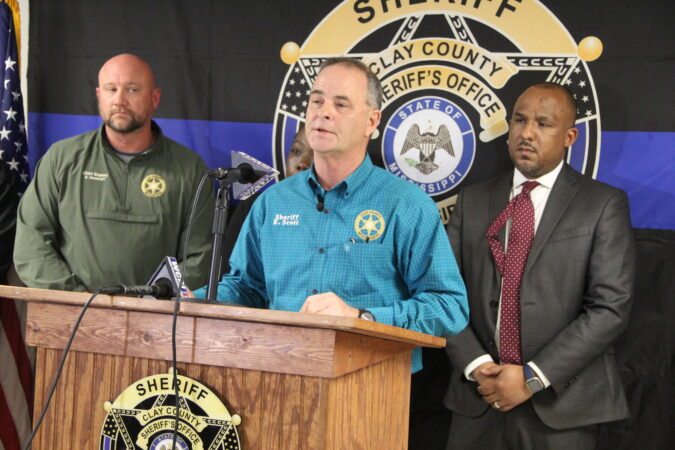
    Clay County Sheriff Eddie Scott said at a Saturday news conference that evidence and witnesses indicate that Moore was the only shooter and no other injuries have been reported.

    Investigators were continuing to interview Moore but do not currently know what may have motivated him, he added.

    “A situation like this, you’ve got a family member attacking their own family,” Scott said. “Whatever the reason is, we’re hoping that we’ll find out.”

    The shootings unfolded in an area of fields, woods, and mostly modest homes about 125 miles northeast of Jackson.

    Investigators believe Moore first killed his father, 67-year-old Glenn Moore; his brother, 33-year-old Quinton Moore; and his uncle, 55-year-old Willie Ed Guines, at the family’s mobile home on a dirt road in western Clay County.

    The sheriff said Moore then stole his brother’s truck and drove a few miles to a cousin’s house, where he forced his way in and attempted to commit sexual battery. Scott said Moore than put a gun to the head of a 7-year-old girl, whom he declined to identify, and fatally shot her.

    “I don’t know what kind of motive you could have to kill a 7-year-old,” he said.

    Scott said that according to witnesses, Moore then placed a gun against a younger child’s head, but she was not shot. It was not clear whether he did not pull the trigger or the gun misfired.

    “That’s how violent it was,” Scott said.

    The mother and a third child were also present, the sheriff said.

    Moore then allegedly drove to a small white frame church, the Apostolic Church of the Lord Jesus. There, Scott said, he broke into a residence, killed the pastor and his brother, and stole one of their vehicles.

    Scott said the last two victims, the Rev. Barry Bradley and Samuel Bradley, lived most of the time in nearby Columbus but spent weekends on church grounds. Some Moore family members attend the church, Scott said.

    Moore was caught at a roadblock at 11:24 p.m. near where the second shooting occurred, Scott said, 4½ hours after the first call came in. Colom said Moore had a rifle and a handgun. Scott said officers are investigating where Moore obtained the guns.

    The state medical examiner is performing autopsies on the victims.

    Scott said Moore’s surviving relatives are overwhelmed with grief.

    “It was really hard to have conversations other than prayers with everybody out there,” he said, adding, “this has really shaken our community.”

    Colom, a Democrat who is seeking his party’s nomination this year to run against Republican U.S. Sen. Cindy Hyde Smith, said he is confident that his office has the resources to prosecute Moore and pursuing the death penalty is the right thing to do.

    “Six people, one night, several different scenes, it’s about as bad as it gets,” Colom said.

  • U.S. launches new retaliatory strikes against ISIS in Syria after deadly ambush

    U.S. launches new retaliatory strikes against ISIS in Syria after deadly ambush

    WASHINGTON — The U.S. has launched another round of retaliatory strikes against the Islamic State in Syria following last month’s ambush that killed two U.S. soldiers and one American civilian interpreter in the country.

    The large-scale strikes, conducted by the U.S. alongside partner forces, occurred around 12:30 p.m. ET, according to U.S. Central Command. The strikes hit multiple Islamic State targets across Syria.

    Saturday’s strikes are part of a broader operation that is part of President Donald Trump’s response to the deadly ISIS attack that killed Sgt. Edgar Brian Torres-Tovar, Sgt. William Nathaniel Howard, and Ayad Mansoor Sakat, the civilian interpreter, in Palmyra last month.

    “Our message remains strong: if you harm our warfighters, we will find you and kill you anywhere in the world, no matter how hard you try to evade justice,” U.S. Central Command said in a statement Saturday.

    A day earlier, Syrian officials said their security forces had arrested the military leader of IS operations in the Levant.

    The U.S. military said Saturday’s strikes were carried out alongside partner forces without specifying which forces had taken part.

    The Trump administration is calling the response to the Palmyra attacks Operation Hawkeye Strike. Both Torres-Tovar and Howard were members of the Iowa National Guard.

    It launched Dec. 19 with another large-scale strike that hit 70 targets across central Syria that had IS infrastructure and weapons.

    The Kurdish-led Syrian Democratic Forces has for years been the U.S.’s main partner in the fight against IS in Syria, but since the ouster of former Syrian President Bashar Assad in December 2024, Washington has increasingly been coordinating with the central government in Damascus.

    Syria recently joined the global coalition against IS.

  • ‘ICE out’ protesters take to the streets in Philly and around the country

    ‘ICE out’ protesters take to the streets in Philly and around the country

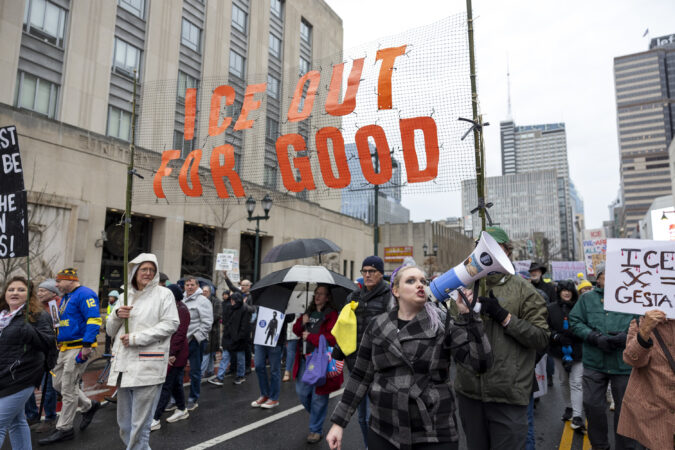
    Demonstrators swept onto the streets of Philadelphia and cities across the country on Saturday to vent anger and sadness over the ICE killing of an unarmed woman motorist in Minneapolis.

    Protests over the fatal Wednesday shooting of 37-year-old Renee Good were taking place or being planned in hundreds of places, from small towns to major cities in Pennsylvania, New Jersey, Texas, Florida, California, New York, and elsewhere.

    Organizers intend to hold rallies on Sunday in Trenton, Abington, Cherry Hill, Ardmore, Ambler, and other communities, the breadth of the protests signaling the scope of resistance to President Donald Trump’s immigration agenda. Leading civil rights groups have called for people to step up and support the ICE Out for Good Weekend of Action.

    “What happened in Minneapolis is unforgivable,” said Vicki Miller, a leader of Indivisible Philadelphia, who gathered with others at City Hall on Saturday morning.

    In Philadelphia the day began in a cold, steady rain, with about a hundred people at City Hall chanting, “No fear, no hate, no ICE in our state.”

    Trump administration officials insist the agent who shot Good three times had fired out of self-defense, saying he was about to be run over, and Secretary of Homeland Security Kristi Noem described the incident as “an act of domestic terrorism.”

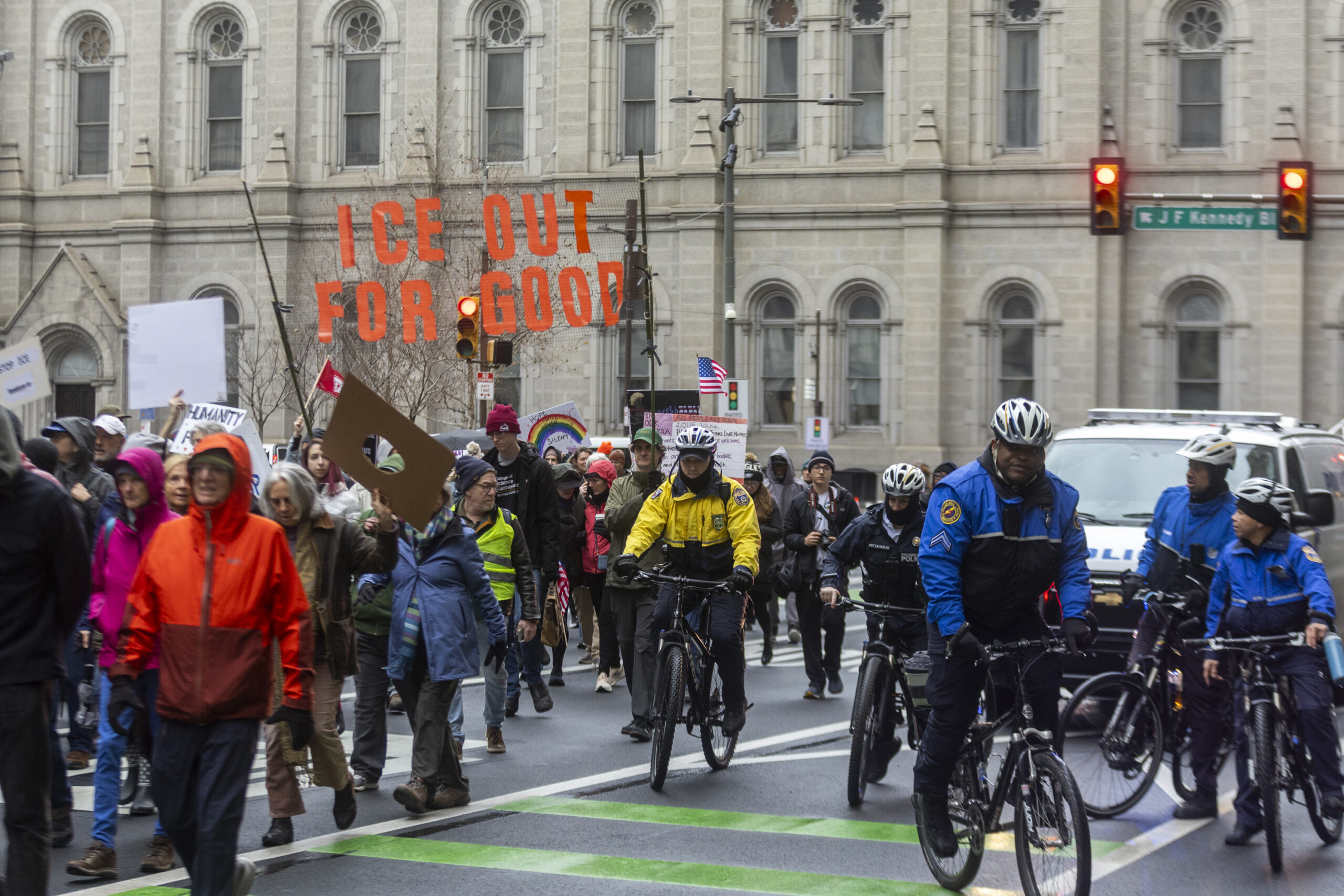
    Many gather to show their support for Renee Good and to protest against ICE in Philadelphia, Pa., on Saturday, Jan. 10, 2026.

    Video taken by bystanders appears to show that the agent was not in the path of Good’s SUV when he fired, and activists have condemned the shooting as evidence of a violent, undisciplined federal agency.

    Trump has undertaken an unprecedented campaign to arrest and deport millions of immigrants, an effort that’s included sending ICE and federal troops into blue American cities.

    An estimated 2,000 federal agents have surged into Minnesota, following similar deployments in Los Angeles, Chicago, Washington, Memphis, and elsewhere. Somehow Philadelphia has gone untouched, despite its history of feuding with Trump.

    On Friday night, a 1,000-person protest outside of a Minneapolis hotel turned violent as demonstrators threw ice, snow, and rocks at officers, according to Minneapolis police.

    The demonstrations there continue as the Department of Homeland Security pushes forward in the Twin Cities with what it calls its biggest-ever immigration enforcement operation.

    At Philadelphia City Hall, Miller called on residents to protect one another from the Trump administration.

    “An authoritarian wants us to feel alone. We are showing that we are not alone,” she said. “We are happy to be here for our neighbors; we are here to protect them.”

    By 10:30 a.m., the crowd began moving down Market Street, meeting up with another demonstration near federal properties around Seventh and Arch Streets, and growing in size to about 500 people.

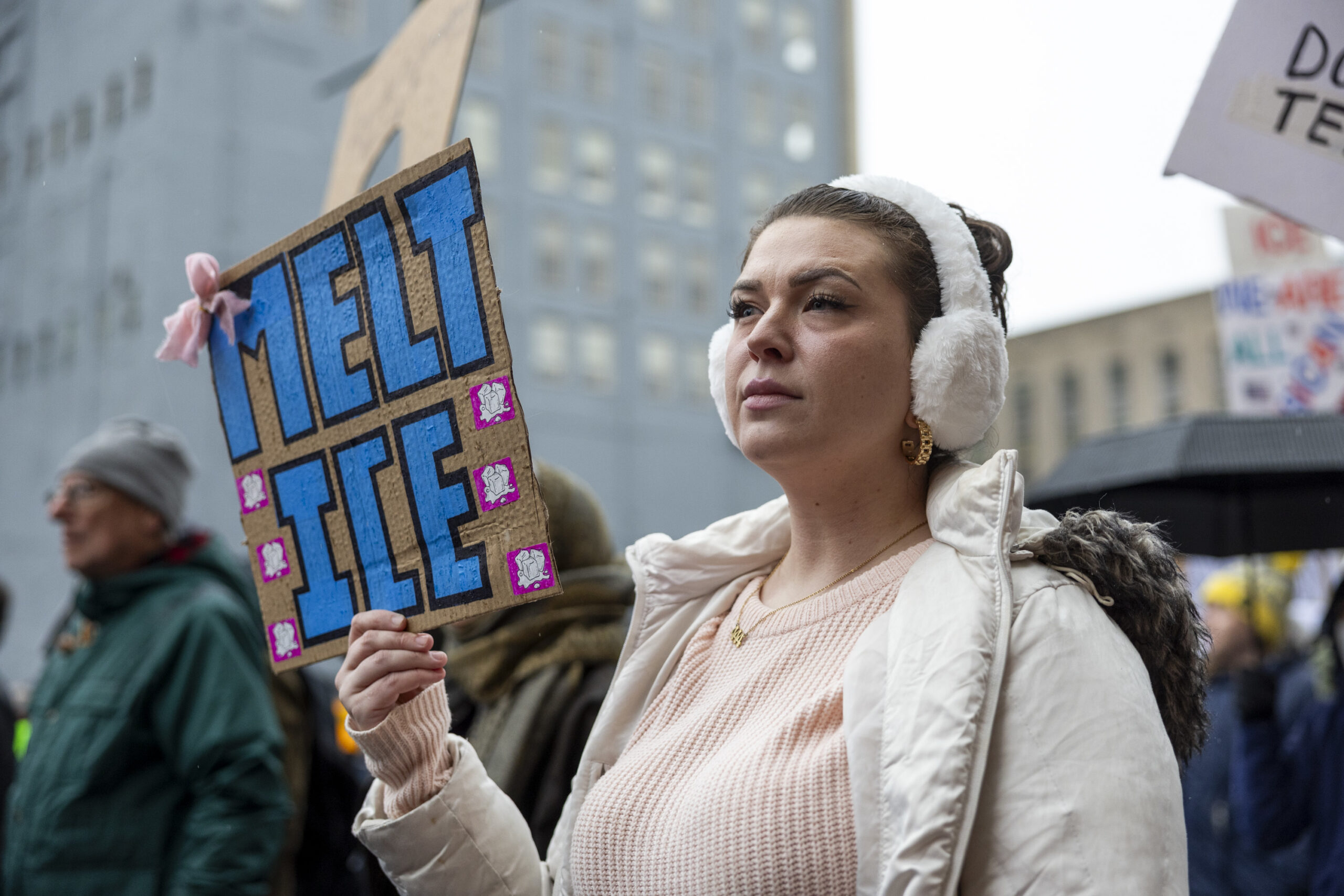
    Tiffanie Knott, of Rittenhouse, holding a sign reading “Melt ICE” as she marches with many others to protest against ICE in Philadelphia, Pa., on Saturday, Jan. 10, 2026.

    School psychologist Michele Messer, 51, came from Camden with her students in mind.

    “Our immigrant students are impacted and it will have a long-lasting effect in their education,” said the member of grassroots group Cooper River Indivisible. “We need to show up so they know we love them; we hear them, and we will be here for you until this is over.”

    Jim Greway, 77, said he was protesting for those who couldn’t be present, whose immigration status or race made them fearful of speaking out.

    “People who look different than me are being told they don’t belong here and will never succeed in this country,” said Greway, who is white. “I’m here to say that’s not true.”

    A couple in their late 70s marched down Market Street holding hands, chanting with the crowd for Immigration and Customs Enforcement to be shut down.

    “We have good friends that are afraid to leave their house, so to us this is personal,” explained Lori Chewkanes.

    Her husband, Michael Chewkanes, said that ICE actions in Minneapolis made the couple feel like their patriotism was being stolen.

    “As a veteran, it makes me sick to my stomach,” he said. “[ICE] should be protecting the people, not hurting them. This should have never happened.”

    Madeline Forrest, 20, of Camden, handed out copies of a poem she wrote that condemned ICE. As she did so, MAGA supporter Patrick Labrie, also 20, approached to talk about why he supported the agency, including the shooting by the officer in Minnesota.

    “From the clips, it seemed like he was in a lot of danger, so it seems like he did everything he could to protect himself,” Labrie said.

    Labrie continued to defend the officer’s actions, later attempting to interrupt the chants of the crowd.

    Forrest thought Labrie was deliberating trying to attract attention to draw more watchers on social media. She tried to engage him again, but was unable do so as police moved in to safeguard him from the crowd.