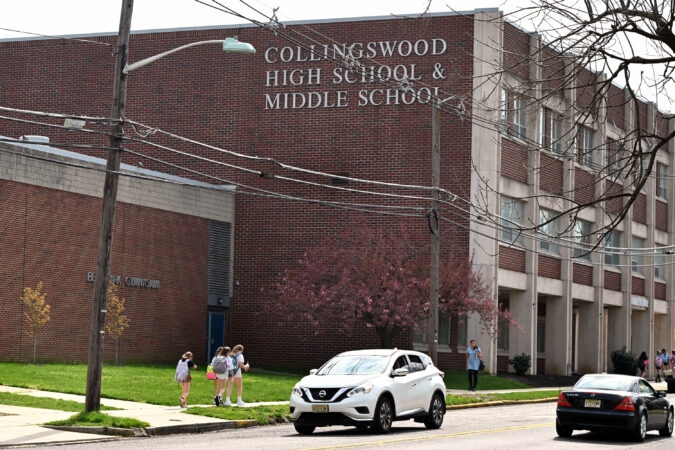
After more than a century as a dry town, Collingswood is considering lifting its ban on alcohol sales within the borough.
For months, the three-person Collingswood Board of Commissioners has been discussing whether to lift the long-standing restrictions on liquor sales both as a potential new revenue source for the borough and as a way to bolster the local restaurant industry.
Per the state’s population-based license cap 一 one liquor license for every 3,000 residents — Collingswood would be able to issue as many as four retail consumption licenses that permit restaurants or bars to serve alcohol, or one distribution license for a liquor store within borough limits.
If liquor sales are eventually permitted, the borough could receive anywhere from $1,000 to $10,000 annually through licensing and renewal fees.
But discussions are still preliminary as the commissioners work to determine what is best for Collingswood’s existing restaurant and business owners, borough administrator Cassandra Duffey said.
“There’s a general sense that liquor can be a good thing, but there’s a concern that if it’s done in a way that’s unbalanced, it can also throw people off,” she said.
“Is there strength in the dry-town brand that has been around for years and years?” Duffey said.
Tracing back to its Quaker roots, Collingswood has prohibited alcohol sales by ordinance since the 19th century.
A change to the policy would require public approval through a referendum during the November general election, borough solicitor Caitlin Harney Norcia said.
To begin that process, the borough’s commissioners would need to adopt a resolution by Aug. 21 so that the Camden County Clerk’s Office has enough time to add the question to the ballot. In order to adopt the resolution, at least 15% of voters who participated in the last general election must sign a public petition in favor of putting the question on the ballot, Harney Norcia said.
After that, “repealing any kind of prior restrictions could all be done relatively easily,” Harney Norcia said, describing the logistics of updating local ordinances if a referendum passes.
If voters approve lifting the ban, Harney Norcia said, the borough could either award licenses in a competitive bidding process, which could generate one-time revenue for Collingswood’s budget, or enact an application and review process that includes annual fees and public presentations by prospective licensees.
But if the measure were to fail on Election Day, Collingswood would be barred from holding another referendum on alcohol sales for five years, according to state law.
Some business owners have expressed concern that the public bidding process could result in one of the borough’s few licenses being awarded to an outside business instead of an established Collingswood restaurant, Duffey said.
“The challenge is not to disrupt the balance of businesses that already exist here,” she said. “If you get a bidder that gets a license from outside of town, sure, you get the revenue, but then you’ve added somebody and it doesn’t necessarily benefit one of our businesses.
“The other option is to award [the licenses] directly, but then somebody must make a decision on who gets them, which is also a challenge,” she added.
The commissioners are in continued talks with the borough’s business improvement team, local restaurateurs, and others about the best approach, she said.
“Is there a way to distribute licenses or award licenses that is a boost for everybody?” Duffey said.
The internal debate in Collingswood comes less than two years after residents in neighboring Haddon Heights voted to get rid of its de facto ban on liquor sales. The town has set a $200,000 minimum bid for its first retail liquor license and is currently accepting applications ahead of a public auction sale in September.
Haddon Heights is hoping to leverage the new liquor licenses as a way to help boost a broader revival and redevelopment, Mayor Zachary Houck said.
The licenses “would hopefully draw in one or two additional restaurants or enhance existing restaurants and let us then continue to move that ball forward when it comes to enhancing our downtown historic district,” Houck said.
Making more, and more affordable, liquor licenses available statewide was a goal of legislation then-Gov. Phil Murphy signed into law in 2024. The measure was touted as an unprecedented reform of New Jersey’s liquor laws, long described by critics as arcane and antiquated.
“By easing restrictions and boosting the availability of licenses, we are creating new opportunities for small businesses, especially mom-and-pop establishments, to expand and facilitate development on main streets across New Jersey,” Stella Porter, a spokesperson for Murphy, told The Inquirer that year.
Jack Pinkowski relished his time as a photojournalist for Temple University’s student newspaper when he was enrolled there in the 1960s.
And he always admired the work of his father, the late Edward Pinkowksi, an historian and author who founded a small newspaper in the Montgomery County borough of Bridgeport.
This month, Pinkowski, a 1968 Temple grad, and his wife, Monica, gave Temple a $1.25 million gift, a portion of which will for the first time endow the editor-in-chief position for the Temple News, as well as increase other staff salaries and pay for some story-related travel and new equipment.
Pinkowski said the need for journalists has never been more important, and he lamented the struggles print journalism has faced.
“We hope to show it a lifeline, give it some support to encourage people to go into that as a field of endeavor,” said Pinkowski, 78, of Plantation, Fla. “This named editorship is a tribute to my father for starting a newspaper and having a lifetime as a critical mind that searched for facts and put them together and brought stories to the enjoyment of people.”
Of the gift, $250,000 will be used to create an endowment for the student newspaper, and the remaining $1 million will fund scholarships of up to $10,000 per academic year for students to study at Temple’s Rome campus. Applicants must have knowledge of, coursework in, or a commitment to promoting Polish or Italian studies, history, or culture.
The Pinkowskis made their money by investing in and managing real estate as well as through other careers.
The couple both worked in businesses with global ties — Jack as an importer of furniture and Monica as an importer of gourmet foods to restaurants — and saw the merit in global study. They also both attended a study abroad program for adults at Temple Rome in 2024.
Given the federal government’s policies affecting foreign students, Pinkowski said, he thought it was important to support the Rome campus so that students have an alternative way to attend an American university.
Temple president John Fry said he especially likes that the gift is so personal and that it is widening access to students to participate in both studying on the Rome campus and working for the student newspaper.
“These are two really important experiences that many students have to forgo, and I think the Pinkowskis are making both of those possible,” Fry said. “Its meaning and impact are significant.”
The gift comes as the college prepares to close a record fundraising year, led by a record $55 million gift from alumnus Christopher Barnett in October and a large gift in April from alumna Jane Creamer Sullivan and her late husband, Thomas J. Sullivan, to start its new honors college.
A boost for the Temple News
John DiCarlo, managing director of student media and adviser to the Temple News, said its portion of the Pinkowski gift will be incredibly important in supporting the newspaper with a staff of 37, which last academic year ran on a $115,596 budget that largely covers salaries and print costs.
Most of the costs were covered by the university, with the newspaper responsible for raising $23,500 through ad revenue and other means. If the publication exceeds that goal — which it did last year, raising over $29,000 — it can funnel the additional money back into operations, DiCarlo said.
The new endowment, DiCarlo said, will bring in an additional $10,000 to $12,000 annually, depending on its earnings.
Incoming senior Sienna Conaghan, 20, who will be the inaugural Edward Pinkowski Editor-in-Chief, said she is grateful for the funding, which will cover her approximate $5,400 salary. And she is glad that salaries for other staffers can get boosted, too.
“We’re asking them to do full-time jobs on a college student’s budget and a college student’s schedule,” DiCarlo said. “It takes a lot out of them because they really care.”
Conaghan, a journalism major from West Yellowstone, Mont., estimates that she spends about 30 hours a week on Temple News work. She freelanced freshman year, was assistant sports editor sophomore year, and worked as sports co-editor last year.
The experience is more important than the paycheck, said Conaghan, who plans to pursue a career in sports journalism, but the money helps.
“It has really been everything,” Conaghan said of her Temple News work. “I think I’ve learned so much from working at the Temple News, from how to be a journalist and also just how to be an adult and a person.”
The Pinkowskis initially gave a gift to the Temple News in 2023 to help it reach a fundraising goal. The college wanted to be able to pay student journalists a little more because some were having to take on second jobs to generate more income, DiCarlo said. At that time, he said, he had no idea the couple would return with such a large gift three years later; it is the largest gift the Temple News has ever received.
“Monica and I are avid readers and avid followers of print journalism,” said Jack Pinkowski, a graduate of Philadelphia’s Central High School.
Pinkowski said his father decided to start the now-defunct Bridgeport South Side Press in 1950 because the community did not have a local paper. He also wrote history books about the local area, using skills he developed as a journalist, Pinkowski said.
The Pinkowskis have had other career experience in addition to real estate and import businesses.
He was a general contractor and wedding photographer early on and later spent 18 years as an associate professor of public administration at Nova Southeastern University’s school of business and entrepreneurship in Florida.
And she was a flight attendant at one time and as a child grew up working in a family traveling carnival business in Missouri — which helped pay for her education at the University of Missouri-Kansas City.
Jack Pinkowski said the common thread in their endeavors has been “inquisitiveness and intellectual curiosity and the ability to take something where there’s nothing and make something of it.”
Both Temple officials and the Pinkowskis hope their gift will motivate others.
“I do believe that other people pay attention to that, and it makes them say, well, maybe they can do something as well,” Jack Pinkowski said.
A new agreement between the Collingswood Board of Education and Collingswood Borough approved this week will open the door for a $10.5 million renovation of the school district’s athletic complex.
The three-person Collingswood Board of Commissioners voted in favor of the shared service agreement on June 17, and the 11-member Board of Education followed suit unanimously at its Monday meeting.
The agreement aims to update the school district’s recreation spaces and give the borough more access to school properties formerly closed to nonstudents, including auditoriums, classrooms, and athletic fields.
The public can now visit the district’s playgrounds and track facilities from 7 a.m. until dusk on days when students aren’t at school, including the summer months, weekends, and holidays. When school is back in session, those facilities will open when after-school activities end and close at dusk.
The new shared service agreement just lays out the formal framework for that collaboration and ensures the borough gets perks in return, like use of school property for July 4 celebrations and access to the new facilities.
Amy Henderson Riley, one of Collingswood’s commissioners, said the agreement gives the spending a dual purpose.
“When you work together, things can be kind of amazing. Everybody is being squeezed,” Henderson Riley said. “The word of the year is affordability.”
The project proposal, presented in October at a community forum on Collingswood’s recent 310-page recreation master plan, has a long list of goals. The district wants to convert the current grass football field into a multisport artificial turf field and build a new eight-lane track, along with adding a grass softball field, a concessions building, new bathrooms, a 1,500-seat grandstand, a student press box, and more improvements.
The firms involved so far include Remington & Vernick Engineers and Garrison Architects, Superintendent Fredrick McDowell said. A construction company won’t come on board until Collingswood and its school board publicize a bid package for construction work and review those bids at least 30 days later.
McDowell said Wednesday the goal is to start the project as soon as possible, though there’s no timeline yet for when the project could begin or wrap up. Students will continue to use existing facilities in the meantime.
A new grade school and park improvements
The remaining $4.5 million in bonded funds from the borough will likely be split between improvements to Knight Park, a 70-acre green space in the middle of Collingswood, and the potential acquisition of a new upper grade school.
The recreation presentation from October reported that $2.5 million of the $15 million bonded funds will go toward Knight Park upgrades.
Henderson Riley said her fellow commissioner Jim Maley is overseeing the steering committee for the Knight Park project. Maley did not return requests for comment.
The other $2 million could go to the acquisition of the former Good Shepherd Catholic School on Lees Avenue. The Collingswood School District has sought for years to convert Good Shepherd into an upper grade school building for fourth and fifth graders.
Henderson Riley said there is currently no information to share on the status of acquiring Good Shepherd.
The only way the school district could have afforded the athletic field renovations and these projects without collaboration with the borough is through a bond referendum, McDowell said, a vote at the ballot box to determine whether a school can borrow funds through the sale of bonds.
It would have also closed two elementary schools and allowed the district to acquire Good Shepherd and convert it into an upper grade school. The referendum would’ve raised Collingswood residents’ property taxes, since that’s how bonds are paid back.
One of those elementary schools, James Garfield Elementary, still closed due to budget cuts this week.
Think you know your news? There’s only one way to find out. Welcome back to our weekly News Quiz — a quick way to see if your reading habits are sinking in and to put your local news knowledge to the test.
Question 1 of 10
Four friends from outside the U.S. lied to their employers as part of a pact to travel to Philly for the World Cup this year. They’ll stay until the Fourth of July. In the meantime, they’ve enjoyed many Philly gems, including cheesesteaks, hoagies, Rocky, and the Eagles. Where are the four fans from?
CorrectIncorrect. XX% of other readers got this question right.
The Frenchmen have marveled over Cheez Whiz and sports culture in Philly. But they’re not completely sure where smoking cigarettes is allowed, aren’t impressed with SEPTA and are skeptical of Uber Eats delivery robots. Still, they’d like to come back for a Birds game.
Question 2 of 10
Upsala mansion, on the border of Germantown and Mount Airy is listed for sale at $995,000 and comes with nine bedrooms, 10 fireplaces, 15 parking spaces, and a 70-page agreement that includes one particular caveat written into the home’s deed for:
CorrectIncorrect. XX% of other readers got this question right.
Built at the end of the 18th century on the site of a major Revolutionary War battle in Philadelphia, Upsala mansion was listed on the National Register of Historic Places in 1972. As part of the home’s deed, once a year, the owner must permit “a re-enactment of portions of the Battle of Germantown” on their front lawn.
story continues after advertisement
Question 3 of 10
Oh, Mary!, the wacky and irreverent Tony Award-winning play about first lady Mary Todd Lincoln, will stop in Philadelphia on its first national tour next spring, and tickets go on sale this week. The play focuses on the Lincolns in the weeks leading up to the assassination of President Abraham Lincoln, who is called ____ in the play.
CorrectIncorrect. XX% of other readers got this question right.
It’s Mary’s Husband. Written by actor/comedian Cole Escola, the dark, campy comedy first featured Escola in the role of Mary — which led them to win the 2025 Tony Award for best leading actor in a play — and has since hosted special guest stars like Maya Rudolph, Tituss Burgess, Jinkx Monsoon, and Jane Krakowski. The show also won the Tony for best direction of a play and was named a Pulitzer Prize finalist.
Question 4 of 10
Camden, New Jersey’s latest viral dance that has earned over a million fans across the world. What’s it called?
CorrectIncorrect. XX% of other readers got this question right.
Starting out on the basketball courts of Camden High School, the Camden Bop is a love letter to the city that’s often considered New Jersey’s most dangerous.
Question 5 of 10
Ronnie Gunter, a lacrosse player and recent Drexel graduate, made his TV debut Monday night on Love Island USA. But in 2024, Gunter went viral on TikTok for his resemblance to this public figure:
CorrectIncorrect. XX% of other readers got this question right.
Two years ago, in a TikTok reshared by accounts including ESPN, Gunter’s then-girlfriend said he’d get mistaken for Eagles quarterback Jalen Hurts “everywhere we go.” Gunter told The Inquirer at the time that the comparisons started coming around his sophomore year — along with stares and photo requests — but he welcomed the attention for the most part.
Subscribe to The Philadelphia Inquirer
Our reporting is directly supported by reader subscriptions. If you want more journalism like this story, please subscribe today.
Philadelphia's Blacktronika festival celebrates the artists and albums that helped shape Black electronic and futuristic music traditions. One featured event pays tribute to a landmark recording from a Philadelphia music legend. Which influential musician's album "Life on Mars" is included in the programming?
CorrectIncorrect. XX% of other readers got this question right.
Musical trailblazer Dexter Wansel was scheduled to join a Philly all-star band with Black Buttafly on keys, Anthony Tidd on bass, Tim Motzer on guitar, Elliot Levin on sax, and singers Lady Alma and Tonja Dixon. Poet Ursula Rucker was also on the bill. Wansel died last month at 75, so the inaugural Blacktronika Icon Award will be presented posthumously to his son, producer Pop Wansel. Black Music Month founder Dyana Williams will host.
Question 7 of 10
This popular food vendor will operate permanently at Triple Bottom Brewing:
CorrectIncorrect. XX% of other readers got this question right.
Triple Bottom owners Tess Hart and her husband, Bill Popwell, announced South Philly Barbacoa as their new permanent food vendor for the Spring Garden brewery. The South Philly Barbacoa menu at Triple Bottom features most of the same items found at its South Philly location inside Casa Mexico, where South Philly Barbacoa still operates.
Question 8 of 10
Mama-Tees, the community fridges around town notable for their bright yellow paint jobs, is selling flavor-infused olive oils as part of a fundraiser to combat food insecurity locally. There’s a basil oil, truffle oil, pepper oil, and this unique addition:
CorrectIncorrect. XX% of other readers got this question right.
It’s cheesesteak oil and it retails for $19. A survey of food reporters and local chefs had varying opinions on it. It can be purchased at Wegmans in King of Prussia, with other locations coming soon.
Question 9 of 10
Unsurprisingly, the Philly cheesesteak ranked high among World Cup tourists on a new survey about host city foods travelers looked forward to trying. What food landed in first place on the list?
CorrectIncorrect. XX% of other readers got this question right.
Guadalajara’s torta ahogada landed in first place, but the Philly cheesesteak snagged the No. 5 position, beating out a New York slice significantly.
Question 10 of 10
Who was a guest bartender at Jason and Kylie Kelce’s sixth annual Sea Isle fundraiser, Shore Birds, this week?
CorrectIncorrect. XX% of other readers got this question right.
United States Women’s rugby player Ilona Maher made her bartending debut, also serving Jello shots with the event’s matriarch, Donna Kelce. Maher was also on Team Kelce for a round of flip cup, working with both Jason and Kylie Kelce and Beau Allen to secure the win.
Your Results
You have skipped .
You scored XX out of 10.
The average reader scored XX out of 10
Seems like you’ve been skimming more than reading there, buddy. There’s always next week.
You’ve read some articles (or made some educated guesses) but we wouldn’t come to you first for our local news recaps. Better luck next week!
Do you work here? You’re a local news stan with the latest updates on Philly happenings. Your friends definitely ask you for summaries on what’s going on and it shows.
Amid rising inflation and business costs, many Philadelphia corner stores, bars, laundromats, and smoke shops have turned to skill games, the slot machine look-alikes, to help keep their slim margins afloat.
The machines, which shop owners say also encourage their customers to linger in stores and make additional purchases, are particularly profitable because theyare not taxed or regulated like slot machines — and they have been operating without state oversight in a legal gray area for more than a decade. But a recent state Supreme Court ruling may force that tochange.
Last week, Pennsylvania’s highest court handed down a decision deeming skill games the same as slot machines. That means the skill game terminals proliferating around the state will soon be illegal if not operated and taxed at 52%, and housed in a highly regulated casino or truck stop with a license to carry slot machines. Those terms will take effect in less than four months unless the state legislature intervenes.
Owners and clerks at several corner stores throughout Philadelphia that offer the games say they do not contribute a lot of revenue to their establishments directly, but they foster more of a lounge atmosphere in the shops that leads patrons tostay longer and purchase more snacks, drinks, lottery tickets, and other goods. Many of the business owners said they are willing to stomach a tax on skill games, but additional regulations would make them rethink keeping the machines.
José Pérez, who runs a corner store on Opal Street in South Philadelphia, said his store runs on incremental profits. And, he said, when people play the skill game machines and start feeling lucky, they often are inclined to make other purchases there.
“This business is about getting a little bit of money from every product, and the machines are a tiny source of income that adds up to that,” he said in Spanish between transactions at the store’s register. “While people play, they buy other stuff in the store. And if they win, they buy lottery tickets. Because when someone has one vice, they probably have two.”
Tax proposals from Harrisburg
Lawmakers in Harrisburg have for years failed to reach an agreement on how to tax and regulate the so-called skill games
The issue has proved to be tricky in Pennsylvania’s split legislature, where Democrats narrowly control the House and Republicans control the Senate. The skill games industry leader, Georgia-based Pace-O-Matic, long maintained a friendly relationship with the Senate GOP, and the Republican lawmakers appeared willing to support policies that benefited them. But last year, the goodwill began to sour after the company backed political campaigns against incumbent Republican state lawmakers who did not support its requested low tax rate on the machines.
State Rep. Danilo Burgos (D., Philadelphia) and State Sen. Anthony H. Williams (D., Philadelphia) have introduced a bipartisan bill in their chambers to impose a $500-per-month fee on each skill game machine operated in Pennsylvania, with a 50,000-machine cap across the state. There are currently an estimated 70,000 skill game machines in Pennsylvania, according to the state attorney general’s office.
Skill games can be seen through the door of a mini mart on Kensington Avenue in the Kensington section of Philadelphia on Wednesday, July 30, 2025.
The proposed legislation would split revenues among transit and infrastructure, local governments, and state police for enforcing the cap and fee. The bills also prohibit small businesses whose “primary source of net revenue” is from skill games, in an effort to prevent mini casinos in stop-and-go corner stores around the city. Burgos estimates the regulations would bring in $300 million in new revenue to the state in their first year.
The bill includes additional protections for Philadelphia, where City Council voted in 2024 to ban the machines. The ban never went into effect, after a lawsuit was filed seeking to block it. In the legislation before the General Assembly, Philadelphia has specific carve-outs that would allow city officials to block stop-and-go businesses or “chronic nuisance” businesses from getting a license to carry the games.
Surrounded by hundreds of skill games supporters at a news conference Wednesday on the Capitol steps in Harrisburg, Williams said rank-and-file lawmakers would hold up passing the state budget, due June 30, if there is not a deal to protect small businesses from losing their skill games altogether.
“In this time when everybody talks about affordability, I can’t afford a 52% tax,” Williams said.
The fee-per-machine option offered in the Democratic-sponsored bills is backed by Pace-O-Matic, which has spent millions of dollars on political campaigns and lobbying in the state, in addition to millions more spent by other parts of Pennsylvania’s booming gambling industry.
Meanwhile, a separate proposal backed by the Senate GOP and penned last year would set the tax at 35% on gross terminal revenue, in addition to annual license fees. A small portion of those fees would go toward the state’s resources for problem gambling.
Gov. Josh Shapiro, a first-term Democrat, has proposed taxing the machines at the same rate as slot machines — a hefty 52% levy on each machine’s net revenue — in his last two budget proposals. As the machines have continued to proliferate around the state, Shapiro’s office estimated the newly regulated industry could bring in nearly $800 million in revenue in its first year.
Uncertain future with uncertain revenue
Philly store owners were divided on whether it would be worth keeping the machines if they needed to pay a lofty tax on either housing the devices or the profits they made on them.
Andrew Karki, who operates a laundromat near Pérez‘s store in South Philadelphia, said the machines occupy the customers while they wait for their laundry to finish and, as at Pérez‘s store, lead to purchases of candy and soda from the small bodega he runs inside the laundromat.
He estimated the machines make up 15% to 20% of his monthly revenue, and he said he would likely be willing to take on a tax on the games, even a rather large one, to keep them around.
“It’s hard, but we got to pay it. We got to pay it,” Karki said.
For others, like Diego Reyes, who runs a secondhand shop on Kensington Avenue with about a dozen skill machines inside, taxing the small businesses for the machines does not seem fair. The terminals are often owned by small amusement companies, and are largely operated by Pace-O-Matic. The business owners get a cut from the machine’s revenue for allowing the terminal in their building.
“They should tax the owner,” Reyes said in Spanish, wearing a Phillies cap and T-shirt with a size-medium sticker still stuck on the back, as three people played the machines.
Pérez agreed that any tax should be on skill games companies and not on the businesses that carry them.
It is frustrating to think another tax may be coming down the line,he said,when small-business owners already pay so many of them and see little return on the investment in the community.
“Look outside, that pothole has been there for six months. We have no safety,” Pérez said. “What do you want me to pay more taxes for if you are not doing anything to better the conditions with it?”
Staff writer Isabel Maney contributed to this article.
A nascent property tax relief program for New Jersey seniors has been at the center of budget negotiations between Gov. Mikie Sherrill and lawmakers as the state’sbudget deadline quickly approaches.
That program, called Stay NJ, is expected to undergo changes that would slice the income eligibility by more than half, kicking off seniors that made hundreds of thousands of dollars and started reaping the benefit this year.
The benefit is currently available to seniors making less than $500,000, but that cap would be lowered to $200,000 under an agreement between the governor and legislative leaders, according to reports of closed-door budget talks. Those making less money would be eligible for a larger refund under the arrangement.
The proposal is a compromise between Sherrill, who pushed for cuts to the program, and House Speaker Craig Coughlin (D., Middlesex), a key player in budget negotiations who has championed Stay NJ.
As the name suggests, Stay NJ was created in 2023 to incentivize New Jerseyans to remain in the Garden State by providing refunds to eligible seniorhomeowners. The program was designed to start payments in 2026, so the very first checks had just begun going out when the first term governor presented her early March budget proposal.
Here’s what to know about the status of the Stay NJ program.
Is there a budget deal?
Sherrill, Coughlin, and State Sen. President Nicholas Scutari (D., Union) announced Tuesday that they came to a budget “agreement.” The closed-door deal wasn’t made public, and legislators continue to iron out the details ahead of the deadline this coming Tuesday.
They said the budget agreement totals $60.7 billion, the same total Sherrill proposed in March. The governor has touted her proposal as “fiscally responsible,” though it’s still the highest price tag in the state’s history.
The joint statement mentioned few details but cited a handful of measures, including Stay NJ.
The state leaderssaid their agreement ensures the program “is a sustainable benefit retirees can count on.”
The propertytax relief program issues refund payments to eligible seniors in quarterly installments. The first Stay NJ payments were issued in February with an average of $600 each, according to the state treasurer’s office.
Under the current policy, eligible homeowners over 65 years old who make under $500,000 a year are eligible to get refunds for as much as half their property tax bills. The refunds are capped at $6,500 in a year.
What did Gov. Sherrill want to change about Stay NJ?
Sherrill wanted to slice the eligibility cap in half so only seniors with an annual household income below $250,000 would qualify.
She also wanted to lower the maximum benefit to $4,000.
“That’s a fairer, more efficient use of taxpayer money,” she said in her budget address in early March.
Stephen Sigmund, a spokesperson for Sherrill, said at the time of her proposal that 90% of Stay NJ recipients would keep their benefits.
The AARP expressed outrage at her proposal as New Jersey seniors struggle with the cost of living. But critics of the program who believe it directs too much state money to higher earners praised her for wanting to rein it in.
So what’s actually changing?
According to reports of the budget agreement, Sherrill and legislators agreed on a compromise.
Sherrill agreed to steer an additional $100 million funding to the program, NJ.com reported.
Meanwhile, legislative leaders agreed to lower the income threshold to qualify for the program to $200,000, even lower than what Sherrill initially suggested.
And as part of the new plan, those earning the least would get bigger deductions, according to the report.
Seniors making $100,000 or less would qualify for up to $6,500; those making between $100,000 and $150,000 would be eligible for up to $5,000, and those making $150,000 to $200,000 would qualify for up to $4,000, according to the report.
Coughlin said at an AARP town hall that Sherrill’s proposed cap across the board of $4,000 was “too low,” and that he would “stand up for Stay NJ,” New Jersey Monitor reported earlier this month.
Spokespeople for the governor did not respond to a request asking for confirmation of the plan.
OCEAN CITY, N.J. — The proposal to build a luxury hotel on the site of the closed Gillian’s Wonderland Pier on Ocean City’s Boardwalk got a long-sought boost Thursday, 6/25.
The City Council voted 5-2 to declare the site at 600 Boardwalk “in need of rehabilitation,” a designation sought by developer Eustace Mita.
Council will now begin a process of negotiating with Mita over what ultimately gets built on the property, which for decades attracted families to its rides and arcades.
Reached by text message, Mita called the action a “great vote for the populace of Ocean City ! A win for progress in the future of America’s greatest family resort.”
He added, “But this is only the first step in the process.”
Mita has proposed a seven-story luxury hotel, but a committee appointed by council to study the property suggested that a smaller hotel might be more suitable.
Council member Dave Winslow, originally opposed to the designation, said he now saw the rehabilitation designation as a way for the City Council to have more input in what ends up being built.
“There’s an urgency to restore the north end of the Boardwalk to its former glory,” Winslow said. “The designation gives zero approval to build anything. It puts the future development of the property in the hands of this governing body to make decisions on scope.”
Council President Terry Crowley Jr. also stressed that the designation was the beginning of a process. He said the council would be mindful of the conclusions of a Boardwalk committee that urged the smaller footprint with public entertainment along the Boardwalk, and which would be mindful of neighbors.
“We want a state-of-the-art product at that end of the Boardwalk,” he said.
The nearly three-hour meeting included numerous residents speaking against the resolution, suggesting there might be legal action taken if council passed it, and urging them to wait until July when a newly elected anti-hotel council member, Jim Kelly, will be sworn in.
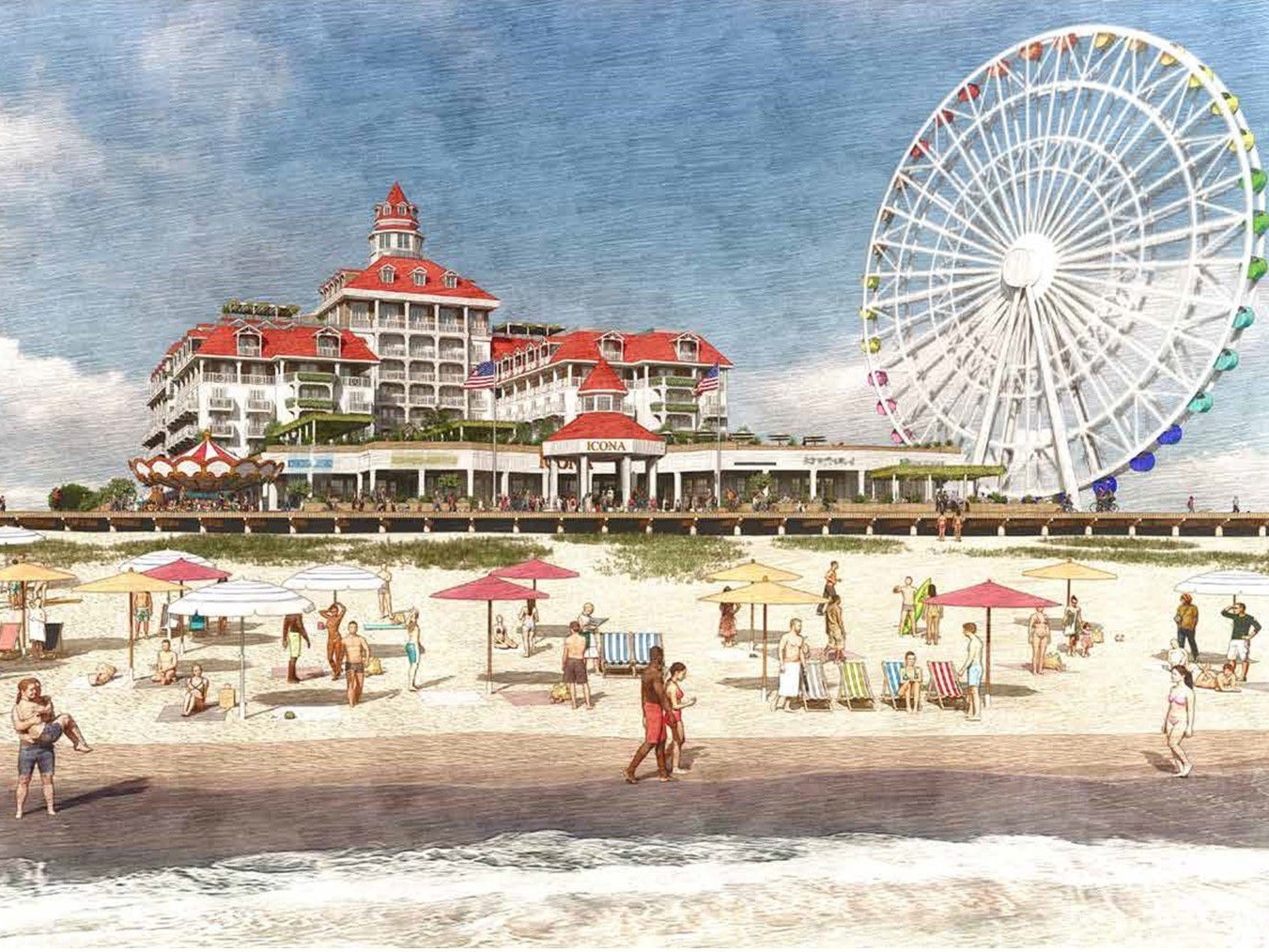
A rendering of the proposed new Icona in Wonderland Resort, which is proposed to be built on the site of the old Wonderland Pier. The proposal for a 252-room resort includes saving the iconic Ferris wheel and carousel.
The meeting was moved to the city’s Music Pier to accommodate the number of people, and turned heated at times.
Several speakers asked that several council members recuse themselves, accusing them of conflict of interests. Others said declaring Boardwalk frontage in need of rehabilitation in a wealthy beach town was illogical.
“The rehabilitation designation was created to help struggling deteriorated communities revitalize themselves,” said resident Dave Hayes, during public comment. “It was never meant to apply to expensive beachfront properties so wealthy developers like Eustace Mita could further increase their profits.”
Numerous business owners on the Boardwalk and elsewhere in town urged the council to move forward on the project.
“It’s been the better part of a year,” said Caitlin Quirk, president of the Downtown Merchants Association. “You’ve done your due diligence. You’ve done your homework.”
While neighbors argued the hotel idea was not in keeping with the family entertainment of the Boardwalk, business owners said the entire economic viability of the boardwalk was at stake.
Mark Raab, whose family owns numerous Boardwalk properties, said one of the stores near the closed Wonderland has no tenant this summer and is boarded up.
“Next year, it’s even dimmer,” he said. “We have five storefronts up for lease, two definitely not coming back. This is a crossroads that we are enduring. Thousands of people are going to walk by that boarded-up store and wonder why. We are out of time.”
Council member Jody Levchuk, who runs Jilly’s Arcade on the Boardwalk, said all the planning reports point to “the demise of the north end of the Boardwalk” if action wasn’t taken.
Mita, who has proposed back in November 2024 turning the property into Icona in Wonderland, had sought the designation initially as a way to fast track his hotel idea.
That did not happen.
In January, the city’s planning board deadlocked on whether to recommend declaring the site in need of rehabilitation and sent it back to Council.
Mita in the meantime moved on to other projects, including a “Soul Sanctuary” Catholic retreat in Ireland on the former grounds of a notorious abbey.
The future of Wonderland has generated protracted and heated debate in the Shore town, with residents initially vowing to save Wonderland and later arguing that “big hotel” would be a “big mistake.”
While some cling to the idea that an amusement park could still be opened there, most opponents have tried to argue that Mita’s proposal is too big for the site, would compromise nearby residential neighborhoods, and is not in keeping with the Boardwalk town’s family vibe and need for family entertainment.
How big the hotel will be remains a topic to be negotiated now between the city and Mita, who bought the land from Mayor Jay Gillian and initially leased it back to him to continue to run Wonderland.
Gillian made the decision to close the 65-year-old institution in October 2024, saying it was no longer financially viable. He declared personal bankruptcy this year, in part from failed business ventures. Voters elected him to a fifth term in May.
Council member Tony Polcini said his yes vote was “to give hope to the people that work hard,” in seasonal businesses.
“The beach and the Boardwalk are a part of our livelihood and why our homes are worth so much,” he said. “I really truly feel that moving this process forward to a yes will allow us to negotiate and do what is best for Ocean City.”
Voting no were council members Keith Hartzell and Sean Barnes, who said the regular zoning and planning process would be a better way to move forward.
Noted in the feds’ lawsuit: When the ordinance was making its way through the legislative process, City Solicitor Renee Garcia advised the mayor it would be “inaccurate” to suggest the city can “legally and practically enforce the Bill.”
The city responded Thursday afternoon to the Trump administration’s request for an injunction preventing the ordinance from taking effect next month by arguing the federal government doesn’t have standing until the city attempts to enforce its provisions.
Even if the administration had standing to sue, the bill’s provisions don’t interfere with the federal government’s work and “at most imposes an incidental burden,” the city’s response said.
Additionally, the filing contended the Trump administration can’t show irreparable harm because of exceptions that allow officers to conceal their identity. The city, meanwhile, has “a significant interest in protecting its residents and law enforcement officers,” it said.
“The Bill was enacted in response to the confusion and fear generated by the federal government’s deployment of large numbers of federal agents who subsequently applied aggressive enforcement tactics behind the mask of anonymity, undermining public safety and trust,” the city said.
The defendants in the case — the city, Parker, Garcia, and District Attorney Larry Krasner — are represented jointly by attorneys from the law firm Ballard Spahr.
“In essence, the city’s argument, which we have joined, is that this ain’t the right time,” Krasner said in an interview. “The City Council ordinance is not in effect yet. There has been no enforcement by the Philadelphia Police Department yet. You don’t even have a real case to consider.”
Krasner added that while he was in lockstep with the Parker administration on Thursday’s filing, further developments could necessitate his office to seek separate representation.
The Department of Justice declined to comment on the new filing.
A city Law Department spokesperson did not immediately respond to a request for comment.
The ordinance at the heart of the litigation makes it a crime for law enforcement officers, including Immigration and Customs Enforcement agents, to wear face coverings or conceal personal identifiers like badges and nameplates while carrying out their official duties in Philadelphia, and requires officers to identify themselves. It also prohibits the use of unmarked vehicles.
The bill includes exceptions allowing officers to wear masks in certain circumstances, such as medical emergencies or SWAT operations.
An officerwho violates the ordinance could be prosecuted, and risks up to 90 days in jail plus a fine.
The ICE Out package, including the mask law, goes into effect July 7.
The Trump administration has sued other jurisdictions, including New Jersey, over similar requirements. In April, the U.S. Court of Appeals for the Ninth Circuit found that a California bill requiring agents to “visibly display identification” violated the U.S. Constitution’s supremacy clause, which bars states from regulating federal government activities.
An awkward position for Parker
Defending the bill puts Parker and her administration in an awkward position.
Councilmember Kendra Brooks speaks during a news conference outside Philadelphia City Hall, Wednesday, June 3, 2026, in Philadelphia. Organizers called on local and state officials to restrict U.S. Immigration and Customs Enforcement involvement in public safety operations during the FIFA World Cup.
Brooks said she did not want the lawsuit to hold up the Parker administration’s implementation of the law.
“There is nothing in the lawsuit stopping the administration from implementing our ICE Out package on time,” she said.
Brooks had good reason to question the administration’s commitment to the legislation given Parker’s handling of it.
After the bills’ passage, Garcia advised Parker not to sign the bill banning law enforcement officers from concealing their identity, saying doing so “would send an inaccurate signal to the public that the Administration can legally and practically enforce the Bill.”
Parker followed her solicitor’s advice, signing six bills and allowing the seventh to become law without her signature.
As for Garcia’s concerns about the bill, the new filing from the city only notes that her letter advising Parker didn’t address the issue of standing or whether the issue is ripe for litigation.
DUBAI, United Arab Emirates — A United Nations agency paused the evacuation of ships through the Strait of Hormuz on Thursday after the British military said a vessel was hit by a projectile off the coast of Oman following the passage of several tankers that used a route backed by the U.N.
The head of the International Maritime Organization said the plan to move stranded ships out of the Persian Gulf through the strait will be on hold until the agency can confirm safety guarantees for the ships on the evacuation list and in the region.
The report of a strike came hours after Iran threatened vessels to stop using the route through the strait without Tehran’s permission. The vessel that was attacked was not part of the evacuation effort, said Arsenio Dominguez, the U.N. agency’s secretary-general.
A U.S. official told the Associated Press that the vessel was hit by an Iranian drone.
The official, who spoke on condition of anonymity to discuss a sensitive situation, said the merchant vessel Ever Lovely was attacked by a drone being flown by the Iran’s paramilitary Revolutionary Guard.
Following reports of the attack, Iran’s Persian Gulf Strait Authority — a new government agency established to control shipping in the strait — wrote on X that transit outside its own designated routes “will not be covered by the guarantee of safe passage.”
The United Kingdom Maritime Trade Operations center said the vessel sustained damage, but it reported no injuries or environmental effects from the attack off the coast of Oman.
An alternative passage would relieve pressure on economy
The opening of an alternative passage through the vital waterway would relieve pressure on the world economy and remove Iran’s main source of leverage in ongoing peace talks with the United States. U.S. Secretary of State Marco Rubio, on a visit to the Gulf to reassure American allies, said Washington was committed to the new route and ensuring that ships are able to transit the strait.
“If that stops, then we’re going to have a problem,” Rubio said Thursday before the report of the strike on the ship.
Traffic through the strait increased in recent days but was still well below prewar levels. Oil on Thursday briefly dipped below its last prewar price of just under $73 per barrel, a sign that the market believes the situation is improving.
The U.S. and Iran are still debating terms of an interim peace deal, including issues such as getting ships through the narrow mouth of the Persian Gulf and addressing the future of Iran’s stockpile of highly enriched uranium.
Under the memorandum of understanding signed last week, the U.S. and Iran have 60 days to iron out the details. As talks are held behind closed doors, President Donald Trump and Iranian leaders have seemed to negotiate in public, trading threats and claiming concessions the other side denies.
Meanwhile, a flare-up of fighting in Lebanon between Israel and Iranian-backed Hezbollah militants threatened the wider truce. Lebanon says five people have been killed by Israeli strikes over the past two days. Iran says the tentative deal to end the war would require Israel to withdraw from Lebanon — a condition Israel has rejected.
More ships pass through the strait, but far fewer than before the war
Oil tankers, led by the Stoic Warrior vessel, sailed along the United Arab Emirates and then Oman early Thursday, passing by Oman’s Musandam Peninsula fairly close to the shore. The route was laid out by Oman and the International Maritime Organization.
North of the route is a corridor in the center of the strait where ships moved freely before the war, transporting about a fifth of all the world’s oil and natural gas.
Iran said it mined that passage after the U.S. and Israel attacked it on Feb. 28. At least one mine has been sighted there.
Though some ships had been getting out of the strait, with U.S. military support, the U.N. agency’s effort was the latest to free trapped vessels. The shipping company Maersk said its container ship, the Maersk Baltimore, and another chartered vessel made it out on Thursday.
Last week, 125 vessels crossed the strait, up from 33 the week before, according to marine data and analysis firm Lloyd’s List Intelligence.
According to S&P Global, Wednesday saw 78 transits, the most since the war began, but still below the daily prewar average of 130 or more.
Iran says the new shipping route is ‘unacceptable’
The naval arm of the Revolutionary Guard issued a warning Thursday against using the new route.
In a statement carried by Iran’s state-run IRNA news agency, naval officials said the route was established without notice or coordination with Iran, calling it “unacceptable and completely dangerous.”
“The only authorized route for passing through the Strait of Hormuz is the one declared by the Islamic Republic of Iran,” the Iranian force said. “Vessel traffic outside these routes is extremely dangerous and prohibited.”
“Violators will be dealt with,” it added, without elaborating.
On Wednesday, the Guard threatened one tanker over the radio, with a soldier warning, “You are in range of my missiles and maybe [I] fire on you,” according to the private security firm Ambrey.
Rubio says the U.S. will ensure there are no tolls on ships
Rubio met with foreign ministers from the six-nation Gulf Cooperation Council to assure them that their interests would be protected in any agreement with Iran.
Those countries, including major energy producers reliant on the strait for exports, came under attack by Iran after the start of the war.
“There is no part in this deal that’s undertaken that in any way undermines the security, the stability or the prosperity of any of our partners in the Gulf region,” Rubio said at the meeting in Bahrain.
Bahrain’s foreign minister, Abdullatif bin Rashid al-Zayani, said the agreement brought a glimmer of hope but stressed that it was “critically important that Iran adheres to its obligations.”
Lebanon remains a flashpoint
A lull in fire between Israeli forces and Hezbollah that started Sunday began to show cracks after Israel said it targeted Hezbollah militants.
Lebanon’s health ministry said Thursday that three people were killed by an Israeli strike on a car in southern Lebanon.
Hezbollah has called the recent strikes a ceasefire violation but has not retaliated. The Israeli military said Thursday that it fired on two separate groups it suspected of being Hezbollah members. The strikes came as Lebanese and Israeli officials were in Washington discussing a proposed phased withdrawal of Israeli troops from southern Lebanon.
Israel’s military also said Thursday that a reservist soldier was killed in southern Lebanon.
The Florida Everglades immigration detention center known as “Alligator Alcatraz” has served its purpose, Gov. Ron DeSantis said Thursday, closing the makeshift facility heralded by the Trump administration and denounced as inhumane by civil rights groups.
DeSantis said the center, which opened in July 2025, was always meant to be only temporary until more permanent detention centers could be secured and federal officials now have that capacity.
“We stepped up because there was a gap, but my hope is that they’ll be able to handle that,” the Republican governor said at a news conference at the facility.
Officials announced a temporary closure of the facility earlier in June and sent all of the detainees to other facilities, saying hurricane season made it unsafe to keep them in the Everglades.
Immigration advocates said the center’s tents were never safe or humane for holding people. Detainees at the facility have talked about their difficulty accessing lawyers and described poor physical conditions, including worms in the food, toilets that didn’t flush, floors flooded with fecal waste, and mosquitoes and other insects everywhere.
They described large white tents with rows of and rows of bunk beds surrounded by chain-link cages. The air-conditioning could shut off abruptly in the sweltering Florida heat. Detainees could go days without showering or getting prescription medicine.
Advocates for immigrants said the closure of “Alligator Alcatraz” does nothing to stop the harm to people who spend months in custody as their families suffer. The Florida Immigrant Coalition said the only winners were corporations and contractors who profited millions of dollars as Republicans pushed an immigration emergency that does not exist.
The detention center of tents and trailers was built by DeSantis’ administration in a matter of days. The governor and President Donald Trump said the center was critical to Republican efforts to return people in the country illegally back to their home countries.
“There is no question this mission has made the state of Florida safer,” said DeSantis, noting that 21,000 people were deported through the facility.
Even with the closure of the facility, Florida continues to play a key role with other detention centers and an increased role in helping with immigration enforcement, White House border czar Tom Homan said at Thursday’s news conference.
“Gov. DeSantis did a good job, and he’s going to continue doing what he’s doing to help us make this country safe again,” Homan said. “This isn’t the end of relationship. This is a continuation.”
Lawyers for the immigrants at the facility said their clients suddenly started leaving for other facilities in South Florida, California, Arizona, Louisiana, and Texas earlier this month, disappearing for about a week before their attorneys and families were told where they were sent.
DeSantis said the Everglades airstrip the facility was built around will continue to be used.
Environmental groups sued over the detention center, saying Florida officials never got the proper permits or did required reviews on its impact.
The state and federal governments built the site with no oversight and closed it with no input, but they will still be held responsible even with the site is closed, said Paul J. Schwiep, an attorney for Friends of the Everglades and the Center for Biological Diversity.
“The administration believes it can quietly walk away and leave its mess for others to clean up. The law will not allow them to escape accountability. We will ask the courts to ensure that the environmental damage is fully addressed,” Schwiep said in a statement Thursday.