The 42-year-old man in addiction who died inside a Philadelphia jail days after his arrest in Kensington had been flagged as an “emergency” case by an intake worker at the jail, and should have received one-on-one supervision in the hours before he collapsed, according to records from the Department of Prisons.
But that didn’t happen, and instead, Andrew Drury died alone inside the holding cell, without having received a formal behavioral health evaluation by the prison staff, according to the records obtained by The Inquirer. His cause of death remains under investigation, though when he was jailed in the fall, he had been hospitalized multiple times from withdrawal-related health complications.
A spokesperson for the Philadelphia Department of Prisons declined to comment Friday.
Drury had been picked up by Philadelphia police on the night of March 6, after officers encountered him at Kensington Avenue and Somerset Street, and learned he had outstanding bench warrants related to a drug case in Maryland and a 2022 violation of a protection-from-abuse order filed in Philadelphia.
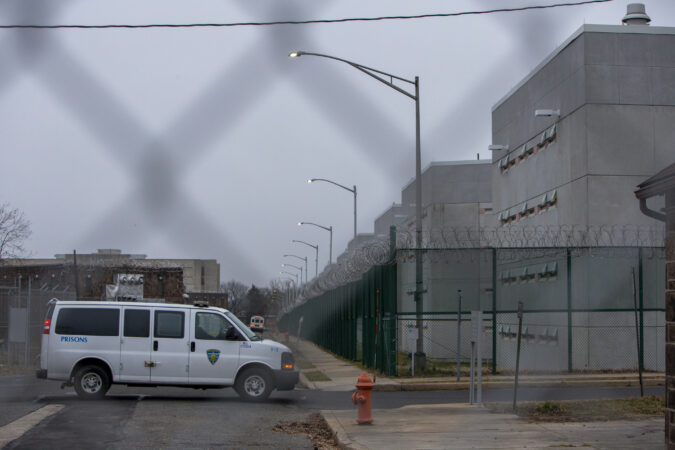
Police said Drury received off-site medical treatment over the next day before he was transferred to Curran-Fromhold Correctional Facility around 2:15 a.m. on March 8. Police declined to say what kind of treatment he received, where he was treated, or how he was cleared for transfer to the jail.
Drury remained in an intake room at the jail until the next afternoon, waiting to be medically evaluated and assigned to a cell block. On March 9, around 9:30 a.m., an intake worker for the prisons assessed Drury and wrote that he was experiencing a range of physical and behavioral health issues and described him as extremely agitated and confused, according to the records.
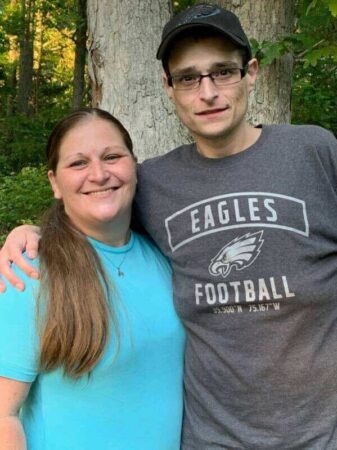
Andrew Drury, left, and Jennifer Barnes had been homeless and struggling with addiction in Kensington for about two years. Drury died on March 9 inside a Philadelphia jail.
The employee labeled Drury as an emergency case, which, according to the records, should have required that he receive one-on-one supervision until he could be evaluated by a behavioral health worker.
Instead, Drury remained in his intake cell for another six hours. A jail guard walking through the area found him unresponsive at 1:45 p.m., and despite administering two doses of Narcan and other lifesaving measures, he was pronounced dead at 2 p.m., according to a spokesperson for the prison.
The Philadelphia Medical Examiner’s Office said Wednesday that doctors are awaiting toxicology results to determine his cause of death.
Drury had long struggled with an opioid addiction, and had been experiencing homelessness in Kensington for about two years, said his longtime girlfriend, Jennifer Barnes.
In an interview this week, Barnes, 44, said she believes he died from health complications related to withdrawal — something that he has been hospitalized for in the past.
When Drury was arrested in October on bench warrants related to the same cases, he was hospitalized multiple times, including for more than a week, after suffering a mild heart attack and other issues while going through withdrawal in jail, according to Barnes and a source familiar with Drury’s care at the time.
After Drury was released in November, Barnes said he was in and out of the hospital because of ongoing chest pains and shortness of breath.
Barnes said she worried about his health as she watched police arrest him that night.
“The withdrawal, it’s not good for him,” she said she told the officers. “He needs medical attention.”
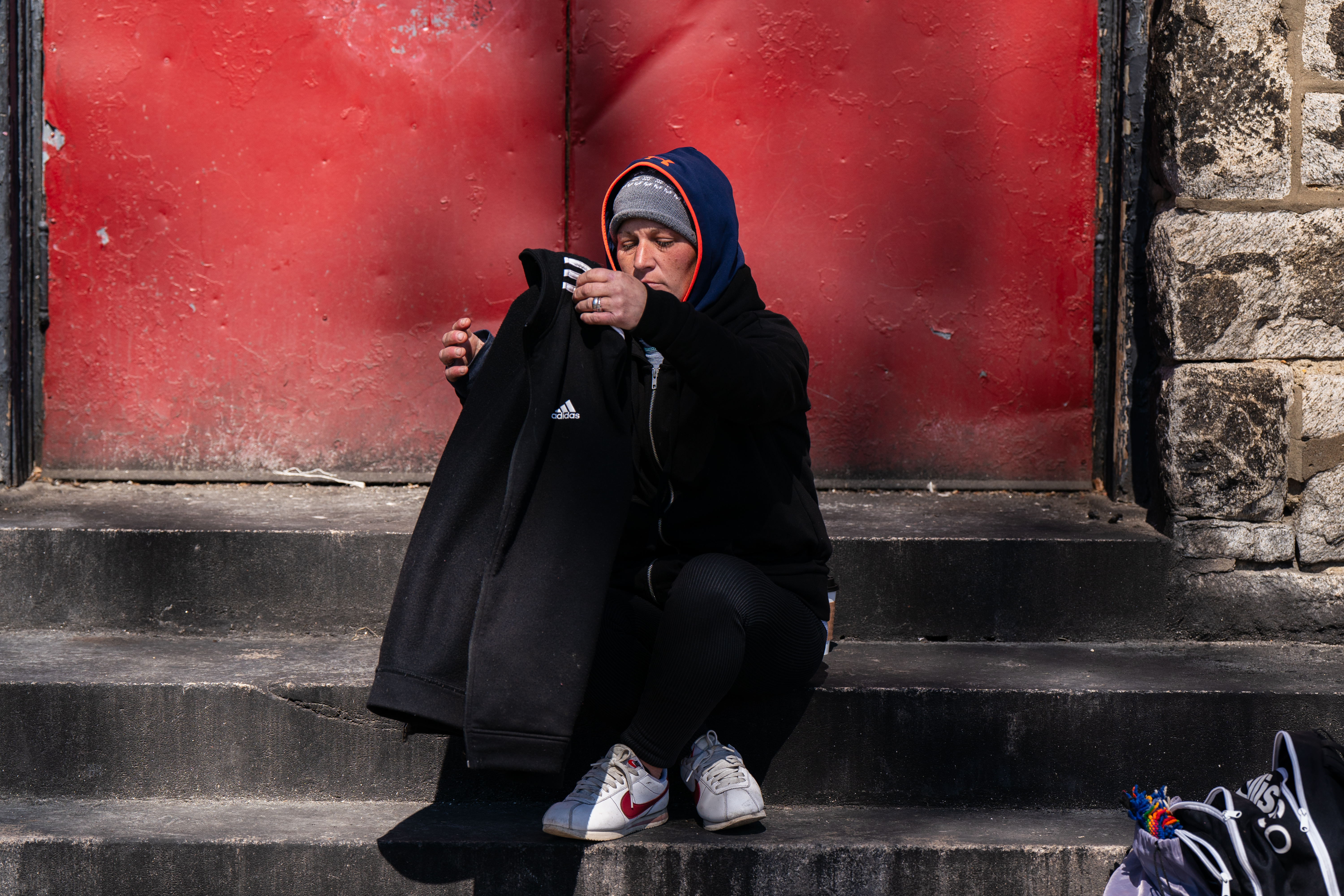
Jennifer Barnes, whose fiancee Andrew Drury died while in jail, shown here in Philadelphia on Tuesday.
Drury’s death comes as the city ramps up enforcement efforts in Kensington, a section of the city that has long experienced concentrated violence, homelessness, and drug use in and around its massive open-air drug market. Mayor Cherelle L. Parker has said her administration would shut down the drug activity in the area and return a quality of life to the neighborhood’s residents.
But some advocates have warned city and law enforcement officials that the withdrawal effects for people who use opioids can be life-threatening, and that the understaffed jails might struggle to respond to people’s health needs in those circumstances.
Barnes said she and Drury were both from South Philadelphia, and had been dating since 2012 after meeting in a luncheonette in the neighborhood. They were not married, she said, but wore rings as if they were.
Andrew Drury and Jennifer Barnes in a photo before they became homeless in Kensington.
Barnes said she has struggled with addiction since about 2008. Drury also used drugs by the time they had met, she said, his troubles beginning after he underwent a weight loss surgery and got hooked on pain killers. For many years, they were both able to hold jobs and hide their addiction.
They bounced between friends’ and families’ homes, she said, until they were kicked out of Drury’s mother’s house in 2021 and she got a Protection From Abuse order against him. They’ve been on the streets of Kensington since about the summer of 2023, she said.
Drury was funny and loving, she said, and helped protect her from the dangers of living on the streets. They had both recently talked about wanting to go to rehab and getting their lives back on track.
Jennifer Barnes holds the sweatshirt of her longtime boyfriend, Andrew Drury, who died in jail on March 9.
Since his death, she said, she feels in a fog. She has connected with a friend who found a bed for her at a recovery house in South Jersey, and she hopes to go next week.
“For myself, and for him, it’s the best thing to do,” she said. “This way he won’t have to worry anymore.”
A 42-year-old man with a history of addiction died inside a Philadelphia jail over the weekend just days after he was arrested in Kensington, officials said.
Andrew Drury was picked up on a bench warrant by Philadelphia police near Kensington and Lehigh Avenues on Thursday night and was found collapsed inside the intake room at Curran-Fromhold Correctional Facility on Sunday afternoon, according to police and prison officials. Officers who found Drury administered two doses of Narcan, among other lifesaving measures, but he did not regain consciousness, officials said.
Drury, whose cause of death remains under investigation, was addicted to opioids and had been hospitalized multiple times for withdrawal-related complications when he was jailed in the fall on similar warrant issues, according to a source familiar with his care who was not authorized to speak publicly.
Philadelphia police arrested Drury in Kensington around 10:30 p.m. Thursday on outstanding bench warrants related to a drug case in Maryland and a 2022 violation of a protection-from-abuse order filed in Philadelphia.
Sgt. Eric Gripp, a spokesperson for Philadelphia police, said Drury was evaluated and “received off-site medical treatment” before he was transferred to the jail on State Road around 2:15 a.m. Saturday.
People who use drugs are often gathered near Kensington and Somerset Avenues, an intersection at the heart of Philadelphia’s opioid crisis.
Drury had been in an intake room at the facility for nearly 36 hours, waiting to be assigned to a cell block, when a jail guard found him unresponsive around 1:45 p.m. Sunday, according to John Mitchell, a spokesperson for the Philadelphia prisons. He was pronounced dead at 2 p.m., Mitchell said.
The cause of Drury’s death was under investigation, he said, but no foul play was suspected. Gripp declined to say where and under what circumstances Drury was treated medically while in police custody, citing an ongoing investigation. It is not clear whether Drury was medically evaluated once he arrived at the jail.
Drury is the first person to die in the custody of the Philadelphia Department of Prisons this year, and his death comes as the city ramps up drug enforcement in Kensington and arrests more people in addiction. Advocates have warned city and law enforcement officials that the withdrawal effects for people who use opioids can be life-threatening, and that the understaffed jails might struggle to respond to people’s health needs in those circumstances.
His death follows that of Amanda Cahill, 31,who died inside a cell at the Philadelphia Industrial Correctional Center in September, days after she was arrested in Kensington on charges related to drugs and open warrants. The Philadelphia Medical Examiner’s Office said Tuesday that an autopsy showed Cahill died from drug intoxication.
At least 29 people in addiction have died in Philadelphia jail or police custody since 2018 for reasons that appear connected to drug intoxication or withdrawal, according to medical examiner records reviewed by The Inquirer.
Amanda Cahill, 31, is seen here in a photo provided by her family. She died in Philadelphia Industrial Correctional Center in September.
Drury’s legal troubles go back to at least July 2021, when he was arrested for possession with intent to distribute drugs in Maryland, according to court records. Then, in July 2022, he was arrested in Philadelphia for violating a protection-from-abuse order that his mother had filed against him. He was later released on bail.
After Drury failed to appear in court in Maryland and Philadelphia, warrants were issued for his arrest. He was picked up by police on Oct. 1, 2024, in connection with those pending cases.
While in custody, Drury was hospitalized at least twice, including for more than a week, after experiencing health issues related to withdrawal, said the person familiar with his care, who had reviewed the records related to Drury’s earlier cases.
He was released from jail in November after authorities in Maryland declined to extradite him, the source said. Because he did not return to Maryland to resolve his case, there was still an outstanding warrant for his arrest. And when Drury did not appear for a December hearing in his Philadelphia case, a second warrant was issued.
The warrants landed him back in police custody on Thursday.
Two of Drury’s relatives, who asked not to be identified for privacy reasons, said they did not know he was struggling with addiction. They described him as a warm and generous person, a good listener, and a helping hand.
“I feel that something is not right,” one relative said. “I don’t know, and I won’t know, I guess, until I can get the coroner’s report. I’m in the dark right now.”
Andrew Pappas, pretrial managing director of the Defender Association of Philadelphia, said Drury’s death underscores the dangerous conditions inside Philadelphia’s jails, which face an ongoing staffing shortage.
“We continue to see the effects of that with yet another death in custody,” he said.
It was a tough two-and-a-half-week period: Students accused of impersonating ICE agents. One student accused of shooting and killing another. A student stabbing a former student 13 times. And a student falling from a light pole during a post-Eagles celebration and dying from his injuries.
These high-profile incidents involved Temple University students and three of the four occurred on or near campus, posing another test for new president John A. Fry.
Some say they are gratified that the administration communicated swiftly and thoroughly about the incidents, which wasn’t always the case in the past.
“That’s been really great to have such a quick turnaround time,” said Ray Epstein, president of student government. “Even if it is the middle of the night, we are getting an email immediately.”
After Chase Myles, a 20-year-old student from Maryland was shot and killed atabout 11 p.m. Feb. 6, Fry notified the campus in an email at 3:46 a.m., and just hours later was on a plane back to campus from an alumni event in Florida so he could be on the ground to talk to the victim’s parents and help coordinate the response.
By contrast, it took nearly twice as long for the university to get out an email about the shooting death of Samuel Collington outside his off-campus residence in November 2021 even though that happened in the daytime. The email did not come from then-president Jason Wingard, but rather from then-safety chief Charles Leone. The attack put the campus on edge and stirred fear in the Temple community among students, parents, and staff — and social media posts circulatedwith the hashtag “Where’s Wingard,” who laterresigned after less than two years on the job.
Donna Gray, Temple’s campus safety services manager for risk reduction and advocacy services, greets Temple president John A. Fry during his first day of work Nov. 1.
That incident ― which happened as part of an attempted robbery and carjacking ― was different in that it involved random violence by a stranger in the neighborhood.
But even the Temple police officers’ union, which has been critical of university leadership in past years, has noted Fry’s efforts in dealing with the recent multiple incidents.
“He seems to be handling it well,” said Sean Quinn, president of the Temple University Police Association. “Without a doubt, as soon as these things happen, he’s right on top of it.”
“It is up to us to tell the bad news first, personally to all of our community,” he said. “Number two is just to keep a steady stream of communications following that even when there is not a whole lot to say. It’s worth checking in.”
Parents on the university’s family council said they are confident in the university leadership’s handling of the incidents, too.
“It seems like there are the right people in place,” said Allison Borenstein, a Temple alumna whose son, a sophomore, attends the university. “They handled it well, and I think they are on it.”
Borenstein, an event planner at a synagogue who lives in Cherry Hill, noted such incidents could happen near any college campus and said she feels that Temple sometimes gets an unfair rap.
“There’s nothing that the school could have done in advance,” she said.
Emma Legge, an alumna and parent of a senior who lives in New York, said she feels she is kept informed, and she checks in with her son after receiving a communication.
“I do feel as a parent that Temple is doing what it can within the city of Philadelphia to manage what happens,” said Legge, who got both her bachelor’s and master’s degrees at Temple and met her husband, also a twice Temple alumnus, there. “I have a lot of confidence in the university and the people who are on board.”
Philadelphia Police Commissioner Kevin J. Bethel and Jennifer Griffin, Temple University vice president for public safety, after graduation ceremonies for the Police Academy Class #402, new officers of the Philadelphia Police Department and Temple University Police Department, at Temple’s Performing Arts Center in June.
That includes Jennifer Griffin, vice president for public safety, she said.
“I feel very reassured by the measures police are undertaking to be involved in the neighborhood and be involved with students,” said Legge, who works in student affairs administration at a New York college.
Griffin said after the recentincidents, she met with the student safety advisory committee and its members saidthey appreciated the accurate and timely information, which she said she has always aimed to provide since starting at Temple about two and a half years ago.
“We hope it decreased anxiety,” she said.
Of Fry, she said, “I thought he handled all the incidents with thoughtfulness and decisiveness and direction that I would expect from somebody with his level of experience.”
The police union has been critical of Griffin, even calling for her to resign or be fired over staffing issues. University leadership has backed Griffin.
Quinn said the union now is trying to work things out, noting that the university is amid a police staffing study conducted by an external company.
“I just don’t want to come to work every day feeling like I’m butting heads,” he said. “I actually would like to work with whoever I have to work with to see if we can accomplish things.”
Fry said he expects to have the results of the staffing study in a couple months. He said he’s pleased with the work campus police do, noting he had gone on ride alongs with them and wants to make sure they have enough help.
Ray Epstein, Temple student government president.
While Epstein, the student government president, endorsed the university’s handling of communication about the recent shooting, she said it also should have issued an alert after a report about a student placing hidden cameras in a fraternity bathroom in late November and recording people without their knowledge. Instead the campus learned of it through social media earlier this month, she said. The student has been arrested and charged in that case.
“I was not sure when or if the fraternity/university would ever disclose this incident, but I wanted to inform everyone in case this was never announced,” someone posted on a Temple Reddit page, with court documents about the case.
“Maybe it’s perceived by campus safety as not being an ongoing threat,” Epstein said. “I’d argue that it is because when these things happen in a house, you can’t possibly know until an investigation is concluded who all was involved.”
Griffin countered that the investigation was handled swiftly, the individual was identified and arrested, and there was no ongoing threat to the community. A Temple alert is sent when there is an immediate threat to the community, she said.
In this case, people who lived in the house notified law enforcement after the equipment was found, the equipment was taken and the individual who put it there was identified, she said.
“The people who called in the cameras were cooperative,” she said. “It was an isolated incident at an off-campus residence … and student affairs reached out to those who were impacted.”
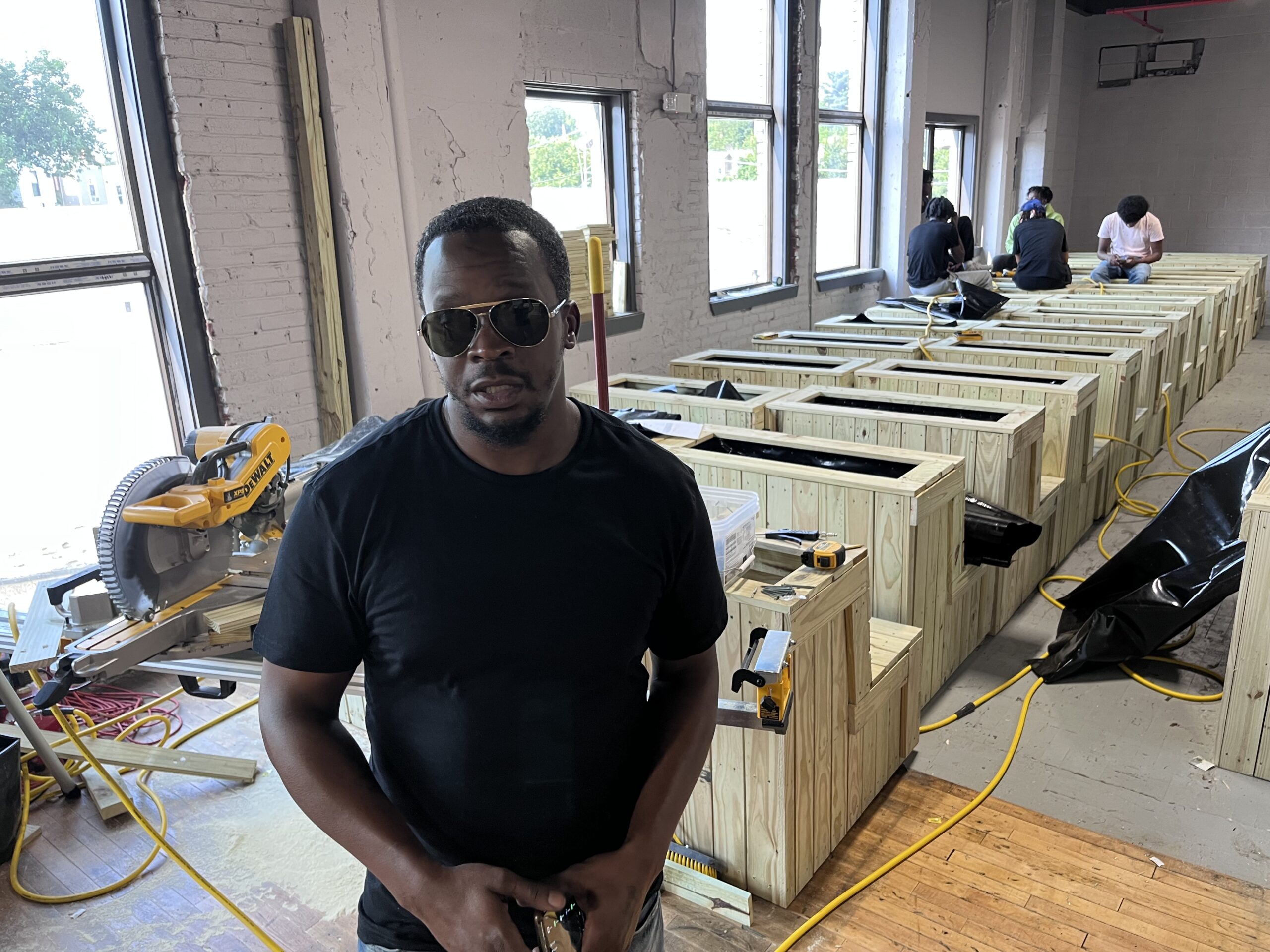
A crew working at a Philadelphia warehouse Tuesday was well on its way toward building 120 combination shade stations and planters to be installed this summer on sidewalks in the Kingsessing, Point Breeze, Grays Ferry, and Haddington neighborhoods.
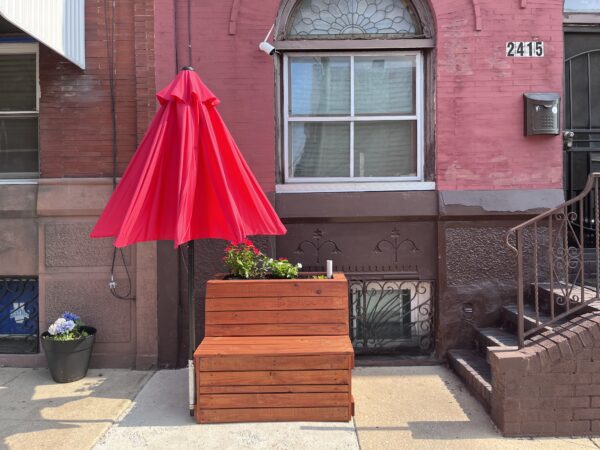
The stations, many of which have already been installed, are built of pressure-treated lumber and come with a bench, umbrella, and decorative planter.
“This idea started as a job creation and heat mitigation program but turned into a broader set of things,” said Franco Montalto, a Drexel engineering professor who directs the program. “We found that a lot of people like these planters. They create social opportunities, and they are an aesthetic improvement.”
The shade can’t come soon enough. Temperatures are forecast to reach 97 on Friday, setting up a dual summer ick for Philadelphians: high heat, high humidity. Together, they’ll combine to make it feel like 106.
This week’s heat wave comes on the heels of data showing Philadelphia ranks as the sixth highest U.S. city for the number of people experiencing an “urban heat-island effect” of more than 9 degrees compared to those living in nonurban areas. It is also one of the few cities that have neighborhoods exceeding 12 degrees of heat island effect.
!function(){“use strict”;window.addEventListener(“message”,(function(a){if(void 0!==a.data[“datawrapper-height”]){var e=document.querySelectorAll(“iframe”);for(var t in a.data[“datawrapper-height”])for(var r=0;r<e.length;r++)if(e[r].contentWindow===a.source){var i=a.data["datawrapper-height"][t]+"px";e[r].style.height=i}}}))}();
Where it’s hottest
The data from the nonprofit Climate Central provide a model for which city neighborhoods are most vulnerable during heat waves because of the density of sidewalks, streets and buildings, along with the lack of tree cover.
Parts of Center City rank among the top for a heat island effect of more than 12 degrees. Center City, however, certainly has residents but is mostly a large swath of offices and retail and not representative of the city’s true residential neighborhoods.
Those highly residential areas, such as Fairmount, Spring Garden, North Philadelphia, East Schuylkill, Southwest Center City, Point Breeze, Kensington, Bella Vista, and Southwark, all bake up to 10 degrees higher than surrounding neighborhoods outside the city, the data suggest.
City officials have said previously that temperatures in some neighborhoods, such as Hunting Park, can rise even higher, leaving medically vulnerable residents at risk. This year, Mayor Jim Kenney’s administration launched a 10-year Philly Tree Plan that calls for planting thousands of trees to increase the city’s canopy to 30% as a way of tackling the disparity.
In general, areas of the city near big parks, with more detached homes and more tree canopy fare much better. Pennypack, West Oak Lane, Overbrook, Olney, Frankford, Bustleton, Northeast Philadelphia, East Falls, and Manayunk all experience a heat-island effect of less than 7 degrees.
(function() {
var l2 = function() {
new pym.Parent(‘heatisland26’,
‘https://media.inquirer.com/storage/inquirer/projects/innovation/arcgis_iframe/heatisland26.html’);
};
if (typeof(pym) === ‘undefined’) {
var h = document.getElementsByTagName(‘head’)[0],
s = document.createElement(‘script’);
s.type = ‘text/javascript’;
s.src = ‘https://pym.nprapps.org/pym.v1.min.js’;
s.onload = l2;
h.appendChild(s);
} else {
l2();
}
})();
Philly’s islands of heat
Climate Central did not base its study on actual temperatures, but rather on modeling that combines data from satellite imagery, impervious land cover, green space, building footprints, transportation, and census tract population data.
Scientists use the data to model which tracts would likely be warmer than others. For example, buildings, roads, and other infrastructure absorb and reemit the sun’s heat more than forests and rivers. Dark surfaces, such as black asphalt roofs, reflect less light and retain more heat. As a result, certain areas can become hotter during extreme heat relative to suburban and rural areas, according to the U.S. Environmental Protection Agency.
The heat-island effect strikes a mix of neighborhoods:
For example, a neighborhood in the eastern part of North Philadelphia has an urban heat-island effect of more than 11 degrees. The population is 12% Hispanic, 16% Black, 44% white, and 23% Asian.
A cluster of streets in Kensington has a heat-island effect of 10 degrees, according to the Climate Central data. The neighborhood is 51% Hispanic, 25% Black, and 19% white. But a cluster in South Philly that’s 73% white, 10% Hispanic, 13% Asian and 2% Black sees the same 10 degree effect.
One of the least impacted parts of the city, West Oak Lane, with a 6.6 degree heat-island effect, is 94% Black. And people living in mostly white Bustleton experience the same effect.
The data, however, differ from Philadelphia’s Heat Vulnerability Index, which is used to indicate neighborhoods most at risk during extreme heat events. The city’s index takes into account more than just temperature. It looks at social, economic and health factors such as age, education, language barriers, percent of people living in poverty, race and ethnicity, and social isolation. It looks at the number of people who have asthma, heart disease, and other health issues.
For example, the Climate Central data give a census tract in North Philadelphia a heat-island effect of 7.75 degrees, which is not among the highest in the city. But the city assigns the same tract a “very high” score on the Heat Vulnerability Index. The neighborhood is 95% nonwhite, many live below the poverty line and have obesity and hypertension.
“Every day is a learning experience,” said Omar Sewell, 42, of South Philadelphia, who is working under a Drexel-led program to build shade stations for city sidewalks. Sewell spoke at the program’s rented warehouse in Kingsessing on Tuesday.
Finding shade
Jennifer Brady, a former EPA staffer who conducted the analysis for Climate Central, said it makes sense that Center City would show a high degree of heat-island effect because of the population density, paucity of trees, tall buildings, and infrastructure that absorbs heat and reduces airflow.
The impact of heat on people in Center City might be much less than in other neighborhoods, Brady said. That’s because people in Center City tend to be wealthier with the means to escape or have easy access to air-conditioned apartments, offices, stores, or shaded square.
“There are other neighborhoods that are not only high risk, but you can’t walk three or four blocks to find any kind of cover or shaded area,” Brady said. “That’s not accounted for in the data. That’s something not explicitly in these numbers, but is an important consideration when you’re thinking about people being able to escape from the heat.”
So, lower-income residents of color tend to bear the brunt of extreme heat’s impact. In 2020, for example, the Hunting Park Neighborhood Advisory Committee surveyed residents about how they cope with heat and asked how many had air-conditioning. Out of 563 who answered, only 100 had air-conditioning.
To help residents cope, the city operates scores of cooling centers, which can include air conditioned buses.
Back at the Drexel program, Oman Sewell, 42, of South Philly was working in a warehouse in Kingessing that Montalto’s program rents to build the shade-giving planters. The planters are placed with guidance from of local community organizations. It’s the fourth year of the program, which is funded by the William Penn Foundation and started with planter installations in Hunting Park.
Sewell started working in June under the tutelage of architect Angelo Zaharatos, founder of Arxis League, a New York-based design group. Sewell was busy Tuesday helping assemble the planters after having made many of the cuts on a miter saw.
Sewell is enthusiastic about the program and credits Zaharatos with daily uplifting readings that might come from, say, Marcus Aurelius, a Roman emperor and philosopher.
“Every day is a learning experience,” Sewell said. “It opens your mind, showing you can actually uses these building blocks and turn the skills into something you can use the rest of your life.”
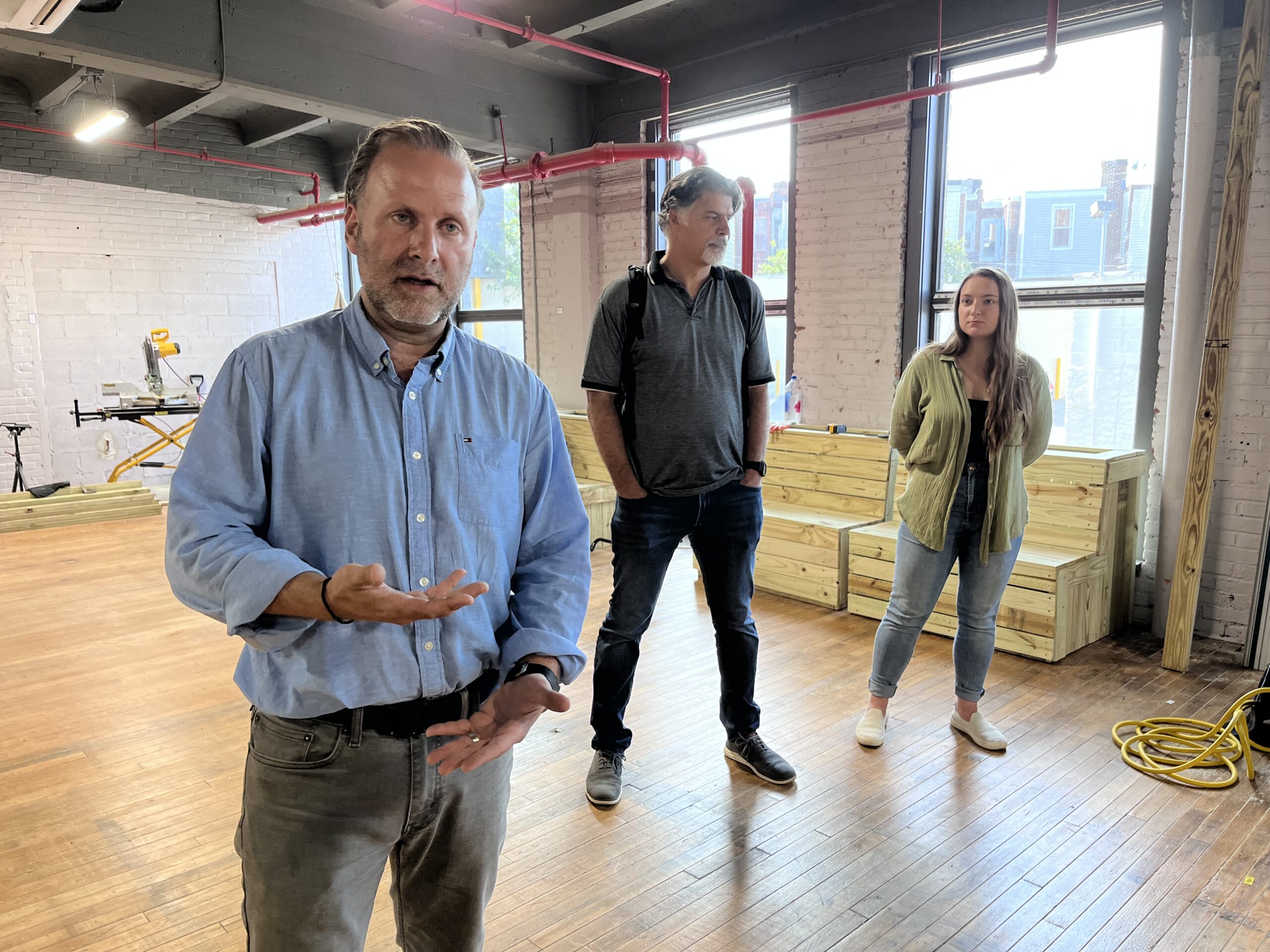
Architect Angelo Zaharatos explains how shade-giving planters are built at a warehouse in Philadelphia’s Kingsessing neighborhood. Drexel professor Franco Montalto (middle) oversees the program. Nikki Pearl (right) manages it.
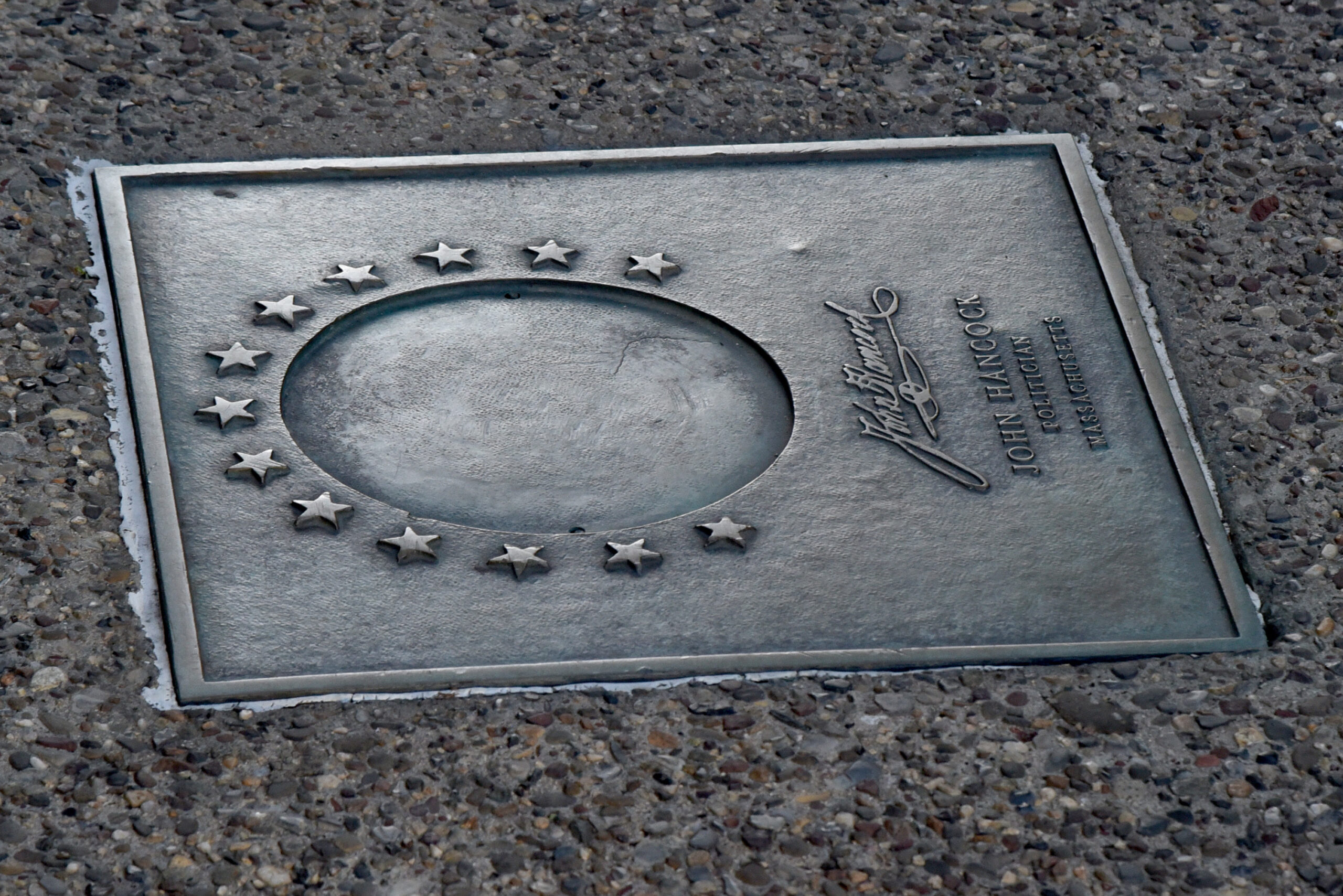
John Hancock has lost his face. So has Pennsylvania’s George Clymer.
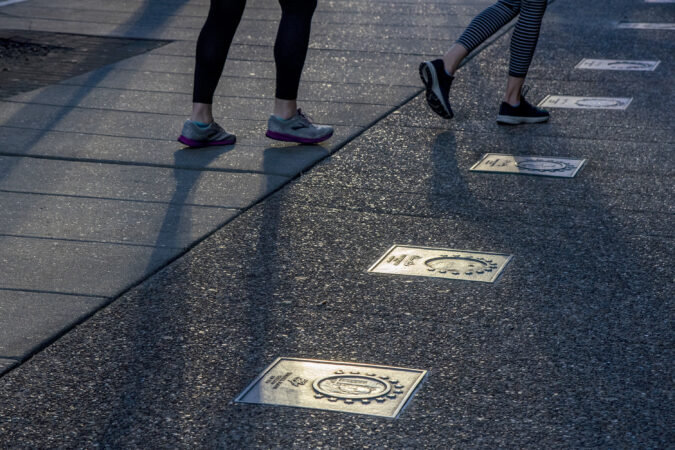
So have 12 other of the 56 signers of the Declaration of Independence whose memorial plaques have been consigned to the soles and heels of pedestrians in the 600 block of Chestnut Street, a block from where they put their lives on the line on July 4, 1776.
These days, the bronze plaques embedded in a sidewalk outside a Wawa, have become orphans, trodden upon daily and, literally, defaced.
The John Hancock plaque with the missing face.
They were donated by the Franklin Mint — whose roots, coincidentally, are in Wawa, Delaware County — for the city’s Bicentennial celebration in 1976.
The owners of the adjacent Public Ledger Building, who were not immediately available for comment, have assumed responsibility for the maintenance of the plaques, a spokesperson for the Center City District, a building tenant, said Saturday. However, they evidently have not been able to protect the plaques from vandalism.
Exactly how the faces disappeared is a mystery, and while a police spokesperson said that no incidents of theft have been reported, the remnants of glue and missing bolts suggest the faces were removed.
“That’s terribly sad,” said Ann Meredith, who as director of the erstwhile “Lights of Liberty” group had a lot to do with how the plaques wound up where they are today.
A bit of history
As part of an exhibit that The Inquirer called a “delightful” and “appropriate way” to teach history, the plaques were dedicated on May 10, 1975, the 200th anniversary of the convening of the Continental Congress.
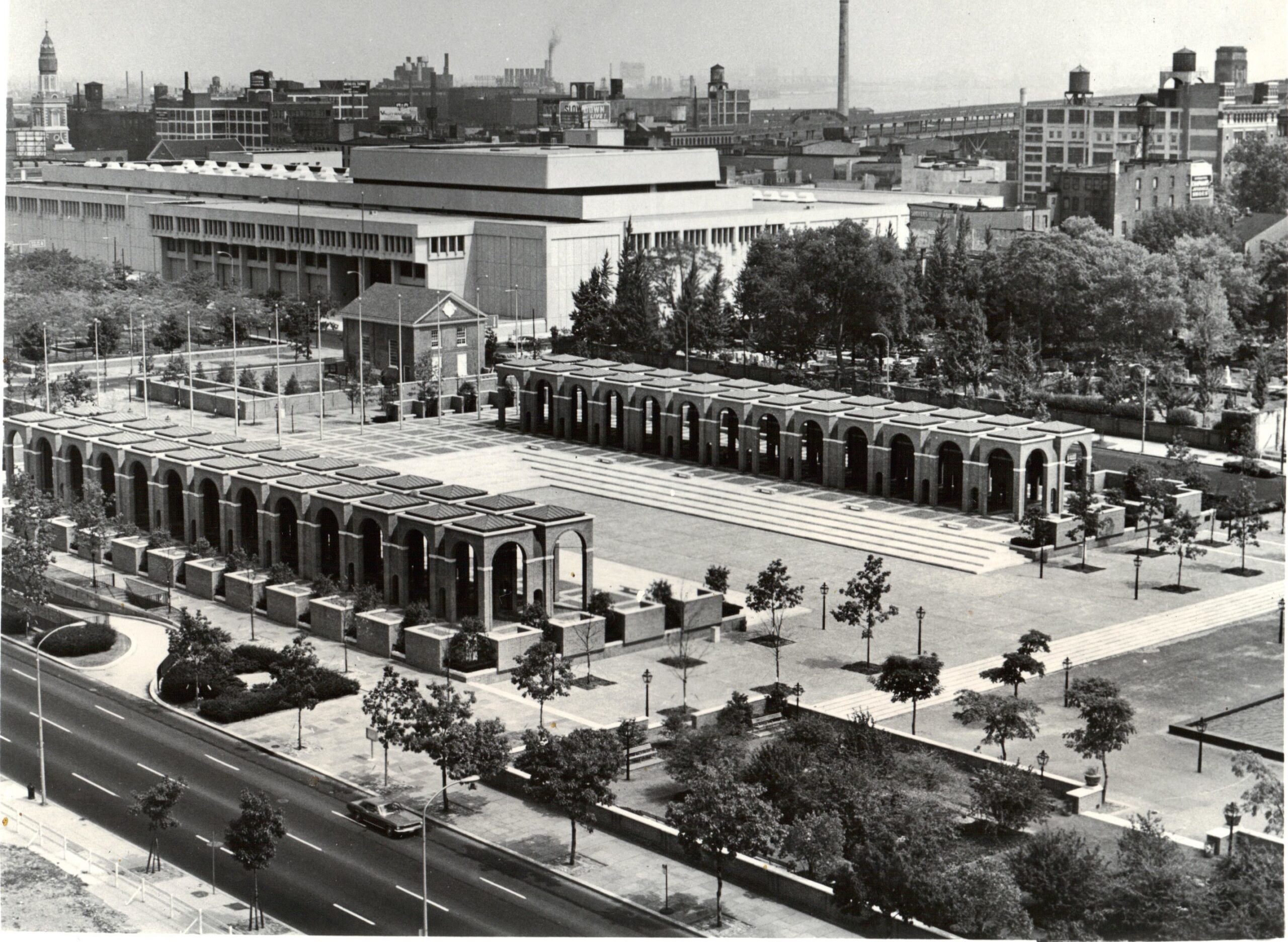
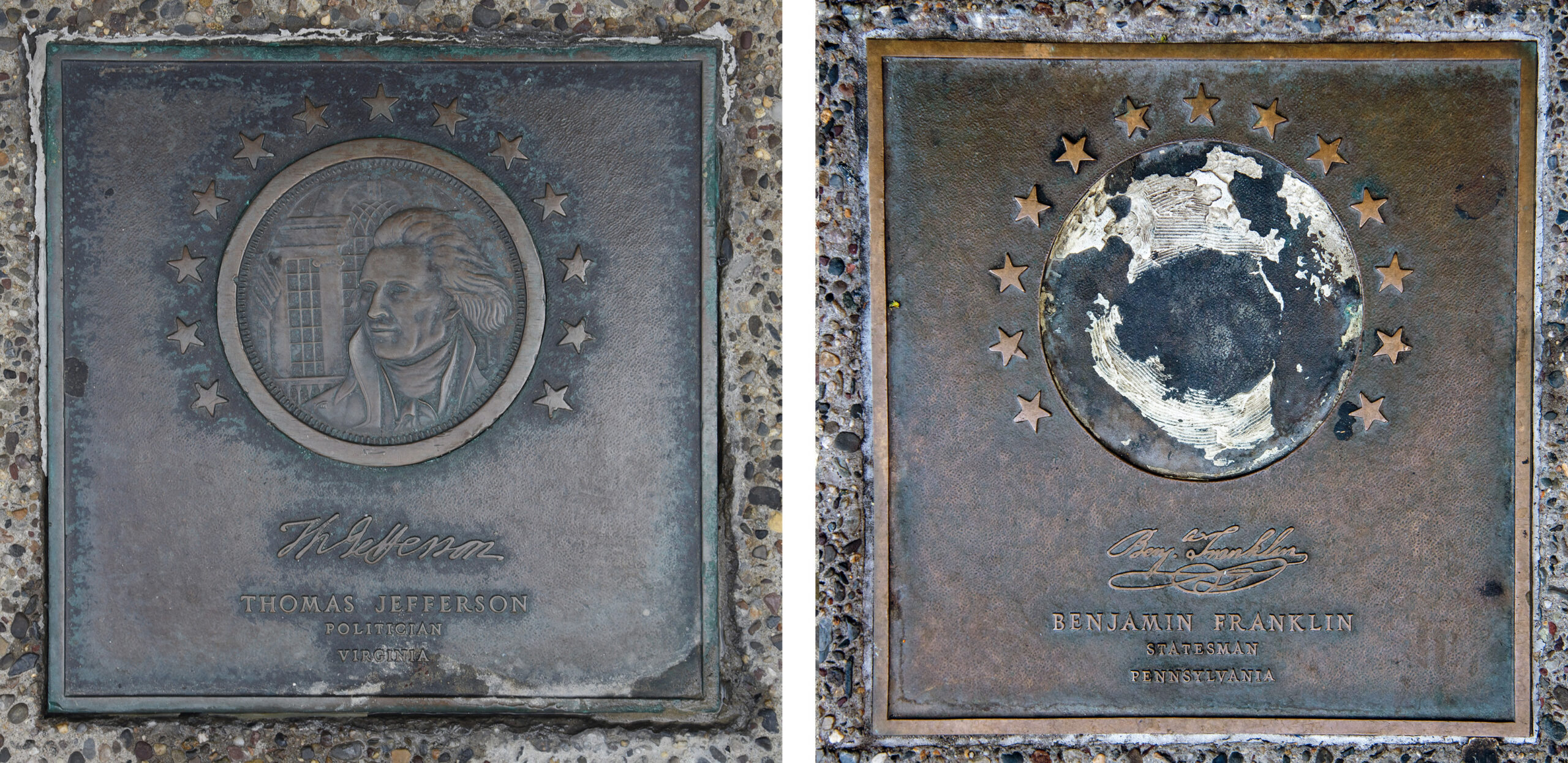
Just over a square foot, each one contained the image of a signer and a replica of the signature that appeared on the Declaration. They were mounted beneath the arches of brick colonnades on the Judge Lewis Quadrangle, along with flags of the states, ready for a Bicentennial celebration for which Philadelphia aspired to be a centerpiece.
The old Judge Lewis Quadrangle pavilions, which houses the bronze plaques commemorating the 56 signers of the Declaration of Independence. The site now is occupied by the Independence National Historical Park Gateway Visitors Center.
After the Bicentennial, Independence National Historical Park planned a major transformation.
“We found out the NPS was going to dispose of them,” said Meredith, who was running Lights of Liberty, a historical sound-and-light show that she described as “a theme-park experience in one of the most protected historical areas in America,” on Independence Mall. “We asked, ‘Can we have them?’”
The plaques were to be installed on Chestnut, just outside the park’s property, as a “Signers Walk” — an “added feature” to the light show, said Meredith.
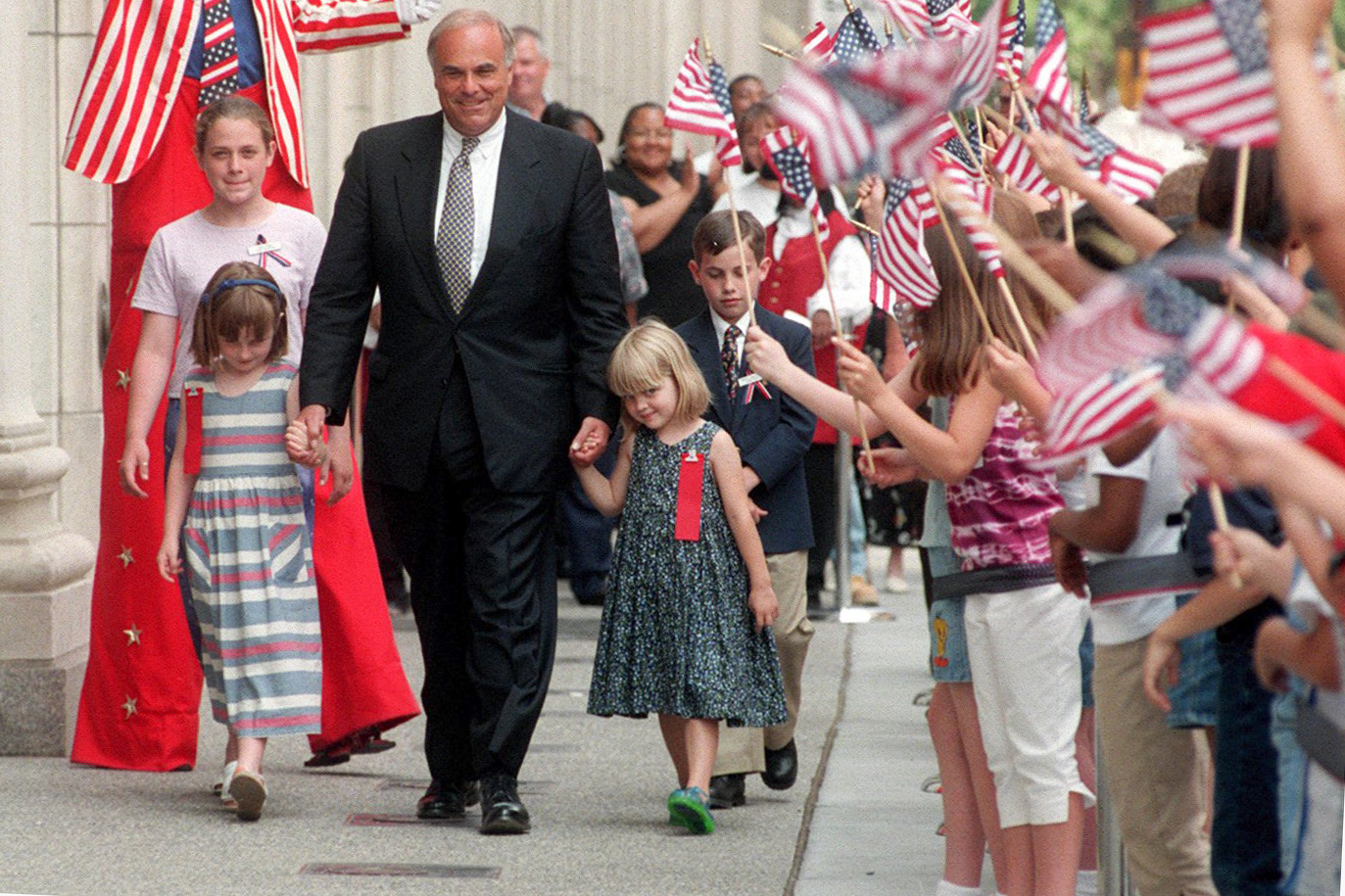
Former Pennsylvania Gov. Ed Rendell, who then was Philadelphia’s mayor, appeared at the 1999 dedication ceremony with a group of young descendants of the signers.
Meredith recalled it well: Her daughter participated.
Mayor Ed Rendell with some descendants of the signers of the Declaration of Independence during the June 7, 1999, unveiling of the “Signers Walk.”
“Everybody was happy,” said Meredith, now executive director of Herald Publishing, a division of the Bucks County Herald. The plaques “became a popular stop for tour guides.”
Meredith said that when she left Lights of Liberty in 2007, the plaques were in good shape.
Officials with the group, the city, the National Park Service, and the Center City District said they did not know who, if anyone, had assumed ownership of the plaques.
“I can’t say there was a plan for taking care of them in perpetuity,” said Meredith.
“I guess they were never meant for sidewalk use,” she said, adding she was not sanguine about their future.
“They were a nice enhancement. They were a pleasant surprise. I don’t think anyone would miss them if they weren’t there.”
The Thomas Jefferson and Benjamin Franklin plaques.
Staff writer Stephanie Farr contributed to this article.
This article has been updated to note that the owners of the Public Ledger Building have assumed responsibility for maintaining the plaques, according to the Center City District. An earlier version of this article also misidentified one of the signers of the Declaration of Independence.
As The Philadelphia Inquirer closes its printing plant, a ‘family’ of employees marks the end of an era
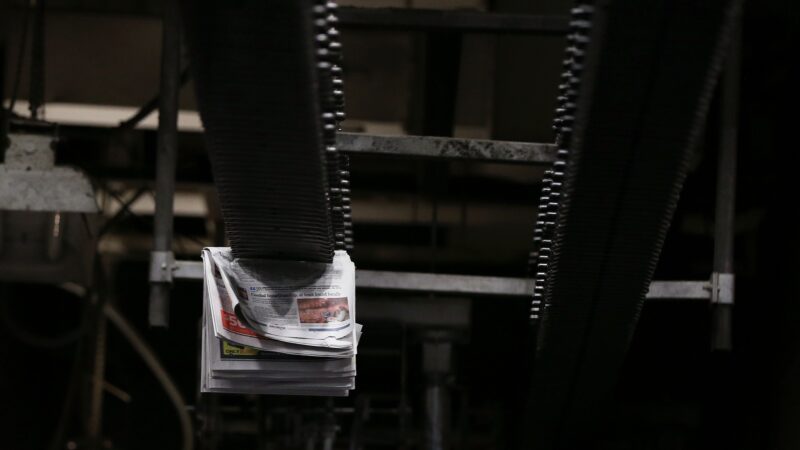
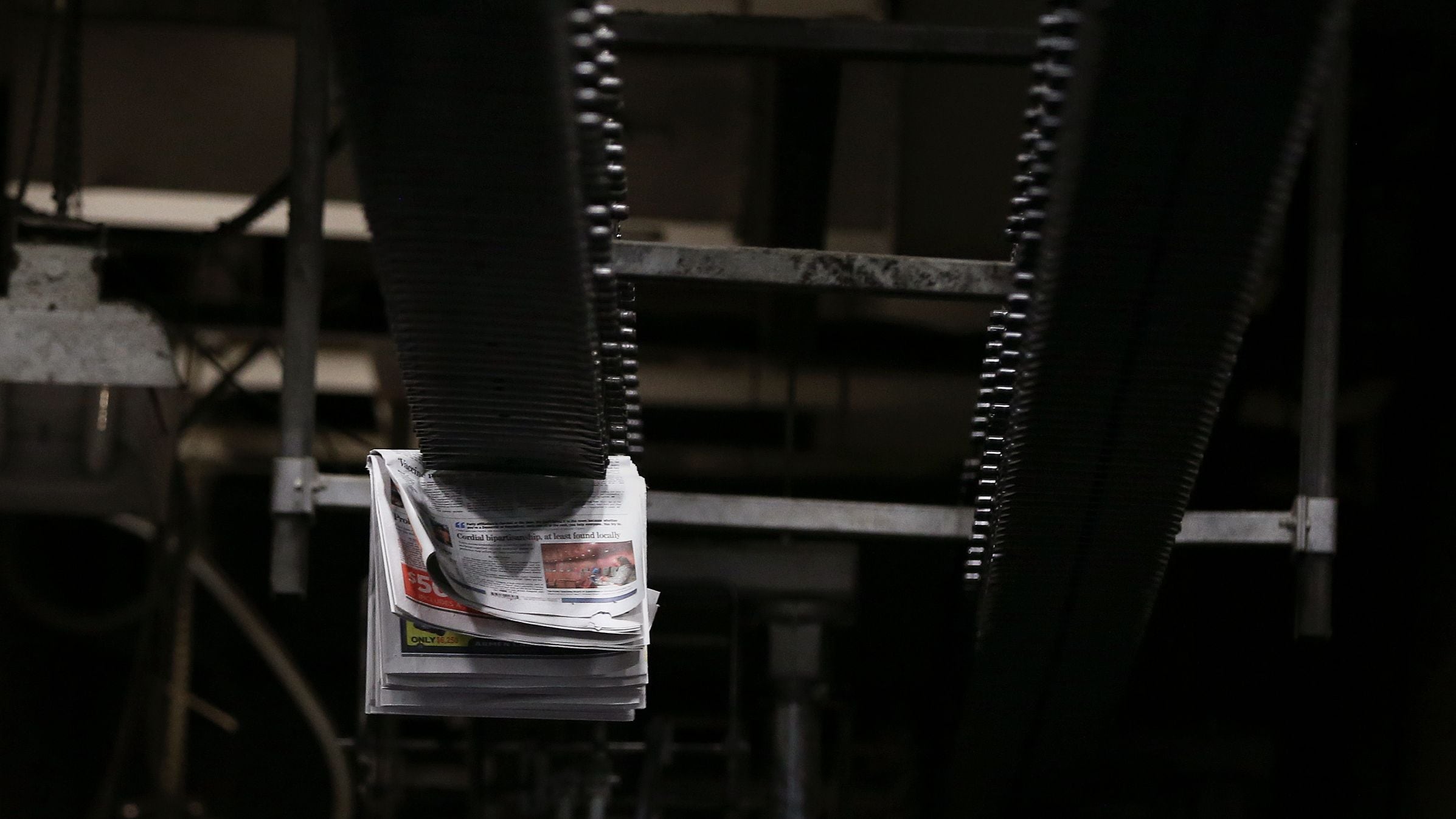
A tattered copy of The Inquirer is the last to ride the grippers from the pressroom to the mailroom at the Schuylkill Printing Plant in Upper Merion Township on March 28.TIM TAI / Staff Photographer
Tom “Three Bars” Lafauci had no chance of disappearing quietly into the howling winds of the night.
“Lafauci!”
Sybil White, a longtime security officer, summoned him before he could reach the only available exit at The Philadelphia Inquirer’s Schuylkill Printing Plant, the mammoth newspaper factory that was about to call it an era.
“Come on, get in the picture,” she commanded him. Almost reflexively, Len Leach and Tanya Rockeymore, who were working the lobby security detail that night, stuck their heads in the frame. They might not see him again. One of 500 who lost their jobs with the building’s sale, this was Lafauci’s last work shift.
At the age of 192, The Inquirer is stopping its own presses for good — the April 1 issues marked the last official runs — and will be outsourcing its print operations in line with newspapers across the country that are cutting costs and fighting a media universe changing at the speed of breaking news.
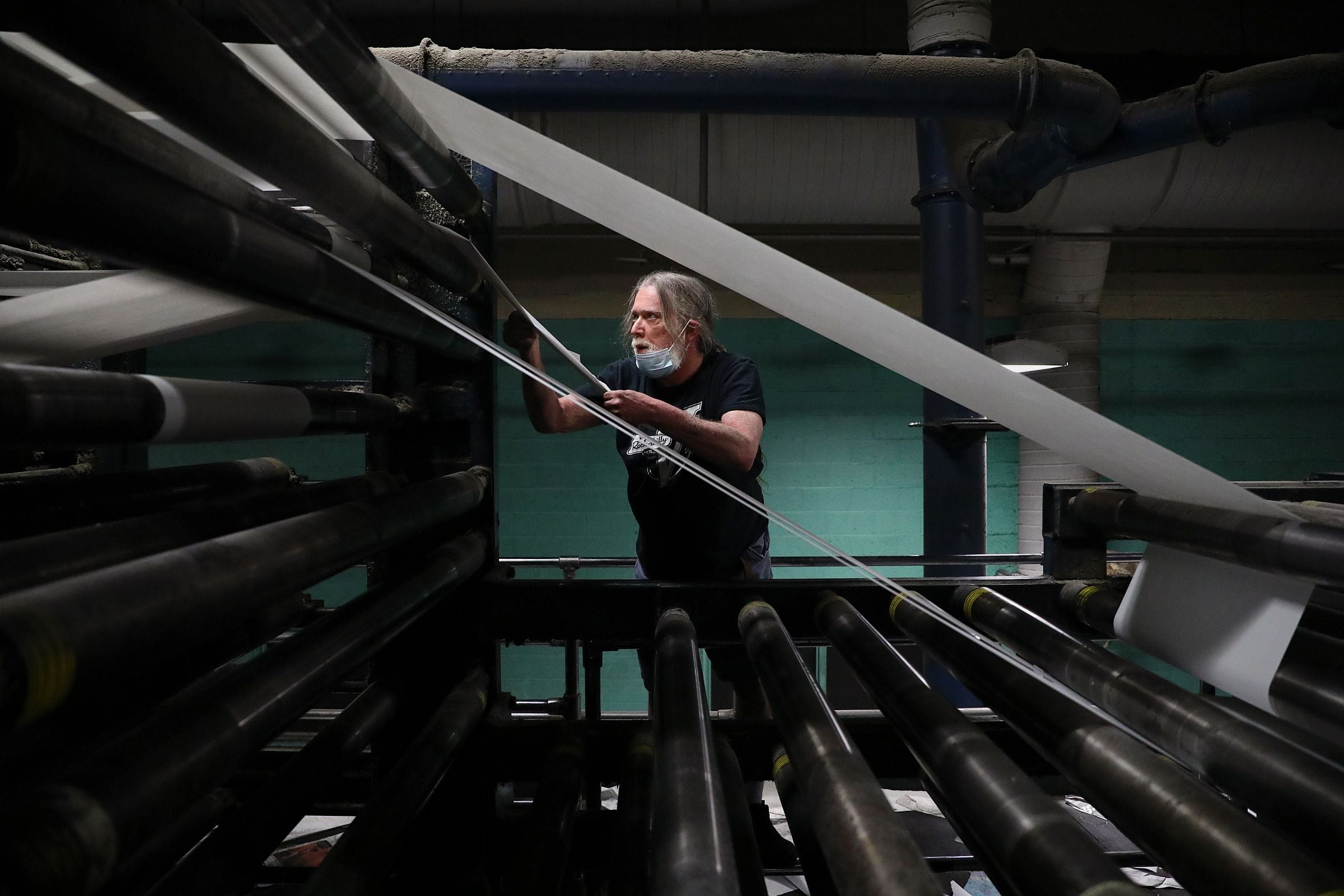
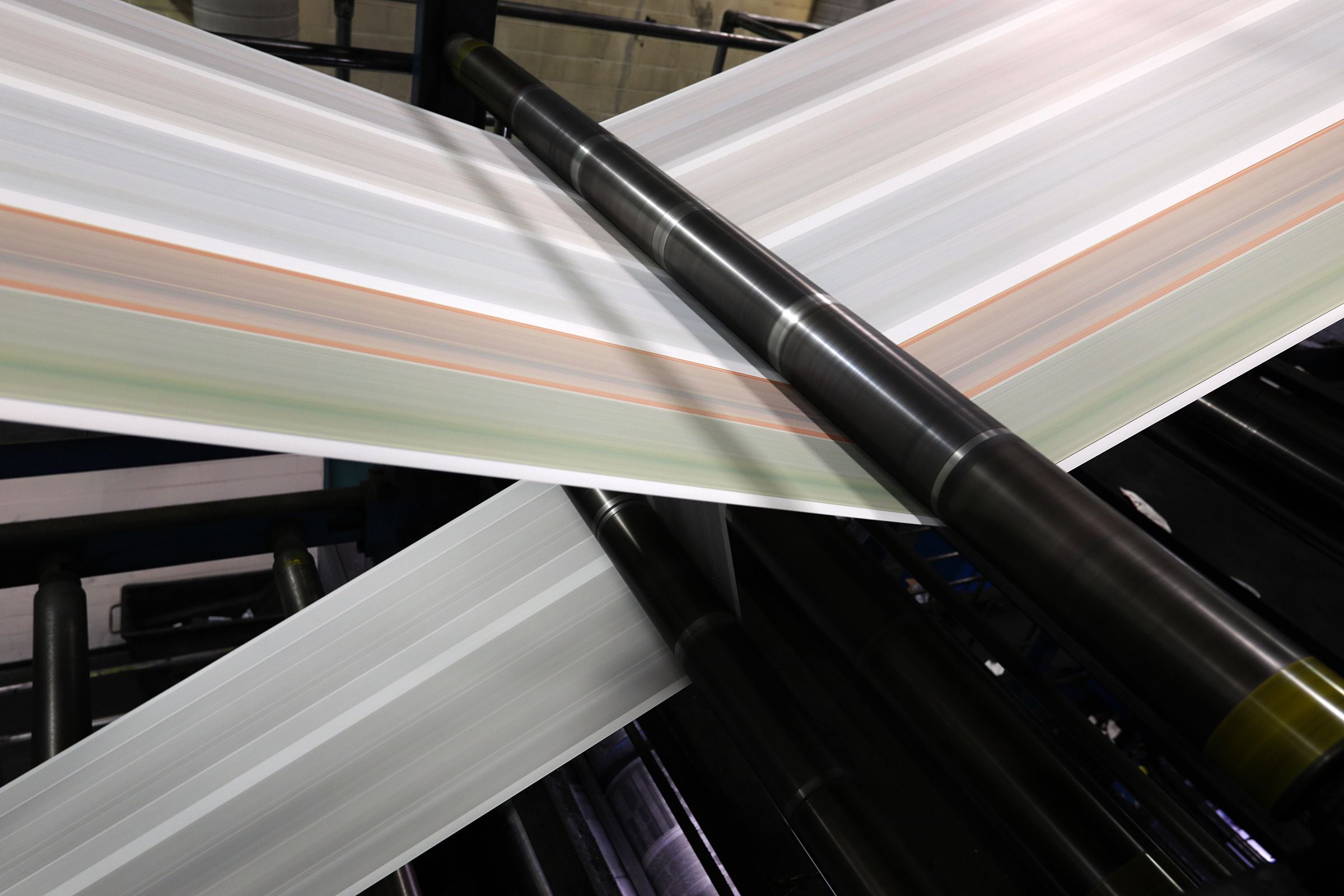
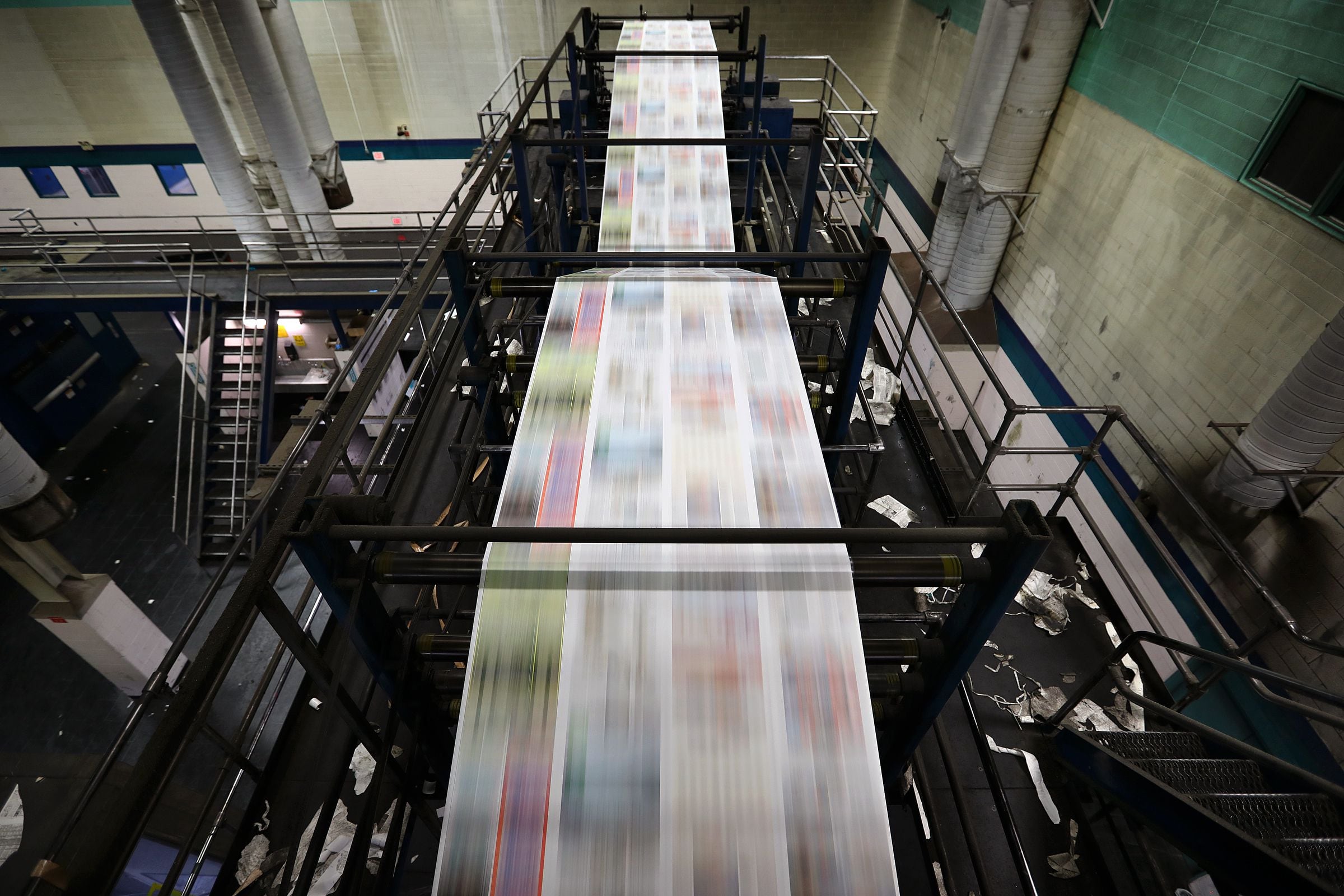
Aaron Krakovitz, a third-generation, 47-year pressman, threads paper through a set of rollers as he prepares for the night's press run. TIM TAI / Staff PhotographerA blur of paper courses along rollers during a Sunday advance run; some sections of the Sunday paper are printed ahead of time. TIM TAI / Staff PhotographerColor pages speed across rollers for a Sunday advance run. TIM TAI / Staff Photographer
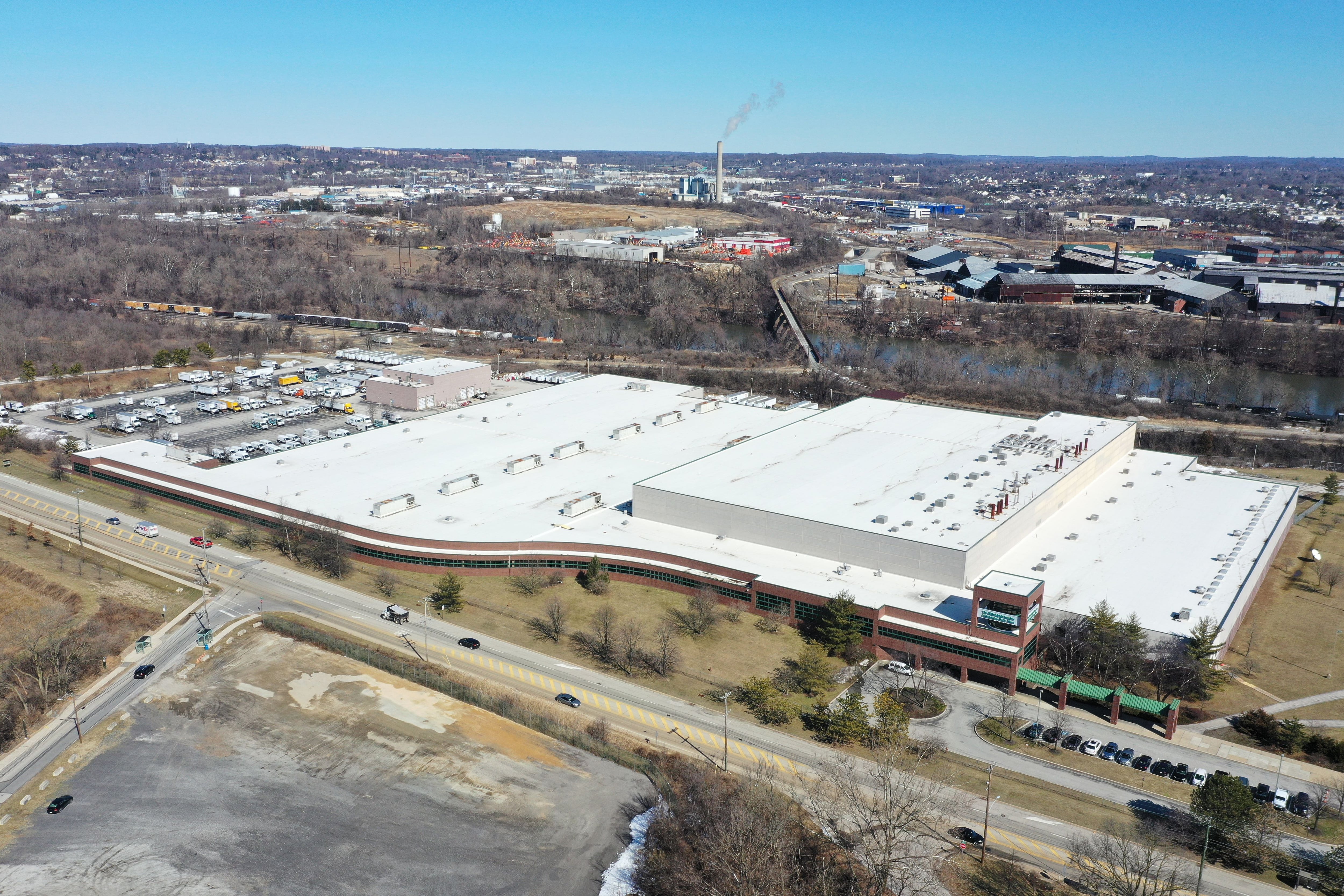
The guards seemed to be well-acquainted with Three Bars. Actually, they seemed to be well-acquainted with everyone exiting and entering the brick, curving structure built for $299.5 million (about $600 million in today’s dollars) 30 years ago, and sold to developer J. Brian O’Neill for $37 million to become part of his burgeoning biotech-health science empire.
“You get to know everybody,” said White. “It’s like family,” a leitmotif sentiment among the guards, engravers, pressmen, mailers, and drivers who worked in the immense, quirk-infested complex that was marinated in the vague odors of paper and the ink that blackwashed the floors and layered the handrails.
A production theme park
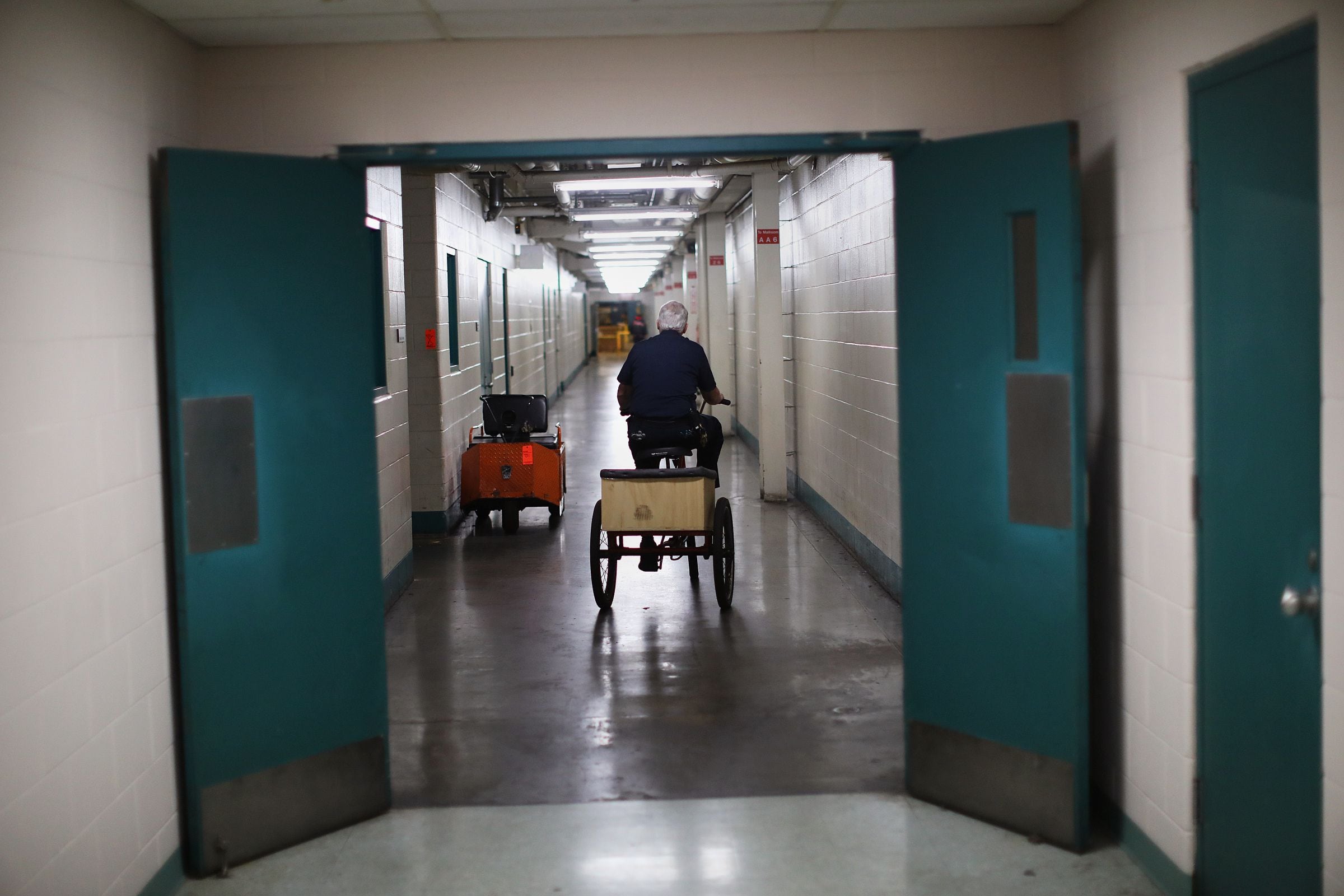
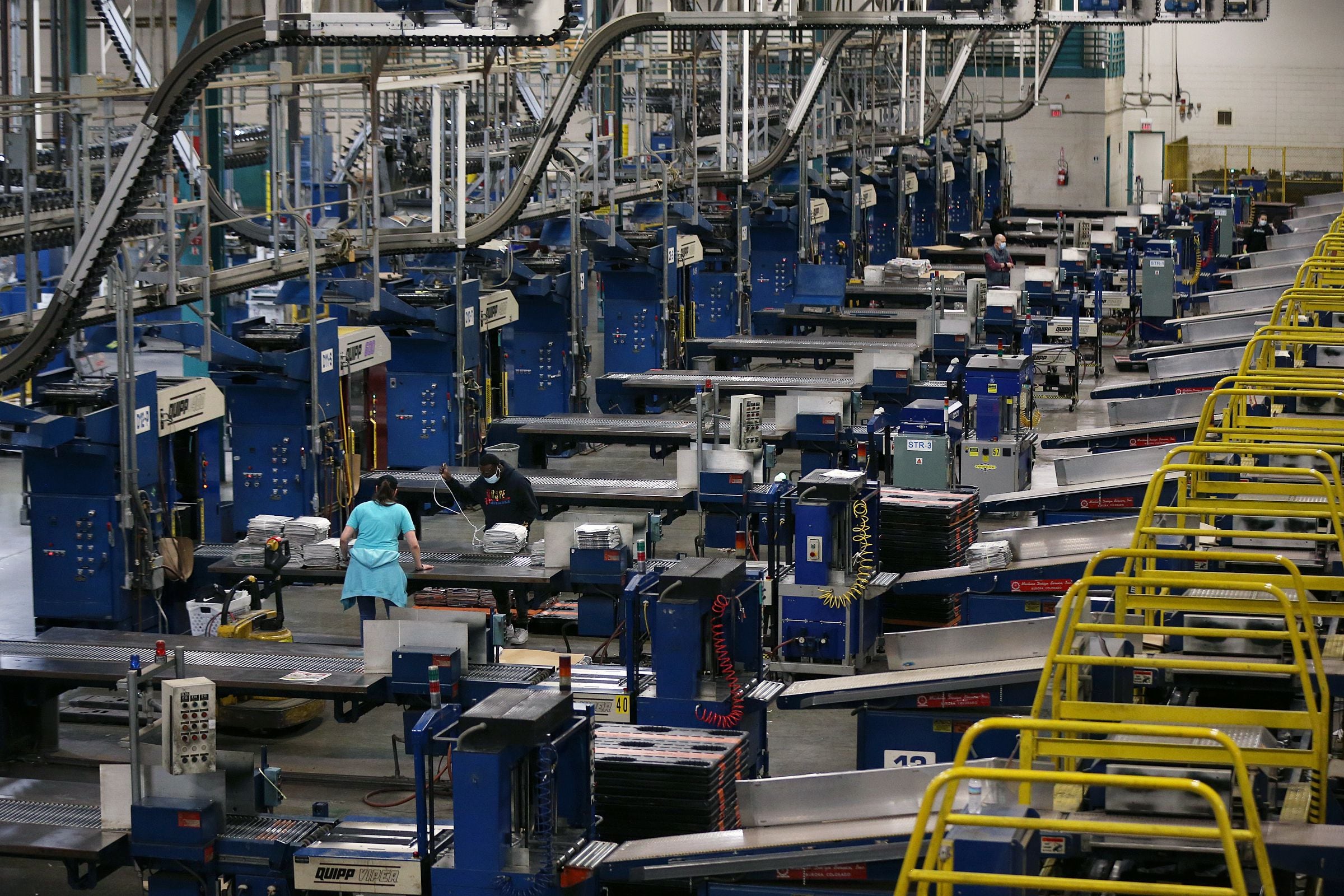
The printing plant, a 681,023-square-foot complex along the river, was built to house $160 million worth of “state of the art” presses. FRANK WIESE / StaffSecond childhood? No, engineer Joe Hoban is riding a tricycle that can carry tools while navigating the building’s lengthy corridors. TIM TAI / Staff Photographer
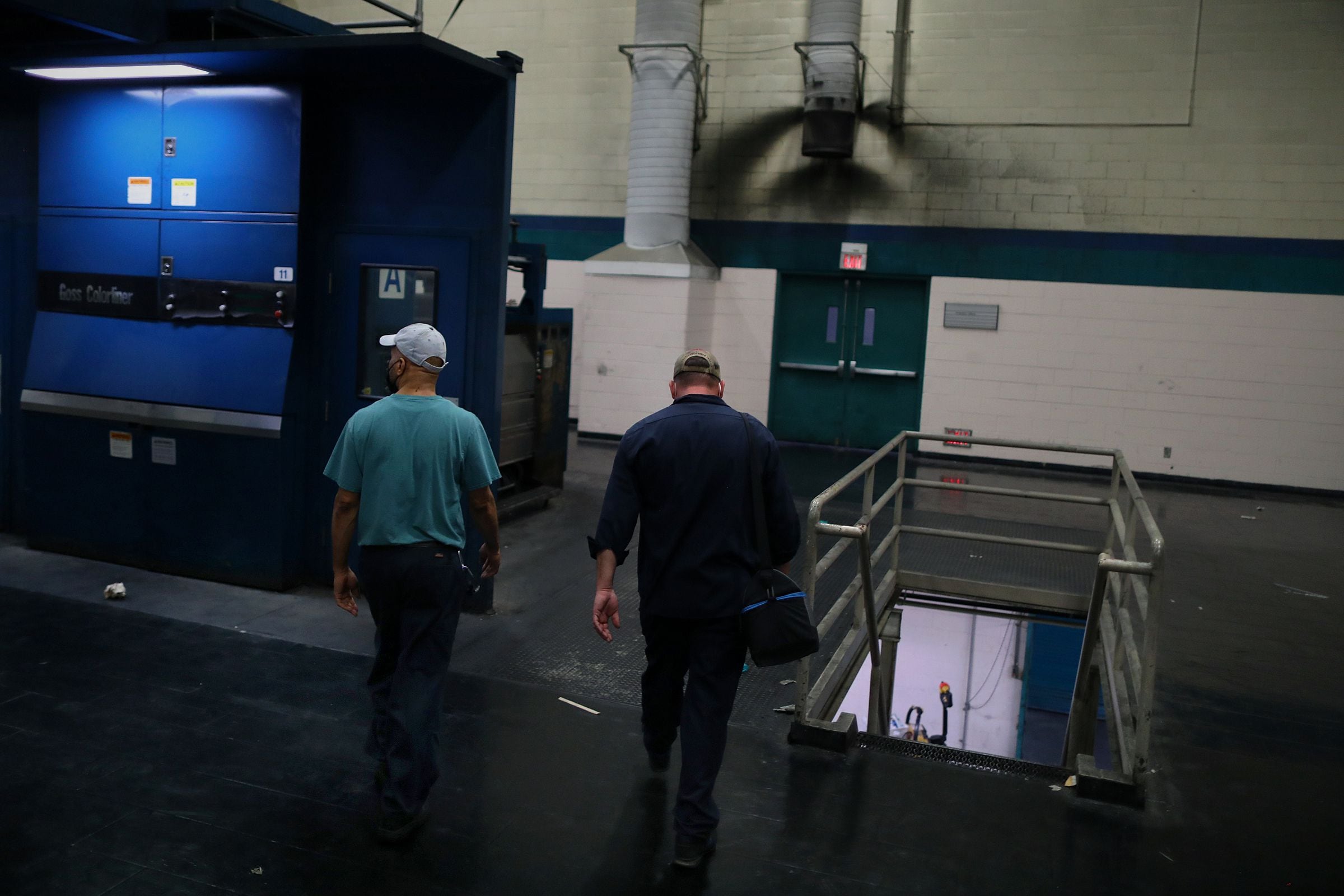
This was a thundering production theme park of impossible intricacy, where paper-carrying freight cars rumbled and rammed into the rail bay, where newspaper pages rolled off presses that collectively weighed as much as a Navy destroyer.
They were folded and collated, and commuted on cars and conveyors as though they had purchased tickets on amusement rides. Ultimately they landed in trucks that ferried The Inquirer and Daily News to hundreds of locations while most readers slept.
All it took to get them their papers, said Fred Lehman, vice president of operations, was about two million moving parts.
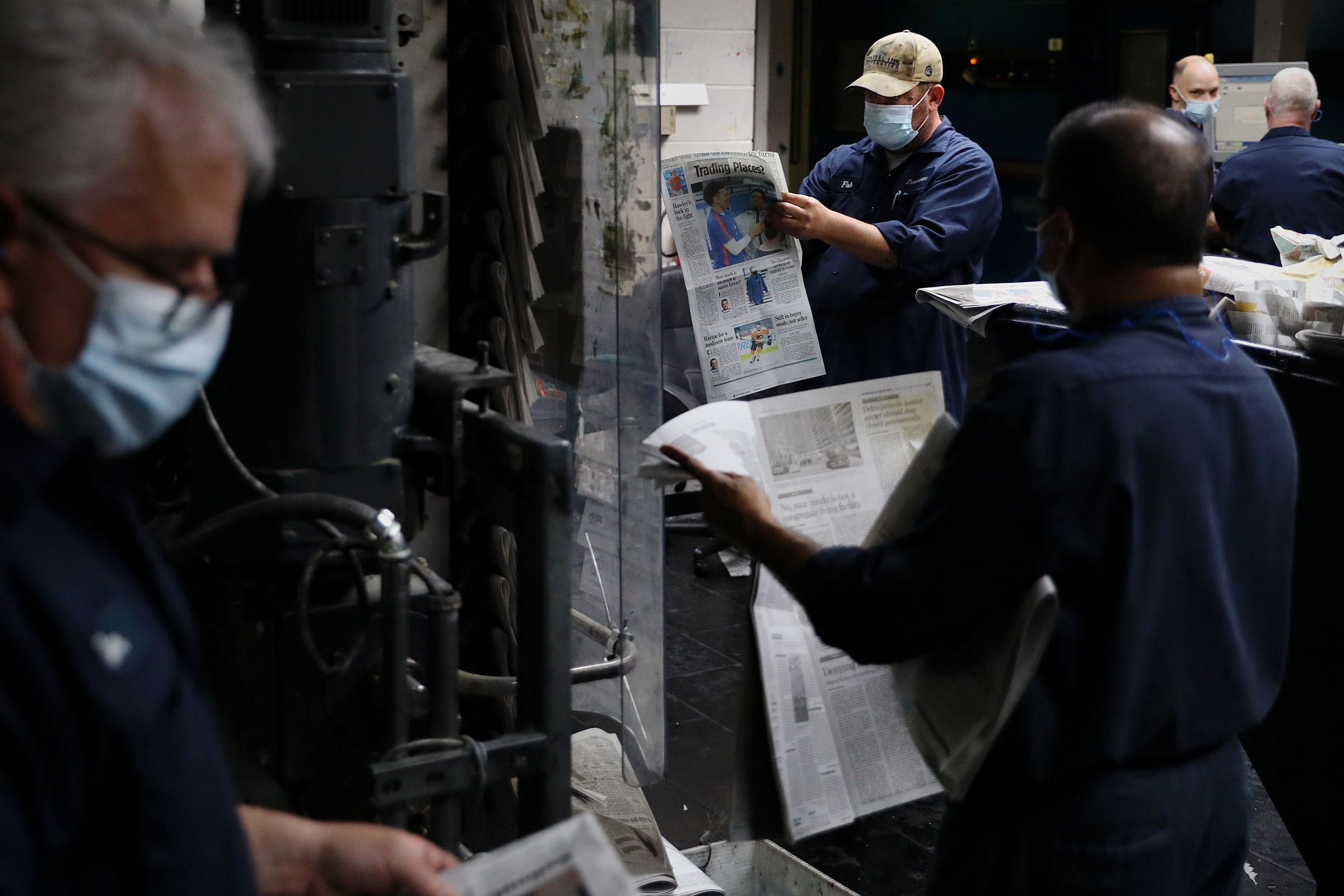
Pressroom supervisor Jim Fish (top) flips through Inquirer pages as a quality check. TIM TAI / Staff Photographer
Somehow amid the often hellish cacophony in this 681,023-square-foot behemoth, people got to know each other.
In many cases, they knew each other already. “Family” was more than metaphoric in White’s case. Her uncle got her the job 25 years ago; he worked at the company. Her father was a driver.
Lafauci, a mailer, said his nickname had no association with happy hour. “Three Bars … my grandfather worked here, my father worked here.” Yes, he was the third bar. Bill Burk, a transportation manager, worked with all three bars, and at one time or another, The Inquirer employed 20 of Burk’s family members.
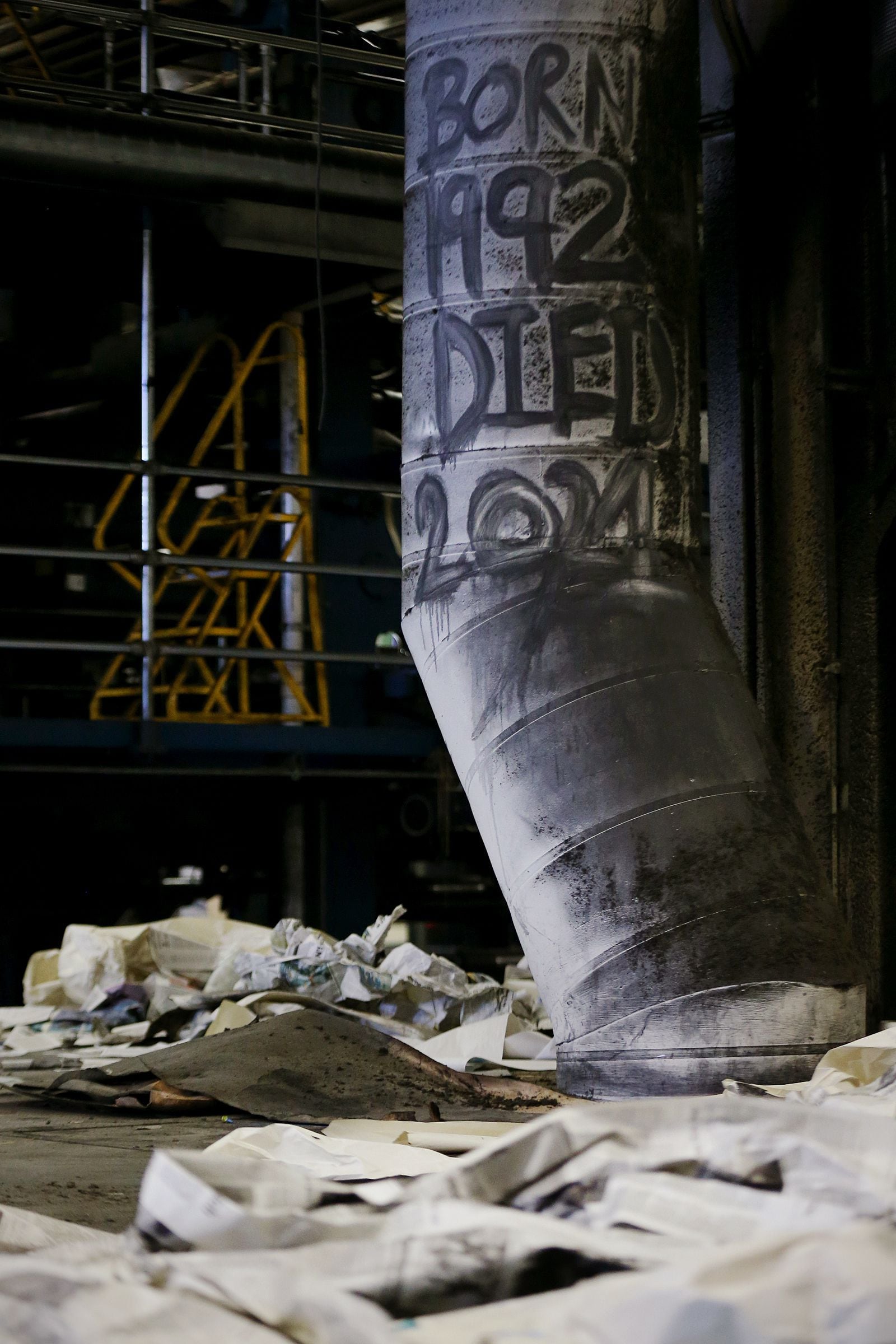
Epitaph for an era: "BORN 1992 DIED 2021" is traced in the grime on an air duct inside the pressroom. TIM TAI / Staff Photographer
“My grandfather worked here, my father worked here.”
Tom “Three Bars” Lafauci
‘It was family’
Those days are history, as soon will be the printing plant, located in Upper Merion Township at the junction of Routes 23 and 320, a location a reporter once described as “centrally isolated.”
Rather than a death in the family, October’s announcement that SPP would be sold was more like deaths in multiple families, and the sense of loss — a mix of resignation, equanimity, sadness, with a dash of bitterness — condensed as employees were leaving the building for the last time.
“It was family,” Lafauci said. There’s that word again.
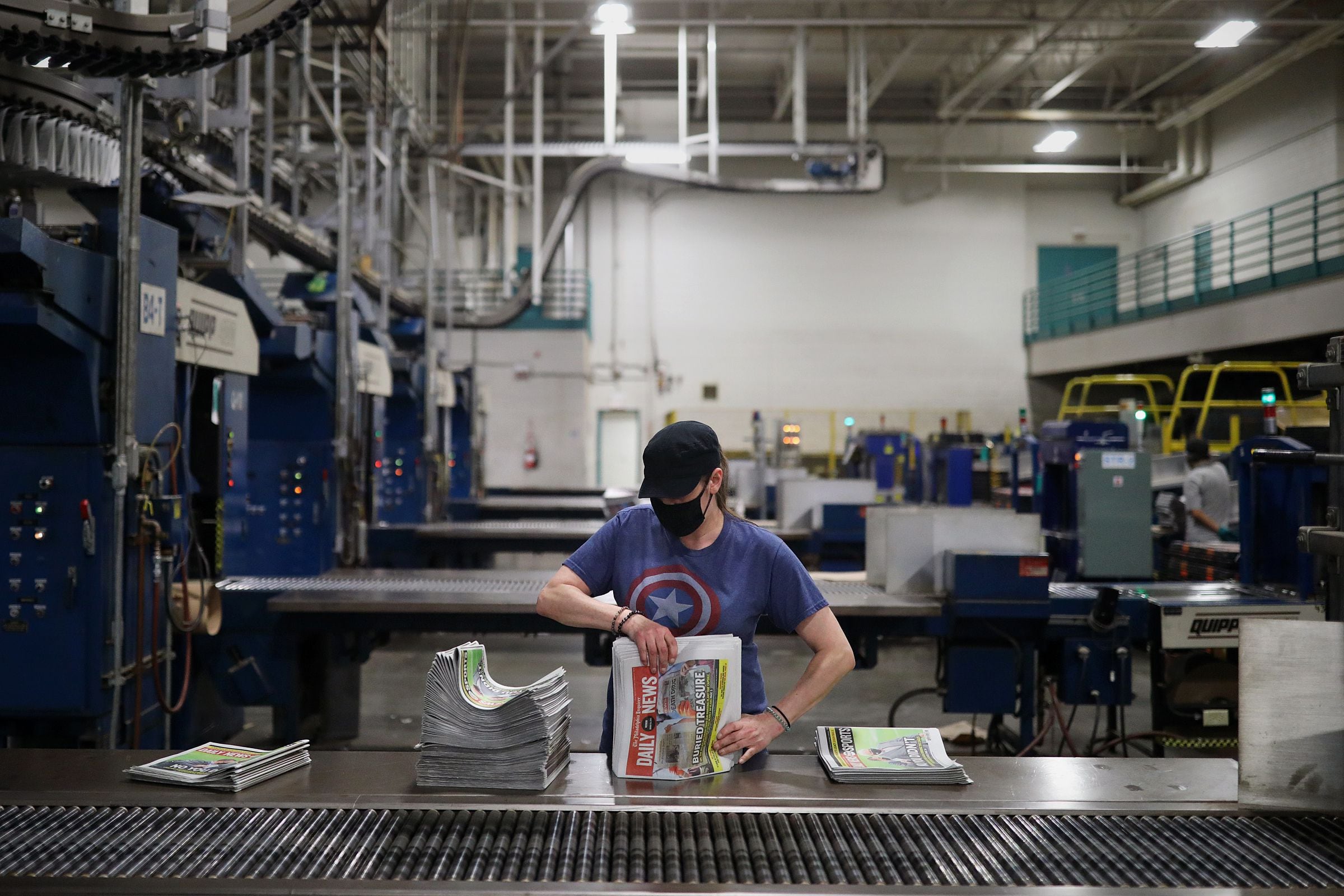
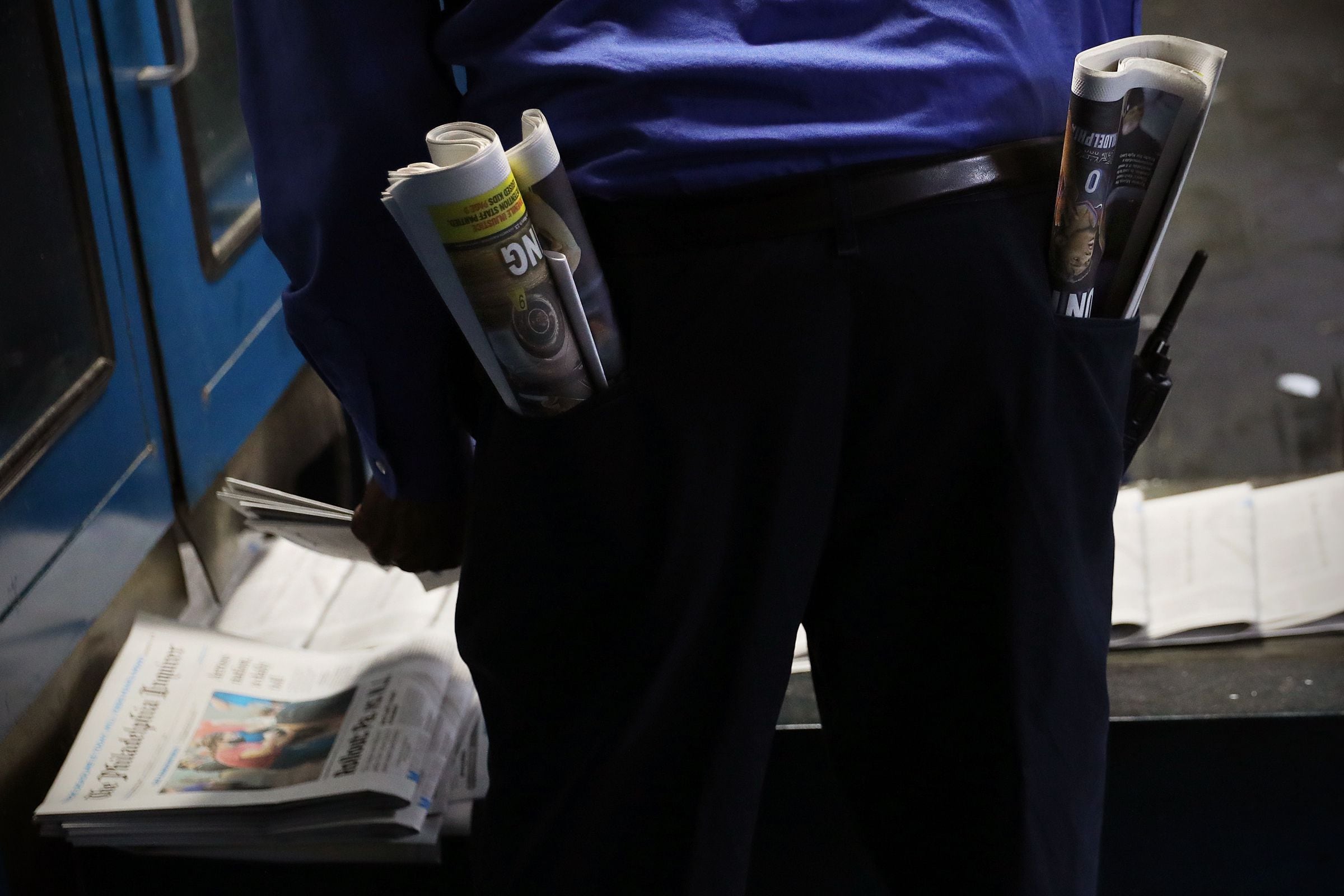
Mailer Jessica Tayoun, who started working for The Inquirer in 1992, stacks a bundle of Daily News issues. TIM TAI / Staff PhotographerTayoun and Lionel Shaw, a 37-year Inquirer veteran, prepare bundles of the newspaper's last scheduled edition to be printed at SPP. TIM TAI / Staff PhotographerPressroom supervisor Tom Addison, hired in 1979, carries in his rear pockets rolled-up Daily News issues that he will examine later for quality. TIM TAI / Staff Photographer
About the only problems they had at the plant, the guards said, involved intra-family disputes that reasoned discussion failed to resolve. Said White, “We tried to calm them down.”
The writers and editors reported and crafted the stories — from seven presidential elections in the SPP era, to a World Series title and a Super Bowl championship, to the 9/11 terrorist attacks, to one tenacious pandemic — but the SPP workforce made sure people got to read them on paper that they could hold in their hands, and perhaps even save.
During the last run of the Inquirer's own presses, a “family” of employees say goodbye as the company transitions to an outsourced printing operation.Kristen Balderas, Raishad Hardnett, Astrid Rodrigues, Lauren Schneiderman and Frank Wiese / Staff
All the news that fits
In the pre-SPP days, type and advertisements were posted on flats by hand. Editors marked last-minute cuts with blue pencils, and the compositors would surgically consign them to the cutting-room floor.
The job evolved rapidly with “pagination,” as computer screens replaced the flats and workers such as Kathleen Griffiths moved from the composing room to a video terminal. Inspecting the pages to make sure that the ads are properly placed and error-free, and that the display type and copy are correctly confined to a page is a critical step in the “prepress” process.
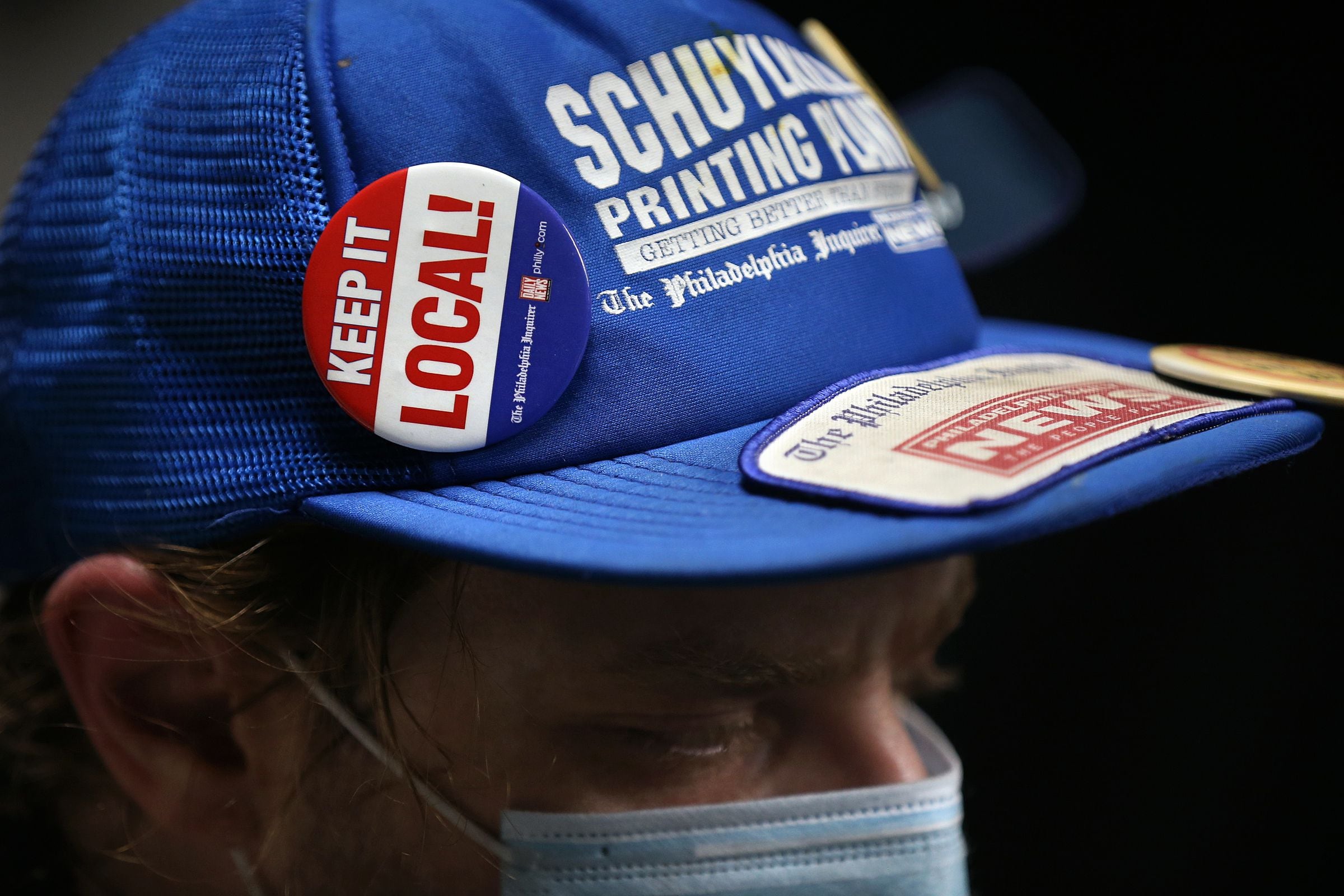
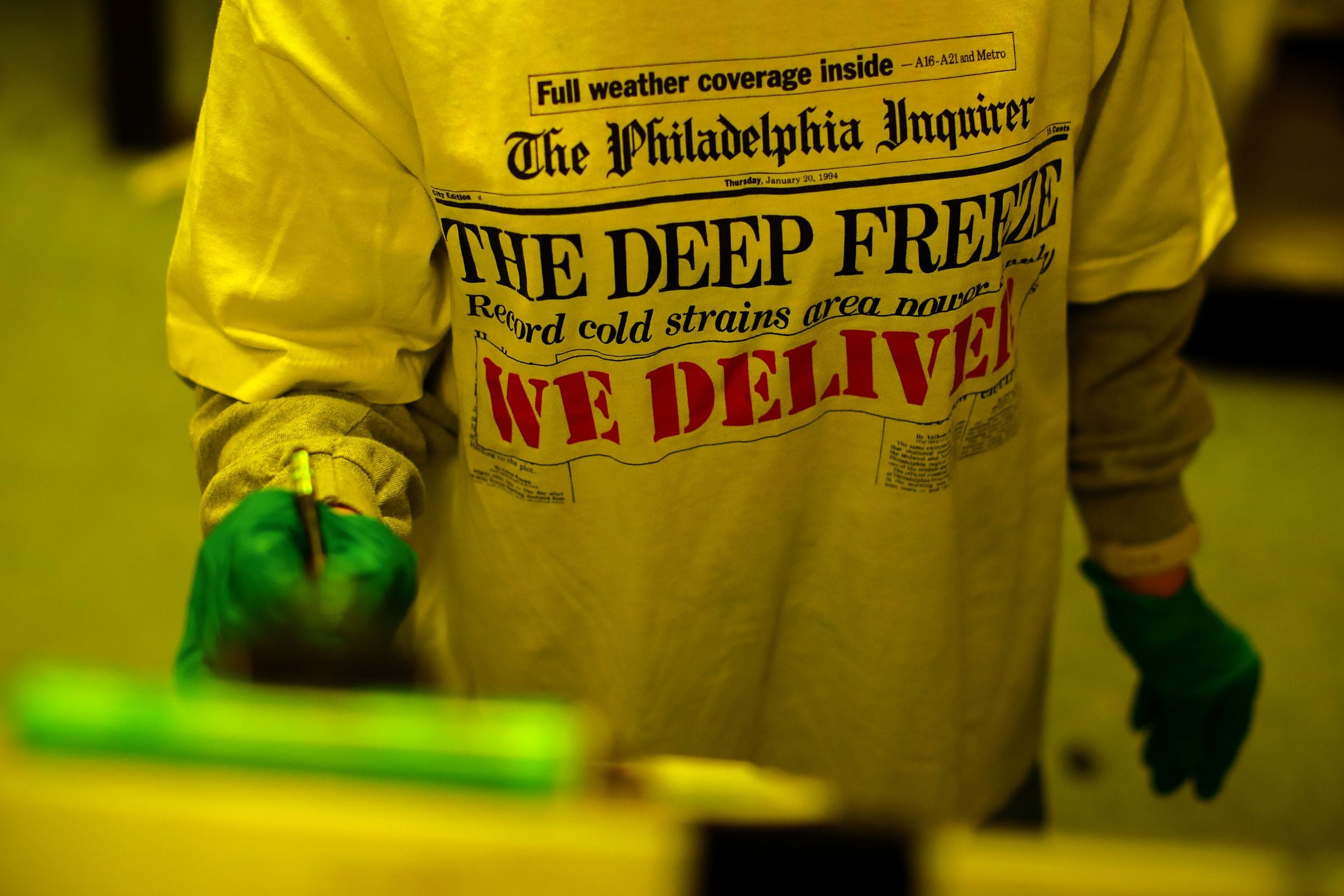
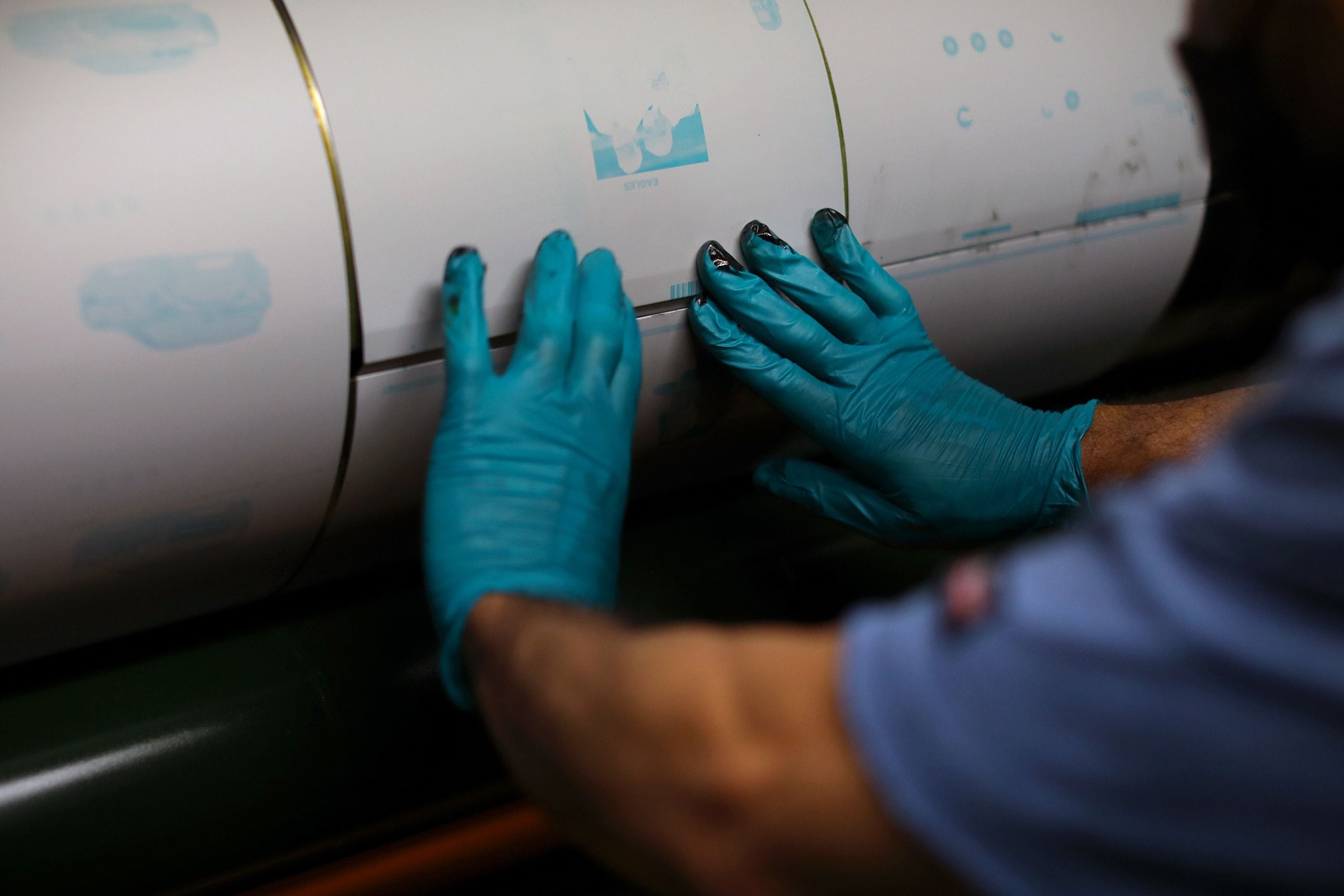
Pressman Brett Nick, who started working at The Inquirer in 2003, wears a hat with an old Inquirer campaign slogan: "Keep It Local!" TIM TAI / Staff PhotographerPlatemaker Debbie Dougherty wears a T-shirt stamped with a front-page image from Jan. 20, 1994, the year she was hired. TIM TAI / Staff Photographer
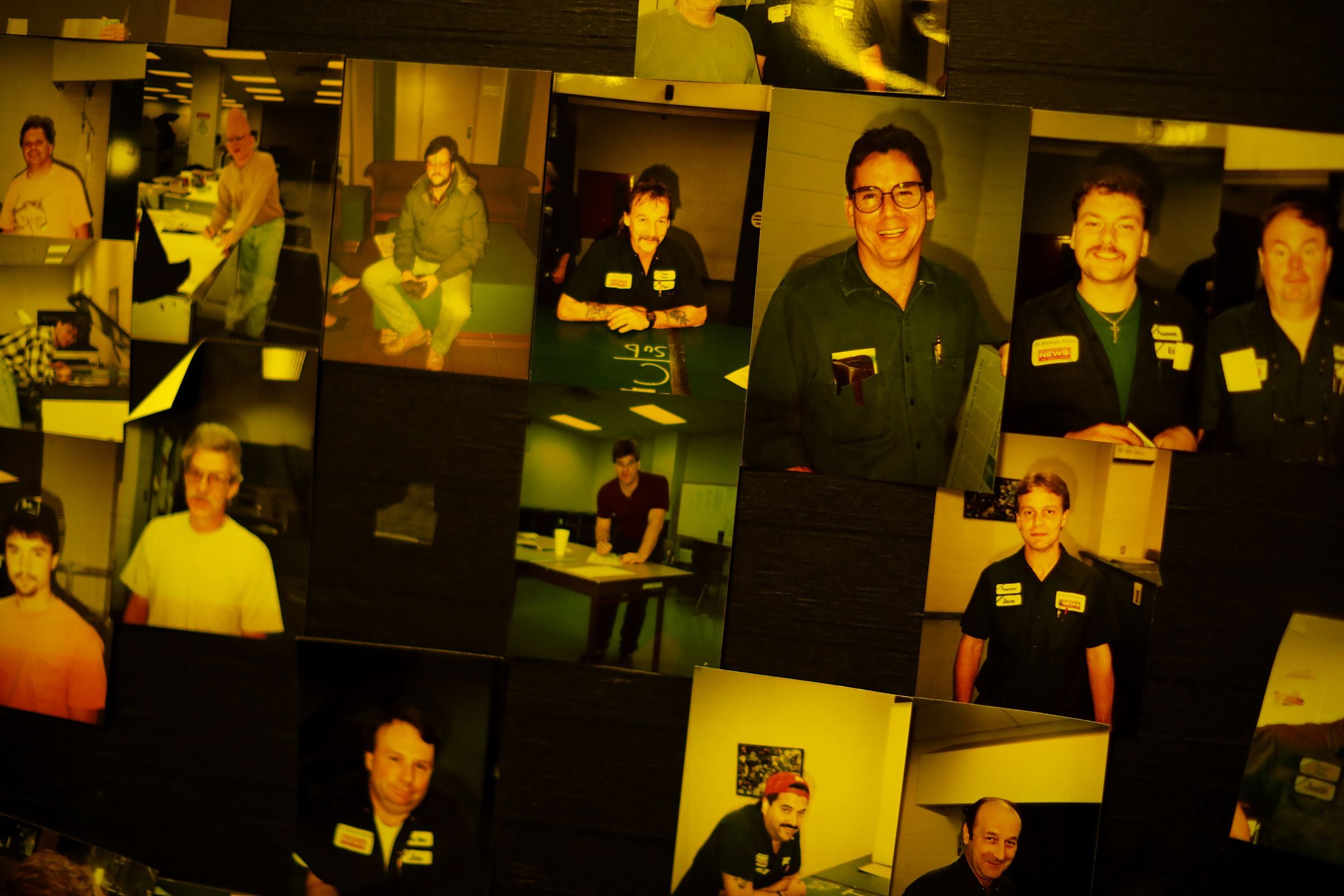
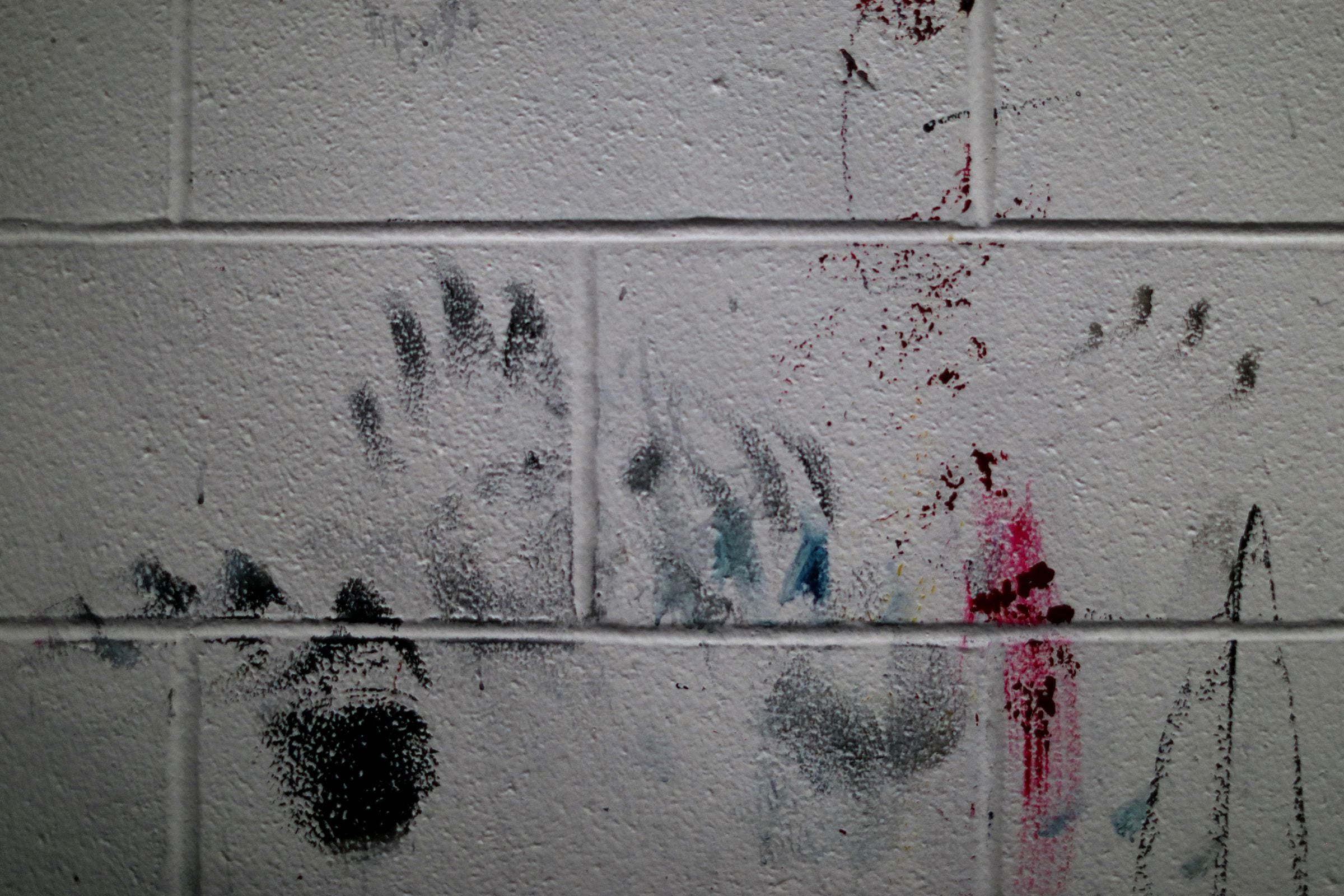
Engraved in memory: A board inside the plate room features photos of former employees. TIM TAI / Staff PhotographerInk-stained handprints decorate a pressroom wall. TIM TAI / Staff Photographer
“It’s like putting a puzzle together,” said Tom Chambers, who has worked for the company for 31 years. He and the other platemakers imprint those completed-puzzle images on wafer-thin aluminum plates that bear the images of the pages of The Inquirer and Daily News.
On any given day those images would be stamped on paper rolls whose linear footage would reach halfway around the world — all the way on Sundays.
Pressman Hayden Darrabie, hired in 1998, presses plates into place before the night's run. TIM TAI / Staff Photographer
Roll ‘em
SPP is more or less a prodigious shell built around $160 million worth of presses, said Pat McElwee, the production supervisor. When the plant started operating in the summer of 1992, “It was fantastic,” he said.
The Goss Colorlink “offset” presses were radically different from the 45-year-old “letterpress” predecessors in which plates were pressed directly onto the paper. With offset, the plates roll against rubber “blankets” that press against the paper. For the first time The Inquirer and Daily News could publish photographs and ads in color.
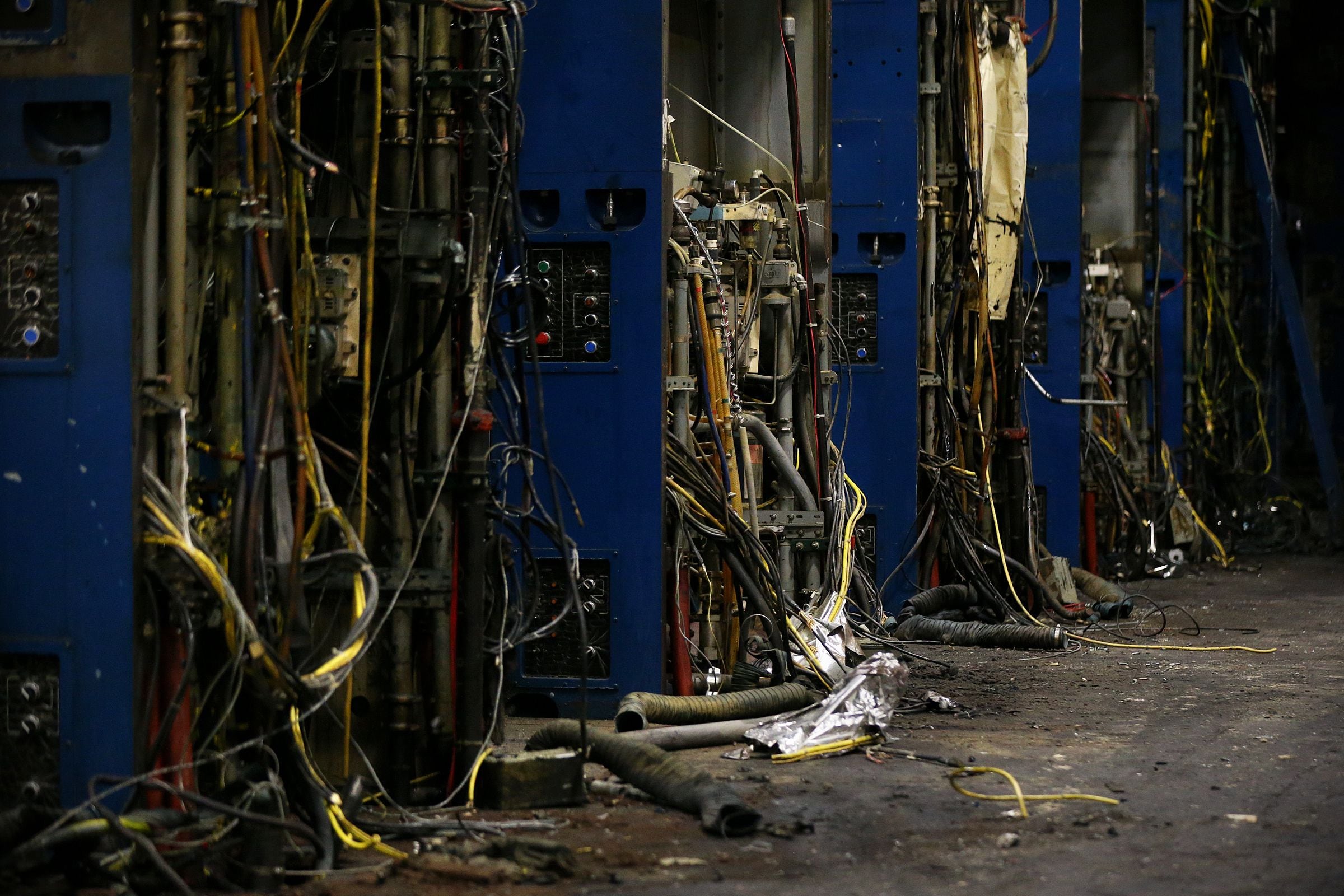
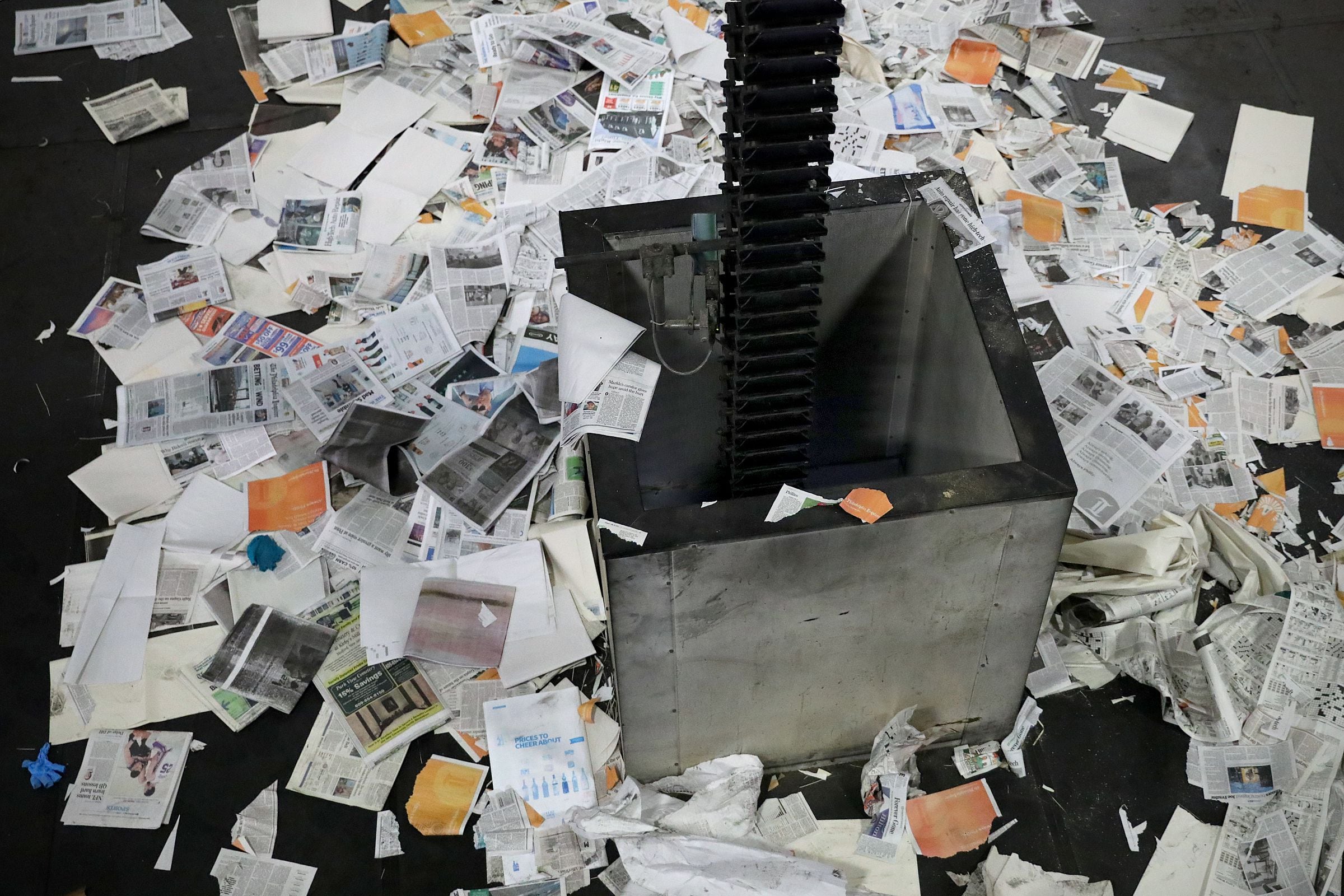
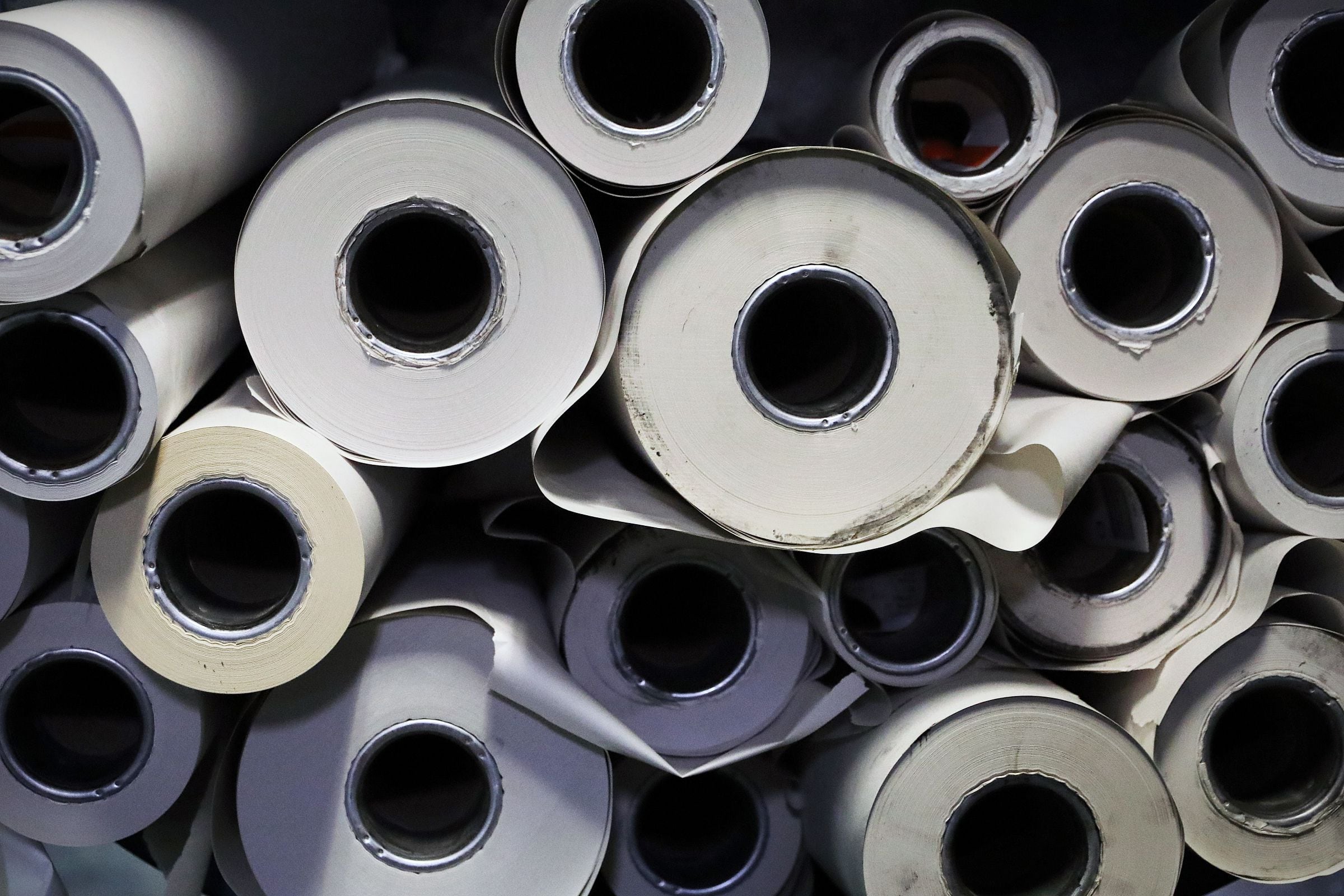
Wiring dangles from one of the nine Goss Colorliner presses. TIM TAI / Staff PhotographerLoose papers are scattered across the base of the gripper chute from which papers are conveyed from the pressroom to the mailroom for packaging. TIM TAI / Staff PhotographerPartial rolls of leftover paper from press runs, known as "butt rolls," are stored in the reel room. TIM TAI / Staff Photographer
“It was all new,” said Tom Addison, the company pressroom foreman. With novelty came mishaps. More than once the papers published “To our readers” apology notes for delivery issues.
Like so many employees on the production side, Addison was a lifer, having started in 1979.
And to Aaron Krakovitz, Addison was a newcomer: Krakovitz already had been there five years, starting as a high school senior, recruited to fill in on a short-staffed weekend. He was child labor whose own father was a pressman.
The pressmen developed a familial and literal closeness, said Jim Fish, the union foreman: In the heydays, he said, “You worked with six to seven guys on the press.”
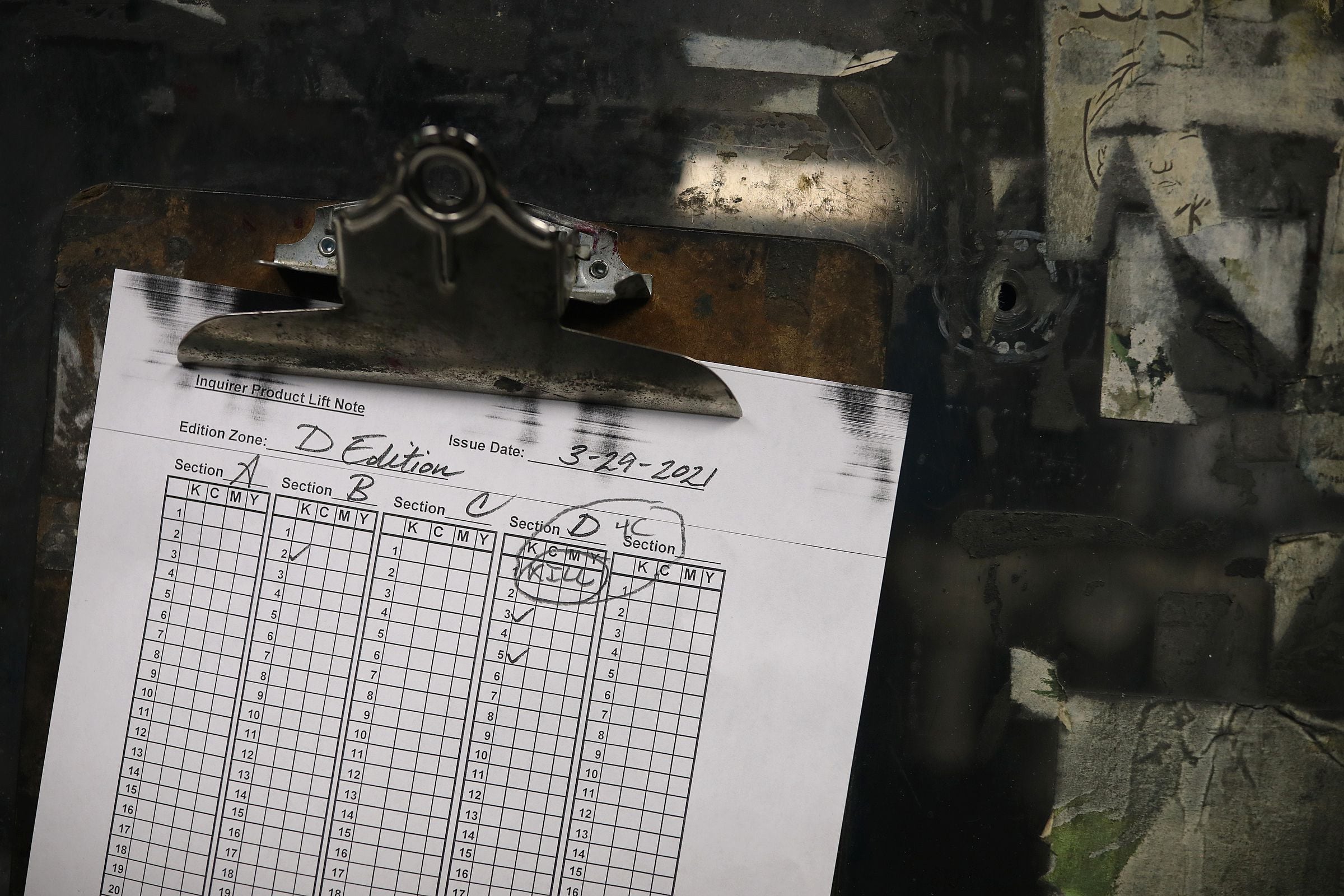
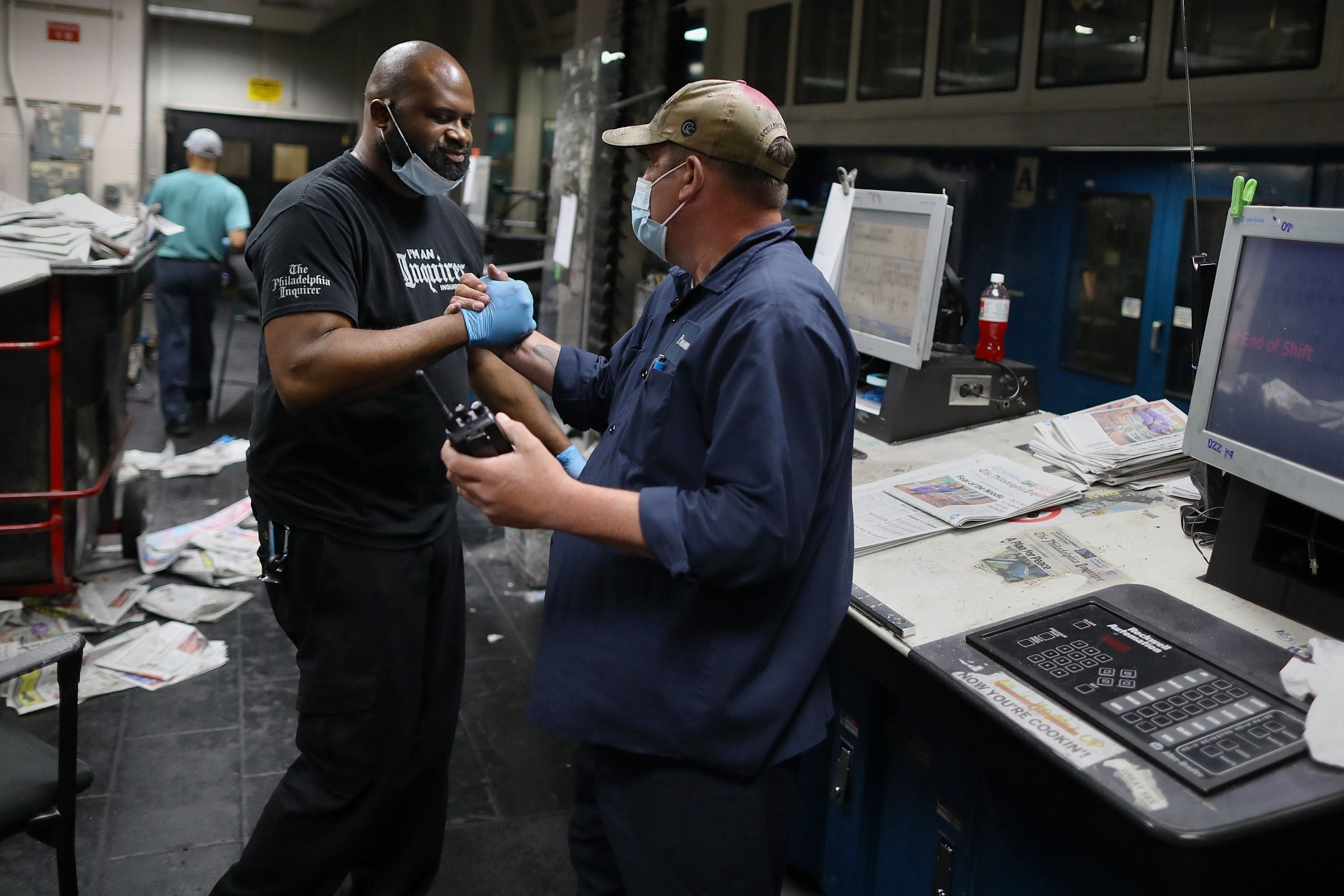
A clipboard in the quiet room informs pressmen about the plates that need to be switched out for a "lift" for a later edition. TIM TAI / Staff PhotographerPressman Keith Jones (left), who was hired in 2005, and Jim Fish prepare to embrace as they are about to depart after the last scheduled press run. TIM TAI / Staff Photographer
Fold ‘em, stuff ‘em
Among all his family members who ever worked in the mail room, a 187,000-square-foot canyon where the printed sections and advertising inserts were added and prepared for the trucks, Devin Leidy counted 150 years’ experience.
“When I was 12 years old, my father said, ‘You’re going to be delivering newspapers. You’re going to learn how to hand-stuff,’ ” said Leidy.
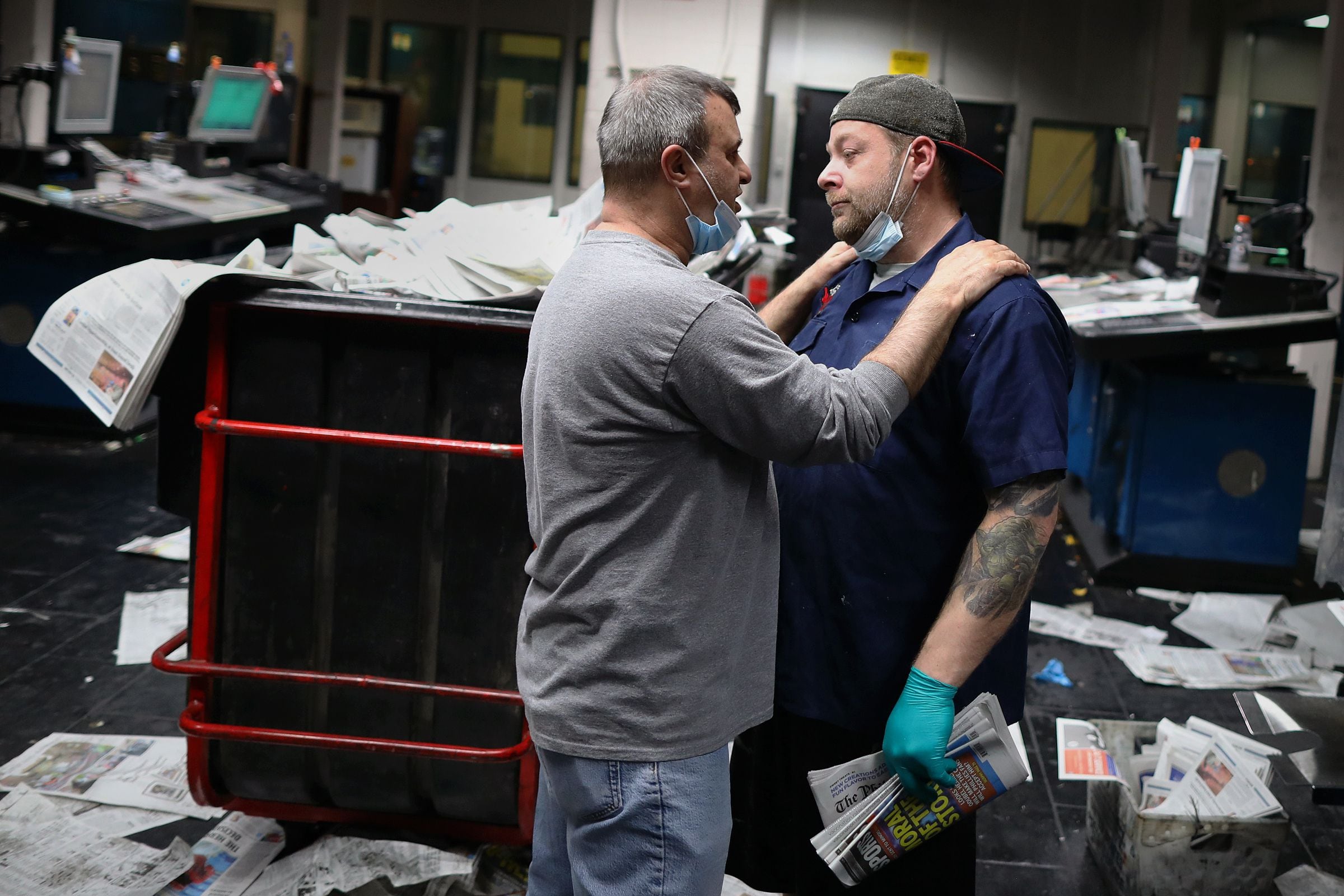
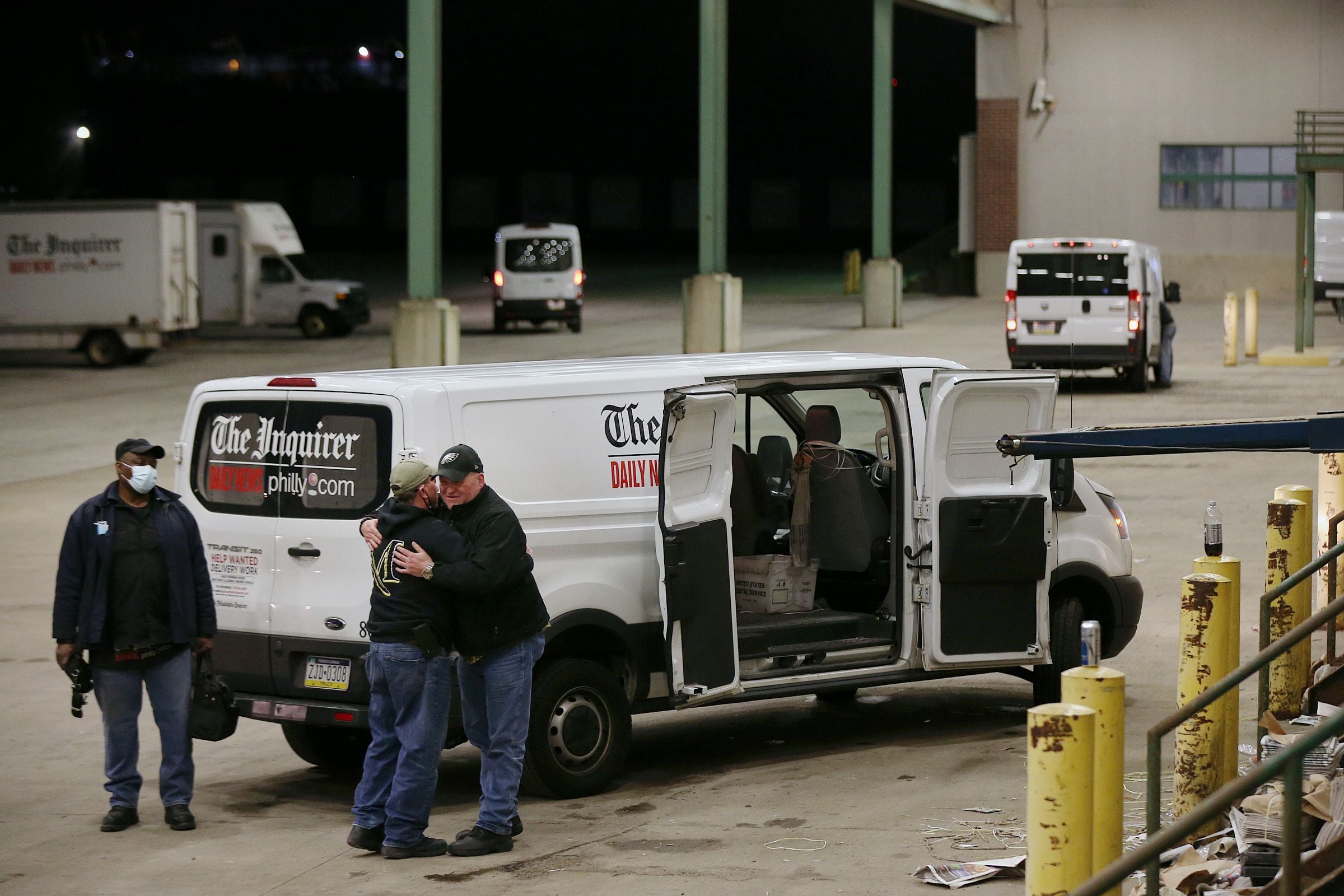
Pressroom supervisor David Creek (left), hired in 1984, chats with colleague Bobby Nick, who joined The Inquirer in 2002, as Nick gets ready to sign off. TIM TAI / Staff PhotographerDriver Darryl Jackson (left) looks toward dispatcher George Young (center) hugging driver Dominic Delvecchio, all of whom started in 2000. TIM TAI / Staff PhotographerPressman Hayden Darrabie (left) and Jim Fish walk out of the press room after the last scheduled run. TIM TAI / Staff Photographer
Leidy, who would grow up to be a mailroom supervisor, said the assembly and presentation of the papers were critical to sales: “You’re trying to put it out correctly … neatly.”
Evie Lang, a mailer who (stop if you heard this before) was the daughter and granddaughter of mailers, derived satisfaction from her labor as she left the house on Sunday mornings. “The newspaper would fall out the door and you’d go, ‘Oh, I helped to make that.’ ”
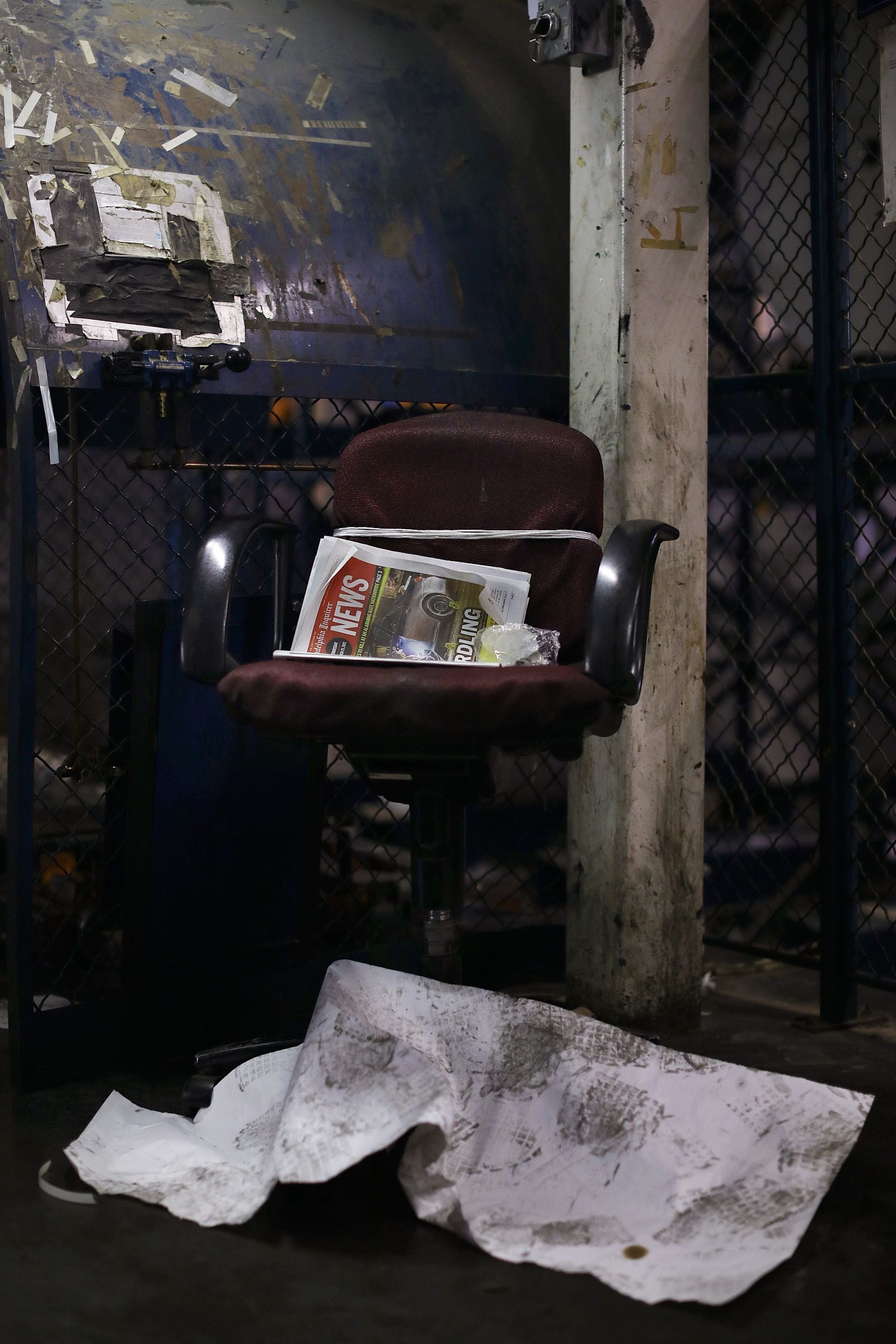
A discarded Daily News rests in a chair in the reel room, where paper had been loaded onto the presses that had been operating since 1992. TIM TAI / Staff Photographer
“My whole life. I wanted to yell, ‘Stop the presses.’ But now, when I think about it, I don’t want to stop them. I wish they could keep going.”
Pat McElwee
The last rides
Budd Emmett got hired in an antiquarian fashion: through a newspaper ad. That was in 1971.
Emmett became a transportation supervisor in 1988, overseeing a truck fleet that at one time exceeded 325.
“It’s all family,” Emmett said. It wasn’t an echo; it just sounded like one. The mood at the building in the closing days was similar to that of a pre-funeral viewing, only in this case the subject of conversation wasn’t yet deceased and had the benefit of hearing the praise.
Emmett said he plans to retire, as does pressman Krakovitz and others.
The furloughed SPP workers generally were pleased with what they viewed as generous severance packages. Lehman said those who wanted to keep working have found jobs.
Lehman and McElwee are among those who plan to call it a career. McElwee is anxious to spend more time with his grandchildren, but the end is profoundly bittersweet.
“My whole life. I wanted to yell, ‘Stop the presses.’ ” he said. “But now, when I think about it, I don’t want to stop them. I wish they could keep going.”
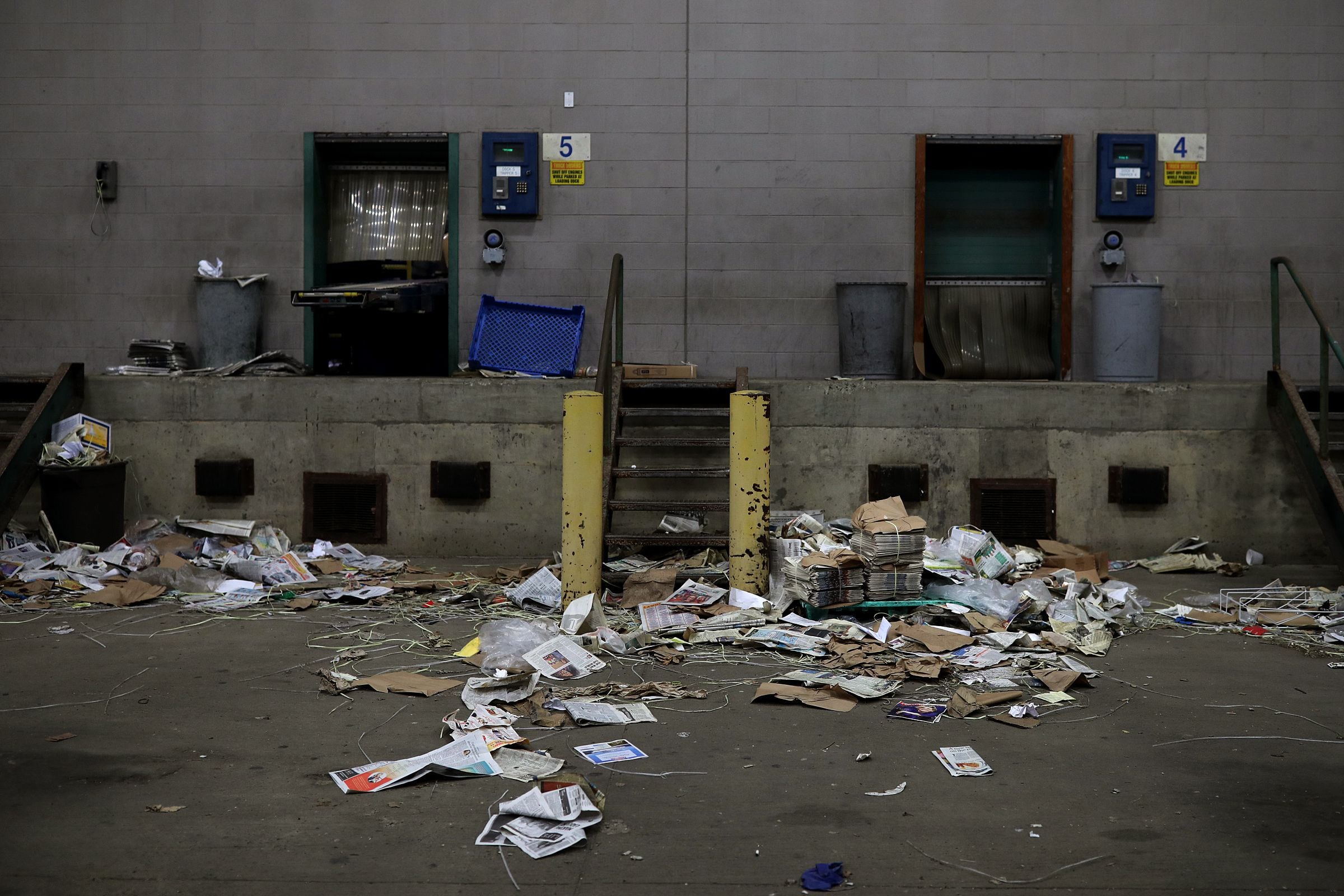
In the early morning hours of March 29, newspapers litter the docks that no longer will be used for loading The Inquirer and Daily News onto delivery trucks while most of us slept. TIM TAI / Staff Photographer
Staff Contributors
Reporting: Anthony R. Wood
Visuals: Tim Tai, Frank Wiese, Danese Kenon, Astrid Rodrigues, Kristen Balderas, Lauren Schneiderman, and Raishad Hardnett
Design & Development: Dain Saint and Jessica Parks
Editing: Emily Babay and Diane Mastrull
Digital: Kerith Gabriel, Patricia Madej, Lauren Aguirre, and Caryn Shaffer
Copy editing & Print: Brian Leighton and Sterling Chen
Glancing down near the intersection of 18th and Locust Streets near Rittenhouse Square, Carolyn Rogers can’t help but do a double-take.
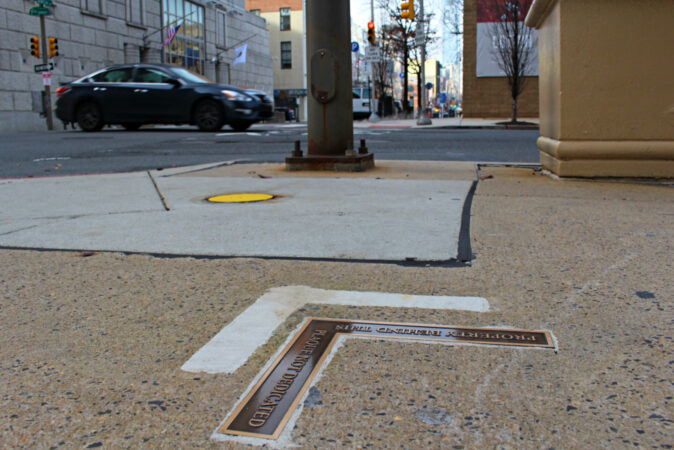
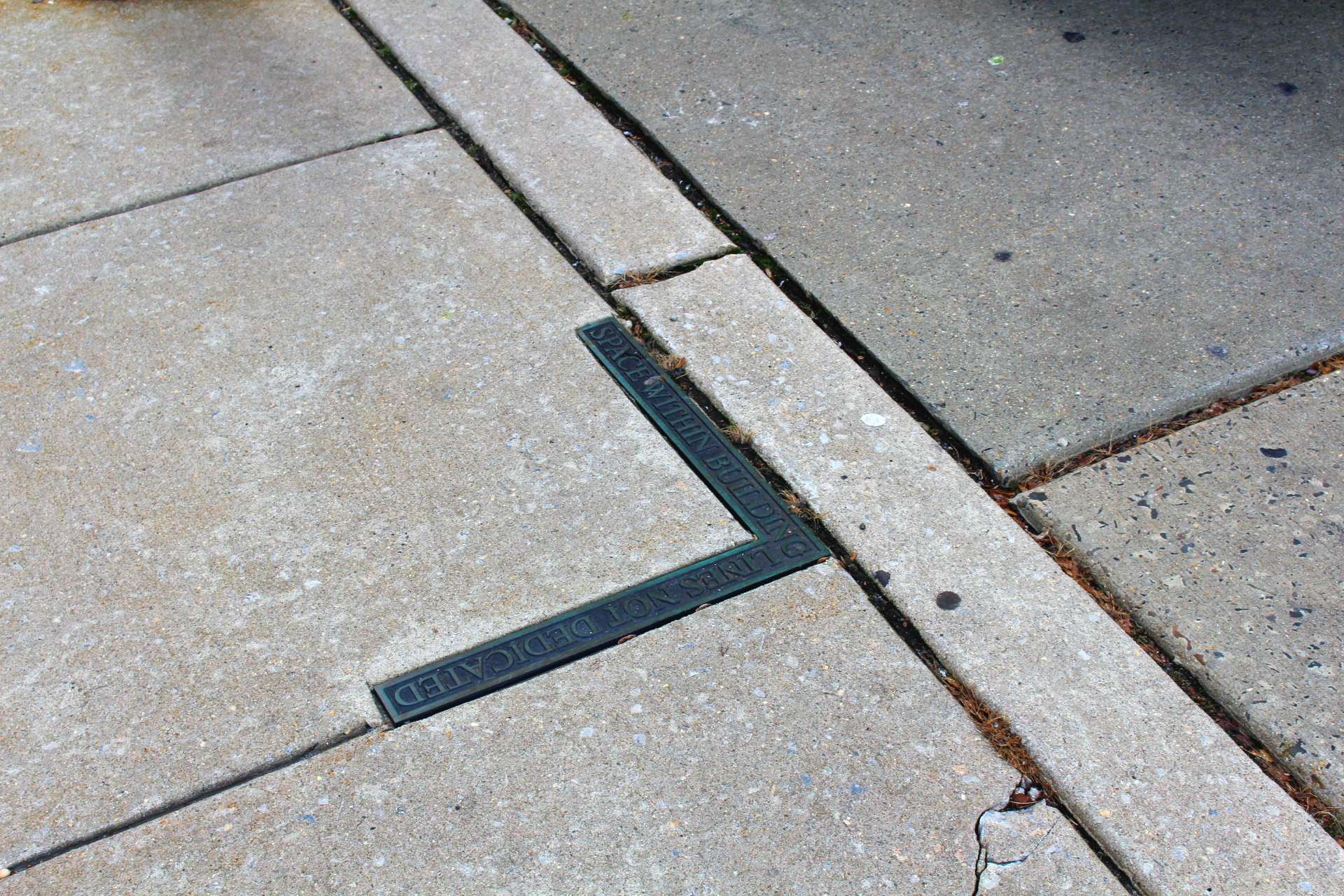
“The space between this sign and the building is not dedicated to the public,” proclaims the brassy plaque inlaid in the sidewalk.
“I’m always like, ‘Am I reading this right?’” Rogers said. “Not dedicated? Should I not walk there?”
Rogers asked about the signs scattered around the city’s pavement through Curious Philly, a portal that allows readers to ask Inquirer and Daily News journalists their questions about the Philadelphia region.
“Space within building lines not dedicated” sign at the Philadelphia Federal Detention Center.
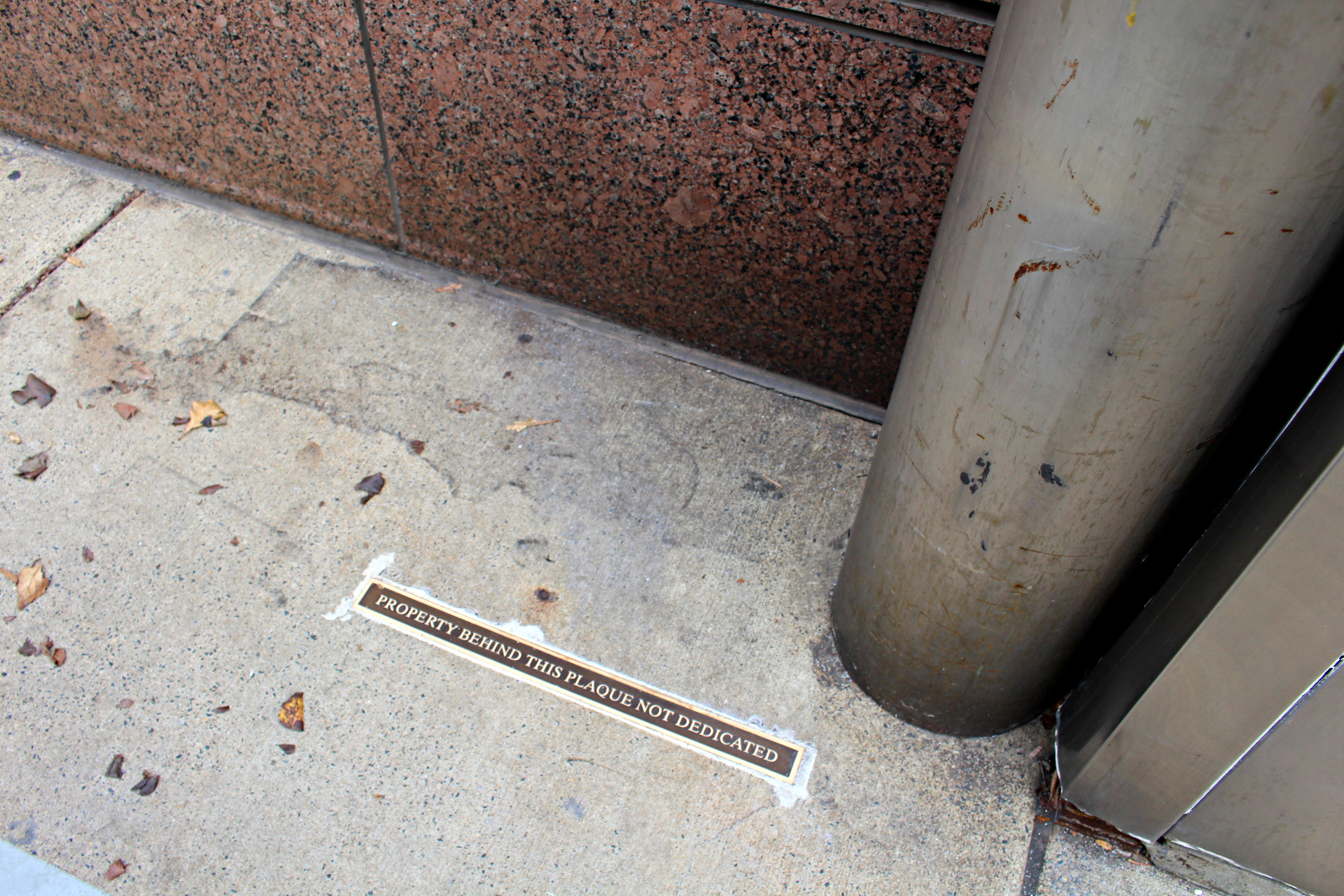
Some of the metal inlays say “the space … is not dedicated” while others proclaim “property behind this plaque not dedicated,” but in the end, they’re saying the same thing.
“Dedicated to the public,” in this case, is a legal phrase, defined by Black’s Law Dictionary as “an appropriation of land to some public use made by the owner, and accepted for such use by or no behalf of the public.”
The signage occurs when a building’s property line extends past the dimensions of the structure. In other words, the property owner owns more land than just the building.
So, “not dedicated to the public” means that the space of sidewalk between where that metal sign stops and the building begins technically isn’t public property.
Although the plaques are placed to protect the property owner’s rights, you’re welcome to walk in the “not dedicated” space, but technically, it’s private property, University of Pennsylvania Architect Charlie Newman said in a feature on the school’s website.
The plaques can be found throughout the city, from Penn’s campus in University City to the Federal Detention Center on Seventh and Arch.
A “property behind this plaque not dedicated” sign on Arch St. near the Federal Reserve.
It’s a safeguard in place to protect against a real estate legal loophole known as “prescriptive easements,” PlanPhilly’s Jim Saska wrote in a 2016 column about the curious corner pieces.
“Prescriptive easements” are another bit of legalese, meaning those who use an area for 21 years or more are extended rights to the land, as explained in the Pennsylvania Law Monitor.
So, in other words, if Philadelphians were to traipse down Arch Street on the 12 inches of pavement between the technical property line of the Federal Reserve and the building’s wall for 21 years straight with no “dedicated” plaque in sight, the property would become the public’s, too.
That’s where the plaques come in. With a little legal language bolted to the ground, the property owner is letting you know that you can walk there, but you don’t own it.
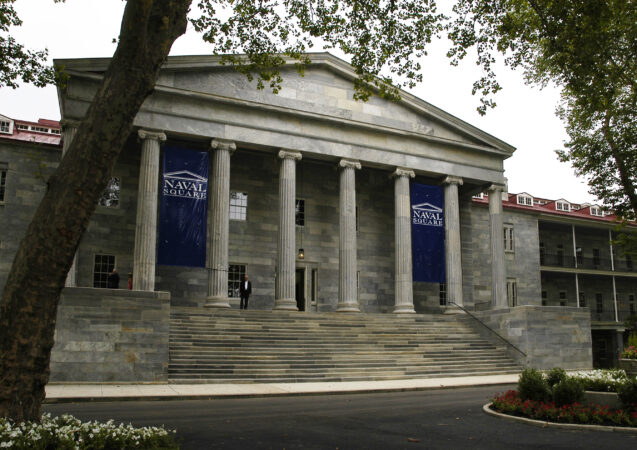
Naval Square, as it is now known, has been many things before becoming a gated community of expensive condos on the banks of the Schuylkill in a neighborhood with many names.
But whatever you call it, the 24-acre plot of land on Grays Ferry Avenue has been associated with the Navy since 1827 and has the unusual distinction of being the final resting place of Dexter, the Navy’s last working horse.
A reader interested in learning more about the horse — the questioner thought it was a mule — asked about it through Curious Philly, the Inquirer and Daily News question-and-answer forum through which readers submit questions about their communities and reporters seek to answer them.
First, a little history about the site.
The Philadelphia Naval Asylum, a hospital, opened there in 1827.
From 1838 until 1845, the site also served as the precursor to the U.S. Naval Academy, until the officers training school opened in Annapolis with seven instructors, four of them from Philadelphia.
In 1889, its name was changed to the Naval Home to reflect its role as a retirement home for old salts, as they used to call retired sailors. It closed in 1976, when the Naval Home moved to Gulfport, Miss.
It was in the service of the Naval Home that Dexter came to Philadelphia.
Originally an Army artillery horse foaled in 1934, Dexter was transferred to the Navy in 1945 to haul a trash cart around the Naval Home.
Despite his lowly duties, the men — only men lived there — loved him.
“That horse was more human than animal,” Edward Pohler, chief of security at the home, told the Inquirer in 1968. “He had the run of the grounds and would come to the door of my office every day to beg for an apple or a lump of sugar.”
The chestnut gelding was retired in 1966 and sent to a farm in Exton, but that did not last long. Naval Home residents who missed him committed to paying the $50 monthly bill for his feed and care.
For two years he grazed on a three-acre field that residents dubbed Dexter Park.
But on July, 11, 1968, Dexter, who had stopped eating and was not responding to medication, died at the age of 34 in his stall with a little human intervention to make it pain-free.
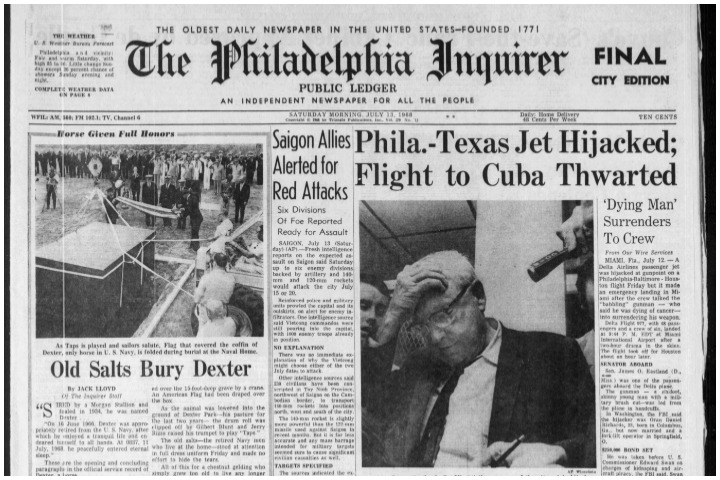
The story about the funeral for Dexter was on the front page of the Inquirer on July 13, 1968.
The next day, 400 people, including Navy men in dress uniform, turned out for a burial with full military honors.
Dexter was placed in a casket measuring 9 feet long, 5 feet wide, and 5 feet deep, with an American flag draped on the top. Retired Rear Adm. M.F.D. Flaherty, the home’s governor, offered final words, saying, “Dexter was no ordinary horse.”
As the casket was lowered by a crane into the 15-foot-deep grave, Gilbert Blunt rolled the drum and Jerry Rizzo played “Taps” on his trumpet. Members of the honor guard folded the flag into a triangle of white stars on a blue field and presented it to Albert A. Brenneke, a retired aviation mechanic and former farm boy from Missouri who was Dexter’s groom.
Brenneke recalled Dexter fondly, saying the horse was “very gentle and playful” and “liked to nibble on you,” according to news coverage of the funeral.
No sign exists marking Dexter’s final place.
The pasture, however, did not remain empty for long.
According to the December 1968 issue of the Navy magazine All Hands, a retired 16-year-old Fairmount Park Police horse named Tallyho took up residence at the Naval Home after Dexter’s death.
But, unlike Dexter, Tallyho, a bay gelding, was a gift to the home’s residents and did not receive an official Navy serial number.
“As was the case with Dexter, Tallyho’s only duty will be to contribute to the happiness of the men who share their retirement with him at the U.S. Naval Home,” the magazine said.
What happened to Tallyho after he went to the Naval Home is not clear.
Just before midnight on March 4, 1990, 15-year-old Darius Lamont was pulled through the back door of a friend’s home in Charlotte, N.C.
His attacker wanted the teenager’s green-and-white Eagles Starter-brand jacket, valued at $125. During their struggle, the attacker pulled out a gun and shot Lamont in the face.
When police arrived, the jacket was gone. Lamont died 10 hours later.
His death — like the jacket — was part of a trend.
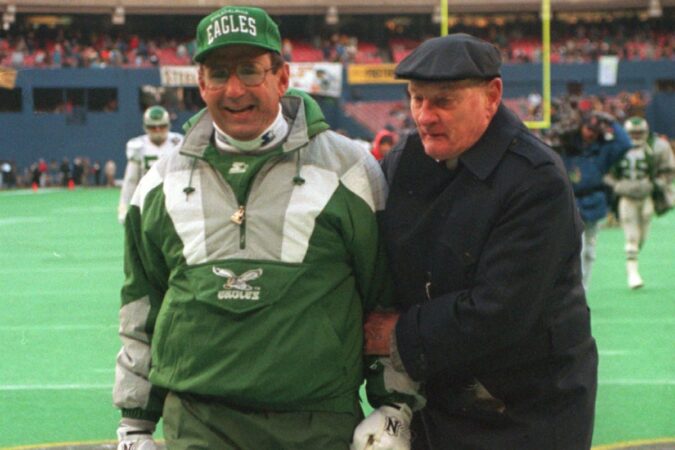
The growing popularity of professional sports in the late 1980s and early ’90s spawned a new cultural status symbol: expensive sports gear lined in team colors and affixed with hulking logos. The apparel was marketed to the eager-to-impress in their teens and early 20s. But the gear was so popular that some young wearers became crime victims.
As the 2017 NFL season kicks off and sports stores start to push their cold-weather gear, we look back on the chaos that followed the rise in sports-gear popularity and crimes spurred by the Starter-brand jacket trend.
In the 1980s and ’90s, the jackets were manufactured by the Starter Corp. of New Haven, Conn. The company was licensed to produce gear for all the major professional teams, including baseball, hockey, basketball, and football. While the brand still exists, it’s now an underutilized subsidy of Iconix Brand Group, which continues to sell the jackets for about $100 each.
Starter’s business peaked in 1992, when the brand made $350 million in sales.The most popular product was the winter-weight jacket, worn by gangster rappers and Hollywood superstars alike.
But the status symbol also led to a secondary industry: jacket theft. In Philadelphia, especially in the lower Northeast, some who couldn’t afford one turned to violence.
Two and three times a week, the police blotter was full. On one week in 1993:
– “14-year-old boy was jumped by a group of four men at 8:45 p.m. Jan 23 in the 6300 block of Charles Street and robbed of his $100 warmup jacket”
– “14-year-old boy was punched and robbed of his $100 Starter jacket at 9:15 p.m. Jan. 22 in the 4100 block of Levick Street by a group of three teen-age boys”
– “A 13-year-old boy was robbed of his $100 Starter jacket at 3:15 p.m. Jan. 21 in the 1500 block of Foulkrod Street by a 15-year-old boy”
Philadelphia police went so far as to send the freshest-faced cops undercover as decoys to catch would-be thieves. A Mayfair neighborhood group offered to put jackets on a registry, scribbling assigned serial numbers in three separate and secret locations on the jackets. But the thieves caught on, cutting out the serial numbers after they were lifted.
In 1993, when Robert Levins was inspector of the Northeast Police Division, he told then-Daily News columnist Jill Porter that he would lecture parents.
“I tell parents that I wouldn’t buy one for my child because of the fact — why put a target on your kid?” he said. “Why make your kid a victim? Buy him a nice coat, but it doesn’t have to be a Starter jacket or a sports team jacket.”
Porter wrote in response: “Sounds good to me, but try telling that to your kid.”
James Lamont, Darius’ father, told the Charlotte Observer that he had given his son money for Christmas to buy the jacket.
“It’s a shame you can’t buy something for your child,” he said, “without worrying if he’ll be safe to wear it.”