Category: Commentary

  • Proposed rule could gut American science, Penn researcher warns

    Proposed rule could gut American science, Penn researcher warns

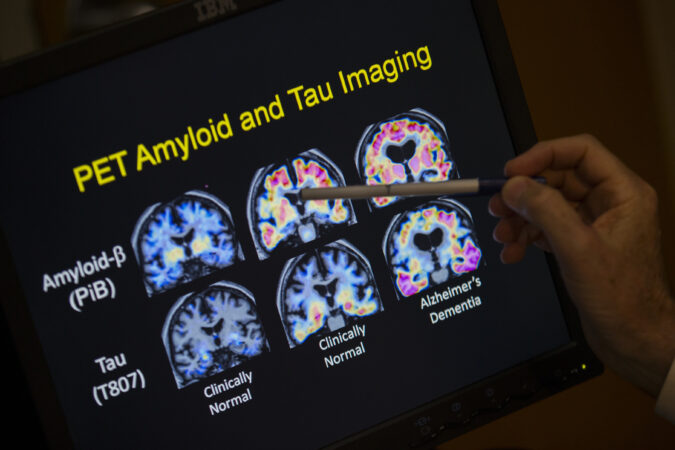
    As an undergraduate researcher at the University of Pennsylvania, I spend my time outside of class studying how a protein called tau destroys the brain cells of Alzheimer’s patients. This research happens at Penn’s Center for Neurodegenerative Disease Research (CNDR), it is funded by the National Institutes of Health, and it is the reason I want to spend my life as a physician-scientist.

    It is also exactly the kind of research a new federal proposal could quietly undermine.

    On May 29, the White House’s Office of Management and Budget (OMB) published a 100-page proposed rule that would fundamentally restructure how the federal government administers research grants. The comment period closes July 13.

    Most Americans have never heard of it. That needs to change.

    The rule has several alarming impacts. For instance, it would allow political appointees to override scientific peer review in grant decisions, upending the meritocratic, rigorous system that has pushed American science forward since World War II.

    Perhaps most critically, it would permit the government to terminate any active federal grant at any time, for any reason — including the vague, undefined justification that a study is no longer in the “national interest.” Furthermore, it would effectively ban federal funding for research into health disparities across racial populations, with a stated exception so narrow it is meaningless in practice.

    Let me put that in perspective with specific examples. Over seven million Americans currently live with Alzheimer’s disease, and that number will nearly double by 2050. The research that underpins our understanding of this disease — including discovery of biomarkers, assembly of databases, and clinical trial frameworks — took decades of sustained, longitudinal federal investment to build. The Alzheimer’s Disease Neuroimaging Initiative, launched in 2004, required over 20 years of continuous funding and investment prior to producing any comprehensive datasets that now drive clinical trials.

    Under the proposed rule, however, a political appointee or administrator with no scientific background could have decided at any point in that 20-year window that the study was no longer in the “national interest” and ended the study. The harm this vague, sweeping rule would do is not hypothetical. Much biomedical and clinical research, including in the field of neurodegenerative diseases, is longitudinal, and progress is not always immediately visible.

    I’m reminded of what the late John Trojanowski, a former leader of the lab I now work in, said in regard to his research on the proteins behind Alzheimer’s:

    “We asked our mentors, ‘Is this something we should do?’ They all said, ‘No. It’s a swamp, and you’ll ruin your careers because so little is known.’ What they saw as a swamp, we saw as a huge challenge and opportunity that has led to an engaging career.”

    Trojanowski’s partner in that research was Virginia Lee, whose work on tauopathies I have the privilege of contributing to today.

    Their “swamp” turned out to be an oasis of discovery that likely would’ve remained untouched if these two experts in their field had not trusted in themselves and decades of training. If even their mentors — senior scientists in their own right — had dismissed these field-defining ideas, imagine the damage administrators and political appointees can inflict on similar revolutionary discoveries simply because they deem them “not in the national interest.”

    The ban on research into racial disparities will compound this harm. Black Americans are diagnosed with Alzheimer’s at roughly twice the rate of white Americans. Population differences in disease risk, progression, and biomarkers are not ideological claims, but instead are observed, replicated findings in the scientific literature.

    For example, research has found that the relationship between the APOE4 gene (a major genetic risk factor for Alzheimer’s disease) and brain pathology inherently differs across racial groups. More specifically, some studies have found different patterns of tau protein markers in Black and Hispanic populations compared with the predominantly white cohorts that comprised much of the foundational, preexisting literature.

    As currently written, this provision reaches much further than OMB’s framing of eliminating unlawful DEI policies suggests, and instead directly threatens legitimate biomedical research.

    From a student perspective, I also want to acknowledge something that institutional press releases may not: This rule falls hardest on the people least able to absorb the blow.

    If a principal investigator or faculty member loses a grant, it is by all means a loss, but they are more likely to have tenure, salary, or institutional support. If a graduate or doctoral student loses a grant mid-project, they potentially lose their publication, graduation timeline, and may face an altered career trajectory. And yet, trainees are never once mentioned in this proposal.
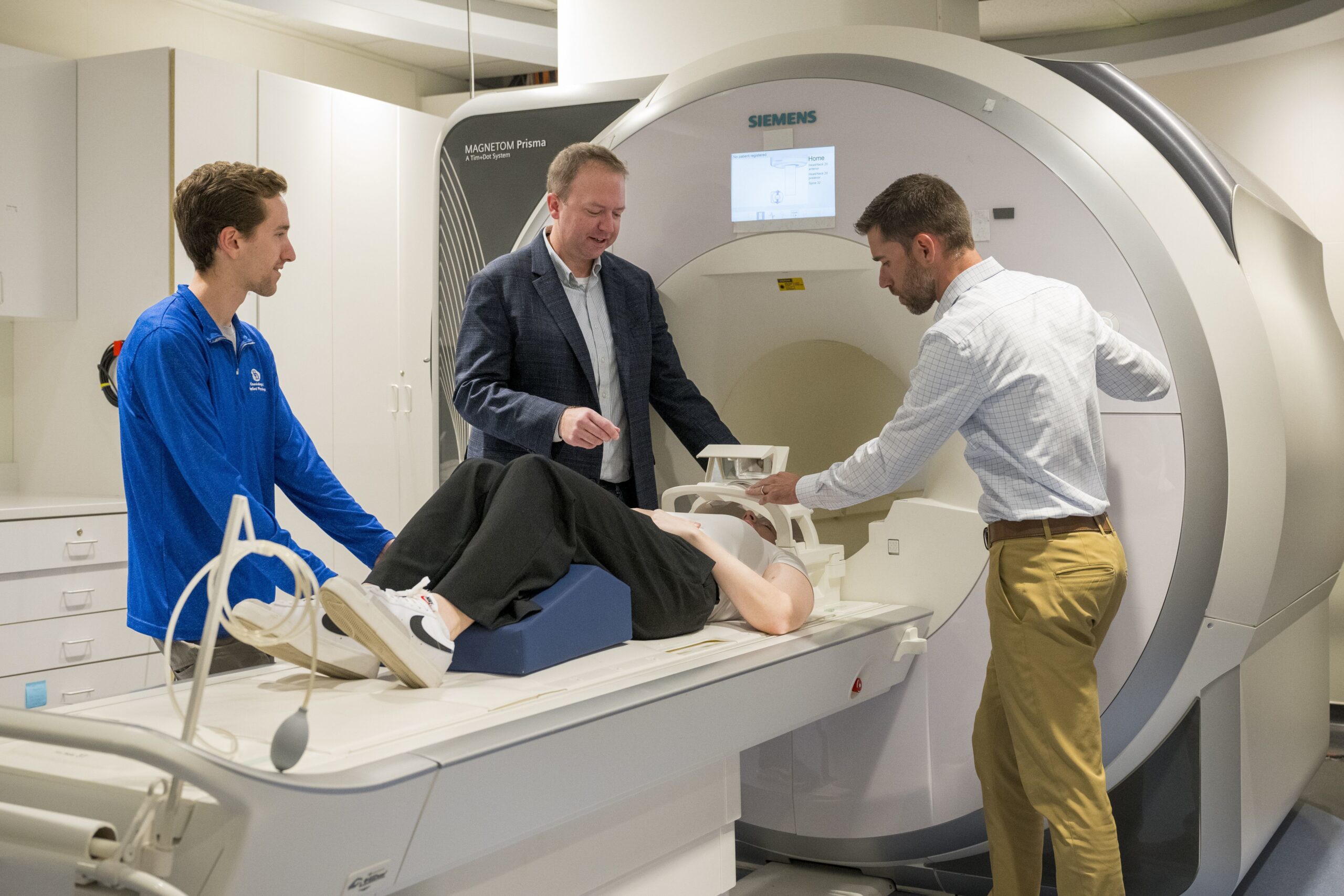
    Doctoral students at the Delaware Center for Cognitive Aging study the impact of cardiovascular function on brain tissue integrity and cognitive aging.

    So what can those of us who want to ensure we have the tools to effectively treat future pandemics and that our children benefit from world-class health research do?

    Congress has little practical recourse here. The Congressional Review Act exists, but in the current political climate, a veto-proof majority to overturn an OMB rule is a fantasy.

    Yet, our voice still matters.

    I do not say this as a mere platitude. The Federal Register, where this document was published, contains a form for anyone to leave a comment for OMB. Unlike the “contact me” forms on senators’ and representatives’ pages that you rarely receive a response from, the comments here are public — and they also carry legal weight. When this proposal gets challenged in court — and it almost certainly will — judges will look at the administrative record, which includes every single comment.

    If OMB does not meaningfully engage with a substantive objection raised during the comment period, that provides grounds to vacate the rule. Your comment doesn’t just go into a void. It becomes part of the legal ammunition.

    Physicians and healthcare workers: Share the stories of your patients who benefited from federally funded studies. Scientists and students: Explain your research and the progress made from it. Attorneys and legal scholars: Challenge the principles and wording in this sweeping, overarching proposal.

    To those whose careers do not directly involve science, this is your fight, too.

    Comment on your medical condition that’s been treated. Chances are that treatment was only possible due to federally funded basic science. And if you or a loved one suffers from a disease or illness for which we do not yet have a cure, it is all the more important that you speak up with us.

    Stable and comprehensive funding allows scientists to develop treatments for both rare illnesses and widespread ones like neurodegenerative diseases.

    This is also a fight for our underrepresented racial and ethnic populations, the LGBTQ+ community, and the marginalized in our city. The decision to fund research on medical disparities is a decision to invest in the people who need it most.

    As we in Philadelphia celebrate our nation’s Semiquincentennial, America’s first hospital and medical school, and the great scientific advancements of our city, it would be wrong not to recognize the benefit biomedical research has received from federal funding.

    This legacy is now in danger. If we want to see another 250 years of great American science, now is the time to act.

    Ayaan Shah is a sophomore at the University of Pennsylvania studying neuroscience and an undergraduate research assistant at Penn’s Center for Neurodegenerative Disease Research.
  • The Supreme Court freed college athletes to earn. Collective bargaining is the next step.

    The Supreme Court freed college athletes to earn. Collective bargaining is the next step.

    It is past time for Division I colleges and universities to recognize that their student-athletes deserve both the right to bargain collectively and recognition that they are employees because of the compensation their institutions provide to them and the control those institutions have over them.

    A deluge of media coverage has been aimed at other issues in big-time college sports, particularly football and basketball, but too little attention has been given to what should be center-stage — how student-athletes should be fairly treated by the institutions that benefit from their athletic prowess.

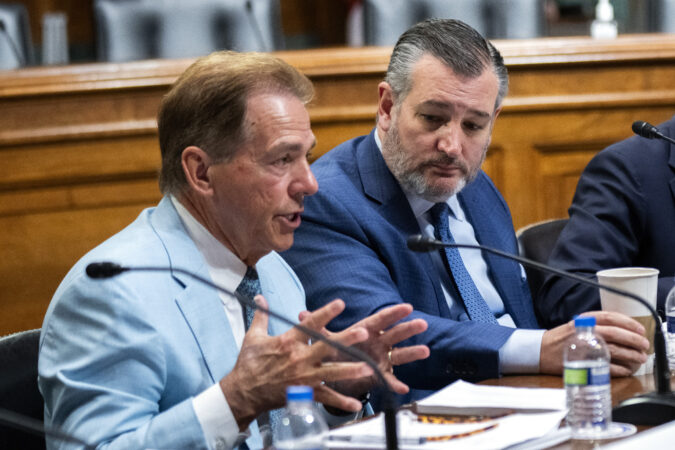
    The Senate Commerce Committee recently held a hearing on the Protect College Sports Act of 2026, sponsored by Sens. Ted Cruz (R., Texas) and Maria Cantwell (D., Wash.), to “restore order” to college sports. This 111-page legislative effort is the latest in a series of approximately 40 bills aimed at reversing judicial rulings that oblige universities to share financial gains with their players.

    Like their legislative predecessors, the 2026 bill limits or ignores existing player rights and immunizes universities from antitrust liability resulting from player-initiated litigation and substitutes Congress’ judgment for the courts, players, and universities.

    Thus, the 2026 bill restricts the ability of players to transfer through a “portal” from one college to another and limits player eligibility to five years beyond the day of high school graduation. The bill would preclude awarding antitrust damages to players who seek to increase their mobility and earnings. It would also preempt state laws guaranteeing players compensation for their names, images, and likenesses used, for instance, on video games and athletic clothing (this has come to be called NIL money).

    Until the last decade, the unchallenged position of the National Collegiate Athletic Association was that all college players are amateurs entitled to no more than athletic scholarships and frequently inadequate reimbursement for college expenses. Post-World War II football and basketball were dominated by the Southeastern Conference and the Big Ten, and both were big businesses.

    Notwithstanding this reality, the NCAA maintained that the players were amateurs who could not be paid until the U.S. Supreme Court in 2021 ruled that the NCAA and its member campuses were liable for treble damages when they conspired to deny the players “educational” compensation beyond athletic scholarships and reimbursements.

    Universities became involved in class-actions brought by their players about player transfers, eligibility, and related issues following that Supreme Court ruling. The ruling recognized that the universities have always treated athletes differently from other students, sometimes providing them with preferred admissions as well as under-the-table monies and other benefits, frequently in conjunction with wealthy alumni and “boosters.”

    With California leading the way, many states enacted so-called NIL laws that allow players to be compensated for use of their names, images, and likenesses.

    But the NCAA continued to insist the players were amateurs. As a result, outside “booster” groups or “collectives” were created to provide business deals to attract or retain college athletes from a source other than the universities.

    Meanwhile, institutions of higher learning went to war to attract coaches with multimillion-dollar salaries, often exceeding those of any other employee, and — among state universities — any other state employee, including governors.

    In the wake of these developments, an immediate response was the negotiation of financially lucrative media deals by the universities and a realignment of college conferences.

    Stanford University, for example, left the Pac-12 Conference to join the Atlantic Coast Conference, requiring all its varsity athletes to travel regularly across the country, increasing the separation from their classrooms.

    Further, NIL procedures have become a kind of Wild West, sometimes composed of shadowy characters and “agents” who operate without any regulation as is provided in the professional leagues.

    Earlier this year, President Donald Trump convened a meeting of business and university officials in connection with a new executive order to preempt state regulation. The 2026 Cruz-Cantwell bill is the most recent response. It consigns players to minority representation on an athletic “governing board” or “rulemaking committee.”

    Deeply troubling, it avoids even a mention of collective bargaining or employee status for the players. The current National Labor Relations Board is unlikely to address these issues effectively. And this Congress is unlikely to act on the Cruz-Cantwell bill.

    Some, we realize, claim we should go back to an earlier era when money was not center stage in every aspect of Division I college sports. But it is too late to return that genie to its bottle.

    Rather than wait for voluntary recognition of the organizing power of college players, or for state legislatures to take action, Congress should amend the National Labor Relations Act to allow student-athletes to exercise their collective bargaining rights.

    This step by a new Congress in 2027 could provide much-needed protections for college athletes in terms of adequate compensation, health and safety protections, as well as a reasonable measure of player mobility fashioned by both students and universities seeking a balance between freedom and a disruptive revolving door.

    After all, the most appropriate forum for resolving the complex matters around modern-day college athletics isn’t through one-off legislation or the occasional court ruling, but rather at the collective bargaining table.

    Thomas Ehrlich is the president emeritus of Indiana University, former provost of the University of Pennsylvania, and former dean of Stanford Law School. Currently, he is an adjunct professor at the Stanford University Graduate School of Education. William B. Gould IV is the Charles A. Beardsley Professor of Law, emeritus, at Stanford Law School. He is a member of the National Academy of Arbitrators and former chairman of both the National Labor Relations Board and the California Agricultural Labor Relations Board.

  • Democratic leaders threaten self-destruction after wins by popular left-wing candidates

    Democratic leaders threaten self-destruction after wins by popular left-wing candidates

    For years, I have summed up American politics in one sentence: Republicans have no principles, Democrats have no spine. Now, Democrats seem intent on proving they have no brains to go with that wobbly backbone. Following James Carville’s lead, some frightened Democrats appear determined to snatch defeat from the jaws of victory.

    Carville worked magic nearly 35 years ago, helping mastermind Bill Clinton’s 1992 win. He has since become the epitome of the conventional-wisdom consulting class. Only a split within the party could darken the Democrats’ bright electoral prospects this year and beyond. Yet, Carville seems determined to promote precisely that division.

    Appointing himself the party’s membership czar, Carville openly advocates for an intraparty “schism,” pushing out the democratic socialists whom voters just elected in Democratic primaries. Sparing no expletives, he said, “I actually do think it’s time for Democrats to talk the S-word: schism.”

    Even the word reeks of futility. Schism is most closely associated with the Great Church Schism, which culminated in 1054. The schism irreparably split the Christian Church into Eastern Orthodox and Western Roman Catholic, and weakened Christianity for centuries. It led to Western Crusaders sacking Constantinople in 1204, and left the Eastern Orthodox exposed to the rising Ottoman empire, which took the city in 1453.

    The Democratic Party has always thrived on diversity. In the 1930s, Sen. “Cotton Ed” Smith and fellow conservatives held the party’s right flank while Sen. Robert Wagner and the liberals held its left. That coalition built the majorities that enabled Franklin Delano Roosevelt to enact the New Deal and to lead the nation through World War II.

    One of FDR’s few political missteps was his attempt to purge conservatives in the 1938 primaries. The failed purge, which party chair James Farley called a “bust,” drove Southern Democrats into a conservative coalition with Republicans and shattered FDR’s aura of invincibility. Though not the primary cause, it contributed to staggering Democratic losses that November: 72 House seats and eight Senate seats.

    Carville’s schism has no upside. A handful of democratic socialists will not turn America into Cuba. They sit much closer to the Democratic mainstream than Cotton Ed’s bloc sat to FDR’s. A September Gallup poll found that 66% of Democrats hold a positive view of socialism. And these are not hard-line socialists; they more closely resemble the social democrats of Scandinavia, who would regulate capitalist enterprise, rather than have the state seize it.

    The downside, though, is immense. A divided party wins fewer elections. The most likely outcome of a Democratic schism is MAGA rule for the foreseeable future, posing grave danger to American democracy itself.

    Carville’s promotional flair has won his idea wide coverage, and some Democrats have signed on. The Nation blared that “Establishment Democrats Are Embracing Loserdom.” The author warned that “Some centrists would rather have Trump triumph than forge an alliance with the left.

    Former Democratic Party chair Jaime Harrison told left-wing Democrats: “If you hate the Democratic Party, then please don’t run for our nomination. Don’t use our resources. Don’t rely on our volunteers. Don’t use our infrastructure.”

    Democratic Rep. Josh Gottheimer of New Jersey agreed. “Are we going to let them take over the party? Or are we going to stand up and fight back?” he said. “Many of us believe, as I do, that if you’re a socialist, you’re not a Democrat.”

    Democratic Sen. John Fetterman of Pennsylvania, although not explicitly endorsing Carville’s call for schism, blasted left-wing Democrats. He said that the victory of democratic socialists has “just been the dancing days of the dirtbag left. You know, some of these candidates are outrageous.”

    Carville and his backers should remember the words made famous by football coach Vince Lombardi: “Winning isn’t everything; it’s the only thing.” Stopping Donald Trump and his cronies from subverting our democracy is not the most important thing; it is the only thing.

    A united Democratic Party, not a top-down purged one, holds the only hope of achieving that end.

    Instead of panicking over left-wing candidates’ victories, mainstream Democrats should learn why those wins sparked such voter enthusiasm. Democrats should also reject Carville’s siren song and heed Sen. Cory Booker’s response to Fetterman’s slamming of the “dirtbag left.”

    “If you want to heal a country, you can’t be picking fights,” he said. “Our party is not homogeneous. One of the things that makes the Democratic Party great is that it’s a big-tent party. We need to stay that way. The focus has got to be the November elections.”

    Allan J. Lichtman is a distinguished professor of history at American University. He is also the author of “Great American Presidents: The Twelve Who Transformed the Nation,” out from Bancroft Press in September.

  • What the citizenship test tells us about what it means to be American

    What the citizenship test tells us about what it means to be American

    Independence Day is one of my favorite holidays. Not for the parades, pageantry, and fireworks, though I love those, too — even more so in the year of the nation’s Semiquincentennial.

    I love the day for what it celebrates: the birth of an audacious experiment. The idea that a nation could be built not on shared race, religion, or ancestry, but on a shared belief in human dignity, and the right to pursue a life of your own making. E pluribus unum. Out of many, one.

    That idea is how my family became Americans. My parents came to the United States as exchange students from Iran, intending to return home. The Iranian Revolution happened the day my dad was defending his doctoral dissertation. It extinguished the future my parents had imagined, especially for me. His Jewish dissertation advisers wrapped their arms around our young Muslim family, and America took us in.

    I have spent my career seeking to be worthy of that welcome, serving my country — the United States — at some of the highest levels of government. My diplomatic counterparts in the Middle East thought I was a unicorn: How could the first-generation daughter of a country that is the sworn enemy of the United States be seen as so American as to represent it? My experience is not unique — just ask the many first-generation troops who serve in our military. I’m not the unicorn. Our country is.

    President Ronald Reagan said it best, in his final speech as president: “A man wrote me and said: ‘You can go to live in France, but you cannot become a Frenchman. You can go to live in Germany or Turkey or Japan, but you cannot become a German, a Turk, or a Japanese. But anyone, from any corner of the Earth, can come to live in America and become an American.’ … We lead the world because, unique among nations, we draw our people — our strength — from every country and every corner of the world. And by doing so, we continuously renew and enrich our nation.”

    Our founders knew that their radical idea would take work from all of us. George Washington spelled out the covenant of citizenship when, writing to a Jewish congregation in 1790, he said that America “gives to bigotry no sanction, to persecution no assistance” — and in return “requires only that they who live under its protection should demean themselves as good citizens, in giving it on all occasions their effectual support.” Welcome extended. Citizenship expected.

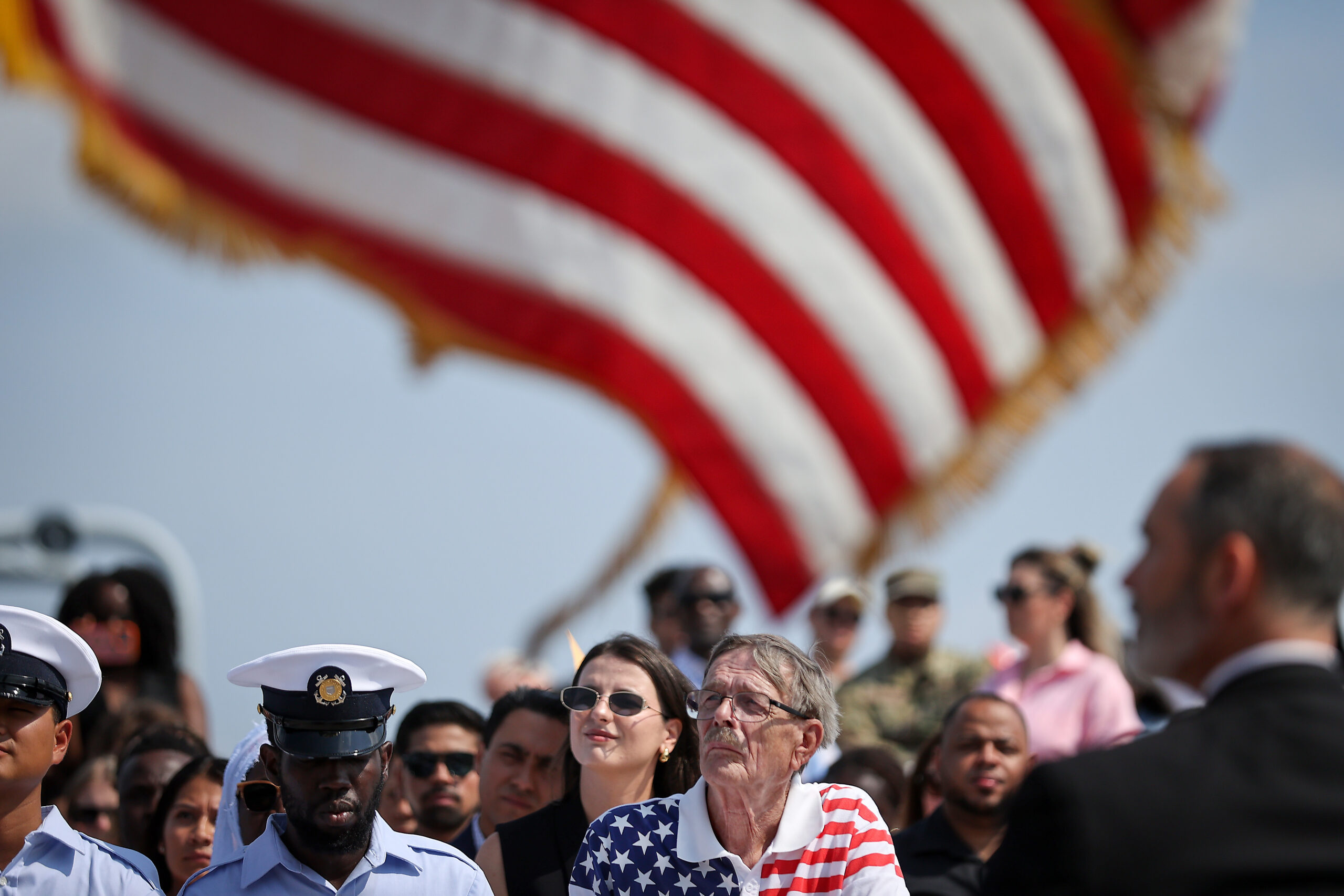
    Bjorn Bedersen (right), who was one of the 42 soon-to-be U.S. citizens, listens to a speech during an Independence Day naturalization ceremony on Battleship New Jersey in Camden on July 4, 2024.

    So every Fourth of July, I find myself thinking about what citizenship should demand of us today. This year, with our 250th upon us and citizenship debated in courts and in the press, the question is more urgent than ever.

    Right now, hundreds of thousands of aspiring Americans are studying for the naturalization exam — 128 questions on the history, values, and structure of the country they have chosen. They are doing it after working long hours, after putting their kids to bed, in their second or third language. They chose this country on purpose, and they are earning their place in it the hard way.

    Which raises a humbling question for the rest of us: Could we pass the same test?

    Most of us — native-born Americans, myself included — would struggle to keep up with them. Two-thirds of Americans can’t pass the civics test that new citizens are required to pass, and this year, it got twice as hard.

    The path these aspiring Americans walk has seldom been more fraught. In recent years, families have been separated by enforcement actions, legal pathways to citizenship are increasingly unclear, and communities that once felt settled now live in a persistent state of uncertainty. The people studying those 128 questions are doing so under a shadow most of us will never know. They wonder: Are they still even welcome here?

    That is the full truth of this moment: that the people studying the hardest — who perhaps know the most about our country and what makes it extraordinary, who are perhaps the most committed to it — face an uphill battle for a prize most of us simply inherit and often fail to value.

    Citizenship cannot be something we take for granted. It is something we practice by learning our history, contributing to our communities, and strengthening them for the next generation.

    That’s why I find so much hope in the many Americans who have stepped forward in recent years to help newcomers build their lives in this country. Veterans who know what civilians suffer in war. Pastors in small towns who organized their congregations. Neighbors who decided that the covenant Washington described was theirs to keep.

    Now, many of those people are stepping up again to help newcomers succeed in their dreams of becoming American citizens. I lead a nonprofit, Welcome.US, that has created a new citizen guide program, through which Americans can help aspiring citizens study for the civics exam, practice English, and prepare for the live interview that many newcomers find most daunting. One neighbor and one aspiring American at a time, sitting down together over the questions that define this country.

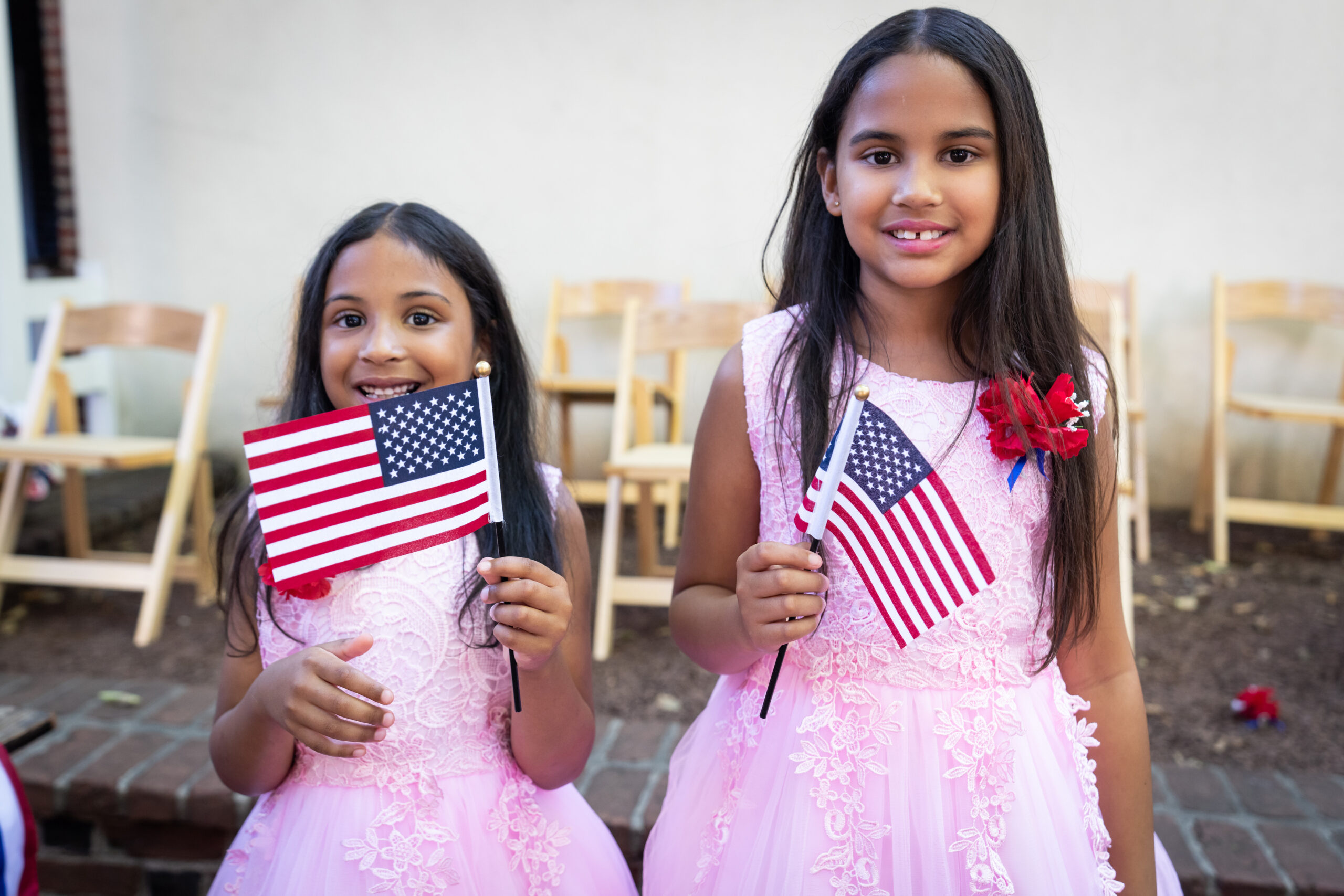
    Elianny Torres Rodriguez (left) and Edwanny Torres Rodriguez at the children’s naturalization ceremony at the Betsy Ross House in Center City in July 2024.

    Through our organization’s work with more than two million volunteers, I’ve seen that the learning goes both ways.

    When Americans help someone prepare for the citizenship test, they don’t just teach. They remember. They are reminded why the First Amendment matters, what the Civil War settled, how generations of Americans — from suffrage to the Civil Rights Movement to American tribes — made our Constitution more real for more people. Welcoming someone into citizenship turns out to be one of the most reliable ways to renew your own.

    So here is my invitation on America’s 250th birthday: Take the test. Welcome.US has put the civics questions online. See how you do. Let yourself be surprised by what you know and humbled by what you’ve forgotten.

    And if you find that mix of humility and renewed awe that I find every time I try my hand at the test — consider doing something with it. Become a citizen guide and help someone else prepare for it. Spend a few hours with someone who has chosen America on purpose, and let them remind you why it was worth choosing.

    Two hundred and fifty years after our founding, the American Experiment remains unfinished. That’s not a failure; that’s the design. The founders left it to us — all of us, newcomers and native-born alike — to keep working on that ever more perfect union. On this momentous national anniversary, let’s renew that charge.

    Take the citizenship quiz and learn about becoming a citizen guide at Welcome.US.

    Nazanin Ash is the CEO of Welcome.US, a nonpartisan nonprofit that has mobilized more than two million American volunteers across 26,000 zip codes to welcome and support newcomers.

    Take the test

    Here are a few sample questions from the U.S. citizenship test. See more examples at interact.welcome.us/civics:

    1. How many voting members are in the House of Representatives?

    2. There are four amendments to the U.S. Constitution about who can vote. Describe one of them.

    3. How many amendments does the U.S. Constitution have?

    4. The Federalist Papers supported the passage of the U.S. Constitution. Name one of the writers.

    5. The Nation’s first motto was “E Pluribus Unum.” What does that mean?

    Answers

    1. Four hundred thirty-five (435).

    2. Citizens eighteen (18) and older (can vote). You don’t have to pay (a poll tax) to vote. Any citizen can vote. (Women and men can vote.) A male citizen of any race (can vote).

    3. Twenty-seven (27).

    4. (James) Madison; (Alexander) Hamilton; (John) Jay; Publius.

    5. Out of many, one; We all become one.

  • 250 years has taught us that freedom comes only with economic security

    250 years has taught us that freedom comes only with economic security

    In America, one broken-down car can cost someone a job. One medical bill can wipe out a bank account. One missed paycheck can push a family from stability to desperation.

    That is not freedom in any real sense.

    As the nation marks 250 years of independence, we should say plainly what too many families already know: Freedom requires economic security. And economic security is only achievable when people have resources that exceed the basic cost of living, allowing them to cover their daily needs and build essential wealth — the savings, assets, and financial cushion needed to withstand life’s inevitable shocks.

    Pathway to opportunity

    Two hundred and fifty years ago, our Founding Fathers made a promise that people would have a right to self-determination. It was a promise that hard work, responsibility, and perseverance would open real pathways to opportunity. As we mark this anniversary, we must ask an honest question: For how many Americans does that promise hold?

    For too many, it does not. Millions of families are working, paying their bills, and doing everything right, yet have almost nothing set aside for the moment life goes wrong. A child spikes a fever. A parent grows too frail to climb the stairs alone. The cost of in-home care lands like a bombshell. One emergency room visit, one layoff, one transmission repair, and stability collapses into crisis. Their rights exist in theory, but their actual circumstances leave people with fewer choices, fewer chances, and far less control over their own lives.

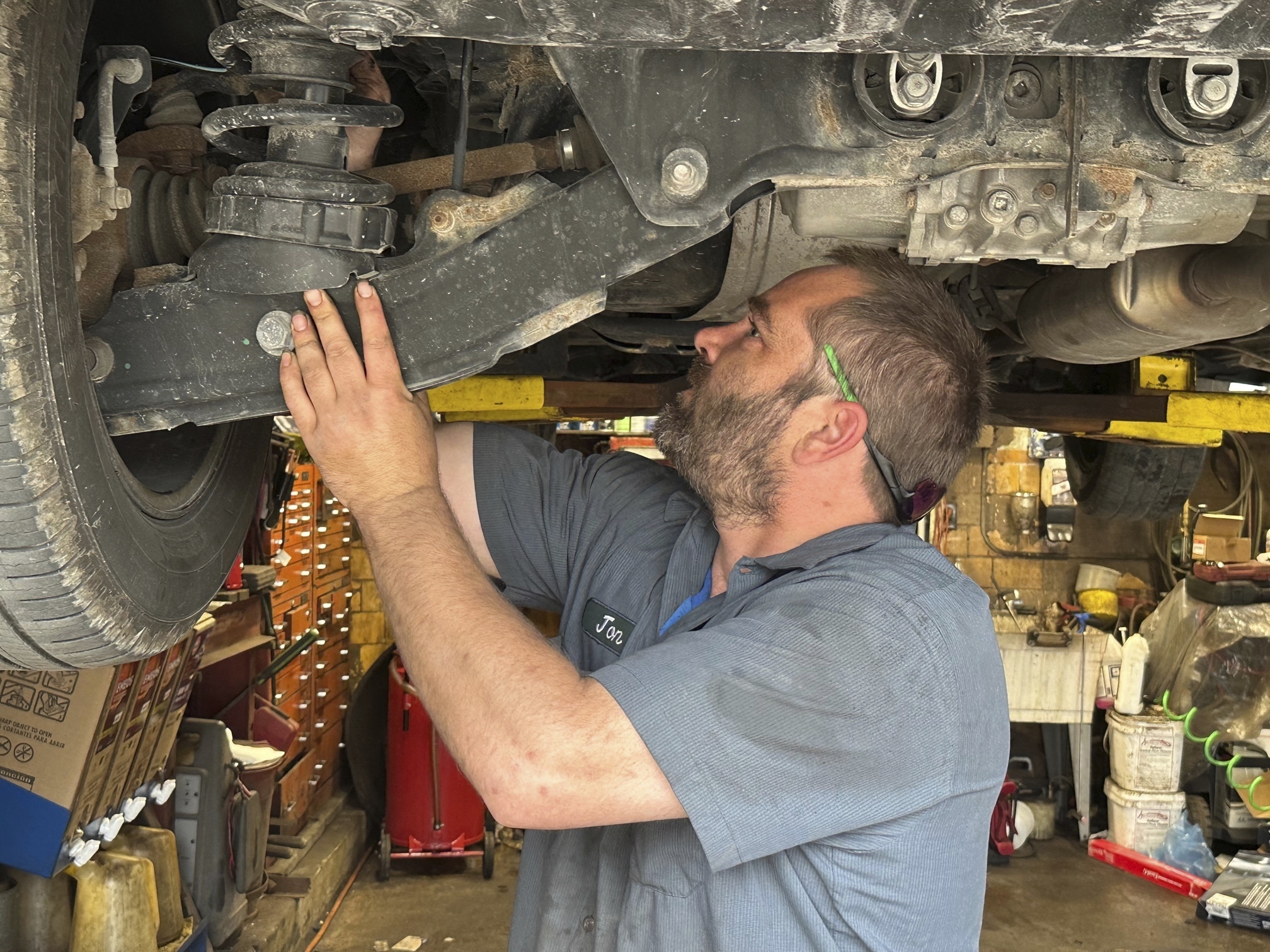
    A mechanic works on a pickup truck in Michigan. The expense of a major auto repair bill can mean the difference between stability and ruin for many Americans.

    The Constitution guarantees liberty, but circumstances can constrain it. People without the resources to withstand hardship face insurmountable barriers to education, purchasing homes, launching businesses, or saving for retirement. They cannot give their children a running start. They may have rights on paper, but lack the economic security to fully exercise them.

    The founders understood at least this much: Liberty could not survive as an abstraction. The Virginia Declaration of Rights, a document that helped supply the moral language of the Declaration of Independence, described the inherent rights of the people as including life and liberty, but also “the means of acquiring and possessing property” and pursuing happiness and safety. That phrase matters.

    Today, we understand “the means” less as land than as essential wealth. This is not wealth in the sense of luxury, privilege, or vast accumulation. It is the modest but vital foundation that allows a family to absorb a shock without being knocked flat. It is the money to repair the car that gets someone to work, cover the childcare that keeps a parent employed, pay for medicine before a condition becomes a crisis, or help an aging parent remain safe at home.

    Essential wealth is what allows families to plan instead of merely react. It is the difference between recovering from a setback and being defined by it.

    For generations, the government has measured economic well-being almost entirely by the absence of poverty. It tracks what people earn while paying little attention to what they own, save, or can lean on when hardship strikes. Income matters, but it cannot tell us whether a family is truly economically secure.

    Wealth, not income

    The real test comes when life happens. And in those moments, the difference between stability and crisis is not income. It is wealth, or the lack of it.

    The cost of ignoring this is written across the country and across Pennsylvania. Tens of millions of American households cannot cover a modest emergency expense, including 48% of households here in the commonwealth, according to the “Measuring the True Cost of Economic Security” report. Wealth gaps yawn across race, geography, and generation, falling hardest on communities long denied the chance to build.

    As we celebrate 250 years of American independence, we must think bigger.

    We need policies that help families build assets, not just scrape by. Policies that expand pathways to homeownership, invest in children’s futures, widen access to savings and wealth-building, and tear down the barriers that block economic mobility. We need to ensure every child, no matter their zip code or their parents’ income, has the tools to build a secure future.

    We must stop managing poverty and start measuring the true cost of living, which includes investing in freedom. Two and a half centuries in, the promise of America was never that people would simply get by. It was that they would have the freedom to get ahead. Living up to it now is the work this anniversary demands.

    Michael A. Nutter served as the 98th mayor of Philadelphia from 2008 to 2016 and is currently a senior executive fellow at the Weitzman School of Design at the University of Pennsylvania. Jennifer Jones Austin is the CEO of the Federation of Protestant Welfare Agencies and cochair of the National True Cost of Living Coalition.

  • America emerging

    America emerging

    When the people drafting the U.S. founding documents got to work in the mid-1700s, they made unprecedented progress on the ills plaguing the preceding era, while failing to meet the fullest expression of their ideals. They would leave those moral aspirations to us — their inheritors.

    Their impact is all around us. When any person, anywhere in the world, claims, “I have rights,” they are nodding toward the Enlightenment ideals at the heart of the U.S. founding. Today, it is difficult to appreciate the extent to which those founding principles were revolutionary for simply quelling religious violence.

    In the era preceding the founding, millions of Europeans died in warfare couched within differences of faith. On this side of the Atlantic, institutions reflected the certainty of one, true God. Harvard was founded in 1636 to train Puritan clergymen; William and Mary was established six decades later to train Anglican clergy. In the colony of Maryland, Catholics battled Protestants in 1655, leading to the execution of four Catholic leaders.

    In this context, 11 years before he would take control of Pennsylvania, William Penn wrote a treatise establishing a rationale for religious toleration. Benjamin Franklin picked up that emphasis when he shared Proposals Relating to the Education of Youth in Pensilvania in 1739. In the document that framed the University of Pennsylvania’s early years, Franklin insisted that students would consider “the Advantage of Civil Orders and Constitutions, how Men and their Properties are protected by joining in Societies and establishing Government.”

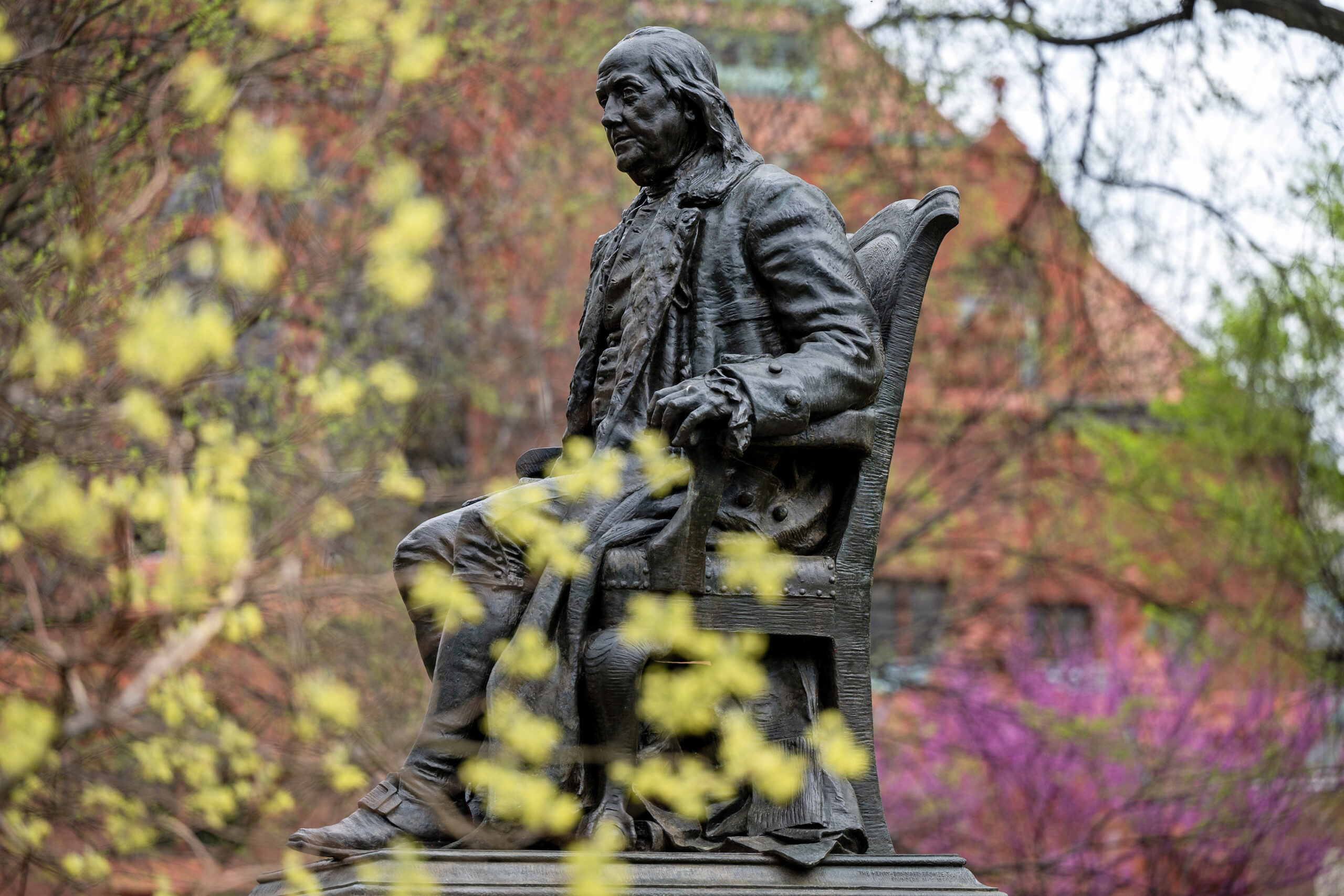
    Benjamin Franklin statue on the campus of the University of Pennsylvania in front of College Hall.

    Penn’s early, religiously inclusive orientation was at odds with the identity politics of the era, which featured an association between Anglicanism and British loyalty. As tensions grew, the university trustees mandated an Anglican majority on the board, contributing to suspicions of loyalist bias.

    After the British occupation of Philadelphia and 2,000 disease-driven deaths among the Continental Army at Valley Forge, state leaders dissolved the university. According to the Pennsylvania Assembly, “the College had been ‘in the hands of dangerous and disaffected men’ who have provoked ‘tumult, sedition, and bloodshed.’

    A new university was mandated — and the leadership was diverse across Protestant sects, including even Catholic representation. The leaders, however, were uniform in their support for the American revolutionaries.

    This creation of, and commitment to, a civic, secular, tolerant institution of higher learning reflected centuries of conflict in arms, persuasion in conversation, and development of ideals. And, like the Declaration of Independence, it was so near in time and space that Penn’s founding was not a crowning achievement but a milestone on a much longer journey.

    Indeed, America’s hypocrisies at the founding and struggles since that time are understood in terms of American ideals: enacting in life and in law, through shared governance, a country that embraces the dignity of all people.

    A century after William Penn died, Frederick Douglass was born into enslavement — yet he was destined to advance America’s moral imagination.

    Douglass self-emancipated by escaping to Philadelphia at the age of 20 in 1838. Only three years later, he rose to fame through his abolitionist speeches, compelling audiences with his message and oratory power.

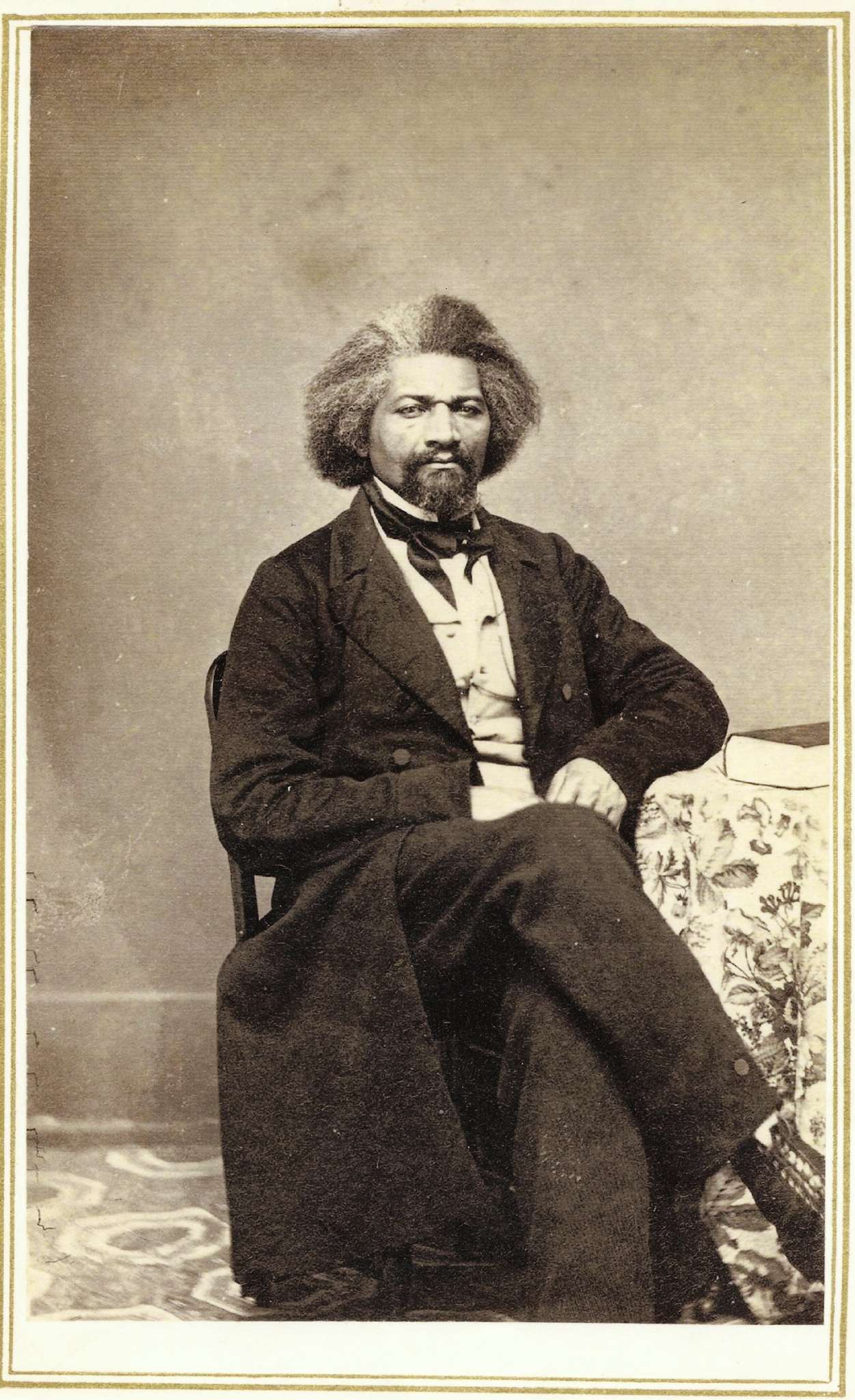
    An 1863 photograph (carte-de-visite) of Frederick Douglass, by Edwin Burke Ives and Reuben L. Andrews.

    He also grew through international collaboration. His 1840s tour of Ireland and Britain revealed the interdependence of global struggles for freedom.

    When Douglass returned to the states in 1847, he joined Elizabeth Cady Stanton and Philadelphian Lucretia Mott in upstate New York at the Seneca Falls Convention for women’s rights. As his reputation grew, he occasionally parted ways with his mentor, the abolitionist William Lloyd Garrison.

    One critical difference featured a perennial question: Is it possible to reform the system?

    Garrison and many of his followers viewed the U.S. Constitution as a pro-slavery document. He refused to participate in U.S. electoral politics and believed free states should separate from states that permitted slavery. Douglass differed.

    The debate extended across the Atlantic. In 1860, Douglass was invited to Glasgow, Scotland, to defend his position. He began by clarifying that “the American government and the American constitution … are as distinct from each other as the compass is from the ship.”

    In an extensively argued defense of constitutional principles, textual, and moral clarity, Douglass asserted that if Americans honor the Constitution, “we will have no need of a dissolution of the Union — we will have a dissolution of slavery all over that country.”

    In this orientation toward America, emerging ever more aligned with its fullest expression as a birthplace of freedom, Douglass echoed Franklin.

    At the age of 81, in 1787, Franklin urged adoption of the U.S. Constitution — specifically recognizing it had faults he disagreed with. He emphasized union over disunion; he offered faith in the possibility of stepping from the rule of a king to the rule of the people, however small that first step was — it was still a spark.

    Though Douglass would live most of his life in Massachusetts, New York, and the nation’s capital, he gained his freedom by coming to Philadelphia — a city and region awash in abolitionist organizing. Harriet Tubman also established her freedom in Philadelphia before moving northward. In the same era, the nation’s first historically Black colleges and universities, Lincoln and Cheyney, were founded in Southeast Pennsylvania. They would soon educate numerous pivotal civil rights leaders in the U.S., as well as the young men who would later become the first presidents of Ghana and Nigeria.

    Revolutions in human freedom move much more like a river than a straight line. We who work, vote, and struggle for freedom are the water. We hit rocks, cliffs, and eddies — but freedom, like water, finds its path.

    That freedom-finding is not merely metaphorical. In the 1700s and early 1800s, enslaved Africans fleeing Georgia fled not north but south, where the Spanish ruled until 1821. Just a bit north of St. Augustine, Fla., is Fort Mose, established as a legally sanctioned free Black community in 1738.

    The Visitor Center at Fort Mose Historic State Park includes several exhibits and a detailed timeline that tells the story of the first free Black community in the U.S.

    Freedom can be enacted on any soil, by any heritage. And it has been violated — all around the world — by a full range of traditions. Legally sanctioned slavery continued in Brazil through the end of the 1800s; it persisted in the Indian Ocean region well into the 1900s. Religious freedom — and freedom of conscience — remains an ideal that has yet to be fully enacted.

    In the U.S., it is better than it is in much of the world, but we, like people anywhere, will always need to challenge ourselves to fully understand and enact our highest ideals.

    When we celebrate the founding, we celebrate ideals. When we make American progress, we advance their implementation. The rights underlying democracy are not a given; they are the product of a cocreated moral imagination, grounded in shared values, extended through quality schooling, and in need of restrengthening and improving with every generation.

    Eric Hartman recently delivered invited lectures on these topics at Northeastern University and at Flagler College in St. Augustine, Fla. This op-ed is excerpted from a longer article currently under review.

  • America’s rich tradition of July Fourth protest is worth recalling

    America’s rich tradition of July Fourth protest is worth recalling

    No Kings and other protests opposing the policies and executive overreach of the Trump administration continue to draw crowds across the country, most recently on Flag Day, June 14, which was also the president’s 80th birthday. While critics have denounced these demonstrators as un-American — House Speaker Mike Johnson called a 2025 No Kings march a “hate America rally” — those voicing dissent, pushing for change and speaking truth to power are, in fact, participating in a tradition at our nation’s core.

    That tradition dates back to July 4, 1776, when the Continental Congress, citing a list of grievances, declared independence from the rule of a would-be despot, King George III. The founders’ act of resistance set an example that ordinary Americans would follow. According to historian David Waldstreicher, citizens in the early republic used celebrations not just to commemorate independence, but to lay claim to the lofty principles expressed in the Declaration of Independence, namely that all are created equal, that they have unalienable rights, and that government is instituted to secure those rights, deriving its just powers from the consent of the governed.

    The custom continued for two-plus centuries, with Americans regularly marching, picketing, or otherwise taking to the streets on the Fourth to realize a more perfect union.

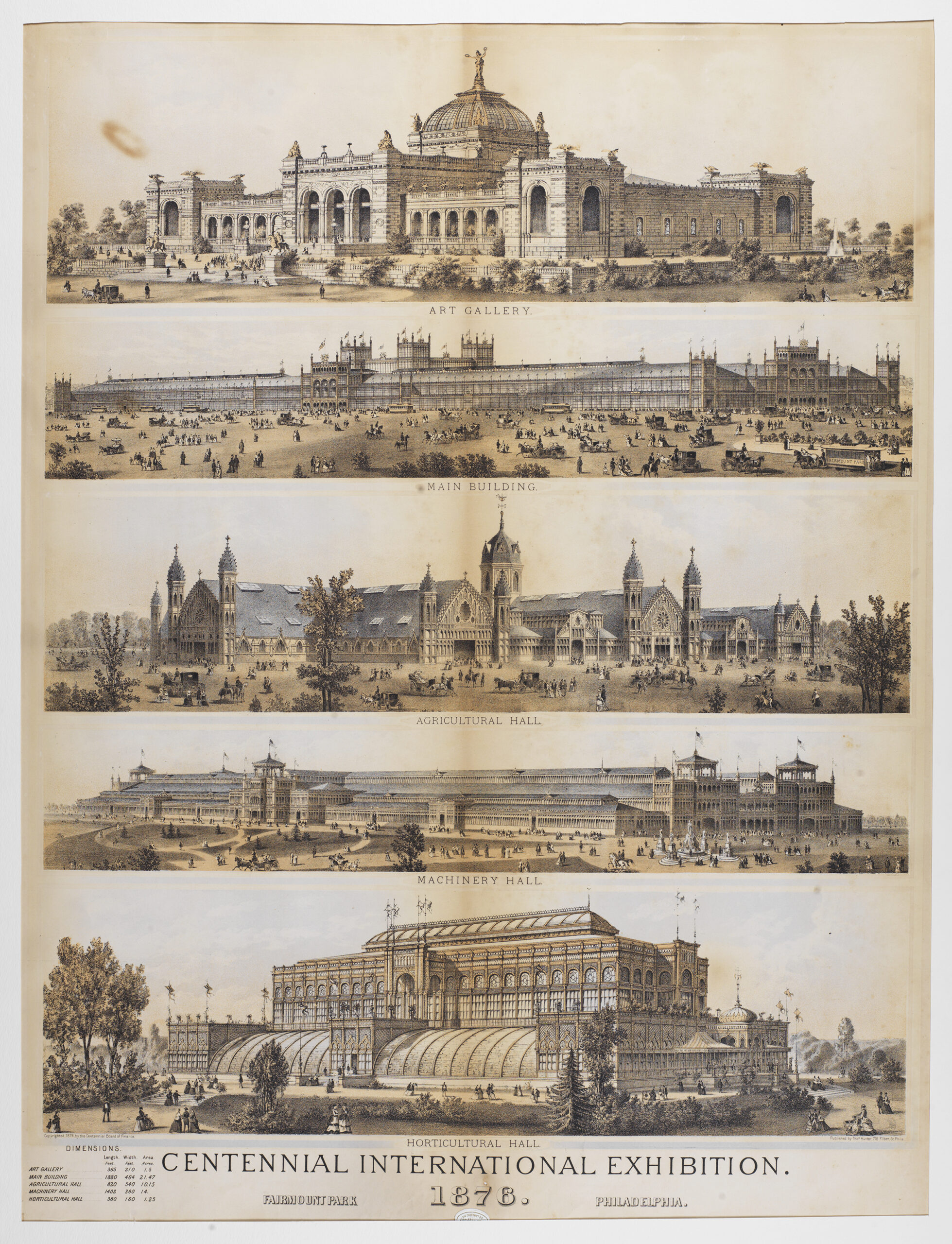
    Centennial International Exhibition, 1876.

    Perhaps the most famous Independence Day protest occurred in 1876 in Philadelphia. As tens of thousands gathered for the Centennial International Exhibition in Philadelphia’s Fairmount Park to celebrate a century of American progress in the arts, in industry, and in economic development, Susan B. Anthony protested the fact that half the nation, women, remained unable to vote and were thus without the unalienable rights named in the declaration.

    Anthony and a determined group of suffragists attempted to introduce a statement drafted by the National Woman Suffrage Association into the exhibition’s official proceedings. When Joseph Hawley, president of the United States Centennial Commission, prevented the women from doing so, Anthony led a procession to Independence Hall, where she read aloud the suffragists’ “Declaration of Rights of the Women of the United States” to a crowd that quickly gathered around her. Patterned after the original declaration, the text condemned the government for denying women the franchise, before ending with a clear demand: “We ask justice, we ask equality, we ask that all the civil and political rights that belong to citizens of the United States, be guaranteed to us and our daughters forever.”

    It took decades of nonviolent action before Congress passed the 19th Amendment, granting women the constitutional right to vote. But Anthony’s principled stance contributed to a rich history of July Fourth protests that continued a century later, as the nation prepared to mark the Bicentennial.

    On July 4, 1976, approximately 10,000 to 15,000 demonstrators massed in Washington, D.C., on America’s 200th birthday. Assembled by the People’s Bicentennial Commission, a New Left group, near the Jefferson Memorial, they marched to the U.S. Capitol under a banner reading, “Independence from Big Business.”

    The group’s populist call for economic democracy resonated in the mid-1970s, when the country was still reeling from a divisive war (Vietnam), a constitutional crisis (Watergate), and an economic recession that saw both inflation (5.97% in July 1976) and unemployment (7.6%) soar. Many people signed the commission’s “Declaration of Economic Independence” calling for limits on concentrated corporate power in the interest of the common good. “We, therefore, the Citizens of the United States of America,” the declaration stated, “hereby call for the abolition of these giant institutions of tyranny … to provide for the equal and democratic participation of all American Citizens in the economic decisions … that effect … our Nation.”

    Other protests occurred across the country, in Detroit and Chicago, as well as Los Angeles, San Francisco, and Seattle. Even Salt Lake City witnessed a small demonstration — albeit on Saturday, July 3, so as not to disturb the Christian Sabbath.

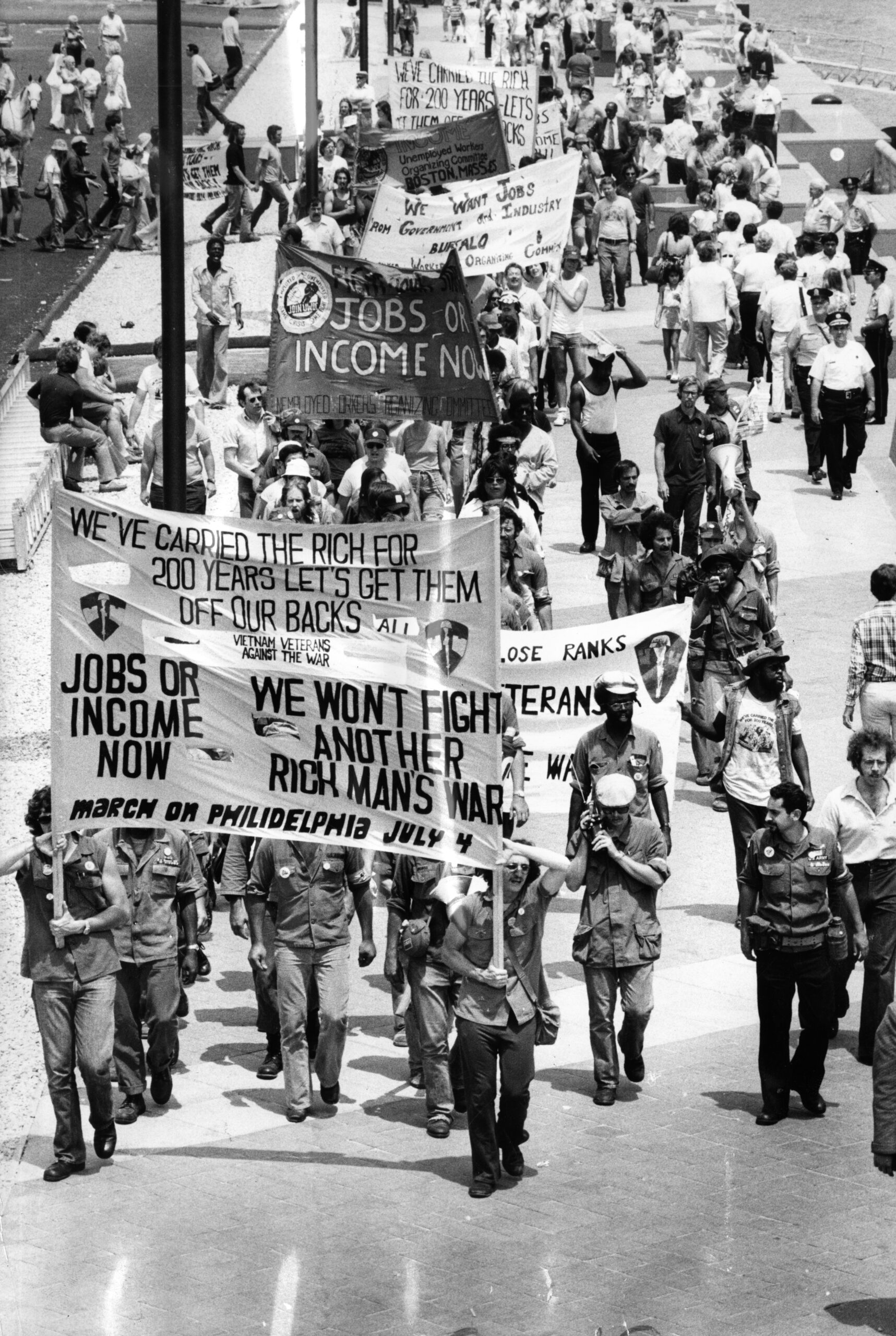
    Marchers with the Rich Off Our Backs Coalition demonstrate at Penn’s Landing in Philadelphia on July 3, 1976.

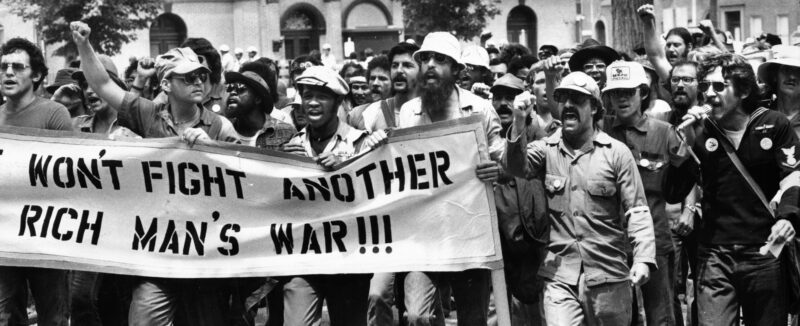
    The largest gatherings, though, were in Philadelphia, where more than 3,000 demonstrators gathered in Norris Square, under the auspices of a group called the Rich Off Our Backs Coalition, to march for jobs and income and economic justice — backed by fatigue-wearing Vietnam Veterans Against the War, who chanted: “One, two, three, four, we won’t fight a rich man’s war.”

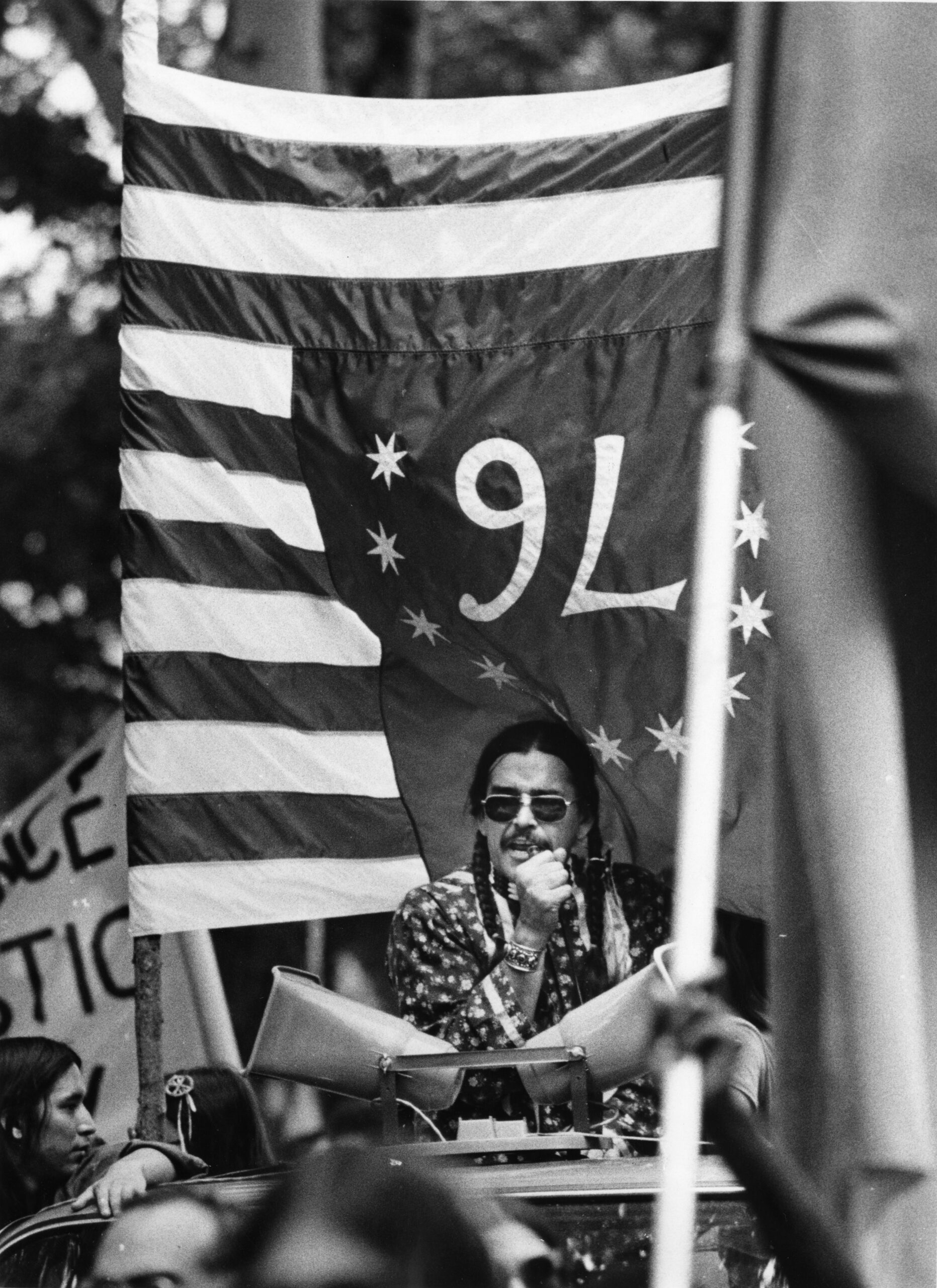
    Another group, the July 4th Coalition, rallied 30,000-plus in Fairmount Park, site of the Bicentennial, to demand Puerto Rican independence, greater rights for Black Americans, Native Americans, and members of the LGBTQ+ community, and much else. Karen DeCrow, president of the National Organization for Women, reread the declaration Susan B. Anthony had introduced a century earlier to flag the limited progress the nation had made toward gender equity since 1876. Black Panther leader Elaine Brown, a native Philadelphian, decried America’s 200-year history of racism.

    A group of Native Americans leads a July 4th Coalition protest parade at 33rd and Diamond Streets in Philadelphia on July 4, 1976.

    Despite opposition — Mayor Frank Rizzo famously requested 15,000 federal troops to maintain order — the demonstrations remained peaceful. Organizers won plaudits even from those who did not necessarily agree with their critiques. Protesters had a right, The Inquirer editors agreed, to call attention to America’s shortcomings, as they saw them. Dissent was as integral to the Fourth of July as bunting and brass bands: Its existence confirmed “the strength and genius of American democracy.”

    Today, according to polls, Americans typically mark Independence Day by barbecuing, shooting fireworks, going to the beach, viewing a parade, traveling, watching patriotic movies, or relaxing at home. Participating in a protest, demonstration, rally, or other nonviolent action does not rate a mention.

    That’s certainly understandable. These days are exhausting, and we all just want a break, a moment to have a laugh with family and friends.

    Yet, America’s rich tradition of July Fourth protest is worth recalling, especially at a time when the nation’s democratic institutions are under stress, for it once served as an essential tool that enabled Americans to hold their leaders to account for the words of 1776. We, the people, have never quite realized those words — written principally by a slave owner, Thomas Jefferson.

    But for 250 years and counting, the Declaration of Independence has set a “moral standard,” as historian Pauline Maier has argued, to which not only feminists and civil rights activists but civil libertarians and laborers have turned time and again in pursuit of liberty from their oppressors, be those would-be tyrants, foreign or domestic.

    M. Todd Bennett, a professor of history at East Carolina University, and David McKean, former director of policy planning in the U.S. Department of State, are the authors of “The Flag Was Still There: A History of the American Experiment in Five Anniversaries” (PublicAffairs, 2026).

    Made By History takes readers beyond the headlines with articles written and edited by professional historians. Opinions expressed do not necessarily reflect the views of The Inquirer.

    Made By History sponsors.
  • Religious liberty isn’t the only American principle on Pope Leo XIV’s mind as he accepts the Liberty Medal

    Religious liberty isn’t the only American principle on Pope Leo XIV’s mind as he accepts the Liberty Medal

    The common wisdom that “There will never be an American pope” went up in white smoke on May 8, 2025, when Cardinal Robert Prevost, a boy from the South Side of Chicago and a graduate of Villanova University, was elected pontiff and took the name Leo XIV.

    Now, on the eve of America’s Semiquincentennial, as if to underscore how much has changed, the American pope has been awarded the National Constitution Center’s Liberty Medal. Pope Leo accepted the award at the Vatican on April 30. On Friday, in a ceremony at the National Constitution Center on Independence Mall, the pontiff will address the audience live from the Vatican in a speech that will be livestreamed globally.

    The medal, according to the center’s interim president and CEO, Vince Stango, will celebrate how “[i]n formal Vatican statements and public addresses, His Holiness has affirmed that peace cannot exist without freedom of religion, freedom of thought, and freedom of expression, principles that closely align with constitutional protections guaranteed by the First Amendment.”

    One reason an American pope was long unthinkable is that American principles have not always aligned with Catholic principles. The proud American refusal to establish the Catholic Church as the national religion flew in the face of traditional Catholic teaching that the church should ensoul the body politic.

    That was never going to happen in the United States, of course. Not even close. And so the question then became, from the Catholic point of view, what to say about the American model that included the First Amendment, with its coordinated guarantees of the “free exercise” of religion and the nonestablishment of religion by Congress.

    Rome’s response has changed over time. In the late 1800s, Pope Leo XIII noted with approval the religious situation of Catholics in the United States, yet cautioned against the error that separation between the church and the civil power was to be the norm. By the 1950s, though, some Catholic thinkers were claiming the American model, in fact, stated the ideal, reasoning that the First Amendment guarantee of “free exercise” is necessary for a person to honor his God-imposed duties.

    By now, even though the Second Vatican Council (1962-1965) stated that it was leaving the church’s traditional teaching “untouched,” the nonestablishment of religion and a legal guarantee of individual and group free exercise of religion, subject to just limitations for the common good, constitute the norm proposed by the Catholic Church to the world as we know it.

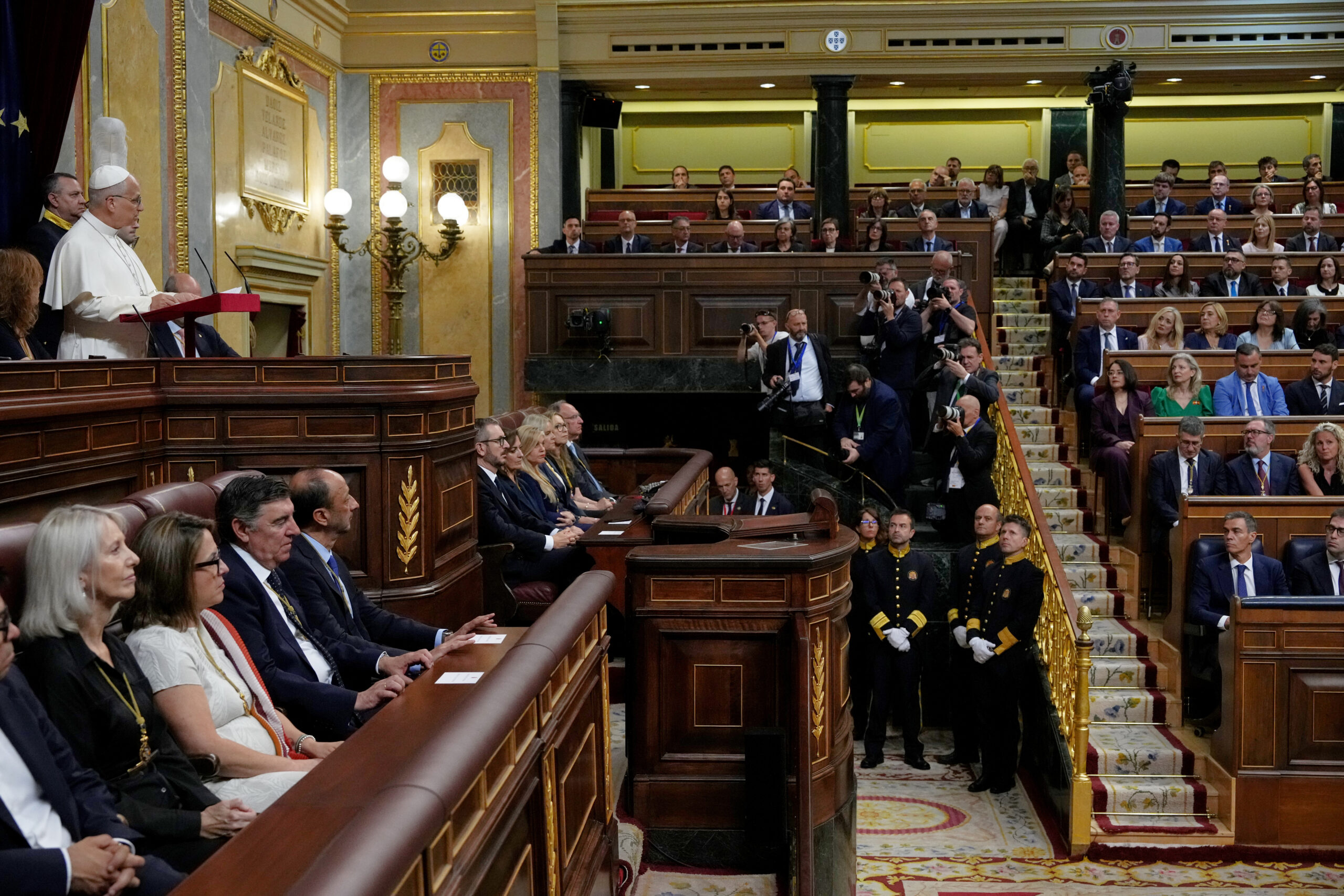
    Pope Leo XIV speaks to members of the Spanish Parliament at the Congress of Deputies, in Madrid, on Monday, June 8.

    In speaking to the Spanish Parliament on June 8, for example, Pope Leo insisted that laws must respect “freedom of thought, conscience and religion, a fundamental right that protects the most intimate sphere of the person. The freedom upon which the contemporary state is built, if it is authentic, recognizes the religious dimension of the human person.”

    In the ceremony on Independence Mall on Friday, Pope Leo will address a nation in which, for the first time in its history, it is becoming socially acceptable to oppose the free exercise of religion for some people. Litigation that threatens to cancel people’s freedom to live according to their conscience becomes more common. The seal of confession, long protected in the United States, is under assault, and the threat is real. In his address to the Spanish Parliament, Pope Leo warned against the withdrawal of that protection, and the warning needs to be echoed in the United States.

    It would be one of history’s great ironies for an American pope to call his country back to a principle that his church learned, in part, from America.

    Religious liberty is not the only American principle on the American pope’s mind, as his message to the 2026 graduates of his alma mater makes clear. “This being the 250th anniversary of the United States of America, I would invite you to recall in a special way the guiding principles of the foundations of our nation: ‘We hold these truths to be self-evident: that all [people] are created equal; that they are endowed by our Creator with certain inalienable rights, and among those are Life, Liberty and the pursuit of happiness.’”

    The principles of the First Amendment are to be cherished, but prior to those principles, the pope has reminded us, are the principles of the Declaration of Independence around which the nation was formed in 1776. And while the declaration does indeed attest to the nation’s commitment to the people’s Creator-given right to liberty, the outstanding principle of the declaration to which President Abraham Lincoln later found the nation “dedicated” since 1776 was that all people are “created equal.”

    When Lincoln summoned the American nation to rededicate itself to the equality of all persons, he did so for good reason: Unless we are related to one another as equals, we are related to one another as fractions to wholes. The three-fifths clause of the original U.S. Constitution gave effect to slavery, a grievous injustice removed by the 13th Amendment in concert with the other Reconstruction amendments. These amendments constitutionalized the nation’s earlier commitment to our having been “created equal,” but not everyone is a believer in the equality of all people.

    Today, Americans are divided over the declaration and, specifically, the claim that we are “created equal.” Human equality is said by some to be a self-evident lie, and even among those who pay it lip service, commitment to the basic equality of all people is undermined by identity politics, race-based priorities, and blood guilt.

    Pope Leo, though, is not in doubt about the equality of all people. In his first encyclical, Magnifica Humanitas, he writes that we are equal in “ontological dignity, which is neither acquired nor earned, nor does it need to be justified.” This immutable and foundational equality is true of all people because we are, without exception, “created in the image and likeness of God.”

    And this is another truth Americans need to reclaim.

    In order to reclaim it, we need to understand that human equality was never meant to state something empirical or measurable about people. The equality declared by the declaration and celebrated by Lincoln, and fully constitutionalized by the Reconstruction amendments, depends on what is spiritual in a person, represented by the radical Christian judgment that underneath the obvious and often wonderful diversity of people lies a universal sameness in being created in the divine image.

    When G.K. Chesterton was asked, “What is America?” he gave a characteristically smart answer that has been debated ever since: “America is a nation with the soul of a church. America is the only nation in the world founded on a creed. That creed is set forth with dogmatic and even theological lucidity in the Declaration of Independence.”

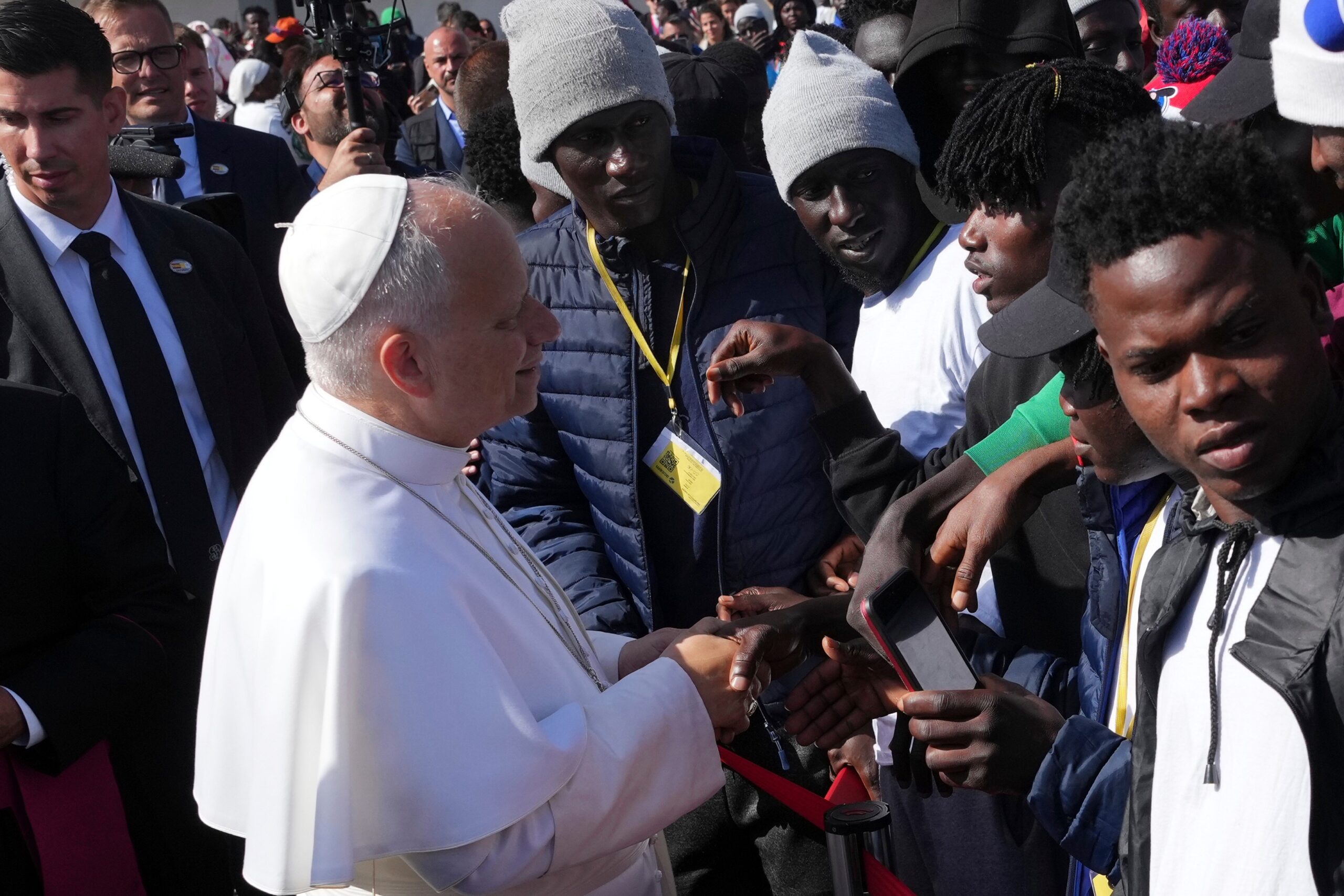
    Pope Leo XIV meets migrants at the Las Raices center, in San Cristobal de la Laguna, Tenerife, Spain, June 12.

    Robert Prevost, now Pope Leo, was formed, in part, in that “church” with its declarational creed. He was also, and first, formed in the Catholic Church, with its commitment to the universal equality of all people.

    What the American pope can do now, in a way no other person on earth can, is to remind Americans that the equality to which their nation has been dedicated since 1776 depends on what Christianity has shown the world: that even the least, in worldly eyes, are equals in God’s eyes.

    Patrick McKinley Brennan is the chair of Catholic legal studies and a constitutional law scholar at Villanova University.

  • Pa. lawmakers must pass a full moratorium on hyperscale data centers

    Pa. lawmakers must pass a full moratorium on hyperscale data centers

    Artificial intelligence is fundamentally changing the world we live in at a speed unprecedented in modern history.

    Headlines buzz with warnings that this tech boom will bring a disruptive reindustrialization, and people are already seeing this play out in real time. Behemoth data center campuses have been proposed across the nation, including dozens right here in Pennsylvania.

    Gov. Josh Shapiro has been at the helm of this push, incentivizing data center developers to take advantage of Pennsylvania’s resources to accommodate these energy-guzzling facilities and offering industry tax breaks that will cost taxpayers big time.

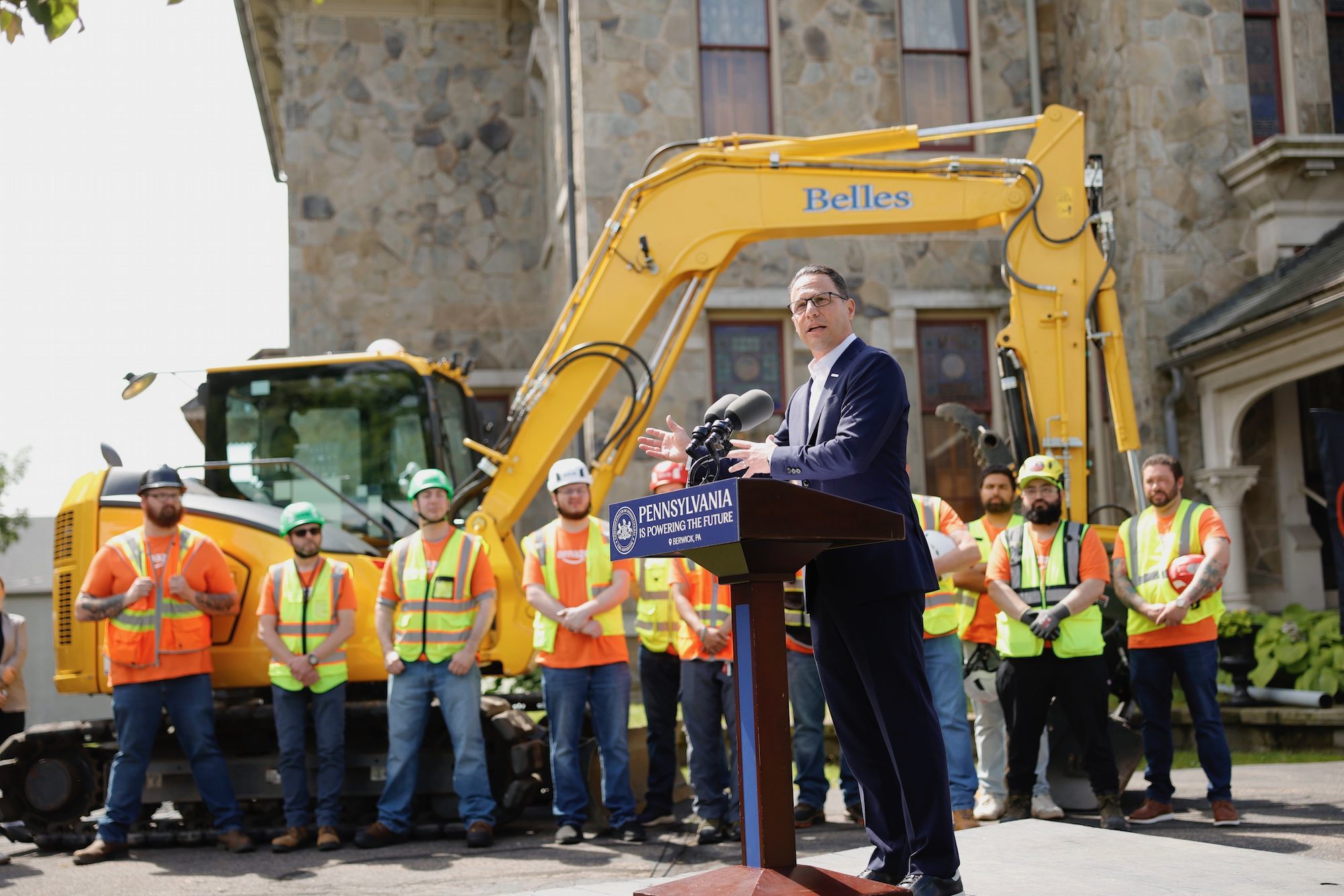
    Gov. Josh Shapiro announces a $20 billion investment by Amazon in Pennsylvania data centers in Salem Township and Falls Township in June 2025.

    The governor’s so-called Responsible Infrastructure Development (GRID) standards, which passed the House last week, are yet another effort to grease the wheels for data center developers. These voluntary half-measures are a naive effort to placate widespread data center opposition — worse still, Right to Know files obtained by Concerned Citizens of Montour County found that Amazon had first dibs on GRID input. That doesn’t sound like putting Pennsylvanians first.

    Instead of diving in headfirst, lawmakers must consider the real-world consequences of a largely unfettered data center build-out. That’s why the grassroots organization I am part of, Food and Water Watch, has endorsed the three-year moratorium State Sen. Katie Muth (D., Berks, Chester, and Montgomery) introduced in the Assembly.

    A recent comprehensive report from Food and Water Watch details the harms AI-driven hyperscale data centers will bring. Shapiro’s embrace of this technology — notwithstanding his recent attempt to make data center development less worrisome to Pennsylvania residents — has left communities grappling with secretive billion-dollar projects that threaten to swallow agricultural land, drive up residential and small-business electricity rates, and ruin quality of life.

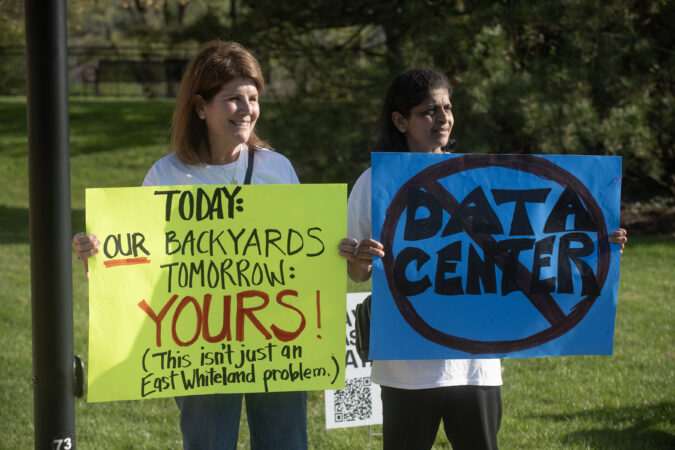
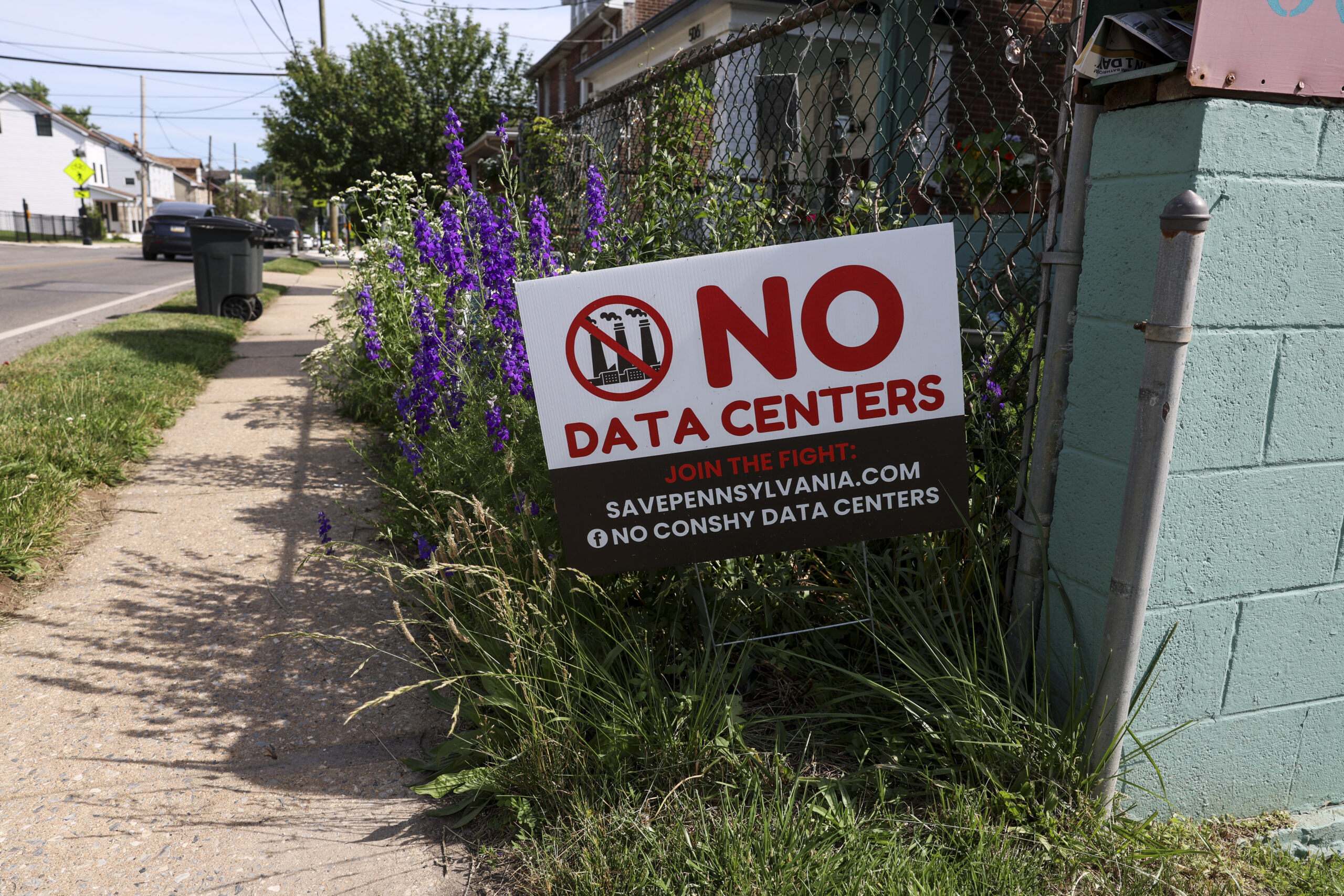
    A yard sign protests the proposed data center on New Elm Street near the Closed Cleveland-Cliffs steel mill, photographed on June 4 in Conshohocken.

    Communities across Pennsylvania have pushed back on each and every data center project, from East Whiteland and Hazle Townships to Montour County and beyond. Concerns include lack of transparency and due process, high water use, skyrocketing energy prices, an unprecedented build-out of power plants and high-voltage transmission lines, and more.

    These concerns are not purely theoretical — Pennsylvanians are already seeing the financial impacts of the data center build-out. In 2024, Pennsylvanians paid $492 million in energy infrastructure upgrades for 16 data centers. Shapiro’s GRID plan notwithstanding, as more projects are proposed and more infrastructure is needed to bring these sites online, we can expect ratepayers to fork over more of their hard-earned cash for facilities that do not serve their needs or interests.

    Pennsylvanians don’t have to look far to see what unchecked data center expansion can do to communities.

    Two states away in Virginia, massive, loud data centers have been built right next to homes, turning neighborhoods into industrial sites. Now this industry is attempting to bully Pennsylvania communities to accept the same fate.

    A data center owned by Amazon Web Services, front right, under construction next to the Susquehanna nuclear power plant in Berwick, Pa., in January 2025.

    Many of these industrial compounds are proposed for rural Pennsylvania, threatening to disrupt communities’ way of life. A proposed data center in South Whitehall Township, Lehigh County, would include six buildings spread across 410 acres — which Food and Water Watch analysis finds is equivalent to the size of 100 Walmart supercenters.

    On an even grander scale, as part of the Shapiro-touted $20 billion data center AI investment by Amazon, a proposed campus in Luzerne County would stretch across 1,5200-1,700 acres.

    These are not modest developments. They are sprawling industrial complexes that threaten to reshape rural and residential communities beyond recognition.

    These proposals also threaten drinking water supplies. Hyperscale data centers can consume as much as two million to eight million gallons of water daily, putting enormous strain on local water supplies. This comes as the majority of Eastern Pennsylvania, a hot spot for development, is currently experiencing moderate to severe drought.

    Nationwide, two-thirds of data centers built since 2022 have been built in water-stressed regions, showing an alarming pattern of development that ignores the limits of local resources. Pennsylvanians should not be forced to compete with corporate server complexes for access to safe, reliable drinking water.

    Data centers are not a public good. They are profit-driven extractive industrial facilities that destroy local communities’ quality of life, all while draining their most necessary resources.

    Lawmakers have the choice to stand with communities and allow state regulators to pause and take an informed path when deciding if — not how — data centers can coexist with the needs of Pennsylvanians.

    It’s why Food and Water Watch drove 180-plus impacted residents facing data center projects in their communities to Harrisburg on June 23, and it’s why Pennsylvanians across the commonwealth must call on their legislators to support Muth’s bipartisan moratorium on hyperscale data centers today, before we all pay the price later.

    Ginny Marcille-Kerslake is a senior organizer for Food and Water Watch in West Whiteland Township.

  • The World Cup is a stress test for our public health system. We failed it even before kickoff.

    The World Cup is a stress test for our public health system. We failed it even before kickoff.

    This summer, the largest sporting event in human history is moving across three countries, 16 cities, and 104 matches. Millions of people from every continent are passing through the same stadiums, the same airports, the same fan zones. As an infectious disease physician, I can tell you exactly what this is in epidemiological terms. It is a stress test.

    Mass gatherings do not create new pathogens. They reveal the weaknesses present in the systems that receive them. I learned this in Ebola wards and in refugee camps, and I learned it again as the first chief medical officer for New York City during the first COVID-19 surge. The virus did not invent the cracks in our response. It found them, widened them, and poured through them.

    So the right question about the 2026 World Cup is not “what new disease might appear.” It is “what is already broken, and what happens when we run a max-capacity crowd straight through it.”

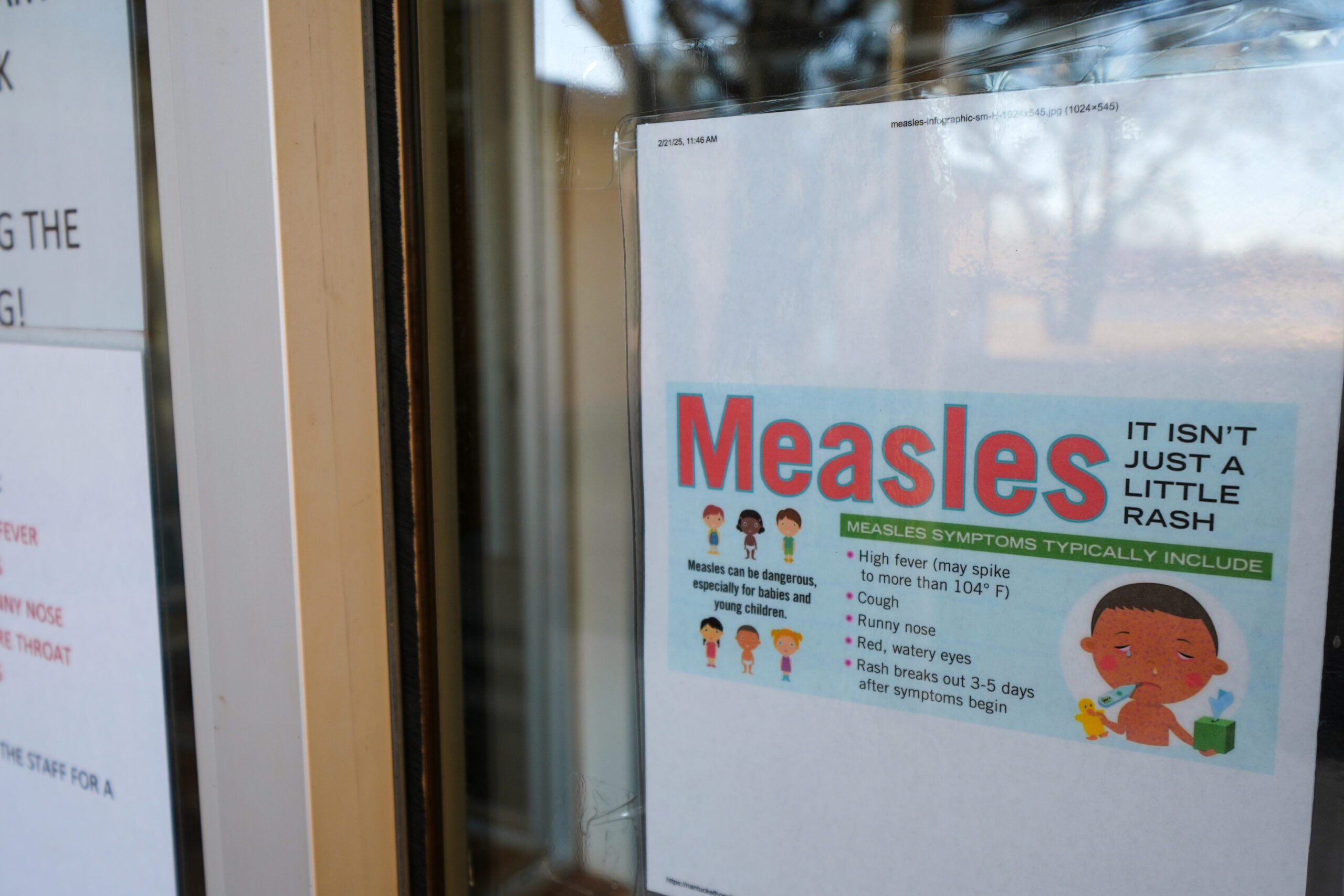
    Start with measles. The United States recorded its worst year for measles in more than three decades in 2025, and 2026 is on pace to be even worse. We have already crossed 2,000 confirmed cases this year. The country that declared measles eliminated in 2000 is now, by the assessment of its own scientists, likely to lose that status.

    This is not a tropical import. This is a homegrown failure of vaccination, accelerated by official messaging that treats a settled question as an open debate. Measles is one of the most contagious pathogens known to medicine. A stadium is, by design, the most efficient room we have ever built for spreading it.

    Now layer the rest. Three host nations means three health systems, three surveillance capacities, and three sets of rules that do not automatically talk to each other. Fans are crossing the Tijuana and El Paso corridors in volume. We will have a kaleidoscope of variable immunity without any uniform vaccine requirements or compliance, and thereby radically divergent vulnerability to infection.

    Moreover, these systems are not connected. These countries rarely speak to one another and the current political climate has exacerbated it. A case detected in one country is only useful if the next country hears about it in time to act. During COVID-19, our data systems were often a week behind the virus. A week is a lifetime in an outbreak.

    A clinic in Brownsnville, Texas, offers measles inoculations. Measles is just one of the infectious diseases that could be spread as people gather in large groups during the World Cup, writes Tyler B. Evans.

    Then there is geography. Several Mexican host cities sit in dengue-endemic zones, and summer is peak mosquito season. Southern Hemisphere visitors are arriving mid-influenza season carrying strains our summer was not expecting. West Nile virus peaks in exactly the Southern U.S. cities hosting matches, in exactly these weeks.

    None of this is exotic. All of it is predictable — which should worry us, because predictable means preventable, and preventable means that whatever goes wrong will be a choice, not an accident.

    There is also what screening cannot see. Ebola is remembered as a disease of blood and isolation wards, but the virus can persist in survivors for months after recovery and can transmit sexually long after a patient is declared cured. Outbreaks have been seeded this way, quietly, by transmission that no fever check at an airport would ever catch. Record crowds could spread disease we have not thought to look for.

    Here is the part that the risk charts miss. The people who will suffer most are not the ticket holders. They are the workers. The food handlers, the stadium cleaners, the hotel staff, the rideshare drivers, the street vendors. They are disproportionately low-income, often uninsured, frequently undocumented, and the least able to take a sick day or see a doctor.

    When transmission runs through a city, it does not stop at the stadium gate. It follows the bus lines home to the neighborhoods with the least health infrastructure and the most people sharing the least space. This is the pattern of every modern pandemic. The pathogen is universal. The suffering is sorted by income.

    The same sorting applies to the infections we never put on a risk chart. Sexually transmitted infections rise wherever large numbers of people gather, travel, and disperse, and they fall hardest on the people with the least access to testing and treatment. Syphilis is already at its highest level in the United States in decades. A surveillance system built around fevers and symptoms will miss these. What we fail to look for, we fail to find.

    We know how to prevent this. The tools are not mysterious. Real-time, trinational surveillance that shares data across the CDC, Canada’s public health agency, and Mexico’s IMSS. Vaccination campaigns that meet visitors and workers before they gather, not after they fall ill. Mosquito control in the cities where the vectors are already breeding. Food and water safety enforcement scaled to the size of the crowd. Medical teams embedded at venues, and clear, accurate public health messaging that treats people as adults rather than as a constituency to be managed.

    None of that is expensive compared to the alternative. It is, however, unglamorous, and it requires a federal posture that takes infectious disease seriously rather than treating vaccine science as a matter of opinion. That is the variable none of us can predict. The mosquitoes will behave as mosquitoes do. The viruses will behave as viruses do. The open question is whether our institutions will behave as public health institutions are supposed to.

    I have spent nearly three decades working in global health across dozens of countries, and I have watched leaders in resource-poor settings mount more coherent outbreak responses than wealthy nations that simply chose not to. Capacity is not our problem. Will is our problem.

    The World Cup is a celebration. I want it to be one. But it is also a mirror, and it is going to show us exactly what we have built and exactly what we have neglected. We still have time to act on what it reveals. The kickoff has already happened. The reckoning is still a choice.

    Tyler B. Evans is the author of “Pandemics, Poverty, and Politics,” founder and CEO of Wellness & Equity Alliance, and a public health policy expert focused on global health security and equity.