Too many people in this country think free speech comes with no consequences. A constitutionally protected free pass to say whatever you want with zero repercussions. But that’s not true. There is a cost to speaking out.
On the left, think Colin Kaepernick being blackballed by the NFL for taking a knee during the national anthem. On the right, think every yahoo who’s ever been fired from their job over some racist/sexist Facebook post.
If you think that’s an unfair comparison, write about it. Yell at me about it. That’s how free speech works. I say something, and you can say something back. How it definitely does not work is when the government steps in. The courts have been very clear that the First Amendment protects us from government censorship.
That means calls to boycott comedian Tony Hinchcliffe after he called Puerto Rico a “floating island of garbage” at a Donald Trump rally? Legal. ABC firing comedian Bill Maher for insensitive comments after 9/11? Legal. However much you or I can loathe so-called cancel culture, it’s legal.
What happened to Jimmy Kimmel is something else.
On Wednesday, Disney-owned ABC put the late-night talk show Jimmy Kimmel Live! on indefinite hiatus. This happened soon after Nexstar Communications Group said it would pull the program from its 23 ABC-affiliated stations over a joke Kimmel had made Monday about the MAGA reaction to the killing of Charlie Kirk. The leaders of the conservative-leaning Sinclair Broadcast Group also announced they would be preempting the show.
So far, so wrong, but within these private companies’ rights. The problem is that also on Wednesday, the head of the Federal Communications Commission, Brendan Carr, went on the right-wing podcast The Benny Show and laid out how the government could go after those who gave the late-night comedian his platform.
“There’s calls for Kimmel to be fired. You can certainly see a path forward for suspension over this. And again, the FCC is going to have remedies that we could look at,” Carr told host Benny Johnson. “Disney needs to see some change here, but the individual licensed stations that are taking their content, it’s time for them to step up.”
Now, the FCC cannot go after ABC because, like the other national networks, it does not hold a broadcast license to transmit over the public airwaves (although Disney owns a few stations), but it can absolutely go after local affiliates.
Not only that, but much like in the case of CBS’s cancellation of The Late Show with Stephen Colbert — which put the Trump-mocking show on the chopping block after the network’s parent company needed government approval for a merger — Nexstar is also in merger talks.
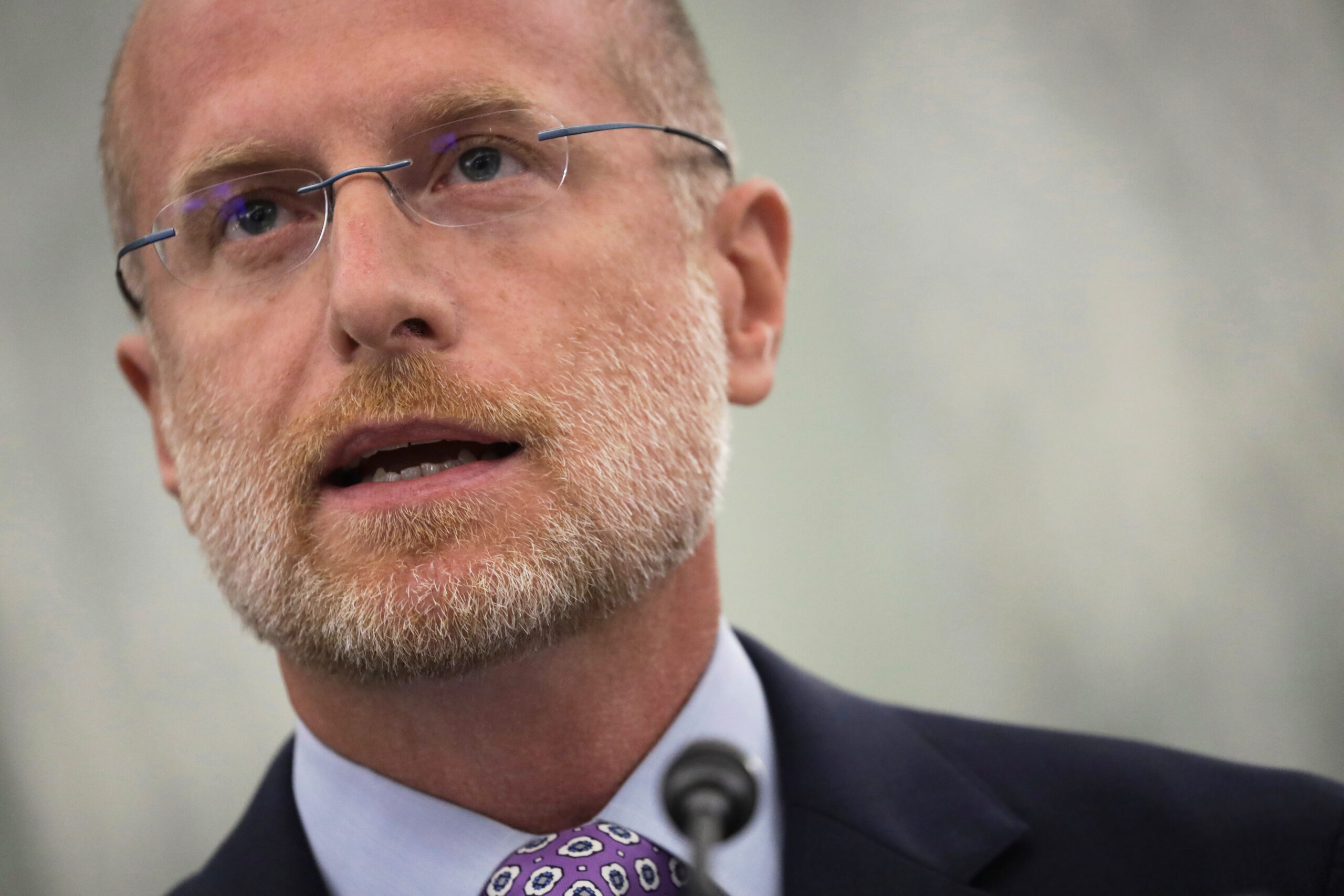
Brendan Carr, then a Federal Communications Commission commissioner, speaks during a Senate Commerce, Science, and Transportation committee hearing on Capitol Hill in Washington, in 2020.
With The Late Show, CBS executives could at least make the case (transparent as it was) that their decision was justified because ratings were down, and they would allow the show to run until the end of the host’s contract next year.
But for Kimmel, there hasn’t been even an attempt at that kind of pretense. He’s been suspended following a barely veiled threat by the guy in charge of allowing TV stations to do business. Now, I think what Nexstar did is cowardly, but it is by no means nonsensical.
Add it to the list of companies, universities, and law firms that have sold out American principles and are fully on board with endangering democracy by enabling Trump’s worst instincts — all for the sake of doing business.
Also, add this incident to the long list of examples of hypocrisy from the Trump administration and the right-wing commentariat. Unsurprisingly, back in 2023, Carr posted on X that “Free speech is the counterweight — it is the check on government control. That is why censorship is the authoritarian’s dream.” The same day Kimmel was suspended, Trump criticized England’s laws limiting speech (he’s right) while praising ABC’s decision.
The president has repeatedly threatened networks over their news coverage, and raged against late-night comedians like Kimmel and Colbert for making fun of him. Of the Big Three networks (sorry, kids, I’m old), Comcast-owned NBC has so far stood its ground.
This is important because Saturday Night Live alone has produced some definitive presidential portraits that have stood the test of time. In my late-night TV-watching lifetime, we’ve seen George H.W. Bush as awkward and out of touch (Dana Carvey), Bill Clinton as hungry horndog (Phil Hartman), George W. Bush as clueless bro (Will Ferrell), Barack Obama as professorial but cool (Jay Pharoah), and Donald Trump as game cue card reader desperate for love and attention (Donald J. Trump).
The show may want to amend Trump’s portrayal, though, to a thin-skinned demagogue who lost his sense of humor about the same time he found love and attention among the vilest peddlers of right-wing vitriol and hate on his way to authoritarianism.
As to what those of us who consider free speech one of the vital ingredients in the American Experiment can do, well, that’s easy.
Speak out, loudly and often — ideally respectfully, but the Constitution doesn’t say you need to be nice. What’s happening is not right, and we need to say so. Damn the consequences.
As Vladimir Putin blocks peace talks, Kyiv wants to share with the U.S. and Europe how to counter the AI-driven weapons of the future.
Betsyk, commander for the 3rd Separate Assault Brigade's special battalion for intercepting enemy drones, sits beside downed Russian reconnaissance drones.3rd Separate Assault Brigade
DIRECTION POKROVSK, Ukraine — In a warren of rooms filled with computers, 3D printers, colorful wires, and drone frames, the atmosphere was casual, but the intentions were deadly.
The young men in their 20s and 30s, dressed in cargo pants and T-shirts, wouldn’t have looked out of place at a Silicon Valley start-up. Except they were fighting for their lives — and their country’s survival.
In the basement command center, three of the soldier-techies stared at multiple screens with dozens of views delivered by Ukrainian-made surveillance drones. They were looking for Russian targets in a war that had lasted for three and a half years.
As I peered over their shoulders during a June visit to the rear of the front lines, a moving car was spotted.
Orders were quickly passed to a frontline drone navigator and pilot in a trench or basement who would make the final call as to whether the target was clearly visible and worth destroying — at which point the pilot’s goggles would let him watch the little exploding drone descend until a flash signaled another kill.
It was a slow day, and everyone’s attention had turned to other screens before I could learn the fate of the car. But there were always more targets to find.
By my side, the 31-year-old commander of an elite drone battalion of the 59th Assault Brigade, call sign Condor, told me there are up to 300 targets a day, which can range from a single fighter in the grass to a moving motorcycle to a small Russian dugout covered with branches or nets.
“The orcs outnumber us, and they don’t care about loss of lives,” Condor said, using the name of the grotesque enemy warriors in the Lord of the Rings series to refer to the Russians. “In this new way of war, infantry and artillery and mortars still matter, but everything is controlled by air. Now, a military is just a way of supporting drones.”
For Ukraine, drones are an essential part of why the country has been able to hold out so long against an army four times its size.
Source: Institute for the Study of War and AEI's Critical Threats Project.John Duchneskie/Staff Artist
The technology of unmanned weaponry is advancing at a pace that appears revolutionary — from aerial drones to drones that move by sea, robotic land drones, and long-range drones carrying missiles — all increasingly directed by artificial intelligence.
Sea drones drove Russian ships out of the Black Sea along the Ukrainian coast, and continue to strike at the critical Kerch Bridge connecting Russia to Crimea. In June, Ukrainian security services conducted the amazing Operation Spiderweb, which damaged or destroyed up to 40 Russian warplanes worth billions of dollars, deep inside Russia — all with 117 small drones costing $500 each.
But Russia is catching up. Ukraine needs the funds to massively scale up drone production.
That’s why the most important moment of President Donald Trump’s Monday meeting with Ukraine’s president and top European leaders may have been when Volodymyr Zelensky proposed to share his country’s breakthrough drone technology with the Pentagon.
Kyiv would sell tens of billions of dollars’ worth of advanced Ukrainian-made drones to America, and, in return, would buy double that dollar amount of U.S. weapons systems, financed by Europe. Both countries would then be far better equipped for the challenges of modern conflict.
The success of that proposal could bolster American preparedness for future tech wars, while helping Ukraine survive as a free, sovereign state.
More on Ukraine
Trump’s deference to Putin means only more bloodshed in Ukraine
The president could have used America’s power to force Vladimir Putin to negotiate seriously. Instead, he opened the door to blaming Ukraine for any failed "peace" talks.
Why so? Peace talks are going nowhere. Vladimir Putin has no interest in peace. He thinks he’s winning.
The Russian dictator “has no reason to compromise so long as the president refuses to apply any pressure on Moscow,” as former Russian political prisoner Vladimir Kara-Murza bluntly told MSNBC. “You cannot make peace by placating Russia.”
Despite the effusive red-carpet welcome Trump gave Putin at their recent Alaska summit, the Russian leader has rejected every one of the president’s proposals to end the war.
story continues after advertisement
No ceasefire. No strong security guarantees for Kyiv, as the naive White House negotiator Steve Witkoff claimed Putin had accepted. The Kremlin has already rebuffed a possible bilateral meeting between Putin and Zelensky that Trump has been touting.
Peace talks will become plausible only if the U.S. joins Europe in putting maximum pressure on Russia, convincing Putin he can’t win and can’t afford to fight any longer.
But that would require Trump to recognize what the Europeans already know: Ukraine has been able to hold off the Russians until now because it has pioneered a revolutionary new way of warfare — the war of drones.
So Zelensky’s proposal is in both countries’ interests. The U.S. is way behind in small drone production, but it has weapons systems crucial to Ukraine. A swap would signal to Putin that Trump is not a pushover.
If Trump wants to be a peacemaker, he must recognize that the Ukraine war is about far more than real estate. It is a battle over freedom, geopolitics — and who will win the tech wars of the future.
As I was told by former Ukrainian Minister of Strategic Industries Oleksandr Kamyshin: “This war started like the Second World War with drones. But it will finish as the First World Drone War.”
A pilot with the elite drone unit for HUR, the Ukrainian Defense Ministry’s intelligence service, demonstrates drone control.Trudy Rubin/Staff
In the air
My latest Ukraine visit — my fifth since the fighting began in February 2022 — showed me what it means when unmanned drones take over the battlefield.
Last year, I could still visit artillery emplacements and destroyed villages near the front where army units lived, showered outdoors, and ate outdoors. I could drive on roads to and from towns near the Donetsk front line inside the contested parts of the eastern Donbas region that Ukraine still controls. Military vehicles still sped along those roads.
Those days are over.
The 15 kilometers (roughly nine miles) on each side of the front line have become a kill zone where almost nothing moves on land because it is at risk of being hit by the other side’s drones.
The size of the kill zone keeps expanding.
Tanks are sitting ducks. So are medical evacuation vehicles. Indeed, military vehicles of any kind. No longer are the soldiers who man frontline positions or drone pilots rotated every day or two; they stay in place for days because the roads in and out are so risky.
Supplies are brought in and the wounded taken out by unmanned robotic carts, known as land drones. These robots also lay mines, and some are equipped with machine guns or rockets.
As for Ukraine’s cities, Putin is demonstrating how drones can be used as a cheap, terrifying tool of terror against civilians.
During my stay in Kyiv, the nightly Russian barrage of Shaheds — drones designed in Iran and gifted by the thousands to Putin by the ayatollahs — rained down nightly on civilian targets. I was lucky to be in a hotel with a comfortable basement shelter, but my Ukrainian friends and contacts were up each night huddled in their hallways or bathrooms. They still are.
Natalya Dubchek stands next to a minibus destroyed by a Shahed drone. The fire from the explosion torched her home in Odesa, Ukraine.Trudy Rubin / Staff
In Odesa one morning, I visited a neighborhood where a family of three was incinerated when a Shahed sheared off the top floor of their apartment building in a residential neighborhood. I spoke with a woman whose bungalow burned to its concrete walls, and who barely escaped the flames.
Even after my return to the U.S., I have kept the air raid alerts on my iPhone, which can be set to any city or region. My phone buzzes every time Russia launches another swarm of Shaheds (along with cruise and ballistic missiles) against Kyiv. For hours, the alerts go off every 20 minutes.
Each buzz means Ukrainian civilians, including the elderly and mothers with small children, must decide whether to descend to an underground shelter and spend miserable hours or the entire night there.
The Shaheds, which give off a chilling whine as they fly, are now copied and manufactured inside Russia with Tehran’s technical help. They have been made more lethal with the addition of jet engines, which enable them to fly higher and faster and elude countermeasures. They are meant to terrorize, exhaust, and kill civilians in Ukrainian schools, hospitals, markets, and apartment buildings.
The number of Shaheds in the skies has jumped dramatically since Putin concluded that Trump will never be serious about punishing Russia for its refusal to accept a ceasefire or engage in serious peace talks. And they are affecting morale. If the Russian barrage continues, more Ukrainians may try to leave for abroad.
A Ukrainian officer shows a thermobaric charge from a downed Shahed drone in a research laboratory in an undisclosed location in Ukraine in 2024.Efrem Lukatsky
Yet, despite the daily Shahed carnage and recent Russian gains on long stalemated front lines, Moscow is still not winning this war.
A prime reason is that Ukraine’s war of technology has so far enabled Kyiv to hold its defensive line, but not to take back territory.
Former Ukrainian commander in chief, now ambassador to the U.K., Valerii Zaluzhnyi, told a video forum in Kyiv that the only war Ukraine can wage is a “high-tech war of survival” until it destroys Russia’s military and economic ability to keep fighting over the long run.
The bad news is that Russia is learning from Ukraine and receiving large-scale tech aid, components, and ready-made drones not only from Iran, but from its other allies, China and North Korea.
This alliance of dictators is growing stronger, and its members are watching the Ukraine war for lessons in future drone warfare with the West. Think China and Taiwan.
story continues after advertisement
To shake up the Kremlin, Kyiv needs to vastly scale up its drone production and race to outdo the Russians with innovation, especially interceptors that can destroy Shaheds and fiber-optic drones.
European governments and private companies are entering agreements to jointly produce drones, both in Ukraine and in Europe. They are studying Kyiv’s technological advances, including on the front lines.
Ukraine wants to share its invaluable battle-tested knowledge with Washington, yet Trump still appears hung up on the vain hope that Putin “wants a peace deal,” which he mistakenly believes would entitle him to a Nobel Peace Prize.
So long as he refuses to recognize Kyiv’s importance as a strategic ally, the president undermines not only Ukraine’s security but ours.
A Ukrainian serviceman of 57th motorised brigade controls an FPV drone at the frontline in Kharkiv region, Ukraine in August.Andrii Marienko
Drone expansion
In June 2024, when I first met with then-infantry commander Condor of the 59th Assault Brigade in one of the hottest combat zones in eastern Ukraine, he was struggling to arm his depleted battalion. They were suffering through a terrible “shell hunger,” he told me, after the U.S. Congress had frozen military aid for six months. His men were often reduced to firing one artillery shell for every 10 fired by the Russians.
“Every day of [congressional] delay cost broken lives and deaths,” the former history teacher turned soldier said bitterly, as we sat in a dark, virtually empty cafe in the countryside near Pokrovsk. “So, we had no other choice but to be creative.”
To fend off a brutal Russian adversary with four times their population and massive industrial might, the nation’s techies and grunts turned their front lines and hidden basements into a tech incubator for modern war.
Desperate fighters, like Condor’s unit, were already using simple Chinese-made commercial drones to spy on Russian forces in 2023 and 2024.
Every unit I visited near the front during those years had guys working on benches in abandoned farmhouses or workshops, putting together drones from parts purchased on Amazon with their own salaries, or donated by families, friends, or private charitable foundations.
While Ukraine was well known in peacetime for talented engineers and a deep tech sector, many of those early do-it-yourself builders had no such background, but figured things out as they went.
By the summer of 2024, the men of Condor’s unit had come up with how to turn small commercial or DIY drones into little exploding drones.
Call sign Condor, commander of the UAV Forces Battalion of the 59th Assault Brigade.Trudy Rubin / Staff
“We cut sewage pipes and stuffed them with explosives,” Condor explained. “We did the same with energy drink cans.”
These makeshift mini bombs were then affixed to UAVs, the shorthand for unmanned aerial vehicles, mostly small Chinese DJI MAVIC quadcopters, the kind Americans use to record panoramic overhead views of weddings. The Ukrainians launched them at Russian tanks, artillery positions, and trenches.
“This is the art of war,” Condor said, with a grim smile. “When you have no supplies, you have to innovate.”
The turning point came in 2024, when the U.S.-induced shell hunger spurred a massive expansion of drone use to save Ukraine’s army. The goal was to protect and preserve precious frontline man power in a war in which Russia treats soldiers like cannon fodder — and to do so with weapons far cheaper than what they destroy.
Government and private companies produced two million drones in 2025, and are set to manufacture more than four million next year. They could produce eight million to 10 million, Zelensky has said, if they had enough funds.
Other weaponry still plays an important role, especially air defenses. While drones can hold the defensive line, taking territory still requires infantry. But 80% or more of the Ukrainian strikes on the front line are now made by drones.
More on Ukraine
A funeral for a tattoo artist-turned-soldier shows why Ukraine won’t capitulate to Moscow
The friends of Roman Tarasyuk vow to keep fighting despite Trump's support for Putin.
Those early exploding drones have evolved into larger attack drones with bigger payloads, including sea drones that resemble large rowboats filled with electronics and sometimes carrying rockets. Robotic ground drones are now mounted with machine guns, and larger long-distance drones can carry small missiles. All of these drones are unmanned and directed by pilots and navigators using goggles and tablets.
Anything that can be viewed by FPVs — first-person view drones in which pilots wearing special goggles can see exactly what the drone sees — is now vulnerable to drone attacks, including men, artillery, ships, helicopters, and low-flying planes.
story continues after advertisement
In the process, Ukraine has rewritten the rules of ground, sea, and air conflict.
As the war continues, artificial intelligence is certain to take on more of the piloting responsibilities (although target decisions will still be made by pilots and commanders, for now).
So crucial have drones become to modern warfare that the Ukrainian military has a new branch up and running whose task is coordinating drone warfare, called the Unmanned Systems Forces.
“We are the first country with an unmanned forces command,” I was told by Hanna Gvozdiar, deputy minister for Ukraine’s Ministry for Strategic Industries. She estimated Ukraine now produces 300 different varieties of drones.
Moreover, special drone units within most Ukrainian battalions have become central to every element of the conflict. Not only do many of them design their own drones, but they also provide constant updates to private drone manufacturers so they can stay ahead of Russian defenses.
As for Condor, he moved from commanding infantrymen to leading the UAV Forces Battalion of the same 59th Assault Brigade, one of the top drone units in the country. By the time I saw him in June, he was fighting a totally different war.
A worker inspects a combat drone at Fire Point's secret factory in Ukraine in August.Efrem Lukatsky
Advantage Ukraine
In the “genesis space” of a modern, glass-fronted office building in Kyiv, a group of start-up Ukrainian tech entrepreneurs has come to pitch their products to guests from the European Union — and to anyone who might fund them to scale up.
The program is sponsored by Brave1, a government-supported tech incubator that helps connect drone start-ups with investors and provides seed money for promising new projects.
“We are in a race with the Russian drone ecosystem,” I was told by Artem Moroz, Brave1’s head of international investment. “The Russians don’t need to fundraise for drone production,” he noted, with bitter irony.
“We want to win the war with the help of technology because we can’t compete with man power,” he continued. “Most of the innovation comes from the private sector. We unite 1,500 companies, some in apartments, some operating at a huge scale, providing thousands of drones.”
Before the show-and-tell, I listened to Oleksiy Babenko, one of Ukraine’s best drone producers, make his pitch to foreign investors. Babenko’s company, Vyriy — named for a paradise in pre-Christian Slavic mythology — makes a small FPV drone called Molfar, which can function in swarms and evade Russian electronic jamming.
“Practically every Ukrainian university has a polytech [division] that graduates a lot of talent. We are a technical hub for software development, and young tech entrepreneurs are migrating to the battlefield,” he told the group.
A technician prepares a Shrike drone at the Skyfall military technology company in Ukraine.Andrew Kravchenko
“But this brilliant talent needs investment, domestic or foreign, to scale up production. If we don’t do this, we will die.”
After Babenko came the young entrepreneurs with slide decks and videos: Bravo Dynamics promotes a radio-based mesh network that can connect drones, but could also have civilian uses. Farsight Vision produces software that digests visual data, which could help drone targeting or serve business uses. VMP has a robot model “that will be the main tool for logistics on the front line,” but could be used for civil defense.
There is both pride and a sense of frustration in the room. Ukraine is a start-up nation. These talented innovators, not Ukrainian government bureaucrats, have sparked the drone revolution.
Right now, Ukraine produces 94% of its own drones and is reducing its dependence on Chinese parts. Kyiv is also manufacturing 40% of its other weapons inventory.
But Ukrainian factories are operating at only one-fourth of capacity, according to Kamyshin, the former government minister. “We need $10 billion to $15 billion of necessary capital to produce what is needed,” he told me as we fast-walked through a park near his office so he could work off some of the daily tension. “We are much better innovators than the Russians, but we need to scale up.”
More on Ukraine
Ukraine’s drone attack was more than a morale booster, it showed the new face of modern war
Operation Spiderweb illustrated the brilliance of Ukraine’s technological skills and the flaws of the Russian military.
Private Ukrainian firms lead Europe and the U.S. in producing battle-tested drones, from mass-produced FPVs to highly secret deep strike missile drones. Ukraine seeks not only to intensively scale up its own drone production but to become an international hub for dual-use technology.
However, unlike Russia, which can draw on billions from its (dwindling) sovereign wealth fund, Ukrainians must raise funds to increase government and private drone production to keep up with Russian drone output — which has now expanded to industrial scale.
“Our only chance is to become our own arsenal and the arsenal for Europe,” argued former Ukrainian Defense Minister Andriy Zagorodnyuk over coffee. “The question is, how to organize that.”
European governments are seriously addressing this question of scaling up Ukrainian production, and some private investors are hovering. The question is whether they can act quickly enough to fund joint projects inside Ukraine or based in Europe. Especially now that Trump has decreed Washington will no longer give military aid to Kyiv, but will let Europeans buy weapons to transfer.
There’s no time to waste, as Russia is scaling up its drone output at a frightening rate.
In this photo taken from a video distributed by the Russian Defense Ministry Press Service in May, Russian servicemen train to operate military drones in an undisclosed location.Russian Defense Ministry Press Service via AP
Advantage Russia
Putin has rallied Russia’s entire state-run industrial machine behind the war effort, and the total drone output of its state-run industrial machine now exceeds Ukraine’s. Long-range drone production more than doubled from 2023 to 2025, and has increased fivefold since then.
Prodded by Ukraine’s success in drone technology, Moscow is rushing to build a drone empire, even introducing school curriculums about the development and operations of drones.
Moreover, while Russia receives support from its ever-tightening alliance with China, North Korea, and Iran, Trump is too transactional to see the broader geopolitical threat this drone quartet poses to the United States.
Tehran was the first to partner with Moscow by sending thousands of its long-range Shaheds to Russia in 2022. Since then, Shaheds have become the go-to UAV for terrorizing Ukrainian cities.
Iran also helped Russia set up its own production facilities in Tatarstan (now spread out over the whole country), which mass-produce the killer drones, along with decoy copies to confuse Ukrainian air defenses.
In this photo taken from a video distributed by the Russian Defense Ministry Press Service in August, a soldier launches a reconnaissance drone in an undisclosed location in Ukraine.Russian Defense Ministry Press Service via AP
Equally dangerous, Russia is giving North Korea the technology and production skills to start producing the Russian variants of Iran’s Shaheds, according to Ukraine’s head of military intelligence, Kyrylo Budanov. This will enable the North to strike targets across South Korea, changing the balance of power between the two nations, Budanov warned in an interview with the military news site the War Zone.
Meantime, China, despite its denials, is actively enabling Russia’s drone production, providing basic drones and many critical components. “China uses Russia as a research base,” I was told by Yehor Cherniev, deputy chairman of the Ukrainian parliament’s National Security Committee. “China watches aspects of the new warfare. It is about geopolitical vision on both sides.”
story continues after advertisement
Without Beijing’s aid, Russia would probably be unable to rapidly scale up its production of long-range UAVs.
Moreover, top experts on Russia and China warn that the quartets’ mutual interest in undermining the West should shatter any Trump illusions of splitting Russia from China.
Trump’s coddling of Putin only speeds Russia’s advancement in the new global drone wars, which could boomerang against Washington all too soon.
“The U.S. will be drawn in,” insisted former defense minister Zagorodnyuk. “China and Russia want to destroy Western dominance, starting with Europe and NATO, and leading to a clash with the United States.
“This war is not going to end, but is going to get worse.”
Prime Minister of Denmark Mette Frederiksen lays a wreath during a memorial ceremony, as her husband Bo Tengberg and Ukrainian President Volodymyr Zelenskyy, right, stand behind her at the Field of Mars at Lychakiv Cemetery in Lviv, Ukraine, in 2024.Mads Claus Rasmussen
What Europe understands
On Aug. 3, as Denmark took over the rotating European Union presidency, Danish Prime Minister Mette Frederiksen called on Europeans to “change our mindset” about helping Kyiv.
“Instead of thinking we are delivering weapons to Ukraine,” she stated bluntly, “we have to think of it as a part of rearming ourselves — because right now it is the army of Ukraine that is protecting Europe. I see no signs that Putin’s imperial dreams stop with Ukraine.”
The tough-minded Frederiksen, who stood up to Trump when he threatened to seize Greenland, is now echoed by most other European leaders, none of whom harbor illusions about Putin’s aims. They understand that Ukraine’s army is defending the line between Western democracies and Eurasian adversaries, as Europe’s NATO members struggle to beef up their weak defenses.
Russia has been conducting assassinations, sabotage, and cyberwarfare against European nations for the past several years. The Kremlin clearly seeks to militarize and control the Arctic, which impacts the Nordic states, and to exert its power in the Baltic Sea and the North Atlantic.
The three Baltic states — Estonia, Latvia, and Lithuania — along with other European nations that suffered under Soviet domination, all worry that Putin’s first move should Ukraine fall would be to move on them, perhaps using drones.
The aim would be to prove NATO was a paper tiger and would not come to its members’ defense, leading to the collapse of the alliance.
NATO Secretary General Mark Rutte, left, shakes hands with Ukrainian President Volodymyr Zelensky during their briefing in Kyiv, Ukraine, on Friday.Efrem Lukatsky
Mark Rutte, the former Dutch prime minister and current secretary-general of NATO, has gone one step further, warning that “Russia is reconstituting itself at an incredible pace, and the U.S. is not secure if the Atlantic, Europe, and the Arctic are not secured.”
Rutte has also cautioned that if China’s Xi Jinping attacks Taiwan, the Chinese leader might ask Putin to open a new front in Europe to distract NATO and the United States.
With Trump favoring Putin, the Europeans are moving to bolster Kyiv’s military production, including drones. They know they need Ukraine’s army as a buffer against Moscow. As Zelensky said at the Munich Security Conference in Germany in February, referring to the Russians: “Right now, Ukraine stops them. If not, who will stop them?”
Good question.
story continues after advertisement
Europe is far from ready to defend against drones or other Russian mischief now that the United States has turned its back. “The Europeans are really changing. They are buying time for themselves,” said Zagarodnyuk. “They realize they will be next.”
With that in mind, Frederiksen has pioneered the “Danish model,” a framework whereby Europeans fund drone production by private Ukrainian manufacturers, with Copenhagen vetting the contracts and effectiveness.
Germany, Norway, the Netherlands, Britain, and the European Union are following suit, as is a special fund set up by NATO. Private European weapons manufacturers are looking into joint production and sending representatives to Ukraine to test drones and components. Ukraine, meanwhile, has offered its front line for companies to “Test in Ukraine.”
Ukrainian drone units near the front line tell me they often host European military or civilian manufacturers looking to test drones or components. Few Americans come, they said, and U.S. special forces no longer visit. If Europe coordinates its efforts, that may suffice to fund Ukraine’s drone scale-up and block Russia’s push to dominate drone warfare.
But that goal will be Herculean if Trump continues to back Putin over Europe and Ukraine.
President Donald Trump meets with Ukraine's President Volodymyr Zelensky in the Oval Office at the White House on Aug. 18 in Washington. (AP Photo/Julia Demaree Nikhinson)Julia Demaree Nikhinson
What Trump doesn’t understand
Last fall, the former chairman of the Joint Chiefs of Staff, Mark Milley, and former Google CEO Eric Schmidt sounded the alarm over America’s lack of readiness for the wars of the future.
Writing in Foreign Affairs, the two men warned: “Future wars will no longer be about who can mass the most people or field the best jets, ships and tanks. Instead, they will be dominated by increasingly autonomous weapons systems (largely drones) and powerful algorithms. Unfortunately, this is a future for which the United States remains unprepared.”
Five days after Ukraine’s Operation Spiderweb garnered huge international publicity, Trump signed an executive order calling for “continued American development, commercialization and export of drones.” He called for American “drone dominance.”
What the president did not do was turn to Ukraine, which has extensive combat experience with drones that the U.S. military and its nascent drone manufacturers lack.
To understand whether that makes sense, I turned to Michael Horowitz, director of the University of Pennsylvania’s Perry World House, who served in the Biden administration as U.S. deputy assistant secretary of defense for force development and emerging capabilities. Translated, that means he is an expert on the new drone warfare, where large masses of relatively cheap unmanned drones can deliver precise and deadly strikes.
“The Ukraine war has been transformative to the U.S. military in a couple of ways,” he told me. “It showed how attack drones are now a ubiquitous part of warfare, and ready to scale up today.”
A Ukrainian serviceman operates a drone on the front line in the Zaporizhzhia region of Ukraine in 2024.Andriy Andriyenko
While the Pentagon has used thousands of drones against militants such as the Yemeni Houthis, the new warfare will demand millions, which “requires the U.S. to find a different model than the war on terrorism … drawing from the lessons from Ukraine,” Horowitz said.
There is another lesson at hand. The Pentagon is a slow-moving bureaucracy that normally deals with only a handful of defense contractors that take years to produce small numbers of very expensive ships, tanks, and planes — most (not all) of which are now vulnerable to cheap drones.
Moreover, the U.S. military structure generally emphasizes a rigid top-down command when it comes to weapons, which can make change difficult.
Ukraine, out of necessity, has cast aside this inflexible model, as small military units now do critical drone R&D and modify drones daily to adjust to changes in battlefield conditions. Moreover, private drone firms and their brilliant techies interact directly with the military and test on the battlefront.
More on Ukraine
How Ukraine can still beat Russia — even with Trump getting in the way
The president has spread dangerous myths about Ukraine that obscure that country's importance to our security and global standing. Trudy Rubin is in Ukraine to debunk those myths.
These are lessons yet to be absorbed by a Pentagon roiled by internal politics and reluctant to commit sufficient funds to scaling up small, inexpensive drones and robots that will be at the forefront of new wars.
Yet, lo and behold, a U.S. change agent has entered the picture.
Schmidt, the former Google CEO, has signed an agreement in Denmark with the Ukrainian government to produce hundreds of thousands of AI-enhanced drones this year, and more next year — particularly the desperately needed Shahed interceptors.
Schmidt’s secretive firm, Swift Beat, has already been supplying Ukraine with drones that have downed many Shaheds. Ukraine will have priority on the interceptors, which will be sold at cost.
This major project by a big name like Schmidt may give other U.S. drone firms — and even U.S. investment funds — the needed encouragement to take advantage of the talent and testing opportunities in Ukraine.
Unfortunately, Trump’s blindness to Putin’s motives will probably deter the U.S. military from making use of Ukrainian expertise in confronting Russia’s strategic army of drones. If he rejects cooperation with Ukraine and Europe — including giving a thumbs-down to any form of Zelensky’s proposed drone deal — it will help Russia surge ahead of the U.S. in drone dominance.
Should this course remain unchanged, sooner rather than later, Americans, Europeans, and Ukraine will pay a very high price.
On July 18, more than 250 Venezuelan immigrants held since March in a Salvadoran prison at the behest of the Trump administration were released in a prisoner swap for 10 U.S. citizens and permanent residents jailed by the Venezuelan government.
For the men and their families, it could not have been a more joyous moment. It had been months since they last heard from their loved ones, not knowing if they were alive or dead.
For the respective governments involved, it was also a time to crow.
Even self-described “world’s coolest dictator” (and apparently America’s next top jailer), Salvadoran President Nayib Bukele, got a little self-love in, boasting on X of the “months of negotiations with a tyrannical regime” that El Salvador had engaged in to help get the Americans home.
Well, bully for authoritarianism.
For the rest of us — for those who believe in the rule of law and still hold out hope for the American Experiment — July 18 may be remembered as a dark day.
Unless the administration is held accountable for the blatantly illegal way it upended these immigrants’ lives, the episode will mark a new low in America’s slide toward illiberal democracy under President Trump.
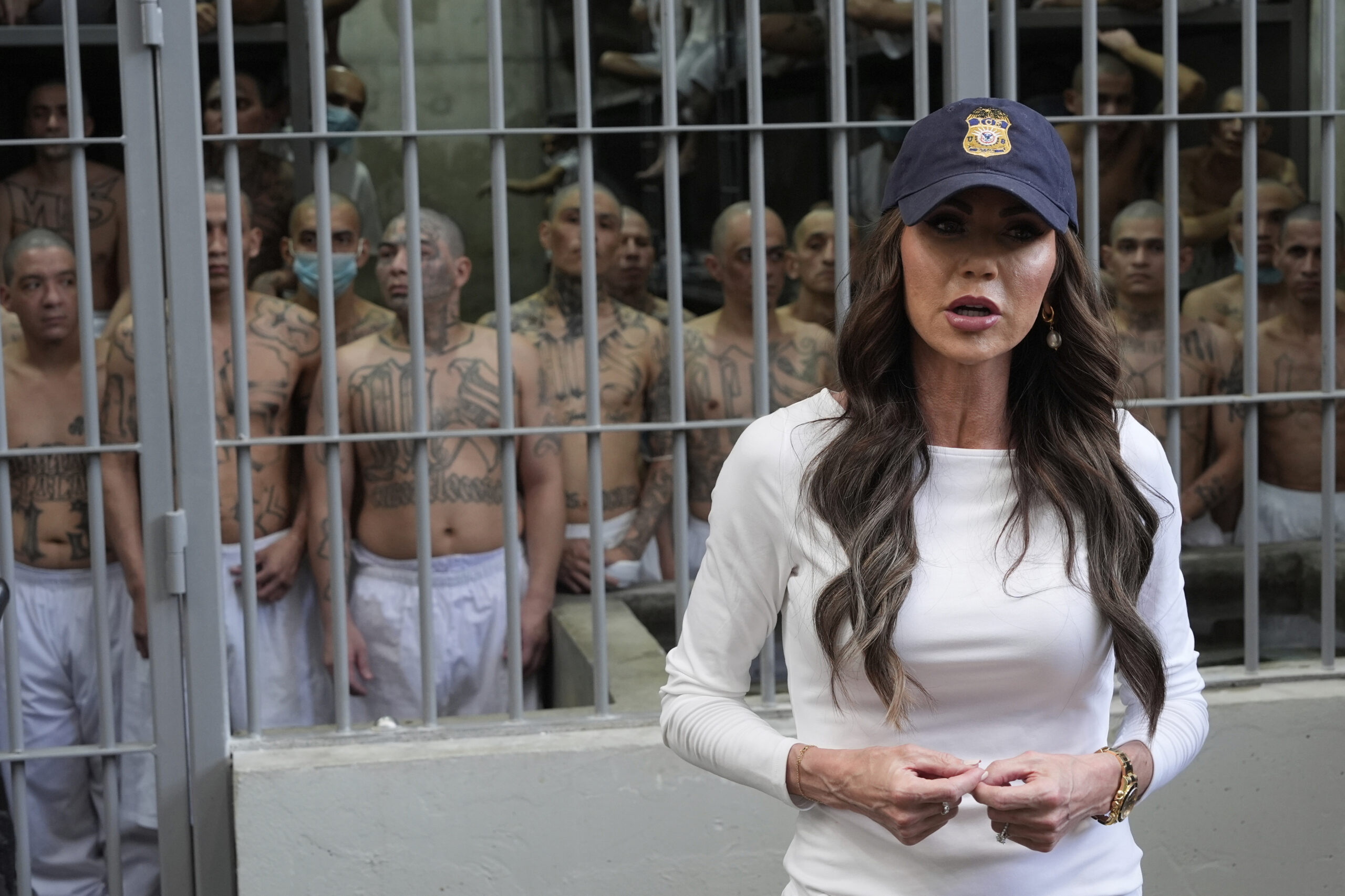
As prisoners stand looking out from a cell, Homeland Security Secretary Kristi Noem speaks during a tour of the Terrorist Confinement Center in Tecoluca, El Salvador, in March.
Undue process
To be sure, the release of all these men is good news. Most of the freed Americans were wrongfully detained and accused of being involved in plots to destabilize Venezuela.
Their arrests were part of a transparent, cynical ploy by the Maduro regime to use these men like bargaining chips as the country struggles to get out from under oil sanctions that have contributed to the nation’s deep economic problems.
The illegal detentions were also par for the course for a government where every branch is controlled by Maduro loyalists, and which routinely jails its own dissidents. (The swap included 80 political prisoners, but there are conflicting reports on whether they have all been released.)
There is no question that Venezuela’s actions are morally and legally indefensible. But what about America’s?
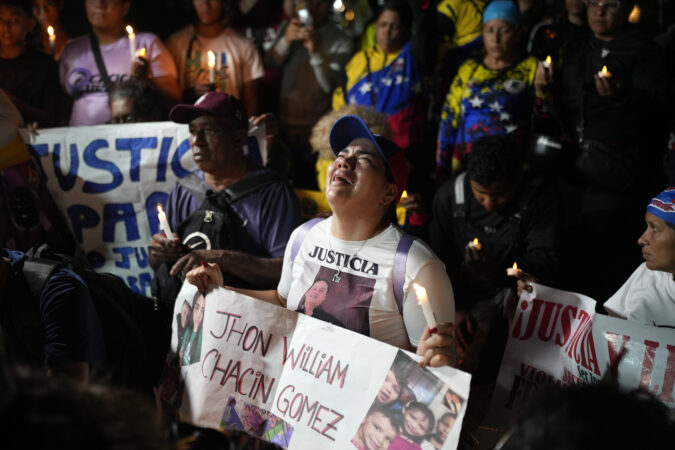
The more than 250 Venezuelans who ended up in El Salvador’s Terrorism Confinement Center, known as CECOT, were sent there by the Trump administration on March 15. They were deported with little or no due process under the 1798 Alien Enemies Act, accused of being dangerous criminals and members of the Tren de Aragua gang, which Trump declared a terrorist organization.
But reporting by several media organizations quickly put the lie to those claims, with ProPublica finding the government’s own records show that it knew the vast majority of the men had not been convicted of any violent crime in the U.S., and only a few had committed crimes abroad.
Most of the men were also not very hard to find, as they were either never released from immigration custody while they pursued asylum claims or their cases were moving through the immigration system.
Take the four Venezuelans identified as having ties to Pennsylvania before they were sent to CECOT.
Inmates exercise under the watch of prison guards during a press tour of the Terrorism Confinement Center, or CECOT, in Tecololuca, El Salvador, Oct. 12, 2023.
Joén Manuel Suárez Fuentes, 23, was detained during a traffic stop and charged with driving without a license. Ileis Villegas Freites, 28, had been sentenced to one year of probation for retail theft in Montgomery County.
Miguel Gregorio Vaamondes Barrios, 32, had a series of shoplifting arrests, including an open theft case in Pennsylvania, and was convicted of petit larceny in Nassau County, N.Y. Luis Jean Pier Gualdrón, 22, had a pending asylum application when he was deported. He had pleaded guilty to harassment in Northampton County, Pa., and was sentenced to three to six months in jail.
While some may argue that only people of unimpeachable moral character should be welcomed in America — and having a criminal record can disqualify immigrants from being granted legal status — these men were far from the “monsters” and members of a gang who the U.S. Department of Homeland Security said “rape, maim, and murder for sport.”
And even if they had been charged with being the worst of the worst, under the Constitution, the government still has to prove its case against anyone it seeks to deprive of “life, liberty, or property.”
In deporting the Venezuelans, the administration acted recklessly and lawlessly, ignoring not only the letter of the law but also directly disregarding an order from U.S. District Judge James Boasberg, barring the government from transferring the men to El Salvador under the Alien Enemies Act.
That the men are now free — although it is highly likely some have been placed right back in the dangerous situations under an oppressive regime they were fleeing in the first place — does not absolve the Trump administration of wrongdoing.
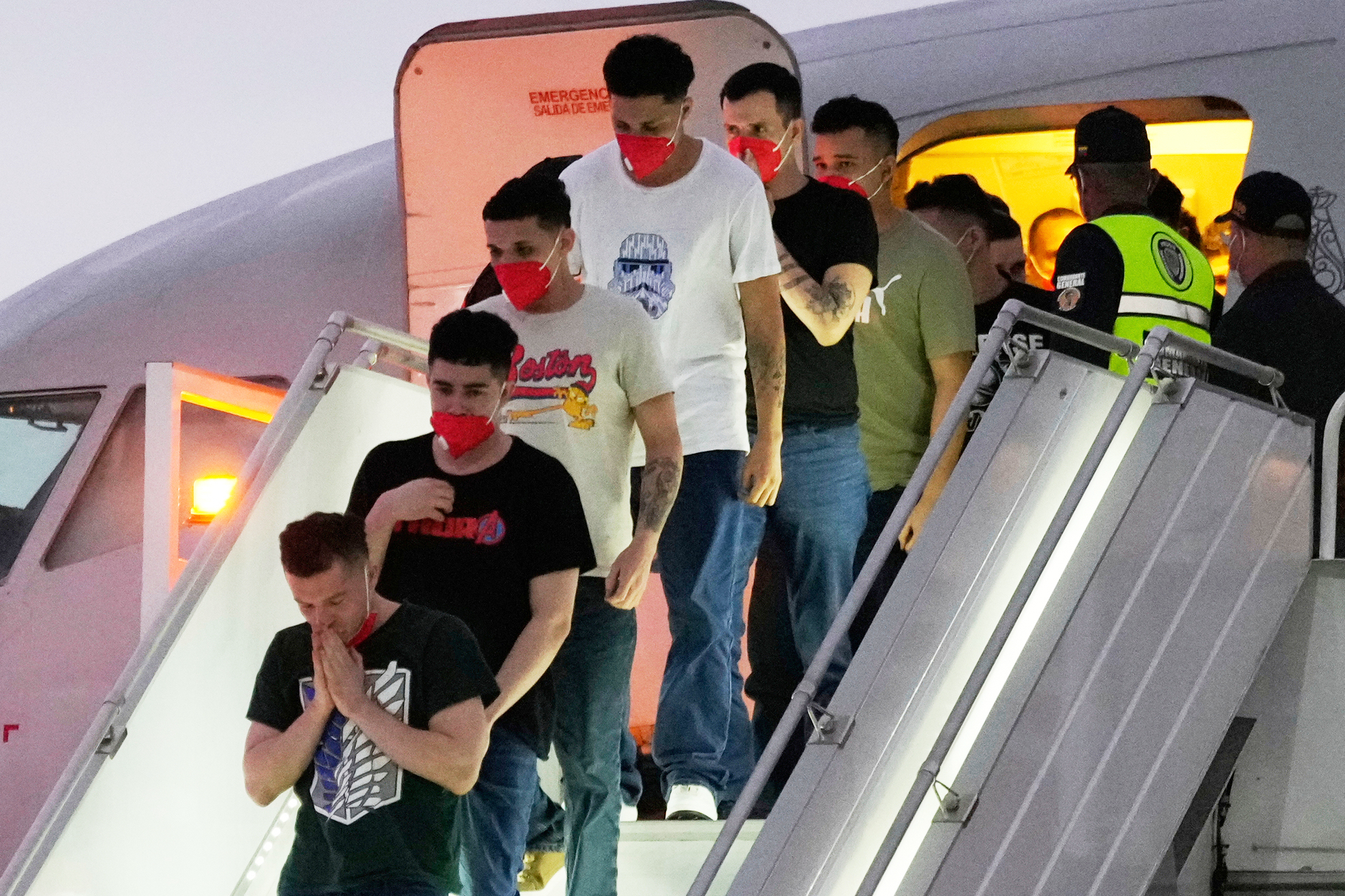
Migrants deported months before by the United States to El Salvador under the Trump administration’s immigration crackdown arrive at Simon Bolívar International Airport in Maiquetia, Venezuela, July 18, 2025.
Test case
Throughout the entire ordeal, the government has placed itself above the law.
Seeking to make good on Trump’s promise of mass deportations and tall tales of criminal immigrants running rampant, administration officials engaged in the kind of abuse of power that is un-American on its face.
The government selected a group of men under suspect criteria, identifying many of them as gang members based on the discredited belief that they had identifying tattoos. It then disappeared them, sending them to a foreign prison known for its brutal conditions, where they were unable to communicate with their families or lawyers.
To this day, officials have not even released a full list of names of the people they sent to El Salvador. What is publicly available has been cobbled together from families speaking out and media reports. It is unclear if everyone deported has been accounted for.
The government consistently defied court interventions, claiming that once the men were in El Salvador, they had no direct control over what would happen to them. The prisoner swap makes this particular lie only more blatant.
Most alarming is that there is nothing stopping them from doing it again — or keeping them from doing it to whomever they want. Already, Trump has mused about sending Americans to El Salvador.
“The homegrowns are next,” he told Bukele during the Salvadoran leader’s April visit to the White House. “You gotta build about five more places. … It’s not big enough.”
Having already violated the Fifth Amendment guaranteeing due process, it’s not much of a stretch for the administration to ignore the Eighth Amendment’s protection from cruel and unusual punishment.
America cannot move on from what happened to the Venezuelan immigrants. Their plight cannot be swept away in the flood of scandals and outrages that regularly flow from the White House.
The Trump administration cannot be allowed to do this to anyone ever again.
As Donald Trump intensifies his push for mass deportations, and communities rightfully protest in defense of their immigrant members, local and state leaders must be ready to stand up and defend the rule of law — including civil rights — against a president who is increasingly bent on using authoritarian tactics.
The United States is a nation of laws, and those who are in the country illegally should understand there are consequences. But two wrongs don’t make a right, and the way the Trump administration has engaged in enforcing immigration has leaned into the kind of cruelty and brutality that is anathema to American values.
During his presidential campaign, Trump was clear that if elected, he would seek to deport the estimated 11 million people in the country without authorization. Thanks to misinformation, propaganda, and the Biden administration’s inability to pursue a coherent asylum strategy, many voters were sold on Trump’s promise of mass deportation as a viable solution to what they saw as a crisis on the border.
The U.S. has every right to control who enters the country, and detaining and deporting immigrants who commit violent offenses has near-universal support. But mass deportation is a morally bankrupt policy whose execution, even if done within the boundaries of the law, results in families and communities being torn apart, to no discernible benefit.
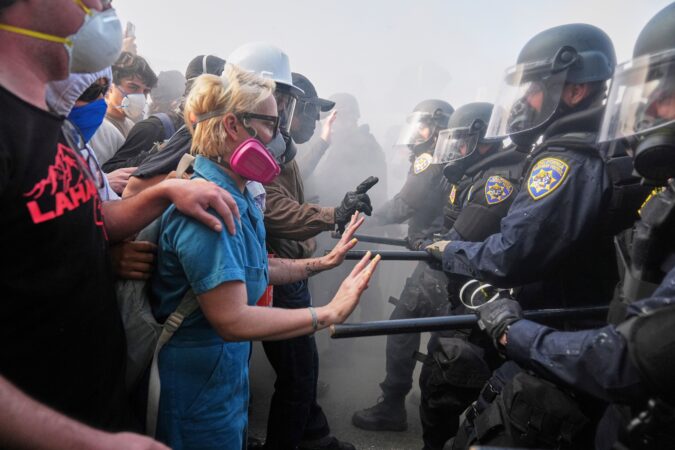
Protesters confront police following an immigration raid protest the night before. Mass deportations tear families and communities apart, to no discernible benefit, the Editorial Board writes.
If the president were serious about ending illegal immigration, he would begin by lobbying Congress to reform a system that is deeply broken and works only for those who seek to exploit people who are looking for a better life in the land of opportunity.
The old saw that immigrants in the country illegally should “get in line” cuts to one of the biggest misconceptions about immigration, and that is that for most people seeking to come to the U.S. legally, or to adjust their status once here, there is no line.
Immigrants toil under difficult conditions in construction, meat processing, and dairy farming. They take care of our children and our elderly, and pick the fruits and vegetables that end up on our tables. They help revitalize blighted and economically depressed commercial corridors with their small businesses. They are also easy to demonize and scapegoat whenever politicians need to find someone to blame.
There is a stunning hypocrisy in the Trump administration’s claim that it is righteously enforcing the law to protect America from immigrants, even as it engages in the kind of lawlessness that truly endangers the union. The government has clearly violated the Constitution, denying due process to immigrants it has accused of serious crimes and summarily deported to foreign prisons renowned for torture.
The president also continues to coyly ignore the courts, endorse U.S. Immigration and Customs Enforcement agents hiding their identity and acting like de facto secret police, and flirts with disaster by entangling troops trained for deadly combat in civilian law enforcement surrounding immigration protests.
Those protests are only expected to grow, yet Trump is fanning the flames, extending his dangerous dehumanizing rhetoric from immigrants to those who would defend them. During a speech at Fort Bragg in North Carolina on Tuesday, the president called protesters in Los Angeles “animals” and a “foreign enemy.”
“We will liberate Los Angeles and make it free, clean, and safe again,” he told gathered soldiers, in a deeply troubling display of politicizing the military.
Philadelphia has already been targeted by the administration as a “sanctuary city,” and ICE tactical teams are reportedly on their way. What happens if Trump decides the city also needs to be “liberated”?
While we must all continue to demand thatthe courts and Congress hold the president accountable for any abuses, elected officials must do all they can within the law to protect all Philadelphians — including immigrants.
A government that is allowed to run roughshod over the rights of some will not hesitate to trample the rights of all.
It seems Pennsylvania’s senior U.S. senator enjoys the perks of high office but is less interested in doing the actual job.
He has missed more votes than nearly every other senator in the past two years. He regularly skips committee hearings, cancels meetings, avoids the daily caucus lunches with colleagues, and rarely goes on the Senate floor.
Fetterman, a first-term Democrat, is also following the path of Republican elected officials by not holding town halls with constituents for fear of being heckled.
Fetterman dismissed the report as a single-source “hit piece.” But several media outlets confirmed Fetterman’s erratic behavior through multiple sources, including The Inquirer.
In one instance, Fetterman lashed out at members of the teachers’ union who pressed him regarding cuts to federal education. He reportedly banged his fist on the table and yelled at the group.
Six former Fetterman staffers told Inquirer reporter Julia Terruso that Fetterman was frequently absent or spent hours alone in his office, avoiding colleagues and meetings.
“It’s pretty impossible to overstate how disengaged he is,” one recently departed staffer said.
Fetterman suffered a stroke in May 2022 while running for Senate. After winning the election, he underwent treatment for clinical depression, citing a “dark time” and struggles to get out of bed.
Fetterman bravely confronted physical and mental health challenges, but has checked out of his Senate duties at a time when all elected officials must stand up to Donald Trump’s naked authoritarianism, corruption, and incompetence.
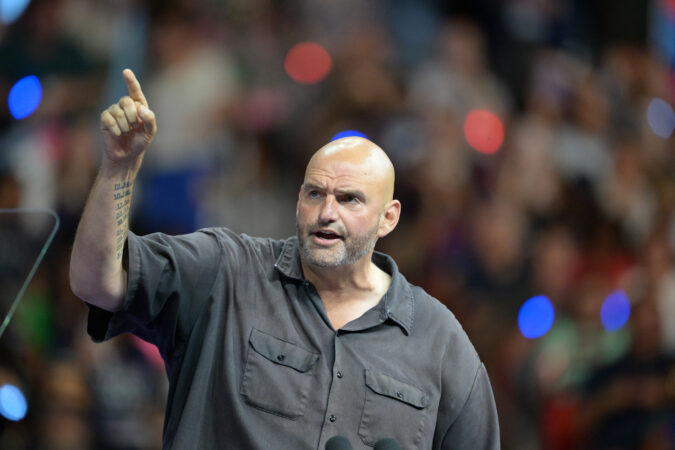
John Prenis holds a sign at Independence Mall during Indivisible Philadelphia’s demonstration and march from Independence Mall to Sen. John Fetterman’s office at Second and Chestnut Streets on May 9.
To be sure, mental health is a serious issue and not something to ignore. If Fetterman is still struggling, then he should seek immediate help.
Instead, Fetterman complained people have “weaponized” his mental health battles against him.
Being an elected official comes with public scrutiny. If Fetterman can’t handle the attention or perform his job, then in the best interest of the country and the nearly 13 million residents of Pennsylvania he represents, he should step aside.
After all, being an elected representative is a privilege, not an entitlement. Being a U.S. senator is a serious job that requires full-time engagement.
If Fetterman wants to continue to serve, then he must take his position seriously. He showed up for his first Commerce, Science and Transportation Committee meeting of the year in May and admitted he was shamed into attending by the media.
Fetterman dismissed his skipping out on the committee work and procedural votes as a “performative” waste of time.
He said his chronic absenteeism was a product of his decision to spend more time at home with his children and his father, who suffered a recent heart attack.
“I would go visit my dad instead of a throwaway vote,” he told the New York Times.
Spending time with family is laudable, but if that is his priority, then Fetterman should get a job closer to one of the eight properties he owns in his hometown of Braddock, Pa.
Senators often work long nights in Washington. But they also have flexible schedules and enjoy plenty of time off from Washington, since there are only an average of 165 legislative days.
Many of Fetterman’s constituents would like to work half a year so they, too, could spend time with their families. Safe to say, many would do it for less than Fetterman’s salary of $174,000, which is more than double the nation’smedian household income.
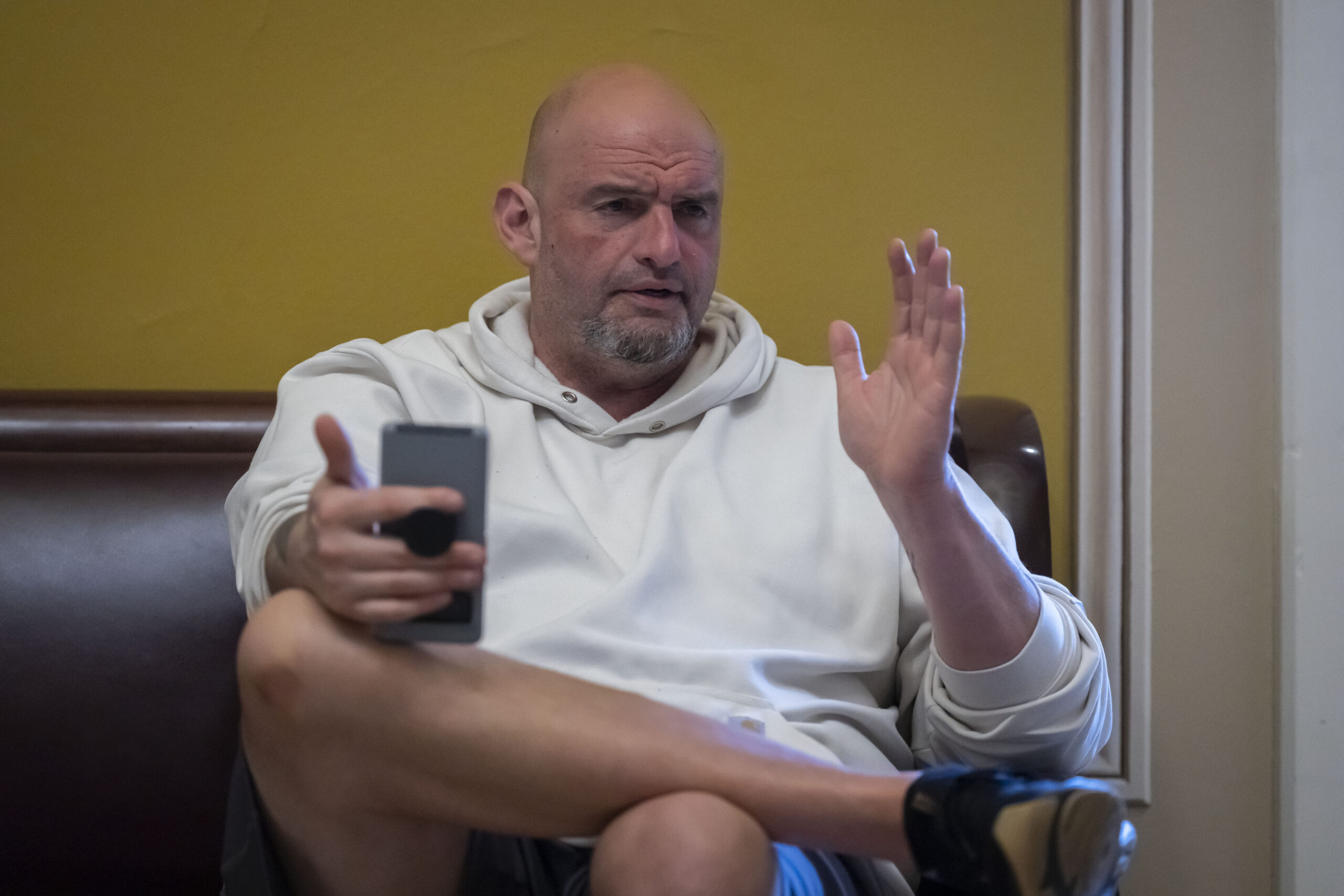
Sen. John Fetterman speaks to a reporter near the Senate chamber at the U.S. Capitol in Washington in March.
That doesn’t include the $172,500 advance Fetterman received to write a book with former Inquirer reporter Buzz Bissinger, or the $34,000 tax-free pay bump senators can claim for gas, food, and lodging while on official business in Washington.
Or the generous pensions and healthcare coverage senators receive — something most Pennsylvanians do not enjoy. Or the lifetime access to the U.S. Capitol gym and Senate dining room. Or the support staff of around 60 to help each senator do their job.
Being a U.S. senator also requires a lot of travel — mainly across their home state to hear from their constituents. The late Sen. Arlen Specter routinely crisscrossed Pennsylvania, visiting all 67 counties every two years and holding 400 town hall meetings. That’s what public service looks like.
Fetterman has not had much time for Washington or Pennsylvania. But he found time to jet down to Mar-a-Lago to schmooze with Trump, who he said “was kind,” “fascinating,” and “a commonsense person.”
Fetterman has flown to Israel twice in the past year, including a recent all-expense-paid junket to meet with Prime Minister Benjamin Netanyahu, who has been accused of war crimes and corruption. He and his wife flew first class and stayed in five-star hotels as part of a fact-finding mission that cost $36,000 and was paid for by a New York-based nonprofit.
Fetterman finds time to regularly appear on Fox News and other TV talk shows, while also seeming preoccupied with his social media profile.
“He’s taken two all-expenses-paid trips to Israel, but can’t drive down the street and hold a town hall,” a former staffer told the Intercept.
Other senators travel overseas but also show up for work in Washington and meet with constituents in their home state. Public service is not about serving yourself.
It’s time for Fetterman to serve Pennsylvanians, or step away.
DENVER — Amarilis Marte and Mariangy Delgado Gutiérrez didn’t leave their native Venezuela and spend three months traveling about 5,000 miles to the United States because they were pursuing a “dream.” They yearned for something both more practical and more basic.
The practical? “I didn’t come here for an American dream,” Mariangy told me in an interview last week. “I came to this country for calmness, stability — to live peacefully without the fear that someone would kill you.”
It was not an abstract concern. In Venezuela, a nation mostly defined over the last decade by economic and social unrest under the autocratic regime of President Nicolás Maduro, Amarilis, 24, and Mariangy, 31, said they lived with a persistent worry that they would be harmed — not just because of the country’s overall instability, but also because they are a lesbian couple. In Venezuela, as in much of Latin America, there is a widespread intolerance of the LGBTQ community.
“There was a lot of aggression toward us both,” Mariangy said, adding that the couple had received at least one death threat.
Then, there was the basic: The two wanted to be wed. With same-sex marriages banned in their home country, and the price of even the simplest ceremony out of reach in their new home in Colorado, it seemed they had few options.
That’s when Denver’s LGBTQ community rallied around them. A Pennsylvania native organized the wedding, complete with donated photography, a wedding cake, cookies, rainbow flags, and a wedding arch in honor of Pride Month.
“We are waiting for a favor from God,” Mariangy said.
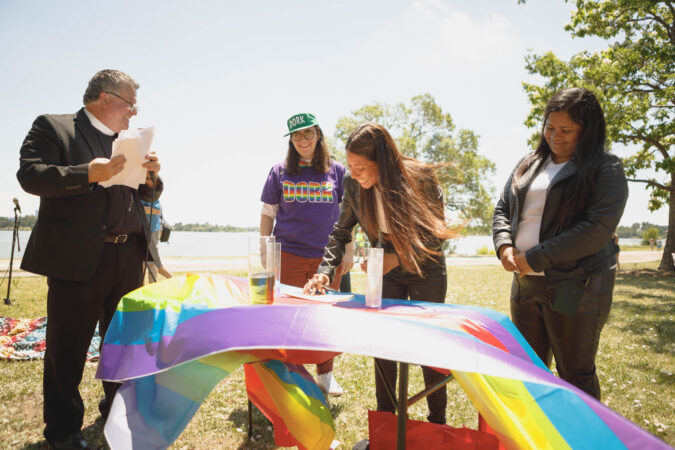
Susan Law (center) grew up in Murrysville, Pa., and organized a wedding in Denver for Venezuelan asylum-seekers Mariangy Delgado Gutiérrez (left) and Amarilis Marte.
That favor came in the form of their new neighbors in their new home, including Susan Law, the Pennsylvania woman who put together the weekend’s events.
In a migrant support group on Facebook, she saw a news clip about the couple and reached out to ask if they were interested in attending the Denver Pride parade with Dork Dancing.
“I wanted to set aside a certain number of spots for the unhoused and migrant LGBTQ community members,” said Law, who grew up in Murrysville, Pa., a 20-minute drive from Pittsburgh. “They told me what they had been through. They were in serious hardship and needed my help.”
When she heard the couple couldn’t afford a $30 marriage license, she vowed to throw them a wedding during Pride Month.
The Rev. Quirino Cornejo officiated. The couple walked down the aisle lined with Pride flags to the sounds of “The Story” by Brandi Carlile. Many guests brought their children. Others contributed lemon crinkle cookies to the Pittsburgh-style cookie table. And unlike at many weddings, most of the attendees were meeting each other for the first time.
Before the ceremony started, I spoke with David Hosanna and Jaime Rodriguez, who met a year ago this month at a gay bar. “For anyone who has negative things to say about Pride, I would say you’re missing the big picture,” Rodriguez said. “Who is to say that someone you’ve come to love — a friend, niece, grandchild, nephew — won’t need this in the future? Wouldn’t you feel better and happier knowing that they are entering a more accepting world?”
After the wedding, the Dork Dancers danced. The founder of Dork Dancing, Ethan Levy, is at center.
At one point during the ceremony, an orange Jeep sped by, the driver shouting expletives about Pride from a lowered window. Minutes later, a minivan passed in the opposite direction, honking exuberantly and waving a rainbow umbrella out of the passenger-side window.
The brides poured black-and-white sand into a shared vessel to symbolize their union. They had wanted to be married for years since they were in Venezuela, but it wasn’t safe to do so. Under Venezuelan law, same-sex couples do not have protections or rights. And while same-sex relationships are not explicitly illegal, as they are in 67 countries, frequently, LGBTQ Venezuelans face violence.
“We feel more free here,” Mariangy said.
The couple shows off their wedding rings.
A perilous journey
Amarilis and Mariangy’s journey to Sloan’s Lake Park began five years ago when they first started dating. In 2020, fearing for their safety, the couple and their two daughters, ages 9 and 13, left their home in Valencia, Venezuela, and fled to Colombia.
They left Bogotá on July 14 for Medellín, Colombia, and spent almost four months traveling overland to the United States. They crossed the Darién Gap, a 60-mile stretch of dense jungle between Colombia and Panama, over three days without eating; the little food they found in the trash was saved for their children.
In addition to being perilous, crossing Central America is expensive. In Panama, the family was kidnapped and told to pay $280 per head to continue. When the kidnappers realized Amarilis and Mariangy didn’t have money, nor did their friends and family back home, they let them go.
The threats continued: In Mexico, on a packed train, a cartel stopped the railcar and took money from the passengers. Mariangy told me she and Amarilis had to protect the kids from assault. They jumped from the top of the train and ran barefoot over mountains until they reached a faraway town.
After three arduous months, the family of four arrived legally as asylum-seekers at the border in Texas on Oct. 28, where Amarilis was detained by migration. Mariangy and her daughters were given the option of taking a bus to New York, Washington, D.C., or Denver. She chose Denver because she heard that there would be shelters. On Dec. 1, Amarilis rejoined them.
“We are here,” Mariangy told me. “That’s the most important thing.” They survived.
Amarilis Marte and Mariangy Delgado Gutiérrez cut into their wedding cake from Eternal Flavors Bakery while their daughters look on. After the couple told Susan Law they couldn’t afford a $30 marriage license, a community of LGBTQ people and allies came together to throw them a wedding.
A call to action
When they reached Colorado, Amarilis and Mariagny wanted to marry, but they couldn’t afford the simplest items for a ceremony. The family lives in the 16th most expensive metro area in the country, where they spend $800 a month to sleep on the floor of an apartment with five people they don’t know, all men. The family sleeps in a closet.
Their dreams are so prosaic as to be beautiful. They want a house for their kids to thrive in, good work to support their family, and to have another child together. They want to get a dog, though they differ in preferences: Mariangy wants a mini schnauzer. Amarilis would prefer a German shepherd.
The wedding on the shore of Sloan’s Lake was a celebration, but also a call to action. Without Law’s help, they would likely be on the streets. The family is still food insecure. Paying rent is a struggle; Law helped them with a missing $450 a few days before the wedding. Once they get work permits, her hope is to help Amarilis and Mariangy identify a source of income beyond cleaning patios or backyards.
Mariangy Delgado Gutiérrez and Amarilis Marte exchanged vows at Sloan’s Lake Park in Denver on June 9.
In my life, I have ridden a bicycle in Toronto behind the Dykes on Bikes and learned the hard way not to wear glitter on my eyes in the rain. I’ve marched at Pride in New Hampshire, New Zealand, and watched from the sidelines in New York City.
None of that was as meaningful as watching Mariangy and Amarilis get married. It was a privilege to witness the true power of the LGBTQ community. Celebrating Pride means uplifting the most vulnerable among us.
On Tuesday, Flyers defenseman Ivan Provorov refused to wear a rainbow warmup jersey during the team’s LGBTQ Pride Night game against the Anaheim Ducks. He was the only player to do so. Provorov, who hails from Yaroslavl, Russia, cited his Russian Orthodox faith as the reason for abstaining from rainbows, telling reporters after the game that he had chosen “to stay true to myself and my religion.”
As a queer woman, a former hockey player, a Christian, and an NHL fan, I am disappointed at the league and the Flyers’ response. In refusing to wear the Pride Night jersey, Provorov refused to acknowledge the humanity of LGBTQ people. And the league, in defending his stance, went right along with it.
In a statement released Wednesday, the NHL said: “Clubs decide whom to celebrate, when and how — with league counsel and support. Players are free to decide which initiatives to support, and we continue to encourage their voices and perspectives on social and cultural issues.”
In other words: There’s no problem with players being vocally antigay. Flyers head coach John Tortorella doubled down on the support of Provorov’s homophobia, telling reporters after the game: “This has to do with his belief and his religion. It’s one thing I respect about Provy, he’s always true to himself. That’s where I’m at with that.”
Too few people understand that this tacit acceptance of discrimination — especially as it relates to sexuality and religion — is a matter of life or death for members of my community.
Provorov is entitled to his personal convictions. He can believe that only marriages between a man and a woman can be blessed by God, or that homosexuality is a sin. But I wish he knew this: For other populations, when they adopt the church, the suicide rate decreases. For LGBTQ people, when they adopt the church, the suicide rate increases.
Provorov should have donned that rainbow jersey and, yes, put rainbow tape on his hockey stick — not because he accepts gay marriage or because he’s eager to march in a Pride parade — but to stand up for LGBTQ people who are suffering. The defenseman had a chance to make a statement against bullying, against hatred, and against violence, without even opening his mouth. Instead, he chose not to step on the ice for warmups. That is shameful.
I would recommend that Provorov, Tortorella, NHL leadership, and anyone who disagrees with me — take a moment to read the book Heavy Burdens by sociologist Bridget Eileen Rivera. In it, she shows how generations of LGBTQ people have been condemned and alienated by churches. That legacy has caused immeasurable harm to my community. It is a heavy burden to carry.
Flyers defenseman Ivan Provorov sat out warmups on Tuesday night to avoid wearing the team’s Pride Night jerseys.
Next, dive into Affirming: A Memoir of Faith, Sexuality, and Staying in the Church bySally Gary. Gary is the executive director of CenterPeace, a nonprofit organization that helps members of the LGBTQ community feel a sense of belonging in the church — and provides resources for Christian leaders and parents of LGBTQ kids to respond to the queer community as Christ would: with love and acceptance.
After that, I would recommend that Provorov sit down and spend time with his Bible.
If Provorov truly wants to follow Jesus, the best thing to do is to stand up for the vulnerable. One of the first things Jesus said in announcing his ministry was: “The Spirit of the Lord is on me, because he has anointed me to proclaim good news to the poor. He has sent me to proclaim freedom for the prisoners and recovery of sight for the blind, to set the oppressed free, to proclaim the year of the Lord’s favor.” (Luke 4:18-19)
That is how close the vulnerable were to Jesus’ heart. If Provorov’s Christianity does not center on helping the vulnerable — and I mean every vulnerable population — then he’s missing the mark.
My heart goes out to Provorov. He’s trying to follow God with the knowledge and resources he has.
In the Gospel of Matthew, Jesus had some of the strongest warnings for the most religious of his day. He warned his followers to be wary of those who “preach, but do not practice. They tie up heavy burdens, hard to bear, and lay them on people’s shoulders, but they themselves are not willing to move them with their finger.” (Matthew 23:3-4)
I’m asking Provorov to move his finger. Clear these burdens. Reading the Bible with fresh eyes might open his mind.
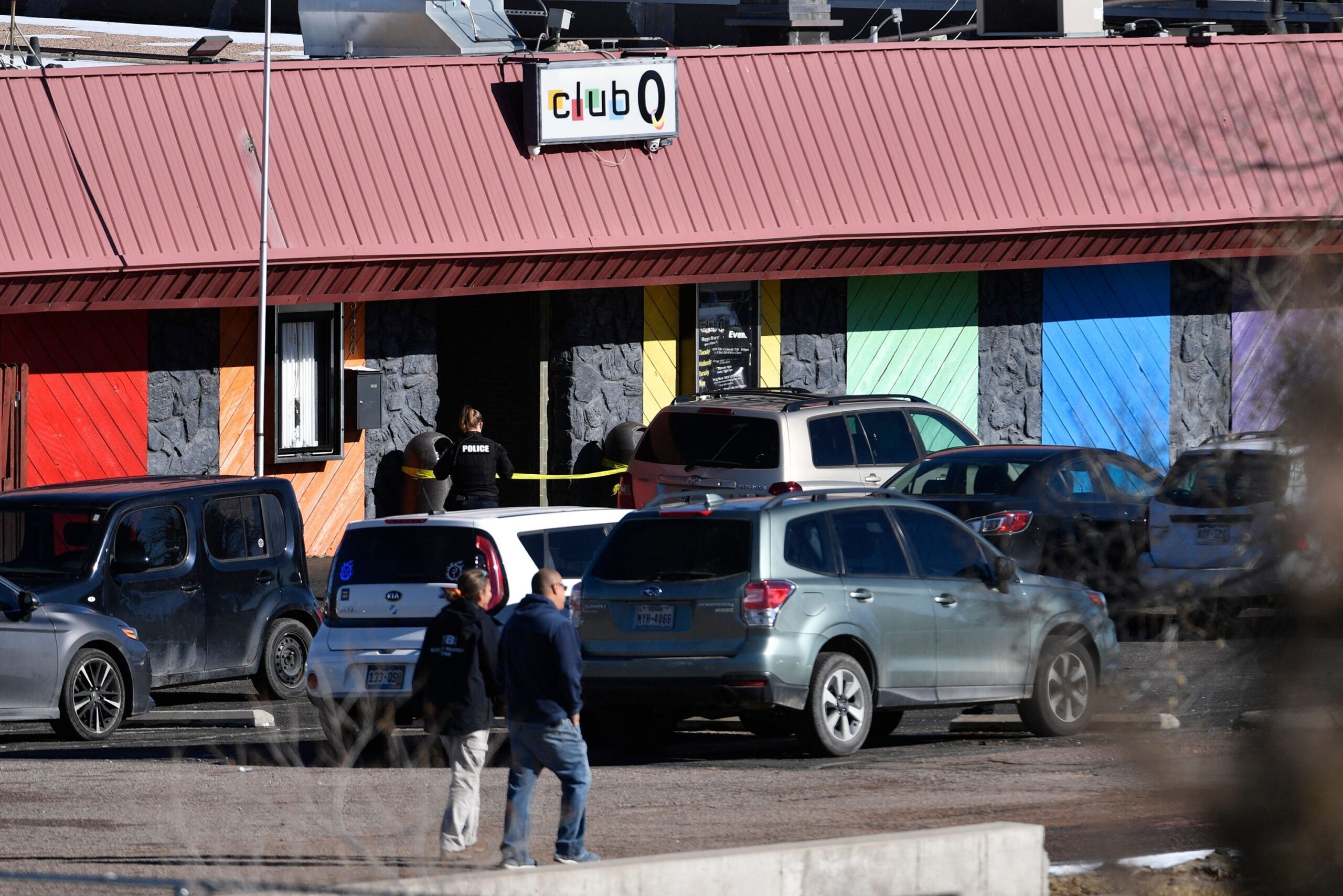
On Saturday night, a 22-year-old man entered an LGBTQ nightclub in Colorado Springs, Colo., and used a long rifle to kill five people before he was tackled to the ground by patrons. Twenty-five others were injured.
When I heard the news, I felt nauseated. I thought about a recent night I spent with a date at Tavern on Camac in the Gayborhood. We chose the spot specifically because we would be able to talk, but also be surrounded by some semblance of community. A series of men strutted up to the piano to sing renditions of Disney and Sondheim and Cher. I sipped a lager and asked my date about their childhood.
Not once did I eye the exit or think about what might happen if a man with a gun entered the room, hellbent on killing us because of our gender identities or the way that we love. But after the shooting at Club Q — and after reflecting on the 49 LGBTQ people who lost their lives at Pulse nightclub in Orlando, Fla., in 2016 — I might start.
Many people don’t understand that LGBTQ bars and clubs are holy spaces. Too many of us have been rejected by our families or our religious communities, or deal with microaggressions at work that make us feel overly sexualized and less-than-human.
Too often, the people who we expect to love and accept us unconditionally choose not to respond in that way — and that leads to LGBTQ people seeking out other channels for connection. It’s possible to find safety and support in a bar, or a community center, or a friend’s kitchen. Even if we have the privilege of not dealing with these pains — both large and small — on a daily basis, we have likely loved someone who has.
Even in a strong circle of support, many LGBTQ people feel a sense of isolation. The suicide rate is astronomically high — nearly half of LGBTQ youth have had suicidal thoughts in the past year, according to a survey by the Trevor Project. The politicians who ban LGBTQ books or enact laws that limit access to gender-affirming health care don’t understand that for many in my community, the ability to be seen and loved as ourselves is a matter of life or death.
For adults, an LGBTQ bar is a safe space. But what does safety mean?
Law enforcement officers walk through the parking lot of Club Q, an LGBTQ nightclub, in Colorado Springs, Colorado, on Sunday.
Safety means being able to make eye contact. It means not fearing death. It means staring into the eyes of someone who could be a lover — or even holding their hand above the table, or dancing close — and thinking only of them, without being distracted by a straight person’s gaze or judgment.
That’s not to say that Tavern on Camac is perfect. A lesbian bar would have been preferable by a mile — but Philadelphia doesn’t have one. Toasted Walnut closed in 2021. Sisters closed in 2013. If I had a time machine, I would go to Sisters in 1996, just for one drink.
But back in Tavern on Camac on Oct. 15, in the year of our Lord, 2022, my date leaned in for a kiss. Soon after, a drunk man leered at us.
“There’s two straight people kissing in here! Don’t they know this is a gay bar?” he shouted.
That wouldn’t have happened in a lesbian bar. We left soon after — giddy, yes, but fazed.
In this Philly experience, I know I am not alone. In his 2015 essay, “Black not fetch enough for Woody’s?” Ernest Owens wrote: “LGBT members of color continue to face a sense of de facto dismissal socially when trying to enjoy the night scene at one of Philly’s more accepting venues.” Owens argued that the city should work with the Gayborhood to “foster more cross-cultural LGBT collaboration to help shake up the social division. Otherwise, there will be more shade to be thrown across the dance floor — something that nobody has time for.”
There are vanishingly few lesbian bars across the country. In 1980, there were around 200. Today, there are less than 25. On the podcast Cruising Pod, Sarah Gabrielli, Rachel Karp, and Jen McGinity take a road trip to document the surviving spaces for queer women. The Lesbian Bar Project is a documentary film and fund-raising project that seeks to do the same. These bars are sacred.
Every queer person’s experience is different. But the unifying theme is a longing for acceptance. Too often we are told that we are less-than-human, or unwelcome, or that the way we love is unholy. When I see a rainbow flag over the door of a bar or a church or a café, I know that I won’t be judged.
On a road trip this spring, I waited out a tornado warning at the Lipstick Lounge in East Nashville, Tenn., where it was drag queen trivia night. Outside, torrential rains fell. Inside, I was welcomed to a table of queer women who were elated just to share space with each other. I was useless at the trivia, but that didn’t matter. I had a puppy with me, recently adopted, who was a total babe magnet. The bartenders gave her bacon. The night ended with karaoke, and I listened but did not sing. Suffice to say, karaoke in Nashville, where everyone is a would-be musician, is superior to karaoke in any other city.
For people who don’t have an experience in these LGBTQ spaces — and for the politicians who live at a comfortable distance — imagine that the person in that bar is your daughter, or your son, or your loved one.
Think of Daniel Aston, a 28-year-old trans man and bartender at Club Q who was shot and killed this weekend. In an interview with Colorado Public Radio, his mother, Sabrina Aston, said that working at Club Q, her son “was the happiest he had ever been.”
“He was thriving and having fun and having friends. It’s just unbelievable. He had so much more life to give to us and to all his friends and to himself.”
Everyone deserves a safe space to dance and exist and experience joy. And Philly, if we ever get a lesbian bar again, know that I will show up in my finest blazer and sneakers and dance.