Tony Lupien drove to Philadelphia in February of 1946, just a few weeks before the Phillies were scheduled to begin spring training. Lupien missed most of the previous season after being drafted into the Navy during World War II and still didn’t have a contract for the new season.
There was a good reason: Phillies general manager Herb Pennock told Lupien he was being traded to the Hollywood Stars, a minor-league team.
Lupien was livid. He believed his job in the majors was guaranteed to him for a year after returning from the service and hired a lawyer to challenge the team’s decision.
“Who the hell are you to think that you’re above the federal government?” Lupien told Pennock.
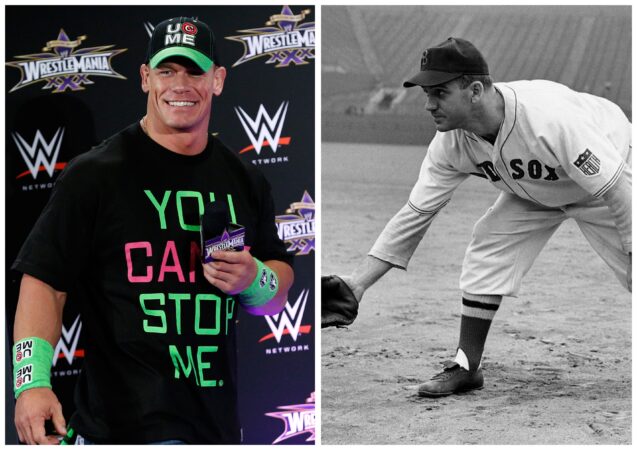
Lupien’s grandson would become one of the biggest stars in professional wrestling before embarking on a Hollywood career. But John Cena’s grandfather didn’t want to be a Hollywood Star. He wanted to play first base for the Phillies.
“Lupien, guaranteed a year’s job with Phils under selective service law, gets kick in pants instead,” wrote a headline in The Boston Globe.
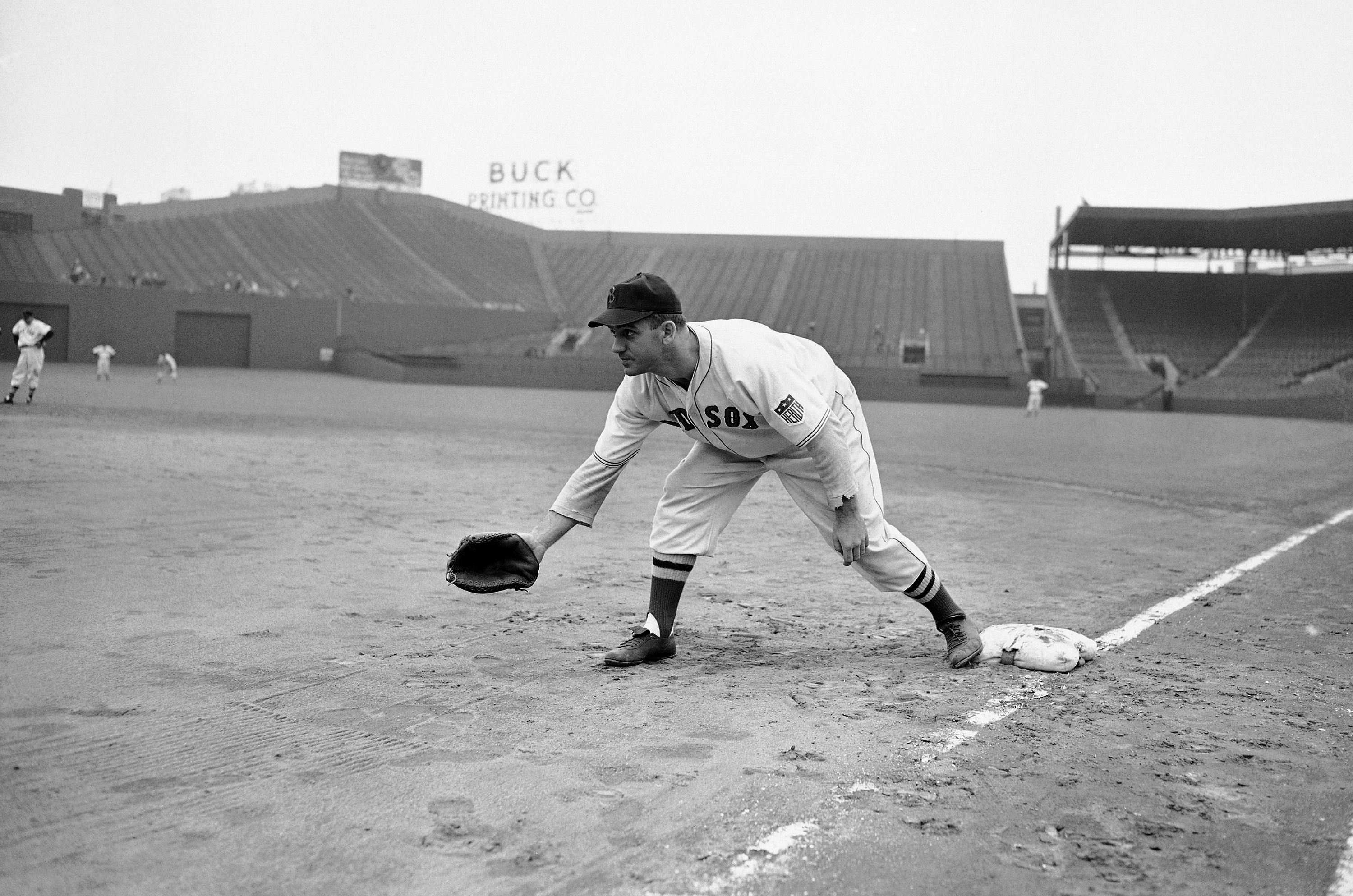
Ulysses “Tony” Lupien graduated from Harvard and joined the Phillies in 1944 after being waived by the Red Sox. He hit .283 in 1944 before being sworn into the Navy in March of 1945. Lupien spent six months on a Naval base in New York before returning to the Phillies in September, just in time for the final stretch of a 108-loss season.
The Phillies were so bad in 1945 that their manager quit in June. Lupien, a smooth fielder, was a bright spot when he returned at the end of the season, hitting .315 over 15 games.
Tony Lupien played six major league seasons, including two with the Phillies.
The Phils ranked last that season in nearly every statistical category, even attendance. The Phils wanted to clean house, declaring that any player who was in the lineup for the final game of 1945 would not be in the lineup for the first game of 1946. So that meant Lupien was gone.
“The G.I. Bill was designed to protect for at least one year the jobs of men who entered the service. Now that bill either applies to ballplayers or it doesn’t,” Lupien told The Sporting News. “That’s what I am trying to find out, and if it means that I am the goat or the ball carrier, I am perfectly willing to assume that role. If the G.I. Bill does apply, then I may help many other veterans in the months to come by following through with my action.”
The Phillies disagreed with Lupien as Pennock said the G.I. Bill didn’t apply to baseball. They had signed Frank McCormick, a 35-year-old power hitter, to play first base and the 29-year-old Lupien had a minor-league gig waiting in California.
“I think the least the Phils might have done is give me a chance to show what I have,” Lupien said.
Lupien wrote a letter to the National League commissioner. He hoped to become a free agent or at least get invited to spring training. Lupien already played three years in the minors and didn’t want to go back.
His letter was returned unopened. Lupien’s lawyer, a former Harvard classmate, said he had a case. The Massachusetts Selective Service Board said the case would have to be heard in Philadelphia since it involved the Phillies.
The Hollywood Stars sent him a contract for $8,000, which made him the highest-paid player in the minor leagues. He learned the Phillies were kicking in $3,000. The Phillies, Lupien believed, were circumventing the G.I. Bill by making sure he still earned his prewar salary despite not giving him his old job.
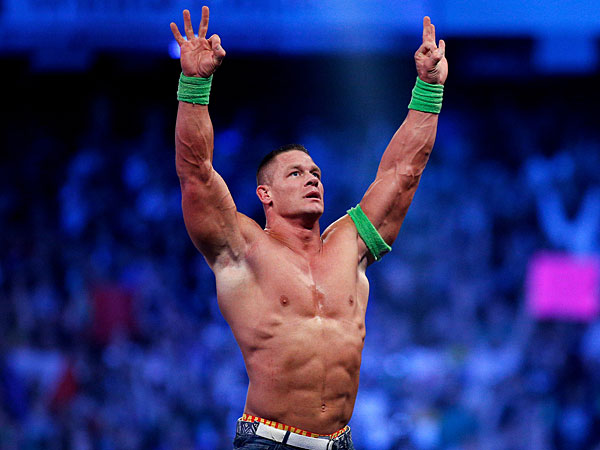
John Cena has said next Saturday night will be the final wrestling match of his career.
Lupien already had two children and knew it would be too expensive to travel back and forth to Philadelphia to fight his case. He reported to Hollywood at the end of spring training and became a Star.
Lupien played two seasons with the Stars before returning to the majors in 1948 with the White Sox. He then bounced around the minors as a player/manager and coached basketball at Middlebury College before being hired in 1956 to coach Dartmouth College. He managed the team to the College World Series in 1970 and co-wrote a book in 1980 about the history of baseball’s labor movement. Lupien remained outspoken about labor, believing the sport’s contract structure railroaded his career.
He died in 2004, two years after Cena debuted in the WWE. Cena, whose mother, Carol, is Lupien’s daughter, said next Saturday night will be the final match of his career.
Cena, 48, once wore a Phillies jersey to the ring and is one of the most popular performers in wrestling history. His celebrity has long crossed over into popular culture as he’s starred in movies and TV shows.
He spent the last year balancing his WWE farewell with the filming of a new movie. After wrestling, Cena is expected to fully become a Hollywood star. His grandfather, begrudgingly, was one first.
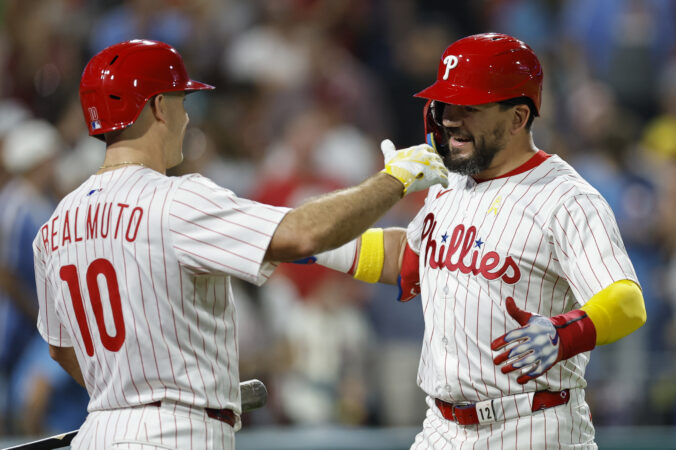
What’s it like to be an executive at baseball’s winter meetings? Jim Duquette, a former general manager with the Mets and Orioles and now the host of a show on MLB Network Radio, puts us in the rooms where everything happens. He also discusses the Phillies’ offseason, including the chances that Kyle Schwarber and J.T. Realmuto return in free agency. It’s all on “Phillies Extra,” the baseball podcast from The Philadelphia Inquirer. Watch here.
“It’s really more their process than it is ours at this time in the sense that they set the time frame,” Dave Dombrowski said. “They know we have interest, and then it’s up to them to kind of say, ‘OK, we’re ready to move forward,’ or not, whenever that ends up happening.”
That was three weeks ago. Schwarber and Realmuto have had five weeks to browse the market. By now, they have a decent idea of what’s there for them beyond the Delaware Valley. The Phillies probably do, too.
And with the baseball world set to gather again Sunday night in Orlando for the three-day winter meetings, it might finally be time for all parties to circle back to one another. In the shadow of the Magic Kingdom, of all places, the fantasyland of rumors about which teams are curious about which players will give way to a better sense of reality about whether Schwarber and Realmuto will return or move on.
The Phillies haven’t hidden their strong desire to keep both. Even though Schwarber will be 33 and Realmuto 35, and they’re central to a team that made the playoffs four years in a row but stubbed its toe in October, Dombrowski described them as “very important” and said they “mean a lot to the organization.”
With the exception of Japanese ace Yoshinobu Yamamoto, owner John Middleton hasn’t lost out on a free agent that he’s wanted since the “stupid money” winter of 2018-19. And free agents have wanted to play in Philly over the last half-decade because of the culture set by Schwarber, Realmuto, et al.
No wonder most of the industry expects Schwarber and Realmuto to find their way back to the corner of Pattison and Darien.
Phillies owner John Middleton hasn’t been outbid for many free agents over the last half-decade.
But even if it feels like almost a fait accompli, the mission for their agents is to get offers that will at least drive up the price. Maybe they’ve done that. Maybe not.
Schwarber’s market is especially fascinating because it lacks most of the high-payroll teams. The Dodgers’ designated hitter is Shohei Ohtani, only the best player on the planet. The Yankees (Giancarlo Stanton) and Astros (Yordan Alvarez) are set at DH, too. George Springer had a career renaissance as a DH for the Blue Jays, who are in on seemingly every marquee free agent except Schwarber. The Cubs appear to be focused on pitching.
The Red Sox want to add a middle-of-the-order bat, chief baseball officer Craig Breslow said last month, and Alex Cora loved managing Schwarber in 2021. But given their lineup’s lefty lean and Fenway Park’s dimensions, righty-hitting Pete Alonso or Alex Bregman might be better fits. And Boston doesn’t spend money like it once did, either.
The Reds’ interest in bringing Schwarber home to southwest Ohio is real, multiple sources confirmed this week. It makes sense for a young team that is rich in starting pitching but lacking power and veteran leadership. Asked in July about the prospect of being courted by his childhood team, Schwarber said this: “I think it’d be awesome.”
But the Reds intend to keep their payroll in the $120 million range, president of baseball operations Nick Krall told reporters last month, leaving them with about $20 million to spend for 2026. Schwarber figures to cost at least $30 million per year.
And even if they had the cash, spending big for free agents isn’t in the Reds’ organizational DNA. They’ve done only two nine-figure contracts in their history, and Joey Votto and Homer Bailey were extensions. Their largest free-agent contracts: Mike Moustakas and Nick Castellanos, both four years, $64 million.
That leaves, well, who? Various reports have linked Schwarber to the Giants and Pirates (seriously).
The Mets are “in the mix” for Schwarber, at least according to an ESPN.com report. It’s plausible as a backup plan if New York doesn’t re-sign Alonso, although president of baseball operations David Stearns emphasized run prevention as the team’s chief offseason focus. Schwarber doesn’t help there.
But the best way for Schwarber’s agents to hike the price on the Phillies might be to claim interest from the rival Mets, owned by Steve Cohen, the wealthiest man in baseball. And the Mets could attempt to gain leverage over Alonso by suggesting they’d pivot to Schwarber.
In any case, the Phillies remain the favorite in the Schwarber derby.
“You have the owner who wants him, you have Dave Dombrowski who wants him, you have the coaching staff, you have [manager] Rob Thomson, you have a fan base — everybody involved here wants [him] to be back, including Kyle — so what does it come down to?” hitting coach Kevin Long, who is close with Schwarber, said on The Inquirer’s Phillies Extra podcast. “What’s his market value, and are we willing to give him his market value? And I think the answer is yes to that.
“I think it would be devastating to this organization and this fan base and everybody involved if he wasn’t a Phillie.”
The last five weeks have been about establishing market value for Schwarber and Realmuto. Next week might finally mark the Phillies’ chance to meet it.
A few other thoughts leading into the winter meetings:
Phillies third baseman Alec Bohm is once again a candidate to be traded in the offseason.
Trading places
Two of the most intriguing offseason moves so far were one-for-one trades of major leaguers.
The Orioles swapped four years of control over gifted but often-injured pitcher Grayson Rodriguez to the Angels for walk-year outfielder Taylor Ward. Then, the Mets dealt popular outfielder Brandon Nimmo to the Rangers for second baseman Marcus Semien in a change-the-mix move.
Across the sport, the trade market is hyperactive, multiple team officials said this week, perhaps because some clubs are wary of signing free agents to multiyear contracts amid labor uncertainty beyond 2026.
Once again, Alec Bohm‘s name will come up in the Phillies’ conversations. But they couldn’t agree on his value in trade talks last winter, and it figures to be even lower now that the third baseman is one season from free agency.
Lefty reliever Matt Strahm could be another potential chip, especially after Dombrowski volunteered in an end-of-year news conference that the veteran declined to do pitcher fielding drills before the postseason.
Rivals believe the Phillies prefer trading from their major league roster rather than the farm system after moving teenage shortstop Starlyn Caba (for Jesús Luzardo) and catcher Eduardo Tait and right-hander Mick Abel (for Jhoan Duran) within the last calendar year. Andrew Painter, Aidan Miller, and Justin Crawford are thought to be largely off limits, with Painter and Crawford ticketed for the opening-day roster and Miller close behind.
As long as the Phillies cling to that trio, it’s difficult to see them matching up with the Diamondbacks for second baseman Ketel Marte, the Red Sox for outfielder Jarren Duran, or especially the Twins for center fielder Byron Buxton, if Buxton decides to waive his no-trade clause.
But maybe there’s a trade to be made for someone like Astros center fielder Jake Meyers, a solid defender who batted .292 with a 103 OPS-plus this season and is reportedly available.
Jesús Luzardo had a big season for the Phillies after being acquired in a trade last December.
Making a pitch
A year ago, the Phillies weren’t focused on starting pitching at the winter meetings. But they traded for Luzardo a few weeks later, and it wound up as their best offseason move.
Just something to keep in mind.
Because although the rotation remains the strength of the roster even amid the expected departure of free agent Ranger Suárez, there are questions. Aaron Nola is coming off an injury-interrupted season in which he posted a 6.01 ERA. Painter’s prospect shine isn’t quite as luminescent after he struggled in triple A.
Oh, and although Zack Wheeler is close to throwing a ball again, a source said this week, the recovery from thoracic outlet decompression surgery isn’t always a linear process.
And Dombrowski, who values starting pitching as much as any executive in the sport, recently noted the drop-off after Cristopher Sánchez, Luzardo, Wheeler, Nola, Taijuan Walker, and Painter.
“We don’t have a lot of starting pitching depth, so that’s something that we have to be cognizant of,” he said. “It’s not our highest priority, but I can’t say that we wouldn’t [add another starter]. That doesn’t necessarily mean top of the market, but where does that fit in? Because you never have enough starting pitching.”
After making a bid for Yamamoto two years ago, it wouldn’t be surprising if the Phillies show interest in Japanese right-hander Tatsuya Imai. Or maybe they will be opportunistic in the trade market again.
One other bit of winter-meetings business: The Phillies are still looking for a bench coach. Don Mattingly remains a leading candidate, if he’s interested in returning to the dugout after leaving the Blue Jays’ staff after the World Series.
What would it mean to keep Kyle Schwarber in a Phillies uniform?
Just look at the names he is likely to pass on the franchise’s all-time home runs list by the end of 2026, his age-33 season.
Sitting at 187 dingers since joining the Phillies, Schwarber likely will pass Bobby Abreu (195) and Dick Allen (204) before the All-Star break. A month or two later, he could pass Jimmy Rollins (216) and Cy Williams (217).
By then, Schwarber will be in striking distance of three of the heaviest hitters in Phillies history, literally and figuratively.
Greg Luzinski, 223
Chase Utley, 233
Chuck Klein, 243
A repeat of Schwarber’s 56 homers in 2025 would leave him in a tie with Klein for fifth place all-time. Only Del Ennis (259) and Pat Burrell (251) would stand between him and Mike Schmidt (548) and Ryan Howard (382).
You can’t let a guy like that walk away. We know it. The Phillies know it. And, yeah, Schwarber’s agent knows it. Which is why we are here, in early December, on the eve of baseball’s annual winter meetings, still waiting for confirmation that the last of the Schwarbombs has yet to fall on South Philadelphia.
Do not fret, sweet children. Save your angst for the Eagles. The baseball offseason is in its opening laps. The pace car is still on the track. The top of the market has barely begun to percolate. Kyle Tucker, Bo Bichette, Alex Bregman, Cody Bellinger … all have yet to agree to terms. All will remain free agents for the foreseeable future. Exactly one position player has signed a multiyear contract. Schwarber and the Phillies are right where we should have expected them to be.
The one big deal to date actually bodes well for the Phillies. Josh Naylor’s five-year, $92.5 million contract with the Mariners suggests that the market won’t grow too outlandish for sluggers at nonpremium positions.
Kyle Schwarber will enter his age-33 season coming off a 56-homer campaign in 2025.
You can argue that Naylor barely qualifies as a slugger, with 88 home runs over the last four seasons. Whatever the semantics, he clearly is in a different power class. But there is some comparability here. Naylor’s 124 OPS+ from 2022 to 2025 is in a similar tier to Schwarber’s 134. He is also four years younger than Schwarber and has a good glove at first base.
The logic goes something like this: The same types of teams that would have interest in a hitter like Schwarber probably would have interest in a hitter like Naylor. If Naylor had signed for six years and $120 million or five years and $110 million, we might be sitting here wondering if it really would be wise for the Phillies to shell out the stupid money it would take to retain Schwarber. The answer probably still would be yes. But it’s nice not to have to consider it.
It’s fair to assume that the market will look as it has the past several seasons. There is a pretty hard limit on the amount teams are willing to spend on players who don’t add significant value on defense. Besides Juan Soto, the only hitters to sign for more than $95 million over the last three offseasons have played shortstop, center field, or starting pitcher (Shohei Ohtani). The last first baseman or designated hitter to sign for more than five years and $100 million was Freddie Freeman, who landed six years and $162 million from the Dodgers in 2022.
Schwarber can — and should — argue that he is a different case. A typical designated hitter doesn’t finish second in MVP voting. Schwarber’s power and consistency are transcendent enough to disregard positional archetypes. The only hitter with more home runs than his 187 over the last four seasons is Aaron Judge (210). He, Judge, and Ohtani (also at 187) stand alone. In terms of impact on a contender, Schwarber is much closer to Freeman than he is to Naylor. Six years and $150 million is a defensible ask.
The Phillies can argue that Schwarber’s age and positional limitations are legitimate factors. Just look at Pete Alonso, who is pretty close to a carbon copy of Schwarber at the plate. The Mets’ first baseman had to settle for a two-year, $54 million contract last offseason. Not only that, Alonso is on the market again after opting out of his deal. Or, consider Teoscar Hernández, who signed with the Dodgers for three years and $69 million last year. Schwarber is better than Hernández. But is he better than two Hernándezes? For the Phillies, four years and $100 million is a justifiable offer.
Hopefully, we’re just waiting for the two sides to split the difference. Five years and $125 million would be a steep price to pay to lock up the designated hitter position through Schwarber’s age-37 season. But then, Schwarber will be bigger than a 37-year-old designated hitter when that time comes. He will be one of the defining players of an era, one of the franchise’s all-time greats, a fixture in the community and a potential Hall of Famer. He may have passed Howard for second on the franchise home run list. He may be closing in on 500 for his career.
Can the Phillies afford to sign Schwarber?
The better question is whether they can afford not to.
Two of its tentpole baseball franchises — the Brooklyn Dodgers and the New York Giants — packed up before the 1958 season and moved to the West Coast. Leaving behind only the Yankees and the rival American League to carry the New York City banner.
Just down the (not-yet-under-construction) I-95 corridor, the Carpenter family wondered if their own N.L. franchise, the Philadelphia Phillies, could help fill the void.
Broadcasting Phils’ games to the New York market could help soften the blow of losing two beloved franchises. It could also be lucrative.
And it would help a Philly team build a fanbase in — of all places — the Big Apple.
A league of their own
Now they’re just organizing devices, but back in the 1950s, there was a difference between the two leagues under the Major League Baseball umbrella.
The N.L. was faster to integrate Black players, featured more competitive teams, and thus more competitive pennant races. The A.L., on the other hand, was mostly dominated by one glory-hogging franchise.
So Phillies owner Bob Carpenter, hoping to help fill the vacuum, made a deal with TV station WOR, which had previously aired Dodgers games.
New York would carry 78 Phillies games during the 1958 season: 58 from Connie Mack Stadium, and 20 from the road (including night games).
And they weren’t alone.
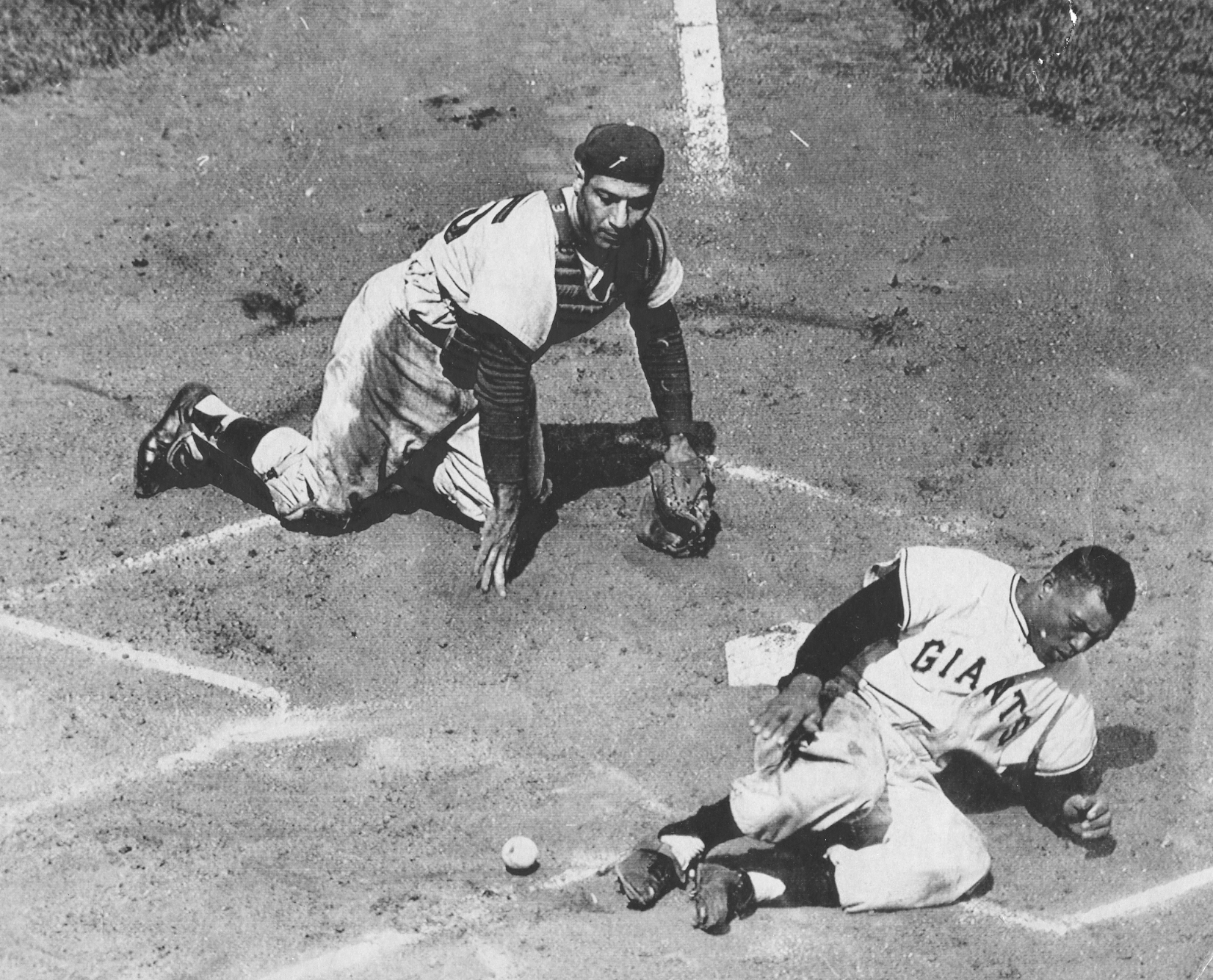
Willie Mays scores on an inside-the-park home run vs. the Phillies in the 1950s.
‘The market is shot’
The St. Louis Cardinals and Pittsburgh Pirates made deals to broadcast two dozen of their games against the Giants and Dodgers to a New York audience.
Yankees brass reacted with trademark tact: They started making threats.
If Phillies (or Pirates or Cardinals) games returned to New York television sets the next season, then the Yankees would look to televise their games — featuring World Series-winning superstars like Mickey Mantle and Yogi Berra — on a national network. They’d even partner with the National League’s Milwaukee Braves to complete the package. Together stealing away scores of diehards and converting scores of casuals, from sea to shining sea.
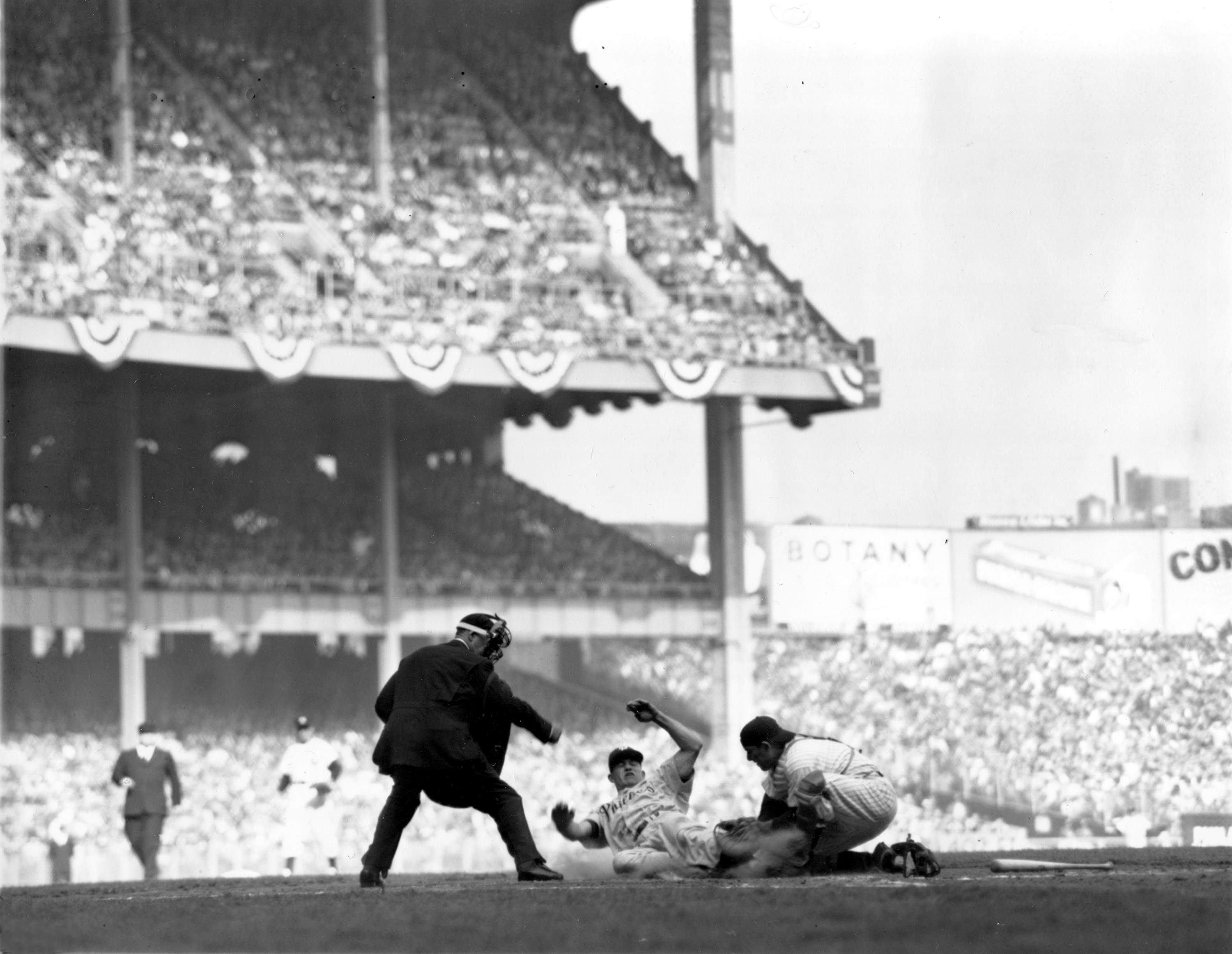
New York Yankees catcher Yogi Berra tags the sliding Philadelphia Phillies shortstop Granny Hamner for an out at home plate and second half of double play in 4th inning in the fourth and final World Series game at Yankee Stadium in New York City in 1950.
So on Dec. 5, 1958, the three teams announced that they were dropping their New York broadcast plans for the 1959 season.
None of the team representatives admitted to backing down.
But the joke was really on us: Those left-behind Dodger and Giants fans in New York didn’t get much joy from Philadelphia’s signature brand of baseball.
The Phillies went 69-85, and finished in last place.
And to make it worse: the Mets would arrive four years later.
In 2025, the Phillies had the second-oldest lineup in baseball.
Collectively, the average age of Phillies hitters was 30.3 years old, ranking only behind the Dodgers’ 30.7. That number only stands to increase when their core reports to Clearwater, Fla., another year older in February — that is, unless the Phillies see an injection of youth. Which, according to president of baseball operations Dave Dombrowski, is the plan.
“We also have some young players that we’re going to mesh into our club,” Dombrowski said in October. “I’m not going to declare that anybody has a job, but there will be some people that we’re really open-minded to be on the big league club next year.”
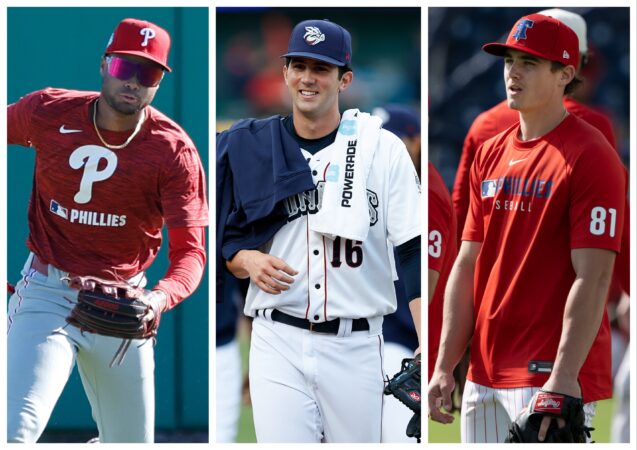
There are several Phillies prospects poised to make their debuts in 2026. Here’s a breakdown of the position players on the farm most likely to make a major league impact in 2026. (An overview of pitching prospects can be found here.)
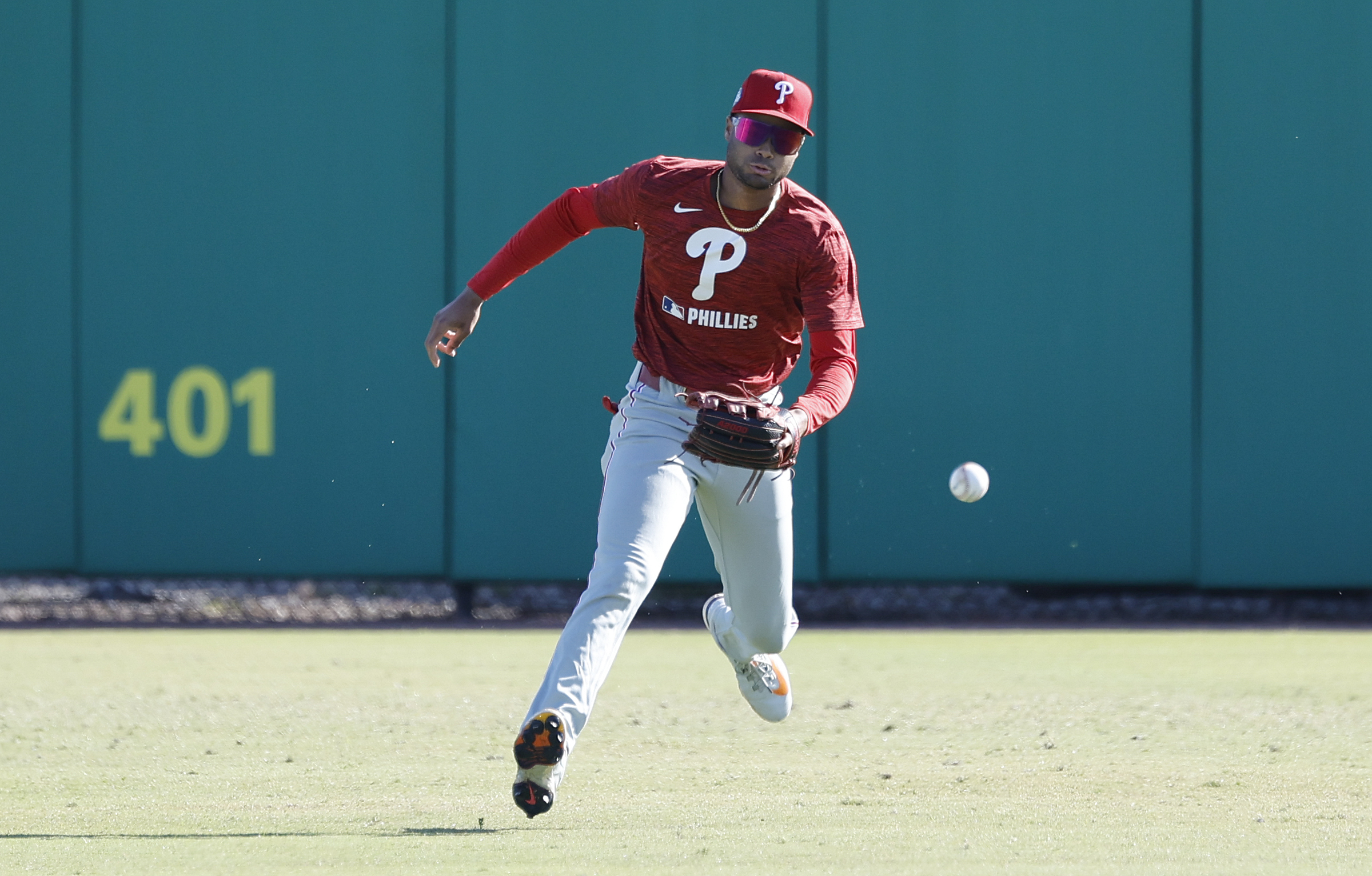
Justin Crawford could wind up in center field or left field for the Phillies in 2026.
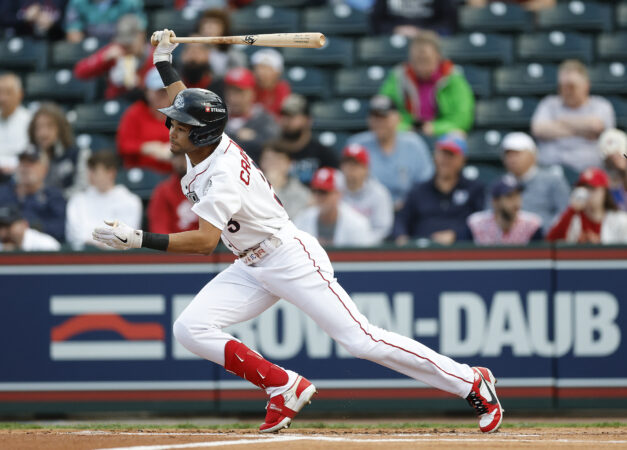
Justin Crawford
The Phillies have been saying it for a while: Justin Crawford is ready.
There isn’t much left for the outfielder to prove at the triple A level after he hit .334 and stole 46 bases for Lehigh Valley. Crawford, who turns 22 next month, was blocked from a promotion in 2025 because of a lack of a path to regular playing time on the major league club. But with some outfield shuffling expected this offseason, he will have an opportunity in 2026, one he could seize as soon as opening day.
“Crawford has a real strong chance to be with our club,” Dombrowski said at the general managers’ meetings last month. “We’re giving him that opportunity to be with our club.”
The Phillies view Crawford internally as a center fielder, though he also played 30 games in left field at Lehigh Valley last season. Where his major league opportunity will come will likely depend on how the rest of the outfield picture shakes out after any free-agent additions or trades.
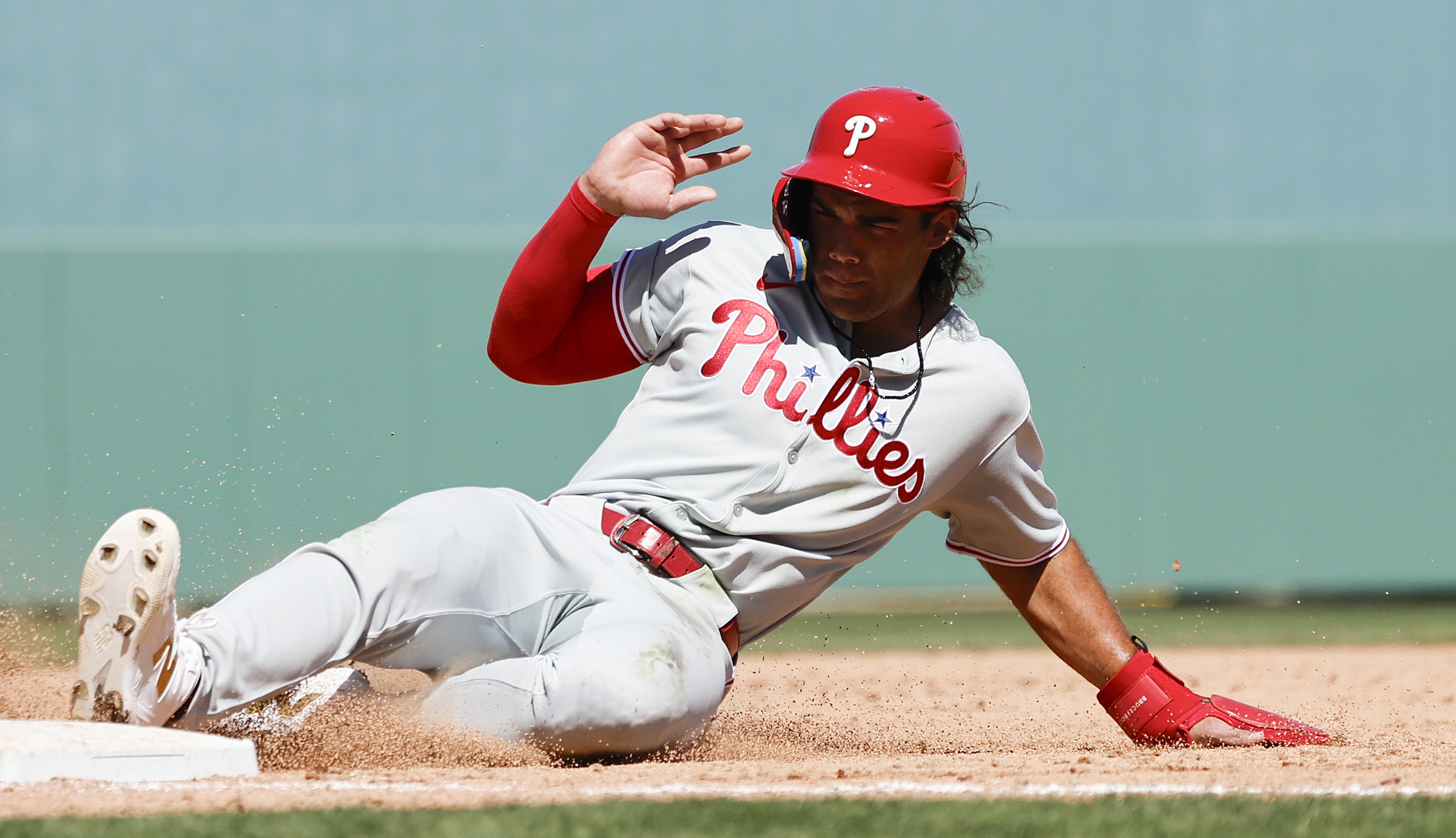
Beyond youth, Crawford would add speed to the Phillies’ lineup. He has an 81.9% success rate in stolen base attempts throughout his three-year professional career, and last season hit 23 doubles and four triples. He doesn’t have an overwhelming amount of power, with just seven homers last season, and his ground-ball rate continues to be high, at 59.4% in 2025. Despite that, he has hit well at every minor league level, and the only test left is the biggest one.
“I think [Crawford] more than anybody is looking forward to the 2026 opportunity he’s going to have in front of him,” Phillies farm director Luke Murton said on a recent episode of Phillies Extra, The Inquirer’s baseball show.
Gabriel Rincones Jr.’s 18 home runs ranked second in the Phillies farm system last season, but all were against right-handed pitching.
Gabriel Rincones Jr.
At his year-end news conference in October, Dombrowski highlighted outfield prospect Gabriel Rincones Jr. as one of the young players in the system the Phillies were high on.
“We really like Gabriel Rincones, who’s got a lot of pop in his bat, and really hits right-handed pitching even better,” Dombrowski said.
The Phillies added Rincones to the 40-man roster to protect him from being selected in the Rule 5 draft on Dec. 10.
Ranked No. 9 in the Phillies’ system by MLBPipeline, Rincones had a .240 batting average and a .799 OPS in 119 games at Lehigh Valley. His 18 home runs ranked second in the Phillies farm system, trailing Rodolfo Castro by one.
All 18 of those came against right-handed pitching, though. Rincones struggles against lefties, with just a .107 batting average and a .323 OPS.
If an opportunity were to arise for him in the majors, it would likely be strictly a platoon role — and the Phillies already have a left-handed outfield platoon bat in Brandon Marsh. But Rincones’ pop against righties could be of value to the major league club at some point in 2026.
Shortstop Aidan Miller led the Phillies farm system with 59 stolen bases last season.
Aidan Miller
Infield prospect Aidan Miller slashed .264/.392/.433 and led the Phillies farm system with 59 stolen bases in 116 games last season. Eight of those games were in triple A after a September promotion from double-A Reading, as Miller finished the season one step from the majors.
When Miller’s big league opportunity arrives, though, he will need to have a chance to play every day to develop.
Miller has played only shortstop in the minor leagues. But there isn’t exactly an opening there for the foreseeable future, with Trea Turner under contract through 2033 and coming off a resurgent defensive season.
With Alec Bohm heading into free agency after the 2026 season — and once again surrounded by trade rumors — it seems the likeliest path for Miller to break into the Phillies infield will be third base.
“We’d have to make sure that we properly prepared him to do that, and that’s still a discussion that we’ll have to have,” Dombrowski said in October of Miller changing positions. “But he’s a really good player and a good athlete.”
Murton said on Phillies Extrathat while the Phillies would not completely rule out Miller playing left field as a path to the majors, it’s “not something that I think we’ve kicked around too much recently.”
Keaton Anthony
Ranked No. 15 in the Phillies’ system, first baseman Keaton Anthony has flown relatively under the radar.
Anthony, who was one of 26 Iowa student-athletes investigated for violating the NCAA’s sports betting policies in 2023, went undrafted that year. He was not charged, and the Phillies signed him as a free agent.
Since then, Anthony has a career .324 minor league batting average and an .869 OPS. He won a Gold Glove in 2024 as the top defensive first baseman in the minors.
Anthony, who slashed .323/.378/.484 this season, reached triple A in June. The 24-year-old right-hander’s approach is geared more toward contact and he doesn’t have a ton of power, with six homers last year. But Anthony hits line drives at a 33.5% clip.
As a first baseman, Anthony has a very limited avenue to the majors as it stands. But he has some experience playing outfield in college.
With a strong start to 2026, Anthony could potentially follow a similar trajectory as Otto Kemp in 2025. Kemp, who was also undrafted, was called up as an injury replacement in June. Despite having little outfield experience, Kemp ultimately saw some time in left field to keep his bat in the lineup.
No matter what happens over the next few weeks in free agency and the trade market, one thing appears certain about the Phillies in 2026.
It will be graduation season.
Justin Crawford and Andrew Painter are poised to figure prominently in the Phillies’ plans — probably as soon as opening day — after spending 2025 in the minors. Fellow top prospect Aidan Miller may not be far behind.
And their looming major league debuts are as essential to an aging Phillies roster as any offseason move that the team will make, including the potential re-signings of Kyle Schwarber and J.T. Realmuto.
Minor league director Luke Murton recently joined Phillies Extra, The Inquirer’s baseball podcast, to discuss the state of the farm system, with a focus on Crawford, Painter, and Miller. Here’s an excerpt from our conversation, edited for brevity and clarity.
Watch the full interview below and subscribe to the Phillies Extra podcaston Spotify or Apple Podcasts.
Q: Was there any point in 2025 when you got close to calling up Crawford?
A: Any time a player performs the way Justin performed, I think the conversation will always happen. When you’ve got a guy that’s hitting .330 at triple A and is athletic and can play center field and do all these things, I think at the end of day, that’s always a conversation: Should we bring Justin up? When should we bring Justin up? The one thing that’s good for us is our major league club is very, very good. Not the best thing for some prospects. I think if you look at a lot of the organizations, Justin would have probably been in the big leagues at some point this year because of how well he performed.
I do think his maturation in the minor leagues in the full season of triple A will help him heading into this year. So, yeah, I think at different points of the year [a call-up] was obviously closer than others. He’s a talented player who we believe is major league-ready. And I think he could have been ready for a lot of teams last year. I think just given where we were at, where he was at, it just probably wasn’t the best at the time. So I think him more than anybody is looking forward to the 2026 opportunity he’s going to have in front of him.
Q: How much debate is there internally about him being best in center field vs. left field? You were pretty clear during the season that you think he can be your center fielder. Is that still the feeling?
A: … I think Justin’s more than capable of playing center field. We view him internally as a center fielder. We’ll see how the offseason goes. But I think, right now, he’s geared to center field. That’s where he’s going to play, and that’s where he’s going to be with us for a very long time.
Q: Looking back on Painter’s year, how much do you emphasize the 26 starts, 118 innings, no setbacks from a health standpoint, finishing the season, and trust that the command will get sharper as he gets further away from Tommy John surgery?
A: … He did a tremendous job this year. We had expectations on him. I think the industry had expectations on him. Honestly, some of these expectations we put on players is unfair. I think he’s a guy that’s just coming back from Tommy John, that pitched over 100 innings, was healthy and at a level he’d never been without an offseason to where he could really progress and do what he wanted to do.
So, I was very pleased, very satisfied. … You hear a lot of statistics of what guys do their first year out of Tommy John and how much better the second year goes. So at the end of the day, Andy’s a very, very talented kid who’s a great kid. I think he accomplished a ton this year. I think next year, he’s looking forward to accomplishing more. I think he’s down in Florida, at home, and he’s working. I know he goes in and out of Cressey [Sports Performance in Florida], spends a lot of time there, which, they’ve done a great job with him over the years. So he’s down there. He popped in here [in Clearwater, Fla.] to the high-performance camp the other day. But he looks great. He’s healthy. He’s ready to go.
Q: What’s the plan for getting Miller some reps at other positions, maybe third base? Is that in the cards for him? And can you see him factoring into the mix at the big league level in 2026?
A: … He wanted to prove that he can play shortstop. I think he’s done that internally. I think he’s done that to the industry. Where we’re at now is, Trea Turner is a phenomenal shortstop, played great defensively, led the league in hitting. It’s not easy to go replace that in the big leagues. But I think at the end of the day, we’ve talked to Aidan about possibly doing some third [base] and moving around the infield a little bit, and he’s open to it.
And as far as him being in the mix next year, you never know. He’s a very talented player. Don’t want to put too much on him too soon. He’ll be a big-league spring-training invite. You bring him in and you see what we’ve got, we see where the roster ends up throughout the year, and you never know … Obviously, that’s [president] Dave [Dombrowski] and [general manager] Preston [Mattingly] kind of doing that. But I think from a talent standpoint, from a readiness standpoint … the ones that are really good, they always are ready a little sooner than you think they are. So I think we’ll see. I think, at the end of day, he might move around defensively a little bit to get somewhere off shortstop. He’ll be in big league spring training, and he’s looking for the opportunity to prove that he’s ready.
Aidan Miller has only played shortstop in the minor leagues but that position is blocked by Trea Turner at the major league level.
Q: Could you see left field as a possibility for Miller?
A: I don’t think you rule anything out as a possibility ever. Because I think, at the end of the day, it’s [about] how do we best service our major league team? And I think somebody like Aidan would be completely willing to go wherever he could to do that. But right now I think it’s more to say moving around the infield, see if there’s a spot there potentially ever in the future. And, again, I don’t think outfield is out of the question, but not something that I think we’ve kicked around too much recently.
Check out the full interview for Murton’s assessment of several other prospects, including pitcher Gage Wood, outfielder Gabriel Rincones Jr., and more.
NEW YORK — Free agent reliever Devin Williams has agreed to a contract with the New York Mets, a person familiar with the negotiations told The Associated Press on Monday night.
The person spoke to the AP on condition of anonymity because the deal was pending a physical and had not been announced.
Multiple media reports indicated the sides agreed to a three-year contract.
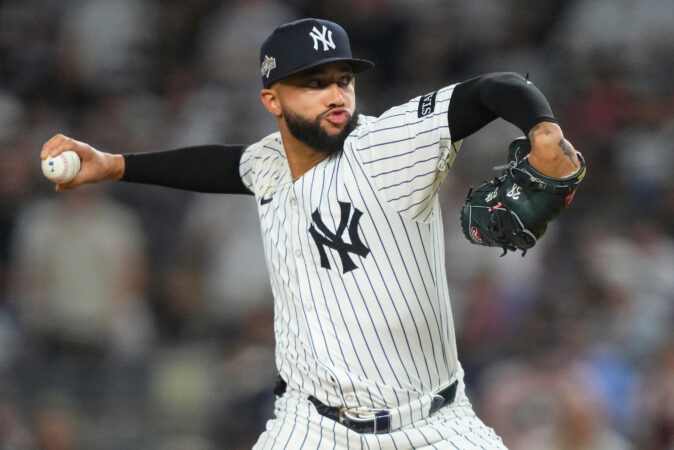
Williams spent last season across town with the New York Yankees, going 4-6 with a career-worst 4.79 ERA and 18 saves in 22 chances. He lost the closer’s job, regained it and then lost it again before finishing the year with four scoreless outings during the American League playoffs.
The 31-year-old right-hander is a two-time All-Star who twice won the Trevor Hoffman NL Reliever of the Year Award with the Milwaukee Brewers while Mets president of baseball operations David Stearns was running that team. Williams also was voted the 2020 NL Rookie of the Year.
Milwaukee traded Williams to the Yankees for pitcher Nestor Cortes and infielder Caleb Durbin last December.
With the Mets, Williams could replace free agent closer Edwin Díaz or complement him in a rebuilt bullpen.
Williams was pitching for the Brewers when he gave up a go-ahead homer to Mets slugger Pete Alonso in the deciding Game 3 of their 2024 NL wild-card series. The three-run shot put New York ahead in the ninth inning, and the Mets won the series.
Known for a changeup so deceptive it’s called The Airbender, Williams struck out 90 batters and walked 25 in 62 innings over 67 appearances during his lone season in pinstripes. He made $8.6 million in 2025.
“At first it was a challenge, but I’ve grown to love being here,” the reliever said in October following a 5-2 loss to Toronto in Game 4 of their AL Division Series. “I love this city. I love taking the train to the field every day. Yeah, I really enjoyed my experience here.”
When Mick Abel, then the Phillies’ No. 8 prospect, made his major league debut in May, it was just for a spot start.
But he impressed enough in those six scoreless innings that the Phillies decided to give him a chance in the rotation two weeks later. After a tough 2024 season, Abel was a bit of a revelation for the Phillies early on as their fifth starter.
And while he was ultimately sent back to triple A in July to reset after some struggles with command, his turnaround continued to impact the major league club when he was traded to the Minnesota Twins as part of the package for Jhoan Duran.
Of the players yet to make their major league debuts, who could be the Abel of 2026? Let’s take a look at the Phillies’ pitching prospects who are the most likely to make a major league impact next season.
Andrew Painter struggled with his command in his return to the mound with Lehigh Valley following Tommy John surgery in 2023.
Andrew Painter
Plenty of ink has been devoted to the subject of Painter’s major league debut since at least 2023, when he was under consideration for the Phillies’ rotation at age 19.
A ligament sprain and subsequent Tommy John elbow surgery delayed that timeline. But once he returned to the mound in 2025, it was expected he would figure into the Phillies’ plans by the summer.
That didn’t happen, either.
The Phillies were pleased with the quality of Painter’s stuff and his velocity. But command is typically the last thing that returns to a pitcher after Tommy John surgery, and that’s what Painter struggled with the most in 2025. He had a 5.40 ERA and issued 3.9 walks per nine innings at triple-A Lehigh Valley, and the call-up never arrived.
“I think everybody was excited about getting him back,” Phillies manager Rob Thomson said in September. “I think at the end of the day you look back on it, you say, ‘First time going through this, it usually takes two years for a guy to come back [from Tommy John].’ I think we can all look back and think, ‘Man, [we] probably should have expected this.’”
Given that he remains healthy, next season should be different. Painter will have a normal offseason and spring for the first time since 2023. He will again enter camp in contention for a rotation spot, and this time he isn’t a teenager; he’ll turn 23 in April.
There figures to be a place for him, too. Ranger Suárez is likely to command a big contract as one of the top left-handers on the free-agent market, and unless the Phillies outbid pitching-starved teams or make a splash elsewhere, that would leave an opportunity for Painter to break camp with the team.
“We’re optimistic that with a regular offseason training program and getting ready to come in the season, that he’ll be able to regain that [command],” Phillies president of baseball operations Dave Dombrowski said.
Jean Cabrera had a 3.81 ERA and 1.23 WHIP over a career-high 137 innings last season with double-A Reading.
Jean Cabrera
At the general managers’ meetings last month, Dombrowski pointed to the 24-year-old Cabrera as the Phillies’ current minor league starting pitching depth beyond Painter.
“You never have enough starting pitching,” he said. “And really, for us, after you get past Painter, now you’re talking about Cabrera, [who] would be one of those guys. But we don’t have a lot of starting pitching, so that’s something we’re going to be cognizant of.”
Cabrera spent the 2025 season with double-A Reading, where he posted a 3.81 ERA and 1.23 WHIP over a career-high 137 innings. The right-hander allowed just 0.72 home runs per nine innings. Cabrera has been on the Phillies’ 40-man roster since 2024, when he was added as protection from the Rule 5 draft.
Cabrera was consistent in terms of workload last season. He made 26 starts and none was shorter than 4⅓ innings. In the event of an injury or if a spot start is needed, Cabrera provides the Phillies with crucial starting depth.
Alex McFarlane had a strong second half in his first season back from Tommy John surgery.
Alex McFarlane
McFarlane was added to the Phillies’ 40-man roster last month ahead of the Rule 5 draft, signaling the team’s faith in the 24-year-old righty.
Like Painter, McFarlane is coming off his first full season back after undergoing Tommy John surgery in 2023. He had a stronger second half, with a 2.54 ERA and 1.03 WHIP in his last 39 innings compared to a 7.02 ERA and 1.71 WHIP in his first 41 innings.
That improvement also came with a move to the bullpen in August. McFarlane was promoted from high-A Jersey Shore to double-A Reading in September to finish out the year.
With a fastball that can touch 100 mph, McFarlane could be possible bullpen depth for the Phillies in 2026.
The Phillies left pitcher Griff McGarry unprotected in the Rule 5 draft for the second straight year.
Griff McGarry
It’s possible that McGarry could find himself in a new organization come Dec. 11, as he was left unprotected in the Rule 5 draft for the second year in a row.
Another team can pay the Phillies $100,000 to select McGarry, but he must remain on that team’s 26-man roster for the entire season or be offered back for $50,000. Last December, the Twins selected right-hander Eiberson Castellano from the Phillies in the Rule 5 draft, but he was returned in March. (Castellano elected free agency at the end of the season.)
McGarry built a solid foundation for 2026 with a bounceback 2025 season. The 26-year-old righty won the Phillies’ Paul Owens Award, an internal honor for their top minor league pitcher, after posting a 3.44 ERA in 83⅔ innings.
McGarry has struggled with command throughout his minor league career and was moved to the bullpen in 2024. Last year, though, the Phillies moved him back to a starting role. He cut his walks from 10.2 per nine innings in 2024 to 5.3 per nine in 2025.
“Heading into this year, early in the spring, they kind of made it known to me that I’d be back in a starting role,” McGarry said in September. “I think I definitely am capable of doing both. And I love starting; I love relieving. So it’s kind of wherever the Phillies want me, I’m willing to perform.”
McGarry spent most of the season at double-A Reading, but he finished the year on a high note with a final start back up in triple A.
“I think in years past in triple A, I’ve had my ups and downs there,” he said. “It’s good to really finish there and kind of finish the season how I wanted to, with a successful start.”
Gage Wood, the Phillies’ 2025 first-round pick, is likely to be on an innings limit in 2026.
Names to know, but unlikely for this year
Moises Chace was a deadline acquisition from the Baltimore Orioles in 2024 and had an intriguing fastball that missed a lot of bats. But the 22-year-old right-hander underwent Tommy John surgery in 2025 and is still rehabbing.
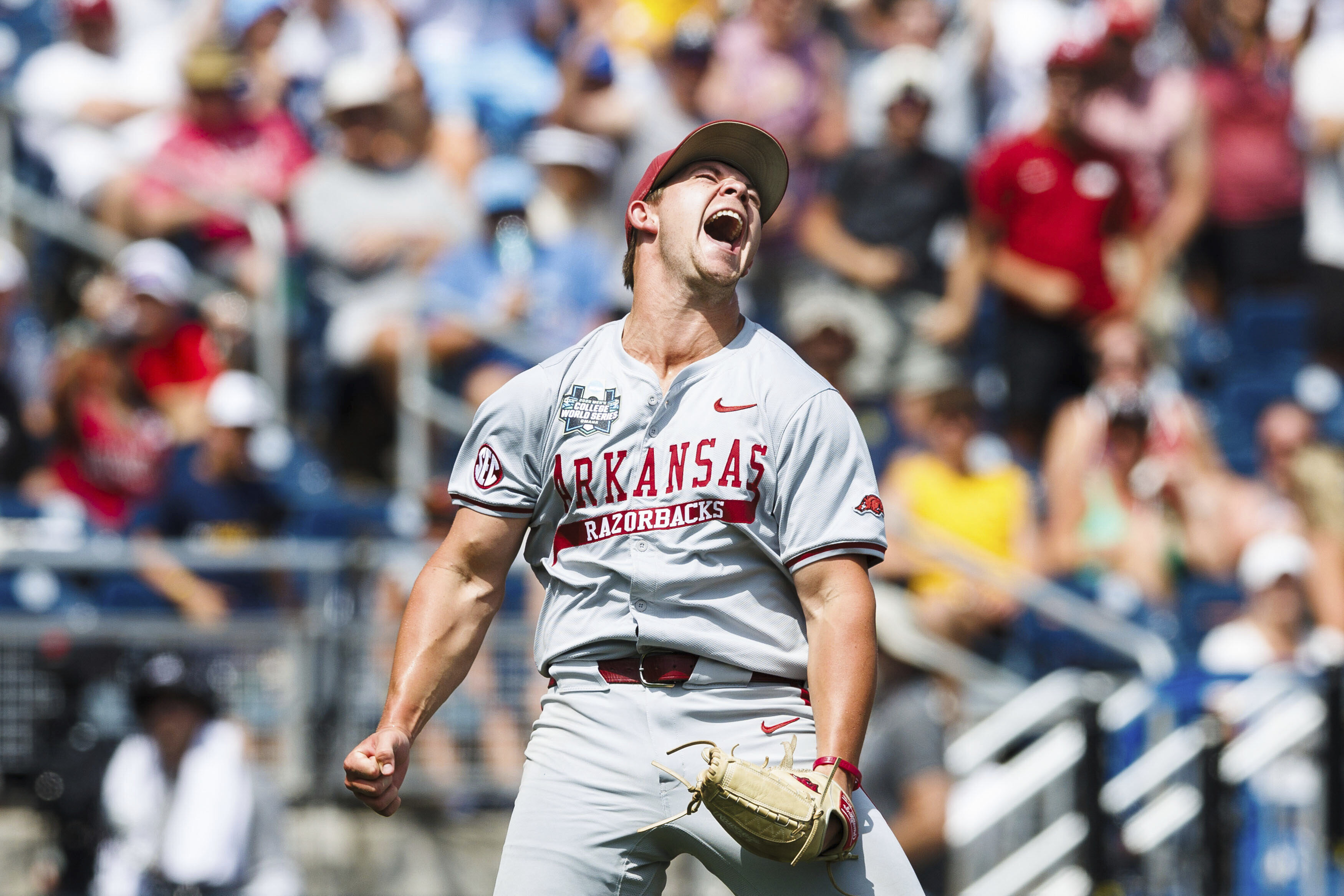
Since the Phillies drafted right-hander Gage Wood out of Arkansas — going the college pitcher route in the first round for the first time since Aaron Nola in 2014 — questions have swirled about how soon he could arrive in the majors.
But don’t bank on Wood following the breakneck trajectory of Pottstown’s Trey Yesavage, who went from starting games in single A to the World Series with the Blue Jays in four months. The Phillies plan to build him up as a starter, but Wood is likely to be on an innings limit in 2026, according to Dombrowski.
Wood didn’t experience a full starter’s workload in his college career. He pitched 37⅔ innings for Arkansas in 2025, missing almost two months due to a shoulder impingement. In his two college seasons before that, Wood was primarily a reliever for the Razorbacks.
The Washington Post’s opinion section enlisted nine writers to share which American city they think deserves the title of the nation’s best sports city.
Los Angeles, Seattle, New York, Boston — even the likes of Kansas City and Cleveland got a mention. Which city was snubbed? Philadelphia.
Taking a look through the comments of their recent Instagram post promoting the list, not to mention the nearly 800 comments on the column itself, we’re not the only ones who raised an eyebrow at the exclusion of Philly from the list.
So we got nine of our own writers to argue why Philadelphia is the nation’s best sports city. Enjoy.
It means more to us
Mike Sielski, sports columnist
Philadelphia is America’s best sports city because sports — not national sports, not the Olympics, but the teams and athletes here — is the lingua franca of the town and the great connector of the city and its surrounding suburbs and communities. Do you flinch when someone says the name Chico Ruiz or Joe Carter? Do you smile at a random mention of Matt Stairs or Corey Clement? Then you know and love Philadelphia sports.
It’s America’s best sports city because Philadelphia is a provincial, parochial region where the love of and devotion to the teams’ histories and traditions are passed down from one generation to the next — a succession of unbroken bonds over a century or more. Did you sit out on your front stoop on a summer night and listen to Harry and Whitey call a Phillies game over the radio? Do you still sync Merrill and Mike’s broadcast to the TV telecast? Do you know who J.J. Daigneault is? Then you know and love Philadelphia sports.
It is America’s best sports city because you can walk down the street here after an Eagles loss or a Phillies loss or a Sixers loss and know that those teams lost just from the vacant looks on the faces of the passersby. Do you turn up the talk-radio station on those terrible Monday mornings? Do you remember where you were when Kawhi’s fourth bounce fell through the net? Then you know and you live and you die with Philadelphia sports.
Most of all, Philadelphia is America’s best sports city because people here care more and sports here matters more than it does anywhere else. If you don’t believe me, go ahead. Tell a Philadelphia sports fan that your city, your teams, your traditions are better. Go ahead. Dare ya.
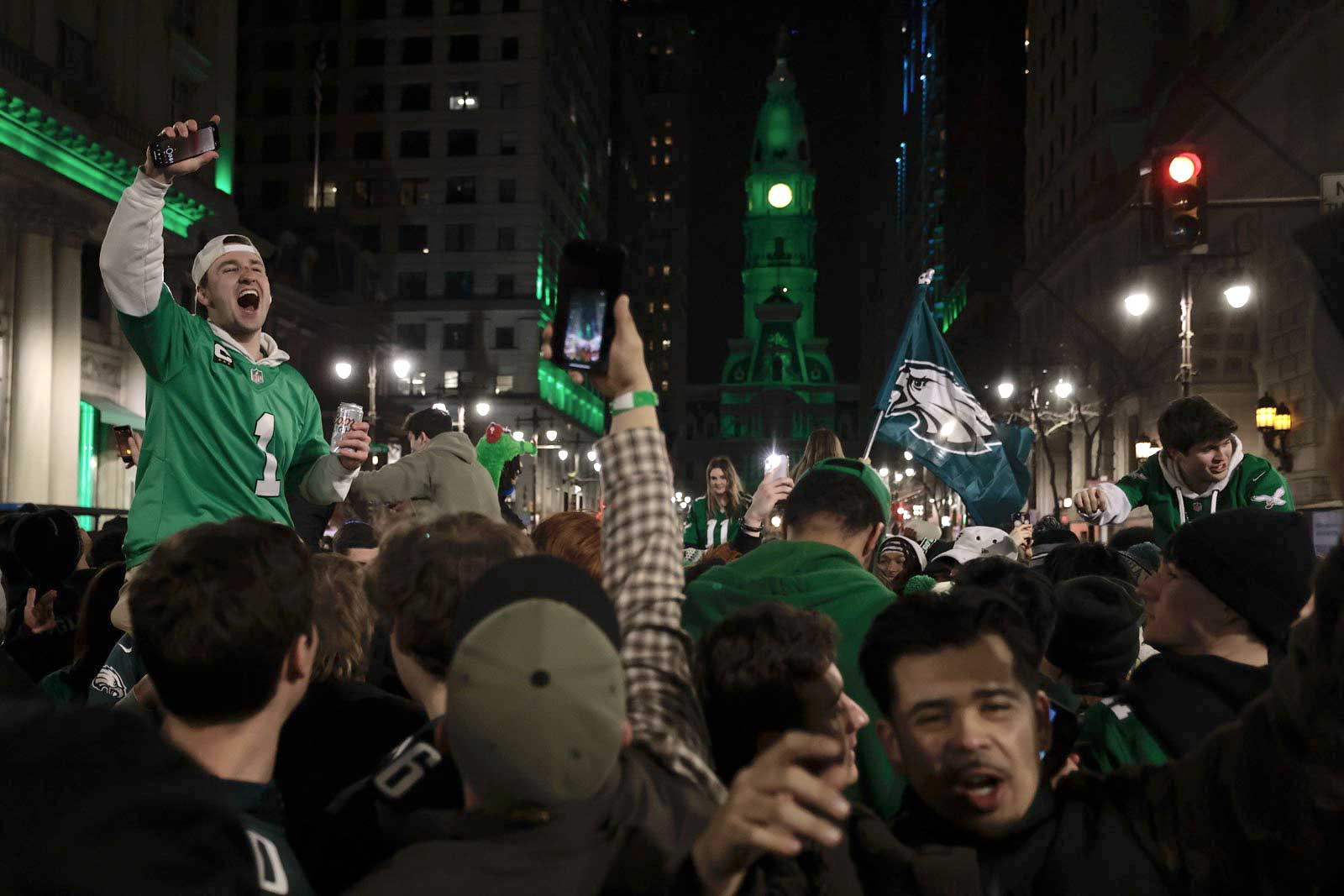
Philly fans celebrate the Eagles’ Super Bowl LIX win in near City Hall.
Nobody parties like us
Stephanie Farr, features columnist
Philadelphia is undoubtedly the best sports city in the United States and it has everything to do with our fans, who are as passionate and dedicated as they come. Here “Go Birds” is a greeting, talking trash is an art form, and being a part of it all is totally intoxicating, even if you’re completely sober (which, to be fair, most of us aren’t).
Nobody celebrates a major win like Philly — by partying in the street with Gritty and Ben Franklin impersonators, dancing with Philly Elmo and his drum line, and climbing greased poles. When the Phillies won the NLCS in 2022, I watched Sean “Shrimp” Hagan climb a pole and shotgun seven cans of Twisted Tea thrown to him by the crowd. To his credit, at some point Hagan realized he was too drunk to get down safely and waited for firefighters to bring a ladder.
“It couldn’t have happened without the crowd being so [expletive] Philly,” he told me. “What other city’s first thought when they see a guy on a pole would be to throw him a beer?”
Do our Bacchanalian celebrations border on absolute lawless anarchy? Yes, but if you want to live safe and know how something will end, go watch a Hallmark movie. This is Philly, where we are fueled by the raging fire of a thousand losses — even when we win — and we thrive off the unpredictability of life.
In my early 20s, I lived in Tampa for a brief stint. The downtown area is small enough that all of its neighborhoods are in proximity to each other. My apartment was in a section popular among locals for its dining and nightlife scene. But it was close enough to the hotel district to be in the eye of the storm when the Eagles came to town.
One Saturday evening in late October, we were sitting at a popular outside bar when the place was suddenly overcome by a wave of midnight green. Everywhere you looked, there were packs of Eagles fans who looked like they hadn’t seen the sun in two months. They swaggered through the place in their Brian Dawkins jerseys with zero regard for humanity. They ordered their Bud Lights in multiples of two and yelled Eagles chants at each other as horrified young women clung desperately to each other and wiped errant sloshes of domestic Pilsner off each other’s going-out clothes. A friend of mine stepped off the patio to have a cigarette. He returned with a stunned expression on his face. “An Eagles fan just peed on my foot,” he said with a mixture of anger and respect.
Tampa got the last laugh the next day when Matt Bryant kicked a walk-off field goal from 62 yards out. But I always think of that weekend when people ask me if Philly sports fans are as crazy as their reputation.
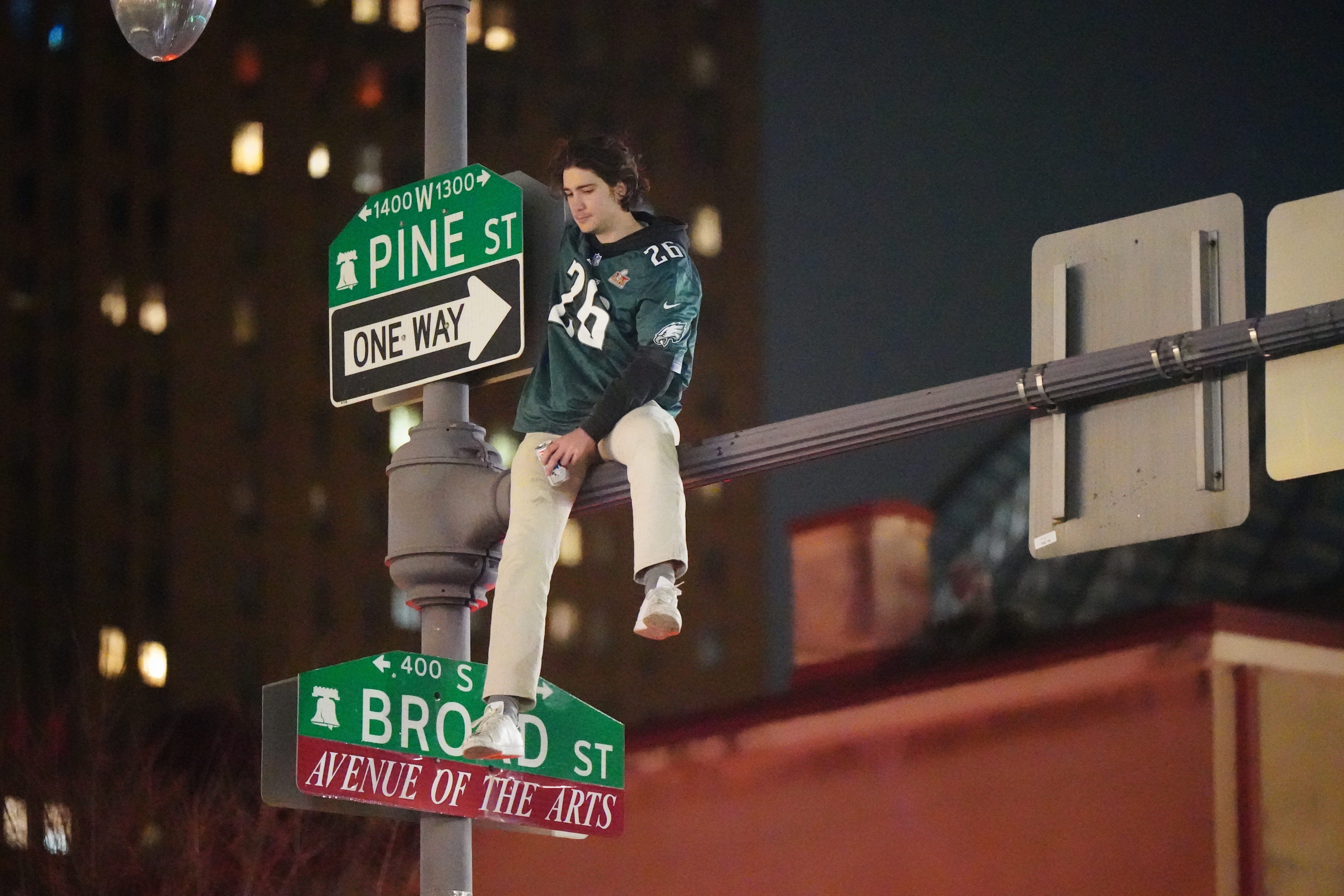
An Eagles fan sits on top of the traffic light post at the intersection of Broad and Pine Streets after the team won Super Bowl LIX in February.
There are a lot of different prerequisites that a city needs in order to consider itself a great sports town. For instance, it must be an actual city, one with history and character that stands on its own even without sports. Furthermore, a great sports town requires a certain level of market penetration. Sports must sit atop the pedestal in a way that it doesn’t in places like New York and L.A. There must be a critical mass of folks who are born and raised, which eliminates pretty much any city south of the Mason-Dixon and west of the Mississippi. The list is a short one. Boston, Chicago, Buffalo, Pittsburgh, Detroit, maybe Milwaukee.
From there, the thing that sets Philly apart is the people. They are a strange lot, prone to overexcitement and, every now and then, over-indulgence. But, man, do they care. You see it any time one of their teams hits the road. You hear it, too. There is an energy that is difficult to define but impossible not to feel. It’s the secret sauce of this place. And, yeah, it’s the best.
A veteran Eagles reporter wrote recently that last Sunday’s Eagles-Cowboys game was the Birds’ worst ever loss to their rival. They blew a 21-point lead, exposed some glaring flaws, and lost on a walk-off field goal. Fair point. But it was pushed back immediately on social media. You think this loss was bad? That’s what makes Philadelphia a great — maybe the greatest — sports city. We celebrate our wins like no other but we also wear our losses forever. This was a brutal loss but we still remember that botched chip shot on Monday Night Football in 1997. And that blowout loss in the playoffs while we were stuck inside during the Blizzard of ‘96. Oh yeah, remember what happened in 2010?
I don’t know if any city in the U.S. holds onto losses more than Philly. We do that because we care. We lose sleep when the Phillies blow a save, have a bad week if the Eagles lose, still can’t believe they didn’t call the Islanders offside, and are still waiting for Ben Simmons to dunk it. So yeah, that’s why it means more here when the teams do win. Because we care so much when they lose. You can have L.A., Seattle, and Kansas City. I’ll stay in Philly.
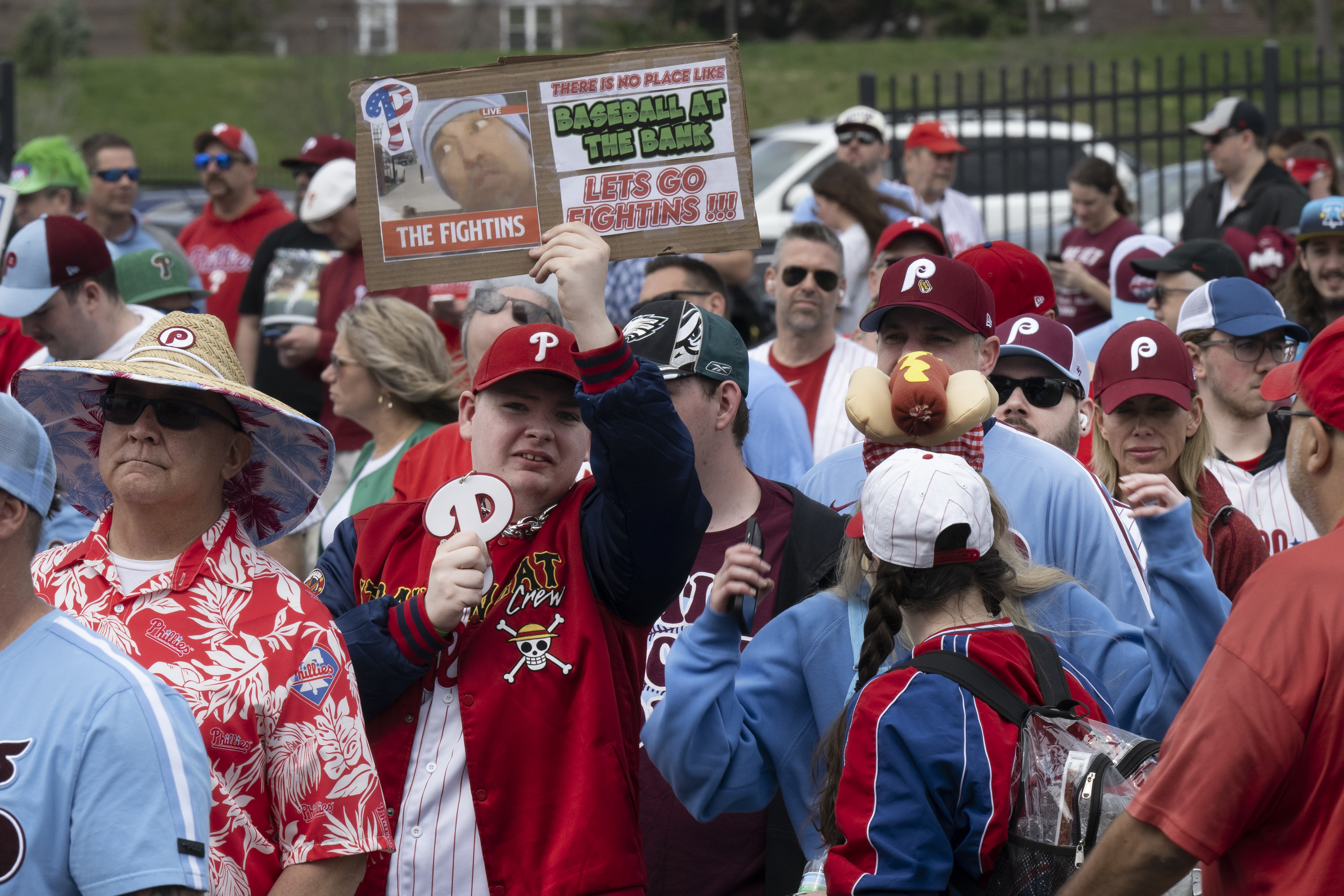
A Phillies fan holds up a sign paying tribute to another viral Phillies fan before the team’s 2025 home opener.
We feed off being underdogs
Julia Terruso, politics reporter
Look, I’m not pretending to be neutral here. I went to spring training in Clearwater in pigtails as a child. I fell in love at an Eagles tailgate and flew to London to watch the Phillies play the Mets on my honeymoon. But even non-Philadelphians would be out of their minds not to put us in the top three — let alone the top nine.
Rooting for the Phillies, Sixers, Eagles, and Flyers is a cross-class, cross-generation rite. We’re one of only eight U.S. cities with all four major teams, and our stadiums are actually accessible — yes, Los Angeles, I’m looking at you. Tickets are (mostly) affordable, the crowds are electric, and the fervor is real. We boo because we care. And unlike other cities, we don’t sneer at bandwagoners. The citywide greeting is “Go Birds,” and the uniform is fair game for the lifer who knows about pickle juice and The Process, along with the new Fishtown transplant who couldn’t diagram a wheel play but looks fantastic in kelly green — because everyone looks fantastic in Kelly green.
But the thing that really makes Philly a great sports town is our shared history of heartbreak and near-misses that drives us forward. We’re used to being underestimated. So go ahead, leave us off your list, WaPo. Underdogs run on disrespect, and we’ve got miles to go.
Stand on the South Street bridge at 7 a.m. and you’ll know the time of year, and that says it all. The rivers of medical professionals walking and biking back from their night shifts, and those heading to their morning duties, give it away in unison. Red caps? It must be October. Kelly and midnight green beanies? The NFL playoffs are coming. Blue or black starred jackets? The NBA playoffs are underway and our hearts will soon be broken, again.
I am a Philly transplant who comes from the tradition of European soccer, where rivalry between teams from the same city is the driver of passion. I always thought that there is nothing more electric than winning a derby game, and having your team crowned as the city’s best. But Philadelphia taught me that I was wrong. There is something more electric: a city united, together, declaring love to its teams in every nook and corner.
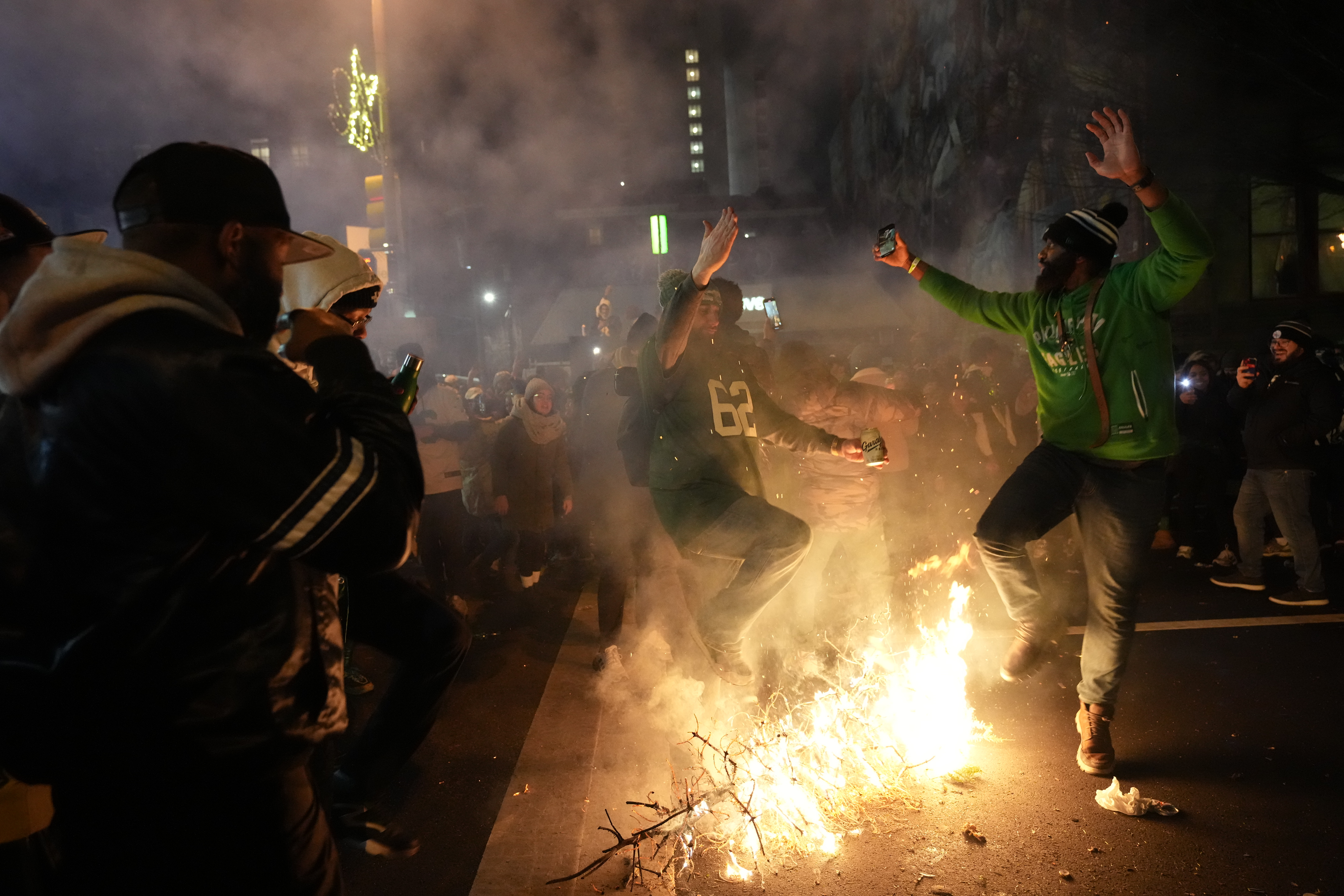
Jubilant Eagles fans dance around a fire on Broad Street after the Birds beat the Chiefs in Super Bowl LIX.
Philadelphia isn’t just the best sports city in America (“next year on Broad?”), it’s an organism that breathes sports fandom unlike any other place.
The days of throwing snowballs at Santa or batteries on a hated player are far gone. This is the city that gave a struggling shortstop who just arrived in town a standing ovation, that travels in droves so E-A-G-L-E-S chants come through the broadcast of every away game, and has a community of sickos who rode with its Sixers through one of the weirdest experiments in NBA history.
The electric energy isn’t confined to the city lines. It’s a moment that every Philadelphian cherishes. Don an Eagles hat in any other city in America, or even abroad, and you are more likely than not to lock eyes with a stranger passing by.
“Go Birds,” they inevitably say.
“Go Birds!” you respond.
Nothing beats that. And if you don’t like it. All good. We don’t care.
The Washington Post’s opinion section has been having a rough go of it. Which makes me wonder if this list, too, had to be cleared by the Amazon overlord, and maybe Jeff Bezos just hates Philadelphia?
I mean … Cleveland?
The size and scale of the two recent Eagles parades speak for themselves. The fact that there used to be a jail in the bowels of Veterans Stadium speaks for itself. Attending one Phillies playoff game at Citizens Bank Park would speak for itself. “Go Birds,” is a passing “hello” to a fellow Philadelphian in another town, a phrase of familial camaraderie. Due respect to Los Angeles, a city I love to be and eat in. But the sheer number of sports that happen in a place doesn’t make it a good sports city. That’s not human. People and passion make a place.
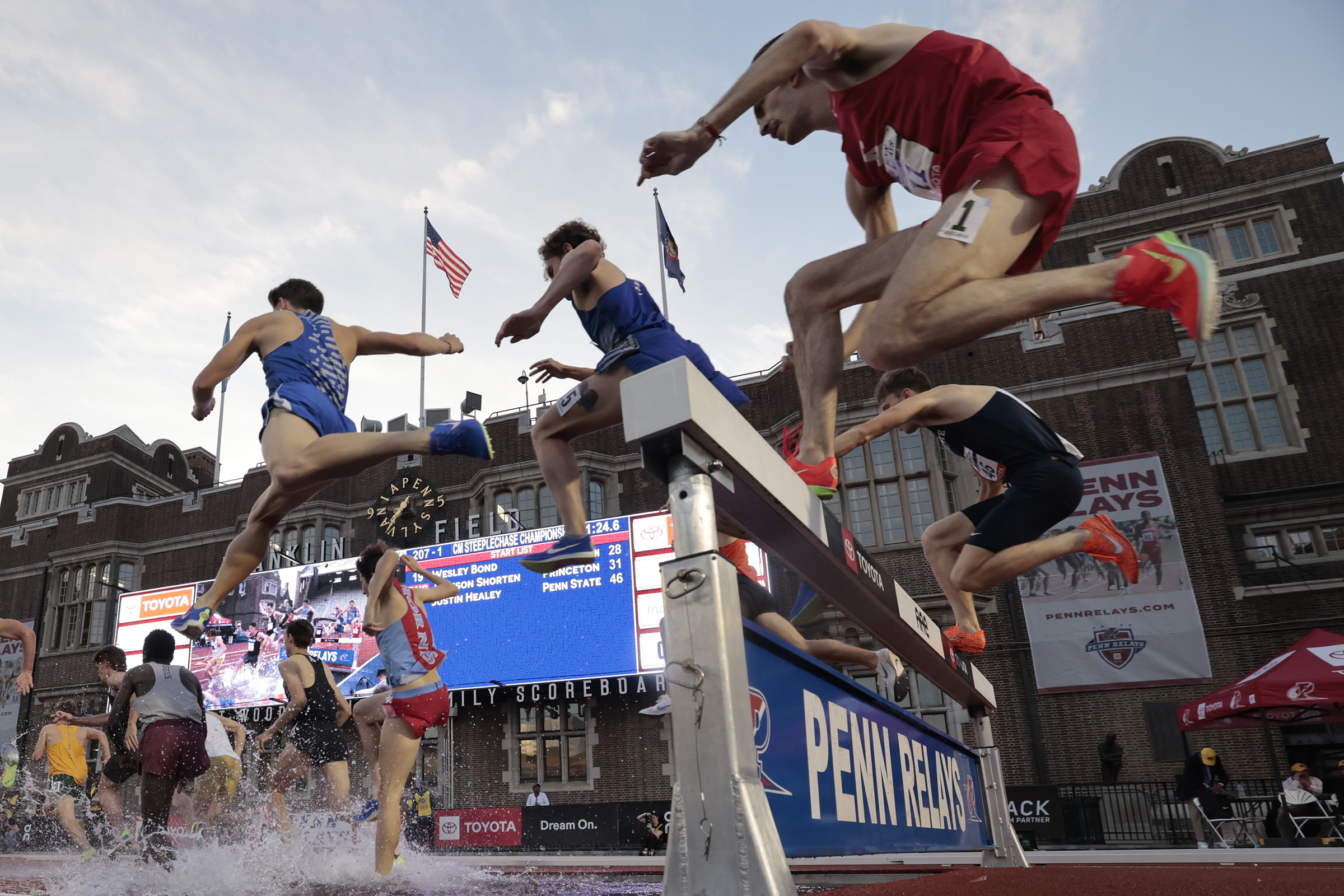
The Penn Relays at Franklin Field are one of just a few annual sports traditions in Philadelphia.
We have much more than pro sports
Tommy Rowan, cheesesteak/Philly history expert
A criteria would have helped, but really, any discernible or coherent formula would have really pulled that Washington Post list together. Here, instead, are three reasons why Philadelphia is one of the cornerstone cities in American sports …
History: The fabric of American sport was woven here. The Heisman Trophy is named after John Heisman, who played at Penn. The Phillies are one of the key reasons fans are allowed to keep foul balls that land in the stands. All because an 11-year-old Phillies fan didn’t blink when the team had him thrown in jail for larceny.
Tradition: We’re more than pro sports. We’ve hosted the annual Army-Navy game, and the Dad Vail Regatta, and the Penn Relays. Tennis found an American foothold at the Philadelphia Cricket Club.
Passion: Support is an undergarment. This city has passion. Fandom here is passed down from generation to generation, just like their houses. And sure they’re loud, and they generally take it the worst of any fanbafan base. But they’re vocal, they’re informed, and they care. These teams mean something to these people.
Sports fans start young in Philly, as fandom gets passed down from generation to generation.
We know our stuff
Ariel Simpson, sports trending writer
Oct. 9 was a tragic day for Philly sports fans. The Phillies season ended with a heartbreaking loss to the Los Angeles Dodgers, the Eagles suffered a devastating 34-17 loss to the New York Giants, and the Flyers dropped their season opener to the Florida Panthers.
That very next day, I wandered the streets of Philadelphia in what felt like a walk of shame. The heartbreak could be seen on each fan’s face as they still sported their favorite team’s colors. And when asked about the losses, each fan gave me a full breakdown of what needs to be done in order for the teams to be more successful.
That’s what makes Philly such a great sports city. Not only are the fans passionate, but they are knowledgeable when it comes to their sports teams. Sure, sometimes they may rush to call for a head coach to be fired or boo their own teams, but that’s only because they care so much.
They wear their heart on their sleeves and they expect more from each team. And when they do succeed, they show up and celebrate like no other. If you need an example, look no further than the city greasing its light poles in an attempt to stop fans from climbing them in celebration.