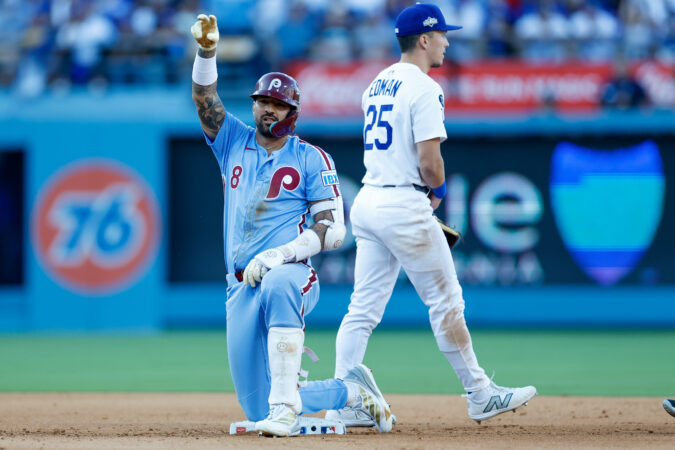
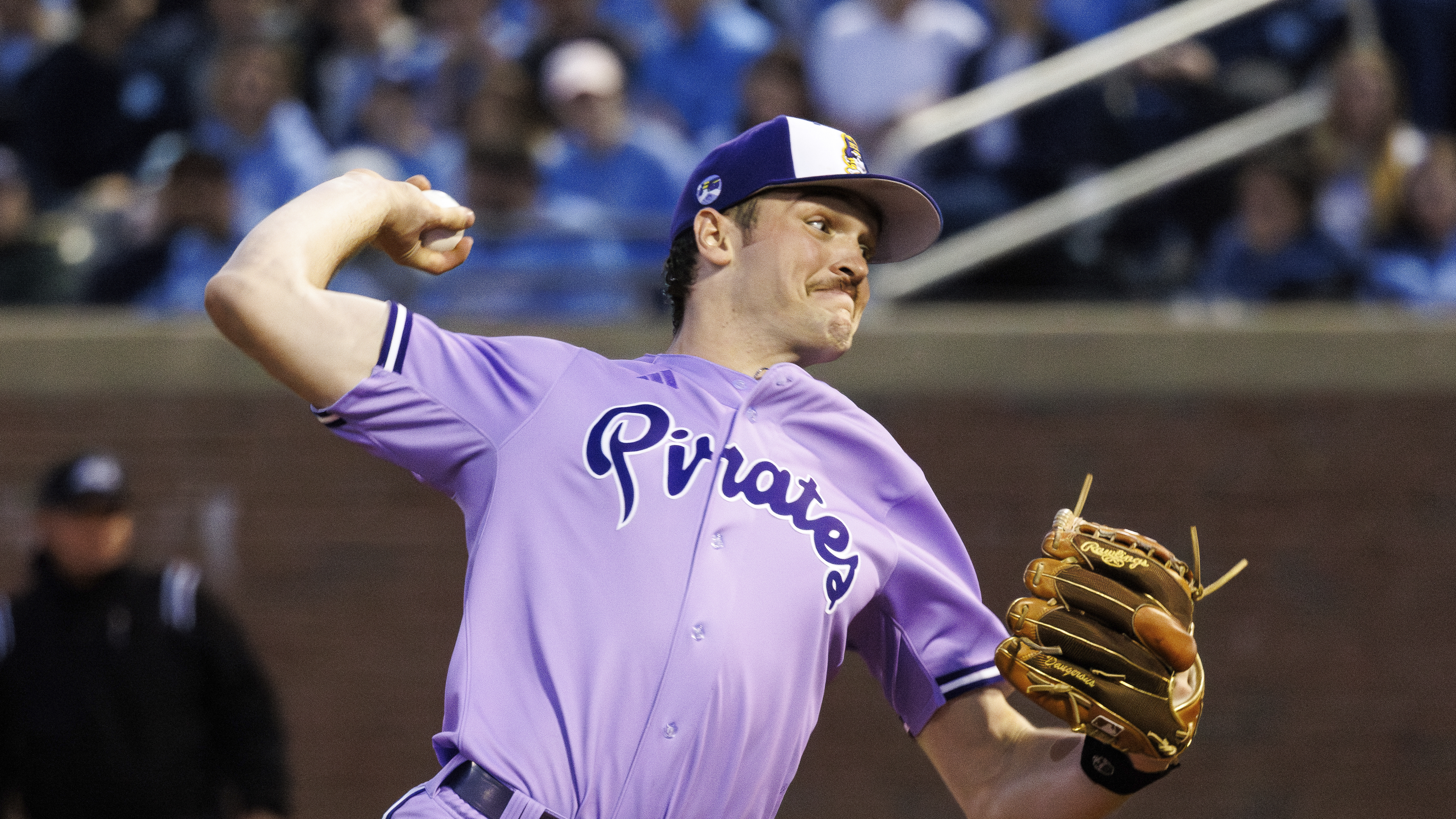
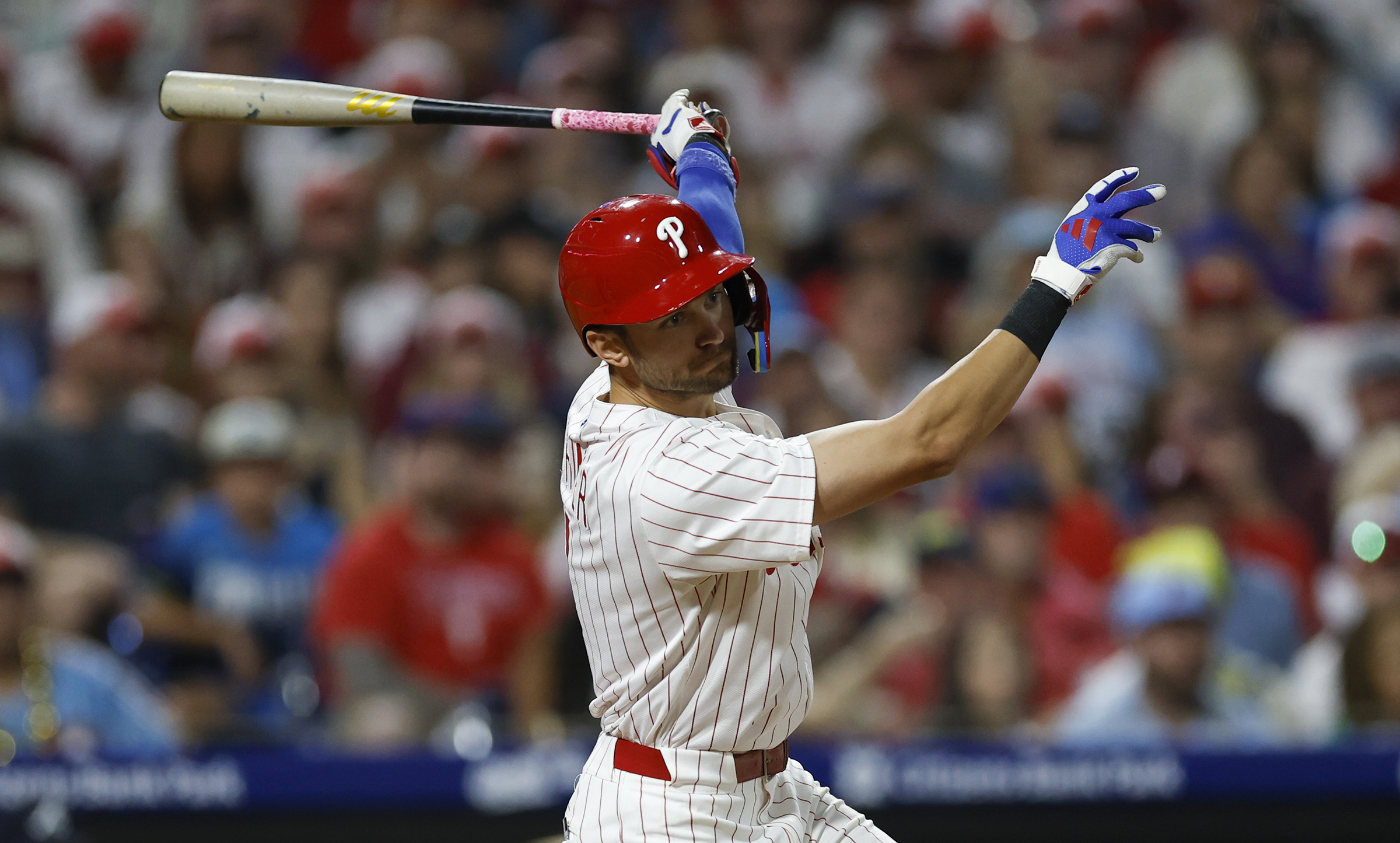
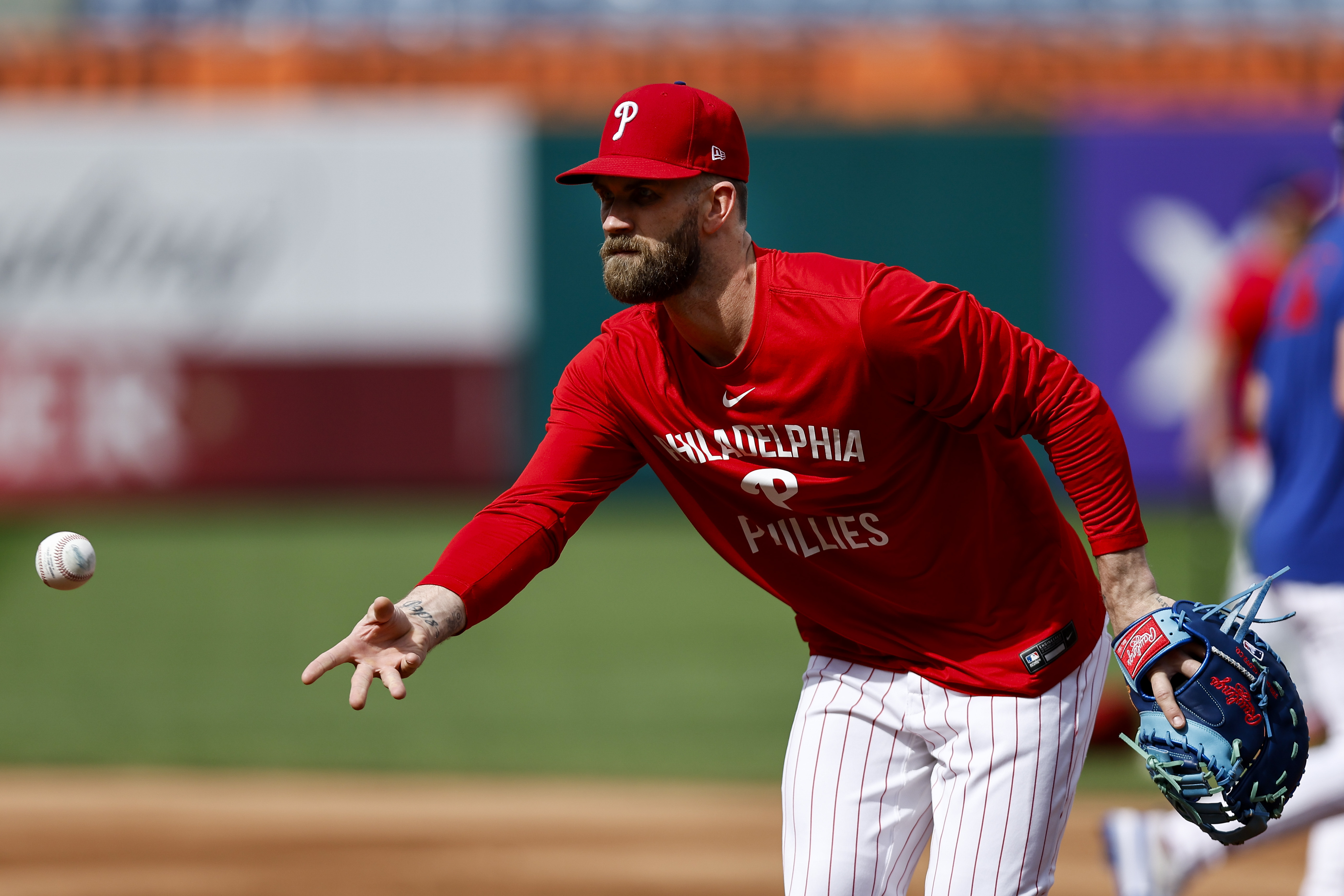
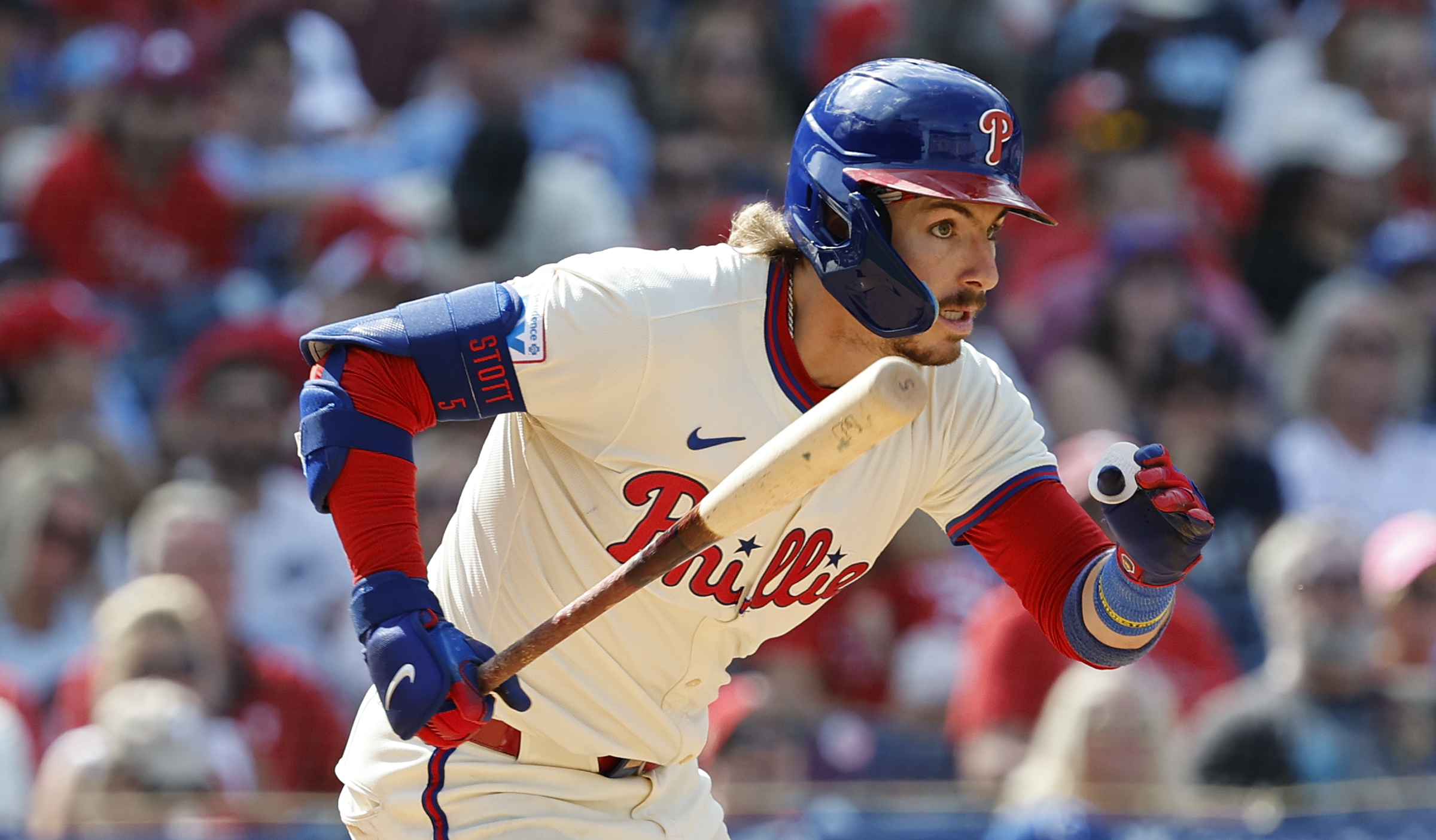
The most important variable in any negotiation is what the other side thinks you are willing to pay. Right now, the other 29 teams in Major League Baseball have every reason to think the Phillies aren’t willing to pay Nick Castellanos anything. That’s a tough starting point for Dave Dombrowski as he tries to find someone interested in trading for the veteran right fielder.
Fact is, Castellanos is due to make $20 million this season, which is at least $18 million more than he could reasonably expect to make if he were a free agent. Even if the Phillies eat most of that money, why would a team trade anything of value for Castellanos rather than signing this year’s version of Mark Canha for a couple of million bucks?
The only realistic option for the Phillies is to find a team that is looking to shed a similarly overpriced contract. Even then, Dombrowski may have to further incentivize an interested party. That quickly leads to a point where the Phillies are better off simply releasing Castellanos. Or walking a lot of things back before he reports for spring training.
Here are three examples of deals that maybe, kinda, sorta, if you squint could potentially make a fraction of a smidgen of sense for both parties.
Get excited!
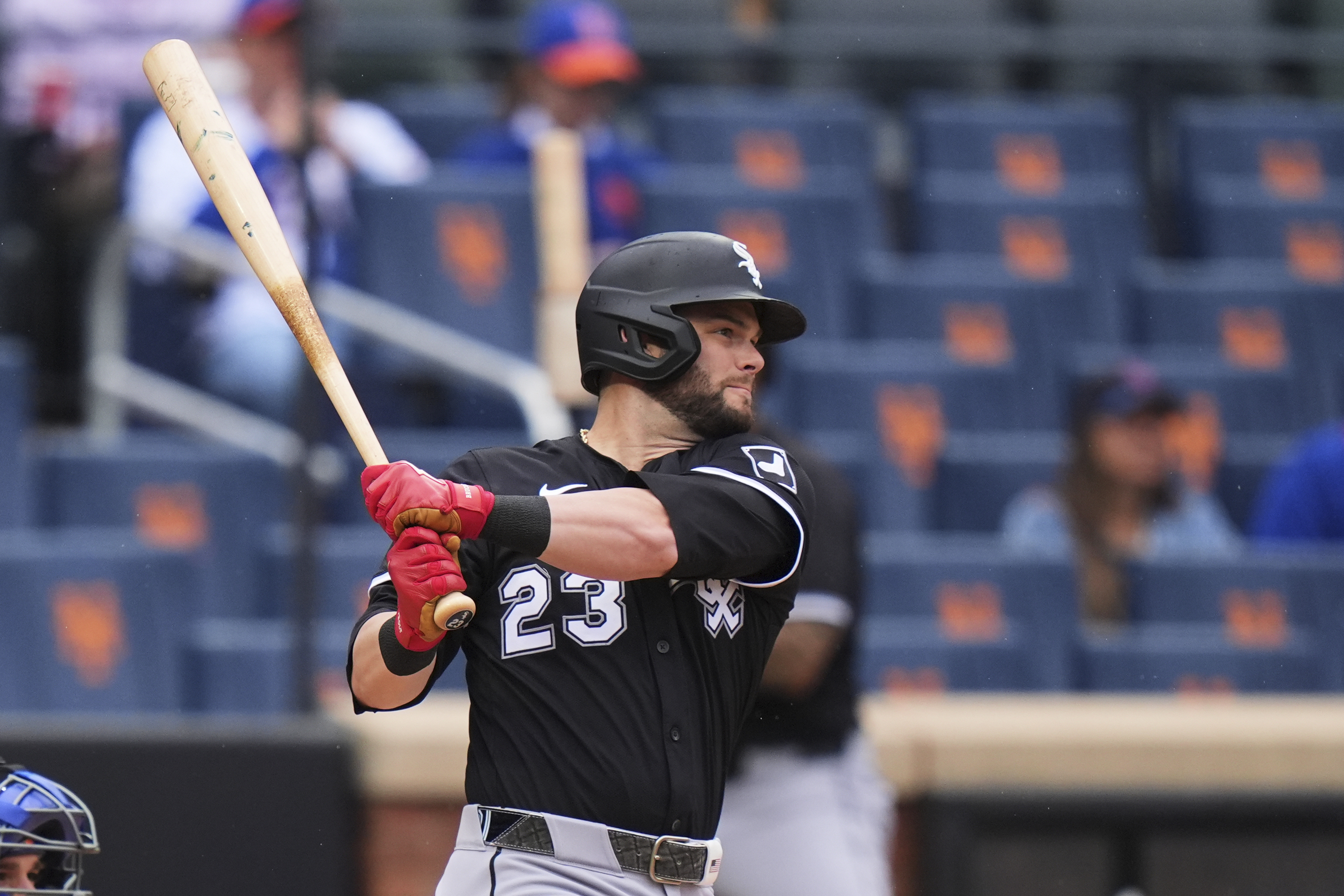
Andrew Benintendi is slashing just .245/.309/.391 in his first three years with the White Sox.
1. Andrew Benintendi plus cash to the Phillies, Castellanos to the White Sox
This is the baseball equivalent of one of those NBA trades in which a couple of overpriced veterans and 16 second-round draft picks change hands but nobody ends up with more than they started with. You only live once, baby.
Benintendi has been a sunk cost the moment he signed a five-year, $75 million contract in Chicago in 2023. Was it only three years ago that the White Sox were trying? Apparently, it was.
Benintendi hit free agency as the rare hitter still in his prime, having broken into the big leagues at 21 years old on the watch of none other than Dombrowski. He hasn’t come close to the .782 OPS he posted in his first seven seasons in the majors, hitting just .245/.309/.391 in his first three years with the White Sox. He showed a little life in the second half of last season and finished with a .738 OPS that was slightly above league average. But he didn’t show nearly enough life to warrant salaries of $17.1 million this season and $15.1 million in 2027.
Swapping Castellanos for Benintendi would make some sense from an accounting perspective. The Phillies would be taking on an additional $12.2 million in “dead” money over two years. More importantly from a competitive standpoint, they’d be tacking on $15 million in average annual value to next year’s payroll rather than paying Castellanos $20 million up front and then being free and clear.
But what if the White Sox included $10 million in cash to pay Benintendi’s 2027 salary? That would essentially enable the Phillies to split up Castellanos’ money over two years, saving them $10 million this year while adding $10 million next year. And, hey, maybe Benintendi gives them a little something in the outfield rotation as a Max Kepler replacement. At 31 years old, the chances of that aren’t zero.
What’s in it for the White Sox? Well, they’d save $5 million in cash in 2027 at the expense of an extra $3 million this year. I’m not sure whether this trade makes sense for both sides or makes sense for neither side. But that’s where we’re at.
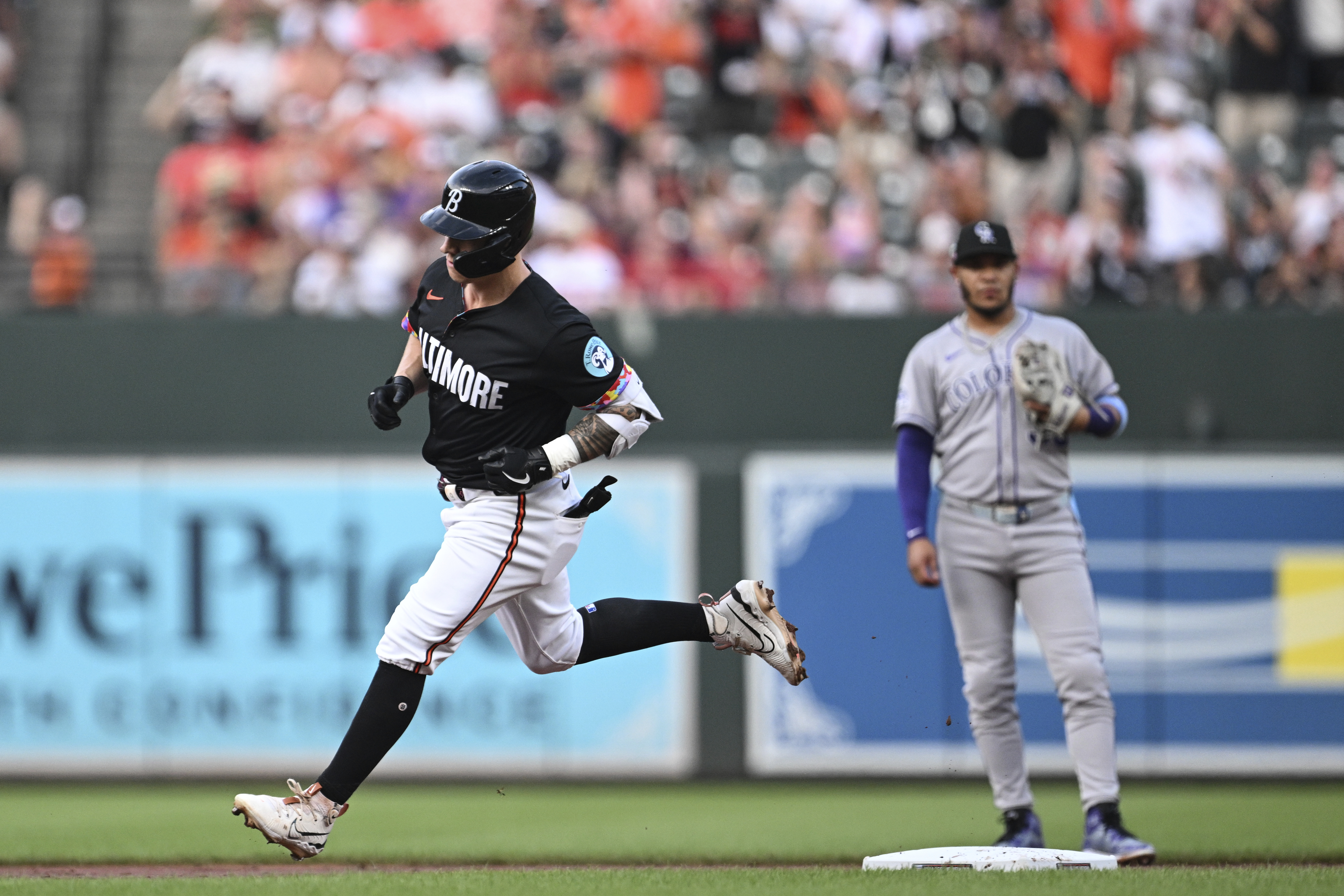
The Orioles’ Tyler O’Neill had just 209 plate appearances and nine home runs in 2025.
2. Tyler O’Neill to the Phillies, Castellanos to the Orioles
Truthfully, I’m not sure how much sense this makes for either side. O’Neill signed a three-year, $49.5 million contract last offseason after a big year with the Red Sox (.847 OPS, 31 home runs). He was a major disappointment, posting a .684 OPS and nine home runs in 209 plate appearances in a season marred by injuries.
The argument from the Phillies’ perspective goes like this. They’d essentially be signing O’Neill to a two-year, $13 million deal, given the $20 million they are saving on Castellanos. That’s pretty close to fair market value for O’Neill, who has mostly been a league-average hitter outside of his two spike years (2021 with the Cardinals and 2024 in Boston).
The Phillies get a right-handed hitter who still might have another big season in him. Even if he doesn’t, maybe he is an adequate enough rotational corner outfielder for two years (O’Neill is heading into his 31-year-old season). They also save $3.5 million on this year’s official payroll.
Is all of that worth $16.5 million less in spending power next offseason? Probably not.
Likewise, what are the Orioles really gaining? Saving $13 million over two years isn’t nothing. But it’s probably not worth sacrificing the chance that O’Neill bounces back.
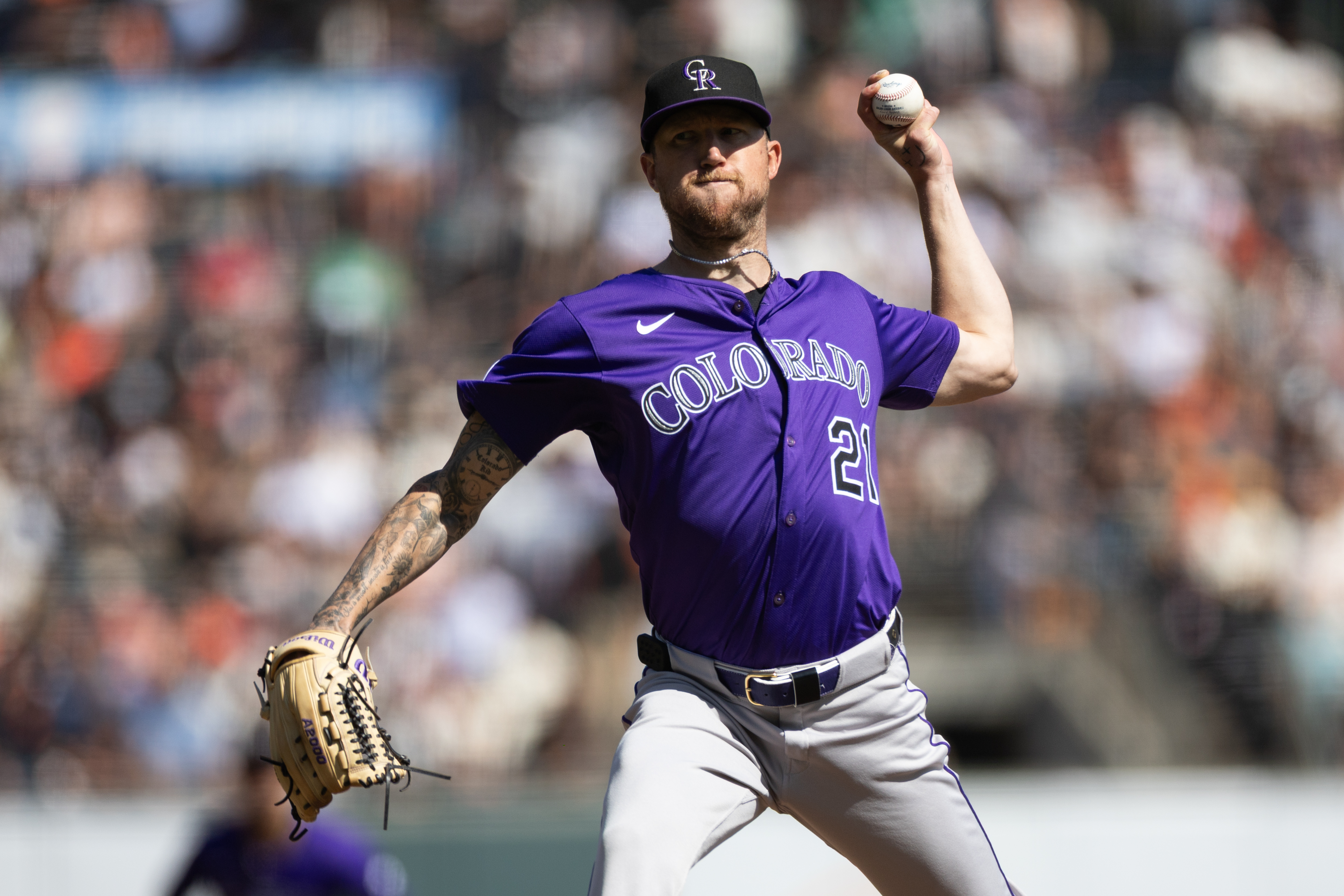
Kyle Freeland, 32, has spent his entire career with the Rockies and has been better away from Coors Field.
3. Kyle Freeland to the Phillies, Castellanos plus cash to the Rockies.
Freeland, who has spent his entire career with the Rockies, has one year and $16 million left on his deal. That’s a lot to pay a guy who has a 5.07 ERA over the last three seasons. Castellanos has hit well at Coors Field with a .914 career OPS in 88 plate appearances. The Phillies get another piece of rotation depth in the form of a guy who has had some decent years on the road in his career. The Rockies get a guy who at least has chance of regaining some value between now and next year’s trade deadline.
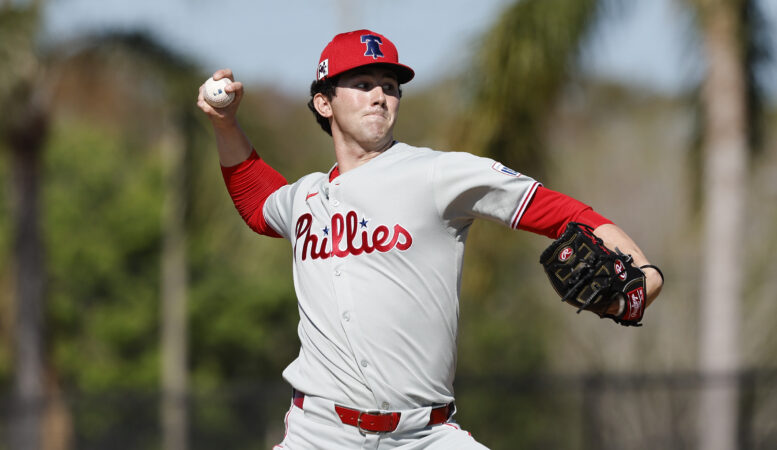
The Phillies added three prospects to their 40-man roster Tuesday to protect them from next month’s Rule 5 draft: right-handed pitchers Andrew Painter and Alex McFarlane and outfielder Gabriel Rincones Jr.
The Rule 5 draft will be held Dec. 10 at the winter meetings in Orlando. If an eligible player is selected by another organization, he must remain on their 26-man roster all season or he will have to pass through outright waivers and be offered back to his former team.
As the Phillies’ No. 1 prospect, Painter was expected to be protected. In his first full season after undergoing Tommy John surgery, Painter, 22, posted a 5.26 ERA in 118 innings between single-A Clearwater and triple-A Lehigh Valley. He had issues with command, but stayed healthy for the full season, and the Phillies remain confident he will be a part of their future.
“I think he’s going to be better the second year out after the Tommy John [surgery],” Phillies manager Rob Thomson said in October. “The command’s going to get better. The quality of stuff’s going to get a little bit better. He’s going to be fine.”
McFarlane, 24, wrapped up his first season following Tommy John surgery in 2023 and posted a 4.84 ERA. He moved to the bullpen toward the end of the season and finished the year with double-A Reading. McFarlane has had some command struggles, but his slider grades out highly and he can touch 100 mph with his fastball.
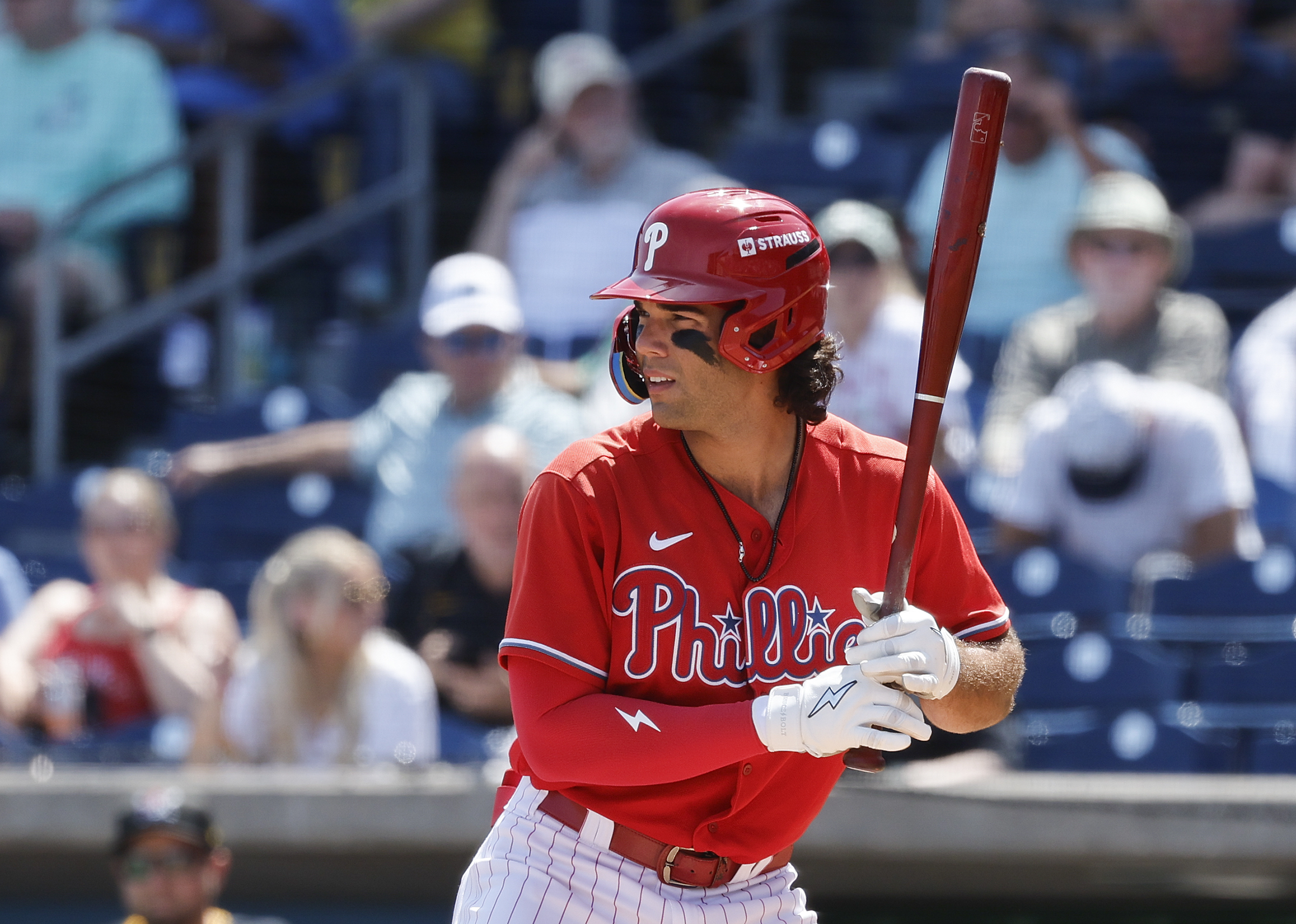
Gabriel Rincones Jr. spent the season in triple A, where he slashed .240/.370/.430 and hit 18 home runs.
Rincones, 24, made a strong impression with his power in spring training this year as a nonroster invitee. A left-handed hitter, Rincones spent the season in triple A, where he slashed .240/.370/.430 and hit 18 home runs. He struggles against lefties, hitting just .107, but could fill a platoon role with his .261 average and .873 OPS against right-handers.
The Phillies’ 40-man roster stands at 33 players.
Notable names left unprotected include Griff McGarry, who will be eligible for the Rule 5 draft for the second straight season. McGarry was named the Phillies’ Paul Owens Award recipient as their 2025 minor league pitcher of the year after a bounce-back season.
Once considered a top prospect, McGarry, 26, has had inconsistencies with command but improved his walk rate from 10.2 walks per nine innings in 2024 to 5.2 in 2025.
Felix Reyes, who had some eye-popping numbers in double A and triple A this season, will also be unprotected. The utility player slashed .331/.362/.562 in 101 games.
Catcher Caleb Ricketts was also left off the roster. Ricketts hit .256 with a .702 OPS in 58 games with double-A Reading.
SCOTTSDALE, Ariz. — It only took Phillies outfield prospect Dante Nori 14.76 seconds to leg out an inside-the-park home run in one of his final games in the Arizona Fall League.
On Nov. 6, Nori blasted a ball 414 feet into deep right-center field at Salt River Fields, the spring training home of the Colorado Rockies and Arizona Diamondbacks. Off the bat, Nori thought it was a no-doubter that would certainly carry over the wall.
“Out of the box, I was like, ‘Aw, it’s gone,’” Nori said. “I’ve seen some balls that I’ve hit that well. I was like, ‘All right, that’s going to get out.’ And I remember, right as I passed first base, I saw it clank off the wall. And I was like, ‘Uh-oh, we’ve got to go.”
Despite getting a slow start, the speedy left-handed hitter clocked one of the fastest times recorded around the bases in 2025. Only Boston Red Sox outfielder Jarren Duran (14.71 seconds) circled the bases at a faster pace in a major league game this year.
The Phillies’ 2024 first-round pick dazzled in his short time in the AFL, a six-week showcase for some of baseball’s most promising minor league prospects.
Nori, 21, impressed scouts with his defense and baserunning, while batting .308 with a .386 on-base percentage, .822 OPS, seven RBIs, and two stolen bases in 12 games. But his time was limited due to an undisclosed leg injury that he suffered in his first AFL game on Oct. 7.
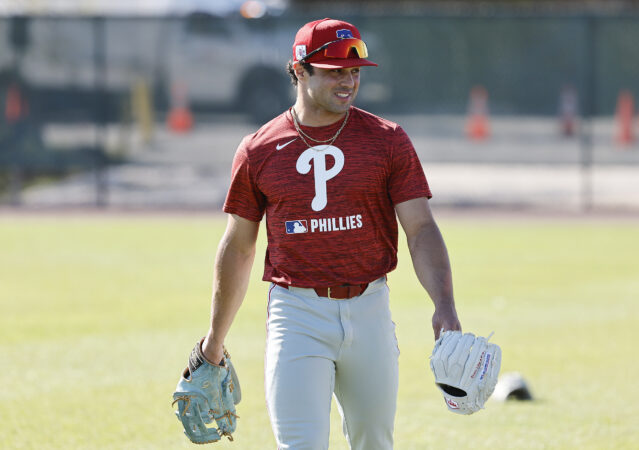
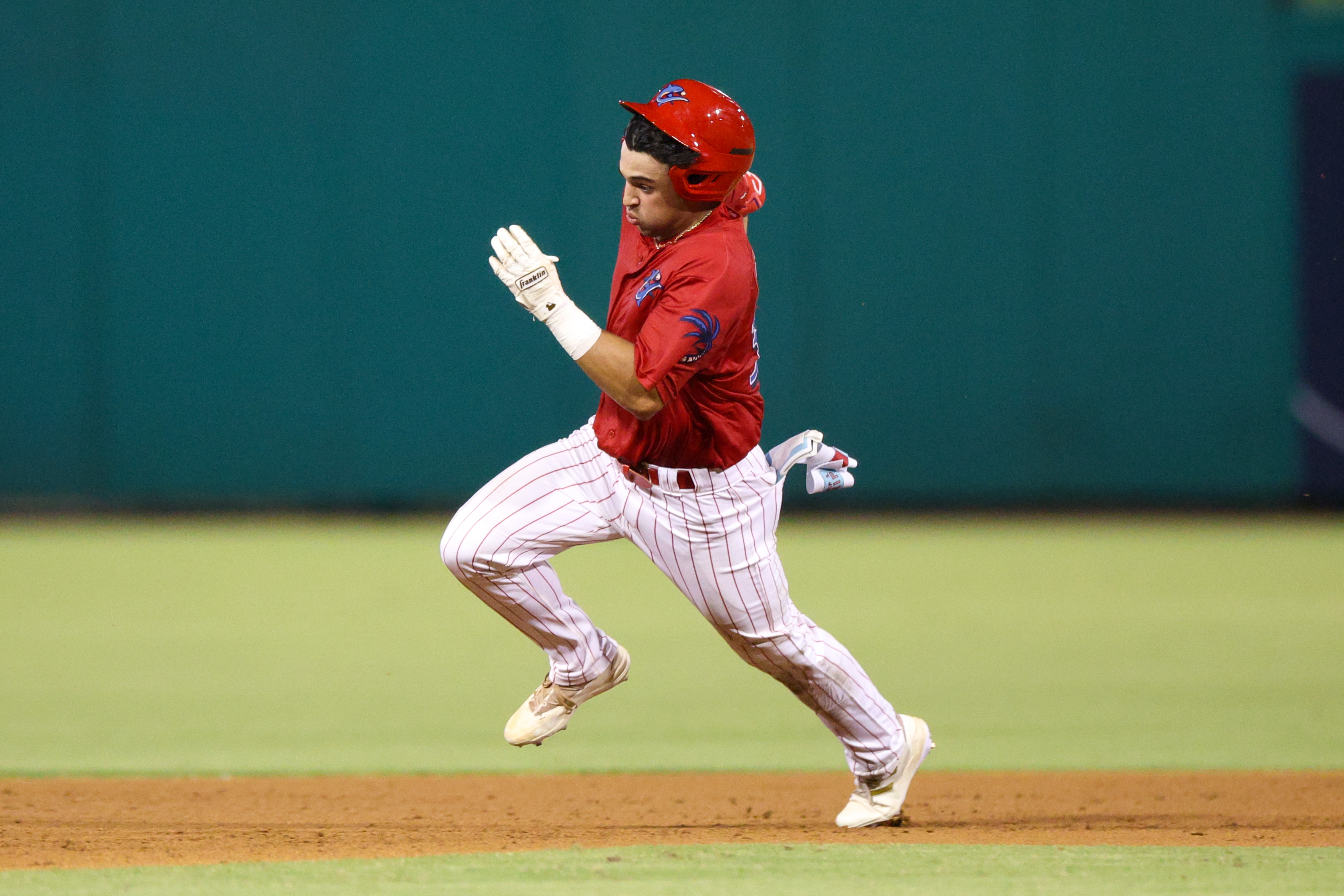
Phillies 2024 first-round pick Dante Nori, shown playing for single-A Clearwater, stole 52 bases across three levels of the minor leagues this season.
Nori said he “tweaked something” on a steal attempt, and chose to play it safe, taking the next two weeks off.
He returned to the Surprise Saguaros’ lineup Oct. 21 and saw regular playing time as the leadoff man and center fielder, a spot he hopes to occupy one day for the Phillies. His presence in the Saguaros’ lineup helped them win the AFL championship.
“I think I find ways to help my team win,” Nori said. “If it’s not with your bat, it’s with your glove, it’s with your speed. You know, you’re not always going to have your bat every single day. Sometimes, it might be the opposite. You might not have your glove, but you’re going to find a way to help your team win.”
Nori’s first full season in the Phillies organization started slowly — he batted just .221 through his first 50 games at single-A Clearwater — prompting him to modify his approach, as well as his bat selection.
“After the first two months I was struggling, so we made an adjustment,” Nori said. “I moved closer on the plate, and I switched to the torpedo bat, and since then, it’s been good.”
Nori saw immediate results, batting .300 with a .410 OBP and .860 OPS over his final 58 games in single-A, earning him a promotion to high-A Jersey Shore in mid-August, before finishing his regular season at double-A Reading.
Nori said the torpedo bat made an impact.
“Honestly, [the bat] just brings the barrel closer to my hands,” Nori said. “All my mishits are usually close to the hands, so it’s one of those things where it’s like, ‘Hey, if I’m missing there, why not bring more of the barrel in, up closer to the plate, so it just brings the barrel closer to me?’ And I’m able to contribute more. So, I like it way more. It’s been fun.”
Late in July, Nori was thrilled to receive a call about playing in the Fall League. He believes he made the best of the experience, and said his favorite part was making connections with other players and coaches, and learning from them.
“Honestly, just the relationships,” Nori said. “Just hearing how different organizations work, and just keep playing the game. We’ve been playing since January, and I think it’s a privilege to be here, and just to finish the year on a high note against some top competition, that’s all I could ask for.”
With his first full season of pro ball behind him, Nori will head home for the winter. He hopes to start 2026 in double A.
“I could see myself starting in double A,” Nori said. “That’s the goal. [I wanted to] come down here and prove that [I] can play at that level. So, start in double A, and then you know, you just take it one step at a time. So, the next one’s triple A, and then after that, it’s the big leagues.”
But before beginning his next minor league assignment, Nori has his eyes fixed on another objective: playing in the World Baseball Classic for Team Italy. While his addition to the team has not yet been finalized, Nori, who is of Italian heritage, has been in contact with the Italian national team and is excited about the potential opportunity to play in the WBC.
Dante Nori slashed .261/.361/.372 across three levels of the minor leagues in 2025, his full season in professional baseball.
Nori, the son of longtime NBA assistant coach Micah Nori, was born in Canada and spent most of his childhood in the United States. His grandfather is a longtime baseball coach who helped recruit Phillies slugger Kyle Schwarber to play at Indiana University.
“I worked out with Schwarber in the offseason these past three seasons,” Nori said. “So, I’m at his facility hitting with him, so I know I have a great bond with him.”
And he added about the National League home run king, who is a free agent: “I’m really hoping he comes back.”
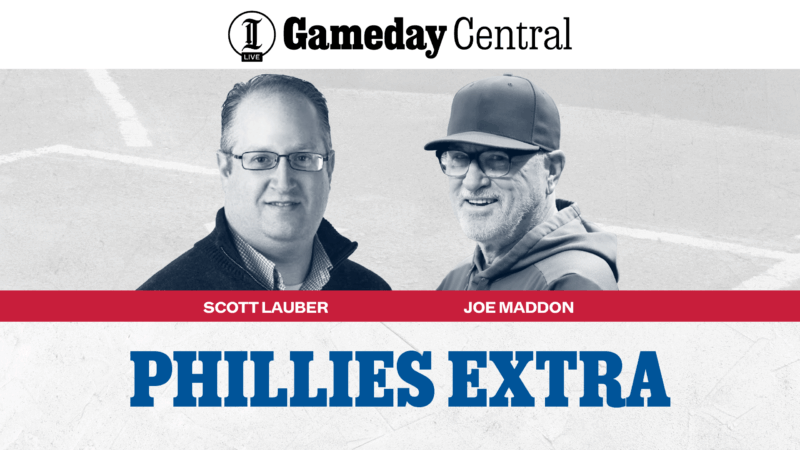
Joe Maddon is a three-time former Manager of the Year, manager of the hex-breaking 2016 Chicago Cubs, and one of the sharpest minds in baseball. He’s also a native Pennsylvanian. And he joined “Phillies Extra” to discuss the state of the Phillies, Kyle Schwarber’s evolution into a complete hitter, how to pitch Bryce Harper, and much more. Watch and listen here:
Alec Bohm returned from the injured list last month and got eight hits in three games, giving rise to a theory: If Bohm stayed hot, maybe the star hitter who precedes him in the Phillies’ batting order would see more strikes.
Harper knew how that sounded, so he made clear that he meant no disrespect to Bohm. But his point remained. Harper faced a lower rate of pitches in the zone (43%) than any hitter in baseball this season (minimum 150 pitches), so the notion that any Phillies lineup protection short of peak Mike Schmidt would affect how he was pitched ranked somewhere between wishful thinking and delusion.
It has been this way for most of Harper’s life. He recalls being 11 years old and competing in travel tournaments in which the opposing coach would point to him and direct pitchers not to give him anything to hit. In 2016, the Cubs walked him 13 times, four intentionally, in 19 plate appearances over four games at Wrigley Field.
Quite simply, teams game-plan against Harper specifically.
“When we go into a series, we circle guys’ names, too,” Harper said earlier in the season. “It happens that way.”
Even so, there was something different about this season. When Harper did get pitches in the zone, he didn’t do as much damage. As such, he didn’t produce his typical numbers.
Phillies first baseman Bryce Harper saw a lower rate of pitches in the strike zone (43%) than any hitter in baseball this season.
Harper reached base at a .357 clip, his lowest mark since 2014. He slugged .487 with an .844 OPS, his worst totals since 2016. He mashed 27 home runs, despite missing a month with an inflamed right wrist. Although he outproduced the league average by 29%, based on OPS+, he has been 42% better than average over his career.
So, upon being asked at his end-of-the-season news conference on Oct. 16 — coincidentally, Harper’s 33rd birthday — if the Phillies believe this was a down year and not the start of a downturn for the face of the franchise, president of baseball operations Dave Dombrowski offered an eyebrow-raising answer.
“He’s still an All-Star-caliber player,” he said. “He didn’t have an elite season like he has had in the past. And I guess we only find out if he becomes elite [again] or he continues to be good. If you look around the league, Freddie Freeman, he’s a really good player, right? Is he elite like he was before? Probably not to the same extent. Freddie is a tremendous player, and that, to me, is Bryce.
“Can he rise to the next level again? I don’t really know that answer. He’s the one that will dictate that more than anything else.
“I don’t think he’s content with the year that he had. And, again, it wasn’t a bad year. But when you think of Bryce Harper, you think of elite, right? You think of one of the top-10 players in baseball, and I don’t think [this season] fit into that category. But again, a very good player. I’ve seen guys at his age — again, he’s not old — that level off. Or I’ve seen guys rise again.”
Maybe we just aren’t accustomed to that level of candor from a high-ranking executive, especially at a news conference. Or maybe Dombrowski calculated that challenging a future Hall of Famer to be better would have the effect of poking a grizzly.
Regardless, it sparked conversation — even idle speculation about Harper’s future with six years and $153.25 million left on his contract and no-trade rights based on more than 10 years of major-league service, more than five with the Phillies.
“I’ve been reading that, ‘Oh, the Phillies may trade Bryce Harper.’ That couldn’t be further from the truth,” Dombrowski said the other day on Foul Territory TV. “We love him, think he’s a great player. He’s a very important part of our team.
“When I think of Bryce Harper, it’s a compliment. Because the reality is, there are eight to 10 players in the game of baseball every year when they’re not, let’s say, in the MVP consideration for whatever reason — sometimes it can be an injury factor; sometimes they just have a bad year — it’s not an elite year for them.
“I’ve seen him have better years. I look for him to have better years.”
Especially if the Phillies give him more help.
Bryce Harper hit 27 homers this season, despite missing one month with an inflamed right wrist.
Missing the mistakes
Let there be no doubt about Harper’s state of mind in the aftermath of the Phillies’ second consecutive divisional-round knockout.
“I want [a championship] more than probably a lot of people,” he said. “I want to hold that trophy. On a personal level, I’m going to work my butt off this offseason again and get ready for next year and hopefully take another swing at it and see what we can do.”
But who will follow Harper in the batting order?
It was a topic of conversation early this season. Harper got walked intentionally twice with runners in scoring position on April 11 in Atlanta, prompting Rob Thomson to tweak the lineup the next day. Rather than keeping a struggling Bohm — or fellow right-handed hitters J.T. Realmuto or Nick Castellanos — behind Harper, the manager moved Kyle Schwarber into that spot.
“Just trying to protect Harper the best we can,” Thomson said.
Schwarber should have represented Secret Service-level lineup protection. He batted behind Harper for 42 consecutive games and hit 12 homers in that span.
And yet Harper didn’t see many more pitches in the zone.
“It’s actually gotten worse, which is crazy,” Harper told The Inquirer in May during a series in Cleveland. “Just got to try to hone in as much as possible and hit the mistakes. That’s one thing where [Barry] Bonds was so good at. You get the mistakes and let the other ones go.”
Usually, it’s a trademark of Harper’s, too.
Through six seasons with the Phillies (2019 to 2024), he saw only 42.6% of pitches in the zone, tied for second-lowest rate among 293 players who faced at least 500 pitches, according to Statcast. But he punished those strikes, slugging .680, fifth-best behind Aaron Judge (.763), Shohei Ohtani (.710), Yordan Alvarez (.695), and Mike Trout (.695).
Kyle Schwarber (right) batted behind Bryce Harper early in the season before the Phillies got away from that alignment.
This year, with opponents still coming after him in the zone only 43% of the time, Harper’s slugging percentage on those pitches fell to .591. His weighted on-base average slipped, too, from .424 to .378.
Reasons for the drop-off weren’t clear. Harper’s average bat speed wasn’t diminished (74.2 mph vs. 74.0 mph in 2024). His average exit velocity (91.3 mph) and hard-hit rate (47.5%) were consistent with the last two seasons (91.5 mph, 47.5%).
There was a notable difference in how teams attacked Harper. He faced fewer fastballs (46.7%) and more breaking pitches — curveballs and sliders (41.3%) — than ever before. By comparison, the breakdown last season was 52.9% fastballs and 32.3% breaking stuff.
Why the change?
“Because I’m not hitting them,” Harper said. “Like, don’t try to fix what’s not broken, right?”
Indeed, Harper slugged .438 against curveballs and sliders, down from .458 in 2024, .466 in 2023, and .495 in 2022.
At least Harper didn’t overreact by swinging at many more pitches out of the zone. His chase rate ticked up to 35.6%, according to Statcast, but wasn’t far off his 33.4% mark from each of the previous two seasons. He walked in 12.1% of his plate appearances, nearly identical to his 12% mark from 2024.
But as the Phillies seek explanations for Harper’s subpar season, they can start by tracing why he didn’t crush as many pitches — of any variety — in the zone as usual.
Bryce Harper is a two-time Gold Glove finalist at first base. The Phillies haven’t discussed moving him back to the outfield.
Better protection
Maybe it would’ve helped if Thomson stuck with Schwarber behind Harper.
Instead, Schwarber moved into the No. 2 hole while Harper was sidelined in June and stayed there en route to joining Ryan Howard in the pantheon of Phillies’ 50-homer hitters. Once Harper came back, he most often was followed in the order by Realmuto (41 games), Bohm (18), and Castellanos (13).
Harper was the Phillies’ primary No. 3 hitter (117 games); Phillies cleanup hitters combined to rank 20th in slugging (.408) and OPS (.720).
Scott Boras, Harper’s agent, didn’t respond to messages in recent days. But he told MLB.com that the best way for the Phillies to restore Harper’s elite performance is to “give Bryce Harper more pitches to hit.”
Translation: Upgrade the lineup protection.
Maybe it’s as simple as re-signing Schwarber and sticking him in the cleanup spot. Maybe the Phillies can add even more slug by putting the $24.5 million that will come off the books with the departures of Max Kepler, Jordan Romano, and David Robertson into an offer for, say, Alex Bregman, then swapping Bohm for Angels outfielder Taylor Ward.
But unless 2006 Ryan Howard comes out of retirement, history suggests that Harper will continue to see fewer pitches in the zone than almost any hitter in baseball.
He needs to get back to crushing them.
“I think he’s highly motivated to have the best season of his career next year,” Thomson said. “He hasn’t told me this, but that type of person — and I’ve seen it before — they’ve had bad years, they’ll go like gangbusters during the offseason to get better because they want to get back to where they normally are at. I think that’s just Harp’s mindset. I think that’s what he’s going to do.”
Brent Urcheck was in his early 20s with a nice apartment in Washington and a well-paying job. But that’s not what he wanted. Mr. Urcheck wanted to chase a dream, not sit in a cubicle.
He flew to New Orleans in December 2003 for the winter meetings — an annual gathering of nearly everyone who works in professional baseball — to find a way to work in the game. He didn’t have many connections, but Mr. Urcheck was determined to get in.
He handed out his resumé, landed an internship with the Cleveland Indians, and quit his finance job to chase his dream in a tiny office in the basement of the ballpark.
Mr. Urcheck spent 20 years in the game and helped build the Toronto Blue Jays into pennant winners this season as a player personnel manager. His dream became his job. His rise was no surprise to anyone who knew Mr. Urcheck, who died Oct. 8 in his South Philadelphia apartment just 12 days before the Blue Jays reached the World Series. Mr. Urcheck died of natural causes, his family said. He was 49.
“He knew. He just knew that’s not what he wanted to do” said Jon Watts, Mr. Urcheck’s childhood friend and roommate in Washington. “He did a lot of self-examination and realized that ‘My passion is baseball, so that’s what I’m going to do.’ It was so admirable that he went after it like that and knew what he wanted. As soon as you met him, you knew he would be special.”
Mr. Urcheck grew up outside Cleveland, studied finance at the University of Richmond, and moved to Philadelphia in 2006 while working as a scout for Cleveland. The city provided a centralized location for his travel-heavy job. It quickly became home. He frequented concerts at venues like the Highmark Mann Center and Union Transfer, played the jukebox at Doobies Bar, and was a card-carrying member of the Palizzi Social Club.
“The jukebox still played CDs, and it was a dollar for four plays,” said Frankie Garland, a friend of Mr. Urcheck. “We would spend a lot of nights there, just taking turns on the jukebox and having great conversations. He was just such a calming presence. If you invited him to a show with another group of friends, he would fit in seamlessly like he knew them forever.”
Urcheck wasn’t from Philadelphia, but Garland said the guy from Shaker Heights, Ohio, epitomized everything Philly was about. He was loyal, dependable, and honest. Mr. Urcheck, said another friend, Frank Spina, simply was “solid.” He didn’t care for the Philly teams — he somehow never wavered in loving the Cleveland Browns — but he loved Philly.
“He just showed up for people,” said a friend, Julie Spragg. “Like the people at Palizzi became his family. One of the bartenders is in a band, and he would go far away to go see them play. He was all in.”
Julie Spragg said Brent Urcheck was “all in” with everyone he knew.
Mr. Urcheck graduated from Richmond in 1998 and was a seldom-used backup catcher on the baseball team. A three-sport athlete in high school, Mr. Urcheck could have switched colleges to play more. That was never a thought.
“He showed up with a level of humility that you don’t often see in Division I sports,” Spina said. “A nonscholarship player who had tons of high school accolades. He knew he had to earn it and he approached his collegiate career the same way I would characterize his rise through the scouting world. He started at the bottom and worked without an ego and learned.”
Mr. Urcheck’s internship with Cleveland (now known as the Cleveland Guardians) came with no guarantees. His career in professional baseball could have lasted just a few months. But he didn’t need any promises. Mr. Urcheck knew that’s where he belonged.
“Brent was real subtle,” childhood friend Jason Lowe said. “He would just do things. He was like, ‘Yeah, I got a job as a scout with the Indians.’ We’re like, ‘What?’ He just did it. It was never about him.”
Brent Urcheck (left) with his friends at the Mann to see Phish.
Mr. Urcheck paired his playing career with his finance background to become a good fit in Cleveland’s forward-thinking front office. But it was his personality — the same qualities that made him the linchpin of his many friend groups — that helped him climb the major league ladder.
“He had this uncommon ability to get along with everyone he meets,” Watts said. “By showing respect, he immediately commanded respect. He was just the person you wanted to be around and respect. He was as true and genuine as they come. He wasn’t selling anything. Plus, the guy was smart, too. That didn’t hurt.”
Mr. Urcheck spent 14 years with Cleveland before leaving for the Toronto Blue Jays in 2018. The Jays are run by two people — president Mark Shapiro and general manager Ross Atkins — for whom Mr. Urcheck worked in Cleveland. Toronto won the American League East this season after finishing 2024 in last place. A guy who lived at 13th and Reed Streets had a hand in a magical season.
The Blue Jays held a moment of silence for Mr. Urcheck before a playoff game earlier this month and tweeted that Mr. Urcheck “left a lasting impact on the organization” and “has been crucial in helping build a successful Major League roster this season.”
Before today's game, we held a moment of silence to remember Brent Urcheck.
Brent left a lasting impact on the organization through his work in the Pro Scouting department. His work has been crucial in helping build a successful Major League roster this season.
“Brent was just really smart,” said Jason Morris, a college teammate. “He was a smart kid. You combine that catcher’s mentality with being a really sharp dude plus being so enjoyable to be around, I don’t think anyone was really surprised by what he did.”
Mr. Urcheck had friends from every stop: Shaker Heights, Richmond, Washington, Cleveland, Philly, and Toronto. He found a way to be everyone’s friend. He was always there, Lowe said.
Spragg was nervous two years ago to teach a fitness class, and there was Mr. Urcheck sitting in the back of each class waiting to support her. Garland wasn’t sure how he’d fit into Philly after moving here from California. One night with Mr. Urcheck was enough to know he had someone to lean on. When Watts went to West Virginia last fall to spread his brother’s ashes in the fast-moving Gauley River, Mr. Urcheck was in the boat with him.
“That’s just how he was,” Watts said. “He showed up for everything. And I know he did that for everyone. I don’t know how he did it. He just did it. He was that kind of dude.”
Mr. Urcheck’s friends will watch the World Series begin Friday and think of the guy who was planning a yacht-rock themed 50th birthday party. They’ll wear Blue Jays hats and root for the team that their buddy — the guy who helped them score a membership to Palizzi — helped build. Mr. Urcheck talked so little about his success that his childhood friends had to be the ones who mentioned in their group chat how the Blue Jays went from worst to first. His friends rooted for the Guardians, Yankees, and Phillies. They’re now rooting for a new team.
“We’ve all bought Blue Jays gear,” Spragg said. “We’re all so pumped for them. It’s bittersweet because he’s not seeing this. But it’s amazing that we can all rally around it.”
A South Philly man helped the Blue Jays reach the World Series. And it started because he was determined to make a dream come true.
“We were living in a nice apartment in D.C. in our early 20s,” Watts said. “It was an easy, comfortable situation to stay in. So it wasn’t an easy decision. He did the work to figure out what it was that he needed to do.”
Mr. Urcheck is survived by his mother, Sara Jane Sargent, and her husband, Jack; his father, Gary Urcheck, and his partner, Patty Arendt; his sister, Stephanie Urcheck, and many aunts, uncles, and cousins.
A memorial reception will be held from 2-4 p.m. Sunday at Debonné Vineyards in Madison, Ohio. A Philadelphia gathering is planned for Nov. 15 at a location to be determined. In lieu of flowers, donations can be made in Mr. Urcheck’s honor to the Philadelphia Animal Welfare Society.
The noise around him was deafening. But he looked up at the top of the dugout, and focused there for a beat. Then he put his hat on, and he walked out to the mound to do his job.
“It was funny,” said Boyertown Area head baseball coach Todd Moyer, “because I’ve seen him do that lots of times.”
This time, though, instead of facing off against rivals in the Pioneer Athletic Conference, Yesavage was striking out Cal Raleigh and Josh Naylor.
On Sunday, his job was keeping the Blue Jays’ season alive in the American League Championship Series against the Mariners. Toronto gave the ball to the 22-year-old from Pottstown to start Game 6, and he held Seattle to two runs over 5⅔ innings. Yesavage helped force a Game 7, where the Blue Jays punched their ticket to the World Series.
Now, the 22-year-old from Pottstown will start Game 1 of the Fall Classic against the Dodgers.
“It’s something I never even would have dreamed of,” Yesavage said Thursday.
What Yesavage has done this year has never been done before. Just over 15 months ago, the right-hander was drafted, 20th overall, out of East Carolina University. He opened his first professional season in March with Toronto’s single-A affiliate, the Dunedin Blue Jays.
And on Friday, he will be the youngest player to start a World Series game since 2010, when Madison Bumgarner started Game 4 for San Francisco at 21.
Trey Yesavage made just three starts in the regular season with the Blue Jays.
‘Fearless’
The key difference, though, is that Bumgarner had been a professional baseball player for two years before that first World Series start. He was drafted out of high school in 2007, and spent 2008 and most of 2009 in the minors before making his major league debut that September.
Yesavage ascended through the minor leagues at a breakneck pace. When he was called up to high-A in May, it was the first of four promotions in four months. He reached the majors on Sept. 15, and struck out nine in his debut to set a franchise record.
“I’ve been able to go through this and handle it as diligently as possible,” Yesavage said. “With this being my rookie season and having these high-pressure games, I try to treat it as if it’s not as high pressure as it is, mentally.”
Yesavage set another franchise record in his postseason debut in Game 2 of the division series. Yesavage’s 11 strikeouts against the Yankees were the most in Blue Jays postseason history, as he held New York without a hit for 5⅔ innings.
“I was standing with a group of people when he got Aaron Judge, and the first time he didn’t get him, but the second time he did,” Moyer said. “And we were like, ‘There it is, right there. He just struck out Aaron Judge.’ One of the best hitters in the game, biggest stars. It was a weird feeling. It was a really good feeling to watch him be successful.
“But at that level, against that guy. I can’t tell you what it was. It was just unbelievable to watch.”
Trey Yesavage had a 2.58 ERA in 65 games with East Carolina before becoming a first-round pick of the Blue Jays in 2024.
Moyer has known Yesavage even before he starred for the Boyertown Area baseball team. He also coached him at age 7 in youth basketball, as Yesavage is a year older than Moyer’s son.
“He was a big, strong kid. He was kind of fearless,” said Moyer. “He didn’t have a whole lot of doubt that he was going to be able to handle what he was getting himself into. And you see that now. He looks at his situation, and what he needs to do, and he gets it done. He’s been getting it done really well.”
Fundamentals
On Sunday, Moyer was watching on television from home as Yesavage waded into some trouble in the third inning of Game 6. With Toronto hanging on to a two-run lead, a pair of walks and a single loaded the bases for Raleigh, the regular-season home run king.
Yesavage went to his signature pitch — his splitter — and got Raleigh to hit a sharp grounder to first base. Vladimir Guerrero Jr. snagged it and threw to second for the force out. By the time the ball was in shortstop Andrés Giménez’s glove, Yesavage was already covering first base to complete the inning-ending double play. He had not hesitated coming off the mound for even a second.
At that moment, texts started rolling into Moyer’s phone: You think he heard your voice in the back of his head?
As a coach, Moyer has always emphasized fundamentals. Whenever one of his pitchers finds themselves in a similar predicament, it’s a sure bet Moyer will be shouting from the dugout, “Get over there!”
But an elimination game in the ALCS is different. Moyer isn’t taking any credit. This is how Yesavage has always been.
“His composure and his maturity,” Moyer said. “He’s just shown that all the time. It’s fun to watch because I know how hard the game is, and I know if he doesn’t catch that ball and they get momentum, it’s a completely different game and a completely different story.”
Blue Jays pitcher Trey Yesavage and teammate Vladimir Guerrero Jr. celebrate after defeating the Yankees in Game 2 of the ALDS on Oct. 5.
Yesavage induced two more double play balls in Game 6 to keep the Mariners at bay. Fellow East Carolina Pirate and former Phillie Jeff Hoffman pitched the eighth and ninth to close it out.
“I heard so much about him, from past coaches and trainers and all these things about how, ‘You’re going to love this kid,’” Hoffman said. “And ‘He’s a great kid; great head on his shoulders.’ And I think all those reports are absolutely true. He’s one of a kind. He’s extremely mature for his age. He has all the things that you look for a young kid like that to come up with, and I think it puts him in a really good spot to have a long career.”
Roots
During Yesavage’s meteoric ascension, he’s become a hot topic back home. Moyer’s family owns a catering business. One night, while he was making a delivery, Moyer drove by two different houses where people were starting to gather to watch one of Yesavage’s starts.
Yesavage has not forgotten where he came from, either. He texted Moyer after a Boyertown playoff game in the spring to let him know he was keeping track of the team.
That’s also part of his DNA. Yesavage remembers the stops he made along the way this year, and takes pride in representing every level of the minor leagues on this stage.
“It’s really special,” he said. “I’ve got guys from Dunedin to Vancouver, New Hampshire, Buffalo that are texting me, congratulating me.”
The whirlwind few months haven’t been simple, though. Yesavage is living out of a hotel in Toronto, and his Toyota Tundra truck is piled with so much stuff he joked that it looks like a mobile home.
Trey Yesavage reacts after an inning-ending double play during Game 6 of the ALCS against the Mariners on Sunday.
Through it all, he doesn’t exactly carry himself like a typical 22-year-old. He sat in front of the World Series backdrop at the Rogers Centre on Thursday and fielded dozens of questions like a seasoned veteran. Yesavage doesn’t have an explanation for it.
“This is just who I am,” he said. “I don’t know, my parents raised me this way.”
Yesavage’s parents and two brothers are driving up from Pennsylvania on Friday for Game 1. Moyer will be one of the many people tuning in from Yesavage’s hometown.
The first player to step into the batter’s box on Friday will be Shohei Ohtani. Yesavage will take just one moment, the length of time it takes him to jog out to the mound, to soak it all in. The lights, the stage, the sold-out crowd. Where he started; where he is now.
While the Phillies are poised for some roster changes in 2026, at the moment it doesn’t seem like those will occur in the infield.
The Phillies’ outfield has been a revolving door for the last few seasons, but the infield continues to run it back. And according to Dave Dombrowski, that seems to be the plan again. At least, for now.
“The infield is pretty well solidified,” the Phillies’ president of baseball operations said at his end-of-season news conference on Oct. 16.
And indeed, Trea Turner and Bryce Harper are under contract into the 2030s, while Bryson Stott, Edmundo Sosa, and Alec Bohm are arbitration eligible. Barring a trade, there isn’t much room for movement or change.
Here’s an overview of the Phillies’ infield outlook next season and beyond.
Trea Turner had his best overall season as a Phillie in 2025, winning the NL batting title with a .304 average and stealing 36 bases.
Turner’s improvement
This time last year, there were questions raised about Turner’s long-term future at shortstop after another below-average defensive season. But those questions have been all but put to rest after Turner made significant strides in 2025. His 17 outs above average were the highest of his career and tied for third among shortstops.
On the offensive side, Turner bought into the Phillies’ plan for him as their new leadoff hitter. Manager Rob Thomson wanted him to focus on using his athleticism and getting on base, rather than hitting homers. Turner did just that, stealing 36 bases and posting a .355 on-base percentage, his best since arriving in Philadelphia. With a .304 batting average, Turner also became the first Phillie to win the batting title since Richie Ashburn in 1958 and was named a Silver Slugger finalist.
He may have sacrificed some power to do it, hitting just 15 home runs compared to 21 last season. But overall, Turner did exactly what the Phillies wanted out of him in the regular season, both offensively and defensively.
“He’s tough on himself,” Dombrowski said. “He’s like one of these guys, if he doesn’t hit 40 home runs and 40 doubles and 40 stolen bases, and lead the league in hitting, he’s probably going to think that he needs to do more.
“That’s how he is, which is great. That’s a great quality and attribute, but he doesn’t have to hit with any more power for us. He really did a fine job.”
The Phillies plan to keep Bryce Harper, a Gold Glove finalist for a second straight season, at first base.
Harper to the outfield?
Don’t expect Harper to change positions, either, despite the first baseman expressing some willingness last offseason and ahead of the trade deadline to return to the outfield.
Harper, who earned his second straight Gold Glove nomination at first base this season, has said he would be open to making a position switch if needed for an offensive upgrade. But it doesn’t sound as if the Phillies will consider moving him back to the outfield to add, say, Pete Alonso, who plans to opt out of his contract with the Mets after a 38-homer season.
“I think Bryce is a first baseman at this time,” Dombrowski said. “I mean, that’s where we look at him as, and he has asked to go out into the outfield. He would be willing to do so, but I think it would be more for the short term if we had done something at the trading deadline, but it’s been a while since he’s been out [there].
“I’m sure he’d be fine, but he’s a really good first baseman, and I think for us, that’s the position we look at him playing for us.”
Harper finished the season with an OPS of .844. Though that still ranked 11th in the National League, it was his lowest since 2016 (.814).
Dombrowski seemed to lay down a challenge to Harper at his year-end news conference.
“He’s still an All-Star-caliber player. He didn’t have an elite season like he has had in the past. And I guess we only find out if he becomes elite or he continues to be good,” Dombrowski said. “… He’s the one that will dictate that more than anything else, and that’s what it comes down to.”
Bryson Stott hit .310 with an .880 OPS from Aug. 1 through the end of the regular season, but still struggled against lefties.
Second and third base
Stott continued to be elite defensively at second base, but had a roller-coaster offensive season. He struggled over the first half, but a midyear adjustment to his hand placement led to improved at-bats overall. Stott went from hitting .194 with a .637 OPS in July to a .307 batting average and .864 OPS in August.
However, Stott’s .575 OPS against lefties kept him in a platoon with Sosa. When called upon, the Phillies’ utility man provided a spark of energy and clutch hits, plus an .895 OPS against left-handers.
“I view Stott as an everyday player, but Sosa’s numbers are so good against left-handed pitching that you’ve got to fit him someplace, whether it’s at third base when Bohm was hurt or mixed in for Stott against the lefties,” Thomson said. “So I view Stott as an everyday hitter. I think if he played every single day against left-handed pitching, he’d get better and put up pretty good numbers.”
On the other hand, Bohm spent last offseason amid a tornado of trade rumors. He will reach free agency in 2027, and his name will likely be floating around this winter, too, as one of the few ways the Phillies can change up their infield. The third baseman was afflicted by injuries — a rib fracture in July and shoulder inflammation in August — and slashed .287/.331/.409.
While Bohm and Harper were on the injured list at different points this season, Otto Kemp was a key fill-in. He hit .234 with 28 RBIs in his first 62 major-league games, most of which he played through knee and shoulder injuries that he will address with offseason surgery.
Kemp, 26, saw the bulk of his playing time at third but also appeared at first and second and in left field.
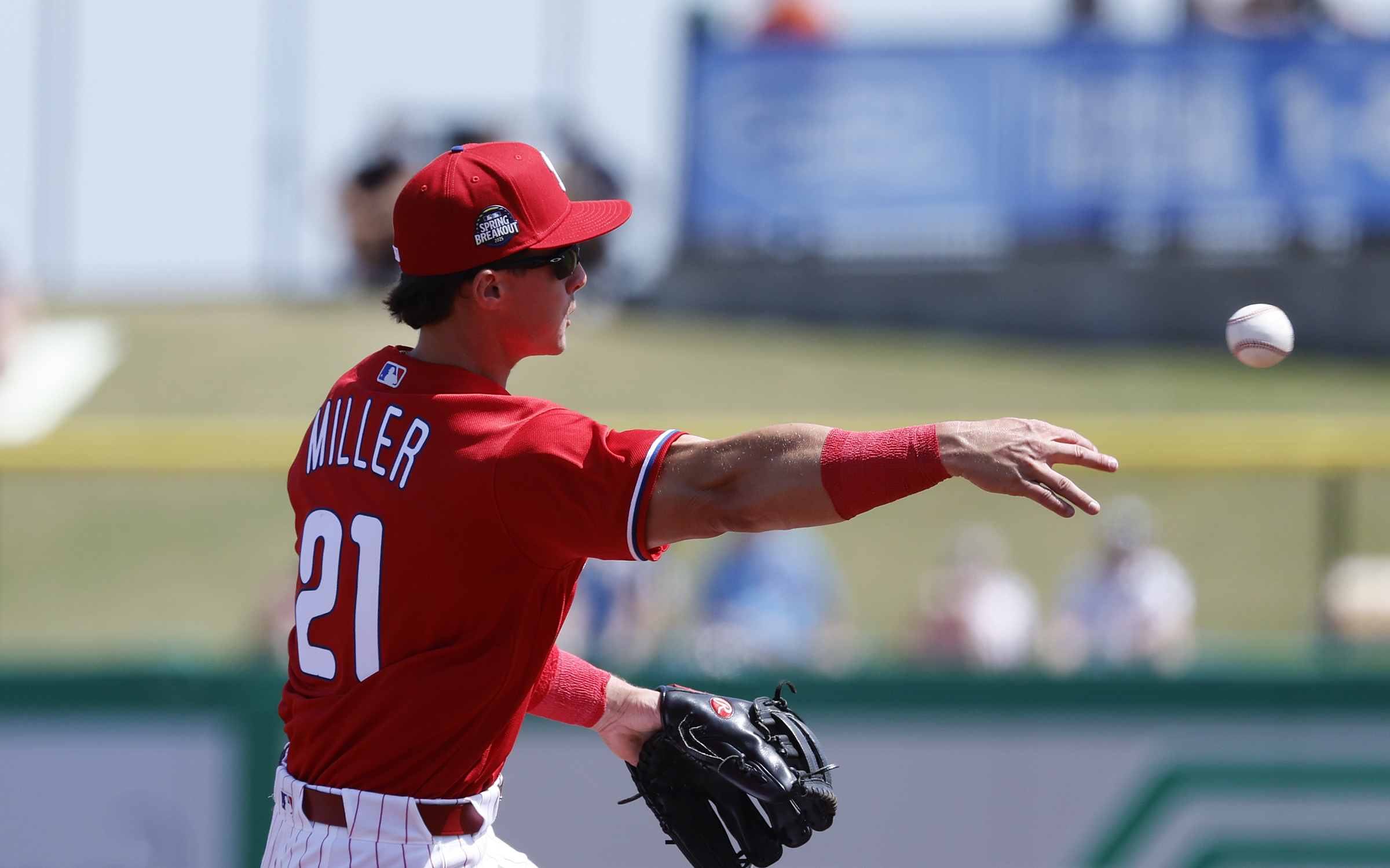
The Phillies believe Aidan Miller can stick at shortstop, but that’s blocked by Trea Turner for now.
Down on the farm
The Phillies’ top infield prospect, Aidan Miller, is rising quickly. The 21-year-old posted an .825 OPS this year and stole 59 bases between double-A Reading and triple-A Lehigh Valley. But the question remains as to where he will play in the majors.
Miller, who finished the season in triple A after a September promotion, has played shortstop throughout his minor-league career. Similar to the situation with top outfield prospect Justin Crawford, the Phillies believe that when Miller reaches the major leagues, he will need to be an everyday player.
A Miller breakthrough next season would require some changes to the current infield configuration. And Turner, who is under contract through 2033, doesn’t appear to be on the move from shortstop anytime soon. Dombrowski said the Phillies are still having conversations about Miller’s long-term position.
“When I talked to people in our organization, they feel he can play shortstop. Of course, we have an All-Star shortstop at this point,” he said. “… [Miller has] played some second, he’s played some third, but he’s primarily been a shortstop, so we’d have to make sure that we properly prepare him to do that, and that’s still a discussion that we’ll have to have.”
Miller initially planned to participate in the Arizona Fall League, but the Phillies decided to prioritize rest instead.
Further down the pike, second baseman Aroon Escobar is the Phillies’ No. 5 prospect, according to MLB Pipeline. Escobar, 20, ascended three levels in 2025 to finish the season at double A. He hit 15 homers and had 62 RBIs in 120 games.
Also in double A to end the year is Phillies No. 13 prospect Carson DeMartini. In his first full professional season after being drafted in 2024 out of Virginia Tech, the third baseman posted a .707 OPS and stole 45 bases.
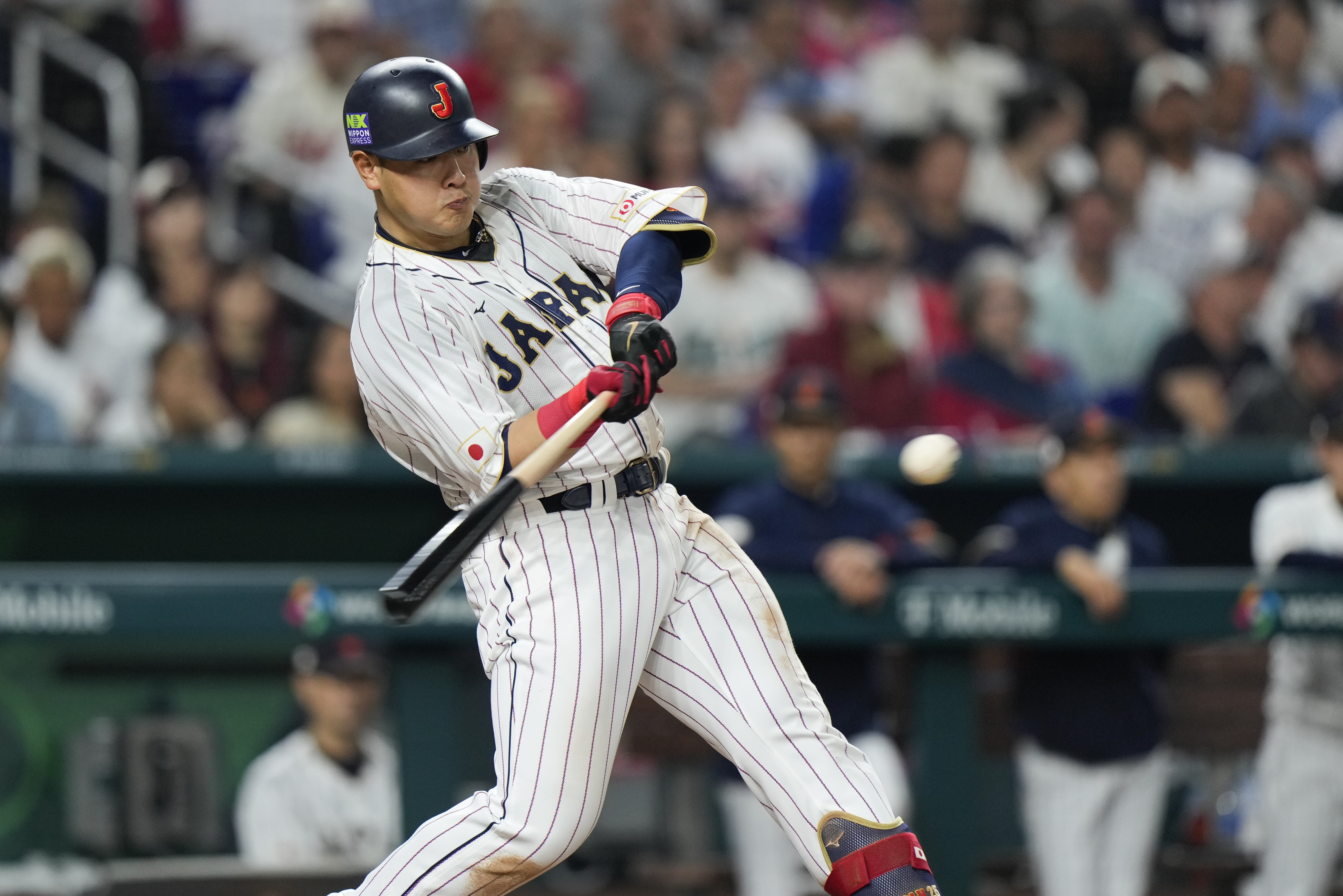
Kazuma Okamoto has slashed .277/.361/.521 with 248 homers over 11 seasons in Nippon Professional Baseball in Japan.
Free agency
The Phillies don’t have a pressing free-agent need to fill in the infield, though that could change if a trade is made. (The battery will be covered later in this series.)
Currently, one of the top available names on the market is righty third baseman Alex Bregman, who is set to opt out of his contract with the Red Sox after an All-Star season in which he slashed .273/.360/.462 with 18 homers.
Third baseman Eugenio Suárez was one of the most coveted offensive trade deadline acquisitions this year and was linked to the Phillies before ending up with the Mariners. Suárez saw a dip in production in the second half, but he still had some big postseason moments for Seattle, such as a game-winning grand slam in Game 5 of the American League Championship Series.
Gleyber Torres, 28, had an overall bounce-back year with the Tigers after the Yankees let him walk in 2024. The right-handed-hitting second baseman was named an All-Star for the first time since 2019. Torres saw diminished production later in the season, with a .812 first-half OPS compared to .659 in the second half, but revealed that he had been playing through a sports hernia late in the year.
There are also international options. In recent years, the Phillies have attempted to expand their outreach in Japan in the hopes of attracting top stars there, but have yet to break through.
The Yomiuri Giants of Nippon Professional Baseball have announced that they will be posting corner infielder Kazuma Okamoto. The right-handed 29-year-old has hit .277/.361/.521 with 248 homers over 11 seasons in NPB.
According to an MLB.com report, Munetaka Murakami is also expected to be posted this winter. Murakami, 25, is a left-handed-hitting corner infielder with a career .951 OPS across eight seasons in NPB. He was named Most Valuable Player of the Central League in 2021 and 2022.
Forty-five years ago this week, the Phillies won their first World Series.
At the center of it all, Michael Jack Schmidt.
Schmidt went 8-for-21 with two homers and seven RBIs against the Royals and was named World Series MVP, a crowning achievement in his Hall of Fame career. But he badly needed that performance to change the narrative after several years’ worth of playoff disappointment, individually and for the team.
Here’s an excerpt from our conversation, edited for brevity and clarity. Watch the full interview below and subscribe to the Phillies Extra podcaston Spotify or Apple Podcasts.
Q: Kyle Schwarber has 340 home runs through age 32. What’s the key to maintaining the production on the back nine of a career?
A: You’re getting into your middle 30s, moving a little bit into your late 30s, if you can stay healthy, continue a really, really strong workout program in the offseason. Your flexibility has to be there. Your bat speed obviously has to stay up. Your eyes have to stay — you’ve got to be able to see. I had 20/10 vision when I played. And it’s important to have good eyesight as you’re going forward, like you did when you were young.
There’s a lot of nonmechanical baseball swing issues that have got to stay right because you’ve got to be quick.
Schwarber is now quick to the ball, and you have to have confidence you could hit a 95 mph fastball as you get older. That’s what kind of sent me out of the game — that fastball just started to just get by me. My reactions weren’t as strong as they were when I was young. My bat speed wasn’t what it used to be.
It’s like golf. As you get older, you wonder, ‘Why did I lose my length? How come I can only hit at 240 now? I used to be able to hit it 290-300,’ and things just change when you get older. So you’ve got to fight that off as long as you can. You’ve got to push that off into your 40s or whatever. And so, that’s a big issue.
… We’re crazy to [only] use the number 500 [homers] with Kyle Schwarber. You’re only talking about what, five more years at 30 a year to get to 500? He’s probably got, let’s say, five more years at 50 a year. Five more years at 40-45, a year. So, his No. 500, I believe, is selling a little bit short.
Q: Why do you think Bryce Harper has been such a good fit for Philly and maybe vice versa?
A: I had my doubts in the beginning, from a distance, from what I knew about [him] playing at Washington. I had my doubts about that. Plus, you add in that crazy amount of money [$330 million] the Phillies gave him to come to Philadelphia and the number of years [13], and I just had my doubts. And he has taken to Philly like a duck to water. He’s got a fantastic team around him. He’s a great family man. He plays the Philly way — down and dirty, and that’s the way he is. And he brings the crowd into his game, and the game into the crowd. He’s a little bit the opposite of me. I kind of played with those blinders on, and he’s very emotional when he plays the game. The Philly fans love that. He’s gotten a lot of big hits. He loves that big moment. The fans love to be there when Bryce comes up in a big moment. So he’s a clutch player, there’s no question about that.
And he knows the history of the game. He gives me a lot of respect. And also other players to play before him. That’s good. Players of my era like to see that in current-day players as a rule. … We don’t think that this generation of players knows as much about us as they should, because I know that when we played, we knew about the guys that came before us. We had their baseball cards when we were young, and … if somebody walked in, if Stan Musial walked into our clubhouse, we’d all rush over to meet him. We all knew who he [was]. I don’t want to get too deep into this, but I think over time, the sense of the people that came before you — and in all sports — I truly believe that is diminished from what it was 20-30 years ago. Not with Bryce. Bryce is very informed about the alumni like myself.
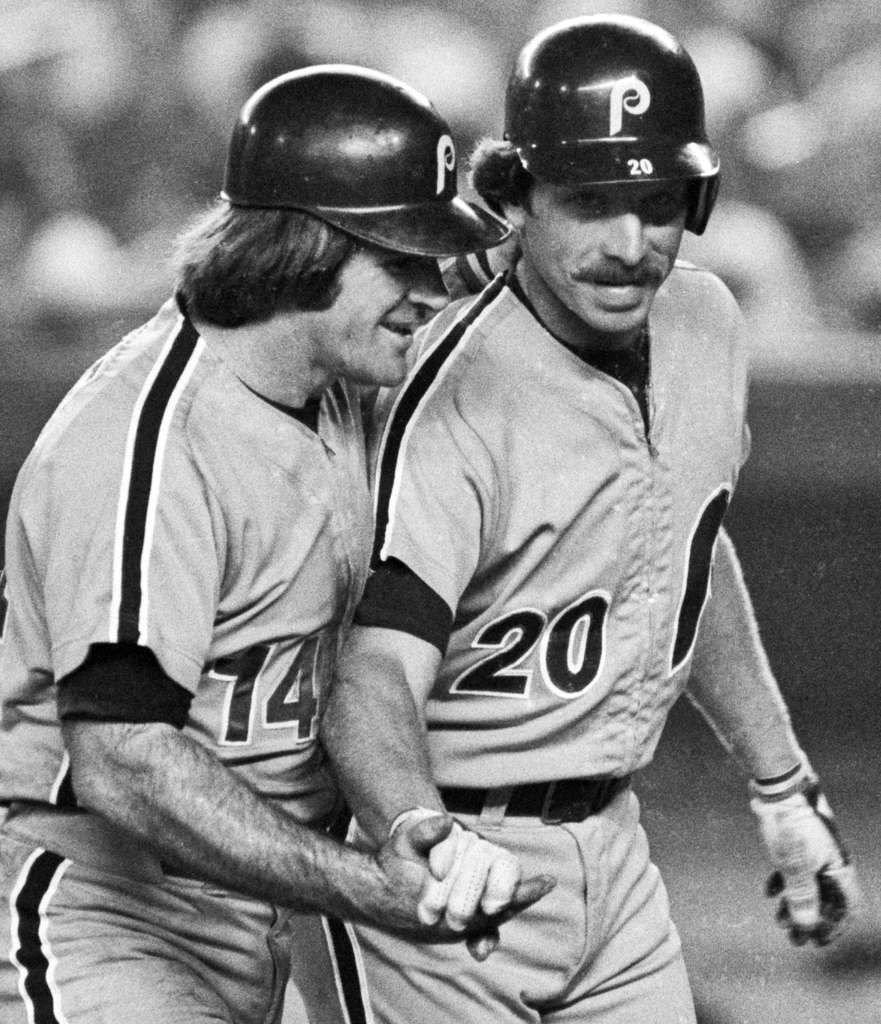
Pete Rose (left) was Phillies teammates with Mike Schmidt for five seasons.
Q: In May, the commissioner posthumously reinstated Pete Rose, whose name could be put before a Hall of Fame era committee for consideration for induction in December 2027. Within the Hall of Fame community, do you think there’s support to put Pete Rose in the Hall of Fame?
A: I do, but I don’t know that it’s any more than 50% … There are as many detractors as supporters in Pete’s case. However [Hall of Fame chairman of the board of directors] Jane Clark forms the committee, that will determine Pete’s fate. And even if they put 16 ex-players, members of the Hall of Fame on it, I still think it would be 50/50. And if they put four or five Hall of Fame members on it, and GMs and team presidents and media people and historians, and they put all those guys on it, I still think it runs 50/50. [Note: 75% support is required for election.]
… I can’t go one way strong or the other, based upon my experiences and talking about Pete, wherever I’ve been, be it around the members of the Hall of Fame or media types, Just general conversation at a restaurant or something with people.
What a tumultuous life that man led. I don’t think he handled the whole situation very well. I’m not a proponent of him gambling on the game, which was the big issue, of course. The people’s lives that he affected through that, through his life during that period, the way he handled when he admitted on that, and the way that Mr. [former commissioner Bud] Selig was hoping that he would change his life and do some good, change his habits in life to positive things for the game of baseball and for himself and his family, which didn’t happen.
So I think he created his own fate. And now we will find out, I guess in two or three years, when this committee votes whether he will have a plaque in the Hall of Fame. And I believe that if he doesn’t, I still think there should be a big corner in the museum somewhere that shows pictures and tells the story, maybe a video of some sort, of Pete Rose happening in the history of baseball. Because I think it’s important. Whether it was a negative stain on the sport or not, that’s part of it.
Phillies pitcher Orion Kerkering gets replaced by manager Rob Thomson in the eighth inning against the Atlanta Braves on Sunday, August 31, 2025 in Philadelphia.Yong Kim / Staff Photographer
The Phillies are primed for big changes. Who needs to come back, and who needs to go? Swipe and decide
For the second straight year, the Phillies won the National League East. And for the second straight year, the season came to an unceremonious end in the National League Division Series.
Dave Dombrowski tried to improve the roster at the margins last winter, signing pitchers Joe Ross and Jordan Romano and outfielder Max Kepler to one-year deals and trading for Jesús Luzardo. Neither Ross nor Romano threw a pitch for the Phillies after August.
The Phillies have around $170 million committed to eight players for 2026, plus nine arbitration-eligible players. But with several key members of the Phillies core set to hit free agency this year, they are primed for bigger changes. Will they go bigger and bolder this year?
“You’re always looking to get better, so we will be open-minded to that,” Dombrowski said at his year-end press conference on Thursday. “I think it's a little bit different in that there's some built-in situations for us that are going to have to be addressed. So where you go as a club is very much dictated on some of those moves that end up happening.”
As the Phillies consider their next move, you can have your say. Make your pick for each player by swiping the cards below — right for Stay or left for Go. Yes, just like Tinder. Finding it hard to decide? We'll also show you how other Inquirer readers have voted so far and what we think the team will do.
Advertisement
Pitchers
For the first time under manager Rob Thomson, the Phillies have a bona-fide closer to go with a top-end starting rotation. But some changes will be coming, with Ranger Suárez heading to free agency and the enduring Andrew Painter question. The Phillies also have to address their middle relief corps. Navigating the bridge from their starters to Jhoan Duran was a weakness during the playoffs.
#45
Zack
Wheeler
All-Star
Crowd says
Contract
Signed thru '27
Age
35
Inky Says Stay
March: Wheeler is expected back from thoracic outlet surgery in the first half of ’26. He had a 2.71 ERA before his diagnosis and was building another Cy Young-caliber year.
#55
Ranger
Suárez
Crowd says
Contract
Free agent
Age
30
Inky Says Go
March: Suárez is primed for a big payday, but with a crowded rotation and Andrew Painter on the way, it’s unlikely the Phillies will outbid other teams to keep him.
#27
Aaron
Nola
Crowd says
Contract
Signed thru '30
Age
32
Inky Says Stay
March: Hampered by injuries, Nola had a career-worst 6.01 ERA. But some better starts late in the year showed flashes of the old Nola, signaling a bounce back next season.
#50
Orion
Kerkering
Crowd says
Contract
Pre-arbitration
Age
24
Inky Says Stay
March: If Kerkering regains confidence after that brutal finish, he’s worth keeping. Despite inconsistent execution, his 33.5% hard-hit rate at age 24 signals back-end potential.
#61
Cristopher
Sánchez
Crowd says
Contract
Signed thru '28
Age
28
Inky Says Stay
March: Sánchez stepped into the role of the Phillies’ ace in the absence of Zack Wheeler. He had a 2.50 ERA over 202 innings (22 quality starts) and his 8.0 bWAR led all pitchers.
#46
Jose
Alvarado
Crowd says
Contract
Club option
Age
30
Inky Says Stay
March: If the Phillies are betting on first-half Alvarado — who had a 2.70 ERA and a 99 mph fastball before his PED suspension — it’s worth exercising their club option.
#58
Tanner
Banks
Crowd says
Contract
Arbitration elig.
Age
33
Inky Says Stay
March: Banks has developed into a reliable option against left-handed hitters, holding them to a .175 batting average this season.
#31
Walker
Buehler
Crowd says
Contract
Free agent
Age
31
Inky Says Go
March: Buehler had a 0.66 ERA in a tiny sample size (13⅔ innings) with the Phillies, but had major struggles with command all year. It would be risky to commit a rotation spot.
#59
Jhoan
Duran
Crowd says
Contract
Arbitration elig.
Age
27
Inky Says Stay
March: As the Phillies’ closer, Duran is the anchor of the bullpen. His 32 saves in 2025 were a career high.
#44
Jesús
Luzardo
Crowd says
Contract
Signed thru '26
Age
28
Inky Says Stay
March: Luzardo had some rough patches, but overall put together a strong season. His 183⅔ innings were a career high, and he finished second in the NL in strikeouts (216).
#54
Tim
Mayza
Crowd says
Contract
Free agent
Age
33
Inky Says Stay
March: Mayza pitched only 16⅔ innings in an injury-plagued season, but left-handed relievers with a 53.8% ground-ball rate can be hard to come by. He could be worth another shot.
#30
David
Robertson
Crowd says
Contract
Free agent
Age
40
Inky Says Go
March: Robertson had a 28.2% strikeout rate in 20 games. He has undeniable experience, but will be entering his age-41 season and the Phillies may prefer to build for the future.
#68
Jordan
Romano
Crowd says
Contract
Free agent
Age
32
Inky Says Go
March: Romano was a reclamation project that didn't pan out, and he ended the season on the injured list after struggling to an 8.23 ERA. A change of scenery will be best for all.
#25
Matt
Strahm
Crowd says
Contract
Signed thru '26
Age
33
Inky Says Stay
March: One of the leaders in the bullpen, Strahm can get lefties and righties out and is a solid setup man for Jhoan Duran. Strahm held opponents to a 4.3% barrel rate in 2025.
#57
Lou
Trivino
Crowd says
Contract
Free agent
Age
34
Inky Says Go
March: Trivino had a 1.343 WHIP across three teams. Though his numbers improved with the Phillies late in the year, they may prefer a more consistent middle relief option.
#99
Taijuan
Walker
Crowd says
Contract
Signed thru '26
Age
33
Inky Says Stay
March: Walker improved from his 2024 season as he bounced between the rotation and bullpen. There were still inconsistencies, but his fastball velocity increased to 92.1 mph.
It isn’t usually the best idea to offer a multiyear contract to a catcher who is entering his age-35 season and coming off his worst offensive season in 10 years. But here’s the question: If not J.T. Realmuto, then who? The pitchers swear by Realmuto, and the Phillies are built on pitching. Maybe it isn’t such a difficult decision after all.
#10
J.T.
Realmuto
Crowd says
Contract
Free agent
Age
34
Inky Says Stay
Lauber: Signing a 35-year-old catcher to a multiyear contract usually isn't wise. But what's the alternative? As Cristopher Sánchez said, “We’re basically nothing without him."
#13
Rafael
Marchán
Crowd says
Contract
Arbitration elig.
Age
26
Inky Says Stay
Lauber: How do you evaluate a catcher who plays once a week? Say this: There's upside for a larger workload, although he remains the backup to J.T. Realmuto or a replacement.
#21
Garrett
Stubbs
Crowd says
Contract
Arbitration elig.
Age
32
Inky Says Stay
Lauber: After stepping back to triple A, he's out of minor league options. But if there's a way to keep him and Rafael Marchàn in the organization, catching depth is important.
The infield, to quote Dombrowski, is “pretty well solidified.” The Phillies prefer to keep Bryce Harper at first base, and Trea Turner quieted talk of a position change by making drastic improvements in his defense at shortstop. Bryson Stott will likely reprise his role at second base, with Edmundo Sosa providing an option against left-handed pitching. Get ready, then, for another round of Alec Bohm trade rumors. Third base is the one spot where change could be coming.
#7
Trea
Turner
Crowd says
Contract
Signed thru '33
Age
32
Inky Says Stay
Lauber: Behold the NL batting champ. Also, one of four Phillies players to bat .300 with at least 175 hits, 15 homers, and 30 steals in a season. He's squarely in his prime.
#3
Bryce
Harper
Crowd says
Contract
Signed thru '31
Age
33
Inky Says Stay
Lauber: Something seemed … off? … all season. Maybe it was his achy right wrist. He still finished 11th in OPS among NL hitters. Everything continues to revolve around No. 3.
#28
Alec
Bohm
Crowd says
Contract
Arbitration elig.
Age
29
Inky Says Go
Lauber: Get ready for another winter as a walking trade rumor. But after an injury-filled, league-average season with Bohm entering his walk year, the Phillies will be selling low.
#4
Otto
Kemp
Crowd says
Contract
Pre-arbitration
Age
26
Inky Says Stay
Lauber: An undrafted Division II college player reaching the majors was one of the year's best Phillies stories. He'll have a chance to stick around as a right-handed bench bat.
#33
Edmundo
Sosa
Crowd says
Contract
Arbitration elig.
Age
29
Inky Says Stay
Lauber: A versatile fill-in all over the infield, he's also the lefty-mashing half of a potential second-base platoon with Bryson Stott. Either way, he brings energy and value.
#5
Bryson
Stott
Crowd says
Contract
Arbitration elig.
Age
28
Inky Says Stay
Lauber: He batted .310 with an .880 OPS after Aug. 1 by lowering his hands and moving closer to the plate, à la Kyle Schwarber. Maybe it unlocked peak Stott. At last.
It’s possible the Phillies could have an entirely new outfield. Nick Castellanos isn’t expected back. Harrison Bader and Kepler are free agents, with only Bader on the Phillies’ radar. Justin Crawford is on the way, but will he play center field or left? The answer could impact Brandon Marsh’s future. It’s the most unsettled area on the field … again. Oh, and there’s a $125-ish million question at DH, with free agent Kyle Schwarber.
#12
Kyle
Schwarber
All-Star
Crowd says
Contract
Free agent
Age
32
Inky Says Stay
Lauber: As long as the Phillies are spending $125 million or so, what about a solid outfield defender with a low strikeout rate? Cody Bellinger, anyone? Probably not over Schwarber.
#8
Nick
Castellanos
Crowd says
Contract
Signed thru '26
Age
33
Inky Says Go
Lauber: In a hitting-depressed era, someone (Royals? Reds? Giants?) may take a one-year flier. How much of his $20 million salary must the Phillies eat? Regardless, he's gone.
#16
Brandon
Marsh
Crowd says
Contract
Arbitration elig.
Age
27
Inky Says Stay
Lauber: Subtract April, and he was seventh among NL outfielders in OPS (.836). How's that for a trade pitch? Problem is, he's one of the Phillies' few outfield assets.
#2
Harrison
Bader
Crowd says
Contract
Mutual option
Age
31
Inky Says Go
Lauber: If the Phillies are honest, he surpassed expectations after a deadline trade. Assuming he declines his $10 million option, bid him farewell and usher in Justin Crawford.
#17
Max
Kepler
Crowd says
Contract
Free agent
Age
32
Inky Says Go
Lauber: A .791 OPS in August and September kept him from being a total bust. Overall, he underperformed a $10 million, one-year contract. He isn't the answer in left field.
#23
Johan
Rojas
Crowd says
Contract
Pre-arbitration
Age
25
Inky Says Go
Lauber: You could do worse for late-inning defense and speed off the bench. But after Rojas was sent back to the minors in July, a change of scenery is probably best for everyone.
#37
Weston
Wilson
Crowd says
Contract
Pre-arbitration
Age
31
Inky Says Stay
Lauber: He's out of minor league options, which could be a factor in a potential spring-training competition with Otto Kemp for a spot as a right-handed hitter off the bench.
All Outfielders rated!
Advertisement
Staff Contributors
Development: Sam Morris and Jasen Lo
Design: Sam Morris, Jasen Lo, and Luke Reasoner
Reporting: Scott Lauber and Lochlahn March
Editing: John Roberts and Jim Swan
Photo Editing: Danese Kenon
Photography: Staff Photographers, additional photography provided by Associated Press