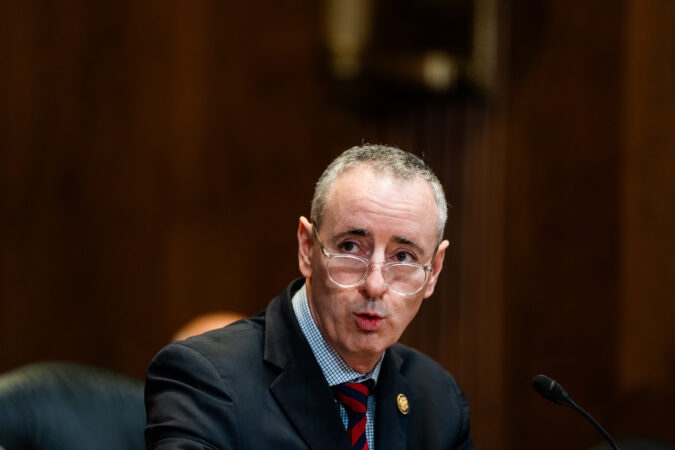
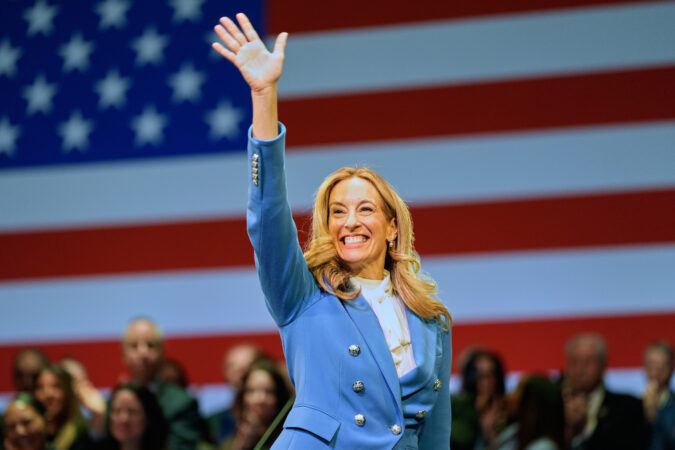
U.S. Sen. John Fetterman (D., Pa.) is calling on the Department of Homeland Security to hit the brakes on its plan to develop two Immigration and Customs Enforcement detention centers in Pennsylvania, saying they would have a negative impact on local communities.
“While I have been clear in my support for the enforcement of federal immigration law, this decision will do significant damage to these local tax bases, set back decades-long efforts to boost economic development, and place undue burdens on limited existing infrastructure in these communities,” Fetterman wrote in a letter addressed to DHS Secretary Kristi Noem and posted online Saturday.
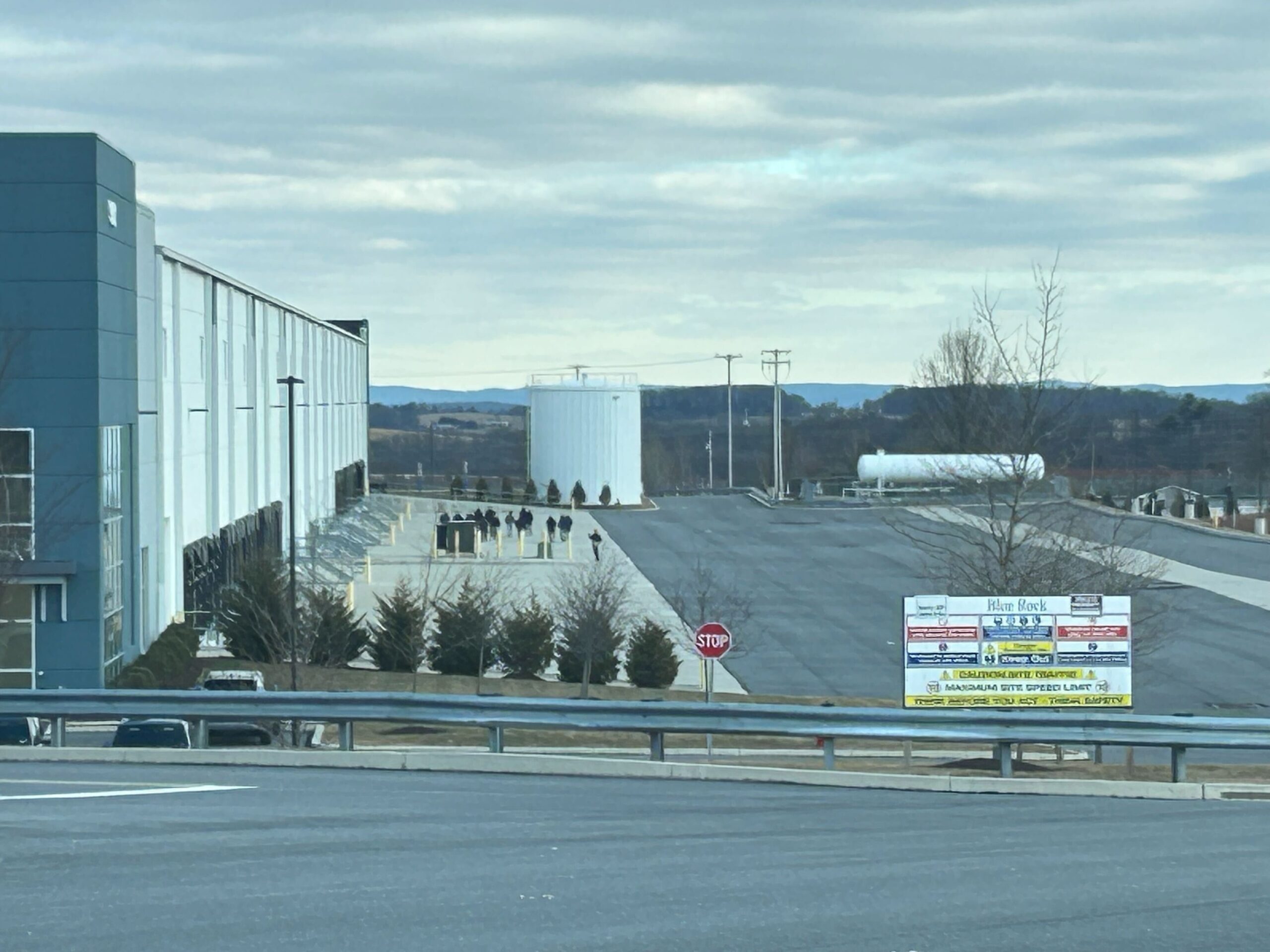
A 1.3-million-square-foot former Big Lots warehouse in Tremont, Pa., has been bought by U.S. Immigration and Customs Enforcement for $119 million. The agency plans to detain up to 7,500 immigrants there.
The Tremont Township detention center would house as many as 7,500 people, Fetterman noted, while the Upper Bern Township one would be capable of detaining 1,500 people.
Upper Bern Township has 1,606 residents, according to the U.S. Census Bureau, and is about 30 minutes northwest of Reading. The facility is near an Amazon warehouse and the Mountain Springs Camping Resort.
Tremont Township — where the much larger detention center is set to be built — has just 283 residents and is next to the 1,670-resident Tremont Borough. Tremont is in a rural area northeast of Harrisburg, near the Appalachian Trail, state game lands, and Fort Indiantown Gap, an Army National Guard training center.
In his letter, Fetterman said local and state officials did not have a chance to weigh in on how these massive facilities would affect everything from sewer systems and the electrical grid to hospitals and emergency medical services.
“Both townships do not currently have the capacity to meet the demands of these detention centers, with Tremont Township officials specifically stating the proposed 7,500-bed detention facility would quadruple the existing burden on their public infrastructure system,” Fetterman said.
A warehouse in Upper Bern Township, Berks County, Pa., was purchased by ICE and the Trump administration.
The letter maintains Fetterman’s stance as someone who supports ICE operations in general while criticizing the federal government’s recent handling of them. After federal agents shot and killed two U.S. citizens in Minneapolis last month, Fetterman called on the Trump administration to fire Noem. A few days later, Fetterman said he supports ICE agents wearing face masks.
Fetterman was among 23 Senate Democrats to cross the aisle last month to vote for a compromise bill funding the federal government through September, while granting just two weeks of funding for DHS.
Fetterman said the Pennsylvania facilities would result in a tax loss of $1.6 million to the communities. He asked DHS to agree to several conditions before proceeding further with the sites.
He requested an “impact assessment,” details on the criteria used to select these facilities, an agreement that federal funds be used to upgrade them, and “a commitment to a period of public engagement and dialogue with these communities.”
“Due to these significant concerns, it is my fear that DHS and ICE did not perform any due diligence, spending more than $200 million in tax dollars for warehouses that cannot be adequately converted and further eroding trust between Pennsylvanians and the Federal government,” Fetterman wrote.
The Department of Homeland Security and Immigration and Customs Enforcement did not immediately respond to a request for comment.
This story has been updated to correct the location of one of the proposed detention centers to Upper Bern Township.
As Chris Scafario sees it, Philadelphia’s reputation as an “eds and meds” region, referring to its plethora of colleges and hospitals, could grow a third leg.
It could also become the defense industrial base region,said Scafario, CEO of the Delaware Valley Industrial Resource Center.
President DonaldTrump wants to increase defense spending, with $1.5 trillion proposed for 2027. This could mean more research and workforce development training opportunities — and local universities are positioned to take advantage of it, Scafario said.
Chris Scafario, CEO of the Delaware Valley Industrial Resource Center
“A lot of that investment is going to be targeted toward university and innovation-based relationships because they need help getting stuff done,” said Scafario, who is talking to local colleges to help get them ready to capitalize. “They need access to brilliant people, whether they’re faculty or the faculty’s work products, the students.”
The move comes as colleges face potential cuts in research funding under the Trump administration in other areas, such as the National Institutes of Health. Both Princeton University and the University of Pennsylvania in the last month announced cutbacks to cope with potential financial fallout from federal policies.
Scafario’s center, which is based at the Navy Yard and was founded in 1988, aims to foster economic development and local manufacturing.
The Philadelphia region has been involved in defense contracting on and off for years, with major hubs in naval and aerospace manufacturing, and local universities say they worked with the Department of Defense in the past. Rowan University in New Jersey says it has $70 million in defense-related research projects underway.
But Scafario sees the opportunity for major expansion.
Drexel University, Temple University, Penn, Rowan, and Villanova University, which is already a top producer of naval engineers, are among the schools that are “in a great spot to leverage the opportunities that are going to be coming through the defense industrial base,” Scafario said. “In the next year, people are going to start realizing that we are meds, eds, and a defense industrial base region. It’s going to bring a lot of investment, a lot of economic opportunities, and some really, really great employment opportunities in the region.”
The Philadelphia region could become a national anchor for shipbuilding or other maritime industrial-based activities, he said.
Scafario hopes to bring colleges together with other partners for more discussions in the spring when the timeline for those federal investments starts to become clearer, he said.
Amanda Page, Warfighter Technologies Liaison for the Delaware Valley Industrial Resource Center
Colleges could help with efforts to accelerate production capacity of naval ships and work on initiatives such as how to make submarines less traceable and more durable. Or they could help improve medical equipment and training for the battlefield. The treatment standard in the military used to be the “golden hour”; now it’s about “prolonged field care,” said Amanda Page, a retired active-duty Army medic who serves as warfighter technologies liaison for the center.
“Medical personnel need to be prepared mentally, physically, emotionally, and electronically to keep those patients for 96 hours,” Page said. “That’s going to require a ton of research and technology.”
Page was hired by the center in October to help build relationships between the center, the Department of Defense (which the Trump administration has rebranded the Department of War), local higher education systems, and the city.
“I’m super excited about what it will bring to the region and what the region can prove to the Department of War about its legitimacy,” she said, “as a manufacturing and technology powerhouse.”
Local colleges say they are reviewing potential collaborations.
“There are a lot of opportunities we are looking at,” said Aleister Saunders, Drexel’s executive vice provost for research and innovation, declining to provide specificsfor competitive reasons.
In addition to opportunities with the Navy and the Navy Yard, he noted major local companies involved with aerospace and aviation, including Lockheed Martin and Boeing. There are also opportunities around materials and textiles with the Philadelphia-based Defense Logistics Agency Troop Support, which provides many of the supplies to the military.
“Those are really valuable assets that we should find a way to leverage better than we are,” he said.
Key opportunities are available in advanced manufacturing and workforce development, he said.
“There could be folks who are already working in manufacturing who need [upgraded skills] in advanced manufacturing techniques,” he said.
Temple University president John Fry said increasing research opportunities and impact — the school’s research budget now exceeds $300 million — is a priority in the school’s strategic plan. Temple offers opportunities around medical manufacturing, healthcare, and health services, he said.
“The key to doing that is going to be partnerships,” he said.
Josh Gladden, Temple’s vice president for research, said he has met with folks from Scafario’s group and they are talking about some opportunities, but declined to discuss them because they are in early development.
He noted that the Navy is interested in working with Temple’s burn unit.
Temple has also been getting to know the workforce needs of businesses at the Navy Yard and looking at how to align its educational programs, Fry said.
“Those are relationships I would love to pursue,” he said. “Part of our mission is to develop the future workforce and grow the regional economy, and that’s one way of doing it.”
Rowan has been a longtime research partner with the U.S. military, said Mei Wei, the school’s vice chancellor for research.
“It’s encouraging to know there could be more funding available for research,” Wei said. “These projects give our undergraduate and graduate students the opportunities they need to develop their research skills with close guidance from our faculty and our external partners.”
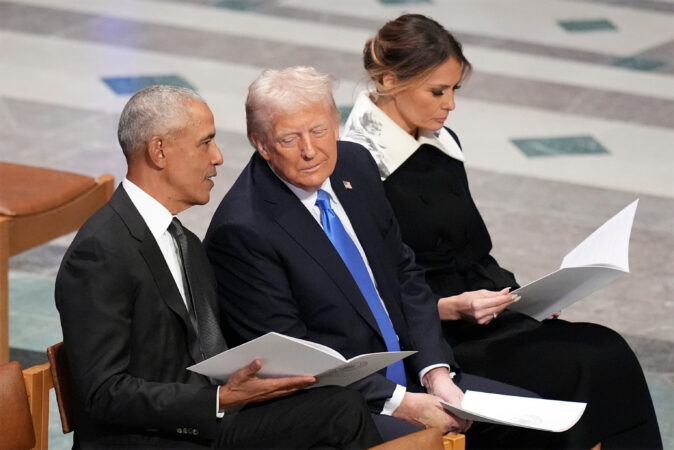
WASHINGTON — President Donald Trump’s racist social media post featuring former President Barack Obama and his wife, Michelle Obama, as primates in a jungle was deleted after a backlash from both Republicans and Democrats who criticized the video as offensive.
Trump said later Friday that he won’t apologize for the post. “I didn’t make a mistake,” he said.
The Republican president’s Thursday night post was deleted Friday and blamed on a staffer after widespread backlash, from civil rights leaders to veteran Republican senators, for its treatment of the nation’s first Black president and first lady. The deletion, a rare admission of a misstep by the White House, came hours after press secretary Karoline Leavitt dismissed “fake outrage” over the post. After calls for its removal for being racist — including by Republicans — the White House said a staffer had posted the video erroneously and it had been taken down.
The post was part of a flurry of social media activity on Trump’s Truth Social account that amplified his false claims that the 2020 election was stolen from him, despite courts around the country and a Trump attorney general from his first term finding no evidence of fraud that could have affected the outcome.
Trump has a record of intensely personal criticism of the Obamas and of using incendiary, sometimes racist, rhetoric — from feeding the lie that Obama was not a native-born U.S. citizen to crude generalizations about majority Black countries.
The post came in the first week of Black History Month and days after a Trump proclamation that cited “the contributions of black Americans to our national greatness and their enduring commitment to the American principles of liberty, justice, and equality.”
An Obama spokeswoman said the former president, a Democrat, had no response.
‘An internet meme’
Nearly all of the 62-second clip, which was among dozens of Truth Social posts from Trump overnight, appears to be from a conservative video alleging deliberate tampering with voting machines in battleground states as the 2020 presidential votes were tallied. At the 60-second mark is a quick scene of two primates, with the Obamas’ smiling faces imposed on them.
Those frames were taken from a separate video, previously circulated by an influential conservative meme maker. It shows Trump as “King of the Jungle” and depicts a range of Democratic leaders as animals, including Joe Biden, who is white, as a jungle primate eating a banana.
“This is from an internet meme video depicting President Trump as the King of the Jungle and Democrats as characters from The Lion King,” Leavitt said by text.
Disney’s 1994 feature film that Leavitt referenced is set on the savannah, not in the jungle, and it does not include great apes.
“Please stop the fake outrage and report on something today that actually matters to the American public,” Leavitt added.
By noon, the post had been taken down with responsibility placed on a Trump subordinate.
The White House explanation raised additional questions about the control of Trump’s social media account, which has also been used to levy import taxes, threaten military action, make domestic policy announcements, and intimidate political rivals. The president often signs his name or initials after policy announcements.
The White House did not immediately respond to questions about its process for vetting posts and how it guarantees that the public knows when Trump himself is posting.
Mark Burns, a pastor and a prominent Trump supporter who is Black, said Friday afternoon on X that he had spoken “directly” with Trump about the post. He recommended to Trump that he fire the staffer who posted the video and publicly condemn what happened.
“He knows this is wrong, offensive, and unacceptable,” Burns posted.
Yet while it was still up, Trump’s post drew condemnation from across the political and ideological spectrum — and demands for an apology that had not come by the early afternoon.
The Rev. Bernice King, daughter of the assassinated civil rights icon the Rev. Dr. Martin Luther King Jr., resurfaced her father’s words: “Yes. I’m Black. I’m proud of it. I’m Black and beautiful.” She praised Black Americans as “diverse, innovative, industrious, inventive” and added, “We are beloved of God as postal workers and professors, as a former first lady and president. We are not apes.”
The U.S. Senate’s lone Black Republican, Tim Scott of South Carolina, called on Trump to take down the post. “Praying it was fake because it’s the most racist thing I’ve seen out of this White House,” Scott, who chairs Senate Republicans’ midterm campaign arm, said on social media.
Another Republican, Sen. Roger Wicker of Mississippi, is white but represents the state with the largest percentage of Black residents. Wicker called the post “totally unacceptable” and said the president should apologize.
Some Republicans who face tough reelections this November voiced concerns, as well, feeding an unusual cascade of intraparty criticism for a president who often has enjoyed a stranglehold over fellow Republicans who stayed silent over some of Trump’s previous controversial statements or fear a public spat with the president or losing his endorsement in a future campaign.
NAACP President Derrick Johnson pointed to Trump’s wider political concerns, asserting that Trump is trying anything to distract from economic conditions and attention on the Jeffrey Epstein case files.
“Donald Trump’s video is blatantly racist, disgusting, and utterly despicable,” Johnson said in a statement. “You know who isn’t in the Epstein files? Barack Obama,” he continued. “You know who actually improved the economy as president? Barack Obama.”
A long history of racism
There is a long history in the U.S. of powerful white figures associating Black people with animals, including apes, in demonstrably false and racist ways. The practice dates back to 18th-century cultural racism and pseudo-scientific theories in which white people drew connections between Africans and monkeys to justify the enslavement of Black people in Europe and North America, and later to dehumanize freed Black people as an uncivilized threat to white people.
Thomas Jefferson, author of the Declaration of Independence, wrote in his famous text “Notes on the State of Virginia” that Black women were the preferred sexual partners of orangutans. President Dwight Eisenhower, discussing the desegregation of public schools in the 1950s, once argued that white parents were concerned about their daughters being in classrooms with “big Black bucks.” Obama, as a candidate and president, was featured as a monkey or other primate on T-shirts and other merchandise.
In his 2024 campaign, Trump said immigrants were “poisoning the blood of our country,” language similar to what Adolf Hitler said to dehumanize Jews in Nazi Germany.
During his first White House term, Trump referred to a swath of developing nations that are majority Black as “shithole countries.” He initially denied using the slur but admitted in December 2025 that he did say it.
When Obama was in the White House, Trump advanced the false claims that the 44th president, who was born in Hawaii, was born in Kenya and was constitutionally ineligible to serve. Trump, in interviews that helped endear him to many conservative voters, repeatedly demanded that Obama produce birth records and prove he was a “natural-born citizen” as required to become president.
Obama eventually released his Hawaii records. Trump finally acknowledged during his 2016 campaign, after having won the Republican nomination, that Obama was born in Hawaii. But he immediately said, falsely, that his Democratic rival Hillary Clinton started those birtherism attacks on Obama.
COLORADO SPRINGS, Colo. — Derrick Johnson buried his mother’s ashes beneath a golden dewdrop tree with purple blossoms at his home on Maui’s Haleakalā Volcano, fulfilling her wish of a final resting place looking over her grandchildren.
Then the FBI called.
It was Feb. 4, 2024, and Johnson was teaching an eighth-grade gym class.
“‘Are you the son of Ellen Lopes?’” a woman asked, Johnson recalled in an interview with the Associated Press.
There had been an incident, and an FBI agent would fly out to explain, the caller said. Then she asked: “’Did you use Return to Nature for a funeral home?’”
“‘You should probably google them,’” she added.
In the clatter of the weight room, Johnson typed “Return to Nature” into his cell phone. Dozens of news reports appeared, details popping out in a blur.
Hundreds of bodies stacked on top of each other. Inches of body decomposition fluid. Swarms of bugs. Investigators traumatized. Governor declares state of emergency.
Johnson felt nauseated and his chest constricted, forcing the breath from his lungs. He pushed himself out of the building as another teacher heard his cries and came running.
Two FBI agents visited Johnson the following week, confirming his mother’s body was among 189 that Return to Nature’s owners, Jon and Carie Hallford, had stashed in a Colorado building between 2019 and Oct. 4, 2023, when the bodies were found.
Even as the Hallfords’ bills went unpaid, authorities said they bought Tiffany jewelry, luxury cars, and laser-body sculpting, pocketing about $130,000 clients paid for cremations.
They were arrested in Oklahoma in November 2023 and charged with abusing nearly 200 corpses.
Hundreds of families learned from officials that the ashes they ceremonially spread or kept close weren’t actually their loved ones’ remains. The bodies of their mothers, fathers, grandparents, children, and babies had moldered in a room-temperature building in Colorado.
Jon Hallford was sentenced Friday to 40 years in prison. His now ex-wife, Carie Hallford, was to be sentenced in April. Both had pleaded guilty in December. Attorneys for Jon and Carie Hallford did not respond to an AP request for comment.
Johnson, 45, who’s suffered panic attacks since the FBI called, promised himself that he would speak at Hallford’s sentencing and ask for the maximum penalty.
“When the judge passes out how long you’re going to jail, and you walk away in cuffs,” he said, “you’re gonna hear me.”
‘She lied’
Jon and Carie Hallford were a husband-and-wife team who advertised “green burials” without embalming as well as cremation at their Return to Nature funeral home in Colorado Springs.
She would greet grieving families, guiding them through their loved ones’ final journey. He was less seen.
Johnson called the funeral home in early February 2023, the week his mother died. Carie Hallford assured him she would take good care of his mother, Johnson said.
Days later, she handed Johnson a blue box containing a zip-tied plastic bag with gray powder, saying those were his mother’s ashes.
“She lied to me over the phone. She lied to me through email. She lied to me in person,” Johnson told the AP.
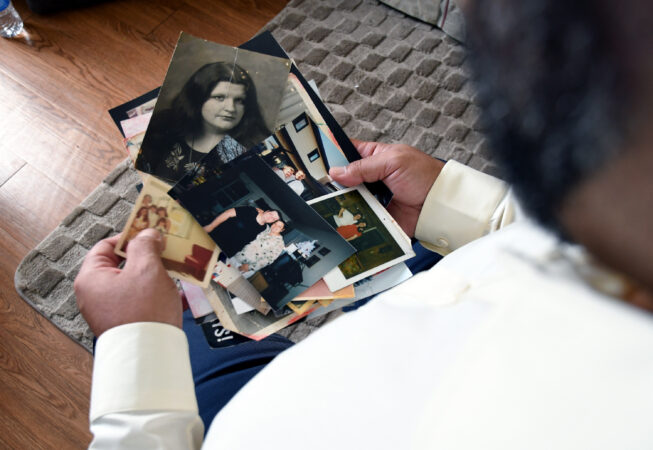
The following day, the box lay surrounded by flowers and photos of Ellen Marie Shriver-Lopes at a memorial service at a Holiday Inn in Colorado Springs.
Johnson sprinkled rose petals over it as a preacher said: “Ashes to ashes, dust to dust.”
Caught on video
On Sept. 9, 2023, surveillance footage showed a man appearing to be Jon Hallford walk inside a building owned by Return to Nature in the town of Penrose, outside Colorado Springs, according to an arrest affidavit.
Camera footage inside showed a body laying on a gurney wearing a diaper and hospital socks. The man flipped it onto the floor.
Then he “appeared to wipe the remaining decomposition from the gurney onto other bodies in the room,” before wheeling what appeared to be two more bodies into the building, the affidavit said.
In a text to his wife, Hallford said, “while I was making the transfer, I got people juice on me,” according to court testimony.
The neighborhood mom
Johnson grew up with his mother in an affordable-housing complex in Colorado Springs, where she knew everyone.
Johnson’s father wasn’t around much; at 5 years old, Johnson remembers seeing him punch his mom, sending her careening into a table, then onto a guitar, breaking it.
It was Lopes who taught Johnson to shave and hollered from the bleachers at his football games.
Neighborhood kids called her “mom,” some sleeping on the couch when they needed a place to stay and a warm meal. She would chat with Jehovah’s Witnesses because she didn’t want to be rude. With a life spent in social work, Lopes would say: “If you have the ability and you have the voice to help … help.”
Johnson spoke with his mother nearly everyday. After diabetes left her blind and bedridden at age 65, she’d ask Johnson to describe what her grandchildren looked like over the phone.
It was Super Bowl Sunday in 2023 when her heart stopped.
Johnson, who had flown in from Hawaii to be at her bedside, clutched her warm hand and held it until it was cold.
A gruesome discovery
Detective Sgt. Michael Jolliffe and Laura Allen, the county’s deputy coroner, stood outside the Penrose building on Oct. 3, 2023, according to the 50-page arrest affidavit.
A sign on the door read “Return to Nature Funeral Home” and listed a phone number. When Joliffe called it, it was disconnected. Cracked concrete and yellow stalks of grass encircled the building. At back was a shabby hearse with expired registration. A window air-conditioner hummed.
Someone had told Jolliffe of a rank smell coming from the building the day before, the affidavit said.
One neighbor told an AP reporter they thought it came from a septic tank; another said her daughter’s dog always headed to the building whenever he got off-leash.
It was reminiscent of rancid manure or rotting fish, and struck anyone downwind of the building.
Joliffe and Allen spotted a dark stain under the door and on the building’s stucco exterior. They thought it looked like fluids they had seen during investigations with decaying bodies, the affidavit said.
But the building’s windows were covered and they couldn’t see inside.
Allen contacted the Colorado Department of Regulatory Agency, which oversees funeral homes, which got in touch with Jon Hallford. Hallford agreed to show an inspector inside the next afternoon.
Inspector Joseph Berry arrived, but Hallford didn’t show.
Berry found a small opening in one of the window coverings, the affidavit said. Peering through, he saw white plastic bags that looked like body bags on the floor.
A judge issued a search warrant that week.
Bodies stacked high
Donning protective suits, gloves, boots, and respirators, investigators entered the 2,500-square-foot building on Oct. 5, 2023, according to the affidavit.
Inside, they found a large bone grinder and next to it a bag of Quikcrete that investigators suspected was used to mimic ashes. Bodies were stacked in nearly a dozen rooms, including the bathroom, sometimes so high they blocked doorways, the affidavit said.
There were 189.
Some had decayed for years, others several months, according to the affidavit. Many were in body bags, some wrapped in sheets and duct tape. Others were half-exposed, on gurneys or in plastic totes, or lay with no covering, it said.
Investigators believed the Hallfords were experimenting with water cremation, which can dissolve a body in several hours, the document said. There were swarms of bugs and maggots.
Body bags were filled with fluid, according to the affidavit. Some had ripped. Five-gallon buckets had been placed to catch the leaks. Removal teams “trudged through layers of human decomposition on the floor,” it said.
Investigators identified bodies using fingerprints, hospital bracelets and medical implants, the affidavit said. It said one body was supposed to be buried in Pikes Peak National Cemetery.
Investigators exhumed the wooden casket at the burial site of the U.S. Army veteran, who served in Vietnam and the Persian Gulf. Inside was a woman’s deteriorated body, wrapped in duct tape and plastic sheets.
The veteran’s body was discovered in the Penrose building, covered in maggots.
‘Ashes to ashes’
Following the call from the FBI, Johnson promised himself he would speak at the Hallfords’ sentencing. But he struggled to talk about what had happened even with close friends, let alone in front of a judge and the Hallfords.
For months, Johnson obsessed over the case, reading dozens of news reports, often glued to his phone until one of his children would interrupt him to play.
When he shut his eyes, he said he imagined trudging through the building with “maggots, flies, centipedes. There’s rats, they’re feasting.” He asked a preacher if his mother’s soul had been trapped there. She reassured him it hadn’t. When an episode of the zombie show The Walking Dead came on, he broke down.
Johnson started seeing a therapist and was diagnosed with post-traumatic stress disorder. He joined Zoom meetings with other victims’ relatives as the number grew from dozens to hundreds.
After Lopes’ body was identified, Johnson flew in March 2024 to Colorado, where his mother’s remains lay in a brown box in a crematorium.
“I don’t think you blame me, but I still want to tell you I’m sorry,” he recalled saying, placing his hand on the box.
Then Lopes’ body was loaded into the cremator and Johnson pushed the button.
Justice
Johnson has slowly improved with therapy, engaging more with his students and children. He began practicing speaking at the Hallfords’ sentencings in therapy. Closing his eyes, he envisioned standing in front of the judge — and the Hallfords.
“Justice is, it’s the part that is missing from this whole equation,” he said. “Maybe somehow this justice frees me.
“And then there’s part of me that’s scared it won’t, because it probably won’t.”
U.S. Rep. Brian Fitzpatrick (R., Bucks)called on President Donald Trump to apologize for sharing a racist video Thursday night on Truth Social that depicts former President Barack Obama, the country’s first Black president, and former first lady Michelle Obama, as apes.
“Whether intentional or careless, this post is a grave failure of judgment and is absolutely unacceptable from anyone — most especially from the President of the United States. A clear and unequivocal apology is owed,” Fitzpatrick wrote in a post on X Friday afternoon.
The Bucks County Republican, who will be defending a key swing district this fall, joined a bipartisan ensemble of lawmakers who are condemning Trump’s post, which was deleted Friday after the widespread backlash.
“Donald Trump is a bigoted, small-minded man who has long spewed racist remarks and tried to whitewash our nation’s history. Today he finds a new low,” said U.S. Rep. Dwight Evans (D., Philadelphia), a member of the Congressional Black Caucus, in a post on X. “His recent post is vile, disgusting, and abhorrently racist. Every elected official should speak up and condemn this hate.”
Sen. John Fetterman (D., Pa.) in a statement to The Inquirer, called the president’s post “indefensible and horrendous.”
“That garbage came from, and should forever remain in, the twisted and grotesque corners of the internet,” he said.
Fitzpatrick, a moderate representing a purple county, has disagreed with Trump before but the lawmaker’s comments Friday serve as one of his strongest rebukes yet.
“Racism and hatred have no place in our country — ever. They divide our people and weaken the foundations of our democracy,“ Fitzpatrick wrote. “History leaves no doubt: when division is inflamed by those in positions of power, the consequences are real and lasting.”
The White House blamed a staffer for the video, which was posted just fivedays into Black History Month, The Associated Press reported. This came after White House press secretary Karoline Leavitt said there was “fake outrage” over the post and that it was a meme inspired by The Lion King.
In addition to the Obamas, other Democratic leaders, including former President Joe Biden, were depicted as various animals in the video, which was set to “The Lion Sleeps Tonight” and features Trump as the “King of the Jungle.” The clip of the Obamas appears to have originally come from a conservative user on X, The New York Times reported.
In addition to the election officials reacting with horror, Rt. Rev. Daniel G.P. Gutiérrez, bishopof the Episcopal Diocese in Pennsylvania, said that he was “repulsed and sickened” by Trump’s post and called on the president toresign.
U.S. Sen. Dave McCormick (R., Pa) condemned the video late Friday afternoon after the White House had blamed it on a staffer.
“Posting this video is unacceptable and thankfully it has been taken down. It should never have been posted and does not represent who we are as a nation. Racism has no place in America,” McCormick said in a post on X.
Other Republican senators moved faster to publicly condemn Trump’s post.
U.S. Sen. Tim Scott (R., S.C.), the only Black Republican in the U.S. Senate, said Friday morning, “It’s the most racist thing I’ve seen out of this White House. The President should remove it.”
An undocumented immigrant is seeking $1 million in damages after he says he was riding his bike in Melrose Park, Ill., when a U.S. Border Patrol agent suddenly tackled him, placed him in a chokehold and punched his head.
A Chicago resident says that federal agents caused $30,000 worth of property damage when they broke a lock on his wrought-iron gate and scaled a wooden fence to chase after construction workers repairing his Victorian-era home.
A Columbia University student and activist who spent 104 days in a U.S. Immigration and Customs Enforcement detention center is demanding $20 million over what he says was a false arrest.
All three should expect a long and difficult fight under the current legal landscape, lawyers warn.
These and scores of other claims expected to arise out of the Trump administration’s crackdown on illegal immigration are winding through a bureaucratic process mandated under the Federal Tort Claims Act. It is the primary legal recourse for people seeking compensation for property damage, injuries and even deaths allegedly caused by federal agencies and their employees.
First, individuals must fill out a form and submit it for review by the agency that they say caused the harm. Agencies such as ICE and Customs and Border Protection have six months to deny a claim, offer a settlement, or not respond at all. Only then can people sue in court under the Federal Tort Claims Act.
But these cases are different from civil rights lawsuits. Judges, not juries, decide the outcome. Awarded damages are likely to be much lower. And individual officers can’t be named as defendants.
“It’s absolutely bonkers,” said Brian Orozco, a Chicago attorney for Ricardo Aguayo Rodriguez, the bike-riding immigrant who was hospitalized and is now detained, awaiting deportation to Mexico. “If a Chicago police officer abuses my civil rights, I can file a claim immediately. I don’t have to wait six months [to file a lawsuit]. I have a right to a jury trial. I don’t have that when I’m up against the federal government. It’s scary to me how protected these federal agents are.”
After the Civil War, Congress passed a law that established the right to sue local and state officials for the violation of constitutional rights. Federal officials weren’t included in the law, though a 1971 Supreme Court ruling established precedence for such lawsuits. But legal experts said that the court’s decisions within the past decade have narrowed that path and made it nearly impossible to successfully sue federal agents for civil rights violations.
“It is arguably harder today in 2026 than at any other time in American history to sue federal officials for money damages if they violate your constitutional rights,” said Harrison Stark, senior counsel at the State Democracy Research Initiative at the University of Wisconsin Law School.
Relatives of both Renée Good and Alex Pretti, Minneapolis residents who were fatally shot in separate encounters by federal immigration officers in January, have hired attorneys. In a statement, Romanucci & Blandin, the law firm retained by Good’s family, said it is pursuing a tort claim and would not be deterred by “the byzantine, time-consuming processes mandated by the Federal Tort Claims Act.” The attorney hired by Pretti’s parents did not respond to a request for comment.
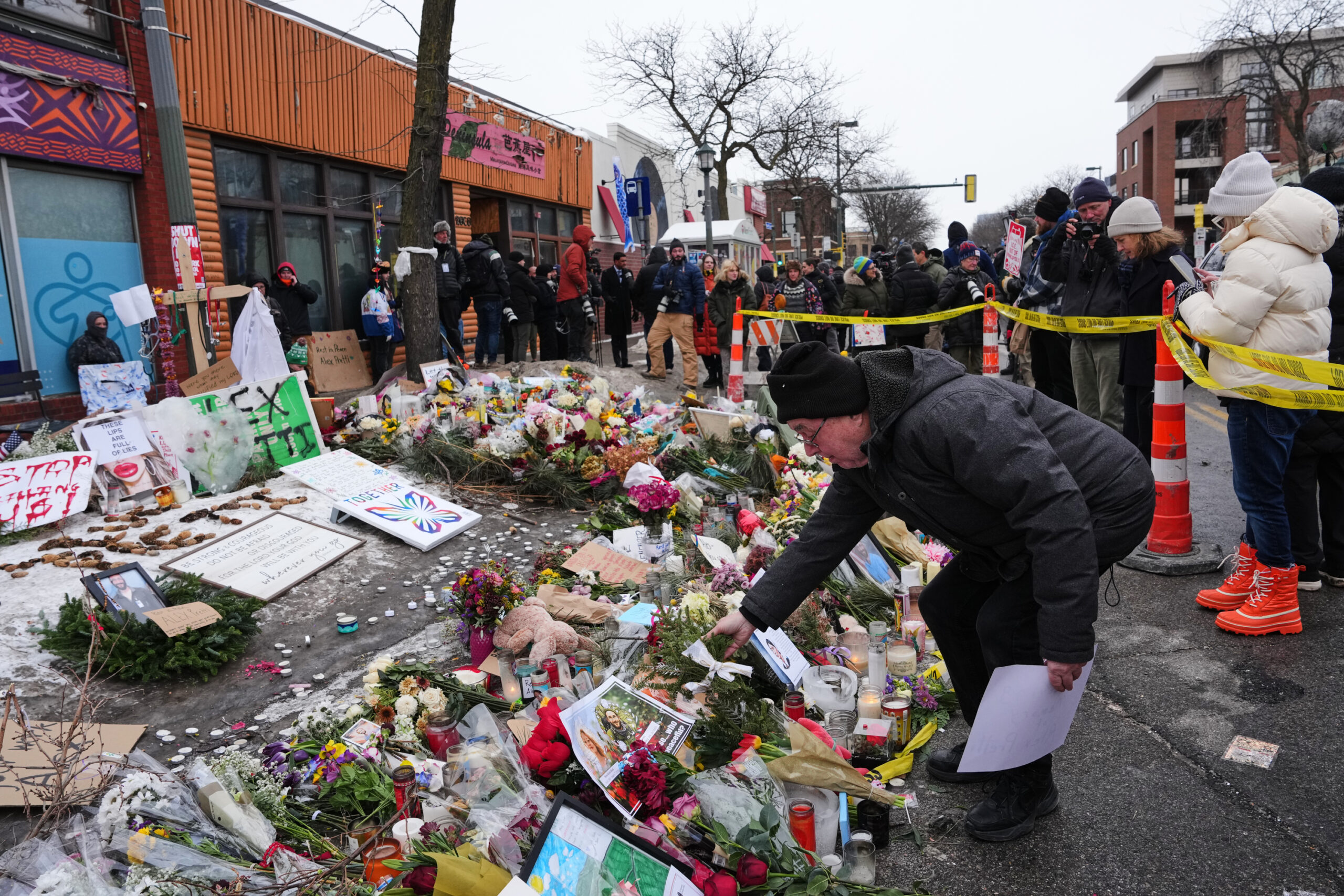
People visit a makeshift memorial on Jan. 26 in Minneapolis for 37-year-old Alex Pretti, who was fatally shot by immigration officers.
An ICE spokesperson said the agency received about 400 tort claims in fiscal 2025, which ended Sept. 30, but did not provide a breakdown of how many resulted in settlements or denials.
“Despite facing a more than 1,300% increase in assaults against them, 8,000% increase in death threats, and a 3,200% increase in vehicle rammings, the men and women of ICE continue working around the clock” to arrest and remove “the worst of the worst criminal aliens from the United States,” ICE said in an emailed statement. The Washington Post could not independently verify these numbers.
A U.S. Customs and Border Protection spokesperson declined to provide data about the number of tort claims the agency received last year.
“Rioters and agitators have created an extraordinary amount of damage to public and private property, not to mention the harm they have put our officers and the public in,” a CBP spokesperson said in a statement. “We expect these agitators will be held responsible for their actions.”
Spokespeople for ICE and CBP declined to comment on individual claims described in this story. They broadly said their agencies adhere to the Federal Tort Claims Act.
A significant settlement is not impossible. The estate of Ashli Babbitt, the woman who was shot and killed on Jan. 6, 2021, during the U.S. Capitol riot, filed a tort lawsuit and reached a nearly $5 million settlement with the government.
But the challenges of navigating the Federal Tort Claims Act — coupled with an anticipated rise in claims as violent encounters continue in cities across the United States — have put pressure on Congress to pass legislation to allow civil rights lawsuits against federal officers and agents.
Such an effort would probably face pushback, experts said. Several years ago, the National Border Patrol Council, a union that represents Border Patrol agents, warned the Supreme Court of the “potentially massive financial impact” that would occur if thousands of its agents were exposed to “liability for personal damages.”
‘Not very hopeful’
Leo Feler said he ran into challenges as soon as he decided to pursue a tort claim. For one thing, he wasn’t sure where to send it: Feler didn’t know which federal agency employed the masked men who came to his Chicago home on Oct. 24.
Feler, a 46-year-old economist, said he wasn’t there at the time. But he received a notification from his Ring security camera: Someone was on his property.
A construction crew had been repairing the windows and siding of his home in the affluent Lakeview neighborhood. As the workers ate lunch outside, armed men in green uniforms jumped from two vehicles and tried to break the locks on the gates of a nearly 6-foot-high wrought-iron fence, according to Feler, who reviewed security camera footage of the incident and a video taken by a neighbor.
The agents, Feler said, had scaled a wooden fence along the side of his house and hopped onto his balcony in pursuit of the fleeing workers.
One worker was injured as he scrambled through a construction site littered with wood and nails, Feler said, leaving a trail of blood in the home. Another worker was detained, he said.
Feler said a tenant who rented a unit on his property asked the officers to provide a warrant that authorized the raid, but they refused to do so. Through his Ring camera’s intercom system, Feler told the agents that they were trespassing and needed to leave. But they ignored him, he said.
Feler later sought legal advice. Attorneys told him he could file a tort claim for damages.
Unsure which agencies had come to his house, Feler sent the paperwork for his tort claim in December to ICE, Customs and Border Protection and the Department of Homeland Security.
He described the damage to his property — including to his locks and fence — and also wrote that the agents “robbed me and my family of the feeling of security we once enjoyed in my home.” His tenant was afraid and asked to break her lease early, which Feler said he agreed to do.
Overall, Feler estimated $30,000 in damage to his property.
He said he is “not very hopeful” that he will receive payment. If his claim is denied, he said he and his attorneys will pursue a lawsuit under the Federal Tort Claims Act.
Others caught up in Operation Midway Blitz, the administration’s immigration enforcement actions in the Chicago area last fall, also said they expect it will be difficult to recover alleged damages.
Leigh Kunkel, a 39-year-old freelance journalist, said she was documenting federal agents shooting pepper balls at protesters in late September outside an ICE facility in Broadview, Ill. An agent then aimed the weapon at her and fired pepper balls, she said, striking her in the back of the head and the nose and leaving her bloodied.
A week later, her fiancé, Kyle Frankovich, also was protesting in Broadview within an area that he said state police monitoring the scene had designated a “free speech zone.” Federal officials, including Border Patrol commander Gregory Bovino, emerged from the ICE facility and began arresting protesters, according to video footage.
Frankovich, 41, said he showed no aggression toward agents; nevertheless, he said, they took him to the ground and put him in handcuffs. They later lined him up with other detainees along a guardrail near the facility. The scene served as a backdrop to a Department of Homeland Security promotional video featuring Secretary Kristi L. Noem.
He said he was detained for eight hours before a federal agent dropped him off at a nearby gas station. Frankovich has not been charged with a crime.
Antonio Romanucci, a civil rights lawyer and founding partner at the Chicago-based firm representing Renée Good’s family, said his office plans to file federal tort claims for Kunkel and Frankovich. The couple said they understand the path may be long and their case could be unsuccessful, while also exposing them to public scrutiny.
“Ultimately, we landed on the feeling that we are privileged enough to have the opportunity to fight back against this as citizens,” Kunkel said, “and that if we can do that, if this is one little way that we can push back, that we should.”
Pushing for change
Previous efforts to change the federal law have failed to gain traction.
A law signed by President Ulysses S. Grant in 1871 established the statutory right to sue local or state officials for constitutional violations. Nearly two years ago, a group of U.S. lawmakers introduced draft legislation that would have amended that law by inserting just four words — “or the United States” — and established the right to sue federal officials as well. But the effort stalled.
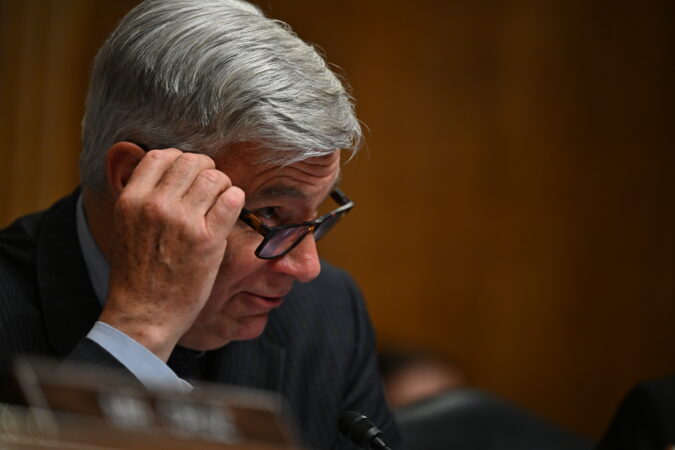
“It’s a somewhat complicated area of law across different jurisdictions,” Sen. Sheldon Whitehouse (D., R.I.) said of the challenges in garnering support for the bill, which he sponsored. “But I didn’t see any huge partisan issues.”
Whitehouse said there was a lack of urgency at the time, even though the Supreme Court had “more or less strangled” the legal pathway that had been used since the 1970s to sue federal officials for civil rights violations.
Last fall, Whitehouse and Rep. Hank Johnson (D., Ga.) reintroduced the measure. Legal experts told the Post they think it is unlikely to pass, citing anticipated concerns about exposing federal law enforcement officers to personal liability.
A handful of states already have laws that authorize claims against federal officials for the violation of constitutional rights, including New Jersey and Massachusetts, according to research compiled by Stark of the University of Wisconsin Law School. Lawmakers in other states are scrambling to draft similar bills.
Last week, the California Senate passed the “No Kings Act” to allow civil rights lawsuits against federal officers. The measure will head to the State Assembly next.
In Colorado, Mike Weissman, a Democratic state senator, recently introduced a similar bill. He described talking with state legislators in Washington, New Mexico, and Virginia, to exchange ideas.
And in Minnesota, State Rep. Jamie Long, a Democrat whose district includes part of Minneapolis, has drafted such a bill for the legislative session that begins later this month.
“We know that there is evidence of these severe constitutional violations happening, and that’s why we think it’s appropriate to create this state remedy,” Long said.
Such measures are likely to be challenged. The U.S. Justice Department has already sued Illinois, alleging that its new law authorizing civil rights claims against federal officers is an “unconstitutional attempt to regulate federal law enforcement officers.”
In the meantime, those who say they have sustained property damage or injuries during immigration enforcement efforts and their attorneys are continuing to press lawmakers to enable them to sue federal officers.
Christopher Parente, a Chicago-based lawyer, is representing Marimar Martinez, a 30-year-old teacher’s assistant who was shot five times by a Border Patrol agent in October and survived. In an interview with the Post, her attorney said he thinks that Congress should change the law.
Parente, a former federal prosecutor who plans to file a tort claim on Martinez’s behalf, said, “There is no deterrence — in fact, these agents are embraced and celebrated by this administration and their colleagues.”
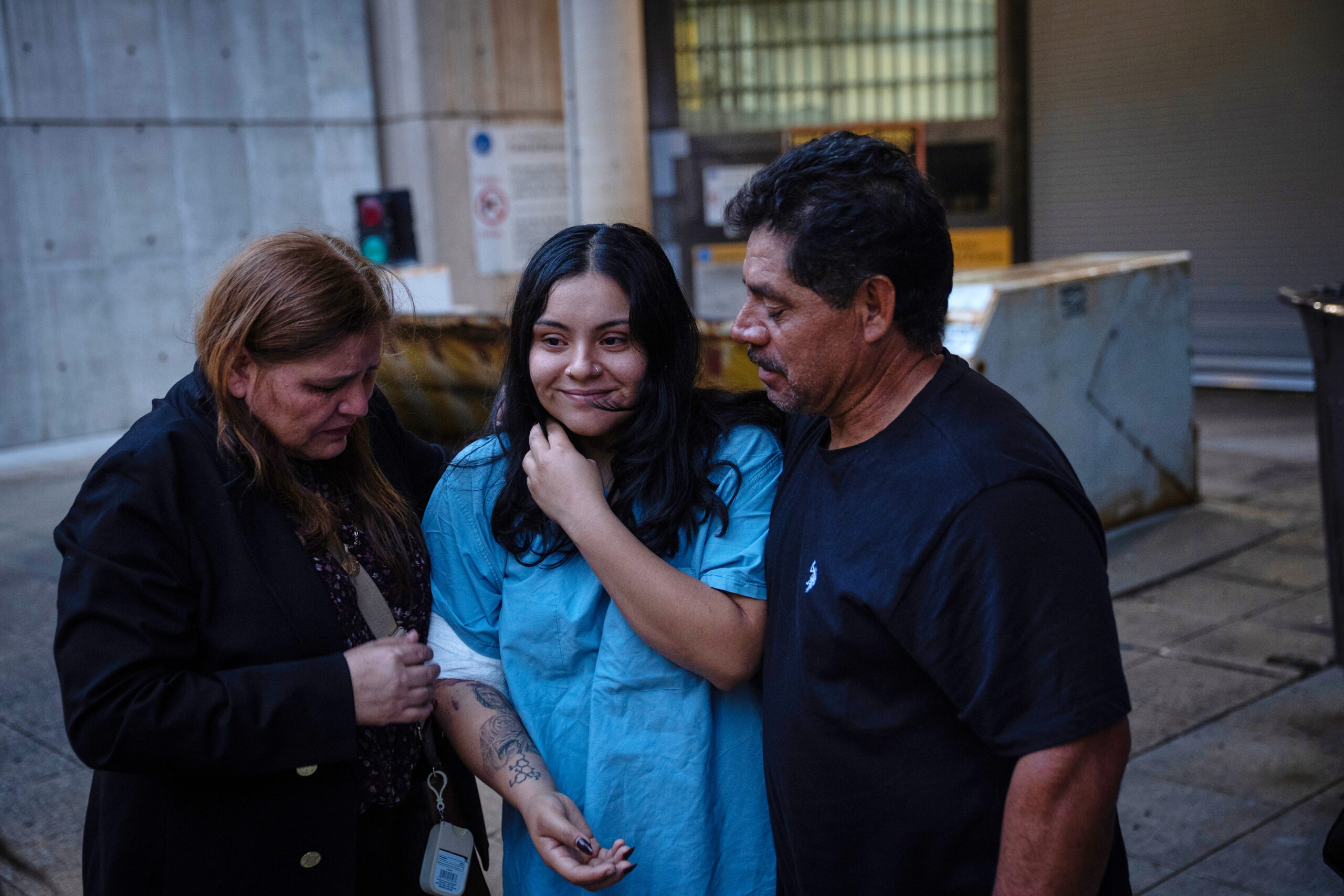
Marimar Martinez (center) is greeted by her family after being released from the Metropolitan Correctional Center on Oct. 6, 2025, after being shot by immigration agents and charged with assaulting federal officers in an incident in Chicago’s Brighton Park.
A chilling effect
People seeking compensation from the federal government may face another roadblock: finding an attorney to take their case.
“I’ve met people who spent the entire statute of limitations period, which is generally two years, looking for attorneys to represent them in cases against the federal government or federal officials and not being able to find them,” said Anya Bidwell, senior attorney for the Institute for Justice, a nonprofit law firm based in the D.C. area.
Bidwell said many attorneys are deterred from taking Federal Tort Claims Act cases because the government often invokes “a very broad immunity that courts traditionally interpret to pretty much swallow any of the claims that involve any kind of a judgment or choice on behalf of an officer.”
In other words, many cases are dismissed. Bidwell said “even getting to trial is extremely difficult.”
Some people who consider filing claims ultimately decide not to, discouraged by the long and difficult process.
In Minneapolis, Gina Christ, a 55-year-old business manager, contacted a lawyer to challenge what she described as an unlawful detention. But the attorney she met with told her suing the government would be “very, very difficult,” Christ recalled.
Christ had driven to a protest that began after Border Patrol agents allegedly tried to arrest a pair of Latino teens. She said she parked along the side of the street to observe the agents, not to obstruct them.
Christ said she was soon surrounded by agents and protesters. Agents yelled at her to move before smashing the window of her Ford Escape. They opened the door, pulled her out of the car, and held her facedown on the pavement, she said.
Agents restrained her wrists with plastic zip ties, Christ said, while her eyes and throat burned from tear gas fired into the nearby crowd.
Authorities took her to a federal building for processing, she said, and placed her in metal arm and leg shackles. She said they walked her to a folding table, where there was a makeshift sign with the criminal code for assaulting an officer. They told her she would face charges and took her fingerprints and a DNA swab.
Christ said she spent nearly four hours in custody before she was released. She hasn’t been charged with a crime.
A Customs and Border Protection spokesperson did not answer questions about the agency’s interaction with Christ.
After weighing the difficulty of pursuing a tort claim, Christ said she plans to pay to fix her window herself. Given what others have lost, she said, it seems too small to pursue.
The Democratic primary to replace N.J. Gov. Mikie Sherrill in Congress remains too close to call as of Friday afternoon, but the early results already signal a major breakthrough for progressives in the state.
Analilia Mejia, a progressive who’s worked for U.S.Sen. Bernie Sanders and the Working Families Party, led former U.S. Rep. Tom Malinowski byless than 1 percentage point, with more than 91% of votes tabulatedin the crowded primary.
Some outlets, including Decision Desk, called the race for Malinowski, who dominated mail ballots, Thursday night before issuing retractions as Mejia gained ground. The Democratic National Committee had even issued a premature congratulations to the former House member before Mejia took the lead.
(function () {window.addEventListener(‘message’, function (e) { var message = e.data; var els = document.querySelectorAll(‘iframe[src*=”‘ + message.id + ‘”]’); els.forEach(function(el) { el.style.height = message.height + ‘px’; }); }, false); })();
Sherrill represented North Jersey’s 11th CongressionalDistrict, which includes parts of Essex, Morris, and Passaic Counties, and stepped down after being elected governor. A field of 13 Democrats competedin the special election for the open seat from various factions of the Democratic Party.
Only two broke through as serious contenders, and they represent two sides of the New Jersey Democratic Party: the establishment and progressives.
Democrats were so invested in the race, turnout exceeded the 2024 primary for the seat, which signals the high level of motivation for Democratic voters going into this year’s midterms.
Sherrill stayed neutral in the race
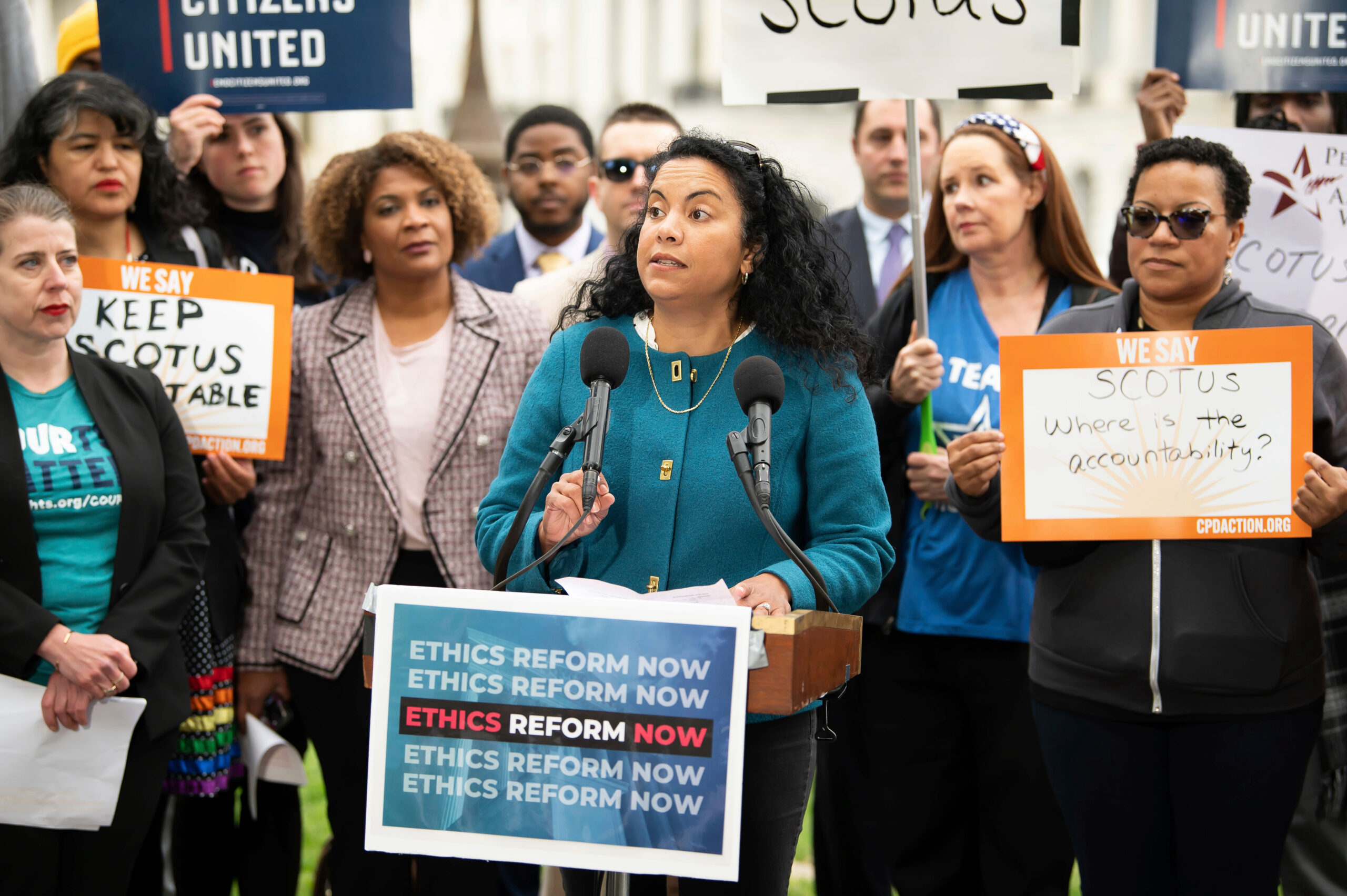
Analilia Mejia, center, speaks during a rally calling for SCOTUS ethics reform, May 2, 2023, in Washington.
Analilia Mejia is supported by national progressives like AOC
Mejia, 48, is the daughter of Colombian and Dominican immigrants. She has called to “abolish ICE” and spoke in both English and Spanish at a news conference Friday.
The progressive candidate has most recently worked as the co-executive director of Popular Democracy, a network of organizations across the country that call for “transformational change for Black, brown and low-income communities,” according to its website. She worked as the national political director for Sanders’ 2020 presidential campaign, the state director of the New Jersey Working Families Party, and as a union organizer before launching her bid for the seat.
Mejia was endorsed by national progressives, including Sanders (I., Vt.), U.S. Rep. Alexandria Ocasio-Cortez (D., N.Y.) and U.S. Sen. Elizabeth Warren (D., Mass.). She also had the backing of Newark Mayor Ras Baraka, whose progressive campaign landed him in second place behind Sherrill in the six-way gubernatorial primary last year.
Mejia leaned into her underdog status Thursday night when addressing supporters, noting the race had been called for her opponent before she took the lead.
“Here’s the bottom line,” she said. “We know that our movement, this party, this moment, calls on every one of us to be big and bold and brave. And that is what we are about.”
She later declared: “I think we’ll listen to some Bad Bunny!”
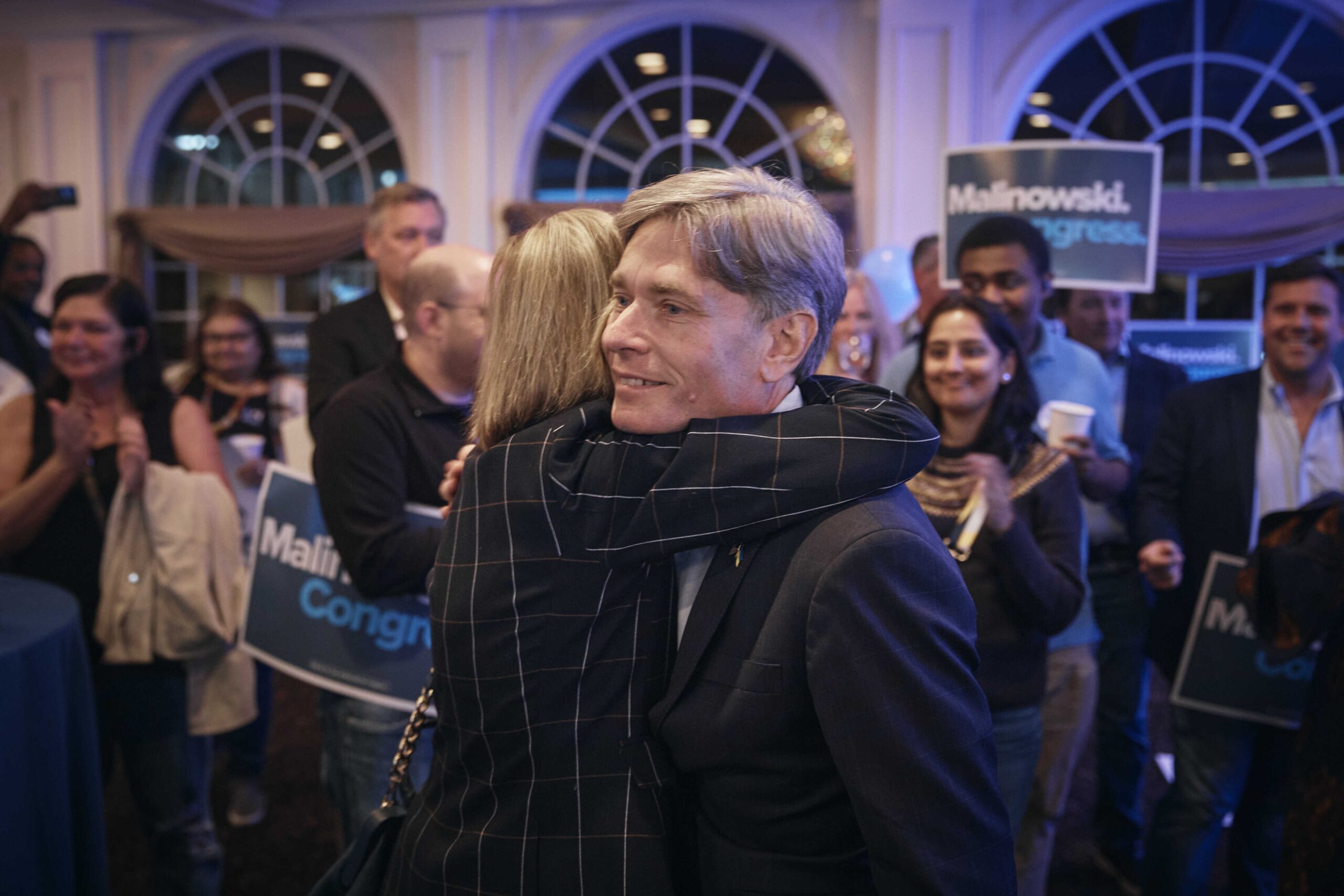
Democratic Rep. Tom Malinowski, center right, arrives during his election night party in Garwood, N.J., Tuesday, Nov. 8, 2022.
Tom Malinowski was backed by the local party apparatus
Malinowski, 60, started as a freshman House Democrat alongside Sherrill in 2019 before losing his seat to Republican U.S. Rep. Thomas Kean Jr. in the 2022 election afterhe faced pushback for undisclosed stock trading and his area was redistricted to be less favorable to Democrats.
His former district is right next to the 11th District and encompasses parts of Union, Somerset, Morris, and Sussex Counties, and all of Hunterdon and Warren Counties.
He recently chaired the Hunterdon County Democratic Committee and previously worked as former President Barack Obama’s assistant secretary of state for democracy and human rights.
The Essex and Passaic County parties backed other candidates who were far behind Malinowski and Mejia.
DNC Chair Ken Martin said in the premature Thursday night statement that Malinowski has “the experience to serve New Jersey once again.”
AIPAC’s involvement in the race backfired
Malinowski faced attacks from a super PAC funded by American Israel Public Affairs Committee (AIPAC), a pro-Israel national lobbying group, even though the group supported him in the past, The New York Times and other outlets reported.
Those attacks likely pulled support away from Malinowski, who is far less critical of Israel than Mejia.
Mejia called AIPAC’s tactics against Malinowski “disgusting” in a news conference on Friday and said it underscores her broader concerns about money in politics.
“Big money can actually silence voters … In many ways, I’m glad that NJ-11 voters got to see the terrible tactics so that we could reject it in the future,” she said.
The district, which used to be Republican, is now viewed as safely blue
Sherrill flipped the 11th congressional district blue as a first-time candidate in 2018, defeating Republican Assemblymember Jay Webber after the GOP incumbent retired. The incumbent, former U.S. Rep. Rodney Frelinghuysen had held the seat since 1995. The district went from leaning Republican to leaning Democratic when its lines were redrawn in 2022.
Sherrill won her last general election race for her House seat with 56.5% of the vote in 2024.
The nonpartisan Cook Political Report rates the district as solidly Democratic. Former Vice President Kamala Harris won the district decisively by nearly 9 points in 2024, but it still swung to the right from Biden’s 2020 victory in the district by almost 17 points, according to Cook data.
Joe Hathaway, the former mayor of Randolph in Morris County, was unopposed in the Republican primary.
Hathaway, 38, said in a video on social media Thursday that the election brings an opportunity for “a new generation of leadership …one focused more on the hard work than the headlines.”
He is a former aide to former Republican Gov. Christopher J. Christie and has worked in various roles in the private sector, and has branded himself as a “workhorse” throughout his campaign.
Hathaway and the winner of the Democratic primary will face off on Thursday, April 16, less than two months before the regular primary election on June 2 for the midterms.
When will the race be called, and will there be a recount?
It’s unclear when the race will be called by The Associated Press (which The Inquirer relies on for election results), but it may not be this week.
Mail ballots that were postmarked by Election Day on Thursday and received by the county Board of Election by next Wednesday can be counted in New Jersey.
Provisional ballots in the state cannot be officially counted until after the eligible mail ballots are received to ensure the voter has not voted by mail. These ballots are used in specific situations, such as when a person registered to vote moves within the county without updating their address.
Voters also have until the following Tuesday, Feb. 17, to cure a ballot flagged by election officials. This happens when there is a potential issue with a voter’s signature, which can happen when someone forgets to sign their ballot or whose signature has changed over time. The voter then has to verify their identity for their ballot to be counted.
As for a recount, New Jersey doesn’t have an automatic recount system, so a candidate would have to request one and cover the expenses. The candidate would receive a refund if the result changed.
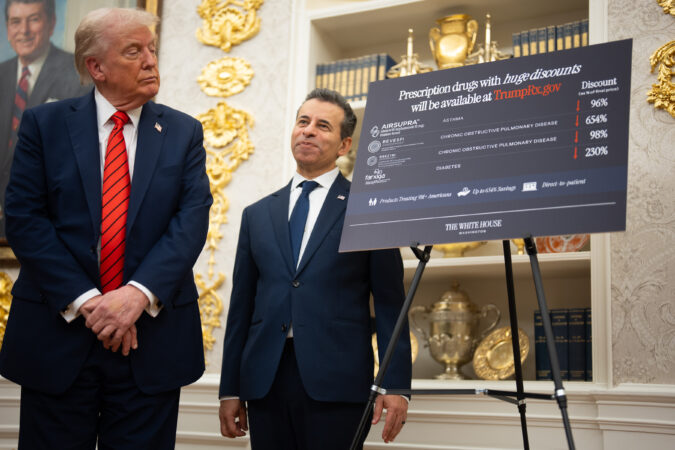
NEW YORK — The Trump administration on Thursday launched TrumpRx, a website it says will help patients buy prescription drugs directly at a discounted rate at a time when health care and the cost of living are growing concerns for Americans.
“You’re going to save a fortune,” President Donald Trump said at the site’s unveiling. “And this is also so good for overall health care.”
The government-hosted website is not a platform for buying medications. Instead, it’s set up as a facilitator, pointing Americans to drugmakers’ direct-to-consumer websites, where they can make purchases. It also provides coupons to use at pharmacies. The site launches with over 40 medications, including weight-loss drugs such as Ozempic and Wegovy.
The site is part of a larger effort by the Trump administration to show it’s tacking the challenges of high costs. Affordability has emerged as a political vulnerability for Trump and his Republican allies going into November’s midterm elections, as Americans remain concerned about the cost of housing, groceries, utilities and other staples of middle-class identity.
Trump stressed that the lower prices were made possible by his pressuring of pharmaceutical companies on prices, saying he demanded that they charge the same costs in the U.S. as in other nations. He said prescription drug costs will increase in foreign countries as a result.
“We’re tired of subsidizing the world,” Trump said at the event on the White House campus that lasted roughly 20 minutes.
The president first teased TrumpRx in September while announcing the first of his more than 15 deals with pharmaceutical companies to lower drug prices to match the lowest price offered in other developed nations. He said in December the website would provide “massive discounts to all consumers” — though it’s unclear whether the prices available on drugmakers’ websites will routinely be any lower than what many consumers could get through their insurance coverage.
The website’s Thursday release came after it faced multiple delays, for reasons the administration hasn’t publicly shared. Last fall, Mehmet Oz, administrator of the Centers for Medicare and Medicaid Services, told Trump the site would share prices for consumers before the end of the year. An expected launch in late January was also pushed back.
The president has spent the past several months seeking to spotlight his efforts to lower drug prices for Americans. He’s done that through deals with major pharmaceutical companies, including some of the biggest drugmakers like Pfizer, Eli Lilly and Merck, which have agreed to lower prices of their Medicaid drugs to so-called “most favored nations” pricing. As part of the deals, many of the companies’ new drugs are also to be launched at discounted rates for consumer markets through TrumpRx.
Many of the details of Trump’s deals with manufacturers remain unclear, and drug prices for patients in the U.S. can depend on many factors, including the competition a treatment faces and insurance coverage. Most people have coverage through work, the individual insurance market or government programs like Medicaid and Medicare, which shield them from much of the cost.
Trump’s administration also has negotiated lower prices for several prescription drugs for Medicare enrollees, through a direct negotiation program created by a 2022 law.
NEW YORK — In 2015, Woody Allen and his wife, Soon-Yi Previn, went on a trip to Washington, D.C. With the help of their friend Jeffrey Epstein, they were able to tour the White House.
Allen’s friendship with Epstein has been known for years, but emails in the huge trove of records released by the Justice Department in recent days illustrate that relationship in new depth.
The filmmaker, his wife and Epstein were neighbors in New York City, and the three dined together often, records show. They offered each other emotional support during periods when they were being criticized in the media. They commiserated about being accused — unfairly, they told each other — of sexual misconduct.
And in 2015, Epstein used his connections to another friend who had been in President Barack Obama’s administration to help the couple get a White House tour.
“Could you show soon yi the White House,” Epstein wrote in a May 2015 email to former White House counsel Kathy Ruemmler. “I assume woody would be too politically sensitive?”
“I am sure I could show both of them the White House,” Ruemmler responded, although she doubted whether Epstein, who in 2008 had pleaded guilty to solicitating prostitution from an underage girl, would be allowed in.
“You are too politically sensitive, I think,” she added.
White House records show that Allen, Previn, and Ruemmler visited on Dec. 27, a Sunday. Obama was in Hawaii at the time.
Ruemmler and Allen were among a long list of notable people who maintained friendships with Epstein for years, even though he was a registered sex offender who had been accused of abusing children, and whose legal problems had been widely covered in newspapers.
Some of the guests who accompanied Allen and Previn to dinners with Epstein included talk show host Dick Cavett, linguist Noam Chomsky, and the late comedian David Brenner. Epstein also attended screenings of Allen’s movies and, according to emails, would visit with Allen so he could watch him edit his latest film.
“Wide variety of interesting people at every dinner,” was how Allen described some of their gatherings in a letter commissioned for a 2016 Epstein birthday party. “It’s always interesting and the food is sumptuous and abundant. Lots of dishes, plenty of choices, numerous desserts, well served. I say well served often it’s by some professional houseman and just as often by several young women reminding one of Castle Dracula where (actor Bela) Lugosi has three young female vampires who service the place.”
A message sent to an assistant for Allen and Previn via email seeking comment wasn’t immediately returned. Epstein killed himself in 2019 while awaiting trial on sex trafficking charges.
Emails suggest that Previn, too, had a close relationship to Epstein and she often served as the intermediary between Epstein and Allen.
Numerous exchanges among Allen, Previn, and Epstein refer to the scandals that began in the early 1990s when Allen acknowledged he was having an affair with Previn, the adopted daughter of his then-girlfriend Mia Farrow. Around the same time, he was investigated by state authorities over allegations he had assaulted their adopted daughter, Dylan Farrow, while visiting Mia’s Connecticut home.
A Connecticut prosecutor said in 1993 that there was “probable cause” to charge Allen with molesting Dylan, but that he decided not to pursue the case.
Allen, who married Previn in 1997 and has since adopted two daughters, has denied any wrongdoing. Dylan’s allegations returned to the news in 2014 when an open letter from her was published in the New York Times. Allen has since been largely ostracized by the American film community.
In emails in 2016, Epstein, Previn, and Allen compared their own scandals to another celebrity in the news at the time: Bill Cosby, who had denied allegations that he drugged and sexually assaulting numerous women.
“The crowd needs a witch to burn, and there are not many left,” Epstein wrote.
Allen replied, in a message relayed through Previn, that his own situation is “radically different” from Cosby’s.
“I do expect (and get) many ugly unfair accusations, (but) he has to battle 50 women and criminal charges,” Allen said, according to Previn’s email. “I have one irate mother whose case was investigated and discredited,” he said, referring to Mia Farrow.
Epstein replied that the public scorn Allen received was more likely related to his relationship with Previn, which he called a “publicly broken taboo.”
“Everything else is noise,” he added.
Allen, in comments relayed through Previn, responded that if the couple’s taboo relationship was the issue, “there’s nothing to be done.”
“I’m certainly not going to dump her and I’m not going to apologize because I don’t feel either of us did anything we have to apologize for,” he says. “Our romantic life is our business and not the business of the public so it’s a hopeless situation because there’s no way out if that’s what they’re holding against us.”
Epstein advised his friends to just enjoy themselves and in life.
“Some actors or actresses might decline a role,” Epstein wrote. “But, so what.”
Allen hasn’t been accused of having any involvement in Epstein’s alleged sexual abuse of girls and women.
BUENOS AIRES, Argentina — Argentina and the United States agreed Thursday to ease restrictions on each other’s goods in an expansive trade and investment deal that boosts a drive by President Javier Milei’s government to open up Argentina’s protectionist economy and a push by the Trump administration to reduce food prices for Americans.
The deal, which slashes hundreds of reciprocal tariffs between the countries, also reflects the importance of Milei’s ideological loyalty to President Donald Trump, even as the chronically distressed South American nation long isolated from the global economy has little to offer Washington in the way of economic reward or geopolitical clout.
Argentina’s radical libertarian leader has gone to dramatic lengths to prove his devotion to Trump, reshaping his country’s foreign policy to align with the U.S. and championing Trump’s increasingly aggressive interventions in the Western Hemisphere. Milei has traveled to the U.S. at least a dozen times since entering office and plans to visit Trump’s private Mar-a-Lago club in Florida again next week.
The efforts have already paid off. Last year as market turmoil threatened to derail Milei’s free-market overhaul and drain Argentina’s foreign currency reserves ahead of a crucial midterm election, Trump offered his ally a $20 billion credit line. Milei avoided a currency devaluation and won a decisive victory in the election that sent markets rallying.
A trade deal between ideological allies
On Thursday, Argentine Foreign Minister Pablo Quirno and U.S. Trade Representative Jamieson Greer signed the trade and investment agreement in Washington.
After imposing sweeping tariffs on its traditional trading partners for months, the Trump administration changed its tune last November in announcing framework deals with four Latin American countries, including Argentina.
The White House argued that the reduction of mutual tariffs on a range of food imports, like Argentine beef and Ecuadorian bananas, would improve the ability of American firms to sell industrial and agricultural products abroad and relieve rising prices for American consumers. The announcement also came as Trump’s steep tariffs drew scrutiny from the Supreme Court.
Argentina on Thursday became the first of the four countries to finalize its agreement with the U.S. Quirno hailed it as a milestone not only in Argentina’s alliance with the U.S., but also in Milei’s campaign to rebuild the serial defaulter’s reputation.
“Today Argentina sent a clear signal to the world,” he wrote on social media. “We are a reliable partner, open to trade and committed to clear rules, predictability and strategic cooperation.”
Concessions could revive criticism
Argentina’s foreign ministry said it would scrap trade barriers on more than 200 categories of goods from the U.S., including chemicals, machinery and medical devices, slash tariffs to 2% on a range of imports like auto parts and allow sensitive imports like vehicles, beef and dairy products to enter the country tariff-free under government quotas.
Those are key concessions as local Argentine industries long protected by steep tariffs voice concern about their ability to compete with American manufacturers.
Washington, for its part, will eliminate reciprocal tariffs on 1,675 Argentine products, the Argentine Foreign Ministry said, adding $1 billion in export revenue. It did not name all the products, while the White House only said the U.S. would remove reciprocal tariffs on “unavailable natural resources” and ingredients for pharmaceutical goods.
The text of the deal also shows the U.S. agreeing to review its stiff 50% taxes on steel and aluminum imports that have hobbled Argentine manufacturers since last year and quadruple the amount of Argentine beef it allows into the country annually at a lower tariff rate.
An influx of Argentine beef
The influx of beef could reignite criticism from cattle ranchers and Republican lawmakers in farm states who were outraged last October when Trump first floated plans to increase imports of Argentine beef, threatening to lower the price that American ranchers receive for their cattle.
The move, aimed at shoring up the South American country’s limping economy while helping bring beef prices in the U.S. down from record highs, came shortly after the Trump administration offered Milei the $20 billion lifeline and directly purchased both U.S. dollar-denominated Argentine bonds that ratings agencies were classifying as “junk” at the time and the volatile Argentine currency that local investors were dumping in droves.
The backlash came from across the political spectrum. Trump’s MAGA base questioned the need to bail out a far-flung country that has never been a natural U.S. trading partner: The two countries export many of the same things and directly compete in markets of soy, corn, wheat, meat and oil.
Democratic lawmakers expressed outrage that Trump was staking taxpayer money on a political gift to an ideological soulmate. That criticism continues, with U.S. Sen. Elizabeth Warren, the top Democrat on the Senate Banking Committee, on Thursday appealing to Treasury Secretary Scott Bessent to end the $20 billion lifeline.