WASHINGTON — A federal judge has temporarily blocked the Trump administration’s efforts to remake Head Start, ordering it to stop purging words it associates with diversity, equity and inclusion from grant applications and barring it from laying off any more federal employees in the Office of Head Start.
The order came this week in a lawsuit filed in April against Department of Health and Human Services Secretary Robert F. Kennedy Jr. and other officials. The lawsuit accuses the Trump administration of illegally dismantling Head Start by shutting down federal Head Start offices and laying off half the staff. It also challenges the administration’s attempts to bar children who are in the U.S. illegally from Head Start programs and to ban language they view as suggestive of DEI.
The plaintiff organizations representing Head Start providers and parents said in a court filing last month that officials told a Head Start director in Wisconsin to axe the terms “race,” “belonging” and “pregnant people” from her grant application. They later sent a list with nearly 200 words the department discouraged her from using in her application, including “Black,” “Native American,” “disability” and “women.”
A Health and Human Services spokesperson said he could not comment on the judge’s order.
Head Start, founded six decades ago as part of President Lyndon B. Johnson’s War on Poverty, is an early education and family support program that serves hundreds of thousands of children who come from low-income households, foster homes or homelessness. It is federally funded but operated by nonprofits, schools and local governments.
Joel Ryan, who heads the Washington State Head Start & Early Childhood Education and Assistance Program, said the order halts an attack on Head Start centers.
“When a Head Start program has their funding withheld because of their efforts to provide effective education to children with autism, serve tribal members on a reservation, or treat all families with respect, it is an attack on the fundamental promise of the Head Start program,” Ryan said.
The directive on the forbidden words raised confusion for Head Start directors, who must describe how they will use the money in grant applications and are required by law to provide demographic information about the families they serve. A director in Washington state said in a court filing the guidance led her to cancel staff training on how to support children with autism and children with trauma.
The order from U.S. District Judge Ricardo S. Martinez of Seattle, published Monday, bars Health and Human Services from cutting any more employees and from punishing Head Start providers if they use the prohibited language.
PROVIDENCE, R.I. — When a gunman began firing inside an academic building on the Brown University campus, students didn’t wait for official alerts warning of trouble. They got information almost instantly, in bits and bursts — through phones vibrating in pockets, messages from strangers, rumors that felt urgent because they might keep someone alive.
On Dec. 13 as the attack at the Ivy League institution played out during finals week, students took to Sidechat, an anonymous, campus-specific message board used widely at U.S. colleges, for fast-flowing information in real time.
An Associated Press analysis of nearly 8,000 posts from the 36 hours after the shooting shows how social media has become central to how students navigate campus emergencies.
Fifteen minutes before the university’s first alert of an active shooter, students were already documenting the chaos. Their posts — raw, fragmented, and sometimes panicked — formed a digital time capsule of how a college campus experienced a mass shooting.
As students sheltered in place, they posted while hiding under library tables, crouching in classrooms and hallways. Some comments even came from wounded students, like one posting a selfie from a hospital bed with the simple caption: #finalsweek.
Others asked urgent questions: Was there a lockdown? Where was the shooter? Was it safe to move?
Described by Harvard Magazine as “the College’s stream of collective consciousness,” Sidechat allows anyone with a verified university email to post to a campus feed. On most days, the Brown feed is filled with complaints about dining hall food, jokes about professors, and stress about exams — fleeting posts running the gamut of student life.
On the Saturday afternoon just before the shooting, a student posted about how they wished they could “play Minecraft for 60 hours straight.” Then, the posts abruptly shifted.
Crowds began pouring out of Brown’s Barus and Holley building, and someone posted at 4:06 p.m.: “Why are people running away from B&H?”
Others quickly followed. “EVERYONE TAKE COVER,” one wrote. “STAY AWAY FROM THAYER STREET NEAR MACMILLAN 2 PEOPLE JUST GOT SHOT IM BEING DEAD SERIOUS,” another user wrote at 4:10 p.m.
Dozens of frantic messages followed as students tried to fill the information gap themselves.
“so r we on lockdown or what,” one student asked.
By the time the university alert was sent at 4:21 p.m., the shooter was no longer on campus — a fact Brown officials did not yet know.
“Where would we be without Sidechat?” one student wrote.
A university spokesperson said Brown’s alert reached 20,000 people minutes after the school’s public safety officials were notified shots had been fired. Officials deliberately didn’t use sirens to avoid sending people rushing to seek shelter into harm’s way, said the spokesperson, Brian E. Clark, who added Brown commissioned two external reviews of the response with the aim of enhancing public safety and security.
Long hours of hiding
Long after the sun had set, students sheltered in dark dorm rooms and study halls. Blinds were closed. Doors were barricaded with dressers, beds, and mini fridges.
“Door is locked windows are locked I’ve balanced a metal pipe thing on the handle so if anyone even tries the handle from the outside it’ll make a loud noise,” one student wrote.
Students reacted to every sound — footsteps in hallways, distant sirens, helicopters overhead. When alerts came, the vibrations and ringtones were jarring. Some feared that names of the dead would be released — and that they would recognize someone they knew.
Law enforcement moved through campus buildings, clearing them floor by floor.
A student who fled Barus and Holley asked whether anyone could text his parents to let them know he had made it out safely. Others said they had left phones behind in classrooms when they fled, unable to reach frantic loved ones. Ironically, those closest to the shooting often had the least information.
Many American students expressed emotions hovering between numbness and heartbreak.
“Just got a text from a friend I haven’t spoken to in nearly three years,” one student wrote. “Our last messages? Me checking in on her after the shooting at Michigan State.” Multiple students replied, saying they’d had similar experiences.
International students posted about parents unable to sleep on the other side of the world.
“I just want a hug from my mom,” one student wrote.
Anxiety sets in
As the hours dragged on, students struggled with basic needs. Some described urinating in trash cans or empty laundry detergent bottles because they were too afraid to leave their rooms. Others spoke of drinking to cope.
“I was on the street when it happened & suddenly I felt so scared,” one student wrote. “I ran and didn’t calm down for a while. I feel numb, tired, & about to throw up.”
Another wrote: “I’m locked inside! Haven’t eaten anything today! I’m so scared i don’t even know if I get out of this alive or dead.”
Some students posted into the early morning, more than 10 hours into the lockdown, saying they couldn’t sleep. Sidechat also documented acts of kindness, including a student going door to door with macaroni and cheese cups in a dark dorm.
Information, and its limits
Students repeatedly asked the same questions — news? sources? — and challenged one another to verify what they saw before reposting it.
“Frankly I’d rather hear misinformation than people not report stuff they’ve heard,” one student wrote.
Others pushed back, sharing a Google Doc that would grow to 28 pages where students could find the most updated, verified information. Some posted police scanner transcriptions or warned against relying on artificial intelligence summaries of the developing situation. Professors — who rarely post on the app — joined the feed, urging caution and offering reassurance.
“If you’re talking about the active situation please add a source!!!” one student wrote.
But “reliable information,” students noted, often arrived with a delay.
Within about 30 minutes of the shooting, posts incorrectly claimed the shooter had been caught. Reports of more gunshots — later proven false — continued into the night and the next day, fueling fear and frustration. Asked one student, what are police doing “RIGHT NOW”?
Replies came quickly.
“They are trying their best,” one person responded. “Be grateful,” another added. “They are putting their lives in danger at this moment for us to be safe.”
A campus changed
Students awoke Sunday to a campus they no longer recognized. It had snowed overnight — the first snowfall of the academic year.
In post after post, students called the sight unsettling. What was usually a celebration felt instead like confirmation something had irrevocably shifted.
“It truly hurt seeing the flakes fall this morning, beautiful and tragic,” one student wrote.
Even as the lockdown lifted, many said they were unsure what to do — where they could go, whether dining halls were open, whether it was safe to move.
“What do I do rn?” one student posted. “I’m losing my mind.”
Students walked through fresh snow in a daze, heading to blood donation centers. Others noticed flowers being placed at the campus gates and outside Barus and Holley.
Many mourned not only the two students killed, but the innocence they felt had been stripped from their campus.
“Will never see the first snow of the season and not think about those two,” one student wrote.
With the lockdown ended, students returned to their dorms as Sidechat continued to fill with grief and reflection. Many said Brown no longer felt the same.
“Snow will always be bloody for me,” one person posted.
MORGANTOWN, Pa. — The Trump administration says it is focused on protecting unaccompanied migrant children. It imposed strict new background checks on those seeking custody of young migrants and cut ties with a chain of youth shelters accused of subjecting children in its care to pervasive sexual abuse.
“This administration is working fearlessly to end the tragedy of human trafficking and other abuses of unaccompanied alien children who enter the country illegally,” saidHealth Secretary Robert F. Kennedy Jr., who oversees the Office of Refugee Resettlement, or ORR, which cares for unaccompanied migrant children.
But for the last three months, that office has also locked some teenage migrant boys inside a secure juvenile prison about 50 miles west of Philadelphia with a long and publicly documented history of staff physically and sexually abusing juvenile offenders in its care, a Washington Post investigation has found.
“ORR is sending children to a juvenile detention center who should not be there,” said Becky Wolozin, a senior attorney at National Center for Youth Law.
ORR awarded $9 million to Abraxas Alliance in August to hold up to 30 young immigrants deemed a danger to themselves or others in its facility in Morgantown, Berks County. At various times since early October, between five and eight migrant teenage boys have been held inside a dedicated wing of the juvenile detention center, sleeping inside locked cells the size of walk-in closets, according to lawyers who met with them.
Pennsylvania state inspectors have documented at least 15 incidents since 2013 in which they said staff physically mistreated minors at the Morgantown facility, which holds principally juveniles facing or convicted of criminal offenses. In at least two incidents, officials documented allegations of staff sexually harassing or sexually abusing young residents. The most recent reported abuse occurred in November.
In a lawsuit filed in 2024, six former residents of the facility allege they were sexually abused by staff between 2007 and 2016, accusing management of enabling a “culture of abuse.”
A spokesperson for Abraxas Alliance, the Pittsburgh nonprofit that operates the facility,did not respond to a long list of questions about its treatment of children. After some of the incidents cited by inspectors, Abraxas suspended or fired staff members and submitted correction plans to state regulators, promising to retrain workers on proper restraining techniques and install more surveillance cameras.
ORR has wide latitude over the types of facilities it uses to house children, though federal rules require it to use “the least restrictive setting that is in the best interests of the child.” The rules say ORR may place minors in secure facilities if they have been charged with a crime, or if the agency determines they could harm themselves or others.
HHS spokesman Andrew Nixon said decisions on where to place migrant children “are based on each child’s specific circumstances, behavior-based risk assessments, and legal criteria.” All the teens at the Morgantown facilitywere provided a notice with “specific details as to why they are placed there,” he added.
Some of the migrant boys have no pending criminal charges, and several have parents or close relatives in the U.S. asking to be reunited with them, said Becky Wolozin, a senior attorney at National Center for Youth Law who visited the facility and spoke to some of the boys in November.
The Post was unable to identify any of the boys or verify Wolozin’s claims about their circumstances, because neither their immigration lawyers nor government officials would share details about their cases due to strict rules protecting the records of minors.
License revoked
In November, Pennsylvania revoked one ofthe three licenses held by different units within the Morgantown facility, Abraxas Academy. The state accused Abraxas of “gross incompetence, negligence, and misconduct” following a Nov. 4 incident of staff violence against a child, state records show. According to those documents, a staff member put his hand on a child’s neck andshoved his face into a table, an incident the facility’s operatordid not report to local authorities.
Ali Fogarty, a spokeswoman for Pennsylvania’s Department of Human Services, said state law prevented her from commenting on the incident, includingwhether the child was a migrant placed by ORR or another juvenile held in the facility. The state increased its monitoring of the Morgantown facility and reduced its maximum capacity under one license by 25 residents whilethe companyappeals the revocation. Its two other licenses were unaffected, and it is still permitted to hold more than 100 individuals, Fogarty said.
Nixon, the HHS spokesman, saidORR “will make any necessary adjustments to its use of the facility based on the outcome of the state’s licensing process” and its own review of the incident,adding that “ORR has zero tolerance for sexual abuse and harassment of children in our care.”
The problems at the nation’s only secure jail for migrant youths are unfolding as the Trump administration pushes measures it says are aimed at safeguarding the 2,300 unaccompanied migrant children in its custody, as well as those it releases to sponsors within the country.
In March, ORR ended its use of shelters operated by Southwest Keys — a Texas nonprofit which the Justice Department sued in 2024, alleging its workers repeatedly sexually abused children in the nonprofit’s shelters from 2015 to at least 2023. The company said in a 2024 statement that the lawsuit did not “present the accurate picture of the care and commitment our employees provide to the youth and children.” The department dropped the lawsuit last year.
Around the same time, ORRalso began requiring people to provide income documents and submit to DNA testing, fingerprinting and interviews before regaining custody of young migrants, including their own children, which agency officials say will help ensure they are not being claimed by traffickers.
The Trump administration said President Joe Biden had released tens of thousands migrant children to sponsors with little or no vetting, including to some adults with a history of violent crimes. U.S. Immigration and Customs Enforcementsays it’s enlisting the help of local law enforcement agencies to locate the children and verify their safety.
Jen Smyers, a former deputy director of ORR under Biden, said this population has faced abuse for decades, across several administrations. She said stricter vetting cannot always prevent mistreatment.
Partly as a result of the Trump administration’s new vetting procedures, the average child remains in ORR custody about six months —nearly three times longer than at the beginning of 2025, government data shows.
A history of abuse allegations
By jailing migrant children in a secure detention center, especially one with a recent history of abuse, the administration is exposing these young people to some of the same risks it says it wants to eliminate, said Jonathan White, a former career HHSofficial who managed the unaccompanied children program during part of Trump’s first term.
Under any previous administration, a track record of physical or sexual abuse would be “instantly disqualifying” for federal contracts involving the care of minors, White said. “This is the kind of thing under Republican and Democratic administrations you terminate existing grants for — you don’t give new grants to places like that.”
Abraxas Academy, part of a chain of 10 youth detention and treatment centers, holds dozens of teenage boys from surrounding areas, many of whom are serving sentences for violent crimes or awaiting court hearings. Rob Monzon, a former director of the Morgantown facility, calls it “the most extreme setting in juvenile detention.”Its young inmates, some who claim to be from gangs, frequently lash out at one another, vandalize the building and attack staff members, he said.
State inspection records show that staff members have at times responded with violence.
One staff member“picked up[a child] by the shirt and threw the child to the ground, holding the child down with a knee, and banging the child into the wall,” a 2013 report on the state’s website said. Another threw punches at a different minor and yet another bit an incarcerated child in the abdomen, other reports said.The reports noted that one staff member “frequently escalates situations” by applying restraint holds that are “known to cause pain to the child.”
Workers have been trained to defend themselves by placing inmates into restrictive holds, waiting for them to calm down and calling for help from other employees, according to Shamon Tooles, who worked as a supervisor at Abraxas Academy for eight months in 2023. But due to a lack of training, supervision, and frequent short-staffing, he said, some workers resorted to fighting back.
“A lot of the staff were just scared,” said Tooles, who said he does not condone any mistreatment of children.
In December 2016, Pennsylvania state inspectors said they found “a preponderance of evidence” that a staff member sexually harassed a child at the Morgantown facility. The staff member, who was not identified, was put on leave and subsequently resigned.
One of the former detainees who is suing AbraxasAllianceclaimed a staff membertook away his food or gym privileges or locked him in his room if he did not comply with sexual requests.
In court records, attorneys for Abraxas Alliance denied any wrongdoing and said they would need the names of all the abusers to confirm details of the alleged abuse. The lawsuit, which covers allegations lodged by 40 former residents from fiveAbraxas facilities, is still active and no trial date has been set.
Nixon,the HHS spokesman, saidAbraxas Academy was the only state-licensed facility that submitted a bid on the ORR contract that “operated a secure care facility for youth between the ages of 13 to 17.” He said the contract is part of an effort to “restore” the government’s capacity to hold “children whose needs cannot be safely supported” in less restrictive settings.
Fresh paint
Abraxas Academy sits at the end of a three-mile road, deep in the farmlands of Amish country. It’sso remote that when nine boys escaped through a hole in the barbed wire fence in 2023, they were quickly discovered a few miles away, lost and shivering in the rain, ready to go back,according to Paul Stolz, the police chief of nearby Caernarvon Township.
When Wolozin visited Nov. 5, she said the walls smelled like fresh paint and workers were still renovating the floors of the wing designated for immigrant boys, separate from the teens serving criminal sentences. At that time, there were eight migrant boys; at least two have since been transferred to less restrictive facilities, and another was moved to an adult detention center upon turning 18, according to their lawyers. At least two new detainees arrived in December.
Wolozin’s group advocates for children in the foster care, juvenile detention and immigration detention systems and has special permission to meet with them per the terms of a landmark 1997 legal agreement. She has personally supported Democratic politicians and causes.
According to Wolozin, the conditions for migrant boys at Abraxas Academy mirror those of children serving criminal sentences. The boys are woken from their cells and counted every morning. Their use of a “family room,” with TVs, board games and bean bag chairs, is restricted to certain times, as is their access to an outdoor recreation area with farm animals and an indoor gym. Some have told lawyers and advocates they have been limited to two 15-minute phone calls to family members per week. Federal rulesrequire at least three calls per week.
Wolozin, who interviewed five of the migrant boys but has not reviewed their files, said one appeared to have severe cognitive disabilities. Another had completed his sentence for a criminal charge and was set to be released to his familybut was instead transferred to ORR custody. Others had never been in jail before.
“What became very apparent to me is that ORR is sending children to a juvenile detention center who should not be there,” she said.
The vast majority of the migrant children in government custody live in shelters where they move freely around a campus. But the government can place children in more restrictive settings if they are deemed a risk — a broad authority that former child welfare officials say ORR has misused.
In 2018, ORR found it had “inappropriately placed” 18 of the 32 minors who were in secure facilities at the time, according to the court deposition of a former agency official. One child, the official said, had been placed in a jail because they were an “annoyance” and not an actual danger.
ORR had moved away from juvenile detention centers since 2023, after the government settled lawsuits that claimed children in these facilities were subjected to inhumane punishments or illegally locked up based on being mislabeled gang members. As part of the settlements, ORR agreed to implement new rules providingstronger legal protections for migrant children in custody.
Now, the administration is expanding the practice of secure detention once more. Along with the 30 beds for migrant teens at Abraxas Academy, ORR is exploring a second secure facility that would hold up to 30 additional migrant children in Texas, government procurement records show.
Advocates for migrant youths say these jails are unnecessary and harmful — and evident from the government’s tumultuous history with ORR detention centers before the Abraxas contract.
‘I just went on myself’
Young peopledetained at Virginia’s Shenandoah Valley Juvenile Center said in 2018 court declarations that they had been locked in small rooms for most of the day. Some said they were beaten by guards. If they acted out, some said, they were put in a restraint chair, with straps around their head, elbows, legs and feet, and wheeled into a room where they were left to sit alone for hours with their head covered in a white mesh hood so they couldn’t spit on the guards.
“This is embarrassing, but on one occasion, I had to pee, and they wouldn’t let me, so I just went on myself,” a child identified as “R.B.”said in a court filing. “I know one or two other kids this happened to as well; they peed on themselves while they were in the chair.”
Shenandoah’s operators said their use of the restraint chair was not abuse. ORR policies permit such restrains as a last resort. A federal judge ruled in 2018 that the government had improperly placed minors in secure facilities including Shenandoah but did not determine whether its use of restraints constituted abuse.
California’s Yolo County Juvenile Detention Center commonly used chemical agents and physical force to control children, the state’s attorney general found in 2019. A spokeswoman for Yolo County said in an emailed statement that the facility took measures to reduce its reliance on chemical agents, including staff training on nonviolent crisis intervention.
Community activists pressured city and state officials to stop jailing migrant children there, citing lawsuits and the growing costs of defending against them. One Salvadoran teen alleged in court papershe was shipped across the country to the facility simply because New York police claimed he was a member of MS13. A federal judge found no unequivocal evidence of the boy’s ties to any gang.
By 2023, Shenandoah, Yolo and another juvenile detention center in Alexandria, Va., had all opted not to renew their contracts with ORR.
“Nobody wants these contracts,” said Holly S. Cooper, co-director of the Immigration Law Clinic at UC Davis, who was involved in the effort to end the Yolo contract. “There was a massive public outcry.”
According to Smyers, ORR’s No. 2 official at the time, the agency in late 2023 solicited proposals for a new kind of facility where children could have restrictions increased or reduced depending on their behavior. ORR has not awarded this contract, but Nixon said it is still a priority.
Fights, an escape attempt
The Abraxas chain of youth detention and treatment centers has changed ownership at least twice. At the time of many of the abuse incidents in the inspection reports, it was owned by private prison firm Geo Group, which purchased the chain for $385 million in 2010. Geo has said in court records it is not aware of any sexual abuse.
The company sold parts of the Abraxas business to a nonprofit group run by Jon Swatsburg, the unit’s longtime executive, for $10 million in 2021.At the time, Geo was losing federal contracts and being shunned by major banks in response to community activism against its business. Geo still owns the building in Morgantown and leases it out to Abraxas Alliance, securities filings show.
A spokesman for Geo did not respond to requests for comment.
Swatsburg, who has overseen the properties for more than two decades, was paid $752,000 by Abraxas and related entities in 2022, according to the most recent tax filings available. Inperium, an investor in the nonprofit group, said Swatsburg was departing in 2023, but he continued to list himself as president and chairman of Abraxas in corporate filings in 2024 and 2025. As of last year, Swatsburg was also listed as a vice president of Geo Group.
Last year alone, police responded to at least 34 incidents at the facility, local records show, including inmate fights, at least one attempted escape,a suicidal detainee, an incident that left three police officers with minor injuries and another incident in which a staff member’s finger was partly amputated by a door.
Meanwhile, the migrant boys at Abraxis havetold advocates that they feel stuck.
“They had plans and family, and lives and school and girlfriends, and things going on that they planned to do,” Wolozin said. “Instead, they are in this place.”
In the aftermath, Homeland Security Secretary Kristi L. Noem said the woman had committed an act of “domestic terrorism,” first disobeying officers’ commands and then weaponizing her SUV by attempting to “run a law enforcement officer over.” President Donald Trump said the woman “violently, willfully and viciously ran over the ICE officer.”
A frame-by-frame analysis of video footage, however, raises questions about those accounts. The SUV did move toward the ICE agent as he stood in front of it. But the agent was able to move out of the way and fire at least two of three shots from the side of the vehicle as it veered past him, according to the analysis.
Video taken by a witness shows Renee Nicole Good’s vehicle, a burgundy Honda Pilot SUV, stopped in the middle of a one-way road in a residential area of south Minneapolis on Wednesday morning. That footage and other videos examined by The Washington Post do not show the events leading up to that moment.
The agent, who has not been publicly identified, can be seen standing behind Good’s SUV, holding up a phone and pointing it toward a woman who also has her phone out. The two appear to be recording each other.
The agent then walks around the passenger side of Good’s vehicle.
A pickup truck pulls up, and two additional agents exit the vehicle and approach Good, the video shows. A voice can be heard saying to “get out” of the car at least two times. One of the agents puts a hand on the opening of the driver’s side window and with his other hand tugs twice quickly on the door handle, but the driver’s door does not open.
That same agent puts his hand farther in the opening of Good’s window, and almost simultaneously, the SUV begins to back up.
The agent who was first seen behind Good’s SUV reemerges in front of the vehicle, still appearing to hold up a phone. The SUV quickly pulls forward, and then veers to the right, in the correct direction of traffic on the one-way street.
As the vehicle moves forward, video shows, the agent moves out of the way and at nearly the same time fires his first shot. The footage shows that his other two shots were fired from the side of the vehicle.
Videos examined by The Post, including one shared on Truth Social by Trump, do not clearly show whether the agent is struck or how close the front of the vehicle comes to striking him. Referring to the officer, Trump wrote in his post that it was “hard to believe he is alive.” Video shows the agent walking around the scene for more than a minute after the shooting.
Good’s SUV travels a short distance before crashing into a car parked on the opposite side of the street.
The FBI and Minnesota’s Bureau of Criminal Apprehension are investigating the shooting. The White House and the Department of Homeland Security did not immediately respond to a request seeking comment for this story.
Gov. Josh Shapiro officially announced his widely expectedreelection bid for Pennsylvania governor Thursday, as speculation over a 2028 run for president continues to build. The question now: How will the Democrat’s rumored presidential ambitions bolster or detract from his must-win election at home in 2026?
Shapiro will kick off his reelection campaign with not one but two rallies— first stopping in Pittsburgh, then in Philadelphia. In a campaign video posted to social media Thursday morning, he touted his three years of leading a divided legislature and his bipartisan achievements in a politically split state, via a campaign that has already amassed a record $30 million war chest.
He coasted to victory in 2022, elevating his profile within the national Democratic Party, and is not expected to face a primary challenger. In the general election, he will likely face Republican State Treasurer Stacy Garrity, who largely consolidated GOP support early.
But that’s not the only race on the line in November.
As Shapiro looks to potential parallel runs, he’ll need to continue to build a national profile without outwardly focusing too much on the presidential picture.
Gov. Josh Shapiro is interviewed by TV news in the spin room at the Convention Center following the debate between former President Donald Trump and Vice President Kamala Harris Tuesday, Sept. 10, 2024.
“The challenge, of course, is you have to take care of your next election first,” said Christopher Borick, a pollster at Muhlenberg College. “Of anything he does, he knows this is the most important thing for his potential success in 2028 if he was to run.”
In the governor’s race, Shapiro will likely face a more formidable opponent in Garrity than he did in state Sen. Doug Mastriano (R., Franklin) in 2022, but he’ll also be running in a far more favorable political atmosphere for Democrats amid souring attitudes toward President Donald Trump and the GOP. If he can retain the governor’s mansion decisively and bring a ticket of Democrats vying for the statehouse and Congress to victory with him, that’s a narrative that could be strong in a Democratic presidential primary.
“Having a win, and maybe an impressive one in Pennsylvania, the key swing state heading into that cycle, is about as big of a boost as any that you can have,” Borick added.
Running local
The 2028-curious Democrats include several other sitting governors generating buzz: California’s Gavin Newsom, Kentucky’s Andy Beshear, Maryland’s Wes Moore, Michigan’s Gretchen Whitmer, and Illinois’ JB Pritzker. Shapiro has formed alliances with several of them.
But unlike some of his peers, Shapiro hasn’t been a frequent guest on cable news or podcasts with national reach.
On Oct. 4, 2024, nearly a month before Harris lost the presidential election to Trump, Shapiro confidentially requested that the state ethics commission determine whether he would violate any state ethics laws for accepting royalties from a book about his life in public service, according to the filing.
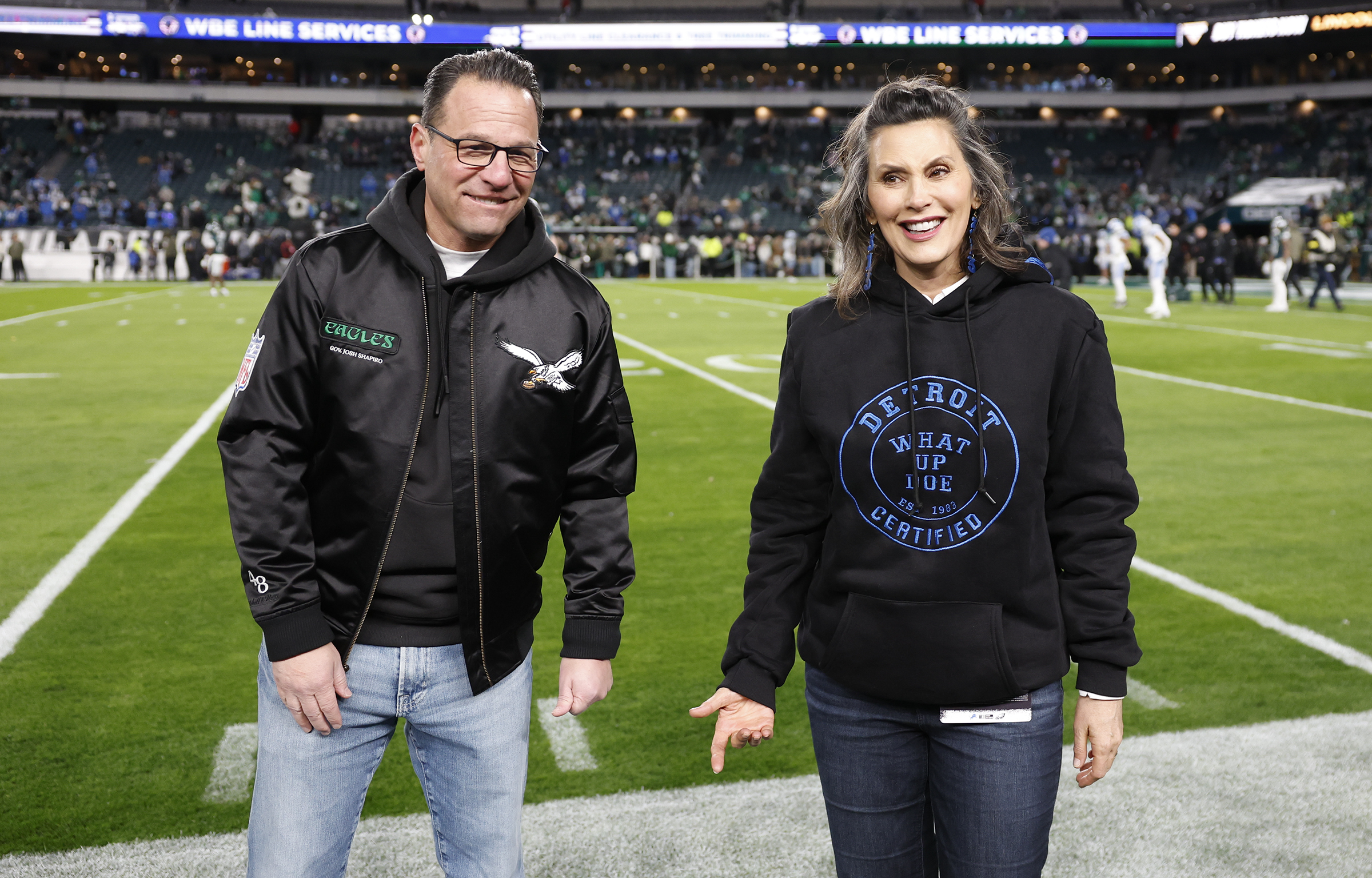
Pennsylvania Gov. Josh Shapiro (right) and Michigan Gov. Gretchen Whitmer before the Eagles played the Detroit Lions at Lincoln Financial Field on Sunday, Nov. 16, 2025, in Philadelphia, PA.
His book, Where We Keep the Light, will publish later this month, recounting his political upbringing, his vice presidential vetting, and the firebombing of his home last year. He’s not alone. Harris published a memoir about the 2024 election last year, and Newsom is due out with Young Man in a Hurry: A Memoir of Discovery in February.
But in the coming months, several Democratic strategists predict Shapiro will be squarely focused on the governor’s race he has to win in Pennsylvania — simultaneously proving he has what it takes to capture the vote of the nation’s most important swing state.
“He’s such a careful politician. He’s not taking anything for granted,” said former Gov. Ed Rendell, a Democrat who also once faced scrutiny for having potential presidential ambitions.
Shapiro is likely to follow the same campaign playbook in Pennsylvania as he did in 2022: Stump in every region of the state, including areas where Democrats don’t usually show up. That helped him run down the margins in longtime GOP strongholds like Lancaster or Schuylkill Counties toward his resounding victory over Mastriano. Those stops in most of Pennsylvania’s 67 countieswon’t give him as much time to visit South Carolina, Iowa, and New Hampshire, as the other Democratic presidential hopefuls start their sojourns.
Pennsylvania Governor Josh Shapiro waves goodbye to the crowd after speaking during graduation ceremonies at Pennsbury High School in Fairless Hills on Thursday, June 12, 2025.
“The No. 1 caveat is stay focused on the race you’re running,” echoed Alan Kessler, a national fundraiser based in Philadelphia who has supported and fundraised for Shapiro.
Still, the campaign is likely to generate attention beyond the Keystone State.
Shapiro will still court donors in blue states as he fundraises for reelection, Kessler added.
Come November, he will be the only governor with rumored 2028 aspirations up for reelection in a swing state. And his brand as a popular, moderate Democratic governor trying to restore trust in government — as well as his potential to help boost Democrats down ballot — will easily capture a wider audience and bring national media into Pennsylvania.
As Democrats seek to flip control of the U.S. House in 2026, targeting several congressional districts in the state, the election may once again come down to Pennsylvania, and in turn, increase the spotlight on Shapiro. The governor is widely seen as someone who can boost the congressional Democratic candidates also on the ballot, having won three of the four districts that Democrats are targeting in the state by double digits in 2022.
Republicans have targeted several weaknesses to try to erode Shapiro’s popularity in Pennsylvania and boost Garrity. They point to a lack of rigorous electoral challengers in his past. They question his record of “getting stuff done” — his oft-repeated motto — including three late state budgets. And they’ve harped on a lack of transparency as governor, including claims he used tax dollars for political benefitas well as a sexual harassment scandal involving a former top aide. They’ve also criticized his support for Minnesota Gov. Tim Walz, who recently dropped his third gubernatorial bid following a fraud scandal among the state’s Somali refugee population totaling $1 billion, according to federal prosecutors.
Among the emerging attacks: Republicans want to highlight Shapiro’s presumed presidential ambitions, as they try to cast him as an opportunist more interested in a future White House bid than the problems of everyday Pennsylvanians.
“Josh Shapiro is more concerned with a promotion to Pennsylvania Avenue than serving hardworking Pennsylvanians,” Garrity said in a statement, noting the state fared poorly in U.S. News and World Report rankings on the economy and education. “In the military, I learned the importance of putting service before self. Pennsylvanians are the hardest-working, most compassionate, strongest people in the nation, and together we will return Pennsylvania to our rightful place as a national and global leader.”
State Treasurer and Republican candidate for governor Stacy Garrity holds a rally in Bucks County Sept. 25, 2025 at the Newtown Sports & Events Center.
Mastriano, the far-right Republican state senator who announced Wednesday he won’t run for governor, said in a statement earlier this week that Shapiro “owes [Pennsylvanians] straight answers” over his use of the state plane, security updates to his personal home in Abington Township, and more.
“Pennsylvanians deserve accountability, not ambition,” he added, making a nod to Shapiro’s potential longer-term plans.
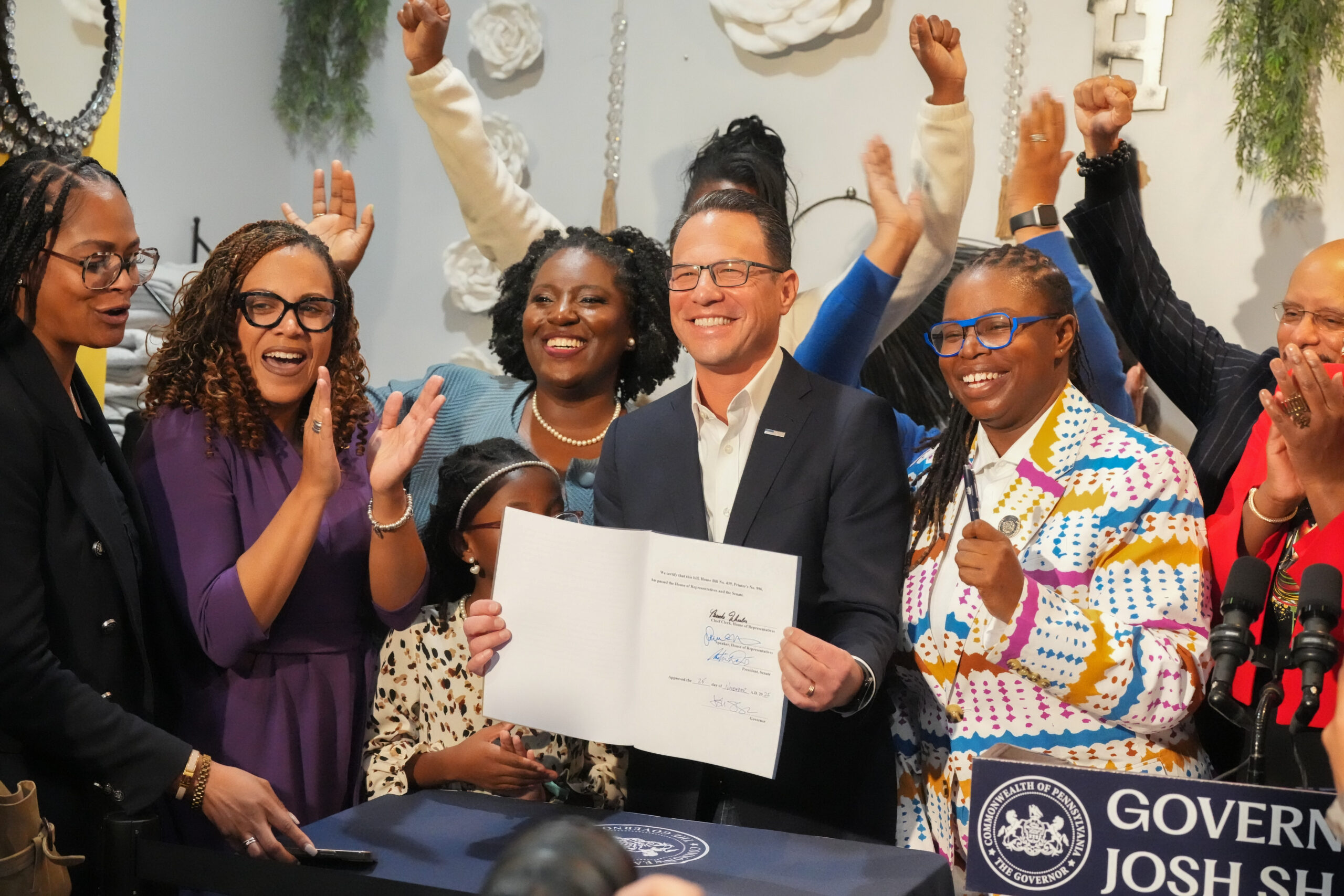
House Speaker Joanna McClinton, back center left, Gov. Josh Shapiro, front center, and State Rep. La’Tasha D. Mayes, right, celebrate the signing of the CROWN Act, which prohibits discrimination based on a person’s hair type, during a press conference at Island Design Natural Hair Studio, in West Philadelphia, November 25, 2025.
Borick, the pollster, was skeptical that attacks on Shapiro’s potential wider ambitions could reverse hislargely positive public sentiment.
“If that’s all they got, they don’t got a lot.”
Republicans insist they see a path to victory for Garrity in a politically divided state with months to go until the election. But behind the scenes, some Republicans are already acknowledging the goal is to lose by less and prevent big losses in state legislature or congressional races.
If Shapiro does look poised to cruise to victory, it might mean less media attention on the race, and it could mean he’s less vetted ahead of a much bigger stage.
“I think Josh is better served if the [Republican Governors Association] puts $100 million into this race because then it’s nationalized,” said a Democratic political strategist based in Pennsylvania who did not want to be named speculating on Shapiro’s presidential run. “If it’s a cakewalk, CNN’s not gonna cover it …If he wants to be governor for another four years, he should pray for a cakewalk. If he wants to be president, he should pray for a difficult campaign.”
Florida Gov. Ron DeSantis, for example, the strategist noted, cleaned up in his 2022 reelection, but failed to gain traction in the GOP presidential primary that Trump dominated.
Beyond 2026
Shapiro speaks Pennsylvanian very well. Raised in Montgomery County, he’s lived here almost all of his life, and has built an image as a popular moderate focused on problem-solving in a purple state. That’s earned him the support of about 30% of Trump voters in the state.
But winning a general election in Pennsylvania is different than winning a Democratic presidential primary.
He’s tried not to alienate the MAGA base, focusing on issues with bipartisan appeal like funding for apprenticeship and vocational-training programs. He’s taken on Trump in court, but has picked his personal battles with the president more carefully.
But being a strategic, self-described “progressive pragmatist” can end up alienating voters on both sides.
Gov. Josh Shapiro leaves after an event at the Port of Philadelphia Thursday, Apr. 10, 2025, the day after President Trump paused some tariffs.
Becky Carroll, a Democratic political consultant in Chicago who has worked with Pritzker, said Shapiro seems less on the radar of voters in the Midwest. As she’s followed Shapiro’s career, she said she sees a “damn fine governor,” but someone who’s taken a more muted approach to Trump than blue state governors like Pritzker and Newsom.
When it comes to a Democratic primary, candidates may be judged in part on their pushback to Trump, she said. “I think we’re in a moment where you can sulk in a corner and hope it’ll all go away or fight …,” Carroll said. “And if you’re gonna put yourself out there for a primary battle, you better show you have battle scars to prove you can fight for the most vulnerable in the country right now.”
Gov. Josh Shapiro is interviewed by TV news in the spin room at the Convention Center following the debate between former President Donald Trump and Vice President Kamala Harris Tuesday, Sept. 10, 2024.
But other national strategists see Shapiro’s moderate appeal as a potential asset in 2028. Jared Goldberg-Leopold, a former communications director for the Democratic Governors Association, thinks Shapiro’s biggest asset is his electoral track record in a state the nation knows is critical on the path to the White House. Primaries have previously been won by moderates whom the party thinks have the best chance at winning the general.
But the first step, Goldberg-Leopold stressed, is the governor’s race ahead.
“It would be easy for the Eagles to look past the 49ers to the next week of playoffs, but they’ve gotta focus on only one thing. And the same is true for the governor,” he said. “You can only prepare for what’s ahead of you, and the way people get in trouble in politics is planning too many steps ahead.”
Staff writer Katie Bernard contributed to this article.
WASHINGTON — The State Department said Wednesday that it has suspended all U.S. assistance to Somalia’s federal government over allegations that Somali officials destroyed an American-funded warehouse belonging to the World Food Program and seized 76 metric tons of food aid intended for impoverished civilians.
“The Trump Administration has a zero-tolerance policy for waste, theft, and diversion of life-saving assistance,” the department said in a statement.
“The State Department has paused all ongoing U.S. assistance programs which benefit the Somali Federal Government,” it said. “Any resumption of assistance will be dependent upon the Somali Federal Government, taking accountability for its unacceptable actions and taking appropriate remedial steps.”
It was not immediately clear how much assistance would be affected by the suspension because the Trump administration has slashed foreign aid expenditures, dismantled the U.S. Agency for International Development and not released new country-by-country data.
The U.S. had provided $770 million in assistance for projects in Somalia during the last year of Democratic President Joe Biden’s administration, but only a fraction of that went directly to the government.
The Trump administration made the move after authorities at the Mogadishu Port demolished the WFP warehouse at the direction of President Hassan Sheikh Mohamud “with no prior notification or coordination with international donor countries, including the United States,” according to a U.S. official familiar with the alleged incident.
The official spoke on condition of anonymity to discuss private reporting from American diplomats in the region.
WASHINGTON — The U.S. population is projected to grow by 15 million in 30 years, a smaller estimate than in previous years, due to President Donald Trump’s hard-line immigration policies and an expected lower fertility rate, the Congressional Budget Office said Wednesday.
The nonpartisan budget office projected that the U.S. population will grow from 349 million people this year to 364 million people in 30 years, a 2.2% smaller gain than it had predicted in 2025. In September, the office issued a revised demographics report that showed Trump’s plans for mass deportations and other strict immigration measures would result in roughly 320,000 people removed from the United States over the next 10 years.
The country’s total population is projected to stop growing in 2056 and remain roughly the same size as in the previous year, the CBO said. But without immigration, the population would begin to shrink in 2030 as deaths start to exceed births, making immigrants an increasingly important source of population growth, according to the report.
Even if the limits on immigration and increased deportations end with the Trump administration in three years, “it’s still a demographic shock,” said William Frey, a demographer at the centrist Brookings Institution.
Social Security and Medicare, which are already buckling under an aging population, will be under increasing pressure with even fewer than expected people in the labor force paying taxes. By the end of the decade, all of the nation’s baby boomers, born between 1946 and 1964, will be over age 65.
With fewer immigrants in the labor force and projections for U.S. fertility rates showing a long-term decline below replacement levels, “that reduces the number of kids who are going to be born in that four-year period” of the second Trump administration, Frey said.
The latest numbers come as Trump has pushed for the largest mass deportation campaign in history. The CBO’s numbers account for the success of those efforts in the first year of his second term in office.
Trump’s tax and spending law, passed by Congress and signed in July, included roughly $150 billion to ramp up his deportation agenda over the next four years. This includes money for extending the U.S.-Mexico border wall, building detention centers and adding thousands of law enforcement staff.
When it comes to estimating the nation’s population and future growth, immigration is always the wild card because it varies much more year to year than the number of births and deaths. Immigration has fueled U.S. population growth this decade because of an aging population and fertility lower than the replacement rate. For a generation to replace itself in the absence of immigration, the fertility rate needs to be 2.1 births per woman. But it was expected to be 1.58 in 2026 and is projected to drop to 1.53 in 2036 where it will remain over the next two decades.
The U.S. Census Bureau said that immigration increased by 2.8 million people in 2024 over the previous year.
Since Trump returned to office in January 2025, though, demographers and economists have struggled to decipher the impact of his policies on immigrant growth in the United States.
The bureau’s population estimates for last year have not been released yet, but the Current Population Survey estimated that the number of adult immigrants fell by 1.8 million people from January to November 2025. But those numbers have come under scrutiny, with some experts claiming they may reflect a decline in participation by immigrants in the survey rather than a dramatic drop in immigrant numbers.
Last September, the CBO reduced its immigration estimate for 2025 by 1.6 million people, and it said Wednesday that the U.S. added 410,000 immigrants last year. Immigration is projected to gradually increase through 2030, and then grow more slowly through 2036 because of fewer international students and temporary workers, before jumping up to an average of 1.2 million people a year from 2037 to 2056, the CBO said.
“These immigrants bring both themselves and the potential for children in the near term,” Kenneth Johnson, a senior demographer at the University of New Hampshire, said in an email. “They contribute both to the labor force through their arrival but also to the potential future growth of the US population through their potential to have children in the near term.”
LOS ANGELES — The high-profile private attorney for Nick Reiner resigned from his case Wednesday for reasons he said he could not reveal, and he later told reporters that under California law his client is definitely not guilty of murder in the killing of his parents, Rob Reiner and Michele Singer Reiner.
“Circumstances beyond our control and more importantly circumstances beyond Nick’s control have dictated that, sadly, it’s made it impossible to continue our representation,” lawyer Alan Jackson said as he stood with his team outside a Los Angeles courthouse.
But, Jackson added, after weeks of investigation, “what we’ve learned, and you can take this to the bank, is that pursuant to the laws of this state, pursuant to the law of California, Nick Reiner is not guilty of murder. Print that.”
Jackson would not specify what he meant and took no questions at the brief news conference, but it was the first direct statement from a Nick Reiner representative about his guilt or innocence in the 3 1/2 weeks since the killings.
He spoke after a hearing where Reiner was supposed to be arraigned and enter a plea to two charges of first-degree murder. Instead, after meeting with the Judge Theresa McGonigle in chambers, Jackson, at his own request, was replaced by a public defender and the plea hearing was postponed to Feb. 23.
Jackson does not say why he has to quit case
Jackson said that for legal and ethical reasons, he could not reveal why he had to resign. He first appeared in court representing Nick Reiner at a hearing a few days after the beloved actor-director and his wife of 36 years were found dead with stab wounds in their home in the upscale Brentwood section of Los Angeles. Jackson did not say how he was hired — or who hired him. Generally, defendants use public defenders when they can’t pay for a private attorney.
Jackson has become one of the most prominent defense attorneys in the nation in recent years after his defense of clients including Harvey Weinstein, Kevin Spacey and Karen Read at her intensely followed trials in Massachusetts.
Deputy Public Defender Kimberly Greene took over as Reiner’s attorney during the hearing.
“The Public Defender’s Office recognizes what an unimaginable tragedy this is for the Reiner family and the Los Angeles community,” LA County Public Defender Ricardo D. Garcia said in a rare public statement on a case from the office. “Our hearts go out to the Reiner family as they navigate this difficult time. We ask for your patience and compassion as the case moves through the legal process.”
A Reiner family spokesperson said in a statement after Wednesday’s hearing that “They have the utmost trust in the legal process and will not comment further on matters related to the legal proceedings.”
Nick Reiner appears in jail clothes, without suicide prevention smock
During Wednesday’s hearing, Reiner stood behind glass in a custody area of the courtroom wearing brown jail garb and with his hair shaved. Two deputies stood behind him. Jackson and his team stood in front of him on the other side of the glass. At one point, Reiner stood on his tiptoes to peer over the lawyers’ heads to look at the audience. He spoke only to agree to the delayed arraignment.
McGonigle approved the use of cameras inside the courtroom but said photos and video could not be taken of the defendant. Reiner did not wear the suicide prevention smock he had on at his initial court appearance on Dec. 17.
Reiner, 32, the third of Rob Reiner’s four children, has been held without bail since his arrest hours after his parents were found dead on Dec. 14.
Jackson says he ‘dropped everything’ to represent Reiner
Jackson, a former LA County prosecutor, had given no indication of the plans for his defense.
He said that just hours after Nick Reiner’s arrest, he and his team were in New York when they got a call about representing him. He did not say who called him.
“We dropped everything,” Jackson said. “For the last three weeks, we have devoted literally every waking hour to protecting Nick and his interests. We’ve investigated this matter top to bottom, back to front.”
He said they remain “deeply, deeply committed” to him and said, “We’re not just convinced; we know that the legal process will reveal the true facts.”
Rob Reiner, 78, and Michele Singer Reiner, 70, were killed early on the morning of Dec. 14, and they were found in the late afternoon, authorities said. The LA County Medical Examiner said in initial findings that they died from “multiple sharp force injuries.” A court order has prevented the release of more details. Police have said nothing about possible motives.
Prosecutors have said they have not yet decided whether to seek the death penalty for Nick Reiner.
Rob Reiner was a prolific director whose work included some of the most memorable and endlessly watchable movies of the 1980s and ’90s. His credits included “This is Spinal Tap,” “Stand By Me,” “A Few Good Men,” and “When Harry Met Sally …,” during whose production he met Michele Singer, a photographer, and married her soon after.
A decade ago, Nick Reiner publicly discussed his struggles with addiction and mental health after making a movie with his father, “Being Charlie,” that was very loosely based on their lives.
Americans should eat more whole foods and protein, fewer highly processed foods and less added sugar, according to the latest edition of federal nutrition advice released Wednesday by the Trump administration.
Health Secretary Robert F. Kennedy Jr. and Agriculture Secretary Brooke Rollins issued the 2025-2030 U.S. Dietary Guidelines for Americans, which offer updated recommendations for a healthy diet and provide the foundation for federal nutrition programs and policies. They come as Kennedy has for months stressed overhauling the U.S. food supply as part of his Make America Healthy Again agenda.
“My message is clear: Eat real food,” Kennedy said at a White House briefing.
The guidelines emphasize consumption of fresh vegetables, whole grains and dairy products, long advised as part of a healthy eating plan. Officials released a new graphic depicting an inverted version of the long-abandoned food pyramid, with protein, dairy, healthy fats and fruits and vegetables at the top and whole grains at the bottom.
But they also take a new stance on “highly processed” foods, and refined carbohydrates, urging consumers to avoid “packaged, prepared, ready-to-eat or other foods that are salty or sweet, such as chips, cookies and candy.” That’s a different term for ultraprocessed foods, the tasty, energy-dense products that make up more than half the calories in the U.S. diet and have been linked to chronic diseases such as diabetes and obesity.
The new guidance backs away from revoking long-standing advice to limit saturated fats, despite signals from Kennedy and Food and Drug Commissioner Marty Makary that the administration would push for more consumption of animal fats to end the “war” on saturated fats.
Instead, the document suggests that Americans should choose whole-food sources of saturated fat — such as meat, whole-fat dairy or avocados — while continuing to limit saturated fat consumption to no more than 10% of daily calories. The guidance says “other options can include butter or beef tallow,” despite previous recommendations to avoid those fats.
Guidelines were due for an update
The dietary guidelines, required by law to be updated every five years, provide a template for a healthy diet. But in a country where more than half of adults have a diet-related chronic disease, few Americans actually follow the guidance, research shows.
The new recommendations drew praise from some prominent nutrition and medical experts.
“There should be broad agreement that eating more whole foods and reducing highly processed carbohydrates is a major advance in how we approach diet and health,” said Dr. David Kessler, a former FDA commissioner who has written books about diet and nutrition and has sent a petition to the FDA to remove key ingredients in ultraprocessed foods.
“The guidelines affirm that food is medicine and offer clear direction patients and physicians can use to improve health,” said Dr. Bobby Mukkamala, president of the American Medical Association.
Other experts were relieved that the guidelines didn’t go against decades of nutrition evidence linking saturated fat to heart disease, but they were critical of the guidelines’ focus on meat and dairy as a primary source of protein instead of plant-based sources.
“Overall, if people eat the way these are recommended, they will be eating more calories, not less,” said Marion Nestle, a nutritionist and food policy expert who advised previous editions of the guidance.
The new document is just 10 pages, upholding Kennedy’s pledge to create a simple, understandable guideline. Previous editions of the dietary guidelines have grown over the years, from a 19-page pamphlet in 1980 to the 164-page document issued in 2020, which included a four-page executive summary.
The guidance will have the most profound effect on the federally funded National School Lunch Program, which is required to follow the guidelines to feed nearly 30 million U.S. children on a typical school day.
The Agriculture Department will have to translate the recommendations into specific requirements for school meals, a process that can take years, said Diane Pratt-Heavner, spokesperson for the School Nutrition Association. The latest school nutrition standards were proposed in 2023 but won’t be fully implemented until 2027, she noted.
Science advisers didn’t make ultraprocessed food recommendations
The new guidelines largely rejected the advice of a 20-member panel of nutrition experts convened by the Biden administration, who met for nearly two years to review the latest scientific evidence on diet and health. Kennedy had criticized the expertise of the panel members and suggested that they had ties to the food industry that influenced their advice.
Instead, the new guidance relied on a new set of experts revealed Wednesday in supporting documents. Of the 10 experts who led the new scientific review under Kennedy, five reported financial ties to beef, pork or dairy industries or to makers of infant formula or supplements.
The new group rejected more than half the recommendations of the previous panel, the documents showed.
That previous panel didn’t make recommendations about ultraprocessed food. Although a host of studies have shown links between ultraprocessed foods and poor health outcomes, the nutrition experts had concerns with the quality of the research and the certainty that those foods, and not other factors, were causing the problems.
The recommendations on highly processed foods drew cautiously positive reactions. The FDA and the Agriculture Department are already working on a definition of ultraprocessed foods, but it’s expected to take time.
Not all highly processed foods are unhealthy, said Dr. David Ludwig, an endocrinologist and researcher at Boston Children’s Hospital.
“I think the focus should be on highly processed carbohydrates,” he said, noting that processing of protein or fats can be benign or even helpful.
More protein recommended
The guidelines made a few other notable changes, including a call to potentially double protein consumption.
The previous recommended dietary allowance called for 0.8 grams of protein per kilogram of body weight — about 54 grams daily for a 150-pound person. The new recommendation is 1.2 to 1.6 grams of protein per kilogram of body weight. An average American man consumes about 100 grams of protein per day, or about twice the previously recommended limit.
Makary said the new advice supersedes protein guidance that was based on the “bare minimum” required for health.
Ludwig also noted that the earlier recommendation was the minimum amount needed to prevent protein deficiency and said higher amounts of protein might be beneficial.
“A moderate increase in protein to help displace the processed carbohydrates makes sense,” he said.
Officials with the American Heart Association, however, called for more research on protein consumption and the best sources for optimal health.
“Pending that research, we encourage consumers to prioritize plant-based proteins, seafood and lean meats and to limit high-fat animal products including red meat, butter, lard and tallow, which are linked to increased cardiovascular risk,” the group said in a statement.
Avoid added sugars
The guidelines advise avoiding or sharply limiting added sugars or non-nutritive sweeteners, saying “no amount” is considered part of a healthy diet.
No one meal should contain more than 10 grams of added sugars, or about 2 teaspoons, the new guidelines say.
Previous federal guidelines recommended limiting added sugars to less than 10% of daily calories for people older than 2, but to aim for less. That’s about 12 teaspoons a day in a 2,000-calorie daily diet. Children younger than 2 should have no added sugars at all, the older guidance said.
In general, most Americans consume about 17 teaspoons of added sugars per day, according to the U.S. Centers for Disease Control and Prevention.
Alcohol limits removed
The new guidelines roll back previous recommendations to limit alcohol to one drink or less per day for women and two drinks or less per day for men.
Instead, the guidance advises Americans to “consume less alcohol for better health.” They also say that alcohol should be avoided by pregnant women, people recovering from alcohol use disorder and those who are unable to control the amount they drink.
U.S. Secretary of State Marco Rubio said he plans to meet with Danish officials next week after the Trump administration doubled down on its intention to take over Greenland, the strategic Arctic island that is a self-governing territory of Denmark.
Since the capture of former Venezuelan leader Nicolás Maduro, President Donald Trump has revived his argument that the United States needs to control the world’s largest island to ensure its own security in the face of rising threats from China and Russia in the Arctic.
Danish Foreign Minister Lars Løkke Rasmussen and his Greenland counterpart, Vivian Motzfeldt, had requested a meeting with Rubio, according to a statement posted Tuesday to Greenland’s government website. Previous requests for a meeting were not successful, the statement said.
Rubio told a select group of U.S. lawmakers that it was the Republican administration’s intention to eventually purchase Greenland, as opposed to using military force.
The remarks, first reported by The Wall Street Journal, were made in a classified briefing Monday evening on Capitol Hill, according to a person with knowledge of his comments who was granted anonymity because it was a private discussion.
On Wednesday, Rubio told reporters in Washington that Trump has been talking about acquiring Greenland since his first term. “That’s always been the president’s intent from the very beginning,” Rubio said. “He’s not the first U.S. president that has examined or looked at how we could acquire Greenland.”
European leaders express concern
The leaders of France, Germany, Italy, Poland, Spain and the United Kingdom joined Danish Prime Minister Mette Frederiksen in issuing a statement this week reaffirming that the mineral-rich island, which guards the Arctic and North Atlantic approaches to North America, “belongs to its people.” Frederiksen warned that a U.S. takeover would amount to the end of NATO.
“The Nordics do not lightly make statements like this,” Maria Martisiute, a defense analyst at the European Policy Centre think tank, told The Associated Press on Wednesday. “But it is Trump whose very bombastic language bordering on direct threats and intimidation is threatening the fact to another ally by saying, ‘I will control or annex the territory.’”
Rubio, who was on Capitol Hill for a classified briefing Wednesday with the entire U.S. Senate and House, did not directly answer reporters’ questions about whether the administration was willing to risk the NATO alliance by potentially moving ahead with a military option regarding Greenland.
“I’m not here to talk about Denmark or military intervention, I’ll be meeting with them next week, we’ll have those conversations with them then, but I don’t have anything further to add to that,” Rubio said. He added that every president retains the option to address national security threats to the United States through military means.
White House press secretary Karoline Leavitt said Tuesday that using the military to acquire Greenland was an option, though she told reporters Wednesday that “the president’s first option always has been diplomacy.”
Some Republican senators said they saw strategic value in Greenland, but they stopped short of supporting military action to acquire it.
Kansas Sen. Roger Marshall said he hoped “we can work out a deal,” while North Dakota Sen. John Hoeven said some of the discussion about taking Greenland by force has been “misconstrued.”
“One of the things about President Trump, you may have noticed, is he keeps our adversaries off balance by making sure they don’t know what we’re going to do,” Hoeven said.
But Alaska Sen. Lisa Murkowski said she hated “the rhetoric around either acquiring Greenland by purchase or by force,” adding, “I think that it is very, very unsettling.”
Democratic Sen. Jeanne Shaheen of New Hampshire and Republican Sen. Thom Tillis of North Carolina, co-chairs of the bipartisan Senate NATO Observer Group, said the U.S. needs to honor its treaty obligations to Denmark.
“Any suggestion that our nation would subject a fellow NATO ally to coercion or external pressure undermines the very principles of self-determination that our Alliance exists to defend,” the senators said in a joint statement.
‘This is America now’
Thomas Crosbie, an associate professor of military operations at the Royal Danish Defense College, said an American takeover would not help Washington’s national security.
“The United States will gain no advantage if its flag is flying in Nuuk versus the Greenlandic flag,” he told the AP. “There’s no benefits to them because they already enjoy all of the advantages they want. If there’s any specific security access that they want to improve American security, they’ll be given it as a matter of course, as a trusted ally. So this has nothing to do with improving national security for the United States.”
Denmark’s parliament approved a bill in June to allow U.S. military bases on Danish soil. It widened a previous military agreement, made in 2023 with the Biden administration, in which U.S. troops had broad access to Danish air bases in the Scandinavian country. Denmark’s foreign minister has said that Denmark would be able to terminate the agreement if the U.S. tries to annex all or part of Greenland.
In the event of military action, the U.S. Department of Defense operates the remote Pituffik Space Base, in northwestern Greenland, and the troops there could be mobilized.
Crosbie said he believes the U.S. would not seek to hurt the local population or engage with Danish troops.
“They don’t need to bring any firepower. They don’t need to bring anybody,” Crosbie said Wednesday. “They could just direct the military personnel currently there to drive to the center of Nuuk and just say, ‘This is America now,’ right? And that would lead to the same response as if they flew in 500 or 1,000 people.”
The danger in an American annexation, he said, lies in the “erosion of the rule of law globally and to the perception that there are any norms protecting anybody on the planet.”
He added: “The impact is changing the map. The impact I don’t think would be storming the parliament.”