Category: New Jersey Politics

  • Camden’s planned 25-story Beacon Building could get a boost from new N.J. tax credit bill

    Camden’s planned 25-story Beacon Building could get a boost from new N.J. tax credit bill

    New Jersey lawmakers on Monday approved a bill that would make it easier for development projects in Camden to qualify for hundreds of millions of dollars in tax credits.

    That could be a boon to the Beacon Building — a planned 25-story office tower downtown whose backers have said they intend to seek state incentives — among other projects, according to the bill’s supporters.

    Under current law, most commercial real estate developers must show their projects would generate more dollars in economic activity than they would receive in subsidies in order to qualify for tax credits under New Jersey’s gap-financing program, known as Aspire.

    The new legislation — which was introduced late last month and approved by the Democratic-led Legislature days before Democratic Gov. Phil Murphy is to leave office — would exempt certain projects from the program’s so-called net benefit test.

    Lawmakers on Monday also passed a bill increasing the cap on the size of the Aspire tax-credit program from $11.5 billion to $14 billion and authorized $300 million in tax breaks to renovate the Prudential Center in Newark, home of the New Jersey Devils hockey franchise. The team is owned by Harris Blitzer Sports & Entertainment, which also owns the Philadelphia 76ers.

    ‘Competitive market’

    Supporters of the Camden bill, A6298/S5025, said it would make South Jersey more competitive in the Philadelphia market, while critics contended it would weaken a provision of a 2020 economic development law signed by Murphy that was intended to ensure fiscal prudence.

    The test has impeded big projects in South Jersey, said Assembly Majority Leader Louis Greenwald (D., Camden), a sponsor of the bill. Since the law was signed, the region hasn’t attracted a single “transformative project” — a designation in the Aspire program for developments that have a total cost of $150 million and are eligible for up to $400 million in incentives over 10 years, Greenwald said.

    “We started to ask people, what’s the barrier?” he said. “And when you look at the competitive market of what [developers] can get in Philadelphia or Pennsylvania compared to other areas in the state that don’t have to compete with that, that net operating loss test, that net benefits test, is a barrier.”

    The legislation was not drafted with a specific project in mind, Greenwald said, but he acknowledged that one that might benefit is Beacon, which would feature 500,000 square feet of office space.

    Developer Gilbane is leading the project with the Camden County Improvement Authority at a vacant site on the northwest corner of Broadway and Martin Luther King Boulevard across the street from the Walter Rand Transportation Center and Cooper University Hospital.
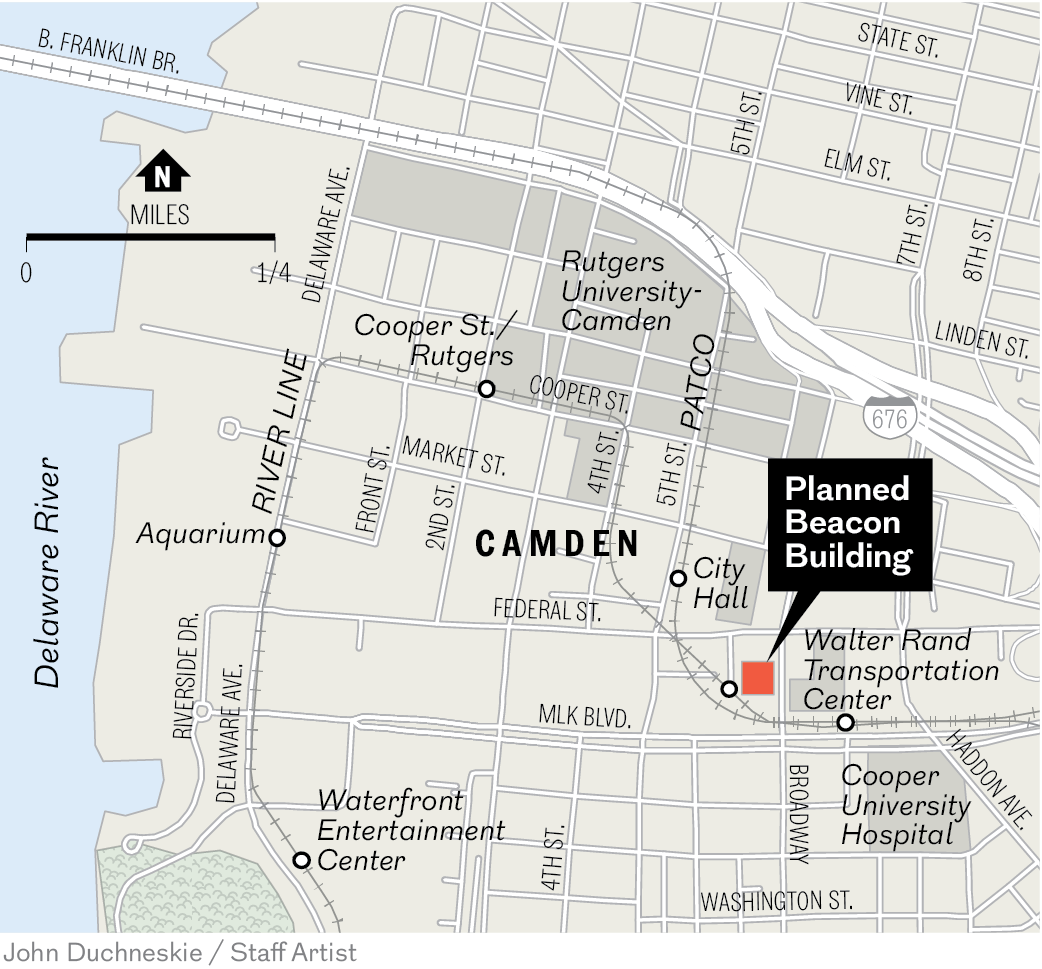
    Map of the planned Beacon Building in Camden.

    “The goal is to attract projects, maybe like Beacon Tower, to capitalize off of the growth that we’ve seen in Camden city,” Greenwald said.

    Any project seeking Aspire subsidies must apply to the Economic Development Authority.

    Camden County officials have said they expect tenants to include Cooper University Health Care, which has said it needs additional office space to accommodate its $3 billion expansion. They also hope to entice civil courts to relocate there.

    County Commissioner Jeff Nash said last year that tenants had yet to commit, in part because the development team was still working on an application for Aspire tax credits.

    The incentives will help determine rent, he told the Cherry Hill Sun. The land is owned by the Camden Parking Authority, and Nash has said officials are still trying to determine who will own the site and the building going forward, according to Real Estate NJ.

    County spokesperson Dan Keashen said that those talks remain ongoing and that the improvement authority may issue a request for proposals for a new developer. Gilbane, the current master developer, didn’t respond to a request for comment.

    Wendy Marano, a spokesperson for Cooper University Health Care, said she didn’t have an immediate answer to a question about whether the hospital network planned to obtain an equity stake in the development.

    In 2014 the state awarded $40 million in tax credits to incentivize Cooper Health’s relocation of suburban office jobs to Camden, and Cooper later bought a stake in the development.

    The possible new state investment in Camden comes after Murphy’s administration separately allocated $250 million to renovate the state-owned Rand center — which serves two dozen NJ Transit bus lines and the River Line, and includes PATCO’s Broadway station.

    Construction on the transit center is expected to begin soon, according to county officials. While that renovation is underway, the Beacon site will serve as a temporary bus shelter, Keashen said, adding that possible construction on an office tower is still years away.

    Fast track

    Critics of the bill said that it was rushed through the Legislature with minimal public input and outside the normal budget process, and that it appeared to be designed to benefit specific projects. The bill passed the Assembly, 48-25, and the Senate, 24-14. It now heads to Murphy’s desk. The governor’s second term ends on Jan. 20, when he is to be succeeded by fellow Democrat Mikie Sherrill.

    The legislation applies to redevelopment projects located in a “government-restricted municipality” — language included in the Aspire program’s statute — “which municipality is also designated as the county seat of a county of the second class.” The project must also be located in “close proximity” to a “multimodal transportation hub,” an institution of higher education, and a licensed healthcare facility that “serves underrepresented populations.”

    “I say to you that there’s going to be one project that fits all those criteria,” Assemblyman Jay Webber (R., Morris) said on the floor of the chamber during debate Monday.

    “The net benefits test was put in as an accountability measure to make sure these projects were at least by some measure benefiting the taxpayer,” Webber added in an interview.

    “And now apparently one or more projects can’t meet that test,” he said. “And so rather than stick to the rules that they agreed to and pull the credits, they’re going to change the rules, lower the bar so that somebody can step over it. It’s wrong.”

    Greenwald said the legislation has “nothing to do with [Beacon] in particular,” adding that he hopes it is one of many projects that could benefit. Possible developments in Trenton and New Brunswick could also qualify for incentives under the bill, he said.

    Assembly Majority Leader Louis Greenwald in 2019.

    The net benefit test

    The test relies on economic modeling based on data such as projected jobs and wages. Under current law, most commercial projects seeking Aspire credits must demonstrate a minimum net benefit to New Jersey of 185% of the tax credit award — meaning, for instance, an applicant that receives $100 million in credits must generate $185 million in economic activity.

    The credits can be sold to the state Treasury Department for 85 cents on the dollar.

    Projects located in “government-restricted municipalities” — a half-dozen cities, including Camden, selected by the Legislature — already face a lower threshold of 150%, according to the state Economic Development Authority.

    Some projects, including residential and certain healthcare centers, are exempt from the net benefit test.

    The test was strengthened in the Economic Recovery Act of 2020, signed by Murphy, because “we saw in previous iterations of the tax credit program that if the guardrails weren’t strong enough … then companies could simply not meet the test, or, you know, not follow through on their promises, and nonetheless collect the funds,” said Peter Chen, senior policy analyst at New Jersey Policy Perspective, a liberal-leaning think tank.

    The 2020 law changed that, he said. “It’s one of the most important guardrails of the entire corporate tax credit program,” Chen said in an interview last week. “So exempting any project from the net benefit test requires a pretty large, pretty strong reason for doing so, and in this case, no reason was given.”

    Criminal case

    The renewed push for tax credits in South Jersey comes as a criminal case involving an earlier round of corporate subsidies continues to play out in court.

    Democratic power broker George E. Norcross III — founder of a Camden-based insurance brokerage and chairman of Cooper Health — and five codefendants were indicted in 2024 on racketeering charges related to development projects on the city’s waterfront.

    A judge dismissed the charges last year, and the state Attorney General’s Office is appealing the decision. Norcross has denied wrongdoing. He and his allies say state incentives have helped revitalize the city.

    During his floor speech on Monday, Webber alluded to “incredible allegations of corruption” in the earlier economic development program and noted that Murphy had previously championed reform of the system.

    The governor’s spokesperson, Tyler Jones, declined to comment on pending legislation.
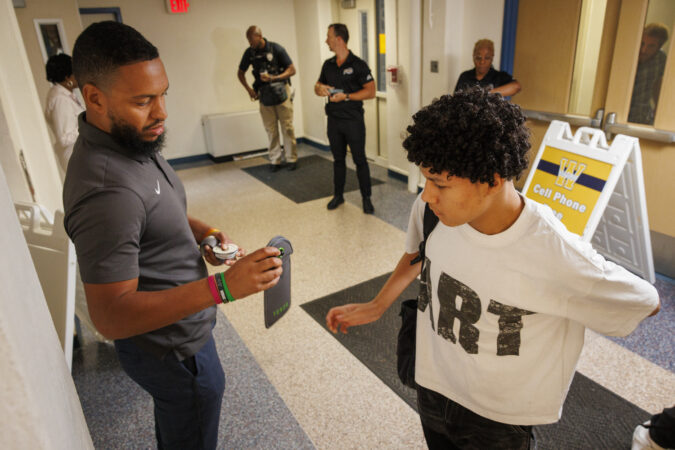
  • N.J. adopts ‘bell-to-bell’ cell phone ban policy for public schools

    N.J. adopts ‘bell-to-bell’ cell phone ban policy for public schools

    Gov. Phil Murphy signed a law Thursday banning cell phones in New Jersey public schools from “bell to bell” in an effort to help students focus on learning.

    New Jersey joins a growing number of states that have enacted tighter cell phone restrictions in schools to remove distractions. Pennsylvania is considering a similar measure, and 17 states have banned the devices in schools, according to ABC News.

    Murphy proposed the restrictions last year during his annual State of the State address. Legislation then won bipartisan support in both houses.

    During a bill-signing event at Ramsey High School in Bergen County, Murphy said the law would promote improved academic performance and student mental health.

    “By getting rid of needless distractions, we are fundamentally changing our schools’ learning environments and encouraging our children to be more attentive and engaged during the school day,” Murphy said. “This is a sensible policy that will make a world of difference for our children.”

    Murphy, who said he refrains from bringing his phone into meetings, borrowed a phone to use as a prop for the news conference because his was locked in his car.

    “That will be locked up until I’m no longer governor,” said Murphy, who leaves office Jan. 20.

    The bill was heavily endorsed by principals and teachers, who said valuable instruction time is lost when they have to direct students to put away the devices during class.

    Experts say cell phones have become a growing distraction and hinder learning. Students have been using their phones to text friends and even to watch movies during class. The devices have also been used for cyberbullying.

    Bans will not go into place in schools around the state, however, until next school year. The law requires the state Department of Education to develop guidelines for districts to draft polices restricting the use of cell phones and devices by students in classrooms and during the school day.

    Local school boards that operate more than 600 districts across the state must then adopt a new policy. The law takes effect for the 2026-2027 school year.

    Many districts in South Jersey, including Cherry Hill, Deptford, Moorestown, Washington Township, and Woodbury, already restrict cell phone use in classrooms, but the policies have not been consistently enforced and punishments vary. Some require students to store their phones in lockers all day, while others allow phones during lunch and breaks.

    Some districts only require students to keep their phones turned off, while others provide locations for the devices to be stored during the school day.

    Under the bell-to-bell approach of the new state law, students will not be permitted to access their phones for the entire school day.

    Lianah Carruolo, a seventh-grade student at Woodbury Junior-Senior High School, unlocks her cell phone pouch in September 2024.

    Woodbury Superintendent Andrew Bell said a cell-phone-free campus policy at Woodbury Senior High School has drastically changed the culture. There are fewer disciplinary issues and students interact more with classmates and teachers, he said.

    “Students are noticeably happier, engaged and present in their classrooms, and connected to one another,” said Dwayne Dobbins Jr., acting co-principal of Woodbury Junior-Senior High School.

    What happens next?

    Districts must adopt policies restricting cell phones during the entire school day. That may require students to lock up the devices when they arrive or secure them in locked pouches.

    In December, the state awarded nearly $1 million in grants to 86 districts under a new Phone-Free Schools Grant Program to help districts implement the policy. Schools had to agree to restrict cell phone use during the entire day.

    In South Jersey, 12 districts in Burlington, Camden, and Gloucester Counties received grants. The grant amounts varied depending on the size of each district.

    window.addEventListener(“message”,function(a){if(void 0!==a.data[“datawrapper-height”]){var e=document.querySelectorAll(“iframe”);for(var t in a.data[“datawrapper-height”])for(var r,i=0;r=e[i];i++)if(r.contentWindow===a.source){var d=a.data[“datawrapper-height”][t]+”px”;r.style.height=d}}});

    Gloucester City Superintendent Sean Gorman said his district used a $10,823 grant to install cabinets in classrooms where students in grades 7-12 must lock up their devices when they arrive for homeroom. Younger students are instructed to leave the devices at home, he said.

    “We know it’s right for kids,” Gorman said. “If you let them bury their head in their phone for a good portion of the day they will.”

    Other districts, like Woodbury, have opted to use locked pouch systems to store students’ phones. They retrieve their phones at the end of the day.

    In Pennsylvania, similar legislation has bipartisan support and advanced out of a Senate committee last month.

    What about parental concerns?

    Not everyone agrees with the bans.

    Some parents have expressed concern that they will not be able to reach their children, especially in the event of an emergency. School officials say parents will still be able to contact their children through the main office.

    There have also been arguments by opponents that states are overreacting with the cell phone bans and that the legislation is unlikely to have the intended impact.

    But groups have parents have also mobilized to speak out against cell phone use, circulating pledges to wait until eighth grade or high school to purchase phones for their children.

    Are there exceptions to the ban?

    Districts will have some flexibility to allow exceptions. For example, some students use their phones for medical conditions such as glucose testing.

    Exceptions may also be made for students with individual education plans or IEPs and use devices such as tablets and ear buds as part of their curriculum.

    Before the law signed Thursday, some districts allowed students to retrieve their phones during breaks, in the hallways between classes or during lunch. The law no longer permits that.

    Will students be penalized?

    It will be left to districts to decide how policy violations should be handled. Some districts with policies already have opted for a progressive discipline approach.

    Gorman said Gloucester City has had 60 violations at its high school since the new policy took effect in September, down from 130 the previous year. The school has 731 students.

    First-time offenders are given a two-day, in-school suspension and their phone is confiscated, Gorman said. A second offense gets a four-day, in-school suspension; three-time offenders are given a three-day, out-of-school suspension and remanded to an alternative program, he said.

    Gorman said students have largely accepted the policy. The school has had fewer disciplinary problems and conflicts typically escalated through text messages have decreased, he said.

    “We barely had any repeat offenders,” Gorman said.

  • Vineland educator is named new Camden superintendent, the first Hispanic to lead the district

    Vineland educator is named new Camden superintendent, the first Hispanic to lead the district

    A veteran Vineland educator has been named the state-appointed superintendent to oversee the Camden school system, state Education Commissioner Kevin Dehmer announced Wednesday.

    Alfonso Q. Llano Jr. was selected after a national search that began in June. He will begin heading the troubled South Jersey school system starting March 1.

    He will be the first Hispanic superintendent to lead the district. Demographics in Camden have shifted in recent years, and 56% of its traditional public school students are now Hispanic, 42% are Black, and 1.2% are white.

    Dehmer made the long-awaited announcement at the monthly state Board of Education meeting in Trenton. The board unanimously approved the appointment.

    “I’m honored for the opportunity to serve the Camden City School District,” Llano said. “Together, we’re going to work through transparency and tough times. We’re going to achieve great things.”

    Llano will receive an annual salary of $260,000 under a three-year contract.

    In Vineland, he was the highest-paid superintendent in Cumberland County with an annual base salary of $206,000.

    Davida Coe-Brockington, a longtime Camden educator who has served as the interim superintendent during the search, will remain in that role until Llano takes over. She was not a candidate for the job.

    Llano succeeds Katrina T. McCombs, whose contract was not renewed after a group of city leaders, including Mayor Victor Carstarphen, called for her ouster. The group said Camden schools needed “a new vision for leadership.” McCombs left Camden in July for a state role after seven years as superintendent.

    Reactions to Llano’s hiring

    Carstarphen and other officials praised Llano’s appointment in a statement released Wednesday. The mayor lauded the state “for identifying someone who will bring meaningful change for Camden’s students.”

    “I am confident he will be an excellent leader who prepares our students for the future and always puts our students’ academic interest first,” Carstarphen said.

    N’Namdee Nelson, president of the Camden City Advisory School Board, said: “We want to ensure that every child in the school district has access to a great school.”

    Others, like former longtime school board member Jose E. Delgado, wished Llano well but were less optimistic. He said the selection of a Hispanic superintendent was “long overdue.”

    “He’s stepping into a very dysfunctional environment that will require a wide array of fiscal, administrative, and educational skills,” Delgado said.

    Llano inherits a district with declining enrollment — it currently has about 5,532 students — low test scores, and a high dropout rate. There have been modest gains since the state seized control of the district in 2013.

    The changing educational landscape in Camden poses the biggest challenge. Thousands of students have left the city’s traditional public schools for Renaissance and charter schools, which are publicly funded but privately run and now lead the district’s enrollment.

    Camden is the only district in New Jersey with three school types. Charters enroll 3,236 students, and Renaissance schools have 6,664 students.

    Last spring, McCombs cited the declining enrollment in part for a $91 million budget deficit. She cut more than 100 positions and laid off teachers and support staff in a massive restructuring.

    Camden Education Association president Pamela Clark, who represents more than 1,000 teachers and support staff, said she hopes to meet with Llano soon to discuss concerns about possible layoffs and school closures.

    “I will continue to advocate fiercely to protect my members’ jobs and school closures, and I hope the new superintendent brings fairness, transparency, and unity to our city,” she said.

    Llano’s past work in Vineland and Trenton

    Llano has been superintendent of the Vineland district in Cumberland County since 2021. His five-year contract was set to expire in June.

    During a meeting in June, the Vineland board was bitterly divided over whether to renew his contract. The board must give six months’ notice if it plans to terminate a superintendent. The motion to not renew it failed, and it was unclear what direction the board would pursue.

    In Vineland, Llano oversaw a diverse district of more than 10,200 students enrolled in 16 schools. About 63% of the students are Hispanic, 14% are Black, and 18% are white. About 17.4% of its students are multilingual learners.

    Vineland has some of the same issues as Camden schools — low test scores and chronic absenteeism. The majority of the students in the sprawling 68-square-mile community are economically disadvantaged.

    Llano also spent 10 years in the Trenton school system, most recently as the interim schools chief for nearly a year prior to moving to Vineland. He previously was the district’s chief academic officer for six months. He also was an assistant superintendent and principal in Trenton.

    According to his LinkedIn profile, Llano also had stints in the Readington Township and Howell Township school districts in a career spanning 27 years.

    He is pursuing a doctoral degree in education at Seton Hall University. He holds master’s degrees from New Jersey City University and Kean University, and a bachelor’s degree from Rowan University.

    Interim State-appointed Camden school Superintendent Davida Coe-Brockington.

    Coe-Brockington said Llano’s reputation precedes him and that she was looking forward to working with him to “focus on the progress we’ve made in the district and focus on creating better outcomes for the students and families of Camden City.”

    It was unclear Wednesday whether Coe-Brockington would remain in the central office when Llano takes over or return to Creative Arts High School, where she has been principal since it opened in 1999.

  • Long under fire, Pemberton mayor resigns after being called uninsurable

    Long under fire, Pemberton mayor resigns after being called uninsurable

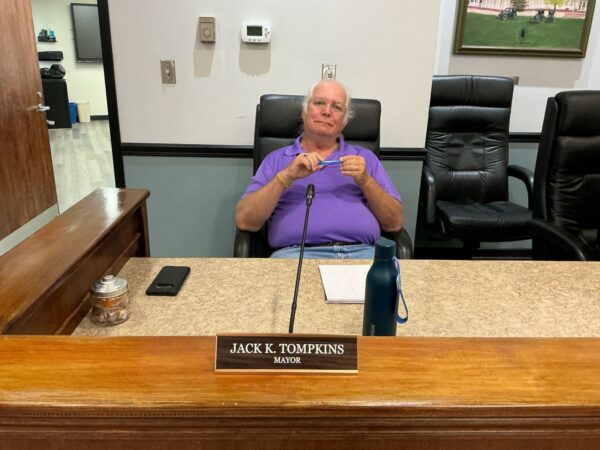
    Former Pemberton Township Mayor Jack Tompkins revealed in a rare interview this week that lawsuits stemming from allegations of misconduct against him made him uninsurable, compelling him to resign to avoid financial ruin.

    The township’s insurance carrier “decided to cancel my insurance,“ said Tompkins, 64, who resigned on Dec. 31. ”They notified me and the township in October. I weighed my options and the smartest thing to do was to resign. Withdrawal of insurance coverage would have financially devastated me.”

    Tompkins, a Republican, was long under fire for alleged sexual harassment and other behavior over the last two years.

    On Wednesday, the five-member township council of the Pine Barrens community in Burlington County — all Republicans — will choose one of three GOP candidates to replace Tompkins. The three candidates were selected by the Republican municipal county committee last week to serve the balance of the year. The committee didn’t release the candidates’ names.

    Tompkins was the subject of a highly critical independent investigation in April 2024 that was commissioned by township officials and conducted by a Hackensack law firm, Pashman Stein Walder Hayden.

    Some of the report’s more serious allegations included inappropriate interactions with female lifeguards under age 18; sexual harassment of the township’s recreation director, who sued Tompkins and the township, winning a $500,000 judgment.

    He was also accused of a pattern of misconduct — such as poking a woman in the head, or discussing rape in township offices — that was sometimes accompanied by obscene language and “retaliatory” outbursts, fostering what the investigators who wrote the report termed a “severe chilling effect” that silenced anyone who felt wronged and allowed Tompkins to continue his aberrant behavior.

    Tompkins said that while he was mayor, he worked in a “toxic environment created by [township] council, and I was walking on eggshells.

    “Things got really ugly and nasty.”

    He added that his time in office left “such a dirty taste in my mouth about politics, I want nothing to do with it anymore.”

    In office since January 2023, Tompkins, 64, a retired Air Force veteran, refused to quit during his tumultuous tenure despite calls from members of both political parties for him to do so, including Gov. Phil Murphy.

    Over time, the township council officially censured Tompkins, whose pay was cut from $13,000 annually to $4,000, to $1.

    Tompkins told The Inquirer on Monday he relented after the Burlington County Municipal Joint Insurance Fund, which covers the township, informed him of their decision to no longer insure him. The fund cited “numerous claims resulting from your interaction with Pemberton Township employees over the past several years.”

    Township officials said last summer that more lawsuits connected to Tompkins were expected.

    In the interview, he said that inappropriate behavior with lifeguards “never happened.” He also said that any alleged misconduct “toward [other] females never happened.” He declined to comment on additional allegations.

    Tompkins said there have been “zero criminal charges” leveled against him. He added, “Everything has been civil allegations, and nothing’s been proven.”

    Asked why these allegations were made in the first place, Tompkins said, “You’re looking for an answer to something I don’t know. I don’t know what they were trying to do.”

    Accused on several occasions of cursing and being harsh to staff, Tompkins explained, “Sometimes when you’re the boss and tell somebody they need to get something done, I guess they wanted me to ask ‘pretty please.’ With my military background, that wouldn’t always happen.”

    Tompkins said he’s survived the experience with the support of friends and family “who knew this was nonsense.”

    Sherry Scull, a former Democratic township council member, has publicly supported Tompkins, and continues to do so. “I’ve never seen signs of him doing what he was accused of,” she said. “I think his resigning is sad.”

    Others contacted this week didn’t agree.

    “This has been a total embarrassment for the town,” said Republican council member Dan Dewey.

    Abby Bargar, Republican municipal chair for Pemberton Township, said, “I always liked Jack, but I think he made some bad decisions. It was the best thing for the party that he stepped down.”

    Throughout town, the reaction to the end of Tompkins’s administration is “overwhelmingly positive,” said Marti Graf Wenger, president of the Browns Mills Improvement Association. Browns Mills is an unincorporated section of Pemberton Township; the association works to improve and promote the area, once a “Gatsby-esque” locale with chic hotels that drew well-off Philadelphians vacationing in the woods, Wenger said.

    She added, “Tompkins treated this town like his dictatorship. There’s just a sense of relief now, a feeling that we can start fresh and hope our leadership will be better.”

    Asked whether lingering resentments will make it difficult to remain in town, Tompkins said he’s not going anywhere.

    “I just want to go into retirement and put this chapter behind me,” he said. “I’ve traveled the world, and I’ve settled here. I once said I’m going to die in this house. So this is where I’ll be.”

  • New Jersey digital innovation office that uses AI becomes permanent with new law

    New Jersey digital innovation office that uses AI becomes permanent with new law

    New Jersey Gov. Phil Murphy’s digital innovation office has been made a permanent cabinet-level office in what appears to be the first move of its kind in the nation as the role of artificial intelligence increases in government.

    Murphy created the New Jersey State Office of Innovation in 2018 to improve digital innovation in state government.

    And now it’ll remain a fixture in New Jersey after he leaves office, following Murphy’s signing Monday of a bill that turns the office into an authority within the Treasury Department.

    Gov.-elect Mikie Sherrill, who will be inaugurated on Jan. 20, will oversee the new authority. Sherrill supports the office, but even if she didn’t, the new law means a governor can’t just get rid of it.

    Georgetown University’s Beeck Center, which tracks these efforts nationally, has identified 17 states with digital innovation offices, including Pennsylvania. But the university and Murphy’s office say New Jersey is the first to codify a cabinet-level position of its kind into law.

    The new law also helps the office fund projects between departments more easily and opens up the possibility of revenue streams such as by selling its technology to other state governments or local governments within the state, said Dave Cole, a Haddonfield resident who leads the department. The law also requires a board of directors appointed by the governor.

    The state innovation office has worked with almost every state agency to identify problems that can be fixed with technology in an effort to make government services more efficient, Cole said.

    In one example, it helped the Department of Labor redesign emails for its unemployment program, which had used decades-old design technology and hard-to-understand legalese that was slowing down the claim process because it wasn’t user-friendly.

    In another, the office used machine learning to identify 100,000 students eligible for summer food assistance who weren’t getting it.

    The office has also modernized call centers and even created an internal AI chat bot for state employees that helps draft emails, summarize documents, and analyze public feedback — shaving days off the process of aggregating public comments.

    Employees are told repeatedly that AI is a tool and that human review is still needed, Cole said.

    “The person that’s using the AI needs to be accepting responsibility for the use of and any dissemination of information after they’ve reviewed it,” he said in an interview.

    The office was awarded what it called a “first of its kind” grant last month to utilize AI in government.

    Cole, 40, said his team’s approach to AI is to make bureaucratic processes more efficient, like summarizing fraud information, generating memos, and matching disparate data sets.

    “Our purpose isn’t to solve an AI problem as much as it is to solve a resident problem, a business owner problem — sometimes, when we work with higher education, an institutional problem,” he said. “And often AI, more recently, emerges as a tool that can help us through that.”

    The bill passed by 29-8 in the Senate with three members not voting on Dec. 22 and by 61-13 in the Assembly on Dec. 8, with four members not voting and two abstentions.

    Sherrill said she will keep Cole in his position as she puts together her administration.

    “I look forward to working with Dave as we modernize the way New Jerseyans access state government services and build a government that works for everyone,” Sherrill said in a statement.

    Cole, a Rutgers grad, worked with data and analytics as an organizer for former President Barack Obama’s 2008 presidential campaign before developing the White House website and online petitions as part of the presidential administration.

    That work was simpler than the projects he does now given the rapid development of AI — but reached the same goal of increased civic engagement, he said.

    After his work there, Cole then pivoted to the private tech sector and made an unsuccessful bid for Congress in South Jersey in 2016 before joining the state’s innovation office in 2020 to help with pandemic vaccine distribution before eventually rising to chief innovation officer a year ago, replacing Beth Noveck, who now works as the chief AI strategist in the same office.

    “Generally speaking, there’s a lot of pain. There’s a lot of unsolved problems. There’s a lot of improvements that we need to see,” Cole said. “And so if we understand how to effectively leverage technology, we can do good there, but we have to be careful with anything like this.”

    One project Cole is looking forward to this year is building the option for residents to use one online account for various government agencies and allowing for their data to be shared across departments to pre-populate forms.

    Not only can that simplify processes for residents who choose to participate, but it can make it easier for government agencies to recommend different government programs by getting information about applicants it wouldn’t otherwise receive, he said.

    “Having that information allows us to do really interesting things, like ‘You’re enrolled in this program, did you know you may also be eligible for this other program?’” he said. “This has been for a long time, I think, sort of a dream of folks who do this kind of digital technology work to recommend and automatically enroll people in benefits based on their eligibility.”

    Working with Sherrill to cut through red tape

    Sherrill campaigned on “cutting through that red tape and bureaucracy.” When asked to elaborate by The Inquirer at a mid-November campaign appearance in South Jersey, she said “a lot of it is just putting stuff online.”

    She also said she wants to address redundancies for residents who need to go through different government organizations and find out they have more steps than they initially thought.

    “I’ve heard too many stories of people who do the five steps they need to get a permit, and they go back and they go, ‘Well, here’s five more,’” she said in November. “So there’s not a lot of clarity, transparency, or accountability in getting through this process.”

    That’s the kind of work the innovation office has been doing through business.nj.gov, a centralized website for starting and growing a business, and Cole looks forward to doing more of it in partnership with Sherrill.

    New businesses that use the website launched an average of a couple of weeks sooner than those that didn’t, Cole said.

    “It has many agencies, permits, and licenses integrated in it, but not all,” he said.

    “And one of the challenges is that agencies have many priorities about the things that they need to work on at a given point in time, so I think the governor-elect’s focus on this could allow more clarity there,” he added.

    This article has been updated to reflect the office is cabinet-level.

  • Moody’s boosts Atlantic City to investment grade a decade after its near bankruptcy

    Moody’s boosts Atlantic City to investment grade a decade after its near bankruptcy

    ATLANTIC CITY — A decade after teetering on the edge of bankruptcy and being taken over by the State of New Jersey, Atlantic City has been given an investment-grade rating by Moody’s Ratings.

    “Today is a tremendous day to start the new year,” Atlantic City Mayor Marty Small Sr. said Monday at a livestreamed news briefing. “The city of Atlantic City is officially investment grade.”

    The credit rating of Baa3 puts the city in the lowest long-term investment-grade category, several steps from the top A ratings. But it marks a dramatic rise from 10 years ago, Small noted, when he was sworn in as the City Council president.

    “We had the junkiest junk bonds imaginable,” he recalled. “The city’s finances were not in a good state. Employees were getting paid once a month. People were running to the bank to cash their checks. The outlook was bleak. We even entertained that we were bankrupt. It was a long, drawn-out fight. However, that was then; this is now.”

    Small himself ended 2025 in dramatic fashion: a two-week trial that ended in an acquittal on charges that he physically abused his teenage daughter.

    Small and business administrator Anthony Swan said at the Dec. 31 meetings that Moody’s expressed interest in seeing a stable government and experienced department directors.

    Small was sworn in to a new four-year term on New Year’s Day with his daughter in attendance and said then that the family has begun the healing process. A decision is expected soon by the Atlantic County prosecutor on whether to pursue similar charges against his wife, La’Quetta Small, the city’s schools superintendent.

    The state’s takeover of Atlantic City expired Dec. 1. But another bill is moving through the legislature that will leave the state in charge of Atlantic City finances for another six years. It calls for a “master developer” to oversee major projects, even as the city is trying to regain control over planning and zoning.

    There are other challenges ahead for Atlantic City: New York City approved three casino licenses that could cut a substantial hole in Atlantic City’s gambling revenue and prompt state lawmakers to approve casinos in North Jersey. Casino owners also oppose an effort to ban smoking in the city’s casinos that is now before an appellate court.

    Though the state takeover began a decade ago in hostile fashion, it evolved to a cooperative partnership. Small praised the decision by incoming Gov. Mikie Sherrill to keep Jacquelyn Suárez as head of the state’s Department of Community Affairs, which would oversee the next takeover.

    Atlantic City Mayor Marty Small Sr. speaks to the media after being found not guilty on all counts of abusing his teenage daughter, on Dec. 18.

    But Monday was a day of triumph for the city.

    Small noted that the city had substantially reduced its debt to $228 million, down from a peak of $550 million, and cut taxes six years in a row. Of that, only $71 million is debt directly incurred by the city; the rest are legacy debts from money owed to casinos from tax appeals. He anticipated announcing a seventh tax cut in the coming weeks.

    “This government gets criticized all the time,” he said. “People say, ‘Oh they’re spinning like drunken sailors, spinning spinning spinning like it’s out of control.’ Ladies and gentlemen, that’s just not true.”

    Business administrator Swan said Moody’s was interested in more than just numbers. “It’s about the stability of the city,” he said. “It’s about how the city is run.”

    Finance director Toro Aboderin called the announcement “an extraordinary milestone.” She said Moody’s asked about “bulkheads, roads, infrastructure.”

    “Restoring Atlantic City to sound financial footing has been our top priority every single day,” she said. “A lot of people talk about Atlantic City and how we’re terrible, how the finances are the worst, and the roads are messy. They say all kinds of things, but we have attained something quite remarkable.”

    Officials hope the vote of confidence from Moody’s will signal to investors and developers to look again at their city, which has some of the most affordable beachfront real estate on the East Coast.

    An investment-grade credit rating signals to financial markets that Atlantic City is a lower-risk borrower, although the mayor emphasized that the city currently has no need to borrow.

  • Steve Sweeney to be paid up to $287K in new Gloucester County job after being appointed during Friday commissioners’ meeting

    Steve Sweeney to be paid up to $287K in new Gloucester County job after being appointed during Friday commissioners’ meeting

    Former New Jersey Senate President Steve Sweeney, who finished last in the six-way Democratic primary for New Jersey governor in June, will receive a six-figure salary in Gloucester County for a new role.

    The Gloucester County Board of Commissioners appointed Sweeney as county administrator at its public reorganizational meeting Friday night. The role has a salary rage of $191,308 to $287,168.

    The resolution appointing Sweeney, 66, to the position is tucked away in an unsearchable 236-page packet posted online Friday afternoon, just hours before the meeting. It does not say what Sweeney will be paid, but the document specifies that the county will provide him with a vehicle that can be utilized for personal use — “as in the past,” the resolution notes.

    Sweeney replaces Chad Bruner, the county’s longtime administrator who recently stepped down. Bruner chairs Rowan University’s Board of Trustees, which Sweeney joined in September.

    The resolution easily won approval by the board, which is composed of five Democrats and two Republicans. All five Democrats voted yes. Republican Nicholas DeSilvio voted no, while Republican Chris Konawel Jr. abstained from voting in protest.

    “They violated procedure, and I do believe that was an illegal meeting,” Konawel said Saturday morning.

    Democratic commissioners wouldn’t allow him to object to a “consent agenda,” which would have let commissioners look more closely at each resolution on the agenda, Konawel said. He said he received a copy of the resolution just four hours before the meeting, and noted that the vote was scheduled during a meeting with no public comment period.

    “The biggest thing for me is, we just handed somebody a $290,000 a year job, with no idea what his qualifications were,” Konawel said.

    Sweeney’s contract will last 5 years, the maximum for the role.

    Sweeney, a longtime friend of power broker George Norcross and an ironworker union leader, served the longest tenure as state Senate president, the most powerful position in New Jersey government aside from governor.

    But the West Deptford Democrat lost his reelection in 2021 to Trump-aligned Republican Ed Durr, a truck driver with little funding who planned to also run for governor before dropping out last year.

    The Republican commissioners first found out that Sweeney was picked for the role through the rumor mill weeks ago when department heads were given a heads-up behind closed doors, Konawel said.

    Konawel and DeSilvio each questioned Sweeney’s credentials in part because he didn’t attend college.

    “I kind of thought that they would actually go through a process to pick somebody qualified. I didn’t think they would just give it to Steve Sweeney, but that’s what they did,” DeSilvio said.

    Sweeney and Democratic leaders on the county board could not be reached on Friday for comment.

    Since leaving the state Senate, Sweeney served as the founding chair of a think tank at Rowan University called the Steve Sweeney Center for Public Policy.

    He attempted a political comeback last year, but his campaign for governor failed to gain traction outside of South Jersey and he did worse than expected even within the region.

    Sweeney ran to the right of his opponents on certain issues, like by saying he would get rid of the state’s sanctuary policy for undocumented immigrants, a stance touted by Republicans.

    He avoided the press in the final days of his campaign and left his party quietly just minutes after his loss, which signaled another failure of the South Jersey party machine. He won Gloucester and Salem Counties by wide margins but lost to Gov.-elect Mikie Sherrill in the other three southern counties that endorsed him.

    As county administrator, Sweeney will oversee all county department heads and can sign off on all personnel actions. The powerful role also comes with the authority to help prepare the county budget, authorize payments, take part in board discussions (without voting power), inquire into county operations, and sign off on behalf of the clerk of the board if the clerk is absent.

    County administrators are paid six-figure salaries throughout the state, but Gloucester County has developed a reputation for paying its administrator particularly well.

    Bruner was the second highest paid county administrator in the state at $253,324 in 2023, according to data compiled by the Bergen Record. The highest county administrator salary that year was in Middlesex County, which has more than double the population of Gloucester, according to the Census Bureau. Sweeney’s starting salary was not stated at the meeting, according to Konawel.

    Sweeney cannot be removed from the role without cause for the duration of his contract, and if he is, he will still receive his remaining salary, according to the resolution. He will be eligible for raises.

    Attorney General Matt Platkin expressed disapproval over the position’s high salary last month, noting that Gloucester’s County administrator was making more than the governor, whose salary is $175,000 and will raise to $210,000 this year when Sherrill takes office.

    “A county administrator making $100k more than the current governor’s salary is a pretty good argument to keep the comptroller as an independent agency to combat waste, fraud, and abuse in local government,” Platkin said in a social media post in early December when the state legislature was considering an ultimately unsuccessful bill to limit the watchdog’s power.

  • How an anti-Trump crusader and a ‘boring’ Republican prosecutor forged an unlikely partnership

    How an anti-Trump crusader and a ‘boring’ Republican prosecutor forged an unlikely partnership

    Right after Pennsylvania Attorney General Dave Sunday was sworn into office in January, he received a lunch invitation from across the Delaware River.

    It didn’t matter that they came from different political parties, said New Jersey Attorney General Matthew Platkin, a Democrat appointed to his post by outgoing Gov. Phil Murphy.

    Platkin wanted to get to know his neighbor, and invited Sunday out to lunch in Philadelphia.

    The two men could not have more different approaches to their jobs. In a hyperpolarized political era, where attorneys general play an increasingly important role in national politics, Platkin has become a face of Democratic opposition to President Donald Trump’s administration. He has led or joined dozens of lawsuits by blue-state attorneys general and governors in arguing that the executive branch is acting unconstitutionally on issues like birthright citizenship, withholding congressionally approved funds, and more.

    In contrast, Sunday, a Republican elected last year, has largely avoided suing Trump and has said he strives to be “boring,” focusing his efforts on oversight of his own office.

    Even their jobs are different, despite sharing a title. New Jersey’s attorney general is in charge of the state’s 21 county prosecutors, oversight of state police, and protecting consumers, among other duties; Pennsylvania’s attorney general has wide-ranging powers to investigate corruption, enforce the state’s laws, represent the state’s agencies and interests in lawsuits, and more.

    New Jersey Attorney General Matthew Platkin on Monday, June 17, 2024, at the Richard J. Hughes Justice Complex in Trenton, N.J.

    Platkin, 39, is an ambitious lawyer who grew up in northern New Jersey and attended one of the best high schools in the state before attending Stanford University and Stanford Law School. He went on to work in private practice in New York and New Jersey before being appointed as chief general counsel to Murphy at 35 — the youngest person to ever hold the office.

    Sunday, 50, grew up in a suburb of Harrisburg and has described his high school years as lacking direction. He joined the U.S. Navy after high school before attending Pennsylvania State University for undergraduate and Widener University Law School for his law degree, working at UPS to help put himself through school. He returned to south-central Pennsylvania for his clerkship, and was a career prosecutor in York County until his election to attorney general.

    Pennsylvania Attorney General Dave Sunday stands to be recognized by Council President Kenyatta Johnson before Philadelphia Mayor Cherelle Parker gives her budget address to City Council, City Hall, Thursday, March 13, 2025.

    But over salads at the Mulberry, Platkin and Sunday found common ground. And ever since, the two said in a joint interview this month, they have worked closely on issues affecting residents in their neighboring states.

    “Just because you may not see eye-to-eye on [Trump] doesn’t mean you can’t see or don’t see eye-to-eye on many, many other issues,” Sunday said.

    “​​When we have an auto theft problem, [residents] don’t care if there’s a ‘D’ or an ‘R’ after your name,” Platkin added. “They just want to see us working to solve it.”

    The two have since worked together on issues that stretch from criminal investigations and human trafficking cases to challenging Big Tech companies as artificial intelligence rapidly advances, Sunday said.

    Earlier this month, Sunday and Platkin led national efforts of coalescing approximately 40 attorneys general across party lines on the issues they say are most pressing for residents. The group wrote a letter to Big Tech companies in mid-December, detailing concerns about the lack of guardrails for AI chatbots like those available from ChatGPT or Meta’s Instagram AI chats, and the potential harm they could cause people in crisis or children who use them.

    In two more letters sent this month, the attorneys general also voiced support for a workforce reentry bill before a U.S. House committee and requested that Congress approve additional funding for courtroom and judicial security to protect the nation’s judges from safety threats. Platkin and Sunday said they were some of the first attorneys general to sign on to the letters.

    “While the undersigned hold differing views on many legal issues, we all agree that the legal system cannot function if judges are unsafe in their homes and courthouses,” the group of 47 attorneys general wrote in a Dec. 9 letter to top leaders of Congress.

    When it comes to lawsuits against the Trump administration and other litigation authored by partisan attorneys general associations, Sunday has largely avoided the fray. Earlier this month, he was elected Eastern Region chair of the National Association of Attorneys General, a nonpartisan group composed of the 56 state and territory attorneys general.

    Platkin, on the other hand, has led the charge in pushing back against the administration’s policies in New Jersey, signing onto dozens of lawsuits such as ones challenging Trump’s efforts to end birthright citizenship and to withhold SNAP funding if a state does not turn over personal information about its residents.

    Still, Pennsylvania has joined many lawsuits, including several challenging the federal government for withholding congressionally approved funds for electric vehicles and more, as Democratic Gov. Josh Shapiro, formerly the state’s attorney general, has signed on in his capacity as governor.

    Platkin, who has served as New Jersey’s attorney general since 2022, will leave office when Murphy’s term ends next month, and Gov.-elect Mikie Sherrill will appoint someone new to the post. Sherrill, a Democrat, earlier this month nominated Jen Davenport, a former prosecutor and current attorney at PSE&G, New Jersey’s largest electric and gas company, to be Platkin’s successor.

    Sunday’s team has already been in touch with Davenport to forge a similar cross-state working relationship.

    What’s next for Platkin? He said he’s a “Jersey boy” and will remain in the state but declined to say what his next move might entail.

    And both Platkin and Sunday say they will maintain their bipartisan friendship going forward.

    “It’s OK to say we don’t agree on everything. We shouldn’t hate each other,” Platkin said. “We should be open about the fact that we like each other. … I don’t think there’s anything wrong with that.”

  • How Camden tells the story of Mikie Sherrill’s big win and New Jersey’s blue wave

    How Camden tells the story of Mikie Sherrill’s big win and New Jersey’s blue wave

    The story behind New Jersey Gov.-elect Mikie Sherrill’s landslide victory last month can be understood by looking at her strong performance in the city of Camden.

    The young, diverse, and working-class city exemplifies trends that played out across the state as Sherrill reversed rightward shifts among the voter groups Democrats desperately need to rebound with nationally.

    An Inquirer analysis of municipal-level data shows that Sherrill outperformed both former Vice President Kamala Harris in 2024 and outgoing Democratic Gov. Phil Murphy in 2021 across New Jersey’s 564 cities, boroughs, and townships, winning 300 — about 53% — of them as compared with Harris’ 252 last year and Murphy’s 210 four years ago.

    She reversed gains made by President Donald Trump last year that gave Republicans false hope that Jack Ciattarelli, who was aligned with and endorsed by Trump, would do much better in November than he actually did as Sherrill outperformed expectations.

    window.addEventListener(“message”,function(a){if(void 0!==a.data[“datawrapper-height”]){var e=document.querySelectorAll(“iframe”);for(var t in a.data[“datawrapper-height”])for(var r,i=0;r=e[i];i++)if(r.contentWindow===a.source){var d=a.data[“datawrapper-height”][t]+”px”;r.style.height=d}}});

    Camden’s population is more than 54% Hispanic and nearly 38% Black — Democratic-leaning voter groups that had shifted toward Trump nationally in 2024. Sherrill’s campaign had outreach operations geared toward both Black and Hispanic voters.

    Every demographic group in the state swung toward Democrats this year, but Sherrill’s most striking improvement over Murphy and Harris seemed to be among Hispanic people, who make up more than half of Camden’s population.

    She similarly made gains in areas across the state that have high populations of young voters, lower-income voters, and voters without college degrees — like Camden.

    Voters in Camden turned out for Sherrill resoundingly with 92% of the vote, more than 10 percentage points better than Harris performed in the city during her presidential run last year, and Sherrill outperformed the former vice president in every one of the city’s 40 precincts. The larger the Hispanic share of the voting district, the larger it shifted toward Sherrill.

    This was reflected statewide, with the state’s 10 largest Hispanic-majority cities moving an average of 18 points to the left while other New Jersey municipalities moved just about four points toward the Democrat.

    Latino outreach in Camden fueled Hispanic support

    window.addEventListener(“message”,function(a){if(void 0!==a.data[“datawrapper-height”]){var e=document.querySelectorAll(“iframe”);for(var t in a.data[“datawrapper-height”])for(var r,i=0;r=e[i];i++)if(r.contentWindow===a.source){var d=a.data[“datawrapper-height”][t]+”px”;r.style.height=d}}});

    Outreach to Hispanic voters was driven by a coordinated campaign between Sherrill’s campaign and the state Democratic Party, as well as independent expenditure groups. It seemed to pay off.

    In Camden’s most heavily Hispanic precinct, for example, voters gave Sherrill 92% of the vote, 12 points more than they gave to Harris.

    Sherrill’s campaign and its backers knew how important it was to win over these voters who had felt taken for granted by the Democratic Party.

    Sherrill had limited time to introduce herself to voters coming out of a six-way competitive primary in June — which she won big but with less success in some heavily Black and Hispanic areas. To many voters, especially in South Jersey, she was just another candidate.

    UnidosUS Action PAC experienced that unfamiliarity with Sherrill when its canvassers first started knocking on doors in Camden in September, said Rafael Collazo, the executive director of the PAC.

    “The question that Latino voters and voters that we spoke to had wasn’t if they were going to vote for Ciattarelli or not, because they were clearly against anyone associated with Trump,” Collazo said. “But they honestly weren’t sure if they were going to vote for Sherrill, because they didn’t feel like they knew her.”

    Sherrill’s campaign and backers tapped local leaders like pastors, nonprofit executives, and elected officials, and held events specifically catered to Latinos, said Vereliz Santana, the coordinated campaign’s Latino base vote director, who grew up in Camden.

    They spread the message through Spanish-speaking door knockers and Spanish-language ads, which Camden City Councilman Falio Leyba-Martinez, a Democrat, called “beyond impactful.”

    “She made it normal for people to understand that you don’t speak English,” he said.

    That was not always the case for New Jersey Democrats, according to Patricia Campos-Medina, a vice chair of Sherrill’s campaign and senior adviser for Sherrill’s Latino and progressive outreach. Democratic operatives in the state justified saving money on bilingual messaging over the last decade since most Latinos speak English, she said.

    “But the problem is that Latinos have to hear that you are talking to them … otherwise they feel like you’re just ignoring them,” she added.

    And it’s not just speaking Spanish. Showing cultural competency — such as using Puerto Rican slang or phrases like “reproductive healthcare” instead of “abortion rights” — is also critical, she said.

    window.addEventListener(“message”,function(a){if(void 0!==a.data[“datawrapper-height”]){var e=document.querySelectorAll(“iframe”);for(var t in a.data[“datawrapper-height”])for(var r,i=0;r=e[i];i++)if(r.contentWindow===a.source){var d=a.data[“datawrapper-height”][t]+”px”;r.style.height=d}}});

    Latino organizers in Camden said that community members who supported Trump or did not vote in 2024 have become frustrated by the high cost of living, slashed federal funding, and Immigration and Customs Enforcement’s tactics. Even those for whom immigration was not a top priority or who supported Trump’s plan to deport people who committed crimes have been dismayed, they said.

    Camden City Council President Angel Fuentes said videos circulating of immigrants being detained locally have been particularly resonant.

    “You can see the tears of these individuals,” he said. “You know, it’s so inhumane. I mean, I really want to use the f-word, but it’s so inhumane how they’re treated. Latinos … we are all family. We should not be treated like this.”

    Turnout increased compared to last race for governor

    Turnout is typically lower in cities with large numbers of lower-income voters and voters without college degrees, like Camden. But Democratic investments in the city seemed to make a difference this year.

    Camden saw a 63% increase in turnout compared with 2021. The jump in the city is more than double the 28% turnout increase statewide compared with the last race for governor.

    The city still has relatively low turnout compared with the full state, however, with only 26% of voters casting ballots in Camden compared with 51% statewide.

    Camden County as a whole was closer to the statewide turnout rate at 50%, but the county’s increase of 32% from 2021 was smaller than the city’s growth.

    Sherrill visited the city of Camden in July — early in her general election campaign — for a visit to CAMcare, a federally qualified health center that treats underserved communities, and went on to discuss it on a national podcast the next day.

    She did not return until October, at which point she visited the city three times in the lead-up to Election Day. Her campaign also held a rally outside city lines at the Camden County Democratic Party headquarters in Cherry Hill that Santana said was planned to feel “authentically Latino.”

    As part of their “scientific” strategy, Sherrill visited less-Democratic areas in the summer and early fall to try to win over swing voters before pivoting to bluer places like Camden, where they needed to motivate already-registered Democrats to cast their ballots, said Om Savargaonkar, the coordinated campaign director for Sherrill’s campaign and the New Jersey Democratic State Committee.

    As Sherrill zigzagged the state, a massive coordinated effort was underway to draw a strong Democratic turnout, bolstered by national funding from the Democratic National Committee.

    Sherrill’s coordinated campaign — the state party operation that worked with the campaign — made at least 19.5 million phone calls, door knocks, and text messages statewide, which was roughly 13 times more than the 1.5 million made for Murphy’s coordinated campaign in 2021, Savargaonkar said.

    Out of a roughly $12 million statewide investment, about $2 million to $3 million went directly to county parties to supplement the statewide turnout efforts, Savargaonkar said of the coordinated campaign.

    Sherrill did even better than previous Democrats in lower-income municipalities

    Democrats routinely score landslide wins in New Jersey’s working-class municipalities.

    Both Murphy and Harris posted double-digit margins in these communities, but Sherrill took that strong base and supercharged it. She won nearly two-thirds of the vote in the lowest-income municipalities and in places where fewer voters have college degrees — improving on Murphy’s and Harris’ performances by as much as eight percentage points.

    In Camden, fewer than one in 10 adults have a college degree and the typical household has an annual income of $40,000. That’s in a state where nearly 45% of residents are college-educated and with a median income of about $100,000.

    Sherrill’s campaign reached Latinos in Camden who voted for Trump last year because they believed he would make life more affordable but were having buyer’s remorse, organizers said.

    Her campaign spoke with locals about the negative impacts of Trump’s tariffs, engaging with everyone from distributors and manufacturers to local business groups, Santana said. Local surrogates also discussed Trump’s cuts to benefits and programs that help the community, said Camden Mayor Victor Carstarphen.

    And Sherrill’s focus on affordability and Trump resonated more broadly.

    She also won among voters in wealthier places, including the middle 50% of towns by median household income — places where Ciattarelli won four years ago and where Trump fought Harris to a near-draw last year. Like Harris before her, she managed to win the very wealthiest areas comfortably.

    While the city of Camden saw Sherrill’s biggest improvement over Harris in the county, her second-largest improvement came in nearby Runnemede, a borough in Camden County, where the typical household’s income is virtually identical to that of the state.

    Sherrill reversed losses among the youngest voters

    Trump made gains last year among younger voters across the country, and New Jersey was no different. The president won about 37% of the vote in the state’s youngest 25% of municipalities, beating Ciattarelli’s 2021 performance with that group by more than three percentage points even as he lost the state by nearly double Ciattarelli’s 2021 margin.

    This year, Sherrill reversed those inroads, improving on Harris’ performance by nearly eight points in places, including Camden, where the median age is 33. (New Jersey’s median age is 40.)

    Sherrill’s campaign made partnering with social media influencers a key part of her strategy as more young people focus their attention online. She appeared on national podcasts and in TikTok videos, on Substack, Reddit, and Instagram — often with Democratic-friendly hosts. Her team provided special access to influencers and held briefings with them.

    Sherrill appeared on 18 podcasts from January to October 2025, according to Edison Research, while Harris appeared on only eight during her campaign from July to November 2024.

    Her coordinated campaign’s statewide Latino effort also had its own social media, spearheaded by Frank Santos, a 33-year-old Camden resident of Puerto Rican and Nicaraguan descent. Santos and other staffers on the Latino outreach team represented different sub-demographics of “the larger Latino monolith,” Santana said.

    Organizers also catered their conversations to different sub-demographics through smaller and more “organic” events, she said, noting that younger voters were generally more progressive.

    “If you’re trying to connect with a community, knowing that you yourself reflect and represent that community, I think it makes the world of a difference,” she said.

    window.addEventListener(“message”,function(a){if(void 0!==a.data[“datawrapper-height”]){var e=document.querySelectorAll(“iframe”);for(var t in a.data[“datawrapper-height”])for(var r,i=0;r=e[i];i++)if(r.contentWindow===a.source){var d=a.data[“datawrapper-height”][t]+”px”;r.style.height=d}}});

  • Atlantic City Mayor Marty Small Sr. found not guilty on all counts of abusing his teenage daughter

    Atlantic City Mayor Marty Small Sr. found not guilty on all counts of abusing his teenage daughter

    Atlantic City Mayor Marty Small Sr. was acquitted of child endangerment and related crimes Thursday after being accused of repeatedly assaulting his teenage daughter.

    Small, 51, faced charges stemming from a handful of incidents in late 2023 and early 2024 in which prosecutors said he and his wife abused and assaulted the teen. The couple said the incidents stemmed from their disapproval of their daughter’s relationship with a young man, leading to escalating tension and arguments in the family home.

    The jury delivered its verdict at 12 p.m. after deliberating for two days. They found Small not guilty of endangering the welfare of a child, aggravated assault, making terroristic threats, and witness tampering.

    “Thank you, Jesus! Thank you, jury!” Small said as the verdict was announced and broke into tears.

    Speaking to reporters outside the courthouse, Small said he and his family were prepared to “put this chapter behind us, in peace.”

    “It’s a lot of political forces out here that are against the leadership of my wife and I,” Small said. “But guess what? The people of Atlantic City want us, the people of Atlantic City need us, and the people of Atlantic City deserve us.”

    Had Small been convicted of any of the crimes, he would have been required by state law to cede his office.

    Those stakes were evident as the mayor’s friends and supporters packed into the courtroom for nearly two weeks of the trial. Supporters surrounded Small and broke into cheers outside the courthouse, celebrating a political career whose future had depended on the opinion of jurors.

    Small said he had been heavily scrutinized for more than a year after news of the allegations broke in spring 2024. He said he and his wife had since been “drug through the mud” and cast as child abusers by the media.

    Small’s defense attorney, Louis Barbone, said the verdict was “absolute proof that our justice system works” and that “honest men like Marty Small are vindicated.”

    Atlantic County Prosecutor William Reynolds said he and his office “respectfully disagree with the verdict.”

    “We acted based upon the complaints of the victim,” Reynolds told reporters. “The trial in this case was truly to give the victim a voice — the jury chose not to believe that voice.“

    Prosecutors said Small, a Democrat who was reelected this year amid his legal struggles, punched his daughter and beat her with a belt. In an incident central to their case against the mayor, prosecutors said, Small struck her in the head with a broom multiple times, knocking her unconscious.

    Jurors heard a conversation the teen recorded on her phone, in which Small told the girl he would “earth slam” her down the staircase. And prosecutors said that after the girl reported the abuse and investigators stepped in, Small encouraged his daughter to “twist up” her account of the events to minimize his involvement.

    Over the course of the trial, Small and his wife, La’Quetta — who also faces charges of abusing the teen — looked on as prosecutors described the mayor’s actions as criminal. Prosecutors presented photos of the teen’s bruises and listened to testimony from a pediatrician who said the injuries did not appear accidental.

    Small’s defense team, by contrast, told jurors that the teen had lied to investigators and exaggerated the extent of her injuries, and that she and her boyfriend had conspired against her father.

    Barbone had called the trial “extortion by child.” He said the mayor was a caring father who was only attempting to discipline an out-of-control child, and presented jurors with more than 40 character witnesses on his behalf.

    Small also testified and said he loved his daughter. He denied abusing her in the manner she described, telling jurors: “I did not hit my daughter with a broom.”

    The girl, now 17, took the stand last week and described being punched in the legs by her father in his “man cave” after her parents found out she had sneaked her boyfriend into the family home to have sex.

    “He said some words and put his hands on me,” the teen testified. Her father, she said, “was punching me in my legs and he hit me with a belt.”

    Prosecutors said the girl’s decision to testify was one of the most challenging things a teenager could do, and they rebuffed Barbone’s suggestion that the girl was a liar who sought retribution against her politically powerful father.

    As for the broom incident, Barbone said, the mayor had not hit the girl but was wrestling the broom out of her hands when she fell and hit her head.

    Prosecutors showed jurors photos of marks on the girl’s face. But a nurse who treated the teen at a hospital several days after the girl complained of headaches said she had not been able to find signs of injury.

    Jurors asked to review multiple pieces of evidence during their deliberation, including video of Small’s testimony about the broom incident.

    Again they watched the mayor recall the morning he urged his daughter to get ready to attend a peace walk in January 2024 following a spate of killings in Atlantic City.

    The teen refused, cursing at Small before ripping his shirt and throwing laundry detergent on him, the mayor testified. A scuffle broke out when she picked up a butter knife and the broom, he said.

    Mentioning the hospital examination, the mayor asked: “Where is the bruise, where is the bump, where is the bleeding?”

    In less than half an hour, jurors returned their verdict.

    Small, in his post-verdict remarks, described his daughter as “lost” and vowed to right the course of his family life.

    “I’m gonna get my daughter back,” Small said. “In the Bible, it says, ‘Father, forgive her, for she know not what she do.’ And that’s what we’re gonna do.”

    Prosecutors declined to comment on what would happen to the girl, who is still a minor and does not currently live with her family.

    Small’s wife, La’Quetta, is scheduled to stand trial in January on charges of endangering the welfare of a child and simple assault. La’Quetta Small, the superintendent of Atlantic City public schools, is accused of repeatedly beating her daughter.

    Also facing a forthcoming trial is Constance Days-Chapman, the principal of the Smalls’ daughter’s high school. Prosecutors say when the teen reported her parents’ abuse, Days-Chapman failed to notify child welfare authorities and instead told the couple of the report.

    Days-Chapman, who is Marty Small’s former campaign manager, was later charged with official misconduct and related crimes.

    Reynolds, the county prosecutor, said his office would hold an internal meeting to discuss the charges against La’Quetta Small and Days-Chapman. They will also meet with the Smalls’ daughter, he said.

    “We need to get the victim in here and have a discussion with her before any decisions are made — and that’s out of respect for her,” Reynolds said.