It doesn’t look like the Trump administration will begin holding undocumented immigrants at a South Jersey military base anytime soon.
Democratic elected officials said Wednesday that they received a letter from the administration saying there is currently no approved construction plan, nor a timeline, for confining people at Joint Base McGuire-Dix-Lakehurst.
Estimates are that the base, which spans parts of Burlington and Ocean Counties, could hold 1,000 to 3,000 detainees. Specifics surrounding the when, where, and how of that undertaking remain unknown.
New Jersey U.S. Reps. Donald Norcross and Herb Conaway, Democratic members of the House Armed Services Committee, announced that they received a response earlier this week from the Department of Homeland Security after requesting more information about the administration’s plans.
“The Trump Administration’s ongoing disregard for due process and humane treatment of undocumented immigrants has required us to press repeatedly for answers and fulfill our congressional oversight responsibilities,” the lawmakers said in a joint statement. “While we acknowledge that the Department of Homeland Security has finally responded to our questions, we will continue to monitor for any further developments.”
Their priority, the lawmakers said, is to uphold standards of human rights to ensure that plans to detain immigrants do not interfere with military readiness.
The administration’s response said the government’s need for more detention space “reflects the Trump administration’s commitment to restoring the rule of law and ending the catch-and-release policies of prior years that jeopardized American communities.”
Trump administration officials earlier named the base as one of two sites in the country now certified to assist in the president’s plan to remove millions of immigrants. The other is Camp Atterbury in Indiana.
Philadelphia City Council is attempting once again to change city law to allow members to keep their jobs while running for higher office, an effort that has already failed three times in the last 20 years.
Maybe the fourth time’s really the charm?
This attempt is a little bit different. A Council committee on Wednesday advanced legislation to change the 70-year-old resign-to-run rule that requires city officeholders to leave their jobs while campaigning for another office.
But the legislation — which must be approved by a majority of voters through a ballot question — doesn’t repeal the rule entirely. It merely narrows it to allow members to keep their seats if they are seeking state or federal office, such as seats in Congress or the state General Assembly.
Under the new proposal, Philadelphia’s resign-to-run rule would remain in place for members seeking a city office, like mayor or district attorney.
That distinction makes the rule change more likely to become reality, said Councilmember Isaiah Thomas, who sponsored the legislation even though voters rejected attempts to eliminate the rule in 2007 and 2014.
More than a year ago, Thomas proposed that the city try again to eliminate the rule entirely. But this week, he amended his proposal to apply only to those seeking state or federal office, calling that a compromise.
“I personally think that you should be able to run for mayor and keep your seat in City Council,” Thomas said. “But that’s not what the majority of people who I’ve talked to feel. And I don’t think that this should be about how I feel. It should be about what’s best for the city.”
A necessary measure or a barrier to entry?
Thomas, a Democrat in his second term who represents the city at-large, is one of several Council members rumored to have aspirations for higher office. But there is not currently an obvious seat for him or his colleagues to seek.
Thomas said he is not currently interested in serving in Washington — he has two young children — but said he has some “amazing colleagues” who may want to run for Congress in the future.
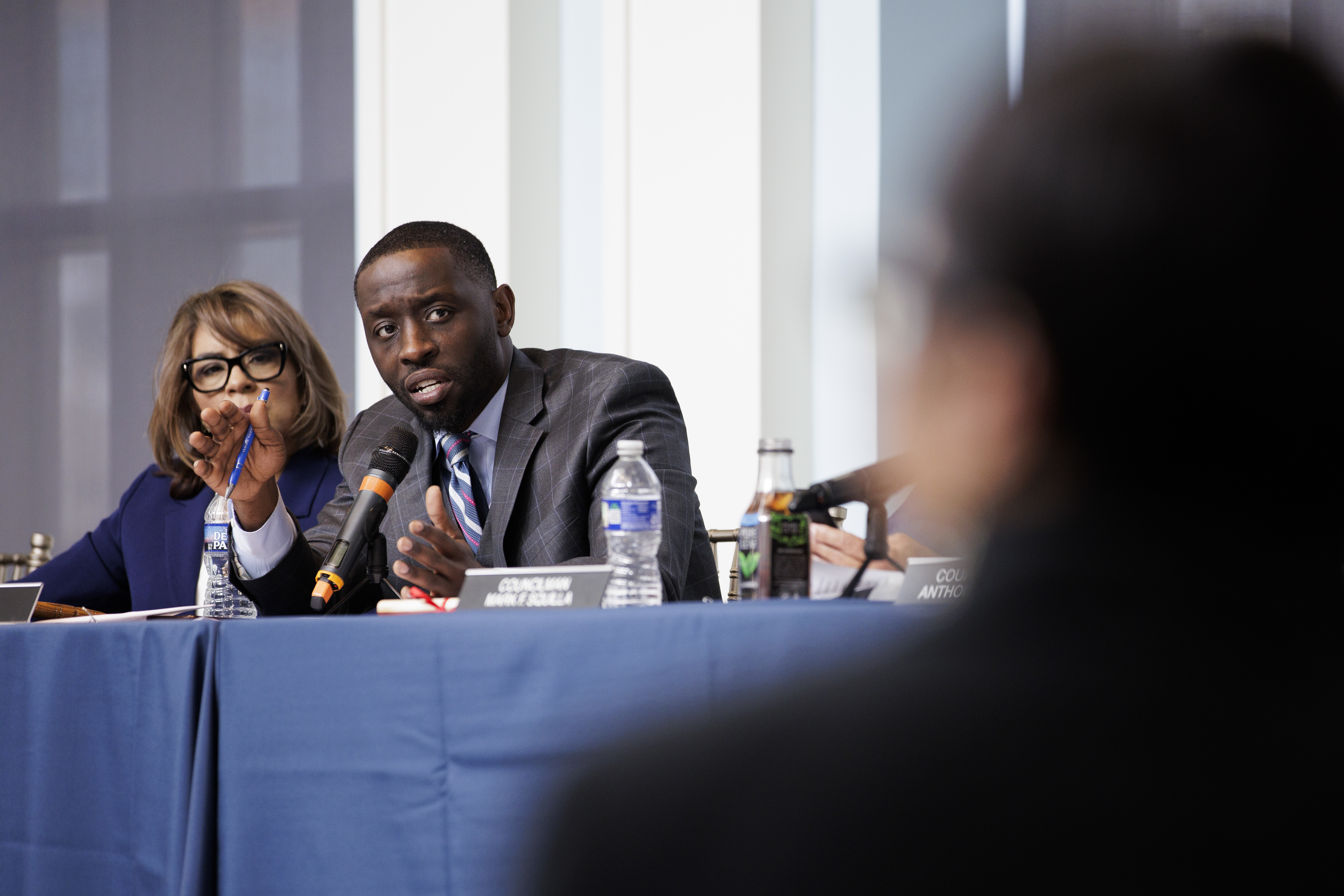
Councilmember Isaiah Thomas speaks during a City Council Committee on Legislative Oversight hearing held at the Museum of the American Revolution in April.
The resign-to-run rule has been codified in the Home Rule Charter since 1951 when the charter was established. Proponents have long said that public servants should not be influencing policy while campaigning for another office.
But others contend that the rule — which applies to Council members, row office holders, and members of the mayor’s administration — creates an unnecessary barrier for people who want to run for higher office but can’t financially withstand giving up their salary.
The rule also recently led to a handful of lawmaker vacancies. In 2022, six of City Council’s 17 members — including now-Mayor Cherelle L. Parker — resigned to run for mayor, at times making it complicated for the city’s legislative body to govern.
Ethics questions emerge
Multiple ethics officers said they oppose the change as it’s currently proposed. Jordana Greenwald, general counsel for the city’s Board of Ethics, said the board was not involved in drafting the rule change, and has a handful of “technical” concerns about its implementation.
“What we don’t want is for this to be passed and then it to become something where there are unintended problems or pitfalls for people who choose to take advantage,” Greenwald said.
Thomas said there is “plenty of time” to address the board’s concerns before passage. He is hopeful the legislation can be passed in time for a question to appear on the 2026 primary election ballot in May.
But Lauren Cristella, CEO of the good-government group Committee of Seventy, questioned the urgency and said Council should give the Board of Ethics time to do its “due diligence.”
While the Committee of Seventy has supported past attempts to repeal resign-to-run, Cristella said she does not understand the purpose of a carveout for members seeking state or federal office.
And she said any repeal should be paired with a three-term limit for Council members, who are currently not term limited.
“Philadelphians deserve comprehensive, not piecemeal, reform here,” she said.
Several Council members said they support Thomas’ legislation, pointing out that state and federal lawmakers do not need to resign from their jobs to seek higher office.
“It’s an issue of consistency across the board,” said Councilmember Cindy Bass, a Democrat who represents parts of North and Northwest Philadelphia. “It’s crazy when everyone’s doing something different.”
Staff members arrived at the Delaware County Republican Party headquarters in Media on Wednesday morning to find the building’s glass door shattered.
The apparent vandalism appeared to have occurred overnight, said Frank Agovino, the party chair. The Media Police Department, he said, is investigating.
The incident comes a year after the local party had to call police to the same office when protesters cornered two volunteers ahead of the presidential election.
“It’s just a sign of the times, unfortunately,” Agovino said. “There’s some people who just refuse to be civil about political disagreements.”
It was unclear who damaged the office or their motive. However, according to photos shared to Facebook by the Delaware County GOP, a sign identifying the office as a Republican office was posted on the door above the broken glass.
The Media Police Department did not immediately comment on the incident.
Agovino called for state and federal officials to consider stricter penalties for the perpetrators of such violence.
“People that are working in the political arena need to be protected,” he said.
This suburban content is produced with support from the Leslie Miller and Richard Worley Foundation and The Lenfest Institute for Journalism. Editorial content is created independently of the project donors. Gifts to support The Inquirer’s high-impact journalism can be made at inquirer.com/donate. A list of Lenfest Institute donors can be found at lenfestinstitute.org/supporters.
SNAP benefits are restored, and the program is funded through next year. But the Trump administration is now looking to “completely deconstruct the program,” its top USDA official said.
Agriculture Secretary Brooke Rollins said that millions of low-income Supplemental Nutrition Assistance Program recipients will have to reapply for their benefits as part of an effort to crack down on “fraud.”
“It’s going to give us a platform and a trajectory to fundamentally rebuild this program, have everyone reapply for their benefit, make sure that everyone that’s taking a taxpayer-funded benefit through SNAP or food stamps, that they literally are vulnerable, and they can’t survive without it,” she told Newsmax last week.
On Tuesday, Rollins told Fox Business that her plan is for the U.S. Department of Agriculture to “completely deconstruct” SNAP.
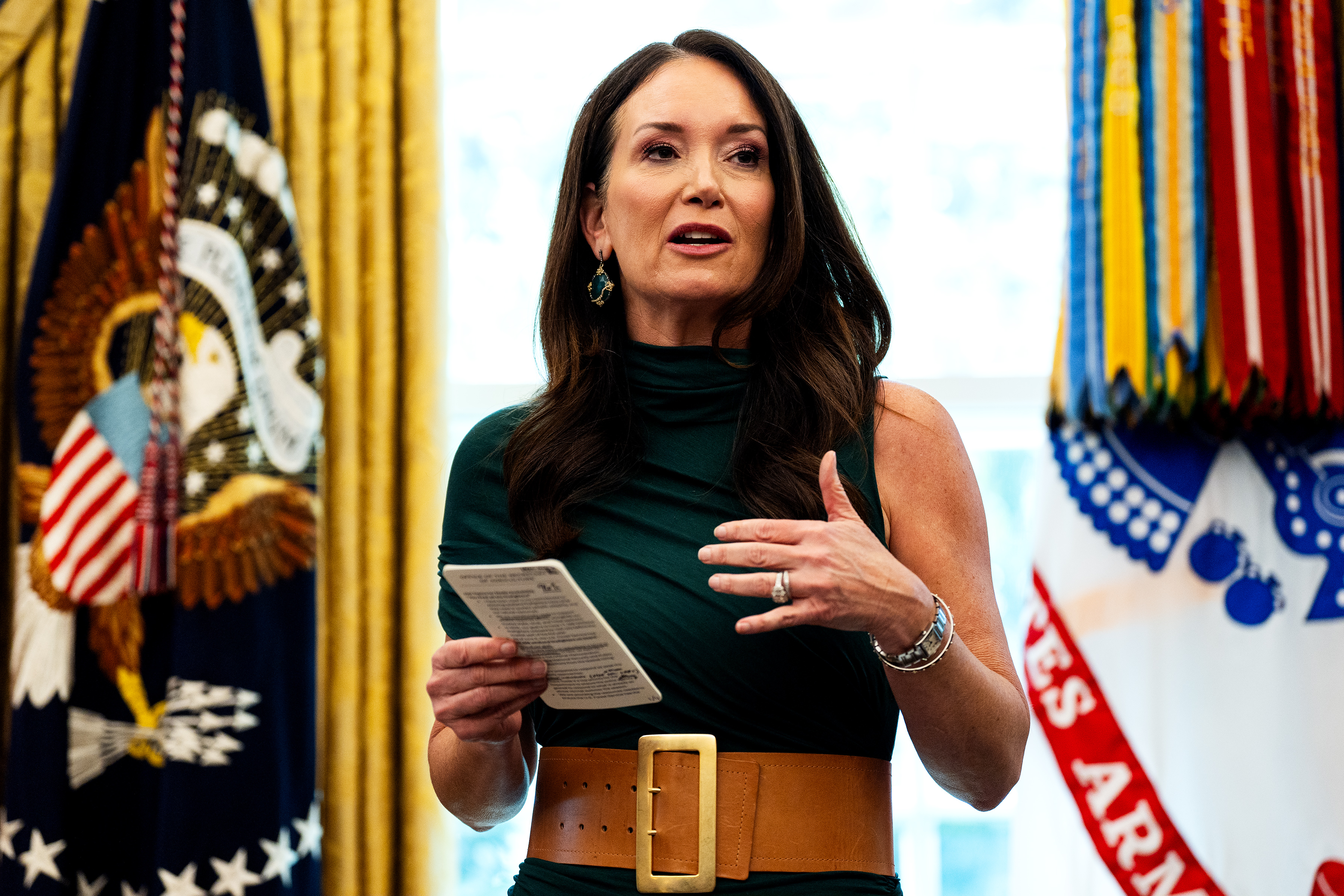
Agriculture Secretary Brooke Rollins speaks to the media in the Oval Office of the White House in June. Rollins had various roles in the first Trump administration.
However, there is no official guidance from USDA on the plans Rollins spoke of and the rules have not changed, said Community Legal Services staff attorney Mackenzie Libbey.
“Most SNAP recipients in Pennsylvania are already required to reverify household and income information every six months. SNAP recipients should continue submitting their semiannual reports and annual renewals as the current rules require,” Libbey said.
In a statement, the USDA did not confirm the existence of new changes to SNAP. Instead, a spokesperson for the agency said the “standard recertification processes for households is a part of that work.”
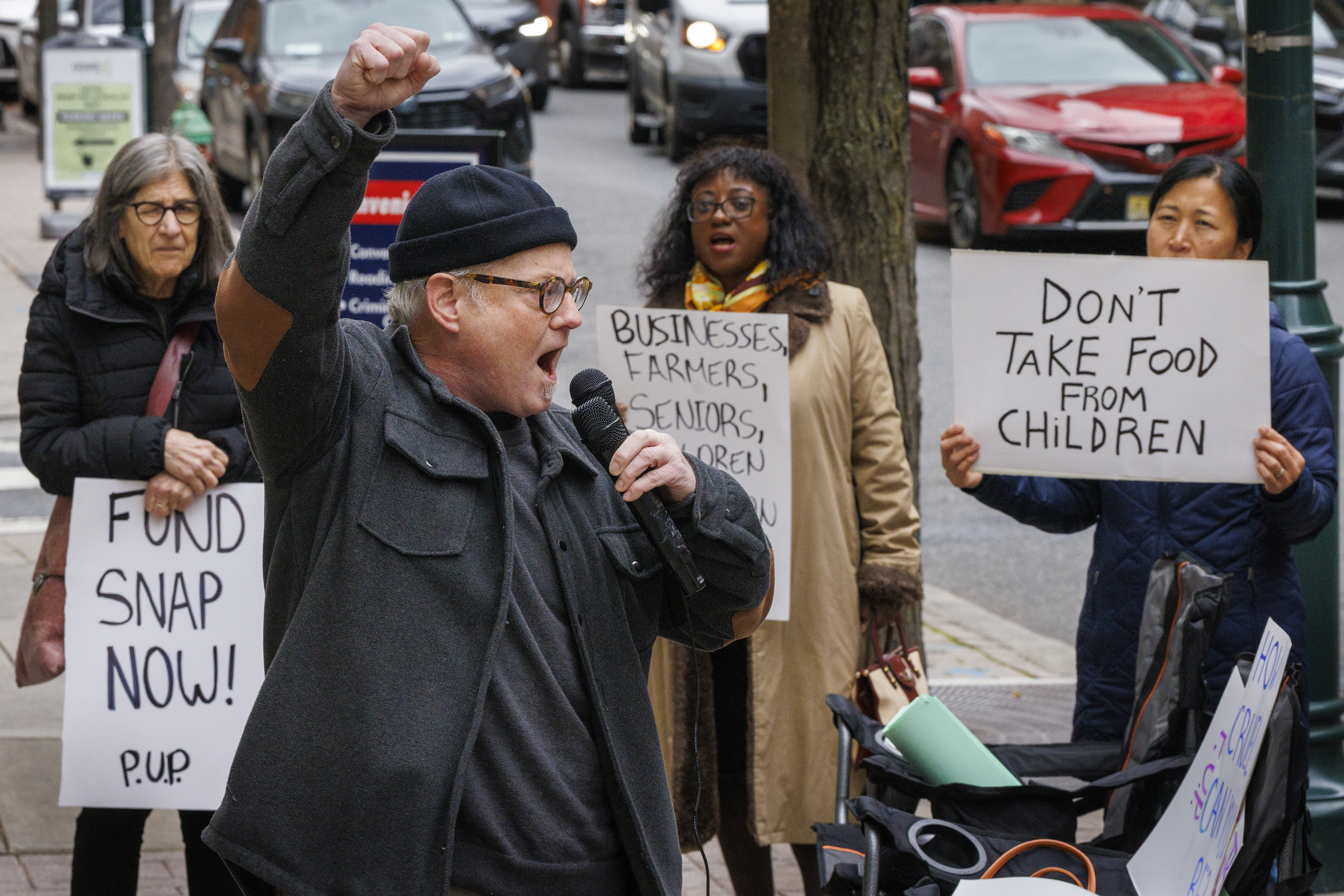
Jeff Garis, Outreach and Patnership Director, Penn Policy chants during rally along side SNAP recipients, clergy members, and other advocates at a rally and news conference outside of Reading Terminal Market, to urge the Trump administration to restore full SNAP funding, Wednesday, November 12, 2025.
Are SNAP benefits changing?
There are a few changes to SNAP work requirements that were implemented on Sept. 1 and Nov. 1.
On Nov. 1, some older low-income Americans were forced back to work when Congress and Trump passed additional work requirements, raising the maximum working age cap from 54 to 64 years old.
Parents with dependents age 14 and over also must go back to work or lose benefits. Previously, SNAP recipients with dependents under 18 did not have to meet work requirements. Veterans and former foster youth ages 18 through 24 are no longer exempt from work requirements either, under new federal law.
Do you have to reapply for SNAP benefits?
SNAP recipients do not currently need to reapply to the program. SNAP recipients should continue filing their semiannual reports every six months to recertify their income and household.
Lisa Mellon, 59, of Bridesburg, Pa., is walking her groceries to her friends car, who was kind enough to driver her around 40 minutes to the Feast of Justice at St. John’s Lutheran Church and back home on Tuesday, Nov. 11, 2025.
Will snap benefits be issued in December?
Yes. The SNAP program is funded through Sept. 30, 2026, after Congress reached an agreement on a spending deal last week. Most other federal government agencies and programs are funded only through Jan. 30.
Congress will need to strike another spending deal before the January deadline; otherwise the federal government could be shut down again.
However, SNAP benefits have been guaranteed through next September regardless of another shutdown.
How do you qualify for SNAP benefits?
SNAP requirements are based on your work hours and income. Other factors, like whether a member of your household is disabled, elderly, or a veteran, can provide households with additional benefits.
SNAP recipients must be working, volunteering, or participating in an education or training program for at least 20 hours a week (or 80 hours a month). They also must report those work hours.
These rules apply to you if you:
Are ages 18 through 64.
Do not have a dependent child under 14 years old.
Are considered physically and mentally able to work.
Income requirements
Households cannot exceed these monthly income limits to be eligible for SNAP benefits.
When a small, bipartisan group of House lawmakers introduced a petition in July to maneuver around Speaker Mike Johnson’s control of the House floor, it appeared a longshot effort — especially as Trump urged his supporters to dismiss the matter as a “hoax.”
But both Trump and Johnson failed to prevent the vote. The president in recent days bowed to political reality, saying he would sign the bill. And just hours after the House vote, senators agreed to approve it unanimously, skipping a formal roll call.
The decisive, bipartisan work in Congress Tuesday further showed the pressure mounting on lawmakers and the Trump administration to meet long-held demands that the Justice Department release its case files on Epstein, a well-connected financier who killed himself in a Manhattan jail while awaiting trial in 2019 on charges he sexually abused and trafficked underage girls.
For survivors of Epstein’s abuse, passage of the bill was a watershed moment in a years-long quest for accountability.
“These women have fought the most horrific fight that no woman should have to fight. And they did it by banding together and never giving up,” said Rep. Marjorie Taylor Greene as she stood with some of the abuse survivors outside the Capitol Tuesday morning.
“That’s what we did by fighting so hard against the most powerful people in the world, even the president of the United States, in order to make this vote happen today,” added Greene, a Georgia Republican.
In the end, only one lawmaker in Congress opposed the bill. Rep. Clay Higgins, a Louisiana Republican who is a fervent supporter of Trump, was the only “nay” vote in the House’s 427-1 tally. He said he worried the legislation could lead to the release of information on innocent people mentioned in the federal investigation.
The bill forces the release within 30 days of all files and communications related to Epstein, as well as any information about the investigation into his death in federal prison. It would allow the Justice Department to redact information about Epstein’s victims or continuing federal investigations, but not information due to “embarrassment, reputational harm, or political sensitivity.”
Even before the bill’s passage Tuesday, thousands of pages of emails and other documents from Epstein’s estate have been released from an investigation by the House Oversight Committee.
Those documents show Epstein’s connections to global leaders, Wall Street powerbrokers, influential political figures and Trump himself. In the United Kingdom, King Charles III stripped his disgraced brother Prince Andrew of his remaining titles and evicted him from his royal residence after pressure to act over his relationship with Epstein.
Still, many in the Republican base continued to demand the release of the files. Adding to that pressure, survivors of Epstein’s abuse rallied outside the Capitol Tuesday morning. Bundled in jackets against the November chill and holding photos of themselves as teenagers, they recounted their stories of abuse.
“We are exhausted from surviving the trauma and then surviving the politics that swirl around it,” said one of the survivors.
Another, Jena-Lisa Jones, said she had voted for Trump and had a message for the president: “I beg you Donald Trump, please stop making this political.”
That’s because Johnson kept the House closed for legislative business for nearly two months and refused to swear-in Democratic Rep. Adelita Grijalva of Arizona during the government shutdown. After winning a special election on Sept. 23, Grijalva had pledged to provide the crucial 218th vote to the petition for the Epstein files bill. But only after she was sworn into office last week could she sign her name to the discharge petition to give it majority support in the 435-member House.
It quickly became obvious the bill would pass, and both Johnson and Trump began to fold. Trump on Sunday said Republicans should vote for the bill.
Yet Greene told reporters that Trump’s decision to fight the bill had betrayed his Make America Great Again political movement.
“Watching this turn into a fight has ripped MAGA apart,” she said.
Rather than waiting until next week for the discharge position to officially take effect, Johnson held the vote under a procedure that requires a two-thirds majority.
But Johnson also spent a morning news conference listing off problems that he sees with the legislation. He argued that the bill could have unintended consequences by disclosing parts of federal investigations that are usually kept private, including information on victims.
“This is a raw and obvious political exercise,” Johnson said.
Still, he voted for the bill. “None of us want to go on record and in any way be accused of not being for maximum transparency,” he explained.
Meanwhile, the bipartisan pair who sponsored the bill, Reps. Thomas Massie, R-Ky., and Ro Khanna, D-Calif., warned senators against doing anything that would “muck it up,” saying they would face the same public uproar that forced both Trump and Johnson to back down.
“We’ve needlessly dragged this out for four months,” Massie said, adding that those raising problems with the bill “are afraid that people will be embarrassed. Well, that’s the whole point here.”
Senate acts quickly
Even as the bill cleared his chamber, Johnson pressed for the Senate to amend it to protect the information of “victims and whistleblowers.” But Senate Majority Leader John Thune quickly shut down that notion.
As senators gathered in the chamber Tuesday evening for the first votes of the week, it became clear no one would object to passing the bill as written.
Just before Senate Democratic leader Chuck Schumer called to pass the bill by unanimous consent, Oklahoma Sen. Markwayne Mullin, a Republican who is close to Trump, walked in the chamber and gave Schumer a thumbs-up. He then walked over to Schumer and shook his hand.
“This is about giving the American people the transparency they’ve been crying for,” said Schumer, D-N.Y. “This is about holding accountable all the people in Jeffrey Epstein’s circle who raped, groom, targeted and enabled the abuse of hundreds of girls for years and years.”
But this week, Parker is going on the offensive. The mayor said she was eager to eliminate the city’s racial participation targets long before the current legal threats to the policy emerged, saying the city’s 40-year-old effort to use its contracting process to boost diverse businesses had failed.
“Did the Supreme Court ruling have anything to do with our decision-making? Absolutely,” Parker said Monday, referring to a 2023 ruling that threatened race-based affirmative action programs. “But it wasn’t the impetus for it. I ran on providing access to economic opportunity for all here in the city of Philadelphia.”
That case, Students for Fair Admissions v. Harvard, could mark the beginning of the end for a wide variety of government programs that seek to boost diversity or aid people of color.
In her first extensive comments since The Inquirer reported Parker’s administration had ended race- and gender-conscious contracting policies, the mayor defended her decision Monday at a last-minute “roundtable” meeting she organized in Northwest Philadelphia with business leaders.
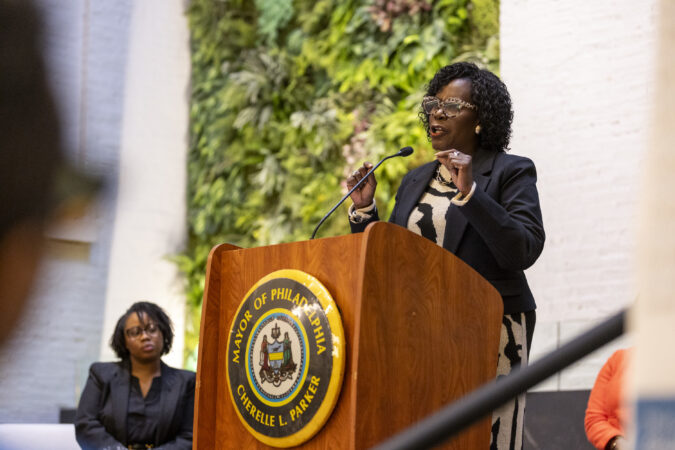
And she doubled down during a news conference Tuesday at the African American Chamber of Commerce headquarters, where she signed an executive order codifying the city’s shift to favoring firms that are registered as “small and local.”
“We knew the system was broken years before,” Parker, the city’s first Black female mayor, said. “Because every time we would look at the numbers and we would want to see how many Black and brown and women and disabled business owners were growing in the city of Philadelphia, the numbers became stagnant.”
Historically disadvantaged firms win city contracts worth more than $370 million annually, and supporters of the program criticized Parker for not fighting to preserve it.
City Councilmember Kendra Brooks of the progressive Working Families Party said Parker was “caving” to President Donald Trump, whose administration has sought to roll back policies on diversity, equity, and inclusion.
“People want to see leaders fighting for something,” Brooks said last week, “and right now we don’t see our city fighting for anything.”
But Chief Deputy Mayor Vanessa Garrett Harley said Monday that the administration examined the Philadelphia Office of Economic Opportunity’s registry of disadvantaged businesses that should get a leg up in city procurement opportunities, and found that only 20% were actually winning contracts.
“Obviously, it was not working,” Garrett Harley said.
Deputy Mayor Vanessa Garrett Harley speaks during a press conference in Philadelphia, Pa., on Thursday, June 27, 2024.
Parker said that setting diversity goals was not enough to grow women- and minority-owned businesses. Instead, she said, they need technical assistance, access to capital, and other tools so that they can develop to the point where they are able to regularly compete for city contracts without relying on set-asides.
Her administration is focused on providing those resources, she said, and not just “checking boxes.”
“I’m fighting,” Parker said. “But I’m fighting the fight the way I know best: to achieve the results and act and extract the tangible results that I need for the people who live in this city, who own businesses in the city.”
‘Small and local:’ A new world for city contracting
Parker on Tuesday signed an executive order detailing city’s new contracting system. As previously detailed in The Inquirer, the city will now give preference to “small and local” firms rather than requiring participation for businesses owned by women, minorities, and people with disabilities.
The executive order does not set a target goal for what share of city contracting dollars should go to “small and local” businesses.
The city’s previous goal of directing 35% of contracting dollars to disadvantaged firms was similarly not enumerated in law. Instead, Parker’s order outlines a structure for setting benchmarks and providing assistance to firms seeking to do business with the city.
For example, it charges the economic opportunity office with setting overall contracting goals, as well as establishing “participation ranges” for individual contracts. Those ranges will be used to give contractors benchmarks for money that should be set aside for subcontractors and suppliers that are considered disadvantaged businesses.
The office is also responsible for maintaining the registry of small and local businesses. Garrett Harley said the “overwhelming majority” of businesses that are registered with the city as minority-, women-, or disabled-owned will qualify as “small and local.”
Nadir Jones, the city’s director of business impact and economic advancement, said firms already registered with the city will be “grandfathered in” and will not need to register again as small or local.
To qualify as “local,” a business must either be headquartered in Philadelphia city limits or meet two of three other criteria:
More than 60% of employees live in Philadelphia.
More than half of the business’ employees work in the city at least 60% of the time.
More than 75% of the business’ gross receipts came from Philadelphia.
To qualify as “small,” Jones said, a business must have fewer than 750 employees.
Parker said her administration is working with outside advisers to hone the program. That includes the African American Chamber of Commerce, which announced Tuesday it had established a Special Task Force on Economic Access and Procurement in response to the contracting changes.
“We will continue to advocate for policies that are not only measurable and defendable, but also those that produce real impact,” said Regina Hairston, the organization’s president and CEO. “However, as we have recently learned, these policy changes are happening whether we fully support them or not.”
A risk-averse legal strategy
Parker’s elimination of racial diversity targets in city contracting — due in part to the hypothetical threat of litigationraised by City Solicitor Renee Garcia — in some ways parallels the mayor’s decision earlier this year to settle a lawsuit challenging a city tax break that primarily benefited small businesses.
In both instances, critics said that the Parker administration overstated the legal jeopardy the programs faced and gave up without a fight. But there are key differences between Parker’s handling of the contracting goals and the tax break, which exempted firms’ first $100,000 in revenue from the business income and receipts tax, or BIRT.
If anything, there was less of an immediate threat to the city’s contracting diversity goals, which are not facing any legal challenge. The administration instead preemptively abolished its racial diversity targets due to rulings on separate issues, such as affirmative action in college admissions or the city’s project labor agreements.
The catalyst for Parker eliminating the BIRT exemption was a 2024 lawsuit filed by a Massachusetts medical device manufacturer challenging the constitutionality of the tax break. Critics of Parker’s decision argued that if the city had fought it in court, the case could have been thrown out because the company may have struggled to demonstrate harm, given that the tax break actually benefited the firm.
Instead, the city settled with the company, and Parker pressed Council to remove the tax break from city law.
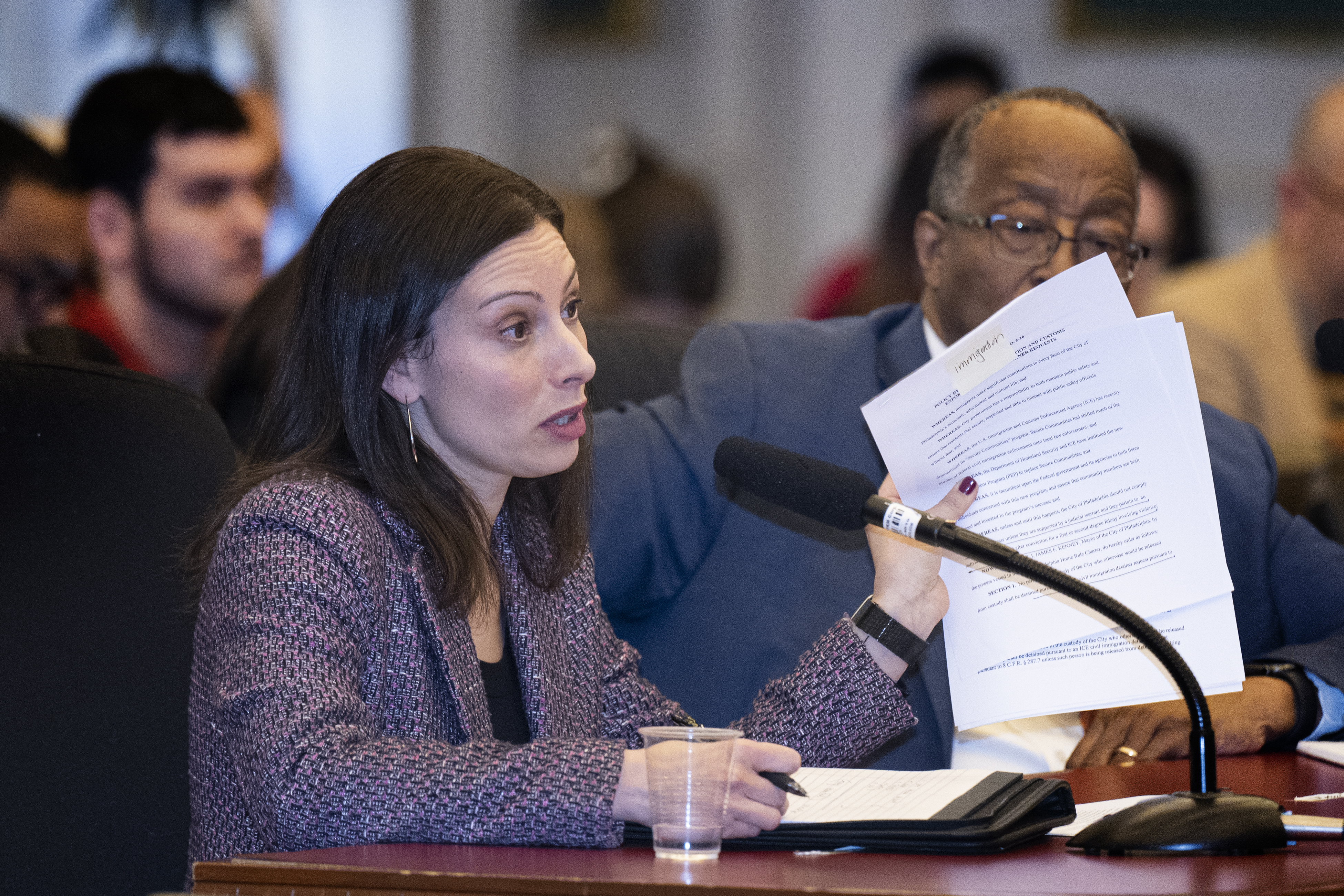
Renee Garcia, Philadelphia City Solicitor speak on Jan 22, 2025 during a hearing exploring Philadelphia’s readiness and commitment to protecting immigrant, LGBTQ+, and other marginalized communities in preparation for the impending Trump administration.
During the debate over the BIRT exemption, Garcia said Philadelphia could potentially lose hundreds of millions of dollars in tax revenue if it didn’t cave to the legal challenge. Critics of the city’s approach cast doubt on whether that was a realistic outcome.
But in the case of the contracting DEI goals, the potential risks articulated by the administration are far less dire.
Garcia said Monday the primary financial risk involved in maintaining the contracting diversity program is that if the city ever did get sued, and then lost a protracted court battle, it may have to pay the plaintiff’s attorney’s fees.
She also cited the possibility of creating unwanted legal precedent if the hypothetical lawsuit against the city reached the U.S. Supreme Court and lost — something that could still happen if a suit is filed against any of the hundreds of jurisdictions across the country that still have racial participation goals in contracting.
“This way, we do it on our terms,“ Garcia said. ”We have time to build it. We have a plan.”
The most important difference between the business tax and contracting issues is that Parker was in favor of the BIRT exemption but does not support the old contracting system.
In her budget address in March, Parker said she was begrudgingly seeking to end the tax break because state judicial rulings, in the administration’s view, had forced the city’s hand. But when it comes to the city’s contracting practices, Parker’s aims in some ways align with those seeking to undo longstanding city policy on diversity in contracting.
The administration’s messaging on the issue has become somewhat mixed. On one hand, Garcia said Parker was “anguished” when she realized she had to make changes to the contracting system due to the legal environment.
“She did not want to do this,” Garcia said.
On the other hand, Parker said she has long planned to reform the contracting system. Asked if her policy goals or new legal rulings were driving the decision, Parker said: “It’s both. It’s not either/or.”
“We are building something that does not exist here in the city of Philadelphia,” she said. “We are asking you to join the fight with us.”
The U.S. Equal Employment Opportunity Commission is suing the University of Pennsylvania for failing to release information related to an investigation it began in 2023over the school’s treatment of Jewish faculty and other employees regarding antisemitism complaints.
Penn, according to the complaint filed in federal court Tuesday, has not complied with a subpoena for information, including the identification of employees who could have been exposed to alleged harassment and the names of all employees who complained about the behavior.
In its quest to find people potentially affected, the EEOC demanded a list of employees in Penn’s Jewish Studies Program, a list of all clubs, groups, organizations and recreation groups related to the Jewish religion — including points of contact and a roster of members — and names of employees who lodged antisemitism complaints.
Penn usually does not comment on litigation, but in this case, the school ardently objected to the EEOC’s characterization of its cooperation and the personal nature of the material it was still seeking.
The school said in a statement it has cooperated extensively with the EEOC, including providing more than 100 documents and over 900 pages.
But the private university said it will not disclose personal information, specifically “lists of Jewish employees, Jewish student employees and those associated with Jewish organizations, or their personal contact information” to the government.
“Violating their privacy and trust is antithetical to ensuring Penn’s Jewish community feels protected and safe,” the university said Tuesday.
Penn also provided information on employees who complained and agreed that it could be shared, the school said, but the school would not provide information on those who objected.
“Penn also offered to help the EEOC reach employees who are willing to speak with the agency by informing all employees of the investigation and how they could reach out to the agency,” the university said. “The EEOC rejected that offer.”
The original complaint was launched by EEOC Commissioner Andrea Lucas, now chair of the body, on Dec. 8, 2023, two months after Hamas’ attack on Israel that led to unrest on college campuses, including Penn, and charges of antisemitism. It was also just three days after former Penn President Liz Magill had testified before a Republican-led congressional committee on the school’s handling of antisemitism complaints; the testimony drew a bipartisan backlash and led to Magill’s resignation days later.
Lucas, who was appointed chair this year by President Donald Trump, also brought similar antisemitism charges against Columbia University that earlier this year resulted in the school paying $21 million for “a class settlement fund.”
EEOC complaints typically come from those who allege they were aggrieved. Lucas, according to the complaint, made the charge in Penn’s case because of the “probable reluctance of Jewish faculty and staff to complain of harassing environment due to fear of hostility and potential violence directed against them.“
The EEOC’s investigation ensued after Lucas’ complaint to the EEOC’s Philadelphia office that alleged Penn was subjecting Jewish faculty, staff, and other employees including students “to an unlawful hostile work environment based on national origin, religion, and/or race.”
The allegation, the complaint said, is based on news reports, public statements made by the university and its leadership, letters from university donors, board members, alumni and others. It also cited complaints filed against Penn in federal court and with the U.S. Department of Education over antisemitism allegations and testimony before a congressional committee.
The EEOC complaint pointed to public comments by Magill, addressing antisemitism while she led Penn.
“I am appalled by incidents on our own campus, and I’ve heard too many heartbreaking stories from those who are fearful for their safety right here at Penn,” Magill said in 2023. “This is completely unacceptable.”
Magill also in a message had addressed “a small number of Penn staff members” who “received vile, disturbing antisemitic emails that threatened violence against members of our Jewish community,” in November 2023.
The complaint cited incidents of antisemitic obscenities being shouted on the campus, destruction of property in Penn’s Hillel, a swastika painted in an academic building, graffiti outside a fraternity and a pro-Palestinian encampment on the campus in 2024 that eventually was dismantled by police.
“Throughout its investigation, the EEOC has endeavored to locate employees exposed to this harassment and to identify other harassing events not noted by respondent in its communications, but respondent has refused to furnish this information, thereby hampering the EEOC’s investigation,” the complaint said.
Penn said it had received three antisemitism complaints, according to the federal complaint, but the EEOC questioned that number given the university’s workforce of more than 20,000. It demanded that the school provide names of all people who attended listening sessions as part of the school’s task force on antisemitism and all faculty and staff members who took the task force’s survey.
Penn objected to the subpoena and the commission partially modified it in September, ordering the school to comply within 21 days, the complaint said.
A federal court has blocked Texas from using its new congressional map for the 2026 midterm elections, directing the state to revert to its previous districts.
The majority opinion said the coalition of voting and civil rights groups who sued was likely to prove at trial that Texas officials had “racially gerrymandered” a new map that “unconstitutionally sorts voters on the basis of race,” depriving the plaintiffs of “their right to participate in a free and fair election.”
The judges were under a tight deadline to make a ruling since the candidate filing period for the 2026 midterm elections began on Nov. 8 and ends on Dec. 8.
Republican Gov. Greg Abbott, a key proponent of the electoral changes, said he would appeal the ruling to the U.S. Supreme Court.
“Any claim that these maps are discriminatory is absurd and unsupported by the testimony offered during ten days of hearings,” Abbott said. “This ruling is clearly erroneous and undermines the authority the U.S. Constitution assigns to the Texas Legislature by imposing a different map by judicial edict.”
The decision marks a significant setback for the state and Republicans, which began with a contentious battle in its state legislature last summer, led to a vote to revise state maps for voting districts, and ultimately spurred other states to buck tradition and pursue mid-decade redistricting.
Two judges, in a three-judge District Court panel, ruled on Nov. 18 that the injunction was necessary because “the racial minorities the Plaintiff Groups represent will be forced to be represented in Congress based on likely unconstitutional racial classifications for at least two years.”
The majority opinion, written by U.S. District Judge Jeffrey V. Brown, a Donald Trump appointee, who sits in Galveston, Texas, was joined by Senior U.S. District Judge David C. Guaderrama, a Barack Obama appointee, in El Paso.
U.S. Circuit Judge Jerry E. Smith, who was appointed to the bench by President Ronald Reagan, is expected to file a dissenting opinion.
A Republican majority in the Texas legislature in August 2025 passed the new state congressional map after a weeks-long standoff with state Democrats. Their new law, at the urging of President Donald Trump, heavily advantaged the GOP in 2026 elections. If used, it could have potentially flipped as many as five Democratic-held seats to Republican control − a significant edge as the party maintains a slim majority in Congress.
In his statement, Abbott said the Texas legislature passed the new maps to “better reflect Texans’ conservative voting preferences – and for no other reason.”
The court ruling and any decision by the U.S. Supreme Court could push back the filing deadlines for the Texas primaries for 2026. The midterm general election includes the seat of U.S. Sen. John Cornyn, D-Texas, all the Texas House of Representatives and Senate seats, and the governor, lieutenant governor and attorney general.
Republicans said redistricting targeted Democrats
The ruling came more than a month after 10 days of testimony and arguments over the legality of the new redistricting map at the federal courthouse in El Paso. The key testimony during the hearing came from Adam Kincaid, executive director of the National Republican Redistricting Trust, who created the maps.Kincaid testified that he looked at no racial data when building the map, solely relying on targeting districts that historically voted for Democrats.
He said he combined Democrat-leaning districts into one district. He took Republican portions of those districts to create their own districts. The outcome gave Democrats one less representative, adding more representation for Republican voters.
Kincaid and Republican leaders said the redistricting was done “race blind.” He testified he targeted Democrats, not minorities, which is allowed under the U.S. Constitution.
Voting rights groups say redistricting targets minorities
Democratic leaders and voting rights representatives argued during the hearing that the only districts targeted and impacted were Hispanic and Black majority districts. Hispanic and Black voters historically vote for Democrats.
In Texas, voters are not required to register by political party. They are free to vote in the primary of their choosing.
The redistricting map suppresses the voice of Texas minorities, including Hispanics, who make up the largest minority population in the state, Democratic state leaders testified in the trial.“They are not built to give Hispanics or African Americans a candidate of their choice,” Rep. Joe Moody, D-El Paso, testified about the new maps.
Democrats and voting rights advocates questioned why Trump focused on four districts and why they were the only districts that were dramatically altered. They said Republicans had already created the map before discussions were held in the Texas Legislature and the public had an opportunity to comment on it.
“That’s not Texas,” testified Rep. Ramon Romero, D-Fort Worth. “That’s not how we do things here.”
The redistricting vote that sparked a chain reaction
The Texas legislators’ efforts earlier this year sparked a national redistricting war across several states, as Democratic and Republican governors responded with their own efforts to redraw maps. Democratic California Gov. Gavin Newsom recently landed a victory in a voter-approved measure to implement new districts likely to add more Democratic representatives.
But that matter is also entangled in a court challenge, after the administration on Nov. 13 joined the California Republican Party to accuse the state of violating the Constitution by gerrymandering using race as a factor to favor Hispanic voters in the new map.
President Donald Trump is drawing widespread criticism after lashing out at a female reporter who was pressing for information about files related to Jeffrey Epstein.
As Trump was speaking to reporters Friday on Air Force One, Bloomberg White House correspondent and former Philadelphia Daily News reporter Catherine Lucey attempted to ask him about the release of the so-called Epstein files, which the Trump administration has refused to make public.
“If there is nothing incriminating in the files —” Lucey said before being cut off.
“Quiet, quiet, piggy,” an angry Trump shot back while pointing at Lucey.
Neither Lucey nor Bloomberg has responded to The Inquirer’s requests for comment.
“Our White House journalists perform a vital public service, asking questions without fear or favor,” Bloomberg said in a statement to the Guardian. “We remain focused on reporting issues of public interest fairly and accurately.”
Lucey, who has not spoken publicly about the matter, was first identified by the Guardian and can be seen in photographs of the interaction with Trump on Air Force One.
Trump’s remarks drew criticism from across the media world. CNN anchor Jake Tapper called the president’s remarks “disgusting and completely unacceptable.” Former Fox News anchor Gretchen Carlson called the president’s comments “degrading.”
“The president continues to behave in ways that not a single parent I know would tolerate from their elementary-school-aged kids,” wrote the Atlantic’s McKay Coppins.
A White House official defended the remark in a statement to MS NOW’s Vaughn Hillyard, claiming without evidence Lucey “behaved in an inappropriate and unprofessional way towards her colleagues on the plane.” The official did not elaborate.
Though the exchange took place days ago, video footage began circulating Tuesday ahead of a House vote on the Epstein files. It has since gone viral among the masses, drawing ire from critics and being reposted by outlets like Pop Crave.
Trump has a history of making sexist comments toward female journalists. He has called women in the press corps “nasty,” “crazy,” and “losers” over the years. He also has used derogatory language about women, comparing them to pigs, dogs, and other animals.
Before her time in D.C., Lucey was a respected reporter in Philadelphia, spending 12 years at the Philadelphia Daily News covering everything from police corruption to local news — but her sweet spot was politics. Her portfolio included coverage of then-Mayor Michael Nutter’s administration and the city’s changing power dynamics.
Lucey left in 2012 to work for the Associated Press, focusing on Iowa state politics and presidential races for four years. From there, she headed to the Wall Street Journal, where she covered the Trump and Biden administrations. She joined Bloomberg in March, according to a news release.
ABC News reporter Mary Bruce asks a question in the Oval Office Tuesday.
Trump also drew criticism Tuesday afternoon after lashing out at ABC News reporter Mary Bruce, who also asked about the Epstein files during an Oval Office meeting between the president and Saudi Arabia Crown Prince Mohammed bin Salman.
“Why wait for Congress to release the Epstein files?” Bruce asked. “Why not just do it now?”
“It’s not the question that I mind, it’s your attitude,” Trump shot back. “You’re a terrible person and a terrible reporter.”
Until recently, Trump had strongly opposed efforts to release the Epstein files. Last week, he called the House’s efforts to press the Department of Justice to make the files available a “Democrat hoax.”
Trump’s social connections to Epstein have been known for decades. Reports show Trump was mentioned in Epstein’s emails more than 1,000 times, making him the most-cited person in the documents released last week by the House Oversight Committee.
But Trump has been reversing his stance on releasing the files, saying on Air Force One, “we have nothing to hide.”
On Tuesday, the House of Representatives passed the Epstein Files Transparency Act in a 427-1 vote, demanding the Justice Department release the unclassified documents on Epstein and his associate Ghislaine Maxwell, who was convicted of sex trafficking.
The Republican-controlled Senate moved quickly Tuesday evening, agreeing to pass the Epstein bill by unanimous consent once it arrived from the House.
The bill would then head to Trump’s desk, who said in recent days he would sign it into law.
WASHINGTON — Congress passed legislation Tuesday to require President Donald Trump’s administration to release troves of records related to notorious sex trafficker Jeffrey Epsteinafter months of pressure from Democrats and survivors on the issue.
The U.S. House voted427-1 to pass the bill on Tuesday, prompting lawmakers in the chamber to cheer. The legislation was then rapidly passed by the U.S. Senate through unanimous consent, a process that skips debate when no senator objects to a bill.
Despite the overwhelming bipartisan consensus, Tuesday’s House vote followed months of pushing by Democrats to bring it the floor as Trump unsuccessfully lobbied to prevent it from receiving a debate.
The president abruptly changed his stance on the bill this week after it became clear it had enough Republican support to pass against his objections. The veto-proof bill now heads to Trump’s desk for his signature.
U.S. Rep. Rob Bresnahan, a freshman Republican who represents Northeastern Pennsylvania, told The Inquirer after the vote that his office “had a lot of phone calls” about the bill.
“We listened to our constituents… and I want to thank the people at home for bringing this to our attention,” he said outside the House chamber.
U.S. Rep. Clay Higgins, a Louisiana Republican, was the sole no vote. Five House members did not vote.
Trump said this week he would sign the bill into law, but he doesn’t actually need congressional approval to order the release of the files and could have already done so — a fact noted by U.S. Rep. Dwight Evans in the lead-up to the vote.
“Let’s be clear — Donald Trump doesn’t have to wait until Congress votes on this resolution,” Evans, a retiring Philadelphia Democrat, said in a Monday post on X. “If he wanted to, he could tell the Justice Department to release the Epstein files TODAY.”
The bill, called the Epstein Files Transparency Act, requires the Department of Justice to publish all unclassified files related to the prosecution and investigation of Jeffrey Epstein, a well-connected financier and convicted sex offender who was found dead in his jail cell in August 2019 and determined to have died by suicide after being federally charged with sex trafficking underage girls. After his death, his close associate Ghislaine Maxwell was convicted of sexually exploiting and abusing girls with him over the course of a decade.
The bill was led by U.S. Rep. Ro Khanna, a California Democrat who grew up in Bucks County, and U.S. Rep. Thomas Massie, a Kentucky Republican who frequently breaks with party leadership. U.S. Reps. Mary Gay Scanlon and Chris Deluzio, both Pennsylvania Democrats, were cosponsors.
Trump suggested on the campaign trail that he would release files related to the Epstein investigation, but after his administration faced uproar over their lackluster release of information surrounding the investigation, he began discrediting the cause.
Trump is mentioned numerous times in files that have already been released, including in an email in which Epstein claims Trump “spent hours at my house” with a young woman who later said she was a victim of Epstein, the New York Times reported last week. The president was neighbors with Epstein in Florida and was photographed with him at numerous social occasions in the 1990s and 2000s. He has called the efforts for more transparency a Democratic “hoax” that had fooled “stupid” Republicans who would be committing a “hostile act” by supporting the release.
Bresnahan was hesitant to answer whether any of the mentions of the president concern him.
“I saw some of the email threads; a lot of it was snippets. I don’t know where it came from,” said Bresnahan, who represents a swing district.
“I want to look at the whole comprehensive picture,” he added.
House Speaker Mike Johnson (R., La.) wasn’t going to allow the bill to be voted on the floor, so Khanna and Massie successfully forced the vote through a discharge petition, which was supported by all House Democrats and just three other Republicans — U.S. Reps. Marjorie Taylor Greene of Georgia, Nancy Mace of South Carolina, and Lauren Boebert of Colorado.
Massie and Khanna started to gather signatures in September and got the 218th needed on Wednesday last week when U.S. Rep. Adelita Grijalva (D. Ariz.) was sworn into office after winning a special election in September.
U.S. Rep. Brendan Boyle, a Philadelphia Democrat, blamed the delay for Grijalva’s swearing in on Trump and Johnson‘s resistance to the bill getting to the floor.
“There is a reason why Donald Trump has worked so hard to keep these Epstein files covered up,” he said in a video he shared on social media.
The bill reaching the floor put Republicans in a new bind: their stance on the matter would be on the record. They had to choose whether their loyalty to Trump would outweigh pressure from constituents on the matter.
Once it became clear the president wouldn’t prevail, Trump had a complete about-face Sunday night and called for lawmakers to support the bill.
“House Republicans should vote to release the Epstein files, because we have nothing to hide, and it’s time to move on from this Democrat Hoax perpetrated by Radical Left Lunatics in order to deflect from the Great Success of the Republican Party,” he posted on Truth Social.
“I DON’T CARE!” he added in the post and claimed that the files are a “curse on the Democrats, not us.”
Khanna said that almost 100 Republicans would have voted for the bill before Trump changed course in an interview with The New York Times.
“Trump saw his MAGA coalition was splintering and the last thing he could have had is a hundred Republicans vote for a Democratic bill in defiance of what he wanted,” he said in the interview. “Obviously, he has enough political instincts to realize how much he was losing on this issue.”
Once Trump signaled support for the bill, Khanna said he would “be surprised if it’s not close to unanimous.”
A separate House Oversight Committee investigation has released thousands of files from Epstein’s estate that show his connections spanning from Trump to influential leaders on Wall Street and across the globe. The Wall Street Journal also revealed over the summer a sexually explicit birthday message that appeared to be from the president to Epstein.
Trump has since called on the Justice Department to investigate ties between his political adversaries and Epstein, particularly the Clintons.
Survivors of Epstein’s abuse rallied outside the Capitol in the cold Tuesday morning.
Liz Stein, a survivor of Epstein’s abuse, said in a statement that she hopes “our elected leaders show the courage to stand with survivors.”
“Those of us directly impacted and harmed by the crimes of Jeffrey Epstein and Ghislaine Maxwell deserve justice and for the world to know our story,” she said. “It’s time for real accountability and true transparency.”
Where did Pa. Republicans stand prior to Tuesday’s vote?
U.S. Rep. Brian Fitzpatrick, a Bucks County Republican and former FBI agent who represents a purple district, had been quiet on the issue.
World Without Exploitation, an anti-human trafficking group that has called for the release of all Epstein files, put a billboard up in Fitzpatrick’s district that says: “Courage is Contagious: Release ALL The Epstein Files.”
Fitzpatrick was also the subject of digital ads from the Democratic National Committee about the Epstein files over the summer that called him one of Trump’s “sycophantic enablers.”
Even though no Pennsylvania Republicans signed onto the petition to allow a vote on the bill, some had previously indicated that they wanted the records released.
Bresnahan said on FOX56 WOLF on Friday that he wouldvote to release the files while making sure victims are protected. He told The Inquirer after the vote that he made that decision “weeks ago.”
When asked whether he was surprised at the near-unanimous support from his Republican peers, he said he “really wasn’t talking to a lot of my peers as to where they were going to be on it.”
Other Republicans made statements over the summer after the Justice Department said it would not release any more files. Attorney General Pam Bondi suggested in February that she had Epstein’s “client list,” but the department released files that were long in the public eye before claiming in July that Epstein didn’t actually have a list of clients.
U.S. Rep. Ryan Mackenzie, a freshman Republican who represents the Lehigh Valley, said during a telephone town hallin July that he would support measures to release DOJ files on Epstein if Trump’s administration doesn’t do more, NPR reported. He echoed that position Monday night, according to news reports.
“I know they have not released as much as I would like to see to date, but hopefully they’re going to be doing that,” he said in July. “And if not, then Congress should potentially step in and compel them to do that because again, the American people deserve to have full transparency and information about what is in those files, and ultimately, we’re going to get there.”
U.S. Rep. Scott Perry, a Trump ally who represents parts of Central Pennsylvania, shared a letter to Bondi on July 18 expressing “serious concern” over how the Epstein case had been handled and said it “remains one of the most troubling examples of apparent failures within our justice system.”
He said the Trump administration’s handling of the case at that point had “only heightened public distrust.” He cited how the administration’s February 2025 release of documents “contained little new information” and its pivot on a supposed client list.
“The continued secrecy surrounding these records undermines public confidence in the Justice Department’s commitment to justice,” he said at the time, requesting a special prosecutor to investigate the handling of the case.
Perry supported a Democratic motion in July to subpoena the Justice Department for the Epstein files in an effort led by U.S. Rep. Summer Lee, a progressive Democrat from Pittsburgh. He also backed motions to subpoena former President Bill Clinton and former Secretary of State Hillary Rodham Clinton related to the case.
Fitzpatrick, Perry, Mackenzie, and Bresnahan all represent districts that will be targeted by Democrats during next year’s midterms.
Also in July, U.S. Rep. Dan Meuser (R., Luzerne) called for the release of “all the pertinent, credible Epstein files” but focused squarely on Clinton.
Other Republicans in the state have been pretty quiet on the matter.
Lee, the Pittsburgh Democrat who led the summer subpoena effort, said in a post on X after the vote that the Department of Justice has “slow-walked” the release of files for months and echoed that Trump hasn’t acted on his ability to compel the department to release the files.
“No matter how wealthy or well-connected, every person who is complicit, enabled, or abused women and girls will be brought to justice,” she added.
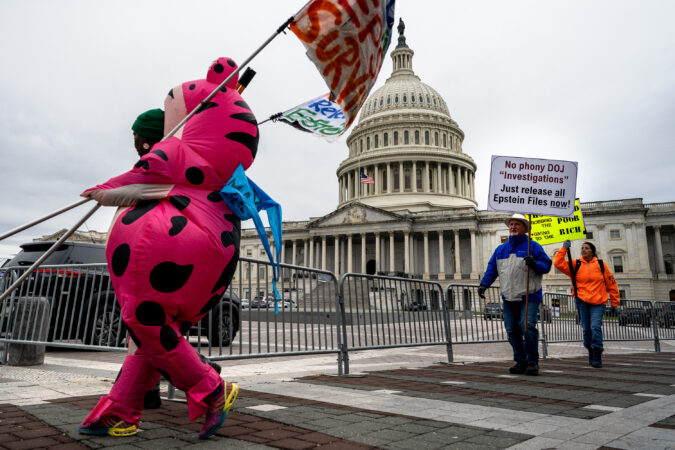
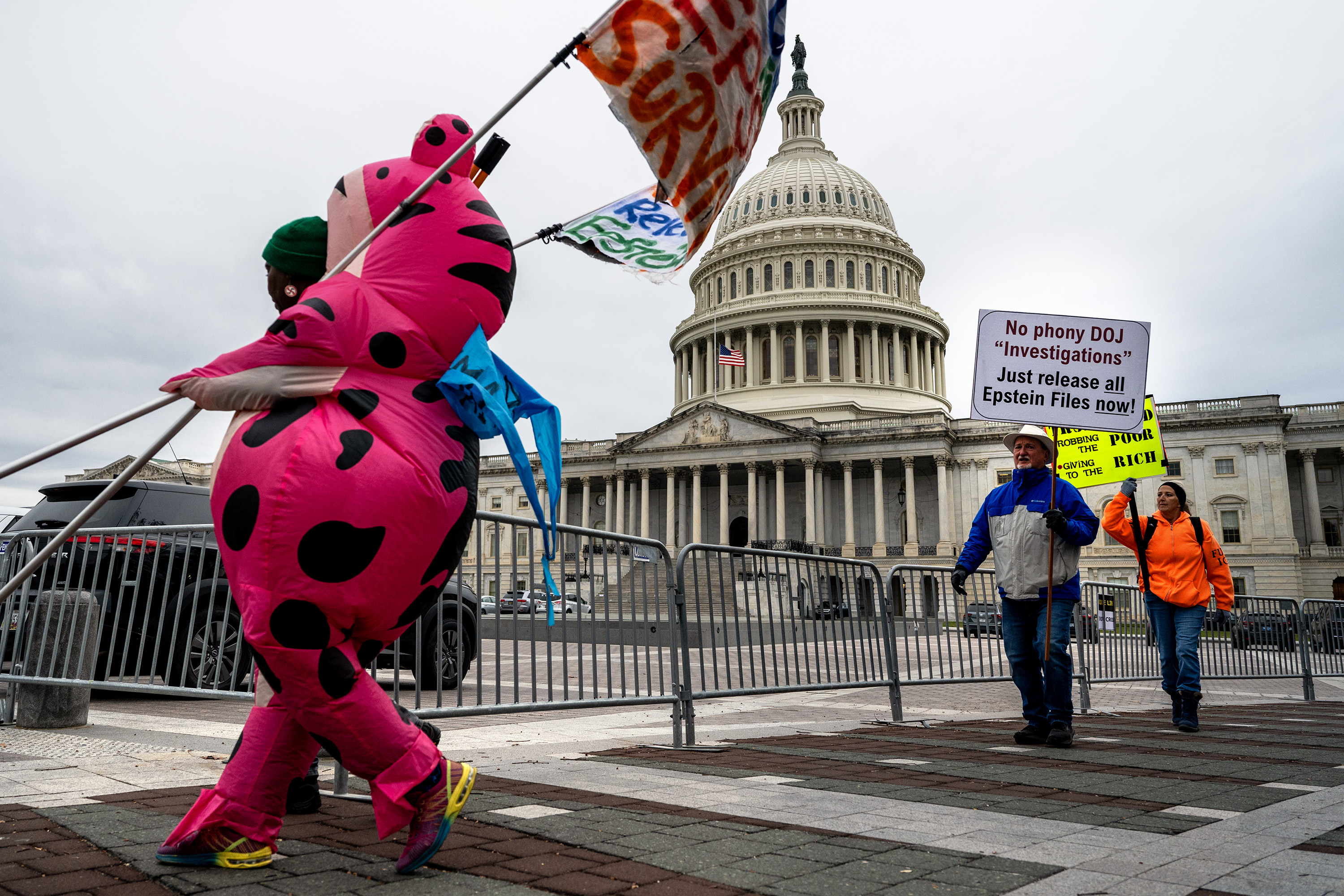
Protesters head to the U.S. Capitol in Washington D.C. Tuesday, Nov. 18, 2025 as a bill that would require the release of records relating to Jefrey Epstein comes to a vote.