Category: Politics

Political news and coverage

  • Erica Deuso’s campaign to be Pa.’s first trans mayor isn’t about that. It’s ‘about the neighbors.’

    Erica Deuso’s campaign to be Pa.’s first trans mayor isn’t about that. It’s ‘about the neighbors.’

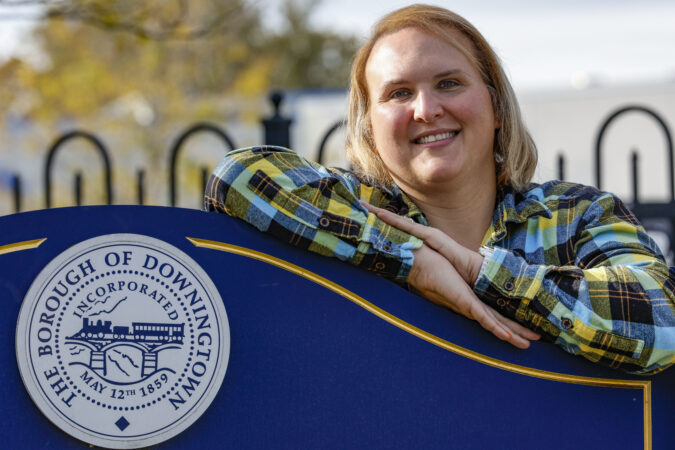
    By most measures, Erica Deuso’s campaign for mayor of Downingtown is unremarkable.

    She spends Saturday mornings greeting residents at the farmers market and her weekend days knocking on doors in the Chester County borough. Most of the time, she’s talking about traffic and community events.

    Nevertheless, the effort is groundbreaking.

    If she is elected in the Democratic-leaning borough, Deuso would be the first openly transgender person elected mayor in Pennsylvania. She would do so as President Donald Trump’s administration pursues policies that limit public life for transgender residents and as Democrats’ vocal support for the community wanes in the aftermath of the 2024 election.

    Democratic supporters pose with current Downingtown Mayor Phil Dague, center, Chester County Commissioner Josh Maxwell, center left, and mayoral candidate Erica Deuso, center right.

    For most voters, though, those facts didn’t even register.

    Deuso, who works in management at a pharmaceutical company, has lived in Downingtown for 18 years.

    She is a committeewoman in the local Democratic Party, and board member for Emerge Pennsylvania, which trains women and LGBTQ+ people to run for office. Her platform centers on traffic control, domestic violence, community engagement, and sustainable development.

    The Downingtown mayor has relatively limited power, overseeing the police department and acting as a tiebreaking vote on borough council. Deuso has promised not to sign an agreement between Downingtown police and U.S. Immigration and Customs Enforcement and said she wants to work on enhancing mental health services for officers while expanding their reach in the community to address concerns over traffic violations and e-bikes.

    As she knocked on doors on a Saturday morning in October, Deuso’s gender identity rarely came up in her interactions with voters.

    “I’m not running on being trans, that’s not something I ever do or ever wanted to do. I wanted to make it about the neighbors,” Deuso said. “It’s the other side making it about who I am, my identity.”
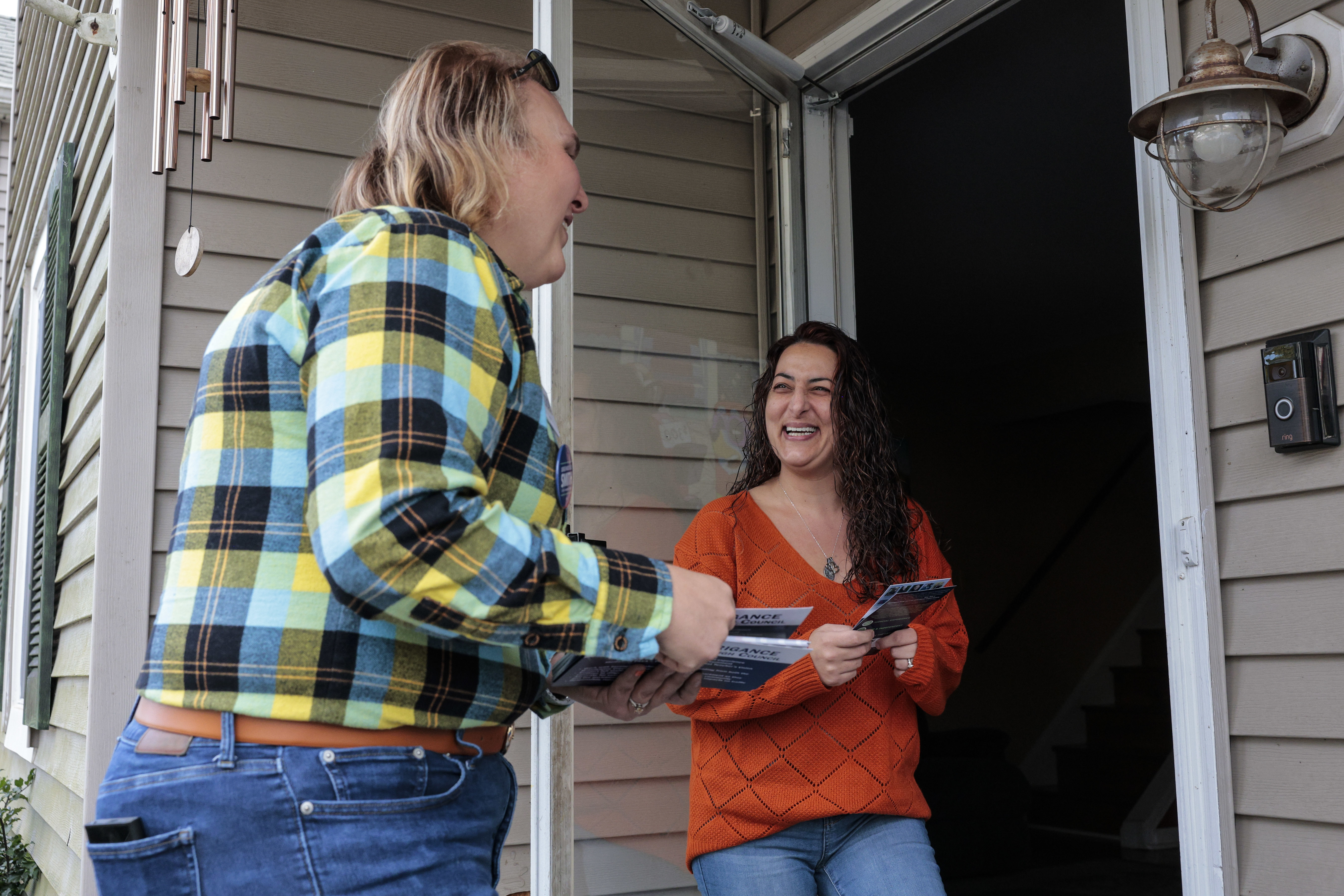
    Going door-to-door looking for votes in Downingtown in October, Erica Deuso meets Nicole Flood at her door.

    The historic nature of her campaign has likely driven attention and funds to the race. She has earned endorsements from several organizations that back LGBTQ+ and women candidates. And she’s received donations from outside the state and outside Chester County, including a $3,000 donation from Greater Than PAC, which supports progressive women.

    But a scan of comments in community Facebook pages shows her identity has also driven more vitriol.

    “There are people who refuse to use my correct name or pronouns, they’ve deadnamed me, all those sorts of things. But it’s been 16 years since I transitioned; I don’t really care,” Deuso said. But she’s mindful that LGBTQ+ youth are watching her. She engages in some of the posts, but not all of them.

    “I want to handle it with grace.”

    Those efforts are already influencing at least one local teen. Nicole Bastida-Moyer, a 39-year-old voter, told Deuso her candidacy had inspired her 14-year-old daughter to volunteer to help other students with their mental health. Both she and her daughter are pansexual.

    “She deals with a lot of hate,” Bastida-Moyer said through tears about her daughter.

    “Having Erica’s voice, it means a lot,” Bastida-Moyer said.
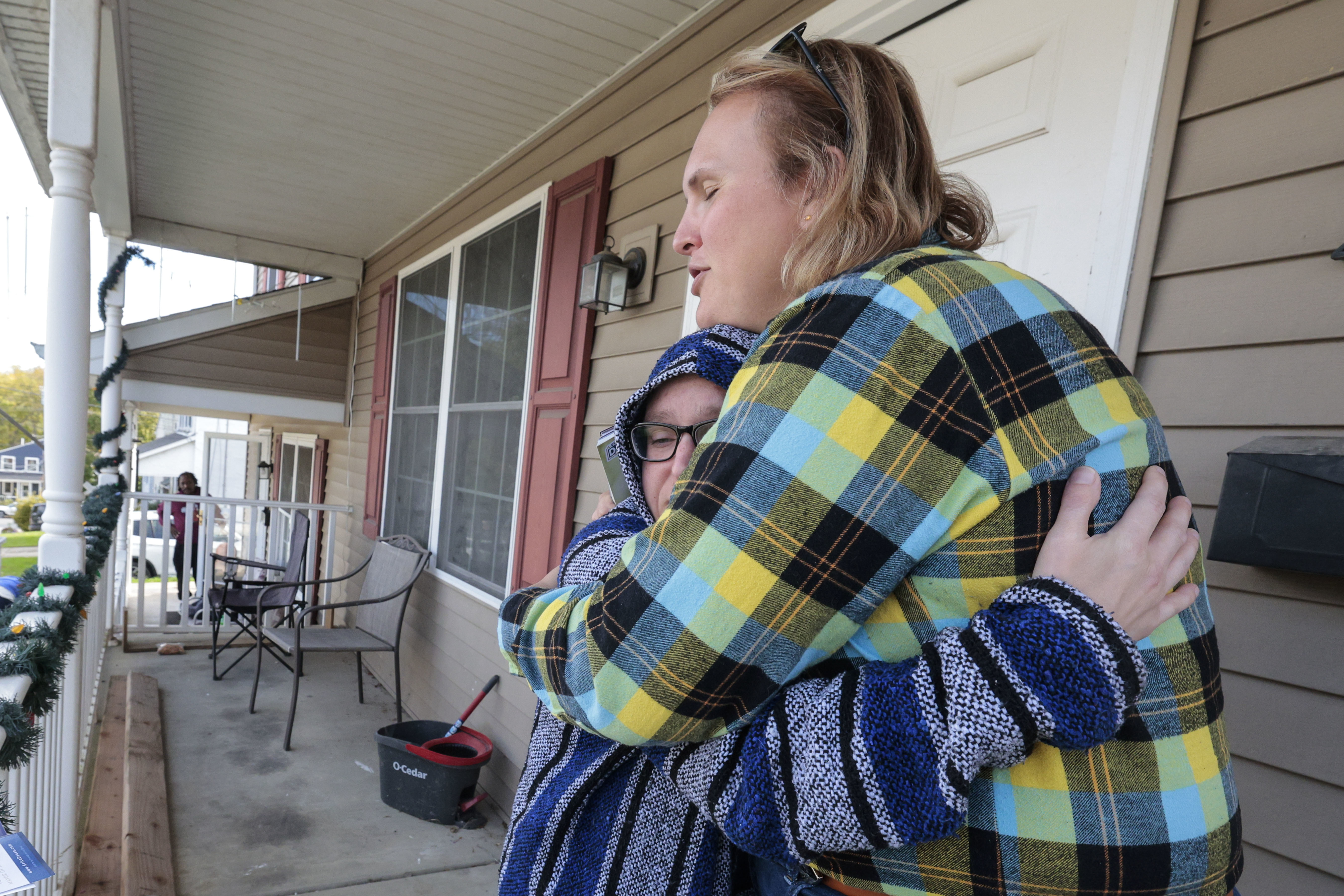
    Nicole Bastida-Moyer gets a hug from Downingtown mayoral candidate Erica Deuso while campaigning in October.

    Impact on voters

    Deuso responds to comments on her Facebook page and other groups occasionally. She said she tends to do so only when she thinks a true conversation can come of it.

    Door-knocking in her neighborhood, Deuso encountered just one voter who appeared to be hostile to her because of her gender identity. When Deuso approached one house, a woman came to the door and glanced at the candidate and her fliers through the screen door without opening it.

    “I’m not voting for him,” the woman said. “For who?” Deuso asked as the woman turned and walked away.

    Episodes like this are relatively rare, Deuso said

    “People are generally much nicer in person than online,” said Jenn Fenn, who managed U.S. Rep. Chrissy Houlahan’s 2024 reelection campaign in a district that includes Downingtown.

    Deuso’s opponent, Republican Rich Bryant, says he doesn’t condone those who attack Deuso based on her identity.

    But Deuso has shared several screenshots on social media that appear to show Bryant insulting transgender women and making misogynistic remarks about cisgender women. At a canvass launch at the local farmers market, the township’s current mayor, Democrat Phil Dague, referenced these posts while comparing Bryant to Trump.

    Current Downingtown Mayor Phil Dague talks with supporters for Erica Deuso listening at right. Saturday October 18, 2025.

    Bryant claimed 90% of these posts are AI-generated but refused to say which posts are real and which are fake.

    “I don’t like mud-slinging misinformation,” Bryant said. “I try to stay focused on what’s good for Downingtown.”

    Rich Bryant is running as a Republican for Downingtown mayor.

    He sought to present himself as better experienced than Deuso to be mayor, contending his career in cybersecurity has prepared him for the mayor’s primary duty of overseeing the local police department.

    Alice Sullivan, an 80-year-old neighbor and donor to Deuso, had noticed some of the nastiness on social media and said she was voting for Deuso because, unlike her opponent, she wasn’t a “bigot.”

    She lamented the online attacks against Deuso as disappointing — but unsurprising. The candidate’s gender identity shouldn’t matter, insisted Sullivan, who has lived in Downingtown for decades.

    “Other people’s lives, genders, whatever is not my business,” she said.

    Josh Maxwell, a Democratic county commissioner and former Downingtown mayor who had joined Deuso to knock doors, asked if Sullivan thought others would disagree in the historically Catholic community. But the people who cared, Sullivan argued, are “not going to vote Democrat anyway.”

    “There might be some,” she said. “I don’t know very many.”
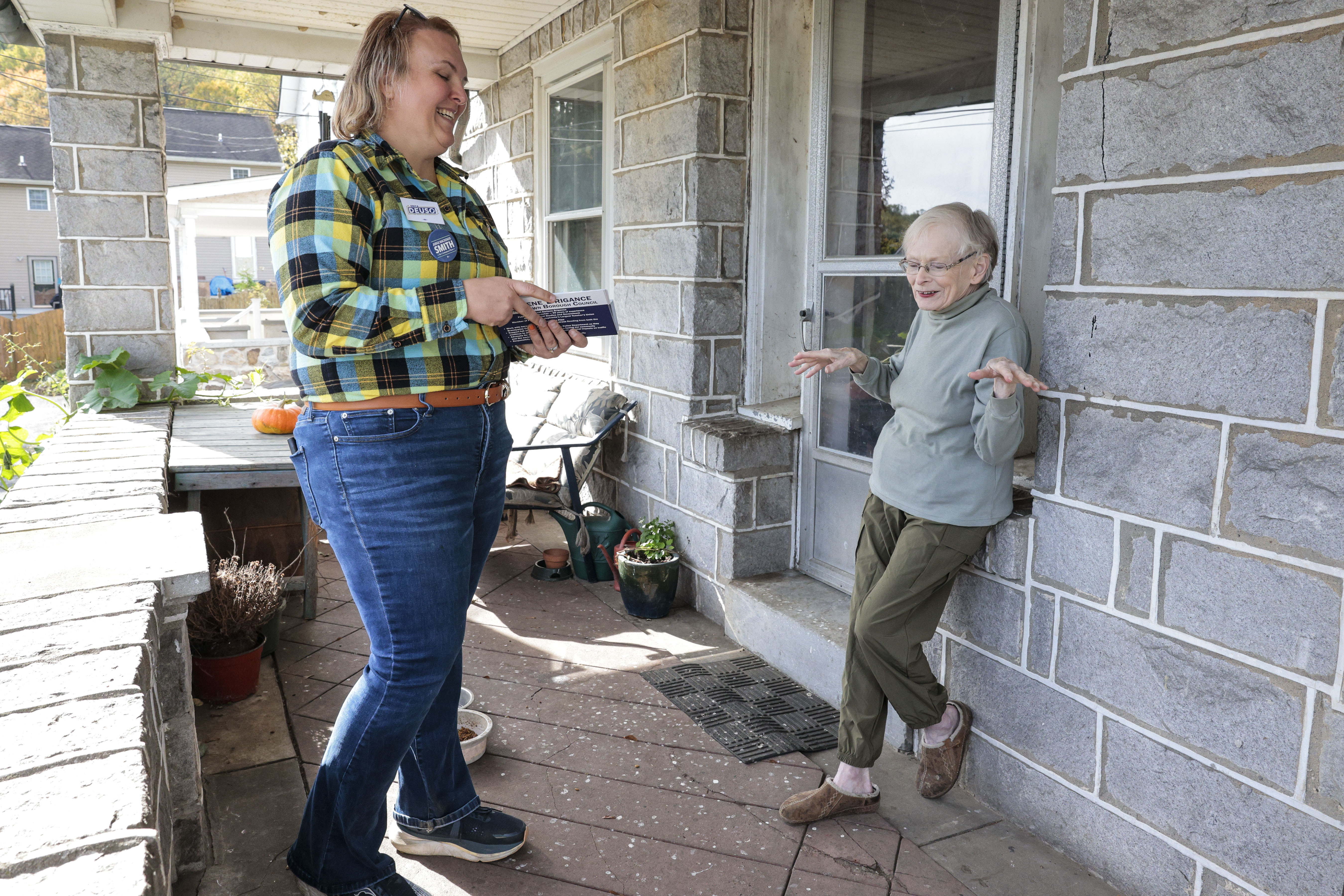
    Campaigning in the west end of Downingtown Erica Deuso greets Alice Sullivan on Oct. 18.

    As Deuso walked door to door, her conversations focused on local and community issues. She greeted every dog she saw and spoke to their owners about their safety concerns — drivers had been racing down quiet neighborhood streets — and their concerns about the community. Deuso is proposing a program to offer hotel rooms for one night to those facing domestic violence.

    She also made it clear that she would be a resource, even on issues that went beyond the mayor’s official duties. She showed one voter how she had started a youth-driven art project at a recent township festival. And pointed to a home that, just weeks prior, she’d brought a misdelivered package to on behalf of a voter.

    For weeks, Raul Hurtado, Deuso’s neighbor who immigrated from Colombia in the 1990s, has been rolling down his windows when he sees Deuso, telling her he’s voting for her.

    “She is from this town, my neighbor, and we need someone to help us,” Hurtado told The Inquirer.

    If she’s elected, Deuso told Hurtado, her goal is to be available to all residents through office hours at Borough Hall.

    “We can have a face-to-face discussion,” she said. “Not through your car window.”

    This suburban content is produced with support from the Leslie Miller and Richard Worley Foundation and The Lenfest Institute for Journalism. Editorial content is created independently of the project donors. Gifts to support The Inquirer’s high-impact journalism can be made at inquirer.com/donate. A list of Lenfest Institute donors can be found at lenfestinstitute.org/supporters.


  • Philly has had a ‘soda tax’ since 2017. One lawmaker wants the city to consider repealing it.

    Philly has had a ‘soda tax’ since 2017. One lawmaker wants the city to consider repealing it.

    City Councilmember Jimmy Harrity wants to revisit the contentious debate that led to the 2017 creation of Philadelphia’s sweetened beverage tax, arguing that the levy has cost the city jobs and will eventually prove insufficient to pay for the programs it was enacted to support, such as subsidized prekindergarten.

    “We‘re going to keep on pulling more money out of the general fund each year, taking away from other programs,” Harrity, a Democrat, said Monday at a hearing of Council’s Labor and Civil Service Committee, which he chairs. “If we were in business and these numbers were the numbers of the business, we wouldn’t be in business long.”

    The tax, which is paid by distributors of sweetened beverages sold in Philadelphia, is 1.5 cents per ounce. Council approved it in 2016 despite vociferous opposition from the beverage industry and Teamsters Local 830, which testified Monday the tax has led to 1,000 of its members who drove trucks for distributors losing work.

    Harrity, an ally of the Teamsters, noted that revenue from the tax has declined as Philadelphians either drink fewer sweetened beverages or find ways to purchase them outside the city. The tax produced about $73.4 million in the 2023 fiscal year, but only $64.4 million last year, he said.

    A Council staffer arranges a table of sugary drinks before Councilmember Jimmy Harrity (not shown) holds a hearing in City Council Monday, Oct. 27, 2025 on former Mayor Jim Kenney’s tax on sweetened beverages.

    For Harrity, that means that the city should consider eliminating the “soda tax,” as it is widely known, in favor of a more “sustainable” funding stream. He did not offer any alternatives.

    But based on his colleagues’ reactions, it is unlikely the tax will be reconsidered in a serious way any time soon.

    Several Council members, public health advocates, and childcare industry representatives defended the tax, which was championed by former Mayor Jim Kenney. They noted that research by the University of Pennsylvania indicates it has been a public health success story that has helped to keep down obesity rates.

    Marcy Boroff with Children First dresses as a coke can for a City Council hearing Monday, Oct. 27, 2025 on former Mayor Jim Kenney’s tax on sweetened beverages. She was there to support the tax. Children First advocates for policy changes to improve child health, education, and welfare, especially for low-income children. .

    And they stressed its critical role in paying for the three initiatives that Kenney launched alongside the tax: PHL Pre-K, which provides free childcare to 5,250 kids; community schools, which offer a multitude of services to families in 20 Philly schools; and the Rebuild program, which renovates and improves recreation centers and playgrounds.

    “We have to make tough decisions that will actually benefit the greater good, and that’s what we did here,” Democratic Councilmember Rue Landau said during the hearing, adding that “the majority of us up here on this panel think this is a great investment.”

    ‘What we always intended’

    Mayor Cherelle L. Parker, a Democrat who voted for the tax as a Council member, also remains supportive of it.

    “We would not have been able to fund these programs without that beverage tax money,” said city Finance Director Rob Dubow, who has held his role under Parker, Kenney, and former Mayor Michael A. Nutter. Nutter twice tried unsuccessfully to implement a “soda tax” before Kenney succeeded.

    Dubow told lawmakers that the decline in the tax’s revenue over time was always part of the plan and that city leaders intended for the regular city budget to make up the difference for funding Rebuild, pre-K, and community schools when they created the tax. The moment when the soda tax began taking in less money than the city pays out for the three programs it helped launch was the 2024 fiscal year, he said.

    “We pay for it out of the general fund, which is what we always intended we would do,” Dubow said.

    This year, Rebuild, pre-K, and community schools are projected to cost $110 million, Dubow said. Of that, $73 million pays for the 5,250 slots in the city’s pre-K program.

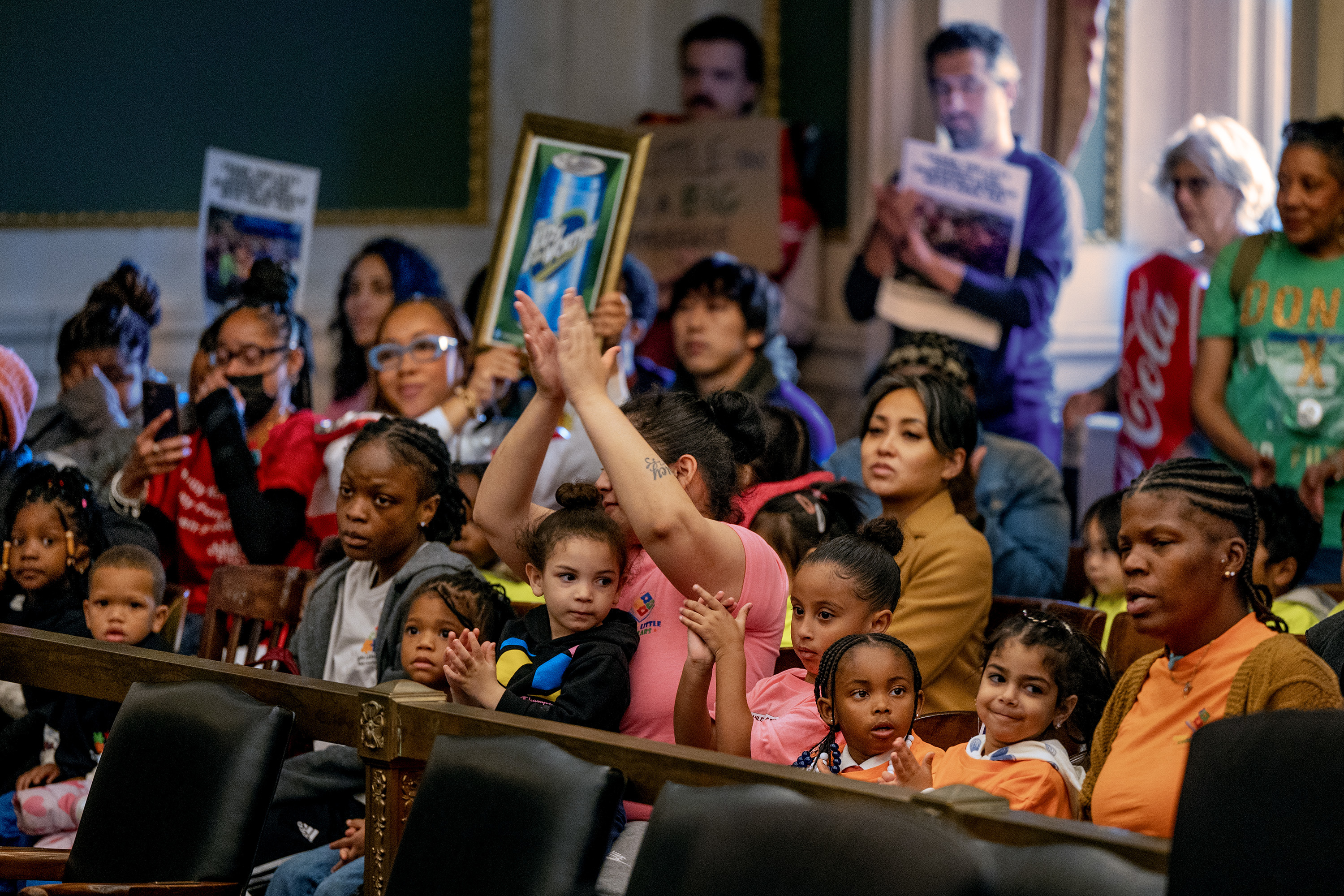
    Preschoolers and their caregivers attend a City Council hearing held by Councilmember Jimmy Harrity Monday, Oct. 27, 2025 on former Mayor Jim Kenney’s tax on sweetened beverages. The tax funds the city’s universal pre-kindergarten program

    ‘Why not Taj Mahals?’

    Councilmember Brian O’Neill was the only other Council member besides Harrity to vocally criticize the tax at Monday’s hearing.

    O’Neill, Council’s lone Republican, noted that Council members have traditionally had control over capital funding for Philadelphia Parks and Recreation projects in their districts. That money, he noted, is split evenly among the 10 district Council members.

    Rebuild, he lamented, instead gives the power to decide which projects move forward to the mayor’s administration. Consequently, he said, the program has produced uneven results and overbudget and unnecessarily ambitious playground and recreation center renovations.

    “This program — Rebuild, they call it — they didn’t decide to bring playgrounds up to some minimum level where people over the years may not have spent their money well,” O’Neill said. “They decided to build Taj Mahals in many cases. … You know what happens when you build a playground and spend tons of money on it? … All the playgrounds around it look terrible.“

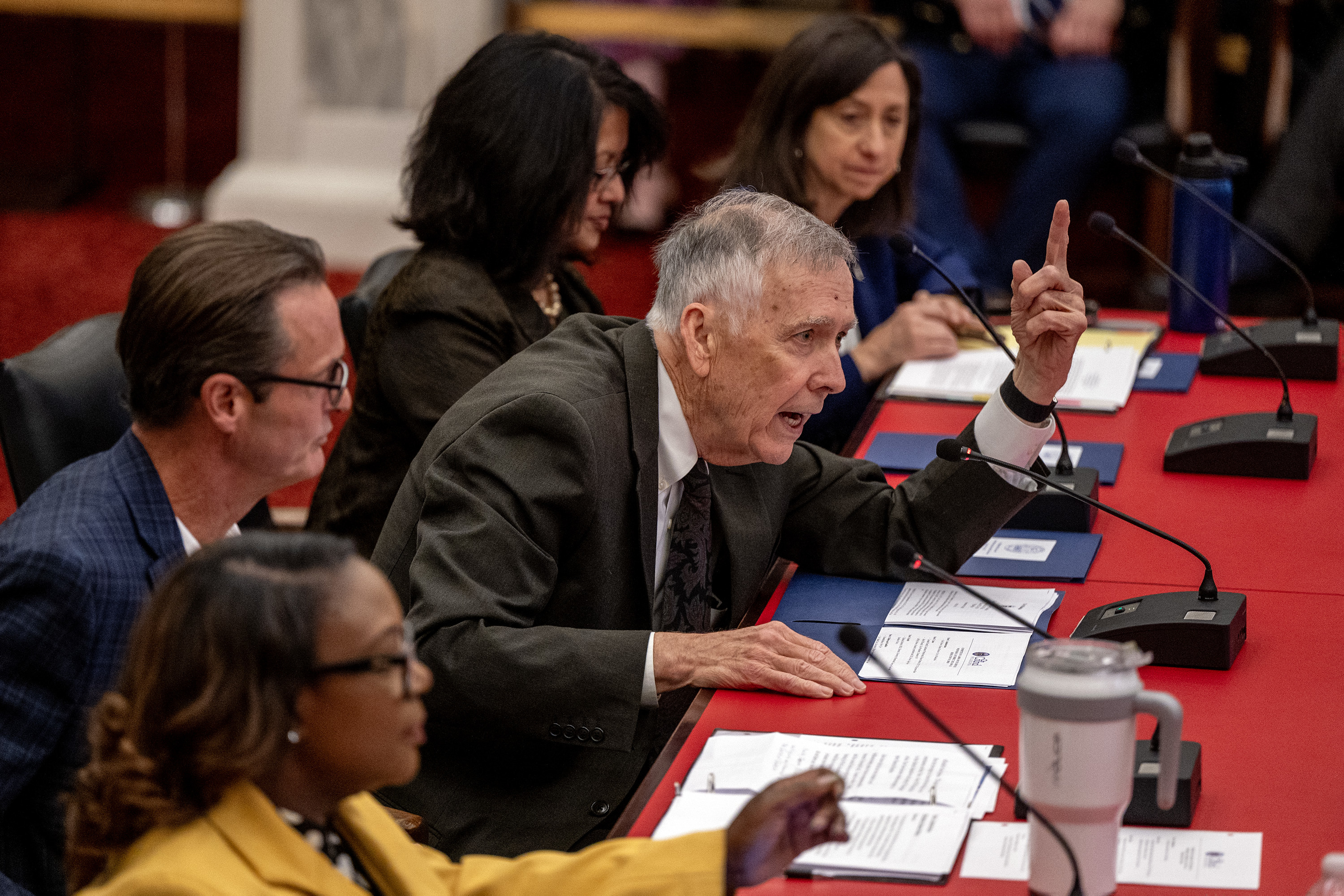
    Councilmember Brian J. O’Neill (center) speaks during a hearing in City Council Monday, Oct. 27, 2025 on former Mayor Jim Kenney’s tax on sweetened beverages. Behind him, front to rear, are: Councilmembers Kendra Brooks, Jimmy Harrity, Nina Ahmad, and Rue Landau.

    That comment did not go over well with some of his colleagues.

    “My community benefited from a rec center that was through the Rebuild program,” said Councilmember Kendra Brooks, a member of the progressive Working Families Party who lives in Nicetown. “It’s not a Taj Mahal. It’s a quality rec center in the middle of North Philadelphia. It does not have everything, because I personally went and bought a refrigerator.”

    And Councilmember Nina Ahmad, a Democrat, questioned why building grandiose rec centers would be a problem in the first place.

    “Why not Taj Mahals for all our folks? Why not have the best-quality rec centers so our children want to go there, our children want to spend time there?” Ahmad said. “We live in a first-world country and yet we are begging for scraps for our youngest citizens.”

  • Shapiro’s view that America is ready for a Jewish president hasn’t changed, Times says

    Shapiro’s view that America is ready for a Jewish president hasn’t changed, Times says

    Gov. Josh Shapiro told the New York Times in an article appearing Monday his opinion that a Jewish person could become president has not changed since he first voiced it a year ago.

    The article referenced a statement Shapiro made to the Times last year that “speaking broadly, absolutely” America could elect a Jewish president in his lifetime.

    The Monday article stated: “This month he said his view was unchanged.”

    Shapiro has never publicly confirmed he’s interested in running for president, though speculation has long followed him.

    While he has been largely untested on the national stage, Shapiro is often listed among the Democrats likely to make a run for the presidency in 2028.

    Despite that, the April arson attack, denounced by many as antisemitic, at the governor’s mansion against Shapiro and his family on Passover as they slept shook some people’s “confidence in the idea that the country was ready for leaders like Mr. Shapiro,” the Times wrote.

    In fact, Shapiro told the Times, he spoke with his family about whether holding elected office was worth the risk of political violence, which Americans believe is on the rise, according to a survey released last week by the Pew Research Center.

    Shapiro concluded: “If I leave because violence pushed us out or scared us, then those who want to perpetuate political violence win.

    “I’ve got to stay. I’ve got to show that we’re not afraid.”

    Taking that stand, however, is not getting easier.

    “It’s gotten hotter and hotter and more and more dangerous,” Michigan Gov. Gretchen Whitmer, herself the target of a kidnapping plot, told the Times.

    Cody Balmer, 38, the man accused of setting the governor’s mansion ablaze, pleaded guilty on Oct. 14 to attempted murder and related crimes. Sentenced to 25 to 50 years in prison, Balmer said he intended to attack Shapiro with a hammer that night.

    Photos released by the Pennsylvania State Police and seen on YouTube showed a soot-covered chandelier, singed walls, a blackened carpet, melted tables, burned furniture, and a damaged grand piano.

    Since the attack, Shapiro has spoken with other elected leaders and those considering running for office, offering personal guidance to those victimized by political violence, and he talked with Gov. Tim Walz of Minnesota after the former state House speaker, Melissa Hortman, and her husband were assassinated, the Times wrote.

    “Knowing that as you’re doing that work that I consider to be noble, that it comes with a risk to you and your family,” he told the Times, “that’s a tension that is a challenge to work through.”

    “It is one of the reasons why I’m so motivated to speak out against political violence,” Shapiro added. To “try and take the temperature down so that good people want to serve.”

    Regarding potential bias against religion, the governor told the Times that Americans “respect faith, even if they don’t practice it, and want to have a deep relationship with the people who represent them.”

    Being open about his Judaism has allowed him “to be able to have a deeper relationship with the people of Pennsylvania, allowed them to share their stories,” Shapiro told the Times, adding: “We’re doing that in this ultimate swing state.”

    Shapiro will release a memoir next year detailing his career and personal life, including the firebombing of the governor’s mansion and his place on the short list to be Kamala Harris’ vice presidential candidate.

    Considered a viable Democratic presence, Shapiro on Saturday stumped for New Jersey gubernatorial candidate U.S. Rep. Mikie Sherrill in the Garden State at a senior center auditorium and an African Methodist Episcopal church, targeting two groups seen as necessary for Sherrill to beat Republican Jack Ciattarelli.

    Staff writers Julia Terruso and Gillian McGoldrick contributed to this article.

  • Delco homeless shelter system to close two shelters amid Harrisburg budget impasse

    Delco homeless shelter system to close two shelters amid Harrisburg budget impasse

    Delaware County’s homeless services, already overextended and stretched to its limits, are slated to lose two shelters and a much-needed rental assistance program at the end of the month as a result of the ongoing budget impasse in Harrisburg.

    The closures, though likely temporary until state lawmakers set aside partisan disagreements to approve a budget, would mark a major blow to a system some say is on the brink of collapse in one of Pennsylvania’s most populous counties.

    Delaware County officials have attempted to stave off suspensions in critical social services for the first few months of the budget impasse by dipping into their coffers. According to officials, the county typically spends $12 million a month on homeless shelters and other services for children and youth, mental health needs, and substance use disorders.

    Now out of options to pay for these critical supports, the county has notified local service providers that they won’t be able to help them any further. Only a budget can restore funding.

    “We had hoped the impasse would be resolved much sooner and had fully funded our providers through September, but unfortunately can no longer fully fund providers without the funds from the state,” county spokesperson Mike Connolly said.

    Men’s dorm at Life Center-Eastern Delaware County in Upper Darby on Friday.

    The Community Action Agency of Delaware County, which operates three shelters and a rental assistance program, among other services, has no choice but to make cuts to its services or even close, its executive director Ed Coleman said.

    Life Center, a shelter that has room for about 50 people, has gradually cut its capacity by half. Wesley House and Family Management Center, which have a combined capacity to house more than 110 people, are slated to close by the end of the month. Plus, CAADC’s rental assistance program, which helps approximately 270 families a year, will be paused until the state budget is passed.

    Remaining homeless shelters, such as Breaking Bread in Upper Darby and the Salvation Army in Chester, have already seen a surge in people seeking assistance in recent weeks as Wesley House Shelter and Family Management Center wind down operations.

    “We’re at capacity. We have no more room,” said James Stephenson, who leads the Salvation Army’s 40-person facility.

    Mental Health Partnerships, which provides services for people with mental health conditions or substance use disorders, has been assembling a weekly working group with local shelters and county government to prepare for a winter with at least one emergency shelter, in anticipation of more shelter closures, said its president and CEO, Jeannine Lisitski. Mental Health Partnerships officials have already begun seeing more people on the streets around Delaware County as part of their street outreach there due to the diminishing number of places that people can go to stay warm in these cooling months.

    “There’s a real crisis in Delaware County brewing now,” Lisitski said.

    ‘It’s childish for people to be so politically divided’

    With no state budget in sight, public schools, counties, and service providers that help Pennsylvania’s most vulnerable have been forced to find ways to keep their doors open as they await reimbursement from the state. School districts have had to make up more than $3 billion in expected state payments, while some counties have had to lay off staff or take out major loans.

    But the issues are particularly dire in Delaware County, where the budget impasse is just the latest blow to the threadbare safety net that has only been further stretched in recent years.

    Delco had the fourth-highest eviction rate in Pennsylvania in 2022, at 11.5%, according to a study by PolicyLink and Community Legal Services of Philadelphia.

    The persistent issue pushed Delco officials and dozens of other stakeholders to convene the following year to find ways to help the more than 300 people already facing homelessness and the 100 families on wait lists for shelters in the county, as well as all those in danger of losing housing.

    But just this year, Crozer-Chester Medical Center, which was the county’s only 24-7 crisis center for mental and behavioral health, closed in May. Shelter operators, such as the Salvation Army, believe they will have to step up to help the affected population.

    St. Joseph’s Family Hope Center closed in June.

    Breaking Bread, which until recently could serve 25 people, can take in only eight after moving back to its original building, which is in need of repairs and has limited space.

    And the county’s adult and family services agency, which contracts with shelter providers, saw a loss of $1 million in funding.

    Lisitski said Mental Health Partnerships — which serves Delaware County, the other three collar counties, and Philadelphia — has already taken out a significant amount of credit to continue operating. And she has grown deeply frustrated with the state government that leaders have not been able to come together to achieve a budget deal.

    “I’m really disgusted, I have to say. I hold myself to a very high standard as a CEO and as a leader. I would not leave my post if I did not take care of every program. I would not leave for the day until I resolved everything,” she said.

    “That’s my commitment. I want the same commitment from our elected officials. And it’s childish for people to be so politically divided,” she added.

    Separately, the federal shutdown is poised to delay funds from the Low-Income Energy Assistance Program, which help about 300,000 Pennsylvanians pay their heating bills, as well as the distribution of Supplemental Nutrition Assistance Program (SNAP) benefits.

    As funds dry up, limited options for families

    At Wesley House, which can serve an average of 50 children at any given time, families like Grayson’s are scrambling to find temporary housing.

    The 52-year-old has been living in Wesley House for almost seven months after caring for his terminally ill mother drained the family’s finances and led his family of four to be evicted. He asked that his full name be withheld to protect the identity of his two young children, as not everyone knows the family became homeless this year.

    “This is people’s last resort. This is the last stop before being on the street,” Grayson said of the room with four bunk beds he shares with his family. “I feel like we’re being kicked while we’re already down.”

    With news of Wesley House’s closure, Grayson and his wife are working with social workers to get rapid rehousing so as not to disrupt their children’s lives, but it’s a race against time in between the three combined jobs the couple is working.

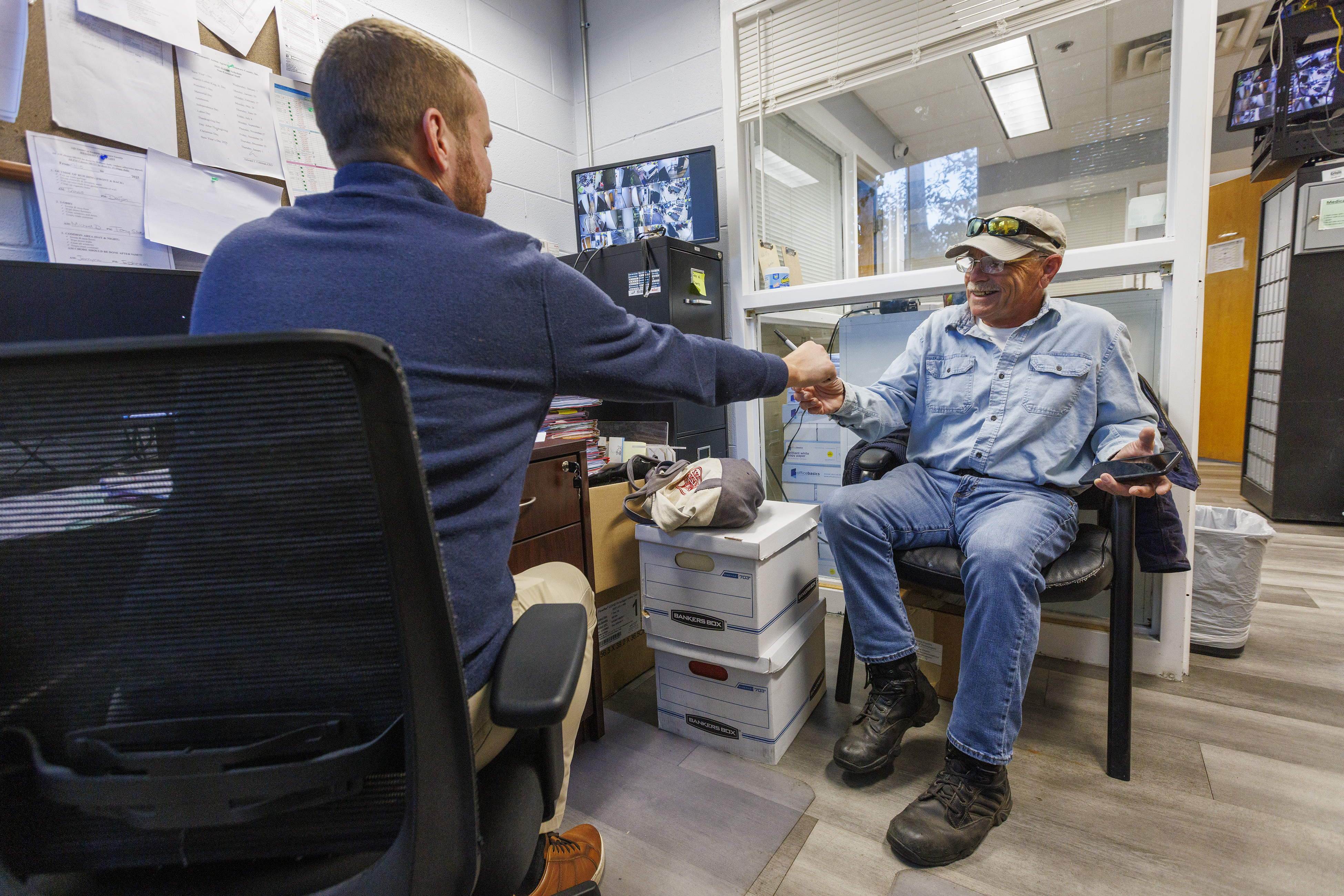
    John Weis, Life Center of Delaware County’s lead case manager (left) assists client Joseph Wallace Friday.

    For Heather Schearer, her several months living at Life Center were a necessary step up in her recovery process. She had been unhoused for about five months earlier this year, and was sleeping in her car until it got too cold. When approached, she agreed to stay at Life Center until she eventually was connected to longer-term provider Mental Health Partnerships for its rapid rehousing and peer support programs, she said.

    “[Politicians] don’t want to get their boots on the ground, take your ties off, and sit and talk,” Schearer said. “It’s the little things that matter that will get you to the next step.”

    According to Community Action, similar scenes are playing out at Family Management Center, which can serve an average of a little more than 30 children at any given time. And while the most significant service reductions in homeless services are not scheduled for another week, the impacts of cuts are already visible across Delaware County.

    Lisitski, of Mental Health Partnerships, which provides street outreach around Delaware County, said staff have already seen “a lot more people” than usual living on the street.

    When shelters close like this, it becomes a “life-and-death situation” for people who are unhoused, she added. If the people who access critical services — usually people who are homeless, have substance use disorder, or have serious mental health conditions — cannot do so, she said, it will result in their being jailed, institutionalized, or, in the worst cases, dead.

    In anticipation of the added need for housing due to the impasse, Mental Health Partnerships is working with Delaware County officials, faith-based entities, and other local groups to prepare emergency shelter space from December through April. It is also taking a line of credit to stay afloat.

    But loans are not a viable option for all service providers.

    Coleman, of Community Action, said even if the nonprofit could be approved for a line of credit, leaders have no way of knowing how much to ask for since they don’t know when a budget will be passed. Then there would be the question of interest.

    “There’s no way [shelters] can afford to pay back interest on a loan, and the interest on a loan cannot be charged to a grant, so it would just be money lost to them,” he said.

    Without a state budget, local government is the nonprofit’s last hope. Upper Darby, where Life Center is located, has awarded Life Center $120,000 in Community Development Block Grant funds, which will become available Jan. 1, according to officials there.

    It’s much-needed money, but only one thing can help Community Action’s two other shelters stay open.

    “We’re hoping that the legislators can do their job and pass a budget so the county doesn’t have to deal with some unfortunate situations,” Coleman said.

  • These parents wish Mikie Sherrill would defend their transgender kids. They understand why she doesn’t.

    These parents wish Mikie Sherrill would defend their transgender kids. They understand why she doesn’t.

    C.B. can’t even comprehend her transgender daughter being required to use the boys’ bathroom at her South Jersey school.

    “If you went into her classroom and someone said, ‘Pick out the trans kid out of these 25 kids,’ you would not be able to,” C.B. said. “You might very well get it wrong.”

    C.B., who asked to be identified by her initials to protect the privacy of her child, said she loves the Garden State. She has a “very Jersey family.”

    But, like other parents of trans children, she’s considering packing her family’s bags depending on the results of the Nov. 4 election, and whether the next governor maintains the state’s LGBTQ+ friendly policies.

    “I can’t think of anyone who’s not at least thinking of a contingency plan. I think we all have our limits of when we’ve got to go,” C.B. said. “We just have to protect our kids.”

    The stakes of the election are stark for C.B. and other parents. Jack Ciattarelli, the Republican nominee for New Jersey governor, opposes state policies implemented under Democratic Gov. Phil Murphy meant to protect transgender children. Ciattarelli says he would require schools to tell parents about their children’s gender identity and stop transgender girls from participating in girls’ sports. He also opposes gender-affirming care for minors and believes parents should be able to opt their kids out of LGBTQ+ related topics in school.

    U.S. Rep. Mikie Sherrill, the Democratic nominee, has largely voted in support of transgender rights throughout her nearly seven-year legislative career. She was endorsed by LGBTQ+ advocacy groups as well as her friend U.S. Rep. Sarah McBride (D., Del.), the first openly transgender member of Congress. But Sherrill has not publicly defended trans rights when criticized by Ciattarelli and has declined to answer reporters’ questions on the matter.

    L.B., another South Jersey parent facing the same dilemma in the lead-up to Election Day, said her 10-year-old transgender daughter isn’t stealing any thunder from other girls on her coed sports team — she is the smallest in her class. And it’s hard for her to imagine anyone seeing her child as a threat to anyone in the bathroom.

    “People move from all over the country to New Jersey because it’s known as a safe haven for LGBTQ rights,” said L.B., who is using her initials to protect her child’s privacy. “And now, if Jack Ciattarelli wins, it could become a state that people have to flee from.”

    Republican nominee for New Jersey governor Jack Ciattarelli speaks at a rally at the Corner House Tavern in Columbus.

    During the 2024 election, President Donald Trump frequently attacked Vice President Kamala Harris for supporting transgender people. Ciattarelli has followed that playbook, framing Sherrill on the campaign trail, in ads, and on the debate stage as being too supportive of transgender identities.

    Sherrill has not just ignored the attacks. She has avoided talking about the issue altogether.

    “I don’t necessarily blame her for that, although more vocal support, outspoken support, would be amazing. It would make a lot of us feel much safer,” C.B. said.

    Other transgender rights advocates interviewed by The Inquirer also said they wish Sherrill would speak up more. But they understand why she doesn’t.

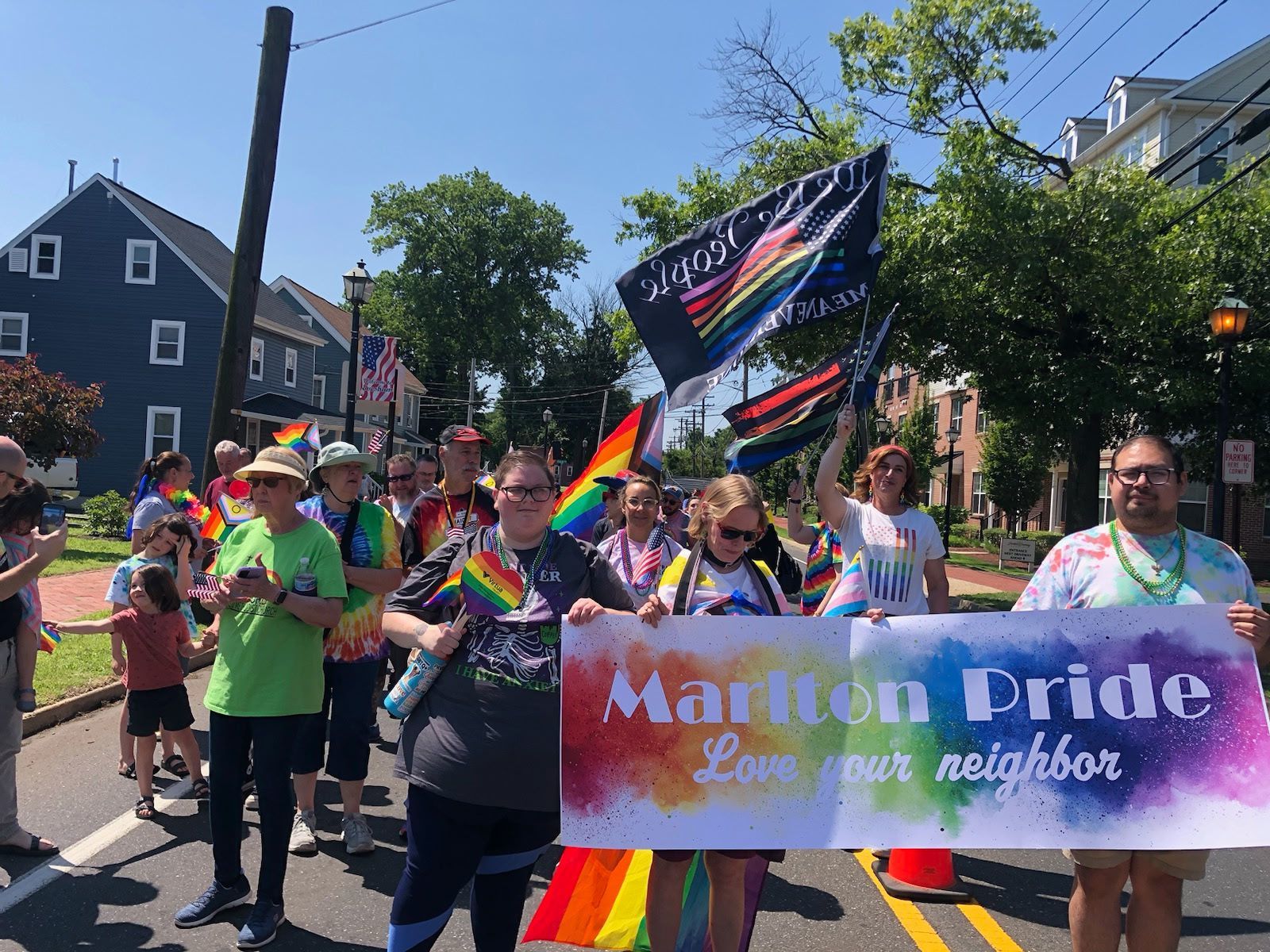
    “Mikie Sherrill is not saying much of anything about the transgender population — which, you know, frankly, is what unfortunately might be her best strategy to be elected,” said Melissa Firstenberg, a transgender woman who founded Marlton Pride. “Unfortunately, for somebody like me, she is the only option.”

    Melissa Firstenberg marching in a July 4 parade with Marlton Pride.

    A page out of Trump’s playbook

    Trump campaigned for president on the promise of stopping transgender athletes from competing in women’s and girls’ sports.

    Ciattarelli has also made the popular GOP talking point a centerpiece of his campaign. In his stump speeches, he attacks Sherrill for voting “to allow biological boys to play in girls’ sports” despite being “a mother of two daughters,” in reference to her vote against the “Protection of Women and Girls in Sports Act‚” which would prohibit transgender girls from participating in girls’ sports and had support from only two House Democrats.

    Ciattarelli has championed a so-called parental rights movement and frequently touts his opposition to New Jersey School Policy 5756, an advisory policy calling for schools to support students’ gender identity and allow transgender students to compete on sports teams and use the restrooms where they feel comfortable. The guidance states that parental consent is not needed to accept a student’s asserted gender identity.

    In the first general election debate last month, Ciattarelli tried to veer the conversation to transgender youth in schools multiple times, and said he was concerned about “the welfare of our children.”

    “I don’t think school districts should be keeping secrets from parents. I don’t think that biological boys should be playing in girls’ sports,” he said.

    “She opposes me on both of those issues,” Ciattarelli added, referring to Sherrill’s 2023 vote against the “Parents Bill of Rights Act” that would require parental notification of children’s gender identity, among other measures. No House Democrats voted for the bill.

    Sherrill did not address her past votes, correct Ciattarelli, or respond to the specifics of his argument, beyond mentioning that “parents know their kids best, and they need to be able to determine if there’s something they want to opt out of.” That stance echoes Ciattarelli’s arguments, though it was unclear what exactly Sherrill was referring to.

    When asked after the debate about participation of transgender athletes, Sherrill deferred to “New Jersey sports groups” and the National Collegiate Athletic Association. She also cited her support for the Kids Online Safety Act, mentioning an uptick in bullying of LGBTQ+ youth.

    Sherrill has garnered endorsements and donations from LGBTQ+ advocacy groups like the Human Rights Campaign and GLAAD for her voting record — though she did take heat for a December 2024 vote for the National Defense Authorization Act, which included a provision that removed transgender healthcare for military dependents. Despite her vote, Sherrill criticized that measure as singling “out a small handful of innocent children to be used as political pawns.”

    But Sherrill declined through a campaign spokesperson to share her stance on the state’s school guidance or protections for gender-affirming care for this story, or to be interviewed about trans rights.

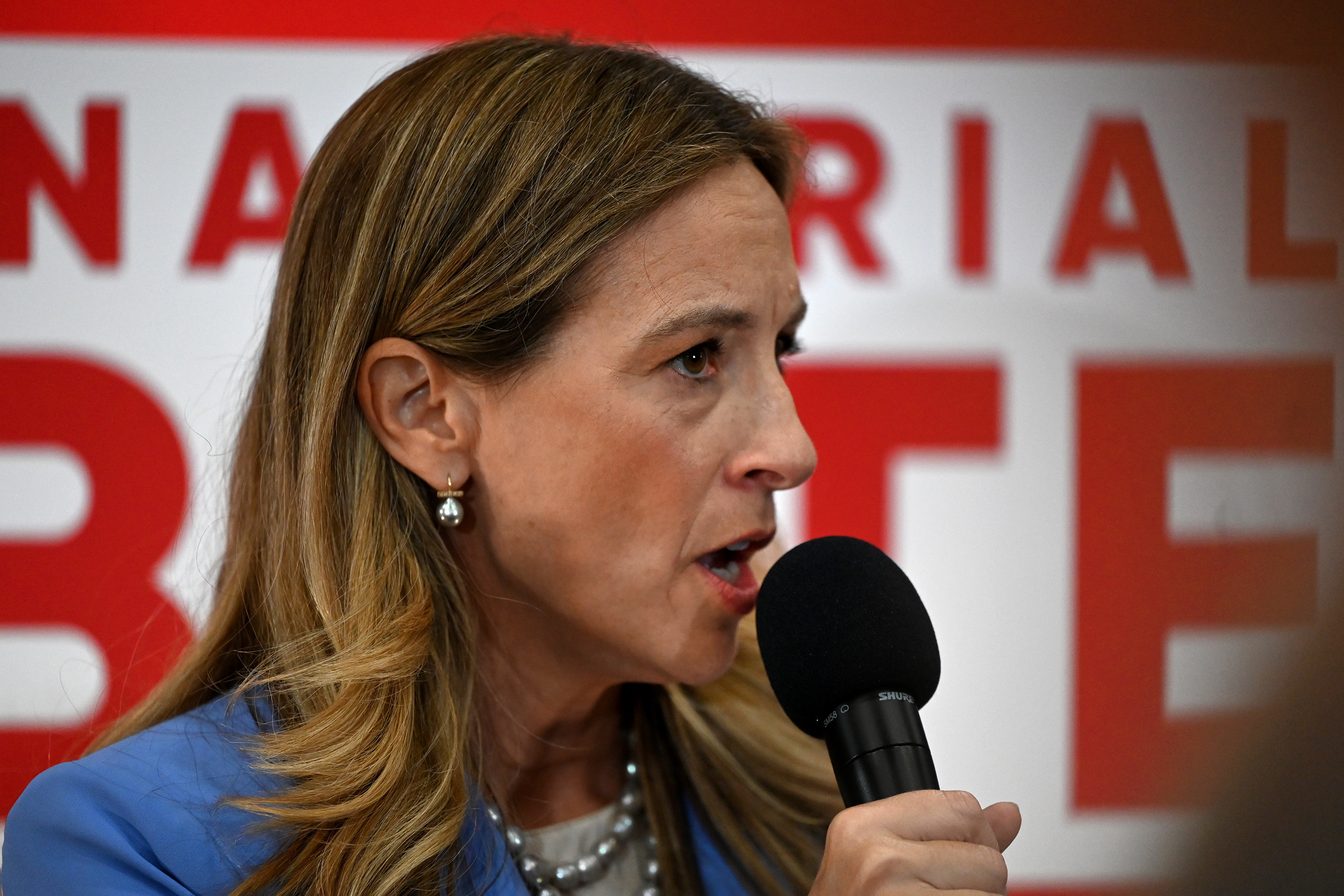
    U.S. Rep. Mikie Sherrill (D., N.J.) speaks during a gubernatorial debate with Republican Jack Ciattarelli Sept. 21, 2025 at Rider University.

    Instead, in a statement, Sherrill said she “will govern in a way that keeps New Jersey kids, my own and others, safe and with parents in the driver’s seat regarding their kids’ education.” The 200-word statement did not mention “trans,” “gender,” or “LGBTQ.”

    She also said that “schools are a place to learn, not to advance political agendas,” and that she would ensure they teach “the full history of our nation” and continue to give parents the choice to opt out of “certain sex-education conversations.”

    Meanwhile, Chris Russell, a Ciattarelli campaign spokesperson, said in a text message that Ciattarelli “opposes so-called gender-affirming care for minors” when asked about Murphy’s executive order that makes the state a “safe haven” for gender-affirming healthcare.

    “As Governor Jack will review all of Governor Murphy’s EO’s and related policies to ensure that they are consistent with his positions regarding parental notification for minors, protecting women’s & girl’s sports & offering an age appropriate curriculum,” he added.

    Sherrill is not the only Democrat across the country who has trod lightly on trans rights since Republicans upped the attacks last year, but Diane Rugala, a Collingswood-based parent whose transgender son is a Rutgers University graduate student, thinks Sherrill should “just own it” when it comes to defending transgender kids.

    “You have to play the game, I get it,” said Rugala, who is also an activist with PFLAG, an LGBTQ+ advocacy group.

    “But I also think that a really authentic statement would be good,” she added. “I don’t think people are asking for her to become this big advocate for the trans community … just a simple statement.”

    Attack ads mirroring the presidential election

    Ciattarelli’s campaign recently started running an ad that highlights Sherrill saying that she “would push an LGBTQ education into our schools,” and that “parents have a right to opt out of a lot of things” but “this is not an area where they should be opting out.”

    The clip was from a Democratic primary debate earlier this year when she was responding to the question of whether parents should be able to opt their students out of “LGBTQ-related content” in the same way they can be taken out of sex-ed and health classes.

    The ad calls it her “education plan” and tells viewers that it’s “your choice, not hers.”

    She explained in that debate that students should understand “the background of people throughout our nation” and condemned the “erasure of history.” As of 2020, New Jersey schools are required to teach about societal contributions from LGBTQ+ people, along with other groups, in middle and high school social studies.

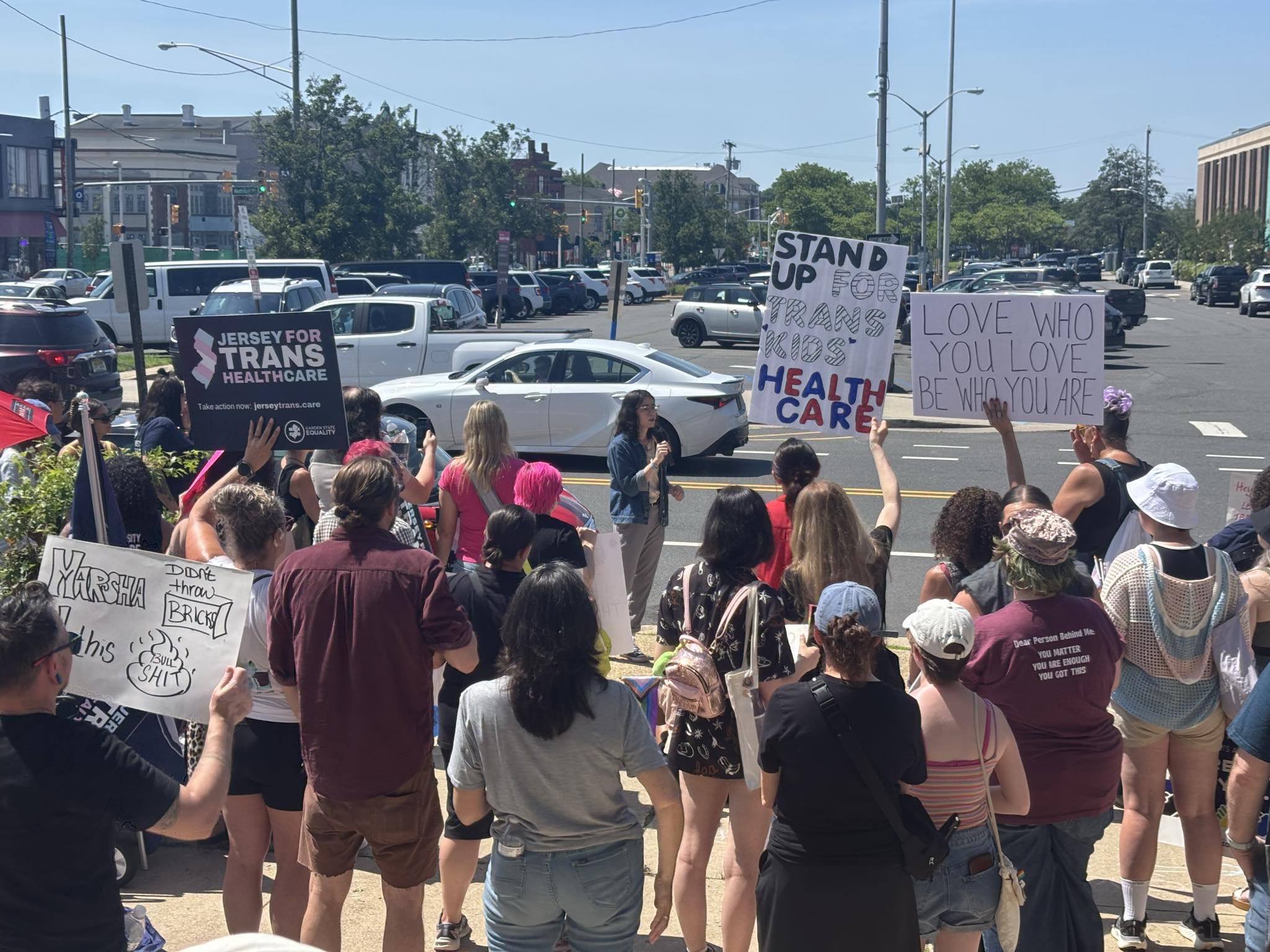
    Jo Miller speaks at a rally for trans youth organized by Garden State Equality in Asbury Park in June.

    Another ad echoes the attack that was lodged against Vice President Kamala Harris’ presidential campaign.

    The American Principles Project (APP), a Virginia-based conservative group that identifies itself as “pro-family,” paid for an ad that vilifies trans people and accuses Sherrill of wanting to “protect they/them instead of your children,” referencing nonbinary pronouns. The group’s New Jersey PAC reported $126,000 in expenditures in the race as of Oct. 3, with $429,000 more cash on hand.

    Trump’s campaign aired ads last year arguing that Harris is for “they/them,” while Trump is for “you.”

    Jo Miller, 29, a transgender woman who serves on the Woodbury City Council, said she “would like to see a more forceful response” from Sherrill because not addressing the attacks can leave more people thinking that Republicans’ “demonization” of trans people — a small segment of the population — is true.

    “I would love to see Mikie Sherrill take some stronger stances, and I think we will see that eventually as governor, but I think the truth is, it’s not her main focus,” Miller said. “And it’s kind of strange that it’s Jack Ciattarelli’s main focus, and it’s Donald Trump’s main focus.”

  • Shapiro stumps for N.J. gubernatorial candidate Mikie Sherrill

    Shapiro stumps for N.J. gubernatorial candidate Mikie Sherrill

    On the first day of early in-person voting in New Jersey, and with U.S. Rep. Mikie Sherrill, the Democratic gubernatorial candidate, showing a slim polling edge over her Republican opponent, Democrats called in the popular governor from neighboring Pennsylvania to drum up some enthusiasm among Garden State voters.

    Gov. Josh Shapiro stumped for Sherrill at a senior center auditorium and an African Methodist Episcopal church, targeting two groups seen as necessary for Sherrill to beat Republican Jack Ciattarelli.

    “Thank you for getting off the sidelines,” Shapiro said to the crowd at the senior center, several of whom said they either voted by mail already or were on their way to the polls. “Thank you for doing your part. Thank you for being in this game. I am grateful.”

    Outside the Monroe Township senior center, Shapiro was a big draw among the crowd that lined up early Saturday to get through security.

    “He’s very well liked,” said Connie Hamlin, 71, of Monroe Township, who sipped coffee to stay warm “Number one, he’s handsome. He’s young. That’s very important.”

    Equally important, she said, is that Shapiro is “for democracy” and “a decent person,” two traits she said President Donald Trump lacks.

    Shapiro got standing ovations and roaring applause, but Sherrill was the main event. The Navy veteran and former federal prosecutor finds herself in a tight race with Ciattarelli, a business owner and former state lawmaker. A recent Rutgers-Eagleton poll found Sherrill with a five-percentage-point lead.

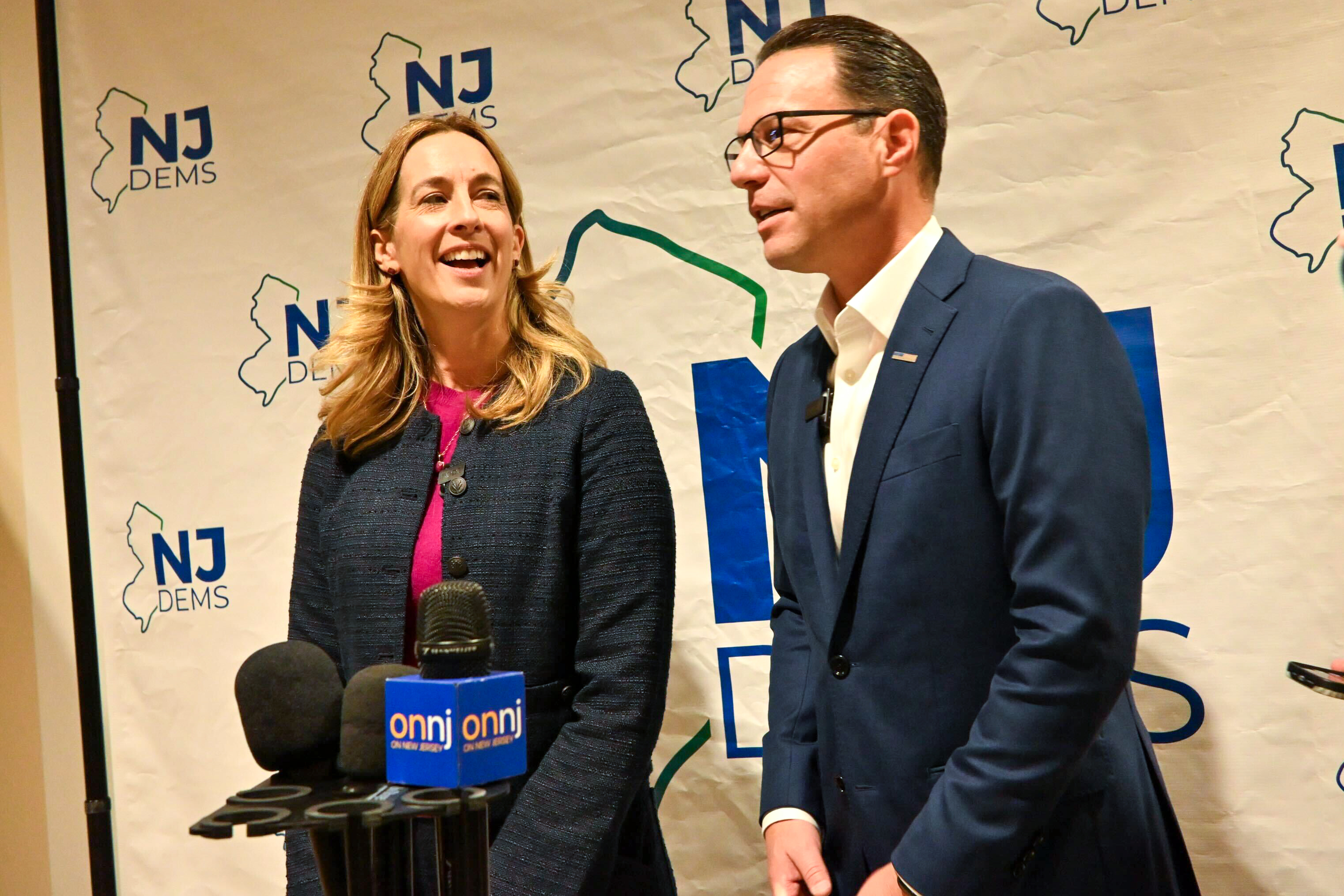
    Gov. Josh Shapiro on the campaign trail for NJ gubernatorial candidate Mikie Sherrill (left) Saturday, Oct. 25, 2025.

    At the two campaign stops, Sherrill ripped into Trump, saying that while the prices of consumer goods like coffee have skyrocketed, “Trump and his family are making billions.”

    Sherrill said her opponent would rubber-stamp Trump administration policies that are unpopular with many in New Jersey — such as his cancellation of $16 billion in funding to build two new rail tunnels under the Hudson River.

    “It’s about opportunity and affordability,” Sherrill said. “We’re fighting for our kids, to make sure they have a better future.”

    Ciattarelli hit the campaign trail as well Saturday, stopping in Passaic, Bergen, and Morris Counties with a message of “a stronger, safer, and more affordable New Jersey,” according to Facebook posts.

    Friday evening, Trump held a tele-rally for Ciattarelli, in which he said Sherrill would “be a travesty as the governor of New Jersey” and urged Republicans to take part in early voting.

    “You got to make sure the votes are counted, because New Jersey has a little bit of a rough reputation, I must be honest,” Trump said.

    There is no evidence of mass voter fraud in New Jersey or anywhere else in recent elections, but Trump still claims the 2020 election was rigged against him and has appointed a notorious Pennsylvania election denier to a federal position monitoring elections. On Friday, the Department of Justice said it will send federal observers to monitor elections in New Jersey and California.

    At a news conference Saturday, Sherrill said she is proud that New Jersey’s elections have been “open, transparent, and free.”

    “And we’re going to continue to do that, and ensure we don’t have any voter intimidation,” Sherrill said.

    At the senior center, Hamlin said she supports Sherrill’s plan to lower energy costs, likes that she’s a woman, and feels it’s important that the next governor is a Democrat. “She’s soft-spoken, but she has meaningful things to say,” Hamlin said.

    Shapiro spoke about how he was raised and how his faith teaches him that “no one is required to complete the task, but neither are we free to refrain from it.”

    The message wasn’t lost on Steve Riback, who said Trump has given antisemites and other extremists “license to come out of the woodwork.” Riback, who is Jewish, said that Shapiro would be his top choice for president in 2028, above Illinois Gov. JB Pritzker.

    Shapiro urged voters frustrated with Trump to send a message to the rest of the country “that here in Jersey, we value our freedom, we cherish our democracy, and we love our country.”

    And Shapiro held up Sherrill as someone who would get things done in New Jersey. Sherrill has cited Pennsylvania as an example of a state with more efficient business licensure rules and better-managed energy costs.

    Shapiro, who has not officially announced his reelection campaign, has long been floated as a presidential hopeful by Democratic insiders and national pundits. Shapiro’s soon-to-be-released memoir will likely add to speculation about his 2026 intentions.

    After the senior center visit, Shapiro and Sherrill hit the turnpike up to New Brunswick, where a packed Mount Zion A.M.E. Church — congregants had come in on buses from around the state — was waiting for him.

    Shapiro said it was up to Democrats to keep, and build upon, what the founders created. “We are those people, and this is a moment where we have to do this work. We’ve got to stand up for our rights,” he said. “We’ve got to keep perfecting our union.”

    Pheobie Thomas, an A.M.E. member who traveled from Trenton for church, said Shapiro and Sherrill offered promising signs that they support “equitable access for all people, including Black people.”

    Thomas, 48, said there is a long history of Democratic politicians courting Black churches for votes, and for good reason.

    “The Black church is extremely important,” Thomas said. “We do go to the polls. We do show up.”

    As for Shapiro, she said he was speaking to New Jersey — but at the same time, he hinted that he was speaking to a broader audience.

    “You just know that there’s that potential of, you know, ‘I may come back again to ask for your vote.’”

    Staff writer Robert Moran contributed to this article.

  • $1M in taxpayer money will be used to make security upgrades at Gov. Josh Shapiro’s private residence

    $1M in taxpayer money will be used to make security upgrades at Gov. Josh Shapiro’s private residence

    Spotlight PA is an independent, nonpartisan, and nonprofit newsroom producing investigative and public-service journalism that holds power to account and drives positive change in Pennsylvania. Sign up for our free newsletters.

    HARRISBURG — Taxpayers are paying for roughly $1 million in security upgrades to Gov. Josh Shapiro’s private home in Montgomery County, according to information the administration disclosed to top lawmakers about its expenditures in the aftermath of the brazen arson attack on the first family earlier this year.

    In a Friday letter to legislative leaders, administration officials said improvements include “erecting physical and visual barriers on the property, installing enhanced security technology, and other steps.” They then noted that due to safety concerns, they could not provide more details about the work being conducted at Shapiro’s private home.

    The letter, authored by Pennsylvania State Police Commissioner Christopher Paris and Department of General Services Secretary Reggie McNeill, also disclosed safety upgrades totaling $32.3 million at the governor’s official residence in Harrisburg, including $8 million to retrofit the mansion with new windows that are bullet- and shatterproof.

    The attack occurred at the 29,000-square-foot mansion this past April while the governor and his family were asleep inside.

    “The horrifying attack on the Governor, his family, and Commonwealth property, coupled with the unfortunate rise in political violence across our country, has made these updates necessary to protect the Governor and his family and ensure the continued operation of the executive branch of the Commonwealth,” Paris and McNeill wrote. “No family should have to live behind bulletproof glass or behind large walls — but the nature of the threats against elected officials today require us to take these important steps.”

    They added: “Unfortunately, the threat to a high-profile elected official like Gov. Shapiro does not end when he leaves the Governor’s Residence.”

    In a statement, Shapiro spokesperson Rosie Lapowsky said the State Police conducted a security review of the governor’s personal residence and recommended a number of improvements. Before carrying out any of those improvements, she said the administration “consulted the Ethics Commission … to ensure there is no improper private, pecuniary gain from these security improvements.”

    Last week, Harrisburg resident Cody Balmer pleaded guilty to attempted murder, aggravated arson, and other charges related to the attack in the dead of the night on April 13. That is when Balmer scaled the perimeter fence at the governor’s official residence along the banks of the Susquehanna River, broke two windows, and used crude, homemade Molotov cocktails to set fire to several rooms on the residence’s first floor.

    Shapiro, his family, and friends had celebrated Passover just hours before, and were asleep on the second floor of the residence when Balmer broke in. Balmer told authorities that he would have beaten Shapiro with a hammer he had with him if he had encountered the governor.

    The Democratic governor has said that he and his family are still struggling with the emotional toll of the attack, but stressed that he will not be deterred from continuing in public service.

    It is not clear what prompted Paris and McNeill’s letter. Earlier this week, Spotlight PA submitted a public records request for all taxpayer-funded expenditures at the governor’s private home.

    Also midweek, Republican state Sen. Jarett Coleman, who chairs the chamber’s Intergovernmental Operations Committee, fired off a letter to Paris seeking similar information about physical improvements to Shapiro’s Montgomery County home, among other items.

    Coleman told Spotlight PA on Friday that his committee will “continue to investigate” spending at the governor’s private residence “to protect taxpayers as this unprecedented project is being completed.”

    Spotlight PA last month reported that the state has spent more than $6 million to repair extensive damage from the fire at the governor’s official residence — but that the administration is shielding information about nearly a quarter of those expenses, including who was paid and exactly what the money was spent on.

    The news organization has also reported that private donors have separately contributed to a fund managed by a Harrisburg-based nonprofit to help restore the mansion. So far, neither the organization nor the administration has disclosed the donors’ identities, the amount they contributed to the fund, or provided a general description of what that money has or will be used for.

    In the letter sent to legislative leaders, the administration shed light on at least some of those questions. The officials said that to date, the state has submitted $4.5 million in expenses to one of its insurers, which in turn has so far approved $2 million in reimbursements.

    Security upgrades and improvements to the official residence, however, are not covered by the state’s insurance plans. The security improvements — recommended by a third-party review commissioned by the State Police in the wake of the attack — there include:

    • An estimated $14 million to replace the 6-foot fence that Balmer scaled with a “single material, 10-foot barrier resistant to vehicle damage or climbing.”
    • An estimated $6.3 million to install updated cameras, improve lighting, and add motion detection sensors in the residence’s yard.
    • An estimated $8 million to retrofit the residence’s existing windows with bulletproof and shatterproof glass.
    • An estimated $4 million to install a comprehensive fire suppression system in the residence, one of the largest state-owned buildings without one.

    “In addition to the visible and extensive building security enhancements outlined above, additional recommendations on things like staffing, internal systems, and other technology improvements have been implemented,” by the state, Paris and McNeill wrote. “To avoid risk of a successful security threat against the property or the Governor in the future, we cannot disclose all of those recommendations publicly.”

    The two men noted that the fire damaged multiple decorative items inside the residence, including chandeliers, china, pianos, and artwork. Most of those items, they said, do not qualify for insurance reimbursement, and their repair or replacement will be funded by private dollars.

    BEFORE YOU GO… If you learned something from this article, pay it forward and contribute to Spotlight PA at spotlightpa.org/donate. Spotlight PA is funded by foundations and readers like you who are committed to accountability journalism that gets results.

  • DOJ prepares to send election monitors to California, New Jersey following requests from state GOPs

    DOJ prepares to send election monitors to California, New Jersey following requests from state GOPs

    LOS ANGELES — The Department of Justice is preparing to send federal election observers to California and New Jersey next month, targeting two Democratic states holding off-year elections following requests from state Republican parties.

    The DOJ announced Friday that it is planning to monitor polling sites in Passaic County, New Jersey, and five counties in southern and central California: Los Angeles, Orange, Kern, Riverside, and Fresno. The goal, according to the DOJ, is “to ensure transparency, ballot security, and compliance with federal law.”

    “Transparency at the polls translates into faith in the electoral process, and this Department of Justice is committed to upholding the highest standards of election integrity,” Attorney General Pam Bondi said in a statement to the Associated Press.

    Election monitoring is a routine function of the Justice Department, but the focus on California and New Jersey comes as both states are set to hold closely watched elections with national consequences on Nov. 4. New Jersey has an open seat for governor that has attracted major spending by both parties and California is holding a special election aimed at redrawing the state’s congressional map to counter Republican gerrymandering efforts elsewhere ahead of the 2026 midterms.

    The DOJ’s efforts are also the latest salvo in the GOP’s preoccupation with election integrity after President Donald Trump spent years refusing to accept the results of the 2020 election and falsely railing against mail-in voting as rife with fraud. Democrats fear the new administration will attempt to gain an upper hand in next year’s midterms with similarly unfounded allegations of fraud.

    The announcement comes days after the Republican parties in both states wrote letters to the DOJ requesting their assistance. Some leading Democrats in the states blasted the decision.

    New Jersey Attorney General Matt Platkin called the move “highly inappropriate” and said the DOJ “has not even attempted to identify a legitimate basis for its actions.”

    Rusty Hicks, chair of the California Democratic Party, said in a statement that “No amount of election interference by the California Republican Party is going to silence the voices of California voters.”

    California’s House districts at stake

    The letter from the California GOP, sent Monday and obtained by the AP, asked Harmeet Dhillon, who leads the DOJ’s Civil Rights Division, to provide monitors to observe the election in the five counties.

    “In recent elections, we have received reports of irregularities in these counties that we fear will undermine either the willingness of voters to participate in the election or their confidence in the announced results of the election,” wrote GOP chairwoman Corrin Rankin.

    The state is set to vote Nov. 4 on a redistricting proposition that would dramatically redraw California’s congressional lines to add as many as five additional Democratic seats to its U.S. House delegation.

    Each of the counties named, they alleged, has experienced recent voting issues, such as sending incorrect or duplicate ballots to voters. They also take issue with how Los Angeles and Orange counties maintain their voter rolls.

    California is one of at least eight states the Justice Department has sued as part of a wide-ranging request for detailed voter roll information involving at least half the states. The department has not said why it wants the data.

    Brandon Richards, a spokesman for Gov. Gavin Newsom, said the DOJ has no standing to “interfere” with California’s election because the ballot contains only a state-specific initiative and has no federal races.

    “Deploying these federal forces appears to be an intimidation tactic meant for one thing: suppress the vote,” he said in an email.

    Orange County Registrar of Voters Bob Page said he welcomes anyone who wants to watch the county’s election operations and said it’s common to have local, state, federal and even international observers. He described Orange County’s elections as “accessible, accurate, fair, secure, and transparent.”

    Los Angeles County Clerk Dean Logan said election observers are standard practice across the country and that the county, with 5.8 million registered voters, is continuously updating and verifying its voter records.

    “Voters can have confidence their ballot is handled securely and counted accurately,” he said.

    Most Californians vote using mail ballots returned through the Postal Service, drop boxes or at local voting centers, which typically leaves polling places relatively quiet on Election Day. But in pursuit of accuracy and counting every vote, the nation’s most populous state has gained a reputation for tallies that can drag on for weeks — and sometimes longer.

    In 2024, it took until early December to declare Democrat Adam Gray the winner in his Central Valley district, the final congressional race to be decided in the nation last year.

    Passaic County the target in New Jersey

    California’s request echoed a similar letter sent by New Jersey Republicans asking the DOJ to dispatch election monitors to “oversee the receipt and processing of vote-by-mail ballots” and “monitor access to the Board of Elections around the clock” in suburban Passaic County ahead of the state’s governor’s race.

    The New Jersey Republican State Committee told Dhillon that federal intervention was necessary to ensure an accurate vote count in the heavily Latino county that was once a Democratic stronghold, but shifted to President Donald Trump’s column in last year’s presidential race.

    The county could be critical to GOP gubernatorial nominee Jack Ciattarelli’s hopes against Democrat Mikie Sherrill. But the letter cited previous voter fraud cases in the county and alleged a “long and sordid history” of vote-by-mail shenanigans.

    In 2020, a judge ordered a new election for a city council seat in Paterson — the largest city in Passaic County — after the apparent winner and others were charged with voter fraud.

    Platkin said the state is committed to ensuring its elections are fair and secure. With the DOJ’s announcement, he said the attorney general’s office is “considering all of our options to prevent any effort to intimidate voters or interfere with our elections.”

    Election observers are nothing new

    Local election offices and polling places around the country already have observers from both political parties to ensure rules are followed. The DOJ also has a long history of sending observers to jurisdictions that have histories of voting rights violations to ensure compliance with federal civil rights laws.

    Last year, when the Biden administration was still in power, some Republican-led states said they would not allow federal monitors to access voting locations on Election Day.

    Trump has for years railed against mail voting as part of his repeated false claims that former President Joe Biden’s victory in 2020 was rigged. He alleges it is riddled with fraud, even though numerous studies have found no evidence of widespread fraud in U.S. elections.

    Earlier this year, Trump pledged to ban vote-by-mail across the country, something he has no power to do under the U.S. Constitution.

    The DOJ’s effort will be overseen by Dhillon’s Civil Rights Division, which will deploy personnel in coordination with U.S. attorney’s offices and work closely with state and local officials, the department said

    The department also is soliciting further requests for monitoring in other jurisdictions.

    David Becker, a former DOJ attorney who has served as an election monitor and trained them, said the work is typically done by department lawyers who are prohibited from interfering at polling places.

    But Becker, now executive director of the Center for Election Integrity & Research, said local jurisdictions normally agree to the monitors’ presence.

    If the administration tried to send monitors without a clear legal rationale to a place where local officials didn’t want them, “That could result in chaos,” he said.

  • Pentagon accepts $130 million donation to help pay the military during the government shutdown

    Pentagon accepts $130 million donation to help pay the military during the government shutdown

    WASHINGTON — The Pentagon confirmed Friday that it has accepted an anonymous $130 million gift to help pay members of the military during the government shutdown, raising ethical questions after President Donald Trump had announced that a friend had offered the gift to defray any shortfalls.

    While large and unusual, the gift amounts to a small contribution toward the billions needed to cover service member paychecks. The Trump administration told Congress last week that it used $6.5 billion to make payroll. The next payday is coming within the week, and it is unclear if the administration will again move money around to ensure the military does not go without compensation.

    “That’s what I call a patriot,” Trump said during a White House event Thursday when he disclosed the payment from the donor.

    The president declined to name the person, whom he called “a friend of mine,” saying the man didn’t want the recognition.

    The Pentagon confirmed it had accepted the donation on Thursday “under its general gift acceptance authority.”

    “The donation was made on the condition that it be used to offset the cost of Service members’ salaries and benefits,” said Sean Parnell, chief spokesman for the Pentagon. “We are grateful for this donor’s assistance after Democrats opted to withhold pay from troops.”

    Congress is at a stalemate over the government shutdown, now on track to become one of the longest federal closures ever, in its 24th day. Neither Republicans, who have control of the House and Senate, nor Democrats, in the minority, are willing to budge in their broader standoff over health care funding.

    Payment for service members is a key concern among lawmakers of both parties as well as a point of political leverage. The Trump administration shifted $8 billion from military research and development funds to make payroll last week, ensuring that military compensation did not lapse.

    But it is unclear if the Trump administration will be willing — or able — to shift money again next week as tensions rise over the protracted shutdown.

    While the $130 million is a hefty sum, it would cover just a fraction of the billions needed for military paychecks. Trump said the donation was to cover any “shortfall.”

    What’s unclear, however, is the regulations around such a donation.

    “That’s crazy,” said Max Stier, president and CEO of the Partnership for Public Service, a nonpartisan organization focused on the federal government.

    “It’s treating the payment of our uniformed services as if someone’s picking up your bar tab.”

    He questioned the legality of the donation and called for more transparency around it.

    Pentagon policy says authorities “must consult with their appropriate Ethics Official before accepting such a gift valued in excess of $10,000 to determine whether the donor is involved in any claims, procurement actions, litigation, or other particular matters involving the Department that must be considered prior to gift acceptance.”

  • Penn releases letter rejecting Trump compact

    Penn releases letter rejecting Trump compact

    The University of Pennsylvania on Friday afternoon released the letter that President J. Larry Jameson sent to the U.S. Department of Education last week, explaining why the school rejected the compact proposed by President Donald Trump’s administration.

    Several other schools, including the Massachusetts Institute of Technology, Dartmouth College, and Brown University, already have released their letters rejecting the compact.

    “Our university policies and practices are already aligned with many of the core principles of the Compact…” Jameson wrote. But “we find that significant portions of the Compact and its overarching framing would undermine Penn’s ability to advance our mission and the nation’s interests.”

    The “Compact for Academic Excellence in Higher Education” was the latest attempt by the Trump administration to force changes in the way universities operate as the president tries to reshape higher education to match his vision. It offered colleges that sign preferential consideration for federal funding. It’s still not clear what penalty, if any, Penn — which receives about $1 billion annually in federal funding — will face for not signing.

    “Institutions of higher education are free to develop models and values other than [those in the compact], if the institution elects to forego federal benefits,” the compact states.

    Penn last week declined to release its letter, but Jameson in a message to the campus community Friday afternoon said “in the spirit of transparency” he would share it. He said he’d received many requests for its release.

    The university has not had further discussions with the government since rejecting the compact, Jameson said, noting “we believe there remains opportunity to advance the long-standing relationship between American higher education and the federal government which has greatly benefited our community, nation and world.”

    But he also was clear that Penn’s greatest partnership is with the public.

    “America’s great universities already have a compact with the American people,” he said. “It is built on the open exchange of ideas, merit-based selection and achievement, and freedom of inquiry to yield knowledge. It affirms that knowledge should serve the public good, that education should remain a ladder of opportunity, and that discovery should make life better, richer, and freer.”

    Jameson highlighted seven areas where he said Penn and the compact appear to be in alignment and five areas that pose concerns.

    Areas of agreement include hiring and promotion standards and “merit based admissions” that comply with the law, including the 2023 U.S. Supreme Court decision that banned the use of race-based admission, Jameson said. The university also has reinstituted a standardized test score requirement for admission; Penn like many others had paused the requirement during the pandemic. And, its undergraduate student body is 13% international, Jameson said. That’s under the 15% mark that the compact would require.

    Penn also is in compliance with federal foreign gift regulations and has “viewpoint-neutral rules” governing protests and expression, he said.

    The university last year adopted an “institutional neutrality” policy, which states that the school will no longer make statements about world events unless they have a direct effect on Penn’s operations; the compact calls for schools to adhere to institutional neutrality.

    While the university hasn’t agreed to freezing tuition for five years as the compact asks, the school has taken steps to make education more affordable, Jameson said, noting that its aid is all grants and no loans and is need based. Nearly half its students receive aid, he said.

    And, Jameson said, Penn officials “share concerns about grade inflation and believe there may be an opportunity to engage the higher education community to seek a broader solution.”

    But Penn objects to federal funding being meted out based on signing a compact, Jameson said.

    “Research and our nation are better served by competition that rewards promise and performance,” he said. “Penn seeks no special consideration beyond fair and merit-based funding.”

    The compact fails to promise or even mention academic freedom, which is “the bedrock of our national system of higher education,” Jameson said. It seeks to protect conservative thought alone, he said.

    “One-sided conditions conflict with the viewpoint diversity and freedom of expression that are central to how universities contribute to democracy and to society,” Jameson wrote.

    He also objected to the compact mandating free tuition to students in the “hard sciences.”

    “We celebrate the sciences,” Jameson wrote. “However, we focus our financial aid efforts on those who cannot afford to pay, ensuring that a Penn education is accessible to those who are offered admission.”

    Jameson also called out the compact’s financial penalties for failing to comply “based on subjective standards and undefined processes.” That could endanger teaching and research, he said.

    “Universities must be accountable for their actions,” he wrote. “We believe that existing laws and policies suffice to achieve compliance and accountability.”

    Many groups on campus had spoken out against the compact and were watching closely, given that the university had struck an agreement with the Education Department in July over the participation of a transgender athlete on the women’s swim team.

    Penn’s announcement that it would reject the compact brought praise from local and state officials, including Democratic Gov. Josh Shapiro.