Category: Politics

Political news and coverage

  • Demise of U.S.-Russia nuclear pact sparks fears of new arms race

    Demise of U.S.-Russia nuclear pact sparks fears of new arms race

    The last major arms-control agreement between the U.S. and Russia expired Thursday, increasing the risk of a new arms race between the world’s two largest nuclear powers amid growing global instability.

    The 2011 Strategic Arms Reduction Treaty, or New START, limited the size of the Russian and U.S. nuclear arsenals and allowed for inspections and exchanges of information. Its demise leaves Moscow and Washington without a framework to regulate their strategic stockpiles for the first time since the depths of the Cold War in the 1980s.

    The end of the accord “definitely doesn’t make the world safer,” said Pavel Podvig, a senior researcher at the United Nations Institute for Disarmament Research in Geneva. “The real loss will be a loss of transparency and it will increase political risks.”

    START is expiring as relations between Russia and Europe have spiraled to their worst in decades over the war in Ukraine and with uncertainty among U.S. allies about its longterm commitment to the NATO military alliance. China is bolstering its strategic forces and other nations are eyeing the need for nuclear weapons to safeguard themselves as major powers increasingly jostle for dominance in their regions.

    The treaty had been due to expire in 2021 before the two sides agreed to a five-year extension, though Russian President Vladimir Putin suspended formal participation in 2023, halting inspections and information exchanges as confrontation with the U.S. surged over his full-scale invasion of Ukraine. Still, he pledged to uphold the pact, which restricts each side to 1,550 deployed strategic warheads.

    “The immediate danger is that, in the absence of legal constraints and verification measures, both countries will revert to worst-case planning and begin uploading hundreds more warheads to their deployed forces out of fear that the other is doing so,” said Mackenzie Knight-Boyle, a senior research associate for the Nuclear Information Project at the Federation of American Scientists. “The United States and Russia have significant upload capacity that would allow them to drastically increase their numbers of deployed nuclear warheads in a short amount of time.”

    In September, Putin said he’d be ready to adhere to the terms of the treaty for another year after it expired if the U.S. did the same. President Donald Trump didn’t formally respond to that idea.

    Trump will decide the path forward on nuclear arms control and will clarify it in his own timeline, a White House official said. The president has spoken repeatedly of addressing the threat from nuclear weapons and indicated that he wants to involve China in arms control talks, the official added.

    “China’s nuclear strength is by no means at the same level with that of the U.S.,” Lin Jian, a Chinese Foreign Ministry spokesperson, told reporters at a Feb. 3 briefing. “It is neither fair nor reasonable to ask China to join the nuclear disarmament negotiations at this stage.”

    China hopes the U.S. will respond to Russia’s “constructive” proposal for extending START’s terms and “truly uphold global strategic stability,” the spokesman added.

    Russia now assumes the two sides “are no longer bound by any obligations or symmetrical declarations within the context of the treaty” and are “free to choose their next steps,” the Foreign Ministry in Moscow said in a statement late Wednesday. Still, Moscow “remains open to the search for political and diplomatic ways to comprehensively stabilize the strategic situation,” it said.

    Some Republican lawmakers privately urged Trump not to entertain Putin’s proposal, according to a person familiar with the matter, in light of the risk it would end up constraining the U.S.’s ability to maneuver without doing much to limit Moscow’s actions.

    In particular, the treaty only regulated strategic weapons and didn’t place limits on tactical nuclear weapons for either side. Former CIA Director Bill Burns has said there was a genuine risk of Russia resorting to those shorter-range and lower-yield weapons in Ukraine in the fall of 2022.

    At a Senate hearing on Tuesday, retired admiral Charles A. Richard, a former commander of United States Strategic Command, told lawmakers that “simply extending the New Start Treaty for one year does not constrain Russia to the same way that it constrains us,” and that doing so would prevent the U.S. from meeting the challenge posed by China’s own rapid buildup.

    Rose Gottemoeller, a former undersecretary of State for arms control in the Obama administration who was the chief U.S. negotiator of the New START treaty, advocated for an extension, saying it would be better to “keep them limited at least for another year while we continue to plan and prepare for the Chinese threat.”

    China has been growing its nuclear forces to catch up with Russia and the U.S.. In its 2025 annual report to Congress on military developments in China, the Pentagon said Beijing had “continued its massive nuclear expansion” as part of its goal of achieving “strategic counterbalance” against the U.S. by 2027.

    The People’s Liberation Army is on track to have more than 1,000 warheads by 2030 from a stockpile in the low 200s at the start of this decade, according to the Pentagon report. While Beijing adheres to a no-first-use policy on nuclear weapons, China “has not demonstrated a willingness to advance discussions on nuclear risk reduction measures, bilaterally or multilaterally,” it said.

    Russia may indicate “a willingness to refrain from buildups until the United States increases its strategic arsenal,” said Dmitry Stefanovich, a research fellow at the Center for International Security at the Institute of World Economy and International Relations in Moscow. Still, the absence of binding agreements between the nuclear powers creates “the foundation for an increase in strategic offensive weapons in the medium term,” he said.

    An unconstrained nuclear era that led to increases in Russian and U.S. weapons would likely prompt other states from the UK and France to North Korea and Pakistan to seek to increase their strategic arsenals, according to Knight-Boyle of the Federation of American Scientists.

    Putin boasts that Russia has developed a new range of strategic weapons in recent years that are capable of evading existing defenses. They include the nuclear-powered Burevestnik cruise missile and Poseidon torpedo drone, as well as the Kinzhal hypersonic ballistic missile that’s claimed to be capable of traveling at up to 10 times the speed of sound.

    Russia has also used the Oreshnik intermediate-range ballistic missile in strikes on Ukraine, a weapon that’s capable of carrying atomic warheads and has a range of 3,100 miles, putting most of Europe and the U.S. West Coast in striking distance.

    After Moscow conducted trials of the nuclear-capable Poseidon and Burevestnik, Trump threatened to resume atomic tests “on an equal basis” to other powers. That prompted Putin to order his officials to seek more information about Washington’s intentions and to set out proposals for “the possible commencement of work on nuclear weapons testing.”

    The last U.S. nuclear explosive test was in 1992, though it continues to test delivery systems. Russia’s last known nuclear detonation was in 1990, while China’s was in 1996.

    Russian officials say negotiations on a potential new agreement would also have to cover the issues of North Atlantic Treaty Organization expansion, the U.S. global missile-defense system and medium- and short-range missile deployments.

    A deal to settle the war in Ukraine “could open up a broader dialog with the Russians on strategic stability,” said Ankit Panda, Stanton Senior Fellow in the Nuclear Policy Program at the Carnegie Endowment for International Peace. “The Russians will be interested in engaging on arms control.”

  • What to know as Iran and U.S. prepare for nuclear talks in Oman

    What to know as Iran and U.S. prepare for nuclear talks in Oman

    DUBAI, United Arab Emirates — Iran and the United States will hold talks Friday in Oman, their latest over Tehran’s nuclear program after Israel launched a 12-day war on the country in June and the Islamic Republic launched a bloody crackdown on nationwide protests.

    President Donald Trump has kept up pressure on Iran, moving aircraft carriers and other military assets to the Gulf and suggesting America could attack Iran over the killing of peaceful demonstrators or if Tehran launches mass executions over the protests. Trump has pushed Iran’s nuclear program back into the frame as well after the June war disrupted five rounds of talks held in Rome and Muscat, Oman, last year.

    Just hours ahead of Friday’s meeting, many questions hovered over the talks, including the scope of the agenda. While negotiations are expected to focus on Iran’s nuclear program, Secretary of State Marco Rubio this week said the U.S. hoped to discuss other concerns, including Iran’s ballistic missiles, support for proxy networks across the region and the “treatment of their own people.” Iran has said it wants talks to focus solely on the nuclear issue.

    Trump began the diplomacy initially by writing a letter last year to Iran’s 86-year-old Supreme Leader Ayatollah Ali Khamenei to jump start these talks. Khamenei has warned Iran would respond to any attack with an attack of its own, particularly as the theocracy he commands reels following the protests.

    Here’s what to know about Iran’s nuclear program and the tensions that have stalked relations between Tehran and Washington since the 1979 Islamic Revolution.

    Trump writes letter to Khamenei

    Trump dispatched the letter to Khamenei on March 5, 2025, then gave a television interview the next day in which he acknowledged sending it. He said: “I’ve written them a letter saying, ‘I hope you’re going to negotiate because if we have to go in militarily, it’s going to be a terrible thing.’”

    Since returning to the White House, the president has been pushing for talks while ratcheting up sanctions and suggesting a military strike by Israel or the U.S. could target Iranian nuclear sites.

    A previous letter from Trump during his first term drew an angry retort from the supreme leader.

    But Trump’s letters to North Korean leader Kim Jong Un in his first term led to face-to-face meetings, though no deals to limit Pyongyang’s atomic bombs and a missile program capable of reaching the continental U.S.

    Oman mediated previous talks

    Oman, a sultanate on the eastern edge of the Arabian Peninsula, has mediated talks between Iranian Foreign Minister Abbas Araghchi and U.S. Mideast envoy Steve Witkoff. The two men have met face to face after indirect talks, a rare occurrence due to the decades of tensions between the countries.

    It hasn’t been all smooth, however. Witkoff at one point made a television appearance in which he suggested 3.67% enrichment for Iran could be something the countries could agree on. But that’s exactly the terms set by the 2015 nuclear deal struck under former President Barack Obama, from which Trump unilaterally withdrew America. Witkoff, Trump and other American officials in the time since have maintained Iran can have no enrichment under any deal, something to which Tehran insists it won’t agree.

    Those negotiations ended, however, with Israel launching the war in June on Iran.

    12-day war and nationwide protests

    Israel launched what became a 12-day war on Iran in June that included the U.S. bombing Iranian nuclear sites. Iran later acknowledged in November that the attacks saw it halt all uranium enrichment in the country, though inspectors from the International Atomic Energy Agency have been unable to visit the bombed sites.

    Iran soon experienced protests that began in late December over the collapse of the country’s rial currency. Those demonstrations soon became nationwide, sparking Tehran to launch a bloody crackdown that killed thousands and saw tens of thousands detained by authorities.

    Iran’s nuclear program worries the West

    Iran has insisted for decades that its nuclear program is peaceful. However, its officials increasingly threaten to pursue a nuclear weapon. Iran now enriches uranium to near weapons-grade levels of 60%, the only country in the world without a nuclear weapons program to do so.

    Under the original 2015 nuclear deal, Iran was allowed to enrich uranium up to 3.67% purity and to maintain a uranium stockpile of 300 kilograms (661 pounds). The last report by the International Atomic Energy Agency on Iran’s program put its stockpile at some 9,870 kilograms (21,760 pounds), with a fraction of it enriched to 60%.

    U.S. intelligence agencies assess that Iran has yet to begin a weapons program, but has “undertaken activities that better position it to produce a nuclear device, if it chooses to do so.” Iranian officials have threatened to pursue the bomb.

    Israel, a close American ally, believes Iran is pursuing a weapon. It wants to see the nuclear program scrapped, as well as a halt in its ballistic missile program and support for anti-Israel militant groups such as Hezbollah in Lebanon and Hamas.

    Decades of tense relations

    Iran was once one of the U.S.’s top allies in the Mideast under Shah Mohammad Reza Pahlavi, who purchased American military weapons and allowed CIA technicians to run secret listening posts monitoring the neighboring Soviet Union. The CIA had fomented a 1953 coup that cemented the shah’s rule.

    But in January 1979, the shah, fatally ill with cancer, fled Iran as mass demonstrations swelled against his rule. The Islamic Revolution followed, led by Grand Ayatollah Ruhollah Khomeini, and created Iran’s theocratic government.

    Later that year, university students overran the U.S. Embassy in Tehran, seeking the shah’s extradition and sparking the 444-day hostage crisis that saw diplomatic relations between Iran and the U.S. severed. The Iran-Iraq war of the 1980s saw the U.S. back Saddam Hussein. The “Tanker War” during that conflict saw the U.S. launch a one-day assault that crippled Iran at sea, while the U.S. later shot down an Iranian commercial airliner that the U.S. military said it mistook for a warplane.

    Iran and the U.S. have seesawed between enmity and grudging diplomacy in the years since, with relations peaking when Tehran made the 2015 nuclear deal with world powers. But Trump unilaterally withdrew America from the accord in 2018, sparking tensions in the Mideast that persist today.

  • Inside the toxic legacy of America’s multibillion-dollar carpet empire

    Inside the toxic legacy of America’s multibillion-dollar carpet empire

    DALTON, Ga. — Bob Shaw glared at the executives from the chemical giant 3M across the table from him. He held up a carpet sample and pointed at the logo for Scotchgard on the back.

    “That’s not a logo,” fumed Shaw, CEO of the world’s largest carpet company, one attendee later recalled. “That’s a target.”

    Weeks earlier, 3M Company announced it would reformulate its signature stain-resistance brand under pressure from the Environmental Protection Agency because of human health and environmental concerns.

    Mills like Shaw’s had been using Scotchgard in carpet production, releasing its chemical ingredients into the environment for decades. And on a massive scale: The shrewd CEO built Shaw Industries from a family firm in Dalton, Georgia, into a globally dominant carpet maker worth billions.

    “I got 15 million of these out in the marketplace,” Shaw told his 3M visitors. “What am I supposed to do about that?”

    A 3M executive replied that he didn’t know. Shaw threw the sample at him and left the room.

    The answer to Shaw’s Scotchgard question from that moment in 2000 would be the same as that of the broader industry. Carpet makers kept using closely related chemical alternatives for years, even after scientific studies and regulators warned of their accumulation in human blood and possible health effects. Customers expected stain resistance; nothing worked better than the family of chemicals known as PFAS.

    A lack of state and federal regulations allowed carpet companies and their suppliers to legally switch among different versions of these stain-and-soil resistant products. Meanwhile, the local public utility in Dalton responsible for ensuring safe drinking water coordinated with carpet executives in private meetings that would effectively shield their companies from oversight.

    Year after year, the chemicals traveled in water discarded during manufacturing from mills across northwest Georgia, eventually reaching a river system that provides drinking water to hundreds of thousands of people in Georgia and eastern Alabama.

    The pollution is so bad some researchers have identified the region as one of the nation’s PFAS hot spots. Today, the consequences can be found everywhere. PFAS, often called forever chemicals because they can take decades or more to break down, are in the water and the soil.

    They’re in the dust on floors where children crawl, the local fish and wildlife, and as ongoing research has shown, the people.

    Doctors have few answers for those like Dolly Baker who live downriver from Dalton’s carpet plants. She recently learned her blood has extraordinarily high PFAS levels.

    “I feel like, I don’t know, almost like there’s a blanket over me, smothering me that I can’t get out from under,” she said. “It’s just, you’re trapped.”

    An investigation by newsrooms including The Atlanta Journal-Constitution, The Associated Press and FRONTLINE (PBS) has revealed how the economic engine that sustained northwest Georgia contaminated the area and neighboring states, too. Downriver from Dalton, AL.com found cities in Alabama are struggling to remove PFAS from drinking water. And in South Carolina, The Post and Courier traced a local watchdog’s discovery of forever chemicals to a river by a Shaw factory.

    The full story of Georgia’s power structures prioritizing a prized industry over public health is only now emerging through dozens of interviews and thousands of pages of court records from lawsuits against the industry and its chemical suppliers. Those records, including testimony from key executives, emails and other internal documents, detail how carpet companies benefited from chemistry and regulatory inaction to keep using forever chemicals.

    All the while, the mills still hummed.

    Pointing fingers in a company town

    A sign welcomes Dalton’s visitors to the “Carpet Capital of the World.”

    Fleets of semitrucks stamped with company logos rumble out of behemoth warehouses. Textiles have employed generations here, propelling the city from 19th-century cotton mills into a manufacturing hub — and the region into a supplier of carpet to the globe.

    The durability that makes PFAS so good at protecting carpets from spilled tomato sauce and muddy boots lets them survive in the environment. It also makes them dangerous for humans. Because they bind to a protein in human blood and absorb into some organs, PFAS linger.

    The blood of nearly all Americans has some amount of the chemicals, which have been used in a variety of consumer products: nonstick cookware, waterproof sunscreen, dental floss, microwave popcorn bags.

    Few industries used them as much as carpet did in northwest Georgia. While huge amounts were needed for stain resistance on an industrial scale, minuscule amounts — the equivalent of less than a drop in an Olympic-sized swimming pool — can make drinking water a health risk. For certain PFAS, U.S. regulators now say no level is safe to drink.

    More than a year before the Scotchgard announcement in 2000, 3M informed Shaw Industries and its biggest competitor, Mohawk Industries Inc., that it was finding Scotchgard’s chemical in human blood and that it stayed in the environment, 3M records show.

    Carpet executives have long insisted they are not to blame. They point out that 3M and fellow chemical manufacturer DuPont assured them their products were safe, for decades hiding internal studies that were finding harm to the environment, animals and people.

    Shaw and Mohawk both said they relied on and complied with regulators and stopped using PFAS in U.S. carpet production in 2019.

    In an interview, a Shaw executive said the company acted in good faith as it worked hard to exit PFAS as quickly as suitable substitutes could be found.

    “Hindsight is 20/20,” said Kellie Ballew, Shaw’s vice president of environmental affairs. “I don’t think that we can call into question our intentions. I think Shaw had every good intention along the way.”

    Shaw in a follow-up statement said it complied with its wastewater permits and took guidance from chemical companies, some of which “instructed Shaw to put spills of product into the public sewer system.”

    Mohawk declined an interview request, instead referring to a 2024 filing in its lawsuit against chemical companies: “For decades, DuPont and 3M sold their carpet treatment products to Mohawk without disclosing the actual or potential presence of PFAS in their products.”

    Later, in response to detailed questions, Mohawk attorney Jason Rottner wrote that, “Any PFAS contamination issues in northwest Georgia are a problem of the chemical manufacturers’ making.”

    Now, uncertainty and feelings of betrayal are boiling across the region. Communities fear their drinking water is unsafe and local governments say the problem is too vast for them to fix alone.

    In Washington, Republicans and Democrats alike have been slow to act. Under President Joe Biden, the Environmental Protection Agency in 2024 established the first PFAS drinking water protections. The Trump administration has announced plans to roll back some and delay enforcement of others.

    The agency declined interview requests but in a statement said it is committed to combating PFAS contamination to protect human health and the environment, without causing undue burden to industry.

    Georgia’s regulatory system has done little to scrutinize PFAS and depends mostly on industry to self-report chemical spills, imposing modest penalties when companies do. The Georgia Environmental Protection Division, which declined an interview request, said it “relies on the expertise of” the EPA.

    Meanwhile, carpet makers still can’t seem to shake PFAS. Just last year, EPA concluded “PFAS have been and continue to be used” by the industry, based on wastewater testing. The agency did not name companies and said it’s unclear whether the chemicals were from current or prior use.

    The mess in northwest Georgia has led to a series of lawsuits over the past decade with hundreds of millions of dollars at stake.

    Buried in this avalanche of litigation, finger-pointing and politics are the people who live here. They have been forced to navigate a public health and economic crisis of a magnitude still not fully understood.

    “They ought to have to clean this land up,” Faye Jackson said, referring to carpet companies. A former industry worker, she raised her family in a house next to a polluted river and has elevated PFAS levels in her blood. “They ought to have to pay for it.”

    The creek ran blood red

    Lisa Martin watched the creek beside the Mohawk Industries mill run red with carpet dye.

    It was one of her first days as a planning manager at Mohawk in 2005, and she tried to hide her unease as the dye runoff turned the water into what looked like blood.

    The red she saw in Drowning Bear Creek had come from the nearby dyehouse, where carpets got their colors. There, machines whirred as workers sloshed around in rubber boots in ankle-deep dyewater, reminding Martin of fishermen. The acrid odor made her eyes tear up.

    A recent California transplant at the time, Martin recalled her initial culture shock.

    “At a gut level, you know it’s not right. And unfortunately, when you try to raise the flag and everybody’s like, ‘Well, that’s just the way it is,’” Martin said in an interview.

    “I became complacent.”

    Like Shaw, Mohawk is based in northwest Georgia and is among the largest carpet companies in the world. The industry supported the entire community, employing someone in what seems like every family. Martin realized carpet was in the region’s DNA.

    Martin said the chemical runoff was routine during her 20 years at Mohawk, which ended with her 2024 retirement. Sometimes, when the company dyed carpets blue, the water in the creek would be blue, too. One spill that turned the creek purple for a mile downstream killed thousands of fish, records show.

    Mohawk’s attorney called such spills “rare instances” that were promptly reported and said there is no evidence any spills directly discharged PFAS.

    In the dyehouse, what neither Martin nor the workers could detect were the colorless, odorless compounds also included in the wastewater: forever chemicals. Machines bathed the carpets in these soil-and-stain blockers, and what didn’t stick washed away.

    For decades, Mohawk’s and Shaw’s mills sent PFAS-polluted wastewater through sewer pipes to the local Dalton Utilities plants for treatment that did not remove the chemicals. Much of the tainted water ended up in the Conasauga River.

    Both Shaw and Mohawk said they operated in accordance with permits issued by Dalton Utilities. The utility said it takes direction from federal and state regulators, who have not prohibited PFAS in industrial wastewater.

    The Conasauga watershed is filled with lush green pastures, creeks and tributaries that help fuel the water-hungry industry. The river’s waters emerge out of Georgia’s Blue Ridge Mountains and eventually flow southwest, past Dalton, Calhoun and Rome, and then into Alabama.

    Residents downriver from the mills didn’t know about the chemicals running through their towns. But the industry’s top leaders did.

    PFAS is a catchall term for a group of thousands of related synthetic compounds also known as fluorochemicals. They have been fundamental to the carpet business since the 1970s, as market demand for stain resistance transformed the industry, and carpet makers began buying millions of pounds. In the mid-1980s, the introduction of DuPont’s Stainmaster, accompanied by a successful marketing blitz, further established these products as essential.

    Neither DuPont nor its related chemical companies that supplied PFAS provided comment for this story.

    The carpet industry used so much PFAS that Dalton’s mills became the largest combined emitters of the chemicals among 3M’s U.S. customers, according to a 1999 internal 3M study that looked at 38 industrial locations.

    Before 3M had pulled Scotchgard, leading to Bob Shaw’s showdown in the spring of 2000, both Shaw Industries and Mohawk had been privy to inside information that PFAS were accumulating in human blood. Bob Shaw did not respond to requests for comment.

    In late 1998 and early 1999, 3M held a series of meetings with carpet executives to disclose its blood-study research, according to 3M’s internal meeting notes from court records.

    “When we started finding the chemical in everybody’s blood, one of the biggest worries was Dalton, because we knew how sloppy they were,” Rich Purdy, a 3M toxicologist who alerted the EPA to his company’s hiding of PFAS’ dangers, said in an interview.

    Notes by a 3M employee from a January 1999 meeting said Mohawk executives did not express grave concerns about the revelations. “No real sense of Mohawk problem/responsibility,” 3M noted. “If it’s good enough for 3M, it’s good enough for Mohawk.” Mohawk’s attorney said of the meetings over two decades ago that 3M assured the company its chemicals were safe.

    At another meeting that January, Shaw executives were “concerned but quiet,” with one executive expressing he “felt plaintiffs’ attorneys would be involved immediately,” according to 3M’s notes. Shaw Industries maintains it learned of the concerns about Scotchgard at the same time everyone else did.

    In follow-up letters to top executives with Shaw and Mohawk later that month, 3M noted the company’s efforts were guided by the idea that reducing exposure “to a persistent chemical is the prudent and responsible thing to do” while emphasizing current evidence did not show human health effects.

    “We trust that you appreciate the delicate nature of this information and its potential for misuse,” the letters said. “We ask that you treat it accordingly.”

    3M then asked for access to Shaw and Mohawk mills to see if they were handling the chemicals safely, records show. Those internal reports, produced in 1999, would fault how carpet companies handled PFAS products, exposing workers and the environment, according to court records.

    The next year, 3M and EPA announced concerns about Scotchgard.

    The day of the announcement, the director of EPA’s Chemical Control Division sent an email to his colleagues and counterparts in other countries calling the key ingredient in Scotchgard an “unacceptable technology” and a “toxic chemical.” The email said the compound should be eliminated “to protect human health and the environment from potentially severe long-term consequences.”

    3M declined an interview request. In a statement, the company said it has stopped all PFAS manufacturing and has invested $1 billion in water treatment at its facilities. “3M has taken, and will continue to take, actions to address PFAS manufactured prior to the phase out,” the company said.

    In 2000, the year 3M announced it was pulling Scotchgard, Mohawk logged more than $3.4 billion in net sales. Shaw Industries reported $4.2 billion.

    EPA would not issue its first provisional health advisories for nearly another decade. Absent federal guidance, the carpet industry could legally continue to use these products.

    Despite accumulating health and environmental concerns, federal law at the time did not let EPA ban any chemical without “enormous evidence” of harm, said Betsy Southerland, a former director of the agency’s water protection division who spent over three decades there.

    “So we were really hamstrung at the time,” said Southerland, who has become a critic of EPA.

    At Mohawk, Lisa Martin was not an executive making decisions about PFAS, she said, but her time at the company weighs on her still.

    “Unfortunately, I later learned that there are more people that I worked with that were aware of it,” she said. “They were aware of it and didn’t do the things they should have done.”

    Years into her tenure, the athletic and inquisitive Martin began getting sick and feeling lethargic. Her doctor said she’d grown nodules on her thyroid, a gland that is a key part of the immune system and which studies have shown forever chemicals can harm.

    She had no family history of thyroid issues. It was a mystery to her.

    Cozy relationship

    Inside the Dalton headquarters of the Carpet and Rug Institute, industry executives and the local water utility conferred in 2004 about EPA’s growing scrutiny.

    For several months, EPA representatives had negotiated with Dalton Utilities and the carpet industry through the institute, its influential trade group, over gaining access to their facilities to test the water. Mohawk and Shaw were using DuPont’s Stainmaster and other products, which also contained forever chemicals akin to Scotchgard’s older formulation.

    Still, federal regulators worried these compounds were exhibiting similar harmful properties. Dalton Utilities and the carpet industry were uneasy about welcoming in government officials. Companies could not be guaranteed confidentiality and feared test results could lead to “inaccurate public perceptions and inappropriate media coverage,” records show.

    The public utility and the carpet industry chose to resist.

    Their close ties went back years. Carpet executives have long sat on Dalton Utilities’ board, appointed by the city’s mayor and city council. Fueled by the growth of the carpet industry, Dalton Utilities’ fortunes rose with the industry’s success.

    At the carpet institute’s 2004 annual meeting, officials with carpet and chemical companies convened to discuss the EPA’s increasingly aggressive posture. Shaw’s director of technical services, Carey Mitchell, addressed his colleagues. He was blunt. No company would allow testing.

    “Dalton Utilities has said not no, but hell no,” Mitchell said, according to notes made by a 3M attendee. Mitchell did not respond to requests for comment.

    In response to questions for this story, Dalton Utilities declined an interview request but said it and the carpet industry “have always operated independently of one another” and that the EPA testing request was informal.

    The carpet institute declined an interview request, sending a written statement instead.

    “The CRI’s conduct was and continues to be appropriate, lawful, and focused on our customers, communities, and the millions of people who rely on our products every day,” institute President Russ DeLozier said, adding: “Today’s carpet products reflect decades of progress, and The CRI members remain committed to moving forward responsibly.”

    The EPA stiff-arm was the latest run-in between Dalton Utilities and federal regulators.

    A public water utility’s obligation, above all else, is to ensure clean drinking water. Dalton’s utility had previously gone to criminal lengths to deceive regulators.

    In the early 1990s, Dalton Utilities’ staff traced a drop in oxygen levels in its wastewater treatment to stain-resistant chemicals from carpet mills, the utility’s top engineer at the time, Richard Belanger, said in an interview. While the utility didn’t know about PFAS then, something in these chemicals was impacting its ability to process the wastewater, he said. Rather than clamping down on industry, according to Belanger, his bosses ordered him to manipulate pollution figures the utility reported to government regulators.

    “I was told, OK, make this work,” Belanger, now retired, said.

    In June 1995, EPA investigators interviewed Belanger. He told them Dalton Utilities’ program to clean industrial pollutants was “a sham.” The treatment was so poor, the smell of carpet chemicals carried throughout the utility’s plant, and local creeks were often “purple and foamy,” according to investigators’ notes from the interview.

    Two months later, agents with the FBI and EPA raided Dalton Utilities’ offices.

    Federal prosecutors charged the utility with violating the Clean Water Act by falsifying wastewater reports, which concealed the full extent of the carpet industry’s pollution. The case did not address PFAS specifically, which was not yet a pollutant of concern for EPA. Dalton Utilities pleaded guilty in 1999 and was fined $1 million. Its CEO was removed.

    The utility was also put under federal monitoring in 2001 to ensure it was making key changes to protect the water supply and agreed to pay a $6 million penalty.

    The era of legal troubles with the federal government was pivotal, the utility said, adding it “has remained committed to avoiding the issues that led to those proceedings” and is transparent with regulators.

    Around the same time, emerging data showed the fluorochemicals used in carpets caused cancer in rats.

    The carpet institute’s then-president, Werner Braun, forwarded the rat study to several carpet and chemical executives in a 2002 email, calling the findings a “troubling issue,” records show. Braun, now in his 90s, was unable to comment for this story due to his health, his wife said.

    In preparing to respond to Braun, a 2002 email shows DuPont officials planned to explain that Stainmaster didn’t contain the type of PFAS that was then EPA’s focus. The next year, DuPont would tell carpet companies the opposite, acknowledging the chemical was indeed in Stainmaster. DuPont maintained in later legal proceedings it wasn’t aware until 2003 that Stainmaster contained the chemical.

    Despite its success in fending off EPA testing, the industry faced a mounting challenge, and the carpet institute focused on shoring up its influence and image.

    At a meeting in the spring of 2004 attended by top executives, the carpet institute decided to solicit donations from company employees for its political action committee “in an effort to submit friendships, gain access, and say thank you to legislators,” according to meeting notes.

    Later that year, PFAS made news in a high-profile legal case involving DuPont. The class-action lawsuit brought by residents in West Virginia claimed their water had been contaminated by a nearby chemical plant that used PFAS. Although DuPont said the settlement did not imply legal liability, it agreed to pay $70 million and to establish a health monitoring panel. Some two decades later, Braun was shown the rat study email during a legal deposition.

    “I wouldn’t necessarily call it a red flag but a flag, you know, that you might want to be aware of,” he said.

    Only years later did people downstream begin to learn the toll.

    The river brought the poison

    When Marie Jackson’s goats started dying about a year ago, nobody could explain why. Jackson saw it as just another sign something was wrong with her land.

    Marie and her mother, Faye Jackson, have lived on their 12 acres near Calhoun for decades. Today they keep mostly to themselves, inseparable, equal parts bickering and loving.

    Most days, Marie makes the short drive down a gravel road, Jackson Drive, to her mother’s house to check on her. She tends to Faye’s chickens, mows her grass and drives her to doctor’s appointments. Behind their homes is a rolling stretch of grassy pasture where their cattle graze — and the goats did as well, she said, until they all died.

    Past a curtain of trees on the far end of the pasture lies the Conasauga.

    Marie, 50, spent her childhood playing and swimming in the muddy river with rocks on the banks that made a good fishing spot. The Jacksons now know the water that sustains their homestead, about 15 miles downstream from Dalton, is contaminated.

    Tests of the river by the AJC found levels of what was once a key ingredient in Scotchgard at more than 30 times the proposed EPA limits for drinking water. Tests of Faye’s drinking water well by the AJC and the city of Calhoun found PFAS just under these federal health limits.

    Calhoun city officials used that health standard to guide a program designed to address contaminated wells. A 2024 legal settlement between the city and the Southern Environmental Law Center included a condition to test local water. As of August, 30% of private wells tested had levels above the health limit.

    Because Faye’s test was just below the cutoff, she does not qualify to receive a filtration system.

    Uncertainty about the chemicals continues to permeate every aspect of the Jacksons’ lives. They fear PFAS are behind their declining health. They fear their drinking water. They fear for the health of the cattle and chickens they raise; and for the health of those who may eat them.

    “I know they’ve got it in their systems,” Faye said.

    Even Marie’s memories are filled with second-guessing. Idyllic scenes of her childhood are now overshadowed by recollections of foam on the river and dead fish. She blames the mills.

    The Jacksons, like generations of northwest Georgians, relied on the carpet industry. Both of Marie’s parents worked in the mills: Faye with yarn machines and her dad in the dyehouse. Marie would end up working in carpet, too.

    Everyone suspected the work was dangerous. Faye said she’d get headaches from the strong chemical smells. The hours were long. But with the risk came a steady wage.

    “Around here, you have to understand the people, that’s all we know, right? That’s all we’ve ever been around,” Marie said, fidgeting with her plastic water bottle. “It’s like you don’t think. It’s routine. You go in, you know your job, you do your job, you go home.”

    Faye’s failing health eventually forced her to stop working. Today she drinks water she buys from the store.

    In 2022, Faye’s husband, Robert, died after struggling with several illnesses. She now wonders whether decades of PFAS exposure was to blame. And Marie has nodules growing on her thyroid.

    The Jacksons long suspected they had forever chemicals in their blood. With their consent, the AJC commissioned testing last fall and the mother and daughter finally learned the truth. Their PFAS levels were above the safety threshold outlined by the National Academies of Sciences, Engineering and Medicine.

    “They’ve poisoned us,” Faye said.

    Among the highest ever recorded

    In 2006, the carpet industry and Dalton Utilities faced a new dilemma.

    University of Georgia researchers were testing the Conasauga for PFAS, and early results seen by carpet companies showed high levels. Shaw Industries began conducting its own tests, which confirmed UGA’s results: PFAS coursed through the river.

    As Georgia’s scientists worked on their PFAS study, the majority of outside experts on an EPA advisory panel determined the PFAS associated with DuPont’s Stainmaster was ” likely to be carcinogenic.” In 2005, the year prior, EPA and DuPont settled a claim that the chemical company failed to report for decades what it knew about the risks. At $10.25 million, it was then the largest penalty ever obtained under a federal environmental law. DuPont did not admit liability.

    The university’s study, eventually published in 2008, made headlines. The UGA researchers reported PFAS levels in the Conasauga were “among the highest ever recorded in surface water” like a river or a lake. Not just in the United States, but worldwide.

    Journalists from a local newspaper also began asking questions about the study and the earlier decision by the utility and the industry to deny regulators access for testing.

    A Chattanooga Times Free Press reporter was “hot on the trail” of a story, wrote Denise Wood, at the time a Mohawk environmental executive and Dalton City Council member, in a February 2008 email to Dalton Utilities CEO Don Cope.

    One of the university researchers told the paper that UGA’s test results were “staggeringly high.” Cope did not respond to requests by the AJC and AP for an interview, and Wood declined to comment.

    At the carpet institute, officials rushed to create a crisis management team, internal records and emails show. The industry downplayed the UGA study and broader concerns about PFAS.

    “In our society today, it is absolutely known that you report the presence of some chemical and everybody gets all up and arms,” the institute’s head, Braun, told reporters.

    UGA’s study had an impact. The EPA returned in 2009. Unlike before, the agency now had provisional health advisory limits for certain PFAS compounds, offering regulators some enforcement authority.

    This new scrutiny would uncover a major source of pollution along the Conasauga.

    On the edge of Dalton, the Loopers Bend “land application system” occupies more than 9,600 acres on the river’s banks. The public utility had long hosted hunts for wildlife at the forested site, which is crisscrossed by a network of 19,000 sprinklers that sprayed PFAS-laden wastewater for decades.

    For years, the site’s design allowed runoff to leak into the river, according to EPA’s former water programs enforcement chief. The wastewater was so poorly filtered the ground felt like walking on “shag carpet” due to all the fibers, the EPA official, Scott Gordon, said in an interview. He noted gullies cut by wastewater led directly to creeks and the river.

    Because Dalton Utilities distributed the treated wastewater over land instead of discharging it into the river directly, it didn’t need a federal Clean Water Act permit. After EPA inspected and saw the conditions, the agency ordered the local utility to apply for one. The state, however, had approval power in Georgia and rejected the application, saying the permit wasn’t necessary.

    Today, Loopers Bend remains a significant source of PFAS in the Conasauga.

    The EPA worked with Dalton Utilities to upgrade the site starting in 1999, but it would be years before the agency would require testing of the Conasauga’s water.

    In 2009, testing reports submitted by Dalton Utilities to EPA confirmed what the UGA research had already shown: Forever chemicals had infiltrated the region. In addition to river and well water, deer and turkey taken from Loopers Bend had PFAS in their muscles and organs.

    Dalton Utilities said that levels of PFAS in its wastewater and the compost it provided to enrich soil for farmers and homeowners were not a health risk. PFAS were everywhere and a “societal problem,” and not one Dalton Utilities could solve, the utility’s lawyer wrote the EPA in 2010.

    Nonetheless, the utility agreed to restrict its compost distribution ​​and test wastewater from a quarter of its industrial customers annually.

    As later testing showed, the chemicals would persist for years.

    A health reckoning

    Why is the doctor calling? Dolly Baker wondered as she rinsed the hair of a client at her salon “Dolled Up” in Calhoun. Dr. Dana Barr’s number had popped up on her cellphone.

    Baker had taken part in a 2025 Emory University study of northwest Georgia, where she was one of 177 people who had their blood tested. Now one of the study’s lead scientists was on the phone.

    Barr, an analytical chemist with epidemiological experience, had been mailing study participants about the results. When she saw Baker’s test data, she dialed her phone.

    Baker, a lifelong Calhoun resident now in her 40s, had PFAS levels hundreds of times above the U.S. average.

    “I don’t want to alarm you, but we’re just trying to figure out what can be causing this,” Barr told her, Baker later recalled. “I suggest you talk to your doctor and let them know that there are certain cancers that can come into play later.”

    Baker was speechless.

    She walked back to her wash station and slowly started rinsing her client’s hair again, quietly processing what this all meant. How did she have such high levels? Her mind raced.

    What was she supposed to do about the forever chemicals in her body?

    “Unfortunately, there is no easy answer,” Baker said Barr told her.

    Emory tested Baker’s water and hair products, but the tests came back low. Almost a year after learning her blood test results, Baker is no closer to knowing why her levels are so high.

    She said she’s frustrated by the lack of action and leadership, especially after years of testing and community meetings to discuss the problem.

    “You know, people go in other countries to help them get clean water,” Baker said, “and do we have clean water?”

    Barr, who spent years at the U.S. Centers for Disease Control and Prevention studying environmental toxicants, realized there was too little data to grasp the problem in northwest Georgia. She helped launch Emory’s study to understand the extent of contamination in human blood.

    Three out of four residents tested by Emory had PFAS levels that warrant medical screening, according to clinical guidelines from the National Academy of Sciences.

    “People in Rome and in Calhoun tended to have higher levels of PFAS than most of the people in the U.S. population,” Barr said.

    Mohawk and Shaw say they stopped using older fluorochemicals around 2008. These were known by chemists as “long-chain” or C8 because each had eight or more carbon atoms on their molecular chains. Scotchgard, Stainmaster and Daikin’s Unidyne have since been reformulated without these C8 compounds.

    Chemical manufacturers made new “short-chain” or C6 versions with six carbon atoms. Daikin U.S. Corp. said in a statement it “is committed, as it always has been, to regulatory compliance, evolving PFAS science, and global standards.”

    Despite the chemical variations, short-chain PFAS had the stain-busting and water-repellant traits of the older chemicals. Scientists in the 2010s also expressed concerns that the newer formulations might carry similar environmental and health risks. Some began calling them “regrettable substitutes.”

    After saying it got out of PFAS completely in 2019, Shaw has struggled to remove the chemicals from its facilities. The company said the compounds have so many applications they appear elsewhere in the machines and processes it takes to produce carpet.

    “You can’t just say you stopped using them and you’re done,” said Ballew, Shaw’s vice president for environmental affairs.

    She said the company installed filters at some mills and sleuthed out PFAS sources from its supply chain to remove them. Shaw developed a testing technology and shared it with suppliers so they could do the same, offering it as an example of strong corporate citizenry from a company with roots in the region.

    “Shaw didn’t quit looking, and that’s what I’m really proud of,” Ballew said. “That’s the story. It’s not how long it took us to get here.”

    Worries, but few answers

    Down the road from Baker’s hair salon, Dr. Katherine Naymick operates a private medical practice. She’s practiced in Calhoun since moving there in 1996.

    Naymick’s office sits in a small strip mall off Calhoun’s main road — a tidy, white-walled office decorated with retro medical equipment. She’s been mystified that many of her young patients’ thyroid glands had just “quit on them.” Similarly, she said her patients also had higher rates of endocrine cancers than the national average.

    Doctors have few tools to address patient concerns, as the understanding of these chemicals’ links to health effects is still evolving. One resource is guidance the National Academy published in 2022 for physicians, which cites the “alarming” pervasiveness of PFAS contamination.

    That guidance recommended doctors offer blood testing to patients who live in high exposure areas. The panel also cautioned the results could raise questions about links to possible health effects that cannot be easily answered.

    People like Dolly Baker are at higher risk of kidney or other cancers, and thyroid problems, research shows.

    When Naymick started in Calhoun, chemical manufacturers knew about the potential dangers of forever chemicals, but the public did not. The doctor said she did her best to treat her patients while feeling powerless to understand why they were so sick.

    Then studies began to emerge in the 2000s showing high levels of forever chemicals in the Conasauga. In the 2010s, the first large health studies tied PFAS to issues with childhood development and the immune system.

    Naymick enrolled in environmental medicine training, which focuses on patients’ exposure to contaminants, among other factors. Through study, Naymick gained tools to investigate the area’s heavy industrial footprint she long suspected. She started looking for clues, including blood tests, that might help explain her patients’ problems. Soon she zeroed in on forever chemicals.

    In 2025, Dr. Barr’s group at Emory used Dr. Naymick’s clinic to draw blood. Naymick now thinks all her patients should get tested because of their high chance of exposure. But insurers rarely cover PFAS tests, and many of her clients can’t afford the hundreds of dollars they cost.

    As they wait, the full extent of the human toll in northwest Georgia remains unknown.

    The pollution continues

    This past June, more than a hundred people crammed into a barn in Chatsworth, about 10 miles east of Dalton.

    Law firms operating under the name PFAS Georgia had been testing properties across northwest Georgia.

    Nick Jackson, one of the attorneys, stood up to address the crowd, which was eager to hear about the contamination in their midst.

    “If you feel compelled to lift up your test results so that your neighbors could see, please feel free to do so at this time,” he said. At once, people raised signs displaying the levels found on their properties, many substantially above EPA health guidelines.

    PFAS Georgia has filed numerous lawsuits against chemical manufacturers and carpet makers since last June. Today the group represents dozens of residents and farmers in northwest Georgia who allege their properties are contaminated with PFAS from the carpet industry. The wave of litigation is the latest development in a legal saga that began a decade ago.

    In 2016, the eastern Alabama town of Gadsden filed the first of a series of municipal drinking water lawsuits against the carpet industry, accusing the mills upriver of contaminating its drinking water more than 100 miles away.

    Three years later, Rome filed its own lawsuit against the carpet industry, chemical companies and Dalton Utilities. The city’s water, drawn downriver from Dalton, had tested at over one-and-a-half times the EPA’s health advisories at the time. Rome estimated a new water treatment plant would cost $100 million, to be paid for by a series of steep rate increases.

    After several years of bitter litigation, Rome reached a series of settlements with carpet and chemical companies and the utility for roughly $280 million. None admitted liability.

    For many, the lack of state and federal PFAS regulations means the courts are their only chance for accountability.

    Georgia environmental officials have done little to regulate forever chemicals beyond drafting drinking water limits on two types of PFAS, deferring to their federal counterparts. The Trump administration’s EPA has said it intends to remove drinking water limits finalized by the Biden administration for some forever chemicals and is delaying limits on others until 2031.

    EPA said it is working on better PFAS detection methods. “EPA is actively working to support water systems who are working to reduce PFAS in drinking water,” an agency spokesperson said in a statement.

    In a statement, Georgia EPD pointed to testing it has done throughout the state. If PFAS is found above health advisory levels, the agency said it works to ensure safe drinking water is available.

    Last year, several northwest Georgia legislators proposed a state bill that would have shielded carpet companies from PFAS lawsuits. The lead sponsor, state Rep. Kasey Carpenter, R-Dalton, said legal action should target chemical makers, not carpet companies. The bill failed.

    Carpenter said he was not aware of the evidence showing the carpet industry knew of PFAS’ potential health risks and will consider it when he reintroduces the bill this year. He said, ultimately, he wants EPA to fix the contamination.

    “There needs to be some kind of federal deal where money’s dumped in for cleanup. That, to me, is a solution,” Carpenter said.

    The pollution continues. Dalton Utilities, in its own recent lawsuit against carpet and chemical companies, said PFAS applied long ago at the sprawling Loopers Bend land application system will continue to spread for the “foreseeable future.” The suit estimated PFAS contamination cleanup would likely exceed hundreds of millions of dollars.

    “The contamination that exists today is the result of the carpet industry’s use and application of PFAS and PFAS-containing products, purchased from chemical suppliers,” the utility said.

    Sludge spread by local municipalities to fertilize farms and yards over decades has pushed the crisis past the banks of the river and has heightened fears among some people over contamination in the local food supply.

    PFAS Georgia said it has collected more than 2,600 samples of dust, soil and water from hundreds of properties. The group said it has detected PFAS at levels exceeding EPA limits in over half of its water samples. No such limits exist for dust or soil, but the sampling has found the compounds at high levels in both, particularly in the dust inside people’s homes.

    “There’s nothing like northwest Georgia,” the group’s testing expert, Bob Bowcock, said. “I don’t know how we’re going to begin to tackle it.”

    Last year, Lisa Martin, the retired Mohawk manager, received her results from the Emory study. Her blood tested higher than most Americans for a type of PFAS used by the carpet industry.

    After she moved to Calhoun decades ago to work in carpet, Martin’s health declined. She has struggled with a suppressed immune system and long COVID. There were the nodules on her thyroid. She began to suspect PFAS.

    “What are the odds with my health that I’m going to live to old age?” said Martin, 64.

    Martin said she struggles with guilt from years of silence when she worked at Mohawk. Like many of her neighbors, she also wrestles with a sense of betrayal.

    “How many people have lost their health,” she asked, “because somebody made a decision not to do anything?”


  • When patients see the line between life and death, should we believe them?

    When patients see the line between life and death, should we believe them?

    After she dropped to her knees outside her home in Midlothian, Va., suffocating, after she was lifted into the ambulance and told herself, “I can’t die this way,” and after emergency workers at the hospital cut the clothes off her to assess her breathing, Miasha Gilliam-El, a 37-year-old nurse and mother of six, blacked out.

    What happened next has happened to thousands who’ve returned from the precipice of death with stories of strange visions and journeys that challenge what we know of science. Last year, a team of researchers from Belgium, the United States, and Denmark launched an ambitious effort to explain these experiences on a neurobiological level — work that is now being contested by a pair of researchers in Virginia.

    At stake are questions almost as old as humanity, concerning the possibility of an afterlife and the nature of scientific evidence — questions likely to take center stage at a conference of brain experts in Porto, Portugal, in April.

    “The next thing I knew, I was out of my body, above myself, looking at them work on me, doing chest compressions,” Gilliam-El said, recalling Feb. 27, 2012, the day she suffered a rare condition called peripartum cardiomyopathy. For reasons that aren’t fully understood, between the last month of pregnancy and five months after childbirth, a woman’s cardiac muscle weakens and enlarges, creating a risk of heart failure.

    Gilliam-El, who had given birth just three days earlier, recalled watching a doctor try to snake a tube down her throat to open an airway. She remembered staring at the machine showing the electrical activity in her heart and seeing herself flatline. Her breathing stopped.

    “And then it was kind of like I was transitioned to another place. I was kind of sucked back into a tunnel,” she said. “It is so peaceful in this tunnel. And I’m just walking and I’m holding someone’s hand. And all I’m hearing is the scripture, ‘Yea, though I walk through the valley of the shadow of death …’”

    While neuroscientists have discovered more and more about the inner workings of the brain in recent decades, a deep mystery still surrounds near-death experiences like Gilliam-El’s.

    Writing last year in the journal Nature Reviews Neurology, a research team led by Charlotte Martial, a neuroscientist at the University of Liège in Belgium, synthesized some 300 scientific papers focusing on commonalities across the following experiences: viewing one’s body from the outside, journeying through a tunnel toward a brilliant light, and experiencing a deep sense of peace. The authors linked these experiences to specific changes in the brain, creating a pioneering model called NEPTUNE (neurophysiological evolutionary psychological theory understanding near-death experience).

    Bruce Greyson and Marieta Pehlivanova, researchers at the University of Virginia School of Medicine, responded with a sweeping critique of the NEPTUNE model in the journal Psychology of Consciousness: Theory, Research, and Practice.

    While calling the model “an admirable strategy,” they wrote that aspects of such experiences cannot be explained solely by brain physiology, and they criticized the NEPTUNE authors for omitting evidence that did not support their ideas.

    Although this debate is taking place in the rarefied atmosphere of scientific journals and conferences, it is almost certainly one that has crossed the minds of most people.

    “This is not the digestive function of some lower life form we’re talking about here. These are implications that reach all of humanity,” said Jeffrey Long, a radiation oncologist and co-author of the 2011 book Evidence of the Afterlife: The Science of Near-Death Experiences.

    “Do we have some evidence?” he asked. “And how strong is that evidence that we have life after death, that our consciousness survives bodily death?” Long — who was not involved in either the NEPTUNE paper or the critique — said he has studied more than 4,000 near-death experiences.

    The NEPTUNE researchers cited several studies showing that about 10 to 23% of near-death experiences occur after a heart attack, 15% after a prolonged stay in intensive care and 3% after a traumatic brain injury. Others occur after electrocution, near drowning, and complications during childbirth.

    “For most of them, it’s a life-transforming experience,” Martial said. “Typically, they are less afraid to die [afterward].” They tend to develop greater interest in spirituality, she said, and can become more empathetic to others.

    To create the NEPTUNE model, scientists examined changes in gas concentrations in blood vessels in the brain: the decreased oxygen and increased carbon dioxide that occur just before and during a cardiac arrest.

    They cited studies suggesting that sensations resembling out-of-body experiences may be generated in the temporoparietal junction, a high-level hub for processing sensory information and helping distinguish the self from others. Studies indicate that applying electric stimulation to this area, located behind and just above the ear, could trigger an out-of-body experience, they wrote.

    Folded into their analysis were observations about brain chemistry, including the nerve cells and chemical messengers that regulate mood, sleep, and learning. Martial said the model is intended as a living document that can be revised as scientists learn more.

    But Greyson and Pehlivanova disputed key aspects of the model. They wrote that illusions triggered by electric stimulation are “nothing like the visions of deceased persons reported in [near-death experiences].” For example, one study reported inducing an illusion in which a patient felt the presence of a person behind them whom they could not see or hear.

    “This is not remotely comparable to the visions reported in many [near-death experiences] of identified deceased persons who are seen, heard, smelled, and touched,” wrote Greyson and Pehlivanova, who are, respectively, a professor emeritus of psychiatry and neurobehavioral sciences and a research assistant professor of psychiatry and neurobehavioral sciences.

    The two acknowledged that near-death experiences “are typically triggered by physiological events” but stressed that such events do not account fully for the experiences people have described. They faulted the NEPTUNE authors for dismissing evidence from patients’ near-death accounts and from hospital staff who have supported aspects of those accounts — for example, the number of people who were in the room during resuscitation.

    Scientists disagree on whether the stories patients tell constitute reliable scientific data.

    Near-death experiences have been described since antiquity, said Greyson. Researchers have been collecting and discussing accounts since at least 1892, when Swiss mountaineer and geologist Albert Heim discussed stories he’d collected since his own brush with death while climbing in the Alps.

    By their nature, these reports can be difficult to define and even harder to analyze with scientific rigor. In a 1983 paper, Greyson described a 16-item scale he developed for measuring accounts of near-death experiences and standardizing research into them.

    But the effort to impose rigor on the study of near-death experiences forces researchers into an uncomfortable zone that straddles the line between the scientific and the spiritual.

    “These stories are seductively powerful narratives that give hope to our deepest yearnings for consciousness beyond our death,” Kevin Nelson, an emeritus professor of neurology and retired chief of medical staff affairs at University of Kentucky HealthCare, wrote in an email. “I too have such hope, but with wax in my ears and science lashing me to the mast, I will not succumb to the siren’s song.” (Nelson was one of the authors of the NEPTUNE paper.)

    Greyson said the NEPTUNE researchers may dismiss the testimony of patients who have come close to dying “as not evidential, but the fact is that every scientific discovery begins with subjective observation that may eventually be corroborated by controlled experiment.”

    In addition to testing aspects of the NEPTUNE model, Greyson and Pehlivanova wrote that “it will also be important to remain open to other potential causes, whether currently unknown or not yet fully understood.”

    By necessity, most previous studies have involved researchers going back to patients after their near-death experiences to gather their accounts and medical records. But such retrospective studies are open to biases in how people remember such events after time has passed and how they have shared their accounts with others.

    However, Martial, the NEPTUNE researcher, said that she and three of her colleagues at the University Hospital of Liège are in the midst of a prospective study that involves tracking patients from the moment they are taken to the hospital’s resuscitation room. It will involve video footage recorded at the hospital as well as electroencephalograms that measure electrical activity in the brain.

    “When we die, this is a process — not just an event,” Martial said. “For example, during a cardiac arrest, we have a decrease of oxygen, which leads to a decrease of brain activity. But at some point, actually, we see an increase of electrical brain activity, and then we can observe a kind of flatline.”

    Gilliam-El, the nurse, remembered that her near-death experience ended when a powerful voice told her “Not yet,” and she felt herself return to her body. Everything looked blurry in the bright hospital room.

    She feared that if she told anyone what had happened, they wouldn’t believe her.

  • As cold-stunned invasive iguanas fall from trees, Floridians scoop them up for killing

    As cold-stunned invasive iguanas fall from trees, Floridians scoop them up for killing

    Ryan Izquierdo woke up on a recent morning groggy, cold and most of all ready — to go iguana hunting.

    Temperatures in Jupiter, Fla., where the 27-year-old social media star lives, had dipped well below 50 degrees, as a cold front swallowed much of the East Coast in snowfall and record-breaking low temperatures. As flurries fell on parts of the state, residents braced for the inevitable: Cold-stunned green iguanas — one of Floridians’ most reviled invasive pests — began to lose consciousness and fall out of trees.

    The dry, scaly deluge is a familiar forecast in those parts. These cold-blooded reptiles’ nervous systems shut down when temperatures dip into the 40s and below. They become paralyzed and fall from their leafy perches. This time, for some unlikely conservationists, as well as state officials, that meant killing season.

    In a first, officials capitalized on the paralyzed pests and told residents they could bring them in for disposal.

    “This is the first time we have organized a removal effort of invasive iguanas,” said Shannon Knowles, communications director for the Florida Fish and Wildlife Conservation Commission (FWC).

    “South Florida has not experienced this level of cold weather in many years,” she added. “So we used this opportunity to remove this invasive non-native species from the landscape.”

    The commission issued an executive order that allowed people without permits to gather and transport the iguanas to one of several offices to be humanely killed, “or, in some cases, transferred to permittees for live animal sales.”

    Typically people can themselves humanely or painlessly do away with green iguanas when they see them, but they’re not allowed to transport them. Knowles added that people lined up, cloth bags and bins brimming with the lizards, to drop them off Sunday and Monday. While she said the commission did not yet have an official estimate, Izquierdo was floored by what he saw.

    “It was a madhouse,” Izquierdo said of the FWC site near Fort Lauderdale where he deposited about 100 iguanas Monday. “There were iguanas that were pushing six to six-and-a-half feet long. They look like dragons, absolutely crazy.”

    Green iguanas are a scourge of South Florida. First documented in the 1960s, their population has since exploded to, by some estimates, more than 1 million. They’ve wreaked havoc on the region’s infrastructure, burrowing holes around homes, sidewalks and seawalls. They’ve chewed through some of the state’s most crucial native plants such as nickerbean, which helps sustain the endangered Miami Blue butterfly.

    Izquierdo has been catching iguanas since he was 10 years old. In his grandmother’s backyard, he found them to use as fishing bait for peacock bass.

    “I’ve always loved nature and the outdoors,” he said.

    Now, he makes a living out of it as a content creator, documenting his fishing excursions around the world. But as the dipping temperatures created a new opportunity last weekend, he decided to temporarily pivot to the quest he dubbed “a Florida man Easter egg hunt for dinosaurs.”

    He jumped into his pickup truck and began hunting.

    In warm temperatures, iguanas are almost impossible to nab. You need either a gun or a 15-foot-long pole with an invisible lasso attached to it, Izquierdo said.

    “If you want to do iguana management, this is a good time to do it because they’re very vulnerable to removal,” said Frank Mazzotti, a professor of wildlife ecology at the University of Florida.

    But in the cold, chase proved easy and bountiful. “This is the most I’ve ever found,” he said. “We were practically almost stepping on them.”

    Despite the fun and viral Instagram reels, he’s not immune to the difficult decisions that come with maintaining a balanced ecosystem.

    “They’re animals, so people do have a soft spot in their heart for them and so do I because they’re really cool, especially the little baby ones,” Izquierdo said. “But you have to look at the bigger picture of things.”

    He’s passionate about making the most of a dead green iguana. On Monday night, he and his friends baked an iguana pizza, (delicious, he said, they’re nicknamed “chicken of the trees”) and he plans to use the skin and some meat for fishing lures and bait.

    On Tuesday morning, as the temperatures in Florida finally began to creep up to milder levels, Izquierdo sat in his truck, filled with about a dozen stunned iguanas, knowing his hours of hunting were numbered.

    “As the temperature starts climbing back up, it’s going to get back to normal,” he said. Two motionless lizards, a male and a female, lay in his lap. “Yeah, these iguanas will be back about their business.”

  • Gavin Newsom sat by his mother during her assisted suicide, and came to terms with anger and grief

    Gavin Newsom sat by his mother during her assisted suicide, and came to terms with anger and grief

    It was the spring of 2002 when Gavin Newsom’s mother Tessa, dying of cancer, stunned him with a voicemail. If he wanted to see her again, she told him, it would need to be before the following Thursday, when she planned to end her life.

    Newsom, then a 34-year-old San Francisco supervisor, did not try to dissuade her, he recounted in an interview with the Washington Post. The fast-rising politician was wracked with guilt from being distant and busy as she dealt with the unbearable pain of the breast cancer spreading through her body.

    Newsom’s account of his mother’s death at the age of 55 by assisted suicide, and his feelings of grief and remorse toward a woman with whom he had a loving but complex relationship, is one of the most revealing and emotional passages in the California governor’s book, Young Man in a Hurry: A Memoir of Discovery, which will be published Feb. 24.

    Newsom, a potential Democratic candidate for president, has seldom spoken of the chapter in his family’s life, which is likely to generate controversy if he enters the race. Assisted suicide, at the time, was illegal in California and remains illegal in all but 12 states and the District of Columbia, according to the advocacy group Death with Dignity.

    When that Thursday in 2002 arrived, Newsom and his sister Hilary did as his mother asked and sat by her bedside in Pacific Heights, Newsom said in an interview this week. He wanted her suffering to end, he said, but it would be years before he could forgive her for asking him to be there.

    “I hated her for it — to be there for the last breath — for years,” he said in an interview in San Diego this week. “I want to say it was a beautiful experience. It was horrible.”

    Forty-five minutes before the “courageous doctor” arrived to administer the medicine that would end her life, Newsom and his sister gave their mother her regular dose of painkillers to keep her comfortable, he said.

    When the doctor arrived, Tessa Newsom lucidly answered his questions and told him she was sure of her decision, Gavin Newsom said. Her labored breathing and the gravity of the moment became too much for Newsom’s sister. She left the room. Newsom stayed.

    “Then I sat there with her for another 20 minutes after she was dead,” he said, his voice breaking briefly and his eyes welling as he told the story. “My head on her stomach, just crying, waiting for another breath.”

    Despite his painful memories, Newsom said that he believes assisted suicide should be legal nationally, that people should have “the freedom to make that decision themselves.” California legalized the practice in 2015 with the “End of Life Option Act.”

    Six years after voters approved the practice, and two years after he became governor in 2019, Newsom signed a second bill that reduced the waiting period for a drug-induced suicide from 15 days to 48 hours and eliminated a requirement for a formal written declaration of intent at the end of the process. Last year, Newsom signed a third bill that eliminated a sunset clause in the 2015 bill, making assisted suicide legal in California indefinitely.

    When the bill came up in the California legislature, Newsom heard objections not only from churches and religious groups, but also from “the old Irish Catholic side of my family.”

    They were “up in arms about that bill, and obviously, by extension, by what my mom did,” he recalled. But Newsom said his own experience with his mother strengthened his support for the bill.

    “I watched the physical deterioration, the mental deterioration, just the cries of pain,” he said this week. “She would have just suffered.”

    Last year in an interview on the Diary of a CEO podcast, Newsom said he had no regrets about his role — “If you want to come after me, come after me, she needed to do it,” he said.

    Tessa Newsom worked three jobs to support her two children after her husband left, Newsom wrote in the book. His father, William Newsom, an attorney who became a judge, was the best friend of the billionaire Gordon Getty — and had for a time helped manage the Getty Trust. Their father’s friendship with the Gettys, which began in high school, created what Newsom described as a “surreal” double life for the two Newsom children, who joined their father and the Gettys during summer vacations that involved private jets, resorts and limousines.

    Tessa Newsom, a quiet but dominant force who shaped his work ethic, he said, did not approve of Newsom’s political ambitions.

    She urged him to stay immersed in his business, the PlumpJack Group, a wine and hospitality company that he founded in 1992.

    “Get out before it’s too late,” Tessa Newsom told her son after he had become a San Francisco supervisor in 1997 and was considering a 2003 run for mayor of San Francisco, which had been his father’s dream.

    She never fully explained the admonition. But William Newsom had also harbored political ambitions for a time — running for San Francisco county supervisor and state senator. And the younger Newsom learned years later, through an oral history his father recorded, that his electoral failures and subsequent debt had led to the unraveling of his parents’ marriage, Newsom said in an interview with the Post and in his book.

    Newsom — a father of four who is married to Jen Siebel, a documentary filmmaker — said his mother’s warning still haunts him.

    “I think about it any time when things are really going down — that she was right,” he said with a laugh. And while many people don’t believe that Newsom is still wrestling with whether he will run for president, his mother’s warnings are part of the quandary, he said.

    “I don’t think people are taking me as literally as they should. We’ll see what happens,” he said of a potential presidential run. “Every day, I just try to get better, and be a better husband, be a better father. I’ve got to take care of them, and I can’t do what my father did.”

  • After a historic win, Joi Washington settles into life as Media’s mayor

    After a historic win, Joi Washington settles into life as Media’s mayor

    Joi Washington’s first challenge as mayor came in the form of a winter weather emergency.

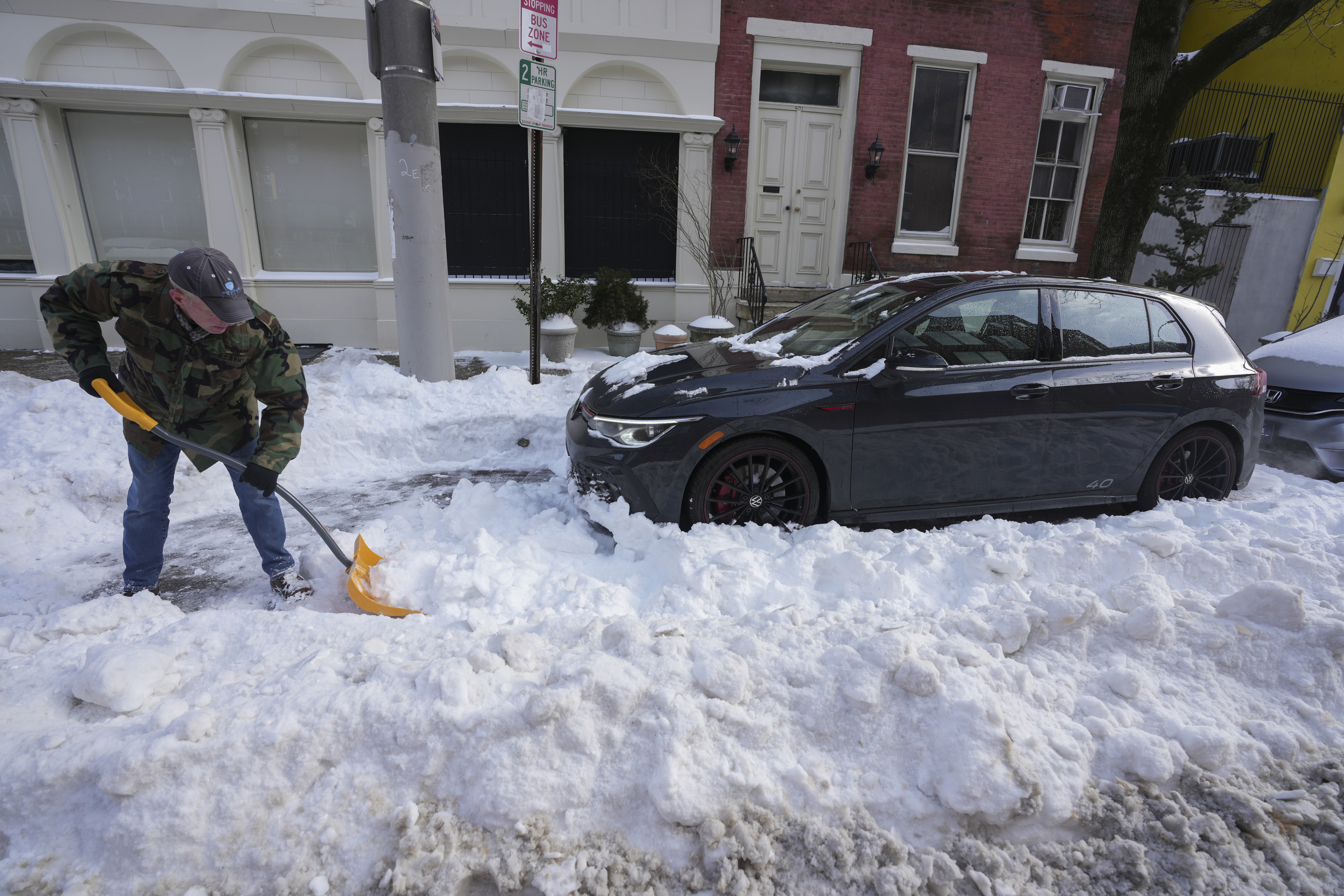
    On Jan. 5, Washington was sworn in as Media’s first new mayor in three decades. On Jan. 25, 9.3 inches of snow fell on Philadelphia, setting off a snow emergency declaration. Washington monitored the storm and worked to put parking restrictions and plowing operations into effect.

    It was “fascinating” — a headfirst dive into running a municipal government, she said.

    A graphic designer by trade and former borough council member, Washington moved to Media from Philadelphia in 2013 and fell in love with its walkability and tight-knit community of 6,000. As she learns on the job, friends and colleagues say her intelligence and ability to work across the aisle make her the right person for the role. For Washington, learning how to be a good mayor is all about “being a good neighbor.”

    Media Mayor Joi Washington talks with Garden Café owner Willow Culbertson in downtown Media on Sunday, Feb. 1.

    Who is Joi Washington?

    Washington, 39, was born and raised in Germantown. She graduated from Moore College of Art and Design in 2008 with a bachelor of fine arts in illustration. She has worked for numerous Philly-area companies doing graphic design, digital asset management, and storyboarding.

    Around a decade ago, Washington took a graphic design job in Media. The long commute from Roxborough, where she lived at the time, quickly became tiresome, so she packed up and moved. She met her husband at work, and the two have lived in Media since.

    Washington, a Democrat, was elected to Media’s borough council in 2021, serving until she became mayor last month.

    Katey McVerry, Media’s tax collector, was impressed with Washington as a borough council member. She described Washington as civically and politically engaged, “well known by her neighbors,” and able to work across the aisle.

    When Bob McMahon, Media’s mayor of 33 years, decided to retire last year, Washington stepped up.

    Children played as folks dined on State Street during Media’s Dine Under the Stars event on Wednesday, June 4, 2025.

    A ‘resounding’ win

    Washington campaigned for mayor on expanding public transit options, supporting local businesses, and working with law enforcement to make streets safer for drivers, cyclists, and pedestrians. She was elected with 77% of the vote, beating out Republican Kevin Kellogg.

    Democrats swept local races in Media and Delaware County in November, winning seats on the Rose Tree Media school board, borough council, and Delaware County Council.

    Mary Tonita Austin helped campaign for Washington last year. Austin and Washington met at a Juneteenth celebration when Washington was still on borough council. Last year, when Austin ran for the Rose Tree Media school board, they found themselves in similar spots — Black women running for office in a county that remains largely white (Washington is the first woman and first person of color to be elected mayor of Media).

    Austin gladly handed out Washington’s campaign fliers along with her own.

    “She’s both intelligent and creative, which I think is so important for us to have,” Austin said of Washington.

    Malcolm Yates, a convener of the Delaware County Black Caucus, said Washington’s win was “resounding.”

    Media is 82% white, according to the most recent census estimates — a percentage nearly 1.5 times higher than the Philly metro area at-large. Before Democrats won three seats on the Delaware County Council in 2019, the body had been controlled by Republicans since the Civil War.

    “It shows that the county has been moving and progressing forward to be more of a melting pot,” Yates said of Washington’s win. “You don’t necessarily have to always look or identify a certain way to be a leader.”

    Media Mayor Joi Washington at Media Borough Hall Sunday, Feb. 1, 2026.

    Becoming the mayor

    Washington describes the first few weeks of being mayor as a “whirlwind.” There are webinars to watch, police reports to study, hands to shake, and nuggets of advice to glean from McMahon, now retired, whom Washington has stayed in touch with.

    There’s a lot to look forward to, as well. Media recently secured grants to purchase a new ambulance, enhance walkability within the borough, and improve Barrall Community Park. Washington hopes to bring in visitors to shop and dine at Media’s small businesses, continuing the borough’s ascent as a Delco destination. Washington rattled off a list of forthcoming events with excitement: Dining Under the Stars, the completion of Plum Street Park, and the Media Spring Arts Show.

    As for her personal life, Washington said she is trying to find balance as mayor, which is a part-time gig in Media. Washington is still working as a freelance illustrator and graphic designer. She is also a natural introvert learning to manage an increasingly busy social calendar.

    “I’m also glad that I have two cats to keep me sane. My husband’s very supportive. I think it’s really good to have a life outside of politics,” she said.

    This suburban content is produced with support from the Leslie Miller and Richard Worley Foundation and The Lenfest Institute for Journalism. Editorial content is created independently of the project donors. Gifts to support The Inquirer’s high-impact journalism can be made at inquirer.com/donate. A list of Lenfest Institute donors can be found at lenfestinstitute.org/supporters.

  • Brian Fitzpatrick has more cash on hand than any other swing district Republican incumbent in the country

    Brian Fitzpatrick has more cash on hand than any other swing district Republican incumbent in the country

    U.S. Rep. Brian Fitzpatrick has more cash on hand than any other GOP incumbent in a swing district nationwide as the party prepares for a tough election.

    The Bucks County lawmaker raised about $4.3 million in the most recent cycle, more than any other House candidate in the state and the 21st most of all the candidates running for the 435-member House in 2026. He ended 2024 with nearly $4.4 million when removing debt and had more than $7.3 million cash on hand as of Dec. 31. That haul makes him the best-funded of the 16 candidates on the National Republican Congressional Committee’s Patriots program, a group of vulnerable incumbents in key swing districts, according to Federal Election Commission data.

    “Brian Fitzpatrick has years of electoral success under his belt and will continue to be unbeatable in Bucks County because Pennsylvanians know he’ll always put them first in Washington … this race was over before it began,” NRCC spokesperson Reilly Richardson said in a statement.

    But Fitzpatrick’s district is one of four in Pennsylvania that could determine the control of the U.S. House and has long been coveted by Democrats because of its purple electorate. It is one of nine GOP-held districts in the country that former Vice President Kamala Harris won in 2024.

    Bob Harvie, a Democrat who chairs the Bucks County commissioners, has emerged as the front-runner to face Fitzpatrick in the 2026 election.

    Harvie, who would need to win the May primary to face Fitzpatrick, raised nearly $930,000 last year and has more than $400,000 cash on hand. He surpassed $1 million after getting $100,000 in the first few weeks of the year, according to his campaign.

    “Based on the outpouring of support we are receiving, it’s clear voters agree and are fired up to be a part of this campaign,” Harvie said Wednesday in a news release about his fundraising.

    Harvie made history flipping the Bucks County board six years ago, has strong name recognition in the district, and has the backing of national Democrats. But Fitzpatrick ended the year with nearly 20 times more cash on hand.

    Fitzpatrick received more money from each of New York and Florida than from in-state donors in 2025, according to FEC data. Harvie received the vast majority of his money from Pennsylvania.

    Fitzpatrick could be less vulnerable than other swing-state Republicans

    Fitzpatrick has set himself apart as willing to vote against President Donald Trump without blocking the president’s flagship bills. He was the only Pennsylvania Republican to vote against Trump’s One Big Beautiful Bill Act on final passage, and Trump called him disloyal in response. But Fitzpatrick had cast a key vote that propelled an earlier version of the legislation forward.

    He recently joined Democrats and two other swing-district Republicans in the state to vote to extend Affordable Care Act subsidies, which Republicans quashed. Fitzpatrick criticized House Speaker Mike Johnson (R., La.) and called some of his Republican colleagues “intellectually dishonest.” But Democrats have argued that Fitzpatrick has not been critical enough of the president, whom he often avoids naming when challenging his policies.

    Fitzpatrick has consistently outperformed Trump in the suburban district. He won his most recent election by nearly 13 percentage points.

    Jim Worthington, a GOP mega-donor in Pennsylvania and owner of the Newtown Athletic Club, said that Fitzpatrick’s approach makes him “the perfect representative for a purple county.”

    “Everybody that’s moderate and people that are independents, they love him because he votes to what best represents his constituents, and by the way, sometimes he takes some votes that make me cringe a little bit, but I understand why he does it,” Worthington said.

    Heather Roberts, a spokesperson for Fitzpatrick’s campaign, attributed the incumbent’s fundraising success to his ability to break the partisan mold.

    “Strong fundraising follows strong leadership — and Congressman Fitzpatrick has built a broad coalition of Republicans, Democrats, and Independents who are rejecting the extremes and backing two-party, patriotic, common-sense solutions,” Roberts said in a statement.

    But Democrats are still trying to tie Fitzpatrick to the president, whose popularity is falling, according to Pew Research Center and other pollsters.

    Fitzpatrick “is no maverick and no John McCain — he is a doormat for Trump’s worst instincts and a greenlight for D.C. Republicans’ dangerous agenda that is hurting our community,” Harvie said Wednesday in a statement to The Inquirer.

    “Pennsylvanians deserve a Congressman who will stand up to Trump and actually do something to lower prices — but Fitzpatrick is weak and caves to his own party when it matters most,” said Eli Cousin, a spokesperson for the Democratic Congressional Campaign Committee, in a statement.

    Democrats, including Harvie, will also be trying to build on their successes from the November 2025 elections, when Democrats flipped two key row offices in Bucks — district attorney and sheriff — and saw wins on local school boards.

    But the nonpartisan Cook Political Report expects Fitzpatrick to be in a safer position than his swing-district colleagues, rating his district as “likely” Republican, while U.S. Rep. Rob Bresnahan’s Northeastern Pennsylvania seat is rated “lean” Republican. Republican U.S. Reps Scott Perry of York County and Ryan Mackenzie of Lehigh County are each in districts rated as a “toss up.”

    Harvie has less cash on hand than the other Democratic front-runners in the state’s swing districts.

    Janelle Stelson, a second-time challenger to Perry, ended 2025 with about $1.5 million cash on hand. Scranton Mayor Paige Cognetti, who is challenging Bresnahan, ended the year with a little more than $800,000 cash on hand. Former federal prosecutor Ryan Croswell, Mackenzie’s Democratic challenger with the most cash, has $612,000 for the Lehigh Valley race.

    Does name recognition make Harvie a ‘formidable’ challenger?

    Harvie’s campaign is confident that he can cash in on name recognition, having won two countywide commissioner races in the last seven years that could help raise his profile among voters in the 1st Congressional District, which includes all of Bucks County and a sliver of Montgomery County.

    Provided he wins the primary, Harvie would be the first Democratic challenger to Fitzpatrick’s seat who has held countywide elected office.

    But will that help Harvie’s chances?

    “The starting point that Bob Harvie has with his name ID as a commissioner is just a much better starting point,” said Brittany Crampsie, a Democratic consultant in Pennsylvania, noting that he would not need to spend as much money introducing himself to voters in an expensive Philadelphia-area media market.

    “He has a lot of advantages going into this race, not the least of which is his name ID, but he would be probably the most formidable matchup we’ve seen against Fitzpatrick in his tenure,” she added.

    “Maybe,” GOP consultant Christopher Nicholas said as to whether Harvie has valuable name recognition, adding that “among hardcore Democrats his name ID is decent because they’re hardcore Democrats.”

    “But if you stood out on the streets of Tullytown or Riegelsville or Dublin and said, ‘Who are your county commissioners?’,” residents may be unfamiliar, Nicholas said.

    As of October 2025, 43% of respondents to an internal Harvie campaign survey conducted by Public Policy Polling could identify Harvie, with 26% giving him a favorable rating and 17% an unfavorable. That poll had the commissioner and Fitzpatrick tied at 41%.

    This article has been updated to include a comment from Fitzpatrick’s campaign received after publication.

  • Philadelphians are frustrated with the city’s snowstorm cleanup. What does that mean for Mayor Cherelle Parker?

    Philadelphians are frustrated with the city’s snowstorm cleanup. What does that mean for Mayor Cherelle Parker?

    Mayor Cherelle L. Parker often says she isn’t a fan of “Monday-morning quarterbacks” and “expert AOPs” — her shorthand for so-called articulators of problems who don’t offer solutions.

    Now she has a city full of them.

    After a heavy snowfall followed by a week of below-freezing temperatures, Philadelphia’s streets are still laden with snow, slush, and ice; SEPTA buses are packed; and numerous cars are still stuck in the spots residents left them in 11 days ago.

    The mayor acknowledged residents’ exasperation at a news conference at the Pelbano Recreation Center in Northeast Philadelphia on Wednesday, her first appearance dedicated to the city’s snow response since Jan. 26, the day after the storm walloped the region.

    “For anyone who is frustrated right now about the ice, about the ability for all of the streets to be fully cleared, I want you to know that I understand,” she said. “Everybody can Monday-morning quarterback. … That’s cool. We can’t stop people from feeling the way they feel. But let me tell you something: We were prepared.”

    Parker said the city deployed 1,000 workers and 800 pieces of snow-removal equipment to deal with the emergency.

    “We don’t promise to be perfect, Philadelphia,” she said. “We promise to go to war with the status quo and to fix things, to be doers. … We’re going to continue doing everything that we can to make sure all of this work is done.”

    A pedestrian walks past a large pile of snow and ice along the Benjamin Franklin Parkway days after a fierce winter storm dropped up to 9 inches of snow and sleet, with freezing temperatures leaving large banks of ice and snow on streets and sidewalks in Philadelphia, Monday, Feb. 2, 2026.

    Snowstorms are infamous for their ability to undermine constituents’ faith in their mayors. Over the years, they have been credited with ending political careers in Denver, New York, Chicago, and Seattle.

    The risk of political fallout could be heightened for Parker, who campaigned on a promise to upgrade city services. When Parker ceremonially dropped the puck at Tuesday night’s Flyers game, she was greeted with boos from many fans at Xfinity Mobile Arena.

    “Parker has pitched herself as the can-do mayor. ‘I’m not gonna deal with ideology. I’ve got principles, but I’m here to get the job done,’” said Randall M. Miller, a political historian and professor emeritus at St. Joseph’s University. “There’s that expectation you’re going to get this thing done.”

    Parker also faced questions about her administration’s commitment to delivering core services during the eight-day city workers strike last July, when “Parker piles” of trash mounted around Philadelphia in the hot summer sun. She escaped that ordeal relatively unscathed after winning what she called a “fiscally responsible” contract largely in line with her goals.

    But Miller said the mobility issues associated with snow removal have unique psychological effects for constituents.

    “You’re cold, you’re miserable, and you’re trapped. You’re looking around like, ‘Who is confining me?’” Miller said. “You get angry at the mayor because the mayor said, ‘I’m here to provide public services,’ and public service isn’t being provided.”

    Fred Scheuren shovels snow at 12th Street, near Waverly Street, in Center City, Philadelphia, Monday, Jan. 26, 2026.

    The circumstances of this year’s winter weather emergency could also give Parker some breathing room. Municipal leaders in Pittsburgh, New York, Washington, D.C., and Providence, R.I., are all feeling the heat amid the polar temperatures, thanks to an unusually persistent cold snap that has hampered snow-removal operations.

    A slight reprieve in the weather this week, with highs peaking above freezing Tuesday and Wednesday, could help the city’s cleanup efforts. But officials warned Wednesday that temperatures are forecast to fall again by the end of the week.

    “It’s not hyperbole to consider that we’re still under emergency conditions,” Dominick Mireles, who leads the Philadelphia Office of Emergency Management, said Wednesday.

    Lessons from past Philly storms

    By some measures, the city threw more resources at the latest storm than in the past, but got fewer returns.

    After the legendary blizzard of Jan. 7, 1996, then-Mayor Ed Rendell deployed more than 540 snowplows, dump trucks, and other vehicles to clear away the record 30.7 inches of snow that fell over two days, according to an Inquirer report from that year. Officials bragged at the time that the fleet eclipsed the 300 vehicles marshaled by former Mayor W. Wilson Goode Sr. for the last major blizzard, in 1987.

    Four days after the 1996 storm, the city said it hauled away 50,000 tons of snow, including truckloads famously dumped directly into the Delaware River and the Schuylkill. Officials also said that day that about 71% of roadways were passable, including around half of all side streets.

    In February 2003, the city got walloped with 19 inches of snow, followed by days of subfreezing temperatures. Four days after that storm, the city said it had cleared 75% to 80% of city streets.

    In 2016, Mayor Jim Kenney used 10,000 tons of salt and 1,600 city workers to clear away 22.5 inches of snow, clearing 92% of residential streets by day four — with a major assist from warmer temperatures a few days after the storm.

    The 800 pieces of snow-removal equipment Parker cited that were used in the most recent storm are far more than even in the blizzard of 1996. She also said the city brought in a snow-melting machine from Chicago, saying workers had melted about 4.7 million pounds of snow, while scattering 30,000 tons of salt.

    The result: More than a week after the end of the snowfall, about 85% of city streets had been “treated,” which includes salting, plowing, or both, according to the city.

    Heavy equipment clearing snow along S. Broad Street at Dickinson Street, Philadelphia, Tuesday, Feb. 3, 2026.

    But mobility nonetheless remains limited in much of the city, and officials pointed to the lingering icy conditions.

    The prolonged freeze is “not unheard of, but it is unusual, and that stresses and makes the potential for a lot of not-great things to happen,” Mireles said. “It’s affecting the snow-fighting operation.”

    An analysis of city plowing data shows that after the conclusion of the storm on Jan. 25, vehicles reached about 70% of city streets by the end of Monday. As the snow hardened, activity slowed by about a third on Jan. 27. Some parts of the city — including neighborhood-size chunks of South Philly — saw little plowing until five days after the storm or longer.

    The psychology of snow

    One reason voters punish mayors more harshly for failing to remove snow than for other problems is because of its omnipresence, from getting around the city to small talk about the weather, Miller said.

    Even trash-collection problems tend not to get under residents’ skin to the same degree because they don’t shut the city down, he said.

    “You are furious, and it’s day in, day out,” Miller said. “You’re constantly reminded.”

    Trisha Swed walks with her dog Alberta Einstein at North 30th Street and Girard Avenue in Brewerytown on Monday, Jan. 26, 2026 in Philadelphia. In Philadelphia, 9.3 inches of snow fell, the most in a decade.

    Parker has turned to private contractors to help with the snow-removal operation. And at Wednesday’s news conference, she touted the city’s efforts to deploy 300 “same-day pay and work” laborers earning $25 per hour to help manually clear streets and sidewalks.

    Those moves drew criticism Wednesday from the city’s largest union for municipal workers, District Council 33 of the American Federation of State, County and Municipal Workers, which went on strike for higher wages last summer.

    “District Council 33 is deeply concerned by the City’s decision to bring in outside laborers for snow‐removal operations without any consultation or collaboration with our union,” DC 33 president Greg Boulware said in a statement. “Our members deserve better, and the residents of Philadelphia deserve a snow‐removal strategy rooted in safety, foresight, and respect for the workforce that keeps this city running.”

    Miller said those efforts show the city is doing everything it can to clear the city’s streets and sidewalks.

    “There’s been a great effort to try to deal with it, but Philadelphia is a very difficult place to manage in terms of snow because it’s got so many older streets,” he said.

    Man with shovel clearing snow from small park on Main Street in Manayunk on Monday, Jan. 26, 2026.

    But, he said, hearing about the city’s efforts is cold comfort to residents struggling to navigate their neighborhoods.

    “The major thoroughfares, they’ve done a pretty good job. But folks are concerned with their neighborhoods. They’re not concerned with if they go down to Fourth and Market,” he said. “Once you start to hear those kinds of complaints, it’s hard to contain it.”

    Parker said complaints will not deter her team. “Whenever we’ve been dealing with something challenging in government … there are some people who are expert articulators for problems,” she said.

    Her staff, she said, “is not a team of expert AOPs.”

    “This is a team of subject-matter experts who are doers and they are fixers, and we don’t cry,” she said. “Our job won’t be done until every street in the city of Philadelphia is walkable.”

    Staff writers Ximena Conde and Anna Orso contributed to this article.

  • Here’s who is funding Philly’s crowded race for Congress

    Here’s who is funding Philly’s crowded race for Congress

    The race to fill Philadelphia’s open congressional seat is the marquee election in the city this year, but with less than four months left until primary election day, it has yet to attract much money from political action committees or donors outside the region.

    Most of the campaign thus far has been funded by big checks from individual donors, and several of the top contenders to represent Pennsylvania’s 3rd Congressional District — the most Democratic in the nation — have raised most of their money from people who live in Pennsylvania.

    That’s according to an Inquirer analysis of recently filed campaign finance reports that break down contributions to each candidate between October and December.

    The filings, coupled with previous financial reports, provide a snapshot of who is contributing to each Democrat’s campaign heading into the election year, and how capable each contender is of powering their operations and advertising.

    While money is not the only factor in a political campaign, fundraising prowess can be used as a predictor of viability, and it can persuade other donors to contribute. Ten candidates announced they are running for the seat held by retiring U.S. Rep. Dwight Evans, but it’s likely that not all of them will make it onto the May 19 primary election ballot.

    Overall, the reports showed that State Sen. Sharif Street, the son of a former mayor, holds a financial advantage over the rest of the field.

    However, the two physicians in the contest, Ala Stanford and David Oxman, have each dedicated six-figure loans to their own campaigns, and progressive State Rep. Chris Rabb is expected to draw donations from left-leaning groups.

    Physician Ala Stanford (right) arrives at a forum hosted by the 9th Ward Democratic Committee Dec. 4, 2025. She is a Democratic candidate running to represent Philadelphia’s Third Congressional District.

    Interest from outside Philly will also likely rise as the primary election draws near.

    If national political figures weigh in on the race, they can lean on their vast networks of donors across the country to keep their preferred candidates’ campaigns afloat.

    And deep-pocketed special-interest groups with their eyes on influencing Congress may seek to sway the race in its final months.

    Not much PAC money — yet

    Under decades-old campaign finance law, corporations cannot give directly to candidates for federal office. But their executives, board members, and employees can fund PACs that are used as vehicles to prop up their supported candidates.

    As the role of money in politics has drawn scrutiny over the years, so has the reliance on so-called corporate PACs. That is especially true among some Democrats who see accepting money from them as a litmus test of their working-class bona fides.

    Rabb has hammered the issue in public forums and debates. He says he has never accepted corporate PAC money since his first run for office in 2015, and has repeatedly called on the other contenders to refuse corporate PAC funding.

    None of the candidates for the 3rd District has thus far leaned on corporate PAC money, according to the campaign finance reports.

    window.addEventListener(“message”,function(a){if(void 0!==a.data[“datawrapper-height”]){var e=document.querySelectorAll(“iframe”);for(var t in a.data[“datawrapper-height”])for(var r,i=0;r=e[i];i++)if(r.contentWindow===a.source){var d=a.data[“datawrapper-height”][t]+”px”;r.style.height=d}}});

    However, PACs associated with labor unions have gotten involved.

    Street raised about $40,000 in the last period from PACs associated with labor groups. He is backed by the deep-pocketed Philadelphia Building and Construction Trades Council, an umbrella organization of unions that endorsed him last fall.

    In the past, the trades have also funded super PACs, outside spending groups that can raise unlimited amounts of money but must follow strict rules largely barring them from coordinating directly with the campaigns they support.

    In 2023, the building trades funded a super PAC that supported Cherelle L. Parker’s successful run for mayor. And in 2018, Local 98 of the International Brotherhood of Electrical Workers, the most cash-flush building trades union in the state, funded a super PAC to support unsuccessful congressional candidate Rich Lazer.

    Ryan Boyer, head of the Philadelphia Building & Construction Trades Council, was one of the first to speak at Cherelle Parker’s election night party at the Sheet Metal Workers Local 19 on Nov. 7, 2023.

    But no such super PAC has materialized so far, according to campaign finance reports. Rather, the bigger financial factor in this race — at least through the end of last year — was candidates lending money to their own campaigns. Stanford put up $250,000 on Dec. 31, the last day of the reporting period. And Oxman has lent his campaign $175,000.

    Small vs. big-dollar donors

    While the candidates relied largely on donations from individuals, the size of the checks they brought in varied. Under campaign finance limits, individuals can give up to $3,500 to a candidate per election.

    The average contribution to State Rep. Morgan Cephas since she announced her campaign was $596 — about half of Street’s and Rabb’s average contributions. Individual donors gave the most to Stanford, on average, with the average contribution to her campaign totaling $1,737.

    That analysis includes only donors who contributed more than $200 through the course of the year. Campaigns are required to itemize only contributions above that threshold.

    State Rep. Chris Rabb at a forum hosted by the 9th Ward Democratic Committee Dec. 4, 2025. He is a Democratic candidate running to represent Philadelphia’s Third Congressional District.

    Small donations, or contributions under $200, have made up a tiny fraction of the money brought in by the top contenders so far, according to the latest filings. About 11.5% of the money Rabb raised was from small-dollar donors. Such contributions made up less than 5% of all funding for Stanford, Oxman, and Street.

    The one outlier was Pablo Iván McConnie-Saad, an ex-Treasury Department official under former President Joe Biden. His campaign has been somewhat low-profile so far; however, small-dollar contributions made up a quarter of his total of $119,000 raised.

    His campaign said in a statement that the filings are evidence that his run is “entirely people powered.”

    Stanford’s campaign manager, Janée Taft-Mack, noted that the pediatric surgeon has been campaigning for a shorter amount of time than several of her opponents. She announced her campaign in October, several months after Street and Rabb.

    Taft-Mack added that the range of donors “underscores a coalition that crosses income levels, neighborhoods, and communities.”

    Where the money came from

    While every candidate vying for Evans’ seat has touted grassroots support, it appears that Cephas and Street raised the most money from donors who live in Philadelphia.

    About half of the individual donors who gave more than $200 to Street and Cephas are city residents. Both candidates have also raised the most money from donors living in Pennsylvania.

    window.addEventListener(“message”,function(a){if(void 0!==a.data[“datawrapper-height”]){var e=document.querySelectorAll(“iframe”);for(var t in a.data[“datawrapper-height”])for(var r,i=0;r=e[i];i++)if(r.contentWindow===a.source){var d=a.data[“datawrapper-height”][t]+”px”;r.style.height=d}}});

    Street, who formerly led the state Democratic Party and has connections to donors across Pennsylvania, raised 81% of his individual contributions, or about $488,000, from in-state residents. For Cephas, the share was 78%, or about $162,000.

    Anthony Campisi, a spokesperson for Street, said the latest finance report “highlights the entire point of our campaign.”

    “Sharif is running to represent Philadelphians from across an incredibly diverse district,” he said, “and is building the coalition needed to both win and effectively serve in Congress.”

    Cephas’ campaign manager, Salvatore Colleluori, said her fundraising within the city shows she has a “broad base of support, especially in Philadelphia.”

    “She has been a champion for Philadelphia in the state House, and people know that,” he said. “They want to support that work.”

    Rabb, a progressive who has support from left-leaning organizations and activists outside the region, had among the lowest share of contributions from Philly-based donors, according to The Inquirer’s analysis.

    He said in a statement that when small-dollar donations are accounted for, he believes he will have “more Philly donations than any of the establishment candidates.”

    Rabb said he will soon be rolling out endorsements from progressive organizations “that will significantly grow our donor base.”

    Staff writer Sean Collins Walsh contributed to this article.