Category: Politics

Political news and coverage

  • The fifth anniversary of the Jan. 6 insurrection brings fresh division to the Capitol

    The fifth anniversary of the Jan. 6 insurrection brings fresh division to the Capitol

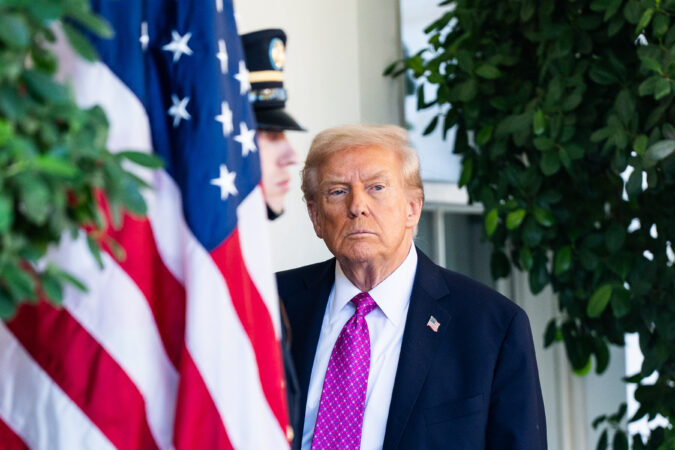
    WASHINGTON — Five years ago outside the White House, outgoing President Donald Trump told a crowd of supporters to head to the Capitol — “and I’ll be there with you” — in protest as Congress was affirming the 2020 election victory for Democrat Joe Biden.

    A short time later, the world watched as the seat of U.S. power descended into chaos, and democracy hung in the balance.

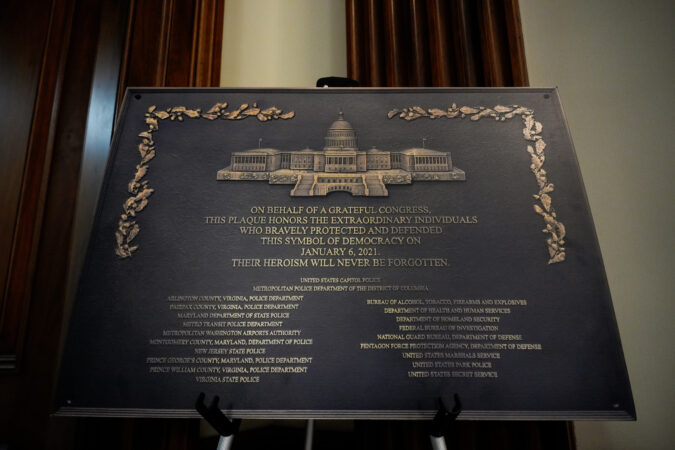
    On the fifth anniversary of Jan. 6, 2021, there is no official event to memorialize what happened that day, when the mob made its way down Pennsylvania Avenue, battled police at the Capitol barricades and stormed inside, as lawmakers fled. The political parties refuse to agree to a shared history of the events, which were broadcast around the globe. And the official plaque honoring the police who defended the Capitol has never been hung.

    Instead, the day displayed the divisions that still define Washington, and the country, and the White House itself issued a glossy new report with its own revised history of what happened.

    Trump, during a lengthy morning speech to House Republicans convening away from the Capitol at the rebranded Kennedy Center now carrying his own name, shifted blame for Jan. 6 onto the rioters themselves.

    The president said he had intended only for his supporters to go “peacefully and patriotically” to confront Congress as it certified Biden’s win. He blamed the media for focusing on other parts of his speech that day.

    At the same time, Democrats held their own morning meeting at the Capitol, reconvening members of the House committee that investigated the Jan. 6, 2021, attack for a panel discussion. Recalling the history of the day is important, they said, in order to prevent what Rep. Jamie Raskin (D., Md.) warned was the GOP’s “Orwellian project of forgetting.”

    And the former leader of the militant Proud Boys, Enrique Tarrio, summoned people for a midday march retracing the rioters’ steps from the White House to the Capitol, this time to honor Trump supporter Ashli Babbitt and others who died in the Jan. 6 siege and its aftermath. More than 100 people gathered, including Babbitt’s mother.

    Tarrio and others are putting pressure on the Trump administration to punish officials who investigated and prosecuted the Jan. 6 rioters. He was sentenced to 22 years in prison for seditious conspiracy for orchestrating the Jan. 6 attack, and he is among more than 1,500 defendants who saw their charges dropped when Trump issued a sweeping pardon on his return to the White House last year.

    “They should be fired and prosecuted,” Tarrio told the crowd before they arrived at the Capitol, confronted along the way by counterprotesters, and sang the national anthem.

    The White House in its new report highlighted the work the president has already done to free those charged and turned the blame on Democrats for certifying Biden’s election victory.

    Echoes of 5 years ago

    This milestone anniversary carried echoes of the differences that erupted that day.

    But it unfolds while attention is focused elsewhere, particularly after the U.S. military’s stunning capture of Venezuela’s president, Nicolás Maduro, and Trump’s plans to take over the country and prop up its vast oil industry, a striking new era of American expansionism.

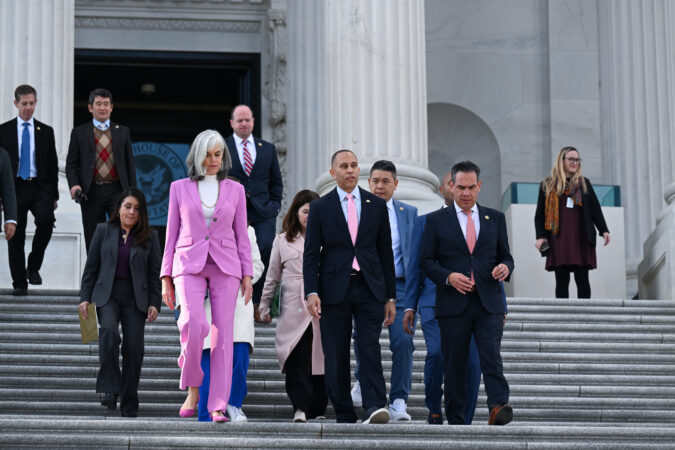
    “These people in the administration, they want to lecture the world about democracy when they’re undermining the rule of law at home, as we all will be powerfully reminded,” House Democratic leader Hakeem Jeffries of New York said on the eve of the anniversary.

    House Speaker Mike Johnson of Louisiana, responding to requests for comment about the delay in hanging the plaque honoring the police at the Capitol, as required by law, said in a statement on the eve of the anniversary that the statute “is not implementable,” and proposed alternatives “also do not comply with the statute.”

    Democrats revive an old committee, Republicans lead a new one

    At the morning hearing at the Capitol, lawmakers heard from a range of witnesses and others — including former U.S. Capitol Police officer Winston Pingeon, who said as a kid he always dreamed of being a cop. But on that day, he thought he was going to die in the mayhem on the steps of the Capitol.

    “I implore America to not forget what happened,” he said, “I believe the vast majority of Americans have so much more in common than what separates us.”

    Also testifying was Pamela Hemphill, a rioter who refused Trump’s pardon, blamed the president for the violence and silenced the room as she apologized to the officer sitting alongside her at the witness table, stifling tears.

    “I can’t allow them not be recognized, to be lied about,” Hemphill said about the police who she said also saved her life as she fell and was trampled on by the mob. “Until I can see that plaque get up there, I’m not done.”

    Among those testifying were former Rep. Adam Kinzinger of Illinois, who along with former Rep. Liz Cheney of Wyoming were the two Republicans on the panel that investigated Trump’s efforts to overturn Biden’s win. Cheney, who lost her own reelection bid to a Trump-backed challenger, did not appear. Speaker Emerita Nancy Pelosi urged the country to turn away from a culture of lies and violence that she said sends the wrong message about democracy.

    Republican Rep. Barry Loudermilk of Georgia, who has been tapped by Johnson to lead a new committee to probe other theories about what happened on Jan. 6, rejected Tuesday’s session as a “partisan exercise” designed to hurt Trump and his allies.

    Many Republicans reject the narrative that Trump sparked the Jan. 6 attack, and Johnson, before he became the House speaker, had led challenges to the 2020 election. He was among some 130 GOP lawmakers voting that day to reject the presidential results from some states.

    Instead, they have focused on security lapses at the Capitol — from the time it took for the National Guard to arrive on the scene to the failure of the police canine units to discover the pipe bombs found that day outside Republican and Democratic party headquarters. The FBI arrested a Virginia man suspected of placing the pipe bombs, and he told investigators last month he believed someone needed to speak up for those who believed the 2020 election was stolen, authorities say.

    “The Capitol Complex is no more secure today than it was on Jan. 6,” Loudermilk said in a social media post. “My Select Subcommittee remains committed to transparency and accountability and ensuring the security failures that occurred on Jan. 6 and the partisan investigation that followed never happens again.”

    The aftermath of Jan. 6

    At least five people died in the Capitol siege and its aftermath, including Babbitt, who was shot and killed by police while trying to climb through the window of a door near the House chamber, and Capitol Police Officer Brian Sicknick died later after battling the mob. Several law enforcement personnel died later, some by suicide.

    The Justice Department indicted Trump on four counts in a conspiracy to defraud voters with his claims of a rigged election in the run-up to the Jan. 6 attack.

    Former Justice Department special counsel Jack Smith told lawmakers last month that the riot at the Capitol “does not happen” without Trump. He ended up abandoning the case once Trump was reelected president, adhering to department guidelines against prosecuting a sitting president.

    Trump, who never made it to the Capitol that day as he hunkered down at the White House, was impeached by the House on the sole charge of having incited the insurrection. The Senate acquitted him after top GOP senators said they believed the matter was best left to the courts.

    Ahead of the 2024 election, the Supreme Court ruled ex-presidents have broad immunity from prosecution.
  • New Jersey digital innovation office that uses AI becomes permanent with new law

    New Jersey digital innovation office that uses AI becomes permanent with new law

    New Jersey Gov. Phil Murphy’s digital innovation office has been made a permanent cabinet-level office in what appears to be the first move of its kind in the nation as the role of artificial intelligence increases in government.

    Murphy created the New Jersey State Office of Innovation in 2018 to improve digital innovation in state government.

    And now it’ll remain a fixture in New Jersey after he leaves office, following Murphy’s signing Monday of a bill that turns the office into an authority within the Treasury Department.

    Gov.-elect Mikie Sherrill, who will be inaugurated on Jan. 20, will oversee the new authority. Sherrill supports the office, but even if she didn’t, the new law means a governor can’t just get rid of it.

    Georgetown University’s Beeck Center, which tracks these efforts nationally, has identified 17 states with digital innovation offices, including Pennsylvania. But the university and Murphy’s office say New Jersey is the first to codify a cabinet-level position of its kind into law.

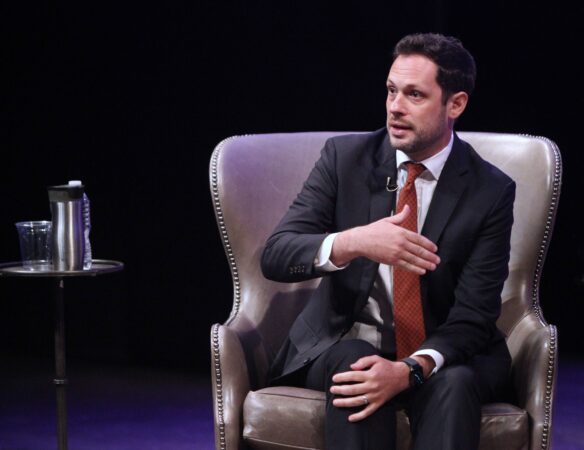
    The new law also helps the office fund projects between departments more easily and opens up the possibility of revenue streams such as by selling its technology to other state governments or local governments within the state, said Dave Cole, a Haddonfield resident who leads the department. The law also requires a board of directors appointed by the governor.

    The state innovation office has worked with almost every state agency to identify problems that can be fixed with technology in an effort to make government services more efficient, Cole said.

    In one example, it helped the Department of Labor redesign emails for its unemployment program, which had used decades-old design technology and hard-to-understand legalese that was slowing down the claim process because it wasn’t user-friendly.

    In another, the office used machine learning to identify 100,000 students eligible for summer food assistance who weren’t getting it.

    The office has also modernized call centers and even created an internal AI chat bot for state employees that helps draft emails, summarize documents, and analyze public feedback — shaving days off the process of aggregating public comments.

    Employees are told repeatedly that AI is a tool and that human review is still needed, Cole said.

    “The person that’s using the AI needs to be accepting responsibility for the use of and any dissemination of information after they’ve reviewed it,” he said in an interview.

    The office was awarded what it called a “first of its kind” grant last month to utilize AI in government.

    Cole, 40, said his team’s approach to AI is to make bureaucratic processes more efficient, like summarizing fraud information, generating memos, and matching disparate data sets.

    “Our purpose isn’t to solve an AI problem as much as it is to solve a resident problem, a business owner problem — sometimes, when we work with higher education, an institutional problem,” he said. “And often AI, more recently, emerges as a tool that can help us through that.”

    The bill passed by 29-8 in the Senate with three members not voting on Dec. 22 and by 61-13 in the Assembly on Dec. 8, with four members not voting and two abstentions.

    Sherrill said she will keep Cole in his position as she puts together her administration.

    “I look forward to working with Dave as we modernize the way New Jerseyans access state government services and build a government that works for everyone,” Sherrill said in a statement.

    Cole, a Rutgers grad, worked with data and analytics as an organizer for former President Barack Obama’s 2008 presidential campaign before developing the White House website and online petitions as part of the presidential administration.

    That work was simpler than the projects he does now given the rapid development of AI — but reached the same goal of increased civic engagement, he said.

    After his work there, Cole then pivoted to the private tech sector and made an unsuccessful bid for Congress in South Jersey in 2016 before joining the state’s innovation office in 2020 to help with pandemic vaccine distribution before eventually rising to chief innovation officer a year ago, replacing Beth Noveck, who now works as the chief AI strategist in the same office.

    “Generally speaking, there’s a lot of pain. There’s a lot of unsolved problems. There’s a lot of improvements that we need to see,” Cole said. “And so if we understand how to effectively leverage technology, we can do good there, but we have to be careful with anything like this.”

    One project Cole is looking forward to this year is building the option for residents to use one online account for various government agencies and allowing for their data to be shared across departments to pre-populate forms.

    Not only can that simplify processes for residents who choose to participate, but it can make it easier for government agencies to recommend different government programs by getting information about applicants it wouldn’t otherwise receive, he said.

    “Having that information allows us to do really interesting things, like ‘You’re enrolled in this program, did you know you may also be eligible for this other program?’” he said. “This has been for a long time, I think, sort of a dream of folks who do this kind of digital technology work to recommend and automatically enroll people in benefits based on their eligibility.”

    Working with Sherrill to cut through red tape

    Sherrill campaigned on “cutting through that red tape and bureaucracy.” When asked to elaborate by The Inquirer at a mid-November campaign appearance in South Jersey, she said “a lot of it is just putting stuff online.”

    She also said she wants to address redundancies for residents who need to go through different government organizations and find out they have more steps than they initially thought.

    “I’ve heard too many stories of people who do the five steps they need to get a permit, and they go back and they go, ‘Well, here’s five more,’” she said in November. “So there’s not a lot of clarity, transparency, or accountability in getting through this process.”

    That’s the kind of work the innovation office has been doing through business.nj.gov, a centralized website for starting and growing a business, and Cole looks forward to doing more of it in partnership with Sherrill.

    New businesses that use the website launched an average of a couple of weeks sooner than those that didn’t, Cole said.

    “It has many agencies, permits, and licenses integrated in it, but not all,” he said.

    “And one of the challenges is that agencies have many priorities about the things that they need to work on at a given point in time, so I think the governor-elect’s focus on this could allow more clarity there,” he added.

    This article has been updated to reflect the office is cabinet-level.

  • Democrats look primed to win the House, but a wave might be harder

    Democrats look primed to win the House, but a wave might be harder

    Democrats are celebrating signs that the tide is turning their way for the 2026 midterms. But translating dissatisfaction with President Donald Trump into an electoral tsunami, or even a wave election, will be much harder to achieve than in years past.

    History, polling, a narrow Republican majority, a string of off-year victories, and voter anxiety over the economy favor the Democrats, who lead in support for control of Congress by five percentage points in a Post average of November and December national polls.

    It’s unclear what effect the Trump administration’s recent intervention in Venezuela will have, if any, and will probably depend on how deeply the U.S. involves itself in running that country’s affairs. Democrats hope it further splits Trump’s MAGA coalition.

    But the battlefield in the House is smaller than ever, according to political analysts, experts, and operatives, meaning Democrats will need to compete in districts that Trump won by large margins to pick up a significant number of seats.

    Of the 39 seats Democrats are competing for, 28 are in districts that Trump won by five or more percentage points.

    A gerrymandering spree instigated by Trump has narrowed the number of truly competitive seats, furthering a trend that was already underway in recent elections as the nation has become more polarized. That has not affected the race for the Senate, which Republicans are favored to hold.

    Just 36 races in this year’s election are rated competitive by the Cook Political Report, compared with 49 races at the same point in the 2018 cycle. Half of the seats rated competitive by Cook this year are already held by Democrats, leaving the party even less room to gain ground.

    “Democrats will have a very narrow but viable path to the majority. That’s a different scenario than 2006 or 2018, when Democrats put a ton of Republican-held seats in play,” said David Wasserman, senior editor and elections analyst at the Cook Political Report. “There’s so little elasticity in U.S. House elections these days compared to prior eras.”

    Democrats won 40 House seats in the “blue wave” of 2018 during Trump’s first term, easily erasing the Republicans’ then 23-seat governing margin.

    The good news for Democrats this year: They need only three seats to regain control of the House.

    That is achievable, but 2018-sized “waves” are harder now given increasingly partisan maps and a more divided electorate that has become more rigidly partisan, according to Wasserman and other analysts.

    Party leaders, however, argue they are well positioned to compete in heavily Trump districts. Trump’s 2024 victory was powered by a historic realignment of the electorate that upended decades of traditional coalitions. He made inroads with Latinos, young voters, first-time voters, and middle- and lower-income households. Democrats say they can unwind many of those gains with a slate of less traditional, and in some cases less partisan, candidates.

    One of them is Paige Cognetti, the mayor of Scranton, Pa., who won her current seat by running as an independent in a campaign called “Paige Against the Machine.” Even though Trump won her district by about eight percentage points, voters are open to her because they still cannot afford basic necessities like housing and groceries and are not “bleeding Democrats or hardcore Republicans,” she said in an interview. She noted that Gov. Josh Shapiro (D) won the same district by eight percentage points in 2022.

    Cognetti is challenging Rep. Rob Bresnahan (R., Pa.), who has faced scrutiny for stock trades while he was in Congress after campaigning on a ban on stock trading for members of Congress.

    “This is the exact type of public corruption and cynical behavior that people here really, really loathe,” Cognetti said. “Government should work and people want to see it at their local level and federal level, too.”

    Bresnahan supported an effort last year that would restrict members of Congress from trading stocks and has said lawmakers should not profit off the information that they have. Bresnahan’s stocks are in an institutionally managed fund that is run by financial advisers, spokesperson Hannah Pope said.

    In a statement, Bresnahan’s campaign attacked Cognetti’s record as mayor and as “a former Goldman Sachs banker who made the richest Americans even richer.”

    Democrats have coalesced around a midterm message focused on the cost of living and healthcare, hammering Republicans for passing a $4 trillion budget bill that includes steep cuts to Medicaid and food stamps. They have also highlighted Republicans’ failure to extend pandemic-era Obamacare subsidies that expired Dec. 31 that will drive up premiums for millions of Americans this year.

    Democratic Party leaders have been energized by off-year and special elections in which Democrats performed above expectations. In a Tennessee special election last month in a district Trump won by 22 points, Republican Matt Van Epps won by about nine percentage points.

    Some Republicans have urged the party to focus more on affordability, rather than solely focusing on issues such as crime or immigration that played a significant role in their 2024 sweep. Trump kicked off a tour last month in Pennsylvania to focus on Americans’ struggles with rising prices, but veered off-script, mocking the word “affordability,” touting the stock market, and disparaging Somalia.

    Republicans say they also have a slate of strong candidates in the country’s most competitive districts, including Kevin Lincoln, a former mayor and pastor running against incumbent Adam Gray (D., Calif.) in a central California district, and Eric Flores, a Republican army veteran and lawyer challenging Rep. Vicente Gonzalez (D., Texas) in Texas’s 34th Congressional District, near the state’s southern Gulf Coast and the border with Mexico.

    Mike Marinella, spokesperson for the National Republican Campaign Committee, agreed the battlefield is smaller than in past midterm elections. But he said Republicans hold the advantage, pointing to about a dozen Democratic incumbents who are fending off challenges in districts that Trump won narrowly.

    “Fundamentally, we have the upper hand just by looking at the pure numbers, and Democrats are certainly on defense in a lot more districts than we are,” Marinella said.

    Rep. Suzan DelBene (D., Wash.), chairperson of the Democratic Congressional Campaign Committee, said in an interview that many candidates competing in Trump districts are closely connected to their communities and “independent-minded.”

    “Authenticity matters a ton because you’re talking to folks across the political spectrum,” DelBene said.

    Democrats believe they have effectively neutralized Republican efforts to pick up additional seats through gerrymandering in Texas, Ohio, and North Carolina by gaining seats of their own in California and Utah. The Indiana Senate rejected a partisan gerrymander last month, and Democrats are still exploring whether they could pick up seats in Virginia, Illinois, and Maryland. Wasserman said the post-gerrymandering landscape remains “pretty equitable to both parties.”

    As Trump’s approval ratings fall — 39% of voters approve of the job he is doing, according to a Washington Post average of polls in early December — Democrats are working to wipe out some of the gains he made with voter groups that are traditionally aligned with them.

    In South Texas, Tejano music star Bobby Pulido is competing in one of the new districts Republicans drew to try to maintain the House majority.

    Key to Trump’s victory in Texas’ 15th District, which includes the Rio Grande Valley, was an unprecedented rightward swing among Latino voters. Pulido has broad name recognition in the Southwest and in Mexico in large part because of his 1995 debut single “Desvelado.” Trump’s immigration crackdown is devastating tourism and the rest of the economy in South Texas, Pulido said, creating an opening among those who supported him.

    “These immigration raids are hurting a lot of these small business owners or builders where their workforce they’ve had for years is no longer either there or afraid to go to work,” Pulido said in an interview. “I understand that a lot of Democrats don’t want to get labeled open borders. I’m sure as heck not open borders. … But due in large part to the immigration policies this administration has taken, we need to fix it.”

    There are still myriad questions about where the final map for 2026 will end up. In addition to ongoing gerrymandering efforts by both parties, the Supreme Court is expected to decide whether to strike down the last major pillar of the Voting Rights Act, a provision that has bolstered the power of minority voters and candidates for more than 50 years.

    If the court issues a ruling early enough and sides with Louisiana and the Trump administration — which has argued that race played too large a role in the decision to create a second Black-majority congressional district in the state — some states might scramble to redraw their maps and add Republican seats.

    Chris Warshaw, professor of political science at the McCourt School of Public Policy at Georgetown University, said it’s not clear how aggressively Republican states will respond, if at all, if the Supreme Court strikes down Section 2 of the Voting Rights Act. Even if Republican states try to redraw their maps, he said, Democrats have shown they are willing to respond.

    But the cost of last year’s redistricting fights is the health of American democracy, particularly as the country had previously made progress toward less partisan maps, he said.

    “The unwinding of that progress is really sad, and there’s no reason to think this genie is going to go back into the bottle,” Warshaw said.

  • Trump revives an old vision of American power, with global implications

    Trump revives an old vision of American power, with global implications

    The nighttime raid that ousted Venezuelan President Nicolás Maduro this weekend was the most dramatic demonstration of President Donald Trump’s vow to focus U.S. might on the Americas, as the White House re-creates a stance toward the Western Hemisphere that more resembles its 19th century empire-building era than the laissez-faire attitude of recent generations.

    Trump and his top allies suggested that the Venezuelan operation could be the start of efforts to remake the region, warning the governments of Cuba and Colombia that they might be next. Trump and some backers have also brought up Mexico as a potential target, and they are reviving talk of attempting to acquire Greenland, a Danish territory.

    After announcing Maduro’s capture, Trump boasted of the “Donroe Doctrine,” a twist on the strategy articulated by President James Monroe in 1823 that European powers should stop interfering in the Western Hemisphere. The national security strategy released by the White House in December noted a “Trump Corollary” to the Monroe Doctrine that promised “to protect our homeland and our access to key geographies throughout the region.”

    The effort carries significant risks. Washington could get pulled into the nation-building invasions that Trump has long sworn to avoid if the Venezuelan military or people are unwilling to go along with his plans. It also makes it harder for the United States to argue to Russia and China that they should steer clear of their neighbors. And it may reshape global affairs more broadly, as smaller nations that were long dependent on Washington’s guarantees for global trade and stability hedge their bets by building ties elsewhere.

    Backers of Trump’s strategy downplay the drawbacks and say a narrower focus on U.S. regional interests is long overdue.

    “The goal of the policy is to see changes in Venezuela that are beneficial to the United States first and foremost, because that’s who we work for, but also, we believe, beneficial for the people of Venezuela, who have suffered tremendously,” Secretary of State Marco Rubio told NBC’s Meet the Press on Sunday, a day after Trump said U.S. forces were ready to reinvade Venezuela if Maduro’s de facto successor, Delcy Rodríguez, did not comply with his wishes.

    Rubio — the son of Cuban immigrants to the United States — has long backed efforts to oust Venezuela’s leaders, who have presided over a decline in their country’s economy, ignored election results, and built ties to U.S. adversaries including Russia and China. Deposing Venezuela’s government would probably weaken the Communist leaders of Cuba as well, since they have long depended on Caracas for energy and other economic support.

    “This emphasis on the Western Hemisphere should not come as a surprise to anybody. It matters more to American security than any other part of the world,” said Nick Solheim, chief executive of American Moment, a group that backs Trump’s policies and trains junior staffers.

    But he said advocates of a more robust focus on the Western Hemisphere were not saying Washington should abandon global affairs entirely.

    “It’s making sure that our neighbors are not doing anything that is, that would adversely affect the United States, and then focused on our greatest geopolitical challenge right now, which is China,” he said. “That is not a retreat from the world of foreign policy. It is an accurate prioritization of what actually matters the most, what poses the biggest threats to the United States.”

    The move against Venezuela drew criticism from both the center and the right, as some influential “America First” advocates said that military conflicts and expanded foreign opportunities for U.S. oil companies weren’t why voters backed Trump.

    “This is the same Washington playbook that we are so sick and tired of that doesn’t serve the American people, but actually serves the big corporations, the banks, and the oil executives,” Marjorie Taylor Greene, a longtime Trump ally who is retiring from Congress after breaking with the president, said on NBC’s Meet the Press on Sunday. “We don’t consider Venezuela our neighborhood. Our neighborhood is right here in the 50 United States, not in the Southern Hemisphere.”

    Washington has a long history of efforts to back friendly leaders in Latin America, including at times intervening with force to do so. But it has not done so directly since the 1991 end of the Cold War, and Venezuela — with 30 million residents and a territory double the size of Iraq’s — is an especially large nation to take on.

    “I understand how we got here, but there’s been no forethought to the difficulties of the plan or the ideas that they seem to have adopted as the way ahead, and there definitely is no plan to the level of detail that’s required,” said Jennifer Kavanagh, a senior fellow at Defense Priorities, a think tank that advocates a more limited role for the U.S. military in the world.

    She said she wasn’t sure that China and Russia would be emboldened by Trump’s actions, since they already appear to feel unconstrained toward their neighbors. But she noted that Trump appears to be cautious about tangling with militaries that can inflict serious damage on the United States.

    “This sort of spectacular operation is very consistent. He likes to hit adversaries that can’t hit back, whether it’s small drug-smuggling boats, or Iran with no air defenses, or Venezuela, which is also weak,” she said. “And to me, that explains the more accommodating approach to Russia and China, in the sense that his view of military power is kind of go big or go home. But that model doesn’t work against Russia and China.”

    Some of Trump’s former advisers warn that the world the president is building may turn out to be more dangerous than the era of the 1990s and 2000s, when the United States was the preeminent global power and backed a broad effort to strip barriers to trade.

    “It just seems to be back to the 18th and 19th centuries,” said Fiona Hill, an expert at the Brookings Institution who was Trump’s top Russia adviser in his first term. “If you’ve bought into the idea of competition among the great powers and that Russia is another great power that’s inevitably going to dominate in its region, just as China is in its region, then this is the logical conclusion from this.”

    Hill said countries that have deep, allied ties to the United States but are threatened by Trump may seek to protect themselves by building trade and security relationships elsewhere, a move that will ultimately weaken Washington, not strengthen it.

    The raid has sparked fears elsewhere that Trump could act on other threats toward U.S. neighbors, which have included demands to take over the Panama Canal, to turn Canada into the 51st state, to annex Greenland, and to overthrow Cuba’s government.

    Trump on Sunday said he didn’t plan action against Havana, but offered tough language nevertheless.

    “I think it’s just going to fall. I don’t think we need any action,” he told reporters on Air Force One. “You ever watch a fight, they go down for the count, and Cuba looks like it’s going down.”

    He was sharper toward Greenland.

    “We need Greenland from a national security situation,” Trump said. “It’s so strategic. Right now, Greenland is covered with Russian and Chinese ships all over the place. … Denmark is not going to be able to do it.” On Saturday, an influential former White House aide, Katie Miller, posted on social media an image of Greenland with the U.S. flag superimposed on top of it.

    The president’s repeated statements about Greenland drew a sharp response earlier Sunday from Danish Prime Minister Mette Frederiksen. “I have to say this very directly to the United States: It makes absolutely no sense to talk about the need for the United States to take over Greenland,” she said.

    In a statement, she said Denmark is a U.S. military ally and that the United States has extensive access to Greenland.

    “I would therefore strongly urge the United States to stop the threats against a historically close ally and against another country and another people who have said very clearly that they are not for sale,” she said.

  • Hegseth censures Sen. Kelly after Democrats’ video urging troops to resist unlawful orders

    Hegseth censures Sen. Kelly after Democrats’ video urging troops to resist unlawful orders

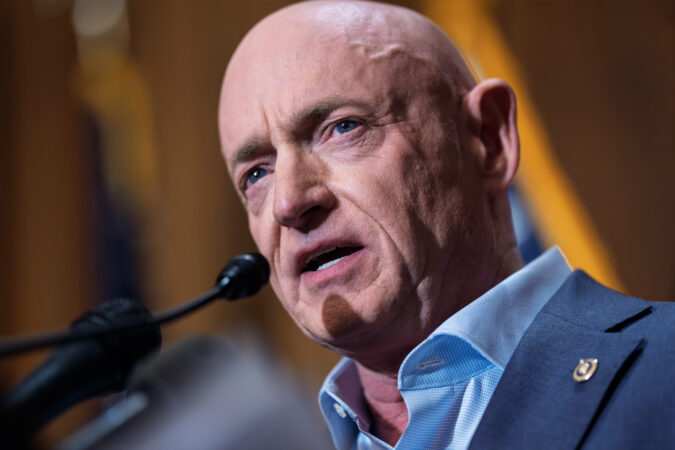
    WASHINGTON — Defense Secretary Pete Hegseth announced Monday that he censured Democratic Sen. Mark Kelly of Arizona over the former Navy pilot’s participation in a video that called on troops to resist unlawful orders.

    Hegseth said the censure — by itself simply a formal letter with little practical consequence — was “a necessary process step” to proceedings that could result in a demotion from Kelly’s retired rank of captain and subsequent reduction in retirement pay.

    Investigating and now punishing a sitting U.S. senator is an extraordinary move for the Pentagon, which until President Donald Trump’s second term had usually gone out of its way to act and appear apolitical. A legal expert says the choice to go after a lawmaker will complicate an already unique case.

    In a lengthy post on social media, Kelly said he “never expected” what he called an “attack” from Trump and Hegseth, recounting his 25 years of Navy service as well as combat and space missions.

    Calling Hegseth’s move “outrageous” and “un-American,” Kelly said he would fight the censure “with everything I’ve got — not for myself, but to send a message back that Pete Hegseth and Donald Trump don’t get to decide what Americans in this country get to say about their government.”

    Hegseth’s action follows video about illegal orders

    The censure comes after Kelly participated in a video in November with five other Democratic lawmakers — all veterans of the armed services and intelligence community — in which they called on troops to uphold the Constitution and defy “illegal orders.”

    Trump, a Republican, accused the lawmakers of sedition “punishable by DEATH” in a social media post days later.

    The 90-second video was first posted from Sen. Elissa Slotkin’s X account. In it, the six lawmakers — Slotkin, Kelly ,and Reps. Jason Crow, Chris Deluzio, Maggie Goodlander, and Chrissy Houlahan — speak directly to U.S. service members, whom Slotkin acknowledges are “under enormous stress and pressure right now.”

    The lawmakers didn’t mention specific circumstances. But their message was released amid a series of military attacks on boats accused of smuggling drugs in the Caribbean Sea and the eastern Pacific Ocean and Trump’s attempts to deploy National Guard troops to American cities.

    The Pentagon announced that it began an investigation of Kelly in late November, citing a federal law that allows retired service members to be recalled to active duty on orders of the defense secretary for possible court-martial or other measures.

    While all six lawmakers served in the military or the intelligence community, Hegseth previously said Kelly was the only one facing investigation because he is the only one of the lawmakers who formally retired from the military and is still under the Pentagon’s jurisdiction.

    Kelly said last month that the investigation was part of an effort to silence dissent: “This is just about sending a message to retired service members, active duty service members, government employees — do not speak out against this president or there will be consequences.”

    Kelly, along with some of the other Democrats in the initial video, have sent out fundraising messages based on Trump’s reaction to their comments, efforts that have gone toward filling their own campaign coffers and further elevating their national-level profiles.

    What accusations Hegseth is leveling against Kelly

    In his post Monday, Hegseth charged that Kelly’s remarks in the video and afterward violated Uniform Code of Military Justice provisions against conduct unbecoming an officer and violating good order and discipline.

    “Captain Kelly’s status as a sitting United States Senator does not exempt him from accountability, and further violations could result in further action,” Hegseth said.

    Todd Huntley, a retired Navy captain and judge advocate general, called this is a “novel” situation that raises legal questions.

    One issue, Huntley said, is whether Kelly’s comments fall under the constitutional protections of the speech or debate clause, which is intended to protect members of Congress from questioning about official legislative acts.

    A 1968 Supreme Court decision said the provision’s intent was “to prevent legislative intimidation by and accountability to the other branches of government.”

    Huntley said that while the type of process Hegseth is using — known as a retirement grade determination — is fairly routine, “as far as I know, they’ve always been based on conduct during the individual’s active duty service, even if it only came to light after retirement.”

    “So, I don’t know if conduct totally after retirement would fit the requirement for such a determination,” he added.

    According to Hegseth, Kelly now has 30 days to submit a response to the proceedings that will decide if he is demoted. The decision will be made within 45 days, Hegseth’s post added.

    Huntley noted that Kelly will also have options to appeal the finding both within the military and in federal court.

  • Moody’s boosts Atlantic City to investment grade a decade after its near bankruptcy

    Moody’s boosts Atlantic City to investment grade a decade after its near bankruptcy

    ATLANTIC CITY — A decade after teetering on the edge of bankruptcy and being taken over by the State of New Jersey, Atlantic City has been given an investment-grade rating by Moody’s Ratings.

    “Today is a tremendous day to start the new year,” Atlantic City Mayor Marty Small Sr. said Monday at a livestreamed news briefing. “The city of Atlantic City is officially investment grade.”

    The credit rating of Baa3 puts the city in the lowest long-term investment-grade category, several steps from the top A ratings. But it marks a dramatic rise from 10 years ago, Small noted, when he was sworn in as the City Council president.

    “We had the junkiest junk bonds imaginable,” he recalled. “The city’s finances were not in a good state. Employees were getting paid once a month. People were running to the bank to cash their checks. The outlook was bleak. We even entertained that we were bankrupt. It was a long, drawn-out fight. However, that was then; this is now.”

    Small himself ended 2025 in dramatic fashion: a two-week trial that ended in an acquittal on charges that he physically abused his teenage daughter.

    Small and business administrator Anthony Swan said at the Dec. 31 meetings that Moody’s expressed interest in seeing a stable government and experienced department directors.

    Small was sworn in to a new four-year term on New Year’s Day with his daughter in attendance and said then that the family has begun the healing process. A decision is expected soon by the Atlantic County prosecutor on whether to pursue similar charges against his wife, La’Quetta Small, the city’s schools superintendent.

    The state’s takeover of Atlantic City expired Dec. 1. But another bill is moving through the legislature that will leave the state in charge of Atlantic City finances for another six years. It calls for a “master developer” to oversee major projects, even as the city is trying to regain control over planning and zoning.

    There are other challenges ahead for Atlantic City: New York City approved three casino licenses that could cut a substantial hole in Atlantic City’s gambling revenue and prompt state lawmakers to approve casinos in North Jersey. Casino owners also oppose an effort to ban smoking in the city’s casinos that is now before an appellate court.

    Though the state takeover began a decade ago in hostile fashion, it evolved to a cooperative partnership. Small praised the decision by incoming Gov. Mikie Sherrill to keep Jacquelyn Suárez as head of the state’s Department of Community Affairs, which would oversee the next takeover.

    Atlantic City Mayor Marty Small Sr. speaks to the media after being found not guilty on all counts of abusing his teenage daughter, on Dec. 18.

    But Monday was a day of triumph for the city.

    Small noted that the city had substantially reduced its debt to $228 million, down from a peak of $550 million, and cut taxes six years in a row. Of that, only $71 million is debt directly incurred by the city; the rest are legacy debts from money owed to casinos from tax appeals. He anticipated announcing a seventh tax cut in the coming weeks.

    “This government gets criticized all the time,” he said. “People say, ‘Oh they’re spinning like drunken sailors, spinning spinning spinning like it’s out of control.’ Ladies and gentlemen, that’s just not true.”

    Business administrator Swan said Moody’s was interested in more than just numbers. “It’s about the stability of the city,” he said. “It’s about how the city is run.”

    Finance director Toro Aboderin called the announcement “an extraordinary milestone.” She said Moody’s asked about “bulkheads, roads, infrastructure.”

    “Restoring Atlantic City to sound financial footing has been our top priority every single day,” she said. “A lot of people talk about Atlantic City and how we’re terrible, how the finances are the worst, and the roads are messy. They say all kinds of things, but we have attained something quite remarkable.”

    Officials hope the vote of confidence from Moody’s will signal to investors and developers to look again at their city, which has some of the most affordable beachfront real estate on the East Coast.

    An investment-grade credit rating signals to financial markets that Atlantic City is a lower-risk borrower, although the mayor emphasized that the city currently has no need to borrow.

  • This Jan. 6 plaque was made to honor law enforcement. It’s nowhere to be found at the Capitol

    This Jan. 6 plaque was made to honor law enforcement. It’s nowhere to be found at the Capitol

    WASHINGTON — On the fifth anniversary of the Jan. 6, 2021, attack on the Capitol, the official plaque honoring the police who defended democracy that day is nowhere to be found.

    It’s not on display at the Capitol, as is required by law. Its whereabouts aren’t publicly known, though it’s believed to be in storage.

    House Speaker Mike Johnson, a Louisiana Republican, has yet to formally unveil the plaque. And the Trump administration’s Department of Justice is seeking to dismiss a police officers’ lawsuit asking that it be displayed as intended. The Architect of the Capitol, which was responsible for obtaining and displaying the plaque, said in light of the federal litigation, it cannot comment.

    Determined to preserve the nation’s history, some 100 members of Congress, mostly Democrats, have taken it upon themselves to memorialize the moment. For months, they’ve mounted poster board-style replicas of the Jan. 6 plaque outside their office doors, resulting in a Capitol complex awash with makeshift remembrances.

    “On behalf of a grateful Congress, this plaque honors the extraordinary individuals who bravely protected and defended this symbol of democracy on Jan. 6, 2021,” reads the faux bronze stand-in for the real thing. “Their heroism will never be forgotten.”

    Jan. 6 void in the Capitol

    In Washington, a capital city lined with monuments to the nation’s history, the plaque was intended to become a simple but permanent marker, situated near the Capitol’s west front, where some of the most violent fighting took place as rioters breached the building.

    But in its absence, the missing plaque makes way for something else entirely — a culture of forgetting.

    Visitors can pass through the Capitol without any formal reminder of what happened that day, when a mob of President Donald Trump’s supporters stormed the building trying to overturn the Republican’s 2020 reelection defeat by Democrat Joe Biden. With memory left unchecked, it allows new narratives to swirl and revised histories to take hold.

    Five years ago, the jarring scene watched the world over was declared an “insurrection” by the then-GOP leader of the Senate, while the House GOP leader at the time called it his “saddest day” in Congress. But those condemnations have faded.

    Trump calls it a “day of love.” And Johnson, who was among those lawmakers challenging the 2020 election results, is now the House speaker.

    “The question of January 6 remains — democracy was on the guillotine — how important is that event in the overall sweep of 21st century U.S. history,” said Douglas Brinkley, a professor of history at Rice University and noted scholar.

    “Will January 6 be seen as the seminal moment when democracy was in peril?” he asked. Or will it be remembered as “kind of a weird one-off?”

    “There’s not as much consensus on that as one would have thought on the fifth anniversary,” he said.

    Memories shift, but violent legacy lingers

    At least five people died in the riot and its aftermath, including Trump supporter Ashli Babbitt, who was fatally shot by police while trying to climb through a window toward the House chamber. More than 140 law enforcement officers were wounded, some gravely, and several died later, some by suicide.

    All told, some 1,500 people were charged in the Capitol attack, among the largest federal prosecutions in the nation’s history. When Trump returned to power in January 2025, he pardoned all of them within hours of taking office.

    Unlike the twin light beams that commemorated the Sept. 11, 2001, attack or the stand-alone chairs at the Oklahoma City bombing site memorial, the failure to recognize Jan. 6 has left a gap not only in memory but in helping to stitch the country back together.

    “That’s why you put up a plaque,” said Rep. Mary Gay Scanlon (D., Pa.). “You respect the memory and the service of the people involved.”

    Police sue over plaque, DOJ seeks to dismiss

    The speaker’s office over the years has suggested it was working on installing the plaque, but it declined to respond to a request for further comment.

    Lawmakers approved the plaque in March 2022 as part of a broader government funding package. The resolution said the U.S. “owes its deepest gratitude to those officers,” and it set out instructions for an honorific plaque listing the names of officers “who responded to the violence that occurred.” It gave a one-year deadline for installation at the Capitol.

    This summer, two officers who fought the mob that day sued over the delay.

    “By refusing to follow the law and honor officers as it is required to do, Congress encourages this rewriting of history,” said the claim by officers Harry Dunn and Daniel Hodges. “It suggests that the officers are not worthy of being recognized, because Congress refuses to recognize them.”

    The Justice Department is seeking to have the case dismissed. U.S. Attorney Jeanine Pirro and others argued Congress “already has publicly recognized the service of law enforcement personnel” by approving the plaque and displaying it wouldn’t alleviate the problems they claim to face from their work.

    “It is implausible,” the Justice Department attorneys wrote, to suggest installation of the plaque “would stop the alleged death threats they claim to have been receiving.”

    The department also said the plaque is required to include the names of “all law enforcement officers” involved in the response that day — some 3,600 people.

    Makeshift memorials emerge

    Lawmakers who have installed replicas of the plaque outside their offices said it’s important for the public to know what happened.

    “There are new generations of people who are just growing up now who don’t understand how close we came to losing our democracy on Jan 6, 2021,” said Rep. Jamie Raskin (D., Md.), a member of the Jan. 6 committee, which was opposed by GOP leadership but nevertheless issued a nearly 1,000-page report investigating the run-up to the attack and the attempt to overturn the 2020 election.

    Raskin envisions the Capitol one day holding tours around what happened. “People need to study that as an essential part of American history,” he said.

    “Think about the dates in American history that we know only by the dates: There’s the 4th of July. There’s December 7th. There’s 9/11. And there’s January 6th,” said Rep. Zoe Lofgren (D., Calif.), who also served on the committee and has a plaque outside her office.

    “They really saved my life, and they saved the democracy, and they deserve to be thanked for it,” she said.

    But as time passes, there are no longer bipartisan memorial services for Jan. 6. On Tuesday, the Democrats will reconvene members from the Jan. 6 committee for a hearing to “examine ongoing threats to free and fair elections,” House Democratic Leader Hakeem Jeffries of New York announced. It’s unlikely Republicans will participate.

    The Republicans under Johnson have tapped Rep. Barry Loudermilk of Georgia to stand up their own special committee to uncover what the speaker calls the “full truth” of what happened. They’re planning a hearing this month.

    “We should stop this silliness of trying to whitewash history — it’s not going to happen,” said Rep. Joe Morelle (D., N.Y.), who helped lead the effort to display the replica plaques.

    “I was here that day so I’ll never forget,” he said. “I think that Americans will not forget what happened.”

    The number of makeshift plaques that fill the halls is a testimony to that remembrance, he said.

    Instead of one plaque, he said, they’ve “now got 100.”

  • DA Larry Krasner takes more shots at Trump as he’s sworn in to third term amid major drop in crime

    DA Larry Krasner takes more shots at Trump as he’s sworn in to third term amid major drop in crime

    When Larry Krasner was sworn in to his second term as district attorney four years ago, Philadelphia was in a public safety crisis: Murders and shootings were at an all-time high and the homicide clearance rate was at a historic low.

    On Monday, Krasner was inaugurated to a third, four-year term in remarkably different circumstances. The city in 2025 recorded the fewest homicides in 59 years, and police are solving killings at the highest rate in more than 40 years.

    Krasner, 64, took the oath of office alongside his wife, former Common Pleas Court Judge Lisa M. Rau, and one of his two sons inside the grand auditorium of the Kimmel Center for the Performing Arts.

    More than two dozen city judges, as well as City Controller Christy Brady, were also sworn in.

    Krasner is now one of the longest-serving district attorneys in modern Philadelphia history. Lynne M. Abraham, the tough-on-crime Democrat who in the 1990s was dubbed “deadliest DA” by the New York Times because she so frequently sought the death penalty, is the only other top prosecutor in the city to serve more than two terms.

    Krasner cruised to reelection in November after handily defeating former Municipal Court Judge Patrick F. Dugan with about 75% of the vote. Krasner’s campaign often focused more on attacking President Donald Trump than specifying what, if anything, he might do differently with another four years.

    He struck similar tones on Monday.

    Across a nearly 20-minute speech, Krasner did not lay out a coming agenda, saying that was “not for today,” but instead recounted what he said were his accomplishments over the last eight years: building what he said was a more morally intact staff, investing in forensic advancements to help take down violent gangs, and providing grants to community organizations.

    “It will be headed towards more safety. It will be headed towards more freedom,” he said of his office in the next four years.

    And he took a few shots at Trump.

    “Sometimes people ask me, ‘Why are you talking about Trump so much? Why do you keep bringing up Trump?’” he said.

    While City Council members and state lawmakers have “tremendous power,” he said, “they don’t have the obligation, as I just swore in front of you, to uphold the Constitution and the laws of the United States from someone … whose intent is, without question, the overthrow of democracy in the United States of America.”

    District Attorney Larry Krasner displays a political cartoon by Pat Bagley during a news conference in August 2025 to lament President Trump’s deployment of the National Guard to D.C. streets. Bagley is staff cartoonist for the Salt Lake Tribune in Salt Lake City, Utah.

    He also noted that Trump has not deployed the National Guard to Philadelphia, as the president has done in other Democratic cities like Chicago, San Francisco, and Los Angeles, and seemed to acknowledge Cherelle L. Parker’s hotly debated strategy of avoiding confrontation with Trump.

    “If that has any part in the reality that we have not seen Trump’s troops, Trump’s tanks in the City of Philadelphia — I don’t know if it does or not, but if it has anything to do with that, then I’m glad, and I intend to work closely, always, with other elected officials.”

    Parker, who earlier congratulated Krasner in her introductory remarks, stared ahead stoically during his comments about Trump.

    Krasner ended by promising to continue making Philadelphia safer, and then returned to one of his favorite themes.

    “We all got to this point of achievement together, and this is no time to retreat. It is no time to surrender. It is time to push on so that Philadelphia goes from being known as chronically violent to being known as consistently safe for decades to come,” he said.

    “And if anybody — including the guy in D.C. — doesn’t want that, if they want to F around, then they’re gonna find out.”

  • John Fetterman praises Trump administration’s capture of Maduro in Venezuela: ‘Appropriate and surgical’

    John Fetterman praises Trump administration’s capture of Maduro in Venezuela: ‘Appropriate and surgical’

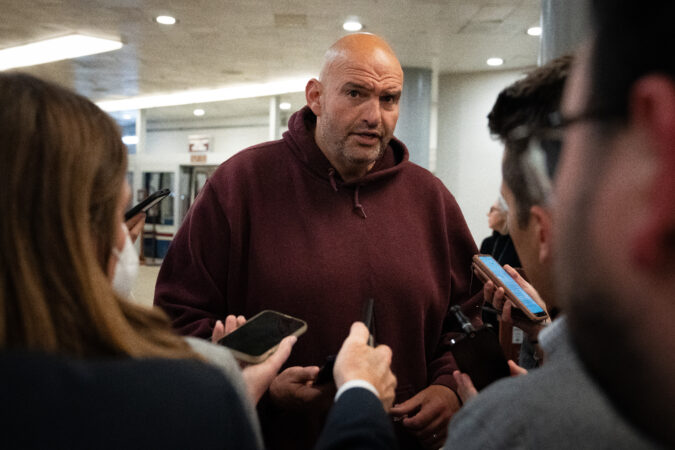
    Sen. John Fetterman (D., Pa.) on Monday praised President Donald Trump’s order to capture Venezuelan President Nicolás Maduro and his wife, breaking with most Democrats’ messaging on the military operation that took place early Saturday without congressional authorization.

    “I don’t know why we can’t just acknowledge that it’s been a good thing what’s happened. … We all wanted this man gone, and now he is gone,” Fetterman said during an interview on Fox & Friends on Monday morning.

    Fetterman’s comments come days after the Trump administration orchestrated a strike on Caracas, resulting in the capture of Maduro, Venezuela’s president since 2013, and his wife, Cilia Flores, early Saturday.

    The event followed months of escalation by the U.S. military and claims from the Trump administration that Maduro is responsible for large-scale drug trafficking operations. The future of the Venezuelan government is unclear, but Trump has suggested that U.S. involvement will continue.

    “I think [the military operation] was appropriate and surgical,” Fetterman said during the interview. “This wasn’t a war, this wasn’t boots on the grounds, and in that kind of way, this was surgical and very efficient, and I want to celebrate our military.”

    A Venezuelan official said the strike killed at least 40 people, the New York Times reported.

    The military operation provoked mixed reactions from members of the Philadelphia region’s Venezuelan community, some of whom are thankful for Maduro’s ouster but were concerned by Trump’s comments over the weekend that the U.S. would “run” Venezuela.

    The incident also garnered sharp disapproval from many Democratic lawmakers.

    Sen. Cory Booker (D., N.J.) said in a post on X on Saturday that Maduro is a “brutal dictator who has committed grave abuses” and that the U.S. military carries out their orders with “professionalism and excellence,” but stressed that Trump’s military operation defies the Constitution and is a culmination of a repeated failure by Congress to exercise its check on presidential power.

    “We face an authoritarian-minded president who acts with dangerous growing impunity. He has shown a willingness to defy court orders, violate the law, ignore congressional intent, and shred basic norms of decency and democracy,” Booker said.

    “This pattern will continue unless the Article I branch of government, especially Republican congressional leadership, finds the courage to act,” Booker said.

    Other Democrats and opponents to the military operation have also questioned its legality.

    This is not the first time that Fetterman has differed with fellow Democrats on key issues. Recently, the Pennsylvania senator was one of only a handful of Senate Democrats who supported the Republican-led plan to reopen the federal government without addressing the expiration of healthcare subsidies.

    During his interview Monday, Fetterman noted that Democrats, including former President Joe Biden, have called for the ouster of Maduro.

    Biden raised the bounty for Maduro’s arrest to $25 million in January 2025, days before Trump took office. The move came after Maduro assumed a third presidential term despite evidence that he lost the election.

    “Why have a bounty of $25 million if we didn’t want him gone? Why would you do these things if you weren’t willing to actually do something other than harsh language,” Fetterman said.

  • Hegseth censures Kelly after Democrats’ video warning about following unlawful orders

    Hegseth censures Kelly after Democrats’ video warning about following unlawful orders

    WASHINGTON — Defense Secretary Pete Hegseth on Monday announced that he is issuing a letter of censure to Democratic Sen. Mark Kelly of Arizona over the lawmaker’s participation in a video that called on troops to resist unlawful orders.

    Hegseth said that the censure was “a necessary process step” to proceedings that could result in a demotion from Kelly’s retired rank of captain in the U.S. Navy. Kelly’s office had no immediate comment.

    The move comes more than a month after Kelly participated in a video with five other Democratic lawmakers in which they called on troops to defy “illegal orders.” President Donald Trump accused the lawmakers of sedition “punishable by DEATH” in a social media post days later. Senate Democratic leader Chuck Schumer of New York called Hegseth’s action against Kelly “a despicable act of political retribution.”

    “Mark Kelly is a hero and a patriot committed to serving the American people,” Schumer said on social media. “Pete Hegseth is a lap dog committed to serving one man – Donald Trump.”

    In November, Kelly and the other lawmakers — all veterans of the armed services and intelligence community — called on U.S. military members to uphold the Constitution and defy “illegal orders.”

    The 90-second video was first posted from Sen. Elissa Slotkin’s X account. In it, the six lawmakers — Slotkin, Kelly and Reps. Jason Crow, Chris Deluzio, Maggie Goodlander and Chrissy Houlahan — speak directly to U.S. service members, whom Slotkin acknowledges are “under enormous stress and pressure right now.”

    The Pentagon announced that it began an investigation of Kelly late in November while citing a federal law that allows retired service members to be recalled to active duty on orders of the defense secretary for possible court martial or other measures.

    While all six lawmakers served in the military or the intelligence community, Hegseth made clear in previous remarks that Kelly was the only one facing investigation because he is the only one of the lawmakers who formally retired from the military and is still under the Pentagon’s jurisdiction.

    Kelly said that the investigation was part of an effort to silence dissent within the military.

    “This is just about sending a message to retired service members, active duty service members, government employees — do not speak out against this president or there will be consequences,” Kelly told reporters in mid-December.

    In his post Monday, Hegseth charged that Kelly’s remarks in the video and afterward violated the Uniform Code of Military Justice provisions against conduct unbecoming an officer and violating good order and discipline.

    Kelly, along with some of the other Democrats in the initial video, have also sent out fundraising messages based off the Republican president’s reaction to their comments, efforts that have gone toward filling their own campaign coffers and further elevating their national-level profiles.

    In recent months, Kelly — whose name has frequently been mentioned as a potential 2028 Democratic presidential contender — has made several trips to South Carolina, traditionally an early primary state that kicked off its party’s nominating calendar in 2024. Appearing with his wife, former Rep. Gabby Giffords, at events calling for stricter gun control measures, Kelly met during those trips with local lawmakers, stakeholders whose early support can be critical as national-level hopefuls attempt to make inroads in the critical state.

    Hegseth said Monday that “Captain Kelly’s status as a sitting United States Senator does not exempt him from accountability, and further violations could result in further action.”

    Todd Huntley, a retired Navy captain and judge advocate general, said that this is a “novel” situation that raises legal questions.

    One issue, according to Huntley, is whether Kelly’s comments fall under the constitutional protections of the speech or debate clause.

    The clause is intended to protect members of Congress from questioning about official legislative acts, and a 1968 Supreme Court decision wrote that the provision’s intent was “to prevent legislative intimidation by and accountability to the other branches of government.”

    Huntley also said that while the type of process Hegseth is using here, known as a retirement grade determination, is fairly routine, “as far as I know, they’ve always been based on conduct during the individual’s active duty service, even if it only came to light after retirement.”

    “So, I don’t know if conduct totally after retirement would fit the requirement for such a determination,” he added.

    According to Hegseth, Kelly now has 30 days to submit a response to the proceedings that will decide if he is demoted. The decision will be made within 45 days, Hegseth’s post added.