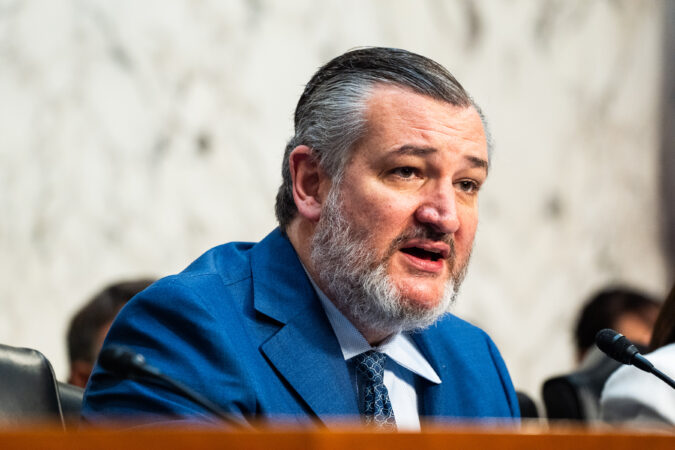
Sen. Ted Cruz sat down with a longtime ally in November at an office near D.C.’s Union Station to discuss the future of the Republican Party. Before long, the discussion touched on his own future.
His friend Morton Klein, president of the Zionist Organization for America, told Cruz he believed that “Jew hatred and Israel bashing” was on the rise on the right — and that something had to be done about it. Cruz, who had begun a series of speeches decrying antisemitism in the GOP, told Klein he had been fielding requests from people urging him to run for president in 2028.
Cruz came across as someone “seriously” considering such a run, Klein recalled.
With the future of the party up for grabs in a Donald Trump-less 2028 primary, Cruz has in recent months positioned himself as a loud voice for a more traditional, hawkish Republican foreign policy. He’s also urging the GOP to rid itself of popular MAGA pundit Tucker Carlson, whom he argues is injecting the “poison” of antisemitism into the movement with his broadsides against Israel. Carlson has rejected that characterization.
As he feuds with Carlson, Cruz is weighing a second presidential bid, according to a person close to the senator and another briefed on his thinking, who spoke like others on the condition of anonymity to disclose internal conversations. A White House run would be politically risky for Cruz, 55, putting him on course to collide with Vice President JD Vance, who many Republicans expect to enter the 2028 race.
Friction is already evident behind the scenes: Cruz has criticized Vance, a close ally of Carlson, to Republican donors, according to two people familiar with the comments. The senator has warned that Vance’s foreign policy views are dangerously isolationist, the people said.(Vance has been one of the GOP’s most prominent skeptics of U.S. intervention abroad.)
The emerging rivalry shows how much the party has changed under Trump’s leadership since Cruz arrived in the Senate in 2013. After rising to prominence as a rebel against the establishment, Cruz is now a vocal champion of some longtime orthodox GOP positions, as a new generation of conservatives is ascending with a different vision.
Some political observers are skeptical that another Cruz run would gain much traction. He can no longer run as an outsider and alienated some conservatives with his fight against Trump in the 2016 campaign. Still, Cruz has built name recognition and relationships with plenty of activists and donors across the country in recent years, and it’s far from clear what will animate the base in the next GOP primary.
“Can Ted help craft or meld together the traditional Republican approach with the new reality of what the Republican Party is now?” asked Daron Shaw, a political science professor at the University of Texas who overlapped with Cruz as a staffer on George W. Bush’s presidentialcampaign. “It’s a heavy lift.”
The day after his chat with Klein, Cruz called Carlson “a coward” during a speech before a group supporting Jewish conservatives in Las Vegas, again denouncing the “poisonous lies” of antisemitism. He said they were “blessed” to have Trump, who “loves the Jewish people,” in the White House right now.
“When Trump is not in the White House, what then?” he asked in his booming voice.
“Ted Cruz!” an audience member shouted.
The senator just smiled, then continued his speech.
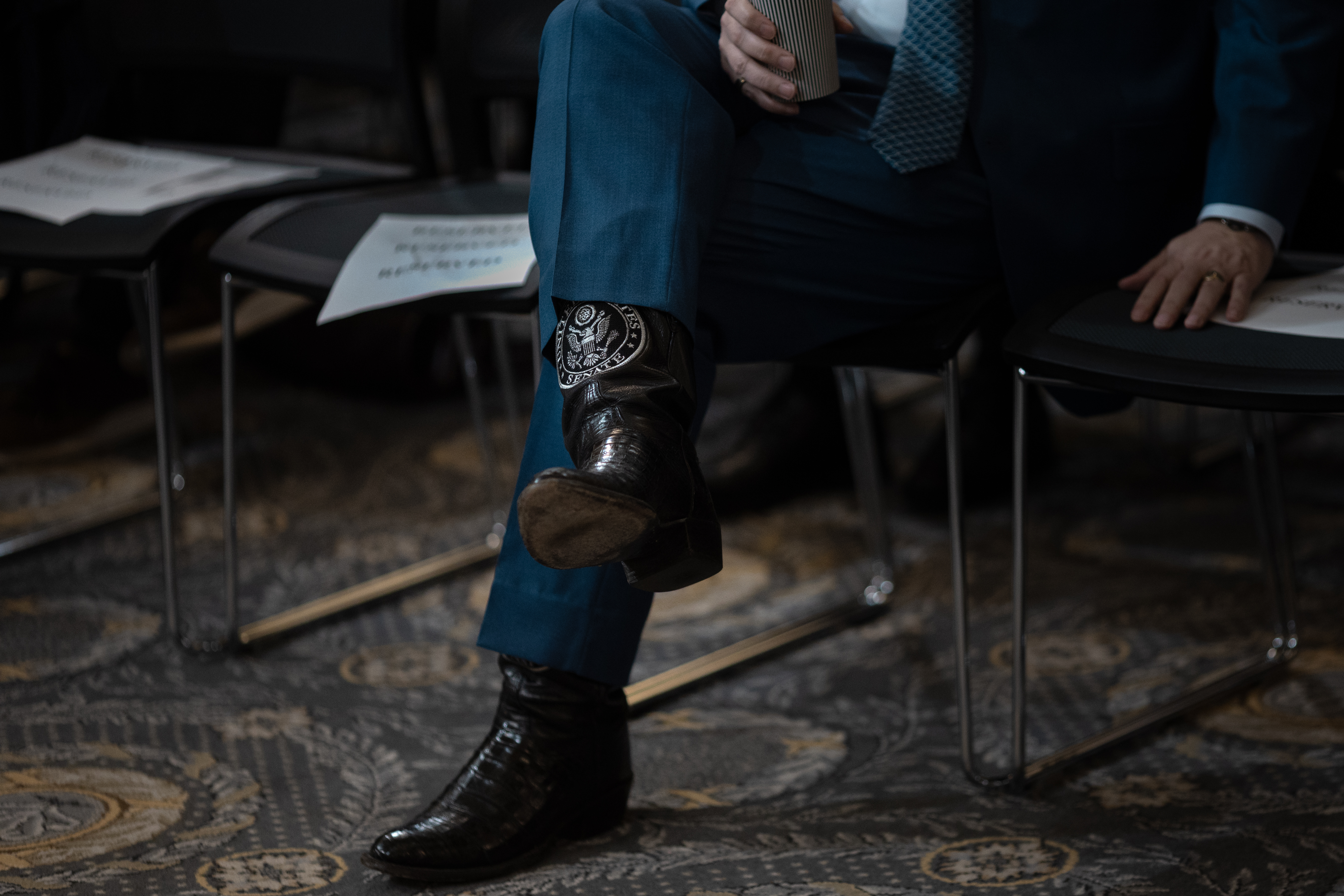
Sen. Ted Cruz (Texas) wears Senate-themed boots in May at the Capitol.
‘All of us hate Ted Cruz’
Anyone considering a run for the GOP nomination in 2028 faces a big obstacle: Vance.
The 41-year-old vice president leads early polls and is seen as a loyal lieutenant to Trump, who maintains high support from the party base even as the president’s approval ratings have plummeted.
But Trump has been noncommittal about endorsing his running mate as heir to his Make America Great Again movement, leaving an opening for an ambitious conservative with a different vision for the party.
“The Republicans will be fighting for their identity,” Rep. Marjorie Taylor Greene (R-Georgia) said of the 2028 primary. Greene, a close ally of Carlson who represents the populist and isolationist wing of the party, added: “There’ll be Ted Cruz, I’m sure, running against JD Vance. All of us hate Ted Cruz.”
Cruz has adapted to changes in his party over several decades in politics. Following a stretch in the establishment during Bush’s 2000 campaign, he became solicitor general of Texas in 2003 and launched a Senate campaign in 2011 as a tea-party-infused change agent, defeating the lieutenant governor in the GOP primary.
“The best thing to happen to the Republican Party was to get its teeth kicked in in 2008,” Cruz said during a 2012 campaign event with the libertarian Ron Paul.
When he arrived in Washington, Cruz picked fights over spending and President Barack Obama’s health care law, sparking a government shutdown in 2013. Not everyone in his party liked his style. “If you killed Ted Cruz on the floor of the Senate, and the trial was in the Senate, nobody could convict you,” Sen. Lindsey Graham (R-South Carolina) joked at a 2016 press dinner.
Cruz brought his insurgent pitch into the 2016 presidential race, but Trump caught fire with an antiestablishment campaign that dramatically eclipsed the senator’s. After bowing out of the GOP race as the last major Trump opponent standing, Cruz told delegates at the Republican National Convention that year to “vote your conscience,” instead of throwing his support behind Trump, who had branded him as “Lyin’ Ted.” He returned to the Senate, where he is now chair of the Commerce Committee and has refashioned himself into a bipartisan dealmaker on aviation safety and other issues.
The Texas senator, who has called himself a “noninterventionist hawk” and has long been a vocal ally of Israel, argues that an anti-Israel foreign policy could embolden terrorists. And he is a defender of the benefits of traditional capitalism at a time when some in the “New Right” are calling for a more populist turn.
“Those who are anti-Israel quickly become anti-capitalist and anti-American,” Cruz said in a brief interview about his decision to speak out against Carlson. “Tucker’s obsession is unhealthy and dangerous.”
By targeting Carlson and growing anti-Israel sentiment within the party, Cruz has hit upon a division within the GOP base that some believe could animate the 2028 primaries. Carlson is closely allied with Vance, a onetime Trump critic who is now an “America First” populist, embracing skepticism of some big-business interests and rejecting the U.S. foreign policy status quo.
Cruz is staking out positions against isolationism and antisemitism at a time when explicitly antisemitic figures such as white supremacist commentator Nick Fuentes are gaining an audience on the right.
Vance, by contrast,has rejected the suggestion that the right has a problem with antisemitism afterCarlson hosted Fuentes for a friendly interview. (The vice president disavowed Fuentes months before the interview and has not explicitly weighed in on Carlson hosting him.)
It’s “kind of slanderous to say that the Republican Party, the conservative movement, is extremely antisemitic,”Vancesaid in a recent interview with NBC News. In a social media postlast week, Vance criticized a news article claiming antisemitism was rising among young people.
“I would say there’s a difference between not liking Israel (or disagreeing with a given Israeli policy) and antisemitism,” he replied to one user.
Asked to respond to Vance’s comment, Cruz said he is not in agreement with “people who are anti-Israel or people who are antisemitic.”
“Every Hamas or Hezbollah or IRGC terrorist that Israel took out makes Americans safer,” Cruzsaid, referencing militants in Gaza, Lebanon and Iran that the United States designates as terrorist groups. “And those who don’t see that are not acting in accordance with American national security interests.”
The feud
In early July, Cruz sat down in Washington with Israel’s prime minister and delivered a dire warning. Over cigars at Blair House, Cruz told Benjamin Netanyahu that antisemitism on the right was rising to a level he had never seen before.
“No, Ted,” Netanyahu responded, according to Cruz, who recounted the conversation in a speech. “That’s Qatar, that’s Iran, that’s astroturf, that’s paid for.”
But Cruz said he was not placated. Replies to his social media posts were flooded with anti-Jewish bigotry from what looked to him like ordinary, real people. He began to fear that what he saw as antisemitism on the left was beginning to infect the right, he said.
In June, Cruz sat for an interview with Carlson that grew heated over the topic of Israel. Cruz suggested that Carlson criticizes Israel more than other countries because of bigotry toward Jews. Carlson said he has many Jewish friends who have the same questions as him and grilled Cruz with factual questions on the Middle East. In an uncharacteristic lapse, Cruz failed to identify the population of Iran. “You don’t know the population of the country you seek to topple?” Carlson asked.
Since then, the two have savaged each other in increasingly personal terms. Carlson has called Cruz “vulgar and dumb and reckless” for connecting U.S. military support for Israel to a biblical responsibility to defend the Holy Land and God’s chosen people. After Carlson hosted Fuentes on his podcast this fall, Cruz called on Republicans to repudiate the pundit.
Carlson “decided Jews are the source of all evil in the world,” Cruz said in a recent podcast. The senator also posted a digitally altered sexually suggestive photo of Carlson to critique his friendly stance toward Qatar, a U.S. ally with which Israel has clashed.
Since the killing of conservative influencer Charlie Kirk, internal battles about the future of the GOP have spilled into the open, many centering on the true meaning of “America First” as Trump spends time and political capital on Ukraine, Israel and Venezuela. Carlson criticized Trump’s decision to strike Iran’s nuclear sites in June and has warned the president against pursuing regime change in Venezuela, a goal Cruz shares.
“What Ted is trying to do is say, this is where our voters are,” said one person close to the senator. “Trump and Ted are much more aligned on foreign policy than Trump and Tucker are.”
Few Republicans have publicly rallied to Cruz’s side.
“I can tell you, my colleagues, almost to a person, think what is happening is horrifying,” Cruz said in one speech on Carlson. “But a great many of them are frightened because he has one hell of a big megaphone.”
Rep. Dan Crenshaw (R-Texas) said he “applauds” Cruz for speaking out against Carlson. But others declined to weigh in.
Sen. Tommy Tuberville (R-Alabama), a close Trump ally, said he believes the back-and-forth is personal. “Sometimes when you get embarrassed, you get mad, get your feelings hurt,” he said.
Sen. Richard Blumenthal (D-Connecticut) said he is surprised but happy that Cruz has the “courage” to challenge such a powerful figure on the right. “To give Senator Cruz due credit, it requires some guts and gumption to stand up against Tucker Carlson,” he said.
As Carlson and Cruz have attacked each other, Trump has declined to take sides, calling Carlson a “nice guy” and Cruz a “good friend” in recent months.
Carlson has said he thinks “antisemitism is immoral, and I am against it.” He argues the feud is just politics. “All [Cruz] wants is to be president. That’s all he’s ever wanted,” Carlson said in an interview. “As a political matter, he somehow thinks that calling me a Nazi is going to get him the nomination because it’s going to hurt JD Vance.” (Cruz has not publicly used that word to described Carlson.)
Rep. Ryan Zinke (R-Montana), who argued that Cruz damaged his credibility with conservatives after spurning Trump in 2016 but later recovered his standing, said Cruz “always has an eye on running.”
“Ted stakes out his position pretty well, and so were he to run, we know where he is,” Zinke said.
So far, there are few signs that Cruz is gaining an advantage. Hal Lambert, a major GOP donor who helped organize a super PAC to support Cruz when he ran for president in 2016, said he thinks a 2028 bid would be tricky for the senator.
“If JD Vance is running, I’m going to be supporting JD Vance,” Lambert said.
“I just don’t understand what the platform would be,” he said of Cruz’s potential run. “The platform would be, I’m Ted, and that’s JD?”
Kadia Goba and Sarah Ellison contributed to this report.
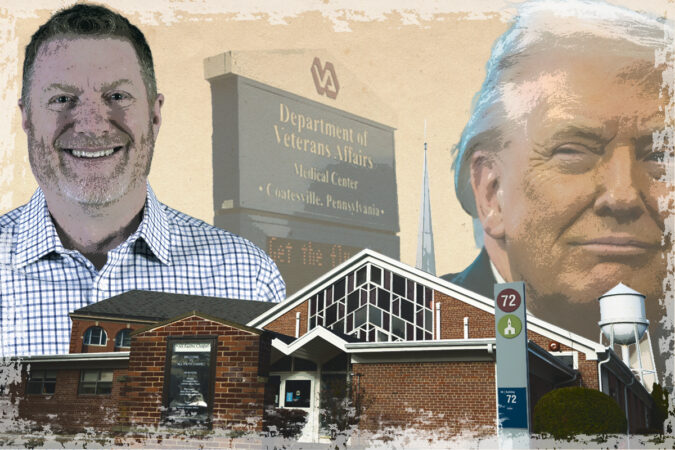
Russell “Rusty” Trubey said he was compelled by God to preach the words that helped set off a national battle over religion at the U.S. Department of Veterans Affairs.
Reading from a sermon titled“When Culture Excludes God,” Trubey, an Army Reserve chaplain, sermonized to a congregation of veterans at the Coatesville VA Medical Center from a Bible passage — Romans 1:23-32 — that refers to same-sex relationships as “shameful.”
Some congregants, upset by the sermon, walked out of the June 2024 service at the Chester County facility, where Trubey has been employed for roughly 10 years. Soon after, Trubey’s lawyers said he was temporarily pulled from his assignment — and transferred to stocking supply shelves — while his supervisors investigated his conduct.
Speaking to Truth and Liberty, a Christian group that advocates for the church to play a greater role in the public sphere, Trubey said he knows that reading the Bible verses about same-sex relationships is “100%” the reason he got in trouble.
One of the entrances leading into Coatesville VA Medical Center.
A month earlier, Trubey’s lawyers had taken hiscase to the White House. In a letter sent a few weeks after President Donald Trump’s inauguration, Trubey’s lawyers asked Trump’s VA secretary, Doug Collins, to interveneon Trubey’s behalf in regard to repercussions for the sermon.
Trubey had delivered the talk during former President Joe Biden’s administration — an environment that Trump officials allege was hostile to Christians.
In the letter, the chaplain’s lawyers from the First Liberty Institute and Independence Law Center accused Trubey’s supervisor of wanting sermons to be screened ahead of time for pre-approval and stated that Trubey received a letter of reprimand, which would later go on to be rescinded by Coatesville VA Medical Center officials.
Soon after the lawyers’ letter reached the new administration, the VA, one of the largest federal employers in Pennsylvania, reinstated Trubey to his position and Collins reaffirmed that chaplains’ sermons would not be censored.
But the fallout from this incident — paired with Trump’s ongoing campaign to root out perceived prejudice against Christians and dismantle diversity, equity, and inclusion — left an undeniable mark on the VA, helping to inspire an agencywide “Anti-Christian Bias Task Force.”
Announced to employees in April 2025, the task force asks employees to report offenses such as “reprimand issued in response to displays of Christian imagery or symbols,” per a department email reviewed by The Inquirer.
And the VA wants names.
In the email, the VA encouraged employees to identify colleagues and workplace practices that violate the policy and send information about the alleged offenses to a dedicated email address. The announcement was in accordance with a Trump executive order from February that ordered federal agencies to “eradicate” anti-Christian bias and create a larger White House task force composed of cabinet secretaries and chaired by Attorney General Pam Bondi.
As of this summer, the VA received more than 1,000 reports of anti-Christian bias and reviewed 500, according to task force documents. Another report is expected in February.
Some of the offenses the VA is on the watch for could be especially pertinent during the holiday season when workers may want their faith represented at their desks.
One union leader at the Veterans Benefits Administration office in Philadelphia called the task force, which does not extend to biases against other religions, “McCarthyism for Christians.”
“What they’re really doing is they’re trying to create a hostile work environment where you’re now afraid to say something because you may be reported,” said the union representative weeks after the VA’s task force announcement. The representative asked to speak anonymously out of fear of workplace retaliation.
The VA said in a statement that the department is “grateful” for Trump’s executive order. The VA did not answer The Inquirer’s questions on an updated number of reports received through the task force, what happens to people or practices that are reported, and next steps of the task force.
“As the EO stated, the prior administration ‘engaged in an egregious pattern of targeting peaceful Christians, while ignoring violent, anti-Christian offenses,’” said VA press secretary Pete Kasperowicz in the statement. “Under President Trump, VA will never discriminate against Veterans, families, caregivers or survivors who practice the Christian faith.”
One of those offenses, as outlined by the VA, is “informal policies, procedures, or unofficial understandings hostile to Christian views.” Another is retaliation against chaplains’ sermons, which appears to be in responseto the Trubey incident from June 2024.
Erin Smith, associate counsel at the First Liberty Institute, who helped represent Trubey said: “If Chaplain Trubey’s story serves as inspiration to help protect the rights of all chaplains in the VA, then that is a wonderful thing to come out of a terrible situation.”
But some VA employees disagree.
Ira Kedson, president of AFGE Local 310, which represents employees at the Coatesville VA Medical Center, said in an interview in June that he heard some employees were “deeply troubled” by the incident with Trubey, especially those who worked in clinical settings with patients who were in attendance of the controversial sermon.
“I was told that some of the residents were deeply hurt and deeply troubled by the situation and it took a long time for them to be able to move past it,” Kedson said.
Religion takes center stage in the Trump administration
Trump is leading what is arguably one of the most nonsecular presidencies in modern United States history with his embrace of a loyal, conservative Christian base.
“We’re bringing back religion in our country,” Trump said at the Rose Garden during the National Day of Prayer in May.
And efforts to elevate religion in the public sphere have gone beyond Trump’s rhetoric. For instance, the Office of Personnel Management, the federal government’s human resources agency, issued guidance that aims to protect religious expression in the workplace for all religions.
Most of the reports submitted to the VA focused on “denying religious accommodations for vaccines and provision of abortion services; mandating trainings inconsistent with Christian views; concealing Christian imagery; and Chaplain program and protections for Chaplains,” according to task force documents.
Doug Collins at his Jan. 21 confirmation hearing before the Senate Veterans’ Affairs Committee, at the Capitol in Washington.
Charles Haynes, senior fellow for religious liberty at the Freedom Forum, a nonpartisan organization based in Washington that promotes First Amendment rights, said while it’s not unconstitutional or unprecedented to createa faith-specific task force, “the appearance of [the Christian-bias task force], to many people, is a favoritism of the government for one group over another.”
The White House, in a statement, said Trump has a record of defending religious liberty regardless of faith.
“President Trump has taken unprecedented action to fight anti-Christian, anti-Semitic, and other forms of anti-religious bias while ending the weaponization of government against all people of faith,” said White House spokesperson Taylor Rogers in an email to The Inquirer.
Furthermore, she added, that the media is doing “insane mental gymnastics to peddle a false and negative narrative about the President’s efforts on behalf of nearly 200 million Christians across the country.”
Identifying anti-Christian bias or chasing a ‘unicorn’?
The Trump administration has shared few details about the operations and goals of the anti-Christian bias task force, raising questions from lawmakers and other stakeholders.
Rep. Mark Takano, the ranking member of the House Committee on Veterans’ Affairs, was in a monthslong back-and-forth with VA Secretary Collins, trying to get answers to an extensive list of questions he initially sent in May, with the California Democrat particularly concerned that the scope of the initiative is limited to bias against Christians.
“To preserve this right to religious freedom, the Department cannot prioritize one faith over others, nor can it allow religious considerations to shape its policies in ways that may conflict with the First Amendment,” Takano wrote in May. “Further, the vagueness of the task force’s mission raises significant concerns about how it will be used and whether it is compatible with the mission of the Department.”
Collins responded in June and did not answer most of Takano’s questions, though he did saythat the task force, which reports to the secretary, will identify, strategize, and potentially alter any policies that discriminate against Christians or religious liberty.
The lawmakerfollowed up a week later. Roughly four months later, in October, Collins’ responses were vague once again.Most recently, Takano is asking for both Democratic and Republican members of the House and Senate’s Veterans’ Affairs Committees to be looped in on future correspondence regarding the task force.
The VA, according to a statement from Takano, has not fully answered their questions and has refused to host a bipartisan briefing.
“The lack of transparency and accountability of this task force leaves me with numerous concerns for the due process and privacy of hardworking VA employees,” Takano said. “VA’s silence won’t stop us from asking the questions we are constitutionally obligated to ask.”
Rep. Mark Takano (D., Calif.) in August 2022, on Capitol Hill in Washington. Takano, ranking member of the House Committee on Veterans’ Affairs, has been trying to get answers from the VA on the Anti-Christian Bias Task Force.
Michael L. “Mikey” Weinstein, former counsel for the Reagan administration turned founder and president of the Military Religious Freedom Foundation, said his group is looking for a plaintiff to sue the government over the task force. The group has been receiving calls from VA employees concerned aboutit, one of whom, he said, was a senior physician at the VA Medical Center in Philadelphia.
The physician, Weinstein said, was distraught to receive the memo about the task force. He had family in town and noted the irony of showing his family around all the historical sites that signified the birthplace of American freedoms while being asked by the federal government to partake in such a project.
“It was like a dagger in his heart,” Weinstein said.
Weinstein is adamant that anti-Christian bias in the federal workforce is nonexistent, like looking for a “unicorn.”
Noticeably absent from the task force, critics say, is any effort to explore instances of discrimination against other faiths within federal agencies.
Trump has historically espoused hateful rhetoric against Muslims, including enacting a travel ban on individuals from predominantly Muslim countries during his first term. The president has issued an executive order this term to combat antisemitism on college campuses, but he also has a history of engaging with antisemites on the political right.
Ahmet Selim Tekelioglu, executive director of CAIR-Philadelphia, a nonprofit that aims to protect the civil rights of Muslims in the U.S., said he believes all forms of discrimination should be stamped out, but he’s concerned the task force isn’t affording those protections to everyone.
“It focuses exclusively on alleged anti-Christian conduct within the federal agencies, and in our opinion of this, risks then entrenching preferential treatment and signaling the protections that should exist for everyone is conditional, right?” Tekelioglu said.
There is hope, however, that this task force could lead to other future initiatives to root out hate, said Jason Holtzman, chief of Jewish Community Relations Council at the Jewish Federation of Greater Philadelphia.
“My hope is that hopefully they’re starting with the task force on Christian bias, and then maybe they’ll initiate one on antisemitism, Islamophobia, because I think task forces need to exist on all of these different forms of hate,” said Holtzman, noting that both Trump and Biden have taken action to combat antisemitism.
Haynes, the religious liberty expert, said anti-Christian bias is a “matter of perspective.”
“How you see it for the conservative Christian, what others would say is just creating an inclusive, safe workplace for everyone, they see, in some respects, as being anti-Christian,” Haynes said.
Haynes said that “anecdotal sort of stories” about prejudice against Christians pushed by conservative groups do not appear to be based in any kind of research into a widespread trend. But it only takes one story — as seen in Trubey’s case — to set off a firestorm.
And this year, Parker let go of three top city officials amid ordeals fraught with internal drama for the administration.
Despite those tribulations, the big-picture news for the city has been positive, and the mayor can credibly say she has made progress on her oft-repeated campaign slogan of making Philadelphia “the safest, cleanest, greenest big city in the nation with access to economic opportunity for all.”
"We are doing the best we can with what we have," Parker said in an interview Friday. “Nobody’s resting. We’re not having a party and celebrating because we know we have a lot more work to do.”
story continues after advertisement
The year encapsulated Philadelphia’s reality under Parker’s administration: big wins on major goals despite signs of tension in City Hall.
“She’s getting some pushback, but statistically, in terms of the crime rate, the city is doing better,” said David Dunphy, a Pennsylvania Democratic political consultant and lobbyist. “In terms of the biggest issues that voters had in the last election, it’s inarguable there’s been vast improvement.”
“There’s a general sense Philadelphia is coming back and making a rebound [following the pandemic], and she gets a lot of good will from the sense she enjoys being mayor,” Dunphy said.
Here are six takeaways from Parker’s second year in office.
story continues after advertisement
Big wins, with caveats
Parker made public safety the central themeof her 2023 mayoral campaign. And two years in, the news could hardly be better.
The Police Department as of last week had recorded 212 homicides in 2025, and is on pace to close the year with the lowest level since 1966.
But it’s not just the reduction in violence.
Philadelphia’s poverty rate has dipped below 20%, and it no longer has the highest rate among the 10 largest U.S. cities. The city’s finances are in the best shape they have been in since the early 1990s fiscal crisis. Perhaps most shockingly, there even appears to be progress in Kensington, where Parker has pledged to end the neighborhood’s notorious open-air drug market.
Onedrug dealer told The Inquirer the city’s crackdown has cut his weekly revenue from about $1,500 to $400. And the city isexpanding its Riverview Wellness Village, a first-of-its-kind initiative from Parker’s administration to house and provide treatment for people in recovery.
There are plenty of caveats to all of those headline accomplishments. The decline in homicides began shortly before Parker took office. Philadelphia still has the lowest median income of the 10 biggest cities in the country. The city’s finances, buoyed by a growing economy, have been growing more stable for decades. And the Kensington drug market isn’t disappearing anytime soon.
Workers from Philadelphia’s Community Life Improvement Program clean the intersection of Kensington Avenue and Somerset Street on Jan. 22, 2025.Jessica Griffin / Staff Photographer
But mayors are judged by how the city changes during their tenures. And so far, Parker is likely pleased with her progress on the most important measuring sticks.
“She communicated during the campaign and throughout the beginning of her term a set of priorities that everybody can repeat: the safe, clean, green, inclusive growth or opportunity for all,” said Pedro A. Ramos, a former city managing director who now leads the Philadelphia Foundation, a major philanthropy. “Two years in, I think any fair scorecard has got to give her pretty good grades.”
Tom Gralish / Staff Photographer
Strike highlighted Parker’s strengths and weaknesses
During the first major city worker strike in 40 years, the mayor stoodatop the Philadelphia Art Museum steps in sweltering heat as what were unofficially dubbed “Parker piles” of uncollected trash mounted around the city.
“I will not put the fiscal stability of the city of Philadelphia in jeopardy for no one,” Parker said, explaining her refusal to meet demands for bigger wage increases for the union representing trash collectors, 911 dispatchers, water treatment plant employees, and other blue-collar workers. “If that means I’m a one-term mayor, then so be it.”
Philadelphia Mayor Cherelle L. Parker discusses the AFSCME DC 33 municipal workers strike at a news conference at the Philadelphia Art Museum on Thursday, July 3, 2025.Kaiden J. Yu / Staff Photographer
But the strike was also the most divisive moment in Parker’s tenure, fuelingtensions within organized labor and leading to accusations that Parker didn’t care about the workers’ plight.
Teamsters Local 107 president Bill Hamilton said the mayor encouraged workers to cross picket lines and “should be ashamed of her actions and her words during this strike.”
“She doesn’t have any friends on my side of labor, I can tell you that,” he said.
Parker said that being at odds with labor was “abnormal” for her and that she was disappointed the strike led some people to believe she was not a strong supporter of organized labor.
”Was I disappointed? Yes, because it wasn’t reflective of my career and everything I had done," Parker said in the interview. “But I also respect the union.”
Alejandro A. Alvarez / Staff Photographer
Parker’s don’t-poke-the-bear strategy with Trump
In August, the U.S. Department of Justice sent so-called sanctuary cities a letter threatening to cut off federal funding if they did not get in line with the Trump administration’s immigration policies.
Like many other Democratic leaders, Boston Mayor Michelle Wu excoriated the Trump administration andpublished a scathing response to the DOJ.
But Parker said nothing. Her administration refused to release Philadelphia’s response to the DOJ letter and is still fighting an Inquirer request for the document under Pennsylvania’s Right to Know Law.
Since President Donald Trump took office in January, Parker has rarely if ever uttered the president’s name in public. Supporters sayher don’t-poke-the-bear approach has saved Philadelphia from Trump’s wrath and kept National Guard troops out of the city while theywere deployed to other major U.S. cities. Critics say it shows an unwillingness to stand tall during a dangerous moment in American history.
Read More
Mayor Parker’s restraint with Trump is both calculation and gamble as the president escalates against blue cities
Mayor Cherelle L. Parker has avoided overtly criticizing Trump, even as the president has sought to deploy troops to other American cities against the will of their Democratic mayors.
“We are living in actual fascism,” said City Councilmember Nicolas O’Rourke, of the progressiveWorking Families Party. “It’s clear the mayor is being calculating. That is not the tactic I would take. I think we need to be more pronounced.”
Parker said her goal was to focus on delivering on her campaign promises without letting politics get in the way.
“If there were ever a time that the citizens of Philadelphia needed a mayor to stay laser-focused on doing everything we can with the scarce resources that we have … that time is now,” Parker said. “Some people won’t like it. That’s very unfortunate, but I have to lead in a way that’s authentic to me.”
Kaiden J. Yu / Staff Photographer
A remarkable level of control over Philly’s political arena
In one meeting in June, Council approved the initial legislation for the H.O.M.E. initiative, a $6.8 billion city budget, and a 13-year plan to gradually cut the business tax — all while makingminimal changes to Parker’s proposals.
For a moment, it appeared Council President Kenyatta Johnson had gotten rolled by Parker. But Johnson, standing next to Parker at a celebratory news conference, revealed they had been working together all along, even before Parker unveiled her budget and tax plans three months earlier.
“Folks want to see us fight,” Johnson said. “A while ago … we had the John Street-Ed Rendell partnership when the city thrived. We haven’t seen it since then, quite frankly.”
City Council President Kenyatta Johnson and Mayor Cherelle L. Parker at City Hall on Thursday, Dec. 19, 2024.Tom Gralish / Staff Photographer
It’s difficult to overstate the significance of the comparison. In the 1990s, Mayor Ed Rendell and Council President John F. Street formed an unlikely partnership that was credited with saving the city from the brink of bankruptcy. No mayor and Council presidenthave worked together as closely since.
The moment highlighted how Parker has amassed a remarkable level of control over institutions in Philadelphia government and politics that have tripped up past mayors’ agendas.
In City Hall, Parker’s alliance with Johnson has seen her agenda largely sail through the legislature. City Controller Christy Brady, whose office has historically been a thorn in the sides of mayors, ran for reelection this year on a platform of working with, and not against, the Parker administration.
And the unions for city workers,which have inflicted lasting wounds on past mayors including Rendell and Michael A. Nutter, are all locked in multi-year contracts after Parker’s successful stand against DC 33’s strike.
Politically, the centrist Democratic mayor has a seemingly unbreakable bond with some of the most influential labor organizations in the city — the Philadelphia Building and Construction Trades Council, the Carpenters union, and the Service Employees International Union Local 32BJ — and she is usually in lockstep with Democratic City Committee Chair Bob Brady.
Additionally, potential threats from both the right and the left have not materialized, with the Philly GOP in the political wilderness and the local progressive movement appearing to have lost some momentum.
Parker said the support she has built in Philadelphia politics is not a strategy but the product of her career in public service, which began when she was a teenager interning for former Councilmember Marian Tasco.
“These are organic relationships. These are not like forced marriages,” Parker said. “I’ve been working with all of these people my whole life.”
Council took its most notable stand against Parker during a fight this fall over legislation related to the H.O.M.E. initiative.Johnson sided with lawmakers who wanted to prioritize funding for housing programs for the city’s lowest-income Philadelphians, defying Parker’s plan to spread the benefits more evenly across low- and middle-income households.
But Council still supports the major tenets of H.O.M.E., and Johnson made clear earlier this month the episodedid not damage his alliance with Parker. He even made an unsolicited early endorsement for her 2027 reelection campaign.
“I’m pretty confident that our mayor will be reelected — that’s my personal opinion — and will have my support to get reelected,“ said Johnson, the only senior Democratic member of Council who did not endorse Parker in the 2023 mayor’s race.
Despite facing little political opposition, Parker clearly still sees enemies in many corners.
The mayor bristles at dissent even when she wins, and has recently has been handing out to journalists, administration officials, and others copies of a 98-page book titled Performative Outrage: How Manufactured Fury Undermines Local Government and Public Service.
“It is truly our blueprint,” chief of staff Tiffany W. Thurman said. “It reminds us that noise isn’t the same as progress. … We don’t chase the outrage of the moment. We chase the outcomes of a lifetime.”
The city in August spent $423.80 to order copies for every cabinet member, according to records for the mayor’s office credit card.
Parker signed a copy of the book, which was given to a reporter, writing: “Great read!”
Tom Gralish / Staff Photographer
Signs of discord within the administration
Parker freely admits she is a tough boss. And the strains of working under her demanding leadership style started to show in her second year.
But Anderson, the former DEI director, pushed back on that account, and asserted that DeSantis’ investigation was a pretext for Parker to fire her because she had pushed for the administration to take a more aggressive stance against Trump’s DEI crackdown. Her comments took on new salience whenThe Inquirer revealed this fall that Parker had quietly ended the city’s longstanding policy of prioritizing city contracts for businesses owned by women, people of color, or disabled people due to legal threats from conservative groups.
Parker said personnel issues come with the territory of running a city.
“Things happen. You can’t have a government with 29,000 employees where stuff doesn’t just happen,” she said. “For me, it’s how does my administration navigate those challenges? … Do we get paralyzed into inaction? And the answer is no.”
Ramos added that Parker will be judged by outcomes, not internal disputes.
“At the end of the day, people only care about palace intrigue if they don’t see results,” Ramons said.
Tom Gralish / Staff Photographer
A ‘big mahoff’ emerges
When she became mayor, Parker said she didn’t want one top aide to be the “big mahoff” in her administration. Instead she appointed a “big three” — a trio of senior advisers.
Two years later, it looks like Parker ended up with a “big mahoff” after all.
Thurman, the chief of staff, appears to have become the central figure in the administration, and her portfolio of responsibilities has continually grown over the last two years.
The shift started in 2024, when Thurman took over the 76ers arena negotiations from then-Chief Deputy Mayor Aren Platt. And when Platt resigned in October of that year, Thurman took over the oversight of all the city’s planning and development projects. This year, her portfolio has grown to include the Neighborhood Community Action Centers, a Parker initiative to establish 10 “mini-City Halls” throughout the city, where residents can request services like graffiti removal and traffic-calming measures.
Chief of staff Tiffany W. Thurman takes questions from City Council on Nov. 12, 2024.Alejandro A. Alvarez / Staff Photographer
Parker objected to the notion that her “big three” structure had gone by the wayside and emphasized that the two chief deputy mayors who make up the rest of the triumvirate continue to have “a hell of a lot” in their portfolios. Sinceré Harris, who was Parker’s 2023 campaign manager, oversees labor, legislative affairs, and intergovernmental relations. Vanessa Garrett-Harley leads on child welfare, early education, DEI, and other issues.
Thurman could instead be seen as a first among equals, given that Harris and Garrett-Harley still report directly to the mayor.
But at Friday’s event, Thurman introduced Parker with a flattering speech, and the mayor in turn made clear that Thurman has a central role in her administration.
“Tiffany Thurman is not just my chief of staff. She is the chief air traffic controller” of the administration, Parker said Friday. “Nothing moves in this city without her. I don’t make a decision without her.”
Tom Gralish / Staff Photographer
Staff Contributors
Reporting: Sean Collins Walsh, Anna Orso, Jake Blumgart, Ellie Rushing, and Ryan Briggs
Editing: Oona Goodin-Smith, Ariella Cohen, and Addam Schwartz
Digital Editing: Patricia Madej
Subscribe to The Philadelphia Inquirer
Our reporting is directly supported by reader subscriptions. If you want more journalism like this story, please subscribe today
WEST PALM BEACH, Fla. — Deputy Attorney General Todd Blanche on Sunday defended the Justice Department’s decision to release just a fraction of the Jeffrey Epstein files by the congressionally mandated deadline as necessary to protect survivors of sexual abuse by the disgraced financier.
Blanche pledged that the Trump administration eventually would meet its obligation required by law. But he stressed that the department was obligated to act with caution as it goes about making public thousands of documents that can include sensitive information.
Friday’s partial release of the Epstein files has led to a new crush of criticism from Democrats who have accused the Republican administration of trying to hide information.
Blanche called that pushback disingenuous as President Donald Trump’s administration continues to struggle with calls for greater transparency, including from members of his political base, about the government’s investigations into Epstein, who once counted Trump as well as several political leaders and business titans among his peers.
“The reason why we are still reviewing documents and still continuing our process is simply that to protect victims,” Blanche told NBC’s Meet the Press. “So the same individuals that are out there complaining about the lack of documents that were produced on Friday are the same individuals who apparently don’t want us to protect victims.”
Blanche’s comments were the most extensive by the administration since the file dump, which included photographs, interview transcripts, call logs, court records, and other documents. But some of the most consequential records expected about Epstein were nowhere to be found, such as FBI interviews with survivors and internal Justice Department memos examining charging decisions. Those records could help explain how investigators viewed the case and why Epstein was allowed in 2008 to plead guilty to a relatively minor state-level prostitution charge.
Trump, who was friends with Epstein for years before the two had a falling out, tried for months to keep the records sealed. Though Trump has not been accused of wrongdoing in connection with Epstein, he has argued there is nothing to see in the files and that the public should focus on other issues.
Federal prosecutors in New York brought sex trafficking charges against Epstein in 2019, but he killed himself in jail after his arrest.
Democrats see a cover-up, not an effort to protect victims
But Democratic lawmakers on Sunday hammered Trump and the Justice Department for a partial release.
Rep. Jamie Raskin (D., Md.) argued that the Justice Department is obstructing the implementation of the law mandating the release of the documents not because it wants to protect the Epstein victims.
“It’s all about covering up things that, for whatever reason, Donald Trump doesn’t want to go public, either about himself, other members of his family, friends, Jeffrey Epstein, or just the social, business, cultural network that he was involved in for at least a decade, if not longer,” he said on CNN’s State of the Union.
Blanche also defended the department’s decision to remove several files related to the case from its public webpage, including a photograph showing Trump, less than a day after they were posted.
The missing files, which were available Friday but no longer accessible by Saturday, included images of paintings depicting nude women, and one showed a series of photographs along a credenza and in drawers. In that image, inside a drawer among other photos, was a photograph of Trump alongside Epstein, Melania Trump, and Epstein’s longtime associate, Ghislaine Maxwell.
Blanche said the documents were removed because they also showed victims of Epstein. Blanche said that the Trump photo and the other documents will be reposted once redactions are made to protect survivors.
“It has nothing to do with President Trump,” Blanche said. “There are dozens of photos of President Trump already released to the public seeing him with Mr. Epstein.”
The thousands of Epstein-related records posted publicly offer the most detailed look yet at nearly two decades worth of government scrutiny of Epstein’s sexual abuse of young women and underage girls. Yet Friday’s release, replete with redactions, has not dulled the clamor for information given how many records had yet to be released and because some of the materials had already been made public.
Blanche says DOJ has just learned of more potential victims
Blanche said that the department continues to review the trove of documents and has learned the names of additional potential victims in recent days.
The deputy attorney general also defended the decision by the federal Bureau of Prisons, which Blanche oversees, to transfer Maxwell to a less restrictive, minimum-security federal prison earlier this year soon after he interviewed her about Epstein. Blanche said that the transfer was made because of concerns about her safety.
Maxwell, Epstein’s onetime girlfriend, is serving a 20-year federal prison sentence for her 2021 conviction for sex trafficking crimes.
“She was suffering numerous and numerous threats against her life,” Blanche said. “So the BOP is not only responsible for putting people in jail and making sure they stay in jail, but also for their safety.”
Meanwhile, Reps. Ro Khanna (D., Calif.) and Thomas Massie (R., Ky.) have indicated they could draft articles of impeachment against Attorney General Pam Bondi for what they see as the gross failure of the department to comply with the Epstein Files Transparency Act.
“It’s not about the timeline, it’s about the selective concealment,” Khanna said on CBS’ Face the Nation, adding that the redactions in the released files are excessive. He said he believes there will be “bipartisan support in holding her accountable, and a committee of Congress should determine whether these redactions are justified or not.”
House Democratic leader Hakeem Jeffries of New York said on ABC’s This Week that there needs “to be a full and complete explanation and then a full and complete investigation as to why the document production has fallen short of what the law clearly required,” but he stopped short of backing impeachment.
Blanche dismissed the impeachment talk.
“Bring it on,” Blanche said. “We are doing everything we’re supposed to be doing to comply with this statute.”
ALBANY, N.Y. — Rep. Elise Stefanik announced Friday that she is suspending her campaign for New York governor and will not seek reelection to Congress, bowing out of the race in a surprise statement that said “it is not an effective use of our time” to stay in what was expected to be a bruising Republican primary.
Stefanik, a Republican ally of President Donald Trump, said in a post on X that she was confident of her chances in the primary against Bruce Blakeman, a Republican county official in New York City’s suburbs. But she said she wanted to spend more time with her young son and family.
“I have thought deeply about this and I know that as a mother, I will feel profound regret if I don’t further focus on my young son’s safety, growth, and happiness — particularly at his tender age,” she said.
Stefanik has been an intense critic of incumbent Democratic Gov. Kathy Hochul, who is also seeking reelection but faces a primary challenge from her own lieutenant governor, Antonio Delgado.
The announcement marks an abrupt end, at least for now, for a once-promising career for Stefanik. She was the youngest woman ever elected to Congress when she won her first campaign in 2014 at just 30 years old, representing a new generation of Republicans making inroads in Washington. She ultimately rose to her party’s leadership in the House when she became the chair of the House Republican Conference in 2021.
First viewed as a moderate when she came to Washington, Stefanik became far more conservative as Trump began to dominate the party. Once someone who refused to say Trump’s name, she became one of his top defenders during his first impeachment inquiry. She would go on to vote against certifying the 2020 election results, even after a violent mob stormed the Capitol on Jan. 6.
Stefanik was expected to have a bitter Republican primary against Blakeman, who also counts himself as an ally of Trump. The president had so far seemed keen on avoiding picking a side in the race, telling reporters recently: “He’s great, and she’s great. They’re both great people.”
Stefanik’s decision follows a clash with Speaker Mike Johnson, whom she accused of lying before embarking on a series of media interviews criticizing him. In one with The Wall Street Journal, she called Johnson a “political novice” and said he wouldn’t be reelected speaker if the vote were held today.
The tumultuous early December episode appeared to cool when Johnson said he and Stefanik had a “great talk.”
“I called her and I said, ‘Why wouldn’t you just come to me, you know?’” Johnson said. “So we had some intense fellowship about that.”
Still, Stefanik, the chairwoman of the House Republican leadership, has not fully walked back her criticisms. A Dec. 2 social media post remains online in which, after a provision she championed was omitted from a defense authorization bill, Stefanik accused Johnson of falsely claiming he was unaware of it, calling it “more lies from the Speaker.”
State Republican Chairman Ed Cox said the party respected Stefanik’s decision and thanked her for her efforts.
“Bruce Blakeman has my endorsement and I urge our State Committee and party leaders to join me,” Cox said in a prepared statement. “Bruce is a fighter who has proven he knows how to win in difficult political terrain.”
WASHINGTON — The Justice Department released thousands of files Friday about convicted sex offender Jeffrey Epstein but the incomplete document dump did not break significant ground about the long-running criminal investigations of the financier or his ties to wealthy and powerful individuals.
The files included a small number of photos of President Donald Trump, sparing the White House for now from having to confront fresh revelations about an Epstein relationship that the administration for months has tried in vain to push past.
It did, however, feature a series of never-before-seen photos of Bill Clinton from a trip that the former president appears to have take with Epstein decades ago.
Reaction to the disclosures broke along mostly partisan lines. Democrats and some Republicans seized on the limited release to accuse the Justice Department of failing to meet a congressionally set deadline to produce the Epstein files. White House officials on social media gleefully promoted a photo of Clinton in a hot tub with a person with a blacked-out face. The Trump administration touted the release as a show of its commitment to transparency, ignoring the fact that the Justice Department just months ago said no more files would be released. Congress then passed a law mandating it.
The records, consisting largely of pictures but also including call logs, grand jury testimony, interview transcripts, and other documents, arrived amid extraordinary anticipation that they might offer the most detailed look yet at nearly two decades worth of government scrutiny of Epstein’s sexual abuse of young women and underage girls. Their release has long been demanded by a public hungry to learn whether any of Epstein’s associates knew about or participated in the abuse. Epstein’s accusers have also sought answers about why federal authorities shut down their initial investigation into the allegations in 2008.
Yet the release, replete with redactions. seemed unlikely to satisfy the public clamor for information given how many investigative records the department indicated it was continuing to withhold.
In a letter to Congress obtained by The Associated Press, Deputy Attorney General Todd Blanche wrote that the Justice Department was continuing to review files in its possession and expected additional disclosures by the end of the year. The department also said it was withholding some documents under exemptions allowed in the law and was redacting names of victims. The department expects to complete its document production by the end of the year, Blanche said.
Bowing to political pressure from fellow Republicans, Trump on Nov. 19 signed a bill giving the Justice Department 30 days to release most of its files and communications related to Epstein, including information about the investigation into his death in a federal jail. The law’s passage, which set a deadline for Friday, was a remarkable display of bipartisanship that overcame months of opposition from Trump and Republican leadership.
Limited details about Trump
The released files include a small number of photos of Trump, which appear to have been known for decades, including two in which Trump and Epstein are posing with now-first lady Melania Trump in February 2000 at an event at Trump’s Palm Beach club, Mar-a-Lago, before the pair’s friendship ruptured.
Trump was friends with Epstein for years before the two had a falling-out. Neither he nor Clinton has ever been accused of wrongdoing in connection with Epstein, and the mere inclusion of someone’s name in files from the investigation does not imply otherwise.
Attorney General Pam Bondi said last month that she had ordered a top federal prosecutor to investigate Epstein’s ties to Trump’s political foes, including Clinton. Bondi acted after Trump pressed for such an inquiry, though he did not explain what supposed crimes he wanted the Justice Department to investigate.
In July, Trump dismissed some of his own supporters as “weaklings” for falling for “the Jeffrey Epstein hoax.” But both Trump and House Speaker Mike Johnson (R., La.) failed to prevent the legislation from coming to a vote.
Trump did a U-turn on the files once it became clear that congressional action was inevitable. He insisted that the Epstein matter had become a distraction to the Republican agenda and that releasing the records was the best way to move on.
After nearly two decades of court action and prying by reporters, a voluminous number of records related to Epstein had already been public well before Froday, including flight logs, address books, email correspondence, police reports, grand jury records, courtroom testimony, and transcripts of depositions of his accusers, his staffers and others.
New photos of Clinton
Senior Trump White House aides took to X to promote photos in the Epstein files that show Clinton with women whose faces are redacted.
Karoline Leavitt, the White House press secretary, wrote “Oh my!” and added a shocked face emoji in response to a photo of Clinton in a hot tub with a woman whose face was redacted.
“They can release as many grainy 20-plus-year-old photos as they want, but this isn’t about Bill Clinton,” Clinton spokesman Angel Ureña said in a statement.
“There are two types of people here,” he said. “The first group knew nothing and cut Epstein off before his crimes came to light. The second group continued relationships after that. We’re in the first. No amount of stalling by people in the second group will change that.”
The Epstein investigations
Police in Palm Beach, Fla., began investigating Epstein in 2005 after the family of a 14-year-old girl reported she had been molested at his mansion. The FBI joined the investigation, and authorities gathered testimony from multiple underage girls who said they had been hired to give Epstein sexual massages.
Ultimately, though, prosecutors gave Epstein a deal that allowed him to avoid federal prosecution. He pleaded guilty to state prostitution charges involving someone under age 18 and was sentenced to 18 months in jail.
Epstein’s accusers then spent years in civil litigation trying to get that plea deal set aside. One of those women, Virginia Giuffre, accused Epstein of arranging for her to have sexual encounters, starting at age 17, with numerous other men, including billionaires, famous academics, U.S. politicians, and Andrew Mountbatten-Windsor, then known as Britain’s Prince Andrew. Mountbatten-Windsor denied ever having sex with Giuffre, but King Charles III stripped him of his royal titles this year after Giuffre’s memoir was published after she died.
Prosecutors never brought charges in connection with Giuffre’s claims, but her account fueled conspiracy theories about supposed government plots to protect the powerful. Giuffre died by suicide at her farm in Western Australia in April at age 41.
Federal prosecutors in New York brought new sex trafficking charges against Epstein in 2019, but he killed himself in jail a month after his arrest. Prosecutors then charged Epstein’s longtime confidant, British socialite Ghislaine Maxwell, with recruiting underage girls for Epstein to abuse.
Maxwell was convicted in late 2021 and is serving a 20-year prison sentence, though she was moved from a low-security federal prison in Florida to a minimum-security prison camp in Texas after she was interviewed over the summer by Blanche. Her lawyers argued that she never should have been tried or convicted.
The Justice Department in July said it had not found any information that could support prosecuting anyone else.
WASHINGTON — Secretary of State Marco Rubio was hopeful but clear about the challenges facing the Trump administration’s Russia-Ukraine and Israel-Hamas peace efforts and defended increasing U.S. military pressure on Venezuela during a marathon end-of-year news conference Friday.
In a freewheeling exchange with reporters running more than two hours, Rubio offered no predictions for timing or success on any of those three issues. He also said he was proud of President Donald Trump’s radical overhaul in foreign assistance and that the administration was working to reach a humanitarian ceasefire in Sudan in time for the new year.
Rubio’s rare and lengthy appearance in the State Department briefing room came as key meetings on Gaza and Russia-Ukraine are being held in Miami on Friday and Saturday after a tumultuous year in U.S. foreign policy. Rubio has assumed the additional role of national security adviser and emerged as a staunch defender of Trump’s “America First” priorities on issues ranging from visa restrictions to a shakeup of the State Department bureaucracy.
Talks on Ukraine and Gaza are planned
Rubio spoke about peace efforts as national security officials from Britain, France, and Germany were taking part in talks in Florida with Ukraine’s lead negotiator, Rustem Umerov, and envoys Steve Witkoff and Jared Kushner to discuss the latest iteration of Trump’s Ukraine-Russia peace proposal.
A White House official, who spoke on condition of anonymity because of the sensitivity of the matter, said Witkoff and Kushner, who is Trump’s son-in-law, also would see Egyptian, Turkish, and Qatari officials Friday for talks on how to get to the next phase of Trump’s plan to end the Israel-Hamas war in Gaza.
Progress on Trump’s Gaza ceasefire plan has moved slowly since it was announced in October. U.S. officials have been pushing to get the plan implemented by setting up a “Board of Peace” that would oversee the territory after two years of war and create an international stabilization force that would police the area.
“I think we owe them a few more answers before we get there,” Rubio said when asked about contributions to the stabilization force. After establishing the Board of Peace and a Palestinian technocratic group to govern Gaza, “that will allow us to firm up the stabilization force, including how it’s going to be paid for, what the rules of engagement are, what their role will be in demilitarization.”
In a whirlwind of diplomacy, Witkoff and Kushner are also set to meet Saturday with Russian President Vladimir Putin’s adviser Kirill Dmitriev in Miami, officials said. Rubio, who will be at his home in Florida for the holidays, said he would probably attend the meeting.
But he said there would be no peace deal unless both Ukraine and Russia can agree to the terms, making it impossible for the U.S. to force a deal on anyone. Instead, the U.S. is trying to “figure out if we can nudge both sides to a common place.”
“We understand that you’re not going to have a deal unless both sides have to give, and both sides have to get,” Rubio said. “Both sides will have to make concessions if you’re going to have a deal. You may not have a deal. We may not have a deal. It’s unfortunate.”
The U.S. proposal has been through numerous versions with Trump seesawing back and forth between offering support and encouragement for Ukraine and then seemingly sympathizing with Putin’s hard-line stances by pushing Ukrainian President Volodymyr Zelensky to agree to territorial concessions. Kyiv has rejected that concession in return for security guarantees intended to protect Ukraine from future Russian incursions.
Rubio defends U.S. policy toward Venezuela
On Venezuela, Rubio has been a leading proponent of military operations against suspected drug-running vessels targeted in the Caribbean Sea and eastern Pacific Ocean since early September. The actions have ramped up pressure on leftist Venezuelan President Nicolás Maduro, who has been charged with narcoterrorism in the U.S.
Rubio defended Trump’s prerogatives on Venezuela and said the administration believes “nothing has happened that requires us to notify Congress or get congressional approval or cross the threshold into war.” He added, “We have very strong legal opinions.”
In an NBC News interview Friday, Trump would not rule out a war with Venezuela. Rubio and Defense Secretary Pete Hegseth have publicly maintained that the current operations are directed at “narcoterrorists” trying to smuggle deadly drugs into the United States. Maduro has insisted the real purpose is to force him from office.
Rubio sidestepped a direct question about whether the U.S. wants “regime change in 2026” in the South American country.
“We have a regime that’s illegitimate, that cooperates with Iran, that cooperates with Hezbollah, that cooperates with narcotrafficking and narcoterrorist organizations,” Rubio said, “including not just protecting their shipments and allowing them to operate with impunity, but also allows some of them to control territory.”
Other peacemaking efforts at risk
Trump has spoken of wanting to be remembered as a “peacemaker,” but ceasefires his administration helped craft are already in trouble due to renewed military action between Cambodia and Thailand as well as Rwanda and Congo. Rubio, however, said those deals created a list of commitments that can now be used to push the parties back to peace.
“Those commitments today are not being kept,” Rubio said of the Thailand-Cambodia conflict, which now threatens to reignite following Thai airstrikes. “The work now is to bring them back to the table.”
In a departure from his predecessors who often limited questions to just four, Rubio responded to queries, including a handful in Spanish, from nearly every reporter seated in the 59-seat briefing room, which has not been used since the State Department ended its twice-weekly press briefings in August.
Since taking over the department, Rubio has moved swiftly to implement Trump’s “America First” agenda, helping dismantle the U.S. Agency for International Development and reducing the size of the diplomatic corps through a significant reorganization. Previous administrations have distributed billions of dollars in foreign assistance over the past five decades through USAID.
Critics have said the decision to eliminate USAID and slash foreign aid spending has cost lives overseas, although Rubio and others have denied this, pointing to ongoing disaster relief operations in the Philippines, the Caribbean and elsewhere, along with new global health compacts being signed with countries that previously had programs run by USAID.
“We have a limited amount of money that can be dedicated to foreign aid and humanitarian assistance,” Rubio said. “And that has to be applied in a way that furthers our national interest.”
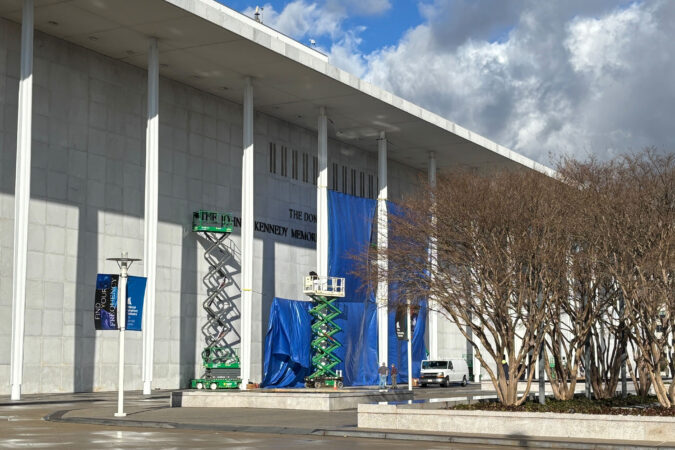
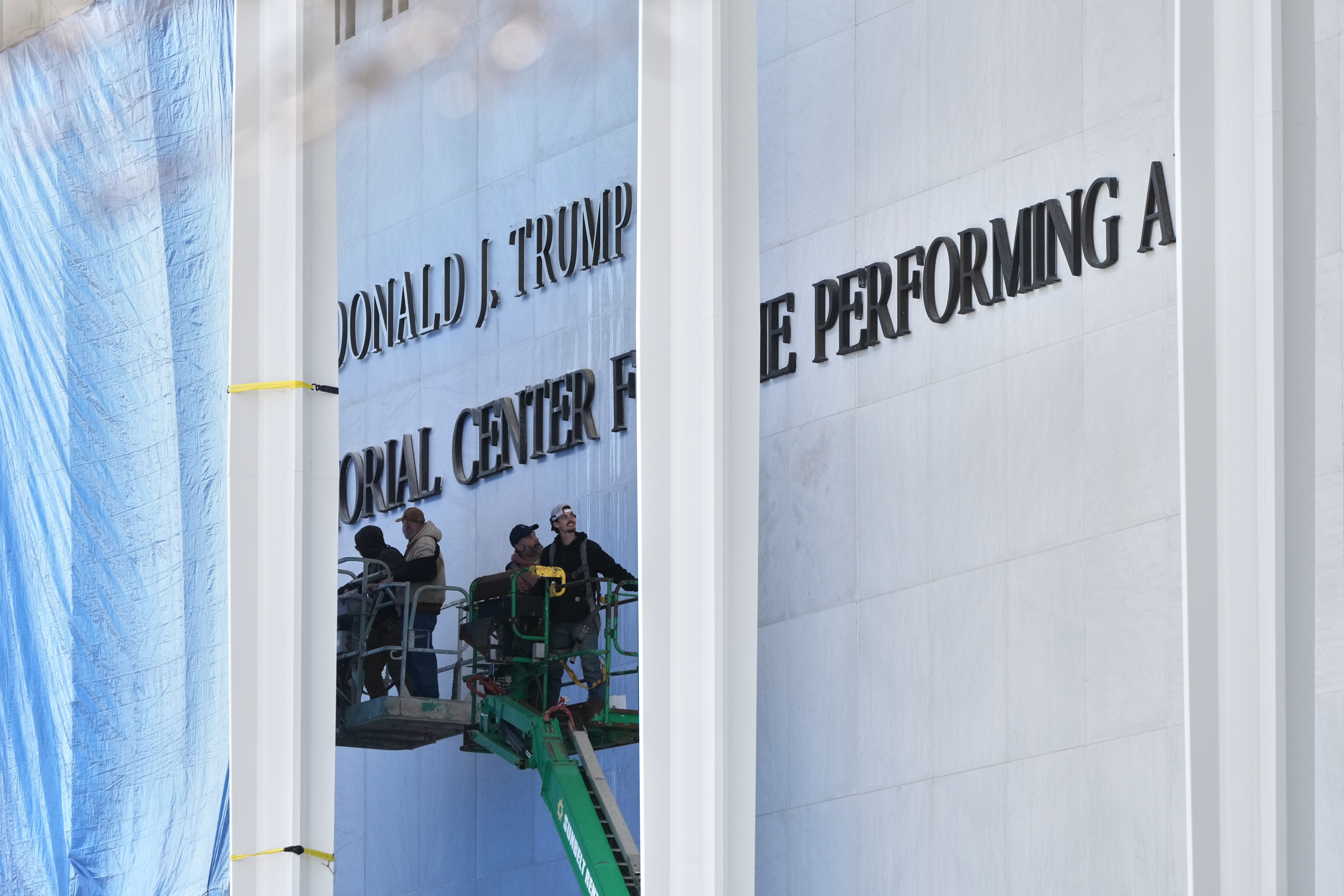
The Kennedy Center began updating signage on the exterior of the building Friday morning, a day after its board voted to rename the institution “The Donald J. Trump and The John F. Kennedy Memorial Center for the Performing Arts.”
A blue tarp was stretched across a portion of the building as a small team on scaffolding started the work. Loud drilling could be heard nearby. Inside the building, large letters spelling “Trump” could be seen on the floor of the entry hall, according to a photograph obtained by the Washington Post. Signage elsewhere around the exterior of the institution remained unchanged.
Thursday’s vote by the board of trustees marked a dramatic change to a building established as a “living memorial” to a slain president. The announcement drew swift condemnation from Kennedy family members and Democratic leaders, who called it illegal and said only Congress could change the center’s name.
For months, Trump had repeatedly joked about the name change, including at the Kennedy Center Honors earlier this month. The center has seen a year of upheaval since Trump overhauled the institution in February, sparking a wave of firings and resignations. Ticket sales have fallen sharply, according to an October analysis by The Post, and many artists have said they will no longer perform there. The new leadership has boasted of hefty fundraising tallies and has begun to ramp up bookings for Christian and right-wing events.
“The Trump Kennedy Center shows a bipartisan commitment to the Arts,” Kennedy Center President Richard Grenell wrote Thursday on X.Officials did not cite an authority for the board’s ability to change the institution’s name.
The current board consists of loyalists to Trump following a purge of trustees appointed by former President Joe Biden. They met Thursday in Palm Beach, Florida.
This is not the only building to which Trump’s name has been added in recent weeks in Washington. Earlier this month, his administration renamed the building that houses the U.S. Institute of Peace downtown, emblazoning “Donald J. Trump” in several areas of the structure.
“Boy, that is beautiful,” Trump said at the time, thanking Secretary of State Marco Rubio for putting his name on the building.
It is becoming increasingly clear that Donald Trump and his most ardent supporters view the U.S. presidency as a golden opportunity for branding.
On Thursday, the White House announced that the John F. Kennedy Center for the Performing Arts would be renamed the Trump Kennedy Center, after what was reported to be a unanimous vote by the board of trustees that the president himself installed there. Trump is the board’s chairman.
The move was roundly denounced by Democrats and by members of the Kennedy family.
“Perhaps the board isn’t aware that the Kennedy Center is THE memorial to the president of the United States, John F. Kennedy,” JFK’s nephew Tim Shriver wrote on Instagram. “Would they rename the Lincoln Memorial? The Jefferson? That would be an insult to great presidents. This too is an insult to a great president.”
Workers install Donald J. Trump above the current signage on the Kennedy Center on Friday, Dec. 19, 2025, in Washington. (AP Photo/Jacquelyn Martin)
It is also questionable whether it could be done without Congress’s approval, given that the center was established by statute. But the new name was already being affixed to the building on Friday — a move very much in line with other actions taken recently by the Trump administration.
It freshly rechristened the U.S. Institute of Peace to be the Donald J. Trump Institute of Peace. Tax-deferred investment vehicles for children that are coming in 2026 will be called “Trump accounts.” And a new government website to help people shop for lower-priced drugs can be found at TrumpRx.com.
This month, the National Park Service added Trump’s June 14 birthday to its list of free-admission days. The president’s birthday coincides with Flag Day. But the Park Service simultaneously dropped its policies of not charging admission on Martin Luther King Jr. Day and Juneteenth, which unlike Flag Day are federal holidays.
U.S. Treasurer Brandon Beach confirmed in October that the U.S. Mint was drafting $1 coins featuring the image of Trump on both sides to commemorate the 250th anniversary of the nation’s founding.
Trump’s image is not among the designs for the semiquincentennial coins and medals coin unveiled by the Mint thus far, however — the idea possibly impeded for now by a law that presidents cannot appear on coins until two years after their deaths.
In 2003, there was a move among Republicans in Congress to replace Franklin D. Roosevelt on the dime with an image of Ronald Reagan. The former president was suffering from Alzheimer’s disease and unable to speak for himself, but his wife, Nancy, put a stop to the effort.
“While I can understand the intentions of those seeking to place my husband’s face on the dime, I do not support this proposal and I am certain Ronnie would not,” she said. “When our country chooses to honor a great president such as Franklin Roosevelt by placing his likeness on our currency, it would be wrong to remove him and replace him with another.”
Though the impulse of a real estate developer is to slap his name on everything around him, the nation’s past chief executives, with rare exceptions, have refrained from doing so while in office.
Perhaps the most notable of those exceptions was naming the capital city in 1791 after George Washington, the nation’s first president, who had selected the site for the federal district. The decision on what to call it was made by a three-member commission to oversee the city’s development that was appointed by Washington.
Moves to christen institutions and landmarks after history’s most well-regarded presidents have often risen from the ground up and reflected the wishes of local communities. Across the map, there are countless counties and towns, schools and libraries, streets and squares called George Washington, Thomas Jefferson, and Abraham Lincoln.
Sometimes, the way former presidents have been honored for their historic achievements has gone against their wishes. In 1941, Roosevelt put his hand on his presidential desk in the Oval Office, where he had signed the legislation that made the New Deal a reality, and told Supreme Court Justice Felix Frankfurter precisely what kind of monument he would like to see to his presidency.
“If any memorial is erected to me, I know exactly what I should like it to be. I should like it to consist of a block about the size of this and placed in the center of that green plot in front of the Archives Building,” Roosevelt said. “I don’t care what it is made of, whether limestone or granite or whatnot, but I want it plain without any ornamentation, with the simple carving, ‘In Memory of ____’.”
Indeed, that modest block of stone was put into place on Pennsylvania Avenue in 1965. But a little more than three decades later, the largest and most grandiose of all presidential monuments was dedicated in Roosevelt’s honor. It stretches across 7.5 acres along the southwest side of the Tidal Basin.
And there is irony in the gargantuan Ronald Reagan Building and International Trade Center — a federal building eclipsed only by the Pentagon in size — given the 40th president’s aversion to big government.
A special poignancy led to the naming of the Kennedy Center. The concept of a national cultural center had been kicking around for decades and was a project embraced by Kennedy’s Republican predecessor, Dwight D. Eisenhower. Kennedy and first lady Jacqueline Kennedy were enthusiasts, and helped raise money, but still couldn’t get it off the ground.
In a speech at Amherst College less than a month before his 1963 assassination, Kennedy said: “If sometimes our great artists have been the most critical of our society, it is because their sensitivity and their concern for justice, which must motivate any true artist, makes him aware that our nation falls short of its highest potential.”
“I see little of more importance to the future of our country and our civilization than full recognition of the place of the artist,” he added.
After his death, his widow asked that the center become a reality and a “living memorial” to her husband. There was still a furious fight in Congress over appropriating government money to the project — $15.5 million in federal dollars to match private donations. Republicans in particular decried it as frivolous.
But where patronage of the arts has usually been the province of the wealthy, this idea caught on with ordinary Americans.
“A great number of people throughout the United States have sent in small contributions to the Treasury and to the White House, in denominations of $1 to $25,” Rep. James C. Auchincloss of New Jersey, one of the few Republicans to support providing federal funds for the center, argued on the House floor.
The measure passed two months after Kennedy’s assassination, on Jan. 23, 1964. President Lyndon B. Johnson broke ground for the center in December.
“Pericles said, ‘If Athens shall appear great to you, consider then that her glories were purchased by valiant men, and by men who learned their duty,’” Johnson said. “As this center comes to reflect and advance the greatness of America, consider then those glories were purchased by a valiant leader who never swerved from duty — John Kennedy. And in his name I dedicate this site.”
When President Donald Trump declared in May that he wanted drug companies to voluntarily cut their prices, few pharmaceutical executives wanted to go first. Now, no one wants to be last — and risk the wrath of the president.
Nine drug companies announced price cuts with Trump at the White House on Friday, touting discounts on medication to treat diabetes, heart disease, HIV, hepatitis B, and other conditions. The deals will offer discounts on drugs sold to the government and to Americans through a new website, TrumpRx.gov, in exchange for tariff relief and other incentives, including faster FDA reviews for future approvals.
The program, known as the Most Favored Nation initiative, is an effort to link U.S. drug prices to lower costs abroad.
“Every president for a generation has promised to reduce drug prices, but … I am the only one of them to ever even think in terms of ‘favored nations,’” Trump boasted Friday, flanked by drug-company executives and health officials.
Friday’s announcements follow similar deals with five other companies, beginning in September when Pfizer CEO Albert Bourla joined Trump to unveil price cuts. Since then, other drug-company executives have joined Trump to announce discounts on fertility and GLP-1 drugs and other offerings. In return, the administration has lifted the threat of tariffs and offered the companies other benefits, such as priority vouchers to expedite FDA reviews, which can lead to hundreds of millions of dollars in additional revenue for a company if a new drug is quickly approved.
Amgen, Boehringer Ingelheim, Bristol Myers Squibb, Genentech, Gilead Sciences, GSK, Merck, Novartis and Sanofi all announced new price cuts Friday. Three of the 17 pharmaceutical companies initially targeted by the Trump administration — AbbVie, Johnson & Johnson and Regeneron — have yet to appear with the president to tout price cuts, but officials said that those companies are set to make their own announcements soon.
Trump has heralded his initiative — which he attempted to pursue in his first term — as one of his most significant achievements this year, arguing that even small savings matter amid the difficulty of curbing drug prices. The deep-pocketed pharmaceutical industry has repeatedly blocked most major efforts at reform for decades, and U.S. drug spending continues to rise, outpacing other wealthy countries.
“This is the biggest thing ever to happen on drug pricing and on healthcare,” Trump claimed. He also criticized other countries for relying on high drug prices in the United States to subsidize the cost of pharmaceutical research and development, saying that global prices needed to be more equitable.
“We were subsidizing the entire world. We’re not doing that anymore,” the president said.
Democrats and outside experts have credited the deals as potentially helping some patients but said the initiative’s overall savings to the U.S. health system will be negligible and dismissed Trump’s hyperbole.
“It’s a bit laughable to call this ‘the biggest thing ever’ in health policy. I’m not even sure this cracks the top 10 health policy changes,” said Craig Garthwaite, director of healthcare at Northwestern University’s Kellogg School of Management. “Giving Most Favored Nation prices to Medicaid, particularly for older drugs, likely won’t save that much.”
The president has sought to make regular announcements about his drug-price deals, aiming to show progress and counter voter frustration over rising healthcare costs entering a midterm year that favors Democrats. Trump is timing Friday’s event to be one of his final White House events of the year, before he heads to North Carolina for a rally on affordability and then to his Mar-a-Lago resort.
Pharmaceutical companies also touted their willingness to cut U.S. prices. A Bristol Myers Squibb executive said the company would provide its blood-thinning drug Eliquis, its most-prescribed medicine, to Medicaid free. Merck said it would offer discounts on its drugs Januvia, Janumet, and Janumet XR, which are used to treat Type 2 diabetes.
“I reflect on your goal, driving affordability and access to Americans, but equally getting prices up outside the United States,” Merck CEO Robert Davis told Trump. “We’re 100 percent supportive of your actions.”
Democrats have questioned whether Trump’s dealmaking with the companies is creating a quid pro quo, with pharmaceutical executives striking agreements to give the president a political win in exchange for potential profit.
“Congress and the American people remain in the dark about the contours of your agreement with the Trump Administration,” Sen. Ron Wyden (D., Ore.) and Reps. Richard E. Neal (D., Mass.), Frank Pallone Jr. (D., N.J.) and Robert C. “Bobby” Scott (D., Va.) wrote in letters sent this week to pharmaceutical executives participating in the initiative. The lawmakers are the top Democrats on four congressional committees that oversee aspects of the U.S. health system.
Several former FDA officials — including two physicians who recently oversaw the agency’s drug-regulation center — have warned that the voucher program may be illegal and risk undermining public health by streamlining reviews. While the agency’s drug reviews can traditionally take about a year, as scientists pore over safety and effectiveness data, Trump officials have said that the voucher program can guarantee a review within one or two months. The administration has defended the program, saying that safety and effectiveness remain priorities despite the accelerated timetable.
Trump officials have used other levers, too. The administration has relied on the Centers for Medicare and Medicaid Services’s innovation center, which allows officials to pilot payment changes without seeking congressional approval, to pressure drug companies that do not voluntarily lower prices. Several drug-payment pilots have already been announced, and more are expected on Friday, the people said.
Wall Street analysts say the companies have incentives to strike quick deals with the administration, rather than tempt Trump’s ire. Medicaid represents a relatively small portion of their business, and many companies are agreeing to price cuts similar to discount programs they have begun.
Pfizer’s announcement with Trump also sent a signal to the rest of the industry, several pharmaceutical executives and industry analysts have told reporters.
“When you saw the lack of impact to earnings of the initial companies’ deals, for most coming after, it’s a no-brainer,” said Chris Meekins, a managing director at Raymond James.
Trump officials have said that the initial negotiations were tough, and securing concessions has become easier over time.
“I think the first five companies that came through the pipeline were some of the hardest ones to get through,” CMS Administrator Mehmet Oz said in an interview on Dec. 7, pointing to the size of companies like Pfizer, AstraZeneca, and Eli Lilly, which were among the first companies to agree to deals.
Trump officials have leaned on the healthcare companies’ civic responsibilities, in addition to applying pressure through tariffs and the CMS innovation center.
Chris Klomp, the head of the Medicare program and a lead negotiator on the drug-price cuts, said he stressed “duty and patriotism” in a conversation with one prominent CEO.
“And when we got done, he said, ‘I didn’t get into this business for [quarterly earnings],” Klomp said in remarks at last month’s MAHA Action summit. “I have children. I want to make them proud. I understand this is important to you and the president. We will show up.’”