That’s the message Philadelphia city officials want to send to people considering illegally dumping garbage in the city as a new enforcement unit hits the streets.
The officers are armed with violation notices that could cost dumpers $5,000 per item. That means that tossing four tires into a vacant lot — which several years ago would have resulted in a ticket for a couple of hundred bucks, max — can now run a violator the price of a Honda and result in arrest.
The new unit of 40 officers focused on identifying the people who dump is part of an expanded task force that Mayor Cherelle L. Parker announced on Thursday. The group also includes a dozen people who monitor 400 surveillance cameras placed near frequent dumping sites, as well as partners in the police department who investigate severe cases.
“Part of the reason why people think it’s open season to illegally dump in the city of Philadelphia … it’s because they never thought that enforcement would occur,” Parker said. “Besides it being unsightly and unhealthy for people, it’s a crime.”
City officials said they have brought 17 cases against people who dumped waste illegally so far this year, resulting in more than $3.7 million in collected fines.
The mayor said her administration would ramp up that effort with the initiation of the task force.
“Philly ain’t playin’,” she said.
Members of the new Illegal Dumping Task Force stand during an introductory press conference with Philadelphia Mayor Cherelle Parker and the Office of Clean and Green Initiatives on Thursday, Oct. 23, 2025, at 10th and Courtland Streets in Philadelphia.
Parker made the announcement while standing in North Philadelphia’s infamous Logan Triangle, the 35-acre plot that has been an eyesore for the better part of 50 years. It was once home to hundreds of rowhouses, but the families moved out in the 1980s when it became clear their homes were sinking into the bed of the Wingohocking Creek.
Today, the triangle is a cautionary tale of failed redevelopment — a place where ideas like a basketball center or a dirt bike track or an apple orchard have never been realized. It is now, and has long been, a dumping site.
It’s also the site where, last week, two people were arrested for unloading trash, said Carlton Williams, the city’s director of clean and green initiatives.
Philadelphia Mayor Cherelle L. Parker (right) and Carlton Williams (left) of the Office of Clean and Green Initiatives announce stricter laws to combat illegal dumping during a news conference at Logan Triangle, a frequent dumping site at 10th and Courtland Streets, on Thursday in Philadelphia.
Not only could those people face criminal penalties, but the administration is focused on levying hefty fines and holding dumpers responsible for cleanup costs. The city is also newly fining people who hire contractors to short dump.
“We’re gonna hit you where it hurts: in the pocketbook,” Parker said.
Despite the spending, many in the city say dumping sites are a major problem. A 2023 Lenfest Institute for Journalism/SSRS poll of 1,200 Philadelphians found that six in 10 residents believed reducing dumping should be a top priority for the mayor. Concern was most acute among residents who are low-income, Black, and Latino.
City Councilmember Quetcy Lozada, a Democrat and a Parker ally whose district borders Logan Triangle, said the administration’s focus on illegal dumping can begin to remedy what she described as “extremely stressful” situations for residents who have long watched waste pile up near their homes without abatement.
“Our residents have done their part, and those calls for help went unanswered for a really, really long time,” Lozada said. “But today feels different.”
How to report illegal dumping
Anyone who sees illegal dumping happening can call 911. Residents who want to report illegal dumping after the fact can file a complaint through 311.
In March 2023, Kathryn Ott Lovell, then Philadelphia’s parks and recreation commissioner, announced that the plan to build a new Carousel House in West Philly was finally coming together.
The city’s only recreation center dedicated to people with disabilities had closed its doors temporarily in 2020 during the coronavirus pandemic, then permanently in 2021. City officials said years of deferred maintenance had made it unsafe.
“I’m excited to stop talking and start doing,” Ott Lovell said during the 2023 presentation at the Please Touch Museum.
The city’s disability community was also excited to reunite at Carousel House. To many, the rec center on Belmont Avenue had become like a second home, with dances, movies, swimming, arts and crafts, and summer camp.
The city’s youth wheelchair basketball team was looking forward to returning to its home base. Since the rec center closed, the squad has been practicing in New Jersey.
Two and a half years later, however, Ott Lovell has moved on to a new job, Mayor Cherelle L. Parker has replaced Jim Kenney, and the Carousel House plan is still in the design phase.
The new ribbon-cutting date: summer 2028.
“I know this is a point of pain for many people, the timeline associated with this project,” Aparna Palantino, a deputy city managing director, acknowledged at a meeting Tuesday night announcing the “relaunch” of the project.
The previous plan called for Carousel House to reopen this year.
Palantino, who heads the city’s capital program office, said the expected cost of the project had risen from $35 million to $40 million. The work will still be funded primarily with beverage-tax proceeds, but the city had to line up grants to cover the difference, as well as conduct additional environmental and structural analyses.
“The result of all that is this amazing space that will provide so many more opportunities than the former one did,” Palantino told an audience of several dozen.
Aparna Palantino, deputy managing director of Capital Program Office, speaks with attendees during the Carousel House Rebuild Community Relaunch at the Please Touch Museum on Tuesday, Oct. 21, 2025, in Philadelphia. The Carousel House project is estimated to be completed in Summer 2028.
The state-of-the-art rec center will preserve some parts of the iconic Carousel House building and include two basketball courts, a heated lap pool and an activity pool with a zero-entry sloping entrance, a computer lab, a gym, a sensory room, and other amenities.
That all sounds great to people like Mike Martin, who has used a wheelchair for the last 30 years and has been going to Carousel House since the late 1990s. Such a place is needed in Philadelphia, where an estimated 17% of residents have a disability.
But the lengthy delays in the project have Martin, 74, questioning whether he will ever see the vision become a reality.
Martin and others would have preferred for the city to fix the existing building four years ago, when rec centers were reopening after the COVID-19 shutdown. A 2021 “Save the Carousel House” protest failed to sway city leaders.
“The design is way more than I think we expected, not that we’re complaining at all,” said Martin, who serves on the Carousel House advisory committee. “We’ll see what kind of political will there is to push this through. I just don’t want to get my hopes up is what it comes down to.”
Once a model
Carousel House was considered a milestone when it opened in 1987: a city-funded rec center, specifically for people with physical and cognitive limitations, three years before the Americans with Disabilities Act would be signed into law.
The Carousel House is pictured in Philadelphia’s West Fairmount Park on Wednesday, June 2, 2021. The city said it was permanently closing the recreation center for disabled people due to the facility’s deterioration.
But in recent years, disability-rights advocates, both locally and nationally, have come to view that approach as outdated and even discriminatory. How is telling people with disabilities to go to one center, they ask, any different from designating centers for Black people, LGBTQ+ people, or other identity groups?
“People with disabilities shouldn’t have to go to one place. That’s segregation, no matter how you look at it,” Fran Fulton, the late Philadelphia disability-rights activist, told The Inquirer in 2022. “There is no doubt having people who know how to work with children and adults with different types of disabilities is an advantage. But it doesn’t have to be just Carousel House.”
Sadiki Smith (right) stands to dance as music therapist Madison Frank (left) with her guitar leads a music therapy session at Gustine Recreation Center Tuesday, November 29, 2022. Since the closing of the Carousel House, the city’s only rec center for people with physical and intellectual disabilities, many of the programs have moved to Gustine.
The city was already moving in that direction before the pandemic with its long-term Rec for All inclusion plan. The goal is to eventually make the city’s 150 rec centers accessible to all residents. The new Carousel House will be open to all people in the surrounding neighborhoods, not just those with disabilities.
That is welcome news for Lucinda Hudson, president of the Parkside Association of Philadelphia, who attended Tuesday’s meeting.
“It’s well needed, and I think the community is pleased with how it’s coming together,” Hudson said. “We need a facility to be inclusive for all, and to support the handicapped community.”
Worth the wait?
Palantino said that while the Carousel House project has faced significant delays, city officials have continued to work behind the scenes. It is the largest project in the city’s beverage-tax funded Rebuild program, which has so far committed or spent $470 million.
She believes the new building will be worth the wait.
“It will be a universal space, so an entire family can come here and enjoy the amenities. The former Carousel House was a little more restrictive in the population it served,” Palantino said in an interview. “This will be the flagship rec center in the city when it’s completed.”
Attendees look at blueprints during the Carousel House Rebuild Community Relaunch at the Please Touch Museum on Oct. 21.
Families that frequented the Carousel House, however, are running out of patience.
The Gustine Recreation Center in East Falls has continued some of the programs for people with disabilities, including music therapy, basketball, and social groups. But that center doesn’t have the space and amenities that Carousel House provided.
“It’s just not the same,” said Tamar Riley, whose 43-year-old son had been going to Carousel House since he was 12.
“Hopefully we can get this off the ground,” Riley, president of the advisory council for Carousel House, said of the plans presented this week. “It’s been a really long time. I know it’s going to be a beautiful place once the city gets it up and running.”
The closure of Carousel House also forced Katie’s Komets, Philadelphia’s team in the National Wheelchair Basketball Association, to move its weekly practices to RiverWinds Community Center in West Deptford, Gloucester County.
As a result, there is only one Philly player on the team, according to Joe Kirlin, who with his wife, Roseann, created a fund to support the team. The team is named after their late daughter.
“The problem is city kids just can’t get over there,” Joe Kirlin said.
Caroline Fitzpatrick (right), 14, of South Jersey, talks with friends during the Philadelphia Parks & Recreation’s 24th Annual Katie Kirlin Junior Wheelchair Basketball Tournament in Philadelphia on Sunday, Jan. 23, 2022. Fitzpatrick plays on Katie’s Komets team from Philadelphia.
He said wheelchair athletes in the city are missing out on potential collegeopportunities. This year, all three high school graduates on Katie’s Komets received scholarships to play college wheelchair basketball.
“That wouldn’t have happened if they didn’t start as kids playing wheelchair basketball,” Roseann Kirlin said.
Lorraine Gomez, a community activist and president of the Viola Street Residents Association in East Parkside, said after Tuesday’s meeting that she appreciated the city’s efforts to keep the surrounding neighborhoods informed about the project.
Gomez is looking forward to being able to use the indoor pool and walking track in the winter, and said people with disabilities also deserve “to have their space back.”
“This is what the community needs,” Gomez said. “It’ll be a place where we can stay in touch with each other.”
For Hudson, of the Parkside association, the most important thing now is to break ground.
“So many things get put on the books, but don’t happen,” Hudson said. “This has got to be built.”
More than 300,000 Pennsylvanians who struggle to pay their heating bills will need to wait longer for assistance from the state government due to funding stoppages caused by the federal government shutdown.
The Pennsylvania Department of Human Services said in a news release Wednesday that Pennsylvania will delay the opening of this year’s Low-Income Home Energy Assistance Program (LIHEAP) untilat least Dec. 3 because of a pause in federal funding due to the shutdown.The program was originally scheduled to open on Nov. 3.
The opening date for the program will be reassessed once the shutdown ends and is contingent on the state receiving the delayed federal funds, Brandon Cwalina, DHS press secretary, said in a statement Thursday.
LIHEAP distributes benefits to utility companies or home heating fuel providers for Pennsylvanians who need assistance paying their heating bills. The state has received more than $200 million each of the last two years from the federal government to carry out the program.
Pennsylvania Human Services Secretary Val Arkoosh said in the news release that the program “is especially critical for older adults and low-income families” as colder months approach.
Once DHS receives federal funding after the shutdown ends, the department will begin accepting LIHEAP applications and will continue processing applications that had been received during the shutdown.
This announcement comes the same week that DHS said nearly 2 million Pennsylvanians will not receive benefits from the Supplemental Nutrition Assistance Program (SNAP) next month if the shutdown continues. The food assistance program provides $366 million a month to low-income people in Pennsylvania,including roughly 500,000 in Philadelphia.
Joline Price, an attorney in the energy unit at Community Legal Services who works with clients to advocate for their access to water, heat, and electricity, said many of the same households could be affected by a lack of SNAP benefits and assistance in paying their heating bills, creating a “huge and devastating impact.” The program assisted 56,000 Philadelphia households last season, she noted.
“Even if some of these benefits become available later in November, they’re gonna be making really serious choices between food and utilities,” Price said. “It’s gonna be — I don’t even know that I have the words — it’s going to be bad.”
Other resources are available in the meantime — for instance, some electric and gas companies offer assistance programs — but there are gaps that remain with LIHEAP help beginning later than expected. For instance, Pennsylvania has an annual winter utility shut-off moratorium for qualified residents from Dec. 1 through March 31, though it does not eliminate any outstanding home heating bills, DHS said.
Prior to Dec. 1, low-income Pennsylvanians who are already “drowning” in utility costs could see their electric or gas shut off, Price said.
“Until then, folks are vulnerable to having their electric or their gas shut off, which would then bring them into the winter without safe heating sources,” Price said.
Democratic Gov. Josh Shapiro and members of his administration are arguing that impacts to crucial services are on the shoulders of Republicans in Washington, who hold both chambers of Congress and the White House. Meanwhile, Republicansare blaming the shutdown on Democrats because the majority party cannot pass funding legislation in the Senate without at least seven Democrats crossing the aisle.
Arkoosh echoed Shapiro’s messaging Wednesday, saying of LIHEAP: “Inaction from the Republican-controlled Congress now threatens access to this assistance.”
“I urge Congress and the White House to recognize the serious consequences that limiting heating assistance will have on the health and safety of people in Pennsylvania. Congress must come together for a solution that protects people most at risk,” she said.
City Controller Christy Brady, seeking her first full term as Philadelphia’s independently elected fiscal watchdog, is being challenged by Republican Ari Patrinos in the Nov. 4 general election.
The controller’s office is charged with auditing the city’s finances and investigating fraud, waste, and abuse.
But despite that critical role, there hasn’t been much drama in this year’s race.
Patrinos, a former stockbroker and Philadelphia public school teacher, acknowledged the odds are against him in heavily Democratic Philadelphia and said he has no particular complaints about Brady’s performance.
Instead, he said, he ran because “it was important that somebody run on the ticket.”
“The truth is nobody wanted to run, and my ward leader asked me if I would run,” said Patrinos, who has not reported raising any money for his campaign. “I didn’t have any specific attacks on Brady. My concern is that the city is too single-party, and I think the city functions better when you have a two-party system.”
Brady, a Democrat who has a $250,000 campaign war chest she likely won’t need to use this year, has the support of much of the local political establishment, including the Democratic City Committee and the building trades unions.
A 30-year veteran of the controller’s office, Brady has struck a notably conciliatory tone during her tenure, striving to work collaboratively with Mayor Cherelle L. Parker’s administration rather than butt heads with the executive branch, as many of her predecessors have done.
“Because of my experience when I took office two years ago, I hit the ground running,” she said.
Seeking a full four-year term for the first time, Brady this year ran uncontested in the Democratic primary.
“The biggest question I get [on the campaign trail] is: What does a controller do?” she said. “And so I’m getting out there and spreading the word of what we’re currently working on and what we do in the office.”
The controller earns an annual salary of $171,000 and oversees an office with more than 120 employees and a budget of about $11.8 million.
Patrinos also had no opponent in the May primary. He said he has been spending much of his time on the campaign trail promoting Pat Dugan’s campaign for district attorney.
“I spend like half my time when I campaign advocating for Dugan because I’m very concerned about the crime,” Patrinos said.
From Philly to Harvard and back
Patrinos, who lives in Chestnut Hill, said he was a Democrat until about four years ago, adding that he voted for Joe Biden in the 2020 presidential election.
His conversion was prompted primarily by his alma mater, Harvard College, which he felt had too enthusiastically embraced a “woke” stance.
“The immediate driving factor was on the cultural front. It was what was going at Harvard,” he said. “I’m a little bit of an anti-woke warrior. … 2020 was peak woke.“
Academia’s leftward trajectory and the Biden administration’s “terrible” handling of the pandemic combined to leave Patrinos with the feeling that he had no place in the Democratic Party, he said.
“These Ivy League liberal types who really don’t have a sense of what’s going on in the lives of average Americans — they seemed to be so indifferent to the negative effects of their policies,” he said.
He became involved in local Republican politics and helped boost President Donald Trump’s Philadelphia campaign in 2024.
“I’m not a MAGA guy, so I didn’t join [the GOP] because of Trump,” he said, “but honestly I’m very happy with the higher education stuff, the hardcore stand he’s taken with Harvard.”
Patrinos, a Central High School graduate who also has a master’s degree in political science from the University of Chicago, was a stockbroker in New York City before moving back to Philly about 15 years ago.
He then became a math and history teacher and worked at West Philadelphia High School and Strawberry Mansion High School. Patrinos said he suffered a seizure several years ago that temporarily limited his employment opportunities, but is now seeking other jobs should he come up short against Brady.
If elected, Patrinos said, he would audit the Philadelphia Department of Licenses and Inspections (L&I), examine whether SEPTA could do a better job preventing fare evasion, and push the school district to prepare more students for careers in information technology.
Controller and mayor on the same page
Brady’s approach to the mayor’s administration is the exception when it comes to the recent history of her office.
A decade ago, then-City Controller Alan Butkovitz’s relationship with Mayor Michael A. Nutter became so toxic that Nutter at one point issued a statement calling Butkovitz “a sad and sick person.”
Their successors, Kenney and Rhynhart, started off with widespread expectations that they might have a better working partnership, given that Rhynhart served as a top executive branch official under Nutter and, briefly, Kenney. But the relationship soured in a matter of months after Rhynhart publicly criticized the administration’s bookkeeping, prompting a call from Kenney that reportedly “got personal” and the cancellation of their planned monthly meetings.
Cherelle L. Parker, then a candidate for mayor of Philadelphia, stops to greet a group, including Christy Brady,(center seated), during election day lunch at Famous 4th Street Deli in Philadelphia on Tuesday, May 16, 2023.
That outcome does not appear likely with Brady and Parker.
Brady shares many political allies with Parker, especially the Philadelphia Building and Construction Trades Council, a coalition of unions that spends big on elections and has reason to be pleased with both Brady and Parker’s tenures so far.
Brady, for instance, touts her office’s audit of L&I that revealed inspectors often failed to confirm that construction sites were being run by licensed contractors — providing ammunition to the trades unions, which often rail against “fly-by-night” contractors that do not employ their members. And the mayor last year split the department into two agencies, with one focused largely on enforcing construction regulations.
Brady said her healthy relationship with the Parker administration should not be confused with a reticence to call out fraud and waste.
“I am an independently elected official. I am not afraid to stand up for what’s right,” she said. “I believe in the rules and regulations in city government.”
Her approach to the executive branch, she said, is designed to advance the aim of any auditor: ”getting management to implement your recommendations.”
“In my experience in the controller’s office, when you fight, they’re not going to listen to your recommendation,” said Brady, a certified public accountant who graduated from the Philadelphia College of Textiles and Science, now Jefferson University. “When we issue our reports, the mayor has been thanking me for the recommendations. And I really appreciate that relationship because I believe that we can make change.”
Staff writer Ryan W. Briggs contributed to this article.
Gov. Josh Shapiro is hitting the campaign trail in two key states this weekend.
With less than two weeks left until Election Day, Shapiro will campaign and raise cash for U.S. Reps. Mikie Sherrill (D., N.J.) and Abigail Spanberger, (D., Va.), two Democratic hopefuls in high-stakes gubernatorial races that could preview the national mood ahead of next year’s midterms.
Shapiro will campaign with Sherrill Saturday morning in Monroe Township at an event to mark the start of early in-person voting in the Democratic-leaning state which has grown increasingly red. The pair will then attend a Souls to the Polls event at a church in New Brunswick, Shapiro For Pennsylvania spokesperson Manuel Bonder said.
The governor is also expected to hold a fundraiser for the New Jersey Democratic State Committee to benefit Sherrill’s campaign later in the day.
On Sunday, Shapiro will head to Virginia to attend events in Portsmouth and Norfolk with Spanberger.
Sherrill has amped up her campaigning in recent weeks, and she’s brought out big Democratic names to help her. In the last three weeks, she’s campaigned with New Jersey Sens. Cory Booker and Andy Kim, and with Maryland Gov. Wes Moore. Former Secretary of Transportation Pete Buttigieg is planning a visit to New Jersey next weekend, and Sherrill’s campaign curtain call the Saturday before Election Day will feature a rally with former President Barack Obama.
This combination photo shows candidates for governor of New Jersey Republican Jack Ciattarelli, left, and Democrat Mikie Sherrill during the final debate in governors race, Oct. 8, 2025, in New Brunswick, N.J. (AP Photos/Heather Khalifa)
Why Shapiro is involved in the New Jersey governor’s race
Shapiro is a big draw on the campaign trail as he continues to build a national profile, and gears up for his own reelection campaign next year. The first-term governor, who is seen as a potential 2028 presidential candidate, announced the 2026 release of a memoir this week.
The poll also found that Shapiro is viewed favorably by some Republicans, an across-the-aisle appeal that appears to extend across the Delaware River.
Shapiro’s been lauded by Sherrill’s Republican opponent in the New Jersey race, Jack Ciattarelli, a trend chronicled recently by Politico.
Ciattarelli commended Shapiro’s willingness to criticize New York City mayoral candidate Zohran Mamdani’s past comments on Israel, and praised his handling of small businesses, energy and property taxes in Pennsylvania, contrastingly saying New Jersey faces a “crisis” in all three.
Sherrill has said frequently that she wants to mimic Pennsylvania’s success in cutting the time it takes business owners to get permits from state government.
This story has been updated to correct the location of Gov. Josh Shapiro’s first stop with U.S. Rep. Mikie Sherrill on the campaign trail Saturday.
Mayor Cherelle L. Parker is shaking up the board of the Philadelphia Land Bank, which helps control the sale of city-owned land but hasn’t been moving fast enough to advance her housing priorities.
Parker’s first land bank board chair, Herb Wetzel, has been asked to step down as well as board member Majeedah Rashid, who leads the Nicetown Community Development Corp. The board has 13 members.
Angela D. Brooks, who serves as the city’s chief housing officer, will be joining the board. Earlier this year Parker appointed Brooks to lead the mayor’s campaign, Housing Opportunities Made Easy, or H.O.M.E., to build or renovate 30,000 houses over the course of her administration.
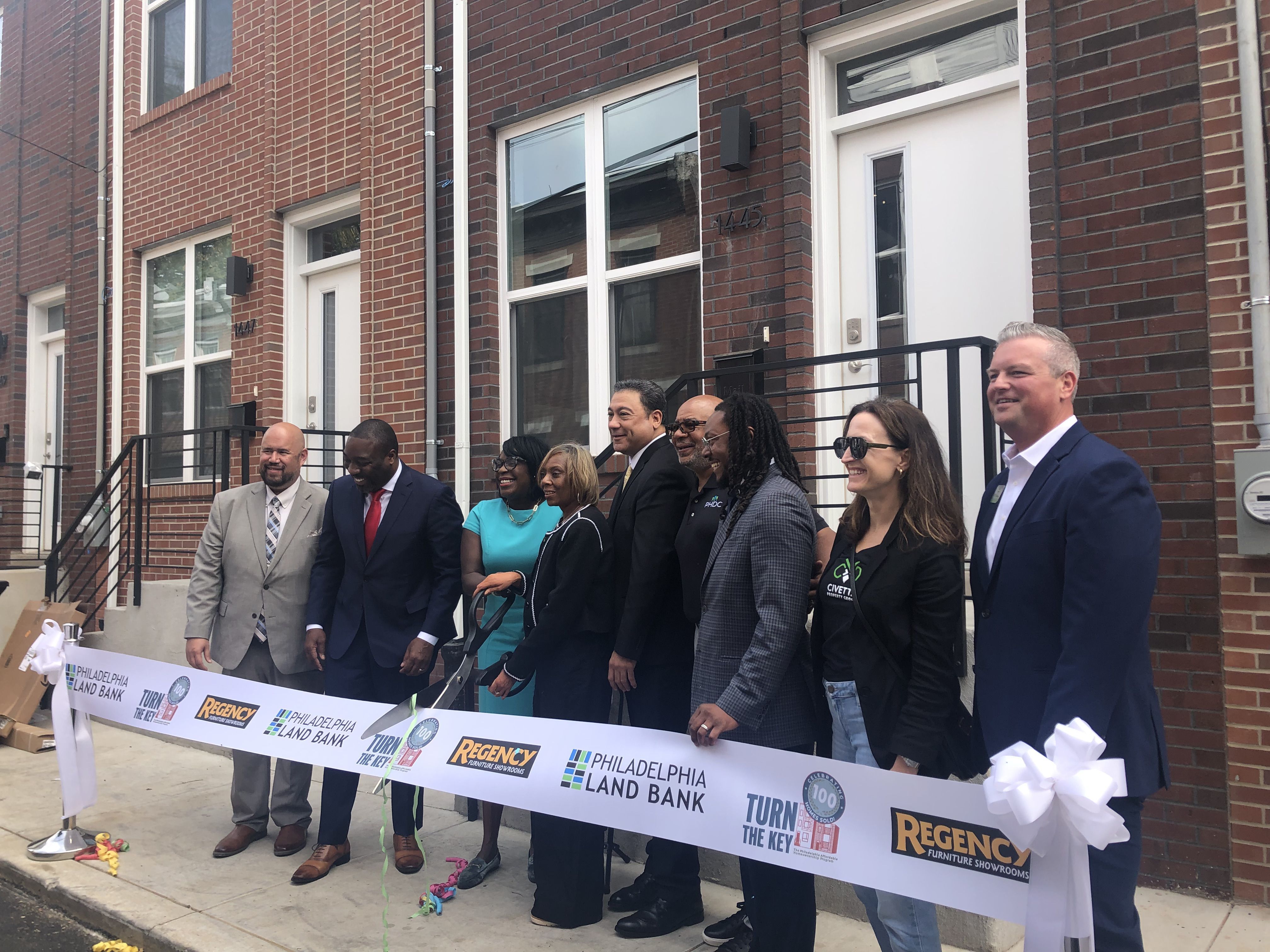
The mayor has long championed the Turn the Key program as part of that plan, a policy that depends on getting inexpensive city-owned land to developers so they can build houses that are affordable to working and middle-class families.
Rashid is being replaced by Alexander Balloon, who formerly served on the Land Bank’s board and is the executive director of the Passyunk Avenue Revitalization Corp.
“It is clear from the Land Bank’s success with its Turn The Key program: A strong and effective Land Bank is essential for reaching the H.O.M.E. initiative’s goal to produce and preserve 30,000 homes,” Parker said in a statement.
Several Turn the Key proposals have been held up by the Land Bank board, which has been riven between factions that are either more or less friendly to private-sector developers.
Rashid and other board members who come from a nonprofit development background have argued that scarce city-owned land should be earmarked for affordable housing, community gardens, and similar projects.
Mayor Cherelle L. Parker and Turn the Key’s 100th homebuyer hold giant scissors as they prepare to cut a ceremonial ribbon.
Although the Turn the Key program produces units that are more affordable than market-rate homes, many of the projects are built by private-sector developers and still unaffordable to Philadelphians with low incomes.
“Majeedah Rashid has worked with me on economic development issues dating to my time in the Pennsylvania General Assembly, and her advice has been invaluable,” Parker said in a statement. “Our city is stronger for Herb’s and Majeedah’s public service.”
Rashid did not respond to a request for comment.
During Balloon’s previous tenure on the board, he was among members who pushed for vacant city-owned land to be put back into productive use as quickly as possible because empty lots attract crime and litter and are a drag on city services.
Private-sector developers often can build more — and faster — than their nonprofit counterparts because they are less reliant on public funds, which are increasingly unreliable from the federal level.
“I’m excited to rejoin the Philadelphia Land Bank and help Mayor Parker deliver on her bold vision to build and preserve 30,000 homes across our city,” Balloon said in an email statement. “This is an inspiring moment for Philadelphia’s growth and the success of the Turn the Key program and other initiatives.”
“Herb Wetzel has been a subject matter expert for me on any housing issue that I’ve worked on throughout my career as an elected official, and I have always relied on his counsel,” Parker said in a statement. “He will continue to be part of my circle of advisers on housing issues, just in a different capacity.”
But according to three City Hall sources, who did not have permission to speak to the media, Parker’s team felt Wetzel sought to play peacemaker between the factions and was not always able to get their favored Turn the Key projects moving. As a recent arrival to the city and leader of the administration’s housing initiative, Brooks is expected to pursue the mayor’s priorities.
Brooks said in an interview that her appointment was no reflection on Wetzel’s performance and that he would continue to serve on the H.O.M.E. advisory board.
“I don’t have any thoughts on what he didn’t do or didn’t other than he’s been a great supporter of both the mayor and me and this housing plan,” Brooks said. “He’ll continue to be a part of that as we move it forward. [It’s just that] historically, we have had a city staff person to sit on the Land Bank board, and since I’m spearheading the H.O.M.E. Initiative, it seemed to be time.”
Frequent stalemates on the board were not the only challenge facing Turn the Key projects. Under the tradition of so-called councilmanic prerogative, the Land Bank requires action from City Council to release property for development even if the mayor backs a particular proposal.
For example, the administration sent over a 50-unitTurn the Key proposal in North Philadelphia to City Council last November, and District Councilmember Jeffery Young simply never introduced it, effectively killing the deal.
Or in Kensington, Councilmember Quetcy Lozada declined to endorse several Turn the Key proposals, leading developers to abandon them.
Parker sought to loosen Council’s grip on some city-owned land during budget negotiations earlier this year, but the campaign was largely unsuccessful. National land bank experts have long argued that land banks like Philadelphia’s are much less effective than counterparts that do not have political veto checkpoints.
During budget hearings this year, Council asked for an organization assessment of the Land Bank, and some members questioned why its staff wasn’t more robust.
Brooks said that an assessment will be released soon from the consultant group Guidehouse and that the Land Bank “is in the process of filling positions.”
Democratic veterans in Congress, including two from Pennsylvania, are taking personally comments U.S. Rep. Scott Perry made to a conservative radio station asserting that Democrats in Congress “hate the military” — and the lawmakers are hitting back.
“That’s only a credential that they get when they want to run for office,” Perry said, of Democrats, during an interview last week on The Chris Stigall Show.
”They join the military, they serve a little bit, they get the credential and then they run for office and wear the uniform and say, ‘Look at me — I support America.’ But let’s face it, all their votes say they don’t support America.”
Perry made the commentslast week, but a report this week from the New York Times prompted backlash from Perry’s colleagues on the other side of the aisle, including U.S. Rep. Chris Deluzio, a Democrat who represents the Pittsburgh suburbs and served six years in the Navy.
On Wednesday, members of the Democratic Veterans Caucus, cochaired by Deluzio and U.S. Rep. Pat Ryan (D., N.Y.) called the remarks “insulting to their service,” in a statement shared with The Inquirer.
“It’s disgusting to see a sitting member of Congress attack the integrity and honor of veterans and servicemembers due to their political party,” the veterans wrote. “He should immediately apologize to his constituents for insulting their service and questioning their patriotism.”
The statement blasted Perry as an “oathbreaker,” noting he was part of an effort to throw out Pennsylvania’s electoral votes after President Donald Trump’s loss in the 2020 election. The lawmakers also criticized Perry’s unwillingness to hold in-person town halls, something very few Republican lawmakers have been doing since Trump’s first administration.
“If he had a spine he’d stand in front of the Democratic veterans he represents and say this garbage to their faces, but Scott Perry doesn’t have the guts,” his House colleagues wrote.
Perry, in a statement, pushed back clarifying his remarks were not about “all Democrats,” but “Leftists in Congress who served in the military and use that as a shield to insulate themselves from accountability for their radial and corrosive ideologies.”
“The leftists now stomping their feet about my response are the same leftists who caused our government to shut down,” Perry said in his response.
Still, the comments from Perry about his colleagues and their jilted response illustrate the ways in which political insults have accelerated. Lawmakers who have served in the military had long been one of the few bipartisan groups bonded through service. A group of Democratic and Republican former service members serving in Congress called For Country Caucus still meets for early morning breakfasts on the Hill.
Perry, a House member since 2013, served in the U.S. Army and has been a staunch conservative voice, unabashed with his criticism of Democrats. Perry retired from the Army National Guard in 2019 with the rank of brigadier general after 39 years of service.
Democrats have dominated Delaware County government since the 2019 election.
As suburban communities across the nation flipped from red to blue, Democrats took control of the county council for the first time since the Civil War — the result of long-term shifts accelerated by President Donald Trump’s first administration. The party has held all five seats on the governing board ever since, easily retaining seats in 2021 and 2023.
Two seats on the five-member board are on the ballot in November. Democrats argue tax increases were necessary to make up for decades of underinvestment by Republicans.
But Republicans insist spending is out of control. While they cannot take control of the board this year, they are asking voters to give them a voice to push back against the Democrats.
“The money tree in the backyard does not exist,” said Brian Burke, one of two Republicans running for council.
Burke, a union steamfitter, was first elected to Upper Darby’s township council in 2019 as a Democrat. He became a Republican to unsuccessfully run for mayor of the township in 2023 following years of feuds with the Democratic administration. While on the township council, Burke worked in conjunction with Republicans on the board as well as two other Democrats to challenge Democratic leadership in Upper Darby. He said this experience would aid him as he worked to hold Democratic leadership in Delaware County accountable.
Piazza worked for decades in Delaware County Court’s domestic relations department, where she ran the warrant division and served as a liaison for judges and attorneys. Running for council, Piazza has been vocal about wanting to devote opioid settlement funds toward grandparents caring for the children of those struggling with addiction.
Womack was first elected to the council in 2021 after spending 10 years on the Darby Township Board of Commissioners. Womack spent years as an advocate in the labor movement, including serving as an adviser on community and religious affairs for the national AFL-CIO.
Burke and Piazza are urging voters to elect them to “stop the spend.”
After the council raised property taxes by 23% last year, the pair of Republicans argued the taxes were a result of out-of-control spending in the county. They say there needs to be a voice on the council acting as a check on spending.
“There’s a lot that needs to be cut. There’s a lot of spending,” Piazza said.
If elected, the two Republicans would not have control over county spending, but they would have votes on the five-member board to oppose new spending and work to sway their Democratic counterparts.
What is the Democratic platform?
Womack and Phillips are largely defending the actions of the Democratic council over the last five years. Republican leadership, they argue, did not raise taxes for 12 years and allowed county infrastructure to fall into disrepair. As a result, they say, Democrats had to increase taxes to fund county services and infrastructure improvements.
No one wanted to increase taxes, Womack said, but it was unavoidable.
“Our county has really been underserved for many decades,” Womack said. “In the long run, it costs you a lot more money to repair than if you had taken care of things gradually.”
If elected, Phillips says she would like to do more public vetting of contracts and work to increase development in Delaware County so that the local tax base can be increased without more tax hikes. Womack has said he wants to work on expanding affordable housing options in the county.
Why were taxes raised? Will there be another hike?
The county council voted last year to increase property taxes by 23%, which comes out to roughly $185 annually for the owner of a home assessed at the county average. The county had used pandemic relief funds to stave off significant tax increases in prior years, but those funds were running dry and additional dollars were needed to cover employee salaries amid inflation, council members said at the time.
Piazza and Burke insist that another double-digit tax increase is on the way. Too much of the current budget, they argue, still depends on short-term federal pandemic relief funds or transfers from other county funds.
“They’re going to come out after November 4th election and basically tell the residents of Delaware County, ‘You’ve got another 20% increase,’” Burke said.
Womack, the sole member of the county council who voted against the increase, said that he anticipated another tax hike but that he could not imagine it would reach 20%.
The incumbent spearheaded a citizens budget task force that has spent the year seeking areas to cut spending.
“It’s kind of hard to really project what we’re looking at right now,” Womack said. He noted that, amid a federal government shutdown, details on state and federal aid are unclear.
However, the county is not expecting to release its preliminary budget until mid-November, after the election. Last year, the county did not release its proposed budget until Dec. 3.
Where do Republicans want to cut?
Republicans have identified three primary areas they argue represent overspending: the county health department, the prison, and outside legal assistance.
Republicans in the county have long argued it was an unnecessary expense. Though the $18 million department is currently funded entirely by state and federal grant dollars, Burke argued it will eventually cost taxpayers.
“In my eyes, that [money] could have been used somewhere else,” Burke said.
In 2020, the council voted to explore options to retake control of the county prison from the private firm that had run it. Phillips, who was controller at the time, argued the decision was in the county’s best interest and has better served inmates and staff.
But Republicans argued that the county’s costs have gone up too much and that the county opened itself up to litigation that it would not have been vulnerable to if the prison had remained privately run. The union representing prison employees often clashed with the first warden the county chose to lead the prison.
In an interview, Burke argued the county could find significant savings if it put the prison back in private hands. In 2025, the prison cost the county over $59 million. The county’s last contract with GEO, which managed the prison privately, paid the company $259 million over five years.
Phillips said the health department and public prison, while significant expenses, will save the county and its residents in the long run. Even when the prison was run privately, she said, infrastructure repairs were on the county and the private operators sought to maximize the number of inmates in the building.
“Government should take care of its people,” Phillips said.
Finally, Republicans point to the ballooning cost of legal counsel to the county. Last year, the county paid more than $4.4 million to outside legal counsel, including a firm that once employed Phillips and County Councilwoman Christine Reuther. Republicans argue this represents misuse of funds and political cronyism.
Phillips and Womack instead point to the county’s small in-house legal team and the growing number of cases brought against the county, including defending against frivolous suits filed by election deniers, as well as managing complex legal issues, such as the Prospect Medical Holdings bankruptcy filing that closed two major hospitals in the county.
Even if they won both seats, Republicans would hold the minority on the council for at least the next two years. This means they would have to persuade Democrats to come along with them on any policy changes or budget cuts.
“I would love to win the seat and get in there and get into the nitty-gritty and kind of see what goes on behind closed doors and have a voice for the residents and be there for them,” Piazza said.
This suburban content is produced with support from the Leslie Miller and Richard Worley Foundation and The Lenfest Institute for Journalism. Editorial content is created independently of the project donors. Gifts to support The Inquirer’s high-impact journalism can be made at inquirer.com/donate. A list of Lenfest Institute donors can be found at lenfestinstitute.org/supporters.
HARRISBURG — The Republican-led Pennsylvania Senate sent a $47.9 billion spending plan to the state House on Tuesday, but the proposal was dead on arrival and deemed “unserious” in the Democratic-controlled chamber, marking the latest chapter of the nearly four-month-long budget impasse in the state’s bitterly divided legislature.
The Senate GOP plan, which passed the chamber by a 27-23 vote along party lines, included a $300 million, or 0.6%, total increase over last year’s budget that is intended to cover the state’s debt service and pension obligations, in addition to cutting operational spending for the legislative body by 5%, said Senate Majority Leader Joe Pittman (R., Indiana).
The House Democrats’ $50.25 billion spending bill was a slight decrease from the $51.5 billion budget proposal Democratic Gov. Josh Shapiro pitched in February. And it was an attempt by House Democrats at reaching a compromise — decreasing their proposed spending by 2.4% over Shapiro’s initial pitch — after encouragement from Senate President Pro Tempore Kim Ward (R., Westmoreland) for legislative leaders to bring the usually closed-door budget negotiations into the public eye.
But the Senate GOP’s counteroffer passed Tuesday included little compromise and little increase in spending. However, it is a budget that would fund Pennsylvania’s needs rather than wants, several top GOP senators said during floor debate on the bill.
“All it takes is one day and one vote to end this ‘Shapiro Shutdown,’” Pittman said in his floor remarks in support of the GOP budget bill.
Several GOP senators noted the state’s fiscal outlook as the reason lawmakers cannot afford to spend much more over last year, as Pennsylvania is on track to bring in $46.4 billion during the 2025-26 fiscal year, which is significantly less than Shapiro and House Democrats want to spend.
Pennsylvania is sitting on approximately $10 billion in reserves, from its leftover balance from the 2024-25 fiscal year and its hefty Rainy Day Fund. Democrats want to tap into those reserves and reinvest them in the state, while Republicans believe it is critical to protect those funds to maintain the state’s bond rating or cut taxes as a way to reinvest those surpluses back into taxpayers’ pockets.
Top Senate Republicans on Tuesday urged the state House to return to session and pass their $47.9 billion spending plan as the most responsible way to protect Pennsylvania taxpayers in future years. And some offered criticism of Shapiro, who has continued to host news conferences around Pennsylvania during the 113-day budget impasse, accusing the governor of failing to lead in Harrisburg on budget negotiations.
“If you want to have an honest conversation about how to get this budget done, a governor gallivanting across the state taking potshots at members of this caucus doesn’t help,” Pittman said.
What was not mentioned Tuesday among Senate Republicans was that $47.9 billion is the highest number that the most conservative members of the GOP Senate caucus have pledged to spend. Sen. Dawn Keefer (R., Cumberland), who led the House Freedom Caucus before her election to the state Senate last year, even went as far as to take a flamethrower to a replica of Shapiro’s budget proposal in a social media video earlier this year while promising viewers through a rhyme that she would “hold the line at $47.9″ billion.
Sign posted by the PA Senate at the Pennsylvania State Capitol in Harrisburg Aug. 26, 2025, reminds visitors of the state’s “multi-billion dollar structural deficit.”
Senate Democrats firmly rejected the GOP plan as a farce that would not cover the state’s obligations for this fiscal year or make critical increases to public education funding needed to improve Pennsylvania’s school funding system. The top Senate Democratic leader, Sen. Jay Costa (D., Allegheny), tried several legislative maneuvers to try to get the Senate to vote on the House Democrats’ bill instead of the GOP proposal, all of which failed.
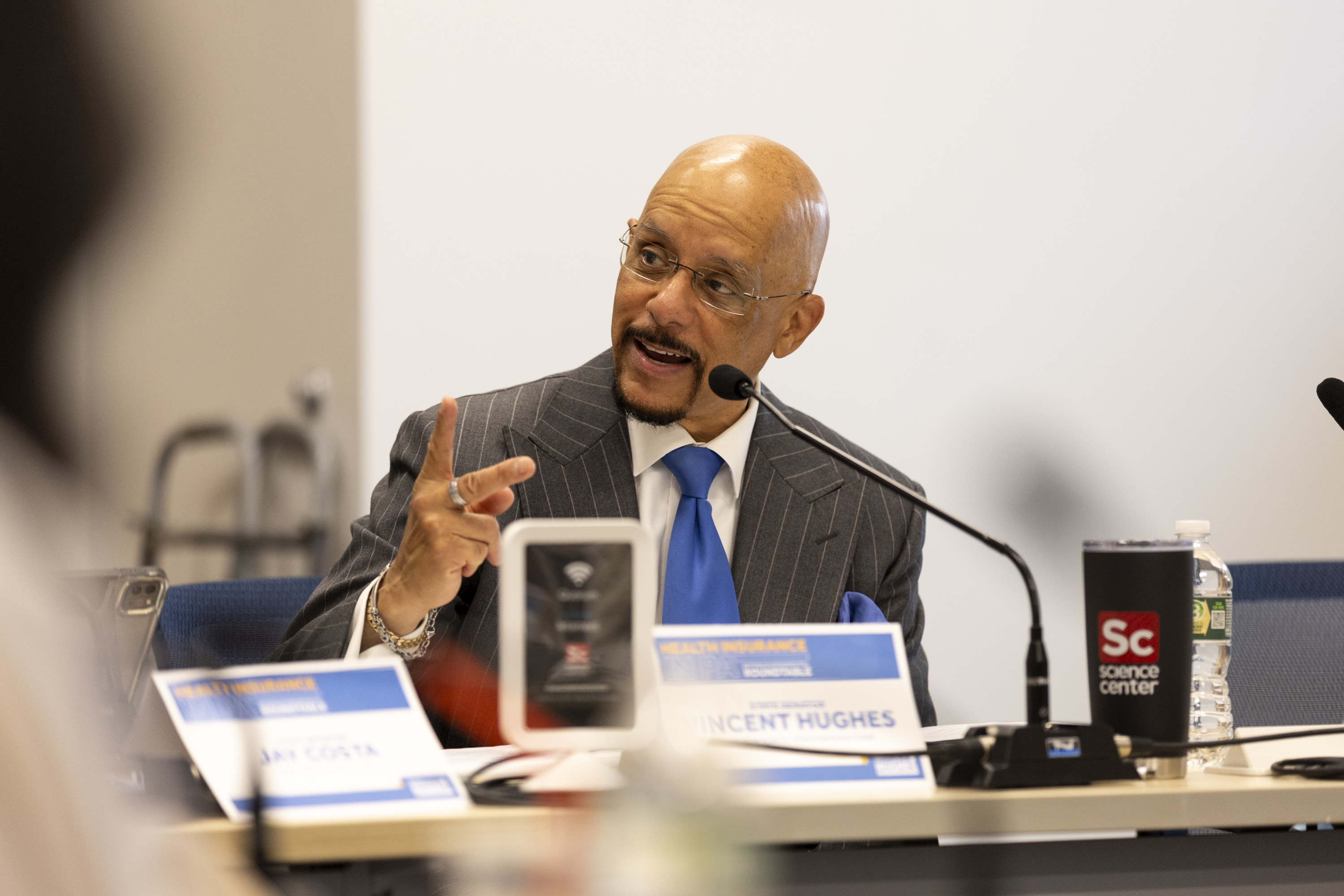
“They thumbed their noses and they said, ‘Go to heck,’” State Sen. Vincent Hughes (D., Philadelphia), the minority chair of the Senate Appropriations Committee, said of his GOP colleagues’ response to the House bill ahead of Tuesday’s vote.
Senator Vincent Hughes, speaks at the Round table with Pennsylvania lawmakers, stakeholders, health systems to discuss potential cuts to Medicaid and ACA at the University City Science Center in Philadelphia, Pa., on Tuesday, April 22, 2025.
Shapiro, following a news conference in Allegheny County on Tuesday, voiced a similar sentiment when he told reporters the Senate’s proposal was “a joke” and “not designed to be serious or get the job done.” He again urged top GOP Senate leaders to begin meeting with top House Democrats to finalize a budget deal.
“I’m sorry transit didn’t get funded. But just because your top priority didn’t get addressed doesn’t mean that our priorities are no longer relevant, and that’s a hard truth,” Pittman,who has been critical of Pennsylvania’s mass transit systems and was a major roadblock in finalizing a deal, said Tuesday.
And, as evidenced by Tuesday’s vote, leaders still do not agree on how much Pennsylvania should spend for the current fiscal year, now almost in its fifth month. Pennsylvania is the only state in the nation without any spending plan. North Carolina, which passed a six-month budget in early summer, returned to session this week to finish budget negotiations.
Sen. John Fetterman (D., Pa.) said he would back a Republican plan to override the Senate filibuster if it meant passing a bill to reopen the government.
In an interview with The Inquirer on Tuesday, Fetterman admonished fellow Democrats who balk at the notion of using the so-called nuclear option to end the filibuster: “When I ran for Senate, everyone, including myself, said we’ve got to get rid of the filibuster. I don’t want to see any Democrats clutching their pearls about it now.
“If we’d had our way, the filibuster wouldn’t have been around for years.”
A staple of the Senate that has long been debated, the filibuster requires 60 votes to pass most legislation in the chamber.
Republicans have long vowed to protect the filibuster, noting that the 60-vote threshold presents a check on Democrats when they have the majority,but it’s now the rule standing in the way of their government funding bill. And in recent months, leaders have made moves to further weaken the minority party’s power, including bypassing the need to get Democratic support to confirm a slate of President Donald Trump’s nominees last month. Senate Majority Leader John Thune (R., S.D.) has thus far said he won’t use the same tactic to reopen the government.
Fetterman’s comments on Tuesday followed several Republicans floating the idea of getting rid of the filibuster in recent days.
Fetterman is one of three members of the Democratic caucus who voted with Republicans to reopen the government earlier this month, joining Sens. Catherine Cortez Masto of Nevada and Angus King, a Maine independent.
“If you look at my record, I’ve been voting the Democratic line, but this is different now. The tactic is wrong,” Fetterman said.
He said his main concern is the possibility that people in the state and across the country would face hunger if the federal government shutdown continues and Americans lose their Supplemental Nutrition Assistance Program (SNAP) benefits beginning Nov. 1.
“Nobody checks their political party when they’re hungry,” he said. “It’s not about a political side blinking. The only losers are the American people now.”
Fetterman added that he is in favor of extending tax credits, as Democrats are demanding during the shutdown. With those tax credits set to expire, people are going to start seeing higher prices when they sign up for health insurance come open enrollment in November, experts say.
“I don’t want people clobbered,” Fetterman said. “But Democrats designed them to expire this year. We passed these things when we were in the majority.”
Seeing room for dialogue, Fetterman said Thune “is an honorable man, and I believe a productive conversation to extend tax credits can be had with him.”
Sen. Andy Kim (D., N.J.) said he had multiple conversations with Senate Republicans on Tuesday who said they would “adamantly oppose” ending the filibuster.
“That’s been a huge part of how they’ve been able to lock down power here in D.C. before,” Kim said.
He said from his perspective, Senate Democrats are focused on getting the House back to work to negotiate a deal that includes the extended healthcare subsidies in a government funding bill.
“This is not an issue of Senate procedure. This is an issue of just doing our job.” Kim did not comment on Fetterman’s support for a filibuster carveout to end the shutdown.
In 2022, according to the media and politics site Mediaite, every Senate Democrat with the exceptions of then-Sens. Joe Manchin of West Virginia and Kyrsten Sinema of Arizona voted to eliminate the filibuster in a failed effort to pass former President Joe Biden’s elections overhaul.
A sometimes contrary figure, Fetterman has taken controversial stands in the past and is one of few Democrats who actively works with Republicans.
He has been criticized by progressives for his unwavering support of Israel in its war against Hamas.
And Fetterman garnered the enmity of some Democrats (and the praise of President Donald Trump) when he defended Immigration and Customs Enforcement by saying fellow Democrats’ calls to abolish the agency were “inappropriate and outrageous.”