Category: Residential Real Estate

  • Preserving older properties drives housing affordability, population growth, and investment, says study by historic preservation group

    Preserving older properties drives housing affordability, population growth, and investment, says study by historic preservation group

    For years, the Preservation Alliance for Greater Philadelphia has heard the same arguments: Preservation is a barrier to development. It reduces density. It restricts the housing supply.

    “And we knew in our gut that that wasn’t true, but we didn’t have the data to support it,” said Paul Steinke, executive director of the Preservation Alliance, which works to protect historic properties from demolition. “Now, we do.”

    The Preservation Alliance commissioned its most comprehensive analysis of how historic preservation affects the city’s economy and housing. The report, released Wednesday, found that preservation of Philadelphia’s older properties protects housing affordability, drives investment, preserves housing density, and supports population growth.

    In Philadelphia, $4 billion has been invested in historic rehabilitation projects, which have created thousands of jobs each year.

    Steinke said the Preservation Alliance commissioned this study now because of current debates about Philadelphia’s growth and affordability, the need to increase the housing supply, and development policy as Mayor Cherelle L. Parker rolls out her Housing Opportunities Made Easy, or H.O.M.E., initiative to build or preserve 30,000 homes.

    “We wanted to develop some data to demonstrate preservation’s role in those conversations,” said Steinke, who is on the H.O.M.E. advisory committee. “And the reality is the data show that historic preservation is a powerful engine … for investment, jobs, affordability, and inclusive growth.”

    The study was completed by PlaceEconomics, a Washington-based firm that analyzes the economic impacts of historic preservation in cities across the country. The purpose of the analysis in Philadelphia was to understand the economics of the preservation of older properties in general and not only those properties that are historically designated, Steinke said.

    Preservation debates

    Historic designation is a divisive topic, and preservationists have found themselves clashing not only with developers who want to demolish properties but also with homeowners and pro-housing groups.

    Historic designation shields properties from demolition and means owners have some restrictions on what they can do to the outside of their properties. Decisions about doors and windows, for example, are subject to the scrutiny of preservation officials. And owners who fight the designation of their properties argue that regulations can be a burden.

    Residents have challenged in court three historic districts that Philadelphia recently created — the most significant pushback against the city’s preservation ordinance in 15 years.

    In response to the Preservation Alliance’s study, 5th Square, a Philadelphia-based urbanist political action committee, said it supports efforts to rehabilitate older buildings and that “Philadelphia’s dense, historic neighborhoods are a beloved feature of the city.”

    “However, we remain concerned about the proliferation of historical preservation districts across the city,” Brennan Maragh, cochair of the group’s housing committee, said in an emailed statement. “These districts … impose real costs on families, small businesses, and owners attempting to maintain or improve their properties.”

    Almost 5% of Philadelphia is historically designated

    Almost 5% of the city’s land area is a historic district or is property individually designated as historic outside of historic districts, the study found.

    The share of properties historically designated by the city has increased from 2.2% to 4.4% since 2016, when the city started ramping up its historic designations. Philadelphia has caught up with other large cities.

    In 2023, about 56,000 residents lived in a local historic district.

    Tax credits have created jobs and revenue

    Between 2010 and 2024, 295 projects that used state and/or federal historic preservation tax credits were completed in Philadelphia, according to the study. This ranks Philadelphia first in the nation.

    Projects that use historic tax credits have created an average of 1,777 direct jobs and 729 indirect jobs each year in Philadelphia over the last 15 years. Each year, they have created an average of about $95 million in direct income and about $47 million in indirect income.

    If historic rehabilitation were a single industry, it would be the city’s 25th-largest employer.

    Historic tax credit activity also has generated about $8 million in local tax revenue.

    Older homes are more affordable

    Two-thirds of Philadelphia’s residential buildings and half of the city’s housing units were built before 1950, according to the study. This older housing tends to be smaller in size and lower in cost.

    So preserving older homes helps preserve housing affordability. The study did not consider the historic designation status of these homes.

    “While it is true that Philadelphia’s older housing stock remains affordable compared to new construction,” said Maragh at 5th Square, “historic preservation districts can also have the unintended consequences of excluding low-income residents from large parts of the city, raising lifetime housing costs on owners and creating unnecessary regulations that slow down the process of adaptive reuse.”

    The study found that the city’s historic districts have higher shares of high-income households and lower shares of low-income households compared to the rest of the city.

    Outsize population growth in historic districts

    Donovan Rypkema, principal and CEO at PlaceEconomics, said a “myth” of historic preservation is if “you create those historic districts, you just set neighborhoods in amber and nothing can ever change.”

    The firm’s study found that population growth in historic districts outpaced growth in the rest of the city.

    In historic districts created before 2010 — so before the recent push for more districts and ones that are more geographically and racially inclusive — the population grew by about 27% between 2010 and 2020. Over the same time, the rest of the city’s population grew by less than 5%.

    More than 79% of the homes in historic districts are in buildings with two or more units, compared to 32% in the rest of Philadelphia. Historic districts also offer a wider range of housing types.

    The densest areas of the city are in historic districts, according to the study. There are 10,000 more people per square mile in historic districts than in the rest of the city’s residential areas.

    These statistics speak to the “inherent attractiveness” of historic districts and also that “they can accommodate that growth,” Rypkema said.

  • Mayor Parker shakes up the Philadelphia Land Bank board to try to further her housing plan

    Mayor Parker shakes up the Philadelphia Land Bank board to try to further her housing plan

    Mayor Cherelle L. Parker is shaking up the board of the Philadelphia Land Bank, which helps control the sale of city-owned land but hasn’t been moving fast enough to advance her housing priorities.

    Parker’s first land bank board chair, Herb Wetzel, has been asked to step down as well as board member Majeedah Rashid, who leads the Nicetown Community Development Corp. The board has 13 members.

    Angela D. Brooks, who serves as the city’s chief housing officer, will be joining the board. Earlier this year Parker appointed Brooks to lead the mayor’s campaign, Housing Opportunities Made Easy, or H.O.M.E., to build or renovate 30,000 houses over the course of her administration.

    The mayor has long championed the Turn the Key program as part of that plan, a policy that depends on getting inexpensive city-owned land to developers so they can build houses that are affordable to working and middle-class families.

    Rashid is being replaced by Alexander Balloon, who formerly served on the Land Bank’s board and is the executive director of the Passyunk Avenue Revitalization Corp.

    “It is clear from the Land Bank’s success with its Turn The Key program: A strong and effective Land Bank is essential for reaching the H.O.M.E. initiative’s goal to produce and preserve 30,000 homes,” Parker said in a statement.

    Several Turn the Key proposals have been held up by the Land Bank board, which has been riven between factions that are either more or less friendly to private-sector developers.

    Rashid and other board members who come from a nonprofit development background have argued that scarce city-owned land should be earmarked for affordable housing, community gardens, and similar projects.

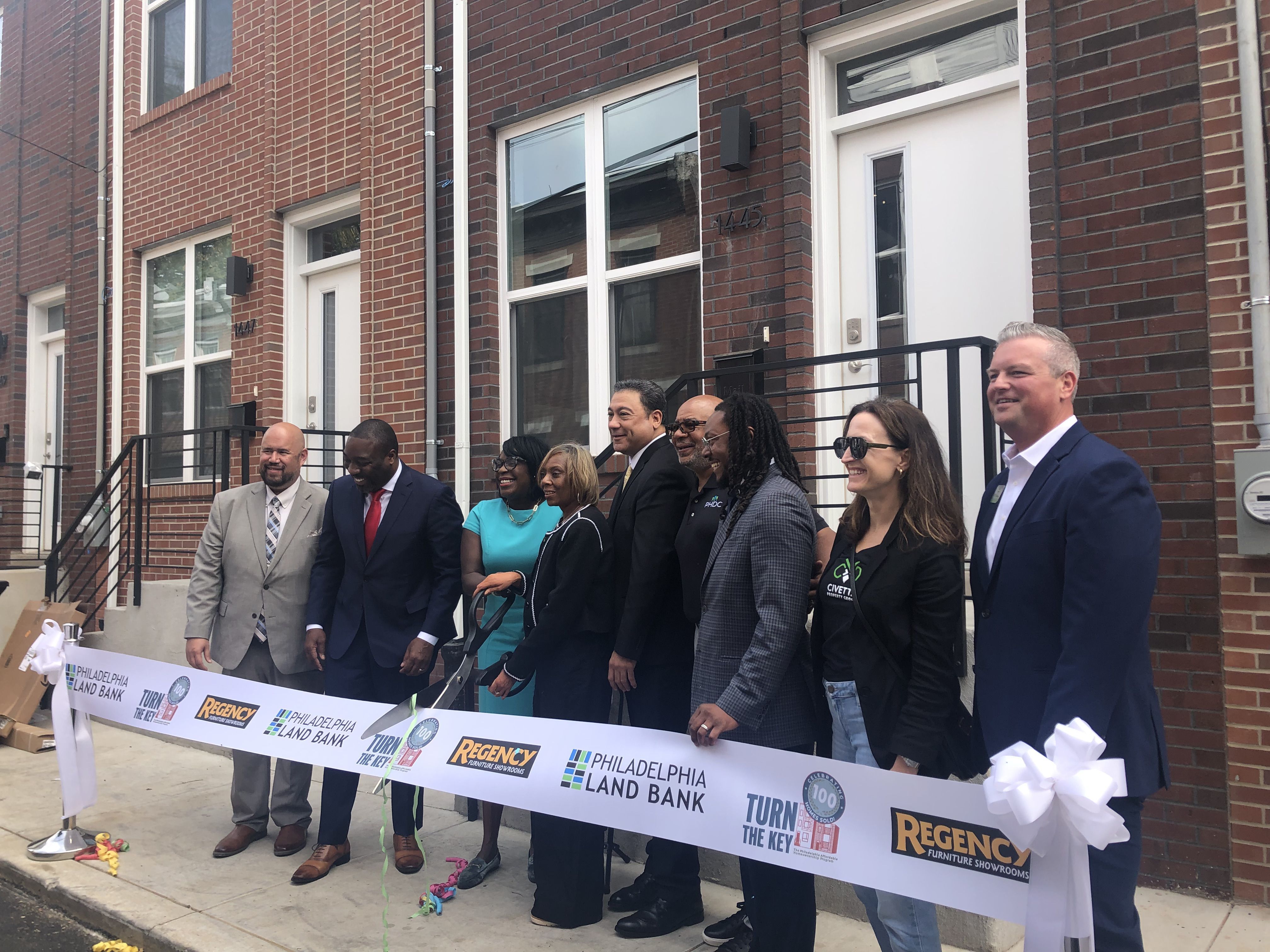
    Mayor Cherelle L. Parker and Turn the Key’s 100th homebuyer hold giant scissors as they prepare to cut a ceremonial ribbon.

    Although the Turn the Key program produces units that are more affordable than market-rate homes, many of the projects are built by private-sector developers and still unaffordable to Philadelphians with low incomes.

    “Majeedah Rashid has worked with me on economic development issues dating to my time in the Pennsylvania General Assembly, and her advice has been invaluable,” Parker said in a statement. “Our city is stronger for Herb’s and Majeedah’s public service.”

    Rashid did not respond to a request for comment.

    During Balloon’s previous tenure on the board, he was among members who pushed for vacant city-owned land to be put back into productive use as quickly as possible because empty lots attract crime and litter and are a drag on city services.

    Private-sector developers often can build more — and faster — than their nonprofit counterparts because they are less reliant on public funds, which are increasingly unreliable from the federal level.

    “I’m excited to rejoin the Philadelphia Land Bank and help Mayor Parker deliver on her bold vision to build and preserve 30,000 homes across our city,” Balloon said in an email statement. “This is an inspiring moment for Philadelphia’s growth and the success of the Turn the Key program and other initiatives.”

    Wetzel’s role as Land Board chair was the latest in a long tenure of municipal housing policy positions, including his lengthy service as a close aide to former Council President Darrell L. Clarke, who created the Turn the Key program and was one of its most enthusiastic proponents.

    “Herb Wetzel has been a subject matter expert for me on any housing issue that I’ve worked on throughout my career as an elected official, and I have always relied on his counsel,” Parker said in a statement. “He will continue to be part of my circle of advisers on housing issues, just in a different capacity.”

    But according to three City Hall sources, who did not have permission to speak to the media, Parker’s team felt Wetzel sought to play peacemaker between the factions and was not always able to get their favored Turn the Key projects moving. As a recent arrival to the city and leader of the administration’s housing initiative, Brooks is expected to pursue the mayor’s priorities.

    Brooks said in an interview that her appointment was no reflection on Wetzel’s performance and that he would continue to serve on the H.O.M.E. advisory board.

    “I don’t have any thoughts on what he didn’t do or didn’t other than he’s been a great supporter of both the mayor and me and this housing plan,” Brooks said. “He’ll continue to be a part of that as we move it forward. [It’s just that] historically, we have had a city staff person to sit on the Land Bank board, and since I’m spearheading the H.O.M.E. Initiative, it seemed to be time.”

    Frequent stalemates on the board were not the only challenge facing Turn the Key projects. Under the tradition of so-called councilmanic prerogative, the Land Bank requires action from City Council to release property for development even if the mayor backs a particular proposal.

    For example, the administration sent over a 50-unit Turn the Key proposal in North Philadelphia to City Council last November, and District Councilmember Jeffery Young simply never introduced it, effectively killing the deal.

    Or in Kensington, Councilmember Quetcy Lozada declined to endorse several Turn the Key proposals, leading developers to abandon them.

    Parker sought to loosen Council’s grip on some city-owned land during budget negotiations earlier this year, but the campaign was largely unsuccessful. National land bank experts have long argued that land banks like Philadelphia’s are much less effective than counterparts that do not have political veto checkpoints.

    During budget hearings this year, Council asked for an organization assessment of the Land Bank, and some members questioned why its staff wasn’t more robust.

    Brooks said that an assessment will be released soon from the consultant group Guidehouse and that the Land Bank “is in the process of filling positions.”

  • North Broad garage will be redeveloped into 99 apartments and a large restaurant

    North Broad garage will be redeveloped into 99 apartments and a large restaurant

    An antiquated industrial building at 142-144 N. Broad St. is being converted to 99 apartments and over 4,000 square feet in restaurant space.

    The seven-story building previously served as a car showroom with vehicle elevators and a factory. It has been empty for years.

    “It’s gone through a couple of owners,” said Carolina Pena, principal at Parallel Architecture Studio, which is working on the project. “We’re doing an interior renovation. There are no additions proposed. We’re trying to retrofit the existing garage into apartments.”

    The building’s previous owner, John Wei, has been selling off property across the Callowhill area in recent years in the face of mounting financial difficulties. He purchased 142-144 N. Broad in 2022 for $7 million.

    The property sold in August for $6.2 million to a company called Penn Hall Investment LLC.

    In zoning applications filed with the city earlier this month, the owners are listed as Qiaozhen Huang and Yizhou Li with their business address as 300 E. Allegheny Ave. in Kensington.

    Philadelphia-based Parallel Architecture Studio, which is designing the project for the latest developers, also served as the architect for an earlier iteration of the property, when Wei sought to use it to house a 115-room hotel.

    Pre-pandemic permits show a proposal for an even larger hotel from another developer and architect.

    “It’s more stable financially this way,” said Pena, of Parallel Architecture. “It’s harder to get financing for hotels than to get financing for apartments.”

    Pena projects a construction timeline of 18 to 24 months. The apartments will be designed for single-person households.

    “We have some studios, some one-bedrooms,” Pena said. “They’ll be around 600 square feet.”

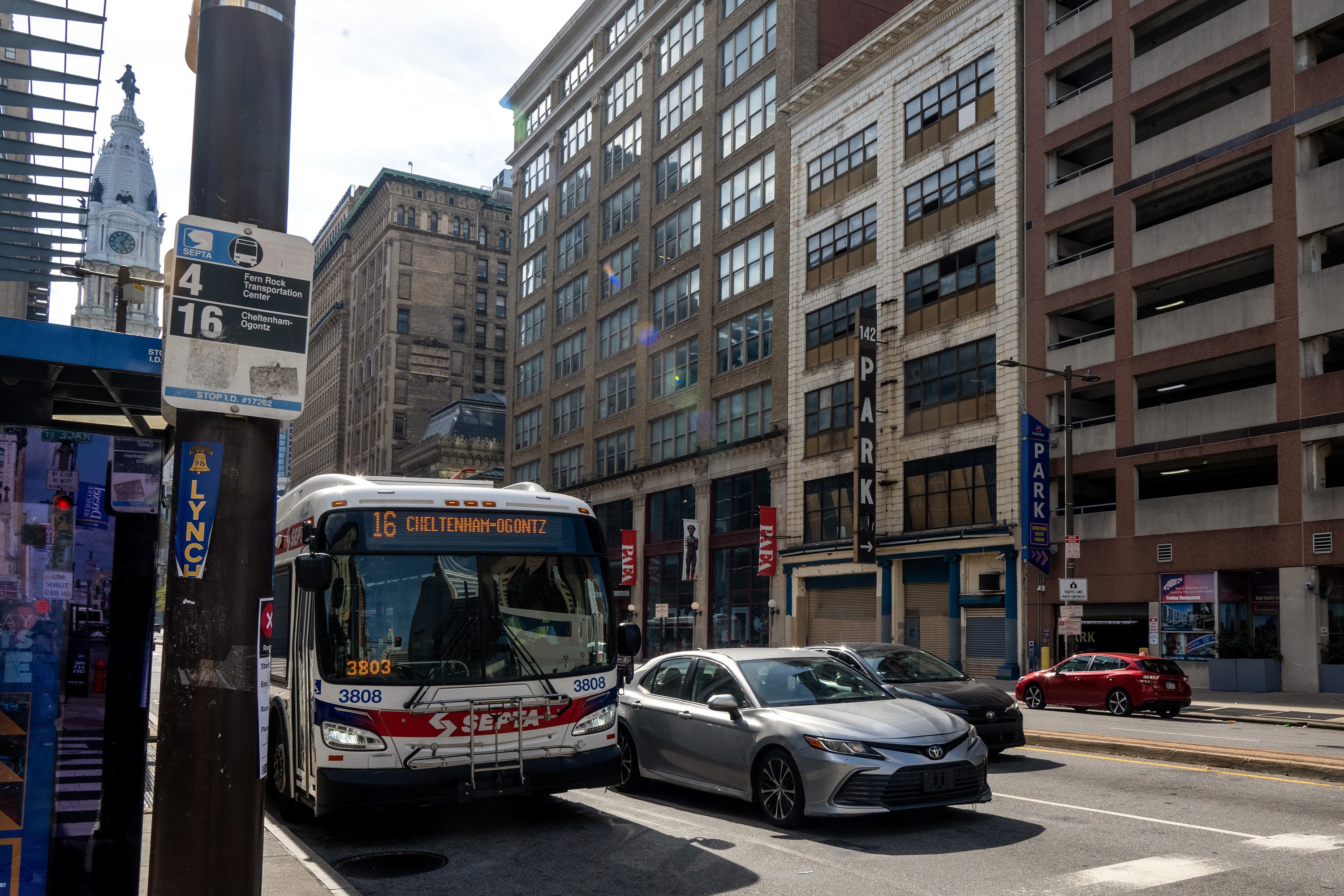
    A view of 142-44 N. Broad St. (black PARK sign). Zoning permits have been pulled for a conversion of the long-vacant tower to residential and restaurant use.

    The current Penn Hall project does not require any action from the zoning board because 142 N. Broad St. is in the most flexible zoning district in the city.

    Bicycle parking and four automobile spaces will be available in the tower’s existing small underground parking facility.

    In 2017, the city issued an “unsafe structure” violation for the building, but the owners at the time shored it up. No violation of that magnitude has been issued since.

    The development along North Broad Street has been advancing at a slow but steady pace since the Great Recession.

    Philadelphia developer Eric Blumenfeld’s string of popular projects along the thoroughfare, including The Met and the Divine Lorraine, started the redevelopment trend.

    Other developers such as Alterra Property Group have added hundreds of new apartments to the area, and the Philadelphia Ballet’s new building is opening soon. Closer to City Hall at the shuttered Hahnemann University Hospital, Dwight City Group plans 288 apartments.

  • Apartment tower planned for Columbus Boulevard could be the first of three

    Apartment tower planned for Columbus Boulevard could be the first of three

    New York’s Brevet Capital Management revealed its vision for 1341 S. Christopher Columbus Blvd. to the Pennsport Civic Association on Wednesday night, showing a soaring tower on Delaware River with 620 units and promising a dramatic revision of public space in the area.

    In addition to the tower and small retail building just to its west, the developer’s representatives outlined possible future phases that could include two additional towers.

    “The retail building is constructed as a placeholder,” Meredith Trego, a zoning lawyer with Ballard Spahr, said at the Pennsport Civic Association meeting. “But the idea is in a future phase that a one-story building would go away, and a new tower could go in its place.”

    The towering project, with its limited parking, is legally possible due to the unique zoning incentives available along the central Delaware riverfront.

    In exchange for building as high as they want, the developers must meet a variety of requirements including paying into the city’s housing trust fund, providing public space, and upgrading, maintaining, and extending a rundown stretch of the Delaware River Trail down to Reed Street.

    The first tower would be more than 380 feet tall, and renderings show possible future towers that would be even taller. To be allowed to build that high for future buildings, the developer would have to meet the city’s exacting requirements again, including by paying more into the housing trust fund (and they could not encroach on trail space).

    Conditions on the pedestrian- and bike-friendly river trail have deteriorated below Washington Avenue. The infrastructure has not been maintained to the level it is farther north.

    An encampment of homeless people has settled along this portion of the trail, although its residents have been moved around several times in sweeps orchestrated by the city, Delaware River Waterfront Corp., and property owners.

    Another sweep is planned for Tuesday, the developer’s representatives said at the Pennsport meeting, and additional signage and fencing are planned to limit access to the property.

    But currently the encampment is largely along the public access bike and pedestrian trail itself, not private property.

    “Everyone knows that’s only going to last so long until we get density back there, people [will probably be] living back there,” said Matt McClure, a zoning lawyer representing Brevet. “That’s why we need an active use.”

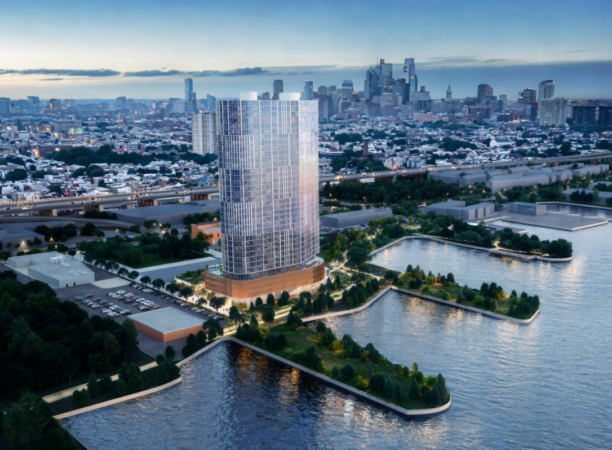
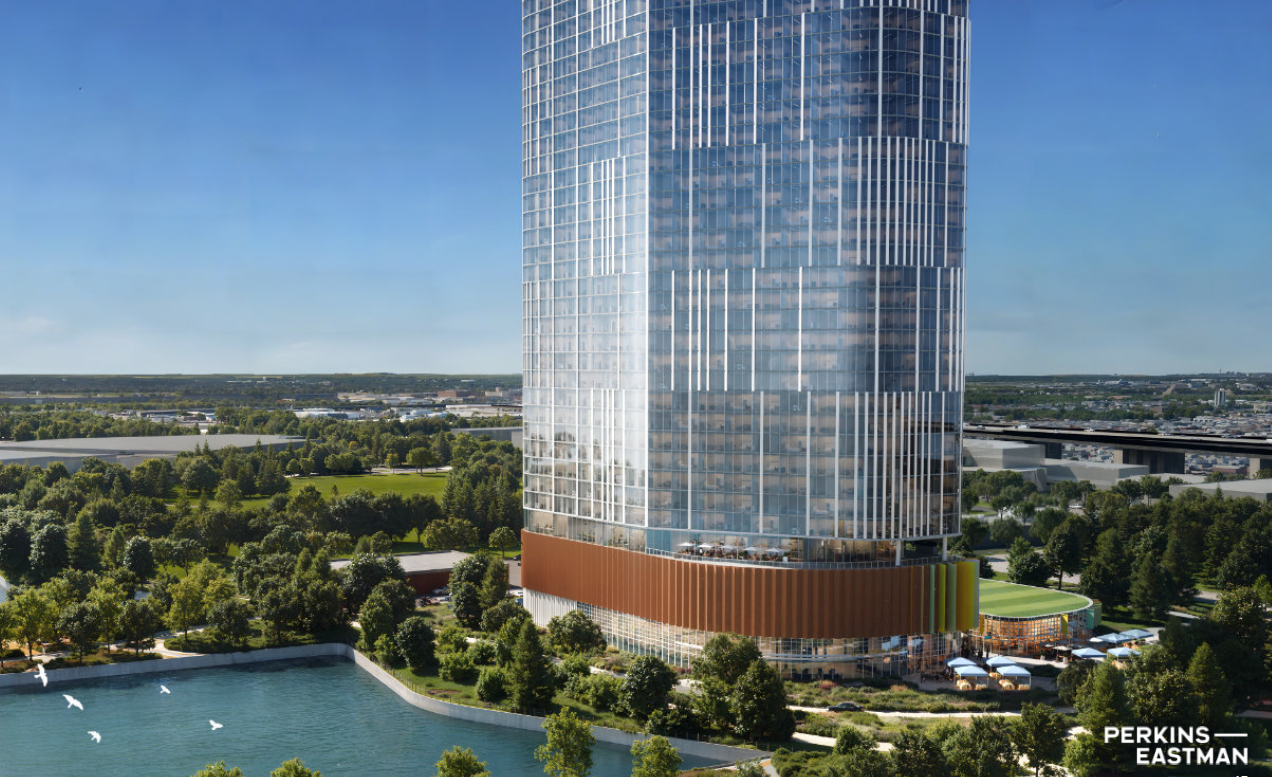
    A rendering of the proposed tower discussed at the Pennsport Civic Association meeting Wednesday night.

    Brevet’s team said they would provide additional public space with the initial tower, including on disused piers that jut into the river. Currently they do not plan to build structures on the piers but turn them into publicly accessible green space.

    Residents also asked that the developer address traffic conditions on Columbus Boulevard, which is a high-speed roadway that is unsafe for pedestrians.

    “Big projects generate focus on improvements,” McClure said. “Hopefully it generates dialogue on making things better” on the boulevard.

    The biggest applause of the night came when an attendee urged the developer to add more parking than the 187 spaces currently proposed within the tower. Another 100 spaces are available in an existing surface lot, although that is also the site for a possible third future residential tower.

    The developer’s representatives tempered hopes for a greater share of parking in future development, while not ruling it out.

    “So for future phases, if there’s a need for additional parking, we could incorporate that,” Trego said. Based on what they’re seeing in developments throughout the city, she added, garages are not as full as expected.

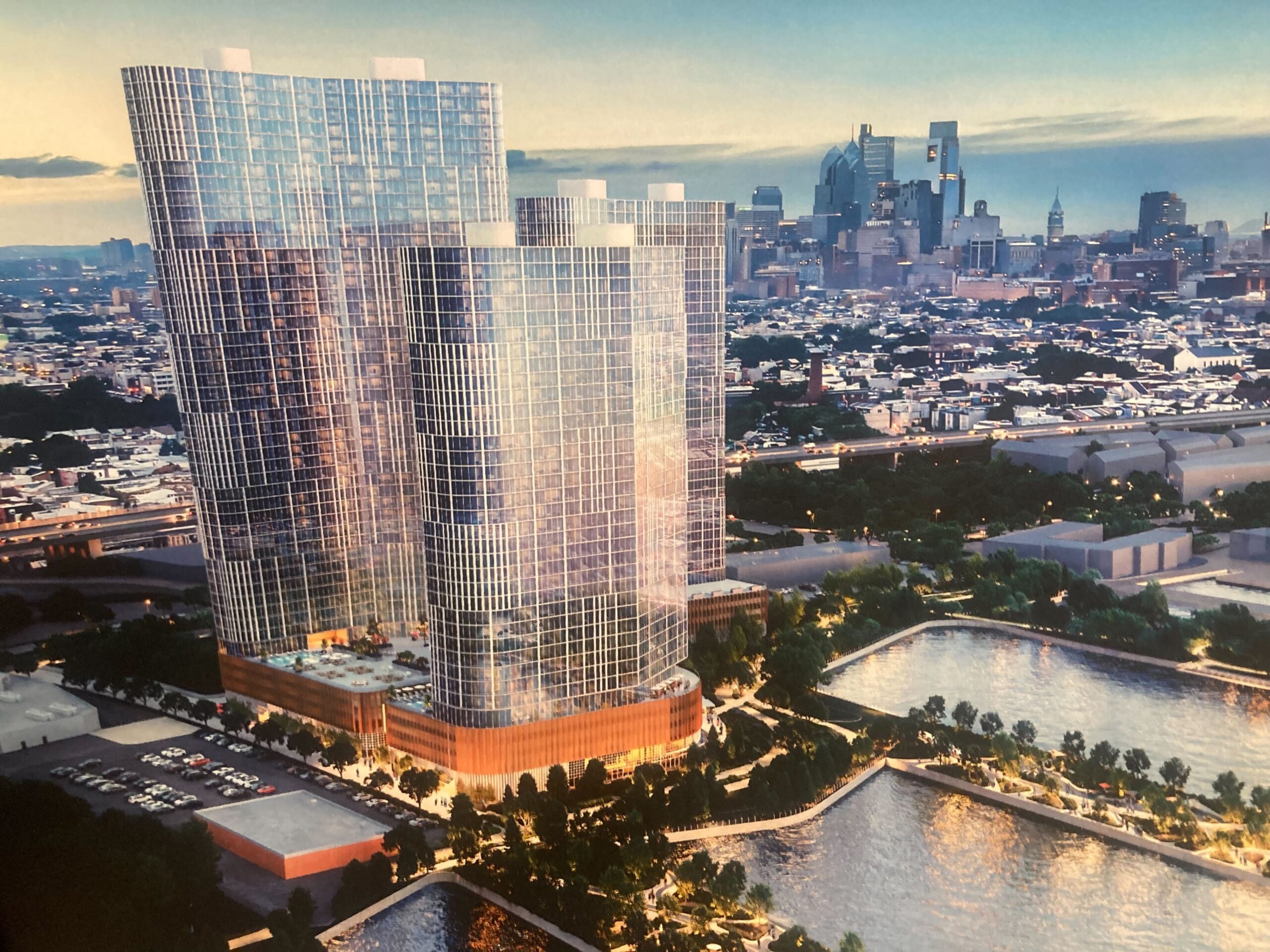
    A rendering of the highly theoretical future two towers the developer has discussed as a possibility for the site.

    Plans for the first tower have mostly smaller units — 50% one-bedroom units and 35% studios — but the developer said that could change.

    “As we study this further, if there is desire for larger units, we can always make room for that,” said Milton Lau, a project architect with the firm Perkins Eastman.

    Brevet expects to begin building in summer 2026, with an 18- to 24-month construction timeline for the first tower.

    This is Brevet’s first real estate project in Philadelphia, although the company has built other developments in Florida, Texas, and California.

  • New York developer plans 620 apartments on Columbus Boulevard and an extension of Delaware River Trail

    New York developer plans 620 apartments on Columbus Boulevard and an extension of Delaware River Trail

    A New York developer is planning a 620-apartment development at 1341 S. Christopher Columbus Blvd. in South Philadelphia.

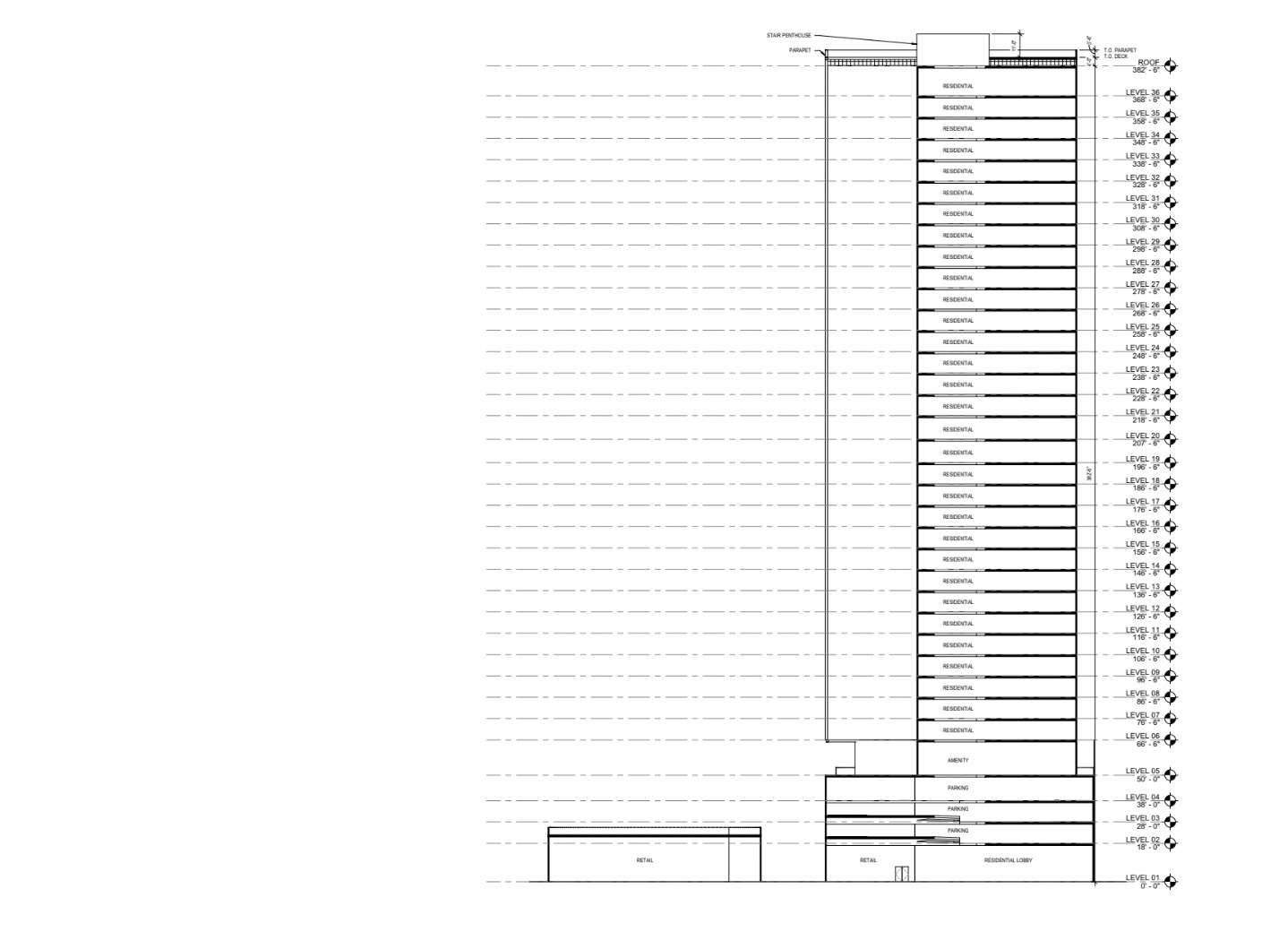
    The 36-story project from Manhattan-based Brevet Capital Management makes use of multiple zoning bonuses to allow a taller, denser project than would otherwise be legal.

    In exchange for those development benefits, the developer will pay into Philadelphia’s Housing Trust Fund and upgrade and maintain the Delaware River Trail below Washington Avenue, where its conditions currently get much rougher.

    The zoning was changed before the pandemic to allow developers to build taller in exchange for extending the trail, but Brevet would be the first to do so.

    “To me the most exciting aspect of this project is that they will be paying for and constructing the waterfront trail along their property,” said Matt Ruben, chair of the Central Delaware Advocacy Group, which has long pushed for responsible development on the riverfront.

    “That’s one of the most important and consequential public benefits a developer can provide” in this area, said Ruben, who has not seen renderings of the buildings.

    Jack O’Brien, who posts in JackPhillyRE’s Substack, first reported the latest project for this parcel in advance of a Wednesday night meeting with the developers before the Pennsport Civic Association. The permit with Brevet executives listed as owners was pulled on July 3 of this year.

    “We are pleased to see the first major investment in Pennsport’s historically underutilized waterfront,” said Patrick Fitzmaurice, president of the Pennsport Civic Association. “We look forward to neighbors safely enjoying the waterfront with the proposed retail and recreational plans.

    The project is designed by the international architecture firm Perkins Eastman, with its Philadelphia office listed, and is called Wharton Piers in plans filed with the city. The developer is represented by Matt McClure and Meredith Trego of the law firm Ballard Spahr.

    Although no parking is required, the developer is providing 187 parking spaces on floors two to four of the housing tower. Over 10,000 square feet of commercial and office space will be on the ground floor, with amenity space on level five.

    A small, neighboring one-story building will include 20,650 square feet of retail space.

    A screenshot from plans filed with the city shows how the housing tower proposed on the right dwarfs the small retail building proposed on the left.

    Previous proposals for the property

    The property at 1341 S. Christopher Columbus Blvd. has had multiple development proposals over the years. Most recently, in 2023, New York-based Silverstein Properties proposed 612 apartments and 500 parking spaces across two towers.

    Before the pandemic, it was the site of a 2,000-unit project that would have spanned 10 buildings. That plan, from Maryland-based developer Jeffery Kozero called Liberty on the River, drew widespread skepticism and went nowhere.

    Kozero’s company at that time, K4 Associates LLC, is still listed as the permit holder. His proposal was met by backlash from the Central Delaware Advocacy Group and other neighborhood organizations.

    They felt that the developer was taking advantage of zoning incentives put in place during former Mayor Michael Nutter’s administration. The overlay along the Delaware was meant to encourage smaller developments on the waterfront — not the mega projects frequently proposed by big developers, including one involving President Donald Trump, who often failed to follow through.

    K4 “tried to warp the entire overlay to allow the construction of 10 huge towers that many of us knew would never get built,” Ruben said.

    Following the backlash, City Council changed the zoning overlay covering the waterfront in part by allowing developers to build taller in exchange for growing and maintaining the bike path, part of a larger plan.

    “It’s ironic that this [new proposal] is the first project that will make use of the new density bonus system,” said Ruben, given that the old K4 project on the same site is the reason the zoning incentive exists at all.

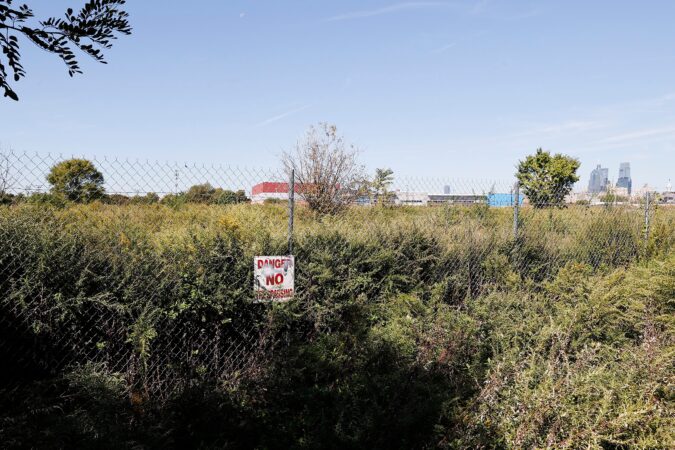
    Until recently, the vast vacant lot at 1341 S. Christopher Columbus had been used as an encampment by people who are homeless. Last December, The Inquirer reported that the property was being swept, with the tents and residents removed, at the behest of the property owners.

    Today, an established encampment instead lines much of the bike and pedestrian trail below Washington Avenue.

    This story has been corrected to make clear that the river bike trail does extend below Washington Avenue and that the developer promises to upgrade and maintain that part of the path.